DIVISION TRAINING-WRITESHOP
ON THE DEVELOPMENT
OF FORMATIVE ASSESSMENT
RESOURCE PACKAGE IN ENGLISH
October 12-14, 2023
SDO-ISABELA’S
virtual library hub
CONTENT GUIDE
tinyurl.com/DivisionReadingVirtualLibrary
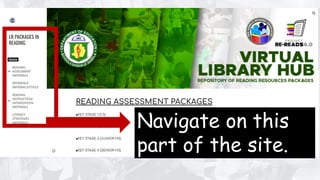
Navigate on this
part of the site.
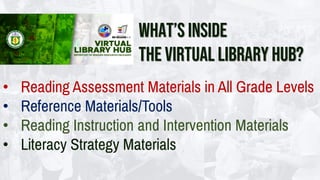
What’s inside
the virtual library hub?
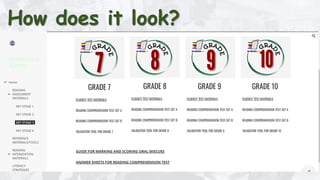
• Reading Assessment Materials in All Grade Levels
• Reference Materials/Tools
• Reading Instruction and Intervention Materials
• Literacy Strategy Materials
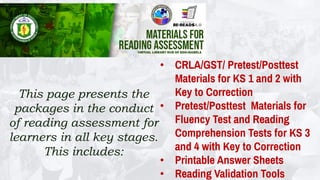
This page presents the
packages in the conduct
of reading assessment for
learners in all key stages.
This includes:
• CRLA/GST/ Pretest/Posttest
Materials for KS 1 and 2 with
Key to Correction
• Pretest/Posttest Materials for
Fluency Test and Reading
Comprehension Tests for KS 3
and 4 with Key to Correction
• Printable Answer Sheets
• Reading Validation Tools
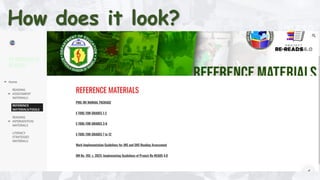
How does it look?
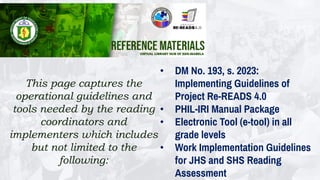
This page captures the
operational guidelines and
tools needed by the reading
coordinators and
implementers which includes
but not limited to the
following:
• DM No. 193, s. 2023:
Implementing Guidelines of
Project Re-READS 4.0
• PHIL-IRI Manual Package
• Electronic Tool (e-tool) in all
grade levels
• Work Implementation Guidelines
for JHS and SHS Reading
Assessment
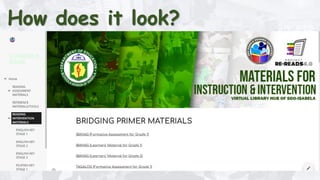
How does it look?
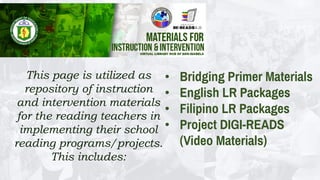
This page is utilized as
repository of instruction
and intervention materials
for the reading teachers in
implementing their school
reading programs/projects.
This includes:
• Bridging Primer Materials
• English LR Packages
• Filipino LR Packages
• Project DIGI-READS
(Video Materials)
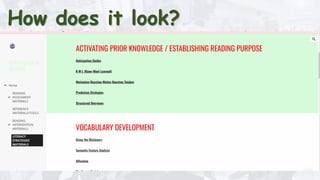
How does it look?
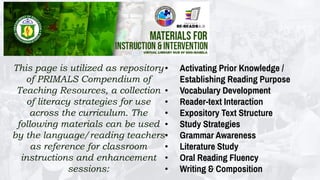
This page is utilized as repository
of PRIMALS Compendium of
Teaching Resources, a collection
of literacy strategies for use
across the curriculum. The
following materials can be used
by the language/reading teachers
as reference for classroom
instructions and enhancement
sessions:
• Activating Prior Knowledge /
Establishing Reading Purpose
• Vocabulary Development
• Reader-text Interaction
• Expository Text Structure
• Study Strategies
• Grammar Awareness
• Literature Study
• Oral Reading Fluency
• Writing & Composition
How does it look?
IMPLEMENTING GUIDELINES
IN THE ADMINISTRATION
OF CONTEXTUALIZED READING
ASSESSMENT
FOR JUNIOR AND SENIOR HIGH SCHOOL
A. Fluency Test
Decoding and fluency tests are used to
determine the fluency skills in each fluency
component –accuracy, automaticity, and in word,
phrase, and sentence level prosody. This test will
use a linear text which can be academic/literary.
A. Fluency Test
Each set consisted of four grade - level
passages which were taken from varied sources
– literature books, novels, magazines,
newspapers, and Internet articles.
Each passage contains 250 to 350 words as
suggested by Samuels (2006).
A. Fluency Test
Each set consisted of four grade - level
passages which were taken from varied sources
– literature books, novels, magazines,
newspapers, and Internet articles.
Each passage contains 250 to 350 words as
suggested by Samuels (2006).
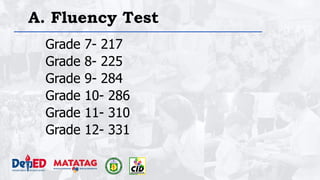
A. Fluency Test
Grade 7- 217
Grade 8- 225
Grade 9- 284
Grade 10- 286
Grade 11- 310
Grade 12- 331
B. Reading Comprehension
The comprehension tests aimed to measure the
students’ comprehension skills at the literal,
inferential, and critical levels in reading. Two passages
will be used with 10-item linear text and 10-item
non-linear text. Each of the 10-item passage has
questions distributed as follows: two literal level
items; four inference/interpretation level items; and
four knowledge construction level items.
B. Reading Comprehension
Reading Passages underwent
Readability Tests to determine the
text complexity.
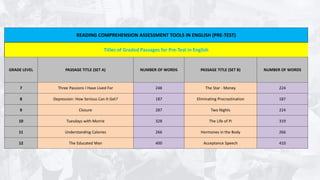
READING COMPREHENSION ASSESSMENT TOOLS IN ENGLISH (PRE-TEST)
Titles of Graded Passages for Pre-Test in English
GRADE LEVEL PASSAGE TITLE (SET A) NUMBER OF WORDS PASSAGE TITLE (SET B) NUMBER OF WORDS
7 Three Passions I Have Lived For 248 The Star - Money 224
8 Depression: How Serious Can It Get? 187 Eliminating Procrastination 187
9 Closure 287 Two Nights 224
10 Tuesdays with Morrie 328 The Life of Pi 319
11 Understanding Calories 266 Hormones in the Body 266
12 The Educated Man 400 Acceptance Speech 410
WORK IMPLEMENTATION GUIDELINES
IN THE ADMINISTRATION
OF CONTEXTUALIZED READING
ASSESSMENT
FOR JUNIOR AND SENIOR HIGH SCHOOL
1. With the supervision of the School Head,
the School Reading Coordinator and
School Testing Coordinator with the
Language and Reading Teachers shall
facilitate the conduct of the reading
assessment from October 2-13 while the
validation of the pretest results shall run
from October 16-27.
1. With the supervision of the School Head,
the School Reading Coordinator and
School Testing Coordinator with the
Language and Reading Teachers shall
facilitate the conduct of the reading
assessment from October 2-20 while the
validation of the pretest results shall run
from October 23-27.
2. All learners from Grades 7 to 12
shall undergo the reading assessment
in English to measure their reading
proficiency level. This shall serve as
basis for reading intervention and
inputs in the development for the
school reading program.
3. Each learner per grade level shall
use the contextualized reading
package to assess his/her fluency
skill with a text to be read orally.
While two passages with 20-item
questions will be answered silently to
test their reading comprehension
skill.
4. This activity must be conducted during
English period and/or during
Intervention/Remediation period. The
fluency test must run for two sessions
(depending on the number of learners per
class) while the reading comprehension
test must be conducted in one session
equivalent to one hour.
4. This activity must be conducted during
English period and/or during
Intervention/Remediation period. The
fluency test must run for two sessions
(depending on the number of learners per
class) while the reading comprehension
test must be conducted in one session
equivalent to one hour.
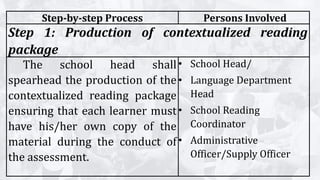
Step-by-step Process Persons Involved
Step 1: Production of contextualized reading
package
The school head shall
spearhead the production of the
contextualized reading package
ensuring that each learner must
have his/her own copy of the
material during the conduct of
the assessment.
• School Head/
• Language Department
Head
• School Reading
Coordinator
• Administrative
Officer/Supply Officer
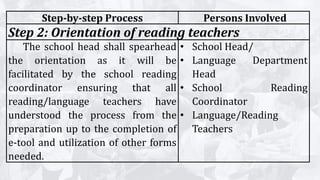
Step-by-step Process Persons Involved
Step 2: Orientation of reading teachers
The school head shall spearhead
the orientation as it will be
facilitated by the school reading
coordinator ensuring that all
reading/language teachers have
understood the process from the
preparation up to the completion of
e-tool and utilization of other forms
needed.
• School Head/
• Language Department
Head
• School Reading
Coordinator
• Language/Reading
Teachers
Step 3.1: Administration of reading assessment on
Fluency Test (One-on-one)
3.1.1. Prepare two copies of the fluency test
material, the teacher’s copy and the reader’s copy.
The learner will use the reader’s copy while the
teacher’s copy will be used for marking the miscues
and for profiling student’s performance in the
fluency test. Do not forget to write the name of the
student as well as his/her age and grade level.
Step 3.1: Administration of reading assessment on
Fluency Test (One-on-one)
3.1.2. Before asking the student to read aloud,
instruct him/her to
● sit properly and hold the copy properly;
● read using his/her normal voice and the normal
speed s/he uses whenever s/he reads; and
● begin reading when you tell him/her to begin
and stop when you ask him/her to stop.
Step 3.1: Administration of reading assessment on
Fluency Test (One-on-one)
3.1.3. Once the learner starts reading
orally, prepare the timer for one
minute. While the student is reading,
mark and record the oral reading
miscues using the teacher’s copy.
Step 3.1: Administration of reading assessment on
Fluency Test (One-on-one)
3.1.4. After a minute, release the
learner and instruct him/her to go
back to their class activity to lessen the
destruction for the next reader.
Step 3.2: Administration of reading assessment
on Reading Comprehension Test
After completing the fluency test, the
language/reading teacher must have a separate
schedule in the conduct of the reading
comprehension test. After setting the class, the
language/reading teacher shall do the
following:
Step 3.2: Administration of reading assessment on
Reading Comprehension Test
3.2.1. Ask the learners to arrange their chairs
with enough space between rows/columns. Inform
the class that there will be two sets of tests to avoid
copying answers from their seatmates. (Set A and
Set B). Orient the students that they will be
answering two text types with 10 questions for
each type.
Step 3.2: Administration of reading assessment on
Reading Comprehension Test
3.2.2. Once set, distribute the reading materials,
and answer sheets for Set A and Set B.
3.2.3. Give the learners sixty minutes to read and
answer the given passages (one linear and one non-
linear text.)
3.2.4. Collect the reading materials and the
answer sheets.
Step 4: Consolidation of pretest results
4.1. On the fluency test, the language/reading
teacher shall first summarize the result of the
fluency test. He/She shall complete the form where
summary of miscues and number of words read in a
minute are indicated.
Step 4: Consolidation of pretest results
4.2. On the reading comprehension
test, the language/reading teacher
shall check the individual scores of the
learners and attach the answer sheet
on the learner’s fluency test result.
Step 4: Consolidation of pretest results
4.3. After gathering the needed data, the
language/reading teacher shall input the scores in the
contextualized e-tool as it will be consolidated by the
School Reading Coordinator.
While the copies of the completed forms must be compiled in
one folder per class which shall also be submitted to the School
Reading Coordinator for ready reference during the validation
proper. This shall also serve as the record of the learner’s
individual reading performance.
Step 5: Validation of pretest results
5.1. Before the validation, the school reading
coordinator shall prepare the summarized reading results
which will be presented to the members of the District
Reading Committee. This result may be included but not
limited to the following:
a. Summary of Pretest Result per Class
b. Summary of Pretest Result per Grade Level
c. Overall Summary of the reading performance of the
learners per grade level using a graphical representation.
Step 5: Validation of pretest results
5.2. During the validation, the members of the District
Reading Committee shall randomly pick five (5) learners
who are under the independent level, five (5) learners
who are under the instructional level, and five (5)
learners who are under the frustration level from the
pretest result. A total of 15 learners shall undergo the
reading validation process per class.
Each learner shall undergo reading comprehension
tests with another set of reading materials.
Step 5: Validation of pretest results
5.3. After the validation process, the validators then
shall issue a certification indicating whether the students’
reading performances during the validation are parallel
with their performances during the conduct of the
pretest.
In case there are discrepancies observed, the
validators shall give a note in their monitoring tool and
provide technical assistance as to how it shall be
addressed by the school.
After the assessment, the school may
start implementing its planned reading
intervention/ remediation as reflected in
the approved School Reading Program. The
data from the reading assessment must be
properly analyzed and utilized in carrying
out the school’s reading programs, projects
and activities.
GUIDE IN THE USE OF E-TOOL
For FLuency
WPM (Word per Minute)
-Input the number of words read by the learner in one
(1) minute.
WCPM (Word Correct per Minute)
-To get this, deduct the total number of miscues to the
number of words read by the learner in one (1) minute.
Note: The e-tool will automatically generate and interpret all other data required to determine the learner’s reading level.
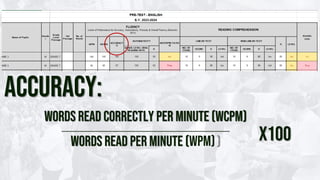
Accuracy:
Words read correctly per minute (wcpm)
Words read per minute (wpm) x100
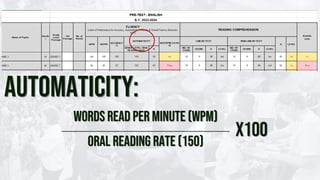
automaticity:
Words read per minute (wpm)
Oral Reading rate (150)
x100
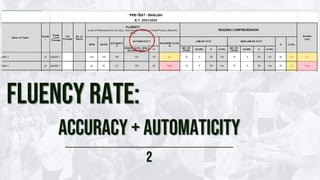
FLUENCY RATE:
ACCURACY + AUTOMATICITY
2
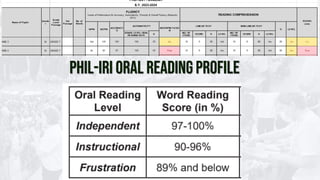
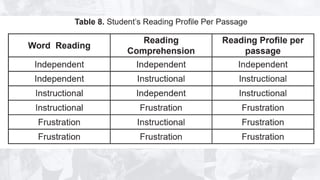
Phil-IRI ORAL READING PROFILE
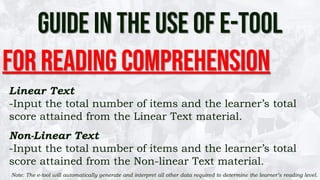
GUIDE IN THE USE OF E-TOOL
For READING COMPREHENSION
Linear Text
-Input the total number of items and the learner’s total
score attained from the Linear Text material.
Non-Linear Text
-Input the total number of items and the learner’s total
score attained from the Non-linear Text material.
Note: The e-tool will automatically generate and interpret all other data required to determine the learner’s reading level.
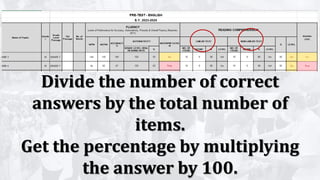
Divide the number of correct
answers by the total number of
items.
Get the percentage by multiplying
the answer by 100.
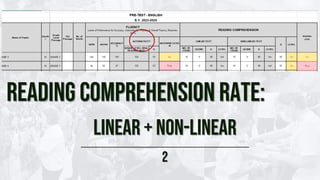
READING COMPREHENSION RATE:
LINEAR + NON-LINEAR
2
Certificate of Adoption

2023-Reading-Implementing-Guidelines.pdf

  • 1.
    DIVISION TRAINING-WRITESHOP ON THEDEVELOPMENT OF FORMATIVE ASSESSMENT RESOURCE PACKAGE IN ENGLISH October 12-14, 2023
  • 2.
  • 3.
  • 4.
  • 5.
    What’s inside the virtuallibrary hub? • Reading Assessment Materials in All Grade Levels • Reference Materials/Tools • Reading Instruction and Intervention Materials • Literacy Strategy Materials
  • 6.
    This page presentsthe packages in the conduct of reading assessment for learners in all key stages. This includes: • CRLA/GST/ Pretest/Posttest Materials for KS 1 and 2 with Key to Correction • Pretest/Posttest Materials for Fluency Test and Reading Comprehension Tests for KS 3 and 4 with Key to Correction • Printable Answer Sheets • Reading Validation Tools
  • 7.
  • 8.
    This page capturesthe operational guidelines and tools needed by the reading coordinators and implementers which includes but not limited to the following: • DM No. 193, s. 2023: Implementing Guidelines of Project Re-READS 4.0 • PHIL-IRI Manual Package • Electronic Tool (e-tool) in all grade levels • Work Implementation Guidelines for JHS and SHS Reading Assessment
  • 9.
  • 10.
    This page isutilized as repository of instruction and intervention materials for the reading teachers in implementing their school reading programs/projects. This includes: • Bridging Primer Materials • English LR Packages • Filipino LR Packages • Project DIGI-READS (Video Materials)
  • 11.
  • 12.
    This page isutilized as repository of PRIMALS Compendium of Teaching Resources, a collection of literacy strategies for use across the curriculum. The following materials can be used by the language/reading teachers as reference for classroom instructions and enhancement sessions: • Activating Prior Knowledge / Establishing Reading Purpose • Vocabulary Development • Reader-text Interaction • Expository Text Structure • Study Strategies • Grammar Awareness • Literature Study • Oral Reading Fluency • Writing & Composition
  • 13.
  • 14.
    IMPLEMENTING GUIDELINES IN THEADMINISTRATION OF CONTEXTUALIZED READING ASSESSMENT FOR JUNIOR AND SENIOR HIGH SCHOOL
  • 15.
    A. Fluency Test Decodingand fluency tests are used to determine the fluency skills in each fluency component –accuracy, automaticity, and in word, phrase, and sentence level prosody. This test will use a linear text which can be academic/literary.
  • 16.
    A. Fluency Test Eachset consisted of four grade - level passages which were taken from varied sources – literature books, novels, magazines, newspapers, and Internet articles. Each passage contains 250 to 350 words as suggested by Samuels (2006).
  • 17.
    A. Fluency Test Eachset consisted of four grade - level passages which were taken from varied sources – literature books, novels, magazines, newspapers, and Internet articles. Each passage contains 250 to 350 words as suggested by Samuels (2006).
  • 18.
    A. Fluency Test Grade7- 217 Grade 8- 225 Grade 9- 284 Grade 10- 286 Grade 11- 310 Grade 12- 331
  • 19.
    B. Reading Comprehension Thecomprehension tests aimed to measure the students’ comprehension skills at the literal, inferential, and critical levels in reading. Two passages will be used with 10-item linear text and 10-item non-linear text. Each of the 10-item passage has questions distributed as follows: two literal level items; four inference/interpretation level items; and four knowledge construction level items.
  • 20.
    B. Reading Comprehension ReadingPassages underwent Readability Tests to determine the text complexity.
  • 21.
    READING COMPREHENSION ASSESSMENTTOOLS IN ENGLISH (PRE-TEST) Titles of Graded Passages for Pre-Test in English GRADE LEVEL PASSAGE TITLE (SET A) NUMBER OF WORDS PASSAGE TITLE (SET B) NUMBER OF WORDS 7 Three Passions I Have Lived For 248 The Star - Money 224 8 Depression: How Serious Can It Get? 187 Eliminating Procrastination 187 9 Closure 287 Two Nights 224 10 Tuesdays with Morrie 328 The Life of Pi 319 11 Understanding Calories 266 Hormones in the Body 266 12 The Educated Man 400 Acceptance Speech 410
  • 22.
    WORK IMPLEMENTATION GUIDELINES INTHE ADMINISTRATION OF CONTEXTUALIZED READING ASSESSMENT FOR JUNIOR AND SENIOR HIGH SCHOOL
  • 23.
    1. With thesupervision of the School Head, the School Reading Coordinator and School Testing Coordinator with the Language and Reading Teachers shall facilitate the conduct of the reading assessment from October 2-13 while the validation of the pretest results shall run from October 16-27.
  • 24.
    1. With thesupervision of the School Head, the School Reading Coordinator and School Testing Coordinator with the Language and Reading Teachers shall facilitate the conduct of the reading assessment from October 2-20 while the validation of the pretest results shall run from October 23-27.
  • 25.
    2. All learnersfrom Grades 7 to 12 shall undergo the reading assessment in English to measure their reading proficiency level. This shall serve as basis for reading intervention and inputs in the development for the school reading program.
  • 26.
    3. Each learnerper grade level shall use the contextualized reading package to assess his/her fluency skill with a text to be read orally. While two passages with 20-item questions will be answered silently to test their reading comprehension skill.
  • 27.
    4. This activitymust be conducted during English period and/or during Intervention/Remediation period. The fluency test must run for two sessions (depending on the number of learners per class) while the reading comprehension test must be conducted in one session equivalent to one hour.
  • 28.
    4. This activitymust be conducted during English period and/or during Intervention/Remediation period. The fluency test must run for two sessions (depending on the number of learners per class) while the reading comprehension test must be conducted in one session equivalent to one hour.
  • 29.
    Step-by-step Process PersonsInvolved Step 1: Production of contextualized reading package The school head shall spearhead the production of the contextualized reading package ensuring that each learner must have his/her own copy of the material during the conduct of the assessment. • School Head/ • Language Department Head • School Reading Coordinator • Administrative Officer/Supply Officer
  • 30.
    Step-by-step Process PersonsInvolved Step 2: Orientation of reading teachers The school head shall spearhead the orientation as it will be facilitated by the school reading coordinator ensuring that all reading/language teachers have understood the process from the preparation up to the completion of e-tool and utilization of other forms needed. • School Head/ • Language Department Head • School Reading Coordinator • Language/Reading Teachers
  • 31.
    Step 3.1: Administrationof reading assessment on Fluency Test (One-on-one) 3.1.1. Prepare two copies of the fluency test material, the teacher’s copy and the reader’s copy. The learner will use the reader’s copy while the teacher’s copy will be used for marking the miscues and for profiling student’s performance in the fluency test. Do not forget to write the name of the student as well as his/her age and grade level.
  • 32.
    Step 3.1: Administrationof reading assessment on Fluency Test (One-on-one) 3.1.2. Before asking the student to read aloud, instruct him/her to ● sit properly and hold the copy properly; ● read using his/her normal voice and the normal speed s/he uses whenever s/he reads; and ● begin reading when you tell him/her to begin and stop when you ask him/her to stop.
  • 33.
    Step 3.1: Administrationof reading assessment on Fluency Test (One-on-one) 3.1.3. Once the learner starts reading orally, prepare the timer for one minute. While the student is reading, mark and record the oral reading miscues using the teacher’s copy.
  • 34.
    Step 3.1: Administrationof reading assessment on Fluency Test (One-on-one) 3.1.4. After a minute, release the learner and instruct him/her to go back to their class activity to lessen the destruction for the next reader.
  • 35.
    Step 3.2: Administrationof reading assessment on Reading Comprehension Test After completing the fluency test, the language/reading teacher must have a separate schedule in the conduct of the reading comprehension test. After setting the class, the language/reading teacher shall do the following:
  • 36.
    Step 3.2: Administrationof reading assessment on Reading Comprehension Test 3.2.1. Ask the learners to arrange their chairs with enough space between rows/columns. Inform the class that there will be two sets of tests to avoid copying answers from their seatmates. (Set A and Set B). Orient the students that they will be answering two text types with 10 questions for each type.
  • 37.
    Step 3.2: Administrationof reading assessment on Reading Comprehension Test 3.2.2. Once set, distribute the reading materials, and answer sheets for Set A and Set B. 3.2.3. Give the learners sixty minutes to read and answer the given passages (one linear and one non- linear text.) 3.2.4. Collect the reading materials and the answer sheets.
  • 38.
    Step 4: Consolidationof pretest results 4.1. On the fluency test, the language/reading teacher shall first summarize the result of the fluency test. He/She shall complete the form where summary of miscues and number of words read in a minute are indicated.
  • 39.
    Step 4: Consolidationof pretest results 4.2. On the reading comprehension test, the language/reading teacher shall check the individual scores of the learners and attach the answer sheet on the learner’s fluency test result.
  • 40.
    Step 4: Consolidationof pretest results 4.3. After gathering the needed data, the language/reading teacher shall input the scores in the contextualized e-tool as it will be consolidated by the School Reading Coordinator. While the copies of the completed forms must be compiled in one folder per class which shall also be submitted to the School Reading Coordinator for ready reference during the validation proper. This shall also serve as the record of the learner’s individual reading performance.
  • 41.
    Step 5: Validationof pretest results 5.1. Before the validation, the school reading coordinator shall prepare the summarized reading results which will be presented to the members of the District Reading Committee. This result may be included but not limited to the following: a. Summary of Pretest Result per Class b. Summary of Pretest Result per Grade Level c. Overall Summary of the reading performance of the learners per grade level using a graphical representation.
  • 42.
    Step 5: Validationof pretest results 5.2. During the validation, the members of the District Reading Committee shall randomly pick five (5) learners who are under the independent level, five (5) learners who are under the instructional level, and five (5) learners who are under the frustration level from the pretest result. A total of 15 learners shall undergo the reading validation process per class. Each learner shall undergo reading comprehension tests with another set of reading materials.
  • 43.
    Step 5: Validationof pretest results 5.3. After the validation process, the validators then shall issue a certification indicating whether the students’ reading performances during the validation are parallel with their performances during the conduct of the pretest. In case there are discrepancies observed, the validators shall give a note in their monitoring tool and provide technical assistance as to how it shall be addressed by the school.
  • 44.
    After the assessment,the school may start implementing its planned reading intervention/ remediation as reflected in the approved School Reading Program. The data from the reading assessment must be properly analyzed and utilized in carrying out the school’s reading programs, projects and activities.
  • 45.
    GUIDE IN THEUSE OF E-TOOL For FLuency WPM (Word per Minute) -Input the number of words read by the learner in one (1) minute. WCPM (Word Correct per Minute) -To get this, deduct the total number of miscues to the number of words read by the learner in one (1) minute. Note: The e-tool will automatically generate and interpret all other data required to determine the learner’s reading level.
  • 46.
    Accuracy: Words read correctlyper minute (wcpm) Words read per minute (wpm) x100
  • 47.
    automaticity: Words read perminute (wpm) Oral Reading rate (150) x100
  • 48.
  • 49.
  • 50.
    GUIDE IN THEUSE OF E-TOOL For READING COMPREHENSION Linear Text -Input the total number of items and the learner’s total score attained from the Linear Text material. Non-Linear Text -Input the total number of items and the learner’s total score attained from the Non-linear Text material. Note: The e-tool will automatically generate and interpret all other data required to determine the learner’s reading level.
  • 51.
    Divide the numberof correct answers by the total number of items. Get the percentage by multiplying the answer by 100.
  • 52.
  • 54.