Presenting:
K. RAGHUNATHA
(Reg No: 17W51D1503)
Department of Mechanical Engineering
Viswam Engineering College
Madanapalle-517325.
DESIGN AND ANALYSIS OF A HELICAL SPRING
FOR DIFFERENT MATERIALS USING ANSYS
Under the Guidance of
Mr. ANJAPPA S B
Assistant Professor
Department of Mechanical Engineering
Viswam Engineering College
Madanapalle-517325.
CONTENT OF PRESENTATION
1. Abstract
2. Introduction
3. Literature Review
4. Methodology
5. Results and Discussions
6. Conclusion
7. References.
ABSTRACT
A spring is an elastic object that stores Mechanical energy. A suspension or
compression spring is designed to reduce shock impulse, and generate kinetic
energy. The coil spring is to dissipate or absorb energy; it also absorbs the shock
generated by road irregularities in a vehicle, results in enhanced ride quality, and
an increase in ride comfort due to reduction of disturbances. Springs are made of
an elastic material formed into the shape of a helix which returns to its natural
length when unloaded. The purpose of this
project is comparative study and analysis of a coil spring with three different
materials (Stain less steel, Oil tempered Spring steel and Chrome Silicon).Static
analysis is done using ANSYS 18.1 to determine the optimum material to reduce
the stress and deflection.
The modelling of spring is developed on CATIA V5R21 and analysis is carried out
on ANSYS 18.1 and further is to check the feasibility of coil spring by changing the
dimensions for wire diameter, pitch, number of coils. The comparative study has
been made with optimum material by varying pitch , number of coils and wire
diameter. The results and comparative study shows the optimum material that can
be selected as spring material for efficient function and long life.
INTRODUCTION
A spring is defined as an elastic body, whose function is to distort when
loaded and to recover its original shape when the load is removed. It is an
elastic object used to store mechanical energy. Springs are usually made out of
spring steel. Small springs can be wound from pre-hardened stock, while
larger ones are made from annealed steel and hardened after fabrication.
Some non-ferrous metals are also used including phosphor bronze and
titanium for parts requiring corrosion resistance and beryllium copper for
springs carrying electrical current (because of its low electrical resistance).
When a spring is compressed or stretched, the force it exerts is
proportional to its change in length. Helical springs are simple forms of
springs, commonly used for the suspension system in wheeled vehicles.
Vehicle suspension system is made out of springs that have basic role in
power transfer, vehicle motion and driving. Therefore, springs performance
optimization plays important role in improvement of car dynamic.
TYPES OF SPRINGS
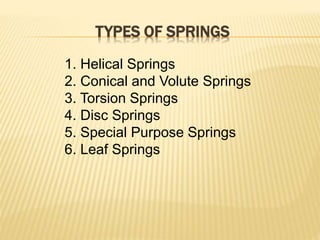
1. Helical Springs
2. Conical and Volute Springs
3. Torsion Springs
4. Disc Springs
5. Special Purpose Springs
6. Leaf Springs
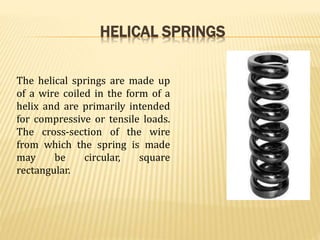
HELICAL SPRINGS
The helical springs are made up
of a wire coiled in the form of a
helix and are primarily intended
for compressive or tensile loads.
The cross-section of the wire
from which the spring is made
may be circular, square
rectangular.
COMMONLY USED SPRING MATERIALS
One of the important considerations in spring design is the choice of the
spring material. Some of the common spring materials are
Hard-drawn wire:
This is cold drawn, cheapest spring steel. Normally used for low stress
and static load. The material is not suitable at subzero temperatures or at
temperatures above 120ºC.
Oil-tempered wire:
It is a cold drawn, quenched, tempered, and general purpose spring steel.
However, it is not suitable for fatigue or sudden loads, at subzero
temperatures and at temperatures above 180ºC.
When we go for highly stressed conditions then alloy steels are useful.
Chrome Vanadium:
This alloy spring steel is used for high stress conditions and at high
temperature up to 220ºC. It is good for fatigue resistance and long
endurance for shock and impact loads.
Chrome Silicon:
This material can be used for highly stressed springs. It offers excellent
service for long life, shock loading and for temperature up to 250ºC.
Music wire:
This spring material is most widely used for
small springs. It is the toughest and has highest
tensile strength and can withstand repeated
loading at high stresses. However, it can not be
used at subzero temperatures or at
temperatures above 120ºC.
Normally when we talk about springs we will find
that the music wire is a common choice for
springs.
Stainless steel:
Widely used alloy spring materials.
Phosphor Bronze / Spring Brass:
It has good corrosion resistance and electrical
conductivity. That’s the reason it is commonly
used for contacts in electrical switches. Spring
brass can be used at subzero temperatures.
LITERATURE REVIEW
Anil Antony Sequeiraet al have conducted the static structural analysis to study
the behavior of carbon and Kevlar composite helical suspension and comparison is
made from steel helical spring using ANSYS software. The properties investigated
are load carrying capacity, stiffness, along weight reduction using FRP composite
spring.
N. Lavanya et al presented an analysis of the safe load for light automobiles
suspension spring which is fabricated from two materials chrome vanadium steel and
low carbon steel. The results showed that the low carbon steel is suitable more than
the chrome vanadium steel for production of helical spring
Nijssen, R.P.L et al. has investigated the effect of fiber volume fraction on the
properties of composite materials used in the analysis of helical coil suspension. A
schematic of variation in fiber rein forced composite with the amount of fiber
volume fraction is shown in figure 2-1. Typically, fiber shares 30% to 75% of the
volume of composites.
Mehdi Bakhshesh et al. conducted a comparative study using steel spring with
composite helical spring, and results have shown that composite helical spring is
found
to have lower stresses and performs best when fiber position has been considered
to be in the direction of loading. The spring weight is also reduced by changing the
fiber
PR Jadhav et al. , in this research, steel coil spring is replaced by three different
composite materials. The results obtained from the numerical method are in close
agreement with results from the analytical method. The stress generated in
composite helical coil spring is found to be lower as compared to steel suspensions,
and considerable weight reduction is also achieved by changing fiber percentage
P.K. Mallick has fabricated and conducted the performance test for the composite
lliptic spring. The composite leaf springs are successfully used in the suspension of
the light vehicles. The fibers used in these are unidirectional E-glass due to their high
extensibility, toughness and low cost.
LITERATURE REVIEW….
DATA COLLECTION
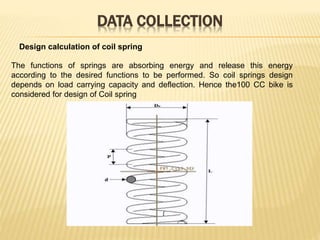
Design calculation of coil spring
The functions of springs are absorbing energy and release this energy
according to the desired functions to be performed. So coil springs design
depends on load carrying capacity and deflection. Hence the100 CC bike is
considered for design of Coil spring
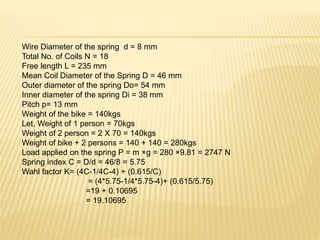
Wire Diameter of the spring d = 8 mm
Total No. of Coils N = 18
Free length L = 235 mm
Mean Coil Diameter of the Spring D = 46 mm
Outer diameter of the spring Do= 54 mm
Inner diameter of the spring Di = 38 mm
Pitch p= 13 mm
Weight of the bike = 140kgs
Let, Weight of 1 person = 70kgs
Weight of 2 person = 2 X 70 = 140kgs
Weight of bike + 2 persons = 140 + 140 = 280kgs
Load applied on the spring P = m ×g = 280 ×9.81 = 2747 N
Spring index C = D/d = 46/8 = 5.75
Wahl factor K= (4C-1/4C-4) + (0.615/C)
= (4*5.75-1/4*5.75-4)+ (0.615/5.75)
=19 + 0.10695
= 19.10695
DESIGN OF COIL SPRING IN CATIA V5
SOFTWARE
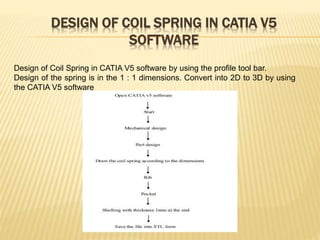
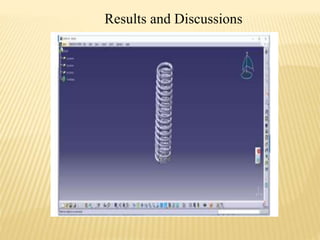
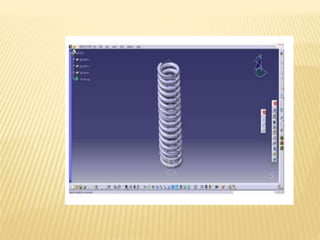
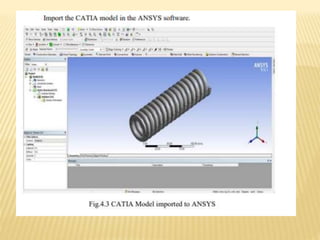
Design of Coil Spring in CATIA V5 software by using the profile tool bar.
Design of the spring is in the 1 : 1 dimensions. Convert into 2D to 3D by using
the CATIA V5 software
Results and Discussions
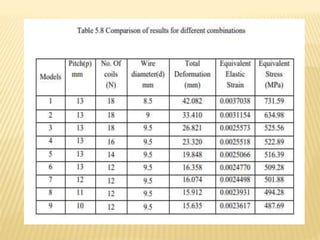
1. The modelling was done in CATIA V5R21 and analysis in ANSYS
18.1
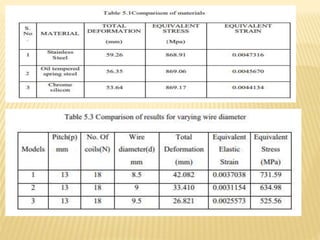
2. Ccomparison has been made among the three different materials
and it is observed that chrome silicon is the best material of
construction for coil spring from static Analysis.
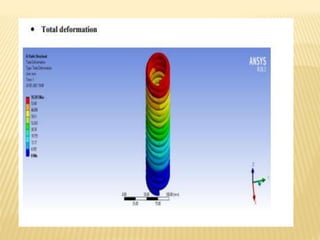
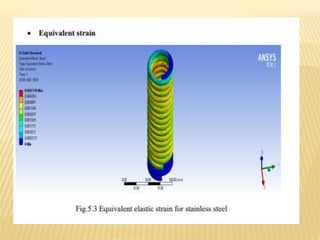
3. The values of total deformation, equivalent stress and equivalent
elastic strain of
various spring materials are compared and it is observed that minimum
deformation (53.64 mm), equivalent stress(869.17 Mpa) and equivalent
elastic strain(0.0044134) in the chrome silicon material.
4. And also comparison has been made for a coil spring with optimum
material i.e, chrome silicon by varying the pitch, no. of coils and wire
diameter.
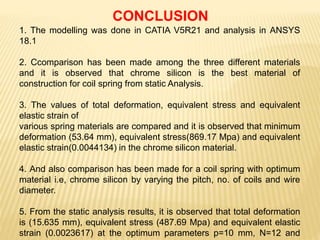
5. From the static analysis results, it is observed that total deformation
is (15.635 mm), equivalent stress (487.69 Mpa) and equivalent elastic
strain (0.0023617) at the optimum parameters p=10 mm, N=12 and
CONCLUSION
REFERENCES
[1]. Pradhan, Jagannath & Singh, Babita. (2020). Experimental investigation on performance of
Engine using waste cooking oil biodiesel blends with alcohol and Nanoparticle additives as fuel.
Mater Today: Proceedings. 24. 1332-1339. 10.1016/j.matpr.2020.04.449.
[2]. Zeeshan Khutbuddin Shaikh and Sayyad Asma Naser “Experimental Study of Helical
Compression Spring” International Journal of Engineering Technology Science and Research,
Volume 4, Issue 12, December 2017.
[3]. Harshal Rajurakar, M. C. Swami “Analysis Of Helical Compression Spring For Two Wheeler
Automotive Rear Suspension” Journal of Mechanical and Civil Engineering (IOSR-JMCE)
Volume 13, Issue 2 Ver. II (Mar. - Apr. 2016)
[4]. Aakash Bhatt, Anil Devani and Parth Zalavadiya, “Design analysis of helical spring of suspension
System” IJEDR | Volume 4, Issue 3. 2016
[5]. K. Vinay Kumar, R. Rudrabhiramu, “Design And Analysis of Helical Springs in Two Wheeler
Suspension System” International Journal of Research in Advanced Engineering Technologies ,
Volume 5, Issue 2 DEC 2015
[6]. N. Lavanya, P. Sampath Rao and M. Pramod Reddy , “Design and Analysis of A Suspension Coil
Spring For Automotive Vehicle” Int. Journal of Engineering Research and Applications, ol. 4,
Issue 9( Version 5), September 2014, pp.151-157.
[7]. Harale, S. G. and Elango, M. 2014, Design of Helical Coil Suspension System by Combination of
Conventional Steel and Composite Material, International Journal of Innovative Research in
Science, Engineering and Technology 3, (8) 15144-15150.
THANK YOU

2022-23 project review.pptx

  • 1.
    Presenting: K. RAGHUNATHA (Reg No:17W51D1503) Department of Mechanical Engineering Viswam Engineering College Madanapalle-517325. DESIGN AND ANALYSIS OF A HELICAL SPRING FOR DIFFERENT MATERIALS USING ANSYS Under the Guidance of Mr. ANJAPPA S B Assistant Professor Department of Mechanical Engineering Viswam Engineering College Madanapalle-517325.
  • 2.
    CONTENT OF PRESENTATION 1.Abstract 2. Introduction 3. Literature Review 4. Methodology 5. Results and Discussions 6. Conclusion 7. References.
  • 3.
    ABSTRACT A spring isan elastic object that stores Mechanical energy. A suspension or compression spring is designed to reduce shock impulse, and generate kinetic energy. The coil spring is to dissipate or absorb energy; it also absorbs the shock generated by road irregularities in a vehicle, results in enhanced ride quality, and an increase in ride comfort due to reduction of disturbances. Springs are made of an elastic material formed into the shape of a helix which returns to its natural length when unloaded. The purpose of this project is comparative study and analysis of a coil spring with three different materials (Stain less steel, Oil tempered Spring steel and Chrome Silicon).Static analysis is done using ANSYS 18.1 to determine the optimum material to reduce the stress and deflection. The modelling of spring is developed on CATIA V5R21 and analysis is carried out on ANSYS 18.1 and further is to check the feasibility of coil spring by changing the dimensions for wire diameter, pitch, number of coils. The comparative study has been made with optimum material by varying pitch , number of coils and wire diameter. The results and comparative study shows the optimum material that can be selected as spring material for efficient function and long life.
  • 4.
    INTRODUCTION A spring isdefined as an elastic body, whose function is to distort when loaded and to recover its original shape when the load is removed. It is an elastic object used to store mechanical energy. Springs are usually made out of spring steel. Small springs can be wound from pre-hardened stock, while larger ones are made from annealed steel and hardened after fabrication. Some non-ferrous metals are also used including phosphor bronze and titanium for parts requiring corrosion resistance and beryllium copper for springs carrying electrical current (because of its low electrical resistance). When a spring is compressed or stretched, the force it exerts is proportional to its change in length. Helical springs are simple forms of springs, commonly used for the suspension system in wheeled vehicles. Vehicle suspension system is made out of springs that have basic role in power transfer, vehicle motion and driving. Therefore, springs performance optimization plays important role in improvement of car dynamic.
  • 5.
    TYPES OF SPRINGS 1.Helical Springs 2. Conical and Volute Springs 3. Torsion Springs 4. Disc Springs 5. Special Purpose Springs 6. Leaf Springs
  • 6.
    HELICAL SPRINGS The helicalsprings are made up of a wire coiled in the form of a helix and are primarily intended for compressive or tensile loads. The cross-section of the wire from which the spring is made may be circular, square rectangular.
  • 7.
    COMMONLY USED SPRINGMATERIALS One of the important considerations in spring design is the choice of the spring material. Some of the common spring materials are Hard-drawn wire: This is cold drawn, cheapest spring steel. Normally used for low stress and static load. The material is not suitable at subzero temperatures or at temperatures above 120ºC. Oil-tempered wire: It is a cold drawn, quenched, tempered, and general purpose spring steel. However, it is not suitable for fatigue or sudden loads, at subzero temperatures and at temperatures above 180ºC. When we go for highly stressed conditions then alloy steels are useful. Chrome Vanadium: This alloy spring steel is used for high stress conditions and at high temperature up to 220ºC. It is good for fatigue resistance and long endurance for shock and impact loads. Chrome Silicon: This material can be used for highly stressed springs. It offers excellent service for long life, shock loading and for temperature up to 250ºC.
  • 8.
    Music wire: This springmaterial is most widely used for small springs. It is the toughest and has highest tensile strength and can withstand repeated loading at high stresses. However, it can not be used at subzero temperatures or at temperatures above 120ºC. Normally when we talk about springs we will find that the music wire is a common choice for springs. Stainless steel: Widely used alloy spring materials. Phosphor Bronze / Spring Brass: It has good corrosion resistance and electrical conductivity. That’s the reason it is commonly used for contacts in electrical switches. Spring brass can be used at subzero temperatures.
  • 9.
    LITERATURE REVIEW Anil AntonySequeiraet al have conducted the static structural analysis to study the behavior of carbon and Kevlar composite helical suspension and comparison is made from steel helical spring using ANSYS software. The properties investigated are load carrying capacity, stiffness, along weight reduction using FRP composite spring. N. Lavanya et al presented an analysis of the safe load for light automobiles suspension spring which is fabricated from two materials chrome vanadium steel and low carbon steel. The results showed that the low carbon steel is suitable more than the chrome vanadium steel for production of helical spring Nijssen, R.P.L et al. has investigated the effect of fiber volume fraction on the properties of composite materials used in the analysis of helical coil suspension. A schematic of variation in fiber rein forced composite with the amount of fiber volume fraction is shown in figure 2-1. Typically, fiber shares 30% to 75% of the volume of composites. Mehdi Bakhshesh et al. conducted a comparative study using steel spring with composite helical spring, and results have shown that composite helical spring is found to have lower stresses and performs best when fiber position has been considered to be in the direction of loading. The spring weight is also reduced by changing the fiber
  • 10.
    PR Jadhav etal. , in this research, steel coil spring is replaced by three different composite materials. The results obtained from the numerical method are in close agreement with results from the analytical method. The stress generated in composite helical coil spring is found to be lower as compared to steel suspensions, and considerable weight reduction is also achieved by changing fiber percentage P.K. Mallick has fabricated and conducted the performance test for the composite lliptic spring. The composite leaf springs are successfully used in the suspension of the light vehicles. The fibers used in these are unidirectional E-glass due to their high extensibility, toughness and low cost. LITERATURE REVIEW….
  • 11.
    DATA COLLECTION Design calculationof coil spring The functions of springs are absorbing energy and release this energy according to the desired functions to be performed. So coil springs design depends on load carrying capacity and deflection. Hence the100 CC bike is considered for design of Coil spring
  • 12.
    Wire Diameter ofthe spring d = 8 mm Total No. of Coils N = 18 Free length L = 235 mm Mean Coil Diameter of the Spring D = 46 mm Outer diameter of the spring Do= 54 mm Inner diameter of the spring Di = 38 mm Pitch p= 13 mm Weight of the bike = 140kgs Let, Weight of 1 person = 70kgs Weight of 2 person = 2 X 70 = 140kgs Weight of bike + 2 persons = 140 + 140 = 280kgs Load applied on the spring P = m ×g = 280 ×9.81 = 2747 N Spring index C = D/d = 46/8 = 5.75 Wahl factor K= (4C-1/4C-4) + (0.615/C) = (4*5.75-1/4*5.75-4)+ (0.615/5.75) =19 + 0.10695 = 19.10695
  • 13.
    DESIGN OF COILSPRING IN CATIA V5 SOFTWARE Design of Coil Spring in CATIA V5 software by using the profile tool bar. Design of the spring is in the 1 : 1 dimensions. Convert into 2D to 3D by using the CATIA V5 software
  • 14.
  • 21.
    1. The modellingwas done in CATIA V5R21 and analysis in ANSYS 18.1 2. Ccomparison has been made among the three different materials and it is observed that chrome silicon is the best material of construction for coil spring from static Analysis. 3. The values of total deformation, equivalent stress and equivalent elastic strain of various spring materials are compared and it is observed that minimum deformation (53.64 mm), equivalent stress(869.17 Mpa) and equivalent elastic strain(0.0044134) in the chrome silicon material. 4. And also comparison has been made for a coil spring with optimum material i.e, chrome silicon by varying the pitch, no. of coils and wire diameter. 5. From the static analysis results, it is observed that total deformation is (15.635 mm), equivalent stress (487.69 Mpa) and equivalent elastic strain (0.0023617) at the optimum parameters p=10 mm, N=12 and CONCLUSION
  • 22.
    REFERENCES [1]. Pradhan, Jagannath& Singh, Babita. (2020). Experimental investigation on performance of Engine using waste cooking oil biodiesel blends with alcohol and Nanoparticle additives as fuel. Mater Today: Proceedings. 24. 1332-1339. 10.1016/j.matpr.2020.04.449. [2]. Zeeshan Khutbuddin Shaikh and Sayyad Asma Naser “Experimental Study of Helical Compression Spring” International Journal of Engineering Technology Science and Research, Volume 4, Issue 12, December 2017. [3]. Harshal Rajurakar, M. C. Swami “Analysis Of Helical Compression Spring For Two Wheeler Automotive Rear Suspension” Journal of Mechanical and Civil Engineering (IOSR-JMCE) Volume 13, Issue 2 Ver. II (Mar. - Apr. 2016) [4]. Aakash Bhatt, Anil Devani and Parth Zalavadiya, “Design analysis of helical spring of suspension System” IJEDR | Volume 4, Issue 3. 2016 [5]. K. Vinay Kumar, R. Rudrabhiramu, “Design And Analysis of Helical Springs in Two Wheeler Suspension System” International Journal of Research in Advanced Engineering Technologies , Volume 5, Issue 2 DEC 2015 [6]. N. Lavanya, P. Sampath Rao and M. Pramod Reddy , “Design and Analysis of A Suspension Coil Spring For Automotive Vehicle” Int. Journal of Engineering Research and Applications, ol. 4, Issue 9( Version 5), September 2014, pp.151-157. [7]. Harale, S. G. and Elango, M. 2014, Design of Helical Coil Suspension System by Combination of Conventional Steel and Composite Material, International Journal of Innovative Research in Science, Engineering and Technology 3, (8) 15144-15150.
  • 23.