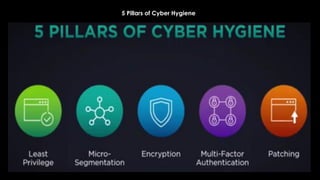
CYBER HYGIENE
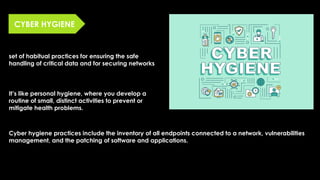
set ofhabitual practices for ensuring the safe
handling of critical data and for securing networks
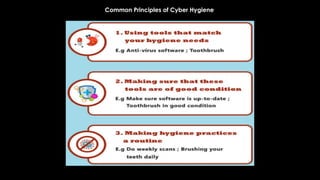
It’s like personal hygiene, where you develop a
routine of small, distinct activities to prevent or
mitigate health problems.
Cyber hygiene practices include the inventory of all endpoints connected to a network, vulnerabilities
management, and the patching of software and applications.
3.
1. Cyber hygienehelps prevent cybercriminals from breaching an organization’s network — or at least
task can be made so hard that the criminal gives up and goes looking for another victim.
2. Today’s attacks are increasingly sophisticated, relying on social engineering to get a victim to
divulge sensitive information, targeting high-level executives, or deploying malware in a supply chain
that can then infect hundreds of others.
5. The typical business network includes an array of computers, servers, databases, virtual machines, mobile
devices, operating systems, applications, and tools, each of which is a potential attack vector.
If these aren’t regularly and properly maintained, it can result in lost or misplaced data, unpatched
software, outdated user privileges, and other issues. In this way, an environment grows more vulnerable
over time and leaves you with multiple points of exposure.
3. Cyber hygiene helps reduce those vulnerabilities by identifying risks and deploying mechanisms and
strategies to reduce or resolve them.
4. By practicing cyber hygiene, organizations can strengthen their security posture and can more
effectively defend themselves against devastating breaches.
Why is cyber hygiene important
4.
What are thebenefits of cyber hygiene
Locate unmanaged assets
Protect customer data
Find outdated administrator privileges
Identify rogue software
Meet compliance requirements
5.
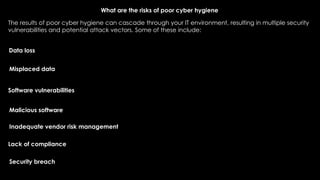
What are therisks of poor cyber hygiene
The results of poor cyber hygiene can cascade through your IT environment, resulting in multiple security
vulnerabilities and potential attack vectors. Some of these include:
Data loss
Misplaced data
Software vulnerabilities
Malicious software
Inadequate vendor risk management
Lack of compliance
Security breach
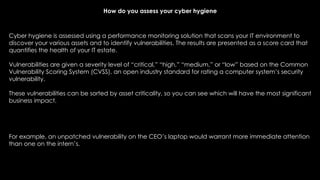
Cyber hygiene isassessed using a performance monitoring solution that scans your IT environment to
discover your various assets and to identify vulnerabilities. The results are presented as a score card that
quantifies the health of your IT estate.
Vulnerabilities are given a severity level of “critical,” “high,” “medium,” or “low” based on the Common
Vulnerability Scoring System (CVSS), an open industry standard for rating a computer system’s security
vulnerability.
These vulnerabilities can be sorted by asset criticality, so you can see which will have the most significant
business impact.
For example, an unpatched vulnerability on the CEO’s laptop would warrant more immediate attention
than one on the intern’s.
How do you assess your cyber hygiene
9.
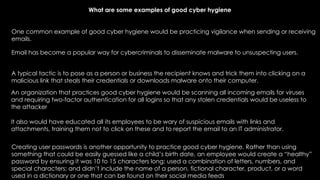
What are someexamples of good cyber hygiene
One common example of good cyber hygiene would be practicing vigilance when sending or receiving
emails.
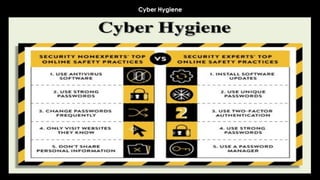
Creating user passwords is another opportunity to practice good cyber hygiene. Rather than using
something that could be easily guessed like a child’s birth date, an employee would create a “healthy”
password by ensuring it was 10 to 15 characters long; used a combination of letters, numbers, and
special characters; and didn’t include the name of a person, fictional character, product, or a word
used in a dictionary or one that can be found on their social media feeds
Email has become a popular way for cybercriminals to disseminate malware to unsuspecting users.
A typical tactic is to pose as a person or business the recipient knows and trick them into clicking on a
malicious link that steals their credentials or downloads malware onto their computer.
An organization that practices good cyber hygiene would be scanning all incoming emails for viruses
and requiring two-factor authentication for all logins so that any stolen credentials would be useless to
the attacker
It also would have educated all its employees to be wary of suspicious emails with links and
attachments, training them not to click on these and to report the email to an IT administrator.
10.
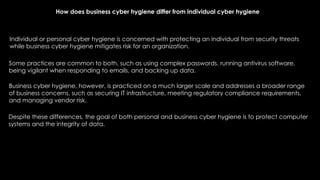
How does businesscyber hygiene differ from individual cyber hygiene
Individual or personal cyber hygiene is concerned with protecting an individual from security threats
while business cyber hygiene mitigates risk for an organization.
Some practices are common to both, such as using complex passwords, running antivirus software,
being vigilant when responding to emails, and backing up data.
Business cyber hygiene, however, is practiced on a much larger scale and addresses a broader range
of business concerns, such as securing IT infrastructure, meeting regulatory compliance requirements,
and managing vendor risk.
Despite these differences, the goal of both personal and business cyber hygiene is to protect computer
systems and the integrity of data.
11.
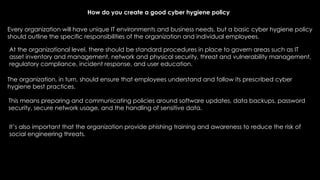
How do youcreate a good cyber hygiene policy
Every organization will have unique IT environments and business needs, but a basic cyber hygiene policy
should outline the specific responsibilities of the organization and individual employees.
The organization, in turn, should ensure that employees understand and follow its prescribed cyber
hygiene best practices.
At the organizational level, there should be standard procedures in place to govern areas such as IT
asset inventory and management, network and physical security, threat and vulnerability management,
regulatory compliance, incident response, and user education.
This means preparing and communicating policies around software updates, data backups, password
security, secure network usage, and the handling of sensitive data.
It’s also important that the organization provide phishing training and awareness to reduce the risk of
social engineering threats.
12.
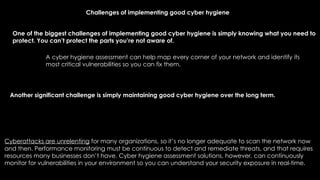
Challenges of implementinggood cyber hygiene
One of the biggest challenges of implementing good cyber hygiene is simply knowing what you need to
protect. You can’t protect the parts you’re not aware of.
Cyberattacks are unrelenting for many organizations, so it’s no longer adequate to scan the network now
and then. Performance monitoring must be continuous to detect and remediate threats, and that requires
resources many businesses don’t have. Cyber hygiene assessment solutions, however, can continuously
monitor for vulnerabilities in your environment so you can understand your security exposure in real-time.
A cyber hygiene assessment can help map every corner of your network and identify its
most critical vulnerabilities so you can fix them.
Another significant challenge is simply maintaining good cyber hygiene over the long term.
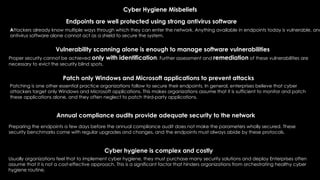
Attackers already knowmultiple ways through which they can enter the network. Anything available in endpoints today is vulnerable, and
antivirus software alone cannot act as a shield to secure the system.
Cyber Hygiene Misbeliefs
Endpoints are well protected using strong antivirus software
Vulnerability scanning alone is enough to manage software vulnerabilities
Patch only Windows and Microsoft applications to prevent attacks
Annual compliance audits provide adequate security to the network
Cyber hygiene is complex and costly
Usually organizations feel that to implement cyber hygiene, they must purchase many security solutions and deploy Enterprises often
assume that it is not a cost-effective approach. This is a significant factor that hinders organizations from orchestrating healthy cyber
hygiene routine.
Preparing the endpoints a few days before the annual compliance audit does not make the parameters wholly secured. These
security benchmarks come with regular upgrades and changes, and the endpoints must always abide by these protocols.
Patching is one other essential practice organizations follow to secure their endpoints. In general, enterprises believe that cyber
attackers target only Windows and Microsoft applications. This makes organizations assume that it is sufficient to monitor and patch
these applications alone, and they often neglect to patch third-party applications.
Proper security cannot be achieved only with identification. Further assessment and remediation of these vulnerabilities are
necessary to evict the security blind spots.
16.
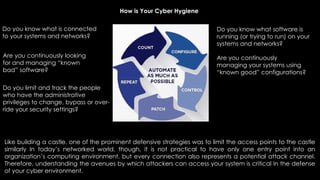
How is YourCyber Hygiene
Like building a castle, one of the prominent defensive strategies was to limit the access points to the castle
similarly In today’s networked world, though, it is not practical to have only one entry point into an
organization’s computing environment, but every connection also represents a potential attack channel.
Therefore, understanding the avenues by which attackers can access your system is critical in the defense
of your cyber environment.
Do you know what is connected
to your systems and networks?
Do you know what software is
running (or trying to run) on your
systems and networks?
Are you continuously
managing your systems using
“known good” configurations?
Are you continuously looking
for and managing “known
bad” software?
Do you limit and track the people
who have the administrative
privileges to change, bypass or over-
ride your security settings?
17.
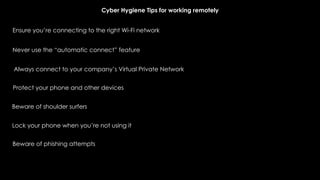
Ensure you’re connectingto the right Wi-Fi network
Never use the “automatic connect” feature
Always connect to your company’s Virtual Private Network
Protect your phone and other devices
Beware of shoulder surfers
Lock your phone when you’re not using it
Beware of phishing attempts
Cyber Hygiene Tips for working remotely
18.
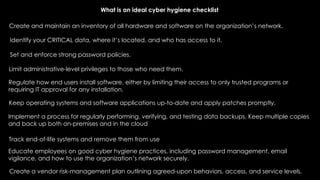
What is anideal cyber hygiene checklist
Create and maintain an inventory of all hardware and software on the organization’s network.
Identify your CRITICAL data, where it’s located, and who has access to it.
Set and enforce strong password policies.
Limit administrative-level privileges to those who need them.
Regulate how end users install software, either by limiting their access to only trusted programs or
requiring IT approval for any installation.
Keep operating systems and software applications up-to-date and apply patches promptly.
Implement a process for regularly performing, verifying, and testing data backups. Keep multiple copies
and back up both on-premises and in the cloud
Track end-of-life systems and remove them from use
Create a vendor risk-management plan outlining agreed-upon behaviors, access, and service levels.
Educate employees on good cyber hygiene practices, including password management, email
vigilance, and how to use the organization’s network securely.