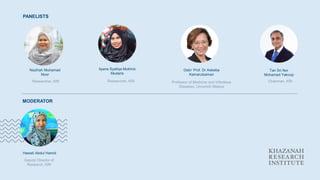
Nazihah Muhamad
Noor
Ilyana Syafiqa Mukhriz
Mudaris
Researcher, KRI Researcher, KRI
PANELISTS
Hawati Abdul Hamid
Deputy Director of
Research, KRI
MODERATOR
Tan Sri Nor
Mohamed Yakcop
Chairman, KRI
Dato’ Prof. Dr Adeeba
Kamarulzaman
Professor of Medicine and Infectious
Diseases, Universiti Malaya
Khazanah
Research
Institute
ACARA AKAN DIMULAKAN
SEBENTAR LAGI
LIVE EVENT
WILL START SHORTLY
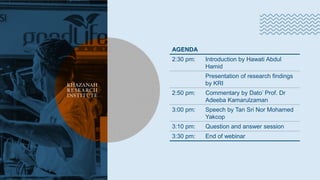
AGENDA
2:30 pm: Introduction by Hawati Abdul
Hamid
Presentation of research findings
by KRI
2:50 pm: Commentary by Dato’ Prof. Dr
Adeeba Kamarulzaman
3:00 pm: Speech by Tan Sri Nor Mohamed
Yakcop
3:10 pm: Question and answer session
3:30 pm: End of webinar
Khazanah
Research
Institute
Introduction
Khazanah
Research
Institute
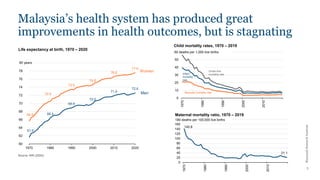
Malaysia’s health system has produced great
improvements in health outcomes, but is stagnating
5
Source: KRI (2020)
Life expectancy at birth, 1970 – 2020
61.6
66.4
68.9
70.0
71.9
72.6
65.6
70.5
73.5
74.6
76.6
77.6
60
62
64
66
68
70
72
74
76
78
80
1970 1980 1990 2000 2010 2020
80 years
Men
Women
140.8
21.1
0
20
40
60
80
100
120
140
160
180
1970
1980
1990
2000
2010
180 deaths per 100,000 live births
Child mortality rates, 1970 – 2019
0
10
20
30
40
50
60
1970
1980
1990
2000
2010
60 deaths per 1,000 live births
Infant
mortality
rate
Neonatal mortality rate
Under-five
mortality rate
Maternal mortality ratio, 1970 – 2019
Khazanah
Research
Institute
Health
Protection as
Social
Protection
Khazanah
Research
Institute
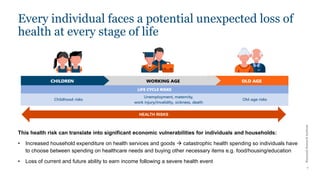
Every individual faces a potential unexpected loss of
health at every stage of life
7
HEALTH RISKS
This health risk can translate into significant economic vulnerabilities for individuals and households:
• Increased household expenditure on health services and goods  catastrophic health spending so individuals have
to choose between spending on healthcare needs and buying other necessary items e.g. food/housing/education
• Loss of current and future ability to earn income following a severe health event
Khazanah
Research
Institute
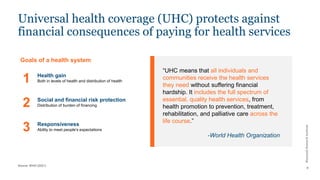
Universal health coverage (UHC) protects against
financial consequences of paying for health services
Source: WHO (2021)
8
“UHC means that all individuals and
communities receive the health services
they need without suffering financial
hardship. It includes the full spectrum of
essential, quality health services, from
health promotion to prevention, treatment,
rehabilitation, and palliative care across the
life course.”
-World Health Organization
1 Health gain
Both in levels of health and distribution of health
2 Social and financial risk protection
Distribution of burden of financing
3 Responsiveness
Ability to meet people’s expectations
Goals of a health system
Khazanah
Research
Institute
Challenges to
Health
Protection in
Malaysia
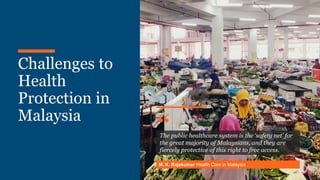
The public healthcare system is the ‘safety net’ for
the great majority of Malaysians, and they are
fiercely protective of this right to free access.
M. K. Rajakumar Health Care in Malaysia
“
Khazanah
Research
Institute
10
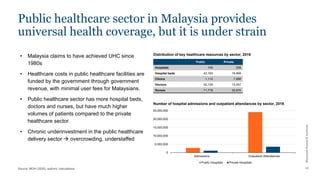
Public healthcare sector in Malaysia provides
universal health coverage, but it is under strain
Source: MOH (2020), authors’ calculations
• Malaysia claims to have achieved UHC since
1980s
• Healthcare costs in public healthcare facilities are
funded by the government through government
revenue, with minimal user fees for Malaysians.
• Public healthcare sector has more hospital beds,
doctors and nurses, but have much higher
volumes of patients compared to the private
healthcare sector.
• Chronic underinvestment in the public healthcare
delivery sector  overcrowding, understaffed
Distribution of key healthcare resources by sector, 2019
0
5,000,000
10,000,000
15,000,000
20,000,000
25,000,000
Admissions Outpatient Attendances
Public Hospitals Private Hospitals
Number of hospital admissions and outpatient attendances by sector, 2019
Public Private
Hospitals 145 208
Hospital beds 42,183 16,469
Clinics 1,114 7,988
Doctors 52,129 15,457
Nurses 71,778 35,970
Khazanah
Research
Institute
11
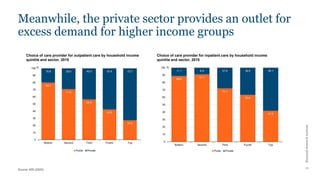
Meanwhile, the private sector provides an outlet for
excess demand for higher income groups
Source: KRI (2020)
Choice of care provider for outpatient care by household income
quintile and sector, 2015
Choice of care provider for inpatient care by household income
quintile and sector, 2015
88.9
91.1
72.1
63.4
41.9
11.1 8.9 27.9 36.6 58.1
0
10
20
30
40
50
60
70
80
90
100
Bottom Second Third Fourth Top
Public Private
%
80.2
71.0
56.6
42.6
27.3
19.8 29.0 43.4 57.4 72.7
0
10
20
30
40
50
60
70
80
90
100
Bottom Second Third Fourth Top
Public Private
%
Khazanah
Research
Institute
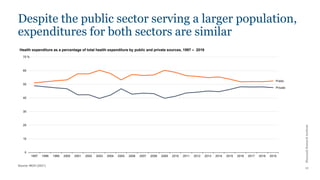
Despite the public sector serving a larger population,
expenditures for both sectors are similar
Source: MOH (2021)
12
Public
Private
0
10
20
30
40
50
60
70
1997 1998 1999 2000 2001 2002 2003 2004 2005 2006 2007 2008 2009 2010 2011 2012 2013 2014 2015 2016 2017 2018 2019
%
Health expenditure as a percentage of total health expenditure by public and private sources, 1997 – 2019
Khazanah
Research
Institute
13
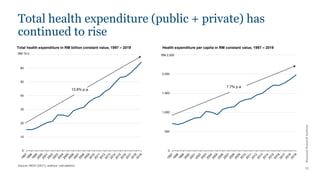
Total health expenditure (public + private) has
continued to rise
Source: MOH (2021), authors’ calculations
0
10
20
30
40
50
60
70
13.8% p.a.
RM 70 b
0
500
1,000
1,500
2,000
2,500
RM 2,500
7.7% p.a.
Total health expenditure in RM billion constant value, 1997 – 2019 Health expenditure per capita in RM constant value, 1997 – 2019
Khazanah
Research
Institute
14
The government has repeatedly indicated that it
intends to reduce public financing for healthcare
“With increasing demand by the
population for healthcare, coupled with
rising public expectations the real
challenge will, therefore, be to find
ways and means to meet the rising cost
of providing healthcare. In view of this,
new sources of finance must be
identified.”
—5th Malaysia Plan
“Rising healthcare costs have
threatened the financial sustainability of
the Government in providing quality
public healthcare.”
“A comprehensive revitalisation of the
country’s healthcare system aims…[to]
Reduce the high level of subsidies,
unsustainable healthcare
financing…”
—12th Malaysia Plan
Khazanah
Research
Institute
15
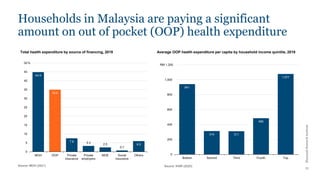
Households in Malaysia are paying a significant
amount on out of pocket (OOP) health expenditure
Source: MOH (2021)
44.9
35.0
7.6 3.3 2.5
0.7
6.0
0
5
10
15
20
25
30
35
40
45
50
MOH OOP Private
insurance
Private
employers
MOE Social
insurance
Others
%
Total health expenditure by source of financing, 2019
941
314 311
485
1,077
0
200
400
600
800
1,000
1,200
Bottom Second Third Fourth Top
RM 1,200
Average OOP health expenditure per capita by household income quintile, 2019
Source: IHSR (2020)
Khazanah
Research
Institute
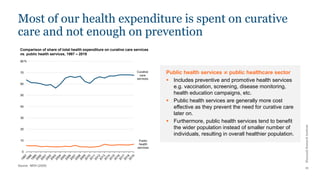
Most of our health expenditure is spent on curative
care and not enough on prevention
Source: MOH (2020)
16
Comparison of share of total health expenditure on curative care services
vs. public health services, 1997 – 2019
Public health services ≭ public healthcare sector
 Includes preventive and promotive health services
e.g. vaccination, screening, disease monitoring,
health education campaigns, etc.
 Public health services are generally more cost
effective as they prevent the need for curative care
later on.
 Furthermore, public health services tend to benefit
the wider population instead of smaller number of
individuals, resulting in overall healthier population.
Curative
care
services
Public
health
services
0
10
20
30
40
50
60
70
80%
Khazanah
Research
Institute
Policy
Aspirations
Khazanah
Research
Institute
18
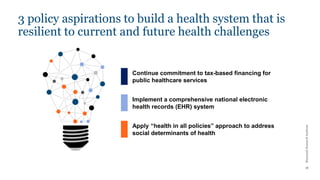
3 policy aspirations to build a health system that is
resilient to current and future health challenges
Continue commitment to tax-based financing for
public healthcare services
Implement a comprehensive national electronic
health records (EHR) system
Apply “health in all policies” approach to address
social determinants of health
Khazanah
Research
Institute
19
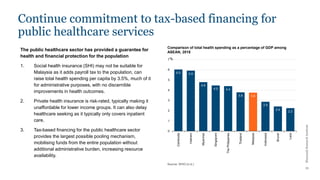
Continue commitment to tax-based financing for
public healthcare services
Source: WHO (n.d.)
Comparison of total health spending as a percentage of GDP among
ASEAN, 2018
6.0 5.9
4.8
4.5 4.4
3.8 3.8
2.9
2.4
2.2
0
1
2
3
4
5
6
7
Cambodia
Vietnam
Myanmar
Singapore
The
Philippines
Thailand
Malaysia
Indonesia
Brunei
Laos
%
The public healthcare sector has provided a guarantee for
health and financial protection for the population
1. Social health insurance (SHI) may not be suitable for
Malaysia as it adds payroll tax to the population, can
raise total health spending per capita by 3.5%, much of it
for administrative purposes, with no discernible
improvements in health outcomes.
2. Private health insurance is risk-rated, typically making it
unaffordable for lower income groups. It can also delay
healthcare seeking as it typically only covers inpatient
care.
3. Tax-based financing for the public healthcare sector
provides the largest possible pooling mechanism,
mobilising funds from the entire population without
additional administrative burden, increasing resource
availability.
Khazanah
Research
Institute
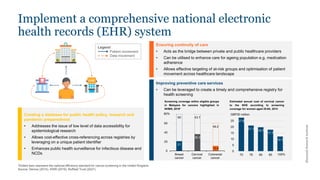
Implement a comprehensive national electronic
health records (EHR) system
*Dotted bars represent the national efficiency standard for cancer screening in the United Kingdom
Source: Demos (2014), IHSR (2019), Nuffield Trust (2021)
Ensuring continuity of care
• Acts as the bridge between private and public healthcare providers
• Can be utilised to enhance care for ageing population e.g. medication
adherence
• Allows effective targeting of at-risk groups and optimisation of patient
movement across healthcare landscape
Improving preventive care services
• Can be leveraged to create a timely and comprehensive registry for
health screening
27.6
21.1
19.7
17.7
12.1
0
5
10
15
20
25
30
70 78 80 85 100
100%
GBP30 million
Estimated annual cost of cervical cancer
to the NHS according to screening
coverage for women aged 25-64, 2014
21
36.3
10.8
59 43.7
49.2
0
20
40
60
80
Breast
cancer
Cervical
cancer
Colorectal
cancer
80%
Screening coverage within eligible groups
in Malaysia for cancers highlighted in
NHMS, 2019*
Creating a database for public health policy, research and
pandemic preparedness
• Addresses the issue of low level of data accessibility for
epidemiological research
• Allows cost-effective cross-referencing across registries by
leveraging on a unique patient identifier
• Enhances public health surveillance for infectious disease and
NCDs
Legend
Patient movement
Data movement
Khazanah
Research
Institute
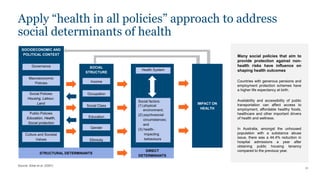
Apply “health in all policies” approach to address
social determinants of health
Source: Solar et al. (2007)
21
SOCIOECONOMIC AND
POLITICAL CONTEXT
Governance
Macroeconomic
Policies
Social Policies
Housing, Labour,
Land
Public Policies
Education, Health,
Social protection
Culture and Societal
Values
SOCIAL
STRUCTURE
Income
Occupation
Social Class
Education
Gender
Ethnicity
STRUCTURAL DETERMINANTS
Social factors:
(1) physical
environment;
(2) psychosocial
circumstances;
and
(3) health-
impacting
behaviours
Health System
DIRECT
DETERMINANTS
IMPACT ON
HEALTH
Many social policies that aim to
provide protection against non-
health risks have influence on
shaping health outcomes
Countries with generous pensions and
employment protection schemes have
a higher life expectancy at birth.
Availability and accessibility of public
transportation can affect access to
employment, affordable healthy foods,
healthcare and other important drivers
of health and wellness.
In Australia, amongst the unhoused
population with a substance abuse
issue, there was a 44.4% reduction in
hospital admissions a year after
obtaining public housing tenancy
compared to the previous year.
Khazanah
Research
Institute
ACARA AKAN DIMULAKAN
SEBENTAR LAGI
LIVE EVENT
WILL START SHORTLY
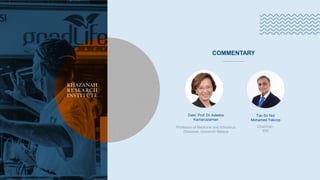
COMMENTARY
Tan Sri Nor
Mohamed Yakcop
Chairman,
KRI
Dato’ Prof. Dr Adeeba
Kamarulzaman
Professor of Medicine and Infectious
Diseases, Universiti Malaya
Khazanah
Research
Institute
QUESTION AND ANSWER SESSION
Khazanah
Research
Institute
Follow the latest KRI research and events
on KRI website and social media:
@KRInstitute
@KRInstitute or
www.facebook.com/KRInstitute/
Khazanah Research Institute
@krinstitute
Scan QR for press release, reports and related materials.

20211215_Health Webinar_v1.pdf

  • 2.
    Nazihah Muhamad Noor Ilyana SyafiqaMukhriz Mudaris Researcher, KRI Researcher, KRI PANELISTS Hawati Abdul Hamid Deputy Director of Research, KRI MODERATOR Tan Sri Nor Mohamed Yakcop Chairman, KRI Dato’ Prof. Dr Adeeba Kamarulzaman Professor of Medicine and Infectious Diseases, Universiti Malaya
  • 3.
    Khazanah Research Institute ACARA AKAN DIMULAKAN SEBENTARLAGI LIVE EVENT WILL START SHORTLY AGENDA 2:30 pm: Introduction by Hawati Abdul Hamid Presentation of research findings by KRI 2:50 pm: Commentary by Dato’ Prof. Dr Adeeba Kamarulzaman 3:00 pm: Speech by Tan Sri Nor Mohamed Yakcop 3:10 pm: Question and answer session 3:30 pm: End of webinar
  • 4.
  • 5.
    Khazanah Research Institute Malaysia’s health systemhas produced great improvements in health outcomes, but is stagnating 5 Source: KRI (2020) Life expectancy at birth, 1970 – 2020 61.6 66.4 68.9 70.0 71.9 72.6 65.6 70.5 73.5 74.6 76.6 77.6 60 62 64 66 68 70 72 74 76 78 80 1970 1980 1990 2000 2010 2020 80 years Men Women 140.8 21.1 0 20 40 60 80 100 120 140 160 180 1970 1980 1990 2000 2010 180 deaths per 100,000 live births Child mortality rates, 1970 – 2019 0 10 20 30 40 50 60 1970 1980 1990 2000 2010 60 deaths per 1,000 live births Infant mortality rate Neonatal mortality rate Under-five mortality rate Maternal mortality ratio, 1970 – 2019
  • 6.
  • 7.
    Khazanah Research Institute Every individual facesa potential unexpected loss of health at every stage of life 7 HEALTH RISKS This health risk can translate into significant economic vulnerabilities for individuals and households: • Increased household expenditure on health services and goods  catastrophic health spending so individuals have to choose between spending on healthcare needs and buying other necessary items e.g. food/housing/education • Loss of current and future ability to earn income following a severe health event
  • 8.
    Khazanah Research Institute Universal health coverage(UHC) protects against financial consequences of paying for health services Source: WHO (2021) 8 “UHC means that all individuals and communities receive the health services they need without suffering financial hardship. It includes the full spectrum of essential, quality health services, from health promotion to prevention, treatment, rehabilitation, and palliative care across the life course.” -World Health Organization 1 Health gain Both in levels of health and distribution of health 2 Social and financial risk protection Distribution of burden of financing 3 Responsiveness Ability to meet people’s expectations Goals of a health system
  • 9.
    Khazanah Research Institute Challenges to Health Protection in Malaysia Thepublic healthcare system is the ‘safety net’ for the great majority of Malaysians, and they are fiercely protective of this right to free access. M. K. Rajakumar Health Care in Malaysia “
  • 10.
    Khazanah Research Institute 10 Public healthcare sectorin Malaysia provides universal health coverage, but it is under strain Source: MOH (2020), authors’ calculations • Malaysia claims to have achieved UHC since 1980s • Healthcare costs in public healthcare facilities are funded by the government through government revenue, with minimal user fees for Malaysians. • Public healthcare sector has more hospital beds, doctors and nurses, but have much higher volumes of patients compared to the private healthcare sector. • Chronic underinvestment in the public healthcare delivery sector  overcrowding, understaffed Distribution of key healthcare resources by sector, 2019 0 5,000,000 10,000,000 15,000,000 20,000,000 25,000,000 Admissions Outpatient Attendances Public Hospitals Private Hospitals Number of hospital admissions and outpatient attendances by sector, 2019 Public Private Hospitals 145 208 Hospital beds 42,183 16,469 Clinics 1,114 7,988 Doctors 52,129 15,457 Nurses 71,778 35,970
  • 11.
    Khazanah Research Institute 11 Meanwhile, the privatesector provides an outlet for excess demand for higher income groups Source: KRI (2020) Choice of care provider for outpatient care by household income quintile and sector, 2015 Choice of care provider for inpatient care by household income quintile and sector, 2015 88.9 91.1 72.1 63.4 41.9 11.1 8.9 27.9 36.6 58.1 0 10 20 30 40 50 60 70 80 90 100 Bottom Second Third Fourth Top Public Private % 80.2 71.0 56.6 42.6 27.3 19.8 29.0 43.4 57.4 72.7 0 10 20 30 40 50 60 70 80 90 100 Bottom Second Third Fourth Top Public Private %
  • 12.
    Khazanah Research Institute Despite the publicsector serving a larger population, expenditures for both sectors are similar Source: MOH (2021) 12 Public Private 0 10 20 30 40 50 60 70 1997 1998 1999 2000 2001 2002 2003 2004 2005 2006 2007 2008 2009 2010 2011 2012 2013 2014 2015 2016 2017 2018 2019 % Health expenditure as a percentage of total health expenditure by public and private sources, 1997 – 2019
  • 13.
    Khazanah Research Institute 13 Total health expenditure(public + private) has continued to rise Source: MOH (2021), authors’ calculations 0 10 20 30 40 50 60 70 13.8% p.a. RM 70 b 0 500 1,000 1,500 2,000 2,500 RM 2,500 7.7% p.a. Total health expenditure in RM billion constant value, 1997 – 2019 Health expenditure per capita in RM constant value, 1997 – 2019
  • 14.
    Khazanah Research Institute 14 The government hasrepeatedly indicated that it intends to reduce public financing for healthcare “With increasing demand by the population for healthcare, coupled with rising public expectations the real challenge will, therefore, be to find ways and means to meet the rising cost of providing healthcare. In view of this, new sources of finance must be identified.” —5th Malaysia Plan “Rising healthcare costs have threatened the financial sustainability of the Government in providing quality public healthcare.” “A comprehensive revitalisation of the country’s healthcare system aims…[to] Reduce the high level of subsidies, unsustainable healthcare financing…” —12th Malaysia Plan
  • 15.
    Khazanah Research Institute 15 Households in Malaysiaare paying a significant amount on out of pocket (OOP) health expenditure Source: MOH (2021) 44.9 35.0 7.6 3.3 2.5 0.7 6.0 0 5 10 15 20 25 30 35 40 45 50 MOH OOP Private insurance Private employers MOE Social insurance Others % Total health expenditure by source of financing, 2019 941 314 311 485 1,077 0 200 400 600 800 1,000 1,200 Bottom Second Third Fourth Top RM 1,200 Average OOP health expenditure per capita by household income quintile, 2019 Source: IHSR (2020)
  • 16.
    Khazanah Research Institute Most of ourhealth expenditure is spent on curative care and not enough on prevention Source: MOH (2020) 16 Comparison of share of total health expenditure on curative care services vs. public health services, 1997 – 2019 Public health services ≭ public healthcare sector  Includes preventive and promotive health services e.g. vaccination, screening, disease monitoring, health education campaigns, etc.  Public health services are generally more cost effective as they prevent the need for curative care later on.  Furthermore, public health services tend to benefit the wider population instead of smaller number of individuals, resulting in overall healthier population. Curative care services Public health services 0 10 20 30 40 50 60 70 80%
  • 17.
  • 18.
    Khazanah Research Institute 18 3 policy aspirationsto build a health system that is resilient to current and future health challenges Continue commitment to tax-based financing for public healthcare services Implement a comprehensive national electronic health records (EHR) system Apply “health in all policies” approach to address social determinants of health
  • 19.
    Khazanah Research Institute 19 Continue commitment totax-based financing for public healthcare services Source: WHO (n.d.) Comparison of total health spending as a percentage of GDP among ASEAN, 2018 6.0 5.9 4.8 4.5 4.4 3.8 3.8 2.9 2.4 2.2 0 1 2 3 4 5 6 7 Cambodia Vietnam Myanmar Singapore The Philippines Thailand Malaysia Indonesia Brunei Laos % The public healthcare sector has provided a guarantee for health and financial protection for the population 1. Social health insurance (SHI) may not be suitable for Malaysia as it adds payroll tax to the population, can raise total health spending per capita by 3.5%, much of it for administrative purposes, with no discernible improvements in health outcomes. 2. Private health insurance is risk-rated, typically making it unaffordable for lower income groups. It can also delay healthcare seeking as it typically only covers inpatient care. 3. Tax-based financing for the public healthcare sector provides the largest possible pooling mechanism, mobilising funds from the entire population without additional administrative burden, increasing resource availability.
  • 20.
    Khazanah Research Institute Implement a comprehensivenational electronic health records (EHR) system *Dotted bars represent the national efficiency standard for cancer screening in the United Kingdom Source: Demos (2014), IHSR (2019), Nuffield Trust (2021) Ensuring continuity of care • Acts as the bridge between private and public healthcare providers • Can be utilised to enhance care for ageing population e.g. medication adherence • Allows effective targeting of at-risk groups and optimisation of patient movement across healthcare landscape Improving preventive care services • Can be leveraged to create a timely and comprehensive registry for health screening 27.6 21.1 19.7 17.7 12.1 0 5 10 15 20 25 30 70 78 80 85 100 100% GBP30 million Estimated annual cost of cervical cancer to the NHS according to screening coverage for women aged 25-64, 2014 21 36.3 10.8 59 43.7 49.2 0 20 40 60 80 Breast cancer Cervical cancer Colorectal cancer 80% Screening coverage within eligible groups in Malaysia for cancers highlighted in NHMS, 2019* Creating a database for public health policy, research and pandemic preparedness • Addresses the issue of low level of data accessibility for epidemiological research • Allows cost-effective cross-referencing across registries by leveraging on a unique patient identifier • Enhances public health surveillance for infectious disease and NCDs Legend Patient movement Data movement
  • 21.
    Khazanah Research Institute Apply “health inall policies” approach to address social determinants of health Source: Solar et al. (2007) 21 SOCIOECONOMIC AND POLITICAL CONTEXT Governance Macroeconomic Policies Social Policies Housing, Labour, Land Public Policies Education, Health, Social protection Culture and Societal Values SOCIAL STRUCTURE Income Occupation Social Class Education Gender Ethnicity STRUCTURAL DETERMINANTS Social factors: (1) physical environment; (2) psychosocial circumstances; and (3) health- impacting behaviours Health System DIRECT DETERMINANTS IMPACT ON HEALTH Many social policies that aim to provide protection against non- health risks have influence on shaping health outcomes Countries with generous pensions and employment protection schemes have a higher life expectancy at birth. Availability and accessibility of public transportation can affect access to employment, affordable healthy foods, healthcare and other important drivers of health and wellness. In Australia, amongst the unhoused population with a substance abuse issue, there was a 44.4% reduction in hospital admissions a year after obtaining public housing tenancy compared to the previous year.
  • 22.
    Khazanah Research Institute ACARA AKAN DIMULAKAN SEBENTARLAGI LIVE EVENT WILL START SHORTLY COMMENTARY Tan Sri Nor Mohamed Yakcop Chairman, KRI Dato’ Prof. Dr Adeeba Kamarulzaman Professor of Medicine and Infectious Diseases, Universiti Malaya
  • 23.
  • 24.
    Khazanah Research Institute Follow the latestKRI research and events on KRI website and social media: @KRInstitute @KRInstitute or www.facebook.com/KRInstitute/ Khazanah Research Institute @krinstitute Scan QR for press release, reports and related materials.