RELIABILITY | RESILIENCE | SECURITY
Industry Webinar
Technical Report: BPS-Connected Inverter-Based
Resource Modeling and Studies
NERC IRPTF
June 8, 2020
RELIABILITY | RESILIENCE | SECURITY
2
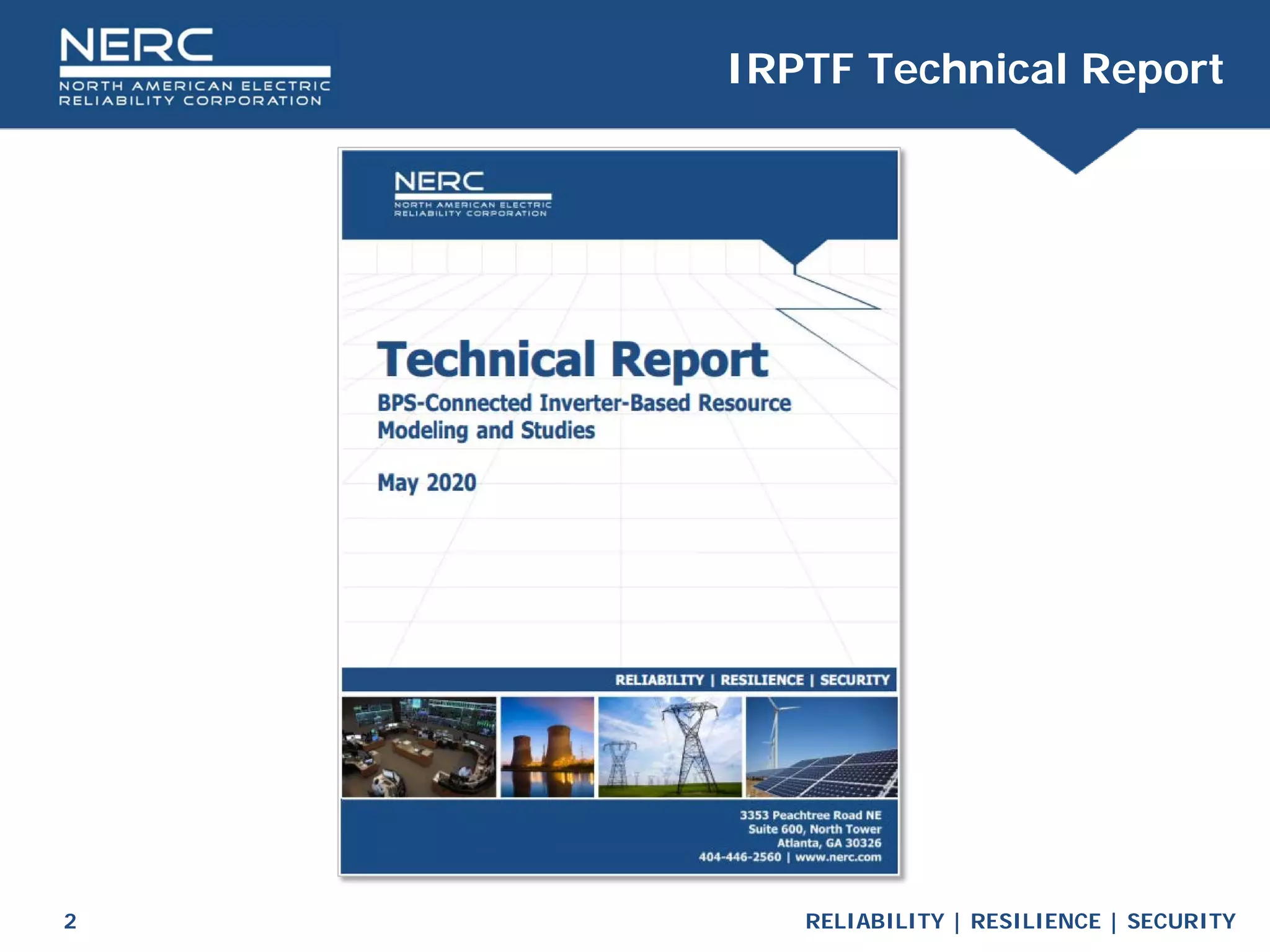
IRPTF Technical Report
RELIABILITY | RESILIENCE | SECURITY
3
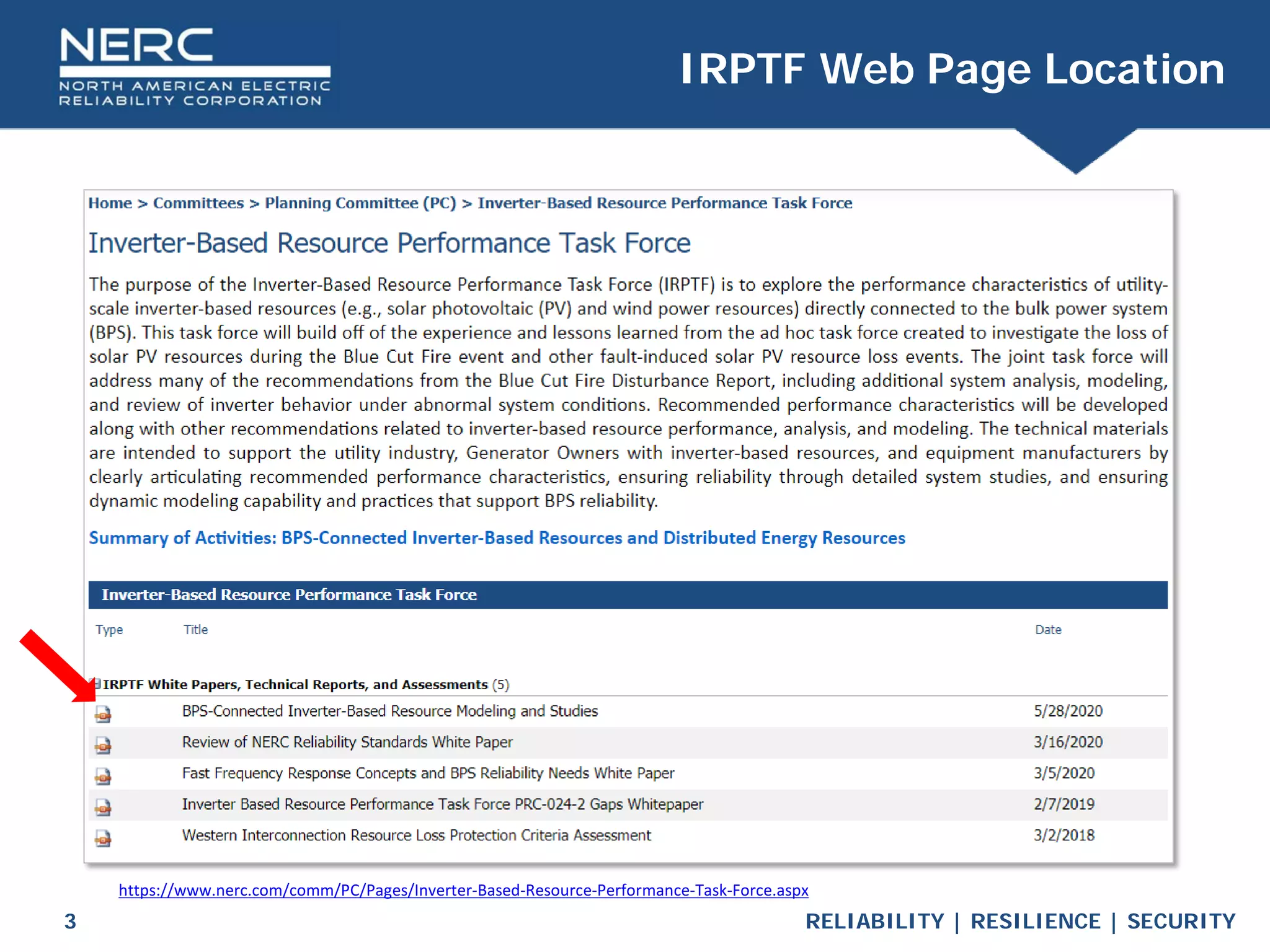
IRPTF Web Page Location
https://www.nerc.com/comm/PC/Pages/Inverter-Based-Resource-Performance-Task-Force.aspx
RELIABILITY | RESILIENCE | SECURITY
4
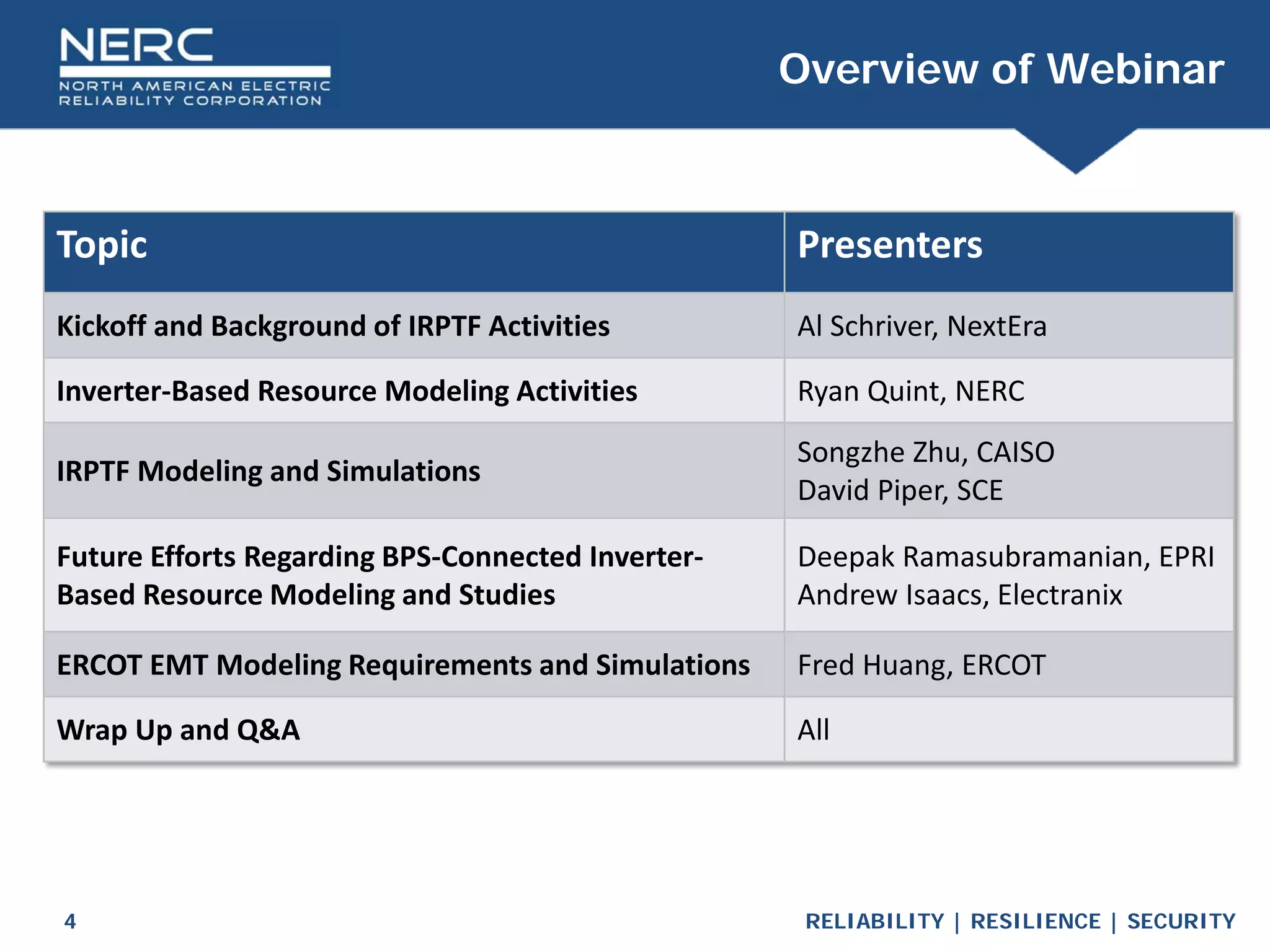
Overview of Webinar
Topic Presenters
Kickoff and Background of IRPTF Activities Al Schriver, NextEra
Inverter-Based Resource Modeling Activities Ryan Quint, NERC
IRPTF Modeling and Simulations
Songzhe Zhu, CAISO
David Piper, SCE
Future Efforts Regarding BPS-Connected Inverter-
Based Resource Modeling and Studies
Deepak Ramasubramanian, EPRI
Andrew Isaacs, Electranix
ERCOT EMT Modeling Requirements and Simulations Fred Huang, ERCOT
Wrap Up and Q&A All
RELIABILITY | RESILIENCE | SECURITY
5
Kickoff and Background of IRPTF Activities
Allen Schriver, NextEra
RELIABILITY | RESILIENCE | SECURITY
6
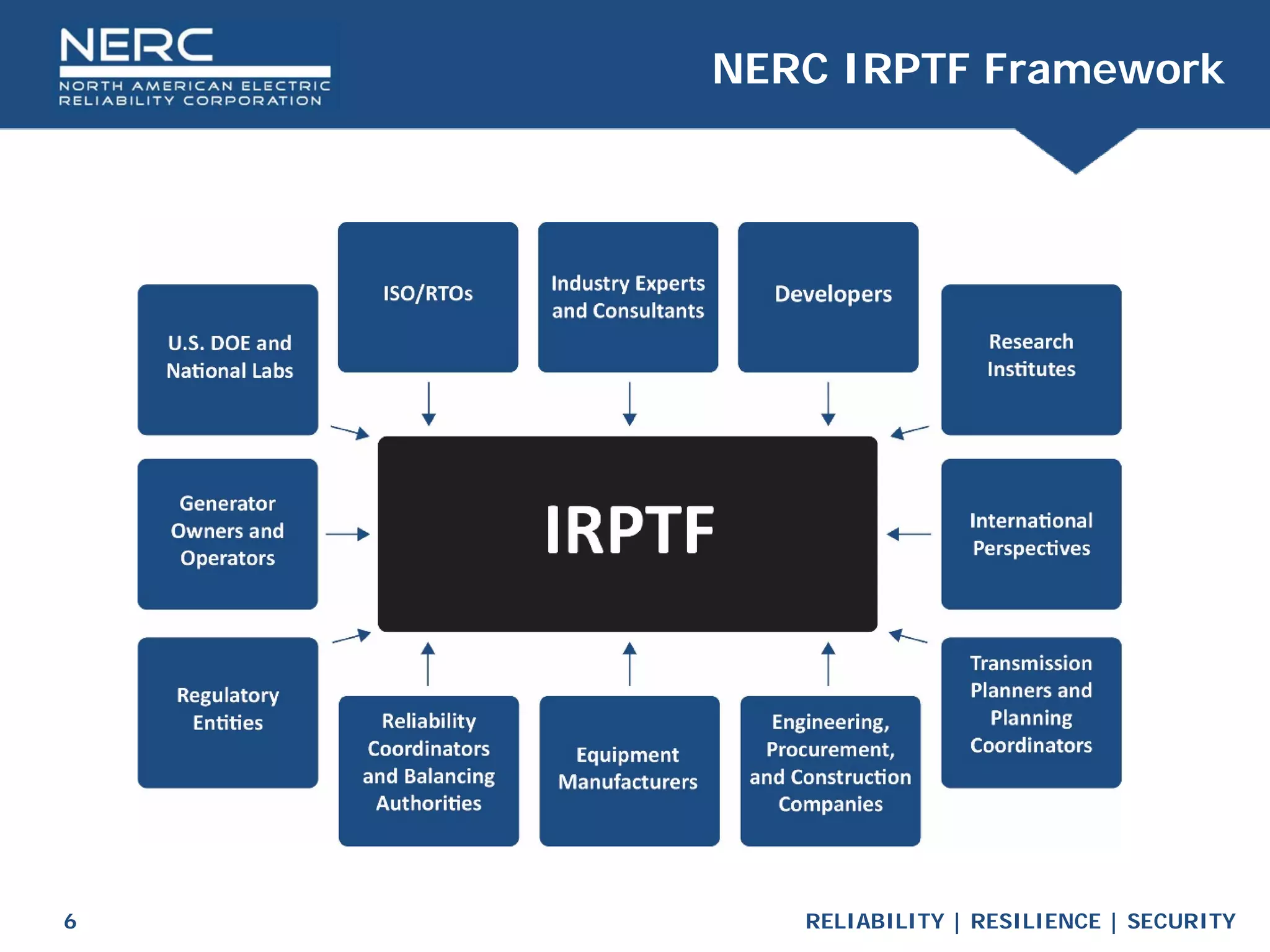
NERC IRPTF Framework
RELIABILITY | RESILIENCE | SECURITY
7
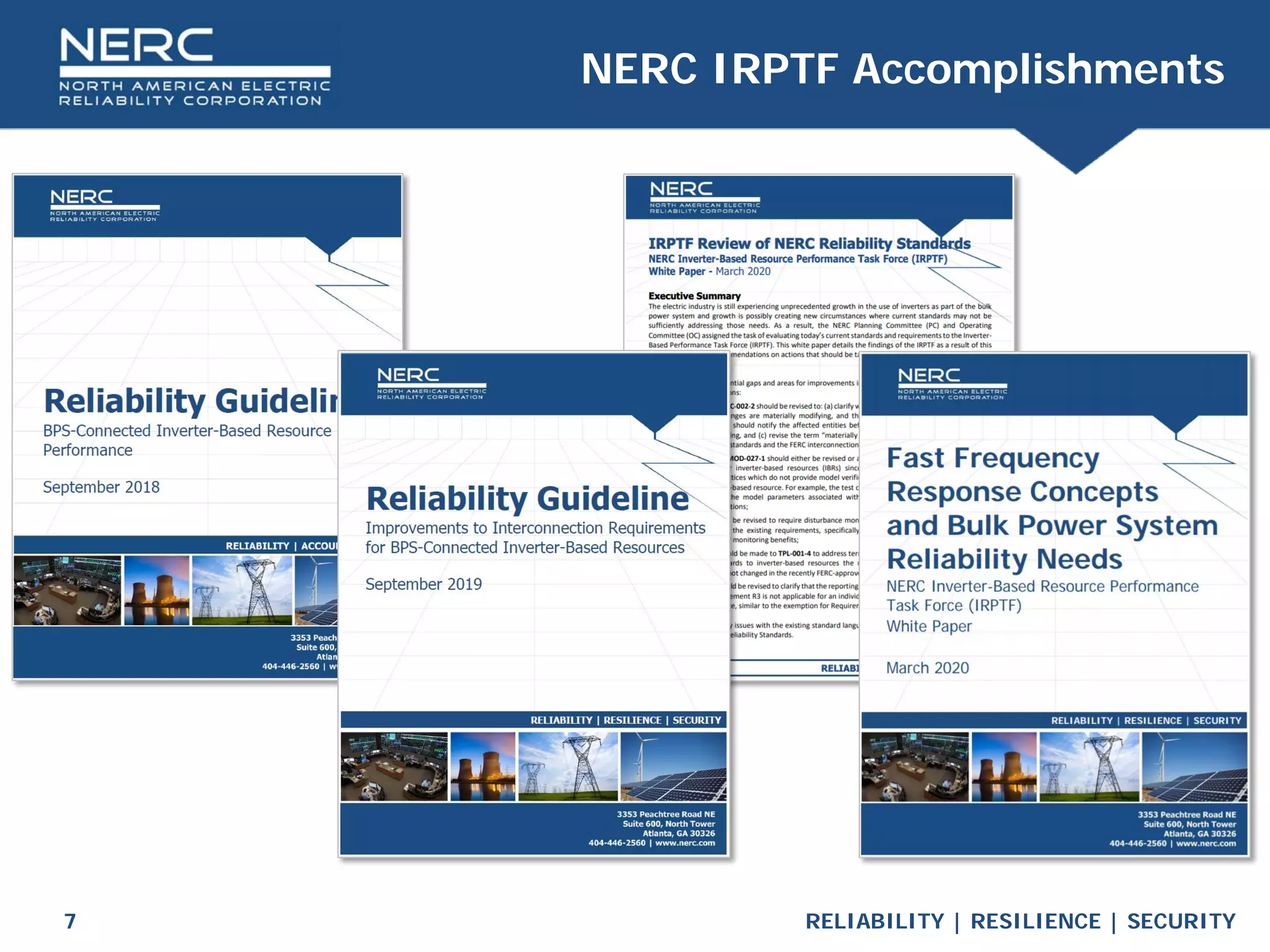
NERC IRPTF Accomplishments
RELIABILITY | RESILIENCE | SECURITY
8
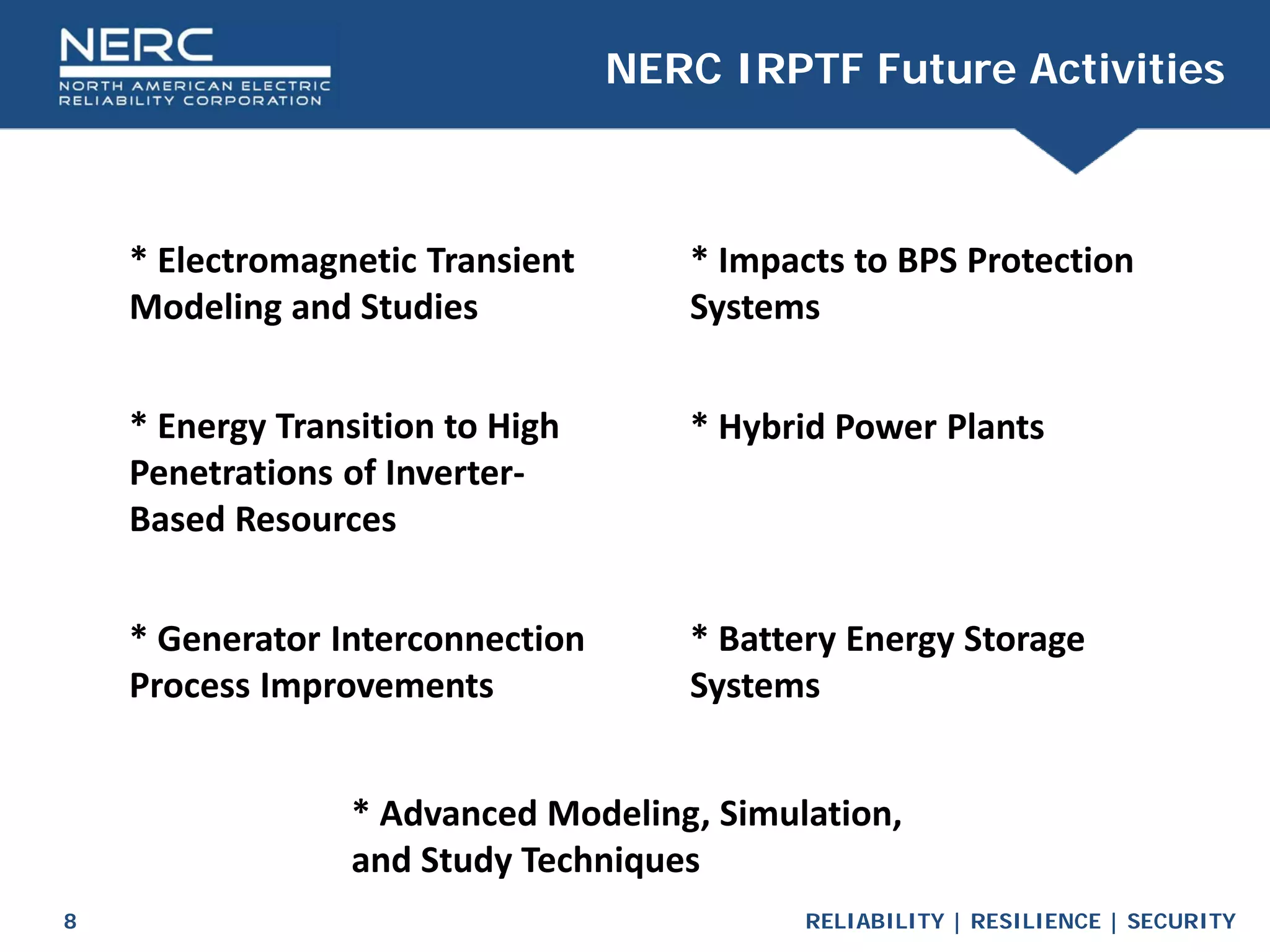
NERC IRPTF Future Activities
* Electromagnetic Transient
Modeling and Studies
* Energy Transition to High
Penetrations of Inverter-
Based Resources
* Impacts to BPS Protection
Systems
* Battery Energy Storage
Systems
* Hybrid Power Plants
* Generator Interconnection
Process Improvements
* Advanced Modeling, Simulation,
and Study Techniques
RELIABILITY | RESILIENCE | SECURITY
9
Chapter 1:
Inverter-Based Resource Modeling Activities
Ryan Quint, NERC
RELIABILITY | RESILIENCE | SECURITY
10
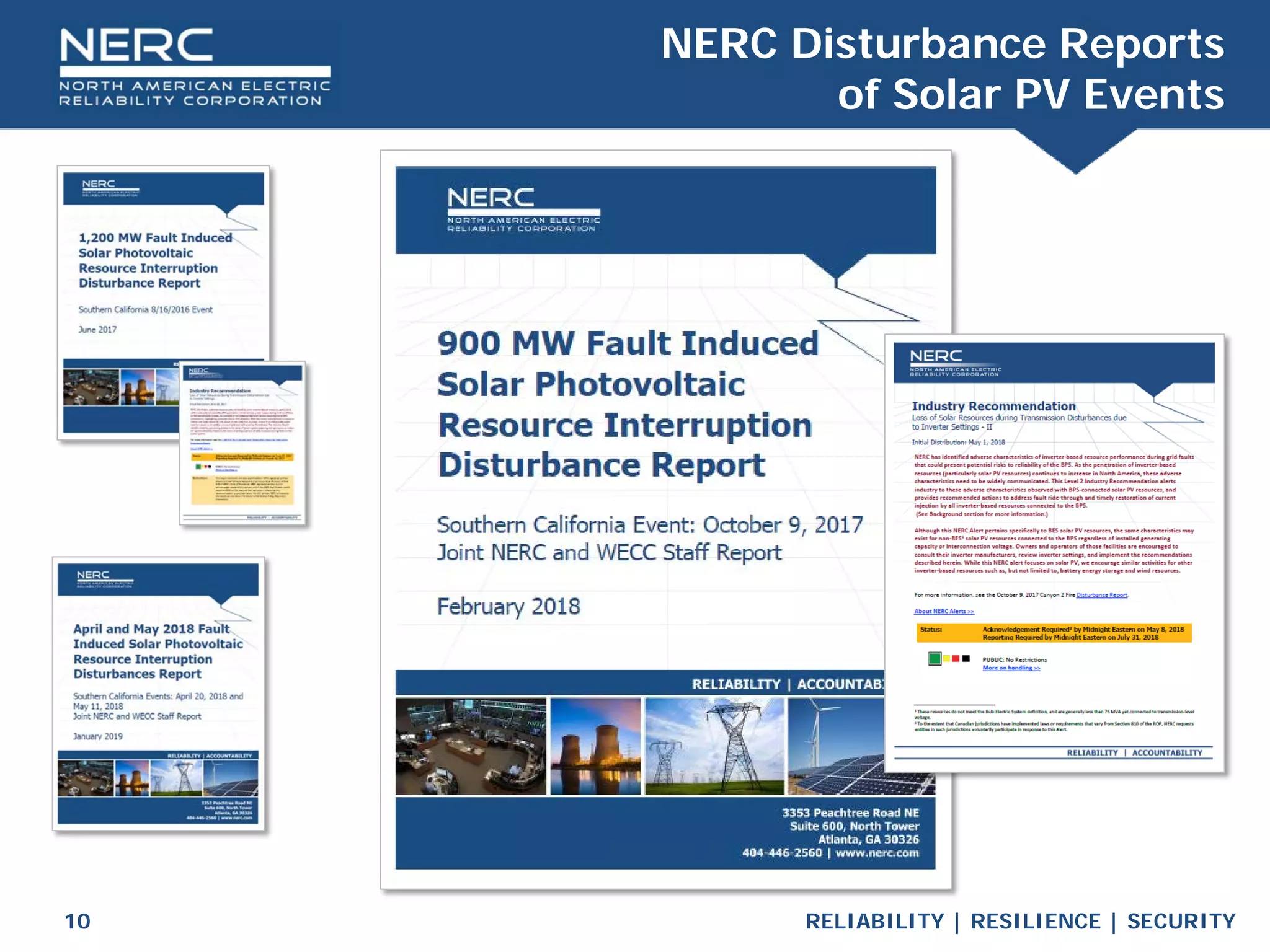
NERC Disturbance Reports
of Solar PV Events
RELIABILITY | RESILIENCE | SECURITY
11
• Modeling updates for existing resources
 Many TPs and PCs stated that minimal or no models provided by GO
 Models that were provided were incorrectly parameterized, were
unusable, or were wrong models entirely
• TP and PC outreach to GOs
 Rare number of entities doing extensive model follow-up
o Utilized MOD-032-1 or processes outside NERC Alert or NERC Standards
 Minimal follow-up actions by TPs and PCs to correct issues
 Some follow-up met with unwillingness of GO to cooperate
• TPs and PCs stated updated models were correct; cursory
review of updated models by WECC showed modeling errors
 Systemic lack of model “verification” by TPs and PCs
Canyon 2 Fire Alert Findings
RELIABILITY | RESILIENCE | SECURITY
12
• Most solar PV resource owners stated that they could eliminate
momentary cessation or change settings to improve
performance
 Little to no dynamic models provided; unclear as to what has or has not
been changed – follow-up activities needed
• BES versus non-BES resources
 Only about one-half of installed capacity of BPS-connected solar PV
resources in the West were part of NERC Alert process due to BES
definition (i.e., 75 MVA)
 Other one-half of capacity has settings and capabilities that are unknown
to NERC (and likely to much of industry)
Canyon 2 Fire Alert Findings (cont.)
RELIABILITY | RESILIENCE | SECURITY
13
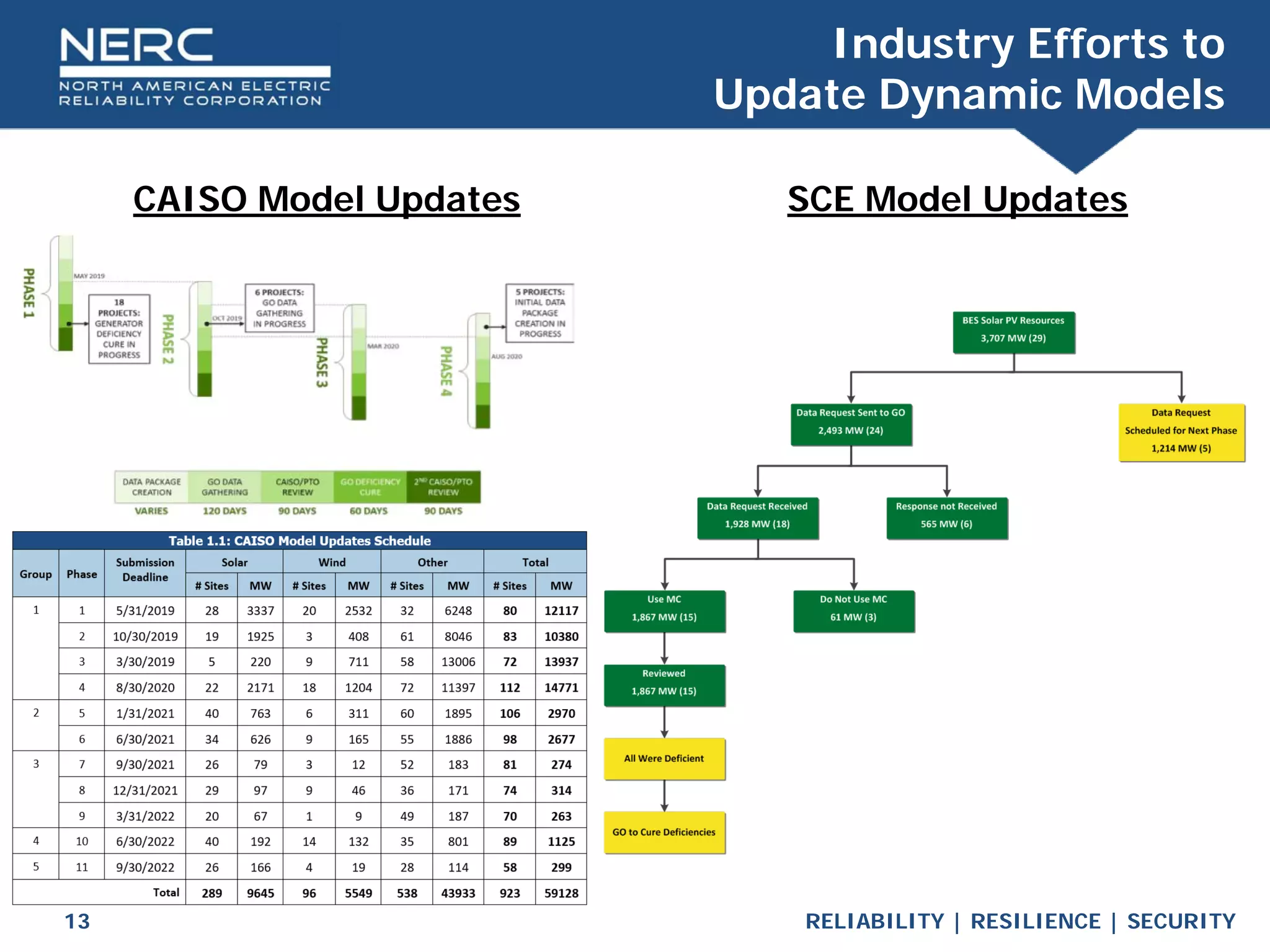
Industry Efforts to
Update Dynamic Models
CAISO Model Updates SCE Model Updates
RELIABILITY | RESILIENCE | SECURITY
14
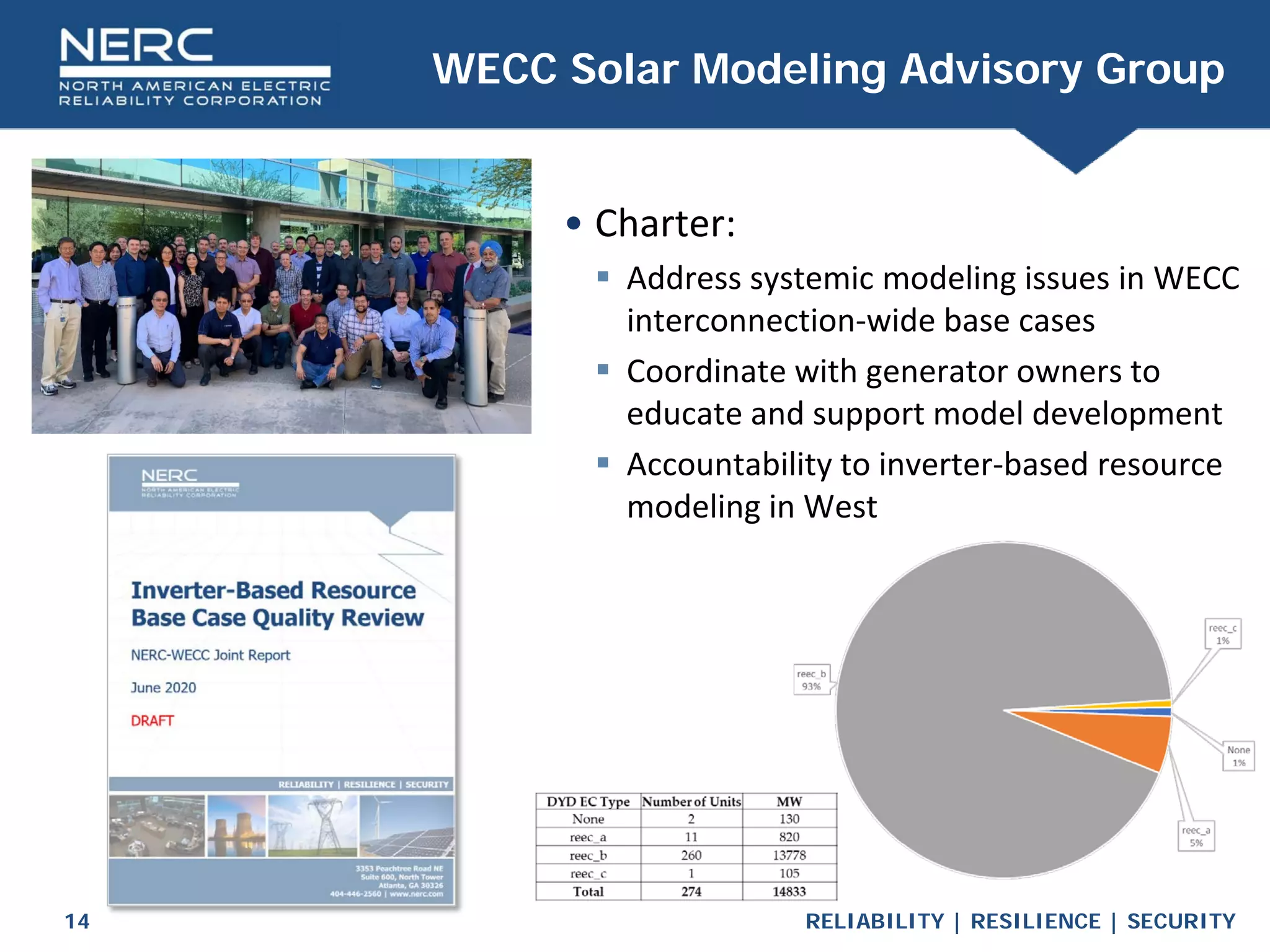
WECC Solar Modeling Advisory Group
• Charter:
 Address systemic modeling issues in WECC
interconnection-wide base cases
 Coordinate with generator owners to
educate and support model development
 Accountability to inverter-based resource
modeling in West
RELIABILITY | RESILIENCE | SECURITY
15
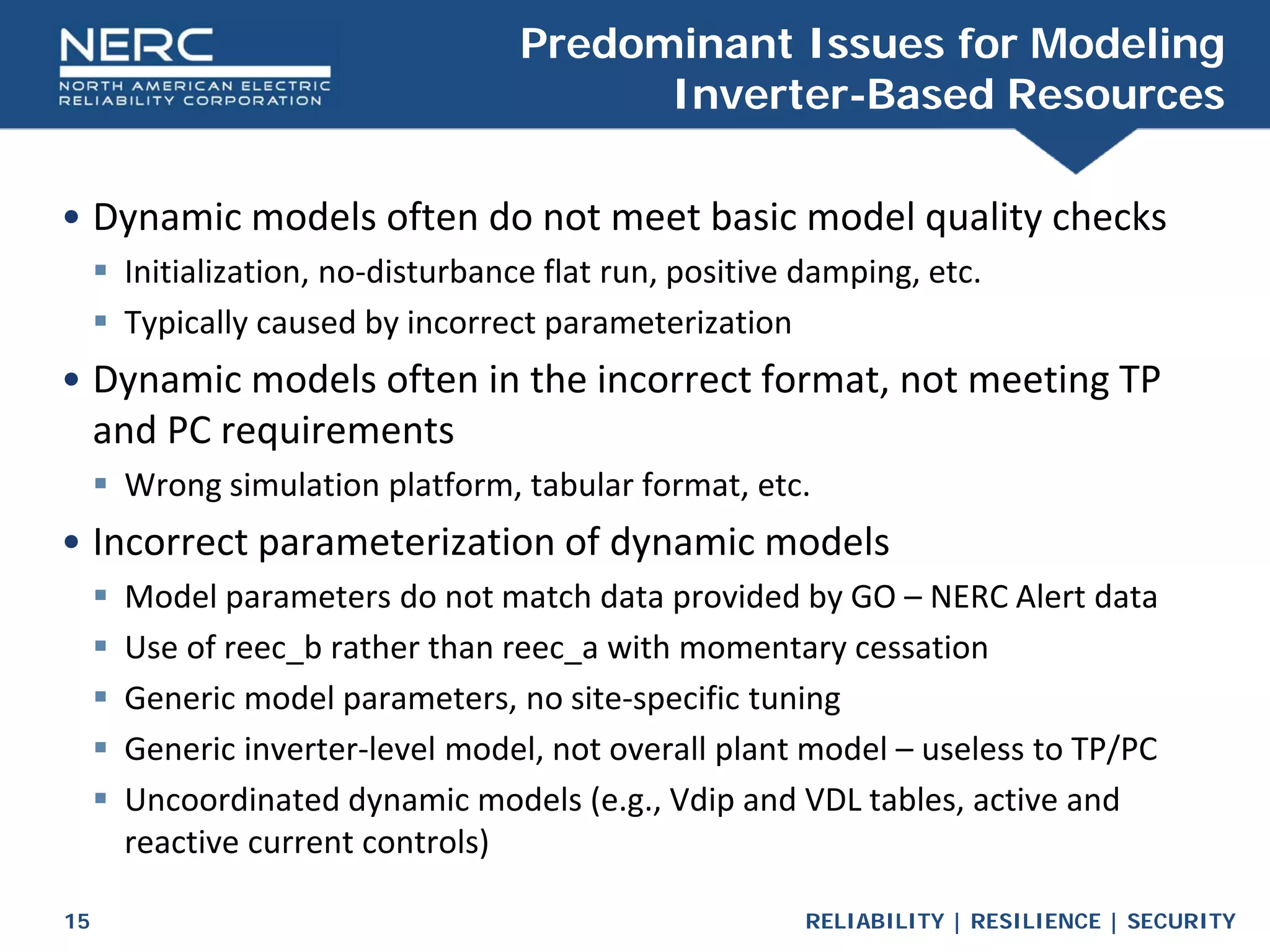
• Dynamic models often do not meet basic model quality checks
 Initialization, no-disturbance flat run, positive damping, etc.
 Typically caused by incorrect parameterization
• Dynamic models often in the incorrect format, not meeting TP
and PC requirements
 Wrong simulation platform, tabular format, etc.
• Incorrect parameterization of dynamic models
 Model parameters do not match data provided by GO – NERC Alert data
 Use of reec_b rather than reec_a with momentary cessation
 Generic model parameters, no site-specific tuning
 Generic inverter-level model, not overall plant model – useless to TP/PC
 Uncoordinated dynamic models (e.g., Vdip and VDL tables, active and
reactive current controls)
Predominant Issues for Modeling
Inverter-Based Resources
RELIABILITY | RESILIENCE | SECURITY
16
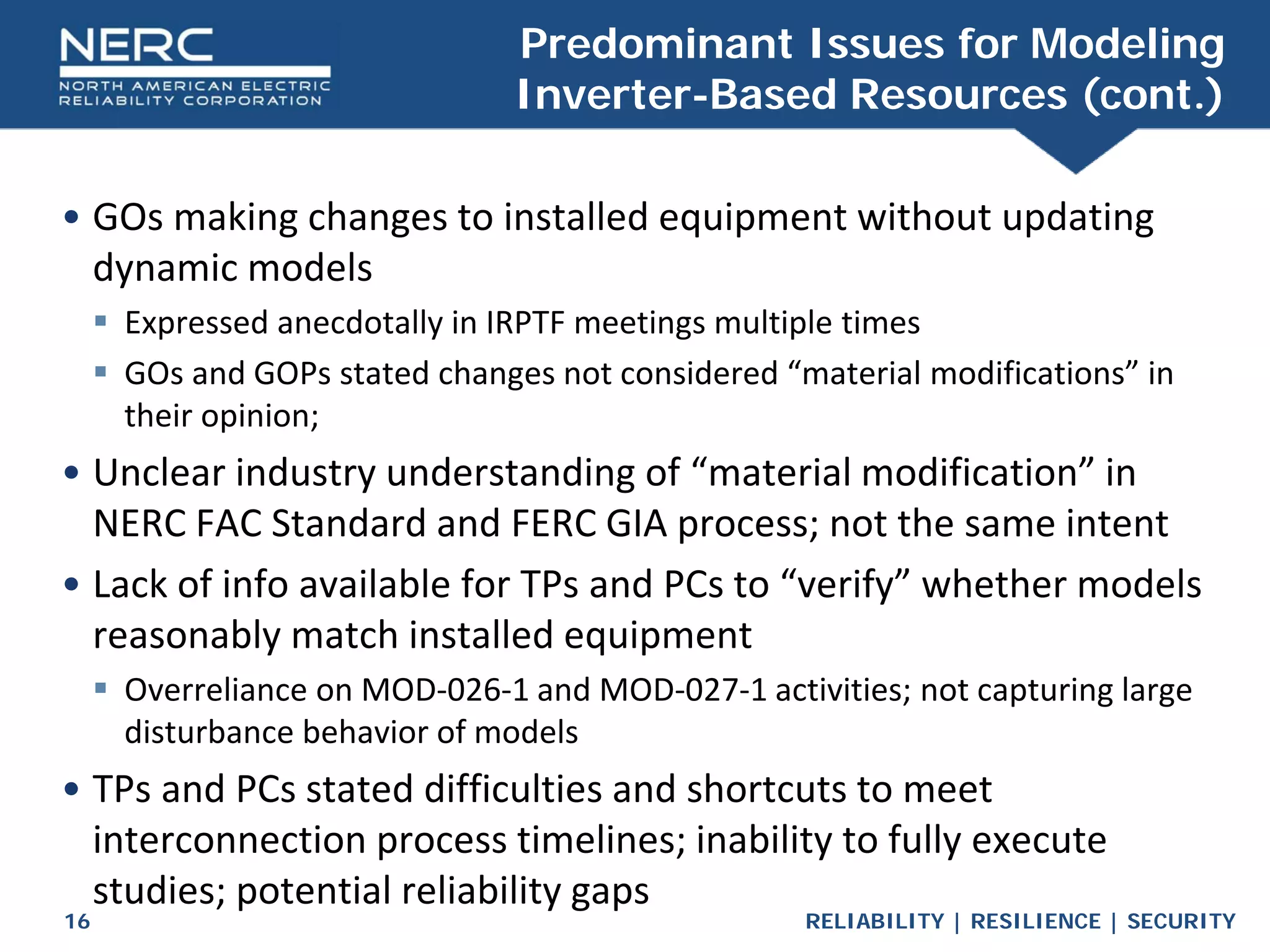
• GOs making changes to installed equipment without updating
dynamic models
 Expressed anecdotally in IRPTF meetings multiple times
 GOs and GOPs stated changes not considered “material modifications” in
their opinion;
• Unclear industry understanding of “material modification” in
NERC FAC Standard and FERC GIA process; not the same intent
• Lack of info available for TPs and PCs to “verify” whether models
reasonably match installed equipment
 Overreliance on MOD-026-1 and MOD-027-1 activities; not capturing large
disturbance behavior of models
• TPs and PCs stated difficulties and shortcuts to meet
interconnection process timelines; inability to fully execute
studies; potential reliability gaps
Predominant Issues for Modeling
Inverter-Based Resources (cont.)
RELIABILITY | RESILIENCE | SECURITY
17
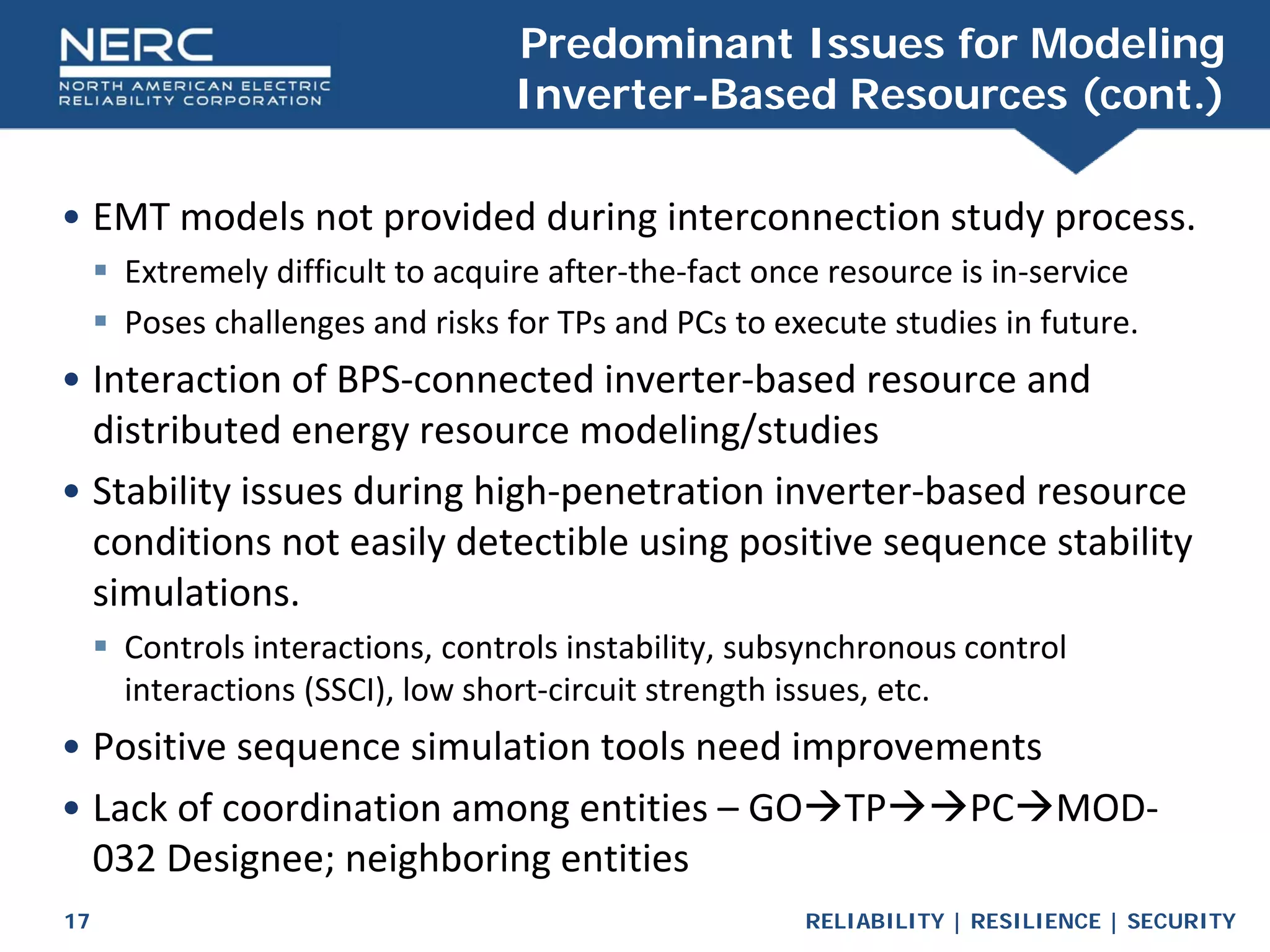
• EMT models not provided during interconnection study process.
 Extremely difficult to acquire after-the-fact once resource is in-service
 Poses challenges and risks for TPs and PCs to execute studies in future.
• Interaction of BPS-connected inverter-based resource and
distributed energy resource modeling/studies
• Stability issues during high-penetration inverter-based resource
conditions not easily detectible using positive sequence stability
simulations.
 Controls interactions, controls instability, subsynchronous control
interactions (SSCI), low short-circuit strength issues, etc.
• Positive sequence simulation tools need improvements
• Lack of coordination among entities – GOTPPCMOD-
032 Designee; neighboring entities
Predominant Issues for Modeling
Inverter-Based Resources (cont.)
RELIABILITY | RESILIENCE | SECURITY
18
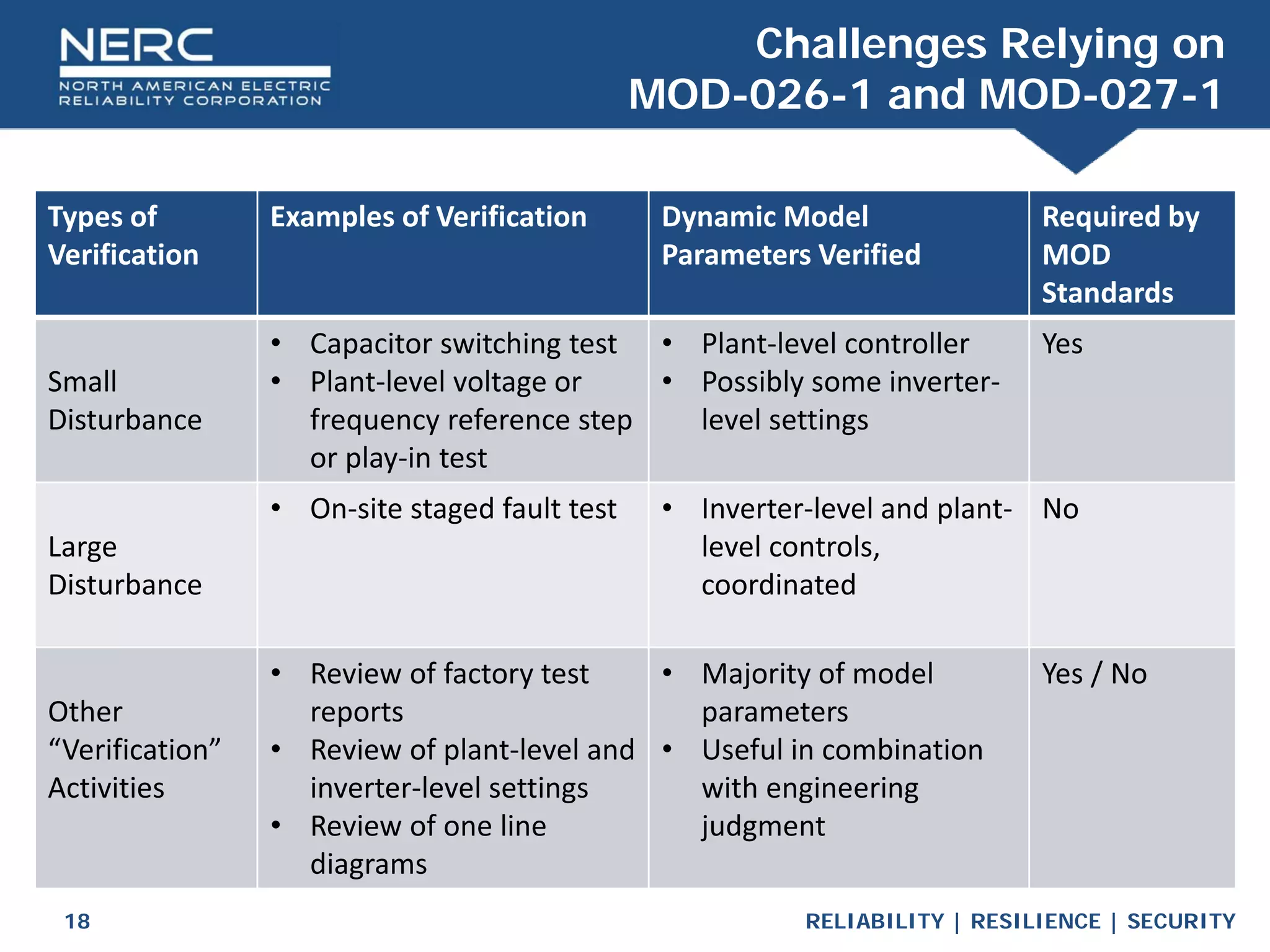
Types of
Verification
Examples of Verification Dynamic Model
Parameters Verified
Required by
MOD
Standards
Small
Disturbance
• Capacitor switching test
• Plant-level voltage or
frequency reference step
or play-in test
• Plant-level controller
• Possibly some inverter-
level settings
Yes
Large
Disturbance
• On-site staged fault test • Inverter-level and plant-
level controls,
coordinated
No
Other
“Verification”
Activities
• Review of factory test
reports
• Review of plant-level and
inverter-level settings
• Review of one line
diagrams
• Majority of model
parameters
• Useful in combination
with engineering
judgment
Yes / No
Challenges Relying on
MOD-026-1 and MOD-027-1
RELIABILITY | RESILIENCE | SECURITY
19
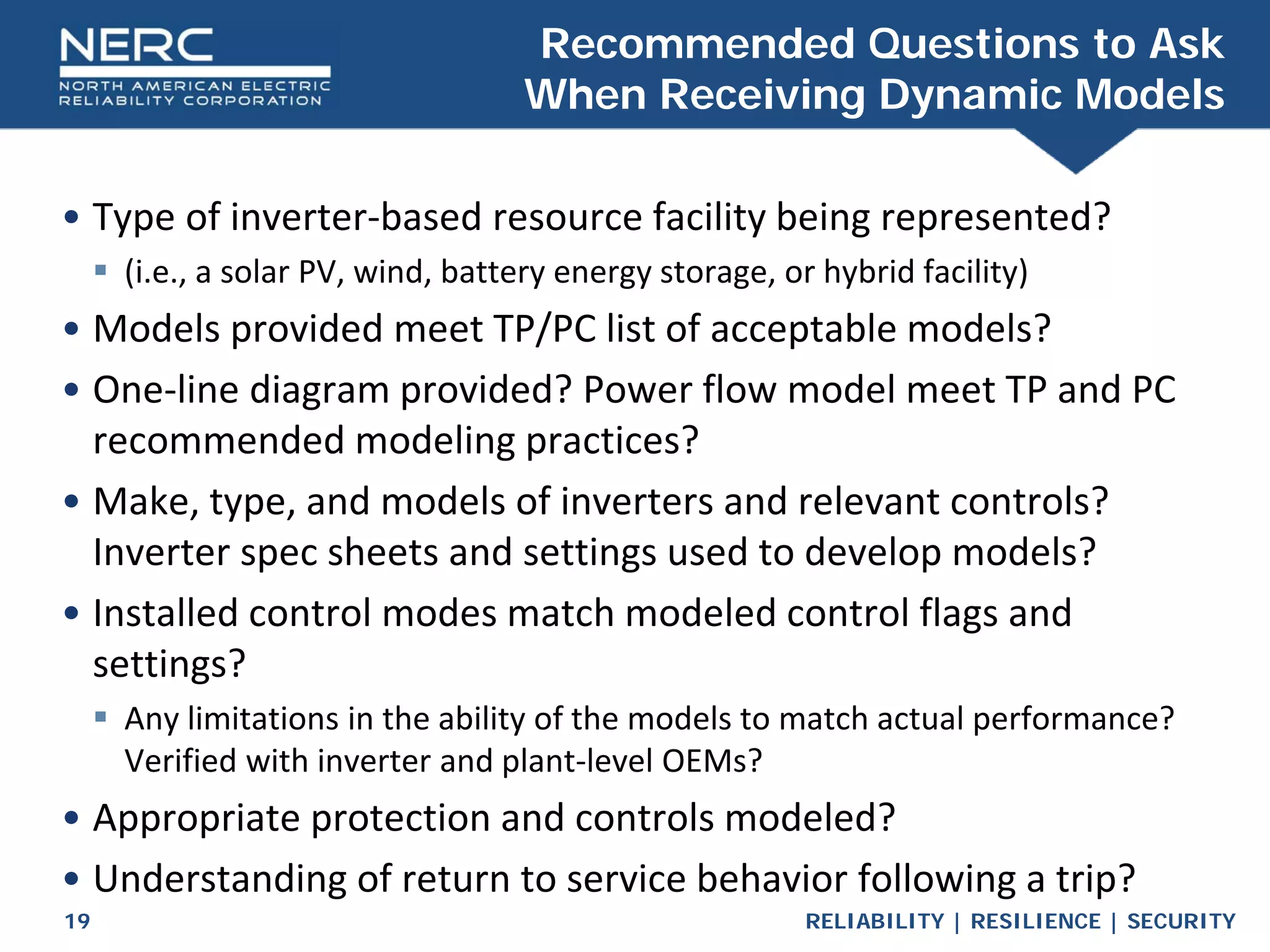
• Type of inverter-based resource facility being represented?
 (i.e., a solar PV, wind, battery energy storage, or hybrid facility)
• Models provided meet TP/PC list of acceptable models?
• One-line diagram provided? Power flow model meet TP and PC
recommended modeling practices?
• Make, type, and models of inverters and relevant controls?
Inverter spec sheets and settings used to develop models?
• Installed control modes match modeled control flags and
settings?
 Any limitations in the ability of the models to match actual performance?
Verified with inverter and plant-level OEMs?
• Appropriate protection and controls modeled?
• Understanding of return to service behavior following a trip?
Recommended Questions to Ask
When Receiving Dynamic Models
RELIABILITY | RESILIENCE | SECURITY
20
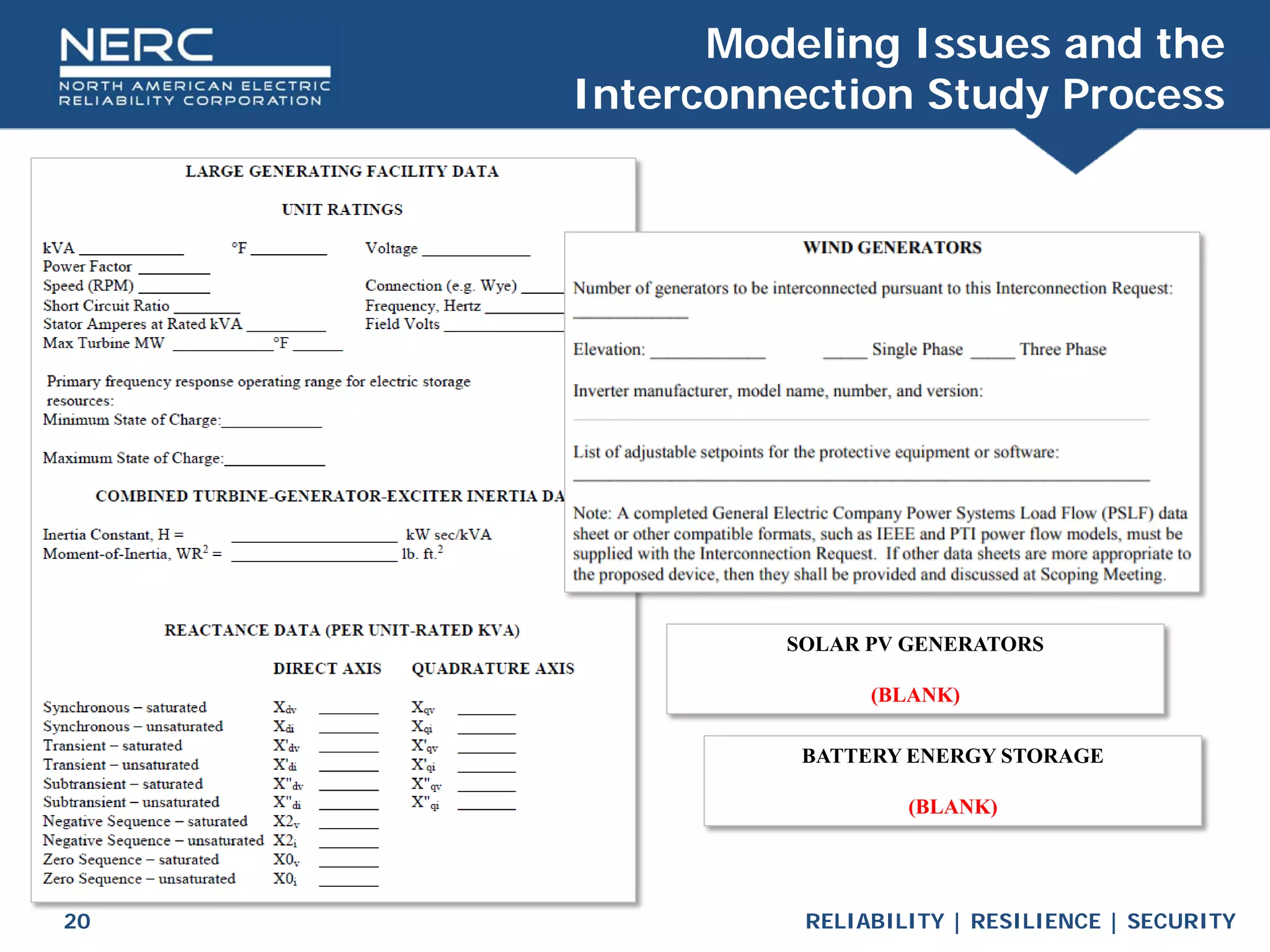
Modeling Issues and the
Interconnection Study Process
SOLAR PV GENERATORS
(BLANK)
BATTERY ENERGY STORAGE
(BLANK)
RELIABILITY | RESILIENCE | SECURITY
21
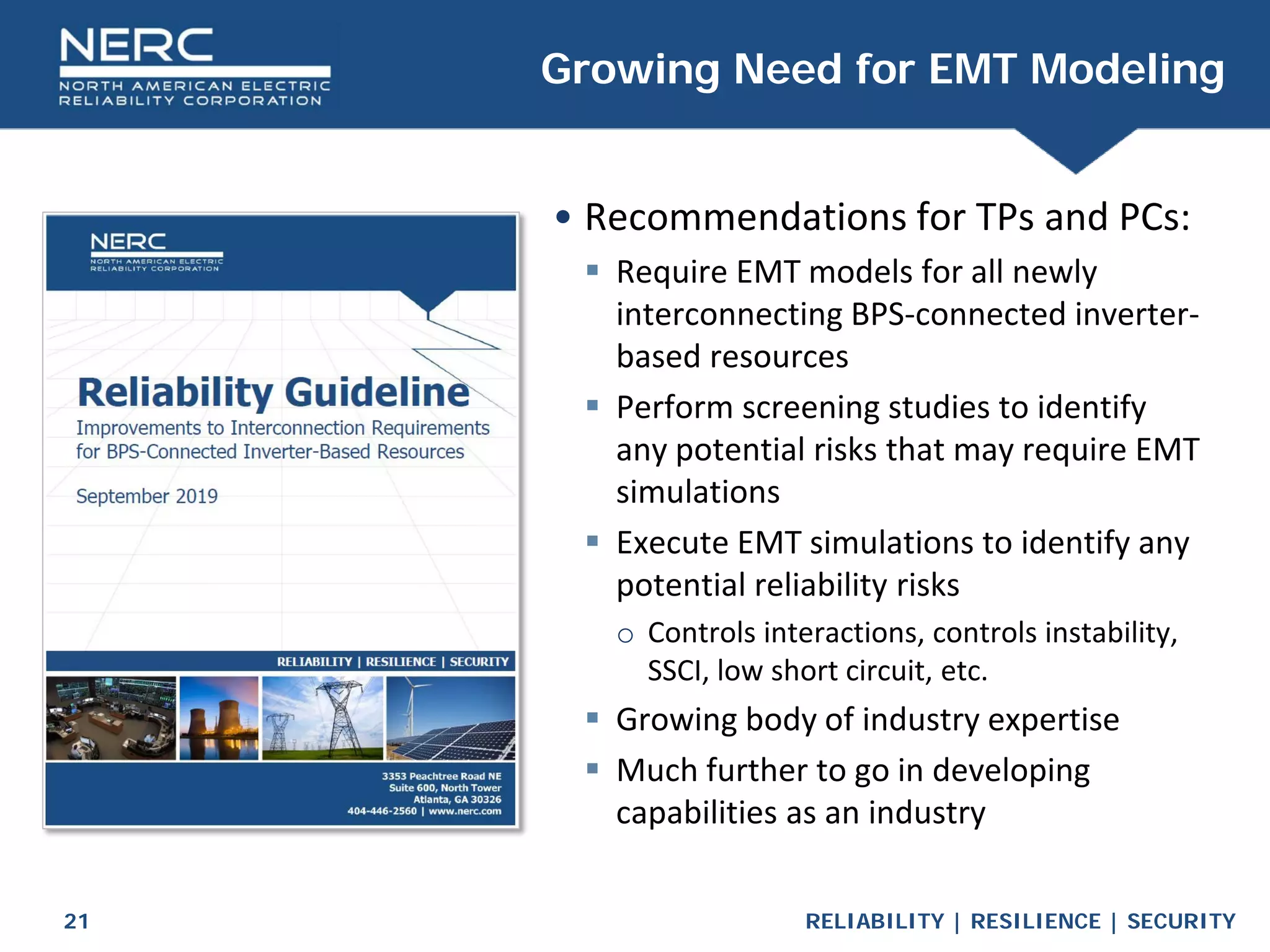
• Recommendations for TPs and PCs:
 Require EMT models for all newly
interconnecting BPS-connected inverter-
based resources
 Perform screening studies to identify
any potential risks that may require EMT
simulations
 Execute EMT simulations to identify any
potential reliability risks
o Controls interactions, controls instability,
SSCI, low short circuit, etc.
 Growing body of industry expertise
 Much further to go in developing
capabilities as an industry
Growing Need for EMT Modeling
RELIABILITY | RESILIENCE | SECURITY
22
Chapter 2:
IRPTF Modeling and Simulations
Songzhe Zhu, CAISO
David Piper, SCE
RELIABILITY | RESILIENCE | SECURITY
23
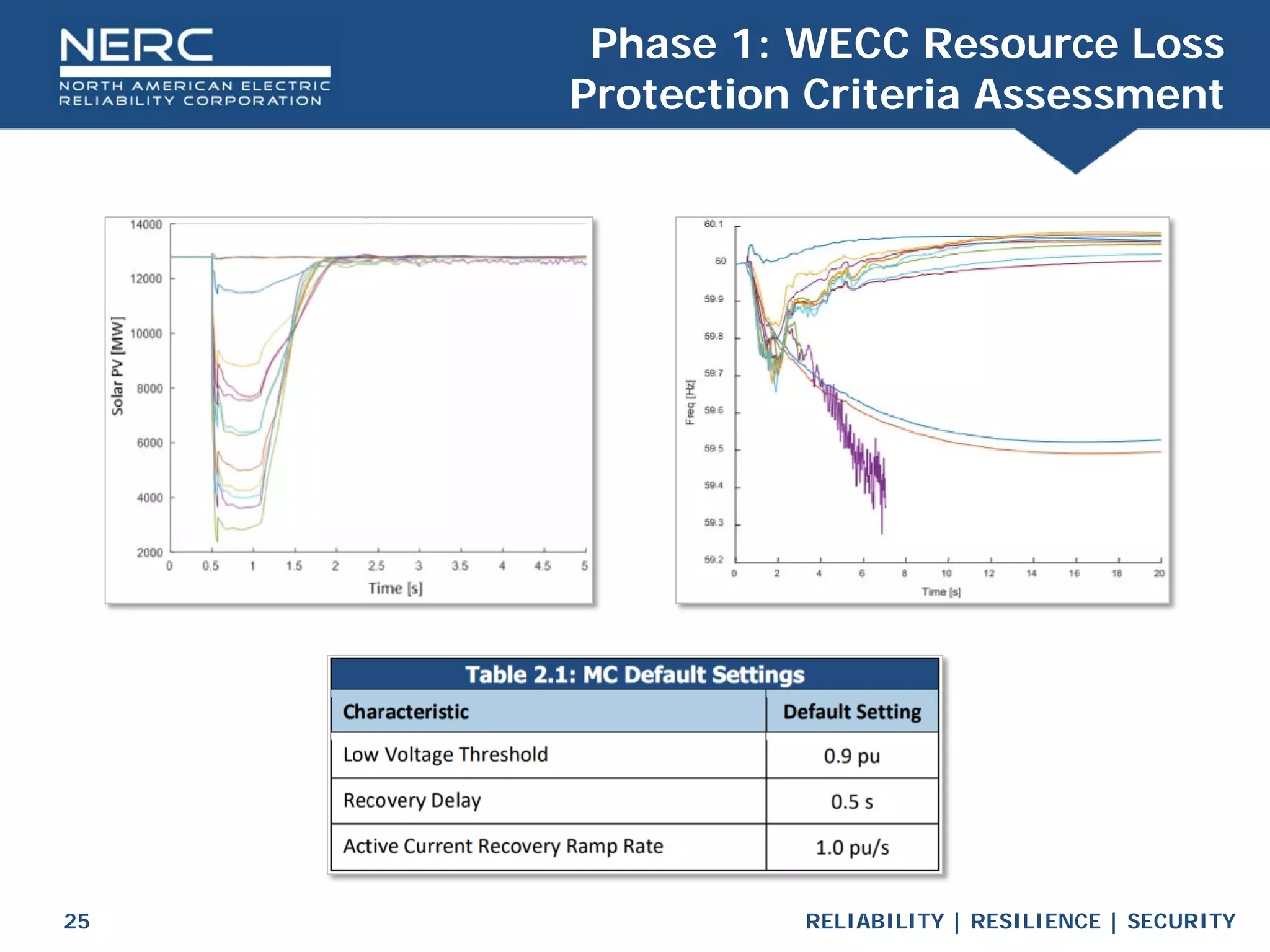
• Phase 1: Resource Loss Protection Criteria Studies
 Minimum inertia, minimum reserves, overly stressed operating condition
 No reliability risks identified w.r.t. frequency stability and RLPC
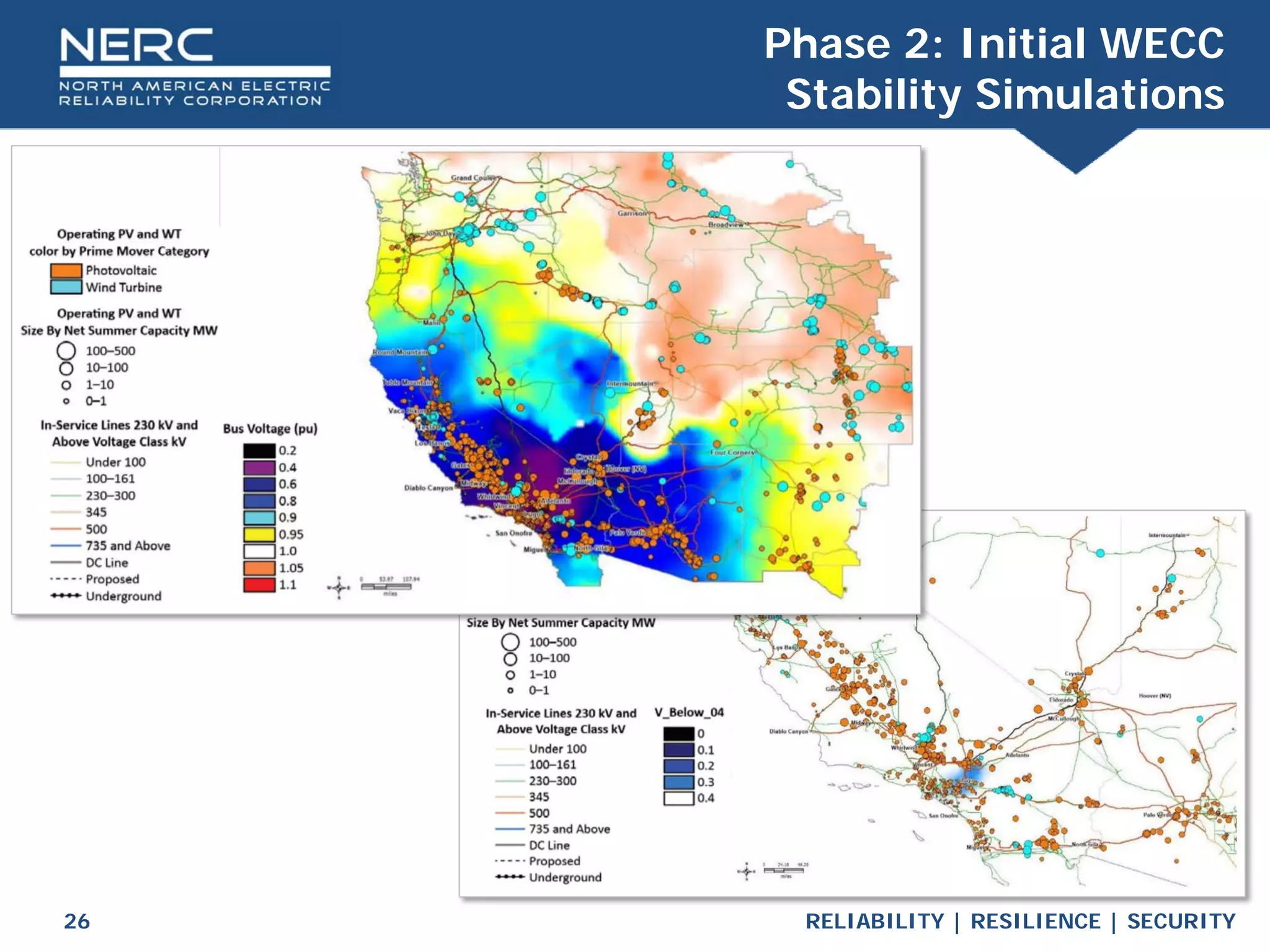
• Phase 2: Realistic High Solar PV Penetration Conditions
 Light summer base case, high solar PV, moderate wind, reasonable on-line
reserves
 All resources potential employing momentary cessation (based on data
available at the time)
• Phase 3: Updated Dynamics Data and High Solar PV Conditions
 Same base case and operating conditions
 Updated dynamics data to match NERC Alert data following Canyon 2
disturbance
Overview of IRPTF Studies
RELIABILITY | RESILIENCE | SECURITY
24
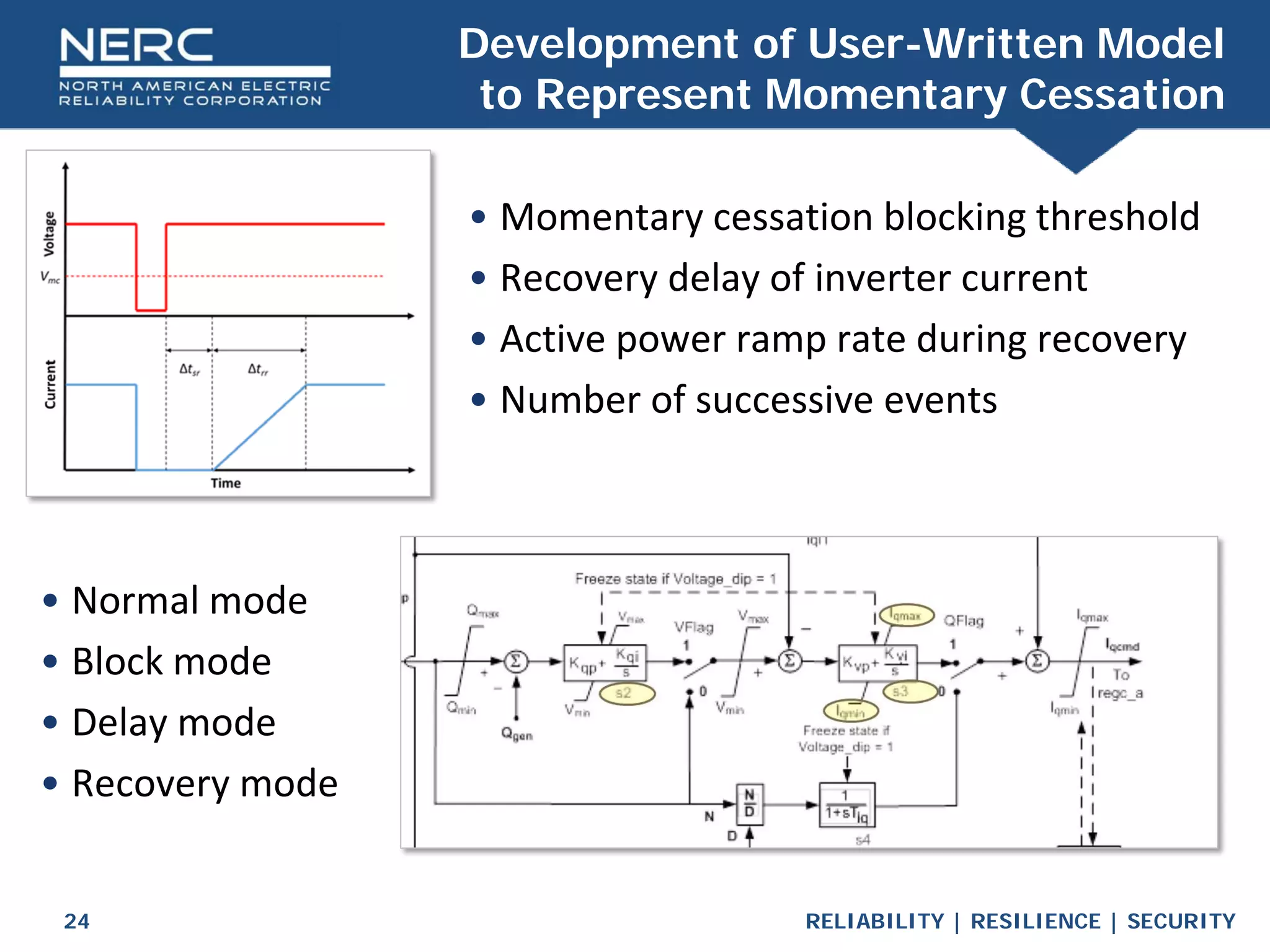
• Momentary cessation blocking threshold
• Recovery delay of inverter current
• Active power ramp rate during recovery
• Number of successive events
Development of User-Written Model
to Represent Momentary Cessation
• Normal mode
• Block mode
• Delay mode
• Recovery mode
RELIABILITY | RESILIENCE | SECURITY
25
Phase 1: WECC Resource Loss
Protection Criteria Assessment
RELIABILITY | RESILIENCE | SECURITY
26
Phase 2: Initial WECC
Stability Simulations
RELIABILITY | RESILIENCE | SECURITY
27
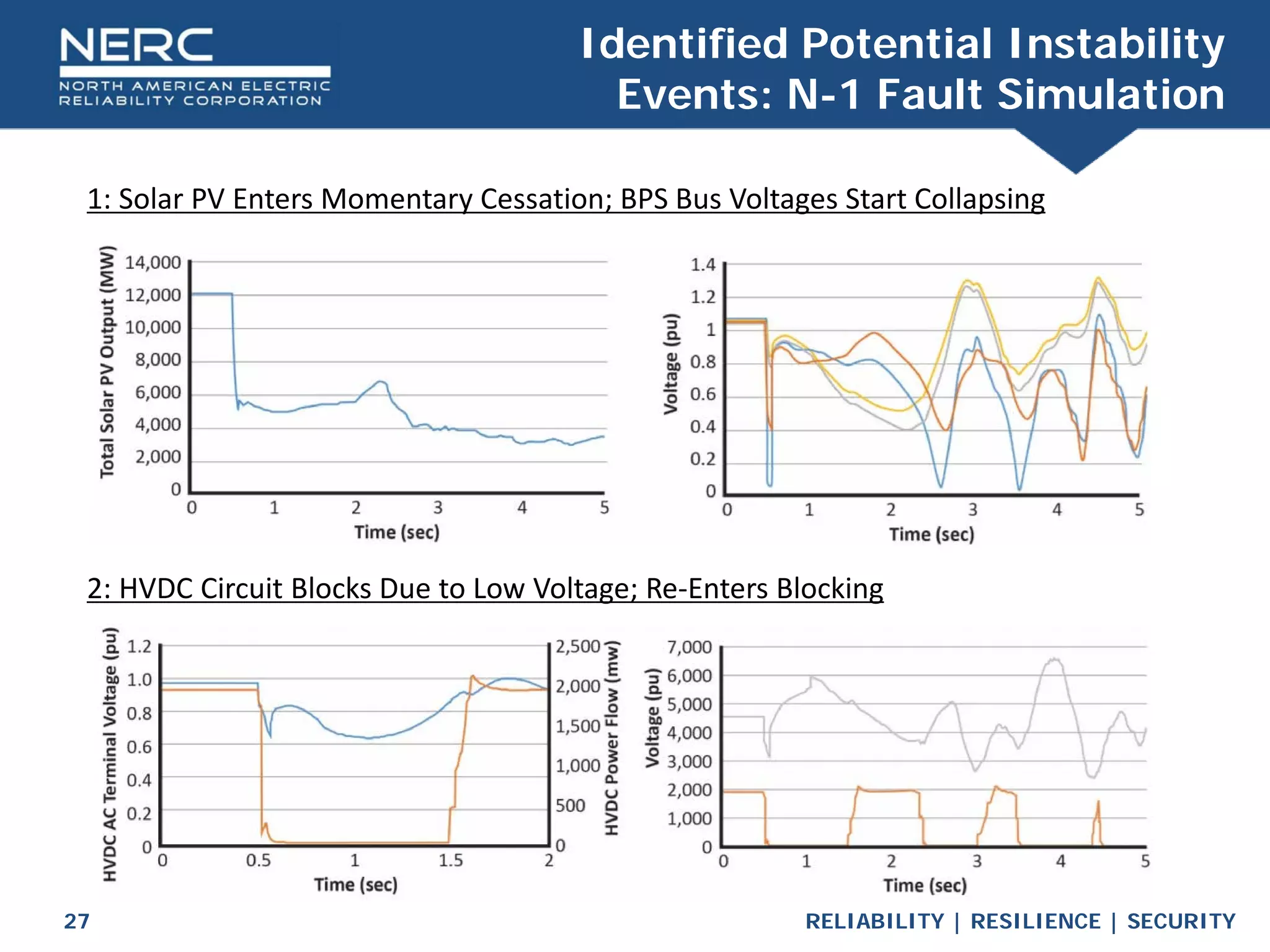
Identified Potential Instability
Events: N-1 Fault Simulation
1: Solar PV Enters Momentary Cessation; BPS Bus Voltages Start Collapsing
2: HVDC Circuit Blocks Due to Low Voltage; Re-Enters Blocking
RELIABILITY | RESILIENCE | SECURITY
28
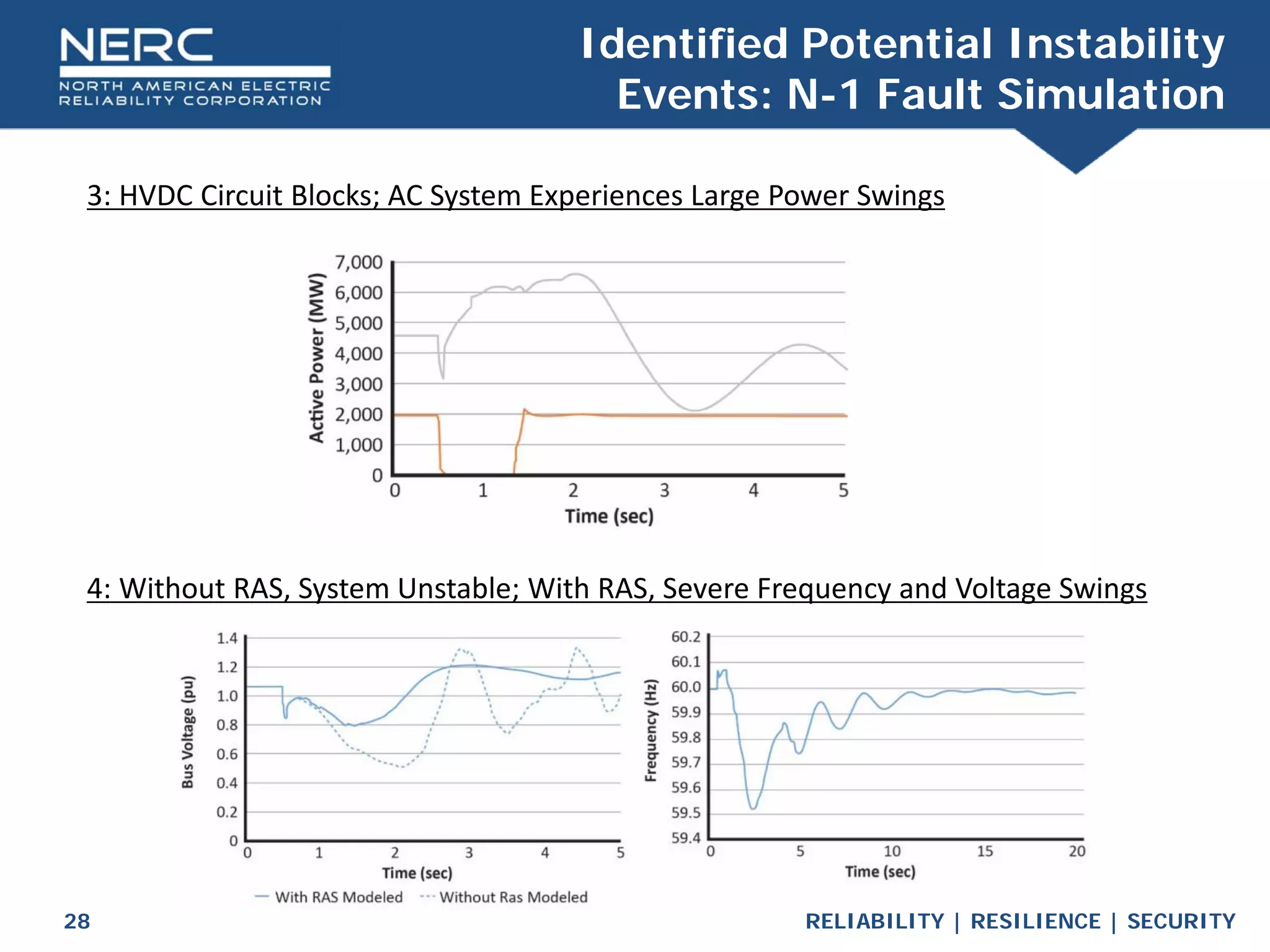
Identified Potential Instability
Events: N-1 Fault Simulation
3: HVDC Circuit Blocks; AC System Experiences Large Power Swings
4: Without RAS, System Unstable; With RAS, Severe Frequency and Voltage Swings
RELIABILITY | RESILIENCE | SECURITY
29
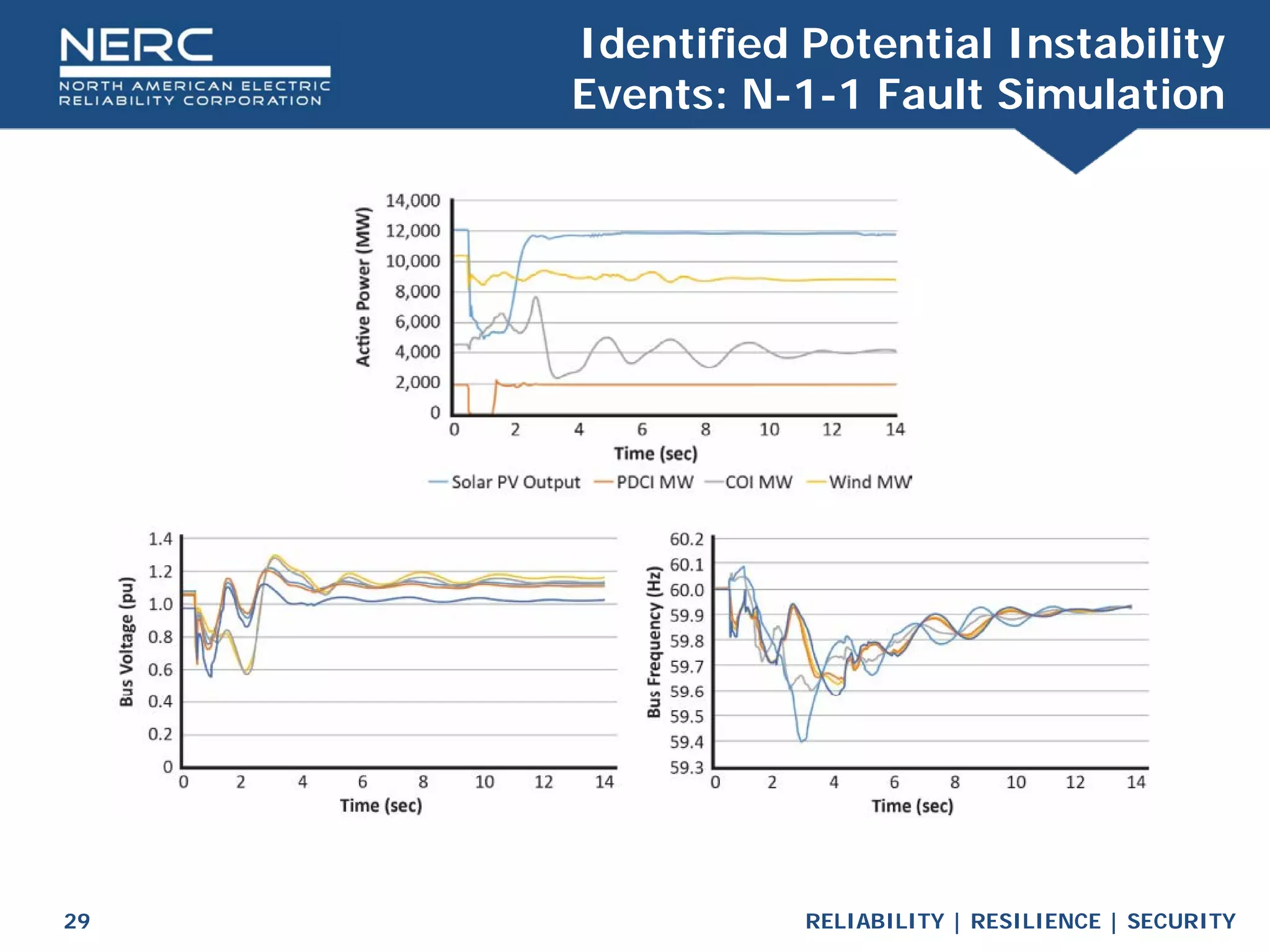
Identified Potential Instability
Events: N-1-1 Fault Simulation
RELIABILITY | RESILIENCE | SECURITY
30
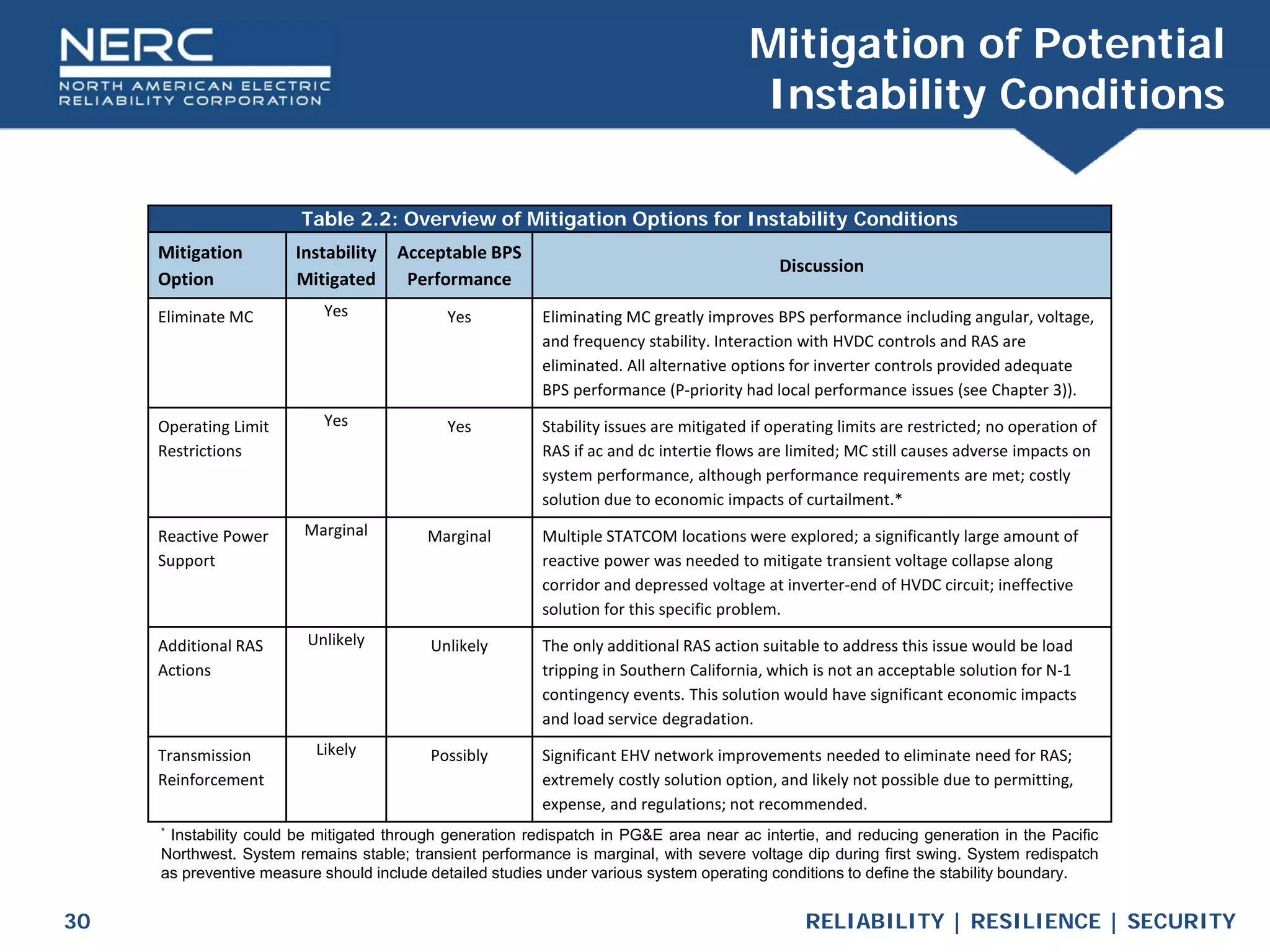
Table 2.2: Overview of Mitigation Options for Instability Conditions
Mitigation
Option
Instability
Mitigated
Acceptable BPS
Performance
Discussion
Eliminate MC Yes Yes Eliminating MC greatly improves BPS performance including angular, voltage,
and frequency stability. Interaction with HVDC controls and RAS are
eliminated. All alternative options for inverter controls provided adequate
BPS performance (P-priority had local performance issues (see Chapter 3)).
Operating Limit
Restrictions
Yes Yes Stability issues are mitigated if operating limits are restricted; no operation of
RAS if ac and dc intertie flows are limited; MC still causes adverse impacts on
system performance, although performance requirements are met; costly
solution due to economic impacts of curtailment.*
Reactive Power
Support
Marginal Marginal Multiple STATCOM locations were explored; a significantly large amount of
reactive power was needed to mitigate transient voltage collapse along
corridor and depressed voltage at inverter-end of HVDC circuit; ineffective
solution for this specific problem.
Additional RAS
Actions
Unlikely Unlikely The only additional RAS action suitable to address this issue would be load
tripping in Southern California, which is not an acceptable solution for N-1
contingency events. This solution would have significant economic impacts
and load service degradation.
Transmission
Reinforcement
Likely Possibly Significant EHV network improvements needed to eliminate need for RAS;
extremely costly solution option, and likely not possible due to permitting,
expense, and regulations; not recommended.
Mitigation of Potential
Instability Conditions
* Instability could be mitigated through generation redispatch in PG&E area near ac intertie, and reducing generation in the Pacific
Northwest. System remains stable; transient performance is marginal, with severe voltage dip during first swing. System redispatch
as preventive measure should include detailed studies under various system operating conditions to define the stability boundary.
RELIABILITY | RESILIENCE | SECURITY
31
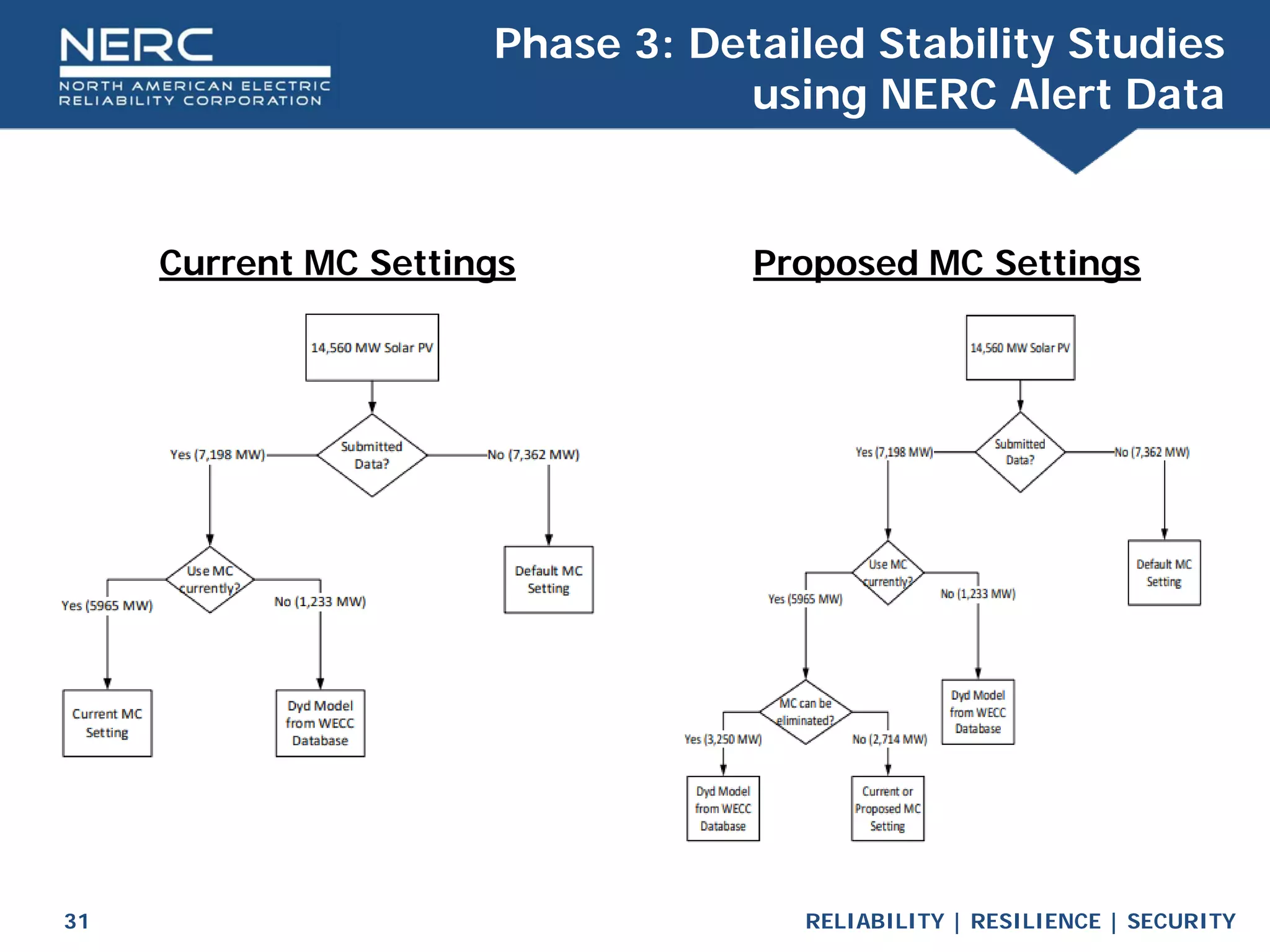
Phase 3: Detailed Stability Studies
using NERC Alert Data
Current MC Settings Proposed MC Settings
RELIABILITY | RESILIENCE | SECURITY
32
Table 2.3: Performance Comparison for Different MC Settings for N-1
Contingency (without and with RAS Action)
System Response Default MC Current MC Proposed MC
RAS Actions Not Modeled
Initial HVDC blocking duration [s] 0.93 0.90 0.84
Successive HVDC Blocking Yes No No
System Stable No Yes Yes
System Frequency Nadir [Hz] N/A (Unstable) 59.63 Hz 59.78 Hz
RAS Actions Modeled
Successive HVDC Blocking No No No
System Stable Yes Yes Yes
System Frequency Nadir [Hz] 59.52 59.6 59.71
Phase 3 Simulation Results
Solar PV Entering MC
BPS Frequency
RELIABILITY | RESILIENCE | SECURITY
33
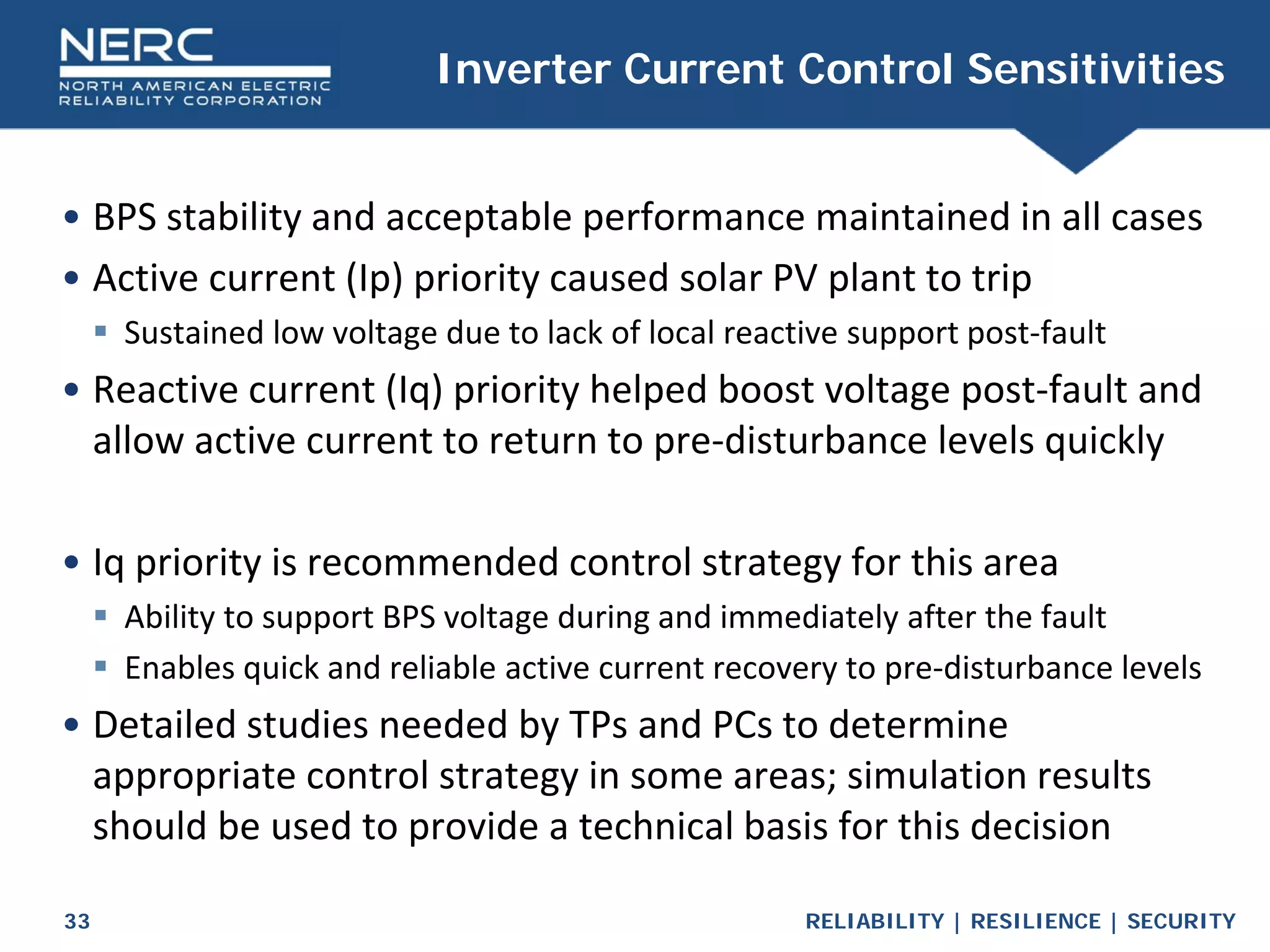
• BPS stability and acceptable performance maintained in all cases
• Active current (Ip) priority caused solar PV plant to trip
 Sustained low voltage due to lack of local reactive support post-fault
• Reactive current (Iq) priority helped boost voltage post-fault and
allow active current to return to pre-disturbance levels quickly
• Iq priority is recommended control strategy for this area
 Ability to support BPS voltage during and immediately after the fault
 Enables quick and reliable active current recovery to pre-disturbance levels
• Detailed studies needed by TPs and PCs to determine
appropriate control strategy in some areas; simulation results
should be used to provide a technical basis for this decision
Inverter Current Control Sensitivities
RELIABILITY | RESILIENCE | SECURITY
34
Future Efforts Regarding BPS-Connected Inverter-
Based Resource Modeling and Studies
Deepak Ramasubramanian, EPRI
Andrew Isaacs, Electranix
RELIABILITY | RESILIENCE | SECURITY
35
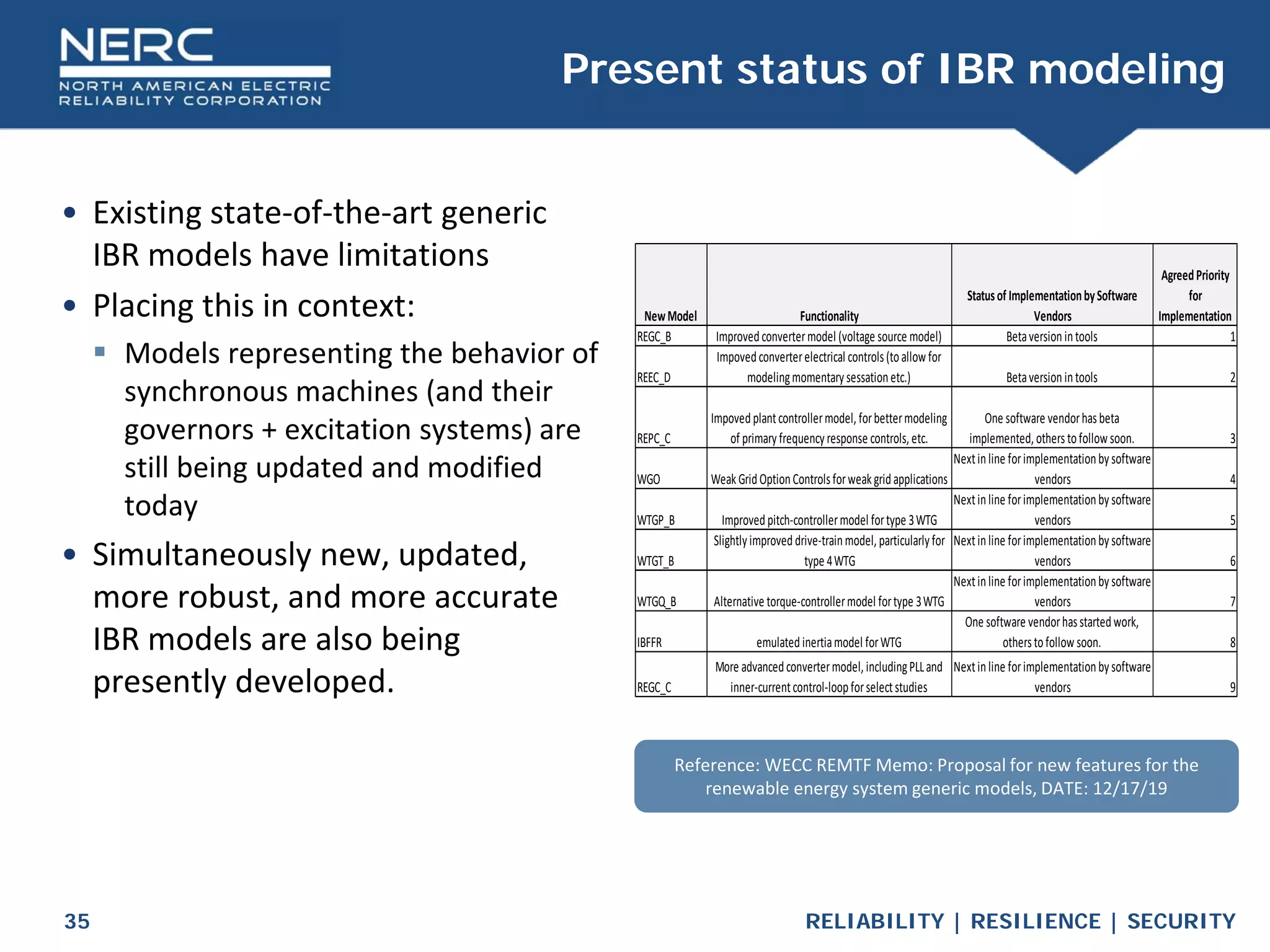
• Existing state-of-the-art generic
IBR models have limitations
• Placing this in context:
 Models representing the behavior of
synchronous machines (and their
governors + excitation systems) are
still being updated and modified
today
• Simultaneously new, updated,
more robust, and more accurate
IBR models are also being
presently developed.
Present status of IBR modeling
NewModel Functionality
Statusof ImplementationbySoftware
Vendors
AgreedPriority
for
Implementation
REGC_B Improvedconvertermodel (voltage source model) Betaversionintools 1
REEC_D
Impovedconverterelectrical controls(toallow for
modelingmomentary sessationetc.) Betaversionintools 2
REPC_C
Impovedplantcontrollermodel, forbettermodeling
of primary frequency response controls, etc.
One software vendorhasbeta
implemented, otherstofollow soon. 3
WGO Weak GridOptionControlsforweak gridapplications
Nextinline forimplementationby software
vendors 4
WTGP_B Improvedpitch-controllermodel fortype 3WTG
Nextinline forimplementationby software
vendors 5
WTGT_B
Slightly improveddrive-trainmodel, particularly for
type 4WTG
Nextinline forimplementationby software
vendors 6
WTGQ_B Alternative torque-controllermodel fortype 3WTG
Nextinline forimplementationby software
vendors 7
IBFFR emulatedinertiamodel forWTG
One software vendorhasstartedwork,
otherstofollow soon. 8
REGC_C
More advancedconvertermodel, includingPLLand
inner-currentcontrol-loopforselectstudies
Nextinline forimplementationby software
vendors 9
Reference: WECC REMTF Memo: Proposal for new features for the
renewable energy system generic models, DATE: 12/17/19
RELIABILITY | RESILIENCE | SECURITY
36
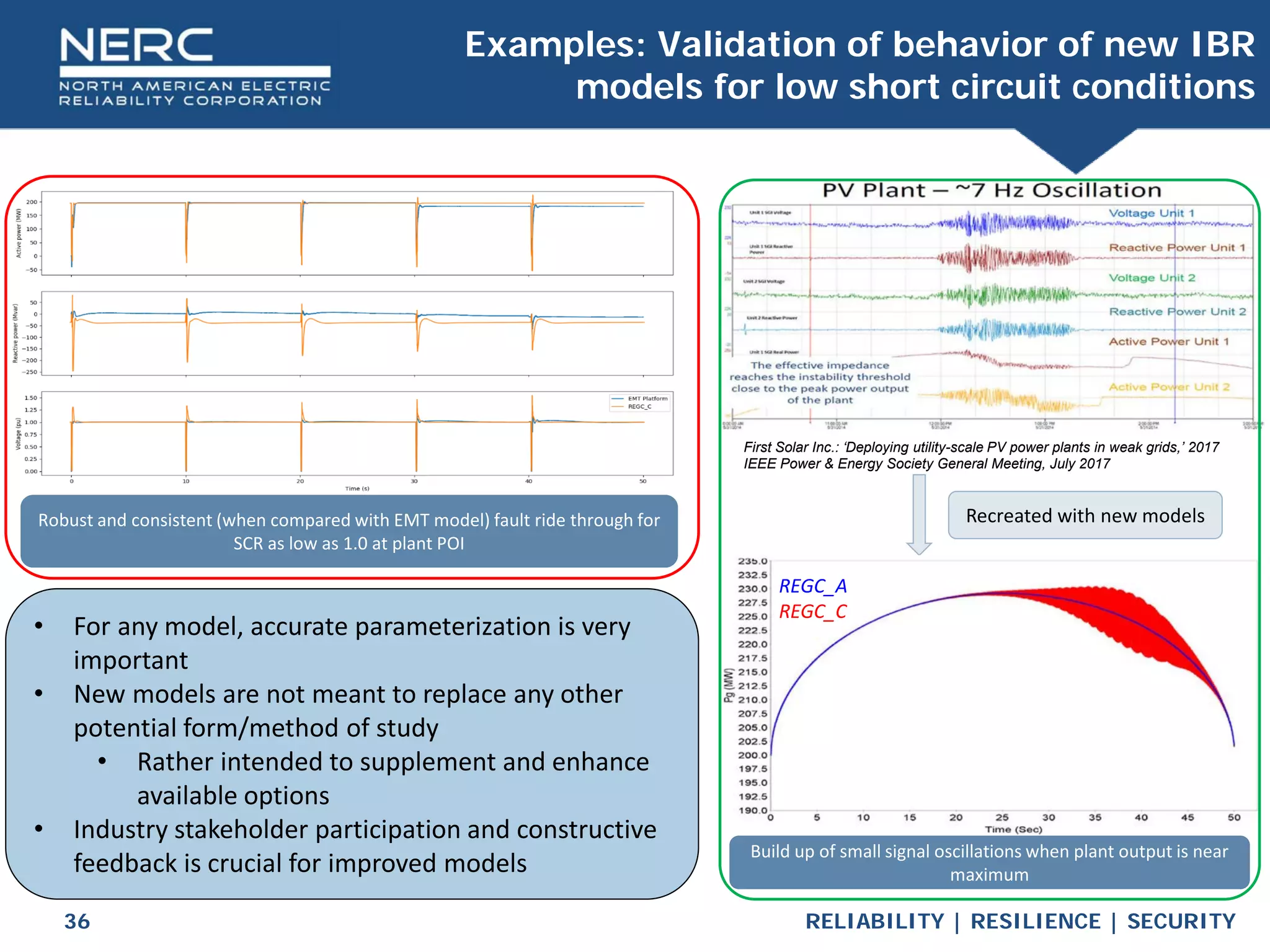
Examples: Validation of behavior of new IBR
models for low short circuit conditions
Robust and consistent (when compared with EMT model) fault ride through for
SCR as low as 1.0 at plant POI
First Solar Inc.: ‘Deploying utility-scale PV power plants in weak grids,’ 2017
IEEE Power & Energy Society General Meeting, July 2017
Recreated with new models
REGC_A
REGC_C
• For any model, accurate parameterization is very
important
• New models are not meant to replace any other
potential form/method of study
• Rather intended to supplement and enhance
available options
• Industry stakeholder participation and constructive
feedback is crucial for improved models
Build up of small signal oscillations when plant output is near
maximum
RELIABILITY | RESILIENCE | SECURITY
37
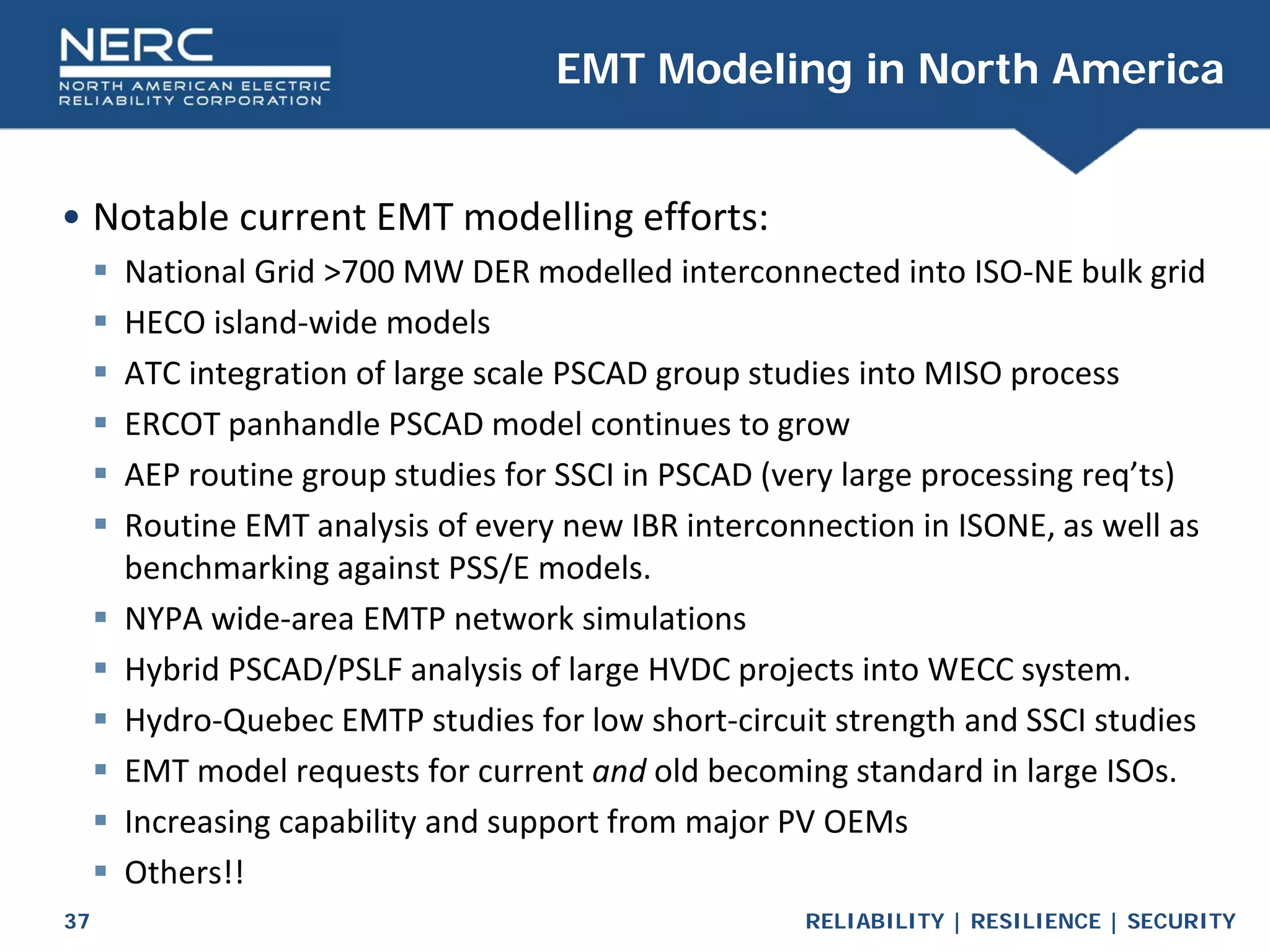
• Notable current EMT modelling efforts:
 National Grid >700 MW DER modelled interconnected into ISO-NE bulk grid
 HECO island-wide models
 ATC integration of large scale PSCAD group studies into MISO process
 ERCOT panhandle PSCAD model continues to grow
 AEP routine group studies for SSCI in PSCAD (very large processing req’ts)
 Routine EMT analysis of every new IBR interconnection in ISONE, as well as
benchmarking against PSS/E models.
 NYPA wide-area EMTP network simulations
 Hybrid PSCAD/PSLF analysis of large HVDC projects into WECC system.
 Hydro-Quebec EMTP studies for low short-circuit strength and SSCI studies
 EMT model requests for current and old becoming standard in large ISOs.
 Increasing capability and support from major PV OEMs
 Others!!
EMT Modeling in North America
RELIABILITY | RESILIENCE | SECURITY
38
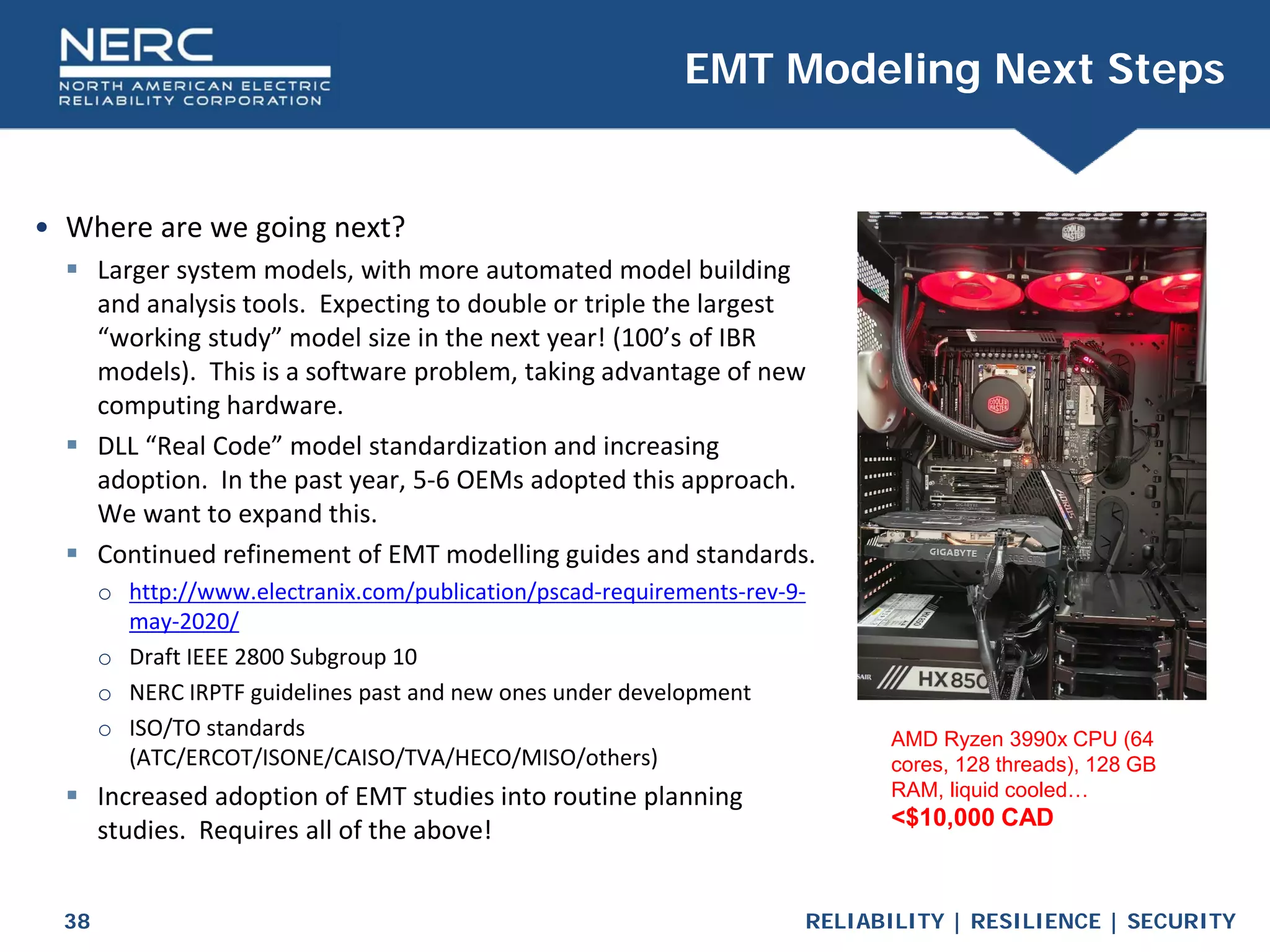
• Where are we going next?
 Larger system models, with more automated model building
and analysis tools. Expecting to double or triple the largest
“working study” model size in the next year! (100’s of IBR
models). This is a software problem, taking advantage of new
computing hardware.
 DLL “Real Code” model standardization and increasing
adoption. In the past year, 5-6 OEMs adopted this approach.
We want to expand this.
 Continued refinement of EMT modelling guides and standards.
o http://www.electranix.com/publication/pscad-requirements-rev-9-
may-2020/
o Draft IEEE 2800 Subgroup 10
o NERC IRPTF guidelines past and new ones under development
o ISO/TO standards
(ATC/ERCOT/ISONE/CAISO/TVA/HECO/MISO/others)
 Increased adoption of EMT studies into routine planning
studies. Requires all of the above!
EMT Modeling Next Steps
AMD Ryzen 3990x CPU (64
cores, 128 threads), 128 GB
RAM, liquid cooled…
<$10,000 CAD
RELIABILITY | RESILIENCE | SECURITY
39
ERCOT Electromagnetic Transient (EMT)
Modeling Requirements and Simulations
Fred Huang, ERCOT
RELIABILITY | RESILIENCE | SECURITY
40
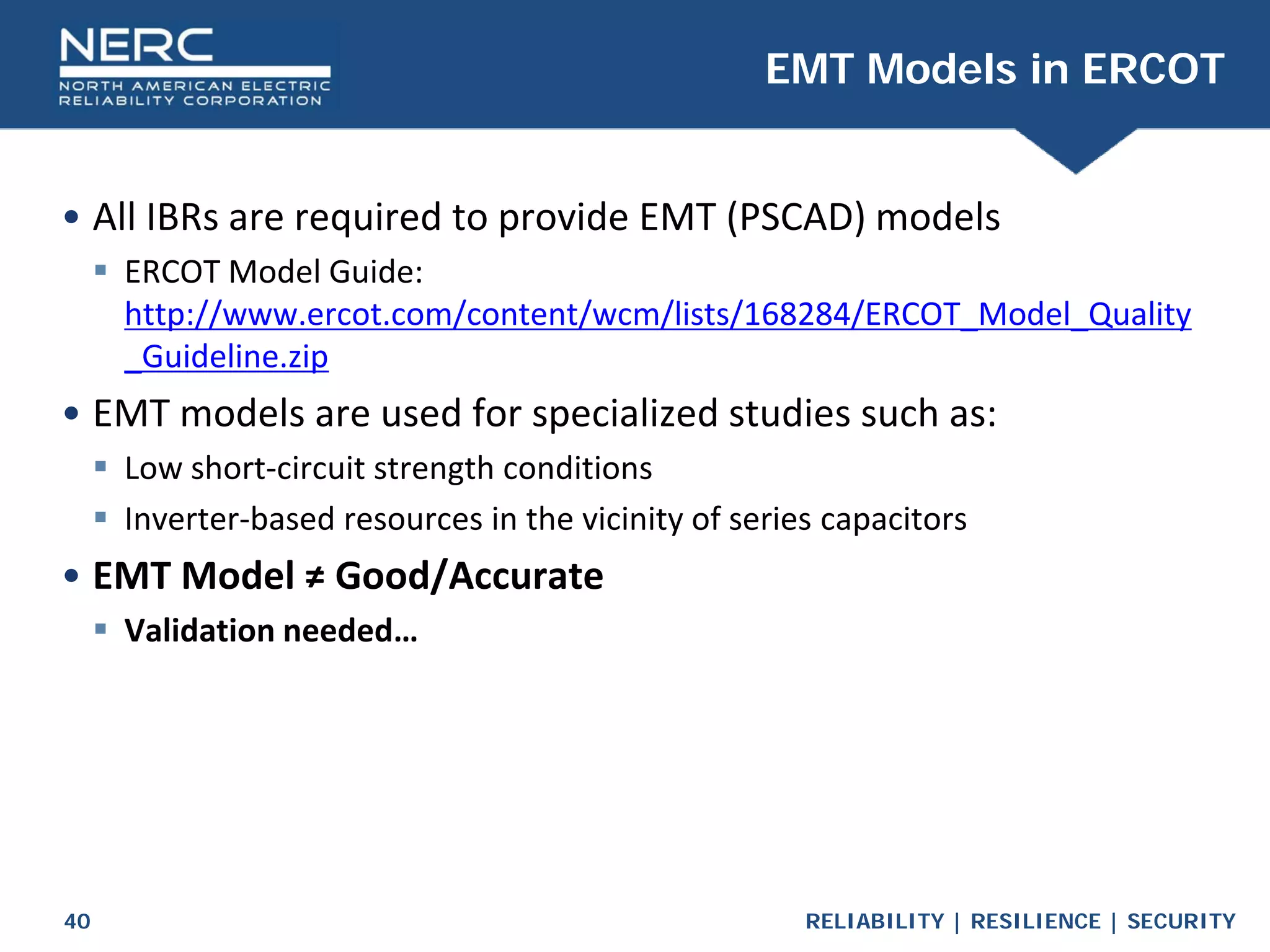
• All IBRs are required to provide EMT (PSCAD) models
 ERCOT Model Guide:
http://www.ercot.com/content/wcm/lists/168284/ERCOT_Model_Quality
_Guideline.zip
• EMT models are used for specialized studies such as:
 Low short-circuit strength conditions
 Inverter-based resources in the vicinity of series capacitors
• EMT Model ≠ Good/Accurate
 Validation needed…
EMT Models in ERCOT
RELIABILITY | RESILIENCE | SECURITY
41
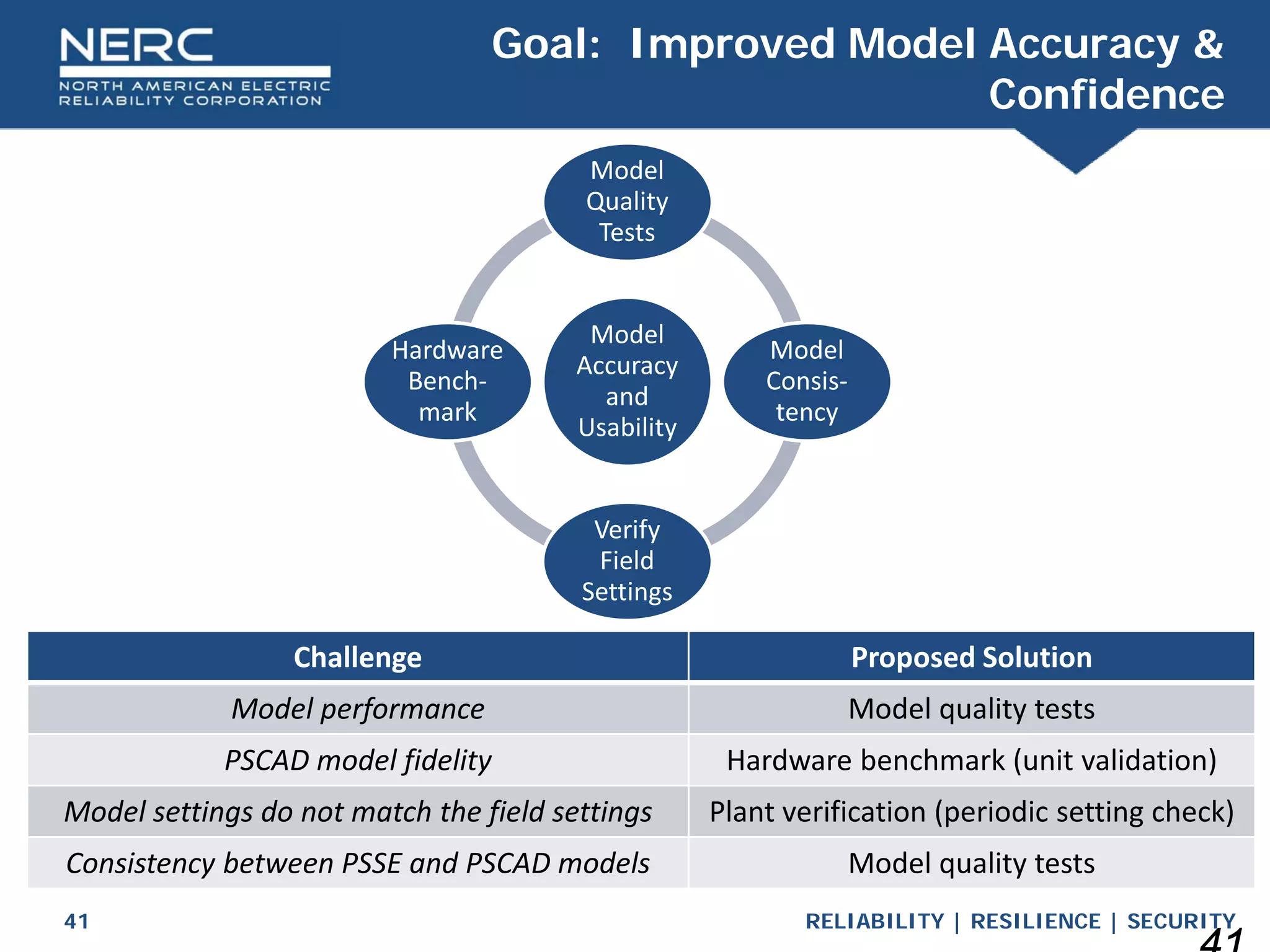
Goal: Improved Model Accuracy &
Confidence
Model
Accuracy
and
Usability
Model
Quality
Tests
Model
Consis-
tency
Verify
Field
Settings
Hardware
Bench-
mark
Challenge Proposed Solution
Model performance Model quality tests
PSCAD model fidelity Hardware benchmark (unit validation)
Model settings do not match the field settings Plant verification (periodic setting check)
Consistency between PSSE and PSCAD models Model quality tests
RELIABILITY | RESILIENCE | SECURITY
42
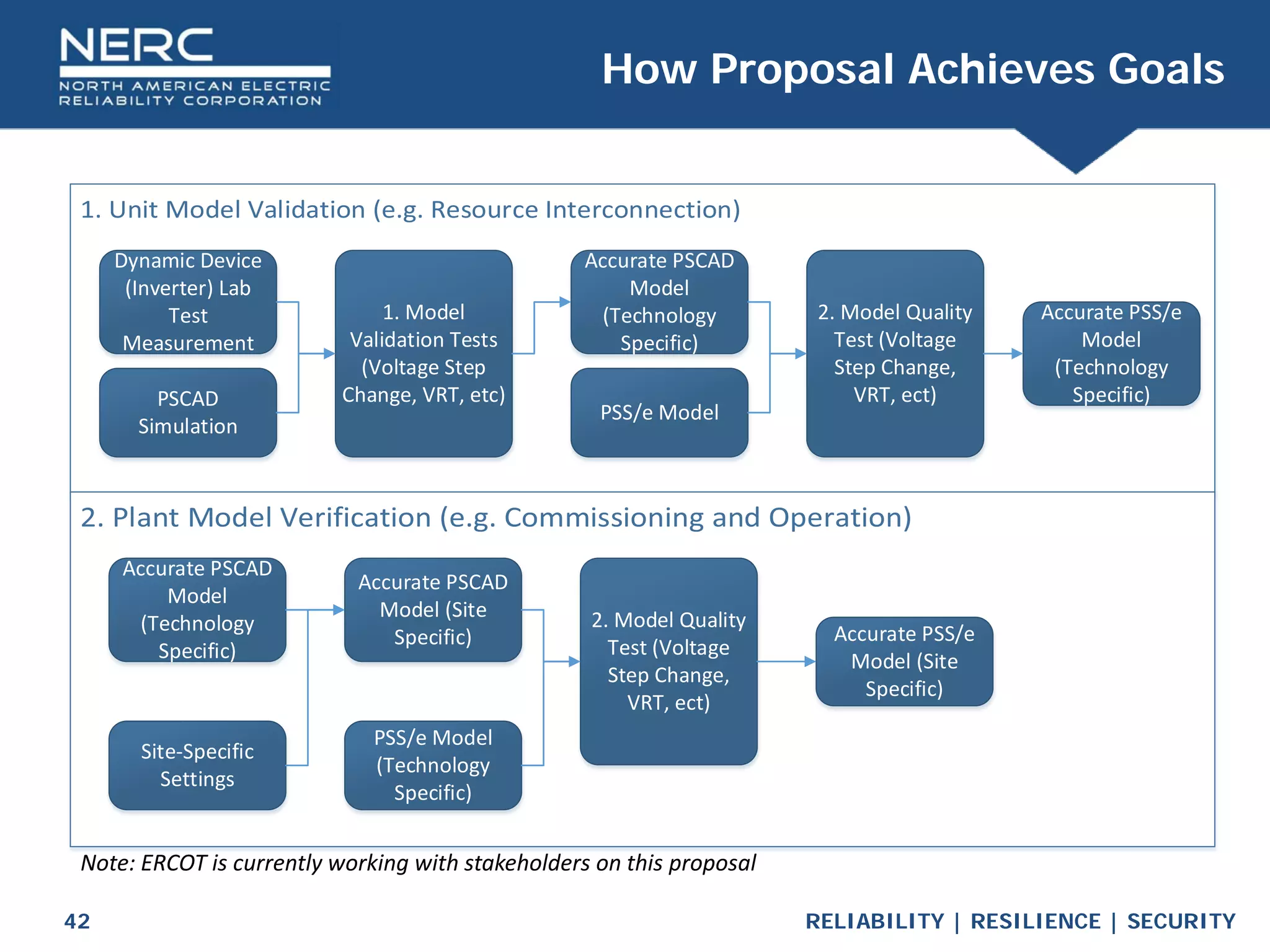
How Proposal Achieves Goals
Dynamic Device
(Inverter) Lab
Test
Measurement
PSCAD
Simulation
1. Model
Validation Tests
(Voltage Step
Change, VRT, etc)
Accurate PSCAD
Model
(Technology
Specific)
PSS/e Model
2. Model Quality
Test (Voltage
Step Change,
VRT, ect)
Accurate PSS/e
Model
(Technology
Specific)
Accurate PSCAD
Model
(Technology
Specific)
Site-Specific
Settings
Accurate PSCAD
Model (Site
Specific)
2. Model Quality
Test (Voltage
Step Change,
VRT, ect)
PSS/e Model
(Technology
Specific)
Accurate PSS/e
Model (Site
Specific)
Note: ERCOT is currently working with stakeholders on this proposal
RELIABILITY | RESILIENCE | SECURITY
43
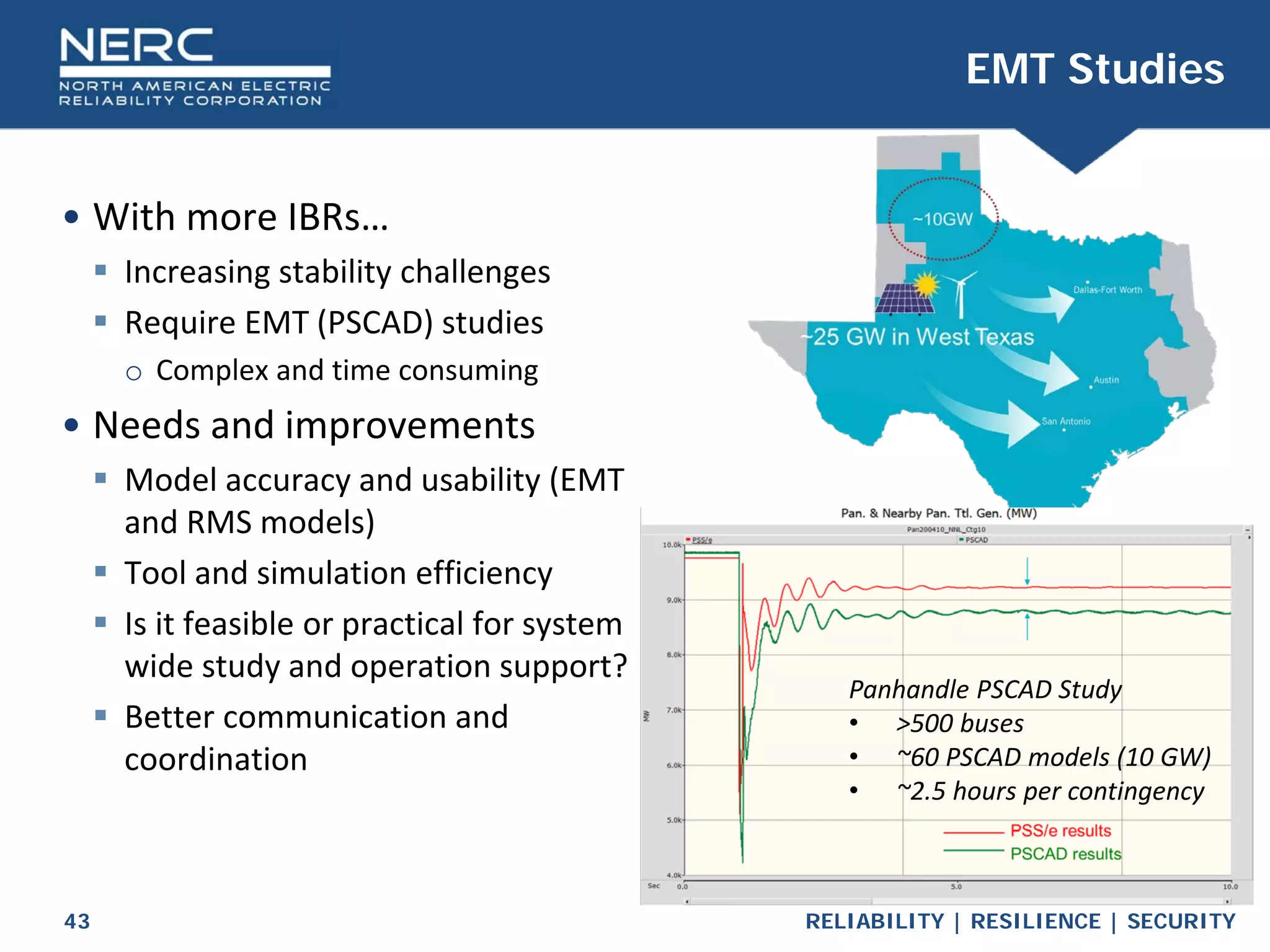
• With more IBRs…
 Increasing stability challenges
 Require EMT (PSCAD) studies
o Complex and time consuming
• Needs and improvements
 Model accuracy and usability (EMT
and RMS models)
 Tool and simulation efficiency
 Is it feasible or practical for system
wide study and operation support?
 Better communication and
coordination
EMT Studies
Panhandle PSCAD Study
• >500 buses
• ~60 PSCAD models (10 GW)
• ~2.5 hours per contingency
RELIABILITY | RESILIENCE | SECURITY
44
Wrap Up – Key Findings and Recommendations
Ryan Quint, NERC
RELIABILITY | RESILIENCE | SECURITY
45
• NERC Alert
 Modeling issues systemic for solar PV resources; needs quick attention
 Many resources can improve dynamic behavior; eliminate momentary
cessation; uncertain of extent of changes
 Need more TP and PC engagement in verifying accuracy of models
 Need better coordination and educations among entities
• IRPTF Studies
 Widespread momentary cessation poses BPS reliability risks
 More detailed modeling showed degraded BPS performance with existing
momentary cessation
 Dynamic support, particularly reactive current priority with dynamic
voltage control, proved most effective in terms of BPS
stability/performance
Key Findings and Recommendations
RELIABILITY | RESILIENCE | SECURITY
46
• IRPTF Technical Discussions
 MOD-026-1 and MOD-027-1 gaps in verifying large disturbance behavior
 As-built settings differ from models provided, in all phases of
interconnection process and upon commercial operation
 LGIP (and SGIP) should be revisited to improve understanding of modeling
to enable sufficient studies
 Confusion with “material modification” in FAC-001-3 and FERC GIA process
 Growing need for EMT models and simulations
 Significant improvements needed to interconnection requirements to
cover modeling of all kinds (e.g., positive sequence, short-circuit, EMT)
 Case creation becoming increasing challenging; coordination needed
 “Fringe” (realistic yet highly stressed) operating conditions need to be
studied by both planning and operating entities
 Improved dynamic modeling practices needed moving forward
Key Findings and Recommendations
RELIABILITY | RESILIENCE | SECURITY
47
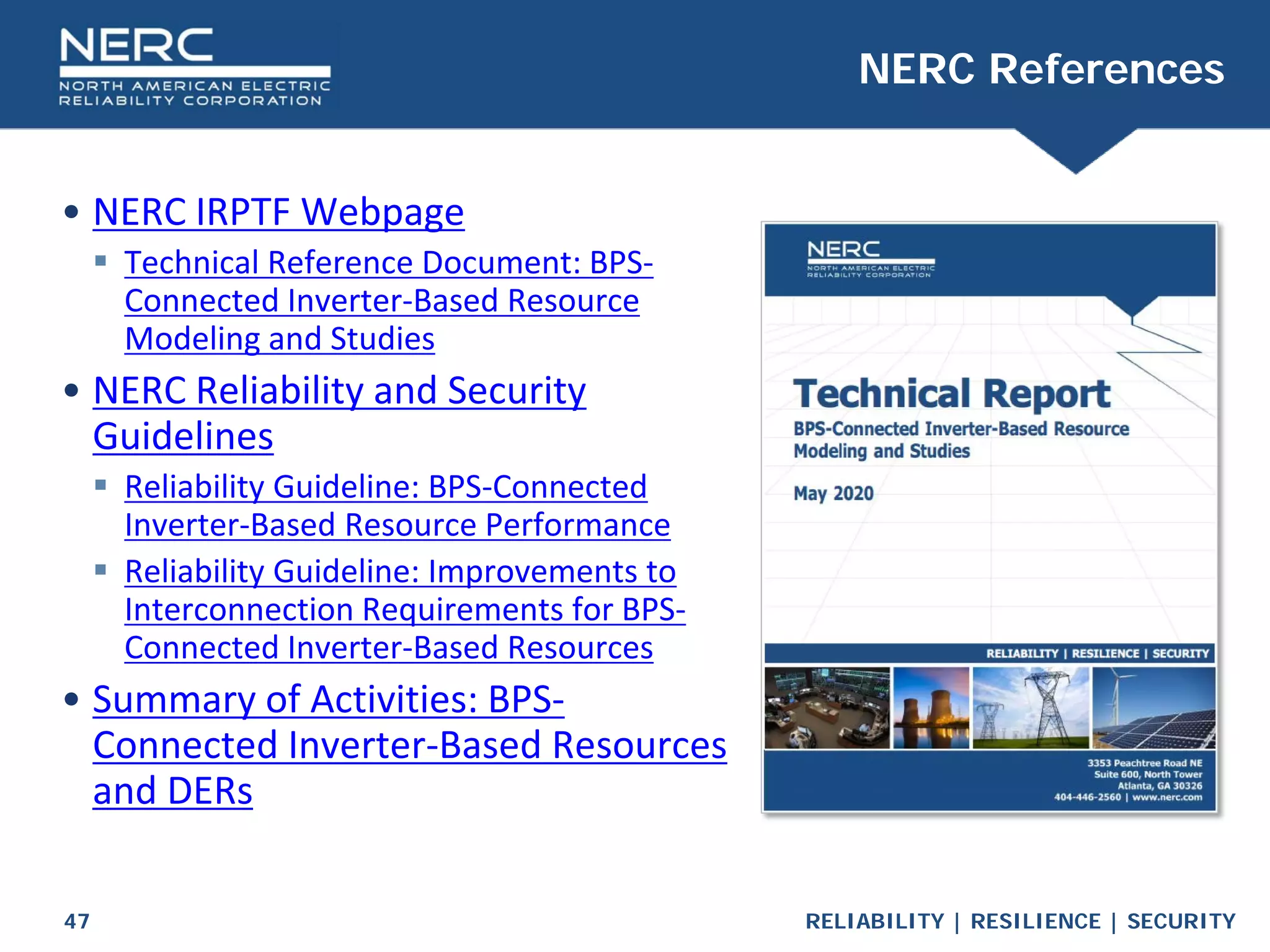
• NERC IRPTF Webpage
 Technical Reference Document: BPS-
Connected Inverter-Based Resource
Modeling and Studies
• NERC Reliability and Security
Guidelines
 Reliability Guideline: BPS-Connected
Inverter-Based Resource Performance
 Reliability Guideline: Improvements to
Interconnection Requirements for BPS-
Connected Inverter-Based Resources
• Summary of Activities: BPS-
Connected Inverter-Based Resources
and DERs
NERC References
RELIABILITY | RESILIENCE | SECURITY
48
Want to get involved with IRPTF?
Email: ryan.quint@nerc.net
RELIABILITY | RESILIENCE | SECURITY
49
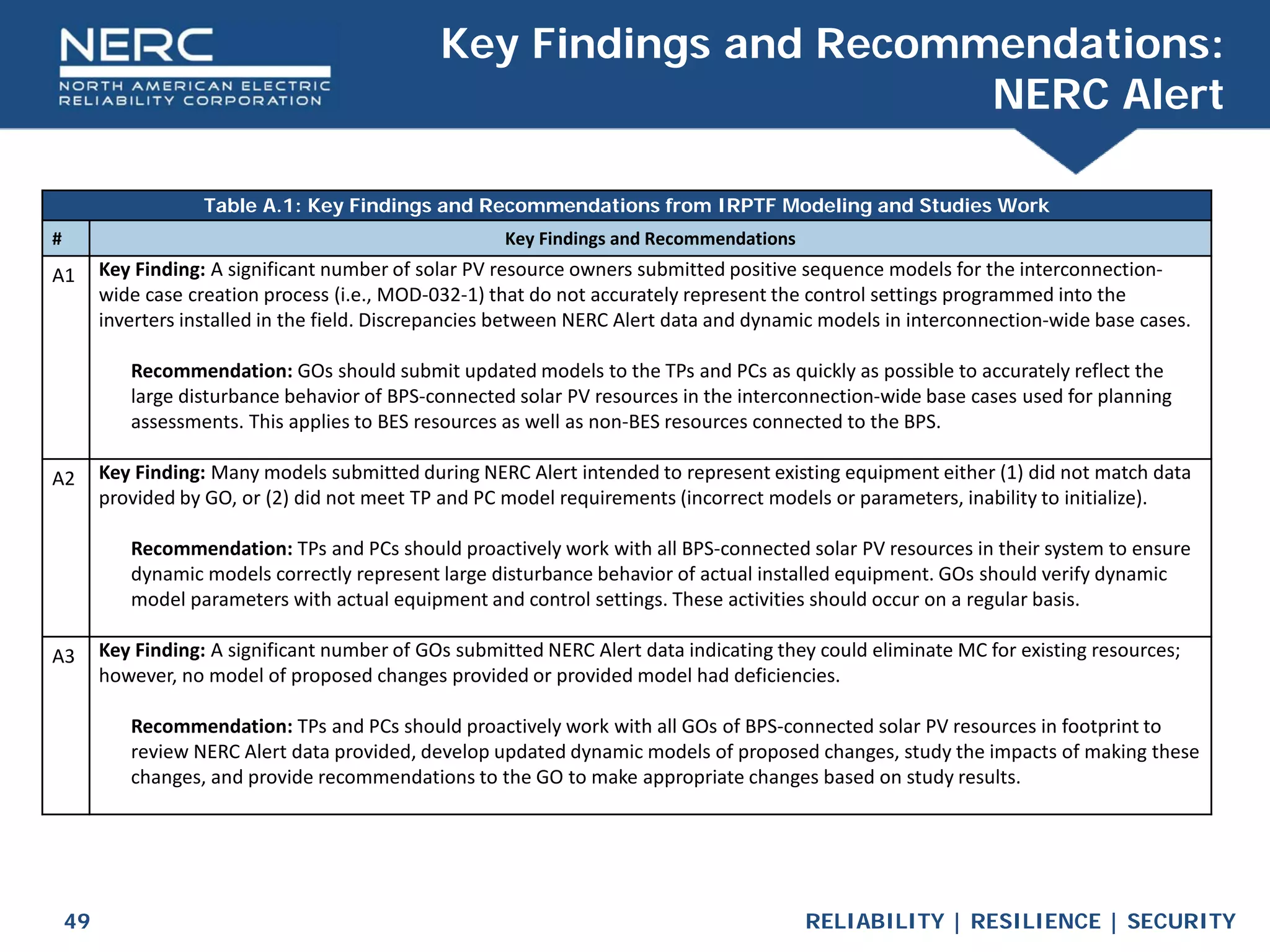
Table A.1: Key Findings and Recommendations from IRPTF Modeling and Studies Work
# Key Findings and Recommendations
A1 Key Finding: A significant number of solar PV resource owners submitted positive sequence models for the interconnection-
wide case creation process (i.e., MOD-032-1) that do not accurately represent the control settings programmed into the
inverters installed in the field. Discrepancies between NERC Alert data and dynamic models in interconnection-wide base cases.
Recommendation: GOs should submit updated models to the TPs and PCs as quickly as possible to accurately reflect the
large disturbance behavior of BPS-connected solar PV resources in the interconnection-wide base cases used for planning
assessments. This applies to BES resources as well as non-BES resources connected to the BPS.
A2 Key Finding: Many models submitted during NERC Alert intended to represent existing equipment either (1) did not match data
provided by GO, or (2) did not meet TP and PC model requirements (incorrect models or parameters, inability to initialize).
Recommendation: TPs and PCs should proactively work with all BPS-connected solar PV resources in their system to ensure
dynamic models correctly represent large disturbance behavior of actual installed equipment. GOs should verify dynamic
model parameters with actual equipment and control settings. These activities should occur on a regular basis.
A3 Key Finding: A significant number of GOs submitted NERC Alert data indicating they could eliminate MC for existing resources;
however, no model of proposed changes provided or provided model had deficiencies.
Recommendation: TPs and PCs should proactively work with all GOs of BPS-connected solar PV resources in footprint to
review NERC Alert data provided, develop updated dynamic models of proposed changes, study the impacts of making these
changes, and provide recommendations to the GO to make appropriate changes based on study results.
Key Findings and Recommendations:
NERC Alert
RELIABILITY | RESILIENCE | SECURITY
50
Key Findings and Recommendations:
NERC Alert
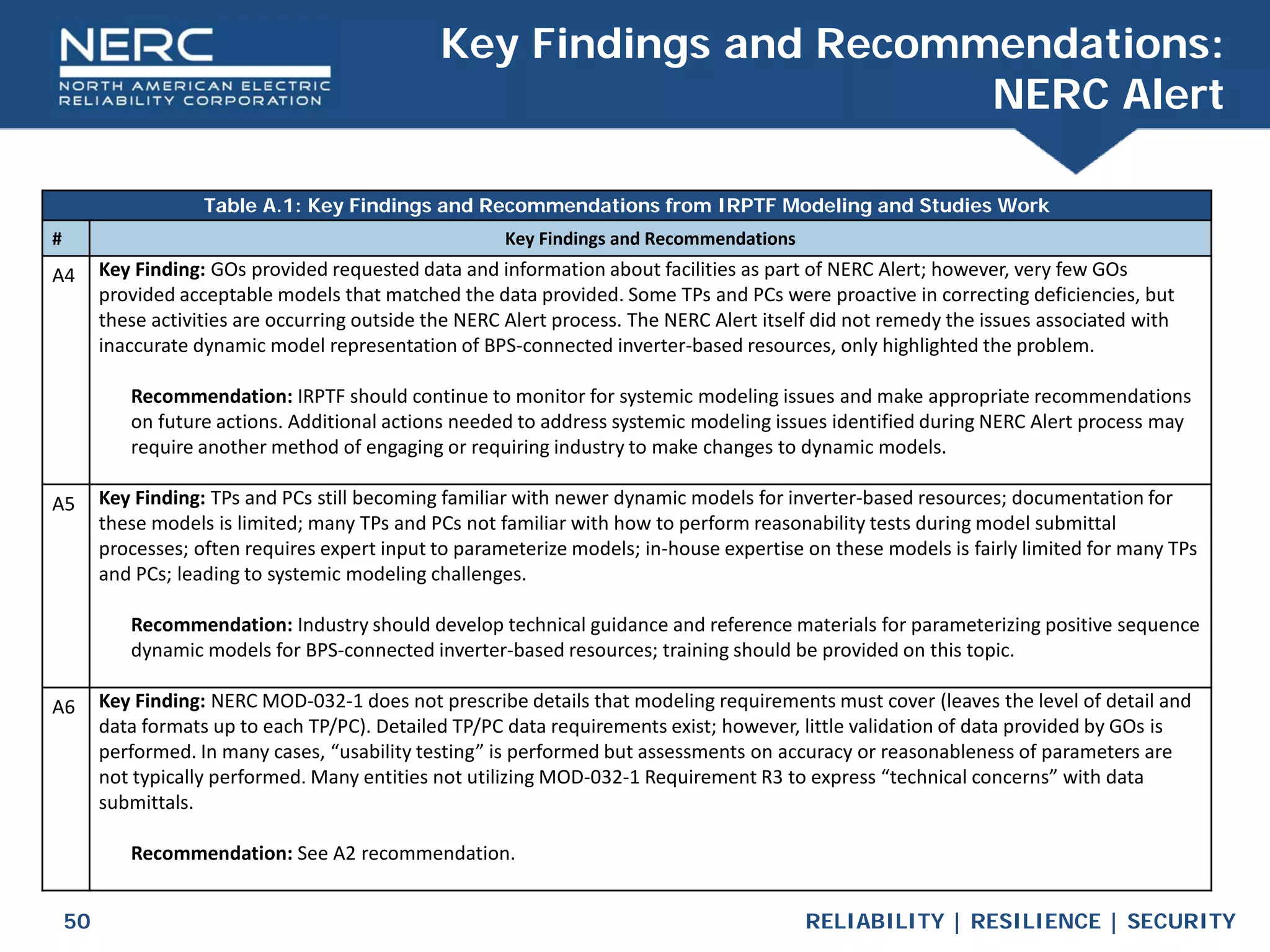
Table A.1: Key Findings and Recommendations from IRPTF Modeling and Studies Work
# Key Findings and Recommendations
A4 Key Finding: GOs provided requested data and information about facilities as part of NERC Alert; however, very few GOs
provided acceptable models that matched the data provided. Some TPs and PCs were proactive in correcting deficiencies, but
these activities are occurring outside the NERC Alert process. The NERC Alert itself did not remedy the issues associated with
inaccurate dynamic model representation of BPS-connected inverter-based resources, only highlighted the problem.
Recommendation: IRPTF should continue to monitor for systemic modeling issues and make appropriate recommendations
on future actions. Additional actions needed to address systemic modeling issues identified during NERC Alert process may
require another method of engaging or requiring industry to make changes to dynamic models.
A5 Key Finding: TPs and PCs still becoming familiar with newer dynamic models for inverter-based resources; documentation for
these models is limited; many TPs and PCs not familiar with how to perform reasonability tests during model submittal
processes; often requires expert input to parameterize models; in-house expertise on these models is fairly limited for many TPs
and PCs; leading to systemic modeling challenges.
Recommendation: Industry should develop technical guidance and reference materials for parameterizing positive sequence
dynamic models for BPS-connected inverter-based resources; training should be provided on this topic.
A6 Key Finding: NERC MOD-032-1 does not prescribe details that modeling requirements must cover (leaves the level of detail and
data formats up to each TP/PC). Detailed TP/PC data requirements exist; however, little validation of data provided by GOs is
performed. In many cases, “usability testing” is performed but assessments on accuracy or reasonableness of parameters are
not typically performed. Many entities not utilizing MOD-032-1 Requirement R3 to express “technical concerns” with data
submittals.
Recommendation: See A2 recommendation.
RELIABILITY | RESILIENCE | SECURITY
51
Key Findings and Recommendations:
IRPTF Studies
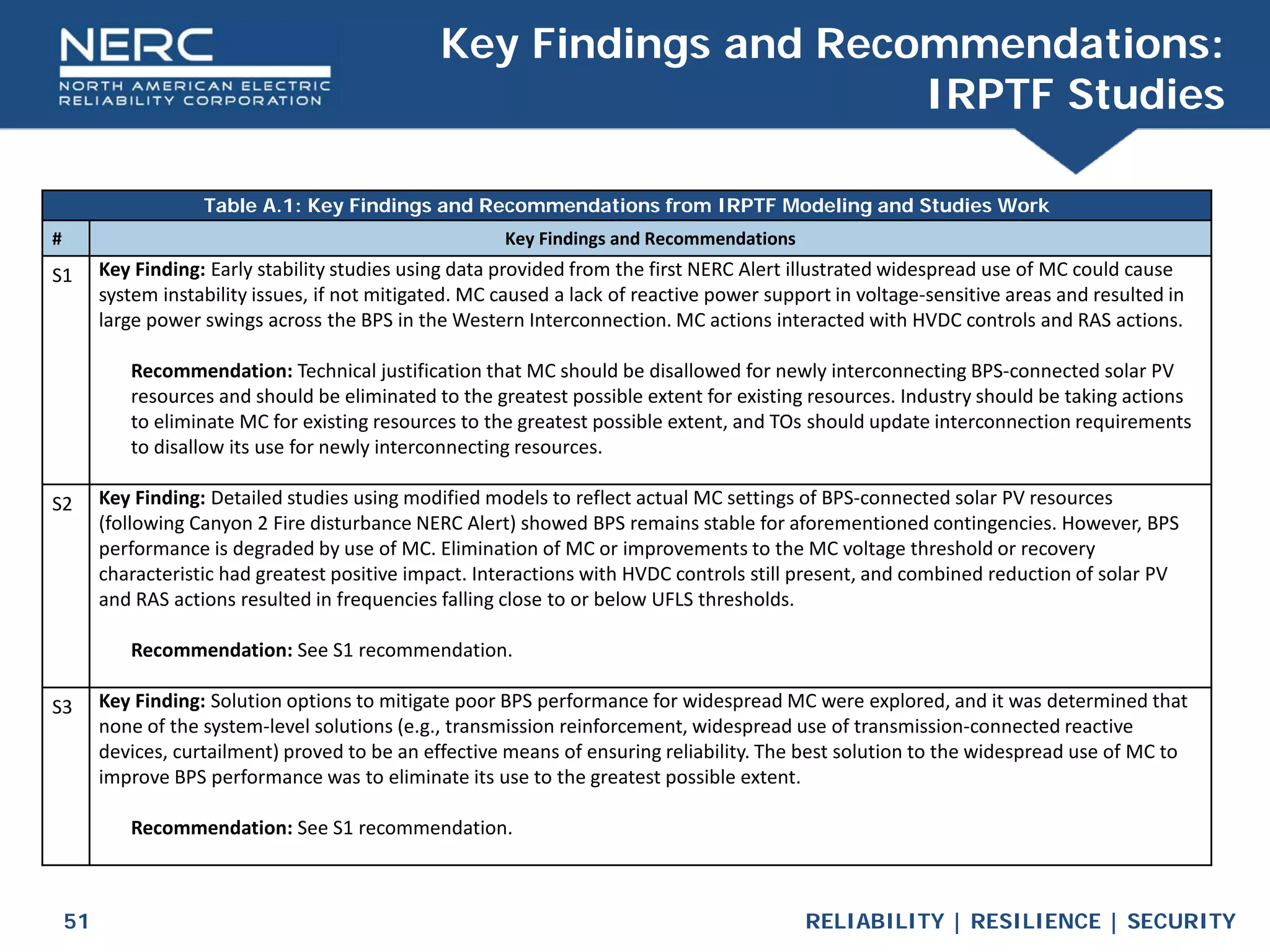
Table A.1: Key Findings and Recommendations from IRPTF Modeling and Studies Work
# Key Findings and Recommendations
S1 Key Finding: Early stability studies using data provided from the first NERC Alert illustrated widespread use of MC could cause
system instability issues, if not mitigated. MC caused a lack of reactive power support in voltage-sensitive areas and resulted in
large power swings across the BPS in the Western Interconnection. MC actions interacted with HVDC controls and RAS actions.
Recommendation: Technical justification that MC should be disallowed for newly interconnecting BPS-connected solar PV
resources and should be eliminated to the greatest possible extent for existing resources. Industry should be taking actions
to eliminate MC for existing resources to the greatest possible extent, and TOs should update interconnection requirements
to disallow its use for newly interconnecting resources.
S2 Key Finding: Detailed studies using modified models to reflect actual MC settings of BPS-connected solar PV resources
(following Canyon 2 Fire disturbance NERC Alert) showed BPS remains stable for aforementioned contingencies. However, BPS
performance is degraded by use of MC. Elimination of MC or improvements to the MC voltage threshold or recovery
characteristic had greatest positive impact. Interactions with HVDC controls still present, and combined reduction of solar PV
and RAS actions resulted in frequencies falling close to or below UFLS thresholds.
Recommendation: See S1 recommendation.
S3 Key Finding: Solution options to mitigate poor BPS performance for widespread MC were explored, and it was determined that
none of the system-level solutions (e.g., transmission reinforcement, widespread use of transmission-connected reactive
devices, curtailment) proved to be an effective means of ensuring reliability. The best solution to the widespread use of MC to
improve BPS performance was to eliminate its use to the greatest possible extent.
Recommendation: See S1 recommendation.
RELIABILITY | RESILIENCE | SECURITY
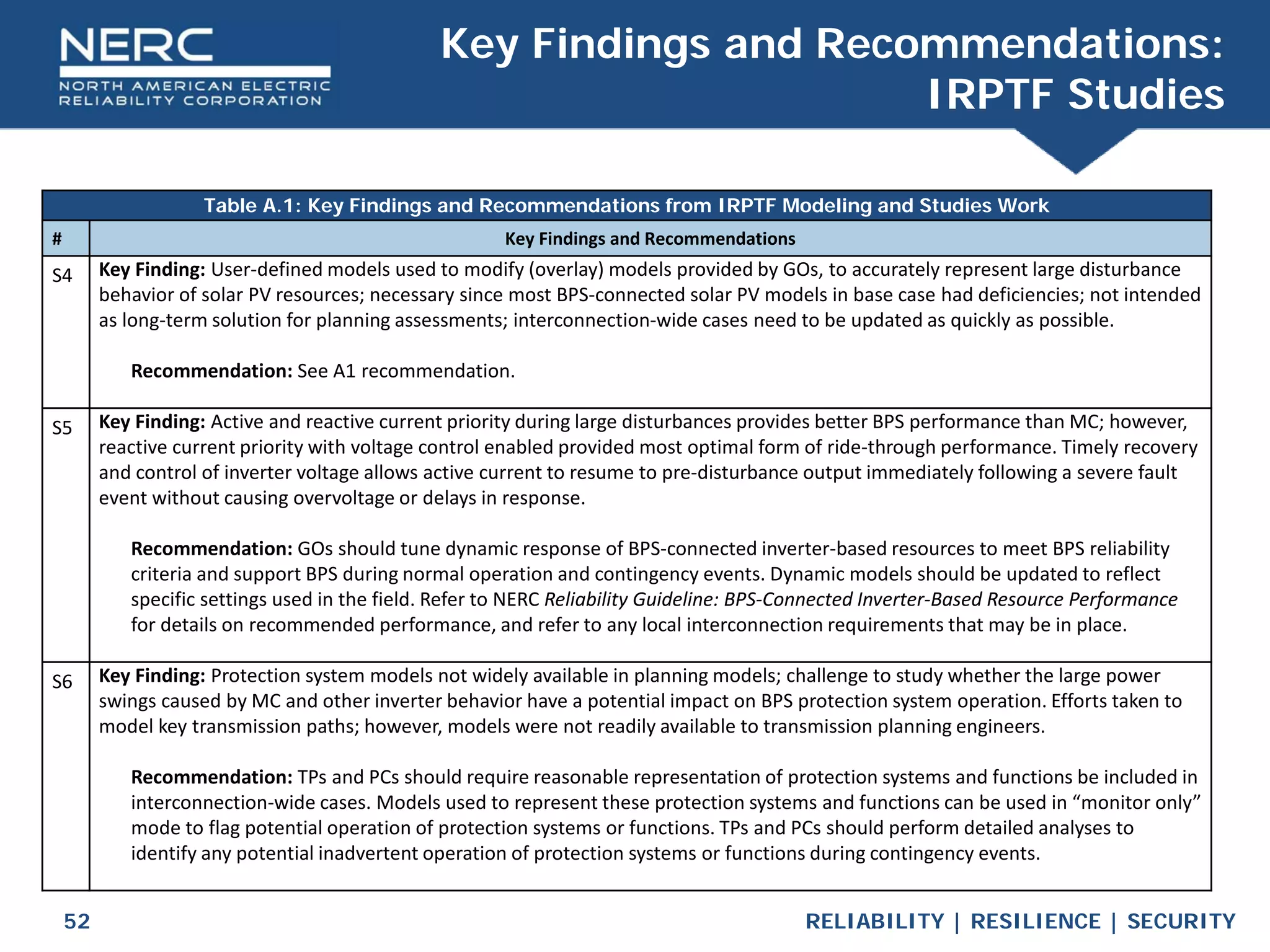
52
Key Findings and Recommendations:
IRPTF Studies
Table A.1: Key Findings and Recommendations from IRPTF Modeling and Studies Work
# Key Findings and Recommendations
S4 Key Finding: User-defined models used to modify (overlay) models provided by GOs, to accurately represent large disturbance
behavior of solar PV resources; necessary since most BPS-connected solar PV models in base case had deficiencies; not intended
as long-term solution for planning assessments; interconnection-wide cases need to be updated as quickly as possible.
Recommendation: See A1 recommendation.
S5 Key Finding: Active and reactive current priority during large disturbances provides better BPS performance than MC; however,
reactive current priority with voltage control enabled provided most optimal form of ride-through performance. Timely recovery
and control of inverter voltage allows active current to resume to pre-disturbance output immediately following a severe fault
event without causing overvoltage or delays in response.
Recommendation: GOs should tune dynamic response of BPS-connected inverter-based resources to meet BPS reliability
criteria and support BPS during normal operation and contingency events. Dynamic models should be updated to reflect
specific settings used in the field. Refer to NERC Reliability Guideline: BPS-Connected Inverter-Based Resource Performance
for details on recommended performance, and refer to any local interconnection requirements that may be in place.
S6 Key Finding: Protection system models not widely available in planning models; challenge to study whether the large power
swings caused by MC and other inverter behavior have a potential impact on BPS protection system operation. Efforts taken to
model key transmission paths; however, models were not readily available to transmission planning engineers.
Recommendation: TPs and PCs should require reasonable representation of protection systems and functions be included in
interconnection-wide cases. Models used to represent these protection systems and functions can be used in “monitor only”
mode to flag potential operation of protection systems or functions. TPs and PCs should perform detailed analyses to
identify any potential inadvertent operation of protection systems or functions during contingency events.
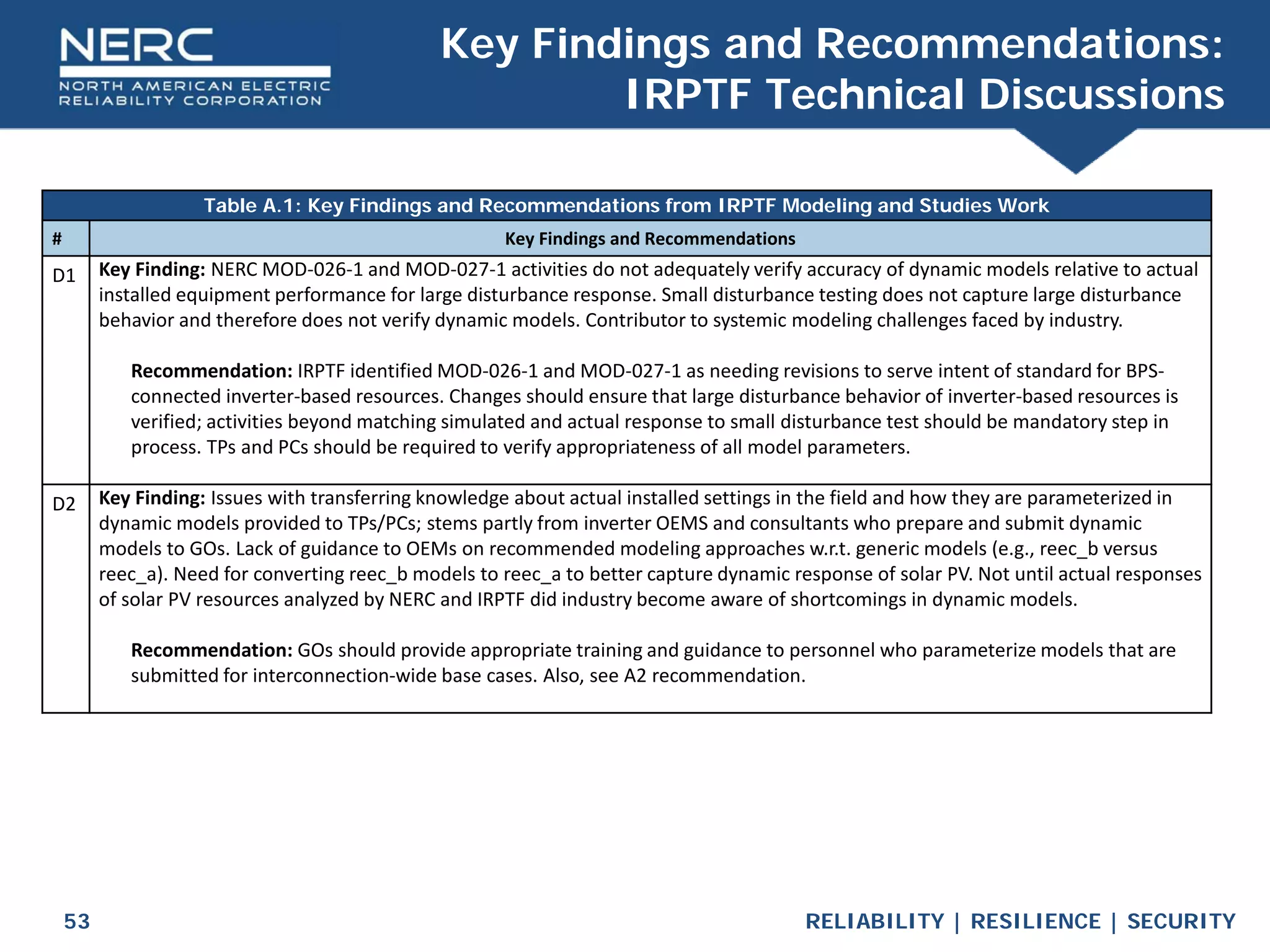
RELIABILITY | RESILIENCE | SECURITY
53
Key Findings and Recommendations:
IRPTF Technical Discussions
Table A.1: Key Findings and Recommendations from IRPTF Modeling and Studies Work
# Key Findings and Recommendations
D1 Key Finding: NERC MOD-026-1 and MOD-027-1 activities do not adequately verify accuracy of dynamic models relative to actual
installed equipment performance for large disturbance response. Small disturbance testing does not capture large disturbance
behavior and therefore does not verify dynamic models. Contributor to systemic modeling challenges faced by industry.
Recommendation: IRPTF identified MOD-026-1 and MOD-027-1 as needing revisions to serve intent of standard for BPS-
connected inverter-based resources. Changes should ensure that large disturbance behavior of inverter-based resources is
verified; activities beyond matching simulated and actual response to small disturbance test should be mandatory step in
process. TPs and PCs should be required to verify appropriateness of all model parameters.
D2 Key Finding: Issues with transferring knowledge about actual installed settings in the field and how they are parameterized in
dynamic models provided to TPs/PCs; stems partly from inverter OEMS and consultants who prepare and submit dynamic
models to GOs. Lack of guidance to OEMs on recommended modeling approaches w.r.t. generic models (e.g., reec_b versus
reec_a). Need for converting reec_b models to reec_a to better capture dynamic response of solar PV. Not until actual responses
of solar PV resources analyzed by NERC and IRPTF did industry become aware of shortcomings in dynamic models.
Recommendation: GOs should provide appropriate training and guidance to personnel who parameterize models that are
submitted for interconnection-wide base cases. Also, see A2 recommendation.
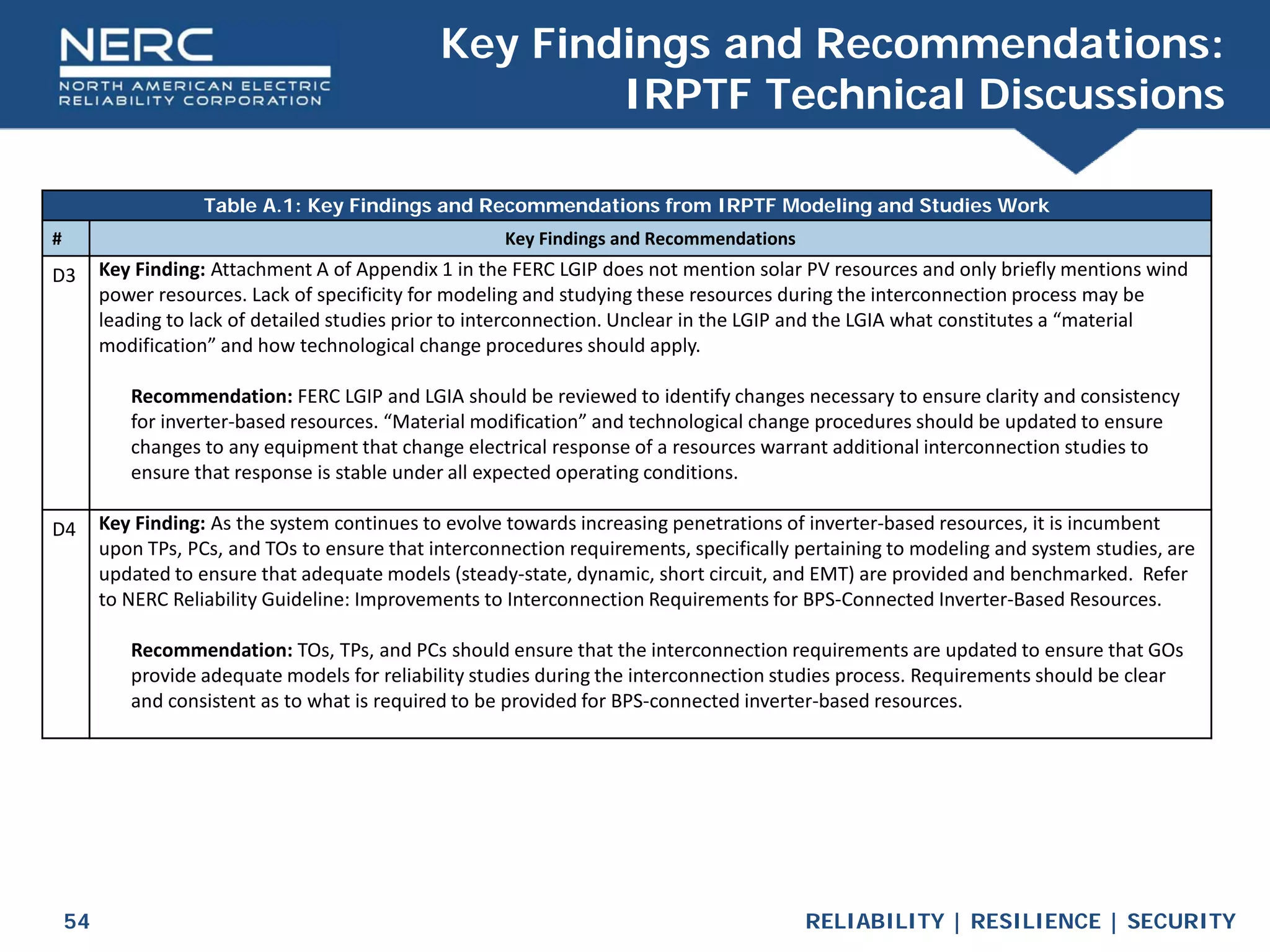
RELIABILITY | RESILIENCE | SECURITY
54
Key Findings and Recommendations:
IRPTF Technical Discussions
Table A.1: Key Findings and Recommendations from IRPTF Modeling and Studies Work
# Key Findings and Recommendations
D3 Key Finding: Attachment A of Appendix 1 in the FERC LGIP does not mention solar PV resources and only briefly mentions wind
power resources. Lack of specificity for modeling and studying these resources during the interconnection process may be
leading to lack of detailed studies prior to interconnection. Unclear in the LGIP and the LGIA what constitutes a “material
modification” and how technological change procedures should apply.
Recommendation: FERC LGIP and LGIA should be reviewed to identify changes necessary to ensure clarity and consistency
for inverter-based resources. “Material modification” and technological change procedures should be updated to ensure
changes to any equipment that change electrical response of a resources warrant additional interconnection studies to
ensure that response is stable under all expected operating conditions.
D4 Key Finding: As the system continues to evolve towards increasing penetrations of inverter-based resources, it is incumbent
upon TPs, PCs, and TOs to ensure that interconnection requirements, specifically pertaining to modeling and system studies, are
updated to ensure that adequate models (steady-state, dynamic, short circuit, and EMT) are provided and benchmarked. Refer
to NERC Reliability Guideline: Improvements to Interconnection Requirements for BPS-Connected Inverter-Based Resources.
Recommendation: TOs, TPs, and PCs should ensure that the interconnection requirements are updated to ensure that GOs
provide adequate models for reliability studies during the interconnection studies process. Requirements should be clear
and consistent as to what is required to be provided for BPS-connected inverter-based resources.
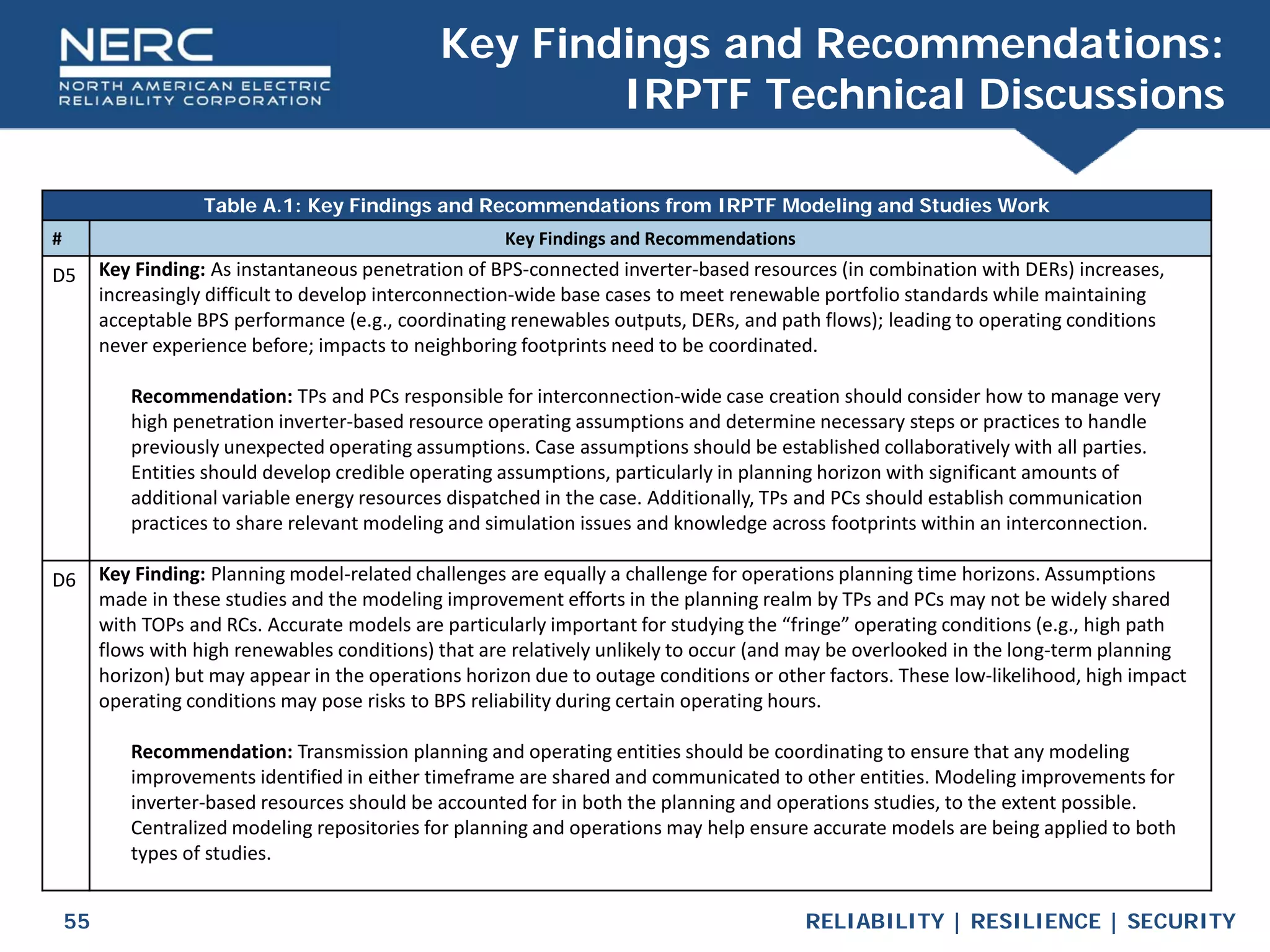
RELIABILITY | RESILIENCE | SECURITY
55
Key Findings and Recommendations:
IRPTF Technical Discussions
Table A.1: Key Findings and Recommendations from IRPTF Modeling and Studies Work
# Key Findings and Recommendations
D5 Key Finding: As instantaneous penetration of BPS-connected inverter-based resources (in combination with DERs) increases,
increasingly difficult to develop interconnection-wide base cases to meet renewable portfolio standards while maintaining
acceptable BPS performance (e.g., coordinating renewables outputs, DERs, and path flows); leading to operating conditions
never experience before; impacts to neighboring footprints need to be coordinated.
Recommendation: TPs and PCs responsible for interconnection-wide case creation should consider how to manage very
high penetration inverter-based resource operating assumptions and determine necessary steps or practices to handle
previously unexpected operating assumptions. Case assumptions should be established collaboratively with all parties.
Entities should develop credible operating assumptions, particularly in planning horizon with significant amounts of
additional variable energy resources dispatched in the case. Additionally, TPs and PCs should establish communication
practices to share relevant modeling and simulation issues and knowledge across footprints within an interconnection.
D6 Key Finding: Planning model-related challenges are equally a challenge for operations planning time horizons. Assumptions
made in these studies and the modeling improvement efforts in the planning realm by TPs and PCs may not be widely shared
with TOPs and RCs. Accurate models are particularly important for studying the “fringe” operating conditions (e.g., high path
flows with high renewables conditions) that are relatively unlikely to occur (and may be overlooked in the long-term planning
horizon) but may appear in the operations horizon due to outage conditions or other factors. These low-likelihood, high impact
operating conditions may pose risks to BPS reliability during certain operating hours.
Recommendation: Transmission planning and operating entities should be coordinating to ensure that any modeling
improvements identified in either timeframe are shared and communicated to other entities. Modeling improvements for
inverter-based resources should be accounted for in both the planning and operations studies, to the extent possible.
Centralized modeling repositories for planning and operations may help ensure accurate models are being applied to both
types of studies.
RELIABILITY | RESILIENCE | SECURITY
56
Key Findings and Recommendations:
IRPTF Technical Discussions
Table A.1: Key Findings and Recommendations from IRPTF Modeling and Studies Work
# Key Findings and Recommendations
D7 Key Finding: The generic RMS positive sequence dynamic models for inverter-based resources connected to the BPS can
generally model momentary cessation behavior but with known limitations on modeling the recovery delay. Inaccurate
modeling of recovery delay causes inaccuracies in the dynamic simulation results, particularly regarding false voltage overshoot
when active current recovery is delayed but reactive current is not. Further, the reec_b model has limitations on capturing
voltage-dependent current logic and its use is discouraged moving forward.
Recommendation: The generic RMS positive sequence dynamic models should be enhanced by model development groups
as soon as possible. Once the model enhancements are benchmarked and approved for use in planning assessments, TPs
and PCs should notify GOs in their planning footprint that these updated models are available and should be used for any
necessary modeling improvements (regarding MC and other improvements to modeling disturbance ride-through
performance).

2020-06_Webinar-IBR_Modeling_Studies_Report.pdf

  • 1.
    RELIABILITY | RESILIENCE| SECURITY Industry Webinar Technical Report: BPS-Connected Inverter-Based Resource Modeling and Studies NERC IRPTF June 8, 2020
  • 2.
    RELIABILITY | RESILIENCE| SECURITY 2 IRPTF Technical Report
  • 3.
    RELIABILITY | RESILIENCE| SECURITY 3 IRPTF Web Page Location https://www.nerc.com/comm/PC/Pages/Inverter-Based-Resource-Performance-Task-Force.aspx
  • 4.
    RELIABILITY | RESILIENCE| SECURITY 4 Overview of Webinar Topic Presenters Kickoff and Background of IRPTF Activities Al Schriver, NextEra Inverter-Based Resource Modeling Activities Ryan Quint, NERC IRPTF Modeling and Simulations Songzhe Zhu, CAISO David Piper, SCE Future Efforts Regarding BPS-Connected Inverter- Based Resource Modeling and Studies Deepak Ramasubramanian, EPRI Andrew Isaacs, Electranix ERCOT EMT Modeling Requirements and Simulations Fred Huang, ERCOT Wrap Up and Q&A All
  • 5.
    RELIABILITY | RESILIENCE| SECURITY 5 Kickoff and Background of IRPTF Activities Allen Schriver, NextEra
  • 6.
    RELIABILITY | RESILIENCE| SECURITY 6 NERC IRPTF Framework
  • 7.
    RELIABILITY | RESILIENCE| SECURITY 7 NERC IRPTF Accomplishments
  • 8.
    RELIABILITY | RESILIENCE| SECURITY 8 NERC IRPTF Future Activities * Electromagnetic Transient Modeling and Studies * Energy Transition to High Penetrations of Inverter- Based Resources * Impacts to BPS Protection Systems * Battery Energy Storage Systems * Hybrid Power Plants * Generator Interconnection Process Improvements * Advanced Modeling, Simulation, and Study Techniques
  • 9.
    RELIABILITY | RESILIENCE| SECURITY 9 Chapter 1: Inverter-Based Resource Modeling Activities Ryan Quint, NERC
  • 10.
    RELIABILITY | RESILIENCE| SECURITY 10 NERC Disturbance Reports of Solar PV Events
  • 11.
    RELIABILITY | RESILIENCE| SECURITY 11 • Modeling updates for existing resources  Many TPs and PCs stated that minimal or no models provided by GO  Models that were provided were incorrectly parameterized, were unusable, or were wrong models entirely • TP and PC outreach to GOs  Rare number of entities doing extensive model follow-up o Utilized MOD-032-1 or processes outside NERC Alert or NERC Standards  Minimal follow-up actions by TPs and PCs to correct issues  Some follow-up met with unwillingness of GO to cooperate • TPs and PCs stated updated models were correct; cursory review of updated models by WECC showed modeling errors  Systemic lack of model “verification” by TPs and PCs Canyon 2 Fire Alert Findings
  • 12.
    RELIABILITY | RESILIENCE| SECURITY 12 • Most solar PV resource owners stated that they could eliminate momentary cessation or change settings to improve performance  Little to no dynamic models provided; unclear as to what has or has not been changed – follow-up activities needed • BES versus non-BES resources  Only about one-half of installed capacity of BPS-connected solar PV resources in the West were part of NERC Alert process due to BES definition (i.e., 75 MVA)  Other one-half of capacity has settings and capabilities that are unknown to NERC (and likely to much of industry) Canyon 2 Fire Alert Findings (cont.)
  • 13.
    RELIABILITY | RESILIENCE| SECURITY 13 Industry Efforts to Update Dynamic Models CAISO Model Updates SCE Model Updates
  • 14.
    RELIABILITY | RESILIENCE| SECURITY 14 WECC Solar Modeling Advisory Group • Charter:  Address systemic modeling issues in WECC interconnection-wide base cases  Coordinate with generator owners to educate and support model development  Accountability to inverter-based resource modeling in West
  • 15.
    RELIABILITY | RESILIENCE| SECURITY 15 • Dynamic models often do not meet basic model quality checks  Initialization, no-disturbance flat run, positive damping, etc.  Typically caused by incorrect parameterization • Dynamic models often in the incorrect format, not meeting TP and PC requirements  Wrong simulation platform, tabular format, etc. • Incorrect parameterization of dynamic models  Model parameters do not match data provided by GO – NERC Alert data  Use of reec_b rather than reec_a with momentary cessation  Generic model parameters, no site-specific tuning  Generic inverter-level model, not overall plant model – useless to TP/PC  Uncoordinated dynamic models (e.g., Vdip and VDL tables, active and reactive current controls) Predominant Issues for Modeling Inverter-Based Resources
  • 16.
    RELIABILITY | RESILIENCE| SECURITY 16 • GOs making changes to installed equipment without updating dynamic models  Expressed anecdotally in IRPTF meetings multiple times  GOs and GOPs stated changes not considered “material modifications” in their opinion; • Unclear industry understanding of “material modification” in NERC FAC Standard and FERC GIA process; not the same intent • Lack of info available for TPs and PCs to “verify” whether models reasonably match installed equipment  Overreliance on MOD-026-1 and MOD-027-1 activities; not capturing large disturbance behavior of models • TPs and PCs stated difficulties and shortcuts to meet interconnection process timelines; inability to fully execute studies; potential reliability gaps Predominant Issues for Modeling Inverter-Based Resources (cont.)
  • 17.
    RELIABILITY | RESILIENCE| SECURITY 17 • EMT models not provided during interconnection study process.  Extremely difficult to acquire after-the-fact once resource is in-service  Poses challenges and risks for TPs and PCs to execute studies in future. • Interaction of BPS-connected inverter-based resource and distributed energy resource modeling/studies • Stability issues during high-penetration inverter-based resource conditions not easily detectible using positive sequence stability simulations.  Controls interactions, controls instability, subsynchronous control interactions (SSCI), low short-circuit strength issues, etc. • Positive sequence simulation tools need improvements • Lack of coordination among entities – GOTPPCMOD- 032 Designee; neighboring entities Predominant Issues for Modeling Inverter-Based Resources (cont.)
  • 18.
    RELIABILITY | RESILIENCE| SECURITY 18 Types of Verification Examples of Verification Dynamic Model Parameters Verified Required by MOD Standards Small Disturbance • Capacitor switching test • Plant-level voltage or frequency reference step or play-in test • Plant-level controller • Possibly some inverter- level settings Yes Large Disturbance • On-site staged fault test • Inverter-level and plant- level controls, coordinated No Other “Verification” Activities • Review of factory test reports • Review of plant-level and inverter-level settings • Review of one line diagrams • Majority of model parameters • Useful in combination with engineering judgment Yes / No Challenges Relying on MOD-026-1 and MOD-027-1
  • 19.
    RELIABILITY | RESILIENCE| SECURITY 19 • Type of inverter-based resource facility being represented?  (i.e., a solar PV, wind, battery energy storage, or hybrid facility) • Models provided meet TP/PC list of acceptable models? • One-line diagram provided? Power flow model meet TP and PC recommended modeling practices? • Make, type, and models of inverters and relevant controls? Inverter spec sheets and settings used to develop models? • Installed control modes match modeled control flags and settings?  Any limitations in the ability of the models to match actual performance? Verified with inverter and plant-level OEMs? • Appropriate protection and controls modeled? • Understanding of return to service behavior following a trip? Recommended Questions to Ask When Receiving Dynamic Models
  • 20.
    RELIABILITY | RESILIENCE| SECURITY 20 Modeling Issues and the Interconnection Study Process SOLAR PV GENERATORS (BLANK) BATTERY ENERGY STORAGE (BLANK)
  • 21.
    RELIABILITY | RESILIENCE| SECURITY 21 • Recommendations for TPs and PCs:  Require EMT models for all newly interconnecting BPS-connected inverter- based resources  Perform screening studies to identify any potential risks that may require EMT simulations  Execute EMT simulations to identify any potential reliability risks o Controls interactions, controls instability, SSCI, low short circuit, etc.  Growing body of industry expertise  Much further to go in developing capabilities as an industry Growing Need for EMT Modeling
  • 22.
    RELIABILITY | RESILIENCE| SECURITY 22 Chapter 2: IRPTF Modeling and Simulations Songzhe Zhu, CAISO David Piper, SCE
  • 23.
    RELIABILITY | RESILIENCE| SECURITY 23 • Phase 1: Resource Loss Protection Criteria Studies  Minimum inertia, minimum reserves, overly stressed operating condition  No reliability risks identified w.r.t. frequency stability and RLPC • Phase 2: Realistic High Solar PV Penetration Conditions  Light summer base case, high solar PV, moderate wind, reasonable on-line reserves  All resources potential employing momentary cessation (based on data available at the time) • Phase 3: Updated Dynamics Data and High Solar PV Conditions  Same base case and operating conditions  Updated dynamics data to match NERC Alert data following Canyon 2 disturbance Overview of IRPTF Studies
  • 24.
    RELIABILITY | RESILIENCE| SECURITY 24 • Momentary cessation blocking threshold • Recovery delay of inverter current • Active power ramp rate during recovery • Number of successive events Development of User-Written Model to Represent Momentary Cessation • Normal mode • Block mode • Delay mode • Recovery mode
  • 25.
    RELIABILITY | RESILIENCE| SECURITY 25 Phase 1: WECC Resource Loss Protection Criteria Assessment
  • 26.
    RELIABILITY | RESILIENCE| SECURITY 26 Phase 2: Initial WECC Stability Simulations
  • 27.
    RELIABILITY | RESILIENCE| SECURITY 27 Identified Potential Instability Events: N-1 Fault Simulation 1: Solar PV Enters Momentary Cessation; BPS Bus Voltages Start Collapsing 2: HVDC Circuit Blocks Due to Low Voltage; Re-Enters Blocking
  • 28.
    RELIABILITY | RESILIENCE| SECURITY 28 Identified Potential Instability Events: N-1 Fault Simulation 3: HVDC Circuit Blocks; AC System Experiences Large Power Swings 4: Without RAS, System Unstable; With RAS, Severe Frequency and Voltage Swings
  • 29.
    RELIABILITY | RESILIENCE| SECURITY 29 Identified Potential Instability Events: N-1-1 Fault Simulation
  • 30.
    RELIABILITY | RESILIENCE| SECURITY 30 Table 2.2: Overview of Mitigation Options for Instability Conditions Mitigation Option Instability Mitigated Acceptable BPS Performance Discussion Eliminate MC Yes Yes Eliminating MC greatly improves BPS performance including angular, voltage, and frequency stability. Interaction with HVDC controls and RAS are eliminated. All alternative options for inverter controls provided adequate BPS performance (P-priority had local performance issues (see Chapter 3)). Operating Limit Restrictions Yes Yes Stability issues are mitigated if operating limits are restricted; no operation of RAS if ac and dc intertie flows are limited; MC still causes adverse impacts on system performance, although performance requirements are met; costly solution due to economic impacts of curtailment.* Reactive Power Support Marginal Marginal Multiple STATCOM locations were explored; a significantly large amount of reactive power was needed to mitigate transient voltage collapse along corridor and depressed voltage at inverter-end of HVDC circuit; ineffective solution for this specific problem. Additional RAS Actions Unlikely Unlikely The only additional RAS action suitable to address this issue would be load tripping in Southern California, which is not an acceptable solution for N-1 contingency events. This solution would have significant economic impacts and load service degradation. Transmission Reinforcement Likely Possibly Significant EHV network improvements needed to eliminate need for RAS; extremely costly solution option, and likely not possible due to permitting, expense, and regulations; not recommended. Mitigation of Potential Instability Conditions * Instability could be mitigated through generation redispatch in PG&E area near ac intertie, and reducing generation in the Pacific Northwest. System remains stable; transient performance is marginal, with severe voltage dip during first swing. System redispatch as preventive measure should include detailed studies under various system operating conditions to define the stability boundary.
  • 31.
    RELIABILITY | RESILIENCE| SECURITY 31 Phase 3: Detailed Stability Studies using NERC Alert Data Current MC Settings Proposed MC Settings
  • 32.
    RELIABILITY | RESILIENCE| SECURITY 32 Table 2.3: Performance Comparison for Different MC Settings for N-1 Contingency (without and with RAS Action) System Response Default MC Current MC Proposed MC RAS Actions Not Modeled Initial HVDC blocking duration [s] 0.93 0.90 0.84 Successive HVDC Blocking Yes No No System Stable No Yes Yes System Frequency Nadir [Hz] N/A (Unstable) 59.63 Hz 59.78 Hz RAS Actions Modeled Successive HVDC Blocking No No No System Stable Yes Yes Yes System Frequency Nadir [Hz] 59.52 59.6 59.71 Phase 3 Simulation Results Solar PV Entering MC BPS Frequency
  • 33.
    RELIABILITY | RESILIENCE| SECURITY 33 • BPS stability and acceptable performance maintained in all cases • Active current (Ip) priority caused solar PV plant to trip  Sustained low voltage due to lack of local reactive support post-fault • Reactive current (Iq) priority helped boost voltage post-fault and allow active current to return to pre-disturbance levels quickly • Iq priority is recommended control strategy for this area  Ability to support BPS voltage during and immediately after the fault  Enables quick and reliable active current recovery to pre-disturbance levels • Detailed studies needed by TPs and PCs to determine appropriate control strategy in some areas; simulation results should be used to provide a technical basis for this decision Inverter Current Control Sensitivities
  • 34.
    RELIABILITY | RESILIENCE| SECURITY 34 Future Efforts Regarding BPS-Connected Inverter- Based Resource Modeling and Studies Deepak Ramasubramanian, EPRI Andrew Isaacs, Electranix
  • 35.
    RELIABILITY | RESILIENCE| SECURITY 35 • Existing state-of-the-art generic IBR models have limitations • Placing this in context:  Models representing the behavior of synchronous machines (and their governors + excitation systems) are still being updated and modified today • Simultaneously new, updated, more robust, and more accurate IBR models are also being presently developed. Present status of IBR modeling NewModel Functionality Statusof ImplementationbySoftware Vendors AgreedPriority for Implementation REGC_B Improvedconvertermodel (voltage source model) Betaversionintools 1 REEC_D Impovedconverterelectrical controls(toallow for modelingmomentary sessationetc.) Betaversionintools 2 REPC_C Impovedplantcontrollermodel, forbettermodeling of primary frequency response controls, etc. One software vendorhasbeta implemented, otherstofollow soon. 3 WGO Weak GridOptionControlsforweak gridapplications Nextinline forimplementationby software vendors 4 WTGP_B Improvedpitch-controllermodel fortype 3WTG Nextinline forimplementationby software vendors 5 WTGT_B Slightly improveddrive-trainmodel, particularly for type 4WTG Nextinline forimplementationby software vendors 6 WTGQ_B Alternative torque-controllermodel fortype 3WTG Nextinline forimplementationby software vendors 7 IBFFR emulatedinertiamodel forWTG One software vendorhasstartedwork, otherstofollow soon. 8 REGC_C More advancedconvertermodel, includingPLLand inner-currentcontrol-loopforselectstudies Nextinline forimplementationby software vendors 9 Reference: WECC REMTF Memo: Proposal for new features for the renewable energy system generic models, DATE: 12/17/19
  • 36.
    RELIABILITY | RESILIENCE| SECURITY 36 Examples: Validation of behavior of new IBR models for low short circuit conditions Robust and consistent (when compared with EMT model) fault ride through for SCR as low as 1.0 at plant POI First Solar Inc.: ‘Deploying utility-scale PV power plants in weak grids,’ 2017 IEEE Power & Energy Society General Meeting, July 2017 Recreated with new models REGC_A REGC_C • For any model, accurate parameterization is very important • New models are not meant to replace any other potential form/method of study • Rather intended to supplement and enhance available options • Industry stakeholder participation and constructive feedback is crucial for improved models Build up of small signal oscillations when plant output is near maximum
  • 37.
    RELIABILITY | RESILIENCE| SECURITY 37 • Notable current EMT modelling efforts:  National Grid >700 MW DER modelled interconnected into ISO-NE bulk grid  HECO island-wide models  ATC integration of large scale PSCAD group studies into MISO process  ERCOT panhandle PSCAD model continues to grow  AEP routine group studies for SSCI in PSCAD (very large processing req’ts)  Routine EMT analysis of every new IBR interconnection in ISONE, as well as benchmarking against PSS/E models.  NYPA wide-area EMTP network simulations  Hybrid PSCAD/PSLF analysis of large HVDC projects into WECC system.  Hydro-Quebec EMTP studies for low short-circuit strength and SSCI studies  EMT model requests for current and old becoming standard in large ISOs.  Increasing capability and support from major PV OEMs  Others!! EMT Modeling in North America
  • 38.
    RELIABILITY | RESILIENCE| SECURITY 38 • Where are we going next?  Larger system models, with more automated model building and analysis tools. Expecting to double or triple the largest “working study” model size in the next year! (100’s of IBR models). This is a software problem, taking advantage of new computing hardware.  DLL “Real Code” model standardization and increasing adoption. In the past year, 5-6 OEMs adopted this approach. We want to expand this.  Continued refinement of EMT modelling guides and standards. o http://www.electranix.com/publication/pscad-requirements-rev-9- may-2020/ o Draft IEEE 2800 Subgroup 10 o NERC IRPTF guidelines past and new ones under development o ISO/TO standards (ATC/ERCOT/ISONE/CAISO/TVA/HECO/MISO/others)  Increased adoption of EMT studies into routine planning studies. Requires all of the above! EMT Modeling Next Steps AMD Ryzen 3990x CPU (64 cores, 128 threads), 128 GB RAM, liquid cooled… <$10,000 CAD
  • 39.
    RELIABILITY | RESILIENCE| SECURITY 39 ERCOT Electromagnetic Transient (EMT) Modeling Requirements and Simulations Fred Huang, ERCOT
  • 40.
    RELIABILITY | RESILIENCE| SECURITY 40 • All IBRs are required to provide EMT (PSCAD) models  ERCOT Model Guide: http://www.ercot.com/content/wcm/lists/168284/ERCOT_Model_Quality _Guideline.zip • EMT models are used for specialized studies such as:  Low short-circuit strength conditions  Inverter-based resources in the vicinity of series capacitors • EMT Model ≠ Good/Accurate  Validation needed… EMT Models in ERCOT
  • 41.
    RELIABILITY | RESILIENCE| SECURITY 41 Goal: Improved Model Accuracy & Confidence Model Accuracy and Usability Model Quality Tests Model Consis- tency Verify Field Settings Hardware Bench- mark Challenge Proposed Solution Model performance Model quality tests PSCAD model fidelity Hardware benchmark (unit validation) Model settings do not match the field settings Plant verification (periodic setting check) Consistency between PSSE and PSCAD models Model quality tests
  • 42.
    RELIABILITY | RESILIENCE| SECURITY 42 How Proposal Achieves Goals Dynamic Device (Inverter) Lab Test Measurement PSCAD Simulation 1. Model Validation Tests (Voltage Step Change, VRT, etc) Accurate PSCAD Model (Technology Specific) PSS/e Model 2. Model Quality Test (Voltage Step Change, VRT, ect) Accurate PSS/e Model (Technology Specific) Accurate PSCAD Model (Technology Specific) Site-Specific Settings Accurate PSCAD Model (Site Specific) 2. Model Quality Test (Voltage Step Change, VRT, ect) PSS/e Model (Technology Specific) Accurate PSS/e Model (Site Specific) Note: ERCOT is currently working with stakeholders on this proposal
  • 43.
    RELIABILITY | RESILIENCE| SECURITY 43 • With more IBRs…  Increasing stability challenges  Require EMT (PSCAD) studies o Complex and time consuming • Needs and improvements  Model accuracy and usability (EMT and RMS models)  Tool and simulation efficiency  Is it feasible or practical for system wide study and operation support?  Better communication and coordination EMT Studies Panhandle PSCAD Study • >500 buses • ~60 PSCAD models (10 GW) • ~2.5 hours per contingency
  • 44.
    RELIABILITY | RESILIENCE| SECURITY 44 Wrap Up – Key Findings and Recommendations Ryan Quint, NERC
  • 45.
    RELIABILITY | RESILIENCE| SECURITY 45 • NERC Alert  Modeling issues systemic for solar PV resources; needs quick attention  Many resources can improve dynamic behavior; eliminate momentary cessation; uncertain of extent of changes  Need more TP and PC engagement in verifying accuracy of models  Need better coordination and educations among entities • IRPTF Studies  Widespread momentary cessation poses BPS reliability risks  More detailed modeling showed degraded BPS performance with existing momentary cessation  Dynamic support, particularly reactive current priority with dynamic voltage control, proved most effective in terms of BPS stability/performance Key Findings and Recommendations
  • 46.
    RELIABILITY | RESILIENCE| SECURITY 46 • IRPTF Technical Discussions  MOD-026-1 and MOD-027-1 gaps in verifying large disturbance behavior  As-built settings differ from models provided, in all phases of interconnection process and upon commercial operation  LGIP (and SGIP) should be revisited to improve understanding of modeling to enable sufficient studies  Confusion with “material modification” in FAC-001-3 and FERC GIA process  Growing need for EMT models and simulations  Significant improvements needed to interconnection requirements to cover modeling of all kinds (e.g., positive sequence, short-circuit, EMT)  Case creation becoming increasing challenging; coordination needed  “Fringe” (realistic yet highly stressed) operating conditions need to be studied by both planning and operating entities  Improved dynamic modeling practices needed moving forward Key Findings and Recommendations
  • 47.
    RELIABILITY | RESILIENCE| SECURITY 47 • NERC IRPTF Webpage  Technical Reference Document: BPS- Connected Inverter-Based Resource Modeling and Studies • NERC Reliability and Security Guidelines  Reliability Guideline: BPS-Connected Inverter-Based Resource Performance  Reliability Guideline: Improvements to Interconnection Requirements for BPS- Connected Inverter-Based Resources • Summary of Activities: BPS- Connected Inverter-Based Resources and DERs NERC References
  • 48.
    RELIABILITY | RESILIENCE| SECURITY 48 Want to get involved with IRPTF? Email: ryan.quint@nerc.net
  • 49.
    RELIABILITY | RESILIENCE| SECURITY 49 Table A.1: Key Findings and Recommendations from IRPTF Modeling and Studies Work # Key Findings and Recommendations A1 Key Finding: A significant number of solar PV resource owners submitted positive sequence models for the interconnection- wide case creation process (i.e., MOD-032-1) that do not accurately represent the control settings programmed into the inverters installed in the field. Discrepancies between NERC Alert data and dynamic models in interconnection-wide base cases. Recommendation: GOs should submit updated models to the TPs and PCs as quickly as possible to accurately reflect the large disturbance behavior of BPS-connected solar PV resources in the interconnection-wide base cases used for planning assessments. This applies to BES resources as well as non-BES resources connected to the BPS. A2 Key Finding: Many models submitted during NERC Alert intended to represent existing equipment either (1) did not match data provided by GO, or (2) did not meet TP and PC model requirements (incorrect models or parameters, inability to initialize). Recommendation: TPs and PCs should proactively work with all BPS-connected solar PV resources in their system to ensure dynamic models correctly represent large disturbance behavior of actual installed equipment. GOs should verify dynamic model parameters with actual equipment and control settings. These activities should occur on a regular basis. A3 Key Finding: A significant number of GOs submitted NERC Alert data indicating they could eliminate MC for existing resources; however, no model of proposed changes provided or provided model had deficiencies. Recommendation: TPs and PCs should proactively work with all GOs of BPS-connected solar PV resources in footprint to review NERC Alert data provided, develop updated dynamic models of proposed changes, study the impacts of making these changes, and provide recommendations to the GO to make appropriate changes based on study results. Key Findings and Recommendations: NERC Alert
  • 50.
    RELIABILITY | RESILIENCE| SECURITY 50 Key Findings and Recommendations: NERC Alert Table A.1: Key Findings and Recommendations from IRPTF Modeling and Studies Work # Key Findings and Recommendations A4 Key Finding: GOs provided requested data and information about facilities as part of NERC Alert; however, very few GOs provided acceptable models that matched the data provided. Some TPs and PCs were proactive in correcting deficiencies, but these activities are occurring outside the NERC Alert process. The NERC Alert itself did not remedy the issues associated with inaccurate dynamic model representation of BPS-connected inverter-based resources, only highlighted the problem. Recommendation: IRPTF should continue to monitor for systemic modeling issues and make appropriate recommendations on future actions. Additional actions needed to address systemic modeling issues identified during NERC Alert process may require another method of engaging or requiring industry to make changes to dynamic models. A5 Key Finding: TPs and PCs still becoming familiar with newer dynamic models for inverter-based resources; documentation for these models is limited; many TPs and PCs not familiar with how to perform reasonability tests during model submittal processes; often requires expert input to parameterize models; in-house expertise on these models is fairly limited for many TPs and PCs; leading to systemic modeling challenges. Recommendation: Industry should develop technical guidance and reference materials for parameterizing positive sequence dynamic models for BPS-connected inverter-based resources; training should be provided on this topic. A6 Key Finding: NERC MOD-032-1 does not prescribe details that modeling requirements must cover (leaves the level of detail and data formats up to each TP/PC). Detailed TP/PC data requirements exist; however, little validation of data provided by GOs is performed. In many cases, “usability testing” is performed but assessments on accuracy or reasonableness of parameters are not typically performed. Many entities not utilizing MOD-032-1 Requirement R3 to express “technical concerns” with data submittals. Recommendation: See A2 recommendation.
  • 51.
    RELIABILITY | RESILIENCE| SECURITY 51 Key Findings and Recommendations: IRPTF Studies Table A.1: Key Findings and Recommendations from IRPTF Modeling and Studies Work # Key Findings and Recommendations S1 Key Finding: Early stability studies using data provided from the first NERC Alert illustrated widespread use of MC could cause system instability issues, if not mitigated. MC caused a lack of reactive power support in voltage-sensitive areas and resulted in large power swings across the BPS in the Western Interconnection. MC actions interacted with HVDC controls and RAS actions. Recommendation: Technical justification that MC should be disallowed for newly interconnecting BPS-connected solar PV resources and should be eliminated to the greatest possible extent for existing resources. Industry should be taking actions to eliminate MC for existing resources to the greatest possible extent, and TOs should update interconnection requirements to disallow its use for newly interconnecting resources. S2 Key Finding: Detailed studies using modified models to reflect actual MC settings of BPS-connected solar PV resources (following Canyon 2 Fire disturbance NERC Alert) showed BPS remains stable for aforementioned contingencies. However, BPS performance is degraded by use of MC. Elimination of MC or improvements to the MC voltage threshold or recovery characteristic had greatest positive impact. Interactions with HVDC controls still present, and combined reduction of solar PV and RAS actions resulted in frequencies falling close to or below UFLS thresholds. Recommendation: See S1 recommendation. S3 Key Finding: Solution options to mitigate poor BPS performance for widespread MC were explored, and it was determined that none of the system-level solutions (e.g., transmission reinforcement, widespread use of transmission-connected reactive devices, curtailment) proved to be an effective means of ensuring reliability. The best solution to the widespread use of MC to improve BPS performance was to eliminate its use to the greatest possible extent. Recommendation: See S1 recommendation.
  • 52.
    RELIABILITY | RESILIENCE| SECURITY 52 Key Findings and Recommendations: IRPTF Studies Table A.1: Key Findings and Recommendations from IRPTF Modeling and Studies Work # Key Findings and Recommendations S4 Key Finding: User-defined models used to modify (overlay) models provided by GOs, to accurately represent large disturbance behavior of solar PV resources; necessary since most BPS-connected solar PV models in base case had deficiencies; not intended as long-term solution for planning assessments; interconnection-wide cases need to be updated as quickly as possible. Recommendation: See A1 recommendation. S5 Key Finding: Active and reactive current priority during large disturbances provides better BPS performance than MC; however, reactive current priority with voltage control enabled provided most optimal form of ride-through performance. Timely recovery and control of inverter voltage allows active current to resume to pre-disturbance output immediately following a severe fault event without causing overvoltage or delays in response. Recommendation: GOs should tune dynamic response of BPS-connected inverter-based resources to meet BPS reliability criteria and support BPS during normal operation and contingency events. Dynamic models should be updated to reflect specific settings used in the field. Refer to NERC Reliability Guideline: BPS-Connected Inverter-Based Resource Performance for details on recommended performance, and refer to any local interconnection requirements that may be in place. S6 Key Finding: Protection system models not widely available in planning models; challenge to study whether the large power swings caused by MC and other inverter behavior have a potential impact on BPS protection system operation. Efforts taken to model key transmission paths; however, models were not readily available to transmission planning engineers. Recommendation: TPs and PCs should require reasonable representation of protection systems and functions be included in interconnection-wide cases. Models used to represent these protection systems and functions can be used in “monitor only” mode to flag potential operation of protection systems or functions. TPs and PCs should perform detailed analyses to identify any potential inadvertent operation of protection systems or functions during contingency events.
  • 53.
    RELIABILITY | RESILIENCE| SECURITY 53 Key Findings and Recommendations: IRPTF Technical Discussions Table A.1: Key Findings and Recommendations from IRPTF Modeling and Studies Work # Key Findings and Recommendations D1 Key Finding: NERC MOD-026-1 and MOD-027-1 activities do not adequately verify accuracy of dynamic models relative to actual installed equipment performance for large disturbance response. Small disturbance testing does not capture large disturbance behavior and therefore does not verify dynamic models. Contributor to systemic modeling challenges faced by industry. Recommendation: IRPTF identified MOD-026-1 and MOD-027-1 as needing revisions to serve intent of standard for BPS- connected inverter-based resources. Changes should ensure that large disturbance behavior of inverter-based resources is verified; activities beyond matching simulated and actual response to small disturbance test should be mandatory step in process. TPs and PCs should be required to verify appropriateness of all model parameters. D2 Key Finding: Issues with transferring knowledge about actual installed settings in the field and how they are parameterized in dynamic models provided to TPs/PCs; stems partly from inverter OEMS and consultants who prepare and submit dynamic models to GOs. Lack of guidance to OEMs on recommended modeling approaches w.r.t. generic models (e.g., reec_b versus reec_a). Need for converting reec_b models to reec_a to better capture dynamic response of solar PV. Not until actual responses of solar PV resources analyzed by NERC and IRPTF did industry become aware of shortcomings in dynamic models. Recommendation: GOs should provide appropriate training and guidance to personnel who parameterize models that are submitted for interconnection-wide base cases. Also, see A2 recommendation.
  • 54.
    RELIABILITY | RESILIENCE| SECURITY 54 Key Findings and Recommendations: IRPTF Technical Discussions Table A.1: Key Findings and Recommendations from IRPTF Modeling and Studies Work # Key Findings and Recommendations D3 Key Finding: Attachment A of Appendix 1 in the FERC LGIP does not mention solar PV resources and only briefly mentions wind power resources. Lack of specificity for modeling and studying these resources during the interconnection process may be leading to lack of detailed studies prior to interconnection. Unclear in the LGIP and the LGIA what constitutes a “material modification” and how technological change procedures should apply. Recommendation: FERC LGIP and LGIA should be reviewed to identify changes necessary to ensure clarity and consistency for inverter-based resources. “Material modification” and technological change procedures should be updated to ensure changes to any equipment that change electrical response of a resources warrant additional interconnection studies to ensure that response is stable under all expected operating conditions. D4 Key Finding: As the system continues to evolve towards increasing penetrations of inverter-based resources, it is incumbent upon TPs, PCs, and TOs to ensure that interconnection requirements, specifically pertaining to modeling and system studies, are updated to ensure that adequate models (steady-state, dynamic, short circuit, and EMT) are provided and benchmarked. Refer to NERC Reliability Guideline: Improvements to Interconnection Requirements for BPS-Connected Inverter-Based Resources. Recommendation: TOs, TPs, and PCs should ensure that the interconnection requirements are updated to ensure that GOs provide adequate models for reliability studies during the interconnection studies process. Requirements should be clear and consistent as to what is required to be provided for BPS-connected inverter-based resources.
  • 55.
    RELIABILITY | RESILIENCE| SECURITY 55 Key Findings and Recommendations: IRPTF Technical Discussions Table A.1: Key Findings and Recommendations from IRPTF Modeling and Studies Work # Key Findings and Recommendations D5 Key Finding: As instantaneous penetration of BPS-connected inverter-based resources (in combination with DERs) increases, increasingly difficult to develop interconnection-wide base cases to meet renewable portfolio standards while maintaining acceptable BPS performance (e.g., coordinating renewables outputs, DERs, and path flows); leading to operating conditions never experience before; impacts to neighboring footprints need to be coordinated. Recommendation: TPs and PCs responsible for interconnection-wide case creation should consider how to manage very high penetration inverter-based resource operating assumptions and determine necessary steps or practices to handle previously unexpected operating assumptions. Case assumptions should be established collaboratively with all parties. Entities should develop credible operating assumptions, particularly in planning horizon with significant amounts of additional variable energy resources dispatched in the case. Additionally, TPs and PCs should establish communication practices to share relevant modeling and simulation issues and knowledge across footprints within an interconnection. D6 Key Finding: Planning model-related challenges are equally a challenge for operations planning time horizons. Assumptions made in these studies and the modeling improvement efforts in the planning realm by TPs and PCs may not be widely shared with TOPs and RCs. Accurate models are particularly important for studying the “fringe” operating conditions (e.g., high path flows with high renewables conditions) that are relatively unlikely to occur (and may be overlooked in the long-term planning horizon) but may appear in the operations horizon due to outage conditions or other factors. These low-likelihood, high impact operating conditions may pose risks to BPS reliability during certain operating hours. Recommendation: Transmission planning and operating entities should be coordinating to ensure that any modeling improvements identified in either timeframe are shared and communicated to other entities. Modeling improvements for inverter-based resources should be accounted for in both the planning and operations studies, to the extent possible. Centralized modeling repositories for planning and operations may help ensure accurate models are being applied to both types of studies.
  • 56.
    RELIABILITY | RESILIENCE| SECURITY 56 Key Findings and Recommendations: IRPTF Technical Discussions Table A.1: Key Findings and Recommendations from IRPTF Modeling and Studies Work # Key Findings and Recommendations D7 Key Finding: The generic RMS positive sequence dynamic models for inverter-based resources connected to the BPS can generally model momentary cessation behavior but with known limitations on modeling the recovery delay. Inaccurate modeling of recovery delay causes inaccuracies in the dynamic simulation results, particularly regarding false voltage overshoot when active current recovery is delayed but reactive current is not. Further, the reec_b model has limitations on capturing voltage-dependent current logic and its use is discouraged moving forward. Recommendation: The generic RMS positive sequence dynamic models should be enhanced by model development groups as soon as possible. Once the model enhancements are benchmarked and approved for use in planning assessments, TPs and PCs should notify GOs in their planning footprint that these updated models are available and should be used for any necessary modeling improvements (regarding MC and other improvements to modeling disturbance ride-through performance).