Xen Project Automotive
and Embedded Overview
April, 2018
Lars Kurth
Chairman, Xen Project Advisory Booard
This work is licensed under a Creative Commons Attribution-Share Alike 4.0 (CC BY-SA 4.0)
GENIVI is a registered trademark of the GENIVI Alliance in the USA and other countries.
Copyright © GENIVI Alliance 2018.
Agenda
Ecosystem Overview
Xen Project Capabilities and Challenges
The Elephant in the Room: Safety Certification
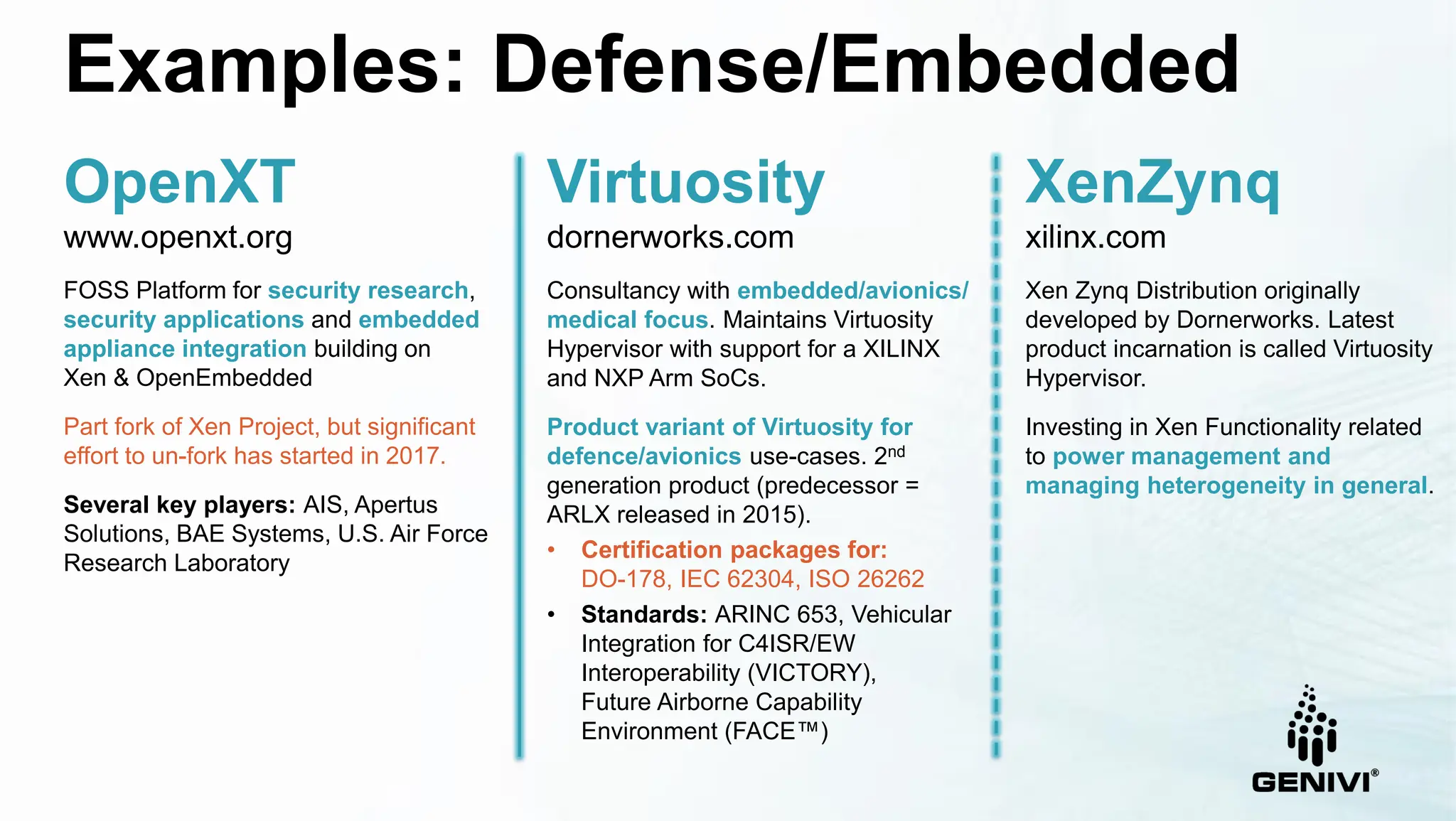
Examples: Defense/Embedded
OpenXT
www.openxt.org
FOSS Platform for security research,
security applications and embedded
appliance integration building on
Xen & OpenEmbedded
Part fork of Xen Project, but significant
effort to un-fork has started in 2017.
Several key players: AIS, Apertus
Solutions, BAE Systems, U.S. Air Force
Research Laboratory
XenZynq
xilinx.com
Xen Zynq Distribution originally
developed by Dornerworks. Latest
product incarnation is called Virtuosity
Hypervisor.
Investing in Xen Functionality related
to power management and
managing heterogeneity in general.
Virtuosity
dornerworks.com
Consultancy with embedded/avionics/
medical focus. Maintains Virtuosity
Hypervisor with support for a XILINX
and NXP Arm SoCs.
Product variant of Virtuosity for
defence/avionics use-cases. 2nd
generation product (predecessor =
ARLX released in 2015).
• Certification packages for:
DO-178, IEC 62304, ISO 26262
• Standards: ARINC 653, Vehicular
Integration for C4ISR/EW
Interoperability (VICTORY),
Future Airborne Capability
Environment (FACE™)
Misc
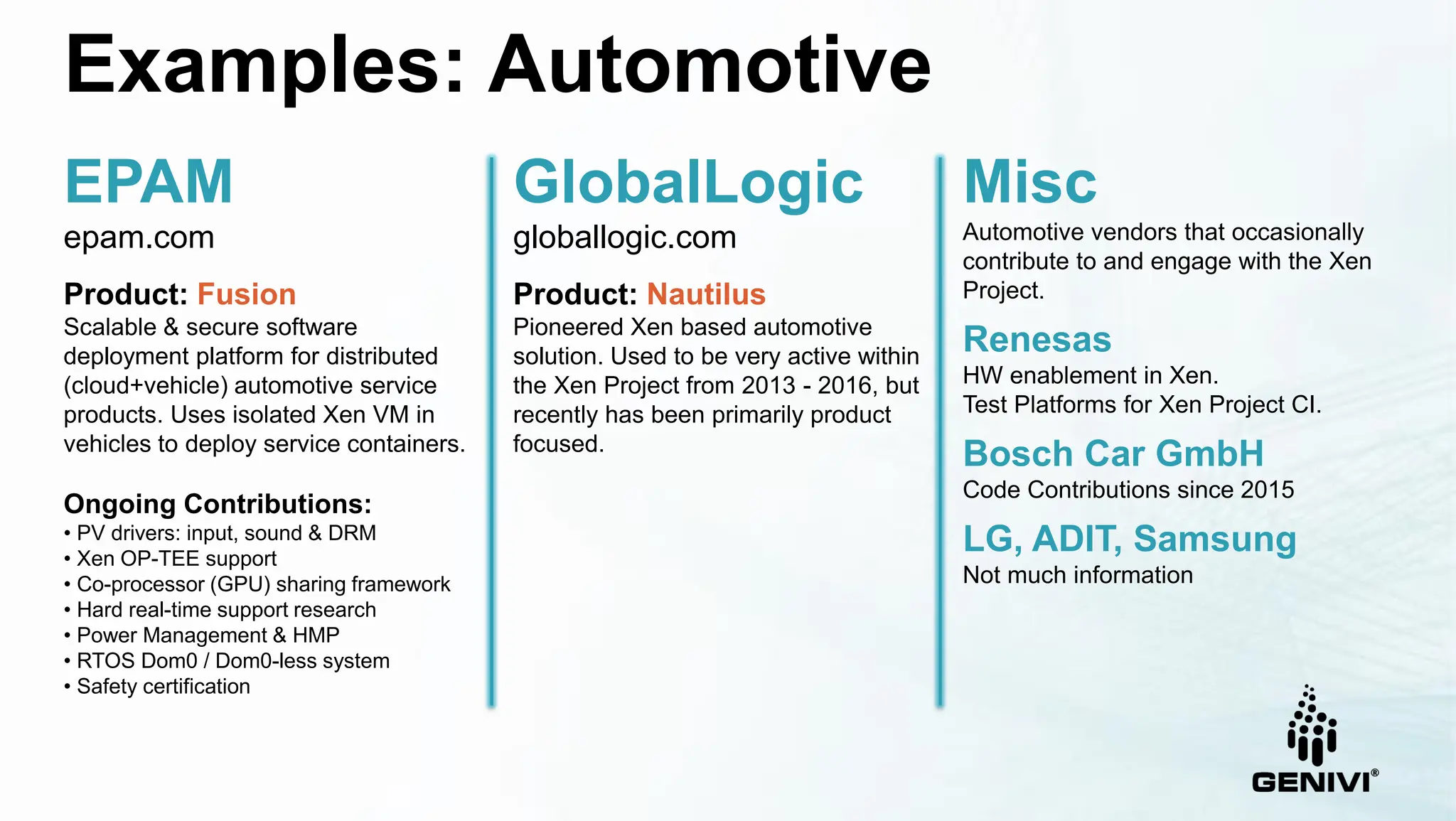
Automotive vendors that occasionally
contribute to and engage with the Xen
Project.
Renesas
HW enablement in Xen.
Test Platforms for Xen Project CI.
Bosch Car GmbH
Code Contributions since 2015
LG, ADIT, Samsung
Not much information
Examples: Automotive
EPAM
epam.com
Product: Fusion
Scalable & secure software
deployment platform for distributed
(cloud+vehicle) automotive service
products. Uses isolated Xen VM in
vehicles to deploy service containers.
Ongoing Contributions:
• PV drivers: input, sound & DRM
• Xen OP-TEE support
• Co-processor (GPU) sharing framework
• Hard real-time support research
• Power Management & HMP
• RTOS Dom0 / Dom0-less system
• Safety certification
GlobalLogic
globallogic.com
Product: Nautilus
Pioneered Xen based automotive
solution. Used to be very active within
the Xen Project from 2013 - 2016, but
recently has been primarily product
focused.
Agenda
Ecosystem Overview
Xen Project Capabilities and Challenges
The Elephant in the Room: Safety Certification
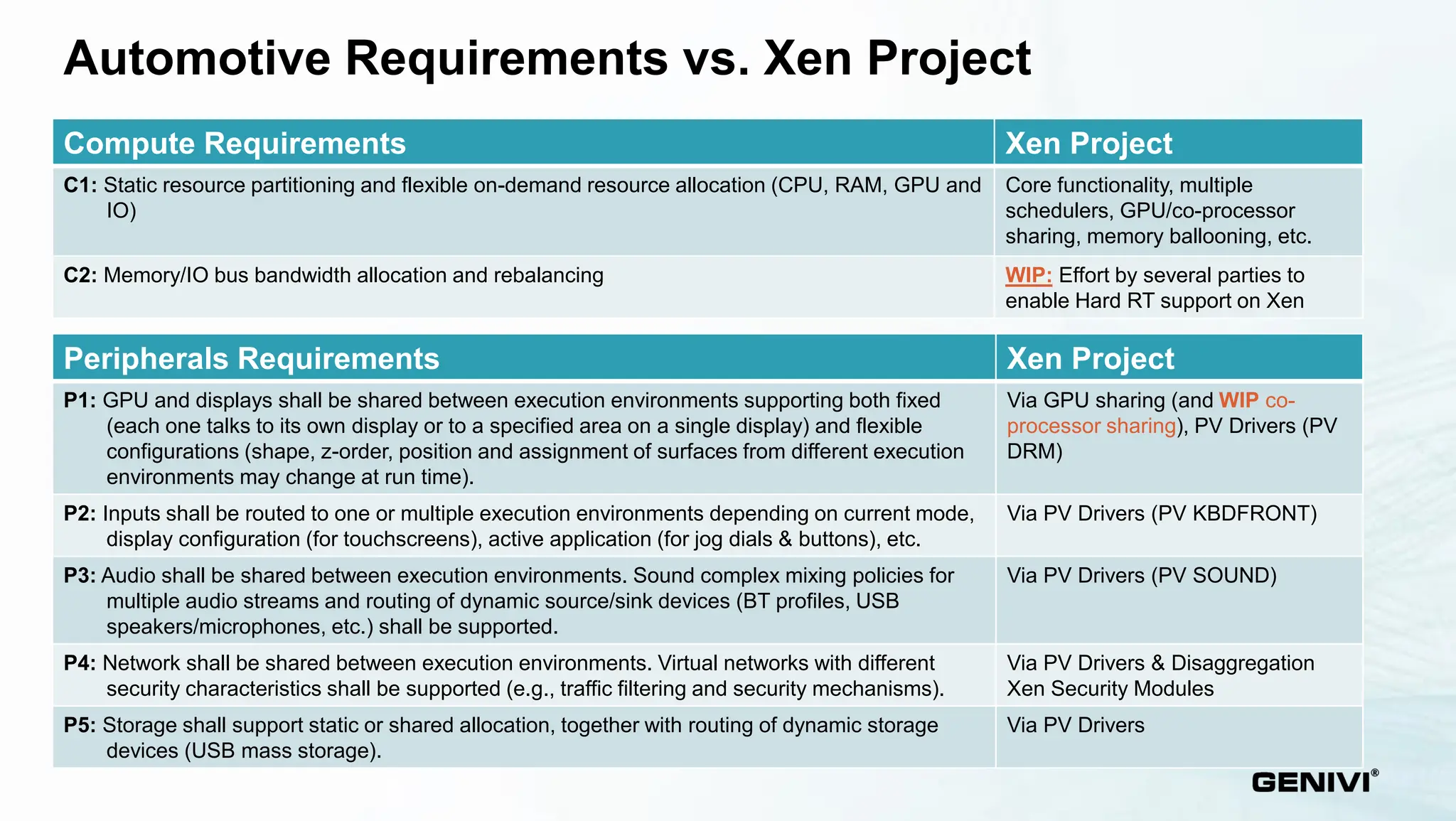
Automotive Requirements vs. Xen Project
Compute Requirements Xen Project
C1: Static resource partitioning and flexible on-demand resource allocation (CPU, RAM, GPU and
IO)
Core functionality, multiple
schedulers, GPU/co-processor
sharing, memory ballooning, etc.
C2: Memory/IO bus bandwidth allocation and rebalancing WIP: Effort by several parties to
enable Hard RT support on Xen
Peripherals Requirements Xen Project
P1: GPU and displays shall be shared between execution environments supporting both fixed
(each one talks to its own display or to a specified area on a single display) and flexible
configurations (shape, z-order, position and assignment of surfaces from different execution
environments may change at run time).
Via GPU sharing (and WIP co-
processor sharing), PV Drivers (PV
DRM)
P2: Inputs shall be routed to one or multiple execution environments depending on current mode,
display configuration (for touchscreens), active application (for jog dials & buttons), etc.
Via PV Drivers (PV KBDFRONT)
P3: Audio shall be shared between execution environments. Sound complex mixing policies for
multiple audio streams and routing of dynamic source/sink devices (BT profiles, USB
speakers/microphones, etc.) shall be supported.
Via PV Drivers (PV SOUND)
P4: Network shall be shared between execution environments. Virtual networks with different
security characteristics shall be supported (e.g., traffic filtering and security mechanisms).
Via PV Drivers & Disaggregation
Xen Security Modules
P5: Storage shall support static or shared allocation, together with routing of dynamic storage
devices (USB mass storage).
Via PV Drivers
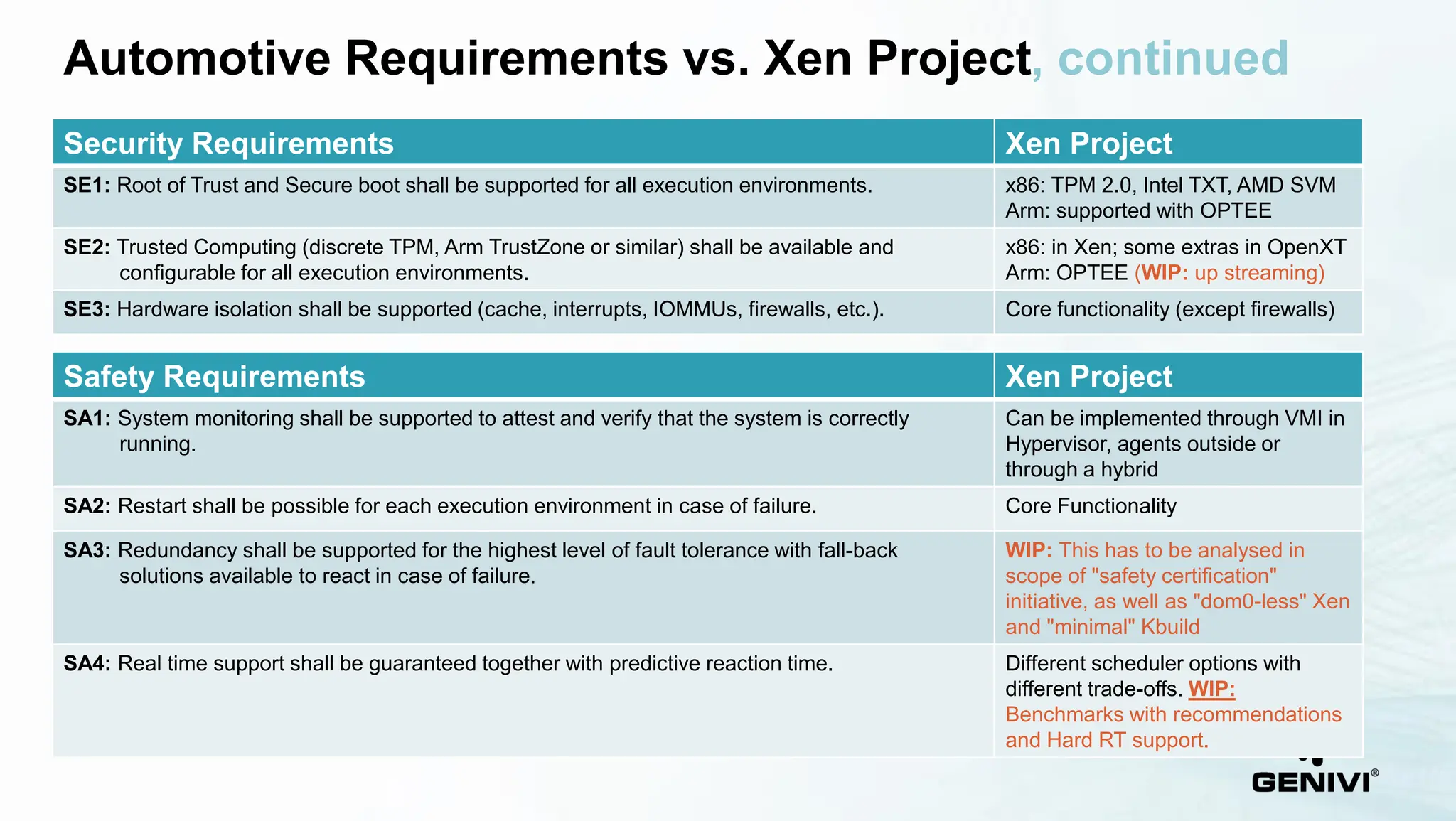
Automotive Requirements vs. Xen Project, continued
Security Requirements Xen Project
SE1: Root of Trust and Secure boot shall be supported for all execution environments. x86: TPM 2.0, Intel TXT, AMD SVM
Arm: supported with OPTEE
SE2: Trusted Computing (discrete TPM, Arm TrustZone or similar) shall be available and
configurable for all execution environments.
x86: in Xen; some extras in OpenXT
Arm: OPTEE (WIP: up streaming)
SE3: Hardware isolation shall be supported (cache, interrupts, IOMMUs, firewalls, etc.). Core functionality (except firewalls)
Safety Requirements Xen Project
SA1: System monitoring shall be supported to attest and verify that the system is correctly
running.
Can be implemented through VMI in
Hypervisor, agents outside or
through a hybrid
SA2: Restart shall be possible for each execution environment in case of failure. Core Functionality
SA3: Redundancy shall be supported for the highest level of fault tolerance with fall-back
solutions available to react in case of failure.
WIP: This has to be analysed in
scope of "safety certification"
initiative, as well as "dom0-less" Xen
and "minimal" Kbuild
SA4: Real time support shall be guaranteed together with predictive reaction time. Different scheduler options with
different trade-offs. WIP:
Benchmarks with recommendations
and Hard RT support.
Automotive Requirements vs. Xen Project, continued
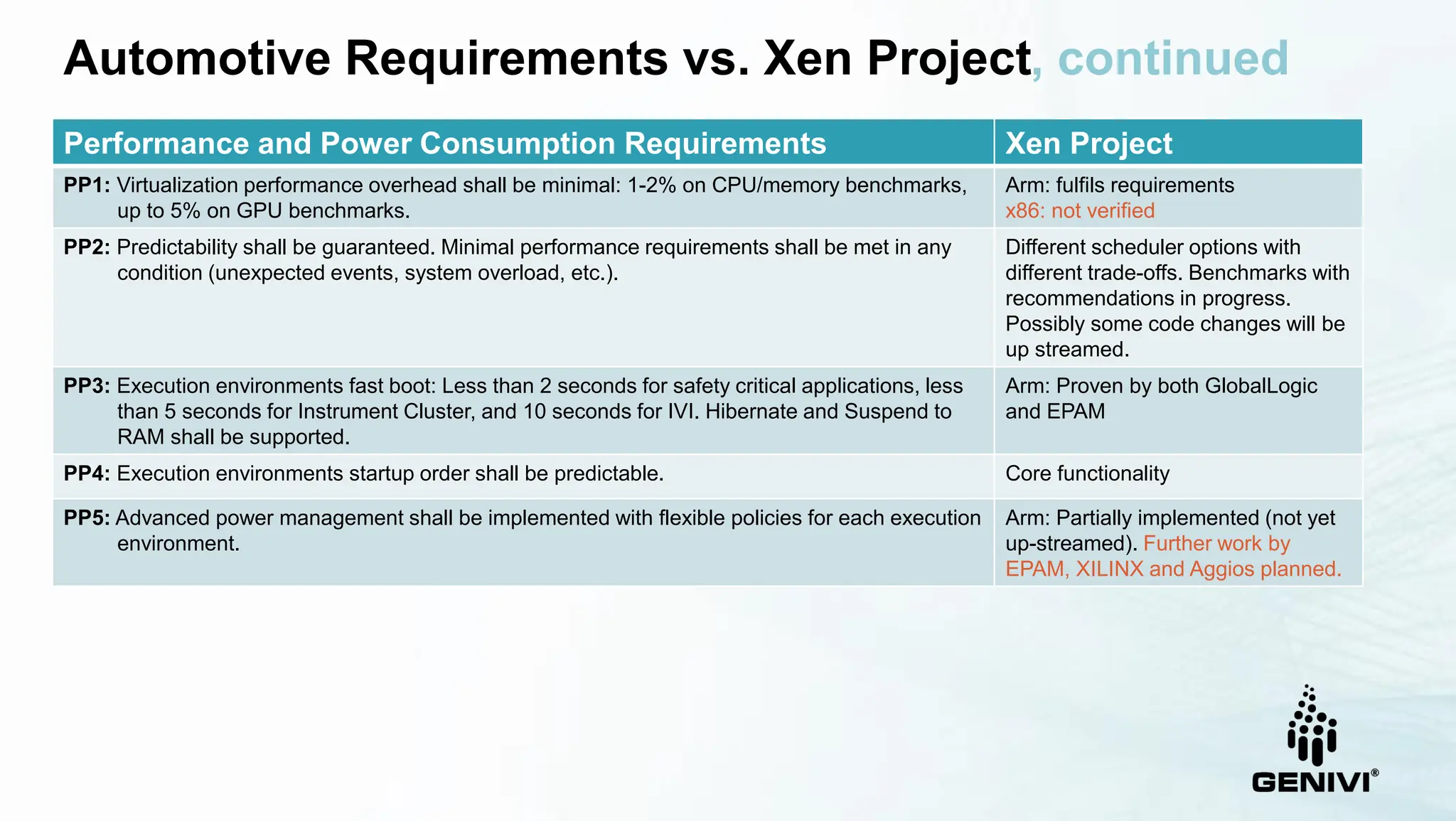
Performance and Power Consumption Requirements Xen Project
PP1: Virtualization performance overhead shall be minimal: 1-2% on CPU/memory benchmarks,
up to 5% on GPU benchmarks.
Arm: fulfils requirements
x86: not verified
PP2: Predictability shall be guaranteed. Minimal performance requirements shall be met in any
condition (unexpected events, system overload, etc.).
Different scheduler options with
different trade-offs. Benchmarks with
recommendations in progress.
Possibly some code changes will be
up streamed.
PP3: Execution environments fast boot: Less than 2 seconds for safety critical applications, less
than 5 seconds for Instrument Cluster, and 10 seconds for IVI. Hibernate and Suspend to
RAM shall be supported.
Arm: Proven by both GlobalLogic
and EPAM
PP4: Execution environments startup order shall be predictable. Core functionality
PP5: Advanced power management shall be implemented with flexible policies for each execution
environment.
Arm: Partially implemented (not yet
up-streamed). Further work by
EPAM, XILINX and Aggios planned.
Agenda
Ecosystem Overview
Xen Project Capabilities and Challenges
The Elephant in the Room: Safety Certification
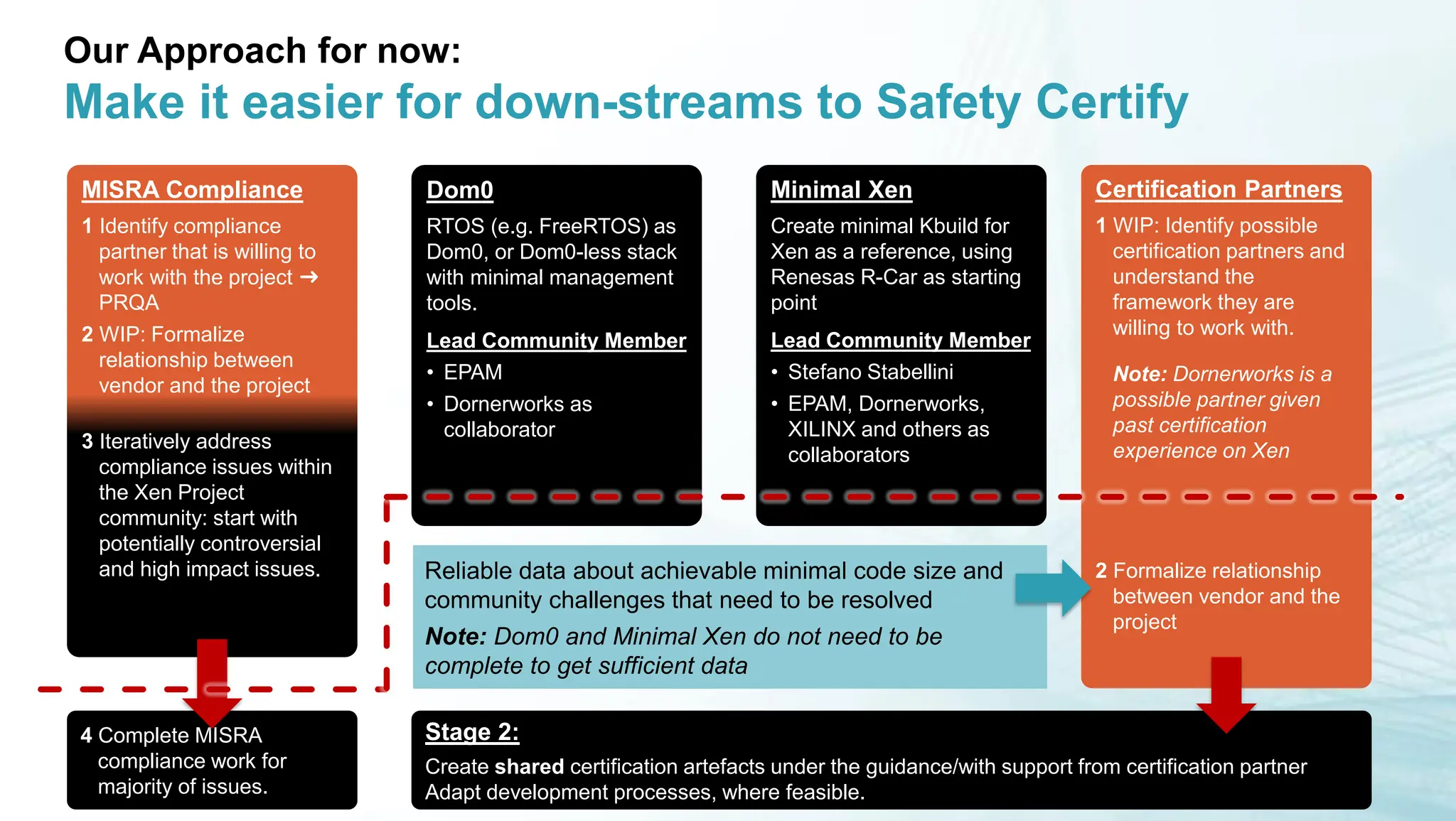
Stage 2:
Create shared certification artefacts under the guidance/with support from certification partner
Adapt development processes, where feasible.
4 Complete MISRA
compliance work for
majority of issues.
Our Approach for now:
Make it easier for down-streams to Safety Certify
MISRA Compliance
1 Identify compliance
partner that is willing to
work with the project ➜
PRQA
2 WIP: Formalize
relationship between
vendor and the project
3 Iteratively address
compliance issues within
the Xen Project
community: start with
potentially controversial
and high impact issues.
Certification Partners
1 WIP: Identify possible
certification partners and
understand the
framework they are
willing to work with.
Note: Dornerworks is a
possible partner given
past certification
experience on Xen
2 Formalize relationship
between vendor and the
project
Dom0
RTOS (e.g. FreeRTOS) as
Dom0, or Dom0-less stack
with minimal management
tools.
Lead Community Member
• EPAM
• Dornerworks as
collaborator
Minimal Xen
Create minimal Kbuild for
Xen as a reference, using
Renesas R-Car as starting
point
Lead Community Member
• Stefano Stabellini
• EPAM, Dornerworks,
XILINX and others as
collaborators
Reliable data about achievable minimal code size and
community challenges that need to be resolved
Note: Dom0 and Minimal Xen do not need to be
complete to get sufficient data
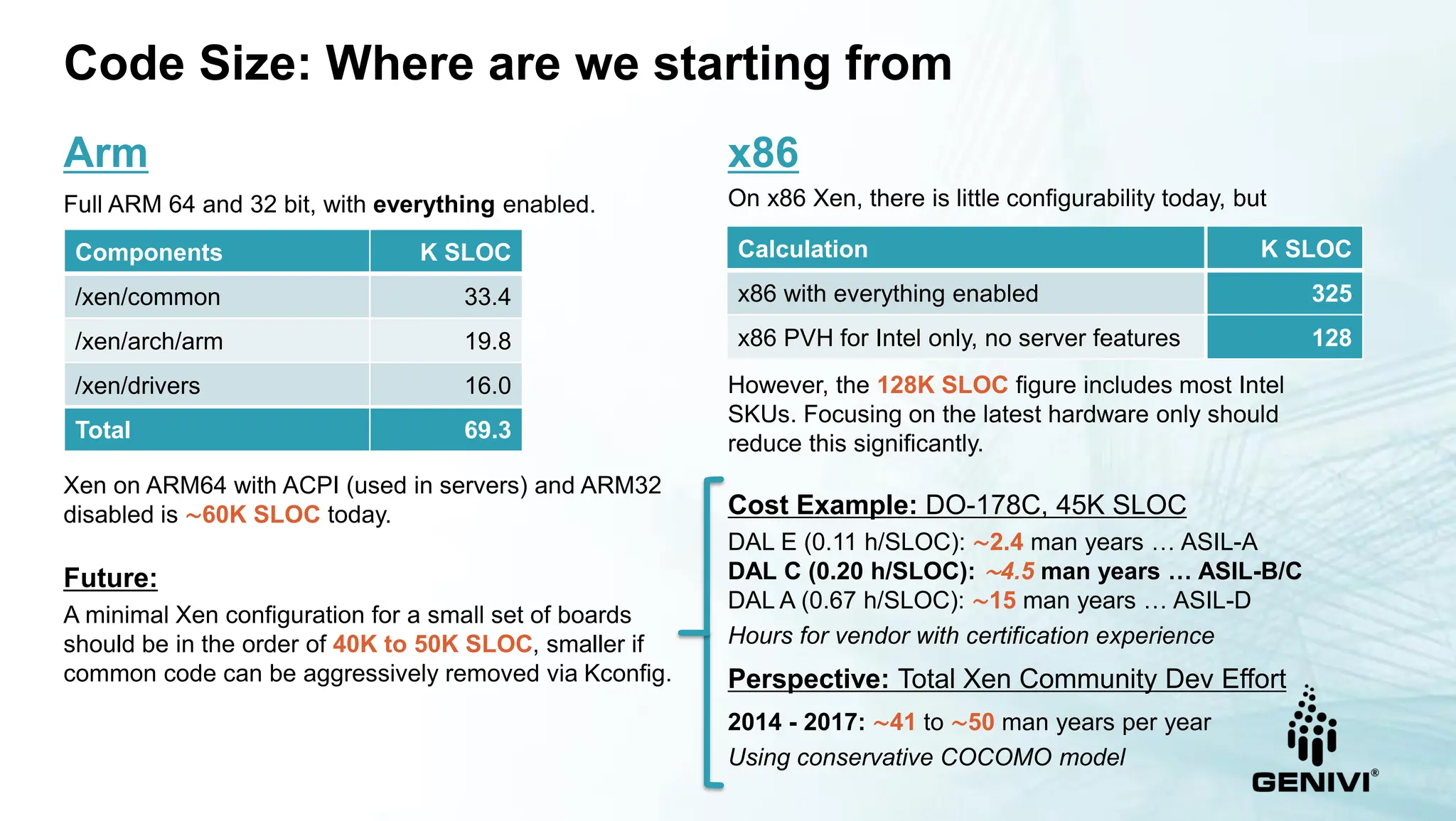
Arm
Full ARM 64 and 32 bit, with everything enabled.
Xen on ARM64 with ACPI (used in servers) and ARM32
disabled is ∼60K SLOC today.
Future:
A minimal Xen configuration for a small set of boards
should be in the order of 40K to 50K SLOC, smaller if
common code can be aggressively removed via Kconfig.
x86
On x86 Xen, there is little configurability today, but
However, the 128K SLOC figure includes most Intel
SKUs. Focusing on the latest hardware only should
reduce this significantly.
Code Size: Where are we starting from
Components K SLOC
/xen/common 33.4
/xen/arch/arm 19.8
/xen/drivers 16.0
Total 69.3
Calculation K SLOC
x86 with everything enabled 325
x86 PVH for Intel only, no server features 128
Cost Example: DO-178C, 45K SLOC
DAL E (0.11 h/SLOC): ∼2.4 man years … ASIL-A
DAL C (0.20 h/SLOC): ∼4.5 man years … ASIL-B/C
DAL A (0.67 h/SLOC): ∼15 man years … ASIL-D
Hours for vendor with certification experience
Perspective: Total Xen Community Dev Effort
2014 - 2017: ∼41 to ∼50 man years per year
Using conservative COCOMO model
Thank you!
Visit GENIVI at http://www.genivi.org or http://projects.genivi.org
Contact us: help@genivi.org
This work is licensed under a Creative Commons Attribution-Share Alike 4.0 (CC BY-SA 4.0)
GENIVI is a registered trademark of the GENIVI Alliance in the USA and other countries.
Copyright © GENIVI Alliance 2018.

2018_GENIVI_XenOverview-123456789011.pdf

  • 1.
    Xen Project Automotive andEmbedded Overview April, 2018 Lars Kurth Chairman, Xen Project Advisory Booard This work is licensed under a Creative Commons Attribution-Share Alike 4.0 (CC BY-SA 4.0) GENIVI is a registered trademark of the GENIVI Alliance in the USA and other countries. Copyright © GENIVI Alliance 2018.
  • 2.
    Agenda Ecosystem Overview Xen ProjectCapabilities and Challenges The Elephant in the Room: Safety Certification
  • 4.
    Examples: Defense/Embedded OpenXT www.openxt.org FOSS Platformfor security research, security applications and embedded appliance integration building on Xen & OpenEmbedded Part fork of Xen Project, but significant effort to un-fork has started in 2017. Several key players: AIS, Apertus Solutions, BAE Systems, U.S. Air Force Research Laboratory XenZynq xilinx.com Xen Zynq Distribution originally developed by Dornerworks. Latest product incarnation is called Virtuosity Hypervisor. Investing in Xen Functionality related to power management and managing heterogeneity in general. Virtuosity dornerworks.com Consultancy with embedded/avionics/ medical focus. Maintains Virtuosity Hypervisor with support for a XILINX and NXP Arm SoCs. Product variant of Virtuosity for defence/avionics use-cases. 2nd generation product (predecessor = ARLX released in 2015). • Certification packages for: DO-178, IEC 62304, ISO 26262 • Standards: ARINC 653, Vehicular Integration for C4ISR/EW Interoperability (VICTORY), Future Airborne Capability Environment (FACE™)
  • 5.
    Misc Automotive vendors thatoccasionally contribute to and engage with the Xen Project. Renesas HW enablement in Xen. Test Platforms for Xen Project CI. Bosch Car GmbH Code Contributions since 2015 LG, ADIT, Samsung Not much information Examples: Automotive EPAM epam.com Product: Fusion Scalable & secure software deployment platform for distributed (cloud+vehicle) automotive service products. Uses isolated Xen VM in vehicles to deploy service containers. Ongoing Contributions: • PV drivers: input, sound & DRM • Xen OP-TEE support • Co-processor (GPU) sharing framework • Hard real-time support research • Power Management & HMP • RTOS Dom0 / Dom0-less system • Safety certification GlobalLogic globallogic.com Product: Nautilus Pioneered Xen based automotive solution. Used to be very active within the Xen Project from 2013 - 2016, but recently has been primarily product focused.
  • 6.
    Agenda Ecosystem Overview Xen ProjectCapabilities and Challenges The Elephant in the Room: Safety Certification
  • 7.
    Automotive Requirements vs.Xen Project Compute Requirements Xen Project C1: Static resource partitioning and flexible on-demand resource allocation (CPU, RAM, GPU and IO) Core functionality, multiple schedulers, GPU/co-processor sharing, memory ballooning, etc. C2: Memory/IO bus bandwidth allocation and rebalancing WIP: Effort by several parties to enable Hard RT support on Xen Peripherals Requirements Xen Project P1: GPU and displays shall be shared between execution environments supporting both fixed (each one talks to its own display or to a specified area on a single display) and flexible configurations (shape, z-order, position and assignment of surfaces from different execution environments may change at run time). Via GPU sharing (and WIP co- processor sharing), PV Drivers (PV DRM) P2: Inputs shall be routed to one or multiple execution environments depending on current mode, display configuration (for touchscreens), active application (for jog dials & buttons), etc. Via PV Drivers (PV KBDFRONT) P3: Audio shall be shared between execution environments. Sound complex mixing policies for multiple audio streams and routing of dynamic source/sink devices (BT profiles, USB speakers/microphones, etc.) shall be supported. Via PV Drivers (PV SOUND) P4: Network shall be shared between execution environments. Virtual networks with different security characteristics shall be supported (e.g., traffic filtering and security mechanisms). Via PV Drivers & Disaggregation Xen Security Modules P5: Storage shall support static or shared allocation, together with routing of dynamic storage devices (USB mass storage). Via PV Drivers
  • 8.
    Automotive Requirements vs.Xen Project, continued Security Requirements Xen Project SE1: Root of Trust and Secure boot shall be supported for all execution environments. x86: TPM 2.0, Intel TXT, AMD SVM Arm: supported with OPTEE SE2: Trusted Computing (discrete TPM, Arm TrustZone or similar) shall be available and configurable for all execution environments. x86: in Xen; some extras in OpenXT Arm: OPTEE (WIP: up streaming) SE3: Hardware isolation shall be supported (cache, interrupts, IOMMUs, firewalls, etc.). Core functionality (except firewalls) Safety Requirements Xen Project SA1: System monitoring shall be supported to attest and verify that the system is correctly running. Can be implemented through VMI in Hypervisor, agents outside or through a hybrid SA2: Restart shall be possible for each execution environment in case of failure. Core Functionality SA3: Redundancy shall be supported for the highest level of fault tolerance with fall-back solutions available to react in case of failure. WIP: This has to be analysed in scope of "safety certification" initiative, as well as "dom0-less" Xen and "minimal" Kbuild SA4: Real time support shall be guaranteed together with predictive reaction time. Different scheduler options with different trade-offs. WIP: Benchmarks with recommendations and Hard RT support.
  • 9.
    Automotive Requirements vs.Xen Project, continued Performance and Power Consumption Requirements Xen Project PP1: Virtualization performance overhead shall be minimal: 1-2% on CPU/memory benchmarks, up to 5% on GPU benchmarks. Arm: fulfils requirements x86: not verified PP2: Predictability shall be guaranteed. Minimal performance requirements shall be met in any condition (unexpected events, system overload, etc.). Different scheduler options with different trade-offs. Benchmarks with recommendations in progress. Possibly some code changes will be up streamed. PP3: Execution environments fast boot: Less than 2 seconds for safety critical applications, less than 5 seconds for Instrument Cluster, and 10 seconds for IVI. Hibernate and Suspend to RAM shall be supported. Arm: Proven by both GlobalLogic and EPAM PP4: Execution environments startup order shall be predictable. Core functionality PP5: Advanced power management shall be implemented with flexible policies for each execution environment. Arm: Partially implemented (not yet up-streamed). Further work by EPAM, XILINX and Aggios planned.
  • 10.
    Agenda Ecosystem Overview Xen ProjectCapabilities and Challenges The Elephant in the Room: Safety Certification
  • 11.
    Stage 2: Create sharedcertification artefacts under the guidance/with support from certification partner Adapt development processes, where feasible. 4 Complete MISRA compliance work for majority of issues. Our Approach for now: Make it easier for down-streams to Safety Certify MISRA Compliance 1 Identify compliance partner that is willing to work with the project ➜ PRQA 2 WIP: Formalize relationship between vendor and the project 3 Iteratively address compliance issues within the Xen Project community: start with potentially controversial and high impact issues. Certification Partners 1 WIP: Identify possible certification partners and understand the framework they are willing to work with. Note: Dornerworks is a possible partner given past certification experience on Xen 2 Formalize relationship between vendor and the project Dom0 RTOS (e.g. FreeRTOS) as Dom0, or Dom0-less stack with minimal management tools. Lead Community Member • EPAM • Dornerworks as collaborator Minimal Xen Create minimal Kbuild for Xen as a reference, using Renesas R-Car as starting point Lead Community Member • Stefano Stabellini • EPAM, Dornerworks, XILINX and others as collaborators Reliable data about achievable minimal code size and community challenges that need to be resolved Note: Dom0 and Minimal Xen do not need to be complete to get sufficient data
  • 12.
    Arm Full ARM 64and 32 bit, with everything enabled. Xen on ARM64 with ACPI (used in servers) and ARM32 disabled is ∼60K SLOC today. Future: A minimal Xen configuration for a small set of boards should be in the order of 40K to 50K SLOC, smaller if common code can be aggressively removed via Kconfig. x86 On x86 Xen, there is little configurability today, but However, the 128K SLOC figure includes most Intel SKUs. Focusing on the latest hardware only should reduce this significantly. Code Size: Where are we starting from Components K SLOC /xen/common 33.4 /xen/arch/arm 19.8 /xen/drivers 16.0 Total 69.3 Calculation K SLOC x86 with everything enabled 325 x86 PVH for Intel only, no server features 128 Cost Example: DO-178C, 45K SLOC DAL E (0.11 h/SLOC): ∼2.4 man years … ASIL-A DAL C (0.20 h/SLOC): ∼4.5 man years … ASIL-B/C DAL A (0.67 h/SLOC): ∼15 man years … ASIL-D Hours for vendor with certification experience Perspective: Total Xen Community Dev Effort 2014 - 2017: ∼41 to ∼50 man years per year Using conservative COCOMO model
  • 13.
    Thank you! Visit GENIVIat http://www.genivi.org or http://projects.genivi.org Contact us: help@genivi.org This work is licensed under a Creative Commons Attribution-Share Alike 4.0 (CC BY-SA 4.0) GENIVI is a registered trademark of the GENIVI Alliance in the USA and other countries. Copyright © GENIVI Alliance 2018.