
Download to read offline

![3
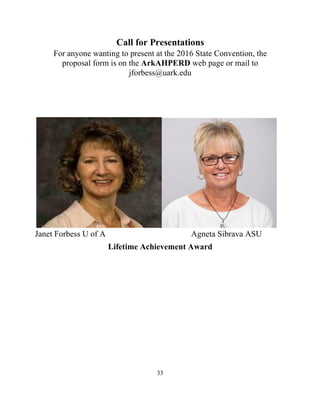
Lifetime Achievement Award
Candidate must meet the following qualifications:
A. Be at least 30 years of age and have earned a
Master’s degree or its equivalent.
B. Have served the profession for at least five years
prior to the nomination.
C. Be a current member of ArkAHPERD. Former
members who have retired from professional work
may be exempt.
D. Be of high moral character and personal integrity
who by their leadership and industry have made
outstanding and noteworthy contributions to the
advancement of our profession in the state of
Arkansas.
To indicate leadership or meritorious contributions,
the nominator shall present evidence of the nominee’s
successful experiences in any two of the following
categories of service:
1. Service to the association.
2. Advancement of the profession through
leadership of outstanding programs.
3. Advancement of the profession through
presentation, writings, or research.
Any ArkAHPERD member may submit nominations
by sending six (6) copies of the candidate’s qualifications
to Janet Forbess, jforbess@uark.edu.
TEACHER OF THE YEAR
Teacher awards are presented in the areas ofelementary
physical education, middle school physical education,
secondary physical education, dance, and health.
Candidate must meet the following qualifications:
A. Have served the profession for at least three
years prior to the nomination.
B. Be a member of AAHPERD & ArkAHPERD.
C. Be of high moral character and personal integrity
who by their leadership and industry have made
outstanding and noteworthy contributions to the
advancement of teaching in the state of Arkansas.
D. Be employed by a public school system in the
state of Arkansas.
E. Have a full time teaching contract, and have a
minimum of 60% of their total teaching
responsibility in the nominated area.
F. Have a minimum of five years teaching
experience in the nominated area.
G. Conduct a quality program.
They must submit three letters of
recommendation and agree to make complete
NASPE application if selected.
Any ArkAHPERD member may submit nominations by
contacting Bennie Prince, bfprince@ualr.edu.
HIGHER EDUCATOR OF THE YEAR
Candidate must meet the following qualifications:
Scholarships
STUDENT
A. Have served the profession for at least three
years prior to the nomination.
B. Be a member of ArkAHPERD
C. Be of high moral character and personal
integrity who by their leadership and industry
have made outstanding and noteworthy
contributions to the advancement of teaching,
research, or service in the state of Arkansas.
D. Be employed by an institution of higher
education in the state of Arkansas.
Any ArkAHPERD member may submit nominations
by sending a copy of the candidate’s qualifications to
Agneta Sibrava, asibrava@astate.edu.
ArkAHPERD awards four scholarships annually for
students majoring in HPERD. They include the Newman
McGee, Past President’s, Jeff Farris Jr., and John Hosinski
scholarships. Students must possess a minimum 2.5 GPA.
[See your academic advisor for details.]
Research Award
Research awards of $100, $50, and $25 are awarded to
undergraduate and graduate students who are members of
ArkAHPERD. Students must submit an abstract and a
complete paper to Rockie Pederson, rpederson@atu.edu
by October 1. Papers selected for the research awards
must be presented by the student in an oral or poster
format at the November convention.
ArkAHPERD Web Site: http://www.arkahperd.com
AWARD QUALIFICATIONS](https://image.slidesharecdn.com/2017arkahperdjournal-170721191507/85/2016-ArkAHPERD-Journal-Vol-51-3-320.jpg)





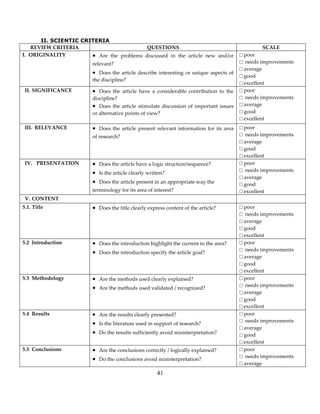
![42
Do the conclusions sufficiently avoid too general or
biased information?
□ good
□ excellent
5.6 References Do the references reflect the latest work/research in the
considered area?
Are the references correctly indicated in the article?
□ poor
□ needs improvements
□ average
□ good
□ excellent
5.7 Tables
[If used]
Are the tables correctly named and numbered?
Are the data presented in tables correctly valued and
interpreted in the article?
□ poor
□ needs improvements
□ average
□ good
□ excellent
5.8 Graphs and figures
[If used]
Do the graphs and figures properly illustrate the
discussed subject?
Are the graphs and figures correctly named and
numbered?
□ poor
□ needs improvements
□ average
□ good
□ excellent
VI. PLAGIARISM If an article (or parts from an article) is suspected to be a
substantial copy of an earlier work, the article is rejected.
□ Accepted
□ Rejected
III. FINAL DECISION
OVERALL RATING FINAL DECISION
□ Poor □ Rejected
□ Needs improvements □ Rejected [consider rewriting for subsequent journal]
□ Average □ May be Revised and resubmitted [major changes]
□ Good □ Accepted with minor changes
□ Excellent □ Accepted
IV. COMMENTS TO THE AUTHOR](https://image.slidesharecdn.com/2017arkahperdjournal-170721191507/85/2016-ArkAHPERD-Journal-Vol-51-42-320.jpg)
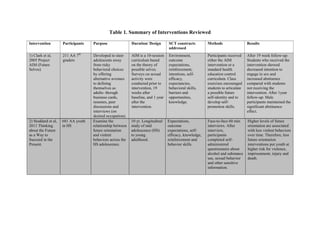
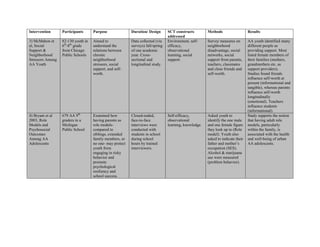
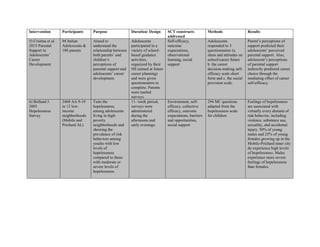
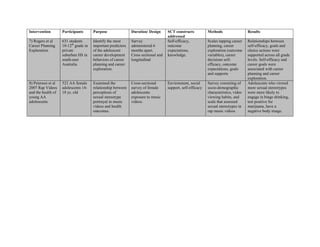
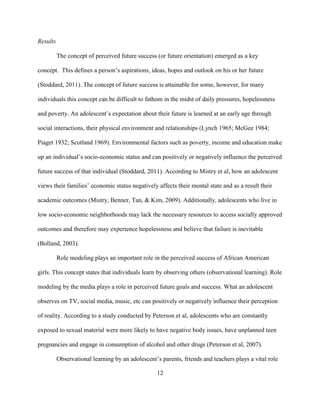
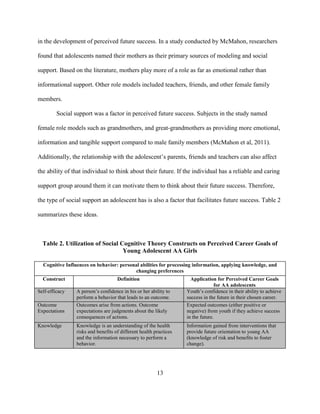
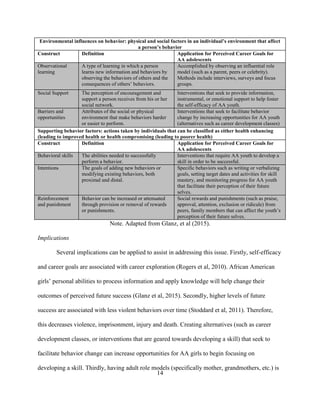
This article examines peer modeling and its relationship to perceived future success and career goals of young African American girls. Six studies are summarized that explore interventions utilizing constructs from social cognitive theory, such as self-efficacy, observational learning, social support and environmental factors. The studies found that role models, especially within the family, are associated with better health outcomes in adolescents. Higher levels of future orientation are also linked to less risky behaviors. Peer modeling and social support can indirectly influence career self-efficacy and choices.


