Applications of Rapid Ecoregional
Assessments (REAs)
Sam Litschert,
Quantum Spatial on-site
contractor at BLM National
Operations Center
GIS in the Rockies, 2016
Basics of REAs …
• Broad scale component of the BLM’s Landscape Approach
• Ecoregional extent
• Compilations of geospatial data, models, and science synthesis
– Data are consistent, standardized across the extent
– Data go across (some) boundaries
– Quality controlled
– Limitation and assumptions are documented
• Robust and transparent basis for coordinated
management strategies with other agencies and
stakeholders
• Goal: to understand the condition, status, and
trend of western landscapes
Applications of REAs
• Quantify the context of an area: how does the area fit into the
surroundings, what is important about the area
• Focus management concerns by identifying areas of interest
• Prioritize areas for restoration, conservation, or development
• Inform Management Questions (MQs)
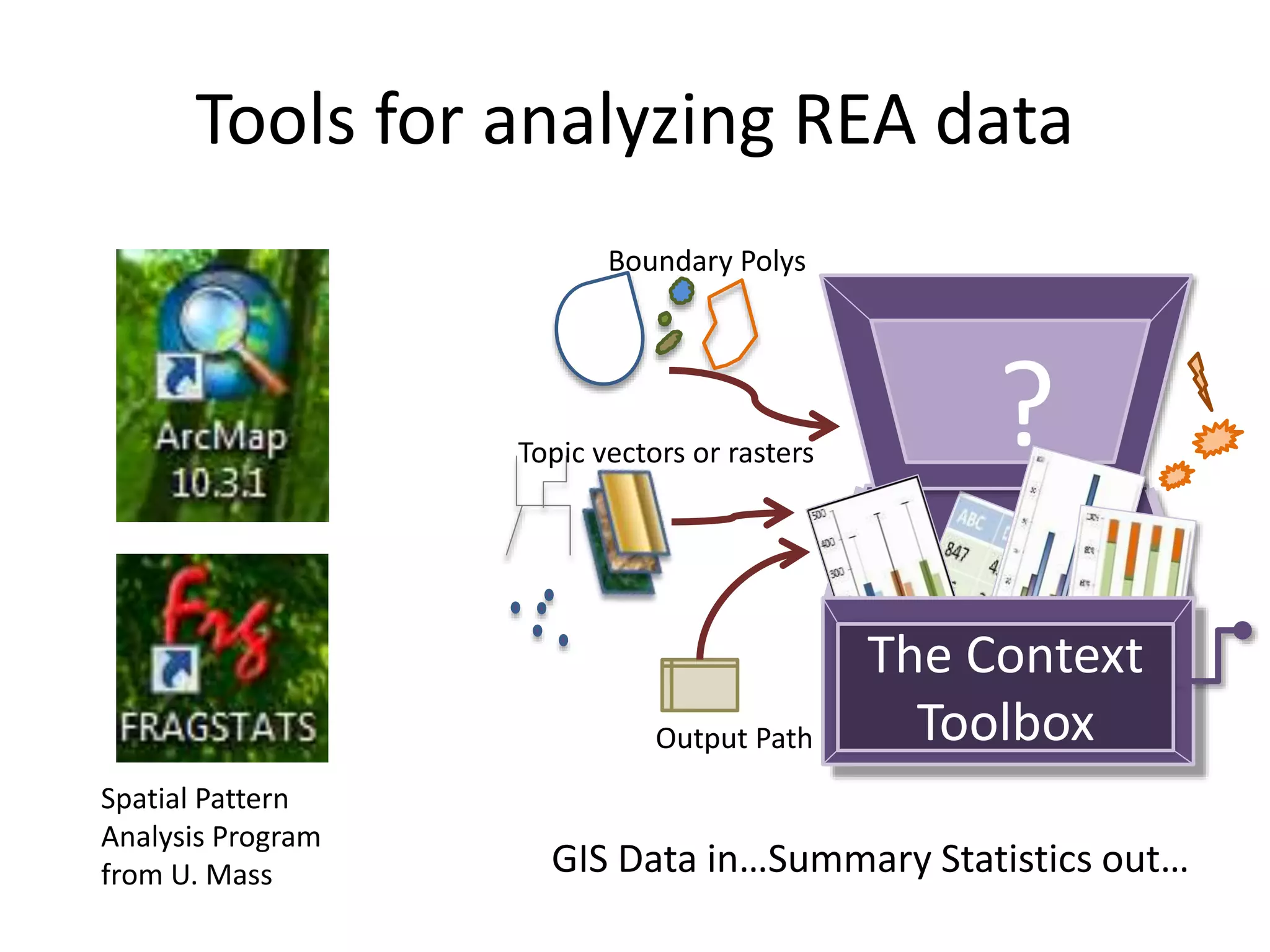
Context Toolbox
The Context
Toolbox
?
GIS Data in…Summary Statistics out…
Boundary Polys
Topic vectors or rasters
Output Path
Tools for analyzing REA data
Spatial Pattern
Analysis Program
from U. Mass
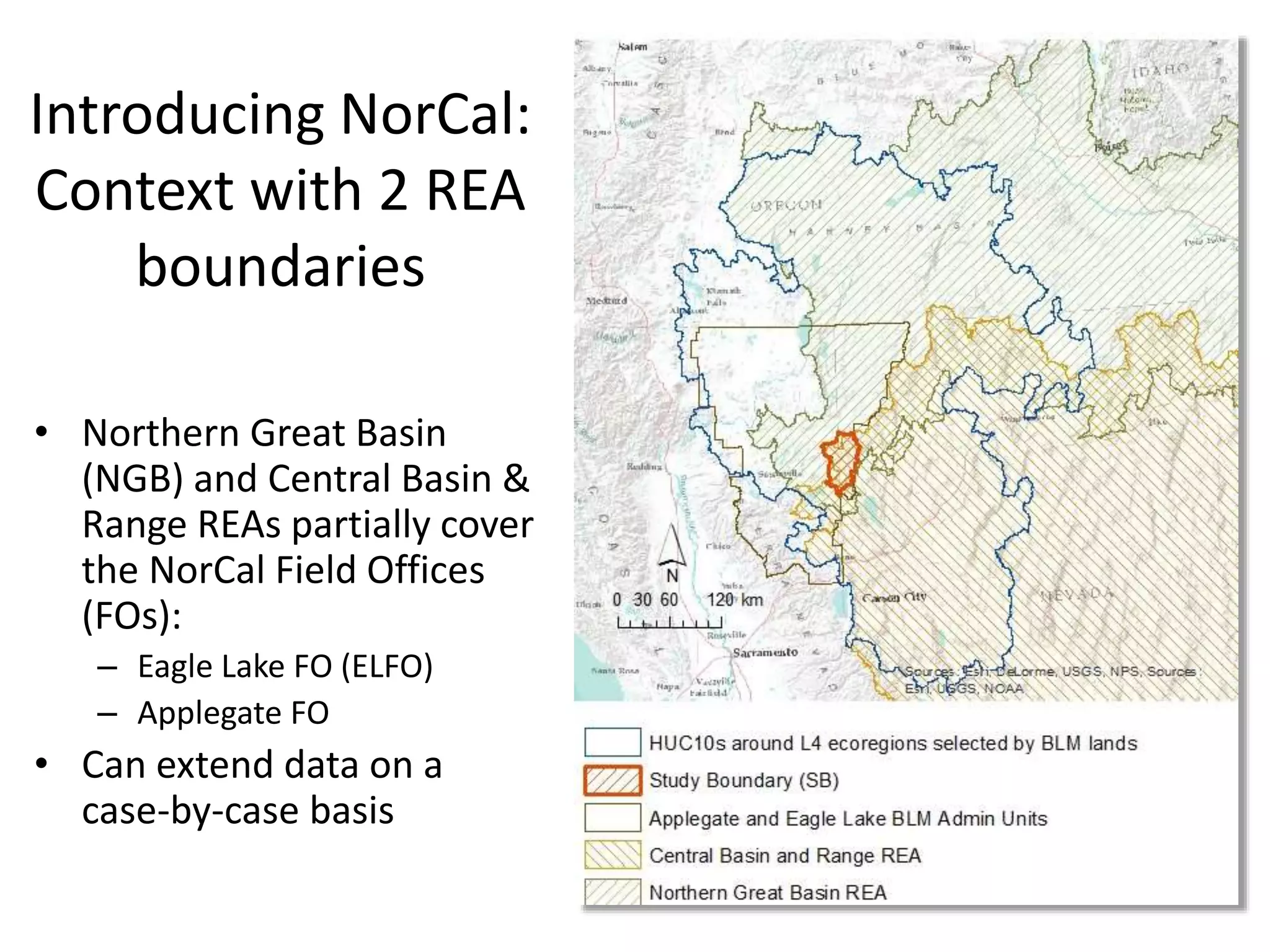
Introducing NorCal:
Context with 2 REA
boundaries
• Northern Great Basin
(NGB) and Central Basin &
Range REAs partially cover
the NorCal Field Offices
(FOs):
– Eagle Lake FO (ELFO)
– Applegate FO
• Can extend data on a
case-by-case basis
 Boundaries?
• Data available for local and broad scale
• The data, analyses, and assumptions are then
quite different…
• Data
 Broad scale (MMU=6 mi2): west-wide data from Utah
State U. (REA data)
 Local scale: seasonal mule deer habitat (from ELFO-
RMP)
MQ: What are the impacts of 30 miles of non-
motorized trail within Bald Mountain - an area of
important mule deer habitat in NorCal?
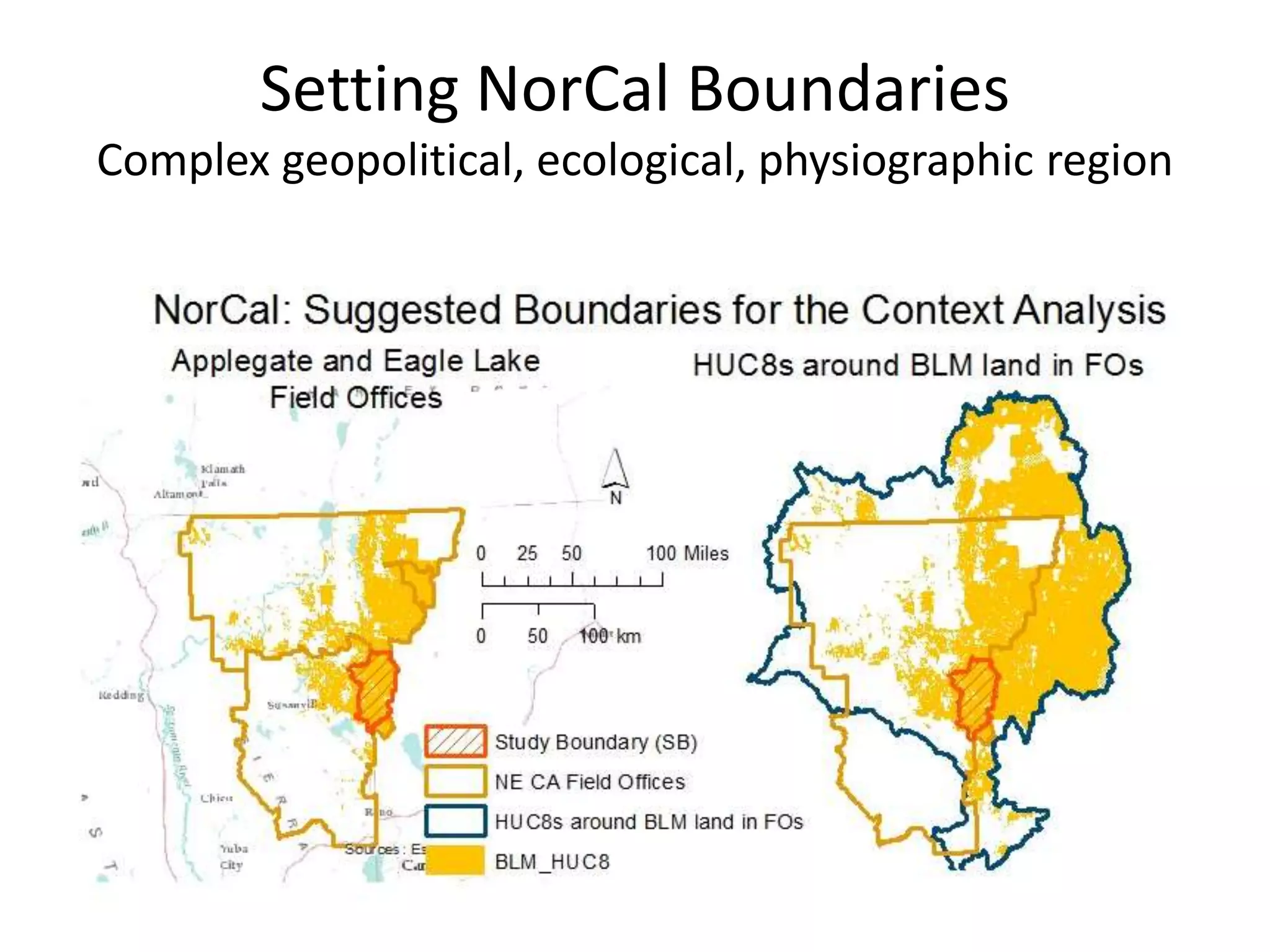
Setting NorCal Boundaries
Complex geopolitical, ecological, physiographic region
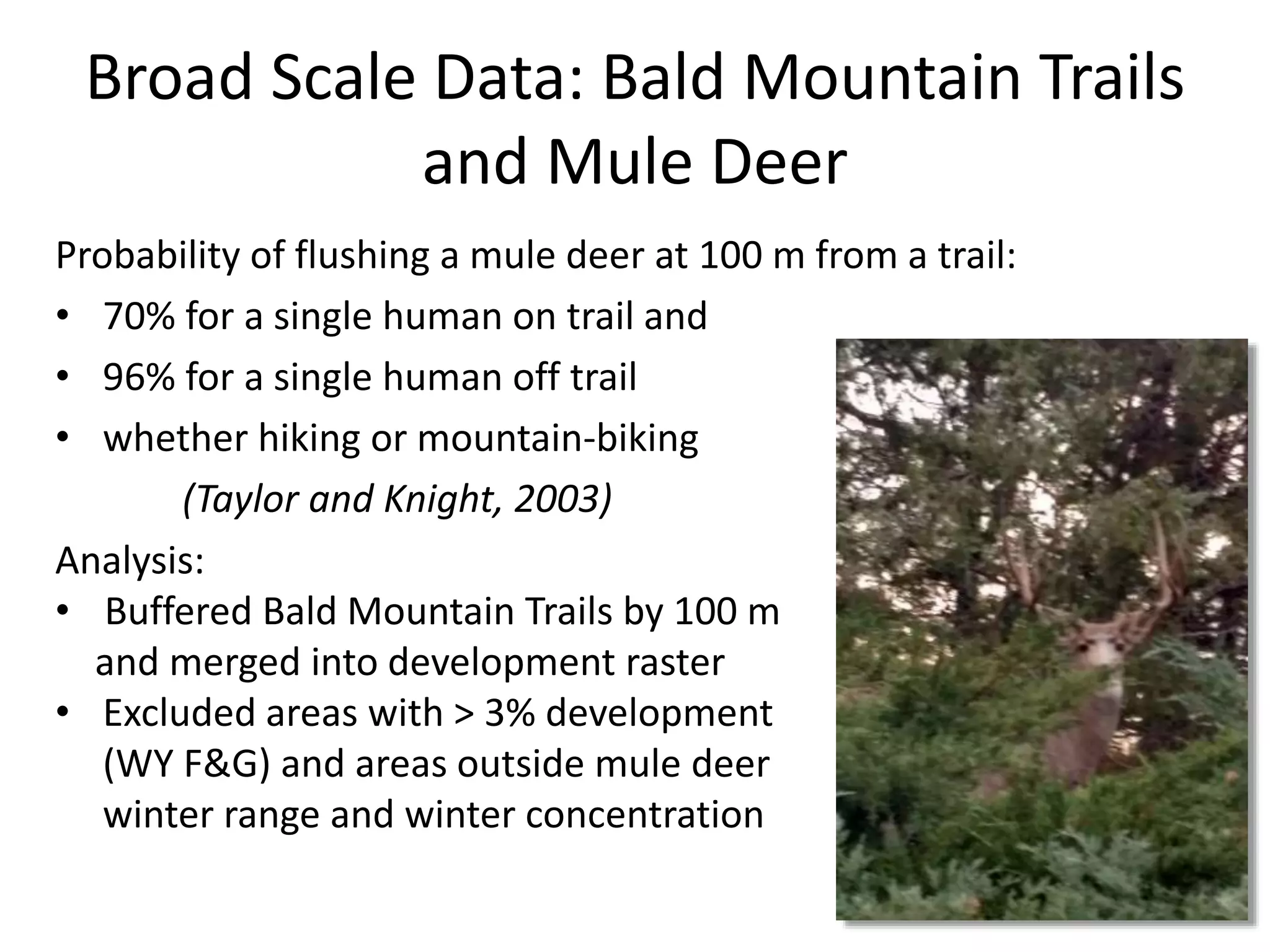
Broad Scale Data: Bald Mountain Trails
and Mule Deer
Probability of flushing a mule deer at 100 m from a trail:
• 70% for a single human on trail and
• 96% for a single human off trail
• whether hiking or mountain-biking
(Taylor and Knight, 2003)
Analysis:
• Buffered Bald Mountain Trails by 100 m
and merged into development raster
• Excluded areas with > 3% development
(WY F&G) and areas outside mule deer
winter range and winter concentration
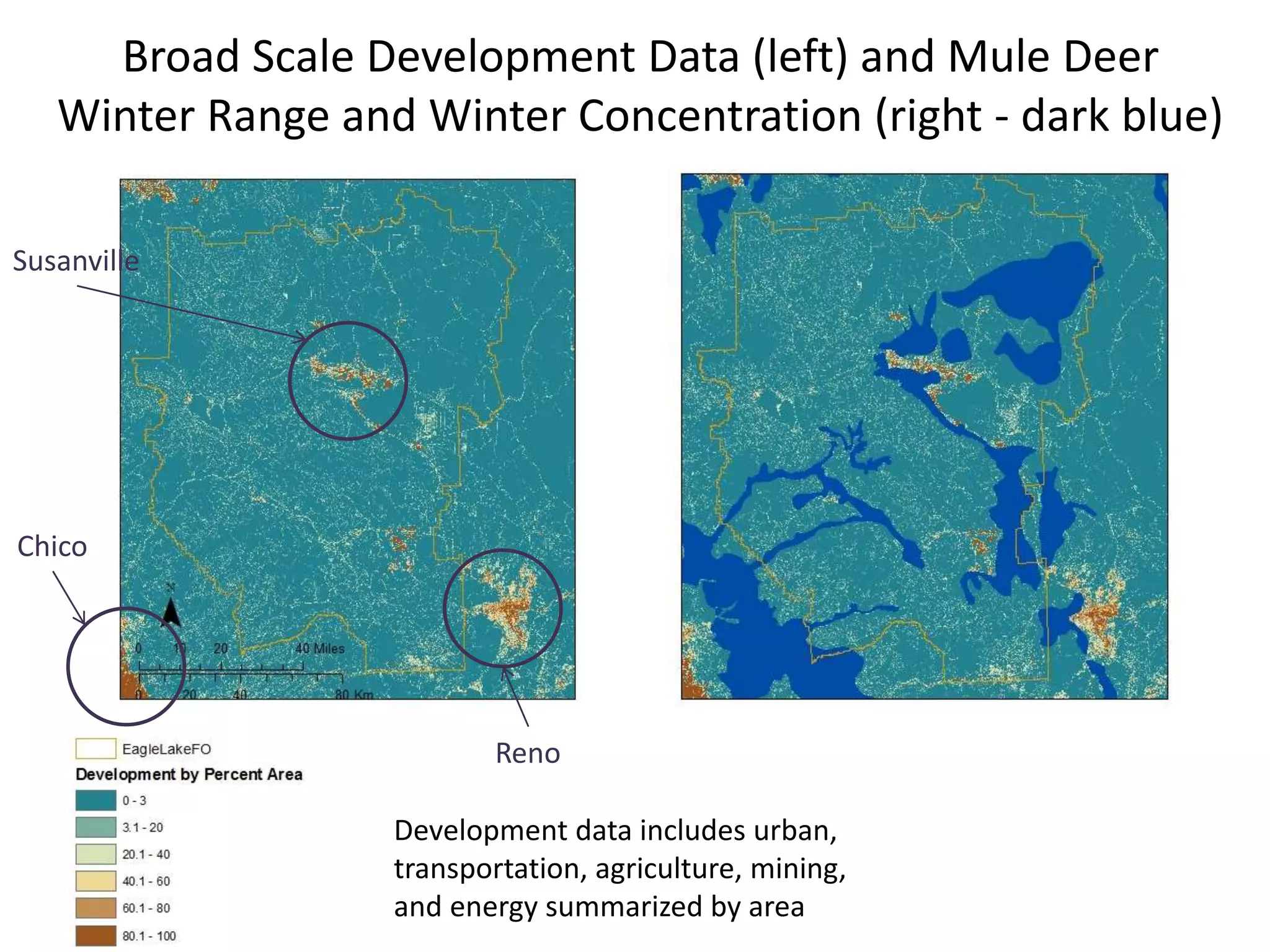
Broad Scale Development Data (left) and Mule Deer
Winter Range and Winter Concentration (right - dark blue)
Susanville
Chico
Reno
Development data includes urban,
transportation, agriculture, mining,
and energy summarized by area
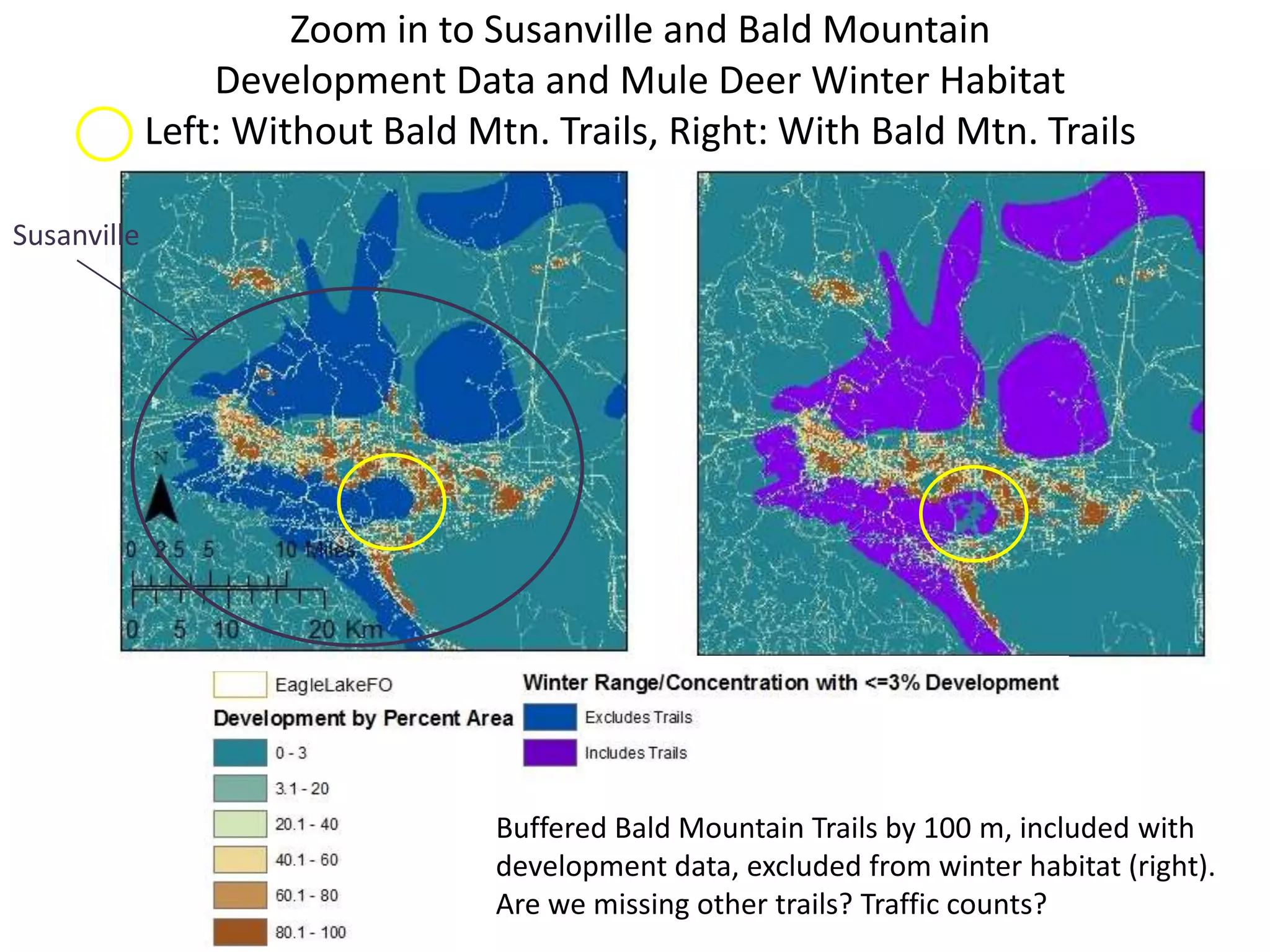
Zoom in to Susanville and Bald Mountain
Development Data and Mule Deer Winter Habitat
Left: Without Bald Mtn. Trails, Right: With Bald Mtn. Trails
Susanville
Buffered Bald Mountain Trails by 100 m, included with
development data, excluded from winter habitat (right).
Are we missing other trails? Traffic counts?
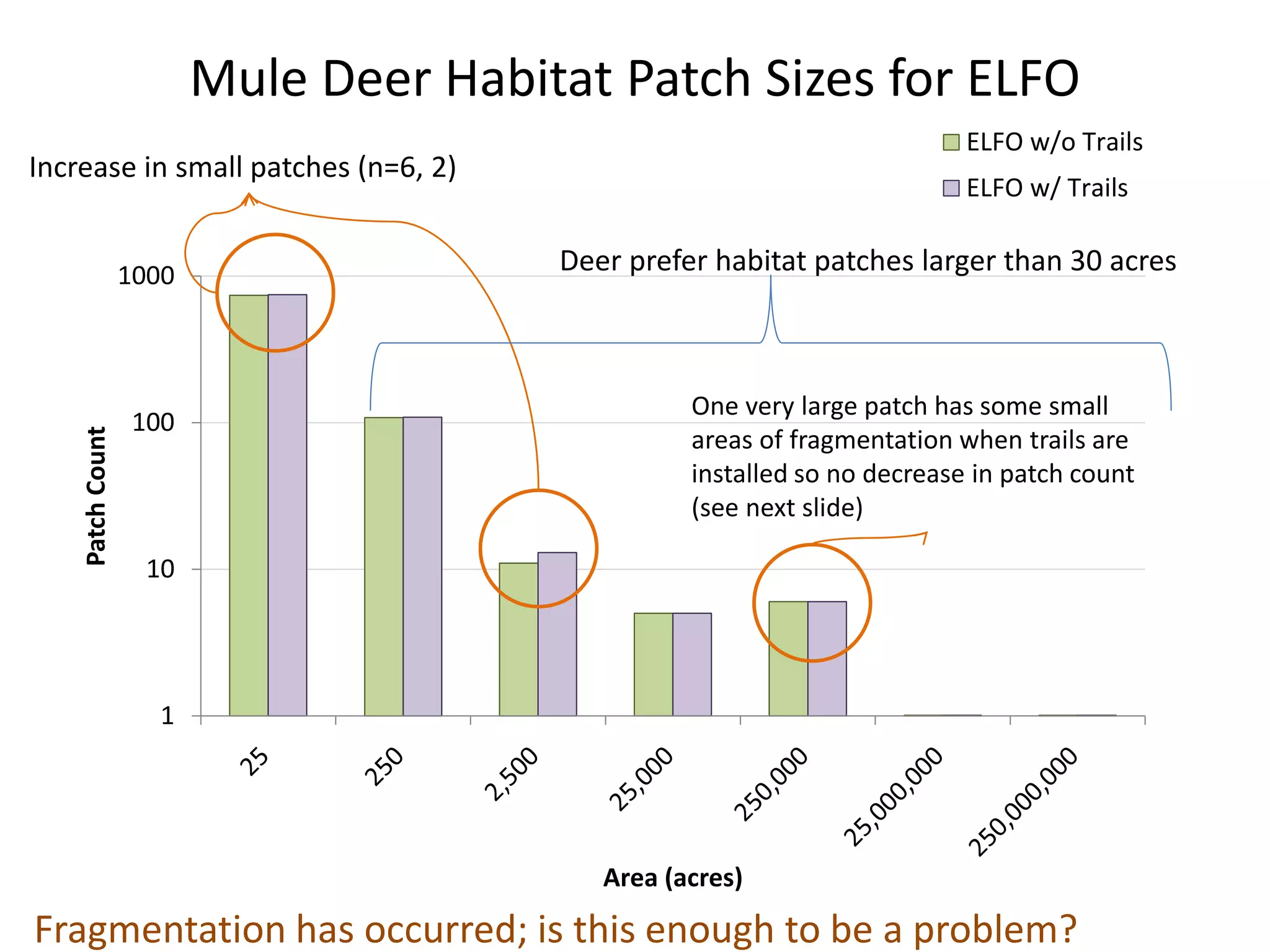
Mule Deer Habitat Patch Sizes for ELFO
1
10
100
1000
PatchCount
Area (acres)
ELFO w/o Trails
ELFO w/ Trails
One very large patch has some small
areas of fragmentation when trails are
installed so no decrease in patch count
(see next slide)
Increase in small patches (n=6, 2)
Fragmentation has occurred; is this enough to be a problem?
Deer prefer habitat patches larger than 30 acres
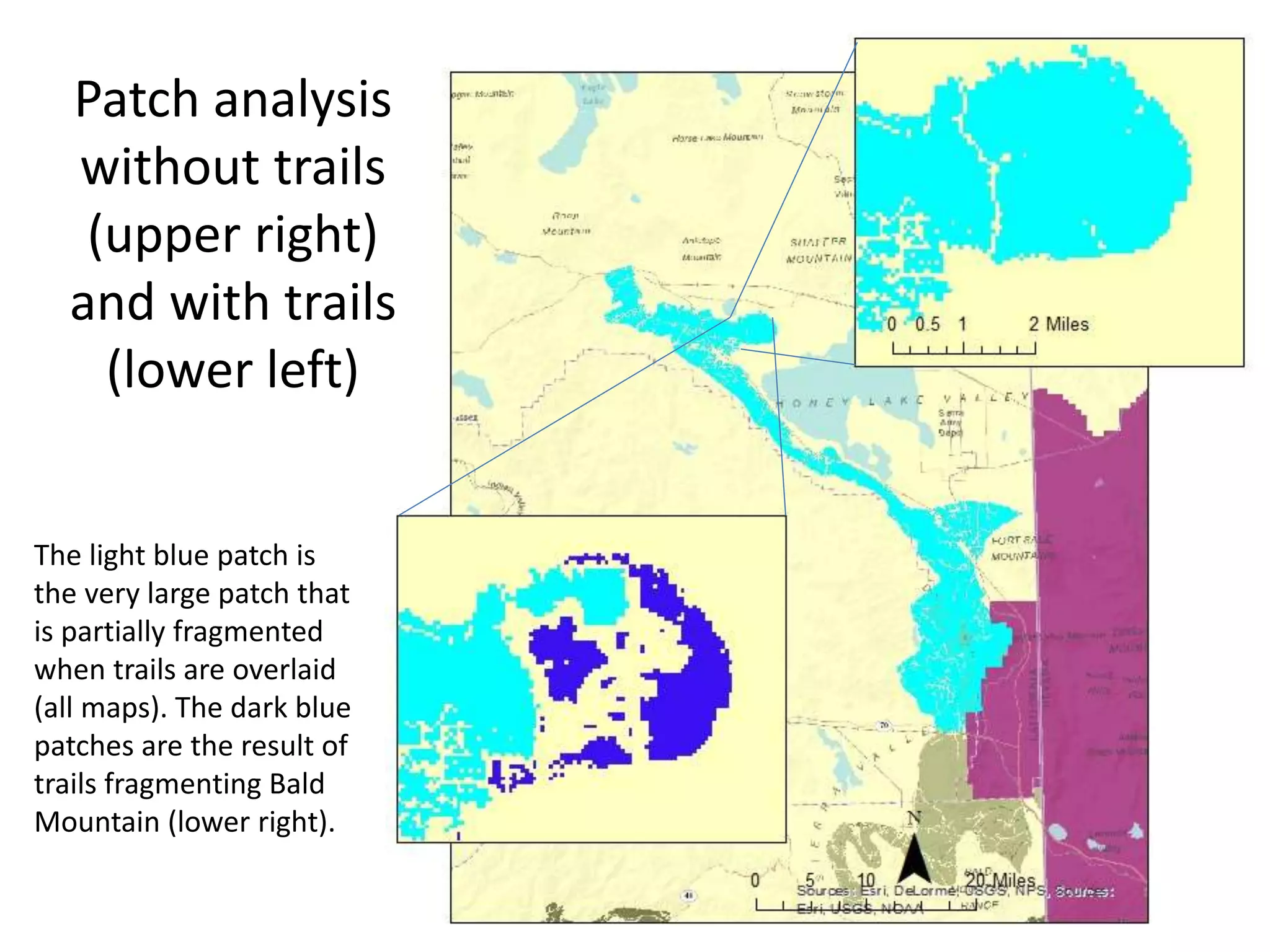
Patch analysis
without trails
(upper right)
and with trails
(lower left)
The light blue patch is
the very large patch that
is partially fragmented
when trails are overlaid
(all maps). The dark blue
patches are the result of
trails fragmenting Bald
Mountain (lower right).
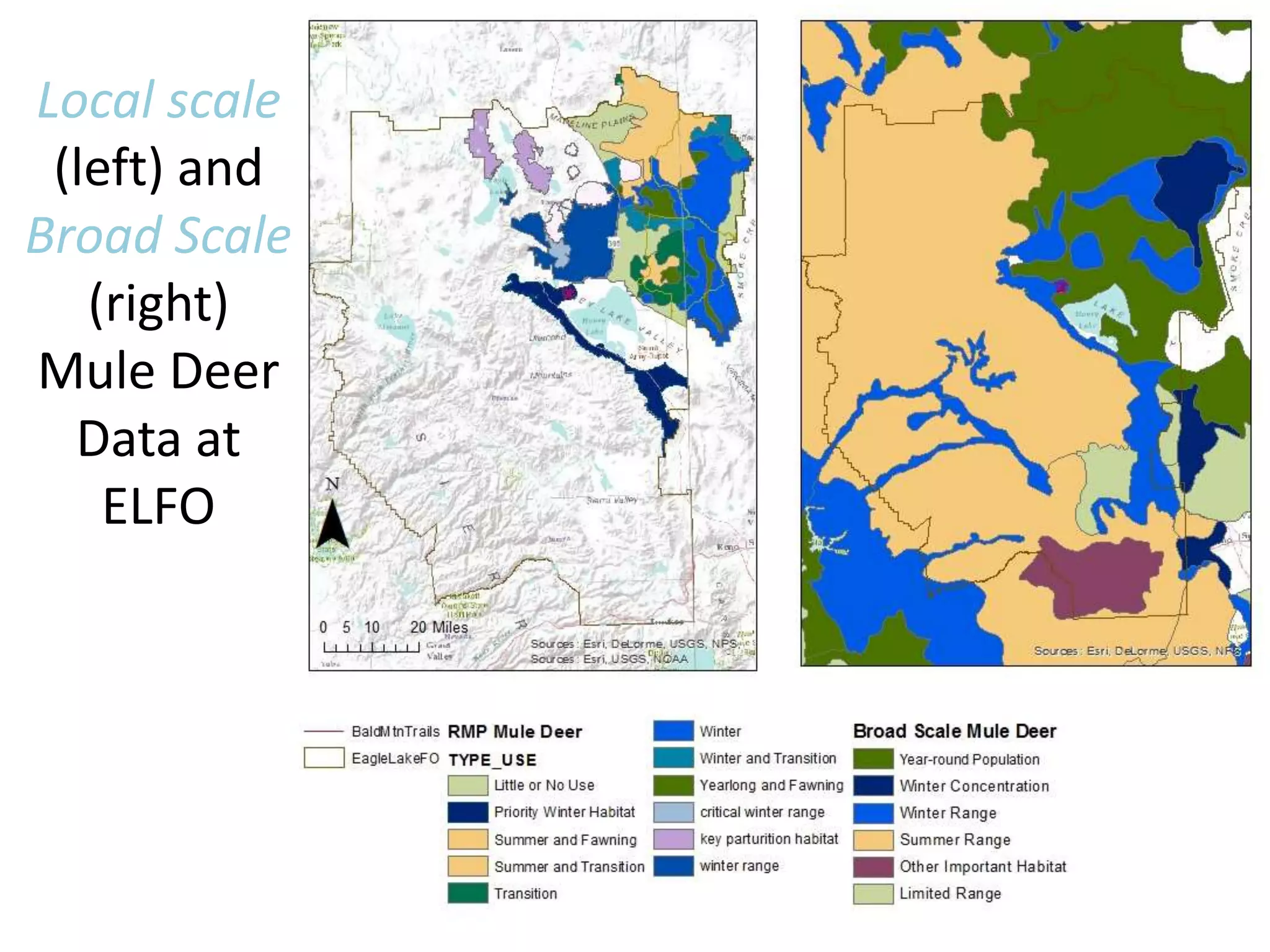
Local scale
(left) and
Broad Scale
(right)
Mule Deer
Data at
ELFO
Bald Mountain Area Trails
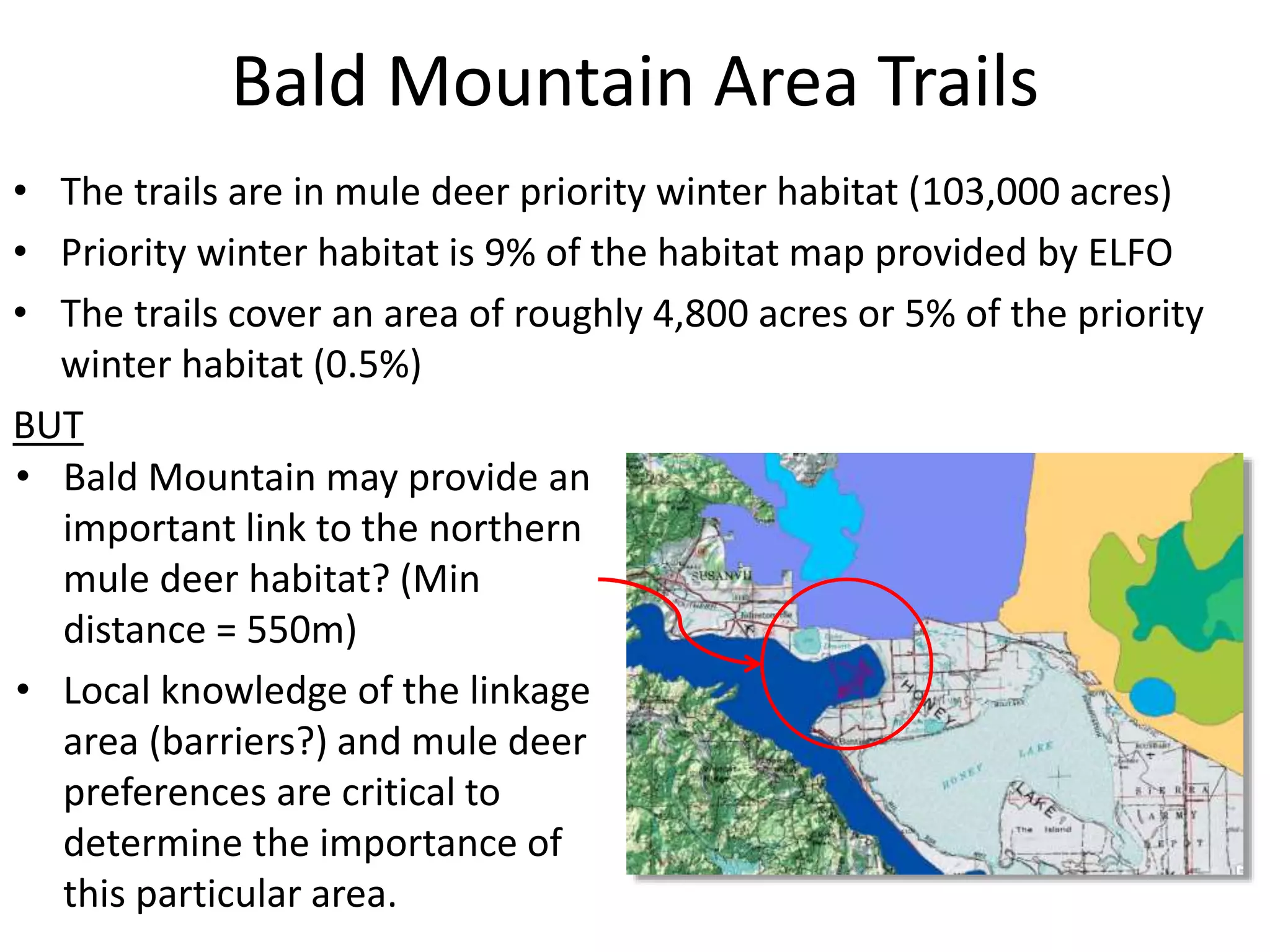
• The trails are in mule deer priority winter habitat (103,000 acres)
• Priority winter habitat is 9% of the habitat map provided by ELFO
• The trails cover an area of roughly 4,800 acres or 5% of the priority
winter habitat (0.5%)
BUT
• Bald Mountain may provide an
important link to the northern
mule deer habitat? (Min
distance = 550m)
• Local knowledge of the linkage
area (barriers?) and mule deer
preferences are critical to
determine the importance of
this particular area.
Bald Mountain Trails
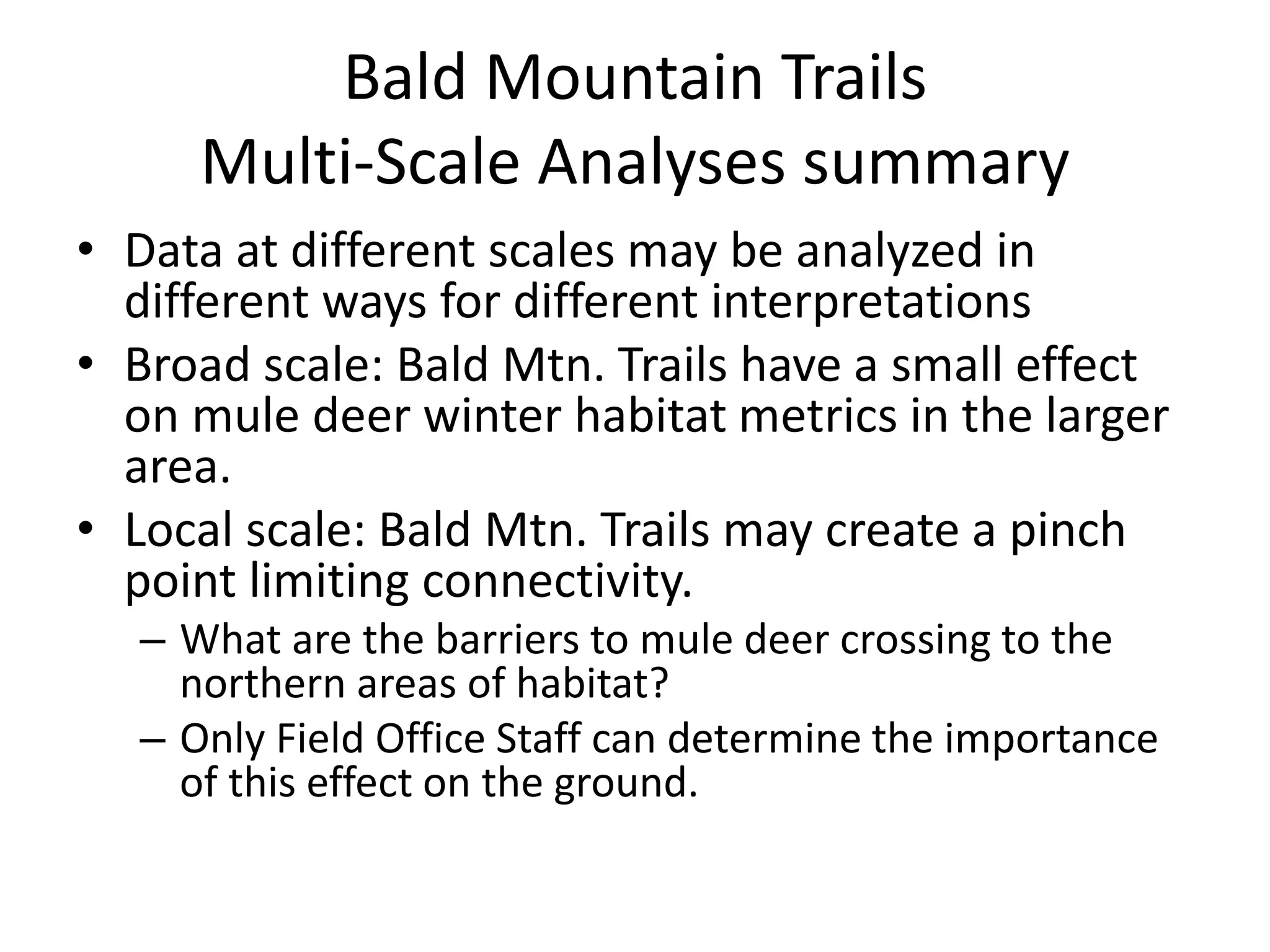
Multi-Scale Analyses summary
• Data at different scales may be analyzed in
different ways for different interpretations
• Broad scale: Bald Mtn. Trails have a small effect
on mule deer winter habitat metrics in the larger
area.
• Local scale: Bald Mtn. Trails may create a pinch
point limiting connectivity.
– What are the barriers to mule deer crossing to the
northern areas of habitat?
– Only Field Office Staff can determine the importance
of this effect on the ground.
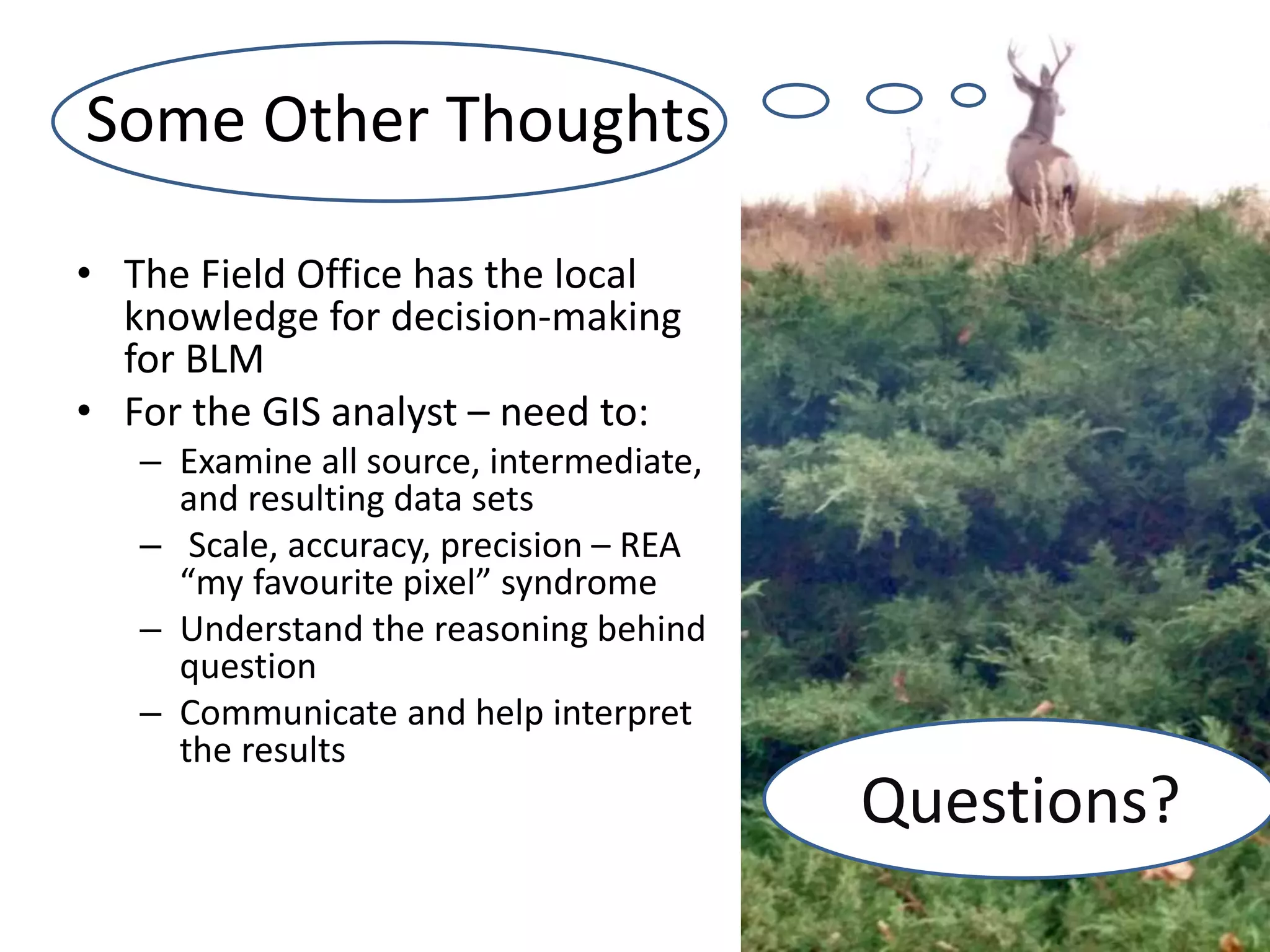
Some Other Thoughts
• The Field Office has the local
knowledge for decision-making
for BLM
• For the GIS analyst – need to:
– Examine all source, intermediate,
and resulting data sets
– Scale, accuracy, precision – REA
“my favourite pixel” syndrome
– Understand the reasoning behind
question
– Communicate and help interpret
the results
Questions?

2016 conservation track: applications of rapid ecoregional assessments (re as) by sam litschert

  • 1.
    Applications of RapidEcoregional Assessments (REAs) Sam Litschert, Quantum Spatial on-site contractor at BLM National Operations Center GIS in the Rockies, 2016
  • 2.
    Basics of REAs… • Broad scale component of the BLM’s Landscape Approach • Ecoregional extent • Compilations of geospatial data, models, and science synthesis – Data are consistent, standardized across the extent – Data go across (some) boundaries – Quality controlled – Limitation and assumptions are documented • Robust and transparent basis for coordinated management strategies with other agencies and stakeholders • Goal: to understand the condition, status, and trend of western landscapes
  • 3.
    Applications of REAs •Quantify the context of an area: how does the area fit into the surroundings, what is important about the area • Focus management concerns by identifying areas of interest • Prioritize areas for restoration, conservation, or development • Inform Management Questions (MQs)
  • 4.
    Context Toolbox The Context Toolbox ? GISData in…Summary Statistics out… Boundary Polys Topic vectors or rasters Output Path Tools for analyzing REA data Spatial Pattern Analysis Program from U. Mass
  • 5.
    Introducing NorCal: Context with2 REA boundaries • Northern Great Basin (NGB) and Central Basin & Range REAs partially cover the NorCal Field Offices (FOs): – Eagle Lake FO (ELFO) – Applegate FO • Can extend data on a case-by-case basis
  • 6.
     Boundaries? • Dataavailable for local and broad scale • The data, analyses, and assumptions are then quite different… • Data  Broad scale (MMU=6 mi2): west-wide data from Utah State U. (REA data)  Local scale: seasonal mule deer habitat (from ELFO- RMP) MQ: What are the impacts of 30 miles of non- motorized trail within Bald Mountain - an area of important mule deer habitat in NorCal?
  • 7.
    Setting NorCal Boundaries Complexgeopolitical, ecological, physiographic region
  • 8.
    Broad Scale Data:Bald Mountain Trails and Mule Deer Probability of flushing a mule deer at 100 m from a trail: • 70% for a single human on trail and • 96% for a single human off trail • whether hiking or mountain-biking (Taylor and Knight, 2003) Analysis: • Buffered Bald Mountain Trails by 100 m and merged into development raster • Excluded areas with > 3% development (WY F&G) and areas outside mule deer winter range and winter concentration
  • 9.
    Broad Scale DevelopmentData (left) and Mule Deer Winter Range and Winter Concentration (right - dark blue) Susanville Chico Reno Development data includes urban, transportation, agriculture, mining, and energy summarized by area
  • 10.
    Zoom in toSusanville and Bald Mountain Development Data and Mule Deer Winter Habitat Left: Without Bald Mtn. Trails, Right: With Bald Mtn. Trails Susanville Buffered Bald Mountain Trails by 100 m, included with development data, excluded from winter habitat (right). Are we missing other trails? Traffic counts?
  • 11.
    Mule Deer HabitatPatch Sizes for ELFO 1 10 100 1000 PatchCount Area (acres) ELFO w/o Trails ELFO w/ Trails One very large patch has some small areas of fragmentation when trails are installed so no decrease in patch count (see next slide) Increase in small patches (n=6, 2) Fragmentation has occurred; is this enough to be a problem? Deer prefer habitat patches larger than 30 acres
  • 12.
    Patch analysis without trails (upperright) and with trails (lower left) The light blue patch is the very large patch that is partially fragmented when trails are overlaid (all maps). The dark blue patches are the result of trails fragmenting Bald Mountain (lower right).
  • 13.
    Local scale (left) and BroadScale (right) Mule Deer Data at ELFO
  • 14.
    Bald Mountain AreaTrails • The trails are in mule deer priority winter habitat (103,000 acres) • Priority winter habitat is 9% of the habitat map provided by ELFO • The trails cover an area of roughly 4,800 acres or 5% of the priority winter habitat (0.5%) BUT • Bald Mountain may provide an important link to the northern mule deer habitat? (Min distance = 550m) • Local knowledge of the linkage area (barriers?) and mule deer preferences are critical to determine the importance of this particular area.
  • 15.
    Bald Mountain Trails Multi-ScaleAnalyses summary • Data at different scales may be analyzed in different ways for different interpretations • Broad scale: Bald Mtn. Trails have a small effect on mule deer winter habitat metrics in the larger area. • Local scale: Bald Mtn. Trails may create a pinch point limiting connectivity. – What are the barriers to mule deer crossing to the northern areas of habitat? – Only Field Office Staff can determine the importance of this effect on the ground.
  • 16.
    Some Other Thoughts •The Field Office has the local knowledge for decision-making for BLM • For the GIS analyst – need to: – Examine all source, intermediate, and resulting data sets – Scale, accuracy, precision – REA “my favourite pixel” syndrome – Understand the reasoning behind question – Communicate and help interpret the results Questions?

Editor's Notes

  • #8 Identifying boundaries is an important part of the Landscape Approach and broad scale analysis. Boundaries are question or topic specific and will often disregard geopolitical or administrative boundaries. Boundaries may be identified using watersheds, ecoregions, or other physiographic provinces. A popular option with the REAs was to identify a relevant level 3 ecoregion and buffer it by selecting HUC 10 (5th field HUC) or HUC 12 (6th field HUC) watersheds surrounding it. This process can also be used to identify smaller extents using level 4 ecoregions. The REAs all use Omernik’s ecoregions and this analysis is consistent with this decision. For this study, it rapidly became clear that Eagle Lake and Applegate Field Offices are located in a very complex region where the eastern Cascades and Sierra Nevada meets the Northern Great Basin and Basin and Range ecoregions. I created several different boundaries for these analyses but again, boundaries are more useful when tailored to a specific question or topic of interest to give it context. For the pronghorn analysis, it was relevant to ignore the forested and mountainous areas and focus more on the shrub and grasslands of the Basin and Range. The left map shows the two FOs and the AIM NorCal study site – I hope that these boundaries are familiar enough that they provide some context for the following boundaries. I included them in all analyses for that reason. The right map shows HUC 8s surrounding the FOs like a physiographic buffer. (H8)
  • #9 The Taylor and Knight paper justifies the 100 m width for the trails buffer to account for human presence through data collection and empirical modelling of the probability of hikers and mountain bikers flushing mule deer. The GIS process included the following: Buffer trails, rasterize, and calculate zonal sum at 90 m to calculate percent developed, merge with USGS percent developed raster. The rasters with and without Bald Mountain Trails can be used to compare larger scale effects in the area for context. I don’t have access to the different types of development to be able to buffer other effects. DV from USGS. Mule Deer from USU. Two problems with this approach: 1) Cover type also affects the response of MD to humans. Taylor and Knight did not quantify this; they point it out as an idea for future research. So the 100 m buffer that I use could be considered to be a conservative value for densely covered areas. But does cover density (type?) only affect the response distance or does it also affect the probability of flushing? 2) Linear and other features used as input to the USGS percent development raster were buffered to denote on the ground width and do not specify the impacts of particular features on particular species.
  • #11 Here we look more closely at Susanville and Bald Mountain. I took a very conservative approach – buffered the trails by 100m on each side and excluded those areas from the mule deer habitat. The percent development data uses agricultural data and based on the literature mule deer may still forage in these areas, so I used LandFire EVT to add areas designated as agricultural back into the development data. This analysis looks at the trails as removing habitat and quantifies how that impacts the various areas.
  • #12 Areas with trails have slightly more patches of the smallest area and 1-2 fewer patches of the larger sizes. The difference is minimal but indicates slightly higher fragmentation when the trails are constructed.
  • #13 The light blue patch is the very large patch that is partially fragmented when trails are overlaid (all maps). The dark blue patches are the result of trails fragmenting Bald Mountain (lower right).
  • #15 This is where the local expertise provided by the FO is critical. The habitat areas do not looked link based on the GIS but the minimum distance is only 550 m, which is well within the daily travel distance of mule deer. Are there barriers here that might prevent mule deer from crossing – fences, a railway, highway, or ? What is the accuracy and precision of the GIS layer – are the two types of habitat really separated by this small gap?