1
INSTRUCKTIONAL GUIDE
All You Need To Get Rolling And Thrive In The Mobile Food Industry
2
Copyright
All content in this document, such as text, graphics, logos, button icons and images is the property of Off
the Grid Services LLC or its content suppliers and protected by United States and international copyright
laws. The selection, arrangement, and presentation of all materials in this document (including information
in the public domain), and the overall design of this document is the exclusive property of Off the Grid
Services LLC and protected by United States and international copyright laws.
3
Table of Contents
WELCOME TO THE STREET FOOD SCENE…………………………………………………………………… 4
TAKE THE TIME TO DEEPLY UNDERSTAND YOUR CONCEPT……………………………………………………… 4
YOUR BUSINESS PLAN…………………………………………………………………………………… 6
	 The Four Big Revenue Levers…………………………………………………………………………… 6
	Location…………………………………………………………………………………………………… 6
	 Item Cost………………………………………………………………………………………………… 6
	 Order Speed……………………………………………………………………………………………… 6
	Volume…………………………………………………………………………………………………… 7
FUNDING……………………………………………………………………………………………… 7
	 Timeline for Capital Acquisition and Truck Launch…………………………………………………… 7
	 Capital Needed…………………………………………………………………………………………… 7
FOOD HANDLING MANAGER CERTIFICATE…………………………………………………………………… 9
WORKMAN’S COMP DECLARATION………………………………………………………………………… 9
YOUR TRUCK…………………………………………………………………………………………… 9
	 Purchasing………………………………………………………………………………………………… 9
	 Wrap……………………………………………………………………………………………………… 9
	Customization……………………………………………………………………………………………11
	 Mechanical Maintenance…………………………………………………………………………………11
	 Kitchen Maintenance……………………………………………………………………………………11
STATE REQUIREMENTS………………………………………………………………………………… 11
	 Housing and Community Development Insignia………………………………………………………11
GENERAL PERMITS, LICENSES, AND PAPERWORK…………………………………………………………… 12
	 Business License……………………………………………………………………………………… 12
	 Seller’s Permit………………………………………………………………………………………… 12
	 Liability Insurance……………………………………………………………………………………… 12
COMMISSARY AND PARKING…………………………………………………………………………… 12
NUTS AND BOLTS…………………………………………………………………………………… 13
	 Fire Extinguisher……………………………………………………………………………………… 13
	Generator……………………………………………………………………………………………… 13
	 First Aid………………………………………………………………………………………………… 13
	 Payment Processing and Point of Sale……………………………………………………………… 14
SUMMARY………………………………………………………………………………………… 16
ESSENTIAL CONTACTS………………………………………………………………………………… 16
4
5
Welcome to the Street Food Scene!
GREETINGS TO
YOU, FELLOW
MOBILE FOOD
ENTREPRENEUR!
TAKE THE
TIME TO DEEPLY
UNDERSTAND
YOUR CONCEPT
Your concept will play an
enormous role in your success
- you need to make sure it’s
the right one.
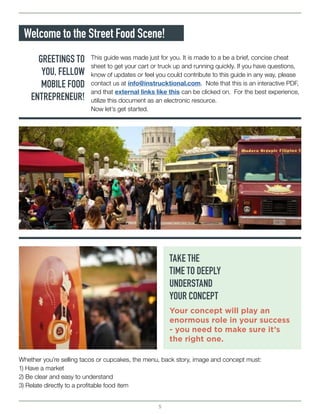
This guide was made just for you. It is made to a be a brief, concise cheat
sheet to get your cart or truck up and running quickly. If you have questions,
know of updates or feel you could contribute to this guide in any way, please
contact us at info@instrucktional.com. Note that this is an interactive PDF,
and that external links like this can be clicked on. For the best experience,
utilize this document as an electronic resource.
Now let’s get started.
Whether you’re selling tacos or cupcakes, the menu, back story, image and concept must:
1) Have a market
2) Be clear and easy to understand
3) Relate directly to a profitable food item
6
When people look at your truck they should know right away what you’re serving. “Indian Street Food”
and “Modern Organic Filipino” say a lot more as a tag line than simply “Tasty Snacks & Treats.” Make sure
the name is consistent with the feeling of the brand. Keep in mind that your best chance of sustained
success will be to ensure the menu item that defines your truck is also your highest profit margin item
and can be re-purposed across your menu. At the same time, it certainly doesn’t hurt to have a sense
of humor - you will be serving from a truck on the street after all. If you do pick a humorous name, make
sure that humor is echoed throughout your menu and theme.
Since so much is going to depend on your concept (from image to menu to service experience) it makes
no sense to rush ahead without your concept well-defined. If you can’t explain exactly what you are doing
in one sentence then you need to re-think the idea. Having a background and theme that links to the
concept is a major plus as people will understand exactly where your food comes from and why they
should eat it.
To summarize - your concept needs to be simple, relevant and easily understandable. The truck name,
menu options and visual theme need to be unified, clear and profitable. Finally, you need to have at least
some sense of humor without being over-the-top.
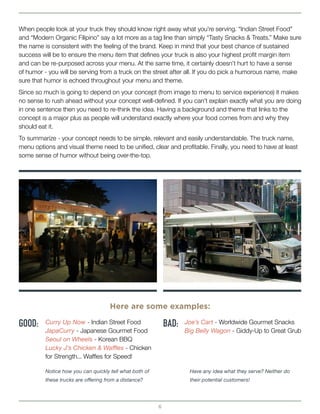
GOOD: BAD:
Here are some examples:
Curry Up Now - Indian Street Food
JapaCurry - Japanese Gourmet Food
Seoul on Wheels - Korean BBQ
Lucky J’s Chicken & Waffles - Chicken
for Strength... Waffles for Speed!
Joe’s Cart - Worldwide Gourmet Snacks
Big Belly Wagon - Giddy-Up to Great Grub
Notice how you can quickly tell what both of
these trucks are offering from a distance?
Have any idea what they serve? Neither do
their potential customers!
7
Your Business Plan
LET’S CUT RIGHT TO THE CHASE. IS
THIS A GOOD BUSINESS TO GET INTO?
Average Yearly Revenue of a
Food Truck* (*SF estimate):
In order to hit this range there are
4 primary areas to tweak:
Once you have your concept, it’s time to write your business plan. If you’ve never written a business plan
then think of it as your mission strategy. You’re going to lay out your opportunities, risks and goals so that
you are better prepared as time goes on. In this section we will be covering cost planning and revenue
generation.
In terms of personal income as the truck
owner: if you work 60 hr/week on the truck
you can hit the 60-70k take-home mark. Each
4 hour shift should bring in at least $750+ (try
for $1,250-$2,500).
LOCATION
Your rotating regular lunch locations are the
financial backbone of your food truck’s business
model. While catering, special events and other
bookings will account for some significant income,
your bread-and-butter will come from your
scheduled lunch shifts. Your goal is to have 2-3
regular spots (ideally in densely populated office
environments) where you appear every other week.
This way your customers will get used to your
schedule and miss you when you’re not there,
$200,000 - 300,000
“The Four Big
Revenue Levers”
causing them to make sure they catch you next
time. Expect to have at least 6 (4h/ea) services per
week with at least 3 lunch shifts. Breakfast and
late-night services tend to be more difficult than
they are worth but can occasionally be profitable
with proper planning.
ITEM COST
Generally food trucks will serve 1-2 small items and
1-2 large items. The small should range from $2-5
ea and the large from $6-9 ea. Specialty drinks
can be especially high-margin as they can easily
be priced at $2-$3 ea and cost pennies. People
assume trucks are going to be less expensive than
nearby restaurants so price accordingly. Customers
expect you to pass along the discounted over-head
costs from your truck. This doesn’t mean you need
to serve cheap food, it means your menu items
(in most cases) should be cheaper than the same
dish at local brick & mortar restaurants. Your menu
should aim to have your main item, the dish your
truck is known for, be your highest margin item.
ORDER SPEED
Having high-margin items is great but only if you
can serve them in a reasonable amount of time.
For a profitable service you need to be serving on
average 1.5 customers per minute (about 100/hr).
Any slower and your line won’t move and you’ll lose
paying customers to other trucks or restaurants.
Setting up your product, line and service to
decrease order time will increase profitability
immensely.
8
VOLUME
Once you have item cost and speed down to a
science, it’s time to turn up the volume. You should
be able to serve about 300 people before running
out of food. In order to do this, you’re going to want
not more than 2 other people on the truck with you
(3 total) in order to keep the labor reasonable. In
order to do the volume in a week you are going to
Funding
need to operate 5-8 services (4 hours each) and
bring in about $1,000/day.
If you can fund your truck yourself, go for it. For those without the capital available, funds must be
acquired. Whether it be through friends, family or a loan, having enough capital on hand is essential
in the early stages of a mobile food business. There are basically two options for non-personal loans:
non-profit lenders and banks. If you have prior business experience, a bank can be a great resource for
securing funding.
Timeline for Capital Acquisition and Truck Launch
If you are starting in the winter or fall you will need your loan to carry you through 6 months of slow sales.
If you begin in the spring you should only need enough to cover you until the lucrative summer months.
Winter / fall sales will generally be 50% less than the rest of the year.
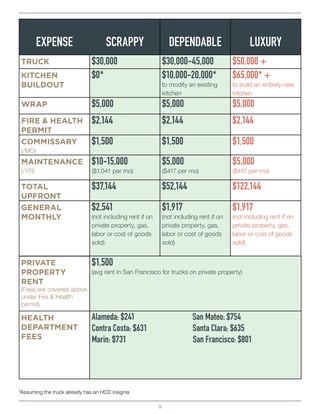
CAPTIAL NEEDED
(chart on next page)
9
EXPENSE SCRAPPY DEPENDABLE LUXURY
TRUCK $30,000 $30,000-45,000 $50,000 +
KITCHEN
BUILDOUT
$0* $10,000-20,000*
to modify an existing
kitchen
$65,000* +
to build an entirely new
kitchen
WRAP $5,000 $5,000 $5,000
FIRE & HEALTH
PERMIT
$2,144 $2,144 $2,144
COMMISSARY
(/MO)
$1,500 $1,500 $1,500
MAINTENANCE
(/YR)
$10-15,000
($1,041 per mo)
$5,000
($417 per mo)
$5,000
($417 per mo)
TOTAL
UPFRONT
$37,144 $52,144 $122,144
GENERAL
MONTHLY
$2,541
(not including rent if on
private property, gas,
labor or cost of goods
sold)
$1,917
(not including rent if on
private property, gas,
labor or cost of goods
sold)
$1,917
(not including rent if on
private property, gas,
labor or cost of goods
sold)
*Assuming the truck already has an HCD insignia
PRIVATE
PROPERTY
RENT
(Fees are covered above
under Fire & Health
permit)
$1,500
(avg rent in San Francisco for trucks on private property)
HEALTH
DEPARTMENT
FEES
Alameda: $241 San Mateo: $754
Contra Costa: $631 Santa Clara: $635
Marin: $731 San Francisco: $801
10
FOOD HANDLING MANAGER CERTIFICATE WORKMAN’S COMP DECLARATION
http://www.servsafe.com/foodhandlerusa
A Certified Food Handling Manager is required
on each food truck in California. Make sure you
sign up for the manager class, not the standard
class. Classes occur infrequently so if you’re on a
deadline don’t forget to check out the next class
and reserve your spot:
Mobile food businesses in California must provide
proof or waiver of Workman’s Compensation
insurance.
If you have no employees this may be waived,
but is typically only granted to very small or family
owned trucks. If you do not waive it, you will need
to provide proof of Workman’s Comp Insurance
from your insurance broker.
YOUR TRUCK
PURCHASING
So, how much does a catering truck cost? Bare minimum - $40,000 with another $5-10k in maintenance
in the first year. To build out a custom kitchen you’re looking at $60,000 plus the cost of a used truck
($20-$30k with 50-60k miles).
WRAP
Your wrap will cost you about $5000 including design, printing and wrapping. Do not cut corners
here. Your wrap IS your truck - it’s your marketing, your first impression and your brand. There is no
place where you can more easily look really good or really bad.
Cheap wraps will peel, bubble and tear. Well-done wraps can last for years. When thinking about
the design, make sure that people can still understand your truck when your service doors are up
and the full wrap is no longer visible.
Painting your truck is also an option but will cost around $3,500 for a one-color coat. The benefit of
painting is that is can often last longer and gives you that “old school” feel. If you have a very simple
design this can be a good option. However, if you need a highly detailed image, a paint job will cost
about 5 times what a wrap will cost.
11
12
CUSTOMIZATION
Truck customization isn’t cheap but it can be the best way to get the exact truck design you need to
make your product quickly and efficiently. Before making heavy modifications make sure that it will pass
Fire/Health/HCD (Housing Community Development) by getting your floor plans pre-approved. Most
reputable manufacturers will guarantee, in writing, the passing of inspections and you should ask for this
provision in your contract. If you’re buying a used truck, consider requesting an inspection from your
primary health department before purchasing to ensure the truck will pass.
MECHANICAL MAINTENANCE KITCHEN MAINTENANCE
Let’s face it - your truck is going to break down.
It’s bound to happen when you least expect it
and at the most critical times. Having a repair
company on call who knows what they are
doing, completes work on time and on budget
is one of the most important tools in the mobile
food entrepreneurs toolkit.
When drawing up your floor plan it is important
to make sure all measurements are correct and
every plug, compartment and device is labeled.
Also critical are fresh/grey water tank sizes and
locations, Ansul system service date, generator
wattage/model and location as well as all water
intake/outlet and electricity hookups. You will
need this floor plan to expedite your health
department approval, and one can be prepared
by hand or the truck manufacturer.
HOUSING COMMUNITY DEVELOPMENT (HCD) INSIGNIA
All food trucks in California must meet the CA
building code as defined by the HCD board. This
can be an expensive and time-consuming decal to
obtain and will be required on all trucks purchased
out of state. Ideally the truck you purchase already
has an HCD insignia or can be guaranteed to pass
the inspection. If it does not pass, you will end up
spending 1-3 months and $5-15k bringing your
truck up to HCD code.
STATE REQUIREMENTS
MORE INFO CAN BE OBTAINED FROM:
http://hcd.ca.gov/
http://hcd.ca.gov/codes/mhp/ii.html
13
General Permits, Licenses and Paperwork
BUSINESS LICENSE LIABILITY INSURANCE
A city business license will be required for all cities
you operate on. Most cities have free services to
advise you on your options.
You will need liability insurance. Specifically 1m
(yes, million) general liability coverage. You can get
this through a general broker and most should be
familiar with the necessary requirements for a food
truck.
In many cases you will need to list additional co-
insurers for permitting purposes. This is something
your insurance broker can do for you and should
not cost you extra.
SELLER’S PERMIT
http://www.boe.ca.gov/elecsrv/esrvcont.htm
All mobile food vendors must have a California
Seller’s Permit. You can create an account and
apply here:
RECOMMENDED INSURANCE BROKER:
PHILL O’KANE, CLCS
POKANE@OKANEINSURANCE.COM
415-242-8756
COMMISSARY & PARKING
Every mobile food truck must park at a commercially zoned location so that the county enviromental
health department can inspect it at any time. There are different options for completing this requirement
ranging from parking at a storage facility to residing at a MFF-only commissary facility.
For a commissary (with grey water dump/refill, garbage service, power for refrigeration etc) expect to
spend about $1,000/mo on rent PLUS $20/day on ice (around $1,500-$1,600/mo total).
Alternatives include using a restaurant kitchen as a commissary (~$20-40/hr) and parking at a
commercial lot ($200-$300/mo), though you will not have constant power and thus will be unable to keep
food on the truck.
CHECK OUT A LISTING OF SF BAY AREA
COMMISSARIES HERE:
www.trygalley.com
14
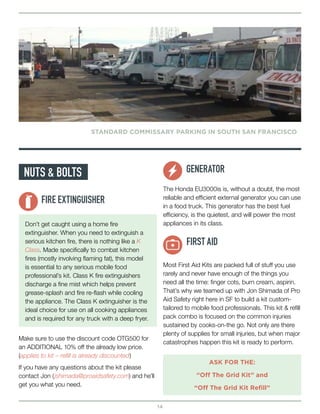
STANDARD COMMISSARY PARKING IN SOUTH SAN FRANCISCO
NUTS & BOLTS
FIRE EXTINGUISHER
GENERATOR
Don’t get caught using a home fire
extinguisher. When you need to extinguish a
serious kitchen fire, there is nothing like a K
Class. Made specifically to combat kitchen
fires (mostly involving flaming fat), this model
is essential to any serious mobile food
professional’s kit. Class K fire extinguishers
discharge a fine mist which helps prevent
grease-splash and fire re-flash while cooling
the appliance. The Class K extinguisher is the
ideal choice for use on all cooking appliances
and is required for any truck with a deep fryer.
The Honda EU3000is is, without a doubt, the most
reliable and efficient external generator you can use
in a food truck. This generator has the best fuel
efficiency, is the quietest, and will power the most
appliances in its class.
FIRST AID
Most First Aid Kits are packed full of stuff you use
rarely and never have enough of the things you
need all the time: finger cots, burn cream, aspirin.
That’s why we teamed up with Jon Shimada of Pro
Aid Safety right here in SF to build a kit custom-
tailored to mobile food professionals. This kit & refill
pack combo is focused on the common injuries
sustained by cooks-on-the go. Not only are there
plenty of supplies for small injuries, but when major
catastrophes happen this kit is ready to perform.
Make sure to use the discount code OTG500 for
an ADDITIONAL 10% off the already low price.
(applies to kit – refill is already discounted)
If you have any questions about the kit please
contact Jon (jshimada@proaidsafety.com) and he’ll
get you what you need.
ASK FOR THE:
“Off The Grid Kit” and
“Off The Grid Kit Refill”
15
When choosing what types of payment to accept there are a number of factors to keep in mind. First,
order speed if your system is slowing you down it may not be worthwhile to accept credit cards or deal
with a fancy POS. However, if you are in an area with a lot of credit card users then you may want to
accept them.
You have a few options for accepting credit cards: Square, GoPayment or a full fledged POS. Square and
GoPayment both only require a smart-phone and dongle which are quite inexpensive when compared
to a terminal type system (which can run in the thousands-of-dollars range). There are many options for
lightweight POS solutions and we recommend you research the available products and make the best
choice for your business.
PAYMENT PROCESSING & POINT-OF-SALE
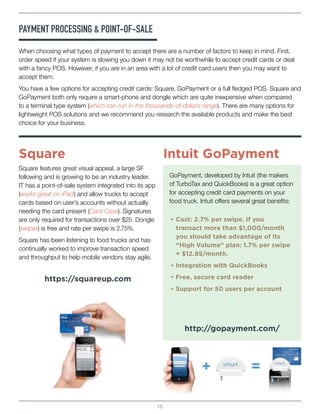
Square features great visual appeal, a large SF
following and is growing to be an industry leader.
IT has a point-of-sale system integrated into its app
(works great on iPad) and allow trucks to accept
cards based on user’s accounts without actually
needing the card present (Card Case). Signatures
are only required for transactions over $25. Dongle
(swiper) is free and rate per swipe is 2.75%.
Square has been listening to food trucks and has
continually worked to improve transaction speed
and throughput to help mobile vendors stay agile.
GoPayment, developed by Intuit (the makers
of TurboTax and QuickBooks) is a great option
for accepting credit card payments on your
food truck. Intuit offers several great benefits:
Square Intuit GoPayment
https://squareup.com
http://gopayment.com/
• Cost: 2.7% per swipe. If you 		
	 transact more than $1,000/month 	
	 you should take advantage of its 		
	 “High Volume” plan: 1.7% per swipe 	
	 + $12.95/month.
• Integration with QuickBooks
• Free, secure card reader
• Support for 50 users per account
16
17
SUMMARY
You are now ready to face the many challenges of starting a mobile food business. If
you have additional questions, need help with specific issues or simply want to reach
out, please contact us at info@instrucktional.com.
ESSENTIAL CONTACTS
300’ RADIUS NOTIFICATIONS
Karen Martin
NotificationMaps.com
866.752.6266
Karen@notificationmaps.com
TRUCK SOURCES
US CATERING (HAYWARD)
Luis Soto (510) 688-3245
luis.soto@uscateringtrucks.com
EL MONTE CATERING (SAN JOSE)
Jorge Gomez (408) 516-6973
jorge@elmontecatering.com
[Mid-Priced New Build Only]
MSM CATERING (LOS ANGELES)
Luis Jr. (562) 272-4595
[Mid-Priced New Builds]
ARMENCO CATERING (LOS ANGELES)
(800) 345-0104
[High-End New Custom Builds]
MECHANICS
Luis Soto - 510-688-3245
Mobile Diesel Medic - 415-305-3090
VEHICLE WRAP
CUSTOM VEHICLE WRAPS
Kwasi Boyd
(877) WRAP 123
www.customvehiclewraps.com
INSURANCE BROKER:
PHILL O’KANE, CLCS
415-242-8756
pokane@okaneinsurance.com
MECHANICS
Mobile Foods
Eclectic Cookery
La Cocina

2015 INSTRUCKTIONAL GUIDE

  • 1.
    1 INSTRUCKTIONAL GUIDE All YouNeed To Get Rolling And Thrive In The Mobile Food Industry
  • 2.
    2 Copyright All content inthis document, such as text, graphics, logos, button icons and images is the property of Off the Grid Services LLC or its content suppliers and protected by United States and international copyright laws. The selection, arrangement, and presentation of all materials in this document (including information in the public domain), and the overall design of this document is the exclusive property of Off the Grid Services LLC and protected by United States and international copyright laws.
  • 3.
    3 Table of Contents WELCOMETO THE STREET FOOD SCENE…………………………………………………………………… 4 TAKE THE TIME TO DEEPLY UNDERSTAND YOUR CONCEPT……………………………………………………… 4 YOUR BUSINESS PLAN…………………………………………………………………………………… 6 The Four Big Revenue Levers…………………………………………………………………………… 6 Location…………………………………………………………………………………………………… 6 Item Cost………………………………………………………………………………………………… 6 Order Speed……………………………………………………………………………………………… 6 Volume…………………………………………………………………………………………………… 7 FUNDING……………………………………………………………………………………………… 7 Timeline for Capital Acquisition and Truck Launch…………………………………………………… 7 Capital Needed…………………………………………………………………………………………… 7 FOOD HANDLING MANAGER CERTIFICATE…………………………………………………………………… 9 WORKMAN’S COMP DECLARATION………………………………………………………………………… 9 YOUR TRUCK…………………………………………………………………………………………… 9 Purchasing………………………………………………………………………………………………… 9 Wrap……………………………………………………………………………………………………… 9 Customization……………………………………………………………………………………………11 Mechanical Maintenance…………………………………………………………………………………11 Kitchen Maintenance……………………………………………………………………………………11 STATE REQUIREMENTS………………………………………………………………………………… 11 Housing and Community Development Insignia………………………………………………………11 GENERAL PERMITS, LICENSES, AND PAPERWORK…………………………………………………………… 12 Business License……………………………………………………………………………………… 12 Seller’s Permit………………………………………………………………………………………… 12 Liability Insurance……………………………………………………………………………………… 12 COMMISSARY AND PARKING…………………………………………………………………………… 12 NUTS AND BOLTS…………………………………………………………………………………… 13 Fire Extinguisher……………………………………………………………………………………… 13 Generator……………………………………………………………………………………………… 13 First Aid………………………………………………………………………………………………… 13 Payment Processing and Point of Sale……………………………………………………………… 14 SUMMARY………………………………………………………………………………………… 16 ESSENTIAL CONTACTS………………………………………………………………………………… 16
  • 4.
  • 5.
    5 Welcome to theStreet Food Scene! GREETINGS TO YOU, FELLOW MOBILE FOOD ENTREPRENEUR! TAKE THE TIME TO DEEPLY UNDERSTAND YOUR CONCEPT Your concept will play an enormous role in your success - you need to make sure it’s the right one. This guide was made just for you. It is made to a be a brief, concise cheat sheet to get your cart or truck up and running quickly. If you have questions, know of updates or feel you could contribute to this guide in any way, please contact us at info@instrucktional.com. Note that this is an interactive PDF, and that external links like this can be clicked on. For the best experience, utilize this document as an electronic resource. Now let’s get started. Whether you’re selling tacos or cupcakes, the menu, back story, image and concept must: 1) Have a market 2) Be clear and easy to understand 3) Relate directly to a profitable food item
  • 6.
    6 When people lookat your truck they should know right away what you’re serving. “Indian Street Food” and “Modern Organic Filipino” say a lot more as a tag line than simply “Tasty Snacks & Treats.” Make sure the name is consistent with the feeling of the brand. Keep in mind that your best chance of sustained success will be to ensure the menu item that defines your truck is also your highest profit margin item and can be re-purposed across your menu. At the same time, it certainly doesn’t hurt to have a sense of humor - you will be serving from a truck on the street after all. If you do pick a humorous name, make sure that humor is echoed throughout your menu and theme. Since so much is going to depend on your concept (from image to menu to service experience) it makes no sense to rush ahead without your concept well-defined. If you can’t explain exactly what you are doing in one sentence then you need to re-think the idea. Having a background and theme that links to the concept is a major plus as people will understand exactly where your food comes from and why they should eat it. To summarize - your concept needs to be simple, relevant and easily understandable. The truck name, menu options and visual theme need to be unified, clear and profitable. Finally, you need to have at least some sense of humor without being over-the-top. GOOD: BAD: Here are some examples: Curry Up Now - Indian Street Food JapaCurry - Japanese Gourmet Food Seoul on Wheels - Korean BBQ Lucky J’s Chicken & Waffles - Chicken for Strength... Waffles for Speed! Joe’s Cart - Worldwide Gourmet Snacks Big Belly Wagon - Giddy-Up to Great Grub Notice how you can quickly tell what both of these trucks are offering from a distance? Have any idea what they serve? Neither do their potential customers!
  • 7.
    7 Your Business Plan LET’SCUT RIGHT TO THE CHASE. IS THIS A GOOD BUSINESS TO GET INTO? Average Yearly Revenue of a Food Truck* (*SF estimate): In order to hit this range there are 4 primary areas to tweak: Once you have your concept, it’s time to write your business plan. If you’ve never written a business plan then think of it as your mission strategy. You’re going to lay out your opportunities, risks and goals so that you are better prepared as time goes on. In this section we will be covering cost planning and revenue generation. In terms of personal income as the truck owner: if you work 60 hr/week on the truck you can hit the 60-70k take-home mark. Each 4 hour shift should bring in at least $750+ (try for $1,250-$2,500). LOCATION Your rotating regular lunch locations are the financial backbone of your food truck’s business model. While catering, special events and other bookings will account for some significant income, your bread-and-butter will come from your scheduled lunch shifts. Your goal is to have 2-3 regular spots (ideally in densely populated office environments) where you appear every other week. This way your customers will get used to your schedule and miss you when you’re not there, $200,000 - 300,000 “The Four Big Revenue Levers” causing them to make sure they catch you next time. Expect to have at least 6 (4h/ea) services per week with at least 3 lunch shifts. Breakfast and late-night services tend to be more difficult than they are worth but can occasionally be profitable with proper planning. ITEM COST Generally food trucks will serve 1-2 small items and 1-2 large items. The small should range from $2-5 ea and the large from $6-9 ea. Specialty drinks can be especially high-margin as they can easily be priced at $2-$3 ea and cost pennies. People assume trucks are going to be less expensive than nearby restaurants so price accordingly. Customers expect you to pass along the discounted over-head costs from your truck. This doesn’t mean you need to serve cheap food, it means your menu items (in most cases) should be cheaper than the same dish at local brick & mortar restaurants. Your menu should aim to have your main item, the dish your truck is known for, be your highest margin item. ORDER SPEED Having high-margin items is great but only if you can serve them in a reasonable amount of time. For a profitable service you need to be serving on average 1.5 customers per minute (about 100/hr). Any slower and your line won’t move and you’ll lose paying customers to other trucks or restaurants. Setting up your product, line and service to decrease order time will increase profitability immensely.
  • 8.
    8 VOLUME Once you haveitem cost and speed down to a science, it’s time to turn up the volume. You should be able to serve about 300 people before running out of food. In order to do this, you’re going to want not more than 2 other people on the truck with you (3 total) in order to keep the labor reasonable. In order to do the volume in a week you are going to Funding need to operate 5-8 services (4 hours each) and bring in about $1,000/day. If you can fund your truck yourself, go for it. For those without the capital available, funds must be acquired. Whether it be through friends, family or a loan, having enough capital on hand is essential in the early stages of a mobile food business. There are basically two options for non-personal loans: non-profit lenders and banks. If you have prior business experience, a bank can be a great resource for securing funding. Timeline for Capital Acquisition and Truck Launch If you are starting in the winter or fall you will need your loan to carry you through 6 months of slow sales. If you begin in the spring you should only need enough to cover you until the lucrative summer months. Winter / fall sales will generally be 50% less than the rest of the year. CAPTIAL NEEDED (chart on next page)
  • 9.
    9 EXPENSE SCRAPPY DEPENDABLELUXURY TRUCK $30,000 $30,000-45,000 $50,000 + KITCHEN BUILDOUT $0* $10,000-20,000* to modify an existing kitchen $65,000* + to build an entirely new kitchen WRAP $5,000 $5,000 $5,000 FIRE & HEALTH PERMIT $2,144 $2,144 $2,144 COMMISSARY (/MO) $1,500 $1,500 $1,500 MAINTENANCE (/YR) $10-15,000 ($1,041 per mo) $5,000 ($417 per mo) $5,000 ($417 per mo) TOTAL UPFRONT $37,144 $52,144 $122,144 GENERAL MONTHLY $2,541 (not including rent if on private property, gas, labor or cost of goods sold) $1,917 (not including rent if on private property, gas, labor or cost of goods sold) $1,917 (not including rent if on private property, gas, labor or cost of goods sold) *Assuming the truck already has an HCD insignia PRIVATE PROPERTY RENT (Fees are covered above under Fire & Health permit) $1,500 (avg rent in San Francisco for trucks on private property) HEALTH DEPARTMENT FEES Alameda: $241 San Mateo: $754 Contra Costa: $631 Santa Clara: $635 Marin: $731 San Francisco: $801
  • 10.
    10 FOOD HANDLING MANAGERCERTIFICATE WORKMAN’S COMP DECLARATION http://www.servsafe.com/foodhandlerusa A Certified Food Handling Manager is required on each food truck in California. Make sure you sign up for the manager class, not the standard class. Classes occur infrequently so if you’re on a deadline don’t forget to check out the next class and reserve your spot: Mobile food businesses in California must provide proof or waiver of Workman’s Compensation insurance. If you have no employees this may be waived, but is typically only granted to very small or family owned trucks. If you do not waive it, you will need to provide proof of Workman’s Comp Insurance from your insurance broker. YOUR TRUCK PURCHASING So, how much does a catering truck cost? Bare minimum - $40,000 with another $5-10k in maintenance in the first year. To build out a custom kitchen you’re looking at $60,000 plus the cost of a used truck ($20-$30k with 50-60k miles). WRAP Your wrap will cost you about $5000 including design, printing and wrapping. Do not cut corners here. Your wrap IS your truck - it’s your marketing, your first impression and your brand. There is no place where you can more easily look really good or really bad. Cheap wraps will peel, bubble and tear. Well-done wraps can last for years. When thinking about the design, make sure that people can still understand your truck when your service doors are up and the full wrap is no longer visible. Painting your truck is also an option but will cost around $3,500 for a one-color coat. The benefit of painting is that is can often last longer and gives you that “old school” feel. If you have a very simple design this can be a good option. However, if you need a highly detailed image, a paint job will cost about 5 times what a wrap will cost.
  • 11.
  • 12.
    12 CUSTOMIZATION Truck customization isn’tcheap but it can be the best way to get the exact truck design you need to make your product quickly and efficiently. Before making heavy modifications make sure that it will pass Fire/Health/HCD (Housing Community Development) by getting your floor plans pre-approved. Most reputable manufacturers will guarantee, in writing, the passing of inspections and you should ask for this provision in your contract. If you’re buying a used truck, consider requesting an inspection from your primary health department before purchasing to ensure the truck will pass. MECHANICAL MAINTENANCE KITCHEN MAINTENANCE Let’s face it - your truck is going to break down. It’s bound to happen when you least expect it and at the most critical times. Having a repair company on call who knows what they are doing, completes work on time and on budget is one of the most important tools in the mobile food entrepreneurs toolkit. When drawing up your floor plan it is important to make sure all measurements are correct and every plug, compartment and device is labeled. Also critical are fresh/grey water tank sizes and locations, Ansul system service date, generator wattage/model and location as well as all water intake/outlet and electricity hookups. You will need this floor plan to expedite your health department approval, and one can be prepared by hand or the truck manufacturer. HOUSING COMMUNITY DEVELOPMENT (HCD) INSIGNIA All food trucks in California must meet the CA building code as defined by the HCD board. This can be an expensive and time-consuming decal to obtain and will be required on all trucks purchased out of state. Ideally the truck you purchase already has an HCD insignia or can be guaranteed to pass the inspection. If it does not pass, you will end up spending 1-3 months and $5-15k bringing your truck up to HCD code. STATE REQUIREMENTS MORE INFO CAN BE OBTAINED FROM: http://hcd.ca.gov/ http://hcd.ca.gov/codes/mhp/ii.html
  • 13.
    13 General Permits, Licensesand Paperwork BUSINESS LICENSE LIABILITY INSURANCE A city business license will be required for all cities you operate on. Most cities have free services to advise you on your options. You will need liability insurance. Specifically 1m (yes, million) general liability coverage. You can get this through a general broker and most should be familiar with the necessary requirements for a food truck. In many cases you will need to list additional co- insurers for permitting purposes. This is something your insurance broker can do for you and should not cost you extra. SELLER’S PERMIT http://www.boe.ca.gov/elecsrv/esrvcont.htm All mobile food vendors must have a California Seller’s Permit. You can create an account and apply here: RECOMMENDED INSURANCE BROKER: PHILL O’KANE, CLCS POKANE@OKANEINSURANCE.COM 415-242-8756 COMMISSARY & PARKING Every mobile food truck must park at a commercially zoned location so that the county enviromental health department can inspect it at any time. There are different options for completing this requirement ranging from parking at a storage facility to residing at a MFF-only commissary facility. For a commissary (with grey water dump/refill, garbage service, power for refrigeration etc) expect to spend about $1,000/mo on rent PLUS $20/day on ice (around $1,500-$1,600/mo total). Alternatives include using a restaurant kitchen as a commissary (~$20-40/hr) and parking at a commercial lot ($200-$300/mo), though you will not have constant power and thus will be unable to keep food on the truck. CHECK OUT A LISTING OF SF BAY AREA COMMISSARIES HERE: www.trygalley.com
  • 14.
    14 STANDARD COMMISSARY PARKINGIN SOUTH SAN FRANCISCO NUTS & BOLTS FIRE EXTINGUISHER GENERATOR Don’t get caught using a home fire extinguisher. When you need to extinguish a serious kitchen fire, there is nothing like a K Class. Made specifically to combat kitchen fires (mostly involving flaming fat), this model is essential to any serious mobile food professional’s kit. Class K fire extinguishers discharge a fine mist which helps prevent grease-splash and fire re-flash while cooling the appliance. The Class K extinguisher is the ideal choice for use on all cooking appliances and is required for any truck with a deep fryer. The Honda EU3000is is, without a doubt, the most reliable and efficient external generator you can use in a food truck. This generator has the best fuel efficiency, is the quietest, and will power the most appliances in its class. FIRST AID Most First Aid Kits are packed full of stuff you use rarely and never have enough of the things you need all the time: finger cots, burn cream, aspirin. That’s why we teamed up with Jon Shimada of Pro Aid Safety right here in SF to build a kit custom- tailored to mobile food professionals. This kit & refill pack combo is focused on the common injuries sustained by cooks-on-the go. Not only are there plenty of supplies for small injuries, but when major catastrophes happen this kit is ready to perform. Make sure to use the discount code OTG500 for an ADDITIONAL 10% off the already low price. (applies to kit – refill is already discounted) If you have any questions about the kit please contact Jon (jshimada@proaidsafety.com) and he’ll get you what you need. ASK FOR THE: “Off The Grid Kit” and “Off The Grid Kit Refill”
  • 15.
    15 When choosing whattypes of payment to accept there are a number of factors to keep in mind. First, order speed if your system is slowing you down it may not be worthwhile to accept credit cards or deal with a fancy POS. However, if you are in an area with a lot of credit card users then you may want to accept them. You have a few options for accepting credit cards: Square, GoPayment or a full fledged POS. Square and GoPayment both only require a smart-phone and dongle which are quite inexpensive when compared to a terminal type system (which can run in the thousands-of-dollars range). There are many options for lightweight POS solutions and we recommend you research the available products and make the best choice for your business. PAYMENT PROCESSING & POINT-OF-SALE Square features great visual appeal, a large SF following and is growing to be an industry leader. IT has a point-of-sale system integrated into its app (works great on iPad) and allow trucks to accept cards based on user’s accounts without actually needing the card present (Card Case). Signatures are only required for transactions over $25. Dongle (swiper) is free and rate per swipe is 2.75%. Square has been listening to food trucks and has continually worked to improve transaction speed and throughput to help mobile vendors stay agile. GoPayment, developed by Intuit (the makers of TurboTax and QuickBooks) is a great option for accepting credit card payments on your food truck. Intuit offers several great benefits: Square Intuit GoPayment https://squareup.com http://gopayment.com/ • Cost: 2.7% per swipe. If you transact more than $1,000/month you should take advantage of its “High Volume” plan: 1.7% per swipe + $12.95/month. • Integration with QuickBooks • Free, secure card reader • Support for 50 users per account
  • 16.
  • 17.
    17 SUMMARY You are nowready to face the many challenges of starting a mobile food business. If you have additional questions, need help with specific issues or simply want to reach out, please contact us at info@instrucktional.com. ESSENTIAL CONTACTS 300’ RADIUS NOTIFICATIONS Karen Martin NotificationMaps.com 866.752.6266 Karen@notificationmaps.com TRUCK SOURCES US CATERING (HAYWARD) Luis Soto (510) 688-3245 luis.soto@uscateringtrucks.com EL MONTE CATERING (SAN JOSE) Jorge Gomez (408) 516-6973 jorge@elmontecatering.com [Mid-Priced New Build Only] MSM CATERING (LOS ANGELES) Luis Jr. (562) 272-4595 [Mid-Priced New Builds] ARMENCO CATERING (LOS ANGELES) (800) 345-0104 [High-End New Custom Builds] MECHANICS Luis Soto - 510-688-3245 Mobile Diesel Medic - 415-305-3090 VEHICLE WRAP CUSTOM VEHICLE WRAPS Kwasi Boyd (877) WRAP 123 www.customvehiclewraps.com INSURANCE BROKER: PHILL O’KANE, CLCS 415-242-8756 pokane@okaneinsurance.com MECHANICS Mobile Foods Eclectic Cookery La Cocina