VALUEx Vail
June 19, 2014
Matt Griffith, CFA
@MattGGriffith
Disclaimer
The data in this presentation has been obtained from sources believed to be reliable, but
accuracy and completeness are not guaranteed. The presentation has been prepared solely for
informative purposes and is made available on an "as is" basis.
No representation or warranty, express or implied, is made as to the fairness, accuracy,
completeness, reasonableness, or correctness of the information, opinions, or conclusions
contained in this presentation. Forecasts, prospects or returns are by their nature subject to
significant uncertainties and contingencies.
Nothing in this presentation is intended to constitute legal, tax, securities, or investment advice,
nor an opinion regarding the appropriateness of any investment, nor a solicitation of any type.
This presentation has been prepared without taking into account the investment objectives,
financial situation or particular needs of any particular person or entity. The contents in this
presentation are intended for general informational purposes only and should not be acted upon
without obtaining specific legal, tax, and investment advice from a licensed professional
concerning your own situation and any specific investment questions you may have.
Past performance is no guarantee of future performance. Actual future events may vary from
these forecasts and you are cautioned not to place undue reliance on any forward looking
statement.
The views or opinions presented are solely those of the author and do not reflect the views or
opinions of any other person or entity.
“It's far better to buy a wonderful company at a fair price than a
fair company at a wonderful price.”
- Berkshire Hathaway Shareholders Letter, 1989
“There is value in growth.”
- Vitaliy Katsenelson, VALUEx Vail 2012
Visa’s Business
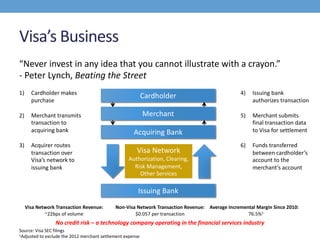
“Never invest in any idea that you cannot illustrate with a crayon.”
- Peter Lynch, Beating the Street
1) Cardholder makes
purchase
2) Merchant transmits
transaction to
acquiring bank
3) Acquirer routes
transaction over
Visa’s network to
issuing bank
4) Issuing bank
authorizes transaction
5) Merchant submits
final transaction data
to Visa for settlement
6) Funds transferred
between cardholder’s
account to the
merchant’s account
Cardholder
Merchant
Acquiring Bank
Issuing Bank
Visa Network
Authorization, Clearing,
Risk Management,
Other Services
Visa Network Transaction Revenue:
~22bps of volume
Non-Visa Network Transaction Revenue:
$0.057 per transaction
Average Incremental Margin Since 2010:
76.5%1
No credit risk – a technology company operating in the financial services industry
Source: Visa SEC filings
1Adjusted to exclude the 2012 merchant settlement expense
Visa’s Strategy
• Increase share of electronic payments as a percentage of global
personal consumption expense (PCE)
• Grow revenue streams outside of the US to greater than 50% of
total revenue
• Increase share of transactions processed on VisaNet
• Invest in new businesses that provide additional value to
customers in payment ecosystem and drive revenue growth
Source: Visa 2013 Investor Day Presentation
Global Conversion to Electronic Payments
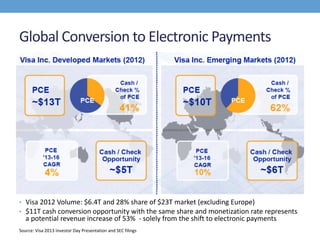
• Visa 2012 Volume: $6.4T and 28% share of $23T market (excluding Europe)
• $11T cash conversion opportunity with the same share and monetization rate represents
a potential revenue increase of 53% - solely from the shift to electronic payments
Source: Visa 2013 Investor Day Presentation and SEC filings
Risk of Declining PCE?
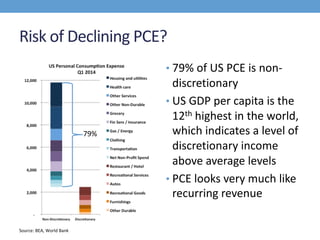
• 79% of US PCE is non-
discretionary
• US GDP per capita is the
12th highest in the world,
which indicates a level of
discretionary income
above average levels
• PCE looks very much like
recurring revenue
79%
Source: BEA, World Bank
Sustainable Competitive Advantage
• Deep integration with all members of payment ecosystem
• Consumers – 2.1B cards issued
• When banks switch networks on their card portfolios, card reissuance can lead
to customer attrition of 10-15%
• Reissuance is operationally complex and costly
• Merchants – 36MM locations accepting Visa cards globally
• Large number of cardholders ensures that merchants have incentive to accept
Visa
• Banks – Relationships with 15,000 financial institutions
• Transactions – 82B transactions in CY 2012
• Knowledge of customers and their transactions allows Visa to provide value-
add services to merchants and issuers that new entrants cannot (fraud
avoidance, enhance volumes)
Source: Visa 2013 Investor Day Presentation and SEC filings
Sustainable Competitive Advantage
• Visa has advantages relative to its few global competitors
• MasterCard
• MasterCard’s transaction count and payment volume are 57% and 67% of Visa’s
respectively
• MasterCard needs to differentiate on both price and service level to win captive
business from Visa and gain share
• Optionality from Visa Europe (more on this later…)
• American Express
• Closed-loop system where American Express acts as acquirer, network, and issuer
• More directly exposed to regulatory risk as 60% of revenue comes from
interchange fees
• Growth opportunities limited to cardholders who are credit-worthy
• China UnionPay
• Unlikely non-Chinese issuing banks will choose to issue a China UnionPay card
• Consequently China UnionPay is focused on markets where Chinese citizens travel
Source: Visa, MasterCard, and American Express SEC filings
Sustainable Competitive Advantage
• Replication of network nearly impossible
• Billions of dollars at risk – new entrant would need significant backing to
build scale and gain confidence of the merchants and banks
• The payment system is highly regulated – new entrants would need to be
adept at interfacing with regulatory agencies globally
• Few issuers have the volume and global presence necessary to effectively
circumvent existing networks
• Once a network is built, the hurdle would then become building scale
(issuing cards, adding acceptance locations, driving network volumes,
etc.)
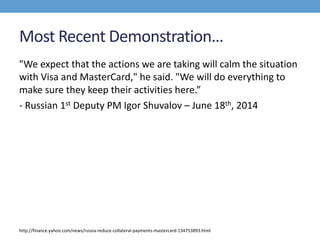
Most Recent Demonstration…
"We expect that the actions we are taking will calm the situation
with Visa and MasterCard," he said. "We will do everything to
make sure they keep their activities here.”
- Russian 1st Deputy PM Igor Shuvalov – June 18th, 2014
http://finance.yahoo.com/news/russia-reduce-collateral-payments-mastercard-134753893.html
Acquisitions and Innovation
• Visa has a history of using cash both to develop enhanced payment
technology in-house (payWave - NFC, V.me – electronic wallet) and acquire
companies innovating in mobile (Fundamo) and merchant services
(CyberSource)
Do Visa Products Add Value for Customers?
The numbers indicate they do.
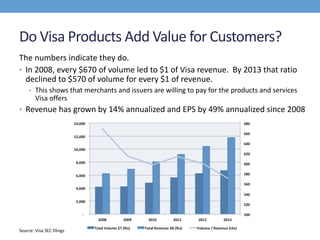
• In 2008, every $670 of volume led to $1 of Visa revenue. By 2013 that ratio
declined to $570 of volume for every $1 of revenue.
• This shows that merchants and issuers are willing to pay for the products and services
Visa offers
• Revenue has grown by 14% annualized and EPS by 49% annualized since 2008
Source: Visa SEC filings
Visa Europe
• Visa Europe is still owned by a consortium of banks and has the
ability to put the company to Visa Inc. at any time
• Regulatory pressure on banks and higher capital requirements would
make proceeds from Visa Europe transaction attractive to current
ownership
• Visa Europe currently not run to generate a profit and prices services
at a below-market level
• Current Visa Europe market environment mimics Visa Inc. pre-IPO
• Since 2007 (pre-IPO), Visa Inc. has revenue CAGR of 22%
• Since the 2008 IPO, EPS has increased from $1.04 to $7.59
• Both of these results occurred during the post-GFC period (pressure on
consumer spending, increased capital requirements for banks, increased
regulation)
• Visa Inc. would likely be the beneficiary of a shift to market pricing
and any potential future growth
Source: Visa SEC filings
Looking forward
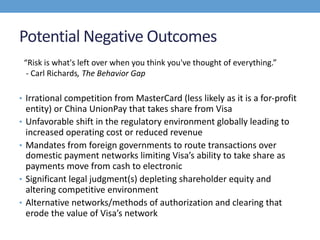
Key Assumptions
• Conservative – ~6% revenue/PCE growth (not factoring increased share from cash payment
conversion); incentives (contra-revenue item) going from 16.8% to 19% of gross revenue
• High Growth – incremental 8% revenue growth from cash payment share gain; incentives going
from 17.1% to 18.4% of gross revenue
• Visa Europe - $8B price; finance 100% with debt (A rating); achieves Visa Inc. margins; 22%
CAGR in revenue (similar to Visa Inc. experience post-IPO)
• Unfavorable Results – Revenue growth of 3% (losing share to competitors as payments shift
from cash); operating margins from 62% to 50%; Incentives from 17% to 25% of gross revenue
Source: Visa SEC filings for 2013, FRED; 2014 and forward are estimates – see disclaimer
Potential Negative Outcomes
• Irrational competition from MasterCard (less likely as it is a for-profit
entity) or China UnionPay that takes share from Visa
• Unfavorable shift in the regulatory environment globally leading to
increased operating cost or reduced revenue
• Mandates from foreign governments to route transactions over
domestic payment networks limiting Visa’s ability to take share as
payments move from cash to electronic
• Significant legal judgment(s) depleting shareholder equity and
altering competitive environment
• Alternative networks/methods of authorization and clearing that
erode the value of Visa’s network
“Risk is what's left over when you think you've thought of everything.”
- Carl Richards, The Behavior Gap
Summary
• There is a global shift occurring towards electronic payments
and away from cash and paper-based payments
• Personal consumption expense (PCE) is growing, particularly in
emerging markets, and a significant portion of PCE is non-
discretionary
• Visa demonstrates the characteristics of a company with a
sustainable competitive advantage
• I believe these factors indicate the range of outcomes for Visa
is positively skewed.
• Under favorable circumstances, there is the potential for
earnings to compound by more than 15% annually over 5
years.
Thank you

2014 VALUEx Vail - Visa

  • 1.
    VALUEx Vail June 19,2014 Matt Griffith, CFA @MattGGriffith
  • 2.
    Disclaimer The data inthis presentation has been obtained from sources believed to be reliable, but accuracy and completeness are not guaranteed. The presentation has been prepared solely for informative purposes and is made available on an "as is" basis. No representation or warranty, express or implied, is made as to the fairness, accuracy, completeness, reasonableness, or correctness of the information, opinions, or conclusions contained in this presentation. Forecasts, prospects or returns are by their nature subject to significant uncertainties and contingencies. Nothing in this presentation is intended to constitute legal, tax, securities, or investment advice, nor an opinion regarding the appropriateness of any investment, nor a solicitation of any type. This presentation has been prepared without taking into account the investment objectives, financial situation or particular needs of any particular person or entity. The contents in this presentation are intended for general informational purposes only and should not be acted upon without obtaining specific legal, tax, and investment advice from a licensed professional concerning your own situation and any specific investment questions you may have. Past performance is no guarantee of future performance. Actual future events may vary from these forecasts and you are cautioned not to place undue reliance on any forward looking statement. The views or opinions presented are solely those of the author and do not reflect the views or opinions of any other person or entity.
  • 3.
    “It's far betterto buy a wonderful company at a fair price than a fair company at a wonderful price.” - Berkshire Hathaway Shareholders Letter, 1989 “There is value in growth.” - Vitaliy Katsenelson, VALUEx Vail 2012
  • 5.
    Visa’s Business “Never investin any idea that you cannot illustrate with a crayon.” - Peter Lynch, Beating the Street 1) Cardholder makes purchase 2) Merchant transmits transaction to acquiring bank 3) Acquirer routes transaction over Visa’s network to issuing bank 4) Issuing bank authorizes transaction 5) Merchant submits final transaction data to Visa for settlement 6) Funds transferred between cardholder’s account to the merchant’s account Cardholder Merchant Acquiring Bank Issuing Bank Visa Network Authorization, Clearing, Risk Management, Other Services Visa Network Transaction Revenue: ~22bps of volume Non-Visa Network Transaction Revenue: $0.057 per transaction Average Incremental Margin Since 2010: 76.5%1 No credit risk – a technology company operating in the financial services industry Source: Visa SEC filings 1Adjusted to exclude the 2012 merchant settlement expense
  • 6.
    Visa’s Strategy • Increaseshare of electronic payments as a percentage of global personal consumption expense (PCE) • Grow revenue streams outside of the US to greater than 50% of total revenue • Increase share of transactions processed on VisaNet • Invest in new businesses that provide additional value to customers in payment ecosystem and drive revenue growth Source: Visa 2013 Investor Day Presentation
  • 7.
    Global Conversion toElectronic Payments • Visa 2012 Volume: $6.4T and 28% share of $23T market (excluding Europe) • $11T cash conversion opportunity with the same share and monetization rate represents a potential revenue increase of 53% - solely from the shift to electronic payments Source: Visa 2013 Investor Day Presentation and SEC filings
  • 8.
    Risk of DecliningPCE? • 79% of US PCE is non- discretionary • US GDP per capita is the 12th highest in the world, which indicates a level of discretionary income above average levels • PCE looks very much like recurring revenue 79% Source: BEA, World Bank
  • 9.
    Sustainable Competitive Advantage •Deep integration with all members of payment ecosystem • Consumers – 2.1B cards issued • When banks switch networks on their card portfolios, card reissuance can lead to customer attrition of 10-15% • Reissuance is operationally complex and costly • Merchants – 36MM locations accepting Visa cards globally • Large number of cardholders ensures that merchants have incentive to accept Visa • Banks – Relationships with 15,000 financial institutions • Transactions – 82B transactions in CY 2012 • Knowledge of customers and their transactions allows Visa to provide value- add services to merchants and issuers that new entrants cannot (fraud avoidance, enhance volumes) Source: Visa 2013 Investor Day Presentation and SEC filings
  • 10.
    Sustainable Competitive Advantage •Visa has advantages relative to its few global competitors • MasterCard • MasterCard’s transaction count and payment volume are 57% and 67% of Visa’s respectively • MasterCard needs to differentiate on both price and service level to win captive business from Visa and gain share • Optionality from Visa Europe (more on this later…) • American Express • Closed-loop system where American Express acts as acquirer, network, and issuer • More directly exposed to regulatory risk as 60% of revenue comes from interchange fees • Growth opportunities limited to cardholders who are credit-worthy • China UnionPay • Unlikely non-Chinese issuing banks will choose to issue a China UnionPay card • Consequently China UnionPay is focused on markets where Chinese citizens travel Source: Visa, MasterCard, and American Express SEC filings
  • 11.
    Sustainable Competitive Advantage •Replication of network nearly impossible • Billions of dollars at risk – new entrant would need significant backing to build scale and gain confidence of the merchants and banks • The payment system is highly regulated – new entrants would need to be adept at interfacing with regulatory agencies globally • Few issuers have the volume and global presence necessary to effectively circumvent existing networks • Once a network is built, the hurdle would then become building scale (issuing cards, adding acceptance locations, driving network volumes, etc.)
  • 12.
    Most Recent Demonstration… "Weexpect that the actions we are taking will calm the situation with Visa and MasterCard," he said. "We will do everything to make sure they keep their activities here.” - Russian 1st Deputy PM Igor Shuvalov – June 18th, 2014 http://finance.yahoo.com/news/russia-reduce-collateral-payments-mastercard-134753893.html
  • 13.
    Acquisitions and Innovation •Visa has a history of using cash both to develop enhanced payment technology in-house (payWave - NFC, V.me – electronic wallet) and acquire companies innovating in mobile (Fundamo) and merchant services (CyberSource)
  • 14.
    Do Visa ProductsAdd Value for Customers? The numbers indicate they do. • In 2008, every $670 of volume led to $1 of Visa revenue. By 2013 that ratio declined to $570 of volume for every $1 of revenue. • This shows that merchants and issuers are willing to pay for the products and services Visa offers • Revenue has grown by 14% annualized and EPS by 49% annualized since 2008 Source: Visa SEC filings
  • 15.
    Visa Europe • VisaEurope is still owned by a consortium of banks and has the ability to put the company to Visa Inc. at any time • Regulatory pressure on banks and higher capital requirements would make proceeds from Visa Europe transaction attractive to current ownership • Visa Europe currently not run to generate a profit and prices services at a below-market level • Current Visa Europe market environment mimics Visa Inc. pre-IPO • Since 2007 (pre-IPO), Visa Inc. has revenue CAGR of 22% • Since the 2008 IPO, EPS has increased from $1.04 to $7.59 • Both of these results occurred during the post-GFC period (pressure on consumer spending, increased capital requirements for banks, increased regulation) • Visa Inc. would likely be the beneficiary of a shift to market pricing and any potential future growth Source: Visa SEC filings
  • 16.
    Looking forward Key Assumptions •Conservative – ~6% revenue/PCE growth (not factoring increased share from cash payment conversion); incentives (contra-revenue item) going from 16.8% to 19% of gross revenue • High Growth – incremental 8% revenue growth from cash payment share gain; incentives going from 17.1% to 18.4% of gross revenue • Visa Europe - $8B price; finance 100% with debt (A rating); achieves Visa Inc. margins; 22% CAGR in revenue (similar to Visa Inc. experience post-IPO) • Unfavorable Results – Revenue growth of 3% (losing share to competitors as payments shift from cash); operating margins from 62% to 50%; Incentives from 17% to 25% of gross revenue Source: Visa SEC filings for 2013, FRED; 2014 and forward are estimates – see disclaimer
  • 17.
    Potential Negative Outcomes •Irrational competition from MasterCard (less likely as it is a for-profit entity) or China UnionPay that takes share from Visa • Unfavorable shift in the regulatory environment globally leading to increased operating cost or reduced revenue • Mandates from foreign governments to route transactions over domestic payment networks limiting Visa’s ability to take share as payments move from cash to electronic • Significant legal judgment(s) depleting shareholder equity and altering competitive environment • Alternative networks/methods of authorization and clearing that erode the value of Visa’s network “Risk is what's left over when you think you've thought of everything.” - Carl Richards, The Behavior Gap
  • 18.
    Summary • There isa global shift occurring towards electronic payments and away from cash and paper-based payments • Personal consumption expense (PCE) is growing, particularly in emerging markets, and a significant portion of PCE is non- discretionary • Visa demonstrates the characteristics of a company with a sustainable competitive advantage • I believe these factors indicate the range of outcomes for Visa is positively skewed. • Under favorable circumstances, there is the potential for earnings to compound by more than 15% annually over 5 years.
  • 19.