Digital Heritage Evangelism
DEN -Digital Heritage Netherlands
Presentation to the
Faculty of Visual Arts & Design,
Bandung Institute of Technology
Den Haag | June 20th, 2014 | Monika Lechner | DEN.nl/english | monika.lechner@den.nl
 What is DEN?
 The Dutch digital heritage landscape
 What is digital heritage?
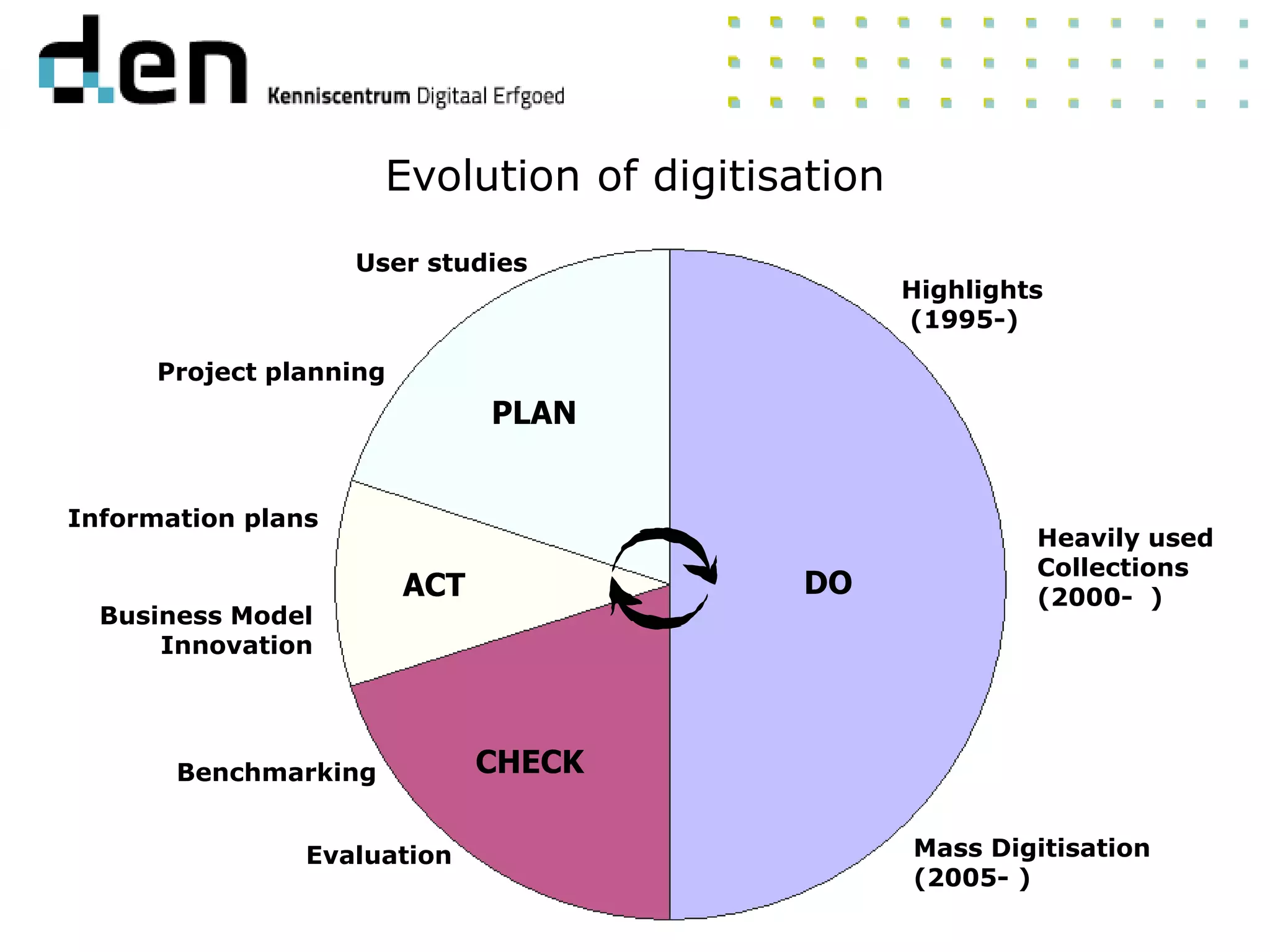
 Evolution of digitisation
 Standardisation
 User demand
 Future technologies that will rock the world
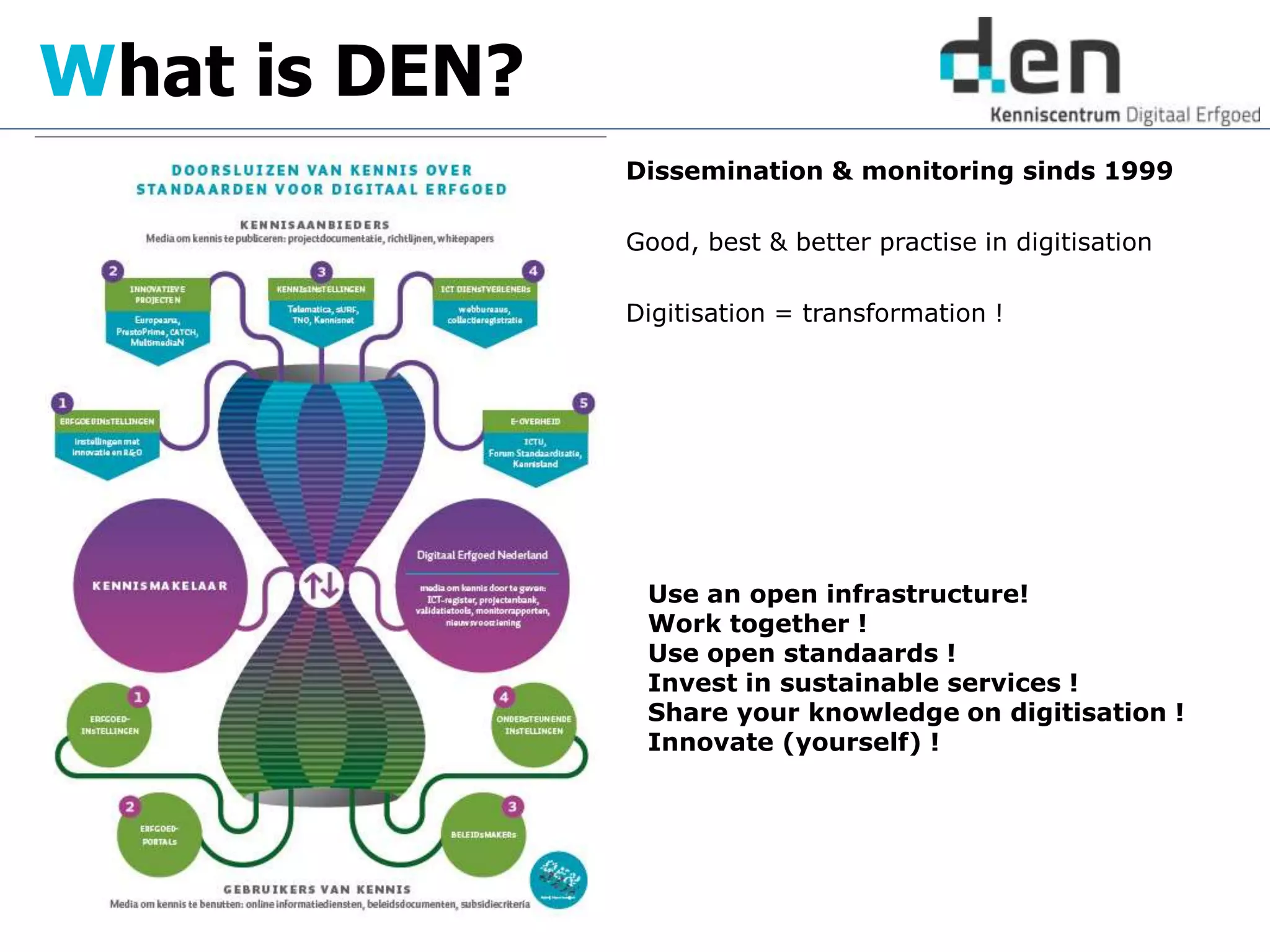
Dissemination & monitoring sinds 1999
Good, best & better practise in digitisation
Digitisation = transformation !
What is DEN?
Use an open infrastructure!
Work together !
Use open standaards !
Invest in sustainable services !
Share your knowledge on digitisation !
Innovate (yourself) !
National policy
There are two sides to Dutch government policy regarding
digitisation of cultural heritage:
Decentralised approach:
• Strengthening local activities and innovation
• Promoting creation of institutional ICT policies
• Investing in staff training
• Funding on national, provincial and local level
Strengthening the national infrastructure in EU-context:
• “Digital Collection Netherlands”
• Infrastructure for preservation and access
• Legal framework / copyright
• Quality assurance based on self regulation
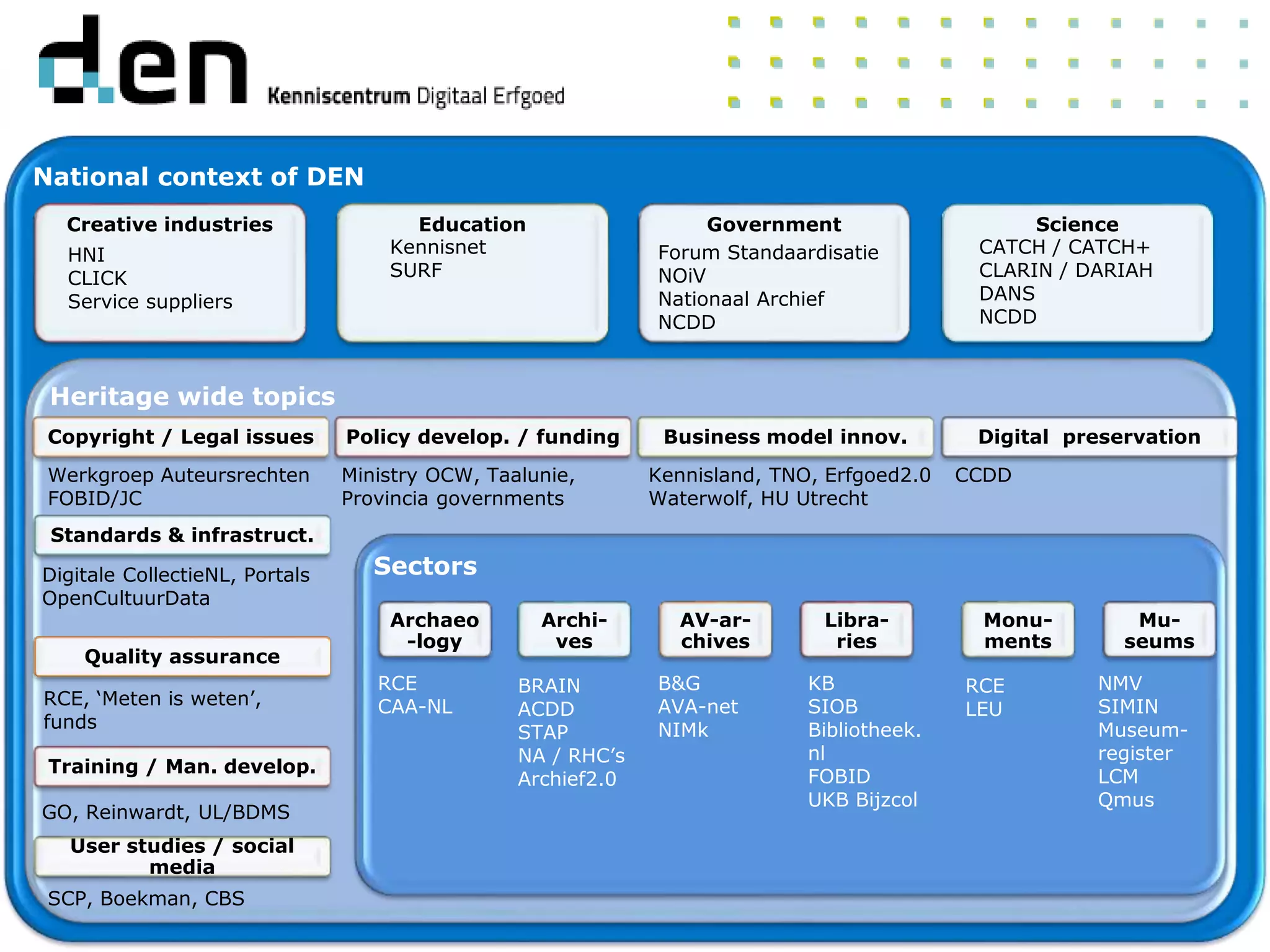
National context of DEN
Creative industries Education Government Science
Heritage wide topics
Copyright / Legal issues Policy develop. / funding Business model innov. Digital preservation
Standards & infrastruct.
Quality assurance
Training / Man. develop.
User studies / social
media
Sectors
Archaeo
-logy
Archi-
ves
AV-ar-
chives
Libra-
ries
Monu-
ments
Mu-
seums
Werkgroep Auteursrechten
FOBID/JC
Ministry OCW, Taalunie,
Provincia governments
Kennisland, TNO, Erfgoed2.0
Waterwolf, HU Utrecht
CCDD
Digitale CollectieNL, Portals
OpenCultuurData
RCE, ‘Meten is weten’,
funds
GO, Reinwardt, UL/BDMS
SCP, Boekman, CBS
RCE
CAA-NL
BRAIN
ACDD
STAP
NA / RHC’s
Archief2.0
B&G
AVA-net
NIMk
KB
SIOB
Bibliotheek.
nl
FOBID
UKB Bijzcol
RCE
LEU
NMV
SIMIN
Museum-
register
LCM
Qmus
HNI
CLICK
Service suppliers
Kennisnet
SURF
Forum Standaardisatie
NOiV
Nationaal Archief
NCDD
CATCH / CATCH+
CLARIN / DARIAH
DANS
NCDD
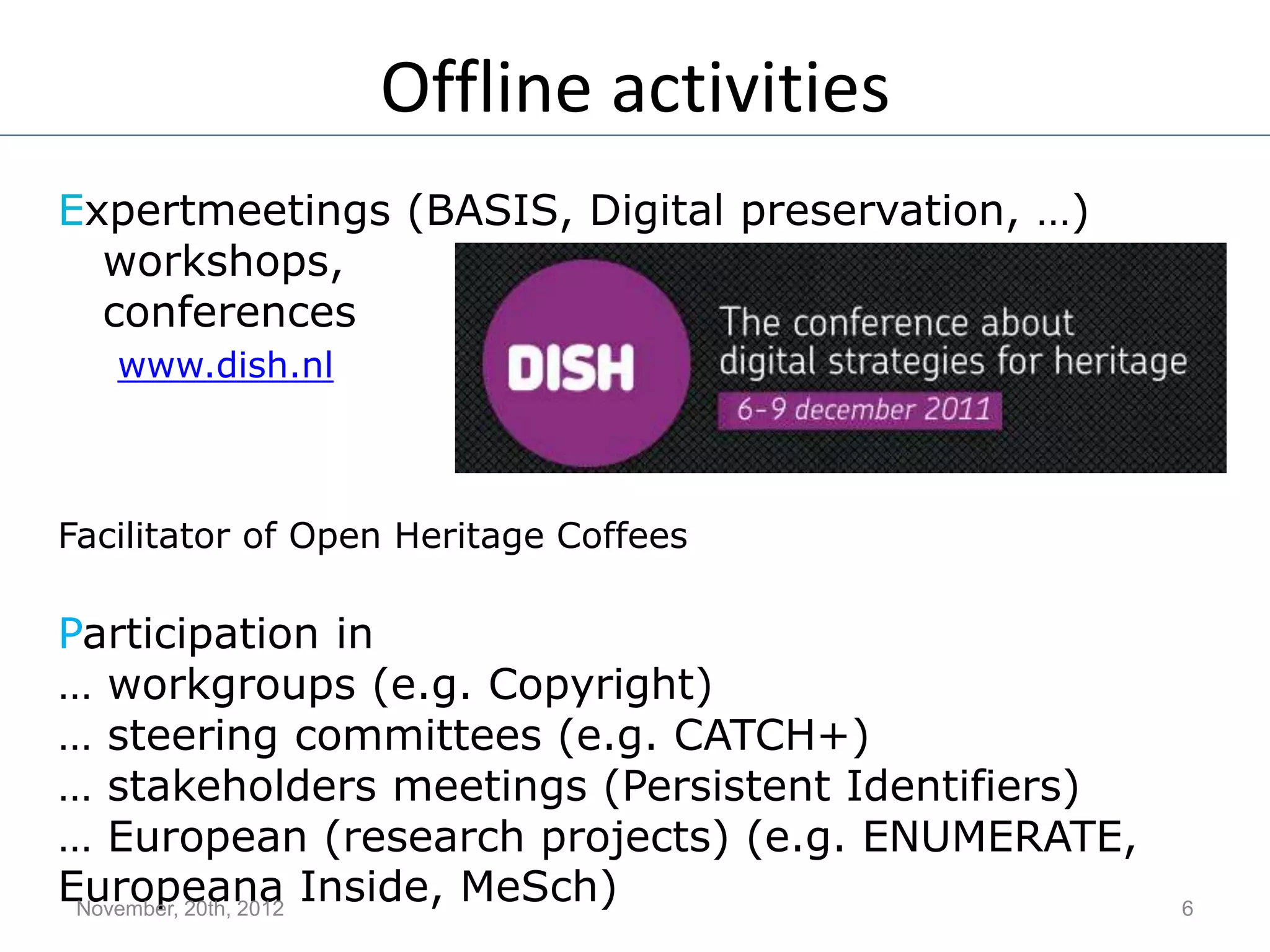
Offline activities
Expertmeetings (BASIS, Digital preservation, …)
workshops,
conferences
www.dish.nl
Facilitator of Open Heritage Coffees
Participation in
… workgroups (e.g. Copyright)
… steering committees (e.g. CATCH+)
… stakeholders meetings (Persistent Identifiers)
… European (research projects) (e.g. ENUMERATE,
Europeana Inside, MeSch)November, 20th, 2012 6
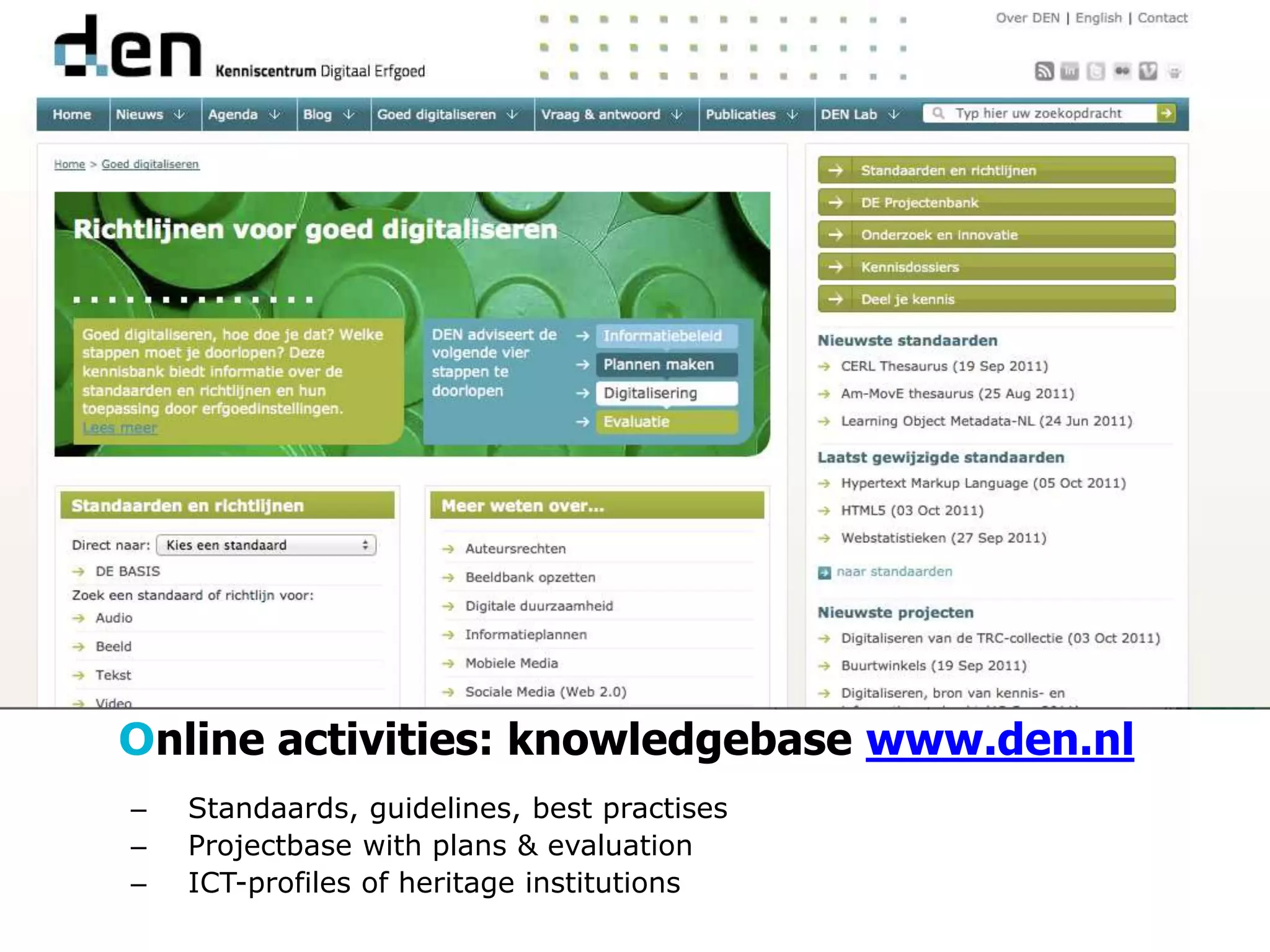
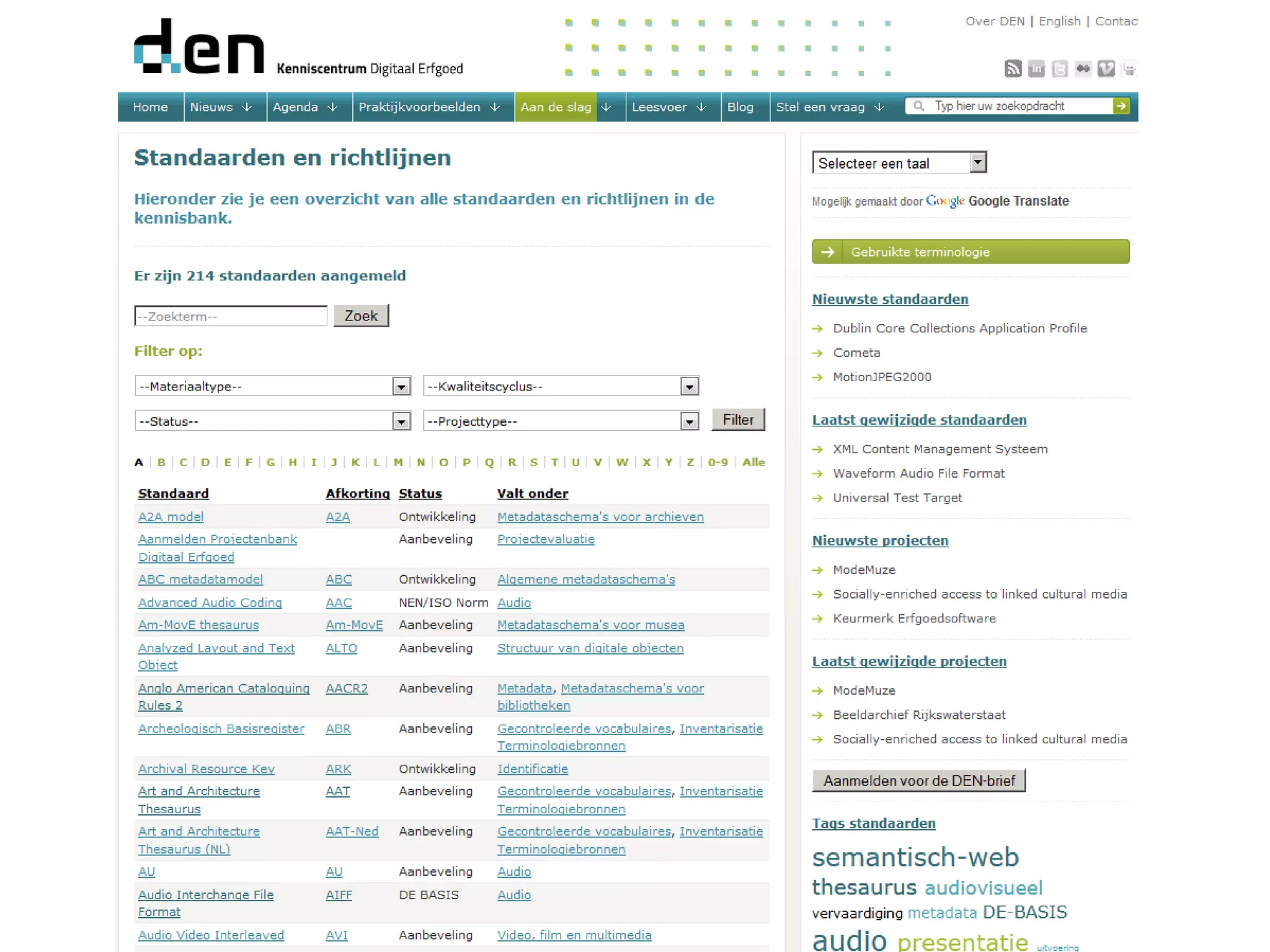
– Standaards, guidelines, best practises
– Projectbase with plans & evaluation
– ICT-profiles of heritage institutions
Online activities: knowledgebase www.den.nl
“Thou shalt always use open standards.”
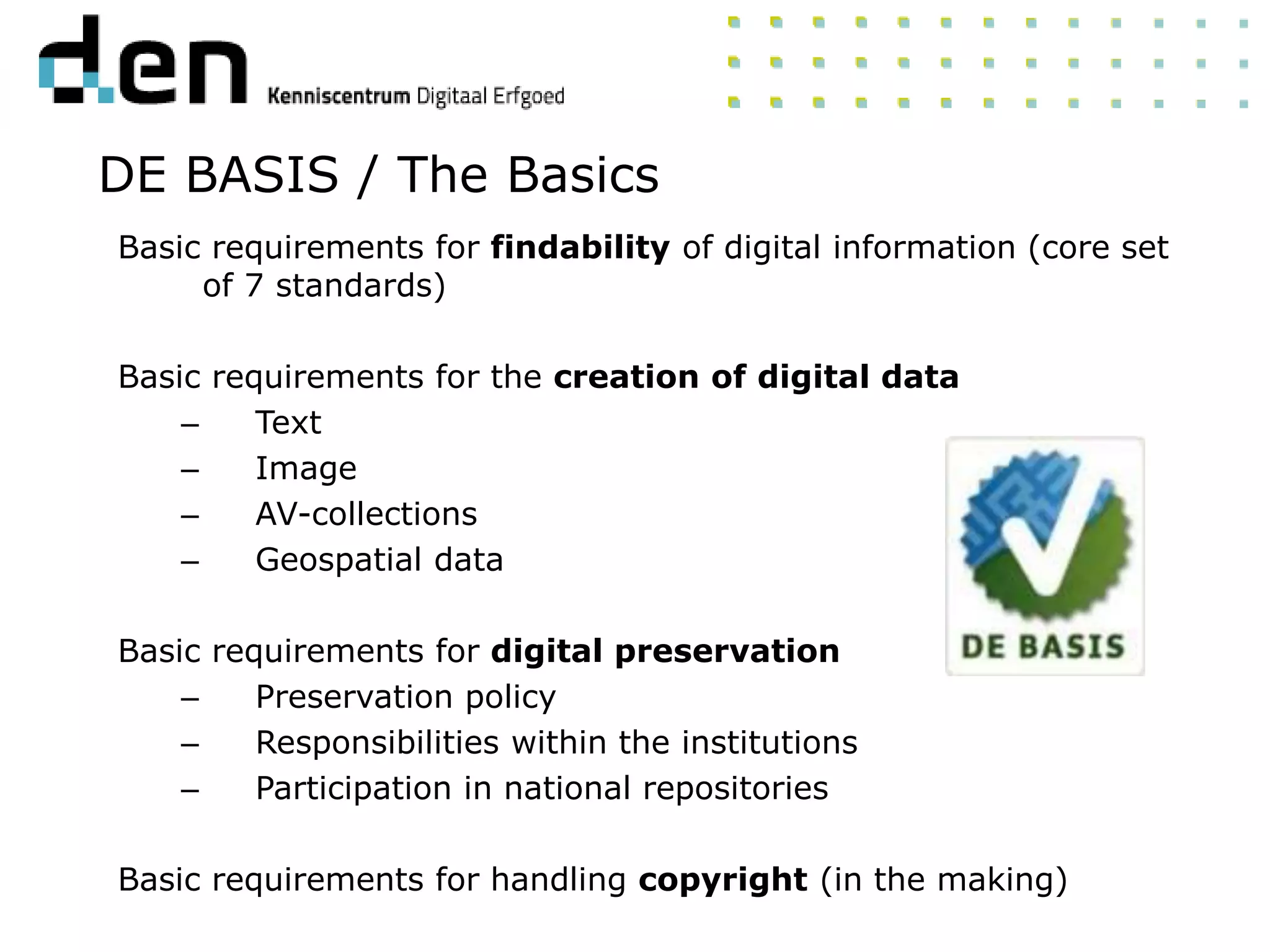
Basic requirements for findability of digital information (core set
of 7 standards)
Basic requirements for the creation of digital data
– Text
– Image
– AV-collections
– Geospatial data
Basic requirements for digital preservation
– Preservation policy
– Responsibilities within the institutions
– Participation in national repositories
Basic requirements for handling copyright (in the making)
DE BASIS / The Basics
What is digital heritage?
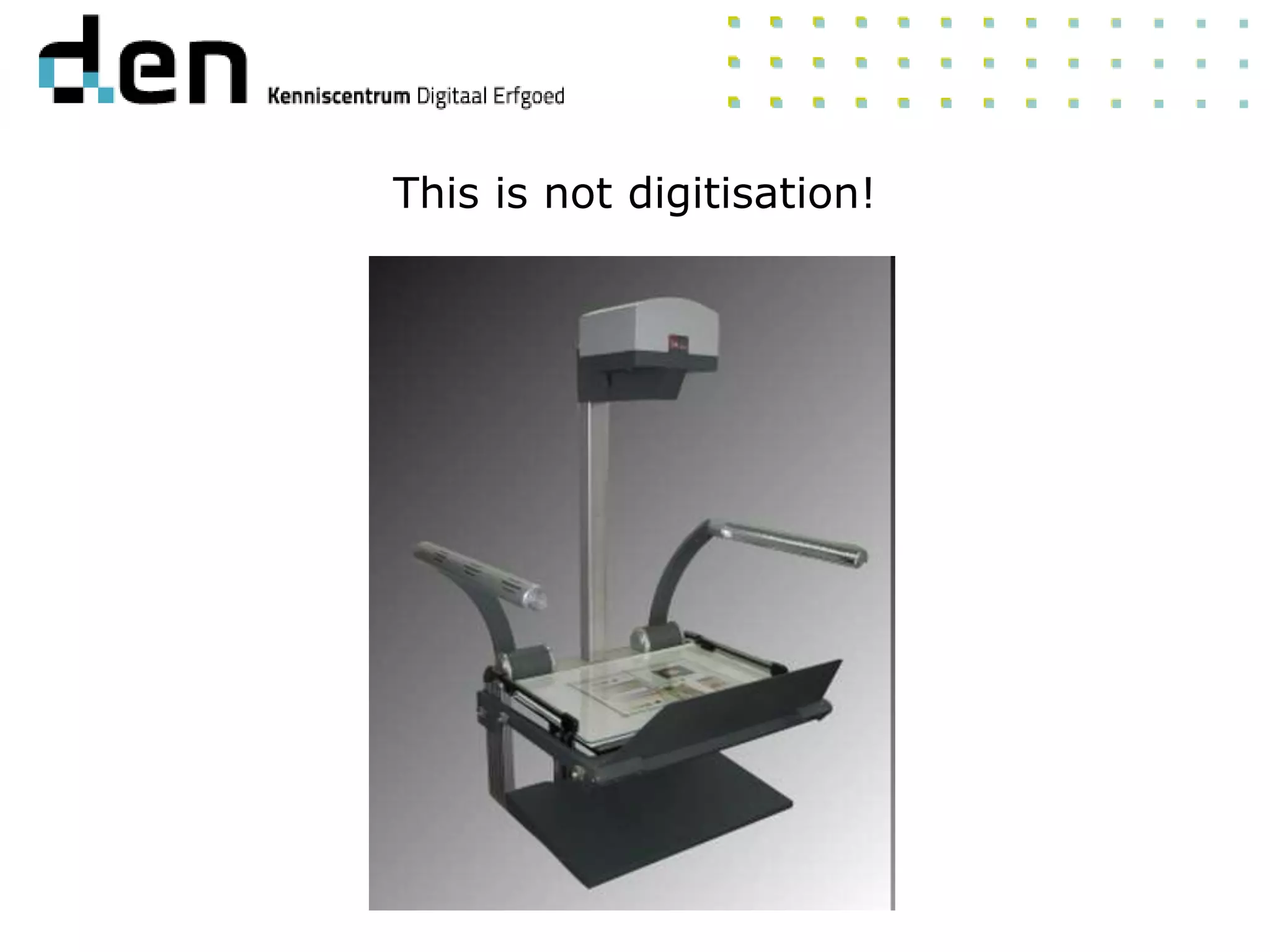
This is not digitisation!
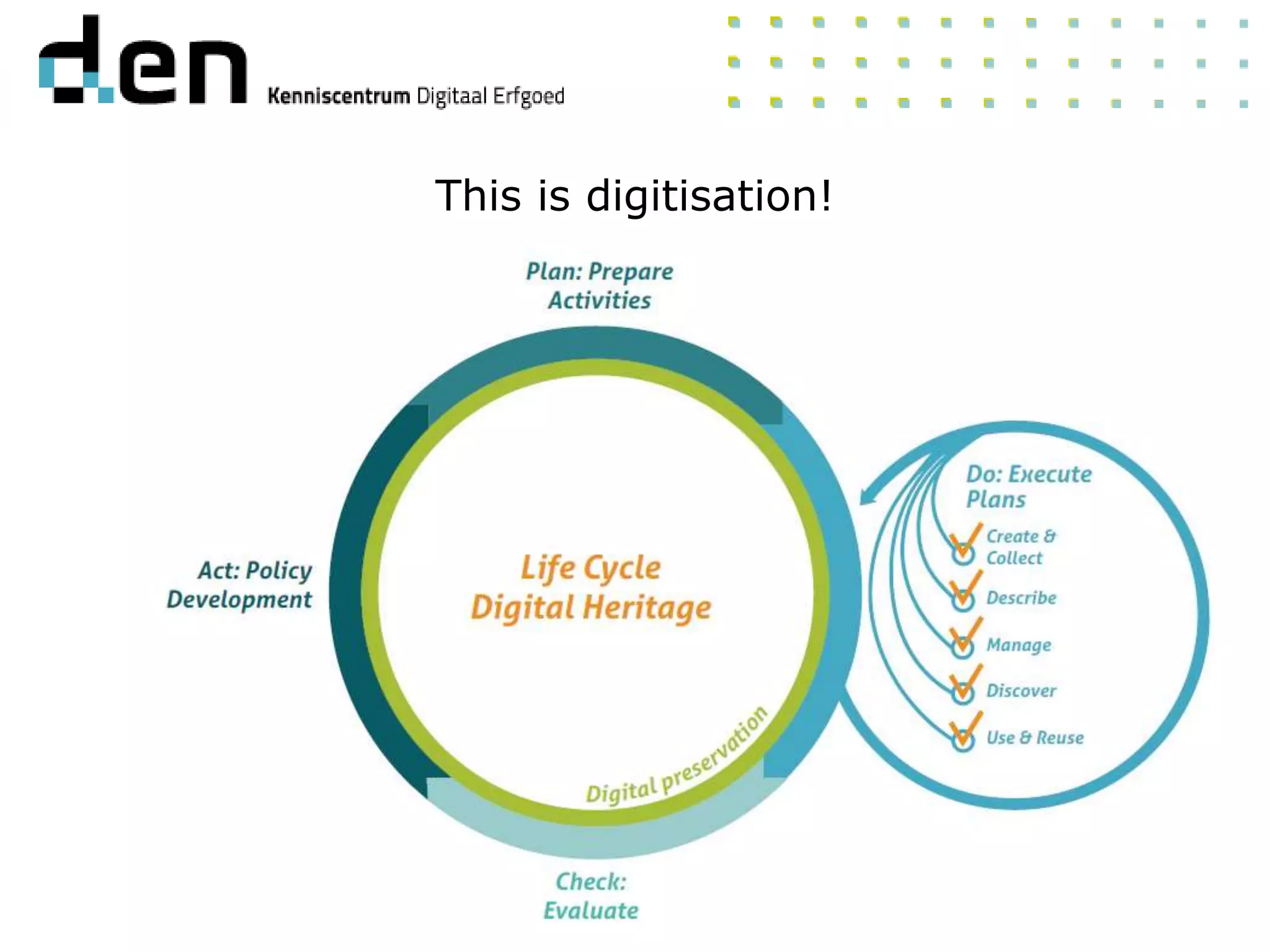
This is digitisation!
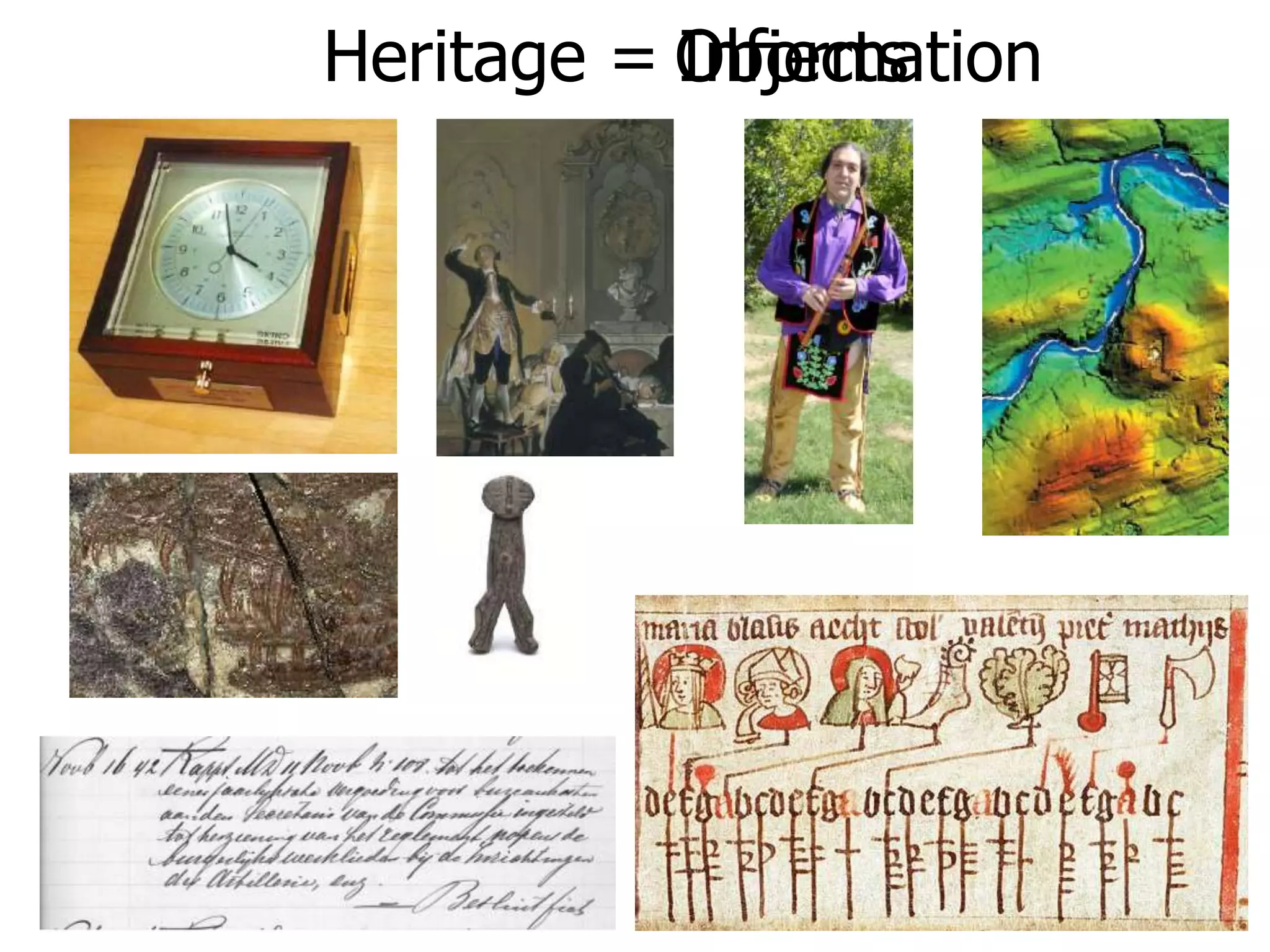
Heritage = ObjectsInformation
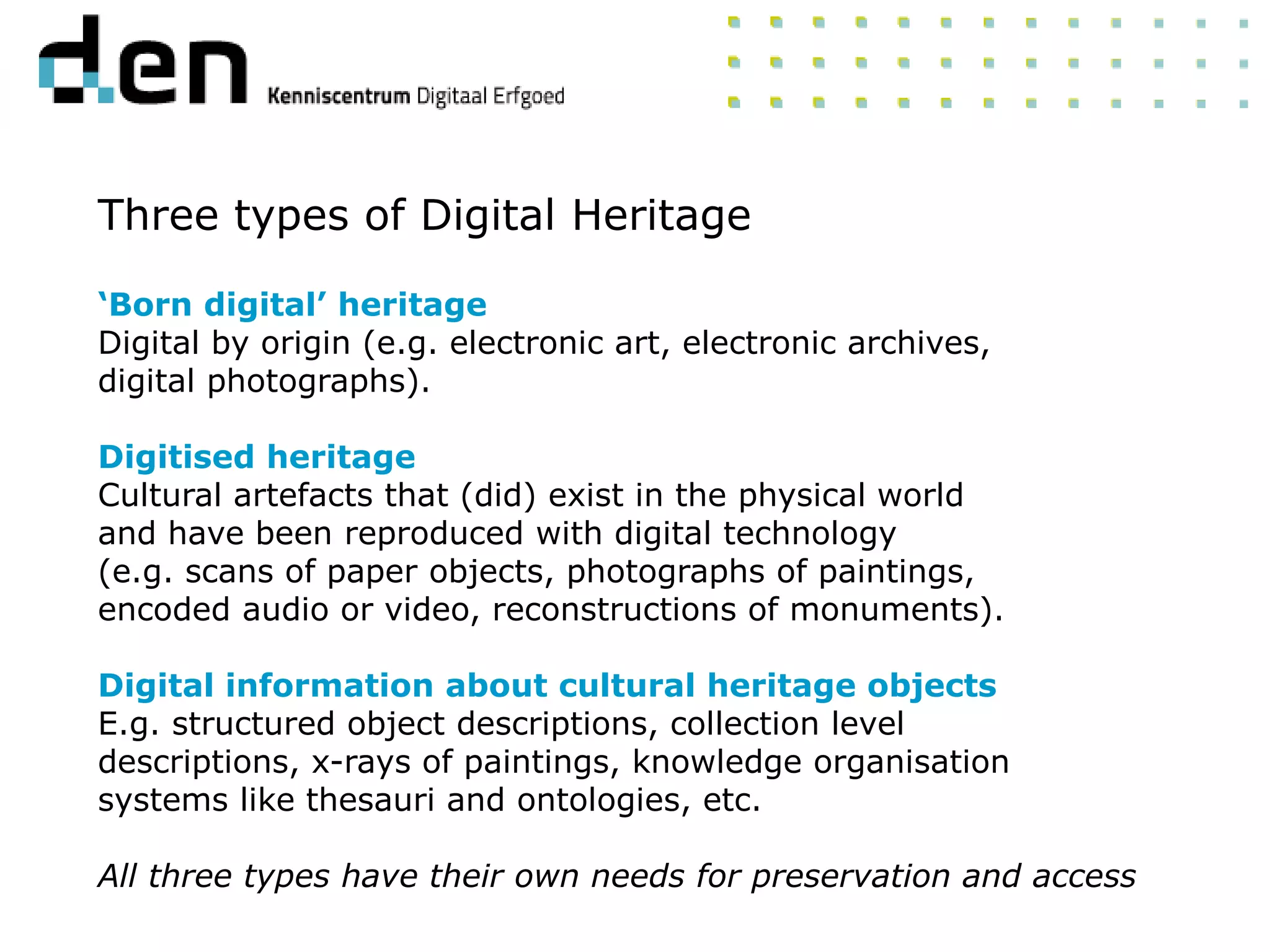
Three types of Digital Heritage
‘Born digital’ heritage
Digital by origin (e.g. electronic art, electronic archives,
digital photographs).
Digitised heritage
Cultural artefacts that (did) exist in the physical world
and have been reproduced with digital technology
(e.g. scans of paper objects, photographs of paintings,
encoded audio or video, reconstructions of monuments).
Digital information about cultural heritage objects
E.g. structured object descriptions, collection level
descriptions, x-rays of paintings, knowledge organisation
systems like thesauri and ontologies, etc.
All three types have their own needs for preservation and access
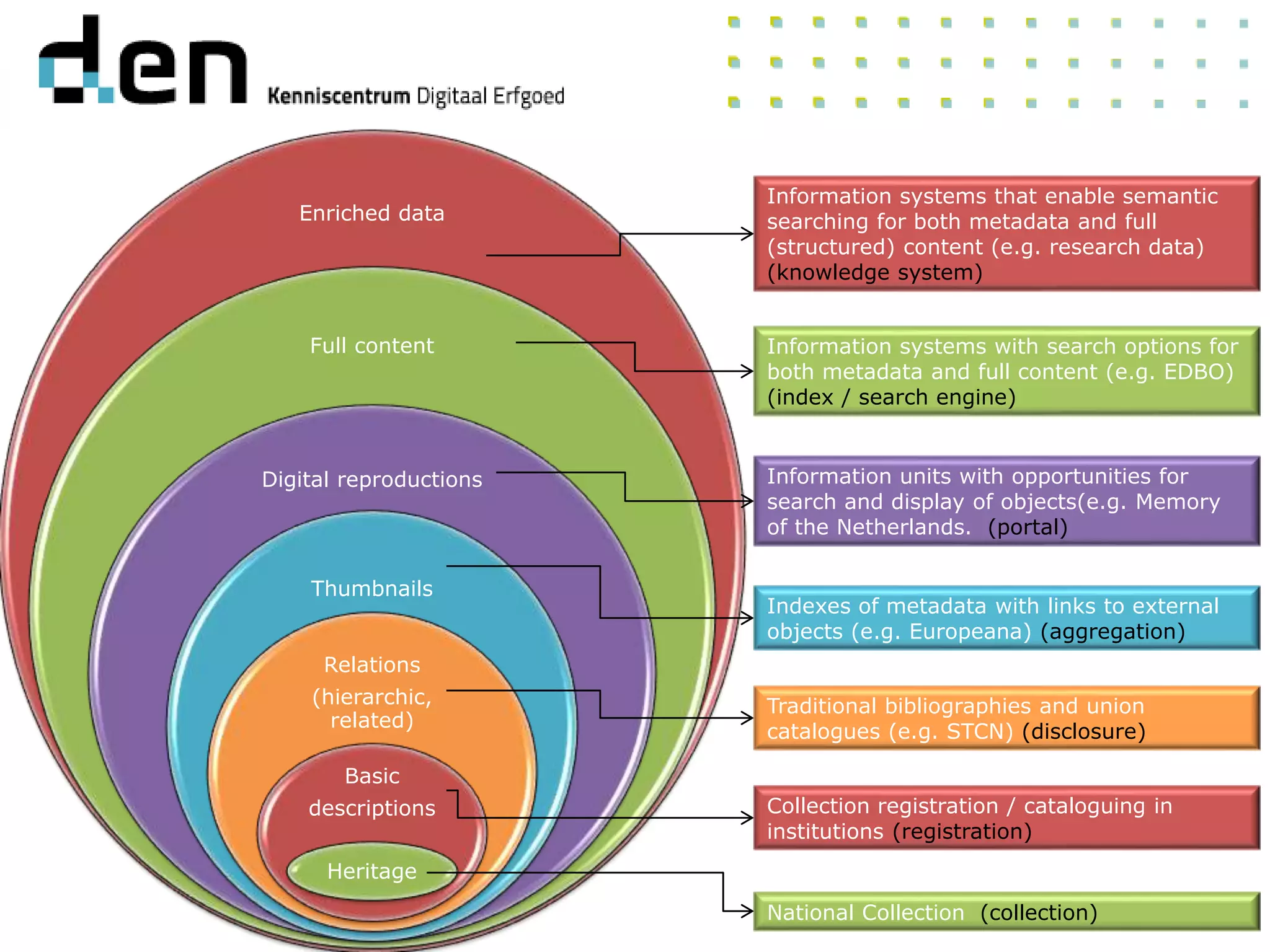
Enriched data
Full content
Digital reproductions
Thumbnails
Relations
(hierarchic,
related)
Basic
descriptions
Heritage
National Collection (collection)
Collection registration / cataloguing in
institutions (registration)
Traditional bibliographies and union
catalogues (e.g. STCN) (disclosure)
Indexes of metadata with links to external
objects (e.g. Europeana) (aggregation)
Information units with opportunities for
search and display of objects(e.g. Memory
of the Netherlands. (portal)
Information systems with search options for
both metadata and full content (e.g. EDBO)
(index / search engine)
Information systems that enable semantic
searching for both metadata and full
(structured) content (e.g. research data)
(knowledge system)
ACT
PLAN
DO
CHECK
Project planning
User studies
Highlights
(1995-)
Heavily used
Collections
(2000- )
Mass Digitisation
(2005- )
Evaluation
Information plans
Evolution of digitisation
Benchmarking
Business Model
Innovation
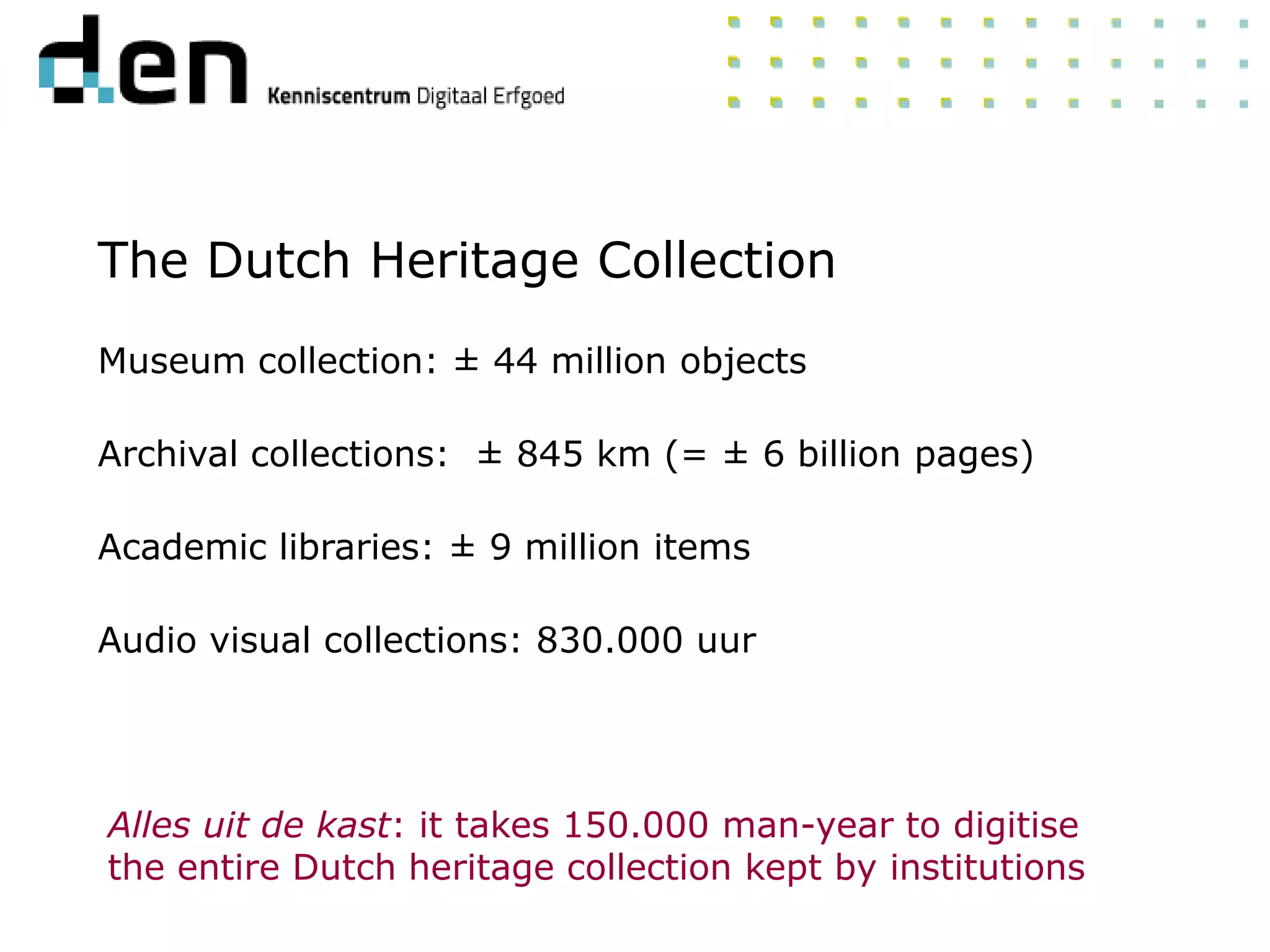
Museum collection: ± 44 million objects
Archival collections: ± 845 km (= ± 6 billion pages)
Academic libraries: ± 9 million items
Audio visual collections: 830.000 uur
Alles uit de kast: it takes 150.000 man-year to digitise
the entire Dutch heritage collection kept by institutions
The Dutch Heritage Collection
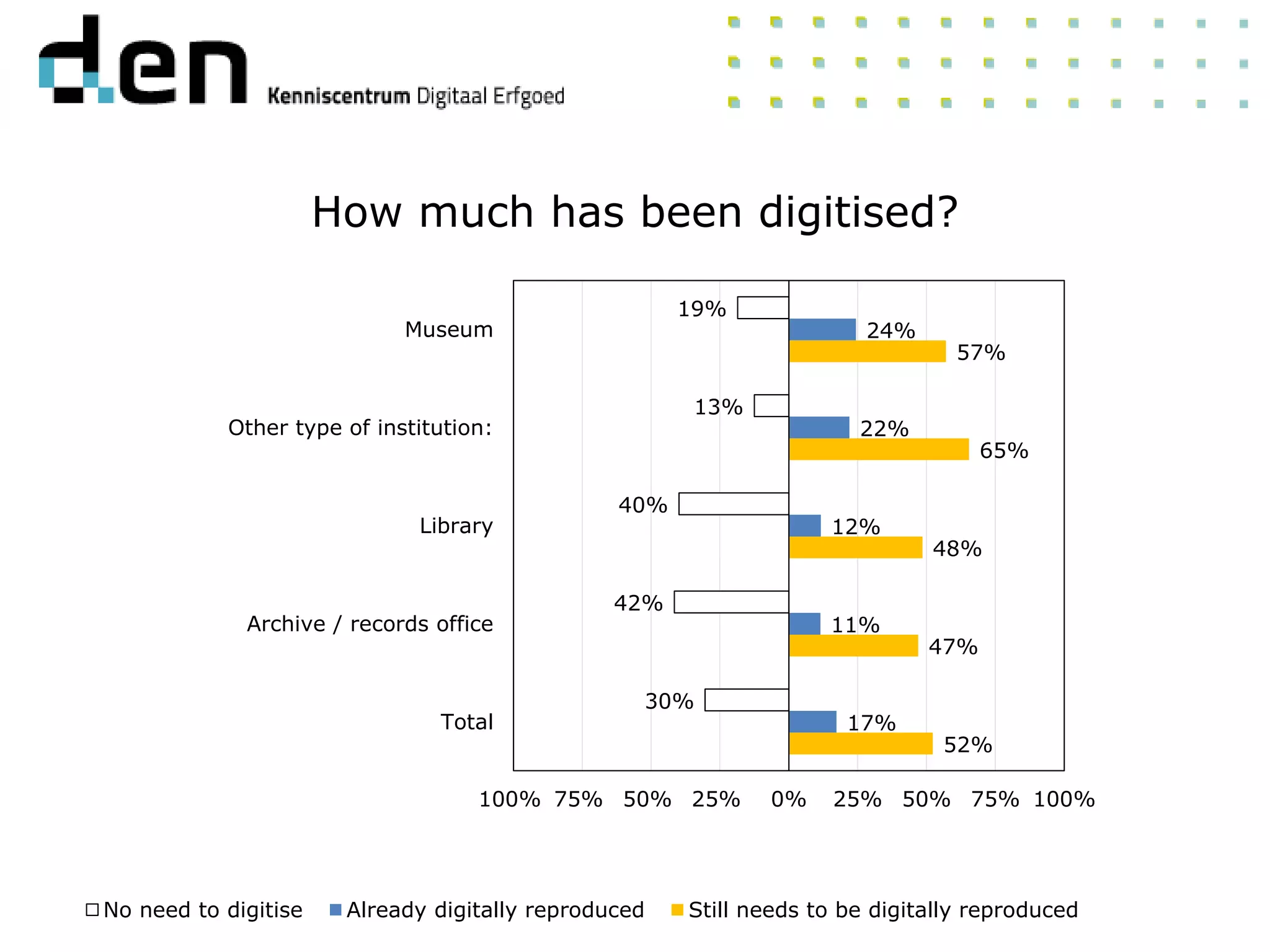
How much has been digitised?
19%
13%
40%
42%
30%
24%
22%
12%
11%
17%
57%
65%
48%
47%
52%
100% 75% 50% 25% 0% 25% 50% 75% 100%
Museum
Other type of institution:
Library
Archive / records office
Total
No need to digitise Already digitally reproduced Still needs to be digitally reproduced
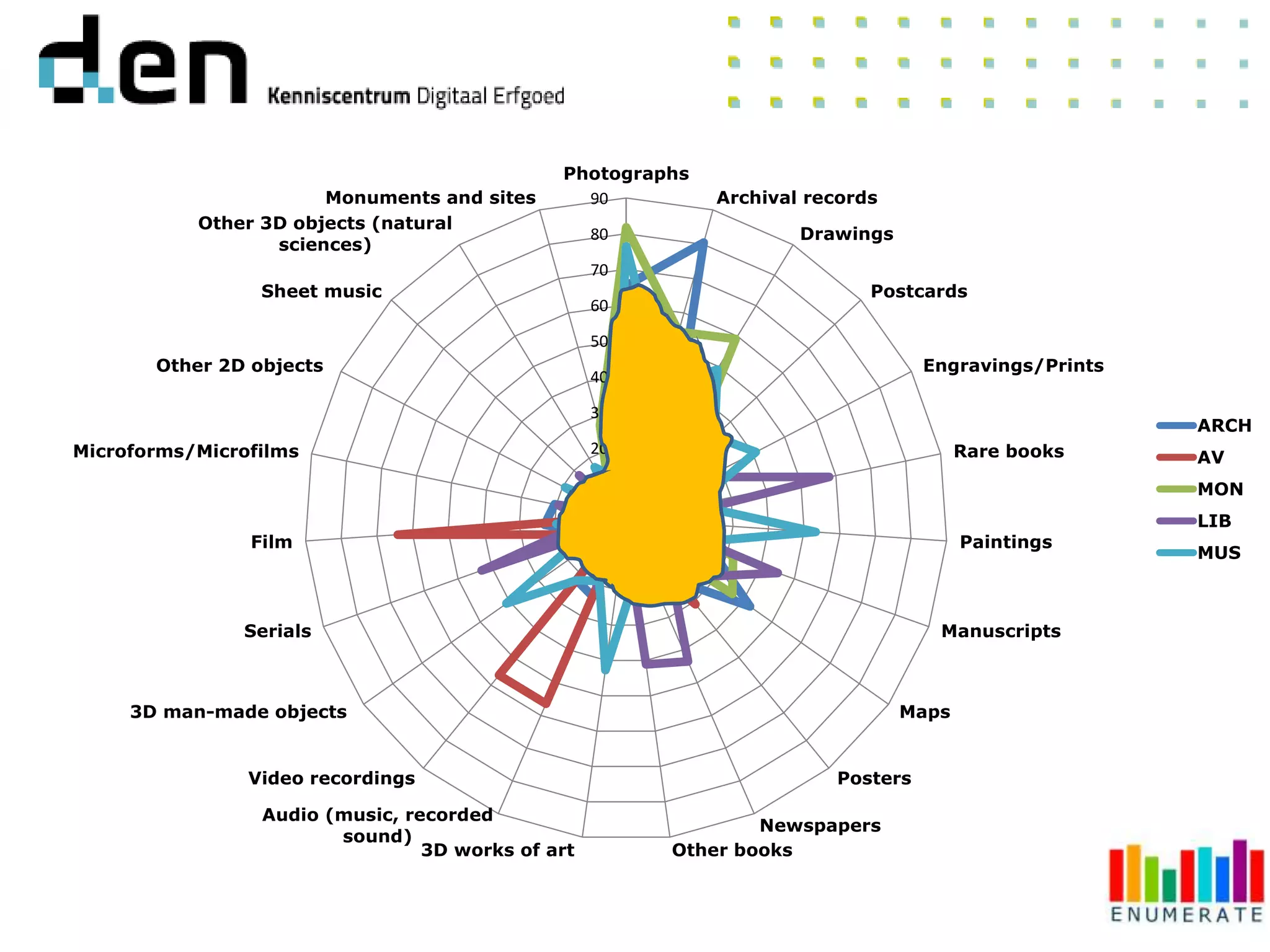
0
10
20
30
40
50
60
70
80
90
Photographs
Archival records
Drawings
Postcards
Engravings/Prints
Rare books
Paintings
Manuscripts
Maps
Posters
Newspapers
Other books3D works of art
Audio (music, recorded
sound)
Video recordings
3D man-made objects
Serials
Film
Microforms/Microfilms
Other 2D objects
Sheet music
Other 3D objects (natural
sciences)
Monuments and sites
ARCH
AV
MON
LIB
MUS
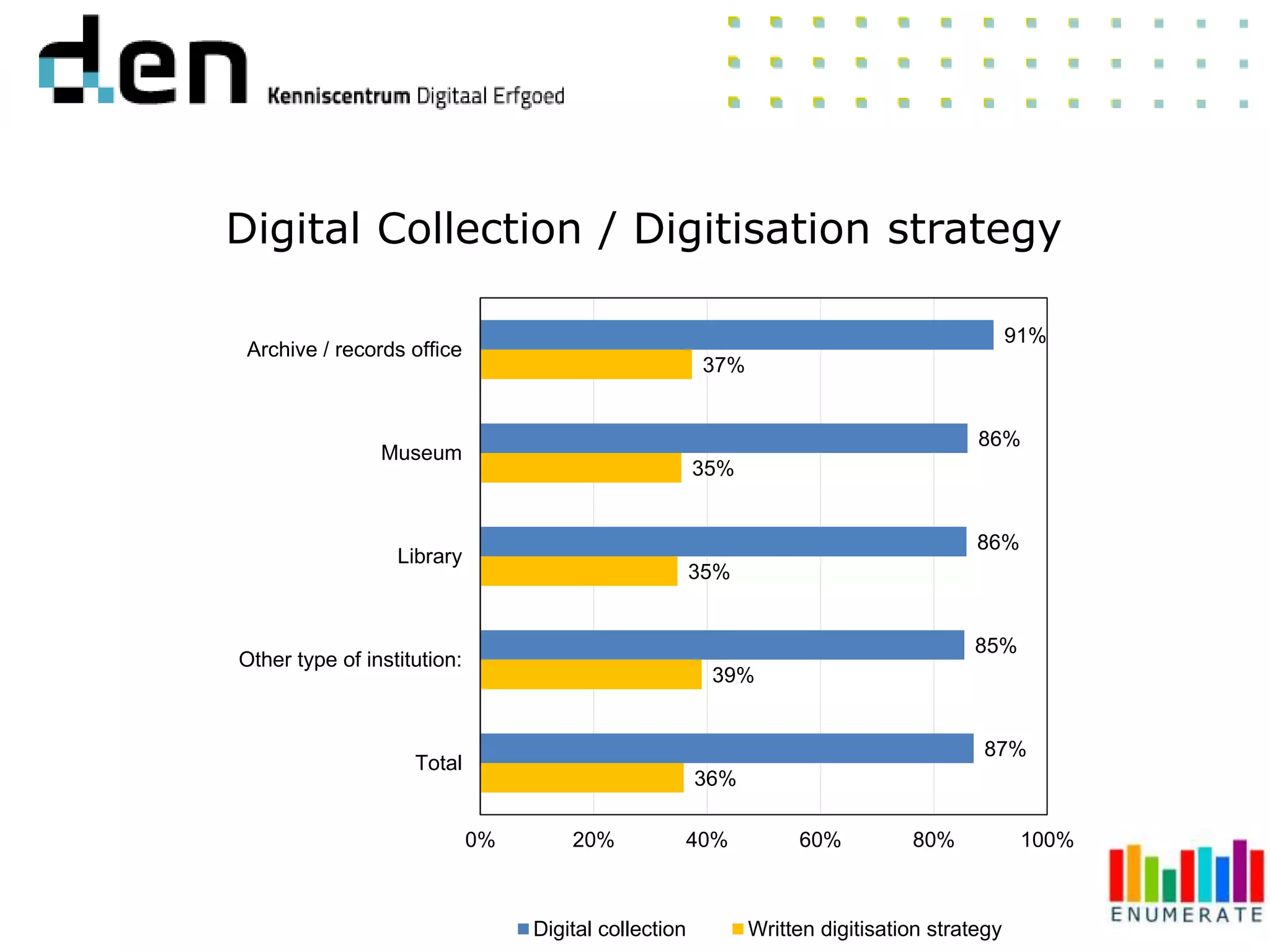
Digital Collection / Digitisation strategy
91%
86%
86%
85%
87%
37%
35%
35%
39%
36%
0% 20% 40% 60% 80% 100%
Archive / records office
Museum
Library
Other type of institution:
Total
Digital collection Written digitisation strategy
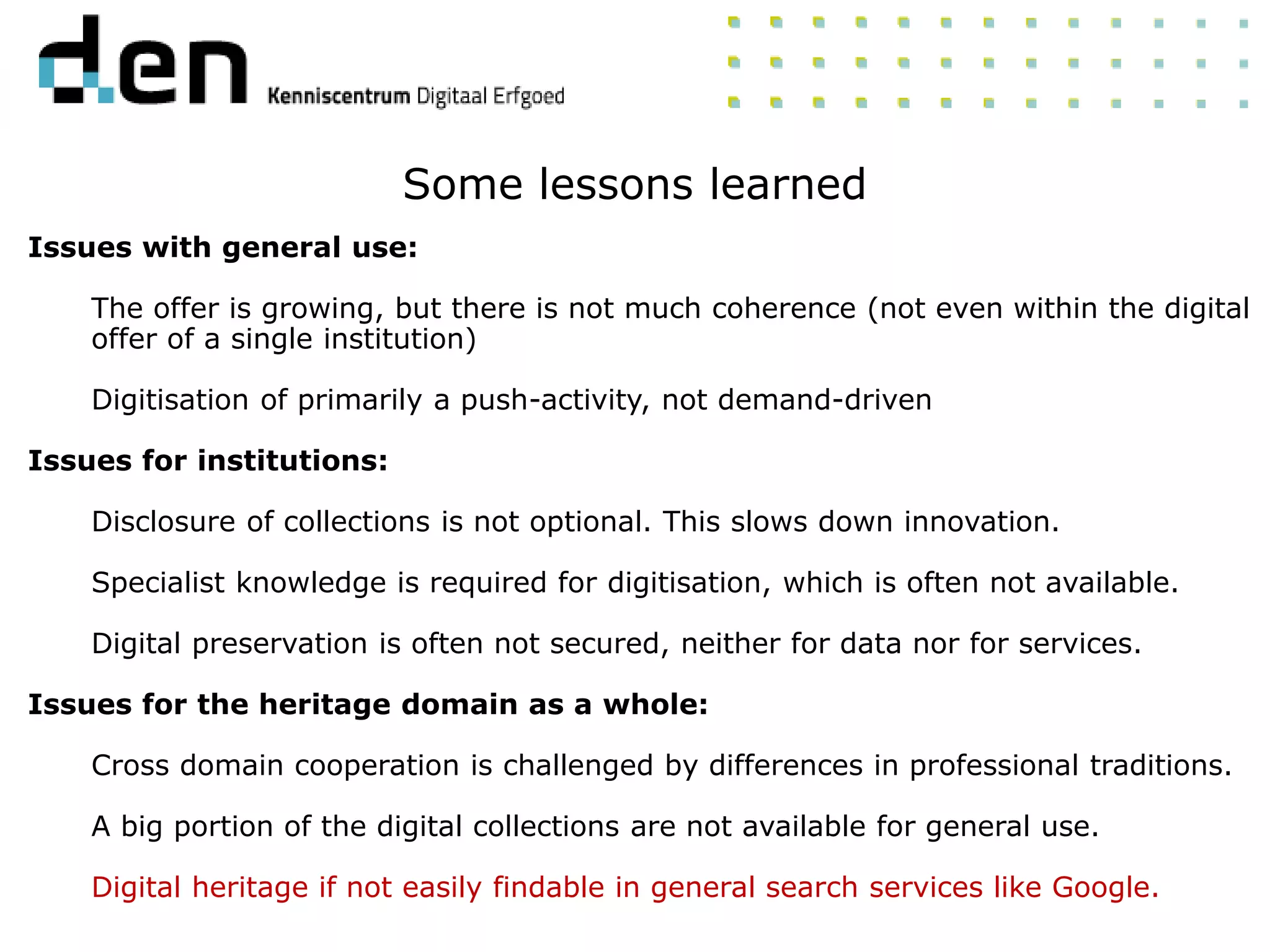
Issues with general use:
The offer is growing, but there is not much coherence (not even within the digital
offer of a single institution)
Digitisation of primarily a push-activity, not demand-driven
Issues for institutions:
Disclosure of collections is not optional. This slows down innovation.
Specialist knowledge is required for digitisation, which is often not available.
Digital preservation is often not secured, neither for data nor for services.
Issues for the heritage domain as a whole:
Cross domain cooperation is challenged by differences in professional traditions.
A big portion of the digital collections are not available for general use.
Digital heritage if not easily findable in general search services like Google.
Some lessons learned
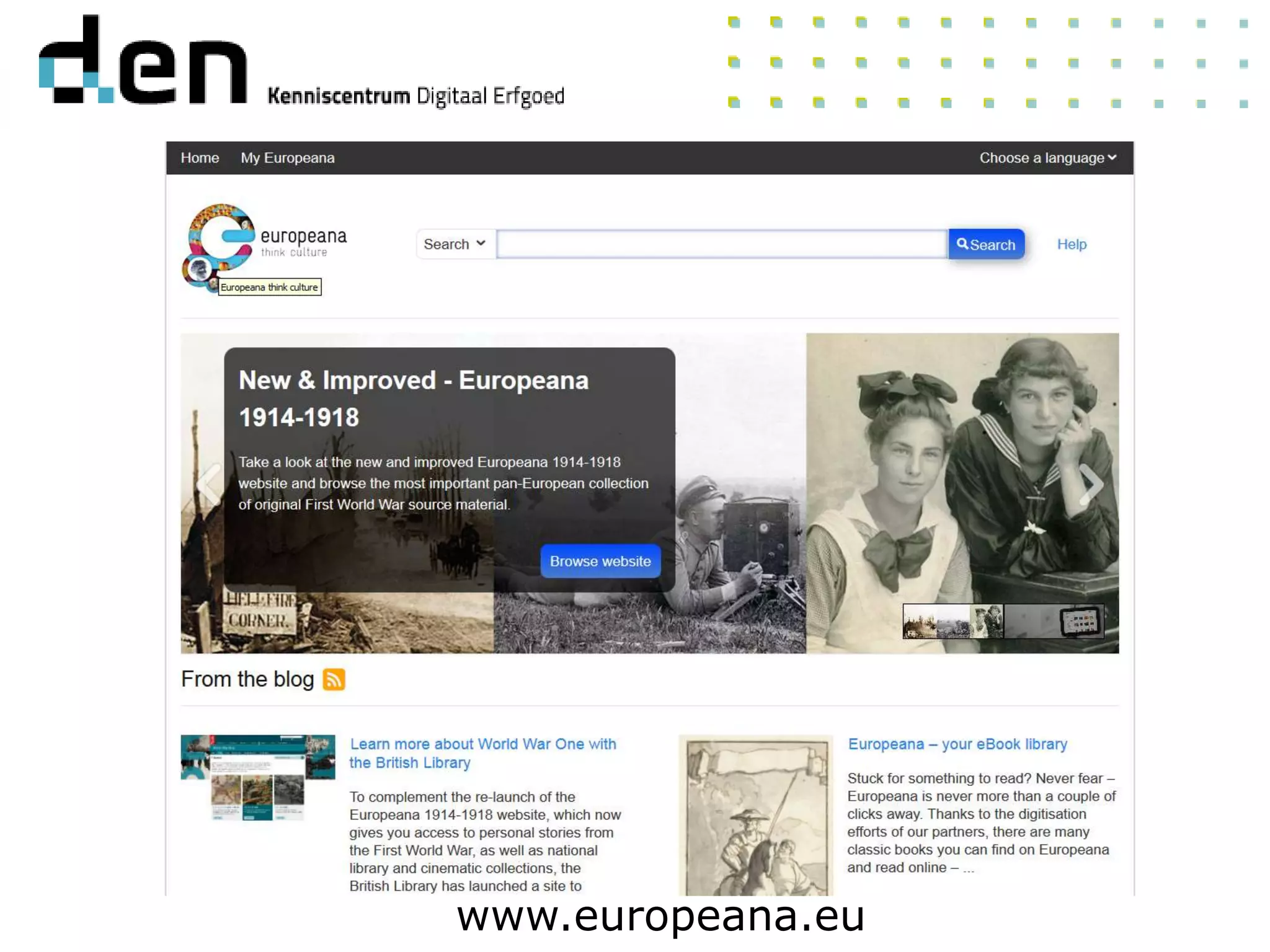
www.europeana.eu
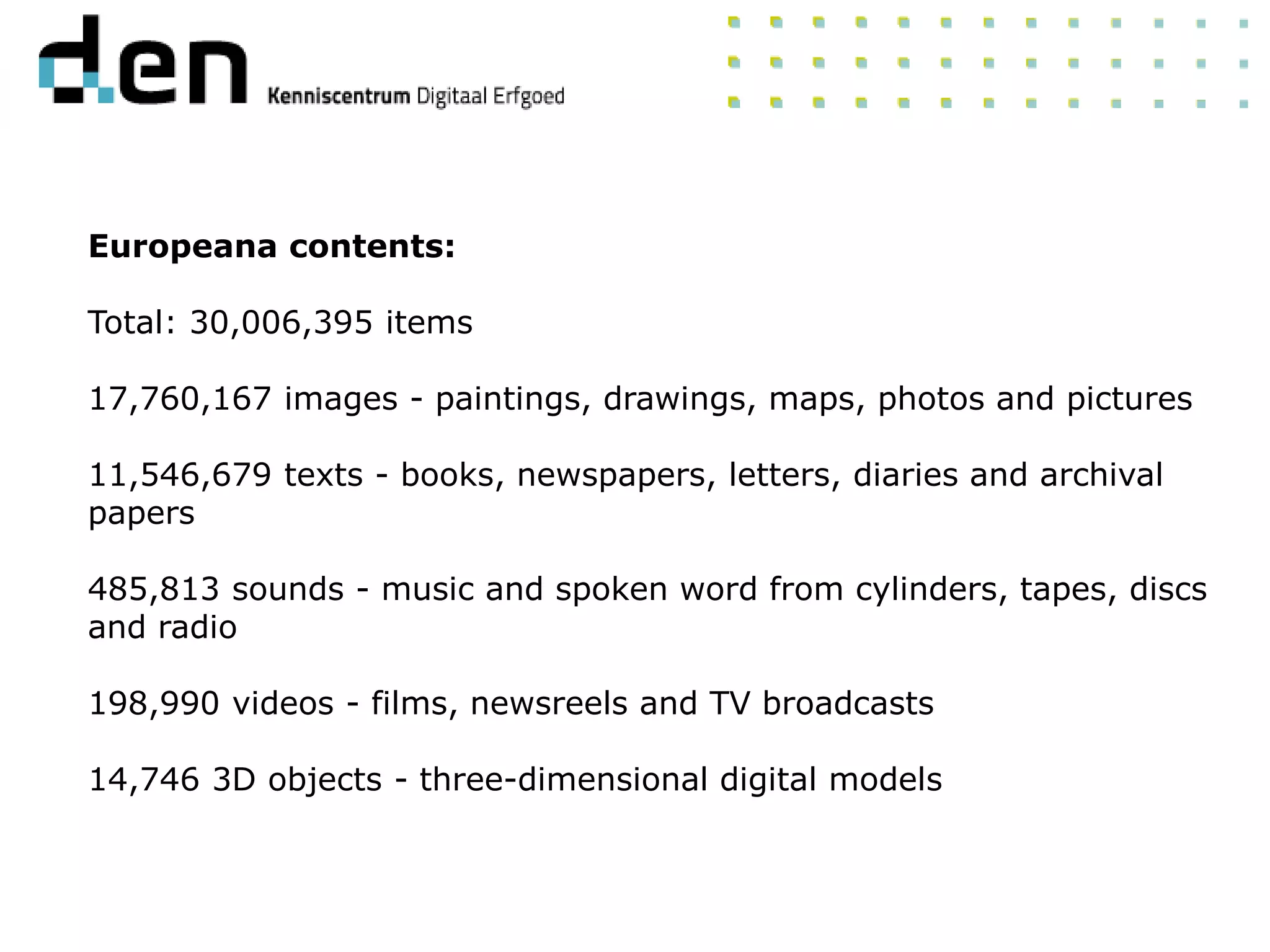
Europeana contents:
Total: 30,006,395 items
17,760,167 images - paintings, drawings, maps, photos and pictures
11,546,679 texts - books, newspapers, letters, diaries and archival
papers
485,813 sounds - music and spoken word from cylinders, tapes, discs
and radio
198,990 videos - films, newsreels and TV broadcasts
14,746 3D objects - three-dimensional digital models
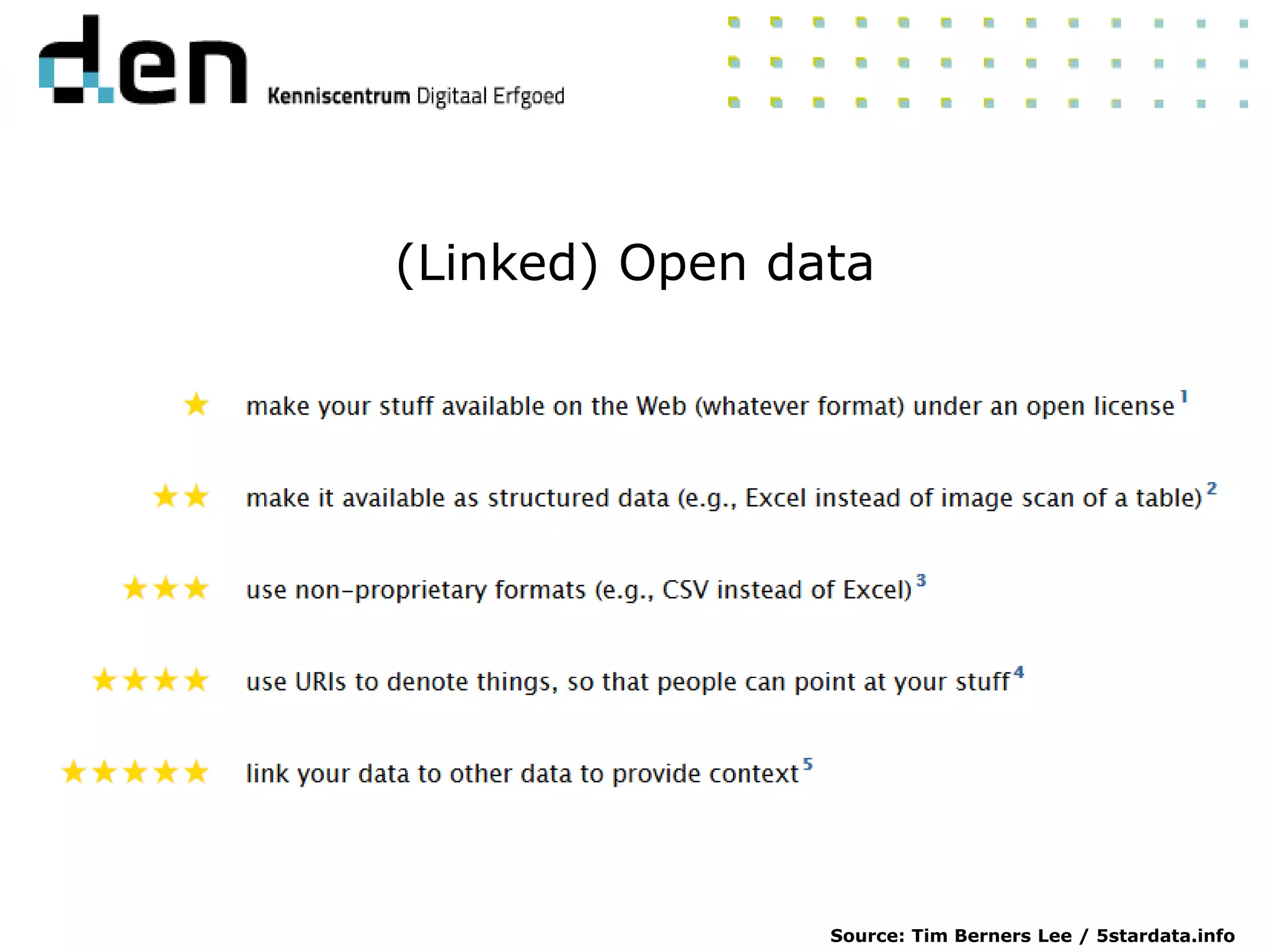
Source: Tim Berners Lee / 5stardata.info
(Linked) Open data
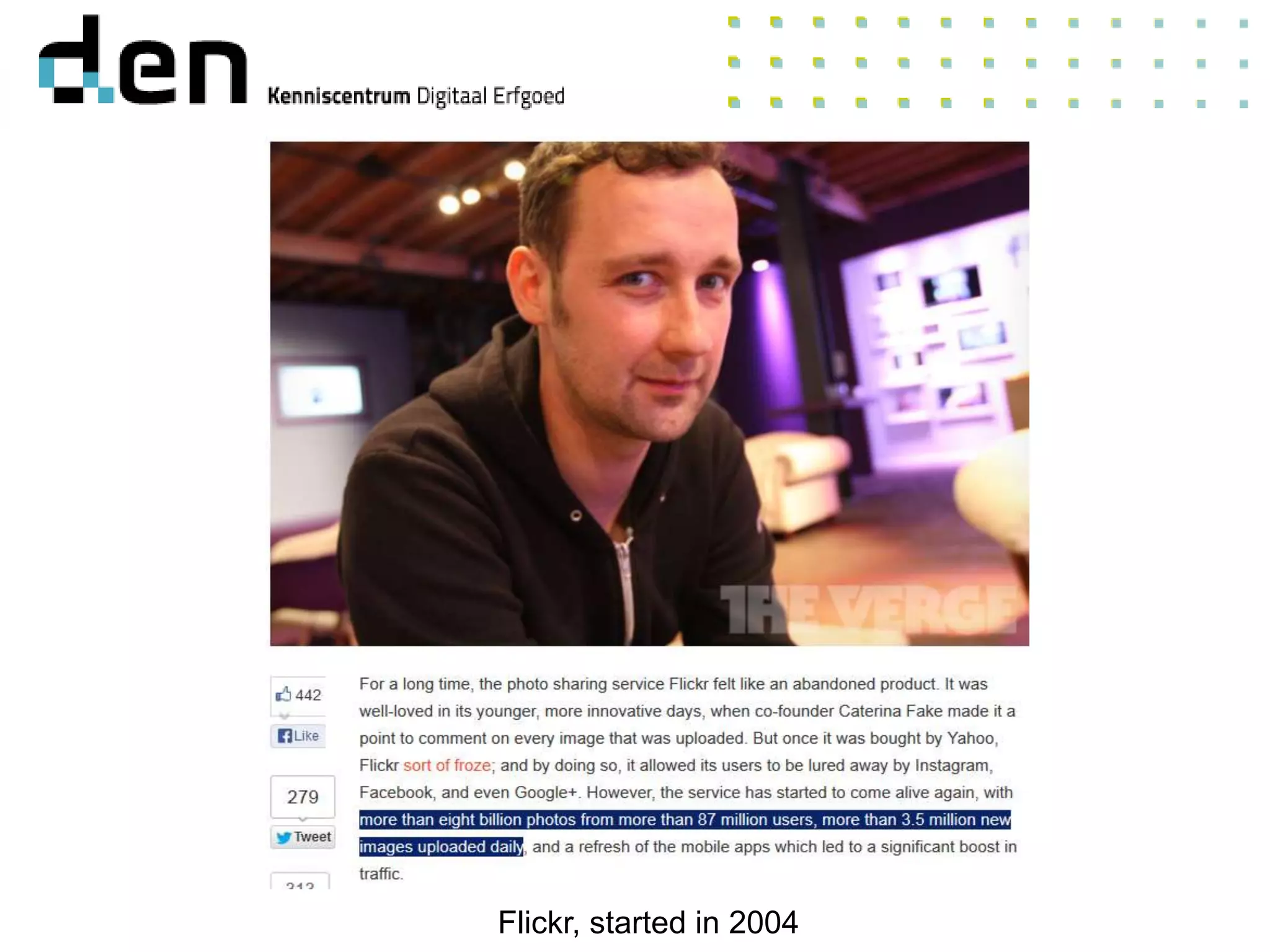
Flickr, started in 2004
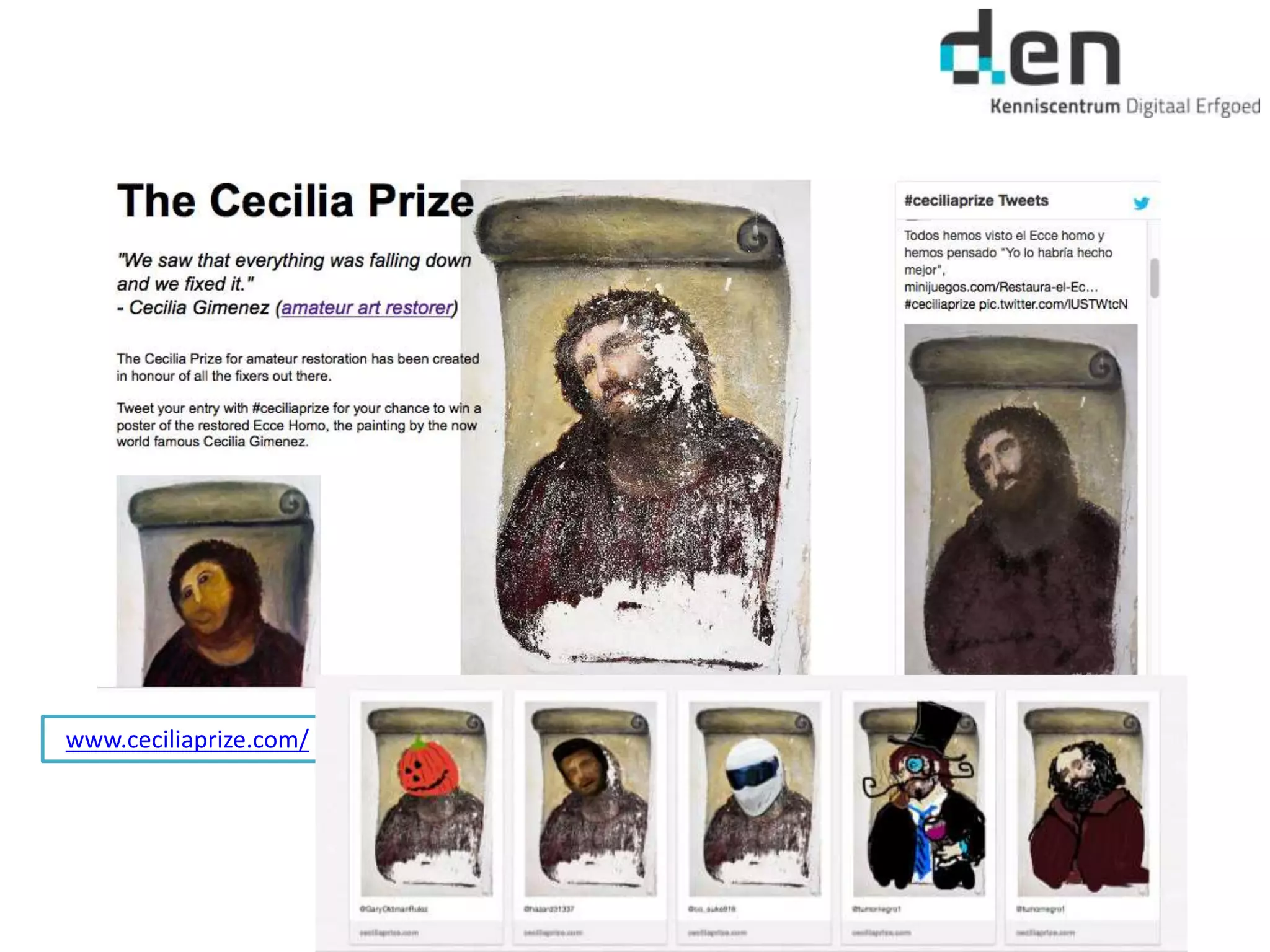
www.ceciliaprize.com/
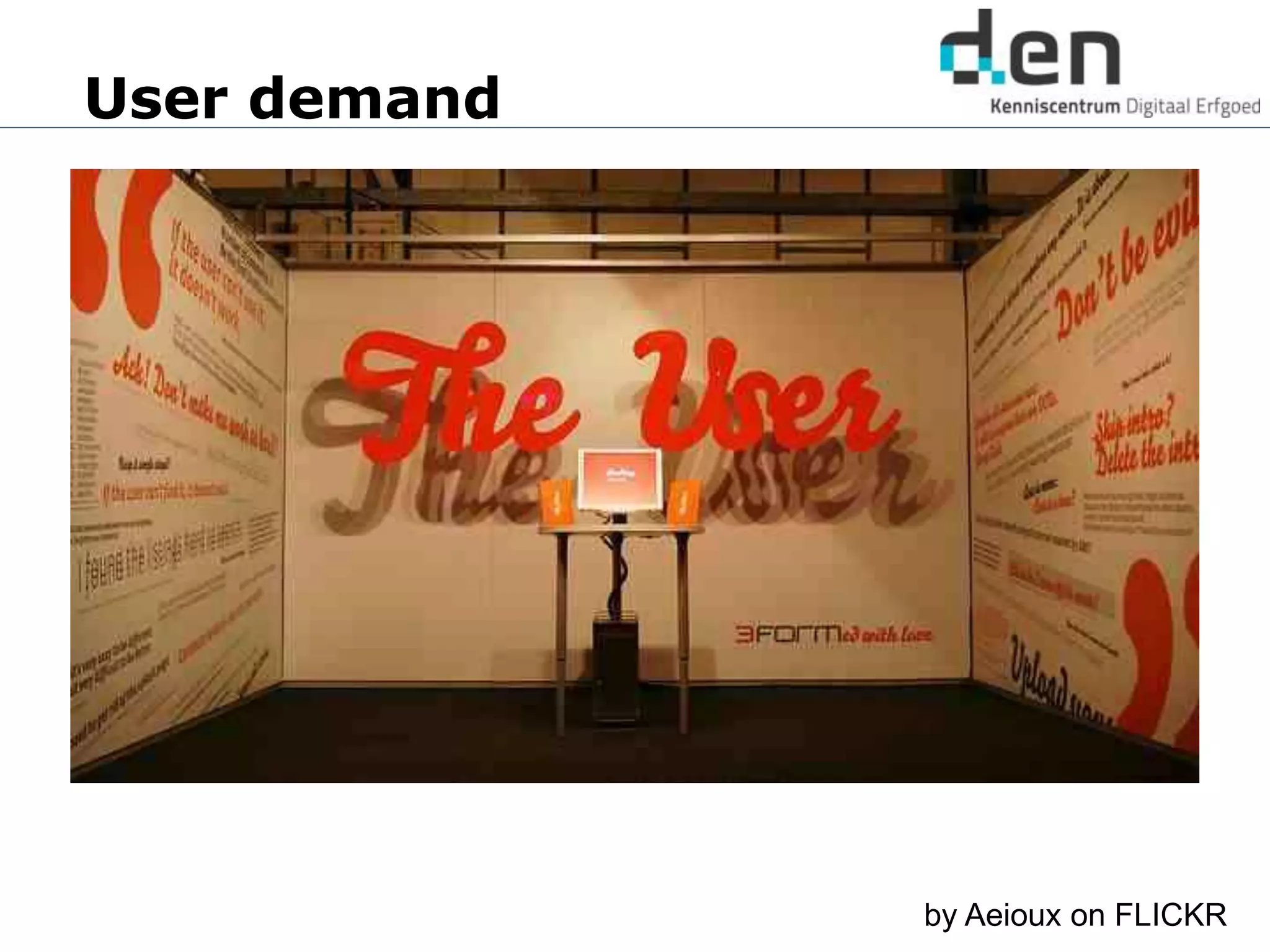
User demand
by Aeioux on FLICKR
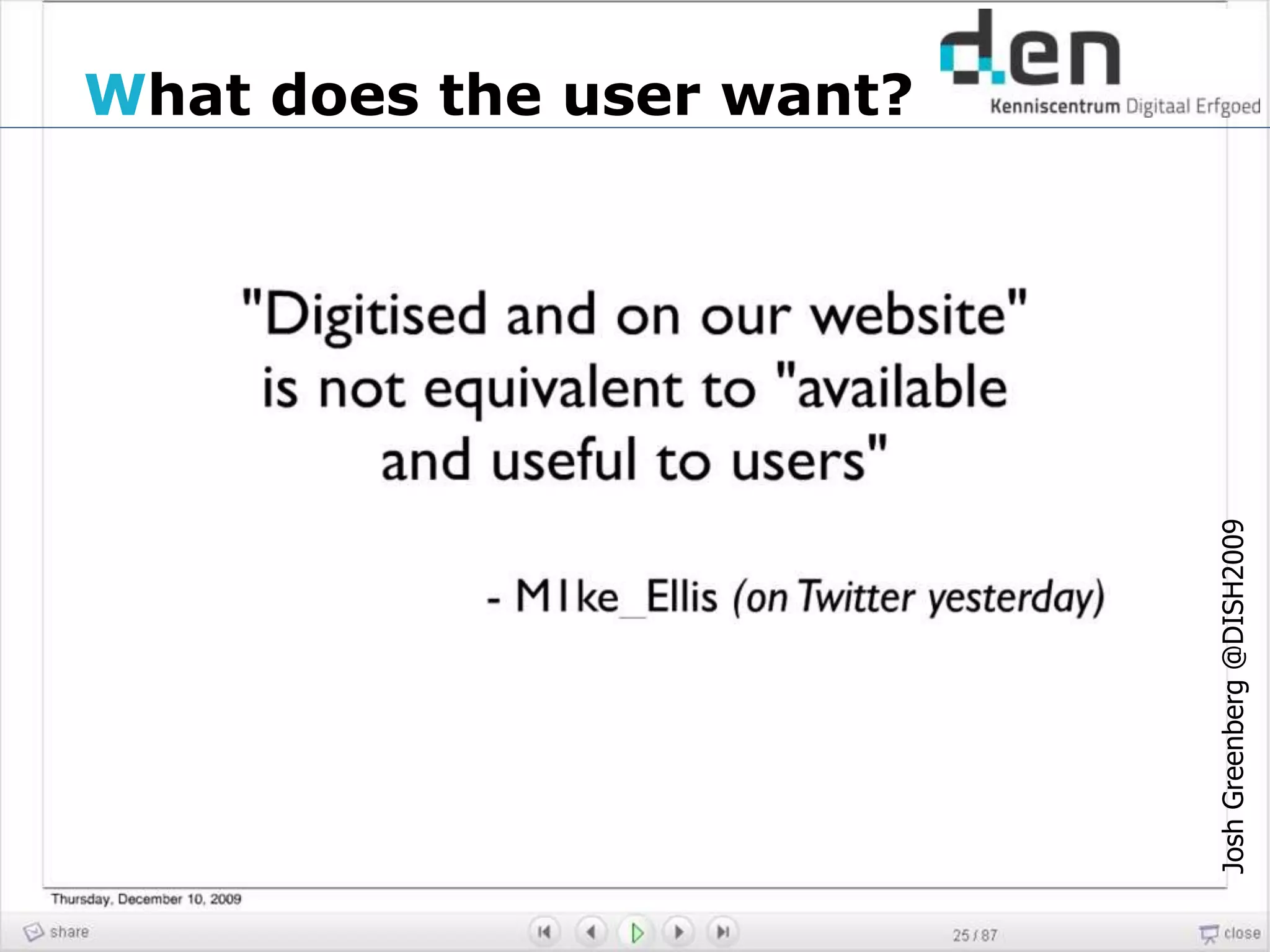
Tweet Mike Ellis
JoshGreenberg@DISH2009
What does the user want?
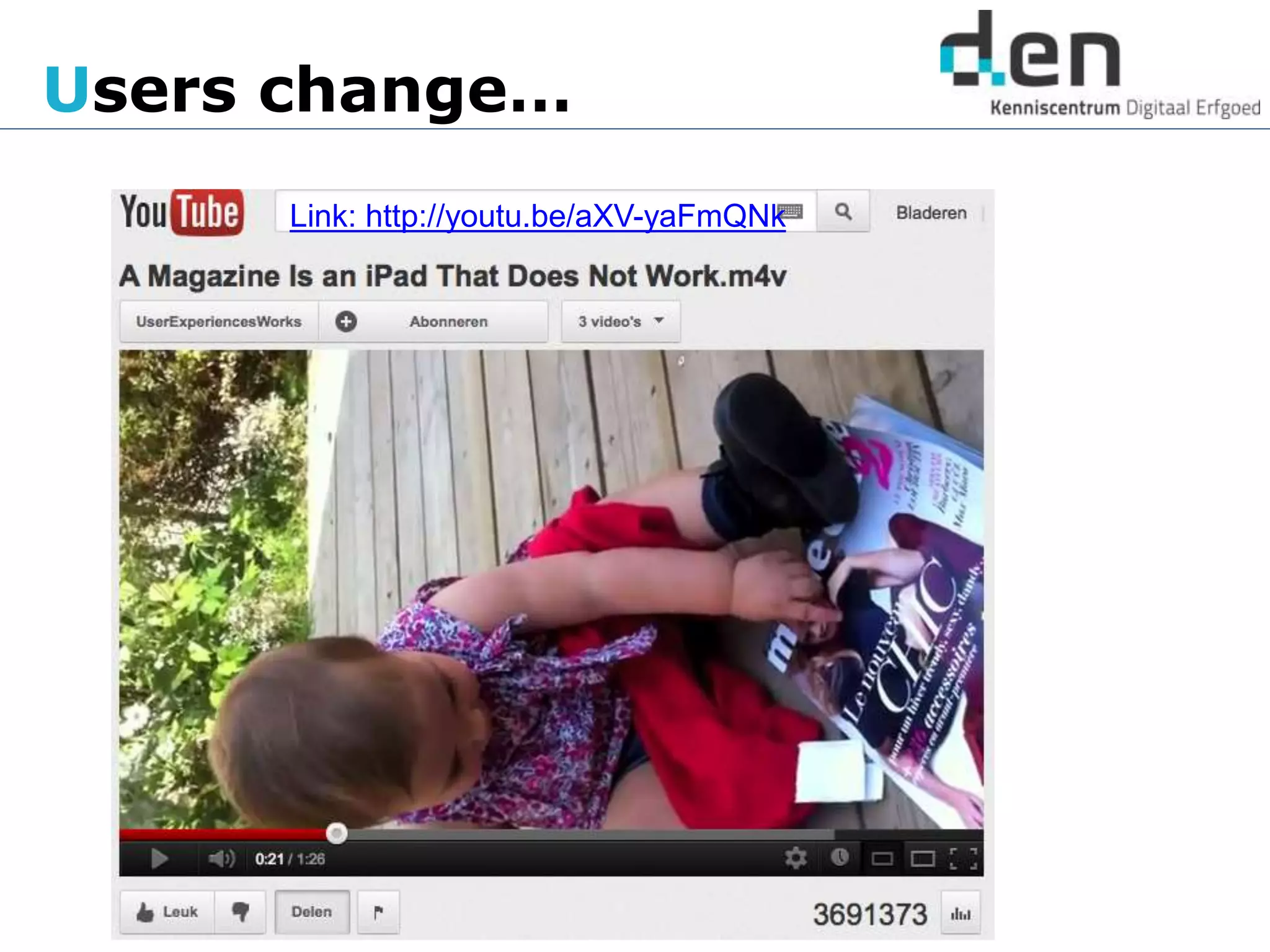
Link: http://youtu.be/aXV-yaFmQNk
Users change…
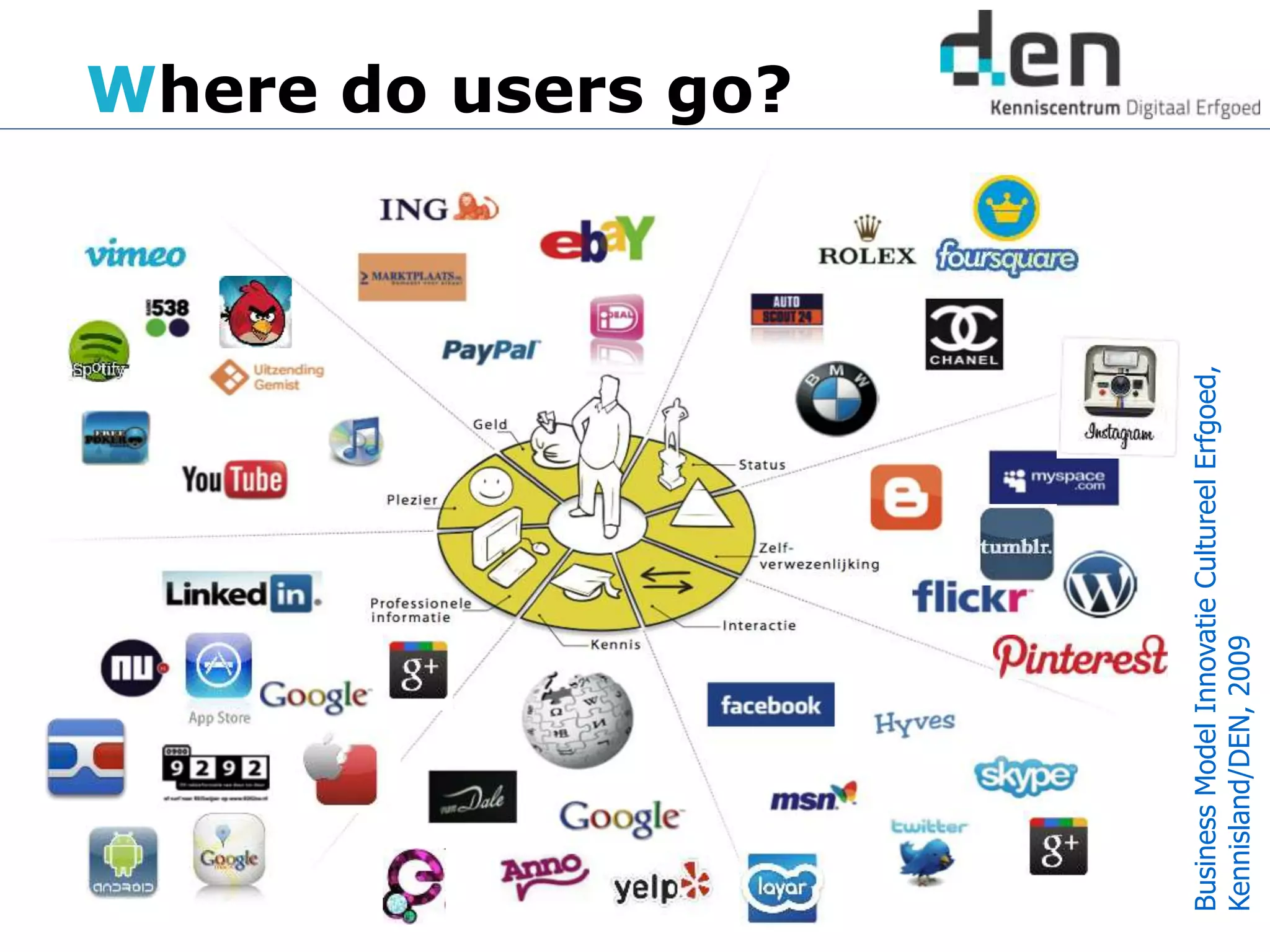
Where do users go?
BusinessModelInnovatieCultureelErfgoed,
Kennisland/DEN,2009
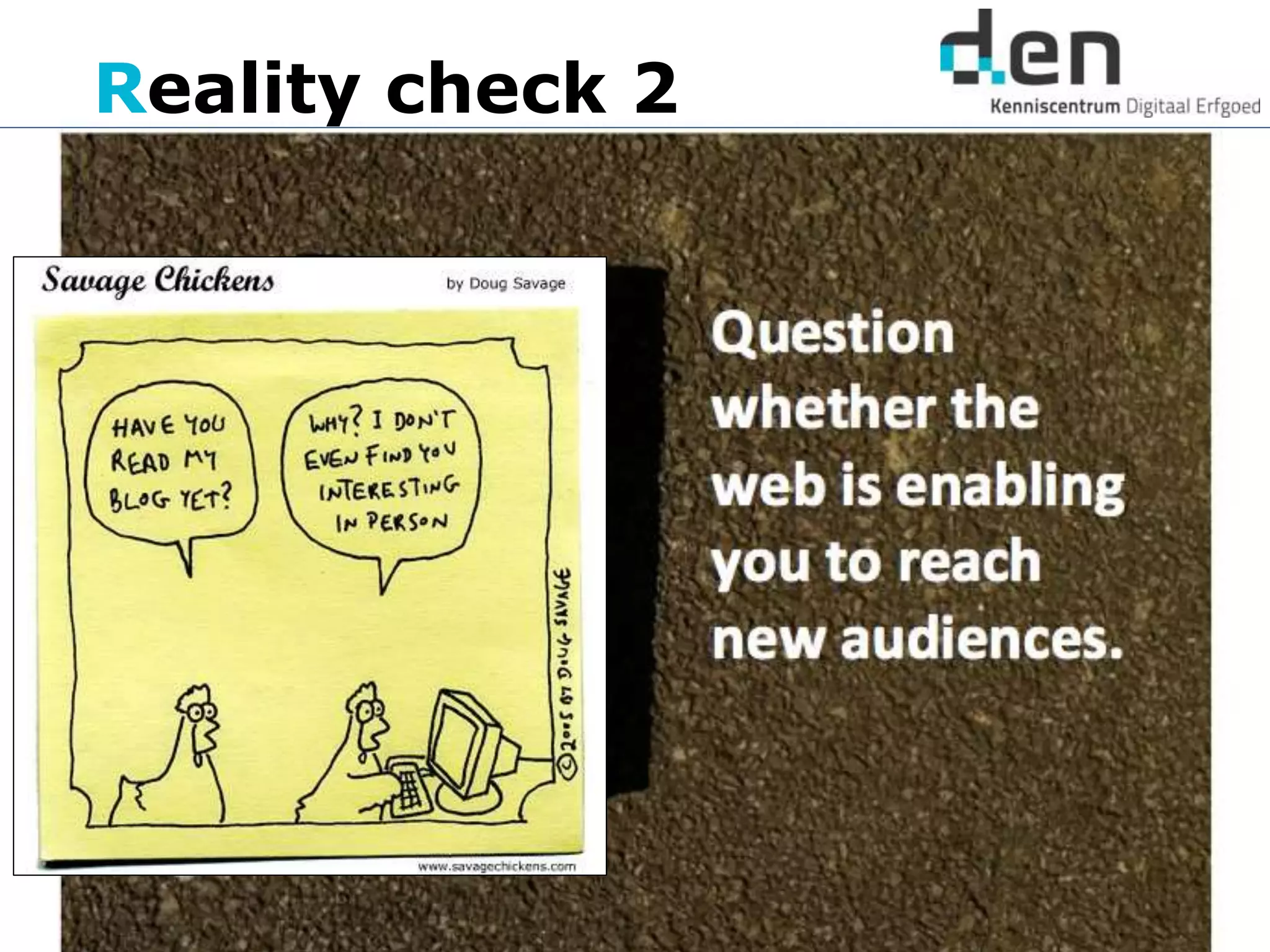
Reality check 1
Bron: Culture24 Action Research Report 2011: “How to measure success
online?”
http://weareculture24.org.uk/projects/action-research/how-to-evaluate-success-online/
Reality check 2
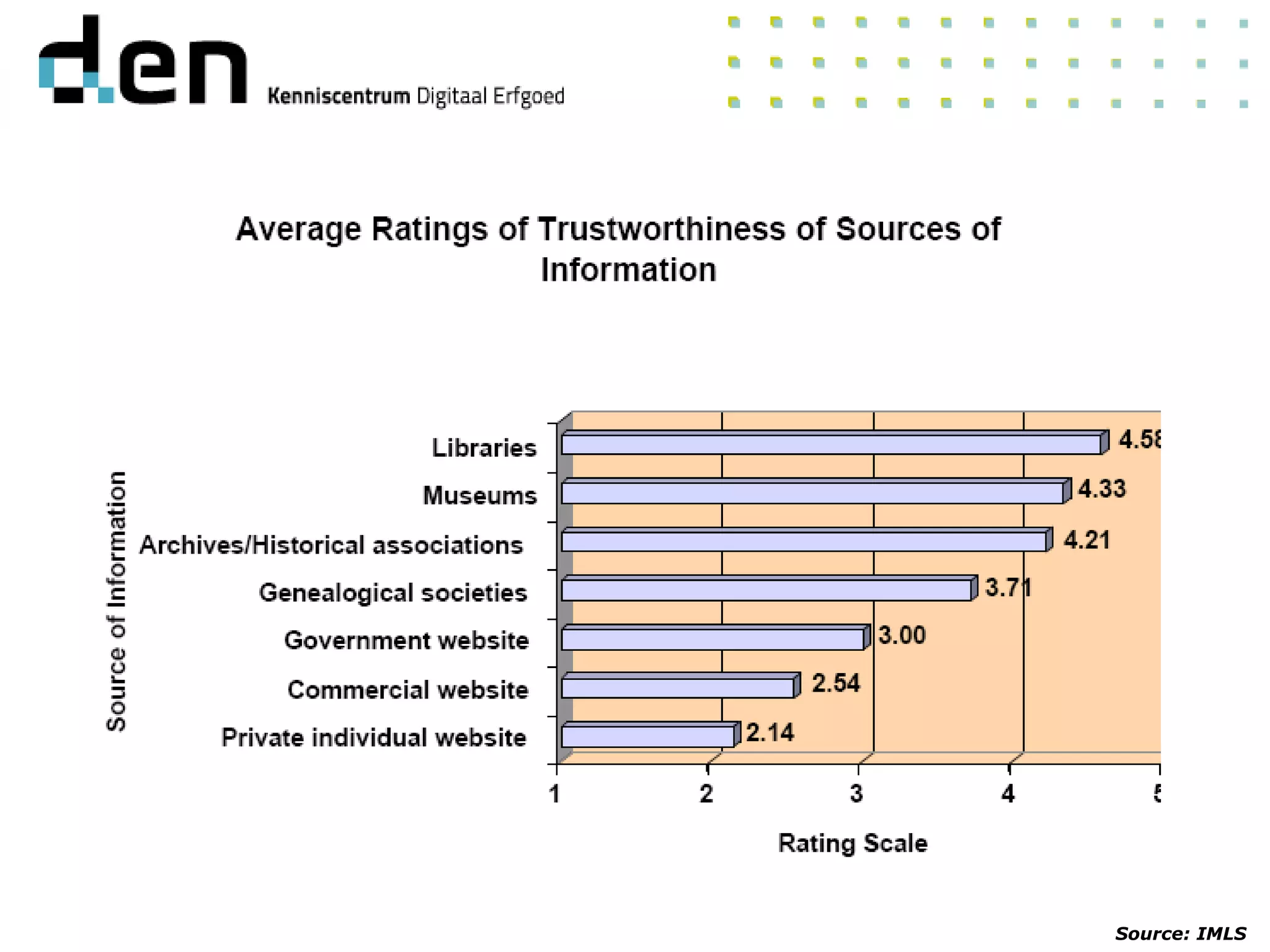
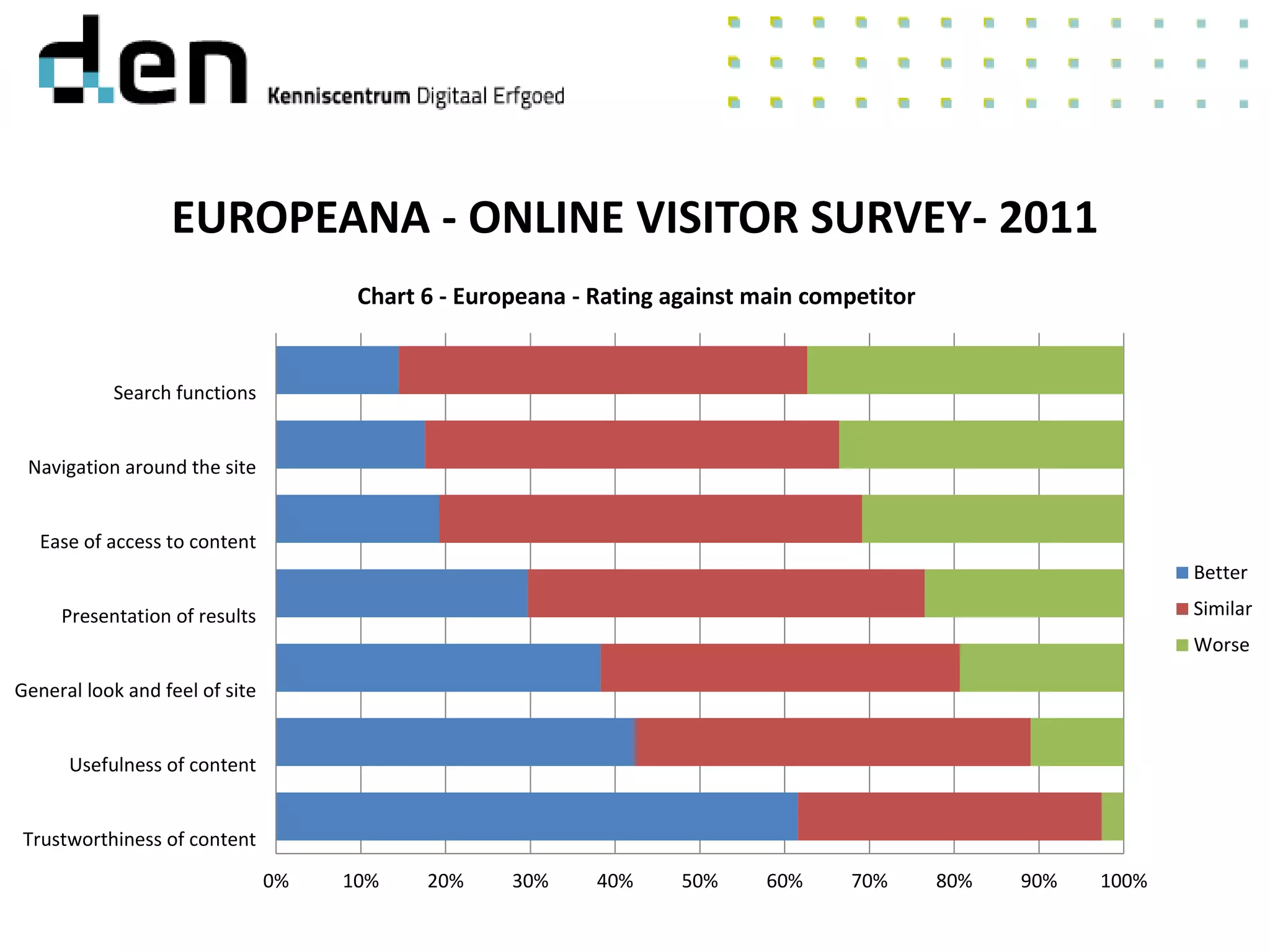
EUROPEANA - ONLINE VISITOR SURVEY- 2011
0% 10% 20% 30% 40% 50% 60% 70% 80% 90% 100%
Trustworthiness of content
Usefulness of content
General look and feel of site
Presentation of results
Ease of access to content
Navigation around the site
Search functions
Chart 6 - Europeana - Rating against main competitor
Better
Similar
Worse
Source: IMLS
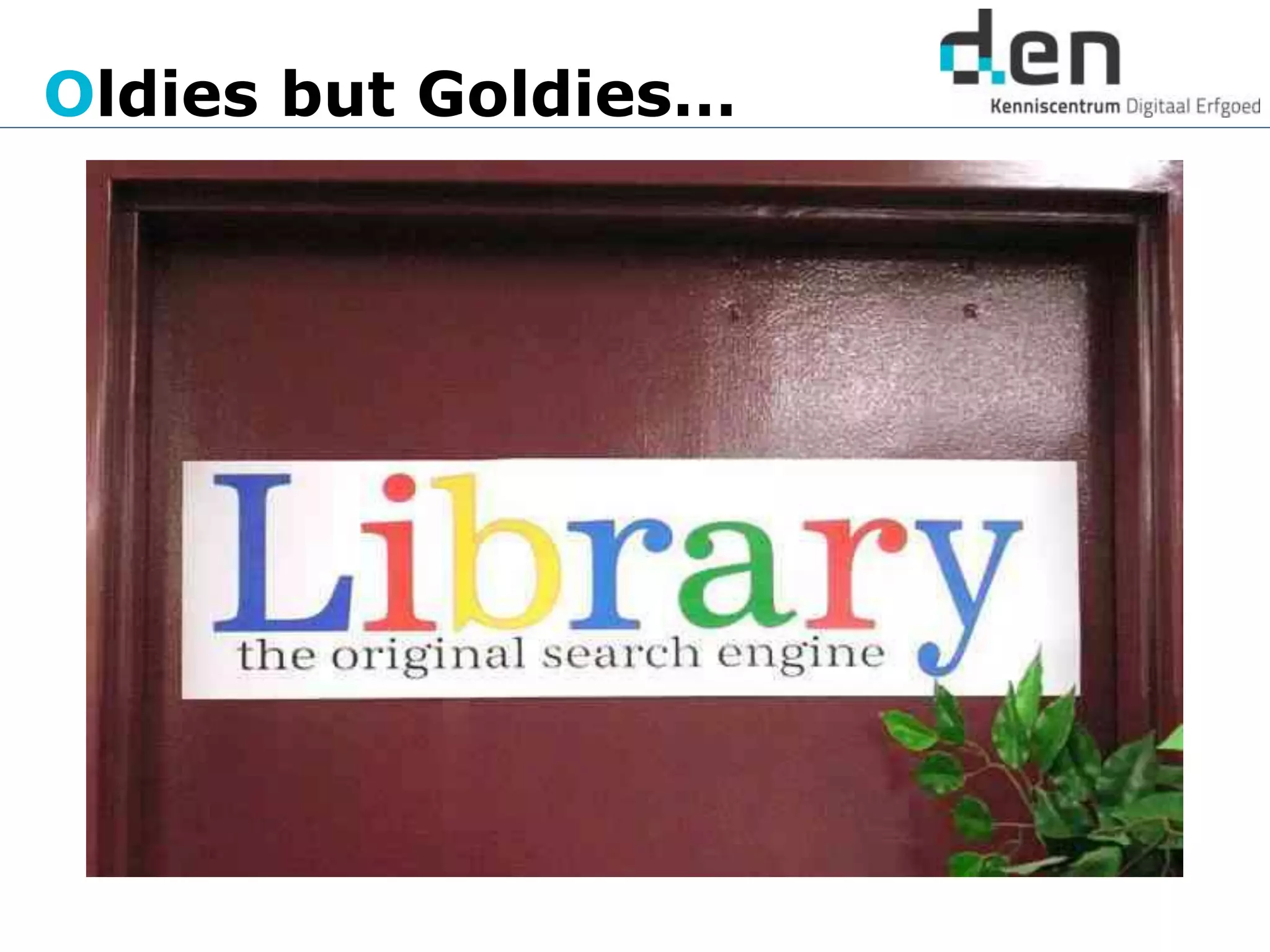
Oldies but Goldies…
What’s next?
Future technologies
that will rock the world
(A selection)
©2012Léocaillard.Tousdroitsréservés.
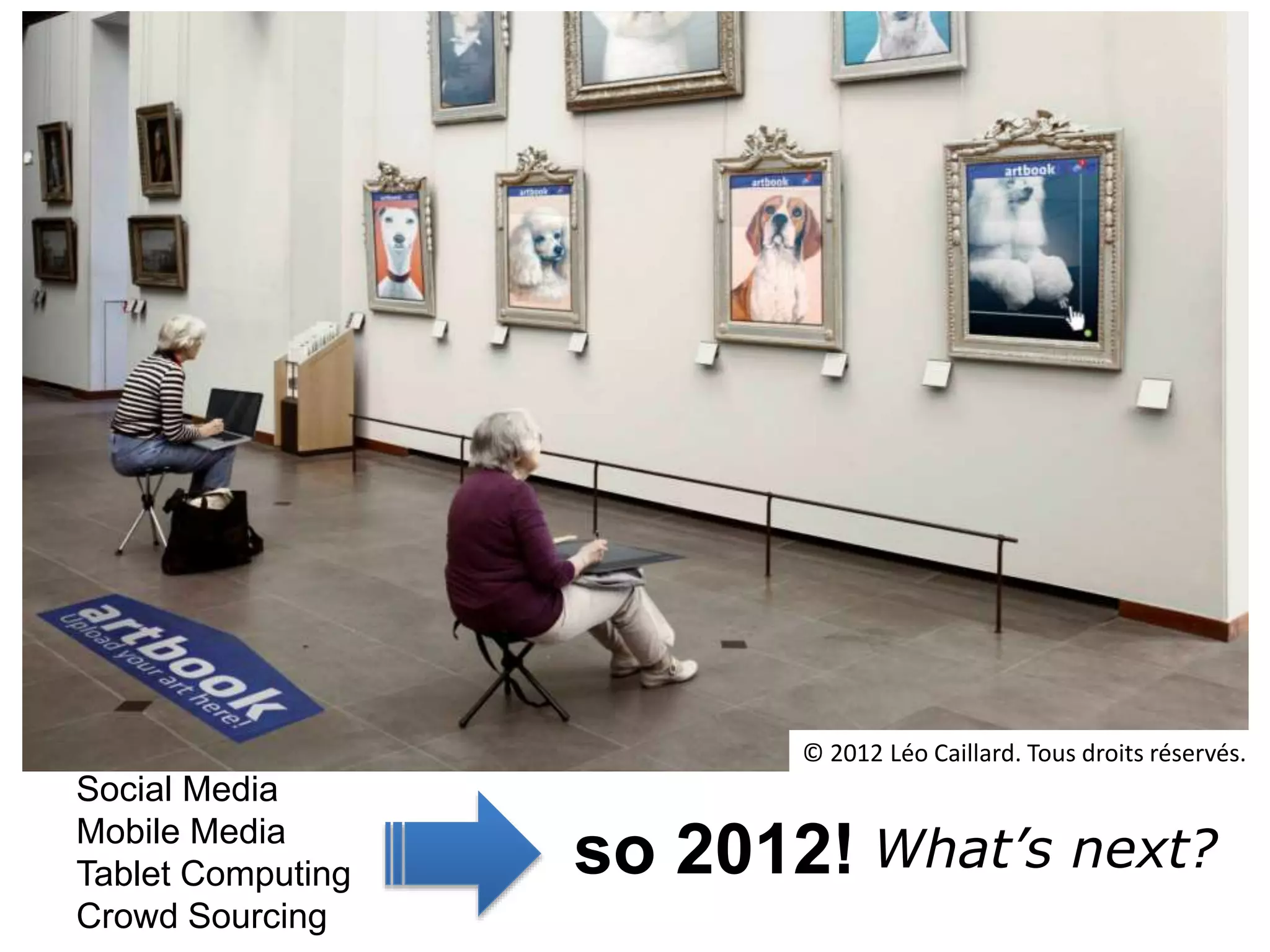
What’s next?
Social Media
Mobile Media
Tablet Computing
Crowd Sourcing
so 2012!
© 2012 Léo Caillard. Tous droits réservés.
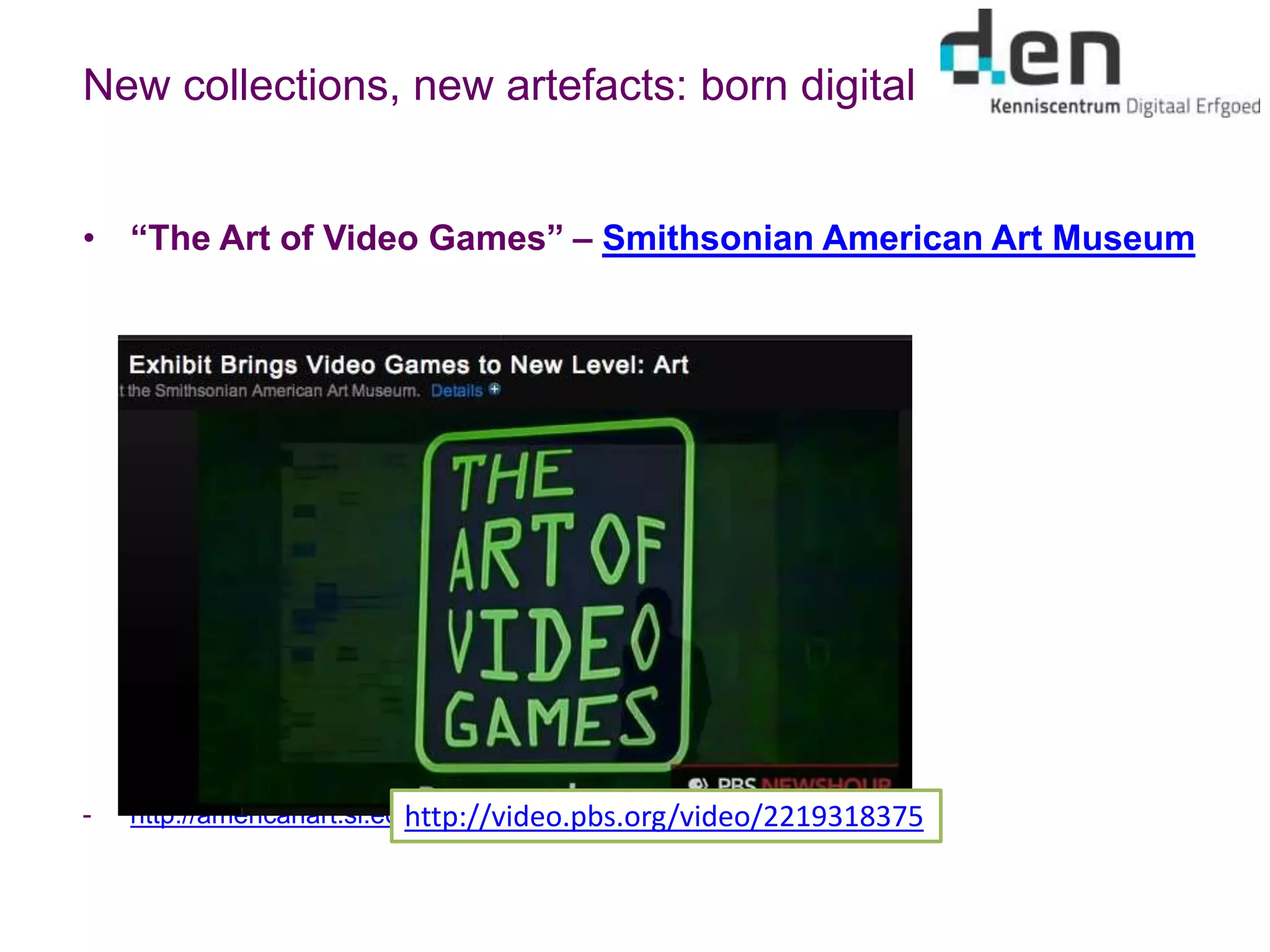
New collections, new artefacts: born digital
• “The Art of Video Games” – Smithsonian American Art Museum
- http://americanart.si.edu/exhibitions/archive/2012/games/artists/http://video.pbs.org/video/2219318375
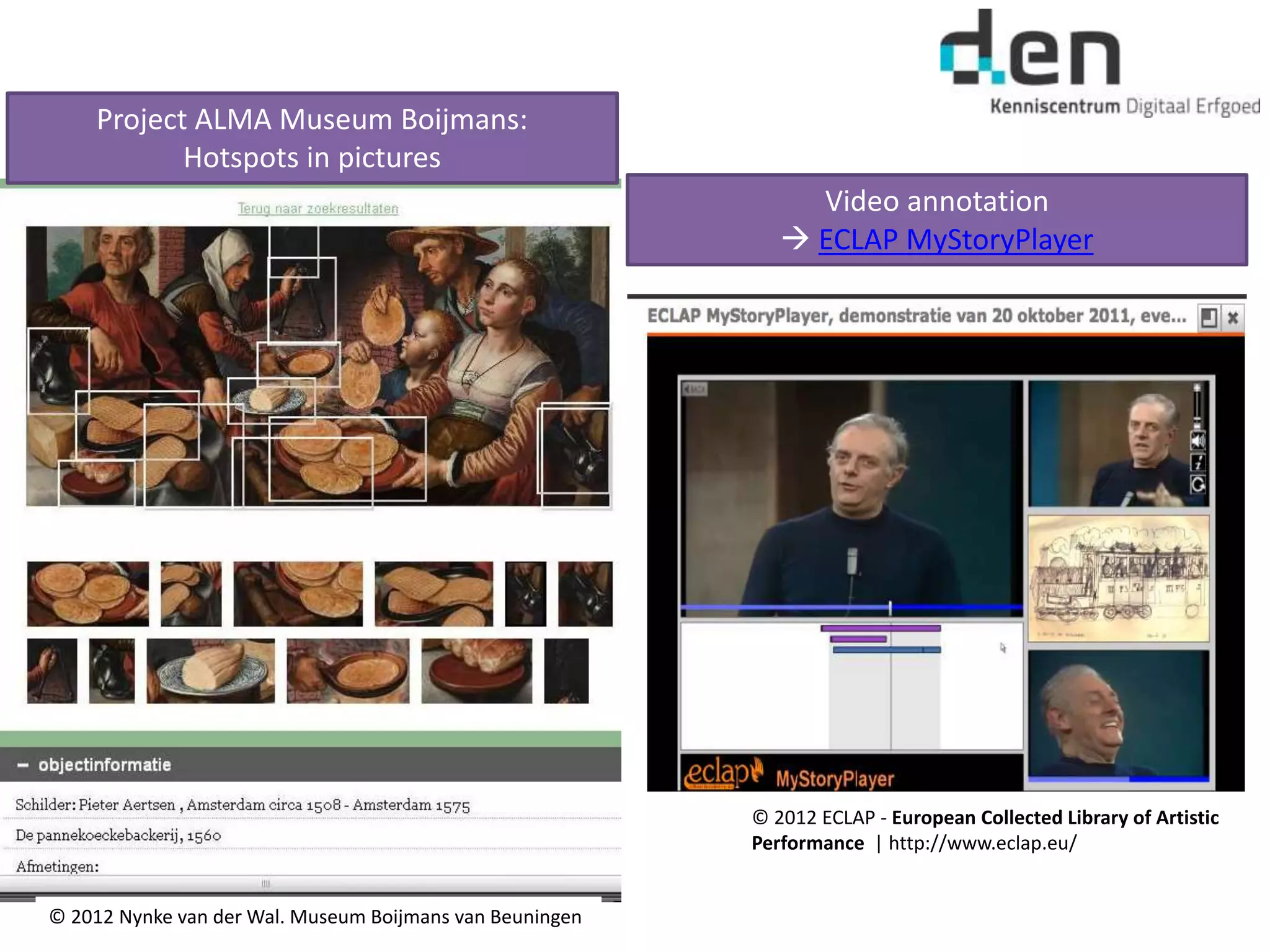
Project ALMA Museum Boijmans:
Hotspots in pictures
© 2012 Nynke van der Wal. Museum Boijmans van Beuningen
© 2012 ECLAP - European Collected Library of Artistic
Performance | http://www.eclap.eu/
Video annotation
 ECLAP MyStoryPlayer
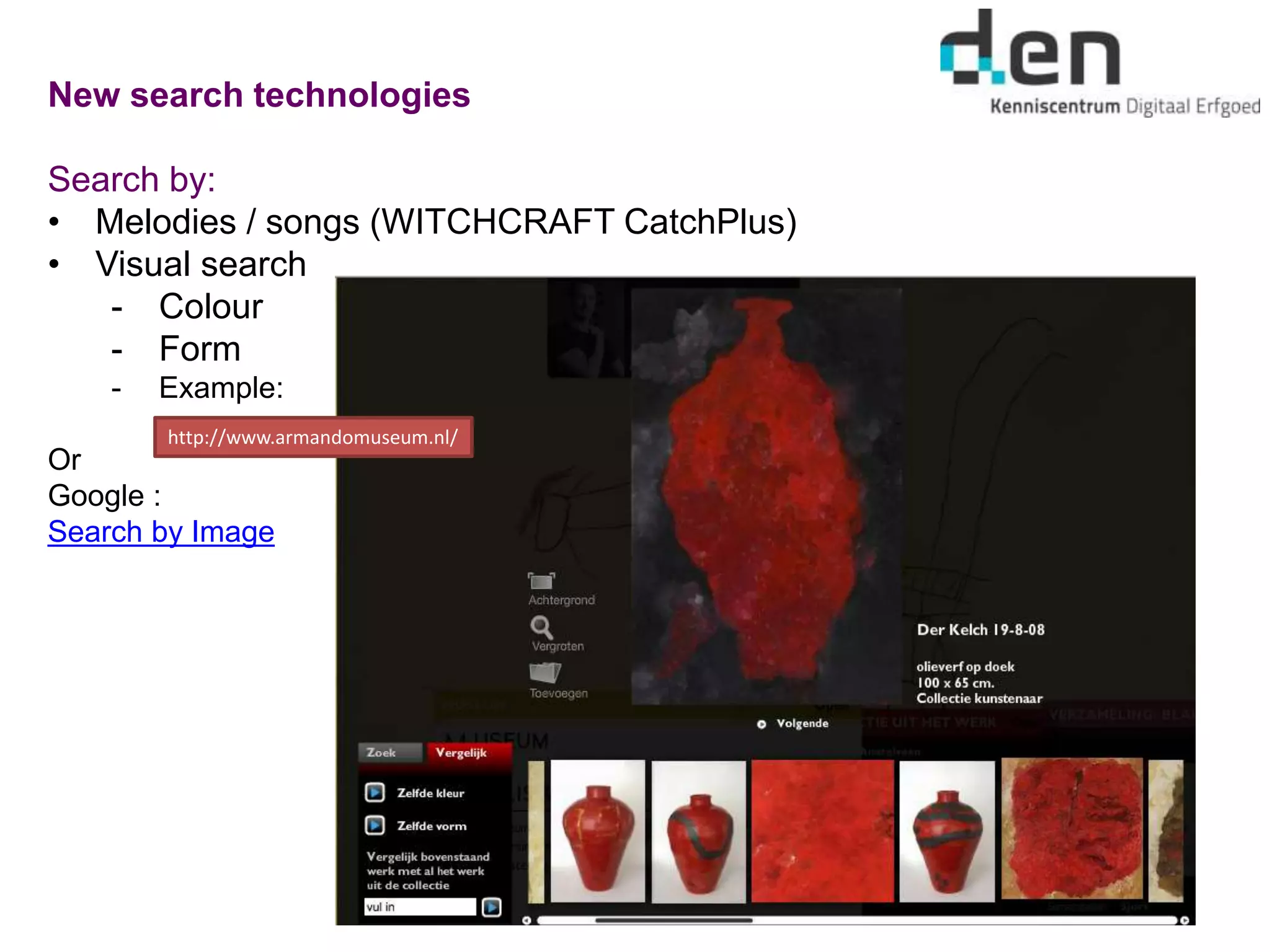
New search technologies
Search by:
• Melodies / songs (WITCHCRAFT CatchPlus)
• Visual search
- Colour
- Form
- Example:
Or
Google :
Search by Image
http://www.armandomuseum.nl/
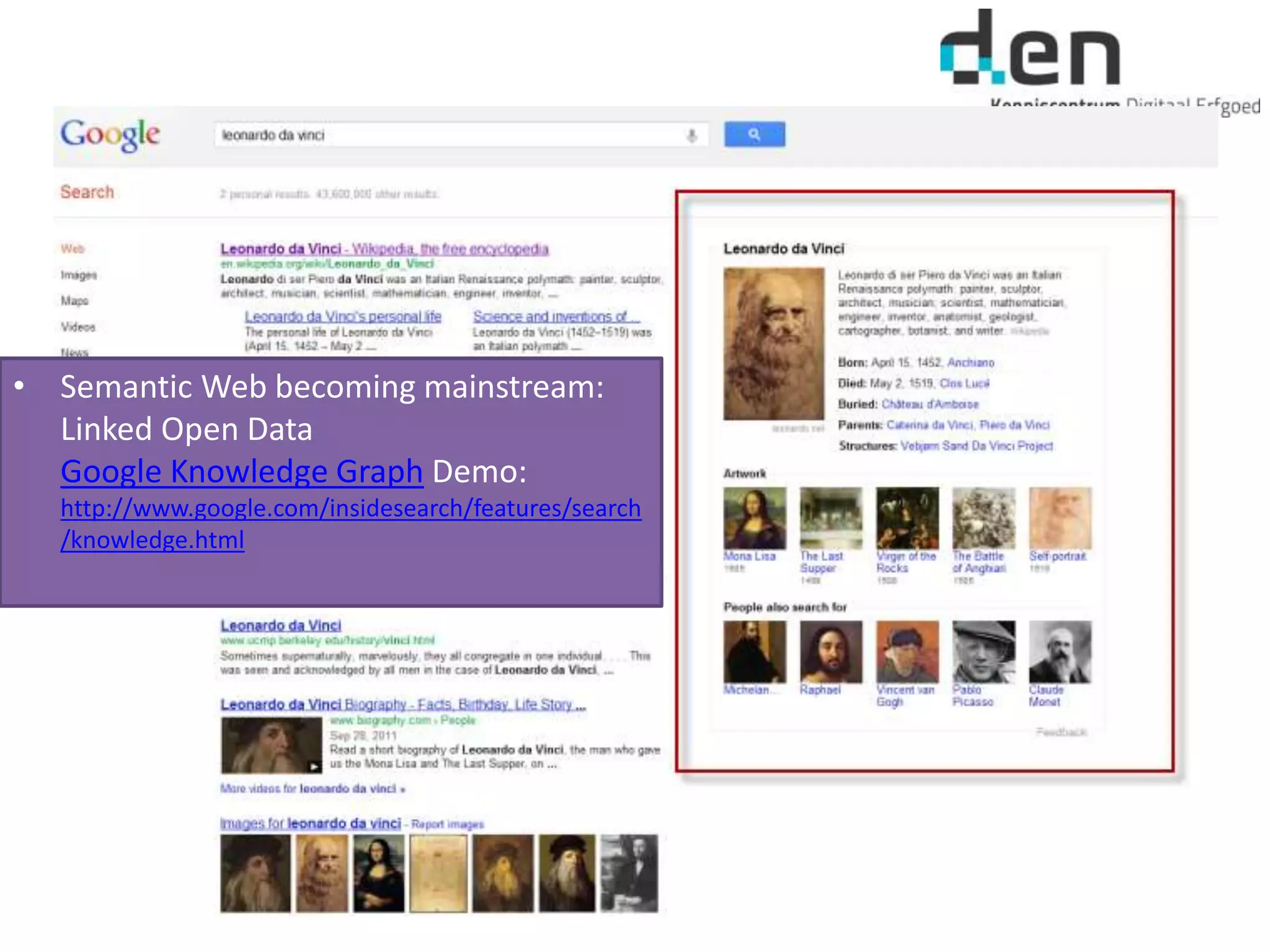
• Semantic Web becoming mainstream:
Linked Open Data
Google Knowledge Graph Demo:
http://www.google.com/insidesearch/features/search
/knowledge.html
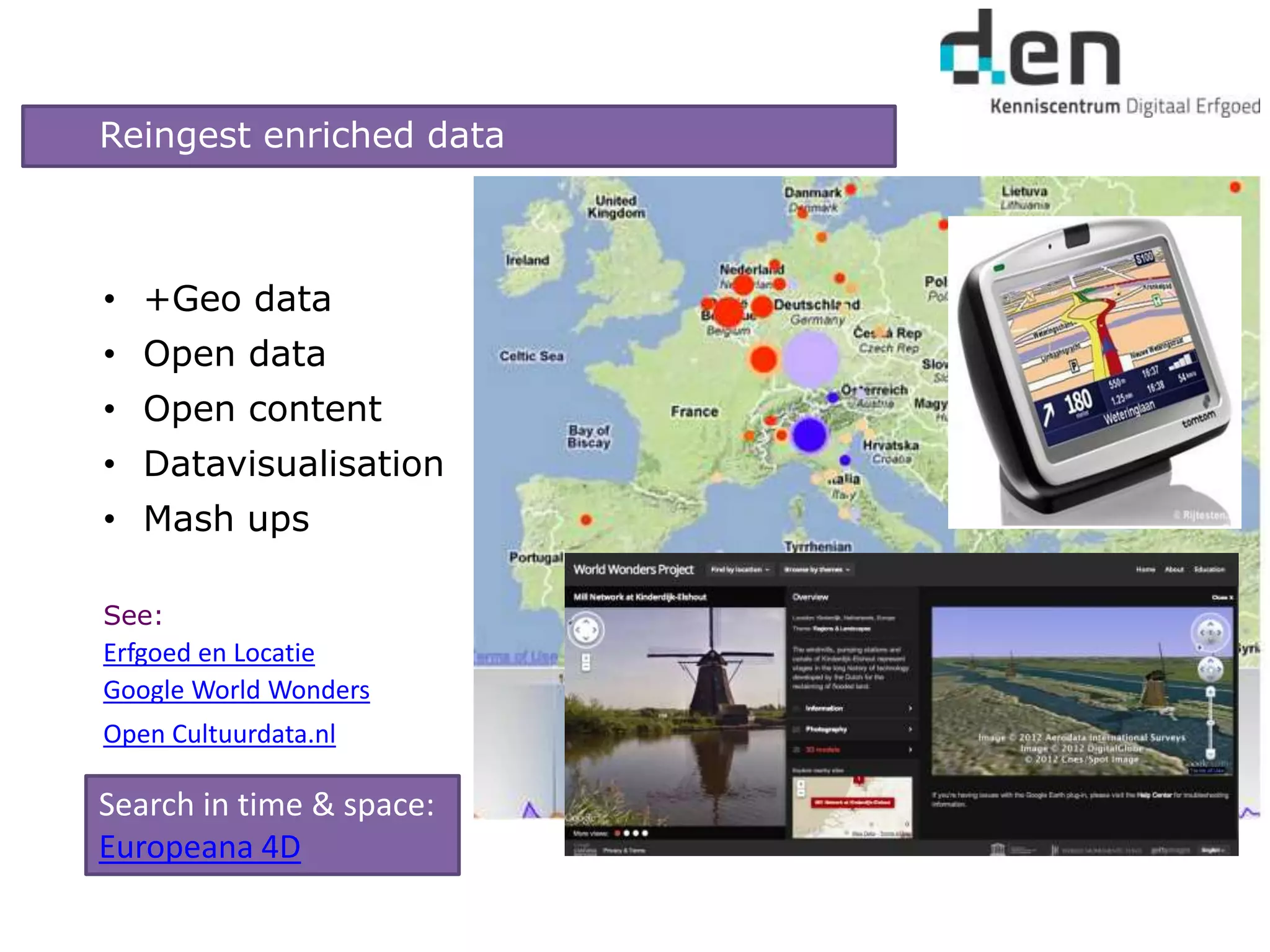
• +Geo data
• Open data
• Open content
• Datavisualisation
• Mash ups
See:
Erfgoed en Locatie
Google World Wonders
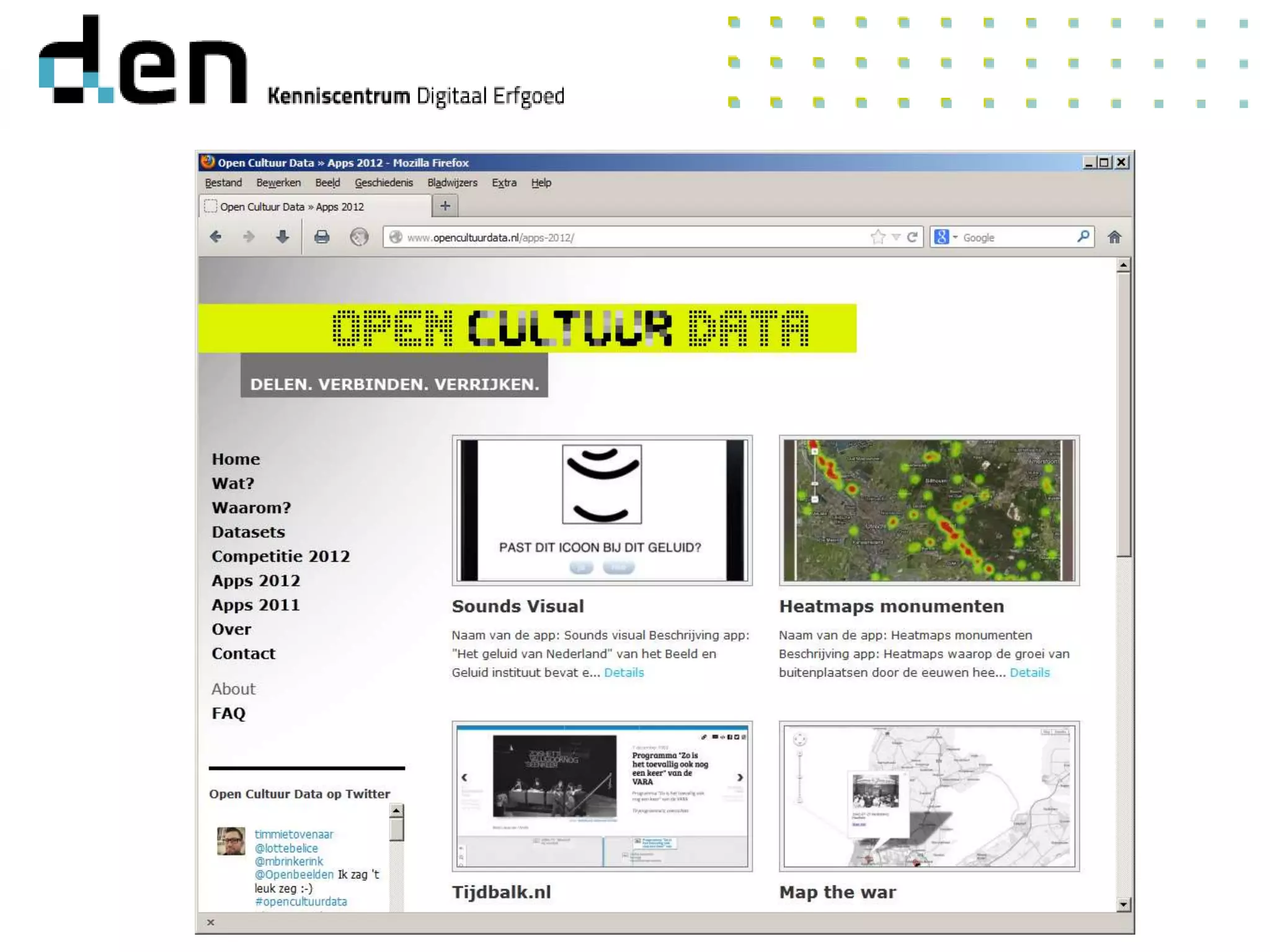
Open Cultuurdata.nl
Search in time & space:
Europeana 4D
Reingest enriched data
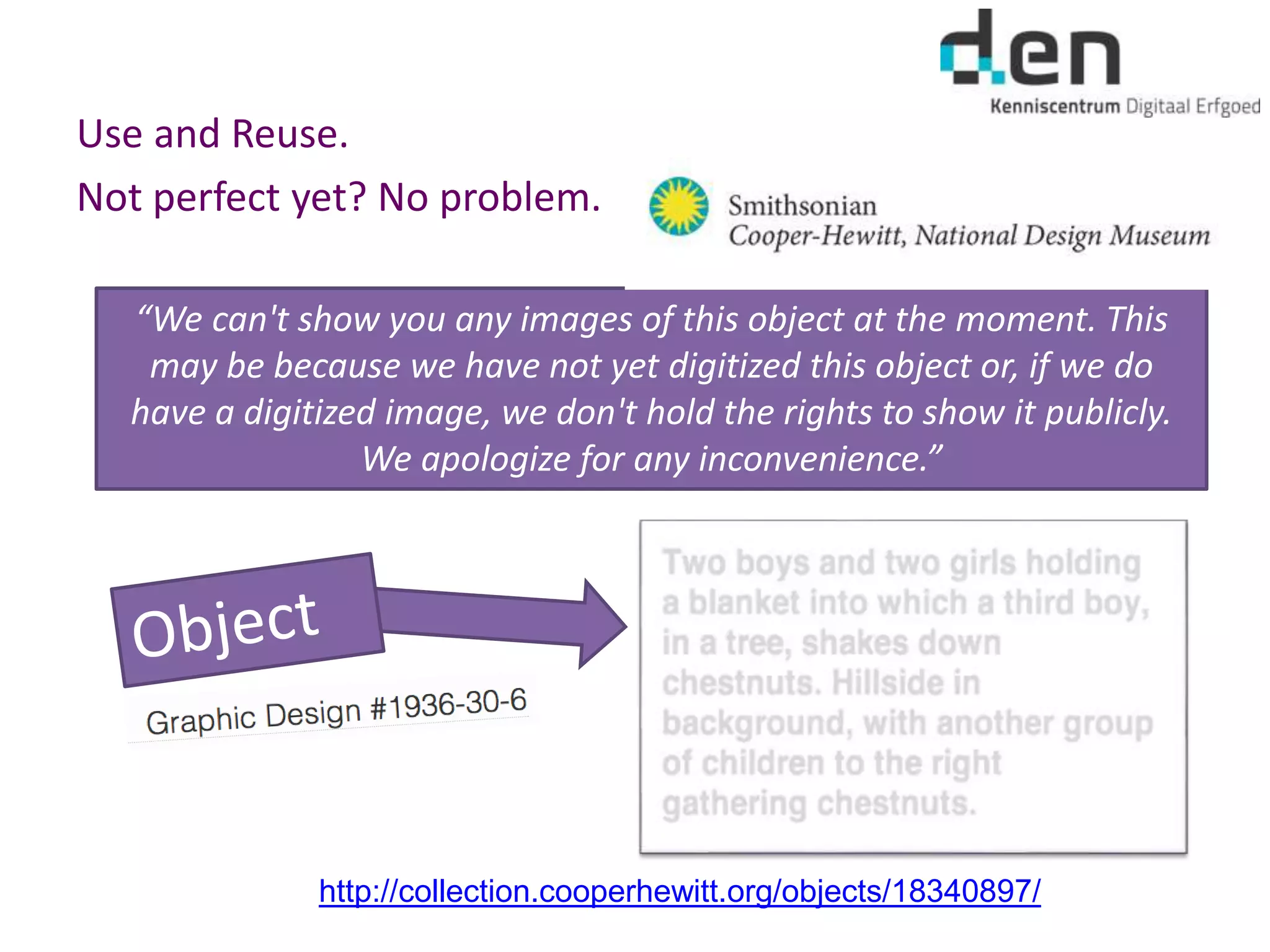
Use and Reuse.
Not perfect yet? No problem.
http://collection.cooperhewitt.org/objects/18340897/
“We can't show you any images of this object at the moment. This
may be because we have not yet digitized this object or, if we do
have a digitized image, we don't hold the rights to show it publicly.
We apologize for any inconvenience.”
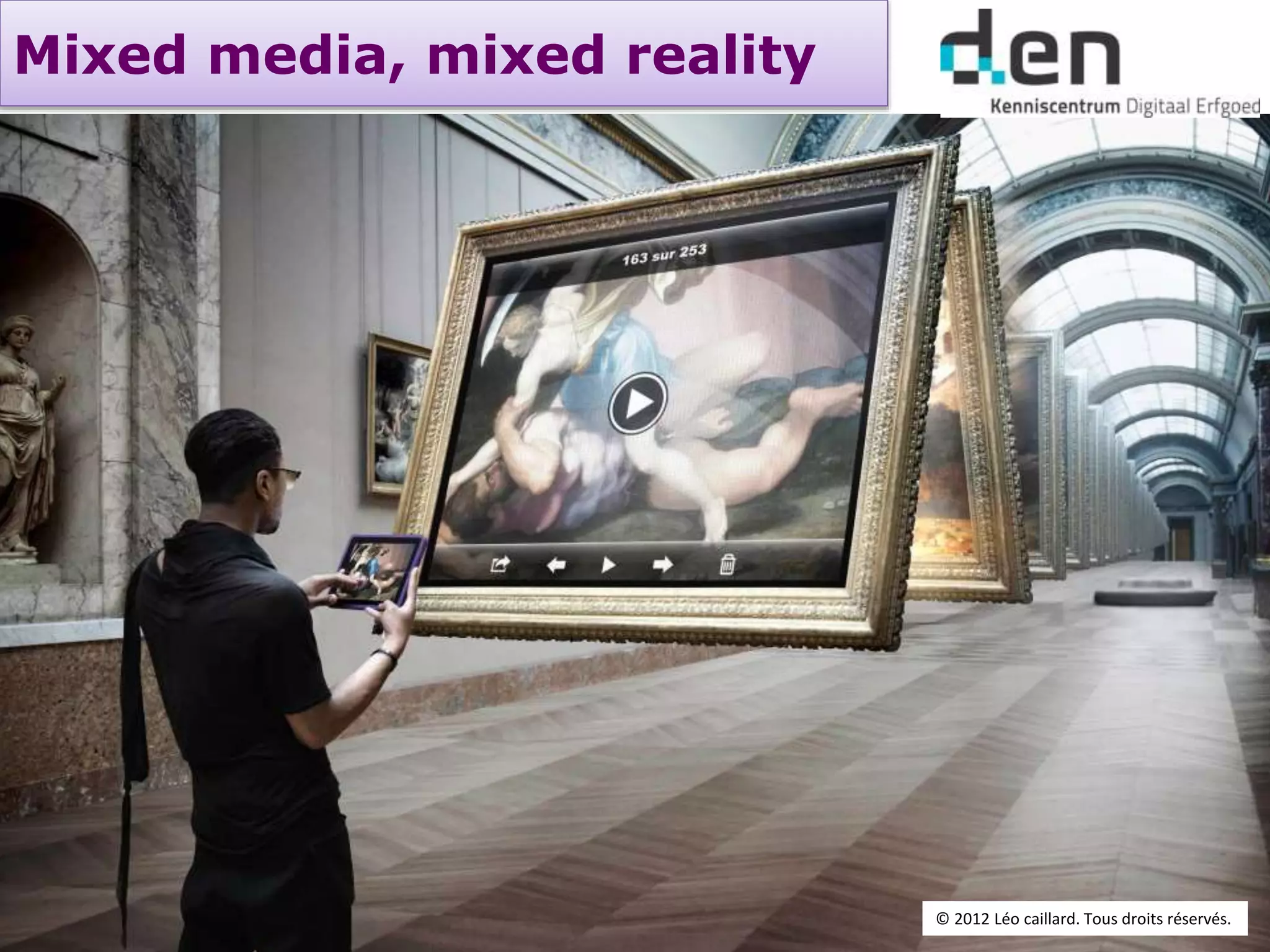
Mixed media, mixed reality
© 2012 Léo caillard. Tous droits réservés.
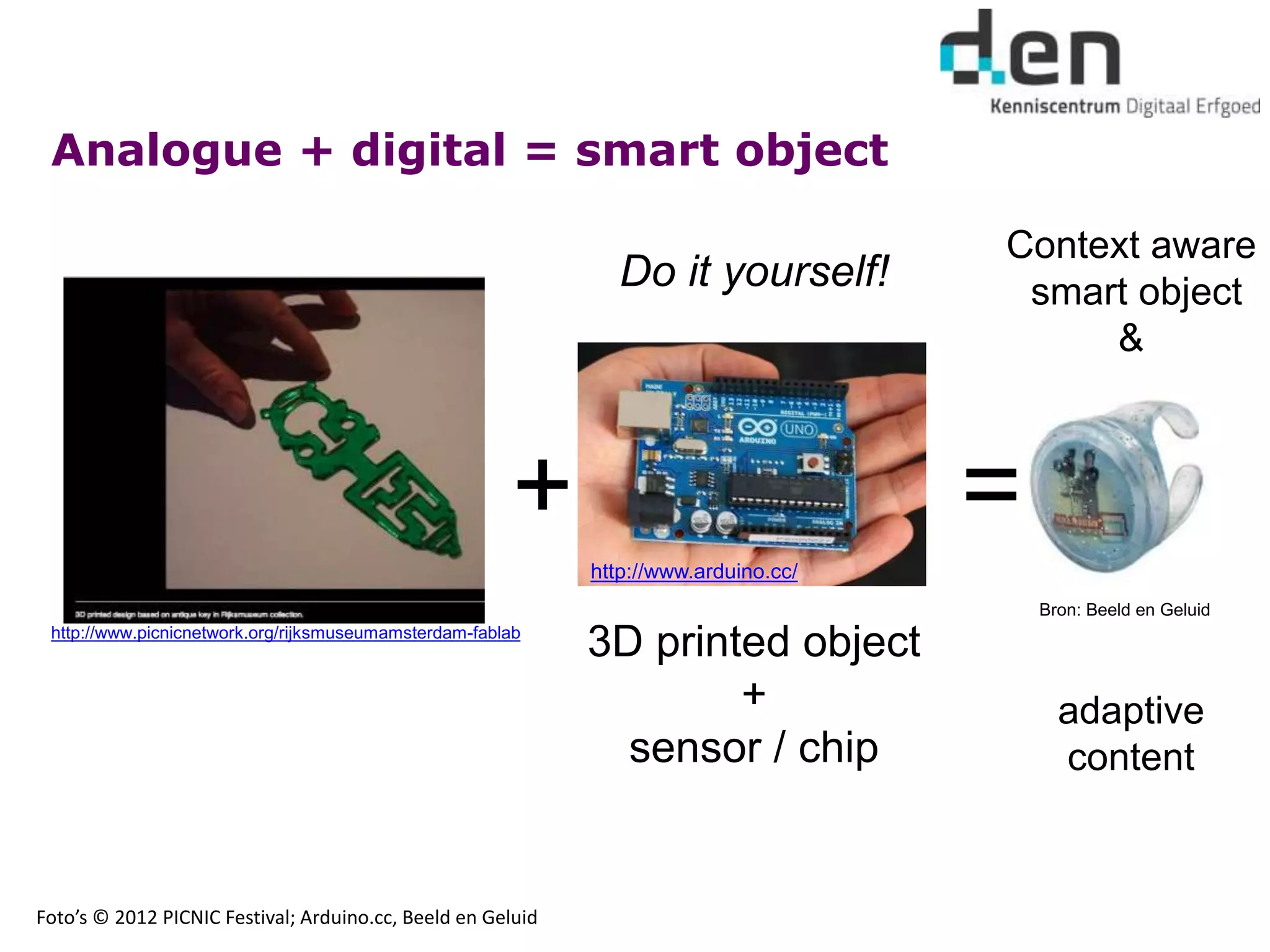
Analogue + digital = smart object
Do it yourself!
3D printed object
+
sensor / chip
http://www.picnicnetwork.org/rijksmuseumamsterdam-fablab
+
http://www.arduino.cc/
=
Bron: Beeld en Geluid
Foto’s © 2012 PICNIC Festival; Arduino.cc, Beeld en Geluid
Context aware
smart object
&
adaptive
content
“I think the future of museums will be a lot
more personalised than the current one fits all
visitor experience, with technology allowing
people with different interests to each have a
tailored experience.”
– Jim Richardson, Founder of Museum Next and Sumo Design
Source: ARUP report: Museums in the Digital Age.
http://publications.arup.com/Publications/M/Museums_in_the_digital_age.aspx
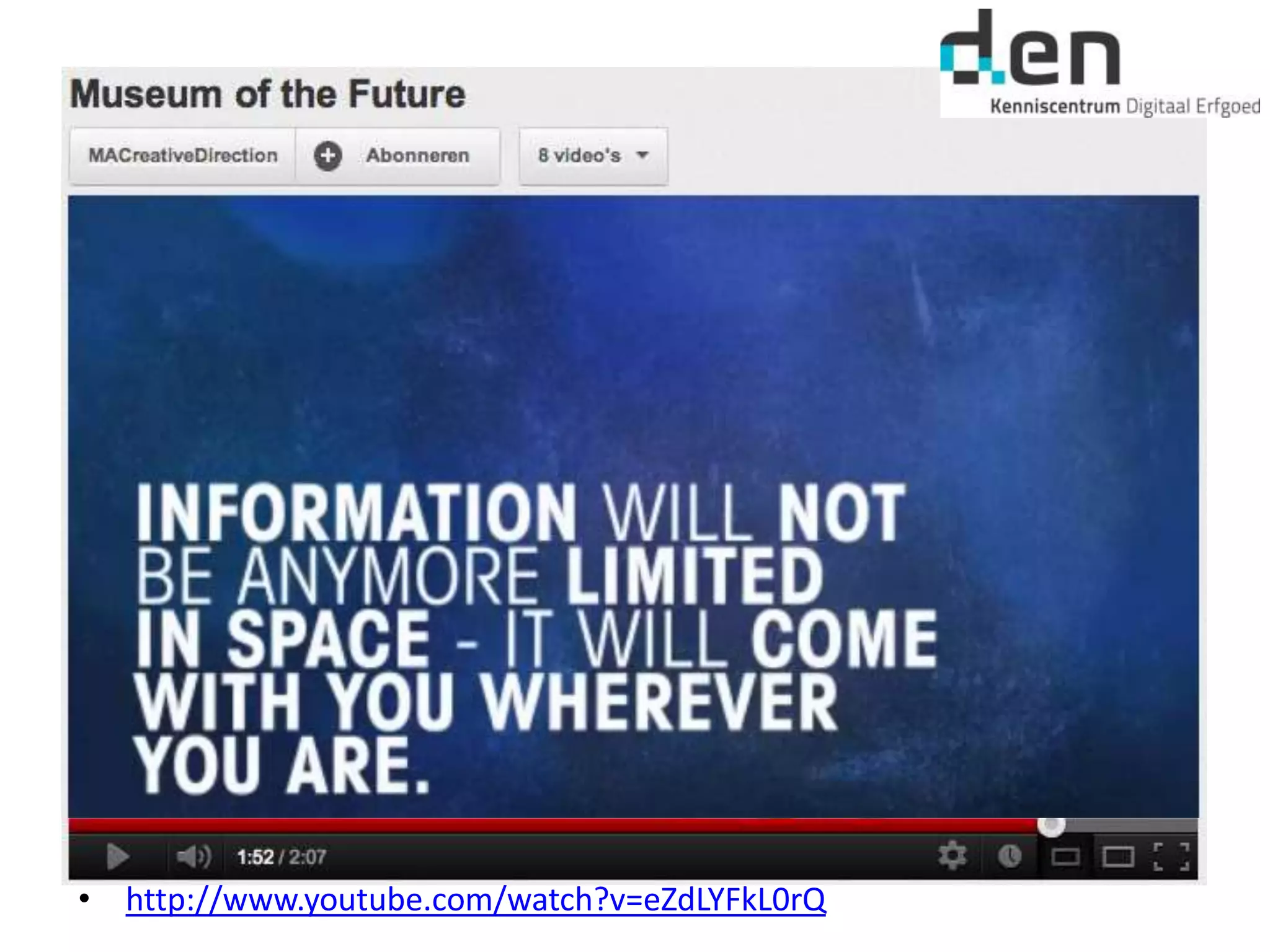
• http://www.youtube.com/watch?v=eZdLYFkL0rQ
Theproject(2013-2017)receivesfundingfromtheEuropeanCommunity’sSeventhFrameworkProgramme‘ICTforaccesstocultural
resources’(ICTCall9:FP7-ICT-2011-9)undertheGrantAgreement600851.
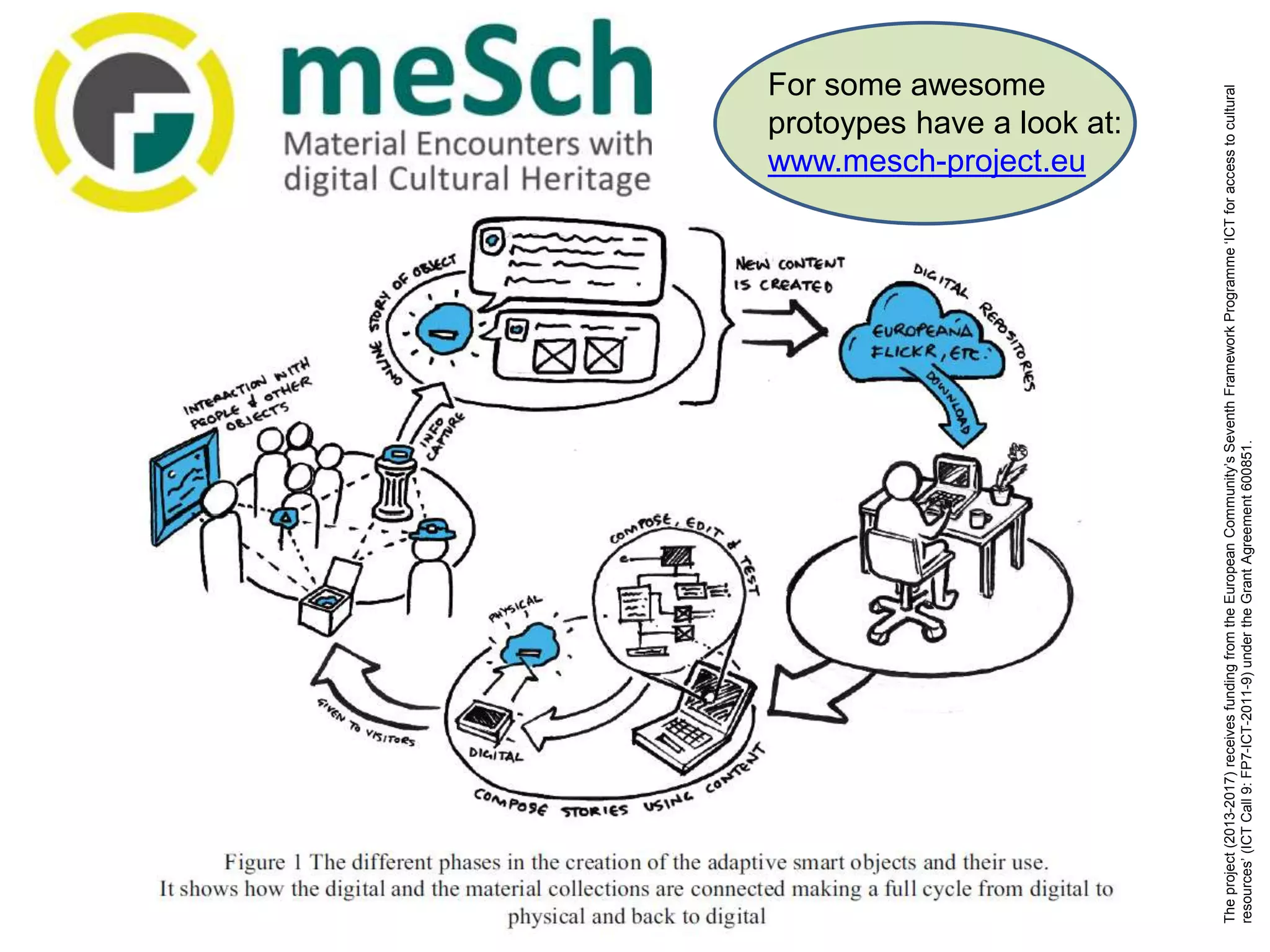
For some awesome
protoypes have a look at:
www.mesch-project.eu
©2012Léocaillard.Tousdroitsréservés.
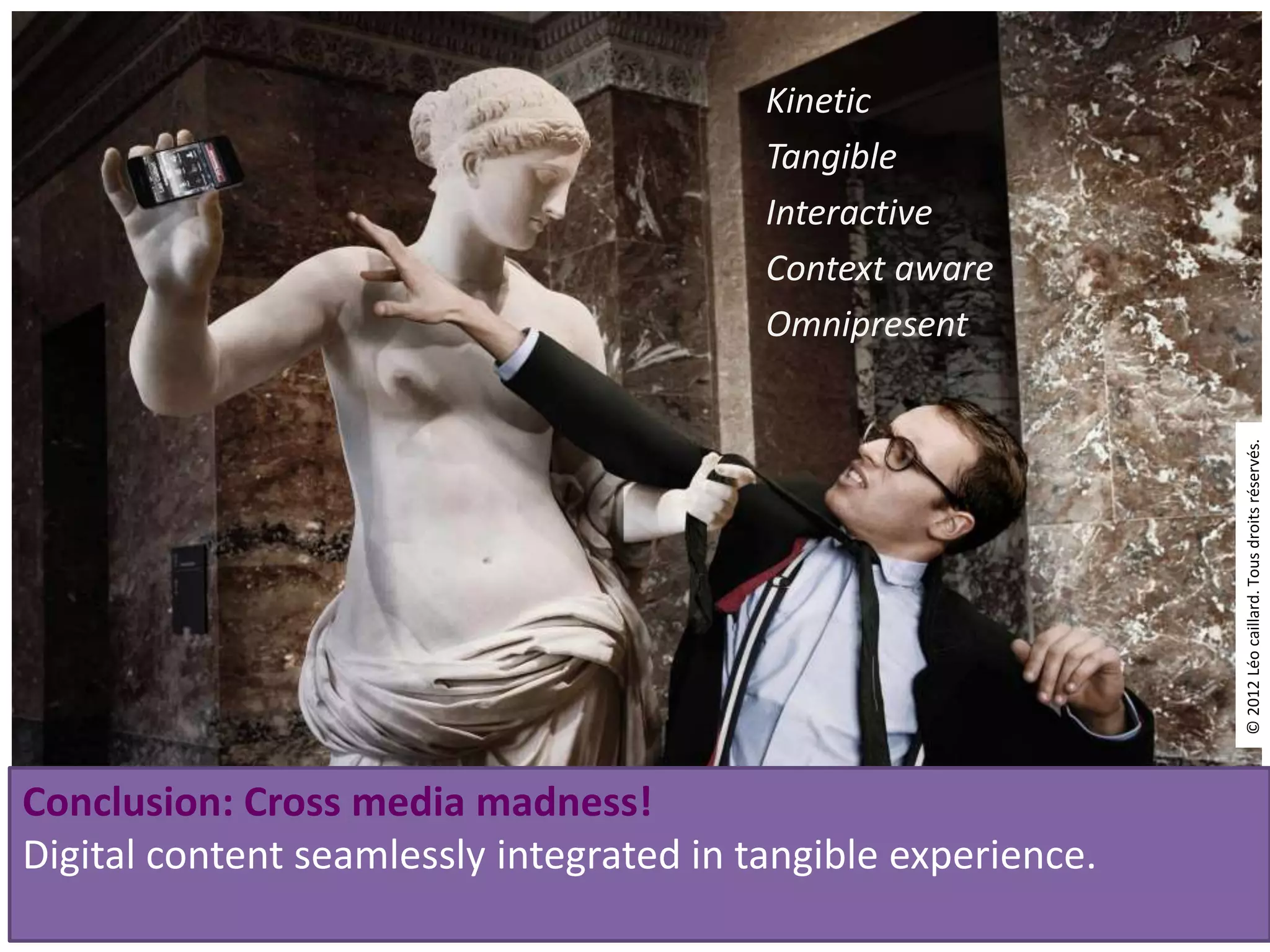
Kinetic
Tangible
Interactive
Context aware
Omnipresent
Conclusion: Cross media madness!
Digital content seamlessly integrated in tangible experience.
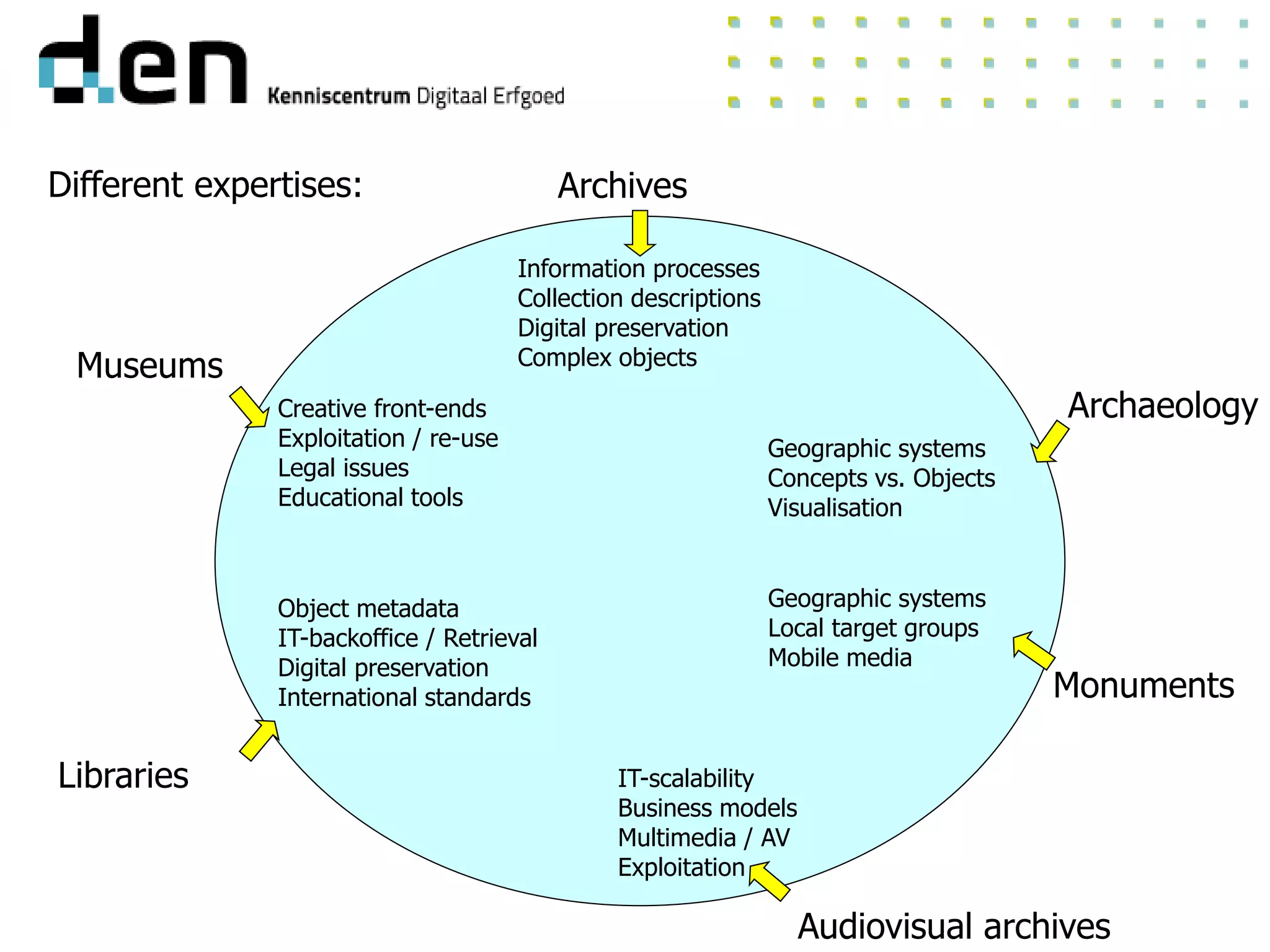
Archives
Museums
Libraries
Archaeology
Monuments
Audiovisual archives
Information processes
Collection descriptions
Digital preservation
Complex objects
Creative front-ends
Exploitation / re-use
Legal issues
Educational tools
Object metadata
IT-backoffice / Retrieval
Digital preservation
International standards
IT-scalability
Business models
Multimedia / AV
Exploitation
Geographic systems
Concepts vs. Objects
Visualisation
Geographic systems
Local target groups
Mobile media
Different expertises:
www.den.nl
@stichtingden
Monika.Lechner@den.nl
Share your knowledge on digitisation!
Thank you!

2014 06-20 fac visual art and design bandung institute of technology ml

  • 1.
    Digital Heritage Evangelism DEN-Digital Heritage Netherlands Presentation to the Faculty of Visual Arts & Design, Bandung Institute of Technology Den Haag | June 20th, 2014 | Monika Lechner | DEN.nl/english | monika.lechner@den.nl
  • 2.
     What isDEN?  The Dutch digital heritage landscape  What is digital heritage?  Evolution of digitisation  Standardisation  User demand  Future technologies that will rock the world
  • 3.
    Dissemination & monitoringsinds 1999 Good, best & better practise in digitisation Digitisation = transformation ! What is DEN? Use an open infrastructure! Work together ! Use open standaards ! Invest in sustainable services ! Share your knowledge on digitisation ! Innovate (yourself) !
  • 4.
    National policy There aretwo sides to Dutch government policy regarding digitisation of cultural heritage: Decentralised approach: • Strengthening local activities and innovation • Promoting creation of institutional ICT policies • Investing in staff training • Funding on national, provincial and local level Strengthening the national infrastructure in EU-context: • “Digital Collection Netherlands” • Infrastructure for preservation and access • Legal framework / copyright • Quality assurance based on self regulation
  • 5.
    National context ofDEN Creative industries Education Government Science Heritage wide topics Copyright / Legal issues Policy develop. / funding Business model innov. Digital preservation Standards & infrastruct. Quality assurance Training / Man. develop. User studies / social media Sectors Archaeo -logy Archi- ves AV-ar- chives Libra- ries Monu- ments Mu- seums Werkgroep Auteursrechten FOBID/JC Ministry OCW, Taalunie, Provincia governments Kennisland, TNO, Erfgoed2.0 Waterwolf, HU Utrecht CCDD Digitale CollectieNL, Portals OpenCultuurData RCE, ‘Meten is weten’, funds GO, Reinwardt, UL/BDMS SCP, Boekman, CBS RCE CAA-NL BRAIN ACDD STAP NA / RHC’s Archief2.0 B&G AVA-net NIMk KB SIOB Bibliotheek. nl FOBID UKB Bijzcol RCE LEU NMV SIMIN Museum- register LCM Qmus HNI CLICK Service suppliers Kennisnet SURF Forum Standaardisatie NOiV Nationaal Archief NCDD CATCH / CATCH+ CLARIN / DARIAH DANS NCDD
  • 6.
    Offline activities Expertmeetings (BASIS,Digital preservation, …) workshops, conferences www.dish.nl Facilitator of Open Heritage Coffees Participation in … workgroups (e.g. Copyright) … steering committees (e.g. CATCH+) … stakeholders meetings (Persistent Identifiers) … European (research projects) (e.g. ENUMERATE, Europeana Inside, MeSch)November, 20th, 2012 6
  • 7.
    – Standaards, guidelines,best practises – Projectbase with plans & evaluation – ICT-profiles of heritage institutions Online activities: knowledgebase www.den.nl
  • 8.
    “Thou shalt alwaysuse open standards.”
  • 10.
    Basic requirements forfindability of digital information (core set of 7 standards) Basic requirements for the creation of digital data – Text – Image – AV-collections – Geospatial data Basic requirements for digital preservation – Preservation policy – Responsibilities within the institutions – Participation in national repositories Basic requirements for handling copyright (in the making) DE BASIS / The Basics
  • 11.
    What is digitalheritage?
  • 12.
    This is notdigitisation!
  • 13.
  • 14.
  • 15.
    Three types ofDigital Heritage ‘Born digital’ heritage Digital by origin (e.g. electronic art, electronic archives, digital photographs). Digitised heritage Cultural artefacts that (did) exist in the physical world and have been reproduced with digital technology (e.g. scans of paper objects, photographs of paintings, encoded audio or video, reconstructions of monuments). Digital information about cultural heritage objects E.g. structured object descriptions, collection level descriptions, x-rays of paintings, knowledge organisation systems like thesauri and ontologies, etc. All three types have their own needs for preservation and access
  • 16.
    Enriched data Full content Digitalreproductions Thumbnails Relations (hierarchic, related) Basic descriptions Heritage National Collection (collection) Collection registration / cataloguing in institutions (registration) Traditional bibliographies and union catalogues (e.g. STCN) (disclosure) Indexes of metadata with links to external objects (e.g. Europeana) (aggregation) Information units with opportunities for search and display of objects(e.g. Memory of the Netherlands. (portal) Information systems with search options for both metadata and full content (e.g. EDBO) (index / search engine) Information systems that enable semantic searching for both metadata and full (structured) content (e.g. research data) (knowledge system)
  • 17.
    ACT PLAN DO CHECK Project planning User studies Highlights (1995-) Heavilyused Collections (2000- ) Mass Digitisation (2005- ) Evaluation Information plans Evolution of digitisation Benchmarking Business Model Innovation
  • 18.
    Museum collection: ±44 million objects Archival collections: ± 845 km (= ± 6 billion pages) Academic libraries: ± 9 million items Audio visual collections: 830.000 uur Alles uit de kast: it takes 150.000 man-year to digitise the entire Dutch heritage collection kept by institutions The Dutch Heritage Collection
  • 19.
    How much hasbeen digitised? 19% 13% 40% 42% 30% 24% 22% 12% 11% 17% 57% 65% 48% 47% 52% 100% 75% 50% 25% 0% 25% 50% 75% 100% Museum Other type of institution: Library Archive / records office Total No need to digitise Already digitally reproduced Still needs to be digitally reproduced
  • 20.
    0 10 20 30 40 50 60 70 80 90 Photographs Archival records Drawings Postcards Engravings/Prints Rare books Paintings Manuscripts Maps Posters Newspapers Otherbooks3D works of art Audio (music, recorded sound) Video recordings 3D man-made objects Serials Film Microforms/Microfilms Other 2D objects Sheet music Other 3D objects (natural sciences) Monuments and sites ARCH AV MON LIB MUS
  • 21.
    Digital Collection /Digitisation strategy 91% 86% 86% 85% 87% 37% 35% 35% 39% 36% 0% 20% 40% 60% 80% 100% Archive / records office Museum Library Other type of institution: Total Digital collection Written digitisation strategy
  • 22.
    Issues with generaluse: The offer is growing, but there is not much coherence (not even within the digital offer of a single institution) Digitisation of primarily a push-activity, not demand-driven Issues for institutions: Disclosure of collections is not optional. This slows down innovation. Specialist knowledge is required for digitisation, which is often not available. Digital preservation is often not secured, neither for data nor for services. Issues for the heritage domain as a whole: Cross domain cooperation is challenged by differences in professional traditions. A big portion of the digital collections are not available for general use. Digital heritage if not easily findable in general search services like Google. Some lessons learned
  • 23.
  • 24.
    Europeana contents: Total: 30,006,395items 17,760,167 images - paintings, drawings, maps, photos and pictures 11,546,679 texts - books, newspapers, letters, diaries and archival papers 485,813 sounds - music and spoken word from cylinders, tapes, discs and radio 198,990 videos - films, newsreels and TV broadcasts 14,746 3D objects - three-dimensional digital models
  • 26.
    Source: Tim BernersLee / 5stardata.info (Linked) Open data
  • 28.
  • 29.
  • 30.
  • 31.
  • 32.
  • 33.
    Where do usersgo? BusinessModelInnovatieCultureelErfgoed, Kennisland/DEN,2009
  • 34.
    Reality check 1 Bron:Culture24 Action Research Report 2011: “How to measure success online?” http://weareculture24.org.uk/projects/action-research/how-to-evaluate-success-online/
  • 35.
  • 36.
    EUROPEANA - ONLINEVISITOR SURVEY- 2011 0% 10% 20% 30% 40% 50% 60% 70% 80% 90% 100% Trustworthiness of content Usefulness of content General look and feel of site Presentation of results Ease of access to content Navigation around the site Search functions Chart 6 - Europeana - Rating against main competitor Better Similar Worse
  • 37.
  • 38.
  • 39.
    What’s next? Future technologies thatwill rock the world (A selection) ©2012Léocaillard.Tousdroitsréservés.
  • 40.
    What’s next? Social Media MobileMedia Tablet Computing Crowd Sourcing so 2012! © 2012 Léo Caillard. Tous droits réservés.
  • 41.
    New collections, newartefacts: born digital • “The Art of Video Games” – Smithsonian American Art Museum - http://americanart.si.edu/exhibitions/archive/2012/games/artists/http://video.pbs.org/video/2219318375
  • 42.
    Project ALMA MuseumBoijmans: Hotspots in pictures © 2012 Nynke van der Wal. Museum Boijmans van Beuningen © 2012 ECLAP - European Collected Library of Artistic Performance | http://www.eclap.eu/ Video annotation  ECLAP MyStoryPlayer
  • 43.
    New search technologies Searchby: • Melodies / songs (WITCHCRAFT CatchPlus) • Visual search - Colour - Form - Example: Or Google : Search by Image http://www.armandomuseum.nl/
  • 44.
    • Semantic Webbecoming mainstream: Linked Open Data Google Knowledge Graph Demo: http://www.google.com/insidesearch/features/search /knowledge.html
  • 45.
    • +Geo data •Open data • Open content • Datavisualisation • Mash ups See: Erfgoed en Locatie Google World Wonders Open Cultuurdata.nl Search in time & space: Europeana 4D Reingest enriched data
  • 46.
    Use and Reuse. Notperfect yet? No problem. http://collection.cooperhewitt.org/objects/18340897/ “We can't show you any images of this object at the moment. This may be because we have not yet digitized this object or, if we do have a digitized image, we don't hold the rights to show it publicly. We apologize for any inconvenience.”
  • 47.
    Mixed media, mixedreality © 2012 Léo caillard. Tous droits réservés.
  • 48.
    Analogue + digital= smart object Do it yourself! 3D printed object + sensor / chip http://www.picnicnetwork.org/rijksmuseumamsterdam-fablab + http://www.arduino.cc/ = Bron: Beeld en Geluid Foto’s © 2012 PICNIC Festival; Arduino.cc, Beeld en Geluid Context aware smart object & adaptive content
  • 49.
    “I think thefuture of museums will be a lot more personalised than the current one fits all visitor experience, with technology allowing people with different interests to each have a tailored experience.” – Jim Richardson, Founder of Museum Next and Sumo Design Source: ARUP report: Museums in the Digital Age. http://publications.arup.com/Publications/M/Museums_in_the_digital_age.aspx
  • 50.
  • 51.
  • 52.
    ©2012Léocaillard.Tousdroitsréservés. Kinetic Tangible Interactive Context aware Omnipresent Conclusion: Crossmedia madness! Digital content seamlessly integrated in tangible experience.
  • 53.
    Archives Museums Libraries Archaeology Monuments Audiovisual archives Information processes Collectiondescriptions Digital preservation Complex objects Creative front-ends Exploitation / re-use Legal issues Educational tools Object metadata IT-backoffice / Retrieval Digital preservation International standards IT-scalability Business models Multimedia / AV Exploitation Geographic systems Concepts vs. Objects Visualisation Geographic systems Local target groups Mobile media Different expertises:
  • 54.