Impact Team
impact@samasource.org
June 2013
IMPACT REPORT
2013 Q1
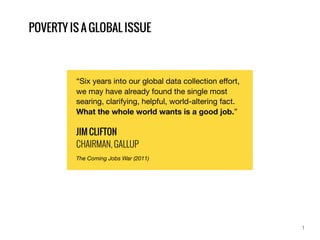
“Six years into our global data collection effort,
we may have already found the single most
searing, clarifying, helpful, world-altering fact.
What the whole world wants is a good job.”
JIM CLIFTON
CHAIRMAN, GALLUP
The Coming Jobs War (2011)
1
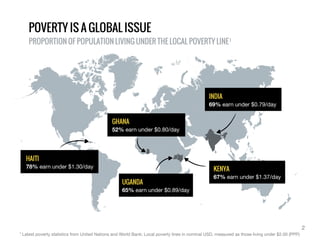
POVERTY IS A GLOBAL ISSUE
1 Latest poverty statistics from United Nations and World Bank; Local poverty lines in nominal USD, measured as those living under $2.00 (PPP)
HAITI
78% earn under $1.30/day
UGANDA
65% earn under $0.89/day
GHANA
52% earn under $0.80/day
KENYA
67% earn under $1.37/day
INDIA
69% earn under $0.79/day
POVERTY IS A GLOBAL ISSUE
PROPORTION OF POPULATION LIVING UNDER THE LOCAL POVERTY LINE1
2
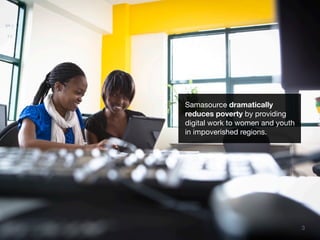
Samasource dramatically
reduces poverty by providing
digital work to women and youth
in impoverished regions.
3
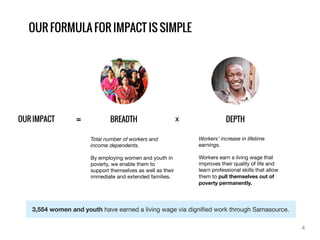
3,554 women and youth have earned a living wage via dignified work through Samasource.
OUR FORMULA FOR IMPACT IS SIMPLE
XOUR IMPACT BREADTH DEPTH=
Total number of workers and
income dependents.
By employing women and youth in
poverty, we enable them to
support themselves as well as their
immediate and extended families.
Workers’ increase in lifetime
earnings.   
Workers earn a living wage that
improves their quality of life and
learn professional skills that allow
them to pull themselves out of
poverty permanently.
4
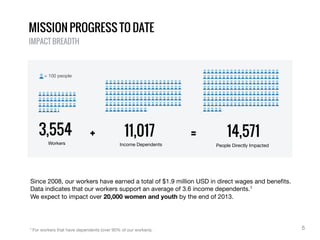
Workers Income Dependents People Directly Impacted
3,554 11,017 14,571+ =
= 100 people
Since 2008, our workers have earned a total of $1.9 million USD in direct wages and benefits.
Data indicates that our workers support an average of 3.6 income dependents.1
We expect to impact over 20,000 women and youth by the end of 2013.
MISSION PROGRESS TO DATE
IMPACT BREADTH
1 For workers that have dependents (over 90% of our workers). 5
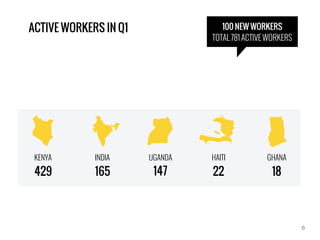
KENYA
429
INDIA
165
UGANDA
147
GHANA
18
HAITI
22
ACTIVE WORKERS IN Q1 100 NEW WORKERS
TOTAL 781 ACTIVE WORKERS
6
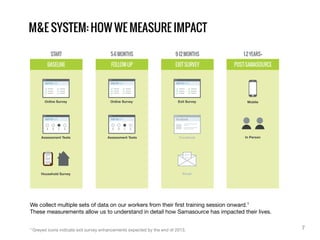
We collect multiple sets of data on our workers from their first training session onward.1
These measurements allow us to understand in detail how Samasource has impacted their lives.
Online Survey
A B C D
Assessment Tests
Household Survey
Exit SurveyOnline Survey
A B C D
Assessment Tests Facebook
Email
Mobile
In Person
START
BASELINE
5-6 MONTHS
FOLLOW-UP
9-12 MONTHS
EXIT SURVEY
1-2 YEARS+
POST-SAMASOURCE
M&E SYSTEM: HOW WE MEASURE IMPACT
1 Greyed icons indicate exit survey enhancements expected by the end of 2013. 7
$12
$5
$13
$5
$15
$7
$23
$6
$24
$14
$26
$13
$40
$20
$48
$21
Shelter Food EducationTransport Utilities Local
Remittances
Discretionary
Income
Savings
Pre-Samasource
Samasource Worker
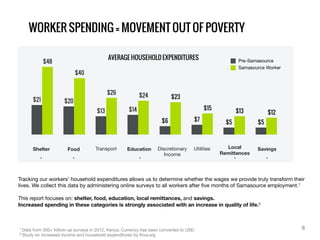
AVERAGE HOUSEHOLD EXPENDITURES
WORKER SPENDING = MOVEMENT OUT OF POVERTY
•••••
Tracking our workers’ household expenditures allows us to determine whether the wages we provide truly transform their
lives. We collect this data by administering online surveys to all workers after five months of Samasource employment.1
This report focuses on: shelter, food, education, local remittances, and savings.
Increased spending in these categories is strongly associated with an increase in quality of life.2
1 Data from 300+ follow-up surveys in 2012, Kenya; Currency has been converted to USD
2 Study on increased income and household expenditures by Kiva.org
8
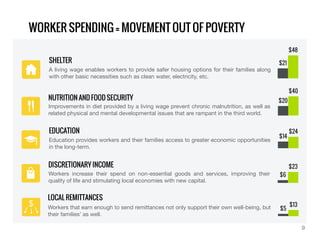
WORKER SPENDING = MOVEMENT OUT OF POVERTY
SHELTER
A living wage enables workers to provide safer housing options for their families along
with other basic necessities such as clean water, electricity, etc.
$48
$21
EDUCATION
Education provides workers and their families access to greater economic opportunities
in the long-term.
$24
$14
NUTRITION AND FOOD SECURITY
Improvements in diet provided by a living wage prevent chronic malnutrition, as well as
related physical and mental developmental issues that are rampant in the third world.
$40
$20
DISCRETIONARY INCOME
Workers increase their spend on non-essential goods and services, improving their
quality of life and stimulating local economies with new capital.
$23
$6
LOCAL REMITTANCES
Workers that earn enough to send remittances not only support their own well-being, but
their families’ as well.
$13
$5
9
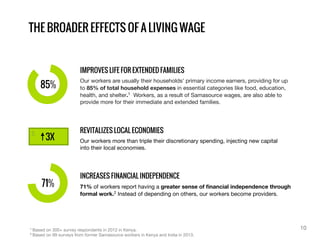
IMPROVES LIFE FOR EXTENDED FAMILIES
Our workers are usually their households’ primary income earners, providing for up
to 85% of total household expenses in essential categories like food, education,
health, and shelter.1 Workers, as a result of Samasource wages, are also able to
provide more for their immediate and extended families.
85%
INCREASES FINANCIAL INDEPENDENCE
71% of workers report having a greater sense of financial independence through
formal work.2 Instead of depending on others, our workers become providers.
71%
REVITALIZES LOCAL ECONOMIES
Our workers more than triple their discretionary spending, injecting new capital
into their local economies.
3X
THE BROADER EFFECTS OF A LIVING WAGE
1 Based on 300+ survey respondents in 2012 in Kenya.
2 Based on 99 surveys from former Samasource workers in Kenya and India in 2013.
10
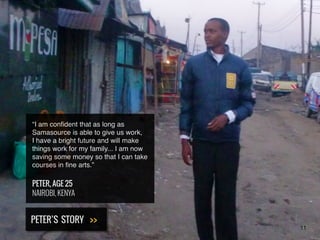
“I am confident that as long as
Samasource is able to give us work,
I have a bright future and will make
things work for my family....I am now
saving some money so that I can take
courses in fine arts.”
PETER, AGE 25
NAIROBI, KENYA
PETER’S STORY >>
11
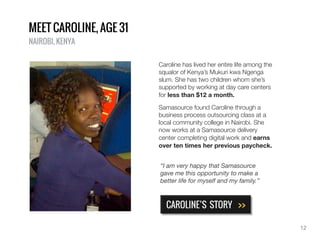
Caroline has lived her entire life among the
squalor of Kenya’s Mukuri kwa Ngenga
slum. She has two children whom she’s
supported by working at day care centers
for less than $12 a month.
Samasource found Caroline through a
business process outsourcing class at a
local community college in Nairobi. She
now works at a Samasource delivery
center completing digital work and earns
over ten times her previous paycheck.
MEET CAROLINE, AGE 31
NAIROBI, KENYA
CAROLINE’S STORY >>
“I am very happy that Samasource
gave me this opportunity to make a
better life for myself and my family.”
12
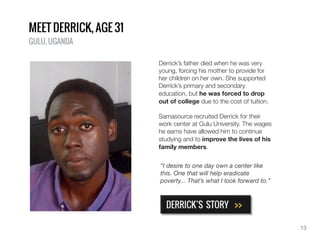
MEET DERRICK, AGE 21
GULU, UGANDA
Derrick’s father died when he was very
young, forcing his mother to provide for
her children on her own. She supported
Derrick’s primary and secondary
education, but he was forced to drop
out of college due to the cost of tuition.
Samasource recruited Derrick for their
work center at Gulu University. The wages
he earns have allowed him to continue
studying and to improve the lives of his
family members.
DERRICK’S STORY >>
“I desire to one day own a center like
this. One that will help eradicate
poverty... That’s what I look forward to.”
13
Samasource 2013 Q1 Impact Report

Samasource 2013 Q1 Impact Report

  • 1.
  • 2.
    “Six years intoour global data collection effort, we may have already found the single most searing, clarifying, helpful, world-altering fact. What the whole world wants is a good job.” JIM CLIFTON CHAIRMAN, GALLUP The Coming Jobs War (2011) 1 POVERTY IS A GLOBAL ISSUE
  • 3.
    1 Latest povertystatistics from United Nations and World Bank; Local poverty lines in nominal USD, measured as those living under $2.00 (PPP) HAITI 78% earn under $1.30/day UGANDA 65% earn under $0.89/day GHANA 52% earn under $0.80/day KENYA 67% earn under $1.37/day INDIA 69% earn under $0.79/day POVERTY IS A GLOBAL ISSUE PROPORTION OF POPULATION LIVING UNDER THE LOCAL POVERTY LINE1 2
  • 4.
    Samasource dramatically reduces povertyby providing digital work to women and youth in impoverished regions. 3
  • 5.
    3,554 women andyouth have earned a living wage via dignified work through Samasource. OUR FORMULA FOR IMPACT IS SIMPLE XOUR IMPACT BREADTH DEPTH= Total number of workers and income dependents. By employing women and youth in poverty, we enable them to support themselves as well as their immediate and extended families. Workers’ increase in lifetime earnings.    Workers earn a living wage that improves their quality of life and learn professional skills that allow them to pull themselves out of poverty permanently. 4
  • 6.
    Workers Income DependentsPeople Directly Impacted 3,554 11,017 14,571+ = = 100 people Since 2008, our workers have earned a total of $1.9 million USD in direct wages and benefits. Data indicates that our workers support an average of 3.6 income dependents.1 We expect to impact over 20,000 women and youth by the end of 2013. MISSION PROGRESS TO DATE IMPACT BREADTH 1 For workers that have dependents (over 90% of our workers). 5
  • 7.
    KENYA 429 INDIA 165 UGANDA 147 GHANA 18 HAITI 22 ACTIVE WORKERS INQ1 100 NEW WORKERS TOTAL 781 ACTIVE WORKERS 6
  • 8.
    We collect multiplesets of data on our workers from their first training session onward.1 These measurements allow us to understand in detail how Samasource has impacted their lives. Online Survey A B C D Assessment Tests Household Survey Exit SurveyOnline Survey A B C D Assessment Tests Facebook Email Mobile In Person START BASELINE 5-6 MONTHS FOLLOW-UP 9-12 MONTHS EXIT SURVEY 1-2 YEARS+ POST-SAMASOURCE M&E SYSTEM: HOW WE MEASURE IMPACT 1 Greyed icons indicate exit survey enhancements expected by the end of 2013. 7
  • 9.
    $12 $5 $13 $5 $15 $7 $23 $6 $24 $14 $26 $13 $40 $20 $48 $21 Shelter Food EducationTransportUtilities Local Remittances Discretionary Income Savings Pre-Samasource Samasource Worker AVERAGE HOUSEHOLD EXPENDITURES WORKER SPENDING = MOVEMENT OUT OF POVERTY ••••• Tracking our workers’ household expenditures allows us to determine whether the wages we provide truly transform their lives. We collect this data by administering online surveys to all workers after five months of Samasource employment.1 This report focuses on: shelter, food, education, local remittances, and savings. Increased spending in these categories is strongly associated with an increase in quality of life.2 1 Data from 300+ follow-up surveys in 2012, Kenya; Currency has been converted to USD 2 Study on increased income and household expenditures by Kiva.org 8
  • 10.
    WORKER SPENDING =MOVEMENT OUT OF POVERTY SHELTER A living wage enables workers to provide safer housing options for their families along with other basic necessities such as clean water, electricity, etc. $48 $21 EDUCATION Education provides workers and their families access to greater economic opportunities in the long-term. $24 $14 NUTRITION AND FOOD SECURITY Improvements in diet provided by a living wage prevent chronic malnutrition, as well as related physical and mental developmental issues that are rampant in the third world. $40 $20 DISCRETIONARY INCOME Workers increase their spend on non-essential goods and services, improving their quality of life and stimulating local economies with new capital. $23 $6 LOCAL REMITTANCES Workers that earn enough to send remittances not only support their own well-being, but their families’ as well. $13 $5 9
  • 11.
    IMPROVES LIFE FOREXTENDED FAMILIES Our workers are usually their households’ primary income earners, providing for up to 85% of total household expenses in essential categories like food, education, health, and shelter.1 Workers, as a result of Samasource wages, are also able to provide more for their immediate and extended families. 85% INCREASES FINANCIAL INDEPENDENCE 71% of workers report having a greater sense of financial independence through formal work.2 Instead of depending on others, our workers become providers. 71% REVITALIZES LOCAL ECONOMIES Our workers more than triple their discretionary spending, injecting new capital into their local economies. 3X THE BROADER EFFECTS OF A LIVING WAGE 1 Based on 300+ survey respondents in 2012 in Kenya. 2 Based on 99 surveys from former Samasource workers in Kenya and India in 2013. 10
  • 12.
    “I am confidentthat as long as Samasource is able to give us work, I have a bright future and will make things work for my family....I am now saving some money so that I can take courses in fine arts.” PETER, AGE 25 NAIROBI, KENYA PETER’S STORY >> 11
  • 13.
    Caroline has livedher entire life among the squalor of Kenya’s Mukuri kwa Ngenga slum. She has two children whom she’s supported by working at day care centers for less than $12 a month. Samasource found Caroline through a business process outsourcing class at a local community college in Nairobi. She now works at a Samasource delivery center completing digital work and earns over ten times her previous paycheck. MEET CAROLINE, AGE 31 NAIROBI, KENYA CAROLINE’S STORY >> “I am very happy that Samasource gave me this opportunity to make a better life for myself and my family.” 12
  • 14.
    MEET DERRICK, AGE21 GULU, UGANDA Derrick’s father died when he was very young, forcing his mother to provide for her children on her own. She supported Derrick’s primary and secondary education, but he was forced to drop out of college due to the cost of tuition. Samasource recruited Derrick for their work center at Gulu University. The wages he earns have allowed him to continue studying and to improve the lives of his family members. DERRICK’S STORY >> “I desire to one day own a center like this. One that will help eradicate poverty... That’s what I look forward to.” 13