page 1
2012BOSTON BY THE NUMBERS
FOREIGN-BORN city of boston
mayor thomas m. menino
peter meade, director
Produced by the Research Division, November 2012
Alvaro Lima, Director of Research
Mark Melnik
Wheneverpossible,thisdocumentuses2000and2010Censusdata. WhenCensusdatacannotanswerthequestion,weuse2006-2010ACSdataforallneighborhoodlevelinformationand2008-2010ACSdatafornon-neighborhoodinformation.
Population
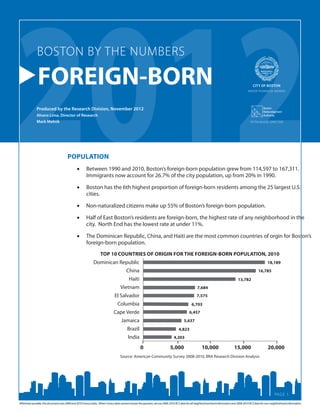
•	 Between 1990 and 2010, Boston’s foreign-born population grew from 114,597 to 167,311.
Immigrants now account for 26.7% of the city population, up from 20% in 1990.
•	 Boston has the 6th highest proportion of foreign-born residents among the 25 largest U.S.
cities.
•	 Non-naturalized citizens make up 55% of Boston’s foreign-born population.
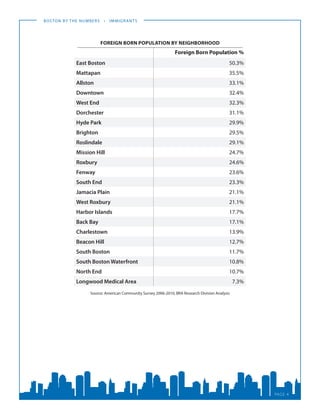
•	 Half of East Boston’s residents are foreign-born, the highest rate of any neighborhood in the
city. North End has the lowest rate at under 11%.
•	 The Dominican Republic, China, and Haiti are the most common countries of orgin for Boston’s
foreign-born population.
Top 10 Countries of Origin for the Foreign-Born Population, 2010
Source: American Community Survey 2008-2010, BRA Research Division Analysis
Dominican Republic
China
Haiti
Vietnam
El Salvador
Columbia
Cape Verde
Jamaica
Brazil
India
0 5,000 10,000 15,000 20,000
18,189
16,785
13,782
7,684
7,575
6,703
6,457
5,637
4,823
4,203
Boston by the Numbers • immigrants
page 2
Languages
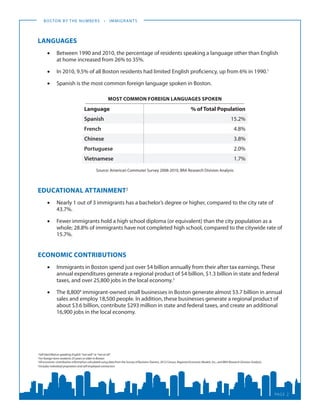
•	 Between 1990 and 2010, the percentage of residents speaking a language other than English
at home increased from 26% to 35%.
•	 In 2010, 9.5% of all Boston residents had limited English proficiency, up from 6% in 1990.1
•	 Spanish is the most common foreign language spoken in Boston.
Most Common Foreign Languages Spoken
Language % of Total Population
Spanish 15.2%
French 4.8%
Chinese 3.8%
Portuguese 2.0%
Vietnamese 1.7%
Source: American Commuter Survey 2008-2010, BRA Research Division Analysis
Educational Attainment2
•	 Nearly 1 out of 3 immigrants has a bachelor’s degree or higher, compared to the city rate of
43.7%.
•	 Fewer immigrants hold a high school diploma (or equivalent) than the city population as a
whole; 28.8% of immigrants have not completed high school, compared to the citywide rate of
15.7%.
Economic Contributions
•	 Immigrants in Boston spend just over $4 billion annually from their after tax earnings. These
annual expenditures generate a regional product of $4 billion, $1.3 billion in state and federal
taxes, and over 25,800 jobs in the local economy.3
•	 The 8,8004
immigrant-owned small businesses in Boston generate almost $3.7 billion in annual
sales and employ 18,500 people. In addition, these businesses generate a regional product of
about $3.6 billion, contribute $293 million in state and federal taxes, and create an additional
16,900 jobs in the local economy.
1
Self identified as speaking English “not well” or “not at all.”
2
For foreign-born residents 25 years or older in Boston
3
All economic contribution information calculated using data from the Survey of Business Owners, 2012 Census, Regional Economic Models, Inc., and BRA Research Division Analysis.
4
Includes individual proprietors and self employed contractors
page 3
Boston by the Numbers • immigrants
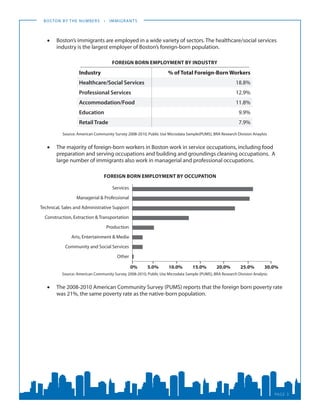
•	 Boston’s immigrants are employed in a wide variety of sectors. The healthcare/social services
industry is the largest employer of Boston’s foreign-born population.
Foreign Born Employment by Industry
Industry % of Total Foreign-Born Workers
Healthcare/Social Services 18.8%
Professional Services 12.9%
Accommodation/Food 11.8%
Education 9.9%
Retail Trade 7.9%
Source: American Community Survey 2008-2010, Public Use Microdata Sample(PUMS), BRA Research Division Anaylsis
•	 The majority of foreign-born workers in Boston work in service occupations, including food
preparation and serving occupations and building and groundings cleaning occupations. A
large number of immigrants also work in managerial and professional occupations.
Foreign Born Employment by Occupation
Services
Managerial & Professional
Technical, Sales and Administrative Support
Construction, Extraction & Transportation
Production
Arts, Entertainment & Media
Community and Social Services
Other
0% 5.0% 10.0% 15.0% 20.0% 25.0% 30.0%
Source: American Community Survey 2008-2010, Public Use Microdata Sample (PUMS), BRA Research Division Analysis
•	 The 2008-2010 American Community Survey (PUMS) reports that the foreign born poverty rate
was 21%, the same poverty rate as the native-born population.
Boston by the Numbers • immigrants
page 4
Foreign Born Population by Neighborhood
Foreign Born Population %
East Boston 50.3%
Mattapan 35.5%
Allston 33.1%
Downtown 32.4%
West End 32.3%
Dorchester 31.1%
Hyde Park 29.9%
Brighton 29.5%
Roslindale 29.1%
Mission Hill 24.7%
Roxbury 24.6%
Fenway 23.6%
South End 23.3%
Jamacia Plain 21.1%
West Roxbury 21.1%
Harbor Islands 17.7%
Back Bay 17.1%
Charlestown 13.9%
Beacon Hill 12.7%
South Boston 11.7%
South Boston Waterfront 10.8%
North End 10.7%
Longwood Medical Area 7.3%
Source: American Community Survey 2006-2010, BRA Research Division Analysis

Boston by the Numbers - Foreign Born - 2012

  • 1.
    page 1 2012BOSTON BYTHE NUMBERS FOREIGN-BORN city of boston mayor thomas m. menino peter meade, director Produced by the Research Division, November 2012 Alvaro Lima, Director of Research Mark Melnik Wheneverpossible,thisdocumentuses2000and2010Censusdata. WhenCensusdatacannotanswerthequestion,weuse2006-2010ACSdataforallneighborhoodlevelinformationand2008-2010ACSdatafornon-neighborhoodinformation. Population • Between 1990 and 2010, Boston’s foreign-born population grew from 114,597 to 167,311. Immigrants now account for 26.7% of the city population, up from 20% in 1990. • Boston has the 6th highest proportion of foreign-born residents among the 25 largest U.S. cities. • Non-naturalized citizens make up 55% of Boston’s foreign-born population. • Half of East Boston’s residents are foreign-born, the highest rate of any neighborhood in the city. North End has the lowest rate at under 11%. • The Dominican Republic, China, and Haiti are the most common countries of orgin for Boston’s foreign-born population. Top 10 Countries of Origin for the Foreign-Born Population, 2010 Source: American Community Survey 2008-2010, BRA Research Division Analysis Dominican Republic China Haiti Vietnam El Salvador Columbia Cape Verde Jamaica Brazil India 0 5,000 10,000 15,000 20,000 18,189 16,785 13,782 7,684 7,575 6,703 6,457 5,637 4,823 4,203
  • 2.
    Boston by theNumbers • immigrants page 2 Languages • Between 1990 and 2010, the percentage of residents speaking a language other than English at home increased from 26% to 35%. • In 2010, 9.5% of all Boston residents had limited English proficiency, up from 6% in 1990.1 • Spanish is the most common foreign language spoken in Boston. Most Common Foreign Languages Spoken Language % of Total Population Spanish 15.2% French 4.8% Chinese 3.8% Portuguese 2.0% Vietnamese 1.7% Source: American Commuter Survey 2008-2010, BRA Research Division Analysis Educational Attainment2 • Nearly 1 out of 3 immigrants has a bachelor’s degree or higher, compared to the city rate of 43.7%. • Fewer immigrants hold a high school diploma (or equivalent) than the city population as a whole; 28.8% of immigrants have not completed high school, compared to the citywide rate of 15.7%. Economic Contributions • Immigrants in Boston spend just over $4 billion annually from their after tax earnings. These annual expenditures generate a regional product of $4 billion, $1.3 billion in state and federal taxes, and over 25,800 jobs in the local economy.3 • The 8,8004 immigrant-owned small businesses in Boston generate almost $3.7 billion in annual sales and employ 18,500 people. In addition, these businesses generate a regional product of about $3.6 billion, contribute $293 million in state and federal taxes, and create an additional 16,900 jobs in the local economy. 1 Self identified as speaking English “not well” or “not at all.” 2 For foreign-born residents 25 years or older in Boston 3 All economic contribution information calculated using data from the Survey of Business Owners, 2012 Census, Regional Economic Models, Inc., and BRA Research Division Analysis. 4 Includes individual proprietors and self employed contractors
  • 3.
    page 3 Boston bythe Numbers • immigrants • Boston’s immigrants are employed in a wide variety of sectors. The healthcare/social services industry is the largest employer of Boston’s foreign-born population. Foreign Born Employment by Industry Industry % of Total Foreign-Born Workers Healthcare/Social Services 18.8% Professional Services 12.9% Accommodation/Food 11.8% Education 9.9% Retail Trade 7.9% Source: American Community Survey 2008-2010, Public Use Microdata Sample(PUMS), BRA Research Division Anaylsis • The majority of foreign-born workers in Boston work in service occupations, including food preparation and serving occupations and building and groundings cleaning occupations. A large number of immigrants also work in managerial and professional occupations. Foreign Born Employment by Occupation Services Managerial & Professional Technical, Sales and Administrative Support Construction, Extraction & Transportation Production Arts, Entertainment & Media Community and Social Services Other 0% 5.0% 10.0% 15.0% 20.0% 25.0% 30.0% Source: American Community Survey 2008-2010, Public Use Microdata Sample (PUMS), BRA Research Division Analysis • The 2008-2010 American Community Survey (PUMS) reports that the foreign born poverty rate was 21%, the same poverty rate as the native-born population.
  • 4.
    Boston by theNumbers • immigrants page 4 Foreign Born Population by Neighborhood Foreign Born Population % East Boston 50.3% Mattapan 35.5% Allston 33.1% Downtown 32.4% West End 32.3% Dorchester 31.1% Hyde Park 29.9% Brighton 29.5% Roslindale 29.1% Mission Hill 24.7% Roxbury 24.6% Fenway 23.6% South End 23.3% Jamacia Plain 21.1% West Roxbury 21.1% Harbor Islands 17.7% Back Bay 17.1% Charlestown 13.9% Beacon Hill 12.7% South Boston 11.7% South Boston Waterfront 10.8% North End 10.7% Longwood Medical Area 7.3% Source: American Community Survey 2006-2010, BRA Research Division Analysis