Burke J. Balch, J.D.Director, Robert Powell Center for Medical EthicsJune 25, 2011Denial of Life-Saving Medical Treatment in the Obama Health Care Law
Types of EuthanasiaVoluntary EuthanasiaNonvoluntary EuthanasiaInvoluntary Euthanasia
Involuntary EuthanasiaBy Health Care ProviderBy Government(Rationing)
What Is Rationing?Some say since we cannot have unlimited health care, health care will always be “rationed,” whether by the government or by simple inability to pay for it
What Is Rationing?Few can afford unlimited vacationsAre vacations therefore “rationed”?Few can afford to eat out at expensive restaurants for every meal every day of the yearIs food “rationed”?
What Is Rationing?Compare:Inability to afford unlimited foodGov’t coupons required for meat, butter, etc. during World War II
What Is Rationing?“Government allocation of scarce resources and consumer goods, usually adopted during wars, famines, or other national emergencies.”
Rationing in the obama health care law
1. Independent Payment Advisory BoardPresent public focus is on impact on Medicare
1. Independent Payment Advisory BoardIndependent Payment Advisory BoardBoard is directed to limit Medicare funding so it does not keep pace with medical inflationMethods:Limit reimbursement rates under gov’t FFSReduce payments to Medicare Advantage plans
1. Independent Payment Advisory BoardEspecially controversial:Board Medicare Cuts automatically become lawCongress may substitute different cuts but must have same resultCongressional majority cannot prevent cuts
1. Independent Payment Advisory BoardLITTLE ATTENTION TO MUCH MORE FAR-REACHING ROLE IN RATIONING:
Agree or Disagree?“Federal law should limit what private citizens can choose, out of their own funds, to spend on medical treatment to save the lives of their own family.”
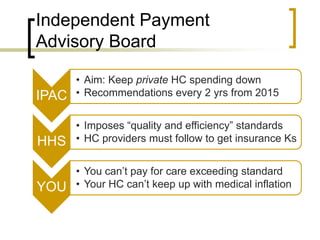
1. Independent Payment Advisory BoardIPAB directed to make recommendations every 2 years, starting in 2015“to slow the growth in national health expenditures” – i.e., nongovernmental spendingBelow the rate of medical inflation
1. Independent Payment Advisory BoardThe recommendations are to include those that federal Department of Health and Human Services “can implement administratively”HOW will HHS enforce?
“Quality” MeasuresHHS empowered to impose on hospitals, doctors, & other health care providersOne uniform standard of care specifying under what circumstances treatment can – and cannot – be given
EnforcementDoctors who give treatment not permitted by “quality” measures disqualified from contracting with the insurance plans all Americans will be required to have (individual mandate)
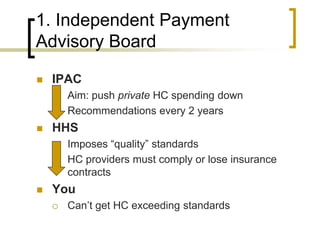
1. Independent Payment Advisory BoardIPACAim: push private HC spending downRecommendations every 2 yearsHHSImposes “quality” standardsHC providers must comply or lose insurance contractsYouCan’t get HC exceeding standards
2. Medicare Limits$ 555 billion cut from Medicare over 10 yearsBut will the government allow senior citizens to make up the difference from their own funds?
2. Medicare LimitsBEFORE:Older Americans permitted to add their own money, if they chose, on top of the governmental payment, in order to get insurance plans less likely to ration.(Known as Medicare Advantage private-fee-for-service plans.)
2. Medicare LimitsUNDER OBAMA HEALTH LAW:HHS given standardless discretion to reject any Medicare Advantage plan.HHS can limit or eliminate ability to add own money to obtain health insurance less likely to ration seniors’ health care.
3.  Exchange Limits on What People Can Pay for InsuranceNew state-based insurance “exchanges”At first, individuals & small business employeesLater, all employees
3. Exchange Limits on What People Can Pay for InsuranceGovernment officials will exclude health insurersWhose plans inside or outside the exchangeAllow private citizens to spend whatever gov’t officials think is an “excessive or unjustified” amount on their own health insurance
4.  “Shared Decisionmaking”Funding to nongovernment groups to develop “patient decision-making aids” to help “patients, caregivers or authorized representatives . . . to decide with their health care provider what treatments are best for them.”
4.  “Shared Decisionmaking”Establish regional “Shared Decisionmaking Resource Centers . . . “to provide technical assistance to providers and to develop and disseminate best practices . . .”
4.  “Shared Decisionmaking”What groups will be paid tax dollars to set the guidelines for and create “patient-decisionmaking aids”?
Foundation for Informed DecisionmakingWebsite box: “Did You Know?”“More care does not equal better outcomes.”
Foundation for Informed DecisionmakingWebsite box: “Did You Know?” “In many people with stable heart disease, medications are just as good as stents or bypass surgery.”
Foundation for Informed DecisionmakingWebsite box: “Did You Know?” “Whether or not they receive active treatment, most men diagnosed with early stage prostate cancer will die of something else.”
Foundation for Informed DecisionmakingWebsite box: “Did You Know?”“Back patients in Idaho Falls, Idaho are 20 times more likely to have lumbar fusion surgery than those in Bangor, Maine, with no clear difference in . . . quality of life.”
Foundation for Informed DecisionmakingWebsite box: “Did You Know?”“About 25% of Medicare dollars are spent on people in their last 60 days of life.”
HealthwiseWebsite proclaims: “avoid unnecessary care with Healthwise consumer health information”
Center for Information TherapyWebsite:  “Toward the end of life, too many people receive ineffective, expensive medical treatments.”
4 Routes to Rationing1. Independent Payment Advisory Board & “quality and efficiency” standards2. Medicare Limits3. Exchange Limits on What People Can Choose to Pay for Insurance4. “Shared Decisionmaking”
Can health care spending be limited without rationing?
The Claim that Greater Efficiency Will Avert Rationing“Dartmouth Atlas” – compares what different hospitals spend per patient on those in last months or years of lifeClaim:  some hospitals spend much less with same outcome (death), so we can limit payments to the level of the most efficient hospitals without harm
NY Times article 12/22/09The Obama Administration’s former director of the Office of Management and Budget, Peter Orzag, attacked the fact that the Ronald Reagan University of California at Los Angelos [UCLA] Medical Center spends more than Rochester, Minnesota's Mayo Clinic.
NY Times article 12/22/09Orzag: "One of them costs twice as much as the other, and I can tell you that we have no idea what we’re getting in exchange for the extra $25,000 a year at U.C.L.A. Medical. We can no longer afford an overall health care system in which the thought is more is always better, because it’s not."
NY Times article 12/22/09BUT: “[T]he hospital that spent the most on heart failure patients had one-third fewer deaths after six months of an initial hospital stay.”Difference between looking forward and looking back
ANOTHER N.Y. Times article 6/14/2010“The atlas’s hospital rankings do not take into account care that prolongs or improves lives. If one hospital spends a lot on five patients and manages to keep four of them alive, while another spends less on each but all five die, the hospital that saved patients could rank lower because Dartmouth compares only costs before death.”
RATIONING: The real agenda
What’s going on?Obama’s appointee to head the agency administering much of the new health law, Donald Berwick:Through “rational collective action overriding some individual self-interest,” he wrote, “we can reduce per capita costs.”
What’s going on?Obama’s appointee to head the agency administering much of the new health law, Donald Berwick:“The decision is not whether or not we will ration care – the decision is whether we will ration with our eyes open. . . .”
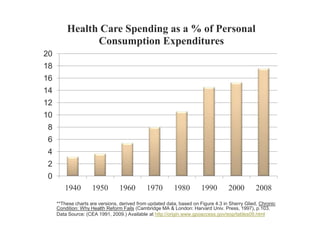
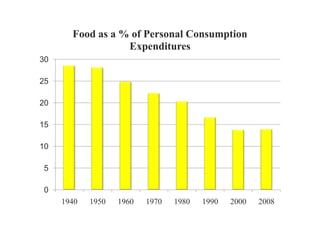
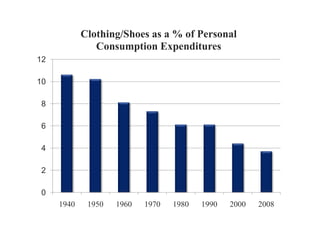
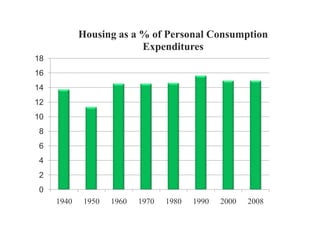
Is It True That America HAS to Ration Health Care?
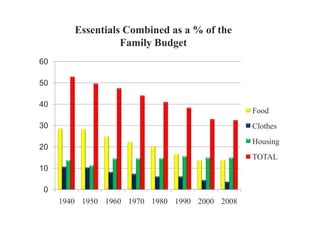
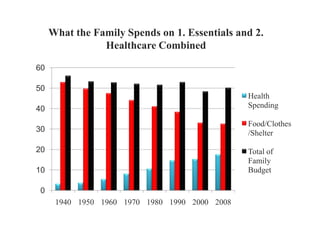
**These charts are versions, derived from updated data, based on Figure 4.3 in Sherry Glied, Chronic Condition: Why Health Reform Fails (Cambridge MA & London: Harvard Univ. Press, 1997), p.103.Data Source: (CEA 1991, 2009.) Available at http://origin.www.gpoaccess.gov/eop/tables09.html
Essentials Combined as a % of the Family Budget
What the Family Spends on 1. Essentials and 2. Healthcare Combined
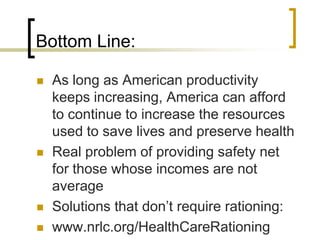
Bottom Line:As long as American productivity keeps increasing, America can afford to continue to increase the resources used to save lives and preserve healthReal problem of providing safety net for those whose incomes are not averageSolutions that don’t require rationing:www.nrlc.org/HealthCareRationing
Can the Obama Health Law Be Repealed?
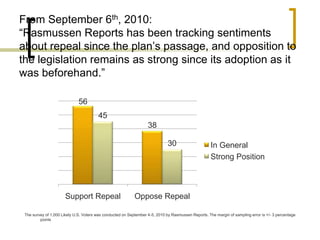
From September 6th, 2010:“Rasmussen Reports has been tracking sentiments about repeal since the plan’s passage, and opposition to the legislation remains as strong since its adoption as it was beforehand.”The survey of 1,000 Likely U.S. Voters was conducted on September 4-5, 2010 by Rasmussen Reports. The margin of sampling error is +/- 3 percentage points
The Road to RepealSilver lining:  the fundamental elements, including the worst rationing aspectsDon’t go into effect until 2014
The Road to RepealBy 2013:Need a pro-repeal PresidentNeed a pro-repeal majority in the HouseWhat about the Senate?
The Road to Repeal41 Senators can filibuster60 Pro-repeal Senators would winWhat if there is a majority, but not 60?Some previous pro-law Senators might switchReconciliation might work
Our Job:  Educate!www.nrlc.org/HealthCareRationing
If you remember nothing else, remember – and relate – the rationing danger of the Independent Payment Advisory Commission:
Independent Payment Advisory Board
Obama Health Law’s IdeologyNo “Two Tier” Health Care SystemBasic question:A. Do you even things out by helping those who can’t afford adequate health care?  ORB. By limiting the health care available to those who can afford it?Obama health law does some of A and a lot of B . . .

Denial of Life-Saving Medical Treatment in the Obama Health Care Law

  • 1.
    Burke J. Balch,J.D.Director, Robert Powell Center for Medical EthicsJune 25, 2011Denial of Life-Saving Medical Treatment in the Obama Health Care Law
  • 2.
    Types of EuthanasiaVoluntaryEuthanasiaNonvoluntary EuthanasiaInvoluntary Euthanasia
  • 3.
    Involuntary EuthanasiaBy HealthCare ProviderBy Government(Rationing)
  • 4.
    What Is Rationing?Somesay since we cannot have unlimited health care, health care will always be “rationed,” whether by the government or by simple inability to pay for it
  • 5.
    What Is Rationing?Fewcan afford unlimited vacationsAre vacations therefore “rationed”?Few can afford to eat out at expensive restaurants for every meal every day of the yearIs food “rationed”?
  • 6.
    What Is Rationing?Compare:Inabilityto afford unlimited foodGov’t coupons required for meat, butter, etc. during World War II
  • 7.
    What Is Rationing?“Governmentallocation of scarce resources and consumer goods, usually adopted during wars, famines, or other national emergencies.”
  • 8.
    Rationing in theobama health care law
  • 9.
    1. Independent PaymentAdvisory BoardPresent public focus is on impact on Medicare
  • 10.
    1. Independent PaymentAdvisory BoardIndependent Payment Advisory BoardBoard is directed to limit Medicare funding so it does not keep pace with medical inflationMethods:Limit reimbursement rates under gov’t FFSReduce payments to Medicare Advantage plans
  • 11.
    1. Independent PaymentAdvisory BoardEspecially controversial:Board Medicare Cuts automatically become lawCongress may substitute different cuts but must have same resultCongressional majority cannot prevent cuts
  • 12.
    1. Independent PaymentAdvisory BoardLITTLE ATTENTION TO MUCH MORE FAR-REACHING ROLE IN RATIONING:
  • 13.
    Agree or Disagree?“Federallaw should limit what private citizens can choose, out of their own funds, to spend on medical treatment to save the lives of their own family.”
  • 14.
    1. Independent PaymentAdvisory BoardIPAB directed to make recommendations every 2 years, starting in 2015“to slow the growth in national health expenditures” – i.e., nongovernmental spendingBelow the rate of medical inflation
  • 15.
    1. Independent PaymentAdvisory BoardThe recommendations are to include those that federal Department of Health and Human Services “can implement administratively”HOW will HHS enforce?
  • 16.
    “Quality” MeasuresHHS empoweredto impose on hospitals, doctors, & other health care providersOne uniform standard of care specifying under what circumstances treatment can – and cannot – be given
  • 17.
    EnforcementDoctors who givetreatment not permitted by “quality” measures disqualified from contracting with the insurance plans all Americans will be required to have (individual mandate)
  • 18.
    1. Independent PaymentAdvisory BoardIPACAim: push private HC spending downRecommendations every 2 yearsHHSImposes “quality” standardsHC providers must comply or lose insurance contractsYouCan’t get HC exceeding standards
  • 19.
    2. Medicare Limits$555 billion cut from Medicare over 10 yearsBut will the government allow senior citizens to make up the difference from their own funds?
  • 20.
    2. Medicare LimitsBEFORE:OlderAmericans permitted to add their own money, if they chose, on top of the governmental payment, in order to get insurance plans less likely to ration.(Known as Medicare Advantage private-fee-for-service plans.)
  • 21.
    2. Medicare LimitsUNDEROBAMA HEALTH LAW:HHS given standardless discretion to reject any Medicare Advantage plan.HHS can limit or eliminate ability to add own money to obtain health insurance less likely to ration seniors’ health care.
  • 22.
    3. ExchangeLimits on What People Can Pay for InsuranceNew state-based insurance “exchanges”At first, individuals & small business employeesLater, all employees
  • 23.
    3. Exchange Limitson What People Can Pay for InsuranceGovernment officials will exclude health insurersWhose plans inside or outside the exchangeAllow private citizens to spend whatever gov’t officials think is an “excessive or unjustified” amount on their own health insurance
  • 24.
    4. “SharedDecisionmaking”Funding to nongovernment groups to develop “patient decision-making aids” to help “patients, caregivers or authorized representatives . . . to decide with their health care provider what treatments are best for them.”
  • 25.
    4. “SharedDecisionmaking”Establish regional “Shared Decisionmaking Resource Centers . . . “to provide technical assistance to providers and to develop and disseminate best practices . . .”
  • 26.
    4. “SharedDecisionmaking”What groups will be paid tax dollars to set the guidelines for and create “patient-decisionmaking aids”?
  • 27.
    Foundation for InformedDecisionmakingWebsite box: “Did You Know?”“More care does not equal better outcomes.”
  • 28.
    Foundation for InformedDecisionmakingWebsite box: “Did You Know?” “In many people with stable heart disease, medications are just as good as stents or bypass surgery.”
  • 29.
    Foundation for InformedDecisionmakingWebsite box: “Did You Know?” “Whether or not they receive active treatment, most men diagnosed with early stage prostate cancer will die of something else.”
  • 30.
    Foundation for InformedDecisionmakingWebsite box: “Did You Know?”“Back patients in Idaho Falls, Idaho are 20 times more likely to have lumbar fusion surgery than those in Bangor, Maine, with no clear difference in . . . quality of life.”
  • 31.
    Foundation for InformedDecisionmakingWebsite box: “Did You Know?”“About 25% of Medicare dollars are spent on people in their last 60 days of life.”
  • 32.
    HealthwiseWebsite proclaims: “avoidunnecessary care with Healthwise consumer health information”
  • 33.
    Center for InformationTherapyWebsite: “Toward the end of life, too many people receive ineffective, expensive medical treatments.”
  • 34.
    4 Routes toRationing1. Independent Payment Advisory Board & “quality and efficiency” standards2. Medicare Limits3. Exchange Limits on What People Can Choose to Pay for Insurance4. “Shared Decisionmaking”
  • 35.
    Can health carespending be limited without rationing?
  • 36.
    The Claim thatGreater Efficiency Will Avert Rationing“Dartmouth Atlas” – compares what different hospitals spend per patient on those in last months or years of lifeClaim: some hospitals spend much less with same outcome (death), so we can limit payments to the level of the most efficient hospitals without harm
  • 37.
    The Claim thatGreater Efficiency Will Avert Rationing“Dartmouth Atlas” – compares what different hospitals spend per patient on those in last months or years of lifeClaim: some hospitals spend much less with same outcome (death), so we can limit payments to the level of the most efficient hospitals without harm
  • 38.
    NY Times article12/22/09The Obama Administration’s former director of the Office of Management and Budget, Peter Orzag, attacked the fact that the Ronald Reagan University of California at Los Angelos [UCLA] Medical Center spends more than Rochester, Minnesota's Mayo Clinic.
  • 39.
    NY Times article12/22/09Orzag: "One of them costs twice as much as the other, and I can tell you that we have no idea what we’re getting in exchange for the extra $25,000 a year at U.C.L.A. Medical. We can no longer afford an overall health care system in which the thought is more is always better, because it’s not."
  • 40.
    NY Times article12/22/09BUT: “[T]he hospital that spent the most on heart failure patients had one-third fewer deaths after six months of an initial hospital stay.”Difference between looking forward and looking back
  • 41.
    ANOTHER N.Y. Timesarticle 6/14/2010“The atlas’s hospital rankings do not take into account care that prolongs or improves lives. If one hospital spends a lot on five patients and manages to keep four of them alive, while another spends less on each but all five die, the hospital that saved patients could rank lower because Dartmouth compares only costs before death.”
  • 42.
  • 43.
    What’s going on?Obama’sappointee to head the agency administering much of the new health law, Donald Berwick:Through “rational collective action overriding some individual self-interest,” he wrote, “we can reduce per capita costs.”
  • 44.
    What’s going on?Obama’sappointee to head the agency administering much of the new health law, Donald Berwick:“The decision is not whether or not we will ration care – the decision is whether we will ration with our eyes open. . . .”
  • 45.
    Is It TrueThat America HAS to Ration Health Care?
  • 46.
    **These charts areversions, derived from updated data, based on Figure 4.3 in Sherry Glied, Chronic Condition: Why Health Reform Fails (Cambridge MA & London: Harvard Univ. Press, 1997), p.103.Data Source: (CEA 1991, 2009.) Available at http://origin.www.gpoaccess.gov/eop/tables09.html
  • 50.
    Essentials Combined asa % of the Family Budget
  • 51.
    What the FamilySpends on 1. Essentials and 2. Healthcare Combined
  • 52.
    Bottom Line:As longas American productivity keeps increasing, America can afford to continue to increase the resources used to save lives and preserve healthReal problem of providing safety net for those whose incomes are not averageSolutions that don’t require rationing:www.nrlc.org/HealthCareRationing
  • 53.
    Can the ObamaHealth Law Be Repealed?
  • 54.
    From September 6th,2010:“Rasmussen Reports has been tracking sentiments about repeal since the plan’s passage, and opposition to the legislation remains as strong since its adoption as it was beforehand.”The survey of 1,000 Likely U.S. Voters was conducted on September 4-5, 2010 by Rasmussen Reports. The margin of sampling error is +/- 3 percentage points
  • 55.
    The Road toRepealSilver lining: the fundamental elements, including the worst rationing aspectsDon’t go into effect until 2014
  • 56.
    The Road toRepealBy 2013:Need a pro-repeal PresidentNeed a pro-repeal majority in the HouseWhat about the Senate?
  • 57.
    The Road toRepeal41 Senators can filibuster60 Pro-repeal Senators would winWhat if there is a majority, but not 60?Some previous pro-law Senators might switchReconciliation might work
  • 58.
    Our Job: Educate!www.nrlc.org/HealthCareRationing
  • 59.
    If you remembernothing else, remember – and relate – the rationing danger of the Independent Payment Advisory Commission:
  • 60.
  • 63.
    Obama Health Law’sIdeologyNo “Two Tier” Health Care SystemBasic question:A. Do you even things out by helping those who can’t afford adequate health care? ORB. By limiting the health care available to those who can afford it?Obama health law does some of A and a lot of B . . .