Arizona Legislative
SCORE
CARD
2010
49th State Legislature
www.azlcv.org
ArizonaConservationVoter
Volume 19,Number 1 Summer 2010
Courtesy jazzcat at stockvault.net
www.azlcv.org 2 Arizona League of Conservation Voters Scorecard Summer 2010
Dear Friends and Members,
The 2010 legislative session was one marked by partisan politics and the lack of will to
tackle the myriad of challenges that Arizona faces. For environmental protection and a
sustainable Arizona, this was not a good year.
We saw the effects of years of systematically defunding our state parks system during good
economic times and now we are witnessing our parks closing throughout the state (at this
writing we have already closed 6 state parks). The refusal of the legislature to invest in one
of our state’s major economic drivers, tourism, resulted in “sweeps” of dedicated parks
funds including Heritage Fund money and entrance fees to parks. The legislature even
“swept” the private donations from the donation boxes at the parks and a private bequest
of $242,000 that a philanthropist left to our state park system (after overwhelming public
pressure the legislature returned the $242,000 but kept the donation box money).
This year's legislative session brought up some big questions for our state. Aside from the
specific bills addressed (or left unaddressed) in the session and documented in this
scorecard, this session and the last session raise some fundamental questions about the
future of our state.
Do the legislative sessions of 2009 and 2010 represent a low point for conservation in
Arizona before the beginning of a new era of environmental stewardship and
responsibility? Or do they represent the beginning of an era of environmental
irresponsibility, deregulation and slash-and-burn budget cutting?
The 2010 elections and the 2011 legislative session will resolve these questions, and I hope
that we are up to the challenge. Arizona may not be directly affected by the oil spill in the
gulf, but our state legislature has been inflicting damage of a similar kind to our air quality,
water quality and our natural heritage. The effect of this damage, like the oil spill, will be
felt for decades to come.
Arizona’s broken priorities were nowhere more apparent than when a bi-partisan plan to
save our state parks was held in committee while a vote on Arizona’s official state beverage
(I’m not making this up, it was going to be milk) was brought the floor of the House (it
failed 26-31). Now we have neither a functioning state parks system nor an official state
beverage.
While some progress was made on energy policy, our legislature once again shied away
from the task to build an Arizona for the 21st century and beyond. Sadly, our legislature
too often resembles a 19th century territorial government with access to 21st century
media tools.
The AZLCV will be working hard this year and next to create a legislature that responds
to constituent concerns about our land, air and water. Without action at the state level
right now Arizona will be reversing decades of progress on the environmental front.
I urge all of you to prioritize the environment at the ballot box this year and to be active
citizens during next year’s legislative session. Join the AZLCV’s E-activist list to stay
abreast of next year’s session by sending an email to mramsey@azlcv.org.
Thank you for your support of the League,
Steven C Arnquist
Executive Director
In this
Scorecard:
Actions Used for
Scoring
4-9
Map of District
Scores
10-11
House Voting Tally
12-15
Senate Voting Tally
16-17
Good Ideas
Left Behind
18
What’s Next
19
Legislator’s 2010 &
Lifetime Scores
20
Arizona League of Conservation Voters Scorecard Summer 2010 3 www.azlcv.org
The Arizona League of Conservation Voters publishes an
annual Scorecard following the legislative session. Contents
are copyrighted, but articles may be reprinted provided
credit is given to authors and the League.
Annual membership for the League begins at $35. All
members receive the Scorecard and, if they choose, our
regular email updates.
www.azlcv.org
Contact us at info@ azlcv.org or
in Tucson: 738 N.Fifth Ave.,Suite 218,85705
in Phoenix: 825 N.Third Ave.,85003
Mailing address: PO Box 40154,Tucson AZ 85717
Staff
Steve Arnquist
Executive Director
Melissa Ramsey
Membership Coordinator
& Administrator
Nicole Schneidman
Intern
Scorecard design by Julie St. John
Board of Directors
Roselyn O’Connell, President, Scottsdale
Tina Beattie, Vice President, Gilbert
Roberta Voss, Secretary/Treasurer, Phoenix
Paul Burkhardt, Prescott
Michael Dunne, Tucson
Grant Loper, Tempe
William Roe, Tucson
Paul Walker, Phoenix
Our Mission
The Arizona League of Conservation Voters
(AZLCV or “the League”) is Arizona’s largest
statewide membership-supported conservation
group, with almost 6,000 members.
# We work to protect our land, air, water and quality of
life for all Arizonans, present and future.
# We do this by advocating for common-sense
environmental policy and by endorsing pro-
conservation candidates.
# We are non-partisan and non-profit, and our work
includes:
# Endorsing and working to elect pro-conservation
state legislators and statewide candidates,
# Educating elected officials and their constituents on
conservation issues important to the League’s
members,
# Lobbying on behalf of reasonable, common-sense
conservation measures,
# Holding elected officials accountable for their
performance with our annual Legislative Scorecard,
and
# Maintaining a political action committee (PAC) that
works directly to elect pro-conservation candidates.
100% Honor Roll
House of Representatives
Christopher Deschene (D-2) – 100%
Chad Campbell (D-14) – 100%
Martha Garcia (D-13) – 100%
David Lujan (D-15) – 100%
Anna Tovar (D-13) – 100%
Kyrsten Sinema (D-15) – 100%
David Bradley (D-28) – 100%
Senate
Meg Burton-Cahill (D-17) – 100%
Jorge Luis Garcia (D-27) – 100%
Leah Landrum-Taylor (D-16) – 100%
Richard Miranda (D-13) – 100%
Debbie McCune-Davis (D-14) – 100%
Top Scoring District:
LD 13 – 100%: Represented by Senator Richard Miranda,
Representative Anna Tovar,& Representative Martha Garcia
Top Scorers
House Democrats
Olivia Cajero Bedford (D-27) – 95%
Tom Chabin (D-2) – 95%
Steve Farley (D-28) – 95%
Daniel Patterson (D-29) – 95%
Nancy Young-Wright (D-26) – 95%
David Schapira (D-17) – 94%
Eric Meyer (D11) – 93%
Edward Ableser (D-17) – 92%
Patricia Fleming (D-25) – 92%
Robert Meza (D-14) – 92%
Phil Lopes (D-27) – 91%
Senate Democrats
Linda Lopez (D-29) – 94%
Paula Aboud (D-28) – 92%
Rebecca Rios (D-23) – 89%
Bottom Scorers
House of Representatives
Andy Biggs (R-22) – 7%
Judy Burges (R-4) – 10%
John Kavanagh (R-8) – 11%
Senate
Chuck Gray (R-19) – 6%
Sylvia Allen (R-5) – 11%
Russell Pearce (R-18) – 12%
Averages
House Average: 52% — Democrats: 88% — Republicans: 27%
Senate Average: 48% — Democrats: 88% — Republicans: 22%
House Republicans
Cecil Ash (R-18) – 51%
Senate Republicans
Jay Tibshraeny (R-21) – 46%
www.azlcv.org 4 Arizona League of Conservation Voters Scorecard Summer 2010
Each legislator’s score is based on his or her total pro-conservation votes over
the course of the session. Measures are weighed according to their importance,
and no credit is given for missing votes. However, members are not penalized for
excused absences (as recorded on the official attendance sheet for each chamber
on the day of the vote). In all cases, the scores are based on the final vote each
measure receives in either chamber.
The League gives “extra credit” to legislators who sponsor positive legislation (prime-prime sponsors
only). For each good measure introduced, the legislator receives an extra percentage point added to his or
her final score. For measures that actually become law, two percentage points are added. On the other
hand, those who sponsor anti-conservation or anti-public-participation legislation have one percentage
point deducted from their final score for each measure introduced and two points deducted if the measure
becomes law. Final scores are capped at 100 percent.
A“NO”vote is a
green vote.Weight: 8
Defeated House
36-23-1 (needed super
majority to pass)
April 28,2010
(Nichols) The Public Conservation Account is controlled by the State Parks Board
and is dedicated to acquiring land for conservation purposes. If the measure had
passed, the funds in this voter-mandated account would have been diverted to run
our state parks and historical societies, both of which have already had their budget
allotments swept. Although these entities represent critical needs, the sweep of the
Public Conservation Account would have misdirected dollars intended for a voter-
approved purpose. Under the Voter Protection Act (Prop. 105) of 1998, initiatives
that the voters approve cannot be repealed without a super majority vote (75%); as
a result, this bill failed after not mustering the required ¾ majority in the House of
Representatives.
A“NO”vote is a
green vote.Weight: 6
Passed House 39-20-1
March 3,2010
Passed Senate 21-7-2
April 19,2010
Signed into law by
Governor April 23,2010
(Pratt, Barnes, McGuire) This bill creates a loophole for mining companies as
related to their water use in Arizona. It allows mining companies to gain long-term
storage credit for the Central Arizona Project (CAP) water they store.As a result, the
more water these companies store, the greater assurance they have for future mining
operations. In addition, this bill fails to account for the groundwater the mining
companies pump for their direct use. Even though the used groundwater should be
charged against the companies’ long-term storage credits, this bill creates a loophole
that allows for the companies’ direct use of groundwater even as they increase their
long-term storage credit of CAP water.
HB 2060 Public conservation monies; transfer
HB 2289 Water recharge; direct use
Actions Used for Scoring
Arizona League of Conservation Voters Scorecard Summer 2010 5 www.azlcv.org
A“NO”vote is a
green vote.Weight: 6
Passed House 34-26
March 3,2010
Held in Senate
(Jones, Kavanagh, Mason, et al) This measure has been a recurring bill during the
past few legislative sessions. It proposes filling abandoned mines with used tires.
Although this may seem like a good idea, the proposal is deeply flawed and would
likely have serious environmental consequences. Tires are extremely flammable and
the threat of a tire fire in an abandoned mine represents a significant problem. Used
tires would also pollute the soil and water surrounding the mines and negatively
impact the bats that use abandoned mines as their habitats.Although this legislation
failed to pass this session, we will likely see it again.
HB 2290 Waste tires in abandoned mines
A“NO”vote is a
green vote.Weight: 3
Passed House 33-2
March 3,2010
Passed Senate 18-12
April 28,2010
Vetoed by Governor
May 11,2010
(Antenori, Biggs, Gowan, et al) This bill represents another means for the state to
challenge federal regulations, but it is clearly regressive as related to the
environment. HB 2337 allows incandescent lightbulbs to be manufactured and sold
in Arizona. The United States is phasing out incandescent light bulbs, so this
measure would not be compliant with federal regulation under the Interstate
Commerce Clause. CFL bulbs use less power and last longer, so they are an easy and
obvious way to become more energy efficient. This bill is a symbol that progress in
energy efficiency is not a priority in Arizona.
HB 2337 Arizona manufactured incandescent lightbulbs; regulation
(Burges, Antenori, Barnes, et al) HB 2442 requires that state agencies receive
legislative authorization before they adopt or enforce any greenhouse emissions
regulations. This will hinder the ability of the Arizona Department of
Environmental Quality to create and institute regulations that reduce emissions.
This bill also includes an intent section that mandates that the legislature authorize
any cap and trade system applied in Arizona. We don’t need additional roadblocks
preventing our state from addressing greenhouse emissions.
HB 2442 Greenhouse gas emissions; regulations A“NO”vote is a
green vote.Weight: 8
Passed House 35-23-1
February 16,2010
Passed Senate 18-10-2
April 19,2010
Signed into law by
Governor April 26,2010
A“NO”vote is a
green vote.Weight: 4
Defeated House
26-28-6
April 1,2010
(Antenori, Crump, Gowan, et al) This bill prohibits a public service corporation
from charging a customer for the first 1,000 ft. of a power line if the associated cost
is less than $10,000. Public service corporations, however, may require customers to
pay the actual cost of a line extension if it is over $10,000. This bill infringes on the
constitutional rate-making authority of the Arizona Corporation Commission and
would shift one of the costs of sprawl development from the developers back to the
ratepayers. It also allows developers to profit without paying the true costs of
development.
HB 2451 Line extensions; utility infrastructure; charges
www.azlcv.org 6 Arizona League of Conservation Voters Scorecard Summer 2010
A“NO”vote is a
green vote.Weight: 7
Passed Senate 16-12-2
April 22,2010
Passed House 38-19-3
April 27,2010
Signed into law by
Governor May 11,2010
(Jones, Gowan, Mason, et al) This bill will prohibit the Arizona Department of
Environmental Quality (ADEQ) from regulating mines more strictly than the federal
mine regulations as established by the 1872 Mining Act. It will hinder the
development of future programs that could regulate the amount of pollutants that
contaminate our drinking water. HB 2617 also creates an advisory committee of
industry professionals that will advise state agencies on how to implement mining
regulations. This bill will supposedly simplify the permit-granting process for new
mines, but in reality, it is another blow to our already thinly stretched ADEQ.
HB 2617 Mining amendments; water; permits; rules
(Mason, Boone, Chad Campbell, et al) This bill expands county and municipal
improvement districts that may be formed to include "renewable energy districts."
Renewable energy districts utilize various renewable and efficient energy equipment and
water conservation units. According to this measure, each district could receive funds to
install and maintain improvements related to energy efficiency, renewable energy, water
conservation and water management. This bill recognizes renewable energy is a smart
investment that has the potential to fuel sustainable growth in Arizona.
HB 2574 Renewable energy districts
(McLain, Ash, Bradley, et al) HB 2464 was a striker bill that would have leased Lake
Havasu State park to Lake Havasu City.Considering that Lake Havasu is one of Arizona’s
most popular state parks, this measure would have represented a significant hit to the
State Parks’ already battered budget. HB 2464 would have deprived the state of $400,000
that Lake Havasu State Park generates each year. In addition, it would have accepted a
lease that would have surrendered this profit to Lake Havasu City in return for only at
most $50,000 a year. If this bill had passed, it would most likely have lead to additional
park closures.Since it was a striker bill,it was a completely different bill having to do with
auto insurance for the House vote, so the House is not penalized for voting on this bill.
HB 2464 NOW: State parks; funding; management A“NO”vote is a
green vote.Weight: 6
Passed House 49-5-6
March 24,2010
Defeated Senate 12-18
April 28,2010
A“YES”vote is a
green vote.Weight: 6
Passed House 47-13
March 3,2010
Held in Senate
A“NO”vote is a
green vote.Weight: 5
Passed House 42-11-7
April 1,2010
Defeated Senate
14-14-2
April 22,2010
(Kavanagh) HB 2599 was a piece of bad legislation that was drafted to demonstrate that
some, although minimal, effort and thought was invested in generating funding for our
state parks. This measure was a substitute for HCR 2040 — the Sustainable Parks Fund,
which would have added a mandatory $9 fee to Arizonans’ vehicle registrations and in
return, would have allowed any person with an Arizona plate to visit all the parks for free.
In contrast,HB 2599 would have added a checkbox on vehicle registrations for a voluntary
$10 contribution to the parks fund. According to this bill, even if an individual
contributed $10 with his registration, they would still have to pay additional fees to enter
the state parks. Furthermore, HB 2599 would not have created a sustainable funding
source for our state parks. Instead, it only represented an ineffective replacement for a
promising piece of legislation. Our state parks should be mandatory, not optional.
HB 2599 State parks fund; voluntary contributions
Actions Used for Scoring continued
Arizona League of Conservation Voters Scorecard Summer 2010 7 www.azlcv.org
A“YES”vote is a
green vote.Weight: 6
Passed House 44-13-2
March 8,2010
Passed Senate 16-14
April 27,2010
Signed into law by
Governor May 10,2010
(Boone) This bill extends the income tax credit for commercial and industrial
applications of solar energy devices to the tax year ending Dec. 31, 2016. The tax
credit is equal to 10% of the installation cost of the device, which can’t exceed
$25,000 for the same building in the same year and can’t exceed $50,000 for the
taxpayer in a year. Unused credit may be carried forward for up to five years.
HB 2700 Solar energy tax incentives; extension
A“NO”vote is a
green vote.Weight: 5
Passed House 37-18-5
March 24,2010
Passed Senate 18-9-3
April 22,2010
Transmitted to the
Secretary of State
(Jerry Weiers, Gowan, Crump, et al) The 2010 general election ballot will carry the
question of whether to change the Arizona constitution by adding hunting and
fishing as a basic right. If voted in, this will make it more difficult to manage wildlife.
Our state’s wildlife belongs to all Arizonans, regardless of the stances we hold on
how it should be managed. Hunting and fishing is a recreational privilege that does
not merit the same standing as constitutional rights such as the freedom of speech.
HCR 2008 NOW: Hunting and fishing; constitutional rights
A“YES”vote is a
green vote.Weight: 7
Passed Senate 19-8-3
April 29,2010
Passed House 45-11-4
April 29,2010
Signed into law by
Governor May 11,2010
(Leff) This bill establishes a tax credit for individuals and corporations that produce
renewable energy. The amount of the credit is adjusted according to the amount of
kilowatt hours produced. In addition, statues pertaining to the tax credit for
research and development expenses are now amended to allow a taxpayer with fewer
than 150 fulltime employees to apply for a tax refund rather than carrying the credit
forward for future filings. This bill joins the ranks of previous legislation that has
provided incentives to people who invest in and use renewable energy in Arizona.
SB 1254 NOW: Research; development; production; tax credit
(Nelson) SB 1200 establishes the Arizona Game and Fish Commission
Appointment Recommendation Board. This board is appointed by the Governor
and assists the Governor in the review and recommendation of appointees to the
Arizona Game and Fish Commission. This bill further excludes the public’s role in
wildlife management. It forms an appointment board that will include only one
member from the non-sportsmen public and four members who represent hunters
and ranchers. The recommendation board should represent Arizona’s broad range
of interests to encourage the development of a more diverse Game and Fish
Commission.
SB 1200 NOW: Game and fish commission; board A“NO”vote is a
green vote.Weight: 8
Passed Senate 16-7-7
March 18,2010
Passed House 36-19-5
March 25,2010
Signed into law by
Governor April 7,2010
www.azlcv.org 8 Arizona League of Conservation Voters Scorecard Summer 2010
A“NO”vote is a
green vote.Weight: 4
Passed Senate 16-12-1
March 3,2010
Held in House
(Melvin) This resolution would have been on the 2010 general ballot and asked
voters to grant our state legislators the authority to appropriate most of the federal
money the state receives. This would have likely resulted in both the reduction of
Arizona’s federal appropriation and the mismanagement of received federal funding.
SCR 1022 Legislative appropriation; federal monies
A“NO”vote is a
green vote.Weight: 9
Passed Senate 18-11-1
March 22,2010
Held in House
(C. Gray, S. Allen, Gould, et al) SCR 1046 would refer to the ballot the question of
whether to amend Arizona’s constitution so that the State of Arizona is the primary
regulator of non-navigable intrastate waters. This measure would have made it so
Arizona rivers would not have the strong protections of the Clean Water Act. The
Clean Water Act has protected many of Arizona's waters since 1972, and this
measure would make our most valuable resource less protected. 94% of Arizona's
water would have lost this protection since they do not flow year round.
SCR 1046 Jurisdiction over intrastate waters
(S. Pierce, Aguirre, Ash, et al) This bill establishes a Water Resources Fund where
revenue from various fees charges by the Department of Water Resources is
deposited. Supposedly, this fund cannot be appropriated or transferred by the
legislature in the future, but judging by the transfers and appropriations of funds
this legislative session we cannot be expected to believe that the Water Resources
Fund would be safe. This is still a step in the right direction. Allowable uses are also
expanded to the Dam Repair Fund. This bill is good for water conservation and
water resource management.
SB 1359 Department of water resources; fund A“YES”vote is a
green vote.Weight: 6
Passed Senate 25-1-4
April 29,2010
Passed House 58-0-2
April 29,2010
Signed into law by
Governor May 7,2010
A“NO”vote is a
green vote.Weight: 6
Passed Senate 20-9-1
April 7,2010
Passed House 39-16-5
April 19,2010
Signed into law by
Governor April 26,2010
(S. Pierce, Burns, Nelson) SB 1445 addresses the Salt River Project (SRP) and
Prescott agreement on the Big Chino Sub-Basin and the upperVerde River. It would
allow Prescott to take water from the Big Chino Sub-Basin, outside of its Active
Management Area. This is a bad piece of legislation because the upper portion of
the Verde River relies heavily on the drainage from the Big Chino Sub-Basin. Our
water is precious and Active Management Areas are critical in preventing the misuse
of our resources.
SB 1445 Groundwater transportation; Big Chino sub-basin
Actions Used for Scoring continued
Arizona League of Conservation Voters Scorecard Summer 2010 9 www.azlcv.org
A“YES”vote is a
green vote.Weight: 6
Passed Senate 29-0-1
March 22,2010
Passed House 60-0
April 21,2010
Transmitted to the
Secretary of State
(Nelson) The 2010 general election ballot will ask Arizonans to vote on whether to
amend the state constitution to alter the governance of state trust land. SCR 1047
would permit Arizona to exchange trust land for other public land of equal or
greater value or to assist with the preservation of the state’s military installations.
The measure ensures state trust land cannot be exchanged for private land and that
all future transactions are made in cooperation with federal agencies. In addition,
all exchanges would be required to have two appraisals, an analysis, full disclosure
of land to be exchanged, and two public hearings. If passed, this measure would
ensure accountability and transparency for state trust land exchanges.
SCR 1047 State lands; military installation preservation
A“NO”vote is a
green vote.Weight: 5
Passed Senate 18-11-1
March 22,2010
Held in House
(S. Allen, Gould, C. Gray, et al) This resolution would have asked voters to decide
whether or not to give Arizona’s Legislature the authority to regulate human caused
emissions of greenhouse gases and substances created by mechanical or chemical
processes (including agricultural operations and waste operations). This was to be
referred to as the "Freedom to Breathe Act" which is classic doublespeak. A more
appropriate name for this bill would be the “Freedom to Pollute Act.”
SCR 1050 Greenhouse emissions; legislative authority
Courtesy Michael R. Swigart
www.azlcv.org 10 Arizona League of Conservation Voters Scorecard Summer 2010
Map of District Scores
Arizona League of Conservation Voters Scorecard Summer 2010 11 www.azlcv.org
www.azlcv.org 12 Arizona League of Conservation Voters Scorecard Summer 2010
House voting tally
& COMMITTEE SCORES
A Green Vote is:
REPRESENTATIVE
Weight:
Ableser 92% D
Adams 25% R
Antenori * 39% R
Ash 51% R
Barnes 32% R
Barto 26% R
Biggs 7% R
Boone 21% R
Bradley 100% D
Brown 47% D
Burges 10% R
Cajero Bedford 95% D
Campbell,Chad 100% D
Campbell,Cloves 79% D
Chabin 95% D
Court 12% R
Crandall 30% R
Deschene 100% D
Driggs 32% R
Farley 95% D
Fleming 92% D
Garcia 100% D
Goodale 30% R
Gowan 27% R
Heinz 71% D
Hendrix 26% R
Jones 41% R
Kavanagh 11% R
Konopnicki 36% R
Lesko 12% R
Scorecard Bills
The AZLCV scores are based on floor votes, and not votes taken in
committee. However, it is important that we understand the
makeup of the committees to which a majority of bills dealing
with our natural environment are sent for consideration. Here are
snapshots of four House committees that are especially important
to conservation.
House Environment
Member Party District Score
Ray Barnes (chair) R 7 32%
Frank Pratt (vice chair) R 23 37%
Ed Ableser D 17 92%
Martha Garcia D 13 100%
Russell Jones R 24 41%
Lucy Mason R 1 46%
Barbara McGuire D 23 39%
Amanda Reeve R 6 35%
Committee Average Score: 53%
House Natural Resources &
Rural Affairs
Member Party District Score
Bill Konopnicki (chair) R 5 36%
Russell Jones (vice chair) R 24 41%
Christopher Deschene D 2 100%
Patricia Fleming D 25 92%
John McComish R 20 25%
Lynne Pancrazi D 24 76%
Frank Pratt R 23 37%
Jerry Weiers R 12 30%
Committee Average Score: 55%
Scorecard Key
= Pro-environment vote
 = Anti-environment vote
— = Not voting (counts against score)
EA = Excused absence
(does not count against score)
CONTINUED NEXT PAGE
CourtesyRosaSay
Arizona League of Conservation Voters Scorecard Summer 2010 13 www.azlcv.org
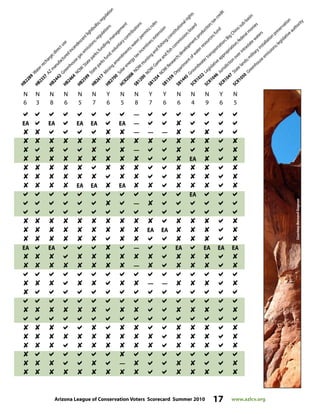
N N N N N N Y N N Y N N Y Y N Y
8 6 6 3 8 4 6 5 7 6 5 8 7 6 6 6
—
           
EA    EA EA EA EA EA EA EA EA EA EA
       
      — —   
           
        —  —  — — 
          — — 
EA EA


EA
 — 


EA EA EA EA
          

—
EA EA
          
           EA
 — — — 
           
        
—             
         
             
* Antenori has been scored in the House and Senate because he replaced Sen.Jonathan Paton in March 2010
HB2289
W
aterrecharge;directuse
HB2060
Publicconservation
m
onies;transfer
HB2290
W
astetiresin
abandoned
m
ines
HB2337
AZm
anufacturedincandescentlightbulbs;regulation
HB2442
Greenhousegasem
issions;regulations
HB2451
Lineextensions;utilityinfrastructure;charges
HB2574
Renewableenergydistricts
HB2599
Stateparksfund;voluntarycontributions
HB2617
M
ining
am
endm
ents;water;perm
its;rules
HB2700
Solarenergytaxincentives;extension
HCR2008
NOW
:Hunting
and
fishing;constitutionalrights
SB1200
NOW
:Gam
eand
fish
com
m
ission;board
SB1254
NOW
:Research;developm
ent;production;taxcredit
SB1359
Departm
entofwaterresources;fund
SB1445
Groundwatertransportation;BigChinosub-basin
SCR1047
Statelands;m
ilitaryinstallationpreservation
www.azlcv.org 14 Arizona League of Conservation Voters Scorecard Summer 2010
House voting tally
 COMMITTEE SCORES continued
House Water  Energy
Member Party District Score
Lucy Mason (chair) R 1 46%
David Stevens (vice chair) R 25 34%
Christopher Deschene D 2 100%
Doris Goodale R 3 30%
Daniel Patterson D 29 95%
Jerry Weiers R 12 30%
Nancy Young-Wright D 26 95%
Committee Average Score: 61%
House Transportation 
Infrastructure
Member Party District Score
Andy Biggs (chair) R 22 7%
Judy Burges (vice chair) R 4 10%
Steve Farley D 28 95%
Nancy McLain R 3 12%
Eric Meyer D 11 93%
Amanda Reeve R 6 35%
Ted Vogt R 30 31%
Rae Waters D 20 89%
Committee Average Score: 47%
Scorecard Key
= Pro-environment vote
 = Anti-environment vote
— = Not voting (counts against score)
EA = Excused absence
(does not count against score)
A Green Vote is:
REPRESENTATIVE
Weight:
Lopes 91% D
Lujan 100% D
Mason 46% R
McComish 25% R
McGuire 39% D
McLain 12% R
Meyer 93% D
Meza 92% D
Miranda 74% D
Montenegro 20% R
Murphy 12% R
Nichols 35% R
Pancrazi 76% D
Patterson 95% D
Pratt 37% R
Quelland 26% R
Reagan 32% R
Reeve 35% R
Schapira 94% D
Seel 12% R
Sinema 100% D
Stevens 34% R
Tobin 32% R
Tovar 100% D
Vogt 31% R
Waters 89% D
Weiers,Jerry 30% R
Weiers,Jim 12% R
Williams 36% R
Yarborough 25% R
Young-Wright 95% D
Scorecard Bills
CourtesyTomCheck
Arizona League of Conservation Voters Scorecard Summer 2010 15 www.azlcv.org
N N N N N N Y N N Y N N Y Y N Y
8 6 6 3 8 4 6 5 7 6 5 8 7 6 6 6
EA EA —
       
           
    EA EA    
             
EA EA EA 
EA EA 


  EA  
—


    EA      
—
             
EA
          EA
          
 EA EA EA EA  EA   EA   
 —
          
             
       —  
           

HB2289
W
aterrecharge;directuse
HB2060
Publicconservation
m
onies;transfer
HB2290
W
astetiresin
abandoned
m
ines
HB2337
AZm
anufacturedincandescentlightbulbs;regulation
HB2442
Greenhousegasem
issions;regulations
HB2451
Lineextensions;utilityinfrastructure;charges
HB2574
Renewableenergydistricts
HB2599
Stateparksfund;voluntarycontributions
HB2617
M
ining
am
endm
ents;water;perm
its;rules
HB2700
Solarenergytaxincentives;extension
HCR2008
NOW
:Hunting
and
fishing;constitutionalrights
SB1200
NOW
:Gam
eand
fish
com
m
ission;board
SB1254
NOW
:Research;developm
ent;production;taxcredit
SB1359
Departm
entofwaterresources;fund
SB1445
Groundwatertransportation;BigChinosub-basin
SCR1047
Statelands;m
ilitaryinstallationpreservation
CourtesyBeverlyAdams
www.azlcv.org 16 Arizona League of Conservation Voters Scorecard Summer 2010
Senate voting tally
 COMMITTEE SCORES
A Green Vote is:
SENATOR
Weight:
Aboud 92% D
Aguirre 79% D
Allen,Carolyn 42% R
Allen,Sylvia 11% R
Alvarez 44% D
Antenori 20% R
Braswell 27% R
Bunch 26% R
Burns 15% R
Burton-Cahill 100% D
Cheuvront 78% D
Garcia 100% D
Gould 12% R
Gray,Chuck 6% R
Gray,Linda 26% R
Hale 75% D
Harper 19% R
Huppenthal 12% R
Landrum-Taylor 100% D
Leff 21% R
Lopez 94% D
McCune-Davis 100% D
Melvin 25% R
Miranda 100% D
Nelson 37% R
Pearce 12% R
Pierce 19% R
Rios 89% D
Tibshraeny 46% R
Verschoor 20% R
Scorecard Bills
The AZLCV scores are based on floor votes, and not votes taken
in committee. However, it is important that we understand the
makeup of the committees to which a majority of bills dealing
with our natural environment are sent for consideration. Here
are snapshots of two Senate committees that are especially
important to conservation.
Senate Natural Resources,
Infrastructure and Public Debt
Member Party District Score
John Nelson (chair) R 12 37%
Steve Pierce (vice chair) R 1 19%
Amanda Aguirre D 24 79%
Sylvia Allen R 5 11%
Albert Hale D 2 75%
Al Melvin R 26 25%
Leah Landrum-Taylor D 16 100%
Committee Average Score: 48%
Senate Appropriations Subcommittee
on Education and Natural Resources
Member Party District Score
Steve Pierce (chair) R 1 19%
Paula Aboud D 28 92%
Russell Pearce R 18 12%
Committee Average Score: 41%
Scorecard Key
= Pro-environment vote
 = Anti-environment vote
— = Not voting (counts against score)
EA = Excused absence
(does not count against score)
Courtesy Ajay Tallam
Arizona League of Conservation Voters Scorecard Summer 2010 17 www.azlcv.org
N N N N N N Y N N Y Y N N N Y N
6 3 8 6 5 7 6 5 8 7 6 6 4 9 6 5
—
EA EA EA EA EA — 
    — — —  
             
    —   
          EA  
           
           
    EA EA  EA      
EA
 — 
             
         EA EA    
           
EA EA  — EA EA EA EA
            
        —     
       — —    


    —    
            
HB2289
W
aterrecharge;directuse
HB2337
AZm
anufacturedincandescentlightbulbs;regulation
HB2442
Greenhousegasem
issions;regulations
HB2464
NOW
:Stateparks;funding;m
anagem
ent
HB2599
Stateparksfund;voluntarycontributions
HB2617
M
ining
am
endm
ents;water;perm
its;rules
HB2700
Solarenergytaxincentives;extension
HCR2008
NOW
:Hunting
and
fishing;constitutionalrights
SB1200
NOW
:Gam
eand
fish
com
m
ission;board
SB1254
NOW
:Research;developm
ent;production;taxcredit
SB1359
Departm
entofwaterresources;fund
SB1445
Groundwater transportation;Big Chino sub-basin
SCR1022
Legislative appropriation;federal m
onies
SCR1046
Jurisdiction over intrastate waters
SCR1047
State lands;m
ilitary installation preservation
SCR1050
Greenhouse em
issions;legislative authority
CourtesyBernardGagnon
www.azlcv.org 18 Arizona League of Conservation Voters Scorecard Summer 2010
This year, the legislature was able to get hundreds of bills
through to the Governor in record time. Of all of the bills that
were submitted to her, she only used her veto power 4% of the
time. Unfortunately, there were a number of bills and
resolutions left behind that could have helped Arizona’s budget
crisis while helping the environment, bills that would have
protected wildlife and bills that would have made Arizona a
leader in renewable energy and energy efficiency.
Here are some of those good ideas that were left behind this year:
HB 2264 Bald eagle; endangered species act
Edward Ableser (D-Tempe) has sponsored some good
legislation, and this one would have been great for threatened
and endangered (T  E) species. This bill would have set a
standard in Arizona for classifying and studying T  E species.
It has guidelines for monitoring, and it could have been a real
step towards T  E species protection in this state. It would have
also put the bald eagle on the endangered species list until 2017.
HB 2356 Green buildings; recovery funding
This bill was sponsored by Representative Kyrsten Sinema (D-
Phoenix) and would have required public buildings and
private buildings constructed with a minimum of 50% public
funds to conform to a minimum energy efficiency standard
after 2013. Existing public buildings undergoing energy
retrofitting equal to at least 35% of the value of the existing
building would also be required to conform to the standard.
Federal recovery funds are to be used for these buildings when
possible. Additionally, recovery funds are made available for
residential weatherization projects.
HB 2744 Bottled water surcharge
Representative Lucy Mason (R-Prescott) was recognizing
the problem of disposable plastic water bottles with this
legislation. This bill would have levied a surcharge on businesses
selling bottled water at a rate of 5 cents for each bottle sold
individually, 5% of the retail price for multi-bottle packages,
and 5 cents per gallon for dispensed water. The surcharge would
have been a source of funding for the Arizona Department of
Water Resources and the Arizona Department of
Environmental Quality, and it would have deterred businesses
from selling bottled water. Even though bottled water
production and waste is a serious environmental problem, half
of our legislators in the House Water and Energy Committee
decided this bill wasn’t worth their vote.
HB 2747 Multifamily dwellings; recycling
Representative Martha Garcia (D-Phoenix) has brought
this bill to the legislature for the past 3 years. Each year it gets no
attention although it’s a great idea. She recognizes that
multifamily dwellings produce just as much waste as single
family dwellings. She attempted again to address the issue by
requiring cities with populations of more than 75,000 to have
curbside recycling by 2012 and recycling pick-up at apartments
by 2014 if the city doesn’t already have recycling.With cities that
have curbside recycling already, this bill would have given them
until 2011 to implement recycling pick-up at apartments.
HCR 2028 Supporting energy efficiency rules
This resolution would have put to the ballot the question of
whether to allow the Corporation Commission to adopt energy
efficiency rules that would require public utilities to design
Demand Side Management (DSM) programs. DSM programs
would promote energy efficiency from all ratepayers by offering
incentives and establishing energy reduction goals by using
programs such as weatherization, home energy audits,
promoting CFL lighting, etc. Representative Christopher
Deschene (D-St. Michaels) didn’t have the chance to ask
voters if we wanted have cheaper energy costs.
HCR 2040 Sustainable state parks fund
This resolution had the conservation community and park
supporters up in arms this year. Representative Russ Jones
(R-Yuma) was asking the legislature to put to the ballot the
question of whether to add a $9 fee to vehicle registrations to be
deposited into a Sustainable State Parks Fund. With this fee, all
Arizonans would be able to get free day use for State Parks all
year if they were displaying Arizona vehicle registration tags.
This would have been a great solution to the budget problems
with our state parks, but it was unfortunately blocked by
Representative John Kavanagh (R-Fountain Hills).
HCR 2044 Fund sweeps; prohibition
With the legislature sweeping multiple funds, including the
Land Conservation Account and Heritage Fund, this resolution
would have responded to the future threat of the legislature
continuing this pattern. Representative Chad Campbell (D-
Phoenix) was asking the legislature to put to the ballot the
question of whether to amend the state Constitution to prohibit
the legislature from sweeping funds. Unfortunately, this good
idea didn’t make it through the legislature.
Good Ideas Left Behindby Melissa Ramsey
Arizona League of Conservation Voters Scorecard Summer 2010 19 www.azlcv.org
What’s Next?
So now you know who was good and bad on the environment this year.
What can you do next?
Vote for environmentally responsible candidates!
Our environment needs to be a top priority for voters and our representatives: We need strong green representation at the
state capitol to push legislation that will protect our air and water and preserve our land and the natural heritage that is
the reason that so many of us choose to live in Arizona.
Join or renew your membership.
Basic membership is $35 but consider an additional gift to support our work. Many of our members choose to contribute
monthly, consider supporting the league every month with a contribution of $10, $25 or even $50 per month.
Renew your membership or become a monthly donor instantly online at
http://azlcv.org and click on Donate Now
Or mail a check to: AZLCV, P.O. Box 40154, Tucson, AZ 85717
Volunteer…
to walk neighborhoods with the AZLCV or in support of environmentally responsible candidates.
Share…
what you know about environmental candidates, legislation and the AZLCV with your friends, family and neighbors.
As we reach more concerned Arizonans our voice becomes stronger. Encourage friends to join our E-Action Alert
list or our Facebook page to keep up with our work.
Follow us…
on Twitter at www.twitter.com/azlcv and on Facebook at www.facebook.com/azlcv for regular updates and news.
Sign up 5 friends…
as new League members or host a house party to tell your friends about our work. Call Melissa Ramsey in Tucson
(520) 622-2819 for more information.
Here’s a new member for the Arizona League of Conservation Voters!
Enclosed is my contribution* of: J $1,000 J $500 J $250 J $100 J $50 J $35
J I would like to help even more by making a payment of $_____ per month on my credit card.
Method of payment: J Check (please make payable to AZLCV) J Credit card
Name: ________________________________________________________
Address: _______________________________________________________
City/State/Zip: __________________________________________________
Phone/Email: ___________________________________________________
Please mail form  payment to:
AZLCV, PO Box 40154,Tucson AZ 85717
Credit card no.: ____________________________
Type: _______________ Exp. Date: ____________
Signature: ________________________________
*Contributions to the Arizona League of
Conservation Voters are NOT tax deductible
due to our lobbying efforts.
49th
Legislature Members  Scores: 2010  Lifetime
2010 Life
District 1 32% 43%
Sen.Steve Pierce Prescott 19% 19%
Rep.Andrew Tobin Paulden 32% 57%
Rep.Lucy Mason Prescott 46% 53%
District 2 90% 93%
Sen.Albert Hale Window Rock 75% 81%
Rep.Christopher Deschene
St.Michaels 100% 100%
Rep.Tom Chabin Flagstaff 95% 98%
District 3 18% 29%
Sen.Ron Gould Lake Havasu City 12% 10%
Rep.Doris Goodale Lake Havasu City 30% 34%
Rep.Nancy McLain Bullhead City 12% 42%
District 4 17% 34%
Sen.Jack Harper Surprise 19% 31%
Rep.Judy Burges Skull Valley 10% 22%
Rep.Tom Boone Peoria 21% 51%
District 5 31% 40%
Sen.Sylvia Allen Snowflake 11% 7%
Rep.Bill Konopnicki Safford 36% 49%
Rep.Jack Brown St.Johns 47% 66%
District 6 25% 28%
Sen.David Braswell Anthem 27% 27%
Rep.Carl Seel Anthem 12% 23%
Rep.Amanda Reeve Anthem 35% 35%
District 7 28% 37%
Sen.Ed Bunch Phoenix 26% 26%
Rep.Nancy Barto Phoenix 26% 42%
Rep.Ray Barnes Phoenix 32% 44%
District 8 28% 50%
Sen.Carolyn Allen Scottsdale 42% 62%
Rep.John Kavanagh Fountain Hills 11% 30%
Rep.Michele Reagan Scottsdale 32% 59%
District 9 13% 26%
Sen.Robert Burns Peoria 15% 37%
Rep.Debbie Lesko Glendale 12% 21%
Rep.Rick Murphy Glendale 12% 22%
District 10 21% 44%
Sen.Linda Gray Glendale 26% 45%
Rep.Doug Quelland Phoenix 26% 41%
Rep.Jim Weiers Phoenix 12% 46%
2010 Life
District 11 49% 65%
Sen.Barbara Leff Paradise Valley 21% 50%
Rep.Adam Driggs Phoenix 32% 51%
Rep.Eric Meyer Paradise Valley 93% 93%
District 12 29% 42%
Sen.John Nelson Glendale 37% 50%
Rep.Jerry Weiers Glendale 30% 43%
Rep.Steve Montenegro Glendale 20% 32%
District 13 100% 96%
Sen.Richard Miranda Tolleson 100% 92%
Rep.Anna Tovar Phoenix 100% 100%
Rep.Martha Garcia Phoenix 100% 95%
District 14 97% 96%
Sen.Debbie McCune-Davis Phoenix 100% 95%
Rep.Chad Campbell Phoenix 100% 100%
Rep.Robert Meza Phoenix 92% 92%
District 15 93% 89%
Sen.Ken Cheuvront Phoenix 78% 83%
Rep.David Lujan Phoenix 100% 96%
Rep.Kyrsten Sinema Phoenix 100% 89%
District 16 84% 91%
Sen.Leah Landrum-Taylor Phoenix 100% 94%
Rep.Ben Miranda Phoenix 74% 88%
Rep.Cloves Campbell Jr. Phoenix 79% 91%
District 17 95% 98%
Sen.Meg Burton-Cahill Tempe 100% 99%
Rep.David Schapira Tempe 94% 99%
Rep.Edward Ableser Tempe 92% 96%
District 18 25% 33%
Sen.Russell Pearce Mesa 12% 20%
Rep.Cecil Ash Mesa 51% 52%
Rep.Steve Court Mesa 12% 27%
District 19 20% 34%
Sen.Chuck Gray Mesa 6% 31%
Rep.Kirk Adams Mesa 25% 35%
Rep.Rich Crandall Mesa 30% 37%
District 20 42% 60%
Sen.John Huppenthal Chandler 12% 38%
Rep.John McComish Phoenix 25% 47%
Rep.Rae Waters Ahwatukee 89% 95%
2010 Life
District 21 35% 45%
Sen.Jay Tibshraeny Chandler 46% 56%
Rep.Steven Yarbrough Chandler 25% 42%
Rep.Warde Nichols Chandler 35% 36%
District 22 18% 27%
Sen.Thayer Verschoor Gilbert 20% 32%
Rep.Andy Biggs Gilbert 7% 20%
Rep.Laurin Hendrix Gilbert 26% 30%
District 23 55% 63%
Sen.Rebecca Rios Apache Junction 89% 93%
Rep.Barbara McGuire Kearny 39% 52%
Rep.Frank Pratt Casa Grande 37% 45%
District 24 65% 71%
Sen.Amanda Aguirre Yuma 79% 80%
Rep.Lynne Pancrazi Yuma 76% 80%
Rep.Russell Jones Yuma 41% 53%
District 25 57% 68%
Sen.Manuel Alvarez Elfrida 44% 76%
Rep.David Stevens Sierra Vista 34% 35%
Rep.Patricia Fleming Sierra Vista 92% 93%
District 26 52% 56%
Sen.Al Melvin Tucson 25% 30%
Rep.Nancy Young-Wright Tucson 95% 95%
Rep.Vic Williams Tucson 36% 44%
District 27 95% 95%
Sen.Jorge Luis Garcia Tucson 100% 93%
Rep.Olivia Cajero-Bedford Tucson 95% 96%
Rep.Phil Lopes Tucson 91% 95%
District 28 96% 97%
Sen.Paula Aboud Tucson 92% 96%
Rep.David Bradley Tucson 100% 97%
Rep.Steve Farley Tucson 95% 98%
District 29 87% 89%
Sen.Linda Lopez Tucson 94% 94%
Rep.Daniel Patterson Tucson 95% 94%
Rep.Matt Heinz Tucson 71% 80%
District 30 29% 30%
Sen.Frank Antenori Tucson 20% 20%
Rep.David Gowan Tucson 27% 32%
Rep.Frank Antenori Tucson 39% 38%
Rep.Ted Vogt Tucson 31% 31%
CourtesyRosaSay

2010 Scorecard

  • 1.
    Arizona Legislative SCORE CARD 2010 49th StateLegislature www.azlcv.org ArizonaConservationVoter Volume 19,Number 1 Summer 2010 Courtesy jazzcat at stockvault.net
  • 2.
    www.azlcv.org 2 ArizonaLeague of Conservation Voters Scorecard Summer 2010 Dear Friends and Members, The 2010 legislative session was one marked by partisan politics and the lack of will to tackle the myriad of challenges that Arizona faces. For environmental protection and a sustainable Arizona, this was not a good year. We saw the effects of years of systematically defunding our state parks system during good economic times and now we are witnessing our parks closing throughout the state (at this writing we have already closed 6 state parks). The refusal of the legislature to invest in one of our state’s major economic drivers, tourism, resulted in “sweeps” of dedicated parks funds including Heritage Fund money and entrance fees to parks. The legislature even “swept” the private donations from the donation boxes at the parks and a private bequest of $242,000 that a philanthropist left to our state park system (after overwhelming public pressure the legislature returned the $242,000 but kept the donation box money). This year's legislative session brought up some big questions for our state. Aside from the specific bills addressed (or left unaddressed) in the session and documented in this scorecard, this session and the last session raise some fundamental questions about the future of our state. Do the legislative sessions of 2009 and 2010 represent a low point for conservation in Arizona before the beginning of a new era of environmental stewardship and responsibility? Or do they represent the beginning of an era of environmental irresponsibility, deregulation and slash-and-burn budget cutting? The 2010 elections and the 2011 legislative session will resolve these questions, and I hope that we are up to the challenge. Arizona may not be directly affected by the oil spill in the gulf, but our state legislature has been inflicting damage of a similar kind to our air quality, water quality and our natural heritage. The effect of this damage, like the oil spill, will be felt for decades to come. Arizona’s broken priorities were nowhere more apparent than when a bi-partisan plan to save our state parks was held in committee while a vote on Arizona’s official state beverage (I’m not making this up, it was going to be milk) was brought the floor of the House (it failed 26-31). Now we have neither a functioning state parks system nor an official state beverage. While some progress was made on energy policy, our legislature once again shied away from the task to build an Arizona for the 21st century and beyond. Sadly, our legislature too often resembles a 19th century territorial government with access to 21st century media tools. The AZLCV will be working hard this year and next to create a legislature that responds to constituent concerns about our land, air and water. Without action at the state level right now Arizona will be reversing decades of progress on the environmental front. I urge all of you to prioritize the environment at the ballot box this year and to be active citizens during next year’s legislative session. Join the AZLCV’s E-activist list to stay abreast of next year’s session by sending an email to mramsey@azlcv.org. Thank you for your support of the League, Steven C Arnquist Executive Director In this Scorecard: Actions Used for Scoring 4-9 Map of District Scores 10-11 House Voting Tally 12-15 Senate Voting Tally 16-17 Good Ideas Left Behind 18 What’s Next 19 Legislator’s 2010 & Lifetime Scores 20
  • 3.
    Arizona League ofConservation Voters Scorecard Summer 2010 3 www.azlcv.org The Arizona League of Conservation Voters publishes an annual Scorecard following the legislative session. Contents are copyrighted, but articles may be reprinted provided credit is given to authors and the League. Annual membership for the League begins at $35. All members receive the Scorecard and, if they choose, our regular email updates. www.azlcv.org Contact us at info@ azlcv.org or in Tucson: 738 N.Fifth Ave.,Suite 218,85705 in Phoenix: 825 N.Third Ave.,85003 Mailing address: PO Box 40154,Tucson AZ 85717 Staff Steve Arnquist Executive Director Melissa Ramsey Membership Coordinator & Administrator Nicole Schneidman Intern Scorecard design by Julie St. John Board of Directors Roselyn O’Connell, President, Scottsdale Tina Beattie, Vice President, Gilbert Roberta Voss, Secretary/Treasurer, Phoenix Paul Burkhardt, Prescott Michael Dunne, Tucson Grant Loper, Tempe William Roe, Tucson Paul Walker, Phoenix Our Mission The Arizona League of Conservation Voters (AZLCV or “the League”) is Arizona’s largest statewide membership-supported conservation group, with almost 6,000 members. # We work to protect our land, air, water and quality of life for all Arizonans, present and future. # We do this by advocating for common-sense environmental policy and by endorsing pro- conservation candidates. # We are non-partisan and non-profit, and our work includes: # Endorsing and working to elect pro-conservation state legislators and statewide candidates, # Educating elected officials and their constituents on conservation issues important to the League’s members, # Lobbying on behalf of reasonable, common-sense conservation measures, # Holding elected officials accountable for their performance with our annual Legislative Scorecard, and # Maintaining a political action committee (PAC) that works directly to elect pro-conservation candidates. 100% Honor Roll House of Representatives Christopher Deschene (D-2) – 100% Chad Campbell (D-14) – 100% Martha Garcia (D-13) – 100% David Lujan (D-15) – 100% Anna Tovar (D-13) – 100% Kyrsten Sinema (D-15) – 100% David Bradley (D-28) – 100% Senate Meg Burton-Cahill (D-17) – 100% Jorge Luis Garcia (D-27) – 100% Leah Landrum-Taylor (D-16) – 100% Richard Miranda (D-13) – 100% Debbie McCune-Davis (D-14) – 100% Top Scoring District: LD 13 – 100%: Represented by Senator Richard Miranda, Representative Anna Tovar,& Representative Martha Garcia Top Scorers House Democrats Olivia Cajero Bedford (D-27) – 95% Tom Chabin (D-2) – 95% Steve Farley (D-28) – 95% Daniel Patterson (D-29) – 95% Nancy Young-Wright (D-26) – 95% David Schapira (D-17) – 94% Eric Meyer (D11) – 93% Edward Ableser (D-17) – 92% Patricia Fleming (D-25) – 92% Robert Meza (D-14) – 92% Phil Lopes (D-27) – 91% Senate Democrats Linda Lopez (D-29) – 94% Paula Aboud (D-28) – 92% Rebecca Rios (D-23) – 89% Bottom Scorers House of Representatives Andy Biggs (R-22) – 7% Judy Burges (R-4) – 10% John Kavanagh (R-8) – 11% Senate Chuck Gray (R-19) – 6% Sylvia Allen (R-5) – 11% Russell Pearce (R-18) – 12% Averages House Average: 52% — Democrats: 88% — Republicans: 27% Senate Average: 48% — Democrats: 88% — Republicans: 22% House Republicans Cecil Ash (R-18) – 51% Senate Republicans Jay Tibshraeny (R-21) – 46%
  • 4.
    www.azlcv.org 4 ArizonaLeague of Conservation Voters Scorecard Summer 2010 Each legislator’s score is based on his or her total pro-conservation votes over the course of the session. Measures are weighed according to their importance, and no credit is given for missing votes. However, members are not penalized for excused absences (as recorded on the official attendance sheet for each chamber on the day of the vote). In all cases, the scores are based on the final vote each measure receives in either chamber. The League gives “extra credit” to legislators who sponsor positive legislation (prime-prime sponsors only). For each good measure introduced, the legislator receives an extra percentage point added to his or her final score. For measures that actually become law, two percentage points are added. On the other hand, those who sponsor anti-conservation or anti-public-participation legislation have one percentage point deducted from their final score for each measure introduced and two points deducted if the measure becomes law. Final scores are capped at 100 percent. A“NO”vote is a green vote.Weight: 8 Defeated House 36-23-1 (needed super majority to pass) April 28,2010 (Nichols) The Public Conservation Account is controlled by the State Parks Board and is dedicated to acquiring land for conservation purposes. If the measure had passed, the funds in this voter-mandated account would have been diverted to run our state parks and historical societies, both of which have already had their budget allotments swept. Although these entities represent critical needs, the sweep of the Public Conservation Account would have misdirected dollars intended for a voter- approved purpose. Under the Voter Protection Act (Prop. 105) of 1998, initiatives that the voters approve cannot be repealed without a super majority vote (75%); as a result, this bill failed after not mustering the required ¾ majority in the House of Representatives. A“NO”vote is a green vote.Weight: 6 Passed House 39-20-1 March 3,2010 Passed Senate 21-7-2 April 19,2010 Signed into law by Governor April 23,2010 (Pratt, Barnes, McGuire) This bill creates a loophole for mining companies as related to their water use in Arizona. It allows mining companies to gain long-term storage credit for the Central Arizona Project (CAP) water they store.As a result, the more water these companies store, the greater assurance they have for future mining operations. In addition, this bill fails to account for the groundwater the mining companies pump for their direct use. Even though the used groundwater should be charged against the companies’ long-term storage credits, this bill creates a loophole that allows for the companies’ direct use of groundwater even as they increase their long-term storage credit of CAP water. HB 2060 Public conservation monies; transfer HB 2289 Water recharge; direct use Actions Used for Scoring
  • 5.
    Arizona League ofConservation Voters Scorecard Summer 2010 5 www.azlcv.org A“NO”vote is a green vote.Weight: 6 Passed House 34-26 March 3,2010 Held in Senate (Jones, Kavanagh, Mason, et al) This measure has been a recurring bill during the past few legislative sessions. It proposes filling abandoned mines with used tires. Although this may seem like a good idea, the proposal is deeply flawed and would likely have serious environmental consequences. Tires are extremely flammable and the threat of a tire fire in an abandoned mine represents a significant problem. Used tires would also pollute the soil and water surrounding the mines and negatively impact the bats that use abandoned mines as their habitats.Although this legislation failed to pass this session, we will likely see it again. HB 2290 Waste tires in abandoned mines A“NO”vote is a green vote.Weight: 3 Passed House 33-2 March 3,2010 Passed Senate 18-12 April 28,2010 Vetoed by Governor May 11,2010 (Antenori, Biggs, Gowan, et al) This bill represents another means for the state to challenge federal regulations, but it is clearly regressive as related to the environment. HB 2337 allows incandescent lightbulbs to be manufactured and sold in Arizona. The United States is phasing out incandescent light bulbs, so this measure would not be compliant with federal regulation under the Interstate Commerce Clause. CFL bulbs use less power and last longer, so they are an easy and obvious way to become more energy efficient. This bill is a symbol that progress in energy efficiency is not a priority in Arizona. HB 2337 Arizona manufactured incandescent lightbulbs; regulation (Burges, Antenori, Barnes, et al) HB 2442 requires that state agencies receive legislative authorization before they adopt or enforce any greenhouse emissions regulations. This will hinder the ability of the Arizona Department of Environmental Quality to create and institute regulations that reduce emissions. This bill also includes an intent section that mandates that the legislature authorize any cap and trade system applied in Arizona. We don’t need additional roadblocks preventing our state from addressing greenhouse emissions. HB 2442 Greenhouse gas emissions; regulations A“NO”vote is a green vote.Weight: 8 Passed House 35-23-1 February 16,2010 Passed Senate 18-10-2 April 19,2010 Signed into law by Governor April 26,2010 A“NO”vote is a green vote.Weight: 4 Defeated House 26-28-6 April 1,2010 (Antenori, Crump, Gowan, et al) This bill prohibits a public service corporation from charging a customer for the first 1,000 ft. of a power line if the associated cost is less than $10,000. Public service corporations, however, may require customers to pay the actual cost of a line extension if it is over $10,000. This bill infringes on the constitutional rate-making authority of the Arizona Corporation Commission and would shift one of the costs of sprawl development from the developers back to the ratepayers. It also allows developers to profit without paying the true costs of development. HB 2451 Line extensions; utility infrastructure; charges
  • 6.
    www.azlcv.org 6 ArizonaLeague of Conservation Voters Scorecard Summer 2010 A“NO”vote is a green vote.Weight: 7 Passed Senate 16-12-2 April 22,2010 Passed House 38-19-3 April 27,2010 Signed into law by Governor May 11,2010 (Jones, Gowan, Mason, et al) This bill will prohibit the Arizona Department of Environmental Quality (ADEQ) from regulating mines more strictly than the federal mine regulations as established by the 1872 Mining Act. It will hinder the development of future programs that could regulate the amount of pollutants that contaminate our drinking water. HB 2617 also creates an advisory committee of industry professionals that will advise state agencies on how to implement mining regulations. This bill will supposedly simplify the permit-granting process for new mines, but in reality, it is another blow to our already thinly stretched ADEQ. HB 2617 Mining amendments; water; permits; rules (Mason, Boone, Chad Campbell, et al) This bill expands county and municipal improvement districts that may be formed to include "renewable energy districts." Renewable energy districts utilize various renewable and efficient energy equipment and water conservation units. According to this measure, each district could receive funds to install and maintain improvements related to energy efficiency, renewable energy, water conservation and water management. This bill recognizes renewable energy is a smart investment that has the potential to fuel sustainable growth in Arizona. HB 2574 Renewable energy districts (McLain, Ash, Bradley, et al) HB 2464 was a striker bill that would have leased Lake Havasu State park to Lake Havasu City.Considering that Lake Havasu is one of Arizona’s most popular state parks, this measure would have represented a significant hit to the State Parks’ already battered budget. HB 2464 would have deprived the state of $400,000 that Lake Havasu State Park generates each year. In addition, it would have accepted a lease that would have surrendered this profit to Lake Havasu City in return for only at most $50,000 a year. If this bill had passed, it would most likely have lead to additional park closures.Since it was a striker bill,it was a completely different bill having to do with auto insurance for the House vote, so the House is not penalized for voting on this bill. HB 2464 NOW: State parks; funding; management A“NO”vote is a green vote.Weight: 6 Passed House 49-5-6 March 24,2010 Defeated Senate 12-18 April 28,2010 A“YES”vote is a green vote.Weight: 6 Passed House 47-13 March 3,2010 Held in Senate A“NO”vote is a green vote.Weight: 5 Passed House 42-11-7 April 1,2010 Defeated Senate 14-14-2 April 22,2010 (Kavanagh) HB 2599 was a piece of bad legislation that was drafted to demonstrate that some, although minimal, effort and thought was invested in generating funding for our state parks. This measure was a substitute for HCR 2040 — the Sustainable Parks Fund, which would have added a mandatory $9 fee to Arizonans’ vehicle registrations and in return, would have allowed any person with an Arizona plate to visit all the parks for free. In contrast,HB 2599 would have added a checkbox on vehicle registrations for a voluntary $10 contribution to the parks fund. According to this bill, even if an individual contributed $10 with his registration, they would still have to pay additional fees to enter the state parks. Furthermore, HB 2599 would not have created a sustainable funding source for our state parks. Instead, it only represented an ineffective replacement for a promising piece of legislation. Our state parks should be mandatory, not optional. HB 2599 State parks fund; voluntary contributions Actions Used for Scoring continued
  • 7.
    Arizona League ofConservation Voters Scorecard Summer 2010 7 www.azlcv.org A“YES”vote is a green vote.Weight: 6 Passed House 44-13-2 March 8,2010 Passed Senate 16-14 April 27,2010 Signed into law by Governor May 10,2010 (Boone) This bill extends the income tax credit for commercial and industrial applications of solar energy devices to the tax year ending Dec. 31, 2016. The tax credit is equal to 10% of the installation cost of the device, which can’t exceed $25,000 for the same building in the same year and can’t exceed $50,000 for the taxpayer in a year. Unused credit may be carried forward for up to five years. HB 2700 Solar energy tax incentives; extension A“NO”vote is a green vote.Weight: 5 Passed House 37-18-5 March 24,2010 Passed Senate 18-9-3 April 22,2010 Transmitted to the Secretary of State (Jerry Weiers, Gowan, Crump, et al) The 2010 general election ballot will carry the question of whether to change the Arizona constitution by adding hunting and fishing as a basic right. If voted in, this will make it more difficult to manage wildlife. Our state’s wildlife belongs to all Arizonans, regardless of the stances we hold on how it should be managed. Hunting and fishing is a recreational privilege that does not merit the same standing as constitutional rights such as the freedom of speech. HCR 2008 NOW: Hunting and fishing; constitutional rights A“YES”vote is a green vote.Weight: 7 Passed Senate 19-8-3 April 29,2010 Passed House 45-11-4 April 29,2010 Signed into law by Governor May 11,2010 (Leff) This bill establishes a tax credit for individuals and corporations that produce renewable energy. The amount of the credit is adjusted according to the amount of kilowatt hours produced. In addition, statues pertaining to the tax credit for research and development expenses are now amended to allow a taxpayer with fewer than 150 fulltime employees to apply for a tax refund rather than carrying the credit forward for future filings. This bill joins the ranks of previous legislation that has provided incentives to people who invest in and use renewable energy in Arizona. SB 1254 NOW: Research; development; production; tax credit (Nelson) SB 1200 establishes the Arizona Game and Fish Commission Appointment Recommendation Board. This board is appointed by the Governor and assists the Governor in the review and recommendation of appointees to the Arizona Game and Fish Commission. This bill further excludes the public’s role in wildlife management. It forms an appointment board that will include only one member from the non-sportsmen public and four members who represent hunters and ranchers. The recommendation board should represent Arizona’s broad range of interests to encourage the development of a more diverse Game and Fish Commission. SB 1200 NOW: Game and fish commission; board A“NO”vote is a green vote.Weight: 8 Passed Senate 16-7-7 March 18,2010 Passed House 36-19-5 March 25,2010 Signed into law by Governor April 7,2010
  • 8.
    www.azlcv.org 8 ArizonaLeague of Conservation Voters Scorecard Summer 2010 A“NO”vote is a green vote.Weight: 4 Passed Senate 16-12-1 March 3,2010 Held in House (Melvin) This resolution would have been on the 2010 general ballot and asked voters to grant our state legislators the authority to appropriate most of the federal money the state receives. This would have likely resulted in both the reduction of Arizona’s federal appropriation and the mismanagement of received federal funding. SCR 1022 Legislative appropriation; federal monies A“NO”vote is a green vote.Weight: 9 Passed Senate 18-11-1 March 22,2010 Held in House (C. Gray, S. Allen, Gould, et al) SCR 1046 would refer to the ballot the question of whether to amend Arizona’s constitution so that the State of Arizona is the primary regulator of non-navigable intrastate waters. This measure would have made it so Arizona rivers would not have the strong protections of the Clean Water Act. The Clean Water Act has protected many of Arizona's waters since 1972, and this measure would make our most valuable resource less protected. 94% of Arizona's water would have lost this protection since they do not flow year round. SCR 1046 Jurisdiction over intrastate waters (S. Pierce, Aguirre, Ash, et al) This bill establishes a Water Resources Fund where revenue from various fees charges by the Department of Water Resources is deposited. Supposedly, this fund cannot be appropriated or transferred by the legislature in the future, but judging by the transfers and appropriations of funds this legislative session we cannot be expected to believe that the Water Resources Fund would be safe. This is still a step in the right direction. Allowable uses are also expanded to the Dam Repair Fund. This bill is good for water conservation and water resource management. SB 1359 Department of water resources; fund A“YES”vote is a green vote.Weight: 6 Passed Senate 25-1-4 April 29,2010 Passed House 58-0-2 April 29,2010 Signed into law by Governor May 7,2010 A“NO”vote is a green vote.Weight: 6 Passed Senate 20-9-1 April 7,2010 Passed House 39-16-5 April 19,2010 Signed into law by Governor April 26,2010 (S. Pierce, Burns, Nelson) SB 1445 addresses the Salt River Project (SRP) and Prescott agreement on the Big Chino Sub-Basin and the upperVerde River. It would allow Prescott to take water from the Big Chino Sub-Basin, outside of its Active Management Area. This is a bad piece of legislation because the upper portion of the Verde River relies heavily on the drainage from the Big Chino Sub-Basin. Our water is precious and Active Management Areas are critical in preventing the misuse of our resources. SB 1445 Groundwater transportation; Big Chino sub-basin Actions Used for Scoring continued
  • 9.
    Arizona League ofConservation Voters Scorecard Summer 2010 9 www.azlcv.org A“YES”vote is a green vote.Weight: 6 Passed Senate 29-0-1 March 22,2010 Passed House 60-0 April 21,2010 Transmitted to the Secretary of State (Nelson) The 2010 general election ballot will ask Arizonans to vote on whether to amend the state constitution to alter the governance of state trust land. SCR 1047 would permit Arizona to exchange trust land for other public land of equal or greater value or to assist with the preservation of the state’s military installations. The measure ensures state trust land cannot be exchanged for private land and that all future transactions are made in cooperation with federal agencies. In addition, all exchanges would be required to have two appraisals, an analysis, full disclosure of land to be exchanged, and two public hearings. If passed, this measure would ensure accountability and transparency for state trust land exchanges. SCR 1047 State lands; military installation preservation A“NO”vote is a green vote.Weight: 5 Passed Senate 18-11-1 March 22,2010 Held in House (S. Allen, Gould, C. Gray, et al) This resolution would have asked voters to decide whether or not to give Arizona’s Legislature the authority to regulate human caused emissions of greenhouse gases and substances created by mechanical or chemical processes (including agricultural operations and waste operations). This was to be referred to as the "Freedom to Breathe Act" which is classic doublespeak. A more appropriate name for this bill would be the “Freedom to Pollute Act.” SCR 1050 Greenhouse emissions; legislative authority Courtesy Michael R. Swigart
  • 10.
    www.azlcv.org 10 ArizonaLeague of Conservation Voters Scorecard Summer 2010 Map of District Scores
  • 11.
    Arizona League ofConservation Voters Scorecard Summer 2010 11 www.azlcv.org
  • 12.
    www.azlcv.org 12 ArizonaLeague of Conservation Voters Scorecard Summer 2010 House voting tally & COMMITTEE SCORES A Green Vote is: REPRESENTATIVE Weight: Ableser 92% D Adams 25% R Antenori * 39% R Ash 51% R Barnes 32% R Barto 26% R Biggs 7% R Boone 21% R Bradley 100% D Brown 47% D Burges 10% R Cajero Bedford 95% D Campbell,Chad 100% D Campbell,Cloves 79% D Chabin 95% D Court 12% R Crandall 30% R Deschene 100% D Driggs 32% R Farley 95% D Fleming 92% D Garcia 100% D Goodale 30% R Gowan 27% R Heinz 71% D Hendrix 26% R Jones 41% R Kavanagh 11% R Konopnicki 36% R Lesko 12% R Scorecard Bills The AZLCV scores are based on floor votes, and not votes taken in committee. However, it is important that we understand the makeup of the committees to which a majority of bills dealing with our natural environment are sent for consideration. Here are snapshots of four House committees that are especially important to conservation. House Environment Member Party District Score Ray Barnes (chair) R 7 32% Frank Pratt (vice chair) R 23 37% Ed Ableser D 17 92% Martha Garcia D 13 100% Russell Jones R 24 41% Lucy Mason R 1 46% Barbara McGuire D 23 39% Amanda Reeve R 6 35% Committee Average Score: 53% House Natural Resources & Rural Affairs Member Party District Score Bill Konopnicki (chair) R 5 36% Russell Jones (vice chair) R 24 41% Christopher Deschene D 2 100% Patricia Fleming D 25 92% John McComish R 20 25% Lynne Pancrazi D 24 76% Frank Pratt R 23 37% Jerry Weiers R 12 30% Committee Average Score: 55% Scorecard Key = Pro-environment vote = Anti-environment vote — = Not voting (counts against score) EA = Excused absence (does not count against score) CONTINUED NEXT PAGE CourtesyRosaSay
  • 13.
    Arizona League ofConservation Voters Scorecard Summer 2010 13 www.azlcv.org N N N N N N Y N N Y N N Y Y N Y 8 6 6 3 8 4 6 5 7 6 5 8 7 6 6 6 — EA EA EA EA EA EA EA EA EA EA EA — — — — — — — — EA EA EA — EA EA EA EA — EA EA EA — — — — * Antenori has been scored in the House and Senate because he replaced Sen.Jonathan Paton in March 2010 HB2289 W aterrecharge;directuse HB2060 Publicconservation m onies;transfer HB2290 W astetiresin abandoned m ines HB2337 AZm anufacturedincandescentlightbulbs;regulation HB2442 Greenhousegasem issions;regulations HB2451 Lineextensions;utilityinfrastructure;charges HB2574 Renewableenergydistricts HB2599 Stateparksfund;voluntarycontributions HB2617 M ining am endm ents;water;perm its;rules HB2700 Solarenergytaxincentives;extension HCR2008 NOW :Hunting and fishing;constitutionalrights SB1200 NOW :Gam eand fish com m ission;board SB1254 NOW :Research;developm ent;production;taxcredit SB1359 Departm entofwaterresources;fund SB1445 Groundwatertransportation;BigChinosub-basin SCR1047 Statelands;m ilitaryinstallationpreservation
  • 14.
    www.azlcv.org 14 ArizonaLeague of Conservation Voters Scorecard Summer 2010 House voting tally COMMITTEE SCORES continued House Water Energy Member Party District Score Lucy Mason (chair) R 1 46% David Stevens (vice chair) R 25 34% Christopher Deschene D 2 100% Doris Goodale R 3 30% Daniel Patterson D 29 95% Jerry Weiers R 12 30% Nancy Young-Wright D 26 95% Committee Average Score: 61% House Transportation Infrastructure Member Party District Score Andy Biggs (chair) R 22 7% Judy Burges (vice chair) R 4 10% Steve Farley D 28 95% Nancy McLain R 3 12% Eric Meyer D 11 93% Amanda Reeve R 6 35% Ted Vogt R 30 31% Rae Waters D 20 89% Committee Average Score: 47% Scorecard Key = Pro-environment vote = Anti-environment vote — = Not voting (counts against score) EA = Excused absence (does not count against score) A Green Vote is: REPRESENTATIVE Weight: Lopes 91% D Lujan 100% D Mason 46% R McComish 25% R McGuire 39% D McLain 12% R Meyer 93% D Meza 92% D Miranda 74% D Montenegro 20% R Murphy 12% R Nichols 35% R Pancrazi 76% D Patterson 95% D Pratt 37% R Quelland 26% R Reagan 32% R Reeve 35% R Schapira 94% D Seel 12% R Sinema 100% D Stevens 34% R Tobin 32% R Tovar 100% D Vogt 31% R Waters 89% D Weiers,Jerry 30% R Weiers,Jim 12% R Williams 36% R Yarborough 25% R Young-Wright 95% D Scorecard Bills CourtesyTomCheck
  • 15.
    Arizona League ofConservation Voters Scorecard Summer 2010 15 www.azlcv.org N N N N N N Y N N Y N N Y Y N Y 8 6 6 3 8 4 6 5 7 6 5 8 7 6 6 6 EA EA — EA EA EA EA EA EA EA EA — EA — EA EA EA EA EA EA EA EA — — HB2289 W aterrecharge;directuse HB2060 Publicconservation m onies;transfer HB2290 W astetiresin abandoned m ines HB2337 AZm anufacturedincandescentlightbulbs;regulation HB2442 Greenhousegasem issions;regulations HB2451 Lineextensions;utilityinfrastructure;charges HB2574 Renewableenergydistricts HB2599 Stateparksfund;voluntarycontributions HB2617 M ining am endm ents;water;perm its;rules HB2700 Solarenergytaxincentives;extension HCR2008 NOW :Hunting and fishing;constitutionalrights SB1200 NOW :Gam eand fish com m ission;board SB1254 NOW :Research;developm ent;production;taxcredit SB1359 Departm entofwaterresources;fund SB1445 Groundwatertransportation;BigChinosub-basin SCR1047 Statelands;m ilitaryinstallationpreservation CourtesyBeverlyAdams
  • 16.
    www.azlcv.org 16 ArizonaLeague of Conservation Voters Scorecard Summer 2010 Senate voting tally COMMITTEE SCORES A Green Vote is: SENATOR Weight: Aboud 92% D Aguirre 79% D Allen,Carolyn 42% R Allen,Sylvia 11% R Alvarez 44% D Antenori 20% R Braswell 27% R Bunch 26% R Burns 15% R Burton-Cahill 100% D Cheuvront 78% D Garcia 100% D Gould 12% R Gray,Chuck 6% R Gray,Linda 26% R Hale 75% D Harper 19% R Huppenthal 12% R Landrum-Taylor 100% D Leff 21% R Lopez 94% D McCune-Davis 100% D Melvin 25% R Miranda 100% D Nelson 37% R Pearce 12% R Pierce 19% R Rios 89% D Tibshraeny 46% R Verschoor 20% R Scorecard Bills The AZLCV scores are based on floor votes, and not votes taken in committee. However, it is important that we understand the makeup of the committees to which a majority of bills dealing with our natural environment are sent for consideration. Here are snapshots of two Senate committees that are especially important to conservation. Senate Natural Resources, Infrastructure and Public Debt Member Party District Score John Nelson (chair) R 12 37% Steve Pierce (vice chair) R 1 19% Amanda Aguirre D 24 79% Sylvia Allen R 5 11% Albert Hale D 2 75% Al Melvin R 26 25% Leah Landrum-Taylor D 16 100% Committee Average Score: 48% Senate Appropriations Subcommittee on Education and Natural Resources Member Party District Score Steve Pierce (chair) R 1 19% Paula Aboud D 28 92% Russell Pearce R 18 12% Committee Average Score: 41% Scorecard Key = Pro-environment vote = Anti-environment vote — = Not voting (counts against score) EA = Excused absence (does not count against score) Courtesy Ajay Tallam
  • 17.
    Arizona League ofConservation Voters Scorecard Summer 2010 17 www.azlcv.org N N N N N N Y N N Y Y N N N Y N 6 3 8 6 5 7 6 5 8 7 6 6 4 9 6 5 — EA EA EA EA EA — — — — — EA EA EA EA EA — EA EA EA EA — EA EA EA EA — — — — HB2289 W aterrecharge;directuse HB2337 AZm anufacturedincandescentlightbulbs;regulation HB2442 Greenhousegasem issions;regulations HB2464 NOW :Stateparks;funding;m anagem ent HB2599 Stateparksfund;voluntarycontributions HB2617 M ining am endm ents;water;perm its;rules HB2700 Solarenergytaxincentives;extension HCR2008 NOW :Hunting and fishing;constitutionalrights SB1200 NOW :Gam eand fish com m ission;board SB1254 NOW :Research;developm ent;production;taxcredit SB1359 Departm entofwaterresources;fund SB1445 Groundwater transportation;Big Chino sub-basin SCR1022 Legislative appropriation;federal m onies SCR1046 Jurisdiction over intrastate waters SCR1047 State lands;m ilitary installation preservation SCR1050 Greenhouse em issions;legislative authority CourtesyBernardGagnon
  • 18.
    www.azlcv.org 18 ArizonaLeague of Conservation Voters Scorecard Summer 2010 This year, the legislature was able to get hundreds of bills through to the Governor in record time. Of all of the bills that were submitted to her, she only used her veto power 4% of the time. Unfortunately, there were a number of bills and resolutions left behind that could have helped Arizona’s budget crisis while helping the environment, bills that would have protected wildlife and bills that would have made Arizona a leader in renewable energy and energy efficiency. Here are some of those good ideas that were left behind this year: HB 2264 Bald eagle; endangered species act Edward Ableser (D-Tempe) has sponsored some good legislation, and this one would have been great for threatened and endangered (T E) species. This bill would have set a standard in Arizona for classifying and studying T E species. It has guidelines for monitoring, and it could have been a real step towards T E species protection in this state. It would have also put the bald eagle on the endangered species list until 2017. HB 2356 Green buildings; recovery funding This bill was sponsored by Representative Kyrsten Sinema (D- Phoenix) and would have required public buildings and private buildings constructed with a minimum of 50% public funds to conform to a minimum energy efficiency standard after 2013. Existing public buildings undergoing energy retrofitting equal to at least 35% of the value of the existing building would also be required to conform to the standard. Federal recovery funds are to be used for these buildings when possible. Additionally, recovery funds are made available for residential weatherization projects. HB 2744 Bottled water surcharge Representative Lucy Mason (R-Prescott) was recognizing the problem of disposable plastic water bottles with this legislation. This bill would have levied a surcharge on businesses selling bottled water at a rate of 5 cents for each bottle sold individually, 5% of the retail price for multi-bottle packages, and 5 cents per gallon for dispensed water. The surcharge would have been a source of funding for the Arizona Department of Water Resources and the Arizona Department of Environmental Quality, and it would have deterred businesses from selling bottled water. Even though bottled water production and waste is a serious environmental problem, half of our legislators in the House Water and Energy Committee decided this bill wasn’t worth their vote. HB 2747 Multifamily dwellings; recycling Representative Martha Garcia (D-Phoenix) has brought this bill to the legislature for the past 3 years. Each year it gets no attention although it’s a great idea. She recognizes that multifamily dwellings produce just as much waste as single family dwellings. She attempted again to address the issue by requiring cities with populations of more than 75,000 to have curbside recycling by 2012 and recycling pick-up at apartments by 2014 if the city doesn’t already have recycling.With cities that have curbside recycling already, this bill would have given them until 2011 to implement recycling pick-up at apartments. HCR 2028 Supporting energy efficiency rules This resolution would have put to the ballot the question of whether to allow the Corporation Commission to adopt energy efficiency rules that would require public utilities to design Demand Side Management (DSM) programs. DSM programs would promote energy efficiency from all ratepayers by offering incentives and establishing energy reduction goals by using programs such as weatherization, home energy audits, promoting CFL lighting, etc. Representative Christopher Deschene (D-St. Michaels) didn’t have the chance to ask voters if we wanted have cheaper energy costs. HCR 2040 Sustainable state parks fund This resolution had the conservation community and park supporters up in arms this year. Representative Russ Jones (R-Yuma) was asking the legislature to put to the ballot the question of whether to add a $9 fee to vehicle registrations to be deposited into a Sustainable State Parks Fund. With this fee, all Arizonans would be able to get free day use for State Parks all year if they were displaying Arizona vehicle registration tags. This would have been a great solution to the budget problems with our state parks, but it was unfortunately blocked by Representative John Kavanagh (R-Fountain Hills). HCR 2044 Fund sweeps; prohibition With the legislature sweeping multiple funds, including the Land Conservation Account and Heritage Fund, this resolution would have responded to the future threat of the legislature continuing this pattern. Representative Chad Campbell (D- Phoenix) was asking the legislature to put to the ballot the question of whether to amend the state Constitution to prohibit the legislature from sweeping funds. Unfortunately, this good idea didn’t make it through the legislature. Good Ideas Left Behindby Melissa Ramsey
  • 19.
    Arizona League ofConservation Voters Scorecard Summer 2010 19 www.azlcv.org What’s Next? So now you know who was good and bad on the environment this year. What can you do next? Vote for environmentally responsible candidates! Our environment needs to be a top priority for voters and our representatives: We need strong green representation at the state capitol to push legislation that will protect our air and water and preserve our land and the natural heritage that is the reason that so many of us choose to live in Arizona. Join or renew your membership. Basic membership is $35 but consider an additional gift to support our work. Many of our members choose to contribute monthly, consider supporting the league every month with a contribution of $10, $25 or even $50 per month. Renew your membership or become a monthly donor instantly online at http://azlcv.org and click on Donate Now Or mail a check to: AZLCV, P.O. Box 40154, Tucson, AZ 85717 Volunteer… to walk neighborhoods with the AZLCV or in support of environmentally responsible candidates. Share… what you know about environmental candidates, legislation and the AZLCV with your friends, family and neighbors. As we reach more concerned Arizonans our voice becomes stronger. Encourage friends to join our E-Action Alert list or our Facebook page to keep up with our work. Follow us… on Twitter at www.twitter.com/azlcv and on Facebook at www.facebook.com/azlcv for regular updates and news. Sign up 5 friends… as new League members or host a house party to tell your friends about our work. Call Melissa Ramsey in Tucson (520) 622-2819 for more information. Here’s a new member for the Arizona League of Conservation Voters! Enclosed is my contribution* of: J $1,000 J $500 J $250 J $100 J $50 J $35 J I would like to help even more by making a payment of $_____ per month on my credit card. Method of payment: J Check (please make payable to AZLCV) J Credit card Name: ________________________________________________________ Address: _______________________________________________________ City/State/Zip: __________________________________________________ Phone/Email: ___________________________________________________ Please mail form payment to: AZLCV, PO Box 40154,Tucson AZ 85717 Credit card no.: ____________________________ Type: _______________ Exp. Date: ____________ Signature: ________________________________ *Contributions to the Arizona League of Conservation Voters are NOT tax deductible due to our lobbying efforts.
  • 20.
    49th Legislature Members Scores: 2010 Lifetime 2010 Life District 1 32% 43% Sen.Steve Pierce Prescott 19% 19% Rep.Andrew Tobin Paulden 32% 57% Rep.Lucy Mason Prescott 46% 53% District 2 90% 93% Sen.Albert Hale Window Rock 75% 81% Rep.Christopher Deschene St.Michaels 100% 100% Rep.Tom Chabin Flagstaff 95% 98% District 3 18% 29% Sen.Ron Gould Lake Havasu City 12% 10% Rep.Doris Goodale Lake Havasu City 30% 34% Rep.Nancy McLain Bullhead City 12% 42% District 4 17% 34% Sen.Jack Harper Surprise 19% 31% Rep.Judy Burges Skull Valley 10% 22% Rep.Tom Boone Peoria 21% 51% District 5 31% 40% Sen.Sylvia Allen Snowflake 11% 7% Rep.Bill Konopnicki Safford 36% 49% Rep.Jack Brown St.Johns 47% 66% District 6 25% 28% Sen.David Braswell Anthem 27% 27% Rep.Carl Seel Anthem 12% 23% Rep.Amanda Reeve Anthem 35% 35% District 7 28% 37% Sen.Ed Bunch Phoenix 26% 26% Rep.Nancy Barto Phoenix 26% 42% Rep.Ray Barnes Phoenix 32% 44% District 8 28% 50% Sen.Carolyn Allen Scottsdale 42% 62% Rep.John Kavanagh Fountain Hills 11% 30% Rep.Michele Reagan Scottsdale 32% 59% District 9 13% 26% Sen.Robert Burns Peoria 15% 37% Rep.Debbie Lesko Glendale 12% 21% Rep.Rick Murphy Glendale 12% 22% District 10 21% 44% Sen.Linda Gray Glendale 26% 45% Rep.Doug Quelland Phoenix 26% 41% Rep.Jim Weiers Phoenix 12% 46% 2010 Life District 11 49% 65% Sen.Barbara Leff Paradise Valley 21% 50% Rep.Adam Driggs Phoenix 32% 51% Rep.Eric Meyer Paradise Valley 93% 93% District 12 29% 42% Sen.John Nelson Glendale 37% 50% Rep.Jerry Weiers Glendale 30% 43% Rep.Steve Montenegro Glendale 20% 32% District 13 100% 96% Sen.Richard Miranda Tolleson 100% 92% Rep.Anna Tovar Phoenix 100% 100% Rep.Martha Garcia Phoenix 100% 95% District 14 97% 96% Sen.Debbie McCune-Davis Phoenix 100% 95% Rep.Chad Campbell Phoenix 100% 100% Rep.Robert Meza Phoenix 92% 92% District 15 93% 89% Sen.Ken Cheuvront Phoenix 78% 83% Rep.David Lujan Phoenix 100% 96% Rep.Kyrsten Sinema Phoenix 100% 89% District 16 84% 91% Sen.Leah Landrum-Taylor Phoenix 100% 94% Rep.Ben Miranda Phoenix 74% 88% Rep.Cloves Campbell Jr. Phoenix 79% 91% District 17 95% 98% Sen.Meg Burton-Cahill Tempe 100% 99% Rep.David Schapira Tempe 94% 99% Rep.Edward Ableser Tempe 92% 96% District 18 25% 33% Sen.Russell Pearce Mesa 12% 20% Rep.Cecil Ash Mesa 51% 52% Rep.Steve Court Mesa 12% 27% District 19 20% 34% Sen.Chuck Gray Mesa 6% 31% Rep.Kirk Adams Mesa 25% 35% Rep.Rich Crandall Mesa 30% 37% District 20 42% 60% Sen.John Huppenthal Chandler 12% 38% Rep.John McComish Phoenix 25% 47% Rep.Rae Waters Ahwatukee 89% 95% 2010 Life District 21 35% 45% Sen.Jay Tibshraeny Chandler 46% 56% Rep.Steven Yarbrough Chandler 25% 42% Rep.Warde Nichols Chandler 35% 36% District 22 18% 27% Sen.Thayer Verschoor Gilbert 20% 32% Rep.Andy Biggs Gilbert 7% 20% Rep.Laurin Hendrix Gilbert 26% 30% District 23 55% 63% Sen.Rebecca Rios Apache Junction 89% 93% Rep.Barbara McGuire Kearny 39% 52% Rep.Frank Pratt Casa Grande 37% 45% District 24 65% 71% Sen.Amanda Aguirre Yuma 79% 80% Rep.Lynne Pancrazi Yuma 76% 80% Rep.Russell Jones Yuma 41% 53% District 25 57% 68% Sen.Manuel Alvarez Elfrida 44% 76% Rep.David Stevens Sierra Vista 34% 35% Rep.Patricia Fleming Sierra Vista 92% 93% District 26 52% 56% Sen.Al Melvin Tucson 25% 30% Rep.Nancy Young-Wright Tucson 95% 95% Rep.Vic Williams Tucson 36% 44% District 27 95% 95% Sen.Jorge Luis Garcia Tucson 100% 93% Rep.Olivia Cajero-Bedford Tucson 95% 96% Rep.Phil Lopes Tucson 91% 95% District 28 96% 97% Sen.Paula Aboud Tucson 92% 96% Rep.David Bradley Tucson 100% 97% Rep.Steve Farley Tucson 95% 98% District 29 87% 89% Sen.Linda Lopez Tucson 94% 94% Rep.Daniel Patterson Tucson 95% 94% Rep.Matt Heinz Tucson 71% 80% District 30 29% 30% Sen.Frank Antenori Tucson 20% 20% Rep.David Gowan Tucson 27% 32% Rep.Frank Antenori Tucson 39% 38% Rep.Ted Vogt Tucson 31% 31% CourtesyRosaSay