
UNITED STATES
                              SECURITIES AND EXCHANGE COMMISSION
                                                               WASHINGTON, D.C. 20549

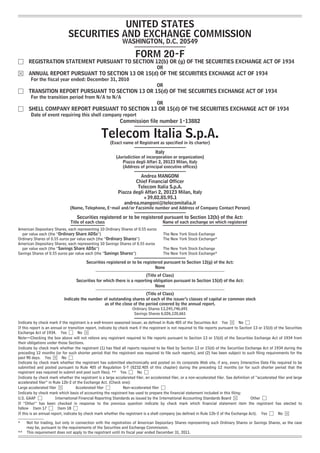
                                                                       FORM 20-F
‘     REGISTRATION STATEMENT PURSUANT TO SECTION 12(b) OR (g) OF THE SECURITIES EXCHANGE ACT OF 1934
                                                                                    OR
È     ANNUAL REPORT PURSUANT TO SECTION 13 OR 15(d) OF THE SECURITIES EXCHANGE ACT OF 1934
       For the fiscal year ended: December 31, 2010
                                                                                    OR
‘     TRANSITION REPORT PURSUANT TO SECTION 13 OR 15(d) OF THE SECURITIES EXCHANGE ACT OF 1934
       For the transition period from N/A to N/A
                                                                                    OR
‘     SHELL COMPANY REPORT PURSUANT TO SECTION 13 OR 15(d) OF THE SECURITIES EXCHANGE ACT OF 1934
       Date of event requiring this shell company report
                                                             Commission file number 1-13882

                                                  Telecom Italia S.p.A.
                                                       (Exact name of Registrant as specified in its charter)

                                                                                   Italy
                                                           (Jurisdiction of incorporation or organization)
                                                              Piazza degli Affari 2, 20123 Milan, Italy
                                                              (Address of principal executive offices)

                                                                      Andrea MANGONI
                                                                    Chief Financial Officer
                                                                     Telecom Italia S.p.A.
                                                            Piazza degli Affari 2, 20123 Milan, Italy
                                                                        +39.02.85.95.1
                                                               andrea.mangoni@telecomitalia.it
                               (Name, Telephone, E-mail and/or Facsimile number and Address of Company Contact Person)

                                   Securities registered or to be registered pursuant to Section 12(b) of the Act:
                               Title of each class                                     Name of each exchange on which registered
American Depositary Shares, each representing 10 Ordinary Shares of 0.55 euros
  par value each (the “Ordinary Share ADSs”)                                             The New York Stock Exchange
Ordinary Shares of 0.55 euros par value each (the “Ordinary Shares”)                     The New York Stock Exchange*
American Depositary Shares, each representing 10 Savings Shares of 0.55 euros
  par value each (the “Savings Share ADSs”)                                              The New York Stock Exchange
Savings Shares of 0.55 euros par value each (the “Savings Shares”)                       The New York Stock Exchange*

                                         Securities registered or to be registered pursuant to Section 12(g) of the Act:
                                                                              None
                                                                         (Title of Class)
                                   Securities for which there is a reporting obligation pursuant to Section 15(d) of the Act:
                                                                              None
                                                                       (Title of Class)
                            Indicate the number of outstanding shares of each of the issuer’s classes of capital or common stock
                                                as of the close of the period covered by the annual report.
                                                               Ordinary Shares 13,245,746,691
                                                                Savings Shares 6,026,120,661

Indicate by check mark if the registrant is a well-known seasoned issuer, as defined in Rule 405 of the Securities Act Yes È No ‘
If this report is an annual or transition report, indicate by check mark if the registrant is not required to file reports pursuant to Section 13 or 15(d) of the Securities
Exchange Act of 1934. Yes ‘ No È
Note—Checking the box above will not relieve any registrant required to file reports pursuant to Section 13 or 15(d) of the Securities Exchange Act of 1934 from
their obligations under those Sections.
Indicate by check mark whether the registrant (1) has filed all reports required to be filed by Section 13 or 15(d) of the Securities Exchange Act of 1934 during the
preceding 12 months (or for such shorter period that the registrant was required to file such reports), and (2) has been subject to such filing requirements for the
past 90 days. Yes È No ‘
Indicate by check mark whether the registrant has submitted electronically and posted on its corporate Web site, if any, every Interactive Data File required to be
submitted and posted pursuant to Rule 405 of Regulation S-T (§232.405 of this chapter) during the preceding 12 months (or for such shorter period that the
registrant was required to submit and post such files). ** Yes ‘ No ‘
Indicate by check mark whether the registrant is a large accelerated filer, an accelerated filer, or a non-accelerated filer. See definition of “accelerated filer and large
accelerated filer” in Rule 12b-2 of the Exchange Act. (Check one):
Large accelerated filer È           Accelerated filer ‘         Non-accelerated filer ‘
Indicate by check mark which basis of accounting the registrant has used to prepare the financial statement included in this filing:
U.S. GAAP ‘            International Financial Reporting Standards as issued by the International Accounting Standards Board È               Other ‘
If “Other” has been checked in response to the previous question indicate by check mark which financial statement item the registrant has elected to
follow Item 17 ‘ Item 18 ‘
If this is an annual report, indicate by check mark whether the registrant is a shell company (as defined in Rule 12b-2 of the Exchange Act). Yes ‘ No È

*    Not for trading, but only in connection with the registration of American Depositary Shares representing such Ordinary Shares or Savings Shares, as the case
     may be, pursuant to the requirements of the Securities and Exchange Commission.
**   This requirement does not apply to the registrant until its fiscal year ended December 31, 2011.
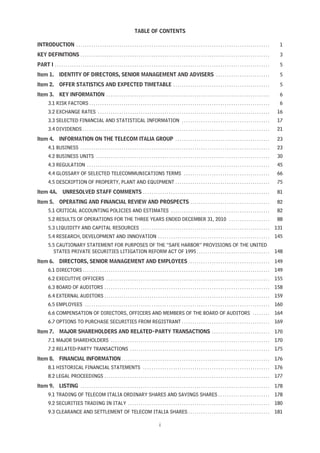
TABLE OF CONTENTS

INTRODUCTION . . . . . . . . . . . . . . . . . . . . . . . . . . . . . . . . . . . . . . . . . . . . . . . . . . . . . . . . . . . . . . . . . . . . . . . . . . . . . . . . . . . . . . . . . .                   1
KEY DEFINITIONS . . . . . . . . . . . . . . . . . . . . . . . . . . . . . . . . . . . . . . . . . . . . . . . . . . . . . . . . . . . . . . . . . . . . . . . . . . . . . . . . . . . . . . . .                    3
PART I . . . . . . . . . . . . . . . . . . . . . . . . . . . . . . . . . . . . . . . . . . . . . . . . . . . . . . . . . . . . . . . . . . . . . . . . . . . . . . . . . . . . . . . . . . . . . . . . . . . .     5
Item 1.            IDENTITY OF DIRECTORS, SENIOR MANAGEMENT AND ADVISERS . . . . . . . . . . . . . . . . . . . . . . . . .                                                                                         5
Item 2.            OFFER STATISTICS AND EXPECTED TIMETABLE . . . . . . . . . . . . . . . . . . . . . . . . . . . . . . . . . . . . . . . . . . . . .                                                               5
Item 3.            KEY INFORMATION . . . . . . . . . . . . . . . . . . . . . . . . . . . . . . . . . . . . . . . . . . . . . . . . . . . . . . . . . . . . . . . . . . . . . . . . . . . .                         6
         3.1 RISK FACTORS . . . . . . . . . . . . . . . . . . . . . . . . . . . . . . . . . . . . . . . . . . . . . . . . . . . . . . . . . . . . . . . . . . . . . . . . . . . . . . . . . . . .                  6
         3.2 EXCHANGE RATES . . . . . . . . . . . . . . . . . . . . . . . . . . . . . . . . . . . . . . . . . . . . . . . . . . . . . . . . . . . . . . . . . . . . . . . . . . . . . . . .                       16
         3.3 SELECTED FINANCIAL AND STATISTICAL INFORMATION . . . . . . . . . . . . . . . . . . . . . . . . . . . . . . . . . . . . . . . . .                                                                     17
         3.4 DIVIDENDS . . . . . . . . . . . . . . . . . . . . . . . . . . . . . . . . . . . . . . . . . . . . . . . . . . . . . . . . . . . . . . . . . . . . . . . . . . . . . . . . . . . . . . .              21
Item 4.            INFORMATION ON THE TELECOM ITALIA GROUP . . . . . . . . . . . . . . . . . . . . . . . . . . . . . . . . . . . . . . . . . . . .                                                                23
         4.1 BUSINESS . . . . . . . . . . . . . . . . . . . . . . . . . . . . . . . . . . . . . . . . . . . . . . . . . . . . . . . . . . . . . . . . . . . . . . . . . . . . . . . . . . . . . . . .             23
         4.2 BUSINESS UNITS . . . . . . . . . . . . . . . . . . . . . . . . . . . . . . . . . . . . . . . . . . . . . . . . . . . . . . . . . . . . . . . . . . . . . . . . . . . . . . . . .                     30
         4.3 REGULATION . . . . . . . . . . . . . . . . . . . . . . . . . . . . . . . . . . . . . . . . . . . . . . . . . . . . . . . . . . . . . . . . . . . . . . . . . . . . . . . . . . . . .                 45
         4.4 GLOSSARY OF SELECTED TELECOMMUNICATIONS TERMS . . . . . . . . . . . . . . . . . . . . . . . . . . . . . . . . . . . . . . . .                                                                        66
         4.5 DESCRIPTION OF PROPERTY, PLANT AND EQUIPMENT . . . . . . . . . . . . . . . . . . . . . . . . . . . . . . . . . . . . . . . . . . . .                                                                 75
Item 4A.              UNRESOLVED STAFF COMMENTS . . . . . . . . . . . . . . . . . . . . . . . . . . . . . . . . . . . . . . . . . . . . . . . . . . . . . . . . . . .                                             81
Item 5.            OPERATING AND FINANCIAL REVIEW AND PROSPECTS . . . . . . . . . . . . . . . . . . . . . . . . . . . . . . . . . . . . .                                                                         82
         5.1 CRITICAL ACCOUNTING POLICIES AND ESTIMATES . . . . . . . . . . . . . . . . . . . . . . . . . . . . . . . . . . . . . . . . . . . . . .                                                               82
         5.2 RESULTS OF OPERATIONS FOR THE THREE YEARS ENDED DECEMBER 31, 2010 . . . . . . . . . . . . . . . . . . .                                                                                              88
         5.3 LIQUIDITY AND CAPITAL RESOURCES . . . . . . . . . . . . . . . . . . . . . . . . . . . . . . . . . . . . . . . . . . . . . . . . . . . . . . . . . . . .                                             131
         5.4 RESEARCH, DEVELOPMENT AND INNOVATION . . . . . . . . . . . . . . . . . . . . . . . . . . . . . . . . . . . . . . . . . . . . . . . . . . . .                                                        145
         5.5 CAUTIONARY STATEMENT FOR PURPOSES OF THE “SAFE HARBOR” PROVISIONS OF THE UNITED
            STATES PRIVATE SECURITIES LITIGATION REFORM ACT OF 1995 . . . . . . . . . . . . . . . . . . . . . . . . . . . . . . . . . .                                                                          148
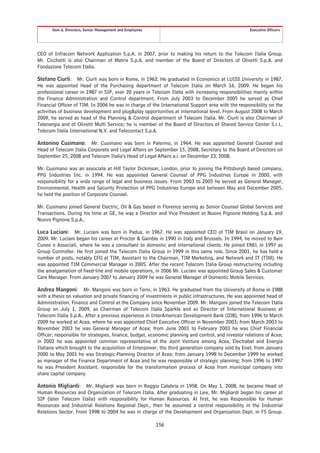
Item 6.            DIRECTORS, SENIOR MANAGEMENT AND EMPLOYEES . . . . . . . . . . . . . . . . . . . . . . . . . . . . . . . . . . . . . .                                                                        149
         6.1 DIRECTORS . . . . . . . . . . . . . . . . . . . . . . . . . . . . . . . . . . . . . . . . . . . . . . . . . . . . . . . . . . . . . . . . . . . . . . . . . . . . . . . . . . . . . . .             149
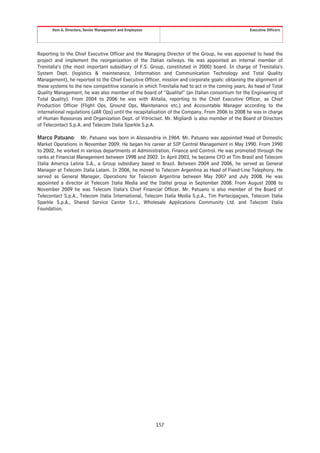
         6.2 EXECUTIVE OFFICERS . . . . . . . . . . . . . . . . . . . . . . . . . . . . . . . . . . . . . . . . . . . . . . . . . . . . . . . . . . . . . . . . . . . . . . . . . . . .                          155
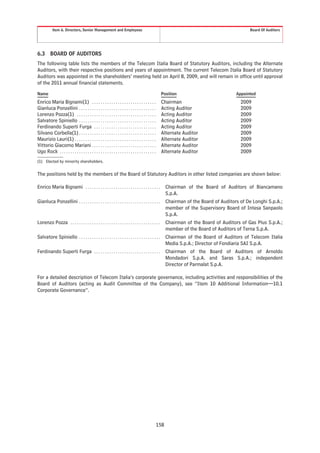
         6.3 BOARD OF AUDITORS . . . . . . . . . . . . . . . . . . . . . . . . . . . . . . . . . . . . . . . . . . . . . . . . . . . . . . . . . . . . . . . . . . . . . . . . . . . . .                         158
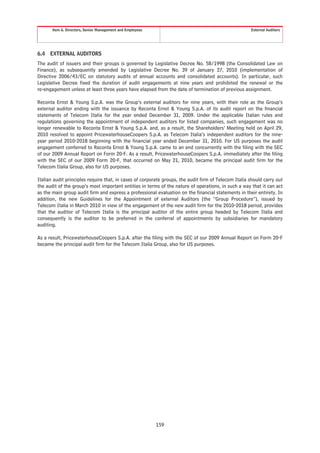
         6.4 EXTERNAL AUDITORS . . . . . . . . . . . . . . . . . . . . . . . . . . . . . . . . . . . . . . . . . . . . . . . . . . . . . . . . . . . . . . . . . . . . . . . . . . . . .                         159
         6.5 EMPLOYEES . . . . . . . . . . . . . . . . . . . . . . . . . . . . . . . . . . . . . . . . . . . . . . . . . . . . . . . . . . . . . . . . . . . . . . . . . . . . . . . . . . . . . .               160
         6.6 COMPENSATION OF DIRECTORS, OFFICERS AND MEMBERS OF THE BOARD OF AUDITORS . . . . . . . .                                                                                                            164
         6.7 OPTIONS TO PURCHASE SECURITIES FROM REGISTRANT . . . . . . . . . . . . . . . . . . . . . . . . . . . . . . . . . . . . . . . . .                                                                    169
Item 7.            MAJOR SHAREHOLDERS AND RELATED-PARTY TRANSACTIONS . . . . . . . . . . . . . . . . . . . . . . . . . . .                                                                                       170
         7.1 MAJOR SHAREHOLDERS . . . . . . . . . . . . . . . . . . . . . . . . . . . . . . . . . . . . . . . . . . . . . . . . . . . . . . . . . . . . . . . . . . . . . . . . . .                              170
         7.2 RELATED-PARTY TRANSACTIONS . . . . . . . . . . . . . . . . . . . . . . . . . . . . . . . . . . . . . . . . . . . . . . . . . . . . . . . . . . . . . . . . .                                        175
Item 8.            FINANCIAL INFORMATION . . . . . . . . . . . . . . . . . . . . . . . . . . . . . . . . . . . . . . . . . . . . . . . . . . . . . . . . . . . . . . . . . . . . .                               176
         8.1 HISTORICAL FINANCIAL STATEMENTS . . . . . . . . . . . . . . . . . . . . . . . . . . . . . . . . . . . . . . . . . . . . . . . . . . . . . . . . . . .                                               176
         8.2 LEGAL PROCEEDINGS . . . . . . . . . . . . . . . . . . . . . . . . . . . . . . . . . . . . . . . . . . . . . . . . . . . . . . . . . . . . . . . . . . . . . . . . . . . . .                         177
Item 9.            LISTING . . . . . . . . . . . . . . . . . . . . . . . . . . . . . . . . . . . . . . . . . . . . . . . . . . . . . . . . . . . . . . . . . . . . . . . . . . . . . . . . . . . . . . . .       178
         9.1 TRADING OF TELECOM ITALIA ORDINARY SHARES AND SAVINGS SHARES . . . . . . . . . . . . . . . . . . . . . . . .                                                                                        178
         9.2 SECURITIES TRADING IN ITALY . . . . . . . . . . . . . . . . . . . . . . . . . . . . . . . . . . . . . . . . . . . . . . . . . . . . . . . . . . . . . . . . . .                                     180
         9.3 CLEARANCE AND SETTLEMENT OF TELECOM ITALIA SHARES . . . . . . . . . . . . . . . . . . . . . . . . . . . . . . . . . . . . . .                                                                       181

                                                                                                            i
Item 10.             ADDITIONAL INFORMATION . . . . . . . . . . . . . . . . . . . . . . . . . . . . . . . . . . . . . . . . . . . . . . . . . . . . . . . . . . . . . . . . . . . 182
         10.1 CORPORATE GOVERNANCE . . . . . . . . . . . . . . . . . . . . . . . . . . . . . . . . . . . . . . . . . . . . . . . . . . . . . . . . . . . . . . . . . . . . . . . 182
         10.2 EXCHANGE CONTROLS AND OTHER LIMITATIONS AFFECTING SECURITY HOLDERS . . . . . . . . . . . . . . . 196
         10.3 DESCRIPTION OF BYLAWS . . . . . . . . . . . . . . . . . . . . . . . . . . . . . . . . . . . . . . . . . . . . . . . . . . . . . . . . . . . . . . . . . . . . . . . . 197
         10.4 DESCRIPTION OF CAPITAL STOCK . . . . . . . . . . . . . . . . . . . . . . . . . . . . . . . . . . . . . . . . . . . . . . . . . . . . . . . . . . . . . . . . 198
         10.5 DESCRIPTION OF AMERICAN DEPOSITARY RECEIPTS . . . . . . . . . . . . . . . . . . . . . . . . . . . . . . . . . . . . . . . . . . . . . 203
         10.6 TAXATION . . . . . . . . . . . . . . . . . . . . . . . . . . . . . . . . . . . . . . . . . . . . . . . . . . . . . . . . . . . . . . . . . . . . . . . . . . . . . . . . . . . . . . . . 211
         10.7 DOCUMENTS ON DISPLAY . . . . . . . . . . . . . . . . . . . . . . . . . . . . . . . . . . . . . . . . . . . . . . . . . . . . . . . . . . . . . . . . . . . . . . . . 216
Item 11.             QUANTITATIVE AND QUALITATIVE DISCLOSURES ABOUT MARKET RISKS . . . . . . . . . . . . . . . . . 217
Item 12.             DESCRIPTION OF SECURITIES OTHER THAN EQUITY SECURITIES . . . . . . . . . . . . . . . . . . . . . . . . . . 218
Item 12A. DEBT SECURITIES . . . . . . . . . . . . . . . . . . . . . . . . . . . . . . . . . . . . . . . . . . . . . . . . . . . . . . . . . . . . . . . . . . . . . . . . . . . 218
Item 12B. WARRANTS AND RIGHTS . . . . . . . . . . . . . . . . . . . . . . . . . . . . . . . . . . . . . . . . . . . . . . . . . . . . . . . . . . . . . . . . . . . . 218
Item 12C. OTHER SECURITIES . . . . . . . . . . . . . . . . . . . . . . . . . . . . . . . . . . . . . . . . . . . . . . . . . . . . . . . . . . . . . . . . . . . . . . . . . . 218
Item 12D. AMERICAN DEPOSITARY SHARES . . . . . . . . . . . . . . . . . . . . . . . . . . . . . . . . . . . . . . . . . . . . . . . . . . . . . . . . . . . 218
PART II . . . . . . . . . . . . . . . . . . . . . . . . . . . . . . . . . . . . . . . . . . . . . . . . . . . . . . . . . . . . . . . . . . . . . . . . . . . . . . . . . . . . . . . . . . . . . . . . . . . . 221
Item 13.             DEFAULTS, DIVIDEND ARREARAGES AND DELINQUENCIES . . . . . . . . . . . . . . . . . . . . . . . . . . . . . . . . . 221
Item 14. MATERIAL MODIFICATION TO THE RIGHTS OF SECURITY HOLDERS AND USE OF
   PROCEEDS . . . . . . . . . . . . . . . . . . . . . . . . . . . . . . . . . . . . . . . . . . . . . . . . . . . . . . . . . . . . . . . . . . . . . . . . . . . . . . . . . . . . . . . . . . . . . . 222
Item 15.             CONTROLS AND PROCEDURES . . . . . . . . . . . . . . . . . . . . . . . . . . . . . . . . . . . . . . . . . . . . . . . . . . . . . . . . . . . . . . . 223
         15.1 DISCLOSURE CONTROLS AND PROCEDURES . . . . . . . . . . . . . . . . . . . . . . . . . . . . . . . . . . . . . . . . . . . . . . . . . . . . . . 223
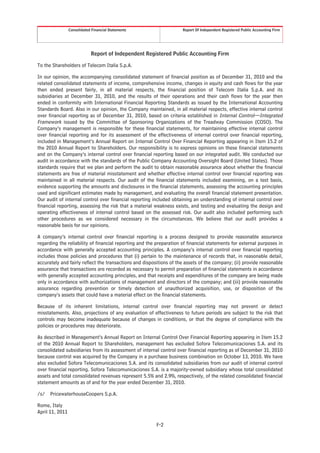
         15.2 MANAGEMENT’S ANNUAL REPORT OF INTERNAL CONTROL OVER FINANCIAL REPORTING . . . . . . . . . 223
         15.3 FOCUS ON “MATERIAL WEAKNESS” AS REPORTED IN CONNECTION WITH THE PREPARATION OF
           FINANCIAL STATEMENTS FOR THE YEAR ENDED DECEMBER 31, 2009 . . . . . . . . . . . . . . . . . . . . . . . . . . . . . . . 224
Item 16.             [RESERVED] . . . . . . . . . . . . . . . . . . . . . . . . . . . . . . . . . . . . . . . . . . . . . . . . . . . . . . . . . . . . . . . . . . . . . . . . . . . . . . . . . . 226
Item 16A. AUDIT COMMITTEE FINANCIAL EXPERT . . . . . . . . . . . . . . . . . . . . . . . . . . . . . . . . . . . . . . . . . . . . . . . . . . . . 226
Item 16B. CODE OF ETHICS AND CONDUCT . . . . . . . . . . . . . . . . . . . . . . . . . . . . . . . . . . . . . . . . . . . . . . . . . . . . . . . . . . . 226
Item 16C. PRINCIPAL ACCOUNTANT FEES AND SERVICES . . . . . . . . . . . . . . . . . . . . . . . . . . . . . . . . . . . . . . . . . . . . 227
Item 16D. EXEMPTIONS FROM THE LISTING STANDARDS FOR AUDIT COMMITTEES . . . . . . . . . . . . . . . . 229
Item 16E. REPURCHASES OF EQUITY SECURITIES . . . . . . . . . . . . . . . . . . . . . . . . . . . . . . . . . . . . . . . . . . . . . . . . . . . . . 229
Item 16F.              CHANGE IN REGISTRANT’S CERTIFYING ACCOUNTANT . . . . . . . . . . . . . . . . . . . . . . . . . . . . . . . . . . . 229
Item 16G.               CORPORATE GOVERNANCE . . . . . . . . . . . . . . . . . . . . . . . . . . . . . . . . . . . . . . . . . . . . . . . . . . . . . . . . . . . . . . . . . 230
PART III . . . . . . . . . . . . . . . . . . . . . . . . . . . . . . . . . . . . . . . . . . . . . . . . . . . . . . . . . . . . . . . . . . . . . . . . . . . . . . . . . . . . . . . . . . . . . . . . . . . . 232
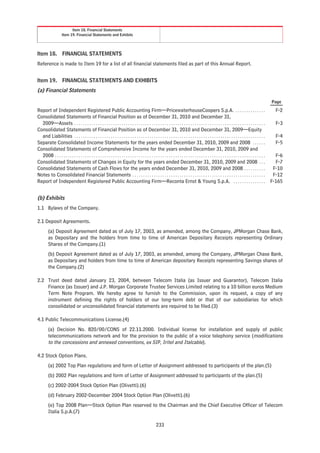
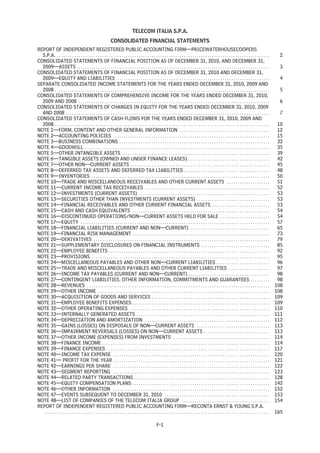
Item 17.             FINANCIAL STATEMENTS . . . . . . . . . . . . . . . . . . . . . . . . . . . . . . . . . . . . . . . . . . . . . . . . . . . . . . . . . . . . . . . . . . . . . 232
Item 18.             FINANCIAL STATEMENTS . . . . . . . . . . . . . . . . . . . . . . . . . . . . . . . . . . . . . . . . . . . . . . . . . . . . . . . . . . . . . . . . . . . . . 233
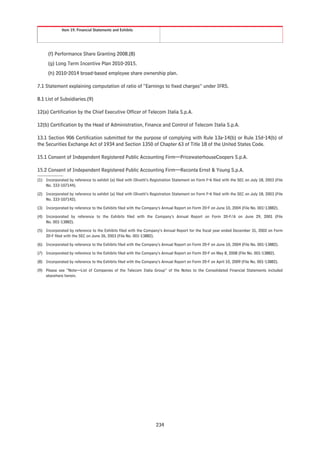
Item 19.             FINANCIAL STATEMENTS AND EXHIBITS . . . . . . . . . . . . . . . . . . . . . . . . . . . . . . . . . . . . . . . . . . . . . . . . . . . . . 233


                                                                                                        ii
Introduction


                                                 INTRODUCTION

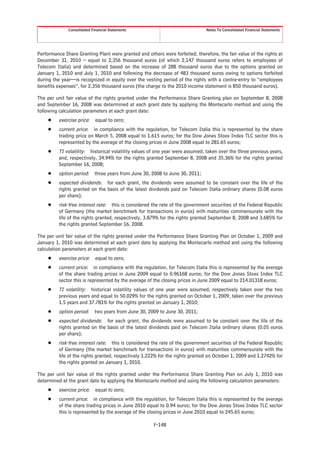
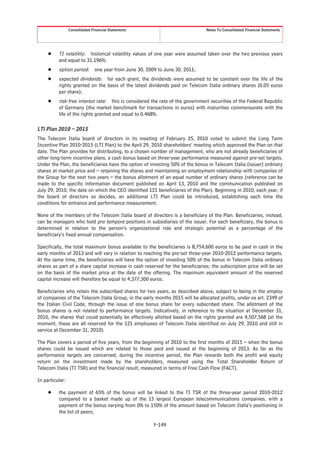
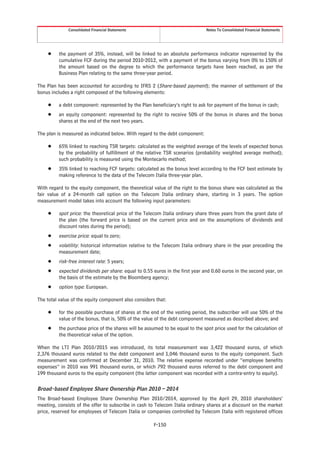
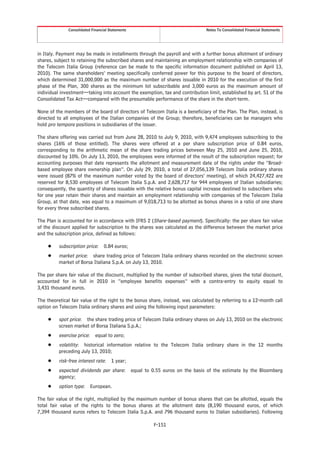
Telecom Italia S.p.A. is incorporated as a joint stock company under the laws of Italy. As used in this Annual
Report, unless the context otherwise requires, the term Company means Telecom Italia S.p.A. the operating
company for fixed and mobile telecommunications services in Italy and the holding company for various
businesses, principally telecommunications, and the terms “we”, “us” and “our” refers to the Company, and, as
applicable, the Company and its consolidated subsidiaries.

Unless otherwise indicated, the financial information contained in this Annual Report has been prepared in
accordance with International Financial Reporting Standards issued by the International Accounting Standards
Board (designated as “IFRS”).

Unless otherwise indicated, any reference in this Annual Report to Consolidated Financial Statements is to the
Consolidated Financial Statements for the year ended December 31, 2010 of the Telecom Italia Group (including
the notes thereto) included elsewhere herein.


    Cautionary Statement for Purposes of the “Safe Harbor” Provisions of the United States Private
                              Securities Litigation Reform Act of 1995.

The Private Securities Litigation Reform Act of 1995 provides a “safe harbor” for forward-looking statements. This
Annual Report contains certain forward-looking statements.

Forward-looking statements are statements that are not historical facts and can be identified by the use of
forward-looking terminology such as “believes,” “may,” “is expected to,” “will,” “will continue,” “should,”
“seeks” or “anticipates” or similar expressions or the negative thereof or other comparable terminology, or by the
forward-looking nature of discussions of strategy, plans or intentions.

The forward-looking statements in this Annual Report include, but are not limited to, the discussion of the
changing dynamics of the telecommunications marketplace, including the continuing developments in
competition in all aspects of our businesses from new competitors and from new and enhanced technologies, our
outlook for growth in the telecommunications industry both within and outside of Italy, including our outlook
regarding developments in the telecommunications industry, and certain trends we have identified in our core
markets, including regulatory developments.

Such statements include, but are not limited to, statements under the following headings: (i) “Item 3. Key
Information—3.1 Risk Factors”, (ii) “Item 4. Information on the Telecom Italia Group—4.1 Business—4.1.7
Updated Strategy”, (iii) “Item 4. Information on the Telecom Italia Group—4.3 Regulation”, (iv) “Item 5.
Operating and Financial Review and Prospects”, (v) “Item 8. Financial Information—8.2 Legal Proceedings” and
(vi) “Item 11. Quantitative and Qualitative Disclosures About Market Risks”, including statements regarding the
likely effect of matters discussed therein.

Actual results may differ materially from those projected or implied in the forward-looking statements. Such
forward-looking information is based on certain key assumptions which we believe to be reasonable but forward-
looking information by its nature involves risks and uncertainties, which are outside our control, that could
significantly affect expected results.

The following important factors could cause actual results to differ materially from those projected or implied in
any forward-looking statements:
Š    our ability to successfully implement our strategy over the 2011-2013 period;
Š    our ability to successfully achieve our debt reduction targets;
Š    the continuing impact of increased competition in a liberalized market, including competition from
     established domestic competitors and global and regional alliances formed by other telecommunications
     operators in our core Italian domestic fixed-line and wireless markets;

                                                          1
Introduction


Š   the increasing competition from global and local OTT (Over The Top) players (operators offering contents
    and services on the internet without owning a proprietary TLC network infrastructure);
Š   the continuing impact and recovery from the global recession in the principal markets in which we operate;
Š   our ability to utilize our relationship with Telefónica to attain synergies primarily in areas such as network,
    IT, purchasing and international mobile roaming;
Š   our ability to introduce new services to stimulate increased usage of our fixed and wireless networks to
    offset declines in the traditional fixed-line voice business due to the continuing impact of regulatory required
    price reductions, market share loss, pricing pressures generally and shifts in usage patterns;
Š   our ability to successfully implement our internet and broadband strategy;
Š   the impact of regulatory decisions and changes in the regulatory environment in Italy and other countries in
    which we operate;
Š   the impact of economic development generally on our international business and on our foreign investments
    and capital expenditures;
Š   our services are technology-intensive and the development of new technologies could render such services
    non-competitive;
Š   the impact of political developments in Italy and other countries in which we operate;
Š   the impact of fluctuations in currency exchange and interest rates;
Š   our ability to build up our business in adjacent markets and in international markets (particularly in Brazil and
    Argentina), due to our specialist and technical resources;
Š   our ability to achieve the expected return on the investments and capital expenditures we have made and
    continue to make (such as those in Brazil and Argentina);
Š   the amount and timing of any future impairment charges for our licenses, goodwill or other assets; and
Š   the outcome of litigation, disputes and investigations in which we are involved or may become involved.

The foregoing factors should not be construed as exhaustive. Due to such uncertainties and risks, readers are
cautioned not to place undue reliance on such forward-looking statements, which speak only as of the date
hereof. We undertake no obligation to release publicly the result of any revisions to these forward-looking
statements which may be made to reflect events or circumstances after the date hereof, including, without
limitation, changes in our business or acquisition strategy or planned capital expenditures, or to reflect the
occurrence of unanticipated events.


                                                         2
Key Definitions


                                                                          KEY DEFINITIONS

The following terms appearing in this Annual Report have the meanings set forth below.
EU . . . . . . . . . . . . . . . . . . . . . . . . . . . . . . . . . . . . . . . . . . . . . . . . . . . . . means the European Union.
IASB . . . . . . . . . . . . . . . . . . . . . . . . . . . . . . . . . . . . . . . . . . . . . . . . . . . means the International Accounting Standards Board.
IFRS . . . . . . . . . . . . . . . . . . . . . . . . . . . . . . . . . . . . . . . . . . . . . . . . . . . means International Financial Reporting Standards
                                                                                                           issued by the IASB. IFRS also include all effective
                                                                                                           International Accounting Standards (“IAS”) and all
                                                                                                           Interpretations issued by the IFRS Interpretations
                                                                                                           Committee (formerly called the International Financial
                                                                                                           Reporting      Interpretations   Committee—IFRIC),
                                                                                                           comprising those previously issued by the Standing
                                                                                                           Interpretations Committee (“SIC”).
Merger . . . . . . . . . . . . . . . . . . . . . . . . . . . . . . . . . . . . . . . . . . . . . . . . means the merger of Old Telecom Italia into Olivetti,
                                                                                                       which became effective on August 4, 2003.
Old Telecom Italia and Old Telecom Italia Group . . . means Telecom Italia as well as Telecom Italia and its
                                                      consolidated subsidiaries, respectively, as they existed
                                                      immediately prior to the effective date of the Merger.
Olivetti . . . . . . . . . . . . . . . . . . . . . . . . . . . . . . . . . . . . . . . . . . . . . . . . unless otherwise indicated, means Olivetti S.p.A., the
                                                                                                         holding company and controlling shareholder of Old
                                                                                                         Telecom Italia.
Olivetti Group . . . . . . . . . . . . . . . . . . . . . . . . . . . . . . . . . . . . . . . . unless otherwise indicated, means Olivetti and its
                                                                                               consolidated subsidiaries, including Old Telecom Italia.
Ordinary Shares . . . . . . . . . . . . . . . . . . . . . . . . . . . . . . . . . . . . . . means the Ordinary Shares, 0.55 euros par value each,
                                                                                            of Telecom Italia.
Parent . . . . . . . . . . . . . . . . . . . . . . . . . . . . . . . . . . . . . . . . . . . . . . . . means Telecom Italia S.p.A.
Savings Shares . . . . . . . . . . . . . . . . . . . . . . . . . . . . . . . . . . . . . . . means the Savings Shares, 0.55 euros par value each,
                                                                                             of Telecom Italia.
Telecom Italia . . . . . . . . . . . . . . . . . . . . . . . . . . . . . . . . . . . . . . . . means the entity which resulted from the Merger.
Telecom Italia Group and Group . . . . . . . . . . . . . . . . . . . . means the Company and its consolidated subsidiaries.
Telecom Italia Media . . . . . . . . . . . . . . . . . . . . . . . . . . . . . . . . . Telecom Italia Media is the Telecom Italia Group’s
                                                                                       subsidiary operating in the Media business.
TIM . . . . . . . . . . . . . . . . . . . . . . . . . . . . . . . . . . . . . . . . . . . . . . . . . . . . means Telecom Italia Mobile S.p.A., the Company’s
                                                                                                            subsidiary   which      operated    in     the    mobile
                                                                                                            telecommunications business, and merged with and
                                                                                                            into Telecom Italia, with Telecom Italia as the surviving
                                                                                                            company, effective as from June 30, 2005.
Tim Italia . . . . . . . . . . . . . . . . . . . . . . . . . . . . . . . . . . . . . . . . . . . . . means the company deriving from the spin-off of TIM’s
                                                                                                     domestic mobile operations, effective as from March 1,
                                                                                                     2005. After the merger of TIM with and into Telecom
                                                                                                     Italia, Tim Italia became a wholly-owned subsidiary of
                                                                                                     Telecom Italia. Subsequently Tim Italia merged with
                                                                                                     and into Telecom Italia, with Telecom Italia as the
                                                                                                     surviving company, effective as from March 1, 2006.

In addition to the foregoing terms, certain technical telecommunication terms relating to our businesses are
defined in the glossary of this Annual Report (see “Item 4. Information on the Telecom Italia Group—4.4
Glossary of Selected Telecommunications Terms”).

In addition, due to the changing nature of our business, we now use the measure “Accesses” when considering
certain statistical and other data for our domestic Italian business. “Access” refers to a connection to any of the

                                                                                        3
Key Definitions


telecommunications services offered by the Group in Italy. We present our customer base using this model
because the integration of telecommunications services in bundled service packages has changed the way
residential and corporate customers contract for our services. Because a single customer may contract for
multiple services, we believe it is more accurate to count the number of accesses, or services a customer has
contracted for, as opposed to only counting the number of our customers. For example, a customer that has fixed
line telephony service and BroadBand service represents two accesses rather than a single customer. In addition,
we fully count the accesses attributable to all companies over which we exercise control. The following are the
main categories of accesses:
Š   Fixed Telephony accesses: includes PSTN lines (public switched telephone network), ISDN lines (integrated
    services digital network) and circuits. For purposes of calculating our number of fixed line accesses, we
    multiply our lines to service as follows: PSTN (×1); basic ISDN (×2); primary ISDN (× between 20 and 30
    as an average);
Š   Internet and data accesses: includes BroadBand accesses (wholesale ADSL and retail ADSL lines),
    narrowband accesses (internet service through the PSTN) and other accesses (unbundled local loops, circuits
    and other business data accesses including WiFi and fiber optic cable);
Š   IP TV (Internet Protocol TV);
Š   Mobile accesses (includes mobile telephony);
Š   Unbundled local loop: includes accesses to both ends of the copper local loop leased to other operators to
    provide voice and DSL services (fully unbundled loop, “fully UL”) or only DSL service (shared unbundled loop,
    “shared UL”);
Š   Wholesale ADSL: means wholesale asymmetrical digital subscriber line; and
Š   Other: includes other circuits for other operators.

Our Brazil and Argentina business areas compile their statistical data differently. Brazil, which primarily offers
mobile telephone services, counts “numbers of lines”. In Argentina, mobile statistical data is compiled on the
basis of “customers”.


                                                          4
Item 1. Identity of Directors, Senior Management and Advisers /
           Item 2. Offer Statistics and Expected Timetable


                                                                    PART I

Item 1.    IDENTITY OF DIRECTORS, SENIOR MANAGEMENT AND ADVISERS
Not Applicable


Item 2.    OFFER STATISTICS AND EXPECTED TIMETABLE
Not Applicable


                                                                      5
Item 3. Key Information                                                             Risk Factors


Item 3.    KEY INFORMATION
3.1    RISK FACTORS
In addition to the other information contained in this Annual Report, investors should carefully consider the risks
described below before making any investment decision. The risks described below are not the only ones we face.
Additional risks not known to us or that we currently deem immaterial may also impair our business and results of
operations. Our business, financial condition, results of operations and cash flows could be materially adversely
affected by any of these risks, and investors could lose all or part of their investment.


RISKS RELATED TO THE TELECOM ITALIA GROUP
Our business will be adversely affected if we are unable to successfully implement our strategic
objectives. Factors beyond our control may prevent us from successfully implementing our strategy.
On February 25, 2011, we set out our strategic priorities for the 2011-2013 period. Our strategy confirms the
strategic priorities that the Telecom Italia Group set in April 2010, and in particular that we will:
Š     focus on core markets (Italy, Brazil and Argentina) to enhance free cash flow generation; and
Š     continue capital discipline to generate sustainable dividend growth and to complete the ongoing
      deleveraging of the Group’s balance sheet through the further reduction of outstanding debt.

Our ability to implement and achieve these strategic objectives may be influenced by certain factors, including
factors outside of our control, such as:
Š     increasing competition from global and local OTT (Over The Top) players (operators offering contents and
      services on the internet without owning a proprietary TLC network infrastructure);
Š     regulatory decisions and change in the regulatory environment in Italy and other countries in which we
      operate;
Š     increasing numbers of competitors in the Italian telecommunications market which could cause us to lose
      further market share;
Š     increasing and stronger market competition in our principal markets with a consequent decline in the prices
      of services;
Š     our ability to strengthen our competitive position in Italy through our focus on related markets and in
      international markets, particularly in Brazil and Argentina for mobile telecommunications;
Š     our ability to develop and introduce new technologies which are attractive in our principal markets, to
      manage innovation, to supply value added services and to increase the use of our fixed and mobile networks;
Š     the success of “disruptive” new technologies which could cause significant reductions in revenues from fixed
      and mobile telephony;
Š     our ability to manage costs;
Š     the continuing effects of the global credit crisis and weak economic conditions in the major markets in which
      we operate;
Š     our ability to refinance existing indebtedness when due under the uncertain conditions in the capital and
      bank markets;
Š     our ability to attract and retain highly qualified employees; and
Š     the effect of exchange rate fluctuations on our operating revenues, margins and financial management.

As a result of these uncertainties there can be no assurance that the objectives identified by management can
effectively be attained in the manner and within the time-frames described. Furthermore, if we are unable to
attain our strategic priorities, our goodwill may be impaired which could result in significant write-offs.


                                                           6
Item 3. Key Information                                                               Risk Factors


The global economic crisis adversely affected our business in 2009 and 2010 and continuing global
economic weakness could further adversely affect our businesses and therefore have a negative
impact on our operating results and financial condition.
The continuing effects of the global economic crisis which began in late 2008 continued during 2010. Although
the global economy began to recover during 2010, such recovery varied between geographic areas and European
economies, including Italy, were affected by the sovereign debt crisis and continuing concerns about the strength
of certain economies, in particular Ireland, Greece, Portugal and Spain. The continuing economic weakness was
reflected in the general contraction in consumer spending, with the impact on consumer spending varying
between geographic areas and different markets. Economic weakness, particularly in our domestic market, is
expected to continue for at least the whole of 2011.

In Italy, the recession has had the greatest impact on the demand for investments and on the purchase of
consumer durable goods and items of mass-consumption, with Gross Domestic Product (“GDP”) declining in
2009. In 2010, GDP improved slightly compared to 2009. In 2010, in both Brazil and Argentina there was a
recovery in GDP growth, which is expected to continue in 2011.

However, in Brazil, the contribution of raw materials to export growth increased in 2010; a fall in the price of raw
materials may have a material adverse effect on Brazil’s economic growth. In Argentina, as has been the case in
the last few years, the level of inflation has been high, and the expected growth of the economy may generate
further inflation in the medium term. Such inflation may negatively affect the Argentina Business Unit’s margins.

Although telecommunications has proven to be one of the industrial segments least affected by pro-cyclical
trends since our society has an increasing need to communicate, recessionary conditions have weighed, and may
continue to weigh, heavily on the development prospects of our domestic market, particularly with regard to the
penetration of the next phase of value-added services and the volume of business, key elements of the Group’s
strategic plan. This applies particularly to the business clientele segment (professionals and small and medium-
size businesses), where it is more likely that continuing weak economic conditions could have a negative effect on
revenues. Declines in the growth in the economies of Brazil and Argentina could also reduce the demand for our
products and services in those markets.

The continuing weakness in the global economy, and in particular the expected slow growth in GDP in our
domestic market, creates significant uncertainty and may adversely impact consumer spending, including on
telecommunication services. If we fail to successfully implement our plans to improve efficiency and optimize
expenditures, our results of operations and financial condition could be adversely affected.

Our leverage is such that deterioration in cash flow can change the expectations of the Group’s ability
to repay its debt and the inability to reduce our debt could have a material adverse effect on our
business. Continuing volatility in the international credit markets may limit our ability to refinance our
financial debt.
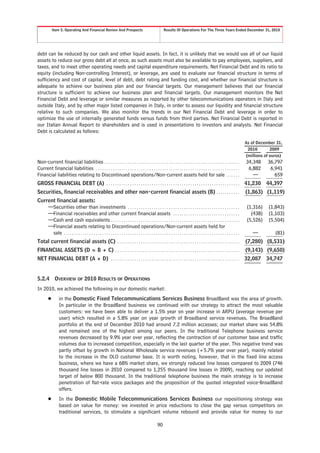
Our gross financial debt was 41,230 million euros at December 31, 2010 compared with 44,397 million euros at
December 31, 2009 and our net financial debt was 32,087 million euros at December 31, 2010 compared with
34,747 million euros as of December 31, 2009.

Due to the competitive environment and the current economic conditions, there could be deterioration in our
income statement and statement of financial position measures used by investors and rating agencies in
determining our credit quality. Ratios derived from these same separate income statement and statement of
financial position measures are used by the rating agencies, such as Moody’s and Standard & Poor’s, which base
their ratings on our ability to repay our debt.

Although rating downgrades do not have an immediate impact on outstanding debt, except for outstanding debt
instruments that specifically contemplate ratings in order to determine interest expense, or on its relative cost to
us, downgrades could lead to a greater risk with respect to refinancing existing debt or higher refinancing costs.

Factors which are beyond our control such as deterioration in performance by the telecommunications sector,
unfavorable fluctuations in interest rates and/or exchange rates, further disruptions in the capital markets,
particularly debt capital markets, and, in a broader sense, deterioration in general economic conditions also as a

                                                         7
Item 3. Key Information                                                                  Risk Factors


result of the continuing effects of the economic and financial crisis, could have a significant effect on our ability to
reduce our debt, or the ability of the Telecom Italia Group to refinance existing debt through further access to the
financial markets. As a result of the reduction of debt being a key element of the Group’s strategy, the failure to
reduce debt could be viewed negatively and adversely affect our credit ratings.

The management and further development of our business will require us to make further capital and other
investments. We may therefore incur additional debt in order to finance such investment. Our future results of
operations may be influenced by our ability to enter into such transactions, which in turn will be determined by
market conditions and factors that are outside our control. In addition, if such transactions increase our leverage
it could adversely affect our credit ratings.

We are continuously involved in disputes and litigation with regulators, competition authorities,
competitors and other parties and are the subject of a number of investigations by judicial authorities.
The ultimate outcome of such proceedings is generally uncertain. When finally concluded, they may
have a material adverse effect on our results of operations and financial condition.
We are subject to numerous risks relating to legal, competition and regulatory proceedings in which we are
currently a party or which could develop in the future. We are also the subject of a number of investigations by
judicial authorities. Such proceedings and investigations are inherently unpredictable. Legal, competition and
regulatory proceedings and investigations in which we are, or may become, involved (or settlements thereof) may
have a material adverse effect on our results of operations and/or financial condition. Furthermore, our
involvement in such proceedings and investigations may adversely affect our reputation. For information
concerning the most significant legal, competition and regulatory proceedings and investigations in which we are
involved, see “Note—Contingent liabilities, other information, commitments and guarantees” of the Notes to the
Consolidated Financial Statements included elsewhere in this Annual Report.

The Italian Collective Action for Damages for the Protection of Consumers Law (the “Collective Action Law”)
was passed in December 2007 and, after undergoing substantial modifications by the Italian Parliament, entered
into force on January 1, 2010. The law allows collective action lawsuits and is similar in many respects to
common law class actions. Contracts between public utilities and consumers and the business practices of
companies that provide public services (such as Telecom Italia) are covered by the Collective Action Law.
Therefore there is a risk of claims against Telecom Italia by consumers’ associations on behalf of broad classes of
consumers, although no such actions have yet been brought against Telecom Italia.

Operational risks could adversely affect our reputation and our profitability.
We face numerous operational risks inherent in our business, including those resulting from inadequate internal
and external processes, fraud, employee errors or misconduct, failure to comply with applicable laws, failure to
document transactions properly or systems failures. These events can result in direct or indirect losses and
adverse legal and regulatory proceedings, and harm our reputation and our operational effectiveness. In recent
years the Company has been the subject of a number of frauds, including matters relating to its Telecom Italia
Sparkle subsidiary, which resulted in the restatement of our financial statements in connection with the 2009
financial year.

We have risk management practices designed to detect, manage and monitor at top level the evolution of these
operational risks, and for this purpose we have recently established a group risk management committee.

However, there is no guarantee that these measures will be successful in effectively controlling the operational
risks that we face and such failures could have a material adverse effect on our results of operations and could
harm our reputation.

Risks associated with Telecom Italia’s ownership chain.
Telco S.p.A. (“Telco”)—a company in which interests are held by the Generali group (30.58%), Intesa Sanpaolo
S.p.A. (11.62%), Mediobanca S.p.A. (11.62%), and Telefónica S.A. (“Telefónica”) (46.18%)—is Telecom Italia’s
largest shareholder, holding an interest of approximately 22.40% of the voting rights.

The shareholders in Telco are parties to an amended shareholders agreement dated April 28, 2010 (as amended
and supplemented from time to time the “Shareholders Agreement”) which is effective through April 27, 2013.

                                                           8
Item 3. Key Information                                                                Risk Factors


The Shareholders’ Agreement defines, inter alia, the criteria for drawing up the slate of candidates for the
appointment of the Board of Directors of Telecom Italia:
Š    Telefónica, insofar as it holds at least 30% of Telco’s share capital, will be entitled to designate two
     candidates;
Š    the other shareholders of Telco, as they hold the absolute majority of its share capital, have the right to
     designate the other members on the slate, of whom three candidates unanimously and the others on a
     proportional basis.

The Shareholders’ Agreement provides that the Telecom Italia Group and the Telefónica Group are managed
autonomously and independently.

Although Telco does not own a controlling interest in Telecom Italia’s voting shares, Telco may exert a significant
influence on all matters to be decided by a vote of shareholders, including appointment of directors (in the
Shareholders’ Meeting on April 14, 2008 12 out of 15 Board members were elected, as a result of the proposal by
Telco, which has deposited its slate for the appointment of the new Board, to be resolved upon by the
Shareholders’ Meeting to be held on April 12, 2011; other lists were proposed by Findim S.A., which is the second
largest shareholder, with a stake of approximately 4.9% of the Company’s ordinary share capital, and a group of
asset management companies, with an overall stake of little more than 1%). It is expected that Telco nominated
directors will make up a similar number of directors as those that are represented on the current Board of
Directors. In principle, the interests of Telco in deciding shareholder matters could be different from the interests
of our other Ordinary Shareholders, and it is possible that certain decisions could be taken that may be influenced
by the needs of Telco.

In addition, Telefónica is the largest shareholder of Telco. Presently Telefónica and Telecom Italia are direct
competitors in certain countries outside of their respective domestic markets; nevertheless, the agreement
among the above mentioned parties provides that the Telecom Italia and Telefónica groups will be managed
autonomously and independently. Such agreements provide—among other things—that the directors designated
by Telefónica in Telco and Telecom Italia shall be directed by Telefónica to neither participate nor vote at board of
directors meetings which discuss matters relating to members of the Group in countries where Telefónica and
Telecom Italia compete. Specific additional matters have been agreed with respect to Telecom Italia’s operations
in Brazil and Argentina. The presence of Telefónica in Telco could, however, result in legal or regulatory
proceedings or affect regulatory decisions in countries where we may wish to operate if Telefónica is also an
operator/competitor in such jurisdictions. For further information, please see “Item 7 Major Shareholders and
Related-Party Transactions—7.1 Major Shareholders—7.1.1 Shareholders’ Agreements” and “Item 10. Additional
Information—10.1 Corporate Governance”. See also “Note—Contingent liabilities, other information,
commitments and guarantees” of the Notes to the Consolidated Financial Statements included elsewhere herein.

Telco is a holding company and the sole operating company in which it has an interest is Telecom Italia.
Therefore, should Telco be unable to obtain funding from its shareholders, present or future, or from other
sources, its cash flows would be entirely dependent upon the dividends paid on the Telecom Italia shares for its
funding needs.


The Italian State, through the Treasury, is in a position to exert certain powers with respect to
Telecom Italia.
Although no shareholder is in a position to prevent a takeover of Telecom Italia, the Italian State, through the
Treasury, is in a position to exert certain powers with respect to Telecom Italia through the exercise of the special
powers included in Telecom Italia’s Bylaws pursuant to compulsory legal provisions. The exercise of such powers
could make a merger with or takeover of Telecom Italia more difficult or discourage certain bidders from making
an offer.

On March 26, 2009, the European Court of Justice declared that Italy, through the special powers, failed to
comply with its obligations under the EC Treaty. According to the Court’s ruling, the alleged infringement of the
EC Treaty arose due to the applicable Italian legal provisions not making sufficiently clear the conditions for the
exercise of the Treasury’s special powers, so that investors would not be in a position to know in what situations

                                                         9
Item 3. Key Information                                                                Risk Factors


the powers will be used. Through a decree passed on May 20, 2010, the Italian Government amended the criteria
under which it may exercise such special powers. In any event, the ruling by the European Court of Justice does
not have any immediate or direct impact on Telecom Italia’s bylaws.

For further information, please see “Item 7 Major Shareholders and Related-Party Transactions—7.1 Major
Shareholders—7.1.3 Continuing Relationship with the Italian Treasury”.


System failures could result in reduced user traffic and reduced revenue and could harm our
reputation.
Our technical infrastructure (including our network infrastructure for fixed-line and mobile telecommunications
services) is vulnerable to damage or interruption from information and telecommunication technology failures,
power loss, floods, windstorms, fires, terrorism, intentional wrongdoing, human error and similar events.
Unanticipated problems at our facilities, system failures, hardware or software failures, computer viruses or
hacker attacks could affect the quality of our services and cause service interruptions. Any of these occurrences
could result in reduced user traffic and reduced revenue and could harm our reputation.


Our business depends on the upgrading of our existing networks.
We must continue to upgrade our existing networks in a timely and satisfactory manner in order to retain and
expand our customer base in each of our markets, to enhance our financial performance and to satisfy regulatory
requirements. Among other things, we could be required to:
Š    upgrade the functionality of our networks to permit increased customization of services;
Š    increase coverage in some of our markets;
Š    expand and maintain customer service, network management and administrative systems; and
Š    upgrade older systems and networks to adapt them to new technologies.

Many of these tasks are not entirely under our control and may be affected by applicable regulation. If we fail to
execute them successfully, our services and products may be less attractive to new customers and we may lose
existing customers to our competitors, which could have a material adverse effect on our business, financial
condition and results of operations.


RISKS RELATED TO THE TELECOMMUNICATIONS INDUSTRY AND FINANCIAL MARKETS
The value of our operations and investments may be adversely affected by political and economic developments
in Italy or other countries. Continuing global economic weakness could reduce purchases of our products and
services and adversely affect our results of operations, cash flows and financial condition.

Our business is dependent to a large degree on general economic conditions in Italy and our other principal
markets, Brazil and Argentina, including levels of interest rates, inflation, taxes and general business conditions. A
significant deterioration in economic conditions could adversely affect our business and results of operations. The
continuing weak economic conditions in 2010 following on from 2009 had an adverse impact on our business,
particularly in Italy. We may also be adversely affected by political developments in other countries where we
have made significant investments. Certain of these countries have political and legal systems that are
unpredictable. Political or economic upheaval or changes in laws or their application in these countries may harm
the operations of the companies in which we have invested and impair the value of these investments.

Continuing uncertainty about current global economic conditions poses a significant risk as consumers and
businesses postpone spending in response to tighter credit, negative financial news (including high levels of
unemployment) or declines in income or asset values, which could have a material negative effect on the demand
for our products and services. Although global economic conditions began to improve in 2010 such improvement
varied in different parts of the world and recovery, particularly in Europe, remained weak. Economic difficulties in
the credit markets and other economic conditions may reduce the demand for or the timing of purchases of our
products and services. A loss of customers or a reduction in purchases by our current customers could have a


                                                         10
Item 3. Key Information                                                                  Risk Factors


material adverse effect on our financial condition, results of operations and cash flow and may negatively affect
our ability to meet our growth targets. Other factors that could influence customer demand include access to
credit, consumer confidence and other macroeconomic factors.

Because we operate in a heavily regulated industry, regulatory decisions and changes in the
regulatory environment could materially adversely affect our business.
Telecom Italia’s fixed and mobile telecommunications operations, as well as its broadband services and television
broadcasting businesses, are subject to regulatory requirements in Italy and its international operations are
subject to regulation in their host countries.

In Italy, Telecom Italia is also subject to universal service obligations, which require it to provide fixed line public
voice telecommunications services in non-profitable areas. Telecom Italia is, to date, the only operator in Italy
under this obligation.

As a member of the European Union (the “EU”), Italy has adapted its telecommunications regulatory framework
to the legislative and regulatory framework established by the EU for the regulation of the European
telecommunications market. The review of the EU common regulatory framework was approved at the end of
2009 and is expected to be implemented in Italy by May 25, 2011.

Included within the regulatory framework is the obligation on the part of the Italian regulator responsible for the
regulation of the telecommunications, radio and television broadcasting sector (“AGCom”) to identify operators
with “significant market power” (“SMP”) based on market analyses in relevant separate retail and wholesale
markets, identified in an EC Recommendation, in which it is considered necessary to intervene to protect free
competition. The framework established criteria and procedures for identifying remedies applicable to operators
with “significant market power” in various markets.

The second round of market analyses was concluded during 2010. To date, AGCom has focused on wholesale
obligations while relaxing retail regulations.

In particular, Telecom Italia was confirmed as having SMP in both call origination and termination services
provided at a fixed location while Other Licensed Operators (“OLOs”) were confirmed as having SMP in wholesale
call termination services. Telecom Italia’s wholesale voice services are therefore set by AGCom according to a
price control mechanism. For the years 2010 and 2011 prices have been set on the basis of Telecom Italia’s
regulatory accounting costs and at an efficient level. For the following years prices will be set according to the
outcome of a bottomup long-run incremental cost (“BU-LRIC”) model.

OLOs’ termination prices also are set by AGCom according to a price control mechanism. For the year 2010,
AGCom set the main (“infrastructure-based”) OLOs’ termination price symmetric with Telecom Italia’s
termination price for the SGT (transit exchange) level starting from July 1, 2010. Non infrastructure-based OLOs
will be subject to price regulation from the year 2011. The European Commission criticised AGCom’s Decision,
noting, among other things, that the price symmetry could possibly be achieved with Telecom Italia’s local level
(SGU), by applying lower fixed termination rates (“FTR”) for OLOs. Due to the lack of FTR symmetry between
Telecom Italia and OLOs at local level, Telecom Italia has filed an extraordinary appeal to the President of the
Italian Republic that is expected to be heard before the end of Summer 2011. On March 4, 2011 AGCom notified
the European Commission of its draft decision concerning the definition of fixed termination charges for Telecom
Italia and OLOs in the year 2011. AGCom’s orientation is to set 2011 prices at the same level of 2010, therefore
maintaining OLOs asymmetric prices equal to Telecom Italia’s termination charge for the SGT level. The final
AGCom Decision will be published in April /May 2011 following EU comments.

Following certain AGCom decisions as well as criticisms from the European Commission, Telecom Italia continues
to pay a rate to terminate traffic on OLOs’ network which is equal to almost twice the rate paid by OLOs for
terminating their traffic on Telecom Italia’s network. The lack of fixed termination rates symmetry between
Telecom Italia and OLOs at local level increased Telecom Italia’s 2010 costs by about 30 million euros and will
entail a similar negative impact also in 2011 if AGCom’s draft decision is confirmed.

The regulatory approach to Next Generation Access Network (“NGAN”) is still under consideration. With Decision
1/11/CONS of January 11, 2011, AGCom launched a public consultation on the regulation of access to the next

                                                          11
Item 3. Key Information                                                               Risk Factors


generation network. The proceeding is expected to conclude by the end of spring 2011 although implementing
measures will not be published before the second half of 2011. As Next Generation Access will require significant
investments, the regulatory uncertainty regarding the obligations which could be imposed on Telecom Italia could
have an adverse effect on the Group’s cash flows and financial condition.

On January 19, 2011, with respect to the annual contribution to the AGCom, AGCom commenced an audit of the
Company’s compliance with the requirements relating to the payments for 2006, 2007, 2008, 2009 and 2010. The
AGCom audit on the annual contribution to the AGCom is part of a general audit of all companies in the
Telecommunications (“TLC”) industry. AGCom released its findings on March 1, 2011, holding that Telecom Italia
did not properly fulfil its obligation to pay the contribution in the 2006-2010 period. The estimated cost for the
company is the payment of an estimated amount of more than 11 million euros.

In general, Telecom Italia is unable to clearly predict the impact of any proposed or potential changes in the
regulatory environment in which it operates both in Italy and internationally. Regulations in the
telecommunications industry are constantly changing to adapt to new competition and technology. Changes in
laws, regulation or government policy could adversely affect its business and competitiveness. In particular, its
ability to compete effectively in its existing or new markets could be adversely affected if regulators decide to
expand the restrictions and obligations to which it is subject or extend them to new services and markets. Finally,
decisions by regulators regarding the granting, amendment or renewal of authorisations, to Telecom Italia or to
third parties, could adversely affect its future operations in Italy and in other countries where it operates.

There is also a general risk related to the possible imposition of fines by the competent authorities for violations
of regulations to which Telecom Italia is subject.

For further information regarding the matters discussed above and other aspects of the regulatory environments
in which Telecom Italia’s businesses operates, see “Item 4.3 Regulation”.


We operate under licenses, authorizations and concessions granted by government authorities.
Many of our activities require licenses, authorizations or concessions from governmental authorities. These
licenses, authorizations and concessions specify the types of services permitted to be offered by the operating
company holding such license, authorization or concession. The continued existence and terms of our licenses,
authorizations and concessions are subject to review by regulatory authorities and to interpretation, modification
or termination by these authorities. Although license, authorization and concession renewal is not usually
guaranteed, most licenses, authorizations and concessions do address the renewal process and terms. Licenses,
authorizations and concessions as well as their renewal terms and conditions, however, may be affected by
political and regulatory factors. As licenses, authorizations and concessions approach the end of their terms, we
intend to pursue their renewal to the extent provided by the relevant licenses, authorizations or concessions,
although we cannot guarantee that we will always complete this process successfully.

Many of these licenses, authorizations and concessions are revocable for public interest reasons. The rules of
some of the regulatory authorities with jurisdiction over our operating companies require us to meet specified
network build-out requirements and schedules. In particular, our existing licenses, authorizations and concessions
typically require us to satisfy certain obligations, including minimum specified quality, service and coverage
conditions and capital investment. Failure to comply with these obligations could result in the imposition of fines
or revocation or forfeiture of the license, authorization or concession for the relevant area. In addition, the need
to meet scheduled deadlines may require us to expend more resources than otherwise budgeted for a particular
network build-out.


Strong competition in Italy may further reduce our core market share for telecommunication services
and may cause further reductions in prices and margins thereby having a material adverse effect on
our results of operations and financial condition.
Strong competition exists in all of the principal telecommunications business areas in Italy in which we operate,
including, most significantly, the fixed-line and mobile voice telecommunications and BroadBand businesses. The
use of the single European currency and the liberalization of the Italian telecommunication market (since January

                                                        12
Item 3. Key Information                                                               Risk Factors


1998) have intensified competition by facilitating international operators’ entry into the Italian market and direct
competition with Telecom Italia’s fixed-line and mobile telephony businesses, particularly in the local and long-
distance markets, and for BroadBand services.

Competition has continued to intensify. As of the date of this Annual Report, there are a number of significant
competitors offering fixed-line and BroadBand services and three other operators (in addition to Telecom Italia)
offering mobile services in the Italian domestic market. Some virtual mobile operators have been operating in the
Italian mobile market since 2007 as a result of commercial agreements reached with operators of mobile
networks, some of which “originated” from fixed line operators.

Moreover, convergence creates economic links among the TLC, Information Technology (“IT”), Media and
Devices/Consumer Electronic (“Devices/CE”) markets, enabling lateral competition for different participants in
these markets (from competition within the same technology to competition on the whole value chain). The
ability to compete will determine value transfer among markets and market participants.

This competition may further increase due to the consolidation and globalization of the telecommunications
industry in Europe, including Italy, and elsewhere. We face competition from international competitors who have
entered local markets to compete with existing operators as well as local operators, each of which has increased
the direct competition we face in our Italian domestic fixed-line and mobile telephony businesses, in the local and
long-distance markets, and BroadBand.

Competition in our principal lines of business could lead to:
Š    further price and margin erosion for our products and services;
Š    a loss of market share in our core markets;
Š    loss of existing or prospective customers and greater difficulty in retaining existing customers;
Š    obsolescence of existing technologies and more rapid deployment of new technologies;
Š    an increase in costs related to investments in new technologies that are necessary to retain customers and
     market share; and
Š    difficulties in reducing debt and funding strategic and technological investments if we cannot generate
     sufficient profits and cash flow.

Although we have taken a number of steps to realize additional efficiencies and to rebalance revenue mix through
the continuing introduction of innovative and value added services to enhance domestic growth, and although our
plans take into account that we face significant competition from a number of operators in all the markets in
which we operate, if any or all of the events described above should occur, the impact of such factors could have a
material adverse effect on our results of operations and financial condition.

Our business may be adversely affected and our revenues may continue to decline if we are unable to
continue the introduction of new services to stimulate increased usage of our fixed and wireless
networks.
In order to sustain growth in revenues despite increased competition eroding our market shares and lower prices,
particularly in our core Italian domestic market, our strategy has been to introduce new services in our fixed-line,
wireless and BroadBand business and in new addressable closely related markets (IPTV, ICT, Online advertising,
Digital Home and Service Exposure). In recent years our strategy to reverse the trend which has led to continuing
revenue declines has been to focus on increasing the loyalty of our customer base, increasing penetration of the
BroadBand retail market and IPTV and fostering the growth of mobile interactive services. These markets have
been growing in recent years in line with increased use of the Internet and the enhanced services offered by
mobile operators. However, if these markets do not continue to expand and our other strategies to slow or
reverse declines in revenues from our traditional fixed line businesses are unsuccessful our revenues may
continue to decrease.

In addition, our strategic priorities have required, and will continue to require, substantial expenditure. Although
these initiatives are core to our strategy, we may be unable to introduce commercially these new products and
services and, even if we introduce them, there can be no assurance they will be successful.

                                                         13
Item 3. Key Information                                                                Risk Factors


Continuing rapid changes in technologies could increase competition, reduce usage of traditional
services or require us to make substantial additional investments.
Many of the services we offer are technology-intensive and the development or acceptance of new technologies
may render such services non-competitive, replace such services or reduce prices for such services. In addition,
as the convergence of services accelerates, we make and will have to make substantial additional investments in
new technologies to remain competitive. The new technologies we choose may not prove to be commercially
successful. In addition, Telecom Italia may not receive the necessary licenses to provide services based on new
technologies in Italy or abroad, or may be negatively impacted by unfavorable regulation regarding the usage of
these technologies (for example, uncertainty on Next Generation Access Networks regulatory requirements).
Furthermore, our most significant competitors in the future may be new entrants to our markets who do not have
to maintain an installed base of older equipment.

As a result, we could lose customers, fail to attract new customers or incur substantial costs in order to maintain
our customer base or to maintain revenues from such customer base.

The mobile communications markets have matured in recent years and competition has increased.
In recent years, mobile communications markets have been approaching maturity levels in our domestic market
in the voice services segment although the data and value-added services segments continue to grow.

Further growth in the mobile telecommunications markets in which we operate will depend on a number of
factors, many of which are outside our control. These factors include:
Š    the activities of our competitors;
Š    competitive pressures and regulations applicable to retail and wholesale prices;
Š    the development and introduction of new and alternative technologies for mobile telecommunications
     products and services and their attractiveness to our customers;
Š    the success of new disruptive or substitute technologies; and
Š    the development of the mobile communications markets.

In addition, as our core domestic Italian market has become increasingly saturated, the focus of competition has
shifted to customer retention from customer acquisition, and increasing the value of existing customers. Such
focus could result in increased expenses to retain customer loyalty or if we are unable to satisfactorily offer better
value to our customers our market share and revenues could decline.

If the mobile telecommunications markets in which we operate do not continue to expand, or if we are unable to
retain our existing customers or stimulate increases in customer usage, our financial condition and results of
operations may be harmed.

We may be adversely affected if we fail to successfully implement our Internet and BroadBand
strategy.
The continuing development of Internet and BroadBand services is an important part of our strategic objectives
and means to increase the use of our networks in Italy and abroad. Our strategy is to replace the mature,
traditional voice services with value added content and services to consumers and companies. Our ability to
successfully implement this strategy may be affected if:
Š    internet usage in Italy grows more slowly than anticipated, for reasons such as changes in Internet users’
     preferences or lower than expected PC penetration rate growth;
Š    BroadBand penetration does not grow as we expect;
Š    competition increases, for reasons such as the entry of new competitors (telcos, OTT players or players from
     adjacent markets), consolidation in the industry or technological developments introducing new platforms
     for Internet access and/or Internet distribution or other operators can provide BroadBand connections
     superior to those that we can offer; and
Š    we experience any network interruptions or related problems with network infrastructure.

                                                         14
Item 3. Key Information                                                               Risk Factors


Any of the above factors may adversely affect the successful implementation of our strategy, our business and
results of operations.


We may be adversely affected if we fail to successfully implement our Information and
Communications Technology (ICT) strategy.
We intend to continue focusing on IT-TLC convergence by addressing the ICT market, in particular offering
network and infrastructure management, as well as application management. We expect to experience increasing
competition in this market as additional competitors (mainly Telco operators through acquisition and partnership
with IT operators) also enter this market.

There is no assurance that the services offered will be successful; as a result our revenues generation could be
negatively affected.


Actual or perceived health risks or other problems relating to mobile handsets or transmission masts
could lead to litigation or decreased mobile communications usage.
The effects of, and any damage caused by, exposure to an electromagnetic field were and are the subject of
careful evaluations by the international scientific community, but until now there is no scientific evidence of
harmful effects on health. We cannot rule out that exposure to electromagnetic fields or other emissions
originating from wireless handsets will not be identified as a health risk in the future.

Our mobile communications business may be harmed as a result of these alleged health risks. For example, the
perception of these health risks could result in a lower number of customers, reduced usage per customer or
potential consumer liability. In addition, although Italian law already imposes strict limits in relation to
transmission equipment, these concerns may cause regulators to impose greater restrictions on the construction
of base station towers or other infrastructure, which may hinder the completion of network build-outs and the
commercial availability of new services and may require additional investments.


Fluctuations in currency exchange and interest rates may adversely affect Telecom Italia’s results.
In the past, we have made substantial international investments, primarily in U.S. dollars, and have significantly
expanded our operations outside of the Euro zone, particularly in Latin America.

We generally hedge our foreign exchange exposure, but do not cover translation risk relating to our foreign
subsidiaries. Movements in exchange rates of the Euro relative to other currencies (in particular the Brazilian Real
and Argentine Peso) may adversely affect our consolidated results. A rise in the value of the Euro relative to other
currencies in certain countries in which we operate or have made investments will reduce the relative value of the
revenues or assets of our operations in those countries and, therefore, may adversely affect our operating results
or financial position.

In addition, we have raised, and may raise in an increasing proportion in the future, financing in currencies other
than the Euro, principally the U.S. dollar and British pound. In accordance with our risk management policies, we
generally hedge the foreign currency risk exposure related to non-Euro denominated liabilities, through cross-
currency and interest rate swaps.

Furthermore, we enter into derivative transactions hedging our interest rate exposure to change interest rates in
order to manage the volatility of our income statement, while remaining within predefined target levels. However,
no assurance can be given that fluctuations in interest rates will not adversely affect our results of operations or
cash flows.


                                                        15
Item 3. Key Information                                                                                                          Exchange Rates


3.2        EXCHANGE RATES
We publish our consolidated financial statements in euros. References to “€”, “euro” and “Euro” are to the euro,
the single unified currency that was introduced in Italy and 10 other member states of the EU on January 1, 1999.
References to “U.S. dollars”, “dollars”, “U.S.$” or “$” are to U.S. dollars, the currency of the United States of
America.

For convenience only (except where noted otherwise), certain euro figures have been translated into dollars at the
rate (the “Euro/Dollar Exchange Rate”) of €1.00= U.S.$ 1.3269, using the last noon buying rate in The City of
New York for cable transfers in foreign currencies as announced by the Federal Reserve Bank of New York for
customs purposes (the “Noon Buying Rate”) on December 31, 2010.

These translations should not be construed as a representation that the euro amounts actually represent such
dollar amounts or have been or could be converted into dollars at the rate indicated.

For the purpose of this Annual Report, “billion” means a thousand million.

The following table sets forth for the years 2006 to 2010 and for the beginning of 2011 certain information
regarding the Noon Buying Rate for Dollars expressed in U.S.$ per €1.00.

Calendar Period                                                                                                                       High     Low     Average(1)    At Period end

2006 . . . . . . . . . . . . . . . . . . . . . . . . . . . . . . . . . . . . . . . . . . . . . . . . . . . . . . . . . . . . . . .   1.3327   1.1860    1.2563          1.3197
2007 . . . . . . . . . . . . . . . . . . . . . . . . . . . . . . . . . . . . . . . . . . . . . . . . . . . . . . . . . . . . . . .   1.4862   1.2904    1.3705          1.4603
2008 . . . . . . . . . . . . . . . . . . . . . . . . . . . . . . . . . . . . . . . . . . . . . . . . . . . . . . . . . . . . . . .   1.6010   1.2446    1.4725          1.3919
2009 . . . . . . . . . . . . . . . . . . . . . . . . . . . . . . . . . . . . . . . . . . . . . . . . . . . . . . . . . . . . . . .   1.5100   1.2547    1.3936          1.4332
2010 . . . . . . . . . . . . . . . . . . . . . . . . . . . . . . . . . . . . . . . . . . . . . . . . . . . . . . . . . . . . . . .   1.4536   1.1959    1.3262          1.3269
2011 (through April 1, 2011) . . . . . . . . . . . . . . . . . . . . . . . . . . . . . . . . . . . . . . .                           1.4215   1.2944    1.3707          1.4215

Monthly Rates                                                                                                                         High     Low     Average(1)    At Period end

November 2010 . . . . . . . . . . . . . . . . . . . . . . . . . . . . . . . . . . . . . . . . . . . . . . . . . . . .                1.4224   1.3036    1.3654          1.3036
December 2010 . . . . . . . . . . . . . . . . . . . . . . . . . . . . . . . . . . . . . . . . . . . . . . . . . . . .                1.3395   1.3089    1.3221          1.3269
January 2011 . . . . . . . . . . . . . . . . . . . . . . . . . . . . . . . . . . . . . . . . . . . . . . . . . . . . . .             1.3715   1.2944    1.3371          1.3715
February 2011 . . . . . . . . . . . . . . . . . . . . . . . . . . . . . . . . . . . . . . . . . . . . . . . . . . . . . .            1.3794   1.3474    1.3648          1.3757
March 2011 . . . . . . . . . . . . . . . . . . . . . . . . . . . . . . . . . . . . . . . . . . . . . . . . . . . . . . . .           1.4212   1.3813    1.4020          1.4183
April 2011 (through April 1, 2011) . . . . . . . . . . . . . . . . . . . . . . . . . . . . . . . . . .                               1.4215   1.4215    1.4215          1.4215

(1) Average of the rates for each month in the relevant period.


The Ordinary Shares, par value 0.55 euros (the “Ordinary Shares”) and Savings Shares, par value 0.55 euros (the
“Savings Shares”) of Telecom Italia trade on Mercato Telematico Azionario (“Telematico”), managed by Borsa
Italiana S.p.A. (“Borsa Italiana”) in euro. Fluctuations in the exchange rate between the euro and the U.S. dollar
will affect the U.S. dollar equivalent of the euro price of the Ordinary Shares and the Savings Shares and the price
of the Ordinary Share American Depositary Shares (“Ordinary Share ADSs”) and the Savings Share American
Depositary Shares (“Savings Share ADSs”), on the New York Stock Exchange (“NYSE”). Cash dividends are paid
in euro. Exchange rate fluctuations will affect the U.S. dollar amounts received by owners of Ordinary Share ADSs
and Savings Share ADSs upon conversion by the Depositary of cash dividends paid in euro on the underlying
Ordinary Shares and Savings Shares. See “Item 10. Additional Information—10.5 Description of American
Depositary Receipts”.

On completion of the Merger, Telecom Italia (formerly Olivetti) became a successor registrant to Old Telecom
Italia under the Securities Exchange Act of 1934, as amended (the “1934 Act”) and, therefore, became subject to
and continues to file periodic reports under the 1934 Act required for a foreign private issuer. Telecom Italia
(formerly Olivetti) obtained a listing of the Ordinary Shares and Savings Shares issued at completion of the
Merger, on the NYSE where such Ordinary Shares and Savings Shares trade in the form of ADSs.


                                                                                                         16
Item 3. Key Information                                    Selected Financial And Statistical Information


3.3   SELECTED FINANCIAL AND STATISTICAL INFORMATION
The selected financial data set forth below is consolidated financial data of the Telecom Italia Group as of and for
each of the years ended December 31, 2010, 2009, 2008, 2007 and 2006, which have been extracted or derived,
with the exception of amounts presented in United States dollars, financial ratios and statistical data, from the
Consolidated Financial Statements of the Telecom Italia Group prepared in accordance with IFRS as issued by
IASB and which have been audited by Reconta Ernst & Young with respect to 2007, 2008 and 2009. 2010 has
been audited by the independent auditor PricewaterhouseCoopers S.p.A., which replaced Reconta Ernst & Young
as part of the normal required rotation of auditors. Due to the restatement of prior year financial statements in
2009 (which affected 2008 and 2007) the information included under the year 2006 in the selected financial data
below is unaudited.

In 2010, the Group applied the accounting policies on a basis consistent with the previous year and did not elect
the early adoption of any IFRS.

The selected financial data below should be read in conjunction with the Consolidated Financial Statements and
notes thereto included elsewhere in this Annual Report.


                                                        17
Item 3. Key Information                                                             Selected Financial And Statistical Information


                                                                                                         Year ended December 31,
                                                                                                                                                      2006
                                                                                         2010           2010        2009       2008      2007     (unaudited)
                                                                                     (millions of                        (millions of euros,
                                                                                     U.S. dollars,              except percentages, ratios, employees
                                                                                 except percentages,                   and per share amounts)
                                                                                  ratios, employees
                                                                                    and per share
                                                                                     amounts)(2)
Consolidated Income Statement Data:
Revenues(1) . . . . . . . . . . . . . . . . . . . . . . . . . . . . . . . .           36,584           27,571      26,894     28,746      29,554        29,575
Operating profit . . . . . . . . . . . . . . . . . . . . . . . . . . . .                7,713           5,813       5,493      5,437       5,738          7,269
Profit before tax from continuing
  operations . . . . . . . . . . . . . . . . . . . . . . . . . . . . . . .              5,476           4,127       3,339      2,894       4,120          5,366
Profit from continuing operations . . . . . . . . . .                                   4,749           3,579       2,218      2,217       2,459          2,855
Profit (loss) from Discontinued operations/Non-
  current assets held for sale . . . . . . . . . . . . . . . . .                           (9)             (7)        (622)       (39)         (99)         (159)
Profit for the year . . . . . . . . . . . . . . . . . . . . . . . . . .                 4,740           3,572       1,596      2,178       2,360          2,696
Š      Profit attributable to owners of the
       Parent(3) . . . . . . . . . . . . . . . . . . . . . . . . . . . . . . .          4,141           3,121        1,581      2,177       2,353         2,707
Capital expenditures . . . . . . . . . . . . . . . . . . . . . . . .                    6,081           4,583       4,543      5,040       5,031          4,698
Financial Ratios:
Š Operating profit/Revenues (ROS)(%) . . . . . . .                                       21.1%           21.1%        20.4%      18.9%       19.4%          24.6%
Š Ratio of earnings to fixed charges(4) . . . . . . .                                    2.84            2.84         2.51       2.21        2.67           3.13
Employees, average number in the Group,
  including personnel with temporary work
  contracts:
Employees (excluding employees relating to the
  consolidated companies considered as
  Discontinued operations/Non-current assets
  held for sale) (average number) . . . . . . . . . . . . .                            70,150          70,150      69,964     73,508      75,735         77,374
Employees relating to the consolidated
  companies considered as Discontinued
  operations/Non-current assets held for sale
  (average number) . . . . . . . . . . . . . . . . . . . . . . . . . .                    —               —          2,168      3,277       3,893         2,898
Basic and Diluted earnings per Share
  (EPS)(5):
Š Ordinary Share . . . . . . . . . . . . . . . . . . . . . . . .                         0.21            0.16        0.08        0.11        0.12          0.14
Š Savings Share . . . . . . . . . . . . . . . . . . . . . . . . .                        0.23            0.17        0.09        0.12        0.13          0.15
    Of which:
    — From continuing operations:
         Š Ordinary Share . . . . . . . . . . . . . . . . .                              0.21            0.16         0.11       0.11        0.12           0.15
         Š Savings Share . . . . . . . . . . . . . . . . . .                             0.23            0.17         0.12       0.12        0.13           0.16
    — From Discontinued operations/
         Non-current assets held for sale:
         Š Ordinary Share . . . . . . . . . . . . . . . . .                               —               —          (0.03)       —           —            (0.01)
         Š Savings Share . . . . . . . . . . . . . . . . . .                              —               —          (0.03)       —           —            (0.01)
Dividends:
Š per Ordinary Share . . . . . . . . . . . . . . . . . . . . . . .                      0.077           0.058(6) 0.0500       0.0500      0.0800         0.1400
Š per Savings Share . . . . . . . . . . . . . . . . . . . . . . .                       0.092           0.069(6) 0.0610       0.0610      0.0910         0.1510


                                                                                           18
Item 3. Key Information                                                                           Selected Financial And Statistical Information


                                                                                                                         As of December 31,
                                                                                                                                                                       2006
                                                                                     2010                            2010        2009        2008         2007      (unaudited)
                                                                                 (millions of
                                                                                 U.S. dollars,
                                                                             except employees)(2)                            (millions of euros, except employees)
Consolidated Statement of Financial
  Position Data:
Total Assets . . . . . . . . . . . . . . . . . . . . . . . . . . . . .                118,268                     89,131 86,267 86,223 88,593                          90,322
Equity:
Š Equity attributable to owners of the
       Parent . . . . . . . . . . . . . . . . . . . . . . . . . . . .                     38,240                   28,819        25,952     25,598      25,431         25,622
Š Non-controlling interests . . . . . . . . . . . .                                        5,030                    3,791         1,168        730       1,063          1,080
Total Equity . . . . . . . . . . . . . . . . . . . . . . . . . . . . .                  43,270                    32,610 27,120 26,328 26,494                          26,702
Total liabilities . . . . . . . . . . . . . . . . . . . . . . . . . .                   74,998                    56,521 59,147 59,895 62,099                          63,620
Total equity and liabilities . . . . . . . . . . . . . .                              118,268                     89,131 86,267 86,223 88,593                          90,322
Share capital(7) . . . . . . . . . . . . . . . . . . . . . . . .                        14,065                    10,600 10,585 10,591 10,605                          10,605
Net Financial Debt(8) . . . . . . . . . . . . . . . . . . .                             42,576                    32,087 34,747 34,039 35,701                          37,301
Employees, number in the Group at
  year-end, including personnel with
  temporary work contracts:
Š Employees (excluding employees
    relating to the consolidated
    companies considered as
    Discontinued operations/Non-current
    assets held for sale) (number at year-
    end) . . . . . . . . . . . . . . . . . . . . . . . . . . . . . . . . .                84,200                   84,200        71,384     75,320      79,238         80,373
Š Employees relating to the
    consolidated companies considered
    as Discontinued operations/Non-
    current assets held for sale (number
    at year-end) . . . . . . . . . . . . . . . . . . . . . . . . .                             —                         —        2,205      2,505        4,191         2,836

                                                                                                                                        As of December 31,
                                                                                                                          2010       2009      2008     2007              2006
Statistical Data:
Fixed-line network connections Business Unit Domestic at year-end
   (thousands) . . . . . . . . . . . . . . . . . . . . . . . . . . . . . . . . . . . . . . . . . . . . . . . . . . . .   17,609     18,525      20,031      22,124      23,698
Physical accesses (Consumer and Business) Business Unit Domestic
   at year-end (thousands) . . . . . . . . . . . . . . . . . . . . . . . . . . . . . . . . . . . . . . . .               15,351     16,097      17,352      19,221      20,540
Fixed-line network connections Business Unit Argentina at
   year-end (thousands) . . . . . . . . . . . . . . . . . . . . . . . . . . . . . . . . . . . . . . . . . . .             4,107      4,060       4,010       3,918       3,821
Mobile lines Business Unit Domestic at year-end (thousands) . . . . . .                                                  31,018     30,856      34,797      36,331      32,450
Mobile lines Business Unit Brazil at year-end (thousands) . . . . . . . . . .                                            51,015     41,102      36,402      31,254      25,410
Mobile customers Business Unit Argentina at year-end
   (thousands)(9) . . . . . . . . . . . . . . . . . . . . . . . . . . . . . . . . . . . . . . . . . . . . . . . . .      18,211     16,281      14,390      12,292        9,589
BroadBand accesses Business Unit Domestic at year-end
   (thousands) . . . . . . . . . . . . . . . . . . . . . . . . . . . . . . . . . . . . . . . . . . . . . . . . . . . .    9,058      8,741        8,134       7,590       6,770
Of which retail BroadBand accesses (thousands) . . . . . . . . . . . . . . . . . . .                                      7,175      7,000        6,754       6,427       5,600
BroadBand accesses Business Unit Argentina at year-end
   (thousands) . . . . . . . . . . . . . . . . . . . . . . . . . . . . . . . . . . . . . . . . . . . . . . . . . . . .    1,380      1,214        1,032          768        448


                                                                                                 19
Item 3. Key Information                                                    Selected Financial And Statistical Information


(1) Starting from the year 2010, following a detailed review of the indirect taxes paid by the Group in the different fiscal jurisdictions, certain
    taxes paid in Brazil have been reclassified from “Other operating expenses” to “Revenues” and “Other income” as deductions.
    Specifically, these reclassifications, which also have been made in connection with the adoption of IFRS by the TIM Brasil group, bring
    the Telecom Italia Group’s accounting presentation in line with other major telecommunications operators. This will ensure greater
    comparability and a better understanding of the economic and financial information presented.

     The amounts which have been reclassified are the followings:

                                                                                                          Year ended December 31,
                                                                                                   2010     2009     2008     2007     2006
                                                                                                             (millions of euros)
     Taxes on revenues and on other income of the companies in Brazil (PIS and COFINS) . .          (334)    (271)    (282)    (266)   (221)

(2) For the convenience of the reader, Euro amounts for 2010 have been converted into U.S. dollars using the Euro/Dollar Exchange Rate in
    effect on December 31, 2010, of €1.00 = U.S.$ 1.3269.

(3) For the purposes of IFRS, “Parent”, as used in this Annual Report, means Telecom Italia S.p.A.

(4) For purposes of calculating the ratio of “earnings to fixed charges”:

     Š    “Earnings” is calculated by adding:

          –    profit before tax from continuing operations;

          –    “fixed charges” (as defined below);

          –    amortization of capitalized interest and debt issue discounts or premiums;

          –    dividends from associates and joint ventures accounted for using the equity method; and

          –    share of losses of associates and joint ventures accounted for using the equity method and then subtracting:

          –    capitalized interest for the applicable period; and

          –    share of earnings of associates and joint ventures accounted for using the equity method.

     Š    “Fixed charges” is calculated by adding:

          –    interest expenses (both expensed and capitalized);

          –    issue costs and any original debt issue discounts or premiums; and

          –    an estimate of the interest within rental expense for operating leases.

(5) In accordance with IAS 33 (Earnings per share), basic earnings per Ordinary Share is calculated by dividing the Group’s profit available to
    shareholders by the weighted average number of shares outstanding during the year, excluding treasury shares. Since Telecom Italia has
    both Ordinary and Savings Shares outstanding, the calculations also take into account the requirement that holders of Savings Shares are
    entitled to an additional dividend equal to 2% of the par value of shares above dividends paid on the Ordinary Shares.

     For the purpose of these calculations, the weighted average number of:

          –    Ordinary Shares was 13,239,883,276 for the year ended December 31, 2010, 13,220,792,908 for the year ended December 31,
               2009, 13,246,643,947 for the year ended December 31, 2008, 13,254,934,303 for the year ended December 31, 2007 and
               13,254,860,233 for the year ended December 31, 2006;

          –    Savings Shares was 6,026,120,661 for the years ended December 31, 2010, 2009, 2008, 2007 and 2006.

     For diluted earnings per share the weighted average number of shares outstanding is adjusted assuming conversion of all dilutive
     potential shares. Potential shares are those securities that, if converted into shares, would increase the total number of shares
     outstanding and reduce the earnings attributable to each share. Potential shares include options, warrants and convertible securities. The
     Group’s profit is also adjusted to reflect the impact of the conversion of potential shares net of the related tax effects.

(6) Telecom Italia’s dividend coupons for the year ended December 31, 2010, will be clipped on April 18, 2011, and will be payable from
    April 21, 2011.

(7) Share capital represents share capital issued net of the par value of treasury shares.

(8) Net Financial Debt is a “Non-GAAP Financial Measure” as defined in Item 10 of Regulation S-K under the 1934 Act. For further details
    please see “Item 5. Operating and Financial Review and Prospects—5.2 Results of Operations for the Three Years Ended December 31,
    2010—5.2.3 Non-GAAP Financial Measures”.

(9) Includes 10,000, 12,000, 15,000 and 7,000 Internet customers provided with Wimax technology as of December 31, 2010, 2009, 2008,
   and 2007, respectively.


                                                                       20
Item 3. Key Information                                                                                        Dividends


3.4       DIVIDENDS
The determination of our future dividend policy, and the amounts thereof, will depend upon a number of factors,
including but not limited to our earnings, financial condition and cash requirements, prospects and such other
factors as may be deemed relevant at the time.

The following table sets forth the dividends per Ordinary Share and per Savings Share declared by Telecom Italia
with respect to each of the last five fiscal years and the aggregate dividends paid in such years. Actual dividends
paid are rounded to the nearest whole cent.

                                                                               Dividends on Ordinary Shares              Dividends on Savings Shares
                                                                           Euros per   U.S. dollars  (millions of   Euros per   U.S. dollars   (millions of
Year ended December 31,                                                      Share    per Share(1)     euros)         Share     per Share(1)     euros)

2006 . . . . . . . . . . . . . . . . . . . . . . . . . . . . . . . . . .   0.1400        0.1903       1,873.13      0.1510        0.2052         909.94
2007 . . . . . . . . . . . . . . . . . . . . . . . . . . . . . . . . . .   0.0800        0.1253       1,070.36      0.0910        0.1426         548.38
2008 . . . . . . . . . . . . . . . . . . . . . . . . . . . . . . . . . .   0.0500        0.0661         667.16      0.0610        0.0807         367.59
2009 . . . . . . . . . . . . . . . . . . . . . . . . . . . . . . . . . .   0.0500        0.0634         667.16      0.0610        0.0774         367.59
2010(2) . . . . . . . . . . . . . . . . . . . . . . . . . . . . . . .      0.0580        0.0824         775.48      0.0690        0.0981         415.80

(1) Euro amounts have been translated into U.S. dollars using the Noon Buying Rate in effect on the respective payment dates. As far as year
    ended December 31, 2010 is concerned, Euro amounts have been translated into U.S. dollars using the Noon Buying Rate in effect on
    April 1, 2011.

(2) Subject to approval at the Annual Shareholders’ Meeting to be held on April 12, 2011. Pursuant to Italian Stock Exchange rules, dividends
    on the Ordinary Shares and the Savings Shares are payable from the fourth trading day after the third Friday of each month, and in any
    case, at least four business days after the Shareholders’ Annual Meeting approving the dividends. Telecom Italia’s dividend coupons for
    the year ended December 31, 2010 will be clipped on April 18, 2011, and will be payable from April 21, 2011.


Payment of annual dividends is subject to approval by the holders of Ordinary Shares at the annual general
shareholders’ meeting, which must be held within 180 days after the end of the financial year to which it relates
(pursuant to article 18, second paragraph, of the Company’s Bylaws, as it will be amended by the shareholders’
meeting on April 12, 2011). In addition, Article 21 of the Company’s Bylaws gives the Board of Directors the
power to approve the distribution of “interim dividends”. Pursuant to Italian law, the distribution may be
approved after the final approval of the preceding year’s financial statements, and the interim dividends may not
exceed the lower of (i) the difference between profits from the preceding fiscal year and amounts required to be
attributed to legal and statutory reserves and (ii) available reserves. Once paid in compliance with applicable laws,
shareholders cannot be required to repay interim dividends to the Company if the shareholders collected such
dividends in good faith. Dividends not collected within five years from the date they become payable will be
forfeited in favor of the Company. If profits are not fully distributed, additional reserves are created.

According to the Italian Civil Code, before dividends may be paid with respect to any year, an amount equal to 5%
of the profit of the Company for such year must be set aside to the legal reserve until the legal reserve, including
amounts set aside during prior years, is at least equal to one-fifth of the par value of the Company’s issued share
capital. This legal reserve is not available for payment of dividends. Such restriction on the payment of dividends
applies, on a non-consolidated basis, to each Italian subsidiary of the Telecom Italia Group. The Company may
also pay dividends out of available retained earnings from prior years or other reserves.

Dividends in respect of Ordinary Shares and Savings Shares held with Monte Titoli S.p.A. (“Monte Titoli”) are
automatically credited to the accounts of the beneficial owners with the relevant participant of Monte Titoli,
without the need for presentation by such beneficial owners of any documentation. See “Item 10. Additional
Information—10.4 Description of Capital Stock”.

Arrangements between Euroclear or Clearstream and Monte Titoli permit the shareholders to collect the dividends
through Euroclear or Clearstream. Holders of American Depositary Receipts (“ADRs”) are entitled to receive
payments in respect of dividends on the underlying Ordinary Shares and Savings Shares, as the case may be, in
accordance with the relevant Deposit Agreement.


                                                                                          21
Item 3. Key Information                                                                 Dividends


Dividends payable on the Company’s Ordinary Shares and Savings Shares may be subject to deduction of Italian
withholding tax. See “Item 10. Additional Information—10.6 Taxation”. Italian regulations do not contain any
specific restrictions on the payment of dividends to non-residents of Italy. See “Item 10. Additional
Information—10.2 Exchange Controls and Other Limitations Affecting Security Holders”.

Pursuant to Italian law, in connection with the payment of dividends, participants of Monte Titoli are required to
supply to the Italian tax authorities certain information concerning the identity of non-resident shareholders
holding Ordinary Shares or Savings Shares. Shareholders are required to provide their Italian tax identification
number, if any, or alternatively, in the case of legal entities, their name, country of establishment and address, or
in the case of individuals, their name, address and place and date of birth, or in the case of partnerships, the
information required for legal entities and the information required for individuals with respect to one of their
representatives. In the case of Ordinary Share ADSs and Savings Share ADSs owned by non-residents of Italy,
Telecom Italia understands that the provision of information concerning the Depositary, in its capacity as holder
of record of the Ordinary Shares and Savings Shares, as the case may be, will satisfy these requirements.

The Depositary, in accordance with Telecom Italia, will provide information to beneficial owners of Ordinary Share
ADSs and Savings Share ADSs, that are considered U.S. residents for purposes of applicable law. To the extent
such owners wish to benefit from reduced withholding tax rates on dividends under an income tax convention,
claims for such benefits must be accompanied by the required information. See “Item 10. Additional
Information—10.6 Taxation”.


                                                         22
Item 4. Information On The Telecom Italia Group                                                      Business


Item 4.    INFORMATION ON THE TELECOM ITALIA GROUP
4.1     BUSINESS
4.1.1     BACKGROUND
The legal and commercial name of the company is Telecom Italia S.p.A.. Telecom Italia is a joint-stock company
established under Italian law on October 20, 1908, with registered offices in Milan at Piazza degli Affari 2.
Telephone number is +39.02.85.95.1. The company is recorded in the Milan Companies Register at
number 00488410010, R.E.A. number 1580695, R.A.E.E. number IT08020000000799.

Our Depositary in New York (JP Morgan Chase) is presently located at 4 New York Plaza, New York, New York
10004.

The duration of the company, as stated in the company’s Bylaws, extends until December 31, 2100.

On July 18, 1997, Old Telecom Italia’s predecessor company was merged with and into Società Finanziaria
Telefonica—per Azioni (“STET”), its parent holding company, with STET as the surviving corporation. As of the
effective date of the merger, STET changed its name to “Telecom Italia S.p.A.”. In November 1997, the Ministry
of the Treasury of the Republic of Italy completed the privatization of Telecom Italia, selling substantially all of its
stake in the Old Telecom Italia Group through a global offering and a private sale to a stable group of
shareholders.

On May 21, 1999, Olivetti obtained control of the Old Telecom Italia Group through a tender offer where
approximately 52.12% of Old Telecom Italia Ordinary Shares were tendered to Olivetti. Through a series of
transactions which started in July 2001, Olimpia, whose largest shareholder was Pirelli & C. S.p.A. (“Pirelli”),
acquired a 28.7% stake in Olivetti.

On December 9, 2002, the Italian Ministry of the Treasury sold its remaining stake in Old Telecom Italia Ordinary
and Savings share capital.

On August 4, 2003, Old Telecom Italia merged with and into Olivetti (the “Merger”). Olivetti, as the surviving
company, changed its name to “Telecom Italia S.p.A.”. Following the Merger, the proportionate ownership of
Telecom Italia’s share capital by shareholders unaffiliated with Olimpia or Pirelli, Olimpia’s largest shareholder,
increased substantially to approximately 88.43% of the outstanding Ordinary Shares. Following the Merger,
Olimpia acquired additional shares through market purchases and, prior to the acquisition by Telecom Italia of the
share capital in TIM that it did not already own (the “TIM Acquisition”), Olimpia held approximately 17% of
Telecom Italia’s Ordinary Shares, making it the largest shareholder of Telecom Italia. As a result of a series of
transactions in December 2004 and March 2005, Olimpia acquired additional Ordinary Shares reaching a stake of
approximately 21.4% of the outstanding Ordinary Shares.

On June 30, 2005, TIM merged with and into Telecom Italia.

Following the issuance of shares of Telecom Italia in exchange for outstanding shares of TIM held by third parties,
as a result of the merger of TIM into Telecom Italia through which the TIM Acquisition was effected, Olimpia’s
stake was diluted to approximately 18%.

Effective as from March 1, 2006, Tim Italia merged with and into Telecom Italia, with Telecom Italia as the
surviving company.

On April 28, 2007, a group of investors (the “Investors” or the “Parties”), made up of 1) Assicurazioni Generali
S.p.A., Sintonia S.A., Intesa Sanpaolo S.p.A., Mediobanca S.p.A. (the “Class A Shareholders”) and 2) Telefónica
S.A. (“Telefónica”), entered into a Co-Investment Agreement establishing terms and conditions for their
participation in Telco, the vehicle through which the Investors purchased the entire share capital of Olimpia, from
Pirelli and Sintonia S.p.A. and Sintonia (together “Sintonia Sellers”).

On May 4, 2007, the Investors entered into a Share Purchase Agreement with Pirelli and the Sintonia Sellers to
purchase the entire share capital of Olimpia. The acquisition was completed on October 25, 2007 by Telco, to

                                                            23
Item 4. Information On The Telecom Italia Group                                                  Business


which Ordinary Shares equal to 5.6% of the ordinary share capital were contributed on the same date by
Mediobanca S.p.A. and companies of the Generali Group. The total investment held by Telco S.p.A. was therefore
equal to 23.595% of Telecom Italia’s ordinary share capital, of which 17.99% was held through Olimpia.

Telco was held by Generali Group (“Generali Group”) (28.1%), Intesa Sanpaolo S.p.A. (“Intesa Sanpaolo”)
(10.6%), Mediobanca S.p.A. (“Mediobanca”) (10.6%), Sintonia (8.4%) and Telefónica S.A. (42.3%).

With effect from December 18, 2007, Olimpia merged with and into Telco, with Telco as the surviving company
and directly holding a stake of 23.595% in Telecom Italia’s ordinary share capital.

On March 20, 2008 Telco acquired a further 121.5 million Ordinary Shares and increased its ownership in Telecom
Italia’s ordinary share capital to 24.5%.

Upon completion of the acquisition of the entire share capital of Olimpia, all the previous shareholders’
agreements concerning Olimpia and Telecom Italia ceased to have any effect, and the only existing agreements
amongst its direct and indirect shareholders that Telecom Italia is aware of are the agreements among the
Investors and Telco.

On October 28, 2009, Sintonia requested, pursuant to Article 11(b) of the Shareholders Agreement, the
non-proportional de-merger of Telco, with the assignment of its pro-rata share of the assets and liabilities of
Telco (comprised of Telecom Italia Shares held by Telco representing approximately 2.06% of Telecom Italia’s
share capital).

On the same date, the Investors other than Sintonia, Intesa Sanpaolo, Mediobanca, Generali Group and Telefónica
(collectively, the “Non-Exiting Shareholders”) acknowledged Sintonia’s decision and, by entering into a
Renewal Agreement dated October 28, 2009, and effective as of April 28, 2010, (the “Renewal Agreement”),
agreed (i) not to request the non-proportional de-merger of Telco, with the assignment of their corresponding
share of Telecom Italia Shares at that time; and (ii) to renew the Shareholders’ Agreement for an additional term
of three years until April 27, 2013, substantially on the same terms and conditions, except to provide that (a) the
right of the Non-Exiting Shareholders to request the non-proportional de-merger of Telco not later than six
months prior to the new expiry date will only be exercisable in the period between October 1, 2012, and
October 28, 2012, and (b) for an early withdrawal right period exercisable between April 1, 2011, and April 28,
2011, (such Shareholders’ Agreement, as amended and renewed, the “New Shareholders’ Agreement”).

The Non-Exiting Shareholders also agreed, in the Renewal Agreement, to consider and evaluate—together with
Sintonia—mutually agreed alternatives to permit Sintonia to exit Telco, other than through non-proportional
de-merger.

The terms of Sintonia’s exit were approved on November 26, 2009, when an extraordinary general meeting of the
Telco shareholders unanimously approved a proposal of the Telco board of directors to permit Sintonia to exit
Telco in a single transaction consisting of two parts.

The transaction was concluded on December 22, 2009 when Telco and Sintonia executed a purchase and sale
agreement pursuant to which: (i) Sintonia acquired the Sintonia Telecom Italia Shares from Telco for a
consideration of 605,254,575.20 euros (equal to a price of 2.20 euros for each Sintonia Telecom Italia Share), and
(ii) Telco voluntarily reduced its share capital by acquiring and cancelling Sintonia’s Telco shares (equal to
162,752,995 class A shares, constituting 8.39% of Telco’s share capital) for a consideration of 293,461,160.95
euros (equal to a price of approximately 1.80 euros for each Telco share) which was equal to the pro rata net
asset value of Sintonia’s interest in Telco as of December 15, 2009.

Currently Telco interests are held by Generali Group (30.58%), Intesa Sanpaolo (11.62%), Mediobanca
(11.62%) and Telefónica (46.18%). See “Item 7. Major Shareholders and Related-Party Transactions” for a
description of the new shareholder arrangements.


                                                           24
Item 4. Information On The Telecom Italia Group                                                  Business


4.1.2    DEVELOPMENT
We updated our Strategic Plan for 2011-2013 in a presentation to the financial markets on February 25, 2011. The
2011-2013 Strategic Plan confirms our strategic priorities and objectives, which include:
Š    reinforcement of free cash flow generation via:
     Š    focus on strategic markets—Italy, Brazil and Argentina—with the goal of stabilizing consolidated
          revenues with the contribution of Latin America;
Š    constant and progressive reduction of the Group’s financial indebtedness.

Moreover, the Group will focus on a policy of an increasing dividend distribution.

For more details, please see “4.1.7 Updated Strategy”.

4.1.3    BUSINESS
The Group operates mainly in Europe, South America and the Mediterranean Basin.

The Telecom Italia Group is engaged principally in the communications sector and, particularly, the fixed and
mobile national and international telecommunications sector, the television sector and the office products sector.

The operating segments of the Telecom Italia Group are organized according to the relative geographical
localization for the telecommunications business (Domestic—Italy, Brazil and Argentina).

On October 13, 2010, the Telecom Italia Group acquired control of Sofora Telecomunicaciones S.A. (“Sofora”)—
the holding company which controls Telecom Argentina—from the Werthein group as fully described in “Item 5.
Operating and Financial Review and Prospects—5.2 Results of Operations for the Three Years Ended
December 31, 2010—5.2.2. Reorganization of Business” and “Note 3—Business Combinations” of the Notes to
the Consolidated Financial Statements included elsewhere in this Annual Report.

Following is a summary description of the Telecom Italia group’s principal geographical business areas.

Domestic Business Area
Telecom Italia is one of three mobile operators licensed to provide services using GSM 900 technology in Italy
and one of three operators licensed to provide services using GSM 1800 (formerly DCS 1800) technology in Italy.
It is also one of four operators holding a UMTS license and providing third-generation telephony services in Italy.

At December 31, 2010 the Telecom Italia Group had approximately 15.4 million physical accesses (consumer and
business) in Italy, a decrease of 0.7 million compared to December 31, 2009. The Wholesale customer portfolio in
Italy reached approximately 6.8 million accesses for telephone services at December 31, 2010, an increase of
approximately 0.6 million compared to December 31, 2009.

The BroadBand portfolio in Italy reached 9.1 million accesses at December 31, 2010 (consisting of approximately
7.2 million retail accesses and 1.9 million wholesale accesses), an increase of 0.3 million accesses compared to
December 31, 2009.

In addition, the Telecom Italia Group had approximately 31.0 million mobile telephone lines at December 31,
2010 in Italy, an increase of 162 thousand mobile telephone lines compared to December 31, 2009, after several
years of decline.

Brazil Business Area
The Telecom Italia Group operates in the mobile and fixed telecommunications sector in Brazil through the Tim
Brasil group which offers mobile services using UMTS, GSM and TDMA technologies. Moreover, following the
acquisition of Intelig Telecomunicações at the end of 2009, the Tim Brasil group is now able to offer fiber-optic
data transmission services using full IP technology such as DWDM and MPLS.

                                                           25
Item 4. Information On The Telecom Italia Group                                                 Business


At December 31, 2010, the Telecom Italia Group had 51.0 million mobile telephone lines in Brazil (41.1 million at
December 31, 2009).

Argentina Business Area
The Telecom Italia Group operates in the fixed and mobile telecommunications sector in Argentina mainly
through Telecom Argentina and Telecom Personal, respectively, as well as mobile telecommunications operations
in Paraguay through Núcleo.

At December 31, 2010 the Telecom Italia Group had approximately 4.1 million fixed lines (in Argentina) and
18.2 million mobile customers (of which 16.3 million in Argentina and 1.9 million in Paraguay).

4.1.4   DISPOSALS AND ACQUISITIONS OF SIGNIFICANT EQUITY INVESTMENTS IN 2010
For a description of disposals and acquisitions of significant equity investments in 2010 please see “Note —Form,
Content and Other General Information”, “Note—Business Combinations”, “Note—Other Non-Current Assets”
and “Note—Discontinued operations/Non-current assets held for sale” of the Notes to the Consolidated Financial
Statements included elsewhere in this Annual Report.

4.1.5   RECENT DEVELOPMENTS DURING 2011
Increased stake in Telecom Argentina
On October 13, 2010, the Telecom Italia Group acquired control of Sofora—the holding company which controls
Telecom Argentina—from the Werthein group. See “—4.2.3 Argentina”, “Item 5. Operating and Financial Review
and Prospects—5.2 Results of Operations for the Three Years Ended December 31, 2010—5.2.2 Reorganization of
Business” and “Note 3—Business Combinations” of the Notes to the Consolidated Financial Statements included
elsewhere in this Annual Report for a fuller description of this transaction.

On January 31, 2011 Telecom Italia International N.V. (a company of the Telecom Italia Group) finalized the
purchase from Fintech Investment Ltd of 2,351,752 Nortel American Depositary Shares (ADS), representing
Preferidas B shares for U.S.$ 66 million. Nortel is the holding company controlling the Telecom Argentina Group,
and is in turn controlled by Sofora. The ADSs purchased represent 117,587.6 Preferidas B shares, which
correspond to 8% of the total Preferidas B shares (without voting rights); taking into account the investment held
by Nortel in Telecom Argentina, the Telecom Italia Group’s economic interest in Telecom Argentina went from
16.2% to 18.3%.

On March 10, 2011, Telecom Italia announced that it had finalized the acquisition, through its subsidiary Telecom
Italia International N.V., of a further 10% stake of Sofora Telecomunicaciones S.A.’s capital—the holding
company which controls Telecom Argentina—from its Argentine partner the Werthein group for a consideration
of U.S.$ 145 million.

As a result, Telecom Italia increased its stake in Sofora from 58% to 68% of the company’s capital, and the
economic interest of Telecom Italia Group in Telecom Argentina increased from 18.3% to 21.1%. This transaction
did not alter or modify (i) the governance rights of the Telecom Argentina Group set forth in the shareholders’
agreement between the Telecom Italia Group and the Werthein group, nor (ii) the commitments assumed by the
Telecom Italia Group before the Argentine antitrust authorities.

Bond buyback
Between January 7, 2011 and March 24, 2011, Telecom Italia Finance repurchased a part of the bonds
denominated “Telecom Italia Finance 7.5% April 2011” for 93 million euros and the bonds denominated “Telecom
Italia Finance 7.25% April 2012” for 187 million euros. In 2009 and 2010, the “Telecom Italia Finance 7.5% April
2011” bonds were bought back for a total of 116 million euros.

For a description of other recent developments please see “Item 8. Financial Information—8.2 Legal
Proceedings” and “Note—Events Subsequent to December 31, 2010” of the Notes to the Consolidated Financial
Statements included elsewhere in this Annual Report.

                                                           26
Item 4. Information On The Telecom Italia Group                                                                               Business


4.1.6     OVERVIEW OF THE TELECOM ITALIA GROUP’S MAJOR BUSINESS AREAS
Telecom Italia is the parent company of the Telecom Italia Group.

The following is a chart of the Telecom Italia Group’s Business Units as of December 31, 2010:

                                                                 Telecom Italia Group


                          Domestic                                    Brazil             Argentina            Media             Olivetti


              Core                    International
            Domestic                   Wholesale
              (*)
                 Consumer             Telecom Italia                  Tim Brasil group     Sofora             Telecom             Olivetti
                                      Sparkle group:                                       group            Italia Media          group
                                                                                                                group

                  Business            − Telecom Italia Sparkle
                                        S.p.A.

                    Top               − Lan Med Nautilus group


            National Wholesale

         Other (support structures)


(*) Main subsidiaries: Telecom Italia S.p.A.; Matrix S.p.A.; Telenergia S.p.A.; Telecontact Center S.p.A., PAth.Net S.p.A., HR Services S.r.l. and
    Shared Service Center S.r.l.


Following the sale in February 2010 of HanseNet, formerly classified as Discontinued Operations, Telecom Italia
exited the European broadband business. The other companies in the European Broadband Business Unit were
included in Other Operations until their sale in October 2010.

Beginning January 1, 2010 the companies Shared Service Center and HR Services, previously included under
Other Operations, were included in the Domestic Business Unit.

On October 13, 2010 we began to fully consolidate the Sofora group following the acquisition of a further 8%
stake in Sofora Telecomunicaciones S.A., the Telecom Argentina controlling holding company. The economic
interest in Telecom Argentina increased to 16.2% as of that date and at December 31, 2010 (increasing to 21.1%
in March 2011). The Sofora Telecomunicaciones S.A. data represent the new Business Unit “Argentina” of the
Telecom Italia Group.

For further details about companies which are a part of the various Business Units, please see Note “List of
companies of the Telecom Italia Group” of the Notes to the Consolidated Financial Statements included
elsewhere herein.

For the revenues, operating profit (loss), capital expenditures and number of employees of the Telecom Italia
Group’s Business Units please see “Item 5. Operating and financial review and prospects—5.2 Results of
operations for the three years ended December 31, 2010—5.2.5 Business unit financial data”.


                                                                         27
Item 4. Information On The Telecom Italia Group                                                  Business


4.1.7    UPDATED STRATEGY
Strategic Priorities and Objectives for the 2011-2013 Three-year Period (the “Plan”)
The updated 2011–2013 Plan was announced on February 25, 2011 and confirms the following strategic priorities
and objectives for the Telecom Italia Group:
Š    focus on core markets (Italy, Brazil and Argentina) to enhance free cash-flow generation;
Š    continue capital discipline to generate sustainable dividend growth and to complete the ongoing
     deleveraging of the Group’s balance sheet through the further reduction of outstanding debt.

Domestic market
In the Domestic market, Telecom Italia’s strategic priorities and objectives are:
Š    improve revenues trend:
     –    defend traditional services: protect the value of voice services and market shares; increase “value for
          money” while avoiding aggressiveness on pricing; exploit our knowledge of the customer;
     –    strengthen the Broadband experience: leverage on quality of service to sustain premium pricing; push
          on innovation; leverage the mobile internet and smartphones; promote ADSL as new applications
          enabler for new bundled product offers; and
     –    develop innovative services: home gateway and content enrichment; over the top services; cloud
          computing; smart cities, health&digital bureaucracy;
Š    continue to protect profitability and free cash flow generation:
     –    operating expense efficiency: continue processes assessment to pursue further cost efficiency; control
          discretionary costs;
     –    optimization of capital expenditures: focused commercial investments; selective deployment of NGAN;
          roll out of next generation wireless access; core network delayering; cloud and service-oriented IT
          architectures.

Brazil
Brazil remains an important market, Telecom Italia will continue to exploit the pure mobile infrastructure operator
approach.

TIM Brasil’s business plan is based on the following strategic priorities and objectives:
Š    increase size: consistent community expansion; grow customer base and increase market share; consolidate
     as the second mobile operator in the Brazilian market;
Š    revenues growth: drive Fixed Mobile Substitution, increasing voice minutes of usage; further development of
     mobile internet to strongly increase VAS share of service revenues;
Š    enhance value creation: strengthen the network infrastructure to support voice and data volumes growth and
     to extend coverage; efficiency in go-to-market; improve profitability and cash generation.

Argentina
Argentina is also expected to be an important market and represents a further growth opportunity, Telecom
Argentina’s strategic priorities and objectives are:
Š    increase size: on fixed business, consolidate market share on fixed access and take steps to achieve a strong
     increase in Broadband lines; on mobile business, steady churn reduction and sound acquisitions in postpaid
     customers and mobile Broadband services;
Š    revenues growth: bundling offers to increase loyalty and ARPU; boost innovative services both on fixed and
     mobile business; strong growth on Interactive value added services through smartphone leadership;
Š    enhance value creation: capex growth to support Broadband and Mobile development; strong focus on high
     margin services and products; solid FCF generation; capital structure optimization.

There can be no assurance that these objectives will actually be achieved.

                                                           28
Item 4. Information On The Telecom Italia Group                                                                                                                                                            Business


4.1.8           THE ORGANIZATIONAL STRUCTURE
The following diagram highlights the organizational structure of the Telecom Italia Group as of April 1, 2011:

                                                                                                                      CHAIRMAN

                                                                                                          GABRIELE GALATERI DI GENOLA


                                                                 CORPORATE LEGAL                    TI AUDIT AND                       RELATIONS WITH                   RELATIONS WITH THE
                                                                      AFFAIRS                        COMPLIANCE                         INSTITUTIONS                      TERRITORY AND
                                                                                                                                                                           INSTITUTIONAL
                                                                                                       SERVICES
                                                                                                                                                                             MARKETING
                                                                                               FEDERICO MAURIZIO                      FRANCO ROSARIO
                                                                ANTONINO CUSIMANO                  d’ANDREA                                                             PAOLO ANNUNZIATO
                                                                                                                                          BRESCIA


                                                                                                         CHIEF EXECUTIVE OFFICER
                                                                                                                    FRANCO BERNABÈ


                           ADMINISTRATION,      HUMAN RESOURCES             PURCHASING            LEGAL AFFAIRS                         STRATEGY AND                EXTERNAL              EQUIVALENCE AND          SECURITY
                            FINANCE AND         AND ORGANIZATION                                                                         INNOVATION                 RELATIONS               REGULATORY
                              CONTROL                                                                                                                                                          AFFAIRS
                                                    ANTONIO                                         a.i. ANTONINO
                          ANDREA MANGONI            MIGLIARDI             STEFANO CIURLI                                                CESARE SIRONI             CARLO FORNARO       ALESSANDRO TALOTTA      DAMIANO TOSELLI
                                                                                                      CUSIMANO


    BUSINESS UNIT                   TECHNOLOGY &                           NATIONAL                                              DOMESTIC MARKET                            TIM BRASIL                      INTERNATIONAL
        MEDIA                        OPERATIONS                            WHOLESALE                                               OPERATIONS                                                                  BUSINESS
                                                                           SERVICES
                                                                                                                                                                                                             a.i. ANDREA
   GIOVANNI STELLA               OSCAR CICCHETTI                        RICCARDO DELLEANI                                        MARCO PATUANO                             LUCA LUCIANI                       MANGONI

                                                                                                                     QUALITY &                      INDUSTRY
                                                                                                                      PROGRAM                     RELATIONS AND
                                                                                                                    MANAGEMENT                       ROAMING
                                                                                                                GIUSEPPE ZAZA                    LUCY LOMBARDI

                                                   TECHNICAL                                                 FRAUD MANAGEMENT                      BROADBAND
                                                   PLANNING                                                      & REVENUE                          CONTENT
                                                                                                                 ASSURANCE
                                                FILIPPO BENTIVOGLIO
                                                      RAVASIO                                                DANIELE GULINATTI                   PAOLO D’ANDREA


  OPEN ACCESS             NETWORK            INFORMATION            TECHNICAL            CONSUMER             BUSINESS             TOP CLIENTS          PUBLIC SECTOR        CUSTOMER              INTERNATIONAL      INTERNATIONAL
                                              TECHNOLOGY        INFRASTRUCTURES                                                                                              OPERATIONS               SUPPORT        POSITIONING AND
                                                                                                                                                                                                                        OPERATIONS
GIUSEPPE ROBERTO     STEFANO NOCENTINI a.i. STEFANO GIGLI   VENANZIO IACOZZILLI     a.i. MARCO PATUANO    PIETRO LABRIOLA    SIMONE BATTIFERRI           GIANFILIPPO
                                                                                                                                                         D’AGOSTINO       CARLOS LAMBARRI       FRANCESCO S. BRUNO FRANCESCO ARMATO
     OPILIO


                                                                                                                29
Item 4. Information On The Telecom Italia Group                                                                     Business Units


4.2     BUSINESS UNITS
4.2.1     Domestic
The Domestic Business Unit operates as the consolidated market leader in Italy in providing telephone and data
services on fixed-line and mobile networks for final retail voice customers and other wholesale operators. In the
international field, the Business Unit develops fiber optic networks for wholesale customers (in Europe, in the
Mediterranean and in South America).

The Domestic Business Unit is organized as follows as of December 31, 2010:


                                                              DOMESTIC


                         CORE DOMESTIC (*)                                 INTERNATIONAL WHOLESALE


                      • Consumer                                            • Telecom Italia Sparkle group:
                      • Business                                              • Telecom Italia Sparkle S.p.A.
                      • Top
                      • National Wholesale                                    • Lan Med Nautilus group
                      • Other (support structure)

(*) Principal companies: Telecom Italia S.p.A., Matrix S.p.A., Telenergia S.p.A., Telecontact Center S.p.A., PAth.Net S.p.A., HR Service Center
    S.r.l. and Shared Service Center S.r.l.

Telecom Italia implemented its “customer centric” organization for its domestic market in 2009. It now presents
its revenues by customer group although 2010 revenues continue to be reported by fixed and mobile technology.

The principal operating and financial data of the Domestic Business Unit are reported according to two Cash-
generating units (“CGU”):
Š     Core Domestic: Core Domestic includes all telecommunications activities within to the Italian market.
      Revenues indicated in the tables that follow are divided according to the net contribution of each market
      segment to the CGU’s results, excluding infrasegment transactions. The sales market segments defined on
      the basis of the “customer centric” organizational model are as follows:
      Š     Consumer: Consumer comprises the aggregate of voice and internet services and products managed
            and developed for individuals and families in the fixed and mobile telecommunications markets, public
            telephony and web portal/services;
      Š     Business: Business comprises by the aggregate of voice, data, internet and ICT solutions services and
            products managed and developed for SMEs (small and medium enterprises) and SOHOs (Small Office
            Home Office) in the fixed and mobile telecommunications markets;
      Š     Top: Top comprises the aggregate of voice, data, internet and ICT solutions services and products
            managed and developed for Top, Public Sector, Large Account and Enterprise clientele in the fixed and
            mobile telecommunications markets;
      Š     National Wholesale: National Wholesale consists of the management and development of the
            portfolio of regulated and unregulated wholesale services for fixed and mobile telecommunications
            operators in the domestic market;
      Š     Other (support structures): Other includes:
            Š     Technology & Operations: services related to the development, building and operation of network
                  infrastructures, real estate—plant and information technology, in addition to delivery and
                  assurance processes regarding client services;

                                                                     30
Item 4. Information On The Telecom Italia Group                                               Business Units


          Š     Staff & Other: services carried out by Staff functions and other support activities performed by
                minor companies of the Group also offered to the market and other Business Units.
Š    International Wholesale: International Wholesale includes the activities of the Telecom Italia Sparkle
     group which operates in the international voice, data and internet services market aimed at fixed and mobile
     telecommunications operators, ISPs/ASPs (Wholesale market) and multinational companies through its own
     networks in the European, Mediterranean and South American markets.


❖    MARKETING CHANNELS AND DISTRIBUTION
As a result of the customer centric approach, Telecom Italia revised its sales structure as follows for each of its
customer segments:


Distribution
The sales structure is organized according to a vertical, multi-channel approach, in which different types of
distribution channels are specialized in different customer segments of the market, based on clusters of
customers and services. This approach enhances the focus and customization of our products.


Š    Consumer
     Consumer customers are now managed by several channels focused on volume and value acquisitions,
     including:
     Š    the “Telesales” channel: an “Outbound” network of approximately 14 partners with 2,500 operators
          supported by 65 employees;
     Š    the “Push” channel: a network of 40 partners with 650 sales agents assisted by 62 employees;
     Š    the “Pull” channel: consisting of the retail network of shops, dealers, and organized and specialized
          large-scale distribution, amounting to a total of approximately 5,900 retail points of sale (at December
          2010). Points of sale are geographically widespread and of many different types: direct; franchisee;
          monobrand; multibrand; organized and specialized large-scale distribution.

     In addition to these partners, distribution also is done through the “Public Telephone” channel, a network of
     approximately 16 partners focused on National and International prepaid card services and associated traffic
     packages.


Š    Business
     During 2010, our Business Market Department reinforced the structure of the commercial channels, by
     introducing a “Business Development channel” focused on innovative products and services.

     The business distribution channels are made up of:
     Š    “SA—Senior Account” channel: a network organized geographically based on about 135 partners
          focused on the top level of high value customers;
     Š    “BP—Business Partner” channel: a network focused on high value customers with about 700 agents and
          on medium value customers with about 1,000 agents;
     Š    “VAR—Value Added Reseller” channel: a network organized geographically based on about 74 partners,
          focused on VAS development, on customized offering and on complex networks;
     Š    “Business Development” channel: focused on innovative products and services;
     Š    outbound call centre: 3 partners focused on specific canvass and loyalty activities;
     Š    community account: 60 agents focused on vertical segmentation (i.e. relations with professional
          associations with which we have agreements); and
     Š    shops: some specific shops (600 of 4,000 shops) offering business products and assistance.

                                                           31
Item 4. Information On The Telecom Italia Group                                               Business Units


Š   TOP
    During 2010 our Top Customers Department was revised by introducing two separate Units, one dedicated to
    Private Top Customers (Large Companies, Banks, Insurance, etc) and one to the Public Sector (Public
    Administration, Health, etc). Around 670 Sales personnel have a dedicated portfolio to supervise and
    develop, supported by structures focused on pre sales (e.g. offers design) and post sales processes (e.g.
    assistance). The main activities include:
    Š     offering the whole range of services (fixed, mobile, telephone, data, ICT services and products); and
    Š     supporting the customer and providing assistance, when required.


Š   National Wholesale Services
    The National Wholesale Services (“NWS”) division manages relationships with approximately 300 other TLC
    operators, which are both customers and competitors of Telecom Italia. These customers purchase Telecom
    Italia intermediate network services for resale to their customers.

          To ensure complete management of the relationship with its customers the NWS Department is
          organized to cover all stages:
    Š     definition of commercial offers, developed by its marketing staff under the conditions set by AGCom;
    Š     marketing through its vendors;
    Š     providing delivery and assurance services through 5 customer care centers distributed in the country
          and supported by the functions of Technology; and
    Š     managing billing and administrative reports.

    The NWS is set up as an independent department which allows Telecom Italia, along with other conditions
    (accounting separation, compliance with the resolutions of the Authorities) to manage transparency and
    fairness in its relationship with other operators as well as satisfying certain regulatory requirements.


                                                          32
Item 4. Information On The Telecom Italia Group                                                                                                      Business Units


❖       CUSTOMER AND LINES
The table below sets forth, for the periods indicated, certain statistical data of the Domestic Business Unit:

                                                                                                                                                   As of and for the years ended
                                                                                                                                                           December 31,
                                                                                                                                                   2010        2009         2008

DOMESTIC FIXED
Fixed-line network connections in Italy at year-end (thousands) . . . . . . . . . . . . . . . . .                                                 17,609     18,525      20,031
Physical accesses (Consumer + Business) at year-end (thousands) . . . . . . . . . . . . . .                                                       15,351     16,097      17,352
Voice pricing plans (thousands) . . . . . . . . . . . . . . . . . . . . . . . . . . . . . . . . . . . . . . . . . . . . . . . . .                  5,734      5,417       5,834
BroadBand accesses in Italy at year-end (thousands) . . . . . . . . . . . . . . . . . . . . . . . . . . . .                                        9,058      8,741       8,134
      Of which retail BroadBand accesses (thousands) . . . . . . . . . . . . . . . . . . . . . . . . . . . .                                       7,175      7,000       6,754
Virgilio average daily page views during the year (millions) . . . . . . . . . . . . . . . . . . . . . .                                            45.5       44.7        44.8
Virgilio average daily single visitors (millions) . . . . . . . . . . . . . . . . . . . . . . . . . . . . . . . . . . .                               3.7        3.2         2.5
Network infrastructure in Italy:
Š access network in copper (millions of km—pair) . . . . . . . . . . . . . . . . . . . . . . . . . . . .                                           111.7       110.5       109.3
Š access and carrier network in optical fiber (millions of km of fiber) . . . . . . . . . .                                                          4.3         4.1         3.9
Network infrastructure abroad:
Š European backbone (km of fiber) . . . . . . . . . . . . . . . . . . . . . . . . . . . . . . . . . . . . . . . . . . .                           55,000     55,000      55,000
Š Mediterranean (km of submarine cable) . . . . . . . . . . . . . . . . . . . . . . . . . . . . . . . . . . . .                                    7,000      7,000       7,000
Š South America (km of fiber) . . . . . . . . . . . . . . . . . . . . . . . . . . . . . . . . . . . . . . . . . . . . . . . .                     30,000     30,000      30,000
Total traffic:
Minutes of traffic on fixed-line network (billions): . . . . . . . . . . . . . . . . . . . . . . . . . . . . . . . .                               121.5       134.4       144.3
Š Domestic traffic . . . . . . . . . . . . . . . . . . . . . . . . . . . . . . . . . . . . . . . . . . . . . . . . . . . . . . . . . . . .         104.1       115.6       125.3
Š International traffic . . . . . . . . . . . . . . . . . . . . . . . . . . . . . . . . . . . . . . . . . . . . . . . . . . . . . . . .             17.4        18.8        19.0
DOMESTIC MOBILE
Number of lines at year-end (thousands) . . . . . . . . . . . . . . . . . . . . . . . . . . . . . . . . . . . . . . . .                           31,018     30,856      34,797
     Of which Prepaid lines (thousands)(1) . . . . . . . . . . . . . . . . . . . . . . . . . . . . . . . . . . . . . .                            24,090     24,398      28,660
Change in lines (%) . . . . . . . . . . . . . . . . . . . . . . . . . . . . . . . . . . . . . . . . . . . . . . . . . . . . . . . . . . . . . .       0.5     (11.3)        (4.2)
Churn rate (%)(2) . . . . . . . . . . . . . . . . . . . . . . . . . . . . . . . . . . . . . . . . . . . . . . . . . . . . . . . . . . . . . . .     22.0       29.4        23.6
Total outgoing traffic per month (millions of minutes) . . . . . . . . . . . . . . . . . . . . . . . . . . .                                       3,305      2,982       3,054
Total average outgoing and incoming traffic per month (millions of minutes) . . . . .                                                              4,597      4,260       4,316
Average monthly revenues per line(3) (euro) . . . . . . . . . . . . . . . . . . . . . . . . . . . . . . . . . . . .                                 19.7       20.0        20.0

(1) Excludes “not-human” (machine to machine) Subscriber Identity Modules (SIM).

(2) The data refers to total lines. The churn rate for the whole year represents the number of mobile customers who discontinued service
    during the period expressed as a percentage of the average number of customers.

(3) The values are calculated on the basis of revenues from services (including revenues from prepaid cards) as a percentage of the average
    number of lines.

Telecom Italia is one of three mobile operators licensed to provide services using GSM 900 technology in Italy
and one of three operators licensed to provide services using GSM 1800 (formerly DCS 1800) technology in Italy.
It is also one of four operators holding a UMTS license and providing third-generation telephony services in Italy.

In its domestic market it has approximately 15.4 million physical accesses (consumer and business) in Italy. The
reduction in the number of fixed lines was 233,000 in the fourth quarter of 2010 compared to in 2009. In total,
line reductions for 2010 were 746,000, an improvement of 509,000 compared to 2009 (-1,255,000).

The Wholesale customer portfolio reached approximately 6.8 million accesses for telephone services at
December 31, 2010, an increase of approximately 0.6 million compared to December 31, 2009.

Furthermore, the BroadBand portfolio in Italy reached 9.1 million accesses at December 31, 2010 (consisting of
7.2 million retail accesses and 1.9 million wholesale accesses), an increase of 0.3 million accesses compared to
December 31, 2009.


                                                                                                  33
Item 4. Information On The Telecom Italia Group                                                Business Units


In addition, the Telecom Italia Group had approximately 31.0 million mobile telephone lines in Italy at
December 31, 2010, recording an increase of 162,000 lines compared to December 31, 2009, following several
years of decline.

❖    MAIN CHANGES IN THE REGULATORY FRAMEWORK
For the main regulatory events which occurred in 2010 that may have an economic impact on Domestic Business
Unit, please see “Item 4. Information On The Telecom Italia Group—4.3 Regulation”.

❖    COMPETITION
The market
The Italian telecommunications market has been characterized for some time by strong competitive pressure
both at the retail and at the wholesale levels which over the years has led to a marked reduction in revenues from
the traditional components of service, in particular of the voice service. Key elements in the evolution of the
market have been the increased penetration of broadband, initially over the fixed and, increasingly, now also
mobile, and above all the progressive increase in bandwidth speed not accompanied, however, by a corresponding
increase in average prices.

For some years, too, the competitive scenario for telecommunications, in Italy and at the global level, has been
evolving under the effect of the convergence of telecommunications, information technology, media and the
consumer electronics markets. This phenomenon causes “lateral” competition which extends the area of
competition to include the converging markets and their reference operators, creating an opportunity for growth
but also a threat.

In particular, for telecommunications operators (the Telcos), in addition to the core competition from the other
historical Telcos in the sector, there is increased competition from Over the Top companies and the device
producers, which take advantage of their full understanding of consumer trends, consumer electronics evolution
and software environments and which, operating wholly in the digital world, base their behavior on a competitive
rationale which is totally different to that of the Telcos.

Over time, therefore, the traditional players’ business models have had to evolve so as to meet the threat from
the new entrants and to utilize the new opportunities:
Š    in Media, the broadcasters, vertically integrated players, continue to dominate this segment but, with the
     Web having a growing importance as a complementary distribution platform, they are increasingly under
     pressure from consumer electronics companies, the Telcos and the Over the Tops;
Š    in Information Technology (where Italy continues to have a level of investment relative to its GDP which is
     significantly lower than that of the United States and of other European countries), the decline in revenues is
     driving the various players towards the cloud computing as a way of protecting market shares in their
     respective core businesses. A strengthening of the Telco operators is expected however, through
     partnerships and acquisitions;
Š    in the Consumer Electronics market, the cell phones with greater functionality (such as Apple’s iPhone)
     attenuate the relationship between the customer and the telecommunications operator, and other devices,
     such as the games console, the set-top box and more recently the connected TV itself, compete with the
     Media companies, with the Telcos and with the Over The Tops for the role of “net enabler” of the living room
     screen; and
Š    the Over The Top operators, as indicated above, represent the most significant threat for the Telcos because
     of their capacity to diversify, their capacity for rapid scale, their disruptive business model (free for the
     customer and based on advertising) and their intensive use of their knowledge of the customer, often with
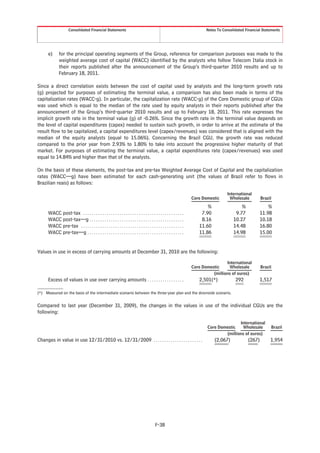
     the latter’s consent.

Conversely, with regard to the positioning of the telecommunications operators in the converging markets, it
should be noted that there are, at varying levels of development, initiatives to enter infrastructure services in the
IT market (Cloud Computing, Machine to Machine, Mobile payment, Security etc.), a role as premium content
distributor through IPTV and as facilitator of the consumption of online content on the living room screen through
OTTV and a significant presence in online advertising and in the development of smartphone web 2.0 applications.

                                                           34
Item 4. Information On The Telecom Italia Group                                              Business Units


Competition in Fixed-Line Telecommunications
The fixed-line telecommunications market is characterized by strong competition between operators centered on
their capacity to innovate service offerings through the introduction of voice/broadband packages (double play)
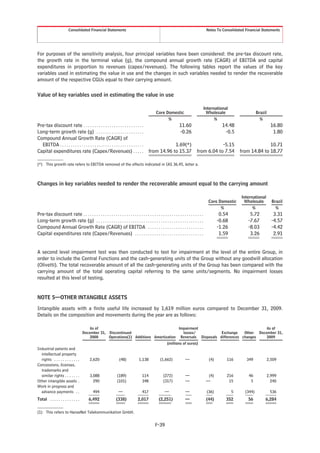
and voice/broadband/IPTV packages (triple play).

This evolution is possible as a result of the competitors’ shift from an essentially reseller approach (carrier
selection/carrier pre-selection for voice services and Wholesale for ADSL) to an approach based on control of the
infrastructures (primarily (LLU) Local Loop Unbundling). There is also an increasingly evident trend of fixed/
mobile convergence: many fixed operators are today also Mobile Virtual Network Operators (MVNOs) and offer
integrated fixed-mobile services.

In 2010, there was a continuation of the migration of customers from fixed telephony to mobile telephony
services and to alternative communications solutions (messaging, e-mail, chat etc.). For some years, for both
private consumers and small and medium businesses there has been in progress a substitution of the mature
traditional voice services with content and value-added services based on the Internet Protocol (IP), the spread of
which is favored both by the use of the internet and by changes in customer preferences and by the penetration of
BroadBand, of PCs and of other connected devices, as well as by the quality of the service.

The competitive scenario in the Italian market for fixed telecommunications is dominated by Telecom Italia and a
number of operators with differentiated business models and with a focus on differing segments of the market:
Š    Wind-Infostrada, an integrated fixed-mobile operator is focused, with its “all inclusive” offering (voice and
     data), on cost conscious retail mass market customers with less concentration on the “top” segment and on
     an ICT offering;
Š    Fastweb, an operator which positions itself as technological leader and which offers a high value-added “all-
     inclusive” broadband service is directed mainly at retail and corporate customers. Fastweb remains focused
     on the large urban centers and on high value customers, although in 2010 it has shown a gradual
     abandonment of premium pricing with recourse to very aggressive promotional formulae. The company is
     also present in the mobile market as a mobile virtual operator (MVO) with H3G;
Š    Tiscali, an operator focused on fixed-line with a broadband offering “semplice e conveniente”, is directed
     primarily at the consumer and SOHO segments and also has a mobile telephony offering “Tiscali Mobile” as
     an MVNO with TIM;
Š    Vodafone, positioned as a global player mainly concentrating on mobile with a fixed offering focused on the
     2play offering and on fixed-mobile cross-selling is focused on the 2Play package (Vodafone Station) and on
     fixed-mobile cross-selling activities; less focused on “top” and ICT offerings;
Š    TeleTu (formerly Tele2, purchased by Vodafone) is focused on low-spending customers with aggressive
     pricing, entry-level voice and broadband plans and extensive promotional use of not charging a “fixed fee”;
Š    BT Italia, focused on business customers and ICT packages, also offers mobile telephony services as an
     MVNO with Vodafone. In 2010, it has shown a progressive weakening with a slow-down in investment and a
     reduced level of innovation.

At the end of 2010, fixed accesses in Italy numbered approximately 22.5 million, substantially in line with 2009.
The growing competition in the access market has led to a gradual reduction in Telecom Italia’s market share of
retail voice traffic volumes.

With respect to the BroadBand market, at December 31, 2010, fixed-line BroadBand customers in Italy reached a
total of approximately 13.1 million with an approximately 58.3% penetration of fixed accesses.

In 2010, growth in fixed-line BroadBand suffered a slight decline compared to the growth of the preceding years
due to a generalized preference of operators to increase the penetration of flat-rate plans (dual/triple play) with
greater value-added. Broadband penetration is driven by the increasing demand for speed and for activation of
new “over IP” services (Voice over IP, Content, Social Networking Services, Online Gaming, IP Centrex, etc.).


                                                           35
Item 4. Information On The Telecom Italia Group                                             Business Units


There was further decline in revenues from the Data transmission services segment which is the main component
of the Top customers market. This market is characterized by the re-designing and upgrading of internet accesses
with high or very high data transmission capacities and by medium and large sized private data networks and has
felt the effects of competition, experiencing a fall in average prices although market shares of operators are
substantially unchanged.


Competition in Mobile Telecommunications
The mobile market, while increasingly saturated and mature in its traditional component of voice services
nevertheless continues to experience growth in the number of mobile lines, driven by the growth in multiSIM/
multidevice customers and in “non-human” (machine to machine) lines (at December 31, 2010, mobile lines in
Italy numbered around 94 million, a growth of 4% over 2009 and with a penetration rate of approximately 155%
of the population).

Although there has been a progressive contraction in revenues from the traditional service, data and value-added
services have recorded significant growth.

This is the situation of mobile broadband which in the past few years has been, and increasingly will be in the
future, the main strategic and commercial opportunity for the mobile telecommunications industry, which may be
able, to offset the erosion in some of the traditional components of revenues such as voice and messaging.

In 2010, in Italy, there was significant growth in mobile BroadBand customers, both large and small screen and at
the end of the year they numbered in total more than 15 million, with a penetration rate of about 16% of mobile
lines.

Alongside innovative services which are established and growing, such as mobile BroadBand, there are various
other market areas with significant medium term growth potential, such as: mobile advertising, mobile content
(e.g. social networking), mobile payment and location based services.

The competitive environment in the Italian mobile telecommunications market is led by Telecom Italia (through
its brand Telecom Italia Mobile—TIM) and by the following operators who operate their own networks Each of
these other operators are focused on different segments of the market or have different strategies:
Š   Vodafone, joint market-leader with TIM, positioned as a global player with a strategy as an innovative
    operator, very attentive to the customer, with a strong brand and customer loyalty based on the
    “community” concept;
Š   Wind, focused on the cost conscious segment with a portfolio of simple plans and on customer loyalty based
    on the “community” concept;
Š   H3G, a mobile-only operator focused on high value customers, on advanced VAS services and terminals with
    competitive pricing (for example, microbrowsing, mobile broadband and mobile content), present in the
    microbusiness segment (professionals and SOHO, small office-home office, who use the basic TLC and
    connectivity solutions) and substantially absent from the TOP segment;
Š   Alongside these operators there are a number of virtual operators (for example Poste Mobile) which to date
    constitute only a small part of the market.

Telecom Italia’s market share of total mobile lines was around 33% at December 31, 2010, down compared to
December 31, 2009 (34.2%).


                                                          36
Item 4. Information On The Telecom Italia Group                                                                                     Business Units


4.2.2       BRAZIL
The Telecom Italia Group operates in the mobile and fixed telecommunications sector in Brazil through the
Tim Brasil group which offers mobile services using UMTS, GSM and TDMA technologies. Moreover, following the
acquisition of Intelig Telecomunicações at the end of 2009, the Tim Brasil group is now able to offer fiber-optic
data transmission services using full IP technology such as DWDM and MPLS.


                                                                              BRAZIL


                                               • Tim Brasil Serviços e Patecipações S.A.
                                                     • Tim Participações S.A.
                                                         • Tim Celular S.A.
                                                         • Intelig Telecomunicações Ltda


The Tim Brasil group’s services cover an area containing over 172.9 million of Brazil’s 193.3 million inhabitants.
Mobile operating subsidiaries have approximately 51.0 million customers located in each of the Brazilian states
and in the Federal District. On December 31, 2010, its combined penetration reached approximately 104.7% of the
Brazilian population and our combined market share totaled approximately 25.1%.

Since the Tim Brasil group began operating in the Brazilian market, its intention has been to provide its customers
with state-of-the-art technology and services. This goal has been achieved through the offer of edge technology,
that has allowed convergence between voice services—either mobile or fixed—, internet access and data
transfer. Management believes this convergence has been made feasible with developments under 3G.

The table below sets forth, for the periods indicated, the number of mobile lines of the Brazil Business Unit:

                                                                                                                                      As of and for the years
                                                                                                                                       ended December 31,
                                                                                                                                     2010      2009       2008

Number of lines at year-end (thousands) . . . . . . . . . . . . . . . . . . . . . . . . . . . . . . . . . . . . . . . . . . . . .   51,015   41,102    36,402


❖      MARKETING
In the fourth quarter, Tim Brasil intensified promotional activity on voice plans and further expanded data
services.

For voice, in the Consumer segment, TIM continued with the existing “Infinity” and “Liberty” plans. Voice
customer gross acquisitions in the fourth quarter alone amounted to 9.1 million, an increase of 54% over the
corresponding period of 2009.

In the Business segment, TIM continues offering the three plans launched in 2010. In the Company segment, TIM
has intensified marketing activity, also with plans for fixed-line/data services from Intelig.

In data services, TIM has stepped up the plans of the “TIM Web”, “Liberty Web” and “Infinity Web” promotions
in order to stimulate market penetration. With regard to equipment, TIM has continued its strategy of reducing
the subsidy on handsets and promoting the use of the service.


                                                                                   37
Item 4. Information On The Telecom Italia Group                                                 Business Units


The range of handsets is subject to continuous renewal due to the new iPhone 4 and the Nokia N8 and the
increasing presence of WebPhones in this portfolio in accordance with our strategy to expand microbrowsing. TIM
has also developed an applications virtual store for certain handsets, in order to encourage the use of internet
from a cell phone.

In fixed line services, TIM is continuing the existing “TIM Fixo Mais” offering. With regard to Intelig, the “Se Liga
23” promotion has continued. For the SME segment, the “Sem Fronteiras 23” rate plan has continued; this plan
offers free unlimited “on-net” calls.


❖    DISTRIBUTION
Tim Brasil’s services are marketed through the largest distribution network in Brazil, with over 9,000 points of
sale, among premium stores and dealers (exclusive or multi-brand), in addition to relying on the distribution
capacity of a number of major retail chains. Tim Brasil’s prepaid service customers rely, in addition to traditional
points of sale, on alternative recharge channels, such as supermarkets and newsstands, totaling about 398,000
points spread all over Brazil. Sales of Tim Brasil’s products and services are offered by Tim Brasil’s sales personnel,
as well as by authorized dealers. Most devices are sold on credit card and in 12 installments.


❖    MAIN CHANGES IN THE REGULATORY FRAMEWORK
For the main regulatory developments which occurred in 2010 that may have an economic impact on the Brazil
Business Unit, please see “Item 4. Information On The Telecom Italia Group—4.3 Regulation”.


❖    COMPETITION
In December 2010, TIM was awarded 8 lots of GSM frequencies for an amount of 65.5 million reais with a
premium averaging 32% of the auction base price. The contract is scheduled to be signed in the first months of
2011. These frequencies will improve the coverage and the service quality of the TIM service. The total of 165
GSM and 3G lots auctioned were sold for a total value of 2.7 billion reais with an average premium on the auction
base price of 31%.


4.2.3   ARGENTINA
On October 13, 2010 Telecom Italia acquired control of Sofora group with its acquisition of an 8% stake in Sofora,
the Telecom Argentina controlling holding company. The economic interest in Telecom Argentina increased to
16.2% (which as of the date of this Annual Report is 21.1%). The Sofora data represent the new Business Unit
“Argentina” of the Telecom Italia Group. Since October 13, 2010 the results of Telecom Argentina became fully
consolidated with the Telecom Italia Group.


                                                           38
Item 4. Information On The Telecom Italia Group                                            Business Units


The Telecom Italia Group operates in the fixed and mobile telecommunications sector in Argentina mainly
through Telecom Argentina and Telecom Personal, respectively, as well as mobile telecommunications operations
in Paraguay through Núcleo. In particular, Telecom Argentina is one of the largest private-sector companies in
Argentina. Telecom Argentina has a non-expiring license to provide fixed-line telecommunications services in
Argentina, Telecom Personal has a non-expiring licence to provide mobile services in Argentina and Núcleo has a
renewable license to provide mobile services in Paraguay. Telecom Argentina also provides other telephone-
related services such as international long-distance service, data transmission, IT solutions outsourcing and
Internet services.


                                                            ARGENTINA


                                    • Sofora Telecomunicaciones S.A. (Sofora)
                                        • Nortel Inversora S.A.
                                           • Telecom Argentina S.A.
                                               • Micro Sistemas S.A. (*)
                                               • Telecom USA
                                               • Telecom Personal S.A.
                                                   • Núcleo S.A. (Paraguay)
                                                   • Springville S.A. (Uruguay) (*)


(*) Non-operating companies.


Telecom Argentina has a non-expiring license to provide fixed-line telecommunications services in the Northern
Region of Argentina. Telecom Argentina also provides other telephone-related services such as international long-
distance service, data transmission, IT solutions outsourcing and Internet services, and through its controlled
companies, Telecom Personal and Núcleo also provides mobile telecommunications services in Argentina and
Paraguay, respectively.

Telecom Argentina pursues its business strategy focused on increasing its profitability and maximizing value
generation for its customers, shareholders, employees and the broader community it serves. In order to promote
the achievement of its goals the Argentine Business Unit continually adapts its business strategy through
investments in product innovation and development of additional complementary services aimed at improving its
customers’ user experience by adding content and interactivity to communication.

Personal customer base increased by 1.9 million in 2010, reaching a total of 16.3 million clients, 30% of whom use
postpaid contracts. At the same time, high-value customer acquisitions and clear leadership in the Smartphone
segment, resulted in ARPU improving approximately 7% over the prior year. A large part of this growth is due to
Value-Added Services which, on the whole, accounts for approximately 40% of service revenues for mobile
telephony services.

In Paraguay, Núcleo customer base grew by about 4% over the prior year and at the end of 2010 had 1.9 million
customers, of which 15% were postpaid. Núcleo provides the 3G Internet service being considered one of the
fasted Mobile Internet product in the market (in terms of speed), giving a boost to the number of the customer
base.


                                                               39
Item 4. Information On The Telecom Italia Group                                                                                       Business Units


The table below sets forth, for the periods indicated, the number of lines /customers of the Argentina Business
Unit:
                                                                                                                                   As of and for the years ended
                                                                                                                                           December 31,
                                                                                                                                   2010        2009         2008

Number of fixed lines (thousands) . . . . . . . . . . . . . . . . . . . . . . . . . . . . . . . . . . . . . . . . . . . . . . .    4,107      4,060       4,010
Number of mobile customers (thousands) (*) . . . . . . . . . . . . . . . . . . . . . . . . . . . . . . . . . . . .                18,211     16,281      14,390
Broadband accesses (thousands) . . . . . . . . . . . . . . . . . . . . . . . . . . . . . . . . . . . . . . . . . . . . . . . .     1,380      1,214       1,032

(*) Includes 10, 12 and 15 thousands Internet customers provided with Wimax technology as of December 31, 2010, 2009 and 2008,
    respectively.


❖      MARKETING
In the fixed line residential segment, Telecom Argentina increased its offering of packages comprising fixed
charge, minutes of traffic and value-added services with the aim of stimulating both the demand for new accesses
and the growth in ARBU (Average Rate Billed per User). Additionally, existing customers have been offered new
Wi-Fi products and the supply of a second line using IP technology. For the corporate segment, services have
been launched featuring an IP communications platform which gives customers new functionalities, ease of use
and reduced costs. Offerings in this segment have centered on convergent ICT solutions.

With regard to broadband, in 2010 Telecom Argentina expanded its offering with the launch of services which
combine an ADSL service with mobile internet.

The strategy for the mobile service has been characterized by the launch of new plans and packages aimed at
further increasing the value added services content, supported by the continuing growth in smartphone
penetration.

Further, Personal, as the first in Argentina, has experimented with fourth generation mobile (4G) services on a
Long Term Evolution platform, achieving connection speeds of up to 50 Mbps.

Personal is taking actions to address adequately the important challenges associated with the introduction of
Number Portability in Argentina at the end of 2011.

Núcleo, in Paraguay, has adopted a new pricing strategy aimed at improving customers’ perceptions and has
strengthened its offering of 3G mobile internet services.

❖      DISTRIBUTION
In the fixed telephony, during 2010 the growth of Internet access was accompanied by price actions and
discounted promotional prices. The Arnet brand leadership was based on effective communication with a
differentiated offering for each customer segment and competitive prices. The strategy in 2010 focused on
developing a functional web site whose main target is to become a channel for the exploration of our products
and services and for the improvement of the relationship with our customers. The main web site contents are
focused on the description of our products and services, a digital experience with both the Arnet (Internet
products and services) and Telecom (products and related voice services) brands, and an enriched self-
management by the customer on the web site.

As regards mobile telephony, during 2010, Telecom Personal’s points of sale consolidated their position in selling
value-added products and up selling. Also, during 2010 the authorized dealers showed a steady increase in
customer acquisitions. In addition, this channel has consolidated its position in customer handset replacement,
which resulted in higher satisfaction and greater customer retention.

This performance during 2010 is a result of a relocation of Telecom Personal’s point of sale in strategic locations
with higher flow of customers and a reorganization of the structure by geographical allocation, which led to
improvements in points of sale productivity and resulted in a substantial improvement in customer satisfaction
ratios.

                                                                                       40
Item 4. Information On The Telecom Italia Group                                             Business Units


❖    MAIN CHANGES IN THE REGULATORY FRAMEWORK
For the main regulatory developments on the Argentina Business Unit which occurred in 2010, please see “Item 4.
Information On The Telecom Italia Group—4.3 Regulation”.


❖    COMPETITION
The telecommunications market in Argentina and Paraguay continues to feature strong demand for new services
and higher access speeds, in an environment which is highly competitive in the fixed and mobile businesses.

Competition is mainly focused on Internet, data and mobile services, including residential, corporate and
government accounts while fixed telephony is characterized by market maturity. In particular, in the Argentina
mobile business, Personal is one of the three operators which offer services at the national level, competing with
Claro (America Móvil group) and Movistar (Telefónica group). In Paraguay, Núcleo operates in a market which
continues to be characterized by a high level of competitiveness based on aggressive pricing and promotion and
also on the launch of product and service innovation.

In the broadband business, the Argentine Business Unit, under the Arnet brand, competes both with the ADSL
competitor Speedy (Telefónica group) and with Fibertel (Clarín group) which provides broadband access services
by cable-modem.

During 2010 the Argentine Business Unit consolidated its market share position in the fixed services with a slight
increase in the market share in mobile services.


4.2.4   MEDIA
The Telecom Italia Media group operates in the Telecom Italia Media, MTV group and Network Operator business
segments. In particular:
Š    Telecom Italia Media: includes activities relating to the television broadcasters La7 and La7D (the channel
     launched at the end of March 2010) and those of the Digital Content for the Telecom Italia Group for the
     creation and production of content relating to the innovative platforms of Telecom Italia and to the web;
Š    MTV group: includes activities carried out by MTV Italia and its subsidiary MTV Pubblicità relating to the
     television broadcasters MTV and MTV+ (the channel launched in May 2010), the 360° Playmaker production
     unit, the production of multimedia musical platforms and satellite channels, in addition to MTV Mobile and
     Digital (Web);
Š    Network Operator (TIMB): includes activities conducted by Telecom Italia Media Broadcasting for the
     operation of the analog and digital broadcasting networks of La7 and MTV and the Digital Multiplex channels
     operated by the Group, in addition to accessory services and radio and television broadcasting platforms
     offered to Group companies and third parties.

In May 2009 Telecom Italia Media S.p.A. sold a 60% stake in Telecom Media News, which controls the APCom
press agency, one of the major operators in primary national news, to Sviluppo Programmi Editoriali S.p.A. (E.P.S.
group).


                                                           41
Item 4. Information On The Telecom Italia Group                                                                   Business Units


As of December 31, 2010, the Business Unit was organized as follows:


                                                                MEDIA


    TELECOM ITALIA MEDIA S.p.A.                                    O
                                                               MTV GROUP                                  NETWORK OPERATOR


    • Telecom Italia Media S.p.A.                   • MTV Italia S.r.l.                            • Telecom Italia Media
                                                      • MTV Pubblicità S.r.l.                        Broadcasting S.r.l.


The table below sets forth, for the periods indicated, certain statistical data of the Media Business Unit:
                                                                                                           As of and for the years ended
                                                                                                                   December 31,
                                                                                                           2010        2009         2008

MEDIA
La 7 audience share Free to Air (average during the period, in %) . . . . . . . . . . . . . . . . . . .     3.1        3.0           3.1
La 7 audience share Free to Air (average of the last month of the period, in %) . . . . . .                 3.3        2.9           3.0


❖     MAIN CHANGES IN THE REGULATORY FRAMEWORK
For the main regulatory events which occurred in 2010 that may have an economic impact on Media Business
Unit, please see “Item 4. Information On The Telecom Italia Group—4.3 Regulation”.


4.2.5    OLIVETTI
The Olivetti group mainly operates in the office products and services for Information Technology sectors. As a
result of its broad range of cutting-edge hardware and software, it offers solutions able to automate processes
and business activities for small and medium enterprises, large corporations and vertical markets. The offering
comprises digital printing systems, notebooks and personal computers, ink-jet office products, specialized
applications for the banking field and commerce, information systems for managing forecast games, electronic
voting and e-government. It also operates with a dedicated structure in the field of documental services (digital
management of company documents), caring services (specialist help-desk) and technical assistance. Olivetti also
manufactures products using silicon technology (ink-jet print heads and Micro Electro-Mechanical Systems
(MEMS) and industrial applications. During 2010, Olivetti continued the process begun in 2009 of expanding and
diversifying its products and services by concentrating on both the development of software solutions and
applications services for businesses and public administrations, and also specialized devices.

The market of the Business Unit is focused mainly in Europe, Asia and South America.


                                                                    42
Item 4. Information On The Telecom Italia Group                                            Business Units


As of December 31, 2010, the Olivetti Business Unit was organized as follows (the main companies are indicated):


                                                           OLIVETTI


                                          •   Olivetti S.p.A.
                                              • Advalso S.p.A.
                                              • Olivetti I-Jet S.p.A.
                                              • European affiliates


4.2.6    INTERNATIONAL INVESTMENTS
❖   BBNed group
The BBNed group consists of the parent, BBNed N.V., and its two subsidiaries, BBeyond B.V. and InterNLnet B.V.

At September 30, 2010, following the decision taken for its disposal, the BBNed group was considered as a
disposal group under IFRS 5 (Non-current assets held for Sale and Discontinued Operations). A sale transaction
was completed on October 5, 2010 after obtaining authorization from the competent Dutch authorities.


❖   OTHER INVESTMENTS ACCOUNTED FOR USING THE EQUITY METHOD
ETECSA
As of December 31, 2010, through Telecom Italia International we held a 27% interest in ETECSA, the monopoly
provider of fixed-line and mobile telecommunications services, Internet and data transmission in Cuba.

Old Telecom Italia obtained an initial stake of 12.25% in ETECSA in 1995, when, prior to its privatization by the
Italian government, Old Telecom Italia acquired, for approximately U.S.$291 million, a 25% stake in a Mexican
telecommunications company which owned 49% of ETECSA. In February 1997, Old Telecom Italia converted its
indirect stake in ETECSA into a direct investment and increased its interest to 29.29%. The acquisition price for
such further 17.04% stake in ETECSA was U.S.$291.6 million. In connection with the merger of the local mobile
operators into ETECSA to form an integrated provider of telecommunications services we participated in a series
of capital increases proportionate to our share ownership.

These capital increases occurred during 2003 and through 2004; during this period we invested an additional
U.S.$41.3 million in ETECSA through capitalization of dividends paid by ETECSA and, following these capital
increases and the mergers, ownership increased to 27%. The other shareholders in the company include the
Cuban government which controls 51% of the company and four other Cuban shareholders.

In addition to our shareholding in ETECSA, Telecom Italia International is a party to a shareholders’ agreement
pursuant to which it has the right to designate certain senior executive officers and a majority of the board of
directors of ETECSA on alternate years.

In addition to these governance arrangements, we entered into agreements to provide certain technical
assistance to ETECSA with respect to its fixed line and wireless services.

In return for these services we received annual fees of 304,592 euros (for fixed line technical assistance) and
969,256 euros (for mobile technical assistance) under each agreement respectively and certain other fees for
specific services provided equal to 1,527,823 euros. The level of the fees earned over the last two years is set
forth in “Note—Related Party Transactions” of the Notes to our 2010 Consolidated Financial Statements included

                                                              43
Item 4. Information On The Telecom Italia Group                                              Business Units


elsewhere herein. The technical agreement with respect to fixed line services, expired at the end of 2009, has
been renewed for the period 2010-2011 and the technical agreement with respect to wireless services will expire
at the end of 2011.

We do not believe that our arrangements with, and investments in, Cuba are material to the results of operations
or financial condition of the Telecom Italia Group, taken as a whole.

At December 31, 2010, ETECSA, after the decision to proceed with its sale, which actually took place on
January 31, 2011, was considered an investment held for sale. Consequently, at the end of the year, the entire
amount of the investment, equal to 389 million euros, was reclassified to “Discontinued operations/Non-current
assets held for sale—of a financial nature” in the statement of financial position.

For further details please see “Note—Events subsequent to December 31, 2010” of the Notes to our 2010
Consolidated Financial Statements included elsewhere herein.


4.2.6   COMPETITION
We face domestic competition in all of our businesses. Competition continues to have an adverse effect on our
revenues as it resulted in lower tariffs for many of our products and services as well as the introduction of flat-
rate pricing plans which have been used to enhance retention efforts but at the same time reducing revenues
from such customers.

For details please see “Item 4. Information on the Telecom Italia Group—4.1 Business—4.1.7 Updated Strategy”,
“Item 4. Information on the Telecom Italia Group—4.2.1 Domestic”, “Item 4. Information on the Telecom Italia
Group—4.2.2 Brazil” and “Item 4. Information on the Telecom Italia Group—4.2.3 Argentina”.


                                                           44
Item 4. Information On The Telecom Italia Group                                                    Regulation


4.3   REGULATION
The EU regulatory framework
Business undertaken by Telecom Italia in the European Union is subject to the EU framework on
telecommunications regulation which includes directives, recommendations and opinions. As such, as a member
of the EU, Italy is required to implement directives issued by the EU, which directives may take effect
automatically on a member state. Regulations adopted at the EU level also have general application and are
binding and directly applicable on EU member states. Recommendations, on the other hand, are not legally
binding although politically important.

The European Commission began opening the telecommunications market to competition with the adoption of
directives in the late 1980s and early 1990s. These liberalization measures culminated in Italy, as well as in all the
main member States of the EU, with the opening of competition in 1998 of public voice telephony and public
network infrastructure.

The 1998 framework was reviewed when growing convergence between telecoms, broadcasting and information
technology meant the rules had to be adapted. A new EU Regulatory Framework was adopted in 2002, covering all
forms of fixed and wireless telecoms, data transmission and broadcasting and made up of a package of legal
instruments, the most relevant of which are five Directives concerning the following topics: the common
regulatory framework; access and interconnection; the authorization regime; the universal service and users’
rights; privacy and data protection.

A Recommendation adopted in February 2003, on relevant product and service markets susceptible to ex ante
regulation, complemented the set of legal instruments relevant for the scope of the electronic communications
market regulation. In December 2007, the European Commission amended this first Recommendation on relevant
markets, reducing the previous 18 markets susceptible to ex-ante regulation to seven. The seven markets are: at
Retail level: access at a fixed location (market 1); at Wholesale level: call origination at a fixed location (market
2); call termination at a fixed location (market 3): wholesale (physical) network infrastructure access (including
shared or fully unbundled access) at a fixed location (market 4); wholesale BroadBand access (market 5);
wholesale terminating segments of leased lines (market 6); and voice call termination on mobile networks
(market 7).

The EU regulatory framework requires that market analyses be carried out by the National Regulatory Authorities
(NRAs, in Italy AGCom) before regulation is imposed and that appropriate obligations are imposed on individual
operators determined as having Significant Market Power (SMP) according to specific EU guidelines. A company
is deemed to have SMP if, either individually or jointly with others, it enjoys a position equivalent to dominance,
that is to say a position of economic strength affording it the power to behave to an appreciable extent
independently of competitors, customers and ultimately consumers. One of the criteria adopted to identify SMP,
according to the EU Guidelines, is the operator’s market share exceeding 50%.

The market analyses carried out by NRAs are subject to the scrutiny of the EU Commission which, to a certain
extent, can challenge the NRAs findings, having a “veto power” about market definition and identification of SMP
operators but not about the choice of remedies.

The EU legal framework was further updated in November 2007 when the Commission adopted review proposals
of the five directives defining the regulatory principles for the sector (i.e. the Framework, Access, Authorisation,
Universal Service and E-Privacy directives), with the aim to define the new European regulatory framework.
New EU telecoms rules officially became EU law following their publication in the Official Journal of the European
Union of December 18, 2009. The Reform Package was composed of the “Better Regulation Directive” (Directive
2009/140/EC, amending the “Framework”, “Access” and “Authorization” directives) and the “Citizens’ Rights
Directive” (Directive 2009/136/EC amending the “Universal Service” and “E-Privacy” directives and the
Regulation 2006/2004 on Consumer Protection Cooperation) that is to be transposed into national laws of the 27
EU Member States by May 25, 2011 and by the Regulation—which was directly applicable—establishing the new
European Telecoms Authority called “Body of European Regulators for Electronic Communications (BEREC)”.


                                                           45
Item 4. Information On The Telecom Italia Group                                                  Regulation


Telecommunication Regulatory Framework in Italy
The legal basis for the electronic communications sector in Italy is as follows:
Š    Law 36 of February 22, 2001, regarding protection from exposure to electric, magnetic and electromagnetic
     fields and Prime Ministerial Decree of July 8, 2003, which established “Exposure limits, attention values and
     quality goals to protect the population against electric, magnetic and electromagnetic fields generated at
     frequencies between 100 KHz and 300 GHz”;
Š    the “Electronic Communications Code” (“ECC”), Legislative Decree 259 of August 1, 2003, which
     incorporated into national law the EU directives of the “99 Review” with regard to electronic
     communications networks and services (the EU directives on “Access”, “Authorization”, “Framework” and
     “Universal Service”);
Š    “Data Protection Code” (Legislative Decree No. 196/2003), last amended by Law 166 of November 20, 2009;
Š    the “Consolidation Act on Radio-Television” (Legislative Decree 177 of July 31, 2005) which contains the
     principles for convergence between radio-television and other sectors of interpersonal communications;
Š    Legislative Decree 206 of September 6, 2005 (“Consumer Code”);
Š    Legislative Decree 262 of October 3, 2006, which contained “Urgent measures with regard to tax and
     financial matters” and which, with reference to the ECC, partially altered the law on sanctions by introducing
     further examples of administrative offenses, a generalized increase in the fines for each sanction and the
     elimination of the institution of the partial cash settlements of fines;
Š    Decree Law 7 of January 31, 2007, (converted into law, with modifications, by Article 1 of Law 40, dated
     April 2, 2007) containing urgent measures for the protection of consumers, promotion of competition,
     development of economic activities which, for the electronic communications sector, abolished top-up
     charges and prohibited the expiry of phone traffic on prepaid phone cards;
Š    Legislative Decree 109 of May 30, 2008, for the incorporation into national law of the EU Directive
     2006/24/EC on the retention of data generated or processed in connection with the provision of publicly
     available electronic communications services or of public communications networks and amending Directive
     2002/58/EC; and
Š    Law 69 of June 18, 2009, containing in Article 1 “BroadBand” measures for the administrative simplification
     of the procedures for the installation and development of optical fiber networks.

Furthermore, the ECC confirmed the responsibilities attributed under previous legislation to the Ministry of
Communications and AGCom:
Š    the Ministry is responsible for State functions and services in respect of postal services, telecommunications,
     multimedia networks, informatics, telematics, radio and television broadcasts and innovative technologies
     applied to the communications sector. The functions of the Ministry of Communications and its resources
     were transferred to the Ministry of Economic Development in May 2008;
Š    AGCom is an independent regulatory authority and guarantor. It must report on its operations to the Italian
     Parliament, which established its powers, defined its bylaws and elected its members. AGCom has the dual
     responsibility of ensuring that there is fair competition among the operators on the market and protecting
     consumers.

4.3.1   TELECOMMUNICATION REGULATION IN ITALY
In July 2008, Telecom Italia proposed to AGCom certain undertakings relating to its access network
(“Undertakings”) that would integrate and strengthen the existing obligations of non-discrimination between
Telecom Italia’s own retail operations and other operators in the provision of wholesale access network services
imposed on Telecom Italia by AGCom since 2002.

AGCom approved the Telecom Italia Undertakings which are divided into fourteen main groups and pursue four
main goals:
Š    to offer additional guarantees of equal treatment between Telecom Italia’s commercial functions and other
     electronic communications operators (“Operators”) that purchase wholesale access services from Telecom
     Italia;

                                                           46
Item 4. Information On The Telecom Italia Group                                                  Regulation


Š    to provide benefits to Operators and final users, through the qualitative development and improvement of
     the fixed access network and of related services;
Š    to make the evolution of Telecom Italia’s fixed access network more transparent for the Operators; and
Š    to ensure the maintenance of competitive conditions in the migration towards new generation networks.

Following the AGCom approval of the Undertakings, a number of sanction proceedings imposed on Telecom Italia
were suspended and are expected to be closed when the actual fulfillment of the Undertakings is assessed.

At the beginning of 2008 Telecom Italia created the Open Access department, a separate business unit focusing
its activities on the Undertakings’ implementation. In order to ensure equal treatment for its own retail operations
and those of Operators (“internal-external equal treatment”) Telecom Italia took actions focused on three main
areas:
Š    technical-organizational: solutions for the improvement of internal processes for delivery and assurance that
     SMP services have been adopted;
Š    cultural-behavioral: a Code of Conduct has been adopted and intensive training activities have been carried
     out in order to spread the principles of internal-external equal treatment; and
Š    economic-regulatory: the drafting of service contracts and transfer charge to implement equality of
     economic treatment.

The Undertakings’ implementation, their complexity and their impact on the stakeholders’ system, has required
the creation of a governance system. In particular, the following bodies have been created: an independent body
(the Supervisory Board) and the Undertakings’ Monitoring Group for the monitoring of the work in progress
(Office of Telecommunications Adjudicator Italia—“OTA Italia”), whose mission is to prevent and resolve
disputes between Operators and the Next Generation Network Committee submitting proposed solutions on
technical, organizational and economic issues for the transition to the Next Generation Network (“NGN”).

Two years after the formalization of the Undertakings, the results reached are positive, both in terms of formal
and substantial fulfilment. As planned, Telecom Italia had fully implemented, as of March 31, 2010, the technical
Undertakings concerning the new delivery process for SMP services, additional procedures for the management of
co-location services, new procedures for the management of wholesale users and a performance monitoring
system for SMP services.

In particular:
Š    the Operational Separation Model of the Access Network adopted by Telecom Italia, notified to the European
     Commission, is considered in Europe an advanced regulatory model and an alternative to the Access Network
     Functional Separation adopted by British Telecom (Open Reach);
Š    at the end of the year, 35 Operators had joined in the New Delivery Process (“NDP”) for Bitstream, Local
     Loop Unbundling (“LLU”), Wholesale Line Rental (“WLR”) and Colocation Services. Other Operators will join
     the NDP during 2011, according to a schedule agreed with Telecom Italia;
Š    AGCom is leading a public consultation on the guidelines to be applied in implementing the Group of
     Undertakings (“GoU”) n. 8, intended to verify the treatment of equality, both technical and economic. In
     particular, the GoU n. 8 imposes:
     Š    Internal Agreements, with the evidence of technical and economic conditions internally applied to the
          Commercial Functions of Telecom Italia for using SMP Access Services; AGCom guidelines state that,
          generally, Commercial Functions of Telecom Italia must use SMP Access Services under the same
          conditions applied to other Operators and published on the Reference Offers; and
     Š    The Accounting Separation integration with the introduction of 1) the “transfer prices mechanism” for
          the SMP Access Services used by Commercial Functions of Telecom Italia 2) separated accounts for the
          SMP Access Services (provided, according to the accounting model of equivalence defined by AGCom,
          by the entity Equivalent Open Access).
     Telecom Italia believes that the GoU n. 8 will be fully implemented during 2011, if AGCom publishes within a
     reasonable time its final Decision;

                                                           47
Item 4. Information On The Telecom Italia Group                                                 Regulation


Š    the promotion of an “Equivalence Culture”, introduced through personnel formation programs, produced
     positive results according to the surveys on OLOs Customer Satisfaction;
Š    more transparency has been ensured to the OLOs by adding more information on “Technical Plans for the
     Access Network Quality” and on “Technical Plans for the NGA Deployment”, and by implementing other
     measures to ensure greater efficiency (and effectiveness) to the OLOs in the planning and development of
     their network and their services;
Š    to reduce and to prevent the phenomenon of the “services not requested”, several actions have been put in
     place on the different market segments and on the different services.

Telecom Italia is waiting the AGCom Decision with the formal evaluation of the results produced by the
Undertakings. AGCom’s positive evaluation is necessary for the cancellation of the economic sanctions still
pending on Telecom Italia.


Market analyses
During 2006 and 2007, AGCom concluded the first round of analyses of electronic communications relevant
markets, as identified by the EC 2003 Recommendation, and designated Telecom Italia as SMP Operator in all
wholesale (fixed (physical) access and (virtual) broadband access, fixed and mobile call termination, fixed call
origination, transit services, terminating and trunk segments of leased lines) and retail markets (residential and
non-residential fixed access, voice traffic, leased lines). As result of these findings AGCom introduced regulatory
measures depending on the specific retail or wholesale market identified: access to network, carrier selection and
pre-selection, transparency and non discrimination, including publication of Reference Offer, information for end
users, advance notification to AGCom of new retail tariffs or change of existing ones, price control including cost
orientation, price/network cap and price tests, cost accounting and accounting separation.

Since December 2007, AGCom has been carrying out the second round of relevant markets analyses to determine
whether to maintain, amend or withdraw the obligations on Telecom Italia in force. In addition, markets not
included in the revised Recommendation (with remedies in place) have been re-assessed in order to justify either
the withdrawal or the keeping of regulation. AGCom has, therefore, reviewed all the 18 markets in its second
round of market analyses. In 2008, AGCom concluded the market analyses of the wholesale mobile markets (call
termination, access and call origination), with respect to international roaming the EU Regulation has been
applied and AGCom did not review this market. Market analyses proceedings, for the fixed markets, were
completed in 2010.

With Decision no. 670/10/CONS on December 17, 2010, AGCom started the third round of review of the mobile
termination market in order to define the relevant market, identify SMP Operators and eventually define
regulatory obligations on SMP Operators. In particular, AGCom will set the price control mechanism to be applied
on mobile termination charges (maybe reviewing the current multiyear price control mechanism that ends in
2012) on the basis of the outcome of the new “Bottom-Up Long-Run Incremental Cost” (“BU-LRIC”) model
(defined with AGCom’s Decision no. 60/11/CONS). The results of this cost model should lead to further
reductions in call termination prices. The third round of mobile termination market review is expected to end by
Autumn 2011.

The major developments in 2010 and in the first quarter of 2011 regarding markets in the electronic
communications sector are described below.


Š    Retail-fixed markets

As a result of the first round of fixed retail market analyses concluded in 2006, AGCom imposed on Telecom Italia
as SMP operator, regulatory obligations, including a price cap mechanism and price control.

In particular, the retail fixed regulated markets were as follows: access to the public telephone network provided
at a fixed location for residential and business customers (markets 1 and 2); local, national and fixed-mobile
services markets–retention component only–for residential and non-residential customers (markets 3 and 5,
removed from the revised 2007 Recommendation); international telephone services, for residential and

                                                           48
Item 4. Information On The Telecom Italia Group                                                  Regulation


non-residential customers, provided at a fixed location (markets 4 and 6, removed from the revised 2007
Recommendation); leased lines market (market 7, removed from the revised 2007 Recommendation).

At the end of 2009, AGCom concluded the second round analyses of the international calls market and of the
minimum set leased lines market and deregulated both such retail markets withdrawing all ex ante obligations for
Telecom Italia from 2010.

In 2010 AGCom concluded the second round analyses of the national retail fixed voice services. AGCom decided
on the withdrawal of all the regulatory obligations after six months from the publication of its final decision. In
the transitional six months period (until January 12, 2011), AGCom maintained the obligation of prior notification
of new tariffs. However Telecom Italia remains subject to an ex-post evaluation of the retail offers. Since
January 12, 2011 Telecom Italia has been permitted to fix retail tariffs without prior notification or approval.

With reference to the price test methodology, with Decision 499/10/CONS of September 13, 2010, AGCom set
new rules for the assessment of Telecom Italia’s retail offers, including non standard offers (public tender and
personalized top business offers) and bundles (multiple-play offers). The new methodology is based on the
application of a replicability test developed on the basis of the following key principles: reference to the most
efficient technology and network architecture that could be used by OLOs to replicate Telecom Italia’s offers and,
hence, to a mix of wholesale inputs (LLU, WLR, bitstream etc.); possible use of avoidable or long run incremental
costs for the evaluation of network and downstream OLO’s costs and, for bundle offers, application of the price
test on the whole bundle taking into account the overall cost of provisioning without considering whether each
component of the bundle may be replicated by alternative operators.

During 2009, AGCom also concluded the second round analyses of the retail and wholesale access markets, where
it found lack of competition and designated Telecom Italia as SMP. In December 2009, AGCom issued Decision
731/09/CONS setting out the remedies to be imposed on Telecom Italia, including the Telecom Italia
Undertakings.

As to the retail access market, AGCom reduced regulatory constraints removing, from 2010, the price cap
mechanism used for controlling residential and business subscriber monthly fees, which are now subject only to a
price test (see above for details) to ensure replicability by an efficient OLO. At the same time, AGCom maintained
the obligation to notify prices and conditions 30 days in advance of the commercial launch (instead of the
previous 60 days), but a clause of “tacit consent” at the end of the notice period has been introduced. As for
bundling services, the previous prohibition has been withdrawn as a consequence of the increased demand for
Telecom Italia’s WLR offer.

AGCom retained Telecom Italia’s obligation to provide WLR service, only in the areas where disaggregated access
services are not offered, with a price calculated according to the network cap method, for the period from May 1,
2010 to December 31, 2012, based on a BU LRIC model, (see below the “Wholesale fixed markets” section for
details), instead of the previous retail-minus regime.

Š    Wholesale fixed markets
The first round of market analyses for fixed wholesale markets concluded in 2006. In particular, the markets were
as follows: Call origination (market 8); Call termination (market 9); Transit services (market 10, removed from the
revised 2007 Recommendation); Unbundled access (including shared access) to metallic loops and sub-loops for
the purpose of providing broadband and voice services (market 11); BroadBand access (market 12); Terminating
segments of leased lines (market 13); Trunk segments of leased lines (market 14 removed from the revised
Recommendation).

As a result of this market analysis, AGCom imposed on Telecom Italia, as SMP operator, regulatory measures
including price control in the form of a network cap (except for the wholesale broadband access market).

The network cap mechanism has been applied to calculate the prices of wholesale call origination, termination
and transit services and of unbundled network-access services (i.e. Local Loop Unbundling and Shared Access).
This mechanism has also applied to circuits, with the aim of ensuring that cost orientation is used to calculate the
prices of the termination and long-distance circuit segments.

                                                           49
Item 4. Information On The Telecom Italia Group                                                   Regulation


Following the conclusion of the second round of market analyses of the wholesale access market, in December
2009, AGCom confirmed the current regulatory system relative to the wholesale access obligations to the copper
infrastructure (unbundling and bitstream), whereas, with regard to the determination of prices, it reintroduced for
the period May 1, 2010 to December 31, 2012 a network cap mechanism, based on a BU-LRIC model. For the
period from January 1, 2010 to April 30, 2010, AGCom set prices of LLU and co-location services and wholesale
broadband services at the same level as 2009 values.

In light of adoption of the LRIC model, in November 2010, AGCom defined new wholesale rates for the period
May 2010- December 2012 for the following wholesale services: unbundling, bitstream and WLR. In particular, for
the LLU service, AGCom set the following monthly fees: 8.70 euro/month as of May 1, 2010; 9.02 euro/month as
of January 1, 2011; and 9.28 euro/month as of January 1, 2012. Those rates remain subject to final verification
by AGCom of their compliance with the improvement of the following indicators measuring the quality of the
network: refusal percentage of OLOs’ wholesale requests due to problems related to access network, and
fulfillment of TI quality plans and faults percentage with technician intervention on field. In particular, with
reference to 2011, AGCom stated that the network quality improvements based on the above indicators proposed
by Telecom Italia were compliant and as a consequence, price increases have been confirmed.

AGCom has also introduced certain obligations for the access to “NGAN” infrastructures and, in particular,
introduced the access obligation to ducts and dark fiber at “fair and reasonable” prices under AGCom supervision
and the bitstream access on “Fiber To The x” (“FTTx”), announcing the launch of a dedicated proceeding on
NGAN regulation. On September 20, 2010, the EC adopted a Recommendation on NGAN regulation. A new
regulatory model was proposed where NRAs are asked to examine differences in conditions of competition in
different geographical areas in order to determine whether the definition of sub-national geographic markets or
the imposition of differentiated remedies are warranted. AGCom launched a public consultation in January 2011
on regulation of access to the next generation network. The public consultation shows, on one hand, the
introduction of a different regulatory framework for access to NGAN in comparison with the one highlighted on
the wholesale access market. In this new proceeding, AGCom proposes to introduce not only new measures but
also to expand/modify obligations already imposed on Telecom Italia. On the other hand, a positive aspect of this
new framework is the introduction of the principle of geographical segmentation of the remedies among
competitive and non-competitive areas. The end of the AGCom proceeding on NGAN services is expected by the
end of Spring 2011 although implementing measures will not be published before the second half of 2011.

With respect to migration between operators, AGCom has revised fixed-line customer migration rules,
substantially reducing times of the process where the donating operator verifies the recipient’s migration request
(so called “Phase 2”) which has been reduced to five days as of March 2010. Moreover, in cases of unrequested
migration, the user will have the right to re-establish, free of charge, the previous configuration within five
working days. Finally, in order to prevent activation of services not requested by retail customers, fixed-line
operators introduced an individual security code. The code is provided to the customer when the client signs the
contract for the access service.

With reference to fixed call termination for alternative network operators, in May 2008, AGCom adopted a
decision setting the new cost accounting model BU-LRIC and a gradual drop from 2007 to 2010 which led to
symmetric termination rates with Telecom Italia’s SGT level beginning in July 2010 (at the maximum level of
€0.057). In July 2008, AGCom designated additional network operators as having SMP in the wholesale market
for fixed call termination, imposing on the bigger infrastructure-based alternative operators access and non
discrimination and price control obligations.

The price control mechanism imposed according to the first round of market analysis on Telecom Italia’s call
origination, termination and transit charges expired at the end of 2009.

AGCom concluded the second round of market analyses on April 28, 2010. The decision postponed the
development of the BU-LRIC model, recommended by the European Commission for the definition of termination
charges, to a further proceeding in order to set charges for the year 2012 onwards.

AGCom provided new wholesale tariffs for the year 2010 and for the year 2011 stated that the prices should be
defined at an efficient cost level on the basis of cost accounting data. All the prices provided for call origination
are equal to call termination. AGCom also confirmed its previous decision to impose infrastructure-based
alternative operators’ FTR equal to Telecom Italia’s termination charge for the SGT level as of July 1, 2010. The

                                                           50
Item 4. Information On The Telecom Italia Group                                                   Regulation


European Commission criticized the decision of the Authority, noting, among other things, that the symmetry
could be possibly achieved with TI’s local level (SGU), by applying lower fixed termination rates for the alternative
operators. For that reason, TI has filed an extraordinary appeal to the President of the Italian Republic against the
decision of AGCom which established the wholesale tariffs. TeIecom Italia’s appeal is expected to be heard by the
“TAR” during the summer 2011. On March 4, 2011 AGCom notified the European Commission of its draft decision
concerning the definition of fixed termination charges for Telecom Italia and OLOs in the year 2011. AGCom’s
orientation is to set 2011 prices at the same level of 2010, therefore maintaining OLOs’ asymmetric prices equal
to Telecom Italia’s termination charge for the SGT level. The final AGCom Decision will be published in April /May
2011, following EU comments.

With respect to transit services, in April 2010, AGCom identified the two following markets: (i) local conveyance
and transit market (it includes the single transit service involving only one switch and the transit service between
two or more switches located in the same telephone district and the transit services provided jointly with the
originating or terminating service) and (ii) national conveyance and transit market (it includes transit services
between two or more switches located in different telephone districts, also when provided jointly with the
originating or terminating service). While the regulation for existing obligations has been withdrawn for the
national conveyance and transit service market, AGCom has maintained the regulation for the local conveyance
and transit market.

With respect to the wholesale markets for trunk segments of leased lines and for terminating segments of leased
lines, AGCom in January 2010, concluded the market for trunk services was competitive and removed all the ex
ante obligations. As to the terminating services market, AGCom defined the following two separate markets:
(i) circuits provided between a Telecom Italia node and end user’s premises (Market A); and (ii) circuits provided
between a Telecom Italia node and a mobile operator’s base station (Market B). AGCom decided to deregulate
market B, removing existing ex ante obligations from December 31, 2010. AGCom decided to maintain SMP
regulation for Telecom Italia in Market A keeping in place regulation under a network cap for the years 2010-
2012. The starting values are the prices of Telecom Italia Reference Offers for the year 2009, approved by AGCom
(published on February 11, 2010).


Š    Mobile markets
AGCom has concluded the second round of analyses of the mobile markets.

AGCom confirmed, in February 2009, that the wholesale market for access and call origination on mobile
networks does not warrant ex ante regulation.

With respect to the wholesale market for voice call termination on mobile networks, AGCom’s decision adopted in
November 2008, provided a four year gradual decline of tariffs setting the Maximum Termination Rate (“MTR”)
for each SMP mobile network operator and elimination of the current asymmetry with the third entrant in 2011
(5.3 eurocents/min) and with the last entrant in 2012 (4.5 eurocents/min). AGCom has already developed a new
cost model for MTRs, taking into account the EU Recommendation on the regulation of termination rates
(approved in May 2009) which will be used in the third round of market review in order to update the values of the
current glide path (multiyear mechanism of price control) set for mobile termination rates. This new AGCom
proceeding is expected to end by Autumn 2011 and is expected to lead to further reductions of termination prices.

As of July 1, 2010, Telecom Italia reduced its termination rates in compliance with AGCom’s Decision which set a
termination charge of 6.6 euro cents/min. for Telecom Italia and Vodafone, 7.2 euro cents/min. for the third
player, Wind, and 9.0 euro cents/min. for the latest entrant, H3G.

As a result of the change in the mobile termination prices, Telecom Italia gave customers, from July 1, 2010, a
reduction in the cost of calls from a land line telephone to all mobile telephone operators, diversified according to
the corresponding reductions in the mobile termination prices.


                                                           51
Item 4. Information On The Telecom Italia Group                                                   Regulation


International roaming
The EC Regulation on international roaming, approved by the European Parliament and the Council in June 2007,
introduced the following measures for roaming calls within the EU (extended to European Economic Area
countries), for a three year period:
Š    an average wholesale price cap for outgoing calls;
Š    a price cap for maximum retail prices for outgoing and incoming calls (“Euro-tariff”).

In June 2009, the EU Parliament and Council adopted a new regulation which provided for further progressive
reduction of prices for voice call (retail and wholesale) and sets maximum prices for SMS (at retail and wholesale
level) and data (at wholesale level), to be applied within the 27 Member States as of July 2009. The new
regulation also provided for stricter transparency obligations on data (retail) such as the introduction of a cut off
limit, from March 2010, in order to prevent “bill shock”. Since July 2010, customers have the cut-off limit by
default (prior to July 2010 it was done on an “opt-in” basis).

The new rules apply until the summer 2012. The EU Commission is in the process of reviewing the regulation and
launched a public consultation (concluded on February 11, 2011) to gather information from the market with
regards to alternative solutions to continuing with the current regulation. The assessment of these alternatives
should be concluded over the next few months and a proposal by the European Commission is expected by June
2011.


Mobile messaging and data services
The EU regulations for international roaming have exerted regulatory pressure on SMS and data (as to prices and
transparency measures) even at a national level. In May 2009, AGCom and AGCM conducted a joint investigation
on voice, SMS, MMS and mobile data services, following which operators, on a voluntary basis, introduced at least
one offer with per second billing on voice and SMS tariff aligned with the Euro-SMS tariff. Moreover, following the
above joint investigation, and a public consultation concerning harmonization measures with the principles of the
EU Regulation on International Roaming and consumer protection, AGCom adopted regulations which have been
implemented as if the end of 2010. These regulations provide for:
Š    free exchange of existing tariff to convert to the offer which provides for a maximum price of an SMS in line
     with that provided by the European Union for international roaming; and
Š    the introduction of alerts to certain thresholds of consumption and the introduction of spending limits
     beyond which roaming can continue only with the explicit consent of the customer.

On December 17, 2010 Telecom Italia filed an extraordinary appeal with the President of the Republic with a
request for cancellation, after suspension, of these regulations. The implementation of the provisions have
significant impact on the systems in that it involves the introduction of mechanisms for real-time control of
traffic.


Spectrum issues
In October 2008, AGCom issued a decision dealing with the procedure for the re-assignment and extension of the
use of 900 MHz (the so-called refarming, i.e. the possibility that the 900 and 1800 MHz frequency band can be
re-organized and re-used for the development of 3G mobile systems—3G/IMT 2000-UMTS—or of other possible
technologies, equivalent and compatible according to the relevant applicable regulation) and the re-assignment of
the 3 blocks of 2x5 MHz in the 2100 MHz band, returned to the Ministry for Economic Development by an UMTS
operator who never entered the market (IPSE 2000). In particular:
Š    900 MHz frequency band. The existing GSM operators can acquire the assignment of a whole number of
     adjacent nationwide blocks of 5 MHz up to a maximum of 25 MHz for the 900 MHz and 1800 MHz band, with
     no more than 10 in the 900 MHz band.
     In February 2009, the Ministry approved the plan submitted by Telecom Italia, Vodafone and Wind for the
     re-assignment of the 900 MHz band. The plan provides for two phases. The first phase which ended on
     November 2009, related to the re-organization of the 900 MHz band. Following the conclusion of this phase,

                                                           52
Item 4. Information On The Telecom Italia Group                                                Regulation


    the Ministry released the new rights of use of such frequencies. The second phase to run between September
    2011 and December 2013 will concern the release of one 5 MHz block to be assigned to the 3G only mobile
    operators. This block should be used for 3G technologies with the introduction of roaming obligations.
    After the approval, in July 2009, of the EC directive—repealing the GSM Directive of 1987- published in the
    EU Official Journal on October 16, 2009, the authorization to refarm was be granted by the Ministry. In this
    regard, Telecom Italia, together with Vodafone and Wind, started (with the approval of the Ministry for
    Economic Development), in February 2009, a plan for the rationalization of the current use of 900 MHz
    frequencies.
Š   2100 MHz frequency band. In June 2009, the Ministry of Economic Development announced it has
    awarded three blocks of 2 x 5 MHz in the 2100 MHz (3G) band to TIM, Vodafone and Wind. Also H3G was
    registered in the auction, but at the end it did not present any offer. The spectrum was awarded in the
    second round of the auction because the MNOs did not present any offers in the first round when the
    minimum bid for each block was fixed at €495,798,623. In the second round the minimum bid was set lower
    at €88,781,500. Telecom Italia, Vodafone and Wind each presented offers for 1 block offering the minimum
    value. As a result, Telecom Italia paid 88,782,000.00 euros, Vodafone 90,210,000.00 euros and Wind
    88,781,500.00 euros for their blocks. The right of use was granted to Telecom Italia by the Italian Ministry
    for Economic Development on September 8, 2009.

Regarding the so-called “digital dividend” i.e. the allocation of a portion of the broadcasting frequency band to
other telecommunication services, AGCom has published guidelines for the frequency national plan which,
according to AGCom, should foster the freeing of the digital dividend band as required by the European
Commission Recommendation 2009/848/EC of October 28, 2009. This band is currently allocated to a large
number of local broadcasters (about 600). On December 7, 2010 the government approved the 2011 Budget Law.
According to this law, AGCom is to initiate procedures for the assignment of the frequencies in the 790-862 MHz
and in other available frequency bands (i.e. the 1800 MHz and the 2,6 GHz bands) to mobile broadband services.
On January 11, 2011, AGCom commenced a public consultation to be held on the spectrum. Following this
consultation the Ministry of Economic Development will prepare the tender documents for the auction procedure
in accordance with AGCom principles. The Italian government estimates that proceeds should be in the range of
2,400 million euros. The procedure for the assignment of the frequencies provides that the amount offered by the
winning bidder should be made available to the government by September 30, 2011. Frequencies in the 790-862
MHz band should be freed by the broadcasters by December 31, 2012.


New numbering plan
In July 2008, AGCom issued a decision following its review of the national numbering plan for the
telecommunication sector. The main modifications concerned new rules of network internal services numbering,
introducing specific blocks for premium services mainly related to SMS/MMS data services, the introduction of
new premium services numbering and of clearer numbering-premium services categories association, the revision
of price thresholds of premium services and the updating of nomadic voice communication services, fixed-mobile
convergent services and mobile virtual network operators numbering. In addition, the pan-European new social
services numbering (i.e. 116XYZ codes) was introduced.

In March 2010, AGCom launched a public consultation (concluded in April 2010) on its proposal to amend the
National Numbering Plan. The most important issue concerned the possibility to assign rights of use of numbers
to mobile virtual operators.

AGCom decided in December 2010, that the assignment of rights of use of mobile numbering is to be extended to
mobile virtual operators (“MVO”). In addition, considering the possible new numbering resources needed, if in the
future MVO numbers in Italy should significantly increase, AGCom’s decision has imposed, by 2012, the
modification of existing end users mobile number codes and Mobile Number Portability routing number codes
length from 3 digits to 4 digits with relevant impacts and costs on infrastructured network operators.


                                                          53
Item 4. Information On The Telecom Italia Group                                                  Regulation


Quality of services of broadband Internet access at fixed location
In November 2008, AGCom issued a decision stating that operators have to provide information about the service
level of Internet access services at a fixed location:
Š    the operators must declare certain minimum standards of quality of service (including the minimum speed of
     connection) and other information about the characteristics of such access. The subscribers can rescind their
     contract if the quality of their connection is worse than the minimum standards which the operator has
     undertaken; and
Š    the operators must make statistical measures at regional level (for example speed data transmission; rate of
     failure in data transmission; rate of packet loss). Presently measurements have been taken in five regions
     (Tuscany, Veneto, Puglia, Sicily and Marche) and gradually will be extended to all 20 Italian regions.

In the autumn of 2010 the Company launched a tool with which customers can measure the quality of their
broadband connections.

The decision also introduces a super-parties agency that verifies the operator’s measures.

Quality of services of broadband Internet access at mobile location
In February 2011, AGCom launched a working group that will give AGCom helpful suggestions on how to regulate
the quality of services of mobile broadband access lines.

Universal Service
The Universal Service is a minimum set of services of a certain quality, which must be made available to all
customers, regardless of their geographical location and, taking account of specific national conditions, offered at
a reasonable price. To date Telecom Italia is the only operator charged with the obligation (the “Universal Service
Obligation” or “USO”) of providing the Universal Service throughout Italy.

The net cost of providing the Universal Service is calculated as the difference between the company’s net cost
when it is subject to the obligations of providing the Universal Service and the net cost of the same operation if
the obligation did not exist. It is AGCom’s responsibility to verify the net cost. A fund set up by the Ministry of
Communications is used to finance the net cost. Companies in the sector contribute to it, including Telecom
Italia.

In March 2008, AGCom published a Decision introducing a new method of calculating the net cost. Retroactive
since 2004, it affects credits related to the Universal Service net cost for the years 2004, 2005 and 2006 which
have been re-calculated and submitted to AGCom under the new terms. Telecom Italia has communicated
universal service net cost for the years 2007, 2008 and 2009.

At the beginning of 2010 the TAR rejected an appeal of one mobile operator, on financing the Universal Service
Obligation net cost for the years 1999, 2000, 2002 and 2003. More specifically, this operator took the position
that the mechanism for sharing the cost should not be applied to mobile network operators, as the degree of
substitutability between telephony services offered on fixed and mobile network was not sufficient to include such
services in the same market. The TAR decided that the above resolutions did not sufficiently state the reasons
why mobile operators were required to contribute to the net cost. Further, the TAR found the analysis of
substitutability between fixed and mobile telephony services lacking because it focused only on potentially
profitable areas, deciding on the contrary that the analysis should be national. Accordingly, the AGCom has
reopened proceedings to renew the orders taking into account the factors criticized by the Court.

The proceedings were reopened by the AGCom in May 2010. Telecom Italia participated in the proceedings and
presented a paper supporting the analyses with data demonstrating that in the years 1999 – 2003 there was
market competitiveness for fixed and mobile telephony and a presence of “some degree of substitutability Fixed-
Mobile for the period under observation”.

On January 2011 AGCom published public consultations about renewal of proceedings relating to the applicability
of the sharing of the net cost of Universal Service for the years 1999, 2000, 2002 and 2003. In the public

                                                           54
Item 4. Information On The Telecom Italia Group                                                Regulation


consultations AGCom confirmed the same level of contributions defined before the beginning of proceedings. In
February 2011 Telecom Italia presented a further paper with analysis and data demonstrating that in the years
1999 – 2003 there was market competitiveness for fixed and mobile telephony and a presence of “some degree of
substitutability Fixed- Mobile for the period under observation”. Now Telecom Italia is waiting for the AGCom‘s
decision about the contribution of mobile operators to the USO.


Public Telephony
In April 2010 AGCom confirmed that distribution criteria on the national territory of public telephones was no
longer consistent with current social needs, and AGCom removed any “quantitative” obligations for Telecom
Italia. As a result, Telecom Italia will be authorized to remove up to 30,000 public telephones per year after
consultation with local municipalities and interested citizens. During 2010, about 7,500 public telephones were
removed in line with this decision.


Accounting separation and fixed network cost accounting
Operators having SMP are required to have an accounting system showing their costs in a transparent manner.
Such operators must provide AGCom annually with both descriptions and reporting of their cost accounting
system to verify compliance with the provisions of the electronic telecommunications regulatory framework.
Moreover, operators of fixed public networks and mobile networks with SMP must keep a separate accounting
system distinguishing between the activities in each of the relevant wholesale and retail markets defined by
AGCom according to market analyses carried out periodically.

The “rules” on regulatory accounting were updated in accordance with EC Recommendation of September 2005
on “Cost Accounting and Accounting Separation”, under the regulatory framework for electronic communications
in order to comply with the “new” sector regulation, organized by “relevant markets”.

During 2009, the independent auditor appointed by AGCom to review Telecom Italia’s accounting separation of
the fixed network services for the years 2005, 2006 and 2007 completed its audit and delivered the requested
audit reports to AGCom.

Reports of the auditor were published by AGCom in January 2010; shortly after, in accordance with the law, the
audited regulatory accounting reports and the methodology for the years 2005, 2006 and 2007 were also
published by Telecom Italia on its website.

Telecom Italia has also produced and delivered to AGCom the regulatory accounts for the years 2008 and 2009.
Regulatory accounting reporting for the year 2010, in accordance with the law, will be delivered to the National
Regulatory Authority in 2011, after the statutory financial statements approval.

In the first months of 2011 the independent auditor appointed by AGCom to review Telecom Italia’s accounting
separation of the fixed and mobile network services for the year 2008 delivered the requested audit reports to the
NRA (AGCom has not published them yet) and started the review of regulatory accounts 2009.


Accounting separation and mobile network cost accounting
In connection with AGCom’s second round analyses of the “market for the termination of voice calls on individual
mobile networks”, AGCom required SMP operators to produce economic and quantitative data related to
regulatory accounting methodologies for the setting of new network cap values.

During the year 2010:
Š   in order to provide evidence of the costs underlying mobile termination services, accounts at historical costs
    for the year 2009 were delivered in July 2010;
Š   auditing activities (by an independent auditor appointed by AGCom) related to the regulatory accounts of the
    mobile network for the year 2008 began in September; and
Š   consultation regarding main assumptions of Mobile LRIC model ended in November.

                                                           55
Item 4. Information On The Telecom Italia Group                                                  Regulation


During the year 2011:
Š    auditing activities regarding accounts at historical and current costs for the year 2008 ended in January;
Š    auditing activities regarding accounts at historical costs for the year 2009 started in February;
Š    regulatory process regarding accounts at historical costs for the year 2010 started in February.


AGCom fee for 2010
In December 2009, AGCom issued a decision on the payment of its fee for the year 2010, (1.5% of 2008 revenues
of the communications sector, to be paid by April 30, 2010). Telecom Italia paid a 20,362,264.08 euros fee.

On January 19, 2011, AGCom commenced an audit of the Company’s compliance with the years 2006, 2007,
2008, 2009 and 2010. The AGCom audit on the annual contribution to the Authority is part of a general audit
covering all companies in the TLC industry. On March 1, 2011, AGCom released its findings claiming that Telecom
Italia did not properly fulfill its obligation to pay the contribution in the 2006-2010 period. Telecom Italia is
considering whether to appeal the AGCom decision to the TAR .


Broadband and digital divide
Law 69 of June 18, 2009 introduced economic and legal measures to promote the expansion of broadband. In
particular, this legislation provides a series of exceptions and corrections to the existing legislation to remove
some legal obstacles and operationally facilitate the building of networks.

The process of simplification to promote the development of broadband in Italy continued with the approval of
Law 73/10 in May 2010 which introduced:
Š    a simplified method for installing some particular mobile network devices; and
Š    simplified rules for building a network.

In July 2010 a set of general rules called “Segnalazione Certificata di Inizio Attività” (“SCIA”) was introduced,
which will allow activity immediately. The application of these general rules to the installation of network
equipment for BroadBand could further reduce administrative constraints required for setting up networks.

SCIA has been utilized for setting up mobile networks.


4.3.2   PRIVACY AND DATA PROTECTION
Telecom Italia must comply with Italy’s data protection code (Legislative Decree No. 196/2003), which came into
force on January 1, 2004.

The code is divided into three parts: 1) general data protection principles; 2) additional measures that apply to
organizations in certain areas, including telecommunications; 3) sanctions and remedies.

The code applies to all processing within Italy and also affects organizations not based in Italy that use equipment
located in Italy, such as computer-based systems.

According to the code, personal data shall be processed lawfully and fairly, kept accurate and up to date and must
not be excessive or kept for longer than necessary. Therefore, information systems shall be configured by
minimizing the use of personal data.

The data subject (any natural or legal person that is the subject of the personal data) shall receive a preliminary
information on data processing purposes and modalities. Consent of the data subject is necessary to process
personal data, except for specific cases (i.e. obligations imposed by law or by a contract with the data subject).
Furthermore, the data subject has the right to access his/her personal data and to obtain information on the
purposes and methods of the processing.

                                                           56
Item 4. Information On The Telecom Italia Group                                                  Regulation


Italy’s Privacy Provisions Related to Specific Processing Operations of the Electronic Communications
Sector
The above mentioned code has implemented the provisions contained in the E-Communications Privacy Directive
of the European Union.

With respect to data retention, communications service providers (“CSPs”) are permitted to retain traffic data for
a six-month period in order to deal with disputes over billing and subscriber services. CSPs are also required to
retain telephone and telematic traffic data for the purpose of detecting and preventing crime. In the course of
2008, data retention terms were significantly reduced. At present, data retention terms for crime prevention and
prosecution are: 24 months for telephony traffic (fixed and mobile); 12 months for telematic traffic; and 30 days
for unsuccessful call attempts.

Traffic data must be kept and controlled in compliance with general provisions issued by the Italian Privacy
Authority (Garante), which requires TLC operators to adopt strict security measures.

Customer profiling in the electronic communications sector is regulated by a provision adopted by the Italian
Privacy Authority on June 25, 2009. CSPs must obtain the consent of the data subject for profiling based on
individual and detailed personal data, while prior approval of the Italian Privacy Authority is necessary to process
aggregated personal data without the data subject’s consent.
With respect to direct marketing activities, the data protection code allows the processing of personal data taken
from directories of subscribers, in order to carry out operator-assisted telephone calls for commercial purposes, in
respect of any entities that have not exercised their right to object, by having the respective telephone numbers
entered in a public “opt-out register”, which came into force on February 1, 2011.


4.3.3   ANTITRUST IN ITALY
Legislation on competition
Telecom Italia is subject to Italian competition law.

Law 287 of October 10, 1990 (“Provisions for protecting competition and the market”) created Italy’s Autorità
Garante della Concorrenza e del Mercato, or Antitrust Authority.

The Antitrust Authority is responsible for:
Š    applying Law 287 of 1990 and supervising the following matters: a) restrictive agreements; b) abuses of a
     dominant position; and c) concentrations of enterprises;
Š    applying, whenever the necessary conditions exist, the corresponding European Law (Articles 81 and 82 of
     the EC Treaty);
Š    applying the standards of Legislative Decree 206 of 2005 with regard to unfair commercial practices; and
Š    monitoring conflicts of interest in the case of people holding government posts.

In addition, article 14 of Decree Law 223/06, entitled “Supplementary powers for the Antitrust Authority”,
converted into law by Law 248/06, established that the Authority may impose the adoption of precautionary
measures and declare obligatory the commitments made and presented by businesses, in order to eliminate any
anti-competitive practices, simultaneously ending the proceedings with the finding of a non-violation.


4.3.4   TELECOMMUNICATION REGULATORY FRAMEWORK IN BRAZIL
The activities of the Telecom Italia Group in Brazil are subject to the General Law on Telecommunications (Lei
Geral de Telecomunicações—“LGT”) of 1997—the legislative benchmark for the sector—and a comprehensive
regulatory framework for the provision of telecommunications services promulgated by the Regulatory Agency for
Telecommunications—Agência Nacional de Telecomunicações (“ANATEL”).

                                                           57
Item 4. Information On The Telecom Italia Group                                                  Regulation


ANALTEL has authority to propose and to issue regulations that are legally binding on telecommunications service
providers. Any proposed regulation or action by ANATEL is subject to a period of public comment, which may
include public hearings, and may be challenged in Brazilian courts.

Despite liberalization, which occurred in 1997, the Brazilian telecommunications market still faces persistent
dominant positions held by fixed incumbent operators. In particular, broadband access is currently offered by
operators over their own infrastructure and the respective regulatory framework is not always based on effective
implementation of the wholesale access obligations.

Since the launch of GSM mobile services in 2002, four main players operate in the mobile market (Claro, Vivo, Oi
and TIM) and compete nationwide. Third generation services deployment started in 2008.


Authorizations
ANATEL conducted the privatization of the former public monopoly (Telebrás) and gradually opened the sector to
competition, in addition to fostering universal access to basic telecom services. According to the General
Telecommunications Law and regulations issued by ANATEL, licenses to provide telecommunications services are
granted either under the public regime, by means of a Concession or a Permission, or under the private regime,
by means of an Authorization. Only certain fixed-line service providers are currently operating under the public
regime (Telefonica, Embratel and Telemar commonly referred to as “Concessionaires”). All the other
telecommunications services providers in Brazil are currently operating under the private regime, including all the
mobile and data service providers.

The authorizations for fixed and mobile services give the companies of the Telecom Italia Group (which operate
under the brand names Tim and Intelig) coverage of the entire Brazilian territory and include an authorization to
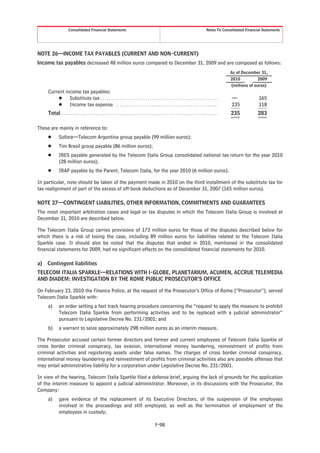
offer fixed long-distance services.

In August 2009, ANATEL gave its approval for the acquisition of the fixed line operator Intelig, which operates as
a national and international long distance operator in Brazil and provide local fixed service in a number of regions
in Brazil. According to the regulations, Tim Brasil and Intelig are obliged to resolve the overlapping of the fixed
service authorizations within 18 months from the acquisition (that is within the end of June 2011) keeping only
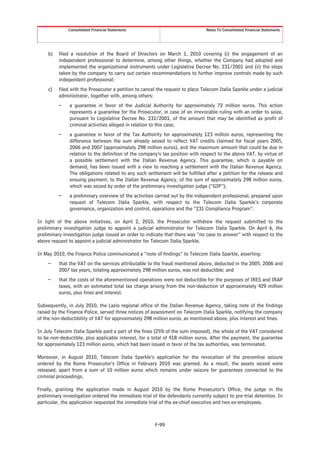
one authorization per class of service.

For details please also see “Item 4. Information on the Telecom Italia Group—4.2.2 Brazil”.


Interconnection rules
Telecommunication operators must publish a public interconnection offer on both economic and technical
conditions and are subject to the “General Interconnection Regulatory Framework” promulgated by ANATEL in
2005.

The free negotiation process for interconnection charges has been extended and will proceed until a “cost based”
reference interconnection value is set by ANATEL. Under a specific Resolution, ANATEL developed a new model to
determine reference costs for the use of mobile networks by providers who have Significant Market Power. These
values will be used in arbitration cases involving termination rates by ANATEL.

In 2005, ANATEL issued a ruling for “Accounting Separation and Cost Accounting”, introducing the obligation of
presenting the Accounting Separation and Allocation Document (Documento de Separação e Alocação de
Contas—“DSAC”) by the licence holders and groups holding significant market power in the offering of fixed
and/or mobile network interconnection and wholesale leased lines (Exploração Industrial De Linha Dedicada—
“EILD”). Starting from 2006 (for fixed operators) and 2008 (for mobile operators), operators (TIM included) are
delivering the requested information to ANATEL. The effective application of cost oriented interconnection
charges is expected in 2012.


                                                           58
Item 4. Information On The Telecom Italia Group                                                  Regulation


Main regulatory developments in 2010
–   MVNOs: in November, 2010, ANATEL approved a resolution establishing the rules to permit the exploration
    of mobile services by means of a virtual network, based on commercial agreements between established
    operators and virtual operators. TIM was the first mobile operator to negotiate a contract with a virtual
    authorized operator and is a pioneer in the discussion of the theme with the regulator.
–   Frequencies: in December 2010 the auction for the assignment of a new portion of spectrum in the 2.1GHz,
    H band, reserved to 3G services, and other left over frequencies in the 900 MHz and 1800 MHz bands not
    assigned in previous auctions. 11 out of the 13 lots available in the H band were awarded to Nextel (which
    has traditionally offered trunking services in Brazil).
    TIM, Vivo and Claro won blocks of spectrum in the 1700/1800 MHz band. Tim Brasil, in particular, won
    individual blocks of frequencies in 8 service areas, strengthening its presence in the North, Santa Catarina,
    Minas Gerais and Parana regions.
–   Refarming: In August 2010, ANATEL approved a resolution for the destination of the 2.5 GHz spectrum to
    mobile services after 2013. Destination of this spectrum in rural areas will prioritize Multichannel Multipoint
    Distribution Service (“MMDS”) operators and in urban areas will prioritize mobile operators.

–   Mobile Termination Rates: It is expected that ANATEL will adopt a resolution on the reduction of fixed to
    mobile rates which derives from a reduction on the respective wholesale interconnection levels on
    termination. In the relevant public consultation ANATEL proposed a real reduction of the F-M rates of -10%
    in 2011 and -10% in 2012 based on nominal declines.
    For the future, ANATEL intends to establish the reference tariffs of SMP (Significant Market Power) operators
    basing on fully allocated historic costs. The implementation of a cost model should be completed in 2012,
    and will imply a reduction of the mobile termination rate.
–   National Broadband Plan: The Brazilian government approved in May 2010 a National Broadband Program
    to extend national broadband coverage by 2014. The plan includes the reactivation of Telebras, which is
    responsible for managing and operating a national fibre network, and a new framework aimed at reducing
    the wholesale connectivity price and consequently allowing a more affordable price of “entry level”
    broadband residential connections.
    Other measures included in the plan are represented by fiscal incentives to induce the operators to offer
    broadband access to low income families, public investments in research and financial support to national
    industries.
–   Concessionaries Contracts: In May 2011, ANATEL will be updating the contracts assigned to
    Concessionaries and in particular will indicate new obligations related to the fixed line universal service
    obligations (“Plano Geral de Metas de Universalização”- “PGMU”), namely referring to backhauling, public
    pay phones and telephone services for families with low incomes among others.
–   Leased Lines: A public consultation on the proposal to modify the regulation on the leased lines is currently
    underway (until March 18, 2011) and will lead to a more efficient wholesale regulation taking into account
    the operational needs of alternative market players.
–   Competitive Framework (“PGMC”): In the next coming months, a new “Competition Framework” will be
    defined and prior adoption will be the subject of a Public Hearing and a Public Consultation. It will set out
    clear criteria for designating operators with Significant Market Power, and the specific regulations they will
    have to follow in the wholesale access market.


4.3.5   TELECOMMUNICATION REGULATORY FRAMEWORK IN ARGENTINA
Telecom Argentina and Telecom Personal operate in a regulated industry. Regulation not only covers rates and
service conditions, but also the terms on which various licensing and technical requirements are imposed.

The activities of Telecom Argentina and Telecom Personal are supervised and controlled by the CNC (“Comisión
Nacional de Comunicaciones”, a governmental agency under the supervision of the SC (“Secretaría de
Comunicaciones”), which is presently supervised by the Ministry of Federal Planning, Public Investments &

                                                          59
Item 4. Information On The Telecom Italia Group                                                   Regulation


Services. The SC has the authority to develop, enforce and implement policies which are applicable to
telecommunications services, to review the applicable legal regulatory framework, to approve major technical
plans and to resolve administrative appeals filed against CNC resolutions.

The principal features of the regulatory framework in Argentina have been created by:
Š    the Privatization Regulations, including the List of Conditions and the Transfer Agreement;
Š    the Licenses granted to Telecom Argentina and its subsidiaries;
Š    the Rate Agreements; and
Š    various governmental decrees, including Decree No. 764/00, establishing the regulatory framework for
     licenses, interconnection, universal service and radio spectrum management.

Other related laws:

Public Emergency Law. As a consequence of the severe and ongoing deterioration of Argentina’s economic
situation, on January 6, 2002 the Argentine government enacted the Public Emergency Law No. 25,561 and other
applicable regulations. It introduced measures that have had and may continue to have a significant impact on
the operations of Telecom Argentina, particularly on fixed telephony regulated rates (end of “Convertibility
US$ 1 = $Arg 1” and freezing rates).

Buy Argentine Act. In December 2001, the Argentine government passed Public Law No. 25,551 (the “Compre
Trabajo Argentino”). The Act requires Telecom Argentina to give priority to national goods and services for the
basic telecommunications services in any procurement related to the rendering of basic telecommunications
services.

Regulatory Authorities abroad
Núcleo, Telecom Personal’s Paraguayan controlled company, is supervised by CONATEL (“Comisión Nacional de
Telecomunicaciones”), the National Communications Commission of Paraguay.

Telecom Argentina USA, Telecom’s subsidiary, is supervised by the Federal Communications Commission
(“FCC”).

Licenses granted as of December 31, 2010
As of December 31, 2010, Telecom Argentina has been granted the following non-expiring licenses to provide the
following services in Argentina: Local fixed telephony; Public telephony; Domestic and international long-distance
telephony; Domestic and international point-to-point link services; Domestic and international telex services;
Value added services, data transmission, videoconferencing and broadcasting signal transport services; and
Internet access.
Š    Telecom Personal has been granted a non-exclusive, non-expiring license to provide mobile
     telecommunication services in the northern region of Argentina and data transmission and value added
     services throughout the country. In addition, Personal owns licenses to provide mobile radio communication
     services in the Federal District and Greater Buenos Aires areas, as well as a non-expiring license to provide
     PCS services throughout the country and it is registered to provide national and international long-distance
     telephone services.
Š    Núcleo has been granted a renewable five-year period license to provide mobile telecommunication services
     in Paraguay as well as PCS services and Internet access in certain areas of that country.

Revocation of the License
Telecom Argentina’s license is revocable in the case of non-compliance with certain obligations, including but not
limited to:
Š    an interruption of all or a substantial portion of service;

Š    a modification of corporate purpose or change of domicile to a jurisdiction outside Argentina;
Š    a sale or transfer of the license to third parties without prior approval of the relevant Argentinean regulatory
     bodies;

                                                           60
Item 4. Information On The Telecom Italia Group                                                  Regulation


Š    any sale, encumbrance or transfer of assets which has the effect of reducing services supplied without the
     prior approval of the relevant Argentinean regulatory bodies;
Š    a reduction of ownership of Nortel in the capital stock of Telecom Argentina to less than 51%, or the
     reduction of ownership of Sofora in the Capital Stock with voting power of Nortel to less than 51%, in either
     case without prior approval of the relevant Argentinean regulatory bodies;
Š    any transfer of shares resulting in a direct or indirect loss of control in Telecom Argentina without prior
     approval of the relevant Argentinean regulatory bodies;
Š    a bankruptcy of Telecom Argentina.

Liberalization of the Argentine Telecommunications Industry
In March 1998, the Argentine government issued Decree No. 264/98, introducing a plan for the liberalization of
the Argentine telecommunications industry. The plan provided for the issuance of a reduced number of
competitive licenses and established the liberalization of basic telephony and international long-distance services
during the time between October 8 and November 8, 1999. The Plan also liberalized pay telephone services and
telephone service in rural areas, during 1998.
Some provisions of this Decree and related resolutions were modified by Decree No. 764/00. This Decree
established a new general regulation of licenses, interconnection, Universal Services and radio- frequencies
spectrum control, provided that each licensed company was allowed to launch its services in November 2000
when the full liberalization of the telecommunications market began.
This Decree established a new Regulation of Licenses based on a single nationwide license for the provision of all
telecommunication services to the public, including fixed-line, wireless, national and international services. Also,
it established a new Interconnection Regulation that includes the obligation to give transparent networks
interconnection and to publish a R.I.O. (Reference Interconnection Offer) with the infrastructure elements and
services that the dominant operator is required to provide. The interconnection commercial conditions are defined
by free agreement between parts, but cost for basic interconnection elements are established in this regulation.
The Decree 764/00 provides for the obligation to implement Number Portability, local loop unbundling; these
regulations are not yet implemented. Particularly, Number Portability will be implemented for mobile services
only, by the end of 2011.
Since the end of the Exclusivity Period the Regulator has granted a number of licenses to, among others,
independent fixed line service providers, mobile and cable operators, cooperative operators, as well as individual
licensees, some of which are affiliated with major service providers outside Argentina. As of December 31, 2010,
more than 500 licenses for local and/or long distance services, payphones and Value Added Services had been
granted.
The main licensees providing local and/or fixed long-distance telephone service are Telmex, Global Crossing,
Comsat, IPlan, Telephone2, Telefónica (in the Northern Region), Telecom Argentina (in the Southern Region),
among others.

The Pesification and freezing of rates for fixed telephony—Contract renegotiation
The Price Cap was a regulation method applied in order to calculate changes in Telecom Argentina’s basic services
rates, based on changes in the U.S. Consumer Price Index (“U.S. C.P.I.”) and an efficiency factor. However, in
October 2001 a preliminary injunction against Telecom Argentina prohibited Telecom Argentina from applying
rate increases by reference to the U.S. C.P.I.
Finally, Public Emergency Law No. 25,561 explicitly prohibited rate adjustments. As of the date of this Annual
Report, the pesification and the freeze of regulated rates remains in force therefore the price cap regime is
suspended and it is unknown if and when it will come back into effect or be replaced by other rate regulation
procedures.
In accordance with the Public Emergency Law, in January 2002, rates for Basic telephone services and long
distance services were converted to Argentine pesos and fixed at an exchange rate of ARS1.00=US$1.00. The
rates Telecom Argentina may charge in the future will be determined by negotiation between Telecom Argentina
and the Argentine government. The Public Emergency Law has been subsequently extended through
December 31, 2011.

                                                           61
Item 4. Information On The Telecom Italia Group                                                   Regulation


On March 6, 2006, Telecom Argentina executed a Letter of Understanding with the Argentine government
pursuant to which Telecom Argentina will be permitted to raise the termination charge for international incoming
calls, the extension of the time bands for peak-hour rates applied to local and domestic long distance calls, and
incorporate certain modifications to the current regulatory framework.


The Letter of Understanding 2006 contemplated the signing and effectiveness of the Minutes of Agreement of the
Renegotiation upon the fulfillment of certain necessary administrative steps. As of the date hereof, such
fulfillment has yet to occur. Although Telecom Argentina’s Management believes that the contract renegotiation
process will be satisfactorily completed they are unable to predict the outcome of the negotiations that are
continuing with regard to further rate increases and the rate scheme which will be applied in the future. Also, they
are unable to predict whether the Argentine government, as a result of the current rate renegotiations, will
impose additional conditions or requirements.


Last relevant regulatory events

Universal Service (“SU”) Regulation. Regulations, published on April 4, 2008, approved a new Universal
Service regime. As with the previous one, the regulations require telecommunications service providers to
contribute 1% of their revenues to the SU Fund and this regulation keeps the “pay or play” mechanism for
compliance with the mandatory monthly contribution to the SU Fund or, to claim the correspondent receivable, as
the case may be.


The regulations established that the SC will review SU initial programs which were established under the previous
regulation, guaranteeing the continuity of SU programs already being administered and implementing programs
that had been under review. Also, the SC will create future SU programs while the telecommunications providers
appointed to participate in such programs will be selected by competitive bidding.


New SU programs. In April 2009 the SC created a new program denominated “Telephony and Internet for
towns without provision of basic Telephone services” that will be subsidized with funds from the SU Fund. This
program seeks to provide fixed telephony services in 1,491 towns and Internet in its schools that currently don’t
have these services.


On December 1, 2010 the SC created two new programs called “Internet for Schools” and “Internet for Libraries”
respectively, to be subsidized by the SU Fund. The goal of these SU programs is to provide BroadBand Internet
access to this kind of official institutions, following a bidding process to select the future provider.


New SU contribution methodology. On November 11, 2010 the SC issued a resolution with a new deposit
methodology for the contributions to the SU Fund. This resolution also defines that the operator must deposit in
the SU Fund the amount owed for the period July 2007 to December 2010. The operators, mainly incumbent
operators, have exempted of that obligation up to SC approve, valuates and audits SU initial programs provided
for these operators.


At the date of issuance of this Annual Report, the SU initial programs are still pending of approval by the SC.


In January 2011, the SC established the procedures that allows licensees to present investments projects for
development of its own network in areas of SU, to be subsidized with the amount of the contribution to SU for the
previous period, January 2001 to June 2007.


SU In Telecom Argentina. Telecom Argentina has provided and continues to provide SU initial programs and
have not received set-offs for providing services as required by the SU regime. As a consequence of that Telecom
Argentina has filed its calculations for review by the regulatory authority and is waiting resolution.

                                                           62
Item 4. Information On The Telecom Italia Group                                                  Regulation


SU In Telecom Personal. Since January 2001, Telecom Personal has been recording a provision related to its
obligation to make contributions to the SU Fund up to June 2007. In addition, since July 2007 Telecom Personal
has deposited the corresponding contributions up to November 2010 (amounting to 112 million Argentine pesos)
into a SU Fiduciary Fund.

Spectrum. Telecom Personal understands that Telefónica Moviles S.A. has completed the return of frequency
bands (850 MHz and 1.900MHz.) exceeding its 50 MHz. spectrum cap. These bands are now available to be
reassigned by SC. Telecom Personal has presented successive requests to the SC demonstrating its interest in
participating in the reassignment process of this spectrum bands, but the SC has not yet defined when the auction
will be held.


4.3.6   BROADCASTING REGULATORY FRAMEWORK IN ITALY
Consolidated Act on Broadcasting (Legislative Decree 177, July 31, 2005) and Legislative Decree
44, March 15, 2010.
Broadcasting activity in Italy is mainly regulated by the Consolidated Act on Broadcasting (Legislative Decree
177, July 31, 2005), recently amended by Legislative Decree 44, March 15, 2010 (“Decree 44”), implementing the
Audio Visual Media Services (“AVMS”) Directive, which entered into force on March 30, 2010.

Decree 44 introduced changes in the audiovisual legislation in the areas of advertising and product placement,
promotion of European works, short extracts rights, protection of minors, and extends regulation to non linear
audiovisual services.

AGCom is implementing the new rules through regulation, including adjustment of authorisation titles already
released prior to the new rules.

With respect to advertising on linear services (TV channels) the rules on the positioning of advertisements have
been relaxed, providing more freedom in the way advertising is inserted in TV schedules.

With respect to time limits for advertising, the Decree has substantially confirmed the hourly and daily limits for
free to air TV channels, while it has reduced hourly limits for pay-TV channels which will have to gradually reduce
advertising from 18% in a given hour applying in 2010 to 12% in 2012.

The Decree also allows for product placement, in line with the rules set by the AVMS Directive, which limits this
opportunity to screening of movies, fiction, sports programmes and entertainment. The implementation of the
rules is taking place through self-regulation.

Protection of minors has been reinforced, in particular as regards pay-tv services and on demand services. All
audiovisual media service providers will have to adopt a “Classification System” of contents directed at protecting
minors as well as specific technical measures in terms of parental control.

The rules on promotion of European works have been renewed and this has resulted in an update of the
regulatory framework on transmission and investment quotas. Telecom Italia Media will maintain the exemptions
it obtained under the previous regulatory framework, in particular as regards quotas on programs for minors and
on recent Italian movies.

The Decree also amends the rule on secondary rights for independent producers. A new regulatory scheme has
been approved and Telecom Italia Media considers positively this new scheme as it implies limited obligations
towards independent producers.

Finally, in line with the AVMS Directive, Decree 44 extends regulation to non linear audiovisual services. An
audiovisual media service provider is identified as one having the editorial responsibility of the contents provided
in the catalogue. On the basis of the new regulation which became effective in January 2011, Video On Demand
(“VOD”) service providers whose income is over 100,000 euros will have to apply for a general authorization.

                                                           63
Item 4. Information On The Telecom Italia Group                                                  Regulation


With respect to digital terrestrial television, the plan for the implementation of Logical Channel Numbering
(“LCN”) was implemented during 2010.

On the basis of the relevant criteria, Telecom Italia Media’s generalist national channels—La7 and MTV—have
been given numbers 7 and 8, respectively, in the LCN.

Telecom Italia Media and MTV Italia have also obtained numbers for their only digital channels (La7D and MTV+),
shifted channels, HD channels and catch up tv services, on demand and interactive services.

Two main local broadcasters have appealed the awarding of a one digit LCN to Telecom Italia Media and MTV,
who have opposed such appeal in order to preserve the assignment of number 7 and 8, since the presence of their
TV channels in the first ten numbers of the LNC is a significant commercial advantage pending the easiest access
to the first 9 channels from customers. The discussion will take place in July 2011.

Switch-off timetable
The complete switch-off of analogue TV and conversion will take place by December 31, 2012.

In 2009, complete switch off took place in the following Italian Regions: Sardegna, West Piemonte, Valle d’Aosta,
Trentino Alto Adige, Lazio and Campania.

In the second half of 2010 complete switch off took place in East Piemonte, Lombardia, Emilia Romagna, Veneto,
Friuli Venezia Giulia.

By the end of 2010 almost 70% of the Italian population was only digital.

The Regions Liguria, Toscana, Umbria, Marche, Abruzzo and Molise are expected to switch off in 2011, while
Puglia, Basilicata, Calabria and Sicilia in 2012.

Digitalization of broadcasting networks and frequencies
In response to the EU infringement procedure 2005/5086 against Italy, the Government approved in June 2008,
Law No. 101, which abolishes the special licensing regime for digital terrestrial network operators and introduces
the authorization regime in line with the Code of Electronic Communications and the EU Directives.

As a consequence, the licenses granted have been converted to general authorizations lasting 20 years.

The European Commission has positively evaluated the changes introduced with law 101/08, but has asked that
more spectrum resources should be assigned to new entrants (Digital Dividend). In response to these further
requests, AGCom has established the criteria for the complete digital conversion of the television terrestrial
networks.

AGCom has established that the National Plan of Assignment of the Frequencies (“PNAF”) which will provide for
21 national DVB-T (Digital Video Broadcasting- Terrestrial) networks with 80% coverage of national territory and 4
DVB-H (Digital Video Broadcasting- Handheld) national Networks. Out of the 21 National DVB-T networks, 8 are to
be used for the conversion of existing analogue networks, 8 for existing digital networks, and 5 will constitute the
Digital Dividend to be assigned on the basis of competitive bidding procedures.

The Ministry of Economic Development—Communication Department—has assigned to the Telecom Italia Media
Group only 3 DVB-T Networks (out of the 4 Networks managed by the Group). The Telecom Italia Media Group
has appealed against this assignment in order to safeguard its interests.

As regards the Digital Dividend, AGCom issued a decision on the criteria to be adopted in the tenders for the
assignment of the Digital Dividend. The Digital Dividend is to be assigned in 3 different tenders, one consisting of
3 Networks/Muxes (Tender A) and the other of 2 Networks/Muxes (Tender B), plus a third tender for a DVB-H/
DVB-T2 Network (Tender C). The decision confirmed the consultation document which presented a number of
critical issues on which Telecom Italia Media had asked for changes. In particular, Telecom Italia Media has, in

                                                           64
Item 4. Information On The Telecom Italia Group                                                Regulation


our view, been mistakenly treated as an incumbent operator in the market for digital terrestrial networks. As a
consequence Telecom Italia Media will be able to participate only in tender B (2 DVB-T Networks) together with
Rai and Mediaset and in Lotto C (1 DVB-H/DVB-T2) Network, while it cannot participate in Tender A, which is
being reserved to new entrants and minor operators, including Sky Italia, following the decision of the European
Commission on July 20, 2010 to allow Sky Italia to participate in such tender.

The Telecom Italia Media Group has appealed against the above decision and against the EU Decision, with
particular reference to the erroneous treatment of Telecom Italia Media as an incumbent operator.


PNAF and digital dividend for mobile services
AGCom issued a decision approving the National Plan of Assignment of the Frequencies necessary for the
assignment of frequencies in the digital switch off areas as well as for the DVB-T Digital Dividend.

This decision also provides for a Digital Dividend for mobile service in the band 790-862 MHz after analogue
broadcasting is switched off. The Italian Budget Law establishes that a tender for such frequencies should take
place by September 2011, in order to guarantee the right of usage after such switch off. AGCom and the Ministry
of Economic Development are taking steps to guarantee such tender by 2011.


Market 18 (co-location services)
RAI and Mediaset, identified as holding a joint dominance in the analogue broadcasting market, have published a
Reference Offer for co-location services of transmitters on analogue sites, as established by the AGCom decision
of April 2008, on “market 18”. The Reference Offers could establish a benchmark for co-location prices for digital
sites.

AGCom, in March 2009, launched a new market analysis of the market for transmission networks. Following a
public consultation, which was concluded in October 2010, AGCom published its analysis on February 19, 2011.
The analysis concluded that the market for National digital DVB-T Networks is competitive and does not need to
be regulated ex-ante. The Decision confirms the obligations previously set for a Reference Offer for co-location
services of transmitters on analogue sites until complete switch off will take place (December 31, 2012).


                                                           65
Item 4. Information On The Telecom Italia Group                      Glossary Of Selected Telecommunications Terms


4.4   GLOSSARY OF SELECTED TELECOMMUNICATIONS TERMS
The following explanations are not intended as technical definitions, but to assist the general reader to
understand certain terms as used in this Annual Report.

2G (second-generation Mobile System). Second-generation protocols using digital encoding and including
GSM, D-AMPS (TDMA) and CDMA. 2G networks are in current use all over Europe and other parts of the world.
These protocols support high bit rate voice and limited data communications. 2G networks technology offer
auxiliary services such as data, fax and SMS. Most 2G protocols offer different levels of encryption.

3G (third-generation Mobile System). Third-generation wireless service, designed to provide high data
speeds, always-on data access, and greater voice capacity. 3G networks allow the transfer of both voice data
services (telephony, messaging) and non-voice data (such as downloading Internet information, exchanging
email, and instant messaging). The high data speeds, measured in Mbps, are significantly higher than 2G and, 3G
networks technology enable full motion video, high-speed internet access and video-conferencing. 3G technology
standards include UMTS, based on WCDMA technology (quite often the two terms are used interchangeably) and
CDMA2000.

Access charge. Amount charged per minute by national operators for the use of their network by operators of
other networks. Also known as an “interconnection charge”.

ADSL (Asymmetric Digital Subscriber Line). A modem technology which converts existing twisted-pair
telephone lines into access paths for multimedia and high-speed data communications. ADSL can receive Mbps
and transmit over 832 Kbps in both directions. Such rates expand existing access capacity by a factor of 50 or
more without new cabling.

Analog.     A transmission which is not digital, e.g., the representation of voice, video or other not in digital form.

ASTN (Automatically Switched Transport Network). Emerging architectural standard for switched
intelligent optical network for the management of the automatic signaling and routing of connection, auto-
discovery and meshed optical network protection.

ATM (Asynchronous Transfer Mode). A BroadBand switching technology that permits the use of one network
for different kinds of information (e.g., voice, data and video).

Backbone. Portion of telecommunication network with the highest traffic intensity and from which the
connections for services in the local areas depart.

Backhauling. Infrastructure network connecting sites that host the equipment for user access (xDSL or other
systems, also Wireless / Mobile). It can be realized in various ways depending on the band, topology and
distance.

Bitstream. Wholesale BroadBand access service which consists of supplying an access to XDSL Telecom Italia
network and transmission capacity to the network of another OLO.

BroadBand services. Services characterized by a transmission speed of 2 Mbit/s or more. According to
international standards, these services are divided into two categories: (i) Interactive services, including
videotelephone/videoconferencing (both point-to-point and multipoint); videomonitoring; interconnection of
local networks; file transfer; CAD; highspeed fax; e-mail for moving images or mixed documents; BroadBand
videotex; Video on demand; retrieval of sound programs or fixed and moving images; and (ii) Broadcast services,
such as sound programs, television programs (including high-definition TV and pay TV) and selective document
acquisition.

Broadcast.      Simultaneous transmission of information to all nodes and terminal equipment of a network.

BSC (Base Station Controller). Interface with the MSC switching exchange. Has the task of supervising and
controlling radio resources, both during the phase when a call is being set up and during the maintenance phase.

                                                            66
Item 4. Information On The Telecom Italia Group                       Glossary Of Selected Telecommunications Terms


BSS (Business Support System). The system used by network operators to manage business operations such
as billing, sales management, customer-service management and customer databases. A type of Operations
Support System (OSS).

BTS (Base Transceiver Station). Radio base station which sends the GSM radio signal via the antenna to
cover an area (cell) and coordinates one or more radio transceivers (TRX).

Bundle. Commercial offer including different telecommunication services (voice, BroadBand internet, IPTV,
other) by an operator under the same brand. Bundle Dual Play offer includes fixed telecommunication services and
BroadBand internet; bundle Triple Play offer is the “bundle dual play” integrated with IPTV; bundle Quadruple
Play offer is the “bundle triple play” integrated with mobile telecommunication services.

Carrier.     Company that makes available the physical telecommunication network.

CATV (Cable television).            Cable or fiber-based distribution of TV programs.

CDMA (Code Division Multiple Access). A digital wireless technology used in radio communication for
transmission between a mobile phone and a radio base station. CDMA was developed by Qualcomm, and
commercially introduced in 1995. It enables the simultaneous transmission and reception of several messages,
each of which has a coded identity to distinguish it from the other messages.

Cell.   Geographical portion of the territory illuminated by a BTS: 900MHz / 1800MHz.

Cellular. A technique used in mobile radio technology to use the same spectrum of frequencies in one network
multiple times. Low power radio transmitters are used to cover a “cell” (i.e., a limited area) so that the
frequencies in use can be reused without interference for other parts of the network.

Channel. The portion of a communications system that connects a source to one or more destinations. Also
called circuit, line, link or path.

Client server. Software program that is used to contact and obtain data from a Server software program on
another computer. Each Client program is designed to work with one or more specific kinds of Server programs,
and each Server requires a specific kind of Client. This configuration model is opposed to a Peer-to-Peer
configuration, where the contact is performed on the same level.

Closed User Group. A group of telecommunications users that share a longstanding economic interest. This
definition has arisen in a regulatory context; it permits the partial liberalization of some telecommunications
services.

Community. A group of customers who have subscribed to specific offers which include special pricing for
traffic towards other customers of the same telco.

CPS (Carrier Pre-selection). Permits a customer to pre-select another operator as an alternative to Telecom
Italia without dialing an identifying code.

D-AMPS (Digital-Advanced Mobile Phone Service). It is a digital version of AMPS (Advanced Mobile Phone
Service), the original analog standard for cellular telephone service in the United States.

DCS 1800 (Digital Communication System). A derivative of the GSM cellular mobile telephone standard.
“1800” refers to the frequency used of 1800 MHz. DCS 1800 is the European PCN standard.

Digital. A mode of representing a physical variable such as speech using digits 0 and 1 only. The digits are
transmitted in binary form as a series of pulses. Digital networks are rapidly replacing the older analog ones. They
allow for higher capacity and higher flexibility through the use of computer-related technology for the
transmission and manipulation of telephone calls. Digital systems offer lower noise interference and can
incorporate encryption as a protection from external interference.

Digital divide. The gap between people with effective access to digital and information technology and those
with very limited or no access at all. The term encompasses among others: gaps in ownership of or regular access
to a computer, internet access—today primarily BroadBand, and related skills.

                                                              67
Item 4. Information On The Telecom Italia Group                           Glossary Of Selected Telecommunications Terms


Digital Home. Fruition of a fully/partially automated house. Generally the term refers to the presence of a
home network of Consumer Electronics equipment, personal computer and mobile devices that cooperate
transparently, delivering simple, seamless interoperability that enhances and enriches user experiences in
Internet access, multimedia, home tasks automation.

Digital Terrestrial TV. Digital Terrestrial Television Broadcasting is a new type of broadcasting technology that
provides a more effective way of transmitting television services using a digital system instead of the existing
analogue system.

DSL Network (Digital Subscriber Line Network). A network built on existing telephone lines with DSL
technology devices which use sophisticated modulation schemes to pack data onto copper wires for connections
from a telephone switching station to a home or office.

DSLAM (Digital Subscriber Line Access Multiplexer). The DSLAM denotes telecommunications equipment
able to process digital signals of various clients and multiply them in a data link to the nodes of the Internet.

DVB—H (Digital Video Broadcasting—Handheld). DVB—H technology combines digital video with the
Internet Protocol (IP): contents are subdivided into packets using the same basic technology employed by the
Internet. The use of IP technology allows the transmission of TV and radio programs, web pages, music and video
games to smartphones/PDA’s.

DWDM (Dense Wavelength Division Multiplexing). This is a technology for multiplying and transmitting
different wavelengths along a single optical fiber contemporaneously.

EDGE (Enhanced Data for GSM Evolution). This is a powerful technology that increases the data
transmission rate of the GPRS standard from rates of 30-40 kbit/s to more than 100 kbit/s and even up to 200
kbit/s with optimal radio conditions.

Exchange.     See Switch.

Flat rate. The rate applied by providers to users surfing the web. It is usually a fixed monthly rate for a
subscription to a specific Internet Service Provider, aside from the number of connection hours to the Net.

Frame Relay.      A data transmission service using fast protocols based on direct use of transmission lines.

FTT HOME, FTT CURB, FTT (Fiber to the …). It is the term used to indicate any network architecture that
uses fiber optic cables in partial or total substitution of traditional copper cables used in telecommunications
networks. The various technological solutions differ in the point of the distribution network where the fiber
connection is made, with respect to the end-user’s location. In the case of FTT Curb (Fibre to the Curb) the fiber
connection reaches the equipment (distribution cabinet) located on the pavement, from where copper
connections are run to the customer; in the case of FTTHome (Fibre to the Home), the fiber connection
terminates inside the customer premises.

Gateway. A connection between the LANs and WANs of one or more suppliers. Can also mean the access nodes
to international networks of various kinds.

GGSN (Gateway GPRS Support Node).                   Junction connecting an external packed network or GPRS system of a
different mobile network.

GRX (GPRS Roaming eXchange for Mobile Operators). The GRX service allows Mobile Operators to
interconnect GPRS networks around the world and offer global GPRS roaming coverage.

GSM (Global System for Mobile Communication).                       A standard for digital cellular telephony used in the
world and working on 900MHz and 1800MHz band.

GSM TIM Card. A prepaid, rechargeable card which permits the TIM mobile customer to make outgoing calls
up to the limit of the card and receive an unlimited number of calls.

                                                               68
Item 4. Information On The Telecom Italia Group                       Glossary Of Selected Telecommunications Terms


HDSL (High-bit-rate Digital Subscriber Line). Technology for business customers which allows the
provision of local loop circuits at higher speeds and lower cost than through conventional means.

HSDPA (High-Speed Downlink Packet Access/UMTS Hi Speed—Universal Mobile Telecommunications
System). UMTS evolution allows BroadBand connections up to 3.6 Mbps.

HLR (Home Location Register).             Database where are recorded the customer data.

Kvar (kilovolt–amperes reactive).             Reactive energy: measurement system, expressed in kilovolt, of power
losses in an AC electrical system.

ICT (Information and communication(s) technology). Broad area concerned with information technology,
telecommunications networking and services and other aspects of managing and processing information,
especially in large organizations.

IEEE (Institute of Electrical and Electronics Engineers). An organization of engineers, scientists and
students involved in electrical, electronics and related fields. IEEE also functions as a publishing house and
standards body.

IMSS/MSEM (Italtel Multi Service Solution/Multi Service Element Manager). It’s a proprietary platform
for the management of the whole network. Refer to a software switch that is compatible with many protocol type
for IP communication and network interworking as SIP, H323, MGCP and H248. The supplier is ITALTEL.

Interactive.   Allowing the user to change some aspect of the program.

Internet. The world’s best-known data network. Initially used by the U.S. Department of Defense, the Internet
now provides an interface for networks based on different technologies (LANs, WANs, data networks, etc.), but
which use the TCP/IP protocol platform.

Internet Protocol TV or IPTV. The service provides the distribution of television channels over Internet
connections using the IP protocol. More than just duplicating a distribution means, IPTV enables interactive
services so that the viewer can interact with the show as it is broadcast.

IP (Internet Protocol).       A set of communications protocols for exchanging data over the Internet.

IP/MPLS (Internet Protocol/Multi Protocol Labeling Switching). A packet switching protocol to optimize
network behaviors of mapping Layer3 (IP) end-to-end data flow to Layer2 traffic between adjacent network
nodes.

IPTV (Internet Protocol Television). A system that utilises the Internet Protocol infrastructure to transmit
digital television content over a network and deliver it via a BroadBand Internet connection.

ISDN (Integrated Services Digital Network). A system in which several services (e.g., speech and data) may
be simultaneously transmitted end to end in digital form.

ISPs (Internet Service Provider).           A vendor who provides access to the Internet and World Wide Web.

ITU (International Telecommunication Union). The worldwide policy, spectrum regulation and
standardization body in telecommunication operating under the auspices of the United Nations.

LAN (Local Area Network). A private network that covers a local geographic area and provides public
telecommunications services as well as interconnection between personal computers.

Local Loop. Copper wire-couple, through which the telephone connection reaches users; it is the foundation of
traditional telephone lines and it is often called “last mile”.

MGCP (Media Gateway Control Protocol). An Internet Engineering Task Force (IETF) signaling protocol
proposal allowing a bridge between classic telephone networks and Internet (i.e., IP-based) infrastructures.

                                                            69
Item 4. Information On The Telecom Italia Group                        Glossary Of Selected Telecommunications Terms


MEMS (Micro-Electro-Mechanical Systems). MEMS are miniaturized devices ranging in size from a few
micrometers to a few millimeters, which execute one or more monitoring, processing or actuation functions by
deploying a combination of electronic, mechanical, optical, chemical or biological components integrated on a
usually silicon hybrid circuit.

MGW (Media GateWay).            Junction for the connections which carry user traffic.

MMDS (Multichannel Multipoint Distribution Service). Also known as Wireless Cable is a wireless
telecommunications technology, used for general-purpose broadband networking or, more commonly, as an
alternative method of cable television programming reception.

MMS (Mobile Multimedia Services). Represent an evolution of the SMS and the EMS service using various
mono-medial elements (text, design, photos, video-clips and audio), which are synchronized and combined
allowing them to be packed together and sent to GSM-GPRS platforms.

Modem. Modulator/Demodulator. A device that modulates digital data to allow their transmission on analog
channels, generally consisting of telephone lines.

MPLS (Multi Protocol Label Switching). A packet switching protocol to optimize network behaviors of
mapping Layer3 end-to-end data flow to Layer2 traffic between adjacent network nodes.

MS SPRING.      A form of traffic protection mechanism for the equipment.

MSC (Mobile Switching Center). Executes functions such as controlling calls, switching traffic, taxation,
controlling network interfaces and acts as an interface with other networks.

MSP.    The name of a general purpose programmable switch made by Redcom Laboratories.

Multimedia. A service involving two or more communications media (e.g., voice, video, text, etc.) and hybrid
products created through their interaction.

Network. An interconnected collection of elements. In a telephone network, these consist of switches
connected to each other and to customer equipment. The transmission equipment may be based on fibre optic or
metallic cable or point to point radio connections.

NGAN (New Generation Access Network). New generation network access that can be realized with
different technological solutions, typically fiber optic and VDSL pairs.

NGNs (Non-Geographic Numbers). The non-geographic numbers are unique as they are by definition not
associated with any particular geographic location (e.g. premium rate services, toll free, directory assistance
services).

NGN2 (Next Generation Network). New generation network created by Telecom Italia to meet the demands
of corporates, public administrations and citizens. The new network architecture guarantees an infrastructure
designed to face multiple offers by increasing customisation levels and bandwidth availability, removing
bandwidth limits and providing an impressive capacity along with a wide selection of access systems.

NNI Agreements (Network Node Interface Agreements).                Contractual agreements for the interface between
two public network pieces of equipment (“NNI”).

Node. Topological network junction, commonly a switching center or station.

Node B (counterpart of BTS in GSM). This is the Radio Base Station in UMTS technology which, via an
antenna, sends the UMTS radio signal which creates the coverage of the cell (typically 3 for Node B). It also
performs functions which are strictly associated with managing the radio connection.

OLOs (Other Licensed Operators). Companies other than the incumbent operator which operate
telecommunications systems in a national market.

                                                           70
Item 4. Information On The Telecom Italia Group                      Glossary Of Selected Telecommunications Terms


Online advertising. Form of promotion that uses the Internet and World Wide Web for the purpose of
delivering marketing messages to customers. Examples of online advertising include contextual ads on search
engine results pages, banner ads, rich media ads, social network advertising, online classified advertising,
advertising networks and e-mail marketing.

ONP (Open Network Provision). Principles and conditions laid down by the EU for access to and usage of
public telecommunications networks and services. A network architecture that permits telecommunications
services to be offered on facilities of public operators and for equipment to be connected to such networks.

Optical fiber. Thin glass, silica or plastic wires, building the interstructure base for data transmission. An
optical fiber cable contains several individual fibers, and each of them is capable of driving a signal (light impulse)
at illimited bandwidth. Optical fibers are usually employed for long-distance communication: they can transfer
“heavy” data loads, and the signal reaches the recipient, protected from possible disturbances along the way. The
driving capacity of optical fibers is higher than the traditional cable ones.

OSS (Operations Support System). Methods and procedures (whether mechanized or not) which directly
support the daily operation of the telecommunications infrastructure.

OTT (Over the Top) players. Operators offering contents and services on the internet without owning the
proprietary TLC network infrastructure.

Outsourcing. Hiring outsiders to perform various telecommunications services, which may include planning,
construction, or hosting of a network or specific equipment belonging to a company, and, ultimately, the
management of entire telecommunications systems. Value-added applications may also be provided in various
sectors.

Packet-Switched Services. Data services based on parceling or breaking the data stream into packets and
switching the individual packets. Information transmitted (whether voice or data) is segmented into cells of a
standardized length, which are then transmitted independently of one another, allowing maximization of available
capacity and usage of single transmission path for multiple communications. The cells are then reassembled upon
reaching their destination.

Pay-Per-View or PPV. A system by which the viewer pays to see a single program (such as a sporting event,
film or concert) at the moment at which it is transmitted or broadcast.

Pay TV. Paid-for TV channels. To receive Pay TV or Pay-Per-View programs, a decoder must be connected to
the television set, and a conditional access system.

PCS.    Personal communications services.

PDA (Personal Digital Assistant). A handheld computer with a memory size up to several megabytes and a
touch-sensitive screen, often using a stylus to input data. The PDA is mainly used for calendar, address book and
memoranda functions, but can incorporate advanced office or multimedia functions such as voice calls,
messaging, video, mp3 player, etc.

Penetration. The measurement of the take-up of services. As of any date, the penetration is calculated by
dividing the number of subscribers by the population to which the service is available and multiplying the quotient
by 100.

Platform. The total input, including hardware, software, operating equipment and procedures, for producing
(production platform) or managing (management platform) a particular service (service platform).

POP (Point Of Presence). Internet provider locations for network connection, often through dial-up phone
lines. When a Pop is within a specific local area, users can connect to the Internet by dialing a local phone
number.


                                                           71
Item 4. Information On The Telecom Italia Group                         Glossary Of Selected Telecommunications Terms


POTS (Plain Old Telephone Service). Refers to the basic telephony service (homes use) supplying standard,
single-line telephones, fixed-line services and access to public voice telephony network. In contrast, telephone
services based on digital communications lines, such as ISDN, are not POTS. The main distinctions between POTS
and non-POTS services are speed and bandwidth. POTS is generally restricted to about 52 Kbps.

PSTN (Public Switched Telephone Network). The public telephone network delivering the basic telephone
service and, in certain circumstances, more advanced services.

RNC (Radio Network Controller—counterpart of BSC in GSM). Supervises and controls radio resources,
both during the phase of setting up the call, and during the maintenance phase (for example, handover between
different cells). Furthermore, it handles connectivity from and towards: Node B, MSC*, and other RNC.

Roaming. A function that enables wireless subscribers to use the service on networks of operators other than
the one with which they signed their initial contract. The roaming service is active when wireless is used in a
foreign country (included in GSM network).

RTG. Is the network of the world’s public circuit-switched telephone networks in much the same way that the
Internet is the network of the world’s public IP-based packet-switched networks.

SDH Standard (Synchronous Digital Hierarchy).                The European standard for high-speed digital transmission.

SDSL (Symmetrical Digital Subscriber Line).               Also known as HDSL.

Service Exposure.       The opening of selected proprietary telecommunication networks and IT capabilities to
third parties.

Service Provider. The party that provides end users and content providers with a range of services, including a
proprietary, exclusive or third-party service center.

SGT (Transit exchange interconnection level for telephone traffic).               Transit Exchange for telephone traffic
carriage, routing and transmission.

SGU (Local exchange interconnection level for telephone traffic).                 Local Exchange for telephone traffic
carriage, routing and transmission.

Shared Access. Methods of shared access, through the user’s duplex cable, with another TLC service provider.
This method permits the retention of voice telephony from Telecom Italia (or other operators) alongside ADSL on
the proprietary network of the shared access operator, that is, not passing through the Telecom Italia networks
but travelling directly along the operator’s channels at the substation.

SME. The small- and medium-size enterprise market which consists of businesses having between 3 and 50
employees.

SMS (Short Message Service). Short text messages that can be received and sent through GSM-network
connected cellular phones. The maximum text length is 160 alpha-numerical characters.

SNCP. A form of traffic protection mechanism for the equipment.

SOHO. The small office/home office market which consists of businesses that use telephone lines to connect to
the Internet, as opposed to dedicated lines, and is made up of small businesses, generally with one or two
employees, and businesses conducted out of the home.

SPP (Service Provider Portability).             Allows an end user to retain the same directory number after changing
from one service provider to another.

Switch. These are used to set up and route telephone calls either to the number called or to the next switch
among the path. They may also record information for billing and control purposes.

Synchronous. Type of data transmission in which there is permanent synchronization between the transmitter
and the receiver.

                                                              72
Item 4. Information On The Telecom Italia Group                     Glossary Of Selected Telecommunications Terms


TACS (Total Access Communication System). An analog cellular network using the 900 MHz band based on
a European standard also used in the UK, Ireland, Austria and Spain. Features include handover and available
add-on services include answering, call notification, call transfer, differentiation of business and private calls,
authorization code for outgoing international calls and itemized billing.

TDMA (Time Division Multiple Access). A technology for digital transmission of radio signals between, for
example, a mobile phone and a radio base station. TDMA breaks signals into sequential pieces of defined length,
places each piece into an information conduit at specific intervals and then reconstructs the pieces at the end of
the conduit.

TRX. Radio transceivers located in BTS.

ULL (Unbundling Local Loop). System through which OLO can rent the “last mile” of local loop, connecting
to their equipments.

UMTS (Universal Mobile Telecommunications System). Third-generation mobile communication standard.
It’s constituted by a BroadBand system in which data travel at 2Mb-per-second, communication is faster, quality
is better and multimedia contents can travel trough the Net.

UMTS Cell.      Geographical portion of the territory illuminated by a Node B.

UMTS Channels. These enable all the customers of the cell to access both the CS (Circuit Switched) services
and the PS (Packet Switched) services of UMTS technology.

Unbundling. A process which allows telephone carriers (other than Telecom Italia) to lease the last part of the
telephone loop, that is to say, the copper wire-cable, connecting Telecom Italia central station to the user’s home,
disconnecting the user from Telecom terminals and connecting him/her to the telephone carrier’s terminals.

Universal service.       The obligation to supply basic service to all users throughout the national territory at
reasonable prices.

VAS (Value Added Services). Value Added Services provide a higher level of functionality than the basic
transmission services offered by a telecommunications network for the transfer of information among its
terminals, which include wired or wireless switched-circuit analog voice communications; direct “unrestricted”
digital point-to-point service at 9,600 bit/s; packet switching (virtual call); direct BroadBand analog transmission
of TV signals, and supplementary services, such as closed user groups; call waiting; collect calls; call forwarding,
and identification of number called. Value Added Services performed by the network, the terminals or the
specialized centers include message handling services (MHS) (which can be used, among other things, for
commercial documents in predetermined formats); electronic directories listing users, network addressees and
terminals; e-mail; fax; teletex; videotex and videotelephone. Value Added Services could include also value added
voice telephony services such as Freephone or Premium Rate Services.

VDSL (Very-high-data-rate Digital Subscriber Line). Access technology that allows providers to give
clients, by means of an apparatus installed in their homes, access to voice and TV services on the traditional
telephone line with a speeds of up to 100 Mbps in downstream (VDSL2).

VOD (Video On Demand). TV-programme supply on user’s request, with payment of a fee for each purchased
programme (a movie, a soccer match, etc). Broadcast in a special method for cable and satellite TV.

VoIP (Voice Over IP). Transmission of voice communications over Internet Protocol (IP) data networks, such
as IP-based LANs, intranets or the Internet.

VPN (Virtual Private Network). A network designed for a business or government agency, using the
infrastructures of a carrier and providing customized services, and which operates in such a manner as to appear
dedicated to the user thereof.

WAN (Wide Area Network).                  A private network that covers a wide geographic area using public
telecommunications services.

                                                           73
Item 4. Information On The Telecom Italia Group                          Glossary Of Selected Telecommunications Terms


WAP (Wireless Application Protocol).                 A technology which allows access to the Internet using mobile sets,
even without the use of a computer.

WI-FI.   A service for wireless Internet connection and high speed access.

WLL (Wireless Local Loop). The means of configuring a local loop without the use of wiring.

Wi—Max (Worldwide Interoperability for Microwave Access). The Wi—MAX—is a technology that allows
wireless access to BroadBand telecommunications networks. It is defined by the Wi—MAX Forum, a global
consortium formed by major companies in the field of fixed and mobile telecommunications which has the
purpose to develop, test and promote the interoperability of systems based on IEEE 802.16-2004 standards for
fixed access and IEEE.802.16e-2005 for fixed and mobile access.

WLR (WHOLESALE LINE RENTAL). The WLR Service consists in the resale to wholesale of the basic telephony
services and advanced “ISDN” associated with the fees paid by certified residential and non-residential customers
of Telecom Italia’s public telephone network.

XDSL (Digital Subscriber Line). It is a technology that makes use of standard telephone lines and it includes
different categories including: ADSL Asymmetric DSL, HDSL High-data-rate DSL and VDSL, Very high bit rate DSL.
This technology uses a digital signal with a very high frequency in order to increase the data transfer rate.


                                                               74
Item 4. Information On The Telecom Italia Group                                           Description Of Property, Plant And Equipment


4.5       DESCRIPTION OF PROPERTY, PLANT AND EQUIPMENT
General
As of December 31, 2010 and 2009, property, plant and equipment owned and leased are detailed as follows:

                                                                   As of December 31, 2010                       As of December 31, 2009
                                                                                Total      % of total                         Total    % of total
                                                                              property,    property,                        property,   property,
                                                                              plant and    plant and                        plant and  plant and
                                                              Owned Leased equipment equipment Owned Leased equipment equipment
                                                                                   (millions of euros, except percentage)
Land . . . . . . . . . . . . . . . . . . . . . . . . . . .       244      —         244         1.5        125        —           125            0.8
Civil and industrial buildings . . . .                           810    1,124     1,934        11.7        495      1,246       1,741           11.6
Plant and equipment . . . . . . . . . . .                     12,184      —      12,184        73.6     11,586        —        11,586           77.2
Manufacturing and distribution
   equipment . . . . . . . . . . . . . . . . . . .                28     —            28        0.2          31       —             31          0.2
Ships . . . . . . . . . . . . . . . . . . . . . . . . . . .      —       —           —          —            26       —             26          0.2
Aircraft . . . . . . . . . . . . . . . . . . . . . . . . .       —       —           —          —           —         —            —            —
Other . . . . . . . . . . . . . . . . . . . . . . . . . .        790      11         801        4.8         621          7         628          4.2
Construction in progress and
   advance payments . . . . . . . . . . .                      1,317       42      1,359         8.2        833         43         876           5.8
Total . . . . . . . . . . . . . . . . . . . . . . . . . . 15,373 1,177          16,550       100.0      13,717 1,296          15,013         100.0


The principal categories of our equipment are exchanges and transmission equipment, cable networks, base
stations for cellular networks and equipment for radio communications, most of which are located throughout
Italy. There are no encumbrances that may affect our utilization of our property or equipment.


Real Estate (Land, Civil and Industrial Buildings)
As of December 31, 2010, the Company owned many buildings located throughout Italy. Specialized buildings for
telecommunications services account for the majority of properties both in number and book value. Such
buildings house mainly exchange equipment and transmission equipment, and are used as part of our continuing
telecommunications operations. General purpose properties consist chiefly of offices, depots and computer
centers.

On December 31, 2010, Tim Brasil group owned approximately 116,347 square meters and leased approximately
1,167,922 square meters of real property, all of which were available for installation of our equipment. Tim Brasil
group also leases approximately 144,258 square meters and owns approximately 66,722 square meters of office
space.


Network Infrastructure (Plant and Equipment)
The Telecom Italia Group network infrastructure includes the domestic and international fixed network, the
domestic mobile network, the Brazilian mobile network and the Argentinean and Paraguayan Networks. See “-4.4
Glossary of Selected Telecommunications Terms”, for definitions of the technical terms used in this section.


Domestic Fixed Network
General. Our domestic fixed network consists of 33 Gateway Areas (each gateway area has two interconnection
points enabling information to be exchanged between the fixed and mobile networks) and 628 main local switches
(only for fixed OLOs). Each local switch belongs to only one of the 33 gateway areas. Since October 2010 is
possible also the interconnection in 12 Aggregation Areas with Backbone Nodes (“BBN”). The long-distance fixed
network (Arianna SDH and Phoenix) routes 4,544 VC4. The fixed long distance network also includes 128 optical
channels 2.5 Gbps point to point and 520 optical channels 10 Gbps point to point (also called lambdas from the
greek letter λ used for wavelength in physics). The fixed copper network includes 111.7 million km of copper
pairs.

                                                                                   75
Item 4. Information On The Telecom Italia Group                                                       Description Of Property, Plant And Equipment


At December 31, 2010, the domestic fixed network consisted of the following:

Exchange areas . . . . . . . . . . . . . . . . . . . . . . . . . . . . . . . . . . . . . . . . .    approximately 10,400
Switching areas . . . . . . . . . . . . . . . . . . . . . . . . . . . . . . . . . . . . . . . . .   628 Urban Group Stages (SGU)
Gateway areas . . . . . . . . . . . . . . . . . . . . . . . . . . . . . . . . . . . . . . . . . .   33
Aggregation areas . . . . . . . . . . . . . . . . . . . . . . . . . . . . . . . . . . . . . .       12
Copper network . . . . . . . . . . . . . . . . . . . . . . . . . . . . . . . . . . . . . . . . .    111.7 million kilometers-pair
Fiber optic access/carrier network . . . . . . . . . . . . . . . . . . . . . .                      4.3 million kilometers-line
Long Distance VC4 . . . . . . . . . . . . . . . . . . . . . . . . . . . . . . . . . . . . . .       4,544
Long Distance Lambda . . . . . . . . . . . . . . . . . . . . . . . . . . . . . . . . . .            128 2.5 Gbps, 520 10 Gbps
BroadBand/ADSL network . . . . . . . . . . . . . . . . . . . . . . . . . . . . . . .                8,887 local switching areas covered
IPTV (Internet Protocol TV) . . . . . . . . . . . . . . . . . . . . . . . . . . . . .               1,804 local switching areas covered
POP main data networks . . . . . . . . . . . . . . . . . . . . . . . . . . . . . . . .              32

SDH and ATM. Our Synchronous Digital Hierarchy (“SDH”) transmission systems operate on fiber optics from
155 Mbit/sec up to 10 Gbit/sec. Work on the development of the national network (Long distance) that, by use of
the latest generation of SDH technologies and the optical DWDM technology (Dense Wavelength Division
Multiplexing) constitutes the basis for the transport network with a high transmission capacity capable of covering
the entire Italian territory, continued during 2010. In order to reduce the number of fibers used, DWDM systems
have been used to multiply by a factor of 12 up to 40 the available optical fiber band and the current transmission
capacity, thus increasing the transport capacity of the connections.

In November 2002, Telecom Italia introduced a new generation of Optical Digital Cross Connect (“ODXC”) on the
domestic fixed transmission backbone in order to progress with the transition from a national network based on a
SDH rings architecture, towards the new generation of meshed ASTN (Automatically Switched Transport Network)
optical backbone. In 2010, Telecom Italia did not add any ODXC nodes but increased the capacity of existing links
and nodes. The evolution of the transport network towards a completely optical network will increase the
operating capacity for all types of traffic, from voice to Internet.

Asynchronous Transfer Mode (“ATM”) switching technology allows the transfer of information combining data,
video, voice and other services on public and private networks both at a national and international level. Telecom
Italia’s ATM/Frame Relay networks work together as a multiservice network, using SDH transmission systems as a
physical layer. The ATM Network allows for the provision of ATM native services with access rates ranking from
2Mbit/s up to 155 Mbit/s. It also acts as a backbone for both the Frame Relay Access network (with access rates
ranking from 64 kbit/s up to 2 Mbit/s), and for the DSL (Digital Subscriber Line) Network, used for the
provisioning of xDSL services (ADSL High-bit-rate Digital Subscriber Line or HDSL) and SDSL. The ATM/Frame
Relay networks allow customers to access IP and MPLS services (Multi Protocol Label Switching) with access
speeds between 64 kbit/s to 155 Mbit/s.

OPB (Optical Packet Backbone). In 2010 we continued to introduce into the network the Terarouter
equipment, deployed in some of the most important PoPs of the network. At the end of 2010 OPB Network had
Terarouter nodes in the following twenty-one PoPs: two “Centro Stella” PoPs in Rome, two “Centro Stella” in
Milan (Inner Core PoPs) and the OPB PoPs located in Naples, Turin, Florence, Palermo, Bari, Bologna, Brescia,
Padua, Catania, Nola, Venice, Pisa, Ancona, Taranto, Modena, Verona and Catanzaro (Outer Core PoPs).

The OPB network is used to transport:
Š       Internet traffic of residential, business and Wholesale customers;
Š       VPN traffic (Virtual Private Network) of business customers;
Š       Voice traffic;
Š       Video traffic related to IPTV services.

OPM (Optical Packet Metro). At the end of 2010 OPM consisted of 30 metro-regional networks to collect
traffic to and from residential customers through DSLAM IP to supply the IPTV and ADSL2+ services. The OPM
network is also used for backhauling UMTS through the GBE (Gigabit Ethernet) transport, aggregation as well as
direct connection (Node B over optical fiber).

                                                                                              76
Item 4. Information On The Telecom Italia Group                     Description Of Property, Plant And Equipment


Gigabit Ethernet Access. Work continued on construction of the network to support the marketing of services
based on Gigabit Ethernet technology (the Ethernity, Hyperway and Genius services on GBE optical access). At the
end of 2010, services with GBE optical access covered 37 towns in Italy.

Network quality and productivity. Following the completion of the porting of all the OSS systems on OPEN
platforms in 2006, we completed in 2007 the integration of the supervision systems of the fixed and mobile
networks and of the platforms for service creation. This resulted in a 15% saving on activities previously
performed by the separate systems.

BroadBand/ADSL network. Telecom Italia’s BroadBand network offers hi-tech telecommunications services
and multimedia applications. In 2010, the commercial services offering access to ADSL for residential customers,
business customers and Internet Service Providers were extended to 7,045 towns (compared to 6,925 at the end
of 2009). Commercial services for the business sector include using ADSL in urban areas to access the IP and ATM
services supplied by data networks. Services for ISP include the supply of ATM accesses with ADSL access to the
public, leaving the ISP to handle relations with the customer. At the end of 2010 8,887 local switching areas were
covered by ADSL technology (compared to 8,671 at the end of 2009).

NGN FTTx (Next Generation Network Fiber To the x). In 2010 Telecom Italia continued to deploy a New
Generation Access Network (“NGAN”), based on fiber optical cables and GPON (Gigabit capable Passive Optical
Network) technology. First deployments (in 2008) were done using Fiber To The Building (“FTTB”) architecture
and new generation cabinets, equipped with VDSL2 cards; since 2009, Telecom Italia’s NGAN has been deployed
on Fiber To The Home (“FTTH”) architecture and about 520,000 households had been passed by the end of 2010,
mainly in the central area of Milan, Rome and Catania. Fiber optical deployment was available in 20 central areas
of Milan, 4 central areas of Rome and 2 central areas of Catania, where Telecom Italia laid new optical cables or
acquired (only in Milan) the right of use (IRU approach) for 15 years on fiber optics from Metroweb (a utility that
already owns a widespread optical access network in Milan).

Fiber optic cables. At December 31, 2010, approximately 4.3 million kilometers of fiber optic cables have
been installed for access and transport, of which approximately 1.2 million kilometers are installed in the long-
distance network. Fiber optic cables significantly increase network capacity and make it possible to offer hi-tech
services based on the simultaneous transmission of various types of signal, such as voice, data and video. To
make these services more widely available, Telecom Italia is evaluating the introduction of fiber optics to the
access network.

IPTV (Internet Protocol TV). “Quadruple play” is regarded as having significant value since customers find
themselves immersed in an environment that can be exploited on several levels and able to supply a vast range of
services. IPTV is an important part of this evolution. In 2006 the first commercial service was launched, involving
836 exchange areas and 258 towns. In 2010 the commercial service with access to IPTV technology has been
expanded to 1,804 exchange areas (compared to 1,443 at the end of 2009). IPTV is considered a key component
in providing customers with access to information in any form, anywhere, through fixed and mobile
infrastructures as the situation demands.

Domestic Mobile Network
The domestic mobile network consists of the 2G (second generation) network, which includes GSM equipment,
and the 3G (third generation) network, for UMTS equipment offering hi-tech services (including video).

As of December 31, 2010, the Telecom Italia GSM/EDGE network consists of 14,852 radio base stations
(compared to 14,632 at December 31, 2009, an increase of 1.5%) and 762,032 radio channels (an increase of
1.53% compared to 750,520 at the end of 2009). The network also includes 456 Base Station Controllers (“BSC”)
(no change since December 31, 2009).

During 2010 planning and implementation of the UMTS network continued. The Telecom Italia UMTS network
consists of 12,553 radio base stations (compared to 12,258 at December 31, 2009, an increase of 2.41%) and
1,841,968 radio channels (an increase of 3.5% compared to 1,779,600 at the end of 2009).

We continued the implementation of the network plan to distribute the High Speed Downlink Packet Access
(“HSDPA”) and the High Speed Uplink Packet Access (“HSUPA”); these systems aim to increase the overall
speed of the data transmission package offered by UMTS.

                                                           77
Item 4. Information On The Telecom Italia Group                     Description Of Property, Plant And Equipment


At the end of 2010 all UMTS stations are able to perform 14.4 Mbit/s. This is a technical availability . The
dimensioning depends on local needs.

Telecom Italia began to implement 21 Mbit/s HSPA+performance in Rome and Milan.

Also operating on the network are 100 Radio Network Controllers (“RNC”) (an increase of 6 units as compared to
the end of 2009).

At December 31, 2010, the GSM network includes: 17 MSC exchanges, 10 transit exchanges and 9 gateways.

At December 31, 2010, the GSM/UMTS core network includes: 61 MSC servers, 82 MGWs, 48 Home Location
Registers (“HLRs”), 20 Gateway GPRS Support Nodes (“GGSNs”) and 48 Serving GPRS Support Nodes (“SGSN”).

International Fixed Network
Telecom Italia Sparkle manages international wholesale services (Voice, Data and IP) and retail services for
multinational customers by means of an international network including:
Š    a fully integrated proprietary cross border backbone operating mainly in Europe and in the United States;
Š    bilateral connections.

The coverage of the Mediterranean and of Central and South America is provided by the interconnection with LAN
MED NAUTILUS backbones.

The international network connects more than 500 operators all over the world with a span of approximately
450,000 Km on submarine systems reaching all the main regions worldwide.

The cross-border backbone integrates 4 regional networks:
Š    Europe (PEB);
Š    Latin America backbone;
Š    Mediterranean basin backbone;
Š    USA backbone.

In detail:
Š    PEB (Pan European Backbone). Proprietary fiber optic network spanning the main European countries:
     Italy, France, United Kingdom, Netherlands, Belgium, Germany, Switzerland, Austria, Spain, Czech Republic
     and Slovakia. The overall length of the entire backbone is 55,000 km.
     The backbone is a multiservice integrated network (Voice, Data, IP) based on DWDM (Dense Wavelength
     Division Multiplexing) and SDH (Synchronous Digital Hierarchy) transport techniques and on the Softswitch
     and IP/MPLS (Internet Protocol/Multi Protocol Label Switching) switching techniques. With respect to
     switching technologies, the network is equipped with class 4 softswitches and IP routers. The DWDM and
     SDH transmission technologies are based on 10 Gbit/s and 40 Gbit/s lambdas with traffic protection
     mechanisms such as MS SPRING (Multiplex Section Shared Protection Ring), SNCP (Sub Network Connection
     Protection), MSP (Multi Section Protection) and “meshed” network.
Š    Latin American backbone. High-capacity backbone based on fiber optic ring networks, terrestrial and
     submarine, with an overall length of 30,000 km, including the Miami-New York section. The ring, which has
     automatic optical traffic protection and a capacity up to 320 Gbit/s, connects the main cities of South
     America to Central and North America.
Š    Mediterranean backbone. Submarine ring network, with a highly reliable configuration, a total length of
     7,000 km and a capacity up to 3.84 Tbit/s connecting the main markets of the Mediterranean area: Italy,
     Greece, Cyprus, and Israel. Currently, the main landing points are Catania, Athens, Chania-Crete, Haifa and
     Tel Aviv.
Š    USA backbone. Proprietary high capacity terrestrial backbone with POPs in: Newark, New York, Miami,
     Ashburn, Atlanta, Chicago, Palo Alto, Los Angeles and Dallas.

                                                           78
Item 4. Information On The Telecom Italia Group                    Description Of Property, Plant And Equipment


The services supplied include voice, IP and managed bandwidth in Europe and in the U.S.A., and managed
bandwidth and IP in the Mediterranean and in South America. The platform for services to Multinational
Corporate Clients (“MNC”) is integrated with the cross-border network.

In 2010 the Pan European Backbone was upgraded in order to keep up with the IP/Data traffic growth. A new
metro ring has been deployed in Paris while capacity has been increased on the London and Frankfurt city rings
towards the main telehouses. As for the IP backbone, the trunks among the main POPs have been expanded and
significant upgrades have been undertaken in the Milan, Frankfurt and Palermo POPs. A new IP POP has also been
added to the backbone in Amsterdam while Telecom Italia Sparkle’s North America subsidiary expanded the POPs
in Chicago, Palo Alto and Miami and the New York-Ashburn and Newark/New York-Miami trunks.

In Singapore the IP platform and the fiber backhaul have been upgraded and a new IP POP has been added in
Hong Kong for Wholesale customers.

In order to increase connectivity towards Africa, the Mediterranean and the Middle and Far East countries, the
SEA-ME-WE3 submarine cable has been upgraded. In addition, a new submarine cable, IMEWE, with a total
length of 12,000 km and a capacity up to 3.84 Tbit/s, has been deployed connecting France, Italy, Egypt,
Lebanon, Saudi Arabia, United Arab Emirates, Pakistan and India.

TI Sparkle has also committed in the next SEA-ME-WE3-4 upgrade that will be delivered during 2011.

A new Italian backbone has also been built based on DWDM Ultra-Long-Haul technology linking the main cable
stations (Catania, Mazara, Palermo, Trapani, Bari) to the POPs of the PEB backbone.

In order to serve east Africa customers, a new POP IP has been built in Djibouti in partnership with a local
operator.

In 2010 the VoIP (Voice over IP) capabilities have been expanded with upgrades on the softswitch platform and
with additional SBCs (Session Border Controller). Upgrades and new capabilities have also been deployed on the
platform handling pre-paid traffic.

Actions to complete the services portfolio for mobile operators have included upgrades of SMS Hub and
SMS-Transit platforms.

As for the service portfolio for multinational customers, network upgrades have been implemented in the
Bratislava, Praga, Bucharest, Rome and Paris POPs.

Mediterranean backbone
Cable upgrades have been deployed for supporting sales in the Greek and Israeli markets (+130Gbit/s in total). A
new metro ring has been built in Athens along with new routers for Multi National Customers deployed in Athens
and Istanbul.

Latin American Backbone
Cable upgrades of 60Gbit/s have been deployed on the SAC and MAC rings. In addition, a new IP POP for
wholesale customers has been built in Rio de Janeiro.

Brazilian Network
Telecom Italia Group’s principal properties in Brazil consist of transmission equipment, switching equipment,
which connect calls to and from customers, and radio base stations, which comprise certain signal transmission
and reception equipment covering a defined area. At our radio base stations we have also installed antennas and
certain equipment to connect these antennas with our switching equipment.

As of December 31, 2010, we had 100 mobile switches, 13,877 radio base stations and approximately 16,200
kilometers in fiber optic cable networks. We generally lease or buy the sites where our mobile
telecommunications network equipment is installed.

                                                          79
Item 4. Information On The Telecom Italia Group                       Description Of Property, Plant And Equipment


The Tim Brasil plans to invest up to 8,5 billion of Brazilian reais in capital expenditures, in accordance with its
strategic plan for the years 2011-2013.


Argentinean and Paraguayan Network
Telecom Italia Group’s operation in Argentina are carried out in two major areas. Voice, data and Internet
services (provided through Telecom Argentina) and wireless services (provided through Telecom Personal). In
Paraguay, there is only a wireless operation (through Núcleo).

Based on the above, the major fixed assets owned by these companies are comprised of outside plant (external
wiring), access facilities (radio base stations) for the wireless system, switching equipment to connect calls to and
from fixed and mobile customers, and transmission equipment to interconnect all switching equipment. The
transmission facilities are used by both areas, “mobile” and “fixed”. Also the computer equipment, including
software, is a very important asset of the Argentina Business Unit.


                                                           80
Item 4A. Unresolved Staff Comments


Item 4A.   UNRESOLVED STAFF COMMENTS
None.


                                                 81
Item 5. Operating And Financial Review And Prospects                     Critical Accounting Policies And Estimates


Item 5.    OPERATING AND FINANCIAL REVIEW AND PROSPECTS
The following discussion should be read in conjunction with the Consolidated Financial Statements included
elsewhere in this Annual Report. Such financial statements have been prepared in accordance with IFRS as issued
by the IASB.

5.1   CRITICAL ACCOUNTING POLICIES AND ESTIMATES
Our discussion and analyses of our financial condition and results of operations is based upon our Consolidated
Financial Statements, which have been prepared in accordance with IFRS as issued by the IASB (designated as
“IFRS”). Our reported financial condition and results of operations as reported under IFRS are based on the
application of accounting methods which involve the use of subjective assumptions and estimates that underlay
the preparation of our financial statements. We base our estimates on historical experience and on various other
assumptions that we believe are reasonable under the circumstances, the results of which form the basis for
making judgments about the carrying values of assets and liabilities that are not readily available. Actual results
could differ, even significantly, from these estimates owing to possible changes in the factors considered in the
determination of such estimates. Estimates are reviewed periodically.

In the absence of a Standard or an Interpretation that specifically applies to a particular transaction, Management
carefully considers and evaluates the various alternative accounting methods to adopt with a view to providing
financial statements which faithfully represent the economic substance of the transactions, are neutral, prepared
on a prudent basis and complete in all material respects and in accordance with IFRS.

Since our selection and application of accounting policies involve judgments and other assumptions affecting the
application of those policies, reported results are sensitive to changes in conditions or assumptions of
Management and these are factors to be considered when reading our Consolidated Financial Statements. We
believe the critical accounting policies described below involve the most significant subjective assumptions and
estimates used in the preparation of our Consolidated Financial Statements under IFRS.

Revenue recognition
Revenues are recognized to the extent that it is probable that economic benefits will flow to the Group and their
amount can be measured reliably. Revenues are stated net of discounts, allowances, and returns.

Š     Revenues from services rendered
      Revenues from services rendered are recognized in the separate consolidated income statement according to
      the stage of completion of the service and only when the outcome of the service rendered can be estimated
      reliably.

      Traffic revenues from interconnection and roaming are reported gross of the amounts due to other TLC
      operators.

      Revenues for delivering information or other content are recognized when the information or content is
      delivered to the customer. In the event that the Group is acting as agent only the commission received from
      the content provider is recognized as revenue.

      Revenues from the activation of telephone services (as well as the related costs not in excess of the amount
      of revenues) are deferred over the expected duration of the relationship with the customer (generally 8 years
      for retail customers and 3 years for wholesale customers). To determine the expected duration of the
      relationship with customers we perform an analysis of our historical customer relationship trends.

      Revenues from prepaid traffic are recorded on the basis of the minutes used at the contract price per minute.
      Deferred revenues for unused minutes are recorded in “Trade and miscellaneous payables and other current
      liabilities” in the consolidated statement of financial position.

Š     Revenues from sales and bundled offerings
      Revenues from sales (telephone and other equipment) are recognized when the significant risks and rewards
      of ownership are transferred to the buyer.

                                                              82
Item 5. Operating And Financial Review And Prospects                        Critical Accounting Policies And Estimates


     For offerings which include the sale of mobile handsets and service contracts, we recognize revenues related
     to the sale of the handset when it is delivered to the final customer whereas traffic revenues are recorded on
     the basis of the minutes used; the related subscriber acquisition costs, including handset subsidies and sales
     commissions, are expensed as incurred. The revenues allocated to the handset sale are limited to the
     contract amount that is not contingent upon the rendering of telecommunication services, i.e. the residual of
     the amount paid by the customer exceeding the services value. The determination of fair values in the
     telecommunications business is complex, because some of the components are price-sensitive and, thus,
     volatile in a competitive marketplace.

     A small portion of our bundled offerings in the mobile business are contracts with a minimum contractual
     period of 12 or 24 months and which include an enforced termination penalty. For these contracts, the
     subscriber acquisition costs are capitalized under “Intangible assets with a finite useful life” if the conditions
     for capitalization as described in the related accounting policy are met.

Š    Revenues on construction contracts
     Revenues on construction contracts are recognized based on the stage of completion (percentage of
     completion method).

Revenue recognition is subject to estimation in respect of the expected duration of customer relationships, the
estimate of relative fair values and estimates of discounts, returns and allowances. Revisions to such estimates
may significantly affect our future operating results.

Allowance for doubtful accounts
Management maintains an allowance for doubtful accounts to account for estimated losses resulting from the
inability of our customers to make required payments. Management bases its estimates on the ageing of our
accounts receivable balances and our historical write-off experience with similar receivables, customer credit-
worthiness and changes in our customer payment history when evaluating the adequacy of our allowance for
doubtful accounts. If the financial condition of our customers were to deteriorate, our actual write-offs might be
higher than we estimate.

Accounting for tangible and intangible non-current assets
Accounting for tangible and intangible non-current assets involves the use of estimates for determining fair value
at the acquisition date in the case of assets acquired in a business combination and the expected useful lives of
assets with a finite useful life. The determination of the fair values of assets, as well as the useful lives of the
assets is based on Management’s judgment. Changes in the economic conditions of the markets in which we
operate, technology and competitive forces could significantly affect the estimated useful lives of these assets and
may lead to a difference in the timing and amount of depreciation and amortization expense.

Acquisition accounting, goodwill and purchase price allocation
We have entered into certain acquisitions and in the future may make further acquisitions. The calculation of the
purchase price, and the subsequent allocation of that purchase price to the fair value of the assets acquired and
liabilities assumed, is critical due to the long-term impact on the separate consolidated income statement.

Under IFRS, we are required to perform a purchase price allocation and, consequently, as part of that allocation,
all consideration, including the fair value of exchanged shares, shall be valued. When equity instruments are
issued as part of the consideration, under IFRS we measure them at their fair value as of the date of exchange.

The purchase price is then allocated to the fair value of the assets acquired and liabilities assumed.

The purchase price allocation requires that all assets and liabilities be recorded at fair values which requires
significant estimates and judgements to be made. A change in any of these estimates or judgments could change
the amount allocated to the assets and liabilities. The resulting change in the purchase price allocation to assets
or liabilities has a direct impact on the final amount of the purchase price that is allocated to goodwill.

                                                              83
Item 5. Operating And Financial Review And Prospects                        Critical Accounting Policies And Estimates


If actual results differ from these estimates, or we adjust the estimated useful economic lives in future periods,
operating results could be significantly affected by these estimates and judgments which involve:
Š    the definition of the purchase price;
Š    the identification of the assets acquired and liabilities assumed in the acquisition;
Š    the valuation of these assets and liabilities in the purchase price allocation; and
Š    the assessment of whether selected assets have a finite or indefinite useful life.

These could have a significant impact on both the level of total goodwill and ultimately on the separate
consolidated income statement.

Accounting for transactions on interests in group companies
We have entered into certain transactions on interests in Group companies, and in the future we may make
further similar transactions.

Under IAS 27, changes in a parent’s ownership interest in a subsidiary that do not result in a loss of control are
accounted for as equity transactions (i.e. transactions with owners in their capacity as owners). In such
circumstances the carrying amounts of the controlling and non-controlling interests shall be adjusted to reflect
the changes in their relative interests in the subsidiary. Any difference between the amount by which the
non-controlling interests are adjusted and the fair value of the consideration paid or received shall be recognized
directly in equity and attributed to the owners of the parent.

Impairment of assets
The determination of impairment of intangible and tangible assets involves the use of estimates that include, but
are not limited to, the cause, timing and amount of the impairment.
     Š      Goodwill. Goodwill is tested for impairment at least annually or more frequently whenever events or
            changes in circumstances indicate that goodwill may be impaired, as set forth in IAS 36 (Impairment of
            Assets); however, when the conditions that gave rise to an impairment loss no longer exist, the original
            amount of goodwill is not reinstated.
            The test is generally conducted at the end of every year so the date of testing is the year-end closing
            date of the financial statements. Goodwill acquired and allocated during the year is tested for
            impairment at the end of the year in which the acquisition and allocation took place.
            To test for impairment, goodwill is allocated, at the date of acquisition, to each cash-generating unit or
            groups of cash-generating units which is expected to benefit from the acquisition.
            Allocation is made to the lowest level at which goodwill is monitored for management purposes and
            that lowest level is not larger than the operating segment determined in accordance with IFRS 8
            (Operating Segments).
            If the carrying amount of the cash-generating unit (or group of cash-generating units) exceeds the
            recoverable amount, an impairment loss is recognized in the separate consolidated income statement.
            The impairment loss is first recognized as a deduction of the carrying amount of goodwill allocated to
            the cash-generating unit (or group of cash-generating units) and then only applied to the other assets of
            the cash-generating unit in proportion to their carrying amount, up to the recoverable amount of the
            assets with a finite useful life. The recoverable amount of a cash-generating unit (or group of cash-
            generating units), to which goodwill is allocated is the higher of fair value less costs to sell and its value
            in use.
            In calculating the value in use, the estimated future cash flows are discounted to present value using a
            discount rate that reflects current market assessments of the time value of money and the risks specific
            to the asset. The future cash flows are those arising from an explicit time horizon of three years as well
            as those extrapolated to estimate the terminal value. The long-term growth rate used to estimate the
            terminal value of the cash-generating unit (or group of cash-generating units) is assumed not to be
            higher than the average long-term growth rate of the segment, country or market in which the cash-
            generating unit (or group of cash-generating units) operates.

                                                                84
Item 5. Operating And Financial Review And Prospects                        Critical Accounting Policies And Estimates


     The value in use of a cash-generating unit which operates in a foreign currency is estimated in the local
     currency by discounting cash flows to their present value on the basis of an appropriate rate for that
     currency. The present value obtained is translated to Euro at the spot rate on the date of the impairment
     test.
     Future cash flows are estimated by referring to the current operating conditions of the cash generating unit
     (or group of cash-generating units) and, therefore, do not include either benefits originating from future
     restructuring for which the entity is not yet committed, or future investments for the improvement or
     optimization of the cash-generating unit.
     For the purpose of calculating impairment, the carrying amount of the cash-generating unit is established
     based on the same criteria used to determine the recoverable amount of the cash-generating unit, excluding
     surplus assets (that is, financial assets, deferred tax assets and net non-current assets held for sale) and
     includes the goodwill attributable to non-controlling interests.
     After conducting the goodwill impairment test for the cash-generating unit (or groups of cash-generating
     units), a second level of impairment testing is carried out which includes the corporate assets which do not
     generate positive cash flows and which cannot be allocated by a reasonable and consistent criterion to the
     single units. At this second level, the total recoverable amount of all cash-generating units (or groups of
     cash-generating units) is compared to the carrying amount of all cash-generating units (or groups of cash-
     generating units), including also those cash-generating units to which no goodwill was allocated, and the
     corporate assets.
Š    Intangible and tangible assets with a finite useful life. At every annual or interim closing date, the
     Group assesses whether there are any indications of impairment of intangible and tangible assets with a
     finite useful life. Both internal and external sources of information are used for this purpose. Internal sources
     include obsolescence or physical damage, and significant changes in the use of the asset and the economic
     performance of the asset compared to estimated performance. External sources include the market value of
     the asset, changes in technology, markets or laws, increases in market interest rates and the cost of capital
     used to evaluate investments, and an excess of the carrying amount of the net assets of the Group over
     market capitalization. When indicators of impairment exist, the carrying amount of the assets is reduced to
     the recoverable amount. The recoverable amount of an asset is the higher of fair value less costs to sell and
     its value in use. In calculating the value in use, the estimated future cash flows are discounted to their
     present value using a discount rate that reflects current market assessments of the time value of money and
     the risks specific to the asset. Where it is not possible to estimate the recoverable amount of an individual
     asset, we estimate the recoverable amount of the cash-generating unit to which the asset belongs.
     Impairment losses are recognized in the separate consolidated income statement. When the conditions that
     gave rise to an impairment loss no longer exist, the carrying amount of the asset or cash-generating unit is
     increased to the revised estimate of its recoverable amount, up to the carrying amount that would have been
     recorded had no impairment loss been recognized. The reversal of an impairment loss is recognized as
     income in the separate consolidated income statement.

The identification of impairment indicators, the estimation of future cash flows and the determination of fair
values of assets, groups of assets (or cash-generating units) require management to make significant judgments
concerning the identification and validation of impairment indicators, expected cash flows, applicable discount
rates, useful lives and residual values. These estimates can have a material impact on fair value and the amount of
any write-downs.

Financial assets
Financial assets include, in particular, investments some of which are publicly traded and have highly volatile
share prices. Generally, an impairment charge is recorded when an investment’s carrying amount exceeds the
present value of its estimated future cash flows. The calculation of the present value of estimated future cash
flows and the determination of whether an impairment is other than temporary involve judgments and relies
heavily on assessments by management regarding the future development and prospects of the investee
company. In determining value, quoted market prices are used, if available, or other valuation methodologies. To
determine whether an impairment is other than temporary, we consider the ability and intent to hold the
investment for a reasonable period of time to ascertain whether a forecasted recovery of fair value exceeds the
carrying amount, including an assessment of factors such as the length of time and magnitude of the excess of

                                                             85
Item 5. Operating And Financial Review And Prospects                       Critical Accounting Policies And Estimates


carrying value over market value, the forecasted results of the investee company, the regional economic
environment and state of the industry. Future adverse changes in market conditions, particularly a downturn in
the telecommunications industry, or poor operating results could result in losses or an inability to recover the
carrying amount of the investment, which could result in impairment charges.


Derivative financial instruments
Telecom Italia enters into several different types of derivative contracts in order to manage its exposure to
exchange rate and interest rate risks and to diversify the parameters of debt so that costs and volatility can be
reduced to within pre-established operational limits. The changes in the fair value of derivatives which do not
qualify for hedge accounting, fair value hedge derivatives and the ineffective portion of cash flow hedge
derivatives are recognized in the separate consolidated income statement in the period of change. The gain or
loss on the effective portion of qualifying cash flow hedges is recognized directly in a specific equity reserve. The
cumulative gain or loss is removed from equity and recognized in the separate consolidated income statement at
the same time as the hedged transaction affects the separate consolidated income statement. The assessment of
the fair value of a derivative contract requires the use of quoted market prices, banker price quotations, price
quotations for similar instruments traded in different markets and, where applicable, pricing models. Pricing
models and their underlying assumptions impact the amount and timing of unrealized gains and losses
recognized. We rely on these pricing models when external fair values are unavailable. The estimates regarding
future prices require estimating several factors, including interest rates, currency values and cash flows. Prices
realized in the future could differ from these estimates, therefore producing different financial results.


Provision for employee severance indemnity
Employee severance indemnity, mandatory for Italian companies pursuant to art. 2120 of the Italian Civil Code, is
deferred compensation and is based on the employees’ years of service and the compensation earned by the
employee during the service period.

Under IAS 19 (Employee Benefits), the employee severance indemnity is considered a “Defined benefit plan,
except when employees, starting from the year 2007, choose to direct their accruing indemnity portions to
supplementary pension funds or to the Treasury Fund managed by the State Social Security Institute (INPS); in
such case the employee severance indemnity is classified as a “Defined contribution plan”.

The obligation for the employee severance indemnity classified as a defined benefit plan is determined in
accordance with actuarial methods. In the event that changes in assumptions are required, the future amounts of
the post employment benefit costs may be materially affected.


Provisions and contingent liabilities
We exercise considerable judgment in determining our exposure to and recognizing provisions for contingent
liabilities related to pending litigations or other outstanding claims subject to negotiated settlement, mediation,
arbitration or government regulation as well as other contingent liabilities.

Judgment is necessary in assessing the likelihood that a pending claim will succeed or a liability will arise and to
quantify the possible range of the final settlement. Provisions are recorded for liabilities when losses are
considered probable and can be reasonably estimated. Because of the inherent uncertainties in making such
judgments, actual losses may be different from the originally estimated provision. Significant estimates are
involved in the determination of provisions related to taxes, environmental liabilities, our workforce reduction
initiative and litigation risks. These estimates are subject to change as new information becomes available,
primarily with the support of internal specialists or outside consultants, such as actuaries or legal counsel.
Adjustments to loss provisions may significantly affect future operating results.


Income tax expense
The Group calculates income tax expense in each of the tax jurisdictions in which it operates. This process
involves a jurisdiction-by-jurisdiction calculation of the current tax charge and an assessment of temporary

                                                             86
Item 5. Operating And Financial Review And Prospects                        Critical Accounting Policies And Estimates


differences resulting from the different treatment of certain items for consolidated financial and tax reporting
purposes. Temporary differences result in the recognition of deferred tax assets or liabilities in the consolidated
financial statements. Deferred tax assets are recognized to the extent that their realization is probable. The
realization of deferred tax assets depends, among other things, on the company’s ability to generate sufficient
taxable income in future years and the reversal of taxable temporary differences, taking into account any
restrictions on the carry-forward of tax losses. Various factors are used to assess the probability of the future
realization of deferred tax assets, including future reversals of existing taxable temporary differences, past
operating results, operational plans, loss carry-forward periods, and tax planning strategies. If actual results differ
from these estimates or, if these estimates must be adjusted in future periods, the financial position, results of
operations and cash flows may be affected. In the event of a change in the assessment of future utilization of
deferred tax assets, the recognized deferred tax assets must be increased or decreased, as the case may be, and
the consequent effects recognized in the separate consolidated income statement.


                                                              87
Item 5. Operating And Financial Review And Prospects        Results Of Operations For The Three Years Ended December 31, 2010


5.2     RESULTS OF OPERATIONS FOR THE THREE YEARS ENDED DECEMBER 31, 2010
5.2.1    SIGNIFICANT TRENDS IMPACTING OUR CORE BUSINESSES
Increased competition continues to have a significant impact on the development of our business.

Key trends affecting our core businesses are:


Domestic Business Unit
Telecommunications are strengthening their central role in society, driven by the growing importance of
Broadband, both fixed and mobile. The ongoing convergence of Telecommunications, Information Technology,
Media and Consumer Electronics has led to greater competition and faster innovation, thus increasing the
industry’s complexity. These macro factors have, and continue to have a material impact on how we plan for, and
manage our business.

In the Italian Telecommunications market there has been a reduction in consumer spending for both fixed and
mobile services, driven by a decline of traditional voice services, only partially offset by the growth of new
Broadband services.

The main strategic priorities and objectives of Telecom Italia in the Domestic market are: protect the value of
voice services and market shares; strengthen Broadband positioning; develop innovative services: (eg: home
gateway and content enrichment; over the top services; cloud computing); further operating expense efficiency
and optimization of capital expenditures.


Brazil Business Unit
Growth in the Brazilian Telecommunications market is driven by Mobile. Significant trends include acceleration of
fixed to mobile substitution and the further development of BroadBand.

Mobile Broadband represents in Brazil a competitive alternative to Fixed Broadband, considering the country’s
geography and fixed network characteristics.

In light of these market trends, TIM Brasil’s main strategic priorities and objectives are: grow its customer base
and increase its market share; consolidate as the second mobile operator in the Brazilian market; drive fixed to
mobile substitution; further development of mobile internet to strongly increase VAS share of service revenues;
strengthen the network infrastructure; improve profitability and cash generation.


Argentina Business Unit
As regards to the telecommunications market in Argentina, the fixed line market (Voice) is expected to remain
stable in line with the evolution of recent years. Telecommunications market growth is expected to be driven by
fixed and mobile Broadband.

The main Telecom Argentina’s strategic priorities and objectives are: on fixed business, consolidate market share
on fixed access and take steps to achieve a strong increase in Broadband lines; on mobile business, steady churn
reduction and sound acquisitions in postpaid and mobile Broadband segments; boost innovative services both on
fixed and mobile business; capex growth to support Broadband and Mobile development; solid FCF generation.


5.2.2    REORGANIZATION OF BUSINESS
The data of the Telecom Italia Group is presented in this 2010 Annual Report according to the following operating
segments:
Š     Domestic: includes operations for voice and data services on fixed and mobile networks for final
      customers (retail) and other operators (wholesale) as well as the related support activities in Italy;
Š     Brazil:    includes mobile and fixed telecommunications operations in Brazil;

                                                               88
Item 5. Operating And Financial Review And Prospects        Results Of Operations For The Three Years Ended December 31, 2010


Š    Argentina: includes mobile and fixed telecommunications operations in Argentina, as well as mobile
     telecommunications operations in Paraguay;
Š    Media:       includes television network operations and management;
Š    Olivetti:     includes activities for the manufacture of digital printing systems and office products;
Š    Other Operations: includes finance companies and other minor companies not strictly related to the core
     business of the Telecom Italia Group.

Following the sale in February 2010 of HanseNet, which was classified as a Discontinued Operation, the European
BroadBand Business Unit was no longer presented as a separate business unit. The other companies of that
business unit became part of Other Operations, until their sale in October 2010.

Starting from January 1, 2010 the companies Shared Service Center and HR Services, previously included under
Other Operations, are included in the Domestic Business Unit.

On October 13, 2010, once the necessary government authorizations were obtained, an agreement was formalized
for the transfer of an 8% stake in Sofora—the holding company which controls Telecom Argentina—from the
Werthein group to Telecom Italia International, as established in the agreements signed between the Telecom
Italia Group and the Werthein group on August 5, 2010.

The Antitrust and TLC Regulatory Authorities approved the transaction that allowed the Telecom Italia Group to
raise its stake in Sofora to 58% and thus obtain control of the Telecom Argentina group. Consequently, the chain
of control of Telecom Argentina at December 31, 2010 shows that Sofora is owned 58% by the Telecom Italia
Group and 42% by the Werthein group. Sofora, in turn, controls the entire ordinary capital stock of Nortel
lnversora S.A. which controls Telecom Argentina with a 54.74% stake in the latter.

As a result of acquiring control Telecom Italia now fully consolidates the Sofora group (including Telecom
Argentina) into its separate income statement and statement of financial position. Such consolidation began on
October 13, 2010. The Sofora data represents the new Business Unit “Argentina” of the Telecom Italia Group. As
a result, and for 2010 (which includes just over two and a half months) the full consolidation of the Sofora group
had, and will have, a significant impact on the Telecom Italia Group’s consolidated results of operations. However,
since the economic interest in Telecom Argentina, was 16.2% as of October 13, 2010 and December 31, 2010
(which as of the date of this Annual Report is 21.1%), it is this economic interest in the Sofora group’s net profit
and equity which is attributable to the owners of the Parent.

For a description of these businesses, see “Item 4. Information on the Telecom Italia Group—4.2 Business
Units”. For purposes of the following discussion selected financial data of each Business Unit has been provided
for 2010, 2009, and 2008 consistent with the structure of each Business Unit at December 31, 2010.


5.2.3    NON-GAAP FINANCIAL MEASURES
In this Annual Report on Form 20-F, in addition to figures presented in accordance with IFRS as issued by IASB,
we disclose figures derived from IFRS that are non-GAAP financial measures (“Non-GAAP Measures”).

Such financial data is considered Non-GAAP financial measures as defined in Item 10 of Regulation S-K under the
1934 Act.

In this Annual Report the Non-GAAP Measure used relate to Net Financial Debt.

Net Financial Debt is a Non-GAAP financial measure as defined in Item 10 of Regulation S-K under the 1934
Act, but is widely used in Italy by financial institutions to assess liquidity and the adequacy of a company’s
financial structure. We believe that Net Financial Debt provides an accurate indicator of our ability to meet our
financial obligations (represented by gross debt) by our available liquidity, represented by the other items shown
in the reconciliation table. Net Financial Debt allows us to show investors the trend in our net financial condition
over the periods presented. The limitation on the use of Net Financial Debt is that it effectively assumes that gross

                                                               89
Item 5. Operating And Financial Review And Prospects                                            Results Of Operations For The Three Years Ended December 31, 2010


debt can be reduced by our cash and other liquid assets. In fact, it is unlikely that we would use all of our liquid
assets to reduce our gross debt all at once, as such assets must also be available to pay employees, suppliers, and
taxes, and to meet other operating needs and capital expenditure requirements. Net Financial Debt and its ratio to
equity (including Non-controlling Interest), or leverage, are used to evaluate our financial structure in terms of
sufficiency and cost of capital, level of debt, debt rating and funding cost, and whether our financial structure is
adequate to achieve our business plan and our financial targets. Our management believes that our financial
structure is sufficient to achieve our business plan and financial targets. Our management monitors the Net
Financial Debt and leverage or similar measures as reported by other telecommunications operators in Italy and
outside Italy, and by other major listed companies in Italy, in order to assess our liquidity and financial structure
relative to such companies. We also monitor the trends in our Net Financial Debt and leverage in order to
optimize the use of internally generated funds versus funds from third parties. Net Financial Debt is reported in
our Italian Annual Report to shareholders and is used in presentations to investors and analysts. Net Financial
Debt is calculated as follows:

                                                                                                                                                                                 As of December 31,
                                                                                                                                                                                  2010        2009
                                                                                                                                                                                 (millions of euros)
Non-current financial liabilities . . . . . . . . . . . . . . . . . . . . . . . . . . . . . . . . . . . . . . . . . . . . . . . . . . . . . . . . . . . . . . .                  34,348     36,797
Current financial liabilities . . . . . . . . . . . . . . . . . . . . . . . . . . . . . . . . . . . . . . . . . . . . . . . . . . . . . . . . . . . . . . . . . . .               6,882      6,941
Financial liabilities relating to Discontinued operations/Non-current assets held for sale . . . . . .                                                                              —          659
GROSS FINANCIAL DEBT (A) . . . . . . . . . . . . . . . . . . . . . . . . . . . . . . . . . . . . . . . . . . . . . . . . . . . . . . . . . . . . . .                             41,230 44,397
Securities, financial receivables and other non-current financial assets (B) . . . . . . . . . . .                                                                               (1,863) (1,119)
Current financial assets:
    —Securities other than investments . . . . . . . . . . . . . . . . . . . . . . . . . . . . . . . . . . . . . . . . . . . . . . . . . . . .                                    (1,316)    (1,843)
    —Financial receivables and other current financial assets . . . . . . . . . . . . . . . . . . . . . . . . . . . . . . .                                                         (438)    (1,103)
    —Cash and cash equivalents . . . . . . . . . . . . . . . . . . . . . . . . . . . . . . . . . . . . . . . . . . . . . . . . . . . . . . . . . . . .                            (5,526)    (5,504)
    —Financial assets relating to Discontinued operations/Non-current assets held for
      sale . . . . . . . . . . . . . . . . . . . . . . . . . . . . . . . . . . . . . . . . . . . . . . . . . . . . . . . . . . . . . . . . . . . . . . . . . . . . . . . . . .       —          (81)
Total current financial assets (C) . . . . . . . . . . . . . . . . . . . . . . . . . . . . . . . . . . . . . . . . . . . . . . . . . . . . . . . . .                             (7,280) (8,531)
FINANCIAL ASSETS (D = B + C) . . . . . . . . . . . . . . . . . . . . . . . . . . . . . . . . . . . . . . . . . . . . . . . . . . . . . . . . . .                                 (9,143) (9,650)
NET FINANCIAL DEBT (A + D) . . . . . . . . . . . . . . . . . . . . . . . . . . . . . . . . . . . . . . . . . . . . . . . . . . . . . . . . . . . .                               32,087 34,747


5.2.4         OVERVIEW OF 2010 RESULTS OF OPERATIONS
In 2010, we achieved the following in our domestic market:
         Š        in the Domestic Fixed Telecommunications Services Business BroadBand was the area of growth.
                  In particular in the BroadBand business we continued with our strategy to attract the most valuable
                  customers: we have been able to deliver a 1.5% year on year increase in ARPU (average revenue per
                  user) which resulted in a 5.8% year on year growth of Broadband service revenues. The BroadBand
                  portfolio at the end of December 2010 had around 7.2 million accesses; our market share was 54.8%
                  and remained one of the highest among our peers. In the traditional Telephone business service
                  revenues decreased by 9.9% year over year, reflecting the contraction of our customer base and traffic
                  volumes due to increased competition, especially in the last quarter of the year. This negative trend was
                  partly offset by growth in National Wholesale service revenues (+5.7% year over year), mainly related
                  to the increase in the OLO customer base. It is worth noting, however, that in the fixed line access
                  business, where we have a 68% market share, we strongly reduced line losses compared to 2009 (746
                  thousand line losses in 2010 compared to 1,255 thousand line losses in 2009), reaching our updated
                  target of below 800 thousand. In the traditional telephone business the main strategy is to increase
                  penetration of flat-rate voice packages and the proposition of the quoted integrated voice-BroadBand
                  offers.
         Š        In the Domestic Mobile Telecommunications Services Business our repositioning strategy was
                  based on value for money: we invested in price reductions to close the gap versus competitors on
                  traditional services, to stimulate a significant volume rebound and provide value for money to our

                                                                                                       90
Item 5. Operating And Financial Review And Prospects        Results Of Operations For The Three Years Ended December 31, 2010


         customers. This strategy resulted in a reversal of the customer loss we have experienced in recent years
         with an increase of 162 thousand lines in 2010 compared to December 31, 2009 which stood at
         31 million lines at year end 2010. At the same time we protected our mobile broadband portfolio, with
         approximately 6.3 million users (+26% year on year). Mobile Data continued to grow: interactive VAS
         revenues increased 8.4% year on year.
         We protected our valuable customers through dedicated bundle offers (the so-called “tutto Compreso”)
         and we reintroduced a broad range of Smartphones, especially during the Christmas Campaign, pushing
         sales bundled with “high-value traffic packages” and “flat internet rate offers” (TIM x Smartphone). As
         a result there was an improvement in the number of handsets sold in the last quarter of the year.

In 2010, we achieved the following with respect to our international markets:
Š   Brazil. Tim Brasil’s customer base grew in 2010 by 24.1% compared to 2009 (adding 9.9 million new
    costumers); its market share expanded to 25.1% from 23.6% in 2009. In terms of value market share (share
    in service revenues) Tim Brasil was the second largest Brazilian mobile operator. The company also recorded
    strong growth on its pre-paid segment increasing 25.7% year over year (reaching 43.5 million customers),
    while the post-paid clients increased 15.7% year over year (totaling 7.5 million subscribers).
    Tim Brasil continued to focus on growth and profitability, through cost discipline and initiatives to increase
    revenue from value-added services, increase traffic volumes/usage and network service quality. On the cost
    side, Tim Brasil adopted a disciplined approach to client acquisition, credit analyses and operating expenses.
Š   Argentina. In the Fixed Business the growth was mainly due to the increase in the Broadband business,
    focusing in a strategy of increasing the Broadband portfolio and the high value subscribers. Moreover, the
    ARPU of ISP Arnet increased (+13%) through the change in the pricing strategy and lower discounts offered
    to customers. During 2010, the BroadBand accesses increased 14% reaching 1.4 million accesses as of
    December 31, 2010. Rates for regulated voice services continued to be affected by the freezing established
    by the Public Emergency Law enacted in January 2002. During 2010, the lines in service increased 1% from
    2009, influenced by market maturity and reaching 4.1 million as of December 31, 2010. The ARBU (average
    rate billed per user) increased 5% as a result of packs of minutes with fixed monthly charge. Data services
    grew basically due to the increase in customer base and the growth in market share of VPN IP dedicated
    circuits.
    In the Mobile Business personal’s customer portfolio increased by 1.9 million customers (+13%), reaching
    16.3 million subscribers as of December 31, 2010, of which 30% were post-paid customers. Personal was
    able to expand its market share by gaining high-value customers with a differential strategy focus by region,
    thus achieving ARPU growth in all its products. The share of value-added service revenues represented about
    40% of service revenues from Personal, which was the major driver for revenue growth in 2010. Mobile
    Internet has largely contributed to the increase in revenues with a major increase in this customer portfolio
    (+140% compared to 2009).
    On the other hand, Núcleo’s customer portfolio increased by 4% compared to the previous year. As of
    December 31, 2010, Núcleo had 1.9 million customers, of which 15% were post-paid customers. It should be
    noted that Núcleo managed to position Internet 3G as the fastest Mobile Internet product in the market,
    which boosted its customer base for this service.


                                                             91
Item 5. Operating And Financial Review And Prospects                                          Results Of Operations For The Three Years Ended December 31, 2010


The following table sets forth our consolidated income statement for the years ended December 31, 2010, 2009
and 2008.
                                                                                                                                                                Year ended December 31,
                                                                                                                                                               2010       2009        2008
                                                                                                                                                                   (millions of euros)
Revenues(1) . . . . . . . . . . . . . . . . . . . . . . . . . . . . . . . . . . . . . . . . . . . . . . . . . . . . . . . . . . . . . . . . . . . . . .      27,571       26,894       28,746
Other income(1) . . . . . . . . . . . . . . . . . . . . . . . . . . . . . . . . . . . . . . . . . . . . . . . . . . . . . . . . . . . . . . . . . .             255          280          308
Total operating revenues and other income . . . . . . . . . . . . . . . . . . . . . . . . . . . . . . . . . . .                                             27,826        27,174       29,054
Acquisition of goods and services . . . . . . . . . . . . . . . . . . . . . . . . . . . . . . . . . . . . . . . . . . . . . . . . . . (11,383) (11,480) (13,120)
Employee benefits expenses . . . . . . . . . . . . . . . . . . . . . . . . . . . . . . . . . . . . . . . . . . . . . . . . . . . . . . . (4,021) (3,734) (4,114)
Other operating expenses(1) . . . . . . . . . . . . . . . . . . . . . . . . . . . . . . . . . . . . . . . . . . . . . . . . . . . . . . (1,422) (1,345) (1,349)
Changes in inventories . . . . . . . . . . . . . . . . . . . . . . . . . . . . . . . . . . . . . . . . . . . . . . . . . . . . . . . . . . . . (135) (15)   113
Internally generated assets . . . . . . . . . . . . . . . . . . . . . . . . . . . . . . . . . . . . . . . . . . . . . . . . . . . . . . . .     547  515    506
Depreciation and amortization . . . . . . . . . . . . . . . . . . . . . . . . . . . . . . . . . . . . . . . . . . . . . . . . . . . . . (5,547) (5,551) (5,676)
Gains (losses) on disposals of non—current assets . . . . . . . . . . . . . . . . . . . . . . . . . . . . . . . . .                              11  (59)    35
Impairment reversals (losses) on non—current assets . . . . . . . . . . . . . . . . . . . . . . . . . . . . .                                   (63) (12)   (12)
Operating profit . . . . . . . . . . . . . . . . . . . . . . . . . . . . . . . . . . . . . . . . . . . . . . . . . . . . . . . . . . . . . . . . .            5,813          5,493      5,437
Share of profits (losses) of associates and joint ventures accounted for using the
   equity method . . . . . . . . . . . . . . . . . . . . . . . . . . . . . . . . . . . . . . . . . . . . . . . . . . . . . . . . . . . . . . . . . .              99           67          64
Other income (expenses) from investments . . . . . . . . . . . . . . . . . . . . . . . . . . . . . . . . . . . . . . . .                                         289          (51)          4
Finance income . . . . . . . . . . . . . . . . . . . . . . . . . . . . . . . . . . . . . . . . . . . . . . . . . . . . . . . . . . . . . . . . . . .           3,081        2,561       3,748
Finance expenses . . . . . . . . . . . . . . . . . . . . . . . . . . . . . . . . . . . . . . . . . . . . . . . . . . . . . . . . . . . . . . . . .            (5,155)      (4,731)     (6,359)
Profit before tax from continuing operations . . . . . . . . . . . . . . . . . . . . . . . . . . . . . . . . . .                                              4,127        3,339        2,894
Income tax expense . . . . . . . . . . . . . . . . . . . . . . . . . . . . . . . . . . . . . . . . . . . . . . . . . . . . . . . . . . . . . . .               (548)       (1,121)       (677)
Profit from continuing operations . . . . . . . . . . . . . . . . . . . . . . . . . . . . . . . . . . . . . . . . . . . . . .                                 3,579          2,218      2,217
Profit (loss) from Discontinued operations/Non—current assets held for sale . . . . . .                                                                          (7)          (622)        (39)
Profit for the year . . . . . . . . . . . . . . . . . . . . . . . . . . . . . . . . . . . . . . . . . . . . . . . . . . . . . . . . . . . . . . .             3,572          1,596      2,178
Attributable to:
Š Owners of the Parent . . . . . . . . . . . . . . . . . . . . . . . . . . . . . . . . . . . . . . . . . . . . . . . . . . . . . . . . . .                      3,121        1,581      2,177
Š Non-controlling interests . . . . . . . . . . . . . . . . . . . . . . . . . . . . . . . . . . . . . . . . . . . . . . . . . . . . . .                           451           15          1

(1) Starting from the year 2010, following a detailed review of the indirect taxes paid by the Group in the different fiscal jurisdictions, certain
    taxes paid in Brazil have been reclassified from “Other operating expenses” to “Revenues” and “Other income” as deductions.
    Specifically, these reclassifications, which also have been made in connection with the adoption of IFRS by the TIM Brasil group, bring
    the Telecom Italia Group’s accounting presentation in line with other major telecommunications operators. This will ensure greater
    comparability and a better understanding of the economic and financial information presented.
       The amounts which have been reclassified are the following:

                                                                                                                                                                     Year ended December 31,
                                                                                                                                                                      2010     2009      2008
                                                                                                                                                                        (millions of euros)
       Taxes on revenues and on other income of the companies in Brazil (PIS and
         COFINS) . . . . . . . . . . . . . . . . . . . . . . . . . . . . . . . . . . . . . . . . . . . . . . . . . . . . . . . . . . . . . . . . . . . . . . . . .   (334)     (271)     (282)


5.2.5         BUSINESS UNIT FINANCIAL DATA
The table below sets forth revenues, operating profit (loss), capital expenditures and number of employees by
Business Units, for the periods indicated.

Following the sale in February 2010 of HanseNet, formerly classified in Discontinued Operation, Telecom Italia
exited the European BroadBand business. The other companies in the European BroadBand Business Unit were
included in Other Operations until their sale in October 2010.

Beginning January 1, 2010 the companies Shared Service Center and HR Services, previously included under
Other Operations, are included in the Domestic Business Unit.

                                                                                                     92
Item 5. Operating And Financial Review And Prospects              Results Of Operations For The Three Years Ended December 31, 2010


On October 13, 2010 following the acquisition of a further 8% stake in Sofora, the Telecom Argentina controlling
holding company, Telecom Italia began fully consolidating the Sofora Group. The economic interest in Telecom
Argentina following such acquisition increased to 16.2% as of that date and remained at 16.2% at December 31,
2010. Due to further transactions which have taken place in 2011 Telecom Italia Group’s economic interest has
increased to 21.1%. The Sofora data represents the new Business Unit “Argentina” of the Telecom Italia Group.

Consequently, financial data relating to 2009 and 2008 have been appropriately reclassified and presented
consistent with the 2010 presentation.

                                                                                                          Adjustments
                                                                                              Other           and      Consolidated
                                                 Domestic Brazil Argentina Media Olivetti Operations      eliminations    Total
                                                             (millions of euros, except number of employees)
Revenues(1) . . . . . . . . . . . . . . . 2010   20,068     6,199      798        258      391        64             (207)        27,571
                                          2009   21,663     4,753      —          230      350        90             (192)        26,894
                                          2008   23,228     4,954      —          287      352       142             (217)        28,746
Operating profit (loss) . . . . . 2010             5,162        685    105 (92)            (24)      (38)              15          5,813
                                  2009             5,393        209    —   (80)            (19)      (30)              20          5,493
                                  2008             5,395        189    — (113)             (37)      (16)              19          5,437
Capital expenditures . . . . . . . 2010            3,106    1,216      188          67        5        4               (3)         4,583
                                   2009            3,515      964      —            53        4        7              —            4,543
                                   2008            3,641    1,348      —            50        3       26              (28)         5,040
Number of employees at                  2010     56,530 10,114 15,650             777 1,090           39              —           84,200
  year-end(2) . . . . . . . . . . . . . 2009     59,367 9,783     —               757 1,098          379              —           71,384
                                        2008     62,433 10,285    —               967 1,194          441              —           75,320

(1) Revenues are total revenues of the various business units of the Telecom Italia Group before elimination of intercompany sales (but after
    elimination of sales between companies within the same major business area).

(2) The number of employees at year-end excludes employees relating to the consolidated companies considered as Discontinued
    operations/Non-current assets held for sale, and includes personnel with temporary work contracts.


                                                                      93
Item 5. Operating And Financial Review And Prospects                                  Results Of Operations For The Three Years Ended December 31, 2010


5.2.6         YEAR ENDED DECEMBER 31, 2010 COMPARED WITH YEAR ENDED DECEMBER 31, 2009
The following chart summarizes the main items which impacted profit attributable to owners of the Parent in
2010:
                           (millions of euros)
                                                                                                              +615
                                                                                                                                           3,121
                                                                                                 +573
                                                                                                                             -436
                                                                                +202
                                                                +266
                                             +320
                        1,581


                                                                                      +1,540


                            2009                                                                                                            2010
                                           Operating        Sofora fair Financial                Income Profit (loss)     Profit (loss)
                                             profit           value     income/                    tax   Discontinued     attributable
                                                           measurement expenses,                 expense operations/      to non-
                                                                           net                           Non-current      controlling
                                                                                                         assets held      interests
                                                                                                         for sale


❖       REVENUES
Revenues amounted to 27,571 million euros in 2010, an increase of 677 million euros, or 2.5%, compared to
26,894 million euros in 2009.

The table below sets forth for the periods indicated gross revenues and consolidated revenues by Business Unit.

                                                                                                           Year ended December 31,
                                                                                            2010                            2009                      Changes
                                                                                                     % of                           % of
                                                                                                 Consolidated                   Consolidated
                                                                              Revenues(1)         revenues       Revenues(1)      revenues          (a-b)      %
                                                                                  (a)                                (b)
                                                                                                    (millions of euros, except percentages)
Domestic . . . . . . . . . . . . . . . . . . . . . . . . . . . . . . . . .        20,068              72.8           21,663           80.5         (1,595)    (7.4)
Š Core Domestic . . . . . . . . . . . . . . . . . . . . . . . . . . . .19,065                         69.1           20,580           76.5         (1,515)    (7.4)
Š International Wholesale . . . . . . . . . . . . . . . . . . . 1,569                                  5.7            1,710            6.4           (141)    (8.2)
Brazil . . . . . . . . . . . . . . . . . . . . . . . . . . . . . . . . . . . . .   6,199              22.5            4,753           17.7          1,446     30.4
Media, Olivetti and Other Operations . . . . . .                                     713               2.6              670            2.5             43      6.4
Adjustments and eliminations . . . . . . . . . . . . .                              (199)             (0.8)            (192)          (0.7)            (7)    (3.6)
Total Revenues (Argentina
  excluded) . . . . . . . . . . . . . . . . . . . . . . . . . . . . .            26,781              97.1           26,894                100        (113) (0.4)
Argentina . . . . . . . . . . . . . . . . . . . . . . . . . . . . . . . . .       798                  2.9               —                            798 —
Adjustments and eliminations . . . . . . . . . . . . .                             (8)                —                                                (8) —
Total Revenues . . . . . . . . . . . . . . . . . . . . . . . . . .             27,571                 100%          26,894                100%        677 2.5

(1) Revenues are total revenues of the various business units of the Telecom Italia Group before elimination of intercompany sales (but after
    elimination of sales between companies within the same major business area).


                                                                                            94
Item 5. Operating And Financial Review And Prospects                                        Results Of Operations For The Three Years Ended December 31, 2010


Revenues in the Domestic Business Unit (divided into Core Domestic and International Wholesale) declined by
7.4% compared to 2009. The decrease in service revenues, in particular in the mobile area, comes from the
significant investment made to reposition TIM’s rate plans to become more competitive and regain market share.
The resulting lower tariffs were not recovered through higher volumes. The decline in the fixed line business
represents a continuation of the trend in declining revenues for the traditional fixed line businesses. Handset sales
in the mobile business posted a slight decline but with an improving trend in the fourth quarter owing to the
launch in the last part of the year of new internet plans which boosted the sale of handsets (smartphones and
tablets) that can be used with the new internet services.

With respect to the Brazil Business Unit, revenues totaled 6,199 million euros in 2010, an increase of
1,446 million euros compared to 2009. Service revenues increased driven by the growth in the customer base
(+9.9 million lines compared to the end of 2009), while handset revenues declined due to lower sales.

For an in-depth analysis of revenue performance by individual Business Unit, reference should be made to “The
Business Units of the Telecom Italia Group”.

❖       OTHER INCOME
Details are as follows:
                                                                                                                                                    Year ended December 31,
                                                                                                                                                2010         2009          Changes
                                                                                                                                                 (a)          (b)       (a-b)    %
                                                                                                                                              (millions of euros, except percentages)
Late payment fees charged for telephone services . . . . . . . . . . . . . . . . . . . . . . . . . . .                                            72          71         1    1.4
Recovery of employee benefit expenses, purchases and services rendered . . .                                                                      47          46         1    2.2
Capital and operating grants . . . . . . . . . . . . . . . . . . . . . . . . . . . . . . . . . . . . . . . . . . . . . . . .                      38          49       (11) (22.4)
Damage compensations, penalties and sundry recoveries . . . . . . . . . . . . . . . . . . . .                                                     18          30       (12) (40.0)
Sundry income . . . . . . . . . . . . . . . . . . . . . . . . . . . . . . . . . . . . . . . . . . . . . . . . . . . . . . . . . . . . . .         80          84        (4) (4.8)
Total other income . . . . . . . . . . . . . . . . . . . . . . . . . . . . . . . . . . . . . . . . . . . . . . . . . . . . . . .                255         280        (25)    (8.9)


❖       OPERATING EXPENSES
Our operating expenses amounted to 22,013 million euros in 2010, an increase of 1.5% compared to
21,681 million euros in 2009 (332 million euros). The increase is attributable to the following:
Š       Acquisition of goods and services amounted to 11,383 million euros in 2010, a decrease of 97 million
        euros, or -0.8% compared to 2009 (11,480 million euros). The reduction would have been considerably
        higher (-974 million euros), if the effect of the entry of the Argentina Business Unit in the scope of
        consolidation was excluded (impact of +347 million euros in 2010) and the strengthening of the Brazilian
        reais against the Euro was also excluded (+530 million euros). The decrease in 2010 over 2009 is mainly in
        the Domestic Business Unit, in particular due to reduced costs of acquisition of raw materials and
        merchandise and lower revenues to be paid to other operators and interconnection costs.

In detail:
                                                                                                                                                     Year ended December 31,
                                                                                                                                                2010          2009        Changes
                                                                                                                                                  (a)          (b)      (a-b)    %
                                                                                                                                              (millions of euros, except percentages)
Acquisition of raw materials and merchandise . . . . . . . . . . . . . . . . . . . . . . . . . . . . . . . .                                     1,568       1,852     (284) (15.3)
Portion of revenues to be paid to other operators and interconnection costs . . .                                                                4,275       4,282       (7) (0.2)
Commercial and advertising costs . . . . . . . . . . . . . . . . . . . . . . . . . . . . . . . . . . . . . . . . . . . .                         2,100       2,012       88    4.4
Power, maintenance and outsourced services . . . . . . . . . . . . . . . . . . . . . . . . . . . . . . . . .                                     1,258       1,254        4    0.3
Rent and leases . . . . . . . . . . . . . . . . . . . . . . . . . . . . . . . . . . . . . . . . . . . . . . . . . . . . . . . . . . . . . .        594         572       22    3.8
Other service expenses . . . . . . . . . . . . . . . . . . . . . . . . . . . . . . . . . . . . . . . . . . . . . . . . . . . . . . .             1,588       1,508       80    5.3
Total acquisition of goods and services . . . . . . . . . . . . . . . . . . . . . . . . . . . . . . . . . . . 11,383                                       11,480       (97) (0.8)
% on Revenues               ...............................................................                                                        41.3        42.7

                                                                                                   95
Item 5. Operating And Financial Review And Prospects                                         Results Of Operations For The Three Years Ended December 31, 2010


Š       Employee benefits expenses
In detail:

                                                                                                                                                    Year ended December 31,
                                                                                                                                               2010         2009      Changes
                                                                                                                                                (a)          (b)    (a-b)   %
                                                                                                                                             (millions of euros, except percentages)
Employee benefits expenses—Italian companies:
Š Ordinary expenses of employees . . . . . . . . . . . . . . . . . . . . . . . . . . . . . . . . . . . . . . .                                 3,313       3,467      (154)    (4.4)
Š Expenses for collective redundancy procedure (“mobilità”) under Law
    223/91 . . . . . . . . . . . . . . . . . . . . . . . . . . . . . . . . . . . . . . . . . . . . . . . . . . . . . . . . . . . . . . . .       258         —         258
Total employee benefits expenses—Italian companies . . . . . . . . . . . . . . . . .                                                          3,571       3,467       104      3.0
Total employee benefits expenses—Foreign companies . . . . . . . . . . . . . . . .                                                              450         267       183     68.5
Total employee benefits expenses . . . . . . . . . . . . . . . . . . . . . . . . . . . . . . . . . . . . . . .                                4,021       3,734       287      7.7
% on Revenues . . . . . . . . . . . . . . . . . . . . . . . . . . . . . . . . . . . . . . . . . . . . . . . . . . . . . . . . . . . . . .       14.6         13.9

The decrease of 154 million euros in the Italian component of ordinary employee benefit expenses was mainly
due to lower costs arising from the reduction in the average number of the salaried workforce (3,237 less units
compared to 2009, of which 565 units refer to the application of the so-called Solidarity Contracts for Telecom
Italia S.p.A. and Shared Service Center S.r.l.). For further information about Solidarity Contracts please see “Item
6 Directors, Senior Management and Employees—6.5 Employees—6.5.2 Industrial Relations”.

Total employee benefit expenses for Italian Companies increased by 104 million euros in 2010 over 2009 due to
expenses for collective dismissal agreements under Law 223/91 (258 million euros) mainly related to the Parent
Telecom Italia S.p.A. (245 million euros), following the August 4, 2010 Agreement signed with the labor unions.
The agreement outlines the steps to be taken on employment levels during the years of the Business Plan
2010–2012, with the expectation, among other things, of recourse to a new voluntary collective redundancy
procedure for 3,900 people in the period 2010-2012.

In determining the amount of the provision charge, account was taken of the valuation of the cost of the new
mobilità procedure and the estimate of the higher unemployment allowances for those terminated under the
pre-June 2010 collective redundancy procedure, due to the entering into force of governmental budget measures
as a result of the postponement of the pension windows. Such expenses would be determined by the eventuality
that the competent institutions would not issue an adjusting maneuver and that Telecom Italia, of necessity,
would be required to safeguard the effectiveness of the agreements that have already been reached.

The remaining amount of unemployment allowances (13 million euros) relates to the mobilità procedures under
Law 223/91 signed with the labor unions by the following companies:
Š       Shared Service Center, on November 16, 2010 (2 million euros);
Š       Telecom Italia Sparkle, on December 7, 2010 (7 million euros);
Š       Olivetti, on September 30, 2010 (3 million euros);
Š       Olivetti I-Jet, on January 11, 2010 and Advalso on March 8, 2010 (1 million euros in total).

Total employee benefits expenses—foreign companies increased by 183 million euros mainly due to the entry of
the Argentina Business Unit in the scope of consolidation as of October 13, 2010 (114 million euros in 2010) and
the strengthening of the Brazilian Real against the Euro for the Brazil Business Unit (+39 million euros).


                                                                                                   96
Item 5. Operating And Financial Review And Prospects                                       Results Of Operations For The Three Years Ended December 31, 2010


The Group’s average number of salaried workforce for the periods indicated was as follows:
                                                                                                                                            Year ended December 31,
                                                                                                                                       2010        2009          Changes
                                                                                                                                        (a)         (b)      (a-b)       %
                                                                                                                                     (equivalent number, except percentages)
Average salaried workforce—Italy . . . . . . . . . . . . . . . . . . . . . . . . . . . . . . . . . . . . . . . .                     57,087       60,324      (3,237) (5.4)
Average salaried workforce—Foreign(1) . . . . . . . . . . . . . . . . . . . . . . . . . . . . . . . . . .                            13,063        9,640       3,423 35.5
Total average salaried workforce(2) . . . . . . . . . . . . . . . . . . . . . . . . . . . . . . . . . . .                            70,150       69,964        186       0.3
Non-current assets held for sale—Foreign(3) . . . . . . . . . . . . . . . . . . . . . . . . . . . . . .                                 —          2,168      (2,168)
Total average salaried workforce—including Non-current assets
  held for sale(2) . . . . . . . . . . . . . . . . . . . . . . . . . . . . . . . . . . . . . . . . . . . . . . . . . . . . . . .     70,150       72,132     (1,982) (2.7)

(1) The 2010 average salaried workforce includes the effect of the inclusion in the scope of consolidation of the Argentina Business Unit
    starting from October 13, 2010.
(2) The total includes people with temporary work contracts: 84 average employees in 2010 (of which 68 average employees in Italy and 16
    average foreign employees); 316 average units in 2009 (of which 279 average employees in Italy and 37 average foreign employees).
(3) The 2009 data include the average salaried headcount of HanseNet, sold at the beginning of 2010.

Group’s employees at December 31, 2010 and 2009 were as follows:
                                                                                                                                                 As of December 31,
                                                                                                                                      2010         2009           Changes
                                                                                                                                       (a)           (b)       (a-b)      %
                                                                                                                                             (units, except percentages)
Employees—Italy . . . . . . . . . . . . . . . . . . . . . . . . . . . . . . . . . . . . . . . . . . . . . . . . . . . . . . . .      58,045      60,872     (2,827)      (4.6)
Employees—Foreign . . . . . . . . . . . . . . . . . . . . . . . . . . . . . . . . . . . . . . . . . . . . . . . . . . . . .          26,155      10,512     15,643      148.8
Total Employees(1) . . . . . . . . . . . . . . . . . . . . . . . . . . . . . . . . . . . . . . . . . . . . . . . . . . . . .         84,200 71,384 12,816    18.0
Discontinued operations(2)—Foreign . . . . . . . . . . . . . . . . . . . . . . . . . . . . . . . . . . . . .                            —    2,205 (2,205) (100.0)
Total Employees—including Non-current assets held for sale(2) . . .                                                                  84,200 73,589 10,611                14.4

(1) Includes employees with temporary work contracts: 71 units at December 31, 2010 and 56 units at December 31, 2009.
(2) The data as of December 31, 2009 include salaried headcount of HanseNet, sold at the beginning of 2010.

The increase of foreign employees as of December 31, 2010 with respect to December 31, 2009 was principally
due to the entry in the scope of consolidation of the Business Unit Argentina (15,650 units as of December 31,
2010).

Š       Other operating expenses
        Details are as follows:
                                                                                                                                            Year ended December 31,
                                                                                                                                     2010        2009           Changes
                                                                                                                                      (a)         (b)       (a-b)        %
                                                                                                                                     (millions of euros, except percentages)
        Impairments and expenses in connection with credit management . .                                                              478         565      (87)        (15.4)
        Accruals to provisions . . . . . . . . . . . . . . . . . . . . . . . . . . . . . . . . . . . . . . . . . . . . . . .            80         168      (88)        (52.4)
        Indirect duties and taxes . . . . . . . . . . . . . . . . . . . . . . . . . . . . . . . . . . . . . . . . . . . .              200         128       72          56.3
        TLC operating fees . . . . . . . . . . . . . . . . . . . . . . . . . . . . . . . . . . . . . . . . . . . . . . . . . .         484         318      166          52.2
        Penalties, compensation and administrative sanctions . . . . . . . . . . . . . . .                                             105          73       32          43.8
        Association dues and fees, donations, scholarships and
          traineeships . . . . . . . . . . . . . . . . . . . . . . . . . . . . . . . . . . . . . . . . . . . . . . . . . . . . . .      24          26        (2)        (7.7)
        Sundry expenses . . . . . . . . . . . . . . . . . . . . . . . . . . . . . . . . . . . . . . . . . . . . . . . . . . . .         51          67       (16)       (23.9)
        Total other operating expenses . . . . . . . . . . . . . . . . . . . . . . . . . . . . . . . . . .                           1,422      1,345        77          5.7
        % on Revenues . . . . . . . . . . . . . . . . . . . . . . . . . . . . . . . . . . . . . . . . . . . . . . . . . . . . . .      5.2          5.0

                                                                                                 97
Item 5. Operating And Financial Review And Prospects                                     Results Of Operations For The Three Years Ended December 31, 2010


    Other operating expenses increased 77 million euros in 2010 compared to 2009, principally due to the entry
    of the Argentina Business Unit in the scope of consolidation (impact of 83 million euros in 2010) and
    increased operating expenses attributable to the Brazil Business Unit (+121 million euros including an
    exchange rate effect of +87 million euros), offset in part by the reduction of 140 million euros in the
    Domestic Business Unit.
    In particular:
    Š       impairments and expenses in connection with credit management included 317 million euros
            attributable to the Domestic Business Unit (404 million euros in 2009) and 133 million euros
            attributable to the Brazil Business Unit (153 million euros in 2009);
    Š       accruals to provisions recorded mainly related to pending disputes, including 53 million euros
            attributable to the Domestic Business Unit (136 million euros in 2009) and 18 million euros attributable
            to the Brazil Business Unit (25 million euros in 2009).
    The increase of 166 million euros in TLC operating fees related principally to the Brazil Business Unit which
    increased in part due to the strengthening of the Brazilian real against the euro with an effect of +50 million
    euros.
    Penalties, compensation and administrative sanctions increased by 32 million euros, from 73 million euros in
    2009 to 105 million euros in 2010. This increase was attributable in part to the Domestic Business Unit,
    which incurred indirect duties and taxes including expenses of 15.6 million euros for the payment, made
    during the year, of VAT relating to invoices for the period 2005-2009 for exports to operators in San Marino
    where the tax documentation was found to be incomplete.

Š   Depreciation and Amortization
    Details are as follows:
                                                                                                                                 Year ended December 31,
                                                                                                                           2010          2009         Changes
                                                                                                                            (a)           (b)      (a-b)      %
                                                                                                                          (millions of euros, except percentages)
    Amortization of intangible assets with a finite useful life . . . . . . . . . .                                       2,216        2,251      (35)      (1.6)
    Depreciation of tangible assets—owned and leased . . . . . . . . . . . . . . .                                        3,331        3,300       31        0.9
    Total depreciation and amortization . . . . . . . . . . . . . . . . . . . . . . . . . .                               5,547       5,551         (4)    (0.1)
    % on Revenues . . . . . . . . . . . . . . . . . . . . . . . . . . . . . . . . . . . . . . . . . . . . . . . . . . .     20.1         20.6

    Amortization and depreciation charges were essentially unchanged between 2010 and 2009. However, total
    depreciation and amortization in 2010 was affected primarily by the inclusion of the Business Unit Argentina
    in the scope of consolidation (+140 million euros in 2010) and higher charges by the Brazil Business Unit
    (+72 million euros), offset by the reduction in amortization and depreciation charges attributable the
    Domestic Business Unit (-207 million euros).

Š   Net gains (losses) on disposals of non-current assets
    Net gains on disposals of non-current assets were 11 million euros in 2010 (59 million euros of net losses on
    disposal of non-current assets in 2009) and include:
    Š       a gain, net of the related transaction costs, of 19 million euros, in connection with the completion of the
            Elettra sales transactions, realized through the sale of one of the ships and the subsequent disposal of
            the investment by the Domestic Business Unit—International Wholesale;
    Š       a gain, net of the related transaction costs, of approximately 1 million euros, in connection with the
            completion of the BBNed N.V. sales transactions finalized on October 5, 2010;
    Š       other net losses on disposals of non-current assets, for a total of 9 million euros.
    In 2009, net losses on disposals of non-current assets were 59 million euros, including 39 million euros for
    the final divestiture of the credit management software developed for the fixed consumer clientele of the
    Domestic Business Unit and 11 million euros on the sale of a 60% stake in Telecom Media News S.p.A.

                                                                                            98
Item 5. Operating And Financial Review And Prospects                                                Results Of Operations For The Three Years Ended December 31, 2010


Š        Impairment losses on non-current assets amounted to 63 million euros in 2010 (12 million euros in
         2009) and included 46 million euros for the impairment of the goodwill allocated to the Media Business Unit.
         The impairment was based on the results of the impairment test. The remaining amount includes the
         writedowns of intangible and tangible assets and the provision charge for expenses connected with the
         transactions for the sale of BBNed and Elettra.


❖        OPERATING PROFIT
         Operating profit was 5,813 million euros in 2010, an increase of 320 million euros compared to 2009
         (+5.8%). As a percentage of revenues, operating profit was 21.1% in 2010 (20.4% in 2009).


❖        SHARE OF PROFITS (LOSSES)                                   OF     ASSOCIATES               AND       JOINT VENTURES ACCOUNTED                    FOR   USING   THE    EQUITY
         METHOD

                                                                                                                                                     Year ended December 31,
                                                                                                                                               2010           2009           Changes
                                                                                                                                                (a)            (b)        (a-b)     %
                                                                                                                                              (millions of euros, except percentages)
ETECSA. . . . . . . . . . . . . . . . . . . . . . . . . . . . . . . . . . . . . . . . . . . . . . . . . . . . . . . . . . . . . . . . .         84            54          30      55.6
Other . . . . . . . . . . . . . . . . . . . . . . . . . . . . . . . . . . . . . . . . . . . . . . . . . . . . . . . . . . . . . . . . . . .     15            13           2      15.4
Total . . . . . . . . . . . . . . . . . . . . . . . . . . . . . . . . . . . . . . . . . . . . . . . . . . . . . . . . . . . . . . . . . . .    99             67          32     47.8


The investment in ETECSA (Cuba) has been classified in Non-current assets held for sale starting from October
2010. As a consequence, the investment value includes not only the share of results up to September 30, 2010
but also an impairment reversal of 30 million euros, recorded up to the limit of the impairment losses recorded
previously. Such reversal was made in accordance with IFRS 5 following the agreements reached at the end of
2010 for the sale of the investment. The sale was finalized on January 31, 2011.

For further details about the above mentioned investments accounted for using the equity method please see
“Item 4. Information on the Telecom Italia Group—4.2 Business Units—4.2.5 International Investments”,
“Note—Other Non-current assets” and “Note—Events Subsequent To December 31, 2010” of the Notes to the
Consolidated Financial Statements included elsewhere in this Annual Report.


❖        OTHER INCOME (EXPENSES) FROM INVESTMENTS
Details are as follows:

                                                                                                                                                     Year ended December 31,
                                                                                                                                               2010           2009           Changes
                                                                                                                                                (a)            (b)        (a-b)     %
                                                                                                                                              (millions of euros, except percentages)
Dividends from other investments . . . . . . . . . . . . . . . . . . . . . . . . . . . . . . . . . . . . . . .                                    2              2        —       —
Net gains on disposal of other investments . . . . . . . . . . . . . . . . . . . . . . . . . . . . . .                                           30              4         26     650
Sofora revaluation, net of the reversal of the negative exchange rate
  reserve . . . . . . . . . . . . . . . . . . . . . . . . . . . . . . . . . . . . . . . . . . . . . . . . . . . . . . . . . . . . . . .         266           —           266     —
Writedowns of Italtel group . . . . . . . . . . . . . . . . . . . . . . . . . . . . . . . . . . . . . . . . . . . . .                           —             (39)         39     —
Writedowns of other investments . . . . . . . . . . . . . . . . . . . . . . . . . . . . . . . . . . . . . . .                                    (9)          (18)          9      50
Total . . . . . . . . . . . . . . . . . . . . . . . . . . . . . . . . . . . . . . . . . . . . . . . . . . . . . . . . . . . . . . . . . . .    289            (51)       340      667


Other income (expenses) from investments in 2010 amounted to 289 million euros, including the revaluation, net
of the negative exchange rate effect, of 266 million euros on the investment interest already held in Sofora
Telecomunicaciones (50%). In particular, consistent with IFRS 3, following the acquisition of control of Sofora
Telecomunicaciones, which took place on October 13, 2010 through the acquisition of a further 8% stake, the
investment interest previously held in the subsidiary, accounted for using the equity method, was remeasured at
fair value at the acquisition date of control.

                                                                                                          99
Item 5. Operating And Financial Review And Prospects                                               Results Of Operations For The Three Years Ended December 31, 2010


The line item also includes the net gain of 29 million euros realized on the settlement agreement reached
between the Telecom Italia Group and the Bolivian government for the resolution of the dispute over the
May 1, 2008 expropriation by that government of the investment held by the Group in Entel Bolivia.

In 2009, the balance of Other income (expenses) from investments was an expense balance of 51 million euros
and included the writedown of 39 million euros on the investment in the Italtel group.


❖        FINANCE INCOME (EXPENSES)
Details are as follows:

                                                                                                                                                               Year ended December 31,
                                                                                                                                                          2010        2009         Changes
                                                                                                                                                           (a)         (b)      (a-b)     %
                                                                                                                                                        (millions of euros, except percentages)
Fair value measurement of call options for 50% on Sofora Telecomunicaciones
  share capital. . . . . . . . . . . . . . . . . . . . . . . . . . . . . . . . . . . . . . . . . . . . . . . . . . . . . . . . . . . . . . .                —           60     (60) (100.0)
Early termination of derivative instruments . . . . . . . . . . . . . . . . . . . . . . . . . . . . . . . . . . .                                            (9)        22     (31) (140.9)
Net finance expenses, fair value adjustments of derivatives and underlyings
  and other items . . . . . . . . . . . . . . . . . . . . . . . . . . . . . . . . . . . . . . . . . . . . . . . . . . . . . . . . . . .                  (2,065) (2,252) 187              8.3
Total . . . . . . . . . . . . . . . . . . . . . . . . . . . . . . . . . . . . . . . . . . . . . . . . . . . . . . . . . . . . . . . . . . . . . . . .   (2,074) (2,170)         96        4.4


The change in finance income (expenses) was impacted by the overall reduction in interest rates and the decrease
in debt exposure which reduced net finance expenses, fair value adjustments of derivatives and underlyings and
other items by 187 million euros, from 2,252 million euros in 2009 to 2,065 million euros in 2010.

For further details about finance income and finance expenses, please see “Note—Finance income” and “Note—
Finance expenses”, respectively, of the Notes to the Consolidated Financial Statements included elsewhere in this
Annual Report.


❖        INCOME TAX EXPENSE
Income tax expense amounted to 548 million euros, a decrease of 573 million euros compared to 1,121 million
euros in 2009. Although, income taxes of the Parent, Telecom Italia S.p.A. remained stable, the Brazil Business
unit had a tax benefit of about 700 million euros arising mainly from the recognition of deferred tax assets in
connection with the recoverability of prior years tax loss carryforwards which became recoverable in 2010 on the
basis of updated assessments of future taxable income of the companies in the Business Unit.


❖        LOSS FROM DISCONTINUED OPERATIONS/NON-CURRENT ASSETS HELD FOR SALE
In 2010, this line item was a loss of 7 million euros and included expenses incurred in connection with sales
transactions of prior years, while 2009 (-662 million euros) included the impairment charge for the goodwill
attributed to the broadband operations in Germany and also the contribution to the consolidated financial
statements by HanseNet, sold at the beginning of 2010.


5.2.7 RESULTS OF OPERATIONS OF BUSINESS UNITS FOR THE YEAR ENDED DECEMBER 31, 2010 COMPARED WITH
THE YEAR ENDED DECEMBER 31, 2009

❖        DOMESTIC
Starting from January 1, 2010 the companies Shared Service Center and HR Services, previously included under
Other Operations, were included in the Domestic Business Unit. These companies activities largely relate to
services provided internally to the Business Unit.


                                                                                                         100
Item 5. Operating And Financial Review And Prospects                                           Results Of Operations For The Three Years Ended December 31, 2010


The following table sets forth, for the periods indicated, certain financial and other data for the Domestic Business
Unit.
                                                                                                                                                       Year ended December 31,
                                                                                                                                                   2010          2009           Changes
                                                                                                                                                    (a)      (b)       (a-b)       %
                                                                                                                                                       (millions of euros, except
                                                                                                                                                      percentages and employees)
Revenues . . . . . . . . . . . . . . . . . . . . . . . . . . . . . . . . . . . . . . . . . . . . . . . . . . . . . . . . . . . . . . . . . .      20,068     21,663     (1,595)    (7.4)
Operating profit . . . . . . . . . . . . . . . . . . . . . . . . . . . . . . . . . . . . . . . . . . . . . . . . . . . . . . . . . . . .           5,162      5,393       (231)    (4.3)
Š % of Revenues . . . . . . . . . . . . . . . . . . . . . . . . . . . . . . . . . . . . . . . . . . . . . . . . . . . . . . . .                     25.7       24.9
Capital expenditures . . . . . . . . . . . . . . . . . . . . . . . . . . . . . . . . . . . . . . . . . . . . . . . . . . . . . . .                 3,106      3,515       (409)   (11.6)
Employees at year-end (units) . . . . . . . . . . . . . . . . . . . . . . . . . . . . . . . . . . . . . . . . . . . . . .                         56,530     59,367     (2,837)    (4.8)

Š        Core Domestic
                                                                                                                                                          Year ended December 31,
                                                                                                                                                     2010        2009         Changes
                                                                                                                                                      (a)         (b)      (a-b)     %
                                                                                                                                                          (millions of euros, except
                                                                                                                                                        percentages and employees)
Revenues(1) . . . . . . . . . . . . . . . . . . . . . . . . . . . . . . . . . . . . . . . . . . . . . . . . . . . . . . . . . . . . . . . . . .     19,065     20,580     (1,515) (7.4)
Š Consumer . . . . . . . . . . . . . . . . . . . . . . . . . . . . . . . . . . . . . . . . . . . . . . . . . . . . . . . . . . . . . . .             9,739     10,999     (1,260) (11.5)
Š Business . . . . . . . . . . . . . . . . . . . . . . . . . . . . . . . . . . . . . . . . . . . . . . . . . . . . . . . . . . . . . . . . .         3,509      3,730       (221) (5.9)
Š Top . . . . . . . . . . . . . . . . . . . . . . . . . . . . . . . . . . . . . . . . . . . . . . . . . . . . . . . . . . . . . . . . . . . . .      3,511      3,688       (177) (4.8)
Š National Wholesale . . . . . . . . . . . . . . . . . . . . . . . . . . . . . . . . . . . . . . . . . . . . . . . . . . . . . .                     2,076      1,996         80    4.0
Š Other . . . . . . . . . . . . . . . . . . . . . . . . . . . . . . . . . . . . . . . . . . . . . . . . . . . . . . . . . . . . . . . . . . .          230        167         63 37.7
Operating profit . . . . . . . . . . . . . . . . . . . . . . . . . . . . . . . . . . . . . . . . . . . . . . . . . . . . . . . . . . . . . .         4,967      5,189       (222) (4.3)
Š % of Revenues . . . . . . . . . . . . . . . . . . . . . . . . . . . . . . . . . . . . . . . . . . . . . . . . . . . . . . . . . . .                 26.1       25.2
Capital expenditures . . . . . . . . . . . . . . . . . . . . . . . . . . . . . . . . . . . . . . . . . . . . . . . . . . . . . . . . . .             3,027      3,427       (400) (11.7)
Employees at year-end (units) . . . . . . . . . . . . . . . . . . . . . . . . . . . . . . . . . . . . . . . . . . . . . . . .                       55,475     58,098     (2,623) (4.5)

(1) Data are net of intersegment transactions.

For the year 2010, the following changes compared to 2009 are noted with regards to the market segments:
Š        Consumer: the decrease in revenues of the Consumer segment was 1,260 million euros (-11.5%), of
         which 1,003 million euros (-9.5%) related to service revenues and 257 million euros to product revenues. The
         decrease in service revenues was principally attributable to the contraction in traditional voice service
         revenues, particularly Fixed-line voice (-394 million euros, of which -212 million euros was attributable to
         traffic and -123 million euros to access revenues), and outgoing Mobile voice (-486 million euros). The
         mobile segment continues to be subject to fierce competition. In order to address this challenge new sales
         policies were introduced as early as the end of 2009 aimed at recovering competitiveness through packages
         offering clearer and more convenient rate plans. As a result of such actions during 2010, the decline in the
         customer base was halted, creating the basis for an improvement in the trend during 2011.
         The decrease in sales was also attributable to lower Mobile termination revenues (-168 million euros, of
         which -111 million euros can be traced to the effect of the reduction in rates) and in text messaging
         revenues (-84 million euros, driven by the same factors indicated above for outgoing voice revenues).
         Internet services recorded a positive change compared to 2009, due to the continuing growth of both Fixed
         (+75 million euros of ADSL access revenues) and Mobile (+47 million euros) broadband services;
Š        Business: the Business segment recorded a decrease in revenues of 221 million euros (-5.9%). Despite the
         decrease, over the course of 2010 this segment gradually recovered compared to the previous quarters and
         considerably improved over the decline reported in the prior year (-9.6%). This improved performance, more
         marked in the fixed than the mobile area, was due to the marketing policies begun in the second half of
         2009, especially with the Impresa Semplice brand, geared to reducing the erosion of the fixed and mobile
         customer base and achieving a better quality of customer acquisitions. In the Fixed area, the customer base
         of voice accesses in 2010 is down by about 106,000 accesses, a decline that was lower than in 2009 (about

                                                                                                     101
Item 5. Operating And Financial Review And Prospects                                       Results Of Operations For The Three Years Ended December 31, 2010


         -235,000 accesses), of which about 27,000 came in the fourth quarter. Broadband accesses grew by 67,000
         (+38,000 in 2009) on an annual basis, including 12,000 in the fourth quarter. In the Mobile area, the annual
         increase was 294,000 lines, of which 73,000 was in the fourth quarter;
Š        Top: the Top segment recorded a decrease in revenues of 177 million euros (-4.8%) with a gradual
         improvement over the course of 2010 especially in the 4th quarter of 2010. Revenues in the Fixed area
         contracted 7.8% due to the difficulties affecting the Voice and Data areas as a result of the overall
         macroeconomic situation and the growing pressure on prices. The ICT area remained flat year to year on
         account of customized plans designed to meet client needs. In the Mobile area, revenues continued to grow
         (+7.8%) aided by the continuing expansion of the customer base and the increase in VAS (about +16.4%);
Š        National Wholesale: the increase in revenues (+80 million euros or +4.0%) was generated by the
         growth of the OLOs (Other Licensed Operators) in Local Loop Unbundling, Wholesale Line Rental and
         Bitstream.
Š        International Wholesale
                                                                                                                           Year ended December 31,
                                                                                                                  2010             2009             Change
                                                                                                                   (a)              (b)         (a-b)       %
                                                                                                            (millions of euros, except percentages and employees)
         Revenues . . . . . . . . . . . . . . . . . . . . . . . . . . . . . . . . . . . . . . . . . . . .       1,569            1,710           (141)        (8.2)
         Š Of which third parties . . . . . . . . . . . . . . . . . . . . . . . . . . . .                       1,099            1,208           (109)        (9.0)
         Operating profit . . . . . . . . . . . . . . . . . . . . . . . . . . . . . . . . . . . . . .             194              209            (15)        (7.2)
         Š % of Revenues . . . . . . . . . . . . . . . . . . . . . . . . . . . . . . . . . . .                   12.4             12.2
         Capital expenditures . . . . . . . . . . . . . . . . . . . . . . . . . . . . . . . . . .                  82              122            (40)       (32.8)
         Employees at year-end (units) . . . . . . . . . . . . . . . . . . . . . . . .                          1,055            1,269           (214)       (16.9)

         In 2010, International Wholesale (the Telecom Italia Sparkle group) reported revenues of 1,569 million
         euros, down 141 million euros (-8.2%) compared to 2009. The decline was almost entirely due to the voice
         business (-132 million euros) which has been adversely affected by strong price pressure caused by market
         competitiveness and also measures taken by Telecom Italia to rationalize the business based on a more
         selective approach to the client portfolio. IP&Data revenues were basically flat year on year whereas
         Multinational Client Services revenues grew slightly. Elettra, which was sold on September 30, 2010,
         contributed to International Wholesale revenues only for the first nine months of 2010 and not for the entire
         year as in 2009 (the contribution of revenues to the Group for the fourth quarter of 2009 had amounted to
         9 million euros).
                                                                                                ***
In addition to the summary by market segment reported above, sales information by technology (fixed and
mobile) is also presented below.
Revenues of the Domestic Business Unit by technology and market segment are reported below:
                                                                                                         Year ended December 31,
                                                                                 2010                                  2009                     Change %
                                                                                  Fixed          Mobile                 Fixed    Mobile          Fixed Mobile
Market segment                                                  Total              (1)            (1)       Total        (1)       (1)    Total   (1)    (1)
                                                                                                  (millions of euros, except percentages)
Consumer . . . . . . . . . . . . . . . . . . . . . .             9,739             4,674          5,275        10,999      5,037      6,251     (11.5)   (7.2)     (15.6)
Business . . . . . . . . . . . . . . . . . . . . . . .           3,509             2,336          1,220         3,730      2,472      1,315      (5.9)   (5.5)      (7.2)
Top . . . . . . . . . . . . . . . . . . . . . . . . . . . .      3,511             2,724            887         3,688      2,956        823      (4.8)   (7.8)       7.8
National Wholesale . . . . . . . . . . . . .                     2,076             2,934            234         1,996      2,758        194       4.0     6.4       20.6
Other (support structures) . . . . . .                             230               201             76           167        174         14      37.2    15.1
Total Core Domestic . . . . . . . . .                         19,065 12,869 7,692 20,580 13,397 8,597                                            (7.4) (3.9) (10.5)
International Wholesale . . . . . . . .                          1,569             1,569             —          1,710      1,710         —       (8.2) (8.2)          —
Eliminations . . . . . . . . . . . . . . . . . . . .              (566)             (322)            —           (627)      (368)        —
Total Domestic . . . . . . . . . . . . . . .                  20,068 14,116 7,692 21,663 14,739 8,597                                            (7.4) (4.2) (10.5)

(1) The breakdown by fixed and mobile technology is presented gross of intersegment eliminations.


                                                                                                 102
Item 5. Operating And Financial Review And Prospects                                    Results Of Operations For The Three Years Ended December 31, 2010


The performance of the major business areas was as follows:
Š   Revenues from Fixed Telecommunications
    In 2010, revenues of the fixed telecommunications area amounted to 14,116 million euros, decreasing by
    623 million euros (-4.2%) compared to 2009.
    At December 31, 2010, the number of retail voice accesses was 15.4 million; the trend of line reductions
    improved in the fourth quarter of 2010 (-233,000 lines) compared to the same period of 2009 (-260,000). In
    total, line reductions for 2010 were 746,000, lower by 509,000 compared to 2009 (-1,255,000).
    The wholesale customer portfolio grew and reached approximately 6.8 million accesses (+613,000 accesses
    against December 31, 2009).
    The total broadband portfolio at December 31, 2010 was equal to approximately 9.1 million accesses
    (+317,000 accesses compared to December 31, 2009), of which wholesale accesses were over 1.9 million.


    Retail voice
                                                                                                             Year ended December 31,
                                                                                                   2010                 2009                   Change
                                                                                                           %                 %                          %
                                                                                                        (millions of euros, except percentages)
    Traffic . . . . . . . . . . . . . . . . . . . . . . . . . . . . . . . . . . . . . . .   2,358          38.4     2,726        40.1      (368)     (13.5)
    Accesses . . . . . . . . . . . . . . . . . . . . . . . . . . . . . . . . . . . . .      3,262          53.2     3,491        51.3      (229)      (6.6)
    VAS services . . . . . . . . . . . . . . . . . . . . . . . . . . . . . . . . .            177           2.9       207         3.0       (30)     (14.5)
    Telephone products . . . . . . . . . . . . . . . . . . . . . . . . . .                    336           5.5       380         5.6       (44)     (11.6)
    Total Retail Voice . . . . . . . . . . . . . . . . . . . . . . . . . .                  6,133       100.0       6,804     100.0       (671)       (9.9)

    Retail Voice revenues, in all market segments, reflected the continuing decline in the customer base, which
    throughout 2010 nonetheless continued to improve in part due to the launch of new customer plans “Voce
    senza limiti” in the Consumer segment. Revenues were also affected by the substitution of Fixed with Mobile
    and the reduction in the regulated fixed-mobile termination rates. The decrease in revenues from accesses in
    the retail area (-229 million euros) was offset in part, in the domestic business, by the expansion of national
    Wholesale services (+95 million euros for regulated intermediate services such as Local Loop Unbundling
    and Wholesale Line Rentals).


    Internet
                                                                                                                 Year ended December 31,
                                                                                                    2010                      2009              Change
                                                                                                              %                       %               %
                                                                                                          (millions of euros, except percentages)
    Total Internet . . . . . . . . . . . . . . . . . . . . . . . . . . . . . . . .           1,751         100.0      1,707     100.0        44         2.6
    of which content/portal . . . . . . . . . . . . . . . . . . . . . . . .                       117         6.7       144         8.4     (27)     (18.8)

    Internet revenues were 1,751 million euros in 2010, increasing 44 million euros (+2.6%) compared to 2009,
    due to the growth of broadband, with the total domestic retail broadband access portfolio reaching
    7.2 million accesses, an increase of 175,000 accesses compared to the end of 2009. Flat-rate packages now
    account for 86% (83% at year-end 2009) due in part to developing new plans aimed at the Consumer
    segment “Internet senza limiti” and “Tutto senza limiti”. The decrease in revenues of the content/portal
    component (-27 million euros, -18.8% compared to 2009) was principally due to the decline in revenues from
    the resale of content (starting from July 2010, when the sale/purchases contracts on soccer rights ended
    and were not renewed) and to a lesser extent to the reduction in revenues for purchases of content on the
    “Rosso Alice” portal and the IPTV platform.


                                                                                            103
Item 5. Operating And Financial Review And Prospects                                       Results Of Operations For The Three Years Ended December 31, 2010


    Business Data
                                                                                                                 Year ended December 31,
                                                                                                      2010                    2009              Change
                                                                                                              %                      %                %
                                                                                                          (millions of euros, except percentages)
    Leased lines . . . . . . . . . . . . . . . . . . . . . . . . . . . . . . . . . . .            163           9.8       190        11.0      (27)     (14.2)
    Data transmission . . . . . . . . . . . . . . . . . . . . . . . . . . . . .                   473          28.7       505        29.2      (32)      (6.3)
    Data products . . . . . . . . . . . . . . . . . . . . . . . . . . . . . . . . .               201          12.1       204        11.8       (3)      (1.5)
    ICT . . . . . . . . . . . . . . . . . . . . . . . . . . . . . . . . . . . . . . . . . . .     818          49.4       831        48.0      (13)      (1.6)
    Š of which ICT Services . . . . . . . . . . . . . . . . . . . . .                             503                     510                  (7)       (1.4)
    Š of which ICT Products . . . . . . . . . . . . . . . . . . . .                               315                     321                  (6)       (1.9)
    Total Data Business . . . . . . . . . . . . . . . . . . . . . . . . .                       1,655      100.0       1,730       100.0       (75)      (4.3)

    Business Data revenues fell 75 million euros (-4.3%) compared to 2009. The decrease reflected the weak
    economic environment and the decrease in prices for traditional leased lines and data transmission
    businesses. Specifically, the decrease in revenues in the ICT area was 13 million euros (-1.6%) owing to the
    slump in product sales (-6 million euros, in connection with the policy focusing on revenues with a higher
    margin) and also in the services area (-7 million euros). The decrease in Services (-1.4%) was due to the
    decline in corporate spending, also in the ICT area, owing to the difficult economic environment. In
    particular, companies are looking to achieve efficiencies by combining minor costs and higher technological
    levels. This should be favorable for the spread of services on owned platforms such as Cloud Computing, a
    strategic objective of companies for the future.


    Wholesale
                                                                                                                 Year ended December 31,
                                                                                                        2010                  2009              Change
                                                                                                              %                       %                %
                                                                                                          (millions of euros, except percentages)
    National Wholesale . . . . . . . . . . . . . . . . . . . . . . . . . . . .                   3,053         73.2     2,888        70.1       165       5.7
    International Wholesale(1) . . . . . . . . . . . . . . . . . . . . .                         1,118         26.8     1,229        29.9      (111)     (9.0)
    Total Wholesale . . . . . . . . . . . . . . . . . . . . . . . . . . . . . . . .              4,171       100.0     4,117       100.0         54       1.3

    (1) Includes sales to the third-party market and Domestic Mobile Telecommunications component.

    The customer portfolio of Telecom Italia’s Wholesale division reached about 6.8 million accesses for voice
    services and 1.9 million for broadband services at the end of 2010.
    Revenues from national wholesale services increased by 165 million euros (+5.7%) compared to 2009. The
    change in wholesale revenues was related to the expansion of the customer base of alternative operators
    served through the various types of accesses.
Š   Revenues from Mobile Telecommunications
    Mobile telecommunications revenues were 7,692 million euros in 2010, a decrease of 905 million euros
    (-10.5%) compared to 2009: revenues from services posted a decline of 8.4% and product revenues
    decreased by 46.9%.
    At December 31, 2010, the number of Telecom Italia mobile lines was approximately 31.0 million, an
    increase of 162,000 lines compared to December 31, 2009, following several years of decline.
    In detail the trend of the main types of revenues from Mobile telecommunications was as follows.


    Outgoing voice
    Outgoing Voice revenues totaled 4,033 million euros, a decrease of 550 million euros (-12.0%) compared to
    2009. The sales policies begun in the fourth quarter of 2009, geared to bringing rate plans to more
    competitive levels, particularly encouraging traffic within the TIM customer community, has not yet resulted

                                                                                                104
Item 5. Operating And Financial Review And Prospects     Results Of Operations For The Three Years Ended December 31, 2010


    in an increase in volumes such as to compensate for the reduction in prices. Improvements were seen in the
    fourth quarter compared to the first nine months of 2010, where a -12.5% change was recorded in revenues
    against a +6.7% increase in traffic volumes, while in the fourth quarter there was a -10.2% change in
    revenues and a +20.1% increase in traffic volumes.


    Incoming voice
    Incoming voice revenues were 1,358 million euros in 2010, a decrease of 152 million euros (-10.1%),
    compared to 2009, due mainly to the reduction in termination prices on the mobile network (-142 million
    euros for retail segment).


    Value-added Services (VAS)
    Value-added services (VAS) revenues amounted to 2,045 million euros in 2010, an increase of 1.1%
    compared to 2009. Such increase was primarily attributable to interactive VAS (+8.4%), due especially to the
    contribution made by Browsing revenues (+13.2%). The ratio of VAS revenues to revenues from services was
    about 27.5%, compared to 25% in the two prior years.


    Handset sales
    Handset sales revenues were 256 million euros in 2010, a decline of 226 million euros (-46.9%) compared to
    2009. With a strategy aimed at rationalizing the product portfolio in order to recover profitability and in the
    highly competitive “free” market for mobile handsets which marked the first eleven months of 2010, it was
    only in December that the decline in sales was reversed with the latest generation of handset devices
    (smartphones and tablets). The number of handsets sold in December 2010 was 11% higher than December
    2009 despite the overall annual decrease of 46.9% described above. In 2011, such change is expected to
    continue due to an increasingly higher number of sales of handsets that can access the new internet services.


Operating profit
Operating profit was 5,162 million euros in 2010, a decrease of 231 million euros (-4.3%) compared to 2009. The
operating profit margin was 25.7% in 2010 (24.9% in 2009).

The operating profit performance was impacted by the change in the following line items:
Š   acquisition of goods and services totaled 7,131 million euros in 2010, a reduction of 1,209 million euros
    (-14.5%) compared to 2009. This decrease was mainly due to a reduction in the amounts to be paid to other
    operators owing to the effect of the development of the “Community TIM” rate plans and the reduction in
    the termination rates of voice calls on the network of other operators from fixed and mobile networks. Lower
    purchases of equipment for resale also contributed to the reduction, particularly the cost of handsets on
    account of the new mobile marketing policy. Commercial expenses for customer acquisition costs were also
    down due to the Group’s strategy of focusing on higher-value customers. Fixed costs, too, were also the
    focus of the effective reduction and rationalization actions begun in prior years;
Š   employee benefits expenses of 3,473 million euros in 2010, represented an increase of 103 million euros
    compared to 2009. While ordinary employee benefits expenses decreased by 151 million euros, mostly due
    to the reduction in the headcount of the average salaried workforce (-3,148 persons compared to
    December 31, 2009, of whom -565 persons are under the “solidarity contracts” in Telecom Italia S.p.A. and
    Shared Service Center), higher expenses were incurred for collective dismissal agreements under Law
    223/1991 in the amount of 254 million euros, following the agreement signed with the labor unions by
    Telecom Italia S.p.A on August 4, 2010, by Telecom Italia Sparkle on December 7, 2010 and by Shared
    Service Center on November 16, 2010; and
Š   other operating expenses of 709 million euros in 2010, represented a decrease of 140 million euros
    compared to 2009, mainly as a result of the reduction in writedowns and expenses in connection with credit
    management.

                                                             105
Item 5. Operating And Financial Review And Prospects                                       Results Of Operations For The Three Years Ended December 31, 2010


Apart from the factors mentioned above, the operating profit performance can be attributed to the lower
depreciation and amortization charges of 207 million euros in 2010 (largely due to the reduction in depreciable
assets).

Capital expenditures
Capital expenditures totaled 3,106 million euros in 2010, down by 409 million euros compared to 2009, principally
due to the impact of the purchase in 2009 of part of the IPSE frequencies (89 million euros) and the continuation
of the plans for the optimization and rationalization of capital expenditures particularly with respect to Network
Platforms, Service Platforms, IT and Service Creation. Also contributing to the reduction is the new commercial
policy regarding mobile handsets which is more selective and focused on high-value customers.

The percentage of capital expenditures to revenues was 15.5% in 2010 (16.2% in 2009).

Employees
Employees were 56,530 as of December 31, 2010, a reduction of 2,837 units compared to December 31, 2009.

❖       BRAZIL
The following table sets forth, for the periods indicated, certain financial and other data for the Brazil Business
Unit.
                                                                                                                          Year ended December 31,
                                                                                                          2010           2009       2010        2009        Changes
                                                                                                                                     (a)         (b)      (a-b)    %
                                                                                                       (millions of euros, except        (millions of BRL, except
                                                                                                            percentages and           percentages and employees)
                                                                                                              employees)
Revenues . . . . . . . . . . . . . . . . . . . . . . . . . . . . . . . . . . . . . . . . . . . . . .     6,199          4,753       14,457     13,161      1,296     9.8
Operating profit . . . . . . . . . . . . . . . . . . . . . . . . . . . . . . . . . . . . . . . .           685            209        1,597        580      1,017     —
Š % of Revenues . . . . . . . . . . . . . . . . . . . . . . . . . . . . . . . . . . . .                   11.0             4.4        11.0         4.4
Capital expenditures . . . . . . . . . . . . . . . . . . . . . . . . . . . . . . . . . . .               1,216            964        2,836      2,671        165     6.2
Employees at year-end (units) . . . . . . . . . . . . . . . . . . . . . . . . . .                       10,114          9,783       10,114      9,783        331     3.4


Revenues
Revenues totaled 14,457 million Brazilian reais, increasing 1,296 million Brazilian reais compared to 2009
(+9.8%). Revenues in 2009, reclassified to take into account the change in the scope of consolidation after the
acquisition of Intelig Telecomunicações Ltda, totaled 13,750 million Brazilian reais.

Service revenues in 2010 were 13,571 million Brazilian reais, an increase of 1,337 million Brazilian reais compared
to 12,234 million Brazilian reais in the prior year (+10.9%); product revenues fell from 927 million Brazilian reais
in 2009 to 886 million Brazilian reais in 2010 (-4.5%), due to growth in rate plans offered separately from the sale
of handsets (“SIM only” sales).

The monthly ARPU, or average revenue per user, was 23.7 Brazilian reais at December 2010 compared to
26.6 Brazilian reais at December 2009.

Total lines at December 31, 2010 were 51.0 million, an increase of 24.1% over December 31, 2009, corresponding
to a 25.1% market share of lines.

Operating profit
Operating profit was 1,597 million Brazilian reais in 2010, an increase of 1,017 million Brazilian reais compared to
2009. This significant improvement in operating profit was attributable to, on the one hand, the increase in
revenue margins, owing to the expansion of “on net” traffic and the growth of revenues from advanced services
and, on the other, by sales policies which reduced the level of handset subsidies and overall efficiency gains in
costs generally unrelated to business development.

                                                                                                  106
Item 5. Operating And Financial Review And Prospects                                               Results Of Operations For The Three Years Ended December 31, 2010


Furthermore operating profit was positively impacted by lower depreciation and amortization charges of
285 million Brazilian reais (2,594 million Brazilian reais in 2010, compared to 2,879 million Brazilian reais in
2009). In particular, the reduction in amortization was attributable to the change in useful life of software
(-364 million Brazilian reais) while the depreciation charge increased for plant and machinery (+117 million
Brazilian reais).

With respect to changes in costs, the following is noted:
Š    acquisition of goods and services totaled 8,208 million Brazilian reais (7,777 million Brazilian reais in 2009).
     The increase of 5.5% compared to the prior year (+431 million Brazilian reais) was the result of higher rent
     and lease costs of 225 million Brazilian reais (1,084 million Brazilian reais in 2010), higher outside service
     costs of 98 million Brazilian reais, higher purchases of raw materials, auxiliaries, consumables and
     merchandise for 62 million Brazilian reais and a higher portion of revenues to be paid to other TLC operators
     of 45 million Brazilian reais. Excluding the change in the scope of consolidation (692 million Brazilian reais),
     there would have been a reduction in costs of 261 million Brazilian reais;
Š    employee benefits expenses, amounted to 659 million Brazilian reais, increasing 86 million Brazilian reais
     compared to 2009 (+14.9%). Excluding the change in the scope of consolidation, the increase would have
     been 18 million Brazilian reais due to the variation in the composition and the per unit cost of the workforce.
     The average number of employees fell from 8,900 in 2009 to 8,727 in 2010. The percentage of employee
     benefits expenses to revenues was 4.6%, increasing 0.2 percentage points compared to 2009; and
Š    other operating expenses, amounted to 1,371 million Brazilian reais in 2010, an increase of 6.0%
     (1,293 million Brazilian reais in 2009). Such expenses consist of the following:

                                                                                                                                            Year ended December 31,
                                                                                                                                       2010        2009          Changes
                                                                                                                                        (a)         (b)       (a-b)      %
                                                                                                                                        (millions of Brazilian reais except
                                                                                                                                                   percentages)
     Impairments and expenses in connection with credit
       management . . . . . . . . . . . . . . . . . . . . . . . . . . . . . . . . . . . . . . . . . . . . . . . . . . .                 311         422      (111)     (26.3)
     Accruals to provisions . . . . . . . . . . . . . . . . . . . . . . . . . . . . . . . . . . . . . . . . . . . .                      41          70       (29)     (41.4)
     TLC operating fees . . . . . . . . . . . . . . . . . . . . . . . . . . . . . . . . . . . . . . . . . . . . . . . .                 961         735       226       30.7
     Indirect duties and taxes . . . . . . . . . . . . . . . . . . . . . . . . . . . . . . . . . . . . . . . . .                         26          33        (7)     (21.2)
     Sundry expenses . . . . . . . . . . . . . . . . . . . . . . . . . . . . . . . . . . . . . . . . . . . . . . . . .                   32          33        (1)      (3.0)
     Total . . . . . . . . . . . . . . . . . . . . . . . . . . . . . . . . . . . . . . . . . . . . . . . . . . . . . . . . . . . . .   1,371     1,293         78        6.0


Capital expenditures
Capital expenditures were 2,836 million Brazilian reais in 2010, an increase of 165 million Brazilian reais compared
to 2009, primarily due to higher capital expenditures for the network (2G and 3G technologies) and IT platforms.
The 2G (voice) capital expenditure program is directed towards improving the capacity, the coverage and the
quality of the network, supporting the increase in traffic due to the expansion of “on net” plans. Capital
expenditures for 3G coverage are also continuing in accordance with the regulatory objectives and market
developments.


Employees
Employees were 10,114 at December 31, 2010, an increase of 331 people compared to December 31, 2009 (9,783
units).


                                                                                                    107
Item 5. Operating And Financial Review And Prospects                                            Results Of Operations For The Three Years Ended December 31, 2010


❖        ARGENTINA
The following table sets out certain selected financial data for the Argentina Business Unit in 2010, beginning with
its consolidation with the Telecom Italia Group on October 13, 2010, the date of acquisition of control by the
Telecom Italia Group. The amounts presented include the effects of the application of the purchase price method.
Specifically, in conformity with the requirements of IFRS 3, all the assets and liabilities of the group acquired have
been measured for their recognition at fair value for purposes of the calculation of goodwill arising from the
acquisition of control of Sofora group. Accordingly, the economic values include, beginning October 13, 2010, the
impacts of such measurement and especially the higher amortization charges related thereto.
                                                                                                                                                 Period from October 13, 2010 to
                                                                                                                                                         December 31, 2010
                                                                                                                                                                       (millions of
                                                                                                                                              (millions of euros    Argentine pesos
                                                                                                                                             except percentages except percentages
                                                                                                                                               and employees)       and employees)

Revenues . . . . . . . . . . . . . . . . . . . . . . . . . . . . . . . . . . . . . . . . . . . . . . . . . . . . . . . . . . . . . . . . .           798               4,142
Operating profit . . . . . . . . . . . . . . . . . . . . . . . . . . . . . . . . . . . . . . . . . . . . . . . . . . . . . . . . . .                 105                 542
Š % of Revenues . . . . . . . . . . . . . . . . . . . . . . . . . . . . . . . . . . . . . . . . . . . . . . . . . . . . . . .                       13.1                13.1
Capital expenditures . . . . . . . . . . . . . . . . . . . . . . . . . . . . . . . . . . . . . . . . . . . . . . . . . . . . . .                     188                 975
Employees at year-end (units)(*) . . . . . . . . . . . . . . . . . . . . . . . . . . . . . . . . . . . . . . . . .                                15,650              15,650

(*) Includes employees with temporary work contracts: 18 at December 31, 2010.

For a better understanding of the performance of the Argentina Business Unit, the following table sets out certain
selected financial data for the full year 2010 compared to 2009. This data is unaudited and provided solely for
information purposes (illustrative and comparative) and are not part of the consolidated results of the Telecom
Italia Group.
                                                                                                                                      Year ended December 31,
                                                                                                                        2010       2009      2010      2009        Changes
                                                                                                                                              (a)       (b)     (a-b)      %
                                                                                                                      (millions of euros, (millions of Argentine pesos, except
                                                                                                                      except employees)        percentages and employees)
Revenues . . . . . . . . . . . . . . . . . . . . . . . . . . . . . . . . . . . . . . . . . . . . . . . . . . .         2,820            2,337     14,627    12,170    2,457    20.2
Capital expenditures . . . . . . . . . . . . . . . . . . . . . . . . . . . . . . . . . . . . . . . . .                   493              428      2,558     2,231      327    14.7
Employees at year-end (units)(*) . . . . . . . . . . . . . . . . . . . . . . . . . . . .                              15,650           15,333     15,650    15,333      317     2.1

(*) Includes employees with temporary work contracts: 18 at December 31, 2010 and 30 at December 31, 2009.

Revenues were 14,627 million Argentine pesos in 2010, an increase of 20.2% compared to the prior year (12,170
million Argentine pesos in 2009). The increase was mainly due to the growth of the customer base in the fixed
and broadband businesses as well as mobile businesses, in addition to the higher ARPU. The main source of
revenues for the Argentina Business Unit is mobile telephony which accounts for 68% of consolidated revenues, an
increase of 24% in 2010 compared to 2009.

Capital expenditures
Capital expenditures were 2,558 million Argentine pesos in 2010, increasing 14.7% compared to 2009. Such
amount includes 551 million Argentine pesos for the capitalization of customer acquisition costs for the
subscription of binding 18—24 month contracts for mobile customers and 12 month contracts for broadband
customers.

With respect to the fixed network, capital expenditures have been directed to the expansion of the optic fiber
infrastructure, DWDM technology and expansion of the IP backbone in order to improve transmission capacity
and increase the access speed offered to customers.

At the same time, Personal has principally invested in the 3G network to increase capacity and expand coverage
as well as in the platforms to expand the Value-Added Services and in IT projects. Capital expenditures by Nucleo
are aimed mainly at the 3G access network and switching.

                                                                                                     108
Item 5. Operating And Financial Review And Prospects                                          Results Of Operations For The Three Years Ended December 31, 2010


Employees
Employees were 15,650 at December 31, 2010, an increase of 317 units compared to December 31, 2009
(+2.1%).

❖        MEDIA
The following table sets forth, for the periods indicated, certain financial and other data for the Media Business
Unit.
                                                                                                                                    Year ended December 31,
                                                                                                                            2010             2009            Changes
                                                                                                                             (a)              (b)        (a-b)         %
                                                                                                                     (millions of euros, except percentages and employees)
Revenues . . . . . . . . . . . . . . . . . . . . . . . . . . . . . . . . . . . . . . . . . . . . . . . . . . .                   258                   230          28       12.2
Operating profit (loss) . . . . . . . . . . . . . . . . . . . . . . . . . . . . . . . . . . . . . .                              (92)                  (80)        (12)     (15.0)
Š % of Revenues . . . . . . . . . . . . . . . . . . . . . . . . . . . . . . . . . . . . . . . . .                              (35.7)                (34.8)
Capital expenditures . . . . . . . . . . . . . . . . . . . . . . . . . . . . . . . . . . . . . . . .                              67                    53             14   26.4
Employees at year-end (units) . . . . . . . . . . . . . . . . . . . . . . . . . . . . . .                                        777                   757             20    2.6

In May 2009 Telecom Italia Media S.p.A. sold a 60% stake in Telecom Media News, which controls the APCom
press agency, one of the major providers of primary national news, to the company Sviluppo Programmi Editoriali
S.p.A. (E.P.S. group). The principal operating data of the company Telecom Media News up to April 30, 2009 are
as follows:
                                                                                                                                                   1.1 – 4.30.2009
                                                                                                                                                  (million of euros)
                           Revenues . . . . . . . . . . . . . . . . . . . . . . . . . . . . . . . . . . . . . . . . . . . . . . . . . . . . . .           3
                           Operating profit (loss) . . . . . . . . . . . . . . . . . . . . . . . . . . . . . . . . . . . . . . . . .                     (2)

The following table and discussions of the financial data for 2010 and 2009, which have been revised to exclude
the results relating to the company Telecom Media News, are as follows:
                                                                                                                                  Year ended December 31,
                                                                                                                         2010              2009            Changes
                                                                                                                          (a)               (b)        (a-b)         %
                                                                                                                   (millions of euros, except percentages and employees)
Revenues . . . . . . . . . . . . . . . . . . . . . . . . . . . . . . . . . . . . . . . . . . . . . . . . .                   258                     227          31        13.7
Operating profit (loss) . . . . . . . . . . . . . . . . . . . . . . . . . . . . . . . . . . . .                              (92)                    (68)         24        35.3
Š % of Revenues . . . . . . . . . . . . . . . . . . . . . . . . . . . . . . . . . . . . . . .                               35.7                   (30.0)
Capital expenditures . . . . . . . . . . . . . . . . . . . . . . . . . . . . . . . . . . . . . .                              67                      53          14        26.4
Employees at year-end (units) . . . . . . . . . . . . . . . . . . . . . . . . . . . .                                        777                     757          20         2.6

Revenues were 258 million euros in 2010, increasing 31 million euros (+13.7%) compared to 227 million euros in
2009. In greater detail:
Š        revenues of Telecom Italia Media S.p.A. in 2010, before intragroup eliminations, amounted to 116 million
         euros, increasing 2 million euros (+1.7%) compared to 2009. Net advertising revenues rose by 8.5%
         compared to 2009, with net sales of 99 million euros compared to 92 million euros in the prior year. Sales of
         Digital Content for Telecom Italia decreased (-2 million euros) due to lower prices in the new contract which
         began in April and Media Service revenues also fell (-3 million euros) following the termination of services
         rendered to Dahlia TV (concluded in the first half of the prior year) which had generated revenues of
         4 million euros to June 2009;
Š        MTV Group revenues were 98 million euros in 2010, basically unchanged, before intragroup eliminations,
         compared to 2009. This result was reached due to higher advertising revenues on the One Channel (+1
         million euros) and the new MTV+ channel (+1 million euros), and also the satellite channels (+2 million
         euros). Conversely, in 2010, MTV Mobile revenues fell by 4 million euros and revenues of the Web channels
         were down by 1 million euros;

                                                                                                    109
Item 5. Operating And Financial Review And Prospects                                           Results Of Operations For The Three Years Ended December 31, 2010


Š        revenues from Network Operator activities, before intragroup eliminations, amounted to 76 million euros in
         2010, compared to 50 million euros in 2009, an increase of 26 million euros (+53.1%). This result is
         principally due to higher revenues from the rental of bandwidths to third parties.

2010 also featured a broader spectrum of offerings by the Group with new programs and the launch of new digital
terrestrial channels (La7D and MTV+) and the Web (La7.TV and the new portals Mtvnews.it and Nickjr.it),
demonstrating how free TV still has a big potential if guided by the quality and excellence of the proposed
content. The result of the above illustrated initiatives led to an increase in audience share, and an increase in
revenues and profit.


Operating profit
Operating profit was a negative 92 million euros in 2010; an increase in loss of 24 million euros compared to a
loss of 68 million euros in 2009. The change can be ascribed to the impairment loss on goodwill of 46 million
euros recorded on the basis of the impairment test on the Media Business Unit, only partly offset by:
Š        the improvement of 2 million euros for Telecom Italia Media S.p.A. due to higher revenues and reduction in
         costs on other operations;
Š        the increase of 2 million euros for MTV Group due to the aforementioned stable revenues, the reduction in
         Playmaker activities, the lower costs of Mobile activities and the constant focus on operating costs;
Š        the improvement of 17 million euros of Network Operator due to higher revenues, as described above, which
         were only partly offset by higher operating costs that included 9 million euros for the writedown of
         receivables from Dahlia TV, after it was wound up on January 10, 2011.


Capital expenditures
Capital expenditures amounted to 67 million euros in 2010 (53 million euros in 2009). Such expenditures were
attributed to Telecom Italia Media S.p.A. (32 million euros), the MTV group (7 million euros) and Telecom Italia
Media Broadcasting (28 million euros), mostly for the acquisition of television rights extending beyond one year
(31 million euros) and the acquisition of infrastructures for the expansion and maintenance of the digital network
(28 million euros).


Employees
There were 777 employees at December 31, 2010, an increase of 20 units compared to December 31, 2009, and
included 44 units with temporary work contracts (38 units at December 31, 2009). The increase was mainly due to
Telecom Italia Media S.p.A., as a result of building up its Digital Content structure and the start of the new La7D
channel and programming changes.


❖        OLIVETTI
The following table sets forth, for the period indicated, certain financial and other data for the Olivetti Business
Unit.

                                                                                                                                        Year ended December 31,
                                                                                                                                2010              2009             Changes
                                                                                                                                 (a)                (b)         (a-b)     %
                                                                                                                         (millions of euros, except percentages and employees)
Revenues . . . . . . . . . . . . . . . . . . . . . . . . . . . . . . . . . . . . . . . . . . . . . . . . . . . . . . .          391               350          41       11.7
Operating profit (loss) . . . . . . . . . . . . . . . . . . . . . . . . . . . . . . . . . . . . . . . . . .                      (24)              (19)        (5)     (26.3)
Š % of Revenues . . . . . . . . . . . . . . . . . . . . . . . . . . . . . . . . . . . . . . . . . . . . .                       (6.1)             (5.4)
Capital expenditures . . . . . . . . . . . . . . . . . . . . . . . . . . . . . . . . . . . . . . . . . . . .                       5                 4           1      25.0
Employees at year-end (units) . . . . . . . . . . . . . . . . . . . . . . . . . . . . . . . . . .                             1,090             1,098           (8)     (0.7)


                                                                                                    110
Item 5. Operating And Financial Review And Prospects                                         Results Of Operations For The Three Years Ended December 31, 2010


Revenues
Revenues were 391 million euros in 2010, increasing 41 million euros compared to 2009.

The increase in revenues was across all the Commercial Channels, due to the first positive effects of the new
product lines linked to the strategic repositioning of the company in the Information Technology market.
Particularly important was the contribution to sales by the new product lines (Data Cards, Netbooks and
Notebooks) in the Telecom Italia and Olivetti channels.

In Italy, higher sales were recorded in the indirect channel (dealers and distributors) particularly for professional
office products, fiscal cash registers and new product lines (Netbooks and Notebooks) which more than offset for
the decline in sales of products using ink-jet technology (faxes, multifunctional printers and accessories). The
direct channel (sales to large customers) in 2010 grew compared to 2009 due to an order for about 8,000
specialized terminals for the largest gaming operator in Italy. Installations, begun in 2009, are continuing on an
important project in collaboration with Telecom Italia S.p.A. for the supply of specialized terminals for payments/
services to authorized tobacconists in Italy.


Operating profit
Operating profit was a negative 24 million euros in 2010, an increase in losses of 5 million euros compared to
2009, owing to employee benefit expenses for 5 million euros, of which:
Š        expenses for the “mobilità” procedure under Law 223/91 owing the union agreements signed on
         January 11, March 8, and September 30, 2010 for 4 million euros;
Š        other expenses for termination benefit incentives in the foreign affiliates for 1 million euros.


Capital expenditures
Capital expenditures amounted to 5 million euros in 2010, increasing by 1 million euros over 2009.


Employees
Employees were 1,090 (1,001 in Italy and 89 abroad) at December 31, 2010, a reduction of 8 compared to
December 31, 2009 (1,098 of whom 1,005 in Italy and 93 abroad). During the period, 38 units were added and 46
units left, consistent with the professional remix focused on the new Olivetti sales offerings.


❖        INTERNATIONAL INVESTMENTS
BBNed group
At September 30, 2010, following the decision taken for its disposal, the BBNed group was considered as a
disposal group under IFRS 5 (Non-current assets held for Sale and Discontinued Operations). The sales
transaction was finalized on October 5, 2010 after obtaining authorization from the competent Dutch authorities.

The BBNed group consisted of the parent, BBNed N.V., and its two subsidiaries, BBeyond B.V. and InterNLnet B.V.

Key results in the first nine months of 2010 and the year 2009 are presented in the following table:

                                                                                                                                                         Year ended
                                                                                                                          1.1 – 9.30.2010            December 31, 2009
                                                                                                                     (millions of euros, except percentages and employees)
Revenues . . . . . . . . . . . . . . . . . . . . . . . . . . . . . . . . . . . . . . . . . . . . . . . . . . . . .               62                          87
Operating profit (loss) . . . . . . . . . . . . . . . . . . . . . . . . . . . . . . . . . . . . . . . . .                        (3)                         (5)
Š % of Revenues . . . . . . . . . . . . . . . . . . . . . . . . . . . . . . . . . . . . . . . . . . .                          (4.8)                       (5.7)
Capital expenditures . . . . . . . . . . . . . . . . . . . . . . . . . . . . . . . . . . . . . . . . . .                          4                           6
Employees at year end (units) . . . . . . . . . . . . . . . . . . . . . . . . . . . . . . . . .                                320                         347


                                                                                                   111
Item 5. Operating And Financial Review And Prospects                                    Results Of Operations For The Three Years Ended December 31, 2010


5.2.8          YEAR ENDED DECEMBER 31, 2009 COMPARED WITH YEAR ENDED DECEMBER 31, 2008
The following chart summarizes the main items which impacted profit attributable to owners of the Parent in
2009:
      (millions of euros)
                                                              +389

          2,177                       +56                                                              +71

                                                                                                                                                       1,581
                                                                                    -515
                                                                                      Income tax-444                   -583              -14


                                                                                     -596 (-27.4%)

          1.1-12.31
                                                                                                                                                       1.1-12-31
            2008
                                   Operating                 Financial             Release of         Income         Profit (loss)    Profit (loss)      2009
                                     Profit              income/expense          deferred tax on        tax              from         attributable
                                                                net               accelerated         expense       Discontinued        to non-
                                                                                  depreciation                      operations/       controlling
                                                                                     (2008)                          Non-current       interests
                                                                                                                    assets held
                                                                                                                       for sale


❖        REVENUES
Revenues amounted to 26,894 million euros in 2009, a decrease of 1,852 million euros, or 6.4%, compared to
28,746 million euros in 2008.

The table below sets forth for the periods indicated gross revenues and consolidated revenues by Business Unit.

                                                                                                              Year ended December 31,
                                                                                              2009                            2008                       Changes
                                                                                                      % of                            % of
                                                                                                   Consolidated                   Consolidated
                                                                                 Revenues(1)        revenues       Revenues(1)      revenues           (a-b)       %
                                                                                     (a)                               (b)
                                                                                                       (millions of euros, except percentages)
Domestic . . . . . . . . . . . . . . . . . . . . . . . . . . . . . . . .           21,663             80.5            23,228            80.8          (1,565)      (6.7)
Brazil . . . . . . . . . . . . . . . . . . . . . . . . . . . . . . . . . . . .      4,753             17.7             4,954            17.2            (201)      (4.1)
Media, Olivetti and Other Operations
  (2) . . . . . . . . . . . . . . . . . . . . . . . . . . . . . . . . . . . .          670              2.5               781             2.7           (111) (14.2)
Adjustments and eliminations . . . . . . . . . . .                                    (192)            (0.7)             (217)           (0.7)            25 11.5
Total Revenues . . . . . . . . . . . . . . . . . . . . . . . .                    26,894               100%          28,746             100%          (1,852) (6.4)

(1) Gross revenues are total revenues of the various business units of the Telecom Italia Group before elimination of intercompany sales (but
    after elimination of sales between companies within the same major business area).

(2) The Other Operations of the Telecom Italia Group consist of the financial companies and other minor companies not associated with the
    core business of the Telecom Italia Group.


The Domestic Business Unit (divided into Core Domestic and International Wholesale) was adversely impacted
by the weak domestic economy in 2009, although the reduction in fixed telephone market revenues was less
affected than the mobile telephone business where revenues have fallen compared to the previous year.


                                                                                               112
Item 5. Operating And Financial Review And Prospects                                          Results Of Operations For The Three Years Ended December 31, 2010


In particular, the change in Core Domestic Revenues during 2009 reflected the following:
–        a contraction in Consumer segment revenues (-1,196 million euros, -9.8%), attributable in part to business
         areas with low margins (in particular: mobile segment product revenues -407 million euros and mobile
         segment content revenues -61 million euros) while growth was reported for Broadband in both fixed (+114
         million euros, +13%) and mobile (+42 million euros, +12%) areas;
–        a fall in Business segment revenues (-394 million euros, -9.6%), which, to a greater extent than the other
         markets, was hurt by the decline in consumption owing to the weak economic conditions during 2009 and
         the contrasting impact of competition in the fixed telephony area, particularly regarding Telecom Italia’s
         customer win-back procedure. Nevertheless, positive trends were seen in the stability of fixed internet
         revenues and growth in mobile browsing revenues;
–        a limited reduction in the Top segment (-3.4%) driven by strong growth in ICT solutions (+15.3%), stable
         mobile revenues, offset by a decrease in revenues in the fixed line business; and
–        a significant increase in the National Wholesale segment (+258 million euros, +14.8%) generated by the
         growth of the customer base of alternative operators.

With respect to the Brazil Business Unit, revenues totaled 4,753 million euros in 2009, 201 million euros lower
than in 2008. The positive trend in VAS revenues, attributable to growth in the customer base (+4.7 million lines
compared to the end of 2008) was offset by the fall in sales of handsets and products.

For an in-depth analysis of revenue performance by individual Business Unit, reference should be made to “The
Business Units of the Telecom Italia Group”.

❖        OTHER INCOME
Details are as follows:

                                                                                                                                              Year ended December 31,
                                                                                                                                        2009           2008           Changes
                                                                                                                                         (a)            (b)        (a-b)    %
                                                                                                                                       (millions of euros, except percentages)
Late payment fees charged for telephone services . . . . . . . . . . . . . . . . . . . . . . .                                           71             86        (15) (17.4)
Recovery of employee benefits expenses, purchases and services
  rendered . . . . . . . . . . . . . . . . . . . . . . . . . . . . . . . . . . . . . . . . . . . . . . . . . . . . . . . . . . . . .     46             51         (5) (9.8)
Capital and operating grants . . . . . . . . . . . . . . . . . . . . . . . . . . . . . . . . . . . . . . . . . . . .                     49             42          7   16.7
Damage compensations, penalties and sundry recoveries . . . . . . . . . . . . . . . .                                                    30             64        (34) (53.1)
Sundry income . . . . . . . . . . . . . . . . . . . . . . . . . . . . . . . . . . . . . . . . . . . . . . . . . . . . . . . . .          84             65         19   29.2
Total other income . . . . . . . . . . . . . . . . . . . . . . . . . . . . . . . . . . . . . . . . . . . . . . . . . . .                280           308         (28)     (9.1)


❖        OPERATING EXPENSES
Our operating expenses amounted to 21,654 million euros in 2009, a reduction of -8.31% compared to
23,617 million euros in 2008 (-1,963 million euros). The decrease was attributable to the following:
Š        Acquisition of goods and services amounted to 11,480 million euros in 2009, a decrease of 1,640 million
         euros, or -12.5% compared to 2008 (13,120 million euros) partly due to favorable exchange rates (the
         Brazilian real and the Euro) related to the Brazil Business Unit (-99 million euros). There was a reduction of
         costs across all areas of expenses (commercial and advertising costs increased slightly), particularly with
         respect to the portion of revenues to be paid to other operators and purchases of goods by the Domestic
         Business Unit and the Brazil Business Unit.


                                                                                                    113
Item 5. Operating And Financial Review And Prospects                                              Results Of Operations For The Three Years Ended December 31, 2010


In detail:
                                                                                                                                                        Year ended December 31,
                                                                                                                                                   2009        2008           Changes
                                                                                                                                                    (a)         (b)       (a-b)       %
                                                                                                                                                  (millions of euros, except percentages)
Acquisition of raw materials and merchandise . . . . . . . . . . . . . . . . . . . . . . . . . . . . . .                                           1,852       2,707       (855) (31.6)
Portion of revenues to be paid to other operators and interconnection
  costs . . . . . . . . . . . . . . . . . . . . . . . . . . . . . . . . . . . . . . . . . . . . . . . . . . . . . . . . . . . . . . . . . . . .    4,282       4,927       (645) (13.1)
Commercial and advertising costs . . . . . . . . . . . . . . . . . . . . . . . . . . . . . . . . . . . . . . . . . .                               2,012       1,971         41    2.1
Power, maintenance and outsourced services . . . . . . . . . . . . . . . . . . . . . . . . . . . . . .                                             1,254       1,280        (26) (2.0)
Rent and leases . . . . . . . . . . . . . . . . . . . . . . . . . . . . . . . . . . . . . . . . . . . . . . . . . . . . . . . . . . . .              572         572        —      —
Other service expenses . . . . . . . . . . . . . . . . . . . . . . . . . . . . . . . . . . . . . . . . . . . . . . . . . . . .                     1,508       1,663       (155) (9.3)
Total acquisition of goods and services . . . . . . . . . . . . . . . . . . . . . . . . . . . . . . . . 11,480 13,120 (1,640) (12.5)
% on Revenues                 ............................................................                                                           42.7       45.6


Š        Employee benefits expenses
         Details are as follows:

                                                                                                                                                           Year ended December 31,
                                                                                                                                                      2009        2008        Changes
                                                                                                                                                        (a)        (b)     (a-b)     %
                                                                                                                                                    (millions of euros, except percentages)
Employee benefits expenses—Italian companies:
Š Expenses and costs of Ordinary employees . . . . . . . . . . . . . . . . . . . . . . . . . . . . . . . .                                             3,467    3,518       (51)     (1.5)
Š Expenses for collective redundancy procedure (“mobilità”) under
     Law 223/91 . . . . . . . . . . . . . . . . . . . . . . . . . . . . . . . . . . . . . . . . . . . . . . . . . . . . . . . . . . . .                  —        292     (292)     (100)
Total employee benefits expenses—Italian companies . . . . . . . . . . . . . . . . . . . .                                                            3,467 3,810         (343)     (9.0)
Total employee benefits expenses—Foreign companies . . . . . . . . . . . . . . . . . . .                                                                267       304      (37) (12.2)
Total employee benefits expenses . . . . . . . . . . . . . . . . . . . . . . . . . . . . . . . . . . . . . . . . . .                                  3,734 4,114         (380)     (9.2)
% on Revenues . . . . . . . . . . . . . . . . . . . . . . . . . . . . . . . . . . . . . . . . . . . . . . . . . . . . . . . . . . . . . . . . .         13.9      14.3


         The decrease of 51 million euros in the Italian component of ordinary employee benefit expenses was mainly
         due to lower costs arising from the reduction in the average number of the salaried workforce (-2,821 units
         compared to 2008, within the same scope of consolidation). The reduction was offset by the continuing
         effect of the increase in the minimum labor contract terms from June 2008 and the effect of the renewal of
         the TLC collective national labor contract in October 2009.
         In particular, employee benefits expenses in 2008 included the expenses for collective dismissal agreements
         under Law 223/91 (292 million euros) related to the Parent Telecom Italia S.p.A., Telecom Italia Sparkle
         S.p.A., Olivetti S.p.A. and Olivetti I-Jet S.p.A.
         With respect to the Group’s foreign companies, ordinary employee benefits expenses decreased by 37 million
         euros due to a decrease in the number of average workforce (-352 units compared to 2008, within the same
         scope of consolidation) and positive exchange rate effects of the Brazil Business Unit (-8 million euros) as
         well as the exclusion from the scope of consolidation of Entel Bolivia Group (-4 million euros).


                                                                                                        114
Item 5. Operating And Financial Review And Prospects                                         Results Of Operations For The Three Years Ended December 31, 2010


      The Group’s average number of salaried workforce for the periods indicated was as follows:
                                                                                                                               Year ended December 31,
                                                                                                                        2009         2008           Changes
                                                                                                                         (a)          (b)       (a-b)        %
                                                                                                                        (equivalent number, except percentages)
      Average salaried workforce—Italy . . . . . . . . . . . . . . . . . . . . . . . . . . .                           60,324      63,145       (2,821)      (4.5)
      Average salaried workforce—Foreign(1) . . . . . . . . . . . . . . . . . . . . .                                   9,640      10,363         (723)      (7.0)
      Total average salaried workforce(2) . . . . . . . . . . . . . . . . . . . . .                                    69,964      73,508      (3,544)       (4.8)
      Non-current assets held for sale—Foreign(3) . . . . . . . . . . . . . . . .                                       2,168       3,277       (1,109)     (33.8)
      Total average salaried workforce—including
        Non-current assets held for sale . . . . . . . . . . . . . . . . . . . . . .                                   72,132      76,785      (4,653)       (6.1)

(1) The change compared to 2008 takes into account the exclusion of Entel Bolivia group’s average headcount of 371 employees.
(2) The total includes people with temporary work contracts 316 average employees in 2009 (of which 279 average employees in Italy and
    37 average foreign employees); 1,073 average units in 2008 (of which 1,013 average employees in Italy and 60 average foreign
    employees).
(3) The 2009 data include the average salaried headcount of HanseNet (2,168 units); in 2008 included the average salaried headcount of
    HanseNet (2,520 units) and the Liberty Surf Group, sold at the end of August 2008 (757 units).

      Group’s employees at December 31, 2009 and 2008 were as follows:
                                                                                                                                   As of December 31,
                                                                                                                        2009          2008           Changes
                                                                                                                         (a)           (b)        (a-b)      %
                                                                                                                               (units, except percentages)
      Employees—Italy . . . . . . . . . . . . . . . . . . . . . . . . . . . . . . . . . . . . . . . . . . .            60,872      64,242       (3,370)      (5.3)
      Employees—Foreign . . . . . . . . . . . . . . . . . . . . . . . . . . . . . . . . . . . . . . . .                10,512      11,078         (566)      (5.1)
      Total Employees (1) . . . . . . . . . . . . . . . . . . . . . . . . . . . . . . . . . . . . . . .                71,384      75,320      (3,936)       (5.2)
      Non-current assets held for sale—Foreign . . . . . . . . . . . . . . . . . . .                                    2,205       2,505        (300)      (12.0)
      Total Employees—including Non-current assets held
        for sale . . . . . . . . . . . . . . . . . . . . . . . . . . . . . . . . . . . . . . . . . . . . . . . . . .   73,589      77,825      (4,236)       (5.4)

(1) Includes employees with temporary work contracts: 56 units at December 31, 2009 (of which 43 units in Italy and 13 Foreign units); and
    782 units at December 31, 2008 (of which 721 units in Italy and 61 Foreign units).

      The foreign employees at December 31, 2009 included 580 units as a result of the entry of Intelig
      Telecomunicações Ltda in the scope of consolidation of the Brazil Business Unit.

Š     Other operating expenses
      Details are as follows:
                                                                                                                                Year ended December 31,
                                                                                                                         2009           2008           Changes
                                                                                                                          (a)            (b)       (a-b)      %
                                                                                                                         (millions of euros, except percentages)
      Impairments and expenses in connection with credit
        management . . . . . . . . . . . . . . . . . . . . . . . . . . . . . . . . . . . . . . . . . . . . . .             565          687       (122)    (17.8)
      Accruals to provisions . . . . . . . . . . . . . . . . . . . . . . . . . . . . . . . . . . . . . . . .               168           74         94     127.0
      Indirect duties and taxes . . . . . . . . . . . . . . . . . . . . . . . . . . . . . . . . . . . . .                  128          139        (11)     (7.9)
      TLC operating fees . . . . . . . . . . . . . . . . . . . . . . . . . . . . . . . . . . . . . . . . . . .             318          315          3       1.0
      Penalties, compensation and administrative sanctions . . . . . . . .                                                  73           63         10      15.9
      Association dues and fees, donations, scholarships and
        traineeships . . . . . . . . . . . . . . . . . . . . . . . . . . . . . . . . . . . . . . . . . . . . . . .          26            26       —          —
      Sundry expenses . . . . . . . . . . . . . . . . . . . . . . . . . . . . . . . . . . . . . . . . . . . . .             67            45        22       48.9
      Total other operating expenses . . . . . . . . . . . . . . . . . . . . . . . . . . .                              1,345        1,349          (4)      (0.3)
      % on Revenues                ..............................................                                          5.0           4.7

                                                                                               115
Item 5. Operating And Financial Review And Prospects           Results Of Operations For The Three Years Ended December 31, 2010


    The reduction in other operating expenses in 2009 compared to 2008, was partially connected with the
    exchange rates of the Brazil Business Units (-29 millions euros).
    In particular, impairments and expenses in connection with credit management consisted of 404 million
    euros attributable to the Domestic Business Unit (402 million euros in 2008) and 153 million euros to the
    Brazil Business Unit (280 million euros in 2008).
    Accruals to provisions, recorded mainly for pending disputes, included 136 million euros relating to the
    Domestic Business Unit (31 million euros in 2008) and 25 million euros relating to the Brazilian Business Unit
    (36 million euros in 2008).


Š   Depreciation and Amortization
    Details are as follows:

                                                                                               Year ended December 31,
                                                                                         2009          2008           Changes
                                                                                          (a)           (b)        (a-b)     %
                                                                                        (millions of euros, except percentages)
    Amortization of intangible assets with a finite useful life . . . . . . .           2,251         2,324          (73)     (3.1)
    Depreciation of tangible assets—owned and leased . . . . . . . . . . .              3,300         3,352          (52)     (1.6)
    Total depreciation and amortization . . . . . . . . . . . . . . . . . . . . . .    5,551          5,676        (125)      (2.2)
    % on Revenues        ...............................................                 20.6           19.7

    The reduction in depreciation and amortization charges was mainly related to the Domestic Business Unit
    (-116 million euros) and, for the remaining balance, the net effect between the change in the Brazilian real/
    euro exchange rate (-34 million euros) and higher depreciation and amortization charges of the Brazil
    Business Unit.


Š   Net losses on disposals of non-current assets
    Net losses on disposals of non-current assets were 59 million euros in 2009 (35 million euros of net gains on
    disposal of non-current assets in 2008) and include:
    Š      a 39 million euros loss connected with the final divestiture of the credit management software
           developed for the fixed consumer clientele of the Domestic Business Unit;
    Š      a loss of 11 million euros on the sale of a 60% stake in Telecom Media News S.p.A. by Telecom Italia
           Media S.p.A..
    In 2008, net gains on disposals of non-current assets included net gains of 9 million euros mainly
    attributable to the disposal of the Pay-per-View business segment by Telecom Italia Media in addition to
    other net gains mainly on the sale of real properties.
Š   Impairment losses on non-current assets amounted to 12 million euros in 2009 (12 million euros in
    2008). 2009 included 6 million euros for the impairment loss attributable to goodwill, within “Other
    Operations”, of the consolidated company BBNed following impairment testing and the remaining
    impairment losses were mainly taken by the Domestic Business Unit.
    The impairment test for the other cash-generating units of the Telecom Italia Group indicated that the
    recoverable amounts exceeded the carrying amounts, therefore no additional impairment losses were
    recognized on goodwill.


❖   OPERATING PROFIT
Operating profit was 5,493 million euros in 2009, an increase of 56 million euros compared to 2008 (1.0%). As a
percentage of revenues, operating profit was 20.4% in 2009 (18.9% in 2008).


                                                                   116
Item 5. Operating And Financial Review And Prospects                                                Results Of Operations For The Three Years Ended December 31, 2010


❖        SHARE OF PROFITS (LOSSES)                                   OF     ASSOCIATES               AND       JOINT VENTURES ACCOUNTED                              FOR    USING   THE    EQUITY
         METHOD
Details are as follows:
                                                                                                                                                        Year ended December 31,
                                                                                                                                                 2009           2008            Changes
                                                                                                                                                  (a)            (b)          (a-b)     %
                                                                                                                                                 (millions of euros, except percentages)
ETECSA. . . . . . . . . . . . . . . . . . . . . . . . . . . . . . . . . . . . . . . . . . . . . . . . . . . . . . . . . . . . . . . .                 54             53              1        1.9
Other . . . . . . . . . . . . . . . . . . . . . . . . . . . . . . . . . . . . . . . . . . . . . . . . . . . . . . . . . . . . . . . . .               13             11              2       18.2
Total . . . . . . . . . . . . . . . . . . . . . . . . . . . . . . . . . . . . . . . . . . . . . . . . . . . . . . . . . . . . . . . . .               67             64             3         4.7

For further details about the above mentioned investments accounted for using the equity method please see
“Item 4. Information on the Telecom Italia Group—4.2 Business Units—4.2.5 International Investments”, and
“Note—Other Non-current assets” of the Notes to the Consolidated Financial Statements included elsewhere in
this Annual Report.

❖        OTHER INCOME (EXPENSES) FROM INVESTMENTS
Details are as follows:
                                                                                                                                                              Year ended December 31,
                                                                                                                                                         2009         2008          Changes
                                                                                                                                                          (a)          (b)       (a-b)    %
                                                                                                                                                       (millions of euros, except percentages)
Dividends from other investments . . . . . . . . . . . . . . . . . . . . . . . . . . . . . . . . . . . . . . . . . . .                                         2            3        (1) (33.3)
Net gains on disposal of other investments . . . . . . . . . . . . . . . . . . . . . . . . . . . . . . . . . .                                                 4            2         2    100
Writedowns of Italtel group . . . . . . . . . . . . . . . . . . . . . . . . . . . . . . . . . . . . . . . . . . . . . . . . .                                (39)      —            (39) —
Writedowns of other investments and other income expenses . . . . . . . . . . . . . . .                                                                      (18)       (1)         (17) —
Total . . . . . . . . . . . . . . . . . . . . . . . . . . . . . . . . . . . . . . . . . . . . . . . . . . . . . . . . . . . . . . . . . . . . . . .         (51)            4       (55)     —

Other income (expenses) from investments amounted to a negative 51 million euros in 2009 and included the
writedown of 39 million euros on the 19.37% investment in the Italtel Group. The amount of the investment,
recorded at cost, was written off on the basis of a valuation backed by a specific report on its estimated value,
conducted by an independent appraiser. Other income (expenses) from investments also included gains, net of
the relative transaction expenses of 3 million euros, on the disposals, in early 2009, of the investments held in
Luna Rossa Challenge 2007 and Luna Rossa Trademark, which were classified as Non-current assets held for sale
at December 31, 2008.

❖        FINANCE INCOME (EXPENSES)
Details are as follows:
                                                                                                                                                              Year ended December 31,
                                                                                                                                                         2009         2008         Changes
                                                                                                                                                          (a)          (b)      (a-b)     %
                                                                                                                                                       (millions of euros, except percentages)
Fair value measurement of call options for 50% of Sofora
  Telecomunicaciones share capital. . . . . . . . . . . . . . . . . . . . . . . . . . . . . . . . . . . . . . . . .                                            60          (190)    250 131.6
Income on bond buybacks . . . . . . . . . . . . . . . . . . . . . . . . . . . . . . . . . . . . . . . . . . . . . . . . . .                                   —              62     (62) (100)
Early termination of cash flow derivatives . . . . . . . . . . . . . . . . . . . . . . . . . . . . . . . . . . .                                               22            19       3  15.8
Writedown of receivables from Lehman Brothers . . . . . . . . . . . . . . . . . . . . . . . . . . . .                                                         —             (58)     58   100
Accrual to provisions for interest (Telecom Italia Sparkle case) . . . . . . . . . . . . . .                                                                  (10)          (10)    —     —
Net finance expenses, fair value adjustments of derivatives and underlyings
  and other items . . . . . . . . . . . . . . . . . . . . . . . . . . . . . . . . . . . . . . . . . . . . . . . . . . . . . . . . . .                      (2,242)    (2,434)       192       7.9
Total . . . . . . . . . . . . . . . . . . . . . . . . . . . . . . . . . . . . . . . . . . . . . . . . . . . . . . . . . . . . . . . . . . . . . . .        (2,170)    (2,611) 441           16.9


                                                                                                         117
Item 5. Operating And Financial Review And Prospects     Results Of Operations For The Three Years Ended December 31, 2010


The change in finance income (expenses) was impacted by the following:
Š    the overall reduction in interest rates and the decrease in debt exposure and an improvement, compared to
     the previous year, of the impact in the fair value adjustments of the positions qualifying for hedge
     accounting;
Š    the improvement in the fair value measurement of the call options on Sofora;
Š    2008 included the writedown of receivables from Lehman Brothers International Europe Ltd and Lehman
     Brothers Special Financing Inc., arising on transactions in derivative instruments hedging financial risks on
     existing financial liabilities; and
Š    lower income on bond buybacks. Such bond repurchase transactions, although having no impact in terms of
     finance income (expenses) in 2009 (income of 62 million euros in 2008), will give rise to lower finance
     expenses prospectively and constituted an efficient alternative investment of excessliquidity.

Furthermore, in 2009, net finance expenses included an accrual of 10 million euros (10 million euros in 2008) to
the provision for risks and charges due to the “Telecom Italia Sparkle case”.

For further details about finance income and finance expenses, please see “Note—Finance income” and “Note—
Finance expenses”, respectively, of the Notes to the Consolidated Financial Statements included elsewhere in this
Annual Report.

❖    INCOME TAX EXPENSE
Income tax expense amounted to 1,121 million euros, an increase of 444 million euros compared to 677 million
euros in 2008. 2008 benefited from the positive effect of 515 million euros due to the tax realignment of off-book
deductions carried out by some Group companies pursuant to Law 244 of December 24, 2007 and the recognition
of 60 million euros of deferred tax assets which became recoverable by some Group companies.

Net of this effect, income taxes posted would have declined by 131 million euros in 2009 compared to the prior
year due to the following:
Š    lower taxes for Telecom Italia in 2009 of 143 million euros due mainly to the filing of an application for the
     reimbursement of prior years’ IRES taxes corresponding to 10% of deductible IRAP taxes, pursuant to
     Legislative Decree 185 of November 29, 2008, art. 6, as well as lower taxes of the prior year;
Š    higher 2009 income taxes (12 million euros) due mainly to a higher tax base for Telecom Italia.

❖    LOSS FROM DISCONTINUED OPERATIONS/NON-CURRENT ASSETS HELD FOR SALE
In 2009, this line item was a loss of 622 million euros and included:
Š    the writedown of the goodwill allocated to Broadband activities in Germany, accruals to provisions and other
     expenses relating to the disposal, on February 16, 2010, of the entire investment held in HanseNet
     Telekommunikation GmbH (-597 million euros);
Š    the negative contribution on consolidation of HanseNet of 23 million euros including the negative impacts of
     the amortization of the customer relationship and the audience agreement which resulted from the
     acquisition of the AOL internet business in Germany;
Š    additional expenses connected with sales transactions in previous years (-2 million euros).

In 2008, loss from discontinued operations/non-current assets held for sale was a loss of 39 million euros and
included:
Š    the net impact of the sale of Liberty Surf group S.A.S., being the balance between the gain on the disposal
     and the company’s negative contribution to the consolidated result (-28 million euros);
Š    HanseNet’s negative contribution on consolidation, including an impairment loss on goodwill of 21 million
     euros and the net contribution of the company to the consolidated result (for a total of -10 million euros);
Š    additional expenses connected with sales transactions in previous years (-1 million euros).

                                                             118
Item 5. Operating And Financial Review And Prospects                                                 Results Of Operations For The Three Years Ended December 31, 2010


In detail, the reconciliation of Profit (loss) from Discontinued operations/Non current assets held for sale and the
main economic and financial data of HanseNet, was as follows:

                                                                                                                                                                  Year ended December 31,
                                                                                                                                                             2009          2008         Changes
                                                                                                                                                               (a)          (b)       (a-b)    %
                                                                                                                                                           (millions of euros, except percentages)
HanseNet economic impacts:
Revenues . . . . . . . . . . . . . . . . . . . . . . . . . . . . . . . . . . . . . . . . . . . . . . . . . . . . . . . . . . . . . . . . . . .               1,161       1,190        (29) (2.4)
Operating profit . . . . . . . . . . . . . . . . . . . . . . . . . . . . . . . . . . . . . . . . . . . . . . . . . . . . . . . . . . . . .                       (6)         8        (14)
Š % of Revenues . . . . . . . . . . . . . . . . . . . . . . . . . . . . . . . . . . . . . . . . . . . . . . . . . . . . . . . . . .                            (0.5)       0.7
Finance Income (expenses) . . . . . . . . . . . . . . . . . . . . . . . . . . . . . . . . . . . . . . . . . . . . . . . . . .                                   (24)       (33)         9
Profit before tax from Discontinued operations/Non-current assets held for
   sale . . . . . . . . . . . . . . . . . . . . . . . . . . . . . . . . . . . . . . . . . . . . . . . . . . . . . . . . . . . . . . . . . . . . . . .          (30)         (25)       (5)
Income tax expense . . . . . . . . . . . . . . . . . . . . . . . . . . . . . . . . . . . . . . . . . . . . . . . . . . . . . . . . .                             7           36       (29)
Profit from Discontinued operations/Non-current assets held for sale
  (A) . . . . . . . . . . . . . . . . . . . . . . . . . . . . . . . . . . . . . . . . . . . . . . . . . . . . . . . . . . . . . . . . . . . . . . .            (23)         11        (34)
Other economic impacts:
Impairment loss on goodwill attributed to HanseNet and expenses incidental
  to the sale . . . . . . . . . . . . . . . . . . . . . . . . . . . . . . . . . . . . . . . . . . . . . . . . . . . . . . . . . . . . . . . .                 (597)         (21)     (576)
Net impact related to Liberty Surf . . . . . . . . . . . . . . . . . . . . . . . . . . . . . . . . . . . . . . . . . . . .                                     —            (28)       28
Expenses connected with sales in prior years . . . . . . . . . . . . . . . . . . . . . . . . . . . . . . . . .                                                  (2)          (1)       (1)
(B) . . . . . . . . . . . . . . . . . . . . . . . . . . . . . . . . . . . . . . . . . . . . . . . . . . . . . . . . . . . . . . . . . . . . . . . . . .      (599)         (50)     (549)
Profit (Loss) from Discontinued operations/Non-current assets held
  for sale (A+B) . . . . . . . . . . . . . . . . . . . . . . . . . . . . . . . . . . . . . . . . . . . . . . . . . . . . . . . . . .                         (622)         (39)     (583)


5.2.9 RESULTS OF OPERATIONS OF BUSINESS UNITS FOR THE YEAR ENDED DECEMBER 31, 2009 COMPARED WITH
THE YEAR ENDED DECEMBER 31, 2008
❖        DOMESTIC
The following table sets forth, for the periods indicated, certain financial and other data for the Domestic Business
Unit.

                                                                                                                                            Year ended December 31,
                                                                                                                               2009           2008                 Changes
                                                                                                                                (a)            (b)            (a-b)          %
                                                                                                                             (millions of euros, except percentages and employees)
Revenues . . . . . . . . . . . . . . . . . . . . . . . . . . . . . . . . . . . . . . . . . . . . . . . . . . .                21,663                      23,228         (1,565)          (6.7)
Operating profit . . . . . . . . . . . . . . . . . . . . . . . . . . . . . . . . . . . . . . . . . . . .                       5,393                       5,395             (2)          (0.0)
Š % of Revenues . . . . . . . . . . . . . . . . . . . . . . . . . . . . . . . . . . . . . . . . .                               24.9                        23.2
Capital expenditures . . . . . . . . . . . . . . . . . . . . . . . . . . . . . . . . . . . . . . . .                           3,515                       3,641           (126)          (3.5)
Employees at year-end (units) . . . . . . . . . . . . . . . . . . . . . . . . . . . . . .                                     59,367                      62,433         (3,066)          (4.9)


Revenues decreased by 1,565 million euros, or 6.7%, from 23,228 million euros in 2008 to 21,663 million euros
in 2009.


                                                                                                           119
Item 5. Operating And Financial Review And Prospects                                        Results Of Operations For The Three Years Ended December 31, 2010


In detail, an analysis of the Domestic Business Unit’s revenues by market segment is as follows:


Š       Core Domestic

                                                                                                                                 Year ended December 31,
                                                                                                                       2009          2008             Changes
                                                                                                                         (a)             (b)           (a-b)       %
                                                                                                                    (millions of euros, except percentages and employees)
Revenues(1) . . . . . . . . . . . . . . . . . . . . . . . . . . . . . . . . . . . . . . . . . . . . . . . . . .       20,580        22,106          (1,526)        (6.9)
Š Consumer . . . . . . . . . . . . . . . . . . . . . . . . . . . . . . . . . . . . . . . . . . . . . . . .            10,999        12,195          (1,196)        (9.8)
Š Business . . . . . . . . . . . . . . . . . . . . . . . . . . . . . . . . . . . . . . . . . . . . . . . . .           3,730         4,124            (394)        (9.6)
Š Top . . . . . . . . . . . . . . . . . . . . . . . . . . . . . . . . . . . . . . . . . . . . . . . . . . . . . .      3,688         3,819            (131)        (3.4)
Š National Wholesale . . . . . . . . . . . . . . . . . . . . . . . . . . . . . . . . . . . . . . .                     1,996         1,738             258         14.8
Š Other . . . . . . . . . . . . . . . . . . . . . . . . . . . . . . . . . . . . . . . . . . . . . . . . . . . .          167           230             (63)           -
Operating profit . . . . . . . . . . . . . . . . . . . . . . . . . . . . . . . . . . . . . . . . . . . . . . .         5,189         5,153              27          0.5
Š % of Revenues . . . . . . . . . . . . . . . . . . . . . . . . . . . . . . . . . . . . . . . . . . .                   25.2          23.3
Capital expenditures . . . . . . . . . . . . . . . . . . . . . . . . . . . . . . . . . . . . . . . . . .               3,427         3,485             (67)        (1.9)
Employees at year-end (units) . . . . . . . . . . . . . . . . . . . . . . . . . . . . . . . . .                       58,098        61,156          (3,072)        (5.1)

(1) Data are net of intersegment relationship.


In particular, as regards the market segments, for the year 2009, the following changes compared to 2008 are
noted:
Š       Consumer: during 2009, the commercial policy of the mobile business underwent a fundamental
        transformation. In particular, the difficult macroeconomic climate resulted in a drop in usage by some parts
        of the customer, which base together with an increasingly competitive market required a rapid repositioning
        of TIM’s offerings. From the traditional focus on the mobile handset as the important driver of choice by the
        final customer and promotion of the commercial network, there was a shift to a policy aimed at effective
        advertising communication, on service packages that further retain customers and a remuneration of the
        distribution channel linked to the quality of the customer acquired.
        Specifically, the reduction in Consumer segment revenues was 1,196 million euros (-9.8%), of which
        742 million euros (-6.6%) related to service revenues and 454 million euros (-49.1%) to product sales (mobile
        handsets in particular). The reduction in service revenues (-742 million euros) was mainly due to a decrease
        in revenues from fixed voice (-333 million euros, -8%) and outgoing Mobile voice (-213 million euros or -6%).
        This was principally due to the contraction of the customer base, the impact of the change in regulated
        interconnection rates, especially mobile termination revenues (down 168 million euros, of which 122 million
        euros was due to rate reductions) and the decrease in traditional value-added service revenues (for
        messaging, a reduction of 76 million euros or -9%) and content revenues (-61 million euros or -24%). Such
        changes in the traditional business areas were in part offset by growth of the broadband customer base and
        broadband service revenues in the fixed area (+114 million euros or +13%) and mobile area (+42 million
        euros or +12%);
Š       Business: the decrease in revenues (-394 million euros compared to 2008 or -9.6%) was mainly due to
        continuing economic difficulties encountered in 2009 by small and medium businesses resulting in a
        reduction of usage. In addition, there was a contraction in the Customer Base: less significant than the prior
        year in the Fixed area but a significant increase in the Mobile area. There was a reduction in revenues in both
        areas: Fixed -11% and Mobile -9%. Positive trends, however, were seen in the comparison of the two years as
        Fixed Broadband revenues were stable, Fixed Data Services grew (+3%) and mobile browsing revenues also
        increased (+16%);
Š       Top: revenue performance (-131 million euros or -3.4% year-on-year) was principally due to the ongoing
        decline in the voice and data area (-8.7% year-on-year). This was also linked to the economic weakness and
        the consequent reduction in usage by companies. Such change was partly offset by the continual, strong
        growth of ICT solutions and offerings (+15.3% year-on-year) with an increase in market share from
        approximately 9.2% in December 2008 to 11.4% in December 2009. The mobile area was stable (-0.1%
        year-on-year);

                                                                                                  120
Item 5. Operating And Financial Review And Prospects                                         Results Of Operations For The Three Years Ended December 31, 2010


Š        National Wholesale: the increase in revenues (+258 million euros or +14.8%) was generated by the
         growth of the OLO customer base on Local Loop Unbundling, Wholesale Line Rental and Bitstream services.

Š        International Wholesale
                                                                                                                                     Year ended December 31,
                                                                                                                        2009            2008                 Change
                                                                                                                        (a)              (b)             (a-b)       %
                                                                                                                      (millions of euros, except percentages and employees)
Revenues . . . . . . . . . . . . . . . . . . . . . . . . . . . . . . . . . . . . . . . . . . . . . . . . . . . . .      1,710         1,830           (120)         (6.6)
Š Of which third parties . . . . . . . . . . . . . . . . . . . . . . . . . . . . . . . . . . . .                        1,208         1,267            (59)         (4.7)
Operating profit . . . . . . . . . . . . . . . . . . . . . . . . . . . . . . . . . . . . . . . . . . . . . . .            209           236            (27)        (11.4)
Š % of Revenues . . . . . . . . . . . . . . . . . . . . . . . . . . . . . . . . . . . . . . . . . . .                    12.2          12.9
Capital expenditures . . . . . . . . . . . . . . . . . . . . . . . . . . . . . . . . . . . . . . . . . .                  122           163            (41)        (25.2)
Employees at year-end (units) . . . . . . . . . . . . . . . . . . . . . . . . . . . . . . . . .                         1,269         1,277             (8)         (0.6)

         In 2009, International Wholesale (Telecom Italia Sparkle group) reported revenues of 1,710 million euros,
         down 120 million euros compared to 2008 (-6.6%) owing to the reduction in revenues from voice services
         both in the captive market and with third parties. The positive performance of IP/Data, Multinational
         Corporations and Consulting businesses was in part offset by the above reduction in voice services.

                                                                                                  ***

In addition to the summary by market segment reported above, sales information by technology (fixed and
mobile) is also presented below.

Revenues of the Domestic Business Unit by technology and market segment are reported below:
                                                                                                           Year ended December 31,
                                                                                  2009                                   2008                     Change %
                                                                                   Fixed          Mobile                  Fixed    Mobile          Fixed Mobile
Market segment                                                   Total              (1)            (1)        Total        (1)       (1)    Total   (1)    (1)
                                                                                                    (millions of euros, except percentages)
Consumer . . . . . . . . . . . . . . . . . . . . .             10,999               5,037          6,251             12,195     5,285     7,270     (9.8) (4.7) (14.0)
Business . . . . . . . . . . . . . . . . . . . . . . .          3,730               2,472          1,315              4,124     2,765     1,440     (9.6) (10.6) (8.7)
Top . . . . . . . . . . . . . . . . . . . . . . . . . . . .     3,688               2,956            823              3,819     3,053       824     (3.4) (3.2) (0.1)
National Wholesale . . . . . . . . . . . .                      1,996               2,758            194              1,738     2,320       107     14.8 18.9    81.3
Other (support structures) . . . . .                              167                 174             14                230       162        46    (27.4)   7.4 (69.6)
Total Core Domestic . . . . . . . . .                         20,580 13,397 8,597 22,106 13,585 9,687                                               (6.9) (1.4) (11.3)
International Wholesale . . . . . . . .                        1,710  1,710   —    1,830  1,830   —                                                 (6.6) (6.6)   —
Eliminations . . . . . . . . . . . . . . . . . . .              (627)  (368)  —     (708)  (415)  —                                                  —     —      —
Total Domestic . . . . . . . . . . . . . . .                  21,663 14,739 8,597 23,228 15,000 9,687                                               (6.7) (1.7) (11.3)

(1) The breakdown by fixed and mobile technology is presented gross of intersegment eliminations.

The performance of the major business areas was as follows:

Š        Revenues from Fixed Telecommunications
         In 2009, revenues for fixed telecommunications amounted to 14,739 million euros, decreasing 261 million
         euros (-1.7%) compared to the prior year.
         At December 31, 2009, the number of retail voice accesses was approximately 16.1 million (-1,255,000
         accesses compared to December 31, 2008). The wholesale customer portfolio increased and at December 31,
         2009 reached approximately 6.2 million accesses (+1,221,000 accesses compared to December 31, 2008).
         The overall access market was stable compared to December 2008.
         The total broadband portfolio at December 31, 2009 is equal to 8.7 million accesses (+607,000 accesses
         compared to December 31, 2008), of which retail is 7.0 million and wholesale is 1.7 million.

                                                                                                   121
Item 5. Operating And Financial Review And Prospects                                      Results Of Operations For The Three Years Ended December 31, 2010


The trend for the main types of revenues from Fixed telecommunications was as follows.

Retail voice
                                                                                                           Year ended December 31,
                                                                                               2009                    2008               Change
                                                                                                      %                       %                  %
                                                                                                    (millions of euros, except percentages)
Traffic . . . . . . . . . . . . . . . . . . . . . . . . . . . . . . . . . . . . . . .   2,726         40.1       3,118         41.4         (392)    (12.6)
Accesses . . . . . . . . . . . . . . . . . . . . . . . . . . . . . . . . . . . . .      3,491         51.3       3,668         48.8         (177)     (4.8)
VAS services . . . . . . . . . . . . . . . . . . . . . . . . . . . . . . . . .            207          3.0         252          3.3          (45)    (17.9)
Telephone products . . . . . . . . . . . . . . . . . . . . . . . . . .                    380          5.6         486          6.5         (106)    (21.8)
Total Retail Voice . . . . . . . . . . . . . . . . . . . . . . . . . .                  6,804       100.0        7,524      100.0           (720)    (9.6)

Retail voice revenues, in all business areas, reflected the continuing reduction in the customer base and traffic
volumes due to the competitive environment in which the company operates. Combined with a smaller customer
base, revenues were adversely affected by a reduction of regulated fixed-mobile termination rates and the
discontinuance of certain mandatory or voluntary Premium services (offered by the company on a mandatory or
voluntary basis). As a result, VAS service revenues decreased by 45 million euros compared to 2008. The
economic impact in terms of lower revenues from the decline in accesses (-177 million euros), was only partially
offset by the increase in subscriber charges which came into effect on February 1, 2009, for the domestic
business. The expansion of national wholesale services (+170 million euros for regulated intermediate services
such as Local Loop Unbundling and Wholesale Line Rentals) offset in part some of these declines.

Internet
                                                                                                                Year ended December 31,
                                                                                                       2009                  2008            Change
                                                                                                                %                   %             %
                                                                                                         (millions of euros, except percentages)
Total Internet . . . . . . . . . . . . . . . . . . . . . . . . . . . . . . . . . . . . . .       1,707        100     1,630       100         77      4.7
of which content/portal                       .............................                         144       8.4        120          7.4     24     20.0

Revenues from internet were 1,707 million euros, increasing 77 million euros compared to 2008. The
Narrowband component continued to decline and represented only about 2% of total revenues. The total
domestic retail broadband access portfolio in the domestic market reached around 7.0 million accesses,
growing 246,000 accesses compared to the end of 2008. Flat-rate packages accounted for 83.0% of the total
retail broadband customer portfolio (77% at year-end 2008). IPTV services continued to gain ground in the
Consumer market (the portfolio had 401,000 customers, +72,000 compared to the end of 2008) and the
Virgilio portal Web packages and activities grew. The Alice Casa offering had a portfolio of 621,000
customers (+503,000 compared to December 31, 2008) and accounted for 8.9% of the broadband portfolio
compared to 1.7% at December 2008.

Business Data
                                                                                                             Year ended December 31,
                                                                                                  2009                     2008             Change
                                                                                                           %                      %               %
                                                                                                      (millions of euros, except percentages)
Leased lines . . . . . . . . . . . . . . . . . . . . . . . . . . . . . . . . . . . .          190         11.0        198        11.5          (8)   (4.0)
Data transmission . . . . . . . . . . . . . . . . . . . . . . . . . . . . . .                 505         29.2        552        32.1         (47)   (8.5)
Data products . . . . . . . . . . . . . . . . . . . . . . . . . . . . . . . . . .             204         11.8        211        12.3          (7)   (3.3)
ICT services . . . . . . . . . . . . . . . . . . . . . . . . . . . . . . . . . . . .          831         48.0        759        44.1          72     9.5
Š Of which ICT Services . . . . . . . . . . . . . . . . . . . . .                             510                     448                      62    13.8
Š Of which ICT Products . . . . . . . . . . . . . . . . . . . . .                             321                     311                      10     3.2
Total Data Business . . . . . . . . . . . . . . . . . . . . . . . . . . .                 1,730        100.0        1,720      100.0          10      0.6


                                                                                        122
Item 5. Operating And Financial Review And Prospects                         Results Of Operations For The Three Years Ended December 31, 2010


     Revenues of the Business Data area rose by 10 million euros (+0.6%) compared to 2008. Growth in the
     packages offered for ICT services and products resulted in an increase in revenues of 72 million euros
     (+9.5%), mainly in the services area which grew by 13.8%. This increase offset declines in other areas of
     Business Data.


     Wholesale
                                                                                                    Year ended December 31,
                                                                                         2009                    2008              Change
                                                                                                 %                       %               %
                                                                                             (millions of euros, except percentages)
     National Wholesale . . . . . . . . . . . . . . . . . . . . . . . . . . . .     2,888       70.1       2,459        65.1       429      17.4
     International Wholesale (1) . . . . . . . . . . . . . . . . . . . .            1,229       29.9       1,318        34.9       (89)     (6.8)
     Total Wholesale . . . . . . . . . . . . . . . . . . . . . . . . . . . . . .    4,117     100.0       3,777       100.0       340        9.0

(1) Includes sales to the third-party market and Domestic Mobile Telecommunications.

     The customer portfolio of Telecom Italia’s Wholesale division reached about 6.2 million accesses for voice
     services and 1.7 million for broadband services at the end of 2009.
     Revenues from national wholesale services increased by 429 million euros (+17.4%) compared to 2008. The
     change in wholesale revenues was related to the expansion of the customer base of alternative operators
     served through the various types of accesses.


Š    Revenues from Mobile Telecommunications
     The program to fundamentally change the mobile business’ commercial policy in the Consumer segment, as
     described earlier, led to a significant reduction in mobile units sold which fell from 7.9 million units in 2008
     to about 4.8 million units in 2009, with noticeable benefits in terms of the contribution margin of the
     Domestic Business Unit.
     Mobile telecommunications revenues totaled 8,597 million euros in 2009, decreasing by 1,090 million euros
     (-11.3%) compared to 2008. The new strategic direction which led to the strong contraction in mobile
     handsets sold as described in the preceding paragraph, resulted in a revenue decline (-44%). Mobile revenues
     also fell due to the effects of the anticipated decrease in regulated interconnection rates and the reduction in
     the customer base which primarily occurred in the first part of the year. Excellent results from mobile
     broadband plans made it possible to offset in part the declining trend of valued-added traditional services
     (SMS).
     At December 31, 2009, the number of Telecom Italia mobile lines was approximately 30.8 million, a decline
     of 4.0 million compared to December 31, 2008. The reduction compared to December 31, 2008 can be
     attributed to greater selectivity in the sales policy focusing on higher-value customers. This strategy was
     confirmed by the number of postpaid lines which reached about 20% of total lines compared to about 17% at
     December 31, 2008, as well as the termination of silent lines.
     In detail the trend of the main types of revenues from Mobile telecommunications was as follows.


     Outgoing voice
     Outgoing voice revenues totaled 4,583 million euros in 2009, down by 386 million euros (-7.8%) compared to
     2008, mainly as a result of the reduction in the customer base.


     Incoming voice
     Incoming voice revenues of 1,511 million euros in 2009 recorded a decrease of 173 million euros (-10.3%),
     compared to 2008, due mainly to the reduction of termination prices on the mobile network and to a lesser
     extent, the contraction in the customer base.


                                                                                   123
Item 5. Operating And Financial Review And Prospects     Results Of Operations For The Three Years Ended December 31, 2010


     Value-added Services (VAS)
     Value-added services (VAS) revenues amounted to 2,022 million euros in 2009, a decrease of 6.9% compared
     to 2008. Such decrease was primarily attributable to VAS content (ring tones, logos and games) following a
     drop in the usage of such services caused by the general economic weakness. The ratio of VAS revenues to
     revenues from services is about 25%, in line with the 2008 average.

     Handset sales
     Handset sales revenues were 482 million euros in 2009, a decline of 378 million euros compared to 2008.
     The reduction was due to a decrease in the total handsets sold owing principally to a more selective sales
     policy that rationalized the product portfolio and focused on quality (higher percentage of advanced handsets
     and devices using mobile internet) and the higher margins on these same handsets and devices.

Operating profit
Operating profit was 5,393 million euros in 2009, a decrease of 2 million euros compared to the corresponding
period of 2008. The Operating profit margin was 24.9% in 2009 (23.2% in 2008).

The Operating profit performance was impacted by the change in the following line items:
     Š      acquisition of goods and services totaled 8,340 million euros in 2009, a reduction of 1,315 million euros
            (-13.6%) compared to the same period of 2008. The change was mainly due to a decrease in the amount
            to be paid to other operators, partly following the reduction in the termination rates of voice calls on
            the network of other operators from the fixed and mobile network, and lower purchases of products for
            resale, in addition to keeping commercial expenses in check, particularly those related to customer
            acquisition. Such decrease was connected with the Group’s strategy of focusing on higher-value
            customers; and
     Š      employee benefits expenses of 3,369 million euros in 2009, represented a decrease of 313 million euros
            compared to 2008. In 2008, 287 million euros was provided in connection with collective dismissal
            procedure (“mobilità”) under Law 223/91. Excluding such effect, employee benefits expenses recorded
            a decrease of 26 million euros in 2009; the contraction in the average headcount (-2,602 units
            compared to 2008) was mainly offset by the effect of the June 2008 increase in minimum salaries
            established by the TLC collective national labor contract and in October 23, 2009, the renewal of TLC
            collective national labor contract.

Apart from the factors above mentioned, the Operating profit performance can be attributed to:
Š    lower depreciation and amortization charges of 122 million euros in 2009 (largely due to the reduction in
     amortizable assets); and
Š    net losses on disposals of non-current assets for 69 million euros.

In addition, during 2009, the credit management software for fixed consumer clientele was disposed of since it
was no longer considered usable in light of the new organizational structure of the Domestic Business Unit and
the continuance of the fixed-mobile convergence process.

Capital expenditures
Capital expenditures totaled 3,515 million euros in 2009, down by 126 million euros compared to 2008. The
percentage of capital expenditures to revenues was 16.2% in 2009 (15.7% in 2008). The reduction in total
expenditure is largely due to the optimization and the rationalization of capital expenditures for the Broadband
Access network, Core Platform and Control, Service and Application Platform, as well as the lower commitments
associated with handset packages (either rented or in connection with multi-year contracts) and the acquisition of
WI-MAX licenses.

The reduction in the Domestic Business Unit, although including 89 million euros for the purchase of part of the
frequencies assigned to IPSE, is also attributable to the cost and capital expenditure reduction plans begun during
2008.

                                                                124
Item 5. Operating And Financial Review And Prospects                                   Results Of Operations For The Three Years Ended December 31, 2010


Employees
Employees were 59,367 as of December 31, 2009, a reduction of 3,066 units compared to December 31, 2008.


❖       BRAZIL
On December 30, 2009, Tim Participações finalized the acquisition of Intelig from JVCO Participações (a
subsidiary of the Docas Group). Intelig is the domestic and international Brazilian telecommunications operator
for long-distance and data transmission services. From an industrial standpoint, the acquisition has been
important to the Company’s Brazilian operations as it strengthened and completed the product offering and
optimized resources due to the synergies generated by the integration of the two networks. Intelig possesses an
important fiber optic network (about 15,000 kilometers) found in major Brazilian cities and has its own extensive
carrier network (backbone).

On December 31, 2009, the merger by incorporation of Tim Nordeste S.A. in Tim Celular S.A. was concluded with
a view towards continuing the process of simplifying the corporate structure aimed at the rationalization of
business activities.

The following table sets forth, for the periods indicated, certain financial and other data for the Brazil Business
Unit.

                                                                                                                   Year ended December 31,
                                                                                                2009           2008         2009         2008          Changes
                                                                                                                             (a)          (b)       (a-b)    %
                                                                                             (millions of euros, except
                                                                                                  percentages and                (millions of BRL, except
                                                                                                    employees)                 percentages and employees)
Revenues . . . . . . . . . . . . . . . . . . . . . . . . . . . . . . . . . . . . . . . . .     4,753         4,954         13,161        13,270      (109)     (0.8)
Operating profit . . . . . . . . . . . . . . . . . . . . . . . . . . . . . . . . . . .           209           189            580           507        73      14.4
Š % of Revenues . . . . . . . . . . . . . . . . . . . . . . . . . . . . . . .                     4.4           3.8            4.4           3.8
Capital expenditures . . . . . . . . . . . . . . . . . . . . . . . . . . . . . .                 964         1,348          2,671         3,612      (941) (26.1)
Employees at year-end (units) . . . . . . . . . . . . . . . . . . . . .                        9,783        10,285          9,783        10,285      (502) (4.9)


Revenues
Revenues totaled 13,161 million Brazilian reais in 2009, -109 million Brazilian reais lower than in 2008 (-0.8%).
Product revenues decreased from 943 million Brazilian reais in 2008 to 927 million Brazilian reais in 2009 (-1.7%).
Service revenues declined from 12,327 million Brazilian reais in 2008 to 12,234 million Brazilian reais in 2009
(-0.7%). In this context, VAS revenues increased by 16.1% over the previous year, owing to the growth in data
packages with broadband and services and content.

Total lines at December 31, 2009 are 41.1 million, up 12.9% compared to December 31, 2008 corresponding to a
23.6% market share on lines.


Operating profit
Operating profit amounted to 580 million Brazilian reais in 2009, an increase of 73 million Brazilian reais
compared to 2008. This result was achieved by exercising a tight control over costs combined with an efficiency
plan to generate resources to support the commercial relaunching of Tim Brasil. The cost components which grew
in 2009 compared to 2008 were attributable to investments for the development of the business.

With respect to changes in costs, the following is noted:
Š       acquisition of goods and services totaling 7,777 million Brazilian reais in 2009 (8,107 million Brazilian reais in
        2008). The decrease compared to the previous year (-330 million Brazilian reais), was principally due to a
        reduction of 514 million Brazilian reais in acquisition of raw and ancillary materials, consumable stores and
        goods and a reduction of 489 million Brazilian reais in the portion in revenues paid to other TLC operators

                                                                                              125
Item 5. Operating And Financial Review And Prospects                                       Results Of Operations For The Three Years Ended December 31, 2010


        (2,623 million Brazilian reais in 2009 and 3,112 million Brazilian reais in 2008) partially offset by an increase
        of 536 million Brazilian reais for commissions, sales commission, other sales costs and advertising and
        promotion costs (a total amount of 2,145 million Brazilian reais in 2009 compared to 1,609 million Brazilian
        reais in 2008);
Š       employee benefits expenses, amounting to 574 million Brazilian reais in 2009, decreased by 52 million
        Brazilian reais compared to 2008 (-8.3 %) due to a variation in the composition and in the unit cost of the
        workforce. Average headcount went from 9,240 in 2008 to 8,900 units in 2009. The percentage of employee
        benefits expenses to revenues was 4.1% in 2009, -0.4 percent compared to the previous year 2008; and
Š       other operating expenses, amounting to 2,043 million Brazilian reais in 2009, decreased by 14.2% (2,381
        million Brazilian reais in 2008) mainly as a result of the better performance in the collection of receivables
        related to postpaid customers. Such expenses consist of the following:

                                                                                                                                                    Year ended December 31,
                                                                                                                                                2009       2008         Changes
                                                                                                                                                 (a)        (b)      (a-b)      %
                                                                                                                                                (millions of Brazilian reais except
                                                                                                                                                           percentages)
Impairments and expenses in connection with credit management . . . . . . . . . . . . . .                                                         422       749     (327)    (43.7)
Accruals to provisions . . . . . . . . . . . . . . . . . . . . . . . . . . . . . . . . . . . . . . . . . . . . . . . . . . . . . . . . . .         70        96      (26)    (27.1)
TLC operating fees . . . . . . . . . . . . . . . . . . . . . . . . . . . . . . . . . . . . . . . . . . . . . . . . . . . . . . . . . . . . .      735       700       35       5.0
Indirect duties and taxes . . . . . . . . . . . . . . . . . . . . . . . . . . . . . . . . . . . . . . . . . . . . . . . . . . . . . . .            33        41       (8)    (19.5)
Sundry expenses . . . . . . . . . . . . . . . . . . . . . . . . . . . . . . . . . . . . . . . . . . . . . . . . . . . . . . . . . . . . . . .      33        40       (7)    (17.5)
Total . . . . . . . . . . . . . . . . . . . . . . . . . . . . . . . . . . . . . . . . . . . . . . . . . . . . . . . . . . . . . . . . . . . . . . . . . . . 1,293 1,626 (333) (20.5)


During 2009, negotiations were concluded with Embratel regarding the dispute that began in 2005 over long-
distance traffic and interconnection. The settlement had a negative impact on operating profit of 64 million
Brazilian reais along with the recognition of amounts payable by Embratel that had been disputed and that had
already been recorded in Tim Participações’ financial statements in the amount of 90 million Brazilian reais. In
April 2009, following a burglary, an impairment loss was recorded on the San Paolo warehouse of 21 million
Brazilian reais.

Furthermore, other costs incurred for the management and conclusion of the consolidation process of Intelig
amounted to 10 million Brazilian reais.

Moreover, amortization and depreciation charges increased by 129 million Brazilian reais mainly in connection
with the 3G license purchased in the second quarter of 2008, capital expenditures in respect of the new UMTS
network and preserving the capacity and quality of the 2G network.


Capital expenditures
Capital expenditures were 2,671 million Brazilian reais in 2009, a decrease of 941 million Brazilian reais compared
to 2008, primarily due to the expense incurred in 2008 to acquire the 3G license for 1,239 million Brazilian reais.


Employees
Employees were 9,783 at December 31, 2009, a reduction of 502 people compared to December 31, 2008 (10,285
units). Employees at December 31, 2009 comprised 580 units attributable to the entrance of Intelig
Telecomunicações Ltda in the scope of consolidation.


                                                                                                126
Item 5. Operating And Financial Review And Prospects                                          Results Of Operations For The Three Years Ended December 31, 2010


❖        MEDIA
The following table sets forth, for the periods indicated, certain financial and other data for the Media Business
Unit.
                                                                                                                                     Year ended December 31,
                                                                                                                        2009           2008                 Changes
                                                                                                                         (a)            (b)            (a-b)          %
                                                                                                                      (millions of euros, except percentages and employees)
Revenues . . . . . . . . . . . . . . . . . . . . . . . . . . . . . . . . . . . . . . . . . . . . . . . . . . .            230                    287            (57)          (19.9)
Operating profit (loss) . . . . . . . . . . . . . . . . . . . . . . . . . . . . . . . . . . . . . .                       (80)                  (113)            33            29.2
Š % of Revenues . . . . . . . . . . . . . . . . . . . . . . . . . . . . . . . . . . . . . . . . .                       (34.8)                 (39.4)
Capital expenditures . . . . . . . . . . . . . . . . . . . . . . . . . . . . . . . . . . . . . . . .                       53                     50              3             6.0
Employees at year-end (units) . . . . . . . . . . . . . . . . . . . . . . . . . . . . . .                                 757                    967           (210)          (21.7)

The principal operating data of the Pay-per-View business sold, through November 2008, and the principal operating
data of the company, Telecom Media News, through April 30, 2009, and for the year ended 2008, are as follows:
                                                                                                                                                      Year ended December 31
                                                                                                                                               1.1 –4.30.2009 2008          Changes
                                                                                                                                                     (a)           (b)   (a-b)     %
                                                                                                                                               (millions of euros, except percentages)
Revenues . . . . . . . . . . . . . . . . . . . . . . . . . . . . . . . . . . . . . . . . . . . . . . . . . . . . . . . . . . . . . . . . . .          3           81     (78) (96.3)
Operating profit (loss) . . . . . . . . . . . . . . . . . . . . . . . . . . . . . . . . . . . . . . . . . . . . . . . . . . . . . .                  (2)         (25)     23   92.0

The following table sets forth, for the years ended December 31, 2009 and 2008, certain financial and other data
for the Media Business Unit, which have been revised to exclude the results relating to the Pay-per-View business
and Telecom Media News:
                                                                                                                                     Year ended December 31,
                                                                                                                        2009           2008                 Changes
                                                                                                                         (a)            (b)            (a-b)          %
                                                                                                                      (millions of euros, except percentages and employees)
Revenues . . . . . . . . . . . . . . . . . . . . . . . . . . . . . . . . . . . . . . . . . . . . . . . . . . .            227                    215            12             5.6
Operating profit (loss) . . . . . . . . . . . . . . . . . . . . . . . . . . . . . . . . . . . . . .                       (68)                   (97)           29            29.9
Š % of Revenues . . . . . . . . . . . . . . . . . . . . . . . . . . . . . . . . . . . . . . . . .                       (29.9)                 (45.1)
Capital expenditures . . . . . . . . . . . . . . . . . . . . . . . . . . . . . . . . . . . . . . . .                       53                     48             5             10.4
Employees at year-end (units) . . . . . . . . . . . . . . . . . . . . . . . . . . . . . .                                 757                    856           (99)           (11.6)


Revenues
Revenues amounted to 227 million euros in 2009, an increase of 12 million euros (5.6%) compared to 215 million
euros in 2008. Such increase was due to:
         Š        revenues of Telecom Italia Media S.p.A. in 2009, before intragroup eliminations, amounted to
                  114 million euros, an increase of 16 million euros (+16.7%) compared to 2008. Net advertising
                  revenues showed an improvement of 11 million euros compared to 2008 (13.2%), sales of Digital
                  Content for Telecom Italia grew (+6 million euros), and the other activities decreased by 1 million
                  euros;
         Š        revenues of the MTV group, amounting to 97 million euros in 2009, before intragroup eliminations,
                  were down 14.3% (-17 million euros) compared to 2008 (114 million euros). This result was attributable
                  to lower advertising revenues (-16 million euros); and
         Š        revenues relating to Network Operator activities, before intragroup eliminations, amounted to
                  50 million euros in 2009, compared to 44 million euros in 2008 (11.9%). This result was principally due to
                  higher revenues from the rental of bandwidths to third parties, offset in part by lower invoicing of digital
                  bandwidth for the Pay-per-View activities that were sold to Dahlia TV at year-end 2008. The contract with
                  Dahlia TV, which went through an initial experimental period in the first four months of 2009 in connection
                  with the start-up phase, began to produce its full effects from the second quarter of 2009.

                                                                                                    127
Item 5. Operating And Financial Review And Prospects                                          Results Of Operations For The Three Years Ended December 31, 2010


Operating profit (loss)
Operating profit (loss) was a loss of 68 million euros in 2009 (-97 million euros in 2008), an improvement of
29 million euros.

In particular, operating loss of Telecom Italia Media S.p.A. decreased by 26 million euros compared to 2008
(-91 million euros). This improvement, besides the above higher revenues, can also be ascribed to lower La7
programming costs of 14 million euros, mainly concentrated in the entertainment sector (8 million euros), and
recoveries of productivity.

Operating profit of the MTV Group decreased by 4 million euros compared to 2008. To deal with the fall in
advertising, as early as the end of the first quarter, MTV initiated a program to reorganize the company. This
program led to cost savings of 14 million euros which were predominantly concentrated in production activities
and made it possible to minimize the impact of the reduction of revenues on operating profit.

Operating profit relating to Network Operator activities improved by 2 million euros compared to 2008 and was
attributable to the above-noted increase in revenues, net of higher operating costs.

Capital expenditures
Capital expenditures amounted to 53 million euros in 2009 (48 million euros in 2008). Such expenditures refer to
Telecom Italia Media S.p.A., the MTV group and Telecom Italia Media Broadcasting for 27 million euros, 4 million
euros and 22 million euros respectively, mostly for the acquisition of television rights extending beyond one year
(25 million euros) and relate to the acquisition of infrastructures for the expansion and maintenance of the digital
network (21 million euros).

Employees
Employees were 757 at December 31, 2009, a reduction of 99 compared to December 31, 2008 and includes 38
people with temporary work contracts (75 units at December 31, 2008). The reduction in employees was
consequent to actions designed to recover overall efficiency based on measures for the reorganization and
optimization of technical and production structures.

❖        OLIVETTI
The following table sets forth, for the periods indicated, certain financial and other data for the Olivetti Business
Unit.
                                                                                                                                        Year ended December 31,
                                                                                                                                2009              2008           Changes
                                                                                                                                 (a)               (b)         (a-b)     %
                                                                                                                               (millions of euros, except percentages and
                                                                                                                                               employees)
Revenues . . . . . . . . . . . . . . . . . . . . . . . . . . . . . . . . . . . . . . . . . . . . . . . . . . . . . . . . . .     350              352          (2)     (0.6)
Operating profit (loss) . . . . . . . . . . . . . . . . . . . . . . . . . . . . . . . . . . . . . . . . . . . . . .               (19)            (37)         18      48.6
Š % of Revenues . . . . . . . . . . . . . . . . . . . . . . . . . . . . . . . . . . . . . . . . . . . . . . . .                  (5.4)          (10.5)
Capital expenditures . . . . . . . . . . . . . . . . . . . . . . . . . . . . . . . . . . . . . . . . . . . . . . .                  4               3           1      —
Employees at year-end (units) . . . . . . . . . . . . . . . . . . . . . . . . . . . . . . . . . . . . . .                      1,098            1,194         (96)     (8.0)


Revenues
Revenues were 350 million euros in 2009, down 2 million euros compared to 2008.

Revenues were stable compared to 2008 despite the difficult economic conditions.

Product revenues in 2009 were in line with the prior year, but with a different mix: lower volumes for conventional
products compensated by sales of new product lines (Data Cards, Net Books and Note Books) on Olivetti and
Telecom Italia channels. The lower sales volumes of conventional products was linked to the weak economy with
the highest declines in European markets, particularly in Spain and in Great Britain where the Pound sterling
decreased significantly in value.

                                                                                                    128
Item 5. Operating And Financial Review And Prospects     Results Of Operations For The Three Years Ended December 31, 2010


Ink-jet products, recorded a 32% reduction in revenues due to lower sales of fax machines, multifunction printers
and accessories.

Printers for banking counter applications, the segment in which Olivetti is the market leader, posted a decrease in
volumes of 13% due to the contraction of Middle East markets, the Emirates and Turkey where the crisis froze the
investments of banks for the opening of new branches. The supply of counter printers to the Italian post office
company, Poste Italiane S.p.A., continued in 2009 with volumes equivalent to those of the prior year.

The sales of fiscal cash registers in the Italian market declined considerably in volumes compared to 2008. 2008
had benefitted from the order to replace installed machines owing to the so-called “seven-year period”, that is,
the average period over which the fiscal memory inserted in the products becomes depleted.

On foreign markets, the sales of fiscal cash registers benefitted from the law that came into effect for tax
collection in Sweden, where revenues totaled about 6 million euros.

In 2009 as compared to 2008, professional office products, copiers and related accessories posted a sharp
reduction in terms of sales volumes in the black and white copier segment (-23%) and in the color copier segment
(-10%), with an average price reduction of 9% on black and white machines and 5% on color machines.

In 2009, installations began on an important project in cooperation with Telecom Italia S.p.A., for the supply of
specialized terminals for payments/services for authorized tobacconists in Italy. To date more than 4,500 have
been installed.

In 2009, revenues from Telecom Italia were 24 million euros.

Operating profit (loss)
Operating profit (loss) was a negative 19 million euros in 2009, an improvement of 18 million euros over the same
period of the prior year.

The lower margin related to the fall in revenues was absorbed by a significant reduction of fixed overheads, the
result of the effects of the reorganization. Considering also the impact of exchange rate fluctuations on sales in
foreign currency to customers outside the EU and on purchases of merchandise and products in foreign
currencies, the change in the U.S. dollar rate against the euro adversely affected Operating profit for a net amount
of 3 million euros.


Capital expenditures
Capital expenditures amounted to 4 million euros in 2009, an increase of 1 million euros compared to the same
period of 2008.


Employees
Employees were 1,098 (1,005 in Italy and 93 abroad) at December 31, 2009, a decrease of 96 units compared to
December 31, 2008 (1,194 of whom 1,088 in Italy and 106 abroad).


                                                             129
Item 5. Operating And Financial Review And Prospects                                         Results Of Operations For The Three Years Ended December 31, 2010


❖        INTERNATIONAL INVESTMENTS
BBNED GROUP
The BBNed group , which was sold during the course of 2010, consisted of the parent, BBNed N.V., and its two
subsidiaries, BBeyond B.V. and InterNLnet B.V.

The following table sets forth, for the periods indicated, certain financial and other data for the BBNed Group.

                                                                                                                                    Year ended December 31,
                                                                                                                           2009              2008              Changes
                                                                                                                            (a)               (b)           (a-b)      %
                                                                                                                     (millions of euros, except percentages and employees)
Revenues . . . . . . . . . . . . . . . . . . . . . . . . . . . . . . . . . . . . . . . . . . . . . . . . . . . . .          87                84              3         3.6
Operating profit (loss) . . . . . . . . . . . . . . . . . . . . . . . . . . . . . . . . . . . . . . . . .                   (5)              (17)            12        70.6
Š % of Revenues . . . . . . . . . . . . . . . . . . . . . . . . . . . . . . . . . . . . . . . . . . .                     (5.7)            (20.2)
Capital expenditures . . . . . . . . . . . . . . . . . . . . . . . . . . . . . . . . . . . . . . . . . .                     6                25            (19)      (76.0)
Employees at year end (units) . . . . . . . . . . . . . . . . . . . . . . . . . . . . . . . . .                           347                407            (60)      (14.7)

The key results for the year 2009 can be summarized as follows:
         Š        revenues amounted to 87 million euros, 3 million euros higher than 2008 (+3.6%), due primarily to a
                  greater contribution of revenues from retail ADSL services. The customer portfolio, standing at about
                  161,000 units at December 31, 2009, is approximately 5,000 lower compared to December 31, 2008;
         Š        operating profit was a negative 5 million euros in 2009, compared to a negative 17 million euros in
                  2008;
         Š        capital expenditures totaled 6 million euros, decreasing 19 million euros compared to the prior year.
                  The reduction can be attributed to capital expenditures in infrastructure (in 2008, significant network
                  and information systems investments were made to expand the Alice package and fiber networks) and
                  operating efficiency recoveries due to a rigid control over the return on investments;
         Š        employees were 347 at December 31, 2009, a reduction of 60 units compared to December 31, 2008
                  and included 13 people with temporary work contracts (61 units at December 31, 2008).


                                                                                                   130
Item 5. Operating And Financial Review And Prospects                                                                                      Liquidity And Capital Resources


5.3       LIQUIDITY AND CAPITAL RESOURCES
The Telecom Italia Group defines the guidelines for directing operations, identifying the most appropriate
financial instruments to meet pre-determined objectives, monitoring the results achieved and excluding the use of
financial instruments for speculative purposes. In particular, the Telecom Italia Group employs a variety of
instruments to finance its operations and raise liquidity. The instruments used are bond issues, alongside
committed and uncommitted bank lines.

The Telecom Italia Group has a centralized treasury function which operates in the interests of the entire Group:
Š       allocating liquidity where necessary;
Š       obtaining excess cash resources from the Group companies;
Š       guaranteeing an adequate level of liquidity compatible with individual needs;
Š       acting on behalf of its subsidiaries to negotiate bank lines;
Š       providing financial consulting services to its subsidiaries.

These activities reduce the Group companies’ need to seek bank lines and enable those companies to obtain
better conditions from the banking system by constantly monitoring cash flows and ensuring a more efficient use
of liquidity in excess of requirements.

Furthermore, the Telecom Italia Group has a centralized financial risk management policy for market, credit and
liquidity risks. For additional details on funding and treasury policies and risk policies reference should be made to
the Note “Cash and cash equivalents” and “Financial risk management” of the Notes to the Consolidated Financial
Statements included elsewhere in this Annual Report.

The Group’s goal is to achieve an “adequate level of financial flexibility” which is expressed by maintaining a
treasury margin in terms of liquid resources and syndicated committed credit lines which enables it to cover
refinancing needs for the next 18-24 months.

5.3.1         LIQUIDITY
Telecom Italia Group’s primary source of liquidity is cash generated from operations and its principal use of funds
are the payment of operating expenses, capital expenditures and investments, the servicing of debt, the payment
of dividends to shareholders and strategic investments, such as international acquisitions.

For additional details, reference should be made to the Note “Cash and cash equivalents” of the Notes to the
Consolidated Financial Statements included elsewhere in this Annual Report.

The table below summarizes, for the periods indicated, the Telecom Italia Group’s cash flows.
                                                                                                                                                    Year ended December 31,
                                                                                                                                                  2010        2009         2008
                                                                                                                                                       (millions of euros)
Cash flows from (used in) operating activities . . . . . . . . . . . . . . . . . . . . . . . . . . . . . . . . . . .                               6,873       5,475         8,261
Cash flows from (used in) investing activities . . . . . . . . . . . . . . . . . . . . . . . . . . . . . . . . . . . .                            (3,319)     (4,569)       (6,672)
Cash flows from (used in) financing activities . . . . . . . . . . . . . . . . . . . . . . . . . . . . . . . . . . . .                            (3,904)       (881)       (2,409)
Cash flows from (used in) Discontinued operations/Non-current assets
  held for sale (*) . . . . . . . . . . . . . . . . . . . . . . . . . . . . . . . . . . . . . . . . . . . . . . . . . . . . . . . . . . . . . .     —              61           (41)
Aggregate cash flows (A) . . . . . . . . . . . . . . . . . . . . . . . . . . . . . . . . . . . . . . . . . . . . . . . . . . . . .                 (350)         86          (861)
Net cash and cash equivalents (**) at beginning of the year (B) . . . . . . . . . . .                                                             5,484       5,226         6,204
Net foreign exchange differences on net cash and cash equivalents (C) . .                                                                           148         172          (117)
Net cash and cash equivalents (**) at end of the year (D=A+B+C) . . . . . . .                                                                     5,282       5,484         5,226

(*) For further details please see the Note “Discontinued operations/non-current assets held for sale” of the Consolidated Financial
    Statements included elsewhere in this Annual Report.
(**) For further details please see the Consolidated Statements of Cash Flows for the years ended December 31, 2010, 2009 and 2008 of the
     Consolidated Financial Statements included elsewhere in this Annual Report.


                                                                                                 131
Item 5. Operating And Financial Review And Prospects                                Liquidity And Capital Resources


Cash flows from operating activities. Cash flows from operating activities were 6,873 million euros in 2010,
5,475 million euros in 2009 and 8,261 million euros in 2008.

2010 compared to 2009
The increase of 1,398 million euros in 2010 compared to 2009 was primarily attributable to:
Š    an increase in profit from continuing operations of 1,361 million euros (3,579 million euros in 2010
     compared to 2,218 million euros in 2009);
Š    a positive effect of net change in current income tax receivables/payables of 1,000 million euros (a net use
     of 170 million euros in 2010 compared to a net use of 1,170 million euros in 2009);
Š    a positive effect of change in trade payables of 717 million euros (a net use of 278 million euros in 2010
     compared to a net use of 995 million euros in 2009);
Š    a positive effect of change in employee benefits of 246 million euros (a net source of 73 million euros in
     2010 compared to a net use of 173 million euros in 2009); and
Š    a positive effect of change in inventories of 126 million euros (from a net use of 30 million euros in 2009 to a
     net source of 96 million euros in 2010).

Such increases in cash flows were partially offset by:
Š    a negative effect of net change in miscellaneous receivables/payables and other assets/liabilities of
     752 million euros (from a net use of 229 million euros in 2009 to a net use of 981 million euros in 2010);
Š    a negative effect of net change in deferred tax assets and liabilities equal to 702 million euros (from a net
     use of 48 million euros in 2009 to a net use of 750 million euros in 2010);
Š    a negative effect of impairment losses (reversals) on non-current assets (including investments) of
     143 million euros (a net use of 116 million euros in 2010 compared to a net source of 27 million euros in
     2009);
Š    a negative effect due to an increase in net gains realized on disposals of non-current assets (including
     investments) of 96 million euros (a net use of 41 million euros in 2010 compared to a net source of
     55 million euros in 2009); and
Š    a negative effect of change in trade receivables and net amounts due from customers on construction
     contracts of 323 million euros (a net source of 13 million euros in 2010 compared to a net source of
     336 million euros in 2009).

2009 compared to 2008
The decrease in 2009 compared to 2008 of 2,786 million euros was primarily attributable to:
Š    a decrease in depreciation and amortization of 125 million euros (5,551 million euros in 2009 compared to
     5,676 million euros in 2008);
Š    the negative effect of impairment losses (reversals) on non-current assets (including investments) of
     185 million euros (a net source of 27 million euros in 2009 compared to a net source of 212 million euros in
     2008);
Š    the negative effect of change in employee benefits of 406 million euros (a net use of 173 million euros in
     2009 compared to a net source of 233 million euros in 2008);
Š    the negative effect of change in trade receivables and net amounts due from customers on construction
     contracts of 401 million euros (a net source of 336 million euros in 2009 compared to a net source of
     737 million euros in 2008);
Š    the negative effect of change in trade payables of 407 million euros (a net use of 995 million euros in 2009
     compared to a net use of 588 million euros in 2008); and
Š    the negative effect of net change in current income tax receivables/payables of 2,248 million euros (a net
     use of 1,170 million euros in 2009 compared to a net source of 1,078 million euros in 2008).

                                                             132
Item 5. Operating And Financial Review And Prospects                              Liquidity And Capital Resources


Such reductions in cash flows were partially offset by:
Š    the positive effect of net change in deferred tax assets and liabilities equal to 983 million euros (from a net
     use of 1,031 million euros in 2008 to a net use of 48 million euros in 2009);
Š    the increase in net gains realized on disposals of non-current assets (including investments) of 92 million
     euros (from a net use of 37 million euros in 2008 to a net source of 55 million euros in 2009); and
Š    the positive effect of change in inventories of 44 million euros (from a net use of 74 million euros in 2008 to
     a net use of 30 million euros in 2009).

Cash flows used in investing activities. Cash flows used in investing activities were 3,319 million euros in
2010, 4,569 million euros in 2009 and 6,672 million euros in 2008.


2010 compared to 2009
The decrease in cash used in investing activities in 2010 compared to 2009 of 1,250 million euros was mainly due
to:
     Š      an increase in net cash and cash equivalents arising from the acquisition of the control of the Sofora
            group—Argentina of 392 million euros;
     Š      a positive effect of change in financial receivables and other financial assets of 1,194 million euros (a
            net source of 502 million euros in 2010 compared to a net use of 692 million euros in 2009);
     Š      an increase of 193 million euros in proceeds from sale that result in a loss of control of subsidiaries or
            other businesses, net of cash disposed of (a net source of 180 million euros in 2010 compared to a net
            use of 13 million euros in 2009); and
     Š      an increase of 41 million euros in acquisitions/disposals of other investments (a net source of 35 million
            euros in 2010 compared to a net use of 6 million euros in 2009).

Such effects were partially offset by:
     Š      an increase in capital expenditures (tangible and intangible assets on a cash basis) of 556 million euros
            (4,480 million euros in 2010 compared to 3,924 million euros in 2009); and
     Š      a decrease in proceeds from sale/repayments of intangible, tangible and other non-current assets of
            10 million euros (a net source of 56 million euros in 2010 compared to a net source of 66 million euros
            in 2009).


2009 compared to 2008
The decrease in cash used in investing activities in 2009 compared to 2008 of 2,103 million euros was due to:
     Š      a decrease in capital expenditures (tangible and intangible assets on a cash basis) of 1,535 million euros
            (3,924 million euros in 2009 compared to 5,459 million euros in 2008); and
     Š      a positive effect of change in financial receivables and other financial assets of 1,064 million euros (a
            net use of 692 million euros in 2009 compared to a net use of 1,756 million euros in 2008).

Such effects were partially offset by:
     Š      a decrease of 465 million euros in proceeds from sale that result in a loss of control of subsidiaries or
            other businesses, net of cash disposed of (a net use of 13 million euros in 2009 compared to a net
            source of 452 million euros in 2008); and
     Š      a decrease in proceeds from sale/repayments of intangible, tangible and other non-current assets of
            31 million euros (a net source of 66 million euros in 2009 compared to a net source of 97 million euros
            in 2008).

Cash flows used in financing activities. Cash flows used in financing activities were 3,904 million euros in
2010, 881 million euros in 2009 and 2,409 million euros in 2008.

                                                                133
Item 5. Operating And Financial Review And Prospects                                                                                                    Liquidity And Capital Resources


Cash flows used in financing activities in 2010 of 3,904 million euros reflected mainly the following:
         Š         a decrease in financial liabilities and other of 2,878 million euros, as a result of repayments of
                   non-current financial liabilities (5,842 million euros) partially offset by the issuance of new debt (2,007
                   million euros) and the change in current financial liabilities and other (957 million euros); and
         Š         the payment of dividends of 1,093 million euros.

Cash flows used in financing activities in 2009 of 881 million euros reflected mainly the following:
         Š         an increase in financial liabilities and other of 180 million euros, as a result of the issuance of new debt
                   (5,563 million euros) partially offset by repayments of non-current financial liabilities (4,260 million
                   euros) and the change in current financial liabilities and other (1,123 million euros); and
         Š         the payment of dividends of 1,050 million euros.

5.3.2           CAPITAL RESOURCES
Net Financial Debt
Net Financial Debt is a non-GAAP financial measure as defined in Item 10 of Regulation S-K under the 1934 Act.
For further details please see “5.2.3—Non-GAAP Financial Measures”.

On a consolidated basis, at December 31, 2010 Net Financial Debt was 32,087 million euros compared to
34,747 million euros at December 31, 2009 (a decrease of 2,660 million euros).

The net financial position of Telecom Italia is independent of that of Telco and Telecom Italia has no obligation to
repay the debt held by Telco since they are two distinct legal entities.

In our updated 2011-2013 Strategic Plan’s we confirmed our strategic priorities: reinforcement of cash flow
generation and constant and progressive reduction of the Group’s financial indebtedness.

Please see “Introduction–Cautionary Statement for Purposes of the “Safe Harbor” Provisions of the United States
Private Securities Litigation Reform Act of 1995”, included elsewhere in this Annual Report, for a discussion of
factors which could cause our actual results to differ materially from the target discussed above. See, also, “Item
3. Key Information–3.1 Risk Factors”.

There can be no assurance that we will be able to achieve the financial targets we have established.

Net Financial Debt is detailed in the following table:
                                                                                                                                                                        As of December 31,
                                                                                                                                                                     2010       2009        2008
                                                                                                                                                                         (millions of euros)
Non-current financial liabilities . . . . . . . . . . . . . . . . . . . . . . . . . . . . . . . . . . . . . . . . . . . . . . . . . . . .                           34,348      36,797      36,527
Current financial liabilities . . . . . . . . . . . . . . . . . . . . . . . . . . . . . . . . . . . . . . . . . . . . . . . . . . . . . . . . .                      6,882       6,941       6,267
Finance liabilities relating to Discontinued operations/Non current assets held for
   sale . . . . . . . . . . . . . . . . . . . . . . . . . . . . . . . . . . . . . . . . . . . . . . . . . . . . . . . . . . . . . . . . . . . . . . . . . . . . .      —            659         —
GROSS FINANCIAL DEBT (A) . . . . . . . . . . . . . . . . . . . . . . . . . . . . . . . . . . . . . . . . . . . . . . . . . . . .                                    41,230 44,397 42,794
Securities, financial receivables and other non-current financial
  assets (B) . . . . . . . . . . . . . . . . . . . . . . . . . . . . . . . . . . . . . . . . . . . . . . . . . . . . . . . . . . . . . . . . . . . . . .            (1,863) (1,119) (2,663)
Current financial assets :
     —Securities other than investments . . . . . . . . . . . . . . . . . . . . . . . . . . . . . . . . . . . . . . . . . .                                         (1,316)     (1,843)        (185)
     —Financial receivables and other current financial assets . . . . . . . . . . . . . . . . . . . . .                                                              (438)     (1,103)        (491)
     —Cash and cash equivalents . . . . . . . . . . . . . . . . . . . . . . . . . . . . . . . . . . . . . . . . . . . . . . . . .                                   (5,326)     (5,504)      (5,416)
     —Financial assets relating to Discontinued operations/Non current assets
          held for sale . . . . . . . . . . . . . . . . . . . . . . . . . . . . . . . . . . . . . . . . . . . . . . . . . . . . . . . . . . . . .                      —            (81)        —
Total current financial assets (C) . . . . . . . . . . . . . . . . . . . . . . . . . . . . . . . . . . . . . . . . . . . . . . .                                    (7,280) (8,531) (6,092)
FINANCIAL ASSETS (D=B+C) . . . . . . . . . . . . . . . . . . . . . . . . . . . . . . . . . . . . . . . . . . . . . . . . . .                                        (9,143) (9,650) (8,755)
NET FINANCIAL DEBT (A+D) . . . . . . . . . . . . . . . . . . . . . . . . . . . . . . . . . . . . . . . . . . . . . . . . . . . .                                    32,087 34,747 34,039


                                                                                                          134
Item 5. Operating And Financial Review And Prospects                                                   Liquidity And Capital Resources


The non-current portion of gross financial debt was 34,348 million euros at December 31, 2010 (36,797 million
euros at December 31, 2009 and 36,527 million euros at December 31, 2008) and corresponds to 83.3% of total
gross financial debt.

The financial risk management policies of the Telecom Italia Group are directed towards diversifying market risks,
hedging exchange rate risk in full and minimizing interest rate exposure by an appropriate diversification of the
portfolio, which is also achieved by using carefully selected derivative financial instruments. It should be stressed
that such instruments are not used for speculative purposes and all have an underlying.

Furthermore, in order to determine its exposure to interest rates, the Group defines an optimum composition for
the fixed-rate and floating-rate debt structure and uses derivative financial instruments to achieve that prefixed
composition. Taking into account the Group’s operating activities, the most suitable mix of medium/long-term
non-current financial liabilities has been established, on the basis of the nominal amount, in a range of 60% - 70%
for the fixed-rate component and 30% - 40% for the floating-rate component.

In managing market risks, the Group has adopted a “Guideline policy for debt management using derivative
instruments” and mainly uses Interest Rate Swaps (IRS) and Cross Currency Interest Rate Swaps (CCIRS)
derivative financial instruments.

The volatility of the levels of interest rates and exchange rates, featuring prominently in the financial markets
beginning in the fourth quarter of 2008, significantly impacted the fair value measurement of derivative positions
and the related financial assets and liabilities.


CHANGE IN NET FINANCIAL DEBT DURING 2010
The following chart summarizes the main transactions which had an impact on the change in net financial debt
during 2010:

       (millions of euros)
                                 +1,093                             +56                        +1,392
                  +4,583
                                                     -67
                                                                                  -973
     34,747
                                                                                                                            32,087
                                                                                                             -8,744


                                                            Change:             -2,660


      December       Capital     Dividends paid   Share capital     Financial    Disposal of    Income    Cash flows from December
      31, 2009    expenditures                     increases      investment    investments      taxes   operating activities, 31, 2010
                                                                                  and other      paid    net of uses in other
                                                                                divestitures                  activities


                                                                     135
Item 5. Operating And Financial Review And Prospects                                                                               Liquidity And Capital Resources


In particular:
Š    Capital expenditures on an accrual basis were 4,583 million euros in 2010, an increase of 40 million
     euros compared to 2009. The breakdown is as follows:
                                                                                                                            Year ended December 31,
                                                                                                                   2010                     2009           Changes
                                                                                                             (a)            %          (b)         %         (a-b)
                                                                                                                     (millions of euros, except percentages)
     Domestic . . . . . . . . . . . . . . . . . . . . . . . . . . . . . . . . . . . . . . . . . . .         3,106         67.8      3,515         77.4        (409)
     Brazil . . . . . . . . . . . . . . . . . . . . . . . . . . . . . . . . . . . . . . . . . . . . . . .   1,216         26.5        964         21.2         252
     Media, Olivetti and other activities . . . . . . . . . . . . . . . . . .                                  76          1.7         64          1.4          12
     Adjustments . . . . . . . . . . . . . . . . . . . . . . . . . . . . . . . . . . . . . . . .               (3)        (0.1)       —           —             (3)
     Total consolidated capital expenditures
       (excluding Argentina) . . . . . . . . . . . . . . . . . . . . . . . . . .                            4,395         95.9     4,543        100.0         (148)
     % on revenues . . . . . . . . . . . . . . . . . . . . . . . . . . . . . . . . . . . . . .                16.4                   16.9
     Argentina . . . . . . . . . . . . . . . . . . . . . . . . . . . . . . . . . . . . . . . . . . .           188          4.1       —            —           188
     Total consolidated capital expenditures . . . . . . . . .                                              4,583       100.0      4,543        100.0            40
     % on revenues               ......................................                                      16.6                    16.9

     Specifically, the significant decrease in capital expenditures of the Domestic Business Unit (-409 million
     euros; -11.6%) was the result of programs to cut costs and capital expenditures begun in 2009. However,
     such reductions were offset by the inclusion of the Argentina Business Unit in the scope of consolidation
     (+188 million euros) since October 13, 2010 and the increase in capital expenditures by the Brazil Business
     Unit which mainly reflected the changes in the Brazilian real/euro exchange rate (+180 million euros) as
     well as higher investments for the expansion of the network and the IT platform.
Š    Share capital increases
     Share capital increases were 67 million euros, of which 44 million euros related to the share capital increase
     of Telecom Italia Media and 23 million euros to the share capital increase realized by the Parent, Telecom
     Italia S.p.A., as part of the broad-based share ownership Plan for employees.
Š    Disposal investments and other divestitures
     Sale of investments and other divestitures amounted to 973 million euros in 2010 and mainly refers to:
     Š        the sale of HanseNet for 811 million euros, including the negative cash flow of about 50 million euros,
              generated from January 1, 2010 to the date of sale (February 16, 2010);
     Š        the sale of Elettra for 35 million euros, including the collection for the sale of one of the ships owned by
              the company and the subsequent sale of the investment itself;
     Š        the sale of BBNed for 47 million euros, including the net financial debt of the company sold;
     Š        the reimbursement of 71 million euros received after reaching a settlement agreement between the
              Telecom Italia Group and the Bolivian government for the resolution of the dispute over the May 1,
              2008 expropriation by that government of the investment held by the Group in Entel Bolivia.

                                                                                                    ***

The following should also be taken into account with respect to net financial debt:
Š    Sales of receivables to factoring companies
     The sales of receivables to factoring companies during 2010 had a positive effect on net financial debt at
     December 31, 2010 of 1,209 million euros (1,034 million euros at December 31, 2009).
Š    VAT taxes, interests and fines related to the Telecom Italia Sparkle case
     With reference to the Telecom Italia Sparkle case, it should be noted that on July 19, 2010, after an in-depth
     internal investigation and in light of the opinions expressed by various professional advisors, the Company

                                                                                                    136
Item 5. Operating And Financial Review And Prospects                                                                                    Liquidity And Capital Resources


     decided to pay the reduced sanctions (25% instead of 100% of the amount fined) and the full amount of VAT
     considered non-deductible and the related interest, for a total amount of 418 million euros. Following the
     above payment, the bank surety which held on behalf of the Tax Authorities about 123 million euros,
     released such amount.
     Moreover, in August 2010, Telecom Italia Sparkle’s appeal was upheld to revoke the seizure as a
     precautionary measure of the sum of 298 million euros (corresponding to the “VAT receivable unlawfully
     deducted for the tax years relating to the alleged illegal activities under investigation”) ordered by the
     Prosecutor’s Office in Rome in February 2010. As a result, the restitution of such sums has been arranged,
     except for 10 million euros which will remain under seizure for precautionary reasons in connection with the
     ongoing criminal case.
     For further details about the Telecom Italia Sparkle case please see also “Note—Contingent liabilities, other
     information, commitments and guaranties” of the Notes to the Consolidated Financial Statements included
     elsewhere in this Annual Report.


CHANGE IN NET FINANCIAL DEBT DURING 2009
The following chart summarizes the main transactions which had an impact on the change in net financial debt
during 2009:

       (millions of euros)                                                                                                    +2,301
                                                      +1,050                        + 65
                            +4,543
                                                                                                               -53

    34,039                                                                                                                                                        34,747
                                                                                                                                              -7,198


                                                                                        Change:                  +708


     December                  Capital               Dividends paid                 Financial               Disposal of        Income      Cash flows from        December
     31, 2008               expenditures                                          investments               investments         taxes     operating activities,   31, 2009
                                                                                  and treasury                and other         paid      net of uses in other
                                                                                      share                 divestitures                       activities
                                                                                    buyback


In particular:
Š    Capital expenditures on an accrual basis were 4,543 million euros in 2009, a decrease of 497 million
     euros compared to 2008. The breakdown is as follows:

                                                                                                                               Year ended December 31,
                                                                                                                       2009                    2008           Changes
                                                                                                                 (a)           %          (b)         %         (a-b)
                                                                                                                        (millions of euros, except percentages)
     Domestic . . . . . . . . . . . . . . . . . . . . . . . . . . . . . . . . . . . . . . . . . . .            3,515          77.4      3,641          72.2        (126)
     Brazil . . . . . . . . . . . . . . . . . . . . . . . . . . . . . . . . . . . . . . . . . . . . . . .        964          21.2      1,348          26.8        (384)
     Media, Olivetti and other activities . . . . . . . . . . . . . . . . . .                                     64           1.4         79           1.6         (15)
     Adjustments . . . . . . . . . . . . . . . . . . . . . . . . . . . . . . . . . . . . . . . .                 —             —          (28)         (0.6)         28
     Total . . . . . . . . . . . . . . . . . . . . . . . . . . . . . . . . . . . . . . . . . . . . . . .      4,543        100.0        5,040       100.0          (497)
     % on revenues               ......................................                                          16.9                    17.5

                                                                                                    137
Item 5. Operating And Financial Review And Prospects                                Liquidity And Capital Resources


     Capital expenditures in 2008 included 477 million euros relating to the purchase of the mobile telephone
     licenses for the Brazil Business Unit’s 3G service. The reduction in the Domestic Business Unit, although
     including 89 million euros for the purchase of frequencies assigned to the operator IPSE, was also due to the
     impact of programs to cut costs and capital expenditures begun in 2008.
Š    Disposal of investments and other divestitures
     Disposal of investments and other divestitures amounted to 53 million euros in 2009 (599 million euros in
     2008) and related principally to the sale of the investments held in Luna Rossa Challenge 2007 and Luna
     Rossa Trademark (for total cash receipts of 13 million euros), the sale of the investment in Telecom Media
     News, and also the disposal of other tangible and intangible assets. In particular, the disposals of tangible
     assets included the cancellation of a contract for the purchase of an aircraft which involved the manufacturer
     returning of the advances that had been paid by Telecom Italia (about 21 million euros).
     The disposal of investments and other divestitures in 2008 mainly related to the sale, in August 2008, of the
     Liberty Surf group (euro 744 million, including the deconsolidation of the net financial debt of the subsidiary
     sold) and the sale, in December 2008, of the Pay-per-View Business segment.
Š    Financial investments and treasury share buybacks
     Financial investments and treasury share buybacks amounted to 65 million euros in 2009, and refers not only
     to the entry of Intelig in the scope of consolidation but also to the buyback of a total of 11.4 million Telecom
     Italia ordinary shares purchased to service the top management incentive plan denominated 2008 TOP Plan.
     The average unit price was 0.92959 euros per share (including brokerage commissions) with a total
     investment of 11 million euros.
     Moreover, in July 2009, the Parent, Telecom Italia, purchased on the market 39,500 Telecom Italia Media
     savings shares to add to the 221,000 Telecom Italia Media savings shares already held. Such purchases
     required a total disbursement of 4,470 euros, corresponding to the average cost of 0.11317 euros per share
     (including commissions).
     The purchases of Telecom Italia and Telecom Italia Media shares were made through Mediobanca pursuant
     to a mandate to purchase shares on behalf of the Company in complete autonomy and independently of
     Telecom Italia and in accordance with the “Regulation of the markets organized and operated by Borsa
     Italiana S.p.A.” and the relative instructions.

                                                             ***

The following should also be taken into account with respect to net financial debt:
Š    Sale of receivables to factoring companies
     The sale of receivables to factoring companies in 2009 had a positive effect on net financial debt at
     December 31, 2009 of 1,034 million euros (794 million euros at December 31, 2008).


Gross Financial Debt
On a consolidated basis, at December 31, 2010, our gross financial debt amounted to 41,230 million euros
(44,397 million euros at December 31, 2009) and included non-current financial liabilities (long-term debt) of
34,348 million euros (36,797 million euros at December 31, 2009) and current financial liabilities (short-term
debt) of 6,882 million euros (6,941 million euros at December 31, 2009).

As of December 31, 2010, approximately 63.2% of our gross financial debt was denominated in Euro, while the
remainder was primarily denominated in U.S. Dollars, Pound Sterling, Brazilian reais, Argentine Peso and
Japanese Yen.


                                                             138
Item 5. Operating And Financial Review And Prospects                                                                           Liquidity And Capital Resources


The following table sets out the currency composition of our gross financial debt:
                                                                                                          As of December 31, 2010       As of December 31, 2009
                                                                                                         (millions of                  (millions of
                                                                                                           foreign      (millions of     foreign       (millions of
                                                                                                          currency)       euros)        currency)        euros)

        USD . . . . . . . . . . . . . . . . . . . . . . . . . . . . . . . . . . . . . . . . . . . .        14,196          10,624        16,296           11,312
        GBP . . . . . . . . . . . . . . . . . . . . . . . . . . . . . . . . . . . . . . . . . . . .         2,531           2,940         2,527            2,845
        BRL . . . . . . . . . . . . . . . . . . . . . . . . . . . . . . . . . . . . . . . . . . . . .       2,682           1,205         3,177            1,267
        JPY . . . . . . . . . . . . . . . . . . . . . . . . . . . . . . . . . . . . . . . . . . . . .      20,834             192        30,548              229
        ARS . . . . . . . . . . . . . . . . . . . . . . . . . . . . . . . . . . . . . . . . . . . .           973             183           —                —
        PYG . . . . . . . . . . . . . . . . . . . . . . . . . . . . . . . . . . . . . . . . . . . .       186,914              31           —                —
        EURO . . . . . . . . . . . . . . . . . . . . . . . . . . . . . . . . . . . . . . . . . . .                         26,055                         28,085
                                                                                                                         41,230                          43,738
        Discontinued operations/Non current assets
          held for sale . . . . . . . . . . . . . . . . . . . . . . . . . . . . . . . . . .                                   —                               659
        Total gross financial debt . . . . . . . . . . . . . . . . . . . .                                               41,230                          44,397


For information regarding the split of our debt between fixed rate and floating rate please see Note “Financial risk
management” of the Notes to Consolidated Financial Statements included elsewhere in this Annual Report.

Long-term debt includes notes we have issued in order to reduce our dependence on short-term debt, extend the
average life of our financial debt and expand our investor base. For this purpose, we have issued long-term debt in
the capital markets under, among others:
Š       the Telecom Italia Euro Medium Term Note (“EMTN”) Programme. The maximum amount permitted to be
        issued under the Programme, including in multiple tranches and multiple currencies, is 20 billion euros;
Š       the Form F-3 Registration Statement, filed with the Securities and Exchange Commission on
        December 29, 2008, which allows for the issuance, by Telecom Italia S.p.A.’s wholly-owned subsidiary
        Telecom Italia Capital S.A. and under a guarantee by Telecom Italia S.p.A., of an indeterminate amount of
        debt securities at various terms, rates and maturities;
Š       the Olivetti Euro Medium Term Note Programme, as updated and amended on June 8, 2001 and
        May 14, 2002, which allowed for the issuance of a total amount of 15 billion euros in debt (or the equivalent
        in other currencies), at various terms, rates and maturities; and
Š       the Old Telecom Italia Global Medium Term Note Program (“Global Note Program”), which allowed for the
        issuance of a total amount of U.S.$12 billion in debt (or the equivalent in other currencies), at various terms,
        rates and maturities.

Telecom Italia issues new long-term debt only from the first two programs of the above list. The following table
highlights the utilization of the above mentioned programs at the end of 2010.

                                                                                                                                       As of December 31, 2010
                                                                                                                                                  Form F-3 Registration
                                                                                                                             EMTN Programme             Statement
                                                                                                                             (millions of euros)    (millions of U.S.$)
Total amount of the program (max outstanding notes) . . . . . . . . . . . . . . . . . . .                                       20,000.00             Indeterminate
Notes and bonds issued . . . . . . . . . . . . . . . . . . . . . . . . . . . . . . . . . . . . . . . . . . . . . . . . .        15,957.78                 16,000.00
Notes and bonds repaid . . . . . . . . . . . . . . . . . . . . . . . . . . . . . . . . . . . . . . . . . . . . . . . . .          4,158.97                  2,950.00
Net utilization of the program . . . . . . . . . . . . . . . . . . . . . . . . . . . . . . . . . . . . . . . . . . .            11,798.81                 13,050.00
Remaining available amount of the program . . . . . . . . . . . . . . . . . . . . . . . . . . . . .                               8,201.19                        —


                                                                                                        139
Item 5. Operating And Financial Review And Prospects                                                                                    Liquidity And Capital Resources


Notes and bonds (including convertible bonds)
At December 31, 2010 we had notes and bonds outstanding of 29,578 million euros (30,036 million euros at
December 31, 2009). Their nominal repayment amount was 28,329 million euros, a decrease of 777 million euros
compared to December 31, 2009 (29,106 million euros).

Changes in bonds during 2010 were as follows:

                                                                                                                                                  Amount
                                                                                                                                      Currency   (millions)

NEW ISSUES                                                                                                                                                            Issue date
Telecom Italia Finance S.A. 107.7 million euros Floating Rate Notes
  Euribor 3 months + 1.3% maturing 3/14/2012(1) . . . . . . . . . . . . . . . . . . .                                                  Euro      107.715              3/12/2010
Telecom Italia S.p.A. 1,250 million euros 5.25% maturing 2/10/2022 . . .                                                               Euro        1,250              2/10/2010

REPAYMENTS                                                                                                                                                    Repayment date
Telecom Italia Capital S.A. 4.875% 700 million dollars, issued with a
  guarantee from Telecom Italia S.p.A. . . . . . . . . . . . . . . . . . . . . . . . . . . . . . . . .                                  USD           700             10/1/2010
Telecom Italia Finance Floating Rate Notes 138.83 million euros Euribor
  3 months + 1.30%(2) . . . . . . . . . . . . . . . . . . . . . . . . . . . . . . . . . . . . . . . . . . . . . . . .                  Euro       138.83              6/14/2010
Telecom Italia S.p.A. Floating Rate Notes 796 million euros Euribor 3
  months + 0.20%(3) . . . . . . . . . . . . . . . . . . . . . . . . . . . . . . . . . . . . . . . . . . . . . . . . .                  Euro           796              6/7/2010
Telecom Italia Capital S.A. 4% 1,250 million dollars, issued with a
  guarantee from Telecom Italia S.p.A. . . . . . . . . . . . . . . . . . . . . . . . . . . . . . . . .                                  USD         1,250             1/15/2010
Telecom Italia S.p.A. 1.5% 2001-2010 convertible bonds with a
  repayment premium . . . . . . . . . . . . . . . . . . . . . . . . . . . . . . . . . . . . . . . . . . . . . . . . .                  Euro           574              1/1/2010

BUYBACKS                                                                                                                                                      Buyback period
Telecom Italia Finance S.A. 1,884 million euros 7.50% maturing April
  2011(4) . . . . . . . . . . . . . . . . . . . . . . . . . . . . . . . . . . . . . . . . . . . . . . . . . . . . . . . . . . . . .    Euro      113.432          January – May

NOTES
(1) These bonds were issued as a result of the contract terms established by the current bonds denominated “Telecom Italia Finance S.A.
    Euro 118,830,000 Guaranteed Floating Rate Extendable Notes due 2010”, net of 20 million euros repurchased by the Company in 2009.
    In fact, under the Terms and Conditions, the holders of the bonds for a nominal amount of 31,115,000 euros waived their right to extend
    the bonds’ maturity to 2012 and were reimbursed for that amount on June 14, 2010. For the remaining amount of 107,715,000 euros,
    bonds were issued on March 12, 2010 denominated “Telecom Italia Finance S.A. Euro 107,715,000 Guaranteed Floating Rate Extendable
    Notes due 2012” maturing on March 14, 2012.

(2) These bonds were repaid as a result of the contract terms established by the current bonds denominated “Telecom Italia Finance S.A.
    Euro 118,830,000 Guaranteed Floating Rate Extendable Notes due 2010”, net of 20 million euros repurchased by the Company in 2009.
    In fact, under the Terms and Conditions, the holders of the bonds for a nominal amount of 31,115,000 euros waived their right to extend
    the bonds’ maturity to 2012 and were reimbursed for that amount on June 14, 2010. For the remaining amount of 107,715,000 euros,
    bonds were issued on March 12, 2010 denominated “Telecom Italia Finance S.A. Euro 107,715,000 Guaranteed Floating Rate Extendable
    Notes due 2012” maturing on March 14, 2012.

(3) Net of 54 million euros bought back by the Company during 2009.

(4) In October 2009, an amount of 2,683 million euros had already been bought back. The total amount bought back in 2009 and 2010 is
    therefore 116.115 million euros.

Telecom Italia S.p.A. 2002-2022 bonds, reserved for subscription by employees of the Group: the nominal amount at December 31,
2010 is equal to 305 million euros and decreased by 43 million euros compared to December 31, 2009 (348 million euros).

Bond buybacks: As occurred in 2008 and 2009, in 2010, the Telecom Italia Group bought back bonds in order to:

Š      provide investors with the further possibility of monetizing their positions;

Š      partially repay some debt securities before maturity, increasing the overall return on the Group’s liquidity without taking any additional
       risks.

For further details about the outstanding notes and bonds please see also “Note—Financial liabilities (current and
non-current)” of the Notes to the Consolidated Financial Statements included elsewhere in this Annual Report.


                                                                                                    140
Item 5. Operating And Financial Review And Prospects                                                                                                         Liquidity And Capital Resources


Revolving Credit Facility and Term Loan
The following table shows the composition and the drawdown of the syndicated committed credit lines available
at December 31, 2010. These are represented by the Revolving Credit Facility for a total of 8 billion euros expiring
August 2014 and the new syndicated revolving line for a total of 1.25 billion euros signed February 12, 2010 and
expiring February 2013. In January 2010, the syndicated line denominated Term Loan 2010 with 1.5 billion euros
became due and was duly repaid with cash resources:
                                                                                                                                     December 31, 2010          December 31, 2009
                                                                                                                                   Committed Drawdown Committed Drawdown
                                                                                                                                                  (billions of euros)
Term Loan—maturity 2010 . . . . . . . . . . . . . . . . . . . . . . . . . . . . . . . . . . . . . .                                       —                     —                        1.5         1.5
Revolving Credit Facility—maturity 2013 . . . . . . . . . . . . . . . . . . . . . . . . .                                                1.25                   —                        —           —
Revolving Credit Facility—maturity 2014 . . . . . . . . . . . . . . . . . . . . . . . . .                                                 8.0                   1.5                      8.0         1.5
Total . . . . . . . . . . . . . . . . . . . . . . . . . . . . . . . . . . . . . . . . . . . . . . . . . . . . . . . . . . . .           9.25                     1.5                     9.5          3.0

Lehman Brothers Bankhaus AG London Branch bank is a lender in the Revolving Credit Facility expiring 2014 with
a commitment of 19 million euros and a disbursed amount of 3.6 million euros.

The bank’s commitment under the Term Loan of 19.9 million euros, disbursed in full, was duly repaid on the loan’s
expiration date of January 28, 2010.

With regard to Lehman Brothers Bankhaus AG’s commitment, the Telecom Italia Group has not received any
communication from Lehman Brothers Bankhaus AG, or from its representatives or directors or agent of the
committed facilities which, at this time, entails changes compared to the situation prior to the bankruptcy of
Lehman Brothers Holding Inc.

On July 14, 2010, a bilateral stand-by credit line was secured for 120 million euros for a period of 18 months
(expiring January 13, 2012) from Banca Regionale Europea and is completely drawn down.

On December 20, 2010, a revolving bilateral credit line was secured for 200 million euros for a period of 18
months (expiring June 19, 2012) from Unicredit S.p.A., drawn down for 120 million euros.

Maturities of financial liabilities and average cost of debt
The average maturity of non-current financial liabilities (including the current portion of medium/long-term
financial liabilities) is 7.55 years.

The Group’s average cost, considered as the cost for the period calculated on an annual basis and derived from
the ratio of debt-related expenses to average exposure, is about 5.2%.

The maturities of financial liabilities in terms of the expected nominal repayment amount, as contractually agreed,
are as follows:
                                                                                                                                                                                          Nominal repayment
                                                                                                                                                                                                amount
                                                                                                                                                                                          (millions of euros)
Maturing by December 31, of the year:
2011(*) . . . . . . . . . . . . . . . . . . . . . . . . . . . . . . . . . . . . . . . . . . . . . . . . . . . . . . . . . . . . . . . . . . . . . . . . . . . . . . . . . . . . . .              5,790
2012 . . . . . . . . . . . . . . . . . . . . . . . . . . . . . . . . . . . . . . . . . . . . . . . . . . . . . . . . . . . . . . . . . . . . . . . . . . . . . . . . . . . . . . . . .           4,032
2013 . . . . . . . . . . . . . . . . . . . . . . . . . . . . . . . . . . . . . . . . . . . . . . . . . . . . . . . . . . . . . . . . . . . . . . . . . . . . . . . . . . . . . . . . .           4,817
2014 . . . . . . . . . . . . . . . . . . . . . . . . . . . . . . . . . . . . . . . . . . . . . . . . . . . . . . . . . . . . . . . . . . . . . . . . . . . . . . . . . . . . . . . . .           5,383
2015 . . . . . . . . . . . . . . . . . . . . . . . . . . . . . . . . . . . . . . . . . . . . . . . . . . . . . . . . . . . . . . . . . . . . . . . . . . . . . . . . . . . . . . . . .           2,807
After 2015 . . . . . . . . . . . . . . . . . . . . . . . . . . . . . . . . . . . . . . . . . . . . . . . . . . . . . . . . . . . . . . . . . . . . . . . . . . . . . . . . . . .                15,406
Total . . . . . . . . . . . . . . . . . . . . . . . . . . . . . . . . . . . . . . . . . . . . . . . . . . . . . . . . . . . . . . . . . . . . . . . . . . . . . . . . . . . . . . . .          38,235

(*) Including 725 million euros of short term debt.


                                                                                                          141
Item 5. Operating And Financial Review And Prospects                             Liquidity And Capital Resources


Current financial assets and liquidity margin
Telecom Italia Group’s available liquidity margin, calculated as the sum of Cash and cash equivalents and
Securities other than investments, was 6,841 million euros at December 31, 2010 (7,347 million euros at
December 31, 2009) and, together with its unused committed credit lines 7.8 billion euros, allows the Group to
amply meet its repayment obligations over the next 24 months. Notwithstanding the amount of the financing
repayments and the bond buybacks made in 2010 (about 5.8 billion euros), cash provided by operating activities
and the new bond issues enabled the Group to maintain an adequate level of liquidity.

In particular:
Š    Cash and cash equivalents were 5,526 million euros at December 31, 2010 (5,504 million euros at
     December 31, 2009). The different technical forms of investing available cash at December 31, 2010, which
     include Euro Commercial Paper for 215 million euros, can be analyzed as follows:
     Š      Maturities: investments have a maximum maturity of three months;
     Š      Counterpart risk: investments are made with leading banking, financial and industrial institutions with
            high-credit-quality and a rating of at least A-. Investments by the companies in South America have
            been made with leading local counterparts;
     Š      Country risk: investments are mainly made in the major European financial markets.
Š    Securities other than investments amount to 1,316 million euros at December 31, 2010 (1,843 million euros
     at December 31, 2009). Such forms of investment represent alternatives to the investment of liquidity with
     the aim of raising the return. These mainly consist of 1,159 million euros of Italian treasury bonds purchased
     by Telecom Italia S.p.A. (with A ratings by S&P’s) and 149 million euros of bonds issued by counterparts with
     a rating of at least BBB+ with different maturities, but all with an active market, that is, readily convertible
     into cash.


Treasury policies
The Group uses a variety of instruments to finance its operations and raise liquidity, in particular bond issues,
alongside committed and uncommitted bank lines.

It should be noted that the acquisition of the controlling stake in the Sofora group, with its consequent entry in
the scope of consolidation of the Telecom Italia Group, did not require any cash payment by the
Telecom Italia Group. Moreover, at December 31, 2010, the Argentina Business Unit has cash resources equal to a
net amount of 86 million euros, while net financial debt was approximately 15 million euros at the consolidation
entry date.


Off-Balance Sheet Arrangements
As of December 31, 2010, the Telecom Italia Group had the following items that are considered to be off-balance
sheet arrangements.

Guarantees were provided—for a total of 173 million euros, net of back-to-back guarantees received for
144 million euros—by Telecom Italia on behalf of associated companies (16 million euros) and other third parties
for medium/long-term financial transactions.

Telecom Italia issued “weak” comfort letters for a total of 32 million euros, on behalf of ETECSA for vendor
financing. Such letters were closed on January 31, 2011 following the disposal of the investment.

For further details please see “Note—Contingent liabilities, other information, commitments and guarantees” of
the Notes to the Consolidated Financial Statements included elsewhere in this Annual Report.


                                                                142
Item 5. Operating And Financial Review And Prospects                                                                                                       Liquidity And Capital Resources


Contractual Obligations and Commitments
The following table aggregates our contractual obligations and commitments with definitive payment terms which
will require significant cash outlays in the future based on nominal amounts and carrying values in accordance
with IFRS.

As of December 31, 2010, the nominal repayment amounts of payables and the relating expiration dates were
as follows:

                                                                                                                                Amounts due as of December 31,
                                                                                                                                                              After
                                                                                                   2011             2012          2013      2014      2015    2015                             Total
                                                                                                                                      (millions of euros)
Bonds . . . . . . . . . . . . . . . . . . . . . . . . . . . . . . . . . . . . . . . . . . .        4,131           3,358           3,497            2,857              1,748      12,738      28,329
Amounts due to banks, other financial payables
   and liabilities . . . . . . . . . . . . . . . . . . . . . . . . . . . . . . . . . .                718              523         1,151            2,380                931       1,820        7,523
Finance lease liabilities . . . . . . . . . . . . . . . . . . . . . . . . . . .                       216              151           169              146                128         848        1,658
Total . . . . . . . . . . . . . . . . . . . . . . . . . . . . . . . . . . . . . . . . . . . . 5,065 4,032 4,817 5,383 2,807 15,406 37,510
Current financial liabilities . . . . . . . . . . . . . . . . . . . . . . .                     725   —     —     —     —      —      725
Total . . . . . . . . . . . . . . . . . . . . . . . . . . . . . . . . . . . . . . . . . . . . 5,790 4,032 4,817 5,383 2,807 15,406 38,235


For further details please see also “Note—Derivatives” and “Note—Other information, Operating leases” of the
Notes to the Consolidated Financial Statements included elsewhere in this Annual Report.


5.3.3          CAPITAL EXPENDITURES
The table below sets forth, for the periods indicated, our total capital expenditures (on an accrual basis) allocated
to the Business Units at December 31, 2010.

                                                                                                                                                                          Year ended December 31,
                                                                                                                                                                          2010      2009      2008
                                                                                                                                                                             (millions of euros)
Purchase of tangible assets:
    Domestic . . . . . . . . . . . . . . . . . . . . . . . . . . . . . . . . . . . . . . . . . . . . . . . . . . . . . . . . . . . . . . . . . . . . . . . . .            1,848      1,950      2,169
    Brazil . . . . . . . . . . . . . . . . . . . . . . . . . . . . . . . . . . . . . . . . . . . . . . . . . . . . . . . . . . . . . . . . . . . . . . . . . . . . .        758        543        482
    Argentina . . . . . . . . . . . . . . . . . . . . . . . . . . . . . . . . . . . . . . . . . . . . . . . . . . . . . . . . . . . . . . . . . . . . . . . . .             156        —          —
    Media, Olivetti . . . . . . . . . . . . . . . . . . . . . . . . . . . . . . . . . . . . . . . . . . . . . . . . . . . . . . . . . . . . . . . . . . . .                  37         29         22
    Other Operations and eliminations . . . . . . . . . . . . . . . . . . . . . . . . . . . . . . . . . . . . . . . . . . . . . . . .                                         3          4          7
Total purchase of tangible assets(1) . . . . . . . . . . . . . . . . . . . . . . . . . . . . . . . . . . . . . . . . . . . . . . .                                       2,802 2,526 2,680
Purchase of intangible assets(2) . . . . . . . . . . . . . . . . . . . . . . . . . . . . . . . . . . . . . . . . . . . . . . . . . . . .                                 1,781 2,017 2,360
Total capital expenditures(3) . . . . . . . . . . . . . . . . . . . . . . . . . . . . . . . . . . . . . . . . . . . . . . . . . . . . . . .                              4,583 4,543 5,040

(1) Purchase of tangible assets is mainly related to local and long distance networks, exchange equipment, investments in subscribers’
    equipment, radio and transmission equipment.

(2) Purchase of intangible assets includes expenditures for software for telecommunications systems and licenses.

(3) Intercompany capital expenditures are adjusted to eliminate intercompany profit.


In the three years ended December 31, 2010, 2009 and 2008, cash flows from operating activities exceeded
capital expenditures on an accrual basis. For further details please see “—5.3.2 Capital Resources”, “—5.2.7
Results Of Operations Of Business Units For The Year Ended December 31, 2010 Compared With The Year Ended
December 31, 2009”, “5.2.9 Results Of Operations Of Business Units For The Year Ended December 31, 2009
Compared With The Year Ended December 31, 2008”.

The capital expenditures planned for 2011, at Telecom Italia Group level, will be approximately 4.8 billion euros.


                                                                                                       143
Item 5. Operating And Financial Review And Prospects                             Liquidity And Capital Resources


The breakdown by core markets is as follows:
    Š      Domestic Business Unit: approximately 3.0 billion euros in 2011 (approximately 8.7 billion euros in
           2011-2013 period);
    Š      Brazil Business Unit (Tim Brasil): approximately 2.9 billion Brazilian reais in 2011 (approximately
           8.5 billion Brazilian reais in 2011-2013 period); and
    Š      Argentine Business Unit: approximately 3.2 billion Argentine pesos in 2011.

The Telecom Italia Group expects to fulfill its future commitments for capital expenditures primarily through the
use of cash generated from operations.

                                                               ***

For details about market risk disclosures please see “Item 11. Quantitative And Qualitative Disclosures About
Market Risks”.


                                                               144
Item 5. Operating And Financial Review And Prospects                         Research, Development and Innovation


5.4    RESEARCH, DEVELOPMENT AND INNOVATION
Within Telecom Italia, research and development activities are carried out by Information Technology and
Telecom Italia Lab (“TI Lab”), both of which belong to the Technology and Operations Department, which
oversee innovation by analysing new technologies and carrying out the engineering operations for Telecom
Italia’s services and network platforms, through strategic partnerships with the main producers of
telecommunications equipment and systems and with research centres of excellence at the most highly qualified
national and international academic institutions. Activities to enhance and generate competitive advantage for
Telecom Italia Group are of particular importance and are pursued through strategic management of the
relationship between research, Intellectual Property Rights (IPR) and business, aimed at developing the
company’s assets in patents rights. In this context, 18 new applications for patents were filed in 2010.


Relevant stakeholders and issues
The relevant stakeholders for research and development are:
Š     areas of the company (e.g. Marketing and Purchasing);
Š     suppliers, for the joint development of solutions in accordance with the technical requirements of Telecom
      Italia;
Š     research centres and universities for collaboration and joint projects (e.g. the National Research Centre for
      the Smart Inclusion project. In 2010, 23 new collaborative projects were begun with 12 Italian universities
      and one foreign university (Keio) (in addition to the three already under way at the beginning of 2010),
      covering research into new technologies, encryption algorithms, new services and new communication
      standards;
Š     standardisation bodies (NGMN, OpenIPTV Forum, OMA, 3GPP , TISPAN, ETSI,) in which Telecom Italia is
      actively involved;
Š     public administration by carrying activities in partnership;
Š     non-governmental associations for joint projects (e.g. the Zambia Project to install a Community Multimedia
      Centre in Africa, that will connect educational and healthcare institutions with one another and the Internet);
      and
Š     international bodies such as the UN and UNESCO (e.g. organising study days and presenting action carried
      out by Telecom Italia in emergency situations).

The themes on which projects are developed are identified on the basis of the Three-Year Technological Plan, the
reference document for the Telecom Group, which provides guidelines for the evolution of the network, platform
and services.

The Plan is published once a year following a wide-ranging process of involvement of the corporate departments
concerned.

The Technological Plan also identifies the main external factors (regulations, standards, vendors, other market
operators) that may influence the company’s strategies and highlights the emerging and crossover technologies in
other sectors that may be of interest to the Group.


Projects and initiatives in 2010
The themes identified can be arranged in 3 macro-strands:
Š     Information Technology to support business;
Š     services to reduce environmental impact; and
Š     services for the community.


                                                              145
Item 5. Operating And Financial Review And Prospects                        Research, Development and Innovation


Information Technology to support business
Research and development activities in 2010 were carried out internally or contracted to outside suppliers and
were directed towards the creation of:
Š   software products dedicated to the management of new commercial offers and new services for customers
    (Business Support Systems), to the proper functioning of network support systems (Operational Support
    Systems), and to Security;
Š   testing and specific checks for tenders and new network architecture;
Š   new hardware infrastructure in support of the applications.

The main activities have been:
Š   development of a new Customer Centric platform, “CRM Business,” for the commercial management of the
    SOHO, SME, Enterprise and Top customers;
Š   development of new Customer Centric “Single Convergent Billing” to manage the billing of fixed/mobile
    services for Consumer customers;
Š   development of a Customer Centric Integrated Data Warehouse to support the Fixed/Mobile convergence;
Š   development of a new “SINGLE SAP” platform to integrate the previous versions relating to previous
    organisations; and
Š   development of IT platforms in support of the business departments for the implementation of new services
    for Consumer, Business & Top customers. In particular, activities were aimed at supporting the following
    offers: offerta Famiglia; “Friend & Family”; MTV (main functions); IPTV; “Alice CASA” (naked); “Alice Total
    Security”; “Alice DATA KIT” (fixed-mobile upselling); “Tim Affare Fatto al Lavoro”; “Impresa Semplice”;
    “Alice Affare Fatto” on VoIP; “Alice Business” (naked).

Services to reduce environmental impact
Š   Next Generation Data Center: this project is aimed at developing the hardware infrastructure according to
    virtualisation principles, based on replacing the physical servers in the Telecom Italia Data Center by making
    shared use of infrastructure between the various applications. The project, which aims to develop
    commercial offers for the ICT market (e.g. ospit@ virtuale), allows logistical and energy optimisations to be
    achieved.
Š   Next Generation WorkPlace: this is a personal computing evolution that allows centrally managed content
    and applications to be accessed remotely and in multichannel mode, creating highly “simplified”
    workstations that only contain the basic network information needed to communicate with the centralised
    infrastructure. In addition to contributing in a decisive way to reducing energy consumption, the project is
    aimed at improving the operational flexibility of employees, establishing the foundation for future
    development of work models (e.g. teleworking).
Š   ITS & Infomobility Platform: intended to enable new services for vehicles, their occupants, Public
    Administration and private citizens, by gradually introducing the idea of a vehicle constantly connected with
    the outside world (e.g. service centre, roadside infrastructure, occupants, other vehicles, etc.
Š   Smart metering: these are solutions that allow energy consumption to be monitored and optimised,
    including TI-Green and Greenhome.
Š   Smart Town: the solution provides a package of services for municipalities by using the public lighting
    network.
Š   EARTH: this project studies network architectures and individual components of existing and above all future
    mobile systems with the aim of improving their energy efficiency by at least 50% compared to current
    standards.
Š   Telepresence: development of a prototype for the telepresence service for business customers, the features
    of which guarantee a high standard of video quality (resolution up to full HD), visibility of the whole person,
    smoothness in the reproduction of movements and polyphonic audio with echo and background noise
    suppression. The prototype is distinguished by the use of low cost technologies such as HD webCAM, low
    cost plasma 50” TV, medium range PC and new low cost sound cards.

                                                             146
Item 5. Operating And Financial Review And Prospects                          Research, Development and Innovation


Services for the community
Š   Solutions for reducing the geographical divide: they are intended to facilitate access to broadband in areas
    with digital divide problems and new urban areas.
Š   Laboratorio Accreditato di Prova (LAP): it operates within TILab and carries out testing activities on ICT
    services and systems. The LAP has been accredited since the 1990s as a provider of various services to the
    Ministry of Economic Development, SIT (Italian calibration service) and Accredia (the new national
    accreditation body) based on European Regulation EC 765/2008. LAP works for internal Telecom Italia
    departments and for organisations and companies operating in the ICT sector, offering tests and services of
    various kinds, from hardware to operational aspects, fixed terminals to mobile ones, exchanges to optical
    systems. Interoperability with the Telecom Italia network is completely simulated in the laboratory.
Š   Smart Inclusion: this project allows young long term hospital patients to participate in social life by
    connecting with their school and home via a touch screen terminal fitted with a camera, while also allowing
    doctors to optimise the management of care procedures The technical solution has been created by Telecom
    Italia by using innovative technologies such as plastic fibre optics and power lines, as well as specific
    software developments, mainly based on open source platforms.
Š   E-learning and evolved teaching methods: a series of initiatives were launched during 2010 in the field of
    schooling with the aim of fulfilling the demand for evolved systems based on collaboration, communication
    and the active involvement of end users.
Š   MyDoctor@home: remote healthcare based on monitoring the physiological parameters of the patient
    directly from home or in appropriately equipped premises. The measurements are carried out by combining
    technologies developed by Telecom Italia with standard commercially available medical electronic apparatus.
Š   MuoviTI: this is an experimental remote monitoring application for people with movement difficulties, which
    allows healthcare personnel to monitor the amount of movement of patients remotely. The system uses
    sensors that can be worn by the patient, process the data on site and transmit the results to the Telecom
    Italia remote monitoring platform for them to be checked by authorised personnel (doctors, relatives). The
    application is based on the SPINE framework, an open source project developed with the academic world
    (Universities of Calabria, University of California—Berkeley and the University of Texas in Dallas). The testing
    of MuoviTi on a number of patients being treated in the rehabilitation department of the Novara University
    “Maggiore della Carità” Hospital began in 2010 with the assistance of the Mario Boella Institute.

For additional details, reference should be made to the Note “Other information”, of the Notes to the
Consolidated Financial Statements included elsewhere herein.


                                                            147
Item 5. Operating And Financial Review And Prospects              Cautionary Statement for Purposes of the “Safe Harbor”
                                                                      Provisions of the United States Private Securities Litigation
                                                                                                              Reform Act of 1995


5.5 CAUTIONARY STATEMENT FOR PURPOSES OF THE “SAFE HARBOR” PROVISIONS OF THE UNITED
STATES PRIVATE SECURITIES LITIGATION REFORM ACT OF 1995
The Private Securities Litigation Reform Act of 1995 provides a “safe harbor” for forward-looking statements. The
foregoing discussion in “Item 5. Operating and Financial Review and Prospects” and the following discussion
under “Item 11. Quantitative and Qualitative Disclosures About Market Risks” contain forward-looking
statements. Forward-looking statements are statements that are not historical facts and can be identified by the
use of forward-looking terminology such as “believes,” “may,” “is expected to,” “will,” “will continue,” “should,”
“seeks” or “anticipates” or similar expressions or the negative thereof or other comparable terminology, or by the
forward-looking nature of discussions of strategy, plans or intentions. Actual results may differ materially from
those projected or implied in the forward-looking statements. Such forward-looking information is based on
certain key assumptions which we believe to be reasonable but forward-looking information by its nature involves
risks and uncertainties, which are outside our control, that could significantly affect expected results.

The following important factors could cause actual results to differ materially from those projected or implied in
any forward-looking statements:
Š   our ability to successfully implement our strategy over the 2011-2013 period;
Š   our ability to successfully achieve our debt reduction targets;
Š   the continuing impact of increased competition in a liberalized market, including competition from
    established domestic competitors and global and regional alliances formed by other telecommunications
    operators in our core Italian domestic fixed-line and wireless markets;
Š   the increasing competition from global and local OTT (Over The Top) players (operators offering contents
    and services on the internet without owning a proprietary TLC network infrastructure);
Š   the continuing impact and recovery from the global recession in the principal markets in which we operate;
Š   our ability to utilize our relationship with Telefónica to attain synergies primarily in areas such as network,
    IT, purchasing and international mobile roaming;
Š   our ability to introduce new services to stimulate increased usage of our fixed and wireless networks to
    offset declines in the traditional fixed-line voice business due to the continuing impact of regulatory required
    price reductions, market share loss, pricing pressures generally and shifts in usage patterns;
Š   our ability to successfully implement our internet and broadband strategy;
Š   the impact of regulatory decisions and changes in the regulatory environment in Italy and other countries in
    which we operate;
Š   the impact of economic development generally on our international businesses and on our foreign
    investments and capital expenditures;
Š   our services are technology-intensive and the development of new technologies could render such services
    non-competitive;
Š   the impact of political developments in Italy and other countries in which we operate;
Š   the impact of fluctuations in currency exchange and interest rates;
Š   our ability to build up our business in adjacent markets and in international markets (particularly in Brazil and
    Argentina), due to our specialist and technical resources;
Š   our ability to achieve the expected return on the investments and capital expenditures we have made and
    continue to make (such as those in Brazil and Argentina);
Š   the amount and timing of any future impairment charges for our licenses, goodwill or other assets; and
Š   the outcome of litigation, disputes and investigations in which we are involved or may become involved.

The foregoing factors should not be construed as exhaustive. Due to such uncertainties and risks, readers are
cautioned not to place undue reliance on such forward-looking statements, which speak only as of the date
hereof. We undertake no obligation to release publicly the result of any revisions to these forward-looking
statements which may be made to reflect events or circumstances after the date hereof, including, without
limitation, changes in our business or acquisition strategy or planned capital expenditures, or to reflect the
occurrence of unanticipated events.

                                                             148
Item 6. Directors, Senior Management and Employees                                                                                                                     Directors


Item 6.          DIRECTORS, SENIOR MANAGEMENT AND EMPLOYEES
6.1       DIRECTORS
On April 14, 2008 the Shareholders’ Meeting of the Company elected a Board of Directors of Telecom Italia. The
Shareholders’ Meeting established the number of Directors at 15 and their term of office for three years, that is up
to the Shareholders’ Meeting which will approve the financial statements of the Company for the year ended
December 31, 2010 (which will take place on April 12, 2011).

On April 15, 2008, the Board of Directors elected Gabriele Galateri di Genola and Franco Bernabè, respectively, as
Chairman of the Board of Directors and Chief Executive Officer.

On February 27, 2009 Gianni Mion resigned from office and the Board appointed Stefano Cao in his place,
effective up to the Shareholders’ Meeting. The Shareholders’ Meeting on April 8, 2009 confirmed his appointment,
with the same term of office as the term of the other directors.

On December 22, 2009, following finalization of the agreement between Telco and Sintonia and the subsequent
exit of Sintonia from the Telco shareholding structure, Stefano Cao resigned from the Board of Directors of
Telecom Italia with immediate effect.

On April 29, 2010 the Shareholders’ Meeting approved the proposal by the Board to appoint Mauro Sentinelli as a
director of the Company, with the same term of office as the term of the other directors.

On November 30, 2010, Berardino Libonati passed away and the Board has not appointed any substitute in his
place.

Consequently, at April 1, 2011 the Board of Directors of Telecom Italia was composed as follows:

Name                                                                                 Age         Position                                                                         Appointed

Gabriele Galateri di Genola . . . . . . . . . . . . . . . . . . . . .                64          Chairman . . . . . . . . . . . . . . . . . . . . . . . . . . . . . . . . .         2008
Franco Bernabè . . . . . . . . . . . . . . . . . . . . . . . . . . . . . . . .       62          Chief Executive Officer/Director . . . . . . . . . . .                             2008
César Alierta Izuel . . . . . . . . . . . . . . . . . . . . . . . . . . . . .        66          Director . . . . . . . . . . . . . . . . . . . . . . . . . . . . . . . . . . .     2008
Paolo Baratta(1) . . . . . . . . . . . . . . . . . . . . . . . . . . . . . . . .     71          Director . . . . . . . . . . . . . . . . . . . . . . . . . . . . . . . . . . .     2008
Tarak Ben Ammar . . . . . . . . . . . . . . . . . . . . . . . . . . . . . .          61          Director . . . . . . . . . . . . . . . . . . . . . . . . . . . . . . . . . . .     2008
Roland Berger(1) . . . . . . . . . . . . . . . . . . . . . . . . . . . . . . .       73          Director . . . . . . . . . . . . . . . . . . . . . . . . . . . . . . . . . . .     2008
Elio Cosimo Catania(1) . . . . . . . . . . . . . . . . . . . . . . . . .             64          Director . . . . . . . . . . . . . . . . . . . . . . . . . . . . . . . . . . .     2008
Jean Paul Fitoussi(1) . . . . . . . . . . . . . . . . . . . . . . . . . . .          68          Director . . . . . . . . . . . . . . . . . . . . . . . . . . . . . . . . . . .     2008
Julio Linares López . . . . . . . . . . . . . . . . . . . . . . . . . . . . .        65          Director . . . . . . . . . . . . . . . . . . . . . . . . . . . . . . . . . . .     2008
Gaetano Micciché . . . . . . . . . . . . . . . . . . . . . . . . . . . . . .         60          Director . . . . . . . . . . . . . . . . . . . . . . . . . . . . . . . . . . .     2008
Aldo Minucci . . . . . . . . . . . . . . . . . . . . . . . . . . . . . . . . . . .   64          Director . . . . . . . . . . . . . . . . . . . . . . . . . . . . . . . . . . .     2008
Renato Pagliaro . . . . . . . . . . . . . . . . . . . . . . . . . . . . . . . .      54          Director . . . . . . . . . . . . . . . . . . . . . . . . . . . . . . . . . . .     2008
Mauro Sentinelli . . . . . . . . . . . . . . . . . . . . . . . . . . . . . . . .     64          Director . . . . . . . . . . . . . . . . . . . . . . . . . . . . . . . . . . .     2010
Luigi Zingales(1) . . . . . . . . . . . . . . . . . . . . . . . . . . . . . . .      48          Director . . . . . . . . . . . . . . . . . . . . . . . . . . . . . . . . . . .     2008
(1) Independent Directors. For details on the criteria applied to determine independence, see “Item 10 Additional Information—
    10.1 Corporate Governance”.

As of April 1, 2011 the Secretary of the Board of Directors was the General Counsel of Telecom Italia, Antonino
Cusimano.

In 2010:
Š       the Board of Directors met nine times, with meetings generally scheduled pursuant to a calendar set forth in
        advance;
Š       the Executive Committee (as of December 31, 2010 composed of Gabriele Galateri—Chairman, Franco
        Bernabè, Roland Berger, Elio Cosimo Catania, Julio Linares López , Aldo Minucci, Renato Pagliaro) met five
        times;


                                                                                           149
Item 6. Directors, Senior Management and Employees                                                 Directors


Š    the Internal Control and Corporate Governance Committee (as of December 31, 2010 composed of Paolo
     Baratta—Chairman, Roland Berger, Jean Paul Fitoussi and Aldo Minucci) held twelve meetings. Where
     deemed desirable in light of the issues on the agenda, the Committee and the Board of Auditors held joint
     meetings;
Š    the Nomination and Remuneration Committee (as of December 31, 2010 composed of Elio Cosimo Catania—
     Chairman, Aldo Minucci, Luigi Zingales) met eight times.

For a detailed description of Telecom Italia’s corporate governance, including activities, responsibilities and
organization of the Board of Directors and the Committees, see “Item 10 Additional Information—10.1.
Corporate Governance”.

                                                            ***

The terms of the above Board of Directors runs for three years and will expire in conjunction with the Annual
Meeting to be held on April 12, 2011. In accordance with the applicable procedures for the nomination of the new
Board of Directors, the following slates of candidates have been duly deposited and published. They will be voted
upon during the Shareholders’ Meeting which will take place on April 12, 2011.

Slate by Telco S.p.A. (owning a total amount of around 22.4% of Telecom Italia ordinary share capital):
1.   Cesar ALIERTA IZUEL, born in Zaragoza (Spain), May 5, 1945;
2.   Tarak BEN AMMAR, born in Tunis (Tunisia), June 12, 1949;
3.   Franco BERNABÈ, born in Vipiteno (Sterzing), September 18, 1948;
4.   Elio Cosimo CATANIA, born in Catania, June 5, 1946;
5.   Jean Paul FITOUSSI, born in La Goulette (Tunisia), August 19, 1942;
6.   Gabriele GALATERI di GENOLA, born in Rome, January 11, 1947;
7.   Julio LINARES LOPEZ, born in (Medina de Pomar (Spain)), December 26, 1945;
8.   Gaetano MICCICHE’, born in Palermo, October 12, 1950;
9.   Aldo MINUCCI, born in Reggio Calabria, July 4, 1946;
10. Renato PAGLIARO, born in Milan, February 20, 1957;
11. Marco PATUANO, born in Alessandria, June 6, 1964;
12. Mauro SENTINELLI, born in Rome, January 8, 1947;
13. Francesco COATTI, born in Milan, August 1, 1970;
14. Filippo BRUNO, born in Milan, October 28, 1961;
15. Oliviero Edoardo PESSI, born in Padua, May 7, 1964.

Slate by Findim Group S.A. (owning a total amount of around 4.9% of Telecom Italia ordinary share capital):
1.   Gianemilio OSCULATI, born in Monza, May 19, 1947;
2.   Paolo Carlo Renato DAL PINO, born in Milan, June 26, 1962;
3.   Carlos Manuel DE LUCENA E VASCONCELOS CRUZ, born in Lisbon (Portugal), September 12, 1957.

Slate by a group of asset management companies and international institutional investors (jointly owning a total
amount of around 4.9% of Telecom Italia ordinary share capital):
1.   Luigi ZINGALES, born in Padua, February 8, 1963;
2.   Ferdinando FALCO BECCALLI, born in Turin, November 25, 1949;
3.   Francesco PROFUMO, born in Savona, May 3, 1953.

                                                            150
Item 6. Directors, Senior Management and Employees                                                    Directors


While depositing its slate, Telco S.p.A. declared the intention to propose to the Shareholders’ Meeting:
Š    to establish the number of members of the Board of Directors at 15;
Š    to fix the term of office of the newly-elected Board of Directors at three financial years, i.e. to end with the
     Shareholders’ Meeting which will be convened to approve the company’s financial statements for the year
     ended December 31, 2013;
Š    to set the overall annual remuneration for the Board of Directors at Euro 2,200,000, as under Article 2389,
     paragraph 1, of the Italian Civil Code, to be divided among the members thereof in accordance with the
     resolutions adopted by the Board itself in this respect;
Š    to authorize the candidates for the post of Director to continue with the activities specified in their respective
     curricula vitae, and to release them from restrictions on competition, as permitted under Article 2390 of the
     Italian Civil Code.

6.1.1    BIOGRAPHICAL DATA
The following are the selected biographical data of the Directors in charge as of April 1, 2011.

Gabriele Galateri di Genola: Gabriele Galateri di Genola was born in Rome in 1947. He was appointed
Chairman of Telecom Italia on December 3, 2007 and confirmed in the office on April 15, 2008. After earning his
MBA at the Columbia University Business School, Mr. Galateri di Genola began his career in 1971 at the
Headquarters of the Banco di Roma, where he started as Head of the Financial Analyses Office before being
appointed to manage the International Loans Office. From 1974 to 1976 he worked as Financial Director of the
Saint Gobain Group in Italy. In 1977, he joined FIAT S.p.A., where he moved from Head of North, Central and
South American Operations at the International Finance Office, to Head of International Finance and, ultimately,
to Director of Finance. Mr. Galateri di Genola became CEO of Ifil S.p.A. in 1986. In 1993, he took on the positions
of CEO and General Manager of IFI, which he retained until 2002. In June 2002, he was appointed CEO of
FIAT S.p.A. Between April 2003 and June 2007, Mr. Galateri di Genola was Chairman of Mediobanca S.p.A. and up
to April 2010 he was Vice Chairman of Assicurazioni Generali S.p.A.. He is a non-executive Board member of
TIM Participaçoes S.A., Banca Esperia S.p.A., Banca Cassa di Risparmio di Savigliano S.p.A., Banca Carige,
Italmobiliare S.p.A.. He is a member of the Giunta and of the Consiglio Direttivo of Confindustria; Mr. Galateri has
been awarded the Cavaliere del Lavoro honor. He is also Confindustria’s Chairman Representative for
telecommunications and broadband development. He is member of the General Council and of the Executive
Board of Assolombarda.

Franco Bernabè: Franco Bernabè was born in Vipiteno/Sterzing (Bozen) in 1948. He was appointed Chief
Executive Officer of Telecom Italia on December 3, 2007 and confirmed in the office on April 15, 2008. After
earning his degree with honors in Economics and Political Science at the University of Turin in 1973, Mr. Bernabè
worked for two years as a post-graduate fellow at the Einaudi Foundation. He began his professional career in
1976 as a Senior Economist at the OECD Department of Economics and Statistics in Paris. In 1978 he joined the
Planning Department of FIAT as Chief Economist. In 1983 he joined Eni as an Assistant to the Chairman and
became subsequently the Head of Corporate Planning, Financial Control and Corporate Development. From 1992
to 1998 Mr. Bernabè was CEO of Eni. During this two terms, he achieved the turnaround of the company and its
successful privatization bringing Eni to be one of the largest oil companies by market capitalization worldwide. In
November 1998 he became CEO of Telecom Italia, a position he retained until 1999, when he left following the
takeover of Telecom Italia by Olivetti. At the end of 1999 he founded FB Group, an investment company active in
the areas of financial advisory, ICT and renewable energy. In 2004, following the merger of the financial advisory
activities of FB Group with the Rothschild Group, he was appointed as Vice Chairman of Rothschild Europe.
Mr. Bernabè has also served pro bono on different public assignments: in 1999 he was appointed by the Italian
Prime Minister as a special representative of the Italian Government for the reconstruction of Kosovo; between
2001 and 2003 he was the Chairman of La Biennale di Venezia, and since 2004 he is the Chairman of Mart, the
foremost Italian museum of modern art. Mr. Bernabè has served on the Advisory Board of the Council on Foreign
Relations, and currently serves on the Board of the Perez Center for Peace. Mr. Bernabè is currently Chairman of
the Board of GSMA, the international organisation of mobile operators, member of the Board of Directors of
PetroChina, and member of the European Roundtable.

César Alierta Izuel: César Alierta Izuel was born in 1945. Mr. Alierta took a degree in law from the University
of Zaragoza and earned an MBA at Columbia University (New York). Mr. Alierta has been a Director of Telecom

                                                             151
Item 6. Directors, Senior Management and Employees                                                 Directors


Italia since November 8, 2007. He has been Chairman and Executive Chairman of the Board of Directors of
Telefónica, S.A. Mr. Alierta began his career in 1970 as general manager of the capital markets division at Banco
Urquijo, S.A. in Madrid, where he worked until 1985. Subsequently, he founded and served as chairman of Beta
Capital Sociedad de Valores, S.A. which he combined as from 1991 with his post as chairman of the Spanish
Financial Analysts’ Association (Asociación Espanola de Analistas Financieros). Between 1996 and November
1999, he was director and chairman of Tabacalera. S.A. At that time Tabacalera, S.A. changed its name into
Altadis. S.A. (following its merger with the French Group, Seita-Société Nationale D’Exploitation Industrielle des
Tabacs et Allumettes) and he became director and chairman of Altadis, S.A. He has also been a member of the
board of directors of the Madrid Stock Exchange (Bolsa de Madrid), Plus Ultra Compania de Seguros y Reaseguros,
S.A. and of Iberia, S.A.

Paolo Baratta: Paolo Baratta was born in Milan in 1939. Mr. Baratta has been a Director of Telecom Italia since
May 6, 2004. In 1967 he began doing economic research at the Associazione per lo sviluppo dell’industria nel
Mezzogiorno (Svimez) in Rome. In 1979 he became a Director of the Istituto per il Credito alle Imprese di
Pubblica Utilità (ICIPU) and then Deputy Chairman. From 1980 to 1992 he was Chairman of ICIPU, Consorzio di
Credito per le Opere Pubbliche (CREDIOP), Deputy Chairman of the Nuovo Banco Ambrosiano (later Banco
Ambrosiano Veneto) and the Italian Bankers’ Association (ABI). In addition to being a Director of various
companies, he was Chairman of the Centro Beneduce per gli studi in Campo Bancario e Assicurativo. In 1993 he
became Minister for Privatizations with responsibility for the reorganization of the system of state holdings. In
1993-94 he was Minister for Foreign Trade and Minister for Industry ad interim. In 1995-96 he was Minister for
Public Works and minister for the Environment. From 1997 to 2000 he was chairman of Bankers’ Trust S.p.A. and
from 1998 to 2000 Chairman of the Biennale di Venezia. He is a member of the Società Italiana degli Economisti
and currently is Chairman of the Fondazione La Biennale di Venezia, Comitato Venezia Internazionale, Accademia
Filarmonica Romana, and the Fondazione Lorenzo Valla. Mr Baratta is a Deputy Chairman of the Fondo per
l’Ambiente Italiano (FAI). He is also a Director of Svimez and Fondazione Cini-Venezia.

Tarak Ben Ammar: Tarak Ben Ammar was born in Tunis in 1949. Mr. Ben Ammar has been a Director of
Telecom Italia since April 14, 2008. He started his career in 1977, as a film producer. In 1990, he formed Quinta
Communications, a company used as a vehicle for a number of investments and as a production and distribution
company, that was also engaged in trading of audiovisual rights (acquired from U.S. producers and sold to
European Broadcasters); in addition Quinta diversified its activities by building up a portfolio of strategic
investments in the media services industry. In addition, Mr. Ben Ammar established close working relationships
with a selected number of prominent International investors in the media industry. Mr. Ben Ammar was awarded
the “Legion d’Honneur” in 1984 for his cultural contributions. Mr. Ben Ammar is Chief Executive Officer of Europa
TV, Prima TV, Ex Machina SAS, Andromeda Tunisie SA, Promotions et Participations International SA, Holland
Coordinator & Service Company Italia S.p.A., Eagle Pictures S.p.A. He is a member of the Board of Director of
Mediobanca S.p.A. and of other companies.

Roland Berger: Roland Berger was born in Berlin in 1937. Mr. Berger has been a Director of Telecom Italia
since April 14, 2008. He graduated in business at Munich Ludwig Maximilians University. In 1967 Mr. Berger
founded Roland Berger & Partners and up until June, 2003 he developed Roland Berger Strategy Consultants.
Since July 1, 2003 Mr. Berger has been Chairman of Roland Berger Strategy Consultants. Mr. Berger has been,
since 1996, Lecturer and Visiting Professor for General Business Administration and Management Consulting at
the Brandenburg Technical University in Cottbus and, since 2000, Honorary Professor for General Business
Administration and Management Consulting at the Brandenburg Technical University in Cottbus. He is the author
of more than 100 publications on issues of international management and organization, strategic planning and
marketing and corporate planning. Mr. Berger has received many public appointments and has been conferred
numerous honors. Mr. Berger is Member of the Board of Trustees of the Association for the Promotion of German
Science, Essen, the Bavarian Elite Academy Foundation, the Institute for Economic Research at the University of
Munich, the Zeppelin University, Friedrichshafen; Board Member of the International Academy of Management,
Barcelona, the International Management Institute, Kiev, the Business School Insead, Fontainebleau, the World
Association for International German Schools, Berlin. Mr. Berger is Chairman of the Board of Trustees of his
private Roland Berger Foundation. The Roland Berger Foundation is committed to protecting human dignity and
human rights worldwide, and to facilitating access to high-quality education for talented young people from
weaker social classes in Europe. He holds offices in many cultural associations and in international advisory/
supervisory boards: in particular, he is Member of various boards and supervisory boards of national and
international businesses, foundations and organizations (Fiat S.p.A., RCS Mediagroup S.p.A., Fresenius SE, Schuler

                                                           152
Item 6. Directors, Senior Management and Employees                                                 Directors


AG, Senator Entertainment AG, Wilhelm von Finck AG—Deputy Chairman, Live Holding AG—Chairman, Prime
Office AG—Chairman, WMP EuroCom AG—Chairman), Member of the international advisory board of Sony
Corporation of Tokio and Blackstone Group of New York.

Elio Cosimo Catania: Elio Cosimo Catania was born in Catania in 1946. Mr. Catania has been a Director of
Telecom Italia since April 14, 2008. He graduated in Electrical Engineering at Rome University and earned a
Master in Management Science at Sloan Management School, MIT, Boston. Elio Cosimo Catania performed a large
proportion of his managerial work at IBM, which he joined in 1970. He operated in four continents and held the
following posts, among others: President of IBM Latin America, based in New York; Vice President of Marketing
for IBM Europe, based in Paris; President and Chief Executive of IBM Italia; President of IBM South Europe. From
2004 to 2006 he has been Chairman and Chief Executive Officer of Ferrovie dello Stato. Mr. Catania is Chairman
and Managing Director of ATM Group (Milan Transport Company), Member of the Board of Management of Banca
Intesa SanPaolo, Vice Chairman of Assonime (Association of Italian Joint Stock Companies), Vice President of the
Council for Relations between Italy and the United States (CRISU), Member of the Committee of Confindustria
and was awarded the Cavaliere del Lavoro honor in 2001.

Jean Paul Fitoussi: Jean-Paul Fitoussi was born in La Goulette (Tunisia) in 1942. Mr. Fitoussi has been a
Director of Telecom Italia since May 6, 2004. Mr. Fitoussi is Professor of Economics at the Institut d’Études
Politiques in Paris, where he has taught since 1982 and whose Scientific Committee he now chairs. He is currently
President of the Observatoire Français des Conjonctures Economiques (OFCE), an economic research and
forecasting institute. Mr. Fitoussi graduated cum laude in Law and Economics from the University of Strasbourg
with a thesis on inflation, equilibrium and unemployment. He began his academic career as a contract professor at
the University of Strasbourg. Between 1979 and 1983 he taught at the European University Institute, Florence,
and in 1984 was visiting professor at the University of California, Los Angeles. Since 1998 he has been a member
of the board of the École Normale Supérieure. In 1997 he became a member of the Prime Minister’s Council for
Economic Analyses. In 1996 he was named to the Commission Économique de la Nation. He was secretary of the
International Economic Association beginning in 1984 and has been an expert for the Economic and Monetary
Committee of the European Parliament. Between 1990 and 1993 he was Chairman of the Economic Council of the
European Bank for Reconstruction and Development. In the field of publishing, Mr. Fitoussi is managing editor of
the Revue et Lettre de L’OFCE, member of the Editorial Board of Labour and The International Journal of
Development Planning Literature and the scientific committee of International Labour Review and Critique
Internationale. His writing appears regularly in newspapers in France and abroad and he is commentator for La
Repubblica and Le Monde. Since 2002 he has been Director of the Fondation Nationale des Sciences Politiques. In
the field of research, Mr. Fitoussi has concentrated on inflation theory, unemployment, foreign trade and the role
of macroeconomic policy. As President of the OFCE and founder of its International Economic Policy Group (of
which he is a member), he has made numerous contributions to the current economic policy debate, particularly
on the issues of economic integration and transition. Mr. Fitoussi has received the Association Français de
Sciences Économiques (French Association for Economic Sciences) Award, and the Rossi Award from the
Académie des Sciences Morales et Politiques (Academy of Moral and Political Sciences). He has been awarded
various honours including the Honorary Deanship of the Faculty of Economics in Strasbourg, Honoris Causa
degree at the Buenos Aires University, and in his own country the decorations of Chevalier de l’Ordre National du
Mérite (Knight of the National Order of Merit) and Chevalier de la Legion d’Honneur (Knight of the Legion of
Honour). He is a Member of various boards of national and international businesses, foundations and
organizations (member of the Board of Directors of FNSP and of the Supervisory Board of Intesa SanPaolo,
member of Executive Committee of the Association Internationale de Sciences Economiques, Chairman of the
Commission des Nations-Unies sur la reforme du systeme monetaire financier international).

Julio Linares López: Julio Linares López was born in Medina de Pomar (Spain) in 1945. He has been a Director
of Telecom Italia since November 8, 2007 and member of the Executive Committee since April 15, 2008.
Mr. Linares has been a member of the Board of Directors and Chief Operating Officer for Telefónica since
December 19, 2007. In May 1970, he joined Telefónica’s Research and Development Center, where he held
several positions until he was appointed head of the Technology Department. In April 1990, he was appointed
General Manager of Telefónica Investigación y Desarrollo S.A. In December 1994, he became deputy general
manager of Marketing and Services Development department in the commerciai area and subsequently, deputy
general manager far Corporate Marketing. In July 1997, he was appointed chief executive officer of Telefónica
Multimedia S.A. and chairman of Telefónica Cable and Producciones Multitemàtícas S.A. In January 2000, he was
appointed executive chairman of Telefónica de Espana S.A., a position which he held until December 2005, when

                                                           153
Item 6. Directors, Senior Management and Employees                                                   Directors


he was appointed managing director for Coordination, Business Development and Synergies of Telefónica. He is
also a member of the Board of Directors of Telefónica Espana, Telefónica Europe, Telefonica Latinoamerica and of
the Social Council of the Complutense University of Madrid. Mr. Linares holds a degree in telecommunications
engineering from the Polytechnic University of Madrid (Universidad Politécnica de Madrid).

Gaetano Miccichè: Gaetano Miccichè was born in Palermo in 1950. Mr. Miccichè has been a Director of Telecom
Italia since July 24, 2007. He graduated in Law and then obtained a Master in Business Administration with merit at
the SDA Bocconi. He began his professional experience in 1971 as Manager for Corporate Clients at Cassa Centrale
Risparmio Province Siciliane. In 1989 he was appointed Central Financial Director at Rodriguez S.p.A., world leading
company in the high-speed navigation sector. From 1992 to 1995 he was Managing Director and later Liquidating
Administrator at Gerolimich—Unione Manifatture, Holding Company with stakes in various industrial sectors. In
1996 he became General Manager of Santavaleria S.p.A., industrial Holding Company in chemical and glass sectors.
From 1997 to 2002 he was Chief Executive Officer and General Manager of Olcese S.p.A. Since 2002 he has been in
Intesa Sanpaolo S.p.A. as Head of Corporate & Investment Banking Division. Since 2007 Mr. Miccichè has been Chief
Executive Officer of Banca IMI. He is also Member of the Board of Directors of Alitalia—Compagnia Aerea Italiana
S.p.A. and member of Supervisory Board of Fondazione Ricerca e Imprenditorialità.

Aldo Minucci: Aldo Minucci was born in Reggio Calabria in 1946. Mr. Minucci has been a Director of Telecom
Italia since April 16, 2007. After graduating in Law, in 1972 he was employed by Assicurazioni Generali S.p.A.,
working in the Tax Consulting Service, for which he became Manager in 1983. In 1993 he was appointed Central
Executive Officer with responsibility for the Administration and Tax Coordination Service, and supervision of the
Tax Consultancy Service. In 1995 he took on the role of Deputy General Manager for Technical-Commercial
Coordination for the Insurance Companies in Italy, and he is Supervisor of the Group’s Internal Audit Service.
Mr. Minucci is Director of Banca Generali S.p.A, AC.E.GA.S. S.p.A., Intesa Previdenza SIM S.p.A., Gemina S.p.A.,
INA Assitalia S.p.A., FATA Vita S.p.A., FATA Assicurazioni Danni S.p.A.and ADR- Aeroporti di Roma S.p.A.. He is
also Chairman of GENERTEL S.p.A. and Telco S.p.A.

Renato Pagliaro: Renato Pagliaro was born in Milan in 1957. Mr. Pagliaro has been a Director of Telecom Italia
since May 6, 2004. A registered auditor, with a Degree in Corporate Economics from Bocconi University, he joined
Mediobanca—Banca di Credito Finanziario S.p.A. in 1981, where he has held positions of increasing responsibility.
In April 2003 he was appointed Co-General Manager and Secretary to the Board of Directors of Mediobanca
S.p.A.; he was Chairman of the Management Board from July 2007 to October 2008 and Managing Director of
Mediobanca S.p.A. from October 2008 to May 2010. In May 2010 he was appointed Chairman of the Board of
Directors of Mediobanca. He is a Deputy Chairman of RCS Mediagroup S.p.A. and Director of Pirelli & C. S.p.A. and
Cofactor S.p.A. Since 1993 he has been a member of the Board of Auditors of Istituto Europeo di Oncologia S.r.l.

Mauro Sentinelli: Mauro Sentinelli was born in Rome in 1947. Mr. Sentinelli was appointed a Director of
Telecom Italia on April 29, 2010. An electronic engineer with a masters degree in telecommunications,
Mr. Sentinelli joined SIP (presently Telecom Italia) in 1974, where he specialized in the mobile business. In 1991
he became Director of Marketing and Planning in the Mobile Division of the company and in 1994 he was
appointed Deputy Managing Director of Telecom Italia’s Mobile Division (to become a separate company in 1995
as a result of the Tim de-merger). In May 1997 he left TIM for an experience in the U.S. and in July 1999 he
returned to TIM as Group Managing Director. In April 2002 he became a director of TIM, finally leaving the
company in January 2005. He was Deputy Chairman of the GSM Association from 2003 to 2008, board member of
Onda Comunication (Italy) and Barthi Airtel (India) up to 2010. Presently Mr. Sentinelli is a Member of the Board
of GSMA Ltd, the industrial branch of the GSM Association.

Luigi Zingales: Luigi Zingales was born in Padua in 1963. Mr. Zingales has been a Director of Telecom Italia since
April 16, 2007. Luigi Zingales is the Robert C. McCormack Professor of Entrepreneurship and Finance at the Graduate
School of Business of the University of Chicago, where he has been a member of the faculty since 1992. In 2005-
2006 he held the Taussig Research Professorship at Harvard University. He is a faculty research fellow of the NBER, a
research fellow of the Centre for Economic Policy Research (CEPR), a member of the Committee on Capital Market
Regulation, and of the United Nation Advisory Board on Microfinance. In 2003 he won the Bernacer Prize for the best
young European financial economist. From 2005 to 2009 he was a director of the American Finance Association. His
research interests span from corporate governance to financial development, from political economy to the
economic effects of culture. He has published extensively in the major economics and financial journals. He is an
editorialist for “Il Sole 24 ore” (the leading Italian economic newspaper) and for L’Espresso.

                                                            154
Item 6. Directors, Senior Management and Employees                                                                                                       Executive Officers


6.2       EXECUTIVE OFFICERS
As of April 1, 2011, the executive officers of Telecom Italia and their respective positions were as follows:

Name                                                                               Age   Position                                                                              Appointed

Directors:
Gabriele Galateri di Genola . . . . . . . . . . . . . . . . . . .                  64    Chairman(1) . . . . . . . . . . . . . . . . . . . . . . . . . . . . . . . . . . .       2008
Franco Bernabè . . . . . . . . . . . . . . . . . . . . . . . . . . . . . . .       62    Chief Executive Officer(1) . . . . . . . . . . . . . . . . . . . . . .                  2008
Managers:
Franco Bertone . . . . . . . . . . . . . . . . . . . . . . . . . . . . . . .       58    Dirección General Ejecutiva (CEO) Telecom
                                                                                         Argentina . . . . . . . . . . . . . . . . . . . . . . . . . . . . . . . . . . . . .     2009
Oscar Cicchetti . . . . . . . . . . . . . . . . . . . . . . . . . . . . . . .      55    Head of Technology & Operations . . . . . . . . . . . . . .                             2009
Stefano Ciurli . . . . . . . . . . . . . . . . . . . . . . . . . . . . . . . . .   49    Head of Purchasing . . . . . . . . . . . . . . . . . . . . . . . . . . . .              2009
Antonino Cusimano . . . . . . . . . . . . . . . . . . . . . . . . . . .            46    Head of Corporate Legal Affairs and a.i. Head of
                                                                                            Legal Affairs . . . . . . . . . . . . . . . . . . . . . . . . . . . . . . . .        2008
Luca Luciani . . . . . . . . . . . . . . . . . . . . . . . . . . . . . . . . . .   43    Diretor Chairman of Tim Brasil . . . . . . . . . . . . . . . . .                        2009
Andrea Mangoni . . . . . . . . . . . . . . . . . . . . . . . . . . . . . .         47    Chief Financial Officer;
                                                                                         a.i. Head of International Business and
                                                                                            Chairman of Telecom Italia Sparkle S.p.A. . . .                                      2009
Antonio Migliardi . . . . . . . . . . . . . . . . . . . . . . . . . . . . .        52    Head of Human Resources and Organization . . .                                          2008
Marco Patuano . . . . . . . . . . . . . . . . . . . . . . . . . . . . . . .        46    Head of Domestic Market Operations . . . . . . . . . .                                  2009
(1) Appointed by the Board of Directors on April 15, 2008.


The following are the selected biographical data of the executive officers, other than Directors (for the
biographical data of Mr. Gabriele Galateri di Genola and Mr. Franco Bernabè, please see above under “—6.1
Directors”):

Franco Bertone: Mr. Bertone was born in Milan in 1952. He has been Chief Executive Director of Telecom
Argentina since 2009. He graduated in electrical engineering at Pavia University in 1977. Mr. Bertone began his
career in 1978 in Sirti. Until November 1997 he held various activities in the design, installation, commissioning
maintenance facilities. From 1988 to 1990 he was Head of Systems Group Milan in the Advanced Systems
Division. From 1992 to 1997 Mr. Bertone was Head of the British subsidiary SIRTI Ltd. based in London. On
December 1997, Mr. Bertone joined Telecom Italia and was appointed Director of Entel Bolivia SA (controlled by
the Group company ETI—Euro Telecom International NV) based in Bolivia; in December 1997, he was appointed
Executive Chairman. From March 2001 to June 2003, he was Head of the Area Manager Latin America of Telecom
Italia based in Buenos Aires. Mr. Bertone has been Head of the Coordinamento Societario in TI Latam until 2003
and from 2004 he has been Head of Shareholders Relations. In June 15, 2006 he was appointed Chairman of Entel
Bolivia. From September 2008 to March 2009, Mr. Bertone has been Chief Operating Officer of Telecom
Argentina—fixed telephony.

Oscar Cicchetti: Mr. Cicchetti was born in Pizzoli (L’Aquila), in 1951. From January 14 to June 4, 2008 he was
Head of Telecom Italia Business Strategies & International Development; from March 10 to June 4, 2008 he was
Head of Domestic Fixed Services and from June 12, 2008 to November 6, 2009 he was Head of Domestic Market
Operations; he is currently Head of Technology & Operations. Mr. Cicchetti began his career in 1978 as an analyst
at the Datamat software house. He joined SIP in 1979 to manage Network and Installations in the Ascoli Piceno
area until 1984, and then he worked as a Market Manager in Ancona and Perugia. Between 1987 and 1993, he was
in charge of Process Organization at the HR Management office. In 1993, Mr. Cicchetti transferred to the Azienda
di Stato dei Servizi Telefonici company (later Iritel). He stayed here until 1994, as Head of Organization and
Training. From 1994 to 1997, he was Head of Staff for the General Manager of Business Systems, before taking on
this same role for the CEO of STET/Telecom Italia. Between 1997 and 2000, he covered a number of managerial
roles at the Telecom Italia Group, including Central Deputy Manager and Head of the International Business Unit.
This period culminated with appointments as Head of Strategic Planning and Head of the Network Division. After
working as a freelance consultant in 2001 and 2002 for Wind and Morgan Stanley Private Equity, in 2003 he
became CEO of business data services specialist Netscalibur S.p.A, a job he retained until 2006. He was appointed


                                                                                         155
Item 6. Directors, Senior Management and Employees                                           Executive Officers


CEO of Infracom Network Application S.p.A. in 2007, prior to making his return to the Telecom Italia Group.
Mr. Cicchetti is also Chairman of Matrix S.p.A. and member of the Board of Directors of Olivetti S.p.A. and
Fondazione Telecom Italia.

Stefano Ciurli: Mr. Ciurli was born in Rome, in 1962. He graduated in Economics at LUISS University in 1987.
He was appointed Head of the Purchasing department of Telecom Italia on March 16, 2009. He began his
professional career in 1987 in SIP, over 20 years in Telecom Italia with increasing responsibilities mainly within
the Finance Administration and Control department. From July 2003 to December 2005 he served as Chief
Financial Officer of TIM. In 2006 he was in charge of the International Support area with the responsibility on the
activities of business development and plug&play opportunities at international level. From August 2008 to March
2009, he served as head of the Planning & Control department of Telecom Italia. Mr. Ciurli is also Chairman of
Telenergia and of Olivetti Multi Service; he is member of the Board of Directors of Shared Service Center S.r.l.,
Telecom Italia International N.V. and Telecontact S.p.A.

Antonino Cusimano: Mr. Cusimano was born in Palermo, in 1964. He was appointed General Counsel and
Head of Telecom Italia Corporate and Legal Affairs on September 15, 2008, Secretary to the Board of Directors on
September 25, 2008 and Telecom Italia’s Head of Legal Affairs a.i. on December 23, 2008.

Mr. Cusimano was an associate at Hill Taylor Dickinson, London, prior to joining the Pittsburgh based company,
PPG Industries Inc. in 1994. He was appointed General Counsel of PPG Industries Europe in 2000, with
responsibility for a wide range of legal and business issues. From 2003 to 2005 he served as General Manager,
Environmental, Health and Security Protection of PPG Industries Europe and between May and December 2005,
he held the position of Corporate Counsel.

Mr. Cusimano joined General Electric, Oil & Gas based in Florence serving as Senior Counsel Global Services and
Transactions. During his time at GE, he was a Director and Vice President at Nuovo Pignone Holding S.p.A. and
Nuovo Pignone S.p.A..

Luca Luciani: Mr. Luciani was born in Padua, in 1967. He was appointed CEO of TIM Brasil on January 19,
2009. Mr. Luciani began his career at Procter & Gamble in 1990 in Italy and Brussels. In 1994, he moved to Bain
Cuneo e Associati, where he was a consultant to domestic and international clients. He joined ENEL in 1997 as
Group Controller. He first joined the Telecom Italia Group in 1999 in this same role. Since 2001, he has held a
number of posts, notably CFO at TIM, Assistant to the Chairman, TIM Marketing, and Network and IT (TIM). He
was appointed TIM Commercial Manager in 2005. After the recent Telecom Italia Group restructuring including
the amalgamation of fixed-line and mobile operations, in 2006 Mr. Luciani was appointed Group Sales & Customer
Care Manager. From January 2007 to January 2009 he was General Manager of Domestic Mobile Services.

Andrea Mangoni: Mr. Mangoni was born in Terni, in 1963. He graduated from the University of Rome in 1988
with a thesis on valuation and private financing of investments in public infrastructures. He was appointed head of
Administration, Finance and Control at the Company since November 2009. Mr. Mangoni joined the Telecom Italia
Group on July 1, 2009, as Chairman of Telecom Italia Sparkle and as Director of International Business at
Telecom Italia S.p.A.. After a previous experience in InterAmerican Development Bank (IDB), from 1996 to March
2009 he worked at Acea, where he was appointed Chief Executive Officer in November 2003; from March 2003 to
November 2003 he was General Manager of Acea; from June 2001 to February 2003 he was Chief Financial
Officer, responsible for strategies, finance, budget, economic planning and control, and investor relations of Acea;
in 2002 he was appointed common representative of the Joint Venture among Acea, Electrabel and Energia
Italiana which brought to the acquisition of Interpower, the third generation company sold by Enel; from January
2000 to May 2001 he was Strategic Planning Director of Acea; from January 1998 to December 1999 he worked
as manager of the Finance Department of Acea and he was responsible of strategic planning; from 1996 to 1997
he was President Assistant, responsible for the transformation process of Acea from municipal company into
share capital company.

Antonio Migliardi: Mr. Migliardi was born in Reggio Calabria in 1958. On May 1, 2008, he became Head of
Human Resources and Organization of Telecom Italia. After graduating in Law, Mr. Migliardi began his career at
SIP (later Telecom Italia) with responsibility for Human Resources. At first, he was Responsible for Human
Resources and Industrial Relations Regional Dept., then he assumed a central responsibility in the Industrial
Relations Sector. From 1998 to 2004 he was in charge of the Development and Organization Dept. in FS Group.

                                                            156
Item 6. Directors, Senior Management and Employees                                          Executive Officers


Reporting to the Chief Executive Officer and the Managing Director of the Group, he was appointed to head the
project and implement the reorganization of the Italian railways. He was appointed an internal member of
Trenitalia’s (the most important subsidiary of F.S. Group, constituted in 2000) board. In charge of Trenitalia’s
System Dept. (logistics & maintenance, Information and Communication Technology and Total Quality
Management), he reported to the Chief Executive Officer, mission and corporate goals: obtaining the alignment of
these systems to the new competitive scenario in which Trenitalia had to act in the coming years. As head of Total
Quality Management, he was also member of the board of “Qualital” (an Italian consortium for the Engineering of
Total Quality). From 2004 to 2006 he was with Alitalia, reporting to the Chief Executive Officer, as Chief
Production Officer (Flight Ops, Ground Ops, Maintenance etc.) and Accountable Manager according to the
international regulations (JAR Ops) until the recapitalization of the Company. From 2006 to 2008 he was in charge
of Human Resources and Organization Dept. of Vitrociset. Mr. Migliardi is also member of the Board of Directors
of Telecontact S.p.A. and Telecom Italia Sparkle S.p.A.

Marco Patuano: Mr. Patuano was born in Alessandria in 1964. Mr. Patuano was appointed Head of Domestic
Market Operations in November 2009. He began his career at SIP Central Management in May 1990. From 1990
to 2002, he worked in various departments at Administration, Finance and Control. He was promoted through the
ranks at Financial Management between 1998 and 2002. In April 2003, he became CFO at Tim Brasil and Telecom
Italia America Latina S.A., a Group subsidiary based in Brazil. Between 2004 and 2006, he served as General
Manager at Telecom Italia Latam. In 2006, he moved to Telecom Argentina as Head of Fixed-Line Telephony. He
served as General Manager, Operations for Telecom Argentina between May 2007 and July 2008. He was
appointed a director at Telecom Italia Media and the Italtel group in September 2008. From August 2008 to
November 2009 he was Telecom Italia’s Chief Financial Officer. Mr. Patuano is also member of the Board of
Telecontact S.p.A., Telecom Italia International, Telecom Italia Media S.p.A., Tim Partecipaçoes, Telecom Italia
Sparkle S.p.A., Shared Service Center S.r.l., Wholesale Applications Community Ltd. and Telecom Italia
Foundation.


                                                           157
Item 6. Directors, Senior Management and Employees                                                                                    Board Of Auditors


6.3       BOARD OF AUDITORS
The following table lists the members of the Telecom Italia Board of Statutory Auditors, including the Alternate
Auditors, with their respective positions and years of appointment. The current Telecom Italia Board of Statutory
Auditors was appointed in the shareholders’ meeting held on April 8, 2009, and will remain in office until approval
of the 2011 annual financial statements.

Name                                                                                                  Position                             Appointed
Enrico Maria Bignami(1) . . . . . . . . . . . . . . . . . . . . . . . . . . . . . .                   Chairman                               2009
Gianluca Ponzellini . . . . . . . . . . . . . . . . . . . . . . . . . . . . . . . . . . . .           Acting Auditor                         2009
Lorenzo Pozza(1) . . . . . . . . . . . . . . . . . . . . . . . . . . . . . . . . . . . . .            Acting Auditor                         2009
Salvatore Spiniello . . . . . . . . . . . . . . . . . . . . . . . . . . . . . . . . . . . .           Acting Auditor                         2009
Ferdinando Superti Furga . . . . . . . . . . . . . . . . . . . . . . . . . . . . .                    Acting Auditor                         2009
Silvano Corbella(1) . . . . . . . . . . . . . . . . . . . . . . . . . . . . . . . . . . . .           Alternate Auditor                      2009
Maurizio Lauri(1) . . . . . . . . . . . . . . . . . . . . . . . . . . . . . . . . . . . . . .         Alternate Auditor                      2009
Vittorio Giacomo Mariani . . . . . . . . . . . . . . . . . . . . . . . . . . . . . .                  Alternate Auditor                      2009
Ugo Rock . . . . . . . . . . . . . . . . . . . . . . . . . . . . . . . . . . . . . . . . . . . . .    Alternate Auditor                      2009
(1) Elected by minority shareholders.


The positions held by the members of the Board of Statutory Auditors in other listed companies are shown below:

Enrico Maria Bignami . . . . . . . . . . . . . . . . . . . . . . . . . . . . . . . . . . .                 Chairman of the Board of Auditors of Biancamano
                                                                                                           S.p.A.
Gianluca Ponzellini . . . . . . . . . . . . . . . . . . . . . . . . . . . . . . . . . . . . . .            Chairman of the Board of Auditors of De Longhi S.p.A.;
                                                                                                           member of the Supervisory Board of Intesa Sanpaolo
                                                                                                           S.p.A.
Lorenzo Pozza . . . . . . . . . . . . . . . . . . . . . . . . . . . . . . . . . . . . . . . . . .          Chairman of the Board of Auditors of Gas Plus S.p.A.;
                                                                                                           member of the Board of Auditors of Terna S.p.A.
Salvatore Spiniello . . . . . . . . . . . . . . . . . . . . . . . . . . . . . . . . . . . . . .            Chairman of the Board of Auditors of Telecom Italia
                                                                                                           Media S.p.A.; Director of Fondiaria SAI S.p.A.
Ferdinando Superti Furga . . . . . . . . . . . . . . . . . . . . . . . . . . . . . . .                     Chairman of the Board of Auditors of Arnoldo
                                                                                                           Mondadori S.p.A. and Saras S.p.A.; independent
                                                                                                           Director of Parmalat S.p.A.

For a detailed description of Telecom Italia’s corporate governance, including activities and responsibilities of the
Board of Auditors (acting as Audit Committee of the Company), see “Item 10 Additional Information—10.1
Corporate Governance”.


                                                                                                     158
Item 6. Directors, Senior Management and Employees                                             External Auditors


6.4   EXTERNAL AUDITORS
The audit of issuers and their groups is governed by Legislative Decree No. 58/1998 (the Consolidated Law on
Finance), as subsequently amended by Legislative Decree No. 39 of January 27, 2010 (implementation of
Directive 2006/43/EC on statutory audits of annual accounts and consolidated accounts). In particular, such
Legislative Decree fixed the duration of audit engagements at nine years and prohibited the renewal or the
re-engagement unless at least three years have elapsed from the date of termination of previous assignment.

Reconta Ernst & Young S.p.A. was the Group’s external auditors for nine years, with their role as the Group’s
external auditor ending with the issuance by Reconta Ernst & Young S.p.A. of its audit report on the financial
statements of Telecom Italia for the year ended December 31, 2009. Under the applicable Italian rules and
regulations governing the appointment of independent auditors for listed companies, such engagement was no
longer renewable to Reconta Ernst & Young S.p.A. and, as a result, the Shareholders’ Meeting held on April 29,
2010 resolved to appoint PricewaterhouseCoopers S.p.A. as Telecom Italia’s independent auditors for the nine-
year period 2010-2018 beginning with the financial year ended December 31, 2010. For US purposes the audit
engagement conferred to Reconta Ernst & Young S.p.A. came to an end concurrently with the filing with the SEC
of our 2009 Annual Report on Form 20-F. As a result, PricewaterhouseCoopers S.p.A. immediately after the filing
with the SEC of our 2009 Form 20-F, that occurred on May 21, 2010, became the principal audit firm for the
Telecom Italia Group, also for US purposes.

Italian audit principles require that, in cases of corporate groups, the audit firm of Telecom Italia should carry out
the audit of the group’s most important entities in terms of the nature of operations, in such a way that it can act
as the main group audit firm and express a professional evaluation on the financial statements in their entirety. In
addition, the new Guidelines for the Appointment of external Auditors (the “Group Procedure”), issued by
Telecom Italia in March 2010 in view of the engagement of the new audit firm for the 2010-2018 period, provides
that the auditor of Telecom Italia is the principal auditor of the entire group headed by Telecom Italia and
consequently is the auditor to be preferred in the conferral of appointments by subsidiaries for mandatory
auditing.

As a result, PricewaterhouseCoopers S.p.A. after the filing with the SEC of our 2009 Annual Report on Form 20-F
became the principal audit firm for the Telecom Italia Group, also for US purposes.


                                                            159
Item 6. Directors, Senior Management and Employees                                                                                                          Employees


6.5        EMPLOYEES
6.5.1          EMPLOYEES AND CHANGES IN THE TELECOM ITALIA GROUP
The number of Group employees at December 31, 2010 and 2009 was the following:
                                                                                                                                                     Year ended December 31,
                                                                                                                                              2010             2009       Changes
                                                                                                                                                              (units)
Employees—Italy . . . . . . . . . . . . . . . . . . . . . . . . . . . . . . . . . . . . . . . . . . . . . . . . . . . . . .                  57,994          60,829       (2,835)
Employees—Foreign . . . . . . . . . . . . . . . . . . . . . . . . . . . . . . . . . . . . . . . . . . . . . . . . . . .                      26,135          10,499       15,636
Total Employees at payroll . . . . . . . . . . . . . . . . . . . . . . . . . . . . . . . . . . . . . . . . . .                               84,129         71,328       12,801
Employees with temporary work contracts . . . . . . . . . . . . . . . . . . . . . . . . . . . . .                                                71             56            15
Employees allocated to non-current assets held for sale . . . . . . . . . . . . . . . .                                                         —            2,205        (2,205)
Total Employees . . . . . . . . . . . . . . . . . . . . . . . . . . . . . . . . . . . . . . . . . . . . . . . . . . . . .                    84,200         73,589       10,611

Excluding employees included in “Non-current assets held for sale” (Hansenet) and personnel with temporary
work contracts, the Group’s workforce increased by 12,801 units compared to December 31, 2009, due to:
Š        the exclusion of Elettra from the scope of consolidation (120 units) and of the BBNED group companies
         (308 units);
Š        the inclusion of Argentina Business Unit companies in the scope of consolidation (15,562 units as of
         October 13, 2010);
Š        workforce turnover down by 2,333 units, as detailed below by individual Business Units:
                                                                                                                                             Hirings      Terminations   Changes
                                                                                                                                                             (units)
Domestic . . . . . . . . . . . . . . . . . . . . . . . . . . . . . . . . . . . . . . . . . . . . . . . . . . . . . . . . . . . . . .           718           (3,438)      (2,720)
Brazil . . . . . . . . . . . . . . . . . . . . . . . . . . . . . . . . . . . . . . . . . . . . . . . . . . . . . . . . . . . . . . . . . .   3,221           (2,890)         331
Argentina . . . . . . . . . . . . . . . . . . . . . . . . . . . . . . . . . . . . . . . . . . . . . . . . . . . . . . . . . . . . . .          295             (225)          70
Media, Olivetti, Other Operations . . . . . . . . . . . . . . . . . . . . . . . . . . . . . . . . . . . . . . .                                227             (241)         (14)
Turn over . . . . . . . . . . . . . . . . . . . . . . . . . . . . . . . . . . . . . . . . . . . . . . . . . . . . . . . . . . . . .          4,461          (6,794)      (2,333)


Telecom Italia S.p.A.
                                                                                                                                                     Year ended December 31,
                                                                                                                                              2010             2009       Changes
                                                                                                                                                              (units)
Personnel on payroll . . . . . . . . . . . . . . . . . . . . . . . . . . . . . . . . . . . . . . . . . . . . . . . . .                       49,636         54,236       (4,600)

At December 31, 2010, Telecom Italia had 49,636 employees on its payroll.

Compared to December 31, 2009, an overall reduction of 4,600 units was recorded, due to:
Š        a balance of 2,129 units departing to join other Group companies, including 2,092 transferred to the
         company SSC (Shared Service Center S.r.l.) of the “IT Operations”;
Š        workforce turnover down by 2,471 units, as specified:
                                                                                                                                             Hirings      Terminations   Changes
                                                                                                                                                             (units)
Telecom Italia S.p.A.—Turn over . . . . . . . . . . . . . . . . . . . . . . . . . . . . . . . . . . . .                                       258           2,729        (2,471)


Tim Brasil group
                                                                                                                                                     Year ended December 31,
                                                                                                                                              2010             2009       Changes
                                                                                                                                                              (units)
Tim Brasil group—Total . . . . . . . . . . . . . . . . . . . . . . . . . . . . . . . . . . . . . . . . . . . . .                             10,114         9,783          331


                                                                                                         160
Item 6. Directors, Senior Management and Employees                                                                                              Employees


The employees of Tim Brasil group were 10,114 as of December 31, 2010.

Compared to December 31, 2009, an overall increase of 331 units was recorded, due to:
       Š       a balance of 3 units departing to join other Group Companies;
       Š       workforce turnover up by 334 units, as specified:
                                                                                                                                Hirings     Terminations     Changes
                                                                                                                                               (units)
Tim Brasil group—Turn over . . . . . . . . . . . . . . . . . . . . . . . . . . . . . . . . . . . . . . . . . . . . . . . . .    3,220         2,886            334


Argentina Business Unit
                                                                                                                                          Year ended December 31,
                                                                                                                                           2010     2009 Changes
                                                                                                                                                   (units)
Argentina Business Unit—Total . . . . . . . . . . . . . . . . . . . . . . . . . . . . . . . . . . . . . . . . . . . . . . . . . . . .   15,632     —         15,632

The employees of the Argentina Business Unit (excluding employees with temporary work contacts), included in
the scope of consolidation of the Telecom Italian Group starting from October 13, 2010 following an increase in
the shareholding in Sofora, were equal to 15,632 units, as of December 31, 2010.

The number of employees operating in Italy, excluding employees with temporary work contracts, is 69%.

6.5.2       INDUSTRIAL RELATIONS
On May 1, 2010, Telecom Italia transferred its line of business consisting of the “IT Operations” department,
operating within the Technology & Operations/Information Technology Department, to Shared Service Center
(SSC), a limited company fully controlled by Telecom Italia. The transfer of this department involved
approximately 2,100 employees. As required by current legislation, these employees were placed under the
collective labour agreement currently applied within Shared Service Center and the employment contracts were
transferred directly from Telecom Italia to Shared Service Center.

The purpose of this operation is to allow Shared Service Center to provide IT services within the Telecom Italia
Group, focusing exclusively on the delivery of services offered through an organization which, within the
framework of requirements previously identified by Telecom Italia, will provide end-to-end services that meet the
highest market standards, in terms of quality and cost.

As part of the overall IT sector reorganization process, the Company has therefore confirmed the strategic
importance of IT activities and the respective professional assets with a view to maintaining them within the
Group.

Following the updating of Telecom Italia’s 2012 Strategic Plan, which was also communicated to the financial
community, in a series of dedicated meetings, in April 2010 the Company provided Trade Unions with details of
the current telecommunication market and its development prospects, both technological and commercial.

At the end of this process, Telecom Italia also illustrated the organizational effects of the 2010-2012 Strategic
Plan and the consequences on employment levels. As part of the discussions held with Trade Unions, the
Company confirmed its willingness to find socially sustainable solutions to deal with the surplus personnel
forecast by the Plan, as it had done in the past.

On August 4, 2010, the trilateral negotiations among the government, Telecom Italia and Trade Unions were
completed positively with the signing of a framework agreement to deal with the expected surplus of personnel at
Telecom Italia and Shared Services Center.

The agreement provides for recourse to collective redundancy allowances under Law 223/91, allowing workers to
change jobs according to agreed criteria, and for Solidarity Contracts to be implemented together with strategic
training as an essential tool for promoting professional retraining and re-skilling in order to avoid surplus of
personnel.

                                                                                    161
Item 6. Directors, Senior Management and Employees                                                 Employees


Solidarity Contracts are agreements that provide for working hours to be reduced in order to avoid, partially or
totally, downsizing or declaration of redundancy. For the workers to whom the contract will be applied, provision
is made for INPS to make up part of the remuneration not received due to the reduction in working hours.

In summary, the agreement of August 4, 2010 provides for the following:
Š    recourse to collective redundancy procedures pursuant to Law 223/91 for 3,900 employees of Telecom Italia
     (including 200 from the previous redundancy procedure pursuant to the agreement of September 19, 2008);
Š    Solidarity Contracts of the “defensive” type to be implemented to deal with the surplus of a further 1,100
     Telecom Italia workers (a defensive job security agreement is a covenant signed by a company and the Trade
     Unions, providing for reductions of working hours, to avoid staff reduction or redundancies, through training
     programs aimed at skill reconversion or job replacement. The employees involved will receive a portion of
     their salary from INPS, to compensate for the portion of salary they will not receive due to the reduced
     working hours;
Š    organization of specific courses to allow the professional retraining and consequent re-employment of
     workers covered by the Solidarity Contract, with priority being given to the Directory Assistance employees;
Š    provision to extend the Solidarity Contract of July 21, 2009 for Directory Assistance (1254) workers for a
     further two years;
Š    application of the Solidarity Contract to a maximum of 450 surplus workers of Shared Services Center and
     the launch of a professional retraining plan;
Š    recourse to collective redundancy allowances pursuant to Law 223/91 for the workers of Shared Services
     Center not covered by the Solidarity Contract.

The Company also committed itself to offering 40 former Telecom Italia Learning Services workers, currently
unemployed, the opportunity to be re-employed within the Group.

In October and November 2010, agreements were executed to implement guidelines identified in the framework
agreement of August 4, 2010.

On October 25, 2010, Telecom Italia and the representative Trade Unions signed a Solidarity Contract of the
“defensive” type at the Italian Ministry of Employment and Social Policy, covering approximately 29,200 workers
of Telecom Italia for a period of two years (until November 7, 2012), in order to prevent 1,100 redundancies
resulting from the Company’s 2010-2012 Strategic Plan.

Telecom Italia also executed an agreement on the initial training projects aimed at re-skilling the staff covered by
the Solidarity Contract to take on other jobs. Worker participation is voluntary. The Agreement contains a
commitment to provide training aimed at improving the knowledge of workers, in order to prevent the danger of
professional obsolescence.

On November 4, 2010, at the Italian Ministry of Employment and Social Policy, Shared Service Center and the
Trade Unions signed a Solidarity Contract of the “defensive” type, in respect of approximately 2,300 workers of
Shared Service Center for a period of two years (until November 14, 2012) in order to prevent 388 redundancies
resulting from the Company’s 2010-2012 Business Plan.

Again on November 4, 2010, an agreement was signed on training projects for the professional retraining of the
workers involved. Worker participation is voluntary.

In the context of the “mobilità” procedure pursuant to Law 223/91, launched on October 26, 2010 by Telecom
Italia S.p.A., an agreement was signed with Trade Unions and the workers’ representatives on November 2, 2010
which allows 3,900 surplus workers of Telecom Italia to be put on such programmes by December 31, 2012. The
primary criterion applied to identifying the workers, as agreed between the parties, will be fulfillment of pension
requirements during the period of the procedure. Only workers who do not object to the collective redundancy
programme will be admitted. In addition to the allowance provided under Law 223/91, the Company will pay a
voluntary redundancy incentive calculated according to pre-established criteria.


                                                            162
Item 6. Directors, Senior Management and Employees                                                  Employees


On November 16, 2010, in the context of the “mobilità” procedure under Law 223/91 launched on November 9,
2010 by Shared Service Center, an agreement was signed with Trade Unions and unitary Union representatives
which allows 50 surplus workers of the company to be put on such programmes according to the same criteria
and conditions set out above.

As regards Industrial Relations activities within Tim Brasil, following the acquisition of the company Intelig at the
end of 2009, the collective labour agreements were unified by allowing Intelig to sign up to the agreements and
standards of the TIM group.

At Tim Brasil, the 2010 collective union agreements are consistent with the current economic, political and legal
situation of the country. The company is negotiating three agreements (in 2008 the contracts had been renewed
for two years, leaving only the salary increase element open for annual discussion) with the two federations
representing all the employees: FITTEL and FENATTEL (the latter alone represents 82% of employees). These
agreements relate to:
Š    economic and social conditions;
Š    the company’s profit-sharing programme;
Š    the hourly rate of pay. On the basis of this agreement, overtime hours may be met by a reduction in the
     normal working hours or through days off in the three months following the completion of the overtime.
     After that, the hours will be paid.

The profit-sharing programme has now been approved. The other two negotiations were finalized in January
2011.

As regards Telecom Italia Media, during 2010, discussions held with the Union representatives of journalists
focused essentially on the implementation aspects of the Solidarity Contract signed on February 2, 2009 for the
period between March 1, 2009 and February 28, 2011.

On October 11, 2010, an agreement was signed with the Editorial Office Committee of La7, FNSI and ASR,
establishing a different distribution of working hours under a solidarity contract, following the increase in working
hours resulting from the action taken by Telecom Italia Media S.p.A. in accordance with the aforementioned
agreement of February 2, 2009.

With respect to discussions with the Union representatives of non-journalists, on May 5, 2010 an agreement was
signed with the sole Union representatives of Telecom Italia Media to extend from 12 to 24 months the maximum
term for fixed term and temporary contracts for the launch and implementation of new projects and activities,
pursuant to the national collective labour agreement for employees of private radio and television companies.

Furthermore, on November 8, 2010, Telecom Italia Media and Telecom Italia Media Broadcasting signed an
agreement with the national and local Trade Union representatives and the workers’ representatives regarding the
performance-related pay applicable for the 2010-2012 period.

In particular, the performance-related pay is split into two parts: one related to the income indicator (Ebitda),
which counts for 70%, and one related to the quality indicator (for Telecom Italia Media the Audience Share and
for Telecom Italia Media Broadcasting the Network Digitalization Plan), which counts for 30%.

For the 2011-2012 period, the performance-related pay will be extended to staff on fixed term and agency
contract workers as well.

The national collective labour agreement for the employees of private radio and television companies expired on
December 31, 2009. Various meetings were held in 2010 between the FRT (Federazione Radio Televisioni)
delegation and both national and local Union delegations. No agreement has yet been reached on renewing the
national collective labour agreement.


                                                            163
Item 6. Directors, Senior Management and Employees         Compensation Of Directors, Officers and Members of the Board of
                                                                                                                          Auditors


6.6     COMPENSATION OF DIRECTORS, OFFICERS AND MEMBERS OF THE BOARD OF AUDITORS
6.6.1    COMPENSATION OF DIRECTORS
The General Shareholders’ Meeting held on April 14, 2008, set the maximum total annual remuneration of the
Board of Directors (to remain in office for a three-year term, until the approval of the 2011 financial statements),
according to article 2389, first paragraph, of the Italian Civil Code up to 2.2 million euros, such amount to be
divided amongst the directors in accordance with the resolution adopted by the Board itself in connection
therewith.

According to the resolution adopted by the Board on April 15, 2008, the above mentioned overall amount for 2010
was distributed as follows:
Š     110,000 euros to be paid to each director in office;
Š     an additional 35,000 euros to be paid to each member of the Executive Committee;
Š     an additional 45,000 euros to be paid to each member of the Internal Control and Corporate Governance
      Committee;
Š     an additional 20,000 euros to be paid to each member of the Nomination and Remuneration Committee;
Š     an additional 20,000 euros to be paid to the director appointed to the Supervision Panel set up under
      Legislative Decree 231/2001 (see “Item 10 Additional Information—10.1 Corporate Governance”).

The total compensation paid by Telecom Italia and by the Telecom Italia Group subsidiaries in 2010 to the
members of the Board of Directors of Telecom Italia was 6,068 million euros.

In addition, according to a further resolution adopted by the Board, the Chairman and the Chief Executive Officer
have been awarded a fixed yearly component of compensation for the position—on top of that paid under
Article 2389, first paragraph, of the Civil Code—of respectively 1.3 million euros and 1.4 million euros. In
addition, the compensation package provided (i) for the Chairman, the use of a Company flat; (ii) for the Chief
Executive Director, payments into a welfare plan of an amount equal to 10% of his fixed salary; (iii) for both of
them, personal health coverage and insurance against accidents at work and non-professional accidents, life
insurance and permanent disability insurance due to illness; (iv) for both of them, a sum equal to the amount
required in order to pay taxes on this type of taxable benefits.

The Chief Executive Officer is also entitled to a short-term variable component of compensation (in the amount of
between 50% and 200% of his fixed salary) based on criteria set forth annually by the Board, on the basis of a
proposal by the Nomination and Compensation Committee and with the approval of the Board of Statutory
Auditors. The indicators for 2010 were as follows:
Š     Consolidated Net Income post minorities (weight: 20%),
Š     Net Financial Position (weight: 15%),
Š     consolidated organic ebitda (weight: 15%),
Š     total organic domestic revenues (weight: 15%)
Š     Quality, in terms of Customer Satisfaction Index (weight: 15%).

The targets for the above parameters were set in accordance with the 2010 budget and allowed for a negative
deviation down to a minimum threshold value and a maximum payout for the achievement of predetermined
positive deviations. Deviations were differentiated according to the relevant indicators and intermediate
performance results were to be measured according to a linear function. In addition to the quantitative
parameters (the total weight of which was 80%) there was a qualitative valuation criteria (weight: 20%) consisting
of the discretionary judgement of the Board of Directors. The final pay-out of the short term compensation of the
Chief Executive Officer for the year 2010 was 100% of his fixed compensation, that is 1.4 million euros.

                                                             ***

While depositing its slate of candidates for the posts of Board members, to be voted upon at the Shareholders’
Meeting which will take place on April 12, 2011, Telco S.p.A. declared the intention to propose to the same

                                                             164
Item 6. Directors, Senior Management and Employees                  Compensation Of Directors, Officers and Members of the Board of
                                                                                                                                   Auditors


Shareholders’ Meeting to set the overall annual remuneration for the Board of Directors at Euro 2,200,000.00, as
under Article 2389, paragraph 1, of the Italian Civil Code, to be divided among the members thereof in
accordance with the resolutions adopted by the Board itself in this respect.

The following table lists the Directors who served during 2010 and their respective compensation as of
December 31, 2010. The compensation relates only to the period of 2010 in which they served as set forth below:
       Individuals                  Description of the position                             Compensation
                                                                                                 Bonuses and
                                                 Period during which      Compensation Non cash      other       Other
          Name                 Position held      position was held          base      benefits    incentives Compensations
                                                                                         (thousands of euros)
BOARD OF
   DIRECTORS
Gabriele GALATERI DI
   GENOLA . . . . . . . . . . . . Chairman     1/1 – 12/31/2010                1,598(1)        188(2)         —                  — (3)
Franco BERNABÈ . . . . . . Chief Executive
                                     Officer   1/1 – 12/31/2010                1,812(4)        327(2)         786(5)             —
César ALIERTA
   IZUEL . . . . . . . . . . . . . . Director  1/1 – 12/31/2010                  110(6)        —              —                  —
Paolo BARATTA . . . . . . . . Director         1/1 – 12/31/2010                  175(7)        —              —                  —
Tarak BEN AMMAR . . . . . Director             1/1 – 12/31/2010                  110           —              —                  —
Roland BERGER . . . . . . . Director           1/1 – 12/31/2010                  190(8)        —              —                  —
Elio Cosimo
   CATANIA . . . . . . . . . . . Director      1/1 – 12/31/2010                  165(9)        —              —                  —
Jean Paul FITOUSSI . . . Director              1/1 – 12/31/2010                  155(10)       —              —                  —
Berardino LIBONATI . . . Director              1/1 – 12/31/2010                  119(11)       —              —                   55(12)
Julio LINARES LÓPEZ . . Director               1/1 – 12/31/2010                  145(13)       —              —                  —
Gaetano MICCICHÈ . . . . Director              1/1 – 12/31/2010                  110(14)       —              —                  —
Aldo MINUCCI . . . . . . . . Director          1/1 – 12/31/2010                  190(8)        —              —                  —
Renato PAGLIARO . . . . . Director             1/1 – 12/31/2010                  145(15)       —              —                  —
Mauro SENTINELLI . . . . Director             4/29 – 12/31/2010                   73(16)       —              —                  —
Luigi ZINGALES . . . . . . . Director          1/1 – 12/31/2010                  130(17)       —              —                  —

(1) The amount includes remuneration as a member of the board of directors (110 thousand euros), remuneration as a member of the
    Executive Committee (35 thousand euros), remuneration for the position of chairman of the board of directors (1,300 thousand euros)
    and remuneration to compensate for the tax charge applicable to the benefits taxed (153 thousand euros).
(2) For the chairman: the conventional value of cars, housing, insurance and health policies as indicated in the 2010 annual Report on the
    Corporate Governance and Ownership Structure. For the CEO: the conventional value of cars, housing, insurance and health policies as
    indicated in the 2010 annual Report on the Corporate Governance and Ownership Structure.
(3) Mr. Galateri does not receive an emolument for the office of chairman of the indirectly held subsidiary Tim Partecipacoes.
(4) The amount includes remuneration as a member of the board of directors (110 thousand euros), remuneration as a member of the
    Executive Committee (35 thousand euros), remuneration for the position of CEO (fixed component) (1,400 thousand euros), and
    remuneration to compensate for the tax charge applicable to the benefits taxed (267 thousand euros).
(5) A short-term variable component of remuneration (MBO) paid in 2010 linked to economic results and management objectives reached in
    the prior year. The variable remuneration paid is net of 194 thousand euros waived by Mr Bernabè and donated to a scholarship fund for
    children of the Telecom Italia Group employees. The incentive had a value of between 50% and 200% of fixed remuneration which varies
    according to the achievement of predetermined objectives (please refer to the 2008 and 2009 annual Report on the Corporate
    Governance and Ownership Structure). As for the short-term variable component (MBO) for the year 2010, payable in 2011, reference
    should be made to the 2010 annual Report on the Corporate Governance and Ownership Structure.
(6) The remuneration is not received by the individual but paid over to Telefónica S.A.
(7) The amount includes remuneration paid as a member of the board of directors (110 thousand euros), chairman of the Committee for
    Internal Control and Corporate Governance (45 thousand euros) and member of the Supervisory Panel under Legislative Decree
    231/2001 (20 thousand euros).
(8) The amount includes remuneration paid as member of the board of directors (110 thousand euros), as a member of the Executive
    Committee (35 thousand euros) and as member of the Committee for Internal Control and Corporate Governance (45 thousand euros).
(9) The amount includes remuneration paid as member of the board of directors (110 thousand euros), as a member of the Executive
    Committee (35 thousand euros) and as member of the Nomination and Remuneration Committee (20 thousand euros).
(10) The amount includes remuneration paid as member of the board of directors (110 thousand euros) and as member of the Committee for
     Internal Control and Corporate Governance (45 thousand euros).


                                                                    165
Item 6. Directors, Senior Management and Employees                          Compensation Of Directors, Officers and Members of the Board of
                                                                                                                                             Auditors


(11) The amount includes remuneration paid as member of the board of directors (101 thousand euros) and as member of the Nomination and
     Remuneration Committee (18 thousand euros).

(12) Remuneration due for the office of chairman of the board of directors from 1/1 to 11/30/2010 in the listed subsidiary Telecom Italia
     Media S.p.A..

(13) The amount, not received but paid over to Telefónica S.A., includes remuneration paid as a member of the board of directors (110
     thousand euros) and as a member of the Executive Committee (35 thousand euros).

(14) The remuneration is not received by the individual but paid over to Banca Intesa Sanpaolo.

(15) The amount, not received but paid over to Mediobanca S.p.A., includes remuneration paid as a member of the board of directors (110
     thousand euros) and as a member of the Executive Committee (35 thousand euros).

(16) The remuneration is not received by the individual but paid over to Ecotel International S.r.l.

(17) The amount includes remuneration paid as member of the board of directors (110 thousand euros) and as member of the Nomination and
     Remuneration Committee (20 thousand euros).


                                                                             ***

Applicable Italian law requires disclosure of individual compensation in the form of stock options for members of
the Board of Directors.

The following table have been prepared according to the format required by the Regulation for the
implementation of Legislative Decree dated February 24, 1998, adopted by Consob under Resolution 11971 dated
May, 14, 1999 and subsequent amendments and additions.
                                                                                                                            Options
                                                                                                                          expired or
                                        Options held at the                                    Options exercised during    forfeited    Options held at the end of
                                        beginning of 2010       Options granted during 2010             2010                in 2010               2010
                                                                                                                   Average           Number
                                  Number                         Number                         Number             market Number        of     Average
                                     of     Average Average         of     Average Average         of     Average price       of    Equivalent exercise Average
                        Position Equivalent exercise expiration Equivalent exercise expiration Equivalent exercise during Equivalent options    price expiration
        Name             held    options(*) price(**)  date     options(*) price(**)  date     options(*) price(**) year   options     (*)       (**)    date
                                                                                                                                        (11)=
                                                                                                                                       (1)+(4)-
          (A)              (B)        (1)       (2)       (3)     (4)       (5)       (6)       (7)       (8)      (9)      (10)       (7)-(10)    (12)      (13)
Gabriele Galateri di
  Genola . . . . . . . . . Chairman 3,000,000(1)1.95     2014     —         —        —          —         —        —       750,000 2,250,000 1.95           2014
Franco Bernabè . . . . . Chief
                           Executive
                           Officer 8,400,000(1)1.95      2014     —         —        —          —         —        —      2,100,000 6,300,000 1.95          2014

(*) In order to render the representation of the options homogeneous with that of the subscribable or purchasable shares and also facilitate
    their measurement based on the average relative exercise prices, Telecom Italia S.p.A. has used the concept of “equivalent options”. This
    refers to a quantity of options equal to the number of ordinary shares actually subscribable/purchasable. In this manner, the average
    market prices and the exercise prices are consistent and directly comparable among each other.

(**) The average exercise price means the average subscription or purchase price of the shares that comes from exercising the options.

(1) Stock Option Plan TOP 2008: each option corresponds to the purchase of 1 Telecom Italia ordinary share (1 equivalent option).


For further details, please see “Note—Stock option and performance share granting plans of the Telecom Italia
Group” of the Notes to the Consolidated Financial Statements, included elsewhere herein.


6.6.2      Compensation of Executive Officers
The total compensation paid by the Company or by any of the Company’s subsidiaries in 2010 to the Company’s
executive officers (including the Chairman of the Board and the CEO) was 11,879 thousand euros.
The contracts with any executive officers contain the following alternative clauses:
Š      if the Company terminates the work relationship (with the exception of a termination for good cause) and
       the executive officer waives certain rights to which he is entitled pursuant to applicable Italian law, the
       Company will pay to the executive officer a separation allowance in the amount up to three years of salary
       plus, in certain cases, a lump sum corresponding to the average bonus compensation received in the three
       years (or shorter period) preceding his termination; and


                                                                             166
Item 6. Directors, Senior Management and Employees                              Compensation Of Directors, Officers and Members of the Board of
                                                                                                                                                Auditors


Š     on the initiative of the company, excluding cases of a termination for just cause and reaching retirement age,
      the company will pay the executive officer, in addition to severance indemnity and compensation in lieu of
      serving the notice period, an amount equal to the maximum penalty pursuant to art. 19 of the Collective
      National Labor Contract for Executives of Companies providing Goods and Services, if the executive officer
      waives the right to request indemnity pursuant to articles 19 and 22 and Collective National Labor Contract
      for Executives of Companies producing Goods and Services.

The specific provisions applicable to the current Chairman of the Board of Directors and Chief Executive Officer,
who have no work relationship with the Company other than their relationships as Executive Directors of Telecom
Italia, are described under 6.6.1 “Compensation of Directors”.

Applicable Italian law requires disclosure of individual compensation in the form of stock options for General
Managers and, in the aggregate and divided by plan, the stock options granted by Telecom Italia S.p.A. to
Executive Officers.

The following tables have been prepared according to the format required by the Regulation for the
implementation of Legislative Decree dated February 24, 1998, adopted by Consob under Resolution 11971 dated
May 14, 1999 and subsequent amendments and additions.

No options were granted or exercised during 2010.
                                                                                                                             Options
                                       Options held at the                                        Options exercised during   expired    Options held at the end of
                                       beginning of 2010            Options granted during 2010            2010              in 2010              2010
                                                                                                                    Average           Number
                              Number                              Number                         Number             market Number        of     Average
                                 of          Average Average         of     Average Average         of     Average price       of    Equivalent exercise Average
                    Position Equivalent      exercise expiration Equivalent exercise expiration Equivalent exercise during Equivalent options    price expiration
       Name          held    options(*)      price(**)  date     options(*) price(**)  date     options(*) price(**) year options(*)    (*)       (**)    date
                                                                                                                                        (11)=
                                                                                                                                       (1)+(4)-
        (A)            (B)       (1)            (2)          (3)      (4)       (5)       (6)      (7)       (8)      (9)     (10)     (7)-(10)    (12)      (13)
2002 Plan . . . . . . . Executive
                        Officers 273,312(1) 2.928015         2010    —         —         —         —         —        —      273,312     —         —         —

(*) In order to render the representation of the options homogeneous with that of the underlying subscribable or purchasable shares and
    also facilitate their measurement based on the average relevant exercise prices, Telecom Italia S.p.A. has used the concept of “equivalent
    options”. This refers to a quantity of options equal to the number of ordinary shares actually subscribable/purchasable. In this manner,
    the average subscription of purchase price of the shares that comes from exercising the options.

(**) The average exercise price means the average subscription or purchase price of the shares that comes from exercising the options.

(1) Stock Option Plans 2002: each option corresponds to the subscription of 3.300871 Telecom Italia ordinary shares (3.300871 equivalent
    options).


6.6.3         COMPENSATION OF MEMBERS OF THE BOARD OF AUDITORS
The General Shareholders’ Meeting of April 8, 2009 (which appointed the current Board of Auditors) authorized
annual compensation of 80,000 euros for each Auditor and 120,000 euros for the Chairman of the Board of
Auditors. It also decided to award an additional 15,000 euros to the member of the Board of Auditors appointed
to the Supervisory Panel established under Legislative Decree 231/2001 (Ferdinando Superti Furga).

The total compensation paid by the Company or by any of the Telecom Italia Group subsidiaries in 2010 to the
members of the Board of Auditors was 495,000 euros.


                                                                                167
Item 6. Directors, Senior Management and Employees                    Compensation Of Directors, Officers and Members of the Board of
                                                                                                                                      Auditors


The following table sets forth the members of the Board of Auditors in office during 2010 and the compensation
received by the Board of Auditors for services rendered during the year ended December 31, 2010:

               Individuals                           Description of the position                    Compensation
                                                                                                   Non     Bonuses
                                                                 Period during which Compensation cash and other        Other
                  Name                           Position held    position was held     base     benefits incentives Compensations
                                                                                                 (thousands of euros)
Enrico Maria BIGNAMI . . . . . . . . .          Chairman         1/1-12/31/2010             120           —          —              —
Lorenzo POZZA . . . . . . . . . . . . . . . .   Acting Auditor   1/1-12/31/2010              80           —          —              —
Gianluca PONZELLINI . . . . . . . . . .         Acting Auditor   1/1-12/31/2010              80           —          —              —
Salvatore SPINIELLO . . . . . . . . . . .       Acting Auditor   1/1-12/31/2010              80           —          —               40(1)
Ferdinando SUPERTI FURGA . . .                  Acting Auditor   1/1-12/31/2010              95(2)        —          —              —
(1) Remuneration due for the positions of acting statutory auditor (from 1/1 to 4/8/2010) and as chairman of the board of statutory auditors
    (from 4/9 to 12/31/2010) in the listed subsidiary Telecom Italia Media S.p.A.

(2) The amount includes remuneration paid as member of the board of statutory auditors (80 thousand euros) and as a member of the
    Supervisory Panel under Legislative Decree 231/2001 (15 thousand euros).


                                                                        168
Item 6. Directors, Senior Management and Employees                   Options To Purchase Securities From Registrant


6.7   OPTIONS TO PURCHASE SECURITIES FROM REGISTRANT
At December 31, 2010, the existing stock options plans were related to options which give the right to the
subscription of new Telecom Italia Ordinary Shares.

For further details, see “Note—Equity compensation plans” of the Notes to the Consolidated Financial
Statements.

The main changes between December 31, 2009 and December 31, 2010 in the share-based compensation plans of
the Telecom Italia Group are described in this paragraph.

During the course of 2010 the “Stock Option Plan 2002 Top”, “Stock Option Plan 2002” and “Stock Option Plan
2003-2005” were extinguished, following expiry of the terms for the exercise of the related options.

The “Stock Option Plan Top 2008”, following expiry of the options due to failure to reach the established
performance parameters, decreased from 11,400,000 options outstanding at December 31, 2009 to 8,550,00
options outstanding at December 31, 2010, which can be exercised at the end of the vesting period.

The “Share Granting Performance Plan”, following expiry of the assigned rights and assignment of new rights
decreased from 11,224,600 rights outstanding at the end of December 31, 2009 to 10,225,800 rights outstanding
at the end of December 31, 2010.

The Shareholders’ Meeting held on April 29, 2010 resolved to launch the “Broad-based Employee Share
Ownership Plan 2010-2014” and the “Long Term Incentive Plan 2010-2015”.
Š     The “Broad-based Employee Share Ownership Plan 2010-2014” calls for a subscription offering reserved for
      employees of a maximum of 31,000,000 ordinary shares at a discount of 10% off the market price, up to a
      maximum limit of euro 3,000 per employee, with an installment option. Subscribers who retain their shares
      for one year, subject to remaining in the Company’s employment, shall receive one bonus ordinary share for
      every three shares subscribed for cash.
      On June 16, 2010, the criteria for the calculation of the subscription price and the subscription period were
      defined. The subscription price, equal to 0.84 euros per share, was communicated by means of a notice
      published on the Group intranet on the evening of June 25, 2010.
      The subscription period for the discounted offer of ordinary shares went from June 28, to July 9, 2010 and,
      following this operation, 27,056,139 ordinary shares were subscribed by 9,474 employees and were issued
      on July 29, 2010, bringing the total number of Telecom Italia ordinary shares issued to 13,407,963,078.
      Accordingly, at that date, the maximum quantity of shares issuable with the relative bonus share capital
      increase went from 10,333,333 to 9,018,713 ordinary shares.
Š     The “Long Term Incentive Plan 2010-2015”, reserved to a selected portion of Telecom Italia’s executives,
      calls for beneficiaries to be granted a cash bonus based on three-year performances (2010-2012) according
      to predetermined parameters, with the option to invest 50% of the bonus accrued in newly issued ordinary
      shares at market prices, up to a maximum amount of Euro 5 million. Subscribers who retain their shares for
      two years, subject to remaining in the Company’s employment, shall be granted one bonus ordinary share for
      each share subscribed for cash.
      On July 29, 2010, the Managing Director, in accordance with the mandate conferred by the Board of
      Directors, identified the 121 Beneficiaries of the LTI Plan 2010-2015 and established the amount of the
      bonus due to them, which amounts in total to a maximum of euro 8,754,600, to be paid in cash during 2013
      in a variable amount based on the level reached of the predetermined performances set for the three year
      period 2010-2012. The maximum countervalue of the increase in share capital, upon payment, will thus be
      equal to euro 4,377,300.

The Shareholders’ Meeting held on April 12, 2011 approved an incentive and retention plan called “Long Term
Incentive Plan 2011” reserved for a selected number of Telecom Italia executives, Top Management and, when
appointed, the Executive Team of Telecom Italia. The plan provides diversified bonuses for the different
categories of recipients, according to parameters based on the fixed component of their annual retribution and
commensurate with the achievement of predetermined performance objectives in the period 2011-2013. The plan
will be served through ad hoc capital increases and treasury stock.

                                                            169
Item 7. Major Shareholders and Related-Party Transactions                                                                               Major Shareholders


Item 7.        MAJOR SHAREHOLDERS AND RELATED-PARTY TRANSACTIONS
7.1     MAJOR SHAREHOLDERS
At December 31, 2010, according to the shareholders register and other information in the Company’s possession,
the parties which held shares with voting rights, directly or indirectly, in excess of 2% of the ordinary share capital
of Telecom Italia were the following:
                                                                                                                              As of December 31, 2010
                                                                                                                Type of     No. Ordinary     % of ordinary
      Major Shareholders                                                                                       ownership      Shares         share capital

      Telco S.p.A. . . . . . . . . . . . . . . . . . . . . . . . . . . . . . . . . . . . . . . . . . . . . .    (direct)   3,003,586,907          22.40
      Findim Group S.A. . . . . . . . . . . . . . . . . . . . . . . . . . . . . . . . . . . . . . . .           (direct)     668,931,444           4.99

As of April 1, 2011, the above mentioned position is the following:
                                                                                                                                 As of April 1, 2011
                                                                                                          Type of           No. Ordinary       % of ordinary
                                                                                                         ownership            Shares           share capital

      Telco S.p.A. . . . . . . . . . . . . . . . . . . . . . . . . . . . . . . . . . . .                      (direct)     3,003,586,907          22.40
      Findim Group S.A. . . . . . . . . . . . . . . . . . . . . . . . . . . . . .                             (direct)       668,931,444           4.99
      BNP Paribas S.A. . . . . . . . . . . . . . . . . . . . . . . . . . . . . . . .             (direct and indirect)       339,366,975(*)       2.531
      (*) Number of shares with voting rights held . . .                                                                    175,769,612           1.311

At December 31, 2010, Telecom Italia held 37,672,014 of its own Ordinary Shares, while the subsidiary Telecom
Italia Finance S.A. held another 124,544,373 Ordinary Shares, for a total of 1.21% of capital with voting rights.

The companies listed below, in their capacity as asset management companies, disclosed the following
information to Consob:
Š     Brandes Investment Partners LP disclosed ownership on July 23, 2008 of a total number of 538,393,272
      Ordinary Shares, which at December 31, 2010 was equal to 4.02% of Telecom Italia’s ordinary share capital;
Š     AllianceBernstein LP disclosed ownership on November 14, 2008 of a total number of 276,847,450 Ordinary
      Shares, which at December 31, 2010 was equal to 2.06% of Telecom Italia’s ordinary share capital;
Š     Blackrock Inc. disclosed ownership on May 20, 2010 of a total number of 387,081,817 Ordinary Shares,
      which at December 31, 2010 was equal to 2.89% of Telecom Italia’s ordinary share capital.

For more details about the significant changes in the percentage of ownership held by major shareholders
organizational structure, please see “Item 4. Information on the Telecom Italia Group—4.1 Business—4.1.1
Background”.

7.1.1      SHAREHOLDERS’ AGREEMENTS
The information contained herein regarding shareholders’ agreements has been derived from publicly available
information filed by the parties involved with regulatory authorities. So far as Telecom Italia is aware, no facts
have been omitted herein which would render the information misleading. No further or other responsibility in
respect of such information is accepted by Telecom Italia.

On April 28, 2007, a group of Investors, made up of the Class A Shareholders and Telefónica, entered into a
Co-Investment Agreement establishing terms and conditions for their participation in Telco, the vehicle through
which they purchased the entire share capital of Olimpia, from Pirelli and the Sintonia Sellers.

On May 4, 2007, the Investors entered into a Share Purchase Agreement with Pirelli and Sintonia Sellers to
purchase the entire share capital of Olimpia. The acquisition was executed on October 25, 2007 by Telco, to which
Ordinary Shares equal to 5.6% of the Telecom Italia Ordinary Share capital were conferred on the same date by
Mediobanca S.p.A. and companies of the Generali Group. The total investment held by Telco S.p.A. was therefore
equal to 23.595% of Telecom Italia Ordinary Share capital, of which 17.99% were held through Olimpia.

Telco was held by Generali Group (28.1%), Intesa Sanpaolo S.p.A. (10.6%), Mediobanca S.p.A. (10.6%), Sintonia
S.A. (8.4%) and Telefónica S.A. (42.3%).

                                                                                              170
Item 7. Major Shareholders and Related-Party Transactions                                    Major Shareholders


Effective as from December 18, 2007 Olimpia merged with and into Telco, with Telco as the surviving company
and directly holding a stake of 23.595% in Telecom Italia’s ordinary share capital.

On March 20, 2008 Telco acquired a further 121.5 million Ordinary Shares and increased its ownership in Telecom
Italia’s ordinary share capital to 24.5%.

Upon completion of the acquisition of the entire share capital of Olimpia, all the previous shareholders’
agreements concerning Olimpia and Telecom Italia ceased to have any effect, and the only existing agreements
amongst its direct and indirect shareholders Telecom Italia is aware of are the agreements among the Investors
and Telco.

In accordance with the shareholders’ agreement entered into on April 28, 2007 by the Investors (the
Shareholders Agreement), after the closing of the Share Purchase Agreement, the Board of Directors of Telco
approved the list to be submitted to the shareholders’ meeting of Telecom Italia held on April 14, 2008, for the
appointment of the directors of Telecom Italia, pursuant to the following criteria: (i) Telefónica—to the extent it
holds at least 30% of Telco’s share capital—has the right vis-à-vis the other parties to designate two directors of
Telecom Italia to be included as designees for appointment in the Board of Directors of Telecom Italia in the list
and, to the extent feasible, pursuant to article 2386, first paragraph, of the Italian Civil Code (i.e. through
co-optation) and (ii) the Class A Shareholders—to the extent they hold at least 50% plus one share of Telco’s
share capital—may designate the other members of the list as follows: (a) three members unanimously and
(b) the remaining members on the basis of a proportionality criterion.

On October 28, 2009 the Investors other than Sintonia, namely Intesa Sanpaolo, Mediobanca, Generali and
Telefónica (Non-Exiting Shareholders) acknowledged Sintonia’s decision to exit from Telco and, by entering into
the Renewal Agreement (effective as of April 28, 2010) agreed:
(i)   not to request the non-proportional de-merger of Telco, with the assignment of their corresponding share of
      Telecom Italia Shares at that time; and
(ii) to renew the Shareholders’ Agreement for an additional term of three years until April 27, 2013, substantially
     on the same terms and conditions, except that:
      (a) the right of the Non-Exiting Shareholders to request the non-proportional de-merger of Telco not later
          than six months prior to the new expiry date will only be exercisable in the period between October 1,
          2012 and October 28, 2012; and
      (b) an early withdrawal right period may be exercised between April 1, 2011 and April 28, 2011.
          (such Shareholders’ Agreement, as amended and renewed, the “New Shareholders’ Agreement”).

In accordance with the Shareholders’ Agreement, the Investors have agreed that the Telecom Italia Group and
Telefónica group will be managed autonomously and independently. In particular, the directors designated by
Telefónica in Telco and Telecom Italia shall be directed by Telefónica to neither participate nor vote at the Board
of Directors’ meetings at which resolutions will be discussed and proposed relating to the policies, management
and operations of companies directly or indirectly controlled by Telecom Italia providing services in countries
where regulatory and legal restrictions or limitations for the exercise of voting rights by Telefónica are in force.

Accordingly Cesar Alierta and Julio Linares committed not to take part in any discussion or to vote in matters
concerning activities of Telecom Italia or Telecom Italia’s subsidiaries in the Brazilian or Argentinian
telecommunications markets.

On October 25, 2007, an Amendment to the Co-investment and Shareholders’ Agreement was signed in which,
inter alia, the contents of the ruling by ANATEL (the Brazilian telecommunications regulator) announced on
October 23, 2007 and published on November 5, 2007 (the “ANATEL Ruling”), which approved the indirect
acquisition by Telco of the Brazilian Telecom Italia subsidiaries, were acknowledged and each party undertook to
implement the content thereof through appropriate legal measures and actions. In furtherance of that
undertaking, respectively on November 19, 2007 and on November 20, 2007, the Shareholders’ Agreement and
the By-laws of Telco were amended to implement the clauses contemplated in the ANATEL Ruling.


                                                                  171
Item 7. Major Shareholders and Related-Party Transactions                                        Major Shareholders


Specifically with respect to Telecom Italia’s Brazilian telecommunication operations, the Parties have agreed as
follows.

While applicable regulatory restrictions and limitations exist:
Š    Telefónica and the directors/officers nominated by Telefónica may not participate, vote or veto resolutions in
     meetings of shareholders, the board or committees or organs with equivalent functions of Telco, Telecom
     Italia or any other company controlled by Telecom Italia when the subject matter concerns engaging in
     telecommunications activity in the Brazilian market. In addition, Telefónica may not nominate or designate
     directors or officers (i) of companies with their registered office in Brazil that are controlled by Telecom Italia
     and supply telecommunications services in the Brazilian market or (ii) of companies with their registered
     office in Brazil controlling such suppliers of telecommunications services;
Š    Telefónica must take steps to ensure that its subsidiaries supplying telecommunications services in the
     Brazilian market do not enter into certain types of relationship with the companies controlled by Telecom
     Italia that supply telecommunications services in the Brazilian market, on terms and conditions different
     from those envisaged by the provisions of Brazilian law applicable to telecommunications;
Š    Telefónica, including where it exercises the right to acquire shares of Telco, may not exercise direct or
     indirect control over any company controlled by Telecom Italia in Brazil;
Š    the parties to the agreement must give instructions to the members of the Board of Directors of Telco they
     have respectively nominated and to the members of the Board of Directors of Telecom Italia nominated by
     Telco for: (i) separate agendas to be prepared for the meetings of the Boards of Directors of Telco, Telecom
     Italia and Telecom Italia International N.V. and every other company with its registered office outside Brazil
     that is controlled by Telecom Italia and has investments in the Brazilian telecommunications sector in which
     the directors nominated by Telefónica are allowed to attend and for the meetings in which the participation
     of the directors nominated by Telefónica is not allowed; and (ii) a copy of the agendas and minutes of the
     meetings referred to in point (i) is to be delivered to Anatel within a time limit of 30 days.

The restrictions and limitations imposed on Telefónica shall survive also in the event of a demerger of Telco as
provided in the Shareholders’ Agreement, as long as applicable regulatory restrictions and limitations exist at the
time of such demerger.

In compliance with the ANATEL Ruling, the Brazilian Telecom Italia subsidiaries submitted to ANATEL, on
November 22, 2007, the relevant corporate instruments (including a Telecom Italia Group internal procedure
adopted by the Board of Directors of Telecom Italia and directed to Telecom Italia Group companies) to
implement the measures and procedures required by the ANATEL Ruling to assure the segregation of Telecom
Italia’s activities in Brazil from any potential influence of Telefónica. As a result, Telecom Italia’s Brazilian
subsidiaries continue to operate independently and autonomously in the Brazilian market.

The ANATEL Ruling also provided for a period of 6 months—ending on May 5, 2008—for the parties to submit
additional possible measures for ANATEL’s approval in order to guarantee the maintenance of a complete
segregation (“total desvinculação”) between Vivo, Telefonica’s Brazilian mobile operator, and TIM, Telecom
Italia’s Brazilian mobile operator. The Brazilian Telecom Italia subsidiaries proposed a list of such additional
measures on May 2, 2008.

On July 31, 2008 Anatel approved the corporate instruments filed on November 22, 2007 after finding full
compliance with the restrictions imposed by the ANATEL Ruling in this respect. Approval of the additional
measures filed on May 2, 2008, was obtained on July 7, 2009.

On April 28, 2010, the board of the Brazilian Antitrust Commission (CADE) unanimously approved
the acquisition by Telco of an indirect minority shareholding in Telecom Italia occurred in 2007, subject to the
simultaneous signing of an agreement (Termo de Compromisso and Desempenho—Tcd), by and between all the
Telco shareholders - Mediobanca, Generali, Intesa Sanpaolo, Telefónica and CADE. Tim Brasil executed such
agreement exclusively as an intervening party on behalf of the Telecom Italia Group, since the latter was not
formally a party to the antitrust proceedings.


                                                                 172
Item 7. Major Shareholders and Related-Party Transactions                                        Major Shareholders


Such agreement, aimed at assuring the effective segregation between the Telefónica and Telecom Italia Groups in
relation to their respective operations in Brazil, provides for certain undertakings for all involved parties, including
the restrictions already imposed by the Brazilian telecommunication Agency Anatel in its decisions of November
2007 and July 2009 on the Telco transaction, plus some additional commitments. As had occurred for the
measures imposed by Anatel, the undertakings given to CADE were incorporated in a special internal procedure
(through a resolution of the Board on May 6, 2010).

A further procedure was introduced by the Board of Directors of Telecom Italia on November 4, 2010, against the
undertakings given by the Group to Argentine antitrust Authority CNDC to obtain approval of the transfer of 8% of
Sofora to Telecom Italia International N.V. These undertakings were aimed at maintaining the separation and
independence of the Telefónica and Telecom Italia groups in Argentina.

With the approval of the above mentioned “CNDC procedure”, the internal procedure adopted at the end of 2008
to formalise the separation of the activities of the Telecom Italia Group and those of the Telefónica group in
Argentina’s telecommunications market was superseded and revoked and so were the further specific governance
solutions approved by the Board with respect to the Argentine market.

On December 10, 2010 the New Shareholders’ Agreement was amended to take into account the provisions of the
“Compromiso” (containing certain obligations aimed at permitting approval of the Telco Transaction by the
Argentine authorities) signed before the CNDC on October 6, 2010 by the Telco shareholders, Telco and—as
intervening parties in order to execute the obligations assumed—by Telecom Italia, Telecom Italia International
N.V., Sofora Telecomunicaciones S.A., Nortel Inversora S.A., Telecom Argentina S.A., Telecom Personal S.A.,
Telefónica de Argentina S.A., and Telefónica Moviles S.A. Accordingly, with reference to activities carried out in
the Argentine market by Telefónica and Telecom Italia, directly or through subsidiaries, the following was
established:
Š    Telefónica and the directors/executives designated by Telefónica will not attend, vote, or exercise their veto
     right in the shareholders’ meetings, boards of directors, executive committees or boards of auditors/
     supervisory boards of Telco, and/or any other company directly or indirectly controlled by or associated with
     Telco or Telecom Italia in relation to any matter concerning the business performed in the Argentine market;
Š    Telefónica may not designate any member of the board of directors, management staff, board of auditors/
     supervisory board, nor any executive or member of any corporate body performing similar functions in
     companies engaged in activities on the Argentine market, directly or indirectly controlled by Telecom Italia;
Š    the restrictions and limitations imposed on Telefónica will apply even in the event of a Telco de-merger;
Š    any amendment in the shareholders’ agreement or Bylaws of Telco concerning the Compromiso and/or
     having an impact on the Argentine market is subject to prior approval by the Argentine Antitrust Authority;
Š    according to Argentine law, Telefónica may not exercise direct or indirect control over any company
     controlled by Telecom Italia that carries out activities in the Argentine market;
Š    Telco’s Bylaws will need to be amended (as they have been) in order to provide that, as long as the
     limitations and restrictions undertaken with respect to the Argentine authorities are effective, (i) holders of B
     Shares (currently held exclusively by Telefónica) do not have the right to vote and do not attend
     shareholders’ meetings referring to any matter connected with the activities carried out and/or to be carried
     out directly or indirectly in the Argentine market by Telecom Italia and its Argentine subsidiaries either
     directly or indirectly, (ii) the directors chosen from the slate submitted by holders of B Shares and the
     directors designated at their request may not participate in discussions relating to the activities carried out
     and/or to be carried out in the Argentine market by Telecom Italia and its Argentine subsidiaries either
     directly or indirectly; (iii) when the items to be addressed by the Telco board of directors include matters
     relating to activities in the Argentine market, two separate agendas shall be prepared, one for the meeting
     that directors chosen from the slate submitted by Telefónica are entitled to attend, and the other for the
     meeting they are not allowed to attend, where issues related to activities in the Argentine market by
     Telecom Italia and its subsidiaries are to be dealt with;
Š    Telefónica may not appoint, in Telco or Telecom Italia, persons who are also members of the board of
     directors or employees of Telefónica de Argentina S.A. or Telefónica Móviles Argentina S.A.


                                                                 173
Item 7. Major Shareholders and Related-Party Transactions                                                          Major Shareholders


7.1.2      SHAREHOLDERS OWNERSHIP
❖      BOARD OF DIRECTORS
In accordance with applicable Italian law, the following table shows the investments held in Telecom Italia S.p.A.
and in the related subsidiaries by all the individuals who, during 2010 or a part of that year, have held the post of
director in Telecom Italia S.p.A..
                                                                                    Number
                                                                                   of shares                              Number of shares
                                                                                  held at the                             held at the end of
                                                                                 end of 2009   Number of                  2010 (or as of the
                                                                                   (or at the    shares     Number of       date on which
                                                                     Class of       date of   purchased in shares sold in   individual left
              Name                             Company               shares     appointment)      2010         2010        post, if before)
Gabriele GALATERI DI
   GENOLA . . . . . . . . . . . . . Telecom Italia S.p.A. Ordinary                176,000    176,000            —               352,000
                                                           Savings                 88,000     88,000            —               176,000
Franco BERNABÈ’ . . . . . . . Telecom Italia S.p.A. Ordinary                      168,000(1) 150,000            —               318,000(1)
                                                           Savings                180,000(2) 150,000            —               330,000(2)
César ALIERTA IZUEL . .                              —         —                      —          —              —                   —
Paolo BARATTA . . . . . . . . Telecom Italia S.p.A. Ordinary                      172,500(3)     —              —               172,500(3)
Tarak BEN AMMAR . . . . .                            —         —                      —          —              —                   —
Roland BERGER . . . . . . . . Telecom Italia S.p.A. Ordinary                      562,500        —              —               562,500
                                                           Savings                700,000        —              —               700,000
Elio Cosimo CATANIA . .                              —         —                      —          —              —                   —
Jean Paul FITOUSSI . . . .                           —         —                      —          —              —                   —
Berardino LIBONATI . . . . Telecom Italia S.p.A. Ordinary                         373,100        —              —               373,100
Julio LINARES LÓPEZ . .                              —         —                      —          —              —                   —
Gaetano MICCICHÉ’ . . . .                            —         —                      —          —              —                   —
Aldo MINUCCI . . . . . . . . . Telecom Italia S.p.A. Ordinary                       2,595        —              —                 2,595
Renato PAGLIARO . . . . . . Telecom Italia S.p.A. Savings                          60,000        —              —                60,000
Mauro SENTINELLI . . . . .                           —         —                      —          —              —                   —
Luigi ZINGALES . . . . . . . . Telecom Italia S.p.A. Ordinary                      58,000        —              —                58,000
(1) Of which 18,000 shares held indirectly.
(2) Of which 30,000 shares held indirectly.
(3) Shares held indirectly.


❖      BOARD OF AUDITORS
At December 31, 2010 no member of the Board of Auditors had investments held in Telecom Italia S.p.A. and its
subsidiaries.

❖      EXECUTIVE OFFICERS
In accordance with applicable Italian law, the following table shows the investments held in Telecom Italia S.p.A.
and in the related subsidiaries by all the individuals who, during 2010 or a part of that year, have held the post of
executive officers in Telecom Italia S.p.A..
                                                                                                                           Number of shares
                                                                           Number of shares                                held at the end of
                                                                           held at the end of   Number of                  2010 (or as of the
                                                                            2009 (or at the       shares    Number of        date on which
                                                                Class of        date of         purchased   shares sold   individual left post,
Company                                                         shares       appointment)        in 2010      in 2010          if before)

Telecom Italia S.p.A. . . . . . . . . . . . . . . . . . . . .   Ordinary          26,240         54,300        —                87,860
Telecom Italia S.p.A. . . . . . . . . . . . . . . . . . . . .    Savings          55,484         64,100        —               119,584
Telecom Italia Media S.p.A. . . . . . . . . . . . . .           Ordinary              48            —           44(*)                4
(*) Shares from reverse stock split (one new share for every 10 old shares).

                                                                           ***

As of April 1, 2011 no member of the Board of Directors, Board of Auditors or Executive Officers beneficially
owned more than 1% of the Ordinary Shares or Savings Shares.

                                                                            174
Item 7. Major Shareholders and Related-Party Transactions                                    Major Shareholders


7.1.3     CONTINUING RELATIONSHIP WITH THE ITALIAN TREASURY
The Italian Treasury continues to be in a position to exert certain powers with respect to Telecom Italia through
the exercise of the special powers included in Telecom Italia’s Bylaws. Such powers, the so-called “golden share,”
were established in 1997 according to Law No. 474/1994, when Telecom Italia—formerly controlled by the
Italian Treasury—was privatized.

On May 22, 2003, taking into account the proposed Merger, a Decree by the Minister of Economy and Finance, in
agreement with the Minister for Productive Activities, maintained the power of approving the acquisition of major
shareholding in the company’s voting capital (3% of Telecom Italia’s voting share capital or more) and the power
of veto over resolutions to dissolve the company, approve mergers, demergers or dispositions of the business,
transfer the registered office abroad, change the corporate purposes or amend and modify the special powers. On
the other hand, the Treasury’s power to approve major shareholders’ agreements and the power to appoint one
Director and one Statutory Auditor were relinquished.

Law No. 350/2003, adopted in December 2003, significantly modified the rules governing the special powers, of
the Italian Government with respect to privatized companies stating, in particular, that the Government no longer
has the power to approve or disapprove the acquisition of material interests in the share capital of such
companies, but instead may object, within a ten-day period, in case of prejudice to vital State Interests and each
time there is the need to protect subsequent undeniable reasons of public interest, in accordance with specific
criteria set forth in an ad-hoc decree of the Government dated June 10, 2004.

As a result, on April 1, 2005 a new Decree by the Minister for Economy and Finance, in agreement with the
Minister for Productive Activities redefined accordingly the content of the “special powers” clause in the Telecom
Italia bylaws, and stated its exact wording. Subsequently the relevant provision of the bylaws was amended
accordingly.

On March 26, 2009, the European Court of Justice declared that, by adopting the provisions contained in decree
of the Government dated June 10, 2004 defining the criteria for the exercise of the special powers, the Italian
Republic failed to fulfil its obligations under the EC Treaty. Specifically, infringement of Articles 43 (freedom of
establishment) and 56 (freedom of movement of capital) of the EC Treaty arose from the fact that the Decree of
2004 did not make sufficiently clear the conditions for the exercise of the special powers, and did not enable
investors to know in what situations the powers would be used. The extremely broad description of the
circumstances permitting recourse to these special powers gave those powers a discretionary nature. As a result,
the above factors discourage investors generally and more specifically those contemplating investing in Italy with
a view to exerting some influence on the management of the companies to which the legislation at issue applies.

As a result of the ruling by the European Court of Justice the Prime Minister’s Decree dated June 10, 2004 was
amended by on May 20, 2010. As a result, presently the special powers may only be exercised when justified by
substantial and compelling reasons of general interest, particularly with regard to public order, security, health
and defense, as appropriate and proportionate to the protection of those interests.


7.2     RELATED-PARTY TRANSACTIONS
There are no significant transactions with related parties, including intragroup transactions, which are non
recurring or unusual and/or atypical in nature. Such transactions, when not regulated by specific laws, are
nevertheless regulated by market conditions.

For further information on related party transactions please see “Note—Related party transactions” of the Notes
to the Consolidated Financial Statements included elsewhere in this Annual Report.


                                                                  175
Item 8. Financial Information                                             Historical Financial Statements


Item 8.   FINANCIAL INFORMATION
8.1   HISTORICAL FINANCIAL STATEMENTS
See “Items 18 and 19” for a list of financial statements and other financial information filed with this report.


                                                         176
Item 8. Financial Information                                                      Legal Proceedings


8.2   LEGAL PROCEEDINGS
We are continuously involved in disputes and litigation with regulators, competitors and other parties. For further
details, please see “Note—Contingent liabilities, other information, commitments and guarantees” and “Note—
Events Subsequent to December 31, 2010” to the Consolidated Financial Statements included elsewhere herein.


                                                       177
Item 9. Listing                                                                Trading Of Telecom Italia Ordinary Shares And Savings Shares


Item 9.            LISTING

9.1        TRADING OF TELECOM ITALIA ORDINARY SHARES AND SAVINGS SHARES

The principal trading market for the Ordinary Shares and the Savings Shares is on Telematico, an automated
screen trading system managed by Borsa Italiana. (See “—9.2 Securities Trading in Italy”).

Ordinary and Savings Share ADSs, each representing respectively ten Ordinary Shares and ten Savings Shares
have been quoted on the NYSE since August 4, 2003. JPMorgan Chase Bank is the Company’s Depositary issuing
ADRs evidencing the Ordinary Share ADSs and the Savings Share ADSs.

The table below sets forth, for the periods indicated, reported high and low official prices of the Ordinary Shares
on Telematico and high and low closing prices of Ordinary Share ADSs on the NYSE from the First Quarter of
2006.

                                                                                                                                              Telematico               NYSE
                                                                                                                                            High       Low        High        Low
                                                                                                                                                  (€)                 (U.S.$)
2006:
First Quarter . . . . . . . . . . . . . . . . . . . . . . . . . . . . . . . . . . . . . . . . . . . . . . . . . . . . . . . . . . . .       2.614    2.257       31.87        26.89
Second Quarter . . . . . . . . . . . . . . . . . . . . . . . . . . . . . . . . . . . . . . . . . . . . . . . . . . . . . . . . .            2.427    2.119       30.21        26.68
Third Quarter . . . . . . . . . . . . . . . . . . . . . . . . . . . . . . . . . . . . . . . . . . . . . . . . . . . . . . . . . . .         2.269    2.065       29.18        25.88
Fourth Quarter . . . . . . . . . . . . . . . . . . . . . . . . . . . . . . . . . . . . . . . . . . . . . . . . . . . . . . . . .            2.405    2.205       31.06        27.99
2007:
First Quarter . . . . . . . . . . . . . . . . . . . . . . . . . . . . . . . . . . . . . . . . . . . . . . . . . . . . . . . . . . . .       2.426    2.108       31.71        27.88
Second Quarter . . . . . . . . . . . . . . . . . . . . . . . . . . . . . . . . . . . . . . . . . . . . . . . . . . . . . . . . .            2.430    2.031       32.53        27.01
Third Quarter . . . . . . . . . . . . . . . . . . . . . . . . . . . . . . . . . . . . . . . . . . . . . . . . . . . . . . . . . . .         2.164       1.9      30.59        25.43
Fourth Quarter . . . . . . . . . . . . . . . . . . . . . . . . . . . . . . . . . . . . . . . . . . . . . . . . . . . . . . . . .            2.237    2.062       32.83        29.06
2008:
First Quarter . . . . . . . . . . . . . . . . . . . . . . . . . . . . . . . . . . . . . . . . . . . . . . . . . . . . . . . . . . . .       2.136    1.214       31.18        18.82
Second Quarter . . . . . . . . . . . . . . . . . . . . . . . . . . . . . . . . . . . . . . . . . . . . . . . . . . . . . . . . .            1.502    1.245       23.54        19.38
Third Quarter . . . . . . . . . . . . . . . . . . . . . . . . . . . . . . . . . . . . . . . . . . . . . . . . . . . . . . . . . . .         1.359    1.037       21.27         14.8
Fourth Quarter . . . . . . . . . . . . . . . . . . . . . . . . . . . . . . . . . . . . . . . . . . . . . . . . . . . . . . . . .            1.169    0.759       16.25         9.53
2009:
First Quarter . . . . . . . . . . . . . . . . . . . . . . . . . . . . . . . . . . . . . . . . . . . . . . . . . . . . . . . . . . . .       1.193    0.780       16.54         9.64
Second Quarter . . . . . . . . . . . . . . . . . . . . . . . . . . . . . . . . . . . . . . . . . . . . . . . . . . . . . . . . .            1.048    0.920       14.36        11.96
Third Quarter . . . . . . . . . . . . . . . . . . . . . . . . . . . . . . . . . . . . . . . . . . . . . . . . . . . . . . . . . . .         1.253    0.946       18.50        13.13
Fourth Quarter . . . . . . . . . . . . . . . . . . . . . . . . . . . . . . . . . . . . . . . . . . . . . . . . . . . . . . . . .            1.218     1.05       17.99        15.15
2010:
First Quarter . . . . . . . . . . . . . . . . . . . . . . . . . . . . . . . . . . . . . . . . . . . . . . . . . . . . . . . . . . . .       1.138    1.019       15.91        13.97
Second Quarter . . . . . . . . . . . . . . . . . . . . . . . . . . . . . . . . . . . . . . . . . . . . . . . . . . . . . . . . .            1.134    0.889       15.46        10.50
Third Quarter . . . . . . . . . . . . . . . . . . . . . . . . . . . . . . . . . . . . . . . . . . . . . . . . . . . . . . . . . . .         1.089     0.89       14.08         11.2
October . . . . . . . . . . . . . . . . . . . . . . . . . . . . . . . . . . . . . . . . . . . . . . . . . . . . . . . . . . . . . . . .     1.102    1.005       15.37        13.73
November . . . . . . . . . . . . . . . . . . . . . . . . . . . . . . . . . . . . . . . . . . . . . . . . . . . . . . . . . . . . . .        1.109    0.951       15.61        12.32
December . . . . . . . . . . . . . . . . . . . . . . . . . . . . . . . . . . . . . . . . . . . . . . . . . . . . . . . . . . . . . .        0.993    0.956       13.28        12.52
2011:
January . . . . . . . . . . . . . . . . . . . . . . . . . . . . . . . . . . . . . . . . . . . . . . . . . . . . . . . . . . . . . . . .     1.082    0.984       14.82        13.13
February . . . . . . . . . . . . . . . . . . . . . . . . . . . . . . . . . . . . . . . . . . . . . . . . . . . . . . . . . . . . . . .      1.121    1.042        15.6        14.11
March . . . . . . . . . . . . . . . . . . . . . . . . . . . . . . . . . . . . . . . . . . . . . . . . . . . . . . . . . . . . . . . . . .   1.144    1.057       15.94        14.51
April (through April 1, 2011) . . . . . . . . . . . . . . . . . . . . . . . . . . . . . . . . . . . . . . . . . . . .                       1.087    1.087       15.46        15.46
Source: Bloomberg data


At the close of business on April 1, 2011 there were 33,221,684 Ordinary Share ADSs outstanding held by
127 registered holders. One of the registered holders is the Depository Trust Company (“DTC”) which holds
33,210,891 Ordinary Share ADSs on behalf of beneficial holders.

                                                                                                        178
Item 9. Listing                                                                  Trading Of Telecom Italia Ordinary Shares And Savings Shares


The table below sets forth, for the periods indicated, reported high and low official prices of the Savings Shares on
Telematico and high and low closing prices of the Savings Share ADSs on the NYSE from the First Quarter of 2006.

                                                                                                                                                              Telematico          NYSE
                                                                                                                                                            High      Low     High     Low
                                                                                                                                                                  (€)            (U.S.$)
2006:
First Quarter . . . . . . . . . . . . . . . . . . . . . . . . . . . . . . . . . . . . . . . . . . . . . . . . . . . . . . . . . . . . . . . . . . .         2.240     1.905   27.12   22.70
Second Quarter . . . . . . . . . . . . . . . . . . . . . . . . . . . . . . . . . . . . . . . . . . . . . . . . . . . . . . . . . . . . . . . .              2.209     1.912   27.13   24.26
Third Quarter . . . . . . . . . . . . . . . . . . . . . . . . . . . . . . . . . . . . . . . . . . . . . . . . . . . . . . . . . . . . . . . . . .           2.038     1.841   26.31   23.43
Fourth Quarter . . . . . . . . . . . . . . . . . . . . . . . . . . . . . . . . . . . . . . . . . . . . . . . . . . . . . . . . . . . . . . . . .            2.043     1.885   26.60   23.68
2007:
First Quarter . . . . . . . . . . . . . . . . . . . . . . . . . . . . . . . . . . . . . . . . . . . . . . . . . . . . . . . . . . . . . . . . . . .         2.024     1.810   26.35   23.53
Second Quarter . . . . . . . . . . . . . . . . . . . . . . . . . . . . . . . . . . . . . . . . . . . . . . . . . . . . . . . . . . . . . . . .              1.985     1.625   26.32   21.42
Third Quarter . . . . . . . . . . . . . . . . . . . . . . . . . . . . . . . . . . . . . . . . . . . . . . . . . . . . . . . . . . . . . . . . . .           1.753     1.509   24.35   19.76
Fourth Quarter . . . . . . . . . . . . . . . . . . . . . . . . . . . . . . . . . . . . . . . . . . . . . . . . . . . . . . . . . . . . . . . . .            1.798     1.597   26.41   22.86
2008:
First Quarter . . . . . . . . . . . . . . . . . . . . . . . . . . . . . . . . . . . . . . . . . . . . . . . . . . . . . . . . . . . . . . . . . . .         1.606    0.9436   23.53   14.75
Second Quarter . . . . . . . . . . . . . . . . . . . . . . . . . . . . . . . . . . . . . . . . . . . . . . . . . . . . . . . . . . . . . . . .              1.181     1.011   18.52   15.63
Third Quarter . . . . . . . . . . . . . . . . . . . . . . . . . . . . . . . . . . . . . . . . . . . . . . . . . . . . . . . . . . . . . . . . . .           1.075    0.7962   16.72   11.27
Fourth Quarter . . . . . . . . . . . . . . . . . . . . . . . . . . . . . . . . . . . . . . . . . . . . . . . . . . . . . . . . . . . . . . . . .            0.811     0.552   11.34    6.71
2009:
First Quarter . . . . . . . . . . . . . . . . . . . . . . . . . . . . . . . . . . . . . . . . . . . . . . . . . . . . . . . . . . . . . . . . . . .         0.859     0.610   12.04    7.51
Second Quarter . . . . . . . . . . . . . . . . . . . . . . . . . . . . . . . . . . . . . . . . . . . . . . . . . . . . . . . . . . . . . . . .              0.814     0.633   10.91    8.59
Third Quarter . . . . . . . . . . . . . . . . . . . . . . . . . . . . . . . . . . . . . . . . . . . . . . . . . . . . . . . . . . . . . . . . . .           0.875     0.665   12.91    9.25
Fourth Quarter . . . . . . . . . . . . . . . . . . . . . . . . . . . . . . . . . . . . . . . . . . . . . . . . . . . . . . . . . . . . . . . . .            0.861     0.749   12.77   10.78
2010:
First Quarter . . . . . . . . . . . . . . . . . . . . . . . . . . . . . . . . . . . . . . . . . . . . . . . . . . . . . . . . . . . . . . . . . . .          0.88     0.762   12.02   10.62
Second Quarter . . . . . . . . . . . . . . . . . . . . . . . . . . . . . . . . . . . . . . . . . . . . . . . . . . . . . . . . . . . . . . . .                 0.9    0.714   12.19    8.49
Third Quarter . . . . . . . . . . . . . . . . . . . . . . . . . . . . . . . . . . . . . . . . . . . . . . . . . . . . . . . . . . . . . . . . . .           0.888     0.722   11.43    9.23
October . . . . . . . . . . . . . . . . . . . . . . . . . . . . . . . . . . . . . . . . . . . . . . . . . . . . . . . . . . . . . . . . . . . . . . . .     0.893      0.82   12.49   11.24
November . . . . . . . . . . . . . . . . . . . . . . . . . . . . . . . . . . . . . . . . . . . . . . . . . . . . . . . . . . . . . . . . . . . . .          0.889     0.805   12.59   10.49
December . . . . . . . . . . . . . . . . . . . . . . . . . . . . . . . . . . . . . . . . . . . . . . . . . . . . . . . . . . . . . . . . . . . . . .        0.824     0.802   11.07   10.51
2011:
January . . . . . . . . . . . . . . . . . . . . . . . . . . . . . . . . . . . . . . . . . . . . . . . . . . . . . . . . . . . . . . . . . . . . . . . .     0.878     0.822   12.05   10.83
February . . . . . . . . . . . . . . . . . . . . . . . . . . . . . . . . . . . . . . . . . . . . . . . . . . . . . . . . . . . . . . . . . . . . . . .      0.943     0.862   13.26   11.82
March . . . . . . . . . . . . . . . . . . . . . . . . . . . . . . . . . . . . . . . . . . . . . . . . . . . . . . . . . . . . . . . . . . . . . . . . . .   1.014     0.925   14.18   12.98
April (through April 1, 2011) . . . . . . . . . . . . . . . . . . . . . . . . . . . . . . . . . . . . . . . . . . . . . . . . . . . .                       0.941     0.941   13.31   13.31
Source: Bloomberg data


At the close of business on April 1, 2011, there were 25,625,365 Savings Share ADSs outstanding held by
18 registered holders.

One of the registered holders is the Depository Trust Company (“DTC”) which holds 25,619,428 Savings Share
ADSs on behalf of beneficial holders.

Fluctuations between the Euro and the U.S. dollar will affect the dollar equivalent of the price of the Ordinary
Share and the Savings Shares on Telematico and the price of the Ordinary Share ADSs and the Savings Share
ADSs on the New York Stock Exchange.

On April 1, 2011 the Noon Buying Rate for the Euro was U.S.$ 1,4215= €1.00.


                                                                                                         179
Item 9. Listing                                                          Securities Trading in Italy


9.2   SECURITIES TRADING IN ITALY
Italian equity securities are traded on the regulated electronic stock market Mercato Telematico Azionario or MTA
(“Telematico”), which operates under the control of the Commissione Nazionale per le Società e la Borsa (the
National Commission for Companies and the Stock Exchange or “Consob”), the public authority in charge of
regulating the securities markets and all public offerings of securities in Italy in order to ensure the transparency
and regularity of trading and protect investors.

Telematico is managed by Borsa Italiana, a joint stock company part of the London Stock Exchange Group,
responsible for the organization and management of the Italian stock exchange.

Securities transactions on Telematico are settled on a cash basis. Cash transactions are settled on the third
trading day following the trading date. Borsa Italiana issues a daily official list with certain information on
transactions in each listed security, including the volume traded and the high and low prices of the day. No last
price is reported, but an “official price” calculated as a weighted average price of all trades performed during the
trading day and a “reference price” as for the closing auction price. The Bank of Italy, in accordance with Consob,
regulates the governing of the clearing system that is currently performed in Italy on an exclusive basis by Monte
Titoli (a centralized securities clearing system owned by certain major Italian banks and financial institutions).

If in the course of a trading day the maximum price variation between two consecutive contracts is ±5%, or
maximum price variation of the contracts with respect to the reference price is ±10% an automatic five-minute
suspension is declared. Furthermore Borsa Italiana has the authority to suspend trading in any security in
response to extreme price fluctuations or for other reasons.

Starting May 15, 2000, the most liquid shares traded on Telematico, including the Telecom Italia ordinary shares,
have been traded on “Mercato After Hours”, an automated screen trading system managed by Borsa Italiana.
“Mercato After Hours” operates, from 6.00 p.m. to 8.30 p.m., substantially under the same rules as Telematico
except that the price of any security may not fluctuate by more than 3.5% from the reference price of said
securities on Telematico on the same day.

The FTSE MIB Index is the primary benchmark index for the Italian equity market. Capturing approximately 80%
of the domestic market capitalisation, the FTSE MIB Index measures the performance of the 40 most liquid and
capitalised Italian shares and seeks to replicate the broad sector weights of the Italian stock market. The index is
derived from the universe of stocks trading on Borsa Italiana’s Telematico market.

The index is calculated in accordance with the Industry Classification Benchmark (“ICB”) where main sectors are:
Oil & Gas, Constructions & Material, Industrials Goods and Services, Automobiles & Parts, Media,
Telecommunications, Utilities, Banks, Technology, Insurance and Personal & Household Goods. Each constituent
is weighted by its free float capital, considering the effective number of shares tradable in the market. Index
Constituents are reviewed twice a year (March and September), whereas the rebalancing weights are
re-calculated quarterly in March, June, September and December. The weighting structure can also be changed
following extraordinary events (if the capital of a stock increases or other events).


                                                        180
Item 9. Listing                                    Clearance And Settlement Of Telecom Italia Shares


9.3   CLEARANCE AND SETTLEMENT OF TELECOM ITALIA SHARES
Legislative Decree No. 213 of June 24, 1998 (“Dematerialization Decree”) provided for the dematerialization of
financial instruments publicly traded on regulated markets including treasury bonds. From July 9, 1998, all
companies that issue financial instruments that are publicly traded on regulated markets must inform Monte
Titoli, which will open an account in the name of each company in its register.

Beneficial owners of Ordinary Shares and Savings Shares must hold their interests through specific deposit
accounts with any participant having an account with Monte Titoli. The beneficial owners of Ordinary Shares and
Savings Shares held with Monte Titoli may transfer their shares, collect dividends, create liens and exercise other
rights with respect to those Ordinary Shares and Savings Shares through such accounts and may no longer obtain
physical delivery of share certificates in respect of their Ordinary Shares and Savings Shares. All new issues of
Ordinary Shares and Savings Shares and all other transactions involving Ordinary Shares and Savings Shares must
settle electronically in book-entry form.

Ordinary Shares and Savings Shares are accepted for clearance through Euroclear and Clearstream. Holders of
shares may elect to hold such Ordinary Shares and Savings Shares through Euroclear or Clearstream (outside the
United States).


                                                       181
Item 10. Additional Information                                                      Corporate Governance


Item 10.   ADDITIONAL INFORMATION
10.1 CORPORATE GOVERNANCE
GENERAL
The Company’s corporate governance system is made up of a series of principles, rules and procedures drawn by
applicable laws and regulations and from international best practices. The system, designed and constructed
bearing in mind the principles formulated by the Committee for Corporate Governance of Borsa Italiana, has been
implemented with the adoption of codes, regulations and policies covering the activity of all the organizational
and operational components of the Company. Most of these documents are available in an English language
version on the Internet at www.telecomitalia.com under “Governance”.

According to applicable Italian law, listed issuers shall annually disclose information on their adoption of—and, in
case, compliance with—codes of conduct promoted by management companies of regulated markets (such as the
aforementioned Corporate Governance Code by Borsa Italiana) or by trade associations of market participants.


❖    CHANGES IN THE REGULATORY FRAMEWORK
Legislative Decree No. 27/2010 implemented in Italy certain provisions of the EU Shareholders’ Rights Directive
(“Directive 2007/36/EC of the European Parliament and of the Council of 11 July 2007 on the exercise of certain
rights of shareholders in listed companies”), which significantly modified pre-existing rules governing the
meetings of shareholders of listed companies.

Apart from minor provisions, the Decree came into force as from the shareholders’ meetings that were convened
after October 31, 2010. A list of the most significant new rules is the following:
Š    The minimum periods for the convening of the shareholders’ meetings will vary depending on the issues to
     be discussed (40-day notice for the appointment of directors and/or statutory auditors in case of vote by
     slates; 21-day notice for share capital reduction because of losses and appointment/revocation of a receiver;
     15-day notice in case of meetings convened to counter a hostile tender offer; general term of notice
     confirmed in 30 days);
Š    Publication of the convening notice in the Italian Official Gazette is no longer compulsory;
Š    Publication of explanatory reports on the items in the agenda required according to the terms for the
     publication of the notice of the relevant meeting, short of specific exceptions;
Š    New terms for the filing and publication of lists of nominees for the appointment of directors and statutory
     auditors (at least 25 and 21 days respectively before the meeting takes place);
Š    Holding of shares on the record date (set at seven trading days before the meeting) as the sole requirement
     for attending the meeting and voting;
Š    Right to ask questions even before the meeting. In case, the company will answer the questions during the
     meeting at the latest;
Š    No limits to the number of proxies for any single proxy-holder;
Š    Obligation (except for specific contrary provisions in the company’s by-laws) for the company to appoint a
     representative who will receive proxies and voting instructions from any interested company’s shareholder,
     free of charge;
Š    No minimum stake ownership for solicitation of proxies;
Š    New electronic instruments for the exercise of shareholders’ rights: (i) conferment of power of attorney,
     subject to a decree by the Minister of Justice not issued yet; (ii) notification of power of attorney according
     to specific, mandatory provisions in the issuer’s by-laws;
Š    Obligation for the issuer to file its draft annual statements (approved by the board only and not any more by
     the shareholders’ meeting as well) within 120 days from the previous fiscal year end;
Š    Possible convening of shareholders’ meetings at one call only (with minimum applicable quorum), subject to
     a specific provision in the by-laws;

                                                        182
Item 10. Additional Information                                                     Corporate Governance


Š    Possible exercise of voting rights by mail or electronically, subject to a specific provision in the by-laws;
Š    Possible right (both for the company and holders of a minimum stake in its share capital) to ask
     intermediaries for a shareholders’ identification at any time, subject to a specific provision in the by-laws;
Š    Premium dividend (up to 10%) for shareholders who maintain their stake (up to 0.5% of the entire share
     capital) for a minimum period of one year, subject to a specific provision in the by-laws.

On September 30, 2010 the Board of Directors of the Company approved certain amendments to the Bylaws in
order to comply with new mandatory provisions.

As for the various options to be made (or available for introduction) in the by-laws, they will be discussed by the
Shareholders’ Meeting which will take place on April 12, 2011. The relevant proposals by the Board are described
below.

With regulation No. 17221 of March 12, 2010, Consob adopted a new discipline governing transactions with
related parties.

Consob regulation called for issuers adopting ad hoc internal procedures for the approval of this kind of
transactions, with a significant role to be granted to independent directors in the relevant decision process and
significant disclosure requirements in case of material transactions.

Companies were required to approve their internal procedures by October 1, 2010, to come into force and
become compulsory starting from January 1, 2011.

The internal rules described below are those that the Board of Telecom Italia adopted on November 4, 2010,
pursuant to the aforementioned Consob regulation.


❖    CODE OF ETHICS AND CONDUCT
The Code of Ethics and Conduct (the “Code of Ethics”) of the Telecom Italia Group is central to Telecom Italia
Group’s system of corporate governance as it spells out the Company’s fundamental values and the principles
considered necessary to ensure an ethically oriented conduct of business. The Code can be considered as the
basis of the whole corporate governance system, since every instrument of corporate governance is based on the
principles of transparency, fairness and loyalty specified in the Code. The Code specifies the principles to be
respected in relations with all the main stakeholders of the Company: shareholders, financial markets, customers,
local communities and employees.

The Code of Ethics was drawn up on the basis of generally accepted ethical principles and in accordance with the
highest international standards, taking into account the principles of Section 406 of the Sarbanes Oxley Act.

As with all of the Company’s corporate governance codes and principles, the Code of Ethics is updated in order to
conform it to the developments in the applicable law and market regulations, taking into account national and
international best practices.

For further details, please see “Item 16B. Code of Ethics and Conduct”.


❖    BOARD OF DIRECTORS
The Company’s system of corporate governance is centered around the Board of Directors. The Telecom Italia
Self-Regulatory Code supplements the applicable rules concerning the tasks and functioning of the Board of
Directors. All the directors are required to comply with the Self-Regulatory Code. The Self-Regulatory Code has
been adopted by the Board of Directors as a self-regulatory measure only and can therefore be amended at any
time with a resolution adopted by the Board and promptly disclosed to the market.

Since 2005, Telecom Italia’s directors have carried out an annual Board performance evaluation.

                                                         183
Item 10. Additional Information                                                    Corporate Governance


Role and tasks
The Board of Directors plays an active role both in the strategic guidance of the Company and in the control of
operations, with the power to formulate strategy and responsibility for intervening directly in decisions having the
greatest impact on the activity of the Company and the Group. In particular, as specified in the Self-Regulatory
Code, the tasks entrusted to the Board of Directors include:
Š    examining and approving strategic, business and financial plans and the budget of the Company and the
     Group;
Š    examining and approving strategic transactions and establishing general criteria for their identification;
Š    verifying the adequacy of the organizational, administrative and accounting structure of the Company and
     the Group, with special reference to the internal control system;
Š    preparing and adopting the Company’s corporate governance rules and drawing up the Group’s governance
     guidelines;
Š    specifying the limits to delegated powers, the manner of exercising them and the frequency with which
     bodies with such powers must report to the Board of Directors on the activity performed in exercising them;
Š    nominating the persons who are to hold the offices of Chairman and CEO in strategic subsidiaries;
Š    assessing the overall performance of operations and periodically comparing the results achieved with those
     planned.

The strategic transactions to be submitted to the Board for its prior approval include:
Š    agreements with competitors of the Group that have an impact on the Group’s strategic business choices;
Š    transactions that entail the entry into (or exit from) geographical and/or product markets;
Š    business investments and disinvestments exceeding 250 million euros; transactions that can result in
     commitments and/or purchase and/or sale transactions of this nature and scale;
Š    purchase and sale transactions referring to companies or business units that are of strategic significance in
     the overall framework of the business or exceed 250 million euros; transactions that can result in
     commitments and/or purchase and/or sale contracts of this nature and scale;
Š    purchase and sale transactions of controlling or affiliated shareholdings exceeding 250 million euros or (even
     if less) in companies carrying out activities included in the core business of the Group, and the conclusion of
     contracts for the exercise of rights attaching to such shareholdings; transactions that can result in
     commitments and/or purchase and/or sale contracts of this nature and scale;
Š    the taking out of loans exceeding 500 million euros and the granting of loans and guarantees in favor of
     nonsubsidiary companies for amounts exceeding 250 million euros; transactions that can results in
     commitments and/or transactions of this nature and scale;
Š    transactions referred to above to be carried out by unlisted subsidiaries of the Group, except for subsidiaries
     of listed subsidiaries;
Š    the listing on (delisting from) European and non-European regulated markets of financial instruments issued
     by the Company or companies belonging to the Group; and
Š    the instructions to be given to listed subsidiaries (and their subsidiaries) in the performance of the Parent
     Company’s direction and coordination function in relation to the carrying out of transactions which meet the
     aforementioned criteria.

Since 2002, the Company has adopted guidelines for carrying out transactions with related parties in order to
ensure both procedural and substantial fairness and transparency.

On November 4, 2010 the Board of Directors introduced the set of procedures currently in force, as per the
aforementioned Consob regulation No. 17221 of March 12, 2010, and thus superseded the rules that the Company
had voluntarily adopted in 2006. In addition to “related parties”, as defined by Consob and IAS 24, the new
procedure (effective as from January 1, 2011) must also be applied—for self-regulatory principles—to

                                                        184
Item 10. Additional Information                                                  Corporate Governance


participants in shareholders’ agreements that regulate candidacy to the position of Director of Telecom Italia, in
the case of a majority slate. The new procedure classifies the transactions in different categories and, according to
this classification, different assessment and approval procedures are applied, if these transactions are to be
carried out with related parties.

For information on the subject of related-party transactions, see “Item 7. Major Shareholders and Related-Party
Transactions—7.2 Related-Party Transactions”.

In its function of monitoring and guiding the performance of operations, the Board of Directors assesses the
adequacy of the organizational, administrative and accounting structure of the Company on the basis of
information made available by the management and, with specific reference to the adequacy of the internal
control system, in light of the results of the investigations made by the Internal Control and Corporate
Governance Committee.

As the body primarily responsible for the internal control system, the Board of Directors avails itself of the above-
mentioned Committee and:
Š    the head of the internal audit function, which is entrusted to the consortium company Telecom Italia Audit &
     Compliance Services; and
Š    with reference to internal controls over financial reporting, on December 2, 2009 the Board of Directors
     appointed Andrea Mangoni, as manager responsible for preparing the Company’s financial reports. The
     powers and responsibilities of this position are specified in a special set of rules which are posted in the
     Governance section of the Company’s website www.telecomitalia.com.

As specified in the Self-Regulatory Code, in implementing the guidelines laid down by the Board of Directors, the
Director in charge of internal controls (as of April 1, 2011 the Chairman, Gabriele Galateri di Genola) defines the
methods and procedures for the configuration of the internal control system and ensures its adaptation to
changes in the operational environment and the applicable laws and regulations. The executive directors, each
with reference to the matters falling within the scope of his/her duties and in cooperation with the manager
responsible for the preparation of the Company’s financial reports for matters for which he/she is competent,
must use the methods and procedures referred to above to ensure the overall adequacy of the system and its
practical effectiveness in a risk-based perspective that is also an essential component in the definition of the
agenda of the Board of Directors. In this process the Group Compliance Officer performs a role of liaison and
coordination among the various plans for the improvement of the Group’s internal control system and is
responsible for ensuring support to the management.

The assessment of the performance of operations is based on a continuous flow of information coordinated by the
Chairman of the Board of Directors and directed towards the non-executive directors and the members of the
Board of Statutory Auditors. Assessments are made, notably, with a comparison of the results achieved with those
budgeted during the examination of the financial reports.

Meetings
The Self-Regulatory Code requires the Board to meet periodically (and at least quarterly).

Through April 1, 2011, in 2011 the Board of Directors has had 3 meetings.

When board meetings are to be held, documentation permitting effective participation in the proceedings is
normally provided well in advance. The Company has adopted an ad-hoc procedure governing the flow of
information to the members of the Board of Directors and the Board of Auditors. The procedure is intended to
provide the non-executive directors and the statutory auditors with the pertinent and relevant information on a
continuous basis.

Appointment of Directors
As noted above, Telecom Italia’s bylaws (Article 9) provide for the Board of Directors to be elected by the
Shareholders’ Meeting through a slate system, which is presently mandatory under Italian law.

                                                        185
Item 10. Additional Information                                                     Corporate Governance


The slate system is designed to ensure the presence on the Board of Directors of persons drawn from slates
presented by minority shareholders. Shareholders who together hold at least 0.5% of the ordinary share capital
(or the different stake required to this end by Consob), can put forward slates of candidates. The slates and the
accompanying documentation (such as the curricula vitae of the candidates) must be filed at the Company’s
registered office at least 25 days and made available to the public at least 21 days before the date scheduled for
the shareholders’ meeting on first call. Consob requires the Company to make the slates and the relevant
information available to the public at its registered office, at Borsa Italiana and on its website
www.telecomitalia.com. According to Telecom Italia’s bylaws, slates of candidates can be put forward also by the
outgoing Board of Directors.

The Board of Directors is elected as follows:
Š    four fifths of the directors to be elected are chosen from the slate that obtains the majority of the votes cast
     by the shareholders, in the order in which they are listed on the slate; in the event of a fractional number, it
     is rounded down to the nearest whole number;
Š    the remaining directors are chosen from the remaining slates. To that end, the votes obtained by the various
     slates are divided successively by whole numbers from one up to the number of directors to be chosen and
     the results (quotients) obtained are assigned to the candidates on each slate in the order specified thereon.
     On the basis of the quotients assigned, the candidates on the various slates are arranged in a single
     decreasing ranking. Those who have obtained the highest quotients are elected.

The shareholders’ meeting held on April 14, 2008, established the number of Telecom Italia directors at 15 and
appointed the Board for a three-year period. The slate of candidates proposed by Telco S.p.A. obtained the highest
number of votes and therefore 12 out of 15 of Telecom Italia’s Directors were elected from that slate (Cesar
Alierta, Tarak Ben Ammar, Franco Bernabè, Elio Cosimo Catania, Jean Paul Fitoussi, Gabriele Galateri, Berardino
Libonati, Julio Linares Lopez, Gaetano Micicchè, Aldo Minucci, Gianni Mion, Renato Pagliaro); two directors (Paolo
Baratta, Roland Berger) were elected from the slate proposed by the Findim Group S.A.; one director (Luigi
Zingales) was elected from the slate proposed by a group of institutional shareholders. See: Risks associated with
Telecom Italia’s ownership chain under “Item 3. Key Information—3.1 Risk Factors”.

With respect to changes to the Board members in 2010 and up to April 1, 2011, see above “Item 6- Directors,
Senior Management and Employees”. A new Board of Directors will be elected at the Annual General Meeting to
be held on April 12, 2011.

Composition
According to the bylaws, the shareholders’ meeting decides the exact number of Board members within a
minimum and a maximum number (from 7 to 19). Directors may serve for a maximum term of three years, they
may be re-elected and there is no statutory age limit for their eligibility. There are no provisions in Italian law that
set age or shareholding requirements for directors’ qualification. There are no provisions in the Telecom Italia
bylaws relating to the retirement of a director under an age limit requirement or a shareholding requirement for
director’s qualification.

If during the term of the Board of Directors one or more directors cease to hold such position for any reason, the
Board of Directors is allowed to appoint replacements by a resolution approved by the Board of Auditors. The
directors so appointed will remain in office until the next Shareholders’ Meeting. As a rule, the replacements
finally appointed by the Shareholders’ Meeting will remain in office for the same term as the other members
already in office at the time of their appointments; the Shareholders’ Meeting may establish a different term of
office for them. In the event of replacement of an independent board member, the Appointment and
Remuneration Committee is responsible for proposing a candidate.

Article 5 of the Company’s Self-Regulatory Code establishes a cap on the maximum number of positions that
Telecom Italia directors may hold in management and control bodies of other companies. The general rule is that
the position of Telecom Italia director is not compatible with directorships or auditorships in more than five
companies, other than Telecom Italia subsidiaries or affiliates, when such companies:
     Š    are listed and included in the S&P/MIB index; and/or
     Š    operate prevalently in the financial sector on a public basis; and/or

                                                          186
Item 10. Additional Information                                                  Corporate Governance


     Š    engage in banking or insurance.

The directorship in Telecom Italia is also considered not compatible with holding more than three executive
positions in companies of the types specified above. The Board of Directors may nonetheless permit exceptions to
these rules, such exceptions to be made public. If a Director holds office in more than one company belonging to
the same Group, it is standard practice to take into account, when calculating the number of offices, only one
office held within that Group.


Impact of Shareholders’ Agreements on the Nomination of Telecom Italia Group’s Companies Boards
Telco is Telecom Italia’s main shareholder with an interest of 22.45% in the ordinary share capital. In turn Telco is
owned by Intesa S.p.A. (11.62%), Mediobanca S.p.A. (11.62%), companies belonging to the Generali Group
(30.58%) and Telefónica S.A. (46.18%).

On the basis of information in the public domain, the shareholders of Telco signed an agreement on April 28, 2007
(subsequently renewed and presently effective up to April 27, 2013) that, among other things, lays down the
criteria pursuant to which the board of directors of Telco will approve the list of candidates to be submitted to the
shareholders’ meeting of Telecom Italia for the appointment of the directors of Telecom Italia. The criteria are set
out below:
     Š    Telefónica, to the extent holding at least 30% of Telco’s share capital, will have the right vis-à-vis the
          other shareholders to designate two directors of Telecom Italia: (a) to be included as designees for
          appointment in the board of Telecom Italia in the list presented by Telco, and (b) to the extent feasible,
          with respect to the substitution of such directors;
     Š    the other shareholders of Telco, to the extent holding at least 50% plus one share of Telco’s share
          capital, will designate the other members of the list as follows: (a) three members unanimously and
          (b) the remaining members on a proportional basis as set out in the shareholders agreement.

The shareholders’ agreement provides for the Telecom Italia Group and the Telefónica Group to be run
autonomously and independently and contains specific provisions to this end. See “Item 7. Major Shareholders
and Related-Party Transactions—Item 7.1.1. The Shareholders’ Agreements”.


Independent Directors
At least two members of the Board of Directors must satisfy the independence requirements set forth by the
Consolidated Law on Finance for the members of the Board of Auditors Article. Moreover, Article 5 of the Telecom
Italia Self Regulatory Code incorporates by reference the independence criteria set out in the Borsa Italiana’s
Corporate Governance Code.

To qualify as independent under Borsa Italiana’s Corporate Governance Code and the Company’s Self-Regulatory
Code, Telecom Italia directors should not maintain, nor have recently maintained, directly or indirectly any
business relationships with the issuer or persons linked to the issuer (Group companies, executive directors or
members of their families), of such a significance as to influence their autonomous judgment, and should not be
in a position to influence the Company as a consequence of the shares they hold or their participation in
shareholders’ agreements. Specific presumptions are listed in Borsa Italiana’s Corporate Governance Code.

The Board of Directors verifies the independence requirements at the first meeting after the appointment of the
Board and subsequently once a year. On the basis of the declarations made by the interested parties and verified
by the Board of Directors, at present 5, out of the 14 directors (following the death of Berardino Libonati on
November 30, 2010, without subsequent substitution), are considered independent, according to the criteria set
forth by the Consolidated Law on Finance as well as the criteria set forth by Telecom Italia’s Self-Regulatory Code:
Paolo Baratta, Roland Berger, Elio Cosimo Catania, Jean Paul Fitoussi and Luigi Zingales. The Board of Auditors
verified the correct application of the principles adopted by the Board to evaluate the independence of directors.

See “Item 16G. Corporate Governance—16.1. Differences in Telecom Italia’s Corporate Governance and New
York Stock Exchange Corporate Governance Practices”.

                                                        187
Item 10. Additional Information                                                   Corporate Governance


Executive Directors and Activities of the Board
The authority to grant delegated powers to directors and revoke such mandates is reserved to the Board of
Directors, which also establishes their objects, limits, manner of exercise and the intervals—of not more than
three months—at which persons with delegated powers must report on their activity, the general results of
operations, and the transactions of greatest economic, financial or balance sheet significance concluded by the
Company or its subsidiaries.

The Board of Directors entrusted the current Chairman (Gabriele Galateri di Genola) and Chief Executive Officer
(Franco Bernabè) with the following powers and responsibilities:
Š    to the Chairman, in addition to legal representation of the Company, as provided for in the bylaws, the
     following powers:
     Š    supervision of the preparation of the strategic, business and financial plans and their development and
          implementation;
     Š    supervision of the design of organizational structures;
     Š    supervision of the economic and financial performance;
     Š    responsibility for overseeing the examination of the strategic guidelines for the internal control system;
Š    to the CEO, in addition to legal representation of the Company, responsibility for the overall governance of
     the Company and the Group. In particular:
     Š    responsibility for drawing up, submitting to the Board of Directors and subsequently developing and
          implementing the strategic, business and financial plans;
     Š    the definition of the organizational arrangements;
     Š    all the organizational responsibilities for ensuring the management and development of the business,
          through the coordination of the organizational aspects not entrusted to the Chairman.

There are no other Telecom Italia executive directors. As of April 1, 2011, Telecom Italia’s non-executive directors
are: Cesar Alierta Izuel, Paolo Baratta, Tarak Ben Ammar, Roland Berger, Elio Cosimo Catania, Jean Paul Fitoussi,
Julio Linares Lopez, Gaetano Micciché, Aldo Minucci, Renato Pagliaro, Mauro Sentinelli and Luigi Zingales.

As a result of the Telco shareholders’ agreement providing for the Telecom Italia Group and the Telefónica Group
to be run autonomously and independently, Cesar Alierta Izuel and Julio Linares Lopez committed not to take part
in any discussion or to vote in matters concerning activities of Telecom Italia or Telecom Italia’s subsidiaries in
the Brazilian or Argentinian telecommunications markets.

In addition,
     Š    in compliance with the ANATEL Ruling, issued on October 23, 2007 and subsequently on July 7, 2009,
          since 2007 the Board of Directors of Telecom Italia adopted an ad hoc internal procedure aimed at
          assuring the segregation of Telecom Italia’s activities in Brazil from any potential influence of
          Telefónica. This procedure was subsequently amended and updated in September 2009; on April 28,
          2010, the board of the Brazilian Antitrust Commission (CADE) approved the acquisition by Telco of an
          indirect minority shareholding in Telecom Italia in 2007, subject to the simultaneous signing of an
          agreement, by and between all the Telco shareholders - Mediobanca, Generali, Intesa Sanpaolo and
          Telefónica - and CADE, which was aimed at maintaining the separation and independence of the
          Telefónica and Telecom Italia groups in the business carried out in Brazil, preserving competition
          conditions in that market. Tim Brasil executed such agreement exclusively as an intervening party, on
          behalf of the Telecom Italia Group since the latter was not formally a party of the antitrust proceedings.
          As occurred for the measures imposed by Anatel, the undertakings given to CADE were incorporated in
          a special internal procedure (as per a resolution by the Board of Directors on May 6, 2010);
     Š    as a result of having reached an agreement with the Argentinean authorities, a further procedure was
          introduced by the Board of Directors of Telecom Italia on November 4, 2010, taking into account the

                                                        188
Item 10. Additional Information                                                Corporate Governance


         undertakings by the Group toward Argentina’s CNDC to obtain approval of the transfer of 8% of Sofora
         S.A. to Telecom Italia International N.V. These commitments were aimed at maintaining the separation
         and independence of the Telefónica and Telecom Italia groups in the activities carried out in Argentina.
         Under the New Shareholders’ Agreement, Telefónica and the directors and executives designated by
         Telefónica will abstain from several corporate actions in Telco. Please see “Item 7. Major Shareholders
         and Related Party Transactions 7.1.1. The Shareholders’ Agreement”.

See “Item 7. Major Shareholders and Related-Party Transactions—Item 7.1.1. The Shareholders’ Agreements”.


Internal Committees
According to article 13 of the Bylaws, the Board may set up committees from among its members charged with
giving advice and making proposals and shall establish their powers and duties. The Self Regulatory Code
establishes three Committees: the Executive Committee, the Nomination and Remuneration Committee, the
Internal Control and Corporate Governance Committee.

With regard to the composition, while the Executive Committee consists of the Executive Directors (Chairman and
CEO) and of non-executive directors, with the Chairman of the Committee being the Chairman of the Board of
Directors, both the Internal Control and Corporate Governance Committee and the Nomination and Remuneration
Committee are composed of non-executive directors the majority of which are required to be independent
directors, including at least one drawn from a minority list.


Executive Committee
The Executive Committee was established on April, 15, 2008 and is composed of Executive Directors (who
coordinate the Committee’s activity with the management) and non-executive directors. The Committee’s Chair is
entrusted to the Chairman of the Board of Directors.

As per Telecom Italia’s Self Regulatory Code the Committee is charged with monitoring the performance of
operations at Company and Group level, approving the executive directors’ proposals for macro organizational
arrangements, submitting opinions to the Board on the budget and the strategic, business and financial plans of
the Company and the Group and performing any other tasks delegated by the Board of Directors.


Internal Control and Corporate Governance Committee
In accordance with Borsa Italiana’s Code of Corporate Governance, on which the Company’s own Code is
modeled, the Committee assists the Board of Directors in the performance of its tasks in matters concerning
internal control and assesses, together with the manager responsible for preparing the Company’s financial
reports and the external auditor, the correctness of the application of accounting standards and their uniformity
for the purpose of preparing consolidated financial statements.

In Telecom Italia the Committee also:
Š   monitors compliance with the rules of corporate governance and their updating;
Š   express its opinion on the proposals for appointing, removing and assigning duties to the person responsible
    for internal control and the manager responsible for preparing the Company’s financial reports;
Š   defines the procedures and time limit for conducting the “board performance evaluation”; and
Š   performs the additional tasks that may be assigned to it by the board of directors.


Nomination and Remuneration Committee
The Committee is charged with putting forward proposals for the remuneration of the directors who hold
particular offices and criteria for the remuneration of the Company’s senior management and with the nomination
of candidates for the Board of Directors in the event of replacement of an independent board member.

                                                       189
Item 10. Additional Information                                                  Corporate Governance


For more information concerning the remuneration of directors and top management see “Item 6. Directors,
Senior Management and Employees—6.6 Compensation of Directors, Officers and Members of the Board of
Auditors”.


Internal Control System
The internal control system is a process made up of rules, procedures and organizational structures and designed
to pursue substantial and procedural correctness, transparency and accountability, values that are considered
fundamental for Telecom Italia’s business dealings, as laid down in the Group Code of Ethics.

The aim of the process is to ensure that the management of the business is efficient and can be verified, that
accounting and operational data are reliable, that applicable laws and regulations are complied with, and that the
assets of the business are safeguarded, not least with a view to preventing fraud against the Company and
financial markets.

The main rules of the Company’s internal control system concern:
    Š    the separation of roles in the performance of the principal activities involved in each operating process;
    Š    the tracking of decisions; and
    Š    the management of decision-making processes on the basis of objective criteria.

As the body responsible for the internal control system, the Board of Directors lays down the guidelines for the
system and verifies its adequacy, efficacy and proper functioning, while making sure that the main operational,
compliance, economic and financial risks are appropriately identified and managed.

In addition to the Internal Control and Corporate Governance Committee, the Board uses an entity endowed with
an appropriate degree of independence and adequate means to be responsible for the internal control function,
that is the consortium company Telecom Italia Audit & Compliance Services. The functions assigned to this entity
are to assist in verifying the adequacy and effectiveness of the internal control system and, where weaknesses are
found, to propose appropriate remedies. This solution maximizes the independence of the person responsible for
internal control from the Company’s structures, which reports to the competent director (the Chairman, Gabriele
Galateri di Genola), the Internal Control and Corporate Governance Committee and the Board of Statutory
Auditors.

As from 2005 the Group Compliance Officer performs a role of liaison and coordination among the plans for the
improvement of the Group’s internal control system and is responsible for monitoring and facilitating the
relationship between management and the internal control system.

As regards internal controls over financial reporting, the Company has drawn on the substantial work done in
order to comply with US reporting requirements to fulfill the transparency requirements introduced by Article
154-bis of the Consolidated Law on Finance.

The Company’s internal control system is completed by the so-called 231 Organizational Model, which provides a
model of organization and management adopted pursuant to Italian Legislative Decree No. 231/2001, and is
aimed at preventing offences that can result in liability for the Company.

The 231 Organizational Model is subject to ongoing upgrading. Some revisions are made necessary by changes in
the law, while others are proposed when deemed appropriate in the light of the results of the model’s application.
Monitoring of the functioning and compliance with the model is performed by a Supervisory Panel made up of a
member of the Board of Statutory Auditors (Ferdinando Superti Furga, Chairman), an independent director on the
Internal Control and Corporate Governance Committee (Paolo Baratta), the head of the internal control system in
the person of the Chairman of Telecom Italia Audit & Compliance Services and, from November 2009, an external
member (presently, Professor Vincenzo Salafia). The Panel reports to the Board of Directors, the Internal Control
and Corporate Governance Committee and the Board of Statutory Auditors.

                                                       190
Item 10. Additional Information                                                 Corporate Governance


In addition, a special unit (the Compliance Support Group) has been created within Telecom Italia Audit &
Compliance Services to provide operational support to the Supervisory Panels of Group companies by handling
reports of violations of the organizational model and conducting compliance audits on the basis of the data
received by way of the information flows that have been put in place.


❖   Board of Auditors
Tasks and role
The Board of Auditors verifies compliance with of the law and the Bylaws and verifies adherence to the best
administration principles, the adequacy and reliability of corporate structures, internal audit procedures and
accounting system, and the adequacy of instructions given by the Company to its subsidiaries. The Board of
Auditors must receive timely disclosures, at least on a quarterly basis, from the Board of Directors about the
company’s business and significant transactions performed by the company and its subsidiaries, including related
parties transactions. Statutory Auditors must inform the Consob of any irregularity they detect in the course of
their duties and are required to attend Shareholders’ Meetings, Board of Directors meetings and Executive
Committee meetings.

In order to make available the broad range of information needed by the Board of Auditors to perform its control
function effectively, the Company adopted the Procedure for Information to Directors and Auditors.

In 2010 the Board of Auditors met 35 times; 7 times jointly with the Internal Control and Corporate Governance
Committee. In addition, its members participated in the meetings of the Board of Directors and the Executive
Committee and periodically received the reports from the executive directors, as provided in the above mentioned
procedure.


Appointment
Telecom Italia’s Board of Auditors is composed of five regular auditors, and four alternate auditors. The Board of
Auditors is appointed by the Shareholders’ Meeting through the slate system under the same procedure used for
the election of the Board of Directors. Three regular auditors and two alternate auditor are drawn from the so
called “majority slate” (that is a slate that obtained the majority of the votes cast by the shareholders), two
regular auditors and two alternate auditors are taken from the other slates, so called “minority slates”.

Pursuant to applicable Italian law, the Chairman of the Board of Auditors is appointed by the shareholders’
meeting from among the auditors elected from a “minority slate”.

Auditors serve for a three-year term, may be reappointed and may be removed from their office for just cause and
upon a resolution approved by the competent court.

The present Board of Auditors was elected, for a three year term, by the shareholders meeting of April 8, 2009, on
the basis of three slates presented respectively by Telco (presently Telecom Italia’s largest shareholder), Findim
(presently Telecom Italia’s second largest shareholder) and by a group of minority shareholders. Salvatore
Spiniello, Ferdinando Superti Furga and Gianluca Ponzellini were elected from the “majority slate”, while Enrico
Maria Bignami and Lorenzo Pozza were elected from the “minority slates”. Enrico Maria Bignami was also
appointed as Chairman of the Board.


Audit Committee
As described above, the Board of Auditors plays a key role in the Company’s system of corporate governance.

More specifically, according to Rule 10A-3 under the 1934 Act and NYSE listing standards, the Board of Auditors
has been identified to act as Telecom Italia’s Audit Committee. The Board of Auditors meets the requirements of
the general exemption contained in Rule 10A-3(c)(3):
    Š    the Board of Auditors is established pursuant to applicable Italian law and Telecom Italia’s Bylaws;
    Š    under Italian legal requirements, the Board of Auditors is separate from the Board of Directors;

                                                       191
Item 10. Additional Information                                                  Corporate Governance


     Š    the Board of Auditors is not elected by the management of the Company and no executive officer is a
          member of the Board of Auditors;
     Š    all of the members of the Board of Auditors meet specific independence requirements from the
          Company and its Group, the management and the auditing firm, as set forth by Italian legal provisions;
     Š    the Board of Auditors, in accordance with and to the extent permitted by Italian law, is responsible for
          the appointment, retention (via proposal to the shareholders’ meeting) and oversight of the work of the
          Company’s external auditors engaged for the purpose of issuing the audit report on the annual financial
          statements;
     Š    the Board of Auditors is authorized to engage independent counsel and other advisers, as it deems
          appropriate; and
     Š    the Board of Auditors has adopted a complaints procedure in accordance with Rule 10A-3 of the
          1934 Act.

In view of its responsibilities under Italian law and the obligations deriving from US law, the Board of Auditors
adopted a complaints procedure for receiving, retaining and treating the “reports” it receives. Such reports can be
of the following kinds:
     Š    statements of violations submitted by shareholders concerning matters deemed to be improper;
     Š    complaints by any person, thus including non-shareholders, concerning alleged irregularities, improper
          facts or, more generally, any problem or issue deemed to merit investigation by the control body;
     Š    complaints specifically regarding accounting, internal accounting controls, or auditing matters; and
     Š    confidential, possibly anonymous submissions of “concerns” by employees of the Company or the
          Group regarding questionable accounting or auditing matters.

A short description of how such reports are to be submitted to the Board of Auditors/Audit Committee is available
on the Company’s website under “Governance”.


❖    Shareholders’ Meetings
Meetings of Ordinary Shareholders
Holders of Ordinary Shares are entitled to attend and vote at ordinary and extraordinary shareholders’ meetings.
At any Shareholders’ Meeting, each holder is entitled to cast one vote for each Ordinary Share held. Votes may be
cast personally or by proxy. Subject to different regulation by the bylaws, the issuer is required to designate, for
each Shareholders’ Meeting, at least one representative on whom those entitled to vote may confer a proxy free
of charge. The person so designated, and the necessary operating instructions, shall be stated in the notice calling
the meeting. Holders of Ordinary Shares can also vote by mail. In addition, at the Shareholders’ Meeting on
April 12, 2011 it will be proposed to allow holders of Ordinary Shares to vote electronically, if so specified in the
notice of the specific meeting and in the ways specified therein.

Shareholders’ Meetings are called by the Company’s Board of Directors when required by law or the shareholders
or deemed necessary.

Shareholders’ Meetings must be convened at least once a year. At these ordinary meetings, holders of Ordinary
Shares (i) approve the annual accounts, (ii) appoint/revoke directors and auditors and determine their
remuneration, when necessary, (iii) vote on other issues defined in the Bylaws, if any, (iv) authorize the
completion of the transactions by the directors, if and when the Bylaws call for such previous authorization, it
being understood that directors remain directly responsible for the transactions accomplished, and (v) adopt rules
of procedure for the shareholders’ meetings (Meeting Regulations).

Presently Telecom Italia’s Bylaws do not entrust to the ordinary shareholders’ meeting any additional
responsibility according to points (iii) and (iv) above, but an amendment will be submitted to the Shareholders’
Meeting which will take place on April 12, 2011, in order to grant the ordinary Shareholders’ Meeting the power to
authorise the execution of transactions with parties related to the Company, as per the specific procedure

                                                        192
Item 10. Additional Information                                                    Corporate Governance


governing related-party transactions adopted by the Board of Directors on November 4, 2010. More specifically,
with respect to transactions of major importance, this procedure requires the approval by the Board of Directors,
subject to the prior approval of a Committee comprised of all the independent directors. In case this Committee
gives a negative opinion on interest and conditions of a transaction of major importance, and this opinion is not
superseded through a so called double majority at the meeting of the Board (a “general” majority, of all the
Directors at the meeting, and a “specific” one, of Independent Directors in non-related positions), in order to be
carried out the transaction of major importance, even if authorized by the Board, must be authorized by the
shareholders’ meeting. There it must obtain the favourable vote of the majority of the non-related shareholders
entitled to vote.

It is compulsory for issuers to publish their annual report within 120 days of the close of their fiscal year; if the
bylaws so provide (an amendment to this end will be submitted to the Shareholders’ Meeting on April 12, 2011),
the approval by the annual general meeting can follow, but in any event the annual general meeting must take
place no later than 180 days after the end of the fiscal year.

Extraordinary Shareholders’ Meetings may be called to pass upon proposed amendments to the Bylaws, capital
increases, mergers, dissolutions, issuance of convertible debentures (which can also be delegated to the Board of
Directors), appointment of receivers and similar extraordinary actions.

As a rule shareholders are informed of all Shareholders’ Meetings to be held by publication of a notice at least 30
days (40 days in case of Shareholders’ Meetings convened to appoint corporate bodies) before the date fixed for
the meeting. The notice must be published in at least one national daily newspaper, posted in the issuer’s internet
site and filed with the Italian Stock Exchange and Consob. The notice of a Shareholders’ Meeting may specify up
to two meeting dates for an ordinary Shareholders’ Meeting and up to three meeting dates for an extraordinary
Shareholders’ Meeting (“calls”). In the event the bylaws of the issuer allow it (and this will be the case of Telecom
Italia, if the Shareholders’ Meeting on April 12, 2011 approves the corresponding proposal of the relevant
amendment), the Shareholders’ Meeting can be called in a single call, and the quorums of second calls of ordinary
Shareholders’ Meeting and second calls of extraordinary Shareholders’ Meeting, as the case may be, apply.

An ordinary Shareholders’ Meeting is duly constituted on first call with the attendance of at least 50% of the
outstanding Ordinary Shares, while on second call there is no quorum requirement. In either case, resolutions are
approved by holders of the majority of the Ordinary Shares represented at the meeting.

Extraordinary Shareholders’ Meetings are duly constituted with the attendance of shareholders representing at
least one-half or more than one-third or at least one-fifth of the company’s ordinary share capital, on the first call,
second call and third call, respectively. The favorable vote of at least two-thirds of the Ordinary Shares
represented at the meeting is necessary for the resolution approval. Resolutions concerning capital increases with
the exclusion or limitation of subscription rights must always be approved by holders of more than 50% of the
shares outstanding, irrespective of the call in which the resolution is taken.

To attend and vote at any Shareholders’ Meeting, holding of shares on the record date (statutorily set at seven
trading days before the meeting) is the sole requirement, but to certify that an ad hoc communication by the
authorized intermediary must have been received by the Company.

Special arrangements with the Depositary may be required for the beneficial owner of ADRs representing ADSs to
attend Shareholders’ Meetings and exercise voting rights with respect to underlying Ordinary Shares. See “—10.5
Description of American Depositary Receipts—Voting of Deposited Securities”.

Votes cast in the Shareholders’ Meeting are open, as the minutes of the meeting are required to evidence how
attending shareholders voted.

Shareholders may attend the meeting by proxy using a power of attorney. There is no limit to the number of
shareholders any one proxy can represent. A proxy may be appointed only for one single meeting (including,
however, the first, second and—in case of extraordinary meetings—third call) and may be substituted by the
person expressly indicated in the form or, if the proxy is so authorized, by the substitute the proxy appoints.

                                                         193
Item 10. Additional Information                                                   Corporate Governance


Votes by proxy may be solicited and collected for the shareholders’ meetings of listed companies. Proxy
solicitation provisions allow individuals (and even the issuer), to promote the soliciting of votes by proxy at
shareholders’ meetings. There is no ownership requirement to this end. Proxy solicitation is subject to specific
rules and disclosure requirements set forth by Consob.

In addition to that, shareholders associations composed of at least 50 people, each with no more than 0.1% voting
share capital, may collect proxies among their group, without any specific disclosure requirement. In order to
facilitate such operation among employee shareholders, the Bylaws provides that special spaces will be made
available to such shareholders associations where information about solicitation can be made available and proxy
collection operations can be carried out.

Ordinary Shareholders may also vote by mail. The “vote by mail” cannot be cast by proxy. The system is
essentially based on the following principles: (a) the notice calling the shareholders’ meetings must specify that
shareholders can vote by mail and must describe the procedures they have to follow; (b) shareholders wishing to
vote by mail (to be duly entitled to vote through timely communication to the issuer, as described above) must
send the company a special form (so called ballot) made available for such purpose by the issuer, which has to
comply with specific Consob requirements; (c) votes cast by mail must be delivered to the company at least on
the day before the Shareholders’ Meeting takes place; and, finally, (d) votes cast by mail remain valid for the
second and third calls of the meeting and can be revoked by a written declaration until the day before the
meeting, or directly in the meeting through an ad-hoc statement by the interested party.

The issuer’s by-laws can admit attendance to Shareholders’ Meeting via electronic means. An ad hoc amendment
to be voted upon on April 12, 2011 provides that, if the notice of the meeting specifies it and in the ways
described therein, Ordinary Shareholders may also vote electronically, in advance of the meeting.

The shareholders’ meetings shall be called when requested by shareholders representing at least 10% of a
company’s share capital. In the case the directors or in their place the statutory auditors don’t call the
Shareholders Meeting, the Court orders with a decree the call of the Shareholders Meeting, after having heard the
directors and statutory auditors, if the refusal is unjustified. Shareholders are not allowed to present requests on
topics upon which the Shareholders Meeting resolves, pursuant to Italian law, on directors’ proposal or on a
project basis or on their reports only.

Shareholders representing at least 2.5% of the share capital may request, within ten days of the publication of the
notice convening the meeting, additions to the agenda, specifying in the request the additional items they
propose. Additions to the agenda may not be made for matters on which the shareholders’ meeting is required by
law to resolve on proposals put forward by the directors or on the basis of a plan or report by the Board of
Directors. Notice of items added to the agenda following requests by shareholders, as above, shall be given in the
same forms prescribed for the publication of the notice convening the meeting.

The Shareholders’ Meeting on May 6, 2004 adopted a set of Rules of Proceeding, which apply to both Ordinary
and Extraordinary meetings, which will be amended by the shareholders’ Meeting of April 12, 2011, in order to
consider the new legislative frame and consistently with the amendments proposed for the Company’s by-laws.
The current version of the Rules is posted on the Company’s website under “Governance”.

Meetings of Savings Shareholders
Although holders of Savings Shares are not entitled to vote in meetings of holders of Ordinary Shares, they are
entitled to attend special meetings of holders of Savings Shares (“Special Meetings”) and to appoint a joint
representative (the “Joint Representative”) to represent them, with respect to the Company.

The Joint Representative, who is appointed by the Special Meeting or, in default, by the Court, is entitled (i) to
inspect certain corporate books of the Company, (ii) to attend the Shareholders’ Meetings and (iii) to challenge in
court the resolutions adopted by such meetings. The Joint Representative is appointed for a maximum three-year
term and, according to the Bylaws, is kept informed by the Company regarding corporate events that can affect
the price trend of Savings Shares. The Savings Shareholders Meeting held on May 28, 2010 appointed
Mr. Emanuele Rimi as joint Representative for a three year period which will expire with the Ordinary
Shareholders’ Meeting to be convened for approval of the Company’s financial statements for the year 2012.

                                                        194
Item 10. Additional Information                                                  Corporate Governance


Special Meetings of Savings Shareholders may be called when deemed necessary or upon request by Savings
Shareholders representing at least 1% of the outstanding Savings Shares either by the Joint Representative or by
the Company’s Board of Directors in order to (a) appoint and revoke the Joint Representative, (b) approve the
resolutions of the Shareholders’ Meetings that may affect the rights of Savings Shares, (c) set up an expense fund
for the coverage of costs incurred in protecting rights of the Savings Shareholders, (d) negotiate possible disputes
with the Company; and (e) resolve other issues relating to their position as holders of Savings Shares. To adopt
resolutions related to (a), (c) and (e) above, a favorable vote of at least 20% of the Savings Shares is required at
Special Meetings held on the first call, a favorable vote of at least 10% is required at Special Meetings held on the
second call, and a favorable vote of at least a majority of the Savings Shares present is required at Special
Meetings held on the third call. To adopt resolutions related to (b) and (d) above, a favorable vote of at least 20%
of the Savings Shares is required at all calls of the Special Meetings.

To attend an vote at any Special Meeting, holding of Savings Shares on the record date (statutorily set at seven
trading days before the meeting) is the sole requirement, but to certify that, an ad hoc communication by an
authorized intermediary must have been received by the Company. Special arrangements with the Depositary may
be required for the beneficial owner of ADRs representing Savings Share ADSs to attend Special Meetings and
exercise voting rights with respect to underlying Savings Shares. See “—10.5 Description of American Depositary
Receipts—Voting of Deposited Securities”.

❖    Disclosure
Transparent relations with the financial markets, and the provision of accurate information are paramount for the
Telecom Italia Group.

A specific procedure (posted on the Company’s website under “Governance”) covers the handling—including the
public disclosure—of inside information concerning Telecom Italia, its unlisted subsidiaries and listed financial
instruments, and is addressed to all the members of the governing bodies, employees and outside consultants of
Group companies who have potential access to inside information. It also applies as an instruction to all
subsidiaries for the purpose of promptly obtaining the necessary information for timely and correct compliance
with public disclosure requirements.

With reference to the preparation of the financial statements for 2010, the procedures for the Preparation of the
Telecom Italia 2010 annual report for Italian purposes and Telecom Italia 2010 Form 20-F provide for specific
mechanisms of upward attestation by the people in charge of the various corporate structures involved in the
process of gathering and handling data and drafting the document. This is aimed at giving adequate assurance
and support to the senior officers, the Board of Auditors, the Internal control and Corporate Governance
Committee and the Board of Directors as a whole in fulfilling their responsibility for oversight of the accuracy and
timeliness of required disclosures.


                                                        195
Item 10. Additional Information                Exchange Controls And Other Limitations Affecting Security Holders


10.2 EXCHANGE CONTROLS AND OTHER LIMITATIONS AFFECTING SECURITY HOLDERS
Foreign Investment and Exchange Control Regulations in Italy
There are no exchange controls in Italy. Residents of Italy may hold foreign currency and foreign securities of any
kind, within and outside Italy. Non-residents may invest in Italian securities and may export cash, instruments of
credit and securities, in both foreign currency and euro, representing interest, dividends, other asset distributions
and the proceeds of dispositions without restriction other than those outlined below. There are no limitations on
the right of non-resident or foreign beneficial owners to vote their Shares except as provided for all Telecom Italia
shareholders by law. See “—10.4 Description of Capital Stock—Limitations on Voting and Shareholdings”.

Reporting and record-keeping requirements are contained in Italian legislation which implements an EU Directive
regarding the free movement of capital. Such legislation requires that transfers of cash or bearer bank or postal
passbooks or bearer instruments in euro or in foreign currency, effected for whatsoever reason between different
parties, shall be carried out by means of credit institutions and any other authorized intermediaries when the total
amount of the value to be transferred is equal to or more than 5,000 euros. The threshold referred to above also
applies when there is reason to believe that several transactions, effected at different times within a certain
period of time, constitute part of a single transaction, even if individually below the threshold amount specified.
Whenever the execution of such transactions leads to belief that there are irregularities in their performance, such
transactions shall be reported in writing to the Italian Central Bank which shall carry out necessary checks. Credit
institutions and other intermediaries effecting such transactions on behalf of residents or non-residents of Italy
are required to maintain records of such transactions for ten years, which may be inspected at any time by Italian
authorities. Non-compliance with the above may result, among others, in administrative fines or, criminal
penalties if the transactions fall within a case ruled by the criminal code. Certain additional procedural
requirements are imposed for tax reasons. Non-corporate residents of Italy effecting transfers to and from Italy in
excess of 10,000 euros in one year must disclose them in their annual income tax returns. Non-corporate
residents must also give details in their income tax returns of financial assets held outside Italy at the end of the
fiscal year and of transfers in excess of 10,000 euros to, from, within and between foreign countries in connection
with such assets during the fiscal year. No tax return is required in respect of foreign investments and foreign
income-earning assets that are exempt from income tax or subject to withholding tax in Italy. Such disclosure
requirements do not apply (i) if the total value of the investments and assets at the end of the taxable period or
the total amount of the transfers effected during the year is not greater than 10,000 euros or (ii) in respect of
foreign investments, foreign assets or transfers within the EU (except for transfer from or to Italy). For corporate
residents there is no requirement for such a declaration because their financial statements (on the basis of which
their tax returns are prepared) already contain the information.

There can be no assurance that the present regulatory environment in or outside Italy will endure or that
particular policies presently in effect will be maintained, although Italy is required to maintain certain regulations
and policies by virtue of its membership in the EU and other international organizations and its adherence to
various bilateral and multilateral international agreements.


                                                         196
Item 10. Additional Information                                                Description Of Bylaws


10.3 DESCRIPTION OF BYLAWS
Object
Telecom Italia’s corporate purpose is described in Article 3 of the Bylaws and consists of:
Š    to install and operate fixed or mobile equipment and installations for the purpose of providing and operating
     telecommunications services and to carry out the activities directly or indirectly related thereto;
Š    to hold interests in other businesses falling within the scope of the above stated corporate object or
     otherwise related thereto; and
Š    to control and provide the strategic, technical, administrative and financial coordination, overseeing and
     managing the financial activities of controlled companies and businesses, and carrying out all transactions
     related thereto.


Directors
There are no provisions in the Bylaws relating to: (1) the power of a director to vote on a proposal in which such
director is materially interested, (2) the power of a director to (in the absence of an independent quorum) vote
compensation to himself or any member of its body, (3) the power of a director to borrow money from the
Company, (4) the retirement of a director under an age limit requirement and (5) the number of shares required
for director’s qualification.

The Board of Directors grants specific positions to any of its members in compliance with the Bylaws of the
company; such positions include, among others, those of Chairman and Managing Director. According to Italian
law the remuneration corresponding to such positions is then defined by the Board of Directors in its discretion,
after acknowledging the opinion of the Board of Auditors.

There are no provisions in Italian law that govern the issue of directors borrowing money from the company and
that set age or shareholding requirements for director’s qualification.


Recent amendments
The Board of Directors on September 30, 2010 amended the bylaws in order to comply with Legislative Decree
No. 27/2010.
The shareholders’ meeting to be held on April 12, 2011 will resolve upon the Board’s proposals described under
Item 10.1 “Corporate Governance” and aimed at authorizing the Board of Directors to issue new Ordinary Shares
servicing the 2011 Long Term Incentive Plan, with reference to Shares to be subscribed/attributed to employees
of the Company.


                                                        197
Item 10. Additional Information                                             Description of Capital Stock


10.4 DESCRIPTION OF CAPITAL STOCK
As of April 1, 2011, the subscribed and fully paid-up capital stock was equal to 10,688,746,056.45 euros divided
into 13,407,963,078 Ordinary Shares and 6,026,120,661 Savings Shares, each with a par value of 0.55 euros.

Telecom Italia’s Extraordinary Shareholders’ Meeting of April 8, 2009, revoked the existing mandate to increase
the share capital and issue convertible bonds granted to the Board of Directors by the Extraordinary Shareholders’
Meeting of May 6, 2004, and resolved that for five years starting from April 8, 2009 the Board of Directors may:
Š   increase the share capital in one or more tranches by up to a maximum total amount of 880,000,000 euros
    by means of cash issues of up to a maximum of 1,600,000,000 Ordinary Shares, to be offered in whole or in
    part with the right of pre-emption to persons having entitlement or, including just a part thereof, to
    employees of the Company and its subsidiaries with the exclusion of the right of pre-emption pursuant to the
    combined effects of the last paragraph of Article 2441 of the Italian Civil Code and Article 134, paragraph 2
    of Legislative Decree 58/1998. Resolutions to increase the share capital adopted by the Board of Directors in
    exercising the powers attributed above shall set the subscription price (including any premium) and a time
    limit for the subscription of the shares; they may also provide, in the event that the increase approved is not
    fully subscribed within the time limit established for each issue, for the capital to be increased by an amount
    equal to the subscriptions received up to such time;
Š   issue, in one or more tranches and for up to a maximum of five years from April 8, 2009, convertible bonds
    up to a maximum amount of 1,000,000,000 euros.

As of April 1, 2011, the aforementioned powers have not been exercised.

The Extraordinary Shareholders’ Meeting of April 29, 2010, in connection with the 2010-2014 public shareholding
plan for employees and the 2010-2015 long-term incentive plan and, more generally, in order to provide the
Shareholders’ Meeting with an additional operational tool, resolved to amend Article 5 of the Bylaws to allow the
allocation of profits to the employees of the Company or its subsidiaries through bonus share grants pursuant to
Article 2349 of the Italian Civil Code.

The same Extraordinary Shareholders’ Meeting of April 29, 2010 authorized the Board of Directors—by amending
Article 5 of the Bylaws—to increase share capital:
    a.   in the service of the 2010-2014 public shareholding plan for employees, (i) for cash by issuing a
         maximum of 31,000,000 Ordinary Shares, pre-emption rights excluded, to be offered for subscription to
         plan beneficiaries and, subsequently, (ii) in the maximum amount of 5,683,333.15 euros through the
         allocation of the corresponding maximum amount of profit pursuant to Article 2349 of the Italian Civil
         Code, by issuing the number of Ordinary Shares required to grant one bonus share per every three
         shares subscribed for cash;
    b.   in the service of the 2010-2015 long-term incentive plan, (i) for cash by issuing ordinary shares in the
         maximum amount of 5,000,000 euros, pre-emption rights excluded, to be offered for subscription to
         plan beneficiaries and, subsequently, (ii) in the maximum amount of 5,000,000 euros through the
         allocation of the corresponding maximum amount of profit pursuant to Article 2349 of the Italian Civil
         Code, by issuing the number of ordinary shares required to grant one bonus share per each share
         subscribed for cash.

The Board of Directors in the meeting of May 6, 2010 exercised the authorization granted under a.(i), up to the
maximum permitted value.

In connection with a new 2011 long-term incentive plan, for the part of it which will be reserved to employees,
the Shareholders’ Meeting to be held on April 12, 2011 will be asked to authorize the Board of Directors—by
amending Article 5 of the Bylaws—to increase share capital:
Š   (i) for cash, by issuing Ordinary Shares by a maximum amount of 5,000,000 euros, pre-emption rights
    excluded, to be offered for subscription to plan beneficiaries (selected managers) and (ii) in the maximum
    amount of 5,000,000 euros through the allocation of the corresponding maximum amount of profit pursuant
    to Article 2349 of the Italian Civil Code, by issuing the number of Ordinary Shares required to grant one
    bonus share per each share subscribed for cash;

                                                       198
Item 10. Additional Information                                             Description of Capital Stock


     Š    in the maximum amount of 5,500,000 euros through the allocation of the corresponding maximum
          amount of profit pursuant to Article 2349 of the Italian Civil Code, by issuing Ordinary Shares reserved
          to members of the Top Management of the Group.


Classes of shares
According to Italian law, Savings Shares may not be issued for an amount which, including other preferred shares,
if any, exceeds one-half of the Company’s share capital.

Pursuant to Telecom Italia’s Bylaws any reduction in share capital made for the purpose of absorbing losses is
applied to the par value of the Ordinary Shares until they have been reduced to zero and only then is the par value
of the Savings Shares reduced. If, as a consequence of capital reduction, the Savings Shares exceed half of the
Company’s share capital, such excess must be eliminated within the following two years.


Form and Transfer
The Dematerialization Decree provides for the dematerialization of financial instruments publicly traded on
regulated markets, including treasury bonds.

As a result, Ordinary Shares and Savings Shares must be held with Monte Titoli. Most Italian banks, brokers and
securities dealers have securities accounts as participants with Monte Titoli, and beneficial owners of Ordinary
Shares and Savings Shares may hold their interests through special deposit accounts with any such participant.
The beneficial owners of Ordinary Shares and Savings Shares held with Monte Titoli may transfer their Ordinary
Shares, collect dividends and exercise other rights with respect to those shares through such accounts. Such
shares held by Monte Titoli are transferred between beneficial owners by appropriate instructions being given to
the relevant participants associated with Monte Titoli to debit the account with the bank of the vendor and to
credit the account with the bank of the purchaser.

Voting rights relating to Ordinary Shares and Savings Shares that have not been deposited with Monte Titoli may
be exercised only by depositing them with an authorized intermediary. The Company may act as an intermediary
for its own shares.

Each person owning a beneficial interest in Ordinary Shares and Savings Shares held through Euroclear or
Clearstream must rely on the procedures of Euroclear or Clearstream, respectively, and of institutions that have
accounts with Euroclear or Clearstream to exercise any rights of a holder of shares. Holders may request
Euroclear or Clearstream to transfer their Ordinary Shares and Savings Shares to an account of such holder with a
participant of Monte Titoli, in which case such holders may transfer their shares, collect dividends and exercise
other shareholder rights through that participant. Any such transfer through that participant is not subject to
Italian transfer tax if non-Italian parties are involved. See “—10.6 Taxation”.


Dividend Rights
Holders of Savings Shares are entitled each year to a distribution with respect to such year’s net income in the
amount up to 5% of the par value of their shares. If with respect to any year a lesser amount is paid, the
entitlement to payment of the shortfall is carried over for two successive years. In the event that dividends are
paid to holders of Ordinary Shares, holders of Savings Shares have a preferential right to receive a dividend per
share that is higher by 2% of its par value than the dividend per Ordinary Share.

In case the net income is insufficient, the Annual Ordinary Shareholders’ meeting is allowed to satisfy the
aforementioned preferential rights by distributing reserves, when available.


Subscription Rights
New Ordinary Shares and/or Savings Shares may be issued pursuant to a resolution of holders of Ordinary Shares
at any extraordinary Shareholders’ Meeting.

                                                       199
Item 10. Additional Information                                              Description of Capital Stock


Pursuant to Italian law, shareholders (including holders of Savings Shares) are entitled to subscribe for new issues
of Ordinary Shares and/or Savings Shares, debentures convertible into Ordinary Shares and/or Savings Shares
and rights to subscribe for Ordinary Shares and/or Savings Shares in proportion to their respective shareholdings.

As a rule, subject to certain conditions principally designed to prevent dilution of the rights of shareholders,
subscription rights may be waived or limited by resolutions taken by an extraordinary Shareholders’ Meeting with
the affirmative vote of holders of more than 50% of the Ordinary Shares outstanding. This majority is required at
the first, second and third call (or at the only call, if the bylaws of the issuer allows it). On the other hand,
according to the Bylaws the subscription rights can be excluded by the extraordinary Shareholders’ Meeting in the
amount of 10% of the pre-existent share capital with no special quorum requirement, on condition that the
subscription price is equal to the shares market price and this is confirmed in the proper independent auditors’
report.

Shareholders can adopt a resolution, at an extraordinary Shareholders’ Meeting, to convert available reserves into
additional share capital. In such case, either the par value of all outstanding shares is identically raised or the
shares resulting from the increase in share capital are allocated to the shareholders in proportion to their
ownership before the increase without further contribution or payment from the shareholder.


Liquidation Rights
Subject to the satisfaction of all other creditors, holders of Ordinary Shares are entitled to a distribution in
liquidation.

Holders of Savings Shares and preferred shares, if any, are entitled to a preferred right to distribution from
liquidation up to their par value. No liquidation dividend is payable to the holders of other classes of shares until
such preferential right has been satisfied in full. Thereafter, in case of surplus assets, holders of all classes of
shares rank equally in the distribution of such surplus assets. Shares rank pari passu among themselves in a
liquidation.


Purchase of Ordinary Shares or Savings Shares by the Company
The Company may purchase its own Ordinary Shares or Savings Shares subject to certain conditions and
limitations. Such purchases must be authorized by a Shareholders’ Meeting and made only out of retained
earnings or distributable reserves as shown on the most recent financial statements approved by the
Shareholders’ Meeting. The par value of the Ordinary Shares or Savings Shares purchased by the Company,
including the Ordinary Shares or Savings Shares, if any, held by the Company’s subsidiaries, may not exceed 10%
of the Company’s share capital. The Company may purchase its own Ordinary Shares or Savings Shares:
     Š    by means of a tender offer;
     Š    on regulated markets in accordance with trading methods laid down in the market rules, that do not
          permit the direct matching of buy orders with predetermined sell orders;
     Š    by means of the purchase and sale of derivative instruments traded on regulated markets that provide
          for the delivery of the underlying shares, provided the market rules lay down methods for the purchase
          and sale of such instruments that (i) do not permit the direct matching of buy orders with
          predetermined sell orders and (ii) ensure the easy participation of investors in the trading of such
          derivative instruments used for buybacks;
     Š    by granting shareholders, in relation to the shares they hold, a put option to be exercised within a
          period established by the shareholders’ meeting authorizing the share purchase programme.

Before entering into transactions aimed at the purchase of its own shares other than by means of a tender offer
(which in Italy is governed by specific disclosure requirements), the Company must disclose to the public all the
details of the share purchase programme.

Ordinary Shares or Savings Shares purchased and held by the Company or one of its subsidiaries may be disposed
of only pursuant to a resolution of the Company’s or, if applicable, its subsidiary’s shareholders’ meeting.

                                                        200
Item 10. Additional Information                                              Description of Capital Stock


As a rule, neither the Company nor any company under its control may vote or subscribe for new Ordinary Shares
or Savings Shares of the Company, but the shareholders’ meeting may authorize the exercise of subscription
rights. If no such authorization is granted, the subscription rights accrue to the other holders so long as such
Ordinary Shares or Savings Shares are held by the Company or a company under its control. The Ordinary Shares
or the Savings Shares, as long as they are owned by the Company, are not entitled to receive dividends.

As of April 1, 2011, Telecom Italia owns 37,672,014 of its own Ordinary Shares, while the subsidiary Telecom
Italia Finance S.A. held another 124,544,373 Ordinary Shares, for a total of 1.21% of capital with voting rights.

The Shareholders’ Meeting to be held on April 12, 2011 has been convened, among the others, to authorize the
Board of Directors for a period of 18 months the purchase, in one or more tranches and at any time, of savings
shares in Telecom Italia S.p.A., within the quantitative limits laid down by law and in any event within a maximum
expenditure limit of Euro 800,000,000. The purchases may be effected on regulated markets either according to
operative procedures which do not permit direct matching of purchase dealing orders with predetermined selling
orders or through purchase and sale of derivative instruments negotiated in regulated markets which require the
physical delivery of the underlying shares, as described above. The Board is also asking for the authorization to
sell the savings treasury shares, once purchased, within the same 18-month time limit.


Reporting Requirements and Restrictions on Acquisitions of Shares
Pursuant to Italian securities regulations any acquisition or sale of an interest in excess of 2%, 5%, 7.5%, 10% and
all higher multiples of five, in the voting shares of a listed company, must be notified to the listed company and to
Consob within five trading days (defined as days on which Borsa Italiana is open) following the acquisition or sale.
Consob must make such information public within three trading days from the notification.

For purposes of the disclosure requirements referred above: (i) a person’s holding must include both the shares
owned by such person, even if the voting rights belong or are assigned to third parties, and the shares whose
voting rights belong or are assigned to such person; (ii) a person’s holding shall also include both the shares
owned by nominees, trustees or subsidiary companies and the shares of which the voting rights belong or are
assigned to such persons; (iii) shares registered in the names of or endorsed to trustees and those whose voting
rights are assigned to an intermediary in connection with collective or individual portfolio management services
are not to be attributed to the persons controlling the trustee or the intermediary.

For the purposes of the disclosure requirements for 5%, 10%, 25%, 50% and 75% thresholds, the calculation of
holdings shall also include issued and subscribed shares that a person may buy or sell on his own initiative, either
directly or through nominees, trustees or subsidiary companies. Shares that may be acquired by exercising
conversion rights or warrants shall be included in the calculation only if the acquisition can be made within sixty
days.

Shareholder agreements concerning the voting shares of a listed company must be notified to Consob, published
in abridged form in the daily press and filed with the Company Register of the place where the company has its
registered office if they provide for duties of consultation before voting, set limits on the transfer or provide for
the purchase of the relevant shares, have as their object or effect the exercise of a dominant influence on the
company, aim to encourage or frustrate a takeover bid or equity swap, including commitments relating to
non-participation in a takeover bid. The same rule applies when the shareholder agreements concern the shares
issued by a non-listed company that controls a listed company. The notification must include the share ownership
of all parties filing it.

When listed companies change their share capital, they must notify Consob and Borsa Italiana of the amount of
the share capital and the number and classes of shares into which it is divided. Consob and Borsa Italiana must
make the information available to the public no later than the day following the notification. The notification shall
be made no later than the day following the event causing such modification or the day following the filing of the
amended Bylaws.

In accordance with Italian antitrust laws and regulations, the Antitrust Authority is required to prohibit
acquisitions of sole or joint control over a company that would create or strengthen a dominant position in the

                                                        201
Item 10. Additional Information                                             Description of Capital Stock


domestic market or a significant part thereof. However, if the acquiring party and the company to be acquired
operate in more than one Member State of the EU and exceed certain revenue thresholds, the antitrust approval
of the acquisition falls within the exclusive jurisdiction of the European Commission. See “Item 4. Information on
the Telecom Italia Group—4.3 Regulation”.


Limitations on Voting and Shareholdings
There are no limitations imposed by Italian law or by the Bylaws of Telecom Italia on the rights of non-residents
of Italy or foreign persons to hold or vote the Shares other than those limitations resulting from the special
powers of the State, which apply equally to all owners of Shares, Italian and foreign alike.


                                                       202
Item 10. Additional Information                                 Description Of American Depositary Receipts


10.5 DESCRIPTION OF AMERICAN DEPOSITARY RECEIPTS
Following the Merger, Olivetti as the surviving company changed its name to “Telecom Italia S.p.A.”, succeeded
to the Exchange Act registration of Old Telecom Italia and became subject to the foreign private issuer reporting
requirements of the Exchange Act. Telecom Italia completed the listing of its Ordinary Share American Depositary
Shares and Savings Share American Depositary Shares on the New York Stock Exchange. Telecom Italia has
entered into two Deposit Agreements among the Company, JPMorgan Chase Bank, as depositary, and the
registered Holders from time to time of ADRs issued thereunder. The first such Deposit Agreement, dated as of
July 17, 2003, provides for the deposit of Ordinary Shares in registered form, par value 0.55 euros each and the
issuance of the Ordinary Share ADSs; the second such Deposit Agreement, also dated as of July 17, 2003 provides
for the deposit of Savings Shares in registered form, par value 0.55 euros each and the issuance of the Savings
Share ADSs. Because these agreements are otherwise substantially identical, such agreements (including all
exhibits and amendments thereto) are referred to herein as the “Deposit Agreement”, deposited Shares as well as
deposited Savings Shares are referred to as “Shares”, and the Ordinary Share ADSs or Savings Share ADSs, as the
case may be, are referred to as the “ADSs”. The following is a summary of the material provisions of the Deposit
Agreement. This summary does not purport to be complete and is qualified in its entirety by reference to the
Deposit Agreement. Copies of the Deposit Agreement are available for inspection at the principal office of the
Depositary in New York (the “Principal New York Office”), which is presently located at 4 New York Plaza, New
York, New York 10004. Terms used herein and not otherwise defined shall have the respective meanings set forth
in the Deposit Agreement.

ADRs evidencing ADSs are issuable by the Depositary pursuant to the terms of the Deposit Agreement. Each ADS
represents, as of the date hereof, the right to receive 10 Ordinary Shares (in the case of each Ordinary Share ADS)
or 10 Savings Shares (in the case of each Savings Share ADS) in each case deposited under the Deposit
Agreement (together with any additional Ordinary Shares deposited thereunder and all other securities, property
and cash received and held thereunder at any time in respect of or in lieu of such deposited Ordinary Shares, the
“Deposited Securities”) with the Custodian, currently the Milan office of BNP Paribas (together with any successor
or successors thereto, the “Custodian”). An ADR may evidence any number of ADSs. Only persons in whose
names ADRs are registered on the books of the Depositary will be treated by the Depositary and the Company as
Holders.


Deposit, Issuance, Transfer and Withdrawal
In connection with the deposit of Ordinary Shares under the Deposit Agreement, the Depositary or the Custodian
may require the following in form satisfactory to it: (a) a written order directing the Depositary to issue or execute
and deliver to, or upon the written order of, the person or persons designated in such order an ADR or ADRs
evidencing the number of ADSs representing such Deposited Securities (a “Delivery Order”); (b) proper
endorsements or duly executed instruments of transfer in respect of such Deposited Securities; and
(c) instruments assigning to the Custodian or its nominee any distribution on or in respect of such Deposited
Securities until the Ordinary Shares are registered in the name required by the Depositary or indemnity therefore.
As soon as practicable after the Custodian receives Deposited Securities pursuant to any such deposit or pursuant
to any distribution upon Deposited Securities or change affecting Deposited Securities, the Custodian shall
present such Deposited Securities for registration of transfer into the name of the Custodian or its nominee, to
the extent such registration is practicable, at the cost and expense of the person making such deposit (or for
whose benefit such deposit is made) and shall obtain evidence satisfactory to it of such registration. Deposited
Securities shall be held by the Custodian for the account and to the order of the Depositary at such place or places
and in such manner as the Depositary shall determine. The Depositary agrees to instruct the Custodian to place all
Ordinary Shares accepted for deposit into a segregated account separate from any Ordinary Shares of the
Company that may be held by such Custodian under any other depositary receipt facility relating to the Ordinary
Shares. Deposited Securities may be delivered by the Custodian to any person only under the circumstances
expressly contemplated in the Deposit Agreement. To the extent that the provisions of or governing the Shares
make delivery of certificates therefore impracticable, Ordinary Shares may be deposited by such delivery thereof
as the Depositary or the Custodian may reasonably accept, including, without limitation, by causing them to be
credited to an account maintained by the Custodian for such purpose with the Company or an accredited
intermediary, such as a bank, acting as a registrar for the Ordinary Shares, together with delivery of the
documents, payments and Delivery Order referred to herein to the Custodian or the Depositary. Neither the
Depositary nor the Custodian shall lend Deposited Securities.

                                                         203
Item 10. Additional Information                                  Description Of American Depositary Receipts


After any such deposit of Ordinary Shares, the Custodian shall notify the Depositary of such deposit and of the
information contained in any related Delivery Order by letter, first class airmail postage prepaid, or, at the
request, risk and expense of the person making the deposit, by cable, telex or facsimile transmission. After
receiving such notice from the Custodian (or such other evidence as the Company may accept), the Depositary,
subject to the Deposit Agreement, shall properly issue or execute and deliver, as the case may be at the transfer
office of the Depositary (the “Transfer Office”), to or upon the order of any person named in such notice, an ADR
or ADRs registered as requested and evidencing the aggregate ADSs to which such person is entitled. ADSs may
be issued in certificated form or through the direct registration system utilized by the Depositary pursuant to
which the Depositary may record the ownership of ADRs without the issuance of a certificate, which ownership
shall be evidenced by periodic statements issued by the Depositary to the Holders entitled thereto.

Subject to the terms of the Deposit Agreement, the Depositary may so issue ADRs for delivery at the Transfer
Office only against deposit with the Custodian of: (a) Ordinary Shares in form satisfactory to the Custodian;
(b) rights to receive Ordinary Shares from the Company or any registrar, transfer agent, clearing agent or other
entity recording Share ownership or transactions; or (c) other rights to receive Shares (until such Shares are
actually deposited pursuant to (a) or (b) above, “Pre-released ADRs”) only if (i) Pre-released ADRs are fully
collateralized (marked to market daily) with cash or U.S. government securities held by the Depositary for the
benefit of Holders (but such collateral shall not constitute Deposited Securities), (ii) each recipient of Pre-released
ADRs agrees in writing with the Depositary that such recipient (a) owns such Shares, (b) assigns all beneficial
right, title and interest therein to the Depositary, (c) holds such Shares for the account of the Depositary and
(d) will deliver such Shares to the Custodian as soon as practicable and promptly upon demand therefore and
(iii) all Pre-released ADRs evidence not more than 20% of all ADSs (excluding those evidenced by Pre-released
ADRs) provided; however, that the Depositary reserves the right to change or disregard such limit from time to
time as it deems appropriate. The Depositary may retain for its own account any earnings on collateral for
Pre-released ADRs and its charges for issuance thereof. At the request, risk and expense of the person depositing
Shares, the Depositary may accept deposits for forwarding to the Custodian and may deliver ADRs at a place other
than its office. Shares or evidence of rights to receive Shares may be deposited through (x) electronic transfer of
such Shares to the account maintained by the Custodian for such purpose at Monte Titoli S.p.A., (y) evidence
satisfactory to the Custodian of irrevocable instructions to cause such Shares to be transferred to such account or
(z) delivery of the certificates representing such Shares. If use of the Monte Titoli book-entry system in
connection with the Shares is discontinued at any time for any reason, the Company shall make other book-entry
arrangements (if any) that it determines, after consultation with the Depositary, are reasonable. Every person
depositing Shares under the Deposit Agreement represents and warrants that such Shares are validly issued and
outstanding, fully paid, non assessable and free of pre-emptive rights, that the person making such deposit is duly
authorized so to do and that such Shares (A) are not “restricted securities” as such term is defined in Rule 144
under the Securities Act of 1933 unless at the time of deposit they may be freely transferred in accordance with
Rule 144(k) and may otherwise be offered and sold freely in the United States or (B) have been registered under
the Securities Act of 1933. Such representations and warranties shall survive the deposit of Shares and issuance
of ADRs.

Subject to the terms and conditions of the Deposit Agreement, upon surrender of (i) a certificated ADR in form
satisfactory to the Depositary at the Transfer Office or (ii) proper instructions and documentation in the case of a
Direct Registration ADR, the Holder is entitled to delivery at the Custodian’s office of the Deposited Securities at
the time represented by the ADSs evidenced thereby. At the request, risk and expense of the Holder of an ADR,
the Depositary may deliver such Deposited Securities at such other place as may have been requested by the
Holder.


Distributions on Deposited Securities
Subject to the terms and conditions of the Deposit Agreement, to the extent practicable, the Depositary will
distribute to each Holder entitled thereto on the record date set by the Depositary therefore at such Holder’s
address shown on the ADR Register, in proportion to the number of Deposited Securities (on which the following
distributions on Deposited Securities are received by the Custodian) represented by ADSs evidenced by such
Holder’s ADRs:
     Š    Cash. Any U.S. dollars available to the Depositary resulting from a cash dividend or other cash
          distribution or authorized portion thereof (“Cash”), on an averaged, if possible, or other practicable

                                                         204
Item 10. Additional Information                                 Description Of American Depositary Receipts


          basis, subject to appropriate adjustments for (i) taxes withheld, (ii) such distribution being
          impermissible or impracticable with respect to certain Holders, and (iii) deduction of the Depositary’s
          expenses in (1) converting any foreign currency to U.S. dollars by sale or in such other manner as the
          Depositary may determine to the extent that it determines that such conversion may be made on a
          reasonable basis, (2) transferring foreign currency or U.S. dollars to the United States by such means as
          the Depositary may determine to the extent that it determines that such transfer may be made on a
          reasonable basis, (3) obtaining any approval or license of any governmental authority required for such
          conversion or transfer, which is obtainable at a reasonable cost and within a reasonable time and
          (4) making any sale by public or private means in any commercially reasonable manner.
     Š    Shares. (i) Additional ADRs evidencing whole ADSs representing any Shares available to the
          Depositary resulting from a dividend or free distribution on Deposited Securities consisting of Shares (a
          “Share Distribution”) and (ii) U.S. dollars available to it resulting from the net proceeds of sales of
          Shares received in a Share Distribution, which Shares would give rise to fractional ADSs if additional
          ADRs were issued therefore, as in the case of Cash.
     Š    Rights. (i) Warrants or other instruments in the discretion of the Depositary after consultation with
          the Company, to the extent practicable, representing rights to acquire additional ADRs in respect of any
          rights to subscribe for additional Shares or rights of any nature available to the Depositary as a result of
          a distribution on Deposited Securities (“Rights”), to the extent that the Company timely furnishes to the
          Depositary evidence satisfactory to the Depositary that the Depositary may lawfully distribute the same
          (the Company has no obligation to so furnish such evidence), or (ii) to the extent the Company does not
          so furnish such evidence and sales of Rights are practicable, any U.S. dollars available to the Depositary
          from the net proceeds of sales of Rights as in the case of Cash, or (iii) to the extent the Company does
          not so furnish such evidence and such sales cannot practicably be accomplished by reason of the non-
          transferability of the Rights, limited markets therefore, their short duration or otherwise, nothing (and
          any Rights may lapse).
     Š    Other Distributions. (i) Securities or property available to the Depositary resulting from any
          distribution on Deposited Securities other than Cash, Share Distributions and Rights (“Other
          Distributions”), by any means that the Depositary may deem equitable and practicable, or (ii) to the
          extent the Depositary deems distribution of such securities or property not to be equitable and
          practicable, any U.S. dollars available to the Depositary from the net proceeds of sales of Other
          Distributions as in the case of Cash. Such U.S. dollars available will be distributed by checks drawn on a
          bank in the United States for whole dollars and cents (any fractional cents being withheld without
          liability for interest and added to future Cash distributions).

To the extent that the Depositary determines in its discretion that any distribution is not practicable with respect
to any Holder, the Depositary, after consultation with the Company, may make such distribution as it so deems
practicable, including the distribution of foreign currency, securities or property (or appropriate documents
evidencing the right to receive foreign currency, securities or property) or the retention thereof as Deposited
Securities with respect to such Holder’s ADRs (without liability for interest thereon or the investment thereof).
There can be no assurance that the Depositary will be able to effect any currency conversion or to sell or
otherwise dispose of any distributed or offered property, subscription or other rights, Shares or other securities in
a timely manner or at a specified rate or price, as the case may be.

Disclosure of Interests
To the extent that the provisions of or governing any Deposited Securities may require disclosure of or impose
limits on beneficial or other ownership of Deposited Securities, other Shares and other securities and may provide
for blocking transfer, voting or other rights to enforce such disclosure or limits, Holders and all persons holding
ADRs agree to comply with all such disclosure requirements and ownership limitations and to cooperate with the
Depositary in the Depositary’s compliance with any Company instructions in respect thereof, and the Depositary
will use reasonable efforts to comply with such Company instructions.

Record Dates
The Depositary shall, to the extent necessary, after consultation with the Company, if practicable, fix a record date
(which shall be as near as practicable to any corresponding record date set by the Company) for the

                                                        205
Item 10. Additional Information                                Description Of American Depositary Receipts


determination of the Holders who shall be entitled to receive any distribution on or in respect of Deposited
Securities, to give instructions for the exercise of any voting rights, to receive any notice or to act in respect of
other matters and only such Holders at the close of business on such record date shall be so entitled.

Voting of Deposited Securities
Upon receipt of notice of any meeting or solicitation of consents or proxies of holders of Shares the Depositary
will, unless otherwise instructed by the Company, promptly thereafter, distribute to all Holders a notice containing
(i) the information (or a summary thereof) included in any such notice received by the Depositary, including the
agenda for the meeting, (ii) a statement that the Holders as of the close of business on a specified record date will
be entitled, subject to applicable provisions of Italian law and of the Company’s Certificate of Incorporation and
Bylaws (any such provisions, if material, will be summarized in such notice), to instruct the Depositary as to the
exercise of voting rights, if any (subject to compliance by such Holder with the requirements described below)
pertaining to the number of Shares represented by their respective ADSs, (iii) if applicable, a statement as to the
manner in which such Holders may request a proper communication to the issuer attesting that beneficial
ownership of the related Shares is in the name of the Holders and therefore enabling them to exercise voting
rights with respect to the Shares represented by their ADSs without the use of ADS proxy cards, (iv) if applicable,
an ADS proxy card pursuant to which such Holder may appoint the Depositary (with power of substitution) as his
or her proxy to vote at such meeting in accordance with the directions set out in such ADS proxy card, and
(v) such other information, including any such modification to the foregoing procedures as agreed between the
Depositary and the Company.

Upon receipt by the Depositary of a properly completed ADS proxy card, on or before the date set by the
Depositary for such purpose, the Depositary will attempt, insofar as practicable and permitted under any
applicable provisions of Italian law and the Company’s Certificate of Incorporation and Bylaws, to vote or cause to
be voted the Shares underlying such ADRs in accordance with any nondiscretionary instructions set forth in such
ADS proxy card. The Depositary will not vote or attempt to exercise the right to vote that attaches to Shares
underlying such ADRs other than in accordance with such instructions.

A Holder desiring to exercise voting rights with respect to the Shares represented by its ADSs without the use of
an ADS proxy card may do so by (A) depositing its ADRs in a blocked account with the Depositary until the
completion of such meeting and (B) instructing the Depositary to (x) furnish the Custodian with the name and
address of such Holder, the number of ADSs represented by ADRs held by such Holder and any other information
required in accordance with Italian law or the Company’s Certificate of Incorporation and Bylaws, (y) notify the
Custodian of such deposit, and (z) instruct the Custodian to issue a communication for such meeting, which gives
notice to the Company of such Holder’s intention to vote the Shares underlying its ADRs. By giving the
instructions set forth under point (B) above, Holders will be deemed to have authorized the Custodian to prohibit
any transfers of the related Shares for the blocked period.

A precondition for the issue of the communication for a specific meeting by the Custodian may be that beneficial
ownership of the related Shares has been in the name of the Holder for a specific number of days prior to the date
of the meeting according to applicable provisions (if any) of Italian laws and regulations and/or applicable
provisions (if any) of the Company’s Certificate of Incorporation and Bylaws.

Under Italian law, shareholders at shareholders’ meetings may modify the resolutions presented for their approval
by the Board of Directors. In such case Holders who have given prior instructions to vote on such resolutions, and
whose instructions do not provide for the case of amendments or additions to such resolutions, will be deemed to
have elected to have abstained from voting on any such revised resolution.

When the Company makes its annual accounts available at its offices in connection with a general meeting of
shareholders at which a vote will be taken on such accounts, the Company will deliver to the Depositary and the
Custodian copies of such accounts. Until such meeting, the Depositary will make available copies of such accounts
for inspection at the office of the Depositary in New York (the “Transfer Office”), the office of the Custodian in
Milan, Italy and any other designated transfer offices.

In the Deposit Agreement, the Depositary and the Company agree to use reasonable efforts to make and maintain
arrangements (in addition to or in substitution of the arrangements described in this paragraph) to enable Holders
to vote the Shares underlying their ADRs.

                                                        206
Item 10. Additional Information                                Description Of American Depositary Receipts


Inspection of Transfer Books
The Deposit Agreement provides that the Depositary or its agent will keep books at its Transfer Office for the
registration, registration of transfer, combination and split-up of ADRs, and, in the case of Direct Registration
ADRs, shall include the Direct Registration System which at all reasonable times will be open for inspection by the
Holders and the Company for the purpose of communicating with Holders in the interest of the business of the
Company or a matter relating to the Deposit Agreement.


Reports and Other Communications
The Deposit Agreement, the provisions of or governing Deposited Securities and any written communications
from the Company, which are both received by the Custodian or its nominee as a holder of Deposited Securities
and made generally available to the holders of Deposited Securities, are available for inspection by Holders at the
offices of the Depositary and the Custodian and at the Transfer Office. The Depositary will mail copies of such
communications (or English translations or summaries thereof) to Holders when furnished by the Company.

On or before the first date on which the Company makes any communication generally available to holders of
Deposited Securities or any securities regulatory authority or stock exchange, by publication or otherwise, the
Company shall transmit to the Depositary a copy thereof in English or with an English translation or summary. The
Company has delivered to the Depositary and the Custodian, a copy of all provisions of or governing the Shares
(other than copies of Italian law) and any other Deposited Securities issued by the Company or any affiliate of the
Company, if any, and, promptly upon any change thereto, the Company shall deliver to the Depositary and
Custodian, a copy (in English or with an English translation) of such provisions (other than copies of Italian law)
as so changed.


Changes Affecting Deposited Securities
Subject to the terms of the Deposit Agreement and the ADRs, the Depositary may, in its discretion, amend the
ADRs or distribute additional or amended ADRs (with or without calling ADRs for exchange) or cash, securities or
property on the record date set by the Depositary therefore to reflect any change in par value, split-up,
consolidation, cancellation or other reclassification of Deposited Securities, any Share Distribution or Other
Distribution not distributed to Holders or any cash, securities or property available to the Depositary in respect of
Deposited Securities from (and the Depositary is hereby authorized to surrender any Deposited Securities to any
person and to sell by public or private sale any property received in connection with) any recapitalization,
reorganization, merger, consolidation, liquidation, receivership, bankruptcy or sale of all or substantially all the
assets of the Company, and to the extent the Depositary does not so amend the ADRs or make a distribution to
Holders to reflect any of the foregoing, or the net proceeds thereof, whatever cash, securities or property results
from any of the foregoing shall constitute Deposited Securities and each ADS evidenced by ADRs shall
automatically represent its pro rata interest in the Deposited Securities as then constituted.


Amendment and Termination of Deposit Agreement
The ADRs and the Deposit Agreement may be amended by the Company and the Depositary, provided that any
amendment that imposes or increases any fees or charges (other than stock transfer or other taxes and other
governmental charges, transfer or registration fees, cable, telex or facsimile transmission costs, delivery costs or
other such expenses), or that shall otherwise prejudice any substantial existing right of Holders, shall become
effective 30 days after notice of such amendment shall have been given to the Holders. Every Holder of an ADR at
the time any amendment to the Deposit Agreement so becomes effective shall be deemed, by continuing to hold
such ADR, to consent and agree to such amendment and to be bound by the Deposit Agreement and the ADRs as
amended thereby. In no event shall any amendment impair the right of the Holder of any ADR to surrender such
ADR and receive the Deposited Securities represented thereby, except in order to comply with mandatory
provisions of applicable law. Any amendments or supplements which (i) are reasonably necessary (as agreed by
the Company and the Depositary) in order for (a) the ADSs to be registered on Form F-6 under the Securities Act
of 1933 or (b) the ADSs or Shares to be traded solely in electronic book-entry form and (ii) do not in either such
case impose or increase any fees or charges to be borne by Holders, shall be deemed not to prejudice any
substantial rights of Holders. Notwithstanding the foregoing, if any governmental body should adopt new laws,
rules or regulations which would require amendment or supplement of the Deposit Agreement or the form of ADR

                                                        207
Item 10. Additional Information                                  Description Of American Depositary Receipts


to ensure compliance therewith, the Company and the Depositary may amend or supplement the Deposit
Agreement and the ADR at any time in accordance with such changed rules. Such amendment or supplement to
the Deposit Agreement in such circumstances may become effective before a notice of such amendment or
supplement is given to Holders or within any other period of time as required for compliance.

Upon any resignation of the Depositary which does not become effective during the earlier of (i) 90 days from the
date of the Depositary shall have resigned as such and (ii) the date on which the Company shall have appointed a
successor depositary or on any removal of the Depositary pursuant to the Deposit Agreement, the Depositary
may, and shall at the written direction of the Company, terminate the Deposit Agreement and this ADR by mailing
notice of such termination to the Holders at least 30 days prior to the date fixed in such notice for such
termination. After the date so fixed for termination, the Depositary and its agents will perform no further acts
under the Deposit Agreement and this ADR, except to receive and hold (or sell) distributions on Deposited
Securities and deliver Deposited Securities being withdrawn. As soon as practicable after the expiration of six
months from the date so fixed for termination, the Depositary shall sell the Deposited Securities and shall
thereafter (as long as it may lawfully do so) hold in a segregated account the net proceeds of such sales, together
with any other cash then held by it under the Deposit Agreement, without liability for interest, in trust for the pro
rata benefit of the Holders of ADRs not theretofore surrendered. After making such sale, the Depositary shall be
discharged from all obligations in respect of the Deposit Agreement and this ADR, except to account for such net
proceeds and other cash. After the date so fixed for termination, the Company shall be discharged from all
obligations under the Deposit Agreement except for its obligations to the Depositary and its agents.


Charges of Depositary
The Depositary may charge each person to whom ADSs are issued against deposits of Shares, including deposits
in respect of Share Distributions, Rights and Other Distributions, and each person surrendering ADSs for
withdrawal of Deposited Securities, U.S.$5.00 for each 100 ADSs (or portion thereof) delivered or surrendered.
The Depositary may sell (by public or private sale) sufficient securities and property received in respect of Share
Distributions, Rights and Other Distributions prior to such deposit to pay such charge. In addition, the Depositary
may charge Holders, a fee for the distribution of securities, such fee being in an amount equal to the fee for the
execution and delivery of ADSs referred to above which would have been charged as a result of the deposit of
such securities (for purposes hereof treating all such securities as if they were Shares) but which securities or the
net cash proceeds from the sale thereof are instead distributed by the Depositary to Holders entitled thereto. The
Company will pay all other charges and expenses of the Depositary and any agent of the Depositary (except the
Custodian) pursuant to agreements from time to time between the Company and the Depositary, except (i) stock
transfer or other taxes and other governmental charges (which are payable by Holders or persons depositing
Shares), (ii) cable, telex and facsimile transmission and delivery charges incurred at the request of persons
depositing, or Holders delivering Shares, ADRs or Deposited Securities (which are payable by such persons or
Holders), (iii) transfer or registration fees for the registration of transfer of Deposited Securities on any applicable
register in connection with the deposit or withdrawal of Deposited Securities (which are payable by persons
depositing Shares or Holders withdrawing Deposited Securities; there are no such fees in respect of the Shares as
of the date of the Deposit Agreement), (iv) expenses of the Depositary in connection with the conversion of
foreign currency into U.S. dollars (which are paid out of such foreign currency) and (v) such fees and expenses as
are incurred by the Depositary (including without limitation expenses incurred on behalf of Holders in connection
with compliance with foreign exchange control regulations or any law or regulation relating to foreign investment)
in delivery of Deposited Securities or otherwise in connection with the Depositary’s or its Custodian’s compliance
with applicable law, rule or regulation (see “Item 12D. American Depositary Shares”).


Liability of Holders for Taxes
If any tax or other governmental charge shall become payable by or on behalf of the Custodian or the Depositary
with respect to an ADR, any Deposited Securities represented by the ADSs evidenced thereby or any distribution
thereon, such tax or other governmental charge shall be paid by the Holder thereof to the Depositary. The
Depositary may refuse to effect any registration, registration of transfer, split-up or combination or, only for those
reasons set forth in General Instruction I.A.(1) of Form F-6 under the Securities Act, any withdrawal of Deposited
Securities until such payment is made. The Depositary may also deduct from any distributions on or in respect of
Deposited Securities, or may sell by public or private sale for the account of the respective Holder any part or all

                                                          208
Item 10. Additional Information                                Description Of American Depositary Receipts


of such Deposited Securities (after attempting by reasonable means to notify the Holder thereof prior to such
sale), and may apply such deduction or the proceeds of any such sale in payment of such tax or other
governmental charge, the respective Holder remaining liable for any deficiency, and shall reduce the number of
ADSs evidenced thereby to reflect any such sales of Shares.

In connection with any distribution to Holders, the Company or its agents will remit to the appropriate
governmental authority or agency all amounts (if any) required to be withheld and owing to such authority or
agency by the Company or its agents; and the Depositary and the Custodian will remit to the appropriate
governmental authority or agency all amounts (if any) required to be withheld by the Depositary or the Custodian.
The Depositary shall forward to the Company or its agent such information from its records as the Company may
request to enable the Company or its agent to file necessary reports with governmental authorities or agencies. If
the Depositary determines that any distribution in property other than cash (including Shares or rights) on
Deposited Securities is subject to any tax that the Depositary or the Custodian is obligated to withhold, the
Depositary may dispose of all or a portion of such property in such amounts and in such manner as the Depositary
deems necessary and practicable to pay such taxes, by public or private sale, and the Depositary shall distribute
the net proceeds of any such sale or the balance of any such property after deduction of such taxes to the Holders
entitled thereto.

The Depositary and the Company agree to use reasonable efforts to make and maintain arrangements (in addition
to or in substitution of the arrangements described herein) to enable persons that are considered United States
residents for purposes of applicable law to receive any rebates, tax credits or other benefits (pursuant to treaty or
otherwise) relating to distributions on the ADSs to which such persons are entitled. Notwithstanding the above,
the Company may, by written notice to the Depositary, modify or withdraw the procedures described in this
paragraph (including by ceasing to pay to the Depositary any amounts in respect of refunds of Italian withholding
taxes), to the extent the Company determines that its participation in the refund process is no longer lawful or
practical.

See “—10.6 Taxation” for additional information on tax issues relating to ADRs.


General Limitations
The Depositary, the Company, their agents and each of them shall: (a) incur no liability (i) if any present or future
law, regulation, the provisions of or governing any Deposited Securities, act of God, war or other circumstance
beyond its control shall prevent, delay or subject to any civil or criminal penalty any act which the Deposit
Agreement or this ADR provides shall be done or performed by it, or (ii) by reason of any exercise or failure to
exercise any discretion given it in the Deposit Agreement or this ADR; (b) assume no liability except to perform its
obligations to the extent they are specifically set forth in this ADR and the Deposit Agreement without gross
negligence or bad faith; (c) in the case of the Depositary and its agents, be under no obligation to appear in,
prosecute or defend any action, suit or other proceeding in respect of any Deposited Securities or this ADR; (d) in
the case of the Company and its agents hereunder be under no obligation to appear in, prosecute or defend any
action, suit or other proceeding in respect of any Deposited Securities or this ADR, which in its opinion may
involve it in expense or liability, unless indemnity satisfactory to it against all expense (including fees and
disbursements of counsel) and liability be furnished as often as may be required; or (e) not be liable for any action
or inaction by it in reliance upon the advice of or information from legal counsel, accountants, any person
presenting Shares for deposit, any Holder, or any other person believed by it in good faith to be competent to give
such advice or information. The Depositary, its agents and the Company may rely and shall be protected in acting
upon any written notice, request, direction or other document believed by them in good faith to be genuine and to
have been signed or presented by the proper party or parties. The Depositary and its agents will not be
responsible for any failure to carry out any instructions to vote any of the Deposited Securities (provided that such
act or omission to act is in good faith), for the manner in which any such vote is cast or for the effect of any such
vote. The Depositary and its agents may own and deal in any class of securities of the Company and its affiliates
and in ADRs. Neither the Company, the Depositary nor any of their respective agents shall be liable to Holders or
beneficial owners of interests in ADSs for any indirect, special, punitive or consequential damages.

Prior to the issue, registration, registration of transfer, split-up or combination of any ADR, the delivery of any
distribution in respect thereof, or, subject to the last sentence of this paragraph, the withdrawal of any Deposited

                                                        209
Item 10. Additional Information                                  Description Of American Depositary Receipts


Securities, and from time to time, in the case of clause (b)(ii) of this paragraph, the Company, the Depositary or
the Custodian may require: (a) payment with respect thereto of (i) any stock transfer or other tax or other
governmental charge, (ii) any stock transfer or registration fees in effect for the registration of transfers of Shares
or other Deposited Securities upon any applicable register and (iii) any applicable charges; (b) the production of
proof satisfactory to it of (i) the identity and genuineness of any signature and (ii) such other information,
including without limitation, information as to citizenship, residence, exchange control approval, beneficial
ownership of any securities, compliance with applicable law, regulations, provisions of or governing Deposited
Securities and terms of the Deposit Agreement and the ADRs, as it may deem necessary or proper; and
(c) compliance with such regulations as the Depositary may establish consistent with the Deposit Agreement. The
Depositary shall provide to the Company, promptly upon its written request, copies of any such proofs of
citizenship or residence or other information referred to in (b) above so requested. The issuance of ADRs, the
acceptance of deposits of Shares, the registration, registration of transfer, split-up or combination of ADRs or,
subject to the last sentence of this paragraph, the withdrawal of Deposited Securities may be suspended,
generally or in particular instances, when the ADR register or any register for Deposited Securities is closed or
when any such action is deemed necessary or advisable by the Depositary or the Company. Notwithstanding any
other provision of the Deposit Agreement or the ADRs, the withdrawal of Deposited Securities may be restricted
only for the reasons set forth in General Instruction I.A.(1) of Form F-6 (as such instructions may be amended
from time to time) under the Securities Act.

Governing Law
The Deposit Agreement is governed by and shall be construed in accordance with the laws of the State of New
York.


                                                         210
Item 10. Additional Information                                                                Taxation


10.6 TAXATION
Unless otherwise indicated, for purposes of the following discussion regarding taxation, the Ordinary Shares and
the Savings Shares are collectively referred to as the “Telecom Italia Shares”.


10.6.1   ITALIAN TAXATION
The following is a summary of material Italian tax consequences of the ownership and disposition of Ordinary
Shares, Savings Shares or ADSs as at the date hereof. It does not purport to be a complete analysis of all potential
tax matters relevant to a decision to hold Shares, Savings Shares or ADSs. For purposes of Italian law and the
Italian-U.S. Income Tax Convention (the “Treaty”), holders of ADSs which are evidenced by ADRs will be treated
as holders of the underlying Shares or Savings Shares, as the case may be. The 1999 Treaty between Italy and
U.S. entered into force and took effect for taxable periods beginning on or after January 1, 2010. In respect of tax
withheld at the source (such as withholding tax on dividends) the 1999 Treaty is effective for amounts paid or
credited in or after February 1, 2010. A grandfathering clause allows a person entitled to greater relief under the
1984 Treaty to elect to apply the 1984 Treaty in its entirety for a 12-month period from the date on which the
provisions of the 1999 Treaty have had effect.


Income Tax
Dividends paid to holders of Savings Shares and applicable ADSs who are not Italian residents and do not have a
permanent establishment in Italy to which dividends are connected are subject to a 12.5% withholding tax.

Dividends paid to holders of Ordinary Shares and applicable ADSs who are not Italian residents and do not have a
permanent establishment in Italy to which dividends are connected are subject to a 27% withholding tax.

All shares of Italian listed companies have to be registered in a centralized deposit system. With respect to
dividends paid in connection with shares held in the centralized deposit system managed by Monte Titoli, such as
Telecom Italia Shares, instead of the 27% or 12.5% withholding taxes mentioned above, a substitute income tax
will apply at the same tax rates as the above-mentioned withholding taxes. This substitute income tax is levied by,
and under the responsibility of, the Italian authorized intermediaries participating in the Monte Titoli system and
with whom the securities are deposited and also by non-Italian authorized intermediaries participating, directly or
through a non-Italian centralized deposit system, in the Monte Titoli system. With respect to any dividends paid
within the above mentioned centralized deposit, Telecom Italia assumes no responsibility for the withholding of
tax at the source (and application of tax treaties, as stated below) as such responsibility lies entirely on the Italian
authorized intermediaries with whom the securities are deposited.

Non-resident holders of Ordinary Shares and applicable ADSs have the right to recover within 48 months from the
date of payment of the Italian substitute income tax, up to four-ninths of such 27% substitute tax on their
dividend income, upon providing adequate evidence, certified by the tax authorities in their home country, that
they paid a corresponding amount of income tax in their home country on the same dividend income.

These refunds are normally subject to extensive delays. In addition, these refunds are an alternative to seeking
any relief from double taxation under an income tax treaty, including the Treaty.

U.S. resident beneficial owners of Ordinary Shares and ADSs may be entitled to a reduced tax rate on their
dividends under the Treaty. Where a U.S. resident owner: (i) qualifies for the benefits of the Treaty and meets all
the requirements of the Treaty provision dealing with limitation on benefits, (ii) is the actual beneficial owner of
the dividends, and (iii) the dividends paid are not connected with a permanent establishment in Italy through
which the U.S. resident owner carries on a business or with a fixed base in Italy through which the U.S. resident
owner performs independent personal services, the Treaty generally provides that Italian taxes cannot exceed
15% of the gross amount of the dividend (this 15% rate may be reduced to 5% when the beneficial owner of the
dividends is a U.S. company which has owned at least 25 percent of the voting stock of the company paying the
dividends for a 12-month period ending on the date the dividend is declared).


                                                          211
Item 10. Additional Information                                                               Taxation


To obtain the reduced tax rate afforded by the Treaty, a beneficial owner of Shares or ADSs must provide, before
the dividend is paid (usually, according to the intermediary instructions), the intermediary with which the shares
are deposited and which participates in the Monte Titoli system with the following documentation:
(i)   a declaration by the beneficial owner containing all the data identifying such person as the beneficial owner
      and establishing the existence of all the conditions necessary for the application of the Treaty; and
(ii) in the case of a U.S. holder, a certification (Form 6166) issued by the U.S. Internal Revenue Service that
     states that the beneficial owner is a U.S. resident for tax purposes. The certification is valid until March 31 of
     the year following the submission.

The processing of requests for certification by the U.S. Internal Revenue Service may take a substantial period of
time. Accordingly, in order to be eligible for the procedure described below, eligible ADS holders should begin the
process of obtaining Form 6166 as soon as possible after receiving instructions from the Depositary on how to
claim the reduced rate provided by the Treaty.

The Depositary’s instructions, which will be sent to all ADS holders before the dividend payment date, will specify
certain deadlines for delivering to the Depositary any documentation required to obtain the reduced rate provided
by the Treaty, including the certification that the eligible ADS holders must obtain from the U.S. Internal Revenue
Service. In the case of ADSs held through a broker or other financial intermediary, the required documentation
should be delivered to such financial intermediary for transmission to the Depositary. In all other cases, the
eligible ADS holders should deliver the required documentation directly to the Depositary.

If the holder of Ordinary Shares or ADSs fails to obtain the reduced rate provided by the Treaty at the time the
dividend is paid, a refund equal to the difference between the Treaty rate and the Italian 12.5% or 27% substitute
tax, applied at the payment of dividends, may be claimed directly from the Italian tax authorities. Extensive delays
have been encountered by U.S. residents seeking payments directly from the Italian authorities.

In the case of dividends derived by a U.S. partnership, the reduction of the tax rate under the Treaty is only
available to the extent such dividends are subject to U.S. tax in the hands of the partners.

Registration Tax
Contracts relating to the transfer of securities are subject to the registration tax as follows: (i) public deeds and
notarized deeds are subject to fixed registration tax at a rate of 168 euros; (ii) private deeds are only subject to
registration tax in case of use or voluntary registration.

Capital Gains Tax
Under Italian law, capital gains tax (“CGT”) is levied on capital gains realized by non-residents from the disposal
of shares in companies resident in Italy for tax purposes even if those shares are held outside of Italy. However,
capital gains realized by non-resident holders on the sale of non-qualified shareholdings (as defined below) in
companies whose shares or ADSs are listed on a stock exchange and resident in Italy for tax purposes (as is the
case for Telecom Italia) are not subject to CGT.

A “qualified shareholding” consists of securities (except for Saving Shares and applicable ADSs) that (i) entitle the
holder to exercise more than 2% of the voting rights of a company with shares listed on a stock exchange
(Telecom Italia is such a company) in the ordinary meeting of the shareholders or (ii) represent more than 5% of
the share capital of a company with shares listed on a stock exchange (Telecom Italia is such a company). A “non-
qualified shareholding” is any shareholding that does not meet the above mentioned requirements to be qualified
as a “qualified shareholding”.

The relevant percentage is calculated taking into account the shareholdings sold during the prior 12-month
period.

Pursuant to the Treaty, a U.S. resident will not be subject to Italian CGT on a sale of qualified shareholdings
unless the Telecom Italia Shares or ADSs form part of the business property of a permanent establishment of the
holder in Italy or pertain to a fixed base available to a holder in Italy for the purpose of performing independent
personal services. U.S. residents who sell Telecom Italia Shares or ADSs may be required to produce appropriate
documentation establishing that the above mentioned conditions of non-taxability pursuant to the Treaty
provisions have been satisfied if CGT would otherwise be applicable.

                                                         212
Item 10. Additional Information                                                               Taxation


Inheritance and Gift Tax.
The transfers of any valuable asset (including Shares, Savings Shares and ADSs) as a result of death or donation
(or other transfers for no consideration) and the creation of liens on such assets for a specific purpose are taxed
as follows:
(i)   transfers in favour of the spouse and of direct descendants or ascendants are subject to an inheritance and
      gift tax applied at a rate of 4% on the value of the inheritance or the gift exceeding €1,000,000 (per
      beneficiary);
(ii) transfers in favour of brothers and sisters are subject to an inheritance and gift tax applied at a rate of 6% on
     the value of the inheritance or the gift exceeding €100,000 (per beneficiary). The same tax rate applies in
     favour of handicapped individuals on the value of inheritance or gift exceeding €1,500,000 (per beneficiary);
(iii) transfers in favour of all other relatives up to the fourth degree or relatives-in-law up to the third degree, are
      subject to an inheritance and gift tax applied at a rate of 6% on the entire value of the inheritance or the gift;
(iv) any other transfer is subject to an inheritance and gift tax applied at a rate of 8% on the entire value of the
     inheritance or the gift.

With respect to listed Shares, the value for inheritance and gift tax purposes is the average stock exchange price
of the last quarter preceding the date of the succession or of the gift (increased by the interest accrued during the
interim). With respect to unlisted Shares, the value for inheritance and gift tax purposes is determined by
reference to the value of listed debt securities having similar features or based on other certain elements.

There is currently no gift tax convention between Italy and the United States.

10.6.2    UNITED STATES FEDERAL INCOME TAXATION
The following is a description of the material U.S. federal income tax consequences to the U.S. Holders described
below of owning and disposing of Telecom Italia Shares or ADSs representing Telecom Italia Shares, but it does
not purport to be a comprehensive description of all tax considerations that may be relevant to a particular
person’s decision to hold the securities. This discussion applies only to a U.S. Holder that holds Telecom Italia
Shares or ADSs as capital assets for U.S. federal income tax purposes. In addition, it does not describe all of the
tax consequences that may be relevant in light of the U.S. Holder’s particular circumstances, including alternative
minimum tax consequences and tax consequences applicable to U.S. Holders subject to special treatment, such
as:
Š     certain financial institutions;
Š     dealers or traders in securities who use a mark-to-market method of tax accounting;
Š     persons holding Telecom Italia Shares or ADSs as part of a hedging transaction, straddle, wash sale,
      conversion transaction or integrated transaction or persons entering into a constructive sale with respect to
      the Telecom Italia Shares or ADSs;
Š     persons whose functional currency for U.S. federal income tax purposes is not the U.S. dollar;
Š     entities classified as partnerships for U.S. federal income tax purposes;
Š     tax-exempt entities, including “individual retirement accounts” or “Roth IRAs”;
Š     persons that own or are deemed to own ten percent or more of the voting stock of Telecom Italia;
Š     persons who acquired Telecom Italia Shares or ADSs pursuant to the exercise of an employee stock option or
      otherwise as compensation; or
Š     persons holding Telecom Italia Shares in connection with a trade or business conducted outside of the
      United States.

If an entity that is classified as a partnership for U.S. federal income tax purposes holds Telecom Italia Shares or
ADSs, the U.S. federal income tax treatment of a partner in the partnership will generally depend on the status of
the partner and the activities of the partnership. Partnerships holding Telecom Italia Shares or ADSs and partners
in such partnerships should consult their tax advisers as to the particular U.S. federal income tax consequences of
holding and disposing of the Telecom Italia Shares or ADSs.

                                                          213
Item 10. Additional Information                                                               Taxation


This discussion is based on the Internal Revenue Code of 1986, as amended (the “Code”), administrative
pronouncements, judicial decisions, final, temporary and proposed Treasury regulations, and the Treaty, all as of
the date hereof, any of which is subject to change, possibly with retroactive effect. It is also based in part on
representations by the Depositary and assumes that each obligation under the Deposit Agreement and any related
agreement will be performed in accordance with its terms.

A “U.S. Holder” is a holder who, for U.S. federal income tax purposes, is a beneficial owner of Telecom Italia
Shares or ADSs who is eligible for the benefits of the Treaty and is:
Š    an individual citizen or resident of the United States;
Š    a corporation, or other entity taxable as a corporation, created or organized in or under the laws of the
     United States, any state therein or the District of Columbia; or
Š    an estate or trust the income of which is subject to U.S. federal income taxation regardless of its source.

In general, a U.S. Holder who owns ADSs will be treated as the owner of the underlying Ordinary Shares or Saving
Shares, as the case may be, represented by those ADSs for U.S. federal income tax purposes. Accordingly, no gain
or loss will be recognized if a U.S. Holder exchanges ADSs for the underlying Ordinary Shares or Saving Shares, as
the case may be, represented by those ADSs.

The U.S. Treasury has expressed concern that parties to whom American depositary shares are released before
shares are delivered to the depositary (“pre-release”), or intermediaries in the chain of ownership between
holders and the issuer of the security underlying the American depositary shares, may be taking actions that are
inconsistent with the claiming of foreign tax credits by holders of American depositary shares. These actions
would also be inconsistent with the claiming of the reduced rate of tax, described below, applicable to dividends
received by certain non-corporate holders. Accordingly, the creditability of Italian taxes, and the availability of the
reduced tax rate for dividends received by certain non-corporate U.S. Holders, each described below, could be
affected by actions taken by such parties or intermediaries.

U.S. Holders should consult their tax advisers concerning the U.S. federal, state, local and foreign tax
consequences of owning and disposing of Telecom Italia Shares or ADSs in their particular circumstances.

This discussion assumes that Telecom Italia is not, and will not become, a passive foreign investment company,
as described below.

Taxation of distributions
Distributions made with respect to the Telecom Italia Shares or ADSs (other than certain pro rata distributions of
Telecom Italia Shares or ADSs), including any Italian tax withheld, will generally constitute foreign source
dividend income for U.S. federal income tax purposes to the extent such distributions are made from Telecom
Italia’s current or accumulated earnings and profits, as determined in accordance with U.S. federal income tax
principles. Because Telecom Italia does not maintain calculations of earnings and profits under U.S. federal
income tax principles, it is expected that distributions will generally be reported to U.S. Holders as dividends. If
you are a non-corporate U.S. Holder, subject to applicable limitations that may vary depending on your particular
circumstances and the discussion above regarding concerns expressed by the U.S. Treasury, dividends paid to you
in taxable years beginning before January 1, 2013 may be taxable at a maximum tax rate of 15%. Non-corporate
U.S. Holders should consult their own tax advisers regarding the availability of the reduced tax rate on dividends.
If you are a corporate U.S. Holder you will not be entitled to claim a dividends-received deduction for dividends
paid on the Telecom Italia Shares or ADSs. The amount of any cash distribution paid in euros, including the
amount of any Italian tax withheld, will be included in your income in an amount equal to the U.S. dollar value of
such euros on the date of receipt by the Depositary, in the case of U.S. Holders of ADSs, or by the U.S. Holder, in
the case of U.S. Holders of Telecom Italia Shares, regardless of whether the payment is in fact converted into U.S.
dollars. If the dividend is converted into U.S. dollars on the date of receipt, you generally should not be required
to recognize foreign currency gain or loss in respect of the dividend income. You may have foreign currency gain
or loss if the amount of such dividend is not converted into U.S. dollars on the date of its receipt. Gain or loss, if
any, recognized on the sale or other disposition of such euros will be U.S. source ordinary income or loss. The
amount of any distribution of property other than cash will be the fair market value of such property on the date
of distribution.

                                                         214
Item 10. Additional Information                                                              Taxation


Subject to certain limitations and restrictions and the discussion above regarding concerns expressed by the U.S.
Treasury, Italian taxes withheld from distributions on Telecom Italia Shares or ADSs at a rate not in excess of that
applicable under the Treaty will be eligible for credit against a U.S. Holder’s U.S. federal income tax liability.
Italian taxes withheld in excess of the rate applicable under the Treaty will generally not be eligible for credit
against a U.S. Holder’s U.S. federal income tax liability (See “Section 10.6.1—Italian Taxation—Income Tax” for a
discussion of how to obtain the Treaty withholding rate). Instead of claiming a credit, you may, at your election,
deduct such Italian taxes in computing your taxable income, subject to generally applicable limitations under U.S.
law. An election to deduct foreign taxes instead of claiming foreign tax credits applies to all taxes paid or accrued
in the taxable year to foreign countries and possessions of the United States. You should consult your tax adviser
concerning the foreign tax credit implications of the payment of any Italian withholding taxes.


Taxation of capital gains
A U.S. Holder will generally recognize U.S. source capital gain or loss on the sale or other disposition of Telecom
Italia Shares or ADSs, which will be long-term capital gain or loss if the U.S. Holder held the Telecom Italia Shares
or ADSs for more than one year. The amount of gain or loss will be equal to the difference between the amount
realized and the U.S. Holder’s adjusted tax basis in the Telecom Italia Shares or ADSs in each case as determined
in U.S. dollars. U.S. Holders should consult their own tax advisers about the treatment of capital gains, which may
be taxed at lower rates than ordinary income for non-corporate taxpayers, and capital losses, the deductibility of
which may be limited.


Passive Foreign Investment Company Rules
Telecom Italia believes that it was not a “passive foreign investment company” (“PFIC”) for U.S. federal income
tax purposes for 2010. However, since PFIC status depends upon the composition of Telecom Italia’s income and
assets and the market value of Telecom Italia’s assets (including, among others, less than 25% owned equity
investments) from time to time, there can be no assurance that Telecom Italia will not be considered a PFIC for
any taxable year. If Telecom Italia were treated as a PFIC for any taxable year during which a U.S. Holder held
Telecom Italia Shares or ADSs, certain adverse tax consequences could apply to the U.S. Holder.


Information Reporting and Backup Withholding
Payments of dividends and sales proceeds that are made within the United States or through certain U.S.-related
financial intermediaries generally are subject to information reporting, and may be subject to backup withholding,
unless (i) the U.S. Holder is an exempt recipient or (ii) in the case of backup withholding, the U.S. Holder provides
a correct taxpayer identification number and certifies that it is not subject to backup withholding.

The amount of any backup withholding from a payment to a U.S. Holder will be allowed as a credit against the
U.S. Holder’s U.S. federal income tax liability and may entitle it to a refund, provided that the required information
is timely furnished to the Internal Service Revenue.


                                                         215
Item 10. Additional Information                                               Documents on Display


10.7 DOCUMENTS ON DISPLAY
We file Annual Reports on Form 20-F and furnish periodic reports on Form 6-K to the SEC. You may read and copy
any of these reports at the SEC’s public reference room in Washington, D.C. Please call the SEC at
1-800-SEC-0330 for further information on the public reference rooms. Our SEC filings are also available to the
public from commercial document retrieval services. Some of our SEC filings are also available at the website
maintained by the SEC at the website www.sec.gov.

Our ADSs are listed on the New York Stock Exchange under the symbol “TI”. You may inspect any periodic reports
and other information filed with or furnished to the SEC by us at the offices of the New York Stock Exchange, 20
Broad Street, New York, New York 10005.

As a foreign private issuer, we are exempt from the rules under the Exchange Act which prescribe the furnishing
and content of proxy statements, and our officers, directors and principal shareholders are exempt from the
reporting and “short-swing” profit recovery provisions contained in Section 16 of the Exchange Act.

We are subject to the informational requirements of the Italian securities commission and the Italian stock
exchanges, and we file reports and other information relating to our business, financial condition and other
matters with the Italian securities commission and the Italian stock exchange. You may read such reports,
statements and other information, including the annual and biannual financial statements, at the website
www.borsaitaliana.it. Some of our Italian securities commission filings are also available at the website
maintained by the Italian securities commission at the website www.consob.it.

As described elsewhere in this Annual Report, certain reports, statements and presentations related to Telecom
Italia can be found on our website at www.telecomitalia.com.

We have appointed JPMorgan Chase Bank, N.A. to act as depositary for our ADSs. JPMorgan Chase Bank will, as
provided in the deposit agreement, arrange for the mailing of summaries in English of such reports and
communications to all record holders of our ADSs. Any record holder of our ADSs may read such reports and
communications or summaries thereof at JPMorgan Chase Bank’s office located at 4 New York Plaza, New York,
New York 10004.


                                                      216
Item 11. Quantitative And Qualitative Disclosures About Market Risks


Item 11.      QUANTITATIVE AND QUALITATIVE DISCLOSURES ABOUT MARKET RISKS
With regard to the quantitative and qualitative disclosures about market risks, please see the “Note—Financial
Risk Management” of the Notes to the Consolidated Financial Statements included elsewhere herein, which
provides:
Š    the objectives and the policies for the management of the financial risks of Telecom Italia Group, and
Š    the sensitivity analyses of the market risks we are exposed to.

The above mentioned Note should be read in conjunction with the “Note—Accounting Policies”, “Note—
Derivatives” and “Note—Supplementary Disclosures on Financial Instruments” of the Notes to the Consolidated
Financial Statements included elsewhere in this Annual Report, which provide other information relating to
financial instruments.


                                                                        217
Item 12. Description Of Securities Other Than Equity Securities


Item 12.     DESCRIPTION OF SECURITIES OTHER THAN EQUITY SECURITIES


Item 12A. DEBT SECURITIES
Not applicable.


Item 12B. WARRANTS AND RIGHTS
Not applicable.


Item 12C. OTHER SECURITIES
Not applicable.


Item 12D. AMERICAN DEPOSITARY SHARES
Description of fees and charges paid by ADR Holders
As provided for in the American Depositary Receipt included as Exhibit A to the Deposit Agreement between JP
Morgan Chase Bank, as depositary (the “Depositary”), Telecom Italia S.p.A. and Holders of American Depositary
Receipts dated as of July 17, 2003, holders of American Depositary Shares may be charged, directly or indirectly,
the following amounts in relation to the ownership of depositary receipts held in the Company’s ADR Program,
which amounts are payable to the Depositary.


                                                                     218
Item 12. Description Of Securities Other Than Equity Securities


             Category of Service                               Depositary Actions                                Associated Fee

a)    Deposit of underlying shares or              Each person to whom ADSs are US$5.00 for each 100 ADSs (or
      surrender of ADRs                            issued against deposits of shares, portion thereof) delivered or
                                                   including deposits in respect of surrendered.
                                                   share distributions, rights and
                                                   other distributions.(1)
                                                   Each person surrendering ADRs for
                                                   the withdrawal of deposited
                                                   securities.
b)    Cash dividends or distributions              Distribution of cash resulting from Subject to deduction of Depositary’s
                                                   a cash dividend or other cash expenses in (i) converting foreign
                                                   distribution.                          currency to US dollars by sale or
                                                                                          such other manner considered
                                                                                          reasonable by the Depositary (ii)
                                                                                          transferring the foreign or US dollars
                                                                                          to the United States and (iii)
                                                                                          obtaining any license or approval of
                                                                                          any governmental authority required
                                                                                          for such conversion or transfer.
c)    Distribution of securities                   Distribution of securities (the fee US$5.00 for each 100 ADSs (or
                                                   being an amount equal to the fees portion thereof) delivered or
                                                   for the execution and delivery of surrendered.
                                                   ADSs which would have been
                                                   charged as a result of the deposit
                                                   of such securities).
d)    Expenses of the Depositary                   Expenses incurred on behalf of
                                                   Holders in connection with:
                                                   i) Stock transfer or other taxes As necessary.
                                                         and     other     governmental
                                                         charges.
                                                   ii) Cable, telex and facsimile US$20.00 per transaction.
                                                         transmission and delivery.
                                                   iii) Expenses of the Depositary in As necessary.
                                                         connection        with       the
                                                         conversion of foreign currency
                                                         into US dollars (which are
                                                         paid out of such foreign
                                                         currency)
                                                   iv) Such fees and expenses as are As necessary.
                                                         incurred by the Depositary
                                                         (including without limitation
                                                         expenses incurred on behalf of
                                                         Holders in connection with
                                                         compliance      with     foreign
                                                         exchange control regulations
                                                         or any law or regulation
                                                         relating       to        foreign
                                                         investment) in delivery of
                                                         deposited      securities     or
                                                         otherwise in connection with
                                                         the Depositary’s or its
                                                         Custodian’s compliance with
                                                         applicable law, rule or
                                                         regulation.
(1) The Depositary may sell (by public or private sale) sufficient securities and property received in respect of such share distributions, rights
    and other distributions prior to such deposit to cover such charge.


                                                                       219
Item 12. Description Of Securities Other Than Equity Securities


Direct and indirect payments made by J.P. Morgan to Telecom Italia in relation to the Company’s ADR
program
J.P. Morgan, as Depositary, has agreed to reimburse the Company for reasonable expenses incurred related to the
Company’s ADR Program including legal fees, investor relations servicing, investor relations presentations, broker
reimbursements, ADR related advertising and public relations, accountant’s fees and other bona fide third party
expenses. In 2010 the Depositary reimbursed the Company in the amount of US$1,300,000, all of which was used
to cover accounting fees incurred in connection with the preparation of the 2009 Form 20-F.

As part of its service to the Company, J.P. Morgan has agreed to cover the standard costs associated with the
administration of the ADR Program. Such costs include fees and expenses related to (1) general services
(administration of the ADR Program, administration of ADR holders’ accounts, maintenance of the ADR registry
and other general services), services related to distribution of dividends and other cash distributions and tax and
regulatory compliance services; (2) services related to the annual meeting; and (3) services to investor relations
such as market updates, quarterly newsletters and market research.


                                                                     220
Item 13. Defaults, Dividend Arrearages And Delinquencies


                                                                PART II

Item 13.    DEFAULTS, DIVIDEND ARREARAGES AND DELINQUENCIES
Not applicable.


                                                                 221
Item 14. Material Modification to the Rights Of Security Holders And
                           Use Of Proceeds


Item 14.      MATERIAL MODIFICATION TO THE RIGHTS OF SECURITY HOLDERS AND USE OF PROCEEDS
Not applicable.


                                                                        222
Item 15. Controls And Procedures                                       Disclosure Controls And Procedures
                                                                                  Management’s Annual Report On Internal
                                                                                         Control Over Financial Reporting


Item 15.   CONTROLS AND PROCEDURES
15.1.   DISCLOSURE CONTROLS AND PROCEDURES
The Company, under the supervision of the Chief Executive Officer and Chief Financial Officer including the
Financial Disclosure Support Group (made up of managers from the Administration Finance and Control, and the
Legal Department, together with the following representatives of Telecom Italia Audit and Compliance Services:
the Compliance Division and the IT Risk & Security Governance), according to the Company’s 404 Process
guidelines (revised also to meet the reporting requirements set forth by article 154-bis of the Italian Legislative
Decree 58/1998; the aforementioned Italian rule provides for a special report by the Chief Executive Officer and
the Chief Financial Officer of the issuer, broadly corresponding in scope to the certifications and the
management’s report on internal control over financial reporting required by the Sarbanes Oxley Act) performed
an evaluation of the effectiveness of the Company’s disclosure controls and procedures as of December 31, 2010.
The Company’s management necessarily applied its judgment in assessing the costs and benefits of such controls
and procedures, which by their nature can provide only reasonable assurance regarding management’s control
objectives. Based on this evaluation, the Company’s Chief Executive Officer and Chief Financial Officer concluded
that the Company’s disclosure controls and procedures (as defined in Rule 13a-15(e) of the Exchange Act) are
effective at the reasonable assurance level.


15.2.   MANAGEMENT’S ANNUAL REPORT ON INTERNAL CONTROL OVER FINANCIAL REPORTING
The Company’s management is responsible for establishing and maintaining adequate internal control over
financial reporting. Internal control over financial reporting is defined in Rule 13a-15(f) or 15d-15(f) promulgated
under the Exchange Act as a process designed by, or under the supervision of, the company’s Chief Executive
Officer and Chief Financial Officer and effected by the Company’s Board of Directors, management and other
personnel, to provide reasonable assurance regarding the reliability of financial reporting and the preparation of
financial statements for external purposes in accordance with generally accepted accounting principles and
includes those policies and procedures that:
Š    pertain to the maintenance of records that in reasonable detail accurately and fairly reflect the transaction
     and dispositions of the assets of the company;
Š    provide reasonable assurance that transactions are recorded as necessary to permit preparation of financial
     statements in accordance with generally accepted accounting principles, and that receipts and expenditures
     for the company are being made only in accordance with authorizations of management and directors of the
     company; and
Š    provide reasonable assurance regarding prevention or timely detection of unauthorized acquisition, use of
     disposition of the company’s assets that could have a material effect on the financial statements.

Because of its inherent limitations, internal control over financial reporting may not prevent or detect
misstatements. Projections of any evaluation of effectiveness to future periods are subject to the risk that controls
may become inadequate because of changes in conditions, or that the degree of compliance with the policies or
procedures may deteriorate.

The Company’s management assessed the effectiveness of the company’s internal control over financial reporting
as of December 31, 2010. In making this assessment, the company’s management used the criteria set forth by
the Committee of Sponsoring Organizations of the Treadway Commission (“COSO”) in Internal Control-Integrated
Framework.

Based on our assessment, management has concluded that, as of December 31, 2010, the Company’s internal
control over financial reporting is effective based on those criteria.

Management has excluded Sofora Telecomunicaciones S.A. and its consolidated subsidiaries from its assessment
of internal control over financial reporting as of December 31, 2010 because control was acquired in a purchase
business combination on October 13, 2010. The total assets and total revenues of these operations represent
approximately 5.5% and 2.9%, respectively, of the related consolidated financial statement amounts as of and for
the year ended December 31, 2010.

                                                        223
Item 15. Controls And Procedures                                        Management’s Annual Report On Internal
                                                                                               Control Over Financial Reporting
                                                              Focus On “Material Weakness” As Reported In Connection With The
                                                                        Preparation Of Financial Statements For The Year Ended
                                                                                                            December 31, 2009


PricewaterhouseCoopers S.p.A., the independent registered public accounting firm that audited the consolidated
financial statements, has audited the effectiveness of internal control over financial reporting as of December 31,
2010. Their attestation report on internal control over financial reporting is included herein.

For a discussion of the steps taken to remediate a “material weakness” identified in connection with the
preparation of the consolidated financial statements for 2009, see “—15.3 Focus on “Material Weakness as
reported in connection with the preparation of financial statements for the year ended December 31, 2009”.


15.3. FOCUS ON “MATERIAL WEAKNESS” AS REPORTED IN CONNECTION WITH THE PREPARATION
OF FINANCIAL STATEMENTS FOR THE YEAR ENDED DECEMBER 31, 2009
As was disclosed in detail in the Company’s Annual Report on Form 20-F for 2009 (the “2009 20-F”), on
February 23, 2010, the Prosecutor’s Office of Rome (the “Prosecutor”) served our subsidiary Telecom Italia
Sparkle with a court order (the “Order”) in connection with an ongoing investigation regarding Telecom Italia
Sparkle and several individuals, including certain employees, former employees and former directors of Telecom
Italia Sparkle, regarding, inter alia, alleged cross border criminal conspiracy, tax evasion, international money
laundering, reinvestment of profits from criminal activities, and registering assets under a false name.

With respect to the issuance of the Order and subsequent developments, detailed information was provided in this
Item 15 of the 2009 20-F. As disclosed in the 2009 20-F, following receipt of the Order and Telecom Italia Sparkle
conducting its own independent investigation in 2010, the Company concluded that certain transactions that
occurred only during the period 2005-2007 were without substance resulting in “errors” as defined in IAS 8. As a
result, the Company determined the financial statement effect resulting from these matters and restated prior
period financial statements to correct errors as defined in IAS 8 arising out of transactions recorded in
2005-2007.

As a result of the annual evaluation of internal control over financial reporting conducted in connection with the
preparation of the financial statements included in the 2009 20-F, in accordance with the comprehensive rules
and regulations and SEC Guidance, management identified the following material weakness in internal control
over financial reporting as of December 31, 2009: in connection with the alleged VAT fraud claim, a material
weakness originating in prior years was identified in the design and operation of controls over the identification
and accumulation of reliable information necessary to appropriately and objectively evaluate potential material
loss contingencies arising out of suspected fraudulent tax schemes, as well as to account for the related liabilities
including relevant financial statement disclosure. This material weakness resulted in a material loss reserve being
established in connection with the Group’s VAT and related liabilities at December 31, 2009 and restatement of
our consolidated financial statements for periods prior to 2009 to correct errors as defined in IAS 8 arising out of
transactions recorded in 2005-2007.

Following receipt of the Order, management of the Company actively engaged in the design and implementation
of remediation efforts to address the above mentioned material weakness.

In pursuit thereof, a specific procedure for evaluating potential material loss contingencies arising out of
suspected fraudulent tax schemes was implemented. This procedure involved the establishment of a special
committee (the “Special Committee”).

The Special Committee’s mandate includes among others:
Š    procedures and processes to ensure that all available information relating to suspected fraudulent tax
     schemes is provided to the Special Committee;
Š    the right to request and accumulate additional information in order for the Special Committee to evaluate
     potential material loss contingencies arising out of suspected fraudulent tax schemes;
Š    authorization to instruct the various departments of the Group to obtain appropriate reliable information
     relating to such matters; and

                                                        224
Item 15. Controls And Procedures               Focus On “Material Weakness” As Reported In Connection With The
                                                                        Preparation Of Financial Statements For The Year Ended
                                                                                                            December 31, 2009


Š    ensuring that the information collected is objectively considered and analyzed so that the Special Committee
     can reasonably conclude that any such material loss contingencies are appropriately accounted for in the
     Company’s consolidated financial statements.

The Committee became fully operational on June 22, 2010.

The Committee is chaired by the Chief Financial Officer and composed of senior managers from the following
departments within the Company:
Š    Head of the Tax Department in the area of Administration, Finance and Control;
Š    Head of the Administration Accounting and Group Reporting in the area of Administration, Finance and
     Control;
Š    President of Telecom Italia Audit and Compliance Services Scarl;
Š    Head of Domestic Market Operations;
Š    Head of Technology and Operations;
Š    General Counsel;
Š    Head of Corporate Finance Legal Affairs in the area of Corporate Legal Affairs; and
Š    Head of Human Resources and Organization.

The Special Committee meets quarterly concurrent with the preparation of quarterly and annual reports as well as
whenever it becomes necessary or at the sole discretion of the Chief Financial Officer. Since its establishment on
June 22, 2010, the Committee has met five times and carried out the following tasks:
Š    it defined and issued a guideline to ensure that, in the event of a suspected tax fraud, all the available
     information is promptly reported by the Departments of Telecom Italia and the Group Companies to the
     Corporate Legal Affairs Department and/or to the Tax Department, that will review the documentation and
     submit it to the Special Committee if deemed relevant.
Š    it instructed the Departments of Telecom Italia and directly its Group Companies to implement and
     distribute “operational instructions”, to ensure the effectiveness of the guideline and to gather relevant
     additional information considered essential by the Special Committee to evaluate the potential risks
     originating from cases of suspected tax frauds; all employees of Telecom Italia Group have been informed
     about the specific instructions from their department or subsidiary.
Š    it considered whether the information, gathered as above by the Special Committee, was fully reviewed and
     evaluated, verifying that potential risks originating from cases of suspected tax frauds were accurately
     reflected in the quarterly and annual financial reports.

More specifically, in order to reinforce the process of risk detection, the combination of the guideline and
operational instruction provides reasonable assurance in the identification of potential tax frauds. The events that
are monitored include, but are not limited to, the following:
Š    reports issued by TI Audit and Compliance Services, following the information received by a “Whistleblower”
     and or information acquired based on the Group procedure “Management of the information”;
Š    transactions and contracts not in conformity with the Group’s established standard procedures (particular
     requests by the counterparties);
Š    purchasing transactions not managed by the SAP system;
Š    detailed analysis of potential customers/suppliers prior to their acceptance for doing business with the
     Group;
Š    detailed analysis of the revenue/cost trends, with particular attention to the irregular trends or unusual
     peaks versus historical data; and
Š    high value transactions with non resident customers/suppliers.

                                                        225
Item 16A. Audit Committee Financial Expert
              Item 16B. Code Of Ethics And Conduct


Item 16.   [RESERVED]
Item 16A. AUDIT COMMITTEE FINANCIAL EXPERT
The Board of Auditors in office as of April 1, 2011 determined that each of its members is an “audit committee
financial expert” as defined in Item 16A of Form 20-F. For the names of the members of the Board of Auditors,
see “Item 6 Directors, Senior Management and Employees—6.3 Board of Auditors”.


Item 16B. CODE OF ETHICS AND CONDUCT
On March 23, 2004, Telecom Italia adopted its Code of Ethics and Conduct which applies—among the others—to
the Chairman, the Chief Executive Officer, the Chief Financial Officer, as well as to all the Group’s employees in
and outside Italy; the suppliers of the Company are required to accept and apply it, too. The Code of Ethics and
Conduct has subsequently been amended from time to time by the Board of Directors, which acted on the basis of
opinions by the Internal Controls and Corporate Governance Committee and the Board of Statutory Auditors, in
order to conform it to the developments in the applicable law and market regulations, taking into account national
and international best practices. The Code of Ethics and Conduct in force is available on Telecom Italia’s website
at www.telecomitalia.com. See also under “Item 16G. Corporate Governance—16.1.1 Differences in Telecom
Italia’s Corporate Governance and New York Stock Exchange Corporate Governance Practices” and “Item 10
Additional Information—10.1 Corporate Governance”.


                                                        226
Item 16C. Principal Accountant Fees And Services


Item 16C. PRINCIPAL ACCOUNTANT FEES AND SERVICES
Beginning with the financial year ended December 31, 2010, PricewaterhouseCoopers S.p.A. is serving as Telecom
Italia’s independent auditor. Ernst & Young acted in this role (from the year ended December 31, 2001 to the year
ended December 31, 2009) and was replaced as part of the required rotation of auditors.

“PricewaterhouseCoopers” means PricewaterhouseCoopers S.p.A., the auditor of the Company, as well as all the
Italian and foreign entities belonging to the PricewaterhouseCoopers network.

“Ernst & Young” means Reconta Ernst & Young S.p.A., the previous auditor of the Company, as well as all the
Italian and foreign entities belonging to the Ernst & Young Global Network.

The following table sets forth the aggregate fees for professional services and other services rendered by
PricewaterhouseCoopers in 2010 and by Ernst & Young in 2009.

                                                                                                                                                                                      Fiscal year ended
                                                                                                                                                                                        December 31,
Type of Fees                                                                                                                                                                          2010         2009
                                                                                                                                                                                    (thousands of euros)
Audit Fees(1) . . . . . . . . . . . . . . . . . . . . . . . . . . . . . . . . . . . . . . . . . . . . . . . . . . . . . . . . . . . . . . . . . . . . . . . . . . . . . .            7,265      11,963
Audit-related Fees(2) . . . . . . . . . . . . . . . . . . . . . . . . . . . . . . . . . . . . . . . . . . . . . . . . . . . . . . . . . . . . . . . . . . . . . .                      189       1,659
Tax Fees (3) . . . . . . . . . . . . . . . . . . . . . . . . . . . . . . . . . . . . . . . . . . . . . . . . . . . . . . . . . . . . . . . . . . . . . . . . . . . . . . .              17         —
Total . . . . . . . . . . . . . . . . . . . . . . . . . . . . . . . . . . . . . . . . . . . . . . . . . . . . . . . . . . . . . . . . . . . . . . . . . . . . . . . . . . . . . .   7,471      13,622

(1) Audit fees consist of fees billed for professional services in connection with Telecom Italia’s annual financial statements, reviews of
    interim financial statements as well as comfort letters issued in relation to capital market transactions, agreed upon procedures for
    certain financial statement areas, included those required for some transactions by regulations in Italy and abroad, and technical
    accounting consultations.

(2) Audit-related fees consist of fees billed for professional services rendered in connection with assurance and related services not included
    under “Audit Fees”.

(3) Tax fees consist of fees billed for professional services rendered for tax compliance and tax advice.


Audit Committee’s Pre-Approval Policies and Procedures
The Board of Auditors (also in its role as Telecom Italia’s Audit Committee), in accordance with and to the extent
permitted by applicable Italian law, is responsible for the appointment, retention and oversight of the work of the
Company’s external auditors engaged for the purpose of issuing the audit report on the annual financial
statements. To this effect, according to current Italian law, the Board of Auditors makes a reasoned proposal to
the Shareholders’ Meeting which appoints the external auditors and determines their compensation.

The three-year period 2007-2009 audit engagement conferred to Reconta Ernst & Young S.p.A. by the Telecom
Italia Shareholders’ Meeting on April 16, 2007 came to an end with the issuance by Reconta Ernst & Young S.p.A.
of its audit report on the financial statements of Telecom Italia for the year ended December 31, 2009. Under the
applicable Italian rules and regulations governing the appointment of independent auditors for listed companies,
such engagement was no longer renewable and, as a result, the Shareholders’ Meeting held on April 29, 2010,
resolved to appoint PricewaterhouseCoopers S.p.A. as Telecom Italia’s independent auditor for the nine-year
period 2010-2018 beginning with the financial year ended December 31, 2010. For US purposes the audit
engagement conferred to Reconta Ernst & Young S.p.A. came to an end concurrently with the filing with the SEC
of our 2009 Annual Report on Form 20-F. As a result, PricewaterhouseCoopers S.p.A. became the principal audit
firm for the Telecom Italia Group immediately after the filing with the SEC of our 2009 Form 20-F, that occurred
on May 21, 2010.

In March 2010, Telecom Italia, together with its Board of Auditors, adopted new Guidelines for the Appointment
of external Auditors (the “Group Procedure”) that superseded the previous ones issued in October 2003. Such
procedure became effective concurrently with the appointment of PricewaterhouseCoopers S.p.A. as Telecom
Italia’s primary independent auditors.


                                                                                                         227
Item 16C. Principal Accountant Fees And Services


The above mentioned Group Procedure provides instructions, among other things, for the following:
Š    appointment to audit the Company’s financial statements: the appointment is authorized by Telecom Italia’s
     shareholders’ meeting, acting on a proposal from the Board of Auditors;
Š    additional appointments: the pre-approval, by Telecom Italia’s Board of Auditors, of certain audit and
     permissible non-audit services to be provided by the external auditors (and associated persons) and the
     prohibition for certain services.

According to the Group Procedure, the Telecom Italia Board of Auditors pre-approved the following audit and
permitted non-audit services.


Audit Services:
Š    audit of the financial statements and reporting packages for consolidation of Telecom Italia’s subsidiaries;
Š    review of the working papers of another auditor when necessary for the audit of the financial reports of
     Telecom Italia or companies it controls;
Š    verification services for the issue of consent letters;
Š    audit of financial statements and/or balance sheets to be published in prospectuses and information
     documents, offering memoranda and the like;
Š    accounting assistance and advice, including in relation to requests coming from CONSOB, the United States
     Securities and Exchange Commission and similar authorities;
Š    audit/verification services in connection with the awarding of grants/loans or obtaining specific tax or social
     security contribution treatment;
Š    verification of the conformity of so-called sustainability and social reports;
Š    issuance of comfort letters in relation to the implementation of extraordinary corporate actions;
Š    reports and opinions requested under law from the Appointed Auditor;
Š    attestations to participate in competitive tenders organized by (national or supranational) governmental
     bodies.


Permitted Non-audit Services:
Š    agreed procedures for aspects of regulatory accounting;
Š    accounting due diligence procedures for companies to be sold or acquired.

Furthermore, it should be noted that, according to the Group Procedure above, the Manager responsible for
preparing the Company’s financial reports (who acts under the supervision of the Telecom Italia Board of
Auditors) sends, on a quarterly basis, to the Board of Auditors and the Internal Control and Corporate Governance
Committee the information gathered on any Additional Appointments awarded. In relation to the above-
mentioned appointments, the Board of Auditors and the Internal Control and Corporate Governance Committee
may have any verifications of compliance deemed necessary carried out by the Internal Control Manager.

An approval is not granted if the service falls within a category of services not permitted by current law or if it is
inconsistent with maintaining auditor independence.


                                                           228
Item 16D. Exemptions From The Listing Standards For Audit Committees
              Item 16E. Repurchases Of Equity Securities
        Item 16F. Change In Registrant’s Certifying Accountant


Item 16D. EXEMPTIONS FROM THE LISTING STANDARDS FOR AUDIT COMMITTEES
Please see “Item 10. Additional Information—10.1. Corporate Governance”.


Item 16E. REPURCHASES OF EQUITY SECURITIES
From January 1, 2010, to December 31, 2010, no purchases were made by or on behalf of Telecom Italia or any
affiliated purchaser of Shares or Savings Shares.


Item 16F. CHANGE IN REGISTRANT’S CERTIFYING ACCOUNTANT
Not applicable.


                                                                  229
Item 16G. Corporate Governance                      Differences In Telecom Italia’s Corporate Governance And
                                                                  New York Stock Exchange Corporate Governance Practices


Item 16G.    CORPORATE GOVERNANCE
16.1 DIFFERENCES IN TELECOM ITALIA’S CORPORATE GOVERNANCE AND NEW YORK STOCK EXCHANGE CORPORATE
GOVERNANCE PRACTICES
We believe the following to be the significant differences between our corporate governance practices and NYSE
corporate governance rules applicable to US companies.

Independent Directors. Under NYSE listing rules applicable to US companies, independent directors must
comprise a majority of the board of directors.

Article 147-ter of the Italian Consolidated Law on Finance requires boards, with more than seven members, to
have at least two directors who meet the criteria set forth by Article 148 for the independence of the members of
the Board of Statutory Auditors; in addition the Borsa Italiana Corporate Governance Code requires Boards of
Directors to have an adequate number of independent members, and defines the criteria to be applied in
determining independence. Telecom Italia’s Self-Regulatory Code incorporates by reference the same
independence criteria set forth by the Borsa Italiana Code. As of May 6, 2010, 5 out of 15 members of the
Telecom Italia Board qualify as independent, as they meet both the requirements set forth by Article 148, and the
criteria set forth by the Borsa Italiana Corporate Governance Code.

For further details, see also “—10.1 Corporate Governance—General—Board of Directors—Independent
Directors”.

Non-management Directors Meeting. Pursuant to NYSE listing standards, non-management directors must meet
on a regular basis without management present and independent directors must meet separately at least once per
year. Borsa Italiana’s Corporate Governance Code requires independent directors to meet al least once a year
without management present.

Telecom Italia’s Self-Regulatory Code sets forth the position of Lead Independent Director. The position is
intended to provide a point of reference and coordination for the needs and inputs of the independent directors
and is entrusted with the power to call special meetings of independent members (Independent Directors’
Executive Sessions) to discuss, separately from the management, issues related to the working of the Board and
the management of the business. In 2009 a total of four such sessions were held. The Lead Independent Director
may use the Company’s support functions in performing his tasks. As of May 6, 2010 the position is held by Paolo
Baratta. For further details, see also “—10.1 Corporate Governance—General—Board of Directors—Executive
Directors and Activities of the Board”.

Board of Directors’ Internal Committees. According to NYSE listing standards, US companies listed on the NYSE
are required to have a Nominating/Corporate Governance Committee, a Compensation Committee and an Audit
Committee. According to Borsa Italiana’s Corporate Governance Code, the Board of Directors shall evaluate
whether to establish among its members a Nomination committee, while an Internal Control Committee and a
Remuneration Committee (both made up of non-executive directors, the majority of which are independent) are
required.

Nominating/Corporate Governance Committee. Under NYSE standards, the nominating/corporate governance
committee is composed entirely of independent directors. In addition to identifying individuals qualified to
become board members, this committee must develop and recommend to the board a set of corporate
governance principles. Pursuant to NYSE standards, this committee should also adopt a written charter.

Article 9 of Telecom Italia’s bylaws provides for the members of the Board of Directors to be elected using the
slate system, which permits shareholders, who, alone or together, hold shares representing at least 0.5% of the
share capital, to put forward slates of nominees for the appointment as directors: the system is intended to
ensure the presence on the Board of persons designated by minority shareholders. Thus, the Company’s view is
that using the slate system meets the needs otherwise served by the creation of a Nominating Committee.

On the other hand, Telecom Italia has an Internal Control and Corporate Governance Committee (made up of
non-executive directors only, a majority of whom must be independent, one of them chosen from a minority slate)

                                                      230
tem 16G. Corporate Governance                         Differences In Telecom Italia’s Corporate Governance And
                                                                    New York Stock Exchange Corporate Governance Practices


which, among other activities, actively participates and assists in developing and implementing the corporate
governance procedures adopted by Telecom Italia. In addition, the Company’s Self-Regulatory Code entrusts the
Nomination and Remuneration Committee with a nomination responsibility, when it is necessary to substitute an
independent director.

For further details, see also “—10.1 Corporate Governance—General—Board of Directors—Internal
Committees”.

Remuneration Committee. Under NYSE standards, the Remuneration Committee is composed entirely of
independent directors. In addition to the review and approval of corporate goals relevant to CEO compensation
and evaluation of the CEO performance in light of those given, this committee must determine and approve the
CEO’s compensation and make recommendations to the Board of Directors with respect to non-CEO
compensation, incentive-compensation plans and equity-based plans.

Telecom Italia has a Nomination and Remuneration Committee, made up of a majority of independent directors
(one of them chosen from a minority slate). In accordance with Telecom Italia’s by-laws and the Self-Regulatory
Code, the remuneration of the Chairman and the Managing Director is determined by the Board, on the basis of
proposals defined by the Committee. Moreover, the Remuneration Committee provides advice regarding
remuneration criteria for the Company’s senior management and is entrusted with the power of proposing
candidates for the Board of Directors, in the event of replacement of an independent board member.

For further details, see also “—10.1 Corporate Governance—General—Board of Directors—Internal
Committees”.

Audit Committee. US companies listed on the NYSE are required to establish an Audit Committee that satisfies
the requirements of Rule 10A-3 under the 1934 Act.

The Board of Auditors, as permitted by Rule 10A-3, is performing the corresponding functions for Telecom Italia,
which therefore is exempted from the requirement to have a separate audit committee.

A Rule 303A written affirmation to this end was submitted to the NYSE on April 15, 2009. For further details, see
also “10.1 Corporate Governance—General—Board of Directors” and “—10.1 Corporate Governance—General—
Board of Auditors”.

Adoption and Disclosure of Corporate Governance Guidelines. US companies listed on the NYSE are required to
adopt and disclose corporate governance guidelines.

Such disclosures are included in this Form 20-F and English translations of the Telecom Italia Group’s corporate
governance policies can be found on Telecom Italia’s website: www.telecomitalia.com under “Governance”.

Code of business conduct and ethics. NYSE listing standards require US companies to adopt a code of business
conduct and ethics for directors, officers and employees, and promptly disclose any waivers of the code for
directors or executive officers. The code should provide for the reporting of violations of its provisions or of laws
and regulations.

Telecom Italia has adopted such a Code. See also below under “—16.1.2 General—Code of Ethics and Conduct”.

Annual Certification by The Chief Executive Officer. A chief executive officer of a US company listed on the NYSE
must annually certify that he or she is not aware of any violation by the company of NYSE corporate governance
standards.

In accordance with NYSE listing rules applicable to foreign private issuers, Telecom Italia submitted its foreign
private issuer annual written affirmation on April 15, 2009.


                                                        231
Item 17. Financial Statements


                                                  PART III

Item 17.   FINANCIAL STATEMENTS
Not applicable.


                                                    232
Item 18. Financial Statements
                     Item 19. Financial Statements and Exhibits


Item 18.              FINANCIAL STATEMENTS
Reference is made to Item 19 for a list of all financial statements filed as part of this Annual Report.


Item 19.              FINANCIAL STATEMENTS AND EXHIBITS
(a) Financial Statements

                                                                                                                                                                                                             Page

Report of Independent Registered Public Accounting Firm—PricewaterhouseCoopers S.p.A. . . . . . . . . . . . . . .                                                                                              F-2
Consolidated Statements of Financial Position as of December 31, 2010 and December 31,
  2009—Assets . . . . . . . . . . . . . . . . . . . . . . . . . . . . . . . . . . . . . . . . . . . . . . . . . . . . . . . . . . . . . . . . . . . . . . . . . . . . . . . . . . . . . . . . .                F-3
Consolidated Statements of Financial Position as of December 31, 2010 and December 31, 2009—Equity
  and Liabilities . . . . . . . . . . . . . . . . . . . . . . . . . . . . . . . . . . . . . . . . . . . . . . . . . . . . . . . . . . . . . . . . . . . . . . . . . . . . . . . . . . . . . . . . .            F-4
Separate Consolidated Income Statements for the years ended December 31, 2010, 2009 and 2008 . . . . . .                                                                                                       F-5
Consolidated Statements of Comprehensive Income for the years ended December 31, 2010, 2009 and
  2008 . . . . . . . . . . . . . . . . . . . . . . . . . . . . . . . . . . . . . . . . . . . . . . . . . . . . . . . . . . . . . . . . . . . . . . . . . . . . . . . . . . . . . . . . . . . . . . . . . .     F-6
Consolidated Statements of Changes in Equity for the years ended December 31, 2010, 2009 and 2008 . . .                                                                                                        F-7
Consolidated Statements of Cash Flows for the years ended December 31, 2010, 2009 and 2008 . . . . . . . . . .                                                                                                F-10
Notes to Consolidated Financial Statements . . . . . . . . . . . . . . . . . . . . . . . . . . . . . . . . . . . . . . . . . . . . . . . . . . . . . . . . . . . . . .                                        F-12
Report of Independent Registered Public Accounting Firm—Reconta Ernst & Young S.p.A. . . . . . . . . . . . . . . .                                                                                           F-165


(b) Exhibits
1.1 Bylaws of the Company.

2.1 Deposit Agreements.
         (a) Deposit Agreement dated as of July 17, 2003, as amended, among the Company, JPMorgan Chase Bank,
         as Depositary and the holders from time to time of American Depositary Receipts representing Ordinary
         Shares of the Company.(1)
         (b) Deposit Agreement dated as of July 17, 2003, as amended, among the Company, JPMorgan Chase Bank,
         as Depositary and holders from time to time of American depositary Receipts representing Savings shares of
         the Company.(2)

2.2 Trust deed dated January 23, 2004, between Telecom Italia (as Issuer and Guarantor), Telecom Italia
    Finance (as Issuer) and J.P. Morgan Corporate Trustee Services Limited relating to a 10 billion euros Medium
    Term Note Program. We hereby agree to furnish to the Commission, upon its request, a copy of any
    instrument defining the rights of holders of our long-term debt or that of our subsidiaries for which
    consolidated or unconsolidated financial statements are required to be filed.(3)

4.1 Public Telecommunications License.(4)
         (a) Decision No. 820/00/CONS of 22.11.2000. Individual license for installation and supply of public
         telecommunications network and for the provision to the public of a voice telephony service (modifications
         to the concessions and annexed conventions, ex SIP, Iritel and Italcable).

4.2 Stock Option Plans.
         (a) 2002 Top Plan regulations and form of Letter of Assignment addressed to participants of the plan.(5)
         (b) 2002 Plan regulations and form of Letter of Assignment addressed to participants of the plan.(5)
         (c) 2002-2004 Stock Option Plan (Olivetti).(6)
         (d) February 2002-December 2004 Stock Option Plan (Olivetti).(6)
         (e) Top 2008 Plan—Stock Option Plan reserved to the Chairman and the Chief Executive Officer of Telecom
         Italia S.p.A.(7)

                                                                                                         233
Item 19. Financial Statements and Exhibits


      (f) Performance Share Granting 2008.(8)
      (g) Long Term Incentive Plan 2010-2015.
      (h) 2010-2014 broad-based employee share ownership plan.

7.1 Statement explaining computation of ratio of “Earnings to fixed charges” under IFRS.

8.1 List of Subsidiaries.(9)

12(a) Certification by the Chief Executive Officer of Telecom Italia S.p.A.

12(b) Certification by the Head of Administration, Finance and Control of Telecom Italia S.p.A.

13.1 Section 906 Certification submitted for the purpose of complying with Rule 13a-14(b) or Rule 15d-14(b) of
the Securities Exchange Act of 1934 and Section 1350 of Chapter 63 of Title 18 of the United States Code.

15.1 Consent of Independent Registered Public Accounting Firm—PricewaterhouseCoopers S.p.A.

15.2 Consent of Independent Registered Public Accounting Firm—Reconta Ernst & Young S.p.A.
(1) Incorporated by reference to exhibit (a) filed with Olivetti’s Registration Statement on Form F-6 filed with the SEC on July 18, 2003 (File
    No. 333-107144).

(2) Incorporated by reference to exhibit (a) filed with Olivetti’s Registration Statement on Form F-6 filed with the SEC on July 18, 2003 (File
    No. 333-107142).

(3) Incorporated by reference to the Exhibits filed with the Company’s Annual Report on Form 20-F on June 10, 2004 (File No. 001-13882).

(4) Incorporated by reference to the Exhibits filed with the Company’s Annual Report on Form 20-F/A on June 29, 2001 (File
    No. 001-13882).

(5) Incorporated by reference to the Exhibits filed with the Company’s Annual Report for the fiscal year ended December 31, 2002 on Form
    20-F filed with the SEC on June 26, 2003 (File No. 001-13882).

(6) Incorporated by reference to the Exhibits filed with the Company’s Annual Report on Form 20-F on June 10, 2004 (File No. 001-13882).

(7) Incorporated by reference to the Exhibits filed with the Company’s Annual Report on Form 20-F on May 8, 2008 (File No. 001-13882).

(8) Incorporated by reference to the Exhibits filed with the Company’s Annual Report on Form 20-F on April 10, 2009 (File No. 001-13882).

(9) Please see “Note—List of Companies of the Telecom Italia Group” of the Notes to the Consolidated Financial Statements included
    elsewhere herein.


                                                                     234
Item 19. Financial Statements and Exhibits


                                                        SIGNATURE

Pursuant to the requirements of Section 12 of the Securities Exchange Act of 1934, the registrant
certifies that it meets all the requirements for filing on Form 20-F and has duly caused this Annual
Report to be signed on its behalf by the undersigned, thereunto duly authorized.

                                                                 TELECOM ITALIA S.p.A.

                                                                 By:          /S/   FRANCO BERNABÈ
                                                                 Name:              Franco Bernabè
                                                                 Title:          Chief Executive Officer


Dated April 11, 2011


                                                           235
[THIS PAGE INTENTIONALLY LEFT BLANK]
TELECOM ITALIA S.P.A.
                                                                 CONSOLIDATED FINANCIAL STATEMENTS
REPORT OF INDEPENDENT REGISTERED PUBLIC ACCOUNTING FIRM—PRICEWATERHOUSECOOPERS
  S.P.A. . . . . . . . . . . . . . . . . . . . . . . . . . . . . . . . . . . . . . . . . . . . . . . . . . . . . . . . . . . . . . . . . . . . . . . . . . . . . . . . . . . . . . . . . . . . . . . . . . . .     2
CONSOLIDATED STATEMENTS OF FINANCIAL POSITION AS OF DECEMBER 31, 2010, AND DECEMBER 31,
  2009—ASSETS . . . . . . . . . . . . . . . . . . . . . . . . . . . . . . . . . . . . . . . . . . . . . . . . . . . . . . . . . . . . . . . . . . . . . . . . . . . . . . . . . . . . . . . . . .                  3
CONSOLIDATED STATEMENTS OF FINANCIAL POSITION AS OF DECEMBER 31, 2010 AND DECEMBER 31,
  2009—EQUITY AND LIABILITIES . . . . . . . . . . . . . . . . . . . . . . . . . . . . . . . . . . . . . . . . . . . . . . . . . . . . . . . . . . . . . . . . . . . . . . .                                        4
SEPARATE CONSOLIDATED INCOME STATEMENTS FOR THE YEARS ENDED DECEMBER 31, 2010, 2009 AND
  2008 . . . . . . . . . . . . . . . . . . . . . . . . . . . . . . . . . . . . . . . . . . . . . . . . . . . . . . . . . . . . . . . . . . . . . . . . . . . . . . . . . . . . . . . . . . . . . . . . . . . .     5
CONSOLIDATED STATEMENTS OF COMPREHENSIVE INCOME FOR THE YEARS ENDED DECEMBER 31, 2010,
  2009 AND 2008 . . . . . . . . . . . . . . . . . . . . . . . . . . . . . . . . . . . . . . . . . . . . . . . . . . . . . . . . . . . . . . . . . . . . . . . . . . . . . . . . . . . . . . . . .                  6
CONSOLIDATED STATEMENTS OF CHANGES IN EQUITY FOR THE YEARS ENDED DECEMBER 31, 2010, 2009
  AND 2008 . . . . . . . . . . . . . . . . . . . . . . . . . . . . . . . . . . . . . . . . . . . . . . . . . . . . . . . . . . . . . . . . . . . . . . . . . . . . . . . . . . . . . . . . . . . . . . .           7
CONSOLIDATED STATEMENTS OF CASH FLOWS FOR THE YEARS ENDED DECEMBER 31, 2010, 2009 AND
  2008 . . . . . . . . . . . . . . . . . . . . . . . . . . . . . . . . . . . . . . . . . . . . . . . . . . . . . . . . . . . . . . . . . . . . . . . . . . . . . . . . . . . . . . . . . . . . . . . . . . . .    10
NOTE 1—FORM, CONTENT AND OTHER GENERAL INFORMATION . . . . . . . . . . . . . . . . . . . . . . . . . . . . . . . . . . . . . . . . . .                                                                            12
NOTE 2—ACCOUNTING POLICIES . . . . . . . . . . . . . . . . . . . . . . . . . . . . . . . . . . . . . . . . . . . . . . . . . . . . . . . . . . . . . . . . . . . . . . . . .                                      15
NOTE 3—BUSINESS COMBINATIONS . . . . . . . . . . . . . . . . . . . . . . . . . . . . . . . . . . . . . . . . . . . . . . . . . . . . . . . . . . . . . . . . . . . . . .                                          32
NOTE 4—GOODWILL . . . . . . . . . . . . . . . . . . . . . . . . . . . . . . . . . . . . . . . . . . . . . . . . . . . . . . . . . . . . . . . . . . . . . . . . . . . . . . . . . . . . . .                       35
NOTE 5—OTHER INTANGIBLE ASSETS . . . . . . . . . . . . . . . . . . . . . . . . . . . . . . . . . . . . . . . . . . . . . . . . . . . . . . . . . . . . . . . . . . . . .                                          39
NOTE 6—TANGIBLE ASSETS (OWNED AND UNDER FINANCE LEASES) . . . . . . . . . . . . . . . . . . . . . . . . . . . . . . . . . . . . . .                                                                               42
NOTE 7—OTHER NON—CURRENT ASSETS . . . . . . . . . . . . . . . . . . . . . . . . . . . . . . . . . . . . . . . . . . . . . . . . . . . . . . . . . . . . . . . . .                                                 45
NOTE 8—DEFERRED TAX ASSETS AND DEFERRED TAX LIABILITIES . . . . . . . . . . . . . . . . . . . . . . . . . . . . . . . . . . . . . . . .                                                                           48
NOTE 9—INVENTORIES . . . . . . . . . . . . . . . . . . . . . . . . . . . . . . . . . . . . . . . . . . . . . . . . . . . . . . . . . . . . . . . . . . . . . . . . . . . . . . . . . . .                          50
NOTE 10—TRADE AND MISCELLANEOUS RECEIVABLES AND OTHER CURRENT ASSETS . . . . . . . . . . . . . . . . . . . .                                                                                                      51
NOTE 11—CURRENT INCOME TAX RECEIVABLES . . . . . . . . . . . . . . . . . . . . . . . . . . . . . . . . . . . . . . . . . . . . . . . . . . . . . . . . . .                                                        52
NOTE 12—INVESTMENTS (CURRENT ASSETS) . . . . . . . . . . . . . . . . . . . . . . . . . . . . . . . . . . . . . . . . . . . . . . . . . . . . . . . . . . . . .                                                    53
NOTE 13—SECURITIES OTHER THAN INVESTMENTS (CURRENT ASSETS) . . . . . . . . . . . . . . . . . . . . . . . . . . . . . . . . . .                                                                                    53
NOTE 14—FINANCIAL RECEIVABLES AND OTHER CURRENT FINANCIAL ASSETS . . . . . . . . . . . . . . . . . . . . . . . . . . .                                                                                            53
NOTE 15—CASH AND CASH EQUIVALENTS . . . . . . . . . . . . . . . . . . . . . . . . . . . . . . . . . . . . . . . . . . . . . . . . . . . . . . . . . . . . . . . .                                                 54
NOTE 16—DISCONTINUED OPERATIONS/NON—CURRENT ASSETS HELD FOR SALE . . . . . . . . . . . . . . . . . . . . . . .                                                                                                    54
NOTE 17—EQUITY . . . . . . . . . . . . . . . . . . . . . . . . . . . . . . . . . . . . . . . . . . . . . . . . . . . . . . . . . . . . . . . . . . . . . . . . . . . . . . . . . . . . . . . .                    57
NOTE 18—FINANCIAL LIABILITIES (CURRENT AND NON—CURRENT) . . . . . . . . . . . . . . . . . . . . . . . . . . . . . . . . . . . . .                                                                                 65
NOTE 19—FINANCIAL RISK MANAGEMENT . . . . . . . . . . . . . . . . . . . . . . . . . . . . . . . . . . . . . . . . . . . . . . . . . . . . . . . . . . . . . . . .                                                 73
NOTE 20—DERIVATIVES . . . . . . . . . . . . . . . . . . . . . . . . . . . . . . . . . . . . . . . . . . . . . . . . . . . . . . . . . . . . . . . . . . . . . . . . . . . . . . . . . .                           79
NOTE 21—SUPPLEMENTARY DISCLOSURES ON FINANCIAL INSTRUMENTS . . . . . . . . . . . . . . . . . . . . . . . . . . . . . . . .                                                                                        85
NOTE 22—EMPLOYEE BENEFITS . . . . . . . . . . . . . . . . . . . . . . . . . . . . . . . . . . . . . . . . . . . . . . . . . . . . . . . . . . . . . . . . . . . . . . . . . . .                                   92
NOTE 23—PROVISIONS . . . . . . . . . . . . . . . . . . . . . . . . . . . . . . . . . . . . . . . . . . . . . . . . . . . . . . . . . . . . . . . . . . . . . . . . . . . . . . . . . . .                          95
NOTE 24—MISCELLANEOUS PAYABLES AND OTHER NON—CURRENT LIABILITIES . . . . . . . . . . . . . . . . . . . . . . . . .                                                                                                96
NOTE 25—TRADE AND MISCELLANEOUS PAYABLES AND OTHER CURRENT LIABILITIES . . . . . . . . . . . . . . . . . . .                                                                                                      97
NOTE 26—INCOME TAX PAYABLES (CURRENT AND NON—CURRENT) . . . . . . . . . . . . . . . . . . . . . . . . . . . . . . . . . . . . . .                                                                                 98
NOTE 27—CONTINGENT LIABILITIES, OTHER INFORMATION, COMMITMENTS AND GUARANTEES . . . . . . . . .                                                                                                                   98
NOTE 28—REVENUES . . . . . . . . . . . . . . . . . . . . . . . . . . . . . . . . . . . . . . . . . . . . . . . . . . . . . . . . . . . . . . . . . . . . . . . . . . . . . . . . . . . . .                       108
NOTE 29—OTHER INCOME . . . . . . . . . . . . . . . . . . . . . . . . . . . . . . . . . . . . . . . . . . . . . . . . . . . . . . . . . . . . . . . . . . . . . . . . . . . . . . . .                             108
NOTE 30—ACQUISITION OF GOODS AND SERVICES . . . . . . . . . . . . . . . . . . . . . . . . . . . . . . . . . . . . . . . . . . . . . . . . . . . . . . .                                                          109
NOTE 31—EMPLOYEE BENEFITS EXPENSES . . . . . . . . . . . . . . . . . . . . . . . . . . . . . . . . . . . . . . . . . . . . . . . . . . . . . . . . . . . . . . . .                                               109
NOTE 32—OTHER OPERATING EXPENSES . . . . . . . . . . . . . . . . . . . . . . . . . . . . . . . . . . . . . . . . . . . . . . . . . . . . . . . . . . . . . . . . .                                               110
NOTE 33—INTERNALLY GENERATED ASSETS . . . . . . . . . . . . . . . . . . . . . . . . . . . . . . . . . . . . . . . . . . . . . . . . . . . . . . . . . . . . . .                                                  111
NOTE 34—DEPRECIATION AND AMORTIZATION . . . . . . . . . . . . . . . . . . . . . . . . . . . . . . . . . . . . . . . . . . . . . . . . . . . . . . . . . .                                                        112
NOTE 35—GAINS (LOSSES) ON DISPOSALS OF NON—CURRENT ASSETS . . . . . . . . . . . . . . . . . . . . . . . . . . . . . . . . . .                                                                                    113
NOTE 36—IMPAIRMENT REVERSALS (LOSSES) ON NON—CURRENT ASSETS . . . . . . . . . . . . . . . . . . . . . . . . . . . . . . .                                                                                        113
NOTE 37—OTHER INCOME (EXPENSES) FROM INVESTMENTS . . . . . . . . . . . . . . . . . . . . . . . . . . . . . . . . . . . . . . . . . . . . .                                                                       114
NOTE 38—FINANCE INCOME . . . . . . . . . . . . . . . . . . . . . . . . . . . . . . . . . . . . . . . . . . . . . . . . . . . . . . . . . . . . . . . . . . . . . . . . . . . . . .                               114
NOTE 39—FINANCE EXPENSES . . . . . . . . . . . . . . . . . . . . . . . . . . . . . . . . . . . . . . . . . . . . . . . . . . . . . . . . . . . . . . . . . . . . . . . . . . . .                                 117
NOTE 40—INCOME TAX EXPENSE . . . . . . . . . . . . . . . . . . . . . . . . . . . . . . . . . . . . . . . . . . . . . . . . . . . . . . . . . . . . . . . . . . . . . . . . .                                     120
NOTE 41— PROFIT FOR THE YEAR . . . . . . . . . . . . . . . . . . . . . . . . . . . . . . . . . . . . . . . . . . . . . . . . . . . . . . . . . . . . . . . . . . . . . . . . .                                   121
NOTE 42—EARNINGS PER SHARE . . . . . . . . . . . . . . . . . . . . . . . . . . . . . . . . . . . . . . . . . . . . . . . . . . . . . . . . . . . . . . . . . . . . . . . . .                                     122
NOTE 43—SEGMENT REPORTING . . . . . . . . . . . . . . . . . . . . . . . . . . . . . . . . . . . . . . . . . . . . . . . . . . . . . . . . . . . . . . . . . . . . . . . . .                                      123
NOTE 44—RELATED PARTY TRANSACTIONS . . . . . . . . . . . . . . . . . . . . . . . . . . . . . . . . . . . . . . . . . . . . . . . . . . . . . . . . . . . . . . .                                                 128
NOTE 45—EQUITY COMPENSATION PLANS . . . . . . . . . . . . . . . . . . . . . . . . . . . . . . . . . . . . . . . . . . . . . . . . . . . . . . . . . . . . . . . .                                                142
NOTE 46—OTHER INFORMATION . . . . . . . . . . . . . . . . . . . . . . . . . . . . . . . . . . . . . . . . . . . . . . . . . . . . . . . . . . . . . . . . . . . . . . . . .                                      152
NOTE 47—EVENTS SUBSEQUENT TO DECEMBER 31, 2010 . . . . . . . . . . . . . . . . . . . . . . . . . . . . . . . . . . . . . . . . . . . . . . . . .                                                                 153
NOTE 48—LIST OF COMPANIES OF THE TELECOM ITALIA GROUP . . . . . . . . . . . . . . . . . . . . . . . . . . . . . . . . . . . . . . . . .                                                                          154
REPORT OF INDEPENDENT REGISTERED PUBLIC ACCOUNTING FIRM—RECONTA ERNST & YOUNG S.P.A.
      .........................................................................................................                                                                                                  165

                                                                                                         F-1
Consolidated Financial Statements                   Report Of Independent Registered Public Accounting Firm


                             Report of Independent Registered Public Accounting Firm

To the Shareholders of Telecom Italia S.p.A.

In our opinion, the accompanying consolidated statement of financial position as of December 31, 2010 and the
related consolidated statements of income, comprehensive income, changes in equity and cash flows for the year
then ended present fairly, in all material respects, the financial position of Telecom Italia S.p.A. and its
subsidiaries at December 31, 2010, and the results of their operations and their cash flows for the year then
ended in conformity with International Financial Reporting Standards as issued by the International Accounting
Standards Board. Also in our opinion, the Company maintained, in all material respects, effective internal control
over financial reporting as of December 31, 2010, based on criteria established in Internal Control—Integrated
Framework issued by the Committee of Sponsoring Organizations of the Treadway Commission (COSO). The
Company’s management is responsible for these financial statements, for maintaining effective internal control
over financial reporting and for its assessment of the effectiveness of internal control over financial reporting,
included in Management’s Annual Report on Internal Control Over Financial Reporting appearing in Item 15.2 of
the 2010 Annual Report to Shareholders. Our responsibility is to express opinions on these financial statements
and on the Company’s internal control over financial reporting based on our integrated audit. We conducted our
audit in accordance with the standards of the Public Company Accounting Oversight Board (United States). Those
standards require that we plan and perform the audit to obtain reasonable assurance about whether the financial
statements are free of material misstatement and whether effective internal control over financial reporting was
maintained in all material respects. Our audit of the financial statements included examining, on a test basis,
evidence supporting the amounts and disclosures in the financial statements, assessing the accounting principles
used and significant estimates made by management, and evaluating the overall financial statement presentation.
Our audit of internal control over financial reporting included obtaining an understanding of internal control over
financial reporting, assessing the risk that a material weakness exists, and testing and evaluating the design and
operating effectiveness of internal control based on the assessed risk. Our audit also included performing such
other procedures as we considered necessary in the circumstances. We believe that our audit provides a
reasonable basis for our opinions.

A company’s internal control over financial reporting is a process designed to provide reasonable assurance
regarding the reliability of financial reporting and the preparation of financial statements for external purposes in
accordance with generally accepted accounting principles. A company’s internal control over financial reporting
includes those policies and procedures that (i) pertain to the maintenance of records that, in reasonable detail,
accurately and fairly reflect the transactions and dispositions of the assets of the company; (ii) provide reasonable
assurance that transactions are recorded as necessary to permit preparation of financial statements in accordance
with generally accepted accounting principles, and that receipts and expenditures of the company are being made
only in accordance with authorizations of management and directors of the company; and (iii) provide reasonable
assurance regarding prevention or timely detection of unauthorized acquisition, use, or disposition of the
company’s assets that could have a material effect on the financial statements.

Because of its inherent limitations, internal control over financial reporting may not prevent or detect
misstatements. Also, projections of any evaluation of effectiveness to future periods are subject to the risk that
controls may become inadequate because of changes in conditions, or that the degree of compliance with the
policies or procedures may deteriorate.

As described in Management’s Annual Report on Internal Control Over Financial Reporting appearing in Item 15.2
of the 2010 Annual Report to Shareholders, management has excluded Sofora Telecomunicaciones S.A. and its
consolidated subsidiaries from its assessment of internal control over financial reporting as of December 31, 2010
because control was acquired by the Company in a purchase business combination on October 13, 2010. We have
also excluded Sofora Telecomunicaciones S.A. and its consolidated subsidiaries from our audit of internal control
over financial reporting. Sofora Telecomunicaciones S.A. is a majority-owned subsidiary whose total consolidated
assets and total consolidated revenues represent 5.5% and 2.9%, respectively, of the related consolidated financial
statement amounts as of and for the year ended December 31, 2010.

/s/   PricewaterhouseCoopers S.p.A.

Rome, Italy
April 11, 2011

                                                        F-2
Consolidated Financial Statements                                                                                   Consolidated Statements Of Financial Position


               CONSOLIDATED STATEMENTS OF FINANCIAL POSITION AS OF DECEMBER 31, 2010 AND
                                     DECEMBER 31, 2009—ASSETS

                                                                                                                                                              As of            As of
                                                                                                                                                          December 31, December 31,
                                                                                                                                                   Note       2010             2009
                                                                                                                                                               (millions of euros)
NON-CURRENT ASSETS
Intangible assets
Goodwill . . . . . . . . . . . . . . . . . . . . . . . . . . . . . . . . . . . . . . . . . . . . . . . . . . . . . . . . . . . . . . . . . . . .    4         43,912             43,615
Other intangible assets . . . . . . . . . . . . . . . . . . . . . . . . . . . . . . . . . . . . . . . . . . . . . . . . . . . . . .                 5          7,903              6,284
                                                                                                                                                             51,815             49,899
Tangible assets . . . . . . . . . . . . . . . . . . . . . . . . . . . . . . . . . . . . . . . . . . . . . . . . . . . . . . . . . . . .             6
Property, plant and equipment owned . . . . . . . . . . . . . . . . . . . . . . . . . . . . . . . . . . . . . . .                                             15,373             13,717
Assets held under finance leases . . . . . . . . . . . . . . . . . . . . . . . . . . . . . . . . . . . . . . . . . . . . .                                     1,177              1,296
                                                                                                                                                             16,550             15,013
Other non-current assets
Investments in associates and joint ventures accounted for using the equity
  method . . . . . . . . . . . . . . . . . . . . . . . . . . . . . . . . . . . . . . . . . . . . . . . . . . . . . . . . . . . . . . . . . . .      7             85                435
Other investments . . . . . . . . . . . . . . . . . . . . . . . . . . . . . . . . . . . . . . . . . . . . . . . . . . . . . . . . . . .             7             43                 53
Securities, financial receivables and other non-current financial assets . . . . . . . .                                                            7          1,863              1,119
Miscellaneous receivables and other non-current assets . . . . . . . . . . . . . . . . . . . . . .                                                  7            934                893
Deferred tax assets . . . . . . . . . . . . . . . . . . . . . . . . . . . . . . . . . . . . . . . . . . . . . . . . . . . . . . . . . .             8          1,863              1,199
                                                                                                                                                               4,788             3,699
TOTAL NON-CURRENT ASSETS (A) . . . . . . . . . . . . . . . . . . . . . . . . . . . . . . . . . . . . . . .                                                   73,153             68,611
CURRENT ASSETS
Inventories . . . . . . . . . . . . . . . . . . . . . . . . . . . . . . . . . . . . . . . . . . . . . . . . . . . . . . . . . . . . . . . . . .     9            387                408
Trade and miscellaneous receivables and other current assets . . . . . . . . . . . . . . . .                                                       10          7,790              7,447
Current income tax receivables . . . . . . . . . . . . . . . . . . . . . . . . . . . . . . . . . . . . . . . . . . . . . .                         11            132                 79
Investments . . . . . . . . . . . . . . . . . . . . . . . . . . . . . . . . . . . . . . . . . . . . . . . . . . . . . . . . . . . . . . . . .      12            —                   39
Securities other than investments . . . . . . . . . . . . . . . . . . . . . . . . . . . . . . . . . . . . . . . . . . . .                          13          1,316              1,843
Financial receivables and other current financial assets . . . . . . . . . . . . . . . . . . . . . . .                                             14            438              1,103
Cash and cash equivalents . . . . . . . . . . . . . . . . . . . . . . . . . . . . . . . . . . . . . . . . . . . . . . . . . . .                    15          5,526              5,504
Current assets sub-total . . . . . . . . . . . . . . . . . . . . . . . . . . . . . . . . . . . . . . . . . . . . . . . . . .                                 15,589             16,423
Discontinued operations/Non-current assets held for sale . . . . . . . . . . . . .                                                                 16
—of a financial nature . . . . . . . . . . . . . . . . . . . . . . . . . . . . . . . . . . . . . . . . . . . . . . . . . . . . . . .                              —                  81
—of a non-financial nature . . . . . . . . . . . . . . . . . . . . . . . . . . . . . . . . . . . . . . . . . . . . . . . . . .                                    389             1,152
                                                                                                                                                                 389             1,233
TOTAL CURRENT ASSETS (B) . . . . . . . . . . . . . . . . . . . . . . . . . . . . . . . . . . . . . . . . . . . . .                                           15,978             17,656
TOTAL ASSETS (A+B) . . . . . . . . . . . . . . . . . . . . . . . . . . . . . . . . . . . . . . . . . . . . . . . . . . . . .                                 89,131             86,267


                        The accompanying notes are an integral part of these consolidated financial statements

                                                                                                      F-3
Consolidated Financial Statements                                                                                   Consolidated Statements Of Financial Position


               CONSOLIDATED STATEMENTS OF FINANCIAL POSITION AS OF DECEMBER 31, 2010 AND
                               DECEMBER 31, 2009—EQUITY AND LIABILITIES

                                                                                                                                                              As of            As of
                                                                                                                                                          December 31, December 31,
                                                                                                                                                   Note       2010             2009
                                                                                                                                                               (millions of euros)
EQUITY                                                                                                                                             17
Share capital issued . . . . . . . . . . . . . . . . . . . . . . . . . . . . . . . . . . . . . . . . . . . . . . . . . . . . . . . . .                        10,689             10,674
Less: treasury shares . . . . . . . . . . . . . . . . . . . . . . . . . . . . . . . . . . . . . . . . . . . . . . . . . . . . . . . .                            (89)               (89)
Share capital . . . . . . . . . . . . . . . . . . . . . . . . . . . . . . . . . . . . . . . . . . . . . . . . . . . . . . . . . . . . . . . .                 10,600             10,585
Paid-in capital . . . . . . . . . . . . . . . . . . . . . . . . . . . . . . . . . . . . . . . . . . . . . . . . . . . . . . . . . . . . . . .                  1,697              1,689
Other reserves and retained earnings (accumulated losses), including profit
  (loss) for the year . . . . . . . . . . . . . . . . . . . . . . . . . . . . . . . . . . . . . . . . . . . . . . . . . . . . . . . . .                       16,522             13,678
Equity attributable to owners of the Parent . . . . . . . . . . . . . . . . . . . . . . . . . . . . . .                                                      28,819             25,952
Non-controlling interests . . . . . . . . . . . . . . . . . . . . . . . . . . . . . . . . . . . . . . . . . . . . . . . . .                                   3,791              1,168
TOTAL EQUITY (A) . . . . . . . . . . . . . . . . . . . . . . . . . . . . . . . . . . . . . . . . . . . . . . . . . . . . . . . . .                           32,610             27,120
NON-CURRENT LIABILITIES
Non-current financial liabilities . . . . . . . . . . . . . . . . . . . . . . . . . . . . . . . . . . . . . . . . . . . . . . .                    18         34,348             36,797
Employee benefits . . . . . . . . . . . . . . . . . . . . . . . . . . . . . . . . . . . . . . . . . . . . . . . . . . . . . . . . . . .            22          1,129              1,075
Deferred tax liabilities . . . . . . . . . . . . . . . . . . . . . . . . . . . . . . . . . . . . . . . . . . . . . . . . . . . . . . .              8          1,027                198
Provisions . . . . . . . . . . . . . . . . . . . . . . . . . . . . . . . . . . . . . . . . . . . . . . . . . . . . . . . . . . . . . . . . . . .   23            860                782
Miscellaneous payables and other non-current liabilities . . . . . . . . . . . . . . . . . . . . . .                                               24          1,086              1,084
TOTAL NON-CURRENT LIABILITIES (B) . . . . . . . . . . . . . . . . . . . . . . . . . . . . . . . . . . .                                                      38,450             39,936
CURRENT LIABILITIES
Current financial liabilities . . . . . . . . . . . . . . . . . . . . . . . . . . . . . . . . . . . . . . . . . . . . . . . . . . .                18          6,882              6,941
Trade and miscellaneous payables and other current liabilities . . . . . . . . . . . . . . . .                                                     25         10,954             11,020
Current income tax payables . . . . . . . . . . . . . . . . . . . . . . . . . . . . . . . . . . . . . . . . . . . . . . . . .                      26            235                283
Current liabilities sub-total . . . . . . . . . . . . . . . . . . . . . . . . . . . . . . . . . . . . . . . . . . . . . . .                                  18,071             18,244
Liabilities directly associated with Discontinued operations/
  Non-current assets held for sale . . . . . . . . . . . . . . . . . . . . . . . . . . . . . . . . . . . . . . .                                   16
—of a financial nature . . . . . . . . . . . . . . . . . . . . . . . . . . . . . . . . . . . . . . . . . . . . . . . . . . . . . . .                              —                 659
—of a non-financial nature . . . . . . . . . . . . . . . . . . . . . . . . . . . . . . . . . . . . . . . . . . . . . . . . . .                                    —                 308
                                                                                                                                                                  —                 967
TOTAL CURRENT LIABILITIES (C) . . . . . . . . . . . . . . . . . . . . . . . . . . . . . . . . . . . . . . . . .                                              18,071             19,211
TOTAL LIABILITIES (D=B+C) . . . . . . . . . . . . . . . . . . . . . . . . . . . . . . . . . . . . . . . . . . . . .                                          56,521             59,147
TOTAL EQUITY AND LIABILITIES (A+D) . . . . . . . . . . . . . . . . . . . . . . . . . . . . . . . . . .                                                       89,131             86,267


                        The accompanying notes are an integral part of these consolidated financial statements

                                                                                                      F-4
Consolidated Financial Statements                                                                                         Separate Consolidated Income Statements


       SEPARATE CONSOLIDATED INCOME STATEMENTS FOR THE YEARS ENDED DECEMBER 31, 2010,
                                       2009 AND 2008

                                                                                                                                                               Year ended December 31,
                                                                                                                                                     Note     2010       2009        2008
                                                                                                                                                                  (millions of euros)
Revenues . . . . . . . . . . . . . . . . . . . . . . . . . . . . . . . . . . . . . . . . . . . . . . . . . . . . . . . . . . . . . . . . . . .       28      27,571      26,894      28,746
Other income . . . . . . . . . . . . . . . . . . . . . . . . . . . . . . . . . . . . . . . . . . . . . . . . . . . . . . . . . . . . . . .           29         255         280         308
Total operating revenues and other income . . . . . . . . . . . . . . . . . . . . . . . . . . . .                                                           27,826      27,174      29,054
Acquisition of goods and services . . . . . . . . . . . . . . . . . . . . . . . . . . . . . . . . . . . . . . . . . . .                              30     (11,383) (11,480) (13,120)
Employee benefits expenses . . . . . . . . . . . . . . . . . . . . . . . . . . . . . . . . . . . . . . . . . . . . . . . .                           31      (4,021) (3,734) (4,114)
Other operating expenses . . . . . . . . . . . . . . . . . . . . . . . . . . . . . . . . . . . . . . . . . . . . . . . . . . .                       32      (1,422) (1,345) (1,349)
Changes in inventories . . . . . . . . . . . . . . . . . . . . . . . . . . . . . . . . . . . . . . . . . . . . . . . . . . . . . .                             (135)     (15)     113
Internally generated assets . . . . . . . . . . . . . . . . . . . . . . . . . . . . . . . . . . . . . . . . . . . . . . . . .                        33         547      515      506
Depreciation and amortization . . . . . . . . . . . . . . . . . . . . . . . . . . . . . . . . . . . . . . . . . . . . . .                            34      (5,547) (5,551) (5,676)
Gains (losses) on disposals of non-current assets . . . . . . . . . . . . . . . . . . . . . . . . . . . .                                            35          11      (59)      35
Impairment reversals (losses) on non-current assets . . . . . . . . . . . . . . . . . . . . . . . .                                                  36         (63)     (12)     (12)
Operating profit . . . . . . . . . . . . . . . . . . . . . . . . . . . . . . . . . . . . . . . . . . . . . . . . . . . . . . . . . .                         5,813       5,493        5,437
Share of profits (losses) of associates and joint ventures accounted for using
   the equity method . . . . . . . . . . . . . . . . . . . . . . . . . . . . . . . . . . . . . . . . . . . . . . . . . . . . . . .                    7          99          67          64
Other income (expenses) from investments . . . . . . . . . . . . . . . . . . . . . . . . . . . . . . . . .                                           37         289         (51)          4
Finance income . . . . . . . . . . . . . . . . . . . . . . . . . . . . . . . . . . . . . . . . . . . . . . . . . . . . . . . . . . . . .             38       3,081       2,561       3,748
Finance expenses . . . . . . . . . . . . . . . . . . . . . . . . . . . . . . . . . . . . . . . . . . . . . . . . . . . . . . . . . . .               39      (5,155)     (4,731)     (6,359)
Profit before tax from continuing operations . . . . . . . . . . . . . . . . . . . . . . . . . . .                                                           4,127       3,339        2,894
Income tax expense . . . . . . . . . . . . . . . . . . . . . . . . . . . . . . . . . . . . . . . . . . . . . . . . . . . . . . . .                   40       (548)      (1,121)       (677)
Profit from continuing operations . . . . . . . . . . . . . . . . . . . . . . . . . . . . . . . . . . . . . . .                                              3,579       2,218        2,217
Profit (loss) from Discontinued operations/Non-current assets held for
  sale . . . . . . . . . . . . . . . . . . . . . . . . . . . . . . . . . . . . . . . . . . . . . . . . . . . . . . . . . . . . . . . . . . . . . .   16           (7)      (622)         (39)
Profit for the year . . . . . . . . . . . . . . . . . . . . . . . . . . . . . . . . . . . . . . . . . . . . . . . . . . . . . . . .                  41      3,572       1,596        2,178
Attributable to:
Š Owners of the Parent . . . . . . . . . . . . . . . . . . . . . . . . . . . . . . . . . . . . . . . . . . . . . . . . . . . . .                              3,121       1,581       2,177
Š Non-controlling interests . . . . . . . . . . . . . . . . . . . . . . . . . . . . . . . . . . . . . . . . . . . . . . . . .                                   451          15           1

                                                                                                                                                               Year ended December 31,
                                                                                                                                                              2010      2009      2008
                                                                                                                                                                       (Euros)
Basic and Diluted Earnings Per Share (EPS)(*) . . . . . . . . . . . . . . . . . . . . . . . . .                                                      42
—Ordinary Share . . . . . . . . . . . . . . . . . . . . . . . . . . . . . . . . . . . . . . . . . . . . . . . . . . . . . . . . . . .                           0.16        0.08        0.11
—Savings Share . . . . . . . . . . . . . . . . . . . . . . . . . . . . . . . . . . . . . . . . . . . . . . . . . . . . . . . . . . . .                          0.17        0.09        0.12
Of which:
—From continuing operations
  —Ordinary Share . . . . . . . . . . . . . . . . . . . . . . . . . . . . . . . . . . . . . . . . . . . . . . . . . . . . . . . .                               0.16        0.11        0.11
  —Savings Share . . . . . . . . . . . . . . . . . . . . . . . . . . . . . . . . . . . . . . . . . . . . . . . . . . . . . . . . .                              0.17        0.12        0.12
—From Discontinued operations/Non-current assets held for sale
  —Ordinary Share . . . . . . . . . . . . . . . . . . . . . . . . . . . . . . . . . . . . . . . . . . . . . . . . . . . . . . . .                               —          (0.03)        —
  —Savings Share . . . . . . . . . . . . . . . . . . . . . . . . . . . . . . . . . . . . . . . . . . . . . . . . . . . . . . . . .                              —          (0.03)        —

(*) Basic EPS is equal to Diluted EPS.


                         The accompanying notes are an integral part of these consolidated financial statements

                                                                                                         F-5
Consolidated Financial Statements                                                                        Consolidated Statements Of Comprehensive Income


                   CONSOLIDATED STATEMENTS OF COMPREHENSIVE INCOME FOR THE YEARS ENDED
                                     DECEMBER 31, 2010, 2009 AND 2008

                                                                                                                                                         Year ended December 31,
                                                                                                                                                         2010      2009      2008
                                                                                                                                                            (millions of euros)
Profit for the year . . . . . . . . . . . . . . . . . . . . . . . . . . . . . . . . . . . . . . . . . . . . . . . .                       (A)           3,572      1,596 2,178
Other components of the Statement of Comprehensive
  Income:
Š Available-for-sale financial assets
    –   Profit (loss) from fair value adjustments . . . . . . . . . . . . . . . . . .                                                                        (7)       14         (2)
    –   Loss (profit) transferred to the Separate Consolidated
        Income Statement . . . . . . . . . . . . . . . . . . . . . . . . . . . . . . . . . . . . . . .                                                        5      —          —
    –   Income tax expense . . . . . . . . . . . . . . . . . . . . . . . . . . . . . . . . . . . . . .                                                       (1)      4          (8)
                                                                                                                                          (B)                (3)      18        (10)
Š        Hedging instruments:
         –  Profit (loss) from fair value adjustments . . . . . . . . . . . . . . . . . .                                                                  767     (1,504)      124
         –  Loss (profit) transferred to the Separate Consolidated
            Income Statement . . . . . . . . . . . . . . . . . . . . . . . . . . . . . . . . . . . . . . .                                                (480)      206        211
         –  Income tax expense . . . . . . . . . . . . . . . . . . . . . . . . . . . . . . . . . . . . . .                                                 (77)      363        (98)
                                                                                                                                          (C)             210       (935)      237
Š        Exchange differences on translating foreign operations:
         –   Profit (loss) on translating foreign operations . . . . . . . . . . . . .                                                                     662       964       (793)
         –   Loss (profit) on translating foreign operations transferred
             to the Separate Consolidated Income Statement . . . . . . . . . .                                                                              18       —          —
         –   Income tax expense . . . . . . . . . . . . . . . . . . . . . . . . . . . . . . . . . . . . . .                                                —         —          —
                                                                                                                                          (D)             680        964      (793)
Š        Share of other profits (losses) of associates and joint
         ventures accounted for using the equity method:
         –   Profit (loss) . . . . . . . . . . . . . . . . . . . . . . . . . . . . . . . . . . . . . . . . . . . . . .                                     109        (71)       13
         –   Loss (profit) transferred to the Separate Consolidated
             Income Statement . . . . . . . . . . . . . . . . . . . . . . . . . . . . . . . . . . . . . . .                                                —         —          —
         –   Income tax expense . . . . . . . . . . . . . . . . . . . . . . . . . . . . . . . . . . . . . .                                                —         —          —
                                                                                                                                          (E)             109        (71)        13
Total . . . . . . . . . . . . . . . . . . . . . . . . . . . . . . . . . . . . . . . . . . . . . . . . . . . . . . . . . . . . . .   (F=B+C+D+E)           996        (24)     (553)
Total profit (loss) for the year . . . . . . . . . . . . . . . . . . . . . . . . . . . . . . . . . . .                                  (A+F)           4,568      1,572 1,625
Attributable to:
Š Owners of the Parent . . . . . . . . . . . . . . . . . . . . . . . . . . . . . . . . . . . . . . . . . .                                               3,855     1,321     1,786
Š Non-controlling interests . . . . . . . . . . . . . . . . . . . . . . . . . . . . . . . . . . . . . .                                                    713       251      (161)


                         The accompanying notes are an integral part of these consolidated financial statements

                                                                                                        F-6
Consolidated Financial Statements                                                                                                  Consolidated Statements Of Changes In Equity


                                                                                      CONSOLIDATED STATEMENTS OF CHANGES IN EQUITY FOR THE YEARS ENDED
                                                                                                      DECEMBER 31, 2010, 2009 AND 2008

      Š       CHANGES IN EQUITY IN 2008

                                                                                                                                                                               Other reserves
                                                                                                                                                                Other gains     and retained
                                                                                                                                                                 (losses) of      earnings
                                                                                                                                               Exchange        associates and  (accumulated
                                                                                                                 Fair value      Fair value differences on joint ventures         losses),         Equity          Equity
                                                                                                              adjustments on adjustments      translating      accounted for including profit attributable to attributable to
                                                                                           Share     Paid-in available-for-sale on hedging      foreign       using the equity (loss) for the owners of the Non-controlling         Total
                                                                                           capital   capital  financial assets  instruments   operations           method           year          Parent         interests          equity
                                                                                                                                                                                              (h=a+b+c+d
                                                                                             (a)       (b)           (c)             (d)          (e)                (f)             (g)         +e+f+g)             (i)            (h+i)
                                                                                                                                                        (millions of euros)
      Balance at December 31, 2007 . . . . . . . . . . . . 10,605 1,689                                             (12)            204           886             (52)           12,111          25,431             1,063          26,494
      Changes in equity in the year ended


F-7
        December 31, 2008:
        Š Dividends approved . . . . . . . . . . . . . . . . . . . . . .                      —        —            —               —              —              —               (1,609)         (1,609)               (59)        (1,668)
        Š Total comprehensive income (loss) for the
          year . . . . . . . . . . . . . . . . . . . . . . . . . . . . . . . . . . . . .      —        —            (10)            237           (631)            13              2,177           1,786              (161)          1,625
        Š Grant of equity instruments . . . . . . . . . . . . . .                             —        —            —               —              —              —                    1               1               —                 1
        Š Treasury shares . . . . . . . . . . . . . . . . . . . . . . . . . .                 (14)     —            —               —              —              —                  (13)            (27)              —               (27)
        Š Changes in the scope of consolidation . . . .                                       —        —            —               —              —              —                  —               —                (117)           (117)
        Š Other changes . . . . . . . . . . . . . . . . . . . . . . . . . . .                 —        —            —               —              —              —                   16              16                 4              20
      Balance at December 31, 2008 . . . . . . . . . . . . 10,591 1,689                                             (22)            441           255             (39)           12,683          25,598                730         26,328


                                                                                       The accompanying notes are an integral part of these consolidated financial statements
Consolidated Financial Statements                                                                                                 Consolidated Statements Of Changes In Equity


      Š       CHANGES IN EQUITY IN 2009

                                                                                                                                                                            Other reserves
                                                                                                                                                             Other gains     and retained
                                                                                                                                                              (losses) of      earnings
                                                                                                                                               Exchange     associates and  (accumulated         Equity
                                                                                                                 Fair value      Fair value differences on joint ventures      losses),       attributable       Equity
                                                                                                              adjustments on adjustments      translating   accounted for including profit          to      attributable to
                                                                                           Share     Paid-in available-for-sale on hedging      foreign    using the equity (loss) for the   owners of the Non-controlling         Total
                                                                                           capital   capital  financial assets  instruments   operations        method           year            Parent        interests           equity
                                                                                                                                                                                             (h=a+b+c+d
                                                                                             (a)       (b)          (c)            (d)           (e)                (f)          (g)           +e+f+g)             (i)             (h+i)
                                                                                                                                                       (millions of euros)
      Balance at December 31, 2008 . . . . . . . . . . . . 10,591 1,689                                            (22)            441           255               (39)        12,683          25,598                 730         26,328
      Changes in equity in the year ended
        December 31, 2009:
        Š Dividends approved . . . . . . . . . . . . . . . . . . . . . .                      —        —           —                —            —                 —            (1,029)          (1,029)               (24)        (1,053)
        Š Changes in ownership interests in


F-8
          subsidiaries that do not result in a loss of
          control . . . . . . . . . . . . . . . . . . . . . . . . . . . . . . . . . .         —        —           —                —            —                 —              (110)            (110)              110             —
        Š Total comprehensive income (loss) for the
          year . . . . . . . . . . . . . . . . . . . . . . . . . . . . . . . . . . . . .      —        —            18             (935)         728               (71)          1,581            1,321               251           1,572
        Š Grant of equity instruments . . . . . . . . . . . . . .                             —        —           —                —            —                 —                 2                2               —                 2
        Š Treasury shares . . . . . . . . . . . . . . . . . . . . . . . . . .                  (6)     —           —                —            —                 —                (5)             (11)              —               (11)
        Š Changes in the scope of consolidation . . . .                                       —        —           —                —            —                 —               196              196                99             295
        Š Other changes . . . . . . . . . . . . . . . . . . . . . . . . . . .                 —        —           —                —            —                 —               (15)             (15)                2             (13)
      Balance at December 31, 2009 . . . . . . . . . . . . 10,585 1,689                                              (4)          (494)          983             (110)         13,303          25,952              1,168          27,120


                                                                                       The accompanying notes are an integral part of these consolidated financial statements
Consolidated Financial Statements                                                                                                 Consolidated Statements Of Changes In Equity


      Š       CHANGES IN EQUITY IN 2010

                                                                                                                                                                          Other reserves
                                                                                                                                                           Other gains     and retained
                                                                                                                                                            (losses) of      earnings
                                                                                                                                             Exchange     associates and  (accumulated
                                                                                                               Fair value      Fair value differences on joint ventures      losses),           Equity          Equity
                                                                                                            adjustments on adjustments      translating   accounted for including profit   attributable to attributable to
                                                                                         Share     Paid-in available-for-sale on hedging      foreign    using the equity (loss) for the   owners of the Non-controlling         Total
                                                                                         capital   capital  financial assets  instruments   operations        method           year            Parent         interests          equity
                                                                                                                                                                                           (h=a+b+c+d
                                                                                           (a)       (b)          (c)            (d)           (e)                 (f)         (g)           +e+f+g)              (i)            (h+i)
                                                                                                                                                      (millions of euros)
      Balance at December 31, 2009 . . . . . . . . . . . . 10,585 1,689                                            (4)          (494)           983             (110)        13,303          25,952              1,168          27,120
      Changes in equity in the year ended
        December 31, 2010:
        Š Dividends approved . . . . . . . . . . . . . . . . . . . . . .                    —        —           —                —             —                —            (1,029)          (1,029)             (135)         (1,164)
        Š Total comprehensive income (loss) for


F-9
          the year . . . . . . . . . . . . . . . . . . . . . . . . . . . . . . . . .        —        —            (3)             210           418              109           3,121            3,855               713           4,568
        Š Grant of equity instruments . . . . . . . . . . . . . .                            15            8     —                —             —                —                 9               32               —                32
        Š Effect of the Telecom Italia Media share
          capital increase transaction . . . . . . . . . . . . .                            —        —           —                —             —                —                   3               3                44              47
        Š Effect arising from the consolidation of
          Sofora group (Argentina) . . . . . . . . . . . . . . . .                          —        —           —                —             —                —               —                —               2,003           2,003
        Š Other changes . . . . . . . . . . . . . . . . . . . . . . . . . . .               —        —           —                —             —                —                   6               6               (2)              4
      Balance at December 31, 2010 . . . . . . . . . . . . 10,600 1,697                                            (7)          (284)        1,401                 (1)       15,413          28,819              3,791          32,610


                                                                                       The accompanying notes are an integral part of these consolidated financial statements
Consolidated Financial Statements                                                                   Consolidated Statements Of Cash Flows


                         CONSOLIDATED STATEMENTS OF CASH FLOWS FOR THE YEARS ENDED
                                      DECEMBER 31, 2010, 2009 AND 2008
                                                                                                                                    Year ended December 31,
                                                                                                                         Note       2010      2009      2008
                                                                                                                                       (millions of euros)
CASH FLOWS FROM OPERATING ACTIVITIES:
Profit from continuing operations . . . . . . . . . . . . . . . . . . . . . . . . . . . . . . . . . . . . . . . . . . . . . .                      3,579 2,218 2,217
Adjustments for:
Depreciation and amortization . . . . . . . . . . . . . . . . . . . . . . . . . . . . . . . . . . . . . . . . . . . . . . . . .                    5,547 5,551 5,676
Impairment losses (reversals) on non-current assets (including investments) . . .                                                                   (116)      27     212
Net change in deferred tax assets and liabilities . . . . . . . . . . . . . . . . . . . . . . . . . . . . . . . .                                   (750)     (48) (1,031)
Losses (gains) realized on disposals of non-current assets (including
  investments) . . . . . . . . . . . . . . . . . . . . . . . . . . . . . . . . . . . . . . . . . . . . . . . . . . . . . . . . . . . . . . . .        (41)     55     (37)
Share of losses (profits) of associates and joint ventures accounted for using
  the equity method . . . . . . . . . . . . . . . . . . . . . . . . . . . . . . . . . . . . . . . . . . . . . . . . . . . . . . . . . . .             (99)    (67)    (64)
Change in employee benefits . . . . . . . . . . . . . . . . . . . . . . . . . . . . . . . . . . . . . . . . . . . . . . . . . . .                      73   (173)     233
Change in inventories . . . . . . . . . . . . . . . . . . . . . . . . . . . . . . . . . . . . . . . . . . . . . . . . . . . . . . . . . .              96     (30)    (74)
Change in trade receivables and net amounts due from customers on
  construction contracts . . . . . . . . . . . . . . . . . . . . . . . . . . . . . . . . . . . . . . . . . . . . . . . . . . . . . . .                 13    336      737
Change in trade payables . . . . . . . . . . . . . . . . . . . . . . . . . . . . . . . . . . . . . . . . . . . . . . . . . . . . . .                (278)   (995)    (588)
Net change in current income tax receivables/payables . . . . . . . . . . . . . . . . . . . . . . . . .                                             (170) (1,170) 1,078
Net change in miscellaneous receivables/payables and other
  assets/liabilities . . . . . . . . . . . . . . . . . . . . . . . . . . . . . . . . . . . . . . . . . . . . . . . . . . . . . . . . . . . . .      (981)   (229)     (98)
CASH FLOWS FROM (USED IN) OPERATING ACTIVITIES (A) . . . . . . . . . . . . . . .                                                                  6,873 5,475 8,261
CASH FLOWS FROM INVESTING ACTIVITIES:
     Purchase of intangible assets on an accrual basis . . . . . . . . . . . . . . . . . . . . . . . . . . 5                                      (1,781) (2,017) (2,360)
     Purchase of tangible assets on an accrual basis . . . . . . . . . . . . . . . . . . . . . . . . . . . . 6                                    (2,802) (2,526) (2,680)
Total purchase of intangible and tangible assets on an accrual basis . . . . . . . . . . . .                                                      (4,583) (4,543) (5,040)
     Change in amounts due to fixed asset suppliers . . . . . . . . . . . . . . . . . . . . . . . . . . .                                            103     619     (419)
Total purchase of intangible and tangible assets on a cash basis . . . . . . . . . . . . . . . .                                                  (4,480) (3,924) (5,459)
Acquisition of control of subsidiaries or other businesses . . . . . . . . . . . . . . . . . . . . . . .                                               (4)   —        —
Net cash and cash equivalents arising from the acquisition of the control of the
  Sofora group—Argentina . . . . . . . . . . . . . . . . . . . . . . . . . . . . . . . . . . . . . . . . . . . . . . . . . . . .                     392     —        —
Acquisitions/disposals of other investments . . . . . . . . . . . . . . . . . . . . . . . . . . . . . . . . . . . . 7-12                               35      (6)     (6)
Change in financial receivables and other financial assets . . . . . . . . . . . . . . . . . . . . . . .                                             502    (692) (1,756)
Proceeds from sale that result in a loss of control of subsidiaries or other
  businesses, net of cash disposed of . . . . . . . . . . . . . . . . . . . . . . . . . . . . . . . . . . . . . . . . . .                            180      (13)    452
Proceeds from sale/repayments of intangible, tangible . . . . . . . . . . . . . . . . . . . . . . . . .
and other non-current assets . . . . . . . . . . . . . . . . . . . . . . . . . . . . . . . . . . . . . . . . . . . . . . . . . . .                     56      66      97
CASH FLOWS FROM (USED IN) INVESTING ACTIVITIES (B) . . . . . . . . . . . . . . . .                                                               (3,319) (4,569) (6,672)
CASH FLOWS FROM FINANCING ACTIVITIES:
Change in current financial liabilities and other . . . . . . . . . . . . . . . . . . . . . . . . . . . . . . . . .                                  957 (1,123) 1,267
Proceeds from non-current financial liabilities (including current portion) . . . . . . .                                                          2,007 5,563 2,317
Repayments of non-current financial liabilities (including current portion) . . . . . .                                                           (5,842) (4,260) (4,302)
Proceeds from equity instruments . . . . . . . . . . . . . . . . . . . . . . . . . . . . . . . . . . . . . . . . . . . . . .                         —       —          1
Consideration paid for equity instruments . . . . . . . . . . . . . . . . . . . . . . . . . . . . . . . . . . . . . .                                —        (11)    (27)
Share capital proceeds/Reimbursements (including subsidiaries) . . . . . . . . . . . . . . .                                                           67    —        —
Dividends paid . . . . . . . . . . . . . . . . . . . . . . . . . . . . . . . . . . . . . . . . . . . . . . . . . . . . . . . . . . . . . . . . .  (1,093) (1,050) (1,665)
CASH FLOWS FROM (USED IN) FINANCING ACTIVITIES (C) . . . . . . . . . . . . . . .                                                                 (3,904) (881) (2,409)
CASH FLOWS FROM (USED IN) DISCONTINUED OPERATIONS/NON-
  CURRENT ASSETS HELD FOR SALE (D) . . . . . . . . . . . . . . . . . . . . . . . . . . . . . . . . . . . 16                                          —         61     (41)
AGGREGATE CASH FLOWS (E=A+B+C+D) . . . . . . . . . . . . . . . . . . . . . . . . . . . . . . . .                                                   (350)       86   (861)
NET CASH AND CASH EQUIVALENTS AT BEGINNING OF THE YEAR (F) . . .                                                                                  5,484 5,226 6,204
Net foreign exchange differences on net cash and cash
  equivalents (G) . . . . . . . . . . . . . . . . . . . . . . . . . . . . . . . . . . . . . . . . . . . . . . . . . . . . . . . . . . . .            148     172    (117)
NET CASH AND CASH EQUIVALENTS AT END OF THE YEAR
  (H=E+F+G) . . . . . . . . . . . . . . . . . . . . . . . . . . . . . . . . . . . . . . . . . . . . . . . . . . . . . . . . . . . . . . .         5,282 5,484 5,226

                   The accompanying notes are an integral part of these consolidated financial statements

                                                                                F-10
Consolidated Financial Statements                                                                                              Consolidated Statements Of Cash Flows


                                                 CONSOLIDATED STATEMENTS OF CASH FLOWS FOR
                                               THE YEARS ENDED DECEMBER 31, 2010, 2009 AND 2008

                                                                                                                                                                       Year ended December 31,
                                                                                                                                                                       2010      2009      2008
                                                                                                                                                                          (millions of euros)
ADDITIONAL CASH FLOW INFORMATION:
Income taxes (paid) received . . . . . . . . . . . . . . . . . . . . . . . . . . . . . . . . . . . . . . . . . . . . . . . . . . . . . . . . . . (1,392) (2,301)                          (633)
Interest expense paid . . . . . . . . . . . . . . . . . . . . . . . . . . . . . . . . . . . . . . . . . . . . . . . . . . . . . . . . . . . . . . . . . (3,079) (3,250) (3,429)
Interest income received . . . . . . . . . . . . . . . . . . . . . . . . . . . . . . . . . . . . . . . . . . . . . . . . . . . . . . . . . . . . . .                   1,176    1,025    1,256
Dividends received . . . . . . . . . . . . . . . . . . . . . . . . . . . . . . . . . . . . . . . . . . . . . . . . . . . . . . . . . . . . . . . . . . . .                 3         4       49
ANALYSIS OF NET CASH AND CASH EQUIVALENTS:
NET CASH AND CASH EQUIVALENTS AT BEGINNING OF THE YEAR:
Š Cash and cash equivalents—from continuing operations . . . . . . . . . . . . . . . . . . . . . . . . . . . .                                                         5,504    5,396    6,398
Š Bank overdrafts repayable on demand—from continuing operations . . . . . . . . . . . . . . . . .                                                                      (101)    (190)    (276)
Š Cash and cash equivalents—from Discontinued operations/Non-current assets held
  for sale . . . . . . . . . . . . . . . . . . . . . . . . . . . . . . . . . . . . . . . . . . . . . . . . . . . . . . . . . . . . . . . . . . . . . . . . . . . . .      81       20        82
Š Bank overdrafts repayable on demand—from Discontinued operations/Non-current
  assets held for sale . . . . . . . . . . . . . . . . . . . . . . . . . . . . . . . . . . . . . . . . . . . . . . . . . . . . . . . . . . . . . . . . .                 —        —        —
                                                                                                                                                                       5,484    5,226    6,204
NET CASH AND CASH EQUIVALENTS AT END OF THE YEAR:
Š Cash and cash equivalents—from continuing operations . . . . . . . . . . . . . . . . . . . . . . . . . . . .                                                         5,526    5,504    5,396
Š Bank overdrafts repayable on demand—from continuing operations . . . . . . . . . . . . . . . . .                                                                      (244)    (101)    (190)
Š Cash and cash equivalents—from Discontinued operations/Non-current assets held
  for sale . . . . . . . . . . . . . . . . . . . . . . . . . . . . . . . . . . . . . . . . . . . . . . . . . . . . . . . . . . . . . . . . . . . . . . . . . . . . .     —         81        20
Š Bank overdrafts repayable on demand—from Discontinued operations/Non-current
  assets held for sale . . . . . . . . . . . . . . . . . . . . . . . . . . . . . . . . . . . . . . . . . . . . . . . . . . . . . . . . . . . . . . . . .                 —        —        —
                                                                                                                                                                       5,282    5,484    5,226


                         The accompanying notes are an integral part of these consolidated financial statements

                                                                                                       F-11
Consolidated Financial Statements                                   Notes To Consolidated Financial Statements


NOTE 1—FORM, CONTENT AND OTHER GENERAL INFORMATION
FORM AND CONTENT
Telecom Italia (the “Parent”) and its subsidiaries form the “Telecom Italia Group” or the “Group”. Telecom
Italia is a joint-stock company (S.p.A.) organized under the laws of the Republic of Italy.

The registered offices of the Parent, Telecom Italia, are located in Milan at Piazza degli Affari 2, Italy.

The duration of the company, as stated in the company’s Bylaws, extends until December 31, 2100.

The Telecom Italia Group operates mainly in Europe, the Mediterranean Basin and South America.

The Group is engaged principally in the communications sector and, particularly, the fixed and mobile national
and international telecommunications sector, the television sector and the office products sector.

The Telecom Italia Group consolidated financial statements have been prepared in accordance with the
International Financial Reporting Standards issued by the International Accounting Standards Board (designated
as “IFRS”).

The Group applied the accounting policies on a basis consistent with those of the previous years and did not elect
the early adoption of any IFRS, except for the year 2009 in which we early adopted the revised IAS 27 and IFRS 3.

The consolidated financial statements have been prepared under the historical cost convention, except for
available-for-sale financial assets, financial assets held for trading and derivative financial instruments which have
been measured at fair value. The carrying amounts of hedged assets and liabilities have been adjusted to reflect
the changes in fair value of the hedged risks (fair value hedge).

In accordance with IAS 1 (Presentation of Financial Statements) comparative information included in the
consolidated financial statements are, unless otherwise indicated, those of the preceding two years.

Starting from the year 2010, following a detailed review of the indirect taxes paid by the Group in the different
fiscal jurisdictions, certain taxes paid in Brazil have been reclassified from “Other operating expenses” to
“Revenues” and “Other income” as deductions. Specifically, these reclassifications, which also have been made in
connection with the adoption of IFRS by the TIM Brasil group, bring the Telecom Italia Group’s accounting
presentation in line with other major telecommunications operators. This will ensure greater comparability and a
better understanding of the economic and financial information presented.

As a result of this reclassification, the Brazilian indirect taxes (PIS and COFINS) deducted from revenues and other
income amounted to 334 million euros in 2010, 271 million euros in 2009 and 282 million euros in 2008.

The Telecom Italia Group consolidated financial statements are expressed in euro (rounded to the nearest million,
unless otherwise indicated).

Publication of the Telecom Italia Group consolidated financial statements for the year ended December 31, 2010
was approved by resolution of the board of directors’ meeting held on February 24, 2011.


FINANCIAL STATEMENT FORMATS
The financial statement formats adopted are consistent with those indicated in IAS 1. In particular:
     Š    the consolidated statement of financial position has been prepared by classifying assets and
          liabilities according to “current and non-current” criterion;
     Š    the separate consolidated income statement has been prepared by classifying operating expenses
          by nature of expense as this form of presentation is considered more appropriate and representative of
          the specific business of the Group, conforms to internal reporting and is in line with the industrial sector
          of reference;

                                                          F-12
Consolidated Financial Statements                                  Notes To Consolidated Financial Statements


     Š    the consolidated statement of comprehensive income includes the profit or loss for the year as
          shown in the separate consolidated income statement and all other non-owner changes in equity;
     Š    the consolidated statement of cash flows has been prepared by presenting cash flows from
          operating activities according to the “indirect method”, as permitted by IAS 7 (Statement of Cash
          Flows).

SEGMENT REPORTING
An operating segment is a component of an entity:
(a) that engages in business activities from which it may earn revenues and incur expenses (including revenues
    and expenses relating to transactions with other components of the same entity);
(b) whose operating results are regularly reviewed by the entity’s chief operating decision maker to make
    decisions about resources to be allocated to the segment and assess its performance; and
(c) for which discrete financial information is available.

In particular, the operating segments of the Telecom Italia Group are organized according to the relative
geographical localization for the telecommunications business (Domestic, Brazil and Argentina) and according to
the specific businesses for the other segments.

The term “operating segment” is considered synonymous with “Business Unit”. The operating segments of the
Telecom Italia Group are as follows:
     Š    Domestic: includes operations for voice and data services on fixed and mobile networks for final
          customers (retail) and other operators (wholesale) as well as the relative support activities in Italy;
     Š    Brazil: includes mobile and fixed telecommunications operations in Brazil;
     Š    Argentina: includes mobile and fixed telecommunications operations in Argentina, as well as mobile
          telecommunications operations in Paraguay;
     Š    Media: includes television network operations and management;
     Š    Olivetti: includes activities for the manufacture of digital printing systems and office products;
     Š    Other Operations: includes finance companies and other minor companies not strictly related to the
          core business of the Telecom Italia Group.

Argentina is a new segment in 2010 resulting from the acquisition of control of Sofora Telecomunicaciones S.A.,
the holding company which controls Nortel Inversora and Telecom Argentina S.A., which was completed on
October 13, 2010.

In addition, beginning January 1, 2010, the Company’s Shared Service Center and HR Services, previously
included in Other Operations, are included in the Domestic Business Unit. For purposes of comparison, the
disclosure by operating segment for the periods under comparison has been appropriately reclassified.


                                                        F-13
Consolidated Financial Statements                             Notes To Consolidated Financial Statements


SCOPE OF CONSOLIDATION
The changes in the scope of consolidation at December 31, 2010 compared to December 31, 2009 (excluding
Discontinued Operations—to which reference can be made in the Note “Discontinued Operations / Non-current
assets held for sale”) can be analyzed as follows:

Š    Entry of companies in the scope of consolidation:
Company                                                                       Business Unit          Month

Telecom Italia Finance Ireland Ltd                  newly formed              Other operations       December 2010
FLAGSHIP STORE BOLZANO 1 S.r.l.                     newly formed              Domestic               December 2010
FLAGSHIP STORE TORINO 1 S.r.l                       newly formed              Domestic               November 2010
FLAGSHIP STORE BOLOGNA 1 S.r.l                      newly formed              Domestic               October 2010
Sofora Telecomunicaciones S.A. and related          acquisition of control    Argentina              October 2010
  subsidiaries:
—Nortel Inversora S.A.
   —Telecom Argentina S.A.
   —Micro Sistemas S.A.
   —Nucleo S.A.
   —Telecom Argentina Usa Inc.
   —Telecom Personal S.A.
   — Springville S.A.
FLAGSHIP STORE MILANO 2 S.r.l                       newly formed              Domestic               September 2010
FLAGSHIP STORE MODENA 1 S.r.l                       newly formed              Domestic               September 2010
FLAGSHIP STORE ROMA 2 S.r.l                         newly formed              Domestic               September 2010
FLAGSHIP STORE TARANTO 1 S.r.l                      newly formed              Domestic               September 2010
FLAGSHIP STORE VICENZA 1 S.r.l                      newly formed              Domestic               September 2010
FLAGSHIP STORE CATANIA 1 S.r.l                      newly formed              Domestic               July 2010
TLC COMMERCIAL SERVICES S.r.l.                      newly formed              Domestic               May 2010
FLAGSHIP STORE ROMA 1 S.r.l                         newly formed              Domestic               May 2010
FLAGSHIP STORE MILANO 1 S.r.l                       newly formed              Domestic               May 2010

Š    Exit of companies from the scope of consolidation:
Company                                                                       Business Unit          Month
Brasilco S.r.l. (in liquidation)                    liquidated                Other operations       December 2010
Netesi S.p.A. (in liquidation)                      liquidated                Other operations       April 2010
Olivetti International B.V. (in liquidation)        liquidated                Olivetti               January 2010
Elettra TLC S.p.A.                                  sold                      Domestic               September 2010
BBNed N.V.                                          sold                      Other operations       October 2010
—BBeyond B.V.
—InterNLnet B.V.

Š    Merger of companies:
Company                                                                       Business Unit          Month

Mediterranean Nautilus Ltd                          mergered in Telecom italia Domestic              December 2010
                                                    Sparkle Luxembourg S.A.
Latin American Nautilus Service Inc.                mergered in Latin American Domestic              March 2010
                                                    Nautilus USA Inc.

                                                           F-14
Consolidated Financial Statements                                                                   Notes To Consolidated Financial Statements


A breakdown of subsidiaries, associates and joint ventures of the Telecom Italia Group at December 31, 2010 and
December 31, 2009 is as follows:
                                                                                                                                  December 31, 2010
                                                                                                                    Italy             Abroad                 Total

Companies
   subsidiaries consolidated line-by-line . . . . . . . . . . . . . . . . . . . . . . . . . .                       40                     68                108
   joint ventures accounted for using the equity method . . . . . . . . . .                                          1                    —                    1
   associates accounted for using the equity method . . . . . . . . . . . . .                                       15                      2                 17
Total companies . . . . . . . . . . . . . . . . . . . . . . . . . . . . . . . . . . . . . . . . . . . . . . . . .   56                     70                126
                                                                                                                                  December 31, 2009
                                                                                                                    Italy             Abroad                 Total

Companies
   subsidiaries consolidated line-by-line (*) . . . . . . . . . . . . . . . . . . . . . .                           30                     67                  97
   joint ventures accounted for using the equity method . . . . . . . . . .                                          1                      1                   2
   associates accounted for using the equity method . . . . . . . . . . . . .                                       17                      3                  20
Total companies . . . . . . . . . . . . . . . . . . . . . . . . . . . . . . . . . . . . . . . . . . . . . . . . .   48                     71                119

(*) Including subsidiaries classified in “Discontinued operations/Non-current assets held for sale”.

Further details are provided in Note “List of companies of the Telecom Italia Group”.

NOTE 2—ACCOUNTING POLICIES
GOING CONCERN
The consolidated financial statements for the year ended December 31, 2010 have been prepared on a going
concern basis as there is the reasonable expectation that Telecom Italia will continue its operational activities in
the foreseeable future (and in any event with a time horizon of more than 12 months).

In particular, consideration has been given to the following factors which management believes, at this time, are
not such as to generate doubts as to the Group’s ability to continue as a going concern:
        Š       the main risks and uncertainties to which the Group and the various activities of the
                Telecom Italia Group are exposed;
        Š       the mix between risk capital and debt capital considered optimal as well as the policy for the
                remuneration of risk capital, described in the paragraph devoted to the “Share capital information”
                under the Note “Equity”;
        Š       the policy for financial risk management (market risk, credit risk and liquidity risk) described in the Note
                “Financial risk management”.

CONSOLIDATION
The consolidated financial statements include the financial statements of all subsidiaries from when control over
such subsidiaries commences until the date that control ceases.

The statement of financial position date of all the subsidiaries’ financial statements coincides with that of the
Parent.

Control exists when the Parent, directly or indirectly, has the majority of voting rights or has the power to
determine, also through contractual agreements, the financial and operating policies of an enterprise so as to
obtain benefits from its activities.

In the preparation of the consolidated financial statements, assets, liabilities, revenues and expenses of the
consolidated companies are consolidated on a line-by-line basis and non-controlling interests in the equity and in
the profit for the year are disclosed separately under appropriate captions, respectively, in the consolidated
statement of financial position, in the separate consolidated income statement and in the consolidated statement
of comprehensive income.

                                                                                           F-15
Consolidated Financial Statements                                   Notes To Consolidated Financial Statements


Under IAS 27, the total comprehensive loss (including the profit or loss for the year) is attributed to the owners of
the parent and to the non-controlling interests even if this results in the non-controlling interests having a deficit
balance.

All intragroup balances and transactions and any gains and losses arising from intragroup transactions are
eliminated on consolidation.

The carrying amount of the investment in each subsidiary is eliminated against the corresponding share of equity
in each subsidiary, after adjustment, if any, to fair value at the acquisition date of control. At that date, goodwill is
recorded as an intangible asset, as described below, whereas any gain from a bargain purchase or negative
goodwill is recognized in the separate consolidated income statement.

Assets and liabilities of foreign consolidated subsidiaries expressed in currencies other than euro are translated
using the exchange rates in effect at the reporting date (the current method); income and expenses are translated
at the average exchange rates for the year. Exchange differences resulting from the application of this method are
classified as equity until the disposal of the investment. The cash flows of foreign consolidated subsidiaries
expressed in currencies other than Euro included in the consolidated statement of cash flows are translated at the
average exchange rates for the year.

Goodwill and fair value adjustments arising from the allocation of the purchase price of a foreign entity are
recorded in the relevant foreign currency and are translated using the year-end exchange rate.

In the consolidated financial statements, investments in associates and joint ventures are accounted for using the
equity method, as provided, respectively, by IAS 28 (Investments in Associates) and IAS 31 (Interests in Joint
Ventures). Associates are enterprises in which the Group holds at least 20% of the voting rights or exercises a
significant influence, but no control or joint control over the financial and operating policies.

In particular, under the equity method the investment is initially recognized at cost and adjusted thereafter for
the post-acquisition change in the investor’s share of net assets of the investee. The profit or loss of the investor
includes the investor’s share of the profit or loss of the investee.

The consolidated financial statements include the Group’s share of profits (losses) of associates and joint ventures
accounted for using the equity method from the date that significant influence or joint control commences until
the date such circumstances cease. When the Group’s share of losses of an associate or a joint venture, if any,
exceeds the carrying amount of the investment on the Group’s statement of financial position, the carrying
amount of the investment is reduced to zero and the share of further losses is not recognized except to the extent
that the Group has incurred legal or constructive obligations or made payments on behalf of the investee.

Gains and losses arising from transactions with associates or joint ventures are eliminated to the extent of the
Group’s interest in those entities.

Under IAS 27, starting from 2009, changes in a parent’s ownership interest as a result of the disposal of an
investment in a subsidiary that do not result in a loss of control are accounted for as equity transactions. In such
circumstances the carrying amounts of the controlling and non-controlling interests shall be adjusted to reflect
the changes in their relative interests in the subsidiary. Any difference between the amount by which the
non-controlling interests are adjusted and the fair value of the consideration paid or received shall be recognized
directly in equity and attributed to the owners of the Parent.

INTANGIBLE ASSETS
Goodwill
Under IFRS 3 (Business Combinations), goodwill is recognized as of the acquisition date of control and measured
as the excess of (a) over (b) below:
a)   the aggregate of:
     Š     the consideration transferred (measured in accordance with IFRS 3; it is generally recognized on the
           basis of the acquisition date fair value);

                                                          F-16
Consolidated Financial Statements                                   Notes To Consolidated Financial Statements


     Š    the amount of any non-controlling interest in the acquiree measured at the non-controlling interest’s
          proportionate share of the acquiree’s identifiable net assets;
     Š    in a business combination achieved in stages, the acquisition date fair value of the acquirer’s previously
          held equity interest in the acquiree;
b)   the acquisition date fair value of the identifiable assets acquired net of the identifiable liabilities assumed
     measured at the acquisition date of control.

IFRS 3 requires, inter alia, the following:
     Š    incidental costs incurred in connection with a business combination are charged to the separate
          consolidated income statement;
     Š    in a business combination achieved in stages, the acquirer shall remeasure its previously held equity
          interest in the acquiree at its fair value at the acquisition date of control and recognize the resulting
          gain or loss, if any, in the separate consolidated income statement.

Goodwill is classified in the statement of financial position as an intangible asset with an indefinite useful life.

Goodwill initially recorded, is subsequently reduced only for impairment losses. Further details are provided in the
accounting policy Impairment of tangible and intangible assets—Goodwill, reported below. In case of loss of
control of a subsidiary, the relative amount of goodwill is taken into account in calculating the gain or loss on
disposal.

In the context of IFRS first-time adoption, the Group elected not to apply IFRS 3 (Business Combinations)
retrospectively to those business combinations which had arisen before January 1, 2004. As a consequence,
goodwill on acquisitions before the date of transition to IFRS was brought forward at the previous Italian GAAP
amounts, and was tested for impairment at that date.

Development costs
Costs incurred internally for the development of new products and services represent either intangible assets
(mainly costs for software development) or tangible assets produced internally. Such costs are capitalized only
when all the following conditions are satisfied: i) the cost attributable to the development phase of the asset can
be measured reliably, ii) there is the intention, the availability of financial resources and the technical ability to
complete the asset and make it available for use or sale and iii) it can be demonstrated that the asset will be able
to generate future economic benefits.

Capitalized development costs comprise only expenditures that can be attributed directly to the development
process and are amortized systematically over the estimated product or service life so that the amortization
method reflects the pattern in which the asset’s future economic benefits are expected to be consumed by the
entity.

Other intangible assets with an indefinite useful life
Intangible assets with an indefinite useful life are not amortized systematically. Instead, they undergo impairment
testing at least annually.

Other intangible assets with a finite useful life
Other purchased or internally-generated assets with a finite useful life are recognized as assets, in accordance
with IAS 38 (Intangible Assets), where it is probable that the use of the asset will generate future economic
benefits and where the cost of the asset can be measured reliably.

Such assets are recorded at purchase or production cost and amortized on a straight-line basis over their
estimated useful lives; the amortization rates are reviewed annually and revised if the current estimated useful life
is different from that estimated previously. The effect of such changes is recognized in the separate consolidated
income statement prospectively.

                                                          F-17
Consolidated Financial Statements                                 Notes To Consolidated Financial Statements


For a small portion of bundled offerings, principally of mobile equipment and services, the Group capitalizes
directly attributable subscriber acquisition costs (represented by commissions for the sales network and subsidies
for the purchase of handsets) when the following conditions are met:
     Š    the capitalized costs can be measured reliably;
     Š    there is a contract binding the customer for a specific period of time;
     Š    it is probable that the amount of the capitalized costs will be recovered through the revenues generated
          by the services contractually provided, or, where the customer withdraws from the contract in advance,
          through the collection of the penalty.

Capitalized subscriber acquisition costs are amortized on a straight-line basis over the foreseen minimum period
of the underlying contract (12 or 24 months).

In all other cases, subscriber acquisition costs are expensed when incurred.


TANGIBLE ASSETS
Property plant and equipment owned
Property, plant and equipment owned is stated at acquisition or production cost. Subsequent expenditures are
capitalized only if they increase the future economic benefits embodied in the related item of property, plant and
equipment. All other expenditures are expensed as incurred.

Cost also includes the expected costs of dismantling the asset and restoring the site if a legal or constructive
obligation exists. The corresponding liability is recognized when the obligation arises in the statement of financial
position under provisions at its present value. These capitalized costs are depreciated and charged to the separate
consolidated income statement over the useful life of the related tangible assets.

The recalculation of estimates for dismantling costs, discount rates and the dates in which such costs are
expected to be incurred is reviewed annually, at each financial year-end. Changes in the above liability must be
recognized as an increase or decrease of the cost of the relative asset; the amount deducted from the cost of the
asset must not exceeded its carrying amount. The excess, if any, should be recorded immediately in the separate
consolidated income statement.

Depreciation of property, plant and equipment owned is calculated on a straight-line basis over the estimated
useful life of the assets.

The depreciation rates are reviewed annually and revised if the current estimated useful life is different from that
estimated previously. The effect of such changes is recognized in the separate consolidated income statement
prospectively.

Land, including land pertaining to buildings, is not depreciated.


Assets held under finance leases
Assets held under finance leases, in which substantially all the risks and rewards of ownership are transferred to
the Group, are initially recognized as assets of the Group at fair value or, if lower, at the present value of the
minimum lease payments, including bargain purchase options. The corresponding liability due to the lessor is
included in the statement of financial position under financial liabilities.

Lease payments are apportioned between interest (recognized in the separate consolidated income statement)
and principal (recognized as a deduction from liabilities). This split is determined so as to produce a constant
periodic rate of interest on the remaining balance of the liability.

Furthermore, gains realized on sale and leaseback transactions that are recorded under finance lease contracts are
deferred over the lease term.

                                                        F-18
Consolidated Financial Statements                                Notes To Consolidated Financial Statements


The depreciation policy for depreciable assets held under finance leases is consistent with that for depreciable
assets that are owned, If there is no reasonable certainty over the acquisition of the ownership of the asset at the
end of lease period, assets held under finance leases are depreciated over the shorter of the lease term and their
useful lives.

Leases where the lessor retains substantially all the risks and rewards of ownership of the assets are accounted for
as operating leases. Operating lease rentals are charged to the separate consolidated income statement on a
straight-line basis over the lease term.

IMPAIRMENT OF INTANGIBLE AND TANGIBLE ASSETS
Goodwill
Goodwill is tested for impairment at least annually or more frequently whenever events or changes in
circumstances indicate that goodwill may be impaired, as set forth in IAS 36 (Impairment of Assets); however,
when the conditions that gave rise to an impairment loss no longer exist, the original amount of goodwill is not
reinstated.

The test is generally conducted at the end of every year so the date of testing is the year-end closing date of the
financial statements. Goodwill acquired and allocated during the year is tested for impairment at the end of the
year in which the acquisition and allocation took place.

To test for impairment, goodwill is allocated, at the date of acquisition, to each cash-generating unit or group of
cash-generating units which is expected to benefit from the acquisition.

If the carrying amount of the cash-generating unit (or group of cash-generating units) exceeds the recoverable
amount, an impairment loss is recognized in the separate consolidated income statement. The impairment loss is
first recognized as a deduction of the carrying amount of goodwill allocated to the cash-generating unit (or group
of cash-generating units) and then only applied to the other assets of the cash-generating unit in proportion to
their carrying amount, up to the recoverable amount of the assets with a finite useful life. The recoverable amount
of a cash-generating unit (or group of cash-generating units) to which goodwill is allocated is the higher of fair
value less costs to sell and its value in use.

In calculating the value in use, the estimated future cash flows are discounted to present value using a discount
rate that reflects current market assessments of the time value of money and the risks specific to the asset. The
future cash flows are those arising from an explicit time horizon of three years as well as those extrapolated from
the last year of the explicit time horizon to estimate the terminal value. The long-term growth rate used to
estimate the terminal value of the cash-generating unit (or group of cash-generating units) is assumed not to be
higher than the average long-term growth rate of the segment, country or market in which the cash-generating
unit (or group of cash-generating units) operates.

The value in use of cash-generating units which operate in a foreign currency is estimated in the local currency by
discounting cash flows to present value on the basis of an appropriate rate for that currency. The present value
obtained is translated to Euro at the spot rate on the date of the impairment test (in the case of the Telecom
Italia Group, the date of the financial statements).

Future cash flows are estimated by referring to the current operating conditions of the cash generating unit (or
group of cash-generating units) and, therefore, do not include either benefits originating from future restructuring
for which the entity is not yet committed, or future investments for the improvement or optimization of the cash-
generating unit.

For the purpose of calculating impairment, the carrying amount of the cash-generating unit is established based
on the same criteria used to determine the recoverable amount of the cash generating unit, excluding surplus
assets (that is, financial assets, deferred tax assets and net non-current assets held for sale) and includes the
goodwill attributable to non-controlling interests.

After conducting the goodwill impairment test for the cash-generating unit (or groups of cash-generating units), a
second level of impairment testing is carried out which includes the corporate assets which do not generate

                                                       F-19
Consolidated Financial Statements                                   Notes To Consolidated Financial Statements


positive cash flows and which cannot be allocated by a reasonable and consistent criterion to the single units. At
this second level, the total recoverable amount of all cash-generating units (or groups of cash-generating units) is
compared to the carrying amount of all cash-generating units (or groups of cash-generating units), including also
those cash-generating units to which no goodwill was allocated, and the corporate assets.


Intangible and tangible assets with a finite useful life
At every annual or interim closing date, the Group assesses whether there are any indications of impairment of
intangible and tangible assets with a finite useful life. Both internal and external sources of information are used
for this purpose. Internal sources include obsolescence or physical damage, and significant changes in the use of
the asset and the economic performance of the asset compared to estimated performance. External sources
include the market value of the asset, changes in technology, markets or laws, increases in market interest rates
and the cost of capital used to evaluate investments, and an excess of the carrying amount of the net assets of the
Group over market capitalization.

When indicators of impairment exist, the carrying amount of the assets is reduced to the recoverable amount. The
recoverable amount of an asset is the higher of fair value less costs to sell and its value in use. In calculating the
value in use, the estimated future cash flows are discounted to present value using a discount rate that reflects
current market assessments of the time value of money and the risks specific to the asset. Where it is not possible
to estimate the recoverable amount of an individual asset, the Group estimates the recoverable amount of the
cash-generating unit to which the asset belongs.

Impairment losses are recognized in the separate consolidated income statement.

When the conditions that gave rise to an impairment loss no longer exist, the carrying amount of the asset or
cash-generating unit is increased to the revised estimate of its recoverable amount, up to the carrying amount
that would have been recorded had no impairment loss been recognized. The reversal of an impairment loss is
recognized as income in the separate consolidated income statement.


FINANCIAL INSTRUMENTS
Other investments
Other investments (other than those in subsidiaries, associates and joint ventures) are classified as non-current or
current assets if they will be kept in the Group’s portfolio for a period of more or not more than 12 months,
respectively.

Upon acquisition, investments are classified in the following categories:
     Š    “available-for-sale financial assets”, as non-current or current assets;
     Š    “financial assets at fair value through profit or loss”, as current assets held for trading.

Other investments classified as “available-for-sale financial assets” are measured at fair value; changes in the fair
value of these investments are recognized in a specific equity reserve (Reserve for available-for-sale financial
assets) until the financial asset is disposed of or impaired, at which time the equity reserve is reversed to the
separate consolidated income statement.

Other unlisted investments classified as “available-for-sale financial assets” whose fair value cannot be measured
reliably are measured at cost adjusted by any impairment losses which are recognized in the separate
consolidated income statement, as required by IAS 39.

Impairment losses recognized on other investments classified as “available-for-sale financial assets” are not
reversed.

Changes in the value of other investments classified as “financial assets at fair value through profit or loss” are
recognized directly in the separate consolidated income statement.


                                                           F-20
Consolidated Financial Statements                                Notes To Consolidated Financial Statements


Securities other than investments
Securities other than investments classified as non-current assets are those held to maturity. The assets are
recorded on the trade date and, on initial recognition, are stated at acquisition cost, including transaction costs,
and subsequently measured at amortized cost.

Amortized cost represents the initial cost of the financial instrument net of principal repayments received,
adjusted (up or down) by the amortization of any differences between the initial amount and the maturity amount
using the effective interest method, less any writedown for impairment or uncollectibility, if any.

Securities other than investments classified as current assets are those that, by decision of the directors, are
intended to be kept in the Group’s portfolio for a period of not more than 12 months, and are included in the
following categories:
     Š     held to maturity (originally more than 3 months but less than 12 months, or, with an original maturity
           of more than 12 months but the remaining maturity at the date of purchase is more than 3 months but
           less than 12 months) and measured at amortized cost;
     Š     held for trading and measured at fair value through profit or loss;
     Š     available-for-sale and measured at fair value with a contra-entry to an equity reserve.

Changes in the value of securities other than investments classified as available-for-sale are recognized in an
equity reserve (Reserve for available-for-sale financial assets) until the financial asset is disposed of or impaired,
at which time the equity reserve is reversed to the separate consolidated income statement.

When the conditions that gave rise to impairment losses on securities other than investments held to maturity or
classified as “available-for-sale financial assets” no longer exist, the impairment losses are reversed.

Receivables and loans
Receivables and loans classified as either non-current or current assets are initially recognized at fair value and
subsequently measured at amortized cost.

Cash and cash equivalents
Cash and cash equivalents are recorded, according to their nature, at nominal value or amortized cost.

Cash equivalents are short-term and highly liquid investments that are readily convertible to known amounts of
cash, subject to an insignificant risk of changes in value and their original maturity or the remaining maturity at
the date of purchase does not exceed 3 months.

Impairment of financial assets
At every annual or interim closing date, assessments are made as to whether there is any objective evidence that
a financial asset or a group of financial assets may be impaired. If any such evidence exists, an impairment loss is
recognized in the separate consolidated income statement for financial assets measured at cost or amortized cost;
for “available-for-sale financial assets” reference should be made to the accounting policy reported previously.

Financial liabilities
Financial liabilities comprise financial debt, including advances received on the assignment of accounts receivable
and other financial liabilities such as derivatives and finance lease obligations.

In accordance with IAS 39, they also include trade and other payables.

Financial liabilities other than derivatives are initially recognized at fair value and subsequently measured at
amortized cost. Amortized cost represents the initial amount net of principal repayments made, adjusted (up or
down) by the amortization of any differences between the initial amount and the maturity amount using the
effective interest method.

                                                         F-21
Consolidated Financial Statements                                  Notes To Consolidated Financial Statements


Compound financial instruments represented by bonds convertible into shares of the issuer are recognized by
splitting the debt and the call option: the debt is included in financial liabilities using the amortized cost method
while the call option amount, computed as the difference between the fair value of the debt and the proceeds
raised on the issue of the financial instrument, is recorded in a specific equity reserve (Other equity instruments).

Financial liabilities hedged by derivative instruments designed to manage exposure to changes in fair value of the
liabilities (fair value hedge derivatives) are measured at fair value in accordance with the hedge accounting
principles of IAS 39. Gains and losses arising from re-measurement at fair value, to the extent of the hedged
component, are recognized in the separate consolidated income statement and are offset by the effective portion
of the gain or loss arising from re-measurement at fair value of the hedging instrument.

Financial liabilities hedged by derivative instruments designed to manage exposure to variability in cash flows
(cash flow hedge derivatives) are measured at amortized cost in accordance with the hedge accounting principles
of IAS 39.

Derivatives
Derivatives are used by the Telecom Italia Group to manage its exposure to exchange rate and interest rate risks
and to diversify the parameters of debt so that costs and volatility can be reduced to within pre-established
operational limits.

In accordance with IAS 39, derivative financial instruments qualify for hedge accounting only when:
     a)   at the inception of the hedge, the hedging relationship is formally designated and documented;
     b)   the hedge is expected to be highly effective;
     c)   its effectiveness can be reliably measured;
     d)   the hedge is highly effective throughout the financial reporting periods for which it is designated.

All derivative financial instruments are measured at fair value in accordance with IAS 39. When derivative
financial instruments qualify for hedge accounting, the following accounting treatment applies:
     Š    Fair value hedge—Where a derivative financial instrument is designated as a hedge of the exposure to
          changes in fair value of an asset or liability due to a particular risk, the gain or loss from re-measuring
          the hedging instrument at fair value is recognized in the separate consolidated income statement. The
          gain or loss on the hedged item attributable to the hedged risk adjusts the carrying amount of the
          hedged item and is recognized in the separate consolidated income statement.
     Š    Cash flow hedge—Where a derivative financial instrument is designated as a hedge of the exposure to
          variability in cash flows of an asset or liability or a highly probable forecasted transaction, the effective
          portion of any gain or loss on the derivative financial instrument is recognized directly in a specific
          equity reserve (Reserve for cash flow hedges). The cumulative gain or loss is removed from equity and
          recognized in the separate consolidated income statement at the same time as the hedged transaction
          affects the separate consolidated income statement. The gain or loss associated with the ineffective
          portion of a hedge is recognized in the separate consolidated income statement immediately. If the
          hedged transaction is no longer probable, the cumulative gains or losses included in the equity reserve
          are immediately recognized in the separate consolidated income statement.

If hedge accounting is not appropriate, gains or losses arising from the measurement of the fair value of
derivative financial instruments are directly recognized in the separate consolidated income statement.

SALES OF RECEIVABLES
The Telecom Italia Group carries out sales of receivables under factoring arrangements in accordance with
Law 52/1991. These sales, in the majority of cases, are characterized by the transfer of all the risks and rewards
of ownership of the receivables to third parties, meeting IAS 39 requirements for derecognition. Specific servicing
contracts, through which the buyer institutions conferred a mandate to Telecom Italia S.p.A. for the collection and
management of the receivables, leave the current Company/customer relationship unaffected.

                                                          F-22
Consolidated Financial Statements                                Notes To Consolidated Financial Statements


AMOUNTS DUE FROM CUSTOMERS ON CONSTRUCTION CONTRACTS
Amounts due from customers under construction contracts, regardless of the duration of the contracts, are
recognized in accordance with the percentage of completion method and classified under current assets.

Losses on such contracts, if any, are recorded in full in the separate consolidated income statement when they
become known.

INVENTORIES
Inventories are measured at the lower of purchase and production cost and estimated realizable value; cost is
determined on a weighted average basis. Provision is made for obsolete and slow-moving inventories based on
their expected future use and estimated realizable value.

NON-CURRENT ASSETS HELD FOR SALE/DISCONTINUED OPERATIONS
Non-current assets (or disposal groups) whose carrying amount will mainly be recovered through sale, rather than
through ongoing use, are classified as held for sale and shown separately from the other statement of financial
position assets and liabilities. The corresponding amounts for the previous period are not reclassified.

An operating asset sold (Discontinued Operations) is a component of an entity that has been divested or classified
as held for sale and:
     Š    represents a major line of business or geographical area of operations;
     Š    is part of a single coordinated plan to dispose of a separate major line of business or geographical area
          of operations; or
     Š    is a subsidiary acquired exclusively with a view to resale.

The results arising from Discontinued Operations—whether disposed of or classified as held for sale—are shown
separately in the separate consolidated income statement, net of tax effects. The corresponding values for the
previous periods, where present, are reclassified and reported separately in the separate consolidated income
statement, net of tax effects, for comparative purposes.

Non-current assets (or disposal groups) classified as held for sale are first recognized in compliance with the
appropriate IFRS applicable to the specific assets and liabilities and subsequently measured at the lower of the
carrying amount and the fair value, less costs to sell. Any subsequent impairment losses are recognized as a direct
adjustment to the non-current assets (or disposal groups) classified as held for sale and expensed in the separate
consolidated income statement.

An entity shall recognize a reversal of an impairment loss for any subsequent increase in fair value less costs to
sell of an asset, but not in excess of the cumulative impairment loss that has been recognized.

EMPLOYEE BENEFITS
Provision for employee severance indemnity
Employee severance indemnity, mandatory for Italian companies pursuant to art. 2120 of the Italian Civil Code, is
deferred compensation and is based on the employees’ years of service and the compensation earned by the
employee during the service period.

Under IAS 19 (Employee Benefits), the employee severance indemnity as calculated is considered a “Defined
benefit plan” and the related liability recognized in the statement of financial position (Provision for employee
severance indemnities) is determined by actuarial calculations. As allowed by IAS 19, the Telecom Italia Group
has elected to recognize all actuarial gains and losses in the separate consolidated income statement as they
arise.

The expenses relative to the increase in the present value of the severance indemnity liability, as the time for
payment of the benefit comes closer, are included in the separate consolidated income statement under
“Employee benefits expenses”.

                                                        F-23
Consolidated Financial Statements                                Notes To Consolidated Financial Statements


Starting from January 1, 2007, the Italian Law introduced for the employee the choice as to the possible
destination of accruing employee severance indemnity either to supplementary pension funds or to company.
Companies that employ at least 50 employees should transfer the employee severance indemnity to the “Treasury
fund” managed by the Italian Social Security Institute (“INPS”).

Consequently, the Group’s obligation to INPS and the contributions to supplementary pension funds take the
form, under IAS 19, of “Defined contribution plans” whereas the amounts recorded in the provision for employee
severance indemnities retain the nature of “Defined benefit plans”.


Equity compensation plans
The companies of the Group provide additional benefits to certain managers and employees of the Group through
equity compensation plans (stock options, performance share grants and long-term incentive plans); in addition, a
broad-based employee share ownership plan was introduced in 2010. The above plans are recognized in
accordance with IFRS 2 (Share-Based Payment).

In accordance with IFRS 2, such plans represent a component of the beneficiaries’ compensation. Therefore, for
the plans that provide for compensation in equity instruments, the cost is represented by the fair value of such
instruments at the grant date, and is recognized in the separate consolidated income statement in “Employee
benefits expenses” over the period between the grant date and vesting date with a contra-entry to an equity
reserve denominated “Other equity instruments”. Changes in the fair value subsequent to the grant date do not
affect the initial measurement. At the end of each year, adjustments are made to the estimate of the number of
rights that will vest up to expiry. The impact of the change in estimate is deducted from “Other equity
instruments” with a contra-entry to “Employee benefits expenses”.

For the plans subject to vesting conditions, when such conditions are not met, the amount recognized in “Other
equity instruments” must be reclassified to “Other reserves”.

For the portion of the plans that provide for the payment of compensation in cash, the amount is recognized in
liabilities as a contra-entry to “Employee benefits expenses”; at the end of each year such liability is measured at
fair value.


PROVISIONS
The Group records provisions for risks and charges when it has a present obligation, legal or constructive, to a
third party, as a result of a past event, when it is probable that an outflow of Group resources will be required to
satisfy the obligation and when the amount of the obligation can be estimated reliably.

If the effect of the time value is material, and the payment date of the obligations can be reasonably estimated,
provisions to be accrued are the present value of the expected cash flows, taking into account the risks associated
with the obligation. The increase in the provision due to the passage of time is recognized as “Finance expenses”.


TREASURY SHARES
Treasury shares are recognized as a deduction from equity. In particular, the nominal amount of treasury shares is
reported as a deduction from the share capital issued while the excess cost of acquisition over the nominal
amount is presented as a deduction from “Other reserves and retained earnings (accumulated losses), including
profit (loss) for the year”.


FOREIGN CURRENCY TRANSACTIONS
Transactions in foreign currencies are recorded at the foreign exchange rate prevailing at the date of the
transaction. Monetary assets and liabilities denominated in foreign currencies are translated at the foreign
exchange rate prevailing at the balance sheet date. Exchange differences arising from the settlement of monetary
items or from their conversion at rates different from those at which they were initially recorded during the year
or at the end of the prior year, are recognized in the separate consolidated income statement.

                                                       F-24
Consolidated Financial Statements                                 Notes To Consolidated Financial Statements


REVENUES
Revenues are recognized to the extent that it is probable that economic benefits will flow to the Group and their
amount can be measured reliably. Revenues are stated net of discounts, allowances, and returns. Amounts
collected on behalf of third parties such as sales taxes, goods and services taxes and value added taxes are not
economic benefits which flow to the entity and do not result in increases in equity. Therefore, they are excluded
from revenues.

Š    Revenues from services rendered
Revenues from services rendered are recognized in the separate consolidated income statement according to the
stage of completion of the service and only when the outcome of the service rendered can be estimated reliably.

Traffic revenues from interconnection and roaming are reported gross of the amounts due to other TLC operators.
Revenues for delivering information or other content are recognized on the basis of the amount invoiced to the
customer, when the service is rendered directly by the Group. In the event that the Group is acting as an agent
(for example non-geographic numbers), only the commission received from the content provider is recognized as
revenue.

Revenues from the activation of telephone services (as well as the related costs not in excess of the amount of
revenues) are deferred over the expected duration of the relationship with the customer (generally 8 years for
retail customers and 3 years for wholesale customers).

Revenues from prepaid traffic are recorded on the basis of the minutes used at the contract price per minute.
Deferred revenues for unused minutes are recorded in “Trade and miscellaneous payables and other current
liabilities” in the statement of financial position.

Š    Revenues from sales and bundled offerings
Revenues from sales (telephone and other equipment) are recognized when the significant risks and rewards of
ownership are transferred to the buyer.

For offerings which include the sale of mobile handsets and service contracts, the Telecom Italia Group recognizes
revenues related to the sale of the handset when it is delivered to the final customer whereas traffic revenues are
recorded on the basis of the minutes used; the related subscriber acquisition costs, including handset subsidies
and sales commissions, are expensed as incurred. The revenues allocated to the handset sale are limited to the
contract amount that is not contingent upon the rendering of telecommunication services, i.e. the residual of the
amount paid by the customer exceeding the services value.

A small portion of the bundled offerings in the mobile business are contracts with a minimum contractual period
of 12 or 24 months and which include an enforced termination penalty. For these contracts, the subscriber
acquisition costs are capitalized under “Intangible assets with a finite useful life” if the conditions for
capitalization as described in the related accounting policy are met.

Š    Revenues on construction contracts
Revenues on construction contracts are recognized based on the stage of completion (percentage of completion
method).

RESEARCH COSTS AND ADVERTISING EXPENSES
Research costs and advertising expenses are charged directly to the separate consolidated income statement in
the year in which they are incurred.

FINANCE INCOME AND EXPENSES
Finance income and expenses are recognized on an accrual basis and include interest accrued on the related
financial assets and liabilities using the effective interest rate method, the changes in fair value of derivatives and
other financial instruments measured at fair value through profit or loss, gains and losses on foreign exchange
and financial instruments (including derivatives).

                                                         F-25
Consolidated Financial Statements                                  Notes To Consolidated Financial Statements


DIVIDENDS
Dividends received from companies other than subsidiaries, associates and joint ventures are recognized in the
separate consolidated income statement in the year in which they become receivable following the resolution by
the shareholders’ meeting for the distribution of dividends of the investee companies.

Dividends payable to third parties are reported as a change in equity in the year in which they are approved by the
shareholders’ meeting.


TAXES
Income taxes include all taxes calculated on the basis of the taxable income of the companies of the Group.
Income taxes are recognized in the separate consolidated income statement, except to the extent that they relate
to items directly charged or credited to equity, in which case the related tax is recognized in the relevant equity
reserves. In the Statement of comprehensive income is indicated the amount of income taxes relating to each
item included as “Other components of the Statement of comprehensive income”.

The income tax expense that could arise on the remittance of a subsidiary’s retained earnings is only recognized
where there is the actual intention to remit such earnings.

Deferred taxes are recognized using the “Balance sheet liability method”. They are calculated on all temporary
differences that arise between the tax base of an asset or liability and the carrying amounts in the consolidated
financial statements except for non tax-deductible goodwill and for those differences related to investments in
subsidiaries which will not reverse in the foreseeable future. Deferred tax assets relating to unused tax loss
carryforwards are recognized to the extent that it is probable that future taxable income will be available against
which they can be utilized. Current and deferred tax assets and liabilities are offset when the income taxes are
levied by the same tax authority and there is a legally enforceable right of offset. Deferred tax assets and liabilities
are determined based on enacted tax rates in the respective jurisdictions in which the Group operates that are
expected to apply to taxable income in the years in which those temporary differences are expected to be
recovered or settled.

Taxes, other than income taxes, are included in “Other operating expenses”.


EARNINGS PER SHARE
Basic earnings per ordinary share is calculated by dividing the Group’s profit attributable to ordinary shares by the
weighted average number of ordinary shares outstanding during the year, excluding treasury shares. Similarly,
basic earnings per savings share is calculated by dividing the Group’s profit attributable to savings shares by the
weighted average number of savings shares outstanding during the year. For diluted earnings per ordinary share,
the weighted average number of shares outstanding is adjusted by all dilutive potential shares (for example, the
conversion of bonds and the exercise of rights on shares with dilutive effects). The Group profit is also adjusted to
reflect the impact of these transactions net of the related tax effects.


USE OF ESTIMATES
The preparation of consolidated financial statements and related disclosure in conformity with IFRS requires
management to make estimates and assumptions based also on subjective judgments, past experience and
hypotheses considered reasonable and realistic in relation to the information known at the time of the estimate.
Such estimates have an effect on the reported amount of assets and liabilities and disclosure of contingent assets
and liabilities at the date of the financial statements as well as the amount of revenues and costs during the year.
Actual results could differ, even significantly, from those estimates owing to possible changes in the factors
considered in the determination of such estimates. Estimates are reviewed periodically.


                                                         F-26
Consolidated Financial Statements                                    Notes To Consolidated Financial Statements


The most important accounting estimates which require a high degree of subjective assumptions and judgments
are addressed below:
Financial statement
line item/area                 Accounting estimates

Goodwill                       The impairment test on goodwill is carried out by comparing the carrying amount of
                               cash-generating units and their recoverable amount. The recoverable amount of a
                               cash-generating unit is the higher of fair value, less costs to sell, and its value in use.
                               The impairment test of goodwill requires a complex valuation process that entails the
                               use of methods such as the discounted cash flow method which uses assumptions to
                               estimate cash flows, the discount rate and the growth rate used for extrapolation. The
                               recoverable amount depends significantly on the discount rate used in the discounted
                               cash flow model as well as the expected future cash flows and the growth rate used
                               for the extrapolation. The key assumptions used to determine the recoverable amount
                               for the different cash generating units, including a sensitivity analysis, are detailed in
                               the Note “Goodwill”.
Business combinations The recognition of business combinations requires that assets and liabilities of the
                      acquiree be recorded at their fair value at the acquisition date of control, as well as
                      the possible recognition of goodwill, through the use of a complex process in
                      determining such values.
Bad debt provision             The recoverability of receivables is measured by considering the uncollectibility of
                               receivables, their age and losses on receivables recognized in the past by type of
                               similar receivables.
Depreciation and               Changes in the economic conditions of the markets, technology and competitive
amortization expense           forces could significantly affect the estimated useful lives of tangible and intangible
                               non-current assets and may lead to a difference in the timing and amount of
                               depreciation and amortization expense.
Accruals, contingent           As regards the provisions for restoration costs the estimate of future costs to
liabilities and                dismantle tangible assets and restore the site is a complex process that requires an
employee benefits              assessment of the liability arising from such obligations which seldom are entirely
                               defined by law, administrative regulations or contract clauses and which normally are
                               to be complied with after an interval of several years.
                               The accruals connected with legal, arbitration and fiscal disputes are the result of a
                               complex estimate process based upon the probability of an unfavorable outcome.
                               Employee benefits, especially the provision for employee severance indemnities, are
                               calculated using actuarial assumptions; changes in such assumptions could have a
                               material impact on such liabilities.
Revenues                       Revenue recognition is influenced by:
                               Š     the expected duration of the relationship with the customer for revenues from
                                     telephone service activations (as well as the related costs up to the ceiling of the
                                     amount of revenues);
                               Š     the estimate of the amount of discounts, allowances and returns to be recorded
                                     as a direct deduction from revenues.
Income taxes                   Income taxes (current and deferred) are calculated in each country in which the Group
                               operates according to a prudent interpretation of the tax laws in effect. This process
                               sometimes involves complex estimates to determine taxable income and deductible
                               and taxable temporary differences between the carrying amounts and the taxable
                               amounts. In particular, deferred tax assets are recognized to the extent that future
                               taxable income will be available against which they can be utilized. The measurement
                               of the recoverability of deferred tax assets, recognized based on both unused tax loss
                               carryforwards to future years and deductible temporary differences, takes into account
                               the estimate of future taxable income and is based on conservative tax planning.

                                                           F-27
Consolidated Financial Statements                                   Notes To Consolidated Financial Statements


Financial statement
line item/area                 Accounting estimates

Derivative                     The fair value of derivative instruments and equity instruments is determined on the
instruments and                basis of either prices in regulated markets or quoted prices provided by financial
equity instruments             counterparts, or using valuation models which also take into account subjective
                               measurements such as, for example, cash flow estimates, expected volatility of prices,
                               etc.

In the absence of a Standard or an Interpretation that specifically applies to a particular transaction, management
carefully considers subjective valuation techniques and uses its judgment as to the accounting methods to adopt
with a view to providing financial statements which faithfully represent the financial position, the results of
operations and the cash flows of the Group, which reflect the economic substance of the transactions, are neutral,
prepared on a prudent basis and complete in all material respects.

NEW STANDARDS AND INTERPRETATIONS ISSUED BY IASB AND IN FORCE FROM JANUARY 1, 2010
As required by IAS 8 (Accounting Policies, Changes in Accounting Estimates and Errors), the IFRS in force from
January 1, 2010 are reported below and briefly summarized.

Improvements to IFRS—issued by IASB in 2008
The improvements, among others, relating to IFRS 5 (Non-current Assets held for Sale and Discontinued
Operations). The amendment clarifies that all of a subsidiary’s assets and liabilities are classified as held for sale if
an entity’s disposal sale plan results in loss of control, regardless of whether the entity will retain a
non-controlling interest in its former subsidiary after the sale.

The adoption of this improvement did not have an impact on the consolidated financial statements at
December 31, 2010.

Amendments to IAS 39 (Financial Instruments: Recognition and Measurement—Eligible hedged items)
The amendments to IAS 39 clarifies certain aspects of hedge accounting:
     Š    identifying the cases in which inflation may be a hedged risk;
     Š    specifying that only the intrinsic value, not the time value, of an option can be designated as a hedge of
          one or some risks of a hedged item (that is, a one-sided risk).

The adoption of these amendments did not have an impact on the consolidated financial statements at
December 31, 2010.

IFRIC 17 (Distribution of Non-cash Assets to Owners)
In particular, the interpretation clarifies that a dividend payable should be recognized when the dividend is
appropriately authorized and that an entity should measure this dividend payable at the fair value of the net
assets to be distributed. Finally, an entity should recognize the difference between the dividend paid and the
carrying amount of the net assets used for payment in the separate consolidated income statement.

The adoption of this interpretation did not have an impact on the consolidated financial statements at
December 31, 2010.

Amendments to IFRS 2 (Group Cash-settled Share-based Payment Transactions)
The amendments clarify, among other things, that an entity that receives goods or services in a share-based
payment arrangement must account for those goods or services no matter which entity in the group settles the
transaction, and no matter whether the transaction is settled in shares or cash. The amendments are effective
from January 1, 2010. The adoption of these amendments did not have an impact on the consolidated financial
statements at December 31, 2010.

                                                          F-28
Consolidated Financial Statements                                   Notes To Consolidated Financial Statements


Improvements to IFRS (issued by IASB in 2009)
The main improvements are the following:
    Š    IFRS 2 (Share-based Payment)
         These amendments clarify that following the changes made by IFRS 3R to the definition of a business
         combination, the contribution of a business on the formation of a joint venture and the combination of
         entities or businesses under common control do not fall within the scope of IFRS 2.
    Š    IFRS 5 (Non-current Assets Held for Sale and Discontinued Operations)
         This amendment, which shall be applied prospectively, clarifies that IFRS 5 and other IFRSs that
         specifically refer to non-current assets (or disposal groups) classified as held for sale or discontinued
         operations set out all the disclosures required in respect of those assets or operations.
    Š    IFRS 8 (Operating Segments)
         The amendment to IFRS 8 clarifies that an entity shall report a measure of total assets for each
         reportable segment only if such an amount is regularly provided to the Chief Operating Decision Maker.
         Before, this information was required, in any case, for each reportable segment.
    Š    IAS 1 (Presentation of Financial Statements)
         This amendment clarifies that an entity shall classify a liability as current when it does not have an
         unconditional right to defer settlement of the liability for at least twelve months after the reporting
         period, even if, at the option of the counterparty, the terms of a liability could result in its settlement by
         the issue of equity instruments.
    Š    IAS 7 (Statement of Cash Flows)
         The amendment clarifies that only expenditures that result in a recognized asset in the statement of
         financial position are eligible for classification as investing activities.
    Š    IAS 17 (Leases)
         The amendment refers to the classification of leases of land and buildings. When a lease includes both
         land and buildings elements, an entity shall assess the classification of each element as a finance or an
         operating lease separately. At the date of adoption, the classification of all land elements of unexpired
         leases must be reassessed, with any lease newly classified as a finance lease to be recognized
         retrospectively.
    Š    IAS 36 (Impairment of Assets)
         The amendments refer to the allocation of goodwill to cash-generating units (or groups of cash-
         generating units) of an acquirer in a business combination or for purposes of impairment testing. In
         particular, the amendments clarify that each unit or group of units to which the goodwill is so allocated
         shall not be larger than an operating segment as defined by IFRS 8 (Operating Segments) before
         aggregation.
    Š    IAS 39 (Financial Instruments: Recognition and Measurement)
         The main amendments, to be applied prospectively to all unexpired contracts, are as follows:
         Š    within the scope of IAS 39, the clarification about the exclusion of any forward contracts between
              an acquirer and a selling shareholder to buy or sell an acquiree that will result in a business
              combination at a future acquisition date;
         Š    as regards accounting for an embedded derivative separately from the host contract, the following
              clarification regarding the prepayment option embedded in a host debt contract was introduced: in
              the case in which the exercise price of a prepayment option reimburses the lender for an amount
              up to the approximate present value of lost interest for the remaining term of the host contract,
              such option shall be considered closely related to the host contract and therefore not accounted
              for separately.


                                                        F-29
Consolidated Financial Statements                                  Notes To Consolidated Financial Statements


     Š    IFRIC 9 (Reassessment of Embedded Derivatives)
          The amendments, applicable prospectively, exclude from the scope of IFRIC 9 embedded derivatives in
          contracts acquired in a business combination, a combination of entities or businesses under common
          control or the formation of a joint venture.
     Š    IFRIC 16 (Hedges of a Net Investment in a Foreign Operation)
          The amendments refer to the removal of the prohibition to use a derivative held by the foreign
          operation being hedged as a hedge of the net investment in that foreign operation.
     The application of the “Improvements to IFRS (2009)” did not have an impact on the consolidated financial
     statements at December 31, 2010.


NEW STANDARDS AND INTERPRETATIONS ISSUED BY IASB NOT YET IN FORCE
As required by IAS 8 (Accounting Policies, Changes in Accounting Estimates and Errors), the IFRS in force from
January 1, 2011 are reported below and briefly summarized.

Amendments to IAS 32 (Classification of Rights Issues)
The amendments to IAS 32 regard the accounting of rights issues (rights, options or warrants) that are
denominated in a currency other than the functional currency of the issuer. Previously such rights issues were
accounted for as derivative liabilities. The amendments require that, provided certain conditions are met, such
rights issues are classified as equity regardless of the currency in which the exercise price is denominated.

The amendments to IAS 32 are effective beginning January 1, 2011, but earlier application is permitted.

The application of these amendments is not expected to have a material impact on the consolidated financial
statements.


Amendments to IAS 24 (Related Party Disclosures)
These amendments provide a partial exemption from the disclosure requirements for government-related entities.

In addition, the definition of related party was revised and some clarifications were introduced on the disclosure
content. The amendments to IAS 24 are effective beginning January 1, 2011, with earlier application permitted.
The application of these amendments is not expected to have an impact on the consolidated financial statements.


Amendments to IFRIC 14 (Prepayments of a Minimum Funding Requirement)
In particular, the amendments refer to when an entity is subject to minimum funding requirements and makes an
early payment of contribution to cover those requirements. The amendments permit such an entity to treat the
benefit of such an early payment as an asset.

The amendments to IFRIC 14 are effective beginning January 1, 2011, with earlier application permitted.

The application of these amendments is not expected to have a material impact on the consolidated financial
statements.


IFRIC 19 (Extinguishing Financial Liabilities with Equity Instruments)
This interpretation clarifies the requirements when an entity renegotiates the terms of a financial liability with its
creditor and the creditor agrees to accept the entity’s shares or other equity instruments to settle the financial
liability fully or partially. In particular, IFRIC 19 clarifies as follows:
     Š    the entity’s equity instruments issued to a creditor are part of the consideration paid to extinguish the
          financial liability;

                                                        F-30
Consolidated Financial Statements                                 Notes To Consolidated Financial Statements


     Š    the equity instruments issued are measured at their fair value. If their fair value cannot be reliably
          measured, the equity instruments should be measured to reflect the fair value of the financial liability
          extinguished;
     Š    the difference between the carrying amount of the financial liability extinguished and the initial
          measurement amount of the equity instruments issued is included in the entity’s separate consolidated
          income statement for the year.


IFRIC 19 is effective beginning January 1, 2011, with earlier application permitted.
The application of this interpretation is not expected to have a material impact on the Group’s consolidated
financial statements.


IFRS 9 (Financial Instruments)
In November 2009, the IASB issued IFRS 9. Such standard regards the classification and measurement of
financial assets and represents the first part of a three-part project to replace IAS 39 Financial Instruments:
Recognition and Measurement. IFRS 9 uses a single approach to determine whether a financial asset is measured
at amortized cost or fair value, replacing the many different rules in IAS 39. Such approach is based on how an
entity manages its financial instruments and the contractual cash flow characteristics of the financial assets. IFRS
9 also requires a single impairment method to be used, replacing the many different impairment methods in
IAS 39.

The new standard must be applied for annual periods beginning on or after January 1, 2013.

The application of these amendments is not expected to have a material impact on the consolidated financial
statements.


Improvements to IFRSs (issued by IASB in 2010)
In May 2010, IASB issued the following improvements to IFRSs:
Š    IFRS 1 (First-Time adoption of International Financial Reporting Standards)
     Amendments refer to the disclosure to be provided for the following specific cases: accounting policy
     changes in the year of first-time adoption of IFRS and use of the deemed cost after the date of transition to
     IFRSs, also with reference to operations subject to rate regulation.
Š    IFRS 3 (Business combinations)
     The amendments:
     Š    limit the choice to measure non-controlling interests either at fair value or at the proportionate share of
          the acquiree’s net identifiable assets at the acquisition date;
     Š    clarify that IFRS 2 should be applied at the acquisition date both for share-based payment transactions
          of the acquiree and for those replaced by the acquirer;
     Š    clarify requirements for contingent considerations.
Š    IFRS 7 (Financial instruments: disclosures)
     The amendments require qualitative disclosures in the context of the quantitative disclosure to help users to
     form an overall picture of the nature and extent of risks arising from financial instruments.
     Furthermore, the amendments clarify the required level of disclosure about credit risk and collateral held and
     provide relief from disclosure of renegotiated loans.
Š    IAS 1 (Presentation of financial statements)
     The amendments clarify that an entity may present the analysis of each component of other comprehensive
     income either in the statement of changes in equity or in the notes to the financial statements.

                                                        F-31
Consolidated Financial Statements                                 Notes To Consolidated Financial Statements


Š   IAS 27 (Consolidated and separate financial statements)
    The amendments clarify the adoption requirements of the amendments made to IAS 21, IAS 28 and IAS 31
    as a result of the revision of IAS 27 in 2008.
Š   IAS 34 (Interim financial reporting)
    The amendments emphasize the principle that the disclosure about significant events and transactions in
    interim periods should update the relevant information presented in the most recent annual financial report.
    In particular, it clarifies how to apply this principle in respect of financial instruments and their fair values.
Š   IFRIC 13 (Customer loyalty programmes)
    The amendments clarify how to measure the fair value for the award credits.

The improvements to IFRSs are effective beginning January 1, 2011.

The application of these amendments is not expected to have a material impact on the consolidated financial
statements.

Š   Amendments to IFRS 7 (Disclosures—Transfers of Financial Assets)
In October 2010, IASB issued some amendments to IFRS 7 (Disclosures—Transfers of Financial Assets). The
Amendments to IFRS 7 require as follows:
    Š    enhancements to the existing disclosures where an asset is transferred but is not derecognized;
    Š    new disclosures for assets that are derecognized but the entity continues to have a continuing exposure
         to the asset after the sale.

The amendments are effective beginning January 1, 2012. Comparative disclosures for 2011 are not required.

The application of these amendments is not expected to have a material impact on the consolidated financial
statements.

Š   Amendments to IAS 12 (Income Taxes)
In December 2010, IASB issued amendments to IAS 12 Income Taxes. IAS 12 requires an entity to measure the
deferred tax relating to an asset depending on whether the entity expects to recover the carrying amount of the
asset through use or sale. The amendment provides a practical solution to the problem by introducing a
presumption that recovery of the carrying amount will normally be through sale. As a result of the amendments,
SIC-21 Income Taxes—Recovery of Revalued Non-Depreciable Assets would no longer apply to investment
properties carried at fair value.

The amendments are effective beginning January 1, 2012, with earlier application permitted.

The application of these amendments is not expected to have a material impact on the consolidated financial
statements.

NOTE 3—BUSINESS COMBINATIONS
BUSINESS COMBINATIONS
YEAR 2010
Acquisition of control of Sofora Telecomunicaciones S.A.
On October 13, 2010, once the necessary government authorizations were obtained, an agreement was formalized
for the transfer of an 8% stake in Sofora Telecomunicaciones S.A. (“Sofora”)—the holding company which
controls Telecom Argentina—from the Werthein group to Telecom Italia International, as established in the
agreements signed between the Telecom Italia Group and the Werthein group on August 5, 2010.

The Antitrust and TLC Regulatory Authorities approved the transaction that allowed the Telecom Italia Group to
raise its stake in the Sofora holding company to 58% and thus obtain control of the Telecom Argentina group.

                                                        F-32
Consolidated Financial Statements                                                                                       Notes To Consolidated Financial Statements


Consequently, the chain of control of Telecom Argentina at December 31, 2010 shows that Sofora is owned 58%
by the Telecom Italia Group and 42% by the Werthein group. Sofora, in turn, controls the entire ordinary capital
stock of Nortel Inversora S.A. which controls Telecom Argentina with a 54.74% stake in the latter.
As a consequence of the acquisition, which did not require any cash disbursement, the Telecom Italia Group
relinquished the call options that it held for the acquisition of the entire stake held by the Werthein group in
Sofora, which had been the subject of legal and administrative proceedings with the Argentine Authorities. The
Argentine Authorities had issued orders preventing the call options from being exercised or transferred. It was
therefore impossible for the Telecom Italia Group to purchase the remaining share capital of Sofora unless certain
legal and administrative proceedings were resolved and revocation of the preventive measures in effect was
obtained, all of which were uncertain as to the timing and outcome.
The agreements reached on August 5, 2010 also provided for the resolution of the pending legal proceedings with
the Werthein group at no cost to the Telecom Italia Group, and the drawing up of a new shareholders’ agreement
for regulating the governance of the Telecom Argentina group. This agreement gives Telecom Italia control over
management, also through the designation of the majority of the board members and the appointment of top
management of the Telecom Argentina group. The Werthein group has certain rights to protect its investment
and, with respect to Telecom Argentina, responsibility for verifying, through the Independent Regulatory
Compliance Committee set up for this purpose, observance of the commitments undertaken with the local
Antitrust Authority.
The agreements were approved by the Argentine Authorities examining the legal framework and the effects on
the competitive environment, as well as the commitments undertaken by the parties in order to guarantee
complete separation between the Telefónica group and the Telecom Italia Group with regard to their operations
conducted in Argentina. Functional measures have been agreed for this purpose in order to ensure the absence of
any influence and participation on the part of Telefónica in the decision-making process of the Telecom Italia
Group regarding its Argentine subsidiaries. In addition, restrictions have been introduced regarding commercial
and operational relations between the two groups within the Argentine market.
The most significant measures prohibit Telefónica and its representatives from taking part and voting in the
corporate board meetings of Telco and Telecom Italia when the matters being addressed refer to
telecommunications activities in the Argentine market. Furthermore, Telefónica may not designate board
directors or administrators in the companies controlled by Telecom Italia in Argentina.
The accounting effects of the business combination as set forth in IFRS 3 can be summarized as follows:
         Š        the measurement of the stake acquired is 130 million euros and corresponds to the fair value of the
                  options relinquished by the Telecom Italia Group. The measurement also include the bonus for control;
         Š        the stake held in the Sofora group prior to acquisition of control was previously accounted for using the
                  equity method and was remeasured at fair value at the acquisition date of control with a fair value of
                  about 394 million euros. This remeasurement produced a positive impact on the separate consolidated
                  income statement of 266 million euros, net of the reversal of the reserve for negative exchange
                  differences to the separate consolidated income statement;
         Š        all the assets acquired and liabilities assumed of the acquired group were measured for their
                  recognition at fair value. Although the measurement for the 2010 financial statements was carefully
                  considered, the reporting standard provides that within 12 months of the operation such provisional
                  values could be the subject of further analysis and possible adjustment. Besides the amounts allocated
                  to the assets acquired and the liabilities assumed, goodwill of 166 million euros, was recorded,
                  calculated as shown in the following table:
                                                                                                                                                                                      (millions of euros)
Measurement of the stake acquired . . . . . . . . . . . . . . . . . . . . . . . . . . . . . . . . . . . . . . . . . . . . . . . . . . . . . . . . . . . .                                     130
Fair value of stake held in the Sofora group prior to acquisition of control . . . . . . . . . . . . . . . . . . . . . .                                                                      394
Value of net assets attributed to non-controlling interests . . . . . . . . . . . . . . . . . . . . . . . . . . . . . . . . . . . . . .                                                     2,003
Total (a) . . . . . . . . . . . . . . . . . . . . . . . . . . . . . . . . . . . . . . . . . . . . . . . . . . . . . . . . . . . . . . . . . . . . . . . . . . . . . . . . . . . . .        2,527
Value of net assets acquired (b) . . . . . . . . . . . . . . . . . . . . . . . . . . . . . . . . . . . . . . . . . . . . . . . . . . . . . . . . . . . .                                   2,361
Goodwill (a-b) . . . . . . . . . . . . . . . . . . . . . . . . . . . . . . . . . . . . . . . . . . . . . . . . . . . . . . . . . . . . . . . . . . . . . . . . . . . . . .                    166


                                                                                                      F-33
Consolidated Financial Statements                                                                              Notes To Consolidated Financial Statements


The values of the main assets and liabilities at the acquisition date of the Sofora group (Argentina) are as follows:

Sofora group—values at the acquisition date
                                                                                                                                         Current amounts to
                                                                                                                                             Fair Value        Carrying amounts
                                                                                                                                                   (millions of euros)
Goodwill . . . . . . . . . . . . . . . . . . . . . . . . . . . . . . . . . . . . . . . . . . . . . . . . . . . . . . . . . . . .                  166                    —
Other non-current assets . . . . . . . . . . . . . . . . . . . . . . . . . . . . . . . . . . . . . . . . . . . .                                3,648                  1,483
of which Other intangible assets . . . . . . . . . . . . . . . . . . . . . . . . . . . . . . . . . . . .                                        1,807                    214
of which Tangible assets . . . . . . . . . . . . . . . . . . . . . . . . . . . . . . . . . . . . . . . . . . . .                                1,823                  1,251
Current assets . . . . . . . . . . . . . . . . . . . . . . . . . . . . . . . . . . . . . . . . . . . . . . . . . . . . . .                        887                    873
of which Cash and cash equivalents . . . . . . . . . . . . . . . . . . . . . . . . . . . . . . . . .                                              392                    392
Total assets . . . . . . . . . . . . . . . . . . . . . . . . . . . . . . . . . . . . . . . . . . . . . . . . . . . . . . .         (a)         4,701                   2,356
Total non-current liabilities . . . . . . . . . . . . . . . . . . . . . . . . . . . . . . . . . . . . . . . . .                                 1,137                    377
of which Deferred tax liabilities . . . . . . . . . . . . . . . . . . . . . . . . . . . . . . . . . . . . .                                       807                     44
of which Provisions . . . . . . . . . . . . . . . . . . . . . . . . . . . . . . . . . . . . . . . . . . . . . . . . .                             100                    100
of which Non-current financial liabilities . . . . . . . . . . . . . . . . . . . . . . . . . . . . .                                              183                    183
Total current liabilities . . . . . . . . . . . . . . . . . . . . . . . . . . . . . . . . . . . . . . . . . . . . . .                           1,037                  1,035
of which Current financial liabilities . . . . . . . . . . . . . . . . . . . . . . . . . . . . . . . . .                                          216                    216
Total liabilities . . . . . . . . . . . . . . . . . . . . . . . . . . . . . . . . . . . . . . . . . . . . . . . . . . . .          (b)         2,174                   1,412
Net assets . . . . . . . . . . . . . . . . . . . . . . . . . . . . . . . . . . . . . . . . . . . . . . . . . . . . . . . . . (a-b)             2,527                     944
Share of Non-controlling interests . . . . . . . . . . . . . . . . . . . . . . . . . . . . . . . . . . .                                        2,003                     814
Share of the Telecom Italia Group . . . . . . . . . . . . . . . . . . . . . . . . . . . . . . . . . . .                                           524                     130

“Non-controlling interests” are measured in proportion to the share of the non-controlling interests in the net
identifiable assets of the acquired company.

Had the acquisition taken place on January 1, 2010, the Telecom Italia Group consolidated financial statements
would have included higher revenues of approximately 2 billion euros and higher EBIT (operating profit) of
approximately 440 million euros.

YEAR 2009
Acquisition of Intelig Telecomunicações Ltda
On December 30, 2009, Tim Participaçoes finalized the acquisition of Intelig Telecomunicações Ltda, the domestic
and international Brazilian telecommunications operator for long-distance and data transmission services; the
company was consolidated in the Telecom Italia Group as from that date.

Specifically, the acquisition through the merger by incorporation of the parent, which owns 100% of Intelig
(Holdco Participaçoes, controlled by JVCO) in Tim Participaçoes, had begun on April 16, 2009 when agreements
were sealed between Tim Participaçoes, its parent Tim Brasil and JVCO Participaçoes (controlled by the
Docas group and the indirect parent of Intelig Telecomunicações Ltda).

The purchase, through the merger transaction, was finalized on December 30, 2009 by assuming a financial debt
of Intelig equal to 68 million U.S. dollars. At the time of the merger, the seller was attributed JVCO shares equal
to 5.14% of Tim Participaçoes ordinary and preferred share capital. Moreover, 3% of Docas ordinary shares were
transferred to Tim Brasil to guarantee Intelig’s financial situation to meet its contingent liabilities.

In the 2010 financial statements, the business combination led to the recognition of goodwill of 84 million euros.
This amount was definitively determined during 2010, that is, within 12 months following the operation—
calculated as the difference between the market price of the shares issued on behalf of the seller as at
December 30, 2009 (295 million) and the assets and liabilities acquired and recorded at their fair value at the
acquisition date (211 million euros).

                                                                                                     F-34
Consolidated Financial Statements                                                                       Notes To Consolidated Financial Statements


In the 2009 financial statements, the provisional amount of goodwill amounted to 96 million euros. As provided
by IFRS 3, the amounts relating to this business combination had been recognized provisionally in those financial
statements. During 2010, those provisional amounts of assets and liabilities recognized at the acquisition date
were adjusted to take into account their fair value at the acquisition date with the consequent remeasurement of
the initially recognized amount of goodwill.


Intelig Telecomunicações Ltda—values at the acquisition date
                                                                                                                  Current values at        Provisional
                                                                                                                    fair value as             values
                                                                                                                   determined in         (2009 financial
                                                                                                                        2010               statements)     Carrying amount
                                                                                                                                       (millions of euros)
Goodwill . . . . . . . . . . . . . . . . . . . . . . . . . . . . . . . . . . . . . . . . . . . . . .                       84                  96                 —
Other non-current assets . . . . . . . . . . . . . . . . . . . . . . . . . . . . . .                                      385                 272                 272
Total current assets . . . . . . . . . . . . . . . . . . . . . . . . . . . . . . . . . . .                                116                 131                 131
Total assets . . . . . . . . . . . . . . . . . . . . . . . . . . . . . . . . . . . . . . . . . .         (a)              585                499                 403
Total non-current liabilities . . . . . . . . . . . . . . . . . . . . . . . . . . . .                                     147                  62                  62
Total current liabilities . . . . . . . . . . . . . . . . . . . . . . . . . . . . . . . .                                 143                 142                 142
Total liabilities . . . . . . . . . . . . . . . . . . . . . . . . . . . . . . . . . . . . . .            (b)              290                204                 204
Net assets acquired . . . . . . . . . . . . . . . . . . . . . . . . . . . . . . . . .                   (a-b)             295                295                 199


YEAR 2008
In 2008, there were no transactions entered into of the type of business combinations defined in IFRS 3.


NOTE 4—GOODWILL
Details of goodwill by business segment and the changes during 2009 and 2010 are presented in the following
tables:

                                                    As of                                                                   As of
                                                December 31, Discontinued                       Exchange                December 31,
                                                    2008      Operations Increase Decrease differences Reclassification     2009
                                                                                 (millions of euros)
Domestic . . . . . . . . . . . . . .                 41,953                      —                     —          —              —               —                41,953
Brazil . . . . . . . . . . . . . . . . . .            1,038                      —                      84        —              307             —                 1,429
European BroadBand . . .                                672                     (661)                  —          —              —               (11)                —
Media . . . . . . . . . . . . . . . . . .               228                      —                     —          —              —               —                   228
Other Operations(*) . . . .                             —                        —                     —           (6)           —                11                   5
Total . . . . . . . . . . . . . . . . . .           43,891                     (661)                   84           (6)         307              —               43,615

(*) Following the inclusion of HanseNet in Discontinued operations, the European BroadBand Business Unit is no longer presented; the other
    companies of that Business Unit have become part of Other Operations.

                                                                       As of                                                                                      As of
                                                                   December 31,                                            Exchange                           December 31,
                                                                       2009                   Increase         Decrease differences Reclassification              2010
                                                                                                                    (millions of euros)
Domestic . . . . . . . . . . . . . . . . . . . . . . . . .               41,953                   —               (6)           —               —                 41,947
Brazil . . . . . . . . . . . . . . . . . . . . . . . . . . . . .          1,429                   —              —              181             —                  1,610
Argentina . . . . . . . . . . . . . . . . . . . . . . . . .                 —                     166            —                7             —                    173
Media . . . . . . . . . . . . . . . . . . . . . . . . . . . .               228                   —              (46)           —               —                    182
Other Operations . . . . . . . . . . . . . . . . .                            5                   —               (5)           —               —                    —
Total . . . . . . . . . . . . . . . . . . . . . . . . . . . . .         43,615                   166             (57)           188             —                43,912


                                                                                                   F-35
Consolidated Financial Statements                                                              Notes To Consolidated Financial Statements


The increase of 297 million euros in 2010 is due to the following:
         Š        +166 million euros: for the allocation of goodwill after the acquisition of control and subsequent
                  consolidation of the Sofora group (Argentina Business Unit); further details are provided in the Note
                  “Business combinations”;
         Š        +188 million euros: for exchange differences mainly relating to the goodwill of the Brazilian companies;
         Š        -46 million euros: for the impairment loss on the goodwill allocated to the Media Business Unit, based
                  on the results of the impairment test;
         Š        -6 million euros: relating to the sale of the company Elettra;
         Š        -5 million euros: relating to the sale of the BBNed group.

The goodwill of the Domestic Business Unit at December 31, 2010 includes 415 million euros relating to the
International Wholesale cash-generating unit, which is lower than the amount at December 31, 2009 owing to the
aforementioned sale of the company Elettra.

The gross carrying amounts of goodwill and the relative accumulated impairment losses from January 1, 2004
(date of allocation to the cash-generating units—CGU) to December 31, 2010 and 2009 can be summarized as
follows:
                                                                                              As of December 31, 2010                As of December 31, 2009
                                                                                          Gross     Accumulated      Net         Gross     Accumulated      Net
                                                                                         carrying    impairment    carrying carrying        impairment    carrying
                                                                                         amount        losses      amount       amount        losses      amount
                                                                                                                    (millions of euros)
Domestic . . . . . . . . . . . . . . . . . . . . . . . . . . . . . . . . . . . .         42,239         (292)       41,947     42,245          (292)         41,953
Brazil . . . . . . . . . . . . . . . . . . . . . . . . . . . . . . . . . . . . . . . .    1,617           (7)        1,610      1,436            (7)          1,429
Argentina . . . . . . . . . . . . . . . . . . . . . . . . . . . . . . . . . . .             173          —             173        —             —               —
Media . . . . . . . . . . . . . . . . . . . . . . . . . . . . . . . . . . . . . . .         228          (46)          182        228           —               228
Olivetti . . . . . . . . . . . . . . . . . . . . . . . . . . . . . . . . . . . . . .          6           (6)          —            6            (6)            —
Other Operations . . . . . . . . . . . . . . . . . . . . . . . . . . . .                    —            —             —           11            (6)              5
Total . . . . . . . . . . . . . . . . . . . . . . . . . . . . . . . . . . . . . . . 44,263             (351)       43,912 43,926              (311)         43,615

Goodwill under IAS 36 is not amortized but is tested for impairment annually or more frequently if specific events
or circumstances indicate that it may be impaired. The Group carried out the impairment test on an annual basis
at December 31, 2010 using the same method as in the previous annual impairment test.

The result of the impairment test confirmed that the recoverable amount of the CGUs, with the exception of the
Telecom Italia Media CGU, is higher than the carrying amount. Moreover, the recoverable amount of the Core
Domestic CGU is lower than the estimate made at December 31, 2009 by 2,067 million euros. This means that a
rise in the discount rate (WACC pre-tax) by 54 basis points would align the recoverable amount with the carrying
amount.

The impairment test is carried out on two levels. At a first level, an estimate is made of the recoverable amount of
the individual cash-generating units (or groups of units) to which goodwill is allocated and at a second level the
group is considered as a whole. The cash-generating units (or groups of units) to which goodwill has been
allocated are the following:
                                     Segment                   Cash-generating units (or groups of units)

                                     Domestic                  Core Domestic
                                                               International Wholesale
                                     Brazil                    Tim Brasil
                                     Argentina                 Sofora group
                                     Media                     Telecom Italia Media

The value used to determine the recoverable amount of the cash-generating units (or groups of units) to which
goodwill has been allocated is the value in use for the Domestic and Brazil CGUs, whereas the Sofora group and

                                                                                                F-36
Consolidated Financial Statements                                      Notes To Consolidated Financial Statements


the Telecom Italia Media CGUs have been measured on the basis of stock market capitalization. In particular, in
the case of Telecom Italia Media, owing to the significant fall in the listed price subsequent to
December 31, 2010, consideration was also given to the change in the share price recorded in January 2011, in
that the change is deemed to more appropriately reflect the market’s reaction to the announcement of the
wind-up of Dahlia TV, one of the CGU’s major customers. This led to the emergence of an impairment loss for the
Telecom Italia Media CGU equal to 46 million euros. As for the Sofora group, stock market capitalization increased
subsequent to the acquisition date of control (October 13, 2010).

As for the other three cash-generating units for which the recoverable value has been estimated on the basis of
the value in use, the basic assumptions to which the result is more sensitive are reported in the following table:
             Core Domestic                               International Wholesale                           Brazil

EBITDA margin                                     EBITDA margin                          EBITDA margin
(EBITDA/revenues) during the period               (EBITDA/revenues) during the           (EBITDA/revenues) during the
of the plan                                       period of the plan                     period of the plan
Growth of EBITDA during the period                Growth of EBITDA during the            Growth of EBITDA during the
of the plan                                       period of the plan                     period of the plan
Capital expenditures rate                         Capital expenditures rate              Capital expenditures rate
(capex/revenues)                                  (capex/revenues)                       (capex/revenues)
                                                                                         BRL/euro exchange rate
Cost of capital                                   Cost of capital                        Cost of capital
Long-term growth rate                             Long-term growth rate                  Long-term growth rate

The estimate of the value in use for all the CGUs (Core Domestic, International Wholesale and Brazil) is based on
the data in the three-year plan approved by the board of directors but not yet announced to the market. In order
to consider this asymmetry of information in relation to the Core Domestic CGU (which constitutes the CGU to
which the most significant part of goodwill has been allocated), stress analyses have been carried out on the flows
of the plan that consider an unfavorable change in the principal variables with respect to revenues (ARPU mobile
calling consumer, mobile consumer calling customer base, wireline voice customer base, wireline broadband
customer base and cloud computing). Even considering this downside scenario, the recoverable amount of the
CGU is higher than its carrying amount, even though the difference between the two values has more than halved
compared to the impairment test performed in 2009.

The nominal growth rates used to estimate the terminal value are the following (the growth rate of Brazil refers to
flows in Brazilian reais):

                                      Core Domestic            International Wholesale            Brazil

                                          -0.26%                        -0.5%                    +1.80%

Such rates fall within the range of growth rates applied by the analysts who follow Telecom Italia shares (as can
be seen in the reports published after the announcement of the Group’s third-quarter 2010 results and up to
February 18, 2011).

The cost of capital was estimated by considering the following:
     a)   the criterion for the estimate of CAPM—Capital Asset Pricing Model (the criterion used by the Group to
          estimate the value in use and referred to in Annex A of IAS 36);
     b)   the Beta coefficient for the Core Domestic CGU and International Wholesale arrived at by using the Beta
          coefficients of the European telephone incumbents, including Telecom Italia itself, adjusted to take into
          account the financial structure (beta coefficient = 1.06);
     c)   the Beta coefficient for the Brazil CGU calculated on the basis of the list price of the corresponding ADR
          compared to the relative stock market index (beta coefficient = 1.06);
     d)   in the case of International Wholesale, a “full equity “ financial structure was considered since it is
          representative of the normal financial structure of the business;

                                                                F-37
Consolidated Financial Statements                                                                     Notes To Consolidated Financial Statements


      e)      for the principal operating segments of the Group, reference for comparison purposes was made to the
              weighted average cost of capital (WACC) identified by the analysts who follow Telecom Italia stock in
              their reports published after the announcement of the Group’s third-quarter 2010 results and up to
              February 18, 2011.

Since a direct correlation exists between the cost of capital used by analysts and the long-term growth rate
(g) projected for purposes of estimating the terminal value, a comparison has also been made in terms of the
capitalization rates (WACC-g). In particular, the capitalization rate (WACC-g) of the Core Domestic group of CGUs
was used which is equal to the median of the rate used by equity analysts in their reports published after the
announcement of the Group’s third-quarter 2010 results and up to February 18, 2011. This rate expresses the
implicit growth rate in the terminal value (g) of -0.26%. Since the growth rate in the terminal value depends on
the level of capital expenditures (capex) needed to sustain such growth, in order to arrive at the estimate of the
result flow to be capitalized, a capital expenditures level (capex/revenues) was considered that is aligned with the
median of the equity analysts (equal to 15.06%). Concerning the Brazil CGU, the growth rate was reduced
compared to the prior year from 2.93% to 1.80% to take into account the progressive higher maturity of that
market. For purposes of estimating the terminal value, a capital expenditures rate (capex/revenues) was used
equal to 14.84% and higher than that of the analysts.

On the basis of these elements, the post-tax and pre-tax Weighted Average Cost of Capital and the capitalization
rates (WACC—g) have been estimated for each cash-generating unit (the values of Brazil refer to flows in
Brazilian reais) as follows:

                                                                                                                                        International
                                                                                                                     Core Domestic       Wholesale         Brazil

                                                                                                                            %                  %               %
      WACC post-tax . . . . . . . . . . . . . . . . . . . . . . . . . . . . . . . . . . . . . . . . . . . . . . .        7.90               9.77           11.98
      WACC post-tax—g . . . . . . . . . . . . . . . . . . . . . . . . . . . . . . . . . . . . . . . . . . . .            8.16              10.27           10.18
      WACC pre-tax . . . . . . . . . . . . . . . . . . . . . . . . . . . . . . . . . . . . . . . . . . . . . . . .      11.60              14.48           16.80
      WACC pre-tax—g . . . . . . . . . . . . . . . . . . . . . . . . . . . . . . . . . . . . . . . . . . . . .          11.86              14.98           15.00


Values in use in excess of carrying amounts at December 31, 2010 are the following:

                                                                                                                                      International
                                                                                                                     Core Domestic     Wholesale           Brazil
                                                                                                                               (millions of euros)
      Excess of values in use over carrying amounts . . . . . . . . . . . . . . . . .                                   2,501(*)            292            1,517

(*) Measured on the basis of the intermediate scenario between the three-year plan and the downside scenario.


Compared to last year (December 31, 2009), the changes in the values in use of the individual CGUs are the
following:

                                                                                                                                            International
                                                                                                                             Core Domestic   Wholesale           Brazil
                                                                                                                                     (millions of euros)
Changes in value in use 12/31/2010 vs. 12/31/2009 . . . . . . . . . . . . . . . . . . . . . . .                                 (2,067)            (267)        1,954


                                                                                           F-38
Consolidated Financial Statements                                                                               Notes To Consolidated Financial Statements


For purposes of the sensitivity analysis, four principal variables have been considered: the pre-tax discount rate,
the growth rate in the terminal value (g), the compound annual growth rate (CAGR) of EBITDA and capital
expenditures in proportion to revenues (capex/revenues). The following tables report the values of the key
variables used in estimating the value in use and the changes in such variables needed to render the recoverable
amount of the respective CGUs equal to their carrying amount.

Value of key variables used in estimating the value in use

                                                                                                                                        International
                                                                                               Core Domestic                             Wholesale                     Brazil
                                                                                                     %                                        %                          %
Pre-tax discount rate . . . . . . . . . . . . . . . . . . . . . . . . . . . .                                    11.60                            14.48                          16.80
Long-term growth rate (g) . . . . . . . . . . . . . . . . . . . . . .                                            -0.26                             -0.5                           1.80
Compound Annual Growth Rate (CAGR) of
  EBITDA . . . . . . . . . . . . . . . . . . . . . . . . . . . . . . . . . . . . . . .                 1.69(*)                              -5.15                         10.71
Capital expenditures rate (Capex/Revenues) . . . . .                                       from 14.96 to 15.37                  from 6.04 to 7.54           from 14.84 to 18.77

(*) This growth rate refers to EBITDA removed of the effects indicated in IAS 36.45, letter a.


Changes in key variables needed to render the recoverable amount equal to the carrying amount

                                                                                                                                                             International
                                                                                                                                          Core Domestic       Wholesale           Brazil
                                                                                                                                                %                  %                %
Pre-tax discount rate . . . . . . . . . . . . . . . . . . . . . . . . . . . . . . . . . . . . . . . . . . . . . . . . . . . . . . . .            0.54            5.72              3.31
Long-term growth rate (g) . . . . . . . . . . . . . . . . . . . . . . . . . . . . . . . . . . . . . . . . . . . . . . . . . .                   -0.68           -7.67             -4.57
Compound Annual Growth Rate (CAGR) of EBITDA . . . . . . . . . . . . . . . . . . . . . . . . . .                                                -1.26           -8.03             -4.42
Capital expenditures rate (Capex/Revenues) . . . . . . . . . . . . . . . . . . . . . . . . . . . . . . . .                                       1.59            3.26              2.91


A second level impairment test was then conducted to test for impairment at the level of the entire Group, in
order to include the Central Functions and the cash-generating units of the Group without any goodwill allocation
(Olivetti). The total recoverable amount of all the cash-generating units of the Group has been compared with the
carrying amount of the total operating capital referring to the same units/segments. No impairment losses
resulted at this level of testing.


NOTE 5—OTHER INTANGIBLE ASSETS

Intangible assets with a finite useful life increased by 1,619 million euros compared to December 31, 2009.
Details on the composition and movements during the year are as follows:

                                        As of                                         Impairment                                 As of
                                    December 31, Discontinued                           losses/            Exchange    Other December 31,
                                        2008     Operations(1) Additions Amortization Reversals Disposals differences changes    2009
                                                                                                        (millions of euros)
Industrial patents and
  intellectual property
  rights . . . . . . . . . . . .          2,620                   (48)            1,138           (1,662)             —                   (4)       116         349             2,509
Concessions, licenses,
  trademarks and
  similar rights . . . . . . .            3,088                 (189)                114             (272)            —                   (4)       216          46             2,999
Other intangible assets .                   290                 (101)                348             (317)            —                  —           15           5               240
Work in progress and
  advance payments . .                       494                 —                   417              —               —                  (36)           5      (344)             536
Total . . . . . . . . . . . . . .        6,492                 (338)             2,017           (2,251)              —                  (44)       352         56          6,284


(1) This refers to HanseNet Telekommunikation GmbH.


                                                                                              F-39
Consolidated Financial Statements                                             Notes To Consolidated Financial Statements


                                                    Change in
                                                     scope of
                                          As of    consolidation                        Impairment                                 As of
                                      December 31,   Argentina                            losses/            Exchange    Other December 31,
                                          2009     Business Unit Additions Amortization Reversals Disposals differences changes    2010
                                                                                 (millions of euros)
Industrial patents and
  intellectual property
  rights . . . . . . . . . . . . .       2,509          —         1,135     (1,507)         —           (1)        71         422        2,629
Concessions, licenses,
  trademarks and
  similar rights . . . . . . .           2,999          843         29        (314)         —           (1)       134          10        3,700
Other intangible assets .                  240          964        325        (395)          (1)       —           47          (1)       1,179
Work in progress and
  advance payments . .                     536          —          292         —             (5)        (1)          2       (429)         395
Total . . . . . . . . . . . . . . .      6,284        1,807      1,781      (2,216)          (6)        (3)       254           2       7,903


Additions in 2010 include 287 million euros of internally generated assets (291 million euros in 2009). Further
details are provided in the Note “Internally generated assets”. Other changes in 2010 include 5 million euros as a
result of the exit from the scope of consolidation of the BBNed group and the company Elettra, sold during the last
few months of 2010.

Industrial patents and intellectual property rights at December 31, 2010 consist almost entirely of
applications software purchased outright and user license rights acquired for an indefinite period of time
(amortized over the period of useful benefit, estimated in three years). They mainly refer to Telecom Italia S.p.A.
(1,801 million euros) and the Brazil Business Unit (725 million euros).

Concessions, licenses, trademarks and similar rights at December 31, 2010 mainly refer to:
        Š        unamortized cost of telephone licenses (1,576 million euros for Telecom Italia S.p.A., 870 million euros
                 for the Brazil Business Unit and 488 million euros for the Argentina Business Unit);
        Š        Indefeasible Rights of Use-IRU (210 million euros) referring mainly to the Telecom Italia Sparkle group
                 companies (International Wholesale);
        Š        TV frequencies of the Media Business Unit (123 million euros).

The unamortized cost of telephone licenses totaling 2,934 million euros, refers to the following:
        Š        Telecom Italia S.p.A.:
                 –        UMTS licenses, 1,558 million euros (amortized on a straight-line basis over 18 years), including the
                          ex-IPSE license, 81 million euros, for the 2100 MHz frequency purchased in 2009 (amortized on a
                          straight-line basis over 12 years), both expiring in 2021;
                 –        Wireless Local Loop, 7 million euros, expiring in 2021 (amortized on a straight-line basis over 15
                          years);
                 –        WiMax, 11 million euros, expiring in 2023 (amortized on a straight-line basis over 15 years);
        Š        Tim Brasil group:
                 –        GSM and 3G (UMTS) licenses, 816 million euros, expiring between 2012 and 2023 (amortized on a
                          straight-line basis between 8-15 years);
                 –        TDMA, 54 million euros, expiring in 2012 (amortized on a straight-line basis over approximately 14
                          years);
        Š        Sofora group—Telecom Argentina:
                 –        PCS license of Nucleo S.A., 26 million euros, expiring in 2022 (amortized on a straight-line basis
                          over 12 years);
                 –        PCS license of Telecom Personal S.A., 462 million euros, for the license with an indefinite useful
                          life. This license falls under of the scope of periodic impairment testing carried out for the Sofora
                          group CGU—Argentina.

                                                                          F-40
Consolidated Financial Statements                                                                   Notes To Consolidated Financial Statements


Other intangible assets at December 31, 2010 mainly include 227 million euros of subscriber acquisition costs
capitalized and referring to some sales campaigns of Telecom Italia S.p.A. (132 million euros), the Brazil Business
Unit (28 million euros) and the Argentina Business Unit (67 million euros). The subscriber acquisition costs are
amortized over the underlying minimum contract period (12 or 24 months) and eliminated from the books after
completion of the amortization process.

Other intangible assets also include fees paid following the start of the stores project of Telecom Italia S.p.A..
These fees are amortized on a straight-line basis over a period of three years; the residual unamortized amount is
33 million euros.

Work in progress and advance payments decreased 141 million euros mainly as a result of previous years’
assets put into operation by Telecom Italia S.p.A. and a writedown taken by the Parent for 5 million euros relating
to systems development no longer reusable.

Amortization and impairment losses are recorded in the income statement as components of the operating result.

Gross carrying amount, accumulated impairment losses and accumulated amortization at December 31, 2010 and
2009 can be summarized as follows:
                                                                                                                            As of December 31, 2010
                                                                                                                 Gross     Accumulated                         Net
                                                                                                                carrying    impairment     Accumulated       carrying
                                                                                                                amount        losses        amortization     amount
                                                                                                                                (millions of euros)
Industrial patents and intellectual property rights . . . . . . . . . . . . . . . .                             13,985           (7)           (11,349)        2,629
Concessions, licenses, trademarks and similar rights . . . . . . . . . . . . . .                                 5,757         (251)            (2,268)        3,238
Other intangible assets . . . . . . . . . . . . . . . . . . . . . . . . . . . . . . . . . . . . . . . . . . .    1,635          —                 (456)        1,179
Work in progress and advance payments . . . . . . . . . . . . . . . . . . . . . . . . .                            405          (10)               —             395
Total intangible assets with a finite useful life . . . . . . . . . . . . . . .                                 21,782         (268)          (14,073)        7,441
Total intangible assets with an indefinite useful life(*) . . . . . .                                              462          —                 —             462
Total Other intangible assets . . . . . . . . . . . . . . . . . . . . . . . . . . . . . . . . . .               22,244         (268)          (14,073)        7,903

(*) These refer to the PCS license with an indefinite useful life of Telecom Personal S.A. (Sofora group—Argentina).

                                                                                                                            As of December 31, 2009
                                                                                                                 Gross     Accumulated                         Net
                                                                                                                carrying    impairment     Accumulated       carrying
                                                                                                                amount        losses        amortization     amount
                                                                                                                                (millions of euros)
Industrial patents and intellectual property rights . . . . . . . . . . . . . . . .                             12,569          (14)           (10,046)        2,509
Concessions, licenses, trademarks and similar rights . . . . . . . . . . . . . .                                 5,053         (233)            (1,821)        2,999
Other intangible assets . . . . . . . . . . . . . . . . . . . . . . . . . . . . . . . . . . . . . . . . . . .      609          —                 (369)          240
Work in progress and advance payments . . . . . . . . . . . . . . . . . . . . . . . . .                            542           (6)               —             536
Total intangible assets with a finite useful life . . . . . . . . . . . . . . .                                 18,773         (253)          (12,236)        6,284
Total intangible assets with an indefinite useful life . . . . . . . . .                                           —            —                 —             —
Total Other intangible assets . . . . . . . . . . . . . . . . . . . . . . . . . . . . . . . . . .               18,773         (253)          (12,236)        6,284

The amounts in the table have been updated partly as a result of updating the allocation of the consideration paid
for the acquisition of Intelig.

Impairment losses on “Industrial patents and intellectual property rights” decreased 7 million euros at
December 31, 2010 due to the elimination of software acquired in prior years at the same time as some activities
of the former Blu.

Impairment losses on “Concessions, licenses, trademarks and similar rights” basically refer to the Indefeasible
Rights of Use (IRU) of the transmission capacity and cables for international connections acquired by the Lan Med
group (the former Latin American Nautilus group).

                                                                                          F-41
Consolidated Financial Statements                              Notes To Consolidated Financial Statements


Such impairments, principally relating to the years prior to 2004, were the result of the altered and shrunken
market value of international broadband compared to the expectations anticipated at the historical date of those
investments. Impairments vary from 233 million euros at December 31, 2009 to 251 million euros at
December 31, 2010 solely as a result of the translation of the U.S. dollar financial statements to euro.


NOTE 6—TANGIBLE ASSETS (OWNED AND UNDER FINANCE LEASES)
Property, plant and equipment owned
Property, plant and equipment owned increased 1,656 million euros compared to December 31, 2009. Details on
the composition and movements during the period are as follows:

                               As of                                         Impairment                              As of
                           December 31, Discontinued                           losses /           Exchange Other December 31,
                               2008     operations(1) Additions Depreciation Reversals Disposals differences changes 2009
                                                                      (millions of euros)
Land . . . . . . . . . . .       123         —            —           —          —         (1)        —           3     125
Buildings (civil and
   industrial) . . . . .         493         —              5         (45)       —         (2)          8        36     495
Plant and
   equipment . . . .          12,037        (460)       1,853      (2,780)       —        (23)        325       634  11,586
Manufacturing and
   distribution
   equipment . . . .               38        —              7         (16)       —        —           —           2      31
Ships . . . . . . . . . .          33        —            —            (7)       —        —           —         —        26
Other . . . . . . . . . .        857         (31)         310        (328)       —        (15)         60      (232)    621
Construction in
   progress and
   advance
   payments . . . . .            671         (18)         292         —            (5)    (20)         38      (125)    833
Total . . . . . . . . . .   14,252           (509)         2,467   (3,176)   (5)   (61)        431         318        13,717


(1) This refers to HanseNet Telekommunikation GmbH.

                                        Change in
                                         scope of
                               As of   consolidation                        Impairment                              As of
                           December 31, Argentina                             losses /           Exchange Other December 31,
                               2009    Business Unit Additions Depreciation Reversals Disposals differences changes 2010
                                                                     (millions of euros)
Land . . . . . . . . . . .       125         114         —           —          —        —             5       —       244
Buildings (civil and
   industrial) . . . . .         495         302           4         (57)       —         (4)         20        50     810
Plant and
   equipment . . . .          11,586       1,032       1,847      (2,799)         (3)    (10)        264       267  12,184
Manufacturing and
   distribution
   equipment . . . .               31        —             8         (13)       —        —           —           2      28
Ships . . . . . . . . . .          26        —           —            (4)       —        (20)        —          (2)    —
Other . . . . . . . . . .        621         209         205        (343)       —        (16)         36        78     790
Construction in
   progress and
   advance
   payments . . . . .            833         166         679         —            (4)     (1)         50      (406)  1,317
Total . . . . . . . . . .   13,717           1,823         2,743   (3,216)   (7)   (51)        375         (11)       15,373


Additions in 2010 include 260 million euros of internally generated assets (224 million euros in 2009). Further
details are provided in the Note “Internally generated assets”.

Other changes in 2010 comprise 41 million euros as a result of the exit from the scope of consolidation of the
BBNed group and the company Elettra, sold during the last few months of 2010.

Depreciation and impairment losses are recorded in the income statement as components of the operating result.


                                                                    F-42
Consolidated Financial Statements                                                                                         Notes To Consolidated Financial Statements


Depreciation is calculated on a straight-line basis over the estimated useful lives of the assets according to the
following minimum and maximum rates for the years 2010 and 2009:

                   Buildings (civil and industrial) . . . . . . . . . . . . . . . . . . . . . . . . . . . . . . . . . . . . . . . . . . . . . . . . . . .                             3.33%
                   Plant and equipment . . . . . . . . . . . . . . . . . . . . . . . . . . . . . . . . . . . . . . . . . . . . . . . . . . . . . . . . . . . .                       3%-50%
                   Manufacturing and distribution equipment . . . . . . . . . . . . . . . . . . . . . . . . . . . . . . . . . . . . . . .                                              20%
                   Ships . . . . . . . . . . . . . . . . . . . . . . . . . . . . . . . . . . . . . . . . . . . . . . . . . . . . . . . . . . . . . . . . . . . . . . . . . . .          9%
                   Other . . . . . . . . . . . . . . . . . . . . . . . . . . . . . . . . . . . . . . . . . . . . . . . . . . . . . . . . . . . . . . . . . . . . . . . . . . .      11%-33%

Gross carrying amount, accumulated impairment losses and accumulated depreciation at December 31, 2010 and
2009 can be summarized as follows:

                                                                                                                                                  As of December 31, 2010
                                                                                                                             Gross             Accumulated
                                                                                                                            carrying            impairment     Accumulated                  Net carrying
                                                                                                                            amount                losses       depreciation                   amount
                                                                                                                                                      (millions of euros)
Land . . . . . . . . . . . . . . . . . . . . . . . . . . . . . . . . . . . . . . . . . . . . . . . . . . . . . . . . .          244                   —                              —           244
Buildings (civil and industrial) . . . . . . . . . . . . . . . . . . . . . . . . . . . . . . . .                              1,755                    (4)                          (941)        810
Plant and equipment . . . . . . . . . . . . . . . . . . . . . . . . . . . . . . . . . . . . . . . . .                        62,765                   (55)                       (50,526)     12,184
Manufacturing and distribution equipment . . . . . . . . . . . . . . . . . . . .                                                300                    (1)                          (271)         28
Other . . . . . . . . . . . . . . . . . . . . . . . . . . . . . . . . . . . . . . . . . . . . . . . . . . . . . . . .         4,159                    (2)                        (3,367)        790
Construction in progress and advance payments . . . . . . . . . . . . . .                                                     1,318                    (1)                           —         1,317
Total . . . . . . . . . . . . . . . . . . . . . . . . . . . . . . . . . . . . . . . . . . . . . . . . . . . . . . . . 70,541                          (63)                  (55,105)          15,373

                                                                                                                                                  As of December 31, 2009
                                                                                                                             Gross             Accumulated
                                                                                                                            carrying            impairment     Accumulated                  Net carrying
                                                                                                                            amount                losses       depreciation                   amount
                                                                                                                                                      (millions of euros)
Land . . . . . . . . . . . . . . . . . . . . . . . . . . . . . . . . . . . . . . . . . . . . . . . . . . . . . . . . .          125                   —                              —           125
Buildings (civil and industrial) . . . . . . . . . . . . . . . . . . . . . . . . . . . . . . . .                              1,348                    (1)                          (852)        495
Plant and equipment . . . . . . . . . . . . . . . . . . . . . . . . . . . . . . . . . . . . . . . . .                        60,736                   (66)                       (49,084)     11,586
Manufacturing and distribution equipment . . . . . . . . . . . . . . . . . . . .                                                306                    (1)                          (274)         31
Ships . . . . . . . . . . . . . . . . . . . . . . . . . . . . . . . . . . . . . . . . . . . . . . . . . . . . . . . . .         143                   (11)                          (106)         26
Other . . . . . . . . . . . . . . . . . . . . . . . . . . . . . . . . . . . . . . . . . . . . . . . . . . . . . . . .         3,599                    (8)                        (2,970)        621
Construction in progress and advance payments . . . . . . . . . . . . . .                                                       845                   (12)                           —           833
Total . . . . . . . . . . . . . . . . . . . . . . . . . . . . . . . . . . . . . . . . . . . . . . . . . . . . . . . . 67,102                          (99)                  (53,286)          13,717


The amounts in the table have been updated partly as a result of updating the allocation of the consideration paid
for the acquisition of Intelig.

During 2010, accumulated impairment losses of tangible assets decreased owing to Telecom Italia S.p.A.’s
disposal of some impaired assets, mainly switching systems.


                                                                                                        F-43
Consolidated Financial Statements                                                                                 Notes To Consolidated Financial Statements


Assets held under finance leases
Assets held under finance leases decreased 119 million euros compared to December 31, 2009. Details on the
composition and movements during the year are as follows:

                                                                           As of                                                                                             As of
                                                                       December 31,                Discontinued                                                 Other    December 31,
                                                                           2008                    Operations(1) Additions Depreciation                        changes       2009
                                                                                                           (millions of euros)
Buildings (civil and industrial) . . . . .                                    1,302                        —                        30           (109)           23          1,246
Plant and equipment . . . . . . . . . . . . . .                                  37                        (37)                    —              —             —              —
Aircraft . . . . . . . . . . . . . . . . . . . . . . . . . . .                    3                        —                       —               (3)          —              —
Other . . . . . . . . . . . . . . . . . . . . . . . . . . . . .                  16                        —                         3            (12)          —                7
Construction in progress and
   advance payments . . . . . . . . . . . . . .                                     52                     —                        26            —              (35)            43
Total . . . . . . . . . . . . . . . . . . . . . . . . . . . . .              1,410                         (37)                     59          (124)           (12)         1,296

(1) This refers to HanseNet Telekommunikation GmbH.

                                                                                                       As of                                                                 As of
                                                                                                   December 31,                                                 Other    December 31,
                                                                                                       2009                      Additions Depreciation        changes       2010
                                                                                                                                         (millions of euros)
Buildings (civil and industrial) . . . . . . . . . . . . . . . . . . . .                                  1,246                     19           (109)          (32)         1,124
Other . . . . . . . . . . . . . . . . . . . . . . . . . . . . . . . . . . . . . . . . . . . .                 7                     10             (6)          —               11
Construction in progress and advance
  payments . . . . . . . . . . . . . . . . . . . . . . . . . . . . . . . . . . . . .                            43                  30            —              (31)            42
Total . . . . . . . . . . . . . . . . . . . . . . . . . . . . . . . . . . . . . . . . . . . .           1,296                       59          (115)           (63)         1,177


Depreciation and impairment losses are recorded in the income statement as components of the operating result.

Gross carrying amount, accumulated impairment losses and accumulated depreciation at December 31, 2010 and
2009 can be summarized as follows:

                                                                                                                                               As of December 31, 2010
                                                                                                                                   Gross     Accumulated                         Net
                                                                                                                                  carrying    impairment     Accumulated       carrying
                                                                                                                                  amount        losses       depreciation      amount
                                                                                                                                                  (millions of euros)
Buildings (civil and industrial) . . . . . . . . . . . . . . . . . . . . . . . . . . . . . . . . . . . .                            2,039         (27)             (888)         1,124
Aircraft . . . . . . . . . . . . . . . . . . . . . . . . . . . . . . . . . . . . . . . . . . . . . . . . . . . . . . . . . . .         30         —                 (30)           —
Other . . . . . . . . . . . . . . . . . . . . . . . . . . . . . . . . . . . . . . . . . . . . . . . . . . . . . . . . . . . .          79         —                 (68)            11
Construction in progress and advance payments . . . . . . . . . . . . . . . . . .                                                      42         —                 —               42
Total . . . . . . . . . . . . . . . . . . . . . . . . . . . . . . . . . . . . . . . . . . . . . . . . . . . . . . . . . . . .      2,190          (27)            (986)         1,177

                                                                                                                                               As of December 31, 2009
                                                                                                                                   Gross     Accumulated                         Net
                                                                                                                                  carrying    impairment   Accumulated         carrying
                                                                                                                                  amount        losses     depreciation        amount
                                                                                                                                                   (millions of euros)
Buildings (civil and industrial) . . . . . . . . . . . . . . . . . . . . . . . . . . . . . . . . . . . .                            2,068         (27)             (795)         1,246
Plant and equipment . . . . . . . . . . . . . . . . . . . . . . . . . . . . . . . . . . . . . . . . . . . . .                         —           —                 —              —
Aircraft . . . . . . . . . . . . . . . . . . . . . . . . . . . . . . . . . . . . . . . . . . . . . . . . . . . . . . . . . . .         30         —                 (30)           —
Other . . . . . . . . . . . . . . . . . . . . . . . . . . . . . . . . . . . . . . . . . . . . . . . . . . . . . . . . . . . .          70         —                 (63)             7
Construction in progress and advance payments . . . . . . . . . . . . . . . . . .                                                      43         —                 —               43
Total . . . . . . . . . . . . . . . . . . . . . . . . . . . . . . . . . . . . . . . . . . . . . . . . . . . . . . . . . . . .      2,211          (27)            (888)         1,296


                                                                                                       F-44
Consolidated Financial Statements                                                                                 Notes To Consolidated Financial Statements


At December 31, 2010 and 2009, lease payments due in future years and their present value are as follows:
                                                                                                                                       As of December 31,
                                                                                                                             2010                          2009
                                                                                                                                      Present                   Present
                                                                                                                                      value of                  value of
                                                                                                                Minimum              minimum       Minimum     minimum
                                                                                                                  lease                lease         lease       lease
                                                                                                                payments             payments      payments    payments
                                                                                                                                       (millions of euros)
      Within 1 year . . . . . . . . . . . . . . . . . . . . . . . . . . . . . . . . . . . . . . . . .              250                  243              231           219
      From 2 to 5 years . . . . . . . . . . . . . . . . . . . . . . . . . . . . . . . . . . . . .                  759                  587              809           614
      After 5 years . . . . . . . . . . . . . . . . . . . . . . . . . . . . . . . . . . . . . . . . . .          1,099                  573            1,262           636
      Total . . . . . . . . . . . . . . . . . . . . . . . . . . . . . . . . . . . . . . . . . . . . . . . . .    2,108                1,403            2,302         1,469

                                                                                                                                                        As of December 31,
                                                                                                                                                        2010          2009
                                                                                                                                                        (millions of euros)
      Future minimum lease payments . . . . . . . . . . . . . . . . . . . . . . . . . . . . . . . . . . . . . . . . . . . . . .                        2,108         2,302
      Interest portion . . . . . . . . . . . . . . . . . . . . . . . . . . . . . . . . . . . . . . . . . . . . . . . . . . . . . . . . . . . . . . .    (705)         (833)
      Present value of lease payments . . . . . . . . . . . . . . . . . . . . . . . . . . . . . . . . . . . . . . . . . . .                            1,403         1,469
      Finance lease liabilities . . . . . . . . . . . . . . . . . . . . . . . . . . . . . . . . . . . . . . . . . . . . . . . . . . . . . . . .        1,674         1,815
      Financial receivables for lessors’ net investments . . . . . . . . . . . . . . . . . . . . . . . . . . . . . .                                    (271)         (346)
      Total net finance lease liabilities . . . . . . . . . . . . . . . . . . . . . . . . . . . . . . . . . . . . . . . . . . .                        1,403         1,469

At December 31, 2010, the ISTAT revaluation of lease payments was about 25 million euros (about
24 million euros at December 31, 2009).

NOTE 7—OTHER NON-CURRENT ASSETS
Other non-current assets increased 1,089 million euros compared to December 31, 2009 and include:
                                                                                                                                     As of December 31,
                                                                                                                              2010                      2009
                                                                                                                                  Of which                  Of which
                                                                                                                                  Financial                 Financial
                                                                                                                                Instruments               Instruments
                                                                                                                                   IAS 39                    IAS 39
                                                                                                                                         (millions of euros)
      Investments accounted for using the equity method:
      –   Associates . . . . . . . . . . . . . . . . . . . . . . . . . . . . . . . . . . . . . . . .                 84                  —              351            —
      –   Joint ventures . . . . . . . . . . . . . . . . . . . . . . . . . . . . . . . . . . . .                      1                  —               84            —
                                                                                                                     85                  —              435            —
      Other investments . . . . . . . . . . . . . . . . . . . . . . . . . . . . . . . . . . . . .                    43                  43              53            53
      Securities, financial receivables and other non-current
        financial assets:
      –    Securities other than investments . . . . . . . . . . . . . . . . .                                        13                    13            15            15
      –    Financial receivables and other non-current
           financial assets . . . . . . . . . . . . . . . . . . . . . . . . . . . . . . . . . . .               1,850                1,850             1,104        1,104
                                                                                                                1,863                1,863             1,119        1,119
      Miscellaneous receivables and other non-current
        assets:
      –   Miscellaneous receivables . . . . . . . . . . . . . . . . . . . . . . . .                               417                  249               385          280
      –   Medium/long-term prepaid expenses . . . . . . . . . . . . .                                             517                  —                 508          —
                                                                                                                  934                  249               893          280
      Deferred tax assets(*) . . . . . . . . . . . . . . . . . . . . . . . . . . . . . . . . .                  1,863                  —               1,199          —
      Total . . . . . . . . . . . . . . . . . . . . . . . . . . . . . . . . . . . . . . . . . . . . . . . . .   4,788                2,155             3,699        1,452

(*) Analyzed in the Note “Deferred tax assets and deferred tax liabilities”.


                                                                                                  F-45
Consolidated Financial Statements                                                                                      Notes To Consolidated Financial Statements


Further details on Financial Instruments are provided in the Note “Supplementary disclosures on financial
instruments”.

Investments in associates accounted for using the equity method are detailed as follows:

                                         As of                                             Sales and          Valuation                                                              As of
                                     December 31,                                           capital           using the                             Reclassifications and        December 31,
                                         2008                   Investments             reimbursements equity method                                   other changes                 2009
                                                                                                    (millions of euros)
EtecSA (Cuba) . . .                          313                      —                           —                             (24)                               —                  289
Italtel group . . . . .                       39                      —                           —                             —                                  (39)               —
Tiglio I . . . . . . . . . . .                54                      —                            (7)                          (10)                               —                   37
Tiglio II . . . . . . . . . .                  4                           3                      —                              (6)                               —                    1
Other . . . . . . . . . . . .                 25                           2                      —                              (3)                               —                   24
Total . . . . . . . . . . . .               435                            5                         (7)                        (43)                               (39)              351

                                         As of                                             Sales and          Valuation                                                              As of
                                     December 31,                                           capital           using the                             Reclassifications and        December 31,
                                         2009                   Investments             reimbursements equity method                                   other changes                 2010
                                                                                                    (millions of euros)
EtecSA (Cuba) . . .                          289                      —                           —                             100                                (389)              —
Italtel group . . . . .                      —                         35                         —                               3                                 —                  38
Tiglio I . . . . . . . . . . .                37                      —                           —                             (14)                                —                  23
Tiglio II . . . . . . . . . .                  1                      —                           —                             —                                   —                   1
Other . . . . . . . . . . . .                 24                        1                          (2)                          —                                    (1)              22
Total . . . . . . . . . . . .               351                         36                           (2)                          89                               (390)               84


Investments in associates accounted for using the equity method increased 35 million euros as a result of the
September 23, 2010 subscription to Italtel Group S.p.A.’s capital increase, after which the investment was
reclassified to associates since the total percentage interest held by the Telecom Italia Group—through ordinary
and preferred shares—increased from 19.37% to 34.68%, with the concomitant modification of governance.

The investment in EtecSA (Cuba) was reclassified to Non-current assets held for sale. Consequently, the
measurement of the investment includes the share of the result up to September 30, 2010 (54 million euros),
exchange differences on translating foreign operations and an impairment reversal of 30 million euros up to the
limit of the previously recorded impairment loss. The reversal was carried out in accordance with IFRS 5 following
the agreements signed at the end of 2010 for the sale of the investment. The sale was finalized on January 31,
2011. Further details are provided in the Note “Events subsequent to December 31, 2010” to the Telecom Italia
Group consolidated financial statements.

Other “Investments accounted for using the equity method” comprise the share of profits (losses) for the year
and exchange differences on translating the financial statements of foreign operations. In particular, the principal
effects on the separate consolidated financial statements in 2010 refer only to the share of the results for the year
of Tiglio I (loss for 14 million euros).

Significant aggregate data for 2010 and 2009 relating to the principal associates, prepared in accordance with
IFRS, based on the Telecom Italia Group’s share, is reported below. The share of profits (losses) for the year
refers, for consolidated groups, to the shares of the Parent and Non-controlling interests.

                                                                                                                                                                      As of December 31,
                                                                                                                                                                       2010         2009
                                                                                                                                                                      (millions of euros)
        Total assets . . . . . . . . . . . . . . . . . . . . . . . . . . . . . . . . . . . . . . . . . . . . . . . . . . . . . . . . . . . . . . . . . . . . . .       463         613
        Total liabilities . . . . . . . . . . . . . . . . . . . . . . . . . . . . . . . . . . . . . . . . . . . . . . . . . . . . . . . . . . . . . . . . . . .        375         317
        Revenues . . . . . . . . . . . . . . . . . . . . . . . . . . . . . . . . . . . . . . . . . . . . . . . . . . . . . . . . . . . . . . . . . . . . . . . .       251         178
        Profits for the year . . . . . . . . . . . . . . . . . . . . . . . . . . . . . . . . . . . . . . . . . . . . . . . . . . . . . . . . . . . . . . .             (21)         39


                                                                                                    F-46
Consolidated Financial Statements                                                               Notes To Consolidated Financial Statements


Investments in joint ventures include the investment in Consorzio Tema Mobility. In 2009, this line item also
included the 50% investment in Sofora Telecomunicaciones S.A..

Significant aggregate 2010 and 2009 data, prepared in accordance with IFRS, based on the Telecom Italia Group’s
share, is reported below. The share of profits (losses) for the year refers, for consolidated groups, to the shares of
the Parent and Non-controlling interests.

                                                                                                                   As of December 31,
                                                                                                        2010                                2009
                                                                                           Joint venture data                  Joint venture data
                                                                                                                 Telecom                                  Telecom
                                                                                               Consorzio          Italia                 Consorzio         Italia
                                                                                                  Tema           Group’s       Sofora      Tema           Group’s
                                                                                                Mobility        share 50%      group      Mobility       share 50%
                                                                                                                    (millions of euros)
Non-current assets . . . . . . . . . . . . . . . . . . . . . . . . . . . . . . .                    0.1            0.0         1,404.3         0.1           702.2
Current assets . . . . . . . . . . . . . . . . . . . . . . . . . . . . . . . . . . .                1.3            0.7           668.6         0.8           334.7
Total assets . . . . . . . . . . . . . . . . . . . . . . . . . . . . . . . . . . . . .            1.4              0.7        2,072.9          0.9       1,036.9
Non-current liabilities . . . . . . . . . . . . . . . . . . . . . . . . . . . .                     0.5            0.3           381.6         —             190.8
Current liabilities . . . . . . . . . . . . . . . . . . . . . . . . . . . . . . . . .               0.1            0.0           900.3         —             450.2
Total liabilities . . . . . . . . . . . . . . . . . . . . . . . . . . . . . . . . .               0.6              0.3        1,281.9          —            641.0
Revenues . . . . . . . . . . . . . . . . . . . . . . . . . . . . . . . . . . . . . . . .                                       2,346.9         —          1,173.5
Operating profit . . . . . . . . . . . . . . . . . . . . . . . . . . . . . . . . . .                                             505.3         —            252.6
Profit before tax . . . . . . . . . . . . . . . . . . . . . . . . . . . . . . . . . .                                            410.4         —            205.2
Profit (loss) for the year . . . . . . . . . . . . . . . . . . . . . . .                                                        253.2          —           126.6
     – Attributable to Non-controlling interests . .                                                                             188.7         —             94.4
     – Attributable to owners of the Parent . . . . . .                                                                           64.5         —             32.2


The list of companies accounted for using the equity method is presented in the Note “List of companies of the
Telecom Italia Group”.

Other investments refer to the following:

                                                      As of                                       Sales and       Valuation     Reclassifications        As of
                                                  December 31,                                     capital          at fair        and other         December 31,
                                                      2008                  Investments        reimbursements       value           changes              2009
                                                                                                      (millions of euros)
Assicurazioni Generali . . . .                              3                     —                   —              —                —                     3
DAHLIA TV S.r.l . . . . . . . . . .                         5                     —                   —              —                —                     5
Fin. Priv . . . . . . . . . . . . . . . . . .              15                     —                   —                  3            —                    18
New Satellite Radio . . . . . .                             7                     —                   —              —                 (7)                —
Sia—SSB . . . . . . . . . . . . . . . .                    11                     —                   —              —                —                    11
Other . . . . . . . . . . . . . . . . . . . .              16                         1                (1)           —                —                   16
Total . . . . . . . . . . . . . . . . . . . .             57                          1                   (1)            3               (7)               53

                                                      As of                                       Sales and       Valuation     Reclassifications        As of
                                                  December 31,                                     capital          at fair        and other         December 31,
                                                      2009                  Investments        reimbursements       value           changes              2010
                                                                                                      (millions of euros)
Assicurazioni Generali . . . .                              3                     —                   —              —                —                     3
DAHLIA TV S.r.l.. . . . . . . . . .                         5                         3               —              —                 (8)                —
Fin. Priv. . . . . . . . . . . . . . . . . .               18                     —                   —               (4)             —                    14
Sia—SSB . . . . . . . . . . . . . . . .                    11                     —                   —              —                —                    11
Other . . . . . . . . . . . . . . . . . . . .              16                     —                   —              —                 (1)                 15
Total . . . . . . . . . . . . . . . . . . . .             53                          3               —               (4)                (9)               43


                                                                                             F-47
Consolidated Financial Statements                                                                                          Notes To Consolidated Financial Statements


Financial receivables and other non-current financial assets are composed as follows:

                                                                                                                                                                 As of December 31,
                                                                                                                                                                 2010          2009
                                                                                                                                                                 (millions of euros)
     Financial receivables for lessors’ net investments . . . . . . . . . . . . . . . . . . . . . . . . . . . . . .                                                199           228
     Receivables from employees . . . . . . . . . . . . . . . . . . . . . . . . . . . . . . . . . . . . . . . . . . . . . . . . . . .                               45            54
     Hedging derivatives relating to hedged items classified as non-current assets/
        liabilities of a financial nature . . . . . . . . . . . . . . . . . . . . . . . . . . . . . . . . . . . . . . . . . . . . . . .                          1,524           792
     Non-hedging derivatives . . . . . . . . . . . . . . . . . . . . . . . . . . . . . . . . . . . . . . . . . . . . . . . . . . . . . . .                           7            12
     Other financial receivables . . . . . . . . . . . . . . . . . . . . . . . . . . . . . . . . . . . . . . . . . . . . . . . . . . . . .                          75            18
     Total . . . . . . . . . . . . . . . . . . . . . . . . . . . . . . . . . . . . . . . . . . . . . . . . . . . . . . . . . . . . . . . . . . . . . . . . . .   1,850        1,104


Financial receivables for lessors’ net investments refer to:
     Š        Teleleasing lease contracts directly negotiated with customers and of which Telecom Italia is the
              guarantor;
     Š        medium/long-term portion of rent contracts, with the rendering of accessory services under the “full
              rent” formula.

The total amount (non-current and current portion) of these receivables is as follows:

                                                                                                                                                                 As of December 31,
                                                                                                                                                                 2010          2009
                                                                                                                                                                 (millions of euros)
     Non-current portion . . . . . . . . . . . . . . . . . . . . . . . . . . . . . . . . . . . . . . . . . . . . . . . . . . . . . . . . . . .                    199           228
     Current portion . . . . . . . . . . . . . . . . . . . . . . . . . . . . . . . . . . . . . . . . . . . . . . . . . . . . . . . . . . . . . . . .               72           118
     Total . . . . . . . . . . . . . . . . . . . . . . . . . . . . . . . . . . . . . . . . . . . . . . . . . . . . . . . . . . . . . . . . . . . . . . . . . .    271           346


Hedging derivatives relating to hedged items classified in non-current assets and liabilities of a financial nature
refer to the mark-to-market component.

Additional information is provided in the Note “Derivatives”.

Miscellaneous receivables and other non-current assets amount to 934 million euros (893 million euros at
December 31, 2009).

They include, among others:
     Š        the receivable from Aree Urbane, net of the provision for writedowns to adjust the receivable to
              estimated realizable value;
     Š        medium/long-term prepaid expenses of 517 million euros (508 million euros at December 31, 2009)
              relating to the deferral of costs in connection with the recognition of revenues.


NOTE 8—DEFERRED TAX ASSETS AND DEFERRED TAX LIABILITIES
The net balance is composed as follows:

                                                                                                                                                                 As of December 31,
                                                                                                                                                                 2010        2009
                                                                                                                                                                  (millions of euros)
     Deferred tax assets . . . . . . . . . . . . . . . . . . . . . . . . . . . . . . . . . . . . . . . . . . . . . . . . . . . . . . . . . . . .                  1,863        1,199
     Deferred tax liabilities . . . . . . . . . . . . . . . . . . . . . . . . . . . . . . . . . . . . . . . . . . . . . . . . . . . . . . . . .                  (1,027)        (198)
     Total . . . . . . . . . . . . . . . . . . . . . . . . . . . . . . . . . . . . . . . . . . . . . . . . . . . . . . . . . . . . . . . . . . . . . . . . . .     836        1,001


                                                                                                    F-48
Consolidated Financial Statements                                                                                          Notes To Consolidated Financial Statements


Since the presentation of deferred tax assets and liabilities in the financial statements takes account of offsets to
the extent that such offsets are legally enforceable, the composition of the gross amounts is presented below:
                                                                                                                                                                            As of December 31,
                                                                                                                                                                            2010          2009
                                                                                                                                                                            (millions of euros)
         Deferred tax assets . . . . . . . . . . . . . . . . . . . . . . . . . . . . . . . . . . . . . . . . . . . . . . . . . . . . . . . . . . . .                        1,977           1,301
         Deferred tax liabilities . . . . . . . . . . . . . . . . . . . . . . . . . . . . . . . . . . . . . . . . . . . . . . . . . . . . . . . . .                        (1,141)           (300)
         Total . . . . . . . . . . . . . . . . . . . . . . . . . . . . . . . . . . . . . . . . . . . . . . . . . . . . . . . . . . . . . . . . . . . . . . . . . .              836       1,001

Based on recovery assumptions, it is estimated that such net balance will reverse by next year for about
512 million euros.

The change in deferred tax assets and liabilities is a negative 165 million euros and is due to:
         Š         utilizations and new accruals of deferred tax assets and liabilities which have given rise to a tax benefit
                   in the income statement for the year ended December 31, 2010 (+710 million euros); in particular, the
                   Brazil Business Unit (Tim Celular) has a tax benefit of about 700 million euros arising mainly from the
                   recognition of deferred tax assets in connection with the recoverability of prior years tax loss
                   carryforwards, which can be carried forward indefinitely, which became recoverable on the basis of
                   estimated future taxable income;
         Š         inclusion in consolidation of deferred tax liabilities of the Sofora group (equal to -44 million euros) as
                   well as the recognition of deferred tax liabilities due to the allocation of higher amounts as part of the
                   business combination of the same Sofora group at the acquisition date (equal to about -763 million
                   euros);
         Š         exchange rate differences and other changes (-68 million euros).

Pursuant to article 15 of Legislative Decree No. 185/2008, Italian entities had the option to realign the tax base of
assets and liabilities recognized prior to January 1, 2008 and still existing at January 1, 2009 to their book basis
upon making certain tax filings. Telecom Italia decided to utilize this opportunity and as a result, the net
deductible temporary difference which existed as of January 1, 2009 in connection with these assets and liabilities
was deducted in 2009 (and will be deducted on a straight-line basis through 2013) in determining our taxable
profit. This represents a tax benefit which we will realize over the five year period of 2009-2013. As a
consequence, net deferred tax assets relative to this tax credit, amounting to approximately 300 million euros, will
be reversed, in accordance with the requirements of the tax law, on a straight-line basis by approximately
60 million euros per year. As of December 31, 2010 the unused tax credit amounts to approximately 193 million
euros.

The temporary differences which make up this line item at December 31, 2010 and 2009 are the following:
                                                                                                                                                                                    As of December 31,
                                                                                                                                                                                     2010         2009
                                                                                                                                                                                    (millions of euros)
Deferred tax assets:
Š Derivatives . . . . . . . . . . . . . . . . . . . . . . . . . . . . . . . . . . . . . . . . . . . . . . . . . . . . . . . . . . . . . . . . . . . . . . . . . . . .                 297            321
Š Provision for bad debts . . . . . . . . . . . . . . . . . . . . . . . . . . . . . . . . . . . . . . . . . . . . . . . . . . . . . . . . . . . . . . . .                             264            208
Š Provisions for risks and charges . . . . . . . . . . . . . . . . . . . . . . . . . . . . . . . . . . . . . . . . . . . . . . . . . . . . . . .                                      240            146
Š Sale and leaseback transactions on properties . . . . . . . . . . . . . . . . . . . . . . . . . . . . . . . . . . . . . . . . .                                                      13              8
Š Provision for pension fund integration (under Law No. 58/92) . . . . . . . . . . . . . . . . . . . . . . . . .                                                                       39             73
Š Tax loss carryforwards . . . . . . . . . . . . . . . . . . . . . . . . . . . . . . . . . . . . . . . . . . . . . . . . . . . . . . . . . . . . . . . .                              659            104
Š Capital grants . . . . . . . . . . . . . . . . . . . . . . . . . . . . . . . . . . . . . . . . . . . . . . . . . . . . . . . . . . . . . . . . . . . . . . . . .                     13             17
Š Unrealized intra-group gains . . . . . . . . . . . . . . . . . . . . . . . . . . . . . . . . . . . . . . . . . . . . . . . . . . . . . . . . . .                                      7             10
Š Taxed amortization and depreciation . . . . . . . . . . . . . . . . . . . . . . . . . . . . . . . . . . . . . . . . . . . . . . . . . .                                             147            118
Š Unused tax credit (realignment, Leg. Decree 185/08) . . . . . . . . . . . . . . . . . . . . . . . . . . . . . . . . . .                                                             193            246
Š Other deferred tax assets . . . . . . . . . . . . . . . . . . . . . . . . . . . . . . . . . . . . . . . . . . . . . . . . . . . . . . . . . . . . . .                               105             50
Total . . . . . . . . . . . . . . . . . . . . . . . . . . . . . . . . . . . . . . . . . . . . . . . . . . . . . . . . . . . . . . . . . . . . . . . . . . . . . . . . . . . . . .   1,977       1,301

                                                                                                         F-49
Consolidated Financial Statements                                                                                          Notes To Consolidated Financial Statements


                                                                                                                                                                                          As of December 31,
                                                                                                                                                                                            2010       2009
                                                                                                                                                                                          (millions of euros)
Deferred tax liabilities:
Š Derivatives . . . . . . . . . . . . . . . . . . . . . . . . . . . . . . . . . . . . . . . . . . . . . . . . . . . . . . . . . . . . . . . . . . . . . . . . . . . . . . .                  (152)      (97)
Š Business combinations-for the part relating to the residual higher amounts . . . . . . . . . . . . . . . .                                                                                 (836)      (63)
Š Deferred gains . . . . . . . . . . . . . . . . . . . . . . . . . . . . . . . . . . . . . . . . . . . . . . . . . . . . . . . . . . . . . . . . . . . . . . . . . . . .                       (4)      (19)
Š Accelerated depreciation . . . . . . . . . . . . . . . . . . . . . . . . . . . . . . . . . . . . . . . . . . . . . . . . . . . . . . . . . . . . . . . . .                                  (28)      (38)
Š Discounting of provision for employee severance indemnities . . . . . . . . . . . . . . . . . . . . . . . . . . . . .                                                                       (29)      (31)
Š Bonds . . . . . . . . . . . . . . . . . . . . . . . . . . . . . . . . . . . . . . . . . . . . . . . . . . . . . . . . . . . . . . . . . . . . . . . . . . . . . . . . . . . .                (3)      (16)
Š Other deferred tax liabilities . . . . . . . . . . . . . . . . . . . . . . . . . . . . . . . . . . . . . . . . . . . . . . . . . . . . . . . . . . . . . .                                  (89)      (36)
Total . . . . . . . . . . . . . . . . . . . . . . . . . . . . . . . . . . . . . . . . . . . . . . . . . . . . . . . . . . . . . . . . . . . . . . . . . . . . . . . . . . . . . . . . .   (1,141)     (300)
Total net deferred tax assets (liabilities) . . . . . . . . . . . . . . . . . . . . . . . . . . . . . . . . . . . . . . . . . . . . . . . . . . .                                             836 1,001

At December 31, 2010, the Group has unused tax loss carryforwards of 5,958 million euros, mainly referring to
certain foreign companies such as the Tim Brasil group, the Lan Med group (former Latin American Nautilus
group) and the companies Telecom Italia Sparkle Luxembourg, Telecom Italia Finance and Telecom Italia
International, with the following expiration dates:
                   Year of expiration                                                                                                                                  (millions of euros)
                   2011 . . . . . . . . . . . . . . . . . . . . . . . . . . . . . . . . . . . . . . . . . . . . . . . . . . . . . . . . . . . . . . . . . . . .                     170
                   2012 . . . . . . . . . . . . . . . . . . . . . . . . . . . . . . . . . . . . . . . . . . . . . . . . . . . . . . . . . . . . . . . . . . . .                       4
                   2013 . . . . . . . . . . . . . . . . . . . . . . . . . . . . . . . . . . . . . . . . . . . . . . . . . . . . . . . . . . . . . . . . . . . .                     —
                   2014 . . . . . . . . . . . . . . . . . . . . . . . . . . . . . . . . . . . . . . . . . . . . . . . . . . . . . . . . . . . . . . . . . . . .                       4
                   2015 . . . . . . . . . . . . . . . . . . . . . . . . . . . . . . . . . . . . . . . . . . . . . . . . . . . . . . . . . . . . . . . . . . . .                      15
                   Expiration after 2015 . . . . . . . . . . . . . . . . . . . . . . . . . . . . . . . . . . . . . . . . . . . . . . . . . . . .                                    163
                   Without expiration . . . . . . . . . . . . . . . . . . . . . . . . . . . . . . . . . . . . . . . . . . . . . . . . . . . . . . .                               5,602
                   Total unused tax loss carryforwards . . . . . . . . . . . . . . . . . . . . . . . . . . . . . . . . . .                                                       5,958

Tax loss carryforwards considered in the calculation of deferred tax assets amount to 2,025 million euros at
December 31, 2010 (367 million euros at December 31, 2009) and mainly refer to the Tim Brasil group, the Lan
Med group (former Latin American Nautilus group) and the company Telecom Italia International.

Instead, deferred tax assets of 1,197 million euros (1,686 million euros at December 31, 2009) have not been
recognized on 3,933 million euros of tax loss carryforwards since, at this time, their recoverability is not
considered probable.

At December 31, 2010, deferred taxes have not been recognized on tax-suspended reserves and undistributed
earnings of subsidiaries and associates, in that their distribution or utilization is not foreseen, except for deferred
taxes accrued within the Sofora group.

NOTE 9—INVENTORIES
Inventories decreased 21 million euros compared to December 31, 2009. The composition is as follows:
                                                                                                                                                                            As of December 31,
                                                                                                                                                                            2010          2009
                                                                                                                                                                            (millions of euros)
         Raw materials and supplies . . . . . . . . . . . . . . . . . . . . . . . . . . . . . . . . . . . . . . . . . . . . . . . . . . . .                                     3                 7
         Work in progress and semi-finished products . . . . . . . . . . . . . . . . . . . . . . . . . . . . . . . . . .                                                        3                 4
         Finished goods . . . . . . . . . . . . . . . . . . . . . . . . . . . . . . . . . . . . . . . . . . . . . . . . . . . . . . . . . . . . . . . .                       381               397
         Total . . . . . . . . . . . . . . . . . . . . . . . . . . . . . . . . . . . . . . . . . . . . . . . . . . . . . . . . . . . . . . . . . . . . . . . . . .           387               408

Inventories particularly refer to Telecom Italia S.p.A. for 112 million euros (167 million euros at December 31,
2009), the companies in the Brazil Business Unit for 103 million euros (162 million euros at December 31, 2009)
and the companies in the Sofora group (Argentina) for 88 million euros. They mainly consist of equipment,
handsets and relative fixed-line and mobile telecommunications accessories.

                                                                                                        F-50
Consolidated Financial Statements                                                                               Notes To Consolidated Financial Statements


Another 69 million euros (56 million euros at December 31, 2009) of inventories is carried by the Olivetti Business
Unit for office products, specialized printers and gaming terminals.

Inventories written down in 2010 total 5 million euros (29 million euros in 2009) and mainly refer to the
adjustment to estimated realizable value of devices and fixed and mobile handsets for marketing.

No inventories are pledged as collateral.

NOTE 10—TRADE AND MISCELLANEOUS RECEIVABLES AND OTHER CURRENT ASSETS
Trade and miscellaneous receivables and other current assets increased 343 million euros compared to
December 31, 2009 and are composed of the following:
                                                                                                                                                   As of December 31,
                                                                                                                                              2010                      2009
                                                                                                                                                 Of which                  Of which
                                                                                                                                                 Financial                 Financial
                                                                                                                                               Instruments               Instruments
                                                                                                                                                    (millions of euros)
Amounts due on construction contracts . . . . . . . . . . . . . . . . . . . . . . . . . . . . . . .                                   36                          25
Trade receivables:
Š Receivables from customers . . . . . . . . . . . . . . . . . . . . . . . . . . . . . . . . . . . . .                           4,536            4,536       4,440        4,440
Š Receivables from other telecommunication operators . . . . . . . . . . . .                                                     1,870            1,870       1,673        1,673
                                                                                                                                6,406            6,406        6,113       6,113
Miscellaneous receivables and other current assets:
Š Other receivables . . . . . . . . . . . . . . . . . . . . . . . . . . . . . . . . . . . . . . . . . . . . . . . .                 873             280          914         247
Š Trade and miscellaneous prepaid expenses . . . . . . . . . . . . . . . . . . . . . . .                                            475             —            395         —
                                                                                                                                1,348               280       1,309         247
Total . . . . . . . . . . . . . . . . . . . . . . . . . . . . . . . . . . . . . . . . . . . . . . . . . . . . . . . . . . . . . . . . 7,790      6,686        7,447       6,360

Further details on Financial Instruments are provided in the Note “Supplementary disclosures on financial
instruments”.

The ageing of financial instruments included in Trade and miscellaneous receivables and other current assets at
December 31, 2010 and December 31, 2009 is as follows:
                                                                                                                                                           Overdue
                                                                                                    As of
                                                                                                December 31,                       0-90 91-180                181-365    More than
                                                                                                    2010                  Current days        days              days     365 days
                                                                                                                                 (millions of euros)
Trade and miscellaneous receivables and other
  current assets . . . . . . . . . . . . . . . . . . . . . . . . . . . . . . . . . . .               6,686                 4,598          980        200        178         730

                                                                                                                                                           Overdue
                                                                                                    As of
                                                                                                December 31,                       0-90 91-180                181-365    More than
                                                                                                    2009                  Current days        days              days     365 days
                                                                                                                                 (millions of euros)
Trade and miscellaneous receivables and other
  current assets . . . . . . . . . . . . . . . . . . . . . . . . . . . . . . . . . . .               6,360                 4,862          467        201        218         612

The increase in receivables overdue “more than 365 days” compared to December 31, 2009 is mainly due to
longer collection times on credit positions considered to be without risk in terms of collectibility.

Trade receivables amount to a 6,406 million euros (6,113 million euros at December 31, 2009) and are net of
the provision for bad debts of 876 million euros (989 million euros at December 31, 2009).

                                                                                               F-51
Consolidated Financial Statements                                                                                          Notes To Consolidated Financial Statements


Trade receivables specifically refer to Telecom Italia S.p.A. (4,178 million euros), the Brazil Business Unit (1,243
million euros) and the Sofora—Telecom Argentina group (461 million euros).

Trade receivables include 29 million euros (26 million euros at December 31, 2009) of medium/long-term trade
receivables from customers, principally in respect of Indefeasible Rights of Use—IRU.

Movements in the provision for bad debts are as follows:
                                                                                                                                                                       2010          2009
                                                                                                                                                                       (millions of euros)
     At January 1 . . . . . . . . . . . . . . . . . . . . . . . . . . . . . . . . . . . . . . . . . . . . . . . . . . . . . . . . . . . . . . . . .                     989          828
     Discontinued operations . . . . . . . . . . . . . . . . . . . . . . . . . . . . . . . . . . . . . . . . . . . . . . . . . . . . . . .                              —             (48)
     Provision charges to the income statement . . . . . . . . . . . . . . . . . . . . . . . . . . . . . . . . . . . .                                                  339          449
     Utilization . . . . . . . . . . . . . . . . . . . . . . . . . . . . . . . . . . . . . . . . . . . . . . . . . . . . . . . . . . . . . . . . . . . . .             (509)        (434)
     Change in the Sofora group area (Argentina) . . . . . . . . . . . . . . . . . . . . . . . . . . . . . . . . . . .                                                   29          —
     Exchange differences and other changes . . . . . . . . . . . . . . . . . . . . . . . . . . . . . . . . . . . . . . .                                                28          194
     At December 31 . . . . . . . . . . . . . . . . . . . . . . . . . . . . . . . . . . . . . . . . . . . . . . . . . . . . . . . . . . . . .                          876           989

The provision for bad debts refers to writedowns of individual receivables for 420 million euros (461 million euros
at December 31, 2009) and overall writedowns for 456 million euros (528 million euros at December 31, 2009).

Accruals to the provision for bad debts are recorded for an exact amount on credit positions that present an
element of individual risk. Instead, on credit positions that do not present such characteristics, accruals are
recorded by customer segment on the basis of the average uncollectibility estimated on the basis of statistics.

Other receivables amount to 873 million euros (914 million euros at December 31, 2009) and are net of a
provision for bad debts of 84 million euros (74 million euros at December 31, 2009). Details are as follows:
                                                                                                                                                                        As of December 31,
                                                                                                                                                                         2010         2009
                                                                                                                                                                        (millions of euros)
     Advances to suppliers . . . . . . . . . . . . . . . . . . . . . . . . . . . . . . . . . . . . . . . . . . . . . . . . . . . . . . . . . . . . .                       46          72
     Receivables from employees . . . . . . . . . . . . . . . . . . . . . . . . . . . . . . . . . . . . . . . . . . . . . . . . . . . . . .                                27          27
     Tax receivables . . . . . . . . . . . . . . . . . . . . . . . . . . . . . . . . . . . . . . . . . . . . . . . . . . . . . . . . . . . . . . . . . . .                346         378
     Sundry receivables . . . . . . . . . . . . . . . . . . . . . . . . . . . . . . . . . . . . . . . . . . . . . . . . . . . . . . . . . . . . . . . .                   454         437
     Total . . . . . . . . . . . . . . . . . . . . . . . . . . . . . . . . . . . . . . . . . . . . . . . . . . . . . . . . . . . . . . . . . . . . . . . . . . . . .     873          914


Sundry receivables mainly include:
     Š        receivables from factoring companies for 70 million euros, of which 53 million euros is from
              Mediofactoring, a company of Banca Intesa group and 17 million euros from other factoring companies;
     Š        receivable for the Italian Universal Service (53 million euros);
     Š        receivables from the Italian state and the European Union (36 million euros) for grants regarding
              research and training projects.

Trade and miscellaneous prepaid expenses mainly pertain to building leases, rentals and maintenance
payments as well as the deferral of costs referring to the recognition of revenues. Trade prepaid expenses
particularly include 392 million euros of the Parent (property leases for 103 million, rent and maintenance
payments for 58 million euros, insurance premiums for 15 million euros and the deferral of costs relating to the
recognition of revenues pursuant to IAS 18 for 207 million euros).

NOTE 11—CURRENT INCOME TAX RECEIVABLES
Current income tax receivables amount to 132 million euros (79 million euros at December 31, 2009) and
mainly include the receivables of the Tim Brasil group companies (111 million euros), as well as IRES and IRAP
taxes paid in 2010 by Telecom Italia Sparkle in excess of the current IRES and IRAP taxes due (9 million euros).

                                                                                                    F-52
Consolidated Financial Statements                                                                                          Notes To Consolidated Financial Statements


NOTE 12—INVESTMENTS (CURRENT ASSETS)
On November 5, 2010, a settlement agreement was reached between the Telecom Italia Group (through the
subsidiary ETI—Euro Telecom International NV) and the Bolivian government for the resolution of the dispute
over the May 1, 2008 expropriation by that government of the investment held by ETI in Entel. Under the
agreement, the Telecom Italia Group was paid an amount of 71 million euros. The effect on the separate
consolidated income statement is a positive 29 million euros, net of incidental charges. The parties have also
relinquished their respective claims regarding ETI’s investment in Entel.


NOTE 13—SECURITIES OTHER THAN INVESTMENTS (CURRENT ASSETS)
Securities other than investments (current assets) decreased 527 million euros compared to
December 31, 2009. The composition is as follows:

                                                                                                                                                                      As of December 31,
                                                                                                                                                                       2010         2009
                                                                                                                                                                      (millions of euros)
     Available-for-sale financial assets:
     Š Listed securities other than investments available for sale, due after 3
          months . . . . . . . . . . . . . . . . . . . . . . . . . . . . . . . . . . . . . . . . . . . . . . . . . . . . . . . . . . . . . . . . . . . . .             1,316       1,093
     Financial assets at fair value through profit or loss:
     Š Listed securities other than investments held for trading . . . . . . . . . . . . . . . . . . . .                                                                 —           750
     Total . . . . . . . . . . . . . . . . . . . . . . . . . . . . . . . . . . . . . . . . . . . . . . . . . . . . . . . . . . . . . . . . . . . . . . . . . . . .    1,316       1,843


Further details on Financial Instruments are provided in the Note “Supplementary disclosures on financial
instruments”.

“Listed securities other than investments available-for-sale, due after three months” include 1,159 million euros
of Italian Treasury Bills (with an A rating by S&P’s) and 149 million euros of bonds with at least a BBB+ rating
with different maturity dates, all actively traded, therefore, readily convertible into cash.


NOTE 14—FINANCIAL RECEIVABLES AND OTHER CURRENT FINANCIAL ASSETS
Financial receivables and other current financial assets decreased 665 million euros compared to
December 31, 2009. Details are as follows:

                                                                                                                                                                     As of December 31,
                                                                                                                                                                     2010          2009
                                                                                                                                                                     (millions of euros)
     Financial receivables for lessors’ net investments . . . . . . . . . . . . . . . . . . . . . . . . . . . . . .                                                    72           118
     Receivables from employees . . . . . . . . . . . . . . . . . . . . . . . . . . . . . . . . . . . . . . . . . . . . . . . . . . .                                  16             9
     Hedging derivatives relating to hedged items classified as current assets/
        liabilities of a financial nature . . . . . . . . . . . . . . . . . . . . . . . . . . . . . . . . . . . . . . . . . . . . . . .                              335            310
     Non hedging derivatives . . . . . . . . . . . . . . . . . . . . . . . . . . . . . . . . . . . . . . . . . . . . . . . . . . . . . . .                             4             20
     Other short-term financial receivables . . . . . . . . . . . . . . . . . . . . . . . . . . . . . . . . . . . . . . . . .                                         11            646
     Total . . . . . . . . . . . . . . . . . . . . . . . . . . . . . . . . . . . . . . . . . . . . . . . . . . . . . . . . . . . . . . . . . . . . . . . . . .       438         1,103


Further details on Financial Instruments are provided in the Note “Supplementary disclosures on financial
instruments”.

Financial receivables for lessors’ net investments refer to:
     Š        Teleleasing lease contracts directly negotiated with customers and of which Telecom Italia is the
              guarantor;
     Š        Short-term portion of rent contracts, with the rendering of accessory services under the “full rent”
              formula.

                                                                                                    F-53
Consolidated Financial Statements                                                                                          Notes To Consolidated Financial Statements


Hedging derivatives relating to hedged items classified as current assets/liabilities of a financial nature mainly
consist of accrued income on derivative contracts. Further details are provided in the Note “Derivatives”.

NOTE 15—CASH AND CASH EQUIVALENTS
Cash and cash equivalents increased 22 million euros compared to December 31, 2009. Details are as follows:
                                                                                                                                                                 As of December 31,
                                                                                                                                                                 2010          2009
                                                                                                                                                                 (millions of euros)
     Liquid assets with banks, financial institutions and post offices . . . . . . . . . . . . . . . . .                                                         4,264         4,613
     Checks, cash and other receivables and deposits for cash flexibility . . . . . . . . . . . . .                                                                  3             1
     Securities other than investments (due within 3 months) . . . . . . . . . . . . . . . . . . . . . . .                                                       1,259           890
     Total . . . . . . . . . . . . . . . . . . . . . . . . . . . . . . . . . . . . . . . . . . . . . . . . . . . . . . . . . . . . . . . . . . . . . . . . . .   5,526        5,504

Further details on Financial Instruments are provided in the Note “Supplementary disclosures on financial
instruments”.

The different technical forms used for the investment of liquidity as of December 31, 2010 can be analyzed as
follows:
     Š        maturities: all deposits have a maximum maturity date of three months;
     Š        counterpart risks: deposits have been made with leading high-credit-quality banks and financial
              institutions with a rating of at least A- with regard to Europe and with leading local counterparts
              relating to investments in South America;
     Š        country risk: deposits have been made mainly in major European financial markets.

Securities other than investments (due within 3 months) include 215 million euros (20 million euros at
December 31, 2009) of euro commercial paper, maturing within 3 months, with an A- rating of the issuer by
S&P’s, and 1,028 million euros (857 million euros at December 31, 2009) of Brazilian certificates of deposit
(Certificado de Depósito Bancário) with maturities within 3 months, from leading local banking and financial
institutions.

NOTE 16—DISCONTINUED OPERATIONS/NON—CURRENT ASSETS HELD FOR SALE
The investment in EtecSA (Cuba) was classified in Non-current assets held for sale. The sale was finalized on
January 31, 2001. Further details are provided in the Note “Events subsequent to December 31, 2010” to the
Telecom Italia Group consolidated financial statements.

The BBNed group and the company Elettra, which in the half-year financial report at June 30, 2010 of the Telecom
Italia Group had been considered disposal groups, were sold on October 5, and September 30, 2010, respectively.

At December 31, 2009, the financial position, economic and cash flow figures of HanseNet Telekommunication GmbH,
sold in the first quarter of 2010, was reclassified to “Discontinued operations/Non-current assets held for sale”.

Disposals in 2010
HanseNet Telekommunikation GmbH
On February 16, 2010, the disposal of HanseNet Telekommunikation GmbH to the Telefónica group was finalized
after having obtained the necessary authorizations from the competent authorities. HanseNet is an operator in the
retail broadband market in Germany and a wholly-owned subsidiary of Telecom Italia S.p.A. through its holding
Telecom Italia Deutschland Holding GmbH. The consideration received on the sale was based on an Enterprise
Value of 900 million euros.

The estimated economic impact of the sale, based on an enterprise value, had been recorded in full in the
consolidated financial statements at December 31, 2009. Specifically, the transaction had produced a negative
impact on the 2009 consolidated net result of 597 million euros, including the goodwill impairment loss on the
company for 558 million euros. In 2010, a further provision charge was recorded for 5 million euros.

                                                                                                    F-54
Consolidated Financial Statements                                                                                         Notes To Consolidated Financial Statements


The transaction was described in detail in the consolidated financial statements at December 31, 2009 of the
Telecom Italia Group to which reference can be made for additional information.

BBNed group
On October 5, 2010, consistently with course of action focusing on the core markets and after obtaining
authorization from the competent authorities, the investment in the BBNed group (provider of fixed line services
in the Netherlands), consisting of the parent, BBNed N.V., and its two subsidiaries, BBeyond B.V. and
InterNLnet B.V. was sold to the company Tele 2 AB. The consideration received on the sale was 47 million euros,
inclusive of the net financial debt sold.

Elettra
On September 30, 2010, Telecom Italia Sparkle, in line with the objective of the Parent to reposition itself on the
core businesses, sold the investment held in Elettra, a company operating in the sector of surveying, laying and
maintaining submarine telecommunications cables and in the sectors of energy and oil&gas, to Atlas Services
Belgium S.A.. The total proceeds received on the sale was 35 million euros, inclusive of the proceeds on the sale
of one of ships owned by the company and the subsequent sale of the investment itself, net of the relative cash
sold.

                                                                                                    ***

In the consolidated statement of financial position at December 31, 2010, “Discontinued operations/Non-current
assets held for sale” includes the value of the investment in EtecSA (Cuba) for an amount of 389 million euros. In
2009, “Discontinued operations/Non-current assets held for sale” and “Liabilities directly associated with
Discontinued operations/Non-current assets held for sale” referred solely to HanseNet:
                                                                                                                                                           Year ended December 31,
                                                                                                                                                             2010            2009
                                                                                                                                                              (millions of euros)
     Discontinued operations/non-current assets held for sale
     Of financial nature . . . . . . . . . . . . . . . . . . . . . . . . . . . . . . . . . . . . . . . . . . . . . . . . . . . . . . . . . .                  —                81
     Of non financial nature . . . . . . . . . . . . . . . . . . . . . . . . . . . . . . . . . . . . . . . . . . . . . . . . . . . . . .                      389           1,152
     Total . . . . . . . . . . . . . . . . . . . . . . . . . . . . . . . . . . . . . . . . . . . . . . . . . . . . . . . . . . . . . . . . . . . . . . .     389           1,233
     Liabilities directly associated with Discontinued
     operations/Non-current assets held for sale
     Of financial nature . . . . . . . . . . . . . . . . . . . . . . . . . . . . . . . . . . . . . . . . . . . . . . . . . . . . . . . . . .                  —               659
     Of non financial nature . . . . . . . . . . . . . . . . . . . . . . . . . . . . . . . . . . . . . . . . . . . . . . . . . . . . . .                      —               308
     Total . . . . . . . . . . . . . . . . . . . . . . . . . . . . . . . . . . . . . . . . . . . . . . . . . . . . . . . . . . . . . . . . . . . . . . .      —               967

Financial assets are detailed as follows:
                                                                                                                                                           Year ended December 31,
                                                                                                                                                             2010            2009
                                                                                                                                                              (millions of euros)
     Current financial assets . . . . . . . . . . . . . . . . . . . . . . . . . . . . . . . . . . . . . . . . . . . . . . . . . . . . .                      —                81
     Total . . . . . . . . . . . . . . . . . . . . . . . . . . . . . . . . . . . . . . . . . . . . . . . . . . . . . . . . . . . . . . . . . . . . . . .     —               81

Non financial assets are detailed as follows:
                                                                                                                                                           Year ended December 31,
                                                                                                                                                             2010            2009
                                                                                                                                                              (millions of euros)
     Non current assets . . . . . . . . . . . . . . . . . . . . . . . . . . . . . . . . . . . . . . . . . . . . . . . . . . . . . . . . . .                   389             980
     Current assets . . . . . . . . . . . . . . . . . . . . . . . . . . . . . . . . . . . . . . . . . . . . . . . . . . . . . . . . . . . . . .               —               172
     Total . . . . . . . . . . . . . . . . . . . . . . . . . . . . . . . . . . . . . . . . . . . . . . . . . . . . . . . . . . . . . . . . . . . . . . .     389           1,152


                                                                                                   F-55
Consolidated Financial Statements                                                                                         Notes To Consolidated Financial Statements


The liabilities of a financial nature are detailed as follows:

                                                                                                                                                              Year ended December 31,
                                                                                                                                                                  2010            2009
                                                                                                                                                                   (millions of euros)
        Non current financial liabilities . . . . . . . . . . . . . . . . . . . . . . . . . . . . . . . . . . . . . . . . . . . . . .                             —                203
        Current financial assets . . . . . . . . . . . . . . . . . . . . . . . . . . . . . . . . . . . . . . . . . . . . . . . . . . . . .                        —                456
        Total . . . . . . . . . . . . . . . . . . . . . . . . . . . . . . . . . . . . . . . . . . . . . . . . . . . . . . . . . . . . . . . . . . . . . . .       —              659


The liabilities of a non-financial nature are detailed as follows:

                                                                                                                                                              Year ended December 31,
                                                                                                                                                                2010            2009
                                                                                                                                                                 (millions of euros)
        Non current liabilities . . . . . . . . . . . . . . . . . . . . . . . . . . . . . . . . . . . . . . . . . . . . . . . . . . . . . . .                     —                 39
        Current liabilities . . . . . . . . . . . . . . . . . . . . . . . . . . . . . . . . . . . . . . . . . . . . . . . . . . . . . . . . . . . .               —                269
        Total . . . . . . . . . . . . . . . . . . . . . . . . . . . . . . . . . . . . . . . . . . . . . . . . . . . . . . . . . . . . . . . . . . . . . . .       —              308


                                                                                                       ***

The impact of the components of “Discontinued operations/Non-current assets held for sale” on the separate
consolidated income statement are as follows:

                                                                                                                                                                Year ended December 31,
                                                                                                                                                              2010        2009         2008
                                                                                                                                                                   (millions of euros)
Economic impact of components of Discontinued operations/
  Non-current assets held for sale on separate consolidated
  income statement:
    Revenues . . . . . . . . . . . . . . . . . . . . . . . . . . . . . . . . . . . . . . . . . . . . . . . . . . . . . . . . . .                              —           1,161           1,500
    Other income . . . . . . . . . . . . . . . . . . . . . . . . . . . . . . . . . . . . . . . . . . . . . . . . . . . . . .                                  —               2              24
    Operating expenses . . . . . . . . . . . . . . . . . . . . . . . . . . . . . . . . . . . . . . . . . . . . . . . .                                        —            (898)         (1,330)
    Depreciation and amortization, capital gains/losses and impairment
      losses on non-current assets . . . . . . . . . . . . . . . . . . . . . . . . . . . . . . . . . . . .                                                    —            (271)          (346)
    Impairment loss on Hansenet goodwill . . . . . . . . . . . . . . . . . . . . . . . . . . . . .                                                            —            (558)           (21)
Operating profit . . . . . . . . . . . . . . . . . . . . . . . . . . . . . . . . . . . . . . . . . . . . . . . . . . . . . .                                  —           (564)           (173)
    Finance income (expenses) . . . . . . . . . . . . . . . . . . . . . . . . . . . . . . . . . . . . . . . .                                                 —             (24)            (61)
Profit (loss) before taxes from Discontinued operations/Non-
  current assets held for sale . . . . . . . . . . . . . . . . . . . . . . . . . . . . . . . . . . . . . . .                                                  —           (588)           (234)
    Income tax expense . . . . . . . . . . . . . . . . . . . . . . . . . . . . . . . . . . . . . . . . . . . . . . .                                          —              7              36
Profit (loss) after tax from Discontinued operations/Non-current
  assets held for sale . . . . . . . . . . . . . . . . . . . . . . . . . . . . . . . . . . . . . . . . . . . . . . . .                           (A)          —           (581)           (198)
Economic effect on the selling companies:
    Net gains in connection with the sale of Liberty Surf . . . . . . . . . . . . . . . .                                                                     —             —              160
    Accruals made in respect of Discontinued operations/Non-current
      assets held for sale . . . . . . . . . . . . . . . . . . . . . . . . . . . . . . . . . . . . . . . . . . . . . .                                          (7)         (41)             (1)
                                                                                                                                                 (B)           (7)          (41)           159
Profit (loss) from Discontinued operation/Non-current assets
  held for sale . . . . . . . . . . . . . . . . . . . . . . . . . . . . . . . . . . . . . . . . . . . . . . . . . . . . . . . .              (A+B)             (7)        (622)            (39)


Since EtecSA (Cuba) does not constitute an important autonomous business segment, the impact connected with
the measurement of the investment was not shown separately in the separate consolidated income statement.

                                                                                                      F-56
Consolidated Financial Statements                                                                                          Notes To Consolidated Financial Statements


The economic impact on the separate consolidated income statement refers to the following companies sold:
                                                                                                                                                   Year ended December 31,
                                                                                                                                                2010         2009         2008
                                                                                                                                                      (millions of euros)
    Hansenet . . . . . . . . . . . . . . . . . . . . . . . . . . . . . . . . . . . . . . . . . . . . . . . . . . . . . . . . . .                  (5)            (620)        (10)
    Tim Hellas . . . . . . . . . . . . . . . . . . . . . . . . . . . . . . . . . . . . . . . . . . . . . . . . . . . . . . . .                   —                —            (1)
    Liberty Surf Group . . . . . . . . . . . . . . . . . . . . . . . . . . . . . . . . . . . . . . . . . . . . . . . . .                         —                —           (28)
    Buffetti Group . . . . . . . . . . . . . . . . . . . . . . . . . . . . . . . . . . . . . . . . . . . . . . . . . . . . .                      (2)              (2)        —
    Operating profit . . . . . . . . . . . . . . . . . . . . . . . . . . . . . . . . . . . . . . . . . . . . . . . . .                              (7)         (622)         (39)

                                                                                                    ***

In the statement of cash flows, cash flows relating to “Discontinued operations/Non-current assets held for sale”
in 2009 referred exclusively to HanseNet, as follows:
                                                                                                                                                   Year ended December 31,
                                                                                                                                                2010         2009         2008
                                                                                                                                                      (millions of euros)
    Cash flows from operating activities . . . . . . . . . . . . . . . . . . . . . . . . . . . . . . .                                           —                211            6
    Cash flows from investing activities . . . . . . . . . . . . . . . . . . . . . . . . . . . . . . . .                                         —               (144)        (379)
    Cash flows from financing activities . . . . . . . . . . . . . . . . . . . . . . . . . . . . . . . .                                         —                 (6)         332
    Total . . . . . . . . . . . . . . . . . . . . . . . . . . . . . . . . . . . . . . . . . . . . . . . . . . . . . . . . . . . . .              —                61           (41)


NOTE 17—EQUITY
Equity includes:
                                                                                                                                                                As of December 31,
                                                                                                                                                                2010          2009
                                                                                                                                                                (millions of euros)
    Equity attributable to owners of the Parent . . . . . . . . . . . . . . . . . . . . . . . . . . . . . . . . . . . . .                                       28,819       25,952
    Equity attributable to Non-controlling interests . . . . . . . . . . . . . . . . . . . . . . . . . . . . . . . .                                             3,791        1,168
    Total . . . . . . . . . . . . . . . . . . . . . . . . . . . . . . . . . . . . . . . . . . . . . . . . . . . . . . . . . . . . . . . . . . . . . . . . . .   32,610      27,120

The composition of the Equity attributable to owners of the Parent is the following:
                                                                                                                                                                As of December 31,
                                                                                                                                                                2010          2009
                                                                                                                                                                (millions of euros)
    Share capital (net of trasury shares held by the Group) . . . . . . . . . . . . . . . . . . . . . . . . .                                                   10,600       10,585
    Paid-in capital . . . . . . . . . . . . . . . . . . . . . . . . . . . . . . . . . . . . . . . . . . . . . . . . . . . . . . . . . . . . . . . . .            1,697        1,689
    Sundry reserves and retained earnings (accumulated losses), including profit
      for the year(*) . . . . . . . . . . . . . . . . . . . . . . . . . . . . . . . . . . . . . . . . . . . . . . . . . . . . . . . . . . . . . .               16,522       13,678
    Total . . . . . . . . . . . . . . . . . . . . . . . . . . . . . . . . . . . . . . . . . . . . . . . . . . . . . . . . . . . . . . . . . . . . . . . . . .   28,819       25,952

    (*) of which:


    –        Reserve for available-for-sale financial assets . . . . . . . . . . . . . . . . . . . . . . . . . . . . .                                              (7)           (4)
    –        Reserve for cash flow hedges . . . . . . . . . . . . . . . . . . . . . . . . . . . . . . . . . . . . . . . . . . . . .                               (284)         (494)
    –        Reserve for exchange differences on translating foreign operations . . . . . . . .                                                                  1,401           983
    –        Other gains (losses) of associates and joint ventures accounted
             for using the equity method . . . . . . . . . . . . . . . . . . . . . . . . . . . . . . . . . . . . . . . . . . . . . .                                 (1)        (110)
    –        Other reserves and retained earnings (accumulated losses), including
             profit for the year . . . . . . . . . . . . . . . . . . . . . . . . . . . . . . . . . . . . . . . . . . . . . . . . . . . . . . . .                15,413       13,303

                                                                                                   F-57
Consolidated Financial Statements                                                 Notes To Consolidated Financial Statements


The movements in share capital during 2010, 2009 and 2008 are presented in the following tables:

Reconciliation between the number of shares outstanding at December 31, 2007 and December 31,
2008

                                                                                         Shares issued
                                                                                           following
                                                                                       bond conversion/
                                                                       Shares as of       Purchase of          Shares as of     Percentage of
                                                                    December 31, 2007 treasury shares December 31, 2008 Share Capital
                                                                                  (number of shares of par value of €0.55 each)
Ordinary Shares issued (a) . . . . . . . . . . . . . . . . . . .     13,380,776,313             19,160       13,380,795,473            68.95%
Less: Treasury Shares (b) . . . . . . . . . . . . . . . . . . . .      (125,816,387)       (25,000,000)        (150,816,387)
Outstanding Ordinary Shares (c) . . . . . . . . . . . . .            13,254,959,926        (24,980,840)      13,229,979,086
Issued and Outstanding Savings Shares (d) . .                          6,026,120,661                —         6,026,120,661            31.05%
Total shares issued by Telecom Italia
  S.p.A. (a+d) . . . . . . . . . . . . . . . . . . . . . . . . . . . . . 19,406,896,974        19,160 19,406,916,134                 100.00%
Total shares of Telecom Italia S.p.A.
  outstanding (c+d) . . . . . . . . . . . . . . . . . . . . . . 19,281,080,587 (24,980,840) 19,256,099,747


Reconciliation between the number of outstanding shares at December 31, 2008 and December 31,
2009

                                                                                         Shares issued
                                                                                           following
                                                                                       bond conversion/
                                                                       Shares as of       Purchase of          Shares as of     Percentage of
                                                                    December 31, 2008 treasury shares December 31, 2009 Share Capital
                                                                                  (number of shares of par value of €0.55 each)
Ordinary Shares issued (a) . . . . . . . . . . . . . . . . . . .     13,380,795,473            111,466       13,380,906,939            68.95%
Less: Treasury Shares (b) . . . . . . . . . . . . . . . . . . . .      (150,816,387)       (11,400,000)        (162,216,387)
Outstanding Ordinary Shares (c) . . . . . . . . . . . . .            13,229,979,086        (11,288,534)      13,218,690,552
Issued and Outstanding Savings Shares (d) . .                          6,026,120,661                —         6,026,120,661            31.05%
Total shares issued by Telecom Italia
  S.p.A. (a+d) . . . . . . . . . . . . . . . . . . . . . . . . . . . . . 19,406,916,134       111,466 19,407,027,600                 100.00%
Total shares of Telecom Italia S.p.A.
  outstanding (c+d) . . . . . . . . . . . . . . . . . . . . . . 19,256,099,747 (11,288,534) 19,244,811,213


Reconciliation between the number of outstanding shares at December 31, 2009 and December 31,
2010

                                                                                       Shares issued for
                                                                       Shares as of     plans destined         Shares as of     Percentage of
                                                                    December 31, 2009 for employees December 31, 2010 Share Capital
                                                                                  (number of shares of par value of €0.55 each)
Ordinary Shares issued (a) . . . . . . . . . . . . . . . . . . .     13,380,906,939        27,056,139        13,407,963,078            68.99%
Less: Treasury Shares (b) . . . . . . . . . . . . . . . . . . . .      (162,216,387)              —            (162,216,387)
Outstanding Ordinary Shares (c) . . . . . . . . . . . . .            13,218,690,552        27,056,139        13,245,746,691
Issued and Outstanding Savings Shares (d) . .                          6,026,120,661               —          6,026,120,661            31.01%
Total shares issued by Telecom Italia
  S.p.A. (a+d) . . . . . . . . . . . . . . . . . . . . . . . . . . . . . 19,407,027,600   27,056,139       19,434,083,739            100.00%
Total shares of Telecom Italia S.p.A.
  outstanding (c+d) . . . . . . . . . . . . . . . . . . . . . . 19,244,811,213            27,056,139       19,271,867,352


                                                                            F-58
Consolidated Financial Statements                                                           Notes To Consolidated Financial Statements


Reconciliation between the value of the outstanding shares as of December 31, 2007 and
December 31, 2008
                                                                                                                   Change in share
                                                                                                                 capital as a result of
                                                                                           Share capital as of      treasury share        Share capital as of
                                                                                           December 31, 2007           buybacks           December 31, 2008
                                                                                                                  (millions of euros)
Ordinary Shares issued (a) . . . . . . . . . . . . . . . . . . . . . . . . . . .                  7,360                  —                       7,360
Less: Treasury Shares (b) . . . . . . . . . . . . . . . . . . . . . . . . . . . .                   (69)                 (14)                      (83)
Outstanding Ordinary Shares (c) . . . . . . . . . . . . . . . . . . . . .                         7,291                   (14)                   7,277
Issued and Outstanding Savings Shares (d) . . . . . . . . . . .                                   3,314                  —                       3,314
Total share capital issued by Telecom Italia
  S.p.A. (a+d). . . . . . . . . . . . . . . . . . . . . . . . . . . . . . . . . . . . .          10,674                  —                     10,674
Telecom Italia S.p.A. total outstanding share
  capital (c+d) . . . . . . . . . . . . . . . . . . . . . . . . . . . . . . . . . . . .          10,605                  (14)                  10,591


Reconciliation between the value of the outstanding shares as of December 31, 2008 and
December 31, 2009
                                                                                                                   Change in share
                                                                                                                 capital as a result of
                                                                                           Share capital as of      treasury share        Share capital as of
                                                                                           December 31, 2008           buybacks           December 31, 2009
                                                                                                                  (millions of euros)
Ordinary Shares issued (a) . . . . . . . . . . . . . . . . . . . . . . . . . . .                  7,360                  —                       7,360
Less: Treasury Shares (b) . . . . . . . . . . . . . . . . . . . . . . . . . . . .                   (83)                  (6)                      (89)
Outstanding Ordinary Shares (c) . . . . . . . . . . . . . . . . . . . . .                         7,277                    (6)                   7,271
Issued and Outstanding Savings Shares (d) . . . . . . . . . . .                                   3,314                  —                       3,314
Total share capital issued by Telecom Italia
  S.p.A. (a+d). . . . . . . . . . . . . . . . . . . . . . . . . . . . . . . . . . . . .          10,674                  —                     10,674
Telecom Italia S.p.A. total outstanding share
  capital (c+d) . . . . . . . . . . . . . . . . . . . . . . . . . . . . . . . . . . . .          10,591                    (6)                 10,585


Reconciliation between the value of the outstanding shares as of December 31, 2009 and
December 31, 2010
                                                                                                                   Change in share
                                                                                                                 capital as a result of
                                                                                           Share capital as of    plans destined for      Share capital as of
                                                                                           December 31, 2009          employees           December 31, 2010
                                                                                                                  (millions of euros)
Ordinary Shares issued (a) . . . . . . . . . . . . . . . . . . . . . . . . . . .                  7,360                   15                     7,375
Less: Treasury Shares (b) . . . . . . . . . . . . . . . . . . . . . . . . . . . .                   (89)                 —                         (89)
Outstanding Ordinary Shares (c) . . . . . . . . . . . . . . . . . . . . .                         7,271                    15                    7,286
Issued and Outstanding Savings Shares (d) . . . . . . . . . . .                                   3,314                  —                       3,314
Total share capital issued by Telecom Italia
  S.p.A. (a+d). . . . . . . . . . . . . . . . . . . . . . . . . . . . . . . . . . . . .          10,674                   15                   10,689
Telecom Italia S.p.A. total outstanding share
  capital (c+d) . . . . . . . . . . . . . . . . . . . . . . . . . . . . . . . . . . . .          10,585                   15                   10,600

Share capital increased 15 million euros due to the effect of the “Broad-based Employee Share Ownership Plan
2010-2014”, approved by the Telecom Italia S.p.A. shareholders’ meeting held on April 29, 2010.

Further details are provided in the following paragraphs and in the Note “Equity compensation plans”.

                                                                                          F-59
Consolidated Financial Statements                                  Notes To Consolidated Financial Statements


The total amount of ordinary treasury shares at December 31, 2010 is 508 million euros and recorded as follows:
the part relating to par value (89 million euros) is recognized as a deduction from share capital issued and the
remaining part as a deduction from Other reserves.

                                                        ***


SHARE CAPITAL INFORMATION
The Telecom Italia S.p.A. ordinary and savings shares are listed on the NYSE in the form of American Depositary
Shares, each ADS corresponding to 10 shares of ordinary or savings shares, respectively, represented by American
Depositary Receipts (ADRs) issued by JPMorgan Chase Bank.

In the shareholder resolutions passed to increase share capital against cash payments, the pre-emptive right can
be excluded to the extent of a maximum of ten percent of the pre-existing share capital, on condition that the
issue price corresponds to the market price of the shares and that this is confirmed in a specific report issued by
the firm charged with the audit.

The Group sources itself with the capital necessary to fund its requirements for business development and
operations; the sources of funds are found in a balanced mix of risk capital, permanently invested by the
shareholders, and debt capital, to guarantee a balanced financial structure and minimize the total cost of capital,
with a resulting advantage to all the stakeholders.

Debt capital is structured according to different maturities and currencies to ensure an efficient access to external
sources of financing (taking advantage of the best opportunities offered in the euro, U.S. dollar and Pound sterling
financial markets to minimize costs), taking care to minimize the refinancing risk.

The remuneration of risk capital is proposed by the board of directors to the shareholders’ meeting which meets
to approve the annual financial statements based upon market trends and business performance, once all the
other obligations are met, including debt servicing. Therefore, in order to guarantee an adequate remuneration of
capital, safeguard company continuity and business development, the Group constantly monitors the change in
debt levels in relation to equity, the level of net debt and the operating margin of industrial operations.


RIGHTS OF SAVINGS SHARES
The rights of savings shares are indicated below:
     Š    the profit shown in the duly approved financial statements, less the amount appropriated to the legal
          reserve, must be distributed to the holders of savings shares in an amount up to 5% of the par value of
          the share;
     Š    after assigning preferred dividends to the savings shares, the distribution of which is approved by the
          shareholders’ meeting, the remaining profit shall be assigned to all the shares so that the savings shares
          have the right to dividends that are higher, than the dividends to which the ordinary shares are entitled,
          by 2% of the par value of the share;
     Š    if in any one year dividends of below 5% of the par value of the share are paid to the savings shares, the
          difference is carried over and added to the preferred dividends for the next two successive years;
     Š    in the case of the distribution of reserves, the savings shares have the same rights as ordinary shares.
          Moreover, the shareholders’ meeting called to approve the separate financial statements for the year
          can, when there is no profit or insufficient profit reported in those financial statements to satisfy the
          rights of the savings shares, resolve to satisfy the dividend right and/or the additional right by
          distributing available reserves;
     Š    the reduction of share capital as a result of losses does not entail a reduction of the par value of savings
          shares except for the amount of the loss which exceeds the overall par value of the other shares;
     Š    upon the wind-up of Telecom Italia S.p.A., the savings shares have a pre-emptive right in the
          reimbursement of capital for the entire par value;

                                                        F-60
Consolidated Financial Statements                                  Notes To Consolidated Financial Statements


    Š    in the event of the cessation of trading in the Company’s ordinary or savings shares, the holder of
         savings shares may ask Telecom Italia S.p.A. to convert its shares into ordinary shares, according to the
         manner resolved by the special session of the shareholders’ meeting called for that purpose within two
         months of being excluded from trading.

                                                        ***

Paid-in capital totals 1,697 million euros, increasing 8 million euros compared to December 31, 2009 following
the capital increase to service the “Broad-based Employee Share Ownership Plan 2010-2014”, approved by the
Telecom Italia S.p.A. shareholders’ meeting held on April 29, 2010.

Other reserves and retained earnings (accumulated losses), including profit for the year comprise:
    Š    The Reserve for available-for-sale financial assets shows a negative balance of 7 million euros at
         December 31, 2010, decreasing 3 million euros compared to December 31, 2009. It includes unrealized
         losses relating to the investment in Assicurazioni Generali (-2 million euros) and the investment in
         Fin.Priv. (-1 million euros) by the Parent, as well as the unrealized losses on the securities portfolio of
         Telecom Italia Finance (-13 million euros) and the positive fair value adjustment of other
         available-for-sale financial assets held by the Parent, (9 million euros). This reserve is expressed net of
         deferred tax liabilities of 3 million euros (at December 31, 2009, it was expressed net of deferred tax
         liabilities of 2 million euros).
    Š    The Reserve for cash flow hedges shows a negative balance of 284 million euros at
         December 31, 2010, increasing 210 million euros compared to December 31, 2009. This reserve is
         expressed net of deferred tax assets of 106 million euros (at December 31, 2009, it was expressed net
         of deferred tax liabilities of 183 million euros). In particular, this reserve includes the effective portion
         of gains or losses on the fair value adjustments of derivatives designated as cash flow hedges of the
         exposure to volatility in the cash flows of assets or liabilities recognized in the financial statements.
    Š    The Reserve for exchange differences on translating foreign operations shows a positive balance
         of 1,401 million euros at December 31, 2010, increasing 418 million euros compared to
         December 31, 2009. This mainly refers to exchange differences in euros on the translation of the
         financial statements of the companies in the Brazil Business Unit and in the Argentina Business Unit;
         starting from the end of 2010, the reserve also includes the negative portion relating to the investment
         in EtecSA (Cuba) previously included in “Other gains (losses) of associates and joint ventures accounted
         for using the equity method”.
    Š    Other gains (losses) of associates and joint ventures accounted for using the equity method show
         a negative balance of 1 million euros at December 31, 2010, increasing 109 million euros compared to
         December 31, 2009, mainly as a result of the reclassification to the “Reserve for exchange differences
         on translating foreign operations” of the reserve for negative exchange differences relating to the
         investment in EtecSA (Cuba) which was classified in Non-current assets held for sale.
    Š    Other reserves and retained earnings (accumulated losses), including profit for the year
         amount to 15,413 million euros, increasing 2,110 million euros compared to December 31, 2009. The
         change is mainly due to the sum of the following:
         –    dividends of 1,029 million euros (1,029 million euros in 2009);
         –    the profit for the year attributable to owners of the Parent, equal to 3,121 million euros
              (1,581 million euros in 2009).

Equity attributable to Non-controlling interests amounts to 3,791 million euros, increasing 2,623 million
euros compared to December 31, 2009, and is represented by the sum of:
Š   dividends (-135 million euros);
Š   the profit for the year attributable to Non-controlling interests of +451 million euros (+15 million euros in
    2009);
Š   the positive change in the “Reserve for exchange differences on translating foreign operations” (+262
    million euros);

                                                       F-61
Consolidated Financial Statements                                                       Notes To Consolidated Financial Statements


Š      the positive effect of the consolidation of companies in the Argentina Business Unit for +2,003 million euros;
Š      the positive effect of the Telecom Italia Media capital transaction for +44 million euros.

The line item consists principally of the equity attributable to the Non-controlling interests referring mainly to the
companies in the Brazil Business Unit, the Argentina Business Unit and the Media Business Unit.

FUTURE POTENTIAL CHANGES IN SHARE CAPITAL
The following table shows the future potential changes in share capital on the basis of the options of the stock
option plans and other compensation plans still outstanding at December 31, 2010:
                                                                                                                              Paid-in      Subscription
                                                                                           Number of       Nominal value      capital       price per
                                                                                         maximum shares     (thousands      (thousands        share
                                                                                            issuable         of euros)       of euros)       (euros)

Additional capital increases not yet approved
   (ordinary shares)
Broad-based Employee Share Ownership Plan 2010-
   2014 (bonus capital increase) . . . . . . . . . . . . . . . . . . . . . . .               9,018,713         4,960            —               —
“Long Term Incentive Plan 2010-2015” . . . . . . . . . . . . . . . .                               n.a.        5,000            n.a.            n.a.
(reserved capital increase) . . . . . . . . . . . . . . . . . . . . . . . . . . . . .                (*)          (*)             (*)             (*)
“Long Term Incentive Plan 2010-2015” . . . . . . . . . . . . . . . .                               n.a.        5,000            —               —
(bonus capital increase) . . . . . . . . . . . . . . . . . . . . . . . . . . . . . . .             (**)          (**)           —               —
Shareholders’ resolution of April 8, 2009 . . . . . . . . . . . . . . .                  1,600,000,000       880,000            n.a.            n.a.
Total additional capital increases not yet
  approved (ordinary shares) . . . . . . . . . . . . . . . . . . . . . . .                                  894,960

(*) A number of ordinary shares can be issued that can be subscribed for a total maximum equivalent amount (including paid-in capital) of
    5,000,000 euros, with the subscription price determined by the board of directors.
(**) A number of ordinary shares can be issued for the number needed to assign a bonus share for every share subscribed, up to a maximum
     amount of 5,000,000 euros.

Further details on Stock option plans are provided in the Note “Equity compensation plans”.

With regard to the additional capital increases not yet approved, the following is noted.

The shareholders’ meeting held on April 29, 2010 granted the directors the right to increase share capital for five
years from April 29, 2010 as follows:
       Š       to service the “Broad-based Employee Share Ownership Plan 2010-2014”, as approved by the
               shareholders’ meeting held on April 29, 2010, (i) against payment, through the issue of a maximum of
               31,000,000 new ordinary shares of par value 0.55 euros each, and thus for a par value not in excess of
               17,050,000 euros, with normal dividend rights, with the exclusion of the pre-emptive right pursuant to
               art. 2441, paragraph 8, of the Italian Civil Code and art. 134, paragraph 2 of Legislative Decree
               58/1998, to be offered for subscription to the employees who are beneficiaries under the “Broad-based
               Employee Share Ownership Plan 2010-2014”, and subsequently (ii) for a maximum amount of
               5,683,333.15 euros through distribution of a corresponding maximum amount of profits in accordance
               with art. 2349 of the Italian Civil Code, with the issue of new ordinary shares of par value 0.55 euros
               each, with normal dividend rights, in the number necessary to allot a bonus share for every three shares
               subscribed to against payment as above by the employees who are beneficiaries of the “Employee Stock
               Ownership Plan 2010-2014” subject to meeting the conditions within the timeframe and according to
               the manner established therein;
       Š       to service the “Long Term Incentive Plan 2010-2015”, as approved by the shareholders’ meeting held
               on April 29, 2010, (i) against payment, through the issue of new ordinary shares of par value 0.55 euros
               each, with normal dividend rights, for a maximum amount of 5,000,000 euros, with the exclusion of the
               pre-emptive right pursuant to art. 2441, paragraph 8, of the Italian Civil Code and art. 134, paragraph 2
               of Legislative Decree 58/1998, to be offered for subscription to the employees who are beneficiaries

                                                                                    F-62
Consolidated Financial Statements                                 Notes To Consolidated Financial Statements


           under the “Long Term Incentive Plan 2010-2015”, and subsequently (ii) for a maximum amount of
           5,000,000 euros through distribution of a corresponding maximum amount of profits in accordance with
           art. 2349 of the Italian Civil Code, with the issue of new ordinary shares for a par value of 0.55 euros
           each, with normal dividend rights, in the number necessary to allot a bonus share for every share
           subscribed to against payment as above by the employees who are beneficiaries of the “Long Term
           Incentive Plan 2010-2015” subject to meeting the conditions within the timeframe and according to the
           manner established therein.

As regard the share capital increase against payment, the board of directors shall fix the share issue price
(including paid-in capital) in conformity with the provisions of the “Broad-based Employee Share Ownership Plan
2010-2014” and the “Long Term Incentive Plan 2010-2015” and shall also fix the period for their subscription,
establishing that, if the approved capital increase is not fully subscribed to within that period, the share capital
shall be increased for an amount equal to the subscriptions received up to the end of that period.

In reference to the “Broad-based Employee Share Ownership Plan 2010-2014”, on May 6, 2010, the board of
directors, by the power granted to it by the special shareholders’ meeting held on April 29, 2010, passed a
resolution to increase against payment, divisible, pursuant to art. 2443 of the Italian Civil Code and according to
the provisions of art. 2441, paragraph 8 of the Italian Civil Code and art. 134, paragraph 2 of Legislative Decree
58/1998, share capital for a maximum par value of 17,050,000 euros, through the issue of a maximum of
31,000,000 new ordinary shares of par value 0.55 euros each, at an issue price equal to the average market prices
of the last month preceding the offering discounted by 10%, to be reserved for subscription by beneficiaries of the
“Broad-based Employee Share Ownership Plan 2010-2014”, establishing that, where the share capital has not
been fully subscribed to by the end of the offering period, in any case not later than September 30, 2010, the
capital shall be increased for an amount equal to the subscriptions received by that date.

On June 16, 2010, the criteria for the calculation of the subscription price and the subscription period were
defined.

The subscription price was defined as the arithmetic mean of the share trading prices of the Company’s ordinary
shares recorded between May 25, 2010 and June 25, 2010 on the Mercato Telematico Azionario (Electronic Stock
Market) organized and operated by Borsa Italiana S.p.A.. It was calculated using as the divisor only the days
which refer to the listed prices taken as the basis for the calculation, discounted by 10%, up to the second digit
after the decimal point (hundredths of a euro).

The precise subscription price, equal to 0.84 euros per share, was communicated by means of a notice published
on the Group intranet on the evening of June 25, 2010.

The subscription period for the discounted offer of ordinary shares went from June 28, to July 9, 2010 and,
following this operation, 27,056,139 ordinary shares were issued on July 29, 2010, bringing the total number of
Telecom Italia ordinary shares issued to 13,407,963,078. Accordingly, at that date, the maximum quantity of
shares issuable with the relative bonus share capital increase went from 10,333,333 to 9,018,713 ordinary shares,
for a par value equal to 4,960 thousand euros.

The shareholders’ meeting held on April 8, 2009 granted the directors the power (which, to date, has not been
exercised), for a maximum period of five years beginning April 8, 2009, to increase against payment, at one or
more times, share capital for a maximum nominal amount of 880,000,000 euros, through the issue, with or
without paid-in capital, of a maximum of 1,600,000,000 ordinary shares of par value 0.55 euros each:
(i)   to be offered as option rights to those entitled in whole or in part,
(ii) to be offered for subscription to the employees of Telecom Italia S.p.A. or to the companies which it
     controls, with the exclusion of the pre-emptive right, pursuant to the combined provision of art. 2441, last
     paragraph, of the Italian Civil Code, and art. 134, paragraph 2, of Legislative Decree 58/1998.

The resolutions for capital increases passed by the board of directors in exercising the aforementioned right shall
fix the subscription price (including any paid-in-capital) and establish a specific period for the subscription of the
shares; they may also provide that, in the event the increase voted by the board is not fully subscribed to within
that period set each time for that purpose, the capital shall be increased for an amount equal to the subscriptions
received up to end of that period.

                                                          F-63
Consolidated Financial Statements                                 Notes To Consolidated Financial Statements


Authorizations for the issue of convertible bonds and the purchase of treasury shares
The board of directors of Telecom Italia S.p.A. has the right to issue, at one or more times and for five years,
starting April 8, 2009, bonds convertible into ordinary shares, to be offered as option rights to those entitled, for a
maximum nominal amount of 1,000,000,000 euros.

As of the date of December 31, 2010, Telecom Italia S.p.A. holds 37,672,014 treasury shares, of which 25,000,000
were purchased to service the plan for granting bonus Telecom Italia S.p.A. ordinary shares to resources who hold
key roles as employees or collaborators of Telecom Italia S.p.A. or subsidiaries (“Performance Share Granting
Plan”), as part of the first tranche of the treasury share buyback program announced on August 8, 2008, and of
which 11,400,000 ordinary shares were purchased to service the stock option plan reserved for executive officers
of Telecom Italia S.p.A., “Stock Option Plan Top 2008”, as part of the second tranche of the same treasury share
buyback program.

As of the date of December 31, 2010, the Telecom Italia Group holds 162,216,387 treasury shares, of which
37,672,014 are held through the Parent, and 124,544,373 through Telecom Italia Finance.

With regard to these latter shares, when the bankruptcy of the Lehman Brothers group was announced,
99,936,853 Telecom Italia S.p.A. ordinary shares were held in custody with Lehman Brothers International Europe
(“LBIE”) according to the provisions of a custody contract. Owing to the complexity of the wind-up procedure,
only on April 28, 2010 were these shares returned by LBIE to Telecom Italia Finance, with the payment of a fee of
0.75% of the value of the assets for 0.8 million euros. During the same month of April 2010, also collected were
the dividends distributed during 2009, relating to the same shares, for a gross amount of 5 million euros,
subjected to withholding taxes.

                                                         ***

On the basis of the motion put forward by the board of directors’ meeting held on February 24, 2011, the profit
for the year 2010 shown in the financial statements of the Parent, Telecom Italia S.p.A. shall be appropriated as
dividends in the amount of 1,192 million euros for distribution to the shareholders as follows:
     Š    0.058 euro for each ordinary share,
     Š    0.069 euro for each savings share,

gross of withholding as established by law; undistributed profit will be appropriated to retained earnings.


                                                         F-64
Consolidated Financial Statements                                                              Notes To Consolidated Financial Statements


NOTE 18—FINANCIAL LIABILITIES (CURRENT AND NON-CURRENT)
Financial liabilities are composed as follows:

                                                                                                                        As of December 31,
                                                                                                                         2010         2009
                                                                                                                        (millions of euros)
          Financial payables (medium/long-term):
              Š Bonds . . . . . . . . . . . . . . . . . . . . . . . . . . . . . . . . . . . . .                         24,589        26,369
                                                                                                                       24,589        26,369
                  Š       Amounts due to banks . . . . . . . . . . . . . . . . . . . . .                                5,501         5,308
                  Š       Other financial payables . . . . . . . . . . . . . . . . . . .                                  503           431
                                                                                                                       30,593        32,108
          Finance lease liabilities (medium/long-term) . . . . . . . .                                                  1,442         1,565
          Other financial liabilities (medium/long-term):
               Š Hedging derivatives relating to hedged
                    items classified as non-current assets/
                    liabilities of a financial nature . . . . . . . . . . . . . .                                         2,238         3,075
               Š Non-hedging derivatives . . . . . . . . . . . . . . . . . . .                                               74            45
               Š Other liabilities . . . . . . . . . . . . . . . . . . . . . . . . . . . .                                    1             4
                                                                                                                         2,313         3,124
          Total non current financial liabilities . . . . . . . . . . . .                                 (A)          34,348        36,797
          Financial payables (short-term):
              Š Bonds . . . . . . . . . . . . . . . . . . . . . . . . . . . . . . . . . . . . .                           4,989         3,086
              Š Convertible bonds . . . . . . . . . . . . . . . . . . . . . . . . .                                         —             581
                                                                                                                         4,989         3,667
                  Š       Amounts due to banks . . . . . . . . . . . . . . . . . . . . .                                   873         2,246
                  Š       Other financial payables . . . . . . . . . . . . . . . . . . .                                   517           311
                                                                                                                         6,379         6,224
          Finance lease liabilities (short term) . . . . . . . . . . . . . . . . .                                         232           250
          Other financial liabilities (short-term):
               Š Hedging derivatives relating to hedged
                    items classified as current assets/liabilities
                    of a financial nature . . . . . . . . . . . . . . . . . . . . . . .                                     269           442
               Š Non-hedging derivatives . . . . . . . . . . . . . . . . . . .                                                2            24
               Š Deferred income . . . . . . . . . . . . . . . . . . . . . . . . . .                                        —               1
                                                                                                                           271           467
          Total current financial liabilities . . . . . . . . . . . . . . . . .                           (B)            6,882         6,941
          Financial liabilities directly associated with
            Discontinued operations/Non current assets
            held for sale . . . . . . . . . . . . . . . . . . . . . . . . . . . . . . . . . . . . .       (C)               —             659
          Total financial liabilities . . . . . . . . . . . . . . . . . . . . . . . . . .             (D)=(A+B+C) 41,230             44,397


Further details on Financial Instruments are provided in the Note “Supplementary disclosures on financial
instruments”.


                                                                                    F-65
Consolidated Financial Statements                                                                                  Notes To Consolidated Financial Statements


Bonds are composed as follows:
                                                                                                                                                         As of December 31,
                                                                                                                                                          2010          2009
                                                                                                                                                          (millions of euros)
     Non-current portion . . . . . . . . . . . . . . . . . . . . . . . . . . . . . . . . . . . . . . . . . . . . . . . . . . . . . . . . . . . . .       24,589       26,369
     Current portion . . . . . . . . . . . . . . . . . . . . . . . . . . . . . . . . . . . . . . . . . . . . . . . . . . . . . . . . . . . . . . . . .    4,989        3,086
     Total carrying amounts . . . . . . . . . . . . . . . . . . . . . . . . . . . . . . . . . . . . . . . . . . . . . . . . . . . . . . .                29,578      29,455
     Fair value adjustment and measurement at amortized cost . . . . . . . . . . . . . . . . . . . . . . .                                                (1,249)      (923)
     Total nominal repayment amount . . . . . . . . . . . . . . . . . . . . . . . . . . . . . . . . . . . . . . . . . . . .                              28,329      28,532


The nominal repayment amount totals 28,329 million euros, decreasing 203 million euros compared to
December 31, 2009 (28,532 million euros): although the repayments were higher than the amount of new issues,
the basic stability of the nominal amount of the bonds is due to their valuation at different exchange rates (mostly
the USD/euro). This phenomenon shows the opposite sign under “Hedging derivatives”.


                                                                                             F-66
Consolidated Financial Statements                                         Notes To Consolidated Financial Statements


The following table lists the bonds issued by companies of the Telecom Italia Group, by issuing company,
expressed at the nominal repayment amount, net of bond repurchases, and also at market value:

                                                                                                                       Market value
                    Amount       Nominal                                                                                   as of
                        in      repayment                                                                 Market price December 31,
                     original   amount in                                                                     as of        2010
                    currency       Euro                                             Maturity      Issue   December 31, (millions of
Currency            (million)    (million)           Coupon          Issue date      date       price (%)   2010 (%)      euros)
Bonds issued by Telecom Italia S.p.A.
Euro . . . . . . .    750   750                        4.500%        01/29/2004   01/28/2011        99.560      100.226             752
Euro . . . . . . .  1,250 1,250                        6.250%        02/01/2002   02/01/2012        98.952      104.448           1,306
Euro . . . . . . .  1,000 1,000       3 month Euribor + 0.53%        12/06/2005   12/06/2012           100       98.503             985
Euro . . . . . . .    650   650                        6.750%        03/19/2009   03/21/2013        99.574      108.150             703
Euro . . . . . . .    500   500       3 month Euribor + 0.63%        07/19/2007   07/19/2013           100       97.478             487
Euro . . . . . . .    500   500                        7.875%        01/22/2009   01/22/2014        99.728      113.171             566
Euro . . . . . . .    673   673                        4.750%        05/19/2006   05/19/2014        99.156      104.453             703
Euro . . . . . . .    120   120       3 month Euribor + 0.66%        11/23/2004   11/23/2015           100       93.977             113
GBP . . . . . . . .   500   581                        5.625%        06/29/2005   12/29/2015        99.878      101.143             588
Euro . . . . . . .    850   850                        8.250%        03/19/2009   03/21/2016        99.740      117.309             997
Euro . . . . . . .    400   400       3 month Euribor + 0.79%        06/07/2007   06/07/2016           100       92.925             372
GBP . . . . . . . .   750   871                        7.375%        05/26/2009   12/15/2017        99.608      108.723             947
Euro . . . . . . .  1,250 1,250                        5.375%        01/29/2004   01/29/2019        99.070      103.301           1,291
GBP . . . . . . . .   850   988                        6.375%        06/24/2004   06/24/2019        98.850       99.630             984
Euro . . . . . . .    305   305 6 month Euribor + (base 365)         01/01/2002   01/01/2022           100          100             305
Euro . . . . . . .  1,250 1,250                         5.25%        02/10/2010   02/10/2022        99.295       96.577           1,207
GBP . . . . . . . .   400   465                        5.875%        05/19/2006   05/19/2023        99.622       91.971             427
Euro . . . . . . .    670   670                        5.250%        03/17/2005   03/17/2055        99.667       75.269             504
Sub-Total . .                    13,073                                                                                         13,237
Bonds issued by Telecom Italia Finance S.A. and guaranteed by Telecom Italia S.p.A.
Euro . . . . . . .   1,884 1,884                    (a) 7.500% 04/20/2001 04/20/2011     99.214                 101.663           1,915
Euro . . . . . . .     108   108       3 month Euribor +1.30% 03/12/2010 03/14/2012         100                 100.268             108
Euro . . . . . . .   1,000 1,000                        7.250% 04/24/2002 04/24/2012 101.651(*)                 106.593           1,066
Euro . . . . . . .     850   850                        6.875% 01/24/2003 01/24/2013     99.332                 107.891             917
JPY . . . . . . . . 20,000   184                        3.550% 04/22/2002 05/14/2032     99.250                  99.937             184
Euro . . . . . . .   1,015 1,015                        7.750% 01/24/2003 01/24/2033 109.646(*)                 106.898           1,085
Sub-Total . .                     5,041                                                                                           5,275
Bonds issued by Telecom Italia Capital S.A. and guaranteed by Telecom Italia S.p.A.
USD . . . . . . .   400     299        3 month US Libor +0.48% 09/28/2005 02/01/2011                   100       99.997             299
USD . . . . . . .   850     636        3 month US Libor +0.61% 07/18/2006 07/18/2011                   100      100.034             636
USD . . . . . . .   750     561                         6.200% 07/18/2006 07/18/2011                99.826      102.338             574
USD . . . . . . . 2,000   1,497                         5.250% 10/29/2003 11/15/2013                99.742      103.924           1,556
USD . . . . . . . 1,000   748.4                         6.175% 06/18/2009 06/18/2014                   100      106.270             795
USD . . . . . . . 1,250     935                         4.950% 10/06/2004 09/30/2014                99.651      101.891             953
USD . . . . . . . 1,400   1,048                         5.250% 09/28/2005 10/01/2015                99.370      102.125           1,070
USD . . . . . . . 1,000   748.4                         6.999% 06/04/2008 06/04/2018                   100      107.102             802
USD . . . . . . . 1,000   748.4                         7.175% 06/18/2009 06/18/2019                   100      108.023             808
USD . . . . . . . 1,000   748.4                         6.375% 10/29/2003 11/15/2033                99.558       85.860             643
USD . . . . . . . 1,000   748.4                         6.000% 10/06/2004 09/30/2034                99.081       81.940             613
USD . . . . . . . 1,000   748.4                         7.200% 07/18/2006 07/18/2036                99.440       93.626             701
USD . . . . . . . 1,000   748.4                         7.721% 06/04/2008 06/04/2038                   100       98.677             738
Sub-Total . .                    10,215                                                                                         10,188
Total . . . . . .                28,329                                                                                         28,700


Note(a): See the following paragraph “Mechanism describing how coupons change on step-up/step-down bonds”.

(*) Weighted average issue price for bonds issued with more than one tranche.

(**) The fair value of the above-listed bonds represents their market value. Using the same measurement method as in 2009—or excluding
     the Telecom Italia credit quality component—the fair value of such instruments would be 4,719 million euros higher (5,090 million euros
     at the nominal repayment amount).


The regulations and/or Offering Circulars relating to the notes/bonds described above are available on the
corporate website http://www.telecomitalia.com.

                                                                   F-67
Consolidated Financial Statements                                                                                 Notes To Consolidated Financial Statements


The following table lists the changes in bonds during 2010:
                                                                                                                                                         Amount in
                                                                                                                                                           original
                                                                                                                                                          currency
                                                             New issues                                                                      Currency     (million)       Issue date

Telecom Italia Finance S.A. 107.7 million euros Floating Rate Notes 3-month
  Euribor + 1.3% maturing 14/03/2012(*) . . . . . . . . . . . . . . . . . . . . . . . . . . . . . . . . .                                      Euro       107.715       03/12/2010
Telecom Italia S.p.A. 1,250 million euros 5.25% maturing 2/10/2022 . . . . . . . .                                                             Euro         1,250       02/10/2010
(*) These bonds were issued as a result of the contract terms established by the existing bonds denominated “Telecom Italia Finance S.A.
    Euro 118,830,000 Guaranteed Floating Rate Extendable Notes due 2010”, net of 20 million euros repurchased by the Company in
    2009. Under the Terms and Conditions, the holders of the bonds for a nominal amount of 31,115,000 euros waived their right to extend
    the bonds’ maturity to 2012 and were reimbursed for that amount on June 14, 2010. For the remaining amount of 107,715,000 euros,
    bonds were issued on March 12, 2010 denominated “Telecom Italia Finance S.A. Euro 107,715,000 Guaranteed Floating Rate Extendable
    Notes due 2012” maturing on March 14, 2012.

                                                                                                                                                        Amount in
                                                                                                                                                          original
                                                                                                                                                         currency
                                                          Repayments                                                                        Currency     (million)    Repayment date

Telecom Italia Capital S.A., 4.875%, 700 million USD, guaranteed by
  Telecomi Italia S.p.A. . . . . . . . . . . . . . . . . . . . . . . . . . . . . . . . . . . . . . . . . . . . . . . . . . . .                USD            700       10/01/2010
Telecom Italia Finance S.A., Floating Rates Notes, 138.83 million euros,
  3 month Euribor + 1.30%(*) . . . . . . . . . . . . . . . . . . . . . . . . . . . . . . . . . . . . . . . . . . . .                         Euro        138.83        06/14/2010
Telecom Italia S.p.A. Floating Rates Notes, 796 million euros, 3 month
  Euribor + 0.20%(**) . . . . . . . . . . . . . . . . . . . . . . . . . . . . . . . . . . . . . . . . . . . . . . . . . . .                  Euro            796       06/07/2010
Telecom Italia Capital S.A. 4%, 1,250 million USD, guaranteed by Telecom
  Italia S.p.A. . . . . . . . . . . . . . . . . . . . . . . . . . . . . . . . . . . . . . . . . . . . . . . . . . . . . . . . . . . . . .     USD         1,250        01/15/2010
Telecom Italia S.p.A. 1.5% 2001-2010 convertible bonds with repayment
  premium . . . . . . . . . . . . . . . . . . . . . . . . . . . . . . . . . . . . . . . . . . . . . . . . . . . . . . . . . . . . . . .      Euro            574       01/01/2010

(*) These bonds were repaid as a result of the contract terms established by the existing bonds denominated “Telecom Italia Finance S.A.
    Euro 118,830,000 Guaranteed Floating Rate Extendable Notes due 2010”, net of 20 million euros repurchased by the Company in 2009.
    Under the Terms and Conditions, the holders of the bonds for a nominal amount of 31,115,000 euros waived their right to extend the
    bonds’ maturity to 2012 and have been reimbursed for that amount on June 14, 2010. For the remaining amount of 107,715,000 euros,
    bonds have been issued on March 14, 2010 denominated “Telecom Italia Finance S.A. Euro 107,715,000 Guaranteed Floating Rate
    Extendable Notes due 2012” maturing on March 14, 2012.
(**) Net of 54 million euros bought back by the company during 2009.

                                                                                                                                                Amount in
                                                                                                                                                  original
                                                                                                                                                currency
                                                       Buybacks                                                                   Currency       (million)         Buyback period

Telecom Italia Finance S.A., 1,884 million euros 7.50%,
  maturing April 2011(*) . . . . . . . . . . . . . . . . . . . . . . . . . . . . . . . . . . . . . . . . . . .                       Euro        113.432      January – May 2010

(*) In October 2009, an amount of 2.683 million euros was already bought back. The total amount bought back in 2009 and 2010 is therefore
    116.115 million euros.


Mechanism describing how coupons change on step-up/step-down notes/bonds in relation to a
change in the rating
TI Finance S.A. bonds—“Euro Notes”: 1,884 million euros, 7.50% interest, maturing April 2011
These securities carry protection for investors which would be triggered by a change in the rating assigned to
Telecom Italia to below the Baa1/BBB+ ratings (by Moody’s and Standard&Poor’s, respectively): each downgrade
in the rating by one notch by each of the two rating agencies to below the stated thresholds would cause an
increase in the coupon interest (or the spread above the Euribor in the case of floating-rate securities) by 0.25%,
starting from the coupon payment date subsequent to the downgrade in the rating.

The downgrade in the rating from the thresholds is evaluated at the end of each coupon period and, on the basis
of this evaluation, the interest for the next coupon is fixed; therefore, changes in the ratings during the coupon
interest period would have no impact on the coupon in progress at that particular time.

                                                                                                   F-68
Consolidated Financial Statements                                                                                   Notes To Consolidated Financial Statements


Nevertheless, the relative step-up/step-down will only be applied when the rating at the end of the coupon period
is different from the rating at the end of the preceding coupon period.

By virtue of this mechanism, the coupon has not been increased since 2008, when the rate was set at 7.50%.


Changes in Telecom Italia’s ratings
During the course of 2010, the three rating agencies—Standard & Poor’s, Moody’s and Fitch Ratings—confirmed
their ratings of Telecom Italia.

                          S&P’s                                                           Moody’s                                                     Fitch Ratings
           Rating                         Outlook                          Rating                         Outlook                          Rating                 Outlook

            BBB                           Stable                            Baa2                           Stable                            BBB                  Stable


Convertible bonds
As established in the Regulations, bond conversions requests have been regularly presented during the bond
period, starting from January 22, 2002 up to December 15, 2009, and the relative shares were issued at the
established dates. Specifically, the shares relating to the last bond conversion requests received between
December 1, and December 15, 2009 were made available to those entitled on December 30, 2009. The remaining
484,600,157 bonds outstanding at December 31, 2009, although no longer convertible, have been reimbursed on
January 1, 2010, with a one-time payment made on January 4, 2010.

                                                                                                                                                         As of December 31,
                                                                                                                                                         2010          2009
                                                                                                                                                         (millions of euros)
    Non-current portion . . . . . . . . . . . . . . . . . . . . . . . . . . . . . . . . . . . . . . . . . . . . . . . . . . . . . . . . . . .            —             —
    Current portion . . . . . . . . . . . . . . . . . . . . . . . . . . . . . . . . . . . . . . . . . . . . . . . . . . . . . . . . . . . . . . . .      —             581
    Total carrying amounts . . . . . . . . . . . . . . . . . . . . . . . . . . . . . . . . . . . . . . . . . . . . . . . . . . . . . .                   —            581
    Measurement at amortized cost . . . . . . . . . . . . . . . . . . . . . . . . . . . . . . . . . . . . . . . . . . . . . . . .                        —             (7)
    Total nominal repayment amount . . . . . . . . . . . . . . . . . . . . . . . . . . . . . . . . . . . . . . . . . .                                   —            574


Financial covenants / other covenants / other features of convertible bonds
The bonds listed do not contain financial covenants (e.g. ratios such a Debt/EBITDA, EBITDA/Interest etc.) or
clauses that would force the early redemption of the bonds in relation to events other than the insolvency of the
Telecom Italia Group. Furthermore, the repayment of the bonds and the payment of interest are not covered by
specific guarantees nor are there commitments provided relative to the assumption of future guarantees, except
for the full and unconditional guarantees provided by Telecom Italia S.p.A. for the bonds issued by Telecom Italia
Finance S.A. and Telecom Italia Capital S.A.. None of the securities summarized here carry any other interest rate
structures or structural complexities.

Since these bonds have been placed principally with institutional investors in major world capital markets
(Euromarket and the U.S.A.), the terms which regulate the bonds are in line with market practice for similar
transactions effected on these same markets; consequently, for example, there are commitments not to use the
company’s assets as collateral for loans (“negative pledges”).

Medium/long-term amounts due to banks total 5,501 million euros (5,308 million euros at
December 31, 2009), increasing 193 million euros.

Short-term amounts due to banks total 873 million euros, decreasing 1,373 million euros (2,246 million euros at
December 31, 2009); in particular, in January 2010, the syndicated credit line denominated Term Loan 2010 for
1.5 billion euros became due and was repaid from cash resources. Short-term amounts due to banks include
512 million euros for the current portion of medium/long-term amount due to banks.

                                                                                             F-69
Consolidated Financial Statements                                                                    Notes To Consolidated Financial Statements


Medium/long-term other financial payables amount to 503 million euros (431 million euros at
December 31, 2009). They include 188 million euros of the Telecom Italia Finance S.A. loan for 20,000 million
Japanese yen due in 2029 and 249 million euros of debt certificates regulated by German law denominated
“Schuldschein” issued by Telecom Italia Finance S.A., maturing 2013. Short-term other financial payables amount
to 517 million euros (311 million euros at December 31, 2009) and include 155 million euros of the current
portion of medium/long-term other financial payables.

At December 31, 2010, other financial payables include 183 million euros (of which 51 million euros is medium/
long-term and 132 million euros is the current portion) relating to Preferred Shares Serie A of Nortel Inversora
S.A.. These are preferred shares regulated by Argentine law, without voting rights except for specific cases stated
in the relative issue conditions, repayable at pre-determined maturities according a pre-established repayment
plan. The shares are remunerated and have the right, among other things, to a base annual cumulative yield,
calculated as a fixed percentage of the subscription value net of repayments already made, regardless of the
results for the year reported by Nortel Inversora S.A.. Because of their features, the Preferred Shares Serie A of
Nortel Inversora S.A. are considered liabilities of a financial nature pursuant to IFRS adopted by the Telecom
Italia Group.

Medium/long-term finance lease liabilities total 1,442 million euros (1,565 million euros at
December 31, 2009) and mainly refer to building sale and leaseback transactions recorded in accordance with IAS
17. Short-term finance lease liabilities amount to 232 million euros (250 million euros at December 31, 2009).

Hedging derivatives relating to items classified as non-current liabilities of a financial nature amount to
2,238 million euros (3,075 million euros at December 31, 2009). Hedging derivatives relating to items classified
as current liabilities of a financial nature total 269 million euros (442 million euros at December 31, 2009).
Further details are provided in the Note “Derivatives”.

Non-hedging derivatives relating to items classified as non-current liabilities of a financial nature amount to
74 million euros (45 million euros at December 31, 2009). Non-hedging derivatives relating to items classified as
current liabilities of a financial nature total 2 million euros (24 million euros at December 31, 2009). These refer
to the measurement of derivatives which, although put into place for hedging purposes, do not possess the formal
requisites to be considered as such under IFRS. Further details are provided in the Note “Derivatives”.


Revolving Credit Facility
Currently, the Telecom Italia Group has two Revolving Credit Facilities (RCF): one is a syndicated credit line
expiring August 2014 permitting borrowings of up to 8 billion euros, of which 1.5 billion euros is drawn down, and
the other is a syndicated credit line expiring February 2013 for 1.25 billion euros, not drawn down.

Gross financial debt according to the original currency of the transaction is as follows:

                                                                                                           As of December 31, 2010          As of December 31, 2009
                                                                                                           (millions of   (millions of      (millions of   (millions of
                                                                                                        foreign currency)    euros)      foreign currency)    euros)

USD . . . . . . . . . . . . . . . . . . . . . . . . . . . . . . . . . . . . . . . . . . . . . . . .         14,196           10,624           16,296             11,312
GBP . . . . . . . . . . . . . . . . . . . . . . . . . . . . . . . . . . . . . . . . . . . . . . . . .        2,531            2,940            2,527              2,845
BRL . . . . . . . . . . . . . . . . . . . . . . . . . . . . . . . . . . . . . . . . . . . . . . . . .        2,682            1,205            3,177              1,267
JPY . . . . . . . . . . . . . . . . . . . . . . . . . . . . . . . . . . . . . . . . . . . . . . . . .       20,834              192           30,548                229
ARS . . . . . . . . . . . . . . . . . . . . . . . . . . . . . . . . . . . . . . . . . . . . . . . . .          973              183              —                  —
PYG . . . . . . . . . . . . . . . . . . . . . . . . . . . . . . . . . . . . . . . . . . . . . . . .        186,914               31              —                  —
EURO . . . . . . . . . . . . . . . . . . . . . . . . . . . . . . . . . . . . . . . . . . . . . . .                           26,055                              28,085
                                                                                                                            41,230                              43,738
Discontinued Operations . . . . . . . . . . . . . . . . . . . . . . . . . . . .                                                —                                   659
                                                                                                                            41,230                              44,397


                                                                                                        F-70
Consolidated Financial Statements                                                                                     Notes To Consolidated Financial Statements


The analysis of gross financial debt by effective interest rate bracket excluding the effect of derivative hedging
instruments, if any, is the following:
                                                                                                                                                                  As of December 31,
                                                                                                                                                                   2010         2009
                                                                                                                                                                  (millions of euros)
         Up to 2.5% . . . . . . . . . . . . . . . . . . . . . . . . . . . . . . . . . . . . . . . . . . . . . . . . . . . . . . . . . . . . . . . . . . . . . .    6,520        5,424
         From 2.5% to 5% . . . . . . . . . . . . . . . . . . . . . . . . . . . . . . . . . . . . . . . . . . . . . . . . . . . . . . . . . . . . . . . .           4,240        6,018
         From 5% to 7.5% . . . . . . . . . . . . . . . . . . . . . . . . . . . . . . . . . . . . . . . . . . . . . . . . . . . . . . . . . . . . . . . .          20,306       21,953
         From 7.5% to 10% . . . . . . . . . . . . . . . . . . . . . . . . . . . . . . . . . . . . . . . . . . . . . . . . . . . . . . . . . . . . . . .            5,064        4,564
         Over 10% . . . . . . . . . . . . . . . . . . . . . . . . . . . . . . . . . . . . . . . . . . . . . . . . . . . . . . . . . . . . . . . . . . . . . . .    1,002        1,073
         Accruals/deferrals, MTM and derivatives . . . . . . . . . . . . . . . . . . . . . . . . . . . . . . . . . . . . . . . .                                   4,098        4,706
                                                                                                                                                                  41,230     43,738
         Discontinued Operations . . . . . . . . . . . . . . . . . . . . . . . . . . . . . . . . . . . . . . . . . . . . . . . . . . . . . . . .                     —          659
                                                                                                                                                                  41,230     44,397

Instead, as a result of the use of derivative hedging instruments, gross financial debt by nominal interest rate
bracket is the following:
                                                                                                                                                                  As of December 31,
                                                                                                                                                                   2010         2009
                                                                                                                                                                  (millions of euros)
         Up to 2.5% . . . . . . . . . . . . . . . . . . . . . . . . . . . . . . . . . . . . . . . . . . . . . . . . . . . . . . . . . . . . . . . . . . . . . .   11,714        5,839
         From 2.5% to 5% . . . . . . . . . . . . . . . . . . . . . . . . . . . . . . . . . . . . . . . . . . . . . . . . . . . . . . . . . . . . . . . .           6,236       14,763
         From 5% to 7.5% . . . . . . . . . . . . . . . . . . . . . . . . . . . . . . . . . . . . . . . . . . . . . . . . . . . . . . . . . . . . . . . .          15,969       13,910
         From 7.5% to 10% . . . . . . . . . . . . . . . . . . . . . . . . . . . . . . . . . . . . . . . . . . . . . . . . . . . . . . . . . . . . . . .            1,995        3,802
         Over 10% . . . . . . . . . . . . . . . . . . . . . . . . . . . . . . . . . . . . . . . . . . . . . . . . . . . . . . . . . . . . . . . . . . . . . . .    1,218          718
         Accruals/deferrals, MTM and derivatives . . . . . . . . . . . . . . . . . . . . . . . . . . . . . . . . . . . . . . . .                                   4,098        4,706
                                                                                                                                                                  41,230     43,738
         Discontinued Operations . . . . . . . . . . . . . . . . . . . . . . . . . . . . . . . . . . . . . . . . . . . . . . . . . . . . . . . .                     —          659
                                                                                                                                                                  41,230     44,397

The maturities of non-current financial liabilities according to the expected nominal repayment amount, as
defined by contract, are the following:

Detail of the maturities of Financial liabilities—nominal repayment amount:
                                                                                                                 Maturing by December 31, of the year
                                                                                                                                                   After
                                                                                             2011            2012    2013       2014      2015     2015                           Total
                                                                                                                          (millions of euros)
Bonds . . . . . . . . . . . . . . . . . . . . . . . . . . . . . . . . . . . . . . . . .      4,131           3,358           3,497           2,857           1,748    12,738     28,329
Loans and other financial liabilities . . . . . . . . . . . .                                  718             523           1,151           2,380             931     1,820      7,523
Finance lease liabilities . . . . . . . . . . . . . . . . . . . . . . . .                      216             151             169             146             128       848      1,658
Total . . . . . . . . . . . . . . . . . . . . . . . . . . . . . . . . . . . . . . . . . 5,065 4,032 4,817 5,383 2,807 15,406 37,510
Current financial liabilities . . . . . . . . . . . . . . . . . . . . .                   725   —     —     —     —      —      725
Total . . . . . . . . . . . . . . . . . . . . . . . . . . . . . . . . . . . . . . . . . 5,790 4,032 4,817 5,383 2,807 15,406 38,235


Covenants and negative pledges relating to outstanding positions at December 31, 2010
With reference to loans received by Telecom Italia S.p.A. from the European Investment Bank (EIB), an amount of
1,052 million euros (out of a total of 2,658 million euros at December 31, 2010) is not secured by bank
guarantees but there are covenants which cover the following:
         Š        in the event the company becomes the target of a merger, demerger or contribution of a business
                  segment outside the Group, or sells, disposes or transfers assets or business segments (except in

                                                                                                    F-71
Consolidated Financial Statements                                  Notes To Consolidated Financial Statements


          certain cases, expressly provided for), it shall immediately inform the EIB which shall have the right to
          ask for guarantees to be provided or changes to be made to the loan contract. The same clause applies
          to two loan contracts signed between the EIB and Telecom Italia S.p.A. on July 17, 2006 and on
          November 30, 2007 for a total principal amount of 332,200,000.00 euros, in which the EIB also has the
          right to rescind from the contract under ex. art. 1456 of the Italian Civil Code (demanding repayment of
          the loan and payment of an indemnity) should Telecom Italia S.p.A. cease to hold, directly or indirect,
          more than 50% of the voting rights in the ordinary shareholders’ meeting of
          HanseNet Telekommunication GmbH Germany or, in any case, a number of shares such as to represent
          more than 50% of its share capital. Following the sale of HanseNet on February 16, 2010, the Group
          decided to voluntarily repay the loan of 182,200,000.00 euros stipulated on November 30, 2007, of
          which 40,000,000.00 euros had already been repaid on June 18, 2010 while the remaining
          142,200,000.00 euros was repaid on September 30, 2010. The loan of 150,000,000.00 euros will remain
          outstanding until its maturity date of July 2014;
     Š    for all loans not secured by collateral, if the Company’s rating of unsubordinated and unsecured
          medium/long-term debt is lower than BBB for Standard &Poor’s, Baa2 for Moody’s and BBB for Fitch
          Ratings, the company shall immediately inform the EIB which shall have the right to ask for suitable
          guarantees to be provided, indicating a date for setting up these guarantees. After that date and if
          Telecom Italia S.p.A. fails to provide the guarantees, the EIB shall have the right to demand immediate
          repayment of the amount disbursed. The current ratings did not require new guarantees or repayments
          of loans.

The syndicated bank lines of Telecom Italia S.p.A. do not contain financial covenants (e.g. ratios such as Debt/
EBITDA, EBITDA/Interest etc.) which would oblige the Company to automatically repay the outstanding loan if the
covenants are not observed. Mechanisms are provided for adjusting the cost of funding in relation to Telecom Italia’s
credit rating, with a spread added to the Euribor of between a minimum of 0.0875% and a maximum of 0.2625% for
the line expiring in 2014 and a minimum of 0.90% and a maximum of 2.50% for the line expiring in 2013.

The two syndicated bank lines contain the usual other types of covenants, including the commitment not to use
the company’s assets as collateral for loans (negative pledges), the commitment not to change the business
purpose or sell the assets of the company unless specific conditions exist (e.g. the sale takes place at fair market
value). The same negative pledge conditions are also found in the export credit loan agreements.

In a series of agreements in which Telecom Italia is a party, communication must be provided in case of a change
in control:
     Š    Multi-currency revolving credit facility (8,000,000,000 euros). The agreement was signed between
          Telecom Italia and a syndicate of banks on August 1, 2005 and subsequently modified. In the event of a
          change in control, Telecom Italia shall inform the agent within five business days and the agent, on
          behalf of the lending banks, shall negotiate, in good faith, how to continue the relationship. None of the
          parties shall be obliged to continue such negotiations beyond the term of 30 days, at the end of which,
          in the absence of an agreement, the credit facility shall cease to be effective and Telecom Italia shall be
          held to repay any sum disbursed (currently equal to 1,500,000,000 euros) to the same. Conventionally,
          no change of control is held to exist in the event control, pursuant to art. 2359 of the Italian Civil Code,
          is acquired (i) by shareholders who at the date of signing the agreement held, directly or indirectly,
          more than 13% of the voting rights in the shareholders’ meeting, or (ii) by the investors (Telefónica S.A.,
          Assicurazioni Generali S.p.A., Intesa Sanpaolo S.p.A. and Mediobanca S.p.A.) which had signed a
          shareholders’ agreement on April 28, 2007 regarding the Telecom Italia shares, or (iii) by a combination
          of parties belonging to the above two categories.
     Š    Revolving credit facility (1,250,000,000 euros). The agreement was signed between Telecom Italia and
          a syndicate of banks on February 12, 2010 and envisages a facility similar to that contained in the
          August 1, 2005 credit facility agreement, even though it was updated to take into account of the
          October 28, 2009 modifications to the April 28, 2007 shareholders’ agreement. Therefore, no change of
          control is held to exist in the event control, pursuant to art. 2359 of the Italian Civil Code, is acquired,
          directly or indirectly (through subsidiaries) by the investors Telefónica S.A., Assicurazioni Generali
          S.p.A., Intesa Sanpaolo S.p.A. and Mediobanca S.p.A.), with the provisions described above remaining
          unchanged.

                                                        F-72
Consolidated Financial Statements                                   Notes To Consolidated Financial Statements


     Š    Revolving credit facility (200,000,000 euros). The agreement was signed between Telecom Italia and
          Unicredit S.p.A. on December 20, 2010 and envisages a facility basically identical to that of the
          February 12, 2010 credit facility. The amount disbursed is currently 120,000,000 euros.
     Š    Bonds. The regulations covering the bonds issued under the Telecom Italia EMTN Programme by both
          Telecom Italia and Olivetti provide that, in the event of mergers or transfer of all or substantially all of
          the assets of the issuing company or the guarantor, the incorporating or transferee company shall
          assume all of the obligations of the merged or transferor company. Non-fulfillment of the obligation, for
          which a solution is not found, is an event of default.
     Š    Contracts with the European Investment Bank (EIB). The contracts signed by Telecom Italia with the
          EIB, for a total maximum amount of approximately 2.65 billion euros, carries the obligation of promptly
          informing the bank about changes regarding the bylaws or the allocation of capital among the
          shareholders which can bring about a change in control. Failure to communicate this information to the
          bank shall result in the termination of the contract. The contract shall also be terminated when a
          shareholder, which, at the date of signing the contract does not hold at least 2% of the share capital,
          comes to hold more than 50% of the voting rights in the ordinary shareholders’ meeting or, in any case,
          a number of shares such that it represents more than 50% of the share capital, whenever, in the bank’s
          reasonable opinion, this fact could cause a detriment to the bank or could compromise the execution of
          the loan project.
     Š    Export Credit Agreement (residual nominal amount of 63 million euros). The contract was signed in
          2004 by Telecom Italia and Société Générale and provides for the repayment of the loan in 2013. It is
          provided that, in the event of a change in control and subsequent failure to reach an agreement with the
          lender bank, Telecom Italia shall reimburse the outstanding loan on the first date on which payment of
          interest shall be due.

Finally, in the documentation of the loans granted to certain companies of the Tim Brasil group, the companies
must generally respect certain financial ratios (e.g. capitalization ratios, ratios for servicing debt, profit ratios and
debt ratios) as well as customary negative pledge clauses, with the failure to comply treated as an event of default
which could result in the acceleration of the repayment of the loan.

Finally, as of December 31, 2010, no covenant, negative pledge clause or other clause relating to the above-
described debt position, has in any way been breached or violated.

NOTE 19—FINANCIAL RISK MANAGEMENT
Financial risk management objectives and policies of the Telecom Italia Group
The Telecom Italia Group is exposed to the following financial risks in the ordinary course of its business
operations:
     Š    market risk: stemming from changes in interest rates and exchange rates in connection with financial
          assets that have been originated and financial liabilities that have been assumed;
     Š    credit risk: representing the risk of the non-fulfillment of the obligations undertaken by the counterpart
          with regard to the liquidity investments of the Group;
     Š    liquidity risk: connected with the need to meet short-term financial commitments.

These financial risks are managed by:
     Š    the definition, at a central level, of guidelines for directing operations;
     Š    the activity of an internal committee which monitors the level of exposure to market risks consistently
          with prefixed general objectives;
     Š    the identification of the most suitable financial instruments, including derivatives, to reach prefixed
          objectives;
     Š    the monitoring of the results achieved;
     Š    the exclusion of the use of financial instruments for speculative purposes.

                                                          F-73
Consolidated Financial Statements                                 Notes To Consolidated Financial Statements


The policies for the management and the sensitivity analyses of the above financial risks by the
Telecom Italia Group are described below.

Identification of risks and analyses
The Telecom Italia Group is exposed to market risks as a result of changes in interest rates and exchange rates in
the markets in which it operates or has bond issues, principally Europe, the United States, Great Britain and Latin
America.

The financial risk management policies of the Telecom Italia Group are directed towards diversifying market risks,
hedging exchange rate risk in full and minimizing interest rate exposure by an appropriate diversification of the
portfolio, which is also achieved by using carefully selected derivative financial instruments.

The Group defines an optimum composition for fixed-rate and variable-rate debt and uses derivative financial
instruments to achieve that prefixed composition. In consideration of the Group’s operating activities, the
optimum combination of medium/long-term non-current financial liabilities has been established, on the basis of
the nominal amount, in the range 60 – 70% for the fixed-rate component and 40% – 30% for the variable-rate
component.

In managing market risk, the Group adopted a guideline policy for debt management using derivative instruments
and mainly uses the following:
     Š    Interest Rate Swaps (IRS): used to modify the profile of the original exposure to interest rate risks on
          loans and bonds, whether fixed or variable;
     Š    Cross Currency and Interest Rate Swaps (CCIRS) and Currency Forwards: used to convert loans and
          bonds issued in currencies other than euro—principally in U.S. dollars and British pounds—to the
          functional currencies of the operating companies.

Derivative financial instruments are designated as fair value hedges for the management of exchange rate risks on
instruments denominated in currencies other than euro and the management of the interest rate risk on fixed-rate
loans. Derivative financial instruments are designated as cash flow hedges when the objective is to pre-fix the
exchange rate of future transactions and the interest rate.

All derivative financial instruments are put into place with high-credit-quality banking and financial counterparts
with a high credit rating.

The exposure to the various market risks can be measured by sensitivity analyses, as set forth in IFRS 7. These
analyses illustrate the effects produced by a given and assumed change in the levels of the relevant variables in the
various markets (exchange rates, interest rates and prices) on finance income and expenses and, at times, directly on
equity. The sensitivity analysis was performed based on the suppositions and assumptions indicated below:
     Š    The sensitivity analyses were performed by applying reasonably possible variations in the relevant risk
          variables to the amounts in the financial statements at December 31, 2010, assuming that such
          amounts are representative of the entire year.
     Š    The exchange risk of the Group’s loans denominated in currencies other than euro is fully hedged,
          therefore, the exchange risk is not considered in the sensitivity analysis under IFRS 7.
     Š    The changes in value of fixed-rate financial instruments, other than derivatives, produced by changes in
          interest rates, generate an impact on profit only when, in accordance with IAS 39, they are accounted
          for at their fair value. All fixed-rate instruments which are accounted for at amortized cost are not
          subject to interest rate risk as defined by IFRS 7.
     Š    In the case of fair value hedge relationships, fair value changes of the underlying hedged item and the
          derivative instrument, due to changes in the reference interest rates, are almost entirely offset in the
          income statement for the year. Therefore, these financial instruments are not exposed to interest rate
          risk.
     Š    The changes in value of financial instruments designated in a cash flow hedge relationship, produced by
          changes in interest rates, generate an impact on the debt level and on equity; accordingly they are
          included in this analysis.

                                                        F-74
Consolidated Financial Statements                                                     Notes To Consolidated Financial Statements


      Š      The changes in value, produced by changes in the reference interest rates of variable-rate financial
             instruments, other than derivatives, which are not part of a cash flow hedge relationship, generate an
             impact on the finance income and expenses for the year; accordingly they are included in this analysis.

Exchange rate risk—Sensitivity analysis
At December 31, 2010 (as at December 31, 2009), the exchange risk of the Group’s loans denominated in
currencies other than the currency of the financial statements of the individual companies was hedged in full. For
this reason, a sensitivity analysis has not been performed on the exchange risk.

Interest rate risk—Sensitivity analysis
The change in interest rates on the variable component of payables and liquidity may lead to higher or lower
finance income and expenses, while the changes in the level of the expected interest rate affect the fair value
measurement of the Group’s derivatives. In particular:
      Š      with regard to derivatives that convert the liabilities contracted by the Group to fixed rates (cash flow
             hedging), in keeping with international accounting standards that regulate hedge accounting, the fair
             value (mark-to-market) measurement of such instruments is accrued in a specific undistributable Equity
             reserve. The combined change of the numerous market variables to which the mark-to-market
             calculation is subject between the transaction inception date and the measurement date renders any
             assumption about the trend of the variables of little significance. As the contract expiration date
             approaches, the accounting effects described will gradually be absorbed until they cease to exist;
      Š      if at December 31, 2010 the interest rates in the various markets in which the Telecom Italia Group
             operates had been 100 basis points higher/lower compared to that actually realized, then higher/lower
             finance expenses, before the tax effect, would have been recognized in the income statement of
             75 million euros (77 million euros at December 31, 2009).

Allocation of the financial structure between fixed rate and variable rate
As for the allocation of the financial structure between the fixed-rate component and the variable-rate
component, for both financial assets and liabilities, reference should be made to the following tables. They show
the nominal repayment/investment amount (insofar as that amount expresses the effective interest rate exposure
of the Group) and, as far as financial assets are concerned, the intrinsic nature (financial characteristics and
duration) of the transactions under consideration rather than just the stated contractual terms alone. Bearing that
in mind, a transaction whose characteristics (short or very short time frame and frequent renewal) are such that
the interest rate is periodically reset on the basis of market parameters, even though the contract does not call for
re-fixing the interest rate (such as in the case of bank deposits, euro commercial paper and receivables on sales of
securities), has been considered in the category of variable rate.
Financial liabilities (at the nominal repayment amount)
                                                                                   As of December 31, 2010       As of December 31, 2009
                                                                                   Fixed   Floating              Fixed   Floating
                                                                                    rate     rate     Total       rate     rate     Total
                                                                                                    (millions of euros)
Bonds . . . . . . . . . . . . . . . . . . . . . . . . . . . . . . . . . . . . . . . . . . . . . . . . . . . . . 17,632 10,697 28,329 17,999 10,533 28,532
Convertible bonds . . . . . . . . . . . . . . . . . . . . . . . . . . . . . . . . . . . . . . . . .                —      —      —      574    —      574
Loans and other financial liabilities . . . . . . . . . . . . . . . . . . . . . . . . 6,166 3,015 9,181 6,941 4,843 11,784
Total non-current financial liabilities (including the
  current portion of medium/long-term financial
  liabilities) . . . . . . . . . . . . . . . . . . . . . . . . . . . . . . . . . . . . . . . . . . . . . 23,798 13,712 37,510 25,514 15,376 40,890
Total current financial liabilities(*) . . . . . . . . . . . . . . . . . . . .                               31    694    725    107    370    477
Total (**) . . . . . . . . . . . . . . . . . . . . . . . . . . . . . . . . . . . . . . . . . . . . . . . . 23,829 14,406 38,235 25,621 15,746 41,367

(*) At December 31, 2010, variable-rate current liabilities include 313 million euros of payables to other lenders for installments paid in
    advance which are conventionally classified in this line item even though they are not correlated to a definite rate parameter (222 million
    euros at December 31, 2009).
(**) Liabilities directly associated with Discontinued operations/Non-current assets held for sale, of a financial nature, are not taken into
     consideration.


                                                                         F-75
Consolidated Financial Statements                                                                             Notes To Consolidated Financial Statements


Financial assets (at the nominal investment amount)
                                                                                                                            As of December 31, 2010     As of December 31, 2009
                                                                                                                            Fixed Floating              Fixed Floating
                                                                                                                             rate    rate     Total      rate    rate     Total
                                                                                                                                            (millions of euros)
Cash and cash equivalents . . . . . . . . . . . . . . . . . . . . . . . . . . . . . . . . . . . .                           —       4,264     4,264     —          4,614     4,614
Euro commercial paper . . . . . . . . . . . . . . . . . . . . . . . . . . . . . . . . . . . . . . .                         —         214       214     —             20        20
Securities . . . . . . . . . . . . . . . . . . . . . . . . . . . . . . . . . . . . . . . . . . . . . . . . . . . .          103     2,262     2,365      31        2,675     2,706
Other receivables . . . . . . . . . . . . . . . . . . . . . . . . . . . . . . . . . . . . . . . . . . . . .                 584       133       717     504          737     1,241
Total (*) . . . . . . . . . . . . . . . . . . . . . . . . . . . . . . . . . . . . . . . . . . . . . . . . . . . . .         687    6,873     7,560      535       8,046     8,581

(*) Discontinued operations/Non-current assets held for sale, of a financial nature, are not taken into consideration.


With regard to variable-rate financial instruments, the contracts provide for revisions of the relative parameters to
take place within the subsequent 12 months.


Effective interest rate
As to the effective interest rate, for the categories where that parameter can be determined, such parameter
refers to the original transaction net of the effect of any derivative hedging instruments.

The disclosure, since it is provided by class of financial asset and liability, was determined, for purposes of
calculating the weighted average, using the carrying amount adjusted by accruals, prepayments, deferrals and
changes in fair value: this is therefore the amortized cost, net of accruals and any changes in fair value as a
consequence of hedge accounting.

Total Financial liabilities
                                                                                                                             As of December 31, 2010     As of December 31, 2009
                                                                                                                              Adjusted    Effective       Adjusted    Effective
                                                                                                                              carrying     interest       carrying     interest
                                                                                                                               amount        rate          amount        rate
                                                                                                                              (millions                   (millions
                                                                                                                              of euros)      (%)          of euros)      (%)
Bonds . . . . . . . . . . . . . . . . . . . . . . . . . . . . . . . . . . . . . . . . . . . . . . . . . . . . . . . . . .      28,131        5.88          28,428           5.87
Convertible bonds . . . . . . . . . . . . . . . . . . . . . . . . . . . . . . . . . . . . . . . . . . . . . .                     —           —               574           7.42
Loans and other financial liabilities . . . . . . . . . . . . . . . . . . . . . . . . . . . . .                                 9,001        4.35          10,030           4.38
Total (*) . . . . . . . . . . . . . . . . . . . . . . . . . . . . . . . . . . . . . . . . . . . . . . . . . . . . . .         37,132         5.51         39,032           5.51

(*) Liabilities directly associated with Discontinued operations/Non-current assets held for sale, of a financial nature, are not taken into
    consideration.

Total Financial assets
                                                                                                                             As of December 31, 2010     As of December 31, 2009
                                                                                                                             Adjusted                    Adjusted
                                                                                                                             carrying     Effective      carrying     Effective
                                                                                                                              amount    interest rate     amount    interest rate
                                                                                                                             (millions                   (millions
                                                                                                                             of euros        (%)         of euros)       (%)
Cash and cash equivalents . . . . . . . . . . . . . . . . . . . . . . . . . . . . . . . . . . . . . .                          4,264        1.19           4,614           0.34
Euro Commercial Papers . . . . . . . . . . . . . . . . . . . . . . . . . . . . . . . . . . . . . . .                             214        1.07              20           0.70
Securities . . . . . . . . . . . . . . . . . . . . . . . . . . . . . . . . . . . . . . . . . . . . . . . . . . . . . .         2,365        6.32           2,706           4.02
Other receivables . . . . . . . . . . . . . . . . . . . . . . . . . . . . . . . . . . . . . . . . . . . . . .                    403        5.02           1,024           4.59
Total (*) . . . . . . . . . . . . . . . . . . . . . . . . . . . . . . . . . . . . . . . . . . . . . . . . . . . . . .         7,246         3.07          8,364            2.05

(*) Discontinued operations/Non-current assets held for sale, of a financial nature, are not taken into consideration.


As for financial assets, the weighted average effective interest rate is not essentially influenced by the existence of
derivatives.

                                                                                                      F-76
Consolidated Financial Statements                               Notes To Consolidated Financial Statements


With reference to the concept of market risk, in the broad sense, the Group has interest coupon step-ups and
step-downs for certain bonds that change in relation to changes in ratings. Such mechanisms, however, do not
affect interest rate exposure or the determination of the current effective interest rate. Further information is
provided in the Note “Financial liabilities (current and non-current)”.

As for market risk management using derivatives, reference should be made to the Note “Derivatives”.


Credit risk
Credit risk represents the Telecom Italia Group’s exposure to possible losses arising from the failure of
commercial or financial counterparts to fulfill their assumed obligations. Such risk stems principally from
economic and financial factors, or from the possibility that a default situation of a counterpart could arise or from
factors more strictly technical, commercial or administrative.

The Telecom Italia Group’s maximum theoretical exposure to credit risk is represented by the carrying amount of
the financial assets and trade receivables recorded in the financial statements.

The accruals to the provision for bad debts are recorded for an exact amount on credit positions that present an
element of individual risk. On credit positions that do not present such characteristics, accruals are recorded by
customer segment on the basis of the average uncollectibility estimated on the basis of statistics. Further details
are provided in the Note “Trade and miscellaneous receivables and other current assets”.

Regarding the credit risk relating to the asset components which contribute to the determination of “Net financial
debt”, it should be noted that the management of the Group’s liquidity is guided by prudent criteria and is
principally based on the following:
     Š    money market management: the investment of temporary excess cash resources during the year which
          are expected to turn around within the subsequent 12-month period;
     Š    bond portfolio management: the investment of a permanent level of liquidity, the investment of that
          part of liquidity which is expected to turn around for cash requirement purposes after a 12-month
          period, as well as the improvement in the average yield.

In order to limit the risk of the non-fulfillment of the obligations undertaken by the counterpart, deposits of the
European companies are made with leading high-credit-quality banking and financial institutions with at least an
A- rating. Investments by the companies in South America are made with leading local counterparts. Moreover,
deposits are made generally for periods of less than three months. As for other temporary investments of
liquidity, there are investments in euro commercial paper (the issuers all have at least an A- rating by S&P’s and
headquarters in Europe). With regard to bond portfolio management, the issuers have at least a BBB+ by S&P’s.

In order to minimize credit risk, the Group also pursues a diversification policy for its investments of liquidity and
allocation of its credit positions among different banking counterparts. Consequently, there are no significant
positions with any one single counterpart.


Liquidity risk
The Group pursues the objective of achieving an “adequate level of financial flexibility” which is expressed by
maintaining a current treasury margin to cover the refinancing requirements at least for the next 12 months with
irrevocable bank lines and liquidity.

Current financial assets at December 31, 2010, together with unused committed bank lines, ensure complete
coverage of debt repayment obligations for the next 24 months.

15% of gross financial debt at December 31, 2010 (nominal repayment amount) will become due in the next 12
months.

                                                        F-77
Consolidated Financial Statements                                                                    Notes To Consolidated Financial Statements


Maturities of non-current financial liabilities (including the current portion of medium/long-term debt) in terms of
the expected nominal repayment amount are the following:

Maturities of non-current financial liabilities—nominal repayment amount
                                                                                                                  Maturing by December 31, of the year
                                                                                                                                                   After
                                                                                                       2011    2012    2013      2014     2015     2015            Total
                                                                                                                           (millions of euros)
Bonds . . . . . . . . . . . . . . . . . . . . . . . . . . . . . . . . . . . . . . . . . . . . . . .    4,131   3,358   3,497     2,857     1,748      12,738      28,329
Loans and other financial liabilities . . . . . . . . . . . . . . . . . .                                718     523   1,151     2,380       931       1,820       7,523
Finance lease liabilities . . . . . . . . . . . . . . . . . . . . . . . . . . . . . .                    216     151     169       146       128         848       1,658
Total . . . . . . . . . . . . . . . . . . . . . . . . . . . . . . . . . . . . . . . . . . . . . . . 5,065 4,032 4,817 5,383 2,807 15,406 37,510

The following table reports the contractual cash flows not discounted to present value relative to gross financial
debt at nominal repayment amounts and the interest flows, determined using the conditions and interest and
exchange rates prevailing at December 31, 2010. The principal and interest portions of the hedged liabilities
include both the disbursements and the receipts of the related hedging derivatives.

Financial liabilities—Maturities of contractually expected disbursements
                                                                                                                  Maturing by December 31, of the year
                                                                                                                                                   After
                                                                                                       2011    2012    2013     2014     2015      2015            Total
                                                                                                                     (millions of euros)
Bonds . . . . . . . . . . . . . . . . . . . . . . . . . . . . . . . . . . . . Principal                4,131   3,358   3,497     2,857     1,748      12,738      28,329
                                                                              Interest                 1,626   1,409   1,240     1,030       889       8,819      15,013
Loans and other financial liabilities . . . . . . . Principal                                           718     523    1,151     2,380        931      1,820       7,523
                                                    Interest                                             75      58       77        13        (35)      (485)       (297)
Finance lease liabilities . . . . . . . . . . . . . . . . . . . Principal                               216     151      169        146       128         848      1,658
                                                                Interest                                106      99       92         85        76         247        705
Total non-current financial
  liabilities . . . . . . . . . . . . . . . . . . . . . . . . . . . . . Principal 5,065 4,032 4,817 5,383 2,807 15,406 37,510
                                                                        Interest 1,807 1,566 1,409 1,128    930 8,581 15,421
Current financial liabilities (*) . . . . . . . . . . . . Principal                                     725     —        —          —         —           —          725
                                                          Interest                                        4     —        —          —         —           —            4
Total . . . . . . . . . . . . . . . . . . . . . . . . . . . . . . . . . . . . Principal 5,790 4,032 4,817 5,383 2,807 15,406 38,235
                                                                              Interest 1,811 1,566 1,409 1,128    930 8,581 15,425

(*) These include hedging and non-hedging derivatives.

Derivatives—Contractually expected interest flows
                                                                                                                  Maturing by December 31, of the year
                                                                                                                                                   After
                                                                                                       2011    2012    2013      2014     2015     2015            Total
                                                                                                                           (millions of euros)
Disbursements . . . . . . . . . . . . . . . . . . . . . . . . . . . . . . . . . . . . . .               852     825     848        692       580   4,854           8,651
Receipts . . . . . . . . . . . . . . . . . . . . . . . . . . . . . . . . . . . . . . . . . . . . .     (966)   (938)   (908)      (775)     (680) (5,574)         (9,841)
Hedging derivatives—net (receipts)
  disbursements . . . . . . . . . . . . . . . . . . . . . . . . . . . . . . . . . .                    (114) (113)      (60)       (83) (100)          (720) (1,190)
Disbursements . . . . . . . . . . . . . . . . . . . . . . . . . . . . . . . . . . . . . .               —       —       —          —         —            68           68
Receipts . . . . . . . . . . . . . . . . . . . . . . . . . . . . . . . . . . . . . . . . . . . . .       (2)     (1)    —          —         —           —             (3)
Non-hedging derivatives—net (receipts)
  disbursements . . . . . . . . . . . . . . . . . . . . . . . . . . . . . . . . . .                      (2)     (1)    —          —         —            68          65
Total net receipts . . . . . . . . . . . . . . . . . . . . . . . . . . . . . . . . . .                 (116) (114)      (60)       (83) (100)          (652) (1,125)


                                                                                                      F-78
Consolidated Financial Statements                                Notes To Consolidated Financial Statements


Furthermore, at the beginning of 2011, the Group proceeded to refinance debt as follows:
     Š    on January 25, 2011, Telecom Italia S.p.A. issued bonds for 1,000 million euros, annual coupon of
          5.125%, with maturity on January 25, 2016.


Fair value of derivatives
In order to determine the fair value of derivatives, the Telecom Italia Group uses various valuation models.

Mark-to-market is calculated by discounting interest and notional future contractual flows using market interest
rates and exchange rates.

The notional amount of IRS does not represent the amount exchanged between the parties and therefore does
not constitute a measurement of credit risk exposure which, instead, is limited to the amount of the differential
between the interest rates paid/received.

The fair value of CCIRSs also depends on the differential between the reference exchange rate at the date of
signing the contract and the exchange rate at the date of measurement, since CCIRSs imply the exchange of the
reference principal, in the respective currencies of denomination.


NOTE 20—DERIVATIVES
Derivative financial instruments are used by the Telecom Italia Group to hedge its exposure to foreign exchange
rate risk and the change in commodity prices and to manage interest rate risk and also to diversify the parameters
of debt so that costs and volatility can be reduced to within predetermined operational limits.

Derivative financial instruments at December 31, 2010 are principally used to manage debt positions. They
include interest rate swaps (IRS) and interest rate options (IRO) to reduce interest rate exposure on fixed-rate
and variable-rate bank loans and bonds, as well as cross currency and interest rate swaps (CCIRS), currency
forwards to convert the loans secured in different foreign currencies to the functional currencies of the various
companies of the Group.

IRS and IRO transactions, respectively, provide for or may entail, at specified maturity dates, the exchange of
flows of interest, calculated on the notional amount, at the agreed fixed or variable rates.

The same also applies to CCIRS transactions which, in addition to the settlement of periodic interest flows, may
provide for the exchange of principal, in the respective currencies of denomination, at maturity and possibly on
demand.


                                                       F-79
Consolidated Financial Statements                                                                        Notes To Consolidated Financial Statements


The following tables present the derivative transactions put into place by the Telecom Italia Group at
December 31, 2010, divided into fair value hedge derivatives (Table 1—Fair Value Hedge Derivatives), cash flow
hedge derivatives (Table 2—Cash Flow Hedge Derivatives) and non-hedge accounting derivatives
(Table 3—Non-Hedge Accounting Derivatives) in accordance with IAS 39.

Table 1—Fair Value Hedge Derivatives
                                                                                                                                                      Mark-to-Market
Description                                                                                                                    Notional amount         (Clean Price)
                                                                                                                              (millions of euros)    (millions of euros)
CCIRS transactions put into place by Telecom Italia S.p.A. maturing May 2032
  on Telecom Italia Finance S.A. bonds of 20 billion JPY (equivalent amount of
  184 million euros at 12/31/2010), broken down as follows:
Š     by Telecom Italia Finance S.A., an IRS contract in which Telecom Italia
      Finance S.A. receives the semiannual coupon of 3.55% in JPY and pays a
      semiannual variable rate in JPY;
Š     by Telecom Italia Finance S.A., the sale of a swaption exercisable annually,
      from 2012 to 2031, to hedge the call option embedded in the underlying
      debt, through which Telecom Italia Finance sold the right to receive a
      semiannual variable rate in JPY and to receive a fixed rate of 3.55%;
Š     by Telecom Italia S.p.A., a CCIRS contract on an intragroup variable-rate
      loan in JPY, in which Telecom Italia S.p.A. receives 6-month LIBOR in JPY
      and pays 6-month Euribor. . . . . . . . . . . . . . . . . . . . . . . . . . . . . . . . . . . . . . . . . . . . . . .            172                     (4)
CCIRS transactions put into place by Telecom Italia S.p.A. on bonds for a total
  amount of 2,250 million USD (equivalent amount of 1,684 million euros at
  12/31/2010) issued by Telecom Italia Capital S.A. in October 2004 (10-year
  tranche of 1,250 million USD and 30-year tranche of 1,000 million USD),
  converting the coupon fixed rate in USD to the 6-month Euribor. . . . . . . . . . . . . .                                          1,805                     (5)
CCIRS transactions put into place by Telecom Italia S.p.A. on bonds for a total
  amount of 1,800 million USD (equivalent amount of 1,347 million euros at
  12/31/2010) issued by Telecom Italia Capital S.A. in September 2005 (5.35-
  year tranche of 400 million USD and 10-year tranche of 1,400 million USD),
  converting the coupon fixed rate in USD to the 6-month Euribor. . . . . . . . . . . . . .                                          1,478                   (42)
CCIRS transactions put into place by Telecom Italia S.p.A. maturing July 2011
  on the two 5-year tranches of a total 1,600 million USD (equivalent amount of
  1,197 million euros at 12/31/2010) on bonds for a total amount of
  2,600 million USD issued by Telecom Italia Capital S.A. in July 2006,
  converting the coupon rate (respectively, 6.2% in USD and the 3-month Libor
  in USD +0.61%) to the 6-month Euribor. . . . . . . . . . . . . . . . . . . . . . . . . . . . . . . . . . . .                       1,264                   (52)
IRS transactions put into place by Telecom Italia S.p.A. maturing 2014 on bonds
  of 500 million euros issued by Telecom Italia S.p.A. in January 2009,
  converting the coupon rate of 7.875% to the 6-month Euribor. . . . . . . . . . . . . . . .                                           500                      8
IRS transactions put into place by Telecom Italia S.p.A. maturing 2013 on bonds
  of 650 million euros issued by Telecom Italia S.p.A. in March 2009,
  converting the coupon rate of 6.75% to the 1-month Euribor. . . . . . . . . . . . . . . . .                                          650                    15
IRS transactions put into place by Telecom Italia S.p.A. maturing 2016 on bonds
  of 850 million euros issued by Telecom Italia S.p.A. in March 2009,
  converting the coupon rate of 8.25% to the 1-month Euribor. . . . . . . . . . . . . . . . .                                          850                    31
CCIRS put into place by Telecom Italia S.p.A. maturing December 2017 on
  bonds of 750 million GBP (equivalent amount of 871 million euros at
  12/31/2010) issued by Telecom Italia S.p.A. in May 2009, converting one
  component of the coupon rate of 3.64745% to the 3-month Euribor. . . . . . . . . .                                                   851                    36
IRS transactions put into place by Telecom Italia S.p.A. maturing 2011 on BTP
  government securities in portfolio at 4.25%, notional amount of 270 million
  euros, converting the coupon rate of 4.25% to the 6-month Euribor. . . . . . . . . . .                                               270                     (2)
IRS transactions put into place by Telecom Italia S.p.A. maturing 2012 on BTP
  government securities in portfolio at 3%, notional amount of 350 million
  euros, converting the coupon rate of 3% to the 6-month Euribor. . . . . . . . . . . . . .                                            350                     (3)

                                                                                       F-80
Consolidated Financial Statements                                                                             Notes To Consolidated Financial Statements


                                                                                                                                                              Mark-to-Market
Description                                                                                                                            Notional amount         (Clean Price)
                                                                                                                                      (millions of euros)    (millions of euros)
IRS transactions put into place by Telecom Italia S.p.A. maturing 2012 on BTP
  government securities in portfolio at 4.25%, notional amount of 100 million
  euros, converting the coupon rate of 4.25% to the 6-month Euribor. . . . . . . . . . .                                                        100                    (2)
IRS transactions put into place by Telecom Italia S.p.A. maturing 2013 on BTP
  government securities in portfolio at 3.75%, notional amount of 100 million
  euros, converting the coupon rate of 3.75% to the 6-month Euribor. . . . . . . . . . .                                                        100                    (2)
IRS transactions put into place by Telecom Italia S.p.A. maturing 2015 on BTP
  government securities in portfolio at 3%, notional amount of 250 million
  euros, converting the coupon rate of 3% to the 6-month Euribor. . . . . . . . . . . . . .                                                     250                    (3)
IRS transactions put into place by Telecom Italia S.p.A. maturing 2011 on bonds
  of 750 million euros issued by Telecom Italia S.p.A. in January 2004,
  converting the coupon rate of 4.5% to the 6-month Euribor. . . . . . . . . . . . . . . . . .                                                  750                      1
IRS transactions put into place by Telecom Italia Finance S.A. maturing 2011 on
  bonds of 2,000 million euros issued by Telecom Italia Finance S.A. in April
  2001, converting the coupon rate of 7.5% to the 6-month Euribor. . . . . . . . . . . .                                                        250                      1
IRS transactions put into place by Telecom Italia S.p.A. maturing 2012 on bonds
  of 1,250 million euros issued by Telecom Italia S.p.A. in February 2002,
  converting the coupon rate of 6.25% to the 6-month Euribor. . . . . . . . . . . . . . . . .                                                 1,250                  —
CCIRS transactions put into place by Telecom Italia S.p.A. maturing 2012 on
  BTP government securities in portfolio at 5.625% in USD, notional amount of
  100 million USD (equivalent amount of 75 million euros at 12/31/2010)
  converting the coupon rate of 5.625% to the 6-month Euribor. . . . . . . . . . . . . . . .                                                      78                 —
Total Fair Value Hedge Derivatives . . . . . . . . . . . . . . . . . . . . . . . . . . . . . . . . . . . . . . . .                         10,968                    (23)


The method selected to test the effectiveness, retrospectively and prospectively, of Fair Value Hedge derivatives is
the Volatility Risk Reduction (VRR) Test. This test assesses the ratio between the portfolio risk (where the
portfolio means the derivative and the item hedged) and the risk of the hedged item taken separately. In short,
the portfolio risk must be significantly less than the risk of the item hedged.

Table 2—Cash Flow Hedge Derivatives

                                                                                                                                                              Mark-to-Market
Description                                                                                                                            Notional amount         (Clean Price)
                                                                                                                                      (millions of euros)    (millions of euros)
Commodity swap transactions put into place by Telenergia S.r.l. to hedge
  monthly purchases of electrical energy from the company EGL Italia S.p.A.,
  expiring December 2011, receiving the variable index (IT Brent Index) and
  paying 60.16 euros per bbl. . . . . . . . . . . . . . . . . . . . . . . . . . . . . . . . . . . . . . . . . . . . . . . . .                     5                      1
Commodity swap transactions put into place by Telenergia S.r.l. to hedge
  monthly purchases of electrical energy from the company EGL Italia S.p.A.,
  expiring December 2011, receiving the variable index (IT Brent Index) and
  paying 59.90 per bbl. . . . . . . . . . . . . . . . . . . . . . . . . . . . . . . . . . . . . . . . . . . . . . . . . . . . . . .               5                      1
Forward purchases in USD by Telecom Italia S.p.A. to hedge quarterly
  contractual flows expiring by November 2011. . . . . . . . . . . . . . . . . . . . . . . . . . . . . . .                                        2                  —
Forward purchases in USD by Telecom Italia S.p.A. to hedge monthly
  commercial contractual flows expiring by November 2013. . . . . . . . . . . . . . . . . . .                                                     1                  —
CCIRS transactions put into place by Telecom Italia S.p.A. maturing November
  2013 on the 10-year tranche of 2,000 million USD (equivalent amount of
  1,497 million euros at 12/31/2010) on bonds for a total of 4,000 million USD
  issued by Telecom Italia Capital S.A. in October 2003, converting the coupon
  rate of 5.25% in USD to the fixed rate of 5.0357% in euros. . . . . . . . . . . . . . . . . . .                                            1,619                  (126)
IRS transactions put into place by Telecom Italia S.p.A. maturing November
  2015 on quarterly variable—rate bonds of 120 million euros issued by
  Telecom Italia S.p.A. (2004-2015), converting the 3-month Euribor to an
  annual fixed rate of 4.1605%. . . . . . . . . . . . . . . . . . . . . . . . . . . . . . . . . . . . . . . . . . . . . . .                    120                     (7)


                                                                                             F-81
Consolidated Financial Statements                                                                                   Notes To Consolidated Financial Statements


                                                                                                                                                                      Mark-to-Market
Description                                                                                                                                    Notional amount         (Clean Price)
                                                                                                                                              (millions of euros)    (millions of euros)
CCIRS transactions put into place by Telecom Italia S.p.A. maturing December
  2015 on bonds of 500 million GBP (equivalent amount of 581 million euros at
  12/31/2010), issued by Telecom Italia S.p.A. in June 2005, converting a
  coupon rate of 5.625% in GBP to a fixed rate of 4.34117% in euros. . . . . . . . . . . .                                                             751                  (167)
CCIRS transactions put into place by Telecom Italia S.p.A. maturing June 2019
  on bonds of 850 million GBP (equivalent amount at 12/31/2010 of
  988 million euros) issued by Telecom Italia S.p.A. in June 2004, converting
  the fixed rate of 6.375% in GBP to a fixed rate of 5.3108% in euros. . . . . . . . . . .                                                           1,258                  (296)
CCIRS transactions put into place by Telecom Italia S.p.A. maturing May 2023
  on bonds of 400 million GBP (equivalent amount of 465 million euros at
  12/31/2010) issued by Telecom Italia S.p.A. in May 2006, converting a
  coupon rate of 5.875% in GBP to a fixed rate of 5.5345% in euros. . . . . . . . . . . . .                                                            587                  (153)
CCIRS transactions put into place by Telecom Italia S.p.A. maturing October
  2029 on the private placement of the Telecom Italia Finance S.A. “Dual-
  Currency” loan of 20 billion JPY (equivalent amount of 184 million euros at
  12/31/2010). The following were put into place:
Š       by Telecom Italia S.p.A., an IRS contract converting the fixed rate of 5% in
        USD to the 6-month Libor in JPY;
Š       by Telecom Italia S.p.A., a CCIRS contract with which Telecom Italia
        S.p.A., on the intragroup loan in JPY, receives the 6-month Libor in JPY
        and pays the 6-month Euribor;
Š       by Telecom Italia S.p.A., an IRS contract converting the 6-month Euribor
        to the fixed rate of 6.9395% in euros. . . . . . . . . . . . . . . . . . . . . . . . . . . . . . . . . . . . .                                 174                    (20)
CCIRS transactions put into place by Telecom Italia S.p.A. maturing November
  2033 on the 30-year tranche of 1,000 million USD (equivalent amount of
  748 million euros at 12/31/2010) on bonds for a total of 4,000 million USD
  issued by Telecom Italia Capital S.A. in October 2003, converting the coupon
  rate of 6.375% in USD to a fixed rate of 5.994% in euros. . . . . . . . . . . . . . . . . . . . .                                                    849                  (177)
CCIRS transactions put into place by Telecom Italia S.p.A. maturing July 2036
  on the 30-year tranche of 1,000 million USD (equivalent amount of
  748 million euros at 12/31/2010) on bonds for a total of 2,600 million USD
  issued by Telecom Italia Capital S.A. in July 2006, converting the coupon rate
  of 7.20% in USD to a fixed rate of 5.88429% in euros. . . . . . . . . . . . . . . . . . . . . . . .                                                  791                     14
IRS transactions put into place by Telecom Italia S.p.A. maturing July 2013 on
  quarterly variable-rate bonds of 500 million euros issued by Telecom Italia
  S.p.A. (2007-2013), converting the 3-month Euribor rate to an annual fixed
  rate of 4.334%. . . . . . . . . . . . . . . . . . . . . . . . . . . . . . . . . . . . . . . . . . . . . . . . . . . . . . . . . . . .                500                    (34)
CCIRS transactions put into place by Telecom Italia S.p.A. maturing June 2018
  on the 10-year tranche of 1,000 million USD (equivalent amount of
  748 million euros at 12/31/2010) on bonds for a total of 2,000 million USD
  issued by Telecom Italia Capital S.A. in May 2008, converting the coupon rate
  of 6.999% in USD to a fixed rate of 7.01232% in euros. . . . . . . . . . . . . . . . . . . . . . .                                                   642                   107
CCIRS transactions put into place by Telecom Italia S.p.A. maturing June 2038
  on the 30-year tranche of 1,000 million USD (equivalent amount of
  748 million euros at 12/31/2010) on bonds for a total of 2,000 million USD
  issued by Telecom Italia Capital S.A. in May 2008, converting the coupon rate
  of 7.721% in USD to a fixed rate of 7.45122% in euros. . . . . . . . . . . . . . . . . . . . . . .                                                   645                     76
IRS transactions put into place by Telecom Italia S.p.A. maturing June 2016 on
  quarterly variable-rate bonds of 400 million euros issued by Telecom Italia
  S.p.A. (2007-2016), converting the 3-month Euribor to a semiannual fixed rate
  of 4.9425%. . . . . . . . . . . . . . . . . . . . . . . . . . . . . . . . . . . . . . . . . . . . . . . . . . . . . . . . . . . . . . . .            400                    (52)
IRS transactions put into place by Telecom Italia S.p.A. maturing August 2014
  on the monthly variable-rate revolving credit facility of 1,500 million euros,
  converting the 1-month Euribor to a semiannual fixed rate of 4.82583%. . . . . .                                                                   1,500                  (162)


                                                                                                   F-82
Consolidated Financial Statements                                                                                       Notes To Consolidated Financial Statements


                                                                                                                                                                           Mark-to-Market
Description                                                                                                                                         Notional amount         (Clean Price)
                                                                                                                                                   (millions of euros)    (millions of euros)
IRS transactions put into place by Telecom Italia S.p.A. maturing March 2014
  on the semiannual variable-rate EIB loan of 350 million euros, converting the
  6-month Euribor to a semiannual fixed rate of 4.93457%. . . . . . . . . . . . . . . . . . . . .                                                            350                   (32)
IRS transactions put into place by Telecom Italia S.p.A. maturing September
  2013 on the quarterly variable-rate EIB loan of 400 million euros, converting
  the 3-month Euribor to a semiannual fixed rate of 5.03388%. . . . . . . . . . . . . . . . .                                                                400                   (36)
IRS transactions put into place by Telecom Italia S.p.A. maturing December
  2013 on the semiannual variable-rate EIB loan of 100 million euros,
  converting the 6-month Euribor to a semiannual fixed rate of 4.832%. . . . . . . . .                                                                       100                     (9)
CCIRS put into place by Telecom Italia S.p.A. maturing December 2017 on
  bonds of 750 million GBP (equivalent amount at 12/31/2010 of 871 million
  euros) issued by Telecom Italia S.p.A. in May 2009, converting one
  component of the coupon rate of 3.72755% to a fixed rate of 3.82901% in
  euros. . . . . . . . . . . . . . . . . . . . . . . . . . . . . . . . . . . . . . . . . . . . . . . . . . . . . . . . . . . . . . . . . . . . .             851                   (12)
CCIRS transactions put into place by Telecom Italia S.p.A. maturing June 2014
  on the 5-year tranche of 1,000 million USD (equivalent amount of 748 million
  euros at 12/31/2010) on bonds for a total of 2,000 million USD issued by
  Telecom Italia Capital S.A. in June 2009, converting the coupon rate of
  6.175% in USD to a fixed rate of 5.8186% in euros. . . . . . . . . . . . . . . . . . . . . . . . . . .                                                     719                    41
CCIRS transactions put into place by Telecom Italia S.p.A. maturing June 2019
  on the 10-year tranche of 1,000 million USD (equivalent amount of
  748 million euros at 12/31/2010) on bonds for a total of 2,000 million USD
  issued by Telecom Italia Capital S.A. in June 2009, converting the coupon
  rate of 7.175% in USD to a fixed rate of 6.694% in euros. . . . . . . . . . . . . . . . . . . . .                                                          722                    31
Forward starting CCIRS transactions put into place by Telecom Italia S.p.A.
  starting September 2012 and maturing September 2034 on the 30-year
  tranche of 1,000 million USD (equivalent amount of 748 million euros at
  12/31/2010) on bonds for a total of 2,250 million USD issued by Telecom
  Italia Capital S.A. in October 2004, converting the semiannual coupon rate of
  6% in USD to a fixed annual rate of 4.7316% in euros. . . . . . . . . . . . . . . . . . . . . . . .                                                        794                    65
Total Cash Flow Hedge Derivatives . . . . . . . . . . . . . . . . . . . . . . . . . . . . . . . . . . . . . . . .                                       13,785                   (947)


The hedge of cash flows by derivatives designated as Cash Flow Hedges was considered highly effective and at
December 31, 2010 led to:
         Š        recognition in equity of unrealized income for 291 million euros;
         Š        reversal from equity to the income statement of net gains from exchange rate adjustments for
                  617 million euros.

Furthermore, at December 31, 2010, the total loss of the hedging instruments that is still recognized in equity
amounts to 19 million euros as a result of the effect of transactions early terminated over the years. The negative
impact reversed to the income statement during 2010 is 1 million euros.


                                                                                                       F-83
Consolidated Financial Statements                                             Notes To Consolidated Financial Statements


The transactions hedged by Cash Flow Hedges will generate cash flows and will produce economic effects in the
income statement in the periods indicated in the following table:

                                                   Notional amount
Currency of                                         in currency of     Start           End
denomination                                        denomination     of period      of period           Rate applied              Interest period
                                                      (millions)
USD . . . . . . . . . . . . . . . . . . . . . .        2,000         July 2011 Nov 2013                    5.25%         Semiannually
Euro . . . . . . . . . . . . . . . . . . . . . .         120         July 2011 Nov 2015          Euribor 3-month +0.66% Quarterly
GBP . . . . . . . . . . . . . . . . . . . . . .          500         July 2011 Dec 2015                   5.625%         Annually
GBP . . . . . . . . . . . . . . . . . . . . . .          850         July 2011 June 2019                  6.375%         Annually
GBP . . . . . . . . . . . . . . . . . . . . . .          400         July 2011 May 2023                   5.875%         Annually
USD . . . . . . . . . . . . . . . . . . . . . .          186          Jan 2011  Oct 2029                   5.45%         Semiannually
USD . . . . . . . . . . . . . . . . . . . . . .        1,000          Jan 2011 Nov 2033                   6.375%         Semiannually
USD . . . . . . . . . . . . . . . . . . . . . .        1,000          Jan 2011 July 2036                   7.20%         Semiannually
Euro . . . . . . . . . . . . . . . . . . . . . .         500          Jan 2011 July 2013         Euribor 3-month +0.63% Quarterly
USD . . . . . . . . . . . . . . . . . . . . . .        1,000          Jan 2011 June 2018                  6.999%         Semiannually
USD . . . . . . . . . . . . . . . . . . . . . .        1,000          Jan 2011 June 2038                  7.721%         Semiannually
Euro . . . . . . . . . . . . . . . . . . . . . .         400          Jan 2011 June 2016         Euribor 3-month +0.79% Quarterly
Euro . . . . . . . . . . . . . . . . . . . . . .       1,500          Jan 2011 Aug 2014         Euribor 1-month +0.1575% Monthly
Euro . . . . . . . . . . . . . . . . . . . . . .         350          Jan 2011 Mar 2014            EIB 6-month +0.29% Semiannually
Euro . . . . . . . . . . . . . . . . . . . . . .         400          Jan 2011 Sept 2013           EIB 3-month +0.15% Quarterly
Euro . . . . . . . . . . . . . . . . . . . . . .         100          Jan 2011 Dec 2013          Euribor 6-month -0.023% Semiannually
GBP . . . . . . . . . . . . . . . . . . . . . .          750          Jan 2011 Dec 2017                  3.72755%        Annually
USD . . . . . . . . . . . . . . . . . . . . . .        1,000          Jan 2011 June 2014                  6.175%         Semiannually
USD . . . . . . . . . . . . . . . . . . . . . .        1,000          Jan 2011 June 2019                  7.175%         Semiannually
USD . . . . . . . . . . . . . . . . . . . . . .        1,000         Sept 2012 Sept 2034                     6%          Semiannually

The method selected to test the effectiveness retrospectively and, whenever the principal terms do not fully
coincide, prospectively, for Cash Flow Hedge derivatives, is the Volatility Risk Reduction (VRR) Test. This test
assesses the ratio between the portfolio risk (where the portfolio means the derivative and the item hedged) and
the risk of the hedged item taken separately. In short, the portfolio risk must be significantly less than the risk of
the item hedged.

The ineffective portion recognized in the income statement from designated Cash Flow Hedge derivatives during
2010 is equal to 0.1 million euros.


Table 3—Non-Hedge Accounting Derivatives

                                                                                                                               Mark-to-Market
Description                                                                                             Notional amount         (Clean Price)
                                                                                                       (millions of euros)    (millions of euros)
Exchange rate transactions put into place by Telecom Italia S.p.A. . . . . . . . . . .                          18                    —
Exchange rate transactions put into place by Telecom Italia Finance S.A. . . . .                                76                    —
Exchange rate transactions put into place by Telecom Italia Capital S.A. . . . . .                              30                    —
Exchange rate transactions put into place by Olivetti S.p.A. . . . . . . . . . . . . . . . . . .                  9                   —
Interest and exchange rate transactions put into place by Tim Celular S.A. . .                                 497                    (59)
Total Non-Hedge Accounting Derivatives . . . . . . . . . . . . . . . . . . . . . . . . . . . . . . .          630                     (59)


                                                                             F-84
Consolidated Financial Statements                                          Notes To Consolidated Financial Statements


The following table presents the derivatives of the Telecom Italia Group by type:

                                                                                                    Mark-to-Market Mark-to-Market
                                                            Notional amount Notional amount Spot (Clean Price) Spot (Clean Price)
Type                                   Hedged Risk           at 12/31/2010      at 12/31/2009       at 12/31/2010       at 12/31/2009
                                                           (millions of euros) (millions of euros) (millions of euros) (millions of euros)
Interest rate
  swaps . . . . . . . . . . . . Interest rate risk                5,320               4,150                  44                   18
Cross Currency and                Interest rate risk and
  Interest Rate                   currency exchange
  Swaps                           rate risk                       5,648               7,174                 (67)                (823)
Total Fair Value
  Hedge
  Derivatives . . . . . .                                       10,968              11,324                  (23)               (805)
Interest rate
  swaps . . . . . . . . . . . .   Interest rate risk              3,370               4,720                (332)                (360)
Cross Currency and                Interest rate risk and
  Interest Rate                   currency exchange
  Swaps                           rate risk                     10,402                9,698                (617)              (1,514)
Commodity Swap                    Commodity risk
  and Options . . . . . .         (energy)                           10                    5                   2                   (1)
Forward and FX                    Currency exchange
  Options . . . . . . . . . .     rate risk                            3                  34                —                    —
Total Cash Flow
  Hedge
  Derivatives . . . . . .                                       13,785              14,457                (947)              (1,875)
Total Non-Hedge
  Accounting
  Derivatives . . . . . .                                           630                 949                 (59)                 (21)
Total Telecom
  Italia Group
  Derivatives . . . . . .                                       25,383              26,730              (1,029)              (2,701)


NOTE 21—SUPPLEMENTARY DISCLOSURES ON FINANCIAL INSTRUMENTS
Measurement at fair value
The majority of non-current financial liabilities of the Telecom Italia Group are composed of bonds, the fair value
of which can be easily determined by reference to financial instruments which, in terms of size and diffusion
among investors, are commonly traded on the relative markets (please refer to the Note “Financial Liabilities—
current and non-current”). However, as concerns other types of financing, the following assumptions have been
made in order to determine fair value:
       Š      for variable-rate loans: the nominal repayment amount has been assumed;
       Š      for fixed-rate loans: fair value has been assumed as the present value of future cash flows using interest
              rates prevailing at December 31, 2010.

Lastly, for the majority of financial assets, their carrying amount constitutes a reasonable approximation of their
fair value since these are short-term investments that are readily convertible into cash.

The measurement at fair value of the financial instruments of the Group is classified according to the three levels
set out in IFRS 7. The fair value hierarchy introduces three levels of input:
       Š      Level 1: quoted prices in active markets;
       Š      Level 2: prices calculated using observable market inputs;
       Š      Level 3: prices calculated using inputs that are not based on observable market data.

                                                                     F-85
Consolidated Financial Statements                                                                                   Notes To Consolidated Financial Statements


The following tables set out, for assets and liabilities at December 31, 2010 and 2009 and in accordance with the
categories established by IAS 39, the supplementary disclosures on financial instruments required by IFRS 7 and
the schedules of gains and losses. Discontinued operations/Non-current assets held for sale and Liabilities directly
associated with Discontinued operations/Non-current assets held for sale are excluded.

          Key for IAS 39 categories
                                                                                                                                                     Acronym

          Loans and Receivables . . . . . . . . . . . . . . . . . . . . . . . . . . . . . . . . . . . . . . . . . . . . . . . . . . .                  LaR
          Financial assets Held-to-Maturity . . . . . . . . . . . . . . . . . . . . . . . . . . . . . . . . . . . . . . . .                           HtM
          Financial assets Available-for-Sale . . . . . . . . . . . . . . . . . . . . . . . . . . . . . . . . . . . . . . .                            AfS
          Financial Assets/Liabilities Held for Trading . . . . . . . . . . . . . . . . . . . . . . . . . . . . . .                              FAHfT and FLHfT
          Financial Liabilities at Amortized Cost . . . . . . . . . . . . . . . . . . . . . . . . . . . . . . . . . . . .                             FLAC
          Hedging Derivatives . . . . . . . . . . . . . . . . . . . . . . . . . . . . . . . . . . . . . . . . . . . . . . . . . . . . .                HD
          Not applicable . . . . . . . . . . . . . . . . . . . . . . . . . . . . . . . . . . . . . . . . . . . . . . . . . . . . . . . . . . .         n.a.


                                                                                          F-86
Consolidated Financial Statements                                                       Notes To Consolidated Financial Statements


Carrying amount for each class of financial asset/liability as of December 31, 2010

                                                                                                    Amounts recognized in the financial
                                                                                                      statements according to IAS 39
                                                                                                                                            Amounts
                                                                                                                                           recognized
                                                                                      Carrying                                  Fair value    in the
                                                                                     amounts in                                recognized financial
                                                                                    the financial                   Fair value    in the   statements
                                                                      IAS 39         statements     Amortized        taken to    income according
                                                                    categories Note 12/31/2010        cost    Cost equity statement to IAS 17
                                                                                                             (millions of euros)
Assets
Other investments . . . . . . . . . . . . . . . . . . . . . . . .      AfS         7)       43           —        26        17       —             —
Securities, financial receivables and other
  non-current financial assets
    of which loans and receivables . . . . . . . .                    LaR          7)       120          120    —         —          —             —
    of which securities . . . . . . . . . . . . . . . . . . .         AfS          7)        13          —      —          13        —             —
    of which hedging derivatives . . . . . . . . . .                  HD           7)     1,524          —      —       1,071        453           —
    of which non- hedging derivatives . . . . .                      FAHfT         7)         7          —      —         —            7           —
    of which receivables for lessors’ net
        investments . . . . . . . . . . . . . . . . . . . . . .        n.a.        7)      199           —      —         —          —             199
Miscellaneous receivables and other
  non-current assets(*)
    of which loans and receivables . . . . . . . .                     LaR         7)      249           214      35      —          —             —
                                                                                  (A)    2,155          334      61    1,101         460           199
Trade and miscellaneous receivables and
   other current assets(*)
      of which loans and receivables . . . . . . . .                   LaR       10)      6,686        6,686 —            —          —             —
Securities
      of which available-for-sale . . . . . . . . . . . .             AfS        13)      1,316          —      —       1,316        —             —
      of which held for trading . . . . . . . . . . . . . .          FAHfT       13)        —            —      —         —          —             —
Financial receivables and other current
   financial assets
      of which loans and receivables . . . . . . . .                  LaR        14)        27           27 —             —          —             —
      of which non-hedging derivatives . . . . . .                   FAHfT       14)         4           — —              —            4           —
      of which hedging derivatives . . . . . . . . . .                HD         14)       335           — —              106        229           —
      of which receivables for lessors’ net
         investments . . . . . . . . . . . . . . . . . . . . . .       n.a.      14)         72          — —              —          —             72
Cash and cash equivalents . . . . . . . . . . . . . . . . .            LaR       15)      5,526        5,526 —            —          —             —
                                                                                  (B) 13,966         12,239 —          1,422         233            72
                                                                               (A+B) 16,121          12,573      61    2,523         693           271
Liabilities
Non-current financial liabilities
     of which liabilities at amortized
        cost(**) . . . . . . . . . . . . . . . . . . . . . . . . . . FLAC/HD     18)     30,594      30,594     —         —          —             —
     of which hedging derivatives . . . . . . . . . .                   HD       18)      2,238         —       —       1,950        288           —
     of which non-hedging derivatives . . . . . . FLHfT                          18)         74         —       —         —           74           —
     of which financial lease liabilities . . . . . .                  n.a.      18)      1,442         —       —         —          —           1,442
                                                                                  (C) 34,348         30,594 —          1,950         362         1,442
Current financial liabilities
     of which liabilities at amortized
        cost(**) . . . . . . . . . . . . . . . . . . . . . . . . . . FLAC/HD     18)      6,379        6,379    —         —          —             —
     of which non-hedging derivatives . . . . . . FLHfT                          18)          2          —      —         —            2           —
     of which hedging derivatives . . . . . . . . . .                   HD       18)        269          —      —         122        147           —
     of which financial lease liabilities . . . . . .                  n.a.      18)        232          —      —         —          —             232
Trade and miscellaneous payables and other
  current liabilities(*)
     of which liabilities at amortized cost . . . FLAC                           25)      7,497        7,497 —            —          —             —
                                                                                 (D) 14,379          13,876 —             122        149           232
                                                                               (C+D) 48,727          44,470 —          2,072         511         1,674

(*) Part of assets or liabilities falling under the scope of IFRS 7.

(**) They also include those at adjusted amortized cost that qualify for hedge accounting.


                                                                                  F-87
Consolidated Financial Statements                                         Notes To Consolidated Financial Statements


Comparison between carrying amount and fair value for each class of financial asset/liability as of
December 31, 2010

                                                                   Amounts recognized in the financial
                                                                     statements according to IAS 39
                                                                                                           Amounts
                                                      Carrying                                         recognized in the
                                                     amounts in                            Fair value      financial
                                                    the financial             Fair value recognized in    statements
                                           IAS 39    statements Amortized      taken to the income       according to Fair Value at
                                         categories 12/31/2010    cost    Cost equity      statement         IAS 17      12/31/2010
                                                                                  (millions of euros)
Assets
Loans and receivables . . . .                LaR       12,608     12,573     35     —          —                 —             12,608
Available-for-sale
   financial assets . . . . . . . .          AfS         1,372       —       26   1,346        —                 —               1,372
Financial assets at fair
   value through profit or
   loss held for trading . . .              FAHfT          11        —      —       —            11              —                   11
Of which non-hedging
   derivatives . . . . . . . . . . . .      FAHfT           11       —      —       —           11               —                  11
Hedging Derivatives . . . . . .              HD          1,859       —      —     1,177        682               —               1,859
Assets measured
   according to IAS 17 . . .                 n.a.         271        —      —       —          —                 271               271
                                                      16,121     12,573 61 2,523               693               271           16,121
Liabilities
Financial liabilities at
   amortized cost(*) . . . . .            FLAC/HD      44,470     44,470 —          —          —                 —             44,494
Financial liabilities at fair
   value through profit or
   loss held for trading . . .              FLHfT          76        —      —       —            76              —                   76
Of which non-hedging
   derivatives . . . . . . . . . . . .      FLHfT           76       —      —       —           76               —                  76
Hedging Derivatives . . . . . .              HD          2,507       —      —     2,072        435               —               2,507
Liabilities measured
   according to IAS 17 . . .                 n.a.        1,674       —      —       —          —               1,674             2,083
                                                      48,727     44,470 —         2,072        511            1,674            49,160

(*) They also include those at adjusted amortized cost that qualify for hedge accounting.


                                                                     F-88
Consolidated Financial Statements                                                     Notes To Consolidated Financial Statements


Fair value hierarchy level for each class of financial asset/liability as of December 31, 2010
                                                                                                                             Hierarchy levels
                                                                                                        Carrying
                                                                                                       amounts in
                                                                                                      the financial
                                                                                        IAS 39         statements
                                                                                      categories Note 12/31/2010 Level 1(*) Level 2(*) Level 3(*)
                                                                                                            (millions of euros)
Assets
Non-current financial assets
Other investments . . . . . . . . . . . . . . . . . . . . . . . . . . . . .              AfS      7)        43              3          14       —
Securities, financial receivables and other
  non-current financial assets
    of which securities . . . . . . . . . . . . . . . . . . . . . . . .                 AfS       7)        13           13          —          —
    of which hedging derivatives . . . . . . . . . . . . . .                            HD        7)     1,524          —          1,524        —
    of which non-hedging derivatives . . . . . . . . .                                 FAHfT      7)         7          —              7        —
                                                                               (A)                      1,587            16       1,545         —
Current financial assets
Securities
     of which available-for-sale . . . . . . . . . . . . . . . .                         AfS     13)     1,316        1,316          —          —
Financial receivables and other current financial
   assets
     of which non-hedging derivatives . . . . . . . . .                                FAHfT     14)         4          —              4        —
     of which hedging derivatives . . . . . . . . . . . . . .                           HD       14)       335          —            335        —
                                                                               (B)                      1,655        1,316           339        —
                                                                              (A+B)                     3,242        1,332        1,884         —
Liabilities
Non-current financial liabilities
     of which hedging derivatives . . . . . . . . . . . . . .                           HD       18)     2,238          —          2,238        —
     of which non-hedging derivatives . . . . . . . . .                                FLHfT     18)        74          —             74        —
                                                                               (C)                      2,312           —         2,312         —
Current financial liabilities
     of which non-hedging derivatives . . . . . . . . .                                FLHfT     18)         2          —              2        —
     of which hedging derivatives . . . . . . . . . . . . . .                           HD       18)       269          —            269        —
                                                                               (D)                         271          —            271        —
                                                                              (C+D)                     2,583           —         2,583         —

(*) Level 1: listed prices (unadjusted) in active markets.

      Level 2: input levels other than listed prices included in level 1 observable either directly or indirectly.

      Level 3: inputs not based on observable market data.


                                                                                 F-89
Consolidated Financial Statements                                                           Notes To Consolidated Financial Statements


Carrying amount for each class of financial asset/liability as of December 31, 2009
                                                                                                        Amounts recognized in the financial
                                                                                                          statements according to IAS 39
                                                                                                                                                Amounts
                                                                                                                                               recognized
                                                                                          Carrying                                  Fair value    in the
                                                                                         amounts in                                recognized financial
                                                                                        the financial                   Fair value    in the   statements
                                                                          IAS 39         statements     Amortized        taken to    income according
                                                                        categories Note 12/31/2009        cost    Cost equity statement to IAS 17
                                                                                                                (millions of euros)
Assets
Other investments . . . . . . . . . . . . . . . . . . . . . . . . . .       AfS      7)         53           —        32        21         —           —
Securities, financial receivables and other
  non-current financial assets
    of which loans and receivables . . . . . . . . . . . . .                LaR      7)         72            72    —         —            —           —
    of which securities . . . . . . . . . . . . . . . . . . . . . .         AfS      7)         15           —      —          15          —           —
    of which hedging derivatives . . . . . . . . . . . . . .                HD       7)        792           —      —         520          272         —
    of which non-hedging derivatives . . . . . . . . . . .                 FAHfT     7)         12           —      —         —             12         —
    of which receivables for lessors’ net
        investments . . . . . . . . . . . . . . . . . . . . . . . . .       n.a.     7)        228           —      —         —            —           228
Miscellaneous receivables and other non-current
  assets(*)
    of which loans and receivables . . . . . . . . . . . . .                LaR      7)        150           133     17       —            —           —
    of which other financial assets at fair value . . .                     n.a.     7)        130           —      —         —            130         —
                                                                                    (A)      1,452          205      49       556         414          228
Trade and miscellaneous receivables and other
   current assets(*)
     of which loans and receivables . . . . . . . . . . . . .               LaR     10)      6,360         6,360    —         —            —           —
Investments (Current Assets) . . . . . . . . . . . . . . . . . .            AfS     12)         39           —       39       —            —           —
Securities
     of which available-for-sale . . . . . . . . . . . . . . . .            AfS     13)      1,093           —      —       1,093          —           —
     of which held for trading . . . . . . . . . . . . . . . . .           FAHfT    13)        750           —      —         —            750         —
Financial receivables and other current financial
   assets
     of which loans and receivables . . . . . . . . . . . . .               LaR     14)        655           655    —         —            —           —
     of which non-hedging derivatives . . . . . . . . . . .                FAHfT    14)         20           —      —         —             20         —
     of which hedging derivatives . . . . . . . . . . . . . .               HD      14)        310           —      —         100          210         —
     of which receivables for lessors’ net
        investments . . . . . . . . . . . . . . . . . . . . . . . . .       n.a.    14)        118           —      —         —            —           118
Cash and cash equivalents . . . . . . . . . . . . . . . . . . . .           LaR     15)      5,504         5,504    —         —            —           —
                                                                                    (B)     14,849       12,519      39     1,193         980          118
                                                                                   (A+B)    16,301       12,724      88     1,749       1,394          346
Liabilities
Non-current financial liabilities
     of which liabilities at amortized cost(**) . . . . .                FLAC/HD    18)     32,112        32,112    —         —            —            —
     of which hedging derivatives . . . . . . . . . . . . . .               HD      18)      3,075           —      —       2,305          770          —
     of which non-hedging derivatives . . . . . . . . . . .                FLHfT    18)         45           —      —         —             45          —
     of which financial lease liabilities . . . . . . . . . . .             n.a.    18)      1,565           —      —         —            —          1,565
                                                                                    (C)     36,797       32,112     —       2,305         815        1,565
Current financial liabilities
     of which liabilities at amortized cost(**) . . . . .                FLAC/HD    18)      6,225         6,225    —         —            —           —
     of which non-hedging derivatives . . . . . . . . . . .                FLHfT    18)         24           —      —         —             24         —
     of which hedging derivatives . . . . . . . . . . . . . .               HD      18)        442           —      —         153          289         —
     of which financial lease liabilities . . . . . . . . . . .             n.a.    18)        250           —      —         —            —           250
Trade and miscellaneous payables and other current
  liabilities(*)
     of which liabilities at amortized cost . . . . . . . .                FLAC     25)      6,950         6,950    —         —            —           —
                                                                                    (D)     13,891       13,175     —         153         313          250
                                                                                   (C+D)    50,688       45,287     —       2,458       1,128        1,815


(*) Part of assets or liabilities falling under the scope of IFRS 7.

(**) They also include those at adjusted amortized cost that qualify for hedge accounting.


                                                                                     F-90
Consolidated Financial Statements                                                                                        Notes To Consolidated Financial Statements


Comparison between carrying amount and fair value for each class of financial asset/liability as of
December 31, 2009

                                                                                                               Amounts recognized in the financial
                                                                                                                 statements according to IAS 39
                                                                                                                                  Amounts
                                                                                                                                 recognized
                                                                                 Carrying                             Fair value    in the
                                                                                amounts in                           recognized financial
                                                                               the financial              Fair value    in the   statements
                                                                      IAS 39    statements Amortized       taken to    income according Fair Value at
                                                                    categories 12/31/2009    cost    Cost equity statement to IAS 17 12/31/2009
                                                                                                         (millions of euros)
Assets
Loans and receivables . . . . . . . . . . . . .                             LaR             12,741              12,724             17           —            —            —         12,741
Available-for-sale financial
   assets . . . . . . . . . . . . . . . . . . . . . . . . . .                AfS              1,200                   —            71       1,129            —            —           1,200
Financial assets at fair value
   through profit or loss held for
   trading . . . . . . . . . . . . . . . . . . . . . . . . .              FAHfT                   782                 —         —               —            782          —             782
Of which non-hedging
   derivatives . . . . . . . . . . . . . . . . . . . . .                  FAHfT                  32                   —         —               —             32          —              32
Hedging derivatives . . . . . . . . . . . . . . .                          HD                 1,102                   —         —               620          482          —           1,102
Other financial assets at fair
   value . . . . . . . . . . . . . . . . . . . . . . . . . . .              n.a.                  130                 —         —               —            130          —             130
Assets measured according to
   IAS 17 . . . . . . . . . . . . . . . . . . . . . . . . .                 n.a.             346                  — —      —                                —            346           346
                                                                                          16,301               12,724 88 1,749                            1,394          346        16,301
Liabilities
Financial liabilities at amortized
   cost(*) . . . . . . . . . . . . . . . . . . . . . . . . .           FLAC/HD 45,287                           45,287 —                        —            —            —         49,670
Financial liabilities at fair value
   through profit or loss held for
   trading . . . . . . . . . . . . . . . . . . . . . . . . .              FLHfT                     69                —         —               —             69          —               69
Of which non-hedging
   derivatives . . . . . . . . . . . . . . . . . . . . .                  FLHfT                  69                   —         —             —              69           —              69
Hedging Derivatives . . . . . . . . . . . . . .                            HD                 3,517                   —         —           2,458         1,059           —           3,517
Liabilities measured according to
   IAS 17 . . . . . . . . . . . . . . . . . . . . . . . . .                 n.a.           1,815                  — —                        —              —          1,815         2,240
                                                                                          50,688               45,287 —                    2,458          1,128        1,815        55,496

(*) They also include those at adjusted amortized cost that quality for hedge accounting.


Gains and losses by IAS 39 category—2010

                                                                                                                                                                       Net gains
                                                                                                                                                                       (losses), of which
                                                                                                                                                    IAS 39 category      2010     interest
                                                                                                                                                              (millions of euros)
Loans and receivables . . . . . . . . . . . . . . . . . . . . . . . . . . . . . . . . . . . . . . . . . . . . . . . . . . . . . .                        LaR                (376)         114
Financial assets available for sale . . . . . . . . . . . . . . . . . . . . . . . . . . . . . . . . . . . . . . . . . . .                                AfS                  60          —
Financial assets and liabilities held for trading . . . . . . . . . . . . . . . . . . . . . . . . . . . . . .                                       FAHfT e FLHfT            (49)         —
Financial liabilities at amortized cost . . . . . . . . . . . . . . . . . . . . . . . . . . . . . . . . . . . . . . . .                                 FLAC              (1,994)      (1,936)
Total . . . . . . . . . . . . . . . . . . . . . . . . . . . . . . . . . . . . . . . . . . . . . . . . . . . . . . . . . . . . . . . . . . . . . .                        (2,359) (1,822)


                                                                                                       F-91
Consolidated Financial Statements                                                                                        Notes To Consolidated Financial Statements


Gains and losses by IAS 39 category—2009

                                                                                                                                                                       Net gains
                                                                                                                                                                       (losses), of which
                                                                                                                                                    IAS 39 category    2009(1)    interest
                                                                                                                                                              (millions of euros)
Loans and receivables . . . . . . . . . . . . . . . . . . . . . . . . . . . . . . . . . . . . . . . . . . . . . . . . . . . . . .                        LaR                (509)         103
Financial assets available for sale . . . . . . . . . . . . . . . . . . . . . . . . . . . . . . . . . . . . . . . . . . .                                AfS                 (28)         —
Financial assets and liabilities held for trading . . . . . . . . . . . . . . . . . . . . . . . . . . . . . .                                       FAHfT e FLHfT            (78)         —
Financial liabilities at amortized cost(2) . . . . . . . . . . . . . . . . . . . . . . . . . . . . . . . . . . . . .                                    FLAC              (1,958)      (1,941)
Total . . . . . . . . . . . . . . . . . . . . . . . . . . . . . . . . . . . . . . . . . . . . . . . . . . . . . . . . . . . . . . . . . . . . . .                        (2,573) (1,838)

(1) Of which, 1 million euros relates to fees and expenses not included in the effective interest rate calculation on financial assets/liabilities
    other than those at fair value through profit or loss held-for-trading.

(2) They include 60 million euros of gains relating to the measurement of the option on Sofora Telecomunicaciones S.A.


NOTE 22—EMPLOYEE BENEFITS
Employee benefits decreased 98 million euros compared to December 31, 2010 and are composed of the
following:

                                                                                                                              As of                                                 As of
                                                                                                                          December 31,                                          December 31,
                                                                                                                              2008                  Increases Decreases             2009
                                                                                                                                                      (millions of euros)
Provision for employee severance
  indemnities . . . . . . . . . . . . . . . . . . . . . . . . . . . . . . . . . . . . .                      (A)               1,112                    52          (113)           1,051
Provision for pension plans . . . . . . . . . . . . . . . . . . . . . . . . . .                                                      24                   3            (2)              25
Provision for termination benefit incentives . . . . . . . . . .                                                                    260                   4          (118)             146
Total other provisions for employee
  benefits(*) . . . . . . . . . . . . . . . . . . . . . . . . . . . . . . . . . . . . . .                    (B)                   284                   7          (120)             171
Total . . . . . . . . . . . . . . . . . . . . . . . . . . . . . . . . . . . . . . . . . . . . . . .       (A+B)                1,396                    59          (233)           1,222
Of which :
Non-current portion . . . . . . . . . . . . . . . . . . . . . . . . . . . . . . . . .                                            1,212                                              1,075
Current portion(*) . . . . . . . . . . . . . . . . . . . . . . . . . . . . . . . . . .                                             184                                                147

(*) The current portion refers only to Other provisions for employee benefits.

                                                                                                                            Change in
                                                                                                  As of                      scope of                                               As of
                                                                                              December 31,                 consolidation                                        December 31,
                                                                                                  2009                     Argentina BU             Increases Decreases             2010
                                                                                                                                                      (millions of euros)
Provision for employee severance
  indemnities . . . . . . . . . . . . . . . . . . . . . . .                       (A)               1,051                                                40         (105)             986
Provision for pension plans . . . . . . . . . . . .                                                        25                       27                    8             (1)             59
Provision for termination benefit
  incentives . . . . . . . . . . . . . . . . . . . . . . . . . .                                         146                                           228            (99)             275
Total other provisions for
  employee benefits(*) . . . . . . . . . . . .                                    (B)                   171                        27                  236          (100)             334
Total . . . . . . . . . . . . . . . . . . . . . . . . . . . . . . . . .        (A+B)                1,222                          27                  276          (205)           1,320
Of which :
Non-current portion . . . . . . . . . . . . . . . . . .                                               1,075                                                                         1,129
Current portion(*) . . . . . . . . . . . . . . . . . . . .                                              147                                                                           191

(*) The current portion refers only to Other provisions for employee benefits.


                                                                                                       F-92
Consolidated Financial Statements                               Notes To Consolidated Financial Statements


Provision for employee severance indemnities refers only to the Italian companies of the Group. The balance
decreased 65 million euros as a result of the sum of provision charges recorded in the income statement
(40 million euros for the interest due for all Group companies, the charges for severance indemnity for companies
with less than 50 employees and actuarial (gains) losses) and utilizations (-105 million euros for indemnities paid
to employees who terminated employment and for advances).

According to national law, the amount to which each employee is entitled depends on the period of service and
must be paid when the employee leaves the company. The amount of severance indemnity due upon termination
of employment is calculated on the basis of the period of employment and the taxable remuneration of each
employee. This liability is adjusted annually based on the official cost-of-living index and legally-prescribed
interest earned. The liability is not associated with any vesting condition or period or any funding obligation;
hence, there are no assets servicing the provision.

Under the regulations introduced by Legislative Decree 252/2005 and Law 296/2006 (the State Budget Law
2007), for companies with at least 50 employees, the severance indemnities accruing from 2007 are assigned, as
elected by the employees, to either the INPS Treasury Fund or to supplementary pension funds and take the form
of a “Defined contribution plan”.

However, revaluations of the provision for employee severance indemnities existing at the election date, for all
companies, and also the amounts accrued and not assigned to supplementary pension plans, for companies with
less than 50 employees, are retained in the provision for employee severance indemnities. In accordance with
IAS 19, this provision has been recognized as a “Defined benefit plan”.

Under IAS 19, employee severance indemnities have been recalculated with actuarial techniques using the
Projected Unit Credit Cost Method as follows:
        Š       the future possible benefits which could be paid to each employee registered in the program in the
                event of retirement, death, disability, resignation etc. have been projected on the basis of a series of
                financial assumptions (cost-of-living increases, interest rate, increase in remuneration etc.). The
                estimate of future benefits includes any increases for additional service seniority as well as the
                estimated increase in the remuneration level at the measurement date—only for employees of
                companies with less than 50 employees;
        Š       the average present value of future benefits has been calculated, at the measurement date, on the basis
                of the annual interest rate and the probability that each benefit has to be effectively paid;
        Š       the liability of each interested company has been calculated as the average present value of future
                benefits that will be generated by the existing provision at the measurement date, without considering
                any future accruals (for companies with at least 50 employees) or identifying the amount of the average
                present value of future benefits which refer to the past service already matured by the employee at the
                measurement date (for the others).

The following assumptions have been made:
Financial assumptions                                                     Executives               Non executives
Cost-of-living increases
  –    in the year of measurement
       (2010 estimated average) . . . .                         1.7% per annum          1.7% per annum
  –    afterwards . . . . . . . . . . . . . . . . . . .         1.9% per annum          1.9% per annum

Discount rate . . . . . . . . . . . . . . . . . . . . . . . .   4.1% per annum          4.1% per annum

Increase in remuneration
  –    equal to or less than 40 years
       of age . . . . . . . . . . . . . . . . . . . . . . . .   2.9% per annum          2.9% per annum
    –       over 40 years, but equal to or
            less than 55 years of age . . . . .                 2.4% per annum          2.4% per annum
    –       over 55 years of age . . . . . . . . . .            1.9% per annum          1.9% per annum


                                                                          F-93
Consolidated Financial Statements                                                                                Notes To Consolidated Financial Statements


Demographic assumptions                                                                       Executives                                               Non executives

Probability of death . . . . . . . . . . . . . . . . . .                Mortality tables RG 48 published                                   Mortality tables RG 48 published
                                                                        by “Ragioneria Generale dello                                      by “Ragioneria Generale dello
                                                                        Stato”                                                             Stato”
Probability of disability . . . . . . . . . . . . . .                   Unisex tables based on a study                                     Unisex tables based on a study
                                                                        published by C.N.R. for “Università                                published by C.N.R. for “Università
                                                                        di Roma” reduced by 80%                                            di Roma” reduced by 80%
Probability of resignation (in relation
  to the company):
  –    up to 40 years of age . . . . . . . . .                          From 3.0% to 5.0% per annum                                        From 1.5% to 4.0% per annum
  –    over 40 up to 50 years of
       age . . . . . . . . . . . . . . . . . . . . . . . . . .          From 1.5% to 4.0% per annum                                        From 0.5% to 2.5% per annum
  –    over 50 up to 59 years of
       age . . . . . . . . . . . . . . . . . . . . . . . . . .          9.0% per annum                                                     2.3% per annum
  –    over 59 years of age . . . . . . . . . .                         none                                                               none
Probability of retirement:
  –    up to 60 years of age . . . . . . . . .                          From 35% to 50% (from 50% to                                       From 18% to 60% (from 33% to
                                                                        100% for woman)                                                    100% for woman)
    –        over 60 but less than 65 years
             of age . . . . . . . . . . . . . . . . . . . . . . . .     From 15% to 35% (from 0.0% to                                      from 10% to 18% (from 0.0% to
                                                                        100% for woman)                                                    100% for woman)
    –        over 66 years of age . . . . . . . . . .                   100%                                                               100%
Probability of receiving at the
beginning of the year an advance
from the provision for severance
indemnities accrued equal to 70% . . . .                                3.0% in each year                                                  3.0% in each year

The adoption of the above assumptions resulted in a liability for employee severance indemnities at December 31,
2010 and 2009, respectively, of 986 million euros and 1,051 million euros.

The effect on the income statement, included in employee benefits expenses, is as follows:
                                                                                                                                                    Year ended December 31,
                                                                                                                                                  2010       2009       2008
                                                                                                                                                         (millions of euros)
Current service cost(*) . . . . . . . . . . . . . . . . . . . . . . . . . . . . . . . . . . . . . . . . . . . . . . . . . . . . . . . . . .        —            —              —
Finance expenses(**) . . . . . . . . . . . . . . . . . . . . . . . . . . . . . . . . . . . . . . . . . . . . . . . . . . . . . . . . . . .          44           67             75
Net actuarial (gains) losses recognized during the year . . . . . . . . . . . . . . . . . . . . . . . . . .                                         (4)         (15)            (6)
Total expense . . . . . . . . . . . . . . . . . . . . . . . . . . . . . . . . . . . . . . . . . . . . . . . . . . . . . . . . . . . . . . . . .     40            52           69
Effective return on plan assets . . . . . . . . . . . . . . . . . . . . . . . . . . . . . . . . . . . . . . . . . . . . . . .                     n/a           n/a            n/a

(*) Following the social security reform, the quotas intended for the INPS Treasury Fund or for the supplementary pension funds have been
    recorded under “Employee benefits expense” in “Social security expenses” and not as “Employee severance indemnities expenses”. The
    latter account will still be used only for the severance indemnity expenses of companies with less than 50 employees (equal to 0.5 million
    euros in 2010 compared to 0.3 million euros in 2009).
(**) Finance expenses include the portion relating to Elettra for nine months of the year.

Provisions for pension plans principally refer to pension plans operating in foreign companies of the Group.
The increase of 34 million euros is due principally to the entry in the scope of consolidation of the Sofora group
(Argentina). The decrease refers to the exit of the BBNed group from the scope of consolidation.

Provisions for termination benefit incentives increased 129 million euros as a result of the sum of new
provision charges in 2010 regarding expenses for collective redundancy procedure (“mobilità”) under Law 223/91
by the Parent, Telecom Italia S.p.A., Telecom Italia Sparkle, Shared Services Center, Olivetti, Olivetti I-Jet and
Advalso and the utilization during the year of the provision for “mobilità” under Law 223/91 accrued in 2008 by
the Parent, Telecom Italia S.p.A., Telecom Italia Sparkle, Olivetti and Olivetti I-Jet.

                                                                                                F-94
Consolidated Financial Statements                                              Notes To Consolidated Financial Statements


NOTE 23—PROVISIONS
Provisions decreased 436 million euros compared to December 31, 2009 and are composed of the following:

                                                                        Change in                 Used             Exchange
                                                              As of      scope of               through           differences    As of
                                                          December 31, consolidation             income      Uses  and other December 31,
                                                              2009     Argentina BU Increase statement directly     changes      2010
                                                                                         (millions of euros)
Provision for taxation and tax
  risks . . . . . . . . . . . . . . . . . . . . . . .          157           31         15       (19)         (39)        18               163
Provision for restoration
  costs . . . . . . . . . . . . . . . . . . . . . .            458            9         15       —           (10)        (13)              459
Provision for legal disputes . . .                             314           73         76        (2)       (138)         10               333
Provision for commercial
  risks . . . . . . . . . . . . . . . . . . . . . . .           70            1          6        (6)         (14)          6               63
Provision for risks and charges
  on investments and
  corporate-related
  transactions . . . . . . . . . . . . . . .                   150          —           24       —           (56)         (3)              115
Other provisions . . . . . . . . . . . . . .                   558          —           16        (3)       (423)        (10)              138
Total . . . . . . . . . . . . . . . . . . . . . . . . .     1,707          114         152       (30)       (680)           8           1,271
Of which :
Non-current portion . . . . . . . . . .                        782                                                                         860
Current portion . . . . . . . . . . . . . . .                  925                                                                         411


Provision for taxation and tax risks increased 6 million euros compared to December 31, 2009. In particular,
the Parent, used 22 million euros in connection with the pre-litigation settlement of disputes with the Revenue
Agency relating to the tax periods 2002, 2005, 2006 and 2007 in reference to the deductibility of certain “TOP”
and “Security” costs for purposes of income taxes and VAT. The Parent also took to income the portion of direct
taxes in excess of requirements. Moreover, internal checks were begun during the year with regard to export
transactions for the period 2005-2010 with San Marino operators; in this connection, in some cases the
documentation was found to be incomplete. Therefore, a decision was made to accrue in the provision for
taxation a total of about 4 million euros (of which 3 million euros relates to probable fines for the period 2005-
2009 and 1 million euros to interest and the voluntary disclosure of tax due for 2010).

Provision for restoration costs refers to the charge for the estimated cost to dismantle tangible assets and
restore the sites of Telecom Italia S.p.A., the Brazil Business Unit and the Sofora group (Argentina).

This provision increased 1 million euros due to:
        Š        new provision charges (+15 million euros) and utilizations (-10 million euros);
        Š        change in the estimate of expenses (-26 million euros) of Telecom Italia S.p.A. and exchange
                 differences of the Brazil Business Unit (+13 million euros);
        Š        entry of the Sofora group (Argentina) in the scope of consolidation (+9 million euros).

Provision for legal disputes increased 19 million euros compared to December 31, 2009. The increase due to
the entry of the Sofora group (Argentina) in the scope of consolidation is offset by the utilization of the Parent,
Telecom Italia, to settle certain disputes.

Other provisions decreased 420 million euros particularly due to the partial utilization for 418 million euros of
the provision accrued in prior years in respect of the Telecom Italia Sparkle case. In particular, with reference to
this case, on July 19, 2010, after an in-depth evaluation, also in light of the opinions expressed by authoritative
professionals, the company decided to pay the reduced fines (25% instead of 100% of the amount fined) and the
full amount of VAT considered non-deductible and the relative interest, for a total amount of 418 million euros.
Further details are provided in the Note “Contingent liabilities, other information, commitments and guarantees”.

                                                                                F-95
Consolidated Financial Statements                                                                                          Notes To Consolidated Financial Statements


NOTE 24—MISCELLANEOUS PAYABLES AND OTHER NON-CURRENT LIABILITIES
Miscellaneous payables and other non-current liabilities increased 2 million euros compared to
December 31, 2009. The composition is as follows:

                                                                                                                                                                 As of December 31,
                                                                                                                                                                 2010        2009
                                                                                                                                                                 (millions of euros)
     Payables to social security agencies . . . . . . . . . . . . . . . . . . . . . . . . . . . . . . . . . . . . . . . . . . . .                                   67           137
     Capital grants . . . . . . . . . . . . . . . . . . . . . . . . . . . . . . . . . . . . . . . . . . . . . . . . . . . . . . . . . . . . . . . . .               55            84
     Medium/long-term deferred income . . . . . . . . . . . . . . . . . . . . . . . . . . . . . . . . . . . . . . . . . . .                                        863           850
     Income tax payables(*) . . . . . . . . . . . . . . . . . . . . . . . . . . . . . . . . . . . . . . . . . . . . . . . . . . . . . . . .                         44           —
     Other payables and liabilities . . . . . . . . . . . . . . . . . . . . . . . . . . . . . . . . . . . . . . . . . . . . . . . . . .                             57            13
     Total . . . . . . . . . . . . . . . . . . . . . . . . . . . . . . . . . . . . . . . . . . . . . . . . . . . . . . . . . . . . . . . . . . . . . . . . . .   1,086        1,084

(*) Analyzed in the Note “Income tax payables”.


Payables to social security agencies refer to the residual amount payable to INPS for estimated employee
benefit obligations owed under Law 58/1992. Details are as follows:

                                                                                                                                                                 As of December 31,
                                                                                                                                                                 2010          2009
                                                                                                                                                                 (millions of euros)
     Non-current payables
     Due from 2 to 5 years after the balance sheet date . . . . . . . . . . . . . . . . . . . . . . . . . . . . .                                                  46           108
     Due beyond 5 years after the balance sheet date . . . . . . . . . . . . . . . . . . . . . . . . . . . . . . .                                                 21            29
                                                                                                                                                                   67          137
     Current payables . . . . . . . . . . . . . . . . . . . . . . . . . . . . . . . . . . . . . . . . . . . . . . . . . . . . . . . . . . . .                      76          228
     Total . . . . . . . . . . . . . . . . . . . . . . . . . . . . . . . . . . . . . . . . . . . . . . . . . . . . . . . . . . . . . . . . . . . . . . . . . .   143           365


In particular, with reference to the payable for pension fund integration under Law 58/1992, the higher amount in
2010 (as in 2009) of short-term items (principal and interest) in comparison to medium/long-term items (only
principal) is largely due to the extinguishment of the payable relating to employees of the former Iritel, the last
installment of which (in total equal to approximately 100 million euros) was paid in October 2010.

Deferred income includes 513 million euros (558 million euros at December 31, 2009) for the deferral of
revenues from the activation of Telecom Italia S.p.A. telephone service and 257 million euros (283 million euros
at December 31, 2009) for the deferral of revenues from the sale of transmission capacity, referring to future
years.


                                                                                                    F-96
Consolidated Financial Statements                                                             Notes To Consolidated Financial Statements


NOTE 25—TRADE AND MISCELLANEOUS PAYABLES AND OTHER CURRENT LIABILITIES
Trade and miscellaneous payables and other current liabilities decreased 66 million euros compared to
December 31, 2009 and are composed of the following:

                                                                                                                                As of December 31,
                                                                                                                         2010                         2009
                                                                                                                             Of which                    Of which
                                                                                                                             Financial                   Financial
                                                                                                                           Instruments                 Instruments
                                                                                                                              IAS 39                      IAS 39
                                                                                                                                (millions of euros)
Payables on construction work . . . . . . . . . . . . . . . . .                                            (A)     23            —               24           —
Trade payables:
    Š Payables to suppliers . . . . . . . . . . . . . . . . . . . .                                              4,943          4,943        4,689           4,689
    Š Payables to other telecommunications
        operators . . . . . . . . . . . . . . . . . . . . . . . . . . . . . . . .                                1,341          1,341        1,326           1,326
                                                                                                           (B)   6,284       6,284          6,015         6,015
Tax payables . . . . . . . . . . . . . . . . . . . . . . . . . . . . . . . . . . . . .                     (C)    685            —             652            —
Miscellaneous payables and other current
  liabilities:
     Š Payables for employee compensation . . . .                                                                 537            537            440           440
     Š Payables to social security agencies . . . . . .                                                           273            —              421           —
     Š Trade and miscellaneous deferred
           income . . . . . . . . . . . . . . . . . . . . . . . . . . . . . . . . . .                              871           —             883            —
     Š Advances received . . . . . . . . . . . . . . . . . . . . . . .                                              27           —              26            —
     Š Customer-related items . . . . . . . . . . . . . . . . . .                                                1,179           360         1,109            238
     Š Payables for the “TLC operating fee” . . . . .                                                               48           —              30            —
     Š Dividends approved, but yet to be paid to
           shareholders . . . . . . . . . . . . . . . . . . . . . . . . . . . . .                                  93             93             22            22
     Š Other current liabilities . . . . . . . . . . . . . . . . . .                                              333            223            326           235
     Š Employee benefits (except for Employee
           severance indemnities) for current
           portion expected to be settled within
           1 year . . . . . . . . . . . . . . . . . . . . . . . . . . . . . . . . . . .                           190            —              147           —
     Š Provisions for current portion expected to
           be settled within 1 year . . . . . . . . . . . . . . . . . .                                           411            —              925           —
                                                                                                           (D)   3,962       1,213          4,329             935
Total . . . . . . . . . . . . . . . . . . . . . . . . . . . . . . . . . . . . . . . . . . . . . .   (A+B+C+D) 10,954         7,497         11,020         6,950

Further details on Financial Instruments are provided in the Note “Supplementary disclosures on financial
instruments”.

Trade payables (all due within 1 year) amounting to 6,284 million euros (6,015 million euros at
December 31, 2009) mainly refer to Telecom Italia S.p.A. (3,508 million euros), the companies in the Brazil
Business Unit (1,379 million euros) and the Argentina Business Unit (662 million euros).

Tax payables particularly refer to the VAT payable of Telecom Italia S.p.A. (115 million euros), the government
concession tax of Telecom Italia S.p.A. (104 million euros), other tax payables of the Brazil Business Unit
(247 million euros) and the Argentina Business Unit (101 million euros).


                                                                                                    F-97
Consolidated Financial Statements                                                                                         Notes To Consolidated Financial Statements


NOTE 26—INCOME TAX PAYABLES (CURRENT AND NON-CURRENT)
Income tax payables decreased 48 million euros compared to December 31, 2009 and are composed as follows:
                                                                                                                                                               As of December 31,
                                                                                                                                                               2010          2009
                                                                                                                                                               (millions of euros)
     Current income tax payables:
          Š Substitute tax . . . . . . . . . . . . . . . . . . . . . . . . . . . . . . . . . . . . . . . . . . . . . . . . . . . . . . .                       —              165
          Š Income tax expense . . . . . . . . . . . . . . . . . . . . . . . . . . . . . . . . . . . . . . . . . . . . . . . .                                 235            118
     Total . . . . . . . . . . . . . . . . . . . . . . . . . . . . . . . . . . . . . . . . . . . . . . . . . . . . . . . . . . . . . . . . . . . . . . . . .   235            283

These are mainly in reference to:
     Š        Sofora—Telecom Argentina group payable (99 million euros);
     Š        Tim Brasil group payable (86 million euros);
     Š        IRES payable generated by the Telecom Italia Group consolidated national tax return for the year 2010
              (28 million euros);
     Š        IRAP payable by the Parent, Telecom Italia, for the year 2010 (6 million euros).

In particular, note should be taken of the payment made in 2010 on the third installment of the substitute tax for
tax realignment of part of the excess of off-book deductions as of December 31, 2007 (165 million euros).

NOTE 27—CONTINGENT LIABILITIES, OTHER INFORMATION, COMMITMENTS AND GUARANTEES
The most important arbitration cases and legal or tax disputes in which the Telecom Italia Group is involved at
December 31, 2010 are described below.

The Telecom Italia Group carries provisions of 173 million euros for those of the disputes described below for
which there is a risk of losing the case, including 89 million euros for liabilities related to the Telecom Italia
Sparkle case. It should also be noted that the disputes that ended in 2010, mentioned in the consolidated
financial statements for 2009, had no significant effects on the consolidated financial statements for 2010.

a)   Contingent liabilities
TELECOM ITALIA SPARKLE—RELATIONS WITH I-GLOBE, PLANETARIUM, ACUMEN, ACCRUE TELEMEDIA
AND DIADEM: INVESTIGATION BY THE ROME PUBLIC PROSECUTOR’S OFFICE

On February 23, 2010 the Finance Police, at the request of the Prosecutor’s Office of Rome (“Prosecutor”), served
Telecom Italia Sparkle with:
     a)       an order setting a fast track hearing procedure concerning the “request to apply the measure to prohibit
              Telecom Italia Sparkle from performing activities and to be replaced with a judicial administrator”
              pursuant to Legislative Decree No. 231/2001; and
     b)       a warrant to seize approximately 298 million euros as an interim measure.

The Prosecutor accused certain former directors and former and current employees of Telecom Italia Sparkle of
cross border criminal conspiracy, tax evasion, international money laundering, reinvestment of profits from
criminal activities and registering assets under false names. The charges of cross border criminal conspiracy,
international money laundering and reinvestment of profits from criminal activities also are possible offenses that
may entail administrative liability for a corporation under Legislative Decree No. 231/2001.

In view of the hearing, Telecom Italia Sparkle filed a defense brief, arguing the lack of grounds for the application
of the interim measure to appoint a judicial administrator. Moreover, in its discussions with the Prosecutor, the
Company:
     a)       gave evidence of the replacement of its Executive Directors, of the suspension of the employees
              involved in the proceedings and still employed, as well as the termination of employment of the
              employees in custody;

                                                                                                    F-98
Consolidated Financial Statements                                 Notes To Consolidated Financial Statements


     b)   filed a resolution of the Board of Directors on March 1, 2010 covering (i) the engagement of an
          independent professional to determine, among other things, whether the Company had adopted and
          implemented the organizational instruments under Legislative Decree No. 231/2001 and (ii) the steps
          taken by the company to carry out certain recommendations to further improve controls made by such
          independent professional;
     c)   filed with the Prosecutor a petition to cancel the request to place Telecom Italia Sparkle under a judicial
          administrator, together with, among others:
          –    a guarantee in favor of the Judicial Authority for approximately 72 million euros. This action
               represents a guarantee for the Prosecutor, in case of an irrevocable ruling with an order to seize,
               pursuant to Legislative Decree No. 231/2001, of the amount that may be identified as profit of
               criminal activities alleged in relation to this case;
          –    a guarantee in favor of the Tax Authority for approximately 123 million euros, representing the
               difference between the sum already seized to reflect VAT credits claimed for fiscal years 2005,
               2006 and 2007 (approximately 298 million euros), and the maximum amount that could be due in
               relation to the definition of the company’s tax position with respect to the above VAT, by virtue of
               a possible settlement with the Italian Revenue Agency. This guarantee, which is payable on
               demand, has been issued with a view to reaching a settlement with the Italian Revenue Agency.
               The obligations related to any such settlement will be fulfilled after a petition for the release and
               ensuing payment, to the Italian Revenue Agency, of the sum of approximately 298 million euros,
               which was seized by order of the preliminary investigation judge (“GIP”);
          –    a preliminary overview of the activities carried out by the independent professional, prepared upon
               request of Telecom Italia Sparkle, with respect to the Telecom Italia Sparkle’s corporate
               governance, organization and control, operations and the “231 Compliance Program”.

In light of the above initiatives, on April 2, 2010, the Prosecutor withdrew the request submitted to the
preliminary investigation judge to appoint a judicial administrator for Telecom Italia Sparkle. On April 6, the
preliminary investigation judge issued an order to indicate that there was “no case to answer” with respect to the
above request to appoint a judicial administrator for Telecom Italia Sparkle.

In May 2010, the Finance Police communicated a “note of findings” to Telecom Italia Sparkle, asserting:
     –    that the VAT on the services attributable to the fraud mentioned above, deducted in the 2005, 2006 and
          2007 tax years, totaling approximately 298 million euros, was not deductible; and
     –    that the costs of the aforementioned operations were not deductible for the purposes of IRES and IRAP
          taxes, with an estimated total tax charge arising from the non-deduction of approximately 429 million
          euros, plus fines and interest.

Subsequently, in July 2010, the Lazio regional office of the Italian Revenue Agency, taking note of the findings
raised by the Finance Police, served three notices of assessment on Telecom Italia Sparkle, notifying the company
of the non-deductibility of VAT for approximately 298 million euros, as mentioned above, plus interest and fines.

In July Telecom Italia Sparkle paid a part of the fines (25% of the sum imposed), the whole of the VAT considered
to be non-deductible, plus applicable interest, for a total of 418 million euros. After the payment, the guarantee
for approximately 123 million euros, which had been issued in favor of the tax authorities, was terminated.

Moreover, in August 2010, Telecom Italia Sparkle’s application for the revocation of the preventive seizure
ordered by the Rome Prosecutor’s Office in February 2010 was granted. As a result, the assets seized were
released, apart from a sum of 10 million euros which remains under seizure for guarantees connected to the
criminal proceedings.

Finally, granting the application made in August 2010 by the Rome Prosecutor’s Office, the judge in the
preliminary investigation ordered the immediate trial of the defendants currently subject to pre-trial detention. In
particular, the application requested the immediate trial of the ex-chief executive and two ex-employees.


                                                        F-99
Consolidated Financial Statements                                    Notes To Consolidated Financial Statements


In relation to this trial, Telecom Italia Sparkle filed an application to bring a civil action against all the defendants.
The Court ruled this application inadmissible in its hearing on December 18, 2010, since it considered such an
action incompatible with the company’s position as a subject of investigation pursuant to Legislative Decree
231/2001.

Given the complexity of the proceeding, and since it is not yet possible to have full knowledge of all the acts of the
proceedings, at present the company cannot yet determine their final outcome. However, while an unfavorable
outcome cannot be ruled out in principle, Telecom Italia Sparkle will pursue its defense with the utmost vigor to
prove its innocence in the matters at issue. Regarding the effects of a conviction under Legislative Decree
231/2001, in addition to the administrative fines (the amount of which would be low) and interdictive measures,
the proceeds of the crime would be seized. According to the case made by the Prosecutor, and without
considering the effect of the Company’s defense arguments, such profits would amount to 72 million euros (a sum
already guaranteed as described above and provided for in the 2009 consolidated financial statements).

So far as the residual tax risk is concerned, the Italian Revenue Agency has not, so far, issued notices of
assessment in relation to the allegations of the Finance Police relating to direct taxation. In this respect, Telecom
Italia Sparkle—also based on the opinion of authoritative professionals—believes that if this should happen, the
risk of losing such a case is only possible, not probable. As a result, no provision to cover the tax risk for direct
taxation has been made.

OTHER TAX DISPUTES
     Š    In February and March 2009, following the tax audits conducted by the Finance Police, the main
          findings of which have already been settled with the Italian Revenue Agency, as indicated in the 2008
          Annual Report, the Company received notices disputing the income tax and VAT deductibility of certain
          “TOP” and “Security” costs for fiscal years 2002 and from 2004 to 2007. To this end, the Company has
          finalized a procedure with the Italian Revenue Agency for a pre-litigation settlement agreement. The
          related expense amounted to approximately 22 million euros. This latest agreement settles all the
          disputes concerning the issue of the costs of the activities of the “TOP” and “Security” Departments.
     Š    On October 27, 2010 the Milan Revenue Agency issued a formal notice of assessment to subsidiary
          Olivetti Multiservices S.p.A. (OMS) which contested the invalid deduction of VAT in the 2005 and 2006
          tax years for approximately 198 million euros, after recalculation of the so-called “pro rata of
          non-deductibility”.
          Subsequently, on 27 and 28 October 2010, the Milan Revenue Agency issued an intimation of payment
          to Telecom Italia and OMS, as jointly obligors, in which it also alleged that mortgage and cadastral tax
          had not been paid and requesting payment of approximately 61 million euros, including interest and
          fines.
          The allegations of the Milan Revenue Agency originate from certain property transactions carried out in
          the 2005 and 2006 tax years as part of the reorganisation by Telecom Italia of the buildings used for
          network equipment. The reorganisation involved the progressive vacating of some of the property used
          to house this equipment. These transactions were extensively described in the reports with the financial
          statements for 2005 and 2006.
          It should be noted that the Board of Directors of Telecom Italia S.p.A. had approved the transfer of
          property worth a total of 1 billion euro at the end of 2005. Specifically, the transaction initially involved
          the transfer, in several tranches between December 2005 and November 2006, of a total of 1,378
          properties to subsidiary Olivetti Multiservices (OMS), a company engaged, among other things, in
          managing and developing the property portfolio of the Telecom Italia Group with the aim of selling the
          property to third parties at the best price. At the same time, the properties acquired were rented by
          OMS to Telecom Italia on the basis of contracts that reflected the operational requirements of Telecom
          Italia.
          Subsequently, in the period from December 2005 to December 2006, OMS proceeded to transfer, in
          several tranches, a total of 1,279 properties by allocating them to two closed-end funds, one called
          Raissa and the other Spazio Industriale.


                                                         F-100
Consolidated Financial Statements                                   Notes To Consolidated Financial Statements


          Finally, the last phase of the process to develop the property portfolio was the placement by OMS of
          shares in the closed-end funds received as consideration for the transfers of the property with
          institutional investors owned by “The Morgan Stanley Real Estate Funds” and the “Cypress Grove
          International Funds” (Soros); the remaining 35% was acquired by Pirelli & C. Real Estate, which
          participated in the transactions with the funds mentioned.
          The assessment notified to OMS alleges that the company applied an invalid deduction of the VAT on
          the purchases of the properties assigned to the funds.
          While the intimation of payment issued to OMS and to Telecom Italia S.p.A., based on the
          aforementioned formal notice of assessment, alleged that both companies had neglected to pay the
          mortgage and cadastral tax due on the transfer of these properties, since the companies in question
          were alleged to have “abused the law”, by improperly using the tax regulations specifically introduced
          by the legislation to facilitate property transactions by using closed-end funds.
          In relation to this, the Company believes it has fully complied with the tax regulations in these
          transactions, and that the allegations of the Revenue Agency are totally without grounds. Such
          conclusion is also reached on the basis of expert professional opinions. With respect to the notice of
          demand for stamp duty and mortgage tax, since this notice is definitive, the companies filed an appeal
          before the Milan Provincial Tax Commission, requesting cancellation of the intimation of payment as
          well as the suspension of the execution of the above payment. By Presidential Decree on 14 February
          2011, the Milan Provincial Tax Commission granted the suspension of the notices in question and set
          the date for a hearing to deal with appeals for May 10, 2011. Moreover, the company has filed a petition
          to the Revenue Agency for repealing and suspending the claims.


APPLICATION FOR INDICTMENT OF TELECOM ITALIA S.P.A. FOR AN ADMINISTRATIVE OFFENCE
PURSUANT TO LEGISLATIVE DECREE 231/2001
In December 2008 Telecom Italia received a notice of commencement of proceedings for administrative offenses
under articles 21 and 25, paragraphs 2 and 4 of legislative decree 231/2001, following the investigation, by the
Public Prosecutor of Milan, of events involving former Company employees and consultants charged with a series
of crimes, including—among others—the offense, under legislative decree 231/2001, of bribing public officials to
obtain information from confidential archives.

With the preliminary hearing pending, Telecom Italia submitted a request for the so-called sanction upon request
(i.e. “plea bargaining”) pursuant to article 63 of legislative decree 231/2001, after, in its capacity as employer, it
provided compensation to the employees and former employees whose personal information had been collected
illegally, for a total cost of 1.8 million euros, and after it had settled with the government authorities that had filed
a civil lawsuit against the Company all claims linked to the events covered by the penal proceedings.

On May 28, 2010, the Judge concluded that the 400,000 euro fine that the Company had agreed to pay was
adequate: after this judgment, Telecom Italia was no longer a defendant in the criminal trial. At the same time,
the Judge approved the motion for settlement of the proceedings presented by many other defendants, including
ex-employees of the Group.

In a judgment on the same date, the charges of unlawful appropriation of the assets of Telecom Italia and its
subsidiary Telecom Italia Latam, which had been admitted to the trial as civil parties in relation to these offences,
were declared to be without foundation. Both companies are challenging this judgment, and have appealed to the
Italian Supreme Court. Until the aforementioned judgment that there is no case to answer is final, Telecom Italia
still benefits from the pre-trial seizure of the assets of one of the defendants, worth over 15 million euros.

At the end of the preliminary hearing phase, the subsidiaries Telecom Italia Latam and Telecom Italia Audit and
Compliance Services remained parties to the civil case in the trial for damages deriving from actions other than
unlawful appropriation. The Company remained part of the criminal proceedings as the entity with civil vicarious
liability, pursuant to article 2049 of the Italian Civil Code, for the actions of the three ex-employee defendants
under trial. In this capacity, Telecom Italia has been served with pre-trial seizure orders for approximately
6 million euro in favor of the parties in the civil proceedings against the ex-employee defendants.


                                                         F-101
Consolidated Financial Statements                                 Notes To Consolidated Financial Statements


All of these orders were, however, subsequently revoked by the Court of Appeals.

The trial phase of the proceedings opened in September 2010 before the second instance Criminal Court of Milan.
In the first hearings, some of the intervening parties claiming civil damages asked to be involved in the
proceedings on the charges of conspiracy and corruption. The judge for the preliminary hearing had not allowed
them to become intervening parties in the proceedings relating to these charges. Telecom Italia has submitted a
request to become an intervening party to the proceedings relating to all the alleged crimes of those defendants
named in the order that are be tried, including the charges of corruption and conspiracy.

In the hearing on 26 January 2010, the Court granted the motions to become an intervening party submitted by
Telecom Italia and by the other intervening parties.

In relation to the requests that the Company pay/indemnify third parties, it should be noted that, given the
current status of the hearings and on the basis of the available information, it is possible that the Company could
lose such proceedings. With respect to one case, on the basis the available information and the progress of the
current proceedings, a positive outcome is unlikely and hence a moderate amount has been provided in the
financial statements.

FASTWEB
Proceedings were initiated by Fastweb in October 2007 before the Court of Appeal of Milan, for the alleged
abusive win-back strategy adopted by Telecom Italia in the market for residential and non-residential fixed-line
voice telephony services and broadband internet access services. Plaintiff sought compensation for approximately
1,070 million euros. Fastweb’s lawsuit was based on the order issued by the Court of Appeal of Milan on May 16,
2006, following the urgent motion for relief filed by Fastweb, requiring Telecom Italia to cease and desist from
continuing its alleged abusive conduct. Telecom Italia then filed a formal reply to Fastweb’s claims. With
judgment 750/2011, the Milan Court of Appeals declared that the case is not under its jurisdiction and referred it
to the Civil Court in Milan to decide. After the above judgment, Fastweb promptly resumed the case before the
Civil Court in Milan.

In June 2010, at the Milan Court, Fastweb claimed damages of approximately 65 million euros (Fastweb also
submitted a subordinate claim, quantifying the damages at 87 million euros) for alleged acts of unfair competition
and misleading advertising as part of the “Impresa Semplice” advertising campaign, for the offer of integrated
services to small and medium-sized enterprises. The judgment referred to a preceding opinion issued by the Jury
of the IAP (Istituto di Autodisciplina Pubblicitaria), the advertising regulatory body, at the behest of Fastweb and
other Operators, that this advertising campaign was indeed misleading. Telecom Italia, after challenging certain
minor points raised by its competitors in these proceedings, filed a reply and a counterclaim.

In January 2011, with its appointment of an arbitrator, Fastweb requested payment of damages for 146 million
euros suffered after the alleged non-compliance with the provisions contained in the contract for the supply of the
“unbundling of the local loop” (LLU). In particular, Fastweb complained that, in the period from July 2008 to June
2010, Telecom Italia had refused, unlawfully, to execute approximately 30,000 requests to migrate customers to
the Fastweb network.

Once the Arbitration Panel is convened, the Company will present its defense and challenge the claims of the
other party.

VODAFONE
Proceedings are still under way before the Court of Appeal of Milan in the action brought by Vodafone in July
2006, seeking compensation for losses set originally at 525 million euros and subsequently raised to 759 million
euros. Plaintiff maintains that Telecom Italia engaged in abusive conduct, due to its dominant position in fixed
telephony, to strengthen its role in the contiguous mobile telephony market, with exclusionary effects to the
detriment of its competitor. According to Vodafone, Telecom Italia’s alleged abusive conduct involved residential
and business customers and was illegal also because it broke the law on personal data protection.

Telecom Italia filed a formal challenge against Vodafone’s allegations and the grounds for its claims.

                                                       F-102
Consolidated Financial Statements                                Notes To Consolidated Financial Statements


FEDERAZIONE ANTI PIRATERIA AUDIOVISIVA (FAPAV)
In June 2010, antipiracy group Federazione Anti Pirateria Audiovisiva (FAPAV) commenced proceedings against
Telecom Italia in the Rome Court for compensation of the alleged damages (quantified at 320 million euros)
resulting from its non-prevention of the illicit downloading of films by customers of the Company accessing
certain websites. According to the claimant, Telecom Italia did not adopt the necessary technical and
administrative measures to prevent the illegal use of its network. Fapav also asked that the Company provide the
Judicial Authorities with information that identifies the customers involved in the alleged unlawful activities.

These proceedings follow a pre-trial procedure at the end of which the Rome Court excluded both any liability of
Telecom Italia for the information it carries, and the obligation to suspend the internet access service of which
Telecom Italia is merely supplier. The Court only ordered the Company to supply all the information in its
possession on the alleged unlawful activity, other from information that identifies the subjects involved.

Telecom Italia, which has complied with the order, filed a reply asking that the claims of the other party be
rejected in their entirety. The Italian association of authors and publishers (SIAE) has joined these proceedings to
support FAPAV’s argument.

EUTELIA and VOICEPLUS
In June 2009, Eutelia and Voiceplus filed a complaint alleging Telecom Italia’s abuse of dominant position in the
premium service market (involving the offering to the public of services through so-called Non Geographical
Numbers). Plaintiffs sought compensation of approximately 730 million euros for losses suffered.

These proceedings were initiated as plaintiffs sought injunctive relief before the Court of Appeal of Milan, which
ordered Telecom Italia to cease and desist from certain alleged abuses of dominant position perpetrated in the
management of business relationships with Eutelia and Voiceplus. Specifically, the matter refers to Telecom
Italia’s regulatory obligation to collect payments, on behalf of these OLOs, from end users of non-geographical
number services.

Telecom Italia appeared to ask the Court to dismiss plaintiffs’ claims.

After a delay in the proceedings pursuant to article 43 of the Italian Bankruptcy Law after Eutelia was declared
insolvent, the Company filed a request for resumption of the proceedings.

TELEUNIT
On October 29, 2009 Teleunit filed a complaint before the Court of Appeal of Milan alleging Telecom Italia’s abuse
of dominant position in the premium service market (involving the offering to the public of services through
so-called Non Geographical Numbers and Telecom Italia’s regulatory obligation to collect payments, on behalf of
these OLOs, from end users). Plaintiff sought damages of approximately 362 million euros for the losses incurred.
Telecom Italia filed a formal challenge to dispute plaintiff’s claims.

POSTE
There are some pending actions brought by Ing. C. Olivetti & C. S.p.A. (now Telecom Italia) against Poste, the
Italian postal service, relating to the failure by Poste to make payment for services rendered under a series of
contracts to supply IT goods and services. The lower court’s judgments establish an outcome that was partially
favorable to the ex-Olivetti, which have been appealed by Poste in individual rehearings.

Following these rehearings, a judgment of the Rome Appeal Court confirmed one of the outstanding payables to
Telecom Italia, while another judgment of the same Court declared void one of the disputed contracts. After this
judgment, Poste issued a writ for the return of approximately 58 million euros, opposed by Telecom Italia, given
that the judgment of the Italian Supreme Court considering amendment of the above judgment is still pending.

In its opposition and appeal for suspension of execution, Telecom Italia argued that it had not been ordered to
pay specific restitution at that time, and hence there was no valid right to execute (the judgment). Accepting this
argument, the Rome Court suspended execution.

                                                       F-103
Consolidated Financial Statements                                  Notes To Consolidated Financial Statements


DISPUTE FOR ADJUSTMENTS ON LICENSE FEES FOR THE YEARS 1994 TO 1998
Proceedings are still pending in relation to the request to the Ministry of Communications to reimburse Telecom
Italia and TIM for the license fees paid for 1994-1998.

ANTITRUST PROCEDURE A426—start of preliminary phase
On May 13, 2010 AGCM, in response to a complaint by Fastweb, commenced a preliminary investigation of possible
abuse by Telecom Italia of its dominant position. Fastweb alleged that Telecom Italia tried to exclude other competitors
from the public tenders held in 2010 by Consip and Enel for the award of contracts for fixed telephony services and IP
connectivity. In particular, according to the complaint, Telecom Italia failed to provide information of a technical-
economic nature that was allegedly essential for the preparation of bids by its competitors, and provided some network
services to its commercial divisions at conditions that were better than those applied to most other operators.

Fastweb complained of similar behavior to AGCom which, in a note of May 26, 2010, rejected Fastweb’s claims
finding that Telecom Italia is not obliged to provide information or network services in the tender process other
than those required by the industry regulations.

Since the investigation is still at an early stage, it is premature to reach any conclusions regarding the alleged
conduct, particularly due to the involvement of issues that fall within the purview of AGCom. The company is
currently considering its defense strategy.

ANTITRUST PROCEDURE A428—start of preliminary phase
On June 23, 2010, AGCM, in response to a report by Fastweb and Wind, commenced a preliminary investigation of
two possible abuses by Telecom Italia of its dominant position.

According to Wind, Telecom Italia allegedly instituted a “technical boycott”, hindering or delaying the activation
of access services, by means of unjustified and spurious refusals (so-called KO). Moreover, according to both
complaints, Telecom Italia allegedly applied a discriminatory price policy, offering high discounts on the price of
access services to final customers only in those geographic areas of Italy in which access services disaggregated
from the local network are available, and hence where other operators can offer greater competition. In order to
substantiate their allegations, the OLOs pointed to the invitation to tender by the Florence municipal authority
won by Telecom Italia in 2009. In relation to this invitation to tender AGCom, after verifying that the financial
conditions of the traffic services offered by Telecom Italia could be actually matched by competitors purchasing
Telecom Italia’s wholesale services, notified Telecom Italia on February 1, 2011 that it had archived the
allegations raised at the start.

Since the investigation is still at an early stage, it is premature to reach any conclusions regarding the alleged
behavior. The company is currently considering its defense strategy.

ARGENTINA
Telecom Italia S.p.A. and Telecom Italia International N.V. were involved in judicial and administrative
proceedings in Argentina brought by the Werthein group, by SECOM (the local communications authority), the
CNDC (the local antitrust authority) and the Secretaría de Comercio Interior (a subdivision of Argentina’s Ministry
of the Economy and Public Finance), with respect to their holding in Sofora.

On 13 October 2010 the Secretaría de Politíca Económica (a subdivision of Argentina’s Ministry of the Economy
and Public Finance) issued a Resolution by which (following the provisions set forth by the CNDC) it authorized
Telecom Italia Group to increase its stake in Sofora from 50% to 58% of its share capital, and accepted the
commitments undertaken by Telecom Italia and the Werthein group aimed at preserving competition in relation
to the activities of Telecom Argentina; the transaction was also approved by SECOM on the same date.

In addition, the Argentine Authorities approved the acquisition of 100% of the share capital of Olimpia S.p.A. by
Telco S.p.A. (the “Telco Transaction”), subject to the fulfillment of the undertakings under a specific agreement
signed by the parties to this Telco Transaction, as well as by the Telecom Italia Group companies operating in
Argentina, as intervening parties. Such undertakings are intended to guarantee the separation of the activities of
the Telefónica Group and the Telecom Italia Group in relation to their respective operations in Argentina. By
virtue of these Resolutions the various administrative proceedings in which the Telecom Italia Group was involved
in the country are substantially closed.

                                                        F-104
Consolidated Financial Statements                               Notes To Consolidated Financial Statements


Finally, in accordance with the agreements signed by Telecom Italia Group and the Werthein group on August 5,
2010 (providing, among other things, for the settlement of the disputes and claims pending between them), the
parties filed a joint request for withdrawal of the proceedings in which they were involved, which were accordingly
dismissed by the competent Argentine courts on this basis.

BOLIVIA—ENTEL
On November 5, 2010, ETI (Euro Telecom International N.V.—a Telecom Italia Group subsidiary), the Bolivian
government and Bolivian telecommunication operator Entel reached an agreement to resolve the dispute
concerning the expropriation of ETI’s holding in Entel by the Bolivian government on May 1, 2008. On the basis of
this agreement, ETI received the sum of 100 million dollars (71 million euros), and the parties renounced their
respective claims on the ETI shareholding in Entel. The agreement also provided for the termination of the
international arbitration proceedings brought by ETI, and the proceedings brought by the Bolivian government in
the courts of the United States.

GERMANY—AOL ARBITRATION
In November 2008 AOL LLC and AOL Europe Sàrl (“AOL”) notified Telecom Italia Deutschland Holding GmbH
(“TIDE”) and Telecom Italia that they had initiated arbitration proceedings before the Paris International
Chamber of Commerce (“ICC”) in relation to the contract for TIDE’s acquisition of the broadband assets of the
AOL Time Warner Group in Germany, signed in September 2006 and completed in February 2007.

The aim of the request for arbitration was to obtain:
(i)   a ruling that the contracts for the supply of services to a specific category of customers (known as Bring-
      Your-Own-Access or BYOA) are not to be considered sold to Telecom Italia and TIDE;
(ii) an order for defendants to cause HanseNet (the German company controlled by TIDE at that time) to return
     to AOL the amount invoiced to BYOA customers for the above services (approximately 2 million euros).

In February 2009, Telecom Italia and TIDE filed their defenses and counterclaims, requesting that AOL, after
confirmation that the BYOA customers had to be assigned by AOL, should transfer them, if still possible, and in
any event pay any amount improperly collected by AOL as revenues from such customers, or compensation for
the damages suffered.

The Arbitration Panel issued a partial award in November 2010, in which it declared that it had jurisdiction to
decide on the request for arbitration and that Telecom Italia and TIDE were not entitled to the transfer of the
BYOA customer category, since they did not belong to the access business transferred in 2007.

The Panel reserved its right to issue further decisions on the unresolved matters concerning not only AOL’s
request for compensation, but also the counterclaims filed by Telecom Italia and TIDE, granting time to the
parties to file their defenses on these aspects.

GREECE—DELAN
In 2005, Tim International (merged into Telecom Italia International as of June 27, 2008) sold the entirety of its
interest held in Tim Hellas pursuant to a Stock Purchase Agreement executed on April 3, in 2005 (SPA). According
to said agreement, Tim International agreed to indemnify the buyer against certain potential liabilities existing as
of the date of the execution of the SPA, among which an arbitration between Tim Hellas and Delan Celular
Services S.A. (Delan) started in 1998.

In July 2006, Tim Hellas (which changed its corporate name into Wind Hellas) notified Tim International that the
Greek Arbitrational Panel had issued a decision on the case in favor of Delan and awarded damages against Wind
Hellas for a total amount of 52 million euros including interest. Wind Hellas challenged this decision, seeking its
nullity, before the Athens Court of Appeal and, in October 2007, informed Tim International that the Athens Court
of Appeal had quashed the award of the Arbitration panel.

In March 2008 Wind Hellas informed Tim International that Delan (now Alpha Digital Television) had challenged
the decision of the Court of appeal before the Greek Supreme Court, claiming the failure to perform the
notification. Subsequently Tim International, in accordance with the provisions of the SPA, decided to take over
the defense of Wind Hellas before the Supreme Court.

                                                        F-105
Consolidated Financial Statements                                 Notes To Consolidated Financial Statements


In September 2008, the Supreme Court issued a decision rejecting the challenge of Delan and confirming the
decision of the Athens Court of Appeal.

During 2009, Carothers Ltd., as successor of Delan, started legal proceedings, both seeking interim injunctive
measures and on the merits, against Wind Hellas before the Greek courts, on grounds similar to those raised in
the arbitration case. Wind Hellas in turn served Telecom Italia International with an impleader for compulsory
intervention, allegedly on the basis of the above mentioned indemnification obligations. This impleader was also
extended to the injunctive proceedings, in which Carothers sought an attachment of the assets of Wind Hellas. In
such injunctive proceedings, Telecom Italia International challenged its impleader as indemnifying party and in
August 2010 the Athens court of the first instance declared the request by Wind Hellas inadmissible.

During 2010, Wind Hellas also served Telecom Italia International with an impleader to appear in another
proceeding started in 2006 by Wind Hellas against what was at the time Delan (now Carothers), challenging the
validity of the arbitration clause in relation to the Delan arbitration, and denying any liability for the damages
incurred by Wind Hellas.

OTHER LIABILITIES CONNECTED WITH SALES OF ASSETS AND INVESTMENTS
Under the contracts for the sale of assets and companies, the Telecom Italia Group has guaranteed compensation
generally commensurate to a percentage of purchase price to buyers for liabilities deriving mainly from legal, tax,
social security and labor-related issues.

In connection with these contingent liabilities, totaling about 1,200 million euros, only for those cases in which an
outflow of resources is considered probable, an amount of 103 million euros has been accrued in the provision for
risks.

Moreover, the Telecom Italia Group is committed to provide further compensation for certain specific contractual
provisions for which the contingent liabilities cannot at present be determined.

b) Other information
DISPUTE CONCERNING THE LICENSE FEE FOR 1998
Telecom Italia has issued proceedings against the Presidenza del Consiglio dei Ministri (the office of the Prime
Minister) before the Rome Court for compensation of the damage caused by the Italian State through appeal
judgment No. 7506/09 by the Consiglio di Stato (Council of State) that, in the view of the Company, violates the
principles of current European community law.

The case was also brought in the light of community jurisprudence that recognizes the right to assert the
responsibility of the State in relation to violation of rights recognized in community law and injured by a judgment
that has become definitive, in respect of which no other remedy may be applied. The aforementioned appeal
judgment definitively denied the right of Telecom Italia to restitution of the license fee for 1998 (totaling
386 million euros for Telecom Italia and 143 million euros for Tim, plus interest), already rejected by the Lazio
Regional Administrative Court despite the favorable and binding opinion of the European Court of Justice on
23 February 2008 concerning the conflict between EC Directive 97/13 on general authorizations and individual
licenses in the telecommunications services industry, and the national regulations that had deferred, for 1998, the
obligation to pay the fee payable by telecommunications concession holders, despite the intervening deregulation
process. The compensation claimed has been quantified as approximately 529 million euros, plus legal interest
and revaluation.

The Avvocatura di Stato filed an appearance and submitted a counterclaim for the same sum. In the meantime, on
January 15, 2011, Telecom Italia notified the Consiglio di Stato of its appeal for revocation of the judgment of the
Consiglio di Stato itself that is the object of the proceedings.

MOBILE TELEPHONY: INVESTIGATION OF DEALERS
The audit of prepaid SIM cards incorrectly associated to customer ID documents that started in 2005-2008
continued in 2010. This initiative involved all the SIM cards identified as not properly documented by the internal
audit of Telecom Italia in the “Greenfield Project” carried out with the support of Deloitte, and not rectified by
January 2009.

                                                       F-106
Consolidated Financial Statements                                                                                          Notes To Consolidated Financial Statements


During the year, 368,000 identity documents were acquired from customers and 791,000 lines terminated. As a
result of the actions taken, the number of SIM cards which had not yet been verified had fallen to 723,000 by
December 31, 2010.

The Milan Public Prosecutor’s Office recently commenced an investigation of the SIM cards with incorrect user
registrations, following the internal investigation included as part of Greenfield Project. The investigation extends
to the issue, raised in the Deloitte report prepared in connection with the Greenfield Project, of the irregular
postponement of the normal expiry date (13 months after the last top-up or other chargeable post-sales action) of
approximately 2.5 million SIM cards during the 2006-2008 period.

Telecom Italia is cooperating with this investigation and has created an internal Work Group to look at the issues
in depth, with the aim of checking and reconstructing the events under investigation during this period, the
operational/authorization process related to the activities in question, and the number and type of SIM cards
involved.

c)      Commitments and guarantees
Surety bonds for 173 million euros, net of back-to-back guarantees received for 144 million euros, by Telecom
Italia on behalf of associates (16 million euros) and other third parties for medium/long-term financial
transactions.

The Parent, Telecom Italia, issued “weak” comfort letters for a total of 32 million euros on behalf of EtecSA
(Cuba) for vendor financing. Such letters terminated on January 31, 2011 following the disposal of the
investment.

Guarantees were provided by third parties to Group companies, amounting to 3,637 million euros, to guarantee
financing received (2,239 million euros) and performance under outstanding contracts (1,398 million euros).

Details of the main surety bonds at December 31, 2010, are as follows:
                                                                                                                                                                                           Amount
Issuer                                                                                                                                                                              (millions of euros)(1)

BBVA—Banco Bilbao Vizcaya Argentaria . . . . . . . . . . . . . . . . . . . . . . . . . . . . . . . . . . . . . . . . . . . . . . . . . . . . .                                              715
Intesa SanPaolo . . . . . . . . . . . . . . . . . . . . . . . . . . . . . . . . . . . . . . . . . . . . . . . . . . . . . . . . . . . . . . . . . . . . . . . . . . . .                     486
Sumitomo . . . . . . . . . . . . . . . . . . . . . . . . . . . . . . . . . . . . . . . . . . . . . . . . . . . . . . . . . . . . . . . . . . . . . . . . . . . . . . . . . .                 52
Bank of Tokyo—Mitsubishi UFJ . . . . . . . . . . . . . . . . . . . . . . . . . . . . . . . . . . . . . . . . . . . . . . . . . . . . . . . . . . . . .                                      254
Banco Santander . . . . . . . . . . . . . . . . . . . . . . . . . . . . . . . . . . . . . . . . . . . . . . . . . . . . . . . . . . . . . . . . . . . . . . . . . . .                        86
Barclays Bank . . . . . . . . . . . . . . . . . . . . . . . . . . . . . . . . . . . . . . . . . . . . . . . . . . . . . . . . . . . . . . . . . . . . . . . . . . . . . . .                  75
CARIGE . . . . . . . . . . . . . . . . . . . . . . . . . . . . . . . . . . . . . . . . . . . . . . . . . . . . . . . . . . . . . . . . . . . . . . . . . . . . . . . . . . . .               92
Natixis . . . . . . . . . . . . . . . . . . . . . . . . . . . . . . . . . . . . . . . . . . . . . . . . . . . . . . . . . . . . . . . . . . . . . . . . . . . . . . . . . . . . .            84
Other banks in favor of the EIB . . . . . . . . . . . . . . . . . . . . . . . . . . . . . . . . . . . . . . . . . . . . . . . . . . . . . . . . . . . . .                                   116

(1) For loans provided by the EIB to fund the following projects: Tim Rete Mobile, Telecom Italia Breitband Infrastruktur Deutschland,
    Telecom Italia Media Digital Network and Telecom Italia Banda Larga Mezzogiorno.
       The guarantee provided by BNL/BNP Paribas for 46 million euros on the loan extended by the EIB for the Telecom Italia Breitband
       Infrastruktur Deutschland project, which was repaid before maturity for 40 million euros on June 18, 2010, will continue to be valid for
       13 months after repayment, in accordance with the agreement for protection against any clawback risks.
       The guarantee provided by BBVA for 163.5 million euros on the loan extend by the EIB for the Breitband Infrastrukture Deutschland II
       Project, which was repaid for 142.2 million euros on September 30, 2010, will continue to be valid for 13 months after repayment, in
       accordance with the agreement for protection against any clawback risk.
       The guarantees provided by BBVA for 149.5 million euros and BNL/BNP Paribas for 195.5 million euros on the loan extended by the EIB
       for the Banda Larga Mezzogiorno Project, were due, respectively, on November 9, 2010 and November 12, 2010 and replaced, as was
       Telecom Italia’s right, with other guaranteeing banks.

There are also surety bonds on the 3G service in Brazil for 109 million euros.

d) Assets pledged to secure financial liabilities
The contracts for low-rate loans granted by the Brazilian development bank BNDES (Banco Nacional de
Desenvolvimento Econômico e Social) to certain operating companies of the Tim Brasil group for a total

                                                                                                       F-107
Consolidated Financial Statements                                                                                          Notes To Consolidated Financial Statements


equivalent amount of 913 million euros are guaranteed by a part of the receipts of those companies, deposited in
bank accounts that are pledged in favor of BNDES. The bank will have access to such amounts only in the case of
default by the companies, otherwise the funds are automatically transferred to accounts to which the latter have
full access.


NOTE 28—REVENUES
Revenues amounted to 27,571 million euros in 2010, 26,894 million euros in 2009 and 28,746 million euros in
2008, showing an increase of 677 million euros in 2010 compared to 2009 and a decrease of 1,852 million euros
in 2009 compared to 2008.

Details are as follows:

                                                                                                                                                                 Year ended December 31,
                                                                                                                                                               2010        2009         2008
                                                                                                                                                                    (millions of euros)
Sales . . . . . . . . . . . . . . . . . . . . . . . . . . . . . . . . . . . . . . . . . . . . . . . . . . . . . . . . . . . . . . . . . . . . . . . . . . .    1,608        1,735        2,242
Services . . . . . . . . . . . . . . . . . . . . . . . . . . . . . . . . . . . . . . . . . . . . . . . . . . . . . . . . . . . . . . . . . . . . . . . .      25,953       25,159       26,501
Revenues on construction contracts . . . . . . . . . . . . . . . . . . . . . . . . . . . . . . . . . . . . . . . . . . . . .                                      10          —              3
Total . . . . . . . . . . . . . . . . . . . . . . . . . . . . . . . . . . . . . . . . . . . . . . . . . . . . . . . . . . . . . . . . . . . . . . . . . . .   27,571      26,894       28,746


Revenues from telecommunications services are presented gross of amounts due to other TLC operators, equal to
3,740 million euros (3,866 million euros in 2009 and 4,528 million euros in 2008).

For a breakdown of revenues by operating segment/geographical area, reference should be made to the Note
“Segment Reporting”.


NOTE 29—OTHER INCOME
Other income amounted to 255 million euros in 2010, 280 million euros in 2009 and 308 million euros in 2008,
showing a decrease of 25 million euros in 2010 compared to 2009 and of 28 million euros in 2009 compared to
2008.

Details are as follows:

                                                                                                                                                                 Year ended December 31,
                                                                                                                                                               2010        2009         2008
                                                                                                                                                                    (millions of euros)
Late payment fees charged for telephone services . . . . . . . . . . . . . . . . . . . . . . . . . . . . . . .                                                  72            71           86
Recovery of costs for employees purchases and services rendered . . . . . . . . . . . . . . .                                                                   47            46           51
Capital and operating grants . . . . . . . . . . . . . . . . . . . . . . . . . . . . . . . . . . . . . . . . . . . . . . . . . . . .                            38            49           42
Damage compensations, penalties and sundry recoveries . . . . . . . . . . . . . . . . . . . . . . . .                                                           18            30           64
Sundry income . . . . . . . . . . . . . . . . . . . . . . . . . . . . . . . . . . . . . . . . . . . . . . . . . . . . . . . . . . . . . . . . . .               80            84           65
Total . . . . . . . . . . . . . . . . . . . . . . . . . . . . . . . . . . . . . . . . . . . . . . . . . . . . . . . . . . . . . . . . . . . . . . . . . . .    255          280          308


                                                                                                       F-108
Consolidated Financial Statements                                                                             Notes To Consolidated Financial Statements


NOTE 30—ACQUISITION OF GOODS AND SERVICES
Acquisition of goods and services amounted to 11,383 million euros in 2010, 11,480 million euros in 2009 and
13,120 million euros in 2008, showing a decrease of 97 million euros in 2010 compared to 2009 and of
1,640 million euros in 2009 compared to 2008.

Details are as follows:
                                                                                                                                                   Year ended December 31,
                                                                                                                                                   2010      2009       2008
                                                                                                                                                      (millions of euros)
Acquisition of raw materials and merchandise . . . . . . . . . . . . . . . . . . . . . .                                                (A)        1,568       1,852       2,707
Costs of services:
    Revenues due to other TLC operators . . . . . . . . . . . . . . . . . . . . . . . . . . . . . . .                                               3,740       3,866       4,528
    Interconnection costs . . . . . . . . . . . . . . . . . . . . . . . . . . . . . . . . . . . . . . . . . . . . . .                                  45          50          58
    Commissions, sales commissions and other selling expenses . . . . . . .                                                                         1,457       1,409       1,443
    Advertising and promotion expenses . . . . . . . . . . . . . . . . . . . . . . . . . . . . . . .                                                  643         603         528
    Professional consulting and services . . . . . . . . . . . . . . . . . . . . . . . . . . . . . . . .                                              380         340         394
    Utilities . . . . . . . . . . . . . . . . . . . . . . . . . . . . . . . . . . . . . . . . . . . . . . . . . . . . . . . . . . . .                 374         408         434
    Maintenance . . . . . . . . . . . . . . . . . . . . . . . . . . . . . . . . . . . . . . . . . . . . . . . . . . . . . . .                         382         365         345
    Outsourcing costs for other services . . . . . . . . . . . . . . . . . . . . . . . . . . . . . . . .                                              502         482         501
    Mailing and delivery expenses for telephone bills, directories and
       other materials to customers . . . . . . . . . . . . . . . . . . . . . . . . . . . . . . . . . . . .                                           96          91         101
    Other service expenses . . . . . . . . . . . . . . . . . . . . . . . . . . . . . . . . . . . . . . . . . . . . .                                 848         793         858
                                                                                                                                        (B)        8,467       8,407       9,190
Lease and rental costs:
    Property lease costs . . . . . . . . . . . . . . . . . . . . . . . . . . . . . . . . . . . . . . . . . . . . . . .                                 594    572    572
    TLC circuit lease rents and rents for use of satellite systems . . . . . . . .                                                                     490    366    341
    Other lease and rental costs . . . . . . . . . . . . . . . . . . . . . . . . . . . . . . . . . . . . . . . .                                       264    283    310
                                                                                                                                               (C)   1,348 1,221 1,223
Total . . . . . . . . . . . . . . . . . . . . . . . . . . . . . . . . . . . . . . . . . . . . . . . . . . . . . . . . . . . . . . . . . . . (A+B+C) 11,383 11,480 13,120


NOTE 31—EMPLOYEE BENEFITS EXPENSES
Employee benefits expenses amounted to 4,021 million euros in 2010, 3,734 million euros in 2009 and
4,114 million euros in 2008, showing an increase of 287 million euros in 2010 compared to 2009 and a decrease
of 380 million euros in 2009 compared to 2008.

Details are as follows:
                                                                                                                                                   Year ended December 31,
                                                                                                                                                   2010      2009       2008
                                                                                                                                                      (millions of euros)
Employee benefits expenses at payroll:
   Wages and salaries . . . . . . . . . . . . . . . . . . . . . . . . . . . . . . . . . . . . . . . . . . . . . . . .                             2,615       2,570       2,597
   Social security expenses . . . . . . . . . . . . . . . . . . . . . . . . . . . . . . . . . . . . . . . . . . .                                   931         942         944
   Employee severance indemnities . . . . . . . . . . . . . . . . . . . . . . . . . . . . . . . . . . .                                              40          52          69
   Other employee expenses . . . . . . . . . . . . . . . . . . . . . . . . . . . . . . . . . . . . . . . . . .                                      112         100          92
                                                                                                                                        (A)       3,698       3,664       3,702
Temporary work costs . . . . . . . . . . . . . . . . . . . . . . . . . . . . . . . . . . . . . . . . . . . . . . . .                    (B)           9          21          38
Miscellaneous expenses for personnel and for other labor–related
  services rendered:
    Remuneration of personnel other than employees . . . . . . . . . . . . . . . . . .                                                                  8           9           9
    Charges for termination benefit plans . . . . . . . . . . . . . . . . . . . . . . . . . . . . . .                                                  56          40          74
    Expenses for collective redundancy procedure (“mobilità”) under
       Law 223/91 . . . . . . . . . . . . . . . . . . . . . . . . . . . . . . . . . . . . . . . . . . . . . . . . . . . . .                           258       —           292
    Other . . . . . . . . . . . . . . . . . . . . . . . . . . . . . . . . . . . . . . . . . . . . . . . . . . . . . . . . . . . . . .                  (8)      —            (1)
                                                                                                                                               (C)    314        49         374
Total . . . . . . . . . . . . . . . . . . . . . . . . . . . . . . . . . . . . . . . . . . . . . . . . . . . . . . . . . . . . . . . . . . . (A+B+C) 4,021     3,734       4,114


                                                                                                  F-109
Consolidated Financial Statements                                                                              Notes To Consolidated Financial Statements


In 2010, the higher employee benefits expenses are mainly due to:
      Š        the entry in the scope of consolidation of the Sofora group (Argentina) (+3,711 average headcount for
               114 million euros);
      Š        lower expenses owing to the reduction in the average headcount of the salaried workforce: -3,526
               compared to 2009 (net of Argentina) of whom an average of -565 persons are under so-called
               “Solidarity Contracts” in Telecom Italia S.p.A. and Shared Services Center;
      Š        expenses and accruals for a total of 258 million euros for collective dismissal agreements under Law
               223/91, of which 254 million euros refers to the Domestic Business Unit following agreements reached
               with the labor unions by Telecom Italia S.p.A. (August 4, 2010), by Telecom Italia Sparkle
               (December 7, 2010) and by Shared Services Center (November 16, 2010), as well as 4 million euros for
               collective dismissal agreements again under Law 223/91 signed by Olivetti (March 8, 2010 and
               September 30, 2010), Olivetti I-Jet (January 11, 2010) and Advalso (March 8, 2010) following the
               agreements reached with the labor unions by Telecom Italia S.p.A. on August 4, 2010, by Telecom Italia
               Sparkle on December 7, 2010 and by Shared Services Center on November 16, 2010.

In 2009, the reduction in payroll expenses and temporary work costs is mainly due to lower expenses as a result
of a reduction in the average number of the salaried workforce (-3,544 compared to December 31, 2008) and is
mainly offset by the effect of the continuing increase in minimum salaries established by the TLC collective
national labor contract since June 2008 and the impact of expenses for the renewal of the collective national labor
contract on October 23, 2009. In particular, employee benefits expenses in 2008 included the expenses for
collective dismissal agreements under Law 223/91 (292 million euros) related to the Parent Telecom Italia S.p.A.,
Telecom Italia Sparkle S.p.A., Olivetti S.p.A. and Olivetti I-Jet S.p.A.

The average equivalent number of salaried employees, including those with temporary work contracts and
excluding those of Discontinued operations/Non-current assets held for sale, is 70,150 in 2010 (69,964 in 2009
and 73,508 in 2008). A breakdown by category is as follows:

                                                                                                                                         Year ended December 31,
                                                                                                                                      2010         2009       2008
                                                                                                                                                  (units)
      Executives . . . . . . . . . . . . . . . . . . . . . . . . . . . . . . . . . . . . . . . . . . . . . . . . . . . . . . . .      1,172         1,155          1,243
      Middle management . . . . . . . . . . . . . . . . . . . . . . . . . . . . . . . . . . . . . . . . . . . . . .                   5,316         5,037          5,026
      White collars . . . . . . . . . . . . . . . . . . . . . . . . . . . . . . . . . . . . . . . . . . . . . . . . . . . . . .      63,410        63,204         65,868
      Blue collars . . . . . . . . . . . . . . . . . . . . . . . . . . . . . . . . . . . . . . . . . . . . . . . . . . . . . . . .      168           252            298
      Employees . . . . . . . . . . . . . . . . . . . . . . . . . . . . . . . . . . . . . . . . . . . . . . . . . . . . . . .        70,066       69,648         72,435
      Personnel with temporary work contracts . . . . . . . . . . . . . . . . . . . . .                                                  84          316          1,073
      Total employees(*) . . . . . . . . . . . . . . . . . . . . . . . . . . . . . . . . . . . . . . . . . . . . . .                 70,150       69,964         73,508

(*) Excluding employees of “Discontinued operations/Non-current assets held for sale” (2,168 in 2009 and 3,277 in 2008).


Headcount in service at December 31, 2010, including those with temporary work contracts but not employees
relating to “Discontinued operations/Non-current assets held for sale” is 84,200 (71,384 at December 31, 2009
and 75,320 at December 31, 2008) with an increase of 12,816 principally due to the entry in the scope of
consolidation of the Sofora group (Argentina).


NOTE 32—OTHER OPERATING EXPENSES
Other operating expenses amounted to 1,422 million euros in 2010, 1,345 million euros in 2009 and 1,349 million
euros in 2008, showing an increase of 77 million euros in 2010 compared to 2009 and a decrease of 4 million
euros in 2009 compared to 2008.


                                                                                                F-110
Consolidated Financial Statements                                                                                    Notes To Consolidated Financial Statements


Details are as follows:
                                                                                                                                               Year ended December 31,
                                                                                                                                             2010           2009        2008
                                                                                                                                                    (millions of euros)
     Impairments and expenses in connection with credit management . . .                                                                      478            565           687
     Accrual to provisions . . . . . . . . . . . . . . . . . . . . . . . . . . . . . . . . . . . . . . . . . . . . . . . .                     80            168            74
     TLC operating fees . . . . . . . . . . . . . . . . . . . . . . . . . . . . . . . . . . . . . . . . . . . . . . . . . .                   484            318           315
     Indirect duties and taxes . . . . . . . . . . . . . . . . . . . . . . . . . . . . . . . . . . . . . . . . . . . .                        200            128           139
     Penalties, settlement compensation and administrative sanctions . . . .                                                                  105             73            63
     Association dues and fees, donations, scholarships and
       traineeships . . . . . . . . . . . . . . . . . . . . . . . . . . . . . . . . . . . . . . . . . . . . . . . . . . . . . .                  24            26            26
     Sundry expenses . . . . . . . . . . . . . . . . . . . . . . . . . . . . . . . . . . . . . . . . . . . . . . . . . . . .                     51            67            45
     Total . . . . . . . . . . . . . . . . . . . . . . . . . . . . . . . . . . . . . . . . . . . . . . . . . . . . . . . . . . . . . . .    1,422         1,345         1,349
     of which, included in the supplementary disclosures on financial
        instruments . . . . . . . . . . . . . . . . . . . . . . . . . . . . . . . . . . . . . . . . . . . . . . . . . . . . . .               478            565           687


Further details on Financial Instruments are provided in the Note “Supplementary disclosures on financial
instruments”.

Other operating expenses grew 77 million euros compared to 2009 due to the entry of the Argentina Business Unit
in the scope of consolidation (impact of 83 million euros in 2010) and the increase of the Brazil Business Unit
(+121 million euros including an exchange rate effect of +87 million euros), countered by the reduction of the
Domestic Business Unit for 140 million euros.

Indirect duties and taxes include expenses for 15.6 million euros for the payment during the year of VAT
regarding export invoices to San Marino operators in the period 2005-2009, for which the tax documentation
proved to be incomplete.


NOTE 33—INTERNALLY GENERATED ASSETS
Internally generated assets amounted to 547 million euros in 2010, 515 million euros in 2009 and 506 million
euros in 2008, showing an increase of 32 million euros in 2010 compared to 2009 and of 9 million euros in 2009
compared to 2008.

Details are as follows:

                                                                                                                                              Year ended December 31,
                                                                                                                                           2010         2009         2008
                                                                                                                                                 (millions of euros)
     Intangible assets with a finite useful life . . . . . . . . . . . . . . . . . . . . . . . . . . .                                     287           291            312
     Property, plant and equipment owned . . . . . . . . . . . . . . . . . . . . . . . . . . . . .                                         260           224            194
     Total . . . . . . . . . . . . . . . . . . . . . . . . . . . . . . . . . . . . . . . . . . . . . . . . . . . . . . . . . . . . .       547           515            506


Internally generated assets mainly include labor costs for technical staff dedicated to software development and
work in connection with the executive design, construction and testing of network installations.


                                                                                                 F-111
Consolidated Financial Statements                                                                              Notes To Consolidated Financial Statements


NOTE 34—DEPRECIATION AND AMORTIZATION
Depreciation and amortization amounted to 5,547 million euros in 2010, 5,551 million euros in 2009 and
5,676 million euros in 2008, showing a decrease of 4 million euros in 2010 compared to 2009 and of 125 million
euros in 2009 compared to 2008.

Details are as follows:

                                                                                                                                                    Year ended December 31,
                                                                                                                                                  2010        2009         2008
                                                                                                                                                       (millions of euros)
Amortization of intangible assets with a finite useful life:
Industrial patents and intellectual property rights . . . . . . . . . . . . . . . . . . .                                                        1,507         1,662        1,739
Concessions, licenses, trademarks and similar rights . . . . . . . . . . . . . . . . .                                                             314           272          272
Other intangible assets . . . . . . . . . . . . . . . . . . . . . . . . . . . . . . . . . . . . . . . . . . . . . .                                395           317          313
                                                                                                                                        (A)      2,216         2,251        2,324
Depreciation of tangible assets owned:
Buildings (civil and industrial) . . . . . . . . . . . . . . . . . . . . . . . . . . . . . . . . . . . . . . .                                      57            45           43
Plant and equipment . . . . . . . . . . . . . . . . . . . . . . . . . . . . . . . . . . . . . . . . . . . . . . . .                              2,799         2,780        2,761
Manufacturing and distribution equipments . . . . . . . . . . . . . . . . . . . . . . . . .                                                         13            16           23
Ships . . . . . . . . . . . . . . . . . . . . . . . . . . . . . . . . . . . . . . . . . . . . . . . . . . . . . . . . . . . . . . .                  4             7            8
Other assets . . . . . . . . . . . . . . . . . . . . . . . . . . . . . . . . . . . . . . . . . . . . . . . . . . . . . . . .                       343           328          393
                                                                                                                                        (B)      3,216         3,176        3,228
Depreciation of tangible assets held under finance leases:
Buildings (civil and industrial) . . . . . . . . . . . . . . . . . . . . . . . . . . . . . . . . . . . . . . .                                  109              109          104
Plant and equipment . . . . . . . . . . . . . . . . . . . . . . . . . . . . . . . . . . . . . . . . . . . . . . . .                             —                —            —
Aircraft . . . . . . . . . . . . . . . . . . . . . . . . . . . . . . . . . . . . . . . . . . . . . . . . . . . . . . . . . . . . .              —                  3            3
Other assets . . . . . . . . . . . . . . . . . . . . . . . . . . . . . . . . . . . . . . . . . . . . . . . . . . . . . . . .                      6               12           17
                                                                                                                                         (C)    115              124          124
Total . . . . . . . . . . . . . . . . . . . . . . . . . . . . . . . . . . . . . . . . . . . . . . . . . . . . . . . . . . . . . . .   (A+B+C) 5,547            5,551        5,676


In 2010, the increase in amortization and depreciation charges is due to the entry of the Argentina Business Unit
in the scope of consolidation (impact of 140 million euros in 2010) and higher charges by the Brazil Business Unit
(+72 million euros, including the Brazilian real/euro exchange rate effect of +195 million euros), countered by
the decrease in amortization and depreciation charges of the Domestic Business Unit (-207 million euros).

Further details are provided in the Notes “Other intangible assets” and “Tangible assets owned and under finance
leases”

For a breakdown of depreciation and amortization by operating segment/geographical area, reference should be
made to the Note “Segment Reporting”.


                                                                                                      F-112
Consolidated Financial Statements                                                                                          Notes To Consolidated Financial Statements


NOTE 35—GAINS (LOSSES) ON DISPOSALS OF NON-CURRENT ASSETS
Gains (losses) on disposals of non-current assets amounted to a gain of 11 million euros in 2010, a loss of
59 million euros in 2009 and a gain of 35 million euros in 2008.

Details are as follows:

                                                                                                                                                                Year ended December 31,
                                                                                                                                                              2010        2009         2008
                                                                                                                                                                   (millions of euros)
Gains on disposals of non-current assets:
Gains on the retirement/disposal of intangible and tangible assets . . . . . . . . . .                                                                          22           14            35
Gains on the disposal of investments in subsidiaries . . . . . . . . . . . . . . . . . . . . . . . .                                                             2          —               9
                                                                                                                                                    (A)         24           14            44
Losses on disposals of non-current assets:
Losses on the retirement/disposal of intangible and tangible assets . . . . . . . .                                                                             13            62             9
Losses on the disposal of investments in subsidiaries . . . . . . . . . . . . . . . . . . . . . . .                                                            —              11          —
                                                                                                                                                    (B)         13           73             9
Total . . . . . . . . . . . . . . . . . . . . . . . . . . . . . . . . . . . . . . . . . . . . . . . . . . . . . . . . . . . . . . . . . . . . . . (A-B)         11          (59)           35


In 2010, net gains on disposals of non-current assets mainly include:
         Š         gain, net of the related transaction costs, for a total of 19 million euros, in connection with the
                   completion of the Elettra sales transactions, realized through the sale of one of the ships and the
                   subsequent disposal of the investment by the Domestic Business Unit—International Wholesale;
         Š         gain, net of the related transaction costs, for about 1 million euros, in connection with the disposal, on
                   October 5, 2010, of the entire investment held in BBNed N.V.;
         Š         other net losses on the sale of non-current assets for a total of 9 million euros.

In 2009, net losses on disposals of non-current assets mainly include:
         Š         the negative impact of a total of 39 million euros in connection with the final disposal of the software
                   for the credit management of the fixed consumer clientele segment of the Domestic Business Unit;
         Š         the negative impact of a total of 11 million euros connected with the sale of a 60% stake in Telecom
                   Media News S.p.A. by Telecom Italia Media S.p.A.

In 2008, this line item included net gains of 9 million euros from the sale of the Pay-per-View business by
Telecom Italia Media and net other gains mainly referring to the sale of buildings.


NOTE 36—IMPAIRMENT REVERSALS (LOSSES) ON NON-CURRENT ASSETS
Impairment losses on non-current assets, amounted to 63 million euros in 2010 and 12 million euros in 2009 and
in 2008.

Details are as follows:
                                                                                                                                                                Year ended December 31,
                                                                                                                                                              2010          2009         2008
                                                                                                                                                                     (millions of euros)
Impairment losses on non-current assets:
    • on intangible assets . . . . . . . . . . . . . . . . . . . . . . . . . . . . . . . . . . . . . . . . . . . . . . . . . . .                                56             7            6
    • on tangible assets . . . . . . . . . . . . . . . . . . . . . . . . . . . . . . . . . . . . . . . . . . . . . . . . . . . . .                               7             5            6
Total . . . . . . . . . . . . . . . . . . . . . . . . . . . . . . . . . . . . . . . . . . . . . . . . . . . . . . . . . . . . . . . . . . . . . . . . . . .    63            12           12


                                                                                                       F-113
Consolidated Financial Statements                                                                                Notes To Consolidated Financial Statements


In 2010, impairment losses on non-current assets amount to 63 million euros and include 46 million euros for the
impairment of the goodwill allocated to the Media Business Unit; the writedown was based on the results of the
impairment test. The remaining amount comprises other writedowns of intangible and tangible assets and the
provision charges for expenses connected with the transactions for the sale of BBNed and Elettra.

In 2009, impairment losses on non-current assets include 6 million euros for the impairment loss, carried out on
the basis of the impairment test’s results, of the goodwill attributed, within business unit Other operations, to the
consolidated company BBNed and for the remaining part impairment losses mainly taken by the Domestic
Business Unit and refer to unused network materials and telephone equipment which are being replaced by new
technologically advanced materials.

In 2008, impairment losses on intangible assets include the writedown of software projects and equipment not
used by the Domestic Business Unit, while impairment losses on tangible assets primarily refer to network
materials (cables, reels and telephone equipment) which are being replaced by new technologically advanced
equipment by the Domestic Business Unit.

NOTE 37—OTHER INCOME (EXPENSES) FROM INVESTMENTS
Other income (expenses) from investments amounted to 289 million euros in 2010, an expense of 51 million
euros in 2009 and 4 million euros in 2008.

Details are as follows:
                                                                                                                                          Year ended December 31,
                                                                                                                                       2010         2009         2008
                                                                                                                                             (millions of euros)
     Dividends from Other investments . . . . . . . . . . . . . . . . . . . . . . . . . . . . . . . . .                                  2               2             3
     Net gains on disposals of Other investments . . . . . . . . . . . . . . . . . . . . . . .                                          30               4             2
     Sofora revaluation, net of the reversal of the negative exchange
       rate reserve . . . . . . . . . . . . . . . . . . . . . . . . . . . . . . . . . . . . . . . . . . . . . . . . . . . .            266           —              —
     Writedown of Italtel group . . . . . . . . . . . . . . . . . . . . . . . . . . . . . . . . . . . . . . . .                        —             (39)           —
     Writedowns of Other investments and other income /expenses . . . .                                                                 (9)          (18)            (1)
     Total . . . . . . . . . . . . . . . . . . . . . . . . . . . . . . . . . . . . . . . . . . . . . . . . . . . . . . . . . . . . .   289           (51)              4
     of which, included in the supplementary disclosures on financial
        instruments . . . . . . . . . . . . . . . . . . . . . . . . . . . . . . . . . . . . . . . . . . . . . . . . . . . .             22            (43)             3

Further details on Financial Instruments are provided in the Note “Supplementary disclosures on financial
instruments”.

In 2010, other income (expenses) from investments include the revaluation, net of the negative exchange rate
effect, of 266 million euros on the investment interest held in Sofora Telecomunicaciones (50%). In particular, as
set forth in IFRS 3, following the acquisition of control of Sofora Telecomunicaciones, which took place on
October 13, 2010 through the acquisition of a further 8% stake, the investment interest previously held in the
subsidiary, accounted for using the equity method, was remeasured at fair value at the acquisition date of control.

The line item also includes the net gain of 29 million euros realized on the settlement agreement reached
between the Telecom Italia Group and the Bolivian government for the resolution of the dispute over the
May 1, 2008 expropriation by that government of the investment held by the Group in Entel Bolivia.

In 2009, the balance of other income (expenses) from investments was an expense balance of 51 million euros
and included the writedown of 39 million euros on the investment in Italtel Group.

NOTE 38—FINANCE INCOME
Finance income amounted to 3,081 million euros in 2010, 2,561 million euros in 2009 and 3,748 million euros in
2008, showing an increase of 520 million euros in 2010 compared to 2009 and a decrease of 1,187 million euros
in 2009 compared to 2008.

                                                                                                 F-114
Consolidated Financial Statements                                                                              Notes To Consolidated Financial Statements


Details are as follows:
                                                                                                                                                    Year ended December 31,
                                                                                                                                                  2010        2009         2008
                                                                                                                                                       (millions of euros)
Other finance income:
Income from financial receivables classified as non-current assets . . .                                                                               1             4           16
Income from securities other than investments, classified as non-
  current assets . . . . . . . . . . . . . . . . . . . . . . . . . . . . . . . . . . . . . . . . . . . . . . . . . . . .                            —             —               1
Income from securities other than investments, classified as current
  assets . . . . . . . . . . . . . . . . . . . . . . . . . . . . . . . . . . . . . . . . . . . . . . . . . . . . . . . . . . . .                      45           19            13
Income other than the above:
    –     Interest income . . . . . . . . . . . . . . . . . . . . . . . . . . . . . . . . . . . . . . . . . . .                                     143           132          328
    –     Foreign exchange gains . . . . . . . . . . . . . . . . . . . . . . . . . . . . . . . . . . .                                              740           445          934
    –     Income from fair value hedging derivatives . . . . . . . . . . . . . . . .                                                                502           462          400
    –     Reclassification of the Reserve for cash flow hedge
          derivatives (interest rate component) from equity to the
          separate income statement . . . . . . . . . . . . . . . . . . . . . . . . . . . . . . .                                                   635           617          574
    –     Income from non-hedging derivatives . . . . . . . . . . . . . . . . . . . . .                                                              44            32           36
    –     Miscellaneous finance income . . . . . . . . . . . . . . . . . . . . . . . . . . . . .                                                     53            18           84
                                                                                                                                        (A)      2,163         1,729        2,386
Positive fair value adjustments to:
Fair value hedge derivatives . . . . . . . . . . . . . . . . . . . . . . . . . . . . . . . . . . . . . . . . .                                      841            38        1,103
Underlying financial assets and liabilities of fair value hedge
  derivatives . . . . . . . . . . . . . . . . . . . . . . . . . . . . . . . . . . . . . . . . . . . . . . . . . . . . . . .                           11          674           32
Non-hedging derivatives . . . . . . . . . . . . . . . . . . . . . . . . . . . . . . . . . . . . . . . . . . . .                                       66          120          226
                                                                                                                                        (B)         918          832        1,361
Impairment reversals on financial assets . . . . . . . . . . . . . . . . . . . . . . . .                                                (C)         —             —               1
Total . . . . . . . . . . . . . . . . . . . . . . . . . . . . . . . . . . . . . . . . . . . . . . . . . . . . . . . . . . . . . . .   (A+B+C) 3,081            2,561        3,748
of which, included in the supplementary disclosures on financial
   instruments . . . . . . . . . . . . . . . . . . . . . . . . . . . . . . . . . . . . . . . . . . . . . . . . . . . . . .                          335           298          700

Further details on Financial Instruments are provided in the Note “Supplementary disclosures on financial
instruments”.

In 2010, foreign exchange gains amount to 740 million euros, increasing 295 million euros compared to 2009
(445 million euros). This amount was reduced by 3 million euros of foreign exchange losses originating from the
Reversal of the Reserve for cash flow hedge derivatives to the income statement (207 million euros in 2009). The
counterpart of foreign exchange gains is represented by foreign exchange losses (734 million euros in 2010;
387 million euros in 2009).

In 2010, income from fair value hedge derivatives (502 million euros) increased 40 million euros compared to 2009
(462 million euros) and refers to CCIRS contracts for 84 million euros and IRS contracts for 418 million euros.

In 2010, the positive effect of the Reversal of the Reserve for cash flow hedge derivatives to the income
statement for the interest rate component (635 million euros) increased 18 million euros compared to 2009
(617 million euros). It refers to CCIRS contracts for 364 million euros, IRS contracts for 270 million euros and
other derivative contracts for 1 million euros.

In 2010, income from non-hedging derivatives (44 million euros) increased 12 million euros compared to 2009
(32 million euros) and refers to IRS contracts for 24 million euros, CCIRS contracts for 9 million euros and other
derivative contracts for 11 million euros.

In 2010, miscellaneous finance income (53 million euros) increased 35 million euros compared to 2009
(18 million euros).

                                                                                                      F-115
Consolidated Financial Statements                                  Notes To Consolidated Financial Statements


In 2010, positive fair value adjustments to fair value hedge derivatives total 841 million euros, increasing
803 million euros compared to 2009 (38 million euros). The counterpart of this amount is represented by negative
fair value adjustments to the underlying financial assets and liabilities of fair value hedge derivatives which
amount to 758 million euros (55 million euros in 2009).

In 2010, positive fair value adjustments to the underlying financial assets and liabilities of fair value hedge
derivatives amount to 11 million euros, decreasing 663 million euros compared to 2009 (674 million euros). The
counterpart of this amount is represented by negative fair value adjustments to the corresponding fair value of
the financial hedge derivatives equal to 68 million euros (667 million euros in 2009).

In 2010, positive fair value adjustments to non-hedging derivatives was 66 million euros, decreasing 54 million
euros compared to 2009 (120 million euros). Of that reduction, 49 million euros is due to the effects of
transactions put into place by the Brazil Business Unit (on financial debt in foreign currencies, entirely hedged but
not qualifying for hedge accounting). The counterpart of this amount is represented by foreign exchange gains
and losses.

In 2009, foreign exchange gains (445 million euros) decreased by 489 million euros compared to 2008 (934
million euros). This amount was reduced by 207 million euros of foreign exchange losses originating from the
Reversal of the Reserve for cash flow hedge derivatives to the income statement (558 million euros in 2008). The
counterpart of foreign exchange gains is represented by foreign exchange losses (387 million euros in 2009;
1,071 million euros in 2008). Additional information is provided in the Note “Finance expenses”.

In 2009, income from fair value hedge derivatives (462 million euros) increased by 62 million euros compared to
2008 (400 million euros) and refers to CCIRS contracts for 167 million, IRS contracts for 291 million euros and
other derivative contracts for 4 million euros.

In 2009, the positive effect of the Reclassification of the Reserve for cash flow hedge derivatives from equity to
the separate income statement for the interest rate component (617 million euros) increased by 43 million euros
compared to 2008 (574 million euros). It refers to CCIRS contracts for 359 million euros and IRS contracts for
258 million euros which include 22 million euros for the positive effect of the early closing of derivatives, of which
20 million euros refers to the closing of cash flow hedge derivatives on 1,500 million euros of underlying debt
relating to the Term Loan expiring in January 2010.

In 2009, income from non-hedging derivatives (32 million euros) decreased by 4 million euros compared to 2008
(36 million euros) and refers to IRS contracts for 23 million euros and CCIRS contracts for 9 million euros.

In 2009, miscellaneous finance income (18 million euros) decreased by 66 million euros compared to 2008
(84 million euros) mainly due to the absence of income generated by the purchase of own bonds (62 million
euros).

In 2009, positive fair value adjustments to fair value hedge derivatives (38 million euros) decreased by
1,065 million euros compared to 2008 (1,103 million euros). The counterpart of this amount is represented by
negative fair value adjustments to the underlying financial assets and liabilities of fair value hedge derivatives
which amount to 55 million euros (1,164 million euros in 2008).

In 2009, positive fair value adjustments to the underlying financial assets and liabilities of fair value hedge
derivatives (674 million euros) increased by 642 million euros compared to 2008 (32 million euros). The
counterpart of this amount is represented by negative fair value adjustments to the corresponding fair value
hedge derivatives equal to 667 million euros (23 million euros in 2008).

In 2009, positive fair value adjustments to non-hedging derivatives (120 million euros) decreased by 106 million
euros compared to 2008 (226 million euros); 166 million euros of the decrease refers to the effects of
transactions put into place by the Brazil Business Unit (on financial debt in foreign currencies, entirely hedged but
not qualifying for hedge accounting). The counterpart of this amount is represented by foreign exchange losses.
This negative effect is partly offset by the positive effect of the measurement of the Sofora Telecomunicaciones
S.A. options in the amount of 60 million euros (a negative 190 million euros in 2008).

                                                        F-116
Consolidated Financial Statements                                                                              Notes To Consolidated Financial Statements


NOTE 39—FINANCE EXPENSES
Finance expenses amounted to 5,155 million euros in 2010, 4,731 million euros in 2009 and 6,359 million euros in
2008, showing an increase of 424 million euros in 2010 compared to 2009 and decrease of 1,628 million euros in
2009 compared to 2008.

Details are as follows:
                                                                                                                                                    Year ended December 31,
                                                                                                                                                  2010        2009         2008
                                                                                                                                                       (millions of euros)
Interest expenses and other finance expenses:
Interest expenses and other costs relating to bonds . . . . . . . . . . . . . . . . .                                                             1,646        1,663         1,746
Interest expenses to banks . . . . . . . . . . . . . . . . . . . . . . . . . . . . . . . . . . . . . . . . . .                                      218          242           361
Interest expenses to others . . . . . . . . . . . . . . . . . . . . . . . . . . . . . . . . . . . . . . . . .                                       244          224           225
                                                                                                                                                  2,108        2,129         2,332
Commissions . . . . . . . . . . . . . . . . . . . . . . . . . . . . . . . . . . . . . . . . . . . . . . . . . . . . . . .                            67           28            23
Foreign exchange losses . . . . . . . . . . . . . . . . . . . . . . . . . . . . . . . . . . . . . . . . . . . .                                     734          387         1,071
Charges from fair value hedge derivatives . . . . . . . . . . . . . . . . . . . . . . . . . . .                                                     286          355           507
Reclassification of the Reserve for cash flow hedge derivatives
  (interest rate component) from equity to the separate income
  statement . . . . . . . . . . . . . . . . . . . . . . . . . . . . . . . . . . . . . . . . . . . . . . . . . . . . . . . .                         772           751          570
Charges from non-hedging derivatives . . . . . . . . . . . . . . . . . . . . . . . . . . . . . .                                                     87            63           67
Miscellaneous finance expenses . . . . . . . . . . . . . . . . . . . . . . . . . . . . . . . . . . . . .                                            188           175          299
                                                                                                                                        (A)      4,242         3,888        4,869
Negative fair value adjustments to:
Fair value hedge derivatives . . . . . . . . . . . . . . . . . . . . . . . . . . . . . . . . . . . . . . . . .                                        68          667            23
Underlying financial assets and liabilities of fair value hedge
  derivatives . . . . . . . . . . . . . . . . . . . . . . . . . . . . . . . . . . . . . . . . . . . . . . . . . . . . . . .                         758            55        1,164
Non-hedging derivatives . . . . . . . . . . . . . . . . . . . . . . . . . . . . . . . . . . . . . . . . . . . .                                      87           121          303
                                                                                                                                        (B)         913          843        1,490
Impairment losses on financial assets (securities other than
  investments) . . . . . . . . . . . . . . . . . . . . . . . . . . . . . . . . . . . . . . . . . . . . . . . . . . . .                  (C)         —             —            —
Total . . . . . . . . . . . . . . . . . . . . . . . . . . . . . . . . . . . . . . . . . . . . . . . . . . . . . . . . . . . . . . .   (A+B+C) 5,155            4,731        6,359
of which, included in the supplementary disclosures on financial
   instruments . . . . . . . . . . . . . . . . . . . . . . . . . . . . . . . . . . . . . . . . . . . . . . . . . . . . . .                        2,238        2,263         2,767

Further details on Financial Instruments are provided in the Note “Supplementary disclosures on financial
instruments”.

In 2010, foreign exchange losses (734 million euros) increased 347 million euros compared to 2009 (387 million
euros). This amount was reduced by 620 million euros of foreign exchange gains arising from the Reversal of the
Reserve for cash flow hedge derivatives to the income statement (135 million euros in 2009). The counterpart of
this amount is represented by foreign exchange gains (740 million euros in 2010, 445 million euros in 2009).

In 2010, charges from fair value hedge derivatives (286 million euros) decreased 69 million euros compared to
2009 (355 million euros) and refer to CCIRS contracts for 103 million euros, IRS contracts for 165 million euros
and other derivative contracts for 18 million euros.

In 2010, the negative effect of the Reversal of the Reserve of cash flow hedge derivatives to the income
statement for the interest rate component (772 million euros) increased 20 million euros compared to 2009
(751 million euros) and refers to CCIRS contracts for 508 million euros, IRS contracts for 259 million euros and
other derivative contracts for 5 million euros.

In 2010, charges from non-hedging derivatives (87 million euros) increased 24 million euros compared to 2009
(63 million euros) and refer to IRS contracts for 22 million euros, CCIRS contracts for 40 million euros and other
derivative contracts for 25 million euros.

                                                                                                      F-117
Consolidated Financial Statements                                 Notes To Consolidated Financial Statements


In 2010, miscellaneous finance expenses (188 million euros) increased 13 million euros compared to 2009
(175 million euros).

In 2010, negative fair value adjustments to fair value hedge derivatives (68 million euros) decreased 599 million
euros compared to 2009 (667 million euros). The counterpart of this amount is represented by the positive fair
value adjustments to the underlying financial assets and liabilities of fair value hedge derivatives which amount to
11 million euros (674 million euros in 2009).

In 2010, negative fair value adjustments to underlying financial assets and liabilities of fair value hedge
derivatives (758 million euros) increased 703 million euros compared to 2009 (55 million euros). The counterpart
of this amount is represented by positive fair value adjustments to the corresponding fair value hedge derivatives
which amount to 841 million euros (38 million euros in 2009).

In 2010, negative fair value adjustments to non-hedging derivatives totaled 87 million euros, decreasing
34 million euros compared to 2009 (121 million euros). 35 million euros of this reduction is due to the effects of
transactions put into place by the Brazil Business Unit (on financial debt in foreign currencies, entirely hedged but
not qualifying for hedge accounting). The counterpart of this amount is represented by foreign exchange gains
and losses.

In 2009, foreign exchange losses (387 million euros) decreased by 684 million euros compared to 2008
(1,071 million euros). This amount was reduced by 135 million euros of foreign exchange gains arising from the
Reversal of the Reserve for cash flow hedge derivatives to the income statement (343 million euros in 2008). The
counterpart of this amount is represented by foreign exchange gains (445 million euros in 2009, 934 million euros
in 2008).

In 2009, charges from fair value hedge derivatives (355 million euros) decreased by 152 million euros compared to
2008 (507 million euros) and refer to CCIRS contracts for 322 million euros and IRS contracts for 33 million euros.

In 2009, the negative effect of the Reclassification of the Reserve for cash flow hedge derivatives from equity to
the separate income statement for the interest rate component (751 million euros) increased by 181 million euros
compared to 2008 (570 million euros) and refers to CCIRS contracts for 505 million euros, IRS contracts for
245 million euros and other derivative contracts for 1 million euros.

In 2009, charges from non-hedging derivatives (63 million euros) decreased by 4 million euros compared to 2008
(67 million euros) and refer to IRS contracts for 19 million euros, CCIRS contracts for 43 million euros and other
derivative contracts for 1 million euros.

In 2009, miscellaneous finance expenses (175 million euros) decreased by 124 million euros compared to 2008
(299 million euros). This decrease is mainly due to the absence of a writedown on the receivables from Lehman
Brothers International Europe Ltd and Lehman Brothers Special Financing Inc. relating to derivative transactions
hedging the financial risks on financial debt for 58 million euros and the absence of expenses generated by
discounting to present value the debt on the purchase of the 3G mobile telephone licenses by the Brazil Business
Unit for 32 million euros.

In 2009, negative fair value adjustments to fair value hedge derivatives (667 million euros) increased by
644 million euros compared to 2008 (23 million euros). The counterpart of this amount is represented by the
positive fair value adjustments to the underlying financial assets and liabilities of fair value hedge derivatives
which amount to 674 million euros (32 million euros in 2008).

In 2009, negative fair value adjustments to underlying financial assets and liabilities of fair value hedge
derivatives (55 million euros) decreased by 1,109 million euros compared to 2008 (1,164 million euros). The
counterpart of this amount is represented by positive fair value adjustments to the corresponding fair value hedge
derivatives equal to 38 million euros (1,103 million euros in 2008).

In 2009, negative fair value adjustments to non-hedging derivatives of 121 million euros decreased by 182 million
euros compared to 2008 (303 million euros). This reduction is mainly due to the absence of the negative effects of
the measurement of the Sofora Telecomunicaciones S.A. option for 190 million euros (positive effect of 60 million
euros in 2009).

                                                       F-118
Consolidated Financial Statements                                                                        Notes To Consolidated Financial Statements


For a better understanding of the net impacts discussed, a table is presented below:
                                                                                                                                            Year ended December 31,
                                                                                                                                          2010           2009         2008
                                                                                                                                                  (millions of euros)
NET EXCHANGE GAINS AND LOSSES
Exchange gains . . . . . . . . . . . . . . . . . . . . . . . . . . . . . . . . . . . . . . . . . . . . . . . . . . . .                     740           445           934
Exchange losses . . . . . . . . . . . . . . . . . . . . . . . . . . . . . . . . . . . . . . . . . . . . . . . . . . .                     (734)         (387)       (1,071)
                                                                                                                                              6           58          (137)
NET RESULT FROM DERIVATIVES
Income from fair value hedge derivatives . . . . . . . . . . . . . . . . . . . . . . . . . .                                               502           462           400
Charges from fair value hedge derivatives . . . . . . . . . . . . . . . . . . . . . . . . . .                                             (286)         (355)         (507)
Net result from fair value hedge derivatives . . . . . . . . . . . . . . . . . . .                                          (A)            216           107          (107)
Positive effect of the Reversal of the Reserve of cash flow hedge
  derivatives to the income statement for the interest rate
  component . . . . . . . . . . . . . . . . . . . . . . . . . . . . . . . . . . . . . . . . . . . . . . . . . . . . . .                    635           617           574
Negative effect of the Reversal of the Reserve of cash flow hedge
  derivatives to the income statement for the interest rate
  component . . . . . . . . . . . . . . . . . . . . . . . . . . . . . . . . . . . . . . . . . . . . . . . . . . . . . .                   (772)         (751)         (570)
Net effect of the Reversal of the Reserve of cash flow hedge
  derivatives to the income statement for the interest rate
  component . . . . . . . . . . . . . . . . . . . . . . . . . . . . . . . . . . . . . . . . . . . . . . . . . . . . .       (B)           (137)         (134)             4
Income from non-hedging derivatives . . . . . . . . . . . . . . . . . . . . . . . . . . . . . .                                              44            32            36
Charges from non-hedging derivatives . . . . . . . . . . . . . . . . . . . . . . . . . . . . .                                              (87)          (63)          (67)
Net result from non-hedging derivatives . . . . . . . . . . . . . . . . . . . . . . .                                       (C)             (43)         (31)          (31)
Net result from derivatives . . . . . . . . . . . . . . . . . . . . . . . . . . . . . . . . . . . . . .                   (A+B+C)            36          (58)         (134)
NET FAIR VALUE ADJUSTMENT TO FAIR VALUE HEDGE
  DERIVATIVES AND UNDERLYING
Positive fair value adjustments to fair value hedge derivatives . . . . . .                                                                841             38        1,103
Negative fair value adjustments to underliying financial assets and
  liabilities of fair value hedge derivatives . . . . . . . . . . . . . . . . . . . . . . . . . .                                         (758)           (55)      (1,164)
Net fair value adjustments . . . . . . . . . . . . . . . . . . . . . . . . . . . . . . . . . . . . . .                      (D)              83          (17)          (61)
Positive fair value adjustments to underlying financial assets and
  liabilities of fair value hedge derivatives . . . . . . . . . . . . . . . . . . . . . . . . . .                                            11          674             32
Negative fair value adjustments to fair value hedge derivatives . . . . .                                                                   (68)        (667)           (23)
Net fair value adjustments . . . . . . . . . . . . . . . . . . . . . . . . . . . . . . . . . . . . . .                      (E)             (57)            7             9
Net fair value adjustment to fair value hedge derivatives and
  underlying . . . . . . . . . . . . . . . . . . . . . . . . . . . . . . . . . . . . . . . . . . . . . . . . . . . . .     (D+E)             26          (10)          (52)
NET FAIR VALUE ADJUSTMENTS TO NON-HEDGING
  DERIVATIVES
Positive fair value adjustments to non-hedging derivatives . . .                                                            (F)              66          120           226
Negative fair value adjustments to non-hedging
  derivatives . . . . . . . . . . . . . . . . . . . . . . . . . . . . . . . . . . . . . . . . . . . . . . . . . . . . .     (G)             (87)        (121)         (303)
Net fair value adjustments to non-hedging derivatives . . . . . . . .                                                      (F+G)            (21)           (1)         (77)


                                                                                              F-119
Consolidated Financial Statements                                                                              Notes To Consolidated Financial Statements


NOTE 40—INCOME TAX EXPENSE

Taxes on continuing operations amounted to 548 million euros in 2010, 1,121 million euros in 2009 and
677 million euros in 2008, showing a decrease of 573 million in 2010 compared to 2009 and an increase of 444 in
2009 compared to 2008. Details are as follows:

                                                                                                                                                   Year ended December 31,
                                                                                                                                                 2010        2009         2008
                                                                                                                                                      (millions of euros)
Current taxes for the year . . . . . . . . . . . . . . . . . . . . . . . . . . . . . . . . . . . . . . . . . . . . . . .                         1,347        1,288         1,292
Lower current taxes of prior years . . . . . . . . . . . . . . . . . . . . . . . . . . . . . . . . . . . . . .                                     (89)        (101)         (106)
Benefit of reimbursement application for Irap deductibility . . . . . . . . . . . . . .                                                            —            (35)          —
Substitute tax (tax realignment) . . . . . . . . . . . . . . . . . . . . . . . . . . . . . . . . . . . . . . . .                                   —            —             533
Total current taxes . . . . . . . . . . . . . . . . . . . . . . . . . . . . . . . . . . . . . . . . . . . . . . . . . . .                       1,258         1,152        1,719
Deferred taxes . . . . . . . . . . . . . . . . . . . . . . . . . . . . . . . . . . . . . . . . . . . . . . . . . . . . . . . . . .               (710)           (31)      (1,042)
Total taxes on continuing operations . . . . . . . . . . . . . . . . . . . . . . . . . . . . . . . .                                    (A)        548        1,121           677
Total taxes on Discontinued operations/Non-current assets held
  for sale . . . . . . . . . . . . . . . . . . . . . . . . . . . . . . . . . . . . . . . . . . . . . . . . . . . . . . . . . . . . .    (B)        —              (7)         (36)
Total income tax expense . . . . . . . . . . . . . . . . . . . . . . . . . . . . . . . . . . . . . . . . . . . .                       (A+B)       548        1,114           641


In particular in 2010, while income taxes of the Parent, are basically stable, the Brazil Business Unit has a tax
benefit of about 700 million euros arising mainly from the recognition of deferred tax assets in connection with
the recoverability of prior years tax loss carryforwards which became recoverable on the basis of estimated future
taxable income.


Taxes on “Discontinued operations/Non-current assets held for sale” are classified in the income statement in
“Profit (loss) from Discontinued operations/Non-current assets held for sale”.


The profit before tax and the income tax expense for the years ended December 31, 2010, 2009 and 2008 are
summarized as follows:

                                                                                                                                                   Year ended December 31,
                                                                                                                                                 2010        2009         2008
                                                                                                                                                      (millions of euros)
Profit before tax:
    • from continuing operations . . . . . . . . . . . . . . . . . . . . . . . . . . . . . . . . . . .                                           4,127        3,339         2,894
    • from Discontinued operations/Non-current assets held for
         sale . . . . . . . . . . . . . . . . . . . . . . . . . . . . . . . . . . . . . . . . . . . . . . . . . . . . . . . . . .                    (7)        (629)          (75)
Total profit before tax . . . . . . . . . . . . . . . . . . . . . . . . . . . . . . . . . . . . . . . . . . . . . . . .                         4,120         2,710         2,819
Current tax . . . . . . . . . . . . . . . . . . . . . . . . . . . . . . . . . . . . . . . . . . . . . . . . . . . . . . . . . . . .     (A)     1,258         1,152         1,707
Deferred tax . . . . . . . . . . . . . . . . . . . . . . . . . . . . . . . . . . . . . . . . . . . . . . . . . . . . . . . . . .        (B)       (710)          (38)     (1,066)
Total income tax expense . . . . . . . . . . . . . . . . . . . . . . . . . . . . . . . . . . . . . . . . . . . .                       (A+B)       548        1,114           641


                                                                                                                                                   Year ended December 31,
                                                                                                                                                 2010        2009         2008
                                                                                                                                                      (millions of euros)
Income tax expense:
    • on continuing operations . . . . . . . . . . . . . . . . . . . . . . . . . . . . . . . . . . . . . . . . . . . . . .                        548         1,121          677
    • on Discontinued operations/Non-current assets held for sale . . . . . . . . . .                                                             —              (7)         (36)
Total income tax expense . . . . . . . . . . . . . . . . . . . . . . . . . . . . . . . . . . . . . . . . . . . . . . . . . . . . .               548          1,114         641


                                                                                                  F-120
Consolidated Financial Statements                                                                            Notes To Consolidated Financial Statements


The reconciliation between the theoretical tax expense, using the IRES tax rate in force in Italy, and the effective
tax expense for the years ended December 31, 2010, 2009 and 2008 is the following:

                                                                                                                                   Year ended December 31,
                                                                                                                          2010                2009             2008
                                                                                                                   (millions           (millions        (millions
                                                                                                                   of euros)   rate    of euros)   rate of euros)   rate
Profit before tax:
    • from continuing operations . . . . . . . . . . . . . . . . . . . . . .                                        4,127                     3,339                   2,894
    • from Discontinued operations/Non-current assets
         held for sale . . . . . . . . . . . . . . . . . . . . . . . . . . . . . . . . . . . . .                        (7)                     (629)                   (75)
Total profit before tax . . . . . . . . . . . . . . . . . . . . . . . . . . . . . . . . . . .                      4,120                     2,710                    2,819
Taxes calculated at the tax rate in force . . . . . . . . . . . . . . . . . . . .                                   1,133       27.5%             745       27.5%      775     27.5%
Tax losses for the year not considered recoverable . . . . . . . . .                                                   18        0.5%              24        0.9%      123      4.4%
Tax losses not considered recoverable in previous years and
  recovered during the year . . . . . . . . . . . . . . . . . . . . . . . . . . . . . . .                            (627)    (15.2%)             (77)       (2.9%)    (118)    (4.2%)
Non-deductible costs . . . . . . . . . . . . . . . . . . . . . . . . . . . . . . . . . . . . . .                       36       0.9%               48         1.8%       67      2.4%
Tax realignment . . . . . . . . . . . . . . . . . . . . . . . . . . . . . . . . . . . . . . . . . . .                 —         —                 —          —         (515)   (18.3%)
Benefit of reimbursement application for IRAP
  deductibility . . . . . . . . . . . . . . . . . . . . . . . . . . . . . . . . . . . . . . . . . . . .               —          —                (35)       (1.3%)    —        —
Goodwill impairment loss and accruals to provisions for
  disposal Hansenet . . . . . . . . . . . . . . . . . . . . . . . . . . . . . . . . . . . . . . .                     —         —                 154        5.7%      —        —
Sofora revaluation . . . . . . . . . . . . . . . . . . . . . . . . . . . . . . . . . . . . . . . . .                  (73)      (1.8%)            —         —          —       —
Other net differences . . . . . . . . . . . . . . . . . . . . . . . . . . . . . . . . . . . . . .                    (295)      (7.2%)            (85)      (3.2%)     (51)    (1.8%)
IRAP . . . . . . . . . . . . . . . . . . . . . . . . . . . . . . . . . . . . . . . . . . . . . . . . . . . . . .      356        8.6%             340       12.6%      360     12.7%
Total effective taxes booked to the income
  statement . . . . . . . . . . . . . . . . . . . . . . . . . . . . . . . . . . . . . . . . . . . . . .               548      13.3% 1,114                  41.1%      641     22.7%


NOTE 41—PROFIT FOR THE YEAR
The profits for the years ended December 31, 2010, 2009 and 2008 are summarized as follows:

                                                                                                                                                            Year ended December 31,
                                                                                                                                                            2010      2009      2008
                                                                                                                                                               (millions of euros)
Profit for the year . . . . . . . . . . . . . . . . . . . . . . . . . . . . . . . . . . . . . . . . . . . . . . . . . . . . . . . . . . . . . . . . . . .   3,572 1,596 2,178
Attributable to:
Owners of the Parent
Profit (loss) from continuing operations . . . . . . . . . . . . . . . . . . . . . . . . . . . . . . . . . . . . . . . . . . . . . . . .                    3,128 2,203 2,216
Profit (loss) from Discontinued operations/Non-current assets held for sale . . . . . . . . . . . .                                                            (7) (622)  (39)
Profit (loss) attributable to the Owners of the Parent . . . . . . . . . . . . . . . . . . . . . . . . . . . . .                                            3,121 1,581 2,177
Non-controlling interests
Profit (loss) from continuing operations . . . . . . . . . . . . . . . . . . . . . . . . . . . . . . . . . . . . . . . . . . . . . . . .                      451       15           1
Profit (loss) from Discontinued operations/Non-current assets held for sale . . . . . . . . . . . .                                                           —        —        —
Profit (loss) attributable to the Non-controlling interests . . . . . . . . . . . . . . . . . . . . . . . .                                                  451        15        1


                                                                                                     F-121
Consolidated Financial Statements                                           Notes To Consolidated Financial Statements


NOTE 42—EARNINGS PER SHARE
For purposes of the calculation of diluted earnings per share, account was only taken of the potential ordinary
shares relating to the equity compensation plans of the employees for which, at December 31, 2010, the market
and non-market performance conditions were satisfied. The additional dividends to which the savings
shareholders are entitled (at an unvarying amount of 0.011 euros per share) conventionally were allocated
entirely to the profit from continuing operations.
                                                                                                Year ended December 31,
                                                                                       2010              2009                    2008

Basic and Diluted Earnings Per
  Share
Profit attributable to owners of
  the Parent . . . . . . . . . . . . . . . . . . . . .                                 3,121             1,581                   2,177
Less: additional dividend to
  Savings Shares (€0.011 per
  share) . . . . . . . . . . . . . . . . . . . . . . . . .                               (66)               (66)                    (66)
                                                             (millions of euros)       3,055             1,515                   2,111
        Weighted average number of
         Ordinary and Savings
         Shares . . . . . . . . . . . . . . . . . . . .               (millions)      19,266            19,247                  19,273
        Basic and diluted earnings
          per share—Ordinary
          Shares . . . . . . . . . . . . . . . . . . . .                                0.16               0.08                    0.11
        Plus: additional dividend per
           Savings Share (€0.011 per
           share) . . . . . . . . . . . . . . . . . . . .                               0.01               0.01                    0.01
        Basic and diluted earnings
          per share—Savings
          Shares . . . . . . . . . . . . . . . . . . . .                 (Euro)         0.17               0.09                    0.12
Basic and Diluted Earnings Per
  Share From Continuing
  Operations
Profit from continuing
  operations . . . . . . . . . . . . . . . . . . . . .                                 3,128             2,203                   2,216
Less: additional dividend to
  Savings Shares (€0.011 per
  share) . . . . . . . . . . . . . . . . . . . . . . . . .                               (66)               (66)                    (66)
                                                             (millions of euros)       3,062             2,137                   2,150
        Weighted average number of
         Ordinary and Savings
         Shares . . . . . . . . . . . . . . . . . . . .               (millions)      19,266            19,247                  19,273
        Basic and diluted earnings
          per share from continuing
          operations—Ordinary
          Shares . . . . . . . . . . . . . . . . . . . .                                0.16               0.11                    0.11
        Plus: additional dividend per
           Savings Share (€0.011 per
           share) . . . . . . . . . . . . . . . . . . . .                               0.01               0.01                    0.01
        Basic and diluted earnings
          per share from continuing
          operations—Savings
          Shares . . . . . . . . . . . . . . . . . . . .                 (Euro)         0.17               0.12                    0.12


                                                                              F-122
Consolidated Financial Statements                                                 Notes To Consolidated Financial Statements


                                                                                                       Year ended December 31,
                                                                                            2010                2009                     2008

Basic and Diluted Earnings Per
  Share From Discontinued
  operations/Non-current
  assets held for sale
    Profit (loss) from
       Discontinued operations/
       Non-current assets held
       for sale . . . . . . . . . . . . . . . . . . .           (millions of euros)                 (7)                 (622)                     (39)
        Weighted average number of
         Ordinary and Savings
         Shares . . . . . . . . . . . . . . . . . . . .                  (millions)            19,266                19,247                   19,273
        Basic and diluted earnings
          (loss) per share from
          Discontinued operations/
          Non-current assets held
          for sale—Ordinary
          Shares . . . . . . . . . . . . . . . . . . . .                    (Euro)                 —                   (0.03)                    0.00
        Basic and diluted earnings
          (loss) per share from
          Discontinued operations/
          Non-current assets held
          for sale—Savings
          Shares . . . . . . . . . . . . . . . . . . . .                    (Euro)                 —                   (0.03)                    0.00

                                                                                                       Year ended December 31,
                                                                                            2010                2009                     2008

Weighted average number of
 Ordinary Shares(*) . . . . . . . . . . . . .                                          13,239,883,276      13,220,792,908          13,246,643,947
Weighted average number of
 Savings Shares . . . . . . . . . . . . . . . . .                                        6,026,120,661      6,026,120,661           6,026,120,661
Total . . . . . . . . . . . . . . . . . . . . . . . . . . . .                         19,266,003,937 19,246,913,569 19,272,764,608

(*) The number only takes into account the potential ordinary shares relating to equity compensation plans of the employees for which the
    market and non-market performance conditions were satisfied.


NOTE 43—SEGMENT REPORTING
a)      Segment reporting
Segment reporting is based on the following operating segments:
        Š        Domestic
        Š        Brazil
        Š        Argentina
        Š        Media
        Š        Olivetti
        Š        Other Operations


                                                                                 F-123
Consolidated Financial Statements                                                                                                     Notes To Consolidated Financial Statements


        CONSOLIDATED INCOME STATEMENTS BY OPERATING SEGMENT
                                                                                                                                                                     Other      Adjustments and
                                                                                     Domestic             Brazil        Argentina     Media            Olivetti    Operations     eliminations    Consolidated Total
                                                                                2010 2009 2008 2010 2009 2008 2010 2009 2008 2010 2009 2008 2010 2009 2008 2010 2009 2008 2010 2009 2008 2010 2009 2008
                                                                                                                                       (millions of euros)
        Third—party revenues . . . . . . . . . . . . . . . . . . . . . . . . . 20,004 21,604 23,121 6,180 4,743 4,947 796 —     — 236 200 240 293 260 303 62           87 135 —        —     — 27,571 26,894 28,746
        Intragroup revenues . . . . . . . . . . . . . . . . . . . . . . . . . .    64     59    107    19    10     7   2 —     —  22   30     47 98       90   49 2    3     7 (207) (192) (217)  —       —      —
        Revenues by operating segment . . . . . . . . . . . . . . 20,068 21,663 23,228 6,199 4,753 4,954 798 —                           —   258 230     287 391 350 352        64     90    142 (207) (192) (217) 27,571 26,894 28,746
        Other income . . . . . . . . . . . . . . . . . . . . . . . . . . . . . . . . 211 245 270 18 14 23  2 —                           —     5   3       5 25   21  14         3      3      2    (9) (6) (6)       255    280    308
        Total operating revenues and other income . . . . 20,279 21,908 23,498 6,217 4,767 4,977 800 —                                   —   263 233     292 416 371 366        67     93    144 (216) (198) (223) 27,826 27,174 29,054
        Acquisition of goods and services . . . . . . . . . . . . . . . . (7,130) (8,340) (9,655)(3,520)(2,808)(3,026) (347)         —   —   (171) (164) (258) (368) (296) (298) (49) (57)   (86) 202     185    203 (11,383)(11,480)(13,120)
        Employee benefits expenses . . . . . . . . . . . . . . . . . . . . (3,473) (3,369) (3,682) (283) (207) (234) (114)           —   —    (61) (67) (87) (72) (66) (82) (21) (28)        (32)   3       3      3 (4,021) (3,734) (4,114)
        of which accruals to employee severance
           indemnities . . . . . . . . . . . . . . . . . . . . . . . . . . . . . . .       (40)  (49)  (68) —      —     — —         —   —   —     (1)     (1) —      (2) — —      —    —    —    —              —        (40)    (52)    (69)
        Other operating expenses . . . . . . . . . . . . . . . . . . . . . .              (709) (849) (718) (588) (467) (607) (83)   —   —   (17) (10)     (7) (7)    (9) (9) (17) (10) (10)  (1) —                  2 (1,422) (1,345) (1,349)
        of which bad debts expenses and accruals to
           provisions . . . . . . . . . . . . . . . . . . . . . . . . . . . . . . . .     (370) (540) (433) (151) (178) (316) (9)    —   —   (13) (6)   (4) (6) (8) (7) (9) (1) (1) —       —                    —     (558) (733) (761)
        Changes in inventories . . . . . . . . . . . . . . . . . . . . . . . .             (57)   52    18   (76) (52) 101 (11)      —   —    (1) (1)    1 12 (14) (7) (1) (1)      1   (1)   1                   (1) (135)     (15)    113
        Internally generated assets . . . . . . . . . . . . . . . . . . . . .              483   481   484    51    22     6 —       —   —   —    —    — —      —   — —      —    —     13   12                   16    547     515     506


F-124
        Depreciation and amortization . . . . . . . . . . . . . . . . . . (4,236) (4,443) (4,565)(1,112)(1,040)(1,027) (140)         —   —   (59) (60) (63) (5) (5) (7) (10) (20) (32) 15    17                   18 (5,547) (5,551) (5,676)
        Gains (losses) on disposals of non-current assets . . . .                           14   (42)   27    (4)   (6)   (1) —      —   —   —    (11)   9 —    —   —     1 —     —    —    —                    —       11     (59)     35
        Impairment reversals (losses) on non-current
           assets . . . . . . . . . . . . . . . . . . . . . . . . . . . . . . . . . . . .   (9)   (5)  (12) —      —     — —         —   —    (46) —     —     —     —    —      (8)   (7)    (1) —       —          1     (63)      (12)     (12)
        Operating profit . . . . . . . . . . . . . . . . . . . . . . . . . . . . 5,162 5,393 5,395        685   209   189 105 —          —   (92) (80) (113) (24) (19) (37) (38) (30) (16)           15    20     19     5,813 5,493 5,437
        Share of profits (losses) of associates and joint
           ventures accounted for using the equity method . .                        (18)   (20)   (15)   —     —     —     —        —   —   —     —     —     —     —    —     117    87     79    —     —      —           99      67      64
        Other income (expenses) from investments . . . . . . . .                                                                                                                                                            289     (51)      4
        Finance income . . . . . . . . . . . . . . . . . . . . . . . . . . . . . .                                                                                                                                        3,081 2,561 3,748
        Finance expenses . . . . . . . . . . . . . . . . . . . . . . . . . . . . .                                                                                                                                       (5,155) (4,731) (6,359)
        Profit before tax from continuing operations . . .                                                                                                                                                               4,127 3,339 2,894
        Income tax expense . . . . . . . . . . . . . . . . . . . . . . . . . .                                                                                                                                            (548) (1,121) (677)
        Profit from continuing operations . . . . . . . . . . . . .                                                                                                                                                      3,579 2,218 2,217
        Profit (loss) from Discontinued operations /Non-
          current assets held for sale . . . . . . . . . . . . . . . . . . .                                                                                                                                                 (7)   (622)      (39)
        Profit for the year . . . . . . . . . . . . . . . . . . . . . . . . . . .                                                                                                                                        3,572 1,596 2,178
        of which:
        Profit attributable to owners of the Parent . . . . . . . . .                                                                                                                                                    3,121     1,581    2,177
        Non-controlling Interest . . . . . . . . . . . . . . . . . . . . . . .                                                                                                                                             451        15        1


                                                                                     None of the Telecom Italia Group’s customers exceeds 10% of consolidated revenues.
Consolidated Financial Statements                                                                                             Notes To Consolidated Financial Statements


        REVENUES BY OPERATING SEGMENT
                                                                                                                                                            Other       Adjustments and
                                                               Domestic                     Brazil           Argentina       Media             Olivetti  Operations       eliminations                Consolidated Total
                                                    2010         2009     2008       2010   2009     2008 2010 2009 2008 2010 2009 2008 2010 2009 2008 2010 2009 2008 2010 2009 2008                2010    2009     2008
                                                                                                                                (millions of euros)
        Revenues from
          equipment sales—
          third party . . . . . . . . . . .           871        1,140    1,588       380     335     351   64 —    —    —      —    —    293 260 303 —       —       —     —       —      —         1,608     1,735     2,242
        Revenues from
          equipment sales—
          intragroup . . . . . . . . . . . .               1         3           2    —       —         1 — —       —    —      —    —    60   52   15 —      —       —      (61)   (55)    (18)       —         —         —
        Revenues from
          equipment sales . . . .                    872 1,143 1,590                  380    335      352 64 —      —    —      —    — 353 312 318 —          —       —      (61) (55) (18) 1,608 1,735 2,242
        Revenues from
          services—third


F-125
          party . . . . . . . . . . . . . . . . . 19,123 20,464 21,530 5,800 4,408 4,596 732 —                      —    236 200 240 —         —    —    62   87 135 —              —      —       25,953 25,159 26,501
        Revenues from
          services—intragroup .                       63     56    105    19    10     6   2 —                      —      22   30   47   38   38   34    2       3       7 (146) (137) (199)          —         —         —
        Total revenues from
          services . . . . . . . . . . . . . 19,186 20,520 21,635 5,819 4,418 4,602 734 —                           —    258 230 287 38 38 34 64 90 142 (146) (137) (199) 25,953 25,159 26,501
        Revenues on
          construction
          contracts—third
          party . . . . . . . . . . . . . . . . .      10          —             3    —       —       —     — —     —    —      —    —    —    —    — —       —       —     —       —      —            10       —                3
        Total revenues on
          construction
          contracts . . . . . . . . . . . .           10           —             3    —       —       —     — —     —    —      —    —    —    —    — —       —       —     —       —      —            10       —            3
        Third-party revenues . . . . 20,004 21,604 23,121 6,180 4,743 4,947 796 —                                   —    236 200 240 293 260 303 62           87 135 —      —     —    27,571 26,894 28,746
        Intragroup revenues . . . .      64     59    107    19    10     7   2 —                                   —     22 30 47 98 90 49 2                  3   7 (207) (192) (217)    —      —      —
        Total revenues . . . . . . . . 20,068 21,663 23,228 6,199 4,753 4,954 798 —                                 —    258 230 287 391 350 352 64 90 142 (207) (192) (217) 27,571 26,894 28,746
Consolidated Financial Statements                                                                                             Notes To Consolidated Financial Statements


        CAPITAL EXPENDITURES BY OPERATING SEGMENT
                                                                                                                                                                      Adjustments and
                                                      Domestic                    Brazil                Argentina        Media              Olivetti Other Operations   eliminations               Consolidated Total
                                                 2010   2009   2008          2010 2009 2008          2010 2009 2008 2010 2009 2008 2010 2009 2008 2010 2009 2008 2010 2009 2008                   2010   2009    2008
                                                                                                                          (millions of euros)
        Purchase of intangible
          assets . . . . . . . . . . . . . . . . . . . 1,258 1,565 1,472       458 421         866    32 —      —      34     27     31     1      1       —    1   3       8   (3) —      (17) 1,781 2,017 2,360
        Purchase of tangible
          assets . . . . . . . . . . . . . . . . . . . 1,848 1,950 2,169       758 543         482 156 —        —      33     26     19     4      3        3   3   4   18 —         —     (11) 2,802 2,526 2,680
        Total . . . . . . . . . . . . . . . . . . . . . . 3,106 3,515 3,641 1,216 964 1,348 188 —               —     67     53     50      5      4       3    4   7   26      (3) —     (28) 4,583 4,543 5,040


        EMPLOYEES AT THE YEAR END BY OPERATING SEGMENT

                                                                Domestic            Brazil          Argentina              Media             Olivetti      Other Operations Consolidated Total
                                                            As of      As of  As of        As of As of      As of    As of       As of  As of        As of As of      As of  As of      As of


F-126
                                                          December December December December December December December December December December December December December December
                                                          31, 2010 31, 2009 31, 2010 31, 2009 31, 2010 31, 2009 31, 2010 31, 2009 31, 2010 31, 2009 31, 2010 31, 2009 31, 2010 31, 2009
                                                                                                                  (number of employees)
         Employees(*) . . . . . . . . . . . . . . . . . . . . . 56,530   59,367       10,114    9,783     15,650       —           777          757        1,090    1,098       39        379        84,200      71,384

        (*) Employees at year end do not take into account the number of employees relating to Discontinued operations/Non-current assets held for sale.
Consolidated Financial Statements                                                                            Notes To Consolidated Financial Statements


        ASSETS AND LIABILITIES BY OPERATING SEGMENT
                                                                                                                                                                   Adjustments and
                                                         Domestic             Brazil          Argentina          Media               Olivetti     Other Operations   eliminations   Consolidated Total
                                                      As of    As of    As of        As of As of     As of  As of     As of      As of      As of As of     As of  As of      As of  As of     As of
                                                    December December December December December December December December December December December December December December December December
                                                    31, 2010 31, 2009 31, 2010 31, 2009 31, 2010 31, 2009 31, 2010 31, 2009 31, 2010 31, 2009 31, 2010 31, 2009 31, 2010 31, 2009 31, 2010 31, 2009
                                                                                                                    (millions of euros)
        Non-current operating
          assets . . . . . . . . . . . . . . . . . . 58,532    59,738       6,296         5,392   4,017   —   459     486       14        15      40       209       (60)       (35)     69,298      65,805
        Current operating assets . . 5,572                      6,075       1,714         1,500     615   —   121     125      238       217      10        34      (119)      (127)      8,151       7,824
        Total operating assets . . 64,104 65,813                           8,010          6,892   4,632   —   580     611      252      232       50       243     (179)      (162) 77,449 73,629
        Investments accounted for
          using the equity
          method . . . . . . . . . . . . . . . . .   28 45                    —            —       —      —   —       —        —           1      57       389       —          —             85         435
        Discontinued operations/
          Non-current assets held


F-127
          for sale . . . . . . . . . . . . . . . . .                                                                                                                                        389       1,233
        Unallocated assets . . . . . . . .                                                                                                                                               11,208      10,970
        Total assets . . . . . . . . . . . . . .                                                                                                                                        89,131 86,267
        Total operating
           liabilities . . . . . . . . . . . . . . 10,347 11,750           2,263          1,829   1,075   —   185     148      205      184       32        60     (186)      (148) 13,921 13,823
        Liabilities directly
           associated with
           Discontinued
           operations/Non-current
           assets held for sale . . . . .                                                                                                                                                   —           967
        Unallocated liabilities . . . . . .                                                                                                                                              42,600      44,357
        Equity . . . . . . . . . . . . . . . . . . . . .                                                                                                                                 32,610      27,120
        Total equity and
          liabilities . . . . . . . . . . . . . .                                                                                                                                       89,131 86,267
Consolidated Financial Statements                                              Notes To Consolidated Financial Statements


b) Information by geographical area
                                                                                                                        Non-current operating
                                                                               Revenues                                        assets
                                                       Breakdown by location of      Breakdown by location of the            Breakdown by the
                                                             operations                   Group’s customers               location of operations
                                                      2010     2009        2008       2010        2009     2008             2010          2009
                                                                                      (millions of euros)
Italy . . . . . . . . . . . . . . . . . . . . . . .   20,210    21,767     23,367     18,689     20,250      21,693       58,596         59,831
Abroad (excluding Italy) . . .                         7,361     5,127      5,379      8,882      6,644       7,053       10,702          5,974
Total . . . . . . . . . . . . . . . . . . . . . . 27,571 26,894 28,746 27,571 26,894 28,746 69,298                                      65,805


NOTE 44—RELATED PARTY TRANSACTIONS
At December 31, 2010, there are no significant transactions with related parties, including intragroup
transactions, which are non recurring or unusual and/or atypical in nature. Such transactions, when not dictated
by specific laws, are nevertheless regulated by market conditions.

The following tables present the balances relating to transactions with related parties and the incidence of those
amounts on the consolidated separate income statements, consolidated statements of financial position and
consolidated statements of cash flows.

The figures in the separate consolidated income statements and consolidated statements of cash flows for the
years 2010 are compared to those for the years 2009 and 2008, while the figures in the consolidated statements
of financial position at December 31, 2010 are compared to those at December 31, 2009.

The effects on the individual line items of the separate consolidated income statements for the years
2010, 2009 and 2008 are as follows:


Separate consolidated income statement line items 2010

                                                                                     Related parties
                                                                 Companies
                                                                 controlled
                                                                     by      Other                              Transactions   Total
                                                      Associates associates related                      Total       of       related      %
                                                       and joint and joint parties Pension      Key     related Discontinued parties net on line
                                             Total     ventures ventures      (*)   funds managers parties Operations of Disc.Op item
                                                                                    (millions of euros)
Revenues . . . . . . . . . . . . .         27,571        130         22       876     —         —       1,028         —            1,028       3.7
Other income . . . . . . . . .                255          2        —           4     —         —           6         —                6       2.4
Acquisition of goods
   and services . . . . . . . .            11,383         85         25       522     —         —         632         —             632        5.6
Employee benefits
   expenses . . . . . . . . . . .            4,021       —          —            4      93       15       112         —             112        2.8
Gains (losses) on
   disposals of
   non-current
   assets . . . . . . . . . . . . . .           11       —          —          (1)    —         —          (1)        —              (1)      —
Finance income . . . . . . .                 3,081       —          —         153     —         —         153         —             153       5.0
Finance expenses . . . . .                   5,155        37                   48                          85                        85       1.6

(*) Other related parties through Directors, Statutory Auditors and key managers.


                                                                              F-128
Consolidated Financial Statements                                                         Notes To Consolidated Financial Statements


Separate consolidated income statement line items 2009
                                                                                            Related parties
                                                              Companies
                                                              controlled
                                                                  by      Other                              Transactions   Total
                                                   Associates associates related                      Total       of       related      %
                                                    and joint and joint parties Pension      Key     related Discontinued parties net on line
                                         Total      ventures ventures      (*)   funds managers parties Operations of Disc.Op item
                                                                                 (millions of euros)
Revenues . . . . . . . . . . . . .     26,894         204             26        784     —             —          1,014          (36)       978        3.6
Other income . . . . . . . . .            280           3            —            3     —             —              6          —            6        2.1
Acquisition of goods
   and services . . . . . . . .        11,480             91          6         560     —             —           657           (126)      531        4.6
Employee benefits
   expenses . . . . . . . . . . .        3,734        —              —            4      92            15         111           —          111        3.0
Finance income . . . . . . .             2,561        —              —           64     —             —            64           —           64        2.5
Finance expenses . . . . .               4,731         31            —          248     —             —           279           —          279        5.9
Profit (loss) from
  Discontinued
  operations/Non-
  current assets held
  for sale . . . . . . . . . . . . .                  —              —          (90)    —             —            (90)

(*) Other related parties through Directors, Statutory Auditors and key managers.


Separate consolidated income statement line items 2008

                                                                                       Related parties
                                                                   Companies
                                                                   controlled                                                   Total
                                                                       by      Other                              Transactions related
                                                        Associates associates related                      Total       of      parties  %
                                                         and joint and joint parties Pension        Key   related Discontinued net of on line
                                                  Total ventures ventures       (*)     funds managers parties Operations Disc.Op item
                                                                                      (millions of euros)
Revenues . . . . . . . . . . . . . . . . . .     28,746        186         22         841      —          —         1,049           (28)    1,021     3.5
Other income . . . . . . . . . . . . . .            308          3          4           5      —          —            12           —          12     3.9
Acquisition of goods and
   services . . . . . . . . . . . . . . . . .    13,120        127         32         579      —          —           738         (106)       632     4.8
Employee benefits
   expenses . . . . . . . . . . . . . . . .       4,114        —           —            4        94         36        134           —         134     3.3
Other operating
   expenses . . . . . . . . . . . . . . . .       1,349        —           —            1      —          —             1           —           1     0.1
Finance income . . . . . . . . . . . .            3,748          2         —          345      —          —           347           —         347     9.3
Finance expenses . . . . . . . . . .              6,359         33         —           54      —          —            87           —          87     1.4
Profit (loss) from
  Discontinued operations/
  Non-current assets held
  for sale . . . . . . . . . . . . . . . . . .      (39)       —           —          (79)     —          —              (79)

(*) Other related parties through Directors, Statutory Auditors and key managers.


                                                                                F-129
Consolidated Financial Statements                                                   Notes To Consolidated Financial Statements


The effects on the individual line items of the consolidated statements of financial position at
December 31, 2010 and at December 31, 2009 are as follows:


Consolidated statement of financial position line items at December 31, 2010
                                                                                          Related parties
                                                                    Companies
                                                                    controlled                                                   Total
                                                                        by      Other                              Transactions related
                                                         Associates associates related                      Total       of      parties  %
                                                          and joint and joint parties Pension        Key   related Discontinued net of on line
                                                   Total ventures ventures       (*)     funds managers parties Operations Disc.Op item
                                                                                       (millions of euros)
Securities, financial
   receivables and other
   non-current financial
   assets . . . . . . . . . . . . . . . . . . .    1,863    —           —        109      —         —           109         —           109       5.9
Securities other than
   investments (current
   assets) . . . . . . . . . . . . . . . . . .     1,316    —           —         14      —         —             14        —             14      1.1
Financial receivables and
   other current financial
   assets . . . . . . . . . . . . . . . . . . .      438    —           —         23      —         —             23        —             23      5.3
Cash and cash
   equivalents . . . . . . . . . . . . . .         5,526    —           —        113      —         —           113         —           113       2.0
Non-current financial
   liabilities . . . . . . . . . . . . . . . .    34,348    193         —        238      —         —           431         —           431       1.3
Current financial
   liabilities . . . . . . . . . . . . . . . .     6,882    118         —        128      —         —           246         —           246       3.6
Miscellaneous receivables
   and other non-current
   assets . . . . . . . . . . . . . . . . . . .      934      15        —        —        —         —             15        —             15      1.6
Trade and miscellaneous
   receivables and other
   current assets . . . . . . . . . . .            7,790      65          1      204      —         —           270         —           270       3.5
Discontinued assets/Non-
   current assets held for
   sale of a non-financial
   nature . . . . . . . . . . . . . . . . . . .      389    —           —        —        —         —           —           —           —        —
Miscellaneous payables and
   other non-current
   liabilities . . . . . . . . . . . . . . . .     1,086    —           —             4   —         —              4        —              4      0.4
Trade and miscellaneous
   payables and other
   current liabilities . . . . . . . .            10,954      18         39      236        32      —           325         —           325       3.0

(*) Other related parties through Directors, Statutory Auditors and key managers.


                                                                              F-130
Consolidated Financial Statements                                               Notes To Consolidated Financial Statements


Consolidated statement of financial position line items at December 31, 2009
                                                                                     Related parties
                                                                 Companies
                                                                 controlled                                                   Total
                                                                     by      Other                              Transactions related
                                                      Associates associates related                      Total       of      parties  %
                                                       and joint and joint parties Pension        Key   related Discontinued net of on line
                                              Total    ventures ventures      (*)     funds managers parties Operations Disc.Op item
                                                                                    (millions of euros)
Securities, financial
   receivables and other
   non-current financial
   assets . . . . . . . . . . . . . . . .     1,119     —           —          48    —         —            48        —             48       4.3
Securities other than
   investments (current
   assets) . . . . . . . . . . . . . . . .    1,843     —           —        —       —         —          —           —            —        —
Financial receivables and
   other current financial
   assets . . . . . . . . . . . . . . . .     1,103     —           —          22    —         —            22        —             22       2.0
Cash and cash
   equivalents . . . . . . . . . . .          5,504     —           —          48    —         —            48        —             48       0.9
Discontinued assets/
   Non-current assets
   held for sale of a
   financial nature . . . . . . .                81     —           —        —       —         —          —           —            —        —
Non-current financial
   liabilities . . . . . . . . . . . . . .   36,797     221         —        254     —         —          475         —            475       1.3
Current financial
   liabilities . . . . . . . . . . . . . .    6,941     128         —        413     —         —          541         —            541       7.8
Liabilities directly
   associated with
   Discontinued
   operations/Non-
   current assets held for
   sale of a financial
   nature . . . . . . . . . . . . . . . .       659     —           —        —       —         —          —           —            —        —
Miscellaneous
   receivables and other
   non-current assets . . . .                   893       26        —        —       —         —            26        —             26       2.9
Trade and miscellaneous
   receivables and other
   current assets . . . . . . . . .           7,447     120           6      163     —         —          289             8        281       3.8
Discontinued assets/
   Non-current assets
   held for sale of a
   non-financial nature . . .                 1,152     —           —           8    —         —             8        —            —        —
Miscellaneous payables
   and other non-current
   liabilities . . . . . . . . . . . . . .    1,084     —            23         3    —         —            26            1         25       2.3
Trade and miscellaneous
   payables and other
   current liabilities . . . . . .           11,020       57          4      305       31      —          397           32         365       3.3
Liabilities directly
   associated with
   Discontinued
   operations/Non-
   current assets held for
   sale of a non-financial
   nature . . . . . . . . . . . . . . . .       308     —           —          33    —         —            33

(*) Other related parties through Directors, Statutory Auditors and key managers.


                                                                           F-131
Consolidated Financial Statements                                            Notes To Consolidated Financial Statements


The effects on the individual line items of the consolidated statements of cash flows for the years 2010,
2009 and 2008 are as follows:


Consolidated statement of cash flows line items 2010
                                                                              Related parties
                                                      Companies
                                                      controlled                                                   Total
                                                          by      Other                              Transactions related
                                           Associates associates related                      Total       of      parties  %
                                            and joint and joint parties Pension       Key    related Discontinued net of on line
                                     Total ventures ventures       (*)    funds managers parties Operations Disc.Op item
                                                                         (millions of euros)
Purchase of intangible and
  tangible assets on an
  accrual basis . . . . . . . . . . . 4,583       2        59          1      —         —           62         —             62       1.4
Dividends paid . . . . . . . . . . . . 1,093   —          —          163            1   —          164         —            164      15.0

(*) Other related parties through Directors, Statutory Auditors and key managers.


Consolidated statement of cash flows line items 2009

                                                                           Related parties
                                                      Companies
                                                      controlled                                                   Total
                                                          by      Other                              Transactions related
                                           Associates associates related                      Total       of      parties  %
                                            and joint and joint parties Pension       Key    related Discontinued net of on line
                                     Total ventures ventures       (*)    funds managers parties Operations Disc.Op item
                                                                         (millions of euros)
Purchase of intangible and
  tangible assets on an
  accrual basis . . . . . . . . . . . 4,543       3       —           19      —         —           22         (19)           3       0.1
Dividends paid . . . . . . . . . . . . 1,050   —          —          176            1   —          177         —            177      16.9
Cash flows from (used in)
  Discontinued
  operations/non-current
  assets held for sale . . . . .          61   —          —            19     —         —            19        —            —        —

(*) Other related parties through Directors, Statutory Auditors and key managers.


Consolidated statement of cash flows line items 2008

                                                                           Related parties
                                                      Companies
                                                      controlled                                                   Total
                                                          by      Other                              Transactions related
                                           Associates associates related                      Total       of      parties  %
                                            and joint and joint parties Pension       Key    related Discontinued net of on line
                                     Total ventures ventures       (*)    funds managers parties Operations Disc.Op item
                                                                         (millions of euros)
Purchase of intangible and
  tangible assets on an
  accrual basis . . . . . . . . . . . 5,040       5       236         37      —         —          278         (38)         240       4.8
Dividends paid . . . . . . . . . . . . 1,665   —          —          281      —         —          281         —            281      16.9
Cash flows from (used in)
  Discontinued
  operations/non-current
  assets held for sale . . . . . (41)          —             2         36     —         —            38        —            —        —

(*) Other related parties through Directors, Statutory Auditors and key managers.


                                                                  F-132
Consolidated Financial Statements                                                         Notes To Consolidated Financial Statements


TRANSACTIONS WITH ASSOCIATES AND JOINT VENTURES
The most significant amounts are summarized as follows:

Separate consolidated
income statement line items                                                         2010     2009 2008                     Type of contract
                                                                                    (millions of euros)
Revenues
Š EtecSA . . . . . . . . . . . . . . . . . . . . . . . . . . . . . . . . .             5           5     5 International telecommunications services,
                                                                                                           roaming and technical assistance
Š       LI.SIT. S.p.A. . . . . . . . . . . . . . . . . . . . . . . . . . . .           3       25       15 Lombardy Region social health system
                                                                                                           information networking and telephone
                                                                                                           services
Š       NordCom S.p.A. . . . . . . . . . . . . . . . . . . . . . . . .                 3           2     1 Supply of telephone services and data
                                                                                                           network connections, applications software
                                                                                                           and call center services
Š       Telbios S.p.A. . . . . . . . . . . . . . . . . . . . . . . . . . .             2           2     1 Supply of telephone services, ADSL lines,
                                                                                                           sale of equipment and property leases
Š       Teleleasing S.p.A. . . . . . . . . . . . . . . . . . . . . . .              115       167      164 Sale of equipment as per the 2000
                                                                                                           collaboration agreement
Š       Telecom Media News S.p.A. . . . . . . . . . . . .                              1           1   — Fixed and mobile telephone services,
                                                                                                           property leases and administrative
                                                                                                           outsourcing
Š       Xtramedia . . . . . . . . . . . . . . . . . . . . . . . . . . . . . .       —              1   — Connectivity internet service and custom
                                                                                                           operation
Š       Other minor companies . . . . . . . . . . . . . . . .                          1           1   —
Total revenues . . . . . . . . . . . . . . . . . . . . . . . . . . . . .            130       204 186
Other income . . . . . . . . . . . . . . . . . . . . . . . . . . . . . .              2            3     3 Recovery of costs of personnel on
                                                                                                           secondment and recovery of costs for
                                                                                                           services rendered
Acquisition of goods and services
Š EtecSA . . . . . . . . . . . . . . . . . . . . . . . . . . . . . . . . . . . .     63        70       81 International telecommunications services
                                                                                                           and roaming
Š NordCom S.p.A. . . . . . . . . . . . . . . . . . . . . . . . . . . .                 2           2     1 Purchase and development of computer
                                                                                                           solutions and hardware hire
Š Telbios . . . . . . . . . . . . . . . . . . . . . . . . . . . . . . . . . . . .      4           6     6 Supply of audio/visual services and
                                                                                                           products and hardware systems and
                                                                                                           software for remote medicine offerings
Š Teleleasing S.p.A. . . . . . . . . . . . . . . . . . . . . . . . . .                 7           8    34 Purchase of goods sold under leasing
                                                                                                           arrangements with Telecom Italia
                                                                                                           customers as per the 2000 collaboration
                                                                                                           agreement
Š Tiglio I S.r.l . . . . . . . . . . . . . . . . . . . . . . . . . . . . . . .         4           3     4 Lease of properties
Š Telecom Media News S.p.A. . . . . . . . . . . . . . . .                              4           2   — Supply of information contents for TimSpot
                                                                                                           services, photo and services for intranet
                                                                                                           and press agencies
Š Other minor companies . . . . . . . . . . . . . . . . . . .                          1      —          1
Total acquisition of goods and
  services . . . . . . . . . . . . . . . . . . . . . . . . . . . . . . . . .         85        91 127
Finance income . . . . . . . . . . . . . . . . . . . . . . . . . . .                —         —          2 Interest income on loans granted to Aree
                                                                                                           Urbane S.r.l.
Finance expenses
Š Teleleasing S.p.A . . . . . . . . . . . . . . . . . . . . . . .                    27        30       32 Interest expenses on finance leases
Š Other minor companies . . . . . . . . . . . . . . . .                              10         1        1
Total finance expenses . . . . . . . . . . . . . . . . . . . .                       37        31      33


                                                                                           F-133
Consolidated Financial Statements                                                       Notes To Consolidated Financial Statements


                                                                                   As of           As of
Consolidated statement of financial position                                   December 31, December 31,
line items                                                                         2010            2009                  Type of contract
                                                                                    (millions of euros)
Non current financial liabilities
Š Teleleasing S.p.A. . . . . . . . . . . . . . . . . . . . .                      192            220       Finance lease and treasure account
Š Tiglio I S.r.l. . . . . . . . . . . . . . . . . . . . . . . . . . .               1              1       Sale and leaseback transactions
Total non current financial liabilities . . .                                     193            221
Current financial liabilities . . . . . . . . . . . . .                           118            128       Finance lease and treasury account with
                                                                                                           Teleleasing S.p.A.
Miscellaneous receivables and other                                                                        Miscellaneous receivables net of provision
  non current assets . . . . . . . . . . . . . . . . . . . .                        15           26        for bad debts
Trade and miscellaneous receivables
  and other current assets
Š EtecSA . . . . . . . . . . . . . . . . . . . . . . . . . . . . . . .              29            28       International telecommunications
                                                                                                           services, roaming and dividends to be
                                                                                                           collected
Š       LI.SIT. S.p.A. . . . . . . . . . . . . . . . . . . . . . . . . .           —              19       Lombardy Region social health system
                                                                                                           Information networking and telephone
                                                                                                           services
Š       Nord.Com S.p.A. . . . . . . . . . . . . . . . . . . . . .                    1             1       Supply of data network connections and
                                                                                                           applications software
Š       Telbios S.p.A. . . . . . . . . . . . . . . . . . . . . . . . .             —               4       Supply of telephone services, ADSL lines,
                                                                                                           sale of equipment and property leases
Š       Teleleasing S.p.A. . . . . . . . . . . . . . . . . . . . .                  33            65       Sale of equipment as per the 2000
                                                                                                           collaboration agreement
Š       Telecom Media News S.p.A. . . . . . . . . . .                                1             1       Property leases and telecommunications
                                                                                                           services
Š       Xtramedia Services B.V. . . . . . . . . . . . . . .                        —               1       Internet connectivity services and custom
                                                                                                           operation
Š Other minor companies . . . . . . . . . . . . . .                                  1             1
Total trade and miscellaneous
  receivables and other current
  assets . . . . . . . . . . . . . . . . . . . . . . . . . . . . . . . . . .        65           120
Trade and miscellaneous payables and
  other current liabilities
Š EtecSA . . . . . . . . . . . . . . . . . . . . . . . . . . . . . . .               2             7       Telecommunications services and
                                                                                                           roaming
Š       LI.SIT. S.p.A. . . . . . . . . . . . . . . . . . . . . . . . . .           —              20       Deferred financial income on the
                                                                                                           information networking project of the
                                                                                                           Lombardy Region social health system
Š       Movenda S.p.A. . . . . . . . . . . . . . . . . . . . . . .                   1             1       Development of computer solutions and
                                                                                                           applications software for SIM card
                                                                                                           laboratories and mobile handsets and
                                                                                                           professional services
Š       Nord.Com S.p.A. . . . . . . . . . . . . . . . . . . . . .                    1             1       Purchase and development of computer
                                                                                                           solutions
Š       Telbios S.p.A. . . . . . . . . . . . . . . . . . . . . . . . .             —               5       Supply of audio/visual services and
                                                                                                           equipment and hardware systems and
                                                                                                           software for remote medicine offerings
Š       Teleleasing S.p.A. . . . . . . . . . . . . . . . . . . . .                  11            19       Purchase of goods sold under leasing
                                                                                                           arrangements with Telecom Italia
                                                                                                           customers as per the 2000 collaboration
                                                                                                           agreement
Š       Telecom Media News S.p.A. . . . . . . . . . .                                1             2       Press agencies Services and supply of
                                                                                                           information content
Š Tiglio I S.r.l. . . . . . . . . . . . . . . . . . . . . . . . . . .                2             1       Lease of properties
Š Other minor companies . . . . . . . . . . . . . .                                —               1
Total trade and miscellaneous
  payables and other current
  liabilities . . . . . . . . . . . . . . . . . . . . . . . . . . . . . .           18           57


                                                                                         F-134
Consolidated Financial Statements                                                    Notes To Consolidated Financial Statements


Consolidated statement of cash flows line
items                                                                  2010          2009         2008                  Type of contract
                                                                              (millions of euros)
Purchase of intangible and tangible
  assets on an accrual basis . . . . . . . . .                          2             3           5      Acquisition from other minor companies


TRANSACTIONS WITH COMPANIES CONTROLLED BY ASSOCIATES AND JOINT VENTURES
Following the September 23, 2010 subscription to Italtel Group S.p.A.’s capital increase, the total percentage
interest held by the Telecom Italia Group—through ordinary and preferred shares—rose from 19.37% to 34.68%,
with the concomitant modification of governance. Therefore, from that date, the company is considered an
associate and the companies controlled by Italtel Group S.p.A. are considered related parties of the Telecom Italia
Group.

On October 13, 2010, the Sofora group entered the scope of consolidation following the acquisition of an
additional 8% stake in the share capital of Sofora Telecomunicaciones S.A., the holding company of the Telecom
Argentina group. Up to that date, Sofora Telecomunicaciones S.A. was an associate and therefore a related party;
the companies controlled by Sofora Telecomunicaciones S.A. were related parties in that they were subsidiaries of
associates.

The most significant amounts are summarized as follows:

Separate consolidated income statement line
items                                                                  2010          2009         2008                  Type of contract
                                                                              (millions of euros)
Revenues
Š Italtel group . . . . . . . . . . . . . . . . . . . . . . .            1           —             2      Supply of telephone and data
                                                                                                          transmission services, contact center
                                                                                                          and sale of LAN and MAN networks
Š       Sofora group—Telecom
        Argentina . . . . . . . . . . . . . . . . . . . . . . . . .     21            26          20      Services of international
                                                                                                          telecommunications and roaming;
                                                                                                          service of data and voice; supply of
                                                                                                          “IRU” transmission capacity; supply
                                                                                                          of evolved platforms and technical
                                                                                                          assistance rendered by Telecom Italia
                                                                                                          for the development of broadband
                                                                                                          and the study of Value-Added
                                                                                                          Services
Total revenues . . . . . . . . . . . . . . . . . . . . . . . .          22            26         22
Other income . . . . . . . . . . . . . . . . . . . . . . . . .         —             —             4      Commercial settlement with the
                                                                                                          Italtel group
Acquisition of goods and services
Š Italtel group . . . . . . . . . . . . . . . . . . . . . . .           21           —            25      Hardware revision services, software
                                                                                                          development and maintenance and
                                                                                                          assistance contracts
Š       Sofora group—Telecom
        Argentina . . . . . . . . . . . . . . . . . . . . . . . . .      4             6           7      International telecommunications
                                                                                                          services and roaming
Total acquisition of goods and
  services . . . . . . . . . . . . . . . . . . . . . . . . . . . . .    25             6         32


                                                                                  F-135
Consolidated Financial Statements                                                     Notes To Consolidated Financial Statements


                                                                               As of            As of
Consolidated statement of financial position                               December 31, December 31,
line items                                                                     2010             2009                    Type of contract
                                                                                (millions of euros)
Trade and miscellaneous receivables
  and other current assets
Š Italtel group . . . . . . . . . . . . . . . . . . . . . . . .                  1             —          Supply contracts related to CAPEX and
                                                                                                          OPEX
Š       Sofora group—Telecom Argentina . .                                     —                 6        Services of international
                                                                                                          telecommunications and roaming;
                                                                                                          service of data and voice; supply of
                                                                                                          “IRU” transmission capacity; supply of
                                                                                                          evolved platforms and technical
                                                                                                          assistance rendered by Telecom Italia
                                                                                                          for the development of broadband and
                                                                                                          the study of Value-Added Services
Total trade and miscellaneous
  receivables and other current
  assets . . . . . . . . . . . . . . . . . . . . . . . . . . . . . . . .         1               6
Miscellaneous payables and other
  non current liabilities . . . . . . . . . . . . . . .                        —                23        Medium/long-term portion of deferred
                                                                                                          income for the supply of “IRU”
                                                                                                          transmission capacity to the Sofora
                                                                                                          group and Telecom Argentina group
Trade and miscellaneous payables
  and other current liabilities
Š Italtel group . . . . . . . . . . . . . . . . . . . . . . . .                 39             —          Hardware revision services, software
                                                                                                          development and maintenance and
                                                                                                          assistance contracts
Š       Sofora group—Telecom Argentina . .                                     —                 4        International telecommunications
                                                                                                          services, roaming and the short-term
                                                                                                          portion of deferred income for the
                                                                                                          supply of “IRU” transmission capacity
Total trade and miscellaneous
  payables and other current
  liabilities . . . . . . . . . . . . . . . . . . . . . . . . . . . . .         39               4

Consolidated statement of cash flows line items                                2010 2009 2008                        Type of contract
                                                                                (millions of euros)
Purchase of intangible and tangible
  assets on an accrual basis . . . . . . . . . . . . . .                        59    —       236     Telecommunications devices from Italtel
                                                                                                      Group

At December 31, 2010, the Telecom Italia Group has provided guarantees on behalf of associates and companies
controlled by associates for a total of 16 million euros (16 million euros al 12/31/2009), of which, on behalf of:
Aree Urbane S.r.l. 5 million euros (11 million euros at 12/31/2009), EtecSA (Cuba) 3 million euros (3 million
euros at 12/31/2009), TM News S.p.A. 2 million euros (2 million euros at 12/31/2009) and Italtel Group
6 million euros. Furthermore, weak comfort letters have also been provided for a total of 32 million euros (34
million euros at 12/31/2009) on behalf of EtecSA (Cuba) on vendor loans.

TRANSACTIONS WITH OTHER RELATED PARTIES (through Directors, Statutory Auditors and Key
Managers)
On February 27, 2009, following the resignation of Gianni Mion (through whom the companies of the Edizione
Holding group and the Sintonia group were related parties of Telecom Italia), Stefano Cao was co-opted as
director (through whom only the companies of the Sintonia group were related parties of Telecom Italia); the
shareholders’ meeting held on April 8, 2009 later confirmed this appointment.

                                                                                     F-136
Consolidated Financial Statements                                                      Notes To Consolidated Financial Statements


On December 22, 2009, the director Stefano Cao resigned from office. Consequently, the income statement
transactions reported in the following tables, with respect to the Edizione group, include the income statement
transactions with the Edizione Holding group from January 1, to March 31, 2009 and the Sintonia group from
January 1, to December 22, 2009.

The most significant amounts are summarized as follows:


Separate consolidated income statement line items

                                                                           2010          2009         2008                Type of contract
                                                                                  (millions of euros)
Revenues
Š ATM group . . . . . . . . . . . . . . . . . . . . . . . . .                1              1        —       Supply of personalized services and
                                                                                                             network business data
Š      Edizione group . . . . . . . . . . . . . . . . . . . . .            —                7           9    Supply of telephone and data
                                                                                                             transmission services outsourced
                                                                                                             managed with dedicated assistance
                                                                                                             work on network
Š      Generali group . . . . . . . . . . . . . . . . . . . . .             62            53           51    Supply of telephone and data
                                                                                                             transmission services, peripheral data
                                                                                                             networks, connections, storage and
                                                                                                             telecommunications equipment and
                                                                                                             services for foreign holdings
Š      Intesa SanPaolo group . . . . . . . . . . . . . .                    95           121         128     Telephone, data and international
                                                                                                             network services, ICT services, LAN
                                                                                                             network management and applications
                                                                                                             platform
Š      Mediobanca group . . . . . . . . . . . . . . . . . .                  6              6           7    Telephone and MPLS data network
                                                                                                             services and marketing of data and
                                                                                                             VoIP devices
Š      Telefónica group . . . . . . . . . . . . . . . . . . .              712           596         637     Interconnection services, roaming,
                                                                                                             broadband access fees, supply of “IRU”
                                                                                                             transmission capacity and software
Š      Other       minor             companies                   and
       companies that are no longer related
       parties . . . . . . . . . . . . . . . . . . . . . . . . . . . . .   —             —              9
Total revenues . . . . . . . . . . . . . . . . . . . . . . . . .           876          784          841
Other income . . . . . . . . . . . . . . . . . . . . . . . . . .             4             3            5    Damage compensation from the
                                                                                                             Generali group
Acquisition of goods and services
Š China Unicom group . . . . . . . . . . . . . . . .                         1              2        —       International telecommunication
                                                                                                             services and roaming services
Š      Edizione group . . . . . . . . . . . . . . . . . . . . .            —                8           6    Sponsorships, commissions for the sale
                                                                                                             of prepaid telephone cards, Fees for
                                                                                                             laying telephone cables along
                                                                                                             expressways and TV and internet rights
                                                                                                             connected with sports events
Š      Generali group . . . . . . . . . . . . . . . . . . . . .             27            25           25    Insurance premiums and property
                                                                                                             leases
Š      Intesa SanPaolo group . . . . . . . . . . . . . .                    13            16           20    Mobile banking services, commissions
                                                                                                             for payment of telephone bills by direct
                                                                                                             debit and collections via credit cards
Š      Mediobanca group . . . . . . . . . . . . . . . . . .                  4             2           2     Credit recovery activities
Š      Telefónica group . . . . . . . . . . . . . . . . . . .              477           507         500     Interconnection, roaming services, site
                                                                                                             sharing, co-billing agreements,
                                                                                                             broadband linesharing and unbundling
Š      Other, no longer related parties . . . . .                          —             —             26
Total acquisition of goods and
  services . . . . . . . . . . . . . . . . . . . . . . . . . . . . .       522          560          579


                                                                                      F-137
Consolidated Financial Statements                                                    Notes To Consolidated Financial Statements


                                                                           2010       2009       2008                 Type of contract
                                                                               (millions of euros)
Employee benefits expenses . . . . . . . . . . . .                            4           4         4   Non-obligatory employee insurance taken
                                                                                                        out with the Generali group
Other operating expenses . . . . . . . . . . . . . . .                     —            —           1   Commercial settlement with the Intesa
                                                                                                        SanPaolo group
Gains (losses) on disposal of
  non-current assets . . . . . . . . . . . . . . . . . . .                   (1)        —       —       Expenses for charges and fees to
                                                                                                        Mediobanca and Banca Intesa incurred for
                                                                                                        investment sales transactions
Finance income
Š Intesa SanPaolo group . . . . . . . . . . . . . . .                      122           33     281     Bank accounts, deposits and hedging
                                                                                                        derivatives
Š       Mediobanca group . . . . . . . . . . . . . . . . . . .              31           31       64    Bank accounts, deposits and hedging
                                                                                                        derivatives
Total Finance Income . . . . . . . . . . . . . . . . . . .                 153           64     345
Finance expenses
Š Intesa SanPaolo group . . . . . . . . . . . . . . .                       26           29       38    Term Loan Facility, Revolving Credit
                                                                                                        Facility, hedging derivatives, loans and
                                                                                                        bank accounts
Š       Mediobanca group . . . . . . . . . . . . . . . . . . .              22          219       16    Term Loan Facility and Revolving Credit
                                                                                                        Facility and hedging derivatives
Total Finance expenses . . . . . . . . . . . . . . . . .                    48          248      54
Profit (loss) from Discontinued
  Operations/Non-current assets held
  for sale
Š Telefónica group . . . . . . . . . . . . . . . . . . . . .               —            (90)     (78)   Interconnection and roaming services of
                                                                                                        HanseNet GmbH (included in Discontinued
                                                                                                        Operations) to Telefonica group
Š       Mediobanca group . . . . . . . . . . . . . . . . . . .             —            —         (1)   Incidental expenses with the Mediobanca
                                                                                                        group for the sale of the Liberty Surf
                                                                                                        group
Total Profit (loss) from Discontinued
  Operations/Non-current assets held
  for sale . . . . . . . . . . . . . . . . . . . . . . . . . . . . . . .   —            (90)    (79)

                                                                               As of            As of
Consolidated statement of financial position line                          December 31, December 31,
items                                                                          2010             2009                    Type of contract
                                                                                (millions of euros)
Securities, financial receivables and
  other non-current financial assets
Š Intesa SanPaolo group . . . . . . . . . . . . . . . . .                          81            43       Hedging derivatives
Š Mediobanca group . . . . . . . . . . . . . . . . . . . . .                       28             5       Hedging derivatives
Total securities, financial receivables and
  other non-current financial assets . . . . .                                    109            48
Securities other than investments
  (Current assets)
Š Generali group . . . . . . . . . . . . . . . . . . . . . . . . .                  2           —         Bonds
Š Intesa SanPaolo group . . . . . . . . . . . . . . . . .                           7           —         Bonds
Š Mediobanca group . . . . . . . . . . . . . . . . . . . . .                        5           —         Bonds
Total securities other than investments
  (Current assets) . . . . . . . . . . . . . . . . . . . . . . . .                 14           —
Financial receivables and other current
  financial assets
Š Intesa SanPaolo group . . . . . . . . . . . . . . . . .                          10             8       Hedging derivatives
Š Mediobanca group . . . . . . . . . . . . . . . . . . . . .                       13            14       Hedging derivatives
Total financial receivables and other
  current financial assets . . . . . . . . . . . . . . . .                         23            22


                                                                                    F-138
Consolidated Financial Statements                                                      Notes To Consolidated Financial Statements


                                                                                     As of           As of
Consolidated statement of financial position line                                December 31, December 31,
items                                                                                2010            2009                  Type of contract
                                                                                      (millions of euros)
Cash and cash equivalents . . . . . . . . . . . . . . . . .                         113            48        Bank accounts and deposits with Intesa
                                                                                                             SanPaolo group
Non-current financial liabilities
Š Intesa San Paolo group . . . . . . . . . . . . . . . . .                           176          192        Revolving Credit Facility, hedging
                                                                                                             derivatives, loans and financial lease
                                                                                                             liabilities
Š       Mediobanca group . . . . . . . . . . . . . . . . . . . . . .                  62           62        Revolving Credit Facility and hedging
                                                                                                             derivatives
Total non-current financial liabilities . . . . .                                   238           254
Current financial liabilities
Š Intesa SanPaolo group . . . . . . . . . . . . . . . . . .                          127          344        Bank accounts, hedging derivatives,
                                                                                                             finance lease liabilities and other
                                                                                                             financial payables
Š       Mediobanca group . . . . . . . . . . . . . . . . . . . . . .                   1           69        Hedging derivatives
Total current financial liabilities . . . . . . . . . . .                           128           413
Other statement of financial position line
  items
Trade and miscellaneous receivable and
  other current assets
Š ATM group . . . . . . . . . . . . . . . . . . . . . . . . . . . . .                  1          —          Supply of personalized services and
                                                                                                             business data network
Š       China Unicom group . . . . . . . . . . . . . . . . . . . .                     1            1        Supply of international
                                                                                                             telecommunications services and
                                                                                                             roaming
Š       Generali group . . . . . . . . . . . . . . . . . . . . . . . . . .            26           26        Supply of telephone and data
                                                                                                             transmission services, peripheral data
                                                                                                             networks, connections, storage,
                                                                                                             applications services and supply of
                                                                                                             telecommunications equipment and
                                                                                                             services for foreign holdings
Š       Intesa SanPaolo group . . . . . . . . . . . . . . . . . .                     89           51        Supply of telephone and data and
                                                                                                             international network services, ICT
                                                                                                             services, LAN network management and
                                                                                                             applications platform
Š       Mediobanca group . . . . . . . . . . . . . . . . . . . . . .                 —              2        Supply of telephone and MPLS data
                                                                                                             network services and marketing of data
                                                                                                             and VoIP devices
Š       Telefónica group . . . . . . . . . . . . . . . . . . . . . . . .              86           83        Interconnection services, roaming,
                                                                                                             broadband access fees, supply of “IRU”
                                                                                                             transmission capacity and software
Š       Other minor companies . . . . . . . . . . . . . . . . .                        1          —
Total trade and miscellaneous receivables
  and other current assets . . . . . . . . . . . . . . . .                          204           163
Discontinued assets/Non-current assets
  held for sale of a non-financial
  nature . . . . . . . . . . . . . . . . . . . . . . . . . . . . . . . . . . .       —              8        Interconnection services and roaming of
                                                                                                             HanseNet GmbH (included in
                                                                                                             Discontinued Operations) to the
                                                                                                             Telefónica group
Miscellaneous payables and other
  non-current liabilities . . . . . . . . . . . . . . . . . . .                        4            3        Deferred income relating to the supply
                                                                                                             of “IRU” transmission capacity to the
                                                                                                             Telefónica group


                                                                                         F-139
Consolidated Financial Statements                                                         Notes To Consolidated Financial Statements


                                                                                    As of            As of
Consolidated statement of financial position line                               December 31, December 31,
items                                                                               2010             2009                      Type of contract
                                                                                     (millions of euros)
Trade and miscellaneous payables and
  other current liabilities
Š A1 Investments group . . . . . . . . . . . . . . . . .                                 1             —          Acquisition of “FISM rights”
Š China Unicom group . . . . . . . . . . . . . . . . . . .                               1                1       International telecommunications
                                                                                                                  services and roaming
Š       Intesa SanPaolo group . . . . . . . . . . . . . . . . .                       159              213        Mobile banking services, commissions
                                                                                                                  for payment of telephone bills by direct
                                                                                                                  debit and collections via credit cards
Š       Mediobanca group . . . . . . . . . . . . . . . . . . . . .                       1                2       Credit recovery activities and factoring
                                                                                                                  commissions
Š       Telefónica group . . . . . . . . . . . . . . . . . . . . . . .                  73              89        Interconnection services, roaming, site
                                                                                                                  sharing, co-billing agreements,
                                                                                                                  broadband line sharing and unbundling
Š       Other minor companies . . . . . . . . . . . . . . . .                            1             —
Total trade and miscellaneous payables
  and other current liabilities . . . . . . . . . . . .                               236              305
Liabilities directly associated with
  Discontinued operations/Non-current
  assets held for sale of a non-financial
  nature . . . . . . . . . . . . . . . . . . . . . . . . . . . . . . . . . .          —                 33        Interconnection services, roaming and
                                                                                                                  other TLC activities of the company to
                                                                                                                  be sold Elettra TLC S.p.A. (at
                                                                                                                  6/30/2010) and the company in
                                                                                                                  discontinued operations HanseNet
                                                                                                                  GmbH (at 12/31/2009) with the
                                                                                                                  Telefónica group

Consolidated statement of cash flows line
items                                                                          2010          2009         2008                 Type of contract
                                                                                      (millions of euros)
Purchase of intangible and tangible
  assets on accrual basis
Š Telefónica group . . . . . . . . . . . . . . . . . . .                       —              19           36     Capitalization of costs connected with
                                                                                                                  unbundling in Germany
Š       A1 Investments group . . . . . . . . . . . . . .                         1           —           —        Capitalization of costs connected with
                                                                                                                  “FISM rights”
Š       Other       minor             companies                   and
        companies that are no longer related
        parties . . . . . . . . . . . . . . . . . . . . . . . . . . . . .      —             —                1
Total purchase of intangible and
  tangible assets on an accrual
  basis . . . . . . . . . . . . . . . . . . . . . . . . . . . . . . . .          1            19           37
Dividends paid
Telco . . . . . . . . . . . . . . . . . . . . . . . . . . . . . . . . . . .    150           164         262      Dividends paid
Other minor . . . . . . . . . . . . . . . . . . . . . . . . . . . . .           13            12          18      Dividends paid
Total dividends paid . . . . . . . . . . . . . . . . . . .                     163           176         280


Indefeasible Right of Use (IRU) between the Telecom Group and the Telefónica group
In the month of November 2009, the Telecom Italia Group (through its subsidiary LAN MED Nautilus Ltd. the
former Latin American Nautilus Ltd.) and the Telefónica group (through its subsidiary TIWS—Telefónica
International Wholesale Services) signed twin Capacity Sale Agreements for the reciprocal sale of lambdas
(transmission capacity streams at 10 Gbit/s) on their submarine networks operating between North and South
America.

These are multi-year contracts for the reciprocal exchange of up to nine lambdas by interconnecting the two ring-
configured networks that both companies operate in South America. From an economic standpoint, the
transactions have been agreed at the current market terms generally applied in normal sales transactions.

                                                                                          F-140
Consolidated Financial Statements                                                           Notes To Consolidated Financial Statements


For the year 2009, in which LAN MED Nautilus Ltd. sold three lambdas with a linear configuration on both sides of
the continent, the transaction was worth US$69.6 million (or 47 million euros). As consideration, from a technical
and economic standpoint, the counterpart buyer sold equivalent transmission capacity.

The contract was in the form of an IRU (Indefeasible Right of Use) for use over a period of 15 years.

Specific order forms regulate in detail the technical and contractual terms of each IRU as well as the procedures
for operating and maintaining the networks which each party commits to guarantee according to current
practices.

Moreover, the two Capacity Sale Agreements ensure that the benefits are evenly distributed between the
contracting parties and that the economic and legal conditions applied follow reciprocal and equivalent principles.

Since these transactions provided for the reciprocal exchange of similar capacity, in accordance with paragraph 12
of IAS 18—Revenues, no assets, liabilities, revenues or expenses were recognized in the consolidated financial
statements.


Sale of HanseNet Telekommunikation GmbH to the Telefónica group
On February 16, 2010, after having obtained the necessary authorizations from the competent authorities, the
sale of HanseNet Telekommunikation GmbH to Telefónica group was finalized. HanseNet (an operator in the retail
market of broadband services in Germany) was a 100%-owned subsidiary of Telecom Italia S.p.A. through the
holding in Telecom Italia Deutschland Holding GmbH. The sales price of the company was based on the enterprise
value of 900 million euros.


TRANSACTIONS WITH PENSION FUNDS
The most significant amounts are summarized as follows:

Separate consolidated income statements
line items                                                                   2010          2009         2008                  Type of contract
                                                                                    (millions of euros)
Employee benefits expenses
Š Fontedir . . . . . . . . . . . . . . . . . . . . . . . . . . .              13            14             15    Contributions to pension funds
Š Telemaco . . . . . . . . . . . . . . . . . . . . . . . . .                  74            74             72
Š Other Italian and foreign pension
     funds . . . . . . . . . . . . . . . . . . . . . . . . . . .               6             4              7
Total employee benefits expenses . . .                                       93             92          94

                                                                                  As of               As of
Consolidated statement of financial position line                             December 31,        December 31,
items                                                                             2010                2009                    Type of contract
                                                                                     (millions of euros)
Trade and miscellaneous payables and
other current liabilities
Š Fontedir . . . . . . . . . . . . . . . . . . . . . . . . . . . . . .                5                 5        Payables for contributions to pension
                                                                                                                 funds
Š      Telemaco . . . . . . . . . . . . . . . . . . . . . . . . . . . . .            25               25
Š      Other Italian and foreign pension
         funds . . . . . . . . . . . . . . . . . . . . . . . . . . . . . .            2                 1
Total trade and miscellaneous payables
  and other current liabilities . . . . . . . . . .                                  32               31


                                                                                          ***


                                                                                          F-141
Consolidated Financial Statements                                                                Notes To Consolidated Financial Statements


Remuneration to key managers
The total remuneration recorded on the accrual basis by Telecom Italia S.p.A. or by companies controlled by the
Group in respect of key managers amounts to 15 million euros in 2010 (15.4 million euros in 2009), analyzed as
follows:
                                                                                                                       2010                           2009
                                                                                                                               (millions of euros)
Short-term remuneration . . . . . . . . . . . . . . . . . . . . . . . . . . . . . . . . . . . . . .                  (1)11.7                         (4)14.2
Long-term remuneration . . . . . . . . . . . . . . . . . . . . . . . . . . . . . . . . . . . . . . .                  (2)1.7                             —
Employment termination benefit incentives . . . . . . . . . . . . . . . . . . . .                                     (3)0.4                             —
Share-based payments(*) . . . . . . . . . . . . . . . . . . . . . . . . . . . . . . . . . . . . . .                      1.2                          (5) 1.2
                                                                                                                        15.0                           15.4

(1) Of which 0.3 million euros recorded by the subsidiary Telecom Argentina S.A..
(2) Of which 0.2 million euros recorded by the subsidiary Telecom Argentina S.A..
(3) Of which 0.4 million euros recorded by the subsidiary Telecom Argentina S.A..
(4) Of which 0.6 million euros recorded by the subsidiary Telecom Italia Media S.p.A.
(5) Of which 0.04 million euros recorded by the subsidiary Telecom Italia Media S.p.A.
(*) This is the fair value of rights at December 31, under the Telecom Italia incentive plans (PSG and TOP 2008).


Key managers, that is, those who have the power and responsibility, directly or indirectly, for the planning,
direction and control of the operations of Telecom Italia Group, including directors, are the following:
Directors:

Gabriele Galateri di Genola . . . . . . . . . . . . . . . . . . . . . . . . . . . . . .                Chairman of Telecom Italia S.p.A.
Franco Bernabè . . . . . . . . . . . . . . . . . . . . . . . . . . . . . . . . . . . . . . . . .       Chief Executive Officer of Telecom Italia S.p.A.
Managers:
Franco Bertone(1) . . . . . . . . . . . . . . . . . . . . . . . . . . . . . . . . . . . . . . .        Direcciòn General Ejecutiva (CEO) Telecom Argentina
Oscar Cicchetti . . . . . . . . . . . . . . . . . . . . . . . . . . . . . . . . . . . . . . . . . .    Head of Technology & Operations
Stefano Ciurli . . . . . . . . . . . . . . . . . . . . . . . . . . . . . . . . . . . . . . . . . . .   Head of Purchasing
Antonino Cusimano . . . . . . . . . . . . . . . . . . . . . . . . . . . . . . . . . . . . .            Head of Corporate Legal Affairs
Luca Luciani . . . . . . . . . . . . . . . . . . . . . . . . . . . . . . . . . . . . . . . . . . . .   Director Chairman of Tim Brasil
Andrea Mangoni . . . . . . . . . . . . . . . . . . . . . . . . . . . . . . . . . . . . . . . .         Head of Administration, Finance and Control
                                                                                                       Head of International Business
Antonio Migliardi . . . . . . . . . . . . . . . . . . . . . . . . . . . . . . . . . . . . . . .        Head of Human Resources and Organization
Marco Patuano . . . . . . . . . . . . . . . . . . . . . . . . . . . . . . . . . . . . . . . . . .      Head of Domestic Market Operations
(1) from October 13, 2010.


NOTE 45—EQUITY COMPENSATION PLANS
Equity compensation plans in effect at December 31, 2010 and at December 31, 2009 relate to the following:
        Š        options (including those at one time granted by Telecom Italia S.p.A. before its merger by incorporation
                 in Olivetti S.p.A.—renamed Telecom Italia S.p.A.—and by TIM S.p.A., later merged in
                 Telecom Italia S.p.A.) which give, or have given, the right to subscribe to Telecom Italia ordinary
                 shares;
        Š        rights to the allotment of bonus Telecom Italia ordinary shares based on the effective period of
                 participation in the plan by each of the beneficiaries and, in some cases, the degree to which they have
                 reached pre-fixed performance targets.

These plans are used by Telecom Italia for retention purposes and as a long-term incentive for the managers and
employees of the Group.

The Telecom Italia compensation plans are described in the following paragraphs.

                                                                                              F-142
Consolidated Financial Statements                              Notes To Consolidated Financial Statements


Stock options plans—Telecom Italia S.p.A.
In describing the stock option plans, so as to render the representation of the options homogeneous with that of
the subscribable shares and also facilitate their measurement based on the relevant subscription prices, the
concept of “equivalent options” has been used. This refers to a quantity of options equal to the number of
ordinary shares of the current Telecom Italia S.p.A. that can be subscribed. In this manner, the weighted average
prices and the exercise prices indicated are consistent and directly comparable among each other.


                                                     F-143
Consolidated Financial Statements                                                                                                               Notes To Consolidated Financial Statements


        The principal features of the stock option plans in effect at December 31, 2010 and 2009 are summarized below.
                                                                                                                                                                                                                                Equivalent Options
                                                                                                                                                                             Original Grant          Exercise period              Outstanding at
                                                                                                                                                               Exercise
                                                                                                                                                    Exercise   Price of
                                                                                                                                                    Price of Equivalent                 No. of
                                                                                                                    BoD Grant Date        Exchange Options(2) Options(3)    No. of    Equivalent
        Stock Option Plans (Date of Shareholders’ meeting)                                                            (Grantees)      Lot Ratio(1)  (euros)    (euros)     Options     Options      from         to       12/31/2009        12/31/2010
        2008 Top Plan
        (4/14/2008) . . . . . . . . . . . . . . . . . . . . . . . . . . . . . . . . . . . . . . . . . . . .          4/15/2008
                                                                                                                      (Executive
                                                                                                                      Directors)     single      1     1.95        1.95 11,400,000 11,400,000      4/15/11    4/15/14       11,400,000         8,550,000
        2002 Top Plan
        (6/12/2001- 5/26/2003) . . . . . . . . . . . . . . . . . . . . . . . . . . . . . . . . . .                   2/13/2002
                                                                                                                       (16 Top          2° 3.300871   9.203    2.788052    3,540,000 11,685,083     2/18/04   2/18/09              —                 —
                                                                                                                      Managers)         3° 3.300871   9.203    2.788052    4,720,000 15,580,111     2/18/05   2/18/10        5,941,567               —
        2002 Plan granted in March
        (12/15/1998-8/10/2000-5/3/2001-5/26/2003) . . . . . . . . . . . . . . .                                      3/26/2002
                                                                                                                     (Managers of       2° 3.300871   9.665    2.928015 8,987,400 29,666,248         3/3/04     3/3/09             —                 —


F-144
                                                                                                                      the Group)        3° 3.300871   9.665    2.928015 11,983,200 39,554,997        3/3/05     3/3/10      16,929,390
        2002 Plan granted in August
        (12/15/1998-8/10/2000-5/3/2001-5/26/2003 . . . . . . . . . . . . . . . .                                      8/1/2002
                                                                                                                     (Managers of       2° 3.300871   7.952    2.409061     252,000      831,819    3/3/04      3/3/09             —                 —
                                                                                                                      the Group)        3° 3.300871   7.952    2.409061     336,000    1,109,093    3/3/05      3/3/10         224,457               —
        2003 – 2005 Plan
        (10/10/2000- 4/7/2005) . . . . . . . . . . . . . . . . . . . . . . . . . . . . . . . . . .                    5/6/2002
                                                                                                                    (Managers and
                                                                                                                     employees of       2° 1.730000   5.070    2.930636 16,685,666 28,866,202       5/24/04   5/31/09              —                 —
                                                                                                                      the Group)        3° 1.730000   5.070    2.930636 16,685,667 28,866,204      12/22/04   5/31/10        1,212,557
        Total . . . . . . . . . . . . . . . . . . . . . . . . . . . . . . . . . . . . . . . . . . . . . . . . . .                                                                                                          35,707,971         8,550,000


        (1) Number of Telecom Italia ordinary shares granted for the exercise of one option.

        (2) Original exercise price established for the exercise of one option.

        (3) Subscription price of one Telecom Italia S.p.A. ordinary share coming from the exercise of one equivalent option.
Consolidated Financial Statements                                   Notes To Consolidated Financial Statements


Š   “Stock Option 2002 Top Plan”:           options not subject to reaching performance targets.
Š   “Stock Option 2002 Plan”: options not subject to reaching performance targets. Priority given to
    Group management who are already beneficiaries of the Stock Option 2000 Plan.
Š   “Stock Option Plans 2003-2005”: options not subject to reaching performance targets. Priority
    given to Group management who are already beneficiaries of TIM’s Stock Option 2001-2003 Plan and
    Supplementary Stock Option 2001-2003 Plan.
Š   “Stock Option 2008 Top Plan”: options granted to the chairman and the CEO, which can be
    exercised at the end of the vesting period, for a period of three years starting from the grant date, on
    condition that the beneficiaries remain as directors of the Company up to the date of the shareholders’
    meeting called to approve the financial statements for the year 2010 and except in the case of pre-set
    assumptions for the early vesting of part of the options granted.
    The exercisability of 75% of the options granted is not subject to performance targets while the
    remaining 25% of the options granted are subject to the relative performance of the Total Shareholder
    Return (TSR) of Telecom Italia compared to the Total Shareholder Return of the 10 major companies (in
    terms of their weight in the Index) in the DJ STOXX TLC Index.
    At the end of 2010, the options subject to performance conditions were forfeit since the Telecom Italia
    TSR did not reach the median of the panel of reference; therefore, the number of options outstanding at
    December 31, 2010, and which will become exercisable at the end of the vesting period, is equal to 75%
    of the options granted.
    The exercisability of the options is valid for a period of three years starting from the end of the vesting
    period (or at the early vesting date). Options that are not exercised by end of the exercisability period
    will lapse. It is understood that, if the directors continue their relationship with the Company, for a year
    from the end of the vesting period, the beneficiaries have open availability up to a maximum of 50% of
    the shares purchasable by exercising the exercisable options.
    The fair value of the options of the 2008 Top Plan was determined overall at the grant date
    (April 15, 2008) in an amount of 2,593 thousand euros and will be recognized in equity over the vesting
    period of the options with a contra-entry entry to “Employee benefits expenses”; the amount charged
    to income in 2010 was 864 thousand euros.
    The fair value of the options has been calculating by applying the Montecarlo method and using the
    following calculation parameters:
    Š    exercise price: 1.95 euros per share;
    Š    current price: in relation to the performance targets set in the Plan, the share market prices have
         been considered at the grant date for Telecom Italia (1.40 euros per share (p.s.)) and for other
         leading companies in the telecommunications sector (Vodafone: 1.88 euros p.s., Telefónica: 18.6
         euros p.s., France Telecom: 2.2 euros p.s., Deutsche Telekom: 11.19 euros p.s., British Telecom:
         2.68 euros p.s., KPN: 11.38 euros p.s., Telia Sonera: 4.76 euros p.s., Telenor: 12.39 euros p.s. and
         OTE: 18.26 euros p.s.);
    Š    volatility: in relation to the performance targets set in the Plan, the volatility values of the shares
         were considered for Telecom Italia (33.02%) and for the above other leading companies in the
         telecommunications sector; at the measurement date, the implicit volatility of the relevant shares
         was assumed to be that observed on options negotiated for expirations of one year and where not
         available the volatility of the options closest to that date; finally, in the absence of options for that
         period, the volatility values were assumed to be the historical volatility of one year;
    Š    option period: three years for the vesting period (from April 15, 2008 to April 15, 2011) and three
         years for the exercise period (from April 15, 2011 to April 15, 2014);
    Š    expected dividends: dividends were assumed to be constant over the life of the options on the
         basis of the latest dividends paid (0.08 euros per Telecom Italia ordinary share);
    Š    risk-free interest rate: this is considered the rate of government securities of the Federal
         Republic of Germany (the market benchmark for transactions in euros) with expirations
         commensurate with the life of the option (3.7485% for 6 years).

                                                   F-145
Consolidated Financial Statements                                                                              Notes To Consolidated Financial Statements


During 2010 and, 2009 no options were exercised.

The market prices of Telecom Italia ordinary shares at December 31, 2009 and 2010 were respectively
1.0920 euros and 0.9711 euros, thus below the exercise price of the equivalent options outstanding and
exercisable at those dates.

In 2010, the Stock Option Plans 2002 Top, 2002 and 2003-2005 lapsed since the terms for exercising the options
expired.

Aggregate movements in all Telecom Italia stock option plans in 2009 and 2010 are presented in the following
table.

                                                                                                                                                                             Weighted
                                                                                                                                                                              Average
                                                                                                                                                            Number of        Price per
                                                                                                                                                            Equivalent       Equivalent
                                                                                                                                                             Options           Option
                                                                                                                                                                              (euros)
Options outstanding at December 31, 2008 . . . . . . . . . . . . . . . . . . . . . . . . . . . . . . . . . . . . . . .                                     59,073,999          2.70
Of which: Options exercisable at December 31, 2008 . . . . . . . . . . . . . . . . . . . . . . . . . . . . . . . . . . .                                    47,673,999         2.88
Granted during the year . . . . . . . . . . . . . . . . . . . . . . . . . . . . . . . . . . . . . . . . . . . . . . . . . . . . . . . . . . . . . . .              —            —
Exercised during the year . . . . . . . . . . . . . . . . . . . . . . . . . . . . . . . . . . . . . . . . . . . . . . . . . . . . . . . . . . . . . .              —            —
Forfeit1 during the year . . . . . . . . . . . . . . . . . . . . . . . . . . . . . . . . . . . . . . . . . . . . . . . . . . . . . . . . . . . . . . . .           —            —
Lapsed2 during the year . . . . . . . . . . . . . . . . . . . . . . . . . . . . . . . . . . . . . . . . . . . . . . . . . . . . . . . . . . . . . . .       (4,612,956)        2.86
Expired3 during the year . . . . . . . . . . . . . . . . . . . . . . . . . . . . . . . . . . . . . . . . . . . . . . . . . . . . . . . . . . . . . . .     (18,753,072)        2.89
Options outstanding at December 31, 2009 . . . . . . . . . . . . . . . . . . . . . . . . . . . . . . . . . . . . . . .                                     35,707,971          2.59
Of which: Options exercisable at December 31, 2009 . . . . . . . . . . . . . . . . . . . . . . . . . . . . . . . . . . .                                    24,307,971         2.89
Granted during the year . . . . . . . . . . . . . . . . . . . . . . . . . . . . . . . . . . . . . . . . . . . . . . . . . . . . . . . . . . . . . . .              —            —
Exercised during the year . . . . . . . . . . . . . . . . . . . . . . . . . . . . . . . . . . . . . . . . . . . . . . . . . . . . . . . . . . . . . .              —            —
Forfeit1 during the year . . . . . . . . . . . . . . . . . . . . . . . . . . . . . . . . . . . . . . . . . . . . . . . . . . . . . . . . . . . . . . . .    (2,850,000)        1.95
Lapsed2 during the year . . . . . . . . . . . . . . . . . . . . . . . . . . . . . . . . . . . . . . . . . . . . . . . . . . . . . . . . . . . . . . .       (1,152,662)        2.93
Expired3 during the year . . . . . . . . . . . . . . . . . . . . . . . . . . . . . . . . . . . . . . . . . . . . . . . . . . . . . . . . . . . . . . .     (23,155,309)        2.89
Options outstanding at December 31, 2010 . . . . . . . . . . . . . . . . . . . . . . . . . . . . . . . . . . . . . . .                                      8,550,000          1.95
Of which: Options exercisable at December 31, 2010 . . . . . . . . . . . . . . . . . . . . . . . . . . . . . . . . . . .                                          —             —

(1) These equivalent options are forfeit since they could no longer be exercised as a result of failure to reach performance targets.

(2) These options lapsed since they could no longer be exercised as a result of the termination of employment and/or for other reasons (e.g.
    relinquished by the interested party).

(3) These equivalent options expired since they were not exercised during the stated period.


The following tables show the Telecom Italia stock option plans existing at December 31, 2010 and 2009 grouped
by the exercise price range, the residual weighted average life and the weighted average grant price of the
equivalent options:

                                                     Equivalent Options Outstanding at                                                Equivalent Options Exercisable at
          Price Range                                       December 31, 2010                                                                December 31, 2010
                                                                 Residual         Weighted                                                                Weighted
                                              Equivalent    Weighted Average Average Grant                                        Equivalent            Average Grant
                                               Options             Life             Price                                          Options                  Price
              (euros)                                                       (years)                       (euros)                                                  (euros)
1.95 . . . . . . . . . . . . . . . . . .      8,550,000                       3.29                         1.95                        —                                     —
                                            8,550,000                                                                                  —                                     —


                                                                                              F-146
Consolidated Financial Statements                                               Notes To Consolidated Financial Statements


                                                                     Equivalent Options Outstanding at         Equivalent Options Exercisable at
                   Price Range                                              December 31, 2009                        December 31, 2009
                                                                                 Residual          Weighted                        Weighted
                                                              Equivalent    Weighted Average Average Grant      Equivalent      Average Grant
                                                               Options              Life             Price       Options             Price
                       (euros)                                                    (years)           (euros)                         (euros)
1.95 . . . . . . . . . . . . . . . . . . . . . . . . . . .   11,400,000          4.29             1.95                 —                 —
2.41 . . . . . . . . . . . . . . . . . . . . . . . . . . .      224,457          0.17             2.41             224,457              2.41
2.78 – 2.94 . . . . . . . . . . . . . . . . . . . . .        24,083,514          0.18             2.89          24,083,514              2.89
                                                             35,707,971                                        24,307,971


Performance Share Granting Plan—Telecom Italia S.p.A.
The Telecom Italia board of directors in its meeting held on August 8, 2008 passed a resolution to introduce the
plan to grant bonus Telecom Italia ordinary shares under the “Performance Share Granting” plan approved by the
shareholders’ meeting held on April 16, 2007. The plan grants beneficiaries (top management of Telecom Italia or
its subsidiaries) the right to a pre-set maximum and variable number of bonus shares, according to the period of
each single beneficiary’s effective participation in the plan and the extent to which the pre-set share performance
targets, reported below, have been reached (reference can be made to the specific information document
published on August 9, 2008 and the communications published on September 16, 2008, October 1, 2009,
January 1, 2010 and July 1, 2010).

The beneficiaries of the Plan include, among others, the executive directors of companies controlled by
Telecom Italia S.p.A..

The situation as at December 31, 2010 shows that the number of the shares that could potentially be effectively
allotted based on the rights granted is equal to 10,225,800 (of which 9,166,200 to Telecom Italia employees and
1,059,600 to executive directors of subsidiaries).

For each recipient, the maximum number of ordinary shares under the Full Grant was determined on the basis of
the beneficiary’s organizational role, as a ratio between a multiple of the fixed annual compensation and the
ordinary share trading price on March 5, 2008.

The Plan covers a period of three years, from July 1, 2008 to June 30, 2011.

As far as the Performance Targets are concerned, the Plan rewards the profit and equity return on the investment
made by shareholders, measured using the Total Shareholder Return of Telecom Italia (TI TSR) during the
Incentive Period. In particular, the number of shares vested is calculated as the percentage of the full grant on
the basis of the degree to which the following targets have been reached:
        Š        an “absolute” TI TSR target: 20% of the full grant is conditional on this target;
        Š        a “relative” TI TSR target: 80% of the full grant is conditional on this target.

The TI TSR calculation conventionally assumes that the initial value is the share trading price on March 5, 2008
(the day before the board of directors’ meeting which approved the 2008-2010 strategic guidelines). The absolute
TI TSR target value was set in the amount of 40% in relation to the entire three-year period of the Plan July 1,
2008 – June 30, 2011.

The relative TI TSR is an indicator of performance compared to market, represented by the variance of the TI TSR
compared to the TSR of the Dow Jones Stoxx Index TLC sector (DJTLC—Bloomberg ticker SXKP). In relation to
the three-year Plan, the ordinary shares can be granted starting from when the TSR of the Index is reached
(corresponding to the vesting of shares equal to 10% of the full grant). For higher variance values, the number of
shares vested grows until it reaches 80% of the full grant, in correspondence to a variance equal to or higher than
+50%.

The fair value of the rights of the Performance Share Granting Plan, originally determined as a total of
2,593 thousand euros, at December 31, 2009 was equal to 2,551 thousand euros. During 2010, new options of the

                                                                               F-147
Consolidated Financial Statements                                Notes To Consolidated Financial Statements


Performance Share Granting Plant were granted and others were forfeited; therefore, the fair value of the rights at
December 31, 2010 – equal to 2,356 thousand euros (of which 2,147 thousand euros refers to employees of
Telecom Italia) and determined based on the increase of 288 thousand euros due to the options granted on
January 1, 2010 and July 1, 2010 and following the decrease of 483 thousand euros owing to options forfeited
during the year—is recognized in equity over the vesting period of the rights with a contra-entry to “employees
benefits expenses”, for 2,356 thousand euros (the charge to the 2010 income statement is 850 thousand euros).

The per unit fair value of the rights granted under the Performance Share Granting plan on September 8, 2008
and September 16, 2008 was determined at each grant date by applying the Montecarlo method and using the
following calculation parameters at each grant date:
     Š    exercise price: equal to zero;
     Š    current price: in compliance with the regulation, for Telecom Italia this is represented by the share
          trading price on March 5, 2008 equal to 1.615 euros; for the Dow Jones Stoxx Index TLC sector this is
          represented by the average of the closing prices in June 2008 equal to 281.65 euros;
     Š    TI volatility: historical volatility values of one year were assumed, taken over the three previous years,
          and, respectively, 34.94% for the rights granted September 8, 2008 and 35.36% for the rights granted
          September 16, 2008;
     Š    option period: three years from June 30, 2008 to June 30, 2011;
     Š    expected dividends: for each grant, the dividends were assumed to be constant over the life of the
          rights granted on the basis of the latest dividends paid on Telecom Italia ordinary shares (0.08 euros
          per share);
     Š    risk-free interest rate: this is considered the rate of the government securities of the Federal Republic
          of Germany (the market benchmark for transactions in euros) with maturities commensurate with the
          life of the rights granted, respectively, 3.879% for the rights granted September 8, 2008 and 3.685% for
          the rights granted September 16, 2008.

The per unit fair value of the rights granted under the Performance Share Granting Plan on October 1, 2009 and
January 1, 2010 was determined at each grant date by applying the Montecarlo method and using the following
calculation parameters at each grant date:
     Š    exercise price: equal to zero;
     Š    current price: in compliance with the regulation, for Telecom Italia this is represented by the average
          of the share trading prices in June 2009 equal to 0.96168 euros; for the Dow Jones Stoxx Index TLC
          sector this is represented by the average of the closing prices in June 2009 equal to 214.01318 euros;
     Š    TI volatility: historical volatility values of one year were assumed, respectively taken over the two
          previous years and equal to 50.029% for the rights granted on October 1, 2009, taken over the previous
          1.5 years and 37.781% for the rights granted on January 1, 2010;
     Š    option period: two years from June 30, 2009 to June 30, 2011;
     Š    expected dividends: for each grant, the dividends were assumed to be constant over the life of the
          rights granted on the basis of the latest dividends paid on Telecom Italia ordinary shares (0.05 euros
          per share);
     Š    risk-free interest rate: this is considered the rate of the government securities of the Federal Republic
          of Germany (the market benchmark for transactions in euros) with maturities commensurate with the
          life of the rights granted, respectively 1.222% for the rights granted on October 1, 2009 and 1.2742% for
          the rights granted on January 1, 2010.

The per unit fair value of the rights granted under the Performance Share Granting Plan on July 1, 2010 was
determined at the grant date by applying the Montecarlo method and using the following calculation parameters:
     Š    exercise price: equal to zero;
     Š    current price: in compliance with the regulation, for Telecom Italia this is represented by the average
          of the share trading prices in June 2010 equal to 0.94 euros; for the Dow Jones Stoxx Index TLC sector
          this is represented by the average of the closing prices in June 2010 equal to 245.65 euros;

                                                      F-148
Consolidated Financial Statements                              Notes To Consolidated Financial Statements


     Š    TI volatility: historical volatility values of one year were assumed taken over the two previous years
          and equal to 31.196%;
     Š    option period: one year from June 30, 2009 to June 30, 2011;
     Š    expected dividends: for each grant, the dividends were assumed to be constant over the life of the
          rights granted on the basis of the latest dividends paid on Telecom Italia ordinary shares (0.05 euros
          per share);
     Š    risk-free interest rate: this is considered the rate of the government securities of the Federal Republic
          of Germany (the market benchmark for transactions in euros) with maturities commensurate with the
          life of the rights granted and equal to 0.468%.

LTI Plan 2010 – 2015
The Telecom Italia board of directors in its meeting of February 25, 2010 voted to submit the Long Term
Incentive Plan 2010-2015 (LTI Plan) to the April 29, 2010 shareholders’ meeting which approved the Plan on that
date. The Plan provides for distributing, to a chosen number of management, who are not already beneficiaries of
other long-term incentive plans, a cash bonus based on three-year performance measured against pre-set targets.
Under the Plan, the beneficiaries have the option of investing 50% of the bonus in Telecom Italia (issuer) ordinary
shares at market price and – retaining the shares and maintaining an employment relationship with companies of
the Group for the next two years – the bonus allotment of an equal number of ordinary shares (reference can be
made to the specific information document published on April 13, 2010 and the communication published on
July 29, 2010, the date on which the CEO identified 121 beneficiaries of the Plan). Beginning in 2010, each year, if
the board of directors so decides, an additional LTI Plan could be introduced, establishing each time the
conditions for entrance and performance measurement.

None of the members of the Telecom Italia board of directors is a beneficiary of the Plan. Beneficiaries, instead,
can be managers who hold pro tempore positions in subsidiaries of the issuer. For each beneficiary, the bonus is
determined in relation to the person’s organizational role and strategic potential as a percentage of the
beneficiary’s fixed annual compensation.

Specifically, the total maximum bonus available to the beneficiaries is 8,754,600 euros to be paid in cash in the
early months of 2013 and will vary in relation to reaching the pre-set three-year 2010-2012 performance targets.
At the same time, the beneficiaries will have the option of investing 50% of the bonus in Telecom Italia ordinary
shares as part of a share capital increase in cash reserved for the beneficiaries; the subscription price will be set
on the basis of the market price at the date of the offering. The maximum equivalent amount of the reserved
capital increase will therefore be equal to 4,377,300 euros.

Beneficiaries who retain the subscribed shares for two years, as described above, subject to being in the employ
of companies of the Telecom Italia Group, in the early months 2015 will be allocated profits, under ex art. 2349 of
the Italian Civil Code, through the issue of one bonus share for every subscribed share. The allotment of the
bonus shares is not related to performance targets. Indicatively, in reference to the situation at December 31,
2010, the shares that could potentially be effectively allotted based on the rights granted are 4,507,568 (at the
moment, these are all reserved for the 121 employees of Telecom Italia identified on July 29, 2010 and still in
service at December 31, 2010).

The Plan covers a period of five years, from the beginning of 2010 to the first months of 2015 – when the bonus
shares could be issued which are related to those paid and issued at the beginning of 2013. As far as the
performance targets are concerned, during the incentive period, the Plan rewards both the profit and equity
return on the investment made by the shareholders, measured using the Total Shareholder Return of
Telecom Italia (TI TSR) and the financial result, measured in terms of Free Cash Flow (FACT).

In particular:

     Š    the payment of 65% of the bonus will be linked to the TI TSR of the three-year period 2010-2012
          compared to a basket made up of the 15 largest European telecommunications companies, with a
          payment of the bonus varying from 0% to 150% of the amount based on Telecom Italia’s positioning in
          the list of peers;

                                                       F-149
Consolidated Financial Statements                                Notes To Consolidated Financial Statements


     Š    the payment of 35%, instead, will be linked to an absolute performance indicator represented by the
          cumulative FCF during the period 2010-2012, with a payment of the bonus varying from 0% to 150% of
          the amount based on the degree to which the performance targets have been reached, as per the
          Business Plan relating to the same three-year period.

The Plan has been accounted for according to IFRS 2 (Share-based payment); the manner of settlement of the
bonus includes a right composed of the following elements:

     Š    a debt component: represented by the Plan beneficiary’s right to ask for payment of the bonus in cash;
     Š    an equity component: represented by the right to receive 50% of the bonus in shares and the bonus
          shares at the end of the next two years.

The plan is measured as indicated below. With regard to the debt component:

     Š    65% linked to reaching TSR targets: calculated as the weighted average of the levels of expected bonus
          by the probability of fulfillment of the relative TSR scenarios (probability weighted average method);
          such probability is measured using the Montecarlo method;
     Š    35% linked to reaching FCF targets: calculated as the bonus level according to the FCF best estimate by
          making reference to the data of the Telecom Italia three-year plan.

With regard to the equity component, the theoretical value of the right to the bonus share was calculated as the
fair value of a 24-month call option on the Telecom Italia ordinary share, starting in 3 years. The option
measurement model takes into account the following input parameters:

     Š    spot price: the theoretical price of the Telecom Italia ordinary share three years from the grant date of
          the plan (the forward price is based on the current price and on the assumptions of dividends and
          discount rates during the period);
     Š    exercise price: equal to zero;
     Š    volatility: historical information relative to the Telecom Italia ordinary share in the year preceding the
          measurement date;
     Š    risk-free interest rate: 5 years;
     Š    expected dividends per share: equal to 0.55 euros in the first year and 0.60 euros in the second year, on
          the basis of the estimate by the Bloomberg agency;
     Š    option type: European.

The total value of the equity component also considers that:

     Š    for the possible purchase of shares at the end of the vesting period, the subscriber will use 50% of the
          value of the bonus, that is, 50% of the value of the debt component measured as described above; and
     Š    the purchase price of the shares will be assumed to be equal to the spot price used for the calculation of
          the theoretical value of the option.

When the LTI Plan 2010/2015 was introduced, its total measurement was 3,422 thousand euros, of which
2,376 thousand euros related to the debt component and 1,046 thousand euros to the equity component. Such
measurement was confirmed at December 31, 2010. The relative expense recorded under “employee benefits
expenses” in 2010 was 991 thousand euros, or which 792 thousand euros referred to the debt component and
199 thousand euros to the equity component (the latter component was recorded with a contra-entry to equity).

Broad-based Employee Share Ownership Plan 2010 – 2014
The Broad-based Employee Share Ownership Plan 2010/2014, approved by the April 29, 2010 shareholders’
meeting, consists of the offer to subscribe in cash to Telecom Italia ordinary shares at a discount on the market
price, reserved for employees of Telecom Italia or companies controlled by Telecom Italia with registered offices

                                                      F-150
Consolidated Financial Statements                                Notes To Consolidated Financial Statements


in Italy. Payment may be made in installments through the payroll and with a further bonus allotment of ordinary
shares, subject to retaining the subscribed shares and maintaining an employment relationship with companies of
the Telecom Italia Group (reference can be made to the specific information document published on April 13,
2010). The same shareholders’ meeting specifically conferred power for this purpose to the board of directors,
which determined 31,000,000 as the maximum number of shares issuable in 2010 for the execution of the first
phase of the Plan, 300 shares as the minimum lot subscribable and 3,000 euros as the maximum amount of
individual investment—taking into account the exemption, tax and contribution limit, established by art. 51 of the
Consolidated Tax Act—compared with the presumable performance of the share in the short-term.

None of the members of the board of directors of Telecom Italia is a beneficiary of the Plan. The Plan, instead, is
directed to all employees of the Italian companies of the Group; therefore, beneficiaries can be managers who
hold pro tempore positions in subsidiaries of the issuer.

The share offering was carried out from June 28, 2010 to July 9, 2010, with 9,474 employees subscribing to the
shares (16% of those entitled). The shares were offered at a per share subscription price of 0.84 euros,
corresponding to the arithmetic mean of the share trading prices between May 25, 2010 and June 25, 2010,
discounted by 10%. On July 13, 2010, the employees were informed of the result of the subscription request; for
accounting purposes that date represents the allotment and measurement date of the rights under the “Broad-
based employee share ownership plan”. On July 29, 2010, a total of 27,056,139 Telecom Italia ordinary shares
were issued (87% of the maximum number voted by the board of directors’ meeting), of which 24,427,422 are
reserved for 8,530 employees of Telecom Italia S.p.A. and 2,628,717 for 944 employees of Italian subsidiaries;
consequently, the quantity of shares issuable with the relative bonus capital increase destined to subscribers who
for one year retain their shares and maintain an employment relationship with companies of the Telecom Italia
Group, at that date, was equal to a maximum of 9,018,713 to be allotted as bonus shares in a ratio of one share
for every three subscribed shares.

The Plan is accounted for in accordance with IFRS 2 (Share-based payment). Specifically: the per share fair value
of the discount applied for subscription to the shares was calculated as the difference between the market price
and the subscription price, defined as follows:

     Š    subscription price: 0.84 euros;
     Š    market price: share trading price of Telecom Italia ordinary shares recorded on the electronic screen
          market of Borsa Italiana S.p.A. on July 13, 2010.

The per share fair value of the discount, multiplied by the number of subscribed shares, gives the total discount,
accounted for in full in 2010 in “employee benefits expenses” with a contra-entry to equity equal to
3,431 thousand euros.

The theoretical fair value of the right to the bonus share, instead, was calculated by referring to a 12-month call
option on Telecom Italia ordinary shares and using the following input parameters:

     Š    spot price: the share trading price of Telecom Italia ordinary shares on July 13, 2010 on the electronic
          screen market of Borsa Italiana S.p.A.;
     Š    exercise price: equal to zero;
     Š    volatility: historical information relative to the Telecom Italia ordinary share in the 12 months
          preceding July 13, 2010;
     Š    risk-free interest rate: 1 year;
     Š    expected dividends per share: equal to 0.55 euros on the basis of the estimate by the Bloomberg
          agency;
     Š    option type: European.

The fair value of the right, multiplied by the maximum number of bonus shares that can be allotted, equals the
total fair value of the rights to the bonus shares at the allotment date (8,190 thousand euros, of which
7,394 thousand euros refers to Telecom Italia S.p.A. and 796 thousand euros to Italian subsidiaries). Following

                                                      F-151
Consolidated Financial Statements                                                                           Notes To Consolidated Financial Statements


the termination of employment relationships, the sales of shares and the intragroup transfer of employees, which
took place up to December 31, 2010, the total fair value of the rights to the bonus shares at that date is equal to
8,098 thousand euros, of which 7,311 thousand euros refers to Telecom Italia S.p.A. and 787 thousand euros to
Italian subsidiaries. The cost for the year 2010, accounted for in “employee benefits expenses” with a contra-
entry to equity, is 3,760 thousand euros.

NOTE 46—OTHER INFORMATION
a)      Exchange rates used to translate the financial statements of foreign operations(*)
                                                                                                                                  Average exchange rates for the year
                                                            Year-end exchange rates                                                     (income statements and
                                                        (statements of financial position)                                             statements of cash flows)
(Local Currency against
1 euro)                                       12/31/2010                12/31/2009               12/31/2008                    Year 2010       Year 2009          Year 2008
Europe
BGN Bulgarian Lev . . . . .                        1.95580                   1.95580                   1.95580                   1.95580          1.95580            1.95580
CZK Czech Koruna . . . . .                        25.06100                  26.47300                  26.87500                  25.28441         26.43714           24.95849
HUF Hungarian
  Forint . . . . . . . . . . . . . . .            277.9500                270.42000                266.70000                   275.43744        280.31935         251.64456
CHF Swiss Franc . . . . . . .                      1.25040                  1.48360                  1.48500                     1.38036          1.50996           1.58686
TRY Turkish Lira . . . . . . .                     2.06940                  2.15470                  2.14880                     1.99706          2.16256           1.90850
GBP Pound Sterling . . . .                         0.86075                  0.88810                  0.95250                     0.85804          0.89132           0.79744
RON Romanian Leu . . . .                           4.26200                  4.23630                  4.02250                     4.21185          4.23826           3.68489
North America
USD U.S. Dollar . . . . . . . .                     1.33620                   1.44060                   1.39170                  1.32620           1.39442           1.47053
Latin America
VEF Venezuelan
  Bolivar . . . . . . . . . . . . . .               3.46978                   3.09340                   2.98840                  3.42870           2.99425           3.15768
BOB Bolivian
  Boliviano . . . . . . . . . . . .                 9.36676                 10.11300                    9.76720                  9.30962           9.79228          10.65382
PEN Peruvian Nuevo
  Sol . . . . . . . . . . . . . . . . . .           3.75086                   4.16189                   4.37155                  3.74631           4.19072           4.28810
ARS Argentinean
  Peso . . . . . . . . . . . . . . . .           5.30994                  5.46185                   4.80444                   5.18735            5.20788            4.64170
CLP Chilean Peso . . . . . .                   625.27500                730.74400                 888.08600                 675.52315          776.67296          763.53892
COP Colombian Peso . . .                     2,571.38000              2,943.76000               3,124.48000               2,516.50868        2,990.09031        2,872.07969
MXN Mexican Peso . . . . .                      16.54750                 18.92230                  19.23330                  16.74302           18.79029           16.30980
BRL Brazilian Real . . . . . .                   2.22638                  2.50837                   3.25240                   2.33215            2.76933            2.67864
Other countries
ILS Israeli Shekel . . . . . .                      4.73775                   5.45452                   5.27800                  4.94668           5.46601           5.25740

(*) Source: data processed by the European Central Bank, Reuters and major Central Banks.


b) Research and development
Expenditures for research and development activities are represented by external costs, labor costs of dedicated
staff and depreciation and amortization. Details are as follows:
                                                                                                                                   2010           2009         2008
                                                                                                                                           (millions of euros)
        Research and development costs expensed during year . . . . . . . . . . . .                                                  64             74             79
        Development costs capitalized . . . . . . . . . . . . . . . . . . . . . . . . . . . . . . . . . . . . .                     634            768            623
        Total research and development costs (expensed and
          capitalized) . . . . . . . . . . . . . . . . . . . . . . . . . . . . . . . . . . . . . . . . . . . . . . . . . . .        698           842            702

Moreover, in the separate consolidated income statement for the year 2010 amortization charges are recorded for
development costs, capitalized during the year and in prior years, for an amount of 840 million euros.

Research and development activities conducted by the Telecom Italia Group are detailed in the Report on
Operations.

                                                                                            F-152
Consolidated Financial Statements                                                                                   Notes To Consolidated Financial Statements


c)   Operating leases
Revenue related
The Group has signed contracts for the lease of direct connections, in particular numeric and analog lines, offered
under wholesale plans to other interconnecting operators.

At December 31, 2010, the amount of lease installments receivable on non-cancelable lease contracts is equal to
4 million euros (6 million euros at December 31, 2009) and all of them are due within one year.

Expense related
The Group has signed lease contracts for buildings (for periods from 6 to 9 years) and lines. At
December 31, 2010, the amount of lease installments payable on non-cancelable lease contracts is the following:
                                                                                                                                       At December 31,     At December 31,
                                                                                                                                            2010                 2009
                                                                                                                                               (millions of euros)
     Within 1 year . . . . . . . . . . . . . . . . . . . . . . . . . . . . . . . . . . . . . . . . . . . . . . . . . . . . .                 234                     417
     From 2 to 5 years . . . . . . . . . . . . . . . . . . . . . . . . . . . . . . . . . . . . . . . . . . . . . . . . .                     573                     597
     After 5 years . . . . . . . . . . . . . . . . . . . . . . . . . . . . . . . . . . . . . . . . . . . . . . . . . . . . . .                65                      68
     Total . . . . . . . . . . . . . . . . . . . . . . . . . . . . . . . . . . . . . . . . . . . . . . . . . . . . . . . . . . . . .        872                   1,082


NOTE 47—EVENTS SUBSEQUENT TO DECEMBER 31, 2010
Purchase of Nortel Preferidas B shares (Nortel is a company controlled by Sofora)
On January 24, 2011, the Telecom Italia Group, through its subsidiary Telecom Italia International N.V., finalized
the purchase from Fintech Investment Ltd of 2,351,752 Nortel American Depositary Shares (ADS), representing
Preferidas B shares, for 65,849,056.00 U.S. dollars. Nortel is the holding company controlling the
Telecom Argentina group, and is in turn controlled by Sofora.

The ADSs in question represent 117,587.6 Preferidas B shares, which correspond to 8% of the total Preferidas B
shares (without voting rights); taking into account the investment held by Nortel in Telecom Argentina, the
Telecom Italia Group’s economic interest in Telecom Argentina went from 16.2% to 18.3%.

Sale of the entire investment held in EtecSA (Cuba)
On January 31, 2011, Telecom Italia International N.V. (a company of the Telecom Italia Group) finalized the sale
of its entire 27% investment in the Cuban operator EtecSA to the Cuban financial company Rafin S. A.

The sales transaction provides that the Telecom Italia Group will receive a total amount of
706 million U.S. dollars, of which 500 million U.S. dollars (equal to 365 million euros) has already been paid by the
buyer (formally authorized by the Cuban government), while the remaining amount will paid by EtecSA in 36
monthly installments. The receivable is secured by a specific guarantee.

From an economic standpoint, the transaction will have a positive impact on the 2011 separate consolidated
income statement of about 15 million euros, in addition to the reversal of the impairment loss of 30 million euros
recorded in 2010.

Bond issue
On January 25, 2011, the Parent issued bonds for 1,000 million euros, 5.125% annual coupon and maturity on
January 25, 2016. The bonds issued at a price of 99.686 produce a yield of 5.198%.

Bond buyback
Between January 7, 2011 and February 16, 2011, Telecom Italia Finance repurchased a part of the bonds
denominated “Telecom Italia Finance 7.5% April 2011” for 50 million euros and the bonds denominated “Telecom
Italia Finance 7.25% April 2012” for 187 million euros. In 2009 and 2010, the “Telecom Italia Finance 7.5% April
2011” bonds were bought back for a total of 116 million euros.

                                                                                                  F-153
Consolidated Financial Statements                                           Notes To Consolidated Financial Statements


IRPJ (Imposto de Renda de Pessoa Jurídica—Corporate Income Tax) and CSLL (Contribuição Social
sobre o Lucro Líquido—Social Contribution on profits)
On March 22, 2011, TIM Celular, received a notice of tax assessment issued by the Brazilian Federal Revenue
Office in the total amount of 1,265 million Brazilian reais (approximately 550 million euros), including penalties
and interest, upon completion of a tax audit covering the years 2006, 2007, 2008 and 2009 of TIM Nordeste
Telecomunicações S.A. and TIM Nordeste S.A. (formerly denominated Maxitel), companies that were merged in
several steps into TIM Celular for the purpose of simplifying the corporate structure in Brazil.

The notice of tax assessment contained a number of matters, of which the most significant are summarized as
follows: (i) the disallowance of the deduction of amortization of goodwill related to the acquisition of Tele
Nordeste Celular Participações S.A. (“TNC”) which was originally recorded by Bitel Participações S.A. (“Bitel”);
(ii) the incorrect exclusion of the goodwill previously amortized by Bitel, 1B2B and TNC, and transferred to the
LALUR (Livro de Apuração do Lucro Real—IRPJ Taxable Income report) of the TIM Brasil group operating
companies; and (iii) the disallowance of the tax effects of the merger between TIM Nordeste Telecomunicações
S.A. and Maxitel S.A.

The matters raised in the notice of tax assessment will be challenged by TIM Celular in administrative court with
the filing of an initial defense document by April 25, 2011. Management, with the assistance of external tax
advisors, is compiling defense documentation and believes that the likelihood of a significant negative outcome
for the Company in respect to this matter is not probable.


NOTE 48—LIST OF COMPANIES OF THE TELECOM ITALIA GROUP
The list is divided by type of investment, consolidation method and operating segment.

The following is indicated for each company: name, head office, country and share capital in the original currency,
in addition to the percentage holding of share capital, the percentage of voting rights in the ordinary
shareholders’ meeting if different than the percentage holding of share capital, and which companies hold the
investment.


Telecom Italia Group

                                                                                                % of
                                                                                    %          voting
Name                                Head Office      Currency   Share Capital    ownership     rights               Held by
PARENT COMPANY
TELECOM ITALIA S.p.A.                 MILAN            EUR      10,688,746,056
                                      (ITALY)

Subsidiaries consolidated line-by-line
DOMESTIC BUSINESS UNIT
FLAGSHIP STORE BOLOGNA 1 S.r.l.       BOLOGNA          EUR              20,000   100.0000                TLC COMMERCIAL SERVICES
                                                                                                         S.r.l.
(sale of products and services in     (ITALY)
   the field of fixed and mobile
   telecommunications and sale of
   every means of diffusion, both
   analog and digital)
FLAGSHIP STORE BOLZANO 1 S.r.l.       BOLZANO          EUR              20,000   100.0000                TLC COMMERCIAL SERVICES
                                                                                                         S.r.l.
(sale of products and services in     (ITALY)
   the field of fixed and mobile
   telecommunications and sale of
   every means of diffusion, both
   analog and digital)


                                                                F-154
Consolidated Financial Statements                                          Notes To Consolidated Financial Statements


                                                                                                % of
                                                                                    %          voting
Name                                    Head Office   Currency   Share Capital   ownership     rights               Held by
FLAGSHIP STORE CATANIA 1 S.r.l.          CATANIA        EUR         20,000       100.0000                TLC COMMERCIAL SERVICES
                                                                                                         S.r.l.
(sale of products and services in the    (ITALY)
   field of fixed and mobile
   telecommunications and sale of
   every means of diffusion, both
   analog and digital)
FLAGSHIP STORE MILANO 1 S.r.l.           MILAN          EUR         50,000       100.0000                TLC COMMERCIAL SERVICES
                                                                                                         S.r.l.
(sale of products and services in the    (ITALY)
   field of fixed and mobile
   telecommunications and sale of
   every means of diffusion, both
   analog and digital)
FLAGSHIP STORE MILANO 2 S.r.l.           MILAN          EUR         50,000       100.0000                TLC COMMERCIAL SERVICES
                                                                                                         S.r.l.
(sale of products and services in the    (ITALY)
   field of fixed and mobile
   telecommunications and sale of
   every means of diffusion, both
   analog and digital)
FLAGSHIP STORE MODENA 1 S.r.l.           MODENA         EUR         20,000       100.0000                TLC COMMERCIAL SERVICES
                                                                                                         S.r.l.
(sale of products and services in the    (ITALY)
   field of fixed and mobile
   telecommunications and sale of
   every means of diffusion, both
   analog and digital)
FLAGSHIPSTORE ROMA 1 S.r.l.              ROME           EUR         50,000       100.0000                TLC COMMERCIAL SERVICES
                                                                                                         S.r.l.
(sale of products and services in the    (ITALY)
   field of fixed and mobile
   telecommunications and sale of
   every means of diffusion, both
   analog and digital)
FLAGSHIPSTORE ROMA 2 S.r.l.              ROME           EUR         50,000       100.0000                TLC COMMERCIAL SERVICES
                                                                                                         S.r.l.
(sale of products and services in the    (ITALY)
   field of fixed and mobile
   telecommunications and sale of
   every means of diffusion, both
   analog and digital)
FLAGSHIPSTORE TARANTO 1 S.r.l.           TARANTO        EUR         20,000       100.0000                TLC COMMERCIAL SERVICES
                                                                                                         S.r.l.
(sale of products and services in the    (ITALY)
   field of fixed and mobile
   telecommunications and sale of
   every means of diffusion, both
   analog and digital)
FLAGSHIPSTORE TORINO 1 S.r.l.            TURIN          EUR         20,000       100.0000                TLC COMMERCIAL SERVICES
                                                                                                         S.r.l.
(sale of products and services in the    (ITALY)
   field of fixed and mobile
   telecommunications and sale of
   every means of diffusion, both
   analog and digital)
FLAGSHIPSTORE VICENZA 1 S.r.l.           VICENZA        EUR         20,000       100.0000                TLC COMMERCIAL SERVICES
                                                                                                         S.r.l.
(sale of products and services in the    (ITALY)
   field of fixed and mobile
   telecommunications and sale of
   every means of diffusion, both
   analog and digital)


                                                                 F-155
Consolidated Financial Statements                                            Notes To Consolidated Financial Statements


                                                                                                   % of
                                                                                       %          voting
Name                                  Head Office      Currency   Share Capital     ownership     rights               Held by
H.R. SERVICES S.r.l.                  L’AQUILA           EUR              500,000   100.0000                TELECOM ITALIA S.p.A.
(planning, development and            (ITALY)
   supply of training services)
I.T. TELECOM S.r.l.                   POMEZIA            EUR           7,000,000    100.0000                TELECOM ITALIA S.p.A.
(software development and             (ROME-
   software consulting)               ITALY)
LAN MED NAUTILUS Ltd                  DUBLIN             USD           1,000,000    100.0000                TELECOM ITALIA SPARKLE
                                                                                                            LUXEMBOURG S.A.
(installation and maintenance of      (IRELAND)
   submarine cable systems)
LATIN AMERICAN NAUTILUS               BUENOS             ARS           9,998,000     95.0000                LAN MED NAUTILUS Ltd
   ARGENTINA S.A.                     AIRES
(installation and maintenance of      (ARGENTINA)                                     5.0000                TELECOM ITALIA SPARKLE
   submarine cable systems)                                                                                 LUXEMBOURG S.A.
LATIN AMERICAN NAUTILUS               LA PAZ             BOB           6,730,600     99.9985                TELECOM ITALIA SPARKLE
   BOLIVIA SRL                                                                                              LUXEMBOURG S.A.
(installation and maintenance of      (BOLIVIA)                                       0.0015                LATIN AMERICAN NAUTILUS
   submarine cable systems)                                                                                 USA Inc.
LATIN AMERICAN NAUTILUS               RIO DE             BRL           6,850,598     99.9999                LATIN AMERICAN NAUTILUS
   BRASIL Ltda                        JANEIRO                                                               BRASIL PARTICIPACOES Ltda
(installation and maintenance of      (BRAZIL)                                        0.0001                LATIN AMERICAN NAUTILUS
   submarine cable systems)                                                                                 USA Inc.
LATIN AMERICAN NAUTILUS               RIO DE             BRL           8,844,866     99.9999                LAN MED NAUTILUS Ltd
  BRASIL PARTICIPACOES Ltda           JANEIRO
(holding company)                     (BRAZIL)                                        0.0001                TELECOM ITALIA SPARKLE
                                                                                                            LUXEMBOURG S.A.
LATIN AMERICAN NAUTILUS               SANTIAGO           CLP      12,781,934,000    100.0000                LAN MED NAUTILUS Ltd
   CHILE S.A.
(installation and maintenance of      (CHILE)
   submarine cable systems)
LATIN AMERICAN NAUTILUS               BOGOTA’            COP        240,225,000     100.0000                LAN MED NAUTILUS Ltd
   COLOMBIA Ltda
(installation and maintenance of      (COLOMBIA)
   submarine cable systems)
LATIN AMERICAN NAUTILUS               MEXICO D.F.        MXN              100,000    99.9999                LAN MED NAUTILUS Ltd LATIN
   MEXICO S.A.
(installation and maintenance of      (MEXICO)                                        0.0001                AMERICAN NAUTILUS USA Inc.
   submarine cable systems)
LATIN AMERICAN NAUTILUS               PANAMA             USD               10,000   100.0000                LAN MED NAUTILUS Ltd
   PANAMA S.A.
(installation and maintenance of
   submarine cable systems)
LATIN AMERICAN NAUTILUS               LIMA               PEN         56,865,179     100.0000                LAN MED NAUTILUS Ltd
   PERU’ S.A.                         (PERÙ)
(installation and maintenance of
   submarine cable systems)
LATIN AMERICAN NAUTILUS St.           VIRGIN             USD               10,000   100.0000                LAN MED NAUTILUS Ltd
   Croix LLC                          ISLANDS
(installation and maintenance of      (USA)
   submarine cable systems)
LATIN AMERICAN NAUTILUS USA           FLORIDA            USD               20,000   100.0000                LAN MED NAUTILUS Ltd
   Inc.
(installation and maintenance of      (USA)
   submarine cable systems)
LATIN AMERICAN NAUTILUS               CARACAS            VEF              981,457   100.0000                LAN MED NAUTILUS Ltd
   VENEZUELA C.A.
(installation and maintenance of      (VENEZUELA)
   submarine cable systems)


                                                                  F-156
Consolidated Financial Statements                                          Notes To Consolidated Financial Statements


                                                                                                 % of
                                                                                     %          voting
Name                               Head Office         Currency   Share Capital   ownership     rights               Held by
LOQUENDO S.p.A.                 TURIN                    EUR        3,573,741      99.9846                TELECOM ITALIA S.p.A.
(research, development
   and marketing of             (ITALY)
   technologies and
   equipment regarding
   voice synthesis
   recognition and/or
   interaction)
MATRIX S.p.A.                   MILAN                    EUR        2,100,000     100.0000                TELECOM ITALIA S.p.A.
(internet services)             (ITALY)
MED-1 (NETHERLANDS)             AMSTERDAM (THE           EUR           18,200     100.0000                MED-1 SUBMARINE CABLES Ltd
  B.V.                          NETHERLANDS)
(holding company)
MED-1 ITALY S.r.l.              ROME                     EUR          548,477     100.0000                MED-1 (NETHERLANDS) B.V.
(installation and               (ITALY)
   management submarine
   cable systems in Italian
   seas)
MED-1 SUBMARINE                 RAMAT GAN                ILS       55,886,866      99.9123                TELECOM ITALIA SPARKLE
   CABLES Ltd                                                                                             S.p.A.
(installation and               (ISRAEL)
   management of cable
   Lev)
MEDITERRANEAN                   AMSTERDAM                EUR           18,003     100.0000                LAN MED NAUTILUS Ltd
NAUTILUS BV
(holding company)               (THE NETHERLANDS)
MEDITERRANEAN                   SOFIA                    BGN          100,000     100.0000                MEDITERRANEAN NAUTILUS
   NAUTILUS BULGARIA                                                                                      B.V.
   EOOD
(telecomunications              (BULGARIA)
   services)
MEDITERRANEAN                   ATHENS                   EUR          111,600     100.0000                MEDITERRANEAN NAUTILUS
   NAUTILUS GREECE S.A.                                                                                   B.V.
(installation and               (GREECE)
   maintenance of
   submarine cable
   systems)
MEDITERRANEAN                   RAMAT GAN                ILS              1,000   100.0000                MEDITERRANEAN NAUTILUS
   NAUTILUS ISRAEL Ltd                                                                                    B.V.
(telecommunications             (ISRAEL)
   services, installation and
   management of
   submarine cable
   systems)
MEDITERRANEAN                   ROME                     EUR        3,100,000     100.0000                MEDITERRANEAN NAUTILUS
   NAUTILUS ITALY S.p.A.                                                                                  B.V.
(installation and               (ITALY)
   management of
   submarine cable
   systems)
MEDITERRANEAN                   ISTANBUL                 TRY        5,639,065      99.9996                MEDITERRANEAN NAUTILUS
   NAUTILUS                                                                                               B.V.
   TELEKOMÜNIKASYON
   HIZMETLERI TICARET
   ANONIM SIRKETI
(telecommunications             (TURKEY)                                            0.0001                LAN MED NAUTILUS Ltd
   services)
                                                                                    0.0001                MEDITERRANEAN NAUTILUS
                                                                                                          ITALY S.p.A.
                                                                                    0.0001                MEDITERRANEAN NAUTILUS
                                                                                                          ISRAEL Ltd
                                                                                    0.0001                MEDITERRANEAN NAUTILUS
                                                                                                          GREECE S.A.


                                                                  F-157
Consolidated Financial Statements                                           Notes To Consolidated Financial Statements


                                                                                                % of
                                                                                    %          voting
Name                                Head Office      Currency   Share Capital    ownership     rights               Held by
OLIVETTI MULTISERVICES             MILAN               EUR        20,337,161     100.0000                TELECOM ITALIA S.p.A.
   S.p.A.
(real estate management)           (ITALY)
PATH.NET S.p.A.                    ROME                EUR        25,800,000     100.0000                TELECOM ITALIA S.p.A.
(networking systems and            (ITALY)
  telecommunications)
SHARED SERVICE CENTER S.r.l.       ROME                EUR         7,000,000     100.0000                TELECOM ITALIA S.p.A.
(planning, design, installation    (ITALY)
   running of computer services)
TECNOSERVIZI MOBILI S.r.l.         ROME                EUR              26,000   100.0000                TELECOM ITALIA S.p.A.
(management of movable             (ITALY)
  assets)
TELECOM ITALIA AUDIT AND           MILAN               EUR         2,750,000      81.8182                TELECOM ITALIA S.p.A.
   COMPLIANCE SERVICES-
   SCARL
(internal auditing for the         (ITALY)                                        18.1818                TELECOM ITALIA MEDIA S.p.A.
   Telecom Italia Group)
TELECOM ITALIA NETHERLANDS         AMSTERDAM           EUR              18,200   100.0000                TELECOM ITALIA SPARKLE
   B.V.                                                                                                  S.p.A.
(telecommunications services)      (THE
                                   NETHERLANDS)
TELECOM ITALIA SAN MARINO          ROVERETA-           EUR         1,808,000      99.9999                TELECOM ITALIA SPARKLE
   S.p.A.                          FALCIANO                                                              S.p.A.
(telecommunications services in    REPUBLIC OF                                     0.0001                TELECOM ITALIA S.p.A.
   San Marino)                     SAN MARINO
TELECOM ITALIA SPAIN SL            MADRID              EUR         2,003,096     100.0000                TELECOM ITALIA SPARKLE
   UNIPERSONAL                                                                                           S.p.A.
(telecommunications services)      (SPAIN)
TELECOM ITALIA SPARKLE             PRAGUE              CZK         6,720,000     100.0000                TELECOM ITALIA SPARKLE
   CZECH S.R.O.                                                                                          S.p.A.
(telecommunications services)      (CZECH
                                   REPUBLIC)
TELECOM ITALIA SPARKLE EST         BUCHAREST           RON         3,021,560     100.0000                TELECOM ITALIA SPARKLE
   S.R.L.                                                                                                S.p.A.
(telecommunications services)      (RUMANIA)
TELECOM ITALIA SPARKLE             BUDAPEST            HUF         2,870,000     100.0000                TELECOM ITALIA SPARKLE
   HUNGARY K.F.T.                                                                                        S.p.A.
(telecommunications services)      (HUNGARY)
TELECOM ITALIA SPARKLE             LUXEMBOURG          EUR        41,625,000     100.0000                TELECOM ITALIA SPARKLE
  LUXEMBOURG S.A.                                                                                        S.p.A.
(holding company)                  (LUXEMBOURG)
TELECOM ITALIA SPARKLE OF          NEW YORK            USD        15,550,000     100.0000                TELECOM ITALIA SPARKLE
   NORTH AMERICA. INC.                                                                                   S.p.A.
(telecommunications and            (USA)
   promotional services)
TELECOM ITALIA SPARKLE             ROME                EUR       200,000,000     100.0000                TELECOM ITALIA S.p.A.
  S.p.A.
(public and private                (ITALY)
  telecommunication services
  management)
TELECOM ITALIA SPARKLE             SINGAPORE           USD         5,121,120      99.9999                TELECOM ITALIA SPARKLE
   SINGAPORE PTE. LTD                                                                                    S.p.A.
(telecommunications services)                                                      0.0001                TELECOM ITALIA SPARKLE OF
                                                                                                         NORTH AMERICA. INC.
TELECOM ITALIA SPARKLE             BRATISLAVA          EUR          300,000      100.0000                TELECOM ITALIA SPARKLE
   SLOVAKIA S.R.O.                                                                                       S.p.A.
(telecommunications services)      (SLOVAKIA)
TELECONTACT CENTER S.p.A.          NAPLES              EUR          770,000      100.0000                TELECOM ITALIA S.p.A.
(telemarketing services)           (ITALY)


                                                                F-158
Consolidated Financial Statements                                           Notes To Consolidated Financial Statements


                                                                                                 % of
                                                                                     %          voting
Name                                  Head Office     Currency   Share Capital    ownership     rights               Held by
TELEFONIA MOBILE                       B.GO             EUR              78,000    51.0000                TELECOM ITALIA SAN MARINO
  SAMMARINESE S.p.A.                   MAGGIORE                                                           S.p.A.
(mobile telephony services)            REPUBLIC
                                       OF SAN
                                       MARINO
TELENERGIA S.r.l.                      ROME             EUR              50,000   100.0000                TELECOM ITALIA S.p.A.
(import, export, purchase, sale and    (ITALY)
   exchange of electrical energy)
TELSY ELETTRONICA E                    TURIN            EUR           390,000     100.0000                TELECOM ITALIA S.p.A.
  TELECOMUNICAZIONI S.p.A.
(manufacturing and sale of systems     (ITALY)
  for encrypted crypto’s
  telecommunications)
TI BELGIUM S.P.R.L.—B.V.B.A            BRUSSELS         EUR          3,000,000    100.0000                TELECOM ITALIA SPARKLE
(telecommunications services)          (BELGIUM)                                                          S.p.A.
TI GERMANY GmbH                        FRANKFURT        EUR              25,000   100.0000                TELECOM ITALIA SPARKLE
(telecommunications services)          (GERMANY)                                                          S.p.A.
TI SWITZERLAND GmbH                    ZURICH        CHF             2,000,000    100.0000                TELECOM ITALIA SPARKLE
(telecommunications services)          (SWITZERLAND)                                                      S.p.A.
TI TELECOM ITALIA (AUSTRIA)            VIENNA           EUR          2,735,000    100.0000                TELECOM ITALIA SPARKLE
TELEKOMMUNICATIONDIESTE                (AUSTRIA)                                                          S.p.A.
GMBH (telecommunications
services)
TI UNITED KINGDOM Ltd                  LONDON           GBP          4,150,000    100.0000                TELECOM ITALIA SPARKLE
(telecommunications services)          (UK)                                                               S.p.A.
TIS France S.A.S. (installation and    PARIS            EUR        18,295,000     100.0000                TELECOM ITALIA SPARKLE
maintenance of                         (FRANCE)                                                           S.p.A.
telecommunication services for
fixed network and relating
activities)
TLC COMMERCIAL SERVICES S.r.l.         ROME             EUR           500,000     100.0000                TELECOM ITALIA S.p.A.
(purchase and management of            (ITALY)
financial investments focused on
the sale of products and services
in the field of telecommunications
and ICT)
TMI—TELEMEDIA                          LONDON           EUR          3,983,254    100.0000                TELECOM ITALIA SPARKLE
INTERNATIONAL Ltd                      (UK)                                                               S.p.A.
(telecommunications services)
TMI TELEMEDIA INTERNATIONAL            SAO PAULO        BRL          8,909,639    100.0000                TMI—TELEMEDIA
DO BRASIL LTDA                         (BRAZIL)                                                           INTERNATIONAL Ltd
(telecommunications services)

BRAZIL BUSINESS UNIT
INTELIG TELECOMUNICAÇOES               RIO DE           BRL      3,279,157,267     99.9999                TIM PARTICIPAÇÕES S.A.
LTDA (telecommunications               JANEIRO                                      0.0001                TIM CELULAR S.A.
services)                              (BRAZIL)
TIM BRASIL SERVIÇOS E                  RIO DE           BRL      6,067,040,293    100.0000                TELECOM ITALIA
PARTICIPAÇÕES S.A. (holding            JANEIRO                                                            INTERNATIONAL N.V.
company)                               (BRAZIL)
TIM CELULAR S.A. (mobile               SAO PAULO        BRL      7,731,647,115    100.0000                TIM PARTICIPAÇÕES S.A.
telephony operator)                    (BRAZIL)
TIM PARTICIPAÇOES S.A. (holding        RIO DE           BRL      8,149,096,024     66.2686                TIM BRASIL SERVIÇOS E
company)                               JANEIRO                                                            PARTICIPAÇÕES S.A.
                                       (BRAZIL)


                                                                 F-159
Consolidated Financial Statements                                       Notes To Consolidated Financial Statements


                                                                                             % of
                                                                                  %         voting
Name                              Head Office     Currency   Share Capital     ownership    rights                Held by
ARGENTINA BUSINESS UNIT
MICRO SISTEMAS S.A.               BUENOS               ARS          360,000     99.9900                TELECOM ARGENTINA S.A.
(telecommunications               AIRES                                          0.0100                NORTEL INVERSORA S.A.
   services)                      (ARGENTINA)
NORTEL INVERSORA S.A.             BUENOS               ARS        78,633,050    67.7883    100.0000    SOFORA
(holding company)                 AIRES                                                                TELECOMUNICACIONES S.A.
                                  (ARGENTINA)
NUCLEO S.A. (mobile               ASUNCION             PYG   146,400,000,000    67.5000                TELECOM PERSONAL S.A.
telecommunications services)      (PARAGUAY)
SOFORA                            BUENOS               ARS      439,702,000     32.5000                TELECOM ITALIA S.p.A.
TELECOMUNICACIONES                AIRES                                         25.5000                TELECOM ITALIA
S.A. (holding company)            (ARGENTINA)                                                          INTERNATIONAL N.V.
SPRINGVILLE S.A. (mobile          MONTEVIDEO           UYU        22,386,377   100.0000                TELECOM PERSONAL S.A.
telecommunications services)      (URUGUAY)
TELECOM ARGENTINA S.A.            BUENOS               ARS      984,380,978     54,7417                NORTEL INVERSORA S.A.
(telecommunications               AIRES
services)                         (ARGENTINA)
TELECOM ARGENTINA USA             DELAWARE             USD          219,973    100.0000                TELECOM ARGENTINA S.A.
INC. (telecommunications          (USA)
services)
TELECOM PERSONAL S.A.             BUENOS               ARS      310,514,481     99.9923                TELECOM ARGENTINA S.A.
(mobile telecommunications        AIRES                                          0.0077                NORTEL INVERSORA S.A.
services)                         (ARGENTINA)

MEDIA BUSINESS UNIT
BEIGUA S.r.l. (purchase, sale,    ROME                 EUR           51,480     51.0004                TELECOM ITALIA MEDIA
management and                    (ITALY)                                                              BROADCASTING S.r.l.
maintenance of installation
for the repair and distribution
of radio and TV broadcasting)
MTV ITALIA S.r.l. (services in    ROME                 EUR        12,151,928    51.0000                TELECOM ITALIA MEDIA S.p.A.
the field of radio and TV         (ITALY)
broadcasting, production and
sale of radio, TV and cinema
programs)
MTV PUBBLICITA’ S.r.l.            MILAN                EUR           10,400    100.0000                MTV ITALIA S.r.l.
(advertising agency)              (ITALY)
TELECOM ITALIA MEDIA              ROME                 EUR        15,000,000   100.0000                TELECOM ITALIA MEDIA S.p.A.
BROADCASTING S.r.l.               (ITALY)
(purchase, sale, management
and maintenance of
installation for the repair and
distribution of radio and TV
broadcasting)
TELECOM ITALIA MEDIA              ROME                 EUR      212,188,324     75.1714     74.4553    TELECOM ITALIA S.p.A.
S.p.A.                            (ITALY)                                        2.2471      2.2557    TELECOM ITALIA FINANCE S.A.
(development and sale of
products in the field of the
publishing industry, gathering
and sale of advertising,
management of all activities
concerning the treatment and
handling of information)


                                                                F-160
Consolidated Financial Statements                                          Notes To Consolidated Financial Statements


                                                                                                 % of
                                                                                     %          voting
Name                                 Head Office       Currency   Share Capital   ownership     rights               Held by
OLIVETTI BUSINESS UNIT
ADVALSO S.p.A. (planning,           IVREA (TURIN-        EUR          500,000     100.0000                OLIVETTI S.p.A.
production and servicing of         ITALY)
telecommunication services and
product)
OLIVETTI DEUTSCHLAND                NURNBERG             EUR       25,600,000     100.0000                OLIVETTI S.p.A.
GmbH (sale of office equipment      (GERMANY)
and holding company)
OLIVETTI ENGINEERING S.A.           YVERDON LES          CHF          100,000     100.0000                OLIVETTI I-JET S.p.A.
  (product research and             BAINS
  development based on ink-jet      (SWITZERLAND)
  technology)
OLIVETTI ESPANA S.A. (sale          BARCELONA            EUR        1,229,309      99.9912                OLIVETTI S.p.A.
  and maintenance of office         (SPAIN)
  equipment, consulting and
  telematic network
  management)
OLIVETTI FRANCE S.A. (sale of       PUTEAUX              EUR        2,200,000     100.0000                OLIVETTI S.p.A.
  office equipment and              (FRANCE)
  software)
OLIVETTI I-JET S.p.A.               ARNAD (AOSTA-        EUR       15,000,000     100.0000                OLIVETTI S.p.A.
  (manufacture and sale of          ITALY)
  products and accessories for
  office equipment)
OLIVETTI S.p.A. (manufacture        IVREA (TURIN-        EUR       83,500,000     100.0000                TELECOM ITALIA S.p.A.
  and sale of products and          ITALY)
  accessories for office
  equipment)
OLIVETTI UK Ltd. (sale of office    MILTON               GBP        6,295,712     100.0000                OLIVETTI S.p.A.
  equipment)                        KEYNES (UK)
TIESSE S.c.p.A. (installation and   ROME (ITALY)         EUR          103,292      61.0000                OLIVETTI S.p.A.
  assistance for electronic,
  computer, telematic and
  telecommunications
  equipment)
OTHER OPERATIONS
EMSA Servizi S.p.A. (in             ROME (ITALY)         EUR        5,000,000     100.0000                TELECOM ITALIA S.p.A.
  liquidation) (real estate
  services management)
ETI—EURO TELECOM                    AMSTERDAM            EUR           50,050     100.0000                ICH—INTERNATIONAL
  INTERNATIONAL N.V.                (THE                                                                  COMMUNICATION HOLDING
  (holding company)                 NETHERLANDS)                                                          N.V.
ICH—INTERNATIONAL                   AMSTERDAM            EUR           50,000     100.0000                TELECOM ITALIA
  COMMUNICATION HOLDING             (THE                                                                  INTERNATIONAL N.V.
  N.V. (holding company)            NETHERLANDS)
OFI CONSULTING S.r.l.               IVREA (TURIN-        EUR           95,000     100.0000                TELECOM ITALIA S.p.A.
  (administrative consulting)       ITALY)
OLIVETTI GESTIONI IVREA             IVREA (TURIN-        EUR          100,000     100.0000                TELECOM ITALIA S.p.A.
  S.r.l. (real estate services)     ITALY)
OLIVETTI HOLDING B.V.               AMSTERDAM            EUR       15,882,770     100.0000                TELECOM ITALIA FINANCE S.A.
  (finance company)                 (THE
                                    NETHERLANDS)
PURPLE TULIP B.V. (holding          AMSTERDAM            EUR           18,000     100.0000                TELECOM ITALIA
  company)                          (THE                                                                  INTERNATIONAL N.V.
                                    NETHERLANDS)


                                                                  F-161
Consolidated Financial Statements                                           Notes To Consolidated Financial Statements


                                                                                                 % of
                                                                                     %          voting
Name                                  Head Office     Currency   Share Capital    ownership     rights               Held by
SAIAT SOCIETA’ ATTIVITA’             TURIN (ITALY)      EUR        35,745,120     100.0000                TELECOM ITALIA S.p.A.
  INTERMEDIE AUSILIARIE TLC
  P.A. (finance company)
TECO SOFT ARGENTINA S.A. (in         BUENOS AIRES       ARS              12,000   100.0000                TELECOM ITALIA S.p.A.
  liquidation) (design,              (ARGENTINA)
  development and sale of
  software)
TELECOM ITALIA CAPITAL S.A.          LUXEMBOURG         EUR          2,336,000    100.0000                TELECOM ITALIA S.p.A.
  (finance company)                  (LUXEMBOURG)
TELECOM ITALIA                       FRANKFURT          EUR              25,000   100.0000                TELECOM ITALIA S.p.A.
  DEUTSCHLAND HOLDING                (GERMANY)
  GmbH (holding company)
TELECOM ITALIA FINANCE               DUBLIN             EUR      1,360,000,000    100.0000                TELECOM ITALIA FINANCE S.A.
  IRELAND LTD (finance               (IRELAND)
  company)
TELECOM ITALIA FINANCE S.A.          LUXEMBOURG         EUR       542,090,241     100.0000                TELECOM ITALIA S.p.A.
  (finance company)                  (LUXEMBOURG)
TELECOM ITALIA                       AMSTERDAM          EUR      2,399,483,000    100.0000                TELECOM ITALIA S.p.A.
  INTERNATIONAL N.V.                 (THE
  (holding company)                  NETHERLANDS)
TELECOM ITALIA LATAM S.A.            SAO PAULO          BRL       118,925,804     100.0000                TELECOM ITALIA S.p.A.
  (Services of                       (BRAZIL)
  telecommunications and
  entertainment)
TIAUDIT COMPLIANCE LATAM             RIO DE             BRL          1,500,000     69.9996                TELECOM ITALIA AUDIT AND
  S.A. (internal auditing)           JANEIRO                                                              COMPLIANCE SERVICES—
                                     (BRAZIL)                                                             SCARL
                                                                                   30.0002                TIM BRASIL SERVICOS E
                                                                                                          PARTICIPACOES S.A.


Associated and joint ventures accounted for using the equity method
AREE URBANE S.r.l. (in               MILAN (ITALY)      EUR           100,000      31.6500                TELECOM ITALIA S.p.A.
  liquidation) (real estate)                                                        0.9700                TELECOM ITALIA MEDIA S.p.A.
ASSCOM INSURANCE BROKERS             MILAN (ITALY)      EUR           100,000      20.0000                TELECOM ITALIA S.p.A.
   S.r.l.
(insurance mediation)
BALTEA S.r.l. (manufacture and       IVREA              EUR           100,000      49.0000                OLIVETTI S.p.A.
  sale of office equipment and       (TURIN-ITALY)
  computer and
  telecommunications services)
BROAD BAND SERVICE S.p.A. (in        SERRAVALLE         EUR              77,000    20.0000                TELECOM ITALIA SAN MARINO
  liquidation) (production and       REPUBLIC OF                                                          S.p.A.
  sales of multimedia services)      SAN MARINO
CONSORZIO SCUOLA                     NAPLES             EUR           127,500      20.0000                TELECOM ITALIA S.p.A.
  SUPERIORE ALTA                     (ITALY)
  FORMAZIONE
  UNIVERSITARIA FEDERICO II
  (in liquidation) (professional
  training)
CONSORZIO E O (in liquidation)       ROME               EUR              15,482    50.0000                TELECOM ITALIA S.p.A.
  (professional training)            (ITALY)
CONSORZIO TEMA MOBILITY              TURIN (ITALY)      EUR           850,000      50.0000                TELECOM ITALIA S.p.A.
  (marketing and development
  of the products jointly realized
  by Telecom Italia and Magneti
  Marelli)
CONSORZIO TURISTEL (in               ROME               EUR              77,460    33.3333                TELECOM ITALIA S.p.A.
  liquidation) (online tourism       (ITALY)
  services)


                                                                 F-162
Consolidated Financial Statements                                           Notes To Consolidated Financial Statements


                                                                                                 % of
                                                                                     %          voting
Name                                  Head Office     Currency   Share Capital    ownership     rights               Held by
CRIAI S.c.r.l.-CONS. CAMPANO DI       NAPLES            EUR           589,258      47.9327                TELECOM ITALIA S.p.A.
  RICERCA PER L’INFORMATICA E         (ITALY)
  L’AUTOMAZIONE INDUSTRIALE
  (delivery of services in the IT
  and industrial automation fields)
IM.SER S.p.A.                         MILAN             EUR              21,165    40.0000                TELECOM ITALIA S.p.A.
  (real estate management)            (ITALY)
ITALTEL GROUP S.p.A. (holding         MILAN             EUR       131,426,652      34.6845                TELECOM ITALIA FINANCE S.A.
  company)                            (ITALY)
MOVENDA S.p.A. (technological         ROME              EUR           133,333      24.9998                TELECOM ITALIA FINANCE SA
 platforms for the development of     (ITALY)
 mobile Internet services)
NORDCOM S.p.A. (application           MILAN             EUR          5,000,000     42.0000                TELECOM ITALIA S.p.A.
  service provider)                   (ITALY)
TELELEASING—LEASING DI                MILAN             EUR          9,500,000     20.0000                SAIAT SOCIETA’
  TELECOMUNICAZIONI E                 (ITALY)                                                             ATTIVITA’INTERMEDIE
  GENERALE S.p.A. (financial                                                                              AUSILIARIE TLC P.A.
  leasing of real estate and other
  assets)
TELECOM MEDIA NEWS S.p.A.             ROME              EUR          1,120,000     40.0000                TELECOM ITALIA MEDIA S.p.A.
  (multimedia journalistic            (ITALY)
  information)
TIGLIO I S.r.l.                       MILAN             EUR          5,255,704     45.6991                TELECOM ITALIA S.p.A.
(real estate management)              (ITALY)                                       2.1027                TELECOM ITALIA MEDIA S.p.A.
TIGLIO II S.r.l.                      MILAN             EUR              10,000    49.4700                TELECOM ITALIA S.p.A.
(real estate management)              (ITALY)


Associated held for sale
Empresa de Telecomunicaciones de      HAVANA            USD      1,749,313,080     27.0030                TELECOM ITALIA
  Cuba S.A. Etec-SA                   (CUBA)                                                              INTERNATIONAL N.V.
  (telecommunications services)


Other significant investments
CEFRIEL S.r.l.                        MILAN             EUR           100,350      11.6000                TELECOM ITALIA S.p.A.
(professional training)               (ITALY)
CELL-TEL S.p.A.                       SCARMAGNO         EUR           500,000      15.0000                OLIVETTI S.p.A.
  (telecommunications equipment,      (TURIN-
  plant and systems)                  ITALY)
DAHLIA TV S.p.A.                      ROME              EUR          6,526,316     10.0800                TELECOM ITALIA MEDIA S.p.A.
(pay per view services)               (ITALY)
FIN.PRIV. S.r.l.                      MILAN             EUR              20,000    14.2900                TELECOM ITALIA S.p.A.
(finance company)                     (ITALY)
IFM INFOMASTER S.p.A.                 GENOA             EUR           161,765      12.0000                TELECOM ITALIA FINANCE S.A.
(planning and development of call     (ITALY)
   center solutions)
INNOVIS S.p.A. (computer, online      IVREA             EUR           325,000      15.0000                OLIVETTI S.p.A.
  and telecommunications              (TURIN-ITALY)
  equipments and services)
ITALBIZ.COM Inc.                      DELAWARE          USD               4,720    19.5000                TELECOM ITALIA MEDIA S.p.A.
(Internet services)                   (USA)
MIX S.r.l.                            MILAN             EUR              99,000    10.8500                TELECOM ITALIA S.p.A.
(internet services provider)          (ITALY)


                                                                 F-163
Consolidated Financial Statements                                          Notes To Consolidated Financial Statements


                                                                                                % of
                                                                                     %         voting
Name                                 Head Office       Currency   Share Capital   ownership    rights                Held by
NEW SATELLITE RADIO S.r.l.           MILAN               EUR           10,000      12.7200                TELECOM ITALIA S.p.A.
  (production and realization of     (ITALY)
  radio-tv channel and program)
PIEDMONT INTERNATIONAL               LUXEMBOURG          USD       10,507,500      17.1300     10.3000    TELECOM ITALIA FINANCE S.A.
  S.A. (in liquidation) (finance     (LUXEMBOURG)
  company)


                                                                  F-164
Consolidated Financial Statements              Report Of Other Independent Registered Public Accounting Firm


                             Report of Independent Registered Public Accounting Firm

To the Shareholders of Telecom Italia S.p.A.

We have audited the accompanying consolidated statements of financial position of Telecom Italia S.p.A. and
subsidiaries as of December 31, 2009, and the related consolidated statements of income, changes in equity, and
cash flows for each of the two years in the period ended December 31, 2009. These financial statements are the
responsibility of the Company’s management. Our responsibility is to express an opinion on these financial
statements based on our audits.

We conducted our audits in accordance with the standards of the Public Company Accounting Oversight Board
(United States). Those standards require that we plan and perform the audit to obtain reasonable assurance about
whether the financial statements are free of material misstatement. An audit includes examining, on a test basis,
evidence supporting the amounts and disclosures in the financial statements. An audit also includes assessing the
accounting principles used and significant estimates made by management, as well as evaluating the overall
financial statement presentation. We believe that our audits provide a reasonable basis for our opinion.

In our opinion, the financial statements referred to above present fairly, in all material respects, the consolidated
financial position of Telecom Italia S.p.A. and subsidiaries as of December 31, 2009, and the consolidated results
of their operations and their cash flows for each of the two years in the period ended December 31, 2009, in
conformity with International Financial Reporting Standards as issued by the International Accounting Standards
Board (IASB).

/s/   Reconta Ernst & Young S.p.A.

Milan, Italy
April 11, 2011


                                                       F-165
[THIS PAGE INTENTIONALLY LEFT BLANK]
Exhibits
[THIS PAGE INTENTIONALLY LEFT BLANK]
Exhibit 1.1


                                                     BYLAWS
                                                       October 2010


INDEX


   Name - Registered office – Purpose and duration of the Company . . . .                                                        2
   Share Capital - Shares - Bonds . . . . . . . . . . . . . . . . . . . . . . . . . . . . . . . . . . . . . .                    3
   Board of Directors . . . . . . . . . . . . . . . . . . . . . . . . . . . . . . . . . . . . . . . . . . . . . . . . . .        5
   Board of Auditors . . . . . . . . . . . . . . . . . . . . . . . . . . . . . . . . . . . . . . . . . . . . . . . . . . .       8
   Shareholders’ Meeting . . . . . . . . . . . . . . . . . . . . . . . . . . . . . . . . . . . . . . . . . . . . . .            10
   Fiscal year - Dividends . . . . . . . . . . . . . . . . . . . . . . . . . . . . . . . . . . . . . . . . . . . . . .          11
   Special Powers . . . . . . . . . . . . . . . . . . . . . . . . . . . . . . . . . . . . . . . . . . . . . . . . . . . . . .   11

   Amended by the Board of Directors on 30 September 2010, as per
   notarial deed n. 7241/3763 by Mr. Carlo Marchetti Public Notary in
   Milan.


                                                                                                                                1
TELECOM ITALIA • BYLAWS


NAME - REGISTERED OFFICE - PURPOSE AND DURATION OF THE COMPANY
Article 1
1.1 - The name of the Company shall be “TELECOM ITALIA S.p.A.”


Article 2
2.1 - The registered office of the Company shall be in Milan.


Article 3
3.1 - The Company’s purpose shall be:
-     the installation and operation, using any technique, method or system, of fixed and
      mobile equipment and installations, including radio stations, links for maritime
      wireless communications, and dedicated and/or integrated networks, for the
      purpose of providing, operating and marketing, without territorial restrictions,
      communications services, including those resulting from technological progress,
      and the performance of activities directly or indirectly related thereto, including the
      design, construction, operation, maintenance, integration and marketing of
      telecommunications, information technology and electronic products, services,
      networks and systems and, in general, ICT (Information Communication
      Technology) solutions for final users;
-     the performance of related and instrumental activities, including publishing,
      advertising, information technology, online and multimedia activities and, in
      general, all commercial, financial, property, research, training and consulting
      activities;
-     the acquisition, provided it is not the Company’s principal activity, of equity
      interests in other companies and undertakings falling within the scope of the
      corporate purpose or related, complementary or similar thereto;
-     the control and the strategic, technical and administrative and financial
      coordination of subsidiary companies and undertakings, and the financial planning
      and management thereof, with the implementation of all related transactions.

3.2 - Activities reserved to persons entered in a professional register and activities
involving dealings with the public covered by Article 106 of Legislative Decree 385/1993
shall be expressly excluded.


Article 4
4.1 - The duration of the Company shall be until 31 December 2100. Extension of the time
limit shall not result in shareholders who do not vote in favour of such resolution having
the right of withdrawal.


2
TELECOM ITALIA • BYLAWS


SHARE CAPITAL – SHARES - BONDS
Article 5
5.1 - The subscribed and fully paid-up share capital shall be equal to Euro
10,688,746,056.45, divided into 13,407,963,078 ordinary shares with a par value of Euro
0.55 each and 6,026,120,661 savings shares with a par value of Euro 0.55 each.

5.2 - In resolutions to increase the share capital by issuing shares for cash, the right of
preemption may be excluded for up to a maximum of ten per cent of the previously
existing capital, provided the issue price corresponds to the market value of the shares
and this is confirmed in a report prepared by the firm appointed as statutory auditor.

5.3 - The allotment of profits to employees of the Company or subsidiaries shall be
allowed, in the legal terms and manner, by means of the issuance of shares pursuant to
paragraph one of Art. 2349 of the Civil Code.
5.4 - For five years starting from 29 April 2010 the Directors may increase the share
capital as follows:
-      to service the implementation of the “2010-2014 Broad-based Employee Share
       Ownership Plan,” in the maximum amount of Euro 4,960,292.15 by the allotment of
       the corresponding maximum amount of profits pursuant to Art. 2349 of the Civil
       Code, by the issuance of the number of ordinary shares necessary for the allotment
       of one bonus share for every three shares for cash as described above by
       employees in the “2010-2014 Broad-based Employee Share Ownership Plan,”
       within the time periods and under the terms and conditions provided for therein;
-      to service the implementation of the “2010-2015 Long-Term Incentive Plan,” (i) by
       the issuance for cash of new ordinary shares with a par value of Euro 0.55 each,
       ranking pari passu, in the maximum amount of Euro 5,000,000, excluding the right
       of pre-emption pursuant to Art. 2441, paragraph 8, of the Civil Code, and Art. 134,
       paragraph 2, of Legislative Decree no. 58/1998, to be reserved for the respective
       beneficiaries, and therefore subsequently (ii) in the maximum amount of Euro
       5,000,000 by the allotment of the corresponding maximum amount of profits
       pursuant to Art. 2349 of the Civil Code, by the issuance of the number of ordinary
       shares with a par value of Euro 0.55 each necessary for the allotment of one bonus
       share for every share subscribed for cash as described above by employee
       beneficiaries of the “2010-2015 Long-Term Incentive Plan,” within the time periods
       and under the terms and conditions provided for therein.

With respect to the capital increase for cash, the Board of Directors shall set subscription
price (including any premium) in accordance with the “2010-2015 Long-Term Incentive
Plan,” respectively, and it shall also set suitable time limits for its subscription, providing
that if the increase resolved is not fully subscribed within that time limits, the capital will
be increased by an amount equal to the subscriptions received up to such time.

5.5 - For five years starting from 8 April 2009 the Directors may increase the share capital
in one or more tranches by up to a maximum total amount of €880,000,000 by means of
cash issues, with or without a share premium, of up to a maximum of 1,600,000,000
ordinary shares with a par value of €0.55 each
(i)   to be offered with the right of pre-emption to persons having entitlement; or,
      including just a part thereof,
(ii) to employees of Telecom Italia S.p.A. and its subsidiaries with the exclusion of the
     right of pre-emption pursuant to the combined effects of the last paragraph of
     Article 2441 of the Civil Code and Article 134(2) of Legislative Decree 58/1998.


                                                                                             3
TELECOM ITALIA • BYLAWS


5.6 - Resolutions to increase the share capital adopted by the Board of Directors in
exercising the powers attributed above shall set the subscription price (including any
premium) and a time limit for the subscription of the shares; they may also provide, in the
event that the increase approved is not fully subscribed within the time limit established
for each issue, for the capital to be increased by an amount equal to the subscriptions
received up to such time.

5.7 - The Board of Directors may issue, in one or more tranches and for up to a maximum
of five years from 8 April 2009, bonds convertible into ordinary shares to be offered with
the right of pre-emption to persons having entitlement up to a maximum nominal amount
of €1 billion.


Article 6
6.1 - Savings shares shall have the preferential rights set forth in this Article.

6.2 - The net profit shown in the duly approved annual accounts, less the amount to be
allocated to the legal reserve, must be distributed to the savings shares up to five per
cent of their par value.

6.3 - The net profit that remains after the allocation to the savings shares of the preferred
dividend provided for in the second paragraph, payment of which must be approved by
the Shareholders’ Meeting, shall be divided among all the shares in such a way that the
dividend per savings share is higher by two per cent of its par value than the dividend per
ordinary share.

6.4 - When the dividend paid on savings share in a fiscal year is less than that indicated in
the second paragraph, the difference shall go to increase the preferred dividend in the
next two fiscal years.

6.5 - In the event of a distribution of reserves, the savings shares have the same rights as
the other shares. If the net profit for the year is nil or insufficient to satisfy the property
rights referred to in the preceding paragraphs, the Shareholders’ Meeting called to
approve the annual accounts may resolve to satisfy the right referred to in the second
paragraph and/or the right to the premium referred to in the third paragraph by drawing
on the reserves. Payment made by drawing on the reserves shall exclude application of
the mechanism for carrying over, to the two following fiscal years, the right to preferred
dividends not received through the distribution of profits referred to in the fourth
paragraph.

6.6 - A reduction of the share capital due to losses shall not entail a reduction of the par
value of the savings shares, except for the amount of the loss that exceeds the total par
value of the other shares.

6.7 - Upon dissolution of the Company, the savings shares shall have priority in the
repayment of the capital up to their entire par value.

6.8 - If the Company’s ordinary or savings shares are delisted, holders of savings shares
may apply to the Company for their conversion into ordinary shares, in the manner
approved by an ad hoc Extraordinary Shareholders’ Meeting called within two months of
the delisting.

6.9 - The organization of savings shareholders shall be governed by law and these bylaws.
The costs associated with organizing special meetings of savings shareholders and
remunerating the common representative shall be borne by the Company.


4
TELECOM ITALIA • BYLAWS


Article 7
7.1 - The shares shall be indivisible. In the event of joint ownership, the rights of the joint
owners shall be exercised by a common representative. Fully paid-up shares may be
bearer shares when the law permits. In such case, shareholders may apply for their shares
to be converted, at their own expense, into registered shares or vice versa.

7.2 - Vis-à-vis the Company, shareholders shall be deemed to elect domicile for all legal
purposes at the domicile indicated in the Shareholders’ Register.

7.3 - The imposition or removal of restrictions on the circulation of shares shall not result
in shareholders who do not vote in favour of such resolution having the right of
withdrawal.


Article 8
8.1 - The Company may issue bonds and shall establish the terms and conditions of their
placement.

8.2 - The costs associated with organizing meetings of bondholders shall be borne by the
Company, which, in the absence of a bondholder resolution in the form prescribed by law,
shall also bear the cost of the common representatives up to the maximum amount set by
the Board of Directors for each issue, taking account of its size.


BOARD OF DIRECTORS
Article 9
9.1 - The Company shall be managed by a Board of Directors consisting of not less than
seven and not more than nineteen members. The Shareholders’ Meeting shall establish
the number of members of the Board of Directors, which shall remain unchanged until a
different number is established.

9.2 - The Board of Directors shall be appointed, in accordance with the applicable laws
and regulations, on the basis of slates presented by the shareholders or by the outgoing
Board of Directors.

9.3 - Each shareholder may present or participate in the presentation of only one slate
and each candidate may appear on only one slate on pain of ineligibility.

9.4 - Slates may be submitted only by shareholders who alone or together with other
shareholders hold a total number of shares representing at least 0.5% (or such other
amount established by Consob regulations) of the share capital entitled to vote at the
Ordinary Shareholders’ Meeting.

9.5 - Together with each slate, it is necessary to file individual candidates’ acceptances of
their candidacy and declarations in which they attest, on their own responsibility, that
there are no grounds for ineligibility or incompatibility, and that they meet any
requirements prescribed for the positions in question as well as any other piece of
information requested by applicable law or regulation or the bylaws. Together with the
declarations, a curriculum vitae shall be filed for each candidate setting out their main
personal and professional data with an indication of the positions held in management
and control bodies of other companies and of the grounds for their qualifying as
independent in accordance with the criteria established by law and the Company. Any
changes that occur up to the day the Shareholders’ Meeting is held must be promptly
notified to the Company.

9.6 - Each person entitled to vote may vote for only one slate.

                                                                                             5
TELECOM ITALIA • BYLAWS


9.7 - The Board of Directors shall be elected as specified below:
a)   four fifths of the directors to be elected shall be chosen from the slate that obtains
     the majority of the votes (the Majority List), in the order in which they are listed on
     the slate; in the event of a fractional number, it shall be rounded down to the nearest
     whole number;
b)   without prejudice to conmpliance with the applicable laws and regulations
     concerning the limits to the link with the Majority List the remaining directors shall
     be taken from the other slates; to that end, the votes obtained by the various slates
     shall be divided successively by whole numbers from one up to the number of
     directors to be chosen. The quotients thus obtained shall be assigned to the
     candidates on each slate in the order specified thereon. On the basis of the quotients
     assigned, the candidates on the various slates shall be arranged in a single
     decreasing ranking. Those who have obtained the highest quotients shall be elected.
     If more than one candidate obtains the same quotient, the candidate from the slate
     that has not yet elected any director or that has elected the smallest number of
     directors shall be elected.
     If none of such slates has yet elected a director or all of them have elected the same
     number of directors, the candidate from the slate that obtained the largest number
     of votes shall be elected. If the different slates have received the same number of
     votes and their candidates have been assigned the same quotients, a new vote shall
     be held by the entire Shareholders’ Meeting and the candidate obtaining the simple
     majority of the votes shall be elected.

9.8 - In appointing directors who for any reason have not been appointed pursuant to the
procedure specified above, the Shareholders’ Meeting shall vote on the basis of the
majorities required by law.

9.9 - If in the course of the fiscal year one or more vacancies occur on the Board, the
procedure specified in Article 2386 of the Civil Code shall be followed.

9.10 - Should a majority of the seats on the Board of Directors become vacant for any
cause or reason, the remaining directors shall be deemed to have resigned and they shall
cease to hold office from the time the Board of Directors has been reconstituted by
persons appointed by the Shareholders’ Meeting.

Article 10
10.1 - The Board of Directors shall elect a Chairman from among its member — if the
Shareholders’ Meeting has not already done so — and may also appoint one or more
Deputy Chairmen.

10.2 - If the Chairman is absent or unable to act, the senior Deputy Chairman by age, if
appointed, shall take his/her place or, in the absence of a Deputy Chairman, the most
senior director by age.

10.3 - The Board of Directors may elect a Secretary who need not be a director.

Article 11
11.1 - The Chairman or his/her substitute shall call meetings of the Board of Directors at
the Company’s registered office or elsewhere, on his/her own initiative and whenever he/
she receives a written request to do so from at least one fifth of the directors holding
office or from the members of the Board of Auditors. The Chairman shall give advance
notice of the matters to be discussed in Board meetings and arrange for adequate
information on the questions to be examined to be provided to all the Directors, taking
account of the circumstances of each case.

6
TELECOM ITALIA • BYLAWS


11.2 - Meetings shall be called, using suitable means in relation to the notice to be given,
normally at least five days prior to the date thereof, except in urgent cases, when at least
twelve hours’ notice must in any case be given.

11.3 - Notice shall be given to the Board of Auditors within the same time limits.

11.4 - Participation in Board meetings may – if the Chairman or his/her substitute verifies
the necessity – be by means of telecommunication techniques that permit participation in
the discussion and informational equality for all those taking part.


Article 12
12.1 - The Board of Directors shall be responsible for running the Company, since all
matters not expressly reserved to the Shareholders’ Meeting by law or these bylaws are
within its jurisdiction.

12.2 - Within the limits established by law, the Board of Directors shall be entrusted with
deciding on the merger into Telecom Italia and the spin-off in favour of Telecom Italia of
companies of which Telecom Italia owns at least 90% of the shares or capital parts, the
reduction of the share capital in the event of the withdrawal of shareholders, the revision
of the bylaws to conform with statutory provisions, the relocation of the Company’s
registered office within Italy, and the opening and closing of secondary offices.


Article 13
13.1 - To implement its own resolutions and manage the Company, the Board of
Directors, subject to the limits provided for by law, may:
-    create an Executive Committee, establishing its powers and the number of members;
-    delegate suitable powers, establishing the limits thereof, to one or more directors,
     possibly with the title of Chief Executive Officer;
-    appoint one or more General Managers, establishing their powers and duties;
-    appoint attorneys, who may be members of the Board of Directors, for specific
     transactions and for a limited period of time.

13.2 - The Board of Directors may set up committees from among its members charged
with giving advice and making proposals and shall establish their powers and duties.

13.3 - The Board of Directors shall appoint the manager responsible for preparing the
Company’s financial reports after consulting the Board of Auditors. Unless revoked for
good cause after consulting the Board of Auditors, the appointment shall terminate
together with that of the Board of Directors that made it.

13.4 - The manager responsible for preparing the Company’s financial reports must be an
expert in the fields of administration, finance and control and satisfy the integrity
requirements established for directors. Subsequent failure to satisfy these requirements
shall entail disqualification from the position, which must be announced by the Board of
Directors within thirty days of its learning of the failure.


Article 14
14.1 - Persons with delegated powers shall report to the Board of Directors and the Board
of Auditors on the activities carried out, the general results of operations and their
foreseeable development, and the transactions of greatest economic, financial or balance
sheet significance concluded by the Company or its subsidiaries; in particular, they shall
report on transactions in which they have an interest, directly or on behalf of third parties,

                                                                                            7
TELECOM ITALIA • BYLAWS


or that are influenced by the person, if any, who performs the activity of direction and
coordination. Such reports shall be made promptly, and at least once in each quarter, in
meetings or in writing.

14.2 - In accordance with the times and procedures for disclosing information to the
market, the representative of the holders of savings shares must be informed by the
Board of Directors or the persons delegated to that end of any corporate events that
might affect the price of the shares of that class.


Article 15
15.1 - The representation of the Company vis-à-vis third parties and in legal proceedings
shall pertain to the Chairman or if he/she is absent or unable to act, the Deputy
Chairman, if one is appointed; it shall also pertain severally to each of the Chief Executive
Officers.


Article 16
16.1 - The directors shall be entitled to the reimbursement of expenses incurred in the
performance of their duties. The Ordinary Shareholders’ Meeting shall also decide the
annual remuneration payable to the Board of Directors. Once fixed, this remuneration
shall remain unchanged until a different amount is established.


BOARD OF AUDITORS
Article 17
17.1 - The Board of Auditors shall consist of five standing auditors. The Shareholders’
Meeting shall also appoint four alternates.

17.2 - For the purposes of Articles 1(2)(b) and 1(2)(c) of the regulation referred to in
Justice Minister Decree 162/2000, the following sectors of activity and matters shall be
considered closely linked to those of the Company: telecommunications, information
technology, online systems, electronics and multimedia technology, and matters related
to private and administrative law, economics and business administration.

17.3 - The appointment of the Board of Auditors shall be in compliance with the
applicable laws and regulations on the basis of slates presented by shareholders.

17.4 - Each shareholder may present or participate in the presentation of only one slate
and each candidate may appear on only one slate on pain of ineligibility.

17.5 - Only shareholders who alone or together with other shareholders hold a total
number of shares representing at least 0.5% (or such other amount established by Consob
regulations for the appointment of the Board of Directors) of the voting share capital, may
submit slates.

17.6 - Together with each slate, it is necessary to file individual candidates’ acceptances
of their candidacy and declarations in which they attest, on their own responsibility, that
there are no grounds for ineligibility or incompatibility, and that they meet the
requirements as well as any other piece of information requested by applicable law or
regulation or the bylaws.

17.7 - Together with the declarations, a curriculum vitae for each candidate shall be filed
setting out their main personal and professional data with an indication of the positions
held in management and control bodies of other companies. Any changes that occur up to
the day the Shareholders’ Meeting is held must be notified to the Company.

8
TELECOM ITALIA • BYLAWS


17.8 - The slates shall be divided into two sections: one for candidates to the position of
standing auditor and the other for candidates to the position of alternate auditor. The first
candidate in each section shall be selected from among the statutory auditors entered in
the appropriate register who have worked on statutory audits for a period of not less than
three years.

17.9 - Each person entitled to vote may vote for only one slate.

17.10 - The Board of Auditors shall be elected as specified below:
a)   from the slate that obtains the majority of the votes (the Majority Slate) three
     standing and two alternate auditors shall be chosen in the order in which they are
     listed on the slate;
b)   without prejudice to the applicable laws and regulations concerning the limits to link
     with the Majority Slate two standing and two alternate auditors shall be chosen from
     the other slates (the Minority Slates).
     To this end the votes obtained by the Minority Slates shall be divided first by one and
     then by two. The quotients thus obtained shall be assigned to the candidate of the
     one and the other section of each slate in the order specified thereon. On the basis of
     the quotients assigned, the candidates on the various slates shall be arranged
     respectively in a single decreasing ranking for the appointment of the standing
     auditors and a single decreasing ranking for the appointment of the alternate
     auditors and those who have obtained the two highest quotients shall be elected.
     If more than one candidate obtains the same quotient, the candidate from the slate
     that has not yet elected an auditor shall be elected or, subordinately, there shall be a
     tiebreaker vote by the entire Shareholders’ Meeting and the candidate who obtains
     the simple majority of the votes shall be elected.

17.11 - The Shareholders’ Meeting shall appoint the Chairman of the Board of Auditors
from among the auditors elected from Minority Slates.

17.12 - In appointing auditors who for any reason have not been appointed pursuant to
the procedure specified above, the Shareholders’ Meeting shall vote on the basis of the
majorities required by law.

17.13 - In the event of the termination of the appointment of auditors chosen from the
Majority Slate or from one of the Minority Slates, alternate auditors chosen respectively
from the Majority Slate or the Minority Slates shall take their place in declining order of
age. Appointments to fill vacancies on the Board of Auditors pursuant to Article 2401 of
the Civil Code shall be approved by the Shareholders’ Meeting with the affirmative vote of
the absolute majority of those voting and in compliance with the principle of the
necessary representation of the minority shareholders. In the event of the termination of
the appointment of an auditor chosen from the Minority Slates the principle of the
necessary representation of the minority shareholders shall be deemed to be complied
with in the event of the appointment of an alternate auditor chosen from the Minority
Slates.

17.14 - After notifying the Chairman of the Board of Directors, the Board of Auditors, may
call, as provided for by law, a Shareholders’ Meeting or a meeting of the Board of
Directors or the Executive Committee. This power to call meetings may be exercised
individually by each auditor, except for the power to call a Shareholders’ Meeting, which
must be exercised by at least two auditors.

17.15 - Participation in the meetings of the Board of Auditors may – if the Chairman
verifies the necessity – be by means of telecommunication techniques that permit
participation in the discussion and informational equality for all those taking part.

                                                                                           9
TELECOM ITALIA • BYLAWS


17.16 - If the Chairman is absent or unable to act, the other standing auditor elected from
the Minority Slates shall take his/her place.

SHAREHOLDERS’ MEETING
Article 18
18.1 - An Extraordinary Shareholders’ Meeting shall be called whenever it is deemed
desirable by the Board of Directors and when it is required in accordance with the law. If
the quorum is not reached at the second call, there may be a third call.

18.2 - Special meetings of savings shareholders shall be called by the common
representative of the savings shareholders or by the Company’s Board of Directors
whenever they deem this to be desirable or when requested in accordance with the law.

18.3 - Ordinary and Extraordinary Shareholders’ Meetings and special meetings of savings
shareholders may be held in a place other than the registered office, provided it is in Italy.

Article 19
19.1 - Those entitled to vote in the Ordinary Shareholders’ Meeting may exercise their
right by mail in accordance with the applicable law.

19.2 - Every person entitled to vote may be represented at the Shareholders’ Meeting by
giving a proxy to an individual or legal entity, subject to the restrictions established by
law.

19.3 - Electronic notification of the proxi may be carried out by electronic mail, following
the procedures indicated in the notice calling the Shareholders’ Meeting.

19.4 - In order to facilitate the collection of proxies among employees of the Company or
its subsidiaries who hold ordinary shares of the Company and belong to shareholder
associations satisfying the requirements established by law, special areas shall be made
available in accordance with the procedures and time limits established by the Board of
Directors either directly or through its agents where information can be provided and
proxy forms collected.

Article 20
20.1 - The Chairman of the Board of Directors or his/her substitute shall chair Ordinary
and Extraordinary Shareholders’ Meeting and govern its proceedings; the same function
shall be performed by the common representative in special meetings of savings
shareholders. In the absence respectively of the Chairman of the Board of Directors (and
his/her substitute) and of the common representative, the meeting shall be chaired by
the person elected with the favourable vote of the majority of the capital represented at
the meeting.

20.2 - The Chairman of the meeting shall, amongst other things, verify its regularity,
ascertain the identity and right to attend of those present, direct the business, including
by establishing a different order for the discussion of the items indicated in the notice
convening the meeting. The Chairman shall take appropriate measures to ensure the
orderly conduct of the discussion and polls; he shall establish how each poll is to be
conducted and verify the results; he may choose two or more scrutineers from among
those present.

20.3 - The Secretary shall be appointed with the favourable vote of the majority of the
capital represented at the meeting and a person who is not a shareholder may be
selected.

10
TELECOM ITALIA • BYLAWS


20.4 - Shareholders’ meetings shall be governed by the law, these bylaws and, exclusively
for Ordinary an Extraordinary Shareholders’ Meetings, the Rules of Proceeding approved
by the Ordinary Shareholders’ Meeting.

FISCAL YEAR – DIVIDENDS
Article 21
21.1 - The fiscal year shall end on December 31 of each year.

21.2 - From the net profit reported in the annual accounts, 5% shall be allocated to the
legal reserve until this reaches an amount equal to one-fifth of the share capital.

21.3 - The remainder shall be used to pay the dividend determined by the Shareholders’
Meeting, and for such other purposes as the Shareholders’ Meeting deems most
appropriate or necessary.

21.4 - During the course of the fiscal year, the Board of Directors may distribute interim
dividends to the shareholders.

SPECIAL POWERS
Article 22
22.1 - Pursuant to Article 2(1) of Decree Law 332/1994, ratified with amendments by Law
474/1994, as replaced by Article 4(227) of Law 350/2003, the Minister for the Economy
and Finance, in agreement with the Minister for Productive Activities, shall have the
following special powers:
a)   to oppose the acquisition by parties subject to the limitations on share ownership
     referred to in Article 3 of Decree Law 332/1994, ratified with amendments by Law
     474/1994, of major holdings, taken to mean holdings that, as specified by Treasury
     Minister Decree of 24 March 1997, are equal to at least 3% of the share capital
     represented by shares with a right to vote in ordinary shareholder’s meetings. The
     objection must be made within ten days of the date of the communication that the
     directors must send at the time of the application for entry in the shareholders’
     register if the Minister deems that the transaction is prejudicial to the vital interests
     of the state. During the interval for the exercise of the right of objection the voting
     rights and any rights other than the property rights attaching to the shares that
     represent the major holding shall be suspended. In the event of the exercise of the
     right of objection, by means of a measure giving the reasons in relation to the actual
     prejudice caused by the transaction to the vital interests of the state, the transferee
     may not exercise the voting rights or any rights other than the property rights
     attaching to the shares that represent the major holding and must sell the shares
     within one year. If this is not done, the Court, at the request of the Minister for the
     Economy and Finance, shall order the sale of the shares representing the major
     holding pursuant to the procedures established in Article 2359-ter of the Civil Code.
     The objection may be appealed within sixty days by the transferee before the Lazio
     Regional Administrative Court;
b)   to veto, giving the reasons in relation to the actual prejudice caused to the vital
     interests of the state, the adoption of resolutions to dissolve the Company, transfer
     the business, merge or divide the Company, transfer the registered office outside
     Italy, change the corporate object, or amend these bylaws with a view to eliminating
     or modifying the powers specified in this article. The veto may be appealed within
     sixty days by the transferee before the Lazio Regional Administrative Court.

22.2 - The right of objection referred to in subparagraph a) may be exercised with reference
to the cases specified in Article 4(228) of Law 350/2003. The special powers referred to in
subparagraphs a) and b) shall be exercised in conformity with the criteria established by the
decree issued by the President of the Council of Ministers on 10 June 2004.

                                                                                           11
[THIS PAGE INTENTIONALLY LEFT BLANK]
Exhibit 4.2(G)

                                          Telecom Italia S.p.A.
                                  LONG TERM INCENTIVE PLAN 2010-2015

                                                      RULES

In implementation of the resolutions made on 29 April 2010 by the Ordinary Shareholders’ Meeting and then by
the Board of Directors of Telecom Italia S.p.A. (with registered office in Milan, at 2 Piazza degli Affari, tax code
and registration number in the Milan Company Register 00488410010, also referred to as “Telecom Italia”, the
“Company” and the “Issuer”), these rules (the “Rules”) have been drawn up for the “Long Term Incentive Plan
2010-2015” for a selected part of the Group Executives (also referred to as the “2010-2015 LTI Plan” or the
“Plan”). The 2010-2015 Plan consists of the attribution to the recipient executives of a cash bonus depending on
their performance in the three year period 2010-2012, verified on pre-established parameters, with the possibility
of investing 50% of the accrued bonus in ordinary shares of the Company at market price and – subject to their
retention of ownership of the subscribed shares for two years and their continuing employment with a Telecom
Italia Group companies – the free assignment of ordinary shares.

DEFINITIONS
Reserved Increase in Capital – the increase in capital by payment reserved to the participants in the Plan, object
of the mandate given to the Board of Directors of the Issuer, to be carried out by the issue of Shares for a total
maximum value of euro 5,000,000 (including share premium), the subscription price of which to be determined by
the Board of Directors based on the market value of the Share at the moment of the Offer.

Free Increase in Capital – the increase in capital pursuant to article 2349 of the Civil Code, object of the mandate
given to the Board of Directors of the Issuer, with the issue of a number of Shares necessary to assign a Matching
Share to each Subscribed share, reserved free of charge to those Beneficiaries who subscribed the Reserved
Increase in Capital who retained uninterrupted ownership of the Subscribed Shares throughout the Investment
Period, and maintained their Employment with Group companies.

Share/Shares – the ordinary shares of Telecom Italia, with a par value of €0.55 each. The Shares are traded on
the MTA electronic share market organised and operated by Borsa Italiana S.p.A.

Subscribed Share(s) – the newly issued Shares subscribed in the Reserved Increase in Capital.

Matching Share(s) – the newly issued Shares that are assigned free of charge to those Beneficiaries who retained
possession of the Subscribed Shares in the Investment Period subject to maintenance of their employment with
Group companies.

Bonus – the cash sum recognised to the individual Beneficiaries, determined on the measures based on their
Letter of Attribution, and effectively paid out in a variable sum depending on the level of their achievement of the
Performance Objectives in the Incentive Period.

Beneficiaries – the executives with an employment contract with Telecom Italia who are beneficiaries of the Plan,
selected according to the strategic nature of their position within the organisation and/or valued as key
resources.

Telecom Italia Group or the Group – Telecom Italia and the companies it controls directly and indirectly.

Letter of Attribution – the communication identifying the individual Beneficiary, quantifying the basic measure of
the Bonus promised if the specified conditions should be met. The content of the Letter of Attribution, the
objectives sheet and these Rules must be formally accepted by the Recipient.

Performance Objectives – the Total Shareholders Return for Telecom Italia and the cumulative Free Cash Flow in
the three year period 2010-2012, level of achievement of which is correlated with payment of the Bonus.

Offer – the offer reserved to Beneficiaries to subscribe to Shares of new issue, the object of the Reserved Increase
in Capital.

Incentive Period – the period of time from 1 January 2010 to 31 December 2012, for which the degree of
achievement of the Performance Objectives will be ascertained.

                                                                                                                  1
Investment Period – the period of twenty four months from the moment the Subscribed Shares are assigned
(credited to a share account) by acceptance of the Offer, for which retention of ownership of the Subscribed
Shares will be checked for the purpose of assigning Matching Shares.

1.    Description of the Plan
1.1   The first phase of the Plan is the promise to Beneficiaries of a Bonus, the amount of which is established in
      a Letter of Attribution, paid at the end of the Incentive Period as a sum that varies according to the
      achievement of the Performance Objectives.
1.2   The Beneficiaries are entitled to invest 50% of their accrued Bonus in the Shares that are the subject of the
      Offer. The subscription price of these Shares shall be determined in due course by the Board of Directors,
      based on the market value of the Share at that time.
1.3   The Subscribed Shares shall be held by the Issuer, which will guarantee to hold and administer them free of
      charge.
1.4   Those Subscribers who have retained the Subscribed Shares with the Issuer uninterruptedly throughout the
      Period of Investment, and who maintained their status as Employees of Group companies, will be assigned
      Matching Shares in a ratio of 1 Matching Share for every Subscribed Share.

2.    Incentive Period
2.1   Cancellation of participation in the Plan
2.1.1 During the Incentive Period, the participation of an individual in the Plan may be cancelled unilaterally by
      the Board of Directors (or its delegated representative) when the Beneficiary no longer holds a strategic
      position inside the business organisation and/or is no longer valued as a key resource. Cancellation of the
      participation of an individual in the Plan shall be communicated to the Beneficiary in the terms laid down in
      point 5, below. With the cancellation of the participation of an individual in the Plan, the Beneficiary loses
      the right to receive the Bonus, the right to accept the Offer and hence the right to the assignment of
      Matching Shares.

2.2   Right to the Bonus
2.2.1 The right to the Bonus accrues at the end of the Incentive Period, without prejudice to the subsequent
      ascertainment of the level of achievement of the Performance Objectives by the Board of Directors that
      approves the consolidated financial statements at 31 December 2012. Achievement of the Performance
      Objectives shall be individually communicated to the Beneficiaries in the terms laid down in point 5, below.
2.2.2 Payment of the Bonus and assignment of any Shares Subscribed by the Beneficiary through the investment
      of 50% of his or her Bonus will occur after the time required for completion of the operation has elapsed,
      without accruing any interest in the meantime.
2.2.3 Payment of the Bonus in cash will be made in a single transaction, net of any tax or social security
      contributions payable by the Beneficiary in consideration of the applicable pro tempore tax regulations.

2.3   Performance Objectives
2.3.1 The Performance Objectives are detailed in the objectives sheet that accompanies the Latter of Attribution.
      The Company reserves the right to proceed to (i) have the parameters used to measure the Performance
      Objectives updated by the Chief Executive Officer, if they should become obsolescent during the Incentive
      Period, and to (ii) make adjustments during the final ascertainment of the level to which the Performance
      Objectives have been achieved, as specified in greater detail in the following point.
2.3.2 The level of achievement of the Performance Objectives will be ascertained by the Board of Directors during
      the meeting to approve the consolidated financial statements at 31 December 2012. Any adjustments to
      neutralise extraordinary phenomena may be established by the Nomination and Remuneration Committee
      (or any other Committee that is temporarily responsible for compensation issues).

2.4   Conditions for payment of the Bonus
2.4.1. The possibility of accessing the Bonus lapses (i) by unilateral decision of the Board of Directors (or its
       delegated representative) in the terms indicated in point 2.1.1. above, or (ii) if the employment of the
       Beneficiary with the Company or with other Group companies should cease during the Incentive Period, or
       (iii) if the Beneficiary should die during the Incentive Period.

                                                                                                                  2
3.    Investment in Shares
3.1. Arrangements for Accepting the Offer to Subscribe to the Reserved Increase in Capital
3.1.1 At the end of the Incentive Period, Beneficiaries accepting the offer to subscribe to the Reserved Increase
      in Capital, by investing 50% of his/her bonus, must submit an application to Telecom Italia accepting the
      offer to subscribe the Reserved Increase in Capital in the terms and with the arrangements established in
      due course by the Board of Directors (or its delegated representative).
3.1.2 In the application for acceptance of the offer to subscribe the Reserved Increase in Capital (carried out
      within the necessary completion times), the Subscribers undertake that the Subscribed Shares assigned to
      them shall be held on free deposit and custody with the Issuer for two years from their respective date of
      assignment (crediting to a share account) of the Subscribed Shares, while maintaining full enjoyment of
      their rights, including the right to freely trade the Shares.
3.1.3 Payment for the Subscribed Shares will be made by deduction of the sum allocated for that purpose from
      the accrued Bonus.


3.2. Right to Matching Shares
3.2.1 The Right to the free assignment of Matching Shares, in the measure of one Matching Share for every
      Subscribed Share, accrues on expiry of the Investment Period, and will depend on the number of
      Subscribed Shares retained uninterruptedly at the Issuer for that period.
3.2.2 The Matching Shares will be assigned to the Beneficiaries after the period of time necessary to carry out the
      Free Increase in Capital has elapsed.


3.3. Conditions for assignment of the Matching Shares
3.3.1 The Right to the assignment of Matching Shares lapses in case of death or termination during the
      Investment Period of the employment of the Beneficiary by the Company or by companies directly or
      indirectly controlled by the latter, even if the company is not the same Group company by which the
      individual was employed at the time they acquired the Right.
3.3.2 The right to the assignment of Matching Shares also lapses if the Beneficiary should die during the
      Investment Period.
3.3.3 Beneficiaries who have subscribed the Reserved Increase in Capital shall make available the provision for
      the application of withholding tax on the income that the Company might apply as withholding agent in
      consideration of the pro tempore fiscal regulations applicable, in the terms and with the arrangements that
      shall be established in due course by the Board of Directors (or its delegated representative).


4.    National insurance and tax regime
4.1   The national insurance and tax contributions relating to the Bonus and the Marching Shares assigned shall
      remain the respective responsibility of the Beneficiaries and/or the Company, for their respective
      competence, based on the applicable pro tempore regulations.
4.2   The national insurance and tax regime of Beneficiaries of the Plan who are resident abroad for tax purposes
      is that of the tax jurisdictions involved, without prejudice to any applicable international agreements on
      double taxation.
4.3   The tax regime applicable to the successors and assigns of a Beneficiary is the regime of the succession
      mortis causa.

5.    Changes to the Plan
5.1   Without prejudice to the provisions of points 2.1.1 (individual cancellation) and 2.3.1 (updating of the
      performance parameters due to subsequent obsolescence and/or their ex-post adjustment to neutralise
      extraordinary events), the Board of Directors may make changes to the terms and conditions of the Plan, or
      wholly or partially cancel it, suspend it or terminate it if the applicable law should change or if extraordinary
      events should occur that might influence the Plan during the Incentive Period and/or the Investment
      Period, promptly informing the Beneficiaries.


                                                                                                                     3
6.    Communications
6.1   Communications to the Beneficiaries pursuant to these Rules shall be made in writing, by ordinary post or
      by electronic mail.
6.2   Communications shall preferably be addressed to the workplace, or at the domicile indicated by the
      Beneficiaries. For this purpose, it is the responsibility of the Beneficiaries to promptly communicate any
      changes to their domicile or e-mail address to the offices of the Human Resources department.


7.    Disputes
7.1   Any disputes arising, dependent or in any way connected to the Plan are devolved to the sole jurisdiction of
      the Milan judicial authorities.


                                                                                                                4
Exhibit 4.2(H)

                                              Telecom Italia S.p.A.
                         2010-2014 broad-based employee share ownership plan

                                                      RULES

In implementation of the resolutions made on 29 April 2010 by the Ordinary Shareholders’ Meeting and then on
6 May 2010 by the Board of Directors of Telecom Italia S.p.A. (with registered office in Milan, at 2 Piazza degli
Affari, tax code and registration number in the Milan Company Register 00488410010, also referred to as
“Telecom Italia”, the “Company” and the “Issuer”), these rules (the “Rules”) have been drawn up for the “2010-
2014 Broad-based Employee Share Ownership Plan” (also referred to as the” 2010-2014 Plan” or the “Plan”)

The 2010-2014 Plan consists of the offer to subscribe to ordinary shares in the Company, for cash, at a discounted
price compared to the market price, reserved to employees of the Company or its subsidiaries registered in Italy,
with the possibility of payment by instalments deducted from salary, and a further free assignment of ordinary
shares, subject to retention of ownership of the subscribed shares for one year and continuing employment with a
Telecom Italia Group companies.

Definitions
Reserved Increase in Capital – the increase in capital reserved to Employees pursuant to article 2441(8) of the
Civil Code and article 134 (2) of legislative decree no. 58/1998, resolved by the Board of Directors of the Issuer
on 6 May 2010, in exercising the mandate given to it by the Extraordinary Shareholders’ Meeting of 29 April 2010
for a maximum of 31,000,000 Shares, to be subscribed by Employees to a maximum sum of 3,000 euro per
Employee.

Free Increase in Capital – the increase in capital pursuant to article 2349 of the Civil Code, object of the mandate
given to the Board of Directors of the Issuer, with the issue of Shares, referred to as Bonus Shares, to a maximum
of 1/3 of the Reserved Increase in Capital, reserved free of charge to the Subscribers who retained uninterrupted
ownership of the Subscribed Shares throughout the Investment Period, and maintained their Employment,
continuously, and assignable to each Subscribed in the measure of one Bonus Share for every three Subscribed
Shares.

Company – Telecom Italia or other Group company by which the Employee is employed.

Share/Shares – the ordinary shares of Telecom Italia S.p.A., each of € 0.55 par value, that are the object of the
Plan. The Shares are traded on the Electronic Share Market organised and operated by Borsa Italiana S.p.A.

Subscribed Share(s) – the newly issued Shares subscribed in the Reserved Increase in Capital.

Bonus Shares – the Shares of new issue that may be assigned free of charge in the Reserved Increase in Capital,
in the measure of one Bonus Share for every three Subscribed Shares.

Employees, or Beneficiaries – the employees with a permanent contract of employment with Telecom Italia or
Group companies, on the company payroll on 15 June 2010.

Telecom Italia Group or the Group – Telecom Italia and the companies it controls directly and indirectly with
registered offices in Italy.

Offer – the offer reserved to Employees to subscribe to Shares of new issue, the object of the Reserved Increase
in Capital.

Offer Period – the period in which the Offer may be accepted, which starts at 8.30 a.m. on 28 June 2010 and ends
at 5.30 p.m. on 9 July 2010, during which Employees may subscribe to Shares.

Investment Period – the period of twelve months starting from the date the Subscribed Shares are assigned.

Subscribers – the Beneficiaries who accept the Offer and subscribe the Reserved Increase in Capital.

1.   Description of the Plan
1.1. The first phase of the Plan is the Offer of a maximum of 31,000,000 Shares, within an individual investment
     limit of 3,000 euro per Employee, without prejudice to the right to reallocation should the Reserved Increase
     in Capital not be sufficient to satisfy all the subscription requests.

                                                                                                                  1
1.2. The Share subscription price in the Offer shall be equal to the arithmetic mean of the official prices of the
     ordinary shares of the Company registered from 25 May 2010 to 25 June 2010 on the electronic share
     market organised and operated by Borsa Italiana S.p.A., calculated using as denominator only those days to
     which the prices used for the basis of the calculation apply, discounted by 10%, truncating to two significant
     figures (eurocents). The precise Issue Price shall be communicated in a notice published on the Group
     intranet on the evening of 25 June 2010.
1.3. The Subscribed Shares shall be held by the Issuer, which will guarantee to hold and administer them free of
     charge.
1.4. Those Subscribers who have retained the Subscribed Shares with the Issuer uninterruptedly throughout the
     Period of Investment, and who maintained their status as Employees will be assigned Bonus Shares in a ratio
     of 1 Bonus Share for every 3 Subscribed Shares (with rounding down to the nearest whole number if
     necessary).
1.5. Upon acceptance of the offer to subscribe the Reserved Increase in Capital, the Subscribers undertake that
     their Subscribed Shares and the Bonus Shares assigned to them shall be held on free deposit and custody
     with the Issuer for three years from their respective date of subscription/assignment, while maintaining full
     enjoyment of their rights, including the right to freely trade the Shares.

2.   Arrangements for accepting the Offer
2.1 Applications to accept the Offer must be submitted to Telecom Italia by completing the appropriate form on
    line, using an application available on the Group intranet (http://noiportal.telecomitalia.it). Each Recipient
    may submit a single application accepting the offer to subscribe the Reserved Increase in Capital.
2.2 Subscribers may request assignment of a number of shares that is a multiple of 3, from a minimum of 300
    shares to a maximum corresponding to an investment of no more than euro 3,000.
2.3 If Employees should request more Shares than the number of Shares envisaged for the Reserved Increase in
    Capital, they shall be reallocated according to the following procedure:

     a)   each Subscriber shall be allocated a minimum quantity of 300 Shares;
     b)   for those Subscribers who have requested a number of Shares that exceeds the minimum quantity, a
          further quantity of Shares shall be assigned in a measure proportional to the further Shares requested,
          rounding down to the multiple of 3 immediately below.
2.4 Within 3 working days of the expiry of the Offer Period, each Subscriber shall be informed, by electronic mail,
    and subject to verification that the application can be proceeded with, in the irrevocable opinion of the
    Company, of the number of Shares accepted in subscription, the sum that must be paid by the Subscriber,
    and the terms of payment.
2.5 Payment for the Subscribed Shares must occur in one of the following ways:
     a)   in a single amount, by bank transfer;
     b)   in instalments, through a Company loan repayable by deductions from salary.
     Upon acceptance of the offer to subscribe, Subscribers shall indicate their preferred payment method,
     without prejudice to the fact that payment by instalment will be activated should the bank transfer operation
     not have been completed by the working day preceding the date of issue of the shares.

3.   Conditions for the assignment of the Bonus Shares
3.1 The right to the assignment of Bonus Shares accrues on expiry of the Investment Period and shall be
    dependent on the number of Subscribed Shares maintained uninterruptedly on deposit with the Issuer for
    the same annual period, in the ratio of one Bonus Share for every three Subscribed Shares (rounding down to
    the nearest whole number, if necessary).
3.2 Bonus Shares will be assigned to Subscribers after the necessary verification that the conditions for their
    assignment and to carry out the Free Increase in Capital have been completed.
3.3 The right to the assignment of Bonus lapses if, during the Investment Period, the Employee is no longer an
    Employee, and that is, is no longer employed by the Company or by a company registered in Italy directly or
    indirectly controlled by the latter, even if the company is not the same Group company by which the
    individual was employed at the time of acceptance of the offer to subscribe the Reserved Increase in Capital.

                                                                                                                 2
3.4 The right to the assignment of Bonus Shares also lapses if the Subscriber should die during the Investment
    Period.


4. Terms and Conditions for the loan
4.1 Repayment of the loan, which may be requested from the Company for subscription of the Shares at
    acceptance of the offer to subscribe the Reserved Increase in Capital, shall occur in twelve monthly
    instalments.
4.2 The loan shall be granted, subject to its feasibility in the irrevocable opinion of the Company, at the official
    reference rate of the ECB (European Central Bank), and repayment shall be made by constant monthly
    instalments deducted on the payroll, from the first useful salary payment. The employee shall provide
    irrevocable instructions to the Company to make the related deductions from payroll, also on behalf of
    Telecom Italia, at the time of acceptance of the offer.
4.3 The interest applied by the Company:
          Š    shall, for 2010, be the official reference rate of the ECB at 31 December 2009, subject to
               settlement of the outstanding sum owed or payable after recalculation of the interest based on the
               official reference rate at 31 December 2010;
          Š    shall, for 2011, be the official reference rate of the ECB at 31 December 2010, subject to
               settlement of the outstanding sum owed or payable after recalculation of the interest based on the
               official reference rate at 31 December 2011.
     So any settlement of outstanding interest shall be carried out at the end of each calendar year. For those
     employees who cease to be employees during the year, settlement shall be carried out based on the official
     tax applicable at the date their employment is terminated.
4.4 The Employee shall have the right to repay the loan in advance, by paying a sum equal to the outstanding
    capital sum due.
4.5 If the employment by Telecom Italia or another Group company should cease, the loan shall be
    automatically terminated, and the Employee must repay the outstanding sum, which may be retained in a
    single amount from the final salary due to the employee. If the Subscriber dies during the period of
    repayment of the loan, the outstanding capital sum owed will be recovered by the Company in a single sum
    from the last payments to be made on his or her behalf.
4.6 The Shares Subscribed with the loan shall not be available for the entire duration of the loan, and shall
    remain on deposit with Telecom Italia. The Subscriber undertakes to not perform any action that might lead
    to loss or limitation of the ownership of the Subscribed Shares for this period, without prejudice to his or her
    right to exercise every other right connected to the Subscribed Shares.


5.   National insurance and tax regime
5.1 The national insurance and tax contributions relating to the Subscribed Shares and Bonus Shares assigned
    shall remain the respective responsibility of the Subscribers and the Company, for their respective
    competence, based on the applicable pro tempore regulations.
5.2 During the period the shares are on deposit with the Issuer, the Subscriber may transfer the Subscribed
    Shares and Bonus Shares assigned, also within the three year period from their respective dates of
    subscription or assignment, without prejudice, in this case, to the exclusion of the traded shares from the tax
    relief regime pursuant to article 51, subsection c (g) of the Consolidated Income Tax Law (TUIR).
5.3 The national insurance and tax regime of Beneficiaries of the Plan who are resident abroad for tax purposes is
    that of the tax jurisdictions involved, without prejudice to any applicable international agreements on double
    taxation.
5.4 The tax regime applicable to the successors and assigns of a defunct Subscriber is the regime of the
    succession mortis causa.


6.   Changes to the Plan
6.1 The Board of Directors or its delegated representative may make any amendments to the terms and conditions
    of the Plan required by changes in the applicable law or extraordinary events that might influence it.

                                                                                                                  3
7.   Communications
7.1 Communications pursuant to these Rules shall be made in writing, by ordinary post or by electronic mail.
7.2 Communications shall preferably be addressed to the workplace, or at the domicile indicated by the
    Beneficiaries. For this purpose, it is the responsibility of the Beneficiaries to promptly communicate any
    changes to their domicile or e-mail address to the offices of the Human Resources department.


8.   Disputes
8.1 Any disputes arising, dependent or in any way connected to the Plan are devolved to the sole jurisdiction of
    the Milan judicial authorities.


                                                                                                               4
Exhibit 7.1

                              Statement explaining computation of ratio of “Earnings to fixed charges”
                                                           under IFRS
                                                                                                                          Year ended December 31,
                                                                                                               2010     2009       2008       2007             2006
                                                                                                                             (millions of euros)
Earnings
Profit before tax from continuing operations . . . . . . . . . . . .                                           4,127    3,339      2,894           4,120       5,366
Fixed charges . . . . . . . . . . . . . . . . . . . . . . . . . . . . . . . . . . . . . . . . . . .            2,189    2,177      2,361           2,432       2,502
Amortization of capitalized interest and issue debt
   discounts or premiums . . . . . . . . . . . . . . . . . . . . . . . . . . . . . . .                          —        —           —              —            —
Dividends from associates and joint ventures accounted
   for using the equity method . . . . . . . . . . . . . . . . . . . . . . . . . .                                 1      20           54            50           49
Share of losses of associates and joint ventures
   accounted for using the equity method . . . . . . . . . . . . . . .                                           18       11          14               2           7
Capitalized interest for the applicable period . . . . . . . . . . . .                                          —        —           —              —            —
Share of earnings of associates and joint ventures
   accounted for using the equity method . . . . . . . . . . . . . . .                                          (117)     (80)        (79)           (89)        (59)
                                                                                                         (A)   6,218    5,467     5,258        6,528           7,879
Fixed charges
Interest expenses (both expensed and capitalized) . . . . . .                                                  2,145    2,129      2,333           2,416       2,488
Issue costs and any original issue debt discounts or
   premiums . . . . . . . . . . . . . . . . . . . . . . . . . . . . . . . . . . . . . . . . . . . .             —           7           7              7           7
Estimated interest within rental expense for operating
   leases . . . . . . . . . . . . . . . . . . . . . . . . . . . . . . . . . . . . . . . . . . . . . . . .        44       41           35            22           21
                                                                                                         (B)   2,189    2,177     2,375        2,445           2,516
Ratio of Earnings to fixed charges (A/B) . . . . . . . . . . . .                                                2.84     2.51      2.21         2.67            3.13
[THIS PAGE INTENTIONALLY LEFT BLANK]
EXHIBIT 12(a)

                     Certification by the Chief Executive Officer of Telecom Italia S.p.A.

I, Franco Bernabè, certify that:
     1.   I have reviewed this annual report on Form 20-F of Telecom Italia S.p.A.;
     2.   Based on my knowledge, this annual report does not contain any untrue statement of a material fact or
          omit to state a material fact necessary to make the statements made, in light of the circumstances
          under which such statements were made, not misleading with respect to the period covered by this
          annual report;
     3.   Based on my knowledge, the financial statements, and other financial information included in this
          annual report, fairly present in all material respects the financial condition, results of operations and
          cash flows of the registrant as of, and for, the periods presented in this annual report;
     4.   The company’s other certifying officers and I are responsible for establishing and maintaining disclosure
          controls and procedures (as defined in Exchange Act Rules 13a-15(e) and 15d-15(e)) and internal
          control over financial reporting (as defined in Exchange Act Rules 13a-15(f) and 15d-15(f)) for the
          registrant and we have:
          (a) designed such disclosure controls and procedures, or caused such disclosure controls and
              procedures to be designed under our supervision to ensure that material information relating to
              the registrant, including its consolidated subsidiaries, is made known to us by others within those
              entities, particularly during the period in which this annual report is being prepared;
          (b) designed such internal control over financial reporting, or caused such internal control over
              financial reporting to be designed under our supervision, to provide reasonable assurance
              regarding the reliability of financial reporting and the preparation of financial statements for
              external purposes in accordance with generally accepted accounting principles;
          (c) evaluated the effectiveness of the company’s disclosure controls and procedures and presented in
              this report our conclusions about the effectiveness of the disclosure controls and procedures, as of
              the end of the period covered by this report based on such evaluation; and
          (d) disclosed in this report any change in the company’s internal control over financial reporting that
              occurred during the period covered by the annual report that has materially affected, or is
              reasonably likely to materially affect, the company’s internal control over financial reporting; and
     5.   The company’s other certifying officers and I have disclosed, based on our most recent evaluation of
          internal control over financial reporting, to the company’s auditors and the audit committee of
          company’s board of directors (or persons performing the equivalent functions):
          (a) all significant deficiencies in the design or operation of internal control over financial reporting
              which are reasonably likely to adversely affect the company’s ability to record, process, summarize
              and report financial data and have identified for the company’s auditors any material weaknesses
              in internal controls; and
          (b) any fraud, whether or not material, that involves management or other employees who have a
              significant role in the company’s internal control over financial reporting.

                                                            By:              /s/   FRANCO BERNABÈ
                                                            Name:                  Franco Bernabè
                                                            Title:              Chief Executive Officer


April 11, 2011
[THIS PAGE INTENTIONALLY LEFT BLANK]
EXHIBIT 12(b)

                     Certification by the Head of Administration, Finance and Control
                                           of Telecom Italia S.p.A.

I, Andrea Mangoni, certify that:
     1.   I have reviewed this annual report on Form 20-F of Telecom Italia S.p.A.;
     2.   Based on my knowledge, this annual report does not contain any untrue statement of a material fact or
          omit to state a material fact necessary to make the statements made, in light of the circumstances
          under which such statements were made, not misleading with respect to the period covered by this
          annual report;
     3.   Based on my knowledge, the financial statements, and other financial information included in this
          annual report, fairly present in all material respects the financial condition, results of operations and
          cash flows of the registrant as of, and for, the periods presented in this annual report;
     4.   The company’s other certifying officers and I are responsible for establishing and maintaining disclosure
          controls and procedures (as defined in Exchange Act Rules 13a-15(e) and 15d-15(e)) and internal
          control over financial reporting (as defined in Exchange Act Rules 13a-15(f) and 15d-15(f)) for the
          registrant and we have:
          (a) designed such disclosure controls and procedures, or caused such disclosure controls and
              procedures to be designed under our supervision to ensure that material information relating to
              the registrant, including its consolidated subsidiaries, is made known to us by others within those
              entities, particularly during the period in which this annual report is being prepared;
          (b) designed such internal control over financial reporting, or caused such internal control over
              financial reporting to be designed under our supervision, to provide reasonable assurance
              regarding the reliability of financial reporting and the preparation of financial statements for
              external purposes in accordance with generally accepted accounting principles;
          (c) evaluated the effectiveness of the company’s disclosure controls and procedures and presented in
              this report our conclusions about the effectiveness of the disclosure controls and procedures, as of
              the end of the period covered by this report based on such evaluation; and
          (d) disclosed in this report any change in the company’s internal control over financial reporting that
              occurred during the period covered by the annual report that has materially affected, or is
              reasonably likely to materially affect, the company’s internal control over financial reporting; and
     5.   The company’s other certifying officers and I have disclosed, based on our most recent evaluation of
          internal control over financial reporting, to the company’s auditors and the audit committee of
          company’s board of directors (or persons performing the equivalent functions):
          (a) all significant deficiencies in the design or operation of internal control over financial reporting
              which are reasonably likely to adversely affect the company’s ability to record, process, summarize
              and report financial data and have identified for the company’s auditors any material weaknesses
              in internal controls; and
          (b) any fraud, whether or not material, that involves management or other employees who have a
              significant role in the company’s internal control over financial reporting.

                                                            By:             /s/     ANDREA MANGONI
                                                            Name:                    Andrea Mangoni
                                                            Title:                Chief Financial Officer


April 11, 2011
[THIS PAGE INTENTIONALLY LEFT BLANK]
EXHIBIT 13.1

                                              906 CERTIFICATION

April 11, 2011

Securities and Exchange Commission
450 Fifth Street, N.W.
Washington, D.C. 20549

Ladies and Gentlemen:

The certification set forth below is being submitted in connection with the Telecom Italia S.p.A. Annual Report on
Form 20-F for the year ended December 31, 2010 (the “Report”) for the purpose of complying with Rule
13a-14(b) or Rule 15d-14(b) of the Securities Exchange Act of 1934 (the “Exchange Act”) and Section 1350 of
Chapter 63 of Title 18 of the United States Code.

Franco Bernabè, the Chief Executive Officer, and Andrea Mangoni, the Chief Financial Officer, of Telecom Italia
S.p.A., each certifies that, to the best of his knowledge:
1.   the Report fully complies with the requirements of Section 13(a) or 15(d) of the Exchange Act; and
2.   the information contained in the Report fairly presents, in all material respects, the financial condition and
     results of operations of Telecom Italia S.p.A.

                                                            By:              /s/     FRANCO BERNABÈ
                                                            Name:                    Franco Bernabè
                                                            Title:                Chief Executive Officer


                                                            By:             /s/      ANDREA MANGONI
                                                            Name:                    Andrea Mangoni
                                                            Title:                Chief Financial Officer
[THIS PAGE INTENTIONALLY LEFT BLANK]
Exhibit 15.1

                  CONSENT OF INDEPENDENT REGISTERED PUBLIC ACCOUNTING FIRM

We hereby consent to the incorporation by reference in the Registration Statements on Form F-3
(No. 333-127351-01 and No. 333-156476-01) of Telecom Italia Capital S.A. and Telecom Italia S.p.A.
(as Guarantor) of our report dated April 11, 2011 relating to the financial statements and the effectiveness of
internal control over financial reporting of Telecom Italia S.p.A., which appears in this Form 20-F. We also consent
to the reference to us under the heading “Selected Financial and Statistical Information” in this Form 20-F.

/s/   PricewaterhouseCoopers S.p.A.

Rome, Italy
April 11, 2011
[THIS PAGE INTENTIONALLY LEFT BLANK]
Exhibit 15.2

                  CONSENT OF INDEPENDENT REGISTERED PUBLIC ACCOUNTING FIRM

We consent to the incorporation by reference in the Registration Statements (Form F-3, No. 333-127351-01 and
No. 333-156476-01) of Telecom Italia Capital S.A. and Telecom Italia S.p.A. (as Guarantor) of our report dated
April 11, 2011, with respect to the consolidated financial statements of Telecom Italia S.p.A. and subsidiaries
included in Telecom Italia S.p.A.´s Form 20-F for the year ended December 31, 2010 filed with the Securities and
Exchange Commission. We also consent to the reference to us under the heading “Selected Financial and
Statistical Information” in this Form 20-F.

/s/   Reconta Ernst & Young S.p.A.

Milan, Italy
April 11, 2011
[THIS PAGE INTENTIONALLY LEFT BLANK]
2010 Form 20-F
2010 Form 20-F

2010 Form 20-F

  • 2.
    UNITED STATES SECURITIES AND EXCHANGE COMMISSION WASHINGTON, D.C. 20549 FORM 20-F ‘ REGISTRATION STATEMENT PURSUANT TO SECTION 12(b) OR (g) OF THE SECURITIES EXCHANGE ACT OF 1934 OR È ANNUAL REPORT PURSUANT TO SECTION 13 OR 15(d) OF THE SECURITIES EXCHANGE ACT OF 1934 For the fiscal year ended: December 31, 2010 OR ‘ TRANSITION REPORT PURSUANT TO SECTION 13 OR 15(d) OF THE SECURITIES EXCHANGE ACT OF 1934 For the transition period from N/A to N/A OR ‘ SHELL COMPANY REPORT PURSUANT TO SECTION 13 OR 15(d) OF THE SECURITIES EXCHANGE ACT OF 1934 Date of event requiring this shell company report Commission file number 1-13882 Telecom Italia S.p.A. (Exact name of Registrant as specified in its charter) Italy (Jurisdiction of incorporation or organization) Piazza degli Affari 2, 20123 Milan, Italy (Address of principal executive offices) Andrea MANGONI Chief Financial Officer Telecom Italia S.p.A. Piazza degli Affari 2, 20123 Milan, Italy +39.02.85.95.1 andrea.mangoni@telecomitalia.it (Name, Telephone, E-mail and/or Facsimile number and Address of Company Contact Person) Securities registered or to be registered pursuant to Section 12(b) of the Act: Title of each class Name of each exchange on which registered American Depositary Shares, each representing 10 Ordinary Shares of 0.55 euros par value each (the “Ordinary Share ADSs”) The New York Stock Exchange Ordinary Shares of 0.55 euros par value each (the “Ordinary Shares”) The New York Stock Exchange* American Depositary Shares, each representing 10 Savings Shares of 0.55 euros par value each (the “Savings Share ADSs”) The New York Stock Exchange Savings Shares of 0.55 euros par value each (the “Savings Shares”) The New York Stock Exchange* Securities registered or to be registered pursuant to Section 12(g) of the Act: None (Title of Class) Securities for which there is a reporting obligation pursuant to Section 15(d) of the Act: None (Title of Class) Indicate the number of outstanding shares of each of the issuer’s classes of capital or common stock as of the close of the period covered by the annual report. Ordinary Shares 13,245,746,691 Savings Shares 6,026,120,661 Indicate by check mark if the registrant is a well-known seasoned issuer, as defined in Rule 405 of the Securities Act Yes È No ‘ If this report is an annual or transition report, indicate by check mark if the registrant is not required to file reports pursuant to Section 13 or 15(d) of the Securities Exchange Act of 1934. Yes ‘ No È Note—Checking the box above will not relieve any registrant required to file reports pursuant to Section 13 or 15(d) of the Securities Exchange Act of 1934 from their obligations under those Sections. Indicate by check mark whether the registrant (1) has filed all reports required to be filed by Section 13 or 15(d) of the Securities Exchange Act of 1934 during the preceding 12 months (or for such shorter period that the registrant was required to file such reports), and (2) has been subject to such filing requirements for the past 90 days. Yes È No ‘ Indicate by check mark whether the registrant has submitted electronically and posted on its corporate Web site, if any, every Interactive Data File required to be submitted and posted pursuant to Rule 405 of Regulation S-T (§232.405 of this chapter) during the preceding 12 months (or for such shorter period that the registrant was required to submit and post such files). ** Yes ‘ No ‘ Indicate by check mark whether the registrant is a large accelerated filer, an accelerated filer, or a non-accelerated filer. See definition of “accelerated filer and large accelerated filer” in Rule 12b-2 of the Exchange Act. (Check one): Large accelerated filer È Accelerated filer ‘ Non-accelerated filer ‘ Indicate by check mark which basis of accounting the registrant has used to prepare the financial statement included in this filing: U.S. GAAP ‘ International Financial Reporting Standards as issued by the International Accounting Standards Board È Other ‘ If “Other” has been checked in response to the previous question indicate by check mark which financial statement item the registrant has elected to follow Item 17 ‘ Item 18 ‘ If this is an annual report, indicate by check mark whether the registrant is a shell company (as defined in Rule 12b-2 of the Exchange Act). Yes ‘ No È * Not for trading, but only in connection with the registration of American Depositary Shares representing such Ordinary Shares or Savings Shares, as the case may be, pursuant to the requirements of the Securities and Exchange Commission. ** This requirement does not apply to the registrant until its fiscal year ended December 31, 2011.
  • 4.
    TABLE OF CONTENTS INTRODUCTION. . . . . . . . . . . . . . . . . . . . . . . . . . . . . . . . . . . . . . . . . . . . . . . . . . . . . . . . . . . . . . . . . . . . . . . . . . . . . . . . . . . . . . . . . . 1 KEY DEFINITIONS . . . . . . . . . . . . . . . . . . . . . . . . . . . . . . . . . . . . . . . . . . . . . . . . . . . . . . . . . . . . . . . . . . . . . . . . . . . . . . . . . . . . . . . . 3 PART I . . . . . . . . . . . . . . . . . . . . . . . . . . . . . . . . . . . . . . . . . . . . . . . . . . . . . . . . . . . . . . . . . . . . . . . . . . . . . . . . . . . . . . . . . . . . . . . . . . . . 5 Item 1. IDENTITY OF DIRECTORS, SENIOR MANAGEMENT AND ADVISERS . . . . . . . . . . . . . . . . . . . . . . . . . 5 Item 2. OFFER STATISTICS AND EXPECTED TIMETABLE . . . . . . . . . . . . . . . . . . . . . . . . . . . . . . . . . . . . . . . . . . . . . 5 Item 3. KEY INFORMATION . . . . . . . . . . . . . . . . . . . . . . . . . . . . . . . . . . . . . . . . . . . . . . . . . . . . . . . . . . . . . . . . . . . . . . . . . . . . 6 3.1 RISK FACTORS . . . . . . . . . . . . . . . . . . . . . . . . . . . . . . . . . . . . . . . . . . . . . . . . . . . . . . . . . . . . . . . . . . . . . . . . . . . . . . . . . . . . 6 3.2 EXCHANGE RATES . . . . . . . . . . . . . . . . . . . . . . . . . . . . . . . . . . . . . . . . . . . . . . . . . . . . . . . . . . . . . . . . . . . . . . . . . . . . . . . . 16 3.3 SELECTED FINANCIAL AND STATISTICAL INFORMATION . . . . . . . . . . . . . . . . . . . . . . . . . . . . . . . . . . . . . . . . . 17 3.4 DIVIDENDS . . . . . . . . . . . . . . . . . . . . . . . . . . . . . . . . . . . . . . . . . . . . . . . . . . . . . . . . . . . . . . . . . . . . . . . . . . . . . . . . . . . . . . . 21 Item 4. INFORMATION ON THE TELECOM ITALIA GROUP . . . . . . . . . . . . . . . . . . . . . . . . . . . . . . . . . . . . . . . . . . . . 23 4.1 BUSINESS . . . . . . . . . . . . . . . . . . . . . . . . . . . . . . . . . . . . . . . . . . . . . . . . . . . . . . . . . . . . . . . . . . . . . . . . . . . . . . . . . . . . . . . . 23 4.2 BUSINESS UNITS . . . . . . . . . . . . . . . . . . . . . . . . . . . . . . . . . . . . . . . . . . . . . . . . . . . . . . . . . . . . . . . . . . . . . . . . . . . . . . . . . 30 4.3 REGULATION . . . . . . . . . . . . . . . . . . . . . . . . . . . . . . . . . . . . . . . . . . . . . . . . . . . . . . . . . . . . . . . . . . . . . . . . . . . . . . . . . . . . . 45 4.4 GLOSSARY OF SELECTED TELECOMMUNICATIONS TERMS . . . . . . . . . . . . . . . . . . . . . . . . . . . . . . . . . . . . . . . . 66 4.5 DESCRIPTION OF PROPERTY, PLANT AND EQUIPMENT . . . . . . . . . . . . . . . . . . . . . . . . . . . . . . . . . . . . . . . . . . . . 75 Item 4A. UNRESOLVED STAFF COMMENTS . . . . . . . . . . . . . . . . . . . . . . . . . . . . . . . . . . . . . . . . . . . . . . . . . . . . . . . . . . . 81 Item 5. OPERATING AND FINANCIAL REVIEW AND PROSPECTS . . . . . . . . . . . . . . . . . . . . . . . . . . . . . . . . . . . . . 82 5.1 CRITICAL ACCOUNTING POLICIES AND ESTIMATES . . . . . . . . . . . . . . . . . . . . . . . . . . . . . . . . . . . . . . . . . . . . . . 82 5.2 RESULTS OF OPERATIONS FOR THE THREE YEARS ENDED DECEMBER 31, 2010 . . . . . . . . . . . . . . . . . . . 88 5.3 LIQUIDITY AND CAPITAL RESOURCES . . . . . . . . . . . . . . . . . . . . . . . . . . . . . . . . . . . . . . . . . . . . . . . . . . . . . . . . . . . . 131 5.4 RESEARCH, DEVELOPMENT AND INNOVATION . . . . . . . . . . . . . . . . . . . . . . . . . . . . . . . . . . . . . . . . . . . . . . . . . . . . 145 5.5 CAUTIONARY STATEMENT FOR PURPOSES OF THE “SAFE HARBOR” PROVISIONS OF THE UNITED STATES PRIVATE SECURITIES LITIGATION REFORM ACT OF 1995 . . . . . . . . . . . . . . . . . . . . . . . . . . . . . . . . . . 148 Item 6. DIRECTORS, SENIOR MANAGEMENT AND EMPLOYEES . . . . . . . . . . . . . . . . . . . . . . . . . . . . . . . . . . . . . . 149 6.1 DIRECTORS . . . . . . . . . . . . . . . . . . . . . . . . . . . . . . . . . . . . . . . . . . . . . . . . . . . . . . . . . . . . . . . . . . . . . . . . . . . . . . . . . . . . . . . 149 6.2 EXECUTIVE OFFICERS . . . . . . . . . . . . . . . . . . . . . . . . . . . . . . . . . . . . . . . . . . . . . . . . . . . . . . . . . . . . . . . . . . . . . . . . . . . . 155 6.3 BOARD OF AUDITORS . . . . . . . . . . . . . . . . . . . . . . . . . . . . . . . . . . . . . . . . . . . . . . . . . . . . . . . . . . . . . . . . . . . . . . . . . . . . . 158 6.4 EXTERNAL AUDITORS . . . . . . . . . . . . . . . . . . . . . . . . . . . . . . . . . . . . . . . . . . . . . . . . . . . . . . . . . . . . . . . . . . . . . . . . . . . . . 159 6.5 EMPLOYEES . . . . . . . . . . . . . . . . . . . . . . . . . . . . . . . . . . . . . . . . . . . . . . . . . . . . . . . . . . . . . . . . . . . . . . . . . . . . . . . . . . . . . . 160 6.6 COMPENSATION OF DIRECTORS, OFFICERS AND MEMBERS OF THE BOARD OF AUDITORS . . . . . . . . 164 6.7 OPTIONS TO PURCHASE SECURITIES FROM REGISTRANT . . . . . . . . . . . . . . . . . . . . . . . . . . . . . . . . . . . . . . . . . 169 Item 7. MAJOR SHAREHOLDERS AND RELATED-PARTY TRANSACTIONS . . . . . . . . . . . . . . . . . . . . . . . . . . . 170 7.1 MAJOR SHAREHOLDERS . . . . . . . . . . . . . . . . . . . . . . . . . . . . . . . . . . . . . . . . . . . . . . . . . . . . . . . . . . . . . . . . . . . . . . . . . . 170 7.2 RELATED-PARTY TRANSACTIONS . . . . . . . . . . . . . . . . . . . . . . . . . . . . . . . . . . . . . . . . . . . . . . . . . . . . . . . . . . . . . . . . . 175 Item 8. FINANCIAL INFORMATION . . . . . . . . . . . . . . . . . . . . . . . . . . . . . . . . . . . . . . . . . . . . . . . . . . . . . . . . . . . . . . . . . . . . . 176 8.1 HISTORICAL FINANCIAL STATEMENTS . . . . . . . . . . . . . . . . . . . . . . . . . . . . . . . . . . . . . . . . . . . . . . . . . . . . . . . . . . . 176 8.2 LEGAL PROCEEDINGS . . . . . . . . . . . . . . . . . . . . . . . . . . . . . . . . . . . . . . . . . . . . . . . . . . . . . . . . . . . . . . . . . . . . . . . . . . . . . 177 Item 9. LISTING . . . . . . . . . . . . . . . . . . . . . . . . . . . . . . . . . . . . . . . . . . . . . . . . . . . . . . . . . . . . . . . . . . . . . . . . . . . . . . . . . . . . . . . . 178 9.1 TRADING OF TELECOM ITALIA ORDINARY SHARES AND SAVINGS SHARES . . . . . . . . . . . . . . . . . . . . . . . . 178 9.2 SECURITIES TRADING IN ITALY . . . . . . . . . . . . . . . . . . . . . . . . . . . . . . . . . . . . . . . . . . . . . . . . . . . . . . . . . . . . . . . . . . 180 9.3 CLEARANCE AND SETTLEMENT OF TELECOM ITALIA SHARES . . . . . . . . . . . . . . . . . . . . . . . . . . . . . . . . . . . . . . 181 i
  • 5.
    Item 10. ADDITIONAL INFORMATION . . . . . . . . . . . . . . . . . . . . . . . . . . . . . . . . . . . . . . . . . . . . . . . . . . . . . . . . . . . . . . . . . . . 182 10.1 CORPORATE GOVERNANCE . . . . . . . . . . . . . . . . . . . . . . . . . . . . . . . . . . . . . . . . . . . . . . . . . . . . . . . . . . . . . . . . . . . . . . . 182 10.2 EXCHANGE CONTROLS AND OTHER LIMITATIONS AFFECTING SECURITY HOLDERS . . . . . . . . . . . . . . . 196 10.3 DESCRIPTION OF BYLAWS . . . . . . . . . . . . . . . . . . . . . . . . . . . . . . . . . . . . . . . . . . . . . . . . . . . . . . . . . . . . . . . . . . . . . . . . 197 10.4 DESCRIPTION OF CAPITAL STOCK . . . . . . . . . . . . . . . . . . . . . . . . . . . . . . . . . . . . . . . . . . . . . . . . . . . . . . . . . . . . . . . . 198 10.5 DESCRIPTION OF AMERICAN DEPOSITARY RECEIPTS . . . . . . . . . . . . . . . . . . . . . . . . . . . . . . . . . . . . . . . . . . . . . 203 10.6 TAXATION . . . . . . . . . . . . . . . . . . . . . . . . . . . . . . . . . . . . . . . . . . . . . . . . . . . . . . . . . . . . . . . . . . . . . . . . . . . . . . . . . . . . . . . . 211 10.7 DOCUMENTS ON DISPLAY . . . . . . . . . . . . . . . . . . . . . . . . . . . . . . . . . . . . . . . . . . . . . . . . . . . . . . . . . . . . . . . . . . . . . . . . 216 Item 11. QUANTITATIVE AND QUALITATIVE DISCLOSURES ABOUT MARKET RISKS . . . . . . . . . . . . . . . . . 217 Item 12. DESCRIPTION OF SECURITIES OTHER THAN EQUITY SECURITIES . . . . . . . . . . . . . . . . . . . . . . . . . . 218 Item 12A. DEBT SECURITIES . . . . . . . . . . . . . . . . . . . . . . . . . . . . . . . . . . . . . . . . . . . . . . . . . . . . . . . . . . . . . . . . . . . . . . . . . . . 218 Item 12B. WARRANTS AND RIGHTS . . . . . . . . . . . . . . . . . . . . . . . . . . . . . . . . . . . . . . . . . . . . . . . . . . . . . . . . . . . . . . . . . . . . 218 Item 12C. OTHER SECURITIES . . . . . . . . . . . . . . . . . . . . . . . . . . . . . . . . . . . . . . . . . . . . . . . . . . . . . . . . . . . . . . . . . . . . . . . . . . 218 Item 12D. AMERICAN DEPOSITARY SHARES . . . . . . . . . . . . . . . . . . . . . . . . . . . . . . . . . . . . . . . . . . . . . . . . . . . . . . . . . . . 218 PART II . . . . . . . . . . . . . . . . . . . . . . . . . . . . . . . . . . . . . . . . . . . . . . . . . . . . . . . . . . . . . . . . . . . . . . . . . . . . . . . . . . . . . . . . . . . . . . . . . . . . 221 Item 13. DEFAULTS, DIVIDEND ARREARAGES AND DELINQUENCIES . . . . . . . . . . . . . . . . . . . . . . . . . . . . . . . . . 221 Item 14. MATERIAL MODIFICATION TO THE RIGHTS OF SECURITY HOLDERS AND USE OF PROCEEDS . . . . . . . . . . . . . . . . . . . . . . . . . . . . . . . . . . . . . . . . . . . . . . . . . . . . . . . . . . . . . . . . . . . . . . . . . . . . . . . . . . . . . . . . . . . . . . 222 Item 15. CONTROLS AND PROCEDURES . . . . . . . . . . . . . . . . . . . . . . . . . . . . . . . . . . . . . . . . . . . . . . . . . . . . . . . . . . . . . . . 223 15.1 DISCLOSURE CONTROLS AND PROCEDURES . . . . . . . . . . . . . . . . . . . . . . . . . . . . . . . . . . . . . . . . . . . . . . . . . . . . . . 223 15.2 MANAGEMENT’S ANNUAL REPORT OF INTERNAL CONTROL OVER FINANCIAL REPORTING . . . . . . . . . 223 15.3 FOCUS ON “MATERIAL WEAKNESS” AS REPORTED IN CONNECTION WITH THE PREPARATION OF FINANCIAL STATEMENTS FOR THE YEAR ENDED DECEMBER 31, 2009 . . . . . . . . . . . . . . . . . . . . . . . . . . . . . . . 224 Item 16. [RESERVED] . . . . . . . . . . . . . . . . . . . . . . . . . . . . . . . . . . . . . . . . . . . . . . . . . . . . . . . . . . . . . . . . . . . . . . . . . . . . . . . . . . 226 Item 16A. AUDIT COMMITTEE FINANCIAL EXPERT . . . . . . . . . . . . . . . . . . . . . . . . . . . . . . . . . . . . . . . . . . . . . . . . . . . . 226 Item 16B. CODE OF ETHICS AND CONDUCT . . . . . . . . . . . . . . . . . . . . . . . . . . . . . . . . . . . . . . . . . . . . . . . . . . . . . . . . . . . 226 Item 16C. PRINCIPAL ACCOUNTANT FEES AND SERVICES . . . . . . . . . . . . . . . . . . . . . . . . . . . . . . . . . . . . . . . . . . . . 227 Item 16D. EXEMPTIONS FROM THE LISTING STANDARDS FOR AUDIT COMMITTEES . . . . . . . . . . . . . . . . 229 Item 16E. REPURCHASES OF EQUITY SECURITIES . . . . . . . . . . . . . . . . . . . . . . . . . . . . . . . . . . . . . . . . . . . . . . . . . . . . . 229 Item 16F. CHANGE IN REGISTRANT’S CERTIFYING ACCOUNTANT . . . . . . . . . . . . . . . . . . . . . . . . . . . . . . . . . . . 229 Item 16G. CORPORATE GOVERNANCE . . . . . . . . . . . . . . . . . . . . . . . . . . . . . . . . . . . . . . . . . . . . . . . . . . . . . . . . . . . . . . . . . 230 PART III . . . . . . . . . . . . . . . . . . . . . . . . . . . . . . . . . . . . . . . . . . . . . . . . . . . . . . . . . . . . . . . . . . . . . . . . . . . . . . . . . . . . . . . . . . . . . . . . . . . . 232 Item 17. FINANCIAL STATEMENTS . . . . . . . . . . . . . . . . . . . . . . . . . . . . . . . . . . . . . . . . . . . . . . . . . . . . . . . . . . . . . . . . . . . . . 232 Item 18. FINANCIAL STATEMENTS . . . . . . . . . . . . . . . . . . . . . . . . . . . . . . . . . . . . . . . . . . . . . . . . . . . . . . . . . . . . . . . . . . . . . 233 Item 19. FINANCIAL STATEMENTS AND EXHIBITS . . . . . . . . . . . . . . . . . . . . . . . . . . . . . . . . . . . . . . . . . . . . . . . . . . . . . 233 ii
  • 6.
    Introduction INTRODUCTION Telecom Italia S.p.A. is incorporated as a joint stock company under the laws of Italy. As used in this Annual Report, unless the context otherwise requires, the term Company means Telecom Italia S.p.A. the operating company for fixed and mobile telecommunications services in Italy and the holding company for various businesses, principally telecommunications, and the terms “we”, “us” and “our” refers to the Company, and, as applicable, the Company and its consolidated subsidiaries. Unless otherwise indicated, the financial information contained in this Annual Report has been prepared in accordance with International Financial Reporting Standards issued by the International Accounting Standards Board (designated as “IFRS”). Unless otherwise indicated, any reference in this Annual Report to Consolidated Financial Statements is to the Consolidated Financial Statements for the year ended December 31, 2010 of the Telecom Italia Group (including the notes thereto) included elsewhere herein. Cautionary Statement for Purposes of the “Safe Harbor” Provisions of the United States Private Securities Litigation Reform Act of 1995. The Private Securities Litigation Reform Act of 1995 provides a “safe harbor” for forward-looking statements. This Annual Report contains certain forward-looking statements. Forward-looking statements are statements that are not historical facts and can be identified by the use of forward-looking terminology such as “believes,” “may,” “is expected to,” “will,” “will continue,” “should,” “seeks” or “anticipates” or similar expressions or the negative thereof or other comparable terminology, or by the forward-looking nature of discussions of strategy, plans or intentions. The forward-looking statements in this Annual Report include, but are not limited to, the discussion of the changing dynamics of the telecommunications marketplace, including the continuing developments in competition in all aspects of our businesses from new competitors and from new and enhanced technologies, our outlook for growth in the telecommunications industry both within and outside of Italy, including our outlook regarding developments in the telecommunications industry, and certain trends we have identified in our core markets, including regulatory developments. Such statements include, but are not limited to, statements under the following headings: (i) “Item 3. Key Information—3.1 Risk Factors”, (ii) “Item 4. Information on the Telecom Italia Group—4.1 Business—4.1.7 Updated Strategy”, (iii) “Item 4. Information on the Telecom Italia Group—4.3 Regulation”, (iv) “Item 5. Operating and Financial Review and Prospects”, (v) “Item 8. Financial Information—8.2 Legal Proceedings” and (vi) “Item 11. Quantitative and Qualitative Disclosures About Market Risks”, including statements regarding the likely effect of matters discussed therein. Actual results may differ materially from those projected or implied in the forward-looking statements. Such forward-looking information is based on certain key assumptions which we believe to be reasonable but forward- looking information by its nature involves risks and uncertainties, which are outside our control, that could significantly affect expected results. The following important factors could cause actual results to differ materially from those projected or implied in any forward-looking statements: Š our ability to successfully implement our strategy over the 2011-2013 period; Š our ability to successfully achieve our debt reduction targets; Š the continuing impact of increased competition in a liberalized market, including competition from established domestic competitors and global and regional alliances formed by other telecommunications operators in our core Italian domestic fixed-line and wireless markets; 1
  • 7.
    Introduction Š the increasing competition from global and local OTT (Over The Top) players (operators offering contents and services on the internet without owning a proprietary TLC network infrastructure); Š the continuing impact and recovery from the global recession in the principal markets in which we operate; Š our ability to utilize our relationship with Telefónica to attain synergies primarily in areas such as network, IT, purchasing and international mobile roaming; Š our ability to introduce new services to stimulate increased usage of our fixed and wireless networks to offset declines in the traditional fixed-line voice business due to the continuing impact of regulatory required price reductions, market share loss, pricing pressures generally and shifts in usage patterns; Š our ability to successfully implement our internet and broadband strategy; Š the impact of regulatory decisions and changes in the regulatory environment in Italy and other countries in which we operate; Š the impact of economic development generally on our international business and on our foreign investments and capital expenditures; Š our services are technology-intensive and the development of new technologies could render such services non-competitive; Š the impact of political developments in Italy and other countries in which we operate; Š the impact of fluctuations in currency exchange and interest rates; Š our ability to build up our business in adjacent markets and in international markets (particularly in Brazil and Argentina), due to our specialist and technical resources; Š our ability to achieve the expected return on the investments and capital expenditures we have made and continue to make (such as those in Brazil and Argentina); Š the amount and timing of any future impairment charges for our licenses, goodwill or other assets; and Š the outcome of litigation, disputes and investigations in which we are involved or may become involved. The foregoing factors should not be construed as exhaustive. Due to such uncertainties and risks, readers are cautioned not to place undue reliance on such forward-looking statements, which speak only as of the date hereof. We undertake no obligation to release publicly the result of any revisions to these forward-looking statements which may be made to reflect events or circumstances after the date hereof, including, without limitation, changes in our business or acquisition strategy or planned capital expenditures, or to reflect the occurrence of unanticipated events. 2
  • 8.
    Key Definitions KEY DEFINITIONS The following terms appearing in this Annual Report have the meanings set forth below. EU . . . . . . . . . . . . . . . . . . . . . . . . . . . . . . . . . . . . . . . . . . . . . . . . . . . . . means the European Union. IASB . . . . . . . . . . . . . . . . . . . . . . . . . . . . . . . . . . . . . . . . . . . . . . . . . . . means the International Accounting Standards Board. IFRS . . . . . . . . . . . . . . . . . . . . . . . . . . . . . . . . . . . . . . . . . . . . . . . . . . . means International Financial Reporting Standards issued by the IASB. IFRS also include all effective International Accounting Standards (“IAS”) and all Interpretations issued by the IFRS Interpretations Committee (formerly called the International Financial Reporting Interpretations Committee—IFRIC), comprising those previously issued by the Standing Interpretations Committee (“SIC”). Merger . . . . . . . . . . . . . . . . . . . . . . . . . . . . . . . . . . . . . . . . . . . . . . . . means the merger of Old Telecom Italia into Olivetti, which became effective on August 4, 2003. Old Telecom Italia and Old Telecom Italia Group . . . means Telecom Italia as well as Telecom Italia and its consolidated subsidiaries, respectively, as they existed immediately prior to the effective date of the Merger. Olivetti . . . . . . . . . . . . . . . . . . . . . . . . . . . . . . . . . . . . . . . . . . . . . . . . unless otherwise indicated, means Olivetti S.p.A., the holding company and controlling shareholder of Old Telecom Italia. Olivetti Group . . . . . . . . . . . . . . . . . . . . . . . . . . . . . . . . . . . . . . . . unless otherwise indicated, means Olivetti and its consolidated subsidiaries, including Old Telecom Italia. Ordinary Shares . . . . . . . . . . . . . . . . . . . . . . . . . . . . . . . . . . . . . . means the Ordinary Shares, 0.55 euros par value each, of Telecom Italia. Parent . . . . . . . . . . . . . . . . . . . . . . . . . . . . . . . . . . . . . . . . . . . . . . . . means Telecom Italia S.p.A. Savings Shares . . . . . . . . . . . . . . . . . . . . . . . . . . . . . . . . . . . . . . . means the Savings Shares, 0.55 euros par value each, of Telecom Italia. Telecom Italia . . . . . . . . . . . . . . . . . . . . . . . . . . . . . . . . . . . . . . . . means the entity which resulted from the Merger. Telecom Italia Group and Group . . . . . . . . . . . . . . . . . . . . means the Company and its consolidated subsidiaries. Telecom Italia Media . . . . . . . . . . . . . . . . . . . . . . . . . . . . . . . . . Telecom Italia Media is the Telecom Italia Group’s subsidiary operating in the Media business. TIM . . . . . . . . . . . . . . . . . . . . . . . . . . . . . . . . . . . . . . . . . . . . . . . . . . . . means Telecom Italia Mobile S.p.A., the Company’s subsidiary which operated in the mobile telecommunications business, and merged with and into Telecom Italia, with Telecom Italia as the surviving company, effective as from June 30, 2005. Tim Italia . . . . . . . . . . . . . . . . . . . . . . . . . . . . . . . . . . . . . . . . . . . . . means the company deriving from the spin-off of TIM’s domestic mobile operations, effective as from March 1, 2005. After the merger of TIM with and into Telecom Italia, Tim Italia became a wholly-owned subsidiary of Telecom Italia. Subsequently Tim Italia merged with and into Telecom Italia, with Telecom Italia as the surviving company, effective as from March 1, 2006. In addition to the foregoing terms, certain technical telecommunication terms relating to our businesses are defined in the glossary of this Annual Report (see “Item 4. Information on the Telecom Italia Group—4.4 Glossary of Selected Telecommunications Terms”). In addition, due to the changing nature of our business, we now use the measure “Accesses” when considering certain statistical and other data for our domestic Italian business. “Access” refers to a connection to any of the 3
  • 9.
    Key Definitions telecommunications servicesoffered by the Group in Italy. We present our customer base using this model because the integration of telecommunications services in bundled service packages has changed the way residential and corporate customers contract for our services. Because a single customer may contract for multiple services, we believe it is more accurate to count the number of accesses, or services a customer has contracted for, as opposed to only counting the number of our customers. For example, a customer that has fixed line telephony service and BroadBand service represents two accesses rather than a single customer. In addition, we fully count the accesses attributable to all companies over which we exercise control. The following are the main categories of accesses: Š Fixed Telephony accesses: includes PSTN lines (public switched telephone network), ISDN lines (integrated services digital network) and circuits. For purposes of calculating our number of fixed line accesses, we multiply our lines to service as follows: PSTN (×1); basic ISDN (×2); primary ISDN (× between 20 and 30 as an average); Š Internet and data accesses: includes BroadBand accesses (wholesale ADSL and retail ADSL lines), narrowband accesses (internet service through the PSTN) and other accesses (unbundled local loops, circuits and other business data accesses including WiFi and fiber optic cable); Š IP TV (Internet Protocol TV); Š Mobile accesses (includes mobile telephony); Š Unbundled local loop: includes accesses to both ends of the copper local loop leased to other operators to provide voice and DSL services (fully unbundled loop, “fully UL”) or only DSL service (shared unbundled loop, “shared UL”); Š Wholesale ADSL: means wholesale asymmetrical digital subscriber line; and Š Other: includes other circuits for other operators. Our Brazil and Argentina business areas compile their statistical data differently. Brazil, which primarily offers mobile telephone services, counts “numbers of lines”. In Argentina, mobile statistical data is compiled on the basis of “customers”. 4
  • 10.
    Item 1. Identityof Directors, Senior Management and Advisers / Item 2. Offer Statistics and Expected Timetable PART I Item 1. IDENTITY OF DIRECTORS, SENIOR MANAGEMENT AND ADVISERS Not Applicable Item 2. OFFER STATISTICS AND EXPECTED TIMETABLE Not Applicable 5
  • 11.
    Item 3. KeyInformation Risk Factors Item 3. KEY INFORMATION 3.1 RISK FACTORS In addition to the other information contained in this Annual Report, investors should carefully consider the risks described below before making any investment decision. The risks described below are not the only ones we face. Additional risks not known to us or that we currently deem immaterial may also impair our business and results of operations. Our business, financial condition, results of operations and cash flows could be materially adversely affected by any of these risks, and investors could lose all or part of their investment. RISKS RELATED TO THE TELECOM ITALIA GROUP Our business will be adversely affected if we are unable to successfully implement our strategic objectives. Factors beyond our control may prevent us from successfully implementing our strategy. On February 25, 2011, we set out our strategic priorities for the 2011-2013 period. Our strategy confirms the strategic priorities that the Telecom Italia Group set in April 2010, and in particular that we will: Š focus on core markets (Italy, Brazil and Argentina) to enhance free cash flow generation; and Š continue capital discipline to generate sustainable dividend growth and to complete the ongoing deleveraging of the Group’s balance sheet through the further reduction of outstanding debt. Our ability to implement and achieve these strategic objectives may be influenced by certain factors, including factors outside of our control, such as: Š increasing competition from global and local OTT (Over The Top) players (operators offering contents and services on the internet without owning a proprietary TLC network infrastructure); Š regulatory decisions and change in the regulatory environment in Italy and other countries in which we operate; Š increasing numbers of competitors in the Italian telecommunications market which could cause us to lose further market share; Š increasing and stronger market competition in our principal markets with a consequent decline in the prices of services; Š our ability to strengthen our competitive position in Italy through our focus on related markets and in international markets, particularly in Brazil and Argentina for mobile telecommunications; Š our ability to develop and introduce new technologies which are attractive in our principal markets, to manage innovation, to supply value added services and to increase the use of our fixed and mobile networks; Š the success of “disruptive” new technologies which could cause significant reductions in revenues from fixed and mobile telephony; Š our ability to manage costs; Š the continuing effects of the global credit crisis and weak economic conditions in the major markets in which we operate; Š our ability to refinance existing indebtedness when due under the uncertain conditions in the capital and bank markets; Š our ability to attract and retain highly qualified employees; and Š the effect of exchange rate fluctuations on our operating revenues, margins and financial management. As a result of these uncertainties there can be no assurance that the objectives identified by management can effectively be attained in the manner and within the time-frames described. Furthermore, if we are unable to attain our strategic priorities, our goodwill may be impaired which could result in significant write-offs. 6
  • 12.
    Item 3. KeyInformation Risk Factors The global economic crisis adversely affected our business in 2009 and 2010 and continuing global economic weakness could further adversely affect our businesses and therefore have a negative impact on our operating results and financial condition. The continuing effects of the global economic crisis which began in late 2008 continued during 2010. Although the global economy began to recover during 2010, such recovery varied between geographic areas and European economies, including Italy, were affected by the sovereign debt crisis and continuing concerns about the strength of certain economies, in particular Ireland, Greece, Portugal and Spain. The continuing economic weakness was reflected in the general contraction in consumer spending, with the impact on consumer spending varying between geographic areas and different markets. Economic weakness, particularly in our domestic market, is expected to continue for at least the whole of 2011. In Italy, the recession has had the greatest impact on the demand for investments and on the purchase of consumer durable goods and items of mass-consumption, with Gross Domestic Product (“GDP”) declining in 2009. In 2010, GDP improved slightly compared to 2009. In 2010, in both Brazil and Argentina there was a recovery in GDP growth, which is expected to continue in 2011. However, in Brazil, the contribution of raw materials to export growth increased in 2010; a fall in the price of raw materials may have a material adverse effect on Brazil’s economic growth. In Argentina, as has been the case in the last few years, the level of inflation has been high, and the expected growth of the economy may generate further inflation in the medium term. Such inflation may negatively affect the Argentina Business Unit’s margins. Although telecommunications has proven to be one of the industrial segments least affected by pro-cyclical trends since our society has an increasing need to communicate, recessionary conditions have weighed, and may continue to weigh, heavily on the development prospects of our domestic market, particularly with regard to the penetration of the next phase of value-added services and the volume of business, key elements of the Group’s strategic plan. This applies particularly to the business clientele segment (professionals and small and medium- size businesses), where it is more likely that continuing weak economic conditions could have a negative effect on revenues. Declines in the growth in the economies of Brazil and Argentina could also reduce the demand for our products and services in those markets. The continuing weakness in the global economy, and in particular the expected slow growth in GDP in our domestic market, creates significant uncertainty and may adversely impact consumer spending, including on telecommunication services. If we fail to successfully implement our plans to improve efficiency and optimize expenditures, our results of operations and financial condition could be adversely affected. Our leverage is such that deterioration in cash flow can change the expectations of the Group’s ability to repay its debt and the inability to reduce our debt could have a material adverse effect on our business. Continuing volatility in the international credit markets may limit our ability to refinance our financial debt. Our gross financial debt was 41,230 million euros at December 31, 2010 compared with 44,397 million euros at December 31, 2009 and our net financial debt was 32,087 million euros at December 31, 2010 compared with 34,747 million euros as of December 31, 2009. Due to the competitive environment and the current economic conditions, there could be deterioration in our income statement and statement of financial position measures used by investors and rating agencies in determining our credit quality. Ratios derived from these same separate income statement and statement of financial position measures are used by the rating agencies, such as Moody’s and Standard & Poor’s, which base their ratings on our ability to repay our debt. Although rating downgrades do not have an immediate impact on outstanding debt, except for outstanding debt instruments that specifically contemplate ratings in order to determine interest expense, or on its relative cost to us, downgrades could lead to a greater risk with respect to refinancing existing debt or higher refinancing costs. Factors which are beyond our control such as deterioration in performance by the telecommunications sector, unfavorable fluctuations in interest rates and/or exchange rates, further disruptions in the capital markets, particularly debt capital markets, and, in a broader sense, deterioration in general economic conditions also as a 7
  • 13.
    Item 3. KeyInformation Risk Factors result of the continuing effects of the economic and financial crisis, could have a significant effect on our ability to reduce our debt, or the ability of the Telecom Italia Group to refinance existing debt through further access to the financial markets. As a result of the reduction of debt being a key element of the Group’s strategy, the failure to reduce debt could be viewed negatively and adversely affect our credit ratings. The management and further development of our business will require us to make further capital and other investments. We may therefore incur additional debt in order to finance such investment. Our future results of operations may be influenced by our ability to enter into such transactions, which in turn will be determined by market conditions and factors that are outside our control. In addition, if such transactions increase our leverage it could adversely affect our credit ratings. We are continuously involved in disputes and litigation with regulators, competition authorities, competitors and other parties and are the subject of a number of investigations by judicial authorities. The ultimate outcome of such proceedings is generally uncertain. When finally concluded, they may have a material adverse effect on our results of operations and financial condition. We are subject to numerous risks relating to legal, competition and regulatory proceedings in which we are currently a party or which could develop in the future. We are also the subject of a number of investigations by judicial authorities. Such proceedings and investigations are inherently unpredictable. Legal, competition and regulatory proceedings and investigations in which we are, or may become, involved (or settlements thereof) may have a material adverse effect on our results of operations and/or financial condition. Furthermore, our involvement in such proceedings and investigations may adversely affect our reputation. For information concerning the most significant legal, competition and regulatory proceedings and investigations in which we are involved, see “Note—Contingent liabilities, other information, commitments and guarantees” of the Notes to the Consolidated Financial Statements included elsewhere in this Annual Report. The Italian Collective Action for Damages for the Protection of Consumers Law (the “Collective Action Law”) was passed in December 2007 and, after undergoing substantial modifications by the Italian Parliament, entered into force on January 1, 2010. The law allows collective action lawsuits and is similar in many respects to common law class actions. Contracts between public utilities and consumers and the business practices of companies that provide public services (such as Telecom Italia) are covered by the Collective Action Law. Therefore there is a risk of claims against Telecom Italia by consumers’ associations on behalf of broad classes of consumers, although no such actions have yet been brought against Telecom Italia. Operational risks could adversely affect our reputation and our profitability. We face numerous operational risks inherent in our business, including those resulting from inadequate internal and external processes, fraud, employee errors or misconduct, failure to comply with applicable laws, failure to document transactions properly or systems failures. These events can result in direct or indirect losses and adverse legal and regulatory proceedings, and harm our reputation and our operational effectiveness. In recent years the Company has been the subject of a number of frauds, including matters relating to its Telecom Italia Sparkle subsidiary, which resulted in the restatement of our financial statements in connection with the 2009 financial year. We have risk management practices designed to detect, manage and monitor at top level the evolution of these operational risks, and for this purpose we have recently established a group risk management committee. However, there is no guarantee that these measures will be successful in effectively controlling the operational risks that we face and such failures could have a material adverse effect on our results of operations and could harm our reputation. Risks associated with Telecom Italia’s ownership chain. Telco S.p.A. (“Telco”)—a company in which interests are held by the Generali group (30.58%), Intesa Sanpaolo S.p.A. (11.62%), Mediobanca S.p.A. (11.62%), and Telefónica S.A. (“Telefónica”) (46.18%)—is Telecom Italia’s largest shareholder, holding an interest of approximately 22.40% of the voting rights. The shareholders in Telco are parties to an amended shareholders agreement dated April 28, 2010 (as amended and supplemented from time to time the “Shareholders Agreement”) which is effective through April 27, 2013. 8
  • 14.
    Item 3. KeyInformation Risk Factors The Shareholders’ Agreement defines, inter alia, the criteria for drawing up the slate of candidates for the appointment of the Board of Directors of Telecom Italia: Š Telefónica, insofar as it holds at least 30% of Telco’s share capital, will be entitled to designate two candidates; Š the other shareholders of Telco, as they hold the absolute majority of its share capital, have the right to designate the other members on the slate, of whom three candidates unanimously and the others on a proportional basis. The Shareholders’ Agreement provides that the Telecom Italia Group and the Telefónica Group are managed autonomously and independently. Although Telco does not own a controlling interest in Telecom Italia’s voting shares, Telco may exert a significant influence on all matters to be decided by a vote of shareholders, including appointment of directors (in the Shareholders’ Meeting on April 14, 2008 12 out of 15 Board members were elected, as a result of the proposal by Telco, which has deposited its slate for the appointment of the new Board, to be resolved upon by the Shareholders’ Meeting to be held on April 12, 2011; other lists were proposed by Findim S.A., which is the second largest shareholder, with a stake of approximately 4.9% of the Company’s ordinary share capital, and a group of asset management companies, with an overall stake of little more than 1%). It is expected that Telco nominated directors will make up a similar number of directors as those that are represented on the current Board of Directors. In principle, the interests of Telco in deciding shareholder matters could be different from the interests of our other Ordinary Shareholders, and it is possible that certain decisions could be taken that may be influenced by the needs of Telco. In addition, Telefónica is the largest shareholder of Telco. Presently Telefónica and Telecom Italia are direct competitors in certain countries outside of their respective domestic markets; nevertheless, the agreement among the above mentioned parties provides that the Telecom Italia and Telefónica groups will be managed autonomously and independently. Such agreements provide—among other things—that the directors designated by Telefónica in Telco and Telecom Italia shall be directed by Telefónica to neither participate nor vote at board of directors meetings which discuss matters relating to members of the Group in countries where Telefónica and Telecom Italia compete. Specific additional matters have been agreed with respect to Telecom Italia’s operations in Brazil and Argentina. The presence of Telefónica in Telco could, however, result in legal or regulatory proceedings or affect regulatory decisions in countries where we may wish to operate if Telefónica is also an operator/competitor in such jurisdictions. For further information, please see “Item 7 Major Shareholders and Related-Party Transactions—7.1 Major Shareholders—7.1.1 Shareholders’ Agreements” and “Item 10. Additional Information—10.1 Corporate Governance”. See also “Note—Contingent liabilities, other information, commitments and guarantees” of the Notes to the Consolidated Financial Statements included elsewhere herein. Telco is a holding company and the sole operating company in which it has an interest is Telecom Italia. Therefore, should Telco be unable to obtain funding from its shareholders, present or future, or from other sources, its cash flows would be entirely dependent upon the dividends paid on the Telecom Italia shares for its funding needs. The Italian State, through the Treasury, is in a position to exert certain powers with respect to Telecom Italia. Although no shareholder is in a position to prevent a takeover of Telecom Italia, the Italian State, through the Treasury, is in a position to exert certain powers with respect to Telecom Italia through the exercise of the special powers included in Telecom Italia’s Bylaws pursuant to compulsory legal provisions. The exercise of such powers could make a merger with or takeover of Telecom Italia more difficult or discourage certain bidders from making an offer. On March 26, 2009, the European Court of Justice declared that Italy, through the special powers, failed to comply with its obligations under the EC Treaty. According to the Court’s ruling, the alleged infringement of the EC Treaty arose due to the applicable Italian legal provisions not making sufficiently clear the conditions for the exercise of the Treasury’s special powers, so that investors would not be in a position to know in what situations 9
  • 15.
    Item 3. KeyInformation Risk Factors the powers will be used. Through a decree passed on May 20, 2010, the Italian Government amended the criteria under which it may exercise such special powers. In any event, the ruling by the European Court of Justice does not have any immediate or direct impact on Telecom Italia’s bylaws. For further information, please see “Item 7 Major Shareholders and Related-Party Transactions—7.1 Major Shareholders—7.1.3 Continuing Relationship with the Italian Treasury”. System failures could result in reduced user traffic and reduced revenue and could harm our reputation. Our technical infrastructure (including our network infrastructure for fixed-line and mobile telecommunications services) is vulnerable to damage or interruption from information and telecommunication technology failures, power loss, floods, windstorms, fires, terrorism, intentional wrongdoing, human error and similar events. Unanticipated problems at our facilities, system failures, hardware or software failures, computer viruses or hacker attacks could affect the quality of our services and cause service interruptions. Any of these occurrences could result in reduced user traffic and reduced revenue and could harm our reputation. Our business depends on the upgrading of our existing networks. We must continue to upgrade our existing networks in a timely and satisfactory manner in order to retain and expand our customer base in each of our markets, to enhance our financial performance and to satisfy regulatory requirements. Among other things, we could be required to: Š upgrade the functionality of our networks to permit increased customization of services; Š increase coverage in some of our markets; Š expand and maintain customer service, network management and administrative systems; and Š upgrade older systems and networks to adapt them to new technologies. Many of these tasks are not entirely under our control and may be affected by applicable regulation. If we fail to execute them successfully, our services and products may be less attractive to new customers and we may lose existing customers to our competitors, which could have a material adverse effect on our business, financial condition and results of operations. RISKS RELATED TO THE TELECOMMUNICATIONS INDUSTRY AND FINANCIAL MARKETS The value of our operations and investments may be adversely affected by political and economic developments in Italy or other countries. Continuing global economic weakness could reduce purchases of our products and services and adversely affect our results of operations, cash flows and financial condition. Our business is dependent to a large degree on general economic conditions in Italy and our other principal markets, Brazil and Argentina, including levels of interest rates, inflation, taxes and general business conditions. A significant deterioration in economic conditions could adversely affect our business and results of operations. The continuing weak economic conditions in 2010 following on from 2009 had an adverse impact on our business, particularly in Italy. We may also be adversely affected by political developments in other countries where we have made significant investments. Certain of these countries have political and legal systems that are unpredictable. Political or economic upheaval or changes in laws or their application in these countries may harm the operations of the companies in which we have invested and impair the value of these investments. Continuing uncertainty about current global economic conditions poses a significant risk as consumers and businesses postpone spending in response to tighter credit, negative financial news (including high levels of unemployment) or declines in income or asset values, which could have a material negative effect on the demand for our products and services. Although global economic conditions began to improve in 2010 such improvement varied in different parts of the world and recovery, particularly in Europe, remained weak. Economic difficulties in the credit markets and other economic conditions may reduce the demand for or the timing of purchases of our products and services. A loss of customers or a reduction in purchases by our current customers could have a 10
  • 16.
    Item 3. KeyInformation Risk Factors material adverse effect on our financial condition, results of operations and cash flow and may negatively affect our ability to meet our growth targets. Other factors that could influence customer demand include access to credit, consumer confidence and other macroeconomic factors. Because we operate in a heavily regulated industry, regulatory decisions and changes in the regulatory environment could materially adversely affect our business. Telecom Italia’s fixed and mobile telecommunications operations, as well as its broadband services and television broadcasting businesses, are subject to regulatory requirements in Italy and its international operations are subject to regulation in their host countries. In Italy, Telecom Italia is also subject to universal service obligations, which require it to provide fixed line public voice telecommunications services in non-profitable areas. Telecom Italia is, to date, the only operator in Italy under this obligation. As a member of the European Union (the “EU”), Italy has adapted its telecommunications regulatory framework to the legislative and regulatory framework established by the EU for the regulation of the European telecommunications market. The review of the EU common regulatory framework was approved at the end of 2009 and is expected to be implemented in Italy by May 25, 2011. Included within the regulatory framework is the obligation on the part of the Italian regulator responsible for the regulation of the telecommunications, radio and television broadcasting sector (“AGCom”) to identify operators with “significant market power” (“SMP”) based on market analyses in relevant separate retail and wholesale markets, identified in an EC Recommendation, in which it is considered necessary to intervene to protect free competition. The framework established criteria and procedures for identifying remedies applicable to operators with “significant market power” in various markets. The second round of market analyses was concluded during 2010. To date, AGCom has focused on wholesale obligations while relaxing retail regulations. In particular, Telecom Italia was confirmed as having SMP in both call origination and termination services provided at a fixed location while Other Licensed Operators (“OLOs”) were confirmed as having SMP in wholesale call termination services. Telecom Italia’s wholesale voice services are therefore set by AGCom according to a price control mechanism. For the years 2010 and 2011 prices have been set on the basis of Telecom Italia’s regulatory accounting costs and at an efficient level. For the following years prices will be set according to the outcome of a bottomup long-run incremental cost (“BU-LRIC”) model. OLOs’ termination prices also are set by AGCom according to a price control mechanism. For the year 2010, AGCom set the main (“infrastructure-based”) OLOs’ termination price symmetric with Telecom Italia’s termination price for the SGT (transit exchange) level starting from July 1, 2010. Non infrastructure-based OLOs will be subject to price regulation from the year 2011. The European Commission criticised AGCom’s Decision, noting, among other things, that the price symmetry could possibly be achieved with Telecom Italia’s local level (SGU), by applying lower fixed termination rates (“FTR”) for OLOs. Due to the lack of FTR symmetry between Telecom Italia and OLOs at local level, Telecom Italia has filed an extraordinary appeal to the President of the Italian Republic that is expected to be heard before the end of Summer 2011. On March 4, 2011 AGCom notified the European Commission of its draft decision concerning the definition of fixed termination charges for Telecom Italia and OLOs in the year 2011. AGCom’s orientation is to set 2011 prices at the same level of 2010, therefore maintaining OLOs asymmetric prices equal to Telecom Italia’s termination charge for the SGT level. The final AGCom Decision will be published in April /May 2011 following EU comments. Following certain AGCom decisions as well as criticisms from the European Commission, Telecom Italia continues to pay a rate to terminate traffic on OLOs’ network which is equal to almost twice the rate paid by OLOs for terminating their traffic on Telecom Italia’s network. The lack of fixed termination rates symmetry between Telecom Italia and OLOs at local level increased Telecom Italia’s 2010 costs by about 30 million euros and will entail a similar negative impact also in 2011 if AGCom’s draft decision is confirmed. The regulatory approach to Next Generation Access Network (“NGAN”) is still under consideration. With Decision 1/11/CONS of January 11, 2011, AGCom launched a public consultation on the regulation of access to the next 11
  • 17.
    Item 3. KeyInformation Risk Factors generation network. The proceeding is expected to conclude by the end of spring 2011 although implementing measures will not be published before the second half of 2011. As Next Generation Access will require significant investments, the regulatory uncertainty regarding the obligations which could be imposed on Telecom Italia could have an adverse effect on the Group’s cash flows and financial condition. On January 19, 2011, with respect to the annual contribution to the AGCom, AGCom commenced an audit of the Company’s compliance with the requirements relating to the payments for 2006, 2007, 2008, 2009 and 2010. The AGCom audit on the annual contribution to the AGCom is part of a general audit of all companies in the Telecommunications (“TLC”) industry. AGCom released its findings on March 1, 2011, holding that Telecom Italia did not properly fulfil its obligation to pay the contribution in the 2006-2010 period. The estimated cost for the company is the payment of an estimated amount of more than 11 million euros. In general, Telecom Italia is unable to clearly predict the impact of any proposed or potential changes in the regulatory environment in which it operates both in Italy and internationally. Regulations in the telecommunications industry are constantly changing to adapt to new competition and technology. Changes in laws, regulation or government policy could adversely affect its business and competitiveness. In particular, its ability to compete effectively in its existing or new markets could be adversely affected if regulators decide to expand the restrictions and obligations to which it is subject or extend them to new services and markets. Finally, decisions by regulators regarding the granting, amendment or renewal of authorisations, to Telecom Italia or to third parties, could adversely affect its future operations in Italy and in other countries where it operates. There is also a general risk related to the possible imposition of fines by the competent authorities for violations of regulations to which Telecom Italia is subject. For further information regarding the matters discussed above and other aspects of the regulatory environments in which Telecom Italia’s businesses operates, see “Item 4.3 Regulation”. We operate under licenses, authorizations and concessions granted by government authorities. Many of our activities require licenses, authorizations or concessions from governmental authorities. These licenses, authorizations and concessions specify the types of services permitted to be offered by the operating company holding such license, authorization or concession. The continued existence and terms of our licenses, authorizations and concessions are subject to review by regulatory authorities and to interpretation, modification or termination by these authorities. Although license, authorization and concession renewal is not usually guaranteed, most licenses, authorizations and concessions do address the renewal process and terms. Licenses, authorizations and concessions as well as their renewal terms and conditions, however, may be affected by political and regulatory factors. As licenses, authorizations and concessions approach the end of their terms, we intend to pursue their renewal to the extent provided by the relevant licenses, authorizations or concessions, although we cannot guarantee that we will always complete this process successfully. Many of these licenses, authorizations and concessions are revocable for public interest reasons. The rules of some of the regulatory authorities with jurisdiction over our operating companies require us to meet specified network build-out requirements and schedules. In particular, our existing licenses, authorizations and concessions typically require us to satisfy certain obligations, including minimum specified quality, service and coverage conditions and capital investment. Failure to comply with these obligations could result in the imposition of fines or revocation or forfeiture of the license, authorization or concession for the relevant area. In addition, the need to meet scheduled deadlines may require us to expend more resources than otherwise budgeted for a particular network build-out. Strong competition in Italy may further reduce our core market share for telecommunication services and may cause further reductions in prices and margins thereby having a material adverse effect on our results of operations and financial condition. Strong competition exists in all of the principal telecommunications business areas in Italy in which we operate, including, most significantly, the fixed-line and mobile voice telecommunications and BroadBand businesses. The use of the single European currency and the liberalization of the Italian telecommunication market (since January 12
  • 18.
    Item 3. KeyInformation Risk Factors 1998) have intensified competition by facilitating international operators’ entry into the Italian market and direct competition with Telecom Italia’s fixed-line and mobile telephony businesses, particularly in the local and long- distance markets, and for BroadBand services. Competition has continued to intensify. As of the date of this Annual Report, there are a number of significant competitors offering fixed-line and BroadBand services and three other operators (in addition to Telecom Italia) offering mobile services in the Italian domestic market. Some virtual mobile operators have been operating in the Italian mobile market since 2007 as a result of commercial agreements reached with operators of mobile networks, some of which “originated” from fixed line operators. Moreover, convergence creates economic links among the TLC, Information Technology (“IT”), Media and Devices/Consumer Electronic (“Devices/CE”) markets, enabling lateral competition for different participants in these markets (from competition within the same technology to competition on the whole value chain). The ability to compete will determine value transfer among markets and market participants. This competition may further increase due to the consolidation and globalization of the telecommunications industry in Europe, including Italy, and elsewhere. We face competition from international competitors who have entered local markets to compete with existing operators as well as local operators, each of which has increased the direct competition we face in our Italian domestic fixed-line and mobile telephony businesses, in the local and long-distance markets, and BroadBand. Competition in our principal lines of business could lead to: Š further price and margin erosion for our products and services; Š a loss of market share in our core markets; Š loss of existing or prospective customers and greater difficulty in retaining existing customers; Š obsolescence of existing technologies and more rapid deployment of new technologies; Š an increase in costs related to investments in new technologies that are necessary to retain customers and market share; and Š difficulties in reducing debt and funding strategic and technological investments if we cannot generate sufficient profits and cash flow. Although we have taken a number of steps to realize additional efficiencies and to rebalance revenue mix through the continuing introduction of innovative and value added services to enhance domestic growth, and although our plans take into account that we face significant competition from a number of operators in all the markets in which we operate, if any or all of the events described above should occur, the impact of such factors could have a material adverse effect on our results of operations and financial condition. Our business may be adversely affected and our revenues may continue to decline if we are unable to continue the introduction of new services to stimulate increased usage of our fixed and wireless networks. In order to sustain growth in revenues despite increased competition eroding our market shares and lower prices, particularly in our core Italian domestic market, our strategy has been to introduce new services in our fixed-line, wireless and BroadBand business and in new addressable closely related markets (IPTV, ICT, Online advertising, Digital Home and Service Exposure). In recent years our strategy to reverse the trend which has led to continuing revenue declines has been to focus on increasing the loyalty of our customer base, increasing penetration of the BroadBand retail market and IPTV and fostering the growth of mobile interactive services. These markets have been growing in recent years in line with increased use of the Internet and the enhanced services offered by mobile operators. However, if these markets do not continue to expand and our other strategies to slow or reverse declines in revenues from our traditional fixed line businesses are unsuccessful our revenues may continue to decrease. In addition, our strategic priorities have required, and will continue to require, substantial expenditure. Although these initiatives are core to our strategy, we may be unable to introduce commercially these new products and services and, even if we introduce them, there can be no assurance they will be successful. 13
  • 19.
    Item 3. KeyInformation Risk Factors Continuing rapid changes in technologies could increase competition, reduce usage of traditional services or require us to make substantial additional investments. Many of the services we offer are technology-intensive and the development or acceptance of new technologies may render such services non-competitive, replace such services or reduce prices for such services. In addition, as the convergence of services accelerates, we make and will have to make substantial additional investments in new technologies to remain competitive. The new technologies we choose may not prove to be commercially successful. In addition, Telecom Italia may not receive the necessary licenses to provide services based on new technologies in Italy or abroad, or may be negatively impacted by unfavorable regulation regarding the usage of these technologies (for example, uncertainty on Next Generation Access Networks regulatory requirements). Furthermore, our most significant competitors in the future may be new entrants to our markets who do not have to maintain an installed base of older equipment. As a result, we could lose customers, fail to attract new customers or incur substantial costs in order to maintain our customer base or to maintain revenues from such customer base. The mobile communications markets have matured in recent years and competition has increased. In recent years, mobile communications markets have been approaching maturity levels in our domestic market in the voice services segment although the data and value-added services segments continue to grow. Further growth in the mobile telecommunications markets in which we operate will depend on a number of factors, many of which are outside our control. These factors include: Š the activities of our competitors; Š competitive pressures and regulations applicable to retail and wholesale prices; Š the development and introduction of new and alternative technologies for mobile telecommunications products and services and their attractiveness to our customers; Š the success of new disruptive or substitute technologies; and Š the development of the mobile communications markets. In addition, as our core domestic Italian market has become increasingly saturated, the focus of competition has shifted to customer retention from customer acquisition, and increasing the value of existing customers. Such focus could result in increased expenses to retain customer loyalty or if we are unable to satisfactorily offer better value to our customers our market share and revenues could decline. If the mobile telecommunications markets in which we operate do not continue to expand, or if we are unable to retain our existing customers or stimulate increases in customer usage, our financial condition and results of operations may be harmed. We may be adversely affected if we fail to successfully implement our Internet and BroadBand strategy. The continuing development of Internet and BroadBand services is an important part of our strategic objectives and means to increase the use of our networks in Italy and abroad. Our strategy is to replace the mature, traditional voice services with value added content and services to consumers and companies. Our ability to successfully implement this strategy may be affected if: Š internet usage in Italy grows more slowly than anticipated, for reasons such as changes in Internet users’ preferences or lower than expected PC penetration rate growth; Š BroadBand penetration does not grow as we expect; Š competition increases, for reasons such as the entry of new competitors (telcos, OTT players or players from adjacent markets), consolidation in the industry or technological developments introducing new platforms for Internet access and/or Internet distribution or other operators can provide BroadBand connections superior to those that we can offer; and Š we experience any network interruptions or related problems with network infrastructure. 14
  • 20.
    Item 3. KeyInformation Risk Factors Any of the above factors may adversely affect the successful implementation of our strategy, our business and results of operations. We may be adversely affected if we fail to successfully implement our Information and Communications Technology (ICT) strategy. We intend to continue focusing on IT-TLC convergence by addressing the ICT market, in particular offering network and infrastructure management, as well as application management. We expect to experience increasing competition in this market as additional competitors (mainly Telco operators through acquisition and partnership with IT operators) also enter this market. There is no assurance that the services offered will be successful; as a result our revenues generation could be negatively affected. Actual or perceived health risks or other problems relating to mobile handsets or transmission masts could lead to litigation or decreased mobile communications usage. The effects of, and any damage caused by, exposure to an electromagnetic field were and are the subject of careful evaluations by the international scientific community, but until now there is no scientific evidence of harmful effects on health. We cannot rule out that exposure to electromagnetic fields or other emissions originating from wireless handsets will not be identified as a health risk in the future. Our mobile communications business may be harmed as a result of these alleged health risks. For example, the perception of these health risks could result in a lower number of customers, reduced usage per customer or potential consumer liability. In addition, although Italian law already imposes strict limits in relation to transmission equipment, these concerns may cause regulators to impose greater restrictions on the construction of base station towers or other infrastructure, which may hinder the completion of network build-outs and the commercial availability of new services and may require additional investments. Fluctuations in currency exchange and interest rates may adversely affect Telecom Italia’s results. In the past, we have made substantial international investments, primarily in U.S. dollars, and have significantly expanded our operations outside of the Euro zone, particularly in Latin America. We generally hedge our foreign exchange exposure, but do not cover translation risk relating to our foreign subsidiaries. Movements in exchange rates of the Euro relative to other currencies (in particular the Brazilian Real and Argentine Peso) may adversely affect our consolidated results. A rise in the value of the Euro relative to other currencies in certain countries in which we operate or have made investments will reduce the relative value of the revenues or assets of our operations in those countries and, therefore, may adversely affect our operating results or financial position. In addition, we have raised, and may raise in an increasing proportion in the future, financing in currencies other than the Euro, principally the U.S. dollar and British pound. In accordance with our risk management policies, we generally hedge the foreign currency risk exposure related to non-Euro denominated liabilities, through cross- currency and interest rate swaps. Furthermore, we enter into derivative transactions hedging our interest rate exposure to change interest rates in order to manage the volatility of our income statement, while remaining within predefined target levels. However, no assurance can be given that fluctuations in interest rates will not adversely affect our results of operations or cash flows. 15
  • 21.
    Item 3. KeyInformation Exchange Rates 3.2 EXCHANGE RATES We publish our consolidated financial statements in euros. References to “€”, “euro” and “Euro” are to the euro, the single unified currency that was introduced in Italy and 10 other member states of the EU on January 1, 1999. References to “U.S. dollars”, “dollars”, “U.S.$” or “$” are to U.S. dollars, the currency of the United States of America. For convenience only (except where noted otherwise), certain euro figures have been translated into dollars at the rate (the “Euro/Dollar Exchange Rate”) of €1.00= U.S.$ 1.3269, using the last noon buying rate in The City of New York for cable transfers in foreign currencies as announced by the Federal Reserve Bank of New York for customs purposes (the “Noon Buying Rate”) on December 31, 2010. These translations should not be construed as a representation that the euro amounts actually represent such dollar amounts or have been or could be converted into dollars at the rate indicated. For the purpose of this Annual Report, “billion” means a thousand million. The following table sets forth for the years 2006 to 2010 and for the beginning of 2011 certain information regarding the Noon Buying Rate for Dollars expressed in U.S.$ per €1.00. Calendar Period High Low Average(1) At Period end 2006 . . . . . . . . . . . . . . . . . . . . . . . . . . . . . . . . . . . . . . . . . . . . . . . . . . . . . . . . . . . . . . . 1.3327 1.1860 1.2563 1.3197 2007 . . . . . . . . . . . . . . . . . . . . . . . . . . . . . . . . . . . . . . . . . . . . . . . . . . . . . . . . . . . . . . . 1.4862 1.2904 1.3705 1.4603 2008 . . . . . . . . . . . . . . . . . . . . . . . . . . . . . . . . . . . . . . . . . . . . . . . . . . . . . . . . . . . . . . . 1.6010 1.2446 1.4725 1.3919 2009 . . . . . . . . . . . . . . . . . . . . . . . . . . . . . . . . . . . . . . . . . . . . . . . . . . . . . . . . . . . . . . . 1.5100 1.2547 1.3936 1.4332 2010 . . . . . . . . . . . . . . . . . . . . . . . . . . . . . . . . . . . . . . . . . . . . . . . . . . . . . . . . . . . . . . . 1.4536 1.1959 1.3262 1.3269 2011 (through April 1, 2011) . . . . . . . . . . . . . . . . . . . . . . . . . . . . . . . . . . . . . . . 1.4215 1.2944 1.3707 1.4215 Monthly Rates High Low Average(1) At Period end November 2010 . . . . . . . . . . . . . . . . . . . . . . . . . . . . . . . . . . . . . . . . . . . . . . . . . . . . 1.4224 1.3036 1.3654 1.3036 December 2010 . . . . . . . . . . . . . . . . . . . . . . . . . . . . . . . . . . . . . . . . . . . . . . . . . . . . 1.3395 1.3089 1.3221 1.3269 January 2011 . . . . . . . . . . . . . . . . . . . . . . . . . . . . . . . . . . . . . . . . . . . . . . . . . . . . . . 1.3715 1.2944 1.3371 1.3715 February 2011 . . . . . . . . . . . . . . . . . . . . . . . . . . . . . . . . . . . . . . . . . . . . . . . . . . . . . . 1.3794 1.3474 1.3648 1.3757 March 2011 . . . . . . . . . . . . . . . . . . . . . . . . . . . . . . . . . . . . . . . . . . . . . . . . . . . . . . . . 1.4212 1.3813 1.4020 1.4183 April 2011 (through April 1, 2011) . . . . . . . . . . . . . . . . . . . . . . . . . . . . . . . . . . 1.4215 1.4215 1.4215 1.4215 (1) Average of the rates for each month in the relevant period. The Ordinary Shares, par value 0.55 euros (the “Ordinary Shares”) and Savings Shares, par value 0.55 euros (the “Savings Shares”) of Telecom Italia trade on Mercato Telematico Azionario (“Telematico”), managed by Borsa Italiana S.p.A. (“Borsa Italiana”) in euro. Fluctuations in the exchange rate between the euro and the U.S. dollar will affect the U.S. dollar equivalent of the euro price of the Ordinary Shares and the Savings Shares and the price of the Ordinary Share American Depositary Shares (“Ordinary Share ADSs”) and the Savings Share American Depositary Shares (“Savings Share ADSs”), on the New York Stock Exchange (“NYSE”). Cash dividends are paid in euro. Exchange rate fluctuations will affect the U.S. dollar amounts received by owners of Ordinary Share ADSs and Savings Share ADSs upon conversion by the Depositary of cash dividends paid in euro on the underlying Ordinary Shares and Savings Shares. See “Item 10. Additional Information—10.5 Description of American Depositary Receipts”. On completion of the Merger, Telecom Italia (formerly Olivetti) became a successor registrant to Old Telecom Italia under the Securities Exchange Act of 1934, as amended (the “1934 Act”) and, therefore, became subject to and continues to file periodic reports under the 1934 Act required for a foreign private issuer. Telecom Italia (formerly Olivetti) obtained a listing of the Ordinary Shares and Savings Shares issued at completion of the Merger, on the NYSE where such Ordinary Shares and Savings Shares trade in the form of ADSs. 16
  • 22.
    Item 3. KeyInformation Selected Financial And Statistical Information 3.3 SELECTED FINANCIAL AND STATISTICAL INFORMATION The selected financial data set forth below is consolidated financial data of the Telecom Italia Group as of and for each of the years ended December 31, 2010, 2009, 2008, 2007 and 2006, which have been extracted or derived, with the exception of amounts presented in United States dollars, financial ratios and statistical data, from the Consolidated Financial Statements of the Telecom Italia Group prepared in accordance with IFRS as issued by IASB and which have been audited by Reconta Ernst & Young with respect to 2007, 2008 and 2009. 2010 has been audited by the independent auditor PricewaterhouseCoopers S.p.A., which replaced Reconta Ernst & Young as part of the normal required rotation of auditors. Due to the restatement of prior year financial statements in 2009 (which affected 2008 and 2007) the information included under the year 2006 in the selected financial data below is unaudited. In 2010, the Group applied the accounting policies on a basis consistent with the previous year and did not elect the early adoption of any IFRS. The selected financial data below should be read in conjunction with the Consolidated Financial Statements and notes thereto included elsewhere in this Annual Report. 17
  • 23.
    Item 3. KeyInformation Selected Financial And Statistical Information Year ended December 31, 2006 2010 2010 2009 2008 2007 (unaudited) (millions of (millions of euros, U.S. dollars, except percentages, ratios, employees except percentages, and per share amounts) ratios, employees and per share amounts)(2) Consolidated Income Statement Data: Revenues(1) . . . . . . . . . . . . . . . . . . . . . . . . . . . . . . . . 36,584 27,571 26,894 28,746 29,554 29,575 Operating profit . . . . . . . . . . . . . . . . . . . . . . . . . . . . 7,713 5,813 5,493 5,437 5,738 7,269 Profit before tax from continuing operations . . . . . . . . . . . . . . . . . . . . . . . . . . . . . . . 5,476 4,127 3,339 2,894 4,120 5,366 Profit from continuing operations . . . . . . . . . . 4,749 3,579 2,218 2,217 2,459 2,855 Profit (loss) from Discontinued operations/Non- current assets held for sale . . . . . . . . . . . . . . . . . (9) (7) (622) (39) (99) (159) Profit for the year . . . . . . . . . . . . . . . . . . . . . . . . . . 4,740 3,572 1,596 2,178 2,360 2,696 Š Profit attributable to owners of the Parent(3) . . . . . . . . . . . . . . . . . . . . . . . . . . . . . . . 4,141 3,121 1,581 2,177 2,353 2,707 Capital expenditures . . . . . . . . . . . . . . . . . . . . . . . . 6,081 4,583 4,543 5,040 5,031 4,698 Financial Ratios: Š Operating profit/Revenues (ROS)(%) . . . . . . . 21.1% 21.1% 20.4% 18.9% 19.4% 24.6% Š Ratio of earnings to fixed charges(4) . . . . . . . 2.84 2.84 2.51 2.21 2.67 3.13 Employees, average number in the Group, including personnel with temporary work contracts: Employees (excluding employees relating to the consolidated companies considered as Discontinued operations/Non-current assets held for sale) (average number) . . . . . . . . . . . . . 70,150 70,150 69,964 73,508 75,735 77,374 Employees relating to the consolidated companies considered as Discontinued operations/Non-current assets held for sale (average number) . . . . . . . . . . . . . . . . . . . . . . . . . . — — 2,168 3,277 3,893 2,898 Basic and Diluted earnings per Share (EPS)(5): Š Ordinary Share . . . . . . . . . . . . . . . . . . . . . . . . 0.21 0.16 0.08 0.11 0.12 0.14 Š Savings Share . . . . . . . . . . . . . . . . . . . . . . . . . 0.23 0.17 0.09 0.12 0.13 0.15 Of which: — From continuing operations: Š Ordinary Share . . . . . . . . . . . . . . . . . 0.21 0.16 0.11 0.11 0.12 0.15 Š Savings Share . . . . . . . . . . . . . . . . . . 0.23 0.17 0.12 0.12 0.13 0.16 — From Discontinued operations/ Non-current assets held for sale: Š Ordinary Share . . . . . . . . . . . . . . . . . — — (0.03) — — (0.01) Š Savings Share . . . . . . . . . . . . . . . . . . — — (0.03) — — (0.01) Dividends: Š per Ordinary Share . . . . . . . . . . . . . . . . . . . . . . . 0.077 0.058(6) 0.0500 0.0500 0.0800 0.1400 Š per Savings Share . . . . . . . . . . . . . . . . . . . . . . . 0.092 0.069(6) 0.0610 0.0610 0.0910 0.1510 18
  • 24.
    Item 3. KeyInformation Selected Financial And Statistical Information As of December 31, 2006 2010 2010 2009 2008 2007 (unaudited) (millions of U.S. dollars, except employees)(2) (millions of euros, except employees) Consolidated Statement of Financial Position Data: Total Assets . . . . . . . . . . . . . . . . . . . . . . . . . . . . . 118,268 89,131 86,267 86,223 88,593 90,322 Equity: Š Equity attributable to owners of the Parent . . . . . . . . . . . . . . . . . . . . . . . . . . . . 38,240 28,819 25,952 25,598 25,431 25,622 Š Non-controlling interests . . . . . . . . . . . . 5,030 3,791 1,168 730 1,063 1,080 Total Equity . . . . . . . . . . . . . . . . . . . . . . . . . . . . . 43,270 32,610 27,120 26,328 26,494 26,702 Total liabilities . . . . . . . . . . . . . . . . . . . . . . . . . . 74,998 56,521 59,147 59,895 62,099 63,620 Total equity and liabilities . . . . . . . . . . . . . . 118,268 89,131 86,267 86,223 88,593 90,322 Share capital(7) . . . . . . . . . . . . . . . . . . . . . . . . 14,065 10,600 10,585 10,591 10,605 10,605 Net Financial Debt(8) . . . . . . . . . . . . . . . . . . . 42,576 32,087 34,747 34,039 35,701 37,301 Employees, number in the Group at year-end, including personnel with temporary work contracts: Š Employees (excluding employees relating to the consolidated companies considered as Discontinued operations/Non-current assets held for sale) (number at year- end) . . . . . . . . . . . . . . . . . . . . . . . . . . . . . . . . . 84,200 84,200 71,384 75,320 79,238 80,373 Š Employees relating to the consolidated companies considered as Discontinued operations/Non- current assets held for sale (number at year-end) . . . . . . . . . . . . . . . . . . . . . . . . . — — 2,205 2,505 4,191 2,836 As of December 31, 2010 2009 2008 2007 2006 Statistical Data: Fixed-line network connections Business Unit Domestic at year-end (thousands) . . . . . . . . . . . . . . . . . . . . . . . . . . . . . . . . . . . . . . . . . . . . . . . . . . . . 17,609 18,525 20,031 22,124 23,698 Physical accesses (Consumer and Business) Business Unit Domestic at year-end (thousands) . . . . . . . . . . . . . . . . . . . . . . . . . . . . . . . . . . . . . . . . 15,351 16,097 17,352 19,221 20,540 Fixed-line network connections Business Unit Argentina at year-end (thousands) . . . . . . . . . . . . . . . . . . . . . . . . . . . . . . . . . . . . . . . . . . . 4,107 4,060 4,010 3,918 3,821 Mobile lines Business Unit Domestic at year-end (thousands) . . . . . . 31,018 30,856 34,797 36,331 32,450 Mobile lines Business Unit Brazil at year-end (thousands) . . . . . . . . . . 51,015 41,102 36,402 31,254 25,410 Mobile customers Business Unit Argentina at year-end (thousands)(9) . . . . . . . . . . . . . . . . . . . . . . . . . . . . . . . . . . . . . . . . . . . . . . . . . 18,211 16,281 14,390 12,292 9,589 BroadBand accesses Business Unit Domestic at year-end (thousands) . . . . . . . . . . . . . . . . . . . . . . . . . . . . . . . . . . . . . . . . . . . . . . . . . . . . 9,058 8,741 8,134 7,590 6,770 Of which retail BroadBand accesses (thousands) . . . . . . . . . . . . . . . . . . . 7,175 7,000 6,754 6,427 5,600 BroadBand accesses Business Unit Argentina at year-end (thousands) . . . . . . . . . . . . . . . . . . . . . . . . . . . . . . . . . . . . . . . . . . . . . . . . . . . . 1,380 1,214 1,032 768 448 19
  • 25.
    Item 3. KeyInformation Selected Financial And Statistical Information (1) Starting from the year 2010, following a detailed review of the indirect taxes paid by the Group in the different fiscal jurisdictions, certain taxes paid in Brazil have been reclassified from “Other operating expenses” to “Revenues” and “Other income” as deductions. Specifically, these reclassifications, which also have been made in connection with the adoption of IFRS by the TIM Brasil group, bring the Telecom Italia Group’s accounting presentation in line with other major telecommunications operators. This will ensure greater comparability and a better understanding of the economic and financial information presented. The amounts which have been reclassified are the followings: Year ended December 31, 2010 2009 2008 2007 2006 (millions of euros) Taxes on revenues and on other income of the companies in Brazil (PIS and COFINS) . . (334) (271) (282) (266) (221) (2) For the convenience of the reader, Euro amounts for 2010 have been converted into U.S. dollars using the Euro/Dollar Exchange Rate in effect on December 31, 2010, of €1.00 = U.S.$ 1.3269. (3) For the purposes of IFRS, “Parent”, as used in this Annual Report, means Telecom Italia S.p.A. (4) For purposes of calculating the ratio of “earnings to fixed charges”: Š “Earnings” is calculated by adding: – profit before tax from continuing operations; – “fixed charges” (as defined below); – amortization of capitalized interest and debt issue discounts or premiums; – dividends from associates and joint ventures accounted for using the equity method; and – share of losses of associates and joint ventures accounted for using the equity method and then subtracting: – capitalized interest for the applicable period; and – share of earnings of associates and joint ventures accounted for using the equity method. Š “Fixed charges” is calculated by adding: – interest expenses (both expensed and capitalized); – issue costs and any original debt issue discounts or premiums; and – an estimate of the interest within rental expense for operating leases. (5) In accordance with IAS 33 (Earnings per share), basic earnings per Ordinary Share is calculated by dividing the Group’s profit available to shareholders by the weighted average number of shares outstanding during the year, excluding treasury shares. Since Telecom Italia has both Ordinary and Savings Shares outstanding, the calculations also take into account the requirement that holders of Savings Shares are entitled to an additional dividend equal to 2% of the par value of shares above dividends paid on the Ordinary Shares. For the purpose of these calculations, the weighted average number of: – Ordinary Shares was 13,239,883,276 for the year ended December 31, 2010, 13,220,792,908 for the year ended December 31, 2009, 13,246,643,947 for the year ended December 31, 2008, 13,254,934,303 for the year ended December 31, 2007 and 13,254,860,233 for the year ended December 31, 2006; – Savings Shares was 6,026,120,661 for the years ended December 31, 2010, 2009, 2008, 2007 and 2006. For diluted earnings per share the weighted average number of shares outstanding is adjusted assuming conversion of all dilutive potential shares. Potential shares are those securities that, if converted into shares, would increase the total number of shares outstanding and reduce the earnings attributable to each share. Potential shares include options, warrants and convertible securities. The Group’s profit is also adjusted to reflect the impact of the conversion of potential shares net of the related tax effects. (6) Telecom Italia’s dividend coupons for the year ended December 31, 2010, will be clipped on April 18, 2011, and will be payable from April 21, 2011. (7) Share capital represents share capital issued net of the par value of treasury shares. (8) Net Financial Debt is a “Non-GAAP Financial Measure” as defined in Item 10 of Regulation S-K under the 1934 Act. For further details please see “Item 5. Operating and Financial Review and Prospects—5.2 Results of Operations for the Three Years Ended December 31, 2010—5.2.3 Non-GAAP Financial Measures”. (9) Includes 10,000, 12,000, 15,000 and 7,000 Internet customers provided with Wimax technology as of December 31, 2010, 2009, 2008, and 2007, respectively. 20
  • 26.
    Item 3. KeyInformation Dividends 3.4 DIVIDENDS The determination of our future dividend policy, and the amounts thereof, will depend upon a number of factors, including but not limited to our earnings, financial condition and cash requirements, prospects and such other factors as may be deemed relevant at the time. The following table sets forth the dividends per Ordinary Share and per Savings Share declared by Telecom Italia with respect to each of the last five fiscal years and the aggregate dividends paid in such years. Actual dividends paid are rounded to the nearest whole cent. Dividends on Ordinary Shares Dividends on Savings Shares Euros per U.S. dollars (millions of Euros per U.S. dollars (millions of Year ended December 31, Share per Share(1) euros) Share per Share(1) euros) 2006 . . . . . . . . . . . . . . . . . . . . . . . . . . . . . . . . . . 0.1400 0.1903 1,873.13 0.1510 0.2052 909.94 2007 . . . . . . . . . . . . . . . . . . . . . . . . . . . . . . . . . . 0.0800 0.1253 1,070.36 0.0910 0.1426 548.38 2008 . . . . . . . . . . . . . . . . . . . . . . . . . . . . . . . . . . 0.0500 0.0661 667.16 0.0610 0.0807 367.59 2009 . . . . . . . . . . . . . . . . . . . . . . . . . . . . . . . . . . 0.0500 0.0634 667.16 0.0610 0.0774 367.59 2010(2) . . . . . . . . . . . . . . . . . . . . . . . . . . . . . . . 0.0580 0.0824 775.48 0.0690 0.0981 415.80 (1) Euro amounts have been translated into U.S. dollars using the Noon Buying Rate in effect on the respective payment dates. As far as year ended December 31, 2010 is concerned, Euro amounts have been translated into U.S. dollars using the Noon Buying Rate in effect on April 1, 2011. (2) Subject to approval at the Annual Shareholders’ Meeting to be held on April 12, 2011. Pursuant to Italian Stock Exchange rules, dividends on the Ordinary Shares and the Savings Shares are payable from the fourth trading day after the third Friday of each month, and in any case, at least four business days after the Shareholders’ Annual Meeting approving the dividends. Telecom Italia’s dividend coupons for the year ended December 31, 2010 will be clipped on April 18, 2011, and will be payable from April 21, 2011. Payment of annual dividends is subject to approval by the holders of Ordinary Shares at the annual general shareholders’ meeting, which must be held within 180 days after the end of the financial year to which it relates (pursuant to article 18, second paragraph, of the Company’s Bylaws, as it will be amended by the shareholders’ meeting on April 12, 2011). In addition, Article 21 of the Company’s Bylaws gives the Board of Directors the power to approve the distribution of “interim dividends”. Pursuant to Italian law, the distribution may be approved after the final approval of the preceding year’s financial statements, and the interim dividends may not exceed the lower of (i) the difference between profits from the preceding fiscal year and amounts required to be attributed to legal and statutory reserves and (ii) available reserves. Once paid in compliance with applicable laws, shareholders cannot be required to repay interim dividends to the Company if the shareholders collected such dividends in good faith. Dividends not collected within five years from the date they become payable will be forfeited in favor of the Company. If profits are not fully distributed, additional reserves are created. According to the Italian Civil Code, before dividends may be paid with respect to any year, an amount equal to 5% of the profit of the Company for such year must be set aside to the legal reserve until the legal reserve, including amounts set aside during prior years, is at least equal to one-fifth of the par value of the Company’s issued share capital. This legal reserve is not available for payment of dividends. Such restriction on the payment of dividends applies, on a non-consolidated basis, to each Italian subsidiary of the Telecom Italia Group. The Company may also pay dividends out of available retained earnings from prior years or other reserves. Dividends in respect of Ordinary Shares and Savings Shares held with Monte Titoli S.p.A. (“Monte Titoli”) are automatically credited to the accounts of the beneficial owners with the relevant participant of Monte Titoli, without the need for presentation by such beneficial owners of any documentation. See “Item 10. Additional Information—10.4 Description of Capital Stock”. Arrangements between Euroclear or Clearstream and Monte Titoli permit the shareholders to collect the dividends through Euroclear or Clearstream. Holders of American Depositary Receipts (“ADRs”) are entitled to receive payments in respect of dividends on the underlying Ordinary Shares and Savings Shares, as the case may be, in accordance with the relevant Deposit Agreement. 21
  • 27.
    Item 3. KeyInformation Dividends Dividends payable on the Company’s Ordinary Shares and Savings Shares may be subject to deduction of Italian withholding tax. See “Item 10. Additional Information—10.6 Taxation”. Italian regulations do not contain any specific restrictions on the payment of dividends to non-residents of Italy. See “Item 10. Additional Information—10.2 Exchange Controls and Other Limitations Affecting Security Holders”. Pursuant to Italian law, in connection with the payment of dividends, participants of Monte Titoli are required to supply to the Italian tax authorities certain information concerning the identity of non-resident shareholders holding Ordinary Shares or Savings Shares. Shareholders are required to provide their Italian tax identification number, if any, or alternatively, in the case of legal entities, their name, country of establishment and address, or in the case of individuals, their name, address and place and date of birth, or in the case of partnerships, the information required for legal entities and the information required for individuals with respect to one of their representatives. In the case of Ordinary Share ADSs and Savings Share ADSs owned by non-residents of Italy, Telecom Italia understands that the provision of information concerning the Depositary, in its capacity as holder of record of the Ordinary Shares and Savings Shares, as the case may be, will satisfy these requirements. The Depositary, in accordance with Telecom Italia, will provide information to beneficial owners of Ordinary Share ADSs and Savings Share ADSs, that are considered U.S. residents for purposes of applicable law. To the extent such owners wish to benefit from reduced withholding tax rates on dividends under an income tax convention, claims for such benefits must be accompanied by the required information. See “Item 10. Additional Information—10.6 Taxation”. 22
  • 28.
    Item 4. InformationOn The Telecom Italia Group Business Item 4. INFORMATION ON THE TELECOM ITALIA GROUP 4.1 BUSINESS 4.1.1 BACKGROUND The legal and commercial name of the company is Telecom Italia S.p.A.. Telecom Italia is a joint-stock company established under Italian law on October 20, 1908, with registered offices in Milan at Piazza degli Affari 2. Telephone number is +39.02.85.95.1. The company is recorded in the Milan Companies Register at number 00488410010, R.E.A. number 1580695, R.A.E.E. number IT08020000000799. Our Depositary in New York (JP Morgan Chase) is presently located at 4 New York Plaza, New York, New York 10004. The duration of the company, as stated in the company’s Bylaws, extends until December 31, 2100. On July 18, 1997, Old Telecom Italia’s predecessor company was merged with and into Società Finanziaria Telefonica—per Azioni (“STET”), its parent holding company, with STET as the surviving corporation. As of the effective date of the merger, STET changed its name to “Telecom Italia S.p.A.”. In November 1997, the Ministry of the Treasury of the Republic of Italy completed the privatization of Telecom Italia, selling substantially all of its stake in the Old Telecom Italia Group through a global offering and a private sale to a stable group of shareholders. On May 21, 1999, Olivetti obtained control of the Old Telecom Italia Group through a tender offer where approximately 52.12% of Old Telecom Italia Ordinary Shares were tendered to Olivetti. Through a series of transactions which started in July 2001, Olimpia, whose largest shareholder was Pirelli & C. S.p.A. (“Pirelli”), acquired a 28.7% stake in Olivetti. On December 9, 2002, the Italian Ministry of the Treasury sold its remaining stake in Old Telecom Italia Ordinary and Savings share capital. On August 4, 2003, Old Telecom Italia merged with and into Olivetti (the “Merger”). Olivetti, as the surviving company, changed its name to “Telecom Italia S.p.A.”. Following the Merger, the proportionate ownership of Telecom Italia’s share capital by shareholders unaffiliated with Olimpia or Pirelli, Olimpia’s largest shareholder, increased substantially to approximately 88.43% of the outstanding Ordinary Shares. Following the Merger, Olimpia acquired additional shares through market purchases and, prior to the acquisition by Telecom Italia of the share capital in TIM that it did not already own (the “TIM Acquisition”), Olimpia held approximately 17% of Telecom Italia’s Ordinary Shares, making it the largest shareholder of Telecom Italia. As a result of a series of transactions in December 2004 and March 2005, Olimpia acquired additional Ordinary Shares reaching a stake of approximately 21.4% of the outstanding Ordinary Shares. On June 30, 2005, TIM merged with and into Telecom Italia. Following the issuance of shares of Telecom Italia in exchange for outstanding shares of TIM held by third parties, as a result of the merger of TIM into Telecom Italia through which the TIM Acquisition was effected, Olimpia’s stake was diluted to approximately 18%. Effective as from March 1, 2006, Tim Italia merged with and into Telecom Italia, with Telecom Italia as the surviving company. On April 28, 2007, a group of investors (the “Investors” or the “Parties”), made up of 1) Assicurazioni Generali S.p.A., Sintonia S.A., Intesa Sanpaolo S.p.A., Mediobanca S.p.A. (the “Class A Shareholders”) and 2) Telefónica S.A. (“Telefónica”), entered into a Co-Investment Agreement establishing terms and conditions for their participation in Telco, the vehicle through which the Investors purchased the entire share capital of Olimpia, from Pirelli and Sintonia S.p.A. and Sintonia (together “Sintonia Sellers”). On May 4, 2007, the Investors entered into a Share Purchase Agreement with Pirelli and the Sintonia Sellers to purchase the entire share capital of Olimpia. The acquisition was completed on October 25, 2007 by Telco, to 23
  • 29.
    Item 4. InformationOn The Telecom Italia Group Business which Ordinary Shares equal to 5.6% of the ordinary share capital were contributed on the same date by Mediobanca S.p.A. and companies of the Generali Group. The total investment held by Telco S.p.A. was therefore equal to 23.595% of Telecom Italia’s ordinary share capital, of which 17.99% was held through Olimpia. Telco was held by Generali Group (“Generali Group”) (28.1%), Intesa Sanpaolo S.p.A. (“Intesa Sanpaolo”) (10.6%), Mediobanca S.p.A. (“Mediobanca”) (10.6%), Sintonia (8.4%) and Telefónica S.A. (42.3%). With effect from December 18, 2007, Olimpia merged with and into Telco, with Telco as the surviving company and directly holding a stake of 23.595% in Telecom Italia’s ordinary share capital. On March 20, 2008 Telco acquired a further 121.5 million Ordinary Shares and increased its ownership in Telecom Italia’s ordinary share capital to 24.5%. Upon completion of the acquisition of the entire share capital of Olimpia, all the previous shareholders’ agreements concerning Olimpia and Telecom Italia ceased to have any effect, and the only existing agreements amongst its direct and indirect shareholders that Telecom Italia is aware of are the agreements among the Investors and Telco. On October 28, 2009, Sintonia requested, pursuant to Article 11(b) of the Shareholders Agreement, the non-proportional de-merger of Telco, with the assignment of its pro-rata share of the assets and liabilities of Telco (comprised of Telecom Italia Shares held by Telco representing approximately 2.06% of Telecom Italia’s share capital). On the same date, the Investors other than Sintonia, Intesa Sanpaolo, Mediobanca, Generali Group and Telefónica (collectively, the “Non-Exiting Shareholders”) acknowledged Sintonia’s decision and, by entering into a Renewal Agreement dated October 28, 2009, and effective as of April 28, 2010, (the “Renewal Agreement”), agreed (i) not to request the non-proportional de-merger of Telco, with the assignment of their corresponding share of Telecom Italia Shares at that time; and (ii) to renew the Shareholders’ Agreement for an additional term of three years until April 27, 2013, substantially on the same terms and conditions, except to provide that (a) the right of the Non-Exiting Shareholders to request the non-proportional de-merger of Telco not later than six months prior to the new expiry date will only be exercisable in the period between October 1, 2012, and October 28, 2012, and (b) for an early withdrawal right period exercisable between April 1, 2011, and April 28, 2011, (such Shareholders’ Agreement, as amended and renewed, the “New Shareholders’ Agreement”). The Non-Exiting Shareholders also agreed, in the Renewal Agreement, to consider and evaluate—together with Sintonia—mutually agreed alternatives to permit Sintonia to exit Telco, other than through non-proportional de-merger. The terms of Sintonia’s exit were approved on November 26, 2009, when an extraordinary general meeting of the Telco shareholders unanimously approved a proposal of the Telco board of directors to permit Sintonia to exit Telco in a single transaction consisting of two parts. The transaction was concluded on December 22, 2009 when Telco and Sintonia executed a purchase and sale agreement pursuant to which: (i) Sintonia acquired the Sintonia Telecom Italia Shares from Telco for a consideration of 605,254,575.20 euros (equal to a price of 2.20 euros for each Sintonia Telecom Italia Share), and (ii) Telco voluntarily reduced its share capital by acquiring and cancelling Sintonia’s Telco shares (equal to 162,752,995 class A shares, constituting 8.39% of Telco’s share capital) for a consideration of 293,461,160.95 euros (equal to a price of approximately 1.80 euros for each Telco share) which was equal to the pro rata net asset value of Sintonia’s interest in Telco as of December 15, 2009. Currently Telco interests are held by Generali Group (30.58%), Intesa Sanpaolo (11.62%), Mediobanca (11.62%) and Telefónica (46.18%). See “Item 7. Major Shareholders and Related-Party Transactions” for a description of the new shareholder arrangements. 24
  • 30.
    Item 4. InformationOn The Telecom Italia Group Business 4.1.2 DEVELOPMENT We updated our Strategic Plan for 2011-2013 in a presentation to the financial markets on February 25, 2011. The 2011-2013 Strategic Plan confirms our strategic priorities and objectives, which include: Š reinforcement of free cash flow generation via: Š focus on strategic markets—Italy, Brazil and Argentina—with the goal of stabilizing consolidated revenues with the contribution of Latin America; Š constant and progressive reduction of the Group’s financial indebtedness. Moreover, the Group will focus on a policy of an increasing dividend distribution. For more details, please see “4.1.7 Updated Strategy”. 4.1.3 BUSINESS The Group operates mainly in Europe, South America and the Mediterranean Basin. The Telecom Italia Group is engaged principally in the communications sector and, particularly, the fixed and mobile national and international telecommunications sector, the television sector and the office products sector. The operating segments of the Telecom Italia Group are organized according to the relative geographical localization for the telecommunications business (Domestic—Italy, Brazil and Argentina). On October 13, 2010, the Telecom Italia Group acquired control of Sofora Telecomunicaciones S.A. (“Sofora”)— the holding company which controls Telecom Argentina—from the Werthein group as fully described in “Item 5. Operating and Financial Review and Prospects—5.2 Results of Operations for the Three Years Ended December 31, 2010—5.2.2. Reorganization of Business” and “Note 3—Business Combinations” of the Notes to the Consolidated Financial Statements included elsewhere in this Annual Report. Following is a summary description of the Telecom Italia group’s principal geographical business areas. Domestic Business Area Telecom Italia is one of three mobile operators licensed to provide services using GSM 900 technology in Italy and one of three operators licensed to provide services using GSM 1800 (formerly DCS 1800) technology in Italy. It is also one of four operators holding a UMTS license and providing third-generation telephony services in Italy. At December 31, 2010 the Telecom Italia Group had approximately 15.4 million physical accesses (consumer and business) in Italy, a decrease of 0.7 million compared to December 31, 2009. The Wholesale customer portfolio in Italy reached approximately 6.8 million accesses for telephone services at December 31, 2010, an increase of approximately 0.6 million compared to December 31, 2009. The BroadBand portfolio in Italy reached 9.1 million accesses at December 31, 2010 (consisting of approximately 7.2 million retail accesses and 1.9 million wholesale accesses), an increase of 0.3 million accesses compared to December 31, 2009. In addition, the Telecom Italia Group had approximately 31.0 million mobile telephone lines at December 31, 2010 in Italy, an increase of 162 thousand mobile telephone lines compared to December 31, 2009, after several years of decline. Brazil Business Area The Telecom Italia Group operates in the mobile and fixed telecommunications sector in Brazil through the Tim Brasil group which offers mobile services using UMTS, GSM and TDMA technologies. Moreover, following the acquisition of Intelig Telecomunicações at the end of 2009, the Tim Brasil group is now able to offer fiber-optic data transmission services using full IP technology such as DWDM and MPLS. 25
  • 31.
    Item 4. InformationOn The Telecom Italia Group Business At December 31, 2010, the Telecom Italia Group had 51.0 million mobile telephone lines in Brazil (41.1 million at December 31, 2009). Argentina Business Area The Telecom Italia Group operates in the fixed and mobile telecommunications sector in Argentina mainly through Telecom Argentina and Telecom Personal, respectively, as well as mobile telecommunications operations in Paraguay through Núcleo. At December 31, 2010 the Telecom Italia Group had approximately 4.1 million fixed lines (in Argentina) and 18.2 million mobile customers (of which 16.3 million in Argentina and 1.9 million in Paraguay). 4.1.4 DISPOSALS AND ACQUISITIONS OF SIGNIFICANT EQUITY INVESTMENTS IN 2010 For a description of disposals and acquisitions of significant equity investments in 2010 please see “Note —Form, Content and Other General Information”, “Note—Business Combinations”, “Note—Other Non-Current Assets” and “Note—Discontinued operations/Non-current assets held for sale” of the Notes to the Consolidated Financial Statements included elsewhere in this Annual Report. 4.1.5 RECENT DEVELOPMENTS DURING 2011 Increased stake in Telecom Argentina On October 13, 2010, the Telecom Italia Group acquired control of Sofora—the holding company which controls Telecom Argentina—from the Werthein group. See “—4.2.3 Argentina”, “Item 5. Operating and Financial Review and Prospects—5.2 Results of Operations for the Three Years Ended December 31, 2010—5.2.2 Reorganization of Business” and “Note 3—Business Combinations” of the Notes to the Consolidated Financial Statements included elsewhere in this Annual Report for a fuller description of this transaction. On January 31, 2011 Telecom Italia International N.V. (a company of the Telecom Italia Group) finalized the purchase from Fintech Investment Ltd of 2,351,752 Nortel American Depositary Shares (ADS), representing Preferidas B shares for U.S.$ 66 million. Nortel is the holding company controlling the Telecom Argentina Group, and is in turn controlled by Sofora. The ADSs purchased represent 117,587.6 Preferidas B shares, which correspond to 8% of the total Preferidas B shares (without voting rights); taking into account the investment held by Nortel in Telecom Argentina, the Telecom Italia Group’s economic interest in Telecom Argentina went from 16.2% to 18.3%. On March 10, 2011, Telecom Italia announced that it had finalized the acquisition, through its subsidiary Telecom Italia International N.V., of a further 10% stake of Sofora Telecomunicaciones S.A.’s capital—the holding company which controls Telecom Argentina—from its Argentine partner the Werthein group for a consideration of U.S.$ 145 million. As a result, Telecom Italia increased its stake in Sofora from 58% to 68% of the company’s capital, and the economic interest of Telecom Italia Group in Telecom Argentina increased from 18.3% to 21.1%. This transaction did not alter or modify (i) the governance rights of the Telecom Argentina Group set forth in the shareholders’ agreement between the Telecom Italia Group and the Werthein group, nor (ii) the commitments assumed by the Telecom Italia Group before the Argentine antitrust authorities. Bond buyback Between January 7, 2011 and March 24, 2011, Telecom Italia Finance repurchased a part of the bonds denominated “Telecom Italia Finance 7.5% April 2011” for 93 million euros and the bonds denominated “Telecom Italia Finance 7.25% April 2012” for 187 million euros. In 2009 and 2010, the “Telecom Italia Finance 7.5% April 2011” bonds were bought back for a total of 116 million euros. For a description of other recent developments please see “Item 8. Financial Information—8.2 Legal Proceedings” and “Note—Events Subsequent to December 31, 2010” of the Notes to the Consolidated Financial Statements included elsewhere in this Annual Report. 26
  • 32.
    Item 4. InformationOn The Telecom Italia Group Business 4.1.6 OVERVIEW OF THE TELECOM ITALIA GROUP’S MAJOR BUSINESS AREAS Telecom Italia is the parent company of the Telecom Italia Group. The following is a chart of the Telecom Italia Group’s Business Units as of December 31, 2010: Telecom Italia Group Domestic Brazil Argentina Media Olivetti Core International Domestic Wholesale (*) Consumer Telecom Italia Tim Brasil group Sofora Telecom Olivetti Sparkle group: group Italia Media group group Business − Telecom Italia Sparkle S.p.A. Top − Lan Med Nautilus group National Wholesale Other (support structures) (*) Main subsidiaries: Telecom Italia S.p.A.; Matrix S.p.A.; Telenergia S.p.A.; Telecontact Center S.p.A., PAth.Net S.p.A., HR Services S.r.l. and Shared Service Center S.r.l. Following the sale in February 2010 of HanseNet, formerly classified as Discontinued Operations, Telecom Italia exited the European broadband business. The other companies in the European Broadband Business Unit were included in Other Operations until their sale in October 2010. Beginning January 1, 2010 the companies Shared Service Center and HR Services, previously included under Other Operations, were included in the Domestic Business Unit. On October 13, 2010 we began to fully consolidate the Sofora group following the acquisition of a further 8% stake in Sofora Telecomunicaciones S.A., the Telecom Argentina controlling holding company. The economic interest in Telecom Argentina increased to 16.2% as of that date and at December 31, 2010 (increasing to 21.1% in March 2011). The Sofora Telecomunicaciones S.A. data represent the new Business Unit “Argentina” of the Telecom Italia Group. For further details about companies which are a part of the various Business Units, please see Note “List of companies of the Telecom Italia Group” of the Notes to the Consolidated Financial Statements included elsewhere herein. For the revenues, operating profit (loss), capital expenditures and number of employees of the Telecom Italia Group’s Business Units please see “Item 5. Operating and financial review and prospects—5.2 Results of operations for the three years ended December 31, 2010—5.2.5 Business unit financial data”. 27
  • 33.
    Item 4. InformationOn The Telecom Italia Group Business 4.1.7 UPDATED STRATEGY Strategic Priorities and Objectives for the 2011-2013 Three-year Period (the “Plan”) The updated 2011–2013 Plan was announced on February 25, 2011 and confirms the following strategic priorities and objectives for the Telecom Italia Group: Š focus on core markets (Italy, Brazil and Argentina) to enhance free cash-flow generation; Š continue capital discipline to generate sustainable dividend growth and to complete the ongoing deleveraging of the Group’s balance sheet through the further reduction of outstanding debt. Domestic market In the Domestic market, Telecom Italia’s strategic priorities and objectives are: Š improve revenues trend: – defend traditional services: protect the value of voice services and market shares; increase “value for money” while avoiding aggressiveness on pricing; exploit our knowledge of the customer; – strengthen the Broadband experience: leverage on quality of service to sustain premium pricing; push on innovation; leverage the mobile internet and smartphones; promote ADSL as new applications enabler for new bundled product offers; and – develop innovative services: home gateway and content enrichment; over the top services; cloud computing; smart cities, health&digital bureaucracy; Š continue to protect profitability and free cash flow generation: – operating expense efficiency: continue processes assessment to pursue further cost efficiency; control discretionary costs; – optimization of capital expenditures: focused commercial investments; selective deployment of NGAN; roll out of next generation wireless access; core network delayering; cloud and service-oriented IT architectures. Brazil Brazil remains an important market, Telecom Italia will continue to exploit the pure mobile infrastructure operator approach. TIM Brasil’s business plan is based on the following strategic priorities and objectives: Š increase size: consistent community expansion; grow customer base and increase market share; consolidate as the second mobile operator in the Brazilian market; Š revenues growth: drive Fixed Mobile Substitution, increasing voice minutes of usage; further development of mobile internet to strongly increase VAS share of service revenues; Š enhance value creation: strengthen the network infrastructure to support voice and data volumes growth and to extend coverage; efficiency in go-to-market; improve profitability and cash generation. Argentina Argentina is also expected to be an important market and represents a further growth opportunity, Telecom Argentina’s strategic priorities and objectives are: Š increase size: on fixed business, consolidate market share on fixed access and take steps to achieve a strong increase in Broadband lines; on mobile business, steady churn reduction and sound acquisitions in postpaid customers and mobile Broadband services; Š revenues growth: bundling offers to increase loyalty and ARPU; boost innovative services both on fixed and mobile business; strong growth on Interactive value added services through smartphone leadership; Š enhance value creation: capex growth to support Broadband and Mobile development; strong focus on high margin services and products; solid FCF generation; capital structure optimization. There can be no assurance that these objectives will actually be achieved. 28
  • 34.
    Item 4. InformationOn The Telecom Italia Group Business 4.1.8 THE ORGANIZATIONAL STRUCTURE The following diagram highlights the organizational structure of the Telecom Italia Group as of April 1, 2011: CHAIRMAN GABRIELE GALATERI DI GENOLA CORPORATE LEGAL TI AUDIT AND RELATIONS WITH RELATIONS WITH THE AFFAIRS COMPLIANCE INSTITUTIONS TERRITORY AND INSTITUTIONAL SERVICES MARKETING FEDERICO MAURIZIO FRANCO ROSARIO ANTONINO CUSIMANO d’ANDREA PAOLO ANNUNZIATO BRESCIA CHIEF EXECUTIVE OFFICER FRANCO BERNABÈ ADMINISTRATION, HUMAN RESOURCES PURCHASING LEGAL AFFAIRS STRATEGY AND EXTERNAL EQUIVALENCE AND SECURITY FINANCE AND AND ORGANIZATION INNOVATION RELATIONS REGULATORY CONTROL AFFAIRS ANTONIO a.i. ANTONINO ANDREA MANGONI MIGLIARDI STEFANO CIURLI CESARE SIRONI CARLO FORNARO ALESSANDRO TALOTTA DAMIANO TOSELLI CUSIMANO BUSINESS UNIT TECHNOLOGY & NATIONAL DOMESTIC MARKET TIM BRASIL INTERNATIONAL MEDIA OPERATIONS WHOLESALE OPERATIONS BUSINESS SERVICES a.i. ANDREA GIOVANNI STELLA OSCAR CICCHETTI RICCARDO DELLEANI MARCO PATUANO LUCA LUCIANI MANGONI QUALITY & INDUSTRY PROGRAM RELATIONS AND MANAGEMENT ROAMING GIUSEPPE ZAZA LUCY LOMBARDI TECHNICAL FRAUD MANAGEMENT BROADBAND PLANNING & REVENUE CONTENT ASSURANCE FILIPPO BENTIVOGLIO RAVASIO DANIELE GULINATTI PAOLO D’ANDREA OPEN ACCESS NETWORK INFORMATION TECHNICAL CONSUMER BUSINESS TOP CLIENTS PUBLIC SECTOR CUSTOMER INTERNATIONAL INTERNATIONAL TECHNOLOGY INFRASTRUCTURES OPERATIONS SUPPORT POSITIONING AND OPERATIONS GIUSEPPE ROBERTO STEFANO NOCENTINI a.i. STEFANO GIGLI VENANZIO IACOZZILLI a.i. MARCO PATUANO PIETRO LABRIOLA SIMONE BATTIFERRI GIANFILIPPO D’AGOSTINO CARLOS LAMBARRI FRANCESCO S. BRUNO FRANCESCO ARMATO OPILIO 29
  • 35.
    Item 4. InformationOn The Telecom Italia Group Business Units 4.2 BUSINESS UNITS 4.2.1 Domestic The Domestic Business Unit operates as the consolidated market leader in Italy in providing telephone and data services on fixed-line and mobile networks for final retail voice customers and other wholesale operators. In the international field, the Business Unit develops fiber optic networks for wholesale customers (in Europe, in the Mediterranean and in South America). The Domestic Business Unit is organized as follows as of December 31, 2010: DOMESTIC CORE DOMESTIC (*) INTERNATIONAL WHOLESALE • Consumer • Telecom Italia Sparkle group: • Business • Telecom Italia Sparkle S.p.A. • Top • National Wholesale • Lan Med Nautilus group • Other (support structure) (*) Principal companies: Telecom Italia S.p.A., Matrix S.p.A., Telenergia S.p.A., Telecontact Center S.p.A., PAth.Net S.p.A., HR Service Center S.r.l. and Shared Service Center S.r.l. Telecom Italia implemented its “customer centric” organization for its domestic market in 2009. It now presents its revenues by customer group although 2010 revenues continue to be reported by fixed and mobile technology. The principal operating and financial data of the Domestic Business Unit are reported according to two Cash- generating units (“CGU”): Š Core Domestic: Core Domestic includes all telecommunications activities within to the Italian market. Revenues indicated in the tables that follow are divided according to the net contribution of each market segment to the CGU’s results, excluding infrasegment transactions. The sales market segments defined on the basis of the “customer centric” organizational model are as follows: Š Consumer: Consumer comprises the aggregate of voice and internet services and products managed and developed for individuals and families in the fixed and mobile telecommunications markets, public telephony and web portal/services; Š Business: Business comprises by the aggregate of voice, data, internet and ICT solutions services and products managed and developed for SMEs (small and medium enterprises) and SOHOs (Small Office Home Office) in the fixed and mobile telecommunications markets; Š Top: Top comprises the aggregate of voice, data, internet and ICT solutions services and products managed and developed for Top, Public Sector, Large Account and Enterprise clientele in the fixed and mobile telecommunications markets; Š National Wholesale: National Wholesale consists of the management and development of the portfolio of regulated and unregulated wholesale services for fixed and mobile telecommunications operators in the domestic market; Š Other (support structures): Other includes: Š Technology & Operations: services related to the development, building and operation of network infrastructures, real estate—plant and information technology, in addition to delivery and assurance processes regarding client services; 30
  • 36.
    Item 4. InformationOn The Telecom Italia Group Business Units Š Staff & Other: services carried out by Staff functions and other support activities performed by minor companies of the Group also offered to the market and other Business Units. Š International Wholesale: International Wholesale includes the activities of the Telecom Italia Sparkle group which operates in the international voice, data and internet services market aimed at fixed and mobile telecommunications operators, ISPs/ASPs (Wholesale market) and multinational companies through its own networks in the European, Mediterranean and South American markets. ❖ MARKETING CHANNELS AND DISTRIBUTION As a result of the customer centric approach, Telecom Italia revised its sales structure as follows for each of its customer segments: Distribution The sales structure is organized according to a vertical, multi-channel approach, in which different types of distribution channels are specialized in different customer segments of the market, based on clusters of customers and services. This approach enhances the focus and customization of our products. Š Consumer Consumer customers are now managed by several channels focused on volume and value acquisitions, including: Š the “Telesales” channel: an “Outbound” network of approximately 14 partners with 2,500 operators supported by 65 employees; Š the “Push” channel: a network of 40 partners with 650 sales agents assisted by 62 employees; Š the “Pull” channel: consisting of the retail network of shops, dealers, and organized and specialized large-scale distribution, amounting to a total of approximately 5,900 retail points of sale (at December 2010). Points of sale are geographically widespread and of many different types: direct; franchisee; monobrand; multibrand; organized and specialized large-scale distribution. In addition to these partners, distribution also is done through the “Public Telephone” channel, a network of approximately 16 partners focused on National and International prepaid card services and associated traffic packages. Š Business During 2010, our Business Market Department reinforced the structure of the commercial channels, by introducing a “Business Development channel” focused on innovative products and services. The business distribution channels are made up of: Š “SA—Senior Account” channel: a network organized geographically based on about 135 partners focused on the top level of high value customers; Š “BP—Business Partner” channel: a network focused on high value customers with about 700 agents and on medium value customers with about 1,000 agents; Š “VAR—Value Added Reseller” channel: a network organized geographically based on about 74 partners, focused on VAS development, on customized offering and on complex networks; Š “Business Development” channel: focused on innovative products and services; Š outbound call centre: 3 partners focused on specific canvass and loyalty activities; Š community account: 60 agents focused on vertical segmentation (i.e. relations with professional associations with which we have agreements); and Š shops: some specific shops (600 of 4,000 shops) offering business products and assistance. 31
  • 37.
    Item 4. InformationOn The Telecom Italia Group Business Units Š TOP During 2010 our Top Customers Department was revised by introducing two separate Units, one dedicated to Private Top Customers (Large Companies, Banks, Insurance, etc) and one to the Public Sector (Public Administration, Health, etc). Around 670 Sales personnel have a dedicated portfolio to supervise and develop, supported by structures focused on pre sales (e.g. offers design) and post sales processes (e.g. assistance). The main activities include: Š offering the whole range of services (fixed, mobile, telephone, data, ICT services and products); and Š supporting the customer and providing assistance, when required. Š National Wholesale Services The National Wholesale Services (“NWS”) division manages relationships with approximately 300 other TLC operators, which are both customers and competitors of Telecom Italia. These customers purchase Telecom Italia intermediate network services for resale to their customers. To ensure complete management of the relationship with its customers the NWS Department is organized to cover all stages: Š definition of commercial offers, developed by its marketing staff under the conditions set by AGCom; Š marketing through its vendors; Š providing delivery and assurance services through 5 customer care centers distributed in the country and supported by the functions of Technology; and Š managing billing and administrative reports. The NWS is set up as an independent department which allows Telecom Italia, along with other conditions (accounting separation, compliance with the resolutions of the Authorities) to manage transparency and fairness in its relationship with other operators as well as satisfying certain regulatory requirements. 32
  • 38.
    Item 4. InformationOn The Telecom Italia Group Business Units ❖ CUSTOMER AND LINES The table below sets forth, for the periods indicated, certain statistical data of the Domestic Business Unit: As of and for the years ended December 31, 2010 2009 2008 DOMESTIC FIXED Fixed-line network connections in Italy at year-end (thousands) . . . . . . . . . . . . . . . . . 17,609 18,525 20,031 Physical accesses (Consumer + Business) at year-end (thousands) . . . . . . . . . . . . . . 15,351 16,097 17,352 Voice pricing plans (thousands) . . . . . . . . . . . . . . . . . . . . . . . . . . . . . . . . . . . . . . . . . . . . . . . . . 5,734 5,417 5,834 BroadBand accesses in Italy at year-end (thousands) . . . . . . . . . . . . . . . . . . . . . . . . . . . . 9,058 8,741 8,134 Of which retail BroadBand accesses (thousands) . . . . . . . . . . . . . . . . . . . . . . . . . . . . 7,175 7,000 6,754 Virgilio average daily page views during the year (millions) . . . . . . . . . . . . . . . . . . . . . . 45.5 44.7 44.8 Virgilio average daily single visitors (millions) . . . . . . . . . . . . . . . . . . . . . . . . . . . . . . . . . . . 3.7 3.2 2.5 Network infrastructure in Italy: Š access network in copper (millions of km—pair) . . . . . . . . . . . . . . . . . . . . . . . . . . . . 111.7 110.5 109.3 Š access and carrier network in optical fiber (millions of km of fiber) . . . . . . . . . . 4.3 4.1 3.9 Network infrastructure abroad: Š European backbone (km of fiber) . . . . . . . . . . . . . . . . . . . . . . . . . . . . . . . . . . . . . . . . . . . 55,000 55,000 55,000 Š Mediterranean (km of submarine cable) . . . . . . . . . . . . . . . . . . . . . . . . . . . . . . . . . . . . 7,000 7,000 7,000 Š South America (km of fiber) . . . . . . . . . . . . . . . . . . . . . . . . . . . . . . . . . . . . . . . . . . . . . . . . 30,000 30,000 30,000 Total traffic: Minutes of traffic on fixed-line network (billions): . . . . . . . . . . . . . . . . . . . . . . . . . . . . . . . . 121.5 134.4 144.3 Š Domestic traffic . . . . . . . . . . . . . . . . . . . . . . . . . . . . . . . . . . . . . . . . . . . . . . . . . . . . . . . . . . . . 104.1 115.6 125.3 Š International traffic . . . . . . . . . . . . . . . . . . . . . . . . . . . . . . . . . . . . . . . . . . . . . . . . . . . . . . . . 17.4 18.8 19.0 DOMESTIC MOBILE Number of lines at year-end (thousands) . . . . . . . . . . . . . . . . . . . . . . . . . . . . . . . . . . . . . . . . 31,018 30,856 34,797 Of which Prepaid lines (thousands)(1) . . . . . . . . . . . . . . . . . . . . . . . . . . . . . . . . . . . . . . 24,090 24,398 28,660 Change in lines (%) . . . . . . . . . . . . . . . . . . . . . . . . . . . . . . . . . . . . . . . . . . . . . . . . . . . . . . . . . . . . . . 0.5 (11.3) (4.2) Churn rate (%)(2) . . . . . . . . . . . . . . . . . . . . . . . . . . . . . . . . . . . . . . . . . . . . . . . . . . . . . . . . . . . . . . . 22.0 29.4 23.6 Total outgoing traffic per month (millions of minutes) . . . . . . . . . . . . . . . . . . . . . . . . . . . 3,305 2,982 3,054 Total average outgoing and incoming traffic per month (millions of minutes) . . . . . 4,597 4,260 4,316 Average monthly revenues per line(3) (euro) . . . . . . . . . . . . . . . . . . . . . . . . . . . . . . . . . . . . 19.7 20.0 20.0 (1) Excludes “not-human” (machine to machine) Subscriber Identity Modules (SIM). (2) The data refers to total lines. The churn rate for the whole year represents the number of mobile customers who discontinued service during the period expressed as a percentage of the average number of customers. (3) The values are calculated on the basis of revenues from services (including revenues from prepaid cards) as a percentage of the average number of lines. Telecom Italia is one of three mobile operators licensed to provide services using GSM 900 technology in Italy and one of three operators licensed to provide services using GSM 1800 (formerly DCS 1800) technology in Italy. It is also one of four operators holding a UMTS license and providing third-generation telephony services in Italy. In its domestic market it has approximately 15.4 million physical accesses (consumer and business) in Italy. The reduction in the number of fixed lines was 233,000 in the fourth quarter of 2010 compared to in 2009. In total, line reductions for 2010 were 746,000, an improvement of 509,000 compared to 2009 (-1,255,000). The Wholesale customer portfolio reached approximately 6.8 million accesses for telephone services at December 31, 2010, an increase of approximately 0.6 million compared to December 31, 2009. Furthermore, the BroadBand portfolio in Italy reached 9.1 million accesses at December 31, 2010 (consisting of 7.2 million retail accesses and 1.9 million wholesale accesses), an increase of 0.3 million accesses compared to December 31, 2009. 33
  • 39.
    Item 4. InformationOn The Telecom Italia Group Business Units In addition, the Telecom Italia Group had approximately 31.0 million mobile telephone lines in Italy at December 31, 2010, recording an increase of 162,000 lines compared to December 31, 2009, following several years of decline. ❖ MAIN CHANGES IN THE REGULATORY FRAMEWORK For the main regulatory events which occurred in 2010 that may have an economic impact on Domestic Business Unit, please see “Item 4. Information On The Telecom Italia Group—4.3 Regulation”. ❖ COMPETITION The market The Italian telecommunications market has been characterized for some time by strong competitive pressure both at the retail and at the wholesale levels which over the years has led to a marked reduction in revenues from the traditional components of service, in particular of the voice service. Key elements in the evolution of the market have been the increased penetration of broadband, initially over the fixed and, increasingly, now also mobile, and above all the progressive increase in bandwidth speed not accompanied, however, by a corresponding increase in average prices. For some years, too, the competitive scenario for telecommunications, in Italy and at the global level, has been evolving under the effect of the convergence of telecommunications, information technology, media and the consumer electronics markets. This phenomenon causes “lateral” competition which extends the area of competition to include the converging markets and their reference operators, creating an opportunity for growth but also a threat. In particular, for telecommunications operators (the Telcos), in addition to the core competition from the other historical Telcos in the sector, there is increased competition from Over the Top companies and the device producers, which take advantage of their full understanding of consumer trends, consumer electronics evolution and software environments and which, operating wholly in the digital world, base their behavior on a competitive rationale which is totally different to that of the Telcos. Over time, therefore, the traditional players’ business models have had to evolve so as to meet the threat from the new entrants and to utilize the new opportunities: Š in Media, the broadcasters, vertically integrated players, continue to dominate this segment but, with the Web having a growing importance as a complementary distribution platform, they are increasingly under pressure from consumer electronics companies, the Telcos and the Over the Tops; Š in Information Technology (where Italy continues to have a level of investment relative to its GDP which is significantly lower than that of the United States and of other European countries), the decline in revenues is driving the various players towards the cloud computing as a way of protecting market shares in their respective core businesses. A strengthening of the Telco operators is expected however, through partnerships and acquisitions; Š in the Consumer Electronics market, the cell phones with greater functionality (such as Apple’s iPhone) attenuate the relationship between the customer and the telecommunications operator, and other devices, such as the games console, the set-top box and more recently the connected TV itself, compete with the Media companies, with the Telcos and with the Over The Tops for the role of “net enabler” of the living room screen; and Š the Over The Top operators, as indicated above, represent the most significant threat for the Telcos because of their capacity to diversify, their capacity for rapid scale, their disruptive business model (free for the customer and based on advertising) and their intensive use of their knowledge of the customer, often with the latter’s consent. Conversely, with regard to the positioning of the telecommunications operators in the converging markets, it should be noted that there are, at varying levels of development, initiatives to enter infrastructure services in the IT market (Cloud Computing, Machine to Machine, Mobile payment, Security etc.), a role as premium content distributor through IPTV and as facilitator of the consumption of online content on the living room screen through OTTV and a significant presence in online advertising and in the development of smartphone web 2.0 applications. 34
  • 40.
    Item 4. InformationOn The Telecom Italia Group Business Units Competition in Fixed-Line Telecommunications The fixed-line telecommunications market is characterized by strong competition between operators centered on their capacity to innovate service offerings through the introduction of voice/broadband packages (double play) and voice/broadband/IPTV packages (triple play). This evolution is possible as a result of the competitors’ shift from an essentially reseller approach (carrier selection/carrier pre-selection for voice services and Wholesale for ADSL) to an approach based on control of the infrastructures (primarily (LLU) Local Loop Unbundling). There is also an increasingly evident trend of fixed/ mobile convergence: many fixed operators are today also Mobile Virtual Network Operators (MVNOs) and offer integrated fixed-mobile services. In 2010, there was a continuation of the migration of customers from fixed telephony to mobile telephony services and to alternative communications solutions (messaging, e-mail, chat etc.). For some years, for both private consumers and small and medium businesses there has been in progress a substitution of the mature traditional voice services with content and value-added services based on the Internet Protocol (IP), the spread of which is favored both by the use of the internet and by changes in customer preferences and by the penetration of BroadBand, of PCs and of other connected devices, as well as by the quality of the service. The competitive scenario in the Italian market for fixed telecommunications is dominated by Telecom Italia and a number of operators with differentiated business models and with a focus on differing segments of the market: Š Wind-Infostrada, an integrated fixed-mobile operator is focused, with its “all inclusive” offering (voice and data), on cost conscious retail mass market customers with less concentration on the “top” segment and on an ICT offering; Š Fastweb, an operator which positions itself as technological leader and which offers a high value-added “all- inclusive” broadband service is directed mainly at retail and corporate customers. Fastweb remains focused on the large urban centers and on high value customers, although in 2010 it has shown a gradual abandonment of premium pricing with recourse to very aggressive promotional formulae. The company is also present in the mobile market as a mobile virtual operator (MVO) with H3G; Š Tiscali, an operator focused on fixed-line with a broadband offering “semplice e conveniente”, is directed primarily at the consumer and SOHO segments and also has a mobile telephony offering “Tiscali Mobile” as an MVNO with TIM; Š Vodafone, positioned as a global player mainly concentrating on mobile with a fixed offering focused on the 2play offering and on fixed-mobile cross-selling is focused on the 2Play package (Vodafone Station) and on fixed-mobile cross-selling activities; less focused on “top” and ICT offerings; Š TeleTu (formerly Tele2, purchased by Vodafone) is focused on low-spending customers with aggressive pricing, entry-level voice and broadband plans and extensive promotional use of not charging a “fixed fee”; Š BT Italia, focused on business customers and ICT packages, also offers mobile telephony services as an MVNO with Vodafone. In 2010, it has shown a progressive weakening with a slow-down in investment and a reduced level of innovation. At the end of 2010, fixed accesses in Italy numbered approximately 22.5 million, substantially in line with 2009. The growing competition in the access market has led to a gradual reduction in Telecom Italia’s market share of retail voice traffic volumes. With respect to the BroadBand market, at December 31, 2010, fixed-line BroadBand customers in Italy reached a total of approximately 13.1 million with an approximately 58.3% penetration of fixed accesses. In 2010, growth in fixed-line BroadBand suffered a slight decline compared to the growth of the preceding years due to a generalized preference of operators to increase the penetration of flat-rate plans (dual/triple play) with greater value-added. Broadband penetration is driven by the increasing demand for speed and for activation of new “over IP” services (Voice over IP, Content, Social Networking Services, Online Gaming, IP Centrex, etc.). 35
  • 41.
    Item 4. InformationOn The Telecom Italia Group Business Units There was further decline in revenues from the Data transmission services segment which is the main component of the Top customers market. This market is characterized by the re-designing and upgrading of internet accesses with high or very high data transmission capacities and by medium and large sized private data networks and has felt the effects of competition, experiencing a fall in average prices although market shares of operators are substantially unchanged. Competition in Mobile Telecommunications The mobile market, while increasingly saturated and mature in its traditional component of voice services nevertheless continues to experience growth in the number of mobile lines, driven by the growth in multiSIM/ multidevice customers and in “non-human” (machine to machine) lines (at December 31, 2010, mobile lines in Italy numbered around 94 million, a growth of 4% over 2009 and with a penetration rate of approximately 155% of the population). Although there has been a progressive contraction in revenues from the traditional service, data and value-added services have recorded significant growth. This is the situation of mobile broadband which in the past few years has been, and increasingly will be in the future, the main strategic and commercial opportunity for the mobile telecommunications industry, which may be able, to offset the erosion in some of the traditional components of revenues such as voice and messaging. In 2010, in Italy, there was significant growth in mobile BroadBand customers, both large and small screen and at the end of the year they numbered in total more than 15 million, with a penetration rate of about 16% of mobile lines. Alongside innovative services which are established and growing, such as mobile BroadBand, there are various other market areas with significant medium term growth potential, such as: mobile advertising, mobile content (e.g. social networking), mobile payment and location based services. The competitive environment in the Italian mobile telecommunications market is led by Telecom Italia (through its brand Telecom Italia Mobile—TIM) and by the following operators who operate their own networks Each of these other operators are focused on different segments of the market or have different strategies: Š Vodafone, joint market-leader with TIM, positioned as a global player with a strategy as an innovative operator, very attentive to the customer, with a strong brand and customer loyalty based on the “community” concept; Š Wind, focused on the cost conscious segment with a portfolio of simple plans and on customer loyalty based on the “community” concept; Š H3G, a mobile-only operator focused on high value customers, on advanced VAS services and terminals with competitive pricing (for example, microbrowsing, mobile broadband and mobile content), present in the microbusiness segment (professionals and SOHO, small office-home office, who use the basic TLC and connectivity solutions) and substantially absent from the TOP segment; Š Alongside these operators there are a number of virtual operators (for example Poste Mobile) which to date constitute only a small part of the market. Telecom Italia’s market share of total mobile lines was around 33% at December 31, 2010, down compared to December 31, 2009 (34.2%). 36
  • 42.
    Item 4. InformationOn The Telecom Italia Group Business Units 4.2.2 BRAZIL The Telecom Italia Group operates in the mobile and fixed telecommunications sector in Brazil through the Tim Brasil group which offers mobile services using UMTS, GSM and TDMA technologies. Moreover, following the acquisition of Intelig Telecomunicações at the end of 2009, the Tim Brasil group is now able to offer fiber-optic data transmission services using full IP technology such as DWDM and MPLS. BRAZIL • Tim Brasil Serviços e Patecipações S.A. • Tim Participações S.A. • Tim Celular S.A. • Intelig Telecomunicações Ltda The Tim Brasil group’s services cover an area containing over 172.9 million of Brazil’s 193.3 million inhabitants. Mobile operating subsidiaries have approximately 51.0 million customers located in each of the Brazilian states and in the Federal District. On December 31, 2010, its combined penetration reached approximately 104.7% of the Brazilian population and our combined market share totaled approximately 25.1%. Since the Tim Brasil group began operating in the Brazilian market, its intention has been to provide its customers with state-of-the-art technology and services. This goal has been achieved through the offer of edge technology, that has allowed convergence between voice services—either mobile or fixed—, internet access and data transfer. Management believes this convergence has been made feasible with developments under 3G. The table below sets forth, for the periods indicated, the number of mobile lines of the Brazil Business Unit: As of and for the years ended December 31, 2010 2009 2008 Number of lines at year-end (thousands) . . . . . . . . . . . . . . . . . . . . . . . . . . . . . . . . . . . . . . . . . . . . . 51,015 41,102 36,402 ❖ MARKETING In the fourth quarter, Tim Brasil intensified promotional activity on voice plans and further expanded data services. For voice, in the Consumer segment, TIM continued with the existing “Infinity” and “Liberty” plans. Voice customer gross acquisitions in the fourth quarter alone amounted to 9.1 million, an increase of 54% over the corresponding period of 2009. In the Business segment, TIM continues offering the three plans launched in 2010. In the Company segment, TIM has intensified marketing activity, also with plans for fixed-line/data services from Intelig. In data services, TIM has stepped up the plans of the “TIM Web”, “Liberty Web” and “Infinity Web” promotions in order to stimulate market penetration. With regard to equipment, TIM has continued its strategy of reducing the subsidy on handsets and promoting the use of the service. 37
  • 43.
    Item 4. InformationOn The Telecom Italia Group Business Units The range of handsets is subject to continuous renewal due to the new iPhone 4 and the Nokia N8 and the increasing presence of WebPhones in this portfolio in accordance with our strategy to expand microbrowsing. TIM has also developed an applications virtual store for certain handsets, in order to encourage the use of internet from a cell phone. In fixed line services, TIM is continuing the existing “TIM Fixo Mais” offering. With regard to Intelig, the “Se Liga 23” promotion has continued. For the SME segment, the “Sem Fronteiras 23” rate plan has continued; this plan offers free unlimited “on-net” calls. ❖ DISTRIBUTION Tim Brasil’s services are marketed through the largest distribution network in Brazil, with over 9,000 points of sale, among premium stores and dealers (exclusive or multi-brand), in addition to relying on the distribution capacity of a number of major retail chains. Tim Brasil’s prepaid service customers rely, in addition to traditional points of sale, on alternative recharge channels, such as supermarkets and newsstands, totaling about 398,000 points spread all over Brazil. Sales of Tim Brasil’s products and services are offered by Tim Brasil’s sales personnel, as well as by authorized dealers. Most devices are sold on credit card and in 12 installments. ❖ MAIN CHANGES IN THE REGULATORY FRAMEWORK For the main regulatory developments which occurred in 2010 that may have an economic impact on the Brazil Business Unit, please see “Item 4. Information On The Telecom Italia Group—4.3 Regulation”. ❖ COMPETITION In December 2010, TIM was awarded 8 lots of GSM frequencies for an amount of 65.5 million reais with a premium averaging 32% of the auction base price. The contract is scheduled to be signed in the first months of 2011. These frequencies will improve the coverage and the service quality of the TIM service. The total of 165 GSM and 3G lots auctioned were sold for a total value of 2.7 billion reais with an average premium on the auction base price of 31%. 4.2.3 ARGENTINA On October 13, 2010 Telecom Italia acquired control of Sofora group with its acquisition of an 8% stake in Sofora, the Telecom Argentina controlling holding company. The economic interest in Telecom Argentina increased to 16.2% (which as of the date of this Annual Report is 21.1%). The Sofora data represent the new Business Unit “Argentina” of the Telecom Italia Group. Since October 13, 2010 the results of Telecom Argentina became fully consolidated with the Telecom Italia Group. 38
  • 44.
    Item 4. InformationOn The Telecom Italia Group Business Units The Telecom Italia Group operates in the fixed and mobile telecommunications sector in Argentina mainly through Telecom Argentina and Telecom Personal, respectively, as well as mobile telecommunications operations in Paraguay through Núcleo. In particular, Telecom Argentina is one of the largest private-sector companies in Argentina. Telecom Argentina has a non-expiring license to provide fixed-line telecommunications services in Argentina, Telecom Personal has a non-expiring licence to provide mobile services in Argentina and Núcleo has a renewable license to provide mobile services in Paraguay. Telecom Argentina also provides other telephone- related services such as international long-distance service, data transmission, IT solutions outsourcing and Internet services. ARGENTINA • Sofora Telecomunicaciones S.A. (Sofora) • Nortel Inversora S.A. • Telecom Argentina S.A. • Micro Sistemas S.A. (*) • Telecom USA • Telecom Personal S.A. • Núcleo S.A. (Paraguay) • Springville S.A. (Uruguay) (*) (*) Non-operating companies. Telecom Argentina has a non-expiring license to provide fixed-line telecommunications services in the Northern Region of Argentina. Telecom Argentina also provides other telephone-related services such as international long- distance service, data transmission, IT solutions outsourcing and Internet services, and through its controlled companies, Telecom Personal and Núcleo also provides mobile telecommunications services in Argentina and Paraguay, respectively. Telecom Argentina pursues its business strategy focused on increasing its profitability and maximizing value generation for its customers, shareholders, employees and the broader community it serves. In order to promote the achievement of its goals the Argentine Business Unit continually adapts its business strategy through investments in product innovation and development of additional complementary services aimed at improving its customers’ user experience by adding content and interactivity to communication. Personal customer base increased by 1.9 million in 2010, reaching a total of 16.3 million clients, 30% of whom use postpaid contracts. At the same time, high-value customer acquisitions and clear leadership in the Smartphone segment, resulted in ARPU improving approximately 7% over the prior year. A large part of this growth is due to Value-Added Services which, on the whole, accounts for approximately 40% of service revenues for mobile telephony services. In Paraguay, Núcleo customer base grew by about 4% over the prior year and at the end of 2010 had 1.9 million customers, of which 15% were postpaid. Núcleo provides the 3G Internet service being considered one of the fasted Mobile Internet product in the market (in terms of speed), giving a boost to the number of the customer base. 39
  • 45.
    Item 4. InformationOn The Telecom Italia Group Business Units The table below sets forth, for the periods indicated, the number of lines /customers of the Argentina Business Unit: As of and for the years ended December 31, 2010 2009 2008 Number of fixed lines (thousands) . . . . . . . . . . . . . . . . . . . . . . . . . . . . . . . . . . . . . . . . . . . . . . . 4,107 4,060 4,010 Number of mobile customers (thousands) (*) . . . . . . . . . . . . . . . . . . . . . . . . . . . . . . . . . . . . 18,211 16,281 14,390 Broadband accesses (thousands) . . . . . . . . . . . . . . . . . . . . . . . . . . . . . . . . . . . . . . . . . . . . . . . . 1,380 1,214 1,032 (*) Includes 10, 12 and 15 thousands Internet customers provided with Wimax technology as of December 31, 2010, 2009 and 2008, respectively. ❖ MARKETING In the fixed line residential segment, Telecom Argentina increased its offering of packages comprising fixed charge, minutes of traffic and value-added services with the aim of stimulating both the demand for new accesses and the growth in ARBU (Average Rate Billed per User). Additionally, existing customers have been offered new Wi-Fi products and the supply of a second line using IP technology. For the corporate segment, services have been launched featuring an IP communications platform which gives customers new functionalities, ease of use and reduced costs. Offerings in this segment have centered on convergent ICT solutions. With regard to broadband, in 2010 Telecom Argentina expanded its offering with the launch of services which combine an ADSL service with mobile internet. The strategy for the mobile service has been characterized by the launch of new plans and packages aimed at further increasing the value added services content, supported by the continuing growth in smartphone penetration. Further, Personal, as the first in Argentina, has experimented with fourth generation mobile (4G) services on a Long Term Evolution platform, achieving connection speeds of up to 50 Mbps. Personal is taking actions to address adequately the important challenges associated with the introduction of Number Portability in Argentina at the end of 2011. Núcleo, in Paraguay, has adopted a new pricing strategy aimed at improving customers’ perceptions and has strengthened its offering of 3G mobile internet services. ❖ DISTRIBUTION In the fixed telephony, during 2010 the growth of Internet access was accompanied by price actions and discounted promotional prices. The Arnet brand leadership was based on effective communication with a differentiated offering for each customer segment and competitive prices. The strategy in 2010 focused on developing a functional web site whose main target is to become a channel for the exploration of our products and services and for the improvement of the relationship with our customers. The main web site contents are focused on the description of our products and services, a digital experience with both the Arnet (Internet products and services) and Telecom (products and related voice services) brands, and an enriched self- management by the customer on the web site. As regards mobile telephony, during 2010, Telecom Personal’s points of sale consolidated their position in selling value-added products and up selling. Also, during 2010 the authorized dealers showed a steady increase in customer acquisitions. In addition, this channel has consolidated its position in customer handset replacement, which resulted in higher satisfaction and greater customer retention. This performance during 2010 is a result of a relocation of Telecom Personal’s point of sale in strategic locations with higher flow of customers and a reorganization of the structure by geographical allocation, which led to improvements in points of sale productivity and resulted in a substantial improvement in customer satisfaction ratios. 40
  • 46.
    Item 4. InformationOn The Telecom Italia Group Business Units ❖ MAIN CHANGES IN THE REGULATORY FRAMEWORK For the main regulatory developments on the Argentina Business Unit which occurred in 2010, please see “Item 4. Information On The Telecom Italia Group—4.3 Regulation”. ❖ COMPETITION The telecommunications market in Argentina and Paraguay continues to feature strong demand for new services and higher access speeds, in an environment which is highly competitive in the fixed and mobile businesses. Competition is mainly focused on Internet, data and mobile services, including residential, corporate and government accounts while fixed telephony is characterized by market maturity. In particular, in the Argentina mobile business, Personal is one of the three operators which offer services at the national level, competing with Claro (America Móvil group) and Movistar (Telefónica group). In Paraguay, Núcleo operates in a market which continues to be characterized by a high level of competitiveness based on aggressive pricing and promotion and also on the launch of product and service innovation. In the broadband business, the Argentine Business Unit, under the Arnet brand, competes both with the ADSL competitor Speedy (Telefónica group) and with Fibertel (Clarín group) which provides broadband access services by cable-modem. During 2010 the Argentine Business Unit consolidated its market share position in the fixed services with a slight increase in the market share in mobile services. 4.2.4 MEDIA The Telecom Italia Media group operates in the Telecom Italia Media, MTV group and Network Operator business segments. In particular: Š Telecom Italia Media: includes activities relating to the television broadcasters La7 and La7D (the channel launched at the end of March 2010) and those of the Digital Content for the Telecom Italia Group for the creation and production of content relating to the innovative platforms of Telecom Italia and to the web; Š MTV group: includes activities carried out by MTV Italia and its subsidiary MTV Pubblicità relating to the television broadcasters MTV and MTV+ (the channel launched in May 2010), the 360° Playmaker production unit, the production of multimedia musical platforms and satellite channels, in addition to MTV Mobile and Digital (Web); Š Network Operator (TIMB): includes activities conducted by Telecom Italia Media Broadcasting for the operation of the analog and digital broadcasting networks of La7 and MTV and the Digital Multiplex channels operated by the Group, in addition to accessory services and radio and television broadcasting platforms offered to Group companies and third parties. In May 2009 Telecom Italia Media S.p.A. sold a 60% stake in Telecom Media News, which controls the APCom press agency, one of the major operators in primary national news, to Sviluppo Programmi Editoriali S.p.A. (E.P.S. group). 41
  • 47.
    Item 4. InformationOn The Telecom Italia Group Business Units As of December 31, 2010, the Business Unit was organized as follows: MEDIA TELECOM ITALIA MEDIA S.p.A. O MTV GROUP NETWORK OPERATOR • Telecom Italia Media S.p.A. • MTV Italia S.r.l. • Telecom Italia Media • MTV Pubblicità S.r.l. Broadcasting S.r.l. The table below sets forth, for the periods indicated, certain statistical data of the Media Business Unit: As of and for the years ended December 31, 2010 2009 2008 MEDIA La 7 audience share Free to Air (average during the period, in %) . . . . . . . . . . . . . . . . . . . 3.1 3.0 3.1 La 7 audience share Free to Air (average of the last month of the period, in %) . . . . . . 3.3 2.9 3.0 ❖ MAIN CHANGES IN THE REGULATORY FRAMEWORK For the main regulatory events which occurred in 2010 that may have an economic impact on Media Business Unit, please see “Item 4. Information On The Telecom Italia Group—4.3 Regulation”. 4.2.5 OLIVETTI The Olivetti group mainly operates in the office products and services for Information Technology sectors. As a result of its broad range of cutting-edge hardware and software, it offers solutions able to automate processes and business activities for small and medium enterprises, large corporations and vertical markets. The offering comprises digital printing systems, notebooks and personal computers, ink-jet office products, specialized applications for the banking field and commerce, information systems for managing forecast games, electronic voting and e-government. It also operates with a dedicated structure in the field of documental services (digital management of company documents), caring services (specialist help-desk) and technical assistance. Olivetti also manufactures products using silicon technology (ink-jet print heads and Micro Electro-Mechanical Systems (MEMS) and industrial applications. During 2010, Olivetti continued the process begun in 2009 of expanding and diversifying its products and services by concentrating on both the development of software solutions and applications services for businesses and public administrations, and also specialized devices. The market of the Business Unit is focused mainly in Europe, Asia and South America. 42
  • 48.
    Item 4. InformationOn The Telecom Italia Group Business Units As of December 31, 2010, the Olivetti Business Unit was organized as follows (the main companies are indicated): OLIVETTI • Olivetti S.p.A. • Advalso S.p.A. • Olivetti I-Jet S.p.A. • European affiliates 4.2.6 INTERNATIONAL INVESTMENTS ❖ BBNed group The BBNed group consists of the parent, BBNed N.V., and its two subsidiaries, BBeyond B.V. and InterNLnet B.V. At September 30, 2010, following the decision taken for its disposal, the BBNed group was considered as a disposal group under IFRS 5 (Non-current assets held for Sale and Discontinued Operations). A sale transaction was completed on October 5, 2010 after obtaining authorization from the competent Dutch authorities. ❖ OTHER INVESTMENTS ACCOUNTED FOR USING THE EQUITY METHOD ETECSA As of December 31, 2010, through Telecom Italia International we held a 27% interest in ETECSA, the monopoly provider of fixed-line and mobile telecommunications services, Internet and data transmission in Cuba. Old Telecom Italia obtained an initial stake of 12.25% in ETECSA in 1995, when, prior to its privatization by the Italian government, Old Telecom Italia acquired, for approximately U.S.$291 million, a 25% stake in a Mexican telecommunications company which owned 49% of ETECSA. In February 1997, Old Telecom Italia converted its indirect stake in ETECSA into a direct investment and increased its interest to 29.29%. The acquisition price for such further 17.04% stake in ETECSA was U.S.$291.6 million. In connection with the merger of the local mobile operators into ETECSA to form an integrated provider of telecommunications services we participated in a series of capital increases proportionate to our share ownership. These capital increases occurred during 2003 and through 2004; during this period we invested an additional U.S.$41.3 million in ETECSA through capitalization of dividends paid by ETECSA and, following these capital increases and the mergers, ownership increased to 27%. The other shareholders in the company include the Cuban government which controls 51% of the company and four other Cuban shareholders. In addition to our shareholding in ETECSA, Telecom Italia International is a party to a shareholders’ agreement pursuant to which it has the right to designate certain senior executive officers and a majority of the board of directors of ETECSA on alternate years. In addition to these governance arrangements, we entered into agreements to provide certain technical assistance to ETECSA with respect to its fixed line and wireless services. In return for these services we received annual fees of 304,592 euros (for fixed line technical assistance) and 969,256 euros (for mobile technical assistance) under each agreement respectively and certain other fees for specific services provided equal to 1,527,823 euros. The level of the fees earned over the last two years is set forth in “Note—Related Party Transactions” of the Notes to our 2010 Consolidated Financial Statements included 43
  • 49.
    Item 4. InformationOn The Telecom Italia Group Business Units elsewhere herein. The technical agreement with respect to fixed line services, expired at the end of 2009, has been renewed for the period 2010-2011 and the technical agreement with respect to wireless services will expire at the end of 2011. We do not believe that our arrangements with, and investments in, Cuba are material to the results of operations or financial condition of the Telecom Italia Group, taken as a whole. At December 31, 2010, ETECSA, after the decision to proceed with its sale, which actually took place on January 31, 2011, was considered an investment held for sale. Consequently, at the end of the year, the entire amount of the investment, equal to 389 million euros, was reclassified to “Discontinued operations/Non-current assets held for sale—of a financial nature” in the statement of financial position. For further details please see “Note—Events subsequent to December 31, 2010” of the Notes to our 2010 Consolidated Financial Statements included elsewhere herein. 4.2.6 COMPETITION We face domestic competition in all of our businesses. Competition continues to have an adverse effect on our revenues as it resulted in lower tariffs for many of our products and services as well as the introduction of flat- rate pricing plans which have been used to enhance retention efforts but at the same time reducing revenues from such customers. For details please see “Item 4. Information on the Telecom Italia Group—4.1 Business—4.1.7 Updated Strategy”, “Item 4. Information on the Telecom Italia Group—4.2.1 Domestic”, “Item 4. Information on the Telecom Italia Group—4.2.2 Brazil” and “Item 4. Information on the Telecom Italia Group—4.2.3 Argentina”. 44
  • 50.
    Item 4. InformationOn The Telecom Italia Group Regulation 4.3 REGULATION The EU regulatory framework Business undertaken by Telecom Italia in the European Union is subject to the EU framework on telecommunications regulation which includes directives, recommendations and opinions. As such, as a member of the EU, Italy is required to implement directives issued by the EU, which directives may take effect automatically on a member state. Regulations adopted at the EU level also have general application and are binding and directly applicable on EU member states. Recommendations, on the other hand, are not legally binding although politically important. The European Commission began opening the telecommunications market to competition with the adoption of directives in the late 1980s and early 1990s. These liberalization measures culminated in Italy, as well as in all the main member States of the EU, with the opening of competition in 1998 of public voice telephony and public network infrastructure. The 1998 framework was reviewed when growing convergence between telecoms, broadcasting and information technology meant the rules had to be adapted. A new EU Regulatory Framework was adopted in 2002, covering all forms of fixed and wireless telecoms, data transmission and broadcasting and made up of a package of legal instruments, the most relevant of which are five Directives concerning the following topics: the common regulatory framework; access and interconnection; the authorization regime; the universal service and users’ rights; privacy and data protection. A Recommendation adopted in February 2003, on relevant product and service markets susceptible to ex ante regulation, complemented the set of legal instruments relevant for the scope of the electronic communications market regulation. In December 2007, the European Commission amended this first Recommendation on relevant markets, reducing the previous 18 markets susceptible to ex-ante regulation to seven. The seven markets are: at Retail level: access at a fixed location (market 1); at Wholesale level: call origination at a fixed location (market 2); call termination at a fixed location (market 3): wholesale (physical) network infrastructure access (including shared or fully unbundled access) at a fixed location (market 4); wholesale BroadBand access (market 5); wholesale terminating segments of leased lines (market 6); and voice call termination on mobile networks (market 7). The EU regulatory framework requires that market analyses be carried out by the National Regulatory Authorities (NRAs, in Italy AGCom) before regulation is imposed and that appropriate obligations are imposed on individual operators determined as having Significant Market Power (SMP) according to specific EU guidelines. A company is deemed to have SMP if, either individually or jointly with others, it enjoys a position equivalent to dominance, that is to say a position of economic strength affording it the power to behave to an appreciable extent independently of competitors, customers and ultimately consumers. One of the criteria adopted to identify SMP, according to the EU Guidelines, is the operator’s market share exceeding 50%. The market analyses carried out by NRAs are subject to the scrutiny of the EU Commission which, to a certain extent, can challenge the NRAs findings, having a “veto power” about market definition and identification of SMP operators but not about the choice of remedies. The EU legal framework was further updated in November 2007 when the Commission adopted review proposals of the five directives defining the regulatory principles for the sector (i.e. the Framework, Access, Authorisation, Universal Service and E-Privacy directives), with the aim to define the new European regulatory framework. New EU telecoms rules officially became EU law following their publication in the Official Journal of the European Union of December 18, 2009. The Reform Package was composed of the “Better Regulation Directive” (Directive 2009/140/EC, amending the “Framework”, “Access” and “Authorization” directives) and the “Citizens’ Rights Directive” (Directive 2009/136/EC amending the “Universal Service” and “E-Privacy” directives and the Regulation 2006/2004 on Consumer Protection Cooperation) that is to be transposed into national laws of the 27 EU Member States by May 25, 2011 and by the Regulation—which was directly applicable—establishing the new European Telecoms Authority called “Body of European Regulators for Electronic Communications (BEREC)”. 45
  • 51.
    Item 4. InformationOn The Telecom Italia Group Regulation Telecommunication Regulatory Framework in Italy The legal basis for the electronic communications sector in Italy is as follows: Š Law 36 of February 22, 2001, regarding protection from exposure to electric, magnetic and electromagnetic fields and Prime Ministerial Decree of July 8, 2003, which established “Exposure limits, attention values and quality goals to protect the population against electric, magnetic and electromagnetic fields generated at frequencies between 100 KHz and 300 GHz”; Š the “Electronic Communications Code” (“ECC”), Legislative Decree 259 of August 1, 2003, which incorporated into national law the EU directives of the “99 Review” with regard to electronic communications networks and services (the EU directives on “Access”, “Authorization”, “Framework” and “Universal Service”); Š “Data Protection Code” (Legislative Decree No. 196/2003), last amended by Law 166 of November 20, 2009; Š the “Consolidation Act on Radio-Television” (Legislative Decree 177 of July 31, 2005) which contains the principles for convergence between radio-television and other sectors of interpersonal communications; Š Legislative Decree 206 of September 6, 2005 (“Consumer Code”); Š Legislative Decree 262 of October 3, 2006, which contained “Urgent measures with regard to tax and financial matters” and which, with reference to the ECC, partially altered the law on sanctions by introducing further examples of administrative offenses, a generalized increase in the fines for each sanction and the elimination of the institution of the partial cash settlements of fines; Š Decree Law 7 of January 31, 2007, (converted into law, with modifications, by Article 1 of Law 40, dated April 2, 2007) containing urgent measures for the protection of consumers, promotion of competition, development of economic activities which, for the electronic communications sector, abolished top-up charges and prohibited the expiry of phone traffic on prepaid phone cards; Š Legislative Decree 109 of May 30, 2008, for the incorporation into national law of the EU Directive 2006/24/EC on the retention of data generated or processed in connection with the provision of publicly available electronic communications services or of public communications networks and amending Directive 2002/58/EC; and Š Law 69 of June 18, 2009, containing in Article 1 “BroadBand” measures for the administrative simplification of the procedures for the installation and development of optical fiber networks. Furthermore, the ECC confirmed the responsibilities attributed under previous legislation to the Ministry of Communications and AGCom: Š the Ministry is responsible for State functions and services in respect of postal services, telecommunications, multimedia networks, informatics, telematics, radio and television broadcasts and innovative technologies applied to the communications sector. The functions of the Ministry of Communications and its resources were transferred to the Ministry of Economic Development in May 2008; Š AGCom is an independent regulatory authority and guarantor. It must report on its operations to the Italian Parliament, which established its powers, defined its bylaws and elected its members. AGCom has the dual responsibility of ensuring that there is fair competition among the operators on the market and protecting consumers. 4.3.1 TELECOMMUNICATION REGULATION IN ITALY In July 2008, Telecom Italia proposed to AGCom certain undertakings relating to its access network (“Undertakings”) that would integrate and strengthen the existing obligations of non-discrimination between Telecom Italia’s own retail operations and other operators in the provision of wholesale access network services imposed on Telecom Italia by AGCom since 2002. AGCom approved the Telecom Italia Undertakings which are divided into fourteen main groups and pursue four main goals: Š to offer additional guarantees of equal treatment between Telecom Italia’s commercial functions and other electronic communications operators (“Operators”) that purchase wholesale access services from Telecom Italia; 46
  • 52.
    Item 4. InformationOn The Telecom Italia Group Regulation Š to provide benefits to Operators and final users, through the qualitative development and improvement of the fixed access network and of related services; Š to make the evolution of Telecom Italia’s fixed access network more transparent for the Operators; and Š to ensure the maintenance of competitive conditions in the migration towards new generation networks. Following the AGCom approval of the Undertakings, a number of sanction proceedings imposed on Telecom Italia were suspended and are expected to be closed when the actual fulfillment of the Undertakings is assessed. At the beginning of 2008 Telecom Italia created the Open Access department, a separate business unit focusing its activities on the Undertakings’ implementation. In order to ensure equal treatment for its own retail operations and those of Operators (“internal-external equal treatment”) Telecom Italia took actions focused on three main areas: Š technical-organizational: solutions for the improvement of internal processes for delivery and assurance that SMP services have been adopted; Š cultural-behavioral: a Code of Conduct has been adopted and intensive training activities have been carried out in order to spread the principles of internal-external equal treatment; and Š economic-regulatory: the drafting of service contracts and transfer charge to implement equality of economic treatment. The Undertakings’ implementation, their complexity and their impact on the stakeholders’ system, has required the creation of a governance system. In particular, the following bodies have been created: an independent body (the Supervisory Board) and the Undertakings’ Monitoring Group for the monitoring of the work in progress (Office of Telecommunications Adjudicator Italia—“OTA Italia”), whose mission is to prevent and resolve disputes between Operators and the Next Generation Network Committee submitting proposed solutions on technical, organizational and economic issues for the transition to the Next Generation Network (“NGN”). Two years after the formalization of the Undertakings, the results reached are positive, both in terms of formal and substantial fulfilment. As planned, Telecom Italia had fully implemented, as of March 31, 2010, the technical Undertakings concerning the new delivery process for SMP services, additional procedures for the management of co-location services, new procedures for the management of wholesale users and a performance monitoring system for SMP services. In particular: Š the Operational Separation Model of the Access Network adopted by Telecom Italia, notified to the European Commission, is considered in Europe an advanced regulatory model and an alternative to the Access Network Functional Separation adopted by British Telecom (Open Reach); Š at the end of the year, 35 Operators had joined in the New Delivery Process (“NDP”) for Bitstream, Local Loop Unbundling (“LLU”), Wholesale Line Rental (“WLR”) and Colocation Services. Other Operators will join the NDP during 2011, according to a schedule agreed with Telecom Italia; Š AGCom is leading a public consultation on the guidelines to be applied in implementing the Group of Undertakings (“GoU”) n. 8, intended to verify the treatment of equality, both technical and economic. In particular, the GoU n. 8 imposes: Š Internal Agreements, with the evidence of technical and economic conditions internally applied to the Commercial Functions of Telecom Italia for using SMP Access Services; AGCom guidelines state that, generally, Commercial Functions of Telecom Italia must use SMP Access Services under the same conditions applied to other Operators and published on the Reference Offers; and Š The Accounting Separation integration with the introduction of 1) the “transfer prices mechanism” for the SMP Access Services used by Commercial Functions of Telecom Italia 2) separated accounts for the SMP Access Services (provided, according to the accounting model of equivalence defined by AGCom, by the entity Equivalent Open Access). Telecom Italia believes that the GoU n. 8 will be fully implemented during 2011, if AGCom publishes within a reasonable time its final Decision; 47
  • 53.
    Item 4. InformationOn The Telecom Italia Group Regulation Š the promotion of an “Equivalence Culture”, introduced through personnel formation programs, produced positive results according to the surveys on OLOs Customer Satisfaction; Š more transparency has been ensured to the OLOs by adding more information on “Technical Plans for the Access Network Quality” and on “Technical Plans for the NGA Deployment”, and by implementing other measures to ensure greater efficiency (and effectiveness) to the OLOs in the planning and development of their network and their services; Š to reduce and to prevent the phenomenon of the “services not requested”, several actions have been put in place on the different market segments and on the different services. Telecom Italia is waiting the AGCom Decision with the formal evaluation of the results produced by the Undertakings. AGCom’s positive evaluation is necessary for the cancellation of the economic sanctions still pending on Telecom Italia. Market analyses During 2006 and 2007, AGCom concluded the first round of analyses of electronic communications relevant markets, as identified by the EC 2003 Recommendation, and designated Telecom Italia as SMP Operator in all wholesale (fixed (physical) access and (virtual) broadband access, fixed and mobile call termination, fixed call origination, transit services, terminating and trunk segments of leased lines) and retail markets (residential and non-residential fixed access, voice traffic, leased lines). As result of these findings AGCom introduced regulatory measures depending on the specific retail or wholesale market identified: access to network, carrier selection and pre-selection, transparency and non discrimination, including publication of Reference Offer, information for end users, advance notification to AGCom of new retail tariffs or change of existing ones, price control including cost orientation, price/network cap and price tests, cost accounting and accounting separation. Since December 2007, AGCom has been carrying out the second round of relevant markets analyses to determine whether to maintain, amend or withdraw the obligations on Telecom Italia in force. In addition, markets not included in the revised Recommendation (with remedies in place) have been re-assessed in order to justify either the withdrawal or the keeping of regulation. AGCom has, therefore, reviewed all the 18 markets in its second round of market analyses. In 2008, AGCom concluded the market analyses of the wholesale mobile markets (call termination, access and call origination), with respect to international roaming the EU Regulation has been applied and AGCom did not review this market. Market analyses proceedings, for the fixed markets, were completed in 2010. With Decision no. 670/10/CONS on December 17, 2010, AGCom started the third round of review of the mobile termination market in order to define the relevant market, identify SMP Operators and eventually define regulatory obligations on SMP Operators. In particular, AGCom will set the price control mechanism to be applied on mobile termination charges (maybe reviewing the current multiyear price control mechanism that ends in 2012) on the basis of the outcome of the new “Bottom-Up Long-Run Incremental Cost” (“BU-LRIC”) model (defined with AGCom’s Decision no. 60/11/CONS). The results of this cost model should lead to further reductions in call termination prices. The third round of mobile termination market review is expected to end by Autumn 2011. The major developments in 2010 and in the first quarter of 2011 regarding markets in the electronic communications sector are described below. Š Retail-fixed markets As a result of the first round of fixed retail market analyses concluded in 2006, AGCom imposed on Telecom Italia as SMP operator, regulatory obligations, including a price cap mechanism and price control. In particular, the retail fixed regulated markets were as follows: access to the public telephone network provided at a fixed location for residential and business customers (markets 1 and 2); local, national and fixed-mobile services markets–retention component only–for residential and non-residential customers (markets 3 and 5, removed from the revised 2007 Recommendation); international telephone services, for residential and 48
  • 54.
    Item 4. InformationOn The Telecom Italia Group Regulation non-residential customers, provided at a fixed location (markets 4 and 6, removed from the revised 2007 Recommendation); leased lines market (market 7, removed from the revised 2007 Recommendation). At the end of 2009, AGCom concluded the second round analyses of the international calls market and of the minimum set leased lines market and deregulated both such retail markets withdrawing all ex ante obligations for Telecom Italia from 2010. In 2010 AGCom concluded the second round analyses of the national retail fixed voice services. AGCom decided on the withdrawal of all the regulatory obligations after six months from the publication of its final decision. In the transitional six months period (until January 12, 2011), AGCom maintained the obligation of prior notification of new tariffs. However Telecom Italia remains subject to an ex-post evaluation of the retail offers. Since January 12, 2011 Telecom Italia has been permitted to fix retail tariffs without prior notification or approval. With reference to the price test methodology, with Decision 499/10/CONS of September 13, 2010, AGCom set new rules for the assessment of Telecom Italia’s retail offers, including non standard offers (public tender and personalized top business offers) and bundles (multiple-play offers). The new methodology is based on the application of a replicability test developed on the basis of the following key principles: reference to the most efficient technology and network architecture that could be used by OLOs to replicate Telecom Italia’s offers and, hence, to a mix of wholesale inputs (LLU, WLR, bitstream etc.); possible use of avoidable or long run incremental costs for the evaluation of network and downstream OLO’s costs and, for bundle offers, application of the price test on the whole bundle taking into account the overall cost of provisioning without considering whether each component of the bundle may be replicated by alternative operators. During 2009, AGCom also concluded the second round analyses of the retail and wholesale access markets, where it found lack of competition and designated Telecom Italia as SMP. In December 2009, AGCom issued Decision 731/09/CONS setting out the remedies to be imposed on Telecom Italia, including the Telecom Italia Undertakings. As to the retail access market, AGCom reduced regulatory constraints removing, from 2010, the price cap mechanism used for controlling residential and business subscriber monthly fees, which are now subject only to a price test (see above for details) to ensure replicability by an efficient OLO. At the same time, AGCom maintained the obligation to notify prices and conditions 30 days in advance of the commercial launch (instead of the previous 60 days), but a clause of “tacit consent” at the end of the notice period has been introduced. As for bundling services, the previous prohibition has been withdrawn as a consequence of the increased demand for Telecom Italia’s WLR offer. AGCom retained Telecom Italia’s obligation to provide WLR service, only in the areas where disaggregated access services are not offered, with a price calculated according to the network cap method, for the period from May 1, 2010 to December 31, 2012, based on a BU LRIC model, (see below the “Wholesale fixed markets” section for details), instead of the previous retail-minus regime. Š Wholesale fixed markets The first round of market analyses for fixed wholesale markets concluded in 2006. In particular, the markets were as follows: Call origination (market 8); Call termination (market 9); Transit services (market 10, removed from the revised 2007 Recommendation); Unbundled access (including shared access) to metallic loops and sub-loops for the purpose of providing broadband and voice services (market 11); BroadBand access (market 12); Terminating segments of leased lines (market 13); Trunk segments of leased lines (market 14 removed from the revised Recommendation). As a result of this market analysis, AGCom imposed on Telecom Italia, as SMP operator, regulatory measures including price control in the form of a network cap (except for the wholesale broadband access market). The network cap mechanism has been applied to calculate the prices of wholesale call origination, termination and transit services and of unbundled network-access services (i.e. Local Loop Unbundling and Shared Access). This mechanism has also applied to circuits, with the aim of ensuring that cost orientation is used to calculate the prices of the termination and long-distance circuit segments. 49
  • 55.
    Item 4. InformationOn The Telecom Italia Group Regulation Following the conclusion of the second round of market analyses of the wholesale access market, in December 2009, AGCom confirmed the current regulatory system relative to the wholesale access obligations to the copper infrastructure (unbundling and bitstream), whereas, with regard to the determination of prices, it reintroduced for the period May 1, 2010 to December 31, 2012 a network cap mechanism, based on a BU-LRIC model. For the period from January 1, 2010 to April 30, 2010, AGCom set prices of LLU and co-location services and wholesale broadband services at the same level as 2009 values. In light of adoption of the LRIC model, in November 2010, AGCom defined new wholesale rates for the period May 2010- December 2012 for the following wholesale services: unbundling, bitstream and WLR. In particular, for the LLU service, AGCom set the following monthly fees: 8.70 euro/month as of May 1, 2010; 9.02 euro/month as of January 1, 2011; and 9.28 euro/month as of January 1, 2012. Those rates remain subject to final verification by AGCom of their compliance with the improvement of the following indicators measuring the quality of the network: refusal percentage of OLOs’ wholesale requests due to problems related to access network, and fulfillment of TI quality plans and faults percentage with technician intervention on field. In particular, with reference to 2011, AGCom stated that the network quality improvements based on the above indicators proposed by Telecom Italia were compliant and as a consequence, price increases have been confirmed. AGCom has also introduced certain obligations for the access to “NGAN” infrastructures and, in particular, introduced the access obligation to ducts and dark fiber at “fair and reasonable” prices under AGCom supervision and the bitstream access on “Fiber To The x” (“FTTx”), announcing the launch of a dedicated proceeding on NGAN regulation. On September 20, 2010, the EC adopted a Recommendation on NGAN regulation. A new regulatory model was proposed where NRAs are asked to examine differences in conditions of competition in different geographical areas in order to determine whether the definition of sub-national geographic markets or the imposition of differentiated remedies are warranted. AGCom launched a public consultation in January 2011 on regulation of access to the next generation network. The public consultation shows, on one hand, the introduction of a different regulatory framework for access to NGAN in comparison with the one highlighted on the wholesale access market. In this new proceeding, AGCom proposes to introduce not only new measures but also to expand/modify obligations already imposed on Telecom Italia. On the other hand, a positive aspect of this new framework is the introduction of the principle of geographical segmentation of the remedies among competitive and non-competitive areas. The end of the AGCom proceeding on NGAN services is expected by the end of Spring 2011 although implementing measures will not be published before the second half of 2011. With respect to migration between operators, AGCom has revised fixed-line customer migration rules, substantially reducing times of the process where the donating operator verifies the recipient’s migration request (so called “Phase 2”) which has been reduced to five days as of March 2010. Moreover, in cases of unrequested migration, the user will have the right to re-establish, free of charge, the previous configuration within five working days. Finally, in order to prevent activation of services not requested by retail customers, fixed-line operators introduced an individual security code. The code is provided to the customer when the client signs the contract for the access service. With reference to fixed call termination for alternative network operators, in May 2008, AGCom adopted a decision setting the new cost accounting model BU-LRIC and a gradual drop from 2007 to 2010 which led to symmetric termination rates with Telecom Italia’s SGT level beginning in July 2010 (at the maximum level of €0.057). In July 2008, AGCom designated additional network operators as having SMP in the wholesale market for fixed call termination, imposing on the bigger infrastructure-based alternative operators access and non discrimination and price control obligations. The price control mechanism imposed according to the first round of market analysis on Telecom Italia’s call origination, termination and transit charges expired at the end of 2009. AGCom concluded the second round of market analyses on April 28, 2010. The decision postponed the development of the BU-LRIC model, recommended by the European Commission for the definition of termination charges, to a further proceeding in order to set charges for the year 2012 onwards. AGCom provided new wholesale tariffs for the year 2010 and for the year 2011 stated that the prices should be defined at an efficient cost level on the basis of cost accounting data. All the prices provided for call origination are equal to call termination. AGCom also confirmed its previous decision to impose infrastructure-based alternative operators’ FTR equal to Telecom Italia’s termination charge for the SGT level as of July 1, 2010. The 50
  • 56.
    Item 4. InformationOn The Telecom Italia Group Regulation European Commission criticized the decision of the Authority, noting, among other things, that the symmetry could be possibly achieved with TI’s local level (SGU), by applying lower fixed termination rates for the alternative operators. For that reason, TI has filed an extraordinary appeal to the President of the Italian Republic against the decision of AGCom which established the wholesale tariffs. TeIecom Italia’s appeal is expected to be heard by the “TAR” during the summer 2011. On March 4, 2011 AGCom notified the European Commission of its draft decision concerning the definition of fixed termination charges for Telecom Italia and OLOs in the year 2011. AGCom’s orientation is to set 2011 prices at the same level of 2010, therefore maintaining OLOs’ asymmetric prices equal to Telecom Italia’s termination charge for the SGT level. The final AGCom Decision will be published in April /May 2011, following EU comments. With respect to transit services, in April 2010, AGCom identified the two following markets: (i) local conveyance and transit market (it includes the single transit service involving only one switch and the transit service between two or more switches located in the same telephone district and the transit services provided jointly with the originating or terminating service) and (ii) national conveyance and transit market (it includes transit services between two or more switches located in different telephone districts, also when provided jointly with the originating or terminating service). While the regulation for existing obligations has been withdrawn for the national conveyance and transit service market, AGCom has maintained the regulation for the local conveyance and transit market. With respect to the wholesale markets for trunk segments of leased lines and for terminating segments of leased lines, AGCom in January 2010, concluded the market for trunk services was competitive and removed all the ex ante obligations. As to the terminating services market, AGCom defined the following two separate markets: (i) circuits provided between a Telecom Italia node and end user’s premises (Market A); and (ii) circuits provided between a Telecom Italia node and a mobile operator’s base station (Market B). AGCom decided to deregulate market B, removing existing ex ante obligations from December 31, 2010. AGCom decided to maintain SMP regulation for Telecom Italia in Market A keeping in place regulation under a network cap for the years 2010- 2012. The starting values are the prices of Telecom Italia Reference Offers for the year 2009, approved by AGCom (published on February 11, 2010). Š Mobile markets AGCom has concluded the second round of analyses of the mobile markets. AGCom confirmed, in February 2009, that the wholesale market for access and call origination on mobile networks does not warrant ex ante regulation. With respect to the wholesale market for voice call termination on mobile networks, AGCom’s decision adopted in November 2008, provided a four year gradual decline of tariffs setting the Maximum Termination Rate (“MTR”) for each SMP mobile network operator and elimination of the current asymmetry with the third entrant in 2011 (5.3 eurocents/min) and with the last entrant in 2012 (4.5 eurocents/min). AGCom has already developed a new cost model for MTRs, taking into account the EU Recommendation on the regulation of termination rates (approved in May 2009) which will be used in the third round of market review in order to update the values of the current glide path (multiyear mechanism of price control) set for mobile termination rates. This new AGCom proceeding is expected to end by Autumn 2011 and is expected to lead to further reductions of termination prices. As of July 1, 2010, Telecom Italia reduced its termination rates in compliance with AGCom’s Decision which set a termination charge of 6.6 euro cents/min. for Telecom Italia and Vodafone, 7.2 euro cents/min. for the third player, Wind, and 9.0 euro cents/min. for the latest entrant, H3G. As a result of the change in the mobile termination prices, Telecom Italia gave customers, from July 1, 2010, a reduction in the cost of calls from a land line telephone to all mobile telephone operators, diversified according to the corresponding reductions in the mobile termination prices. 51
  • 57.
    Item 4. InformationOn The Telecom Italia Group Regulation International roaming The EC Regulation on international roaming, approved by the European Parliament and the Council in June 2007, introduced the following measures for roaming calls within the EU (extended to European Economic Area countries), for a three year period: Š an average wholesale price cap for outgoing calls; Š a price cap for maximum retail prices for outgoing and incoming calls (“Euro-tariff”). In June 2009, the EU Parliament and Council adopted a new regulation which provided for further progressive reduction of prices for voice call (retail and wholesale) and sets maximum prices for SMS (at retail and wholesale level) and data (at wholesale level), to be applied within the 27 Member States as of July 2009. The new regulation also provided for stricter transparency obligations on data (retail) such as the introduction of a cut off limit, from March 2010, in order to prevent “bill shock”. Since July 2010, customers have the cut-off limit by default (prior to July 2010 it was done on an “opt-in” basis). The new rules apply until the summer 2012. The EU Commission is in the process of reviewing the regulation and launched a public consultation (concluded on February 11, 2011) to gather information from the market with regards to alternative solutions to continuing with the current regulation. The assessment of these alternatives should be concluded over the next few months and a proposal by the European Commission is expected by June 2011. Mobile messaging and data services The EU regulations for international roaming have exerted regulatory pressure on SMS and data (as to prices and transparency measures) even at a national level. In May 2009, AGCom and AGCM conducted a joint investigation on voice, SMS, MMS and mobile data services, following which operators, on a voluntary basis, introduced at least one offer with per second billing on voice and SMS tariff aligned with the Euro-SMS tariff. Moreover, following the above joint investigation, and a public consultation concerning harmonization measures with the principles of the EU Regulation on International Roaming and consumer protection, AGCom adopted regulations which have been implemented as if the end of 2010. These regulations provide for: Š free exchange of existing tariff to convert to the offer which provides for a maximum price of an SMS in line with that provided by the European Union for international roaming; and Š the introduction of alerts to certain thresholds of consumption and the introduction of spending limits beyond which roaming can continue only with the explicit consent of the customer. On December 17, 2010 Telecom Italia filed an extraordinary appeal with the President of the Republic with a request for cancellation, after suspension, of these regulations. The implementation of the provisions have significant impact on the systems in that it involves the introduction of mechanisms for real-time control of traffic. Spectrum issues In October 2008, AGCom issued a decision dealing with the procedure for the re-assignment and extension of the use of 900 MHz (the so-called refarming, i.e. the possibility that the 900 and 1800 MHz frequency band can be re-organized and re-used for the development of 3G mobile systems—3G/IMT 2000-UMTS—or of other possible technologies, equivalent and compatible according to the relevant applicable regulation) and the re-assignment of the 3 blocks of 2x5 MHz in the 2100 MHz band, returned to the Ministry for Economic Development by an UMTS operator who never entered the market (IPSE 2000). In particular: Š 900 MHz frequency band. The existing GSM operators can acquire the assignment of a whole number of adjacent nationwide blocks of 5 MHz up to a maximum of 25 MHz for the 900 MHz and 1800 MHz band, with no more than 10 in the 900 MHz band. In February 2009, the Ministry approved the plan submitted by Telecom Italia, Vodafone and Wind for the re-assignment of the 900 MHz band. The plan provides for two phases. The first phase which ended on November 2009, related to the re-organization of the 900 MHz band. Following the conclusion of this phase, 52
  • 58.
    Item 4. InformationOn The Telecom Italia Group Regulation the Ministry released the new rights of use of such frequencies. The second phase to run between September 2011 and December 2013 will concern the release of one 5 MHz block to be assigned to the 3G only mobile operators. This block should be used for 3G technologies with the introduction of roaming obligations. After the approval, in July 2009, of the EC directive—repealing the GSM Directive of 1987- published in the EU Official Journal on October 16, 2009, the authorization to refarm was be granted by the Ministry. In this regard, Telecom Italia, together with Vodafone and Wind, started (with the approval of the Ministry for Economic Development), in February 2009, a plan for the rationalization of the current use of 900 MHz frequencies. Š 2100 MHz frequency band. In June 2009, the Ministry of Economic Development announced it has awarded three blocks of 2 x 5 MHz in the 2100 MHz (3G) band to TIM, Vodafone and Wind. Also H3G was registered in the auction, but at the end it did not present any offer. The spectrum was awarded in the second round of the auction because the MNOs did not present any offers in the first round when the minimum bid for each block was fixed at €495,798,623. In the second round the minimum bid was set lower at €88,781,500. Telecom Italia, Vodafone and Wind each presented offers for 1 block offering the minimum value. As a result, Telecom Italia paid 88,782,000.00 euros, Vodafone 90,210,000.00 euros and Wind 88,781,500.00 euros for their blocks. The right of use was granted to Telecom Italia by the Italian Ministry for Economic Development on September 8, 2009. Regarding the so-called “digital dividend” i.e. the allocation of a portion of the broadcasting frequency band to other telecommunication services, AGCom has published guidelines for the frequency national plan which, according to AGCom, should foster the freeing of the digital dividend band as required by the European Commission Recommendation 2009/848/EC of October 28, 2009. This band is currently allocated to a large number of local broadcasters (about 600). On December 7, 2010 the government approved the 2011 Budget Law. According to this law, AGCom is to initiate procedures for the assignment of the frequencies in the 790-862 MHz and in other available frequency bands (i.e. the 1800 MHz and the 2,6 GHz bands) to mobile broadband services. On January 11, 2011, AGCom commenced a public consultation to be held on the spectrum. Following this consultation the Ministry of Economic Development will prepare the tender documents for the auction procedure in accordance with AGCom principles. The Italian government estimates that proceeds should be in the range of 2,400 million euros. The procedure for the assignment of the frequencies provides that the amount offered by the winning bidder should be made available to the government by September 30, 2011. Frequencies in the 790-862 MHz band should be freed by the broadcasters by December 31, 2012. New numbering plan In July 2008, AGCom issued a decision following its review of the national numbering plan for the telecommunication sector. The main modifications concerned new rules of network internal services numbering, introducing specific blocks for premium services mainly related to SMS/MMS data services, the introduction of new premium services numbering and of clearer numbering-premium services categories association, the revision of price thresholds of premium services and the updating of nomadic voice communication services, fixed-mobile convergent services and mobile virtual network operators numbering. In addition, the pan-European new social services numbering (i.e. 116XYZ codes) was introduced. In March 2010, AGCom launched a public consultation (concluded in April 2010) on its proposal to amend the National Numbering Plan. The most important issue concerned the possibility to assign rights of use of numbers to mobile virtual operators. AGCom decided in December 2010, that the assignment of rights of use of mobile numbering is to be extended to mobile virtual operators (“MVO”). In addition, considering the possible new numbering resources needed, if in the future MVO numbers in Italy should significantly increase, AGCom’s decision has imposed, by 2012, the modification of existing end users mobile number codes and Mobile Number Portability routing number codes length from 3 digits to 4 digits with relevant impacts and costs on infrastructured network operators. 53
  • 59.
    Item 4. InformationOn The Telecom Italia Group Regulation Quality of services of broadband Internet access at fixed location In November 2008, AGCom issued a decision stating that operators have to provide information about the service level of Internet access services at a fixed location: Š the operators must declare certain minimum standards of quality of service (including the minimum speed of connection) and other information about the characteristics of such access. The subscribers can rescind their contract if the quality of their connection is worse than the minimum standards which the operator has undertaken; and Š the operators must make statistical measures at regional level (for example speed data transmission; rate of failure in data transmission; rate of packet loss). Presently measurements have been taken in five regions (Tuscany, Veneto, Puglia, Sicily and Marche) and gradually will be extended to all 20 Italian regions. In the autumn of 2010 the Company launched a tool with which customers can measure the quality of their broadband connections. The decision also introduces a super-parties agency that verifies the operator’s measures. Quality of services of broadband Internet access at mobile location In February 2011, AGCom launched a working group that will give AGCom helpful suggestions on how to regulate the quality of services of mobile broadband access lines. Universal Service The Universal Service is a minimum set of services of a certain quality, which must be made available to all customers, regardless of their geographical location and, taking account of specific national conditions, offered at a reasonable price. To date Telecom Italia is the only operator charged with the obligation (the “Universal Service Obligation” or “USO”) of providing the Universal Service throughout Italy. The net cost of providing the Universal Service is calculated as the difference between the company’s net cost when it is subject to the obligations of providing the Universal Service and the net cost of the same operation if the obligation did not exist. It is AGCom’s responsibility to verify the net cost. A fund set up by the Ministry of Communications is used to finance the net cost. Companies in the sector contribute to it, including Telecom Italia. In March 2008, AGCom published a Decision introducing a new method of calculating the net cost. Retroactive since 2004, it affects credits related to the Universal Service net cost for the years 2004, 2005 and 2006 which have been re-calculated and submitted to AGCom under the new terms. Telecom Italia has communicated universal service net cost for the years 2007, 2008 and 2009. At the beginning of 2010 the TAR rejected an appeal of one mobile operator, on financing the Universal Service Obligation net cost for the years 1999, 2000, 2002 and 2003. More specifically, this operator took the position that the mechanism for sharing the cost should not be applied to mobile network operators, as the degree of substitutability between telephony services offered on fixed and mobile network was not sufficient to include such services in the same market. The TAR decided that the above resolutions did not sufficiently state the reasons why mobile operators were required to contribute to the net cost. Further, the TAR found the analysis of substitutability between fixed and mobile telephony services lacking because it focused only on potentially profitable areas, deciding on the contrary that the analysis should be national. Accordingly, the AGCom has reopened proceedings to renew the orders taking into account the factors criticized by the Court. The proceedings were reopened by the AGCom in May 2010. Telecom Italia participated in the proceedings and presented a paper supporting the analyses with data demonstrating that in the years 1999 – 2003 there was market competitiveness for fixed and mobile telephony and a presence of “some degree of substitutability Fixed- Mobile for the period under observation”. On January 2011 AGCom published public consultations about renewal of proceedings relating to the applicability of the sharing of the net cost of Universal Service for the years 1999, 2000, 2002 and 2003. In the public 54
  • 60.
    Item 4. InformationOn The Telecom Italia Group Regulation consultations AGCom confirmed the same level of contributions defined before the beginning of proceedings. In February 2011 Telecom Italia presented a further paper with analysis and data demonstrating that in the years 1999 – 2003 there was market competitiveness for fixed and mobile telephony and a presence of “some degree of substitutability Fixed- Mobile for the period under observation”. Now Telecom Italia is waiting for the AGCom‘s decision about the contribution of mobile operators to the USO. Public Telephony In April 2010 AGCom confirmed that distribution criteria on the national territory of public telephones was no longer consistent with current social needs, and AGCom removed any “quantitative” obligations for Telecom Italia. As a result, Telecom Italia will be authorized to remove up to 30,000 public telephones per year after consultation with local municipalities and interested citizens. During 2010, about 7,500 public telephones were removed in line with this decision. Accounting separation and fixed network cost accounting Operators having SMP are required to have an accounting system showing their costs in a transparent manner. Such operators must provide AGCom annually with both descriptions and reporting of their cost accounting system to verify compliance with the provisions of the electronic telecommunications regulatory framework. Moreover, operators of fixed public networks and mobile networks with SMP must keep a separate accounting system distinguishing between the activities in each of the relevant wholesale and retail markets defined by AGCom according to market analyses carried out periodically. The “rules” on regulatory accounting were updated in accordance with EC Recommendation of September 2005 on “Cost Accounting and Accounting Separation”, under the regulatory framework for electronic communications in order to comply with the “new” sector regulation, organized by “relevant markets”. During 2009, the independent auditor appointed by AGCom to review Telecom Italia’s accounting separation of the fixed network services for the years 2005, 2006 and 2007 completed its audit and delivered the requested audit reports to AGCom. Reports of the auditor were published by AGCom in January 2010; shortly after, in accordance with the law, the audited regulatory accounting reports and the methodology for the years 2005, 2006 and 2007 were also published by Telecom Italia on its website. Telecom Italia has also produced and delivered to AGCom the regulatory accounts for the years 2008 and 2009. Regulatory accounting reporting for the year 2010, in accordance with the law, will be delivered to the National Regulatory Authority in 2011, after the statutory financial statements approval. In the first months of 2011 the independent auditor appointed by AGCom to review Telecom Italia’s accounting separation of the fixed and mobile network services for the year 2008 delivered the requested audit reports to the NRA (AGCom has not published them yet) and started the review of regulatory accounts 2009. Accounting separation and mobile network cost accounting In connection with AGCom’s second round analyses of the “market for the termination of voice calls on individual mobile networks”, AGCom required SMP operators to produce economic and quantitative data related to regulatory accounting methodologies for the setting of new network cap values. During the year 2010: Š in order to provide evidence of the costs underlying mobile termination services, accounts at historical costs for the year 2009 were delivered in July 2010; Š auditing activities (by an independent auditor appointed by AGCom) related to the regulatory accounts of the mobile network for the year 2008 began in September; and Š consultation regarding main assumptions of Mobile LRIC model ended in November. 55
  • 61.
    Item 4. InformationOn The Telecom Italia Group Regulation During the year 2011: Š auditing activities regarding accounts at historical and current costs for the year 2008 ended in January; Š auditing activities regarding accounts at historical costs for the year 2009 started in February; Š regulatory process regarding accounts at historical costs for the year 2010 started in February. AGCom fee for 2010 In December 2009, AGCom issued a decision on the payment of its fee for the year 2010, (1.5% of 2008 revenues of the communications sector, to be paid by April 30, 2010). Telecom Italia paid a 20,362,264.08 euros fee. On January 19, 2011, AGCom commenced an audit of the Company’s compliance with the years 2006, 2007, 2008, 2009 and 2010. The AGCom audit on the annual contribution to the Authority is part of a general audit covering all companies in the TLC industry. On March 1, 2011, AGCom released its findings claiming that Telecom Italia did not properly fulfill its obligation to pay the contribution in the 2006-2010 period. Telecom Italia is considering whether to appeal the AGCom decision to the TAR . Broadband and digital divide Law 69 of June 18, 2009 introduced economic and legal measures to promote the expansion of broadband. In particular, this legislation provides a series of exceptions and corrections to the existing legislation to remove some legal obstacles and operationally facilitate the building of networks. The process of simplification to promote the development of broadband in Italy continued with the approval of Law 73/10 in May 2010 which introduced: Š a simplified method for installing some particular mobile network devices; and Š simplified rules for building a network. In July 2010 a set of general rules called “Segnalazione Certificata di Inizio Attività” (“SCIA”) was introduced, which will allow activity immediately. The application of these general rules to the installation of network equipment for BroadBand could further reduce administrative constraints required for setting up networks. SCIA has been utilized for setting up mobile networks. 4.3.2 PRIVACY AND DATA PROTECTION Telecom Italia must comply with Italy’s data protection code (Legislative Decree No. 196/2003), which came into force on January 1, 2004. The code is divided into three parts: 1) general data protection principles; 2) additional measures that apply to organizations in certain areas, including telecommunications; 3) sanctions and remedies. The code applies to all processing within Italy and also affects organizations not based in Italy that use equipment located in Italy, such as computer-based systems. According to the code, personal data shall be processed lawfully and fairly, kept accurate and up to date and must not be excessive or kept for longer than necessary. Therefore, information systems shall be configured by minimizing the use of personal data. The data subject (any natural or legal person that is the subject of the personal data) shall receive a preliminary information on data processing purposes and modalities. Consent of the data subject is necessary to process personal data, except for specific cases (i.e. obligations imposed by law or by a contract with the data subject). Furthermore, the data subject has the right to access his/her personal data and to obtain information on the purposes and methods of the processing. 56
  • 62.
    Item 4. InformationOn The Telecom Italia Group Regulation Italy’s Privacy Provisions Related to Specific Processing Operations of the Electronic Communications Sector The above mentioned code has implemented the provisions contained in the E-Communications Privacy Directive of the European Union. With respect to data retention, communications service providers (“CSPs”) are permitted to retain traffic data for a six-month period in order to deal with disputes over billing and subscriber services. CSPs are also required to retain telephone and telematic traffic data for the purpose of detecting and preventing crime. In the course of 2008, data retention terms were significantly reduced. At present, data retention terms for crime prevention and prosecution are: 24 months for telephony traffic (fixed and mobile); 12 months for telematic traffic; and 30 days for unsuccessful call attempts. Traffic data must be kept and controlled in compliance with general provisions issued by the Italian Privacy Authority (Garante), which requires TLC operators to adopt strict security measures. Customer profiling in the electronic communications sector is regulated by a provision adopted by the Italian Privacy Authority on June 25, 2009. CSPs must obtain the consent of the data subject for profiling based on individual and detailed personal data, while prior approval of the Italian Privacy Authority is necessary to process aggregated personal data without the data subject’s consent. With respect to direct marketing activities, the data protection code allows the processing of personal data taken from directories of subscribers, in order to carry out operator-assisted telephone calls for commercial purposes, in respect of any entities that have not exercised their right to object, by having the respective telephone numbers entered in a public “opt-out register”, which came into force on February 1, 2011. 4.3.3 ANTITRUST IN ITALY Legislation on competition Telecom Italia is subject to Italian competition law. Law 287 of October 10, 1990 (“Provisions for protecting competition and the market”) created Italy’s Autorità Garante della Concorrenza e del Mercato, or Antitrust Authority. The Antitrust Authority is responsible for: Š applying Law 287 of 1990 and supervising the following matters: a) restrictive agreements; b) abuses of a dominant position; and c) concentrations of enterprises; Š applying, whenever the necessary conditions exist, the corresponding European Law (Articles 81 and 82 of the EC Treaty); Š applying the standards of Legislative Decree 206 of 2005 with regard to unfair commercial practices; and Š monitoring conflicts of interest in the case of people holding government posts. In addition, article 14 of Decree Law 223/06, entitled “Supplementary powers for the Antitrust Authority”, converted into law by Law 248/06, established that the Authority may impose the adoption of precautionary measures and declare obligatory the commitments made and presented by businesses, in order to eliminate any anti-competitive practices, simultaneously ending the proceedings with the finding of a non-violation. 4.3.4 TELECOMMUNICATION REGULATORY FRAMEWORK IN BRAZIL The activities of the Telecom Italia Group in Brazil are subject to the General Law on Telecommunications (Lei Geral de Telecomunicações—“LGT”) of 1997—the legislative benchmark for the sector—and a comprehensive regulatory framework for the provision of telecommunications services promulgated by the Regulatory Agency for Telecommunications—Agência Nacional de Telecomunicações (“ANATEL”). 57
  • 63.
    Item 4. InformationOn The Telecom Italia Group Regulation ANALTEL has authority to propose and to issue regulations that are legally binding on telecommunications service providers. Any proposed regulation or action by ANATEL is subject to a period of public comment, which may include public hearings, and may be challenged in Brazilian courts. Despite liberalization, which occurred in 1997, the Brazilian telecommunications market still faces persistent dominant positions held by fixed incumbent operators. In particular, broadband access is currently offered by operators over their own infrastructure and the respective regulatory framework is not always based on effective implementation of the wholesale access obligations. Since the launch of GSM mobile services in 2002, four main players operate in the mobile market (Claro, Vivo, Oi and TIM) and compete nationwide. Third generation services deployment started in 2008. Authorizations ANATEL conducted the privatization of the former public monopoly (Telebrás) and gradually opened the sector to competition, in addition to fostering universal access to basic telecom services. According to the General Telecommunications Law and regulations issued by ANATEL, licenses to provide telecommunications services are granted either under the public regime, by means of a Concession or a Permission, or under the private regime, by means of an Authorization. Only certain fixed-line service providers are currently operating under the public regime (Telefonica, Embratel and Telemar commonly referred to as “Concessionaires”). All the other telecommunications services providers in Brazil are currently operating under the private regime, including all the mobile and data service providers. The authorizations for fixed and mobile services give the companies of the Telecom Italia Group (which operate under the brand names Tim and Intelig) coverage of the entire Brazilian territory and include an authorization to offer fixed long-distance services. In August 2009, ANATEL gave its approval for the acquisition of the fixed line operator Intelig, which operates as a national and international long distance operator in Brazil and provide local fixed service in a number of regions in Brazil. According to the regulations, Tim Brasil and Intelig are obliged to resolve the overlapping of the fixed service authorizations within 18 months from the acquisition (that is within the end of June 2011) keeping only one authorization per class of service. For details please also see “Item 4. Information on the Telecom Italia Group—4.2.2 Brazil”. Interconnection rules Telecommunication operators must publish a public interconnection offer on both economic and technical conditions and are subject to the “General Interconnection Regulatory Framework” promulgated by ANATEL in 2005. The free negotiation process for interconnection charges has been extended and will proceed until a “cost based” reference interconnection value is set by ANATEL. Under a specific Resolution, ANATEL developed a new model to determine reference costs for the use of mobile networks by providers who have Significant Market Power. These values will be used in arbitration cases involving termination rates by ANATEL. In 2005, ANATEL issued a ruling for “Accounting Separation and Cost Accounting”, introducing the obligation of presenting the Accounting Separation and Allocation Document (Documento de Separação e Alocação de Contas—“DSAC”) by the licence holders and groups holding significant market power in the offering of fixed and/or mobile network interconnection and wholesale leased lines (Exploração Industrial De Linha Dedicada— “EILD”). Starting from 2006 (for fixed operators) and 2008 (for mobile operators), operators (TIM included) are delivering the requested information to ANATEL. The effective application of cost oriented interconnection charges is expected in 2012. 58
  • 64.
    Item 4. InformationOn The Telecom Italia Group Regulation Main regulatory developments in 2010 – MVNOs: in November, 2010, ANATEL approved a resolution establishing the rules to permit the exploration of mobile services by means of a virtual network, based on commercial agreements between established operators and virtual operators. TIM was the first mobile operator to negotiate a contract with a virtual authorized operator and is a pioneer in the discussion of the theme with the regulator. – Frequencies: in December 2010 the auction for the assignment of a new portion of spectrum in the 2.1GHz, H band, reserved to 3G services, and other left over frequencies in the 900 MHz and 1800 MHz bands not assigned in previous auctions. 11 out of the 13 lots available in the H band were awarded to Nextel (which has traditionally offered trunking services in Brazil). TIM, Vivo and Claro won blocks of spectrum in the 1700/1800 MHz band. Tim Brasil, in particular, won individual blocks of frequencies in 8 service areas, strengthening its presence in the North, Santa Catarina, Minas Gerais and Parana regions. – Refarming: In August 2010, ANATEL approved a resolution for the destination of the 2.5 GHz spectrum to mobile services after 2013. Destination of this spectrum in rural areas will prioritize Multichannel Multipoint Distribution Service (“MMDS”) operators and in urban areas will prioritize mobile operators. – Mobile Termination Rates: It is expected that ANATEL will adopt a resolution on the reduction of fixed to mobile rates which derives from a reduction on the respective wholesale interconnection levels on termination. In the relevant public consultation ANATEL proposed a real reduction of the F-M rates of -10% in 2011 and -10% in 2012 based on nominal declines. For the future, ANATEL intends to establish the reference tariffs of SMP (Significant Market Power) operators basing on fully allocated historic costs. The implementation of a cost model should be completed in 2012, and will imply a reduction of the mobile termination rate. – National Broadband Plan: The Brazilian government approved in May 2010 a National Broadband Program to extend national broadband coverage by 2014. The plan includes the reactivation of Telebras, which is responsible for managing and operating a national fibre network, and a new framework aimed at reducing the wholesale connectivity price and consequently allowing a more affordable price of “entry level” broadband residential connections. Other measures included in the plan are represented by fiscal incentives to induce the operators to offer broadband access to low income families, public investments in research and financial support to national industries. – Concessionaries Contracts: In May 2011, ANATEL will be updating the contracts assigned to Concessionaries and in particular will indicate new obligations related to the fixed line universal service obligations (“Plano Geral de Metas de Universalização”- “PGMU”), namely referring to backhauling, public pay phones and telephone services for families with low incomes among others. – Leased Lines: A public consultation on the proposal to modify the regulation on the leased lines is currently underway (until March 18, 2011) and will lead to a more efficient wholesale regulation taking into account the operational needs of alternative market players. – Competitive Framework (“PGMC”): In the next coming months, a new “Competition Framework” will be defined and prior adoption will be the subject of a Public Hearing and a Public Consultation. It will set out clear criteria for designating operators with Significant Market Power, and the specific regulations they will have to follow in the wholesale access market. 4.3.5 TELECOMMUNICATION REGULATORY FRAMEWORK IN ARGENTINA Telecom Argentina and Telecom Personal operate in a regulated industry. Regulation not only covers rates and service conditions, but also the terms on which various licensing and technical requirements are imposed. The activities of Telecom Argentina and Telecom Personal are supervised and controlled by the CNC (“Comisión Nacional de Comunicaciones”, a governmental agency under the supervision of the SC (“Secretaría de Comunicaciones”), which is presently supervised by the Ministry of Federal Planning, Public Investments & 59
  • 65.
    Item 4. InformationOn The Telecom Italia Group Regulation Services. The SC has the authority to develop, enforce and implement policies which are applicable to telecommunications services, to review the applicable legal regulatory framework, to approve major technical plans and to resolve administrative appeals filed against CNC resolutions. The principal features of the regulatory framework in Argentina have been created by: Š the Privatization Regulations, including the List of Conditions and the Transfer Agreement; Š the Licenses granted to Telecom Argentina and its subsidiaries; Š the Rate Agreements; and Š various governmental decrees, including Decree No. 764/00, establishing the regulatory framework for licenses, interconnection, universal service and radio spectrum management. Other related laws: Public Emergency Law. As a consequence of the severe and ongoing deterioration of Argentina’s economic situation, on January 6, 2002 the Argentine government enacted the Public Emergency Law No. 25,561 and other applicable regulations. It introduced measures that have had and may continue to have a significant impact on the operations of Telecom Argentina, particularly on fixed telephony regulated rates (end of “Convertibility US$ 1 = $Arg 1” and freezing rates). Buy Argentine Act. In December 2001, the Argentine government passed Public Law No. 25,551 (the “Compre Trabajo Argentino”). The Act requires Telecom Argentina to give priority to national goods and services for the basic telecommunications services in any procurement related to the rendering of basic telecommunications services. Regulatory Authorities abroad Núcleo, Telecom Personal’s Paraguayan controlled company, is supervised by CONATEL (“Comisión Nacional de Telecomunicaciones”), the National Communications Commission of Paraguay. Telecom Argentina USA, Telecom’s subsidiary, is supervised by the Federal Communications Commission (“FCC”). Licenses granted as of December 31, 2010 As of December 31, 2010, Telecom Argentina has been granted the following non-expiring licenses to provide the following services in Argentina: Local fixed telephony; Public telephony; Domestic and international long-distance telephony; Domestic and international point-to-point link services; Domestic and international telex services; Value added services, data transmission, videoconferencing and broadcasting signal transport services; and Internet access. Š Telecom Personal has been granted a non-exclusive, non-expiring license to provide mobile telecommunication services in the northern region of Argentina and data transmission and value added services throughout the country. In addition, Personal owns licenses to provide mobile radio communication services in the Federal District and Greater Buenos Aires areas, as well as a non-expiring license to provide PCS services throughout the country and it is registered to provide national and international long-distance telephone services. Š Núcleo has been granted a renewable five-year period license to provide mobile telecommunication services in Paraguay as well as PCS services and Internet access in certain areas of that country. Revocation of the License Telecom Argentina’s license is revocable in the case of non-compliance with certain obligations, including but not limited to: Š an interruption of all or a substantial portion of service; Š a modification of corporate purpose or change of domicile to a jurisdiction outside Argentina; Š a sale or transfer of the license to third parties without prior approval of the relevant Argentinean regulatory bodies; 60
  • 66.
    Item 4. InformationOn The Telecom Italia Group Regulation Š any sale, encumbrance or transfer of assets which has the effect of reducing services supplied without the prior approval of the relevant Argentinean regulatory bodies; Š a reduction of ownership of Nortel in the capital stock of Telecom Argentina to less than 51%, or the reduction of ownership of Sofora in the Capital Stock with voting power of Nortel to less than 51%, in either case without prior approval of the relevant Argentinean regulatory bodies; Š any transfer of shares resulting in a direct or indirect loss of control in Telecom Argentina without prior approval of the relevant Argentinean regulatory bodies; Š a bankruptcy of Telecom Argentina. Liberalization of the Argentine Telecommunications Industry In March 1998, the Argentine government issued Decree No. 264/98, introducing a plan for the liberalization of the Argentine telecommunications industry. The plan provided for the issuance of a reduced number of competitive licenses and established the liberalization of basic telephony and international long-distance services during the time between October 8 and November 8, 1999. The Plan also liberalized pay telephone services and telephone service in rural areas, during 1998. Some provisions of this Decree and related resolutions were modified by Decree No. 764/00. This Decree established a new general regulation of licenses, interconnection, Universal Services and radio- frequencies spectrum control, provided that each licensed company was allowed to launch its services in November 2000 when the full liberalization of the telecommunications market began. This Decree established a new Regulation of Licenses based on a single nationwide license for the provision of all telecommunication services to the public, including fixed-line, wireless, national and international services. Also, it established a new Interconnection Regulation that includes the obligation to give transparent networks interconnection and to publish a R.I.O. (Reference Interconnection Offer) with the infrastructure elements and services that the dominant operator is required to provide. The interconnection commercial conditions are defined by free agreement between parts, but cost for basic interconnection elements are established in this regulation. The Decree 764/00 provides for the obligation to implement Number Portability, local loop unbundling; these regulations are not yet implemented. Particularly, Number Portability will be implemented for mobile services only, by the end of 2011. Since the end of the Exclusivity Period the Regulator has granted a number of licenses to, among others, independent fixed line service providers, mobile and cable operators, cooperative operators, as well as individual licensees, some of which are affiliated with major service providers outside Argentina. As of December 31, 2010, more than 500 licenses for local and/or long distance services, payphones and Value Added Services had been granted. The main licensees providing local and/or fixed long-distance telephone service are Telmex, Global Crossing, Comsat, IPlan, Telephone2, Telefónica (in the Northern Region), Telecom Argentina (in the Southern Region), among others. The Pesification and freezing of rates for fixed telephony—Contract renegotiation The Price Cap was a regulation method applied in order to calculate changes in Telecom Argentina’s basic services rates, based on changes in the U.S. Consumer Price Index (“U.S. C.P.I.”) and an efficiency factor. However, in October 2001 a preliminary injunction against Telecom Argentina prohibited Telecom Argentina from applying rate increases by reference to the U.S. C.P.I. Finally, Public Emergency Law No. 25,561 explicitly prohibited rate adjustments. As of the date of this Annual Report, the pesification and the freeze of regulated rates remains in force therefore the price cap regime is suspended and it is unknown if and when it will come back into effect or be replaced by other rate regulation procedures. In accordance with the Public Emergency Law, in January 2002, rates for Basic telephone services and long distance services were converted to Argentine pesos and fixed at an exchange rate of ARS1.00=US$1.00. The rates Telecom Argentina may charge in the future will be determined by negotiation between Telecom Argentina and the Argentine government. The Public Emergency Law has been subsequently extended through December 31, 2011. 61
  • 67.
    Item 4. InformationOn The Telecom Italia Group Regulation On March 6, 2006, Telecom Argentina executed a Letter of Understanding with the Argentine government pursuant to which Telecom Argentina will be permitted to raise the termination charge for international incoming calls, the extension of the time bands for peak-hour rates applied to local and domestic long distance calls, and incorporate certain modifications to the current regulatory framework. The Letter of Understanding 2006 contemplated the signing and effectiveness of the Minutes of Agreement of the Renegotiation upon the fulfillment of certain necessary administrative steps. As of the date hereof, such fulfillment has yet to occur. Although Telecom Argentina’s Management believes that the contract renegotiation process will be satisfactorily completed they are unable to predict the outcome of the negotiations that are continuing with regard to further rate increases and the rate scheme which will be applied in the future. Also, they are unable to predict whether the Argentine government, as a result of the current rate renegotiations, will impose additional conditions or requirements. Last relevant regulatory events Universal Service (“SU”) Regulation. Regulations, published on April 4, 2008, approved a new Universal Service regime. As with the previous one, the regulations require telecommunications service providers to contribute 1% of their revenues to the SU Fund and this regulation keeps the “pay or play” mechanism for compliance with the mandatory monthly contribution to the SU Fund or, to claim the correspondent receivable, as the case may be. The regulations established that the SC will review SU initial programs which were established under the previous regulation, guaranteeing the continuity of SU programs already being administered and implementing programs that had been under review. Also, the SC will create future SU programs while the telecommunications providers appointed to participate in such programs will be selected by competitive bidding. New SU programs. In April 2009 the SC created a new program denominated “Telephony and Internet for towns without provision of basic Telephone services” that will be subsidized with funds from the SU Fund. This program seeks to provide fixed telephony services in 1,491 towns and Internet in its schools that currently don’t have these services. On December 1, 2010 the SC created two new programs called “Internet for Schools” and “Internet for Libraries” respectively, to be subsidized by the SU Fund. The goal of these SU programs is to provide BroadBand Internet access to this kind of official institutions, following a bidding process to select the future provider. New SU contribution methodology. On November 11, 2010 the SC issued a resolution with a new deposit methodology for the contributions to the SU Fund. This resolution also defines that the operator must deposit in the SU Fund the amount owed for the period July 2007 to December 2010. The operators, mainly incumbent operators, have exempted of that obligation up to SC approve, valuates and audits SU initial programs provided for these operators. At the date of issuance of this Annual Report, the SU initial programs are still pending of approval by the SC. In January 2011, the SC established the procedures that allows licensees to present investments projects for development of its own network in areas of SU, to be subsidized with the amount of the contribution to SU for the previous period, January 2001 to June 2007. SU In Telecom Argentina. Telecom Argentina has provided and continues to provide SU initial programs and have not received set-offs for providing services as required by the SU regime. As a consequence of that Telecom Argentina has filed its calculations for review by the regulatory authority and is waiting resolution. 62
  • 68.
    Item 4. InformationOn The Telecom Italia Group Regulation SU In Telecom Personal. Since January 2001, Telecom Personal has been recording a provision related to its obligation to make contributions to the SU Fund up to June 2007. In addition, since July 2007 Telecom Personal has deposited the corresponding contributions up to November 2010 (amounting to 112 million Argentine pesos) into a SU Fiduciary Fund. Spectrum. Telecom Personal understands that Telefónica Moviles S.A. has completed the return of frequency bands (850 MHz and 1.900MHz.) exceeding its 50 MHz. spectrum cap. These bands are now available to be reassigned by SC. Telecom Personal has presented successive requests to the SC demonstrating its interest in participating in the reassignment process of this spectrum bands, but the SC has not yet defined when the auction will be held. 4.3.6 BROADCASTING REGULATORY FRAMEWORK IN ITALY Consolidated Act on Broadcasting (Legislative Decree 177, July 31, 2005) and Legislative Decree 44, March 15, 2010. Broadcasting activity in Italy is mainly regulated by the Consolidated Act on Broadcasting (Legislative Decree 177, July 31, 2005), recently amended by Legislative Decree 44, March 15, 2010 (“Decree 44”), implementing the Audio Visual Media Services (“AVMS”) Directive, which entered into force on March 30, 2010. Decree 44 introduced changes in the audiovisual legislation in the areas of advertising and product placement, promotion of European works, short extracts rights, protection of minors, and extends regulation to non linear audiovisual services. AGCom is implementing the new rules through regulation, including adjustment of authorisation titles already released prior to the new rules. With respect to advertising on linear services (TV channels) the rules on the positioning of advertisements have been relaxed, providing more freedom in the way advertising is inserted in TV schedules. With respect to time limits for advertising, the Decree has substantially confirmed the hourly and daily limits for free to air TV channels, while it has reduced hourly limits for pay-TV channels which will have to gradually reduce advertising from 18% in a given hour applying in 2010 to 12% in 2012. The Decree also allows for product placement, in line with the rules set by the AVMS Directive, which limits this opportunity to screening of movies, fiction, sports programmes and entertainment. The implementation of the rules is taking place through self-regulation. Protection of minors has been reinforced, in particular as regards pay-tv services and on demand services. All audiovisual media service providers will have to adopt a “Classification System” of contents directed at protecting minors as well as specific technical measures in terms of parental control. The rules on promotion of European works have been renewed and this has resulted in an update of the regulatory framework on transmission and investment quotas. Telecom Italia Media will maintain the exemptions it obtained under the previous regulatory framework, in particular as regards quotas on programs for minors and on recent Italian movies. The Decree also amends the rule on secondary rights for independent producers. A new regulatory scheme has been approved and Telecom Italia Media considers positively this new scheme as it implies limited obligations towards independent producers. Finally, in line with the AVMS Directive, Decree 44 extends regulation to non linear audiovisual services. An audiovisual media service provider is identified as one having the editorial responsibility of the contents provided in the catalogue. On the basis of the new regulation which became effective in January 2011, Video On Demand (“VOD”) service providers whose income is over 100,000 euros will have to apply for a general authorization. 63
  • 69.
    Item 4. InformationOn The Telecom Italia Group Regulation With respect to digital terrestrial television, the plan for the implementation of Logical Channel Numbering (“LCN”) was implemented during 2010. On the basis of the relevant criteria, Telecom Italia Media’s generalist national channels—La7 and MTV—have been given numbers 7 and 8, respectively, in the LCN. Telecom Italia Media and MTV Italia have also obtained numbers for their only digital channels (La7D and MTV+), shifted channels, HD channels and catch up tv services, on demand and interactive services. Two main local broadcasters have appealed the awarding of a one digit LCN to Telecom Italia Media and MTV, who have opposed such appeal in order to preserve the assignment of number 7 and 8, since the presence of their TV channels in the first ten numbers of the LNC is a significant commercial advantage pending the easiest access to the first 9 channels from customers. The discussion will take place in July 2011. Switch-off timetable The complete switch-off of analogue TV and conversion will take place by December 31, 2012. In 2009, complete switch off took place in the following Italian Regions: Sardegna, West Piemonte, Valle d’Aosta, Trentino Alto Adige, Lazio and Campania. In the second half of 2010 complete switch off took place in East Piemonte, Lombardia, Emilia Romagna, Veneto, Friuli Venezia Giulia. By the end of 2010 almost 70% of the Italian population was only digital. The Regions Liguria, Toscana, Umbria, Marche, Abruzzo and Molise are expected to switch off in 2011, while Puglia, Basilicata, Calabria and Sicilia in 2012. Digitalization of broadcasting networks and frequencies In response to the EU infringement procedure 2005/5086 against Italy, the Government approved in June 2008, Law No. 101, which abolishes the special licensing regime for digital terrestrial network operators and introduces the authorization regime in line with the Code of Electronic Communications and the EU Directives. As a consequence, the licenses granted have been converted to general authorizations lasting 20 years. The European Commission has positively evaluated the changes introduced with law 101/08, but has asked that more spectrum resources should be assigned to new entrants (Digital Dividend). In response to these further requests, AGCom has established the criteria for the complete digital conversion of the television terrestrial networks. AGCom has established that the National Plan of Assignment of the Frequencies (“PNAF”) which will provide for 21 national DVB-T (Digital Video Broadcasting- Terrestrial) networks with 80% coverage of national territory and 4 DVB-H (Digital Video Broadcasting- Handheld) national Networks. Out of the 21 National DVB-T networks, 8 are to be used for the conversion of existing analogue networks, 8 for existing digital networks, and 5 will constitute the Digital Dividend to be assigned on the basis of competitive bidding procedures. The Ministry of Economic Development—Communication Department—has assigned to the Telecom Italia Media Group only 3 DVB-T Networks (out of the 4 Networks managed by the Group). The Telecom Italia Media Group has appealed against this assignment in order to safeguard its interests. As regards the Digital Dividend, AGCom issued a decision on the criteria to be adopted in the tenders for the assignment of the Digital Dividend. The Digital Dividend is to be assigned in 3 different tenders, one consisting of 3 Networks/Muxes (Tender A) and the other of 2 Networks/Muxes (Tender B), plus a third tender for a DVB-H/ DVB-T2 Network (Tender C). The decision confirmed the consultation document which presented a number of critical issues on which Telecom Italia Media had asked for changes. In particular, Telecom Italia Media has, in 64
  • 70.
    Item 4. InformationOn The Telecom Italia Group Regulation our view, been mistakenly treated as an incumbent operator in the market for digital terrestrial networks. As a consequence Telecom Italia Media will be able to participate only in tender B (2 DVB-T Networks) together with Rai and Mediaset and in Lotto C (1 DVB-H/DVB-T2) Network, while it cannot participate in Tender A, which is being reserved to new entrants and minor operators, including Sky Italia, following the decision of the European Commission on July 20, 2010 to allow Sky Italia to participate in such tender. The Telecom Italia Media Group has appealed against the above decision and against the EU Decision, with particular reference to the erroneous treatment of Telecom Italia Media as an incumbent operator. PNAF and digital dividend for mobile services AGCom issued a decision approving the National Plan of Assignment of the Frequencies necessary for the assignment of frequencies in the digital switch off areas as well as for the DVB-T Digital Dividend. This decision also provides for a Digital Dividend for mobile service in the band 790-862 MHz after analogue broadcasting is switched off. The Italian Budget Law establishes that a tender for such frequencies should take place by September 2011, in order to guarantee the right of usage after such switch off. AGCom and the Ministry of Economic Development are taking steps to guarantee such tender by 2011. Market 18 (co-location services) RAI and Mediaset, identified as holding a joint dominance in the analogue broadcasting market, have published a Reference Offer for co-location services of transmitters on analogue sites, as established by the AGCom decision of April 2008, on “market 18”. The Reference Offers could establish a benchmark for co-location prices for digital sites. AGCom, in March 2009, launched a new market analysis of the market for transmission networks. Following a public consultation, which was concluded in October 2010, AGCom published its analysis on February 19, 2011. The analysis concluded that the market for National digital DVB-T Networks is competitive and does not need to be regulated ex-ante. The Decision confirms the obligations previously set for a Reference Offer for co-location services of transmitters on analogue sites until complete switch off will take place (December 31, 2012). 65
  • 71.
    Item 4. InformationOn The Telecom Italia Group Glossary Of Selected Telecommunications Terms 4.4 GLOSSARY OF SELECTED TELECOMMUNICATIONS TERMS The following explanations are not intended as technical definitions, but to assist the general reader to understand certain terms as used in this Annual Report. 2G (second-generation Mobile System). Second-generation protocols using digital encoding and including GSM, D-AMPS (TDMA) and CDMA. 2G networks are in current use all over Europe and other parts of the world. These protocols support high bit rate voice and limited data communications. 2G networks technology offer auxiliary services such as data, fax and SMS. Most 2G protocols offer different levels of encryption. 3G (third-generation Mobile System). Third-generation wireless service, designed to provide high data speeds, always-on data access, and greater voice capacity. 3G networks allow the transfer of both voice data services (telephony, messaging) and non-voice data (such as downloading Internet information, exchanging email, and instant messaging). The high data speeds, measured in Mbps, are significantly higher than 2G and, 3G networks technology enable full motion video, high-speed internet access and video-conferencing. 3G technology standards include UMTS, based on WCDMA technology (quite often the two terms are used interchangeably) and CDMA2000. Access charge. Amount charged per minute by national operators for the use of their network by operators of other networks. Also known as an “interconnection charge”. ADSL (Asymmetric Digital Subscriber Line). A modem technology which converts existing twisted-pair telephone lines into access paths for multimedia and high-speed data communications. ADSL can receive Mbps and transmit over 832 Kbps in both directions. Such rates expand existing access capacity by a factor of 50 or more without new cabling. Analog. A transmission which is not digital, e.g., the representation of voice, video or other not in digital form. ASTN (Automatically Switched Transport Network). Emerging architectural standard for switched intelligent optical network for the management of the automatic signaling and routing of connection, auto- discovery and meshed optical network protection. ATM (Asynchronous Transfer Mode). A BroadBand switching technology that permits the use of one network for different kinds of information (e.g., voice, data and video). Backbone. Portion of telecommunication network with the highest traffic intensity and from which the connections for services in the local areas depart. Backhauling. Infrastructure network connecting sites that host the equipment for user access (xDSL or other systems, also Wireless / Mobile). It can be realized in various ways depending on the band, topology and distance. Bitstream. Wholesale BroadBand access service which consists of supplying an access to XDSL Telecom Italia network and transmission capacity to the network of another OLO. BroadBand services. Services characterized by a transmission speed of 2 Mbit/s or more. According to international standards, these services are divided into two categories: (i) Interactive services, including videotelephone/videoconferencing (both point-to-point and multipoint); videomonitoring; interconnection of local networks; file transfer; CAD; highspeed fax; e-mail for moving images or mixed documents; BroadBand videotex; Video on demand; retrieval of sound programs or fixed and moving images; and (ii) Broadcast services, such as sound programs, television programs (including high-definition TV and pay TV) and selective document acquisition. Broadcast. Simultaneous transmission of information to all nodes and terminal equipment of a network. BSC (Base Station Controller). Interface with the MSC switching exchange. Has the task of supervising and controlling radio resources, both during the phase when a call is being set up and during the maintenance phase. 66
  • 72.
    Item 4. InformationOn The Telecom Italia Group Glossary Of Selected Telecommunications Terms BSS (Business Support System). The system used by network operators to manage business operations such as billing, sales management, customer-service management and customer databases. A type of Operations Support System (OSS). BTS (Base Transceiver Station). Radio base station which sends the GSM radio signal via the antenna to cover an area (cell) and coordinates one or more radio transceivers (TRX). Bundle. Commercial offer including different telecommunication services (voice, BroadBand internet, IPTV, other) by an operator under the same brand. Bundle Dual Play offer includes fixed telecommunication services and BroadBand internet; bundle Triple Play offer is the “bundle dual play” integrated with IPTV; bundle Quadruple Play offer is the “bundle triple play” integrated with mobile telecommunication services. Carrier. Company that makes available the physical telecommunication network. CATV (Cable television). Cable or fiber-based distribution of TV programs. CDMA (Code Division Multiple Access). A digital wireless technology used in radio communication for transmission between a mobile phone and a radio base station. CDMA was developed by Qualcomm, and commercially introduced in 1995. It enables the simultaneous transmission and reception of several messages, each of which has a coded identity to distinguish it from the other messages. Cell. Geographical portion of the territory illuminated by a BTS: 900MHz / 1800MHz. Cellular. A technique used in mobile radio technology to use the same spectrum of frequencies in one network multiple times. Low power radio transmitters are used to cover a “cell” (i.e., a limited area) so that the frequencies in use can be reused without interference for other parts of the network. Channel. The portion of a communications system that connects a source to one or more destinations. Also called circuit, line, link or path. Client server. Software program that is used to contact and obtain data from a Server software program on another computer. Each Client program is designed to work with one or more specific kinds of Server programs, and each Server requires a specific kind of Client. This configuration model is opposed to a Peer-to-Peer configuration, where the contact is performed on the same level. Closed User Group. A group of telecommunications users that share a longstanding economic interest. This definition has arisen in a regulatory context; it permits the partial liberalization of some telecommunications services. Community. A group of customers who have subscribed to specific offers which include special pricing for traffic towards other customers of the same telco. CPS (Carrier Pre-selection). Permits a customer to pre-select another operator as an alternative to Telecom Italia without dialing an identifying code. D-AMPS (Digital-Advanced Mobile Phone Service). It is a digital version of AMPS (Advanced Mobile Phone Service), the original analog standard for cellular telephone service in the United States. DCS 1800 (Digital Communication System). A derivative of the GSM cellular mobile telephone standard. “1800” refers to the frequency used of 1800 MHz. DCS 1800 is the European PCN standard. Digital. A mode of representing a physical variable such as speech using digits 0 and 1 only. The digits are transmitted in binary form as a series of pulses. Digital networks are rapidly replacing the older analog ones. They allow for higher capacity and higher flexibility through the use of computer-related technology for the transmission and manipulation of telephone calls. Digital systems offer lower noise interference and can incorporate encryption as a protection from external interference. Digital divide. The gap between people with effective access to digital and information technology and those with very limited or no access at all. The term encompasses among others: gaps in ownership of or regular access to a computer, internet access—today primarily BroadBand, and related skills. 67
  • 73.
    Item 4. InformationOn The Telecom Italia Group Glossary Of Selected Telecommunications Terms Digital Home. Fruition of a fully/partially automated house. Generally the term refers to the presence of a home network of Consumer Electronics equipment, personal computer and mobile devices that cooperate transparently, delivering simple, seamless interoperability that enhances and enriches user experiences in Internet access, multimedia, home tasks automation. Digital Terrestrial TV. Digital Terrestrial Television Broadcasting is a new type of broadcasting technology that provides a more effective way of transmitting television services using a digital system instead of the existing analogue system. DSL Network (Digital Subscriber Line Network). A network built on existing telephone lines with DSL technology devices which use sophisticated modulation schemes to pack data onto copper wires for connections from a telephone switching station to a home or office. DSLAM (Digital Subscriber Line Access Multiplexer). The DSLAM denotes telecommunications equipment able to process digital signals of various clients and multiply them in a data link to the nodes of the Internet. DVB—H (Digital Video Broadcasting—Handheld). DVB—H technology combines digital video with the Internet Protocol (IP): contents are subdivided into packets using the same basic technology employed by the Internet. The use of IP technology allows the transmission of TV and radio programs, web pages, music and video games to smartphones/PDA’s. DWDM (Dense Wavelength Division Multiplexing). This is a technology for multiplying and transmitting different wavelengths along a single optical fiber contemporaneously. EDGE (Enhanced Data for GSM Evolution). This is a powerful technology that increases the data transmission rate of the GPRS standard from rates of 30-40 kbit/s to more than 100 kbit/s and even up to 200 kbit/s with optimal radio conditions. Exchange. See Switch. Flat rate. The rate applied by providers to users surfing the web. It is usually a fixed monthly rate for a subscription to a specific Internet Service Provider, aside from the number of connection hours to the Net. Frame Relay. A data transmission service using fast protocols based on direct use of transmission lines. FTT HOME, FTT CURB, FTT (Fiber to the …). It is the term used to indicate any network architecture that uses fiber optic cables in partial or total substitution of traditional copper cables used in telecommunications networks. The various technological solutions differ in the point of the distribution network where the fiber connection is made, with respect to the end-user’s location. In the case of FTT Curb (Fibre to the Curb) the fiber connection reaches the equipment (distribution cabinet) located on the pavement, from where copper connections are run to the customer; in the case of FTTHome (Fibre to the Home), the fiber connection terminates inside the customer premises. Gateway. A connection between the LANs and WANs of one or more suppliers. Can also mean the access nodes to international networks of various kinds. GGSN (Gateway GPRS Support Node). Junction connecting an external packed network or GPRS system of a different mobile network. GRX (GPRS Roaming eXchange for Mobile Operators). The GRX service allows Mobile Operators to interconnect GPRS networks around the world and offer global GPRS roaming coverage. GSM (Global System for Mobile Communication). A standard for digital cellular telephony used in the world and working on 900MHz and 1800MHz band. GSM TIM Card. A prepaid, rechargeable card which permits the TIM mobile customer to make outgoing calls up to the limit of the card and receive an unlimited number of calls. 68
  • 74.
    Item 4. InformationOn The Telecom Italia Group Glossary Of Selected Telecommunications Terms HDSL (High-bit-rate Digital Subscriber Line). Technology for business customers which allows the provision of local loop circuits at higher speeds and lower cost than through conventional means. HSDPA (High-Speed Downlink Packet Access/UMTS Hi Speed—Universal Mobile Telecommunications System). UMTS evolution allows BroadBand connections up to 3.6 Mbps. HLR (Home Location Register). Database where are recorded the customer data. Kvar (kilovolt–amperes reactive). Reactive energy: measurement system, expressed in kilovolt, of power losses in an AC electrical system. ICT (Information and communication(s) technology). Broad area concerned with information technology, telecommunications networking and services and other aspects of managing and processing information, especially in large organizations. IEEE (Institute of Electrical and Electronics Engineers). An organization of engineers, scientists and students involved in electrical, electronics and related fields. IEEE also functions as a publishing house and standards body. IMSS/MSEM (Italtel Multi Service Solution/Multi Service Element Manager). It’s a proprietary platform for the management of the whole network. Refer to a software switch that is compatible with many protocol type for IP communication and network interworking as SIP, H323, MGCP and H248. The supplier is ITALTEL. Interactive. Allowing the user to change some aspect of the program. Internet. The world’s best-known data network. Initially used by the U.S. Department of Defense, the Internet now provides an interface for networks based on different technologies (LANs, WANs, data networks, etc.), but which use the TCP/IP protocol platform. Internet Protocol TV or IPTV. The service provides the distribution of television channels over Internet connections using the IP protocol. More than just duplicating a distribution means, IPTV enables interactive services so that the viewer can interact with the show as it is broadcast. IP (Internet Protocol). A set of communications protocols for exchanging data over the Internet. IP/MPLS (Internet Protocol/Multi Protocol Labeling Switching). A packet switching protocol to optimize network behaviors of mapping Layer3 (IP) end-to-end data flow to Layer2 traffic between adjacent network nodes. IPTV (Internet Protocol Television). A system that utilises the Internet Protocol infrastructure to transmit digital television content over a network and deliver it via a BroadBand Internet connection. ISDN (Integrated Services Digital Network). A system in which several services (e.g., speech and data) may be simultaneously transmitted end to end in digital form. ISPs (Internet Service Provider). A vendor who provides access to the Internet and World Wide Web. ITU (International Telecommunication Union). The worldwide policy, spectrum regulation and standardization body in telecommunication operating under the auspices of the United Nations. LAN (Local Area Network). A private network that covers a local geographic area and provides public telecommunications services as well as interconnection between personal computers. Local Loop. Copper wire-couple, through which the telephone connection reaches users; it is the foundation of traditional telephone lines and it is often called “last mile”. MGCP (Media Gateway Control Protocol). An Internet Engineering Task Force (IETF) signaling protocol proposal allowing a bridge between classic telephone networks and Internet (i.e., IP-based) infrastructures. 69
  • 75.
    Item 4. InformationOn The Telecom Italia Group Glossary Of Selected Telecommunications Terms MEMS (Micro-Electro-Mechanical Systems). MEMS are miniaturized devices ranging in size from a few micrometers to a few millimeters, which execute one or more monitoring, processing or actuation functions by deploying a combination of electronic, mechanical, optical, chemical or biological components integrated on a usually silicon hybrid circuit. MGW (Media GateWay). Junction for the connections which carry user traffic. MMDS (Multichannel Multipoint Distribution Service). Also known as Wireless Cable is a wireless telecommunications technology, used for general-purpose broadband networking or, more commonly, as an alternative method of cable television programming reception. MMS (Mobile Multimedia Services). Represent an evolution of the SMS and the EMS service using various mono-medial elements (text, design, photos, video-clips and audio), which are synchronized and combined allowing them to be packed together and sent to GSM-GPRS platforms. Modem. Modulator/Demodulator. A device that modulates digital data to allow their transmission on analog channels, generally consisting of telephone lines. MPLS (Multi Protocol Label Switching). A packet switching protocol to optimize network behaviors of mapping Layer3 end-to-end data flow to Layer2 traffic between adjacent network nodes. MS SPRING. A form of traffic protection mechanism for the equipment. MSC (Mobile Switching Center). Executes functions such as controlling calls, switching traffic, taxation, controlling network interfaces and acts as an interface with other networks. MSP. The name of a general purpose programmable switch made by Redcom Laboratories. Multimedia. A service involving two or more communications media (e.g., voice, video, text, etc.) and hybrid products created through their interaction. Network. An interconnected collection of elements. In a telephone network, these consist of switches connected to each other and to customer equipment. The transmission equipment may be based on fibre optic or metallic cable or point to point radio connections. NGAN (New Generation Access Network). New generation network access that can be realized with different technological solutions, typically fiber optic and VDSL pairs. NGNs (Non-Geographic Numbers). The non-geographic numbers are unique as they are by definition not associated with any particular geographic location (e.g. premium rate services, toll free, directory assistance services). NGN2 (Next Generation Network). New generation network created by Telecom Italia to meet the demands of corporates, public administrations and citizens. The new network architecture guarantees an infrastructure designed to face multiple offers by increasing customisation levels and bandwidth availability, removing bandwidth limits and providing an impressive capacity along with a wide selection of access systems. NNI Agreements (Network Node Interface Agreements). Contractual agreements for the interface between two public network pieces of equipment (“NNI”). Node. Topological network junction, commonly a switching center or station. Node B (counterpart of BTS in GSM). This is the Radio Base Station in UMTS technology which, via an antenna, sends the UMTS radio signal which creates the coverage of the cell (typically 3 for Node B). It also performs functions which are strictly associated with managing the radio connection. OLOs (Other Licensed Operators). Companies other than the incumbent operator which operate telecommunications systems in a national market. 70
  • 76.
    Item 4. InformationOn The Telecom Italia Group Glossary Of Selected Telecommunications Terms Online advertising. Form of promotion that uses the Internet and World Wide Web for the purpose of delivering marketing messages to customers. Examples of online advertising include contextual ads on search engine results pages, banner ads, rich media ads, social network advertising, online classified advertising, advertising networks and e-mail marketing. ONP (Open Network Provision). Principles and conditions laid down by the EU for access to and usage of public telecommunications networks and services. A network architecture that permits telecommunications services to be offered on facilities of public operators and for equipment to be connected to such networks. Optical fiber. Thin glass, silica or plastic wires, building the interstructure base for data transmission. An optical fiber cable contains several individual fibers, and each of them is capable of driving a signal (light impulse) at illimited bandwidth. Optical fibers are usually employed for long-distance communication: they can transfer “heavy” data loads, and the signal reaches the recipient, protected from possible disturbances along the way. The driving capacity of optical fibers is higher than the traditional cable ones. OSS (Operations Support System). Methods and procedures (whether mechanized or not) which directly support the daily operation of the telecommunications infrastructure. OTT (Over the Top) players. Operators offering contents and services on the internet without owning the proprietary TLC network infrastructure. Outsourcing. Hiring outsiders to perform various telecommunications services, which may include planning, construction, or hosting of a network or specific equipment belonging to a company, and, ultimately, the management of entire telecommunications systems. Value-added applications may also be provided in various sectors. Packet-Switched Services. Data services based on parceling or breaking the data stream into packets and switching the individual packets. Information transmitted (whether voice or data) is segmented into cells of a standardized length, which are then transmitted independently of one another, allowing maximization of available capacity and usage of single transmission path for multiple communications. The cells are then reassembled upon reaching their destination. Pay-Per-View or PPV. A system by which the viewer pays to see a single program (such as a sporting event, film or concert) at the moment at which it is transmitted or broadcast. Pay TV. Paid-for TV channels. To receive Pay TV or Pay-Per-View programs, a decoder must be connected to the television set, and a conditional access system. PCS. Personal communications services. PDA (Personal Digital Assistant). A handheld computer with a memory size up to several megabytes and a touch-sensitive screen, often using a stylus to input data. The PDA is mainly used for calendar, address book and memoranda functions, but can incorporate advanced office or multimedia functions such as voice calls, messaging, video, mp3 player, etc. Penetration. The measurement of the take-up of services. As of any date, the penetration is calculated by dividing the number of subscribers by the population to which the service is available and multiplying the quotient by 100. Platform. The total input, including hardware, software, operating equipment and procedures, for producing (production platform) or managing (management platform) a particular service (service platform). POP (Point Of Presence). Internet provider locations for network connection, often through dial-up phone lines. When a Pop is within a specific local area, users can connect to the Internet by dialing a local phone number. 71
  • 77.
    Item 4. InformationOn The Telecom Italia Group Glossary Of Selected Telecommunications Terms POTS (Plain Old Telephone Service). Refers to the basic telephony service (homes use) supplying standard, single-line telephones, fixed-line services and access to public voice telephony network. In contrast, telephone services based on digital communications lines, such as ISDN, are not POTS. The main distinctions between POTS and non-POTS services are speed and bandwidth. POTS is generally restricted to about 52 Kbps. PSTN (Public Switched Telephone Network). The public telephone network delivering the basic telephone service and, in certain circumstances, more advanced services. RNC (Radio Network Controller—counterpart of BSC in GSM). Supervises and controls radio resources, both during the phase of setting up the call, and during the maintenance phase (for example, handover between different cells). Furthermore, it handles connectivity from and towards: Node B, MSC*, and other RNC. Roaming. A function that enables wireless subscribers to use the service on networks of operators other than the one with which they signed their initial contract. The roaming service is active when wireless is used in a foreign country (included in GSM network). RTG. Is the network of the world’s public circuit-switched telephone networks in much the same way that the Internet is the network of the world’s public IP-based packet-switched networks. SDH Standard (Synchronous Digital Hierarchy). The European standard for high-speed digital transmission. SDSL (Symmetrical Digital Subscriber Line). Also known as HDSL. Service Exposure. The opening of selected proprietary telecommunication networks and IT capabilities to third parties. Service Provider. The party that provides end users and content providers with a range of services, including a proprietary, exclusive or third-party service center. SGT (Transit exchange interconnection level for telephone traffic). Transit Exchange for telephone traffic carriage, routing and transmission. SGU (Local exchange interconnection level for telephone traffic). Local Exchange for telephone traffic carriage, routing and transmission. Shared Access. Methods of shared access, through the user’s duplex cable, with another TLC service provider. This method permits the retention of voice telephony from Telecom Italia (or other operators) alongside ADSL on the proprietary network of the shared access operator, that is, not passing through the Telecom Italia networks but travelling directly along the operator’s channels at the substation. SME. The small- and medium-size enterprise market which consists of businesses having between 3 and 50 employees. SMS (Short Message Service). Short text messages that can be received and sent through GSM-network connected cellular phones. The maximum text length is 160 alpha-numerical characters. SNCP. A form of traffic protection mechanism for the equipment. SOHO. The small office/home office market which consists of businesses that use telephone lines to connect to the Internet, as opposed to dedicated lines, and is made up of small businesses, generally with one or two employees, and businesses conducted out of the home. SPP (Service Provider Portability). Allows an end user to retain the same directory number after changing from one service provider to another. Switch. These are used to set up and route telephone calls either to the number called or to the next switch among the path. They may also record information for billing and control purposes. Synchronous. Type of data transmission in which there is permanent synchronization between the transmitter and the receiver. 72
  • 78.
    Item 4. InformationOn The Telecom Italia Group Glossary Of Selected Telecommunications Terms TACS (Total Access Communication System). An analog cellular network using the 900 MHz band based on a European standard also used in the UK, Ireland, Austria and Spain. Features include handover and available add-on services include answering, call notification, call transfer, differentiation of business and private calls, authorization code for outgoing international calls and itemized billing. TDMA (Time Division Multiple Access). A technology for digital transmission of radio signals between, for example, a mobile phone and a radio base station. TDMA breaks signals into sequential pieces of defined length, places each piece into an information conduit at specific intervals and then reconstructs the pieces at the end of the conduit. TRX. Radio transceivers located in BTS. ULL (Unbundling Local Loop). System through which OLO can rent the “last mile” of local loop, connecting to their equipments. UMTS (Universal Mobile Telecommunications System). Third-generation mobile communication standard. It’s constituted by a BroadBand system in which data travel at 2Mb-per-second, communication is faster, quality is better and multimedia contents can travel trough the Net. UMTS Cell. Geographical portion of the territory illuminated by a Node B. UMTS Channels. These enable all the customers of the cell to access both the CS (Circuit Switched) services and the PS (Packet Switched) services of UMTS technology. Unbundling. A process which allows telephone carriers (other than Telecom Italia) to lease the last part of the telephone loop, that is to say, the copper wire-cable, connecting Telecom Italia central station to the user’s home, disconnecting the user from Telecom terminals and connecting him/her to the telephone carrier’s terminals. Universal service. The obligation to supply basic service to all users throughout the national territory at reasonable prices. VAS (Value Added Services). Value Added Services provide a higher level of functionality than the basic transmission services offered by a telecommunications network for the transfer of information among its terminals, which include wired or wireless switched-circuit analog voice communications; direct “unrestricted” digital point-to-point service at 9,600 bit/s; packet switching (virtual call); direct BroadBand analog transmission of TV signals, and supplementary services, such as closed user groups; call waiting; collect calls; call forwarding, and identification of number called. Value Added Services performed by the network, the terminals or the specialized centers include message handling services (MHS) (which can be used, among other things, for commercial documents in predetermined formats); electronic directories listing users, network addressees and terminals; e-mail; fax; teletex; videotex and videotelephone. Value Added Services could include also value added voice telephony services such as Freephone or Premium Rate Services. VDSL (Very-high-data-rate Digital Subscriber Line). Access technology that allows providers to give clients, by means of an apparatus installed in their homes, access to voice and TV services on the traditional telephone line with a speeds of up to 100 Mbps in downstream (VDSL2). VOD (Video On Demand). TV-programme supply on user’s request, with payment of a fee for each purchased programme (a movie, a soccer match, etc). Broadcast in a special method for cable and satellite TV. VoIP (Voice Over IP). Transmission of voice communications over Internet Protocol (IP) data networks, such as IP-based LANs, intranets or the Internet. VPN (Virtual Private Network). A network designed for a business or government agency, using the infrastructures of a carrier and providing customized services, and which operates in such a manner as to appear dedicated to the user thereof. WAN (Wide Area Network). A private network that covers a wide geographic area using public telecommunications services. 73
  • 79.
    Item 4. InformationOn The Telecom Italia Group Glossary Of Selected Telecommunications Terms WAP (Wireless Application Protocol). A technology which allows access to the Internet using mobile sets, even without the use of a computer. WI-FI. A service for wireless Internet connection and high speed access. WLL (Wireless Local Loop). The means of configuring a local loop without the use of wiring. Wi—Max (Worldwide Interoperability for Microwave Access). The Wi—MAX—is a technology that allows wireless access to BroadBand telecommunications networks. It is defined by the Wi—MAX Forum, a global consortium formed by major companies in the field of fixed and mobile telecommunications which has the purpose to develop, test and promote the interoperability of systems based on IEEE 802.16-2004 standards for fixed access and IEEE.802.16e-2005 for fixed and mobile access. WLR (WHOLESALE LINE RENTAL). The WLR Service consists in the resale to wholesale of the basic telephony services and advanced “ISDN” associated with the fees paid by certified residential and non-residential customers of Telecom Italia’s public telephone network. XDSL (Digital Subscriber Line). It is a technology that makes use of standard telephone lines and it includes different categories including: ADSL Asymmetric DSL, HDSL High-data-rate DSL and VDSL, Very high bit rate DSL. This technology uses a digital signal with a very high frequency in order to increase the data transfer rate. 74
  • 80.
    Item 4. InformationOn The Telecom Italia Group Description Of Property, Plant And Equipment 4.5 DESCRIPTION OF PROPERTY, PLANT AND EQUIPMENT General As of December 31, 2010 and 2009, property, plant and equipment owned and leased are detailed as follows: As of December 31, 2010 As of December 31, 2009 Total % of total Total % of total property, property, property, property, plant and plant and plant and plant and Owned Leased equipment equipment Owned Leased equipment equipment (millions of euros, except percentage) Land . . . . . . . . . . . . . . . . . . . . . . . . . . . 244 — 244 1.5 125 — 125 0.8 Civil and industrial buildings . . . . 810 1,124 1,934 11.7 495 1,246 1,741 11.6 Plant and equipment . . . . . . . . . . . 12,184 — 12,184 73.6 11,586 — 11,586 77.2 Manufacturing and distribution equipment . . . . . . . . . . . . . . . . . . . 28 — 28 0.2 31 — 31 0.2 Ships . . . . . . . . . . . . . . . . . . . . . . . . . . . — — — — 26 — 26 0.2 Aircraft . . . . . . . . . . . . . . . . . . . . . . . . . — — — — — — — — Other . . . . . . . . . . . . . . . . . . . . . . . . . . 790 11 801 4.8 621 7 628 4.2 Construction in progress and advance payments . . . . . . . . . . . 1,317 42 1,359 8.2 833 43 876 5.8 Total . . . . . . . . . . . . . . . . . . . . . . . . . . 15,373 1,177 16,550 100.0 13,717 1,296 15,013 100.0 The principal categories of our equipment are exchanges and transmission equipment, cable networks, base stations for cellular networks and equipment for radio communications, most of which are located throughout Italy. There are no encumbrances that may affect our utilization of our property or equipment. Real Estate (Land, Civil and Industrial Buildings) As of December 31, 2010, the Company owned many buildings located throughout Italy. Specialized buildings for telecommunications services account for the majority of properties both in number and book value. Such buildings house mainly exchange equipment and transmission equipment, and are used as part of our continuing telecommunications operations. General purpose properties consist chiefly of offices, depots and computer centers. On December 31, 2010, Tim Brasil group owned approximately 116,347 square meters and leased approximately 1,167,922 square meters of real property, all of which were available for installation of our equipment. Tim Brasil group also leases approximately 144,258 square meters and owns approximately 66,722 square meters of office space. Network Infrastructure (Plant and Equipment) The Telecom Italia Group network infrastructure includes the domestic and international fixed network, the domestic mobile network, the Brazilian mobile network and the Argentinean and Paraguayan Networks. See “-4.4 Glossary of Selected Telecommunications Terms”, for definitions of the technical terms used in this section. Domestic Fixed Network General. Our domestic fixed network consists of 33 Gateway Areas (each gateway area has two interconnection points enabling information to be exchanged between the fixed and mobile networks) and 628 main local switches (only for fixed OLOs). Each local switch belongs to only one of the 33 gateway areas. Since October 2010 is possible also the interconnection in 12 Aggregation Areas with Backbone Nodes (“BBN”). The long-distance fixed network (Arianna SDH and Phoenix) routes 4,544 VC4. The fixed long distance network also includes 128 optical channels 2.5 Gbps point to point and 520 optical channels 10 Gbps point to point (also called lambdas from the greek letter λ used for wavelength in physics). The fixed copper network includes 111.7 million km of copper pairs. 75
  • 81.
    Item 4. InformationOn The Telecom Italia Group Description Of Property, Plant And Equipment At December 31, 2010, the domestic fixed network consisted of the following: Exchange areas . . . . . . . . . . . . . . . . . . . . . . . . . . . . . . . . . . . . . . . . . approximately 10,400 Switching areas . . . . . . . . . . . . . . . . . . . . . . . . . . . . . . . . . . . . . . . . . 628 Urban Group Stages (SGU) Gateway areas . . . . . . . . . . . . . . . . . . . . . . . . . . . . . . . . . . . . . . . . . . 33 Aggregation areas . . . . . . . . . . . . . . . . . . . . . . . . . . . . . . . . . . . . . . 12 Copper network . . . . . . . . . . . . . . . . . . . . . . . . . . . . . . . . . . . . . . . . . 111.7 million kilometers-pair Fiber optic access/carrier network . . . . . . . . . . . . . . . . . . . . . . 4.3 million kilometers-line Long Distance VC4 . . . . . . . . . . . . . . . . . . . . . . . . . . . . . . . . . . . . . . 4,544 Long Distance Lambda . . . . . . . . . . . . . . . . . . . . . . . . . . . . . . . . . . 128 2.5 Gbps, 520 10 Gbps BroadBand/ADSL network . . . . . . . . . . . . . . . . . . . . . . . . . . . . . . . 8,887 local switching areas covered IPTV (Internet Protocol TV) . . . . . . . . . . . . . . . . . . . . . . . . . . . . . 1,804 local switching areas covered POP main data networks . . . . . . . . . . . . . . . . . . . . . . . . . . . . . . . . 32 SDH and ATM. Our Synchronous Digital Hierarchy (“SDH”) transmission systems operate on fiber optics from 155 Mbit/sec up to 10 Gbit/sec. Work on the development of the national network (Long distance) that, by use of the latest generation of SDH technologies and the optical DWDM technology (Dense Wavelength Division Multiplexing) constitutes the basis for the transport network with a high transmission capacity capable of covering the entire Italian territory, continued during 2010. In order to reduce the number of fibers used, DWDM systems have been used to multiply by a factor of 12 up to 40 the available optical fiber band and the current transmission capacity, thus increasing the transport capacity of the connections. In November 2002, Telecom Italia introduced a new generation of Optical Digital Cross Connect (“ODXC”) on the domestic fixed transmission backbone in order to progress with the transition from a national network based on a SDH rings architecture, towards the new generation of meshed ASTN (Automatically Switched Transport Network) optical backbone. In 2010, Telecom Italia did not add any ODXC nodes but increased the capacity of existing links and nodes. The evolution of the transport network towards a completely optical network will increase the operating capacity for all types of traffic, from voice to Internet. Asynchronous Transfer Mode (“ATM”) switching technology allows the transfer of information combining data, video, voice and other services on public and private networks both at a national and international level. Telecom Italia’s ATM/Frame Relay networks work together as a multiservice network, using SDH transmission systems as a physical layer. The ATM Network allows for the provision of ATM native services with access rates ranking from 2Mbit/s up to 155 Mbit/s. It also acts as a backbone for both the Frame Relay Access network (with access rates ranking from 64 kbit/s up to 2 Mbit/s), and for the DSL (Digital Subscriber Line) Network, used for the provisioning of xDSL services (ADSL High-bit-rate Digital Subscriber Line or HDSL) and SDSL. The ATM/Frame Relay networks allow customers to access IP and MPLS services (Multi Protocol Label Switching) with access speeds between 64 kbit/s to 155 Mbit/s. OPB (Optical Packet Backbone). In 2010 we continued to introduce into the network the Terarouter equipment, deployed in some of the most important PoPs of the network. At the end of 2010 OPB Network had Terarouter nodes in the following twenty-one PoPs: two “Centro Stella” PoPs in Rome, two “Centro Stella” in Milan (Inner Core PoPs) and the OPB PoPs located in Naples, Turin, Florence, Palermo, Bari, Bologna, Brescia, Padua, Catania, Nola, Venice, Pisa, Ancona, Taranto, Modena, Verona and Catanzaro (Outer Core PoPs). The OPB network is used to transport: Š Internet traffic of residential, business and Wholesale customers; Š VPN traffic (Virtual Private Network) of business customers; Š Voice traffic; Š Video traffic related to IPTV services. OPM (Optical Packet Metro). At the end of 2010 OPM consisted of 30 metro-regional networks to collect traffic to and from residential customers through DSLAM IP to supply the IPTV and ADSL2+ services. The OPM network is also used for backhauling UMTS through the GBE (Gigabit Ethernet) transport, aggregation as well as direct connection (Node B over optical fiber). 76
  • 82.
    Item 4. InformationOn The Telecom Italia Group Description Of Property, Plant And Equipment Gigabit Ethernet Access. Work continued on construction of the network to support the marketing of services based on Gigabit Ethernet technology (the Ethernity, Hyperway and Genius services on GBE optical access). At the end of 2010, services with GBE optical access covered 37 towns in Italy. Network quality and productivity. Following the completion of the porting of all the OSS systems on OPEN platforms in 2006, we completed in 2007 the integration of the supervision systems of the fixed and mobile networks and of the platforms for service creation. This resulted in a 15% saving on activities previously performed by the separate systems. BroadBand/ADSL network. Telecom Italia’s BroadBand network offers hi-tech telecommunications services and multimedia applications. In 2010, the commercial services offering access to ADSL for residential customers, business customers and Internet Service Providers were extended to 7,045 towns (compared to 6,925 at the end of 2009). Commercial services for the business sector include using ADSL in urban areas to access the IP and ATM services supplied by data networks. Services for ISP include the supply of ATM accesses with ADSL access to the public, leaving the ISP to handle relations with the customer. At the end of 2010 8,887 local switching areas were covered by ADSL technology (compared to 8,671 at the end of 2009). NGN FTTx (Next Generation Network Fiber To the x). In 2010 Telecom Italia continued to deploy a New Generation Access Network (“NGAN”), based on fiber optical cables and GPON (Gigabit capable Passive Optical Network) technology. First deployments (in 2008) were done using Fiber To The Building (“FTTB”) architecture and new generation cabinets, equipped with VDSL2 cards; since 2009, Telecom Italia’s NGAN has been deployed on Fiber To The Home (“FTTH”) architecture and about 520,000 households had been passed by the end of 2010, mainly in the central area of Milan, Rome and Catania. Fiber optical deployment was available in 20 central areas of Milan, 4 central areas of Rome and 2 central areas of Catania, where Telecom Italia laid new optical cables or acquired (only in Milan) the right of use (IRU approach) for 15 years on fiber optics from Metroweb (a utility that already owns a widespread optical access network in Milan). Fiber optic cables. At December 31, 2010, approximately 4.3 million kilometers of fiber optic cables have been installed for access and transport, of which approximately 1.2 million kilometers are installed in the long- distance network. Fiber optic cables significantly increase network capacity and make it possible to offer hi-tech services based on the simultaneous transmission of various types of signal, such as voice, data and video. To make these services more widely available, Telecom Italia is evaluating the introduction of fiber optics to the access network. IPTV (Internet Protocol TV). “Quadruple play” is regarded as having significant value since customers find themselves immersed in an environment that can be exploited on several levels and able to supply a vast range of services. IPTV is an important part of this evolution. In 2006 the first commercial service was launched, involving 836 exchange areas and 258 towns. In 2010 the commercial service with access to IPTV technology has been expanded to 1,804 exchange areas (compared to 1,443 at the end of 2009). IPTV is considered a key component in providing customers with access to information in any form, anywhere, through fixed and mobile infrastructures as the situation demands. Domestic Mobile Network The domestic mobile network consists of the 2G (second generation) network, which includes GSM equipment, and the 3G (third generation) network, for UMTS equipment offering hi-tech services (including video). As of December 31, 2010, the Telecom Italia GSM/EDGE network consists of 14,852 radio base stations (compared to 14,632 at December 31, 2009, an increase of 1.5%) and 762,032 radio channels (an increase of 1.53% compared to 750,520 at the end of 2009). The network also includes 456 Base Station Controllers (“BSC”) (no change since December 31, 2009). During 2010 planning and implementation of the UMTS network continued. The Telecom Italia UMTS network consists of 12,553 radio base stations (compared to 12,258 at December 31, 2009, an increase of 2.41%) and 1,841,968 radio channels (an increase of 3.5% compared to 1,779,600 at the end of 2009). We continued the implementation of the network plan to distribute the High Speed Downlink Packet Access (“HSDPA”) and the High Speed Uplink Packet Access (“HSUPA”); these systems aim to increase the overall speed of the data transmission package offered by UMTS. 77
  • 83.
    Item 4. InformationOn The Telecom Italia Group Description Of Property, Plant And Equipment At the end of 2010 all UMTS stations are able to perform 14.4 Mbit/s. This is a technical availability . The dimensioning depends on local needs. Telecom Italia began to implement 21 Mbit/s HSPA+performance in Rome and Milan. Also operating on the network are 100 Radio Network Controllers (“RNC”) (an increase of 6 units as compared to the end of 2009). At December 31, 2010, the GSM network includes: 17 MSC exchanges, 10 transit exchanges and 9 gateways. At December 31, 2010, the GSM/UMTS core network includes: 61 MSC servers, 82 MGWs, 48 Home Location Registers (“HLRs”), 20 Gateway GPRS Support Nodes (“GGSNs”) and 48 Serving GPRS Support Nodes (“SGSN”). International Fixed Network Telecom Italia Sparkle manages international wholesale services (Voice, Data and IP) and retail services for multinational customers by means of an international network including: Š a fully integrated proprietary cross border backbone operating mainly in Europe and in the United States; Š bilateral connections. The coverage of the Mediterranean and of Central and South America is provided by the interconnection with LAN MED NAUTILUS backbones. The international network connects more than 500 operators all over the world with a span of approximately 450,000 Km on submarine systems reaching all the main regions worldwide. The cross-border backbone integrates 4 regional networks: Š Europe (PEB); Š Latin America backbone; Š Mediterranean basin backbone; Š USA backbone. In detail: Š PEB (Pan European Backbone). Proprietary fiber optic network spanning the main European countries: Italy, France, United Kingdom, Netherlands, Belgium, Germany, Switzerland, Austria, Spain, Czech Republic and Slovakia. The overall length of the entire backbone is 55,000 km. The backbone is a multiservice integrated network (Voice, Data, IP) based on DWDM (Dense Wavelength Division Multiplexing) and SDH (Synchronous Digital Hierarchy) transport techniques and on the Softswitch and IP/MPLS (Internet Protocol/Multi Protocol Label Switching) switching techniques. With respect to switching technologies, the network is equipped with class 4 softswitches and IP routers. The DWDM and SDH transmission technologies are based on 10 Gbit/s and 40 Gbit/s lambdas with traffic protection mechanisms such as MS SPRING (Multiplex Section Shared Protection Ring), SNCP (Sub Network Connection Protection), MSP (Multi Section Protection) and “meshed” network. Š Latin American backbone. High-capacity backbone based on fiber optic ring networks, terrestrial and submarine, with an overall length of 30,000 km, including the Miami-New York section. The ring, which has automatic optical traffic protection and a capacity up to 320 Gbit/s, connects the main cities of South America to Central and North America. Š Mediterranean backbone. Submarine ring network, with a highly reliable configuration, a total length of 7,000 km and a capacity up to 3.84 Tbit/s connecting the main markets of the Mediterranean area: Italy, Greece, Cyprus, and Israel. Currently, the main landing points are Catania, Athens, Chania-Crete, Haifa and Tel Aviv. Š USA backbone. Proprietary high capacity terrestrial backbone with POPs in: Newark, New York, Miami, Ashburn, Atlanta, Chicago, Palo Alto, Los Angeles and Dallas. 78
  • 84.
    Item 4. InformationOn The Telecom Italia Group Description Of Property, Plant And Equipment The services supplied include voice, IP and managed bandwidth in Europe and in the U.S.A., and managed bandwidth and IP in the Mediterranean and in South America. The platform for services to Multinational Corporate Clients (“MNC”) is integrated with the cross-border network. In 2010 the Pan European Backbone was upgraded in order to keep up with the IP/Data traffic growth. A new metro ring has been deployed in Paris while capacity has been increased on the London and Frankfurt city rings towards the main telehouses. As for the IP backbone, the trunks among the main POPs have been expanded and significant upgrades have been undertaken in the Milan, Frankfurt and Palermo POPs. A new IP POP has also been added to the backbone in Amsterdam while Telecom Italia Sparkle’s North America subsidiary expanded the POPs in Chicago, Palo Alto and Miami and the New York-Ashburn and Newark/New York-Miami trunks. In Singapore the IP platform and the fiber backhaul have been upgraded and a new IP POP has been added in Hong Kong for Wholesale customers. In order to increase connectivity towards Africa, the Mediterranean and the Middle and Far East countries, the SEA-ME-WE3 submarine cable has been upgraded. In addition, a new submarine cable, IMEWE, with a total length of 12,000 km and a capacity up to 3.84 Tbit/s, has been deployed connecting France, Italy, Egypt, Lebanon, Saudi Arabia, United Arab Emirates, Pakistan and India. TI Sparkle has also committed in the next SEA-ME-WE3-4 upgrade that will be delivered during 2011. A new Italian backbone has also been built based on DWDM Ultra-Long-Haul technology linking the main cable stations (Catania, Mazara, Palermo, Trapani, Bari) to the POPs of the PEB backbone. In order to serve east Africa customers, a new POP IP has been built in Djibouti in partnership with a local operator. In 2010 the VoIP (Voice over IP) capabilities have been expanded with upgrades on the softswitch platform and with additional SBCs (Session Border Controller). Upgrades and new capabilities have also been deployed on the platform handling pre-paid traffic. Actions to complete the services portfolio for mobile operators have included upgrades of SMS Hub and SMS-Transit platforms. As for the service portfolio for multinational customers, network upgrades have been implemented in the Bratislava, Praga, Bucharest, Rome and Paris POPs. Mediterranean backbone Cable upgrades have been deployed for supporting sales in the Greek and Israeli markets (+130Gbit/s in total). A new metro ring has been built in Athens along with new routers for Multi National Customers deployed in Athens and Istanbul. Latin American Backbone Cable upgrades of 60Gbit/s have been deployed on the SAC and MAC rings. In addition, a new IP POP for wholesale customers has been built in Rio de Janeiro. Brazilian Network Telecom Italia Group’s principal properties in Brazil consist of transmission equipment, switching equipment, which connect calls to and from customers, and radio base stations, which comprise certain signal transmission and reception equipment covering a defined area. At our radio base stations we have also installed antennas and certain equipment to connect these antennas with our switching equipment. As of December 31, 2010, we had 100 mobile switches, 13,877 radio base stations and approximately 16,200 kilometers in fiber optic cable networks. We generally lease or buy the sites where our mobile telecommunications network equipment is installed. 79
  • 85.
    Item 4. InformationOn The Telecom Italia Group Description Of Property, Plant And Equipment The Tim Brasil plans to invest up to 8,5 billion of Brazilian reais in capital expenditures, in accordance with its strategic plan for the years 2011-2013. Argentinean and Paraguayan Network Telecom Italia Group’s operation in Argentina are carried out in two major areas. Voice, data and Internet services (provided through Telecom Argentina) and wireless services (provided through Telecom Personal). In Paraguay, there is only a wireless operation (through Núcleo). Based on the above, the major fixed assets owned by these companies are comprised of outside plant (external wiring), access facilities (radio base stations) for the wireless system, switching equipment to connect calls to and from fixed and mobile customers, and transmission equipment to interconnect all switching equipment. The transmission facilities are used by both areas, “mobile” and “fixed”. Also the computer equipment, including software, is a very important asset of the Argentina Business Unit. 80
  • 86.
    Item 4A. UnresolvedStaff Comments Item 4A. UNRESOLVED STAFF COMMENTS None. 81
  • 87.
    Item 5. OperatingAnd Financial Review And Prospects Critical Accounting Policies And Estimates Item 5. OPERATING AND FINANCIAL REVIEW AND PROSPECTS The following discussion should be read in conjunction with the Consolidated Financial Statements included elsewhere in this Annual Report. Such financial statements have been prepared in accordance with IFRS as issued by the IASB. 5.1 CRITICAL ACCOUNTING POLICIES AND ESTIMATES Our discussion and analyses of our financial condition and results of operations is based upon our Consolidated Financial Statements, which have been prepared in accordance with IFRS as issued by the IASB (designated as “IFRS”). Our reported financial condition and results of operations as reported under IFRS are based on the application of accounting methods which involve the use of subjective assumptions and estimates that underlay the preparation of our financial statements. We base our estimates on historical experience and on various other assumptions that we believe are reasonable under the circumstances, the results of which form the basis for making judgments about the carrying values of assets and liabilities that are not readily available. Actual results could differ, even significantly, from these estimates owing to possible changes in the factors considered in the determination of such estimates. Estimates are reviewed periodically. In the absence of a Standard or an Interpretation that specifically applies to a particular transaction, Management carefully considers and evaluates the various alternative accounting methods to adopt with a view to providing financial statements which faithfully represent the economic substance of the transactions, are neutral, prepared on a prudent basis and complete in all material respects and in accordance with IFRS. Since our selection and application of accounting policies involve judgments and other assumptions affecting the application of those policies, reported results are sensitive to changes in conditions or assumptions of Management and these are factors to be considered when reading our Consolidated Financial Statements. We believe the critical accounting policies described below involve the most significant subjective assumptions and estimates used in the preparation of our Consolidated Financial Statements under IFRS. Revenue recognition Revenues are recognized to the extent that it is probable that economic benefits will flow to the Group and their amount can be measured reliably. Revenues are stated net of discounts, allowances, and returns. Š Revenues from services rendered Revenues from services rendered are recognized in the separate consolidated income statement according to the stage of completion of the service and only when the outcome of the service rendered can be estimated reliably. Traffic revenues from interconnection and roaming are reported gross of the amounts due to other TLC operators. Revenues for delivering information or other content are recognized when the information or content is delivered to the customer. In the event that the Group is acting as agent only the commission received from the content provider is recognized as revenue. Revenues from the activation of telephone services (as well as the related costs not in excess of the amount of revenues) are deferred over the expected duration of the relationship with the customer (generally 8 years for retail customers and 3 years for wholesale customers). To determine the expected duration of the relationship with customers we perform an analysis of our historical customer relationship trends. Revenues from prepaid traffic are recorded on the basis of the minutes used at the contract price per minute. Deferred revenues for unused minutes are recorded in “Trade and miscellaneous payables and other current liabilities” in the consolidated statement of financial position. Š Revenues from sales and bundled offerings Revenues from sales (telephone and other equipment) are recognized when the significant risks and rewards of ownership are transferred to the buyer. 82
  • 88.
    Item 5. OperatingAnd Financial Review And Prospects Critical Accounting Policies And Estimates For offerings which include the sale of mobile handsets and service contracts, we recognize revenues related to the sale of the handset when it is delivered to the final customer whereas traffic revenues are recorded on the basis of the minutes used; the related subscriber acquisition costs, including handset subsidies and sales commissions, are expensed as incurred. The revenues allocated to the handset sale are limited to the contract amount that is not contingent upon the rendering of telecommunication services, i.e. the residual of the amount paid by the customer exceeding the services value. The determination of fair values in the telecommunications business is complex, because some of the components are price-sensitive and, thus, volatile in a competitive marketplace. A small portion of our bundled offerings in the mobile business are contracts with a minimum contractual period of 12 or 24 months and which include an enforced termination penalty. For these contracts, the subscriber acquisition costs are capitalized under “Intangible assets with a finite useful life” if the conditions for capitalization as described in the related accounting policy are met. Š Revenues on construction contracts Revenues on construction contracts are recognized based on the stage of completion (percentage of completion method). Revenue recognition is subject to estimation in respect of the expected duration of customer relationships, the estimate of relative fair values and estimates of discounts, returns and allowances. Revisions to such estimates may significantly affect our future operating results. Allowance for doubtful accounts Management maintains an allowance for doubtful accounts to account for estimated losses resulting from the inability of our customers to make required payments. Management bases its estimates on the ageing of our accounts receivable balances and our historical write-off experience with similar receivables, customer credit- worthiness and changes in our customer payment history when evaluating the adequacy of our allowance for doubtful accounts. If the financial condition of our customers were to deteriorate, our actual write-offs might be higher than we estimate. Accounting for tangible and intangible non-current assets Accounting for tangible and intangible non-current assets involves the use of estimates for determining fair value at the acquisition date in the case of assets acquired in a business combination and the expected useful lives of assets with a finite useful life. The determination of the fair values of assets, as well as the useful lives of the assets is based on Management’s judgment. Changes in the economic conditions of the markets in which we operate, technology and competitive forces could significantly affect the estimated useful lives of these assets and may lead to a difference in the timing and amount of depreciation and amortization expense. Acquisition accounting, goodwill and purchase price allocation We have entered into certain acquisitions and in the future may make further acquisitions. The calculation of the purchase price, and the subsequent allocation of that purchase price to the fair value of the assets acquired and liabilities assumed, is critical due to the long-term impact on the separate consolidated income statement. Under IFRS, we are required to perform a purchase price allocation and, consequently, as part of that allocation, all consideration, including the fair value of exchanged shares, shall be valued. When equity instruments are issued as part of the consideration, under IFRS we measure them at their fair value as of the date of exchange. The purchase price is then allocated to the fair value of the assets acquired and liabilities assumed. The purchase price allocation requires that all assets and liabilities be recorded at fair values which requires significant estimates and judgements to be made. A change in any of these estimates or judgments could change the amount allocated to the assets and liabilities. The resulting change in the purchase price allocation to assets or liabilities has a direct impact on the final amount of the purchase price that is allocated to goodwill. 83
  • 89.
    Item 5. OperatingAnd Financial Review And Prospects Critical Accounting Policies And Estimates If actual results differ from these estimates, or we adjust the estimated useful economic lives in future periods, operating results could be significantly affected by these estimates and judgments which involve: Š the definition of the purchase price; Š the identification of the assets acquired and liabilities assumed in the acquisition; Š the valuation of these assets and liabilities in the purchase price allocation; and Š the assessment of whether selected assets have a finite or indefinite useful life. These could have a significant impact on both the level of total goodwill and ultimately on the separate consolidated income statement. Accounting for transactions on interests in group companies We have entered into certain transactions on interests in Group companies, and in the future we may make further similar transactions. Under IAS 27, changes in a parent’s ownership interest in a subsidiary that do not result in a loss of control are accounted for as equity transactions (i.e. transactions with owners in their capacity as owners). In such circumstances the carrying amounts of the controlling and non-controlling interests shall be adjusted to reflect the changes in their relative interests in the subsidiary. Any difference between the amount by which the non-controlling interests are adjusted and the fair value of the consideration paid or received shall be recognized directly in equity and attributed to the owners of the parent. Impairment of assets The determination of impairment of intangible and tangible assets involves the use of estimates that include, but are not limited to, the cause, timing and amount of the impairment. Š Goodwill. Goodwill is tested for impairment at least annually or more frequently whenever events or changes in circumstances indicate that goodwill may be impaired, as set forth in IAS 36 (Impairment of Assets); however, when the conditions that gave rise to an impairment loss no longer exist, the original amount of goodwill is not reinstated. The test is generally conducted at the end of every year so the date of testing is the year-end closing date of the financial statements. Goodwill acquired and allocated during the year is tested for impairment at the end of the year in which the acquisition and allocation took place. To test for impairment, goodwill is allocated, at the date of acquisition, to each cash-generating unit or groups of cash-generating units which is expected to benefit from the acquisition. Allocation is made to the lowest level at which goodwill is monitored for management purposes and that lowest level is not larger than the operating segment determined in accordance with IFRS 8 (Operating Segments). If the carrying amount of the cash-generating unit (or group of cash-generating units) exceeds the recoverable amount, an impairment loss is recognized in the separate consolidated income statement. The impairment loss is first recognized as a deduction of the carrying amount of goodwill allocated to the cash-generating unit (or group of cash-generating units) and then only applied to the other assets of the cash-generating unit in proportion to their carrying amount, up to the recoverable amount of the assets with a finite useful life. The recoverable amount of a cash-generating unit (or group of cash- generating units), to which goodwill is allocated is the higher of fair value less costs to sell and its value in use. In calculating the value in use, the estimated future cash flows are discounted to present value using a discount rate that reflects current market assessments of the time value of money and the risks specific to the asset. The future cash flows are those arising from an explicit time horizon of three years as well as those extrapolated to estimate the terminal value. The long-term growth rate used to estimate the terminal value of the cash-generating unit (or group of cash-generating units) is assumed not to be higher than the average long-term growth rate of the segment, country or market in which the cash- generating unit (or group of cash-generating units) operates. 84
  • 90.
    Item 5. OperatingAnd Financial Review And Prospects Critical Accounting Policies And Estimates The value in use of a cash-generating unit which operates in a foreign currency is estimated in the local currency by discounting cash flows to their present value on the basis of an appropriate rate for that currency. The present value obtained is translated to Euro at the spot rate on the date of the impairment test. Future cash flows are estimated by referring to the current operating conditions of the cash generating unit (or group of cash-generating units) and, therefore, do not include either benefits originating from future restructuring for which the entity is not yet committed, or future investments for the improvement or optimization of the cash-generating unit. For the purpose of calculating impairment, the carrying amount of the cash-generating unit is established based on the same criteria used to determine the recoverable amount of the cash-generating unit, excluding surplus assets (that is, financial assets, deferred tax assets and net non-current assets held for sale) and includes the goodwill attributable to non-controlling interests. After conducting the goodwill impairment test for the cash-generating unit (or groups of cash-generating units), a second level of impairment testing is carried out which includes the corporate assets which do not generate positive cash flows and which cannot be allocated by a reasonable and consistent criterion to the single units. At this second level, the total recoverable amount of all cash-generating units (or groups of cash-generating units) is compared to the carrying amount of all cash-generating units (or groups of cash- generating units), including also those cash-generating units to which no goodwill was allocated, and the corporate assets. Š Intangible and tangible assets with a finite useful life. At every annual or interim closing date, the Group assesses whether there are any indications of impairment of intangible and tangible assets with a finite useful life. Both internal and external sources of information are used for this purpose. Internal sources include obsolescence or physical damage, and significant changes in the use of the asset and the economic performance of the asset compared to estimated performance. External sources include the market value of the asset, changes in technology, markets or laws, increases in market interest rates and the cost of capital used to evaluate investments, and an excess of the carrying amount of the net assets of the Group over market capitalization. When indicators of impairment exist, the carrying amount of the assets is reduced to the recoverable amount. The recoverable amount of an asset is the higher of fair value less costs to sell and its value in use. In calculating the value in use, the estimated future cash flows are discounted to their present value using a discount rate that reflects current market assessments of the time value of money and the risks specific to the asset. Where it is not possible to estimate the recoverable amount of an individual asset, we estimate the recoverable amount of the cash-generating unit to which the asset belongs. Impairment losses are recognized in the separate consolidated income statement. When the conditions that gave rise to an impairment loss no longer exist, the carrying amount of the asset or cash-generating unit is increased to the revised estimate of its recoverable amount, up to the carrying amount that would have been recorded had no impairment loss been recognized. The reversal of an impairment loss is recognized as income in the separate consolidated income statement. The identification of impairment indicators, the estimation of future cash flows and the determination of fair values of assets, groups of assets (or cash-generating units) require management to make significant judgments concerning the identification and validation of impairment indicators, expected cash flows, applicable discount rates, useful lives and residual values. These estimates can have a material impact on fair value and the amount of any write-downs. Financial assets Financial assets include, in particular, investments some of which are publicly traded and have highly volatile share prices. Generally, an impairment charge is recorded when an investment’s carrying amount exceeds the present value of its estimated future cash flows. The calculation of the present value of estimated future cash flows and the determination of whether an impairment is other than temporary involve judgments and relies heavily on assessments by management regarding the future development and prospects of the investee company. In determining value, quoted market prices are used, if available, or other valuation methodologies. To determine whether an impairment is other than temporary, we consider the ability and intent to hold the investment for a reasonable period of time to ascertain whether a forecasted recovery of fair value exceeds the carrying amount, including an assessment of factors such as the length of time and magnitude of the excess of 85
  • 91.
    Item 5. OperatingAnd Financial Review And Prospects Critical Accounting Policies And Estimates carrying value over market value, the forecasted results of the investee company, the regional economic environment and state of the industry. Future adverse changes in market conditions, particularly a downturn in the telecommunications industry, or poor operating results could result in losses or an inability to recover the carrying amount of the investment, which could result in impairment charges. Derivative financial instruments Telecom Italia enters into several different types of derivative contracts in order to manage its exposure to exchange rate and interest rate risks and to diversify the parameters of debt so that costs and volatility can be reduced to within pre-established operational limits. The changes in the fair value of derivatives which do not qualify for hedge accounting, fair value hedge derivatives and the ineffective portion of cash flow hedge derivatives are recognized in the separate consolidated income statement in the period of change. The gain or loss on the effective portion of qualifying cash flow hedges is recognized directly in a specific equity reserve. The cumulative gain or loss is removed from equity and recognized in the separate consolidated income statement at the same time as the hedged transaction affects the separate consolidated income statement. The assessment of the fair value of a derivative contract requires the use of quoted market prices, banker price quotations, price quotations for similar instruments traded in different markets and, where applicable, pricing models. Pricing models and their underlying assumptions impact the amount and timing of unrealized gains and losses recognized. We rely on these pricing models when external fair values are unavailable. The estimates regarding future prices require estimating several factors, including interest rates, currency values and cash flows. Prices realized in the future could differ from these estimates, therefore producing different financial results. Provision for employee severance indemnity Employee severance indemnity, mandatory for Italian companies pursuant to art. 2120 of the Italian Civil Code, is deferred compensation and is based on the employees’ years of service and the compensation earned by the employee during the service period. Under IAS 19 (Employee Benefits), the employee severance indemnity is considered a “Defined benefit plan, except when employees, starting from the year 2007, choose to direct their accruing indemnity portions to supplementary pension funds or to the Treasury Fund managed by the State Social Security Institute (INPS); in such case the employee severance indemnity is classified as a “Defined contribution plan”. The obligation for the employee severance indemnity classified as a defined benefit plan is determined in accordance with actuarial methods. In the event that changes in assumptions are required, the future amounts of the post employment benefit costs may be materially affected. Provisions and contingent liabilities We exercise considerable judgment in determining our exposure to and recognizing provisions for contingent liabilities related to pending litigations or other outstanding claims subject to negotiated settlement, mediation, arbitration or government regulation as well as other contingent liabilities. Judgment is necessary in assessing the likelihood that a pending claim will succeed or a liability will arise and to quantify the possible range of the final settlement. Provisions are recorded for liabilities when losses are considered probable and can be reasonably estimated. Because of the inherent uncertainties in making such judgments, actual losses may be different from the originally estimated provision. Significant estimates are involved in the determination of provisions related to taxes, environmental liabilities, our workforce reduction initiative and litigation risks. These estimates are subject to change as new information becomes available, primarily with the support of internal specialists or outside consultants, such as actuaries or legal counsel. Adjustments to loss provisions may significantly affect future operating results. Income tax expense The Group calculates income tax expense in each of the tax jurisdictions in which it operates. This process involves a jurisdiction-by-jurisdiction calculation of the current tax charge and an assessment of temporary 86
  • 92.
    Item 5. OperatingAnd Financial Review And Prospects Critical Accounting Policies And Estimates differences resulting from the different treatment of certain items for consolidated financial and tax reporting purposes. Temporary differences result in the recognition of deferred tax assets or liabilities in the consolidated financial statements. Deferred tax assets are recognized to the extent that their realization is probable. The realization of deferred tax assets depends, among other things, on the company’s ability to generate sufficient taxable income in future years and the reversal of taxable temporary differences, taking into account any restrictions on the carry-forward of tax losses. Various factors are used to assess the probability of the future realization of deferred tax assets, including future reversals of existing taxable temporary differences, past operating results, operational plans, loss carry-forward periods, and tax planning strategies. If actual results differ from these estimates or, if these estimates must be adjusted in future periods, the financial position, results of operations and cash flows may be affected. In the event of a change in the assessment of future utilization of deferred tax assets, the recognized deferred tax assets must be increased or decreased, as the case may be, and the consequent effects recognized in the separate consolidated income statement. 87
  • 93.
    Item 5. OperatingAnd Financial Review And Prospects Results Of Operations For The Three Years Ended December 31, 2010 5.2 RESULTS OF OPERATIONS FOR THE THREE YEARS ENDED DECEMBER 31, 2010 5.2.1 SIGNIFICANT TRENDS IMPACTING OUR CORE BUSINESSES Increased competition continues to have a significant impact on the development of our business. Key trends affecting our core businesses are: Domestic Business Unit Telecommunications are strengthening their central role in society, driven by the growing importance of Broadband, both fixed and mobile. The ongoing convergence of Telecommunications, Information Technology, Media and Consumer Electronics has led to greater competition and faster innovation, thus increasing the industry’s complexity. These macro factors have, and continue to have a material impact on how we plan for, and manage our business. In the Italian Telecommunications market there has been a reduction in consumer spending for both fixed and mobile services, driven by a decline of traditional voice services, only partially offset by the growth of new Broadband services. The main strategic priorities and objectives of Telecom Italia in the Domestic market are: protect the value of voice services and market shares; strengthen Broadband positioning; develop innovative services: (eg: home gateway and content enrichment; over the top services; cloud computing); further operating expense efficiency and optimization of capital expenditures. Brazil Business Unit Growth in the Brazilian Telecommunications market is driven by Mobile. Significant trends include acceleration of fixed to mobile substitution and the further development of BroadBand. Mobile Broadband represents in Brazil a competitive alternative to Fixed Broadband, considering the country’s geography and fixed network characteristics. In light of these market trends, TIM Brasil’s main strategic priorities and objectives are: grow its customer base and increase its market share; consolidate as the second mobile operator in the Brazilian market; drive fixed to mobile substitution; further development of mobile internet to strongly increase VAS share of service revenues; strengthen the network infrastructure; improve profitability and cash generation. Argentina Business Unit As regards to the telecommunications market in Argentina, the fixed line market (Voice) is expected to remain stable in line with the evolution of recent years. Telecommunications market growth is expected to be driven by fixed and mobile Broadband. The main Telecom Argentina’s strategic priorities and objectives are: on fixed business, consolidate market share on fixed access and take steps to achieve a strong increase in Broadband lines; on mobile business, steady churn reduction and sound acquisitions in postpaid and mobile Broadband segments; boost innovative services both on fixed and mobile business; capex growth to support Broadband and Mobile development; solid FCF generation. 5.2.2 REORGANIZATION OF BUSINESS The data of the Telecom Italia Group is presented in this 2010 Annual Report according to the following operating segments: Š Domestic: includes operations for voice and data services on fixed and mobile networks for final customers (retail) and other operators (wholesale) as well as the related support activities in Italy; Š Brazil: includes mobile and fixed telecommunications operations in Brazil; 88
  • 94.
    Item 5. OperatingAnd Financial Review And Prospects Results Of Operations For The Three Years Ended December 31, 2010 Š Argentina: includes mobile and fixed telecommunications operations in Argentina, as well as mobile telecommunications operations in Paraguay; Š Media: includes television network operations and management; Š Olivetti: includes activities for the manufacture of digital printing systems and office products; Š Other Operations: includes finance companies and other minor companies not strictly related to the core business of the Telecom Italia Group. Following the sale in February 2010 of HanseNet, which was classified as a Discontinued Operation, the European BroadBand Business Unit was no longer presented as a separate business unit. The other companies of that business unit became part of Other Operations, until their sale in October 2010. Starting from January 1, 2010 the companies Shared Service Center and HR Services, previously included under Other Operations, are included in the Domestic Business Unit. On October 13, 2010, once the necessary government authorizations were obtained, an agreement was formalized for the transfer of an 8% stake in Sofora—the holding company which controls Telecom Argentina—from the Werthein group to Telecom Italia International, as established in the agreements signed between the Telecom Italia Group and the Werthein group on August 5, 2010. The Antitrust and TLC Regulatory Authorities approved the transaction that allowed the Telecom Italia Group to raise its stake in Sofora to 58% and thus obtain control of the Telecom Argentina group. Consequently, the chain of control of Telecom Argentina at December 31, 2010 shows that Sofora is owned 58% by the Telecom Italia Group and 42% by the Werthein group. Sofora, in turn, controls the entire ordinary capital stock of Nortel lnversora S.A. which controls Telecom Argentina with a 54.74% stake in the latter. As a result of acquiring control Telecom Italia now fully consolidates the Sofora group (including Telecom Argentina) into its separate income statement and statement of financial position. Such consolidation began on October 13, 2010. The Sofora data represents the new Business Unit “Argentina” of the Telecom Italia Group. As a result, and for 2010 (which includes just over two and a half months) the full consolidation of the Sofora group had, and will have, a significant impact on the Telecom Italia Group’s consolidated results of operations. However, since the economic interest in Telecom Argentina, was 16.2% as of October 13, 2010 and December 31, 2010 (which as of the date of this Annual Report is 21.1%), it is this economic interest in the Sofora group’s net profit and equity which is attributable to the owners of the Parent. For a description of these businesses, see “Item 4. Information on the Telecom Italia Group—4.2 Business Units”. For purposes of the following discussion selected financial data of each Business Unit has been provided for 2010, 2009, and 2008 consistent with the structure of each Business Unit at December 31, 2010. 5.2.3 NON-GAAP FINANCIAL MEASURES In this Annual Report on Form 20-F, in addition to figures presented in accordance with IFRS as issued by IASB, we disclose figures derived from IFRS that are non-GAAP financial measures (“Non-GAAP Measures”). Such financial data is considered Non-GAAP financial measures as defined in Item 10 of Regulation S-K under the 1934 Act. In this Annual Report the Non-GAAP Measure used relate to Net Financial Debt. Net Financial Debt is a Non-GAAP financial measure as defined in Item 10 of Regulation S-K under the 1934 Act, but is widely used in Italy by financial institutions to assess liquidity and the adequacy of a company’s financial structure. We believe that Net Financial Debt provides an accurate indicator of our ability to meet our financial obligations (represented by gross debt) by our available liquidity, represented by the other items shown in the reconciliation table. Net Financial Debt allows us to show investors the trend in our net financial condition over the periods presented. The limitation on the use of Net Financial Debt is that it effectively assumes that gross 89
  • 95.
    Item 5. OperatingAnd Financial Review And Prospects Results Of Operations For The Three Years Ended December 31, 2010 debt can be reduced by our cash and other liquid assets. In fact, it is unlikely that we would use all of our liquid assets to reduce our gross debt all at once, as such assets must also be available to pay employees, suppliers, and taxes, and to meet other operating needs and capital expenditure requirements. Net Financial Debt and its ratio to equity (including Non-controlling Interest), or leverage, are used to evaluate our financial structure in terms of sufficiency and cost of capital, level of debt, debt rating and funding cost, and whether our financial structure is adequate to achieve our business plan and our financial targets. Our management believes that our financial structure is sufficient to achieve our business plan and financial targets. Our management monitors the Net Financial Debt and leverage or similar measures as reported by other telecommunications operators in Italy and outside Italy, and by other major listed companies in Italy, in order to assess our liquidity and financial structure relative to such companies. We also monitor the trends in our Net Financial Debt and leverage in order to optimize the use of internally generated funds versus funds from third parties. Net Financial Debt is reported in our Italian Annual Report to shareholders and is used in presentations to investors and analysts. Net Financial Debt is calculated as follows: As of December 31, 2010 2009 (millions of euros) Non-current financial liabilities . . . . . . . . . . . . . . . . . . . . . . . . . . . . . . . . . . . . . . . . . . . . . . . . . . . . . . . . . . . . . . . 34,348 36,797 Current financial liabilities . . . . . . . . . . . . . . . . . . . . . . . . . . . . . . . . . . . . . . . . . . . . . . . . . . . . . . . . . . . . . . . . . . . 6,882 6,941 Financial liabilities relating to Discontinued operations/Non-current assets held for sale . . . . . . — 659 GROSS FINANCIAL DEBT (A) . . . . . . . . . . . . . . . . . . . . . . . . . . . . . . . . . . . . . . . . . . . . . . . . . . . . . . . . . . . . . . 41,230 44,397 Securities, financial receivables and other non-current financial assets (B) . . . . . . . . . . . (1,863) (1,119) Current financial assets: —Securities other than investments . . . . . . . . . . . . . . . . . . . . . . . . . . . . . . . . . . . . . . . . . . . . . . . . . . . . (1,316) (1,843) —Financial receivables and other current financial assets . . . . . . . . . . . . . . . . . . . . . . . . . . . . . . . (438) (1,103) —Cash and cash equivalents . . . . . . . . . . . . . . . . . . . . . . . . . . . . . . . . . . . . . . . . . . . . . . . . . . . . . . . . . . . . (5,526) (5,504) —Financial assets relating to Discontinued operations/Non-current assets held for sale . . . . . . . . . . . . . . . . . . . . . . . . . . . . . . . . . . . . . . . . . . . . . . . . . . . . . . . . . . . . . . . . . . . . . . . . . . . . . . . . . . — (81) Total current financial assets (C) . . . . . . . . . . . . . . . . . . . . . . . . . . . . . . . . . . . . . . . . . . . . . . . . . . . . . . . . . (7,280) (8,531) FINANCIAL ASSETS (D = B + C) . . . . . . . . . . . . . . . . . . . . . . . . . . . . . . . . . . . . . . . . . . . . . . . . . . . . . . . . . . (9,143) (9,650) NET FINANCIAL DEBT (A + D) . . . . . . . . . . . . . . . . . . . . . . . . . . . . . . . . . . . . . . . . . . . . . . . . . . . . . . . . . . . . 32,087 34,747 5.2.4 OVERVIEW OF 2010 RESULTS OF OPERATIONS In 2010, we achieved the following in our domestic market: Š in the Domestic Fixed Telecommunications Services Business BroadBand was the area of growth. In particular in the BroadBand business we continued with our strategy to attract the most valuable customers: we have been able to deliver a 1.5% year on year increase in ARPU (average revenue per user) which resulted in a 5.8% year on year growth of Broadband service revenues. The BroadBand portfolio at the end of December 2010 had around 7.2 million accesses; our market share was 54.8% and remained one of the highest among our peers. In the traditional Telephone business service revenues decreased by 9.9% year over year, reflecting the contraction of our customer base and traffic volumes due to increased competition, especially in the last quarter of the year. This negative trend was partly offset by growth in National Wholesale service revenues (+5.7% year over year), mainly related to the increase in the OLO customer base. It is worth noting, however, that in the fixed line access business, where we have a 68% market share, we strongly reduced line losses compared to 2009 (746 thousand line losses in 2010 compared to 1,255 thousand line losses in 2009), reaching our updated target of below 800 thousand. In the traditional telephone business the main strategy is to increase penetration of flat-rate voice packages and the proposition of the quoted integrated voice-BroadBand offers. Š In the Domestic Mobile Telecommunications Services Business our repositioning strategy was based on value for money: we invested in price reductions to close the gap versus competitors on traditional services, to stimulate a significant volume rebound and provide value for money to our 90
  • 96.
    Item 5. OperatingAnd Financial Review And Prospects Results Of Operations For The Three Years Ended December 31, 2010 customers. This strategy resulted in a reversal of the customer loss we have experienced in recent years with an increase of 162 thousand lines in 2010 compared to December 31, 2009 which stood at 31 million lines at year end 2010. At the same time we protected our mobile broadband portfolio, with approximately 6.3 million users (+26% year on year). Mobile Data continued to grow: interactive VAS revenues increased 8.4% year on year. We protected our valuable customers through dedicated bundle offers (the so-called “tutto Compreso”) and we reintroduced a broad range of Smartphones, especially during the Christmas Campaign, pushing sales bundled with “high-value traffic packages” and “flat internet rate offers” (TIM x Smartphone). As a result there was an improvement in the number of handsets sold in the last quarter of the year. In 2010, we achieved the following with respect to our international markets: Š Brazil. Tim Brasil’s customer base grew in 2010 by 24.1% compared to 2009 (adding 9.9 million new costumers); its market share expanded to 25.1% from 23.6% in 2009. In terms of value market share (share in service revenues) Tim Brasil was the second largest Brazilian mobile operator. The company also recorded strong growth on its pre-paid segment increasing 25.7% year over year (reaching 43.5 million customers), while the post-paid clients increased 15.7% year over year (totaling 7.5 million subscribers). Tim Brasil continued to focus on growth and profitability, through cost discipline and initiatives to increase revenue from value-added services, increase traffic volumes/usage and network service quality. On the cost side, Tim Brasil adopted a disciplined approach to client acquisition, credit analyses and operating expenses. Š Argentina. In the Fixed Business the growth was mainly due to the increase in the Broadband business, focusing in a strategy of increasing the Broadband portfolio and the high value subscribers. Moreover, the ARPU of ISP Arnet increased (+13%) through the change in the pricing strategy and lower discounts offered to customers. During 2010, the BroadBand accesses increased 14% reaching 1.4 million accesses as of December 31, 2010. Rates for regulated voice services continued to be affected by the freezing established by the Public Emergency Law enacted in January 2002. During 2010, the lines in service increased 1% from 2009, influenced by market maturity and reaching 4.1 million as of December 31, 2010. The ARBU (average rate billed per user) increased 5% as a result of packs of minutes with fixed monthly charge. Data services grew basically due to the increase in customer base and the growth in market share of VPN IP dedicated circuits. In the Mobile Business personal’s customer portfolio increased by 1.9 million customers (+13%), reaching 16.3 million subscribers as of December 31, 2010, of which 30% were post-paid customers. Personal was able to expand its market share by gaining high-value customers with a differential strategy focus by region, thus achieving ARPU growth in all its products. The share of value-added service revenues represented about 40% of service revenues from Personal, which was the major driver for revenue growth in 2010. Mobile Internet has largely contributed to the increase in revenues with a major increase in this customer portfolio (+140% compared to 2009). On the other hand, Núcleo’s customer portfolio increased by 4% compared to the previous year. As of December 31, 2010, Núcleo had 1.9 million customers, of which 15% were post-paid customers. It should be noted that Núcleo managed to position Internet 3G as the fastest Mobile Internet product in the market, which boosted its customer base for this service. 91
  • 97.
    Item 5. OperatingAnd Financial Review And Prospects Results Of Operations For The Three Years Ended December 31, 2010 The following table sets forth our consolidated income statement for the years ended December 31, 2010, 2009 and 2008. Year ended December 31, 2010 2009 2008 (millions of euros) Revenues(1) . . . . . . . . . . . . . . . . . . . . . . . . . . . . . . . . . . . . . . . . . . . . . . . . . . . . . . . . . . . . . . . . . . . . . . 27,571 26,894 28,746 Other income(1) . . . . . . . . . . . . . . . . . . . . . . . . . . . . . . . . . . . . . . . . . . . . . . . . . . . . . . . . . . . . . . . . . . 255 280 308 Total operating revenues and other income . . . . . . . . . . . . . . . . . . . . . . . . . . . . . . . . . . . 27,826 27,174 29,054 Acquisition of goods and services . . . . . . . . . . . . . . . . . . . . . . . . . . . . . . . . . . . . . . . . . . . . . . . . . . (11,383) (11,480) (13,120) Employee benefits expenses . . . . . . . . . . . . . . . . . . . . . . . . . . . . . . . . . . . . . . . . . . . . . . . . . . . . . . . (4,021) (3,734) (4,114) Other operating expenses(1) . . . . . . . . . . . . . . . . . . . . . . . . . . . . . . . . . . . . . . . . . . . . . . . . . . . . . . (1,422) (1,345) (1,349) Changes in inventories . . . . . . . . . . . . . . . . . . . . . . . . . . . . . . . . . . . . . . . . . . . . . . . . . . . . . . . . . . . . (135) (15) 113 Internally generated assets . . . . . . . . . . . . . . . . . . . . . . . . . . . . . . . . . . . . . . . . . . . . . . . . . . . . . . . . 547 515 506 Depreciation and amortization . . . . . . . . . . . . . . . . . . . . . . . . . . . . . . . . . . . . . . . . . . . . . . . . . . . . . (5,547) (5,551) (5,676) Gains (losses) on disposals of non—current assets . . . . . . . . . . . . . . . . . . . . . . . . . . . . . . . . . 11 (59) 35 Impairment reversals (losses) on non—current assets . . . . . . . . . . . . . . . . . . . . . . . . . . . . . (63) (12) (12) Operating profit . . . . . . . . . . . . . . . . . . . . . . . . . . . . . . . . . . . . . . . . . . . . . . . . . . . . . . . . . . . . . . . . . 5,813 5,493 5,437 Share of profits (losses) of associates and joint ventures accounted for using the equity method . . . . . . . . . . . . . . . . . . . . . . . . . . . . . . . . . . . . . . . . . . . . . . . . . . . . . . . . . . . . . . . . . . 99 67 64 Other income (expenses) from investments . . . . . . . . . . . . . . . . . . . . . . . . . . . . . . . . . . . . . . . . 289 (51) 4 Finance income . . . . . . . . . . . . . . . . . . . . . . . . . . . . . . . . . . . . . . . . . . . . . . . . . . . . . . . . . . . . . . . . . . . 3,081 2,561 3,748 Finance expenses . . . . . . . . . . . . . . . . . . . . . . . . . . . . . . . . . . . . . . . . . . . . . . . . . . . . . . . . . . . . . . . . . (5,155) (4,731) (6,359) Profit before tax from continuing operations . . . . . . . . . . . . . . . . . . . . . . . . . . . . . . . . . . 4,127 3,339 2,894 Income tax expense . . . . . . . . . . . . . . . . . . . . . . . . . . . . . . . . . . . . . . . . . . . . . . . . . . . . . . . . . . . . . . . (548) (1,121) (677) Profit from continuing operations . . . . . . . . . . . . . . . . . . . . . . . . . . . . . . . . . . . . . . . . . . . . . . 3,579 2,218 2,217 Profit (loss) from Discontinued operations/Non—current assets held for sale . . . . . . (7) (622) (39) Profit for the year . . . . . . . . . . . . . . . . . . . . . . . . . . . . . . . . . . . . . . . . . . . . . . . . . . . . . . . . . . . . . . . 3,572 1,596 2,178 Attributable to: Š Owners of the Parent . . . . . . . . . . . . . . . . . . . . . . . . . . . . . . . . . . . . . . . . . . . . . . . . . . . . . . . . . . 3,121 1,581 2,177 Š Non-controlling interests . . . . . . . . . . . . . . . . . . . . . . . . . . . . . . . . . . . . . . . . . . . . . . . . . . . . . . 451 15 1 (1) Starting from the year 2010, following a detailed review of the indirect taxes paid by the Group in the different fiscal jurisdictions, certain taxes paid in Brazil have been reclassified from “Other operating expenses” to “Revenues” and “Other income” as deductions. Specifically, these reclassifications, which also have been made in connection with the adoption of IFRS by the TIM Brasil group, bring the Telecom Italia Group’s accounting presentation in line with other major telecommunications operators. This will ensure greater comparability and a better understanding of the economic and financial information presented. The amounts which have been reclassified are the following: Year ended December 31, 2010 2009 2008 (millions of euros) Taxes on revenues and on other income of the companies in Brazil (PIS and COFINS) . . . . . . . . . . . . . . . . . . . . . . . . . . . . . . . . . . . . . . . . . . . . . . . . . . . . . . . . . . . . . . . . . . . . . . . . . (334) (271) (282) 5.2.5 BUSINESS UNIT FINANCIAL DATA The table below sets forth revenues, operating profit (loss), capital expenditures and number of employees by Business Units, for the periods indicated. Following the sale in February 2010 of HanseNet, formerly classified in Discontinued Operation, Telecom Italia exited the European BroadBand business. The other companies in the European BroadBand Business Unit were included in Other Operations until their sale in October 2010. Beginning January 1, 2010 the companies Shared Service Center and HR Services, previously included under Other Operations, are included in the Domestic Business Unit. 92
  • 98.
    Item 5. OperatingAnd Financial Review And Prospects Results Of Operations For The Three Years Ended December 31, 2010 On October 13, 2010 following the acquisition of a further 8% stake in Sofora, the Telecom Argentina controlling holding company, Telecom Italia began fully consolidating the Sofora Group. The economic interest in Telecom Argentina following such acquisition increased to 16.2% as of that date and remained at 16.2% at December 31, 2010. Due to further transactions which have taken place in 2011 Telecom Italia Group’s economic interest has increased to 21.1%. The Sofora data represents the new Business Unit “Argentina” of the Telecom Italia Group. Consequently, financial data relating to 2009 and 2008 have been appropriately reclassified and presented consistent with the 2010 presentation. Adjustments Other and Consolidated Domestic Brazil Argentina Media Olivetti Operations eliminations Total (millions of euros, except number of employees) Revenues(1) . . . . . . . . . . . . . . . 2010 20,068 6,199 798 258 391 64 (207) 27,571 2009 21,663 4,753 — 230 350 90 (192) 26,894 2008 23,228 4,954 — 287 352 142 (217) 28,746 Operating profit (loss) . . . . . 2010 5,162 685 105 (92) (24) (38) 15 5,813 2009 5,393 209 — (80) (19) (30) 20 5,493 2008 5,395 189 — (113) (37) (16) 19 5,437 Capital expenditures . . . . . . . 2010 3,106 1,216 188 67 5 4 (3) 4,583 2009 3,515 964 — 53 4 7 — 4,543 2008 3,641 1,348 — 50 3 26 (28) 5,040 Number of employees at 2010 56,530 10,114 15,650 777 1,090 39 — 84,200 year-end(2) . . . . . . . . . . . . . 2009 59,367 9,783 — 757 1,098 379 — 71,384 2008 62,433 10,285 — 967 1,194 441 — 75,320 (1) Revenues are total revenues of the various business units of the Telecom Italia Group before elimination of intercompany sales (but after elimination of sales between companies within the same major business area). (2) The number of employees at year-end excludes employees relating to the consolidated companies considered as Discontinued operations/Non-current assets held for sale, and includes personnel with temporary work contracts. 93
  • 99.
    Item 5. OperatingAnd Financial Review And Prospects Results Of Operations For The Three Years Ended December 31, 2010 5.2.6 YEAR ENDED DECEMBER 31, 2010 COMPARED WITH YEAR ENDED DECEMBER 31, 2009 The following chart summarizes the main items which impacted profit attributable to owners of the Parent in 2010: (millions of euros) +615 3,121 +573 -436 +202 +266 +320 1,581 +1,540 2009 2010 Operating Sofora fair Financial Income Profit (loss) Profit (loss) profit value income/ tax Discontinued attributable measurement expenses, expense operations/ to non- net Non-current controlling assets held interests for sale ❖ REVENUES Revenues amounted to 27,571 million euros in 2010, an increase of 677 million euros, or 2.5%, compared to 26,894 million euros in 2009. The table below sets forth for the periods indicated gross revenues and consolidated revenues by Business Unit. Year ended December 31, 2010 2009 Changes % of % of Consolidated Consolidated Revenues(1) revenues Revenues(1) revenues (a-b) % (a) (b) (millions of euros, except percentages) Domestic . . . . . . . . . . . . . . . . . . . . . . . . . . . . . . . . . 20,068 72.8 21,663 80.5 (1,595) (7.4) Š Core Domestic . . . . . . . . . . . . . . . . . . . . . . . . . . . .19,065 69.1 20,580 76.5 (1,515) (7.4) Š International Wholesale . . . . . . . . . . . . . . . . . . . 1,569 5.7 1,710 6.4 (141) (8.2) Brazil . . . . . . . . . . . . . . . . . . . . . . . . . . . . . . . . . . . . . 6,199 22.5 4,753 17.7 1,446 30.4 Media, Olivetti and Other Operations . . . . . . 713 2.6 670 2.5 43 6.4 Adjustments and eliminations . . . . . . . . . . . . . (199) (0.8) (192) (0.7) (7) (3.6) Total Revenues (Argentina excluded) . . . . . . . . . . . . . . . . . . . . . . . . . . . . . 26,781 97.1 26,894 100 (113) (0.4) Argentina . . . . . . . . . . . . . . . . . . . . . . . . . . . . . . . . . 798 2.9 — 798 — Adjustments and eliminations . . . . . . . . . . . . . (8) — (8) — Total Revenues . . . . . . . . . . . . . . . . . . . . . . . . . . 27,571 100% 26,894 100% 677 2.5 (1) Revenues are total revenues of the various business units of the Telecom Italia Group before elimination of intercompany sales (but after elimination of sales between companies within the same major business area). 94
  • 100.
    Item 5. OperatingAnd Financial Review And Prospects Results Of Operations For The Three Years Ended December 31, 2010 Revenues in the Domestic Business Unit (divided into Core Domestic and International Wholesale) declined by 7.4% compared to 2009. The decrease in service revenues, in particular in the mobile area, comes from the significant investment made to reposition TIM’s rate plans to become more competitive and regain market share. The resulting lower tariffs were not recovered through higher volumes. The decline in the fixed line business represents a continuation of the trend in declining revenues for the traditional fixed line businesses. Handset sales in the mobile business posted a slight decline but with an improving trend in the fourth quarter owing to the launch in the last part of the year of new internet plans which boosted the sale of handsets (smartphones and tablets) that can be used with the new internet services. With respect to the Brazil Business Unit, revenues totaled 6,199 million euros in 2010, an increase of 1,446 million euros compared to 2009. Service revenues increased driven by the growth in the customer base (+9.9 million lines compared to the end of 2009), while handset revenues declined due to lower sales. For an in-depth analysis of revenue performance by individual Business Unit, reference should be made to “The Business Units of the Telecom Italia Group”. ❖ OTHER INCOME Details are as follows: Year ended December 31, 2010 2009 Changes (a) (b) (a-b) % (millions of euros, except percentages) Late payment fees charged for telephone services . . . . . . . . . . . . . . . . . . . . . . . . . . . 72 71 1 1.4 Recovery of employee benefit expenses, purchases and services rendered . . . 47 46 1 2.2 Capital and operating grants . . . . . . . . . . . . . . . . . . . . . . . . . . . . . . . . . . . . . . . . . . . . . . . . 38 49 (11) (22.4) Damage compensations, penalties and sundry recoveries . . . . . . . . . . . . . . . . . . . . 18 30 (12) (40.0) Sundry income . . . . . . . . . . . . . . . . . . . . . . . . . . . . . . . . . . . . . . . . . . . . . . . . . . . . . . . . . . . . . . 80 84 (4) (4.8) Total other income . . . . . . . . . . . . . . . . . . . . . . . . . . . . . . . . . . . . . . . . . . . . . . . . . . . . . . . 255 280 (25) (8.9) ❖ OPERATING EXPENSES Our operating expenses amounted to 22,013 million euros in 2010, an increase of 1.5% compared to 21,681 million euros in 2009 (332 million euros). The increase is attributable to the following: Š Acquisition of goods and services amounted to 11,383 million euros in 2010, a decrease of 97 million euros, or -0.8% compared to 2009 (11,480 million euros). The reduction would have been considerably higher (-974 million euros), if the effect of the entry of the Argentina Business Unit in the scope of consolidation was excluded (impact of +347 million euros in 2010) and the strengthening of the Brazilian reais against the Euro was also excluded (+530 million euros). The decrease in 2010 over 2009 is mainly in the Domestic Business Unit, in particular due to reduced costs of acquisition of raw materials and merchandise and lower revenues to be paid to other operators and interconnection costs. In detail: Year ended December 31, 2010 2009 Changes (a) (b) (a-b) % (millions of euros, except percentages) Acquisition of raw materials and merchandise . . . . . . . . . . . . . . . . . . . . . . . . . . . . . . . . 1,568 1,852 (284) (15.3) Portion of revenues to be paid to other operators and interconnection costs . . . 4,275 4,282 (7) (0.2) Commercial and advertising costs . . . . . . . . . . . . . . . . . . . . . . . . . . . . . . . . . . . . . . . . . . . . 2,100 2,012 88 4.4 Power, maintenance and outsourced services . . . . . . . . . . . . . . . . . . . . . . . . . . . . . . . . . 1,258 1,254 4 0.3 Rent and leases . . . . . . . . . . . . . . . . . . . . . . . . . . . . . . . . . . . . . . . . . . . . . . . . . . . . . . . . . . . . . . 594 572 22 3.8 Other service expenses . . . . . . . . . . . . . . . . . . . . . . . . . . . . . . . . . . . . . . . . . . . . . . . . . . . . . . . 1,588 1,508 80 5.3 Total acquisition of goods and services . . . . . . . . . . . . . . . . . . . . . . . . . . . . . . . . . . . 11,383 11,480 (97) (0.8) % on Revenues ............................................................... 41.3 42.7 95
  • 101.
    Item 5. OperatingAnd Financial Review And Prospects Results Of Operations For The Three Years Ended December 31, 2010 Š Employee benefits expenses In detail: Year ended December 31, 2010 2009 Changes (a) (b) (a-b) % (millions of euros, except percentages) Employee benefits expenses—Italian companies: Š Ordinary expenses of employees . . . . . . . . . . . . . . . . . . . . . . . . . . . . . . . . . . . . . . . 3,313 3,467 (154) (4.4) Š Expenses for collective redundancy procedure (“mobilità”) under Law 223/91 . . . . . . . . . . . . . . . . . . . . . . . . . . . . . . . . . . . . . . . . . . . . . . . . . . . . . . . . . . . . . . . . 258 — 258 Total employee benefits expenses—Italian companies . . . . . . . . . . . . . . . . . 3,571 3,467 104 3.0 Total employee benefits expenses—Foreign companies . . . . . . . . . . . . . . . . 450 267 183 68.5 Total employee benefits expenses . . . . . . . . . . . . . . . . . . . . . . . . . . . . . . . . . . . . . . . 4,021 3,734 287 7.7 % on Revenues . . . . . . . . . . . . . . . . . . . . . . . . . . . . . . . . . . . . . . . . . . . . . . . . . . . . . . . . . . . . . . 14.6 13.9 The decrease of 154 million euros in the Italian component of ordinary employee benefit expenses was mainly due to lower costs arising from the reduction in the average number of the salaried workforce (3,237 less units compared to 2009, of which 565 units refer to the application of the so-called Solidarity Contracts for Telecom Italia S.p.A. and Shared Service Center S.r.l.). For further information about Solidarity Contracts please see “Item 6 Directors, Senior Management and Employees—6.5 Employees—6.5.2 Industrial Relations”. Total employee benefit expenses for Italian Companies increased by 104 million euros in 2010 over 2009 due to expenses for collective dismissal agreements under Law 223/91 (258 million euros) mainly related to the Parent Telecom Italia S.p.A. (245 million euros), following the August 4, 2010 Agreement signed with the labor unions. The agreement outlines the steps to be taken on employment levels during the years of the Business Plan 2010–2012, with the expectation, among other things, of recourse to a new voluntary collective redundancy procedure for 3,900 people in the period 2010-2012. In determining the amount of the provision charge, account was taken of the valuation of the cost of the new mobilità procedure and the estimate of the higher unemployment allowances for those terminated under the pre-June 2010 collective redundancy procedure, due to the entering into force of governmental budget measures as a result of the postponement of the pension windows. Such expenses would be determined by the eventuality that the competent institutions would not issue an adjusting maneuver and that Telecom Italia, of necessity, would be required to safeguard the effectiveness of the agreements that have already been reached. The remaining amount of unemployment allowances (13 million euros) relates to the mobilità procedures under Law 223/91 signed with the labor unions by the following companies: Š Shared Service Center, on November 16, 2010 (2 million euros); Š Telecom Italia Sparkle, on December 7, 2010 (7 million euros); Š Olivetti, on September 30, 2010 (3 million euros); Š Olivetti I-Jet, on January 11, 2010 and Advalso on March 8, 2010 (1 million euros in total). Total employee benefits expenses—foreign companies increased by 183 million euros mainly due to the entry of the Argentina Business Unit in the scope of consolidation as of October 13, 2010 (114 million euros in 2010) and the strengthening of the Brazilian Real against the Euro for the Brazil Business Unit (+39 million euros). 96
  • 102.
    Item 5. OperatingAnd Financial Review And Prospects Results Of Operations For The Three Years Ended December 31, 2010 The Group’s average number of salaried workforce for the periods indicated was as follows: Year ended December 31, 2010 2009 Changes (a) (b) (a-b) % (equivalent number, except percentages) Average salaried workforce—Italy . . . . . . . . . . . . . . . . . . . . . . . . . . . . . . . . . . . . . . . . 57,087 60,324 (3,237) (5.4) Average salaried workforce—Foreign(1) . . . . . . . . . . . . . . . . . . . . . . . . . . . . . . . . . . 13,063 9,640 3,423 35.5 Total average salaried workforce(2) . . . . . . . . . . . . . . . . . . . . . . . . . . . . . . . . . . . 70,150 69,964 186 0.3 Non-current assets held for sale—Foreign(3) . . . . . . . . . . . . . . . . . . . . . . . . . . . . . . — 2,168 (2,168) Total average salaried workforce—including Non-current assets held for sale(2) . . . . . . . . . . . . . . . . . . . . . . . . . . . . . . . . . . . . . . . . . . . . . . . . . . . . . . . 70,150 72,132 (1,982) (2.7) (1) The 2010 average salaried workforce includes the effect of the inclusion in the scope of consolidation of the Argentina Business Unit starting from October 13, 2010. (2) The total includes people with temporary work contracts: 84 average employees in 2010 (of which 68 average employees in Italy and 16 average foreign employees); 316 average units in 2009 (of which 279 average employees in Italy and 37 average foreign employees). (3) The 2009 data include the average salaried headcount of HanseNet, sold at the beginning of 2010. Group’s employees at December 31, 2010 and 2009 were as follows: As of December 31, 2010 2009 Changes (a) (b) (a-b) % (units, except percentages) Employees—Italy . . . . . . . . . . . . . . . . . . . . . . . . . . . . . . . . . . . . . . . . . . . . . . . . . . . . . . . . 58,045 60,872 (2,827) (4.6) Employees—Foreign . . . . . . . . . . . . . . . . . . . . . . . . . . . . . . . . . . . . . . . . . . . . . . . . . . . . . 26,155 10,512 15,643 148.8 Total Employees(1) . . . . . . . . . . . . . . . . . . . . . . . . . . . . . . . . . . . . . . . . . . . . . . . . . . . . . 84,200 71,384 12,816 18.0 Discontinued operations(2)—Foreign . . . . . . . . . . . . . . . . . . . . . . . . . . . . . . . . . . . . . — 2,205 (2,205) (100.0) Total Employees—including Non-current assets held for sale(2) . . . 84,200 73,589 10,611 14.4 (1) Includes employees with temporary work contracts: 71 units at December 31, 2010 and 56 units at December 31, 2009. (2) The data as of December 31, 2009 include salaried headcount of HanseNet, sold at the beginning of 2010. The increase of foreign employees as of December 31, 2010 with respect to December 31, 2009 was principally due to the entry in the scope of consolidation of the Business Unit Argentina (15,650 units as of December 31, 2010). Š Other operating expenses Details are as follows: Year ended December 31, 2010 2009 Changes (a) (b) (a-b) % (millions of euros, except percentages) Impairments and expenses in connection with credit management . . 478 565 (87) (15.4) Accruals to provisions . . . . . . . . . . . . . . . . . . . . . . . . . . . . . . . . . . . . . . . . . . . . . . . 80 168 (88) (52.4) Indirect duties and taxes . . . . . . . . . . . . . . . . . . . . . . . . . . . . . . . . . . . . . . . . . . . . 200 128 72 56.3 TLC operating fees . . . . . . . . . . . . . . . . . . . . . . . . . . . . . . . . . . . . . . . . . . . . . . . . . . 484 318 166 52.2 Penalties, compensation and administrative sanctions . . . . . . . . . . . . . . . 105 73 32 43.8 Association dues and fees, donations, scholarships and traineeships . . . . . . . . . . . . . . . . . . . . . . . . . . . . . . . . . . . . . . . . . . . . . . . . . . . . . . 24 26 (2) (7.7) Sundry expenses . . . . . . . . . . . . . . . . . . . . . . . . . . . . . . . . . . . . . . . . . . . . . . . . . . . . 51 67 (16) (23.9) Total other operating expenses . . . . . . . . . . . . . . . . . . . . . . . . . . . . . . . . . . 1,422 1,345 77 5.7 % on Revenues . . . . . . . . . . . . . . . . . . . . . . . . . . . . . . . . . . . . . . . . . . . . . . . . . . . . . . 5.2 5.0 97
  • 103.
    Item 5. OperatingAnd Financial Review And Prospects Results Of Operations For The Three Years Ended December 31, 2010 Other operating expenses increased 77 million euros in 2010 compared to 2009, principally due to the entry of the Argentina Business Unit in the scope of consolidation (impact of 83 million euros in 2010) and increased operating expenses attributable to the Brazil Business Unit (+121 million euros including an exchange rate effect of +87 million euros), offset in part by the reduction of 140 million euros in the Domestic Business Unit. In particular: Š impairments and expenses in connection with credit management included 317 million euros attributable to the Domestic Business Unit (404 million euros in 2009) and 133 million euros attributable to the Brazil Business Unit (153 million euros in 2009); Š accruals to provisions recorded mainly related to pending disputes, including 53 million euros attributable to the Domestic Business Unit (136 million euros in 2009) and 18 million euros attributable to the Brazil Business Unit (25 million euros in 2009). The increase of 166 million euros in TLC operating fees related principally to the Brazil Business Unit which increased in part due to the strengthening of the Brazilian real against the euro with an effect of +50 million euros. Penalties, compensation and administrative sanctions increased by 32 million euros, from 73 million euros in 2009 to 105 million euros in 2010. This increase was attributable in part to the Domestic Business Unit, which incurred indirect duties and taxes including expenses of 15.6 million euros for the payment, made during the year, of VAT relating to invoices for the period 2005-2009 for exports to operators in San Marino where the tax documentation was found to be incomplete. Š Depreciation and Amortization Details are as follows: Year ended December 31, 2010 2009 Changes (a) (b) (a-b) % (millions of euros, except percentages) Amortization of intangible assets with a finite useful life . . . . . . . . . . 2,216 2,251 (35) (1.6) Depreciation of tangible assets—owned and leased . . . . . . . . . . . . . . . 3,331 3,300 31 0.9 Total depreciation and amortization . . . . . . . . . . . . . . . . . . . . . . . . . . 5,547 5,551 (4) (0.1) % on Revenues . . . . . . . . . . . . . . . . . . . . . . . . . . . . . . . . . . . . . . . . . . . . . . . . . . . 20.1 20.6 Amortization and depreciation charges were essentially unchanged between 2010 and 2009. However, total depreciation and amortization in 2010 was affected primarily by the inclusion of the Business Unit Argentina in the scope of consolidation (+140 million euros in 2010) and higher charges by the Brazil Business Unit (+72 million euros), offset by the reduction in amortization and depreciation charges attributable the Domestic Business Unit (-207 million euros). Š Net gains (losses) on disposals of non-current assets Net gains on disposals of non-current assets were 11 million euros in 2010 (59 million euros of net losses on disposal of non-current assets in 2009) and include: Š a gain, net of the related transaction costs, of 19 million euros, in connection with the completion of the Elettra sales transactions, realized through the sale of one of the ships and the subsequent disposal of the investment by the Domestic Business Unit—International Wholesale; Š a gain, net of the related transaction costs, of approximately 1 million euros, in connection with the completion of the BBNed N.V. sales transactions finalized on October 5, 2010; Š other net losses on disposals of non-current assets, for a total of 9 million euros. In 2009, net losses on disposals of non-current assets were 59 million euros, including 39 million euros for the final divestiture of the credit management software developed for the fixed consumer clientele of the Domestic Business Unit and 11 million euros on the sale of a 60% stake in Telecom Media News S.p.A. 98
  • 104.
    Item 5. OperatingAnd Financial Review And Prospects Results Of Operations For The Three Years Ended December 31, 2010 Š Impairment losses on non-current assets amounted to 63 million euros in 2010 (12 million euros in 2009) and included 46 million euros for the impairment of the goodwill allocated to the Media Business Unit. The impairment was based on the results of the impairment test. The remaining amount includes the writedowns of intangible and tangible assets and the provision charge for expenses connected with the transactions for the sale of BBNed and Elettra. ❖ OPERATING PROFIT Operating profit was 5,813 million euros in 2010, an increase of 320 million euros compared to 2009 (+5.8%). As a percentage of revenues, operating profit was 21.1% in 2010 (20.4% in 2009). ❖ SHARE OF PROFITS (LOSSES) OF ASSOCIATES AND JOINT VENTURES ACCOUNTED FOR USING THE EQUITY METHOD Year ended December 31, 2010 2009 Changes (a) (b) (a-b) % (millions of euros, except percentages) ETECSA. . . . . . . . . . . . . . . . . . . . . . . . . . . . . . . . . . . . . . . . . . . . . . . . . . . . . . . . . . . . . . . . . 84 54 30 55.6 Other . . . . . . . . . . . . . . . . . . . . . . . . . . . . . . . . . . . . . . . . . . . . . . . . . . . . . . . . . . . . . . . . . . . 15 13 2 15.4 Total . . . . . . . . . . . . . . . . . . . . . . . . . . . . . . . . . . . . . . . . . . . . . . . . . . . . . . . . . . . . . . . . . . . 99 67 32 47.8 The investment in ETECSA (Cuba) has been classified in Non-current assets held for sale starting from October 2010. As a consequence, the investment value includes not only the share of results up to September 30, 2010 but also an impairment reversal of 30 million euros, recorded up to the limit of the impairment losses recorded previously. Such reversal was made in accordance with IFRS 5 following the agreements reached at the end of 2010 for the sale of the investment. The sale was finalized on January 31, 2011. For further details about the above mentioned investments accounted for using the equity method please see “Item 4. Information on the Telecom Italia Group—4.2 Business Units—4.2.5 International Investments”, “Note—Other Non-current assets” and “Note—Events Subsequent To December 31, 2010” of the Notes to the Consolidated Financial Statements included elsewhere in this Annual Report. ❖ OTHER INCOME (EXPENSES) FROM INVESTMENTS Details are as follows: Year ended December 31, 2010 2009 Changes (a) (b) (a-b) % (millions of euros, except percentages) Dividends from other investments . . . . . . . . . . . . . . . . . . . . . . . . . . . . . . . . . . . . . . . 2 2 — — Net gains on disposal of other investments . . . . . . . . . . . . . . . . . . . . . . . . . . . . . . 30 4 26 650 Sofora revaluation, net of the reversal of the negative exchange rate reserve . . . . . . . . . . . . . . . . . . . . . . . . . . . . . . . . . . . . . . . . . . . . . . . . . . . . . . . . . . . . . . . 266 — 266 — Writedowns of Italtel group . . . . . . . . . . . . . . . . . . . . . . . . . . . . . . . . . . . . . . . . . . . . . — (39) 39 — Writedowns of other investments . . . . . . . . . . . . . . . . . . . . . . . . . . . . . . . . . . . . . . . (9) (18) 9 50 Total . . . . . . . . . . . . . . . . . . . . . . . . . . . . . . . . . . . . . . . . . . . . . . . . . . . . . . . . . . . . . . . . . . . 289 (51) 340 667 Other income (expenses) from investments in 2010 amounted to 289 million euros, including the revaluation, net of the negative exchange rate effect, of 266 million euros on the investment interest already held in Sofora Telecomunicaciones (50%). In particular, consistent with IFRS 3, following the acquisition of control of Sofora Telecomunicaciones, which took place on October 13, 2010 through the acquisition of a further 8% stake, the investment interest previously held in the subsidiary, accounted for using the equity method, was remeasured at fair value at the acquisition date of control. 99
  • 105.
    Item 5. OperatingAnd Financial Review And Prospects Results Of Operations For The Three Years Ended December 31, 2010 The line item also includes the net gain of 29 million euros realized on the settlement agreement reached between the Telecom Italia Group and the Bolivian government for the resolution of the dispute over the May 1, 2008 expropriation by that government of the investment held by the Group in Entel Bolivia. In 2009, the balance of Other income (expenses) from investments was an expense balance of 51 million euros and included the writedown of 39 million euros on the investment in the Italtel group. ❖ FINANCE INCOME (EXPENSES) Details are as follows: Year ended December 31, 2010 2009 Changes (a) (b) (a-b) % (millions of euros, except percentages) Fair value measurement of call options for 50% on Sofora Telecomunicaciones share capital. . . . . . . . . . . . . . . . . . . . . . . . . . . . . . . . . . . . . . . . . . . . . . . . . . . . . . . . . . . . . . . — 60 (60) (100.0) Early termination of derivative instruments . . . . . . . . . . . . . . . . . . . . . . . . . . . . . . . . . . . (9) 22 (31) (140.9) Net finance expenses, fair value adjustments of derivatives and underlyings and other items . . . . . . . . . . . . . . . . . . . . . . . . . . . . . . . . . . . . . . . . . . . . . . . . . . . . . . . . . . . (2,065) (2,252) 187 8.3 Total . . . . . . . . . . . . . . . . . . . . . . . . . . . . . . . . . . . . . . . . . . . . . . . . . . . . . . . . . . . . . . . . . . . . . . . . (2,074) (2,170) 96 4.4 The change in finance income (expenses) was impacted by the overall reduction in interest rates and the decrease in debt exposure which reduced net finance expenses, fair value adjustments of derivatives and underlyings and other items by 187 million euros, from 2,252 million euros in 2009 to 2,065 million euros in 2010. For further details about finance income and finance expenses, please see “Note—Finance income” and “Note— Finance expenses”, respectively, of the Notes to the Consolidated Financial Statements included elsewhere in this Annual Report. ❖ INCOME TAX EXPENSE Income tax expense amounted to 548 million euros, a decrease of 573 million euros compared to 1,121 million euros in 2009. Although, income taxes of the Parent, Telecom Italia S.p.A. remained stable, the Brazil Business unit had a tax benefit of about 700 million euros arising mainly from the recognition of deferred tax assets in connection with the recoverability of prior years tax loss carryforwards which became recoverable in 2010 on the basis of updated assessments of future taxable income of the companies in the Business Unit. ❖ LOSS FROM DISCONTINUED OPERATIONS/NON-CURRENT ASSETS HELD FOR SALE In 2010, this line item was a loss of 7 million euros and included expenses incurred in connection with sales transactions of prior years, while 2009 (-662 million euros) included the impairment charge for the goodwill attributed to the broadband operations in Germany and also the contribution to the consolidated financial statements by HanseNet, sold at the beginning of 2010. 5.2.7 RESULTS OF OPERATIONS OF BUSINESS UNITS FOR THE YEAR ENDED DECEMBER 31, 2010 COMPARED WITH THE YEAR ENDED DECEMBER 31, 2009 ❖ DOMESTIC Starting from January 1, 2010 the companies Shared Service Center and HR Services, previously included under Other Operations, were included in the Domestic Business Unit. These companies activities largely relate to services provided internally to the Business Unit. 100
  • 106.
    Item 5. OperatingAnd Financial Review And Prospects Results Of Operations For The Three Years Ended December 31, 2010 The following table sets forth, for the periods indicated, certain financial and other data for the Domestic Business Unit. Year ended December 31, 2010 2009 Changes (a) (b) (a-b) % (millions of euros, except percentages and employees) Revenues . . . . . . . . . . . . . . . . . . . . . . . . . . . . . . . . . . . . . . . . . . . . . . . . . . . . . . . . . . . . . . . . . . 20,068 21,663 (1,595) (7.4) Operating profit . . . . . . . . . . . . . . . . . . . . . . . . . . . . . . . . . . . . . . . . . . . . . . . . . . . . . . . . . . . . 5,162 5,393 (231) (4.3) Š % of Revenues . . . . . . . . . . . . . . . . . . . . . . . . . . . . . . . . . . . . . . . . . . . . . . . . . . . . . . . . 25.7 24.9 Capital expenditures . . . . . . . . . . . . . . . . . . . . . . . . . . . . . . . . . . . . . . . . . . . . . . . . . . . . . . . 3,106 3,515 (409) (11.6) Employees at year-end (units) . . . . . . . . . . . . . . . . . . . . . . . . . . . . . . . . . . . . . . . . . . . . . . 56,530 59,367 (2,837) (4.8) Š Core Domestic Year ended December 31, 2010 2009 Changes (a) (b) (a-b) % (millions of euros, except percentages and employees) Revenues(1) . . . . . . . . . . . . . . . . . . . . . . . . . . . . . . . . . . . . . . . . . . . . . . . . . . . . . . . . . . . . . . . . . . 19,065 20,580 (1,515) (7.4) Š Consumer . . . . . . . . . . . . . . . . . . . . . . . . . . . . . . . . . . . . . . . . . . . . . . . . . . . . . . . . . . . . . . . 9,739 10,999 (1,260) (11.5) Š Business . . . . . . . . . . . . . . . . . . . . . . . . . . . . . . . . . . . . . . . . . . . . . . . . . . . . . . . . . . . . . . . . . 3,509 3,730 (221) (5.9) Š Top . . . . . . . . . . . . . . . . . . . . . . . . . . . . . . . . . . . . . . . . . . . . . . . . . . . . . . . . . . . . . . . . . . . . . 3,511 3,688 (177) (4.8) Š National Wholesale . . . . . . . . . . . . . . . . . . . . . . . . . . . . . . . . . . . . . . . . . . . . . . . . . . . . . . 2,076 1,996 80 4.0 Š Other . . . . . . . . . . . . . . . . . . . . . . . . . . . . . . . . . . . . . . . . . . . . . . . . . . . . . . . . . . . . . . . . . . . 230 167 63 37.7 Operating profit . . . . . . . . . . . . . . . . . . . . . . . . . . . . . . . . . . . . . . . . . . . . . . . . . . . . . . . . . . . . . . 4,967 5,189 (222) (4.3) Š % of Revenues . . . . . . . . . . . . . . . . . . . . . . . . . . . . . . . . . . . . . . . . . . . . . . . . . . . . . . . . . . . 26.1 25.2 Capital expenditures . . . . . . . . . . . . . . . . . . . . . . . . . . . . . . . . . . . . . . . . . . . . . . . . . . . . . . . . . . 3,027 3,427 (400) (11.7) Employees at year-end (units) . . . . . . . . . . . . . . . . . . . . . . . . . . . . . . . . . . . . . . . . . . . . . . . . 55,475 58,098 (2,623) (4.5) (1) Data are net of intersegment transactions. For the year 2010, the following changes compared to 2009 are noted with regards to the market segments: Š Consumer: the decrease in revenues of the Consumer segment was 1,260 million euros (-11.5%), of which 1,003 million euros (-9.5%) related to service revenues and 257 million euros to product revenues. The decrease in service revenues was principally attributable to the contraction in traditional voice service revenues, particularly Fixed-line voice (-394 million euros, of which -212 million euros was attributable to traffic and -123 million euros to access revenues), and outgoing Mobile voice (-486 million euros). The mobile segment continues to be subject to fierce competition. In order to address this challenge new sales policies were introduced as early as the end of 2009 aimed at recovering competitiveness through packages offering clearer and more convenient rate plans. As a result of such actions during 2010, the decline in the customer base was halted, creating the basis for an improvement in the trend during 2011. The decrease in sales was also attributable to lower Mobile termination revenues (-168 million euros, of which -111 million euros can be traced to the effect of the reduction in rates) and in text messaging revenues (-84 million euros, driven by the same factors indicated above for outgoing voice revenues). Internet services recorded a positive change compared to 2009, due to the continuing growth of both Fixed (+75 million euros of ADSL access revenues) and Mobile (+47 million euros) broadband services; Š Business: the Business segment recorded a decrease in revenues of 221 million euros (-5.9%). Despite the decrease, over the course of 2010 this segment gradually recovered compared to the previous quarters and considerably improved over the decline reported in the prior year (-9.6%). This improved performance, more marked in the fixed than the mobile area, was due to the marketing policies begun in the second half of 2009, especially with the Impresa Semplice brand, geared to reducing the erosion of the fixed and mobile customer base and achieving a better quality of customer acquisitions. In the Fixed area, the customer base of voice accesses in 2010 is down by about 106,000 accesses, a decline that was lower than in 2009 (about 101
  • 107.
    Item 5. OperatingAnd Financial Review And Prospects Results Of Operations For The Three Years Ended December 31, 2010 -235,000 accesses), of which about 27,000 came in the fourth quarter. Broadband accesses grew by 67,000 (+38,000 in 2009) on an annual basis, including 12,000 in the fourth quarter. In the Mobile area, the annual increase was 294,000 lines, of which 73,000 was in the fourth quarter; Š Top: the Top segment recorded a decrease in revenues of 177 million euros (-4.8%) with a gradual improvement over the course of 2010 especially in the 4th quarter of 2010. Revenues in the Fixed area contracted 7.8% due to the difficulties affecting the Voice and Data areas as a result of the overall macroeconomic situation and the growing pressure on prices. The ICT area remained flat year to year on account of customized plans designed to meet client needs. In the Mobile area, revenues continued to grow (+7.8%) aided by the continuing expansion of the customer base and the increase in VAS (about +16.4%); Š National Wholesale: the increase in revenues (+80 million euros or +4.0%) was generated by the growth of the OLOs (Other Licensed Operators) in Local Loop Unbundling, Wholesale Line Rental and Bitstream. Š International Wholesale Year ended December 31, 2010 2009 Change (a) (b) (a-b) % (millions of euros, except percentages and employees) Revenues . . . . . . . . . . . . . . . . . . . . . . . . . . . . . . . . . . . . . . . . . . . . 1,569 1,710 (141) (8.2) Š Of which third parties . . . . . . . . . . . . . . . . . . . . . . . . . . . . 1,099 1,208 (109) (9.0) Operating profit . . . . . . . . . . . . . . . . . . . . . . . . . . . . . . . . . . . . . . 194 209 (15) (7.2) Š % of Revenues . . . . . . . . . . . . . . . . . . . . . . . . . . . . . . . . . . . 12.4 12.2 Capital expenditures . . . . . . . . . . . . . . . . . . . . . . . . . . . . . . . . . . 82 122 (40) (32.8) Employees at year-end (units) . . . . . . . . . . . . . . . . . . . . . . . . 1,055 1,269 (214) (16.9) In 2010, International Wholesale (the Telecom Italia Sparkle group) reported revenues of 1,569 million euros, down 141 million euros (-8.2%) compared to 2009. The decline was almost entirely due to the voice business (-132 million euros) which has been adversely affected by strong price pressure caused by market competitiveness and also measures taken by Telecom Italia to rationalize the business based on a more selective approach to the client portfolio. IP&Data revenues were basically flat year on year whereas Multinational Client Services revenues grew slightly. Elettra, which was sold on September 30, 2010, contributed to International Wholesale revenues only for the first nine months of 2010 and not for the entire year as in 2009 (the contribution of revenues to the Group for the fourth quarter of 2009 had amounted to 9 million euros). *** In addition to the summary by market segment reported above, sales information by technology (fixed and mobile) is also presented below. Revenues of the Domestic Business Unit by technology and market segment are reported below: Year ended December 31, 2010 2009 Change % Fixed Mobile Fixed Mobile Fixed Mobile Market segment Total (1) (1) Total (1) (1) Total (1) (1) (millions of euros, except percentages) Consumer . . . . . . . . . . . . . . . . . . . . . . 9,739 4,674 5,275 10,999 5,037 6,251 (11.5) (7.2) (15.6) Business . . . . . . . . . . . . . . . . . . . . . . . 3,509 2,336 1,220 3,730 2,472 1,315 (5.9) (5.5) (7.2) Top . . . . . . . . . . . . . . . . . . . . . . . . . . . . 3,511 2,724 887 3,688 2,956 823 (4.8) (7.8) 7.8 National Wholesale . . . . . . . . . . . . . 2,076 2,934 234 1,996 2,758 194 4.0 6.4 20.6 Other (support structures) . . . . . . 230 201 76 167 174 14 37.2 15.1 Total Core Domestic . . . . . . . . . 19,065 12,869 7,692 20,580 13,397 8,597 (7.4) (3.9) (10.5) International Wholesale . . . . . . . . 1,569 1,569 — 1,710 1,710 — (8.2) (8.2) — Eliminations . . . . . . . . . . . . . . . . . . . . (566) (322) — (627) (368) — Total Domestic . . . . . . . . . . . . . . . 20,068 14,116 7,692 21,663 14,739 8,597 (7.4) (4.2) (10.5) (1) The breakdown by fixed and mobile technology is presented gross of intersegment eliminations. 102
  • 108.
    Item 5. OperatingAnd Financial Review And Prospects Results Of Operations For The Three Years Ended December 31, 2010 The performance of the major business areas was as follows: Š Revenues from Fixed Telecommunications In 2010, revenues of the fixed telecommunications area amounted to 14,116 million euros, decreasing by 623 million euros (-4.2%) compared to 2009. At December 31, 2010, the number of retail voice accesses was 15.4 million; the trend of line reductions improved in the fourth quarter of 2010 (-233,000 lines) compared to the same period of 2009 (-260,000). In total, line reductions for 2010 were 746,000, lower by 509,000 compared to 2009 (-1,255,000). The wholesale customer portfolio grew and reached approximately 6.8 million accesses (+613,000 accesses against December 31, 2009). The total broadband portfolio at December 31, 2010 was equal to approximately 9.1 million accesses (+317,000 accesses compared to December 31, 2009), of which wholesale accesses were over 1.9 million. Retail voice Year ended December 31, 2010 2009 Change % % % (millions of euros, except percentages) Traffic . . . . . . . . . . . . . . . . . . . . . . . . . . . . . . . . . . . . . . . 2,358 38.4 2,726 40.1 (368) (13.5) Accesses . . . . . . . . . . . . . . . . . . . . . . . . . . . . . . . . . . . . . 3,262 53.2 3,491 51.3 (229) (6.6) VAS services . . . . . . . . . . . . . . . . . . . . . . . . . . . . . . . . . 177 2.9 207 3.0 (30) (14.5) Telephone products . . . . . . . . . . . . . . . . . . . . . . . . . . 336 5.5 380 5.6 (44) (11.6) Total Retail Voice . . . . . . . . . . . . . . . . . . . . . . . . . . 6,133 100.0 6,804 100.0 (671) (9.9) Retail Voice revenues, in all market segments, reflected the continuing decline in the customer base, which throughout 2010 nonetheless continued to improve in part due to the launch of new customer plans “Voce senza limiti” in the Consumer segment. Revenues were also affected by the substitution of Fixed with Mobile and the reduction in the regulated fixed-mobile termination rates. The decrease in revenues from accesses in the retail area (-229 million euros) was offset in part, in the domestic business, by the expansion of national Wholesale services (+95 million euros for regulated intermediate services such as Local Loop Unbundling and Wholesale Line Rentals). Internet Year ended December 31, 2010 2009 Change % % % (millions of euros, except percentages) Total Internet . . . . . . . . . . . . . . . . . . . . . . . . . . . . . . . . 1,751 100.0 1,707 100.0 44 2.6 of which content/portal . . . . . . . . . . . . . . . . . . . . . . . . 117 6.7 144 8.4 (27) (18.8) Internet revenues were 1,751 million euros in 2010, increasing 44 million euros (+2.6%) compared to 2009, due to the growth of broadband, with the total domestic retail broadband access portfolio reaching 7.2 million accesses, an increase of 175,000 accesses compared to the end of 2009. Flat-rate packages now account for 86% (83% at year-end 2009) due in part to developing new plans aimed at the Consumer segment “Internet senza limiti” and “Tutto senza limiti”. The decrease in revenues of the content/portal component (-27 million euros, -18.8% compared to 2009) was principally due to the decline in revenues from the resale of content (starting from July 2010, when the sale/purchases contracts on soccer rights ended and were not renewed) and to a lesser extent to the reduction in revenues for purchases of content on the “Rosso Alice” portal and the IPTV platform. 103
  • 109.
    Item 5. OperatingAnd Financial Review And Prospects Results Of Operations For The Three Years Ended December 31, 2010 Business Data Year ended December 31, 2010 2009 Change % % % (millions of euros, except percentages) Leased lines . . . . . . . . . . . . . . . . . . . . . . . . . . . . . . . . . . . 163 9.8 190 11.0 (27) (14.2) Data transmission . . . . . . . . . . . . . . . . . . . . . . . . . . . . . 473 28.7 505 29.2 (32) (6.3) Data products . . . . . . . . . . . . . . . . . . . . . . . . . . . . . . . . . 201 12.1 204 11.8 (3) (1.5) ICT . . . . . . . . . . . . . . . . . . . . . . . . . . . . . . . . . . . . . . . . . . . 818 49.4 831 48.0 (13) (1.6) Š of which ICT Services . . . . . . . . . . . . . . . . . . . . . 503 510 (7) (1.4) Š of which ICT Products . . . . . . . . . . . . . . . . . . . . 315 321 (6) (1.9) Total Data Business . . . . . . . . . . . . . . . . . . . . . . . . . 1,655 100.0 1,730 100.0 (75) (4.3) Business Data revenues fell 75 million euros (-4.3%) compared to 2009. The decrease reflected the weak economic environment and the decrease in prices for traditional leased lines and data transmission businesses. Specifically, the decrease in revenues in the ICT area was 13 million euros (-1.6%) owing to the slump in product sales (-6 million euros, in connection with the policy focusing on revenues with a higher margin) and also in the services area (-7 million euros). The decrease in Services (-1.4%) was due to the decline in corporate spending, also in the ICT area, owing to the difficult economic environment. In particular, companies are looking to achieve efficiencies by combining minor costs and higher technological levels. This should be favorable for the spread of services on owned platforms such as Cloud Computing, a strategic objective of companies for the future. Wholesale Year ended December 31, 2010 2009 Change % % % (millions of euros, except percentages) National Wholesale . . . . . . . . . . . . . . . . . . . . . . . . . . . . 3,053 73.2 2,888 70.1 165 5.7 International Wholesale(1) . . . . . . . . . . . . . . . . . . . . . 1,118 26.8 1,229 29.9 (111) (9.0) Total Wholesale . . . . . . . . . . . . . . . . . . . . . . . . . . . . . . . . 4,171 100.0 4,117 100.0 54 1.3 (1) Includes sales to the third-party market and Domestic Mobile Telecommunications component. The customer portfolio of Telecom Italia’s Wholesale division reached about 6.8 million accesses for voice services and 1.9 million for broadband services at the end of 2010. Revenues from national wholesale services increased by 165 million euros (+5.7%) compared to 2009. The change in wholesale revenues was related to the expansion of the customer base of alternative operators served through the various types of accesses. Š Revenues from Mobile Telecommunications Mobile telecommunications revenues were 7,692 million euros in 2010, a decrease of 905 million euros (-10.5%) compared to 2009: revenues from services posted a decline of 8.4% and product revenues decreased by 46.9%. At December 31, 2010, the number of Telecom Italia mobile lines was approximately 31.0 million, an increase of 162,000 lines compared to December 31, 2009, following several years of decline. In detail the trend of the main types of revenues from Mobile telecommunications was as follows. Outgoing voice Outgoing Voice revenues totaled 4,033 million euros, a decrease of 550 million euros (-12.0%) compared to 2009. The sales policies begun in the fourth quarter of 2009, geared to bringing rate plans to more competitive levels, particularly encouraging traffic within the TIM customer community, has not yet resulted 104
  • 110.
    Item 5. OperatingAnd Financial Review And Prospects Results Of Operations For The Three Years Ended December 31, 2010 in an increase in volumes such as to compensate for the reduction in prices. Improvements were seen in the fourth quarter compared to the first nine months of 2010, where a -12.5% change was recorded in revenues against a +6.7% increase in traffic volumes, while in the fourth quarter there was a -10.2% change in revenues and a +20.1% increase in traffic volumes. Incoming voice Incoming voice revenues were 1,358 million euros in 2010, a decrease of 152 million euros (-10.1%), compared to 2009, due mainly to the reduction in termination prices on the mobile network (-142 million euros for retail segment). Value-added Services (VAS) Value-added services (VAS) revenues amounted to 2,045 million euros in 2010, an increase of 1.1% compared to 2009. Such increase was primarily attributable to interactive VAS (+8.4%), due especially to the contribution made by Browsing revenues (+13.2%). The ratio of VAS revenues to revenues from services was about 27.5%, compared to 25% in the two prior years. Handset sales Handset sales revenues were 256 million euros in 2010, a decline of 226 million euros (-46.9%) compared to 2009. With a strategy aimed at rationalizing the product portfolio in order to recover profitability and in the highly competitive “free” market for mobile handsets which marked the first eleven months of 2010, it was only in December that the decline in sales was reversed with the latest generation of handset devices (smartphones and tablets). The number of handsets sold in December 2010 was 11% higher than December 2009 despite the overall annual decrease of 46.9% described above. In 2011, such change is expected to continue due to an increasingly higher number of sales of handsets that can access the new internet services. Operating profit Operating profit was 5,162 million euros in 2010, a decrease of 231 million euros (-4.3%) compared to 2009. The operating profit margin was 25.7% in 2010 (24.9% in 2009). The operating profit performance was impacted by the change in the following line items: Š acquisition of goods and services totaled 7,131 million euros in 2010, a reduction of 1,209 million euros (-14.5%) compared to 2009. This decrease was mainly due to a reduction in the amounts to be paid to other operators owing to the effect of the development of the “Community TIM” rate plans and the reduction in the termination rates of voice calls on the network of other operators from fixed and mobile networks. Lower purchases of equipment for resale also contributed to the reduction, particularly the cost of handsets on account of the new mobile marketing policy. Commercial expenses for customer acquisition costs were also down due to the Group’s strategy of focusing on higher-value customers. Fixed costs, too, were also the focus of the effective reduction and rationalization actions begun in prior years; Š employee benefits expenses of 3,473 million euros in 2010, represented an increase of 103 million euros compared to 2009. While ordinary employee benefits expenses decreased by 151 million euros, mostly due to the reduction in the headcount of the average salaried workforce (-3,148 persons compared to December 31, 2009, of whom -565 persons are under the “solidarity contracts” in Telecom Italia S.p.A. and Shared Service Center), higher expenses were incurred for collective dismissal agreements under Law 223/1991 in the amount of 254 million euros, following the agreement signed with the labor unions by Telecom Italia S.p.A on August 4, 2010, by Telecom Italia Sparkle on December 7, 2010 and by Shared Service Center on November 16, 2010; and Š other operating expenses of 709 million euros in 2010, represented a decrease of 140 million euros compared to 2009, mainly as a result of the reduction in writedowns and expenses in connection with credit management. 105
  • 111.
    Item 5. OperatingAnd Financial Review And Prospects Results Of Operations For The Three Years Ended December 31, 2010 Apart from the factors mentioned above, the operating profit performance can be attributed to the lower depreciation and amortization charges of 207 million euros in 2010 (largely due to the reduction in depreciable assets). Capital expenditures Capital expenditures totaled 3,106 million euros in 2010, down by 409 million euros compared to 2009, principally due to the impact of the purchase in 2009 of part of the IPSE frequencies (89 million euros) and the continuation of the plans for the optimization and rationalization of capital expenditures particularly with respect to Network Platforms, Service Platforms, IT and Service Creation. Also contributing to the reduction is the new commercial policy regarding mobile handsets which is more selective and focused on high-value customers. The percentage of capital expenditures to revenues was 15.5% in 2010 (16.2% in 2009). Employees Employees were 56,530 as of December 31, 2010, a reduction of 2,837 units compared to December 31, 2009. ❖ BRAZIL The following table sets forth, for the periods indicated, certain financial and other data for the Brazil Business Unit. Year ended December 31, 2010 2009 2010 2009 Changes (a) (b) (a-b) % (millions of euros, except (millions of BRL, except percentages and percentages and employees) employees) Revenues . . . . . . . . . . . . . . . . . . . . . . . . . . . . . . . . . . . . . . . . . . . . . . 6,199 4,753 14,457 13,161 1,296 9.8 Operating profit . . . . . . . . . . . . . . . . . . . . . . . . . . . . . . . . . . . . . . . . 685 209 1,597 580 1,017 — Š % of Revenues . . . . . . . . . . . . . . . . . . . . . . . . . . . . . . . . . . . . 11.0 4.4 11.0 4.4 Capital expenditures . . . . . . . . . . . . . . . . . . . . . . . . . . . . . . . . . . . 1,216 964 2,836 2,671 165 6.2 Employees at year-end (units) . . . . . . . . . . . . . . . . . . . . . . . . . . 10,114 9,783 10,114 9,783 331 3.4 Revenues Revenues totaled 14,457 million Brazilian reais, increasing 1,296 million Brazilian reais compared to 2009 (+9.8%). Revenues in 2009, reclassified to take into account the change in the scope of consolidation after the acquisition of Intelig Telecomunicações Ltda, totaled 13,750 million Brazilian reais. Service revenues in 2010 were 13,571 million Brazilian reais, an increase of 1,337 million Brazilian reais compared to 12,234 million Brazilian reais in the prior year (+10.9%); product revenues fell from 927 million Brazilian reais in 2009 to 886 million Brazilian reais in 2010 (-4.5%), due to growth in rate plans offered separately from the sale of handsets (“SIM only” sales). The monthly ARPU, or average revenue per user, was 23.7 Brazilian reais at December 2010 compared to 26.6 Brazilian reais at December 2009. Total lines at December 31, 2010 were 51.0 million, an increase of 24.1% over December 31, 2009, corresponding to a 25.1% market share of lines. Operating profit Operating profit was 1,597 million Brazilian reais in 2010, an increase of 1,017 million Brazilian reais compared to 2009. This significant improvement in operating profit was attributable to, on the one hand, the increase in revenue margins, owing to the expansion of “on net” traffic and the growth of revenues from advanced services and, on the other, by sales policies which reduced the level of handset subsidies and overall efficiency gains in costs generally unrelated to business development. 106
  • 112.
    Item 5. OperatingAnd Financial Review And Prospects Results Of Operations For The Three Years Ended December 31, 2010 Furthermore operating profit was positively impacted by lower depreciation and amortization charges of 285 million Brazilian reais (2,594 million Brazilian reais in 2010, compared to 2,879 million Brazilian reais in 2009). In particular, the reduction in amortization was attributable to the change in useful life of software (-364 million Brazilian reais) while the depreciation charge increased for plant and machinery (+117 million Brazilian reais). With respect to changes in costs, the following is noted: Š acquisition of goods and services totaled 8,208 million Brazilian reais (7,777 million Brazilian reais in 2009). The increase of 5.5% compared to the prior year (+431 million Brazilian reais) was the result of higher rent and lease costs of 225 million Brazilian reais (1,084 million Brazilian reais in 2010), higher outside service costs of 98 million Brazilian reais, higher purchases of raw materials, auxiliaries, consumables and merchandise for 62 million Brazilian reais and a higher portion of revenues to be paid to other TLC operators of 45 million Brazilian reais. Excluding the change in the scope of consolidation (692 million Brazilian reais), there would have been a reduction in costs of 261 million Brazilian reais; Š employee benefits expenses, amounted to 659 million Brazilian reais, increasing 86 million Brazilian reais compared to 2009 (+14.9%). Excluding the change in the scope of consolidation, the increase would have been 18 million Brazilian reais due to the variation in the composition and the per unit cost of the workforce. The average number of employees fell from 8,900 in 2009 to 8,727 in 2010. The percentage of employee benefits expenses to revenues was 4.6%, increasing 0.2 percentage points compared to 2009; and Š other operating expenses, amounted to 1,371 million Brazilian reais in 2010, an increase of 6.0% (1,293 million Brazilian reais in 2009). Such expenses consist of the following: Year ended December 31, 2010 2009 Changes (a) (b) (a-b) % (millions of Brazilian reais except percentages) Impairments and expenses in connection with credit management . . . . . . . . . . . . . . . . . . . . . . . . . . . . . . . . . . . . . . . . . . . . . . . . . . . 311 422 (111) (26.3) Accruals to provisions . . . . . . . . . . . . . . . . . . . . . . . . . . . . . . . . . . . . . . . . . . . . 41 70 (29) (41.4) TLC operating fees . . . . . . . . . . . . . . . . . . . . . . . . . . . . . . . . . . . . . . . . . . . . . . . . 961 735 226 30.7 Indirect duties and taxes . . . . . . . . . . . . . . . . . . . . . . . . . . . . . . . . . . . . . . . . . 26 33 (7) (21.2) Sundry expenses . . . . . . . . . . . . . . . . . . . . . . . . . . . . . . . . . . . . . . . . . . . . . . . . . 32 33 (1) (3.0) Total . . . . . . . . . . . . . . . . . . . . . . . . . . . . . . . . . . . . . . . . . . . . . . . . . . . . . . . . . . . . . 1,371 1,293 78 6.0 Capital expenditures Capital expenditures were 2,836 million Brazilian reais in 2010, an increase of 165 million Brazilian reais compared to 2009, primarily due to higher capital expenditures for the network (2G and 3G technologies) and IT platforms. The 2G (voice) capital expenditure program is directed towards improving the capacity, the coverage and the quality of the network, supporting the increase in traffic due to the expansion of “on net” plans. Capital expenditures for 3G coverage are also continuing in accordance with the regulatory objectives and market developments. Employees Employees were 10,114 at December 31, 2010, an increase of 331 people compared to December 31, 2009 (9,783 units). 107
  • 113.
    Item 5. OperatingAnd Financial Review And Prospects Results Of Operations For The Three Years Ended December 31, 2010 ❖ ARGENTINA The following table sets out certain selected financial data for the Argentina Business Unit in 2010, beginning with its consolidation with the Telecom Italia Group on October 13, 2010, the date of acquisition of control by the Telecom Italia Group. The amounts presented include the effects of the application of the purchase price method. Specifically, in conformity with the requirements of IFRS 3, all the assets and liabilities of the group acquired have been measured for their recognition at fair value for purposes of the calculation of goodwill arising from the acquisition of control of Sofora group. Accordingly, the economic values include, beginning October 13, 2010, the impacts of such measurement and especially the higher amortization charges related thereto. Period from October 13, 2010 to December 31, 2010 (millions of (millions of euros Argentine pesos except percentages except percentages and employees) and employees) Revenues . . . . . . . . . . . . . . . . . . . . . . . . . . . . . . . . . . . . . . . . . . . . . . . . . . . . . . . . . . . . . . . . . 798 4,142 Operating profit . . . . . . . . . . . . . . . . . . . . . . . . . . . . . . . . . . . . . . . . . . . . . . . . . . . . . . . . . . 105 542 Š % of Revenues . . . . . . . . . . . . . . . . . . . . . . . . . . . . . . . . . . . . . . . . . . . . . . . . . . . . . . . 13.1 13.1 Capital expenditures . . . . . . . . . . . . . . . . . . . . . . . . . . . . . . . . . . . . . . . . . . . . . . . . . . . . . . 188 975 Employees at year-end (units)(*) . . . . . . . . . . . . . . . . . . . . . . . . . . . . . . . . . . . . . . . . . 15,650 15,650 (*) Includes employees with temporary work contracts: 18 at December 31, 2010. For a better understanding of the performance of the Argentina Business Unit, the following table sets out certain selected financial data for the full year 2010 compared to 2009. This data is unaudited and provided solely for information purposes (illustrative and comparative) and are not part of the consolidated results of the Telecom Italia Group. Year ended December 31, 2010 2009 2010 2009 Changes (a) (b) (a-b) % (millions of euros, (millions of Argentine pesos, except except employees) percentages and employees) Revenues . . . . . . . . . . . . . . . . . . . . . . . . . . . . . . . . . . . . . . . . . . . . . . . . . . . 2,820 2,337 14,627 12,170 2,457 20.2 Capital expenditures . . . . . . . . . . . . . . . . . . . . . . . . . . . . . . . . . . . . . . . . . 493 428 2,558 2,231 327 14.7 Employees at year-end (units)(*) . . . . . . . . . . . . . . . . . . . . . . . . . . . . 15,650 15,333 15,650 15,333 317 2.1 (*) Includes employees with temporary work contracts: 18 at December 31, 2010 and 30 at December 31, 2009. Revenues were 14,627 million Argentine pesos in 2010, an increase of 20.2% compared to the prior year (12,170 million Argentine pesos in 2009). The increase was mainly due to the growth of the customer base in the fixed and broadband businesses as well as mobile businesses, in addition to the higher ARPU. The main source of revenues for the Argentina Business Unit is mobile telephony which accounts for 68% of consolidated revenues, an increase of 24% in 2010 compared to 2009. Capital expenditures Capital expenditures were 2,558 million Argentine pesos in 2010, increasing 14.7% compared to 2009. Such amount includes 551 million Argentine pesos for the capitalization of customer acquisition costs for the subscription of binding 18—24 month contracts for mobile customers and 12 month contracts for broadband customers. With respect to the fixed network, capital expenditures have been directed to the expansion of the optic fiber infrastructure, DWDM technology and expansion of the IP backbone in order to improve transmission capacity and increase the access speed offered to customers. At the same time, Personal has principally invested in the 3G network to increase capacity and expand coverage as well as in the platforms to expand the Value-Added Services and in IT projects. Capital expenditures by Nucleo are aimed mainly at the 3G access network and switching. 108
  • 114.
    Item 5. OperatingAnd Financial Review And Prospects Results Of Operations For The Three Years Ended December 31, 2010 Employees Employees were 15,650 at December 31, 2010, an increase of 317 units compared to December 31, 2009 (+2.1%). ❖ MEDIA The following table sets forth, for the periods indicated, certain financial and other data for the Media Business Unit. Year ended December 31, 2010 2009 Changes (a) (b) (a-b) % (millions of euros, except percentages and employees) Revenues . . . . . . . . . . . . . . . . . . . . . . . . . . . . . . . . . . . . . . . . . . . . . . . . . . . 258 230 28 12.2 Operating profit (loss) . . . . . . . . . . . . . . . . . . . . . . . . . . . . . . . . . . . . . . (92) (80) (12) (15.0) Š % of Revenues . . . . . . . . . . . . . . . . . . . . . . . . . . . . . . . . . . . . . . . . . (35.7) (34.8) Capital expenditures . . . . . . . . . . . . . . . . . . . . . . . . . . . . . . . . . . . . . . . . 67 53 14 26.4 Employees at year-end (units) . . . . . . . . . . . . . . . . . . . . . . . . . . . . . . 777 757 20 2.6 In May 2009 Telecom Italia Media S.p.A. sold a 60% stake in Telecom Media News, which controls the APCom press agency, one of the major providers of primary national news, to the company Sviluppo Programmi Editoriali S.p.A. (E.P.S. group). The principal operating data of the company Telecom Media News up to April 30, 2009 are as follows: 1.1 – 4.30.2009 (million of euros) Revenues . . . . . . . . . . . . . . . . . . . . . . . . . . . . . . . . . . . . . . . . . . . . . . . . . . . . . . 3 Operating profit (loss) . . . . . . . . . . . . . . . . . . . . . . . . . . . . . . . . . . . . . . . . . (2) The following table and discussions of the financial data for 2010 and 2009, which have been revised to exclude the results relating to the company Telecom Media News, are as follows: Year ended December 31, 2010 2009 Changes (a) (b) (a-b) % (millions of euros, except percentages and employees) Revenues . . . . . . . . . . . . . . . . . . . . . . . . . . . . . . . . . . . . . . . . . . . . . . . . . 258 227 31 13.7 Operating profit (loss) . . . . . . . . . . . . . . . . . . . . . . . . . . . . . . . . . . . . (92) (68) 24 35.3 Š % of Revenues . . . . . . . . . . . . . . . . . . . . . . . . . . . . . . . . . . . . . . . 35.7 (30.0) Capital expenditures . . . . . . . . . . . . . . . . . . . . . . . . . . . . . . . . . . . . . . 67 53 14 26.4 Employees at year-end (units) . . . . . . . . . . . . . . . . . . . . . . . . . . . . 777 757 20 2.6 Revenues were 258 million euros in 2010, increasing 31 million euros (+13.7%) compared to 227 million euros in 2009. In greater detail: Š revenues of Telecom Italia Media S.p.A. in 2010, before intragroup eliminations, amounted to 116 million euros, increasing 2 million euros (+1.7%) compared to 2009. Net advertising revenues rose by 8.5% compared to 2009, with net sales of 99 million euros compared to 92 million euros in the prior year. Sales of Digital Content for Telecom Italia decreased (-2 million euros) due to lower prices in the new contract which began in April and Media Service revenues also fell (-3 million euros) following the termination of services rendered to Dahlia TV (concluded in the first half of the prior year) which had generated revenues of 4 million euros to June 2009; Š MTV Group revenues were 98 million euros in 2010, basically unchanged, before intragroup eliminations, compared to 2009. This result was reached due to higher advertising revenues on the One Channel (+1 million euros) and the new MTV+ channel (+1 million euros), and also the satellite channels (+2 million euros). Conversely, in 2010, MTV Mobile revenues fell by 4 million euros and revenues of the Web channels were down by 1 million euros; 109
  • 115.
    Item 5. OperatingAnd Financial Review And Prospects Results Of Operations For The Three Years Ended December 31, 2010 Š revenues from Network Operator activities, before intragroup eliminations, amounted to 76 million euros in 2010, compared to 50 million euros in 2009, an increase of 26 million euros (+53.1%). This result is principally due to higher revenues from the rental of bandwidths to third parties. 2010 also featured a broader spectrum of offerings by the Group with new programs and the launch of new digital terrestrial channels (La7D and MTV+) and the Web (La7.TV and the new portals Mtvnews.it and Nickjr.it), demonstrating how free TV still has a big potential if guided by the quality and excellence of the proposed content. The result of the above illustrated initiatives led to an increase in audience share, and an increase in revenues and profit. Operating profit Operating profit was a negative 92 million euros in 2010; an increase in loss of 24 million euros compared to a loss of 68 million euros in 2009. The change can be ascribed to the impairment loss on goodwill of 46 million euros recorded on the basis of the impairment test on the Media Business Unit, only partly offset by: Š the improvement of 2 million euros for Telecom Italia Media S.p.A. due to higher revenues and reduction in costs on other operations; Š the increase of 2 million euros for MTV Group due to the aforementioned stable revenues, the reduction in Playmaker activities, the lower costs of Mobile activities and the constant focus on operating costs; Š the improvement of 17 million euros of Network Operator due to higher revenues, as described above, which were only partly offset by higher operating costs that included 9 million euros for the writedown of receivables from Dahlia TV, after it was wound up on January 10, 2011. Capital expenditures Capital expenditures amounted to 67 million euros in 2010 (53 million euros in 2009). Such expenditures were attributed to Telecom Italia Media S.p.A. (32 million euros), the MTV group (7 million euros) and Telecom Italia Media Broadcasting (28 million euros), mostly for the acquisition of television rights extending beyond one year (31 million euros) and the acquisition of infrastructures for the expansion and maintenance of the digital network (28 million euros). Employees There were 777 employees at December 31, 2010, an increase of 20 units compared to December 31, 2009, and included 44 units with temporary work contracts (38 units at December 31, 2009). The increase was mainly due to Telecom Italia Media S.p.A., as a result of building up its Digital Content structure and the start of the new La7D channel and programming changes. ❖ OLIVETTI The following table sets forth, for the period indicated, certain financial and other data for the Olivetti Business Unit. Year ended December 31, 2010 2009 Changes (a) (b) (a-b) % (millions of euros, except percentages and employees) Revenues . . . . . . . . . . . . . . . . . . . . . . . . . . . . . . . . . . . . . . . . . . . . . . . . . . . . . . . 391 350 41 11.7 Operating profit (loss) . . . . . . . . . . . . . . . . . . . . . . . . . . . . . . . . . . . . . . . . . . (24) (19) (5) (26.3) Š % of Revenues . . . . . . . . . . . . . . . . . . . . . . . . . . . . . . . . . . . . . . . . . . . . . (6.1) (5.4) Capital expenditures . . . . . . . . . . . . . . . . . . . . . . . . . . . . . . . . . . . . . . . . . . . . 5 4 1 25.0 Employees at year-end (units) . . . . . . . . . . . . . . . . . . . . . . . . . . . . . . . . . . 1,090 1,098 (8) (0.7) 110
  • 116.
    Item 5. OperatingAnd Financial Review And Prospects Results Of Operations For The Three Years Ended December 31, 2010 Revenues Revenues were 391 million euros in 2010, increasing 41 million euros compared to 2009. The increase in revenues was across all the Commercial Channels, due to the first positive effects of the new product lines linked to the strategic repositioning of the company in the Information Technology market. Particularly important was the contribution to sales by the new product lines (Data Cards, Netbooks and Notebooks) in the Telecom Italia and Olivetti channels. In Italy, higher sales were recorded in the indirect channel (dealers and distributors) particularly for professional office products, fiscal cash registers and new product lines (Netbooks and Notebooks) which more than offset for the decline in sales of products using ink-jet technology (faxes, multifunctional printers and accessories). The direct channel (sales to large customers) in 2010 grew compared to 2009 due to an order for about 8,000 specialized terminals for the largest gaming operator in Italy. Installations, begun in 2009, are continuing on an important project in collaboration with Telecom Italia S.p.A. for the supply of specialized terminals for payments/ services to authorized tobacconists in Italy. Operating profit Operating profit was a negative 24 million euros in 2010, an increase in losses of 5 million euros compared to 2009, owing to employee benefit expenses for 5 million euros, of which: Š expenses for the “mobilità” procedure under Law 223/91 owing the union agreements signed on January 11, March 8, and September 30, 2010 for 4 million euros; Š other expenses for termination benefit incentives in the foreign affiliates for 1 million euros. Capital expenditures Capital expenditures amounted to 5 million euros in 2010, increasing by 1 million euros over 2009. Employees Employees were 1,090 (1,001 in Italy and 89 abroad) at December 31, 2010, a reduction of 8 compared to December 31, 2009 (1,098 of whom 1,005 in Italy and 93 abroad). During the period, 38 units were added and 46 units left, consistent with the professional remix focused on the new Olivetti sales offerings. ❖ INTERNATIONAL INVESTMENTS BBNed group At September 30, 2010, following the decision taken for its disposal, the BBNed group was considered as a disposal group under IFRS 5 (Non-current assets held for Sale and Discontinued Operations). The sales transaction was finalized on October 5, 2010 after obtaining authorization from the competent Dutch authorities. The BBNed group consisted of the parent, BBNed N.V., and its two subsidiaries, BBeyond B.V. and InterNLnet B.V. Key results in the first nine months of 2010 and the year 2009 are presented in the following table: Year ended 1.1 – 9.30.2010 December 31, 2009 (millions of euros, except percentages and employees) Revenues . . . . . . . . . . . . . . . . . . . . . . . . . . . . . . . . . . . . . . . . . . . . . . . . . . . . . 62 87 Operating profit (loss) . . . . . . . . . . . . . . . . . . . . . . . . . . . . . . . . . . . . . . . . . (3) (5) Š % of Revenues . . . . . . . . . . . . . . . . . . . . . . . . . . . . . . . . . . . . . . . . . . . (4.8) (5.7) Capital expenditures . . . . . . . . . . . . . . . . . . . . . . . . . . . . . . . . . . . . . . . . . . 4 6 Employees at year end (units) . . . . . . . . . . . . . . . . . . . . . . . . . . . . . . . . . 320 347 111
  • 117.
    Item 5. OperatingAnd Financial Review And Prospects Results Of Operations For The Three Years Ended December 31, 2010 5.2.8 YEAR ENDED DECEMBER 31, 2009 COMPARED WITH YEAR ENDED DECEMBER 31, 2008 The following chart summarizes the main items which impacted profit attributable to owners of the Parent in 2009: (millions of euros) +389 2,177 +56 +71 1,581 -515 Income tax-444 -583 -14 -596 (-27.4%) 1.1-12.31 1.1-12-31 2008 Operating Financial Release of Income Profit (loss) Profit (loss) 2009 Profit income/expense deferred tax on tax from attributable net accelerated expense Discontinued to non- depreciation operations/ controlling (2008) Non-current interests assets held for sale ❖ REVENUES Revenues amounted to 26,894 million euros in 2009, a decrease of 1,852 million euros, or 6.4%, compared to 28,746 million euros in 2008. The table below sets forth for the periods indicated gross revenues and consolidated revenues by Business Unit. Year ended December 31, 2009 2008 Changes % of % of Consolidated Consolidated Revenues(1) revenues Revenues(1) revenues (a-b) % (a) (b) (millions of euros, except percentages) Domestic . . . . . . . . . . . . . . . . . . . . . . . . . . . . . . . . 21,663 80.5 23,228 80.8 (1,565) (6.7) Brazil . . . . . . . . . . . . . . . . . . . . . . . . . . . . . . . . . . . . 4,753 17.7 4,954 17.2 (201) (4.1) Media, Olivetti and Other Operations (2) . . . . . . . . . . . . . . . . . . . . . . . . . . . . . . . . . . . . 670 2.5 781 2.7 (111) (14.2) Adjustments and eliminations . . . . . . . . . . . (192) (0.7) (217) (0.7) 25 11.5 Total Revenues . . . . . . . . . . . . . . . . . . . . . . . . 26,894 100% 28,746 100% (1,852) (6.4) (1) Gross revenues are total revenues of the various business units of the Telecom Italia Group before elimination of intercompany sales (but after elimination of sales between companies within the same major business area). (2) The Other Operations of the Telecom Italia Group consist of the financial companies and other minor companies not associated with the core business of the Telecom Italia Group. The Domestic Business Unit (divided into Core Domestic and International Wholesale) was adversely impacted by the weak domestic economy in 2009, although the reduction in fixed telephone market revenues was less affected than the mobile telephone business where revenues have fallen compared to the previous year. 112
  • 118.
    Item 5. OperatingAnd Financial Review And Prospects Results Of Operations For The Three Years Ended December 31, 2010 In particular, the change in Core Domestic Revenues during 2009 reflected the following: – a contraction in Consumer segment revenues (-1,196 million euros, -9.8%), attributable in part to business areas with low margins (in particular: mobile segment product revenues -407 million euros and mobile segment content revenues -61 million euros) while growth was reported for Broadband in both fixed (+114 million euros, +13%) and mobile (+42 million euros, +12%) areas; – a fall in Business segment revenues (-394 million euros, -9.6%), which, to a greater extent than the other markets, was hurt by the decline in consumption owing to the weak economic conditions during 2009 and the contrasting impact of competition in the fixed telephony area, particularly regarding Telecom Italia’s customer win-back procedure. Nevertheless, positive trends were seen in the stability of fixed internet revenues and growth in mobile browsing revenues; – a limited reduction in the Top segment (-3.4%) driven by strong growth in ICT solutions (+15.3%), stable mobile revenues, offset by a decrease in revenues in the fixed line business; and – a significant increase in the National Wholesale segment (+258 million euros, +14.8%) generated by the growth of the customer base of alternative operators. With respect to the Brazil Business Unit, revenues totaled 4,753 million euros in 2009, 201 million euros lower than in 2008. The positive trend in VAS revenues, attributable to growth in the customer base (+4.7 million lines compared to the end of 2008) was offset by the fall in sales of handsets and products. For an in-depth analysis of revenue performance by individual Business Unit, reference should be made to “The Business Units of the Telecom Italia Group”. ❖ OTHER INCOME Details are as follows: Year ended December 31, 2009 2008 Changes (a) (b) (a-b) % (millions of euros, except percentages) Late payment fees charged for telephone services . . . . . . . . . . . . . . . . . . . . . . . 71 86 (15) (17.4) Recovery of employee benefits expenses, purchases and services rendered . . . . . . . . . . . . . . . . . . . . . . . . . . . . . . . . . . . . . . . . . . . . . . . . . . . . . . . . . . . . . 46 51 (5) (9.8) Capital and operating grants . . . . . . . . . . . . . . . . . . . . . . . . . . . . . . . . . . . . . . . . . . . . 49 42 7 16.7 Damage compensations, penalties and sundry recoveries . . . . . . . . . . . . . . . . 30 64 (34) (53.1) Sundry income . . . . . . . . . . . . . . . . . . . . . . . . . . . . . . . . . . . . . . . . . . . . . . . . . . . . . . . . . 84 65 19 29.2 Total other income . . . . . . . . . . . . . . . . . . . . . . . . . . . . . . . . . . . . . . . . . . . . . . . . . . . 280 308 (28) (9.1) ❖ OPERATING EXPENSES Our operating expenses amounted to 21,654 million euros in 2009, a reduction of -8.31% compared to 23,617 million euros in 2008 (-1,963 million euros). The decrease was attributable to the following: Š Acquisition of goods and services amounted to 11,480 million euros in 2009, a decrease of 1,640 million euros, or -12.5% compared to 2008 (13,120 million euros) partly due to favorable exchange rates (the Brazilian real and the Euro) related to the Brazil Business Unit (-99 million euros). There was a reduction of costs across all areas of expenses (commercial and advertising costs increased slightly), particularly with respect to the portion of revenues to be paid to other operators and purchases of goods by the Domestic Business Unit and the Brazil Business Unit. 113
  • 119.
    Item 5. OperatingAnd Financial Review And Prospects Results Of Operations For The Three Years Ended December 31, 2010 In detail: Year ended December 31, 2009 2008 Changes (a) (b) (a-b) % (millions of euros, except percentages) Acquisition of raw materials and merchandise . . . . . . . . . . . . . . . . . . . . . . . . . . . . . . 1,852 2,707 (855) (31.6) Portion of revenues to be paid to other operators and interconnection costs . . . . . . . . . . . . . . . . . . . . . . . . . . . . . . . . . . . . . . . . . . . . . . . . . . . . . . . . . . . . . . . . . . . . 4,282 4,927 (645) (13.1) Commercial and advertising costs . . . . . . . . . . . . . . . . . . . . . . . . . . . . . . . . . . . . . . . . . . 2,012 1,971 41 2.1 Power, maintenance and outsourced services . . . . . . . . . . . . . . . . . . . . . . . . . . . . . . 1,254 1,280 (26) (2.0) Rent and leases . . . . . . . . . . . . . . . . . . . . . . . . . . . . . . . . . . . . . . . . . . . . . . . . . . . . . . . . . . . . 572 572 — — Other service expenses . . . . . . . . . . . . . . . . . . . . . . . . . . . . . . . . . . . . . . . . . . . . . . . . . . . . 1,508 1,663 (155) (9.3) Total acquisition of goods and services . . . . . . . . . . . . . . . . . . . . . . . . . . . . . . . . 11,480 13,120 (1,640) (12.5) % on Revenues ............................................................ 42.7 45.6 Š Employee benefits expenses Details are as follows: Year ended December 31, 2009 2008 Changes (a) (b) (a-b) % (millions of euros, except percentages) Employee benefits expenses—Italian companies: Š Expenses and costs of Ordinary employees . . . . . . . . . . . . . . . . . . . . . . . . . . . . . . . . 3,467 3,518 (51) (1.5) Š Expenses for collective redundancy procedure (“mobilità”) under Law 223/91 . . . . . . . . . . . . . . . . . . . . . . . . . . . . . . . . . . . . . . . . . . . . . . . . . . . . . . . . . . . . — 292 (292) (100) Total employee benefits expenses—Italian companies . . . . . . . . . . . . . . . . . . . . 3,467 3,810 (343) (9.0) Total employee benefits expenses—Foreign companies . . . . . . . . . . . . . . . . . . . 267 304 (37) (12.2) Total employee benefits expenses . . . . . . . . . . . . . . . . . . . . . . . . . . . . . . . . . . . . . . . . . . 3,734 4,114 (380) (9.2) % on Revenues . . . . . . . . . . . . . . . . . . . . . . . . . . . . . . . . . . . . . . . . . . . . . . . . . . . . . . . . . . . . . . . . . 13.9 14.3 The decrease of 51 million euros in the Italian component of ordinary employee benefit expenses was mainly due to lower costs arising from the reduction in the average number of the salaried workforce (-2,821 units compared to 2008, within the same scope of consolidation). The reduction was offset by the continuing effect of the increase in the minimum labor contract terms from June 2008 and the effect of the renewal of the TLC collective national labor contract in October 2009. In particular, employee benefits expenses in 2008 included the expenses for collective dismissal agreements under Law 223/91 (292 million euros) related to the Parent Telecom Italia S.p.A., Telecom Italia Sparkle S.p.A., Olivetti S.p.A. and Olivetti I-Jet S.p.A. With respect to the Group’s foreign companies, ordinary employee benefits expenses decreased by 37 million euros due to a decrease in the number of average workforce (-352 units compared to 2008, within the same scope of consolidation) and positive exchange rate effects of the Brazil Business Unit (-8 million euros) as well as the exclusion from the scope of consolidation of Entel Bolivia Group (-4 million euros). 114
  • 120.
    Item 5. OperatingAnd Financial Review And Prospects Results Of Operations For The Three Years Ended December 31, 2010 The Group’s average number of salaried workforce for the periods indicated was as follows: Year ended December 31, 2009 2008 Changes (a) (b) (a-b) % (equivalent number, except percentages) Average salaried workforce—Italy . . . . . . . . . . . . . . . . . . . . . . . . . . . 60,324 63,145 (2,821) (4.5) Average salaried workforce—Foreign(1) . . . . . . . . . . . . . . . . . . . . . 9,640 10,363 (723) (7.0) Total average salaried workforce(2) . . . . . . . . . . . . . . . . . . . . . 69,964 73,508 (3,544) (4.8) Non-current assets held for sale—Foreign(3) . . . . . . . . . . . . . . . . 2,168 3,277 (1,109) (33.8) Total average salaried workforce—including Non-current assets held for sale . . . . . . . . . . . . . . . . . . . . . . 72,132 76,785 (4,653) (6.1) (1) The change compared to 2008 takes into account the exclusion of Entel Bolivia group’s average headcount of 371 employees. (2) The total includes people with temporary work contracts 316 average employees in 2009 (of which 279 average employees in Italy and 37 average foreign employees); 1,073 average units in 2008 (of which 1,013 average employees in Italy and 60 average foreign employees). (3) The 2009 data include the average salaried headcount of HanseNet (2,168 units); in 2008 included the average salaried headcount of HanseNet (2,520 units) and the Liberty Surf Group, sold at the end of August 2008 (757 units). Group’s employees at December 31, 2009 and 2008 were as follows: As of December 31, 2009 2008 Changes (a) (b) (a-b) % (units, except percentages) Employees—Italy . . . . . . . . . . . . . . . . . . . . . . . . . . . . . . . . . . . . . . . . . . . 60,872 64,242 (3,370) (5.3) Employees—Foreign . . . . . . . . . . . . . . . . . . . . . . . . . . . . . . . . . . . . . . . . 10,512 11,078 (566) (5.1) Total Employees (1) . . . . . . . . . . . . . . . . . . . . . . . . . . . . . . . . . . . . . . . 71,384 75,320 (3,936) (5.2) Non-current assets held for sale—Foreign . . . . . . . . . . . . . . . . . . . 2,205 2,505 (300) (12.0) Total Employees—including Non-current assets held for sale . . . . . . . . . . . . . . . . . . . . . . . . . . . . . . . . . . . . . . . . . . . . . . . . . . 73,589 77,825 (4,236) (5.4) (1) Includes employees with temporary work contracts: 56 units at December 31, 2009 (of which 43 units in Italy and 13 Foreign units); and 782 units at December 31, 2008 (of which 721 units in Italy and 61 Foreign units). The foreign employees at December 31, 2009 included 580 units as a result of the entry of Intelig Telecomunicações Ltda in the scope of consolidation of the Brazil Business Unit. Š Other operating expenses Details are as follows: Year ended December 31, 2009 2008 Changes (a) (b) (a-b) % (millions of euros, except percentages) Impairments and expenses in connection with credit management . . . . . . . . . . . . . . . . . . . . . . . . . . . . . . . . . . . . . . . . . . . . . . 565 687 (122) (17.8) Accruals to provisions . . . . . . . . . . . . . . . . . . . . . . . . . . . . . . . . . . . . . . . . 168 74 94 127.0 Indirect duties and taxes . . . . . . . . . . . . . . . . . . . . . . . . . . . . . . . . . . . . . 128 139 (11) (7.9) TLC operating fees . . . . . . . . . . . . . . . . . . . . . . . . . . . . . . . . . . . . . . . . . . . 318 315 3 1.0 Penalties, compensation and administrative sanctions . . . . . . . . 73 63 10 15.9 Association dues and fees, donations, scholarships and traineeships . . . . . . . . . . . . . . . . . . . . . . . . . . . . . . . . . . . . . . . . . . . . . . . 26 26 — — Sundry expenses . . . . . . . . . . . . . . . . . . . . . . . . . . . . . . . . . . . . . . . . . . . . . 67 45 22 48.9 Total other operating expenses . . . . . . . . . . . . . . . . . . . . . . . . . . . 1,345 1,349 (4) (0.3) % on Revenues .............................................. 5.0 4.7 115
  • 121.
    Item 5. OperatingAnd Financial Review And Prospects Results Of Operations For The Three Years Ended December 31, 2010 The reduction in other operating expenses in 2009 compared to 2008, was partially connected with the exchange rates of the Brazil Business Units (-29 millions euros). In particular, impairments and expenses in connection with credit management consisted of 404 million euros attributable to the Domestic Business Unit (402 million euros in 2008) and 153 million euros to the Brazil Business Unit (280 million euros in 2008). Accruals to provisions, recorded mainly for pending disputes, included 136 million euros relating to the Domestic Business Unit (31 million euros in 2008) and 25 million euros relating to the Brazilian Business Unit (36 million euros in 2008). Š Depreciation and Amortization Details are as follows: Year ended December 31, 2009 2008 Changes (a) (b) (a-b) % (millions of euros, except percentages) Amortization of intangible assets with a finite useful life . . . . . . . 2,251 2,324 (73) (3.1) Depreciation of tangible assets—owned and leased . . . . . . . . . . . 3,300 3,352 (52) (1.6) Total depreciation and amortization . . . . . . . . . . . . . . . . . . . . . . 5,551 5,676 (125) (2.2) % on Revenues ............................................... 20.6 19.7 The reduction in depreciation and amortization charges was mainly related to the Domestic Business Unit (-116 million euros) and, for the remaining balance, the net effect between the change in the Brazilian real/ euro exchange rate (-34 million euros) and higher depreciation and amortization charges of the Brazil Business Unit. Š Net losses on disposals of non-current assets Net losses on disposals of non-current assets were 59 million euros in 2009 (35 million euros of net gains on disposal of non-current assets in 2008) and include: Š a 39 million euros loss connected with the final divestiture of the credit management software developed for the fixed consumer clientele of the Domestic Business Unit; Š a loss of 11 million euros on the sale of a 60% stake in Telecom Media News S.p.A. by Telecom Italia Media S.p.A.. In 2008, net gains on disposals of non-current assets included net gains of 9 million euros mainly attributable to the disposal of the Pay-per-View business segment by Telecom Italia Media in addition to other net gains mainly on the sale of real properties. Š Impairment losses on non-current assets amounted to 12 million euros in 2009 (12 million euros in 2008). 2009 included 6 million euros for the impairment loss attributable to goodwill, within “Other Operations”, of the consolidated company BBNed following impairment testing and the remaining impairment losses were mainly taken by the Domestic Business Unit. The impairment test for the other cash-generating units of the Telecom Italia Group indicated that the recoverable amounts exceeded the carrying amounts, therefore no additional impairment losses were recognized on goodwill. ❖ OPERATING PROFIT Operating profit was 5,493 million euros in 2009, an increase of 56 million euros compared to 2008 (1.0%). As a percentage of revenues, operating profit was 20.4% in 2009 (18.9% in 2008). 116
  • 122.
    Item 5. OperatingAnd Financial Review And Prospects Results Of Operations For The Three Years Ended December 31, 2010 ❖ SHARE OF PROFITS (LOSSES) OF ASSOCIATES AND JOINT VENTURES ACCOUNTED FOR USING THE EQUITY METHOD Details are as follows: Year ended December 31, 2009 2008 Changes (a) (b) (a-b) % (millions of euros, except percentages) ETECSA. . . . . . . . . . . . . . . . . . . . . . . . . . . . . . . . . . . . . . . . . . . . . . . . . . . . . . . . . . . . . . . . 54 53 1 1.9 Other . . . . . . . . . . . . . . . . . . . . . . . . . . . . . . . . . . . . . . . . . . . . . . . . . . . . . . . . . . . . . . . . . 13 11 2 18.2 Total . . . . . . . . . . . . . . . . . . . . . . . . . . . . . . . . . . . . . . . . . . . . . . . . . . . . . . . . . . . . . . . . . 67 64 3 4.7 For further details about the above mentioned investments accounted for using the equity method please see “Item 4. Information on the Telecom Italia Group—4.2 Business Units—4.2.5 International Investments”, and “Note—Other Non-current assets” of the Notes to the Consolidated Financial Statements included elsewhere in this Annual Report. ❖ OTHER INCOME (EXPENSES) FROM INVESTMENTS Details are as follows: Year ended December 31, 2009 2008 Changes (a) (b) (a-b) % (millions of euros, except percentages) Dividends from other investments . . . . . . . . . . . . . . . . . . . . . . . . . . . . . . . . . . . . . . . . . . . 2 3 (1) (33.3) Net gains on disposal of other investments . . . . . . . . . . . . . . . . . . . . . . . . . . . . . . . . . . 4 2 2 100 Writedowns of Italtel group . . . . . . . . . . . . . . . . . . . . . . . . . . . . . . . . . . . . . . . . . . . . . . . . . (39) — (39) — Writedowns of other investments and other income expenses . . . . . . . . . . . . . . . (18) (1) (17) — Total . . . . . . . . . . . . . . . . . . . . . . . . . . . . . . . . . . . . . . . . . . . . . . . . . . . . . . . . . . . . . . . . . . . . . . . (51) 4 (55) — Other income (expenses) from investments amounted to a negative 51 million euros in 2009 and included the writedown of 39 million euros on the 19.37% investment in the Italtel Group. The amount of the investment, recorded at cost, was written off on the basis of a valuation backed by a specific report on its estimated value, conducted by an independent appraiser. Other income (expenses) from investments also included gains, net of the relative transaction expenses of 3 million euros, on the disposals, in early 2009, of the investments held in Luna Rossa Challenge 2007 and Luna Rossa Trademark, which were classified as Non-current assets held for sale at December 31, 2008. ❖ FINANCE INCOME (EXPENSES) Details are as follows: Year ended December 31, 2009 2008 Changes (a) (b) (a-b) % (millions of euros, except percentages) Fair value measurement of call options for 50% of Sofora Telecomunicaciones share capital. . . . . . . . . . . . . . . . . . . . . . . . . . . . . . . . . . . . . . . . . 60 (190) 250 131.6 Income on bond buybacks . . . . . . . . . . . . . . . . . . . . . . . . . . . . . . . . . . . . . . . . . . . . . . . . . . — 62 (62) (100) Early termination of cash flow derivatives . . . . . . . . . . . . . . . . . . . . . . . . . . . . . . . . . . . 22 19 3 15.8 Writedown of receivables from Lehman Brothers . . . . . . . . . . . . . . . . . . . . . . . . . . . . — (58) 58 100 Accrual to provisions for interest (Telecom Italia Sparkle case) . . . . . . . . . . . . . . (10) (10) — — Net finance expenses, fair value adjustments of derivatives and underlyings and other items . . . . . . . . . . . . . . . . . . . . . . . . . . . . . . . . . . . . . . . . . . . . . . . . . . . . . . . . . . (2,242) (2,434) 192 7.9 Total . . . . . . . . . . . . . . . . . . . . . . . . . . . . . . . . . . . . . . . . . . . . . . . . . . . . . . . . . . . . . . . . . . . . . . . (2,170) (2,611) 441 16.9 117
  • 123.
    Item 5. OperatingAnd Financial Review And Prospects Results Of Operations For The Three Years Ended December 31, 2010 The change in finance income (expenses) was impacted by the following: Š the overall reduction in interest rates and the decrease in debt exposure and an improvement, compared to the previous year, of the impact in the fair value adjustments of the positions qualifying for hedge accounting; Š the improvement in the fair value measurement of the call options on Sofora; Š 2008 included the writedown of receivables from Lehman Brothers International Europe Ltd and Lehman Brothers Special Financing Inc., arising on transactions in derivative instruments hedging financial risks on existing financial liabilities; and Š lower income on bond buybacks. Such bond repurchase transactions, although having no impact in terms of finance income (expenses) in 2009 (income of 62 million euros in 2008), will give rise to lower finance expenses prospectively and constituted an efficient alternative investment of excessliquidity. Furthermore, in 2009, net finance expenses included an accrual of 10 million euros (10 million euros in 2008) to the provision for risks and charges due to the “Telecom Italia Sparkle case”. For further details about finance income and finance expenses, please see “Note—Finance income” and “Note— Finance expenses”, respectively, of the Notes to the Consolidated Financial Statements included elsewhere in this Annual Report. ❖ INCOME TAX EXPENSE Income tax expense amounted to 1,121 million euros, an increase of 444 million euros compared to 677 million euros in 2008. 2008 benefited from the positive effect of 515 million euros due to the tax realignment of off-book deductions carried out by some Group companies pursuant to Law 244 of December 24, 2007 and the recognition of 60 million euros of deferred tax assets which became recoverable by some Group companies. Net of this effect, income taxes posted would have declined by 131 million euros in 2009 compared to the prior year due to the following: Š lower taxes for Telecom Italia in 2009 of 143 million euros due mainly to the filing of an application for the reimbursement of prior years’ IRES taxes corresponding to 10% of deductible IRAP taxes, pursuant to Legislative Decree 185 of November 29, 2008, art. 6, as well as lower taxes of the prior year; Š higher 2009 income taxes (12 million euros) due mainly to a higher tax base for Telecom Italia. ❖ LOSS FROM DISCONTINUED OPERATIONS/NON-CURRENT ASSETS HELD FOR SALE In 2009, this line item was a loss of 622 million euros and included: Š the writedown of the goodwill allocated to Broadband activities in Germany, accruals to provisions and other expenses relating to the disposal, on February 16, 2010, of the entire investment held in HanseNet Telekommunikation GmbH (-597 million euros); Š the negative contribution on consolidation of HanseNet of 23 million euros including the negative impacts of the amortization of the customer relationship and the audience agreement which resulted from the acquisition of the AOL internet business in Germany; Š additional expenses connected with sales transactions in previous years (-2 million euros). In 2008, loss from discontinued operations/non-current assets held for sale was a loss of 39 million euros and included: Š the net impact of the sale of Liberty Surf group S.A.S., being the balance between the gain on the disposal and the company’s negative contribution to the consolidated result (-28 million euros); Š HanseNet’s negative contribution on consolidation, including an impairment loss on goodwill of 21 million euros and the net contribution of the company to the consolidated result (for a total of -10 million euros); Š additional expenses connected with sales transactions in previous years (-1 million euros). 118
  • 124.
    Item 5. OperatingAnd Financial Review And Prospects Results Of Operations For The Three Years Ended December 31, 2010 In detail, the reconciliation of Profit (loss) from Discontinued operations/Non current assets held for sale and the main economic and financial data of HanseNet, was as follows: Year ended December 31, 2009 2008 Changes (a) (b) (a-b) % (millions of euros, except percentages) HanseNet economic impacts: Revenues . . . . . . . . . . . . . . . . . . . . . . . . . . . . . . . . . . . . . . . . . . . . . . . . . . . . . . . . . . . . . . . . . . . 1,161 1,190 (29) (2.4) Operating profit . . . . . . . . . . . . . . . . . . . . . . . . . . . . . . . . . . . . . . . . . . . . . . . . . . . . . . . . . . . . . (6) 8 (14) Š % of Revenues . . . . . . . . . . . . . . . . . . . . . . . . . . . . . . . . . . . . . . . . . . . . . . . . . . . . . . . . . . (0.5) 0.7 Finance Income (expenses) . . . . . . . . . . . . . . . . . . . . . . . . . . . . . . . . . . . . . . . . . . . . . . . . . . (24) (33) 9 Profit before tax from Discontinued operations/Non-current assets held for sale . . . . . . . . . . . . . . . . . . . . . . . . . . . . . . . . . . . . . . . . . . . . . . . . . . . . . . . . . . . . . . . . . . . . . . . (30) (25) (5) Income tax expense . . . . . . . . . . . . . . . . . . . . . . . . . . . . . . . . . . . . . . . . . . . . . . . . . . . . . . . . . 7 36 (29) Profit from Discontinued operations/Non-current assets held for sale (A) . . . . . . . . . . . . . . . . . . . . . . . . . . . . . . . . . . . . . . . . . . . . . . . . . . . . . . . . . . . . . . . . . . . . . . . (23) 11 (34) Other economic impacts: Impairment loss on goodwill attributed to HanseNet and expenses incidental to the sale . . . . . . . . . . . . . . . . . . . . . . . . . . . . . . . . . . . . . . . . . . . . . . . . . . . . . . . . . . . . . . . . (597) (21) (576) Net impact related to Liberty Surf . . . . . . . . . . . . . . . . . . . . . . . . . . . . . . . . . . . . . . . . . . . . — (28) 28 Expenses connected with sales in prior years . . . . . . . . . . . . . . . . . . . . . . . . . . . . . . . . . (2) (1) (1) (B) . . . . . . . . . . . . . . . . . . . . . . . . . . . . . . . . . . . . . . . . . . . . . . . . . . . . . . . . . . . . . . . . . . . . . . . . . . (599) (50) (549) Profit (Loss) from Discontinued operations/Non-current assets held for sale (A+B) . . . . . . . . . . . . . . . . . . . . . . . . . . . . . . . . . . . . . . . . . . . . . . . . . . . . . . . . . . (622) (39) (583) 5.2.9 RESULTS OF OPERATIONS OF BUSINESS UNITS FOR THE YEAR ENDED DECEMBER 31, 2009 COMPARED WITH THE YEAR ENDED DECEMBER 31, 2008 ❖ DOMESTIC The following table sets forth, for the periods indicated, certain financial and other data for the Domestic Business Unit. Year ended December 31, 2009 2008 Changes (a) (b) (a-b) % (millions of euros, except percentages and employees) Revenues . . . . . . . . . . . . . . . . . . . . . . . . . . . . . . . . . . . . . . . . . . . . . . . . . . . 21,663 23,228 (1,565) (6.7) Operating profit . . . . . . . . . . . . . . . . . . . . . . . . . . . . . . . . . . . . . . . . . . . . 5,393 5,395 (2) (0.0) Š % of Revenues . . . . . . . . . . . . . . . . . . . . . . . . . . . . . . . . . . . . . . . . . 24.9 23.2 Capital expenditures . . . . . . . . . . . . . . . . . . . . . . . . . . . . . . . . . . . . . . . . 3,515 3,641 (126) (3.5) Employees at year-end (units) . . . . . . . . . . . . . . . . . . . . . . . . . . . . . . 59,367 62,433 (3,066) (4.9) Revenues decreased by 1,565 million euros, or 6.7%, from 23,228 million euros in 2008 to 21,663 million euros in 2009. 119
  • 125.
    Item 5. OperatingAnd Financial Review And Prospects Results Of Operations For The Three Years Ended December 31, 2010 In detail, an analysis of the Domestic Business Unit’s revenues by market segment is as follows: Š Core Domestic Year ended December 31, 2009 2008 Changes (a) (b) (a-b) % (millions of euros, except percentages and employees) Revenues(1) . . . . . . . . . . . . . . . . . . . . . . . . . . . . . . . . . . . . . . . . . . . . . . . . . . 20,580 22,106 (1,526) (6.9) Š Consumer . . . . . . . . . . . . . . . . . . . . . . . . . . . . . . . . . . . . . . . . . . . . . . . . 10,999 12,195 (1,196) (9.8) Š Business . . . . . . . . . . . . . . . . . . . . . . . . . . . . . . . . . . . . . . . . . . . . . . . . . 3,730 4,124 (394) (9.6) Š Top . . . . . . . . . . . . . . . . . . . . . . . . . . . . . . . . . . . . . . . . . . . . . . . . . . . . . . 3,688 3,819 (131) (3.4) Š National Wholesale . . . . . . . . . . . . . . . . . . . . . . . . . . . . . . . . . . . . . . . 1,996 1,738 258 14.8 Š Other . . . . . . . . . . . . . . . . . . . . . . . . . . . . . . . . . . . . . . . . . . . . . . . . . . . . 167 230 (63) - Operating profit . . . . . . . . . . . . . . . . . . . . . . . . . . . . . . . . . . . . . . . . . . . . . . . 5,189 5,153 27 0.5 Š % of Revenues . . . . . . . . . . . . . . . . . . . . . . . . . . . . . . . . . . . . . . . . . . . 25.2 23.3 Capital expenditures . . . . . . . . . . . . . . . . . . . . . . . . . . . . . . . . . . . . . . . . . . 3,427 3,485 (67) (1.9) Employees at year-end (units) . . . . . . . . . . . . . . . . . . . . . . . . . . . . . . . . . 58,098 61,156 (3,072) (5.1) (1) Data are net of intersegment relationship. In particular, as regards the market segments, for the year 2009, the following changes compared to 2008 are noted: Š Consumer: during 2009, the commercial policy of the mobile business underwent a fundamental transformation. In particular, the difficult macroeconomic climate resulted in a drop in usage by some parts of the customer, which base together with an increasingly competitive market required a rapid repositioning of TIM’s offerings. From the traditional focus on the mobile handset as the important driver of choice by the final customer and promotion of the commercial network, there was a shift to a policy aimed at effective advertising communication, on service packages that further retain customers and a remuneration of the distribution channel linked to the quality of the customer acquired. Specifically, the reduction in Consumer segment revenues was 1,196 million euros (-9.8%), of which 742 million euros (-6.6%) related to service revenues and 454 million euros (-49.1%) to product sales (mobile handsets in particular). The reduction in service revenues (-742 million euros) was mainly due to a decrease in revenues from fixed voice (-333 million euros, -8%) and outgoing Mobile voice (-213 million euros or -6%). This was principally due to the contraction of the customer base, the impact of the change in regulated interconnection rates, especially mobile termination revenues (down 168 million euros, of which 122 million euros was due to rate reductions) and the decrease in traditional value-added service revenues (for messaging, a reduction of 76 million euros or -9%) and content revenues (-61 million euros or -24%). Such changes in the traditional business areas were in part offset by growth of the broadband customer base and broadband service revenues in the fixed area (+114 million euros or +13%) and mobile area (+42 million euros or +12%); Š Business: the decrease in revenues (-394 million euros compared to 2008 or -9.6%) was mainly due to continuing economic difficulties encountered in 2009 by small and medium businesses resulting in a reduction of usage. In addition, there was a contraction in the Customer Base: less significant than the prior year in the Fixed area but a significant increase in the Mobile area. There was a reduction in revenues in both areas: Fixed -11% and Mobile -9%. Positive trends, however, were seen in the comparison of the two years as Fixed Broadband revenues were stable, Fixed Data Services grew (+3%) and mobile browsing revenues also increased (+16%); Š Top: revenue performance (-131 million euros or -3.4% year-on-year) was principally due to the ongoing decline in the voice and data area (-8.7% year-on-year). This was also linked to the economic weakness and the consequent reduction in usage by companies. Such change was partly offset by the continual, strong growth of ICT solutions and offerings (+15.3% year-on-year) with an increase in market share from approximately 9.2% in December 2008 to 11.4% in December 2009. The mobile area was stable (-0.1% year-on-year); 120
  • 126.
    Item 5. OperatingAnd Financial Review And Prospects Results Of Operations For The Three Years Ended December 31, 2010 Š National Wholesale: the increase in revenues (+258 million euros or +14.8%) was generated by the growth of the OLO customer base on Local Loop Unbundling, Wholesale Line Rental and Bitstream services. Š International Wholesale Year ended December 31, 2009 2008 Change (a) (b) (a-b) % (millions of euros, except percentages and employees) Revenues . . . . . . . . . . . . . . . . . . . . . . . . . . . . . . . . . . . . . . . . . . . . . . . . . . . . . 1,710 1,830 (120) (6.6) Š Of which third parties . . . . . . . . . . . . . . . . . . . . . . . . . . . . . . . . . . . . 1,208 1,267 (59) (4.7) Operating profit . . . . . . . . . . . . . . . . . . . . . . . . . . . . . . . . . . . . . . . . . . . . . . . 209 236 (27) (11.4) Š % of Revenues . . . . . . . . . . . . . . . . . . . . . . . . . . . . . . . . . . . . . . . . . . . 12.2 12.9 Capital expenditures . . . . . . . . . . . . . . . . . . . . . . . . . . . . . . . . . . . . . . . . . . 122 163 (41) (25.2) Employees at year-end (units) . . . . . . . . . . . . . . . . . . . . . . . . . . . . . . . . . 1,269 1,277 (8) (0.6) In 2009, International Wholesale (Telecom Italia Sparkle group) reported revenues of 1,710 million euros, down 120 million euros compared to 2008 (-6.6%) owing to the reduction in revenues from voice services both in the captive market and with third parties. The positive performance of IP/Data, Multinational Corporations and Consulting businesses was in part offset by the above reduction in voice services. *** In addition to the summary by market segment reported above, sales information by technology (fixed and mobile) is also presented below. Revenues of the Domestic Business Unit by technology and market segment are reported below: Year ended December 31, 2009 2008 Change % Fixed Mobile Fixed Mobile Fixed Mobile Market segment Total (1) (1) Total (1) (1) Total (1) (1) (millions of euros, except percentages) Consumer . . . . . . . . . . . . . . . . . . . . . 10,999 5,037 6,251 12,195 5,285 7,270 (9.8) (4.7) (14.0) Business . . . . . . . . . . . . . . . . . . . . . . . 3,730 2,472 1,315 4,124 2,765 1,440 (9.6) (10.6) (8.7) Top . . . . . . . . . . . . . . . . . . . . . . . . . . . . 3,688 2,956 823 3,819 3,053 824 (3.4) (3.2) (0.1) National Wholesale . . . . . . . . . . . . 1,996 2,758 194 1,738 2,320 107 14.8 18.9 81.3 Other (support structures) . . . . . 167 174 14 230 162 46 (27.4) 7.4 (69.6) Total Core Domestic . . . . . . . . . 20,580 13,397 8,597 22,106 13,585 9,687 (6.9) (1.4) (11.3) International Wholesale . . . . . . . . 1,710 1,710 — 1,830 1,830 — (6.6) (6.6) — Eliminations . . . . . . . . . . . . . . . . . . . (627) (368) — (708) (415) — — — — Total Domestic . . . . . . . . . . . . . . . 21,663 14,739 8,597 23,228 15,000 9,687 (6.7) (1.7) (11.3) (1) The breakdown by fixed and mobile technology is presented gross of intersegment eliminations. The performance of the major business areas was as follows: Š Revenues from Fixed Telecommunications In 2009, revenues for fixed telecommunications amounted to 14,739 million euros, decreasing 261 million euros (-1.7%) compared to the prior year. At December 31, 2009, the number of retail voice accesses was approximately 16.1 million (-1,255,000 accesses compared to December 31, 2008). The wholesale customer portfolio increased and at December 31, 2009 reached approximately 6.2 million accesses (+1,221,000 accesses compared to December 31, 2008). The overall access market was stable compared to December 2008. The total broadband portfolio at December 31, 2009 is equal to 8.7 million accesses (+607,000 accesses compared to December 31, 2008), of which retail is 7.0 million and wholesale is 1.7 million. 121
  • 127.
    Item 5. OperatingAnd Financial Review And Prospects Results Of Operations For The Three Years Ended December 31, 2010 The trend for the main types of revenues from Fixed telecommunications was as follows. Retail voice Year ended December 31, 2009 2008 Change % % % (millions of euros, except percentages) Traffic . . . . . . . . . . . . . . . . . . . . . . . . . . . . . . . . . . . . . . . 2,726 40.1 3,118 41.4 (392) (12.6) Accesses . . . . . . . . . . . . . . . . . . . . . . . . . . . . . . . . . . . . . 3,491 51.3 3,668 48.8 (177) (4.8) VAS services . . . . . . . . . . . . . . . . . . . . . . . . . . . . . . . . . 207 3.0 252 3.3 (45) (17.9) Telephone products . . . . . . . . . . . . . . . . . . . . . . . . . . 380 5.6 486 6.5 (106) (21.8) Total Retail Voice . . . . . . . . . . . . . . . . . . . . . . . . . . 6,804 100.0 7,524 100.0 (720) (9.6) Retail voice revenues, in all business areas, reflected the continuing reduction in the customer base and traffic volumes due to the competitive environment in which the company operates. Combined with a smaller customer base, revenues were adversely affected by a reduction of regulated fixed-mobile termination rates and the discontinuance of certain mandatory or voluntary Premium services (offered by the company on a mandatory or voluntary basis). As a result, VAS service revenues decreased by 45 million euros compared to 2008. The economic impact in terms of lower revenues from the decline in accesses (-177 million euros), was only partially offset by the increase in subscriber charges which came into effect on February 1, 2009, for the domestic business. The expansion of national wholesale services (+170 million euros for regulated intermediate services such as Local Loop Unbundling and Wholesale Line Rentals) offset in part some of these declines. Internet Year ended December 31, 2009 2008 Change % % % (millions of euros, except percentages) Total Internet . . . . . . . . . . . . . . . . . . . . . . . . . . . . . . . . . . . . . . 1,707 100 1,630 100 77 4.7 of which content/portal ............................. 144 8.4 120 7.4 24 20.0 Revenues from internet were 1,707 million euros, increasing 77 million euros compared to 2008. The Narrowband component continued to decline and represented only about 2% of total revenues. The total domestic retail broadband access portfolio in the domestic market reached around 7.0 million accesses, growing 246,000 accesses compared to the end of 2008. Flat-rate packages accounted for 83.0% of the total retail broadband customer portfolio (77% at year-end 2008). IPTV services continued to gain ground in the Consumer market (the portfolio had 401,000 customers, +72,000 compared to the end of 2008) and the Virgilio portal Web packages and activities grew. The Alice Casa offering had a portfolio of 621,000 customers (+503,000 compared to December 31, 2008) and accounted for 8.9% of the broadband portfolio compared to 1.7% at December 2008. Business Data Year ended December 31, 2009 2008 Change % % % (millions of euros, except percentages) Leased lines . . . . . . . . . . . . . . . . . . . . . . . . . . . . . . . . . . . . 190 11.0 198 11.5 (8) (4.0) Data transmission . . . . . . . . . . . . . . . . . . . . . . . . . . . . . . 505 29.2 552 32.1 (47) (8.5) Data products . . . . . . . . . . . . . . . . . . . . . . . . . . . . . . . . . . 204 11.8 211 12.3 (7) (3.3) ICT services . . . . . . . . . . . . . . . . . . . . . . . . . . . . . . . . . . . . 831 48.0 759 44.1 72 9.5 Š Of which ICT Services . . . . . . . . . . . . . . . . . . . . . 510 448 62 13.8 Š Of which ICT Products . . . . . . . . . . . . . . . . . . . . . 321 311 10 3.2 Total Data Business . . . . . . . . . . . . . . . . . . . . . . . . . . . 1,730 100.0 1,720 100.0 10 0.6 122
  • 128.
    Item 5. OperatingAnd Financial Review And Prospects Results Of Operations For The Three Years Ended December 31, 2010 Revenues of the Business Data area rose by 10 million euros (+0.6%) compared to 2008. Growth in the packages offered for ICT services and products resulted in an increase in revenues of 72 million euros (+9.5%), mainly in the services area which grew by 13.8%. This increase offset declines in other areas of Business Data. Wholesale Year ended December 31, 2009 2008 Change % % % (millions of euros, except percentages) National Wholesale . . . . . . . . . . . . . . . . . . . . . . . . . . . . 2,888 70.1 2,459 65.1 429 17.4 International Wholesale (1) . . . . . . . . . . . . . . . . . . . . 1,229 29.9 1,318 34.9 (89) (6.8) Total Wholesale . . . . . . . . . . . . . . . . . . . . . . . . . . . . . . 4,117 100.0 3,777 100.0 340 9.0 (1) Includes sales to the third-party market and Domestic Mobile Telecommunications. The customer portfolio of Telecom Italia’s Wholesale division reached about 6.2 million accesses for voice services and 1.7 million for broadband services at the end of 2009. Revenues from national wholesale services increased by 429 million euros (+17.4%) compared to 2008. The change in wholesale revenues was related to the expansion of the customer base of alternative operators served through the various types of accesses. Š Revenues from Mobile Telecommunications The program to fundamentally change the mobile business’ commercial policy in the Consumer segment, as described earlier, led to a significant reduction in mobile units sold which fell from 7.9 million units in 2008 to about 4.8 million units in 2009, with noticeable benefits in terms of the contribution margin of the Domestic Business Unit. Mobile telecommunications revenues totaled 8,597 million euros in 2009, decreasing by 1,090 million euros (-11.3%) compared to 2008. The new strategic direction which led to the strong contraction in mobile handsets sold as described in the preceding paragraph, resulted in a revenue decline (-44%). Mobile revenues also fell due to the effects of the anticipated decrease in regulated interconnection rates and the reduction in the customer base which primarily occurred in the first part of the year. Excellent results from mobile broadband plans made it possible to offset in part the declining trend of valued-added traditional services (SMS). At December 31, 2009, the number of Telecom Italia mobile lines was approximately 30.8 million, a decline of 4.0 million compared to December 31, 2008. The reduction compared to December 31, 2008 can be attributed to greater selectivity in the sales policy focusing on higher-value customers. This strategy was confirmed by the number of postpaid lines which reached about 20% of total lines compared to about 17% at December 31, 2008, as well as the termination of silent lines. In detail the trend of the main types of revenues from Mobile telecommunications was as follows. Outgoing voice Outgoing voice revenues totaled 4,583 million euros in 2009, down by 386 million euros (-7.8%) compared to 2008, mainly as a result of the reduction in the customer base. Incoming voice Incoming voice revenues of 1,511 million euros in 2009 recorded a decrease of 173 million euros (-10.3%), compared to 2008, due mainly to the reduction of termination prices on the mobile network and to a lesser extent, the contraction in the customer base. 123
  • 129.
    Item 5. OperatingAnd Financial Review And Prospects Results Of Operations For The Three Years Ended December 31, 2010 Value-added Services (VAS) Value-added services (VAS) revenues amounted to 2,022 million euros in 2009, a decrease of 6.9% compared to 2008. Such decrease was primarily attributable to VAS content (ring tones, logos and games) following a drop in the usage of such services caused by the general economic weakness. The ratio of VAS revenues to revenues from services is about 25%, in line with the 2008 average. Handset sales Handset sales revenues were 482 million euros in 2009, a decline of 378 million euros compared to 2008. The reduction was due to a decrease in the total handsets sold owing principally to a more selective sales policy that rationalized the product portfolio and focused on quality (higher percentage of advanced handsets and devices using mobile internet) and the higher margins on these same handsets and devices. Operating profit Operating profit was 5,393 million euros in 2009, a decrease of 2 million euros compared to the corresponding period of 2008. The Operating profit margin was 24.9% in 2009 (23.2% in 2008). The Operating profit performance was impacted by the change in the following line items: Š acquisition of goods and services totaled 8,340 million euros in 2009, a reduction of 1,315 million euros (-13.6%) compared to the same period of 2008. The change was mainly due to a decrease in the amount to be paid to other operators, partly following the reduction in the termination rates of voice calls on the network of other operators from the fixed and mobile network, and lower purchases of products for resale, in addition to keeping commercial expenses in check, particularly those related to customer acquisition. Such decrease was connected with the Group’s strategy of focusing on higher-value customers; and Š employee benefits expenses of 3,369 million euros in 2009, represented a decrease of 313 million euros compared to 2008. In 2008, 287 million euros was provided in connection with collective dismissal procedure (“mobilità”) under Law 223/91. Excluding such effect, employee benefits expenses recorded a decrease of 26 million euros in 2009; the contraction in the average headcount (-2,602 units compared to 2008) was mainly offset by the effect of the June 2008 increase in minimum salaries established by the TLC collective national labor contract and in October 23, 2009, the renewal of TLC collective national labor contract. Apart from the factors above mentioned, the Operating profit performance can be attributed to: Š lower depreciation and amortization charges of 122 million euros in 2009 (largely due to the reduction in amortizable assets); and Š net losses on disposals of non-current assets for 69 million euros. In addition, during 2009, the credit management software for fixed consumer clientele was disposed of since it was no longer considered usable in light of the new organizational structure of the Domestic Business Unit and the continuance of the fixed-mobile convergence process. Capital expenditures Capital expenditures totaled 3,515 million euros in 2009, down by 126 million euros compared to 2008. The percentage of capital expenditures to revenues was 16.2% in 2009 (15.7% in 2008). The reduction in total expenditure is largely due to the optimization and the rationalization of capital expenditures for the Broadband Access network, Core Platform and Control, Service and Application Platform, as well as the lower commitments associated with handset packages (either rented or in connection with multi-year contracts) and the acquisition of WI-MAX licenses. The reduction in the Domestic Business Unit, although including 89 million euros for the purchase of part of the frequencies assigned to IPSE, is also attributable to the cost and capital expenditure reduction plans begun during 2008. 124
  • 130.
    Item 5. OperatingAnd Financial Review And Prospects Results Of Operations For The Three Years Ended December 31, 2010 Employees Employees were 59,367 as of December 31, 2009, a reduction of 3,066 units compared to December 31, 2008. ❖ BRAZIL On December 30, 2009, Tim Participações finalized the acquisition of Intelig from JVCO Participações (a subsidiary of the Docas Group). Intelig is the domestic and international Brazilian telecommunications operator for long-distance and data transmission services. From an industrial standpoint, the acquisition has been important to the Company’s Brazilian operations as it strengthened and completed the product offering and optimized resources due to the synergies generated by the integration of the two networks. Intelig possesses an important fiber optic network (about 15,000 kilometers) found in major Brazilian cities and has its own extensive carrier network (backbone). On December 31, 2009, the merger by incorporation of Tim Nordeste S.A. in Tim Celular S.A. was concluded with a view towards continuing the process of simplifying the corporate structure aimed at the rationalization of business activities. The following table sets forth, for the periods indicated, certain financial and other data for the Brazil Business Unit. Year ended December 31, 2009 2008 2009 2008 Changes (a) (b) (a-b) % (millions of euros, except percentages and (millions of BRL, except employees) percentages and employees) Revenues . . . . . . . . . . . . . . . . . . . . . . . . . . . . . . . . . . . . . . . . . 4,753 4,954 13,161 13,270 (109) (0.8) Operating profit . . . . . . . . . . . . . . . . . . . . . . . . . . . . . . . . . . . 209 189 580 507 73 14.4 Š % of Revenues . . . . . . . . . . . . . . . . . . . . . . . . . . . . . . . 4.4 3.8 4.4 3.8 Capital expenditures . . . . . . . . . . . . . . . . . . . . . . . . . . . . . . 964 1,348 2,671 3,612 (941) (26.1) Employees at year-end (units) . . . . . . . . . . . . . . . . . . . . . 9,783 10,285 9,783 10,285 (502) (4.9) Revenues Revenues totaled 13,161 million Brazilian reais in 2009, -109 million Brazilian reais lower than in 2008 (-0.8%). Product revenues decreased from 943 million Brazilian reais in 2008 to 927 million Brazilian reais in 2009 (-1.7%). Service revenues declined from 12,327 million Brazilian reais in 2008 to 12,234 million Brazilian reais in 2009 (-0.7%). In this context, VAS revenues increased by 16.1% over the previous year, owing to the growth in data packages with broadband and services and content. Total lines at December 31, 2009 are 41.1 million, up 12.9% compared to December 31, 2008 corresponding to a 23.6% market share on lines. Operating profit Operating profit amounted to 580 million Brazilian reais in 2009, an increase of 73 million Brazilian reais compared to 2008. This result was achieved by exercising a tight control over costs combined with an efficiency plan to generate resources to support the commercial relaunching of Tim Brasil. The cost components which grew in 2009 compared to 2008 were attributable to investments for the development of the business. With respect to changes in costs, the following is noted: Š acquisition of goods and services totaling 7,777 million Brazilian reais in 2009 (8,107 million Brazilian reais in 2008). The decrease compared to the previous year (-330 million Brazilian reais), was principally due to a reduction of 514 million Brazilian reais in acquisition of raw and ancillary materials, consumable stores and goods and a reduction of 489 million Brazilian reais in the portion in revenues paid to other TLC operators 125
  • 131.
    Item 5. OperatingAnd Financial Review And Prospects Results Of Operations For The Three Years Ended December 31, 2010 (2,623 million Brazilian reais in 2009 and 3,112 million Brazilian reais in 2008) partially offset by an increase of 536 million Brazilian reais for commissions, sales commission, other sales costs and advertising and promotion costs (a total amount of 2,145 million Brazilian reais in 2009 compared to 1,609 million Brazilian reais in 2008); Š employee benefits expenses, amounting to 574 million Brazilian reais in 2009, decreased by 52 million Brazilian reais compared to 2008 (-8.3 %) due to a variation in the composition and in the unit cost of the workforce. Average headcount went from 9,240 in 2008 to 8,900 units in 2009. The percentage of employee benefits expenses to revenues was 4.1% in 2009, -0.4 percent compared to the previous year 2008; and Š other operating expenses, amounting to 2,043 million Brazilian reais in 2009, decreased by 14.2% (2,381 million Brazilian reais in 2008) mainly as a result of the better performance in the collection of receivables related to postpaid customers. Such expenses consist of the following: Year ended December 31, 2009 2008 Changes (a) (b) (a-b) % (millions of Brazilian reais except percentages) Impairments and expenses in connection with credit management . . . . . . . . . . . . . . 422 749 (327) (43.7) Accruals to provisions . . . . . . . . . . . . . . . . . . . . . . . . . . . . . . . . . . . . . . . . . . . . . . . . . . . . . . . . . . 70 96 (26) (27.1) TLC operating fees . . . . . . . . . . . . . . . . . . . . . . . . . . . . . . . . . . . . . . . . . . . . . . . . . . . . . . . . . . . . . 735 700 35 5.0 Indirect duties and taxes . . . . . . . . . . . . . . . . . . . . . . . . . . . . . . . . . . . . . . . . . . . . . . . . . . . . . . . 33 41 (8) (19.5) Sundry expenses . . . . . . . . . . . . . . . . . . . . . . . . . . . . . . . . . . . . . . . . . . . . . . . . . . . . . . . . . . . . . . . 33 40 (7) (17.5) Total . . . . . . . . . . . . . . . . . . . . . . . . . . . . . . . . . . . . . . . . . . . . . . . . . . . . . . . . . . . . . . . . . . . . . . . . . . . 1,293 1,626 (333) (20.5) During 2009, negotiations were concluded with Embratel regarding the dispute that began in 2005 over long- distance traffic and interconnection. The settlement had a negative impact on operating profit of 64 million Brazilian reais along with the recognition of amounts payable by Embratel that had been disputed and that had already been recorded in Tim Participações’ financial statements in the amount of 90 million Brazilian reais. In April 2009, following a burglary, an impairment loss was recorded on the San Paolo warehouse of 21 million Brazilian reais. Furthermore, other costs incurred for the management and conclusion of the consolidation process of Intelig amounted to 10 million Brazilian reais. Moreover, amortization and depreciation charges increased by 129 million Brazilian reais mainly in connection with the 3G license purchased in the second quarter of 2008, capital expenditures in respect of the new UMTS network and preserving the capacity and quality of the 2G network. Capital expenditures Capital expenditures were 2,671 million Brazilian reais in 2009, a decrease of 941 million Brazilian reais compared to 2008, primarily due to the expense incurred in 2008 to acquire the 3G license for 1,239 million Brazilian reais. Employees Employees were 9,783 at December 31, 2009, a reduction of 502 people compared to December 31, 2008 (10,285 units). Employees at December 31, 2009 comprised 580 units attributable to the entrance of Intelig Telecomunicações Ltda in the scope of consolidation. 126
  • 132.
    Item 5. OperatingAnd Financial Review And Prospects Results Of Operations For The Three Years Ended December 31, 2010 ❖ MEDIA The following table sets forth, for the periods indicated, certain financial and other data for the Media Business Unit. Year ended December 31, 2009 2008 Changes (a) (b) (a-b) % (millions of euros, except percentages and employees) Revenues . . . . . . . . . . . . . . . . . . . . . . . . . . . . . . . . . . . . . . . . . . . . . . . . . . . 230 287 (57) (19.9) Operating profit (loss) . . . . . . . . . . . . . . . . . . . . . . . . . . . . . . . . . . . . . . (80) (113) 33 29.2 Š % of Revenues . . . . . . . . . . . . . . . . . . . . . . . . . . . . . . . . . . . . . . . . . (34.8) (39.4) Capital expenditures . . . . . . . . . . . . . . . . . . . . . . . . . . . . . . . . . . . . . . . . 53 50 3 6.0 Employees at year-end (units) . . . . . . . . . . . . . . . . . . . . . . . . . . . . . . 757 967 (210) (21.7) The principal operating data of the Pay-per-View business sold, through November 2008, and the principal operating data of the company, Telecom Media News, through April 30, 2009, and for the year ended 2008, are as follows: Year ended December 31 1.1 –4.30.2009 2008 Changes (a) (b) (a-b) % (millions of euros, except percentages) Revenues . . . . . . . . . . . . . . . . . . . . . . . . . . . . . . . . . . . . . . . . . . . . . . . . . . . . . . . . . . . . . . . . . . 3 81 (78) (96.3) Operating profit (loss) . . . . . . . . . . . . . . . . . . . . . . . . . . . . . . . . . . . . . . . . . . . . . . . . . . . . . . (2) (25) 23 92.0 The following table sets forth, for the years ended December 31, 2009 and 2008, certain financial and other data for the Media Business Unit, which have been revised to exclude the results relating to the Pay-per-View business and Telecom Media News: Year ended December 31, 2009 2008 Changes (a) (b) (a-b) % (millions of euros, except percentages and employees) Revenues . . . . . . . . . . . . . . . . . . . . . . . . . . . . . . . . . . . . . . . . . . . . . . . . . . . 227 215 12 5.6 Operating profit (loss) . . . . . . . . . . . . . . . . . . . . . . . . . . . . . . . . . . . . . . (68) (97) 29 29.9 Š % of Revenues . . . . . . . . . . . . . . . . . . . . . . . . . . . . . . . . . . . . . . . . . (29.9) (45.1) Capital expenditures . . . . . . . . . . . . . . . . . . . . . . . . . . . . . . . . . . . . . . . . 53 48 5 10.4 Employees at year-end (units) . . . . . . . . . . . . . . . . . . . . . . . . . . . . . . 757 856 (99) (11.6) Revenues Revenues amounted to 227 million euros in 2009, an increase of 12 million euros (5.6%) compared to 215 million euros in 2008. Such increase was due to: Š revenues of Telecom Italia Media S.p.A. in 2009, before intragroup eliminations, amounted to 114 million euros, an increase of 16 million euros (+16.7%) compared to 2008. Net advertising revenues showed an improvement of 11 million euros compared to 2008 (13.2%), sales of Digital Content for Telecom Italia grew (+6 million euros), and the other activities decreased by 1 million euros; Š revenues of the MTV group, amounting to 97 million euros in 2009, before intragroup eliminations, were down 14.3% (-17 million euros) compared to 2008 (114 million euros). This result was attributable to lower advertising revenues (-16 million euros); and Š revenues relating to Network Operator activities, before intragroup eliminations, amounted to 50 million euros in 2009, compared to 44 million euros in 2008 (11.9%). This result was principally due to higher revenues from the rental of bandwidths to third parties, offset in part by lower invoicing of digital bandwidth for the Pay-per-View activities that were sold to Dahlia TV at year-end 2008. The contract with Dahlia TV, which went through an initial experimental period in the first four months of 2009 in connection with the start-up phase, began to produce its full effects from the second quarter of 2009. 127
  • 133.
    Item 5. OperatingAnd Financial Review And Prospects Results Of Operations For The Three Years Ended December 31, 2010 Operating profit (loss) Operating profit (loss) was a loss of 68 million euros in 2009 (-97 million euros in 2008), an improvement of 29 million euros. In particular, operating loss of Telecom Italia Media S.p.A. decreased by 26 million euros compared to 2008 (-91 million euros). This improvement, besides the above higher revenues, can also be ascribed to lower La7 programming costs of 14 million euros, mainly concentrated in the entertainment sector (8 million euros), and recoveries of productivity. Operating profit of the MTV Group decreased by 4 million euros compared to 2008. To deal with the fall in advertising, as early as the end of the first quarter, MTV initiated a program to reorganize the company. This program led to cost savings of 14 million euros which were predominantly concentrated in production activities and made it possible to minimize the impact of the reduction of revenues on operating profit. Operating profit relating to Network Operator activities improved by 2 million euros compared to 2008 and was attributable to the above-noted increase in revenues, net of higher operating costs. Capital expenditures Capital expenditures amounted to 53 million euros in 2009 (48 million euros in 2008). Such expenditures refer to Telecom Italia Media S.p.A., the MTV group and Telecom Italia Media Broadcasting for 27 million euros, 4 million euros and 22 million euros respectively, mostly for the acquisition of television rights extending beyond one year (25 million euros) and relate to the acquisition of infrastructures for the expansion and maintenance of the digital network (21 million euros). Employees Employees were 757 at December 31, 2009, a reduction of 99 compared to December 31, 2008 and includes 38 people with temporary work contracts (75 units at December 31, 2008). The reduction in employees was consequent to actions designed to recover overall efficiency based on measures for the reorganization and optimization of technical and production structures. ❖ OLIVETTI The following table sets forth, for the periods indicated, certain financial and other data for the Olivetti Business Unit. Year ended December 31, 2009 2008 Changes (a) (b) (a-b) % (millions of euros, except percentages and employees) Revenues . . . . . . . . . . . . . . . . . . . . . . . . . . . . . . . . . . . . . . . . . . . . . . . . . . . . . . . . . . 350 352 (2) (0.6) Operating profit (loss) . . . . . . . . . . . . . . . . . . . . . . . . . . . . . . . . . . . . . . . . . . . . . . (19) (37) 18 48.6 Š % of Revenues . . . . . . . . . . . . . . . . . . . . . . . . . . . . . . . . . . . . . . . . . . . . . . . . (5.4) (10.5) Capital expenditures . . . . . . . . . . . . . . . . . . . . . . . . . . . . . . . . . . . . . . . . . . . . . . . 4 3 1 — Employees at year-end (units) . . . . . . . . . . . . . . . . . . . . . . . . . . . . . . . . . . . . . . 1,098 1,194 (96) (8.0) Revenues Revenues were 350 million euros in 2009, down 2 million euros compared to 2008. Revenues were stable compared to 2008 despite the difficult economic conditions. Product revenues in 2009 were in line with the prior year, but with a different mix: lower volumes for conventional products compensated by sales of new product lines (Data Cards, Net Books and Note Books) on Olivetti and Telecom Italia channels. The lower sales volumes of conventional products was linked to the weak economy with the highest declines in European markets, particularly in Spain and in Great Britain where the Pound sterling decreased significantly in value. 128
  • 134.
    Item 5. OperatingAnd Financial Review And Prospects Results Of Operations For The Three Years Ended December 31, 2010 Ink-jet products, recorded a 32% reduction in revenues due to lower sales of fax machines, multifunction printers and accessories. Printers for banking counter applications, the segment in which Olivetti is the market leader, posted a decrease in volumes of 13% due to the contraction of Middle East markets, the Emirates and Turkey where the crisis froze the investments of banks for the opening of new branches. The supply of counter printers to the Italian post office company, Poste Italiane S.p.A., continued in 2009 with volumes equivalent to those of the prior year. The sales of fiscal cash registers in the Italian market declined considerably in volumes compared to 2008. 2008 had benefitted from the order to replace installed machines owing to the so-called “seven-year period”, that is, the average period over which the fiscal memory inserted in the products becomes depleted. On foreign markets, the sales of fiscal cash registers benefitted from the law that came into effect for tax collection in Sweden, where revenues totaled about 6 million euros. In 2009 as compared to 2008, professional office products, copiers and related accessories posted a sharp reduction in terms of sales volumes in the black and white copier segment (-23%) and in the color copier segment (-10%), with an average price reduction of 9% on black and white machines and 5% on color machines. In 2009, installations began on an important project in cooperation with Telecom Italia S.p.A., for the supply of specialized terminals for payments/services for authorized tobacconists in Italy. To date more than 4,500 have been installed. In 2009, revenues from Telecom Italia were 24 million euros. Operating profit (loss) Operating profit (loss) was a negative 19 million euros in 2009, an improvement of 18 million euros over the same period of the prior year. The lower margin related to the fall in revenues was absorbed by a significant reduction of fixed overheads, the result of the effects of the reorganization. Considering also the impact of exchange rate fluctuations on sales in foreign currency to customers outside the EU and on purchases of merchandise and products in foreign currencies, the change in the U.S. dollar rate against the euro adversely affected Operating profit for a net amount of 3 million euros. Capital expenditures Capital expenditures amounted to 4 million euros in 2009, an increase of 1 million euros compared to the same period of 2008. Employees Employees were 1,098 (1,005 in Italy and 93 abroad) at December 31, 2009, a decrease of 96 units compared to December 31, 2008 (1,194 of whom 1,088 in Italy and 106 abroad). 129
  • 135.
    Item 5. OperatingAnd Financial Review And Prospects Results Of Operations For The Three Years Ended December 31, 2010 ❖ INTERNATIONAL INVESTMENTS BBNED GROUP The BBNed group , which was sold during the course of 2010, consisted of the parent, BBNed N.V., and its two subsidiaries, BBeyond B.V. and InterNLnet B.V. The following table sets forth, for the periods indicated, certain financial and other data for the BBNed Group. Year ended December 31, 2009 2008 Changes (a) (b) (a-b) % (millions of euros, except percentages and employees) Revenues . . . . . . . . . . . . . . . . . . . . . . . . . . . . . . . . . . . . . . . . . . . . . . . . . . . . . 87 84 3 3.6 Operating profit (loss) . . . . . . . . . . . . . . . . . . . . . . . . . . . . . . . . . . . . . . . . . (5) (17) 12 70.6 Š % of Revenues . . . . . . . . . . . . . . . . . . . . . . . . . . . . . . . . . . . . . . . . . . . (5.7) (20.2) Capital expenditures . . . . . . . . . . . . . . . . . . . . . . . . . . . . . . . . . . . . . . . . . . 6 25 (19) (76.0) Employees at year end (units) . . . . . . . . . . . . . . . . . . . . . . . . . . . . . . . . . 347 407 (60) (14.7) The key results for the year 2009 can be summarized as follows: Š revenues amounted to 87 million euros, 3 million euros higher than 2008 (+3.6%), due primarily to a greater contribution of revenues from retail ADSL services. The customer portfolio, standing at about 161,000 units at December 31, 2009, is approximately 5,000 lower compared to December 31, 2008; Š operating profit was a negative 5 million euros in 2009, compared to a negative 17 million euros in 2008; Š capital expenditures totaled 6 million euros, decreasing 19 million euros compared to the prior year. The reduction can be attributed to capital expenditures in infrastructure (in 2008, significant network and information systems investments were made to expand the Alice package and fiber networks) and operating efficiency recoveries due to a rigid control over the return on investments; Š employees were 347 at December 31, 2009, a reduction of 60 units compared to December 31, 2008 and included 13 people with temporary work contracts (61 units at December 31, 2008). 130
  • 136.
    Item 5. OperatingAnd Financial Review And Prospects Liquidity And Capital Resources 5.3 LIQUIDITY AND CAPITAL RESOURCES The Telecom Italia Group defines the guidelines for directing operations, identifying the most appropriate financial instruments to meet pre-determined objectives, monitoring the results achieved and excluding the use of financial instruments for speculative purposes. In particular, the Telecom Italia Group employs a variety of instruments to finance its operations and raise liquidity. The instruments used are bond issues, alongside committed and uncommitted bank lines. The Telecom Italia Group has a centralized treasury function which operates in the interests of the entire Group: Š allocating liquidity where necessary; Š obtaining excess cash resources from the Group companies; Š guaranteeing an adequate level of liquidity compatible with individual needs; Š acting on behalf of its subsidiaries to negotiate bank lines; Š providing financial consulting services to its subsidiaries. These activities reduce the Group companies’ need to seek bank lines and enable those companies to obtain better conditions from the banking system by constantly monitoring cash flows and ensuring a more efficient use of liquidity in excess of requirements. Furthermore, the Telecom Italia Group has a centralized financial risk management policy for market, credit and liquidity risks. For additional details on funding and treasury policies and risk policies reference should be made to the Note “Cash and cash equivalents” and “Financial risk management” of the Notes to the Consolidated Financial Statements included elsewhere in this Annual Report. The Group’s goal is to achieve an “adequate level of financial flexibility” which is expressed by maintaining a treasury margin in terms of liquid resources and syndicated committed credit lines which enables it to cover refinancing needs for the next 18-24 months. 5.3.1 LIQUIDITY Telecom Italia Group’s primary source of liquidity is cash generated from operations and its principal use of funds are the payment of operating expenses, capital expenditures and investments, the servicing of debt, the payment of dividends to shareholders and strategic investments, such as international acquisitions. For additional details, reference should be made to the Note “Cash and cash equivalents” of the Notes to the Consolidated Financial Statements included elsewhere in this Annual Report. The table below summarizes, for the periods indicated, the Telecom Italia Group’s cash flows. Year ended December 31, 2010 2009 2008 (millions of euros) Cash flows from (used in) operating activities . . . . . . . . . . . . . . . . . . . . . . . . . . . . . . . . . . . 6,873 5,475 8,261 Cash flows from (used in) investing activities . . . . . . . . . . . . . . . . . . . . . . . . . . . . . . . . . . . . (3,319) (4,569) (6,672) Cash flows from (used in) financing activities . . . . . . . . . . . . . . . . . . . . . . . . . . . . . . . . . . . . (3,904) (881) (2,409) Cash flows from (used in) Discontinued operations/Non-current assets held for sale (*) . . . . . . . . . . . . . . . . . . . . . . . . . . . . . . . . . . . . . . . . . . . . . . . . . . . . . . . . . . . . . . — 61 (41) Aggregate cash flows (A) . . . . . . . . . . . . . . . . . . . . . . . . . . . . . . . . . . . . . . . . . . . . . . . . . . . . . (350) 86 (861) Net cash and cash equivalents (**) at beginning of the year (B) . . . . . . . . . . . 5,484 5,226 6,204 Net foreign exchange differences on net cash and cash equivalents (C) . . 148 172 (117) Net cash and cash equivalents (**) at end of the year (D=A+B+C) . . . . . . . 5,282 5,484 5,226 (*) For further details please see the Note “Discontinued operations/non-current assets held for sale” of the Consolidated Financial Statements included elsewhere in this Annual Report. (**) For further details please see the Consolidated Statements of Cash Flows for the years ended December 31, 2010, 2009 and 2008 of the Consolidated Financial Statements included elsewhere in this Annual Report. 131
  • 137.
    Item 5. OperatingAnd Financial Review And Prospects Liquidity And Capital Resources Cash flows from operating activities. Cash flows from operating activities were 6,873 million euros in 2010, 5,475 million euros in 2009 and 8,261 million euros in 2008. 2010 compared to 2009 The increase of 1,398 million euros in 2010 compared to 2009 was primarily attributable to: Š an increase in profit from continuing operations of 1,361 million euros (3,579 million euros in 2010 compared to 2,218 million euros in 2009); Š a positive effect of net change in current income tax receivables/payables of 1,000 million euros (a net use of 170 million euros in 2010 compared to a net use of 1,170 million euros in 2009); Š a positive effect of change in trade payables of 717 million euros (a net use of 278 million euros in 2010 compared to a net use of 995 million euros in 2009); Š a positive effect of change in employee benefits of 246 million euros (a net source of 73 million euros in 2010 compared to a net use of 173 million euros in 2009); and Š a positive effect of change in inventories of 126 million euros (from a net use of 30 million euros in 2009 to a net source of 96 million euros in 2010). Such increases in cash flows were partially offset by: Š a negative effect of net change in miscellaneous receivables/payables and other assets/liabilities of 752 million euros (from a net use of 229 million euros in 2009 to a net use of 981 million euros in 2010); Š a negative effect of net change in deferred tax assets and liabilities equal to 702 million euros (from a net use of 48 million euros in 2009 to a net use of 750 million euros in 2010); Š a negative effect of impairment losses (reversals) on non-current assets (including investments) of 143 million euros (a net use of 116 million euros in 2010 compared to a net source of 27 million euros in 2009); Š a negative effect due to an increase in net gains realized on disposals of non-current assets (including investments) of 96 million euros (a net use of 41 million euros in 2010 compared to a net source of 55 million euros in 2009); and Š a negative effect of change in trade receivables and net amounts due from customers on construction contracts of 323 million euros (a net source of 13 million euros in 2010 compared to a net source of 336 million euros in 2009). 2009 compared to 2008 The decrease in 2009 compared to 2008 of 2,786 million euros was primarily attributable to: Š a decrease in depreciation and amortization of 125 million euros (5,551 million euros in 2009 compared to 5,676 million euros in 2008); Š the negative effect of impairment losses (reversals) on non-current assets (including investments) of 185 million euros (a net source of 27 million euros in 2009 compared to a net source of 212 million euros in 2008); Š the negative effect of change in employee benefits of 406 million euros (a net use of 173 million euros in 2009 compared to a net source of 233 million euros in 2008); Š the negative effect of change in trade receivables and net amounts due from customers on construction contracts of 401 million euros (a net source of 336 million euros in 2009 compared to a net source of 737 million euros in 2008); Š the negative effect of change in trade payables of 407 million euros (a net use of 995 million euros in 2009 compared to a net use of 588 million euros in 2008); and Š the negative effect of net change in current income tax receivables/payables of 2,248 million euros (a net use of 1,170 million euros in 2009 compared to a net source of 1,078 million euros in 2008). 132
  • 138.
    Item 5. OperatingAnd Financial Review And Prospects Liquidity And Capital Resources Such reductions in cash flows were partially offset by: Š the positive effect of net change in deferred tax assets and liabilities equal to 983 million euros (from a net use of 1,031 million euros in 2008 to a net use of 48 million euros in 2009); Š the increase in net gains realized on disposals of non-current assets (including investments) of 92 million euros (from a net use of 37 million euros in 2008 to a net source of 55 million euros in 2009); and Š the positive effect of change in inventories of 44 million euros (from a net use of 74 million euros in 2008 to a net use of 30 million euros in 2009). Cash flows used in investing activities. Cash flows used in investing activities were 3,319 million euros in 2010, 4,569 million euros in 2009 and 6,672 million euros in 2008. 2010 compared to 2009 The decrease in cash used in investing activities in 2010 compared to 2009 of 1,250 million euros was mainly due to: Š an increase in net cash and cash equivalents arising from the acquisition of the control of the Sofora group—Argentina of 392 million euros; Š a positive effect of change in financial receivables and other financial assets of 1,194 million euros (a net source of 502 million euros in 2010 compared to a net use of 692 million euros in 2009); Š an increase of 193 million euros in proceeds from sale that result in a loss of control of subsidiaries or other businesses, net of cash disposed of (a net source of 180 million euros in 2010 compared to a net use of 13 million euros in 2009); and Š an increase of 41 million euros in acquisitions/disposals of other investments (a net source of 35 million euros in 2010 compared to a net use of 6 million euros in 2009). Such effects were partially offset by: Š an increase in capital expenditures (tangible and intangible assets on a cash basis) of 556 million euros (4,480 million euros in 2010 compared to 3,924 million euros in 2009); and Š a decrease in proceeds from sale/repayments of intangible, tangible and other non-current assets of 10 million euros (a net source of 56 million euros in 2010 compared to a net source of 66 million euros in 2009). 2009 compared to 2008 The decrease in cash used in investing activities in 2009 compared to 2008 of 2,103 million euros was due to: Š a decrease in capital expenditures (tangible and intangible assets on a cash basis) of 1,535 million euros (3,924 million euros in 2009 compared to 5,459 million euros in 2008); and Š a positive effect of change in financial receivables and other financial assets of 1,064 million euros (a net use of 692 million euros in 2009 compared to a net use of 1,756 million euros in 2008). Such effects were partially offset by: Š a decrease of 465 million euros in proceeds from sale that result in a loss of control of subsidiaries or other businesses, net of cash disposed of (a net use of 13 million euros in 2009 compared to a net source of 452 million euros in 2008); and Š a decrease in proceeds from sale/repayments of intangible, tangible and other non-current assets of 31 million euros (a net source of 66 million euros in 2009 compared to a net source of 97 million euros in 2008). Cash flows used in financing activities. Cash flows used in financing activities were 3,904 million euros in 2010, 881 million euros in 2009 and 2,409 million euros in 2008. 133
  • 139.
    Item 5. OperatingAnd Financial Review And Prospects Liquidity And Capital Resources Cash flows used in financing activities in 2010 of 3,904 million euros reflected mainly the following: Š a decrease in financial liabilities and other of 2,878 million euros, as a result of repayments of non-current financial liabilities (5,842 million euros) partially offset by the issuance of new debt (2,007 million euros) and the change in current financial liabilities and other (957 million euros); and Š the payment of dividends of 1,093 million euros. Cash flows used in financing activities in 2009 of 881 million euros reflected mainly the following: Š an increase in financial liabilities and other of 180 million euros, as a result of the issuance of new debt (5,563 million euros) partially offset by repayments of non-current financial liabilities (4,260 million euros) and the change in current financial liabilities and other (1,123 million euros); and Š the payment of dividends of 1,050 million euros. 5.3.2 CAPITAL RESOURCES Net Financial Debt Net Financial Debt is a non-GAAP financial measure as defined in Item 10 of Regulation S-K under the 1934 Act. For further details please see “5.2.3—Non-GAAP Financial Measures”. On a consolidated basis, at December 31, 2010 Net Financial Debt was 32,087 million euros compared to 34,747 million euros at December 31, 2009 (a decrease of 2,660 million euros). The net financial position of Telecom Italia is independent of that of Telco and Telecom Italia has no obligation to repay the debt held by Telco since they are two distinct legal entities. In our updated 2011-2013 Strategic Plan’s we confirmed our strategic priorities: reinforcement of cash flow generation and constant and progressive reduction of the Group’s financial indebtedness. Please see “Introduction–Cautionary Statement for Purposes of the “Safe Harbor” Provisions of the United States Private Securities Litigation Reform Act of 1995”, included elsewhere in this Annual Report, for a discussion of factors which could cause our actual results to differ materially from the target discussed above. See, also, “Item 3. Key Information–3.1 Risk Factors”. There can be no assurance that we will be able to achieve the financial targets we have established. Net Financial Debt is detailed in the following table: As of December 31, 2010 2009 2008 (millions of euros) Non-current financial liabilities . . . . . . . . . . . . . . . . . . . . . . . . . . . . . . . . . . . . . . . . . . . . . . . . . . . . 34,348 36,797 36,527 Current financial liabilities . . . . . . . . . . . . . . . . . . . . . . . . . . . . . . . . . . . . . . . . . . . . . . . . . . . . . . . . . 6,882 6,941 6,267 Finance liabilities relating to Discontinued operations/Non current assets held for sale . . . . . . . . . . . . . . . . . . . . . . . . . . . . . . . . . . . . . . . . . . . . . . . . . . . . . . . . . . . . . . . . . . . . . . . . . . . . . — 659 — GROSS FINANCIAL DEBT (A) . . . . . . . . . . . . . . . . . . . . . . . . . . . . . . . . . . . . . . . . . . . . . . . . . . . . 41,230 44,397 42,794 Securities, financial receivables and other non-current financial assets (B) . . . . . . . . . . . . . . . . . . . . . . . . . . . . . . . . . . . . . . . . . . . . . . . . . . . . . . . . . . . . . . . . . . . . . . (1,863) (1,119) (2,663) Current financial assets : —Securities other than investments . . . . . . . . . . . . . . . . . . . . . . . . . . . . . . . . . . . . . . . . . . (1,316) (1,843) (185) —Financial receivables and other current financial assets . . . . . . . . . . . . . . . . . . . . . (438) (1,103) (491) —Cash and cash equivalents . . . . . . . . . . . . . . . . . . . . . . . . . . . . . . . . . . . . . . . . . . . . . . . . . (5,326) (5,504) (5,416) —Financial assets relating to Discontinued operations/Non current assets held for sale . . . . . . . . . . . . . . . . . . . . . . . . . . . . . . . . . . . . . . . . . . . . . . . . . . . . . . . . . . . . . — (81) — Total current financial assets (C) . . . . . . . . . . . . . . . . . . . . . . . . . . . . . . . . . . . . . . . . . . . . . . . (7,280) (8,531) (6,092) FINANCIAL ASSETS (D=B+C) . . . . . . . . . . . . . . . . . . . . . . . . . . . . . . . . . . . . . . . . . . . . . . . . . . (9,143) (9,650) (8,755) NET FINANCIAL DEBT (A+D) . . . . . . . . . . . . . . . . . . . . . . . . . . . . . . . . . . . . . . . . . . . . . . . . . . . . 32,087 34,747 34,039 134
  • 140.
    Item 5. OperatingAnd Financial Review And Prospects Liquidity And Capital Resources The non-current portion of gross financial debt was 34,348 million euros at December 31, 2010 (36,797 million euros at December 31, 2009 and 36,527 million euros at December 31, 2008) and corresponds to 83.3% of total gross financial debt. The financial risk management policies of the Telecom Italia Group are directed towards diversifying market risks, hedging exchange rate risk in full and minimizing interest rate exposure by an appropriate diversification of the portfolio, which is also achieved by using carefully selected derivative financial instruments. It should be stressed that such instruments are not used for speculative purposes and all have an underlying. Furthermore, in order to determine its exposure to interest rates, the Group defines an optimum composition for the fixed-rate and floating-rate debt structure and uses derivative financial instruments to achieve that prefixed composition. Taking into account the Group’s operating activities, the most suitable mix of medium/long-term non-current financial liabilities has been established, on the basis of the nominal amount, in a range of 60% - 70% for the fixed-rate component and 30% - 40% for the floating-rate component. In managing market risks, the Group has adopted a “Guideline policy for debt management using derivative instruments” and mainly uses Interest Rate Swaps (IRS) and Cross Currency Interest Rate Swaps (CCIRS) derivative financial instruments. The volatility of the levels of interest rates and exchange rates, featuring prominently in the financial markets beginning in the fourth quarter of 2008, significantly impacted the fair value measurement of derivative positions and the related financial assets and liabilities. CHANGE IN NET FINANCIAL DEBT DURING 2010 The following chart summarizes the main transactions which had an impact on the change in net financial debt during 2010: (millions of euros) +1,093 +56 +1,392 +4,583 -67 -973 34,747 32,087 -8,744 Change: -2,660 December Capital Dividends paid Share capital Financial Disposal of Income Cash flows from December 31, 2009 expenditures increases investment investments taxes operating activities, 31, 2010 and other paid net of uses in other divestitures activities 135
  • 141.
    Item 5. OperatingAnd Financial Review And Prospects Liquidity And Capital Resources In particular: Š Capital expenditures on an accrual basis were 4,583 million euros in 2010, an increase of 40 million euros compared to 2009. The breakdown is as follows: Year ended December 31, 2010 2009 Changes (a) % (b) % (a-b) (millions of euros, except percentages) Domestic . . . . . . . . . . . . . . . . . . . . . . . . . . . . . . . . . . . . . . . . . . . 3,106 67.8 3,515 77.4 (409) Brazil . . . . . . . . . . . . . . . . . . . . . . . . . . . . . . . . . . . . . . . . . . . . . . . 1,216 26.5 964 21.2 252 Media, Olivetti and other activities . . . . . . . . . . . . . . . . . . 76 1.7 64 1.4 12 Adjustments . . . . . . . . . . . . . . . . . . . . . . . . . . . . . . . . . . . . . . . . (3) (0.1) — — (3) Total consolidated capital expenditures (excluding Argentina) . . . . . . . . . . . . . . . . . . . . . . . . . . 4,395 95.9 4,543 100.0 (148) % on revenues . . . . . . . . . . . . . . . . . . . . . . . . . . . . . . . . . . . . . . 16.4 16.9 Argentina . . . . . . . . . . . . . . . . . . . . . . . . . . . . . . . . . . . . . . . . . . . 188 4.1 — — 188 Total consolidated capital expenditures . . . . . . . . . 4,583 100.0 4,543 100.0 40 % on revenues ...................................... 16.6 16.9 Specifically, the significant decrease in capital expenditures of the Domestic Business Unit (-409 million euros; -11.6%) was the result of programs to cut costs and capital expenditures begun in 2009. However, such reductions were offset by the inclusion of the Argentina Business Unit in the scope of consolidation (+188 million euros) since October 13, 2010 and the increase in capital expenditures by the Brazil Business Unit which mainly reflected the changes in the Brazilian real/euro exchange rate (+180 million euros) as well as higher investments for the expansion of the network and the IT platform. Š Share capital increases Share capital increases were 67 million euros, of which 44 million euros related to the share capital increase of Telecom Italia Media and 23 million euros to the share capital increase realized by the Parent, Telecom Italia S.p.A., as part of the broad-based share ownership Plan for employees. Š Disposal investments and other divestitures Sale of investments and other divestitures amounted to 973 million euros in 2010 and mainly refers to: Š the sale of HanseNet for 811 million euros, including the negative cash flow of about 50 million euros, generated from January 1, 2010 to the date of sale (February 16, 2010); Š the sale of Elettra for 35 million euros, including the collection for the sale of one of the ships owned by the company and the subsequent sale of the investment itself; Š the sale of BBNed for 47 million euros, including the net financial debt of the company sold; Š the reimbursement of 71 million euros received after reaching a settlement agreement between the Telecom Italia Group and the Bolivian government for the resolution of the dispute over the May 1, 2008 expropriation by that government of the investment held by the Group in Entel Bolivia. *** The following should also be taken into account with respect to net financial debt: Š Sales of receivables to factoring companies The sales of receivables to factoring companies during 2010 had a positive effect on net financial debt at December 31, 2010 of 1,209 million euros (1,034 million euros at December 31, 2009). Š VAT taxes, interests and fines related to the Telecom Italia Sparkle case With reference to the Telecom Italia Sparkle case, it should be noted that on July 19, 2010, after an in-depth internal investigation and in light of the opinions expressed by various professional advisors, the Company 136
  • 142.
    Item 5. OperatingAnd Financial Review And Prospects Liquidity And Capital Resources decided to pay the reduced sanctions (25% instead of 100% of the amount fined) and the full amount of VAT considered non-deductible and the related interest, for a total amount of 418 million euros. Following the above payment, the bank surety which held on behalf of the Tax Authorities about 123 million euros, released such amount. Moreover, in August 2010, Telecom Italia Sparkle’s appeal was upheld to revoke the seizure as a precautionary measure of the sum of 298 million euros (corresponding to the “VAT receivable unlawfully deducted for the tax years relating to the alleged illegal activities under investigation”) ordered by the Prosecutor’s Office in Rome in February 2010. As a result, the restitution of such sums has been arranged, except for 10 million euros which will remain under seizure for precautionary reasons in connection with the ongoing criminal case. For further details about the Telecom Italia Sparkle case please see also “Note—Contingent liabilities, other information, commitments and guaranties” of the Notes to the Consolidated Financial Statements included elsewhere in this Annual Report. CHANGE IN NET FINANCIAL DEBT DURING 2009 The following chart summarizes the main transactions which had an impact on the change in net financial debt during 2009: (millions of euros) +2,301 +1,050 + 65 +4,543 -53 34,039 34,747 -7,198 Change: +708 December Capital Dividends paid Financial Disposal of Income Cash flows from December 31, 2008 expenditures investments investments taxes operating activities, 31, 2009 and treasury and other paid net of uses in other share divestitures activities buyback In particular: Š Capital expenditures on an accrual basis were 4,543 million euros in 2009, a decrease of 497 million euros compared to 2008. The breakdown is as follows: Year ended December 31, 2009 2008 Changes (a) % (b) % (a-b) (millions of euros, except percentages) Domestic . . . . . . . . . . . . . . . . . . . . . . . . . . . . . . . . . . . . . . . . . . . 3,515 77.4 3,641 72.2 (126) Brazil . . . . . . . . . . . . . . . . . . . . . . . . . . . . . . . . . . . . . . . . . . . . . . . 964 21.2 1,348 26.8 (384) Media, Olivetti and other activities . . . . . . . . . . . . . . . . . . 64 1.4 79 1.6 (15) Adjustments . . . . . . . . . . . . . . . . . . . . . . . . . . . . . . . . . . . . . . . . — — (28) (0.6) 28 Total . . . . . . . . . . . . . . . . . . . . . . . . . . . . . . . . . . . . . . . . . . . . . . . 4,543 100.0 5,040 100.0 (497) % on revenues ...................................... 16.9 17.5 137
  • 143.
    Item 5. OperatingAnd Financial Review And Prospects Liquidity And Capital Resources Capital expenditures in 2008 included 477 million euros relating to the purchase of the mobile telephone licenses for the Brazil Business Unit’s 3G service. The reduction in the Domestic Business Unit, although including 89 million euros for the purchase of frequencies assigned to the operator IPSE, was also due to the impact of programs to cut costs and capital expenditures begun in 2008. Š Disposal of investments and other divestitures Disposal of investments and other divestitures amounted to 53 million euros in 2009 (599 million euros in 2008) and related principally to the sale of the investments held in Luna Rossa Challenge 2007 and Luna Rossa Trademark (for total cash receipts of 13 million euros), the sale of the investment in Telecom Media News, and also the disposal of other tangible and intangible assets. In particular, the disposals of tangible assets included the cancellation of a contract for the purchase of an aircraft which involved the manufacturer returning of the advances that had been paid by Telecom Italia (about 21 million euros). The disposal of investments and other divestitures in 2008 mainly related to the sale, in August 2008, of the Liberty Surf group (euro 744 million, including the deconsolidation of the net financial debt of the subsidiary sold) and the sale, in December 2008, of the Pay-per-View Business segment. Š Financial investments and treasury share buybacks Financial investments and treasury share buybacks amounted to 65 million euros in 2009, and refers not only to the entry of Intelig in the scope of consolidation but also to the buyback of a total of 11.4 million Telecom Italia ordinary shares purchased to service the top management incentive plan denominated 2008 TOP Plan. The average unit price was 0.92959 euros per share (including brokerage commissions) with a total investment of 11 million euros. Moreover, in July 2009, the Parent, Telecom Italia, purchased on the market 39,500 Telecom Italia Media savings shares to add to the 221,000 Telecom Italia Media savings shares already held. Such purchases required a total disbursement of 4,470 euros, corresponding to the average cost of 0.11317 euros per share (including commissions). The purchases of Telecom Italia and Telecom Italia Media shares were made through Mediobanca pursuant to a mandate to purchase shares on behalf of the Company in complete autonomy and independently of Telecom Italia and in accordance with the “Regulation of the markets organized and operated by Borsa Italiana S.p.A.” and the relative instructions. *** The following should also be taken into account with respect to net financial debt: Š Sale of receivables to factoring companies The sale of receivables to factoring companies in 2009 had a positive effect on net financial debt at December 31, 2009 of 1,034 million euros (794 million euros at December 31, 2008). Gross Financial Debt On a consolidated basis, at December 31, 2010, our gross financial debt amounted to 41,230 million euros (44,397 million euros at December 31, 2009) and included non-current financial liabilities (long-term debt) of 34,348 million euros (36,797 million euros at December 31, 2009) and current financial liabilities (short-term debt) of 6,882 million euros (6,941 million euros at December 31, 2009). As of December 31, 2010, approximately 63.2% of our gross financial debt was denominated in Euro, while the remainder was primarily denominated in U.S. Dollars, Pound Sterling, Brazilian reais, Argentine Peso and Japanese Yen. 138
  • 144.
    Item 5. OperatingAnd Financial Review And Prospects Liquidity And Capital Resources The following table sets out the currency composition of our gross financial debt: As of December 31, 2010 As of December 31, 2009 (millions of (millions of foreign (millions of foreign (millions of currency) euros) currency) euros) USD . . . . . . . . . . . . . . . . . . . . . . . . . . . . . . . . . . . . . . . . . . . . 14,196 10,624 16,296 11,312 GBP . . . . . . . . . . . . . . . . . . . . . . . . . . . . . . . . . . . . . . . . . . . . 2,531 2,940 2,527 2,845 BRL . . . . . . . . . . . . . . . . . . . . . . . . . . . . . . . . . . . . . . . . . . . . . 2,682 1,205 3,177 1,267 JPY . . . . . . . . . . . . . . . . . . . . . . . . . . . . . . . . . . . . . . . . . . . . . 20,834 192 30,548 229 ARS . . . . . . . . . . . . . . . . . . . . . . . . . . . . . . . . . . . . . . . . . . . . 973 183 — — PYG . . . . . . . . . . . . . . . . . . . . . . . . . . . . . . . . . . . . . . . . . . . . 186,914 31 — — EURO . . . . . . . . . . . . . . . . . . . . . . . . . . . . . . . . . . . . . . . . . . . 26,055 28,085 41,230 43,738 Discontinued operations/Non current assets held for sale . . . . . . . . . . . . . . . . . . . . . . . . . . . . . . . . . . — 659 Total gross financial debt . . . . . . . . . . . . . . . . . . . . 41,230 44,397 For information regarding the split of our debt between fixed rate and floating rate please see Note “Financial risk management” of the Notes to Consolidated Financial Statements included elsewhere in this Annual Report. Long-term debt includes notes we have issued in order to reduce our dependence on short-term debt, extend the average life of our financial debt and expand our investor base. For this purpose, we have issued long-term debt in the capital markets under, among others: Š the Telecom Italia Euro Medium Term Note (“EMTN”) Programme. The maximum amount permitted to be issued under the Programme, including in multiple tranches and multiple currencies, is 20 billion euros; Š the Form F-3 Registration Statement, filed with the Securities and Exchange Commission on December 29, 2008, which allows for the issuance, by Telecom Italia S.p.A.’s wholly-owned subsidiary Telecom Italia Capital S.A. and under a guarantee by Telecom Italia S.p.A., of an indeterminate amount of debt securities at various terms, rates and maturities; Š the Olivetti Euro Medium Term Note Programme, as updated and amended on June 8, 2001 and May 14, 2002, which allowed for the issuance of a total amount of 15 billion euros in debt (or the equivalent in other currencies), at various terms, rates and maturities; and Š the Old Telecom Italia Global Medium Term Note Program (“Global Note Program”), which allowed for the issuance of a total amount of U.S.$12 billion in debt (or the equivalent in other currencies), at various terms, rates and maturities. Telecom Italia issues new long-term debt only from the first two programs of the above list. The following table highlights the utilization of the above mentioned programs at the end of 2010. As of December 31, 2010 Form F-3 Registration EMTN Programme Statement (millions of euros) (millions of U.S.$) Total amount of the program (max outstanding notes) . . . . . . . . . . . . . . . . . . . 20,000.00 Indeterminate Notes and bonds issued . . . . . . . . . . . . . . . . . . . . . . . . . . . . . . . . . . . . . . . . . . . . . . . . . 15,957.78 16,000.00 Notes and bonds repaid . . . . . . . . . . . . . . . . . . . . . . . . . . . . . . . . . . . . . . . . . . . . . . . . . 4,158.97 2,950.00 Net utilization of the program . . . . . . . . . . . . . . . . . . . . . . . . . . . . . . . . . . . . . . . . . . . 11,798.81 13,050.00 Remaining available amount of the program . . . . . . . . . . . . . . . . . . . . . . . . . . . . . 8,201.19 — 139
  • 145.
    Item 5. OperatingAnd Financial Review And Prospects Liquidity And Capital Resources Notes and bonds (including convertible bonds) At December 31, 2010 we had notes and bonds outstanding of 29,578 million euros (30,036 million euros at December 31, 2009). Their nominal repayment amount was 28,329 million euros, a decrease of 777 million euros compared to December 31, 2009 (29,106 million euros). Changes in bonds during 2010 were as follows: Amount Currency (millions) NEW ISSUES Issue date Telecom Italia Finance S.A. 107.7 million euros Floating Rate Notes Euribor 3 months + 1.3% maturing 3/14/2012(1) . . . . . . . . . . . . . . . . . . . Euro 107.715 3/12/2010 Telecom Italia S.p.A. 1,250 million euros 5.25% maturing 2/10/2022 . . . Euro 1,250 2/10/2010 REPAYMENTS Repayment date Telecom Italia Capital S.A. 4.875% 700 million dollars, issued with a guarantee from Telecom Italia S.p.A. . . . . . . . . . . . . . . . . . . . . . . . . . . . . . . . . USD 700 10/1/2010 Telecom Italia Finance Floating Rate Notes 138.83 million euros Euribor 3 months + 1.30%(2) . . . . . . . . . . . . . . . . . . . . . . . . . . . . . . . . . . . . . . . . . . . . . . . . Euro 138.83 6/14/2010 Telecom Italia S.p.A. Floating Rate Notes 796 million euros Euribor 3 months + 0.20%(3) . . . . . . . . . . . . . . . . . . . . . . . . . . . . . . . . . . . . . . . . . . . . . . . . . Euro 796 6/7/2010 Telecom Italia Capital S.A. 4% 1,250 million dollars, issued with a guarantee from Telecom Italia S.p.A. . . . . . . . . . . . . . . . . . . . . . . . . . . . . . . . . USD 1,250 1/15/2010 Telecom Italia S.p.A. 1.5% 2001-2010 convertible bonds with a repayment premium . . . . . . . . . . . . . . . . . . . . . . . . . . . . . . . . . . . . . . . . . . . . . . . . . Euro 574 1/1/2010 BUYBACKS Buyback period Telecom Italia Finance S.A. 1,884 million euros 7.50% maturing April 2011(4) . . . . . . . . . . . . . . . . . . . . . . . . . . . . . . . . . . . . . . . . . . . . . . . . . . . . . . . . . . . . . Euro 113.432 January – May NOTES (1) These bonds were issued as a result of the contract terms established by the current bonds denominated “Telecom Italia Finance S.A. Euro 118,830,000 Guaranteed Floating Rate Extendable Notes due 2010”, net of 20 million euros repurchased by the Company in 2009. In fact, under the Terms and Conditions, the holders of the bonds for a nominal amount of 31,115,000 euros waived their right to extend the bonds’ maturity to 2012 and were reimbursed for that amount on June 14, 2010. For the remaining amount of 107,715,000 euros, bonds were issued on March 12, 2010 denominated “Telecom Italia Finance S.A. Euro 107,715,000 Guaranteed Floating Rate Extendable Notes due 2012” maturing on March 14, 2012. (2) These bonds were repaid as a result of the contract terms established by the current bonds denominated “Telecom Italia Finance S.A. Euro 118,830,000 Guaranteed Floating Rate Extendable Notes due 2010”, net of 20 million euros repurchased by the Company in 2009. In fact, under the Terms and Conditions, the holders of the bonds for a nominal amount of 31,115,000 euros waived their right to extend the bonds’ maturity to 2012 and were reimbursed for that amount on June 14, 2010. For the remaining amount of 107,715,000 euros, bonds were issued on March 12, 2010 denominated “Telecom Italia Finance S.A. Euro 107,715,000 Guaranteed Floating Rate Extendable Notes due 2012” maturing on March 14, 2012. (3) Net of 54 million euros bought back by the Company during 2009. (4) In October 2009, an amount of 2,683 million euros had already been bought back. The total amount bought back in 2009 and 2010 is therefore 116.115 million euros. Telecom Italia S.p.A. 2002-2022 bonds, reserved for subscription by employees of the Group: the nominal amount at December 31, 2010 is equal to 305 million euros and decreased by 43 million euros compared to December 31, 2009 (348 million euros). Bond buybacks: As occurred in 2008 and 2009, in 2010, the Telecom Italia Group bought back bonds in order to: Š provide investors with the further possibility of monetizing their positions; Š partially repay some debt securities before maturity, increasing the overall return on the Group’s liquidity without taking any additional risks. For further details about the outstanding notes and bonds please see also “Note—Financial liabilities (current and non-current)” of the Notes to the Consolidated Financial Statements included elsewhere in this Annual Report. 140
  • 146.
    Item 5. OperatingAnd Financial Review And Prospects Liquidity And Capital Resources Revolving Credit Facility and Term Loan The following table shows the composition and the drawdown of the syndicated committed credit lines available at December 31, 2010. These are represented by the Revolving Credit Facility for a total of 8 billion euros expiring August 2014 and the new syndicated revolving line for a total of 1.25 billion euros signed February 12, 2010 and expiring February 2013. In January 2010, the syndicated line denominated Term Loan 2010 with 1.5 billion euros became due and was duly repaid with cash resources: December 31, 2010 December 31, 2009 Committed Drawdown Committed Drawdown (billions of euros) Term Loan—maturity 2010 . . . . . . . . . . . . . . . . . . . . . . . . . . . . . . . . . . . . . . — — 1.5 1.5 Revolving Credit Facility—maturity 2013 . . . . . . . . . . . . . . . . . . . . . . . . . 1.25 — — — Revolving Credit Facility—maturity 2014 . . . . . . . . . . . . . . . . . . . . . . . . . 8.0 1.5 8.0 1.5 Total . . . . . . . . . . . . . . . . . . . . . . . . . . . . . . . . . . . . . . . . . . . . . . . . . . . . . . . . . . . . 9.25 1.5 9.5 3.0 Lehman Brothers Bankhaus AG London Branch bank is a lender in the Revolving Credit Facility expiring 2014 with a commitment of 19 million euros and a disbursed amount of 3.6 million euros. The bank’s commitment under the Term Loan of 19.9 million euros, disbursed in full, was duly repaid on the loan’s expiration date of January 28, 2010. With regard to Lehman Brothers Bankhaus AG’s commitment, the Telecom Italia Group has not received any communication from Lehman Brothers Bankhaus AG, or from its representatives or directors or agent of the committed facilities which, at this time, entails changes compared to the situation prior to the bankruptcy of Lehman Brothers Holding Inc. On July 14, 2010, a bilateral stand-by credit line was secured for 120 million euros for a period of 18 months (expiring January 13, 2012) from Banca Regionale Europea and is completely drawn down. On December 20, 2010, a revolving bilateral credit line was secured for 200 million euros for a period of 18 months (expiring June 19, 2012) from Unicredit S.p.A., drawn down for 120 million euros. Maturities of financial liabilities and average cost of debt The average maturity of non-current financial liabilities (including the current portion of medium/long-term financial liabilities) is 7.55 years. The Group’s average cost, considered as the cost for the period calculated on an annual basis and derived from the ratio of debt-related expenses to average exposure, is about 5.2%. The maturities of financial liabilities in terms of the expected nominal repayment amount, as contractually agreed, are as follows: Nominal repayment amount (millions of euros) Maturing by December 31, of the year: 2011(*) . . . . . . . . . . . . . . . . . . . . . . . . . . . . . . . . . . . . . . . . . . . . . . . . . . . . . . . . . . . . . . . . . . . . . . . . . . . . . . . . . . . . . . 5,790 2012 . . . . . . . . . . . . . . . . . . . . . . . . . . . . . . . . . . . . . . . . . . . . . . . . . . . . . . . . . . . . . . . . . . . . . . . . . . . . . . . . . . . . . . . . . 4,032 2013 . . . . . . . . . . . . . . . . . . . . . . . . . . . . . . . . . . . . . . . . . . . . . . . . . . . . . . . . . . . . . . . . . . . . . . . . . . . . . . . . . . . . . . . . . 4,817 2014 . . . . . . . . . . . . . . . . . . . . . . . . . . . . . . . . . . . . . . . . . . . . . . . . . . . . . . . . . . . . . . . . . . . . . . . . . . . . . . . . . . . . . . . . . 5,383 2015 . . . . . . . . . . . . . . . . . . . . . . . . . . . . . . . . . . . . . . . . . . . . . . . . . . . . . . . . . . . . . . . . . . . . . . . . . . . . . . . . . . . . . . . . . 2,807 After 2015 . . . . . . . . . . . . . . . . . . . . . . . . . . . . . . . . . . . . . . . . . . . . . . . . . . . . . . . . . . . . . . . . . . . . . . . . . . . . . . . . . . . 15,406 Total . . . . . . . . . . . . . . . . . . . . . . . . . . . . . . . . . . . . . . . . . . . . . . . . . . . . . . . . . . . . . . . . . . . . . . . . . . . . . . . . . . . . . . . . 38,235 (*) Including 725 million euros of short term debt. 141
  • 147.
    Item 5. OperatingAnd Financial Review And Prospects Liquidity And Capital Resources Current financial assets and liquidity margin Telecom Italia Group’s available liquidity margin, calculated as the sum of Cash and cash equivalents and Securities other than investments, was 6,841 million euros at December 31, 2010 (7,347 million euros at December 31, 2009) and, together with its unused committed credit lines 7.8 billion euros, allows the Group to amply meet its repayment obligations over the next 24 months. Notwithstanding the amount of the financing repayments and the bond buybacks made in 2010 (about 5.8 billion euros), cash provided by operating activities and the new bond issues enabled the Group to maintain an adequate level of liquidity. In particular: Š Cash and cash equivalents were 5,526 million euros at December 31, 2010 (5,504 million euros at December 31, 2009). The different technical forms of investing available cash at December 31, 2010, which include Euro Commercial Paper for 215 million euros, can be analyzed as follows: Š Maturities: investments have a maximum maturity of three months; Š Counterpart risk: investments are made with leading banking, financial and industrial institutions with high-credit-quality and a rating of at least A-. Investments by the companies in South America have been made with leading local counterparts; Š Country risk: investments are mainly made in the major European financial markets. Š Securities other than investments amount to 1,316 million euros at December 31, 2010 (1,843 million euros at December 31, 2009). Such forms of investment represent alternatives to the investment of liquidity with the aim of raising the return. These mainly consist of 1,159 million euros of Italian treasury bonds purchased by Telecom Italia S.p.A. (with A ratings by S&P’s) and 149 million euros of bonds issued by counterparts with a rating of at least BBB+ with different maturities, but all with an active market, that is, readily convertible into cash. Treasury policies The Group uses a variety of instruments to finance its operations and raise liquidity, in particular bond issues, alongside committed and uncommitted bank lines. It should be noted that the acquisition of the controlling stake in the Sofora group, with its consequent entry in the scope of consolidation of the Telecom Italia Group, did not require any cash payment by the Telecom Italia Group. Moreover, at December 31, 2010, the Argentina Business Unit has cash resources equal to a net amount of 86 million euros, while net financial debt was approximately 15 million euros at the consolidation entry date. Off-Balance Sheet Arrangements As of December 31, 2010, the Telecom Italia Group had the following items that are considered to be off-balance sheet arrangements. Guarantees were provided—for a total of 173 million euros, net of back-to-back guarantees received for 144 million euros—by Telecom Italia on behalf of associated companies (16 million euros) and other third parties for medium/long-term financial transactions. Telecom Italia issued “weak” comfort letters for a total of 32 million euros, on behalf of ETECSA for vendor financing. Such letters were closed on January 31, 2011 following the disposal of the investment. For further details please see “Note—Contingent liabilities, other information, commitments and guarantees” of the Notes to the Consolidated Financial Statements included elsewhere in this Annual Report. 142
  • 148.
    Item 5. OperatingAnd Financial Review And Prospects Liquidity And Capital Resources Contractual Obligations and Commitments The following table aggregates our contractual obligations and commitments with definitive payment terms which will require significant cash outlays in the future based on nominal amounts and carrying values in accordance with IFRS. As of December 31, 2010, the nominal repayment amounts of payables and the relating expiration dates were as follows: Amounts due as of December 31, After 2011 2012 2013 2014 2015 2015 Total (millions of euros) Bonds . . . . . . . . . . . . . . . . . . . . . . . . . . . . . . . . . . . . . . . . . . . 4,131 3,358 3,497 2,857 1,748 12,738 28,329 Amounts due to banks, other financial payables and liabilities . . . . . . . . . . . . . . . . . . . . . . . . . . . . . . . . . . 718 523 1,151 2,380 931 1,820 7,523 Finance lease liabilities . . . . . . . . . . . . . . . . . . . . . . . . . . . 216 151 169 146 128 848 1,658 Total . . . . . . . . . . . . . . . . . . . . . . . . . . . . . . . . . . . . . . . . . . . . 5,065 4,032 4,817 5,383 2,807 15,406 37,510 Current financial liabilities . . . . . . . . . . . . . . . . . . . . . . . 725 — — — — — 725 Total . . . . . . . . . . . . . . . . . . . . . . . . . . . . . . . . . . . . . . . . . . . . 5,790 4,032 4,817 5,383 2,807 15,406 38,235 For further details please see also “Note—Derivatives” and “Note—Other information, Operating leases” of the Notes to the Consolidated Financial Statements included elsewhere in this Annual Report. 5.3.3 CAPITAL EXPENDITURES The table below sets forth, for the periods indicated, our total capital expenditures (on an accrual basis) allocated to the Business Units at December 31, 2010. Year ended December 31, 2010 2009 2008 (millions of euros) Purchase of tangible assets: Domestic . . . . . . . . . . . . . . . . . . . . . . . . . . . . . . . . . . . . . . . . . . . . . . . . . . . . . . . . . . . . . . . . . . . . . . . . . 1,848 1,950 2,169 Brazil . . . . . . . . . . . . . . . . . . . . . . . . . . . . . . . . . . . . . . . . . . . . . . . . . . . . . . . . . . . . . . . . . . . . . . . . . . . . . 758 543 482 Argentina . . . . . . . . . . . . . . . . . . . . . . . . . . . . . . . . . . . . . . . . . . . . . . . . . . . . . . . . . . . . . . . . . . . . . . . . . 156 — — Media, Olivetti . . . . . . . . . . . . . . . . . . . . . . . . . . . . . . . . . . . . . . . . . . . . . . . . . . . . . . . . . . . . . . . . . . . . 37 29 22 Other Operations and eliminations . . . . . . . . . . . . . . . . . . . . . . . . . . . . . . . . . . . . . . . . . . . . . . . . 3 4 7 Total purchase of tangible assets(1) . . . . . . . . . . . . . . . . . . . . . . . . . . . . . . . . . . . . . . . . . . . . . . . 2,802 2,526 2,680 Purchase of intangible assets(2) . . . . . . . . . . . . . . . . . . . . . . . . . . . . . . . . . . . . . . . . . . . . . . . . . . . . 1,781 2,017 2,360 Total capital expenditures(3) . . . . . . . . . . . . . . . . . . . . . . . . . . . . . . . . . . . . . . . . . . . . . . . . . . . . . . . 4,583 4,543 5,040 (1) Purchase of tangible assets is mainly related to local and long distance networks, exchange equipment, investments in subscribers’ equipment, radio and transmission equipment. (2) Purchase of intangible assets includes expenditures for software for telecommunications systems and licenses. (3) Intercompany capital expenditures are adjusted to eliminate intercompany profit. In the three years ended December 31, 2010, 2009 and 2008, cash flows from operating activities exceeded capital expenditures on an accrual basis. For further details please see “—5.3.2 Capital Resources”, “—5.2.7 Results Of Operations Of Business Units For The Year Ended December 31, 2010 Compared With The Year Ended December 31, 2009”, “5.2.9 Results Of Operations Of Business Units For The Year Ended December 31, 2009 Compared With The Year Ended December 31, 2008”. The capital expenditures planned for 2011, at Telecom Italia Group level, will be approximately 4.8 billion euros. 143
  • 149.
    Item 5. OperatingAnd Financial Review And Prospects Liquidity And Capital Resources The breakdown by core markets is as follows: Š Domestic Business Unit: approximately 3.0 billion euros in 2011 (approximately 8.7 billion euros in 2011-2013 period); Š Brazil Business Unit (Tim Brasil): approximately 2.9 billion Brazilian reais in 2011 (approximately 8.5 billion Brazilian reais in 2011-2013 period); and Š Argentine Business Unit: approximately 3.2 billion Argentine pesos in 2011. The Telecom Italia Group expects to fulfill its future commitments for capital expenditures primarily through the use of cash generated from operations. *** For details about market risk disclosures please see “Item 11. Quantitative And Qualitative Disclosures About Market Risks”. 144
  • 150.
    Item 5. OperatingAnd Financial Review And Prospects Research, Development and Innovation 5.4 RESEARCH, DEVELOPMENT AND INNOVATION Within Telecom Italia, research and development activities are carried out by Information Technology and Telecom Italia Lab (“TI Lab”), both of which belong to the Technology and Operations Department, which oversee innovation by analysing new technologies and carrying out the engineering operations for Telecom Italia’s services and network platforms, through strategic partnerships with the main producers of telecommunications equipment and systems and with research centres of excellence at the most highly qualified national and international academic institutions. Activities to enhance and generate competitive advantage for Telecom Italia Group are of particular importance and are pursued through strategic management of the relationship between research, Intellectual Property Rights (IPR) and business, aimed at developing the company’s assets in patents rights. In this context, 18 new applications for patents were filed in 2010. Relevant stakeholders and issues The relevant stakeholders for research and development are: Š areas of the company (e.g. Marketing and Purchasing); Š suppliers, for the joint development of solutions in accordance with the technical requirements of Telecom Italia; Š research centres and universities for collaboration and joint projects (e.g. the National Research Centre for the Smart Inclusion project. In 2010, 23 new collaborative projects were begun with 12 Italian universities and one foreign university (Keio) (in addition to the three already under way at the beginning of 2010), covering research into new technologies, encryption algorithms, new services and new communication standards; Š standardisation bodies (NGMN, OpenIPTV Forum, OMA, 3GPP , TISPAN, ETSI,) in which Telecom Italia is actively involved; Š public administration by carrying activities in partnership; Š non-governmental associations for joint projects (e.g. the Zambia Project to install a Community Multimedia Centre in Africa, that will connect educational and healthcare institutions with one another and the Internet); and Š international bodies such as the UN and UNESCO (e.g. organising study days and presenting action carried out by Telecom Italia in emergency situations). The themes on which projects are developed are identified on the basis of the Three-Year Technological Plan, the reference document for the Telecom Group, which provides guidelines for the evolution of the network, platform and services. The Plan is published once a year following a wide-ranging process of involvement of the corporate departments concerned. The Technological Plan also identifies the main external factors (regulations, standards, vendors, other market operators) that may influence the company’s strategies and highlights the emerging and crossover technologies in other sectors that may be of interest to the Group. Projects and initiatives in 2010 The themes identified can be arranged in 3 macro-strands: Š Information Technology to support business; Š services to reduce environmental impact; and Š services for the community. 145
  • 151.
    Item 5. OperatingAnd Financial Review And Prospects Research, Development and Innovation Information Technology to support business Research and development activities in 2010 were carried out internally or contracted to outside suppliers and were directed towards the creation of: Š software products dedicated to the management of new commercial offers and new services for customers (Business Support Systems), to the proper functioning of network support systems (Operational Support Systems), and to Security; Š testing and specific checks for tenders and new network architecture; Š new hardware infrastructure in support of the applications. The main activities have been: Š development of a new Customer Centric platform, “CRM Business,” for the commercial management of the SOHO, SME, Enterprise and Top customers; Š development of new Customer Centric “Single Convergent Billing” to manage the billing of fixed/mobile services for Consumer customers; Š development of a Customer Centric Integrated Data Warehouse to support the Fixed/Mobile convergence; Š development of a new “SINGLE SAP” platform to integrate the previous versions relating to previous organisations; and Š development of IT platforms in support of the business departments for the implementation of new services for Consumer, Business & Top customers. In particular, activities were aimed at supporting the following offers: offerta Famiglia; “Friend & Family”; MTV (main functions); IPTV; “Alice CASA” (naked); “Alice Total Security”; “Alice DATA KIT” (fixed-mobile upselling); “Tim Affare Fatto al Lavoro”; “Impresa Semplice”; “Alice Affare Fatto” on VoIP; “Alice Business” (naked). Services to reduce environmental impact Š Next Generation Data Center: this project is aimed at developing the hardware infrastructure according to virtualisation principles, based on replacing the physical servers in the Telecom Italia Data Center by making shared use of infrastructure between the various applications. The project, which aims to develop commercial offers for the ICT market (e.g. ospit@ virtuale), allows logistical and energy optimisations to be achieved. Š Next Generation WorkPlace: this is a personal computing evolution that allows centrally managed content and applications to be accessed remotely and in multichannel mode, creating highly “simplified” workstations that only contain the basic network information needed to communicate with the centralised infrastructure. In addition to contributing in a decisive way to reducing energy consumption, the project is aimed at improving the operational flexibility of employees, establishing the foundation for future development of work models (e.g. teleworking). Š ITS & Infomobility Platform: intended to enable new services for vehicles, their occupants, Public Administration and private citizens, by gradually introducing the idea of a vehicle constantly connected with the outside world (e.g. service centre, roadside infrastructure, occupants, other vehicles, etc. Š Smart metering: these are solutions that allow energy consumption to be monitored and optimised, including TI-Green and Greenhome. Š Smart Town: the solution provides a package of services for municipalities by using the public lighting network. Š EARTH: this project studies network architectures and individual components of existing and above all future mobile systems with the aim of improving their energy efficiency by at least 50% compared to current standards. Š Telepresence: development of a prototype for the telepresence service for business customers, the features of which guarantee a high standard of video quality (resolution up to full HD), visibility of the whole person, smoothness in the reproduction of movements and polyphonic audio with echo and background noise suppression. The prototype is distinguished by the use of low cost technologies such as HD webCAM, low cost plasma 50” TV, medium range PC and new low cost sound cards. 146
  • 152.
    Item 5. OperatingAnd Financial Review And Prospects Research, Development and Innovation Services for the community Š Solutions for reducing the geographical divide: they are intended to facilitate access to broadband in areas with digital divide problems and new urban areas. Š Laboratorio Accreditato di Prova (LAP): it operates within TILab and carries out testing activities on ICT services and systems. The LAP has been accredited since the 1990s as a provider of various services to the Ministry of Economic Development, SIT (Italian calibration service) and Accredia (the new national accreditation body) based on European Regulation EC 765/2008. LAP works for internal Telecom Italia departments and for organisations and companies operating in the ICT sector, offering tests and services of various kinds, from hardware to operational aspects, fixed terminals to mobile ones, exchanges to optical systems. Interoperability with the Telecom Italia network is completely simulated in the laboratory. Š Smart Inclusion: this project allows young long term hospital patients to participate in social life by connecting with their school and home via a touch screen terminal fitted with a camera, while also allowing doctors to optimise the management of care procedures The technical solution has been created by Telecom Italia by using innovative technologies such as plastic fibre optics and power lines, as well as specific software developments, mainly based on open source platforms. Š E-learning and evolved teaching methods: a series of initiatives were launched during 2010 in the field of schooling with the aim of fulfilling the demand for evolved systems based on collaboration, communication and the active involvement of end users. Š MyDoctor@home: remote healthcare based on monitoring the physiological parameters of the patient directly from home or in appropriately equipped premises. The measurements are carried out by combining technologies developed by Telecom Italia with standard commercially available medical electronic apparatus. Š MuoviTI: this is an experimental remote monitoring application for people with movement difficulties, which allows healthcare personnel to monitor the amount of movement of patients remotely. The system uses sensors that can be worn by the patient, process the data on site and transmit the results to the Telecom Italia remote monitoring platform for them to be checked by authorised personnel (doctors, relatives). The application is based on the SPINE framework, an open source project developed with the academic world (Universities of Calabria, University of California—Berkeley and the University of Texas in Dallas). The testing of MuoviTi on a number of patients being treated in the rehabilitation department of the Novara University “Maggiore della Carità” Hospital began in 2010 with the assistance of the Mario Boella Institute. For additional details, reference should be made to the Note “Other information”, of the Notes to the Consolidated Financial Statements included elsewhere herein. 147
  • 153.
    Item 5. OperatingAnd Financial Review And Prospects Cautionary Statement for Purposes of the “Safe Harbor” Provisions of the United States Private Securities Litigation Reform Act of 1995 5.5 CAUTIONARY STATEMENT FOR PURPOSES OF THE “SAFE HARBOR” PROVISIONS OF THE UNITED STATES PRIVATE SECURITIES LITIGATION REFORM ACT OF 1995 The Private Securities Litigation Reform Act of 1995 provides a “safe harbor” for forward-looking statements. The foregoing discussion in “Item 5. Operating and Financial Review and Prospects” and the following discussion under “Item 11. Quantitative and Qualitative Disclosures About Market Risks” contain forward-looking statements. Forward-looking statements are statements that are not historical facts and can be identified by the use of forward-looking terminology such as “believes,” “may,” “is expected to,” “will,” “will continue,” “should,” “seeks” or “anticipates” or similar expressions or the negative thereof or other comparable terminology, or by the forward-looking nature of discussions of strategy, plans or intentions. Actual results may differ materially from those projected or implied in the forward-looking statements. Such forward-looking information is based on certain key assumptions which we believe to be reasonable but forward-looking information by its nature involves risks and uncertainties, which are outside our control, that could significantly affect expected results. The following important factors could cause actual results to differ materially from those projected or implied in any forward-looking statements: Š our ability to successfully implement our strategy over the 2011-2013 period; Š our ability to successfully achieve our debt reduction targets; Š the continuing impact of increased competition in a liberalized market, including competition from established domestic competitors and global and regional alliances formed by other telecommunications operators in our core Italian domestic fixed-line and wireless markets; Š the increasing competition from global and local OTT (Over The Top) players (operators offering contents and services on the internet without owning a proprietary TLC network infrastructure); Š the continuing impact and recovery from the global recession in the principal markets in which we operate; Š our ability to utilize our relationship with Telefónica to attain synergies primarily in areas such as network, IT, purchasing and international mobile roaming; Š our ability to introduce new services to stimulate increased usage of our fixed and wireless networks to offset declines in the traditional fixed-line voice business due to the continuing impact of regulatory required price reductions, market share loss, pricing pressures generally and shifts in usage patterns; Š our ability to successfully implement our internet and broadband strategy; Š the impact of regulatory decisions and changes in the regulatory environment in Italy and other countries in which we operate; Š the impact of economic development generally on our international businesses and on our foreign investments and capital expenditures; Š our services are technology-intensive and the development of new technologies could render such services non-competitive; Š the impact of political developments in Italy and other countries in which we operate; Š the impact of fluctuations in currency exchange and interest rates; Š our ability to build up our business in adjacent markets and in international markets (particularly in Brazil and Argentina), due to our specialist and technical resources; Š our ability to achieve the expected return on the investments and capital expenditures we have made and continue to make (such as those in Brazil and Argentina); Š the amount and timing of any future impairment charges for our licenses, goodwill or other assets; and Š the outcome of litigation, disputes and investigations in which we are involved or may become involved. The foregoing factors should not be construed as exhaustive. Due to such uncertainties and risks, readers are cautioned not to place undue reliance on such forward-looking statements, which speak only as of the date hereof. We undertake no obligation to release publicly the result of any revisions to these forward-looking statements which may be made to reflect events or circumstances after the date hereof, including, without limitation, changes in our business or acquisition strategy or planned capital expenditures, or to reflect the occurrence of unanticipated events. 148
  • 154.
    Item 6. Directors,Senior Management and Employees Directors Item 6. DIRECTORS, SENIOR MANAGEMENT AND EMPLOYEES 6.1 DIRECTORS On April 14, 2008 the Shareholders’ Meeting of the Company elected a Board of Directors of Telecom Italia. The Shareholders’ Meeting established the number of Directors at 15 and their term of office for three years, that is up to the Shareholders’ Meeting which will approve the financial statements of the Company for the year ended December 31, 2010 (which will take place on April 12, 2011). On April 15, 2008, the Board of Directors elected Gabriele Galateri di Genola and Franco Bernabè, respectively, as Chairman of the Board of Directors and Chief Executive Officer. On February 27, 2009 Gianni Mion resigned from office and the Board appointed Stefano Cao in his place, effective up to the Shareholders’ Meeting. The Shareholders’ Meeting on April 8, 2009 confirmed his appointment, with the same term of office as the term of the other directors. On December 22, 2009, following finalization of the agreement between Telco and Sintonia and the subsequent exit of Sintonia from the Telco shareholding structure, Stefano Cao resigned from the Board of Directors of Telecom Italia with immediate effect. On April 29, 2010 the Shareholders’ Meeting approved the proposal by the Board to appoint Mauro Sentinelli as a director of the Company, with the same term of office as the term of the other directors. On November 30, 2010, Berardino Libonati passed away and the Board has not appointed any substitute in his place. Consequently, at April 1, 2011 the Board of Directors of Telecom Italia was composed as follows: Name Age Position Appointed Gabriele Galateri di Genola . . . . . . . . . . . . . . . . . . . . . 64 Chairman . . . . . . . . . . . . . . . . . . . . . . . . . . . . . . . . . 2008 Franco Bernabè . . . . . . . . . . . . . . . . . . . . . . . . . . . . . . . . 62 Chief Executive Officer/Director . . . . . . . . . . . 2008 César Alierta Izuel . . . . . . . . . . . . . . . . . . . . . . . . . . . . . 66 Director . . . . . . . . . . . . . . . . . . . . . . . . . . . . . . . . . . . 2008 Paolo Baratta(1) . . . . . . . . . . . . . . . . . . . . . . . . . . . . . . . . 71 Director . . . . . . . . . . . . . . . . . . . . . . . . . . . . . . . . . . . 2008 Tarak Ben Ammar . . . . . . . . . . . . . . . . . . . . . . . . . . . . . . 61 Director . . . . . . . . . . . . . . . . . . . . . . . . . . . . . . . . . . . 2008 Roland Berger(1) . . . . . . . . . . . . . . . . . . . . . . . . . . . . . . . 73 Director . . . . . . . . . . . . . . . . . . . . . . . . . . . . . . . . . . . 2008 Elio Cosimo Catania(1) . . . . . . . . . . . . . . . . . . . . . . . . . 64 Director . . . . . . . . . . . . . . . . . . . . . . . . . . . . . . . . . . . 2008 Jean Paul Fitoussi(1) . . . . . . . . . . . . . . . . . . . . . . . . . . . 68 Director . . . . . . . . . . . . . . . . . . . . . . . . . . . . . . . . . . . 2008 Julio Linares López . . . . . . . . . . . . . . . . . . . . . . . . . . . . . 65 Director . . . . . . . . . . . . . . . . . . . . . . . . . . . . . . . . . . . 2008 Gaetano Micciché . . . . . . . . . . . . . . . . . . . . . . . . . . . . . . 60 Director . . . . . . . . . . . . . . . . . . . . . . . . . . . . . . . . . . . 2008 Aldo Minucci . . . . . . . . . . . . . . . . . . . . . . . . . . . . . . . . . . . 64 Director . . . . . . . . . . . . . . . . . . . . . . . . . . . . . . . . . . . 2008 Renato Pagliaro . . . . . . . . . . . . . . . . . . . . . . . . . . . . . . . . 54 Director . . . . . . . . . . . . . . . . . . . . . . . . . . . . . . . . . . . 2008 Mauro Sentinelli . . . . . . . . . . . . . . . . . . . . . . . . . . . . . . . . 64 Director . . . . . . . . . . . . . . . . . . . . . . . . . . . . . . . . . . . 2010 Luigi Zingales(1) . . . . . . . . . . . . . . . . . . . . . . . . . . . . . . . 48 Director . . . . . . . . . . . . . . . . . . . . . . . . . . . . . . . . . . . 2008 (1) Independent Directors. For details on the criteria applied to determine independence, see “Item 10 Additional Information— 10.1 Corporate Governance”. As of April 1, 2011 the Secretary of the Board of Directors was the General Counsel of Telecom Italia, Antonino Cusimano. In 2010: Š the Board of Directors met nine times, with meetings generally scheduled pursuant to a calendar set forth in advance; Š the Executive Committee (as of December 31, 2010 composed of Gabriele Galateri—Chairman, Franco Bernabè, Roland Berger, Elio Cosimo Catania, Julio Linares López , Aldo Minucci, Renato Pagliaro) met five times; 149
  • 155.
    Item 6. Directors,Senior Management and Employees Directors Š the Internal Control and Corporate Governance Committee (as of December 31, 2010 composed of Paolo Baratta—Chairman, Roland Berger, Jean Paul Fitoussi and Aldo Minucci) held twelve meetings. Where deemed desirable in light of the issues on the agenda, the Committee and the Board of Auditors held joint meetings; Š the Nomination and Remuneration Committee (as of December 31, 2010 composed of Elio Cosimo Catania— Chairman, Aldo Minucci, Luigi Zingales) met eight times. For a detailed description of Telecom Italia’s corporate governance, including activities, responsibilities and organization of the Board of Directors and the Committees, see “Item 10 Additional Information—10.1. Corporate Governance”. *** The terms of the above Board of Directors runs for three years and will expire in conjunction with the Annual Meeting to be held on April 12, 2011. In accordance with the applicable procedures for the nomination of the new Board of Directors, the following slates of candidates have been duly deposited and published. They will be voted upon during the Shareholders’ Meeting which will take place on April 12, 2011. Slate by Telco S.p.A. (owning a total amount of around 22.4% of Telecom Italia ordinary share capital): 1. Cesar ALIERTA IZUEL, born in Zaragoza (Spain), May 5, 1945; 2. Tarak BEN AMMAR, born in Tunis (Tunisia), June 12, 1949; 3. Franco BERNABÈ, born in Vipiteno (Sterzing), September 18, 1948; 4. Elio Cosimo CATANIA, born in Catania, June 5, 1946; 5. Jean Paul FITOUSSI, born in La Goulette (Tunisia), August 19, 1942; 6. Gabriele GALATERI di GENOLA, born in Rome, January 11, 1947; 7. Julio LINARES LOPEZ, born in (Medina de Pomar (Spain)), December 26, 1945; 8. Gaetano MICCICHE’, born in Palermo, October 12, 1950; 9. Aldo MINUCCI, born in Reggio Calabria, July 4, 1946; 10. Renato PAGLIARO, born in Milan, February 20, 1957; 11. Marco PATUANO, born in Alessandria, June 6, 1964; 12. Mauro SENTINELLI, born in Rome, January 8, 1947; 13. Francesco COATTI, born in Milan, August 1, 1970; 14. Filippo BRUNO, born in Milan, October 28, 1961; 15. Oliviero Edoardo PESSI, born in Padua, May 7, 1964. Slate by Findim Group S.A. (owning a total amount of around 4.9% of Telecom Italia ordinary share capital): 1. Gianemilio OSCULATI, born in Monza, May 19, 1947; 2. Paolo Carlo Renato DAL PINO, born in Milan, June 26, 1962; 3. Carlos Manuel DE LUCENA E VASCONCELOS CRUZ, born in Lisbon (Portugal), September 12, 1957. Slate by a group of asset management companies and international institutional investors (jointly owning a total amount of around 4.9% of Telecom Italia ordinary share capital): 1. Luigi ZINGALES, born in Padua, February 8, 1963; 2. Ferdinando FALCO BECCALLI, born in Turin, November 25, 1949; 3. Francesco PROFUMO, born in Savona, May 3, 1953. 150
  • 156.
    Item 6. Directors,Senior Management and Employees Directors While depositing its slate, Telco S.p.A. declared the intention to propose to the Shareholders’ Meeting: Š to establish the number of members of the Board of Directors at 15; Š to fix the term of office of the newly-elected Board of Directors at three financial years, i.e. to end with the Shareholders’ Meeting which will be convened to approve the company’s financial statements for the year ended December 31, 2013; Š to set the overall annual remuneration for the Board of Directors at Euro 2,200,000, as under Article 2389, paragraph 1, of the Italian Civil Code, to be divided among the members thereof in accordance with the resolutions adopted by the Board itself in this respect; Š to authorize the candidates for the post of Director to continue with the activities specified in their respective curricula vitae, and to release them from restrictions on competition, as permitted under Article 2390 of the Italian Civil Code. 6.1.1 BIOGRAPHICAL DATA The following are the selected biographical data of the Directors in charge as of April 1, 2011. Gabriele Galateri di Genola: Gabriele Galateri di Genola was born in Rome in 1947. He was appointed Chairman of Telecom Italia on December 3, 2007 and confirmed in the office on April 15, 2008. After earning his MBA at the Columbia University Business School, Mr. Galateri di Genola began his career in 1971 at the Headquarters of the Banco di Roma, where he started as Head of the Financial Analyses Office before being appointed to manage the International Loans Office. From 1974 to 1976 he worked as Financial Director of the Saint Gobain Group in Italy. In 1977, he joined FIAT S.p.A., where he moved from Head of North, Central and South American Operations at the International Finance Office, to Head of International Finance and, ultimately, to Director of Finance. Mr. Galateri di Genola became CEO of Ifil S.p.A. in 1986. In 1993, he took on the positions of CEO and General Manager of IFI, which he retained until 2002. In June 2002, he was appointed CEO of FIAT S.p.A. Between April 2003 and June 2007, Mr. Galateri di Genola was Chairman of Mediobanca S.p.A. and up to April 2010 he was Vice Chairman of Assicurazioni Generali S.p.A.. He is a non-executive Board member of TIM Participaçoes S.A., Banca Esperia S.p.A., Banca Cassa di Risparmio di Savigliano S.p.A., Banca Carige, Italmobiliare S.p.A.. He is a member of the Giunta and of the Consiglio Direttivo of Confindustria; Mr. Galateri has been awarded the Cavaliere del Lavoro honor. He is also Confindustria’s Chairman Representative for telecommunications and broadband development. He is member of the General Council and of the Executive Board of Assolombarda. Franco Bernabè: Franco Bernabè was born in Vipiteno/Sterzing (Bozen) in 1948. He was appointed Chief Executive Officer of Telecom Italia on December 3, 2007 and confirmed in the office on April 15, 2008. After earning his degree with honors in Economics and Political Science at the University of Turin in 1973, Mr. Bernabè worked for two years as a post-graduate fellow at the Einaudi Foundation. He began his professional career in 1976 as a Senior Economist at the OECD Department of Economics and Statistics in Paris. In 1978 he joined the Planning Department of FIAT as Chief Economist. In 1983 he joined Eni as an Assistant to the Chairman and became subsequently the Head of Corporate Planning, Financial Control and Corporate Development. From 1992 to 1998 Mr. Bernabè was CEO of Eni. During this two terms, he achieved the turnaround of the company and its successful privatization bringing Eni to be one of the largest oil companies by market capitalization worldwide. In November 1998 he became CEO of Telecom Italia, a position he retained until 1999, when he left following the takeover of Telecom Italia by Olivetti. At the end of 1999 he founded FB Group, an investment company active in the areas of financial advisory, ICT and renewable energy. In 2004, following the merger of the financial advisory activities of FB Group with the Rothschild Group, he was appointed as Vice Chairman of Rothschild Europe. Mr. Bernabè has also served pro bono on different public assignments: in 1999 he was appointed by the Italian Prime Minister as a special representative of the Italian Government for the reconstruction of Kosovo; between 2001 and 2003 he was the Chairman of La Biennale di Venezia, and since 2004 he is the Chairman of Mart, the foremost Italian museum of modern art. Mr. Bernabè has served on the Advisory Board of the Council on Foreign Relations, and currently serves on the Board of the Perez Center for Peace. Mr. Bernabè is currently Chairman of the Board of GSMA, the international organisation of mobile operators, member of the Board of Directors of PetroChina, and member of the European Roundtable. César Alierta Izuel: César Alierta Izuel was born in 1945. Mr. Alierta took a degree in law from the University of Zaragoza and earned an MBA at Columbia University (New York). Mr. Alierta has been a Director of Telecom 151
  • 157.
    Item 6. Directors,Senior Management and Employees Directors Italia since November 8, 2007. He has been Chairman and Executive Chairman of the Board of Directors of Telefónica, S.A. Mr. Alierta began his career in 1970 as general manager of the capital markets division at Banco Urquijo, S.A. in Madrid, where he worked until 1985. Subsequently, he founded and served as chairman of Beta Capital Sociedad de Valores, S.A. which he combined as from 1991 with his post as chairman of the Spanish Financial Analysts’ Association (Asociación Espanola de Analistas Financieros). Between 1996 and November 1999, he was director and chairman of Tabacalera. S.A. At that time Tabacalera, S.A. changed its name into Altadis. S.A. (following its merger with the French Group, Seita-Société Nationale D’Exploitation Industrielle des Tabacs et Allumettes) and he became director and chairman of Altadis, S.A. He has also been a member of the board of directors of the Madrid Stock Exchange (Bolsa de Madrid), Plus Ultra Compania de Seguros y Reaseguros, S.A. and of Iberia, S.A. Paolo Baratta: Paolo Baratta was born in Milan in 1939. Mr. Baratta has been a Director of Telecom Italia since May 6, 2004. In 1967 he began doing economic research at the Associazione per lo sviluppo dell’industria nel Mezzogiorno (Svimez) in Rome. In 1979 he became a Director of the Istituto per il Credito alle Imprese di Pubblica Utilità (ICIPU) and then Deputy Chairman. From 1980 to 1992 he was Chairman of ICIPU, Consorzio di Credito per le Opere Pubbliche (CREDIOP), Deputy Chairman of the Nuovo Banco Ambrosiano (later Banco Ambrosiano Veneto) and the Italian Bankers’ Association (ABI). In addition to being a Director of various companies, he was Chairman of the Centro Beneduce per gli studi in Campo Bancario e Assicurativo. In 1993 he became Minister for Privatizations with responsibility for the reorganization of the system of state holdings. In 1993-94 he was Minister for Foreign Trade and Minister for Industry ad interim. In 1995-96 he was Minister for Public Works and minister for the Environment. From 1997 to 2000 he was chairman of Bankers’ Trust S.p.A. and from 1998 to 2000 Chairman of the Biennale di Venezia. He is a member of the Società Italiana degli Economisti and currently is Chairman of the Fondazione La Biennale di Venezia, Comitato Venezia Internazionale, Accademia Filarmonica Romana, and the Fondazione Lorenzo Valla. Mr Baratta is a Deputy Chairman of the Fondo per l’Ambiente Italiano (FAI). He is also a Director of Svimez and Fondazione Cini-Venezia. Tarak Ben Ammar: Tarak Ben Ammar was born in Tunis in 1949. Mr. Ben Ammar has been a Director of Telecom Italia since April 14, 2008. He started his career in 1977, as a film producer. In 1990, he formed Quinta Communications, a company used as a vehicle for a number of investments and as a production and distribution company, that was also engaged in trading of audiovisual rights (acquired from U.S. producers and sold to European Broadcasters); in addition Quinta diversified its activities by building up a portfolio of strategic investments in the media services industry. In addition, Mr. Ben Ammar established close working relationships with a selected number of prominent International investors in the media industry. Mr. Ben Ammar was awarded the “Legion d’Honneur” in 1984 for his cultural contributions. Mr. Ben Ammar is Chief Executive Officer of Europa TV, Prima TV, Ex Machina SAS, Andromeda Tunisie SA, Promotions et Participations International SA, Holland Coordinator & Service Company Italia S.p.A., Eagle Pictures S.p.A. He is a member of the Board of Director of Mediobanca S.p.A. and of other companies. Roland Berger: Roland Berger was born in Berlin in 1937. Mr. Berger has been a Director of Telecom Italia since April 14, 2008. He graduated in business at Munich Ludwig Maximilians University. In 1967 Mr. Berger founded Roland Berger & Partners and up until June, 2003 he developed Roland Berger Strategy Consultants. Since July 1, 2003 Mr. Berger has been Chairman of Roland Berger Strategy Consultants. Mr. Berger has been, since 1996, Lecturer and Visiting Professor for General Business Administration and Management Consulting at the Brandenburg Technical University in Cottbus and, since 2000, Honorary Professor for General Business Administration and Management Consulting at the Brandenburg Technical University in Cottbus. He is the author of more than 100 publications on issues of international management and organization, strategic planning and marketing and corporate planning. Mr. Berger has received many public appointments and has been conferred numerous honors. Mr. Berger is Member of the Board of Trustees of the Association for the Promotion of German Science, Essen, the Bavarian Elite Academy Foundation, the Institute for Economic Research at the University of Munich, the Zeppelin University, Friedrichshafen; Board Member of the International Academy of Management, Barcelona, the International Management Institute, Kiev, the Business School Insead, Fontainebleau, the World Association for International German Schools, Berlin. Mr. Berger is Chairman of the Board of Trustees of his private Roland Berger Foundation. The Roland Berger Foundation is committed to protecting human dignity and human rights worldwide, and to facilitating access to high-quality education for talented young people from weaker social classes in Europe. He holds offices in many cultural associations and in international advisory/ supervisory boards: in particular, he is Member of various boards and supervisory boards of national and international businesses, foundations and organizations (Fiat S.p.A., RCS Mediagroup S.p.A., Fresenius SE, Schuler 152
  • 158.
    Item 6. Directors,Senior Management and Employees Directors AG, Senator Entertainment AG, Wilhelm von Finck AG—Deputy Chairman, Live Holding AG—Chairman, Prime Office AG—Chairman, WMP EuroCom AG—Chairman), Member of the international advisory board of Sony Corporation of Tokio and Blackstone Group of New York. Elio Cosimo Catania: Elio Cosimo Catania was born in Catania in 1946. Mr. Catania has been a Director of Telecom Italia since April 14, 2008. He graduated in Electrical Engineering at Rome University and earned a Master in Management Science at Sloan Management School, MIT, Boston. Elio Cosimo Catania performed a large proportion of his managerial work at IBM, which he joined in 1970. He operated in four continents and held the following posts, among others: President of IBM Latin America, based in New York; Vice President of Marketing for IBM Europe, based in Paris; President and Chief Executive of IBM Italia; President of IBM South Europe. From 2004 to 2006 he has been Chairman and Chief Executive Officer of Ferrovie dello Stato. Mr. Catania is Chairman and Managing Director of ATM Group (Milan Transport Company), Member of the Board of Management of Banca Intesa SanPaolo, Vice Chairman of Assonime (Association of Italian Joint Stock Companies), Vice President of the Council for Relations between Italy and the United States (CRISU), Member of the Committee of Confindustria and was awarded the Cavaliere del Lavoro honor in 2001. Jean Paul Fitoussi: Jean-Paul Fitoussi was born in La Goulette (Tunisia) in 1942. Mr. Fitoussi has been a Director of Telecom Italia since May 6, 2004. Mr. Fitoussi is Professor of Economics at the Institut d’Études Politiques in Paris, where he has taught since 1982 and whose Scientific Committee he now chairs. He is currently President of the Observatoire Français des Conjonctures Economiques (OFCE), an economic research and forecasting institute. Mr. Fitoussi graduated cum laude in Law and Economics from the University of Strasbourg with a thesis on inflation, equilibrium and unemployment. He began his academic career as a contract professor at the University of Strasbourg. Between 1979 and 1983 he taught at the European University Institute, Florence, and in 1984 was visiting professor at the University of California, Los Angeles. Since 1998 he has been a member of the board of the École Normale Supérieure. In 1997 he became a member of the Prime Minister’s Council for Economic Analyses. In 1996 he was named to the Commission Économique de la Nation. He was secretary of the International Economic Association beginning in 1984 and has been an expert for the Economic and Monetary Committee of the European Parliament. Between 1990 and 1993 he was Chairman of the Economic Council of the European Bank for Reconstruction and Development. In the field of publishing, Mr. Fitoussi is managing editor of the Revue et Lettre de L’OFCE, member of the Editorial Board of Labour and The International Journal of Development Planning Literature and the scientific committee of International Labour Review and Critique Internationale. His writing appears regularly in newspapers in France and abroad and he is commentator for La Repubblica and Le Monde. Since 2002 he has been Director of the Fondation Nationale des Sciences Politiques. In the field of research, Mr. Fitoussi has concentrated on inflation theory, unemployment, foreign trade and the role of macroeconomic policy. As President of the OFCE and founder of its International Economic Policy Group (of which he is a member), he has made numerous contributions to the current economic policy debate, particularly on the issues of economic integration and transition. Mr. Fitoussi has received the Association Français de Sciences Économiques (French Association for Economic Sciences) Award, and the Rossi Award from the Académie des Sciences Morales et Politiques (Academy of Moral and Political Sciences). He has been awarded various honours including the Honorary Deanship of the Faculty of Economics in Strasbourg, Honoris Causa degree at the Buenos Aires University, and in his own country the decorations of Chevalier de l’Ordre National du Mérite (Knight of the National Order of Merit) and Chevalier de la Legion d’Honneur (Knight of the Legion of Honour). He is a Member of various boards of national and international businesses, foundations and organizations (member of the Board of Directors of FNSP and of the Supervisory Board of Intesa SanPaolo, member of Executive Committee of the Association Internationale de Sciences Economiques, Chairman of the Commission des Nations-Unies sur la reforme du systeme monetaire financier international). Julio Linares López: Julio Linares López was born in Medina de Pomar (Spain) in 1945. He has been a Director of Telecom Italia since November 8, 2007 and member of the Executive Committee since April 15, 2008. Mr. Linares has been a member of the Board of Directors and Chief Operating Officer for Telefónica since December 19, 2007. In May 1970, he joined Telefónica’s Research and Development Center, where he held several positions until he was appointed head of the Technology Department. In April 1990, he was appointed General Manager of Telefónica Investigación y Desarrollo S.A. In December 1994, he became deputy general manager of Marketing and Services Development department in the commerciai area and subsequently, deputy general manager far Corporate Marketing. In July 1997, he was appointed chief executive officer of Telefónica Multimedia S.A. and chairman of Telefónica Cable and Producciones Multitemàtícas S.A. In January 2000, he was appointed executive chairman of Telefónica de Espana S.A., a position which he held until December 2005, when 153
  • 159.
    Item 6. Directors,Senior Management and Employees Directors he was appointed managing director for Coordination, Business Development and Synergies of Telefónica. He is also a member of the Board of Directors of Telefónica Espana, Telefónica Europe, Telefonica Latinoamerica and of the Social Council of the Complutense University of Madrid. Mr. Linares holds a degree in telecommunications engineering from the Polytechnic University of Madrid (Universidad Politécnica de Madrid). Gaetano Miccichè: Gaetano Miccichè was born in Palermo in 1950. Mr. Miccichè has been a Director of Telecom Italia since July 24, 2007. He graduated in Law and then obtained a Master in Business Administration with merit at the SDA Bocconi. He began his professional experience in 1971 as Manager for Corporate Clients at Cassa Centrale Risparmio Province Siciliane. In 1989 he was appointed Central Financial Director at Rodriguez S.p.A., world leading company in the high-speed navigation sector. From 1992 to 1995 he was Managing Director and later Liquidating Administrator at Gerolimich—Unione Manifatture, Holding Company with stakes in various industrial sectors. In 1996 he became General Manager of Santavaleria S.p.A., industrial Holding Company in chemical and glass sectors. From 1997 to 2002 he was Chief Executive Officer and General Manager of Olcese S.p.A. Since 2002 he has been in Intesa Sanpaolo S.p.A. as Head of Corporate & Investment Banking Division. Since 2007 Mr. Miccichè has been Chief Executive Officer of Banca IMI. He is also Member of the Board of Directors of Alitalia—Compagnia Aerea Italiana S.p.A. and member of Supervisory Board of Fondazione Ricerca e Imprenditorialità. Aldo Minucci: Aldo Minucci was born in Reggio Calabria in 1946. Mr. Minucci has been a Director of Telecom Italia since April 16, 2007. After graduating in Law, in 1972 he was employed by Assicurazioni Generali S.p.A., working in the Tax Consulting Service, for which he became Manager in 1983. In 1993 he was appointed Central Executive Officer with responsibility for the Administration and Tax Coordination Service, and supervision of the Tax Consultancy Service. In 1995 he took on the role of Deputy General Manager for Technical-Commercial Coordination for the Insurance Companies in Italy, and he is Supervisor of the Group’s Internal Audit Service. Mr. Minucci is Director of Banca Generali S.p.A, AC.E.GA.S. S.p.A., Intesa Previdenza SIM S.p.A., Gemina S.p.A., INA Assitalia S.p.A., FATA Vita S.p.A., FATA Assicurazioni Danni S.p.A.and ADR- Aeroporti di Roma S.p.A.. He is also Chairman of GENERTEL S.p.A. and Telco S.p.A. Renato Pagliaro: Renato Pagliaro was born in Milan in 1957. Mr. Pagliaro has been a Director of Telecom Italia since May 6, 2004. A registered auditor, with a Degree in Corporate Economics from Bocconi University, he joined Mediobanca—Banca di Credito Finanziario S.p.A. in 1981, where he has held positions of increasing responsibility. In April 2003 he was appointed Co-General Manager and Secretary to the Board of Directors of Mediobanca S.p.A.; he was Chairman of the Management Board from July 2007 to October 2008 and Managing Director of Mediobanca S.p.A. from October 2008 to May 2010. In May 2010 he was appointed Chairman of the Board of Directors of Mediobanca. He is a Deputy Chairman of RCS Mediagroup S.p.A. and Director of Pirelli & C. S.p.A. and Cofactor S.p.A. Since 1993 he has been a member of the Board of Auditors of Istituto Europeo di Oncologia S.r.l. Mauro Sentinelli: Mauro Sentinelli was born in Rome in 1947. Mr. Sentinelli was appointed a Director of Telecom Italia on April 29, 2010. An electronic engineer with a masters degree in telecommunications, Mr. Sentinelli joined SIP (presently Telecom Italia) in 1974, where he specialized in the mobile business. In 1991 he became Director of Marketing and Planning in the Mobile Division of the company and in 1994 he was appointed Deputy Managing Director of Telecom Italia’s Mobile Division (to become a separate company in 1995 as a result of the Tim de-merger). In May 1997 he left TIM for an experience in the U.S. and in July 1999 he returned to TIM as Group Managing Director. In April 2002 he became a director of TIM, finally leaving the company in January 2005. He was Deputy Chairman of the GSM Association from 2003 to 2008, board member of Onda Comunication (Italy) and Barthi Airtel (India) up to 2010. Presently Mr. Sentinelli is a Member of the Board of GSMA Ltd, the industrial branch of the GSM Association. Luigi Zingales: Luigi Zingales was born in Padua in 1963. Mr. Zingales has been a Director of Telecom Italia since April 16, 2007. Luigi Zingales is the Robert C. McCormack Professor of Entrepreneurship and Finance at the Graduate School of Business of the University of Chicago, where he has been a member of the faculty since 1992. In 2005- 2006 he held the Taussig Research Professorship at Harvard University. He is a faculty research fellow of the NBER, a research fellow of the Centre for Economic Policy Research (CEPR), a member of the Committee on Capital Market Regulation, and of the United Nation Advisory Board on Microfinance. In 2003 he won the Bernacer Prize for the best young European financial economist. From 2005 to 2009 he was a director of the American Finance Association. His research interests span from corporate governance to financial development, from political economy to the economic effects of culture. He has published extensively in the major economics and financial journals. He is an editorialist for “Il Sole 24 ore” (the leading Italian economic newspaper) and for L’Espresso. 154
  • 160.
    Item 6. Directors,Senior Management and Employees Executive Officers 6.2 EXECUTIVE OFFICERS As of April 1, 2011, the executive officers of Telecom Italia and their respective positions were as follows: Name Age Position Appointed Directors: Gabriele Galateri di Genola . . . . . . . . . . . . . . . . . . . 64 Chairman(1) . . . . . . . . . . . . . . . . . . . . . . . . . . . . . . . . . . . 2008 Franco Bernabè . . . . . . . . . . . . . . . . . . . . . . . . . . . . . . . 62 Chief Executive Officer(1) . . . . . . . . . . . . . . . . . . . . . . 2008 Managers: Franco Bertone . . . . . . . . . . . . . . . . . . . . . . . . . . . . . . . 58 Dirección General Ejecutiva (CEO) Telecom Argentina . . . . . . . . . . . . . . . . . . . . . . . . . . . . . . . . . . . . . 2009 Oscar Cicchetti . . . . . . . . . . . . . . . . . . . . . . . . . . . . . . . 55 Head of Technology & Operations . . . . . . . . . . . . . . 2009 Stefano Ciurli . . . . . . . . . . . . . . . . . . . . . . . . . . . . . . . . . 49 Head of Purchasing . . . . . . . . . . . . . . . . . . . . . . . . . . . . 2009 Antonino Cusimano . . . . . . . . . . . . . . . . . . . . . . . . . . . 46 Head of Corporate Legal Affairs and a.i. Head of Legal Affairs . . . . . . . . . . . . . . . . . . . . . . . . . . . . . . . . 2008 Luca Luciani . . . . . . . . . . . . . . . . . . . . . . . . . . . . . . . . . . 43 Diretor Chairman of Tim Brasil . . . . . . . . . . . . . . . . . 2009 Andrea Mangoni . . . . . . . . . . . . . . . . . . . . . . . . . . . . . . 47 Chief Financial Officer; a.i. Head of International Business and Chairman of Telecom Italia Sparkle S.p.A. . . . 2009 Antonio Migliardi . . . . . . . . . . . . . . . . . . . . . . . . . . . . . 52 Head of Human Resources and Organization . . . 2008 Marco Patuano . . . . . . . . . . . . . . . . . . . . . . . . . . . . . . . 46 Head of Domestic Market Operations . . . . . . . . . . 2009 (1) Appointed by the Board of Directors on April 15, 2008. The following are the selected biographical data of the executive officers, other than Directors (for the biographical data of Mr. Gabriele Galateri di Genola and Mr. Franco Bernabè, please see above under “—6.1 Directors”): Franco Bertone: Mr. Bertone was born in Milan in 1952. He has been Chief Executive Director of Telecom Argentina since 2009. He graduated in electrical engineering at Pavia University in 1977. Mr. Bertone began his career in 1978 in Sirti. Until November 1997 he held various activities in the design, installation, commissioning maintenance facilities. From 1988 to 1990 he was Head of Systems Group Milan in the Advanced Systems Division. From 1992 to 1997 Mr. Bertone was Head of the British subsidiary SIRTI Ltd. based in London. On December 1997, Mr. Bertone joined Telecom Italia and was appointed Director of Entel Bolivia SA (controlled by the Group company ETI—Euro Telecom International NV) based in Bolivia; in December 1997, he was appointed Executive Chairman. From March 2001 to June 2003, he was Head of the Area Manager Latin America of Telecom Italia based in Buenos Aires. Mr. Bertone has been Head of the Coordinamento Societario in TI Latam until 2003 and from 2004 he has been Head of Shareholders Relations. In June 15, 2006 he was appointed Chairman of Entel Bolivia. From September 2008 to March 2009, Mr. Bertone has been Chief Operating Officer of Telecom Argentina—fixed telephony. Oscar Cicchetti: Mr. Cicchetti was born in Pizzoli (L’Aquila), in 1951. From January 14 to June 4, 2008 he was Head of Telecom Italia Business Strategies & International Development; from March 10 to June 4, 2008 he was Head of Domestic Fixed Services and from June 12, 2008 to November 6, 2009 he was Head of Domestic Market Operations; he is currently Head of Technology & Operations. Mr. Cicchetti began his career in 1978 as an analyst at the Datamat software house. He joined SIP in 1979 to manage Network and Installations in the Ascoli Piceno area until 1984, and then he worked as a Market Manager in Ancona and Perugia. Between 1987 and 1993, he was in charge of Process Organization at the HR Management office. In 1993, Mr. Cicchetti transferred to the Azienda di Stato dei Servizi Telefonici company (later Iritel). He stayed here until 1994, as Head of Organization and Training. From 1994 to 1997, he was Head of Staff for the General Manager of Business Systems, before taking on this same role for the CEO of STET/Telecom Italia. Between 1997 and 2000, he covered a number of managerial roles at the Telecom Italia Group, including Central Deputy Manager and Head of the International Business Unit. This period culminated with appointments as Head of Strategic Planning and Head of the Network Division. After working as a freelance consultant in 2001 and 2002 for Wind and Morgan Stanley Private Equity, in 2003 he became CEO of business data services specialist Netscalibur S.p.A, a job he retained until 2006. He was appointed 155
  • 161.
    Item 6. Directors,Senior Management and Employees Executive Officers CEO of Infracom Network Application S.p.A. in 2007, prior to making his return to the Telecom Italia Group. Mr. Cicchetti is also Chairman of Matrix S.p.A. and member of the Board of Directors of Olivetti S.p.A. and Fondazione Telecom Italia. Stefano Ciurli: Mr. Ciurli was born in Rome, in 1962. He graduated in Economics at LUISS University in 1987. He was appointed Head of the Purchasing department of Telecom Italia on March 16, 2009. He began his professional career in 1987 in SIP, over 20 years in Telecom Italia with increasing responsibilities mainly within the Finance Administration and Control department. From July 2003 to December 2005 he served as Chief Financial Officer of TIM. In 2006 he was in charge of the International Support area with the responsibility on the activities of business development and plug&play opportunities at international level. From August 2008 to March 2009, he served as head of the Planning & Control department of Telecom Italia. Mr. Ciurli is also Chairman of Telenergia and of Olivetti Multi Service; he is member of the Board of Directors of Shared Service Center S.r.l., Telecom Italia International N.V. and Telecontact S.p.A. Antonino Cusimano: Mr. Cusimano was born in Palermo, in 1964. He was appointed General Counsel and Head of Telecom Italia Corporate and Legal Affairs on September 15, 2008, Secretary to the Board of Directors on September 25, 2008 and Telecom Italia’s Head of Legal Affairs a.i. on December 23, 2008. Mr. Cusimano was an associate at Hill Taylor Dickinson, London, prior to joining the Pittsburgh based company, PPG Industries Inc. in 1994. He was appointed General Counsel of PPG Industries Europe in 2000, with responsibility for a wide range of legal and business issues. From 2003 to 2005 he served as General Manager, Environmental, Health and Security Protection of PPG Industries Europe and between May and December 2005, he held the position of Corporate Counsel. Mr. Cusimano joined General Electric, Oil & Gas based in Florence serving as Senior Counsel Global Services and Transactions. During his time at GE, he was a Director and Vice President at Nuovo Pignone Holding S.p.A. and Nuovo Pignone S.p.A.. Luca Luciani: Mr. Luciani was born in Padua, in 1967. He was appointed CEO of TIM Brasil on January 19, 2009. Mr. Luciani began his career at Procter & Gamble in 1990 in Italy and Brussels. In 1994, he moved to Bain Cuneo e Associati, where he was a consultant to domestic and international clients. He joined ENEL in 1997 as Group Controller. He first joined the Telecom Italia Group in 1999 in this same role. Since 2001, he has held a number of posts, notably CFO at TIM, Assistant to the Chairman, TIM Marketing, and Network and IT (TIM). He was appointed TIM Commercial Manager in 2005. After the recent Telecom Italia Group restructuring including the amalgamation of fixed-line and mobile operations, in 2006 Mr. Luciani was appointed Group Sales & Customer Care Manager. From January 2007 to January 2009 he was General Manager of Domestic Mobile Services. Andrea Mangoni: Mr. Mangoni was born in Terni, in 1963. He graduated from the University of Rome in 1988 with a thesis on valuation and private financing of investments in public infrastructures. He was appointed head of Administration, Finance and Control at the Company since November 2009. Mr. Mangoni joined the Telecom Italia Group on July 1, 2009, as Chairman of Telecom Italia Sparkle and as Director of International Business at Telecom Italia S.p.A.. After a previous experience in InterAmerican Development Bank (IDB), from 1996 to March 2009 he worked at Acea, where he was appointed Chief Executive Officer in November 2003; from March 2003 to November 2003 he was General Manager of Acea; from June 2001 to February 2003 he was Chief Financial Officer, responsible for strategies, finance, budget, economic planning and control, and investor relations of Acea; in 2002 he was appointed common representative of the Joint Venture among Acea, Electrabel and Energia Italiana which brought to the acquisition of Interpower, the third generation company sold by Enel; from January 2000 to May 2001 he was Strategic Planning Director of Acea; from January 1998 to December 1999 he worked as manager of the Finance Department of Acea and he was responsible of strategic planning; from 1996 to 1997 he was President Assistant, responsible for the transformation process of Acea from municipal company into share capital company. Antonio Migliardi: Mr. Migliardi was born in Reggio Calabria in 1958. On May 1, 2008, he became Head of Human Resources and Organization of Telecom Italia. After graduating in Law, Mr. Migliardi began his career at SIP (later Telecom Italia) with responsibility for Human Resources. At first, he was Responsible for Human Resources and Industrial Relations Regional Dept., then he assumed a central responsibility in the Industrial Relations Sector. From 1998 to 2004 he was in charge of the Development and Organization Dept. in FS Group. 156
  • 162.
    Item 6. Directors,Senior Management and Employees Executive Officers Reporting to the Chief Executive Officer and the Managing Director of the Group, he was appointed to head the project and implement the reorganization of the Italian railways. He was appointed an internal member of Trenitalia’s (the most important subsidiary of F.S. Group, constituted in 2000) board. In charge of Trenitalia’s System Dept. (logistics & maintenance, Information and Communication Technology and Total Quality Management), he reported to the Chief Executive Officer, mission and corporate goals: obtaining the alignment of these systems to the new competitive scenario in which Trenitalia had to act in the coming years. As head of Total Quality Management, he was also member of the board of “Qualital” (an Italian consortium for the Engineering of Total Quality). From 2004 to 2006 he was with Alitalia, reporting to the Chief Executive Officer, as Chief Production Officer (Flight Ops, Ground Ops, Maintenance etc.) and Accountable Manager according to the international regulations (JAR Ops) until the recapitalization of the Company. From 2006 to 2008 he was in charge of Human Resources and Organization Dept. of Vitrociset. Mr. Migliardi is also member of the Board of Directors of Telecontact S.p.A. and Telecom Italia Sparkle S.p.A. Marco Patuano: Mr. Patuano was born in Alessandria in 1964. Mr. Patuano was appointed Head of Domestic Market Operations in November 2009. He began his career at SIP Central Management in May 1990. From 1990 to 2002, he worked in various departments at Administration, Finance and Control. He was promoted through the ranks at Financial Management between 1998 and 2002. In April 2003, he became CFO at Tim Brasil and Telecom Italia America Latina S.A., a Group subsidiary based in Brazil. Between 2004 and 2006, he served as General Manager at Telecom Italia Latam. In 2006, he moved to Telecom Argentina as Head of Fixed-Line Telephony. He served as General Manager, Operations for Telecom Argentina between May 2007 and July 2008. He was appointed a director at Telecom Italia Media and the Italtel group in September 2008. From August 2008 to November 2009 he was Telecom Italia’s Chief Financial Officer. Mr. Patuano is also member of the Board of Telecontact S.p.A., Telecom Italia International, Telecom Italia Media S.p.A., Tim Partecipaçoes, Telecom Italia Sparkle S.p.A., Shared Service Center S.r.l., Wholesale Applications Community Ltd. and Telecom Italia Foundation. 157
  • 163.
    Item 6. Directors,Senior Management and Employees Board Of Auditors 6.3 BOARD OF AUDITORS The following table lists the members of the Telecom Italia Board of Statutory Auditors, including the Alternate Auditors, with their respective positions and years of appointment. The current Telecom Italia Board of Statutory Auditors was appointed in the shareholders’ meeting held on April 8, 2009, and will remain in office until approval of the 2011 annual financial statements. Name Position Appointed Enrico Maria Bignami(1) . . . . . . . . . . . . . . . . . . . . . . . . . . . . . . Chairman 2009 Gianluca Ponzellini . . . . . . . . . . . . . . . . . . . . . . . . . . . . . . . . . . . . Acting Auditor 2009 Lorenzo Pozza(1) . . . . . . . . . . . . . . . . . . . . . . . . . . . . . . . . . . . . . Acting Auditor 2009 Salvatore Spiniello . . . . . . . . . . . . . . . . . . . . . . . . . . . . . . . . . . . . Acting Auditor 2009 Ferdinando Superti Furga . . . . . . . . . . . . . . . . . . . . . . . . . . . . . Acting Auditor 2009 Silvano Corbella(1) . . . . . . . . . . . . . . . . . . . . . . . . . . . . . . . . . . . . Alternate Auditor 2009 Maurizio Lauri(1) . . . . . . . . . . . . . . . . . . . . . . . . . . . . . . . . . . . . . . Alternate Auditor 2009 Vittorio Giacomo Mariani . . . . . . . . . . . . . . . . . . . . . . . . . . . . . . Alternate Auditor 2009 Ugo Rock . . . . . . . . . . . . . . . . . . . . . . . . . . . . . . . . . . . . . . . . . . . . . Alternate Auditor 2009 (1) Elected by minority shareholders. The positions held by the members of the Board of Statutory Auditors in other listed companies are shown below: Enrico Maria Bignami . . . . . . . . . . . . . . . . . . . . . . . . . . . . . . . . . . . Chairman of the Board of Auditors of Biancamano S.p.A. Gianluca Ponzellini . . . . . . . . . . . . . . . . . . . . . . . . . . . . . . . . . . . . . . Chairman of the Board of Auditors of De Longhi S.p.A.; member of the Supervisory Board of Intesa Sanpaolo S.p.A. Lorenzo Pozza . . . . . . . . . . . . . . . . . . . . . . . . . . . . . . . . . . . . . . . . . . Chairman of the Board of Auditors of Gas Plus S.p.A.; member of the Board of Auditors of Terna S.p.A. Salvatore Spiniello . . . . . . . . . . . . . . . . . . . . . . . . . . . . . . . . . . . . . . Chairman of the Board of Auditors of Telecom Italia Media S.p.A.; Director of Fondiaria SAI S.p.A. Ferdinando Superti Furga . . . . . . . . . . . . . . . . . . . . . . . . . . . . . . . Chairman of the Board of Auditors of Arnoldo Mondadori S.p.A. and Saras S.p.A.; independent Director of Parmalat S.p.A. For a detailed description of Telecom Italia’s corporate governance, including activities and responsibilities of the Board of Auditors (acting as Audit Committee of the Company), see “Item 10 Additional Information—10.1 Corporate Governance”. 158
  • 164.
    Item 6. Directors,Senior Management and Employees External Auditors 6.4 EXTERNAL AUDITORS The audit of issuers and their groups is governed by Legislative Decree No. 58/1998 (the Consolidated Law on Finance), as subsequently amended by Legislative Decree No. 39 of January 27, 2010 (implementation of Directive 2006/43/EC on statutory audits of annual accounts and consolidated accounts). In particular, such Legislative Decree fixed the duration of audit engagements at nine years and prohibited the renewal or the re-engagement unless at least three years have elapsed from the date of termination of previous assignment. Reconta Ernst & Young S.p.A. was the Group’s external auditors for nine years, with their role as the Group’s external auditor ending with the issuance by Reconta Ernst & Young S.p.A. of its audit report on the financial statements of Telecom Italia for the year ended December 31, 2009. Under the applicable Italian rules and regulations governing the appointment of independent auditors for listed companies, such engagement was no longer renewable to Reconta Ernst & Young S.p.A. and, as a result, the Shareholders’ Meeting held on April 29, 2010 resolved to appoint PricewaterhouseCoopers S.p.A. as Telecom Italia’s independent auditors for the nine- year period 2010-2018 beginning with the financial year ended December 31, 2010. For US purposes the audit engagement conferred to Reconta Ernst & Young S.p.A. came to an end concurrently with the filing with the SEC of our 2009 Annual Report on Form 20-F. As a result, PricewaterhouseCoopers S.p.A. immediately after the filing with the SEC of our 2009 Form 20-F, that occurred on May 21, 2010, became the principal audit firm for the Telecom Italia Group, also for US purposes. Italian audit principles require that, in cases of corporate groups, the audit firm of Telecom Italia should carry out the audit of the group’s most important entities in terms of the nature of operations, in such a way that it can act as the main group audit firm and express a professional evaluation on the financial statements in their entirety. In addition, the new Guidelines for the Appointment of external Auditors (the “Group Procedure”), issued by Telecom Italia in March 2010 in view of the engagement of the new audit firm for the 2010-2018 period, provides that the auditor of Telecom Italia is the principal auditor of the entire group headed by Telecom Italia and consequently is the auditor to be preferred in the conferral of appointments by subsidiaries for mandatory auditing. As a result, PricewaterhouseCoopers S.p.A. after the filing with the SEC of our 2009 Annual Report on Form 20-F became the principal audit firm for the Telecom Italia Group, also for US purposes. 159
  • 165.
    Item 6. Directors,Senior Management and Employees Employees 6.5 EMPLOYEES 6.5.1 EMPLOYEES AND CHANGES IN THE TELECOM ITALIA GROUP The number of Group employees at December 31, 2010 and 2009 was the following: Year ended December 31, 2010 2009 Changes (units) Employees—Italy . . . . . . . . . . . . . . . . . . . . . . . . . . . . . . . . . . . . . . . . . . . . . . . . . . . . . . 57,994 60,829 (2,835) Employees—Foreign . . . . . . . . . . . . . . . . . . . . . . . . . . . . . . . . . . . . . . . . . . . . . . . . . . . 26,135 10,499 15,636 Total Employees at payroll . . . . . . . . . . . . . . . . . . . . . . . . . . . . . . . . . . . . . . . . . . 84,129 71,328 12,801 Employees with temporary work contracts . . . . . . . . . . . . . . . . . . . . . . . . . . . . . 71 56 15 Employees allocated to non-current assets held for sale . . . . . . . . . . . . . . . . — 2,205 (2,205) Total Employees . . . . . . . . . . . . . . . . . . . . . . . . . . . . . . . . . . . . . . . . . . . . . . . . . . . . . 84,200 73,589 10,611 Excluding employees included in “Non-current assets held for sale” (Hansenet) and personnel with temporary work contracts, the Group’s workforce increased by 12,801 units compared to December 31, 2009, due to: Š the exclusion of Elettra from the scope of consolidation (120 units) and of the BBNED group companies (308 units); Š the inclusion of Argentina Business Unit companies in the scope of consolidation (15,562 units as of October 13, 2010); Š workforce turnover down by 2,333 units, as detailed below by individual Business Units: Hirings Terminations Changes (units) Domestic . . . . . . . . . . . . . . . . . . . . . . . . . . . . . . . . . . . . . . . . . . . . . . . . . . . . . . . . . . . . . . 718 (3,438) (2,720) Brazil . . . . . . . . . . . . . . . . . . . . . . . . . . . . . . . . . . . . . . . . . . . . . . . . . . . . . . . . . . . . . . . . . . 3,221 (2,890) 331 Argentina . . . . . . . . . . . . . . . . . . . . . . . . . . . . . . . . . . . . . . . . . . . . . . . . . . . . . . . . . . . . . . 295 (225) 70 Media, Olivetti, Other Operations . . . . . . . . . . . . . . . . . . . . . . . . . . . . . . . . . . . . . . . 227 (241) (14) Turn over . . . . . . . . . . . . . . . . . . . . . . . . . . . . . . . . . . . . . . . . . . . . . . . . . . . . . . . . . . . . . 4,461 (6,794) (2,333) Telecom Italia S.p.A. Year ended December 31, 2010 2009 Changes (units) Personnel on payroll . . . . . . . . . . . . . . . . . . . . . . . . . . . . . . . . . . . . . . . . . . . . . . . . . 49,636 54,236 (4,600) At December 31, 2010, Telecom Italia had 49,636 employees on its payroll. Compared to December 31, 2009, an overall reduction of 4,600 units was recorded, due to: Š a balance of 2,129 units departing to join other Group companies, including 2,092 transferred to the company SSC (Shared Service Center S.r.l.) of the “IT Operations”; Š workforce turnover down by 2,471 units, as specified: Hirings Terminations Changes (units) Telecom Italia S.p.A.—Turn over . . . . . . . . . . . . . . . . . . . . . . . . . . . . . . . . . . . . 258 2,729 (2,471) Tim Brasil group Year ended December 31, 2010 2009 Changes (units) Tim Brasil group—Total . . . . . . . . . . . . . . . . . . . . . . . . . . . . . . . . . . . . . . . . . . . . . 10,114 9,783 331 160
  • 166.
    Item 6. Directors,Senior Management and Employees Employees The employees of Tim Brasil group were 10,114 as of December 31, 2010. Compared to December 31, 2009, an overall increase of 331 units was recorded, due to: Š a balance of 3 units departing to join other Group Companies; Š workforce turnover up by 334 units, as specified: Hirings Terminations Changes (units) Tim Brasil group—Turn over . . . . . . . . . . . . . . . . . . . . . . . . . . . . . . . . . . . . . . . . . . . . . . . . . 3,220 2,886 334 Argentina Business Unit Year ended December 31, 2010 2009 Changes (units) Argentina Business Unit—Total . . . . . . . . . . . . . . . . . . . . . . . . . . . . . . . . . . . . . . . . . . . . . . . . . . . . 15,632 — 15,632 The employees of the Argentina Business Unit (excluding employees with temporary work contacts), included in the scope of consolidation of the Telecom Italian Group starting from October 13, 2010 following an increase in the shareholding in Sofora, were equal to 15,632 units, as of December 31, 2010. The number of employees operating in Italy, excluding employees with temporary work contracts, is 69%. 6.5.2 INDUSTRIAL RELATIONS On May 1, 2010, Telecom Italia transferred its line of business consisting of the “IT Operations” department, operating within the Technology & Operations/Information Technology Department, to Shared Service Center (SSC), a limited company fully controlled by Telecom Italia. The transfer of this department involved approximately 2,100 employees. As required by current legislation, these employees were placed under the collective labour agreement currently applied within Shared Service Center and the employment contracts were transferred directly from Telecom Italia to Shared Service Center. The purpose of this operation is to allow Shared Service Center to provide IT services within the Telecom Italia Group, focusing exclusively on the delivery of services offered through an organization which, within the framework of requirements previously identified by Telecom Italia, will provide end-to-end services that meet the highest market standards, in terms of quality and cost. As part of the overall IT sector reorganization process, the Company has therefore confirmed the strategic importance of IT activities and the respective professional assets with a view to maintaining them within the Group. Following the updating of Telecom Italia’s 2012 Strategic Plan, which was also communicated to the financial community, in a series of dedicated meetings, in April 2010 the Company provided Trade Unions with details of the current telecommunication market and its development prospects, both technological and commercial. At the end of this process, Telecom Italia also illustrated the organizational effects of the 2010-2012 Strategic Plan and the consequences on employment levels. As part of the discussions held with Trade Unions, the Company confirmed its willingness to find socially sustainable solutions to deal with the surplus personnel forecast by the Plan, as it had done in the past. On August 4, 2010, the trilateral negotiations among the government, Telecom Italia and Trade Unions were completed positively with the signing of a framework agreement to deal with the expected surplus of personnel at Telecom Italia and Shared Services Center. The agreement provides for recourse to collective redundancy allowances under Law 223/91, allowing workers to change jobs according to agreed criteria, and for Solidarity Contracts to be implemented together with strategic training as an essential tool for promoting professional retraining and re-skilling in order to avoid surplus of personnel. 161
  • 167.
    Item 6. Directors,Senior Management and Employees Employees Solidarity Contracts are agreements that provide for working hours to be reduced in order to avoid, partially or totally, downsizing or declaration of redundancy. For the workers to whom the contract will be applied, provision is made for INPS to make up part of the remuneration not received due to the reduction in working hours. In summary, the agreement of August 4, 2010 provides for the following: Š recourse to collective redundancy procedures pursuant to Law 223/91 for 3,900 employees of Telecom Italia (including 200 from the previous redundancy procedure pursuant to the agreement of September 19, 2008); Š Solidarity Contracts of the “defensive” type to be implemented to deal with the surplus of a further 1,100 Telecom Italia workers (a defensive job security agreement is a covenant signed by a company and the Trade Unions, providing for reductions of working hours, to avoid staff reduction or redundancies, through training programs aimed at skill reconversion or job replacement. The employees involved will receive a portion of their salary from INPS, to compensate for the portion of salary they will not receive due to the reduced working hours; Š organization of specific courses to allow the professional retraining and consequent re-employment of workers covered by the Solidarity Contract, with priority being given to the Directory Assistance employees; Š provision to extend the Solidarity Contract of July 21, 2009 for Directory Assistance (1254) workers for a further two years; Š application of the Solidarity Contract to a maximum of 450 surplus workers of Shared Services Center and the launch of a professional retraining plan; Š recourse to collective redundancy allowances pursuant to Law 223/91 for the workers of Shared Services Center not covered by the Solidarity Contract. The Company also committed itself to offering 40 former Telecom Italia Learning Services workers, currently unemployed, the opportunity to be re-employed within the Group. In October and November 2010, agreements were executed to implement guidelines identified in the framework agreement of August 4, 2010. On October 25, 2010, Telecom Italia and the representative Trade Unions signed a Solidarity Contract of the “defensive” type at the Italian Ministry of Employment and Social Policy, covering approximately 29,200 workers of Telecom Italia for a period of two years (until November 7, 2012), in order to prevent 1,100 redundancies resulting from the Company’s 2010-2012 Strategic Plan. Telecom Italia also executed an agreement on the initial training projects aimed at re-skilling the staff covered by the Solidarity Contract to take on other jobs. Worker participation is voluntary. The Agreement contains a commitment to provide training aimed at improving the knowledge of workers, in order to prevent the danger of professional obsolescence. On November 4, 2010, at the Italian Ministry of Employment and Social Policy, Shared Service Center and the Trade Unions signed a Solidarity Contract of the “defensive” type, in respect of approximately 2,300 workers of Shared Service Center for a period of two years (until November 14, 2012) in order to prevent 388 redundancies resulting from the Company’s 2010-2012 Business Plan. Again on November 4, 2010, an agreement was signed on training projects for the professional retraining of the workers involved. Worker participation is voluntary. In the context of the “mobilità” procedure pursuant to Law 223/91, launched on October 26, 2010 by Telecom Italia S.p.A., an agreement was signed with Trade Unions and the workers’ representatives on November 2, 2010 which allows 3,900 surplus workers of Telecom Italia to be put on such programmes by December 31, 2012. The primary criterion applied to identifying the workers, as agreed between the parties, will be fulfillment of pension requirements during the period of the procedure. Only workers who do not object to the collective redundancy programme will be admitted. In addition to the allowance provided under Law 223/91, the Company will pay a voluntary redundancy incentive calculated according to pre-established criteria. 162
  • 168.
    Item 6. Directors,Senior Management and Employees Employees On November 16, 2010, in the context of the “mobilità” procedure under Law 223/91 launched on November 9, 2010 by Shared Service Center, an agreement was signed with Trade Unions and unitary Union representatives which allows 50 surplus workers of the company to be put on such programmes according to the same criteria and conditions set out above. As regards Industrial Relations activities within Tim Brasil, following the acquisition of the company Intelig at the end of 2009, the collective labour agreements were unified by allowing Intelig to sign up to the agreements and standards of the TIM group. At Tim Brasil, the 2010 collective union agreements are consistent with the current economic, political and legal situation of the country. The company is negotiating three agreements (in 2008 the contracts had been renewed for two years, leaving only the salary increase element open for annual discussion) with the two federations representing all the employees: FITTEL and FENATTEL (the latter alone represents 82% of employees). These agreements relate to: Š economic and social conditions; Š the company’s profit-sharing programme; Š the hourly rate of pay. On the basis of this agreement, overtime hours may be met by a reduction in the normal working hours or through days off in the three months following the completion of the overtime. After that, the hours will be paid. The profit-sharing programme has now been approved. The other two negotiations were finalized in January 2011. As regards Telecom Italia Media, during 2010, discussions held with the Union representatives of journalists focused essentially on the implementation aspects of the Solidarity Contract signed on February 2, 2009 for the period between March 1, 2009 and February 28, 2011. On October 11, 2010, an agreement was signed with the Editorial Office Committee of La7, FNSI and ASR, establishing a different distribution of working hours under a solidarity contract, following the increase in working hours resulting from the action taken by Telecom Italia Media S.p.A. in accordance with the aforementioned agreement of February 2, 2009. With respect to discussions with the Union representatives of non-journalists, on May 5, 2010 an agreement was signed with the sole Union representatives of Telecom Italia Media to extend from 12 to 24 months the maximum term for fixed term and temporary contracts for the launch and implementation of new projects and activities, pursuant to the national collective labour agreement for employees of private radio and television companies. Furthermore, on November 8, 2010, Telecom Italia Media and Telecom Italia Media Broadcasting signed an agreement with the national and local Trade Union representatives and the workers’ representatives regarding the performance-related pay applicable for the 2010-2012 period. In particular, the performance-related pay is split into two parts: one related to the income indicator (Ebitda), which counts for 70%, and one related to the quality indicator (for Telecom Italia Media the Audience Share and for Telecom Italia Media Broadcasting the Network Digitalization Plan), which counts for 30%. For the 2011-2012 period, the performance-related pay will be extended to staff on fixed term and agency contract workers as well. The national collective labour agreement for the employees of private radio and television companies expired on December 31, 2009. Various meetings were held in 2010 between the FRT (Federazione Radio Televisioni) delegation and both national and local Union delegations. No agreement has yet been reached on renewing the national collective labour agreement. 163
  • 169.
    Item 6. Directors,Senior Management and Employees Compensation Of Directors, Officers and Members of the Board of Auditors 6.6 COMPENSATION OF DIRECTORS, OFFICERS AND MEMBERS OF THE BOARD OF AUDITORS 6.6.1 COMPENSATION OF DIRECTORS The General Shareholders’ Meeting held on April 14, 2008, set the maximum total annual remuneration of the Board of Directors (to remain in office for a three-year term, until the approval of the 2011 financial statements), according to article 2389, first paragraph, of the Italian Civil Code up to 2.2 million euros, such amount to be divided amongst the directors in accordance with the resolution adopted by the Board itself in connection therewith. According to the resolution adopted by the Board on April 15, 2008, the above mentioned overall amount for 2010 was distributed as follows: Š 110,000 euros to be paid to each director in office; Š an additional 35,000 euros to be paid to each member of the Executive Committee; Š an additional 45,000 euros to be paid to each member of the Internal Control and Corporate Governance Committee; Š an additional 20,000 euros to be paid to each member of the Nomination and Remuneration Committee; Š an additional 20,000 euros to be paid to the director appointed to the Supervision Panel set up under Legislative Decree 231/2001 (see “Item 10 Additional Information—10.1 Corporate Governance”). The total compensation paid by Telecom Italia and by the Telecom Italia Group subsidiaries in 2010 to the members of the Board of Directors of Telecom Italia was 6,068 million euros. In addition, according to a further resolution adopted by the Board, the Chairman and the Chief Executive Officer have been awarded a fixed yearly component of compensation for the position—on top of that paid under Article 2389, first paragraph, of the Civil Code—of respectively 1.3 million euros and 1.4 million euros. In addition, the compensation package provided (i) for the Chairman, the use of a Company flat; (ii) for the Chief Executive Director, payments into a welfare plan of an amount equal to 10% of his fixed salary; (iii) for both of them, personal health coverage and insurance against accidents at work and non-professional accidents, life insurance and permanent disability insurance due to illness; (iv) for both of them, a sum equal to the amount required in order to pay taxes on this type of taxable benefits. The Chief Executive Officer is also entitled to a short-term variable component of compensation (in the amount of between 50% and 200% of his fixed salary) based on criteria set forth annually by the Board, on the basis of a proposal by the Nomination and Compensation Committee and with the approval of the Board of Statutory Auditors. The indicators for 2010 were as follows: Š Consolidated Net Income post minorities (weight: 20%), Š Net Financial Position (weight: 15%), Š consolidated organic ebitda (weight: 15%), Š total organic domestic revenues (weight: 15%) Š Quality, in terms of Customer Satisfaction Index (weight: 15%). The targets for the above parameters were set in accordance with the 2010 budget and allowed for a negative deviation down to a minimum threshold value and a maximum payout for the achievement of predetermined positive deviations. Deviations were differentiated according to the relevant indicators and intermediate performance results were to be measured according to a linear function. In addition to the quantitative parameters (the total weight of which was 80%) there was a qualitative valuation criteria (weight: 20%) consisting of the discretionary judgement of the Board of Directors. The final pay-out of the short term compensation of the Chief Executive Officer for the year 2010 was 100% of his fixed compensation, that is 1.4 million euros. *** While depositing its slate of candidates for the posts of Board members, to be voted upon at the Shareholders’ Meeting which will take place on April 12, 2011, Telco S.p.A. declared the intention to propose to the same 164
  • 170.
    Item 6. Directors,Senior Management and Employees Compensation Of Directors, Officers and Members of the Board of Auditors Shareholders’ Meeting to set the overall annual remuneration for the Board of Directors at Euro 2,200,000.00, as under Article 2389, paragraph 1, of the Italian Civil Code, to be divided among the members thereof in accordance with the resolutions adopted by the Board itself in this respect. The following table lists the Directors who served during 2010 and their respective compensation as of December 31, 2010. The compensation relates only to the period of 2010 in which they served as set forth below: Individuals Description of the position Compensation Bonuses and Period during which Compensation Non cash other Other Name Position held position was held base benefits incentives Compensations (thousands of euros) BOARD OF DIRECTORS Gabriele GALATERI DI GENOLA . . . . . . . . . . . . Chairman 1/1 – 12/31/2010 1,598(1) 188(2) — — (3) Franco BERNABÈ . . . . . . Chief Executive Officer 1/1 – 12/31/2010 1,812(4) 327(2) 786(5) — César ALIERTA IZUEL . . . . . . . . . . . . . . Director 1/1 – 12/31/2010 110(6) — — — Paolo BARATTA . . . . . . . . Director 1/1 – 12/31/2010 175(7) — — — Tarak BEN AMMAR . . . . . Director 1/1 – 12/31/2010 110 — — — Roland BERGER . . . . . . . Director 1/1 – 12/31/2010 190(8) — — — Elio Cosimo CATANIA . . . . . . . . . . . Director 1/1 – 12/31/2010 165(9) — — — Jean Paul FITOUSSI . . . Director 1/1 – 12/31/2010 155(10) — — — Berardino LIBONATI . . . Director 1/1 – 12/31/2010 119(11) — — 55(12) Julio LINARES LÓPEZ . . Director 1/1 – 12/31/2010 145(13) — — — Gaetano MICCICHÈ . . . . Director 1/1 – 12/31/2010 110(14) — — — Aldo MINUCCI . . . . . . . . Director 1/1 – 12/31/2010 190(8) — — — Renato PAGLIARO . . . . . Director 1/1 – 12/31/2010 145(15) — — — Mauro SENTINELLI . . . . Director 4/29 – 12/31/2010 73(16) — — — Luigi ZINGALES . . . . . . . Director 1/1 – 12/31/2010 130(17) — — — (1) The amount includes remuneration as a member of the board of directors (110 thousand euros), remuneration as a member of the Executive Committee (35 thousand euros), remuneration for the position of chairman of the board of directors (1,300 thousand euros) and remuneration to compensate for the tax charge applicable to the benefits taxed (153 thousand euros). (2) For the chairman: the conventional value of cars, housing, insurance and health policies as indicated in the 2010 annual Report on the Corporate Governance and Ownership Structure. For the CEO: the conventional value of cars, housing, insurance and health policies as indicated in the 2010 annual Report on the Corporate Governance and Ownership Structure. (3) Mr. Galateri does not receive an emolument for the office of chairman of the indirectly held subsidiary Tim Partecipacoes. (4) The amount includes remuneration as a member of the board of directors (110 thousand euros), remuneration as a member of the Executive Committee (35 thousand euros), remuneration for the position of CEO (fixed component) (1,400 thousand euros), and remuneration to compensate for the tax charge applicable to the benefits taxed (267 thousand euros). (5) A short-term variable component of remuneration (MBO) paid in 2010 linked to economic results and management objectives reached in the prior year. The variable remuneration paid is net of 194 thousand euros waived by Mr Bernabè and donated to a scholarship fund for children of the Telecom Italia Group employees. The incentive had a value of between 50% and 200% of fixed remuneration which varies according to the achievement of predetermined objectives (please refer to the 2008 and 2009 annual Report on the Corporate Governance and Ownership Structure). As for the short-term variable component (MBO) for the year 2010, payable in 2011, reference should be made to the 2010 annual Report on the Corporate Governance and Ownership Structure. (6) The remuneration is not received by the individual but paid over to Telefónica S.A. (7) The amount includes remuneration paid as a member of the board of directors (110 thousand euros), chairman of the Committee for Internal Control and Corporate Governance (45 thousand euros) and member of the Supervisory Panel under Legislative Decree 231/2001 (20 thousand euros). (8) The amount includes remuneration paid as member of the board of directors (110 thousand euros), as a member of the Executive Committee (35 thousand euros) and as member of the Committee for Internal Control and Corporate Governance (45 thousand euros). (9) The amount includes remuneration paid as member of the board of directors (110 thousand euros), as a member of the Executive Committee (35 thousand euros) and as member of the Nomination and Remuneration Committee (20 thousand euros). (10) The amount includes remuneration paid as member of the board of directors (110 thousand euros) and as member of the Committee for Internal Control and Corporate Governance (45 thousand euros). 165
  • 171.
    Item 6. Directors,Senior Management and Employees Compensation Of Directors, Officers and Members of the Board of Auditors (11) The amount includes remuneration paid as member of the board of directors (101 thousand euros) and as member of the Nomination and Remuneration Committee (18 thousand euros). (12) Remuneration due for the office of chairman of the board of directors from 1/1 to 11/30/2010 in the listed subsidiary Telecom Italia Media S.p.A.. (13) The amount, not received but paid over to Telefónica S.A., includes remuneration paid as a member of the board of directors (110 thousand euros) and as a member of the Executive Committee (35 thousand euros). (14) The remuneration is not received by the individual but paid over to Banca Intesa Sanpaolo. (15) The amount, not received but paid over to Mediobanca S.p.A., includes remuneration paid as a member of the board of directors (110 thousand euros) and as a member of the Executive Committee (35 thousand euros). (16) The remuneration is not received by the individual but paid over to Ecotel International S.r.l. (17) The amount includes remuneration paid as member of the board of directors (110 thousand euros) and as member of the Nomination and Remuneration Committee (20 thousand euros). *** Applicable Italian law requires disclosure of individual compensation in the form of stock options for members of the Board of Directors. The following table have been prepared according to the format required by the Regulation for the implementation of Legislative Decree dated February 24, 1998, adopted by Consob under Resolution 11971 dated May, 14, 1999 and subsequent amendments and additions. Options expired or Options held at the Options exercised during forfeited Options held at the end of beginning of 2010 Options granted during 2010 2010 in 2010 2010 Average Number Number Number Number market Number of Average of Average Average of Average Average of Average price of Equivalent exercise Average Position Equivalent exercise expiration Equivalent exercise expiration Equivalent exercise during Equivalent options price expiration Name held options(*) price(**) date options(*) price(**) date options(*) price(**) year options (*) (**) date (11)= (1)+(4)- (A) (B) (1) (2) (3) (4) (5) (6) (7) (8) (9) (10) (7)-(10) (12) (13) Gabriele Galateri di Genola . . . . . . . . . Chairman 3,000,000(1)1.95 2014 — — — — — — 750,000 2,250,000 1.95 2014 Franco Bernabè . . . . . Chief Executive Officer 8,400,000(1)1.95 2014 — — — — — — 2,100,000 6,300,000 1.95 2014 (*) In order to render the representation of the options homogeneous with that of the subscribable or purchasable shares and also facilitate their measurement based on the average relative exercise prices, Telecom Italia S.p.A. has used the concept of “equivalent options”. This refers to a quantity of options equal to the number of ordinary shares actually subscribable/purchasable. In this manner, the average market prices and the exercise prices are consistent and directly comparable among each other. (**) The average exercise price means the average subscription or purchase price of the shares that comes from exercising the options. (1) Stock Option Plan TOP 2008: each option corresponds to the purchase of 1 Telecom Italia ordinary share (1 equivalent option). For further details, please see “Note—Stock option and performance share granting plans of the Telecom Italia Group” of the Notes to the Consolidated Financial Statements, included elsewhere herein. 6.6.2 Compensation of Executive Officers The total compensation paid by the Company or by any of the Company’s subsidiaries in 2010 to the Company’s executive officers (including the Chairman of the Board and the CEO) was 11,879 thousand euros. The contracts with any executive officers contain the following alternative clauses: Š if the Company terminates the work relationship (with the exception of a termination for good cause) and the executive officer waives certain rights to which he is entitled pursuant to applicable Italian law, the Company will pay to the executive officer a separation allowance in the amount up to three years of salary plus, in certain cases, a lump sum corresponding to the average bonus compensation received in the three years (or shorter period) preceding his termination; and 166
  • 172.
    Item 6. Directors,Senior Management and Employees Compensation Of Directors, Officers and Members of the Board of Auditors Š on the initiative of the company, excluding cases of a termination for just cause and reaching retirement age, the company will pay the executive officer, in addition to severance indemnity and compensation in lieu of serving the notice period, an amount equal to the maximum penalty pursuant to art. 19 of the Collective National Labor Contract for Executives of Companies providing Goods and Services, if the executive officer waives the right to request indemnity pursuant to articles 19 and 22 and Collective National Labor Contract for Executives of Companies producing Goods and Services. The specific provisions applicable to the current Chairman of the Board of Directors and Chief Executive Officer, who have no work relationship with the Company other than their relationships as Executive Directors of Telecom Italia, are described under 6.6.1 “Compensation of Directors”. Applicable Italian law requires disclosure of individual compensation in the form of stock options for General Managers and, in the aggregate and divided by plan, the stock options granted by Telecom Italia S.p.A. to Executive Officers. The following tables have been prepared according to the format required by the Regulation for the implementation of Legislative Decree dated February 24, 1998, adopted by Consob under Resolution 11971 dated May 14, 1999 and subsequent amendments and additions. No options were granted or exercised during 2010. Options Options held at the Options exercised during expired Options held at the end of beginning of 2010 Options granted during 2010 2010 in 2010 2010 Average Number Number Number Number market Number of Average of Average Average of Average Average of Average price of Equivalent exercise Average Position Equivalent exercise expiration Equivalent exercise expiration Equivalent exercise during Equivalent options price expiration Name held options(*) price(**) date options(*) price(**) date options(*) price(**) year options(*) (*) (**) date (11)= (1)+(4)- (A) (B) (1) (2) (3) (4) (5) (6) (7) (8) (9) (10) (7)-(10) (12) (13) 2002 Plan . . . . . . . Executive Officers 273,312(1) 2.928015 2010 — — — — — — 273,312 — — — (*) In order to render the representation of the options homogeneous with that of the underlying subscribable or purchasable shares and also facilitate their measurement based on the average relevant exercise prices, Telecom Italia S.p.A. has used the concept of “equivalent options”. This refers to a quantity of options equal to the number of ordinary shares actually subscribable/purchasable. In this manner, the average subscription of purchase price of the shares that comes from exercising the options. (**) The average exercise price means the average subscription or purchase price of the shares that comes from exercising the options. (1) Stock Option Plans 2002: each option corresponds to the subscription of 3.300871 Telecom Italia ordinary shares (3.300871 equivalent options). 6.6.3 COMPENSATION OF MEMBERS OF THE BOARD OF AUDITORS The General Shareholders’ Meeting of April 8, 2009 (which appointed the current Board of Auditors) authorized annual compensation of 80,000 euros for each Auditor and 120,000 euros for the Chairman of the Board of Auditors. It also decided to award an additional 15,000 euros to the member of the Board of Auditors appointed to the Supervisory Panel established under Legislative Decree 231/2001 (Ferdinando Superti Furga). The total compensation paid by the Company or by any of the Telecom Italia Group subsidiaries in 2010 to the members of the Board of Auditors was 495,000 euros. 167
  • 173.
    Item 6. Directors,Senior Management and Employees Compensation Of Directors, Officers and Members of the Board of Auditors The following table sets forth the members of the Board of Auditors in office during 2010 and the compensation received by the Board of Auditors for services rendered during the year ended December 31, 2010: Individuals Description of the position Compensation Non Bonuses Period during which Compensation cash and other Other Name Position held position was held base benefits incentives Compensations (thousands of euros) Enrico Maria BIGNAMI . . . . . . . . . Chairman 1/1-12/31/2010 120 — — — Lorenzo POZZA . . . . . . . . . . . . . . . . Acting Auditor 1/1-12/31/2010 80 — — — Gianluca PONZELLINI . . . . . . . . . . Acting Auditor 1/1-12/31/2010 80 — — — Salvatore SPINIELLO . . . . . . . . . . . Acting Auditor 1/1-12/31/2010 80 — — 40(1) Ferdinando SUPERTI FURGA . . . Acting Auditor 1/1-12/31/2010 95(2) — — — (1) Remuneration due for the positions of acting statutory auditor (from 1/1 to 4/8/2010) and as chairman of the board of statutory auditors (from 4/9 to 12/31/2010) in the listed subsidiary Telecom Italia Media S.p.A. (2) The amount includes remuneration paid as member of the board of statutory auditors (80 thousand euros) and as a member of the Supervisory Panel under Legislative Decree 231/2001 (15 thousand euros). 168
  • 174.
    Item 6. Directors,Senior Management and Employees Options To Purchase Securities From Registrant 6.7 OPTIONS TO PURCHASE SECURITIES FROM REGISTRANT At December 31, 2010, the existing stock options plans were related to options which give the right to the subscription of new Telecom Italia Ordinary Shares. For further details, see “Note—Equity compensation plans” of the Notes to the Consolidated Financial Statements. The main changes between December 31, 2009 and December 31, 2010 in the share-based compensation plans of the Telecom Italia Group are described in this paragraph. During the course of 2010 the “Stock Option Plan 2002 Top”, “Stock Option Plan 2002” and “Stock Option Plan 2003-2005” were extinguished, following expiry of the terms for the exercise of the related options. The “Stock Option Plan Top 2008”, following expiry of the options due to failure to reach the established performance parameters, decreased from 11,400,000 options outstanding at December 31, 2009 to 8,550,00 options outstanding at December 31, 2010, which can be exercised at the end of the vesting period. The “Share Granting Performance Plan”, following expiry of the assigned rights and assignment of new rights decreased from 11,224,600 rights outstanding at the end of December 31, 2009 to 10,225,800 rights outstanding at the end of December 31, 2010. The Shareholders’ Meeting held on April 29, 2010 resolved to launch the “Broad-based Employee Share Ownership Plan 2010-2014” and the “Long Term Incentive Plan 2010-2015”. Š The “Broad-based Employee Share Ownership Plan 2010-2014” calls for a subscription offering reserved for employees of a maximum of 31,000,000 ordinary shares at a discount of 10% off the market price, up to a maximum limit of euro 3,000 per employee, with an installment option. Subscribers who retain their shares for one year, subject to remaining in the Company’s employment, shall receive one bonus ordinary share for every three shares subscribed for cash. On June 16, 2010, the criteria for the calculation of the subscription price and the subscription period were defined. The subscription price, equal to 0.84 euros per share, was communicated by means of a notice published on the Group intranet on the evening of June 25, 2010. The subscription period for the discounted offer of ordinary shares went from June 28, to July 9, 2010 and, following this operation, 27,056,139 ordinary shares were subscribed by 9,474 employees and were issued on July 29, 2010, bringing the total number of Telecom Italia ordinary shares issued to 13,407,963,078. Accordingly, at that date, the maximum quantity of shares issuable with the relative bonus share capital increase went from 10,333,333 to 9,018,713 ordinary shares. Š The “Long Term Incentive Plan 2010-2015”, reserved to a selected portion of Telecom Italia’s executives, calls for beneficiaries to be granted a cash bonus based on three-year performances (2010-2012) according to predetermined parameters, with the option to invest 50% of the bonus accrued in newly issued ordinary shares at market prices, up to a maximum amount of Euro 5 million. Subscribers who retain their shares for two years, subject to remaining in the Company’s employment, shall be granted one bonus ordinary share for each share subscribed for cash. On July 29, 2010, the Managing Director, in accordance with the mandate conferred by the Board of Directors, identified the 121 Beneficiaries of the LTI Plan 2010-2015 and established the amount of the bonus due to them, which amounts in total to a maximum of euro 8,754,600, to be paid in cash during 2013 in a variable amount based on the level reached of the predetermined performances set for the three year period 2010-2012. The maximum countervalue of the increase in share capital, upon payment, will thus be equal to euro 4,377,300. The Shareholders’ Meeting held on April 12, 2011 approved an incentive and retention plan called “Long Term Incentive Plan 2011” reserved for a selected number of Telecom Italia executives, Top Management and, when appointed, the Executive Team of Telecom Italia. The plan provides diversified bonuses for the different categories of recipients, according to parameters based on the fixed component of their annual retribution and commensurate with the achievement of predetermined performance objectives in the period 2011-2013. The plan will be served through ad hoc capital increases and treasury stock. 169
  • 175.
    Item 7. MajorShareholders and Related-Party Transactions Major Shareholders Item 7. MAJOR SHAREHOLDERS AND RELATED-PARTY TRANSACTIONS 7.1 MAJOR SHAREHOLDERS At December 31, 2010, according to the shareholders register and other information in the Company’s possession, the parties which held shares with voting rights, directly or indirectly, in excess of 2% of the ordinary share capital of Telecom Italia were the following: As of December 31, 2010 Type of No. Ordinary % of ordinary Major Shareholders ownership Shares share capital Telco S.p.A. . . . . . . . . . . . . . . . . . . . . . . . . . . . . . . . . . . . . . . . . . . . . . (direct) 3,003,586,907 22.40 Findim Group S.A. . . . . . . . . . . . . . . . . . . . . . . . . . . . . . . . . . . . . . . . (direct) 668,931,444 4.99 As of April 1, 2011, the above mentioned position is the following: As of April 1, 2011 Type of No. Ordinary % of ordinary ownership Shares share capital Telco S.p.A. . . . . . . . . . . . . . . . . . . . . . . . . . . . . . . . . . . . (direct) 3,003,586,907 22.40 Findim Group S.A. . . . . . . . . . . . . . . . . . . . . . . . . . . . . . (direct) 668,931,444 4.99 BNP Paribas S.A. . . . . . . . . . . . . . . . . . . . . . . . . . . . . . . . (direct and indirect) 339,366,975(*) 2.531 (*) Number of shares with voting rights held . . . 175,769,612 1.311 At December 31, 2010, Telecom Italia held 37,672,014 of its own Ordinary Shares, while the subsidiary Telecom Italia Finance S.A. held another 124,544,373 Ordinary Shares, for a total of 1.21% of capital with voting rights. The companies listed below, in their capacity as asset management companies, disclosed the following information to Consob: Š Brandes Investment Partners LP disclosed ownership on July 23, 2008 of a total number of 538,393,272 Ordinary Shares, which at December 31, 2010 was equal to 4.02% of Telecom Italia’s ordinary share capital; Š AllianceBernstein LP disclosed ownership on November 14, 2008 of a total number of 276,847,450 Ordinary Shares, which at December 31, 2010 was equal to 2.06% of Telecom Italia’s ordinary share capital; Š Blackrock Inc. disclosed ownership on May 20, 2010 of a total number of 387,081,817 Ordinary Shares, which at December 31, 2010 was equal to 2.89% of Telecom Italia’s ordinary share capital. For more details about the significant changes in the percentage of ownership held by major shareholders organizational structure, please see “Item 4. Information on the Telecom Italia Group—4.1 Business—4.1.1 Background”. 7.1.1 SHAREHOLDERS’ AGREEMENTS The information contained herein regarding shareholders’ agreements has been derived from publicly available information filed by the parties involved with regulatory authorities. So far as Telecom Italia is aware, no facts have been omitted herein which would render the information misleading. No further or other responsibility in respect of such information is accepted by Telecom Italia. On April 28, 2007, a group of Investors, made up of the Class A Shareholders and Telefónica, entered into a Co-Investment Agreement establishing terms and conditions for their participation in Telco, the vehicle through which they purchased the entire share capital of Olimpia, from Pirelli and the Sintonia Sellers. On May 4, 2007, the Investors entered into a Share Purchase Agreement with Pirelli and Sintonia Sellers to purchase the entire share capital of Olimpia. The acquisition was executed on October 25, 2007 by Telco, to which Ordinary Shares equal to 5.6% of the Telecom Italia Ordinary Share capital were conferred on the same date by Mediobanca S.p.A. and companies of the Generali Group. The total investment held by Telco S.p.A. was therefore equal to 23.595% of Telecom Italia Ordinary Share capital, of which 17.99% were held through Olimpia. Telco was held by Generali Group (28.1%), Intesa Sanpaolo S.p.A. (10.6%), Mediobanca S.p.A. (10.6%), Sintonia S.A. (8.4%) and Telefónica S.A. (42.3%). 170
  • 176.
    Item 7. MajorShareholders and Related-Party Transactions Major Shareholders Effective as from December 18, 2007 Olimpia merged with and into Telco, with Telco as the surviving company and directly holding a stake of 23.595% in Telecom Italia’s ordinary share capital. On March 20, 2008 Telco acquired a further 121.5 million Ordinary Shares and increased its ownership in Telecom Italia’s ordinary share capital to 24.5%. Upon completion of the acquisition of the entire share capital of Olimpia, all the previous shareholders’ agreements concerning Olimpia and Telecom Italia ceased to have any effect, and the only existing agreements amongst its direct and indirect shareholders Telecom Italia is aware of are the agreements among the Investors and Telco. In accordance with the shareholders’ agreement entered into on April 28, 2007 by the Investors (the Shareholders Agreement), after the closing of the Share Purchase Agreement, the Board of Directors of Telco approved the list to be submitted to the shareholders’ meeting of Telecom Italia held on April 14, 2008, for the appointment of the directors of Telecom Italia, pursuant to the following criteria: (i) Telefónica—to the extent it holds at least 30% of Telco’s share capital—has the right vis-à-vis the other parties to designate two directors of Telecom Italia to be included as designees for appointment in the Board of Directors of Telecom Italia in the list and, to the extent feasible, pursuant to article 2386, first paragraph, of the Italian Civil Code (i.e. through co-optation) and (ii) the Class A Shareholders—to the extent they hold at least 50% plus one share of Telco’s share capital—may designate the other members of the list as follows: (a) three members unanimously and (b) the remaining members on the basis of a proportionality criterion. On October 28, 2009 the Investors other than Sintonia, namely Intesa Sanpaolo, Mediobanca, Generali and Telefónica (Non-Exiting Shareholders) acknowledged Sintonia’s decision to exit from Telco and, by entering into the Renewal Agreement (effective as of April 28, 2010) agreed: (i) not to request the non-proportional de-merger of Telco, with the assignment of their corresponding share of Telecom Italia Shares at that time; and (ii) to renew the Shareholders’ Agreement for an additional term of three years until April 27, 2013, substantially on the same terms and conditions, except that: (a) the right of the Non-Exiting Shareholders to request the non-proportional de-merger of Telco not later than six months prior to the new expiry date will only be exercisable in the period between October 1, 2012 and October 28, 2012; and (b) an early withdrawal right period may be exercised between April 1, 2011 and April 28, 2011. (such Shareholders’ Agreement, as amended and renewed, the “New Shareholders’ Agreement”). In accordance with the Shareholders’ Agreement, the Investors have agreed that the Telecom Italia Group and Telefónica group will be managed autonomously and independently. In particular, the directors designated by Telefónica in Telco and Telecom Italia shall be directed by Telefónica to neither participate nor vote at the Board of Directors’ meetings at which resolutions will be discussed and proposed relating to the policies, management and operations of companies directly or indirectly controlled by Telecom Italia providing services in countries where regulatory and legal restrictions or limitations for the exercise of voting rights by Telefónica are in force. Accordingly Cesar Alierta and Julio Linares committed not to take part in any discussion or to vote in matters concerning activities of Telecom Italia or Telecom Italia’s subsidiaries in the Brazilian or Argentinian telecommunications markets. On October 25, 2007, an Amendment to the Co-investment and Shareholders’ Agreement was signed in which, inter alia, the contents of the ruling by ANATEL (the Brazilian telecommunications regulator) announced on October 23, 2007 and published on November 5, 2007 (the “ANATEL Ruling”), which approved the indirect acquisition by Telco of the Brazilian Telecom Italia subsidiaries, were acknowledged and each party undertook to implement the content thereof through appropriate legal measures and actions. In furtherance of that undertaking, respectively on November 19, 2007 and on November 20, 2007, the Shareholders’ Agreement and the By-laws of Telco were amended to implement the clauses contemplated in the ANATEL Ruling. 171
  • 177.
    Item 7. MajorShareholders and Related-Party Transactions Major Shareholders Specifically with respect to Telecom Italia’s Brazilian telecommunication operations, the Parties have agreed as follows. While applicable regulatory restrictions and limitations exist: Š Telefónica and the directors/officers nominated by Telefónica may not participate, vote or veto resolutions in meetings of shareholders, the board or committees or organs with equivalent functions of Telco, Telecom Italia or any other company controlled by Telecom Italia when the subject matter concerns engaging in telecommunications activity in the Brazilian market. In addition, Telefónica may not nominate or designate directors or officers (i) of companies with their registered office in Brazil that are controlled by Telecom Italia and supply telecommunications services in the Brazilian market or (ii) of companies with their registered office in Brazil controlling such suppliers of telecommunications services; Š Telefónica must take steps to ensure that its subsidiaries supplying telecommunications services in the Brazilian market do not enter into certain types of relationship with the companies controlled by Telecom Italia that supply telecommunications services in the Brazilian market, on terms and conditions different from those envisaged by the provisions of Brazilian law applicable to telecommunications; Š Telefónica, including where it exercises the right to acquire shares of Telco, may not exercise direct or indirect control over any company controlled by Telecom Italia in Brazil; Š the parties to the agreement must give instructions to the members of the Board of Directors of Telco they have respectively nominated and to the members of the Board of Directors of Telecom Italia nominated by Telco for: (i) separate agendas to be prepared for the meetings of the Boards of Directors of Telco, Telecom Italia and Telecom Italia International N.V. and every other company with its registered office outside Brazil that is controlled by Telecom Italia and has investments in the Brazilian telecommunications sector in which the directors nominated by Telefónica are allowed to attend and for the meetings in which the participation of the directors nominated by Telefónica is not allowed; and (ii) a copy of the agendas and minutes of the meetings referred to in point (i) is to be delivered to Anatel within a time limit of 30 days. The restrictions and limitations imposed on Telefónica shall survive also in the event of a demerger of Telco as provided in the Shareholders’ Agreement, as long as applicable regulatory restrictions and limitations exist at the time of such demerger. In compliance with the ANATEL Ruling, the Brazilian Telecom Italia subsidiaries submitted to ANATEL, on November 22, 2007, the relevant corporate instruments (including a Telecom Italia Group internal procedure adopted by the Board of Directors of Telecom Italia and directed to Telecom Italia Group companies) to implement the measures and procedures required by the ANATEL Ruling to assure the segregation of Telecom Italia’s activities in Brazil from any potential influence of Telefónica. As a result, Telecom Italia’s Brazilian subsidiaries continue to operate independently and autonomously in the Brazilian market. The ANATEL Ruling also provided for a period of 6 months—ending on May 5, 2008—for the parties to submit additional possible measures for ANATEL’s approval in order to guarantee the maintenance of a complete segregation (“total desvinculação”) between Vivo, Telefonica’s Brazilian mobile operator, and TIM, Telecom Italia’s Brazilian mobile operator. The Brazilian Telecom Italia subsidiaries proposed a list of such additional measures on May 2, 2008. On July 31, 2008 Anatel approved the corporate instruments filed on November 22, 2007 after finding full compliance with the restrictions imposed by the ANATEL Ruling in this respect. Approval of the additional measures filed on May 2, 2008, was obtained on July 7, 2009. On April 28, 2010, the board of the Brazilian Antitrust Commission (CADE) unanimously approved the acquisition by Telco of an indirect minority shareholding in Telecom Italia occurred in 2007, subject to the simultaneous signing of an agreement (Termo de Compromisso and Desempenho—Tcd), by and between all the Telco shareholders - Mediobanca, Generali, Intesa Sanpaolo, Telefónica and CADE. Tim Brasil executed such agreement exclusively as an intervening party on behalf of the Telecom Italia Group, since the latter was not formally a party to the antitrust proceedings. 172
  • 178.
    Item 7. MajorShareholders and Related-Party Transactions Major Shareholders Such agreement, aimed at assuring the effective segregation between the Telefónica and Telecom Italia Groups in relation to their respective operations in Brazil, provides for certain undertakings for all involved parties, including the restrictions already imposed by the Brazilian telecommunication Agency Anatel in its decisions of November 2007 and July 2009 on the Telco transaction, plus some additional commitments. As had occurred for the measures imposed by Anatel, the undertakings given to CADE were incorporated in a special internal procedure (through a resolution of the Board on May 6, 2010). A further procedure was introduced by the Board of Directors of Telecom Italia on November 4, 2010, against the undertakings given by the Group to Argentine antitrust Authority CNDC to obtain approval of the transfer of 8% of Sofora to Telecom Italia International N.V. These undertakings were aimed at maintaining the separation and independence of the Telefónica and Telecom Italia groups in Argentina. With the approval of the above mentioned “CNDC procedure”, the internal procedure adopted at the end of 2008 to formalise the separation of the activities of the Telecom Italia Group and those of the Telefónica group in Argentina’s telecommunications market was superseded and revoked and so were the further specific governance solutions approved by the Board with respect to the Argentine market. On December 10, 2010 the New Shareholders’ Agreement was amended to take into account the provisions of the “Compromiso” (containing certain obligations aimed at permitting approval of the Telco Transaction by the Argentine authorities) signed before the CNDC on October 6, 2010 by the Telco shareholders, Telco and—as intervening parties in order to execute the obligations assumed—by Telecom Italia, Telecom Italia International N.V., Sofora Telecomunicaciones S.A., Nortel Inversora S.A., Telecom Argentina S.A., Telecom Personal S.A., Telefónica de Argentina S.A., and Telefónica Moviles S.A. Accordingly, with reference to activities carried out in the Argentine market by Telefónica and Telecom Italia, directly or through subsidiaries, the following was established: Š Telefónica and the directors/executives designated by Telefónica will not attend, vote, or exercise their veto right in the shareholders’ meetings, boards of directors, executive committees or boards of auditors/ supervisory boards of Telco, and/or any other company directly or indirectly controlled by or associated with Telco or Telecom Italia in relation to any matter concerning the business performed in the Argentine market; Š Telefónica may not designate any member of the board of directors, management staff, board of auditors/ supervisory board, nor any executive or member of any corporate body performing similar functions in companies engaged in activities on the Argentine market, directly or indirectly controlled by Telecom Italia; Š the restrictions and limitations imposed on Telefónica will apply even in the event of a Telco de-merger; Š any amendment in the shareholders’ agreement or Bylaws of Telco concerning the Compromiso and/or having an impact on the Argentine market is subject to prior approval by the Argentine Antitrust Authority; Š according to Argentine law, Telefónica may not exercise direct or indirect control over any company controlled by Telecom Italia that carries out activities in the Argentine market; Š Telco’s Bylaws will need to be amended (as they have been) in order to provide that, as long as the limitations and restrictions undertaken with respect to the Argentine authorities are effective, (i) holders of B Shares (currently held exclusively by Telefónica) do not have the right to vote and do not attend shareholders’ meetings referring to any matter connected with the activities carried out and/or to be carried out directly or indirectly in the Argentine market by Telecom Italia and its Argentine subsidiaries either directly or indirectly, (ii) the directors chosen from the slate submitted by holders of B Shares and the directors designated at their request may not participate in discussions relating to the activities carried out and/or to be carried out in the Argentine market by Telecom Italia and its Argentine subsidiaries either directly or indirectly; (iii) when the items to be addressed by the Telco board of directors include matters relating to activities in the Argentine market, two separate agendas shall be prepared, one for the meeting that directors chosen from the slate submitted by Telefónica are entitled to attend, and the other for the meeting they are not allowed to attend, where issues related to activities in the Argentine market by Telecom Italia and its subsidiaries are to be dealt with; Š Telefónica may not appoint, in Telco or Telecom Italia, persons who are also members of the board of directors or employees of Telefónica de Argentina S.A. or Telefónica Móviles Argentina S.A. 173
  • 179.
    Item 7. MajorShareholders and Related-Party Transactions Major Shareholders 7.1.2 SHAREHOLDERS OWNERSHIP ❖ BOARD OF DIRECTORS In accordance with applicable Italian law, the following table shows the investments held in Telecom Italia S.p.A. and in the related subsidiaries by all the individuals who, during 2010 or a part of that year, have held the post of director in Telecom Italia S.p.A.. Number of shares Number of shares held at the held at the end of end of 2009 Number of 2010 (or as of the (or at the shares Number of date on which Class of date of purchased in shares sold in individual left Name Company shares appointment) 2010 2010 post, if before) Gabriele GALATERI DI GENOLA . . . . . . . . . . . . . Telecom Italia S.p.A. Ordinary 176,000 176,000 — 352,000 Savings 88,000 88,000 — 176,000 Franco BERNABÈ’ . . . . . . . Telecom Italia S.p.A. Ordinary 168,000(1) 150,000 — 318,000(1) Savings 180,000(2) 150,000 — 330,000(2) César ALIERTA IZUEL . . — — — — — — Paolo BARATTA . . . . . . . . Telecom Italia S.p.A. Ordinary 172,500(3) — — 172,500(3) Tarak BEN AMMAR . . . . . — — — — — — Roland BERGER . . . . . . . . Telecom Italia S.p.A. Ordinary 562,500 — — 562,500 Savings 700,000 — — 700,000 Elio Cosimo CATANIA . . — — — — — — Jean Paul FITOUSSI . . . . — — — — — — Berardino LIBONATI . . . . Telecom Italia S.p.A. Ordinary 373,100 — — 373,100 Julio LINARES LÓPEZ . . — — — — — — Gaetano MICCICHÉ’ . . . . — — — — — — Aldo MINUCCI . . . . . . . . . Telecom Italia S.p.A. Ordinary 2,595 — — 2,595 Renato PAGLIARO . . . . . . Telecom Italia S.p.A. Savings 60,000 — — 60,000 Mauro SENTINELLI . . . . . — — — — — — Luigi ZINGALES . . . . . . . . Telecom Italia S.p.A. Ordinary 58,000 — — 58,000 (1) Of which 18,000 shares held indirectly. (2) Of which 30,000 shares held indirectly. (3) Shares held indirectly. ❖ BOARD OF AUDITORS At December 31, 2010 no member of the Board of Auditors had investments held in Telecom Italia S.p.A. and its subsidiaries. ❖ EXECUTIVE OFFICERS In accordance with applicable Italian law, the following table shows the investments held in Telecom Italia S.p.A. and in the related subsidiaries by all the individuals who, during 2010 or a part of that year, have held the post of executive officers in Telecom Italia S.p.A.. Number of shares Number of shares held at the end of held at the end of Number of 2010 (or as of the 2009 (or at the shares Number of date on which Class of date of purchased shares sold individual left post, Company shares appointment) in 2010 in 2010 if before) Telecom Italia S.p.A. . . . . . . . . . . . . . . . . . . . . Ordinary 26,240 54,300 — 87,860 Telecom Italia S.p.A. . . . . . . . . . . . . . . . . . . . . Savings 55,484 64,100 — 119,584 Telecom Italia Media S.p.A. . . . . . . . . . . . . . Ordinary 48 — 44(*) 4 (*) Shares from reverse stock split (one new share for every 10 old shares). *** As of April 1, 2011 no member of the Board of Directors, Board of Auditors or Executive Officers beneficially owned more than 1% of the Ordinary Shares or Savings Shares. 174
  • 180.
    Item 7. MajorShareholders and Related-Party Transactions Major Shareholders 7.1.3 CONTINUING RELATIONSHIP WITH THE ITALIAN TREASURY The Italian Treasury continues to be in a position to exert certain powers with respect to Telecom Italia through the exercise of the special powers included in Telecom Italia’s Bylaws. Such powers, the so-called “golden share,” were established in 1997 according to Law No. 474/1994, when Telecom Italia—formerly controlled by the Italian Treasury—was privatized. On May 22, 2003, taking into account the proposed Merger, a Decree by the Minister of Economy and Finance, in agreement with the Minister for Productive Activities, maintained the power of approving the acquisition of major shareholding in the company’s voting capital (3% of Telecom Italia’s voting share capital or more) and the power of veto over resolutions to dissolve the company, approve mergers, demergers or dispositions of the business, transfer the registered office abroad, change the corporate purposes or amend and modify the special powers. On the other hand, the Treasury’s power to approve major shareholders’ agreements and the power to appoint one Director and one Statutory Auditor were relinquished. Law No. 350/2003, adopted in December 2003, significantly modified the rules governing the special powers, of the Italian Government with respect to privatized companies stating, in particular, that the Government no longer has the power to approve or disapprove the acquisition of material interests in the share capital of such companies, but instead may object, within a ten-day period, in case of prejudice to vital State Interests and each time there is the need to protect subsequent undeniable reasons of public interest, in accordance with specific criteria set forth in an ad-hoc decree of the Government dated June 10, 2004. As a result, on April 1, 2005 a new Decree by the Minister for Economy and Finance, in agreement with the Minister for Productive Activities redefined accordingly the content of the “special powers” clause in the Telecom Italia bylaws, and stated its exact wording. Subsequently the relevant provision of the bylaws was amended accordingly. On March 26, 2009, the European Court of Justice declared that, by adopting the provisions contained in decree of the Government dated June 10, 2004 defining the criteria for the exercise of the special powers, the Italian Republic failed to fulfil its obligations under the EC Treaty. Specifically, infringement of Articles 43 (freedom of establishment) and 56 (freedom of movement of capital) of the EC Treaty arose from the fact that the Decree of 2004 did not make sufficiently clear the conditions for the exercise of the special powers, and did not enable investors to know in what situations the powers would be used. The extremely broad description of the circumstances permitting recourse to these special powers gave those powers a discretionary nature. As a result, the above factors discourage investors generally and more specifically those contemplating investing in Italy with a view to exerting some influence on the management of the companies to which the legislation at issue applies. As a result of the ruling by the European Court of Justice the Prime Minister’s Decree dated June 10, 2004 was amended by on May 20, 2010. As a result, presently the special powers may only be exercised when justified by substantial and compelling reasons of general interest, particularly with regard to public order, security, health and defense, as appropriate and proportionate to the protection of those interests. 7.2 RELATED-PARTY TRANSACTIONS There are no significant transactions with related parties, including intragroup transactions, which are non recurring or unusual and/or atypical in nature. Such transactions, when not regulated by specific laws, are nevertheless regulated by market conditions. For further information on related party transactions please see “Note—Related party transactions” of the Notes to the Consolidated Financial Statements included elsewhere in this Annual Report. 175
  • 181.
    Item 8. FinancialInformation Historical Financial Statements Item 8. FINANCIAL INFORMATION 8.1 HISTORICAL FINANCIAL STATEMENTS See “Items 18 and 19” for a list of financial statements and other financial information filed with this report. 176
  • 182.
    Item 8. FinancialInformation Legal Proceedings 8.2 LEGAL PROCEEDINGS We are continuously involved in disputes and litigation with regulators, competitors and other parties. For further details, please see “Note—Contingent liabilities, other information, commitments and guarantees” and “Note— Events Subsequent to December 31, 2010” to the Consolidated Financial Statements included elsewhere herein. 177
  • 183.
    Item 9. Listing Trading Of Telecom Italia Ordinary Shares And Savings Shares Item 9. LISTING 9.1 TRADING OF TELECOM ITALIA ORDINARY SHARES AND SAVINGS SHARES The principal trading market for the Ordinary Shares and the Savings Shares is on Telematico, an automated screen trading system managed by Borsa Italiana. (See “—9.2 Securities Trading in Italy”). Ordinary and Savings Share ADSs, each representing respectively ten Ordinary Shares and ten Savings Shares have been quoted on the NYSE since August 4, 2003. JPMorgan Chase Bank is the Company’s Depositary issuing ADRs evidencing the Ordinary Share ADSs and the Savings Share ADSs. The table below sets forth, for the periods indicated, reported high and low official prices of the Ordinary Shares on Telematico and high and low closing prices of Ordinary Share ADSs on the NYSE from the First Quarter of 2006. Telematico NYSE High Low High Low (€) (U.S.$) 2006: First Quarter . . . . . . . . . . . . . . . . . . . . . . . . . . . . . . . . . . . . . . . . . . . . . . . . . . . . . . . . . . . . 2.614 2.257 31.87 26.89 Second Quarter . . . . . . . . . . . . . . . . . . . . . . . . . . . . . . . . . . . . . . . . . . . . . . . . . . . . . . . . . 2.427 2.119 30.21 26.68 Third Quarter . . . . . . . . . . . . . . . . . . . . . . . . . . . . . . . . . . . . . . . . . . . . . . . . . . . . . . . . . . . 2.269 2.065 29.18 25.88 Fourth Quarter . . . . . . . . . . . . . . . . . . . . . . . . . . . . . . . . . . . . . . . . . . . . . . . . . . . . . . . . . 2.405 2.205 31.06 27.99 2007: First Quarter . . . . . . . . . . . . . . . . . . . . . . . . . . . . . . . . . . . . . . . . . . . . . . . . . . . . . . . . . . . . 2.426 2.108 31.71 27.88 Second Quarter . . . . . . . . . . . . . . . . . . . . . . . . . . . . . . . . . . . . . . . . . . . . . . . . . . . . . . . . . 2.430 2.031 32.53 27.01 Third Quarter . . . . . . . . . . . . . . . . . . . . . . . . . . . . . . . . . . . . . . . . . . . . . . . . . . . . . . . . . . . 2.164 1.9 30.59 25.43 Fourth Quarter . . . . . . . . . . . . . . . . . . . . . . . . . . . . . . . . . . . . . . . . . . . . . . . . . . . . . . . . . 2.237 2.062 32.83 29.06 2008: First Quarter . . . . . . . . . . . . . . . . . . . . . . . . . . . . . . . . . . . . . . . . . . . . . . . . . . . . . . . . . . . . 2.136 1.214 31.18 18.82 Second Quarter . . . . . . . . . . . . . . . . . . . . . . . . . . . . . . . . . . . . . . . . . . . . . . . . . . . . . . . . . 1.502 1.245 23.54 19.38 Third Quarter . . . . . . . . . . . . . . . . . . . . . . . . . . . . . . . . . . . . . . . . . . . . . . . . . . . . . . . . . . . 1.359 1.037 21.27 14.8 Fourth Quarter . . . . . . . . . . . . . . . . . . . . . . . . . . . . . . . . . . . . . . . . . . . . . . . . . . . . . . . . . 1.169 0.759 16.25 9.53 2009: First Quarter . . . . . . . . . . . . . . . . . . . . . . . . . . . . . . . . . . . . . . . . . . . . . . . . . . . . . . . . . . . . 1.193 0.780 16.54 9.64 Second Quarter . . . . . . . . . . . . . . . . . . . . . . . . . . . . . . . . . . . . . . . . . . . . . . . . . . . . . . . . . 1.048 0.920 14.36 11.96 Third Quarter . . . . . . . . . . . . . . . . . . . . . . . . . . . . . . . . . . . . . . . . . . . . . . . . . . . . . . . . . . . 1.253 0.946 18.50 13.13 Fourth Quarter . . . . . . . . . . . . . . . . . . . . . . . . . . . . . . . . . . . . . . . . . . . . . . . . . . . . . . . . . 1.218 1.05 17.99 15.15 2010: First Quarter . . . . . . . . . . . . . . . . . . . . . . . . . . . . . . . . . . . . . . . . . . . . . . . . . . . . . . . . . . . . 1.138 1.019 15.91 13.97 Second Quarter . . . . . . . . . . . . . . . . . . . . . . . . . . . . . . . . . . . . . . . . . . . . . . . . . . . . . . . . . 1.134 0.889 15.46 10.50 Third Quarter . . . . . . . . . . . . . . . . . . . . . . . . . . . . . . . . . . . . . . . . . . . . . . . . . . . . . . . . . . . 1.089 0.89 14.08 11.2 October . . . . . . . . . . . . . . . . . . . . . . . . . . . . . . . . . . . . . . . . . . . . . . . . . . . . . . . . . . . . . . . . 1.102 1.005 15.37 13.73 November . . . . . . . . . . . . . . . . . . . . . . . . . . . . . . . . . . . . . . . . . . . . . . . . . . . . . . . . . . . . . . 1.109 0.951 15.61 12.32 December . . . . . . . . . . . . . . . . . . . . . . . . . . . . . . . . . . . . . . . . . . . . . . . . . . . . . . . . . . . . . . 0.993 0.956 13.28 12.52 2011: January . . . . . . . . . . . . . . . . . . . . . . . . . . . . . . . . . . . . . . . . . . . . . . . . . . . . . . . . . . . . . . . . 1.082 0.984 14.82 13.13 February . . . . . . . . . . . . . . . . . . . . . . . . . . . . . . . . . . . . . . . . . . . . . . . . . . . . . . . . . . . . . . . 1.121 1.042 15.6 14.11 March . . . . . . . . . . . . . . . . . . . . . . . . . . . . . . . . . . . . . . . . . . . . . . . . . . . . . . . . . . . . . . . . . . 1.144 1.057 15.94 14.51 April (through April 1, 2011) . . . . . . . . . . . . . . . . . . . . . . . . . . . . . . . . . . . . . . . . . . . . 1.087 1.087 15.46 15.46 Source: Bloomberg data At the close of business on April 1, 2011 there were 33,221,684 Ordinary Share ADSs outstanding held by 127 registered holders. One of the registered holders is the Depository Trust Company (“DTC”) which holds 33,210,891 Ordinary Share ADSs on behalf of beneficial holders. 178
  • 184.
    Item 9. Listing Trading Of Telecom Italia Ordinary Shares And Savings Shares The table below sets forth, for the periods indicated, reported high and low official prices of the Savings Shares on Telematico and high and low closing prices of the Savings Share ADSs on the NYSE from the First Quarter of 2006. Telematico NYSE High Low High Low (€) (U.S.$) 2006: First Quarter . . . . . . . . . . . . . . . . . . . . . . . . . . . . . . . . . . . . . . . . . . . . . . . . . . . . . . . . . . . . . . . . . . . 2.240 1.905 27.12 22.70 Second Quarter . . . . . . . . . . . . . . . . . . . . . . . . . . . . . . . . . . . . . . . . . . . . . . . . . . . . . . . . . . . . . . . . 2.209 1.912 27.13 24.26 Third Quarter . . . . . . . . . . . . . . . . . . . . . . . . . . . . . . . . . . . . . . . . . . . . . . . . . . . . . . . . . . . . . . . . . . 2.038 1.841 26.31 23.43 Fourth Quarter . . . . . . . . . . . . . . . . . . . . . . . . . . . . . . . . . . . . . . . . . . . . . . . . . . . . . . . . . . . . . . . . . 2.043 1.885 26.60 23.68 2007: First Quarter . . . . . . . . . . . . . . . . . . . . . . . . . . . . . . . . . . . . . . . . . . . . . . . . . . . . . . . . . . . . . . . . . . . 2.024 1.810 26.35 23.53 Second Quarter . . . . . . . . . . . . . . . . . . . . . . . . . . . . . . . . . . . . . . . . . . . . . . . . . . . . . . . . . . . . . . . . 1.985 1.625 26.32 21.42 Third Quarter . . . . . . . . . . . . . . . . . . . . . . . . . . . . . . . . . . . . . . . . . . . . . . . . . . . . . . . . . . . . . . . . . . 1.753 1.509 24.35 19.76 Fourth Quarter . . . . . . . . . . . . . . . . . . . . . . . . . . . . . . . . . . . . . . . . . . . . . . . . . . . . . . . . . . . . . . . . . 1.798 1.597 26.41 22.86 2008: First Quarter . . . . . . . . . . . . . . . . . . . . . . . . . . . . . . . . . . . . . . . . . . . . . . . . . . . . . . . . . . . . . . . . . . . 1.606 0.9436 23.53 14.75 Second Quarter . . . . . . . . . . . . . . . . . . . . . . . . . . . . . . . . . . . . . . . . . . . . . . . . . . . . . . . . . . . . . . . . 1.181 1.011 18.52 15.63 Third Quarter . . . . . . . . . . . . . . . . . . . . . . . . . . . . . . . . . . . . . . . . . . . . . . . . . . . . . . . . . . . . . . . . . . 1.075 0.7962 16.72 11.27 Fourth Quarter . . . . . . . . . . . . . . . . . . . . . . . . . . . . . . . . . . . . . . . . . . . . . . . . . . . . . . . . . . . . . . . . . 0.811 0.552 11.34 6.71 2009: First Quarter . . . . . . . . . . . . . . . . . . . . . . . . . . . . . . . . . . . . . . . . . . . . . . . . . . . . . . . . . . . . . . . . . . . 0.859 0.610 12.04 7.51 Second Quarter . . . . . . . . . . . . . . . . . . . . . . . . . . . . . . . . . . . . . . . . . . . . . . . . . . . . . . . . . . . . . . . . 0.814 0.633 10.91 8.59 Third Quarter . . . . . . . . . . . . . . . . . . . . . . . . . . . . . . . . . . . . . . . . . . . . . . . . . . . . . . . . . . . . . . . . . . 0.875 0.665 12.91 9.25 Fourth Quarter . . . . . . . . . . . . . . . . . . . . . . . . . . . . . . . . . . . . . . . . . . . . . . . . . . . . . . . . . . . . . . . . . 0.861 0.749 12.77 10.78 2010: First Quarter . . . . . . . . . . . . . . . . . . . . . . . . . . . . . . . . . . . . . . . . . . . . . . . . . . . . . . . . . . . . . . . . . . . 0.88 0.762 12.02 10.62 Second Quarter . . . . . . . . . . . . . . . . . . . . . . . . . . . . . . . . . . . . . . . . . . . . . . . . . . . . . . . . . . . . . . . . 0.9 0.714 12.19 8.49 Third Quarter . . . . . . . . . . . . . . . . . . . . . . . . . . . . . . . . . . . . . . . . . . . . . . . . . . . . . . . . . . . . . . . . . . 0.888 0.722 11.43 9.23 October . . . . . . . . . . . . . . . . . . . . . . . . . . . . . . . . . . . . . . . . . . . . . . . . . . . . . . . . . . . . . . . . . . . . . . . . 0.893 0.82 12.49 11.24 November . . . . . . . . . . . . . . . . . . . . . . . . . . . . . . . . . . . . . . . . . . . . . . . . . . . . . . . . . . . . . . . . . . . . . 0.889 0.805 12.59 10.49 December . . . . . . . . . . . . . . . . . . . . . . . . . . . . . . . . . . . . . . . . . . . . . . . . . . . . . . . . . . . . . . . . . . . . . . 0.824 0.802 11.07 10.51 2011: January . . . . . . . . . . . . . . . . . . . . . . . . . . . . . . . . . . . . . . . . . . . . . . . . . . . . . . . . . . . . . . . . . . . . . . . . 0.878 0.822 12.05 10.83 February . . . . . . . . . . . . . . . . . . . . . . . . . . . . . . . . . . . . . . . . . . . . . . . . . . . . . . . . . . . . . . . . . . . . . . . 0.943 0.862 13.26 11.82 March . . . . . . . . . . . . . . . . . . . . . . . . . . . . . . . . . . . . . . . . . . . . . . . . . . . . . . . . . . . . . . . . . . . . . . . . . . 1.014 0.925 14.18 12.98 April (through April 1, 2011) . . . . . . . . . . . . . . . . . . . . . . . . . . . . . . . . . . . . . . . . . . . . . . . . . . . . 0.941 0.941 13.31 13.31 Source: Bloomberg data At the close of business on April 1, 2011, there were 25,625,365 Savings Share ADSs outstanding held by 18 registered holders. One of the registered holders is the Depository Trust Company (“DTC”) which holds 25,619,428 Savings Share ADSs on behalf of beneficial holders. Fluctuations between the Euro and the U.S. dollar will affect the dollar equivalent of the price of the Ordinary Share and the Savings Shares on Telematico and the price of the Ordinary Share ADSs and the Savings Share ADSs on the New York Stock Exchange. On April 1, 2011 the Noon Buying Rate for the Euro was U.S.$ 1,4215= €1.00. 179
  • 185.
    Item 9. Listing Securities Trading in Italy 9.2 SECURITIES TRADING IN ITALY Italian equity securities are traded on the regulated electronic stock market Mercato Telematico Azionario or MTA (“Telematico”), which operates under the control of the Commissione Nazionale per le Società e la Borsa (the National Commission for Companies and the Stock Exchange or “Consob”), the public authority in charge of regulating the securities markets and all public offerings of securities in Italy in order to ensure the transparency and regularity of trading and protect investors. Telematico is managed by Borsa Italiana, a joint stock company part of the London Stock Exchange Group, responsible for the organization and management of the Italian stock exchange. Securities transactions on Telematico are settled on a cash basis. Cash transactions are settled on the third trading day following the trading date. Borsa Italiana issues a daily official list with certain information on transactions in each listed security, including the volume traded and the high and low prices of the day. No last price is reported, but an “official price” calculated as a weighted average price of all trades performed during the trading day and a “reference price” as for the closing auction price. The Bank of Italy, in accordance with Consob, regulates the governing of the clearing system that is currently performed in Italy on an exclusive basis by Monte Titoli (a centralized securities clearing system owned by certain major Italian banks and financial institutions). If in the course of a trading day the maximum price variation between two consecutive contracts is ±5%, or maximum price variation of the contracts with respect to the reference price is ±10% an automatic five-minute suspension is declared. Furthermore Borsa Italiana has the authority to suspend trading in any security in response to extreme price fluctuations or for other reasons. Starting May 15, 2000, the most liquid shares traded on Telematico, including the Telecom Italia ordinary shares, have been traded on “Mercato After Hours”, an automated screen trading system managed by Borsa Italiana. “Mercato After Hours” operates, from 6.00 p.m. to 8.30 p.m., substantially under the same rules as Telematico except that the price of any security may not fluctuate by more than 3.5% from the reference price of said securities on Telematico on the same day. The FTSE MIB Index is the primary benchmark index for the Italian equity market. Capturing approximately 80% of the domestic market capitalisation, the FTSE MIB Index measures the performance of the 40 most liquid and capitalised Italian shares and seeks to replicate the broad sector weights of the Italian stock market. The index is derived from the universe of stocks trading on Borsa Italiana’s Telematico market. The index is calculated in accordance with the Industry Classification Benchmark (“ICB”) where main sectors are: Oil & Gas, Constructions & Material, Industrials Goods and Services, Automobiles & Parts, Media, Telecommunications, Utilities, Banks, Technology, Insurance and Personal & Household Goods. Each constituent is weighted by its free float capital, considering the effective number of shares tradable in the market. Index Constituents are reviewed twice a year (March and September), whereas the rebalancing weights are re-calculated quarterly in March, June, September and December. The weighting structure can also be changed following extraordinary events (if the capital of a stock increases or other events). 180
  • 186.
    Item 9. Listing Clearance And Settlement Of Telecom Italia Shares 9.3 CLEARANCE AND SETTLEMENT OF TELECOM ITALIA SHARES Legislative Decree No. 213 of June 24, 1998 (“Dematerialization Decree”) provided for the dematerialization of financial instruments publicly traded on regulated markets including treasury bonds. From July 9, 1998, all companies that issue financial instruments that are publicly traded on regulated markets must inform Monte Titoli, which will open an account in the name of each company in its register. Beneficial owners of Ordinary Shares and Savings Shares must hold their interests through specific deposit accounts with any participant having an account with Monte Titoli. The beneficial owners of Ordinary Shares and Savings Shares held with Monte Titoli may transfer their shares, collect dividends, create liens and exercise other rights with respect to those Ordinary Shares and Savings Shares through such accounts and may no longer obtain physical delivery of share certificates in respect of their Ordinary Shares and Savings Shares. All new issues of Ordinary Shares and Savings Shares and all other transactions involving Ordinary Shares and Savings Shares must settle electronically in book-entry form. Ordinary Shares and Savings Shares are accepted for clearance through Euroclear and Clearstream. Holders of shares may elect to hold such Ordinary Shares and Savings Shares through Euroclear or Clearstream (outside the United States). 181
  • 187.
    Item 10. AdditionalInformation Corporate Governance Item 10. ADDITIONAL INFORMATION 10.1 CORPORATE GOVERNANCE GENERAL The Company’s corporate governance system is made up of a series of principles, rules and procedures drawn by applicable laws and regulations and from international best practices. The system, designed and constructed bearing in mind the principles formulated by the Committee for Corporate Governance of Borsa Italiana, has been implemented with the adoption of codes, regulations and policies covering the activity of all the organizational and operational components of the Company. Most of these documents are available in an English language version on the Internet at www.telecomitalia.com under “Governance”. According to applicable Italian law, listed issuers shall annually disclose information on their adoption of—and, in case, compliance with—codes of conduct promoted by management companies of regulated markets (such as the aforementioned Corporate Governance Code by Borsa Italiana) or by trade associations of market participants. ❖ CHANGES IN THE REGULATORY FRAMEWORK Legislative Decree No. 27/2010 implemented in Italy certain provisions of the EU Shareholders’ Rights Directive (“Directive 2007/36/EC of the European Parliament and of the Council of 11 July 2007 on the exercise of certain rights of shareholders in listed companies”), which significantly modified pre-existing rules governing the meetings of shareholders of listed companies. Apart from minor provisions, the Decree came into force as from the shareholders’ meetings that were convened after October 31, 2010. A list of the most significant new rules is the following: Š The minimum periods for the convening of the shareholders’ meetings will vary depending on the issues to be discussed (40-day notice for the appointment of directors and/or statutory auditors in case of vote by slates; 21-day notice for share capital reduction because of losses and appointment/revocation of a receiver; 15-day notice in case of meetings convened to counter a hostile tender offer; general term of notice confirmed in 30 days); Š Publication of the convening notice in the Italian Official Gazette is no longer compulsory; Š Publication of explanatory reports on the items in the agenda required according to the terms for the publication of the notice of the relevant meeting, short of specific exceptions; Š New terms for the filing and publication of lists of nominees for the appointment of directors and statutory auditors (at least 25 and 21 days respectively before the meeting takes place); Š Holding of shares on the record date (set at seven trading days before the meeting) as the sole requirement for attending the meeting and voting; Š Right to ask questions even before the meeting. In case, the company will answer the questions during the meeting at the latest; Š No limits to the number of proxies for any single proxy-holder; Š Obligation (except for specific contrary provisions in the company’s by-laws) for the company to appoint a representative who will receive proxies and voting instructions from any interested company’s shareholder, free of charge; Š No minimum stake ownership for solicitation of proxies; Š New electronic instruments for the exercise of shareholders’ rights: (i) conferment of power of attorney, subject to a decree by the Minister of Justice not issued yet; (ii) notification of power of attorney according to specific, mandatory provisions in the issuer’s by-laws; Š Obligation for the issuer to file its draft annual statements (approved by the board only and not any more by the shareholders’ meeting as well) within 120 days from the previous fiscal year end; Š Possible convening of shareholders’ meetings at one call only (with minimum applicable quorum), subject to a specific provision in the by-laws; 182
  • 188.
    Item 10. AdditionalInformation Corporate Governance Š Possible exercise of voting rights by mail or electronically, subject to a specific provision in the by-laws; Š Possible right (both for the company and holders of a minimum stake in its share capital) to ask intermediaries for a shareholders’ identification at any time, subject to a specific provision in the by-laws; Š Premium dividend (up to 10%) for shareholders who maintain their stake (up to 0.5% of the entire share capital) for a minimum period of one year, subject to a specific provision in the by-laws. On September 30, 2010 the Board of Directors of the Company approved certain amendments to the Bylaws in order to comply with new mandatory provisions. As for the various options to be made (or available for introduction) in the by-laws, they will be discussed by the Shareholders’ Meeting which will take place on April 12, 2011. The relevant proposals by the Board are described below. With regulation No. 17221 of March 12, 2010, Consob adopted a new discipline governing transactions with related parties. Consob regulation called for issuers adopting ad hoc internal procedures for the approval of this kind of transactions, with a significant role to be granted to independent directors in the relevant decision process and significant disclosure requirements in case of material transactions. Companies were required to approve their internal procedures by October 1, 2010, to come into force and become compulsory starting from January 1, 2011. The internal rules described below are those that the Board of Telecom Italia adopted on November 4, 2010, pursuant to the aforementioned Consob regulation. ❖ CODE OF ETHICS AND CONDUCT The Code of Ethics and Conduct (the “Code of Ethics”) of the Telecom Italia Group is central to Telecom Italia Group’s system of corporate governance as it spells out the Company’s fundamental values and the principles considered necessary to ensure an ethically oriented conduct of business. The Code can be considered as the basis of the whole corporate governance system, since every instrument of corporate governance is based on the principles of transparency, fairness and loyalty specified in the Code. The Code specifies the principles to be respected in relations with all the main stakeholders of the Company: shareholders, financial markets, customers, local communities and employees. The Code of Ethics was drawn up on the basis of generally accepted ethical principles and in accordance with the highest international standards, taking into account the principles of Section 406 of the Sarbanes Oxley Act. As with all of the Company’s corporate governance codes and principles, the Code of Ethics is updated in order to conform it to the developments in the applicable law and market regulations, taking into account national and international best practices. For further details, please see “Item 16B. Code of Ethics and Conduct”. ❖ BOARD OF DIRECTORS The Company’s system of corporate governance is centered around the Board of Directors. The Telecom Italia Self-Regulatory Code supplements the applicable rules concerning the tasks and functioning of the Board of Directors. All the directors are required to comply with the Self-Regulatory Code. The Self-Regulatory Code has been adopted by the Board of Directors as a self-regulatory measure only and can therefore be amended at any time with a resolution adopted by the Board and promptly disclosed to the market. Since 2005, Telecom Italia’s directors have carried out an annual Board performance evaluation. 183
  • 189.
    Item 10. AdditionalInformation Corporate Governance Role and tasks The Board of Directors plays an active role both in the strategic guidance of the Company and in the control of operations, with the power to formulate strategy and responsibility for intervening directly in decisions having the greatest impact on the activity of the Company and the Group. In particular, as specified in the Self-Regulatory Code, the tasks entrusted to the Board of Directors include: Š examining and approving strategic, business and financial plans and the budget of the Company and the Group; Š examining and approving strategic transactions and establishing general criteria for their identification; Š verifying the adequacy of the organizational, administrative and accounting structure of the Company and the Group, with special reference to the internal control system; Š preparing and adopting the Company’s corporate governance rules and drawing up the Group’s governance guidelines; Š specifying the limits to delegated powers, the manner of exercising them and the frequency with which bodies with such powers must report to the Board of Directors on the activity performed in exercising them; Š nominating the persons who are to hold the offices of Chairman and CEO in strategic subsidiaries; Š assessing the overall performance of operations and periodically comparing the results achieved with those planned. The strategic transactions to be submitted to the Board for its prior approval include: Š agreements with competitors of the Group that have an impact on the Group’s strategic business choices; Š transactions that entail the entry into (or exit from) geographical and/or product markets; Š business investments and disinvestments exceeding 250 million euros; transactions that can result in commitments and/or purchase and/or sale transactions of this nature and scale; Š purchase and sale transactions referring to companies or business units that are of strategic significance in the overall framework of the business or exceed 250 million euros; transactions that can result in commitments and/or purchase and/or sale contracts of this nature and scale; Š purchase and sale transactions of controlling or affiliated shareholdings exceeding 250 million euros or (even if less) in companies carrying out activities included in the core business of the Group, and the conclusion of contracts for the exercise of rights attaching to such shareholdings; transactions that can result in commitments and/or purchase and/or sale contracts of this nature and scale; Š the taking out of loans exceeding 500 million euros and the granting of loans and guarantees in favor of nonsubsidiary companies for amounts exceeding 250 million euros; transactions that can results in commitments and/or transactions of this nature and scale; Š transactions referred to above to be carried out by unlisted subsidiaries of the Group, except for subsidiaries of listed subsidiaries; Š the listing on (delisting from) European and non-European regulated markets of financial instruments issued by the Company or companies belonging to the Group; and Š the instructions to be given to listed subsidiaries (and their subsidiaries) in the performance of the Parent Company’s direction and coordination function in relation to the carrying out of transactions which meet the aforementioned criteria. Since 2002, the Company has adopted guidelines for carrying out transactions with related parties in order to ensure both procedural and substantial fairness and transparency. On November 4, 2010 the Board of Directors introduced the set of procedures currently in force, as per the aforementioned Consob regulation No. 17221 of March 12, 2010, and thus superseded the rules that the Company had voluntarily adopted in 2006. In addition to “related parties”, as defined by Consob and IAS 24, the new procedure (effective as from January 1, 2011) must also be applied—for self-regulatory principles—to 184
  • 190.
    Item 10. AdditionalInformation Corporate Governance participants in shareholders’ agreements that regulate candidacy to the position of Director of Telecom Italia, in the case of a majority slate. The new procedure classifies the transactions in different categories and, according to this classification, different assessment and approval procedures are applied, if these transactions are to be carried out with related parties. For information on the subject of related-party transactions, see “Item 7. Major Shareholders and Related-Party Transactions—7.2 Related-Party Transactions”. In its function of monitoring and guiding the performance of operations, the Board of Directors assesses the adequacy of the organizational, administrative and accounting structure of the Company on the basis of information made available by the management and, with specific reference to the adequacy of the internal control system, in light of the results of the investigations made by the Internal Control and Corporate Governance Committee. As the body primarily responsible for the internal control system, the Board of Directors avails itself of the above- mentioned Committee and: Š the head of the internal audit function, which is entrusted to the consortium company Telecom Italia Audit & Compliance Services; and Š with reference to internal controls over financial reporting, on December 2, 2009 the Board of Directors appointed Andrea Mangoni, as manager responsible for preparing the Company’s financial reports. The powers and responsibilities of this position are specified in a special set of rules which are posted in the Governance section of the Company’s website www.telecomitalia.com. As specified in the Self-Regulatory Code, in implementing the guidelines laid down by the Board of Directors, the Director in charge of internal controls (as of April 1, 2011 the Chairman, Gabriele Galateri di Genola) defines the methods and procedures for the configuration of the internal control system and ensures its adaptation to changes in the operational environment and the applicable laws and regulations. The executive directors, each with reference to the matters falling within the scope of his/her duties and in cooperation with the manager responsible for the preparation of the Company’s financial reports for matters for which he/she is competent, must use the methods and procedures referred to above to ensure the overall adequacy of the system and its practical effectiveness in a risk-based perspective that is also an essential component in the definition of the agenda of the Board of Directors. In this process the Group Compliance Officer performs a role of liaison and coordination among the various plans for the improvement of the Group’s internal control system and is responsible for ensuring support to the management. The assessment of the performance of operations is based on a continuous flow of information coordinated by the Chairman of the Board of Directors and directed towards the non-executive directors and the members of the Board of Statutory Auditors. Assessments are made, notably, with a comparison of the results achieved with those budgeted during the examination of the financial reports. Meetings The Self-Regulatory Code requires the Board to meet periodically (and at least quarterly). Through April 1, 2011, in 2011 the Board of Directors has had 3 meetings. When board meetings are to be held, documentation permitting effective participation in the proceedings is normally provided well in advance. The Company has adopted an ad-hoc procedure governing the flow of information to the members of the Board of Directors and the Board of Auditors. The procedure is intended to provide the non-executive directors and the statutory auditors with the pertinent and relevant information on a continuous basis. Appointment of Directors As noted above, Telecom Italia’s bylaws (Article 9) provide for the Board of Directors to be elected by the Shareholders’ Meeting through a slate system, which is presently mandatory under Italian law. 185
  • 191.
    Item 10. AdditionalInformation Corporate Governance The slate system is designed to ensure the presence on the Board of Directors of persons drawn from slates presented by minority shareholders. Shareholders who together hold at least 0.5% of the ordinary share capital (or the different stake required to this end by Consob), can put forward slates of candidates. The slates and the accompanying documentation (such as the curricula vitae of the candidates) must be filed at the Company’s registered office at least 25 days and made available to the public at least 21 days before the date scheduled for the shareholders’ meeting on first call. Consob requires the Company to make the slates and the relevant information available to the public at its registered office, at Borsa Italiana and on its website www.telecomitalia.com. According to Telecom Italia’s bylaws, slates of candidates can be put forward also by the outgoing Board of Directors. The Board of Directors is elected as follows: Š four fifths of the directors to be elected are chosen from the slate that obtains the majority of the votes cast by the shareholders, in the order in which they are listed on the slate; in the event of a fractional number, it is rounded down to the nearest whole number; Š the remaining directors are chosen from the remaining slates. To that end, the votes obtained by the various slates are divided successively by whole numbers from one up to the number of directors to be chosen and the results (quotients) obtained are assigned to the candidates on each slate in the order specified thereon. On the basis of the quotients assigned, the candidates on the various slates are arranged in a single decreasing ranking. Those who have obtained the highest quotients are elected. The shareholders’ meeting held on April 14, 2008, established the number of Telecom Italia directors at 15 and appointed the Board for a three-year period. The slate of candidates proposed by Telco S.p.A. obtained the highest number of votes and therefore 12 out of 15 of Telecom Italia’s Directors were elected from that slate (Cesar Alierta, Tarak Ben Ammar, Franco Bernabè, Elio Cosimo Catania, Jean Paul Fitoussi, Gabriele Galateri, Berardino Libonati, Julio Linares Lopez, Gaetano Micicchè, Aldo Minucci, Gianni Mion, Renato Pagliaro); two directors (Paolo Baratta, Roland Berger) were elected from the slate proposed by the Findim Group S.A.; one director (Luigi Zingales) was elected from the slate proposed by a group of institutional shareholders. See: Risks associated with Telecom Italia’s ownership chain under “Item 3. Key Information—3.1 Risk Factors”. With respect to changes to the Board members in 2010 and up to April 1, 2011, see above “Item 6- Directors, Senior Management and Employees”. A new Board of Directors will be elected at the Annual General Meeting to be held on April 12, 2011. Composition According to the bylaws, the shareholders’ meeting decides the exact number of Board members within a minimum and a maximum number (from 7 to 19). Directors may serve for a maximum term of three years, they may be re-elected and there is no statutory age limit for their eligibility. There are no provisions in Italian law that set age or shareholding requirements for directors’ qualification. There are no provisions in the Telecom Italia bylaws relating to the retirement of a director under an age limit requirement or a shareholding requirement for director’s qualification. If during the term of the Board of Directors one or more directors cease to hold such position for any reason, the Board of Directors is allowed to appoint replacements by a resolution approved by the Board of Auditors. The directors so appointed will remain in office until the next Shareholders’ Meeting. As a rule, the replacements finally appointed by the Shareholders’ Meeting will remain in office for the same term as the other members already in office at the time of their appointments; the Shareholders’ Meeting may establish a different term of office for them. In the event of replacement of an independent board member, the Appointment and Remuneration Committee is responsible for proposing a candidate. Article 5 of the Company’s Self-Regulatory Code establishes a cap on the maximum number of positions that Telecom Italia directors may hold in management and control bodies of other companies. The general rule is that the position of Telecom Italia director is not compatible with directorships or auditorships in more than five companies, other than Telecom Italia subsidiaries or affiliates, when such companies: Š are listed and included in the S&P/MIB index; and/or Š operate prevalently in the financial sector on a public basis; and/or 186
  • 192.
    Item 10. AdditionalInformation Corporate Governance Š engage in banking or insurance. The directorship in Telecom Italia is also considered not compatible with holding more than three executive positions in companies of the types specified above. The Board of Directors may nonetheless permit exceptions to these rules, such exceptions to be made public. If a Director holds office in more than one company belonging to the same Group, it is standard practice to take into account, when calculating the number of offices, only one office held within that Group. Impact of Shareholders’ Agreements on the Nomination of Telecom Italia Group’s Companies Boards Telco is Telecom Italia’s main shareholder with an interest of 22.45% in the ordinary share capital. In turn Telco is owned by Intesa S.p.A. (11.62%), Mediobanca S.p.A. (11.62%), companies belonging to the Generali Group (30.58%) and Telefónica S.A. (46.18%). On the basis of information in the public domain, the shareholders of Telco signed an agreement on April 28, 2007 (subsequently renewed and presently effective up to April 27, 2013) that, among other things, lays down the criteria pursuant to which the board of directors of Telco will approve the list of candidates to be submitted to the shareholders’ meeting of Telecom Italia for the appointment of the directors of Telecom Italia. The criteria are set out below: Š Telefónica, to the extent holding at least 30% of Telco’s share capital, will have the right vis-à-vis the other shareholders to designate two directors of Telecom Italia: (a) to be included as designees for appointment in the board of Telecom Italia in the list presented by Telco, and (b) to the extent feasible, with respect to the substitution of such directors; Š the other shareholders of Telco, to the extent holding at least 50% plus one share of Telco’s share capital, will designate the other members of the list as follows: (a) three members unanimously and (b) the remaining members on a proportional basis as set out in the shareholders agreement. The shareholders’ agreement provides for the Telecom Italia Group and the Telefónica Group to be run autonomously and independently and contains specific provisions to this end. See “Item 7. Major Shareholders and Related-Party Transactions—Item 7.1.1. The Shareholders’ Agreements”. Independent Directors At least two members of the Board of Directors must satisfy the independence requirements set forth by the Consolidated Law on Finance for the members of the Board of Auditors Article. Moreover, Article 5 of the Telecom Italia Self Regulatory Code incorporates by reference the independence criteria set out in the Borsa Italiana’s Corporate Governance Code. To qualify as independent under Borsa Italiana’s Corporate Governance Code and the Company’s Self-Regulatory Code, Telecom Italia directors should not maintain, nor have recently maintained, directly or indirectly any business relationships with the issuer or persons linked to the issuer (Group companies, executive directors or members of their families), of such a significance as to influence their autonomous judgment, and should not be in a position to influence the Company as a consequence of the shares they hold or their participation in shareholders’ agreements. Specific presumptions are listed in Borsa Italiana’s Corporate Governance Code. The Board of Directors verifies the independence requirements at the first meeting after the appointment of the Board and subsequently once a year. On the basis of the declarations made by the interested parties and verified by the Board of Directors, at present 5, out of the 14 directors (following the death of Berardino Libonati on November 30, 2010, without subsequent substitution), are considered independent, according to the criteria set forth by the Consolidated Law on Finance as well as the criteria set forth by Telecom Italia’s Self-Regulatory Code: Paolo Baratta, Roland Berger, Elio Cosimo Catania, Jean Paul Fitoussi and Luigi Zingales. The Board of Auditors verified the correct application of the principles adopted by the Board to evaluate the independence of directors. See “Item 16G. Corporate Governance—16.1. Differences in Telecom Italia’s Corporate Governance and New York Stock Exchange Corporate Governance Practices”. 187
  • 193.
    Item 10. AdditionalInformation Corporate Governance Executive Directors and Activities of the Board The authority to grant delegated powers to directors and revoke such mandates is reserved to the Board of Directors, which also establishes their objects, limits, manner of exercise and the intervals—of not more than three months—at which persons with delegated powers must report on their activity, the general results of operations, and the transactions of greatest economic, financial or balance sheet significance concluded by the Company or its subsidiaries. The Board of Directors entrusted the current Chairman (Gabriele Galateri di Genola) and Chief Executive Officer (Franco Bernabè) with the following powers and responsibilities: Š to the Chairman, in addition to legal representation of the Company, as provided for in the bylaws, the following powers: Š supervision of the preparation of the strategic, business and financial plans and their development and implementation; Š supervision of the design of organizational structures; Š supervision of the economic and financial performance; Š responsibility for overseeing the examination of the strategic guidelines for the internal control system; Š to the CEO, in addition to legal representation of the Company, responsibility for the overall governance of the Company and the Group. In particular: Š responsibility for drawing up, submitting to the Board of Directors and subsequently developing and implementing the strategic, business and financial plans; Š the definition of the organizational arrangements; Š all the organizational responsibilities for ensuring the management and development of the business, through the coordination of the organizational aspects not entrusted to the Chairman. There are no other Telecom Italia executive directors. As of April 1, 2011, Telecom Italia’s non-executive directors are: Cesar Alierta Izuel, Paolo Baratta, Tarak Ben Ammar, Roland Berger, Elio Cosimo Catania, Jean Paul Fitoussi, Julio Linares Lopez, Gaetano Micciché, Aldo Minucci, Renato Pagliaro, Mauro Sentinelli and Luigi Zingales. As a result of the Telco shareholders’ agreement providing for the Telecom Italia Group and the Telefónica Group to be run autonomously and independently, Cesar Alierta Izuel and Julio Linares Lopez committed not to take part in any discussion or to vote in matters concerning activities of Telecom Italia or Telecom Italia’s subsidiaries in the Brazilian or Argentinian telecommunications markets. In addition, Š in compliance with the ANATEL Ruling, issued on October 23, 2007 and subsequently on July 7, 2009, since 2007 the Board of Directors of Telecom Italia adopted an ad hoc internal procedure aimed at assuring the segregation of Telecom Italia’s activities in Brazil from any potential influence of Telefónica. This procedure was subsequently amended and updated in September 2009; on April 28, 2010, the board of the Brazilian Antitrust Commission (CADE) approved the acquisition by Telco of an indirect minority shareholding in Telecom Italia in 2007, subject to the simultaneous signing of an agreement, by and between all the Telco shareholders - Mediobanca, Generali, Intesa Sanpaolo and Telefónica - and CADE, which was aimed at maintaining the separation and independence of the Telefónica and Telecom Italia groups in the business carried out in Brazil, preserving competition conditions in that market. Tim Brasil executed such agreement exclusively as an intervening party, on behalf of the Telecom Italia Group since the latter was not formally a party of the antitrust proceedings. As occurred for the measures imposed by Anatel, the undertakings given to CADE were incorporated in a special internal procedure (as per a resolution by the Board of Directors on May 6, 2010); Š as a result of having reached an agreement with the Argentinean authorities, a further procedure was introduced by the Board of Directors of Telecom Italia on November 4, 2010, taking into account the 188
  • 194.
    Item 10. AdditionalInformation Corporate Governance undertakings by the Group toward Argentina’s CNDC to obtain approval of the transfer of 8% of Sofora S.A. to Telecom Italia International N.V. These commitments were aimed at maintaining the separation and independence of the Telefónica and Telecom Italia groups in the activities carried out in Argentina. Under the New Shareholders’ Agreement, Telefónica and the directors and executives designated by Telefónica will abstain from several corporate actions in Telco. Please see “Item 7. Major Shareholders and Related Party Transactions 7.1.1. The Shareholders’ Agreement”. See “Item 7. Major Shareholders and Related-Party Transactions—Item 7.1.1. The Shareholders’ Agreements”. Internal Committees According to article 13 of the Bylaws, the Board may set up committees from among its members charged with giving advice and making proposals and shall establish their powers and duties. The Self Regulatory Code establishes three Committees: the Executive Committee, the Nomination and Remuneration Committee, the Internal Control and Corporate Governance Committee. With regard to the composition, while the Executive Committee consists of the Executive Directors (Chairman and CEO) and of non-executive directors, with the Chairman of the Committee being the Chairman of the Board of Directors, both the Internal Control and Corporate Governance Committee and the Nomination and Remuneration Committee are composed of non-executive directors the majority of which are required to be independent directors, including at least one drawn from a minority list. Executive Committee The Executive Committee was established on April, 15, 2008 and is composed of Executive Directors (who coordinate the Committee’s activity with the management) and non-executive directors. The Committee’s Chair is entrusted to the Chairman of the Board of Directors. As per Telecom Italia’s Self Regulatory Code the Committee is charged with monitoring the performance of operations at Company and Group level, approving the executive directors’ proposals for macro organizational arrangements, submitting opinions to the Board on the budget and the strategic, business and financial plans of the Company and the Group and performing any other tasks delegated by the Board of Directors. Internal Control and Corporate Governance Committee In accordance with Borsa Italiana’s Code of Corporate Governance, on which the Company’s own Code is modeled, the Committee assists the Board of Directors in the performance of its tasks in matters concerning internal control and assesses, together with the manager responsible for preparing the Company’s financial reports and the external auditor, the correctness of the application of accounting standards and their uniformity for the purpose of preparing consolidated financial statements. In Telecom Italia the Committee also: Š monitors compliance with the rules of corporate governance and their updating; Š express its opinion on the proposals for appointing, removing and assigning duties to the person responsible for internal control and the manager responsible for preparing the Company’s financial reports; Š defines the procedures and time limit for conducting the “board performance evaluation”; and Š performs the additional tasks that may be assigned to it by the board of directors. Nomination and Remuneration Committee The Committee is charged with putting forward proposals for the remuneration of the directors who hold particular offices and criteria for the remuneration of the Company’s senior management and with the nomination of candidates for the Board of Directors in the event of replacement of an independent board member. 189
  • 195.
    Item 10. AdditionalInformation Corporate Governance For more information concerning the remuneration of directors and top management see “Item 6. Directors, Senior Management and Employees—6.6 Compensation of Directors, Officers and Members of the Board of Auditors”. Internal Control System The internal control system is a process made up of rules, procedures and organizational structures and designed to pursue substantial and procedural correctness, transparency and accountability, values that are considered fundamental for Telecom Italia’s business dealings, as laid down in the Group Code of Ethics. The aim of the process is to ensure that the management of the business is efficient and can be verified, that accounting and operational data are reliable, that applicable laws and regulations are complied with, and that the assets of the business are safeguarded, not least with a view to preventing fraud against the Company and financial markets. The main rules of the Company’s internal control system concern: Š the separation of roles in the performance of the principal activities involved in each operating process; Š the tracking of decisions; and Š the management of decision-making processes on the basis of objective criteria. As the body responsible for the internal control system, the Board of Directors lays down the guidelines for the system and verifies its adequacy, efficacy and proper functioning, while making sure that the main operational, compliance, economic and financial risks are appropriately identified and managed. In addition to the Internal Control and Corporate Governance Committee, the Board uses an entity endowed with an appropriate degree of independence and adequate means to be responsible for the internal control function, that is the consortium company Telecom Italia Audit & Compliance Services. The functions assigned to this entity are to assist in verifying the adequacy and effectiveness of the internal control system and, where weaknesses are found, to propose appropriate remedies. This solution maximizes the independence of the person responsible for internal control from the Company’s structures, which reports to the competent director (the Chairman, Gabriele Galateri di Genola), the Internal Control and Corporate Governance Committee and the Board of Statutory Auditors. As from 2005 the Group Compliance Officer performs a role of liaison and coordination among the plans for the improvement of the Group’s internal control system and is responsible for monitoring and facilitating the relationship between management and the internal control system. As regards internal controls over financial reporting, the Company has drawn on the substantial work done in order to comply with US reporting requirements to fulfill the transparency requirements introduced by Article 154-bis of the Consolidated Law on Finance. The Company’s internal control system is completed by the so-called 231 Organizational Model, which provides a model of organization and management adopted pursuant to Italian Legislative Decree No. 231/2001, and is aimed at preventing offences that can result in liability for the Company. The 231 Organizational Model is subject to ongoing upgrading. Some revisions are made necessary by changes in the law, while others are proposed when deemed appropriate in the light of the results of the model’s application. Monitoring of the functioning and compliance with the model is performed by a Supervisory Panel made up of a member of the Board of Statutory Auditors (Ferdinando Superti Furga, Chairman), an independent director on the Internal Control and Corporate Governance Committee (Paolo Baratta), the head of the internal control system in the person of the Chairman of Telecom Italia Audit & Compliance Services and, from November 2009, an external member (presently, Professor Vincenzo Salafia). The Panel reports to the Board of Directors, the Internal Control and Corporate Governance Committee and the Board of Statutory Auditors. 190
  • 196.
    Item 10. AdditionalInformation Corporate Governance In addition, a special unit (the Compliance Support Group) has been created within Telecom Italia Audit & Compliance Services to provide operational support to the Supervisory Panels of Group companies by handling reports of violations of the organizational model and conducting compliance audits on the basis of the data received by way of the information flows that have been put in place. ❖ Board of Auditors Tasks and role The Board of Auditors verifies compliance with of the law and the Bylaws and verifies adherence to the best administration principles, the adequacy and reliability of corporate structures, internal audit procedures and accounting system, and the adequacy of instructions given by the Company to its subsidiaries. The Board of Auditors must receive timely disclosures, at least on a quarterly basis, from the Board of Directors about the company’s business and significant transactions performed by the company and its subsidiaries, including related parties transactions. Statutory Auditors must inform the Consob of any irregularity they detect in the course of their duties and are required to attend Shareholders’ Meetings, Board of Directors meetings and Executive Committee meetings. In order to make available the broad range of information needed by the Board of Auditors to perform its control function effectively, the Company adopted the Procedure for Information to Directors and Auditors. In 2010 the Board of Auditors met 35 times; 7 times jointly with the Internal Control and Corporate Governance Committee. In addition, its members participated in the meetings of the Board of Directors and the Executive Committee and periodically received the reports from the executive directors, as provided in the above mentioned procedure. Appointment Telecom Italia’s Board of Auditors is composed of five regular auditors, and four alternate auditors. The Board of Auditors is appointed by the Shareholders’ Meeting through the slate system under the same procedure used for the election of the Board of Directors. Three regular auditors and two alternate auditor are drawn from the so called “majority slate” (that is a slate that obtained the majority of the votes cast by the shareholders), two regular auditors and two alternate auditors are taken from the other slates, so called “minority slates”. Pursuant to applicable Italian law, the Chairman of the Board of Auditors is appointed by the shareholders’ meeting from among the auditors elected from a “minority slate”. Auditors serve for a three-year term, may be reappointed and may be removed from their office for just cause and upon a resolution approved by the competent court. The present Board of Auditors was elected, for a three year term, by the shareholders meeting of April 8, 2009, on the basis of three slates presented respectively by Telco (presently Telecom Italia’s largest shareholder), Findim (presently Telecom Italia’s second largest shareholder) and by a group of minority shareholders. Salvatore Spiniello, Ferdinando Superti Furga and Gianluca Ponzellini were elected from the “majority slate”, while Enrico Maria Bignami and Lorenzo Pozza were elected from the “minority slates”. Enrico Maria Bignami was also appointed as Chairman of the Board. Audit Committee As described above, the Board of Auditors plays a key role in the Company’s system of corporate governance. More specifically, according to Rule 10A-3 under the 1934 Act and NYSE listing standards, the Board of Auditors has been identified to act as Telecom Italia’s Audit Committee. The Board of Auditors meets the requirements of the general exemption contained in Rule 10A-3(c)(3): Š the Board of Auditors is established pursuant to applicable Italian law and Telecom Italia’s Bylaws; Š under Italian legal requirements, the Board of Auditors is separate from the Board of Directors; 191
  • 197.
    Item 10. AdditionalInformation Corporate Governance Š the Board of Auditors is not elected by the management of the Company and no executive officer is a member of the Board of Auditors; Š all of the members of the Board of Auditors meet specific independence requirements from the Company and its Group, the management and the auditing firm, as set forth by Italian legal provisions; Š the Board of Auditors, in accordance with and to the extent permitted by Italian law, is responsible for the appointment, retention (via proposal to the shareholders’ meeting) and oversight of the work of the Company’s external auditors engaged for the purpose of issuing the audit report on the annual financial statements; Š the Board of Auditors is authorized to engage independent counsel and other advisers, as it deems appropriate; and Š the Board of Auditors has adopted a complaints procedure in accordance with Rule 10A-3 of the 1934 Act. In view of its responsibilities under Italian law and the obligations deriving from US law, the Board of Auditors adopted a complaints procedure for receiving, retaining and treating the “reports” it receives. Such reports can be of the following kinds: Š statements of violations submitted by shareholders concerning matters deemed to be improper; Š complaints by any person, thus including non-shareholders, concerning alleged irregularities, improper facts or, more generally, any problem or issue deemed to merit investigation by the control body; Š complaints specifically regarding accounting, internal accounting controls, or auditing matters; and Š confidential, possibly anonymous submissions of “concerns” by employees of the Company or the Group regarding questionable accounting or auditing matters. A short description of how such reports are to be submitted to the Board of Auditors/Audit Committee is available on the Company’s website under “Governance”. ❖ Shareholders’ Meetings Meetings of Ordinary Shareholders Holders of Ordinary Shares are entitled to attend and vote at ordinary and extraordinary shareholders’ meetings. At any Shareholders’ Meeting, each holder is entitled to cast one vote for each Ordinary Share held. Votes may be cast personally or by proxy. Subject to different regulation by the bylaws, the issuer is required to designate, for each Shareholders’ Meeting, at least one representative on whom those entitled to vote may confer a proxy free of charge. The person so designated, and the necessary operating instructions, shall be stated in the notice calling the meeting. Holders of Ordinary Shares can also vote by mail. In addition, at the Shareholders’ Meeting on April 12, 2011 it will be proposed to allow holders of Ordinary Shares to vote electronically, if so specified in the notice of the specific meeting and in the ways specified therein. Shareholders’ Meetings are called by the Company’s Board of Directors when required by law or the shareholders or deemed necessary. Shareholders’ Meetings must be convened at least once a year. At these ordinary meetings, holders of Ordinary Shares (i) approve the annual accounts, (ii) appoint/revoke directors and auditors and determine their remuneration, when necessary, (iii) vote on other issues defined in the Bylaws, if any, (iv) authorize the completion of the transactions by the directors, if and when the Bylaws call for such previous authorization, it being understood that directors remain directly responsible for the transactions accomplished, and (v) adopt rules of procedure for the shareholders’ meetings (Meeting Regulations). Presently Telecom Italia’s Bylaws do not entrust to the ordinary shareholders’ meeting any additional responsibility according to points (iii) and (iv) above, but an amendment will be submitted to the Shareholders’ Meeting which will take place on April 12, 2011, in order to grant the ordinary Shareholders’ Meeting the power to authorise the execution of transactions with parties related to the Company, as per the specific procedure 192
  • 198.
    Item 10. AdditionalInformation Corporate Governance governing related-party transactions adopted by the Board of Directors on November 4, 2010. More specifically, with respect to transactions of major importance, this procedure requires the approval by the Board of Directors, subject to the prior approval of a Committee comprised of all the independent directors. In case this Committee gives a negative opinion on interest and conditions of a transaction of major importance, and this opinion is not superseded through a so called double majority at the meeting of the Board (a “general” majority, of all the Directors at the meeting, and a “specific” one, of Independent Directors in non-related positions), in order to be carried out the transaction of major importance, even if authorized by the Board, must be authorized by the shareholders’ meeting. There it must obtain the favourable vote of the majority of the non-related shareholders entitled to vote. It is compulsory for issuers to publish their annual report within 120 days of the close of their fiscal year; if the bylaws so provide (an amendment to this end will be submitted to the Shareholders’ Meeting on April 12, 2011), the approval by the annual general meeting can follow, but in any event the annual general meeting must take place no later than 180 days after the end of the fiscal year. Extraordinary Shareholders’ Meetings may be called to pass upon proposed amendments to the Bylaws, capital increases, mergers, dissolutions, issuance of convertible debentures (which can also be delegated to the Board of Directors), appointment of receivers and similar extraordinary actions. As a rule shareholders are informed of all Shareholders’ Meetings to be held by publication of a notice at least 30 days (40 days in case of Shareholders’ Meetings convened to appoint corporate bodies) before the date fixed for the meeting. The notice must be published in at least one national daily newspaper, posted in the issuer’s internet site and filed with the Italian Stock Exchange and Consob. The notice of a Shareholders’ Meeting may specify up to two meeting dates for an ordinary Shareholders’ Meeting and up to three meeting dates for an extraordinary Shareholders’ Meeting (“calls”). In the event the bylaws of the issuer allow it (and this will be the case of Telecom Italia, if the Shareholders’ Meeting on April 12, 2011 approves the corresponding proposal of the relevant amendment), the Shareholders’ Meeting can be called in a single call, and the quorums of second calls of ordinary Shareholders’ Meeting and second calls of extraordinary Shareholders’ Meeting, as the case may be, apply. An ordinary Shareholders’ Meeting is duly constituted on first call with the attendance of at least 50% of the outstanding Ordinary Shares, while on second call there is no quorum requirement. In either case, resolutions are approved by holders of the majority of the Ordinary Shares represented at the meeting. Extraordinary Shareholders’ Meetings are duly constituted with the attendance of shareholders representing at least one-half or more than one-third or at least one-fifth of the company’s ordinary share capital, on the first call, second call and third call, respectively. The favorable vote of at least two-thirds of the Ordinary Shares represented at the meeting is necessary for the resolution approval. Resolutions concerning capital increases with the exclusion or limitation of subscription rights must always be approved by holders of more than 50% of the shares outstanding, irrespective of the call in which the resolution is taken. To attend and vote at any Shareholders’ Meeting, holding of shares on the record date (statutorily set at seven trading days before the meeting) is the sole requirement, but to certify that an ad hoc communication by the authorized intermediary must have been received by the Company. Special arrangements with the Depositary may be required for the beneficial owner of ADRs representing ADSs to attend Shareholders’ Meetings and exercise voting rights with respect to underlying Ordinary Shares. See “—10.5 Description of American Depositary Receipts—Voting of Deposited Securities”. Votes cast in the Shareholders’ Meeting are open, as the minutes of the meeting are required to evidence how attending shareholders voted. Shareholders may attend the meeting by proxy using a power of attorney. There is no limit to the number of shareholders any one proxy can represent. A proxy may be appointed only for one single meeting (including, however, the first, second and—in case of extraordinary meetings—third call) and may be substituted by the person expressly indicated in the form or, if the proxy is so authorized, by the substitute the proxy appoints. 193
  • 199.
    Item 10. AdditionalInformation Corporate Governance Votes by proxy may be solicited and collected for the shareholders’ meetings of listed companies. Proxy solicitation provisions allow individuals (and even the issuer), to promote the soliciting of votes by proxy at shareholders’ meetings. There is no ownership requirement to this end. Proxy solicitation is subject to specific rules and disclosure requirements set forth by Consob. In addition to that, shareholders associations composed of at least 50 people, each with no more than 0.1% voting share capital, may collect proxies among their group, without any specific disclosure requirement. In order to facilitate such operation among employee shareholders, the Bylaws provides that special spaces will be made available to such shareholders associations where information about solicitation can be made available and proxy collection operations can be carried out. Ordinary Shareholders may also vote by mail. The “vote by mail” cannot be cast by proxy. The system is essentially based on the following principles: (a) the notice calling the shareholders’ meetings must specify that shareholders can vote by mail and must describe the procedures they have to follow; (b) shareholders wishing to vote by mail (to be duly entitled to vote through timely communication to the issuer, as described above) must send the company a special form (so called ballot) made available for such purpose by the issuer, which has to comply with specific Consob requirements; (c) votes cast by mail must be delivered to the company at least on the day before the Shareholders’ Meeting takes place; and, finally, (d) votes cast by mail remain valid for the second and third calls of the meeting and can be revoked by a written declaration until the day before the meeting, or directly in the meeting through an ad-hoc statement by the interested party. The issuer’s by-laws can admit attendance to Shareholders’ Meeting via electronic means. An ad hoc amendment to be voted upon on April 12, 2011 provides that, if the notice of the meeting specifies it and in the ways described therein, Ordinary Shareholders may also vote electronically, in advance of the meeting. The shareholders’ meetings shall be called when requested by shareholders representing at least 10% of a company’s share capital. In the case the directors or in their place the statutory auditors don’t call the Shareholders Meeting, the Court orders with a decree the call of the Shareholders Meeting, after having heard the directors and statutory auditors, if the refusal is unjustified. Shareholders are not allowed to present requests on topics upon which the Shareholders Meeting resolves, pursuant to Italian law, on directors’ proposal or on a project basis or on their reports only. Shareholders representing at least 2.5% of the share capital may request, within ten days of the publication of the notice convening the meeting, additions to the agenda, specifying in the request the additional items they propose. Additions to the agenda may not be made for matters on which the shareholders’ meeting is required by law to resolve on proposals put forward by the directors or on the basis of a plan or report by the Board of Directors. Notice of items added to the agenda following requests by shareholders, as above, shall be given in the same forms prescribed for the publication of the notice convening the meeting. The Shareholders’ Meeting on May 6, 2004 adopted a set of Rules of Proceeding, which apply to both Ordinary and Extraordinary meetings, which will be amended by the shareholders’ Meeting of April 12, 2011, in order to consider the new legislative frame and consistently with the amendments proposed for the Company’s by-laws. The current version of the Rules is posted on the Company’s website under “Governance”. Meetings of Savings Shareholders Although holders of Savings Shares are not entitled to vote in meetings of holders of Ordinary Shares, they are entitled to attend special meetings of holders of Savings Shares (“Special Meetings”) and to appoint a joint representative (the “Joint Representative”) to represent them, with respect to the Company. The Joint Representative, who is appointed by the Special Meeting or, in default, by the Court, is entitled (i) to inspect certain corporate books of the Company, (ii) to attend the Shareholders’ Meetings and (iii) to challenge in court the resolutions adopted by such meetings. The Joint Representative is appointed for a maximum three-year term and, according to the Bylaws, is kept informed by the Company regarding corporate events that can affect the price trend of Savings Shares. The Savings Shareholders Meeting held on May 28, 2010 appointed Mr. Emanuele Rimi as joint Representative for a three year period which will expire with the Ordinary Shareholders’ Meeting to be convened for approval of the Company’s financial statements for the year 2012. 194
  • 200.
    Item 10. AdditionalInformation Corporate Governance Special Meetings of Savings Shareholders may be called when deemed necessary or upon request by Savings Shareholders representing at least 1% of the outstanding Savings Shares either by the Joint Representative or by the Company’s Board of Directors in order to (a) appoint and revoke the Joint Representative, (b) approve the resolutions of the Shareholders’ Meetings that may affect the rights of Savings Shares, (c) set up an expense fund for the coverage of costs incurred in protecting rights of the Savings Shareholders, (d) negotiate possible disputes with the Company; and (e) resolve other issues relating to their position as holders of Savings Shares. To adopt resolutions related to (a), (c) and (e) above, a favorable vote of at least 20% of the Savings Shares is required at Special Meetings held on the first call, a favorable vote of at least 10% is required at Special Meetings held on the second call, and a favorable vote of at least a majority of the Savings Shares present is required at Special Meetings held on the third call. To adopt resolutions related to (b) and (d) above, a favorable vote of at least 20% of the Savings Shares is required at all calls of the Special Meetings. To attend an vote at any Special Meeting, holding of Savings Shares on the record date (statutorily set at seven trading days before the meeting) is the sole requirement, but to certify that, an ad hoc communication by an authorized intermediary must have been received by the Company. Special arrangements with the Depositary may be required for the beneficial owner of ADRs representing Savings Share ADSs to attend Special Meetings and exercise voting rights with respect to underlying Savings Shares. See “—10.5 Description of American Depositary Receipts—Voting of Deposited Securities”. ❖ Disclosure Transparent relations with the financial markets, and the provision of accurate information are paramount for the Telecom Italia Group. A specific procedure (posted on the Company’s website under “Governance”) covers the handling—including the public disclosure—of inside information concerning Telecom Italia, its unlisted subsidiaries and listed financial instruments, and is addressed to all the members of the governing bodies, employees and outside consultants of Group companies who have potential access to inside information. It also applies as an instruction to all subsidiaries for the purpose of promptly obtaining the necessary information for timely and correct compliance with public disclosure requirements. With reference to the preparation of the financial statements for 2010, the procedures for the Preparation of the Telecom Italia 2010 annual report for Italian purposes and Telecom Italia 2010 Form 20-F provide for specific mechanisms of upward attestation by the people in charge of the various corporate structures involved in the process of gathering and handling data and drafting the document. This is aimed at giving adequate assurance and support to the senior officers, the Board of Auditors, the Internal control and Corporate Governance Committee and the Board of Directors as a whole in fulfilling their responsibility for oversight of the accuracy and timeliness of required disclosures. 195
  • 201.
    Item 10. AdditionalInformation Exchange Controls And Other Limitations Affecting Security Holders 10.2 EXCHANGE CONTROLS AND OTHER LIMITATIONS AFFECTING SECURITY HOLDERS Foreign Investment and Exchange Control Regulations in Italy There are no exchange controls in Italy. Residents of Italy may hold foreign currency and foreign securities of any kind, within and outside Italy. Non-residents may invest in Italian securities and may export cash, instruments of credit and securities, in both foreign currency and euro, representing interest, dividends, other asset distributions and the proceeds of dispositions without restriction other than those outlined below. There are no limitations on the right of non-resident or foreign beneficial owners to vote their Shares except as provided for all Telecom Italia shareholders by law. See “—10.4 Description of Capital Stock—Limitations on Voting and Shareholdings”. Reporting and record-keeping requirements are contained in Italian legislation which implements an EU Directive regarding the free movement of capital. Such legislation requires that transfers of cash or bearer bank or postal passbooks or bearer instruments in euro or in foreign currency, effected for whatsoever reason between different parties, shall be carried out by means of credit institutions and any other authorized intermediaries when the total amount of the value to be transferred is equal to or more than 5,000 euros. The threshold referred to above also applies when there is reason to believe that several transactions, effected at different times within a certain period of time, constitute part of a single transaction, even if individually below the threshold amount specified. Whenever the execution of such transactions leads to belief that there are irregularities in their performance, such transactions shall be reported in writing to the Italian Central Bank which shall carry out necessary checks. Credit institutions and other intermediaries effecting such transactions on behalf of residents or non-residents of Italy are required to maintain records of such transactions for ten years, which may be inspected at any time by Italian authorities. Non-compliance with the above may result, among others, in administrative fines or, criminal penalties if the transactions fall within a case ruled by the criminal code. Certain additional procedural requirements are imposed for tax reasons. Non-corporate residents of Italy effecting transfers to and from Italy in excess of 10,000 euros in one year must disclose them in their annual income tax returns. Non-corporate residents must also give details in their income tax returns of financial assets held outside Italy at the end of the fiscal year and of transfers in excess of 10,000 euros to, from, within and between foreign countries in connection with such assets during the fiscal year. No tax return is required in respect of foreign investments and foreign income-earning assets that are exempt from income tax or subject to withholding tax in Italy. Such disclosure requirements do not apply (i) if the total value of the investments and assets at the end of the taxable period or the total amount of the transfers effected during the year is not greater than 10,000 euros or (ii) in respect of foreign investments, foreign assets or transfers within the EU (except for transfer from or to Italy). For corporate residents there is no requirement for such a declaration because their financial statements (on the basis of which their tax returns are prepared) already contain the information. There can be no assurance that the present regulatory environment in or outside Italy will endure or that particular policies presently in effect will be maintained, although Italy is required to maintain certain regulations and policies by virtue of its membership in the EU and other international organizations and its adherence to various bilateral and multilateral international agreements. 196
  • 202.
    Item 10. AdditionalInformation Description Of Bylaws 10.3 DESCRIPTION OF BYLAWS Object Telecom Italia’s corporate purpose is described in Article 3 of the Bylaws and consists of: Š to install and operate fixed or mobile equipment and installations for the purpose of providing and operating telecommunications services and to carry out the activities directly or indirectly related thereto; Š to hold interests in other businesses falling within the scope of the above stated corporate object or otherwise related thereto; and Š to control and provide the strategic, technical, administrative and financial coordination, overseeing and managing the financial activities of controlled companies and businesses, and carrying out all transactions related thereto. Directors There are no provisions in the Bylaws relating to: (1) the power of a director to vote on a proposal in which such director is materially interested, (2) the power of a director to (in the absence of an independent quorum) vote compensation to himself or any member of its body, (3) the power of a director to borrow money from the Company, (4) the retirement of a director under an age limit requirement and (5) the number of shares required for director’s qualification. The Board of Directors grants specific positions to any of its members in compliance with the Bylaws of the company; such positions include, among others, those of Chairman and Managing Director. According to Italian law the remuneration corresponding to such positions is then defined by the Board of Directors in its discretion, after acknowledging the opinion of the Board of Auditors. There are no provisions in Italian law that govern the issue of directors borrowing money from the company and that set age or shareholding requirements for director’s qualification. Recent amendments The Board of Directors on September 30, 2010 amended the bylaws in order to comply with Legislative Decree No. 27/2010. The shareholders’ meeting to be held on April 12, 2011 will resolve upon the Board’s proposals described under Item 10.1 “Corporate Governance” and aimed at authorizing the Board of Directors to issue new Ordinary Shares servicing the 2011 Long Term Incentive Plan, with reference to Shares to be subscribed/attributed to employees of the Company. 197
  • 203.
    Item 10. AdditionalInformation Description of Capital Stock 10.4 DESCRIPTION OF CAPITAL STOCK As of April 1, 2011, the subscribed and fully paid-up capital stock was equal to 10,688,746,056.45 euros divided into 13,407,963,078 Ordinary Shares and 6,026,120,661 Savings Shares, each with a par value of 0.55 euros. Telecom Italia’s Extraordinary Shareholders’ Meeting of April 8, 2009, revoked the existing mandate to increase the share capital and issue convertible bonds granted to the Board of Directors by the Extraordinary Shareholders’ Meeting of May 6, 2004, and resolved that for five years starting from April 8, 2009 the Board of Directors may: Š increase the share capital in one or more tranches by up to a maximum total amount of 880,000,000 euros by means of cash issues of up to a maximum of 1,600,000,000 Ordinary Shares, to be offered in whole or in part with the right of pre-emption to persons having entitlement or, including just a part thereof, to employees of the Company and its subsidiaries with the exclusion of the right of pre-emption pursuant to the combined effects of the last paragraph of Article 2441 of the Italian Civil Code and Article 134, paragraph 2 of Legislative Decree 58/1998. Resolutions to increase the share capital adopted by the Board of Directors in exercising the powers attributed above shall set the subscription price (including any premium) and a time limit for the subscription of the shares; they may also provide, in the event that the increase approved is not fully subscribed within the time limit established for each issue, for the capital to be increased by an amount equal to the subscriptions received up to such time; Š issue, in one or more tranches and for up to a maximum of five years from April 8, 2009, convertible bonds up to a maximum amount of 1,000,000,000 euros. As of April 1, 2011, the aforementioned powers have not been exercised. The Extraordinary Shareholders’ Meeting of April 29, 2010, in connection with the 2010-2014 public shareholding plan for employees and the 2010-2015 long-term incentive plan and, more generally, in order to provide the Shareholders’ Meeting with an additional operational tool, resolved to amend Article 5 of the Bylaws to allow the allocation of profits to the employees of the Company or its subsidiaries through bonus share grants pursuant to Article 2349 of the Italian Civil Code. The same Extraordinary Shareholders’ Meeting of April 29, 2010 authorized the Board of Directors—by amending Article 5 of the Bylaws—to increase share capital: a. in the service of the 2010-2014 public shareholding plan for employees, (i) for cash by issuing a maximum of 31,000,000 Ordinary Shares, pre-emption rights excluded, to be offered for subscription to plan beneficiaries and, subsequently, (ii) in the maximum amount of 5,683,333.15 euros through the allocation of the corresponding maximum amount of profit pursuant to Article 2349 of the Italian Civil Code, by issuing the number of Ordinary Shares required to grant one bonus share per every three shares subscribed for cash; b. in the service of the 2010-2015 long-term incentive plan, (i) for cash by issuing ordinary shares in the maximum amount of 5,000,000 euros, pre-emption rights excluded, to be offered for subscription to plan beneficiaries and, subsequently, (ii) in the maximum amount of 5,000,000 euros through the allocation of the corresponding maximum amount of profit pursuant to Article 2349 of the Italian Civil Code, by issuing the number of ordinary shares required to grant one bonus share per each share subscribed for cash. The Board of Directors in the meeting of May 6, 2010 exercised the authorization granted under a.(i), up to the maximum permitted value. In connection with a new 2011 long-term incentive plan, for the part of it which will be reserved to employees, the Shareholders’ Meeting to be held on April 12, 2011 will be asked to authorize the Board of Directors—by amending Article 5 of the Bylaws—to increase share capital: Š (i) for cash, by issuing Ordinary Shares by a maximum amount of 5,000,000 euros, pre-emption rights excluded, to be offered for subscription to plan beneficiaries (selected managers) and (ii) in the maximum amount of 5,000,000 euros through the allocation of the corresponding maximum amount of profit pursuant to Article 2349 of the Italian Civil Code, by issuing the number of Ordinary Shares required to grant one bonus share per each share subscribed for cash; 198
  • 204.
    Item 10. AdditionalInformation Description of Capital Stock Š in the maximum amount of 5,500,000 euros through the allocation of the corresponding maximum amount of profit pursuant to Article 2349 of the Italian Civil Code, by issuing Ordinary Shares reserved to members of the Top Management of the Group. Classes of shares According to Italian law, Savings Shares may not be issued for an amount which, including other preferred shares, if any, exceeds one-half of the Company’s share capital. Pursuant to Telecom Italia’s Bylaws any reduction in share capital made for the purpose of absorbing losses is applied to the par value of the Ordinary Shares until they have been reduced to zero and only then is the par value of the Savings Shares reduced. If, as a consequence of capital reduction, the Savings Shares exceed half of the Company’s share capital, such excess must be eliminated within the following two years. Form and Transfer The Dematerialization Decree provides for the dematerialization of financial instruments publicly traded on regulated markets, including treasury bonds. As a result, Ordinary Shares and Savings Shares must be held with Monte Titoli. Most Italian banks, brokers and securities dealers have securities accounts as participants with Monte Titoli, and beneficial owners of Ordinary Shares and Savings Shares may hold their interests through special deposit accounts with any such participant. The beneficial owners of Ordinary Shares and Savings Shares held with Monte Titoli may transfer their Ordinary Shares, collect dividends and exercise other rights with respect to those shares through such accounts. Such shares held by Monte Titoli are transferred between beneficial owners by appropriate instructions being given to the relevant participants associated with Monte Titoli to debit the account with the bank of the vendor and to credit the account with the bank of the purchaser. Voting rights relating to Ordinary Shares and Savings Shares that have not been deposited with Monte Titoli may be exercised only by depositing them with an authorized intermediary. The Company may act as an intermediary for its own shares. Each person owning a beneficial interest in Ordinary Shares and Savings Shares held through Euroclear or Clearstream must rely on the procedures of Euroclear or Clearstream, respectively, and of institutions that have accounts with Euroclear or Clearstream to exercise any rights of a holder of shares. Holders may request Euroclear or Clearstream to transfer their Ordinary Shares and Savings Shares to an account of such holder with a participant of Monte Titoli, in which case such holders may transfer their shares, collect dividends and exercise other shareholder rights through that participant. Any such transfer through that participant is not subject to Italian transfer tax if non-Italian parties are involved. See “—10.6 Taxation”. Dividend Rights Holders of Savings Shares are entitled each year to a distribution with respect to such year’s net income in the amount up to 5% of the par value of their shares. If with respect to any year a lesser amount is paid, the entitlement to payment of the shortfall is carried over for two successive years. In the event that dividends are paid to holders of Ordinary Shares, holders of Savings Shares have a preferential right to receive a dividend per share that is higher by 2% of its par value than the dividend per Ordinary Share. In case the net income is insufficient, the Annual Ordinary Shareholders’ meeting is allowed to satisfy the aforementioned preferential rights by distributing reserves, when available. Subscription Rights New Ordinary Shares and/or Savings Shares may be issued pursuant to a resolution of holders of Ordinary Shares at any extraordinary Shareholders’ Meeting. 199
  • 205.
    Item 10. AdditionalInformation Description of Capital Stock Pursuant to Italian law, shareholders (including holders of Savings Shares) are entitled to subscribe for new issues of Ordinary Shares and/or Savings Shares, debentures convertible into Ordinary Shares and/or Savings Shares and rights to subscribe for Ordinary Shares and/or Savings Shares in proportion to their respective shareholdings. As a rule, subject to certain conditions principally designed to prevent dilution of the rights of shareholders, subscription rights may be waived or limited by resolutions taken by an extraordinary Shareholders’ Meeting with the affirmative vote of holders of more than 50% of the Ordinary Shares outstanding. This majority is required at the first, second and third call (or at the only call, if the bylaws of the issuer allows it). On the other hand, according to the Bylaws the subscription rights can be excluded by the extraordinary Shareholders’ Meeting in the amount of 10% of the pre-existent share capital with no special quorum requirement, on condition that the subscription price is equal to the shares market price and this is confirmed in the proper independent auditors’ report. Shareholders can adopt a resolution, at an extraordinary Shareholders’ Meeting, to convert available reserves into additional share capital. In such case, either the par value of all outstanding shares is identically raised or the shares resulting from the increase in share capital are allocated to the shareholders in proportion to their ownership before the increase without further contribution or payment from the shareholder. Liquidation Rights Subject to the satisfaction of all other creditors, holders of Ordinary Shares are entitled to a distribution in liquidation. Holders of Savings Shares and preferred shares, if any, are entitled to a preferred right to distribution from liquidation up to their par value. No liquidation dividend is payable to the holders of other classes of shares until such preferential right has been satisfied in full. Thereafter, in case of surplus assets, holders of all classes of shares rank equally in the distribution of such surplus assets. Shares rank pari passu among themselves in a liquidation. Purchase of Ordinary Shares or Savings Shares by the Company The Company may purchase its own Ordinary Shares or Savings Shares subject to certain conditions and limitations. Such purchases must be authorized by a Shareholders’ Meeting and made only out of retained earnings or distributable reserves as shown on the most recent financial statements approved by the Shareholders’ Meeting. The par value of the Ordinary Shares or Savings Shares purchased by the Company, including the Ordinary Shares or Savings Shares, if any, held by the Company’s subsidiaries, may not exceed 10% of the Company’s share capital. The Company may purchase its own Ordinary Shares or Savings Shares: Š by means of a tender offer; Š on regulated markets in accordance with trading methods laid down in the market rules, that do not permit the direct matching of buy orders with predetermined sell orders; Š by means of the purchase and sale of derivative instruments traded on regulated markets that provide for the delivery of the underlying shares, provided the market rules lay down methods for the purchase and sale of such instruments that (i) do not permit the direct matching of buy orders with predetermined sell orders and (ii) ensure the easy participation of investors in the trading of such derivative instruments used for buybacks; Š by granting shareholders, in relation to the shares they hold, a put option to be exercised within a period established by the shareholders’ meeting authorizing the share purchase programme. Before entering into transactions aimed at the purchase of its own shares other than by means of a tender offer (which in Italy is governed by specific disclosure requirements), the Company must disclose to the public all the details of the share purchase programme. Ordinary Shares or Savings Shares purchased and held by the Company or one of its subsidiaries may be disposed of only pursuant to a resolution of the Company’s or, if applicable, its subsidiary’s shareholders’ meeting. 200
  • 206.
    Item 10. AdditionalInformation Description of Capital Stock As a rule, neither the Company nor any company under its control may vote or subscribe for new Ordinary Shares or Savings Shares of the Company, but the shareholders’ meeting may authorize the exercise of subscription rights. If no such authorization is granted, the subscription rights accrue to the other holders so long as such Ordinary Shares or Savings Shares are held by the Company or a company under its control. The Ordinary Shares or the Savings Shares, as long as they are owned by the Company, are not entitled to receive dividends. As of April 1, 2011, Telecom Italia owns 37,672,014 of its own Ordinary Shares, while the subsidiary Telecom Italia Finance S.A. held another 124,544,373 Ordinary Shares, for a total of 1.21% of capital with voting rights. The Shareholders’ Meeting to be held on April 12, 2011 has been convened, among the others, to authorize the Board of Directors for a period of 18 months the purchase, in one or more tranches and at any time, of savings shares in Telecom Italia S.p.A., within the quantitative limits laid down by law and in any event within a maximum expenditure limit of Euro 800,000,000. The purchases may be effected on regulated markets either according to operative procedures which do not permit direct matching of purchase dealing orders with predetermined selling orders or through purchase and sale of derivative instruments negotiated in regulated markets which require the physical delivery of the underlying shares, as described above. The Board is also asking for the authorization to sell the savings treasury shares, once purchased, within the same 18-month time limit. Reporting Requirements and Restrictions on Acquisitions of Shares Pursuant to Italian securities regulations any acquisition or sale of an interest in excess of 2%, 5%, 7.5%, 10% and all higher multiples of five, in the voting shares of a listed company, must be notified to the listed company and to Consob within five trading days (defined as days on which Borsa Italiana is open) following the acquisition or sale. Consob must make such information public within three trading days from the notification. For purposes of the disclosure requirements referred above: (i) a person’s holding must include both the shares owned by such person, even if the voting rights belong or are assigned to third parties, and the shares whose voting rights belong or are assigned to such person; (ii) a person’s holding shall also include both the shares owned by nominees, trustees or subsidiary companies and the shares of which the voting rights belong or are assigned to such persons; (iii) shares registered in the names of or endorsed to trustees and those whose voting rights are assigned to an intermediary in connection with collective or individual portfolio management services are not to be attributed to the persons controlling the trustee or the intermediary. For the purposes of the disclosure requirements for 5%, 10%, 25%, 50% and 75% thresholds, the calculation of holdings shall also include issued and subscribed shares that a person may buy or sell on his own initiative, either directly or through nominees, trustees or subsidiary companies. Shares that may be acquired by exercising conversion rights or warrants shall be included in the calculation only if the acquisition can be made within sixty days. Shareholder agreements concerning the voting shares of a listed company must be notified to Consob, published in abridged form in the daily press and filed with the Company Register of the place where the company has its registered office if they provide for duties of consultation before voting, set limits on the transfer or provide for the purchase of the relevant shares, have as their object or effect the exercise of a dominant influence on the company, aim to encourage or frustrate a takeover bid or equity swap, including commitments relating to non-participation in a takeover bid. The same rule applies when the shareholder agreements concern the shares issued by a non-listed company that controls a listed company. The notification must include the share ownership of all parties filing it. When listed companies change their share capital, they must notify Consob and Borsa Italiana of the amount of the share capital and the number and classes of shares into which it is divided. Consob and Borsa Italiana must make the information available to the public no later than the day following the notification. The notification shall be made no later than the day following the event causing such modification or the day following the filing of the amended Bylaws. In accordance with Italian antitrust laws and regulations, the Antitrust Authority is required to prohibit acquisitions of sole or joint control over a company that would create or strengthen a dominant position in the 201
  • 207.
    Item 10. AdditionalInformation Description of Capital Stock domestic market or a significant part thereof. However, if the acquiring party and the company to be acquired operate in more than one Member State of the EU and exceed certain revenue thresholds, the antitrust approval of the acquisition falls within the exclusive jurisdiction of the European Commission. See “Item 4. Information on the Telecom Italia Group—4.3 Regulation”. Limitations on Voting and Shareholdings There are no limitations imposed by Italian law or by the Bylaws of Telecom Italia on the rights of non-residents of Italy or foreign persons to hold or vote the Shares other than those limitations resulting from the special powers of the State, which apply equally to all owners of Shares, Italian and foreign alike. 202
  • 208.
    Item 10. AdditionalInformation Description Of American Depositary Receipts 10.5 DESCRIPTION OF AMERICAN DEPOSITARY RECEIPTS Following the Merger, Olivetti as the surviving company changed its name to “Telecom Italia S.p.A.”, succeeded to the Exchange Act registration of Old Telecom Italia and became subject to the foreign private issuer reporting requirements of the Exchange Act. Telecom Italia completed the listing of its Ordinary Share American Depositary Shares and Savings Share American Depositary Shares on the New York Stock Exchange. Telecom Italia has entered into two Deposit Agreements among the Company, JPMorgan Chase Bank, as depositary, and the registered Holders from time to time of ADRs issued thereunder. The first such Deposit Agreement, dated as of July 17, 2003, provides for the deposit of Ordinary Shares in registered form, par value 0.55 euros each and the issuance of the Ordinary Share ADSs; the second such Deposit Agreement, also dated as of July 17, 2003 provides for the deposit of Savings Shares in registered form, par value 0.55 euros each and the issuance of the Savings Share ADSs. Because these agreements are otherwise substantially identical, such agreements (including all exhibits and amendments thereto) are referred to herein as the “Deposit Agreement”, deposited Shares as well as deposited Savings Shares are referred to as “Shares”, and the Ordinary Share ADSs or Savings Share ADSs, as the case may be, are referred to as the “ADSs”. The following is a summary of the material provisions of the Deposit Agreement. This summary does not purport to be complete and is qualified in its entirety by reference to the Deposit Agreement. Copies of the Deposit Agreement are available for inspection at the principal office of the Depositary in New York (the “Principal New York Office”), which is presently located at 4 New York Plaza, New York, New York 10004. Terms used herein and not otherwise defined shall have the respective meanings set forth in the Deposit Agreement. ADRs evidencing ADSs are issuable by the Depositary pursuant to the terms of the Deposit Agreement. Each ADS represents, as of the date hereof, the right to receive 10 Ordinary Shares (in the case of each Ordinary Share ADS) or 10 Savings Shares (in the case of each Savings Share ADS) in each case deposited under the Deposit Agreement (together with any additional Ordinary Shares deposited thereunder and all other securities, property and cash received and held thereunder at any time in respect of or in lieu of such deposited Ordinary Shares, the “Deposited Securities”) with the Custodian, currently the Milan office of BNP Paribas (together with any successor or successors thereto, the “Custodian”). An ADR may evidence any number of ADSs. Only persons in whose names ADRs are registered on the books of the Depositary will be treated by the Depositary and the Company as Holders. Deposit, Issuance, Transfer and Withdrawal In connection with the deposit of Ordinary Shares under the Deposit Agreement, the Depositary or the Custodian may require the following in form satisfactory to it: (a) a written order directing the Depositary to issue or execute and deliver to, or upon the written order of, the person or persons designated in such order an ADR or ADRs evidencing the number of ADSs representing such Deposited Securities (a “Delivery Order”); (b) proper endorsements or duly executed instruments of transfer in respect of such Deposited Securities; and (c) instruments assigning to the Custodian or its nominee any distribution on or in respect of such Deposited Securities until the Ordinary Shares are registered in the name required by the Depositary or indemnity therefore. As soon as practicable after the Custodian receives Deposited Securities pursuant to any such deposit or pursuant to any distribution upon Deposited Securities or change affecting Deposited Securities, the Custodian shall present such Deposited Securities for registration of transfer into the name of the Custodian or its nominee, to the extent such registration is practicable, at the cost and expense of the person making such deposit (or for whose benefit such deposit is made) and shall obtain evidence satisfactory to it of such registration. Deposited Securities shall be held by the Custodian for the account and to the order of the Depositary at such place or places and in such manner as the Depositary shall determine. The Depositary agrees to instruct the Custodian to place all Ordinary Shares accepted for deposit into a segregated account separate from any Ordinary Shares of the Company that may be held by such Custodian under any other depositary receipt facility relating to the Ordinary Shares. Deposited Securities may be delivered by the Custodian to any person only under the circumstances expressly contemplated in the Deposit Agreement. To the extent that the provisions of or governing the Shares make delivery of certificates therefore impracticable, Ordinary Shares may be deposited by such delivery thereof as the Depositary or the Custodian may reasonably accept, including, without limitation, by causing them to be credited to an account maintained by the Custodian for such purpose with the Company or an accredited intermediary, such as a bank, acting as a registrar for the Ordinary Shares, together with delivery of the documents, payments and Delivery Order referred to herein to the Custodian or the Depositary. Neither the Depositary nor the Custodian shall lend Deposited Securities. 203
  • 209.
    Item 10. AdditionalInformation Description Of American Depositary Receipts After any such deposit of Ordinary Shares, the Custodian shall notify the Depositary of such deposit and of the information contained in any related Delivery Order by letter, first class airmail postage prepaid, or, at the request, risk and expense of the person making the deposit, by cable, telex or facsimile transmission. After receiving such notice from the Custodian (or such other evidence as the Company may accept), the Depositary, subject to the Deposit Agreement, shall properly issue or execute and deliver, as the case may be at the transfer office of the Depositary (the “Transfer Office”), to or upon the order of any person named in such notice, an ADR or ADRs registered as requested and evidencing the aggregate ADSs to which such person is entitled. ADSs may be issued in certificated form or through the direct registration system utilized by the Depositary pursuant to which the Depositary may record the ownership of ADRs without the issuance of a certificate, which ownership shall be evidenced by periodic statements issued by the Depositary to the Holders entitled thereto. Subject to the terms of the Deposit Agreement, the Depositary may so issue ADRs for delivery at the Transfer Office only against deposit with the Custodian of: (a) Ordinary Shares in form satisfactory to the Custodian; (b) rights to receive Ordinary Shares from the Company or any registrar, transfer agent, clearing agent or other entity recording Share ownership or transactions; or (c) other rights to receive Shares (until such Shares are actually deposited pursuant to (a) or (b) above, “Pre-released ADRs”) only if (i) Pre-released ADRs are fully collateralized (marked to market daily) with cash or U.S. government securities held by the Depositary for the benefit of Holders (but such collateral shall not constitute Deposited Securities), (ii) each recipient of Pre-released ADRs agrees in writing with the Depositary that such recipient (a) owns such Shares, (b) assigns all beneficial right, title and interest therein to the Depositary, (c) holds such Shares for the account of the Depositary and (d) will deliver such Shares to the Custodian as soon as practicable and promptly upon demand therefore and (iii) all Pre-released ADRs evidence not more than 20% of all ADSs (excluding those evidenced by Pre-released ADRs) provided; however, that the Depositary reserves the right to change or disregard such limit from time to time as it deems appropriate. The Depositary may retain for its own account any earnings on collateral for Pre-released ADRs and its charges for issuance thereof. At the request, risk and expense of the person depositing Shares, the Depositary may accept deposits for forwarding to the Custodian and may deliver ADRs at a place other than its office. Shares or evidence of rights to receive Shares may be deposited through (x) electronic transfer of such Shares to the account maintained by the Custodian for such purpose at Monte Titoli S.p.A., (y) evidence satisfactory to the Custodian of irrevocable instructions to cause such Shares to be transferred to such account or (z) delivery of the certificates representing such Shares. If use of the Monte Titoli book-entry system in connection with the Shares is discontinued at any time for any reason, the Company shall make other book-entry arrangements (if any) that it determines, after consultation with the Depositary, are reasonable. Every person depositing Shares under the Deposit Agreement represents and warrants that such Shares are validly issued and outstanding, fully paid, non assessable and free of pre-emptive rights, that the person making such deposit is duly authorized so to do and that such Shares (A) are not “restricted securities” as such term is defined in Rule 144 under the Securities Act of 1933 unless at the time of deposit they may be freely transferred in accordance with Rule 144(k) and may otherwise be offered and sold freely in the United States or (B) have been registered under the Securities Act of 1933. Such representations and warranties shall survive the deposit of Shares and issuance of ADRs. Subject to the terms and conditions of the Deposit Agreement, upon surrender of (i) a certificated ADR in form satisfactory to the Depositary at the Transfer Office or (ii) proper instructions and documentation in the case of a Direct Registration ADR, the Holder is entitled to delivery at the Custodian’s office of the Deposited Securities at the time represented by the ADSs evidenced thereby. At the request, risk and expense of the Holder of an ADR, the Depositary may deliver such Deposited Securities at such other place as may have been requested by the Holder. Distributions on Deposited Securities Subject to the terms and conditions of the Deposit Agreement, to the extent practicable, the Depositary will distribute to each Holder entitled thereto on the record date set by the Depositary therefore at such Holder’s address shown on the ADR Register, in proportion to the number of Deposited Securities (on which the following distributions on Deposited Securities are received by the Custodian) represented by ADSs evidenced by such Holder’s ADRs: Š Cash. Any U.S. dollars available to the Depositary resulting from a cash dividend or other cash distribution or authorized portion thereof (“Cash”), on an averaged, if possible, or other practicable 204
  • 210.
    Item 10. AdditionalInformation Description Of American Depositary Receipts basis, subject to appropriate adjustments for (i) taxes withheld, (ii) such distribution being impermissible or impracticable with respect to certain Holders, and (iii) deduction of the Depositary’s expenses in (1) converting any foreign currency to U.S. dollars by sale or in such other manner as the Depositary may determine to the extent that it determines that such conversion may be made on a reasonable basis, (2) transferring foreign currency or U.S. dollars to the United States by such means as the Depositary may determine to the extent that it determines that such transfer may be made on a reasonable basis, (3) obtaining any approval or license of any governmental authority required for such conversion or transfer, which is obtainable at a reasonable cost and within a reasonable time and (4) making any sale by public or private means in any commercially reasonable manner. Š Shares. (i) Additional ADRs evidencing whole ADSs representing any Shares available to the Depositary resulting from a dividend or free distribution on Deposited Securities consisting of Shares (a “Share Distribution”) and (ii) U.S. dollars available to it resulting from the net proceeds of sales of Shares received in a Share Distribution, which Shares would give rise to fractional ADSs if additional ADRs were issued therefore, as in the case of Cash. Š Rights. (i) Warrants or other instruments in the discretion of the Depositary after consultation with the Company, to the extent practicable, representing rights to acquire additional ADRs in respect of any rights to subscribe for additional Shares or rights of any nature available to the Depositary as a result of a distribution on Deposited Securities (“Rights”), to the extent that the Company timely furnishes to the Depositary evidence satisfactory to the Depositary that the Depositary may lawfully distribute the same (the Company has no obligation to so furnish such evidence), or (ii) to the extent the Company does not so furnish such evidence and sales of Rights are practicable, any U.S. dollars available to the Depositary from the net proceeds of sales of Rights as in the case of Cash, or (iii) to the extent the Company does not so furnish such evidence and such sales cannot practicably be accomplished by reason of the non- transferability of the Rights, limited markets therefore, their short duration or otherwise, nothing (and any Rights may lapse). Š Other Distributions. (i) Securities or property available to the Depositary resulting from any distribution on Deposited Securities other than Cash, Share Distributions and Rights (“Other Distributions”), by any means that the Depositary may deem equitable and practicable, or (ii) to the extent the Depositary deems distribution of such securities or property not to be equitable and practicable, any U.S. dollars available to the Depositary from the net proceeds of sales of Other Distributions as in the case of Cash. Such U.S. dollars available will be distributed by checks drawn on a bank in the United States for whole dollars and cents (any fractional cents being withheld without liability for interest and added to future Cash distributions). To the extent that the Depositary determines in its discretion that any distribution is not practicable with respect to any Holder, the Depositary, after consultation with the Company, may make such distribution as it so deems practicable, including the distribution of foreign currency, securities or property (or appropriate documents evidencing the right to receive foreign currency, securities or property) or the retention thereof as Deposited Securities with respect to such Holder’s ADRs (without liability for interest thereon or the investment thereof). There can be no assurance that the Depositary will be able to effect any currency conversion or to sell or otherwise dispose of any distributed or offered property, subscription or other rights, Shares or other securities in a timely manner or at a specified rate or price, as the case may be. Disclosure of Interests To the extent that the provisions of or governing any Deposited Securities may require disclosure of or impose limits on beneficial or other ownership of Deposited Securities, other Shares and other securities and may provide for blocking transfer, voting or other rights to enforce such disclosure or limits, Holders and all persons holding ADRs agree to comply with all such disclosure requirements and ownership limitations and to cooperate with the Depositary in the Depositary’s compliance with any Company instructions in respect thereof, and the Depositary will use reasonable efforts to comply with such Company instructions. Record Dates The Depositary shall, to the extent necessary, after consultation with the Company, if practicable, fix a record date (which shall be as near as practicable to any corresponding record date set by the Company) for the 205
  • 211.
    Item 10. AdditionalInformation Description Of American Depositary Receipts determination of the Holders who shall be entitled to receive any distribution on or in respect of Deposited Securities, to give instructions for the exercise of any voting rights, to receive any notice or to act in respect of other matters and only such Holders at the close of business on such record date shall be so entitled. Voting of Deposited Securities Upon receipt of notice of any meeting or solicitation of consents or proxies of holders of Shares the Depositary will, unless otherwise instructed by the Company, promptly thereafter, distribute to all Holders a notice containing (i) the information (or a summary thereof) included in any such notice received by the Depositary, including the agenda for the meeting, (ii) a statement that the Holders as of the close of business on a specified record date will be entitled, subject to applicable provisions of Italian law and of the Company’s Certificate of Incorporation and Bylaws (any such provisions, if material, will be summarized in such notice), to instruct the Depositary as to the exercise of voting rights, if any (subject to compliance by such Holder with the requirements described below) pertaining to the number of Shares represented by their respective ADSs, (iii) if applicable, a statement as to the manner in which such Holders may request a proper communication to the issuer attesting that beneficial ownership of the related Shares is in the name of the Holders and therefore enabling them to exercise voting rights with respect to the Shares represented by their ADSs without the use of ADS proxy cards, (iv) if applicable, an ADS proxy card pursuant to which such Holder may appoint the Depositary (with power of substitution) as his or her proxy to vote at such meeting in accordance with the directions set out in such ADS proxy card, and (v) such other information, including any such modification to the foregoing procedures as agreed between the Depositary and the Company. Upon receipt by the Depositary of a properly completed ADS proxy card, on or before the date set by the Depositary for such purpose, the Depositary will attempt, insofar as practicable and permitted under any applicable provisions of Italian law and the Company’s Certificate of Incorporation and Bylaws, to vote or cause to be voted the Shares underlying such ADRs in accordance with any nondiscretionary instructions set forth in such ADS proxy card. The Depositary will not vote or attempt to exercise the right to vote that attaches to Shares underlying such ADRs other than in accordance with such instructions. A Holder desiring to exercise voting rights with respect to the Shares represented by its ADSs without the use of an ADS proxy card may do so by (A) depositing its ADRs in a blocked account with the Depositary until the completion of such meeting and (B) instructing the Depositary to (x) furnish the Custodian with the name and address of such Holder, the number of ADSs represented by ADRs held by such Holder and any other information required in accordance with Italian law or the Company’s Certificate of Incorporation and Bylaws, (y) notify the Custodian of such deposit, and (z) instruct the Custodian to issue a communication for such meeting, which gives notice to the Company of such Holder’s intention to vote the Shares underlying its ADRs. By giving the instructions set forth under point (B) above, Holders will be deemed to have authorized the Custodian to prohibit any transfers of the related Shares for the blocked period. A precondition for the issue of the communication for a specific meeting by the Custodian may be that beneficial ownership of the related Shares has been in the name of the Holder for a specific number of days prior to the date of the meeting according to applicable provisions (if any) of Italian laws and regulations and/or applicable provisions (if any) of the Company’s Certificate of Incorporation and Bylaws. Under Italian law, shareholders at shareholders’ meetings may modify the resolutions presented for their approval by the Board of Directors. In such case Holders who have given prior instructions to vote on such resolutions, and whose instructions do not provide for the case of amendments or additions to such resolutions, will be deemed to have elected to have abstained from voting on any such revised resolution. When the Company makes its annual accounts available at its offices in connection with a general meeting of shareholders at which a vote will be taken on such accounts, the Company will deliver to the Depositary and the Custodian copies of such accounts. Until such meeting, the Depositary will make available copies of such accounts for inspection at the office of the Depositary in New York (the “Transfer Office”), the office of the Custodian in Milan, Italy and any other designated transfer offices. In the Deposit Agreement, the Depositary and the Company agree to use reasonable efforts to make and maintain arrangements (in addition to or in substitution of the arrangements described in this paragraph) to enable Holders to vote the Shares underlying their ADRs. 206
  • 212.
    Item 10. AdditionalInformation Description Of American Depositary Receipts Inspection of Transfer Books The Deposit Agreement provides that the Depositary or its agent will keep books at its Transfer Office for the registration, registration of transfer, combination and split-up of ADRs, and, in the case of Direct Registration ADRs, shall include the Direct Registration System which at all reasonable times will be open for inspection by the Holders and the Company for the purpose of communicating with Holders in the interest of the business of the Company or a matter relating to the Deposit Agreement. Reports and Other Communications The Deposit Agreement, the provisions of or governing Deposited Securities and any written communications from the Company, which are both received by the Custodian or its nominee as a holder of Deposited Securities and made generally available to the holders of Deposited Securities, are available for inspection by Holders at the offices of the Depositary and the Custodian and at the Transfer Office. The Depositary will mail copies of such communications (or English translations or summaries thereof) to Holders when furnished by the Company. On or before the first date on which the Company makes any communication generally available to holders of Deposited Securities or any securities regulatory authority or stock exchange, by publication or otherwise, the Company shall transmit to the Depositary a copy thereof in English or with an English translation or summary. The Company has delivered to the Depositary and the Custodian, a copy of all provisions of or governing the Shares (other than copies of Italian law) and any other Deposited Securities issued by the Company or any affiliate of the Company, if any, and, promptly upon any change thereto, the Company shall deliver to the Depositary and Custodian, a copy (in English or with an English translation) of such provisions (other than copies of Italian law) as so changed. Changes Affecting Deposited Securities Subject to the terms of the Deposit Agreement and the ADRs, the Depositary may, in its discretion, amend the ADRs or distribute additional or amended ADRs (with or without calling ADRs for exchange) or cash, securities or property on the record date set by the Depositary therefore to reflect any change in par value, split-up, consolidation, cancellation or other reclassification of Deposited Securities, any Share Distribution or Other Distribution not distributed to Holders or any cash, securities or property available to the Depositary in respect of Deposited Securities from (and the Depositary is hereby authorized to surrender any Deposited Securities to any person and to sell by public or private sale any property received in connection with) any recapitalization, reorganization, merger, consolidation, liquidation, receivership, bankruptcy or sale of all or substantially all the assets of the Company, and to the extent the Depositary does not so amend the ADRs or make a distribution to Holders to reflect any of the foregoing, or the net proceeds thereof, whatever cash, securities or property results from any of the foregoing shall constitute Deposited Securities and each ADS evidenced by ADRs shall automatically represent its pro rata interest in the Deposited Securities as then constituted. Amendment and Termination of Deposit Agreement The ADRs and the Deposit Agreement may be amended by the Company and the Depositary, provided that any amendment that imposes or increases any fees or charges (other than stock transfer or other taxes and other governmental charges, transfer or registration fees, cable, telex or facsimile transmission costs, delivery costs or other such expenses), or that shall otherwise prejudice any substantial existing right of Holders, shall become effective 30 days after notice of such amendment shall have been given to the Holders. Every Holder of an ADR at the time any amendment to the Deposit Agreement so becomes effective shall be deemed, by continuing to hold such ADR, to consent and agree to such amendment and to be bound by the Deposit Agreement and the ADRs as amended thereby. In no event shall any amendment impair the right of the Holder of any ADR to surrender such ADR and receive the Deposited Securities represented thereby, except in order to comply with mandatory provisions of applicable law. Any amendments or supplements which (i) are reasonably necessary (as agreed by the Company and the Depositary) in order for (a) the ADSs to be registered on Form F-6 under the Securities Act of 1933 or (b) the ADSs or Shares to be traded solely in electronic book-entry form and (ii) do not in either such case impose or increase any fees or charges to be borne by Holders, shall be deemed not to prejudice any substantial rights of Holders. Notwithstanding the foregoing, if any governmental body should adopt new laws, rules or regulations which would require amendment or supplement of the Deposit Agreement or the form of ADR 207
  • 213.
    Item 10. AdditionalInformation Description Of American Depositary Receipts to ensure compliance therewith, the Company and the Depositary may amend or supplement the Deposit Agreement and the ADR at any time in accordance with such changed rules. Such amendment or supplement to the Deposit Agreement in such circumstances may become effective before a notice of such amendment or supplement is given to Holders or within any other period of time as required for compliance. Upon any resignation of the Depositary which does not become effective during the earlier of (i) 90 days from the date of the Depositary shall have resigned as such and (ii) the date on which the Company shall have appointed a successor depositary or on any removal of the Depositary pursuant to the Deposit Agreement, the Depositary may, and shall at the written direction of the Company, terminate the Deposit Agreement and this ADR by mailing notice of such termination to the Holders at least 30 days prior to the date fixed in such notice for such termination. After the date so fixed for termination, the Depositary and its agents will perform no further acts under the Deposit Agreement and this ADR, except to receive and hold (or sell) distributions on Deposited Securities and deliver Deposited Securities being withdrawn. As soon as practicable after the expiration of six months from the date so fixed for termination, the Depositary shall sell the Deposited Securities and shall thereafter (as long as it may lawfully do so) hold in a segregated account the net proceeds of such sales, together with any other cash then held by it under the Deposit Agreement, without liability for interest, in trust for the pro rata benefit of the Holders of ADRs not theretofore surrendered. After making such sale, the Depositary shall be discharged from all obligations in respect of the Deposit Agreement and this ADR, except to account for such net proceeds and other cash. After the date so fixed for termination, the Company shall be discharged from all obligations under the Deposit Agreement except for its obligations to the Depositary and its agents. Charges of Depositary The Depositary may charge each person to whom ADSs are issued against deposits of Shares, including deposits in respect of Share Distributions, Rights and Other Distributions, and each person surrendering ADSs for withdrawal of Deposited Securities, U.S.$5.00 for each 100 ADSs (or portion thereof) delivered or surrendered. The Depositary may sell (by public or private sale) sufficient securities and property received in respect of Share Distributions, Rights and Other Distributions prior to such deposit to pay such charge. In addition, the Depositary may charge Holders, a fee for the distribution of securities, such fee being in an amount equal to the fee for the execution and delivery of ADSs referred to above which would have been charged as a result of the deposit of such securities (for purposes hereof treating all such securities as if they were Shares) but which securities or the net cash proceeds from the sale thereof are instead distributed by the Depositary to Holders entitled thereto. The Company will pay all other charges and expenses of the Depositary and any agent of the Depositary (except the Custodian) pursuant to agreements from time to time between the Company and the Depositary, except (i) stock transfer or other taxes and other governmental charges (which are payable by Holders or persons depositing Shares), (ii) cable, telex and facsimile transmission and delivery charges incurred at the request of persons depositing, or Holders delivering Shares, ADRs or Deposited Securities (which are payable by such persons or Holders), (iii) transfer or registration fees for the registration of transfer of Deposited Securities on any applicable register in connection with the deposit or withdrawal of Deposited Securities (which are payable by persons depositing Shares or Holders withdrawing Deposited Securities; there are no such fees in respect of the Shares as of the date of the Deposit Agreement), (iv) expenses of the Depositary in connection with the conversion of foreign currency into U.S. dollars (which are paid out of such foreign currency) and (v) such fees and expenses as are incurred by the Depositary (including without limitation expenses incurred on behalf of Holders in connection with compliance with foreign exchange control regulations or any law or regulation relating to foreign investment) in delivery of Deposited Securities or otherwise in connection with the Depositary’s or its Custodian’s compliance with applicable law, rule or regulation (see “Item 12D. American Depositary Shares”). Liability of Holders for Taxes If any tax or other governmental charge shall become payable by or on behalf of the Custodian or the Depositary with respect to an ADR, any Deposited Securities represented by the ADSs evidenced thereby or any distribution thereon, such tax or other governmental charge shall be paid by the Holder thereof to the Depositary. The Depositary may refuse to effect any registration, registration of transfer, split-up or combination or, only for those reasons set forth in General Instruction I.A.(1) of Form F-6 under the Securities Act, any withdrawal of Deposited Securities until such payment is made. The Depositary may also deduct from any distributions on or in respect of Deposited Securities, or may sell by public or private sale for the account of the respective Holder any part or all 208
  • 214.
    Item 10. AdditionalInformation Description Of American Depositary Receipts of such Deposited Securities (after attempting by reasonable means to notify the Holder thereof prior to such sale), and may apply such deduction or the proceeds of any such sale in payment of such tax or other governmental charge, the respective Holder remaining liable for any deficiency, and shall reduce the number of ADSs evidenced thereby to reflect any such sales of Shares. In connection with any distribution to Holders, the Company or its agents will remit to the appropriate governmental authority or agency all amounts (if any) required to be withheld and owing to such authority or agency by the Company or its agents; and the Depositary and the Custodian will remit to the appropriate governmental authority or agency all amounts (if any) required to be withheld by the Depositary or the Custodian. The Depositary shall forward to the Company or its agent such information from its records as the Company may request to enable the Company or its agent to file necessary reports with governmental authorities or agencies. If the Depositary determines that any distribution in property other than cash (including Shares or rights) on Deposited Securities is subject to any tax that the Depositary or the Custodian is obligated to withhold, the Depositary may dispose of all or a portion of such property in such amounts and in such manner as the Depositary deems necessary and practicable to pay such taxes, by public or private sale, and the Depositary shall distribute the net proceeds of any such sale or the balance of any such property after deduction of such taxes to the Holders entitled thereto. The Depositary and the Company agree to use reasonable efforts to make and maintain arrangements (in addition to or in substitution of the arrangements described herein) to enable persons that are considered United States residents for purposes of applicable law to receive any rebates, tax credits or other benefits (pursuant to treaty or otherwise) relating to distributions on the ADSs to which such persons are entitled. Notwithstanding the above, the Company may, by written notice to the Depositary, modify or withdraw the procedures described in this paragraph (including by ceasing to pay to the Depositary any amounts in respect of refunds of Italian withholding taxes), to the extent the Company determines that its participation in the refund process is no longer lawful or practical. See “—10.6 Taxation” for additional information on tax issues relating to ADRs. General Limitations The Depositary, the Company, their agents and each of them shall: (a) incur no liability (i) if any present or future law, regulation, the provisions of or governing any Deposited Securities, act of God, war or other circumstance beyond its control shall prevent, delay or subject to any civil or criminal penalty any act which the Deposit Agreement or this ADR provides shall be done or performed by it, or (ii) by reason of any exercise or failure to exercise any discretion given it in the Deposit Agreement or this ADR; (b) assume no liability except to perform its obligations to the extent they are specifically set forth in this ADR and the Deposit Agreement without gross negligence or bad faith; (c) in the case of the Depositary and its agents, be under no obligation to appear in, prosecute or defend any action, suit or other proceeding in respect of any Deposited Securities or this ADR; (d) in the case of the Company and its agents hereunder be under no obligation to appear in, prosecute or defend any action, suit or other proceeding in respect of any Deposited Securities or this ADR, which in its opinion may involve it in expense or liability, unless indemnity satisfactory to it against all expense (including fees and disbursements of counsel) and liability be furnished as often as may be required; or (e) not be liable for any action or inaction by it in reliance upon the advice of or information from legal counsel, accountants, any person presenting Shares for deposit, any Holder, or any other person believed by it in good faith to be competent to give such advice or information. The Depositary, its agents and the Company may rely and shall be protected in acting upon any written notice, request, direction or other document believed by them in good faith to be genuine and to have been signed or presented by the proper party or parties. The Depositary and its agents will not be responsible for any failure to carry out any instructions to vote any of the Deposited Securities (provided that such act or omission to act is in good faith), for the manner in which any such vote is cast or for the effect of any such vote. The Depositary and its agents may own and deal in any class of securities of the Company and its affiliates and in ADRs. Neither the Company, the Depositary nor any of their respective agents shall be liable to Holders or beneficial owners of interests in ADSs for any indirect, special, punitive or consequential damages. Prior to the issue, registration, registration of transfer, split-up or combination of any ADR, the delivery of any distribution in respect thereof, or, subject to the last sentence of this paragraph, the withdrawal of any Deposited 209
  • 215.
    Item 10. AdditionalInformation Description Of American Depositary Receipts Securities, and from time to time, in the case of clause (b)(ii) of this paragraph, the Company, the Depositary or the Custodian may require: (a) payment with respect thereto of (i) any stock transfer or other tax or other governmental charge, (ii) any stock transfer or registration fees in effect for the registration of transfers of Shares or other Deposited Securities upon any applicable register and (iii) any applicable charges; (b) the production of proof satisfactory to it of (i) the identity and genuineness of any signature and (ii) such other information, including without limitation, information as to citizenship, residence, exchange control approval, beneficial ownership of any securities, compliance with applicable law, regulations, provisions of or governing Deposited Securities and terms of the Deposit Agreement and the ADRs, as it may deem necessary or proper; and (c) compliance with such regulations as the Depositary may establish consistent with the Deposit Agreement. The Depositary shall provide to the Company, promptly upon its written request, copies of any such proofs of citizenship or residence or other information referred to in (b) above so requested. The issuance of ADRs, the acceptance of deposits of Shares, the registration, registration of transfer, split-up or combination of ADRs or, subject to the last sentence of this paragraph, the withdrawal of Deposited Securities may be suspended, generally or in particular instances, when the ADR register or any register for Deposited Securities is closed or when any such action is deemed necessary or advisable by the Depositary or the Company. Notwithstanding any other provision of the Deposit Agreement or the ADRs, the withdrawal of Deposited Securities may be restricted only for the reasons set forth in General Instruction I.A.(1) of Form F-6 (as such instructions may be amended from time to time) under the Securities Act. Governing Law The Deposit Agreement is governed by and shall be construed in accordance with the laws of the State of New York. 210
  • 216.
    Item 10. AdditionalInformation Taxation 10.6 TAXATION Unless otherwise indicated, for purposes of the following discussion regarding taxation, the Ordinary Shares and the Savings Shares are collectively referred to as the “Telecom Italia Shares”. 10.6.1 ITALIAN TAXATION The following is a summary of material Italian tax consequences of the ownership and disposition of Ordinary Shares, Savings Shares or ADSs as at the date hereof. It does not purport to be a complete analysis of all potential tax matters relevant to a decision to hold Shares, Savings Shares or ADSs. For purposes of Italian law and the Italian-U.S. Income Tax Convention (the “Treaty”), holders of ADSs which are evidenced by ADRs will be treated as holders of the underlying Shares or Savings Shares, as the case may be. The 1999 Treaty between Italy and U.S. entered into force and took effect for taxable periods beginning on or after January 1, 2010. In respect of tax withheld at the source (such as withholding tax on dividends) the 1999 Treaty is effective for amounts paid or credited in or after February 1, 2010. A grandfathering clause allows a person entitled to greater relief under the 1984 Treaty to elect to apply the 1984 Treaty in its entirety for a 12-month period from the date on which the provisions of the 1999 Treaty have had effect. Income Tax Dividends paid to holders of Savings Shares and applicable ADSs who are not Italian residents and do not have a permanent establishment in Italy to which dividends are connected are subject to a 12.5% withholding tax. Dividends paid to holders of Ordinary Shares and applicable ADSs who are not Italian residents and do not have a permanent establishment in Italy to which dividends are connected are subject to a 27% withholding tax. All shares of Italian listed companies have to be registered in a centralized deposit system. With respect to dividends paid in connection with shares held in the centralized deposit system managed by Monte Titoli, such as Telecom Italia Shares, instead of the 27% or 12.5% withholding taxes mentioned above, a substitute income tax will apply at the same tax rates as the above-mentioned withholding taxes. This substitute income tax is levied by, and under the responsibility of, the Italian authorized intermediaries participating in the Monte Titoli system and with whom the securities are deposited and also by non-Italian authorized intermediaries participating, directly or through a non-Italian centralized deposit system, in the Monte Titoli system. With respect to any dividends paid within the above mentioned centralized deposit, Telecom Italia assumes no responsibility for the withholding of tax at the source (and application of tax treaties, as stated below) as such responsibility lies entirely on the Italian authorized intermediaries with whom the securities are deposited. Non-resident holders of Ordinary Shares and applicable ADSs have the right to recover within 48 months from the date of payment of the Italian substitute income tax, up to four-ninths of such 27% substitute tax on their dividend income, upon providing adequate evidence, certified by the tax authorities in their home country, that they paid a corresponding amount of income tax in their home country on the same dividend income. These refunds are normally subject to extensive delays. In addition, these refunds are an alternative to seeking any relief from double taxation under an income tax treaty, including the Treaty. U.S. resident beneficial owners of Ordinary Shares and ADSs may be entitled to a reduced tax rate on their dividends under the Treaty. Where a U.S. resident owner: (i) qualifies for the benefits of the Treaty and meets all the requirements of the Treaty provision dealing with limitation on benefits, (ii) is the actual beneficial owner of the dividends, and (iii) the dividends paid are not connected with a permanent establishment in Italy through which the U.S. resident owner carries on a business or with a fixed base in Italy through which the U.S. resident owner performs independent personal services, the Treaty generally provides that Italian taxes cannot exceed 15% of the gross amount of the dividend (this 15% rate may be reduced to 5% when the beneficial owner of the dividends is a U.S. company which has owned at least 25 percent of the voting stock of the company paying the dividends for a 12-month period ending on the date the dividend is declared). 211
  • 217.
    Item 10. AdditionalInformation Taxation To obtain the reduced tax rate afforded by the Treaty, a beneficial owner of Shares or ADSs must provide, before the dividend is paid (usually, according to the intermediary instructions), the intermediary with which the shares are deposited and which participates in the Monte Titoli system with the following documentation: (i) a declaration by the beneficial owner containing all the data identifying such person as the beneficial owner and establishing the existence of all the conditions necessary for the application of the Treaty; and (ii) in the case of a U.S. holder, a certification (Form 6166) issued by the U.S. Internal Revenue Service that states that the beneficial owner is a U.S. resident for tax purposes. The certification is valid until March 31 of the year following the submission. The processing of requests for certification by the U.S. Internal Revenue Service may take a substantial period of time. Accordingly, in order to be eligible for the procedure described below, eligible ADS holders should begin the process of obtaining Form 6166 as soon as possible after receiving instructions from the Depositary on how to claim the reduced rate provided by the Treaty. The Depositary’s instructions, which will be sent to all ADS holders before the dividend payment date, will specify certain deadlines for delivering to the Depositary any documentation required to obtain the reduced rate provided by the Treaty, including the certification that the eligible ADS holders must obtain from the U.S. Internal Revenue Service. In the case of ADSs held through a broker or other financial intermediary, the required documentation should be delivered to such financial intermediary for transmission to the Depositary. In all other cases, the eligible ADS holders should deliver the required documentation directly to the Depositary. If the holder of Ordinary Shares or ADSs fails to obtain the reduced rate provided by the Treaty at the time the dividend is paid, a refund equal to the difference between the Treaty rate and the Italian 12.5% or 27% substitute tax, applied at the payment of dividends, may be claimed directly from the Italian tax authorities. Extensive delays have been encountered by U.S. residents seeking payments directly from the Italian authorities. In the case of dividends derived by a U.S. partnership, the reduction of the tax rate under the Treaty is only available to the extent such dividends are subject to U.S. tax in the hands of the partners. Registration Tax Contracts relating to the transfer of securities are subject to the registration tax as follows: (i) public deeds and notarized deeds are subject to fixed registration tax at a rate of 168 euros; (ii) private deeds are only subject to registration tax in case of use or voluntary registration. Capital Gains Tax Under Italian law, capital gains tax (“CGT”) is levied on capital gains realized by non-residents from the disposal of shares in companies resident in Italy for tax purposes even if those shares are held outside of Italy. However, capital gains realized by non-resident holders on the sale of non-qualified shareholdings (as defined below) in companies whose shares or ADSs are listed on a stock exchange and resident in Italy for tax purposes (as is the case for Telecom Italia) are not subject to CGT. A “qualified shareholding” consists of securities (except for Saving Shares and applicable ADSs) that (i) entitle the holder to exercise more than 2% of the voting rights of a company with shares listed on a stock exchange (Telecom Italia is such a company) in the ordinary meeting of the shareholders or (ii) represent more than 5% of the share capital of a company with shares listed on a stock exchange (Telecom Italia is such a company). A “non- qualified shareholding” is any shareholding that does not meet the above mentioned requirements to be qualified as a “qualified shareholding”. The relevant percentage is calculated taking into account the shareholdings sold during the prior 12-month period. Pursuant to the Treaty, a U.S. resident will not be subject to Italian CGT on a sale of qualified shareholdings unless the Telecom Italia Shares or ADSs form part of the business property of a permanent establishment of the holder in Italy or pertain to a fixed base available to a holder in Italy for the purpose of performing independent personal services. U.S. residents who sell Telecom Italia Shares or ADSs may be required to produce appropriate documentation establishing that the above mentioned conditions of non-taxability pursuant to the Treaty provisions have been satisfied if CGT would otherwise be applicable. 212
  • 218.
    Item 10. AdditionalInformation Taxation Inheritance and Gift Tax. The transfers of any valuable asset (including Shares, Savings Shares and ADSs) as a result of death or donation (or other transfers for no consideration) and the creation of liens on such assets for a specific purpose are taxed as follows: (i) transfers in favour of the spouse and of direct descendants or ascendants are subject to an inheritance and gift tax applied at a rate of 4% on the value of the inheritance or the gift exceeding €1,000,000 (per beneficiary); (ii) transfers in favour of brothers and sisters are subject to an inheritance and gift tax applied at a rate of 6% on the value of the inheritance or the gift exceeding €100,000 (per beneficiary). The same tax rate applies in favour of handicapped individuals on the value of inheritance or gift exceeding €1,500,000 (per beneficiary); (iii) transfers in favour of all other relatives up to the fourth degree or relatives-in-law up to the third degree, are subject to an inheritance and gift tax applied at a rate of 6% on the entire value of the inheritance or the gift; (iv) any other transfer is subject to an inheritance and gift tax applied at a rate of 8% on the entire value of the inheritance or the gift. With respect to listed Shares, the value for inheritance and gift tax purposes is the average stock exchange price of the last quarter preceding the date of the succession or of the gift (increased by the interest accrued during the interim). With respect to unlisted Shares, the value for inheritance and gift tax purposes is determined by reference to the value of listed debt securities having similar features or based on other certain elements. There is currently no gift tax convention between Italy and the United States. 10.6.2 UNITED STATES FEDERAL INCOME TAXATION The following is a description of the material U.S. federal income tax consequences to the U.S. Holders described below of owning and disposing of Telecom Italia Shares or ADSs representing Telecom Italia Shares, but it does not purport to be a comprehensive description of all tax considerations that may be relevant to a particular person’s decision to hold the securities. This discussion applies only to a U.S. Holder that holds Telecom Italia Shares or ADSs as capital assets for U.S. federal income tax purposes. In addition, it does not describe all of the tax consequences that may be relevant in light of the U.S. Holder’s particular circumstances, including alternative minimum tax consequences and tax consequences applicable to U.S. Holders subject to special treatment, such as: Š certain financial institutions; Š dealers or traders in securities who use a mark-to-market method of tax accounting; Š persons holding Telecom Italia Shares or ADSs as part of a hedging transaction, straddle, wash sale, conversion transaction or integrated transaction or persons entering into a constructive sale with respect to the Telecom Italia Shares or ADSs; Š persons whose functional currency for U.S. federal income tax purposes is not the U.S. dollar; Š entities classified as partnerships for U.S. federal income tax purposes; Š tax-exempt entities, including “individual retirement accounts” or “Roth IRAs”; Š persons that own or are deemed to own ten percent or more of the voting stock of Telecom Italia; Š persons who acquired Telecom Italia Shares or ADSs pursuant to the exercise of an employee stock option or otherwise as compensation; or Š persons holding Telecom Italia Shares in connection with a trade or business conducted outside of the United States. If an entity that is classified as a partnership for U.S. federal income tax purposes holds Telecom Italia Shares or ADSs, the U.S. federal income tax treatment of a partner in the partnership will generally depend on the status of the partner and the activities of the partnership. Partnerships holding Telecom Italia Shares or ADSs and partners in such partnerships should consult their tax advisers as to the particular U.S. federal income tax consequences of holding and disposing of the Telecom Italia Shares or ADSs. 213
  • 219.
    Item 10. AdditionalInformation Taxation This discussion is based on the Internal Revenue Code of 1986, as amended (the “Code”), administrative pronouncements, judicial decisions, final, temporary and proposed Treasury regulations, and the Treaty, all as of the date hereof, any of which is subject to change, possibly with retroactive effect. It is also based in part on representations by the Depositary and assumes that each obligation under the Deposit Agreement and any related agreement will be performed in accordance with its terms. A “U.S. Holder” is a holder who, for U.S. federal income tax purposes, is a beneficial owner of Telecom Italia Shares or ADSs who is eligible for the benefits of the Treaty and is: Š an individual citizen or resident of the United States; Š a corporation, or other entity taxable as a corporation, created or organized in or under the laws of the United States, any state therein or the District of Columbia; or Š an estate or trust the income of which is subject to U.S. federal income taxation regardless of its source. In general, a U.S. Holder who owns ADSs will be treated as the owner of the underlying Ordinary Shares or Saving Shares, as the case may be, represented by those ADSs for U.S. federal income tax purposes. Accordingly, no gain or loss will be recognized if a U.S. Holder exchanges ADSs for the underlying Ordinary Shares or Saving Shares, as the case may be, represented by those ADSs. The U.S. Treasury has expressed concern that parties to whom American depositary shares are released before shares are delivered to the depositary (“pre-release”), or intermediaries in the chain of ownership between holders and the issuer of the security underlying the American depositary shares, may be taking actions that are inconsistent with the claiming of foreign tax credits by holders of American depositary shares. These actions would also be inconsistent with the claiming of the reduced rate of tax, described below, applicable to dividends received by certain non-corporate holders. Accordingly, the creditability of Italian taxes, and the availability of the reduced tax rate for dividends received by certain non-corporate U.S. Holders, each described below, could be affected by actions taken by such parties or intermediaries. U.S. Holders should consult their tax advisers concerning the U.S. federal, state, local and foreign tax consequences of owning and disposing of Telecom Italia Shares or ADSs in their particular circumstances. This discussion assumes that Telecom Italia is not, and will not become, a passive foreign investment company, as described below. Taxation of distributions Distributions made with respect to the Telecom Italia Shares or ADSs (other than certain pro rata distributions of Telecom Italia Shares or ADSs), including any Italian tax withheld, will generally constitute foreign source dividend income for U.S. federal income tax purposes to the extent such distributions are made from Telecom Italia’s current or accumulated earnings and profits, as determined in accordance with U.S. federal income tax principles. Because Telecom Italia does not maintain calculations of earnings and profits under U.S. federal income tax principles, it is expected that distributions will generally be reported to U.S. Holders as dividends. If you are a non-corporate U.S. Holder, subject to applicable limitations that may vary depending on your particular circumstances and the discussion above regarding concerns expressed by the U.S. Treasury, dividends paid to you in taxable years beginning before January 1, 2013 may be taxable at a maximum tax rate of 15%. Non-corporate U.S. Holders should consult their own tax advisers regarding the availability of the reduced tax rate on dividends. If you are a corporate U.S. Holder you will not be entitled to claim a dividends-received deduction for dividends paid on the Telecom Italia Shares or ADSs. The amount of any cash distribution paid in euros, including the amount of any Italian tax withheld, will be included in your income in an amount equal to the U.S. dollar value of such euros on the date of receipt by the Depositary, in the case of U.S. Holders of ADSs, or by the U.S. Holder, in the case of U.S. Holders of Telecom Italia Shares, regardless of whether the payment is in fact converted into U.S. dollars. If the dividend is converted into U.S. dollars on the date of receipt, you generally should not be required to recognize foreign currency gain or loss in respect of the dividend income. You may have foreign currency gain or loss if the amount of such dividend is not converted into U.S. dollars on the date of its receipt. Gain or loss, if any, recognized on the sale or other disposition of such euros will be U.S. source ordinary income or loss. The amount of any distribution of property other than cash will be the fair market value of such property on the date of distribution. 214
  • 220.
    Item 10. AdditionalInformation Taxation Subject to certain limitations and restrictions and the discussion above regarding concerns expressed by the U.S. Treasury, Italian taxes withheld from distributions on Telecom Italia Shares or ADSs at a rate not in excess of that applicable under the Treaty will be eligible for credit against a U.S. Holder’s U.S. federal income tax liability. Italian taxes withheld in excess of the rate applicable under the Treaty will generally not be eligible for credit against a U.S. Holder’s U.S. federal income tax liability (See “Section 10.6.1—Italian Taxation—Income Tax” for a discussion of how to obtain the Treaty withholding rate). Instead of claiming a credit, you may, at your election, deduct such Italian taxes in computing your taxable income, subject to generally applicable limitations under U.S. law. An election to deduct foreign taxes instead of claiming foreign tax credits applies to all taxes paid or accrued in the taxable year to foreign countries and possessions of the United States. You should consult your tax adviser concerning the foreign tax credit implications of the payment of any Italian withholding taxes. Taxation of capital gains A U.S. Holder will generally recognize U.S. source capital gain or loss on the sale or other disposition of Telecom Italia Shares or ADSs, which will be long-term capital gain or loss if the U.S. Holder held the Telecom Italia Shares or ADSs for more than one year. The amount of gain or loss will be equal to the difference between the amount realized and the U.S. Holder’s adjusted tax basis in the Telecom Italia Shares or ADSs in each case as determined in U.S. dollars. U.S. Holders should consult their own tax advisers about the treatment of capital gains, which may be taxed at lower rates than ordinary income for non-corporate taxpayers, and capital losses, the deductibility of which may be limited. Passive Foreign Investment Company Rules Telecom Italia believes that it was not a “passive foreign investment company” (“PFIC”) for U.S. federal income tax purposes for 2010. However, since PFIC status depends upon the composition of Telecom Italia’s income and assets and the market value of Telecom Italia’s assets (including, among others, less than 25% owned equity investments) from time to time, there can be no assurance that Telecom Italia will not be considered a PFIC for any taxable year. If Telecom Italia were treated as a PFIC for any taxable year during which a U.S. Holder held Telecom Italia Shares or ADSs, certain adverse tax consequences could apply to the U.S. Holder. Information Reporting and Backup Withholding Payments of dividends and sales proceeds that are made within the United States or through certain U.S.-related financial intermediaries generally are subject to information reporting, and may be subject to backup withholding, unless (i) the U.S. Holder is an exempt recipient or (ii) in the case of backup withholding, the U.S. Holder provides a correct taxpayer identification number and certifies that it is not subject to backup withholding. The amount of any backup withholding from a payment to a U.S. Holder will be allowed as a credit against the U.S. Holder’s U.S. federal income tax liability and may entitle it to a refund, provided that the required information is timely furnished to the Internal Service Revenue. 215
  • 221.
    Item 10. AdditionalInformation Documents on Display 10.7 DOCUMENTS ON DISPLAY We file Annual Reports on Form 20-F and furnish periodic reports on Form 6-K to the SEC. You may read and copy any of these reports at the SEC’s public reference room in Washington, D.C. Please call the SEC at 1-800-SEC-0330 for further information on the public reference rooms. Our SEC filings are also available to the public from commercial document retrieval services. Some of our SEC filings are also available at the website maintained by the SEC at the website www.sec.gov. Our ADSs are listed on the New York Stock Exchange under the symbol “TI”. You may inspect any periodic reports and other information filed with or furnished to the SEC by us at the offices of the New York Stock Exchange, 20 Broad Street, New York, New York 10005. As a foreign private issuer, we are exempt from the rules under the Exchange Act which prescribe the furnishing and content of proxy statements, and our officers, directors and principal shareholders are exempt from the reporting and “short-swing” profit recovery provisions contained in Section 16 of the Exchange Act. We are subject to the informational requirements of the Italian securities commission and the Italian stock exchanges, and we file reports and other information relating to our business, financial condition and other matters with the Italian securities commission and the Italian stock exchange. You may read such reports, statements and other information, including the annual and biannual financial statements, at the website www.borsaitaliana.it. Some of our Italian securities commission filings are also available at the website maintained by the Italian securities commission at the website www.consob.it. As described elsewhere in this Annual Report, certain reports, statements and presentations related to Telecom Italia can be found on our website at www.telecomitalia.com. We have appointed JPMorgan Chase Bank, N.A. to act as depositary for our ADSs. JPMorgan Chase Bank will, as provided in the deposit agreement, arrange for the mailing of summaries in English of such reports and communications to all record holders of our ADSs. Any record holder of our ADSs may read such reports and communications or summaries thereof at JPMorgan Chase Bank’s office located at 4 New York Plaza, New York, New York 10004. 216
  • 222.
    Item 11. QuantitativeAnd Qualitative Disclosures About Market Risks Item 11. QUANTITATIVE AND QUALITATIVE DISCLOSURES ABOUT MARKET RISKS With regard to the quantitative and qualitative disclosures about market risks, please see the “Note—Financial Risk Management” of the Notes to the Consolidated Financial Statements included elsewhere herein, which provides: Š the objectives and the policies for the management of the financial risks of Telecom Italia Group, and Š the sensitivity analyses of the market risks we are exposed to. The above mentioned Note should be read in conjunction with the “Note—Accounting Policies”, “Note— Derivatives” and “Note—Supplementary Disclosures on Financial Instruments” of the Notes to the Consolidated Financial Statements included elsewhere in this Annual Report, which provide other information relating to financial instruments. 217
  • 223.
    Item 12. DescriptionOf Securities Other Than Equity Securities Item 12. DESCRIPTION OF SECURITIES OTHER THAN EQUITY SECURITIES Item 12A. DEBT SECURITIES Not applicable. Item 12B. WARRANTS AND RIGHTS Not applicable. Item 12C. OTHER SECURITIES Not applicable. Item 12D. AMERICAN DEPOSITARY SHARES Description of fees and charges paid by ADR Holders As provided for in the American Depositary Receipt included as Exhibit A to the Deposit Agreement between JP Morgan Chase Bank, as depositary (the “Depositary”), Telecom Italia S.p.A. and Holders of American Depositary Receipts dated as of July 17, 2003, holders of American Depositary Shares may be charged, directly or indirectly, the following amounts in relation to the ownership of depositary receipts held in the Company’s ADR Program, which amounts are payable to the Depositary. 218
  • 224.
    Item 12. DescriptionOf Securities Other Than Equity Securities Category of Service Depositary Actions Associated Fee a) Deposit of underlying shares or Each person to whom ADSs are US$5.00 for each 100 ADSs (or surrender of ADRs issued against deposits of shares, portion thereof) delivered or including deposits in respect of surrendered. share distributions, rights and other distributions.(1) Each person surrendering ADRs for the withdrawal of deposited securities. b) Cash dividends or distributions Distribution of cash resulting from Subject to deduction of Depositary’s a cash dividend or other cash expenses in (i) converting foreign distribution. currency to US dollars by sale or such other manner considered reasonable by the Depositary (ii) transferring the foreign or US dollars to the United States and (iii) obtaining any license or approval of any governmental authority required for such conversion or transfer. c) Distribution of securities Distribution of securities (the fee US$5.00 for each 100 ADSs (or being an amount equal to the fees portion thereof) delivered or for the execution and delivery of surrendered. ADSs which would have been charged as a result of the deposit of such securities). d) Expenses of the Depositary Expenses incurred on behalf of Holders in connection with: i) Stock transfer or other taxes As necessary. and other governmental charges. ii) Cable, telex and facsimile US$20.00 per transaction. transmission and delivery. iii) Expenses of the Depositary in As necessary. connection with the conversion of foreign currency into US dollars (which are paid out of such foreign currency) iv) Such fees and expenses as are As necessary. incurred by the Depositary (including without limitation expenses incurred on behalf of Holders in connection with compliance with foreign exchange control regulations or any law or regulation relating to foreign investment) in delivery of deposited securities or otherwise in connection with the Depositary’s or its Custodian’s compliance with applicable law, rule or regulation. (1) The Depositary may sell (by public or private sale) sufficient securities and property received in respect of such share distributions, rights and other distributions prior to such deposit to cover such charge. 219
  • 225.
    Item 12. DescriptionOf Securities Other Than Equity Securities Direct and indirect payments made by J.P. Morgan to Telecom Italia in relation to the Company’s ADR program J.P. Morgan, as Depositary, has agreed to reimburse the Company for reasonable expenses incurred related to the Company’s ADR Program including legal fees, investor relations servicing, investor relations presentations, broker reimbursements, ADR related advertising and public relations, accountant’s fees and other bona fide third party expenses. In 2010 the Depositary reimbursed the Company in the amount of US$1,300,000, all of which was used to cover accounting fees incurred in connection with the preparation of the 2009 Form 20-F. As part of its service to the Company, J.P. Morgan has agreed to cover the standard costs associated with the administration of the ADR Program. Such costs include fees and expenses related to (1) general services (administration of the ADR Program, administration of ADR holders’ accounts, maintenance of the ADR registry and other general services), services related to distribution of dividends and other cash distributions and tax and regulatory compliance services; (2) services related to the annual meeting; and (3) services to investor relations such as market updates, quarterly newsletters and market research. 220
  • 226.
    Item 13. Defaults,Dividend Arrearages And Delinquencies PART II Item 13. DEFAULTS, DIVIDEND ARREARAGES AND DELINQUENCIES Not applicable. 221
  • 227.
    Item 14. MaterialModification to the Rights Of Security Holders And Use Of Proceeds Item 14. MATERIAL MODIFICATION TO THE RIGHTS OF SECURITY HOLDERS AND USE OF PROCEEDS Not applicable. 222
  • 228.
    Item 15. ControlsAnd Procedures Disclosure Controls And Procedures Management’s Annual Report On Internal Control Over Financial Reporting Item 15. CONTROLS AND PROCEDURES 15.1. DISCLOSURE CONTROLS AND PROCEDURES The Company, under the supervision of the Chief Executive Officer and Chief Financial Officer including the Financial Disclosure Support Group (made up of managers from the Administration Finance and Control, and the Legal Department, together with the following representatives of Telecom Italia Audit and Compliance Services: the Compliance Division and the IT Risk & Security Governance), according to the Company’s 404 Process guidelines (revised also to meet the reporting requirements set forth by article 154-bis of the Italian Legislative Decree 58/1998; the aforementioned Italian rule provides for a special report by the Chief Executive Officer and the Chief Financial Officer of the issuer, broadly corresponding in scope to the certifications and the management’s report on internal control over financial reporting required by the Sarbanes Oxley Act) performed an evaluation of the effectiveness of the Company’s disclosure controls and procedures as of December 31, 2010. The Company’s management necessarily applied its judgment in assessing the costs and benefits of such controls and procedures, which by their nature can provide only reasonable assurance regarding management’s control objectives. Based on this evaluation, the Company’s Chief Executive Officer and Chief Financial Officer concluded that the Company’s disclosure controls and procedures (as defined in Rule 13a-15(e) of the Exchange Act) are effective at the reasonable assurance level. 15.2. MANAGEMENT’S ANNUAL REPORT ON INTERNAL CONTROL OVER FINANCIAL REPORTING The Company’s management is responsible for establishing and maintaining adequate internal control over financial reporting. Internal control over financial reporting is defined in Rule 13a-15(f) or 15d-15(f) promulgated under the Exchange Act as a process designed by, or under the supervision of, the company’s Chief Executive Officer and Chief Financial Officer and effected by the Company’s Board of Directors, management and other personnel, to provide reasonable assurance regarding the reliability of financial reporting and the preparation of financial statements for external purposes in accordance with generally accepted accounting principles and includes those policies and procedures that: Š pertain to the maintenance of records that in reasonable detail accurately and fairly reflect the transaction and dispositions of the assets of the company; Š provide reasonable assurance that transactions are recorded as necessary to permit preparation of financial statements in accordance with generally accepted accounting principles, and that receipts and expenditures for the company are being made only in accordance with authorizations of management and directors of the company; and Š provide reasonable assurance regarding prevention or timely detection of unauthorized acquisition, use of disposition of the company’s assets that could have a material effect on the financial statements. Because of its inherent limitations, internal control over financial reporting may not prevent or detect misstatements. Projections of any evaluation of effectiveness to future periods are subject to the risk that controls may become inadequate because of changes in conditions, or that the degree of compliance with the policies or procedures may deteriorate. The Company’s management assessed the effectiveness of the company’s internal control over financial reporting as of December 31, 2010. In making this assessment, the company’s management used the criteria set forth by the Committee of Sponsoring Organizations of the Treadway Commission (“COSO”) in Internal Control-Integrated Framework. Based on our assessment, management has concluded that, as of December 31, 2010, the Company’s internal control over financial reporting is effective based on those criteria. Management has excluded Sofora Telecomunicaciones S.A. and its consolidated subsidiaries from its assessment of internal control over financial reporting as of December 31, 2010 because control was acquired in a purchase business combination on October 13, 2010. The total assets and total revenues of these operations represent approximately 5.5% and 2.9%, respectively, of the related consolidated financial statement amounts as of and for the year ended December 31, 2010. 223
  • 229.
    Item 15. ControlsAnd Procedures Management’s Annual Report On Internal Control Over Financial Reporting Focus On “Material Weakness” As Reported In Connection With The Preparation Of Financial Statements For The Year Ended December 31, 2009 PricewaterhouseCoopers S.p.A., the independent registered public accounting firm that audited the consolidated financial statements, has audited the effectiveness of internal control over financial reporting as of December 31, 2010. Their attestation report on internal control over financial reporting is included herein. For a discussion of the steps taken to remediate a “material weakness” identified in connection with the preparation of the consolidated financial statements for 2009, see “—15.3 Focus on “Material Weakness as reported in connection with the preparation of financial statements for the year ended December 31, 2009”. 15.3. FOCUS ON “MATERIAL WEAKNESS” AS REPORTED IN CONNECTION WITH THE PREPARATION OF FINANCIAL STATEMENTS FOR THE YEAR ENDED DECEMBER 31, 2009 As was disclosed in detail in the Company’s Annual Report on Form 20-F for 2009 (the “2009 20-F”), on February 23, 2010, the Prosecutor’s Office of Rome (the “Prosecutor”) served our subsidiary Telecom Italia Sparkle with a court order (the “Order”) in connection with an ongoing investigation regarding Telecom Italia Sparkle and several individuals, including certain employees, former employees and former directors of Telecom Italia Sparkle, regarding, inter alia, alleged cross border criminal conspiracy, tax evasion, international money laundering, reinvestment of profits from criminal activities, and registering assets under a false name. With respect to the issuance of the Order and subsequent developments, detailed information was provided in this Item 15 of the 2009 20-F. As disclosed in the 2009 20-F, following receipt of the Order and Telecom Italia Sparkle conducting its own independent investigation in 2010, the Company concluded that certain transactions that occurred only during the period 2005-2007 were without substance resulting in “errors” as defined in IAS 8. As a result, the Company determined the financial statement effect resulting from these matters and restated prior period financial statements to correct errors as defined in IAS 8 arising out of transactions recorded in 2005-2007. As a result of the annual evaluation of internal control over financial reporting conducted in connection with the preparation of the financial statements included in the 2009 20-F, in accordance with the comprehensive rules and regulations and SEC Guidance, management identified the following material weakness in internal control over financial reporting as of December 31, 2009: in connection with the alleged VAT fraud claim, a material weakness originating in prior years was identified in the design and operation of controls over the identification and accumulation of reliable information necessary to appropriately and objectively evaluate potential material loss contingencies arising out of suspected fraudulent tax schemes, as well as to account for the related liabilities including relevant financial statement disclosure. This material weakness resulted in a material loss reserve being established in connection with the Group’s VAT and related liabilities at December 31, 2009 and restatement of our consolidated financial statements for periods prior to 2009 to correct errors as defined in IAS 8 arising out of transactions recorded in 2005-2007. Following receipt of the Order, management of the Company actively engaged in the design and implementation of remediation efforts to address the above mentioned material weakness. In pursuit thereof, a specific procedure for evaluating potential material loss contingencies arising out of suspected fraudulent tax schemes was implemented. This procedure involved the establishment of a special committee (the “Special Committee”). The Special Committee’s mandate includes among others: Š procedures and processes to ensure that all available information relating to suspected fraudulent tax schemes is provided to the Special Committee; Š the right to request and accumulate additional information in order for the Special Committee to evaluate potential material loss contingencies arising out of suspected fraudulent tax schemes; Š authorization to instruct the various departments of the Group to obtain appropriate reliable information relating to such matters; and 224
  • 230.
    Item 15. ControlsAnd Procedures Focus On “Material Weakness” As Reported In Connection With The Preparation Of Financial Statements For The Year Ended December 31, 2009 Š ensuring that the information collected is objectively considered and analyzed so that the Special Committee can reasonably conclude that any such material loss contingencies are appropriately accounted for in the Company’s consolidated financial statements. The Committee became fully operational on June 22, 2010. The Committee is chaired by the Chief Financial Officer and composed of senior managers from the following departments within the Company: Š Head of the Tax Department in the area of Administration, Finance and Control; Š Head of the Administration Accounting and Group Reporting in the area of Administration, Finance and Control; Š President of Telecom Italia Audit and Compliance Services Scarl; Š Head of Domestic Market Operations; Š Head of Technology and Operations; Š General Counsel; Š Head of Corporate Finance Legal Affairs in the area of Corporate Legal Affairs; and Š Head of Human Resources and Organization. The Special Committee meets quarterly concurrent with the preparation of quarterly and annual reports as well as whenever it becomes necessary or at the sole discretion of the Chief Financial Officer. Since its establishment on June 22, 2010, the Committee has met five times and carried out the following tasks: Š it defined and issued a guideline to ensure that, in the event of a suspected tax fraud, all the available information is promptly reported by the Departments of Telecom Italia and the Group Companies to the Corporate Legal Affairs Department and/or to the Tax Department, that will review the documentation and submit it to the Special Committee if deemed relevant. Š it instructed the Departments of Telecom Italia and directly its Group Companies to implement and distribute “operational instructions”, to ensure the effectiveness of the guideline and to gather relevant additional information considered essential by the Special Committee to evaluate the potential risks originating from cases of suspected tax frauds; all employees of Telecom Italia Group have been informed about the specific instructions from their department or subsidiary. Š it considered whether the information, gathered as above by the Special Committee, was fully reviewed and evaluated, verifying that potential risks originating from cases of suspected tax frauds were accurately reflected in the quarterly and annual financial reports. More specifically, in order to reinforce the process of risk detection, the combination of the guideline and operational instruction provides reasonable assurance in the identification of potential tax frauds. The events that are monitored include, but are not limited to, the following: Š reports issued by TI Audit and Compliance Services, following the information received by a “Whistleblower” and or information acquired based on the Group procedure “Management of the information”; Š transactions and contracts not in conformity with the Group’s established standard procedures (particular requests by the counterparties); Š purchasing transactions not managed by the SAP system; Š detailed analysis of potential customers/suppliers prior to their acceptance for doing business with the Group; Š detailed analysis of the revenue/cost trends, with particular attention to the irregular trends or unusual peaks versus historical data; and Š high value transactions with non resident customers/suppliers. 225
  • 231.
    Item 16A. AuditCommittee Financial Expert Item 16B. Code Of Ethics And Conduct Item 16. [RESERVED] Item 16A. AUDIT COMMITTEE FINANCIAL EXPERT The Board of Auditors in office as of April 1, 2011 determined that each of its members is an “audit committee financial expert” as defined in Item 16A of Form 20-F. For the names of the members of the Board of Auditors, see “Item 6 Directors, Senior Management and Employees—6.3 Board of Auditors”. Item 16B. CODE OF ETHICS AND CONDUCT On March 23, 2004, Telecom Italia adopted its Code of Ethics and Conduct which applies—among the others—to the Chairman, the Chief Executive Officer, the Chief Financial Officer, as well as to all the Group’s employees in and outside Italy; the suppliers of the Company are required to accept and apply it, too. The Code of Ethics and Conduct has subsequently been amended from time to time by the Board of Directors, which acted on the basis of opinions by the Internal Controls and Corporate Governance Committee and the Board of Statutory Auditors, in order to conform it to the developments in the applicable law and market regulations, taking into account national and international best practices. The Code of Ethics and Conduct in force is available on Telecom Italia’s website at www.telecomitalia.com. See also under “Item 16G. Corporate Governance—16.1.1 Differences in Telecom Italia’s Corporate Governance and New York Stock Exchange Corporate Governance Practices” and “Item 10 Additional Information—10.1 Corporate Governance”. 226
  • 232.
    Item 16C. PrincipalAccountant Fees And Services Item 16C. PRINCIPAL ACCOUNTANT FEES AND SERVICES Beginning with the financial year ended December 31, 2010, PricewaterhouseCoopers S.p.A. is serving as Telecom Italia’s independent auditor. Ernst & Young acted in this role (from the year ended December 31, 2001 to the year ended December 31, 2009) and was replaced as part of the required rotation of auditors. “PricewaterhouseCoopers” means PricewaterhouseCoopers S.p.A., the auditor of the Company, as well as all the Italian and foreign entities belonging to the PricewaterhouseCoopers network. “Ernst & Young” means Reconta Ernst & Young S.p.A., the previous auditor of the Company, as well as all the Italian and foreign entities belonging to the Ernst & Young Global Network. The following table sets forth the aggregate fees for professional services and other services rendered by PricewaterhouseCoopers in 2010 and by Ernst & Young in 2009. Fiscal year ended December 31, Type of Fees 2010 2009 (thousands of euros) Audit Fees(1) . . . . . . . . . . . . . . . . . . . . . . . . . . . . . . . . . . . . . . . . . . . . . . . . . . . . . . . . . . . . . . . . . . . . . . . . . . . . . . 7,265 11,963 Audit-related Fees(2) . . . . . . . . . . . . . . . . . . . . . . . . . . . . . . . . . . . . . . . . . . . . . . . . . . . . . . . . . . . . . . . . . . . . . . 189 1,659 Tax Fees (3) . . . . . . . . . . . . . . . . . . . . . . . . . . . . . . . . . . . . . . . . . . . . . . . . . . . . . . . . . . . . . . . . . . . . . . . . . . . . . . . 17 — Total . . . . . . . . . . . . . . . . . . . . . . . . . . . . . . . . . . . . . . . . . . . . . . . . . . . . . . . . . . . . . . . . . . . . . . . . . . . . . . . . . . . . . . 7,471 13,622 (1) Audit fees consist of fees billed for professional services in connection with Telecom Italia’s annual financial statements, reviews of interim financial statements as well as comfort letters issued in relation to capital market transactions, agreed upon procedures for certain financial statement areas, included those required for some transactions by regulations in Italy and abroad, and technical accounting consultations. (2) Audit-related fees consist of fees billed for professional services rendered in connection with assurance and related services not included under “Audit Fees”. (3) Tax fees consist of fees billed for professional services rendered for tax compliance and tax advice. Audit Committee’s Pre-Approval Policies and Procedures The Board of Auditors (also in its role as Telecom Italia’s Audit Committee), in accordance with and to the extent permitted by applicable Italian law, is responsible for the appointment, retention and oversight of the work of the Company’s external auditors engaged for the purpose of issuing the audit report on the annual financial statements. To this effect, according to current Italian law, the Board of Auditors makes a reasoned proposal to the Shareholders’ Meeting which appoints the external auditors and determines their compensation. The three-year period 2007-2009 audit engagement conferred to Reconta Ernst & Young S.p.A. by the Telecom Italia Shareholders’ Meeting on April 16, 2007 came to an end with the issuance by Reconta Ernst & Young S.p.A. of its audit report on the financial statements of Telecom Italia for the year ended December 31, 2009. Under the applicable Italian rules and regulations governing the appointment of independent auditors for listed companies, such engagement was no longer renewable and, as a result, the Shareholders’ Meeting held on April 29, 2010, resolved to appoint PricewaterhouseCoopers S.p.A. as Telecom Italia’s independent auditor for the nine-year period 2010-2018 beginning with the financial year ended December 31, 2010. For US purposes the audit engagement conferred to Reconta Ernst & Young S.p.A. came to an end concurrently with the filing with the SEC of our 2009 Annual Report on Form 20-F. As a result, PricewaterhouseCoopers S.p.A. became the principal audit firm for the Telecom Italia Group immediately after the filing with the SEC of our 2009 Form 20-F, that occurred on May 21, 2010. In March 2010, Telecom Italia, together with its Board of Auditors, adopted new Guidelines for the Appointment of external Auditors (the “Group Procedure”) that superseded the previous ones issued in October 2003. Such procedure became effective concurrently with the appointment of PricewaterhouseCoopers S.p.A. as Telecom Italia’s primary independent auditors. 227
  • 233.
    Item 16C. PrincipalAccountant Fees And Services The above mentioned Group Procedure provides instructions, among other things, for the following: Š appointment to audit the Company’s financial statements: the appointment is authorized by Telecom Italia’s shareholders’ meeting, acting on a proposal from the Board of Auditors; Š additional appointments: the pre-approval, by Telecom Italia’s Board of Auditors, of certain audit and permissible non-audit services to be provided by the external auditors (and associated persons) and the prohibition for certain services. According to the Group Procedure, the Telecom Italia Board of Auditors pre-approved the following audit and permitted non-audit services. Audit Services: Š audit of the financial statements and reporting packages for consolidation of Telecom Italia’s subsidiaries; Š review of the working papers of another auditor when necessary for the audit of the financial reports of Telecom Italia or companies it controls; Š verification services for the issue of consent letters; Š audit of financial statements and/or balance sheets to be published in prospectuses and information documents, offering memoranda and the like; Š accounting assistance and advice, including in relation to requests coming from CONSOB, the United States Securities and Exchange Commission and similar authorities; Š audit/verification services in connection with the awarding of grants/loans or obtaining specific tax or social security contribution treatment; Š verification of the conformity of so-called sustainability and social reports; Š issuance of comfort letters in relation to the implementation of extraordinary corporate actions; Š reports and opinions requested under law from the Appointed Auditor; Š attestations to participate in competitive tenders organized by (national or supranational) governmental bodies. Permitted Non-audit Services: Š agreed procedures for aspects of regulatory accounting; Š accounting due diligence procedures for companies to be sold or acquired. Furthermore, it should be noted that, according to the Group Procedure above, the Manager responsible for preparing the Company’s financial reports (who acts under the supervision of the Telecom Italia Board of Auditors) sends, on a quarterly basis, to the Board of Auditors and the Internal Control and Corporate Governance Committee the information gathered on any Additional Appointments awarded. In relation to the above- mentioned appointments, the Board of Auditors and the Internal Control and Corporate Governance Committee may have any verifications of compliance deemed necessary carried out by the Internal Control Manager. An approval is not granted if the service falls within a category of services not permitted by current law or if it is inconsistent with maintaining auditor independence. 228
  • 234.
    Item 16D. ExemptionsFrom The Listing Standards For Audit Committees Item 16E. Repurchases Of Equity Securities Item 16F. Change In Registrant’s Certifying Accountant Item 16D. EXEMPTIONS FROM THE LISTING STANDARDS FOR AUDIT COMMITTEES Please see “Item 10. Additional Information—10.1. Corporate Governance”. Item 16E. REPURCHASES OF EQUITY SECURITIES From January 1, 2010, to December 31, 2010, no purchases were made by or on behalf of Telecom Italia or any affiliated purchaser of Shares or Savings Shares. Item 16F. CHANGE IN REGISTRANT’S CERTIFYING ACCOUNTANT Not applicable. 229
  • 235.
    Item 16G. CorporateGovernance Differences In Telecom Italia’s Corporate Governance And New York Stock Exchange Corporate Governance Practices Item 16G. CORPORATE GOVERNANCE 16.1 DIFFERENCES IN TELECOM ITALIA’S CORPORATE GOVERNANCE AND NEW YORK STOCK EXCHANGE CORPORATE GOVERNANCE PRACTICES We believe the following to be the significant differences between our corporate governance practices and NYSE corporate governance rules applicable to US companies. Independent Directors. Under NYSE listing rules applicable to US companies, independent directors must comprise a majority of the board of directors. Article 147-ter of the Italian Consolidated Law on Finance requires boards, with more than seven members, to have at least two directors who meet the criteria set forth by Article 148 for the independence of the members of the Board of Statutory Auditors; in addition the Borsa Italiana Corporate Governance Code requires Boards of Directors to have an adequate number of independent members, and defines the criteria to be applied in determining independence. Telecom Italia’s Self-Regulatory Code incorporates by reference the same independence criteria set forth by the Borsa Italiana Code. As of May 6, 2010, 5 out of 15 members of the Telecom Italia Board qualify as independent, as they meet both the requirements set forth by Article 148, and the criteria set forth by the Borsa Italiana Corporate Governance Code. For further details, see also “—10.1 Corporate Governance—General—Board of Directors—Independent Directors”. Non-management Directors Meeting. Pursuant to NYSE listing standards, non-management directors must meet on a regular basis without management present and independent directors must meet separately at least once per year. Borsa Italiana’s Corporate Governance Code requires independent directors to meet al least once a year without management present. Telecom Italia’s Self-Regulatory Code sets forth the position of Lead Independent Director. The position is intended to provide a point of reference and coordination for the needs and inputs of the independent directors and is entrusted with the power to call special meetings of independent members (Independent Directors’ Executive Sessions) to discuss, separately from the management, issues related to the working of the Board and the management of the business. In 2009 a total of four such sessions were held. The Lead Independent Director may use the Company’s support functions in performing his tasks. As of May 6, 2010 the position is held by Paolo Baratta. For further details, see also “—10.1 Corporate Governance—General—Board of Directors—Executive Directors and Activities of the Board”. Board of Directors’ Internal Committees. According to NYSE listing standards, US companies listed on the NYSE are required to have a Nominating/Corporate Governance Committee, a Compensation Committee and an Audit Committee. According to Borsa Italiana’s Corporate Governance Code, the Board of Directors shall evaluate whether to establish among its members a Nomination committee, while an Internal Control Committee and a Remuneration Committee (both made up of non-executive directors, the majority of which are independent) are required. Nominating/Corporate Governance Committee. Under NYSE standards, the nominating/corporate governance committee is composed entirely of independent directors. In addition to identifying individuals qualified to become board members, this committee must develop and recommend to the board a set of corporate governance principles. Pursuant to NYSE standards, this committee should also adopt a written charter. Article 9 of Telecom Italia’s bylaws provides for the members of the Board of Directors to be elected using the slate system, which permits shareholders, who, alone or together, hold shares representing at least 0.5% of the share capital, to put forward slates of nominees for the appointment as directors: the system is intended to ensure the presence on the Board of persons designated by minority shareholders. Thus, the Company’s view is that using the slate system meets the needs otherwise served by the creation of a Nominating Committee. On the other hand, Telecom Italia has an Internal Control and Corporate Governance Committee (made up of non-executive directors only, a majority of whom must be independent, one of them chosen from a minority slate) 230
  • 236.
    tem 16G. CorporateGovernance Differences In Telecom Italia’s Corporate Governance And New York Stock Exchange Corporate Governance Practices which, among other activities, actively participates and assists in developing and implementing the corporate governance procedures adopted by Telecom Italia. In addition, the Company’s Self-Regulatory Code entrusts the Nomination and Remuneration Committee with a nomination responsibility, when it is necessary to substitute an independent director. For further details, see also “—10.1 Corporate Governance—General—Board of Directors—Internal Committees”. Remuneration Committee. Under NYSE standards, the Remuneration Committee is composed entirely of independent directors. In addition to the review and approval of corporate goals relevant to CEO compensation and evaluation of the CEO performance in light of those given, this committee must determine and approve the CEO’s compensation and make recommendations to the Board of Directors with respect to non-CEO compensation, incentive-compensation plans and equity-based plans. Telecom Italia has a Nomination and Remuneration Committee, made up of a majority of independent directors (one of them chosen from a minority slate). In accordance with Telecom Italia’s by-laws and the Self-Regulatory Code, the remuneration of the Chairman and the Managing Director is determined by the Board, on the basis of proposals defined by the Committee. Moreover, the Remuneration Committee provides advice regarding remuneration criteria for the Company’s senior management and is entrusted with the power of proposing candidates for the Board of Directors, in the event of replacement of an independent board member. For further details, see also “—10.1 Corporate Governance—General—Board of Directors—Internal Committees”. Audit Committee. US companies listed on the NYSE are required to establish an Audit Committee that satisfies the requirements of Rule 10A-3 under the 1934 Act. The Board of Auditors, as permitted by Rule 10A-3, is performing the corresponding functions for Telecom Italia, which therefore is exempted from the requirement to have a separate audit committee. A Rule 303A written affirmation to this end was submitted to the NYSE on April 15, 2009. For further details, see also “10.1 Corporate Governance—General—Board of Directors” and “—10.1 Corporate Governance—General— Board of Auditors”. Adoption and Disclosure of Corporate Governance Guidelines. US companies listed on the NYSE are required to adopt and disclose corporate governance guidelines. Such disclosures are included in this Form 20-F and English translations of the Telecom Italia Group’s corporate governance policies can be found on Telecom Italia’s website: www.telecomitalia.com under “Governance”. Code of business conduct and ethics. NYSE listing standards require US companies to adopt a code of business conduct and ethics for directors, officers and employees, and promptly disclose any waivers of the code for directors or executive officers. The code should provide for the reporting of violations of its provisions or of laws and regulations. Telecom Italia has adopted such a Code. See also below under “—16.1.2 General—Code of Ethics and Conduct”. Annual Certification by The Chief Executive Officer. A chief executive officer of a US company listed on the NYSE must annually certify that he or she is not aware of any violation by the company of NYSE corporate governance standards. In accordance with NYSE listing rules applicable to foreign private issuers, Telecom Italia submitted its foreign private issuer annual written affirmation on April 15, 2009. 231
  • 237.
    Item 17. FinancialStatements PART III Item 17. FINANCIAL STATEMENTS Not applicable. 232
  • 238.
    Item 18. FinancialStatements Item 19. Financial Statements and Exhibits Item 18. FINANCIAL STATEMENTS Reference is made to Item 19 for a list of all financial statements filed as part of this Annual Report. Item 19. FINANCIAL STATEMENTS AND EXHIBITS (a) Financial Statements Page Report of Independent Registered Public Accounting Firm—PricewaterhouseCoopers S.p.A. . . . . . . . . . . . . . . F-2 Consolidated Statements of Financial Position as of December 31, 2010 and December 31, 2009—Assets . . . . . . . . . . . . . . . . . . . . . . . . . . . . . . . . . . . . . . . . . . . . . . . . . . . . . . . . . . . . . . . . . . . . . . . . . . . . . . . . . . . . . . . . . F-3 Consolidated Statements of Financial Position as of December 31, 2010 and December 31, 2009—Equity and Liabilities . . . . . . . . . . . . . . . . . . . . . . . . . . . . . . . . . . . . . . . . . . . . . . . . . . . . . . . . . . . . . . . . . . . . . . . . . . . . . . . . . . . . . . . . . F-4 Separate Consolidated Income Statements for the years ended December 31, 2010, 2009 and 2008 . . . . . . F-5 Consolidated Statements of Comprehensive Income for the years ended December 31, 2010, 2009 and 2008 . . . . . . . . . . . . . . . . . . . . . . . . . . . . . . . . . . . . . . . . . . . . . . . . . . . . . . . . . . . . . . . . . . . . . . . . . . . . . . . . . . . . . . . . . . . . . . . . . . F-6 Consolidated Statements of Changes in Equity for the years ended December 31, 2010, 2009 and 2008 . . . F-7 Consolidated Statements of Cash Flows for the years ended December 31, 2010, 2009 and 2008 . . . . . . . . . . F-10 Notes to Consolidated Financial Statements . . . . . . . . . . . . . . . . . . . . . . . . . . . . . . . . . . . . . . . . . . . . . . . . . . . . . . . . . . . . . . F-12 Report of Independent Registered Public Accounting Firm—Reconta Ernst & Young S.p.A. . . . . . . . . . . . . . . . F-165 (b) Exhibits 1.1 Bylaws of the Company. 2.1 Deposit Agreements. (a) Deposit Agreement dated as of July 17, 2003, as amended, among the Company, JPMorgan Chase Bank, as Depositary and the holders from time to time of American Depositary Receipts representing Ordinary Shares of the Company.(1) (b) Deposit Agreement dated as of July 17, 2003, as amended, among the Company, JPMorgan Chase Bank, as Depositary and holders from time to time of American depositary Receipts representing Savings shares of the Company.(2) 2.2 Trust deed dated January 23, 2004, between Telecom Italia (as Issuer and Guarantor), Telecom Italia Finance (as Issuer) and J.P. Morgan Corporate Trustee Services Limited relating to a 10 billion euros Medium Term Note Program. We hereby agree to furnish to the Commission, upon its request, a copy of any instrument defining the rights of holders of our long-term debt or that of our subsidiaries for which consolidated or unconsolidated financial statements are required to be filed.(3) 4.1 Public Telecommunications License.(4) (a) Decision No. 820/00/CONS of 22.11.2000. Individual license for installation and supply of public telecommunications network and for the provision to the public of a voice telephony service (modifications to the concessions and annexed conventions, ex SIP, Iritel and Italcable). 4.2 Stock Option Plans. (a) 2002 Top Plan regulations and form of Letter of Assignment addressed to participants of the plan.(5) (b) 2002 Plan regulations and form of Letter of Assignment addressed to participants of the plan.(5) (c) 2002-2004 Stock Option Plan (Olivetti).(6) (d) February 2002-December 2004 Stock Option Plan (Olivetti).(6) (e) Top 2008 Plan—Stock Option Plan reserved to the Chairman and the Chief Executive Officer of Telecom Italia S.p.A.(7) 233
  • 239.
    Item 19. FinancialStatements and Exhibits (f) Performance Share Granting 2008.(8) (g) Long Term Incentive Plan 2010-2015. (h) 2010-2014 broad-based employee share ownership plan. 7.1 Statement explaining computation of ratio of “Earnings to fixed charges” under IFRS. 8.1 List of Subsidiaries.(9) 12(a) Certification by the Chief Executive Officer of Telecom Italia S.p.A. 12(b) Certification by the Head of Administration, Finance and Control of Telecom Italia S.p.A. 13.1 Section 906 Certification submitted for the purpose of complying with Rule 13a-14(b) or Rule 15d-14(b) of the Securities Exchange Act of 1934 and Section 1350 of Chapter 63 of Title 18 of the United States Code. 15.1 Consent of Independent Registered Public Accounting Firm—PricewaterhouseCoopers S.p.A. 15.2 Consent of Independent Registered Public Accounting Firm—Reconta Ernst & Young S.p.A. (1) Incorporated by reference to exhibit (a) filed with Olivetti’s Registration Statement on Form F-6 filed with the SEC on July 18, 2003 (File No. 333-107144). (2) Incorporated by reference to exhibit (a) filed with Olivetti’s Registration Statement on Form F-6 filed with the SEC on July 18, 2003 (File No. 333-107142). (3) Incorporated by reference to the Exhibits filed with the Company’s Annual Report on Form 20-F on June 10, 2004 (File No. 001-13882). (4) Incorporated by reference to the Exhibits filed with the Company’s Annual Report on Form 20-F/A on June 29, 2001 (File No. 001-13882). (5) Incorporated by reference to the Exhibits filed with the Company’s Annual Report for the fiscal year ended December 31, 2002 on Form 20-F filed with the SEC on June 26, 2003 (File No. 001-13882). (6) Incorporated by reference to the Exhibits filed with the Company’s Annual Report on Form 20-F on June 10, 2004 (File No. 001-13882). (7) Incorporated by reference to the Exhibits filed with the Company’s Annual Report on Form 20-F on May 8, 2008 (File No. 001-13882). (8) Incorporated by reference to the Exhibits filed with the Company’s Annual Report on Form 20-F on April 10, 2009 (File No. 001-13882). (9) Please see “Note—List of Companies of the Telecom Italia Group” of the Notes to the Consolidated Financial Statements included elsewhere herein. 234
  • 240.
    Item 19. FinancialStatements and Exhibits SIGNATURE Pursuant to the requirements of Section 12 of the Securities Exchange Act of 1934, the registrant certifies that it meets all the requirements for filing on Form 20-F and has duly caused this Annual Report to be signed on its behalf by the undersigned, thereunto duly authorized. TELECOM ITALIA S.p.A. By: /S/ FRANCO BERNABÈ Name: Franco Bernabè Title: Chief Executive Officer Dated April 11, 2011 235
  • 241.
  • 242.
    TELECOM ITALIA S.P.A. CONSOLIDATED FINANCIAL STATEMENTS REPORT OF INDEPENDENT REGISTERED PUBLIC ACCOUNTING FIRM—PRICEWATERHOUSECOOPERS S.P.A. . . . . . . . . . . . . . . . . . . . . . . . . . . . . . . . . . . . . . . . . . . . . . . . . . . . . . . . . . . . . . . . . . . . . . . . . . . . . . . . . . . . . . . . . . . . . . . . . . . . 2 CONSOLIDATED STATEMENTS OF FINANCIAL POSITION AS OF DECEMBER 31, 2010, AND DECEMBER 31, 2009—ASSETS . . . . . . . . . . . . . . . . . . . . . . . . . . . . . . . . . . . . . . . . . . . . . . . . . . . . . . . . . . . . . . . . . . . . . . . . . . . . . . . . . . . . . . . . . . 3 CONSOLIDATED STATEMENTS OF FINANCIAL POSITION AS OF DECEMBER 31, 2010 AND DECEMBER 31, 2009—EQUITY AND LIABILITIES . . . . . . . . . . . . . . . . . . . . . . . . . . . . . . . . . . . . . . . . . . . . . . . . . . . . . . . . . . . . . . . . . . . . . . . 4 SEPARATE CONSOLIDATED INCOME STATEMENTS FOR THE YEARS ENDED DECEMBER 31, 2010, 2009 AND 2008 . . . . . . . . . . . . . . . . . . . . . . . . . . . . . . . . . . . . . . . . . . . . . . . . . . . . . . . . . . . . . . . . . . . . . . . . . . . . . . . . . . . . . . . . . . . . . . . . . . . . 5 CONSOLIDATED STATEMENTS OF COMPREHENSIVE INCOME FOR THE YEARS ENDED DECEMBER 31, 2010, 2009 AND 2008 . . . . . . . . . . . . . . . . . . . . . . . . . . . . . . . . . . . . . . . . . . . . . . . . . . . . . . . . . . . . . . . . . . . . . . . . . . . . . . . . . . . . . . . . . 6 CONSOLIDATED STATEMENTS OF CHANGES IN EQUITY FOR THE YEARS ENDED DECEMBER 31, 2010, 2009 AND 2008 . . . . . . . . . . . . . . . . . . . . . . . . . . . . . . . . . . . . . . . . . . . . . . . . . . . . . . . . . . . . . . . . . . . . . . . . . . . . . . . . . . . . . . . . . . . . . . . 7 CONSOLIDATED STATEMENTS OF CASH FLOWS FOR THE YEARS ENDED DECEMBER 31, 2010, 2009 AND 2008 . . . . . . . . . . . . . . . . . . . . . . . . . . . . . . . . . . . . . . . . . . . . . . . . . . . . . . . . . . . . . . . . . . . . . . . . . . . . . . . . . . . . . . . . . . . . . . . . . . . . 10 NOTE 1—FORM, CONTENT AND OTHER GENERAL INFORMATION . . . . . . . . . . . . . . . . . . . . . . . . . . . . . . . . . . . . . . . . . . 12 NOTE 2—ACCOUNTING POLICIES . . . . . . . . . . . . . . . . . . . . . . . . . . . . . . . . . . . . . . . . . . . . . . . . . . . . . . . . . . . . . . . . . . . . . . . . . 15 NOTE 3—BUSINESS COMBINATIONS . . . . . . . . . . . . . . . . . . . . . . . . . . . . . . . . . . . . . . . . . . . . . . . . . . . . . . . . . . . . . . . . . . . . . . 32 NOTE 4—GOODWILL . . . . . . . . . . . . . . . . . . . . . . . . . . . . . . . . . . . . . . . . . . . . . . . . . . . . . . . . . . . . . . . . . . . . . . . . . . . . . . . . . . . . . . 35 NOTE 5—OTHER INTANGIBLE ASSETS . . . . . . . . . . . . . . . . . . . . . . . . . . . . . . . . . . . . . . . . . . . . . . . . . . . . . . . . . . . . . . . . . . . . . 39 NOTE 6—TANGIBLE ASSETS (OWNED AND UNDER FINANCE LEASES) . . . . . . . . . . . . . . . . . . . . . . . . . . . . . . . . . . . . . . 42 NOTE 7—OTHER NON—CURRENT ASSETS . . . . . . . . . . . . . . . . . . . . . . . . . . . . . . . . . . . . . . . . . . . . . . . . . . . . . . . . . . . . . . . . . 45 NOTE 8—DEFERRED TAX ASSETS AND DEFERRED TAX LIABILITIES . . . . . . . . . . . . . . . . . . . . . . . . . . . . . . . . . . . . . . . . 48 NOTE 9—INVENTORIES . . . . . . . . . . . . . . . . . . . . . . . . . . . . . . . . . . . . . . . . . . . . . . . . . . . . . . . . . . . . . . . . . . . . . . . . . . . . . . . . . . . 50 NOTE 10—TRADE AND MISCELLANEOUS RECEIVABLES AND OTHER CURRENT ASSETS . . . . . . . . . . . . . . . . . . . . 51 NOTE 11—CURRENT INCOME TAX RECEIVABLES . . . . . . . . . . . . . . . . . . . . . . . . . . . . . . . . . . . . . . . . . . . . . . . . . . . . . . . . . . 52 NOTE 12—INVESTMENTS (CURRENT ASSETS) . . . . . . . . . . . . . . . . . . . . . . . . . . . . . . . . . . . . . . . . . . . . . . . . . . . . . . . . . . . . . 53 NOTE 13—SECURITIES OTHER THAN INVESTMENTS (CURRENT ASSETS) . . . . . . . . . . . . . . . . . . . . . . . . . . . . . . . . . . 53 NOTE 14—FINANCIAL RECEIVABLES AND OTHER CURRENT FINANCIAL ASSETS . . . . . . . . . . . . . . . . . . . . . . . . . . . 53 NOTE 15—CASH AND CASH EQUIVALENTS . . . . . . . . . . . . . . . . . . . . . . . . . . . . . . . . . . . . . . . . . . . . . . . . . . . . . . . . . . . . . . . . 54 NOTE 16—DISCONTINUED OPERATIONS/NON—CURRENT ASSETS HELD FOR SALE . . . . . . . . . . . . . . . . . . . . . . . 54 NOTE 17—EQUITY . . . . . . . . . . . . . . . . . . . . . . . . . . . . . . . . . . . . . . . . . . . . . . . . . . . . . . . . . . . . . . . . . . . . . . . . . . . . . . . . . . . . . . . . 57 NOTE 18—FINANCIAL LIABILITIES (CURRENT AND NON—CURRENT) . . . . . . . . . . . . . . . . . . . . . . . . . . . . . . . . . . . . . 65 NOTE 19—FINANCIAL RISK MANAGEMENT . . . . . . . . . . . . . . . . . . . . . . . . . . . . . . . . . . . . . . . . . . . . . . . . . . . . . . . . . . . . . . . . 73 NOTE 20—DERIVATIVES . . . . . . . . . . . . . . . . . . . . . . . . . . . . . . . . . . . . . . . . . . . . . . . . . . . . . . . . . . . . . . . . . . . . . . . . . . . . . . . . . . 79 NOTE 21—SUPPLEMENTARY DISCLOSURES ON FINANCIAL INSTRUMENTS . . . . . . . . . . . . . . . . . . . . . . . . . . . . . . . . 85 NOTE 22—EMPLOYEE BENEFITS . . . . . . . . . . . . . . . . . . . . . . . . . . . . . . . . . . . . . . . . . . . . . . . . . . . . . . . . . . . . . . . . . . . . . . . . . . . 92 NOTE 23—PROVISIONS . . . . . . . . . . . . . . . . . . . . . . . . . . . . . . . . . . . . . . . . . . . . . . . . . . . . . . . . . . . . . . . . . . . . . . . . . . . . . . . . . . . 95 NOTE 24—MISCELLANEOUS PAYABLES AND OTHER NON—CURRENT LIABILITIES . . . . . . . . . . . . . . . . . . . . . . . . . 96 NOTE 25—TRADE AND MISCELLANEOUS PAYABLES AND OTHER CURRENT LIABILITIES . . . . . . . . . . . . . . . . . . . 97 NOTE 26—INCOME TAX PAYABLES (CURRENT AND NON—CURRENT) . . . . . . . . . . . . . . . . . . . . . . . . . . . . . . . . . . . . . . 98 NOTE 27—CONTINGENT LIABILITIES, OTHER INFORMATION, COMMITMENTS AND GUARANTEES . . . . . . . . . 98 NOTE 28—REVENUES . . . . . . . . . . . . . . . . . . . . . . . . . . . . . . . . . . . . . . . . . . . . . . . . . . . . . . . . . . . . . . . . . . . . . . . . . . . . . . . . . . . . . 108 NOTE 29—OTHER INCOME . . . . . . . . . . . . . . . . . . . . . . . . . . . . . . . . . . . . . . . . . . . . . . . . . . . . . . . . . . . . . . . . . . . . . . . . . . . . . . . . 108 NOTE 30—ACQUISITION OF GOODS AND SERVICES . . . . . . . . . . . . . . . . . . . . . . . . . . . . . . . . . . . . . . . . . . . . . . . . . . . . . . . 109 NOTE 31—EMPLOYEE BENEFITS EXPENSES . . . . . . . . . . . . . . . . . . . . . . . . . . . . . . . . . . . . . . . . . . . . . . . . . . . . . . . . . . . . . . . . 109 NOTE 32—OTHER OPERATING EXPENSES . . . . . . . . . . . . . . . . . . . . . . . . . . . . . . . . . . . . . . . . . . . . . . . . . . . . . . . . . . . . . . . . . 110 NOTE 33—INTERNALLY GENERATED ASSETS . . . . . . . . . . . . . . . . . . . . . . . . . . . . . . . . . . . . . . . . . . . . . . . . . . . . . . . . . . . . . . 111 NOTE 34—DEPRECIATION AND AMORTIZATION . . . . . . . . . . . . . . . . . . . . . . . . . . . . . . . . . . . . . . . . . . . . . . . . . . . . . . . . . . 112 NOTE 35—GAINS (LOSSES) ON DISPOSALS OF NON—CURRENT ASSETS . . . . . . . . . . . . . . . . . . . . . . . . . . . . . . . . . . 113 NOTE 36—IMPAIRMENT REVERSALS (LOSSES) ON NON—CURRENT ASSETS . . . . . . . . . . . . . . . . . . . . . . . . . . . . . . . 113 NOTE 37—OTHER INCOME (EXPENSES) FROM INVESTMENTS . . . . . . . . . . . . . . . . . . . . . . . . . . . . . . . . . . . . . . . . . . . . . 114 NOTE 38—FINANCE INCOME . . . . . . . . . . . . . . . . . . . . . . . . . . . . . . . . . . . . . . . . . . . . . . . . . . . . . . . . . . . . . . . . . . . . . . . . . . . . . . 114 NOTE 39—FINANCE EXPENSES . . . . . . . . . . . . . . . . . . . . . . . . . . . . . . . . . . . . . . . . . . . . . . . . . . . . . . . . . . . . . . . . . . . . . . . . . . . . 117 NOTE 40—INCOME TAX EXPENSE . . . . . . . . . . . . . . . . . . . . . . . . . . . . . . . . . . . . . . . . . . . . . . . . . . . . . . . . . . . . . . . . . . . . . . . . . 120 NOTE 41— PROFIT FOR THE YEAR . . . . . . . . . . . . . . . . . . . . . . . . . . . . . . . . . . . . . . . . . . . . . . . . . . . . . . . . . . . . . . . . . . . . . . . . . 121 NOTE 42—EARNINGS PER SHARE . . . . . . . . . . . . . . . . . . . . . . . . . . . . . . . . . . . . . . . . . . . . . . . . . . . . . . . . . . . . . . . . . . . . . . . . . 122 NOTE 43—SEGMENT REPORTING . . . . . . . . . . . . . . . . . . . . . . . . . . . . . . . . . . . . . . . . . . . . . . . . . . . . . . . . . . . . . . . . . . . . . . . . . 123 NOTE 44—RELATED PARTY TRANSACTIONS . . . . . . . . . . . . . . . . . . . . . . . . . . . . . . . . . . . . . . . . . . . . . . . . . . . . . . . . . . . . . . . 128 NOTE 45—EQUITY COMPENSATION PLANS . . . . . . . . . . . . . . . . . . . . . . . . . . . . . . . . . . . . . . . . . . . . . . . . . . . . . . . . . . . . . . . . 142 NOTE 46—OTHER INFORMATION . . . . . . . . . . . . . . . . . . . . . . . . . . . . . . . . . . . . . . . . . . . . . . . . . . . . . . . . . . . . . . . . . . . . . . . . . 152 NOTE 47—EVENTS SUBSEQUENT TO DECEMBER 31, 2010 . . . . . . . . . . . . . . . . . . . . . . . . . . . . . . . . . . . . . . . . . . . . . . . . . 153 NOTE 48—LIST OF COMPANIES OF THE TELECOM ITALIA GROUP . . . . . . . . . . . . . . . . . . . . . . . . . . . . . . . . . . . . . . . . . 154 REPORT OF INDEPENDENT REGISTERED PUBLIC ACCOUNTING FIRM—RECONTA ERNST & YOUNG S.P.A. ......................................................................................................... 165 F-1
  • 243.
    Consolidated Financial Statements Report Of Independent Registered Public Accounting Firm Report of Independent Registered Public Accounting Firm To the Shareholders of Telecom Italia S.p.A. In our opinion, the accompanying consolidated statement of financial position as of December 31, 2010 and the related consolidated statements of income, comprehensive income, changes in equity and cash flows for the year then ended present fairly, in all material respects, the financial position of Telecom Italia S.p.A. and its subsidiaries at December 31, 2010, and the results of their operations and their cash flows for the year then ended in conformity with International Financial Reporting Standards as issued by the International Accounting Standards Board. Also in our opinion, the Company maintained, in all material respects, effective internal control over financial reporting as of December 31, 2010, based on criteria established in Internal Control—Integrated Framework issued by the Committee of Sponsoring Organizations of the Treadway Commission (COSO). The Company’s management is responsible for these financial statements, for maintaining effective internal control over financial reporting and for its assessment of the effectiveness of internal control over financial reporting, included in Management’s Annual Report on Internal Control Over Financial Reporting appearing in Item 15.2 of the 2010 Annual Report to Shareholders. Our responsibility is to express opinions on these financial statements and on the Company’s internal control over financial reporting based on our integrated audit. We conducted our audit in accordance with the standards of the Public Company Accounting Oversight Board (United States). Those standards require that we plan and perform the audit to obtain reasonable assurance about whether the financial statements are free of material misstatement and whether effective internal control over financial reporting was maintained in all material respects. Our audit of the financial statements included examining, on a test basis, evidence supporting the amounts and disclosures in the financial statements, assessing the accounting principles used and significant estimates made by management, and evaluating the overall financial statement presentation. Our audit of internal control over financial reporting included obtaining an understanding of internal control over financial reporting, assessing the risk that a material weakness exists, and testing and evaluating the design and operating effectiveness of internal control based on the assessed risk. Our audit also included performing such other procedures as we considered necessary in the circumstances. We believe that our audit provides a reasonable basis for our opinions. A company’s internal control over financial reporting is a process designed to provide reasonable assurance regarding the reliability of financial reporting and the preparation of financial statements for external purposes in accordance with generally accepted accounting principles. A company’s internal control over financial reporting includes those policies and procedures that (i) pertain to the maintenance of records that, in reasonable detail, accurately and fairly reflect the transactions and dispositions of the assets of the company; (ii) provide reasonable assurance that transactions are recorded as necessary to permit preparation of financial statements in accordance with generally accepted accounting principles, and that receipts and expenditures of the company are being made only in accordance with authorizations of management and directors of the company; and (iii) provide reasonable assurance regarding prevention or timely detection of unauthorized acquisition, use, or disposition of the company’s assets that could have a material effect on the financial statements. Because of its inherent limitations, internal control over financial reporting may not prevent or detect misstatements. Also, projections of any evaluation of effectiveness to future periods are subject to the risk that controls may become inadequate because of changes in conditions, or that the degree of compliance with the policies or procedures may deteriorate. As described in Management’s Annual Report on Internal Control Over Financial Reporting appearing in Item 15.2 of the 2010 Annual Report to Shareholders, management has excluded Sofora Telecomunicaciones S.A. and its consolidated subsidiaries from its assessment of internal control over financial reporting as of December 31, 2010 because control was acquired by the Company in a purchase business combination on October 13, 2010. We have also excluded Sofora Telecomunicaciones S.A. and its consolidated subsidiaries from our audit of internal control over financial reporting. Sofora Telecomunicaciones S.A. is a majority-owned subsidiary whose total consolidated assets and total consolidated revenues represent 5.5% and 2.9%, respectively, of the related consolidated financial statement amounts as of and for the year ended December 31, 2010. /s/ PricewaterhouseCoopers S.p.A. Rome, Italy April 11, 2011 F-2
  • 244.
    Consolidated Financial Statements Consolidated Statements Of Financial Position CONSOLIDATED STATEMENTS OF FINANCIAL POSITION AS OF DECEMBER 31, 2010 AND DECEMBER 31, 2009—ASSETS As of As of December 31, December 31, Note 2010 2009 (millions of euros) NON-CURRENT ASSETS Intangible assets Goodwill . . . . . . . . . . . . . . . . . . . . . . . . . . . . . . . . . . . . . . . . . . . . . . . . . . . . . . . . . . . . . . . . . . . . 4 43,912 43,615 Other intangible assets . . . . . . . . . . . . . . . . . . . . . . . . . . . . . . . . . . . . . . . . . . . . . . . . . . . . . . 5 7,903 6,284 51,815 49,899 Tangible assets . . . . . . . . . . . . . . . . . . . . . . . . . . . . . . . . . . . . . . . . . . . . . . . . . . . . . . . . . . . . 6 Property, plant and equipment owned . . . . . . . . . . . . . . . . . . . . . . . . . . . . . . . . . . . . . . . 15,373 13,717 Assets held under finance leases . . . . . . . . . . . . . . . . . . . . . . . . . . . . . . . . . . . . . . . . . . . . . 1,177 1,296 16,550 15,013 Other non-current assets Investments in associates and joint ventures accounted for using the equity method . . . . . . . . . . . . . . . . . . . . . . . . . . . . . . . . . . . . . . . . . . . . . . . . . . . . . . . . . . . . . . . . . . . 7 85 435 Other investments . . . . . . . . . . . . . . . . . . . . . . . . . . . . . . . . . . . . . . . . . . . . . . . . . . . . . . . . . . . 7 43 53 Securities, financial receivables and other non-current financial assets . . . . . . . . 7 1,863 1,119 Miscellaneous receivables and other non-current assets . . . . . . . . . . . . . . . . . . . . . . 7 934 893 Deferred tax assets . . . . . . . . . . . . . . . . . . . . . . . . . . . . . . . . . . . . . . . . . . . . . . . . . . . . . . . . . . 8 1,863 1,199 4,788 3,699 TOTAL NON-CURRENT ASSETS (A) . . . . . . . . . . . . . . . . . . . . . . . . . . . . . . . . . . . . . . . 73,153 68,611 CURRENT ASSETS Inventories . . . . . . . . . . . . . . . . . . . . . . . . . . . . . . . . . . . . . . . . . . . . . . . . . . . . . . . . . . . . . . . . . . 9 387 408 Trade and miscellaneous receivables and other current assets . . . . . . . . . . . . . . . . 10 7,790 7,447 Current income tax receivables . . . . . . . . . . . . . . . . . . . . . . . . . . . . . . . . . . . . . . . . . . . . . . 11 132 79 Investments . . . . . . . . . . . . . . . . . . . . . . . . . . . . . . . . . . . . . . . . . . . . . . . . . . . . . . . . . . . . . . . . . 12 — 39 Securities other than investments . . . . . . . . . . . . . . . . . . . . . . . . . . . . . . . . . . . . . . . . . . . . 13 1,316 1,843 Financial receivables and other current financial assets . . . . . . . . . . . . . . . . . . . . . . . 14 438 1,103 Cash and cash equivalents . . . . . . . . . . . . . . . . . . . . . . . . . . . . . . . . . . . . . . . . . . . . . . . . . . . 15 5,526 5,504 Current assets sub-total . . . . . . . . . . . . . . . . . . . . . . . . . . . . . . . . . . . . . . . . . . . . . . . . . . 15,589 16,423 Discontinued operations/Non-current assets held for sale . . . . . . . . . . . . . 16 —of a financial nature . . . . . . . . . . . . . . . . . . . . . . . . . . . . . . . . . . . . . . . . . . . . . . . . . . . . . . . — 81 —of a non-financial nature . . . . . . . . . . . . . . . . . . . . . . . . . . . . . . . . . . . . . . . . . . . . . . . . . . 389 1,152 389 1,233 TOTAL CURRENT ASSETS (B) . . . . . . . . . . . . . . . . . . . . . . . . . . . . . . . . . . . . . . . . . . . . . 15,978 17,656 TOTAL ASSETS (A+B) . . . . . . . . . . . . . . . . . . . . . . . . . . . . . . . . . . . . . . . . . . . . . . . . . . . . . 89,131 86,267 The accompanying notes are an integral part of these consolidated financial statements F-3
  • 245.
    Consolidated Financial Statements Consolidated Statements Of Financial Position CONSOLIDATED STATEMENTS OF FINANCIAL POSITION AS OF DECEMBER 31, 2010 AND DECEMBER 31, 2009—EQUITY AND LIABILITIES As of As of December 31, December 31, Note 2010 2009 (millions of euros) EQUITY 17 Share capital issued . . . . . . . . . . . . . . . . . . . . . . . . . . . . . . . . . . . . . . . . . . . . . . . . . . . . . . . . . 10,689 10,674 Less: treasury shares . . . . . . . . . . . . . . . . . . . . . . . . . . . . . . . . . . . . . . . . . . . . . . . . . . . . . . . . (89) (89) Share capital . . . . . . . . . . . . . . . . . . . . . . . . . . . . . . . . . . . . . . . . . . . . . . . . . . . . . . . . . . . . . . . . 10,600 10,585 Paid-in capital . . . . . . . . . . . . . . . . . . . . . . . . . . . . . . . . . . . . . . . . . . . . . . . . . . . . . . . . . . . . . . . 1,697 1,689 Other reserves and retained earnings (accumulated losses), including profit (loss) for the year . . . . . . . . . . . . . . . . . . . . . . . . . . . . . . . . . . . . . . . . . . . . . . . . . . . . . . . . . 16,522 13,678 Equity attributable to owners of the Parent . . . . . . . . . . . . . . . . . . . . . . . . . . . . . . 28,819 25,952 Non-controlling interests . . . . . . . . . . . . . . . . . . . . . . . . . . . . . . . . . . . . . . . . . . . . . . . . . 3,791 1,168 TOTAL EQUITY (A) . . . . . . . . . . . . . . . . . . . . . . . . . . . . . . . . . . . . . . . . . . . . . . . . . . . . . . . . . 32,610 27,120 NON-CURRENT LIABILITIES Non-current financial liabilities . . . . . . . . . . . . . . . . . . . . . . . . . . . . . . . . . . . . . . . . . . . . . . . 18 34,348 36,797 Employee benefits . . . . . . . . . . . . . . . . . . . . . . . . . . . . . . . . . . . . . . . . . . . . . . . . . . . . . . . . . . . 22 1,129 1,075 Deferred tax liabilities . . . . . . . . . . . . . . . . . . . . . . . . . . . . . . . . . . . . . . . . . . . . . . . . . . . . . . . 8 1,027 198 Provisions . . . . . . . . . . . . . . . . . . . . . . . . . . . . . . . . . . . . . . . . . . . . . . . . . . . . . . . . . . . . . . . . . . . 23 860 782 Miscellaneous payables and other non-current liabilities . . . . . . . . . . . . . . . . . . . . . . 24 1,086 1,084 TOTAL NON-CURRENT LIABILITIES (B) . . . . . . . . . . . . . . . . . . . . . . . . . . . . . . . . . . . 38,450 39,936 CURRENT LIABILITIES Current financial liabilities . . . . . . . . . . . . . . . . . . . . . . . . . . . . . . . . . . . . . . . . . . . . . . . . . . . 18 6,882 6,941 Trade and miscellaneous payables and other current liabilities . . . . . . . . . . . . . . . . 25 10,954 11,020 Current income tax payables . . . . . . . . . . . . . . . . . . . . . . . . . . . . . . . . . . . . . . . . . . . . . . . . . 26 235 283 Current liabilities sub-total . . . . . . . . . . . . . . . . . . . . . . . . . . . . . . . . . . . . . . . . . . . . . . . 18,071 18,244 Liabilities directly associated with Discontinued operations/ Non-current assets held for sale . . . . . . . . . . . . . . . . . . . . . . . . . . . . . . . . . . . . . . . 16 —of a financial nature . . . . . . . . . . . . . . . . . . . . . . . . . . . . . . . . . . . . . . . . . . . . . . . . . . . . . . . — 659 —of a non-financial nature . . . . . . . . . . . . . . . . . . . . . . . . . . . . . . . . . . . . . . . . . . . . . . . . . . — 308 — 967 TOTAL CURRENT LIABILITIES (C) . . . . . . . . . . . . . . . . . . . . . . . . . . . . . . . . . . . . . . . . . 18,071 19,211 TOTAL LIABILITIES (D=B+C) . . . . . . . . . . . . . . . . . . . . . . . . . . . . . . . . . . . . . . . . . . . . . 56,521 59,147 TOTAL EQUITY AND LIABILITIES (A+D) . . . . . . . . . . . . . . . . . . . . . . . . . . . . . . . . . . 89,131 86,267 The accompanying notes are an integral part of these consolidated financial statements F-4
  • 246.
    Consolidated Financial Statements Separate Consolidated Income Statements SEPARATE CONSOLIDATED INCOME STATEMENTS FOR THE YEARS ENDED DECEMBER 31, 2010, 2009 AND 2008 Year ended December 31, Note 2010 2009 2008 (millions of euros) Revenues . . . . . . . . . . . . . . . . . . . . . . . . . . . . . . . . . . . . . . . . . . . . . . . . . . . . . . . . . . . . . . . . . . . 28 27,571 26,894 28,746 Other income . . . . . . . . . . . . . . . . . . . . . . . . . . . . . . . . . . . . . . . . . . . . . . . . . . . . . . . . . . . . . . . 29 255 280 308 Total operating revenues and other income . . . . . . . . . . . . . . . . . . . . . . . . . . . . 27,826 27,174 29,054 Acquisition of goods and services . . . . . . . . . . . . . . . . . . . . . . . . . . . . . . . . . . . . . . . . . . . 30 (11,383) (11,480) (13,120) Employee benefits expenses . . . . . . . . . . . . . . . . . . . . . . . . . . . . . . . . . . . . . . . . . . . . . . . . 31 (4,021) (3,734) (4,114) Other operating expenses . . . . . . . . . . . . . . . . . . . . . . . . . . . . . . . . . . . . . . . . . . . . . . . . . . . 32 (1,422) (1,345) (1,349) Changes in inventories . . . . . . . . . . . . . . . . . . . . . . . . . . . . . . . . . . . . . . . . . . . . . . . . . . . . . . (135) (15) 113 Internally generated assets . . . . . . . . . . . . . . . . . . . . . . . . . . . . . . . . . . . . . . . . . . . . . . . . . 33 547 515 506 Depreciation and amortization . . . . . . . . . . . . . . . . . . . . . . . . . . . . . . . . . . . . . . . . . . . . . . 34 (5,547) (5,551) (5,676) Gains (losses) on disposals of non-current assets . . . . . . . . . . . . . . . . . . . . . . . . . . . . 35 11 (59) 35 Impairment reversals (losses) on non-current assets . . . . . . . . . . . . . . . . . . . . . . . . 36 (63) (12) (12) Operating profit . . . . . . . . . . . . . . . . . . . . . . . . . . . . . . . . . . . . . . . . . . . . . . . . . . . . . . . . . . 5,813 5,493 5,437 Share of profits (losses) of associates and joint ventures accounted for using the equity method . . . . . . . . . . . . . . . . . . . . . . . . . . . . . . . . . . . . . . . . . . . . . . . . . . . . . . . 7 99 67 64 Other income (expenses) from investments . . . . . . . . . . . . . . . . . . . . . . . . . . . . . . . . . 37 289 (51) 4 Finance income . . . . . . . . . . . . . . . . . . . . . . . . . . . . . . . . . . . . . . . . . . . . . . . . . . . . . . . . . . . . . 38 3,081 2,561 3,748 Finance expenses . . . . . . . . . . . . . . . . . . . . . . . . . . . . . . . . . . . . . . . . . . . . . . . . . . . . . . . . . . . 39 (5,155) (4,731) (6,359) Profit before tax from continuing operations . . . . . . . . . . . . . . . . . . . . . . . . . . . 4,127 3,339 2,894 Income tax expense . . . . . . . . . . . . . . . . . . . . . . . . . . . . . . . . . . . . . . . . . . . . . . . . . . . . . . . . 40 (548) (1,121) (677) Profit from continuing operations . . . . . . . . . . . . . . . . . . . . . . . . . . . . . . . . . . . . . . . 3,579 2,218 2,217 Profit (loss) from Discontinued operations/Non-current assets held for sale . . . . . . . . . . . . . . . . . . . . . . . . . . . . . . . . . . . . . . . . . . . . . . . . . . . . . . . . . . . . . . . . . . . . . . 16 (7) (622) (39) Profit for the year . . . . . . . . . . . . . . . . . . . . . . . . . . . . . . . . . . . . . . . . . . . . . . . . . . . . . . . . 41 3,572 1,596 2,178 Attributable to: Š Owners of the Parent . . . . . . . . . . . . . . . . . . . . . . . . . . . . . . . . . . . . . . . . . . . . . . . . . . . . . 3,121 1,581 2,177 Š Non-controlling interests . . . . . . . . . . . . . . . . . . . . . . . . . . . . . . . . . . . . . . . . . . . . . . . . . 451 15 1 Year ended December 31, 2010 2009 2008 (Euros) Basic and Diluted Earnings Per Share (EPS)(*) . . . . . . . . . . . . . . . . . . . . . . . . . 42 —Ordinary Share . . . . . . . . . . . . . . . . . . . . . . . . . . . . . . . . . . . . . . . . . . . . . . . . . . . . . . . . . . . 0.16 0.08 0.11 —Savings Share . . . . . . . . . . . . . . . . . . . . . . . . . . . . . . . . . . . . . . . . . . . . . . . . . . . . . . . . . . . . 0.17 0.09 0.12 Of which: —From continuing operations —Ordinary Share . . . . . . . . . . . . . . . . . . . . . . . . . . . . . . . . . . . . . . . . . . . . . . . . . . . . . . . . 0.16 0.11 0.11 —Savings Share . . . . . . . . . . . . . . . . . . . . . . . . . . . . . . . . . . . . . . . . . . . . . . . . . . . . . . . . . 0.17 0.12 0.12 —From Discontinued operations/Non-current assets held for sale —Ordinary Share . . . . . . . . . . . . . . . . . . . . . . . . . . . . . . . . . . . . . . . . . . . . . . . . . . . . . . . . — (0.03) — —Savings Share . . . . . . . . . . . . . . . . . . . . . . . . . . . . . . . . . . . . . . . . . . . . . . . . . . . . . . . . . — (0.03) — (*) Basic EPS is equal to Diluted EPS. The accompanying notes are an integral part of these consolidated financial statements F-5
  • 247.
    Consolidated Financial Statements Consolidated Statements Of Comprehensive Income CONSOLIDATED STATEMENTS OF COMPREHENSIVE INCOME FOR THE YEARS ENDED DECEMBER 31, 2010, 2009 AND 2008 Year ended December 31, 2010 2009 2008 (millions of euros) Profit for the year . . . . . . . . . . . . . . . . . . . . . . . . . . . . . . . . . . . . . . . . . . . . . . . . (A) 3,572 1,596 2,178 Other components of the Statement of Comprehensive Income: Š Available-for-sale financial assets – Profit (loss) from fair value adjustments . . . . . . . . . . . . . . . . . . (7) 14 (2) – Loss (profit) transferred to the Separate Consolidated Income Statement . . . . . . . . . . . . . . . . . . . . . . . . . . . . . . . . . . . . . . . 5 — — – Income tax expense . . . . . . . . . . . . . . . . . . . . . . . . . . . . . . . . . . . . . . (1) 4 (8) (B) (3) 18 (10) Š Hedging instruments: – Profit (loss) from fair value adjustments . . . . . . . . . . . . . . . . . . 767 (1,504) 124 – Loss (profit) transferred to the Separate Consolidated Income Statement . . . . . . . . . . . . . . . . . . . . . . . . . . . . . . . . . . . . . . . (480) 206 211 – Income tax expense . . . . . . . . . . . . . . . . . . . . . . . . . . . . . . . . . . . . . . (77) 363 (98) (C) 210 (935) 237 Š Exchange differences on translating foreign operations: – Profit (loss) on translating foreign operations . . . . . . . . . . . . . 662 964 (793) – Loss (profit) on translating foreign operations transferred to the Separate Consolidated Income Statement . . . . . . . . . . 18 — — – Income tax expense . . . . . . . . . . . . . . . . . . . . . . . . . . . . . . . . . . . . . . — — — (D) 680 964 (793) Š Share of other profits (losses) of associates and joint ventures accounted for using the equity method: – Profit (loss) . . . . . . . . . . . . . . . . . . . . . . . . . . . . . . . . . . . . . . . . . . . . . . 109 (71) 13 – Loss (profit) transferred to the Separate Consolidated Income Statement . . . . . . . . . . . . . . . . . . . . . . . . . . . . . . . . . . . . . . . — — — – Income tax expense . . . . . . . . . . . . . . . . . . . . . . . . . . . . . . . . . . . . . . — — — (E) 109 (71) 13 Total . . . . . . . . . . . . . . . . . . . . . . . . . . . . . . . . . . . . . . . . . . . . . . . . . . . . . . . . . . . . . . (F=B+C+D+E) 996 (24) (553) Total profit (loss) for the year . . . . . . . . . . . . . . . . . . . . . . . . . . . . . . . . . . . (A+F) 4,568 1,572 1,625 Attributable to: Š Owners of the Parent . . . . . . . . . . . . . . . . . . . . . . . . . . . . . . . . . . . . . . . . . . 3,855 1,321 1,786 Š Non-controlling interests . . . . . . . . . . . . . . . . . . . . . . . . . . . . . . . . . . . . . . 713 251 (161) The accompanying notes are an integral part of these consolidated financial statements F-6
  • 248.
    Consolidated Financial Statements Consolidated Statements Of Changes In Equity CONSOLIDATED STATEMENTS OF CHANGES IN EQUITY FOR THE YEARS ENDED DECEMBER 31, 2010, 2009 AND 2008 Š CHANGES IN EQUITY IN 2008 Other reserves Other gains and retained (losses) of earnings Exchange associates and (accumulated Fair value Fair value differences on joint ventures losses), Equity Equity adjustments on adjustments translating accounted for including profit attributable to attributable to Share Paid-in available-for-sale on hedging foreign using the equity (loss) for the owners of the Non-controlling Total capital capital financial assets instruments operations method year Parent interests equity (h=a+b+c+d (a) (b) (c) (d) (e) (f) (g) +e+f+g) (i) (h+i) (millions of euros) Balance at December 31, 2007 . . . . . . . . . . . . 10,605 1,689 (12) 204 886 (52) 12,111 25,431 1,063 26,494 Changes in equity in the year ended F-7 December 31, 2008: Š Dividends approved . . . . . . . . . . . . . . . . . . . . . . — — — — — — (1,609) (1,609) (59) (1,668) Š Total comprehensive income (loss) for the year . . . . . . . . . . . . . . . . . . . . . . . . . . . . . . . . . . . . . — — (10) 237 (631) 13 2,177 1,786 (161) 1,625 Š Grant of equity instruments . . . . . . . . . . . . . . — — — — — — 1 1 — 1 Š Treasury shares . . . . . . . . . . . . . . . . . . . . . . . . . . (14) — — — — — (13) (27) — (27) Š Changes in the scope of consolidation . . . . — — — — — — — — (117) (117) Š Other changes . . . . . . . . . . . . . . . . . . . . . . . . . . . — — — — — — 16 16 4 20 Balance at December 31, 2008 . . . . . . . . . . . . 10,591 1,689 (22) 441 255 (39) 12,683 25,598 730 26,328 The accompanying notes are an integral part of these consolidated financial statements
  • 249.
    Consolidated Financial Statements Consolidated Statements Of Changes In Equity Š CHANGES IN EQUITY IN 2009 Other reserves Other gains and retained (losses) of earnings Exchange associates and (accumulated Equity Fair value Fair value differences on joint ventures losses), attributable Equity adjustments on adjustments translating accounted for including profit to attributable to Share Paid-in available-for-sale on hedging foreign using the equity (loss) for the owners of the Non-controlling Total capital capital financial assets instruments operations method year Parent interests equity (h=a+b+c+d (a) (b) (c) (d) (e) (f) (g) +e+f+g) (i) (h+i) (millions of euros) Balance at December 31, 2008 . . . . . . . . . . . . 10,591 1,689 (22) 441 255 (39) 12,683 25,598 730 26,328 Changes in equity in the year ended December 31, 2009: Š Dividends approved . . . . . . . . . . . . . . . . . . . . . . — — — — — — (1,029) (1,029) (24) (1,053) Š Changes in ownership interests in F-8 subsidiaries that do not result in a loss of control . . . . . . . . . . . . . . . . . . . . . . . . . . . . . . . . . . — — — — — — (110) (110) 110 — Š Total comprehensive income (loss) for the year . . . . . . . . . . . . . . . . . . . . . . . . . . . . . . . . . . . . . — — 18 (935) 728 (71) 1,581 1,321 251 1,572 Š Grant of equity instruments . . . . . . . . . . . . . . — — — — — — 2 2 — 2 Š Treasury shares . . . . . . . . . . . . . . . . . . . . . . . . . . (6) — — — — — (5) (11) — (11) Š Changes in the scope of consolidation . . . . — — — — — — 196 196 99 295 Š Other changes . . . . . . . . . . . . . . . . . . . . . . . . . . . — — — — — — (15) (15) 2 (13) Balance at December 31, 2009 . . . . . . . . . . . . 10,585 1,689 (4) (494) 983 (110) 13,303 25,952 1,168 27,120 The accompanying notes are an integral part of these consolidated financial statements
  • 250.
    Consolidated Financial Statements Consolidated Statements Of Changes In Equity Š CHANGES IN EQUITY IN 2010 Other reserves Other gains and retained (losses) of earnings Exchange associates and (accumulated Fair value Fair value differences on joint ventures losses), Equity Equity adjustments on adjustments translating accounted for including profit attributable to attributable to Share Paid-in available-for-sale on hedging foreign using the equity (loss) for the owners of the Non-controlling Total capital capital financial assets instruments operations method year Parent interests equity (h=a+b+c+d (a) (b) (c) (d) (e) (f) (g) +e+f+g) (i) (h+i) (millions of euros) Balance at December 31, 2009 . . . . . . . . . . . . 10,585 1,689 (4) (494) 983 (110) 13,303 25,952 1,168 27,120 Changes in equity in the year ended December 31, 2010: Š Dividends approved . . . . . . . . . . . . . . . . . . . . . . — — — — — — (1,029) (1,029) (135) (1,164) Š Total comprehensive income (loss) for F-9 the year . . . . . . . . . . . . . . . . . . . . . . . . . . . . . . . . . — — (3) 210 418 109 3,121 3,855 713 4,568 Š Grant of equity instruments . . . . . . . . . . . . . . 15 8 — — — — 9 32 — 32 Š Effect of the Telecom Italia Media share capital increase transaction . . . . . . . . . . . . . — — — — — — 3 3 44 47 Š Effect arising from the consolidation of Sofora group (Argentina) . . . . . . . . . . . . . . . . — — — — — — — — 2,003 2,003 Š Other changes . . . . . . . . . . . . . . . . . . . . . . . . . . . — — — — — — 6 6 (2) 4 Balance at December 31, 2010 . . . . . . . . . . . . 10,600 1,697 (7) (284) 1,401 (1) 15,413 28,819 3,791 32,610 The accompanying notes are an integral part of these consolidated financial statements
  • 251.
    Consolidated Financial Statements Consolidated Statements Of Cash Flows CONSOLIDATED STATEMENTS OF CASH FLOWS FOR THE YEARS ENDED DECEMBER 31, 2010, 2009 AND 2008 Year ended December 31, Note 2010 2009 2008 (millions of euros) CASH FLOWS FROM OPERATING ACTIVITIES: Profit from continuing operations . . . . . . . . . . . . . . . . . . . . . . . . . . . . . . . . . . . . . . . . . . . . . . 3,579 2,218 2,217 Adjustments for: Depreciation and amortization . . . . . . . . . . . . . . . . . . . . . . . . . . . . . . . . . . . . . . . . . . . . . . . . . 5,547 5,551 5,676 Impairment losses (reversals) on non-current assets (including investments) . . . (116) 27 212 Net change in deferred tax assets and liabilities . . . . . . . . . . . . . . . . . . . . . . . . . . . . . . . . (750) (48) (1,031) Losses (gains) realized on disposals of non-current assets (including investments) . . . . . . . . . . . . . . . . . . . . . . . . . . . . . . . . . . . . . . . . . . . . . . . . . . . . . . . . . . . . . . . . (41) 55 (37) Share of losses (profits) of associates and joint ventures accounted for using the equity method . . . . . . . . . . . . . . . . . . . . . . . . . . . . . . . . . . . . . . . . . . . . . . . . . . . . . . . . . . . (99) (67) (64) Change in employee benefits . . . . . . . . . . . . . . . . . . . . . . . . . . . . . . . . . . . . . . . . . . . . . . . . . . . 73 (173) 233 Change in inventories . . . . . . . . . . . . . . . . . . . . . . . . . . . . . . . . . . . . . . . . . . . . . . . . . . . . . . . . . . 96 (30) (74) Change in trade receivables and net amounts due from customers on construction contracts . . . . . . . . . . . . . . . . . . . . . . . . . . . . . . . . . . . . . . . . . . . . . . . . . . . . . . . 13 336 737 Change in trade payables . . . . . . . . . . . . . . . . . . . . . . . . . . . . . . . . . . . . . . . . . . . . . . . . . . . . . . (278) (995) (588) Net change in current income tax receivables/payables . . . . . . . . . . . . . . . . . . . . . . . . . (170) (1,170) 1,078 Net change in miscellaneous receivables/payables and other assets/liabilities . . . . . . . . . . . . . . . . . . . . . . . . . . . . . . . . . . . . . . . . . . . . . . . . . . . . . . . . . . . . . (981) (229) (98) CASH FLOWS FROM (USED IN) OPERATING ACTIVITIES (A) . . . . . . . . . . . . . . . 6,873 5,475 8,261 CASH FLOWS FROM INVESTING ACTIVITIES: Purchase of intangible assets on an accrual basis . . . . . . . . . . . . . . . . . . . . . . . . . . 5 (1,781) (2,017) (2,360) Purchase of tangible assets on an accrual basis . . . . . . . . . . . . . . . . . . . . . . . . . . . . 6 (2,802) (2,526) (2,680) Total purchase of intangible and tangible assets on an accrual basis . . . . . . . . . . . . (4,583) (4,543) (5,040) Change in amounts due to fixed asset suppliers . . . . . . . . . . . . . . . . . . . . . . . . . . . 103 619 (419) Total purchase of intangible and tangible assets on a cash basis . . . . . . . . . . . . . . . . (4,480) (3,924) (5,459) Acquisition of control of subsidiaries or other businesses . . . . . . . . . . . . . . . . . . . . . . . (4) — — Net cash and cash equivalents arising from the acquisition of the control of the Sofora group—Argentina . . . . . . . . . . . . . . . . . . . . . . . . . . . . . . . . . . . . . . . . . . . . . . . . . . . . 392 — — Acquisitions/disposals of other investments . . . . . . . . . . . . . . . . . . . . . . . . . . . . . . . . . . . . 7-12 35 (6) (6) Change in financial receivables and other financial assets . . . . . . . . . . . . . . . . . . . . . . . 502 (692) (1,756) Proceeds from sale that result in a loss of control of subsidiaries or other businesses, net of cash disposed of . . . . . . . . . . . . . . . . . . . . . . . . . . . . . . . . . . . . . . . . . . 180 (13) 452 Proceeds from sale/repayments of intangible, tangible . . . . . . . . . . . . . . . . . . . . . . . . . and other non-current assets . . . . . . . . . . . . . . . . . . . . . . . . . . . . . . . . . . . . . . . . . . . . . . . . . . . 56 66 97 CASH FLOWS FROM (USED IN) INVESTING ACTIVITIES (B) . . . . . . . . . . . . . . . . (3,319) (4,569) (6,672) CASH FLOWS FROM FINANCING ACTIVITIES: Change in current financial liabilities and other . . . . . . . . . . . . . . . . . . . . . . . . . . . . . . . . . 957 (1,123) 1,267 Proceeds from non-current financial liabilities (including current portion) . . . . . . . 2,007 5,563 2,317 Repayments of non-current financial liabilities (including current portion) . . . . . . (5,842) (4,260) (4,302) Proceeds from equity instruments . . . . . . . . . . . . . . . . . . . . . . . . . . . . . . . . . . . . . . . . . . . . . . — — 1 Consideration paid for equity instruments . . . . . . . . . . . . . . . . . . . . . . . . . . . . . . . . . . . . . . — (11) (27) Share capital proceeds/Reimbursements (including subsidiaries) . . . . . . . . . . . . . . . 67 — — Dividends paid . . . . . . . . . . . . . . . . . . . . . . . . . . . . . . . . . . . . . . . . . . . . . . . . . . . . . . . . . . . . . . . . . (1,093) (1,050) (1,665) CASH FLOWS FROM (USED IN) FINANCING ACTIVITIES (C) . . . . . . . . . . . . . . . (3,904) (881) (2,409) CASH FLOWS FROM (USED IN) DISCONTINUED OPERATIONS/NON- CURRENT ASSETS HELD FOR SALE (D) . . . . . . . . . . . . . . . . . . . . . . . . . . . . . . . . . . . 16 — 61 (41) AGGREGATE CASH FLOWS (E=A+B+C+D) . . . . . . . . . . . . . . . . . . . . . . . . . . . . . . . . (350) 86 (861) NET CASH AND CASH EQUIVALENTS AT BEGINNING OF THE YEAR (F) . . . 5,484 5,226 6,204 Net foreign exchange differences on net cash and cash equivalents (G) . . . . . . . . . . . . . . . . . . . . . . . . . . . . . . . . . . . . . . . . . . . . . . . . . . . . . . . . . . . . 148 172 (117) NET CASH AND CASH EQUIVALENTS AT END OF THE YEAR (H=E+F+G) . . . . . . . . . . . . . . . . . . . . . . . . . . . . . . . . . . . . . . . . . . . . . . . . . . . . . . . . . . . . . . . 5,282 5,484 5,226 The accompanying notes are an integral part of these consolidated financial statements F-10
  • 252.
    Consolidated Financial Statements Consolidated Statements Of Cash Flows CONSOLIDATED STATEMENTS OF CASH FLOWS FOR THE YEARS ENDED DECEMBER 31, 2010, 2009 AND 2008 Year ended December 31, 2010 2009 2008 (millions of euros) ADDITIONAL CASH FLOW INFORMATION: Income taxes (paid) received . . . . . . . . . . . . . . . . . . . . . . . . . . . . . . . . . . . . . . . . . . . . . . . . . . . . . . . . . . (1,392) (2,301) (633) Interest expense paid . . . . . . . . . . . . . . . . . . . . . . . . . . . . . . . . . . . . . . . . . . . . . . . . . . . . . . . . . . . . . . . . . (3,079) (3,250) (3,429) Interest income received . . . . . . . . . . . . . . . . . . . . . . . . . . . . . . . . . . . . . . . . . . . . . . . . . . . . . . . . . . . . . . 1,176 1,025 1,256 Dividends received . . . . . . . . . . . . . . . . . . . . . . . . . . . . . . . . . . . . . . . . . . . . . . . . . . . . . . . . . . . . . . . . . . . . 3 4 49 ANALYSIS OF NET CASH AND CASH EQUIVALENTS: NET CASH AND CASH EQUIVALENTS AT BEGINNING OF THE YEAR: Š Cash and cash equivalents—from continuing operations . . . . . . . . . . . . . . . . . . . . . . . . . . . . 5,504 5,396 6,398 Š Bank overdrafts repayable on demand—from continuing operations . . . . . . . . . . . . . . . . . (101) (190) (276) Š Cash and cash equivalents—from Discontinued operations/Non-current assets held for sale . . . . . . . . . . . . . . . . . . . . . . . . . . . . . . . . . . . . . . . . . . . . . . . . . . . . . . . . . . . . . . . . . . . . . . . . . . . . . 81 20 82 Š Bank overdrafts repayable on demand—from Discontinued operations/Non-current assets held for sale . . . . . . . . . . . . . . . . . . . . . . . . . . . . . . . . . . . . . . . . . . . . . . . . . . . . . . . . . . . . . . . . . — — — 5,484 5,226 6,204 NET CASH AND CASH EQUIVALENTS AT END OF THE YEAR: Š Cash and cash equivalents—from continuing operations . . . . . . . . . . . . . . . . . . . . . . . . . . . . 5,526 5,504 5,396 Š Bank overdrafts repayable on demand—from continuing operations . . . . . . . . . . . . . . . . . (244) (101) (190) Š Cash and cash equivalents—from Discontinued operations/Non-current assets held for sale . . . . . . . . . . . . . . . . . . . . . . . . . . . . . . . . . . . . . . . . . . . . . . . . . . . . . . . . . . . . . . . . . . . . . . . . . . . . . — 81 20 Š Bank overdrafts repayable on demand—from Discontinued operations/Non-current assets held for sale . . . . . . . . . . . . . . . . . . . . . . . . . . . . . . . . . . . . . . . . . . . . . . . . . . . . . . . . . . . . . . . . . — — — 5,282 5,484 5,226 The accompanying notes are an integral part of these consolidated financial statements F-11
  • 253.
    Consolidated Financial Statements Notes To Consolidated Financial Statements NOTE 1—FORM, CONTENT AND OTHER GENERAL INFORMATION FORM AND CONTENT Telecom Italia (the “Parent”) and its subsidiaries form the “Telecom Italia Group” or the “Group”. Telecom Italia is a joint-stock company (S.p.A.) organized under the laws of the Republic of Italy. The registered offices of the Parent, Telecom Italia, are located in Milan at Piazza degli Affari 2, Italy. The duration of the company, as stated in the company’s Bylaws, extends until December 31, 2100. The Telecom Italia Group operates mainly in Europe, the Mediterranean Basin and South America. The Group is engaged principally in the communications sector and, particularly, the fixed and mobile national and international telecommunications sector, the television sector and the office products sector. The Telecom Italia Group consolidated financial statements have been prepared in accordance with the International Financial Reporting Standards issued by the International Accounting Standards Board (designated as “IFRS”). The Group applied the accounting policies on a basis consistent with those of the previous years and did not elect the early adoption of any IFRS, except for the year 2009 in which we early adopted the revised IAS 27 and IFRS 3. The consolidated financial statements have been prepared under the historical cost convention, except for available-for-sale financial assets, financial assets held for trading and derivative financial instruments which have been measured at fair value. The carrying amounts of hedged assets and liabilities have been adjusted to reflect the changes in fair value of the hedged risks (fair value hedge). In accordance with IAS 1 (Presentation of Financial Statements) comparative information included in the consolidated financial statements are, unless otherwise indicated, those of the preceding two years. Starting from the year 2010, following a detailed review of the indirect taxes paid by the Group in the different fiscal jurisdictions, certain taxes paid in Brazil have been reclassified from “Other operating expenses” to “Revenues” and “Other income” as deductions. Specifically, these reclassifications, which also have been made in connection with the adoption of IFRS by the TIM Brasil group, bring the Telecom Italia Group’s accounting presentation in line with other major telecommunications operators. This will ensure greater comparability and a better understanding of the economic and financial information presented. As a result of this reclassification, the Brazilian indirect taxes (PIS and COFINS) deducted from revenues and other income amounted to 334 million euros in 2010, 271 million euros in 2009 and 282 million euros in 2008. The Telecom Italia Group consolidated financial statements are expressed in euro (rounded to the nearest million, unless otherwise indicated). Publication of the Telecom Italia Group consolidated financial statements for the year ended December 31, 2010 was approved by resolution of the board of directors’ meeting held on February 24, 2011. FINANCIAL STATEMENT FORMATS The financial statement formats adopted are consistent with those indicated in IAS 1. In particular: Š the consolidated statement of financial position has been prepared by classifying assets and liabilities according to “current and non-current” criterion; Š the separate consolidated income statement has been prepared by classifying operating expenses by nature of expense as this form of presentation is considered more appropriate and representative of the specific business of the Group, conforms to internal reporting and is in line with the industrial sector of reference; F-12
  • 254.
    Consolidated Financial Statements Notes To Consolidated Financial Statements Š the consolidated statement of comprehensive income includes the profit or loss for the year as shown in the separate consolidated income statement and all other non-owner changes in equity; Š the consolidated statement of cash flows has been prepared by presenting cash flows from operating activities according to the “indirect method”, as permitted by IAS 7 (Statement of Cash Flows). SEGMENT REPORTING An operating segment is a component of an entity: (a) that engages in business activities from which it may earn revenues and incur expenses (including revenues and expenses relating to transactions with other components of the same entity); (b) whose operating results are regularly reviewed by the entity’s chief operating decision maker to make decisions about resources to be allocated to the segment and assess its performance; and (c) for which discrete financial information is available. In particular, the operating segments of the Telecom Italia Group are organized according to the relative geographical localization for the telecommunications business (Domestic, Brazil and Argentina) and according to the specific businesses for the other segments. The term “operating segment” is considered synonymous with “Business Unit”. The operating segments of the Telecom Italia Group are as follows: Š Domestic: includes operations for voice and data services on fixed and mobile networks for final customers (retail) and other operators (wholesale) as well as the relative support activities in Italy; Š Brazil: includes mobile and fixed telecommunications operations in Brazil; Š Argentina: includes mobile and fixed telecommunications operations in Argentina, as well as mobile telecommunications operations in Paraguay; Š Media: includes television network operations and management; Š Olivetti: includes activities for the manufacture of digital printing systems and office products; Š Other Operations: includes finance companies and other minor companies not strictly related to the core business of the Telecom Italia Group. Argentina is a new segment in 2010 resulting from the acquisition of control of Sofora Telecomunicaciones S.A., the holding company which controls Nortel Inversora and Telecom Argentina S.A., which was completed on October 13, 2010. In addition, beginning January 1, 2010, the Company’s Shared Service Center and HR Services, previously included in Other Operations, are included in the Domestic Business Unit. For purposes of comparison, the disclosure by operating segment for the periods under comparison has been appropriately reclassified. F-13
  • 255.
    Consolidated Financial Statements Notes To Consolidated Financial Statements SCOPE OF CONSOLIDATION The changes in the scope of consolidation at December 31, 2010 compared to December 31, 2009 (excluding Discontinued Operations—to which reference can be made in the Note “Discontinued Operations / Non-current assets held for sale”) can be analyzed as follows: Š Entry of companies in the scope of consolidation: Company Business Unit Month Telecom Italia Finance Ireland Ltd newly formed Other operations December 2010 FLAGSHIP STORE BOLZANO 1 S.r.l. newly formed Domestic December 2010 FLAGSHIP STORE TORINO 1 S.r.l newly formed Domestic November 2010 FLAGSHIP STORE BOLOGNA 1 S.r.l newly formed Domestic October 2010 Sofora Telecomunicaciones S.A. and related acquisition of control Argentina October 2010 subsidiaries: —Nortel Inversora S.A. —Telecom Argentina S.A. —Micro Sistemas S.A. —Nucleo S.A. —Telecom Argentina Usa Inc. —Telecom Personal S.A. — Springville S.A. FLAGSHIP STORE MILANO 2 S.r.l newly formed Domestic September 2010 FLAGSHIP STORE MODENA 1 S.r.l newly formed Domestic September 2010 FLAGSHIP STORE ROMA 2 S.r.l newly formed Domestic September 2010 FLAGSHIP STORE TARANTO 1 S.r.l newly formed Domestic September 2010 FLAGSHIP STORE VICENZA 1 S.r.l newly formed Domestic September 2010 FLAGSHIP STORE CATANIA 1 S.r.l newly formed Domestic July 2010 TLC COMMERCIAL SERVICES S.r.l. newly formed Domestic May 2010 FLAGSHIP STORE ROMA 1 S.r.l newly formed Domestic May 2010 FLAGSHIP STORE MILANO 1 S.r.l newly formed Domestic May 2010 Š Exit of companies from the scope of consolidation: Company Business Unit Month Brasilco S.r.l. (in liquidation) liquidated Other operations December 2010 Netesi S.p.A. (in liquidation) liquidated Other operations April 2010 Olivetti International B.V. (in liquidation) liquidated Olivetti January 2010 Elettra TLC S.p.A. sold Domestic September 2010 BBNed N.V. sold Other operations October 2010 —BBeyond B.V. —InterNLnet B.V. Š Merger of companies: Company Business Unit Month Mediterranean Nautilus Ltd mergered in Telecom italia Domestic December 2010 Sparkle Luxembourg S.A. Latin American Nautilus Service Inc. mergered in Latin American Domestic March 2010 Nautilus USA Inc. F-14
  • 256.
    Consolidated Financial Statements Notes To Consolidated Financial Statements A breakdown of subsidiaries, associates and joint ventures of the Telecom Italia Group at December 31, 2010 and December 31, 2009 is as follows: December 31, 2010 Italy Abroad Total Companies subsidiaries consolidated line-by-line . . . . . . . . . . . . . . . . . . . . . . . . . . 40 68 108 joint ventures accounted for using the equity method . . . . . . . . . . 1 — 1 associates accounted for using the equity method . . . . . . . . . . . . . 15 2 17 Total companies . . . . . . . . . . . . . . . . . . . . . . . . . . . . . . . . . . . . . . . . . . . . . . . . . 56 70 126 December 31, 2009 Italy Abroad Total Companies subsidiaries consolidated line-by-line (*) . . . . . . . . . . . . . . . . . . . . . . 30 67 97 joint ventures accounted for using the equity method . . . . . . . . . . 1 1 2 associates accounted for using the equity method . . . . . . . . . . . . . 17 3 20 Total companies . . . . . . . . . . . . . . . . . . . . . . . . . . . . . . . . . . . . . . . . . . . . . . . . . 48 71 119 (*) Including subsidiaries classified in “Discontinued operations/Non-current assets held for sale”. Further details are provided in Note “List of companies of the Telecom Italia Group”. NOTE 2—ACCOUNTING POLICIES GOING CONCERN The consolidated financial statements for the year ended December 31, 2010 have been prepared on a going concern basis as there is the reasonable expectation that Telecom Italia will continue its operational activities in the foreseeable future (and in any event with a time horizon of more than 12 months). In particular, consideration has been given to the following factors which management believes, at this time, are not such as to generate doubts as to the Group’s ability to continue as a going concern: Š the main risks and uncertainties to which the Group and the various activities of the Telecom Italia Group are exposed; Š the mix between risk capital and debt capital considered optimal as well as the policy for the remuneration of risk capital, described in the paragraph devoted to the “Share capital information” under the Note “Equity”; Š the policy for financial risk management (market risk, credit risk and liquidity risk) described in the Note “Financial risk management”. CONSOLIDATION The consolidated financial statements include the financial statements of all subsidiaries from when control over such subsidiaries commences until the date that control ceases. The statement of financial position date of all the subsidiaries’ financial statements coincides with that of the Parent. Control exists when the Parent, directly or indirectly, has the majority of voting rights or has the power to determine, also through contractual agreements, the financial and operating policies of an enterprise so as to obtain benefits from its activities. In the preparation of the consolidated financial statements, assets, liabilities, revenues and expenses of the consolidated companies are consolidated on a line-by-line basis and non-controlling interests in the equity and in the profit for the year are disclosed separately under appropriate captions, respectively, in the consolidated statement of financial position, in the separate consolidated income statement and in the consolidated statement of comprehensive income. F-15
  • 257.
    Consolidated Financial Statements Notes To Consolidated Financial Statements Under IAS 27, the total comprehensive loss (including the profit or loss for the year) is attributed to the owners of the parent and to the non-controlling interests even if this results in the non-controlling interests having a deficit balance. All intragroup balances and transactions and any gains and losses arising from intragroup transactions are eliminated on consolidation. The carrying amount of the investment in each subsidiary is eliminated against the corresponding share of equity in each subsidiary, after adjustment, if any, to fair value at the acquisition date of control. At that date, goodwill is recorded as an intangible asset, as described below, whereas any gain from a bargain purchase or negative goodwill is recognized in the separate consolidated income statement. Assets and liabilities of foreign consolidated subsidiaries expressed in currencies other than euro are translated using the exchange rates in effect at the reporting date (the current method); income and expenses are translated at the average exchange rates for the year. Exchange differences resulting from the application of this method are classified as equity until the disposal of the investment. The cash flows of foreign consolidated subsidiaries expressed in currencies other than Euro included in the consolidated statement of cash flows are translated at the average exchange rates for the year. Goodwill and fair value adjustments arising from the allocation of the purchase price of a foreign entity are recorded in the relevant foreign currency and are translated using the year-end exchange rate. In the consolidated financial statements, investments in associates and joint ventures are accounted for using the equity method, as provided, respectively, by IAS 28 (Investments in Associates) and IAS 31 (Interests in Joint Ventures). Associates are enterprises in which the Group holds at least 20% of the voting rights or exercises a significant influence, but no control or joint control over the financial and operating policies. In particular, under the equity method the investment is initially recognized at cost and adjusted thereafter for the post-acquisition change in the investor’s share of net assets of the investee. The profit or loss of the investor includes the investor’s share of the profit or loss of the investee. The consolidated financial statements include the Group’s share of profits (losses) of associates and joint ventures accounted for using the equity method from the date that significant influence or joint control commences until the date such circumstances cease. When the Group’s share of losses of an associate or a joint venture, if any, exceeds the carrying amount of the investment on the Group’s statement of financial position, the carrying amount of the investment is reduced to zero and the share of further losses is not recognized except to the extent that the Group has incurred legal or constructive obligations or made payments on behalf of the investee. Gains and losses arising from transactions with associates or joint ventures are eliminated to the extent of the Group’s interest in those entities. Under IAS 27, starting from 2009, changes in a parent’s ownership interest as a result of the disposal of an investment in a subsidiary that do not result in a loss of control are accounted for as equity transactions. In such circumstances the carrying amounts of the controlling and non-controlling interests shall be adjusted to reflect the changes in their relative interests in the subsidiary. Any difference between the amount by which the non-controlling interests are adjusted and the fair value of the consideration paid or received shall be recognized directly in equity and attributed to the owners of the Parent. INTANGIBLE ASSETS Goodwill Under IFRS 3 (Business Combinations), goodwill is recognized as of the acquisition date of control and measured as the excess of (a) over (b) below: a) the aggregate of: Š the consideration transferred (measured in accordance with IFRS 3; it is generally recognized on the basis of the acquisition date fair value); F-16
  • 258.
    Consolidated Financial Statements Notes To Consolidated Financial Statements Š the amount of any non-controlling interest in the acquiree measured at the non-controlling interest’s proportionate share of the acquiree’s identifiable net assets; Š in a business combination achieved in stages, the acquisition date fair value of the acquirer’s previously held equity interest in the acquiree; b) the acquisition date fair value of the identifiable assets acquired net of the identifiable liabilities assumed measured at the acquisition date of control. IFRS 3 requires, inter alia, the following: Š incidental costs incurred in connection with a business combination are charged to the separate consolidated income statement; Š in a business combination achieved in stages, the acquirer shall remeasure its previously held equity interest in the acquiree at its fair value at the acquisition date of control and recognize the resulting gain or loss, if any, in the separate consolidated income statement. Goodwill is classified in the statement of financial position as an intangible asset with an indefinite useful life. Goodwill initially recorded, is subsequently reduced only for impairment losses. Further details are provided in the accounting policy Impairment of tangible and intangible assets—Goodwill, reported below. In case of loss of control of a subsidiary, the relative amount of goodwill is taken into account in calculating the gain or loss on disposal. In the context of IFRS first-time adoption, the Group elected not to apply IFRS 3 (Business Combinations) retrospectively to those business combinations which had arisen before January 1, 2004. As a consequence, goodwill on acquisitions before the date of transition to IFRS was brought forward at the previous Italian GAAP amounts, and was tested for impairment at that date. Development costs Costs incurred internally for the development of new products and services represent either intangible assets (mainly costs for software development) or tangible assets produced internally. Such costs are capitalized only when all the following conditions are satisfied: i) the cost attributable to the development phase of the asset can be measured reliably, ii) there is the intention, the availability of financial resources and the technical ability to complete the asset and make it available for use or sale and iii) it can be demonstrated that the asset will be able to generate future economic benefits. Capitalized development costs comprise only expenditures that can be attributed directly to the development process and are amortized systematically over the estimated product or service life so that the amortization method reflects the pattern in which the asset’s future economic benefits are expected to be consumed by the entity. Other intangible assets with an indefinite useful life Intangible assets with an indefinite useful life are not amortized systematically. Instead, they undergo impairment testing at least annually. Other intangible assets with a finite useful life Other purchased or internally-generated assets with a finite useful life are recognized as assets, in accordance with IAS 38 (Intangible Assets), where it is probable that the use of the asset will generate future economic benefits and where the cost of the asset can be measured reliably. Such assets are recorded at purchase or production cost and amortized on a straight-line basis over their estimated useful lives; the amortization rates are reviewed annually and revised if the current estimated useful life is different from that estimated previously. The effect of such changes is recognized in the separate consolidated income statement prospectively. F-17
  • 259.
    Consolidated Financial Statements Notes To Consolidated Financial Statements For a small portion of bundled offerings, principally of mobile equipment and services, the Group capitalizes directly attributable subscriber acquisition costs (represented by commissions for the sales network and subsidies for the purchase of handsets) when the following conditions are met: Š the capitalized costs can be measured reliably; Š there is a contract binding the customer for a specific period of time; Š it is probable that the amount of the capitalized costs will be recovered through the revenues generated by the services contractually provided, or, where the customer withdraws from the contract in advance, through the collection of the penalty. Capitalized subscriber acquisition costs are amortized on a straight-line basis over the foreseen minimum period of the underlying contract (12 or 24 months). In all other cases, subscriber acquisition costs are expensed when incurred. TANGIBLE ASSETS Property plant and equipment owned Property, plant and equipment owned is stated at acquisition or production cost. Subsequent expenditures are capitalized only if they increase the future economic benefits embodied in the related item of property, plant and equipment. All other expenditures are expensed as incurred. Cost also includes the expected costs of dismantling the asset and restoring the site if a legal or constructive obligation exists. The corresponding liability is recognized when the obligation arises in the statement of financial position under provisions at its present value. These capitalized costs are depreciated and charged to the separate consolidated income statement over the useful life of the related tangible assets. The recalculation of estimates for dismantling costs, discount rates and the dates in which such costs are expected to be incurred is reviewed annually, at each financial year-end. Changes in the above liability must be recognized as an increase or decrease of the cost of the relative asset; the amount deducted from the cost of the asset must not exceeded its carrying amount. The excess, if any, should be recorded immediately in the separate consolidated income statement. Depreciation of property, plant and equipment owned is calculated on a straight-line basis over the estimated useful life of the assets. The depreciation rates are reviewed annually and revised if the current estimated useful life is different from that estimated previously. The effect of such changes is recognized in the separate consolidated income statement prospectively. Land, including land pertaining to buildings, is not depreciated. Assets held under finance leases Assets held under finance leases, in which substantially all the risks and rewards of ownership are transferred to the Group, are initially recognized as assets of the Group at fair value or, if lower, at the present value of the minimum lease payments, including bargain purchase options. The corresponding liability due to the lessor is included in the statement of financial position under financial liabilities. Lease payments are apportioned between interest (recognized in the separate consolidated income statement) and principal (recognized as a deduction from liabilities). This split is determined so as to produce a constant periodic rate of interest on the remaining balance of the liability. Furthermore, gains realized on sale and leaseback transactions that are recorded under finance lease contracts are deferred over the lease term. F-18
  • 260.
    Consolidated Financial Statements Notes To Consolidated Financial Statements The depreciation policy for depreciable assets held under finance leases is consistent with that for depreciable assets that are owned, If there is no reasonable certainty over the acquisition of the ownership of the asset at the end of lease period, assets held under finance leases are depreciated over the shorter of the lease term and their useful lives. Leases where the lessor retains substantially all the risks and rewards of ownership of the assets are accounted for as operating leases. Operating lease rentals are charged to the separate consolidated income statement on a straight-line basis over the lease term. IMPAIRMENT OF INTANGIBLE AND TANGIBLE ASSETS Goodwill Goodwill is tested for impairment at least annually or more frequently whenever events or changes in circumstances indicate that goodwill may be impaired, as set forth in IAS 36 (Impairment of Assets); however, when the conditions that gave rise to an impairment loss no longer exist, the original amount of goodwill is not reinstated. The test is generally conducted at the end of every year so the date of testing is the year-end closing date of the financial statements. Goodwill acquired and allocated during the year is tested for impairment at the end of the year in which the acquisition and allocation took place. To test for impairment, goodwill is allocated, at the date of acquisition, to each cash-generating unit or group of cash-generating units which is expected to benefit from the acquisition. If the carrying amount of the cash-generating unit (or group of cash-generating units) exceeds the recoverable amount, an impairment loss is recognized in the separate consolidated income statement. The impairment loss is first recognized as a deduction of the carrying amount of goodwill allocated to the cash-generating unit (or group of cash-generating units) and then only applied to the other assets of the cash-generating unit in proportion to their carrying amount, up to the recoverable amount of the assets with a finite useful life. The recoverable amount of a cash-generating unit (or group of cash-generating units) to which goodwill is allocated is the higher of fair value less costs to sell and its value in use. In calculating the value in use, the estimated future cash flows are discounted to present value using a discount rate that reflects current market assessments of the time value of money and the risks specific to the asset. The future cash flows are those arising from an explicit time horizon of three years as well as those extrapolated from the last year of the explicit time horizon to estimate the terminal value. The long-term growth rate used to estimate the terminal value of the cash-generating unit (or group of cash-generating units) is assumed not to be higher than the average long-term growth rate of the segment, country or market in which the cash-generating unit (or group of cash-generating units) operates. The value in use of cash-generating units which operate in a foreign currency is estimated in the local currency by discounting cash flows to present value on the basis of an appropriate rate for that currency. The present value obtained is translated to Euro at the spot rate on the date of the impairment test (in the case of the Telecom Italia Group, the date of the financial statements). Future cash flows are estimated by referring to the current operating conditions of the cash generating unit (or group of cash-generating units) and, therefore, do not include either benefits originating from future restructuring for which the entity is not yet committed, or future investments for the improvement or optimization of the cash- generating unit. For the purpose of calculating impairment, the carrying amount of the cash-generating unit is established based on the same criteria used to determine the recoverable amount of the cash generating unit, excluding surplus assets (that is, financial assets, deferred tax assets and net non-current assets held for sale) and includes the goodwill attributable to non-controlling interests. After conducting the goodwill impairment test for the cash-generating unit (or groups of cash-generating units), a second level of impairment testing is carried out which includes the corporate assets which do not generate F-19
  • 261.
    Consolidated Financial Statements Notes To Consolidated Financial Statements positive cash flows and which cannot be allocated by a reasonable and consistent criterion to the single units. At this second level, the total recoverable amount of all cash-generating units (or groups of cash-generating units) is compared to the carrying amount of all cash-generating units (or groups of cash-generating units), including also those cash-generating units to which no goodwill was allocated, and the corporate assets. Intangible and tangible assets with a finite useful life At every annual or interim closing date, the Group assesses whether there are any indications of impairment of intangible and tangible assets with a finite useful life. Both internal and external sources of information are used for this purpose. Internal sources include obsolescence or physical damage, and significant changes in the use of the asset and the economic performance of the asset compared to estimated performance. External sources include the market value of the asset, changes in technology, markets or laws, increases in market interest rates and the cost of capital used to evaluate investments, and an excess of the carrying amount of the net assets of the Group over market capitalization. When indicators of impairment exist, the carrying amount of the assets is reduced to the recoverable amount. The recoverable amount of an asset is the higher of fair value less costs to sell and its value in use. In calculating the value in use, the estimated future cash flows are discounted to present value using a discount rate that reflects current market assessments of the time value of money and the risks specific to the asset. Where it is not possible to estimate the recoverable amount of an individual asset, the Group estimates the recoverable amount of the cash-generating unit to which the asset belongs. Impairment losses are recognized in the separate consolidated income statement. When the conditions that gave rise to an impairment loss no longer exist, the carrying amount of the asset or cash-generating unit is increased to the revised estimate of its recoverable amount, up to the carrying amount that would have been recorded had no impairment loss been recognized. The reversal of an impairment loss is recognized as income in the separate consolidated income statement. FINANCIAL INSTRUMENTS Other investments Other investments (other than those in subsidiaries, associates and joint ventures) are classified as non-current or current assets if they will be kept in the Group’s portfolio for a period of more or not more than 12 months, respectively. Upon acquisition, investments are classified in the following categories: Š “available-for-sale financial assets”, as non-current or current assets; Š “financial assets at fair value through profit or loss”, as current assets held for trading. Other investments classified as “available-for-sale financial assets” are measured at fair value; changes in the fair value of these investments are recognized in a specific equity reserve (Reserve for available-for-sale financial assets) until the financial asset is disposed of or impaired, at which time the equity reserve is reversed to the separate consolidated income statement. Other unlisted investments classified as “available-for-sale financial assets” whose fair value cannot be measured reliably are measured at cost adjusted by any impairment losses which are recognized in the separate consolidated income statement, as required by IAS 39. Impairment losses recognized on other investments classified as “available-for-sale financial assets” are not reversed. Changes in the value of other investments classified as “financial assets at fair value through profit or loss” are recognized directly in the separate consolidated income statement. F-20
  • 262.
    Consolidated Financial Statements Notes To Consolidated Financial Statements Securities other than investments Securities other than investments classified as non-current assets are those held to maturity. The assets are recorded on the trade date and, on initial recognition, are stated at acquisition cost, including transaction costs, and subsequently measured at amortized cost. Amortized cost represents the initial cost of the financial instrument net of principal repayments received, adjusted (up or down) by the amortization of any differences between the initial amount and the maturity amount using the effective interest method, less any writedown for impairment or uncollectibility, if any. Securities other than investments classified as current assets are those that, by decision of the directors, are intended to be kept in the Group’s portfolio for a period of not more than 12 months, and are included in the following categories: Š held to maturity (originally more than 3 months but less than 12 months, or, with an original maturity of more than 12 months but the remaining maturity at the date of purchase is more than 3 months but less than 12 months) and measured at amortized cost; Š held for trading and measured at fair value through profit or loss; Š available-for-sale and measured at fair value with a contra-entry to an equity reserve. Changes in the value of securities other than investments classified as available-for-sale are recognized in an equity reserve (Reserve for available-for-sale financial assets) until the financial asset is disposed of or impaired, at which time the equity reserve is reversed to the separate consolidated income statement. When the conditions that gave rise to impairment losses on securities other than investments held to maturity or classified as “available-for-sale financial assets” no longer exist, the impairment losses are reversed. Receivables and loans Receivables and loans classified as either non-current or current assets are initially recognized at fair value and subsequently measured at amortized cost. Cash and cash equivalents Cash and cash equivalents are recorded, according to their nature, at nominal value or amortized cost. Cash equivalents are short-term and highly liquid investments that are readily convertible to known amounts of cash, subject to an insignificant risk of changes in value and their original maturity or the remaining maturity at the date of purchase does not exceed 3 months. Impairment of financial assets At every annual or interim closing date, assessments are made as to whether there is any objective evidence that a financial asset or a group of financial assets may be impaired. If any such evidence exists, an impairment loss is recognized in the separate consolidated income statement for financial assets measured at cost or amortized cost; for “available-for-sale financial assets” reference should be made to the accounting policy reported previously. Financial liabilities Financial liabilities comprise financial debt, including advances received on the assignment of accounts receivable and other financial liabilities such as derivatives and finance lease obligations. In accordance with IAS 39, they also include trade and other payables. Financial liabilities other than derivatives are initially recognized at fair value and subsequently measured at amortized cost. Amortized cost represents the initial amount net of principal repayments made, adjusted (up or down) by the amortization of any differences between the initial amount and the maturity amount using the effective interest method. F-21
  • 263.
    Consolidated Financial Statements Notes To Consolidated Financial Statements Compound financial instruments represented by bonds convertible into shares of the issuer are recognized by splitting the debt and the call option: the debt is included in financial liabilities using the amortized cost method while the call option amount, computed as the difference between the fair value of the debt and the proceeds raised on the issue of the financial instrument, is recorded in a specific equity reserve (Other equity instruments). Financial liabilities hedged by derivative instruments designed to manage exposure to changes in fair value of the liabilities (fair value hedge derivatives) are measured at fair value in accordance with the hedge accounting principles of IAS 39. Gains and losses arising from re-measurement at fair value, to the extent of the hedged component, are recognized in the separate consolidated income statement and are offset by the effective portion of the gain or loss arising from re-measurement at fair value of the hedging instrument. Financial liabilities hedged by derivative instruments designed to manage exposure to variability in cash flows (cash flow hedge derivatives) are measured at amortized cost in accordance with the hedge accounting principles of IAS 39. Derivatives Derivatives are used by the Telecom Italia Group to manage its exposure to exchange rate and interest rate risks and to diversify the parameters of debt so that costs and volatility can be reduced to within pre-established operational limits. In accordance with IAS 39, derivative financial instruments qualify for hedge accounting only when: a) at the inception of the hedge, the hedging relationship is formally designated and documented; b) the hedge is expected to be highly effective; c) its effectiveness can be reliably measured; d) the hedge is highly effective throughout the financial reporting periods for which it is designated. All derivative financial instruments are measured at fair value in accordance with IAS 39. When derivative financial instruments qualify for hedge accounting, the following accounting treatment applies: Š Fair value hedge—Where a derivative financial instrument is designated as a hedge of the exposure to changes in fair value of an asset or liability due to a particular risk, the gain or loss from re-measuring the hedging instrument at fair value is recognized in the separate consolidated income statement. The gain or loss on the hedged item attributable to the hedged risk adjusts the carrying amount of the hedged item and is recognized in the separate consolidated income statement. Š Cash flow hedge—Where a derivative financial instrument is designated as a hedge of the exposure to variability in cash flows of an asset or liability or a highly probable forecasted transaction, the effective portion of any gain or loss on the derivative financial instrument is recognized directly in a specific equity reserve (Reserve for cash flow hedges). The cumulative gain or loss is removed from equity and recognized in the separate consolidated income statement at the same time as the hedged transaction affects the separate consolidated income statement. The gain or loss associated with the ineffective portion of a hedge is recognized in the separate consolidated income statement immediately. If the hedged transaction is no longer probable, the cumulative gains or losses included in the equity reserve are immediately recognized in the separate consolidated income statement. If hedge accounting is not appropriate, gains or losses arising from the measurement of the fair value of derivative financial instruments are directly recognized in the separate consolidated income statement. SALES OF RECEIVABLES The Telecom Italia Group carries out sales of receivables under factoring arrangements in accordance with Law 52/1991. These sales, in the majority of cases, are characterized by the transfer of all the risks and rewards of ownership of the receivables to third parties, meeting IAS 39 requirements for derecognition. Specific servicing contracts, through which the buyer institutions conferred a mandate to Telecom Italia S.p.A. for the collection and management of the receivables, leave the current Company/customer relationship unaffected. F-22
  • 264.
    Consolidated Financial Statements Notes To Consolidated Financial Statements AMOUNTS DUE FROM CUSTOMERS ON CONSTRUCTION CONTRACTS Amounts due from customers under construction contracts, regardless of the duration of the contracts, are recognized in accordance with the percentage of completion method and classified under current assets. Losses on such contracts, if any, are recorded in full in the separate consolidated income statement when they become known. INVENTORIES Inventories are measured at the lower of purchase and production cost and estimated realizable value; cost is determined on a weighted average basis. Provision is made for obsolete and slow-moving inventories based on their expected future use and estimated realizable value. NON-CURRENT ASSETS HELD FOR SALE/DISCONTINUED OPERATIONS Non-current assets (or disposal groups) whose carrying amount will mainly be recovered through sale, rather than through ongoing use, are classified as held for sale and shown separately from the other statement of financial position assets and liabilities. The corresponding amounts for the previous period are not reclassified. An operating asset sold (Discontinued Operations) is a component of an entity that has been divested or classified as held for sale and: Š represents a major line of business or geographical area of operations; Š is part of a single coordinated plan to dispose of a separate major line of business or geographical area of operations; or Š is a subsidiary acquired exclusively with a view to resale. The results arising from Discontinued Operations—whether disposed of or classified as held for sale—are shown separately in the separate consolidated income statement, net of tax effects. The corresponding values for the previous periods, where present, are reclassified and reported separately in the separate consolidated income statement, net of tax effects, for comparative purposes. Non-current assets (or disposal groups) classified as held for sale are first recognized in compliance with the appropriate IFRS applicable to the specific assets and liabilities and subsequently measured at the lower of the carrying amount and the fair value, less costs to sell. Any subsequent impairment losses are recognized as a direct adjustment to the non-current assets (or disposal groups) classified as held for sale and expensed in the separate consolidated income statement. An entity shall recognize a reversal of an impairment loss for any subsequent increase in fair value less costs to sell of an asset, but not in excess of the cumulative impairment loss that has been recognized. EMPLOYEE BENEFITS Provision for employee severance indemnity Employee severance indemnity, mandatory for Italian companies pursuant to art. 2120 of the Italian Civil Code, is deferred compensation and is based on the employees’ years of service and the compensation earned by the employee during the service period. Under IAS 19 (Employee Benefits), the employee severance indemnity as calculated is considered a “Defined benefit plan” and the related liability recognized in the statement of financial position (Provision for employee severance indemnities) is determined by actuarial calculations. As allowed by IAS 19, the Telecom Italia Group has elected to recognize all actuarial gains and losses in the separate consolidated income statement as they arise. The expenses relative to the increase in the present value of the severance indemnity liability, as the time for payment of the benefit comes closer, are included in the separate consolidated income statement under “Employee benefits expenses”. F-23
  • 265.
    Consolidated Financial Statements Notes To Consolidated Financial Statements Starting from January 1, 2007, the Italian Law introduced for the employee the choice as to the possible destination of accruing employee severance indemnity either to supplementary pension funds or to company. Companies that employ at least 50 employees should transfer the employee severance indemnity to the “Treasury fund” managed by the Italian Social Security Institute (“INPS”). Consequently, the Group’s obligation to INPS and the contributions to supplementary pension funds take the form, under IAS 19, of “Defined contribution plans” whereas the amounts recorded in the provision for employee severance indemnities retain the nature of “Defined benefit plans”. Equity compensation plans The companies of the Group provide additional benefits to certain managers and employees of the Group through equity compensation plans (stock options, performance share grants and long-term incentive plans); in addition, a broad-based employee share ownership plan was introduced in 2010. The above plans are recognized in accordance with IFRS 2 (Share-Based Payment). In accordance with IFRS 2, such plans represent a component of the beneficiaries’ compensation. Therefore, for the plans that provide for compensation in equity instruments, the cost is represented by the fair value of such instruments at the grant date, and is recognized in the separate consolidated income statement in “Employee benefits expenses” over the period between the grant date and vesting date with a contra-entry to an equity reserve denominated “Other equity instruments”. Changes in the fair value subsequent to the grant date do not affect the initial measurement. At the end of each year, adjustments are made to the estimate of the number of rights that will vest up to expiry. The impact of the change in estimate is deducted from “Other equity instruments” with a contra-entry to “Employee benefits expenses”. For the plans subject to vesting conditions, when such conditions are not met, the amount recognized in “Other equity instruments” must be reclassified to “Other reserves”. For the portion of the plans that provide for the payment of compensation in cash, the amount is recognized in liabilities as a contra-entry to “Employee benefits expenses”; at the end of each year such liability is measured at fair value. PROVISIONS The Group records provisions for risks and charges when it has a present obligation, legal or constructive, to a third party, as a result of a past event, when it is probable that an outflow of Group resources will be required to satisfy the obligation and when the amount of the obligation can be estimated reliably. If the effect of the time value is material, and the payment date of the obligations can be reasonably estimated, provisions to be accrued are the present value of the expected cash flows, taking into account the risks associated with the obligation. The increase in the provision due to the passage of time is recognized as “Finance expenses”. TREASURY SHARES Treasury shares are recognized as a deduction from equity. In particular, the nominal amount of treasury shares is reported as a deduction from the share capital issued while the excess cost of acquisition over the nominal amount is presented as a deduction from “Other reserves and retained earnings (accumulated losses), including profit (loss) for the year”. FOREIGN CURRENCY TRANSACTIONS Transactions in foreign currencies are recorded at the foreign exchange rate prevailing at the date of the transaction. Monetary assets and liabilities denominated in foreign currencies are translated at the foreign exchange rate prevailing at the balance sheet date. Exchange differences arising from the settlement of monetary items or from their conversion at rates different from those at which they were initially recorded during the year or at the end of the prior year, are recognized in the separate consolidated income statement. F-24
  • 266.
    Consolidated Financial Statements Notes To Consolidated Financial Statements REVENUES Revenues are recognized to the extent that it is probable that economic benefits will flow to the Group and their amount can be measured reliably. Revenues are stated net of discounts, allowances, and returns. Amounts collected on behalf of third parties such as sales taxes, goods and services taxes and value added taxes are not economic benefits which flow to the entity and do not result in increases in equity. Therefore, they are excluded from revenues. Š Revenues from services rendered Revenues from services rendered are recognized in the separate consolidated income statement according to the stage of completion of the service and only when the outcome of the service rendered can be estimated reliably. Traffic revenues from interconnection and roaming are reported gross of the amounts due to other TLC operators. Revenues for delivering information or other content are recognized on the basis of the amount invoiced to the customer, when the service is rendered directly by the Group. In the event that the Group is acting as an agent (for example non-geographic numbers), only the commission received from the content provider is recognized as revenue. Revenues from the activation of telephone services (as well as the related costs not in excess of the amount of revenues) are deferred over the expected duration of the relationship with the customer (generally 8 years for retail customers and 3 years for wholesale customers). Revenues from prepaid traffic are recorded on the basis of the minutes used at the contract price per minute. Deferred revenues for unused minutes are recorded in “Trade and miscellaneous payables and other current liabilities” in the statement of financial position. Š Revenues from sales and bundled offerings Revenues from sales (telephone and other equipment) are recognized when the significant risks and rewards of ownership are transferred to the buyer. For offerings which include the sale of mobile handsets and service contracts, the Telecom Italia Group recognizes revenues related to the sale of the handset when it is delivered to the final customer whereas traffic revenues are recorded on the basis of the minutes used; the related subscriber acquisition costs, including handset subsidies and sales commissions, are expensed as incurred. The revenues allocated to the handset sale are limited to the contract amount that is not contingent upon the rendering of telecommunication services, i.e. the residual of the amount paid by the customer exceeding the services value. A small portion of the bundled offerings in the mobile business are contracts with a minimum contractual period of 12 or 24 months and which include an enforced termination penalty. For these contracts, the subscriber acquisition costs are capitalized under “Intangible assets with a finite useful life” if the conditions for capitalization as described in the related accounting policy are met. Š Revenues on construction contracts Revenues on construction contracts are recognized based on the stage of completion (percentage of completion method). RESEARCH COSTS AND ADVERTISING EXPENSES Research costs and advertising expenses are charged directly to the separate consolidated income statement in the year in which they are incurred. FINANCE INCOME AND EXPENSES Finance income and expenses are recognized on an accrual basis and include interest accrued on the related financial assets and liabilities using the effective interest rate method, the changes in fair value of derivatives and other financial instruments measured at fair value through profit or loss, gains and losses on foreign exchange and financial instruments (including derivatives). F-25
  • 267.
    Consolidated Financial Statements Notes To Consolidated Financial Statements DIVIDENDS Dividends received from companies other than subsidiaries, associates and joint ventures are recognized in the separate consolidated income statement in the year in which they become receivable following the resolution by the shareholders’ meeting for the distribution of dividends of the investee companies. Dividends payable to third parties are reported as a change in equity in the year in which they are approved by the shareholders’ meeting. TAXES Income taxes include all taxes calculated on the basis of the taxable income of the companies of the Group. Income taxes are recognized in the separate consolidated income statement, except to the extent that they relate to items directly charged or credited to equity, in which case the related tax is recognized in the relevant equity reserves. In the Statement of comprehensive income is indicated the amount of income taxes relating to each item included as “Other components of the Statement of comprehensive income”. The income tax expense that could arise on the remittance of a subsidiary’s retained earnings is only recognized where there is the actual intention to remit such earnings. Deferred taxes are recognized using the “Balance sheet liability method”. They are calculated on all temporary differences that arise between the tax base of an asset or liability and the carrying amounts in the consolidated financial statements except for non tax-deductible goodwill and for those differences related to investments in subsidiaries which will not reverse in the foreseeable future. Deferred tax assets relating to unused tax loss carryforwards are recognized to the extent that it is probable that future taxable income will be available against which they can be utilized. Current and deferred tax assets and liabilities are offset when the income taxes are levied by the same tax authority and there is a legally enforceable right of offset. Deferred tax assets and liabilities are determined based on enacted tax rates in the respective jurisdictions in which the Group operates that are expected to apply to taxable income in the years in which those temporary differences are expected to be recovered or settled. Taxes, other than income taxes, are included in “Other operating expenses”. EARNINGS PER SHARE Basic earnings per ordinary share is calculated by dividing the Group’s profit attributable to ordinary shares by the weighted average number of ordinary shares outstanding during the year, excluding treasury shares. Similarly, basic earnings per savings share is calculated by dividing the Group’s profit attributable to savings shares by the weighted average number of savings shares outstanding during the year. For diluted earnings per ordinary share, the weighted average number of shares outstanding is adjusted by all dilutive potential shares (for example, the conversion of bonds and the exercise of rights on shares with dilutive effects). The Group profit is also adjusted to reflect the impact of these transactions net of the related tax effects. USE OF ESTIMATES The preparation of consolidated financial statements and related disclosure in conformity with IFRS requires management to make estimates and assumptions based also on subjective judgments, past experience and hypotheses considered reasonable and realistic in relation to the information known at the time of the estimate. Such estimates have an effect on the reported amount of assets and liabilities and disclosure of contingent assets and liabilities at the date of the financial statements as well as the amount of revenues and costs during the year. Actual results could differ, even significantly, from those estimates owing to possible changes in the factors considered in the determination of such estimates. Estimates are reviewed periodically. F-26
  • 268.
    Consolidated Financial Statements Notes To Consolidated Financial Statements The most important accounting estimates which require a high degree of subjective assumptions and judgments are addressed below: Financial statement line item/area Accounting estimates Goodwill The impairment test on goodwill is carried out by comparing the carrying amount of cash-generating units and their recoverable amount. The recoverable amount of a cash-generating unit is the higher of fair value, less costs to sell, and its value in use. The impairment test of goodwill requires a complex valuation process that entails the use of methods such as the discounted cash flow method which uses assumptions to estimate cash flows, the discount rate and the growth rate used for extrapolation. The recoverable amount depends significantly on the discount rate used in the discounted cash flow model as well as the expected future cash flows and the growth rate used for the extrapolation. The key assumptions used to determine the recoverable amount for the different cash generating units, including a sensitivity analysis, are detailed in the Note “Goodwill”. Business combinations The recognition of business combinations requires that assets and liabilities of the acquiree be recorded at their fair value at the acquisition date of control, as well as the possible recognition of goodwill, through the use of a complex process in determining such values. Bad debt provision The recoverability of receivables is measured by considering the uncollectibility of receivables, their age and losses on receivables recognized in the past by type of similar receivables. Depreciation and Changes in the economic conditions of the markets, technology and competitive amortization expense forces could significantly affect the estimated useful lives of tangible and intangible non-current assets and may lead to a difference in the timing and amount of depreciation and amortization expense. Accruals, contingent As regards the provisions for restoration costs the estimate of future costs to liabilities and dismantle tangible assets and restore the site is a complex process that requires an employee benefits assessment of the liability arising from such obligations which seldom are entirely defined by law, administrative regulations or contract clauses and which normally are to be complied with after an interval of several years. The accruals connected with legal, arbitration and fiscal disputes are the result of a complex estimate process based upon the probability of an unfavorable outcome. Employee benefits, especially the provision for employee severance indemnities, are calculated using actuarial assumptions; changes in such assumptions could have a material impact on such liabilities. Revenues Revenue recognition is influenced by: Š the expected duration of the relationship with the customer for revenues from telephone service activations (as well as the related costs up to the ceiling of the amount of revenues); Š the estimate of the amount of discounts, allowances and returns to be recorded as a direct deduction from revenues. Income taxes Income taxes (current and deferred) are calculated in each country in which the Group operates according to a prudent interpretation of the tax laws in effect. This process sometimes involves complex estimates to determine taxable income and deductible and taxable temporary differences between the carrying amounts and the taxable amounts. In particular, deferred tax assets are recognized to the extent that future taxable income will be available against which they can be utilized. The measurement of the recoverability of deferred tax assets, recognized based on both unused tax loss carryforwards to future years and deductible temporary differences, takes into account the estimate of future taxable income and is based on conservative tax planning. F-27
  • 269.
    Consolidated Financial Statements Notes To Consolidated Financial Statements Financial statement line item/area Accounting estimates Derivative The fair value of derivative instruments and equity instruments is determined on the instruments and basis of either prices in regulated markets or quoted prices provided by financial equity instruments counterparts, or using valuation models which also take into account subjective measurements such as, for example, cash flow estimates, expected volatility of prices, etc. In the absence of a Standard or an Interpretation that specifically applies to a particular transaction, management carefully considers subjective valuation techniques and uses its judgment as to the accounting methods to adopt with a view to providing financial statements which faithfully represent the financial position, the results of operations and the cash flows of the Group, which reflect the economic substance of the transactions, are neutral, prepared on a prudent basis and complete in all material respects. NEW STANDARDS AND INTERPRETATIONS ISSUED BY IASB AND IN FORCE FROM JANUARY 1, 2010 As required by IAS 8 (Accounting Policies, Changes in Accounting Estimates and Errors), the IFRS in force from January 1, 2010 are reported below and briefly summarized. Improvements to IFRS—issued by IASB in 2008 The improvements, among others, relating to IFRS 5 (Non-current Assets held for Sale and Discontinued Operations). The amendment clarifies that all of a subsidiary’s assets and liabilities are classified as held for sale if an entity’s disposal sale plan results in loss of control, regardless of whether the entity will retain a non-controlling interest in its former subsidiary after the sale. The adoption of this improvement did not have an impact on the consolidated financial statements at December 31, 2010. Amendments to IAS 39 (Financial Instruments: Recognition and Measurement—Eligible hedged items) The amendments to IAS 39 clarifies certain aspects of hedge accounting: Š identifying the cases in which inflation may be a hedged risk; Š specifying that only the intrinsic value, not the time value, of an option can be designated as a hedge of one or some risks of a hedged item (that is, a one-sided risk). The adoption of these amendments did not have an impact on the consolidated financial statements at December 31, 2010. IFRIC 17 (Distribution of Non-cash Assets to Owners) In particular, the interpretation clarifies that a dividend payable should be recognized when the dividend is appropriately authorized and that an entity should measure this dividend payable at the fair value of the net assets to be distributed. Finally, an entity should recognize the difference between the dividend paid and the carrying amount of the net assets used for payment in the separate consolidated income statement. The adoption of this interpretation did not have an impact on the consolidated financial statements at December 31, 2010. Amendments to IFRS 2 (Group Cash-settled Share-based Payment Transactions) The amendments clarify, among other things, that an entity that receives goods or services in a share-based payment arrangement must account for those goods or services no matter which entity in the group settles the transaction, and no matter whether the transaction is settled in shares or cash. The amendments are effective from January 1, 2010. The adoption of these amendments did not have an impact on the consolidated financial statements at December 31, 2010. F-28
  • 270.
    Consolidated Financial Statements Notes To Consolidated Financial Statements Improvements to IFRS (issued by IASB in 2009) The main improvements are the following: Š IFRS 2 (Share-based Payment) These amendments clarify that following the changes made by IFRS 3R to the definition of a business combination, the contribution of a business on the formation of a joint venture and the combination of entities or businesses under common control do not fall within the scope of IFRS 2. Š IFRS 5 (Non-current Assets Held for Sale and Discontinued Operations) This amendment, which shall be applied prospectively, clarifies that IFRS 5 and other IFRSs that specifically refer to non-current assets (or disposal groups) classified as held for sale or discontinued operations set out all the disclosures required in respect of those assets or operations. Š IFRS 8 (Operating Segments) The amendment to IFRS 8 clarifies that an entity shall report a measure of total assets for each reportable segment only if such an amount is regularly provided to the Chief Operating Decision Maker. Before, this information was required, in any case, for each reportable segment. Š IAS 1 (Presentation of Financial Statements) This amendment clarifies that an entity shall classify a liability as current when it does not have an unconditional right to defer settlement of the liability for at least twelve months after the reporting period, even if, at the option of the counterparty, the terms of a liability could result in its settlement by the issue of equity instruments. Š IAS 7 (Statement of Cash Flows) The amendment clarifies that only expenditures that result in a recognized asset in the statement of financial position are eligible for classification as investing activities. Š IAS 17 (Leases) The amendment refers to the classification of leases of land and buildings. When a lease includes both land and buildings elements, an entity shall assess the classification of each element as a finance or an operating lease separately. At the date of adoption, the classification of all land elements of unexpired leases must be reassessed, with any lease newly classified as a finance lease to be recognized retrospectively. Š IAS 36 (Impairment of Assets) The amendments refer to the allocation of goodwill to cash-generating units (or groups of cash- generating units) of an acquirer in a business combination or for purposes of impairment testing. In particular, the amendments clarify that each unit or group of units to which the goodwill is so allocated shall not be larger than an operating segment as defined by IFRS 8 (Operating Segments) before aggregation. Š IAS 39 (Financial Instruments: Recognition and Measurement) The main amendments, to be applied prospectively to all unexpired contracts, are as follows: Š within the scope of IAS 39, the clarification about the exclusion of any forward contracts between an acquirer and a selling shareholder to buy or sell an acquiree that will result in a business combination at a future acquisition date; Š as regards accounting for an embedded derivative separately from the host contract, the following clarification regarding the prepayment option embedded in a host debt contract was introduced: in the case in which the exercise price of a prepayment option reimburses the lender for an amount up to the approximate present value of lost interest for the remaining term of the host contract, such option shall be considered closely related to the host contract and therefore not accounted for separately. F-29
  • 271.
    Consolidated Financial Statements Notes To Consolidated Financial Statements Š IFRIC 9 (Reassessment of Embedded Derivatives) The amendments, applicable prospectively, exclude from the scope of IFRIC 9 embedded derivatives in contracts acquired in a business combination, a combination of entities or businesses under common control or the formation of a joint venture. Š IFRIC 16 (Hedges of a Net Investment in a Foreign Operation) The amendments refer to the removal of the prohibition to use a derivative held by the foreign operation being hedged as a hedge of the net investment in that foreign operation. The application of the “Improvements to IFRS (2009)” did not have an impact on the consolidated financial statements at December 31, 2010. NEW STANDARDS AND INTERPRETATIONS ISSUED BY IASB NOT YET IN FORCE As required by IAS 8 (Accounting Policies, Changes in Accounting Estimates and Errors), the IFRS in force from January 1, 2011 are reported below and briefly summarized. Amendments to IAS 32 (Classification of Rights Issues) The amendments to IAS 32 regard the accounting of rights issues (rights, options or warrants) that are denominated in a currency other than the functional currency of the issuer. Previously such rights issues were accounted for as derivative liabilities. The amendments require that, provided certain conditions are met, such rights issues are classified as equity regardless of the currency in which the exercise price is denominated. The amendments to IAS 32 are effective beginning January 1, 2011, but earlier application is permitted. The application of these amendments is not expected to have a material impact on the consolidated financial statements. Amendments to IAS 24 (Related Party Disclosures) These amendments provide a partial exemption from the disclosure requirements for government-related entities. In addition, the definition of related party was revised and some clarifications were introduced on the disclosure content. The amendments to IAS 24 are effective beginning January 1, 2011, with earlier application permitted. The application of these amendments is not expected to have an impact on the consolidated financial statements. Amendments to IFRIC 14 (Prepayments of a Minimum Funding Requirement) In particular, the amendments refer to when an entity is subject to minimum funding requirements and makes an early payment of contribution to cover those requirements. The amendments permit such an entity to treat the benefit of such an early payment as an asset. The amendments to IFRIC 14 are effective beginning January 1, 2011, with earlier application permitted. The application of these amendments is not expected to have a material impact on the consolidated financial statements. IFRIC 19 (Extinguishing Financial Liabilities with Equity Instruments) This interpretation clarifies the requirements when an entity renegotiates the terms of a financial liability with its creditor and the creditor agrees to accept the entity’s shares or other equity instruments to settle the financial liability fully or partially. In particular, IFRIC 19 clarifies as follows: Š the entity’s equity instruments issued to a creditor are part of the consideration paid to extinguish the financial liability; F-30
  • 272.
    Consolidated Financial Statements Notes To Consolidated Financial Statements Š the equity instruments issued are measured at their fair value. If their fair value cannot be reliably measured, the equity instruments should be measured to reflect the fair value of the financial liability extinguished; Š the difference between the carrying amount of the financial liability extinguished and the initial measurement amount of the equity instruments issued is included in the entity’s separate consolidated income statement for the year. IFRIC 19 is effective beginning January 1, 2011, with earlier application permitted. The application of this interpretation is not expected to have a material impact on the Group’s consolidated financial statements. IFRS 9 (Financial Instruments) In November 2009, the IASB issued IFRS 9. Such standard regards the classification and measurement of financial assets and represents the first part of a three-part project to replace IAS 39 Financial Instruments: Recognition and Measurement. IFRS 9 uses a single approach to determine whether a financial asset is measured at amortized cost or fair value, replacing the many different rules in IAS 39. Such approach is based on how an entity manages its financial instruments and the contractual cash flow characteristics of the financial assets. IFRS 9 also requires a single impairment method to be used, replacing the many different impairment methods in IAS 39. The new standard must be applied for annual periods beginning on or after January 1, 2013. The application of these amendments is not expected to have a material impact on the consolidated financial statements. Improvements to IFRSs (issued by IASB in 2010) In May 2010, IASB issued the following improvements to IFRSs: Š IFRS 1 (First-Time adoption of International Financial Reporting Standards) Amendments refer to the disclosure to be provided for the following specific cases: accounting policy changes in the year of first-time adoption of IFRS and use of the deemed cost after the date of transition to IFRSs, also with reference to operations subject to rate regulation. Š IFRS 3 (Business combinations) The amendments: Š limit the choice to measure non-controlling interests either at fair value or at the proportionate share of the acquiree’s net identifiable assets at the acquisition date; Š clarify that IFRS 2 should be applied at the acquisition date both for share-based payment transactions of the acquiree and for those replaced by the acquirer; Š clarify requirements for contingent considerations. Š IFRS 7 (Financial instruments: disclosures) The amendments require qualitative disclosures in the context of the quantitative disclosure to help users to form an overall picture of the nature and extent of risks arising from financial instruments. Furthermore, the amendments clarify the required level of disclosure about credit risk and collateral held and provide relief from disclosure of renegotiated loans. Š IAS 1 (Presentation of financial statements) The amendments clarify that an entity may present the analysis of each component of other comprehensive income either in the statement of changes in equity or in the notes to the financial statements. F-31
  • 273.
    Consolidated Financial Statements Notes To Consolidated Financial Statements Š IAS 27 (Consolidated and separate financial statements) The amendments clarify the adoption requirements of the amendments made to IAS 21, IAS 28 and IAS 31 as a result of the revision of IAS 27 in 2008. Š IAS 34 (Interim financial reporting) The amendments emphasize the principle that the disclosure about significant events and transactions in interim periods should update the relevant information presented in the most recent annual financial report. In particular, it clarifies how to apply this principle in respect of financial instruments and their fair values. Š IFRIC 13 (Customer loyalty programmes) The amendments clarify how to measure the fair value for the award credits. The improvements to IFRSs are effective beginning January 1, 2011. The application of these amendments is not expected to have a material impact on the consolidated financial statements. Š Amendments to IFRS 7 (Disclosures—Transfers of Financial Assets) In October 2010, IASB issued some amendments to IFRS 7 (Disclosures—Transfers of Financial Assets). The Amendments to IFRS 7 require as follows: Š enhancements to the existing disclosures where an asset is transferred but is not derecognized; Š new disclosures for assets that are derecognized but the entity continues to have a continuing exposure to the asset after the sale. The amendments are effective beginning January 1, 2012. Comparative disclosures for 2011 are not required. The application of these amendments is not expected to have a material impact on the consolidated financial statements. Š Amendments to IAS 12 (Income Taxes) In December 2010, IASB issued amendments to IAS 12 Income Taxes. IAS 12 requires an entity to measure the deferred tax relating to an asset depending on whether the entity expects to recover the carrying amount of the asset through use or sale. The amendment provides a practical solution to the problem by introducing a presumption that recovery of the carrying amount will normally be through sale. As a result of the amendments, SIC-21 Income Taxes—Recovery of Revalued Non-Depreciable Assets would no longer apply to investment properties carried at fair value. The amendments are effective beginning January 1, 2012, with earlier application permitted. The application of these amendments is not expected to have a material impact on the consolidated financial statements. NOTE 3—BUSINESS COMBINATIONS BUSINESS COMBINATIONS YEAR 2010 Acquisition of control of Sofora Telecomunicaciones S.A. On October 13, 2010, once the necessary government authorizations were obtained, an agreement was formalized for the transfer of an 8% stake in Sofora Telecomunicaciones S.A. (“Sofora”)—the holding company which controls Telecom Argentina—from the Werthein group to Telecom Italia International, as established in the agreements signed between the Telecom Italia Group and the Werthein group on August 5, 2010. The Antitrust and TLC Regulatory Authorities approved the transaction that allowed the Telecom Italia Group to raise its stake in the Sofora holding company to 58% and thus obtain control of the Telecom Argentina group. F-32
  • 274.
    Consolidated Financial Statements Notes To Consolidated Financial Statements Consequently, the chain of control of Telecom Argentina at December 31, 2010 shows that Sofora is owned 58% by the Telecom Italia Group and 42% by the Werthein group. Sofora, in turn, controls the entire ordinary capital stock of Nortel Inversora S.A. which controls Telecom Argentina with a 54.74% stake in the latter. As a consequence of the acquisition, which did not require any cash disbursement, the Telecom Italia Group relinquished the call options that it held for the acquisition of the entire stake held by the Werthein group in Sofora, which had been the subject of legal and administrative proceedings with the Argentine Authorities. The Argentine Authorities had issued orders preventing the call options from being exercised or transferred. It was therefore impossible for the Telecom Italia Group to purchase the remaining share capital of Sofora unless certain legal and administrative proceedings were resolved and revocation of the preventive measures in effect was obtained, all of which were uncertain as to the timing and outcome. The agreements reached on August 5, 2010 also provided for the resolution of the pending legal proceedings with the Werthein group at no cost to the Telecom Italia Group, and the drawing up of a new shareholders’ agreement for regulating the governance of the Telecom Argentina group. This agreement gives Telecom Italia control over management, also through the designation of the majority of the board members and the appointment of top management of the Telecom Argentina group. The Werthein group has certain rights to protect its investment and, with respect to Telecom Argentina, responsibility for verifying, through the Independent Regulatory Compliance Committee set up for this purpose, observance of the commitments undertaken with the local Antitrust Authority. The agreements were approved by the Argentine Authorities examining the legal framework and the effects on the competitive environment, as well as the commitments undertaken by the parties in order to guarantee complete separation between the Telefónica group and the Telecom Italia Group with regard to their operations conducted in Argentina. Functional measures have been agreed for this purpose in order to ensure the absence of any influence and participation on the part of Telefónica in the decision-making process of the Telecom Italia Group regarding its Argentine subsidiaries. In addition, restrictions have been introduced regarding commercial and operational relations between the two groups within the Argentine market. The most significant measures prohibit Telefónica and its representatives from taking part and voting in the corporate board meetings of Telco and Telecom Italia when the matters being addressed refer to telecommunications activities in the Argentine market. Furthermore, Telefónica may not designate board directors or administrators in the companies controlled by Telecom Italia in Argentina. The accounting effects of the business combination as set forth in IFRS 3 can be summarized as follows: Š the measurement of the stake acquired is 130 million euros and corresponds to the fair value of the options relinquished by the Telecom Italia Group. The measurement also include the bonus for control; Š the stake held in the Sofora group prior to acquisition of control was previously accounted for using the equity method and was remeasured at fair value at the acquisition date of control with a fair value of about 394 million euros. This remeasurement produced a positive impact on the separate consolidated income statement of 266 million euros, net of the reversal of the reserve for negative exchange differences to the separate consolidated income statement; Š all the assets acquired and liabilities assumed of the acquired group were measured for their recognition at fair value. Although the measurement for the 2010 financial statements was carefully considered, the reporting standard provides that within 12 months of the operation such provisional values could be the subject of further analysis and possible adjustment. Besides the amounts allocated to the assets acquired and the liabilities assumed, goodwill of 166 million euros, was recorded, calculated as shown in the following table: (millions of euros) Measurement of the stake acquired . . . . . . . . . . . . . . . . . . . . . . . . . . . . . . . . . . . . . . . . . . . . . . . . . . . . . . . . . . . . 130 Fair value of stake held in the Sofora group prior to acquisition of control . . . . . . . . . . . . . . . . . . . . . . 394 Value of net assets attributed to non-controlling interests . . . . . . . . . . . . . . . . . . . . . . . . . . . . . . . . . . . . . . 2,003 Total (a) . . . . . . . . . . . . . . . . . . . . . . . . . . . . . . . . . . . . . . . . . . . . . . . . . . . . . . . . . . . . . . . . . . . . . . . . . . . . . . . . . . . . . 2,527 Value of net assets acquired (b) . . . . . . . . . . . . . . . . . . . . . . . . . . . . . . . . . . . . . . . . . . . . . . . . . . . . . . . . . . . . 2,361 Goodwill (a-b) . . . . . . . . . . . . . . . . . . . . . . . . . . . . . . . . . . . . . . . . . . . . . . . . . . . . . . . . . . . . . . . . . . . . . . . . . . . . . . 166 F-33
  • 275.
    Consolidated Financial Statements Notes To Consolidated Financial Statements The values of the main assets and liabilities at the acquisition date of the Sofora group (Argentina) are as follows: Sofora group—values at the acquisition date Current amounts to Fair Value Carrying amounts (millions of euros) Goodwill . . . . . . . . . . . . . . . . . . . . . . . . . . . . . . . . . . . . . . . . . . . . . . . . . . . . . . . . . . . . 166 — Other non-current assets . . . . . . . . . . . . . . . . . . . . . . . . . . . . . . . . . . . . . . . . . . . . 3,648 1,483 of which Other intangible assets . . . . . . . . . . . . . . . . . . . . . . . . . . . . . . . . . . . . 1,807 214 of which Tangible assets . . . . . . . . . . . . . . . . . . . . . . . . . . . . . . . . . . . . . . . . . . . . 1,823 1,251 Current assets . . . . . . . . . . . . . . . . . . . . . . . . . . . . . . . . . . . . . . . . . . . . . . . . . . . . . . 887 873 of which Cash and cash equivalents . . . . . . . . . . . . . . . . . . . . . . . . . . . . . . . . . 392 392 Total assets . . . . . . . . . . . . . . . . . . . . . . . . . . . . . . . . . . . . . . . . . . . . . . . . . . . . . . . (a) 4,701 2,356 Total non-current liabilities . . . . . . . . . . . . . . . . . . . . . . . . . . . . . . . . . . . . . . . . . 1,137 377 of which Deferred tax liabilities . . . . . . . . . . . . . . . . . . . . . . . . . . . . . . . . . . . . . 807 44 of which Provisions . . . . . . . . . . . . . . . . . . . . . . . . . . . . . . . . . . . . . . . . . . . . . . . . . 100 100 of which Non-current financial liabilities . . . . . . . . . . . . . . . . . . . . . . . . . . . . . 183 183 Total current liabilities . . . . . . . . . . . . . . . . . . . . . . . . . . . . . . . . . . . . . . . . . . . . . . 1,037 1,035 of which Current financial liabilities . . . . . . . . . . . . . . . . . . . . . . . . . . . . . . . . . 216 216 Total liabilities . . . . . . . . . . . . . . . . . . . . . . . . . . . . . . . . . . . . . . . . . . . . . . . . . . . . (b) 2,174 1,412 Net assets . . . . . . . . . . . . . . . . . . . . . . . . . . . . . . . . . . . . . . . . . . . . . . . . . . . . . . . . . (a-b) 2,527 944 Share of Non-controlling interests . . . . . . . . . . . . . . . . . . . . . . . . . . . . . . . . . . . 2,003 814 Share of the Telecom Italia Group . . . . . . . . . . . . . . . . . . . . . . . . . . . . . . . . . . . 524 130 “Non-controlling interests” are measured in proportion to the share of the non-controlling interests in the net identifiable assets of the acquired company. Had the acquisition taken place on January 1, 2010, the Telecom Italia Group consolidated financial statements would have included higher revenues of approximately 2 billion euros and higher EBIT (operating profit) of approximately 440 million euros. YEAR 2009 Acquisition of Intelig Telecomunicações Ltda On December 30, 2009, Tim Participaçoes finalized the acquisition of Intelig Telecomunicações Ltda, the domestic and international Brazilian telecommunications operator for long-distance and data transmission services; the company was consolidated in the Telecom Italia Group as from that date. Specifically, the acquisition through the merger by incorporation of the parent, which owns 100% of Intelig (Holdco Participaçoes, controlled by JVCO) in Tim Participaçoes, had begun on April 16, 2009 when agreements were sealed between Tim Participaçoes, its parent Tim Brasil and JVCO Participaçoes (controlled by the Docas group and the indirect parent of Intelig Telecomunicações Ltda). The purchase, through the merger transaction, was finalized on December 30, 2009 by assuming a financial debt of Intelig equal to 68 million U.S. dollars. At the time of the merger, the seller was attributed JVCO shares equal to 5.14% of Tim Participaçoes ordinary and preferred share capital. Moreover, 3% of Docas ordinary shares were transferred to Tim Brasil to guarantee Intelig’s financial situation to meet its contingent liabilities. In the 2010 financial statements, the business combination led to the recognition of goodwill of 84 million euros. This amount was definitively determined during 2010, that is, within 12 months following the operation— calculated as the difference between the market price of the shares issued on behalf of the seller as at December 30, 2009 (295 million) and the assets and liabilities acquired and recorded at their fair value at the acquisition date (211 million euros). F-34
  • 276.
    Consolidated Financial Statements Notes To Consolidated Financial Statements In the 2009 financial statements, the provisional amount of goodwill amounted to 96 million euros. As provided by IFRS 3, the amounts relating to this business combination had been recognized provisionally in those financial statements. During 2010, those provisional amounts of assets and liabilities recognized at the acquisition date were adjusted to take into account their fair value at the acquisition date with the consequent remeasurement of the initially recognized amount of goodwill. Intelig Telecomunicações Ltda—values at the acquisition date Current values at Provisional fair value as values determined in (2009 financial 2010 statements) Carrying amount (millions of euros) Goodwill . . . . . . . . . . . . . . . . . . . . . . . . . . . . . . . . . . . . . . . . . . . . . . 84 96 — Other non-current assets . . . . . . . . . . . . . . . . . . . . . . . . . . . . . . 385 272 272 Total current assets . . . . . . . . . . . . . . . . . . . . . . . . . . . . . . . . . . . 116 131 131 Total assets . . . . . . . . . . . . . . . . . . . . . . . . . . . . . . . . . . . . . . . . . . (a) 585 499 403 Total non-current liabilities . . . . . . . . . . . . . . . . . . . . . . . . . . . . 147 62 62 Total current liabilities . . . . . . . . . . . . . . . . . . . . . . . . . . . . . . . . 143 142 142 Total liabilities . . . . . . . . . . . . . . . . . . . . . . . . . . . . . . . . . . . . . . (b) 290 204 204 Net assets acquired . . . . . . . . . . . . . . . . . . . . . . . . . . . . . . . . . (a-b) 295 295 199 YEAR 2008 In 2008, there were no transactions entered into of the type of business combinations defined in IFRS 3. NOTE 4—GOODWILL Details of goodwill by business segment and the changes during 2009 and 2010 are presented in the following tables: As of As of December 31, Discontinued Exchange December 31, 2008 Operations Increase Decrease differences Reclassification 2009 (millions of euros) Domestic . . . . . . . . . . . . . . 41,953 — — — — — 41,953 Brazil . . . . . . . . . . . . . . . . . . 1,038 — 84 — 307 — 1,429 European BroadBand . . . 672 (661) — — — (11) — Media . . . . . . . . . . . . . . . . . . 228 — — — — — 228 Other Operations(*) . . . . — — — (6) — 11 5 Total . . . . . . . . . . . . . . . . . . 43,891 (661) 84 (6) 307 — 43,615 (*) Following the inclusion of HanseNet in Discontinued operations, the European BroadBand Business Unit is no longer presented; the other companies of that Business Unit have become part of Other Operations. As of As of December 31, Exchange December 31, 2009 Increase Decrease differences Reclassification 2010 (millions of euros) Domestic . . . . . . . . . . . . . . . . . . . . . . . . . 41,953 — (6) — — 41,947 Brazil . . . . . . . . . . . . . . . . . . . . . . . . . . . . . 1,429 — — 181 — 1,610 Argentina . . . . . . . . . . . . . . . . . . . . . . . . . — 166 — 7 — 173 Media . . . . . . . . . . . . . . . . . . . . . . . . . . . . 228 — (46) — — 182 Other Operations . . . . . . . . . . . . . . . . . 5 — (5) — — — Total . . . . . . . . . . . . . . . . . . . . . . . . . . . . . 43,615 166 (57) 188 — 43,912 F-35
  • 277.
    Consolidated Financial Statements Notes To Consolidated Financial Statements The increase of 297 million euros in 2010 is due to the following: Š +166 million euros: for the allocation of goodwill after the acquisition of control and subsequent consolidation of the Sofora group (Argentina Business Unit); further details are provided in the Note “Business combinations”; Š +188 million euros: for exchange differences mainly relating to the goodwill of the Brazilian companies; Š -46 million euros: for the impairment loss on the goodwill allocated to the Media Business Unit, based on the results of the impairment test; Š -6 million euros: relating to the sale of the company Elettra; Š -5 million euros: relating to the sale of the BBNed group. The goodwill of the Domestic Business Unit at December 31, 2010 includes 415 million euros relating to the International Wholesale cash-generating unit, which is lower than the amount at December 31, 2009 owing to the aforementioned sale of the company Elettra. The gross carrying amounts of goodwill and the relative accumulated impairment losses from January 1, 2004 (date of allocation to the cash-generating units—CGU) to December 31, 2010 and 2009 can be summarized as follows: As of December 31, 2010 As of December 31, 2009 Gross Accumulated Net Gross Accumulated Net carrying impairment carrying carrying impairment carrying amount losses amount amount losses amount (millions of euros) Domestic . . . . . . . . . . . . . . . . . . . . . . . . . . . . . . . . . . . . 42,239 (292) 41,947 42,245 (292) 41,953 Brazil . . . . . . . . . . . . . . . . . . . . . . . . . . . . . . . . . . . . . . . . 1,617 (7) 1,610 1,436 (7) 1,429 Argentina . . . . . . . . . . . . . . . . . . . . . . . . . . . . . . . . . . . 173 — 173 — — — Media . . . . . . . . . . . . . . . . . . . . . . . . . . . . . . . . . . . . . . . 228 (46) 182 228 — 228 Olivetti . . . . . . . . . . . . . . . . . . . . . . . . . . . . . . . . . . . . . . 6 (6) — 6 (6) — Other Operations . . . . . . . . . . . . . . . . . . . . . . . . . . . . — — — 11 (6) 5 Total . . . . . . . . . . . . . . . . . . . . . . . . . . . . . . . . . . . . . . . 44,263 (351) 43,912 43,926 (311) 43,615 Goodwill under IAS 36 is not amortized but is tested for impairment annually or more frequently if specific events or circumstances indicate that it may be impaired. The Group carried out the impairment test on an annual basis at December 31, 2010 using the same method as in the previous annual impairment test. The result of the impairment test confirmed that the recoverable amount of the CGUs, with the exception of the Telecom Italia Media CGU, is higher than the carrying amount. Moreover, the recoverable amount of the Core Domestic CGU is lower than the estimate made at December 31, 2009 by 2,067 million euros. This means that a rise in the discount rate (WACC pre-tax) by 54 basis points would align the recoverable amount with the carrying amount. The impairment test is carried out on two levels. At a first level, an estimate is made of the recoverable amount of the individual cash-generating units (or groups of units) to which goodwill is allocated and at a second level the group is considered as a whole. The cash-generating units (or groups of units) to which goodwill has been allocated are the following: Segment Cash-generating units (or groups of units) Domestic Core Domestic International Wholesale Brazil Tim Brasil Argentina Sofora group Media Telecom Italia Media The value used to determine the recoverable amount of the cash-generating units (or groups of units) to which goodwill has been allocated is the value in use for the Domestic and Brazil CGUs, whereas the Sofora group and F-36
  • 278.
    Consolidated Financial Statements Notes To Consolidated Financial Statements the Telecom Italia Media CGUs have been measured on the basis of stock market capitalization. In particular, in the case of Telecom Italia Media, owing to the significant fall in the listed price subsequent to December 31, 2010, consideration was also given to the change in the share price recorded in January 2011, in that the change is deemed to more appropriately reflect the market’s reaction to the announcement of the wind-up of Dahlia TV, one of the CGU’s major customers. This led to the emergence of an impairment loss for the Telecom Italia Media CGU equal to 46 million euros. As for the Sofora group, stock market capitalization increased subsequent to the acquisition date of control (October 13, 2010). As for the other three cash-generating units for which the recoverable value has been estimated on the basis of the value in use, the basic assumptions to which the result is more sensitive are reported in the following table: Core Domestic International Wholesale Brazil EBITDA margin EBITDA margin EBITDA margin (EBITDA/revenues) during the period (EBITDA/revenues) during the (EBITDA/revenues) during the of the plan period of the plan period of the plan Growth of EBITDA during the period Growth of EBITDA during the Growth of EBITDA during the of the plan period of the plan period of the plan Capital expenditures rate Capital expenditures rate Capital expenditures rate (capex/revenues) (capex/revenues) (capex/revenues) BRL/euro exchange rate Cost of capital Cost of capital Cost of capital Long-term growth rate Long-term growth rate Long-term growth rate The estimate of the value in use for all the CGUs (Core Domestic, International Wholesale and Brazil) is based on the data in the three-year plan approved by the board of directors but not yet announced to the market. In order to consider this asymmetry of information in relation to the Core Domestic CGU (which constitutes the CGU to which the most significant part of goodwill has been allocated), stress analyses have been carried out on the flows of the plan that consider an unfavorable change in the principal variables with respect to revenues (ARPU mobile calling consumer, mobile consumer calling customer base, wireline voice customer base, wireline broadband customer base and cloud computing). Even considering this downside scenario, the recoverable amount of the CGU is higher than its carrying amount, even though the difference between the two values has more than halved compared to the impairment test performed in 2009. The nominal growth rates used to estimate the terminal value are the following (the growth rate of Brazil refers to flows in Brazilian reais): Core Domestic International Wholesale Brazil -0.26% -0.5% +1.80% Such rates fall within the range of growth rates applied by the analysts who follow Telecom Italia shares (as can be seen in the reports published after the announcement of the Group’s third-quarter 2010 results and up to February 18, 2011). The cost of capital was estimated by considering the following: a) the criterion for the estimate of CAPM—Capital Asset Pricing Model (the criterion used by the Group to estimate the value in use and referred to in Annex A of IAS 36); b) the Beta coefficient for the Core Domestic CGU and International Wholesale arrived at by using the Beta coefficients of the European telephone incumbents, including Telecom Italia itself, adjusted to take into account the financial structure (beta coefficient = 1.06); c) the Beta coefficient for the Brazil CGU calculated on the basis of the list price of the corresponding ADR compared to the relative stock market index (beta coefficient = 1.06); d) in the case of International Wholesale, a “full equity “ financial structure was considered since it is representative of the normal financial structure of the business; F-37
  • 279.
    Consolidated Financial Statements Notes To Consolidated Financial Statements e) for the principal operating segments of the Group, reference for comparison purposes was made to the weighted average cost of capital (WACC) identified by the analysts who follow Telecom Italia stock in their reports published after the announcement of the Group’s third-quarter 2010 results and up to February 18, 2011. Since a direct correlation exists between the cost of capital used by analysts and the long-term growth rate (g) projected for purposes of estimating the terminal value, a comparison has also been made in terms of the capitalization rates (WACC-g). In particular, the capitalization rate (WACC-g) of the Core Domestic group of CGUs was used which is equal to the median of the rate used by equity analysts in their reports published after the announcement of the Group’s third-quarter 2010 results and up to February 18, 2011. This rate expresses the implicit growth rate in the terminal value (g) of -0.26%. Since the growth rate in the terminal value depends on the level of capital expenditures (capex) needed to sustain such growth, in order to arrive at the estimate of the result flow to be capitalized, a capital expenditures level (capex/revenues) was considered that is aligned with the median of the equity analysts (equal to 15.06%). Concerning the Brazil CGU, the growth rate was reduced compared to the prior year from 2.93% to 1.80% to take into account the progressive higher maturity of that market. For purposes of estimating the terminal value, a capital expenditures rate (capex/revenues) was used equal to 14.84% and higher than that of the analysts. On the basis of these elements, the post-tax and pre-tax Weighted Average Cost of Capital and the capitalization rates (WACC—g) have been estimated for each cash-generating unit (the values of Brazil refer to flows in Brazilian reais) as follows: International Core Domestic Wholesale Brazil % % % WACC post-tax . . . . . . . . . . . . . . . . . . . . . . . . . . . . . . . . . . . . . . . . . . . . . . . 7.90 9.77 11.98 WACC post-tax—g . . . . . . . . . . . . . . . . . . . . . . . . . . . . . . . . . . . . . . . . . . . . 8.16 10.27 10.18 WACC pre-tax . . . . . . . . . . . . . . . . . . . . . . . . . . . . . . . . . . . . . . . . . . . . . . . . 11.60 14.48 16.80 WACC pre-tax—g . . . . . . . . . . . . . . . . . . . . . . . . . . . . . . . . . . . . . . . . . . . . . 11.86 14.98 15.00 Values in use in excess of carrying amounts at December 31, 2010 are the following: International Core Domestic Wholesale Brazil (millions of euros) Excess of values in use over carrying amounts . . . . . . . . . . . . . . . . . 2,501(*) 292 1,517 (*) Measured on the basis of the intermediate scenario between the three-year plan and the downside scenario. Compared to last year (December 31, 2009), the changes in the values in use of the individual CGUs are the following: International Core Domestic Wholesale Brazil (millions of euros) Changes in value in use 12/31/2010 vs. 12/31/2009 . . . . . . . . . . . . . . . . . . . . . . . (2,067) (267) 1,954 F-38
  • 280.
    Consolidated Financial Statements Notes To Consolidated Financial Statements For purposes of the sensitivity analysis, four principal variables have been considered: the pre-tax discount rate, the growth rate in the terminal value (g), the compound annual growth rate (CAGR) of EBITDA and capital expenditures in proportion to revenues (capex/revenues). The following tables report the values of the key variables used in estimating the value in use and the changes in such variables needed to render the recoverable amount of the respective CGUs equal to their carrying amount. Value of key variables used in estimating the value in use International Core Domestic Wholesale Brazil % % % Pre-tax discount rate . . . . . . . . . . . . . . . . . . . . . . . . . . . . 11.60 14.48 16.80 Long-term growth rate (g) . . . . . . . . . . . . . . . . . . . . . . -0.26 -0.5 1.80 Compound Annual Growth Rate (CAGR) of EBITDA . . . . . . . . . . . . . . . . . . . . . . . . . . . . . . . . . . . . . . . 1.69(*) -5.15 10.71 Capital expenditures rate (Capex/Revenues) . . . . . from 14.96 to 15.37 from 6.04 to 7.54 from 14.84 to 18.77 (*) This growth rate refers to EBITDA removed of the effects indicated in IAS 36.45, letter a. Changes in key variables needed to render the recoverable amount equal to the carrying amount International Core Domestic Wholesale Brazil % % % Pre-tax discount rate . . . . . . . . . . . . . . . . . . . . . . . . . . . . . . . . . . . . . . . . . . . . . . . . . . . . . . . . 0.54 5.72 3.31 Long-term growth rate (g) . . . . . . . . . . . . . . . . . . . . . . . . . . . . . . . . . . . . . . . . . . . . . . . . . . -0.68 -7.67 -4.57 Compound Annual Growth Rate (CAGR) of EBITDA . . . . . . . . . . . . . . . . . . . . . . . . . . -1.26 -8.03 -4.42 Capital expenditures rate (Capex/Revenues) . . . . . . . . . . . . . . . . . . . . . . . . . . . . . . . . 1.59 3.26 2.91 A second level impairment test was then conducted to test for impairment at the level of the entire Group, in order to include the Central Functions and the cash-generating units of the Group without any goodwill allocation (Olivetti). The total recoverable amount of all the cash-generating units of the Group has been compared with the carrying amount of the total operating capital referring to the same units/segments. No impairment losses resulted at this level of testing. NOTE 5—OTHER INTANGIBLE ASSETS Intangible assets with a finite useful life increased by 1,619 million euros compared to December 31, 2009. Details on the composition and movements during the year are as follows: As of Impairment As of December 31, Discontinued losses/ Exchange Other December 31, 2008 Operations(1) Additions Amortization Reversals Disposals differences changes 2009 (millions of euros) Industrial patents and intellectual property rights . . . . . . . . . . . . 2,620 (48) 1,138 (1,662) — (4) 116 349 2,509 Concessions, licenses, trademarks and similar rights . . . . . . . 3,088 (189) 114 (272) — (4) 216 46 2,999 Other intangible assets . 290 (101) 348 (317) — — 15 5 240 Work in progress and advance payments . . 494 — 417 — — (36) 5 (344) 536 Total . . . . . . . . . . . . . . 6,492 (338) 2,017 (2,251) — (44) 352 56 6,284 (1) This refers to HanseNet Telekommunikation GmbH. F-39
  • 281.
    Consolidated Financial Statements Notes To Consolidated Financial Statements Change in scope of As of consolidation Impairment As of December 31, Argentina losses/ Exchange Other December 31, 2009 Business Unit Additions Amortization Reversals Disposals differences changes 2010 (millions of euros) Industrial patents and intellectual property rights . . . . . . . . . . . . . 2,509 — 1,135 (1,507) — (1) 71 422 2,629 Concessions, licenses, trademarks and similar rights . . . . . . . 2,999 843 29 (314) — (1) 134 10 3,700 Other intangible assets . 240 964 325 (395) (1) — 47 (1) 1,179 Work in progress and advance payments . . 536 — 292 — (5) (1) 2 (429) 395 Total . . . . . . . . . . . . . . . 6,284 1,807 1,781 (2,216) (6) (3) 254 2 7,903 Additions in 2010 include 287 million euros of internally generated assets (291 million euros in 2009). Further details are provided in the Note “Internally generated assets”. Other changes in 2010 include 5 million euros as a result of the exit from the scope of consolidation of the BBNed group and the company Elettra, sold during the last few months of 2010. Industrial patents and intellectual property rights at December 31, 2010 consist almost entirely of applications software purchased outright and user license rights acquired for an indefinite period of time (amortized over the period of useful benefit, estimated in three years). They mainly refer to Telecom Italia S.p.A. (1,801 million euros) and the Brazil Business Unit (725 million euros). Concessions, licenses, trademarks and similar rights at December 31, 2010 mainly refer to: Š unamortized cost of telephone licenses (1,576 million euros for Telecom Italia S.p.A., 870 million euros for the Brazil Business Unit and 488 million euros for the Argentina Business Unit); Š Indefeasible Rights of Use-IRU (210 million euros) referring mainly to the Telecom Italia Sparkle group companies (International Wholesale); Š TV frequencies of the Media Business Unit (123 million euros). The unamortized cost of telephone licenses totaling 2,934 million euros, refers to the following: Š Telecom Italia S.p.A.: – UMTS licenses, 1,558 million euros (amortized on a straight-line basis over 18 years), including the ex-IPSE license, 81 million euros, for the 2100 MHz frequency purchased in 2009 (amortized on a straight-line basis over 12 years), both expiring in 2021; – Wireless Local Loop, 7 million euros, expiring in 2021 (amortized on a straight-line basis over 15 years); – WiMax, 11 million euros, expiring in 2023 (amortized on a straight-line basis over 15 years); Š Tim Brasil group: – GSM and 3G (UMTS) licenses, 816 million euros, expiring between 2012 and 2023 (amortized on a straight-line basis between 8-15 years); – TDMA, 54 million euros, expiring in 2012 (amortized on a straight-line basis over approximately 14 years); Š Sofora group—Telecom Argentina: – PCS license of Nucleo S.A., 26 million euros, expiring in 2022 (amortized on a straight-line basis over 12 years); – PCS license of Telecom Personal S.A., 462 million euros, for the license with an indefinite useful life. This license falls under of the scope of periodic impairment testing carried out for the Sofora group CGU—Argentina. F-40
  • 282.
    Consolidated Financial Statements Notes To Consolidated Financial Statements Other intangible assets at December 31, 2010 mainly include 227 million euros of subscriber acquisition costs capitalized and referring to some sales campaigns of Telecom Italia S.p.A. (132 million euros), the Brazil Business Unit (28 million euros) and the Argentina Business Unit (67 million euros). The subscriber acquisition costs are amortized over the underlying minimum contract period (12 or 24 months) and eliminated from the books after completion of the amortization process. Other intangible assets also include fees paid following the start of the stores project of Telecom Italia S.p.A.. These fees are amortized on a straight-line basis over a period of three years; the residual unamortized amount is 33 million euros. Work in progress and advance payments decreased 141 million euros mainly as a result of previous years’ assets put into operation by Telecom Italia S.p.A. and a writedown taken by the Parent for 5 million euros relating to systems development no longer reusable. Amortization and impairment losses are recorded in the income statement as components of the operating result. Gross carrying amount, accumulated impairment losses and accumulated amortization at December 31, 2010 and 2009 can be summarized as follows: As of December 31, 2010 Gross Accumulated Net carrying impairment Accumulated carrying amount losses amortization amount (millions of euros) Industrial patents and intellectual property rights . . . . . . . . . . . . . . . . 13,985 (7) (11,349) 2,629 Concessions, licenses, trademarks and similar rights . . . . . . . . . . . . . . 5,757 (251) (2,268) 3,238 Other intangible assets . . . . . . . . . . . . . . . . . . . . . . . . . . . . . . . . . . . . . . . . . . . 1,635 — (456) 1,179 Work in progress and advance payments . . . . . . . . . . . . . . . . . . . . . . . . . 405 (10) — 395 Total intangible assets with a finite useful life . . . . . . . . . . . . . . . 21,782 (268) (14,073) 7,441 Total intangible assets with an indefinite useful life(*) . . . . . . 462 — — 462 Total Other intangible assets . . . . . . . . . . . . . . . . . . . . . . . . . . . . . . . . . . 22,244 (268) (14,073) 7,903 (*) These refer to the PCS license with an indefinite useful life of Telecom Personal S.A. (Sofora group—Argentina). As of December 31, 2009 Gross Accumulated Net carrying impairment Accumulated carrying amount losses amortization amount (millions of euros) Industrial patents and intellectual property rights . . . . . . . . . . . . . . . . 12,569 (14) (10,046) 2,509 Concessions, licenses, trademarks and similar rights . . . . . . . . . . . . . . 5,053 (233) (1,821) 2,999 Other intangible assets . . . . . . . . . . . . . . . . . . . . . . . . . . . . . . . . . . . . . . . . . . . 609 — (369) 240 Work in progress and advance payments . . . . . . . . . . . . . . . . . . . . . . . . . 542 (6) — 536 Total intangible assets with a finite useful life . . . . . . . . . . . . . . . 18,773 (253) (12,236) 6,284 Total intangible assets with an indefinite useful life . . . . . . . . . — — — — Total Other intangible assets . . . . . . . . . . . . . . . . . . . . . . . . . . . . . . . . . . 18,773 (253) (12,236) 6,284 The amounts in the table have been updated partly as a result of updating the allocation of the consideration paid for the acquisition of Intelig. Impairment losses on “Industrial patents and intellectual property rights” decreased 7 million euros at December 31, 2010 due to the elimination of software acquired in prior years at the same time as some activities of the former Blu. Impairment losses on “Concessions, licenses, trademarks and similar rights” basically refer to the Indefeasible Rights of Use (IRU) of the transmission capacity and cables for international connections acquired by the Lan Med group (the former Latin American Nautilus group). F-41
  • 283.
    Consolidated Financial Statements Notes To Consolidated Financial Statements Such impairments, principally relating to the years prior to 2004, were the result of the altered and shrunken market value of international broadband compared to the expectations anticipated at the historical date of those investments. Impairments vary from 233 million euros at December 31, 2009 to 251 million euros at December 31, 2010 solely as a result of the translation of the U.S. dollar financial statements to euro. NOTE 6—TANGIBLE ASSETS (OWNED AND UNDER FINANCE LEASES) Property, plant and equipment owned Property, plant and equipment owned increased 1,656 million euros compared to December 31, 2009. Details on the composition and movements during the period are as follows: As of Impairment As of December 31, Discontinued losses / Exchange Other December 31, 2008 operations(1) Additions Depreciation Reversals Disposals differences changes 2009 (millions of euros) Land . . . . . . . . . . . 123 — — — — (1) — 3 125 Buildings (civil and industrial) . . . . . 493 — 5 (45) — (2) 8 36 495 Plant and equipment . . . . 12,037 (460) 1,853 (2,780) — (23) 325 634 11,586 Manufacturing and distribution equipment . . . . 38 — 7 (16) — — — 2 31 Ships . . . . . . . . . . 33 — — (7) — — — — 26 Other . . . . . . . . . . 857 (31) 310 (328) — (15) 60 (232) 621 Construction in progress and advance payments . . . . . 671 (18) 292 — (5) (20) 38 (125) 833 Total . . . . . . . . . . 14,252 (509) 2,467 (3,176) (5) (61) 431 318 13,717 (1) This refers to HanseNet Telekommunikation GmbH. Change in scope of As of consolidation Impairment As of December 31, Argentina losses / Exchange Other December 31, 2009 Business Unit Additions Depreciation Reversals Disposals differences changes 2010 (millions of euros) Land . . . . . . . . . . . 125 114 — — — — 5 — 244 Buildings (civil and industrial) . . . . . 495 302 4 (57) — (4) 20 50 810 Plant and equipment . . . . 11,586 1,032 1,847 (2,799) (3) (10) 264 267 12,184 Manufacturing and distribution equipment . . . . 31 — 8 (13) — — — 2 28 Ships . . . . . . . . . . 26 — — (4) — (20) — (2) — Other . . . . . . . . . . 621 209 205 (343) — (16) 36 78 790 Construction in progress and advance payments . . . . . 833 166 679 — (4) (1) 50 (406) 1,317 Total . . . . . . . . . . 13,717 1,823 2,743 (3,216) (7) (51) 375 (11) 15,373 Additions in 2010 include 260 million euros of internally generated assets (224 million euros in 2009). Further details are provided in the Note “Internally generated assets”. Other changes in 2010 comprise 41 million euros as a result of the exit from the scope of consolidation of the BBNed group and the company Elettra, sold during the last few months of 2010. Depreciation and impairment losses are recorded in the income statement as components of the operating result. F-42
  • 284.
    Consolidated Financial Statements Notes To Consolidated Financial Statements Depreciation is calculated on a straight-line basis over the estimated useful lives of the assets according to the following minimum and maximum rates for the years 2010 and 2009: Buildings (civil and industrial) . . . . . . . . . . . . . . . . . . . . . . . . . . . . . . . . . . . . . . . . . . . . . . . . . . . 3.33% Plant and equipment . . . . . . . . . . . . . . . . . . . . . . . . . . . . . . . . . . . . . . . . . . . . . . . . . . . . . . . . . . . . 3%-50% Manufacturing and distribution equipment . . . . . . . . . . . . . . . . . . . . . . . . . . . . . . . . . . . . . . . 20% Ships . . . . . . . . . . . . . . . . . . . . . . . . . . . . . . . . . . . . . . . . . . . . . . . . . . . . . . . . . . . . . . . . . . . . . . . . . . . 9% Other . . . . . . . . . . . . . . . . . . . . . . . . . . . . . . . . . . . . . . . . . . . . . . . . . . . . . . . . . . . . . . . . . . . . . . . . . . . 11%-33% Gross carrying amount, accumulated impairment losses and accumulated depreciation at December 31, 2010 and 2009 can be summarized as follows: As of December 31, 2010 Gross Accumulated carrying impairment Accumulated Net carrying amount losses depreciation amount (millions of euros) Land . . . . . . . . . . . . . . . . . . . . . . . . . . . . . . . . . . . . . . . . . . . . . . . . . . . . . . . . . 244 — — 244 Buildings (civil and industrial) . . . . . . . . . . . . . . . . . . . . . . . . . . . . . . . . 1,755 (4) (941) 810 Plant and equipment . . . . . . . . . . . . . . . . . . . . . . . . . . . . . . . . . . . . . . . . . 62,765 (55) (50,526) 12,184 Manufacturing and distribution equipment . . . . . . . . . . . . . . . . . . . . 300 (1) (271) 28 Other . . . . . . . . . . . . . . . . . . . . . . . . . . . . . . . . . . . . . . . . . . . . . . . . . . . . . . . . 4,159 (2) (3,367) 790 Construction in progress and advance payments . . . . . . . . . . . . . . 1,318 (1) — 1,317 Total . . . . . . . . . . . . . . . . . . . . . . . . . . . . . . . . . . . . . . . . . . . . . . . . . . . . . . . . 70,541 (63) (55,105) 15,373 As of December 31, 2009 Gross Accumulated carrying impairment Accumulated Net carrying amount losses depreciation amount (millions of euros) Land . . . . . . . . . . . . . . . . . . . . . . . . . . . . . . . . . . . . . . . . . . . . . . . . . . . . . . . . . 125 — — 125 Buildings (civil and industrial) . . . . . . . . . . . . . . . . . . . . . . . . . . . . . . . . 1,348 (1) (852) 495 Plant and equipment . . . . . . . . . . . . . . . . . . . . . . . . . . . . . . . . . . . . . . . . . 60,736 (66) (49,084) 11,586 Manufacturing and distribution equipment . . . . . . . . . . . . . . . . . . . . 306 (1) (274) 31 Ships . . . . . . . . . . . . . . . . . . . . . . . . . . . . . . . . . . . . . . . . . . . . . . . . . . . . . . . . . 143 (11) (106) 26 Other . . . . . . . . . . . . . . . . . . . . . . . . . . . . . . . . . . . . . . . . . . . . . . . . . . . . . . . . 3,599 (8) (2,970) 621 Construction in progress and advance payments . . . . . . . . . . . . . . 845 (12) — 833 Total . . . . . . . . . . . . . . . . . . . . . . . . . . . . . . . . . . . . . . . . . . . . . . . . . . . . . . . . 67,102 (99) (53,286) 13,717 The amounts in the table have been updated partly as a result of updating the allocation of the consideration paid for the acquisition of Intelig. During 2010, accumulated impairment losses of tangible assets decreased owing to Telecom Italia S.p.A.’s disposal of some impaired assets, mainly switching systems. F-43
  • 285.
    Consolidated Financial Statements Notes To Consolidated Financial Statements Assets held under finance leases Assets held under finance leases decreased 119 million euros compared to December 31, 2009. Details on the composition and movements during the year are as follows: As of As of December 31, Discontinued Other December 31, 2008 Operations(1) Additions Depreciation changes 2009 (millions of euros) Buildings (civil and industrial) . . . . . 1,302 — 30 (109) 23 1,246 Plant and equipment . . . . . . . . . . . . . . 37 (37) — — — — Aircraft . . . . . . . . . . . . . . . . . . . . . . . . . . . 3 — — (3) — — Other . . . . . . . . . . . . . . . . . . . . . . . . . . . . . 16 — 3 (12) — 7 Construction in progress and advance payments . . . . . . . . . . . . . . 52 — 26 — (35) 43 Total . . . . . . . . . . . . . . . . . . . . . . . . . . . . . 1,410 (37) 59 (124) (12) 1,296 (1) This refers to HanseNet Telekommunikation GmbH. As of As of December 31, Other December 31, 2009 Additions Depreciation changes 2010 (millions of euros) Buildings (civil and industrial) . . . . . . . . . . . . . . . . . . . . 1,246 19 (109) (32) 1,124 Other . . . . . . . . . . . . . . . . . . . . . . . . . . . . . . . . . . . . . . . . . . . . 7 10 (6) — 11 Construction in progress and advance payments . . . . . . . . . . . . . . . . . . . . . . . . . . . . . . . . . . . . . 43 30 — (31) 42 Total . . . . . . . . . . . . . . . . . . . . . . . . . . . . . . . . . . . . . . . . . . . . 1,296 59 (115) (63) 1,177 Depreciation and impairment losses are recorded in the income statement as components of the operating result. Gross carrying amount, accumulated impairment losses and accumulated depreciation at December 31, 2010 and 2009 can be summarized as follows: As of December 31, 2010 Gross Accumulated Net carrying impairment Accumulated carrying amount losses depreciation amount (millions of euros) Buildings (civil and industrial) . . . . . . . . . . . . . . . . . . . . . . . . . . . . . . . . . . . . 2,039 (27) (888) 1,124 Aircraft . . . . . . . . . . . . . . . . . . . . . . . . . . . . . . . . . . . . . . . . . . . . . . . . . . . . . . . . . . . 30 — (30) — Other . . . . . . . . . . . . . . . . . . . . . . . . . . . . . . . . . . . . . . . . . . . . . . . . . . . . . . . . . . . . 79 — (68) 11 Construction in progress and advance payments . . . . . . . . . . . . . . . . . . 42 — — 42 Total . . . . . . . . . . . . . . . . . . . . . . . . . . . . . . . . . . . . . . . . . . . . . . . . . . . . . . . . . . . . 2,190 (27) (986) 1,177 As of December 31, 2009 Gross Accumulated Net carrying impairment Accumulated carrying amount losses depreciation amount (millions of euros) Buildings (civil and industrial) . . . . . . . . . . . . . . . . . . . . . . . . . . . . . . . . . . . . 2,068 (27) (795) 1,246 Plant and equipment . . . . . . . . . . . . . . . . . . . . . . . . . . . . . . . . . . . . . . . . . . . . . — — — — Aircraft . . . . . . . . . . . . . . . . . . . . . . . . . . . . . . . . . . . . . . . . . . . . . . . . . . . . . . . . . . . 30 — (30) — Other . . . . . . . . . . . . . . . . . . . . . . . . . . . . . . . . . . . . . . . . . . . . . . . . . . . . . . . . . . . . 70 — (63) 7 Construction in progress and advance payments . . . . . . . . . . . . . . . . . . 43 — — 43 Total . . . . . . . . . . . . . . . . . . . . . . . . . . . . . . . . . . . . . . . . . . . . . . . . . . . . . . . . . . . . 2,211 (27) (888) 1,296 F-44
  • 286.
    Consolidated Financial Statements Notes To Consolidated Financial Statements At December 31, 2010 and 2009, lease payments due in future years and their present value are as follows: As of December 31, 2010 2009 Present Present value of value of Minimum minimum Minimum minimum lease lease lease lease payments payments payments payments (millions of euros) Within 1 year . . . . . . . . . . . . . . . . . . . . . . . . . . . . . . . . . . . . . . . . . 250 243 231 219 From 2 to 5 years . . . . . . . . . . . . . . . . . . . . . . . . . . . . . . . . . . . . . 759 587 809 614 After 5 years . . . . . . . . . . . . . . . . . . . . . . . . . . . . . . . . . . . . . . . . . . 1,099 573 1,262 636 Total . . . . . . . . . . . . . . . . . . . . . . . . . . . . . . . . . . . . . . . . . . . . . . . . . 2,108 1,403 2,302 1,469 As of December 31, 2010 2009 (millions of euros) Future minimum lease payments . . . . . . . . . . . . . . . . . . . . . . . . . . . . . . . . . . . . . . . . . . . . . . 2,108 2,302 Interest portion . . . . . . . . . . . . . . . . . . . . . . . . . . . . . . . . . . . . . . . . . . . . . . . . . . . . . . . . . . . . . . . (705) (833) Present value of lease payments . . . . . . . . . . . . . . . . . . . . . . . . . . . . . . . . . . . . . . . . . . . 1,403 1,469 Finance lease liabilities . . . . . . . . . . . . . . . . . . . . . . . . . . . . . . . . . . . . . . . . . . . . . . . . . . . . . . . . 1,674 1,815 Financial receivables for lessors’ net investments . . . . . . . . . . . . . . . . . . . . . . . . . . . . . . (271) (346) Total net finance lease liabilities . . . . . . . . . . . . . . . . . . . . . . . . . . . . . . . . . . . . . . . . . . . 1,403 1,469 At December 31, 2010, the ISTAT revaluation of lease payments was about 25 million euros (about 24 million euros at December 31, 2009). NOTE 7—OTHER NON-CURRENT ASSETS Other non-current assets increased 1,089 million euros compared to December 31, 2009 and include: As of December 31, 2010 2009 Of which Of which Financial Financial Instruments Instruments IAS 39 IAS 39 (millions of euros) Investments accounted for using the equity method: – Associates . . . . . . . . . . . . . . . . . . . . . . . . . . . . . . . . . . . . . . . . 84 — 351 — – Joint ventures . . . . . . . . . . . . . . . . . . . . . . . . . . . . . . . . . . . . 1 — 84 — 85 — 435 — Other investments . . . . . . . . . . . . . . . . . . . . . . . . . . . . . . . . . . . . . 43 43 53 53 Securities, financial receivables and other non-current financial assets: – Securities other than investments . . . . . . . . . . . . . . . . . 13 13 15 15 – Financial receivables and other non-current financial assets . . . . . . . . . . . . . . . . . . . . . . . . . . . . . . . . . . . 1,850 1,850 1,104 1,104 1,863 1,863 1,119 1,119 Miscellaneous receivables and other non-current assets: – Miscellaneous receivables . . . . . . . . . . . . . . . . . . . . . . . . 417 249 385 280 – Medium/long-term prepaid expenses . . . . . . . . . . . . . 517 — 508 — 934 249 893 280 Deferred tax assets(*) . . . . . . . . . . . . . . . . . . . . . . . . . . . . . . . . . 1,863 — 1,199 — Total . . . . . . . . . . . . . . . . . . . . . . . . . . . . . . . . . . . . . . . . . . . . . . . . . 4,788 2,155 3,699 1,452 (*) Analyzed in the Note “Deferred tax assets and deferred tax liabilities”. F-45
  • 287.
    Consolidated Financial Statements Notes To Consolidated Financial Statements Further details on Financial Instruments are provided in the Note “Supplementary disclosures on financial instruments”. Investments in associates accounted for using the equity method are detailed as follows: As of Sales and Valuation As of December 31, capital using the Reclassifications and December 31, 2008 Investments reimbursements equity method other changes 2009 (millions of euros) EtecSA (Cuba) . . . 313 — — (24) — 289 Italtel group . . . . . 39 — — — (39) — Tiglio I . . . . . . . . . . . 54 — (7) (10) — 37 Tiglio II . . . . . . . . . . 4 3 — (6) — 1 Other . . . . . . . . . . . . 25 2 — (3) — 24 Total . . . . . . . . . . . . 435 5 (7) (43) (39) 351 As of Sales and Valuation As of December 31, capital using the Reclassifications and December 31, 2009 Investments reimbursements equity method other changes 2010 (millions of euros) EtecSA (Cuba) . . . 289 — — 100 (389) — Italtel group . . . . . — 35 — 3 — 38 Tiglio I . . . . . . . . . . . 37 — — (14) — 23 Tiglio II . . . . . . . . . . 1 — — — — 1 Other . . . . . . . . . . . . 24 1 (2) — (1) 22 Total . . . . . . . . . . . . 351 36 (2) 89 (390) 84 Investments in associates accounted for using the equity method increased 35 million euros as a result of the September 23, 2010 subscription to Italtel Group S.p.A.’s capital increase, after which the investment was reclassified to associates since the total percentage interest held by the Telecom Italia Group—through ordinary and preferred shares—increased from 19.37% to 34.68%, with the concomitant modification of governance. The investment in EtecSA (Cuba) was reclassified to Non-current assets held for sale. Consequently, the measurement of the investment includes the share of the result up to September 30, 2010 (54 million euros), exchange differences on translating foreign operations and an impairment reversal of 30 million euros up to the limit of the previously recorded impairment loss. The reversal was carried out in accordance with IFRS 5 following the agreements signed at the end of 2010 for the sale of the investment. The sale was finalized on January 31, 2011. Further details are provided in the Note “Events subsequent to December 31, 2010” to the Telecom Italia Group consolidated financial statements. Other “Investments accounted for using the equity method” comprise the share of profits (losses) for the year and exchange differences on translating the financial statements of foreign operations. In particular, the principal effects on the separate consolidated financial statements in 2010 refer only to the share of the results for the year of Tiglio I (loss for 14 million euros). Significant aggregate data for 2010 and 2009 relating to the principal associates, prepared in accordance with IFRS, based on the Telecom Italia Group’s share, is reported below. The share of profits (losses) for the year refers, for consolidated groups, to the shares of the Parent and Non-controlling interests. As of December 31, 2010 2009 (millions of euros) Total assets . . . . . . . . . . . . . . . . . . . . . . . . . . . . . . . . . . . . . . . . . . . . . . . . . . . . . . . . . . . . . . . . . . . . . . 463 613 Total liabilities . . . . . . . . . . . . . . . . . . . . . . . . . . . . . . . . . . . . . . . . . . . . . . . . . . . . . . . . . . . . . . . . . . . 375 317 Revenues . . . . . . . . . . . . . . . . . . . . . . . . . . . . . . . . . . . . . . . . . . . . . . . . . . . . . . . . . . . . . . . . . . . . . . . . 251 178 Profits for the year . . . . . . . . . . . . . . . . . . . . . . . . . . . . . . . . . . . . . . . . . . . . . . . . . . . . . . . . . . . . . . . (21) 39 F-46
  • 288.
    Consolidated Financial Statements Notes To Consolidated Financial Statements Investments in joint ventures include the investment in Consorzio Tema Mobility. In 2009, this line item also included the 50% investment in Sofora Telecomunicaciones S.A.. Significant aggregate 2010 and 2009 data, prepared in accordance with IFRS, based on the Telecom Italia Group’s share, is reported below. The share of profits (losses) for the year refers, for consolidated groups, to the shares of the Parent and Non-controlling interests. As of December 31, 2010 2009 Joint venture data Joint venture data Telecom Telecom Consorzio Italia Consorzio Italia Tema Group’s Sofora Tema Group’s Mobility share 50% group Mobility share 50% (millions of euros) Non-current assets . . . . . . . . . . . . . . . . . . . . . . . . . . . . . . . 0.1 0.0 1,404.3 0.1 702.2 Current assets . . . . . . . . . . . . . . . . . . . . . . . . . . . . . . . . . . . 1.3 0.7 668.6 0.8 334.7 Total assets . . . . . . . . . . . . . . . . . . . . . . . . . . . . . . . . . . . . . 1.4 0.7 2,072.9 0.9 1,036.9 Non-current liabilities . . . . . . . . . . . . . . . . . . . . . . . . . . . . 0.5 0.3 381.6 — 190.8 Current liabilities . . . . . . . . . . . . . . . . . . . . . . . . . . . . . . . . . 0.1 0.0 900.3 — 450.2 Total liabilities . . . . . . . . . . . . . . . . . . . . . . . . . . . . . . . . . 0.6 0.3 1,281.9 — 641.0 Revenues . . . . . . . . . . . . . . . . . . . . . . . . . . . . . . . . . . . . . . . . 2,346.9 — 1,173.5 Operating profit . . . . . . . . . . . . . . . . . . . . . . . . . . . . . . . . . . 505.3 — 252.6 Profit before tax . . . . . . . . . . . . . . . . . . . . . . . . . . . . . . . . . . 410.4 — 205.2 Profit (loss) for the year . . . . . . . . . . . . . . . . . . . . . . . 253.2 — 126.6 – Attributable to Non-controlling interests . . 188.7 — 94.4 – Attributable to owners of the Parent . . . . . . 64.5 — 32.2 The list of companies accounted for using the equity method is presented in the Note “List of companies of the Telecom Italia Group”. Other investments refer to the following: As of Sales and Valuation Reclassifications As of December 31, capital at fair and other December 31, 2008 Investments reimbursements value changes 2009 (millions of euros) Assicurazioni Generali . . . . 3 — — — — 3 DAHLIA TV S.r.l . . . . . . . . . . 5 — — — — 5 Fin. Priv . . . . . . . . . . . . . . . . . . 15 — — 3 — 18 New Satellite Radio . . . . . . 7 — — — (7) — Sia—SSB . . . . . . . . . . . . . . . . 11 — — — — 11 Other . . . . . . . . . . . . . . . . . . . . 16 1 (1) — — 16 Total . . . . . . . . . . . . . . . . . . . . 57 1 (1) 3 (7) 53 As of Sales and Valuation Reclassifications As of December 31, capital at fair and other December 31, 2009 Investments reimbursements value changes 2010 (millions of euros) Assicurazioni Generali . . . . 3 — — — — 3 DAHLIA TV S.r.l.. . . . . . . . . . 5 3 — — (8) — Fin. Priv. . . . . . . . . . . . . . . . . . 18 — — (4) — 14 Sia—SSB . . . . . . . . . . . . . . . . 11 — — — — 11 Other . . . . . . . . . . . . . . . . . . . . 16 — — — (1) 15 Total . . . . . . . . . . . . . . . . . . . . 53 3 — (4) (9) 43 F-47
  • 289.
    Consolidated Financial Statements Notes To Consolidated Financial Statements Financial receivables and other non-current financial assets are composed as follows: As of December 31, 2010 2009 (millions of euros) Financial receivables for lessors’ net investments . . . . . . . . . . . . . . . . . . . . . . . . . . . . . . 199 228 Receivables from employees . . . . . . . . . . . . . . . . . . . . . . . . . . . . . . . . . . . . . . . . . . . . . . . . . . . 45 54 Hedging derivatives relating to hedged items classified as non-current assets/ liabilities of a financial nature . . . . . . . . . . . . . . . . . . . . . . . . . . . . . . . . . . . . . . . . . . . . . . . 1,524 792 Non-hedging derivatives . . . . . . . . . . . . . . . . . . . . . . . . . . . . . . . . . . . . . . . . . . . . . . . . . . . . . . . 7 12 Other financial receivables . . . . . . . . . . . . . . . . . . . . . . . . . . . . . . . . . . . . . . . . . . . . . . . . . . . . . 75 18 Total . . . . . . . . . . . . . . . . . . . . . . . . . . . . . . . . . . . . . . . . . . . . . . . . . . . . . . . . . . . . . . . . . . . . . . . . . . 1,850 1,104 Financial receivables for lessors’ net investments refer to: Š Teleleasing lease contracts directly negotiated with customers and of which Telecom Italia is the guarantor; Š medium/long-term portion of rent contracts, with the rendering of accessory services under the “full rent” formula. The total amount (non-current and current portion) of these receivables is as follows: As of December 31, 2010 2009 (millions of euros) Non-current portion . . . . . . . . . . . . . . . . . . . . . . . . . . . . . . . . . . . . . . . . . . . . . . . . . . . . . . . . . . . 199 228 Current portion . . . . . . . . . . . . . . . . . . . . . . . . . . . . . . . . . . . . . . . . . . . . . . . . . . . . . . . . . . . . . . . . 72 118 Total . . . . . . . . . . . . . . . . . . . . . . . . . . . . . . . . . . . . . . . . . . . . . . . . . . . . . . . . . . . . . . . . . . . . . . . . . . 271 346 Hedging derivatives relating to hedged items classified in non-current assets and liabilities of a financial nature refer to the mark-to-market component. Additional information is provided in the Note “Derivatives”. Miscellaneous receivables and other non-current assets amount to 934 million euros (893 million euros at December 31, 2009). They include, among others: Š the receivable from Aree Urbane, net of the provision for writedowns to adjust the receivable to estimated realizable value; Š medium/long-term prepaid expenses of 517 million euros (508 million euros at December 31, 2009) relating to the deferral of costs in connection with the recognition of revenues. NOTE 8—DEFERRED TAX ASSETS AND DEFERRED TAX LIABILITIES The net balance is composed as follows: As of December 31, 2010 2009 (millions of euros) Deferred tax assets . . . . . . . . . . . . . . . . . . . . . . . . . . . . . . . . . . . . . . . . . . . . . . . . . . . . . . . . . . . . 1,863 1,199 Deferred tax liabilities . . . . . . . . . . . . . . . . . . . . . . . . . . . . . . . . . . . . . . . . . . . . . . . . . . . . . . . . . (1,027) (198) Total . . . . . . . . . . . . . . . . . . . . . . . . . . . . . . . . . . . . . . . . . . . . . . . . . . . . . . . . . . . . . . . . . . . . . . . . . . 836 1,001 F-48
  • 290.
    Consolidated Financial Statements Notes To Consolidated Financial Statements Since the presentation of deferred tax assets and liabilities in the financial statements takes account of offsets to the extent that such offsets are legally enforceable, the composition of the gross amounts is presented below: As of December 31, 2010 2009 (millions of euros) Deferred tax assets . . . . . . . . . . . . . . . . . . . . . . . . . . . . . . . . . . . . . . . . . . . . . . . . . . . . . . . . . . . . 1,977 1,301 Deferred tax liabilities . . . . . . . . . . . . . . . . . . . . . . . . . . . . . . . . . . . . . . . . . . . . . . . . . . . . . . . . . (1,141) (300) Total . . . . . . . . . . . . . . . . . . . . . . . . . . . . . . . . . . . . . . . . . . . . . . . . . . . . . . . . . . . . . . . . . . . . . . . . . . 836 1,001 Based on recovery assumptions, it is estimated that such net balance will reverse by next year for about 512 million euros. The change in deferred tax assets and liabilities is a negative 165 million euros and is due to: Š utilizations and new accruals of deferred tax assets and liabilities which have given rise to a tax benefit in the income statement for the year ended December 31, 2010 (+710 million euros); in particular, the Brazil Business Unit (Tim Celular) has a tax benefit of about 700 million euros arising mainly from the recognition of deferred tax assets in connection with the recoverability of prior years tax loss carryforwards, which can be carried forward indefinitely, which became recoverable on the basis of estimated future taxable income; Š inclusion in consolidation of deferred tax liabilities of the Sofora group (equal to -44 million euros) as well as the recognition of deferred tax liabilities due to the allocation of higher amounts as part of the business combination of the same Sofora group at the acquisition date (equal to about -763 million euros); Š exchange rate differences and other changes (-68 million euros). Pursuant to article 15 of Legislative Decree No. 185/2008, Italian entities had the option to realign the tax base of assets and liabilities recognized prior to January 1, 2008 and still existing at January 1, 2009 to their book basis upon making certain tax filings. Telecom Italia decided to utilize this opportunity and as a result, the net deductible temporary difference which existed as of January 1, 2009 in connection with these assets and liabilities was deducted in 2009 (and will be deducted on a straight-line basis through 2013) in determining our taxable profit. This represents a tax benefit which we will realize over the five year period of 2009-2013. As a consequence, net deferred tax assets relative to this tax credit, amounting to approximately 300 million euros, will be reversed, in accordance with the requirements of the tax law, on a straight-line basis by approximately 60 million euros per year. As of December 31, 2010 the unused tax credit amounts to approximately 193 million euros. The temporary differences which make up this line item at December 31, 2010 and 2009 are the following: As of December 31, 2010 2009 (millions of euros) Deferred tax assets: Š Derivatives . . . . . . . . . . . . . . . . . . . . . . . . . . . . . . . . . . . . . . . . . . . . . . . . . . . . . . . . . . . . . . . . . . . . . . . . . . . . 297 321 Š Provision for bad debts . . . . . . . . . . . . . . . . . . . . . . . . . . . . . . . . . . . . . . . . . . . . . . . . . . . . . . . . . . . . . . . . 264 208 Š Provisions for risks and charges . . . . . . . . . . . . . . . . . . . . . . . . . . . . . . . . . . . . . . . . . . . . . . . . . . . . . . . 240 146 Š Sale and leaseback transactions on properties . . . . . . . . . . . . . . . . . . . . . . . . . . . . . . . . . . . . . . . . . 13 8 Š Provision for pension fund integration (under Law No. 58/92) . . . . . . . . . . . . . . . . . . . . . . . . . 39 73 Š Tax loss carryforwards . . . . . . . . . . . . . . . . . . . . . . . . . . . . . . . . . . . . . . . . . . . . . . . . . . . . . . . . . . . . . . . . 659 104 Š Capital grants . . . . . . . . . . . . . . . . . . . . . . . . . . . . . . . . . . . . . . . . . . . . . . . . . . . . . . . . . . . . . . . . . . . . . . . . . 13 17 Š Unrealized intra-group gains . . . . . . . . . . . . . . . . . . . . . . . . . . . . . . . . . . . . . . . . . . . . . . . . . . . . . . . . . . 7 10 Š Taxed amortization and depreciation . . . . . . . . . . . . . . . . . . . . . . . . . . . . . . . . . . . . . . . . . . . . . . . . . . 147 118 Š Unused tax credit (realignment, Leg. Decree 185/08) . . . . . . . . . . . . . . . . . . . . . . . . . . . . . . . . . . 193 246 Š Other deferred tax assets . . . . . . . . . . . . . . . . . . . . . . . . . . . . . . . . . . . . . . . . . . . . . . . . . . . . . . . . . . . . . . 105 50 Total . . . . . . . . . . . . . . . . . . . . . . . . . . . . . . . . . . . . . . . . . . . . . . . . . . . . . . . . . . . . . . . . . . . . . . . . . . . . . . . . . . . . . . 1,977 1,301 F-49
  • 291.
    Consolidated Financial Statements Notes To Consolidated Financial Statements As of December 31, 2010 2009 (millions of euros) Deferred tax liabilities: Š Derivatives . . . . . . . . . . . . . . . . . . . . . . . . . . . . . . . . . . . . . . . . . . . . . . . . . . . . . . . . . . . . . . . . . . . . . . . . . . . . . . . (152) (97) Š Business combinations-for the part relating to the residual higher amounts . . . . . . . . . . . . . . . . (836) (63) Š Deferred gains . . . . . . . . . . . . . . . . . . . . . . . . . . . . . . . . . . . . . . . . . . . . . . . . . . . . . . . . . . . . . . . . . . . . . . . . . . . . (4) (19) Š Accelerated depreciation . . . . . . . . . . . . . . . . . . . . . . . . . . . . . . . . . . . . . . . . . . . . . . . . . . . . . . . . . . . . . . . . . (28) (38) Š Discounting of provision for employee severance indemnities . . . . . . . . . . . . . . . . . . . . . . . . . . . . . (29) (31) Š Bonds . . . . . . . . . . . . . . . . . . . . . . . . . . . . . . . . . . . . . . . . . . . . . . . . . . . . . . . . . . . . . . . . . . . . . . . . . . . . . . . . . . . . (3) (16) Š Other deferred tax liabilities . . . . . . . . . . . . . . . . . . . . . . . . . . . . . . . . . . . . . . . . . . . . . . . . . . . . . . . . . . . . . . (89) (36) Total . . . . . . . . . . . . . . . . . . . . . . . . . . . . . . . . . . . . . . . . . . . . . . . . . . . . . . . . . . . . . . . . . . . . . . . . . . . . . . . . . . . . . . . . . (1,141) (300) Total net deferred tax assets (liabilities) . . . . . . . . . . . . . . . . . . . . . . . . . . . . . . . . . . . . . . . . . . . . . . . . . . . 836 1,001 At December 31, 2010, the Group has unused tax loss carryforwards of 5,958 million euros, mainly referring to certain foreign companies such as the Tim Brasil group, the Lan Med group (former Latin American Nautilus group) and the companies Telecom Italia Sparkle Luxembourg, Telecom Italia Finance and Telecom Italia International, with the following expiration dates: Year of expiration (millions of euros) 2011 . . . . . . . . . . . . . . . . . . . . . . . . . . . . . . . . . . . . . . . . . . . . . . . . . . . . . . . . . . . . . . . . . . . . 170 2012 . . . . . . . . . . . . . . . . . . . . . . . . . . . . . . . . . . . . . . . . . . . . . . . . . . . . . . . . . . . . . . . . . . . . 4 2013 . . . . . . . . . . . . . . . . . . . . . . . . . . . . . . . . . . . . . . . . . . . . . . . . . . . . . . . . . . . . . . . . . . . . — 2014 . . . . . . . . . . . . . . . . . . . . . . . . . . . . . . . . . . . . . . . . . . . . . . . . . . . . . . . . . . . . . . . . . . . . 4 2015 . . . . . . . . . . . . . . . . . . . . . . . . . . . . . . . . . . . . . . . . . . . . . . . . . . . . . . . . . . . . . . . . . . . . 15 Expiration after 2015 . . . . . . . . . . . . . . . . . . . . . . . . . . . . . . . . . . . . . . . . . . . . . . . . . . . . 163 Without expiration . . . . . . . . . . . . . . . . . . . . . . . . . . . . . . . . . . . . . . . . . . . . . . . . . . . . . . . 5,602 Total unused tax loss carryforwards . . . . . . . . . . . . . . . . . . . . . . . . . . . . . . . . . . 5,958 Tax loss carryforwards considered in the calculation of deferred tax assets amount to 2,025 million euros at December 31, 2010 (367 million euros at December 31, 2009) and mainly refer to the Tim Brasil group, the Lan Med group (former Latin American Nautilus group) and the company Telecom Italia International. Instead, deferred tax assets of 1,197 million euros (1,686 million euros at December 31, 2009) have not been recognized on 3,933 million euros of tax loss carryforwards since, at this time, their recoverability is not considered probable. At December 31, 2010, deferred taxes have not been recognized on tax-suspended reserves and undistributed earnings of subsidiaries and associates, in that their distribution or utilization is not foreseen, except for deferred taxes accrued within the Sofora group. NOTE 9—INVENTORIES Inventories decreased 21 million euros compared to December 31, 2009. The composition is as follows: As of December 31, 2010 2009 (millions of euros) Raw materials and supplies . . . . . . . . . . . . . . . . . . . . . . . . . . . . . . . . . . . . . . . . . . . . . . . . . . . . 3 7 Work in progress and semi-finished products . . . . . . . . . . . . . . . . . . . . . . . . . . . . . . . . . . 3 4 Finished goods . . . . . . . . . . . . . . . . . . . . . . . . . . . . . . . . . . . . . . . . . . . . . . . . . . . . . . . . . . . . . . . . 381 397 Total . . . . . . . . . . . . . . . . . . . . . . . . . . . . . . . . . . . . . . . . . . . . . . . . . . . . . . . . . . . . . . . . . . . . . . . . . . 387 408 Inventories particularly refer to Telecom Italia S.p.A. for 112 million euros (167 million euros at December 31, 2009), the companies in the Brazil Business Unit for 103 million euros (162 million euros at December 31, 2009) and the companies in the Sofora group (Argentina) for 88 million euros. They mainly consist of equipment, handsets and relative fixed-line and mobile telecommunications accessories. F-50
  • 292.
    Consolidated Financial Statements Notes To Consolidated Financial Statements Another 69 million euros (56 million euros at December 31, 2009) of inventories is carried by the Olivetti Business Unit for office products, specialized printers and gaming terminals. Inventories written down in 2010 total 5 million euros (29 million euros in 2009) and mainly refer to the adjustment to estimated realizable value of devices and fixed and mobile handsets for marketing. No inventories are pledged as collateral. NOTE 10—TRADE AND MISCELLANEOUS RECEIVABLES AND OTHER CURRENT ASSETS Trade and miscellaneous receivables and other current assets increased 343 million euros compared to December 31, 2009 and are composed of the following: As of December 31, 2010 2009 Of which Of which Financial Financial Instruments Instruments (millions of euros) Amounts due on construction contracts . . . . . . . . . . . . . . . . . . . . . . . . . . . . . . . 36 25 Trade receivables: Š Receivables from customers . . . . . . . . . . . . . . . . . . . . . . . . . . . . . . . . . . . . . 4,536 4,536 4,440 4,440 Š Receivables from other telecommunication operators . . . . . . . . . . . . 1,870 1,870 1,673 1,673 6,406 6,406 6,113 6,113 Miscellaneous receivables and other current assets: Š Other receivables . . . . . . . . . . . . . . . . . . . . . . . . . . . . . . . . . . . . . . . . . . . . . . . . 873 280 914 247 Š Trade and miscellaneous prepaid expenses . . . . . . . . . . . . . . . . . . . . . . . 475 — 395 — 1,348 280 1,309 247 Total . . . . . . . . . . . . . . . . . . . . . . . . . . . . . . . . . . . . . . . . . . . . . . . . . . . . . . . . . . . . . . . . 7,790 6,686 7,447 6,360 Further details on Financial Instruments are provided in the Note “Supplementary disclosures on financial instruments”. The ageing of financial instruments included in Trade and miscellaneous receivables and other current assets at December 31, 2010 and December 31, 2009 is as follows: Overdue As of December 31, 0-90 91-180 181-365 More than 2010 Current days days days 365 days (millions of euros) Trade and miscellaneous receivables and other current assets . . . . . . . . . . . . . . . . . . . . . . . . . . . . . . . . . . . 6,686 4,598 980 200 178 730 Overdue As of December 31, 0-90 91-180 181-365 More than 2009 Current days days days 365 days (millions of euros) Trade and miscellaneous receivables and other current assets . . . . . . . . . . . . . . . . . . . . . . . . . . . . . . . . . . . 6,360 4,862 467 201 218 612 The increase in receivables overdue “more than 365 days” compared to December 31, 2009 is mainly due to longer collection times on credit positions considered to be without risk in terms of collectibility. Trade receivables amount to a 6,406 million euros (6,113 million euros at December 31, 2009) and are net of the provision for bad debts of 876 million euros (989 million euros at December 31, 2009). F-51
  • 293.
    Consolidated Financial Statements Notes To Consolidated Financial Statements Trade receivables specifically refer to Telecom Italia S.p.A. (4,178 million euros), the Brazil Business Unit (1,243 million euros) and the Sofora—Telecom Argentina group (461 million euros). Trade receivables include 29 million euros (26 million euros at December 31, 2009) of medium/long-term trade receivables from customers, principally in respect of Indefeasible Rights of Use—IRU. Movements in the provision for bad debts are as follows: 2010 2009 (millions of euros) At January 1 . . . . . . . . . . . . . . . . . . . . . . . . . . . . . . . . . . . . . . . . . . . . . . . . . . . . . . . . . . . . . . . . . 989 828 Discontinued operations . . . . . . . . . . . . . . . . . . . . . . . . . . . . . . . . . . . . . . . . . . . . . . . . . . . . . . . — (48) Provision charges to the income statement . . . . . . . . . . . . . . . . . . . . . . . . . . . . . . . . . . . . 339 449 Utilization . . . . . . . . . . . . . . . . . . . . . . . . . . . . . . . . . . . . . . . . . . . . . . . . . . . . . . . . . . . . . . . . . . . . . (509) (434) Change in the Sofora group area (Argentina) . . . . . . . . . . . . . . . . . . . . . . . . . . . . . . . . . . . 29 — Exchange differences and other changes . . . . . . . . . . . . . . . . . . . . . . . . . . . . . . . . . . . . . . . 28 194 At December 31 . . . . . . . . . . . . . . . . . . . . . . . . . . . . . . . . . . . . . . . . . . . . . . . . . . . . . . . . . . . . . 876 989 The provision for bad debts refers to writedowns of individual receivables for 420 million euros (461 million euros at December 31, 2009) and overall writedowns for 456 million euros (528 million euros at December 31, 2009). Accruals to the provision for bad debts are recorded for an exact amount on credit positions that present an element of individual risk. Instead, on credit positions that do not present such characteristics, accruals are recorded by customer segment on the basis of the average uncollectibility estimated on the basis of statistics. Other receivables amount to 873 million euros (914 million euros at December 31, 2009) and are net of a provision for bad debts of 84 million euros (74 million euros at December 31, 2009). Details are as follows: As of December 31, 2010 2009 (millions of euros) Advances to suppliers . . . . . . . . . . . . . . . . . . . . . . . . . . . . . . . . . . . . . . . . . . . . . . . . . . . . . . . . . . . . . 46 72 Receivables from employees . . . . . . . . . . . . . . . . . . . . . . . . . . . . . . . . . . . . . . . . . . . . . . . . . . . . . . 27 27 Tax receivables . . . . . . . . . . . . . . . . . . . . . . . . . . . . . . . . . . . . . . . . . . . . . . . . . . . . . . . . . . . . . . . . . . . 346 378 Sundry receivables . . . . . . . . . . . . . . . . . . . . . . . . . . . . . . . . . . . . . . . . . . . . . . . . . . . . . . . . . . . . . . . . 454 437 Total . . . . . . . . . . . . . . . . . . . . . . . . . . . . . . . . . . . . . . . . . . . . . . . . . . . . . . . . . . . . . . . . . . . . . . . . . . . . . 873 914 Sundry receivables mainly include: Š receivables from factoring companies for 70 million euros, of which 53 million euros is from Mediofactoring, a company of Banca Intesa group and 17 million euros from other factoring companies; Š receivable for the Italian Universal Service (53 million euros); Š receivables from the Italian state and the European Union (36 million euros) for grants regarding research and training projects. Trade and miscellaneous prepaid expenses mainly pertain to building leases, rentals and maintenance payments as well as the deferral of costs referring to the recognition of revenues. Trade prepaid expenses particularly include 392 million euros of the Parent (property leases for 103 million, rent and maintenance payments for 58 million euros, insurance premiums for 15 million euros and the deferral of costs relating to the recognition of revenues pursuant to IAS 18 for 207 million euros). NOTE 11—CURRENT INCOME TAX RECEIVABLES Current income tax receivables amount to 132 million euros (79 million euros at December 31, 2009) and mainly include the receivables of the Tim Brasil group companies (111 million euros), as well as IRES and IRAP taxes paid in 2010 by Telecom Italia Sparkle in excess of the current IRES and IRAP taxes due (9 million euros). F-52
  • 294.
    Consolidated Financial Statements Notes To Consolidated Financial Statements NOTE 12—INVESTMENTS (CURRENT ASSETS) On November 5, 2010, a settlement agreement was reached between the Telecom Italia Group (through the subsidiary ETI—Euro Telecom International NV) and the Bolivian government for the resolution of the dispute over the May 1, 2008 expropriation by that government of the investment held by ETI in Entel. Under the agreement, the Telecom Italia Group was paid an amount of 71 million euros. The effect on the separate consolidated income statement is a positive 29 million euros, net of incidental charges. The parties have also relinquished their respective claims regarding ETI’s investment in Entel. NOTE 13—SECURITIES OTHER THAN INVESTMENTS (CURRENT ASSETS) Securities other than investments (current assets) decreased 527 million euros compared to December 31, 2009. The composition is as follows: As of December 31, 2010 2009 (millions of euros) Available-for-sale financial assets: Š Listed securities other than investments available for sale, due after 3 months . . . . . . . . . . . . . . . . . . . . . . . . . . . . . . . . . . . . . . . . . . . . . . . . . . . . . . . . . . . . . . . . . . . . . 1,316 1,093 Financial assets at fair value through profit or loss: Š Listed securities other than investments held for trading . . . . . . . . . . . . . . . . . . . . — 750 Total . . . . . . . . . . . . . . . . . . . . . . . . . . . . . . . . . . . . . . . . . . . . . . . . . . . . . . . . . . . . . . . . . . . . . . . . . . . . 1,316 1,843 Further details on Financial Instruments are provided in the Note “Supplementary disclosures on financial instruments”. “Listed securities other than investments available-for-sale, due after three months” include 1,159 million euros of Italian Treasury Bills (with an A rating by S&P’s) and 149 million euros of bonds with at least a BBB+ rating with different maturity dates, all actively traded, therefore, readily convertible into cash. NOTE 14—FINANCIAL RECEIVABLES AND OTHER CURRENT FINANCIAL ASSETS Financial receivables and other current financial assets decreased 665 million euros compared to December 31, 2009. Details are as follows: As of December 31, 2010 2009 (millions of euros) Financial receivables for lessors’ net investments . . . . . . . . . . . . . . . . . . . . . . . . . . . . . . 72 118 Receivables from employees . . . . . . . . . . . . . . . . . . . . . . . . . . . . . . . . . . . . . . . . . . . . . . . . . . . 16 9 Hedging derivatives relating to hedged items classified as current assets/ liabilities of a financial nature . . . . . . . . . . . . . . . . . . . . . . . . . . . . . . . . . . . . . . . . . . . . . . . 335 310 Non hedging derivatives . . . . . . . . . . . . . . . . . . . . . . . . . . . . . . . . . . . . . . . . . . . . . . . . . . . . . . . 4 20 Other short-term financial receivables . . . . . . . . . . . . . . . . . . . . . . . . . . . . . . . . . . . . . . . . . 11 646 Total . . . . . . . . . . . . . . . . . . . . . . . . . . . . . . . . . . . . . . . . . . . . . . . . . . . . . . . . . . . . . . . . . . . . . . . . . . 438 1,103 Further details on Financial Instruments are provided in the Note “Supplementary disclosures on financial instruments”. Financial receivables for lessors’ net investments refer to: Š Teleleasing lease contracts directly negotiated with customers and of which Telecom Italia is the guarantor; Š Short-term portion of rent contracts, with the rendering of accessory services under the “full rent” formula. F-53
  • 295.
    Consolidated Financial Statements Notes To Consolidated Financial Statements Hedging derivatives relating to hedged items classified as current assets/liabilities of a financial nature mainly consist of accrued income on derivative contracts. Further details are provided in the Note “Derivatives”. NOTE 15—CASH AND CASH EQUIVALENTS Cash and cash equivalents increased 22 million euros compared to December 31, 2009. Details are as follows: As of December 31, 2010 2009 (millions of euros) Liquid assets with banks, financial institutions and post offices . . . . . . . . . . . . . . . . . 4,264 4,613 Checks, cash and other receivables and deposits for cash flexibility . . . . . . . . . . . . . 3 1 Securities other than investments (due within 3 months) . . . . . . . . . . . . . . . . . . . . . . . 1,259 890 Total . . . . . . . . . . . . . . . . . . . . . . . . . . . . . . . . . . . . . . . . . . . . . . . . . . . . . . . . . . . . . . . . . . . . . . . . . . 5,526 5,504 Further details on Financial Instruments are provided in the Note “Supplementary disclosures on financial instruments”. The different technical forms used for the investment of liquidity as of December 31, 2010 can be analyzed as follows: Š maturities: all deposits have a maximum maturity date of three months; Š counterpart risks: deposits have been made with leading high-credit-quality banks and financial institutions with a rating of at least A- with regard to Europe and with leading local counterparts relating to investments in South America; Š country risk: deposits have been made mainly in major European financial markets. Securities other than investments (due within 3 months) include 215 million euros (20 million euros at December 31, 2009) of euro commercial paper, maturing within 3 months, with an A- rating of the issuer by S&P’s, and 1,028 million euros (857 million euros at December 31, 2009) of Brazilian certificates of deposit (Certificado de Depósito Bancário) with maturities within 3 months, from leading local banking and financial institutions. NOTE 16—DISCONTINUED OPERATIONS/NON—CURRENT ASSETS HELD FOR SALE The investment in EtecSA (Cuba) was classified in Non-current assets held for sale. The sale was finalized on January 31, 2001. Further details are provided in the Note “Events subsequent to December 31, 2010” to the Telecom Italia Group consolidated financial statements. The BBNed group and the company Elettra, which in the half-year financial report at June 30, 2010 of the Telecom Italia Group had been considered disposal groups, were sold on October 5, and September 30, 2010, respectively. At December 31, 2009, the financial position, economic and cash flow figures of HanseNet Telekommunication GmbH, sold in the first quarter of 2010, was reclassified to “Discontinued operations/Non-current assets held for sale”. Disposals in 2010 HanseNet Telekommunikation GmbH On February 16, 2010, the disposal of HanseNet Telekommunikation GmbH to the Telefónica group was finalized after having obtained the necessary authorizations from the competent authorities. HanseNet is an operator in the retail broadband market in Germany and a wholly-owned subsidiary of Telecom Italia S.p.A. through its holding Telecom Italia Deutschland Holding GmbH. The consideration received on the sale was based on an Enterprise Value of 900 million euros. The estimated economic impact of the sale, based on an enterprise value, had been recorded in full in the consolidated financial statements at December 31, 2009. Specifically, the transaction had produced a negative impact on the 2009 consolidated net result of 597 million euros, including the goodwill impairment loss on the company for 558 million euros. In 2010, a further provision charge was recorded for 5 million euros. F-54
  • 296.
    Consolidated Financial Statements Notes To Consolidated Financial Statements The transaction was described in detail in the consolidated financial statements at December 31, 2009 of the Telecom Italia Group to which reference can be made for additional information. BBNed group On October 5, 2010, consistently with course of action focusing on the core markets and after obtaining authorization from the competent authorities, the investment in the BBNed group (provider of fixed line services in the Netherlands), consisting of the parent, BBNed N.V., and its two subsidiaries, BBeyond B.V. and InterNLnet B.V. was sold to the company Tele 2 AB. The consideration received on the sale was 47 million euros, inclusive of the net financial debt sold. Elettra On September 30, 2010, Telecom Italia Sparkle, in line with the objective of the Parent to reposition itself on the core businesses, sold the investment held in Elettra, a company operating in the sector of surveying, laying and maintaining submarine telecommunications cables and in the sectors of energy and oil&gas, to Atlas Services Belgium S.A.. The total proceeds received on the sale was 35 million euros, inclusive of the proceeds on the sale of one of ships owned by the company and the subsequent sale of the investment itself, net of the relative cash sold. *** In the consolidated statement of financial position at December 31, 2010, “Discontinued operations/Non-current assets held for sale” includes the value of the investment in EtecSA (Cuba) for an amount of 389 million euros. In 2009, “Discontinued operations/Non-current assets held for sale” and “Liabilities directly associated with Discontinued operations/Non-current assets held for sale” referred solely to HanseNet: Year ended December 31, 2010 2009 (millions of euros) Discontinued operations/non-current assets held for sale Of financial nature . . . . . . . . . . . . . . . . . . . . . . . . . . . . . . . . . . . . . . . . . . . . . . . . . . . . . . . . . . — 81 Of non financial nature . . . . . . . . . . . . . . . . . . . . . . . . . . . . . . . . . . . . . . . . . . . . . . . . . . . . . . 389 1,152 Total . . . . . . . . . . . . . . . . . . . . . . . . . . . . . . . . . . . . . . . . . . . . . . . . . . . . . . . . . . . . . . . . . . . . . . . 389 1,233 Liabilities directly associated with Discontinued operations/Non-current assets held for sale Of financial nature . . . . . . . . . . . . . . . . . . . . . . . . . . . . . . . . . . . . . . . . . . . . . . . . . . . . . . . . . . — 659 Of non financial nature . . . . . . . . . . . . . . . . . . . . . . . . . . . . . . . . . . . . . . . . . . . . . . . . . . . . . . — 308 Total . . . . . . . . . . . . . . . . . . . . . . . . . . . . . . . . . . . . . . . . . . . . . . . . . . . . . . . . . . . . . . . . . . . . . . . — 967 Financial assets are detailed as follows: Year ended December 31, 2010 2009 (millions of euros) Current financial assets . . . . . . . . . . . . . . . . . . . . . . . . . . . . . . . . . . . . . . . . . . . . . . . . . . . . . — 81 Total . . . . . . . . . . . . . . . . . . . . . . . . . . . . . . . . . . . . . . . . . . . . . . . . . . . . . . . . . . . . . . . . . . . . . . . — 81 Non financial assets are detailed as follows: Year ended December 31, 2010 2009 (millions of euros) Non current assets . . . . . . . . . . . . . . . . . . . . . . . . . . . . . . . . . . . . . . . . . . . . . . . . . . . . . . . . . . 389 980 Current assets . . . . . . . . . . . . . . . . . . . . . . . . . . . . . . . . . . . . . . . . . . . . . . . . . . . . . . . . . . . . . . — 172 Total . . . . . . . . . . . . . . . . . . . . . . . . . . . . . . . . . . . . . . . . . . . . . . . . . . . . . . . . . . . . . . . . . . . . . . . 389 1,152 F-55
  • 297.
    Consolidated Financial Statements Notes To Consolidated Financial Statements The liabilities of a financial nature are detailed as follows: Year ended December 31, 2010 2009 (millions of euros) Non current financial liabilities . . . . . . . . . . . . . . . . . . . . . . . . . . . . . . . . . . . . . . . . . . . . . . — 203 Current financial assets . . . . . . . . . . . . . . . . . . . . . . . . . . . . . . . . . . . . . . . . . . . . . . . . . . . . . — 456 Total . . . . . . . . . . . . . . . . . . . . . . . . . . . . . . . . . . . . . . . . . . . . . . . . . . . . . . . . . . . . . . . . . . . . . . . — 659 The liabilities of a non-financial nature are detailed as follows: Year ended December 31, 2010 2009 (millions of euros) Non current liabilities . . . . . . . . . . . . . . . . . . . . . . . . . . . . . . . . . . . . . . . . . . . . . . . . . . . . . . . — 39 Current liabilities . . . . . . . . . . . . . . . . . . . . . . . . . . . . . . . . . . . . . . . . . . . . . . . . . . . . . . . . . . . . — 269 Total . . . . . . . . . . . . . . . . . . . . . . . . . . . . . . . . . . . . . . . . . . . . . . . . . . . . . . . . . . . . . . . . . . . . . . . — 308 *** The impact of the components of “Discontinued operations/Non-current assets held for sale” on the separate consolidated income statement are as follows: Year ended December 31, 2010 2009 2008 (millions of euros) Economic impact of components of Discontinued operations/ Non-current assets held for sale on separate consolidated income statement: Revenues . . . . . . . . . . . . . . . . . . . . . . . . . . . . . . . . . . . . . . . . . . . . . . . . . . . . . . . . . . — 1,161 1,500 Other income . . . . . . . . . . . . . . . . . . . . . . . . . . . . . . . . . . . . . . . . . . . . . . . . . . . . . . — 2 24 Operating expenses . . . . . . . . . . . . . . . . . . . . . . . . . . . . . . . . . . . . . . . . . . . . . . . . — (898) (1,330) Depreciation and amortization, capital gains/losses and impairment losses on non-current assets . . . . . . . . . . . . . . . . . . . . . . . . . . . . . . . . . . . . — (271) (346) Impairment loss on Hansenet goodwill . . . . . . . . . . . . . . . . . . . . . . . . . . . . . — (558) (21) Operating profit . . . . . . . . . . . . . . . . . . . . . . . . . . . . . . . . . . . . . . . . . . . . . . . . . . . . . . — (564) (173) Finance income (expenses) . . . . . . . . . . . . . . . . . . . . . . . . . . . . . . . . . . . . . . . . — (24) (61) Profit (loss) before taxes from Discontinued operations/Non- current assets held for sale . . . . . . . . . . . . . . . . . . . . . . . . . . . . . . . . . . . . . . . — (588) (234) Income tax expense . . . . . . . . . . . . . . . . . . . . . . . . . . . . . . . . . . . . . . . . . . . . . . . — 7 36 Profit (loss) after tax from Discontinued operations/Non-current assets held for sale . . . . . . . . . . . . . . . . . . . . . . . . . . . . . . . . . . . . . . . . . . . . . . . . (A) — (581) (198) Economic effect on the selling companies: Net gains in connection with the sale of Liberty Surf . . . . . . . . . . . . . . . . — — 160 Accruals made in respect of Discontinued operations/Non-current assets held for sale . . . . . . . . . . . . . . . . . . . . . . . . . . . . . . . . . . . . . . . . . . . . . . (7) (41) (1) (B) (7) (41) 159 Profit (loss) from Discontinued operation/Non-current assets held for sale . . . . . . . . . . . . . . . . . . . . . . . . . . . . . . . . . . . . . . . . . . . . . . . . . . . . . . . . (A+B) (7) (622) (39) Since EtecSA (Cuba) does not constitute an important autonomous business segment, the impact connected with the measurement of the investment was not shown separately in the separate consolidated income statement. F-56
  • 298.
    Consolidated Financial Statements Notes To Consolidated Financial Statements The economic impact on the separate consolidated income statement refers to the following companies sold: Year ended December 31, 2010 2009 2008 (millions of euros) Hansenet . . . . . . . . . . . . . . . . . . . . . . . . . . . . . . . . . . . . . . . . . . . . . . . . . . . . . . . . . . (5) (620) (10) Tim Hellas . . . . . . . . . . . . . . . . . . . . . . . . . . . . . . . . . . . . . . . . . . . . . . . . . . . . . . . . — — (1) Liberty Surf Group . . . . . . . . . . . . . . . . . . . . . . . . . . . . . . . . . . . . . . . . . . . . . . . . . — — (28) Buffetti Group . . . . . . . . . . . . . . . . . . . . . . . . . . . . . . . . . . . . . . . . . . . . . . . . . . . . . (2) (2) — Operating profit . . . . . . . . . . . . . . . . . . . . . . . . . . . . . . . . . . . . . . . . . . . . . . . . . (7) (622) (39) *** In the statement of cash flows, cash flows relating to “Discontinued operations/Non-current assets held for sale” in 2009 referred exclusively to HanseNet, as follows: Year ended December 31, 2010 2009 2008 (millions of euros) Cash flows from operating activities . . . . . . . . . . . . . . . . . . . . . . . . . . . . . . . — 211 6 Cash flows from investing activities . . . . . . . . . . . . . . . . . . . . . . . . . . . . . . . . — (144) (379) Cash flows from financing activities . . . . . . . . . . . . . . . . . . . . . . . . . . . . . . . . — (6) 332 Total . . . . . . . . . . . . . . . . . . . . . . . . . . . . . . . . . . . . . . . . . . . . . . . . . . . . . . . . . . . . . — 61 (41) NOTE 17—EQUITY Equity includes: As of December 31, 2010 2009 (millions of euros) Equity attributable to owners of the Parent . . . . . . . . . . . . . . . . . . . . . . . . . . . . . . . . . . . . . 28,819 25,952 Equity attributable to Non-controlling interests . . . . . . . . . . . . . . . . . . . . . . . . . . . . . . . . 3,791 1,168 Total . . . . . . . . . . . . . . . . . . . . . . . . . . . . . . . . . . . . . . . . . . . . . . . . . . . . . . . . . . . . . . . . . . . . . . . . . . 32,610 27,120 The composition of the Equity attributable to owners of the Parent is the following: As of December 31, 2010 2009 (millions of euros) Share capital (net of trasury shares held by the Group) . . . . . . . . . . . . . . . . . . . . . . . . . 10,600 10,585 Paid-in capital . . . . . . . . . . . . . . . . . . . . . . . . . . . . . . . . . . . . . . . . . . . . . . . . . . . . . . . . . . . . . . . . . 1,697 1,689 Sundry reserves and retained earnings (accumulated losses), including profit for the year(*) . . . . . . . . . . . . . . . . . . . . . . . . . . . . . . . . . . . . . . . . . . . . . . . . . . . . . . . . . . . . . . 16,522 13,678 Total . . . . . . . . . . . . . . . . . . . . . . . . . . . . . . . . . . . . . . . . . . . . . . . . . . . . . . . . . . . . . . . . . . . . . . . . . . 28,819 25,952 (*) of which: – Reserve for available-for-sale financial assets . . . . . . . . . . . . . . . . . . . . . . . . . . . . . (7) (4) – Reserve for cash flow hedges . . . . . . . . . . . . . . . . . . . . . . . . . . . . . . . . . . . . . . . . . . . . . (284) (494) – Reserve for exchange differences on translating foreign operations . . . . . . . . 1,401 983 – Other gains (losses) of associates and joint ventures accounted for using the equity method . . . . . . . . . . . . . . . . . . . . . . . . . . . . . . . . . . . . . . . . . . . . . . (1) (110) – Other reserves and retained earnings (accumulated losses), including profit for the year . . . . . . . . . . . . . . . . . . . . . . . . . . . . . . . . . . . . . . . . . . . . . . . . . . . . . . . . 15,413 13,303 F-57
  • 299.
    Consolidated Financial Statements Notes To Consolidated Financial Statements The movements in share capital during 2010, 2009 and 2008 are presented in the following tables: Reconciliation between the number of shares outstanding at December 31, 2007 and December 31, 2008 Shares issued following bond conversion/ Shares as of Purchase of Shares as of Percentage of December 31, 2007 treasury shares December 31, 2008 Share Capital (number of shares of par value of €0.55 each) Ordinary Shares issued (a) . . . . . . . . . . . . . . . . . . . 13,380,776,313 19,160 13,380,795,473 68.95% Less: Treasury Shares (b) . . . . . . . . . . . . . . . . . . . . (125,816,387) (25,000,000) (150,816,387) Outstanding Ordinary Shares (c) . . . . . . . . . . . . . 13,254,959,926 (24,980,840) 13,229,979,086 Issued and Outstanding Savings Shares (d) . . 6,026,120,661 — 6,026,120,661 31.05% Total shares issued by Telecom Italia S.p.A. (a+d) . . . . . . . . . . . . . . . . . . . . . . . . . . . . . 19,406,896,974 19,160 19,406,916,134 100.00% Total shares of Telecom Italia S.p.A. outstanding (c+d) . . . . . . . . . . . . . . . . . . . . . . 19,281,080,587 (24,980,840) 19,256,099,747 Reconciliation between the number of outstanding shares at December 31, 2008 and December 31, 2009 Shares issued following bond conversion/ Shares as of Purchase of Shares as of Percentage of December 31, 2008 treasury shares December 31, 2009 Share Capital (number of shares of par value of €0.55 each) Ordinary Shares issued (a) . . . . . . . . . . . . . . . . . . . 13,380,795,473 111,466 13,380,906,939 68.95% Less: Treasury Shares (b) . . . . . . . . . . . . . . . . . . . . (150,816,387) (11,400,000) (162,216,387) Outstanding Ordinary Shares (c) . . . . . . . . . . . . . 13,229,979,086 (11,288,534) 13,218,690,552 Issued and Outstanding Savings Shares (d) . . 6,026,120,661 — 6,026,120,661 31.05% Total shares issued by Telecom Italia S.p.A. (a+d) . . . . . . . . . . . . . . . . . . . . . . . . . . . . . 19,406,916,134 111,466 19,407,027,600 100.00% Total shares of Telecom Italia S.p.A. outstanding (c+d) . . . . . . . . . . . . . . . . . . . . . . 19,256,099,747 (11,288,534) 19,244,811,213 Reconciliation between the number of outstanding shares at December 31, 2009 and December 31, 2010 Shares issued for Shares as of plans destined Shares as of Percentage of December 31, 2009 for employees December 31, 2010 Share Capital (number of shares of par value of €0.55 each) Ordinary Shares issued (a) . . . . . . . . . . . . . . . . . . . 13,380,906,939 27,056,139 13,407,963,078 68.99% Less: Treasury Shares (b) . . . . . . . . . . . . . . . . . . . . (162,216,387) — (162,216,387) Outstanding Ordinary Shares (c) . . . . . . . . . . . . . 13,218,690,552 27,056,139 13,245,746,691 Issued and Outstanding Savings Shares (d) . . 6,026,120,661 — 6,026,120,661 31.01% Total shares issued by Telecom Italia S.p.A. (a+d) . . . . . . . . . . . . . . . . . . . . . . . . . . . . . 19,407,027,600 27,056,139 19,434,083,739 100.00% Total shares of Telecom Italia S.p.A. outstanding (c+d) . . . . . . . . . . . . . . . . . . . . . . 19,244,811,213 27,056,139 19,271,867,352 F-58
  • 300.
    Consolidated Financial Statements Notes To Consolidated Financial Statements Reconciliation between the value of the outstanding shares as of December 31, 2007 and December 31, 2008 Change in share capital as a result of Share capital as of treasury share Share capital as of December 31, 2007 buybacks December 31, 2008 (millions of euros) Ordinary Shares issued (a) . . . . . . . . . . . . . . . . . . . . . . . . . . . 7,360 — 7,360 Less: Treasury Shares (b) . . . . . . . . . . . . . . . . . . . . . . . . . . . . (69) (14) (83) Outstanding Ordinary Shares (c) . . . . . . . . . . . . . . . . . . . . . 7,291 (14) 7,277 Issued and Outstanding Savings Shares (d) . . . . . . . . . . . 3,314 — 3,314 Total share capital issued by Telecom Italia S.p.A. (a+d). . . . . . . . . . . . . . . . . . . . . . . . . . . . . . . . . . . . . 10,674 — 10,674 Telecom Italia S.p.A. total outstanding share capital (c+d) . . . . . . . . . . . . . . . . . . . . . . . . . . . . . . . . . . . . 10,605 (14) 10,591 Reconciliation between the value of the outstanding shares as of December 31, 2008 and December 31, 2009 Change in share capital as a result of Share capital as of treasury share Share capital as of December 31, 2008 buybacks December 31, 2009 (millions of euros) Ordinary Shares issued (a) . . . . . . . . . . . . . . . . . . . . . . . . . . . 7,360 — 7,360 Less: Treasury Shares (b) . . . . . . . . . . . . . . . . . . . . . . . . . . . . (83) (6) (89) Outstanding Ordinary Shares (c) . . . . . . . . . . . . . . . . . . . . . 7,277 (6) 7,271 Issued and Outstanding Savings Shares (d) . . . . . . . . . . . 3,314 — 3,314 Total share capital issued by Telecom Italia S.p.A. (a+d). . . . . . . . . . . . . . . . . . . . . . . . . . . . . . . . . . . . . 10,674 — 10,674 Telecom Italia S.p.A. total outstanding share capital (c+d) . . . . . . . . . . . . . . . . . . . . . . . . . . . . . . . . . . . . 10,591 (6) 10,585 Reconciliation between the value of the outstanding shares as of December 31, 2009 and December 31, 2010 Change in share capital as a result of Share capital as of plans destined for Share capital as of December 31, 2009 employees December 31, 2010 (millions of euros) Ordinary Shares issued (a) . . . . . . . . . . . . . . . . . . . . . . . . . . . 7,360 15 7,375 Less: Treasury Shares (b) . . . . . . . . . . . . . . . . . . . . . . . . . . . . (89) — (89) Outstanding Ordinary Shares (c) . . . . . . . . . . . . . . . . . . . . . 7,271 15 7,286 Issued and Outstanding Savings Shares (d) . . . . . . . . . . . 3,314 — 3,314 Total share capital issued by Telecom Italia S.p.A. (a+d). . . . . . . . . . . . . . . . . . . . . . . . . . . . . . . . . . . . . 10,674 15 10,689 Telecom Italia S.p.A. total outstanding share capital (c+d) . . . . . . . . . . . . . . . . . . . . . . . . . . . . . . . . . . . . 10,585 15 10,600 Share capital increased 15 million euros due to the effect of the “Broad-based Employee Share Ownership Plan 2010-2014”, approved by the Telecom Italia S.p.A. shareholders’ meeting held on April 29, 2010. Further details are provided in the following paragraphs and in the Note “Equity compensation plans”. F-59
  • 301.
    Consolidated Financial Statements Notes To Consolidated Financial Statements The total amount of ordinary treasury shares at December 31, 2010 is 508 million euros and recorded as follows: the part relating to par value (89 million euros) is recognized as a deduction from share capital issued and the remaining part as a deduction from Other reserves. *** SHARE CAPITAL INFORMATION The Telecom Italia S.p.A. ordinary and savings shares are listed on the NYSE in the form of American Depositary Shares, each ADS corresponding to 10 shares of ordinary or savings shares, respectively, represented by American Depositary Receipts (ADRs) issued by JPMorgan Chase Bank. In the shareholder resolutions passed to increase share capital against cash payments, the pre-emptive right can be excluded to the extent of a maximum of ten percent of the pre-existing share capital, on condition that the issue price corresponds to the market price of the shares and that this is confirmed in a specific report issued by the firm charged with the audit. The Group sources itself with the capital necessary to fund its requirements for business development and operations; the sources of funds are found in a balanced mix of risk capital, permanently invested by the shareholders, and debt capital, to guarantee a balanced financial structure and minimize the total cost of capital, with a resulting advantage to all the stakeholders. Debt capital is structured according to different maturities and currencies to ensure an efficient access to external sources of financing (taking advantage of the best opportunities offered in the euro, U.S. dollar and Pound sterling financial markets to minimize costs), taking care to minimize the refinancing risk. The remuneration of risk capital is proposed by the board of directors to the shareholders’ meeting which meets to approve the annual financial statements based upon market trends and business performance, once all the other obligations are met, including debt servicing. Therefore, in order to guarantee an adequate remuneration of capital, safeguard company continuity and business development, the Group constantly monitors the change in debt levels in relation to equity, the level of net debt and the operating margin of industrial operations. RIGHTS OF SAVINGS SHARES The rights of savings shares are indicated below: Š the profit shown in the duly approved financial statements, less the amount appropriated to the legal reserve, must be distributed to the holders of savings shares in an amount up to 5% of the par value of the share; Š after assigning preferred dividends to the savings shares, the distribution of which is approved by the shareholders’ meeting, the remaining profit shall be assigned to all the shares so that the savings shares have the right to dividends that are higher, than the dividends to which the ordinary shares are entitled, by 2% of the par value of the share; Š if in any one year dividends of below 5% of the par value of the share are paid to the savings shares, the difference is carried over and added to the preferred dividends for the next two successive years; Š in the case of the distribution of reserves, the savings shares have the same rights as ordinary shares. Moreover, the shareholders’ meeting called to approve the separate financial statements for the year can, when there is no profit or insufficient profit reported in those financial statements to satisfy the rights of the savings shares, resolve to satisfy the dividend right and/or the additional right by distributing available reserves; Š the reduction of share capital as a result of losses does not entail a reduction of the par value of savings shares except for the amount of the loss which exceeds the overall par value of the other shares; Š upon the wind-up of Telecom Italia S.p.A., the savings shares have a pre-emptive right in the reimbursement of capital for the entire par value; F-60
  • 302.
    Consolidated Financial Statements Notes To Consolidated Financial Statements Š in the event of the cessation of trading in the Company’s ordinary or savings shares, the holder of savings shares may ask Telecom Italia S.p.A. to convert its shares into ordinary shares, according to the manner resolved by the special session of the shareholders’ meeting called for that purpose within two months of being excluded from trading. *** Paid-in capital totals 1,697 million euros, increasing 8 million euros compared to December 31, 2009 following the capital increase to service the “Broad-based Employee Share Ownership Plan 2010-2014”, approved by the Telecom Italia S.p.A. shareholders’ meeting held on April 29, 2010. Other reserves and retained earnings (accumulated losses), including profit for the year comprise: Š The Reserve for available-for-sale financial assets shows a negative balance of 7 million euros at December 31, 2010, decreasing 3 million euros compared to December 31, 2009. It includes unrealized losses relating to the investment in Assicurazioni Generali (-2 million euros) and the investment in Fin.Priv. (-1 million euros) by the Parent, as well as the unrealized losses on the securities portfolio of Telecom Italia Finance (-13 million euros) and the positive fair value adjustment of other available-for-sale financial assets held by the Parent, (9 million euros). This reserve is expressed net of deferred tax liabilities of 3 million euros (at December 31, 2009, it was expressed net of deferred tax liabilities of 2 million euros). Š The Reserve for cash flow hedges shows a negative balance of 284 million euros at December 31, 2010, increasing 210 million euros compared to December 31, 2009. This reserve is expressed net of deferred tax assets of 106 million euros (at December 31, 2009, it was expressed net of deferred tax liabilities of 183 million euros). In particular, this reserve includes the effective portion of gains or losses on the fair value adjustments of derivatives designated as cash flow hedges of the exposure to volatility in the cash flows of assets or liabilities recognized in the financial statements. Š The Reserve for exchange differences on translating foreign operations shows a positive balance of 1,401 million euros at December 31, 2010, increasing 418 million euros compared to December 31, 2009. This mainly refers to exchange differences in euros on the translation of the financial statements of the companies in the Brazil Business Unit and in the Argentina Business Unit; starting from the end of 2010, the reserve also includes the negative portion relating to the investment in EtecSA (Cuba) previously included in “Other gains (losses) of associates and joint ventures accounted for using the equity method”. Š Other gains (losses) of associates and joint ventures accounted for using the equity method show a negative balance of 1 million euros at December 31, 2010, increasing 109 million euros compared to December 31, 2009, mainly as a result of the reclassification to the “Reserve for exchange differences on translating foreign operations” of the reserve for negative exchange differences relating to the investment in EtecSA (Cuba) which was classified in Non-current assets held for sale. Š Other reserves and retained earnings (accumulated losses), including profit for the year amount to 15,413 million euros, increasing 2,110 million euros compared to December 31, 2009. The change is mainly due to the sum of the following: – dividends of 1,029 million euros (1,029 million euros in 2009); – the profit for the year attributable to owners of the Parent, equal to 3,121 million euros (1,581 million euros in 2009). Equity attributable to Non-controlling interests amounts to 3,791 million euros, increasing 2,623 million euros compared to December 31, 2009, and is represented by the sum of: Š dividends (-135 million euros); Š the profit for the year attributable to Non-controlling interests of +451 million euros (+15 million euros in 2009); Š the positive change in the “Reserve for exchange differences on translating foreign operations” (+262 million euros); F-61
  • 303.
    Consolidated Financial Statements Notes To Consolidated Financial Statements Š the positive effect of the consolidation of companies in the Argentina Business Unit for +2,003 million euros; Š the positive effect of the Telecom Italia Media capital transaction for +44 million euros. The line item consists principally of the equity attributable to the Non-controlling interests referring mainly to the companies in the Brazil Business Unit, the Argentina Business Unit and the Media Business Unit. FUTURE POTENTIAL CHANGES IN SHARE CAPITAL The following table shows the future potential changes in share capital on the basis of the options of the stock option plans and other compensation plans still outstanding at December 31, 2010: Paid-in Subscription Number of Nominal value capital price per maximum shares (thousands (thousands share issuable of euros) of euros) (euros) Additional capital increases not yet approved (ordinary shares) Broad-based Employee Share Ownership Plan 2010- 2014 (bonus capital increase) . . . . . . . . . . . . . . . . . . . . . . . 9,018,713 4,960 — — “Long Term Incentive Plan 2010-2015” . . . . . . . . . . . . . . . . n.a. 5,000 n.a. n.a. (reserved capital increase) . . . . . . . . . . . . . . . . . . . . . . . . . . . . . (*) (*) (*) (*) “Long Term Incentive Plan 2010-2015” . . . . . . . . . . . . . . . . n.a. 5,000 — — (bonus capital increase) . . . . . . . . . . . . . . . . . . . . . . . . . . . . . . . (**) (**) — — Shareholders’ resolution of April 8, 2009 . . . . . . . . . . . . . . . 1,600,000,000 880,000 n.a. n.a. Total additional capital increases not yet approved (ordinary shares) . . . . . . . . . . . . . . . . . . . . . . . 894,960 (*) A number of ordinary shares can be issued that can be subscribed for a total maximum equivalent amount (including paid-in capital) of 5,000,000 euros, with the subscription price determined by the board of directors. (**) A number of ordinary shares can be issued for the number needed to assign a bonus share for every share subscribed, up to a maximum amount of 5,000,000 euros. Further details on Stock option plans are provided in the Note “Equity compensation plans”. With regard to the additional capital increases not yet approved, the following is noted. The shareholders’ meeting held on April 29, 2010 granted the directors the right to increase share capital for five years from April 29, 2010 as follows: Š to service the “Broad-based Employee Share Ownership Plan 2010-2014”, as approved by the shareholders’ meeting held on April 29, 2010, (i) against payment, through the issue of a maximum of 31,000,000 new ordinary shares of par value 0.55 euros each, and thus for a par value not in excess of 17,050,000 euros, with normal dividend rights, with the exclusion of the pre-emptive right pursuant to art. 2441, paragraph 8, of the Italian Civil Code and art. 134, paragraph 2 of Legislative Decree 58/1998, to be offered for subscription to the employees who are beneficiaries under the “Broad-based Employee Share Ownership Plan 2010-2014”, and subsequently (ii) for a maximum amount of 5,683,333.15 euros through distribution of a corresponding maximum amount of profits in accordance with art. 2349 of the Italian Civil Code, with the issue of new ordinary shares of par value 0.55 euros each, with normal dividend rights, in the number necessary to allot a bonus share for every three shares subscribed to against payment as above by the employees who are beneficiaries of the “Employee Stock Ownership Plan 2010-2014” subject to meeting the conditions within the timeframe and according to the manner established therein; Š to service the “Long Term Incentive Plan 2010-2015”, as approved by the shareholders’ meeting held on April 29, 2010, (i) against payment, through the issue of new ordinary shares of par value 0.55 euros each, with normal dividend rights, for a maximum amount of 5,000,000 euros, with the exclusion of the pre-emptive right pursuant to art. 2441, paragraph 8, of the Italian Civil Code and art. 134, paragraph 2 of Legislative Decree 58/1998, to be offered for subscription to the employees who are beneficiaries F-62
  • 304.
    Consolidated Financial Statements Notes To Consolidated Financial Statements under the “Long Term Incentive Plan 2010-2015”, and subsequently (ii) for a maximum amount of 5,000,000 euros through distribution of a corresponding maximum amount of profits in accordance with art. 2349 of the Italian Civil Code, with the issue of new ordinary shares for a par value of 0.55 euros each, with normal dividend rights, in the number necessary to allot a bonus share for every share subscribed to against payment as above by the employees who are beneficiaries of the “Long Term Incentive Plan 2010-2015” subject to meeting the conditions within the timeframe and according to the manner established therein. As regard the share capital increase against payment, the board of directors shall fix the share issue price (including paid-in capital) in conformity with the provisions of the “Broad-based Employee Share Ownership Plan 2010-2014” and the “Long Term Incentive Plan 2010-2015” and shall also fix the period for their subscription, establishing that, if the approved capital increase is not fully subscribed to within that period, the share capital shall be increased for an amount equal to the subscriptions received up to the end of that period. In reference to the “Broad-based Employee Share Ownership Plan 2010-2014”, on May 6, 2010, the board of directors, by the power granted to it by the special shareholders’ meeting held on April 29, 2010, passed a resolution to increase against payment, divisible, pursuant to art. 2443 of the Italian Civil Code and according to the provisions of art. 2441, paragraph 8 of the Italian Civil Code and art. 134, paragraph 2 of Legislative Decree 58/1998, share capital for a maximum par value of 17,050,000 euros, through the issue of a maximum of 31,000,000 new ordinary shares of par value 0.55 euros each, at an issue price equal to the average market prices of the last month preceding the offering discounted by 10%, to be reserved for subscription by beneficiaries of the “Broad-based Employee Share Ownership Plan 2010-2014”, establishing that, where the share capital has not been fully subscribed to by the end of the offering period, in any case not later than September 30, 2010, the capital shall be increased for an amount equal to the subscriptions received by that date. On June 16, 2010, the criteria for the calculation of the subscription price and the subscription period were defined. The subscription price was defined as the arithmetic mean of the share trading prices of the Company’s ordinary shares recorded between May 25, 2010 and June 25, 2010 on the Mercato Telematico Azionario (Electronic Stock Market) organized and operated by Borsa Italiana S.p.A.. It was calculated using as the divisor only the days which refer to the listed prices taken as the basis for the calculation, discounted by 10%, up to the second digit after the decimal point (hundredths of a euro). The precise subscription price, equal to 0.84 euros per share, was communicated by means of a notice published on the Group intranet on the evening of June 25, 2010. The subscription period for the discounted offer of ordinary shares went from June 28, to July 9, 2010 and, following this operation, 27,056,139 ordinary shares were issued on July 29, 2010, bringing the total number of Telecom Italia ordinary shares issued to 13,407,963,078. Accordingly, at that date, the maximum quantity of shares issuable with the relative bonus share capital increase went from 10,333,333 to 9,018,713 ordinary shares, for a par value equal to 4,960 thousand euros. The shareholders’ meeting held on April 8, 2009 granted the directors the power (which, to date, has not been exercised), for a maximum period of five years beginning April 8, 2009, to increase against payment, at one or more times, share capital for a maximum nominal amount of 880,000,000 euros, through the issue, with or without paid-in capital, of a maximum of 1,600,000,000 ordinary shares of par value 0.55 euros each: (i) to be offered as option rights to those entitled in whole or in part, (ii) to be offered for subscription to the employees of Telecom Italia S.p.A. or to the companies which it controls, with the exclusion of the pre-emptive right, pursuant to the combined provision of art. 2441, last paragraph, of the Italian Civil Code, and art. 134, paragraph 2, of Legislative Decree 58/1998. The resolutions for capital increases passed by the board of directors in exercising the aforementioned right shall fix the subscription price (including any paid-in-capital) and establish a specific period for the subscription of the shares; they may also provide that, in the event the increase voted by the board is not fully subscribed to within that period set each time for that purpose, the capital shall be increased for an amount equal to the subscriptions received up to end of that period. F-63
  • 305.
    Consolidated Financial Statements Notes To Consolidated Financial Statements Authorizations for the issue of convertible bonds and the purchase of treasury shares The board of directors of Telecom Italia S.p.A. has the right to issue, at one or more times and for five years, starting April 8, 2009, bonds convertible into ordinary shares, to be offered as option rights to those entitled, for a maximum nominal amount of 1,000,000,000 euros. As of the date of December 31, 2010, Telecom Italia S.p.A. holds 37,672,014 treasury shares, of which 25,000,000 were purchased to service the plan for granting bonus Telecom Italia S.p.A. ordinary shares to resources who hold key roles as employees or collaborators of Telecom Italia S.p.A. or subsidiaries (“Performance Share Granting Plan”), as part of the first tranche of the treasury share buyback program announced on August 8, 2008, and of which 11,400,000 ordinary shares were purchased to service the stock option plan reserved for executive officers of Telecom Italia S.p.A., “Stock Option Plan Top 2008”, as part of the second tranche of the same treasury share buyback program. As of the date of December 31, 2010, the Telecom Italia Group holds 162,216,387 treasury shares, of which 37,672,014 are held through the Parent, and 124,544,373 through Telecom Italia Finance. With regard to these latter shares, when the bankruptcy of the Lehman Brothers group was announced, 99,936,853 Telecom Italia S.p.A. ordinary shares were held in custody with Lehman Brothers International Europe (“LBIE”) according to the provisions of a custody contract. Owing to the complexity of the wind-up procedure, only on April 28, 2010 were these shares returned by LBIE to Telecom Italia Finance, with the payment of a fee of 0.75% of the value of the assets for 0.8 million euros. During the same month of April 2010, also collected were the dividends distributed during 2009, relating to the same shares, for a gross amount of 5 million euros, subjected to withholding taxes. *** On the basis of the motion put forward by the board of directors’ meeting held on February 24, 2011, the profit for the year 2010 shown in the financial statements of the Parent, Telecom Italia S.p.A. shall be appropriated as dividends in the amount of 1,192 million euros for distribution to the shareholders as follows: Š 0.058 euro for each ordinary share, Š 0.069 euro for each savings share, gross of withholding as established by law; undistributed profit will be appropriated to retained earnings. F-64
  • 306.
    Consolidated Financial Statements Notes To Consolidated Financial Statements NOTE 18—FINANCIAL LIABILITIES (CURRENT AND NON-CURRENT) Financial liabilities are composed as follows: As of December 31, 2010 2009 (millions of euros) Financial payables (medium/long-term): Š Bonds . . . . . . . . . . . . . . . . . . . . . . . . . . . . . . . . . . . . . 24,589 26,369 24,589 26,369 Š Amounts due to banks . . . . . . . . . . . . . . . . . . . . . 5,501 5,308 Š Other financial payables . . . . . . . . . . . . . . . . . . . 503 431 30,593 32,108 Finance lease liabilities (medium/long-term) . . . . . . . . 1,442 1,565 Other financial liabilities (medium/long-term): Š Hedging derivatives relating to hedged items classified as non-current assets/ liabilities of a financial nature . . . . . . . . . . . . . . 2,238 3,075 Š Non-hedging derivatives . . . . . . . . . . . . . . . . . . . 74 45 Š Other liabilities . . . . . . . . . . . . . . . . . . . . . . . . . . . . 1 4 2,313 3,124 Total non current financial liabilities . . . . . . . . . . . . (A) 34,348 36,797 Financial payables (short-term): Š Bonds . . . . . . . . . . . . . . . . . . . . . . . . . . . . . . . . . . . . . 4,989 3,086 Š Convertible bonds . . . . . . . . . . . . . . . . . . . . . . . . . — 581 4,989 3,667 Š Amounts due to banks . . . . . . . . . . . . . . . . . . . . . 873 2,246 Š Other financial payables . . . . . . . . . . . . . . . . . . . 517 311 6,379 6,224 Finance lease liabilities (short term) . . . . . . . . . . . . . . . . . 232 250 Other financial liabilities (short-term): Š Hedging derivatives relating to hedged items classified as current assets/liabilities of a financial nature . . . . . . . . . . . . . . . . . . . . . . . 269 442 Š Non-hedging derivatives . . . . . . . . . . . . . . . . . . . 2 24 Š Deferred income . . . . . . . . . . . . . . . . . . . . . . . . . . — 1 271 467 Total current financial liabilities . . . . . . . . . . . . . . . . . (B) 6,882 6,941 Financial liabilities directly associated with Discontinued operations/Non current assets held for sale . . . . . . . . . . . . . . . . . . . . . . . . . . . . . . . . . . . . . (C) — 659 Total financial liabilities . . . . . . . . . . . . . . . . . . . . . . . . . . (D)=(A+B+C) 41,230 44,397 Further details on Financial Instruments are provided in the Note “Supplementary disclosures on financial instruments”. F-65
  • 307.
    Consolidated Financial Statements Notes To Consolidated Financial Statements Bonds are composed as follows: As of December 31, 2010 2009 (millions of euros) Non-current portion . . . . . . . . . . . . . . . . . . . . . . . . . . . . . . . . . . . . . . . . . . . . . . . . . . . . . . . . . . . . . 24,589 26,369 Current portion . . . . . . . . . . . . . . . . . . . . . . . . . . . . . . . . . . . . . . . . . . . . . . . . . . . . . . . . . . . . . . . . . 4,989 3,086 Total carrying amounts . . . . . . . . . . . . . . . . . . . . . . . . . . . . . . . . . . . . . . . . . . . . . . . . . . . . . . . 29,578 29,455 Fair value adjustment and measurement at amortized cost . . . . . . . . . . . . . . . . . . . . . . . (1,249) (923) Total nominal repayment amount . . . . . . . . . . . . . . . . . . . . . . . . . . . . . . . . . . . . . . . . . . . . 28,329 28,532 The nominal repayment amount totals 28,329 million euros, decreasing 203 million euros compared to December 31, 2009 (28,532 million euros): although the repayments were higher than the amount of new issues, the basic stability of the nominal amount of the bonds is due to their valuation at different exchange rates (mostly the USD/euro). This phenomenon shows the opposite sign under “Hedging derivatives”. F-66
  • 308.
    Consolidated Financial Statements Notes To Consolidated Financial Statements The following table lists the bonds issued by companies of the Telecom Italia Group, by issuing company, expressed at the nominal repayment amount, net of bond repurchases, and also at market value: Market value Amount Nominal as of in repayment Market price December 31, original amount in as of 2010 currency Euro Maturity Issue December 31, (millions of Currency (million) (million) Coupon Issue date date price (%) 2010 (%) euros) Bonds issued by Telecom Italia S.p.A. Euro . . . . . . . 750 750 4.500% 01/29/2004 01/28/2011 99.560 100.226 752 Euro . . . . . . . 1,250 1,250 6.250% 02/01/2002 02/01/2012 98.952 104.448 1,306 Euro . . . . . . . 1,000 1,000 3 month Euribor + 0.53% 12/06/2005 12/06/2012 100 98.503 985 Euro . . . . . . . 650 650 6.750% 03/19/2009 03/21/2013 99.574 108.150 703 Euro . . . . . . . 500 500 3 month Euribor + 0.63% 07/19/2007 07/19/2013 100 97.478 487 Euro . . . . . . . 500 500 7.875% 01/22/2009 01/22/2014 99.728 113.171 566 Euro . . . . . . . 673 673 4.750% 05/19/2006 05/19/2014 99.156 104.453 703 Euro . . . . . . . 120 120 3 month Euribor + 0.66% 11/23/2004 11/23/2015 100 93.977 113 GBP . . . . . . . . 500 581 5.625% 06/29/2005 12/29/2015 99.878 101.143 588 Euro . . . . . . . 850 850 8.250% 03/19/2009 03/21/2016 99.740 117.309 997 Euro . . . . . . . 400 400 3 month Euribor + 0.79% 06/07/2007 06/07/2016 100 92.925 372 GBP . . . . . . . . 750 871 7.375% 05/26/2009 12/15/2017 99.608 108.723 947 Euro . . . . . . . 1,250 1,250 5.375% 01/29/2004 01/29/2019 99.070 103.301 1,291 GBP . . . . . . . . 850 988 6.375% 06/24/2004 06/24/2019 98.850 99.630 984 Euro . . . . . . . 305 305 6 month Euribor + (base 365) 01/01/2002 01/01/2022 100 100 305 Euro . . . . . . . 1,250 1,250 5.25% 02/10/2010 02/10/2022 99.295 96.577 1,207 GBP . . . . . . . . 400 465 5.875% 05/19/2006 05/19/2023 99.622 91.971 427 Euro . . . . . . . 670 670 5.250% 03/17/2005 03/17/2055 99.667 75.269 504 Sub-Total . . 13,073 13,237 Bonds issued by Telecom Italia Finance S.A. and guaranteed by Telecom Italia S.p.A. Euro . . . . . . . 1,884 1,884 (a) 7.500% 04/20/2001 04/20/2011 99.214 101.663 1,915 Euro . . . . . . . 108 108 3 month Euribor +1.30% 03/12/2010 03/14/2012 100 100.268 108 Euro . . . . . . . 1,000 1,000 7.250% 04/24/2002 04/24/2012 101.651(*) 106.593 1,066 Euro . . . . . . . 850 850 6.875% 01/24/2003 01/24/2013 99.332 107.891 917 JPY . . . . . . . . 20,000 184 3.550% 04/22/2002 05/14/2032 99.250 99.937 184 Euro . . . . . . . 1,015 1,015 7.750% 01/24/2003 01/24/2033 109.646(*) 106.898 1,085 Sub-Total . . 5,041 5,275 Bonds issued by Telecom Italia Capital S.A. and guaranteed by Telecom Italia S.p.A. USD . . . . . . . 400 299 3 month US Libor +0.48% 09/28/2005 02/01/2011 100 99.997 299 USD . . . . . . . 850 636 3 month US Libor +0.61% 07/18/2006 07/18/2011 100 100.034 636 USD . . . . . . . 750 561 6.200% 07/18/2006 07/18/2011 99.826 102.338 574 USD . . . . . . . 2,000 1,497 5.250% 10/29/2003 11/15/2013 99.742 103.924 1,556 USD . . . . . . . 1,000 748.4 6.175% 06/18/2009 06/18/2014 100 106.270 795 USD . . . . . . . 1,250 935 4.950% 10/06/2004 09/30/2014 99.651 101.891 953 USD . . . . . . . 1,400 1,048 5.250% 09/28/2005 10/01/2015 99.370 102.125 1,070 USD . . . . . . . 1,000 748.4 6.999% 06/04/2008 06/04/2018 100 107.102 802 USD . . . . . . . 1,000 748.4 7.175% 06/18/2009 06/18/2019 100 108.023 808 USD . . . . . . . 1,000 748.4 6.375% 10/29/2003 11/15/2033 99.558 85.860 643 USD . . . . . . . 1,000 748.4 6.000% 10/06/2004 09/30/2034 99.081 81.940 613 USD . . . . . . . 1,000 748.4 7.200% 07/18/2006 07/18/2036 99.440 93.626 701 USD . . . . . . . 1,000 748.4 7.721% 06/04/2008 06/04/2038 100 98.677 738 Sub-Total . . 10,215 10,188 Total . . . . . . 28,329 28,700 Note(a): See the following paragraph “Mechanism describing how coupons change on step-up/step-down bonds”. (*) Weighted average issue price for bonds issued with more than one tranche. (**) The fair value of the above-listed bonds represents their market value. Using the same measurement method as in 2009—or excluding the Telecom Italia credit quality component—the fair value of such instruments would be 4,719 million euros higher (5,090 million euros at the nominal repayment amount). The regulations and/or Offering Circulars relating to the notes/bonds described above are available on the corporate website http://www.telecomitalia.com. F-67
  • 309.
    Consolidated Financial Statements Notes To Consolidated Financial Statements The following table lists the changes in bonds during 2010: Amount in original currency New issues Currency (million) Issue date Telecom Italia Finance S.A. 107.7 million euros Floating Rate Notes 3-month Euribor + 1.3% maturing 14/03/2012(*) . . . . . . . . . . . . . . . . . . . . . . . . . . . . . . . . . Euro 107.715 03/12/2010 Telecom Italia S.p.A. 1,250 million euros 5.25% maturing 2/10/2022 . . . . . . . . Euro 1,250 02/10/2010 (*) These bonds were issued as a result of the contract terms established by the existing bonds denominated “Telecom Italia Finance S.A. Euro 118,830,000 Guaranteed Floating Rate Extendable Notes due 2010”, net of 20 million euros repurchased by the Company in 2009. Under the Terms and Conditions, the holders of the bonds for a nominal amount of 31,115,000 euros waived their right to extend the bonds’ maturity to 2012 and were reimbursed for that amount on June 14, 2010. For the remaining amount of 107,715,000 euros, bonds were issued on March 12, 2010 denominated “Telecom Italia Finance S.A. Euro 107,715,000 Guaranteed Floating Rate Extendable Notes due 2012” maturing on March 14, 2012. Amount in original currency Repayments Currency (million) Repayment date Telecom Italia Capital S.A., 4.875%, 700 million USD, guaranteed by Telecomi Italia S.p.A. . . . . . . . . . . . . . . . . . . . . . . . . . . . . . . . . . . . . . . . . . . . . . . . . . . . USD 700 10/01/2010 Telecom Italia Finance S.A., Floating Rates Notes, 138.83 million euros, 3 month Euribor + 1.30%(*) . . . . . . . . . . . . . . . . . . . . . . . . . . . . . . . . . . . . . . . . . . . . Euro 138.83 06/14/2010 Telecom Italia S.p.A. Floating Rates Notes, 796 million euros, 3 month Euribor + 0.20%(**) . . . . . . . . . . . . . . . . . . . . . . . . . . . . . . . . . . . . . . . . . . . . . . . . . . . Euro 796 06/07/2010 Telecom Italia Capital S.A. 4%, 1,250 million USD, guaranteed by Telecom Italia S.p.A. . . . . . . . . . . . . . . . . . . . . . . . . . . . . . . . . . . . . . . . . . . . . . . . . . . . . . . . . . . . . . USD 1,250 01/15/2010 Telecom Italia S.p.A. 1.5% 2001-2010 convertible bonds with repayment premium . . . . . . . . . . . . . . . . . . . . . . . . . . . . . . . . . . . . . . . . . . . . . . . . . . . . . . . . . . . . . . . Euro 574 01/01/2010 (*) These bonds were repaid as a result of the contract terms established by the existing bonds denominated “Telecom Italia Finance S.A. Euro 118,830,000 Guaranteed Floating Rate Extendable Notes due 2010”, net of 20 million euros repurchased by the Company in 2009. Under the Terms and Conditions, the holders of the bonds for a nominal amount of 31,115,000 euros waived their right to extend the bonds’ maturity to 2012 and have been reimbursed for that amount on June 14, 2010. For the remaining amount of 107,715,000 euros, bonds have been issued on March 14, 2010 denominated “Telecom Italia Finance S.A. Euro 107,715,000 Guaranteed Floating Rate Extendable Notes due 2012” maturing on March 14, 2012. (**) Net of 54 million euros bought back by the company during 2009. Amount in original currency Buybacks Currency (million) Buyback period Telecom Italia Finance S.A., 1,884 million euros 7.50%, maturing April 2011(*) . . . . . . . . . . . . . . . . . . . . . . . . . . . . . . . . . . . . . . . . . . . Euro 113.432 January – May 2010 (*) In October 2009, an amount of 2.683 million euros was already bought back. The total amount bought back in 2009 and 2010 is therefore 116.115 million euros. Mechanism describing how coupons change on step-up/step-down notes/bonds in relation to a change in the rating TI Finance S.A. bonds—“Euro Notes”: 1,884 million euros, 7.50% interest, maturing April 2011 These securities carry protection for investors which would be triggered by a change in the rating assigned to Telecom Italia to below the Baa1/BBB+ ratings (by Moody’s and Standard&Poor’s, respectively): each downgrade in the rating by one notch by each of the two rating agencies to below the stated thresholds would cause an increase in the coupon interest (or the spread above the Euribor in the case of floating-rate securities) by 0.25%, starting from the coupon payment date subsequent to the downgrade in the rating. The downgrade in the rating from the thresholds is evaluated at the end of each coupon period and, on the basis of this evaluation, the interest for the next coupon is fixed; therefore, changes in the ratings during the coupon interest period would have no impact on the coupon in progress at that particular time. F-68
  • 310.
    Consolidated Financial Statements Notes To Consolidated Financial Statements Nevertheless, the relative step-up/step-down will only be applied when the rating at the end of the coupon period is different from the rating at the end of the preceding coupon period. By virtue of this mechanism, the coupon has not been increased since 2008, when the rate was set at 7.50%. Changes in Telecom Italia’s ratings During the course of 2010, the three rating agencies—Standard & Poor’s, Moody’s and Fitch Ratings—confirmed their ratings of Telecom Italia. S&P’s Moody’s Fitch Ratings Rating Outlook Rating Outlook Rating Outlook BBB Stable Baa2 Stable BBB Stable Convertible bonds As established in the Regulations, bond conversions requests have been regularly presented during the bond period, starting from January 22, 2002 up to December 15, 2009, and the relative shares were issued at the established dates. Specifically, the shares relating to the last bond conversion requests received between December 1, and December 15, 2009 were made available to those entitled on December 30, 2009. The remaining 484,600,157 bonds outstanding at December 31, 2009, although no longer convertible, have been reimbursed on January 1, 2010, with a one-time payment made on January 4, 2010. As of December 31, 2010 2009 (millions of euros) Non-current portion . . . . . . . . . . . . . . . . . . . . . . . . . . . . . . . . . . . . . . . . . . . . . . . . . . . . . . . . . . . — — Current portion . . . . . . . . . . . . . . . . . . . . . . . . . . . . . . . . . . . . . . . . . . . . . . . . . . . . . . . . . . . . . . . . — 581 Total carrying amounts . . . . . . . . . . . . . . . . . . . . . . . . . . . . . . . . . . . . . . . . . . . . . . . . . . . . . . — 581 Measurement at amortized cost . . . . . . . . . . . . . . . . . . . . . . . . . . . . . . . . . . . . . . . . . . . . . . . . — (7) Total nominal repayment amount . . . . . . . . . . . . . . . . . . . . . . . . . . . . . . . . . . . . . . . . . . — 574 Financial covenants / other covenants / other features of convertible bonds The bonds listed do not contain financial covenants (e.g. ratios such a Debt/EBITDA, EBITDA/Interest etc.) or clauses that would force the early redemption of the bonds in relation to events other than the insolvency of the Telecom Italia Group. Furthermore, the repayment of the bonds and the payment of interest are not covered by specific guarantees nor are there commitments provided relative to the assumption of future guarantees, except for the full and unconditional guarantees provided by Telecom Italia S.p.A. for the bonds issued by Telecom Italia Finance S.A. and Telecom Italia Capital S.A.. None of the securities summarized here carry any other interest rate structures or structural complexities. Since these bonds have been placed principally with institutional investors in major world capital markets (Euromarket and the U.S.A.), the terms which regulate the bonds are in line with market practice for similar transactions effected on these same markets; consequently, for example, there are commitments not to use the company’s assets as collateral for loans (“negative pledges”). Medium/long-term amounts due to banks total 5,501 million euros (5,308 million euros at December 31, 2009), increasing 193 million euros. Short-term amounts due to banks total 873 million euros, decreasing 1,373 million euros (2,246 million euros at December 31, 2009); in particular, in January 2010, the syndicated credit line denominated Term Loan 2010 for 1.5 billion euros became due and was repaid from cash resources. Short-term amounts due to banks include 512 million euros for the current portion of medium/long-term amount due to banks. F-69
  • 311.
    Consolidated Financial Statements Notes To Consolidated Financial Statements Medium/long-term other financial payables amount to 503 million euros (431 million euros at December 31, 2009). They include 188 million euros of the Telecom Italia Finance S.A. loan for 20,000 million Japanese yen due in 2029 and 249 million euros of debt certificates regulated by German law denominated “Schuldschein” issued by Telecom Italia Finance S.A., maturing 2013. Short-term other financial payables amount to 517 million euros (311 million euros at December 31, 2009) and include 155 million euros of the current portion of medium/long-term other financial payables. At December 31, 2010, other financial payables include 183 million euros (of which 51 million euros is medium/ long-term and 132 million euros is the current portion) relating to Preferred Shares Serie A of Nortel Inversora S.A.. These are preferred shares regulated by Argentine law, without voting rights except for specific cases stated in the relative issue conditions, repayable at pre-determined maturities according a pre-established repayment plan. The shares are remunerated and have the right, among other things, to a base annual cumulative yield, calculated as a fixed percentage of the subscription value net of repayments already made, regardless of the results for the year reported by Nortel Inversora S.A.. Because of their features, the Preferred Shares Serie A of Nortel Inversora S.A. are considered liabilities of a financial nature pursuant to IFRS adopted by the Telecom Italia Group. Medium/long-term finance lease liabilities total 1,442 million euros (1,565 million euros at December 31, 2009) and mainly refer to building sale and leaseback transactions recorded in accordance with IAS 17. Short-term finance lease liabilities amount to 232 million euros (250 million euros at December 31, 2009). Hedging derivatives relating to items classified as non-current liabilities of a financial nature amount to 2,238 million euros (3,075 million euros at December 31, 2009). Hedging derivatives relating to items classified as current liabilities of a financial nature total 269 million euros (442 million euros at December 31, 2009). Further details are provided in the Note “Derivatives”. Non-hedging derivatives relating to items classified as non-current liabilities of a financial nature amount to 74 million euros (45 million euros at December 31, 2009). Non-hedging derivatives relating to items classified as current liabilities of a financial nature total 2 million euros (24 million euros at December 31, 2009). These refer to the measurement of derivatives which, although put into place for hedging purposes, do not possess the formal requisites to be considered as such under IFRS. Further details are provided in the Note “Derivatives”. Revolving Credit Facility Currently, the Telecom Italia Group has two Revolving Credit Facilities (RCF): one is a syndicated credit line expiring August 2014 permitting borrowings of up to 8 billion euros, of which 1.5 billion euros is drawn down, and the other is a syndicated credit line expiring February 2013 for 1.25 billion euros, not drawn down. Gross financial debt according to the original currency of the transaction is as follows: As of December 31, 2010 As of December 31, 2009 (millions of (millions of (millions of (millions of foreign currency) euros) foreign currency) euros) USD . . . . . . . . . . . . . . . . . . . . . . . . . . . . . . . . . . . . . . . . . . . . . . . . 14,196 10,624 16,296 11,312 GBP . . . . . . . . . . . . . . . . . . . . . . . . . . . . . . . . . . . . . . . . . . . . . . . . . 2,531 2,940 2,527 2,845 BRL . . . . . . . . . . . . . . . . . . . . . . . . . . . . . . . . . . . . . . . . . . . . . . . . . 2,682 1,205 3,177 1,267 JPY . . . . . . . . . . . . . . . . . . . . . . . . . . . . . . . . . . . . . . . . . . . . . . . . . 20,834 192 30,548 229 ARS . . . . . . . . . . . . . . . . . . . . . . . . . . . . . . . . . . . . . . . . . . . . . . . . . 973 183 — — PYG . . . . . . . . . . . . . . . . . . . . . . . . . . . . . . . . . . . . . . . . . . . . . . . . 186,914 31 — — EURO . . . . . . . . . . . . . . . . . . . . . . . . . . . . . . . . . . . . . . . . . . . . . . . 26,055 28,085 41,230 43,738 Discontinued Operations . . . . . . . . . . . . . . . . . . . . . . . . . . . . — 659 41,230 44,397 F-70
  • 312.
    Consolidated Financial Statements Notes To Consolidated Financial Statements The analysis of gross financial debt by effective interest rate bracket excluding the effect of derivative hedging instruments, if any, is the following: As of December 31, 2010 2009 (millions of euros) Up to 2.5% . . . . . . . . . . . . . . . . . . . . . . . . . . . . . . . . . . . . . . . . . . . . . . . . . . . . . . . . . . . . . . . . . . . . . . 6,520 5,424 From 2.5% to 5% . . . . . . . . . . . . . . . . . . . . . . . . . . . . . . . . . . . . . . . . . . . . . . . . . . . . . . . . . . . . . . . . 4,240 6,018 From 5% to 7.5% . . . . . . . . . . . . . . . . . . . . . . . . . . . . . . . . . . . . . . . . . . . . . . . . . . . . . . . . . . . . . . . . 20,306 21,953 From 7.5% to 10% . . . . . . . . . . . . . . . . . . . . . . . . . . . . . . . . . . . . . . . . . . . . . . . . . . . . . . . . . . . . . . . 5,064 4,564 Over 10% . . . . . . . . . . . . . . . . . . . . . . . . . . . . . . . . . . . . . . . . . . . . . . . . . . . . . . . . . . . . . . . . . . . . . . . 1,002 1,073 Accruals/deferrals, MTM and derivatives . . . . . . . . . . . . . . . . . . . . . . . . . . . . . . . . . . . . . . . . 4,098 4,706 41,230 43,738 Discontinued Operations . . . . . . . . . . . . . . . . . . . . . . . . . . . . . . . . . . . . . . . . . . . . . . . . . . . . . . . . — 659 41,230 44,397 Instead, as a result of the use of derivative hedging instruments, gross financial debt by nominal interest rate bracket is the following: As of December 31, 2010 2009 (millions of euros) Up to 2.5% . . . . . . . . . . . . . . . . . . . . . . . . . . . . . . . . . . . . . . . . . . . . . . . . . . . . . . . . . . . . . . . . . . . . . . 11,714 5,839 From 2.5% to 5% . . . . . . . . . . . . . . . . . . . . . . . . . . . . . . . . . . . . . . . . . . . . . . . . . . . . . . . . . . . . . . . . 6,236 14,763 From 5% to 7.5% . . . . . . . . . . . . . . . . . . . . . . . . . . . . . . . . . . . . . . . . . . . . . . . . . . . . . . . . . . . . . . . . 15,969 13,910 From 7.5% to 10% . . . . . . . . . . . . . . . . . . . . . . . . . . . . . . . . . . . . . . . . . . . . . . . . . . . . . . . . . . . . . . . 1,995 3,802 Over 10% . . . . . . . . . . . . . . . . . . . . . . . . . . . . . . . . . . . . . . . . . . . . . . . . . . . . . . . . . . . . . . . . . . . . . . . 1,218 718 Accruals/deferrals, MTM and derivatives . . . . . . . . . . . . . . . . . . . . . . . . . . . . . . . . . . . . . . . . 4,098 4,706 41,230 43,738 Discontinued Operations . . . . . . . . . . . . . . . . . . . . . . . . . . . . . . . . . . . . . . . . . . . . . . . . . . . . . . . . — 659 41,230 44,397 The maturities of non-current financial liabilities according to the expected nominal repayment amount, as defined by contract, are the following: Detail of the maturities of Financial liabilities—nominal repayment amount: Maturing by December 31, of the year After 2011 2012 2013 2014 2015 2015 Total (millions of euros) Bonds . . . . . . . . . . . . . . . . . . . . . . . . . . . . . . . . . . . . . . . . . 4,131 3,358 3,497 2,857 1,748 12,738 28,329 Loans and other financial liabilities . . . . . . . . . . . . 718 523 1,151 2,380 931 1,820 7,523 Finance lease liabilities . . . . . . . . . . . . . . . . . . . . . . . . 216 151 169 146 128 848 1,658 Total . . . . . . . . . . . . . . . . . . . . . . . . . . . . . . . . . . . . . . . . . 5,065 4,032 4,817 5,383 2,807 15,406 37,510 Current financial liabilities . . . . . . . . . . . . . . . . . . . . . 725 — — — — — 725 Total . . . . . . . . . . . . . . . . . . . . . . . . . . . . . . . . . . . . . . . . . 5,790 4,032 4,817 5,383 2,807 15,406 38,235 Covenants and negative pledges relating to outstanding positions at December 31, 2010 With reference to loans received by Telecom Italia S.p.A. from the European Investment Bank (EIB), an amount of 1,052 million euros (out of a total of 2,658 million euros at December 31, 2010) is not secured by bank guarantees but there are covenants which cover the following: Š in the event the company becomes the target of a merger, demerger or contribution of a business segment outside the Group, or sells, disposes or transfers assets or business segments (except in F-71
  • 313.
    Consolidated Financial Statements Notes To Consolidated Financial Statements certain cases, expressly provided for), it shall immediately inform the EIB which shall have the right to ask for guarantees to be provided or changes to be made to the loan contract. The same clause applies to two loan contracts signed between the EIB and Telecom Italia S.p.A. on July 17, 2006 and on November 30, 2007 for a total principal amount of 332,200,000.00 euros, in which the EIB also has the right to rescind from the contract under ex. art. 1456 of the Italian Civil Code (demanding repayment of the loan and payment of an indemnity) should Telecom Italia S.p.A. cease to hold, directly or indirect, more than 50% of the voting rights in the ordinary shareholders’ meeting of HanseNet Telekommunication GmbH Germany or, in any case, a number of shares such as to represent more than 50% of its share capital. Following the sale of HanseNet on February 16, 2010, the Group decided to voluntarily repay the loan of 182,200,000.00 euros stipulated on November 30, 2007, of which 40,000,000.00 euros had already been repaid on June 18, 2010 while the remaining 142,200,000.00 euros was repaid on September 30, 2010. The loan of 150,000,000.00 euros will remain outstanding until its maturity date of July 2014; Š for all loans not secured by collateral, if the Company’s rating of unsubordinated and unsecured medium/long-term debt is lower than BBB for Standard &Poor’s, Baa2 for Moody’s and BBB for Fitch Ratings, the company shall immediately inform the EIB which shall have the right to ask for suitable guarantees to be provided, indicating a date for setting up these guarantees. After that date and if Telecom Italia S.p.A. fails to provide the guarantees, the EIB shall have the right to demand immediate repayment of the amount disbursed. The current ratings did not require new guarantees or repayments of loans. The syndicated bank lines of Telecom Italia S.p.A. do not contain financial covenants (e.g. ratios such as Debt/ EBITDA, EBITDA/Interest etc.) which would oblige the Company to automatically repay the outstanding loan if the covenants are not observed. Mechanisms are provided for adjusting the cost of funding in relation to Telecom Italia’s credit rating, with a spread added to the Euribor of between a minimum of 0.0875% and a maximum of 0.2625% for the line expiring in 2014 and a minimum of 0.90% and a maximum of 2.50% for the line expiring in 2013. The two syndicated bank lines contain the usual other types of covenants, including the commitment not to use the company’s assets as collateral for loans (negative pledges), the commitment not to change the business purpose or sell the assets of the company unless specific conditions exist (e.g. the sale takes place at fair market value). The same negative pledge conditions are also found in the export credit loan agreements. In a series of agreements in which Telecom Italia is a party, communication must be provided in case of a change in control: Š Multi-currency revolving credit facility (8,000,000,000 euros). The agreement was signed between Telecom Italia and a syndicate of banks on August 1, 2005 and subsequently modified. In the event of a change in control, Telecom Italia shall inform the agent within five business days and the agent, on behalf of the lending banks, shall negotiate, in good faith, how to continue the relationship. None of the parties shall be obliged to continue such negotiations beyond the term of 30 days, at the end of which, in the absence of an agreement, the credit facility shall cease to be effective and Telecom Italia shall be held to repay any sum disbursed (currently equal to 1,500,000,000 euros) to the same. Conventionally, no change of control is held to exist in the event control, pursuant to art. 2359 of the Italian Civil Code, is acquired (i) by shareholders who at the date of signing the agreement held, directly or indirectly, more than 13% of the voting rights in the shareholders’ meeting, or (ii) by the investors (Telefónica S.A., Assicurazioni Generali S.p.A., Intesa Sanpaolo S.p.A. and Mediobanca S.p.A.) which had signed a shareholders’ agreement on April 28, 2007 regarding the Telecom Italia shares, or (iii) by a combination of parties belonging to the above two categories. Š Revolving credit facility (1,250,000,000 euros). The agreement was signed between Telecom Italia and a syndicate of banks on February 12, 2010 and envisages a facility similar to that contained in the August 1, 2005 credit facility agreement, even though it was updated to take into account of the October 28, 2009 modifications to the April 28, 2007 shareholders’ agreement. Therefore, no change of control is held to exist in the event control, pursuant to art. 2359 of the Italian Civil Code, is acquired, directly or indirectly (through subsidiaries) by the investors Telefónica S.A., Assicurazioni Generali S.p.A., Intesa Sanpaolo S.p.A. and Mediobanca S.p.A.), with the provisions described above remaining unchanged. F-72
  • 314.
    Consolidated Financial Statements Notes To Consolidated Financial Statements Š Revolving credit facility (200,000,000 euros). The agreement was signed between Telecom Italia and Unicredit S.p.A. on December 20, 2010 and envisages a facility basically identical to that of the February 12, 2010 credit facility. The amount disbursed is currently 120,000,000 euros. Š Bonds. The regulations covering the bonds issued under the Telecom Italia EMTN Programme by both Telecom Italia and Olivetti provide that, in the event of mergers or transfer of all or substantially all of the assets of the issuing company or the guarantor, the incorporating or transferee company shall assume all of the obligations of the merged or transferor company. Non-fulfillment of the obligation, for which a solution is not found, is an event of default. Š Contracts with the European Investment Bank (EIB). The contracts signed by Telecom Italia with the EIB, for a total maximum amount of approximately 2.65 billion euros, carries the obligation of promptly informing the bank about changes regarding the bylaws or the allocation of capital among the shareholders which can bring about a change in control. Failure to communicate this information to the bank shall result in the termination of the contract. The contract shall also be terminated when a shareholder, which, at the date of signing the contract does not hold at least 2% of the share capital, comes to hold more than 50% of the voting rights in the ordinary shareholders’ meeting or, in any case, a number of shares such that it represents more than 50% of the share capital, whenever, in the bank’s reasonable opinion, this fact could cause a detriment to the bank or could compromise the execution of the loan project. Š Export Credit Agreement (residual nominal amount of 63 million euros). The contract was signed in 2004 by Telecom Italia and Société Générale and provides for the repayment of the loan in 2013. It is provided that, in the event of a change in control and subsequent failure to reach an agreement with the lender bank, Telecom Italia shall reimburse the outstanding loan on the first date on which payment of interest shall be due. Finally, in the documentation of the loans granted to certain companies of the Tim Brasil group, the companies must generally respect certain financial ratios (e.g. capitalization ratios, ratios for servicing debt, profit ratios and debt ratios) as well as customary negative pledge clauses, with the failure to comply treated as an event of default which could result in the acceleration of the repayment of the loan. Finally, as of December 31, 2010, no covenant, negative pledge clause or other clause relating to the above- described debt position, has in any way been breached or violated. NOTE 19—FINANCIAL RISK MANAGEMENT Financial risk management objectives and policies of the Telecom Italia Group The Telecom Italia Group is exposed to the following financial risks in the ordinary course of its business operations: Š market risk: stemming from changes in interest rates and exchange rates in connection with financial assets that have been originated and financial liabilities that have been assumed; Š credit risk: representing the risk of the non-fulfillment of the obligations undertaken by the counterpart with regard to the liquidity investments of the Group; Š liquidity risk: connected with the need to meet short-term financial commitments. These financial risks are managed by: Š the definition, at a central level, of guidelines for directing operations; Š the activity of an internal committee which monitors the level of exposure to market risks consistently with prefixed general objectives; Š the identification of the most suitable financial instruments, including derivatives, to reach prefixed objectives; Š the monitoring of the results achieved; Š the exclusion of the use of financial instruments for speculative purposes. F-73
  • 315.
    Consolidated Financial Statements Notes To Consolidated Financial Statements The policies for the management and the sensitivity analyses of the above financial risks by the Telecom Italia Group are described below. Identification of risks and analyses The Telecom Italia Group is exposed to market risks as a result of changes in interest rates and exchange rates in the markets in which it operates or has bond issues, principally Europe, the United States, Great Britain and Latin America. The financial risk management policies of the Telecom Italia Group are directed towards diversifying market risks, hedging exchange rate risk in full and minimizing interest rate exposure by an appropriate diversification of the portfolio, which is also achieved by using carefully selected derivative financial instruments. The Group defines an optimum composition for fixed-rate and variable-rate debt and uses derivative financial instruments to achieve that prefixed composition. In consideration of the Group’s operating activities, the optimum combination of medium/long-term non-current financial liabilities has been established, on the basis of the nominal amount, in the range 60 – 70% for the fixed-rate component and 40% – 30% for the variable-rate component. In managing market risk, the Group adopted a guideline policy for debt management using derivative instruments and mainly uses the following: Š Interest Rate Swaps (IRS): used to modify the profile of the original exposure to interest rate risks on loans and bonds, whether fixed or variable; Š Cross Currency and Interest Rate Swaps (CCIRS) and Currency Forwards: used to convert loans and bonds issued in currencies other than euro—principally in U.S. dollars and British pounds—to the functional currencies of the operating companies. Derivative financial instruments are designated as fair value hedges for the management of exchange rate risks on instruments denominated in currencies other than euro and the management of the interest rate risk on fixed-rate loans. Derivative financial instruments are designated as cash flow hedges when the objective is to pre-fix the exchange rate of future transactions and the interest rate. All derivative financial instruments are put into place with high-credit-quality banking and financial counterparts with a high credit rating. The exposure to the various market risks can be measured by sensitivity analyses, as set forth in IFRS 7. These analyses illustrate the effects produced by a given and assumed change in the levels of the relevant variables in the various markets (exchange rates, interest rates and prices) on finance income and expenses and, at times, directly on equity. The sensitivity analysis was performed based on the suppositions and assumptions indicated below: Š The sensitivity analyses were performed by applying reasonably possible variations in the relevant risk variables to the amounts in the financial statements at December 31, 2010, assuming that such amounts are representative of the entire year. Š The exchange risk of the Group’s loans denominated in currencies other than euro is fully hedged, therefore, the exchange risk is not considered in the sensitivity analysis under IFRS 7. Š The changes in value of fixed-rate financial instruments, other than derivatives, produced by changes in interest rates, generate an impact on profit only when, in accordance with IAS 39, they are accounted for at their fair value. All fixed-rate instruments which are accounted for at amortized cost are not subject to interest rate risk as defined by IFRS 7. Š In the case of fair value hedge relationships, fair value changes of the underlying hedged item and the derivative instrument, due to changes in the reference interest rates, are almost entirely offset in the income statement for the year. Therefore, these financial instruments are not exposed to interest rate risk. Š The changes in value of financial instruments designated in a cash flow hedge relationship, produced by changes in interest rates, generate an impact on the debt level and on equity; accordingly they are included in this analysis. F-74
  • 316.
    Consolidated Financial Statements Notes To Consolidated Financial Statements Š The changes in value, produced by changes in the reference interest rates of variable-rate financial instruments, other than derivatives, which are not part of a cash flow hedge relationship, generate an impact on the finance income and expenses for the year; accordingly they are included in this analysis. Exchange rate risk—Sensitivity analysis At December 31, 2010 (as at December 31, 2009), the exchange risk of the Group’s loans denominated in currencies other than the currency of the financial statements of the individual companies was hedged in full. For this reason, a sensitivity analysis has not been performed on the exchange risk. Interest rate risk—Sensitivity analysis The change in interest rates on the variable component of payables and liquidity may lead to higher or lower finance income and expenses, while the changes in the level of the expected interest rate affect the fair value measurement of the Group’s derivatives. In particular: Š with regard to derivatives that convert the liabilities contracted by the Group to fixed rates (cash flow hedging), in keeping with international accounting standards that regulate hedge accounting, the fair value (mark-to-market) measurement of such instruments is accrued in a specific undistributable Equity reserve. The combined change of the numerous market variables to which the mark-to-market calculation is subject between the transaction inception date and the measurement date renders any assumption about the trend of the variables of little significance. As the contract expiration date approaches, the accounting effects described will gradually be absorbed until they cease to exist; Š if at December 31, 2010 the interest rates in the various markets in which the Telecom Italia Group operates had been 100 basis points higher/lower compared to that actually realized, then higher/lower finance expenses, before the tax effect, would have been recognized in the income statement of 75 million euros (77 million euros at December 31, 2009). Allocation of the financial structure between fixed rate and variable rate As for the allocation of the financial structure between the fixed-rate component and the variable-rate component, for both financial assets and liabilities, reference should be made to the following tables. They show the nominal repayment/investment amount (insofar as that amount expresses the effective interest rate exposure of the Group) and, as far as financial assets are concerned, the intrinsic nature (financial characteristics and duration) of the transactions under consideration rather than just the stated contractual terms alone. Bearing that in mind, a transaction whose characteristics (short or very short time frame and frequent renewal) are such that the interest rate is periodically reset on the basis of market parameters, even though the contract does not call for re-fixing the interest rate (such as in the case of bank deposits, euro commercial paper and receivables on sales of securities), has been considered in the category of variable rate. Financial liabilities (at the nominal repayment amount) As of December 31, 2010 As of December 31, 2009 Fixed Floating Fixed Floating rate rate Total rate rate Total (millions of euros) Bonds . . . . . . . . . . . . . . . . . . . . . . . . . . . . . . . . . . . . . . . . . . . . . . . . . . . . . 17,632 10,697 28,329 17,999 10,533 28,532 Convertible bonds . . . . . . . . . . . . . . . . . . . . . . . . . . . . . . . . . . . . . . . . . — — — 574 — 574 Loans and other financial liabilities . . . . . . . . . . . . . . . . . . . . . . . . 6,166 3,015 9,181 6,941 4,843 11,784 Total non-current financial liabilities (including the current portion of medium/long-term financial liabilities) . . . . . . . . . . . . . . . . . . . . . . . . . . . . . . . . . . . . . . . . . . . . . 23,798 13,712 37,510 25,514 15,376 40,890 Total current financial liabilities(*) . . . . . . . . . . . . . . . . . . . . 31 694 725 107 370 477 Total (**) . . . . . . . . . . . . . . . . . . . . . . . . . . . . . . . . . . . . . . . . . . . . . . . . 23,829 14,406 38,235 25,621 15,746 41,367 (*) At December 31, 2010, variable-rate current liabilities include 313 million euros of payables to other lenders for installments paid in advance which are conventionally classified in this line item even though they are not correlated to a definite rate parameter (222 million euros at December 31, 2009). (**) Liabilities directly associated with Discontinued operations/Non-current assets held for sale, of a financial nature, are not taken into consideration. F-75
  • 317.
    Consolidated Financial Statements Notes To Consolidated Financial Statements Financial assets (at the nominal investment amount) As of December 31, 2010 As of December 31, 2009 Fixed Floating Fixed Floating rate rate Total rate rate Total (millions of euros) Cash and cash equivalents . . . . . . . . . . . . . . . . . . . . . . . . . . . . . . . . . . . . — 4,264 4,264 — 4,614 4,614 Euro commercial paper . . . . . . . . . . . . . . . . . . . . . . . . . . . . . . . . . . . . . . . — 214 214 — 20 20 Securities . . . . . . . . . . . . . . . . . . . . . . . . . . . . . . . . . . . . . . . . . . . . . . . . . . . . 103 2,262 2,365 31 2,675 2,706 Other receivables . . . . . . . . . . . . . . . . . . . . . . . . . . . . . . . . . . . . . . . . . . . . . 584 133 717 504 737 1,241 Total (*) . . . . . . . . . . . . . . . . . . . . . . . . . . . . . . . . . . . . . . . . . . . . . . . . . . . . . 687 6,873 7,560 535 8,046 8,581 (*) Discontinued operations/Non-current assets held for sale, of a financial nature, are not taken into consideration. With regard to variable-rate financial instruments, the contracts provide for revisions of the relative parameters to take place within the subsequent 12 months. Effective interest rate As to the effective interest rate, for the categories where that parameter can be determined, such parameter refers to the original transaction net of the effect of any derivative hedging instruments. The disclosure, since it is provided by class of financial asset and liability, was determined, for purposes of calculating the weighted average, using the carrying amount adjusted by accruals, prepayments, deferrals and changes in fair value: this is therefore the amortized cost, net of accruals and any changes in fair value as a consequence of hedge accounting. Total Financial liabilities As of December 31, 2010 As of December 31, 2009 Adjusted Effective Adjusted Effective carrying interest carrying interest amount rate amount rate (millions (millions of euros) (%) of euros) (%) Bonds . . . . . . . . . . . . . . . . . . . . . . . . . . . . . . . . . . . . . . . . . . . . . . . . . . . . . . . . . . 28,131 5.88 28,428 5.87 Convertible bonds . . . . . . . . . . . . . . . . . . . . . . . . . . . . . . . . . . . . . . . . . . . . . . — — 574 7.42 Loans and other financial liabilities . . . . . . . . . . . . . . . . . . . . . . . . . . . . . 9,001 4.35 10,030 4.38 Total (*) . . . . . . . . . . . . . . . . . . . . . . . . . . . . . . . . . . . . . . . . . . . . . . . . . . . . . . 37,132 5.51 39,032 5.51 (*) Liabilities directly associated with Discontinued operations/Non-current assets held for sale, of a financial nature, are not taken into consideration. Total Financial assets As of December 31, 2010 As of December 31, 2009 Adjusted Adjusted carrying Effective carrying Effective amount interest rate amount interest rate (millions (millions of euros (%) of euros) (%) Cash and cash equivalents . . . . . . . . . . . . . . . . . . . . . . . . . . . . . . . . . . . . . . 4,264 1.19 4,614 0.34 Euro Commercial Papers . . . . . . . . . . . . . . . . . . . . . . . . . . . . . . . . . . . . . . . 214 1.07 20 0.70 Securities . . . . . . . . . . . . . . . . . . . . . . . . . . . . . . . . . . . . . . . . . . . . . . . . . . . . . . 2,365 6.32 2,706 4.02 Other receivables . . . . . . . . . . . . . . . . . . . . . . . . . . . . . . . . . . . . . . . . . . . . . . 403 5.02 1,024 4.59 Total (*) . . . . . . . . . . . . . . . . . . . . . . . . . . . . . . . . . . . . . . . . . . . . . . . . . . . . . . 7,246 3.07 8,364 2.05 (*) Discontinued operations/Non-current assets held for sale, of a financial nature, are not taken into consideration. As for financial assets, the weighted average effective interest rate is not essentially influenced by the existence of derivatives. F-76
  • 318.
    Consolidated Financial Statements Notes To Consolidated Financial Statements With reference to the concept of market risk, in the broad sense, the Group has interest coupon step-ups and step-downs for certain bonds that change in relation to changes in ratings. Such mechanisms, however, do not affect interest rate exposure or the determination of the current effective interest rate. Further information is provided in the Note “Financial liabilities (current and non-current)”. As for market risk management using derivatives, reference should be made to the Note “Derivatives”. Credit risk Credit risk represents the Telecom Italia Group’s exposure to possible losses arising from the failure of commercial or financial counterparts to fulfill their assumed obligations. Such risk stems principally from economic and financial factors, or from the possibility that a default situation of a counterpart could arise or from factors more strictly technical, commercial or administrative. The Telecom Italia Group’s maximum theoretical exposure to credit risk is represented by the carrying amount of the financial assets and trade receivables recorded in the financial statements. The accruals to the provision for bad debts are recorded for an exact amount on credit positions that present an element of individual risk. On credit positions that do not present such characteristics, accruals are recorded by customer segment on the basis of the average uncollectibility estimated on the basis of statistics. Further details are provided in the Note “Trade and miscellaneous receivables and other current assets”. Regarding the credit risk relating to the asset components which contribute to the determination of “Net financial debt”, it should be noted that the management of the Group’s liquidity is guided by prudent criteria and is principally based on the following: Š money market management: the investment of temporary excess cash resources during the year which are expected to turn around within the subsequent 12-month period; Š bond portfolio management: the investment of a permanent level of liquidity, the investment of that part of liquidity which is expected to turn around for cash requirement purposes after a 12-month period, as well as the improvement in the average yield. In order to limit the risk of the non-fulfillment of the obligations undertaken by the counterpart, deposits of the European companies are made with leading high-credit-quality banking and financial institutions with at least an A- rating. Investments by the companies in South America are made with leading local counterparts. Moreover, deposits are made generally for periods of less than three months. As for other temporary investments of liquidity, there are investments in euro commercial paper (the issuers all have at least an A- rating by S&P’s and headquarters in Europe). With regard to bond portfolio management, the issuers have at least a BBB+ by S&P’s. In order to minimize credit risk, the Group also pursues a diversification policy for its investments of liquidity and allocation of its credit positions among different banking counterparts. Consequently, there are no significant positions with any one single counterpart. Liquidity risk The Group pursues the objective of achieving an “adequate level of financial flexibility” which is expressed by maintaining a current treasury margin to cover the refinancing requirements at least for the next 12 months with irrevocable bank lines and liquidity. Current financial assets at December 31, 2010, together with unused committed bank lines, ensure complete coverage of debt repayment obligations for the next 24 months. 15% of gross financial debt at December 31, 2010 (nominal repayment amount) will become due in the next 12 months. F-77
  • 319.
    Consolidated Financial Statements Notes To Consolidated Financial Statements Maturities of non-current financial liabilities (including the current portion of medium/long-term debt) in terms of the expected nominal repayment amount are the following: Maturities of non-current financial liabilities—nominal repayment amount Maturing by December 31, of the year After 2011 2012 2013 2014 2015 2015 Total (millions of euros) Bonds . . . . . . . . . . . . . . . . . . . . . . . . . . . . . . . . . . . . . . . . . . . . . . . 4,131 3,358 3,497 2,857 1,748 12,738 28,329 Loans and other financial liabilities . . . . . . . . . . . . . . . . . . 718 523 1,151 2,380 931 1,820 7,523 Finance lease liabilities . . . . . . . . . . . . . . . . . . . . . . . . . . . . . . 216 151 169 146 128 848 1,658 Total . . . . . . . . . . . . . . . . . . . . . . . . . . . . . . . . . . . . . . . . . . . . . . . 5,065 4,032 4,817 5,383 2,807 15,406 37,510 The following table reports the contractual cash flows not discounted to present value relative to gross financial debt at nominal repayment amounts and the interest flows, determined using the conditions and interest and exchange rates prevailing at December 31, 2010. The principal and interest portions of the hedged liabilities include both the disbursements and the receipts of the related hedging derivatives. Financial liabilities—Maturities of contractually expected disbursements Maturing by December 31, of the year After 2011 2012 2013 2014 2015 2015 Total (millions of euros) Bonds . . . . . . . . . . . . . . . . . . . . . . . . . . . . . . . . . . . . Principal 4,131 3,358 3,497 2,857 1,748 12,738 28,329 Interest 1,626 1,409 1,240 1,030 889 8,819 15,013 Loans and other financial liabilities . . . . . . . Principal 718 523 1,151 2,380 931 1,820 7,523 Interest 75 58 77 13 (35) (485) (297) Finance lease liabilities . . . . . . . . . . . . . . . . . . . Principal 216 151 169 146 128 848 1,658 Interest 106 99 92 85 76 247 705 Total non-current financial liabilities . . . . . . . . . . . . . . . . . . . . . . . . . . . . . Principal 5,065 4,032 4,817 5,383 2,807 15,406 37,510 Interest 1,807 1,566 1,409 1,128 930 8,581 15,421 Current financial liabilities (*) . . . . . . . . . . . . Principal 725 — — — — — 725 Interest 4 — — — — — 4 Total . . . . . . . . . . . . . . . . . . . . . . . . . . . . . . . . . . . . Principal 5,790 4,032 4,817 5,383 2,807 15,406 38,235 Interest 1,811 1,566 1,409 1,128 930 8,581 15,425 (*) These include hedging and non-hedging derivatives. Derivatives—Contractually expected interest flows Maturing by December 31, of the year After 2011 2012 2013 2014 2015 2015 Total (millions of euros) Disbursements . . . . . . . . . . . . . . . . . . . . . . . . . . . . . . . . . . . . . . 852 825 848 692 580 4,854 8,651 Receipts . . . . . . . . . . . . . . . . . . . . . . . . . . . . . . . . . . . . . . . . . . . . . (966) (938) (908) (775) (680) (5,574) (9,841) Hedging derivatives—net (receipts) disbursements . . . . . . . . . . . . . . . . . . . . . . . . . . . . . . . . . . (114) (113) (60) (83) (100) (720) (1,190) Disbursements . . . . . . . . . . . . . . . . . . . . . . . . . . . . . . . . . . . . . . — — — — — 68 68 Receipts . . . . . . . . . . . . . . . . . . . . . . . . . . . . . . . . . . . . . . . . . . . . . (2) (1) — — — — (3) Non-hedging derivatives—net (receipts) disbursements . . . . . . . . . . . . . . . . . . . . . . . . . . . . . . . . . . (2) (1) — — — 68 65 Total net receipts . . . . . . . . . . . . . . . . . . . . . . . . . . . . . . . . . . (116) (114) (60) (83) (100) (652) (1,125) F-78
  • 320.
    Consolidated Financial Statements Notes To Consolidated Financial Statements Furthermore, at the beginning of 2011, the Group proceeded to refinance debt as follows: Š on January 25, 2011, Telecom Italia S.p.A. issued bonds for 1,000 million euros, annual coupon of 5.125%, with maturity on January 25, 2016. Fair value of derivatives In order to determine the fair value of derivatives, the Telecom Italia Group uses various valuation models. Mark-to-market is calculated by discounting interest and notional future contractual flows using market interest rates and exchange rates. The notional amount of IRS does not represent the amount exchanged between the parties and therefore does not constitute a measurement of credit risk exposure which, instead, is limited to the amount of the differential between the interest rates paid/received. The fair value of CCIRSs also depends on the differential between the reference exchange rate at the date of signing the contract and the exchange rate at the date of measurement, since CCIRSs imply the exchange of the reference principal, in the respective currencies of denomination. NOTE 20—DERIVATIVES Derivative financial instruments are used by the Telecom Italia Group to hedge its exposure to foreign exchange rate risk and the change in commodity prices and to manage interest rate risk and also to diversify the parameters of debt so that costs and volatility can be reduced to within predetermined operational limits. Derivative financial instruments at December 31, 2010 are principally used to manage debt positions. They include interest rate swaps (IRS) and interest rate options (IRO) to reduce interest rate exposure on fixed-rate and variable-rate bank loans and bonds, as well as cross currency and interest rate swaps (CCIRS), currency forwards to convert the loans secured in different foreign currencies to the functional currencies of the various companies of the Group. IRS and IRO transactions, respectively, provide for or may entail, at specified maturity dates, the exchange of flows of interest, calculated on the notional amount, at the agreed fixed or variable rates. The same also applies to CCIRS transactions which, in addition to the settlement of periodic interest flows, may provide for the exchange of principal, in the respective currencies of denomination, at maturity and possibly on demand. F-79
  • 321.
    Consolidated Financial Statements Notes To Consolidated Financial Statements The following tables present the derivative transactions put into place by the Telecom Italia Group at December 31, 2010, divided into fair value hedge derivatives (Table 1—Fair Value Hedge Derivatives), cash flow hedge derivatives (Table 2—Cash Flow Hedge Derivatives) and non-hedge accounting derivatives (Table 3—Non-Hedge Accounting Derivatives) in accordance with IAS 39. Table 1—Fair Value Hedge Derivatives Mark-to-Market Description Notional amount (Clean Price) (millions of euros) (millions of euros) CCIRS transactions put into place by Telecom Italia S.p.A. maturing May 2032 on Telecom Italia Finance S.A. bonds of 20 billion JPY (equivalent amount of 184 million euros at 12/31/2010), broken down as follows: Š by Telecom Italia Finance S.A., an IRS contract in which Telecom Italia Finance S.A. receives the semiannual coupon of 3.55% in JPY and pays a semiannual variable rate in JPY; Š by Telecom Italia Finance S.A., the sale of a swaption exercisable annually, from 2012 to 2031, to hedge the call option embedded in the underlying debt, through which Telecom Italia Finance sold the right to receive a semiannual variable rate in JPY and to receive a fixed rate of 3.55%; Š by Telecom Italia S.p.A., a CCIRS contract on an intragroup variable-rate loan in JPY, in which Telecom Italia S.p.A. receives 6-month LIBOR in JPY and pays 6-month Euribor. . . . . . . . . . . . . . . . . . . . . . . . . . . . . . . . . . . . . . . . . . . . . . . 172 (4) CCIRS transactions put into place by Telecom Italia S.p.A. on bonds for a total amount of 2,250 million USD (equivalent amount of 1,684 million euros at 12/31/2010) issued by Telecom Italia Capital S.A. in October 2004 (10-year tranche of 1,250 million USD and 30-year tranche of 1,000 million USD), converting the coupon fixed rate in USD to the 6-month Euribor. . . . . . . . . . . . . . 1,805 (5) CCIRS transactions put into place by Telecom Italia S.p.A. on bonds for a total amount of 1,800 million USD (equivalent amount of 1,347 million euros at 12/31/2010) issued by Telecom Italia Capital S.A. in September 2005 (5.35- year tranche of 400 million USD and 10-year tranche of 1,400 million USD), converting the coupon fixed rate in USD to the 6-month Euribor. . . . . . . . . . . . . . 1,478 (42) CCIRS transactions put into place by Telecom Italia S.p.A. maturing July 2011 on the two 5-year tranches of a total 1,600 million USD (equivalent amount of 1,197 million euros at 12/31/2010) on bonds for a total amount of 2,600 million USD issued by Telecom Italia Capital S.A. in July 2006, converting the coupon rate (respectively, 6.2% in USD and the 3-month Libor in USD +0.61%) to the 6-month Euribor. . . . . . . . . . . . . . . . . . . . . . . . . . . . . . . . . . . . 1,264 (52) IRS transactions put into place by Telecom Italia S.p.A. maturing 2014 on bonds of 500 million euros issued by Telecom Italia S.p.A. in January 2009, converting the coupon rate of 7.875% to the 6-month Euribor. . . . . . . . . . . . . . . . 500 8 IRS transactions put into place by Telecom Italia S.p.A. maturing 2013 on bonds of 650 million euros issued by Telecom Italia S.p.A. in March 2009, converting the coupon rate of 6.75% to the 1-month Euribor. . . . . . . . . . . . . . . . . 650 15 IRS transactions put into place by Telecom Italia S.p.A. maturing 2016 on bonds of 850 million euros issued by Telecom Italia S.p.A. in March 2009, converting the coupon rate of 8.25% to the 1-month Euribor. . . . . . . . . . . . . . . . . 850 31 CCIRS put into place by Telecom Italia S.p.A. maturing December 2017 on bonds of 750 million GBP (equivalent amount of 871 million euros at 12/31/2010) issued by Telecom Italia S.p.A. in May 2009, converting one component of the coupon rate of 3.64745% to the 3-month Euribor. . . . . . . . . . 851 36 IRS transactions put into place by Telecom Italia S.p.A. maturing 2011 on BTP government securities in portfolio at 4.25%, notional amount of 270 million euros, converting the coupon rate of 4.25% to the 6-month Euribor. . . . . . . . . . . 270 (2) IRS transactions put into place by Telecom Italia S.p.A. maturing 2012 on BTP government securities in portfolio at 3%, notional amount of 350 million euros, converting the coupon rate of 3% to the 6-month Euribor. . . . . . . . . . . . . . 350 (3) F-80
  • 322.
    Consolidated Financial Statements Notes To Consolidated Financial Statements Mark-to-Market Description Notional amount (Clean Price) (millions of euros) (millions of euros) IRS transactions put into place by Telecom Italia S.p.A. maturing 2012 on BTP government securities in portfolio at 4.25%, notional amount of 100 million euros, converting the coupon rate of 4.25% to the 6-month Euribor. . . . . . . . . . . 100 (2) IRS transactions put into place by Telecom Italia S.p.A. maturing 2013 on BTP government securities in portfolio at 3.75%, notional amount of 100 million euros, converting the coupon rate of 3.75% to the 6-month Euribor. . . . . . . . . . . 100 (2) IRS transactions put into place by Telecom Italia S.p.A. maturing 2015 on BTP government securities in portfolio at 3%, notional amount of 250 million euros, converting the coupon rate of 3% to the 6-month Euribor. . . . . . . . . . . . . . 250 (3) IRS transactions put into place by Telecom Italia S.p.A. maturing 2011 on bonds of 750 million euros issued by Telecom Italia S.p.A. in January 2004, converting the coupon rate of 4.5% to the 6-month Euribor. . . . . . . . . . . . . . . . . . 750 1 IRS transactions put into place by Telecom Italia Finance S.A. maturing 2011 on bonds of 2,000 million euros issued by Telecom Italia Finance S.A. in April 2001, converting the coupon rate of 7.5% to the 6-month Euribor. . . . . . . . . . . . 250 1 IRS transactions put into place by Telecom Italia S.p.A. maturing 2012 on bonds of 1,250 million euros issued by Telecom Italia S.p.A. in February 2002, converting the coupon rate of 6.25% to the 6-month Euribor. . . . . . . . . . . . . . . . . 1,250 — CCIRS transactions put into place by Telecom Italia S.p.A. maturing 2012 on BTP government securities in portfolio at 5.625% in USD, notional amount of 100 million USD (equivalent amount of 75 million euros at 12/31/2010) converting the coupon rate of 5.625% to the 6-month Euribor. . . . . . . . . . . . . . . . 78 — Total Fair Value Hedge Derivatives . . . . . . . . . . . . . . . . . . . . . . . . . . . . . . . . . . . . . . . . 10,968 (23) The method selected to test the effectiveness, retrospectively and prospectively, of Fair Value Hedge derivatives is the Volatility Risk Reduction (VRR) Test. This test assesses the ratio between the portfolio risk (where the portfolio means the derivative and the item hedged) and the risk of the hedged item taken separately. In short, the portfolio risk must be significantly less than the risk of the item hedged. Table 2—Cash Flow Hedge Derivatives Mark-to-Market Description Notional amount (Clean Price) (millions of euros) (millions of euros) Commodity swap transactions put into place by Telenergia S.r.l. to hedge monthly purchases of electrical energy from the company EGL Italia S.p.A., expiring December 2011, receiving the variable index (IT Brent Index) and paying 60.16 euros per bbl. . . . . . . . . . . . . . . . . . . . . . . . . . . . . . . . . . . . . . . . . . . . . . . . . 5 1 Commodity swap transactions put into place by Telenergia S.r.l. to hedge monthly purchases of electrical energy from the company EGL Italia S.p.A., expiring December 2011, receiving the variable index (IT Brent Index) and paying 59.90 per bbl. . . . . . . . . . . . . . . . . . . . . . . . . . . . . . . . . . . . . . . . . . . . . . . . . . . . . . . 5 1 Forward purchases in USD by Telecom Italia S.p.A. to hedge quarterly contractual flows expiring by November 2011. . . . . . . . . . . . . . . . . . . . . . . . . . . . . . . 2 — Forward purchases in USD by Telecom Italia S.p.A. to hedge monthly commercial contractual flows expiring by November 2013. . . . . . . . . . . . . . . . . . . 1 — CCIRS transactions put into place by Telecom Italia S.p.A. maturing November 2013 on the 10-year tranche of 2,000 million USD (equivalent amount of 1,497 million euros at 12/31/2010) on bonds for a total of 4,000 million USD issued by Telecom Italia Capital S.A. in October 2003, converting the coupon rate of 5.25% in USD to the fixed rate of 5.0357% in euros. . . . . . . . . . . . . . . . . . . 1,619 (126) IRS transactions put into place by Telecom Italia S.p.A. maturing November 2015 on quarterly variable—rate bonds of 120 million euros issued by Telecom Italia S.p.A. (2004-2015), converting the 3-month Euribor to an annual fixed rate of 4.1605%. . . . . . . . . . . . . . . . . . . . . . . . . . . . . . . . . . . . . . . . . . . . . . . 120 (7) F-81
  • 323.
    Consolidated Financial Statements Notes To Consolidated Financial Statements Mark-to-Market Description Notional amount (Clean Price) (millions of euros) (millions of euros) CCIRS transactions put into place by Telecom Italia S.p.A. maturing December 2015 on bonds of 500 million GBP (equivalent amount of 581 million euros at 12/31/2010), issued by Telecom Italia S.p.A. in June 2005, converting a coupon rate of 5.625% in GBP to a fixed rate of 4.34117% in euros. . . . . . . . . . . . 751 (167) CCIRS transactions put into place by Telecom Italia S.p.A. maturing June 2019 on bonds of 850 million GBP (equivalent amount at 12/31/2010 of 988 million euros) issued by Telecom Italia S.p.A. in June 2004, converting the fixed rate of 6.375% in GBP to a fixed rate of 5.3108% in euros. . . . . . . . . . . 1,258 (296) CCIRS transactions put into place by Telecom Italia S.p.A. maturing May 2023 on bonds of 400 million GBP (equivalent amount of 465 million euros at 12/31/2010) issued by Telecom Italia S.p.A. in May 2006, converting a coupon rate of 5.875% in GBP to a fixed rate of 5.5345% in euros. . . . . . . . . . . . . 587 (153) CCIRS transactions put into place by Telecom Italia S.p.A. maturing October 2029 on the private placement of the Telecom Italia Finance S.A. “Dual- Currency” loan of 20 billion JPY (equivalent amount of 184 million euros at 12/31/2010). The following were put into place: Š by Telecom Italia S.p.A., an IRS contract converting the fixed rate of 5% in USD to the 6-month Libor in JPY; Š by Telecom Italia S.p.A., a CCIRS contract with which Telecom Italia S.p.A., on the intragroup loan in JPY, receives the 6-month Libor in JPY and pays the 6-month Euribor; Š by Telecom Italia S.p.A., an IRS contract converting the 6-month Euribor to the fixed rate of 6.9395% in euros. . . . . . . . . . . . . . . . . . . . . . . . . . . . . . . . . . . . . 174 (20) CCIRS transactions put into place by Telecom Italia S.p.A. maturing November 2033 on the 30-year tranche of 1,000 million USD (equivalent amount of 748 million euros at 12/31/2010) on bonds for a total of 4,000 million USD issued by Telecom Italia Capital S.A. in October 2003, converting the coupon rate of 6.375% in USD to a fixed rate of 5.994% in euros. . . . . . . . . . . . . . . . . . . . . 849 (177) CCIRS transactions put into place by Telecom Italia S.p.A. maturing July 2036 on the 30-year tranche of 1,000 million USD (equivalent amount of 748 million euros at 12/31/2010) on bonds for a total of 2,600 million USD issued by Telecom Italia Capital S.A. in July 2006, converting the coupon rate of 7.20% in USD to a fixed rate of 5.88429% in euros. . . . . . . . . . . . . . . . . . . . . . . . 791 14 IRS transactions put into place by Telecom Italia S.p.A. maturing July 2013 on quarterly variable-rate bonds of 500 million euros issued by Telecom Italia S.p.A. (2007-2013), converting the 3-month Euribor rate to an annual fixed rate of 4.334%. . . . . . . . . . . . . . . . . . . . . . . . . . . . . . . . . . . . . . . . . . . . . . . . . . . . . . . . . . . . 500 (34) CCIRS transactions put into place by Telecom Italia S.p.A. maturing June 2018 on the 10-year tranche of 1,000 million USD (equivalent amount of 748 million euros at 12/31/2010) on bonds for a total of 2,000 million USD issued by Telecom Italia Capital S.A. in May 2008, converting the coupon rate of 6.999% in USD to a fixed rate of 7.01232% in euros. . . . . . . . . . . . . . . . . . . . . . . 642 107 CCIRS transactions put into place by Telecom Italia S.p.A. maturing June 2038 on the 30-year tranche of 1,000 million USD (equivalent amount of 748 million euros at 12/31/2010) on bonds for a total of 2,000 million USD issued by Telecom Italia Capital S.A. in May 2008, converting the coupon rate of 7.721% in USD to a fixed rate of 7.45122% in euros. . . . . . . . . . . . . . . . . . . . . . . 645 76 IRS transactions put into place by Telecom Italia S.p.A. maturing June 2016 on quarterly variable-rate bonds of 400 million euros issued by Telecom Italia S.p.A. (2007-2016), converting the 3-month Euribor to a semiannual fixed rate of 4.9425%. . . . . . . . . . . . . . . . . . . . . . . . . . . . . . . . . . . . . . . . . . . . . . . . . . . . . . . . . . . . . . . . 400 (52) IRS transactions put into place by Telecom Italia S.p.A. maturing August 2014 on the monthly variable-rate revolving credit facility of 1,500 million euros, converting the 1-month Euribor to a semiannual fixed rate of 4.82583%. . . . . . 1,500 (162) F-82
  • 324.
    Consolidated Financial Statements Notes To Consolidated Financial Statements Mark-to-Market Description Notional amount (Clean Price) (millions of euros) (millions of euros) IRS transactions put into place by Telecom Italia S.p.A. maturing March 2014 on the semiannual variable-rate EIB loan of 350 million euros, converting the 6-month Euribor to a semiannual fixed rate of 4.93457%. . . . . . . . . . . . . . . . . . . . . 350 (32) IRS transactions put into place by Telecom Italia S.p.A. maturing September 2013 on the quarterly variable-rate EIB loan of 400 million euros, converting the 3-month Euribor to a semiannual fixed rate of 5.03388%. . . . . . . . . . . . . . . . . 400 (36) IRS transactions put into place by Telecom Italia S.p.A. maturing December 2013 on the semiannual variable-rate EIB loan of 100 million euros, converting the 6-month Euribor to a semiannual fixed rate of 4.832%. . . . . . . . . 100 (9) CCIRS put into place by Telecom Italia S.p.A. maturing December 2017 on bonds of 750 million GBP (equivalent amount at 12/31/2010 of 871 million euros) issued by Telecom Italia S.p.A. in May 2009, converting one component of the coupon rate of 3.72755% to a fixed rate of 3.82901% in euros. . . . . . . . . . . . . . . . . . . . . . . . . . . . . . . . . . . . . . . . . . . . . . . . . . . . . . . . . . . . . . . . . . . . . 851 (12) CCIRS transactions put into place by Telecom Italia S.p.A. maturing June 2014 on the 5-year tranche of 1,000 million USD (equivalent amount of 748 million euros at 12/31/2010) on bonds for a total of 2,000 million USD issued by Telecom Italia Capital S.A. in June 2009, converting the coupon rate of 6.175% in USD to a fixed rate of 5.8186% in euros. . . . . . . . . . . . . . . . . . . . . . . . . . . 719 41 CCIRS transactions put into place by Telecom Italia S.p.A. maturing June 2019 on the 10-year tranche of 1,000 million USD (equivalent amount of 748 million euros at 12/31/2010) on bonds for a total of 2,000 million USD issued by Telecom Italia Capital S.A. in June 2009, converting the coupon rate of 7.175% in USD to a fixed rate of 6.694% in euros. . . . . . . . . . . . . . . . . . . . . 722 31 Forward starting CCIRS transactions put into place by Telecom Italia S.p.A. starting September 2012 and maturing September 2034 on the 30-year tranche of 1,000 million USD (equivalent amount of 748 million euros at 12/31/2010) on bonds for a total of 2,250 million USD issued by Telecom Italia Capital S.A. in October 2004, converting the semiannual coupon rate of 6% in USD to a fixed annual rate of 4.7316% in euros. . . . . . . . . . . . . . . . . . . . . . . . 794 65 Total Cash Flow Hedge Derivatives . . . . . . . . . . . . . . . . . . . . . . . . . . . . . . . . . . . . . . . . 13,785 (947) The hedge of cash flows by derivatives designated as Cash Flow Hedges was considered highly effective and at December 31, 2010 led to: Š recognition in equity of unrealized income for 291 million euros; Š reversal from equity to the income statement of net gains from exchange rate adjustments for 617 million euros. Furthermore, at December 31, 2010, the total loss of the hedging instruments that is still recognized in equity amounts to 19 million euros as a result of the effect of transactions early terminated over the years. The negative impact reversed to the income statement during 2010 is 1 million euros. F-83
  • 325.
    Consolidated Financial Statements Notes To Consolidated Financial Statements The transactions hedged by Cash Flow Hedges will generate cash flows and will produce economic effects in the income statement in the periods indicated in the following table: Notional amount Currency of in currency of Start End denomination denomination of period of period Rate applied Interest period (millions) USD . . . . . . . . . . . . . . . . . . . . . . 2,000 July 2011 Nov 2013 5.25% Semiannually Euro . . . . . . . . . . . . . . . . . . . . . . 120 July 2011 Nov 2015 Euribor 3-month +0.66% Quarterly GBP . . . . . . . . . . . . . . . . . . . . . . 500 July 2011 Dec 2015 5.625% Annually GBP . . . . . . . . . . . . . . . . . . . . . . 850 July 2011 June 2019 6.375% Annually GBP . . . . . . . . . . . . . . . . . . . . . . 400 July 2011 May 2023 5.875% Annually USD . . . . . . . . . . . . . . . . . . . . . . 186 Jan 2011 Oct 2029 5.45% Semiannually USD . . . . . . . . . . . . . . . . . . . . . . 1,000 Jan 2011 Nov 2033 6.375% Semiannually USD . . . . . . . . . . . . . . . . . . . . . . 1,000 Jan 2011 July 2036 7.20% Semiannually Euro . . . . . . . . . . . . . . . . . . . . . . 500 Jan 2011 July 2013 Euribor 3-month +0.63% Quarterly USD . . . . . . . . . . . . . . . . . . . . . . 1,000 Jan 2011 June 2018 6.999% Semiannually USD . . . . . . . . . . . . . . . . . . . . . . 1,000 Jan 2011 June 2038 7.721% Semiannually Euro . . . . . . . . . . . . . . . . . . . . . . 400 Jan 2011 June 2016 Euribor 3-month +0.79% Quarterly Euro . . . . . . . . . . . . . . . . . . . . . . 1,500 Jan 2011 Aug 2014 Euribor 1-month +0.1575% Monthly Euro . . . . . . . . . . . . . . . . . . . . . . 350 Jan 2011 Mar 2014 EIB 6-month +0.29% Semiannually Euro . . . . . . . . . . . . . . . . . . . . . . 400 Jan 2011 Sept 2013 EIB 3-month +0.15% Quarterly Euro . . . . . . . . . . . . . . . . . . . . . . 100 Jan 2011 Dec 2013 Euribor 6-month -0.023% Semiannually GBP . . . . . . . . . . . . . . . . . . . . . . 750 Jan 2011 Dec 2017 3.72755% Annually USD . . . . . . . . . . . . . . . . . . . . . . 1,000 Jan 2011 June 2014 6.175% Semiannually USD . . . . . . . . . . . . . . . . . . . . . . 1,000 Jan 2011 June 2019 7.175% Semiannually USD . . . . . . . . . . . . . . . . . . . . . . 1,000 Sept 2012 Sept 2034 6% Semiannually The method selected to test the effectiveness retrospectively and, whenever the principal terms do not fully coincide, prospectively, for Cash Flow Hedge derivatives, is the Volatility Risk Reduction (VRR) Test. This test assesses the ratio between the portfolio risk (where the portfolio means the derivative and the item hedged) and the risk of the hedged item taken separately. In short, the portfolio risk must be significantly less than the risk of the item hedged. The ineffective portion recognized in the income statement from designated Cash Flow Hedge derivatives during 2010 is equal to 0.1 million euros. Table 3—Non-Hedge Accounting Derivatives Mark-to-Market Description Notional amount (Clean Price) (millions of euros) (millions of euros) Exchange rate transactions put into place by Telecom Italia S.p.A. . . . . . . . . . . 18 — Exchange rate transactions put into place by Telecom Italia Finance S.A. . . . . 76 — Exchange rate transactions put into place by Telecom Italia Capital S.A. . . . . . 30 — Exchange rate transactions put into place by Olivetti S.p.A. . . . . . . . . . . . . . . . . . . 9 — Interest and exchange rate transactions put into place by Tim Celular S.A. . . 497 (59) Total Non-Hedge Accounting Derivatives . . . . . . . . . . . . . . . . . . . . . . . . . . . . . . . 630 (59) F-84
  • 326.
    Consolidated Financial Statements Notes To Consolidated Financial Statements The following table presents the derivatives of the Telecom Italia Group by type: Mark-to-Market Mark-to-Market Notional amount Notional amount Spot (Clean Price) Spot (Clean Price) Type Hedged Risk at 12/31/2010 at 12/31/2009 at 12/31/2010 at 12/31/2009 (millions of euros) (millions of euros) (millions of euros) (millions of euros) Interest rate swaps . . . . . . . . . . . . Interest rate risk 5,320 4,150 44 18 Cross Currency and Interest rate risk and Interest Rate currency exchange Swaps rate risk 5,648 7,174 (67) (823) Total Fair Value Hedge Derivatives . . . . . . 10,968 11,324 (23) (805) Interest rate swaps . . . . . . . . . . . . Interest rate risk 3,370 4,720 (332) (360) Cross Currency and Interest rate risk and Interest Rate currency exchange Swaps rate risk 10,402 9,698 (617) (1,514) Commodity Swap Commodity risk and Options . . . . . . (energy) 10 5 2 (1) Forward and FX Currency exchange Options . . . . . . . . . . rate risk 3 34 — — Total Cash Flow Hedge Derivatives . . . . . . 13,785 14,457 (947) (1,875) Total Non-Hedge Accounting Derivatives . . . . . . 630 949 (59) (21) Total Telecom Italia Group Derivatives . . . . . . 25,383 26,730 (1,029) (2,701) NOTE 21—SUPPLEMENTARY DISCLOSURES ON FINANCIAL INSTRUMENTS Measurement at fair value The majority of non-current financial liabilities of the Telecom Italia Group are composed of bonds, the fair value of which can be easily determined by reference to financial instruments which, in terms of size and diffusion among investors, are commonly traded on the relative markets (please refer to the Note “Financial Liabilities— current and non-current”). However, as concerns other types of financing, the following assumptions have been made in order to determine fair value: Š for variable-rate loans: the nominal repayment amount has been assumed; Š for fixed-rate loans: fair value has been assumed as the present value of future cash flows using interest rates prevailing at December 31, 2010. Lastly, for the majority of financial assets, their carrying amount constitutes a reasonable approximation of their fair value since these are short-term investments that are readily convertible into cash. The measurement at fair value of the financial instruments of the Group is classified according to the three levels set out in IFRS 7. The fair value hierarchy introduces three levels of input: Š Level 1: quoted prices in active markets; Š Level 2: prices calculated using observable market inputs; Š Level 3: prices calculated using inputs that are not based on observable market data. F-85
  • 327.
    Consolidated Financial Statements Notes To Consolidated Financial Statements The following tables set out, for assets and liabilities at December 31, 2010 and 2009 and in accordance with the categories established by IAS 39, the supplementary disclosures on financial instruments required by IFRS 7 and the schedules of gains and losses. Discontinued operations/Non-current assets held for sale and Liabilities directly associated with Discontinued operations/Non-current assets held for sale are excluded. Key for IAS 39 categories Acronym Loans and Receivables . . . . . . . . . . . . . . . . . . . . . . . . . . . . . . . . . . . . . . . . . . . . . . . . . . . LaR Financial assets Held-to-Maturity . . . . . . . . . . . . . . . . . . . . . . . . . . . . . . . . . . . . . . . . HtM Financial assets Available-for-Sale . . . . . . . . . . . . . . . . . . . . . . . . . . . . . . . . . . . . . . . AfS Financial Assets/Liabilities Held for Trading . . . . . . . . . . . . . . . . . . . . . . . . . . . . . . FAHfT and FLHfT Financial Liabilities at Amortized Cost . . . . . . . . . . . . . . . . . . . . . . . . . . . . . . . . . . . . FLAC Hedging Derivatives . . . . . . . . . . . . . . . . . . . . . . . . . . . . . . . . . . . . . . . . . . . . . . . . . . . . . HD Not applicable . . . . . . . . . . . . . . . . . . . . . . . . . . . . . . . . . . . . . . . . . . . . . . . . . . . . . . . . . . . n.a. F-86
  • 328.
    Consolidated Financial Statements Notes To Consolidated Financial Statements Carrying amount for each class of financial asset/liability as of December 31, 2010 Amounts recognized in the financial statements according to IAS 39 Amounts recognized Carrying Fair value in the amounts in recognized financial the financial Fair value in the statements IAS 39 statements Amortized taken to income according categories Note 12/31/2010 cost Cost equity statement to IAS 17 (millions of euros) Assets Other investments . . . . . . . . . . . . . . . . . . . . . . . . AfS 7) 43 — 26 17 — — Securities, financial receivables and other non-current financial assets of which loans and receivables . . . . . . . . LaR 7) 120 120 — — — — of which securities . . . . . . . . . . . . . . . . . . . AfS 7) 13 — — 13 — — of which hedging derivatives . . . . . . . . . . HD 7) 1,524 — — 1,071 453 — of which non- hedging derivatives . . . . . FAHfT 7) 7 — — — 7 — of which receivables for lessors’ net investments . . . . . . . . . . . . . . . . . . . . . . n.a. 7) 199 — — — — 199 Miscellaneous receivables and other non-current assets(*) of which loans and receivables . . . . . . . . LaR 7) 249 214 35 — — — (A) 2,155 334 61 1,101 460 199 Trade and miscellaneous receivables and other current assets(*) of which loans and receivables . . . . . . . . LaR 10) 6,686 6,686 — — — — Securities of which available-for-sale . . . . . . . . . . . . AfS 13) 1,316 — — 1,316 — — of which held for trading . . . . . . . . . . . . . . FAHfT 13) — — — — — — Financial receivables and other current financial assets of which loans and receivables . . . . . . . . LaR 14) 27 27 — — — — of which non-hedging derivatives . . . . . . FAHfT 14) 4 — — — 4 — of which hedging derivatives . . . . . . . . . . HD 14) 335 — — 106 229 — of which receivables for lessors’ net investments . . . . . . . . . . . . . . . . . . . . . . n.a. 14) 72 — — — — 72 Cash and cash equivalents . . . . . . . . . . . . . . . . . LaR 15) 5,526 5,526 — — — — (B) 13,966 12,239 — 1,422 233 72 (A+B) 16,121 12,573 61 2,523 693 271 Liabilities Non-current financial liabilities of which liabilities at amortized cost(**) . . . . . . . . . . . . . . . . . . . . . . . . . . FLAC/HD 18) 30,594 30,594 — — — — of which hedging derivatives . . . . . . . . . . HD 18) 2,238 — — 1,950 288 — of which non-hedging derivatives . . . . . . FLHfT 18) 74 — — — 74 — of which financial lease liabilities . . . . . . n.a. 18) 1,442 — — — — 1,442 (C) 34,348 30,594 — 1,950 362 1,442 Current financial liabilities of which liabilities at amortized cost(**) . . . . . . . . . . . . . . . . . . . . . . . . . . FLAC/HD 18) 6,379 6,379 — — — — of which non-hedging derivatives . . . . . . FLHfT 18) 2 — — — 2 — of which hedging derivatives . . . . . . . . . . HD 18) 269 — — 122 147 — of which financial lease liabilities . . . . . . n.a. 18) 232 — — — — 232 Trade and miscellaneous payables and other current liabilities(*) of which liabilities at amortized cost . . . FLAC 25) 7,497 7,497 — — — — (D) 14,379 13,876 — 122 149 232 (C+D) 48,727 44,470 — 2,072 511 1,674 (*) Part of assets or liabilities falling under the scope of IFRS 7. (**) They also include those at adjusted amortized cost that qualify for hedge accounting. F-87
  • 329.
    Consolidated Financial Statements Notes To Consolidated Financial Statements Comparison between carrying amount and fair value for each class of financial asset/liability as of December 31, 2010 Amounts recognized in the financial statements according to IAS 39 Amounts Carrying recognized in the amounts in Fair value financial the financial Fair value recognized in statements IAS 39 statements Amortized taken to the income according to Fair Value at categories 12/31/2010 cost Cost equity statement IAS 17 12/31/2010 (millions of euros) Assets Loans and receivables . . . . LaR 12,608 12,573 35 — — — 12,608 Available-for-sale financial assets . . . . . . . . AfS 1,372 — 26 1,346 — — 1,372 Financial assets at fair value through profit or loss held for trading . . . FAHfT 11 — — — 11 — 11 Of which non-hedging derivatives . . . . . . . . . . . . FAHfT 11 — — — 11 — 11 Hedging Derivatives . . . . . . HD 1,859 — — 1,177 682 — 1,859 Assets measured according to IAS 17 . . . n.a. 271 — — — — 271 271 16,121 12,573 61 2,523 693 271 16,121 Liabilities Financial liabilities at amortized cost(*) . . . . . FLAC/HD 44,470 44,470 — — — — 44,494 Financial liabilities at fair value through profit or loss held for trading . . . FLHfT 76 — — — 76 — 76 Of which non-hedging derivatives . . . . . . . . . . . . FLHfT 76 — — — 76 — 76 Hedging Derivatives . . . . . . HD 2,507 — — 2,072 435 — 2,507 Liabilities measured according to IAS 17 . . . n.a. 1,674 — — — — 1,674 2,083 48,727 44,470 — 2,072 511 1,674 49,160 (*) They also include those at adjusted amortized cost that qualify for hedge accounting. F-88
  • 330.
    Consolidated Financial Statements Notes To Consolidated Financial Statements Fair value hierarchy level for each class of financial asset/liability as of December 31, 2010 Hierarchy levels Carrying amounts in the financial IAS 39 statements categories Note 12/31/2010 Level 1(*) Level 2(*) Level 3(*) (millions of euros) Assets Non-current financial assets Other investments . . . . . . . . . . . . . . . . . . . . . . . . . . . . . AfS 7) 43 3 14 — Securities, financial receivables and other non-current financial assets of which securities . . . . . . . . . . . . . . . . . . . . . . . . AfS 7) 13 13 — — of which hedging derivatives . . . . . . . . . . . . . . HD 7) 1,524 — 1,524 — of which non-hedging derivatives . . . . . . . . . FAHfT 7) 7 — 7 — (A) 1,587 16 1,545 — Current financial assets Securities of which available-for-sale . . . . . . . . . . . . . . . . AfS 13) 1,316 1,316 — — Financial receivables and other current financial assets of which non-hedging derivatives . . . . . . . . . FAHfT 14) 4 — 4 — of which hedging derivatives . . . . . . . . . . . . . . HD 14) 335 — 335 — (B) 1,655 1,316 339 — (A+B) 3,242 1,332 1,884 — Liabilities Non-current financial liabilities of which hedging derivatives . . . . . . . . . . . . . . HD 18) 2,238 — 2,238 — of which non-hedging derivatives . . . . . . . . . FLHfT 18) 74 — 74 — (C) 2,312 — 2,312 — Current financial liabilities of which non-hedging derivatives . . . . . . . . . FLHfT 18) 2 — 2 — of which hedging derivatives . . . . . . . . . . . . . . HD 18) 269 — 269 — (D) 271 — 271 — (C+D) 2,583 — 2,583 — (*) Level 1: listed prices (unadjusted) in active markets. Level 2: input levels other than listed prices included in level 1 observable either directly or indirectly. Level 3: inputs not based on observable market data. F-89
  • 331.
    Consolidated Financial Statements Notes To Consolidated Financial Statements Carrying amount for each class of financial asset/liability as of December 31, 2009 Amounts recognized in the financial statements according to IAS 39 Amounts recognized Carrying Fair value in the amounts in recognized financial the financial Fair value in the statements IAS 39 statements Amortized taken to income according categories Note 12/31/2009 cost Cost equity statement to IAS 17 (millions of euros) Assets Other investments . . . . . . . . . . . . . . . . . . . . . . . . . . AfS 7) 53 — 32 21 — — Securities, financial receivables and other non-current financial assets of which loans and receivables . . . . . . . . . . . . . LaR 7) 72 72 — — — — of which securities . . . . . . . . . . . . . . . . . . . . . . AfS 7) 15 — — 15 — — of which hedging derivatives . . . . . . . . . . . . . . HD 7) 792 — — 520 272 — of which non-hedging derivatives . . . . . . . . . . . FAHfT 7) 12 — — — 12 — of which receivables for lessors’ net investments . . . . . . . . . . . . . . . . . . . . . . . . . n.a. 7) 228 — — — — 228 Miscellaneous receivables and other non-current assets(*) of which loans and receivables . . . . . . . . . . . . . LaR 7) 150 133 17 — — — of which other financial assets at fair value . . . n.a. 7) 130 — — — 130 — (A) 1,452 205 49 556 414 228 Trade and miscellaneous receivables and other current assets(*) of which loans and receivables . . . . . . . . . . . . . LaR 10) 6,360 6,360 — — — — Investments (Current Assets) . . . . . . . . . . . . . . . . . . AfS 12) 39 — 39 — — — Securities of which available-for-sale . . . . . . . . . . . . . . . . AfS 13) 1,093 — — 1,093 — — of which held for trading . . . . . . . . . . . . . . . . . FAHfT 13) 750 — — — 750 — Financial receivables and other current financial assets of which loans and receivables . . . . . . . . . . . . . LaR 14) 655 655 — — — — of which non-hedging derivatives . . . . . . . . . . . FAHfT 14) 20 — — — 20 — of which hedging derivatives . . . . . . . . . . . . . . HD 14) 310 — — 100 210 — of which receivables for lessors’ net investments . . . . . . . . . . . . . . . . . . . . . . . . . n.a. 14) 118 — — — — 118 Cash and cash equivalents . . . . . . . . . . . . . . . . . . . . LaR 15) 5,504 5,504 — — — — (B) 14,849 12,519 39 1,193 980 118 (A+B) 16,301 12,724 88 1,749 1,394 346 Liabilities Non-current financial liabilities of which liabilities at amortized cost(**) . . . . . FLAC/HD 18) 32,112 32,112 — — — — of which hedging derivatives . . . . . . . . . . . . . . HD 18) 3,075 — — 2,305 770 — of which non-hedging derivatives . . . . . . . . . . . FLHfT 18) 45 — — — 45 — of which financial lease liabilities . . . . . . . . . . . n.a. 18) 1,565 — — — — 1,565 (C) 36,797 32,112 — 2,305 815 1,565 Current financial liabilities of which liabilities at amortized cost(**) . . . . . FLAC/HD 18) 6,225 6,225 — — — — of which non-hedging derivatives . . . . . . . . . . . FLHfT 18) 24 — — — 24 — of which hedging derivatives . . . . . . . . . . . . . . HD 18) 442 — — 153 289 — of which financial lease liabilities . . . . . . . . . . . n.a. 18) 250 — — — — 250 Trade and miscellaneous payables and other current liabilities(*) of which liabilities at amortized cost . . . . . . . . FLAC 25) 6,950 6,950 — — — — (D) 13,891 13,175 — 153 313 250 (C+D) 50,688 45,287 — 2,458 1,128 1,815 (*) Part of assets or liabilities falling under the scope of IFRS 7. (**) They also include those at adjusted amortized cost that qualify for hedge accounting. F-90
  • 332.
    Consolidated Financial Statements Notes To Consolidated Financial Statements Comparison between carrying amount and fair value for each class of financial asset/liability as of December 31, 2009 Amounts recognized in the financial statements according to IAS 39 Amounts recognized Carrying Fair value in the amounts in recognized financial the financial Fair value in the statements IAS 39 statements Amortized taken to income according Fair Value at categories 12/31/2009 cost Cost equity statement to IAS 17 12/31/2009 (millions of euros) Assets Loans and receivables . . . . . . . . . . . . . LaR 12,741 12,724 17 — — — 12,741 Available-for-sale financial assets . . . . . . . . . . . . . . . . . . . . . . . . . . AfS 1,200 — 71 1,129 — — 1,200 Financial assets at fair value through profit or loss held for trading . . . . . . . . . . . . . . . . . . . . . . . . . FAHfT 782 — — — 782 — 782 Of which non-hedging derivatives . . . . . . . . . . . . . . . . . . . . . FAHfT 32 — — — 32 — 32 Hedging derivatives . . . . . . . . . . . . . . . HD 1,102 — — 620 482 — 1,102 Other financial assets at fair value . . . . . . . . . . . . . . . . . . . . . . . . . . . n.a. 130 — — — 130 — 130 Assets measured according to IAS 17 . . . . . . . . . . . . . . . . . . . . . . . . . n.a. 346 — — — — 346 346 16,301 12,724 88 1,749 1,394 346 16,301 Liabilities Financial liabilities at amortized cost(*) . . . . . . . . . . . . . . . . . . . . . . . . . FLAC/HD 45,287 45,287 — — — — 49,670 Financial liabilities at fair value through profit or loss held for trading . . . . . . . . . . . . . . . . . . . . . . . . . FLHfT 69 — — — 69 — 69 Of which non-hedging derivatives . . . . . . . . . . . . . . . . . . . . . FLHfT 69 — — — 69 — 69 Hedging Derivatives . . . . . . . . . . . . . . HD 3,517 — — 2,458 1,059 — 3,517 Liabilities measured according to IAS 17 . . . . . . . . . . . . . . . . . . . . . . . . . n.a. 1,815 — — — — 1,815 2,240 50,688 45,287 — 2,458 1,128 1,815 55,496 (*) They also include those at adjusted amortized cost that quality for hedge accounting. Gains and losses by IAS 39 category—2010 Net gains (losses), of which IAS 39 category 2010 interest (millions of euros) Loans and receivables . . . . . . . . . . . . . . . . . . . . . . . . . . . . . . . . . . . . . . . . . . . . . . . . . . . . . . LaR (376) 114 Financial assets available for sale . . . . . . . . . . . . . . . . . . . . . . . . . . . . . . . . . . . . . . . . . . . AfS 60 — Financial assets and liabilities held for trading . . . . . . . . . . . . . . . . . . . . . . . . . . . . . . FAHfT e FLHfT (49) — Financial liabilities at amortized cost . . . . . . . . . . . . . . . . . . . . . . . . . . . . . . . . . . . . . . . . FLAC (1,994) (1,936) Total . . . . . . . . . . . . . . . . . . . . . . . . . . . . . . . . . . . . . . . . . . . . . . . . . . . . . . . . . . . . . . . . . . . . . . (2,359) (1,822) F-91
  • 333.
    Consolidated Financial Statements Notes To Consolidated Financial Statements Gains and losses by IAS 39 category—2009 Net gains (losses), of which IAS 39 category 2009(1) interest (millions of euros) Loans and receivables . . . . . . . . . . . . . . . . . . . . . . . . . . . . . . . . . . . . . . . . . . . . . . . . . . . . . . LaR (509) 103 Financial assets available for sale . . . . . . . . . . . . . . . . . . . . . . . . . . . . . . . . . . . . . . . . . . . AfS (28) — Financial assets and liabilities held for trading . . . . . . . . . . . . . . . . . . . . . . . . . . . . . . FAHfT e FLHfT (78) — Financial liabilities at amortized cost(2) . . . . . . . . . . . . . . . . . . . . . . . . . . . . . . . . . . . . . FLAC (1,958) (1,941) Total . . . . . . . . . . . . . . . . . . . . . . . . . . . . . . . . . . . . . . . . . . . . . . . . . . . . . . . . . . . . . . . . . . . . . . (2,573) (1,838) (1) Of which, 1 million euros relates to fees and expenses not included in the effective interest rate calculation on financial assets/liabilities other than those at fair value through profit or loss held-for-trading. (2) They include 60 million euros of gains relating to the measurement of the option on Sofora Telecomunicaciones S.A. NOTE 22—EMPLOYEE BENEFITS Employee benefits decreased 98 million euros compared to December 31, 2010 and are composed of the following: As of As of December 31, December 31, 2008 Increases Decreases 2009 (millions of euros) Provision for employee severance indemnities . . . . . . . . . . . . . . . . . . . . . . . . . . . . . . . . . . . . . (A) 1,112 52 (113) 1,051 Provision for pension plans . . . . . . . . . . . . . . . . . . . . . . . . . . 24 3 (2) 25 Provision for termination benefit incentives . . . . . . . . . . 260 4 (118) 146 Total other provisions for employee benefits(*) . . . . . . . . . . . . . . . . . . . . . . . . . . . . . . . . . . . . . . (B) 284 7 (120) 171 Total . . . . . . . . . . . . . . . . . . . . . . . . . . . . . . . . . . . . . . . . . . . . . . . (A+B) 1,396 59 (233) 1,222 Of which : Non-current portion . . . . . . . . . . . . . . . . . . . . . . . . . . . . . . . . . 1,212 1,075 Current portion(*) . . . . . . . . . . . . . . . . . . . . . . . . . . . . . . . . . . 184 147 (*) The current portion refers only to Other provisions for employee benefits. Change in As of scope of As of December 31, consolidation December 31, 2009 Argentina BU Increases Decreases 2010 (millions of euros) Provision for employee severance indemnities . . . . . . . . . . . . . . . . . . . . . . . (A) 1,051 40 (105) 986 Provision for pension plans . . . . . . . . . . . . 25 27 8 (1) 59 Provision for termination benefit incentives . . . . . . . . . . . . . . . . . . . . . . . . . . 146 228 (99) 275 Total other provisions for employee benefits(*) . . . . . . . . . . . . (B) 171 27 236 (100) 334 Total . . . . . . . . . . . . . . . . . . . . . . . . . . . . . . . . . (A+B) 1,222 27 276 (205) 1,320 Of which : Non-current portion . . . . . . . . . . . . . . . . . . 1,075 1,129 Current portion(*) . . . . . . . . . . . . . . . . . . . . 147 191 (*) The current portion refers only to Other provisions for employee benefits. F-92
  • 334.
    Consolidated Financial Statements Notes To Consolidated Financial Statements Provision for employee severance indemnities refers only to the Italian companies of the Group. The balance decreased 65 million euros as a result of the sum of provision charges recorded in the income statement (40 million euros for the interest due for all Group companies, the charges for severance indemnity for companies with less than 50 employees and actuarial (gains) losses) and utilizations (-105 million euros for indemnities paid to employees who terminated employment and for advances). According to national law, the amount to which each employee is entitled depends on the period of service and must be paid when the employee leaves the company. The amount of severance indemnity due upon termination of employment is calculated on the basis of the period of employment and the taxable remuneration of each employee. This liability is adjusted annually based on the official cost-of-living index and legally-prescribed interest earned. The liability is not associated with any vesting condition or period or any funding obligation; hence, there are no assets servicing the provision. Under the regulations introduced by Legislative Decree 252/2005 and Law 296/2006 (the State Budget Law 2007), for companies with at least 50 employees, the severance indemnities accruing from 2007 are assigned, as elected by the employees, to either the INPS Treasury Fund or to supplementary pension funds and take the form of a “Defined contribution plan”. However, revaluations of the provision for employee severance indemnities existing at the election date, for all companies, and also the amounts accrued and not assigned to supplementary pension plans, for companies with less than 50 employees, are retained in the provision for employee severance indemnities. In accordance with IAS 19, this provision has been recognized as a “Defined benefit plan”. Under IAS 19, employee severance indemnities have been recalculated with actuarial techniques using the Projected Unit Credit Cost Method as follows: Š the future possible benefits which could be paid to each employee registered in the program in the event of retirement, death, disability, resignation etc. have been projected on the basis of a series of financial assumptions (cost-of-living increases, interest rate, increase in remuneration etc.). The estimate of future benefits includes any increases for additional service seniority as well as the estimated increase in the remuneration level at the measurement date—only for employees of companies with less than 50 employees; Š the average present value of future benefits has been calculated, at the measurement date, on the basis of the annual interest rate and the probability that each benefit has to be effectively paid; Š the liability of each interested company has been calculated as the average present value of future benefits that will be generated by the existing provision at the measurement date, without considering any future accruals (for companies with at least 50 employees) or identifying the amount of the average present value of future benefits which refer to the past service already matured by the employee at the measurement date (for the others). The following assumptions have been made: Financial assumptions Executives Non executives Cost-of-living increases – in the year of measurement (2010 estimated average) . . . . 1.7% per annum 1.7% per annum – afterwards . . . . . . . . . . . . . . . . . . . 1.9% per annum 1.9% per annum Discount rate . . . . . . . . . . . . . . . . . . . . . . . . 4.1% per annum 4.1% per annum Increase in remuneration – equal to or less than 40 years of age . . . . . . . . . . . . . . . . . . . . . . . . 2.9% per annum 2.9% per annum – over 40 years, but equal to or less than 55 years of age . . . . . 2.4% per annum 2.4% per annum – over 55 years of age . . . . . . . . . . 1.9% per annum 1.9% per annum F-93
  • 335.
    Consolidated Financial Statements Notes To Consolidated Financial Statements Demographic assumptions Executives Non executives Probability of death . . . . . . . . . . . . . . . . . . Mortality tables RG 48 published Mortality tables RG 48 published by “Ragioneria Generale dello by “Ragioneria Generale dello Stato” Stato” Probability of disability . . . . . . . . . . . . . . Unisex tables based on a study Unisex tables based on a study published by C.N.R. for “Università published by C.N.R. for “Università di Roma” reduced by 80% di Roma” reduced by 80% Probability of resignation (in relation to the company): – up to 40 years of age . . . . . . . . . From 3.0% to 5.0% per annum From 1.5% to 4.0% per annum – over 40 up to 50 years of age . . . . . . . . . . . . . . . . . . . . . . . . . . From 1.5% to 4.0% per annum From 0.5% to 2.5% per annum – over 50 up to 59 years of age . . . . . . . . . . . . . . . . . . . . . . . . . . 9.0% per annum 2.3% per annum – over 59 years of age . . . . . . . . . . none none Probability of retirement: – up to 60 years of age . . . . . . . . . From 35% to 50% (from 50% to From 18% to 60% (from 33% to 100% for woman) 100% for woman) – over 60 but less than 65 years of age . . . . . . . . . . . . . . . . . . . . . . . . From 15% to 35% (from 0.0% to from 10% to 18% (from 0.0% to 100% for woman) 100% for woman) – over 66 years of age . . . . . . . . . . 100% 100% Probability of receiving at the beginning of the year an advance from the provision for severance indemnities accrued equal to 70% . . . . 3.0% in each year 3.0% in each year The adoption of the above assumptions resulted in a liability for employee severance indemnities at December 31, 2010 and 2009, respectively, of 986 million euros and 1,051 million euros. The effect on the income statement, included in employee benefits expenses, is as follows: Year ended December 31, 2010 2009 2008 (millions of euros) Current service cost(*) . . . . . . . . . . . . . . . . . . . . . . . . . . . . . . . . . . . . . . . . . . . . . . . . . . . . . . . . . . — — — Finance expenses(**) . . . . . . . . . . . . . . . . . . . . . . . . . . . . . . . . . . . . . . . . . . . . . . . . . . . . . . . . . . . 44 67 75 Net actuarial (gains) losses recognized during the year . . . . . . . . . . . . . . . . . . . . . . . . . . (4) (15) (6) Total expense . . . . . . . . . . . . . . . . . . . . . . . . . . . . . . . . . . . . . . . . . . . . . . . . . . . . . . . . . . . . . . . . . 40 52 69 Effective return on plan assets . . . . . . . . . . . . . . . . . . . . . . . . . . . . . . . . . . . . . . . . . . . . . . . n/a n/a n/a (*) Following the social security reform, the quotas intended for the INPS Treasury Fund or for the supplementary pension funds have been recorded under “Employee benefits expense” in “Social security expenses” and not as “Employee severance indemnities expenses”. The latter account will still be used only for the severance indemnity expenses of companies with less than 50 employees (equal to 0.5 million euros in 2010 compared to 0.3 million euros in 2009). (**) Finance expenses include the portion relating to Elettra for nine months of the year. Provisions for pension plans principally refer to pension plans operating in foreign companies of the Group. The increase of 34 million euros is due principally to the entry in the scope of consolidation of the Sofora group (Argentina). The decrease refers to the exit of the BBNed group from the scope of consolidation. Provisions for termination benefit incentives increased 129 million euros as a result of the sum of new provision charges in 2010 regarding expenses for collective redundancy procedure (“mobilità”) under Law 223/91 by the Parent, Telecom Italia S.p.A., Telecom Italia Sparkle, Shared Services Center, Olivetti, Olivetti I-Jet and Advalso and the utilization during the year of the provision for “mobilità” under Law 223/91 accrued in 2008 by the Parent, Telecom Italia S.p.A., Telecom Italia Sparkle, Olivetti and Olivetti I-Jet. F-94
  • 336.
    Consolidated Financial Statements Notes To Consolidated Financial Statements NOTE 23—PROVISIONS Provisions decreased 436 million euros compared to December 31, 2009 and are composed of the following: Change in Used Exchange As of scope of through differences As of December 31, consolidation income Uses and other December 31, 2009 Argentina BU Increase statement directly changes 2010 (millions of euros) Provision for taxation and tax risks . . . . . . . . . . . . . . . . . . . . . . . 157 31 15 (19) (39) 18 163 Provision for restoration costs . . . . . . . . . . . . . . . . . . . . . . 458 9 15 — (10) (13) 459 Provision for legal disputes . . . 314 73 76 (2) (138) 10 333 Provision for commercial risks . . . . . . . . . . . . . . . . . . . . . . . 70 1 6 (6) (14) 6 63 Provision for risks and charges on investments and corporate-related transactions . . . . . . . . . . . . . . . 150 — 24 — (56) (3) 115 Other provisions . . . . . . . . . . . . . . 558 — 16 (3) (423) (10) 138 Total . . . . . . . . . . . . . . . . . . . . . . . . . 1,707 114 152 (30) (680) 8 1,271 Of which : Non-current portion . . . . . . . . . . 782 860 Current portion . . . . . . . . . . . . . . . 925 411 Provision for taxation and tax risks increased 6 million euros compared to December 31, 2009. In particular, the Parent, used 22 million euros in connection with the pre-litigation settlement of disputes with the Revenue Agency relating to the tax periods 2002, 2005, 2006 and 2007 in reference to the deductibility of certain “TOP” and “Security” costs for purposes of income taxes and VAT. The Parent also took to income the portion of direct taxes in excess of requirements. Moreover, internal checks were begun during the year with regard to export transactions for the period 2005-2010 with San Marino operators; in this connection, in some cases the documentation was found to be incomplete. Therefore, a decision was made to accrue in the provision for taxation a total of about 4 million euros (of which 3 million euros relates to probable fines for the period 2005- 2009 and 1 million euros to interest and the voluntary disclosure of tax due for 2010). Provision for restoration costs refers to the charge for the estimated cost to dismantle tangible assets and restore the sites of Telecom Italia S.p.A., the Brazil Business Unit and the Sofora group (Argentina). This provision increased 1 million euros due to: Š new provision charges (+15 million euros) and utilizations (-10 million euros); Š change in the estimate of expenses (-26 million euros) of Telecom Italia S.p.A. and exchange differences of the Brazil Business Unit (+13 million euros); Š entry of the Sofora group (Argentina) in the scope of consolidation (+9 million euros). Provision for legal disputes increased 19 million euros compared to December 31, 2009. The increase due to the entry of the Sofora group (Argentina) in the scope of consolidation is offset by the utilization of the Parent, Telecom Italia, to settle certain disputes. Other provisions decreased 420 million euros particularly due to the partial utilization for 418 million euros of the provision accrued in prior years in respect of the Telecom Italia Sparkle case. In particular, with reference to this case, on July 19, 2010, after an in-depth evaluation, also in light of the opinions expressed by authoritative professionals, the company decided to pay the reduced fines (25% instead of 100% of the amount fined) and the full amount of VAT considered non-deductible and the relative interest, for a total amount of 418 million euros. Further details are provided in the Note “Contingent liabilities, other information, commitments and guarantees”. F-95
  • 337.
    Consolidated Financial Statements Notes To Consolidated Financial Statements NOTE 24—MISCELLANEOUS PAYABLES AND OTHER NON-CURRENT LIABILITIES Miscellaneous payables and other non-current liabilities increased 2 million euros compared to December 31, 2009. The composition is as follows: As of December 31, 2010 2009 (millions of euros) Payables to social security agencies . . . . . . . . . . . . . . . . . . . . . . . . . . . . . . . . . . . . . . . . . . . . 67 137 Capital grants . . . . . . . . . . . . . . . . . . . . . . . . . . . . . . . . . . . . . . . . . . . . . . . . . . . . . . . . . . . . . . . . . 55 84 Medium/long-term deferred income . . . . . . . . . . . . . . . . . . . . . . . . . . . . . . . . . . . . . . . . . . . 863 850 Income tax payables(*) . . . . . . . . . . . . . . . . . . . . . . . . . . . . . . . . . . . . . . . . . . . . . . . . . . . . . . . . 44 — Other payables and liabilities . . . . . . . . . . . . . . . . . . . . . . . . . . . . . . . . . . . . . . . . . . . . . . . . . . 57 13 Total . . . . . . . . . . . . . . . . . . . . . . . . . . . . . . . . . . . . . . . . . . . . . . . . . . . . . . . . . . . . . . . . . . . . . . . . . . 1,086 1,084 (*) Analyzed in the Note “Income tax payables”. Payables to social security agencies refer to the residual amount payable to INPS for estimated employee benefit obligations owed under Law 58/1992. Details are as follows: As of December 31, 2010 2009 (millions of euros) Non-current payables Due from 2 to 5 years after the balance sheet date . . . . . . . . . . . . . . . . . . . . . . . . . . . . . 46 108 Due beyond 5 years after the balance sheet date . . . . . . . . . . . . . . . . . . . . . . . . . . . . . . . 21 29 67 137 Current payables . . . . . . . . . . . . . . . . . . . . . . . . . . . . . . . . . . . . . . . . . . . . . . . . . . . . . . . . . . . . 76 228 Total . . . . . . . . . . . . . . . . . . . . . . . . . . . . . . . . . . . . . . . . . . . . . . . . . . . . . . . . . . . . . . . . . . . . . . . . . . 143 365 In particular, with reference to the payable for pension fund integration under Law 58/1992, the higher amount in 2010 (as in 2009) of short-term items (principal and interest) in comparison to medium/long-term items (only principal) is largely due to the extinguishment of the payable relating to employees of the former Iritel, the last installment of which (in total equal to approximately 100 million euros) was paid in October 2010. Deferred income includes 513 million euros (558 million euros at December 31, 2009) for the deferral of revenues from the activation of Telecom Italia S.p.A. telephone service and 257 million euros (283 million euros at December 31, 2009) for the deferral of revenues from the sale of transmission capacity, referring to future years. F-96
  • 338.
    Consolidated Financial Statements Notes To Consolidated Financial Statements NOTE 25—TRADE AND MISCELLANEOUS PAYABLES AND OTHER CURRENT LIABILITIES Trade and miscellaneous payables and other current liabilities decreased 66 million euros compared to December 31, 2009 and are composed of the following: As of December 31, 2010 2009 Of which Of which Financial Financial Instruments Instruments IAS 39 IAS 39 (millions of euros) Payables on construction work . . . . . . . . . . . . . . . . . (A) 23 — 24 — Trade payables: Š Payables to suppliers . . . . . . . . . . . . . . . . . . . . 4,943 4,943 4,689 4,689 Š Payables to other telecommunications operators . . . . . . . . . . . . . . . . . . . . . . . . . . . . . . . . 1,341 1,341 1,326 1,326 (B) 6,284 6,284 6,015 6,015 Tax payables . . . . . . . . . . . . . . . . . . . . . . . . . . . . . . . . . . . . . (C) 685 — 652 — Miscellaneous payables and other current liabilities: Š Payables for employee compensation . . . . 537 537 440 440 Š Payables to social security agencies . . . . . . 273 — 421 — Š Trade and miscellaneous deferred income . . . . . . . . . . . . . . . . . . . . . . . . . . . . . . . . . . 871 — 883 — Š Advances received . . . . . . . . . . . . . . . . . . . . . . . 27 — 26 — Š Customer-related items . . . . . . . . . . . . . . . . . . 1,179 360 1,109 238 Š Payables for the “TLC operating fee” . . . . . 48 — 30 — Š Dividends approved, but yet to be paid to shareholders . . . . . . . . . . . . . . . . . . . . . . . . . . . . . 93 93 22 22 Š Other current liabilities . . . . . . . . . . . . . . . . . . 333 223 326 235 Š Employee benefits (except for Employee severance indemnities) for current portion expected to be settled within 1 year . . . . . . . . . . . . . . . . . . . . . . . . . . . . . . . . . . . 190 — 147 — Š Provisions for current portion expected to be settled within 1 year . . . . . . . . . . . . . . . . . . 411 — 925 — (D) 3,962 1,213 4,329 935 Total . . . . . . . . . . . . . . . . . . . . . . . . . . . . . . . . . . . . . . . . . . . . . . (A+B+C+D) 10,954 7,497 11,020 6,950 Further details on Financial Instruments are provided in the Note “Supplementary disclosures on financial instruments”. Trade payables (all due within 1 year) amounting to 6,284 million euros (6,015 million euros at December 31, 2009) mainly refer to Telecom Italia S.p.A. (3,508 million euros), the companies in the Brazil Business Unit (1,379 million euros) and the Argentina Business Unit (662 million euros). Tax payables particularly refer to the VAT payable of Telecom Italia S.p.A. (115 million euros), the government concession tax of Telecom Italia S.p.A. (104 million euros), other tax payables of the Brazil Business Unit (247 million euros) and the Argentina Business Unit (101 million euros). F-97
  • 339.
    Consolidated Financial Statements Notes To Consolidated Financial Statements NOTE 26—INCOME TAX PAYABLES (CURRENT AND NON-CURRENT) Income tax payables decreased 48 million euros compared to December 31, 2009 and are composed as follows: As of December 31, 2010 2009 (millions of euros) Current income tax payables: Š Substitute tax . . . . . . . . . . . . . . . . . . . . . . . . . . . . . . . . . . . . . . . . . . . . . . . . . . . . . . . — 165 Š Income tax expense . . . . . . . . . . . . . . . . . . . . . . . . . . . . . . . . . . . . . . . . . . . . . . . . 235 118 Total . . . . . . . . . . . . . . . . . . . . . . . . . . . . . . . . . . . . . . . . . . . . . . . . . . . . . . . . . . . . . . . . . . . . . . . . . 235 283 These are mainly in reference to: Š Sofora—Telecom Argentina group payable (99 million euros); Š Tim Brasil group payable (86 million euros); Š IRES payable generated by the Telecom Italia Group consolidated national tax return for the year 2010 (28 million euros); Š IRAP payable by the Parent, Telecom Italia, for the year 2010 (6 million euros). In particular, note should be taken of the payment made in 2010 on the third installment of the substitute tax for tax realignment of part of the excess of off-book deductions as of December 31, 2007 (165 million euros). NOTE 27—CONTINGENT LIABILITIES, OTHER INFORMATION, COMMITMENTS AND GUARANTEES The most important arbitration cases and legal or tax disputes in which the Telecom Italia Group is involved at December 31, 2010 are described below. The Telecom Italia Group carries provisions of 173 million euros for those of the disputes described below for which there is a risk of losing the case, including 89 million euros for liabilities related to the Telecom Italia Sparkle case. It should also be noted that the disputes that ended in 2010, mentioned in the consolidated financial statements for 2009, had no significant effects on the consolidated financial statements for 2010. a) Contingent liabilities TELECOM ITALIA SPARKLE—RELATIONS WITH I-GLOBE, PLANETARIUM, ACUMEN, ACCRUE TELEMEDIA AND DIADEM: INVESTIGATION BY THE ROME PUBLIC PROSECUTOR’S OFFICE On February 23, 2010 the Finance Police, at the request of the Prosecutor’s Office of Rome (“Prosecutor”), served Telecom Italia Sparkle with: a) an order setting a fast track hearing procedure concerning the “request to apply the measure to prohibit Telecom Italia Sparkle from performing activities and to be replaced with a judicial administrator” pursuant to Legislative Decree No. 231/2001; and b) a warrant to seize approximately 298 million euros as an interim measure. The Prosecutor accused certain former directors and former and current employees of Telecom Italia Sparkle of cross border criminal conspiracy, tax evasion, international money laundering, reinvestment of profits from criminal activities and registering assets under false names. The charges of cross border criminal conspiracy, international money laundering and reinvestment of profits from criminal activities also are possible offenses that may entail administrative liability for a corporation under Legislative Decree No. 231/2001. In view of the hearing, Telecom Italia Sparkle filed a defense brief, arguing the lack of grounds for the application of the interim measure to appoint a judicial administrator. Moreover, in its discussions with the Prosecutor, the Company: a) gave evidence of the replacement of its Executive Directors, of the suspension of the employees involved in the proceedings and still employed, as well as the termination of employment of the employees in custody; F-98
  • 340.
    Consolidated Financial Statements Notes To Consolidated Financial Statements b) filed a resolution of the Board of Directors on March 1, 2010 covering (i) the engagement of an independent professional to determine, among other things, whether the Company had adopted and implemented the organizational instruments under Legislative Decree No. 231/2001 and (ii) the steps taken by the company to carry out certain recommendations to further improve controls made by such independent professional; c) filed with the Prosecutor a petition to cancel the request to place Telecom Italia Sparkle under a judicial administrator, together with, among others: – a guarantee in favor of the Judicial Authority for approximately 72 million euros. This action represents a guarantee for the Prosecutor, in case of an irrevocable ruling with an order to seize, pursuant to Legislative Decree No. 231/2001, of the amount that may be identified as profit of criminal activities alleged in relation to this case; – a guarantee in favor of the Tax Authority for approximately 123 million euros, representing the difference between the sum already seized to reflect VAT credits claimed for fiscal years 2005, 2006 and 2007 (approximately 298 million euros), and the maximum amount that could be due in relation to the definition of the company’s tax position with respect to the above VAT, by virtue of a possible settlement with the Italian Revenue Agency. This guarantee, which is payable on demand, has been issued with a view to reaching a settlement with the Italian Revenue Agency. The obligations related to any such settlement will be fulfilled after a petition for the release and ensuing payment, to the Italian Revenue Agency, of the sum of approximately 298 million euros, which was seized by order of the preliminary investigation judge (“GIP”); – a preliminary overview of the activities carried out by the independent professional, prepared upon request of Telecom Italia Sparkle, with respect to the Telecom Italia Sparkle’s corporate governance, organization and control, operations and the “231 Compliance Program”. In light of the above initiatives, on April 2, 2010, the Prosecutor withdrew the request submitted to the preliminary investigation judge to appoint a judicial administrator for Telecom Italia Sparkle. On April 6, the preliminary investigation judge issued an order to indicate that there was “no case to answer” with respect to the above request to appoint a judicial administrator for Telecom Italia Sparkle. In May 2010, the Finance Police communicated a “note of findings” to Telecom Italia Sparkle, asserting: – that the VAT on the services attributable to the fraud mentioned above, deducted in the 2005, 2006 and 2007 tax years, totaling approximately 298 million euros, was not deductible; and – that the costs of the aforementioned operations were not deductible for the purposes of IRES and IRAP taxes, with an estimated total tax charge arising from the non-deduction of approximately 429 million euros, plus fines and interest. Subsequently, in July 2010, the Lazio regional office of the Italian Revenue Agency, taking note of the findings raised by the Finance Police, served three notices of assessment on Telecom Italia Sparkle, notifying the company of the non-deductibility of VAT for approximately 298 million euros, as mentioned above, plus interest and fines. In July Telecom Italia Sparkle paid a part of the fines (25% of the sum imposed), the whole of the VAT considered to be non-deductible, plus applicable interest, for a total of 418 million euros. After the payment, the guarantee for approximately 123 million euros, which had been issued in favor of the tax authorities, was terminated. Moreover, in August 2010, Telecom Italia Sparkle’s application for the revocation of the preventive seizure ordered by the Rome Prosecutor’s Office in February 2010 was granted. As a result, the assets seized were released, apart from a sum of 10 million euros which remains under seizure for guarantees connected to the criminal proceedings. Finally, granting the application made in August 2010 by the Rome Prosecutor’s Office, the judge in the preliminary investigation ordered the immediate trial of the defendants currently subject to pre-trial detention. In particular, the application requested the immediate trial of the ex-chief executive and two ex-employees. F-99
  • 341.
    Consolidated Financial Statements Notes To Consolidated Financial Statements In relation to this trial, Telecom Italia Sparkle filed an application to bring a civil action against all the defendants. The Court ruled this application inadmissible in its hearing on December 18, 2010, since it considered such an action incompatible with the company’s position as a subject of investigation pursuant to Legislative Decree 231/2001. Given the complexity of the proceeding, and since it is not yet possible to have full knowledge of all the acts of the proceedings, at present the company cannot yet determine their final outcome. However, while an unfavorable outcome cannot be ruled out in principle, Telecom Italia Sparkle will pursue its defense with the utmost vigor to prove its innocence in the matters at issue. Regarding the effects of a conviction under Legislative Decree 231/2001, in addition to the administrative fines (the amount of which would be low) and interdictive measures, the proceeds of the crime would be seized. According to the case made by the Prosecutor, and without considering the effect of the Company’s defense arguments, such profits would amount to 72 million euros (a sum already guaranteed as described above and provided for in the 2009 consolidated financial statements). So far as the residual tax risk is concerned, the Italian Revenue Agency has not, so far, issued notices of assessment in relation to the allegations of the Finance Police relating to direct taxation. In this respect, Telecom Italia Sparkle—also based on the opinion of authoritative professionals—believes that if this should happen, the risk of losing such a case is only possible, not probable. As a result, no provision to cover the tax risk for direct taxation has been made. OTHER TAX DISPUTES Š In February and March 2009, following the tax audits conducted by the Finance Police, the main findings of which have already been settled with the Italian Revenue Agency, as indicated in the 2008 Annual Report, the Company received notices disputing the income tax and VAT deductibility of certain “TOP” and “Security” costs for fiscal years 2002 and from 2004 to 2007. To this end, the Company has finalized a procedure with the Italian Revenue Agency for a pre-litigation settlement agreement. The related expense amounted to approximately 22 million euros. This latest agreement settles all the disputes concerning the issue of the costs of the activities of the “TOP” and “Security” Departments. Š On October 27, 2010 the Milan Revenue Agency issued a formal notice of assessment to subsidiary Olivetti Multiservices S.p.A. (OMS) which contested the invalid deduction of VAT in the 2005 and 2006 tax years for approximately 198 million euros, after recalculation of the so-called “pro rata of non-deductibility”. Subsequently, on 27 and 28 October 2010, the Milan Revenue Agency issued an intimation of payment to Telecom Italia and OMS, as jointly obligors, in which it also alleged that mortgage and cadastral tax had not been paid and requesting payment of approximately 61 million euros, including interest and fines. The allegations of the Milan Revenue Agency originate from certain property transactions carried out in the 2005 and 2006 tax years as part of the reorganisation by Telecom Italia of the buildings used for network equipment. The reorganisation involved the progressive vacating of some of the property used to house this equipment. These transactions were extensively described in the reports with the financial statements for 2005 and 2006. It should be noted that the Board of Directors of Telecom Italia S.p.A. had approved the transfer of property worth a total of 1 billion euro at the end of 2005. Specifically, the transaction initially involved the transfer, in several tranches between December 2005 and November 2006, of a total of 1,378 properties to subsidiary Olivetti Multiservices (OMS), a company engaged, among other things, in managing and developing the property portfolio of the Telecom Italia Group with the aim of selling the property to third parties at the best price. At the same time, the properties acquired were rented by OMS to Telecom Italia on the basis of contracts that reflected the operational requirements of Telecom Italia. Subsequently, in the period from December 2005 to December 2006, OMS proceeded to transfer, in several tranches, a total of 1,279 properties by allocating them to two closed-end funds, one called Raissa and the other Spazio Industriale. F-100
  • 342.
    Consolidated Financial Statements Notes To Consolidated Financial Statements Finally, the last phase of the process to develop the property portfolio was the placement by OMS of shares in the closed-end funds received as consideration for the transfers of the property with institutional investors owned by “The Morgan Stanley Real Estate Funds” and the “Cypress Grove International Funds” (Soros); the remaining 35% was acquired by Pirelli & C. Real Estate, which participated in the transactions with the funds mentioned. The assessment notified to OMS alleges that the company applied an invalid deduction of the VAT on the purchases of the properties assigned to the funds. While the intimation of payment issued to OMS and to Telecom Italia S.p.A., based on the aforementioned formal notice of assessment, alleged that both companies had neglected to pay the mortgage and cadastral tax due on the transfer of these properties, since the companies in question were alleged to have “abused the law”, by improperly using the tax regulations specifically introduced by the legislation to facilitate property transactions by using closed-end funds. In relation to this, the Company believes it has fully complied with the tax regulations in these transactions, and that the allegations of the Revenue Agency are totally without grounds. Such conclusion is also reached on the basis of expert professional opinions. With respect to the notice of demand for stamp duty and mortgage tax, since this notice is definitive, the companies filed an appeal before the Milan Provincial Tax Commission, requesting cancellation of the intimation of payment as well as the suspension of the execution of the above payment. By Presidential Decree on 14 February 2011, the Milan Provincial Tax Commission granted the suspension of the notices in question and set the date for a hearing to deal with appeals for May 10, 2011. Moreover, the company has filed a petition to the Revenue Agency for repealing and suspending the claims. APPLICATION FOR INDICTMENT OF TELECOM ITALIA S.P.A. FOR AN ADMINISTRATIVE OFFENCE PURSUANT TO LEGISLATIVE DECREE 231/2001 In December 2008 Telecom Italia received a notice of commencement of proceedings for administrative offenses under articles 21 and 25, paragraphs 2 and 4 of legislative decree 231/2001, following the investigation, by the Public Prosecutor of Milan, of events involving former Company employees and consultants charged with a series of crimes, including—among others—the offense, under legislative decree 231/2001, of bribing public officials to obtain information from confidential archives. With the preliminary hearing pending, Telecom Italia submitted a request for the so-called sanction upon request (i.e. “plea bargaining”) pursuant to article 63 of legislative decree 231/2001, after, in its capacity as employer, it provided compensation to the employees and former employees whose personal information had been collected illegally, for a total cost of 1.8 million euros, and after it had settled with the government authorities that had filed a civil lawsuit against the Company all claims linked to the events covered by the penal proceedings. On May 28, 2010, the Judge concluded that the 400,000 euro fine that the Company had agreed to pay was adequate: after this judgment, Telecom Italia was no longer a defendant in the criminal trial. At the same time, the Judge approved the motion for settlement of the proceedings presented by many other defendants, including ex-employees of the Group. In a judgment on the same date, the charges of unlawful appropriation of the assets of Telecom Italia and its subsidiary Telecom Italia Latam, which had been admitted to the trial as civil parties in relation to these offences, were declared to be without foundation. Both companies are challenging this judgment, and have appealed to the Italian Supreme Court. Until the aforementioned judgment that there is no case to answer is final, Telecom Italia still benefits from the pre-trial seizure of the assets of one of the defendants, worth over 15 million euros. At the end of the preliminary hearing phase, the subsidiaries Telecom Italia Latam and Telecom Italia Audit and Compliance Services remained parties to the civil case in the trial for damages deriving from actions other than unlawful appropriation. The Company remained part of the criminal proceedings as the entity with civil vicarious liability, pursuant to article 2049 of the Italian Civil Code, for the actions of the three ex-employee defendants under trial. In this capacity, Telecom Italia has been served with pre-trial seizure orders for approximately 6 million euro in favor of the parties in the civil proceedings against the ex-employee defendants. F-101
  • 343.
    Consolidated Financial Statements Notes To Consolidated Financial Statements All of these orders were, however, subsequently revoked by the Court of Appeals. The trial phase of the proceedings opened in September 2010 before the second instance Criminal Court of Milan. In the first hearings, some of the intervening parties claiming civil damages asked to be involved in the proceedings on the charges of conspiracy and corruption. The judge for the preliminary hearing had not allowed them to become intervening parties in the proceedings relating to these charges. Telecom Italia has submitted a request to become an intervening party to the proceedings relating to all the alleged crimes of those defendants named in the order that are be tried, including the charges of corruption and conspiracy. In the hearing on 26 January 2010, the Court granted the motions to become an intervening party submitted by Telecom Italia and by the other intervening parties. In relation to the requests that the Company pay/indemnify third parties, it should be noted that, given the current status of the hearings and on the basis of the available information, it is possible that the Company could lose such proceedings. With respect to one case, on the basis the available information and the progress of the current proceedings, a positive outcome is unlikely and hence a moderate amount has been provided in the financial statements. FASTWEB Proceedings were initiated by Fastweb in October 2007 before the Court of Appeal of Milan, for the alleged abusive win-back strategy adopted by Telecom Italia in the market for residential and non-residential fixed-line voice telephony services and broadband internet access services. Plaintiff sought compensation for approximately 1,070 million euros. Fastweb’s lawsuit was based on the order issued by the Court of Appeal of Milan on May 16, 2006, following the urgent motion for relief filed by Fastweb, requiring Telecom Italia to cease and desist from continuing its alleged abusive conduct. Telecom Italia then filed a formal reply to Fastweb’s claims. With judgment 750/2011, the Milan Court of Appeals declared that the case is not under its jurisdiction and referred it to the Civil Court in Milan to decide. After the above judgment, Fastweb promptly resumed the case before the Civil Court in Milan. In June 2010, at the Milan Court, Fastweb claimed damages of approximately 65 million euros (Fastweb also submitted a subordinate claim, quantifying the damages at 87 million euros) for alleged acts of unfair competition and misleading advertising as part of the “Impresa Semplice” advertising campaign, for the offer of integrated services to small and medium-sized enterprises. The judgment referred to a preceding opinion issued by the Jury of the IAP (Istituto di Autodisciplina Pubblicitaria), the advertising regulatory body, at the behest of Fastweb and other Operators, that this advertising campaign was indeed misleading. Telecom Italia, after challenging certain minor points raised by its competitors in these proceedings, filed a reply and a counterclaim. In January 2011, with its appointment of an arbitrator, Fastweb requested payment of damages for 146 million euros suffered after the alleged non-compliance with the provisions contained in the contract for the supply of the “unbundling of the local loop” (LLU). In particular, Fastweb complained that, in the period from July 2008 to June 2010, Telecom Italia had refused, unlawfully, to execute approximately 30,000 requests to migrate customers to the Fastweb network. Once the Arbitration Panel is convened, the Company will present its defense and challenge the claims of the other party. VODAFONE Proceedings are still under way before the Court of Appeal of Milan in the action brought by Vodafone in July 2006, seeking compensation for losses set originally at 525 million euros and subsequently raised to 759 million euros. Plaintiff maintains that Telecom Italia engaged in abusive conduct, due to its dominant position in fixed telephony, to strengthen its role in the contiguous mobile telephony market, with exclusionary effects to the detriment of its competitor. According to Vodafone, Telecom Italia’s alleged abusive conduct involved residential and business customers and was illegal also because it broke the law on personal data protection. Telecom Italia filed a formal challenge against Vodafone’s allegations and the grounds for its claims. F-102
  • 344.
    Consolidated Financial Statements Notes To Consolidated Financial Statements FEDERAZIONE ANTI PIRATERIA AUDIOVISIVA (FAPAV) In June 2010, antipiracy group Federazione Anti Pirateria Audiovisiva (FAPAV) commenced proceedings against Telecom Italia in the Rome Court for compensation of the alleged damages (quantified at 320 million euros) resulting from its non-prevention of the illicit downloading of films by customers of the Company accessing certain websites. According to the claimant, Telecom Italia did not adopt the necessary technical and administrative measures to prevent the illegal use of its network. Fapav also asked that the Company provide the Judicial Authorities with information that identifies the customers involved in the alleged unlawful activities. These proceedings follow a pre-trial procedure at the end of which the Rome Court excluded both any liability of Telecom Italia for the information it carries, and the obligation to suspend the internet access service of which Telecom Italia is merely supplier. The Court only ordered the Company to supply all the information in its possession on the alleged unlawful activity, other from information that identifies the subjects involved. Telecom Italia, which has complied with the order, filed a reply asking that the claims of the other party be rejected in their entirety. The Italian association of authors and publishers (SIAE) has joined these proceedings to support FAPAV’s argument. EUTELIA and VOICEPLUS In June 2009, Eutelia and Voiceplus filed a complaint alleging Telecom Italia’s abuse of dominant position in the premium service market (involving the offering to the public of services through so-called Non Geographical Numbers). Plaintiffs sought compensation of approximately 730 million euros for losses suffered. These proceedings were initiated as plaintiffs sought injunctive relief before the Court of Appeal of Milan, which ordered Telecom Italia to cease and desist from certain alleged abuses of dominant position perpetrated in the management of business relationships with Eutelia and Voiceplus. Specifically, the matter refers to Telecom Italia’s regulatory obligation to collect payments, on behalf of these OLOs, from end users of non-geographical number services. Telecom Italia appeared to ask the Court to dismiss plaintiffs’ claims. After a delay in the proceedings pursuant to article 43 of the Italian Bankruptcy Law after Eutelia was declared insolvent, the Company filed a request for resumption of the proceedings. TELEUNIT On October 29, 2009 Teleunit filed a complaint before the Court of Appeal of Milan alleging Telecom Italia’s abuse of dominant position in the premium service market (involving the offering to the public of services through so-called Non Geographical Numbers and Telecom Italia’s regulatory obligation to collect payments, on behalf of these OLOs, from end users). Plaintiff sought damages of approximately 362 million euros for the losses incurred. Telecom Italia filed a formal challenge to dispute plaintiff’s claims. POSTE There are some pending actions brought by Ing. C. Olivetti & C. S.p.A. (now Telecom Italia) against Poste, the Italian postal service, relating to the failure by Poste to make payment for services rendered under a series of contracts to supply IT goods and services. The lower court’s judgments establish an outcome that was partially favorable to the ex-Olivetti, which have been appealed by Poste in individual rehearings. Following these rehearings, a judgment of the Rome Appeal Court confirmed one of the outstanding payables to Telecom Italia, while another judgment of the same Court declared void one of the disputed contracts. After this judgment, Poste issued a writ for the return of approximately 58 million euros, opposed by Telecom Italia, given that the judgment of the Italian Supreme Court considering amendment of the above judgment is still pending. In its opposition and appeal for suspension of execution, Telecom Italia argued that it had not been ordered to pay specific restitution at that time, and hence there was no valid right to execute (the judgment). Accepting this argument, the Rome Court suspended execution. F-103
  • 345.
    Consolidated Financial Statements Notes To Consolidated Financial Statements DISPUTE FOR ADJUSTMENTS ON LICENSE FEES FOR THE YEARS 1994 TO 1998 Proceedings are still pending in relation to the request to the Ministry of Communications to reimburse Telecom Italia and TIM for the license fees paid for 1994-1998. ANTITRUST PROCEDURE A426—start of preliminary phase On May 13, 2010 AGCM, in response to a complaint by Fastweb, commenced a preliminary investigation of possible abuse by Telecom Italia of its dominant position. Fastweb alleged that Telecom Italia tried to exclude other competitors from the public tenders held in 2010 by Consip and Enel for the award of contracts for fixed telephony services and IP connectivity. In particular, according to the complaint, Telecom Italia failed to provide information of a technical- economic nature that was allegedly essential for the preparation of bids by its competitors, and provided some network services to its commercial divisions at conditions that were better than those applied to most other operators. Fastweb complained of similar behavior to AGCom which, in a note of May 26, 2010, rejected Fastweb’s claims finding that Telecom Italia is not obliged to provide information or network services in the tender process other than those required by the industry regulations. Since the investigation is still at an early stage, it is premature to reach any conclusions regarding the alleged conduct, particularly due to the involvement of issues that fall within the purview of AGCom. The company is currently considering its defense strategy. ANTITRUST PROCEDURE A428—start of preliminary phase On June 23, 2010, AGCM, in response to a report by Fastweb and Wind, commenced a preliminary investigation of two possible abuses by Telecom Italia of its dominant position. According to Wind, Telecom Italia allegedly instituted a “technical boycott”, hindering or delaying the activation of access services, by means of unjustified and spurious refusals (so-called KO). Moreover, according to both complaints, Telecom Italia allegedly applied a discriminatory price policy, offering high discounts on the price of access services to final customers only in those geographic areas of Italy in which access services disaggregated from the local network are available, and hence where other operators can offer greater competition. In order to substantiate their allegations, the OLOs pointed to the invitation to tender by the Florence municipal authority won by Telecom Italia in 2009. In relation to this invitation to tender AGCom, after verifying that the financial conditions of the traffic services offered by Telecom Italia could be actually matched by competitors purchasing Telecom Italia’s wholesale services, notified Telecom Italia on February 1, 2011 that it had archived the allegations raised at the start. Since the investigation is still at an early stage, it is premature to reach any conclusions regarding the alleged behavior. The company is currently considering its defense strategy. ARGENTINA Telecom Italia S.p.A. and Telecom Italia International N.V. were involved in judicial and administrative proceedings in Argentina brought by the Werthein group, by SECOM (the local communications authority), the CNDC (the local antitrust authority) and the Secretaría de Comercio Interior (a subdivision of Argentina’s Ministry of the Economy and Public Finance), with respect to their holding in Sofora. On 13 October 2010 the Secretaría de Politíca Económica (a subdivision of Argentina’s Ministry of the Economy and Public Finance) issued a Resolution by which (following the provisions set forth by the CNDC) it authorized Telecom Italia Group to increase its stake in Sofora from 50% to 58% of its share capital, and accepted the commitments undertaken by Telecom Italia and the Werthein group aimed at preserving competition in relation to the activities of Telecom Argentina; the transaction was also approved by SECOM on the same date. In addition, the Argentine Authorities approved the acquisition of 100% of the share capital of Olimpia S.p.A. by Telco S.p.A. (the “Telco Transaction”), subject to the fulfillment of the undertakings under a specific agreement signed by the parties to this Telco Transaction, as well as by the Telecom Italia Group companies operating in Argentina, as intervening parties. Such undertakings are intended to guarantee the separation of the activities of the Telefónica Group and the Telecom Italia Group in relation to their respective operations in Argentina. By virtue of these Resolutions the various administrative proceedings in which the Telecom Italia Group was involved in the country are substantially closed. F-104
  • 346.
    Consolidated Financial Statements Notes To Consolidated Financial Statements Finally, in accordance with the agreements signed by Telecom Italia Group and the Werthein group on August 5, 2010 (providing, among other things, for the settlement of the disputes and claims pending between them), the parties filed a joint request for withdrawal of the proceedings in which they were involved, which were accordingly dismissed by the competent Argentine courts on this basis. BOLIVIA—ENTEL On November 5, 2010, ETI (Euro Telecom International N.V.—a Telecom Italia Group subsidiary), the Bolivian government and Bolivian telecommunication operator Entel reached an agreement to resolve the dispute concerning the expropriation of ETI’s holding in Entel by the Bolivian government on May 1, 2008. On the basis of this agreement, ETI received the sum of 100 million dollars (71 million euros), and the parties renounced their respective claims on the ETI shareholding in Entel. The agreement also provided for the termination of the international arbitration proceedings brought by ETI, and the proceedings brought by the Bolivian government in the courts of the United States. GERMANY—AOL ARBITRATION In November 2008 AOL LLC and AOL Europe Sàrl (“AOL”) notified Telecom Italia Deutschland Holding GmbH (“TIDE”) and Telecom Italia that they had initiated arbitration proceedings before the Paris International Chamber of Commerce (“ICC”) in relation to the contract for TIDE’s acquisition of the broadband assets of the AOL Time Warner Group in Germany, signed in September 2006 and completed in February 2007. The aim of the request for arbitration was to obtain: (i) a ruling that the contracts for the supply of services to a specific category of customers (known as Bring- Your-Own-Access or BYOA) are not to be considered sold to Telecom Italia and TIDE; (ii) an order for defendants to cause HanseNet (the German company controlled by TIDE at that time) to return to AOL the amount invoiced to BYOA customers for the above services (approximately 2 million euros). In February 2009, Telecom Italia and TIDE filed their defenses and counterclaims, requesting that AOL, after confirmation that the BYOA customers had to be assigned by AOL, should transfer them, if still possible, and in any event pay any amount improperly collected by AOL as revenues from such customers, or compensation for the damages suffered. The Arbitration Panel issued a partial award in November 2010, in which it declared that it had jurisdiction to decide on the request for arbitration and that Telecom Italia and TIDE were not entitled to the transfer of the BYOA customer category, since they did not belong to the access business transferred in 2007. The Panel reserved its right to issue further decisions on the unresolved matters concerning not only AOL’s request for compensation, but also the counterclaims filed by Telecom Italia and TIDE, granting time to the parties to file their defenses on these aspects. GREECE—DELAN In 2005, Tim International (merged into Telecom Italia International as of June 27, 2008) sold the entirety of its interest held in Tim Hellas pursuant to a Stock Purchase Agreement executed on April 3, in 2005 (SPA). According to said agreement, Tim International agreed to indemnify the buyer against certain potential liabilities existing as of the date of the execution of the SPA, among which an arbitration between Tim Hellas and Delan Celular Services S.A. (Delan) started in 1998. In July 2006, Tim Hellas (which changed its corporate name into Wind Hellas) notified Tim International that the Greek Arbitrational Panel had issued a decision on the case in favor of Delan and awarded damages against Wind Hellas for a total amount of 52 million euros including interest. Wind Hellas challenged this decision, seeking its nullity, before the Athens Court of Appeal and, in October 2007, informed Tim International that the Athens Court of Appeal had quashed the award of the Arbitration panel. In March 2008 Wind Hellas informed Tim International that Delan (now Alpha Digital Television) had challenged the decision of the Court of appeal before the Greek Supreme Court, claiming the failure to perform the notification. Subsequently Tim International, in accordance with the provisions of the SPA, decided to take over the defense of Wind Hellas before the Supreme Court. F-105
  • 347.
    Consolidated Financial Statements Notes To Consolidated Financial Statements In September 2008, the Supreme Court issued a decision rejecting the challenge of Delan and confirming the decision of the Athens Court of Appeal. During 2009, Carothers Ltd., as successor of Delan, started legal proceedings, both seeking interim injunctive measures and on the merits, against Wind Hellas before the Greek courts, on grounds similar to those raised in the arbitration case. Wind Hellas in turn served Telecom Italia International with an impleader for compulsory intervention, allegedly on the basis of the above mentioned indemnification obligations. This impleader was also extended to the injunctive proceedings, in which Carothers sought an attachment of the assets of Wind Hellas. In such injunctive proceedings, Telecom Italia International challenged its impleader as indemnifying party and in August 2010 the Athens court of the first instance declared the request by Wind Hellas inadmissible. During 2010, Wind Hellas also served Telecom Italia International with an impleader to appear in another proceeding started in 2006 by Wind Hellas against what was at the time Delan (now Carothers), challenging the validity of the arbitration clause in relation to the Delan arbitration, and denying any liability for the damages incurred by Wind Hellas. OTHER LIABILITIES CONNECTED WITH SALES OF ASSETS AND INVESTMENTS Under the contracts for the sale of assets and companies, the Telecom Italia Group has guaranteed compensation generally commensurate to a percentage of purchase price to buyers for liabilities deriving mainly from legal, tax, social security and labor-related issues. In connection with these contingent liabilities, totaling about 1,200 million euros, only for those cases in which an outflow of resources is considered probable, an amount of 103 million euros has been accrued in the provision for risks. Moreover, the Telecom Italia Group is committed to provide further compensation for certain specific contractual provisions for which the contingent liabilities cannot at present be determined. b) Other information DISPUTE CONCERNING THE LICENSE FEE FOR 1998 Telecom Italia has issued proceedings against the Presidenza del Consiglio dei Ministri (the office of the Prime Minister) before the Rome Court for compensation of the damage caused by the Italian State through appeal judgment No. 7506/09 by the Consiglio di Stato (Council of State) that, in the view of the Company, violates the principles of current European community law. The case was also brought in the light of community jurisprudence that recognizes the right to assert the responsibility of the State in relation to violation of rights recognized in community law and injured by a judgment that has become definitive, in respect of which no other remedy may be applied. The aforementioned appeal judgment definitively denied the right of Telecom Italia to restitution of the license fee for 1998 (totaling 386 million euros for Telecom Italia and 143 million euros for Tim, plus interest), already rejected by the Lazio Regional Administrative Court despite the favorable and binding opinion of the European Court of Justice on 23 February 2008 concerning the conflict between EC Directive 97/13 on general authorizations and individual licenses in the telecommunications services industry, and the national regulations that had deferred, for 1998, the obligation to pay the fee payable by telecommunications concession holders, despite the intervening deregulation process. The compensation claimed has been quantified as approximately 529 million euros, plus legal interest and revaluation. The Avvocatura di Stato filed an appearance and submitted a counterclaim for the same sum. In the meantime, on January 15, 2011, Telecom Italia notified the Consiglio di Stato of its appeal for revocation of the judgment of the Consiglio di Stato itself that is the object of the proceedings. MOBILE TELEPHONY: INVESTIGATION OF DEALERS The audit of prepaid SIM cards incorrectly associated to customer ID documents that started in 2005-2008 continued in 2010. This initiative involved all the SIM cards identified as not properly documented by the internal audit of Telecom Italia in the “Greenfield Project” carried out with the support of Deloitte, and not rectified by January 2009. F-106
  • 348.
    Consolidated Financial Statements Notes To Consolidated Financial Statements During the year, 368,000 identity documents were acquired from customers and 791,000 lines terminated. As a result of the actions taken, the number of SIM cards which had not yet been verified had fallen to 723,000 by December 31, 2010. The Milan Public Prosecutor’s Office recently commenced an investigation of the SIM cards with incorrect user registrations, following the internal investigation included as part of Greenfield Project. The investigation extends to the issue, raised in the Deloitte report prepared in connection with the Greenfield Project, of the irregular postponement of the normal expiry date (13 months after the last top-up or other chargeable post-sales action) of approximately 2.5 million SIM cards during the 2006-2008 period. Telecom Italia is cooperating with this investigation and has created an internal Work Group to look at the issues in depth, with the aim of checking and reconstructing the events under investigation during this period, the operational/authorization process related to the activities in question, and the number and type of SIM cards involved. c) Commitments and guarantees Surety bonds for 173 million euros, net of back-to-back guarantees received for 144 million euros, by Telecom Italia on behalf of associates (16 million euros) and other third parties for medium/long-term financial transactions. The Parent, Telecom Italia, issued “weak” comfort letters for a total of 32 million euros on behalf of EtecSA (Cuba) for vendor financing. Such letters terminated on January 31, 2011 following the disposal of the investment. Guarantees were provided by third parties to Group companies, amounting to 3,637 million euros, to guarantee financing received (2,239 million euros) and performance under outstanding contracts (1,398 million euros). Details of the main surety bonds at December 31, 2010, are as follows: Amount Issuer (millions of euros)(1) BBVA—Banco Bilbao Vizcaya Argentaria . . . . . . . . . . . . . . . . . . . . . . . . . . . . . . . . . . . . . . . . . . . . . . . . . . . . . 715 Intesa SanPaolo . . . . . . . . . . . . . . . . . . . . . . . . . . . . . . . . . . . . . . . . . . . . . . . . . . . . . . . . . . . . . . . . . . . . . . . . . . . . 486 Sumitomo . . . . . . . . . . . . . . . . . . . . . . . . . . . . . . . . . . . . . . . . . . . . . . . . . . . . . . . . . . . . . . . . . . . . . . . . . . . . . . . . . . 52 Bank of Tokyo—Mitsubishi UFJ . . . . . . . . . . . . . . . . . . . . . . . . . . . . . . . . . . . . . . . . . . . . . . . . . . . . . . . . . . . . . 254 Banco Santander . . . . . . . . . . . . . . . . . . . . . . . . . . . . . . . . . . . . . . . . . . . . . . . . . . . . . . . . . . . . . . . . . . . . . . . . . . . 86 Barclays Bank . . . . . . . . . . . . . . . . . . . . . . . . . . . . . . . . . . . . . . . . . . . . . . . . . . . . . . . . . . . . . . . . . . . . . . . . . . . . . . . 75 CARIGE . . . . . . . . . . . . . . . . . . . . . . . . . . . . . . . . . . . . . . . . . . . . . . . . . . . . . . . . . . . . . . . . . . . . . . . . . . . . . . . . . . . . 92 Natixis . . . . . . . . . . . . . . . . . . . . . . . . . . . . . . . . . . . . . . . . . . . . . . . . . . . . . . . . . . . . . . . . . . . . . . . . . . . . . . . . . . . . . 84 Other banks in favor of the EIB . . . . . . . . . . . . . . . . . . . . . . . . . . . . . . . . . . . . . . . . . . . . . . . . . . . . . . . . . . . . . 116 (1) For loans provided by the EIB to fund the following projects: Tim Rete Mobile, Telecom Italia Breitband Infrastruktur Deutschland, Telecom Italia Media Digital Network and Telecom Italia Banda Larga Mezzogiorno. The guarantee provided by BNL/BNP Paribas for 46 million euros on the loan extended by the EIB for the Telecom Italia Breitband Infrastruktur Deutschland project, which was repaid before maturity for 40 million euros on June 18, 2010, will continue to be valid for 13 months after repayment, in accordance with the agreement for protection against any clawback risks. The guarantee provided by BBVA for 163.5 million euros on the loan extend by the EIB for the Breitband Infrastrukture Deutschland II Project, which was repaid for 142.2 million euros on September 30, 2010, will continue to be valid for 13 months after repayment, in accordance with the agreement for protection against any clawback risk. The guarantees provided by BBVA for 149.5 million euros and BNL/BNP Paribas for 195.5 million euros on the loan extended by the EIB for the Banda Larga Mezzogiorno Project, were due, respectively, on November 9, 2010 and November 12, 2010 and replaced, as was Telecom Italia’s right, with other guaranteeing banks. There are also surety bonds on the 3G service in Brazil for 109 million euros. d) Assets pledged to secure financial liabilities The contracts for low-rate loans granted by the Brazilian development bank BNDES (Banco Nacional de Desenvolvimento Econômico e Social) to certain operating companies of the Tim Brasil group for a total F-107
  • 349.
    Consolidated Financial Statements Notes To Consolidated Financial Statements equivalent amount of 913 million euros are guaranteed by a part of the receipts of those companies, deposited in bank accounts that are pledged in favor of BNDES. The bank will have access to such amounts only in the case of default by the companies, otherwise the funds are automatically transferred to accounts to which the latter have full access. NOTE 28—REVENUES Revenues amounted to 27,571 million euros in 2010, 26,894 million euros in 2009 and 28,746 million euros in 2008, showing an increase of 677 million euros in 2010 compared to 2009 and a decrease of 1,852 million euros in 2009 compared to 2008. Details are as follows: Year ended December 31, 2010 2009 2008 (millions of euros) Sales . . . . . . . . . . . . . . . . . . . . . . . . . . . . . . . . . . . . . . . . . . . . . . . . . . . . . . . . . . . . . . . . . . . . . . . . . . . 1,608 1,735 2,242 Services . . . . . . . . . . . . . . . . . . . . . . . . . . . . . . . . . . . . . . . . . . . . . . . . . . . . . . . . . . . . . . . . . . . . . . . . 25,953 25,159 26,501 Revenues on construction contracts . . . . . . . . . . . . . . . . . . . . . . . . . . . . . . . . . . . . . . . . . . . . . 10 — 3 Total . . . . . . . . . . . . . . . . . . . . . . . . . . . . . . . . . . . . . . . . . . . . . . . . . . . . . . . . . . . . . . . . . . . . . . . . . . . 27,571 26,894 28,746 Revenues from telecommunications services are presented gross of amounts due to other TLC operators, equal to 3,740 million euros (3,866 million euros in 2009 and 4,528 million euros in 2008). For a breakdown of revenues by operating segment/geographical area, reference should be made to the Note “Segment Reporting”. NOTE 29—OTHER INCOME Other income amounted to 255 million euros in 2010, 280 million euros in 2009 and 308 million euros in 2008, showing a decrease of 25 million euros in 2010 compared to 2009 and of 28 million euros in 2009 compared to 2008. Details are as follows: Year ended December 31, 2010 2009 2008 (millions of euros) Late payment fees charged for telephone services . . . . . . . . . . . . . . . . . . . . . . . . . . . . . . . 72 71 86 Recovery of costs for employees purchases and services rendered . . . . . . . . . . . . . . . 47 46 51 Capital and operating grants . . . . . . . . . . . . . . . . . . . . . . . . . . . . . . . . . . . . . . . . . . . . . . . . . . . . 38 49 42 Damage compensations, penalties and sundry recoveries . . . . . . . . . . . . . . . . . . . . . . . . 18 30 64 Sundry income . . . . . . . . . . . . . . . . . . . . . . . . . . . . . . . . . . . . . . . . . . . . . . . . . . . . . . . . . . . . . . . . . . 80 84 65 Total . . . . . . . . . . . . . . . . . . . . . . . . . . . . . . . . . . . . . . . . . . . . . . . . . . . . . . . . . . . . . . . . . . . . . . . . . . . 255 280 308 F-108
  • 350.
    Consolidated Financial Statements Notes To Consolidated Financial Statements NOTE 30—ACQUISITION OF GOODS AND SERVICES Acquisition of goods and services amounted to 11,383 million euros in 2010, 11,480 million euros in 2009 and 13,120 million euros in 2008, showing a decrease of 97 million euros in 2010 compared to 2009 and of 1,640 million euros in 2009 compared to 2008. Details are as follows: Year ended December 31, 2010 2009 2008 (millions of euros) Acquisition of raw materials and merchandise . . . . . . . . . . . . . . . . . . . . . . (A) 1,568 1,852 2,707 Costs of services: Revenues due to other TLC operators . . . . . . . . . . . . . . . . . . . . . . . . . . . . . . . 3,740 3,866 4,528 Interconnection costs . . . . . . . . . . . . . . . . . . . . . . . . . . . . . . . . . . . . . . . . . . . . . . 45 50 58 Commissions, sales commissions and other selling expenses . . . . . . . 1,457 1,409 1,443 Advertising and promotion expenses . . . . . . . . . . . . . . . . . . . . . . . . . . . . . . . 643 603 528 Professional consulting and services . . . . . . . . . . . . . . . . . . . . . . . . . . . . . . . . 380 340 394 Utilities . . . . . . . . . . . . . . . . . . . . . . . . . . . . . . . . . . . . . . . . . . . . . . . . . . . . . . . . . . . . 374 408 434 Maintenance . . . . . . . . . . . . . . . . . . . . . . . . . . . . . . . . . . . . . . . . . . . . . . . . . . . . . . . 382 365 345 Outsourcing costs for other services . . . . . . . . . . . . . . . . . . . . . . . . . . . . . . . . 502 482 501 Mailing and delivery expenses for telephone bills, directories and other materials to customers . . . . . . . . . . . . . . . . . . . . . . . . . . . . . . . . . . . . 96 91 101 Other service expenses . . . . . . . . . . . . . . . . . . . . . . . . . . . . . . . . . . . . . . . . . . . . . 848 793 858 (B) 8,467 8,407 9,190 Lease and rental costs: Property lease costs . . . . . . . . . . . . . . . . . . . . . . . . . . . . . . . . . . . . . . . . . . . . . . . 594 572 572 TLC circuit lease rents and rents for use of satellite systems . . . . . . . . 490 366 341 Other lease and rental costs . . . . . . . . . . . . . . . . . . . . . . . . . . . . . . . . . . . . . . . . 264 283 310 (C) 1,348 1,221 1,223 Total . . . . . . . . . . . . . . . . . . . . . . . . . . . . . . . . . . . . . . . . . . . . . . . . . . . . . . . . . . . . . . . . . . . (A+B+C) 11,383 11,480 13,120 NOTE 31—EMPLOYEE BENEFITS EXPENSES Employee benefits expenses amounted to 4,021 million euros in 2010, 3,734 million euros in 2009 and 4,114 million euros in 2008, showing an increase of 287 million euros in 2010 compared to 2009 and a decrease of 380 million euros in 2009 compared to 2008. Details are as follows: Year ended December 31, 2010 2009 2008 (millions of euros) Employee benefits expenses at payroll: Wages and salaries . . . . . . . . . . . . . . . . . . . . . . . . . . . . . . . . . . . . . . . . . . . . . . . . 2,615 2,570 2,597 Social security expenses . . . . . . . . . . . . . . . . . . . . . . . . . . . . . . . . . . . . . . . . . . . 931 942 944 Employee severance indemnities . . . . . . . . . . . . . . . . . . . . . . . . . . . . . . . . . . . 40 52 69 Other employee expenses . . . . . . . . . . . . . . . . . . . . . . . . . . . . . . . . . . . . . . . . . . 112 100 92 (A) 3,698 3,664 3,702 Temporary work costs . . . . . . . . . . . . . . . . . . . . . . . . . . . . . . . . . . . . . . . . . . . . . . . . (B) 9 21 38 Miscellaneous expenses for personnel and for other labor–related services rendered: Remuneration of personnel other than employees . . . . . . . . . . . . . . . . . . 8 9 9 Charges for termination benefit plans . . . . . . . . . . . . . . . . . . . . . . . . . . . . . . 56 40 74 Expenses for collective redundancy procedure (“mobilità”) under Law 223/91 . . . . . . . . . . . . . . . . . . . . . . . . . . . . . . . . . . . . . . . . . . . . . . . . . . . . . 258 — 292 Other . . . . . . . . . . . . . . . . . . . . . . . . . . . . . . . . . . . . . . . . . . . . . . . . . . . . . . . . . . . . . . (8) — (1) (C) 314 49 374 Total . . . . . . . . . . . . . . . . . . . . . . . . . . . . . . . . . . . . . . . . . . . . . . . . . . . . . . . . . . . . . . . . . . . (A+B+C) 4,021 3,734 4,114 F-109
  • 351.
    Consolidated Financial Statements Notes To Consolidated Financial Statements In 2010, the higher employee benefits expenses are mainly due to: Š the entry in the scope of consolidation of the Sofora group (Argentina) (+3,711 average headcount for 114 million euros); Š lower expenses owing to the reduction in the average headcount of the salaried workforce: -3,526 compared to 2009 (net of Argentina) of whom an average of -565 persons are under so-called “Solidarity Contracts” in Telecom Italia S.p.A. and Shared Services Center; Š expenses and accruals for a total of 258 million euros for collective dismissal agreements under Law 223/91, of which 254 million euros refers to the Domestic Business Unit following agreements reached with the labor unions by Telecom Italia S.p.A. (August 4, 2010), by Telecom Italia Sparkle (December 7, 2010) and by Shared Services Center (November 16, 2010), as well as 4 million euros for collective dismissal agreements again under Law 223/91 signed by Olivetti (March 8, 2010 and September 30, 2010), Olivetti I-Jet (January 11, 2010) and Advalso (March 8, 2010) following the agreements reached with the labor unions by Telecom Italia S.p.A. on August 4, 2010, by Telecom Italia Sparkle on December 7, 2010 and by Shared Services Center on November 16, 2010. In 2009, the reduction in payroll expenses and temporary work costs is mainly due to lower expenses as a result of a reduction in the average number of the salaried workforce (-3,544 compared to December 31, 2008) and is mainly offset by the effect of the continuing increase in minimum salaries established by the TLC collective national labor contract since June 2008 and the impact of expenses for the renewal of the collective national labor contract on October 23, 2009. In particular, employee benefits expenses in 2008 included the expenses for collective dismissal agreements under Law 223/91 (292 million euros) related to the Parent Telecom Italia S.p.A., Telecom Italia Sparkle S.p.A., Olivetti S.p.A. and Olivetti I-Jet S.p.A. The average equivalent number of salaried employees, including those with temporary work contracts and excluding those of Discontinued operations/Non-current assets held for sale, is 70,150 in 2010 (69,964 in 2009 and 73,508 in 2008). A breakdown by category is as follows: Year ended December 31, 2010 2009 2008 (units) Executives . . . . . . . . . . . . . . . . . . . . . . . . . . . . . . . . . . . . . . . . . . . . . . . . . . . . . . . . 1,172 1,155 1,243 Middle management . . . . . . . . . . . . . . . . . . . . . . . . . . . . . . . . . . . . . . . . . . . . . . 5,316 5,037 5,026 White collars . . . . . . . . . . . . . . . . . . . . . . . . . . . . . . . . . . . . . . . . . . . . . . . . . . . . . . 63,410 63,204 65,868 Blue collars . . . . . . . . . . . . . . . . . . . . . . . . . . . . . . . . . . . . . . . . . . . . . . . . . . . . . . . . 168 252 298 Employees . . . . . . . . . . . . . . . . . . . . . . . . . . . . . . . . . . . . . . . . . . . . . . . . . . . . . . . 70,066 69,648 72,435 Personnel with temporary work contracts . . . . . . . . . . . . . . . . . . . . . 84 316 1,073 Total employees(*) . . . . . . . . . . . . . . . . . . . . . . . . . . . . . . . . . . . . . . . . . . . . . . 70,150 69,964 73,508 (*) Excluding employees of “Discontinued operations/Non-current assets held for sale” (2,168 in 2009 and 3,277 in 2008). Headcount in service at December 31, 2010, including those with temporary work contracts but not employees relating to “Discontinued operations/Non-current assets held for sale” is 84,200 (71,384 at December 31, 2009 and 75,320 at December 31, 2008) with an increase of 12,816 principally due to the entry in the scope of consolidation of the Sofora group (Argentina). NOTE 32—OTHER OPERATING EXPENSES Other operating expenses amounted to 1,422 million euros in 2010, 1,345 million euros in 2009 and 1,349 million euros in 2008, showing an increase of 77 million euros in 2010 compared to 2009 and a decrease of 4 million euros in 2009 compared to 2008. F-110
  • 352.
    Consolidated Financial Statements Notes To Consolidated Financial Statements Details are as follows: Year ended December 31, 2010 2009 2008 (millions of euros) Impairments and expenses in connection with credit management . . . 478 565 687 Accrual to provisions . . . . . . . . . . . . . . . . . . . . . . . . . . . . . . . . . . . . . . . . . . . . . . . . 80 168 74 TLC operating fees . . . . . . . . . . . . . . . . . . . . . . . . . . . . . . . . . . . . . . . . . . . . . . . . . . 484 318 315 Indirect duties and taxes . . . . . . . . . . . . . . . . . . . . . . . . . . . . . . . . . . . . . . . . . . . . 200 128 139 Penalties, settlement compensation and administrative sanctions . . . . 105 73 63 Association dues and fees, donations, scholarships and traineeships . . . . . . . . . . . . . . . . . . . . . . . . . . . . . . . . . . . . . . . . . . . . . . . . . . . . . . 24 26 26 Sundry expenses . . . . . . . . . . . . . . . . . . . . . . . . . . . . . . . . . . . . . . . . . . . . . . . . . . . . 51 67 45 Total . . . . . . . . . . . . . . . . . . . . . . . . . . . . . . . . . . . . . . . . . . . . . . . . . . . . . . . . . . . . . . . 1,422 1,345 1,349 of which, included in the supplementary disclosures on financial instruments . . . . . . . . . . . . . . . . . . . . . . . . . . . . . . . . . . . . . . . . . . . . . . . . . . . . . . 478 565 687 Further details on Financial Instruments are provided in the Note “Supplementary disclosures on financial instruments”. Other operating expenses grew 77 million euros compared to 2009 due to the entry of the Argentina Business Unit in the scope of consolidation (impact of 83 million euros in 2010) and the increase of the Brazil Business Unit (+121 million euros including an exchange rate effect of +87 million euros), countered by the reduction of the Domestic Business Unit for 140 million euros. Indirect duties and taxes include expenses for 15.6 million euros for the payment during the year of VAT regarding export invoices to San Marino operators in the period 2005-2009, for which the tax documentation proved to be incomplete. NOTE 33—INTERNALLY GENERATED ASSETS Internally generated assets amounted to 547 million euros in 2010, 515 million euros in 2009 and 506 million euros in 2008, showing an increase of 32 million euros in 2010 compared to 2009 and of 9 million euros in 2009 compared to 2008. Details are as follows: Year ended December 31, 2010 2009 2008 (millions of euros) Intangible assets with a finite useful life . . . . . . . . . . . . . . . . . . . . . . . . . . . 287 291 312 Property, plant and equipment owned . . . . . . . . . . . . . . . . . . . . . . . . . . . . . 260 224 194 Total . . . . . . . . . . . . . . . . . . . . . . . . . . . . . . . . . . . . . . . . . . . . . . . . . . . . . . . . . . . . . 547 515 506 Internally generated assets mainly include labor costs for technical staff dedicated to software development and work in connection with the executive design, construction and testing of network installations. F-111
  • 353.
    Consolidated Financial Statements Notes To Consolidated Financial Statements NOTE 34—DEPRECIATION AND AMORTIZATION Depreciation and amortization amounted to 5,547 million euros in 2010, 5,551 million euros in 2009 and 5,676 million euros in 2008, showing a decrease of 4 million euros in 2010 compared to 2009 and of 125 million euros in 2009 compared to 2008. Details are as follows: Year ended December 31, 2010 2009 2008 (millions of euros) Amortization of intangible assets with a finite useful life: Industrial patents and intellectual property rights . . . . . . . . . . . . . . . . . . . 1,507 1,662 1,739 Concessions, licenses, trademarks and similar rights . . . . . . . . . . . . . . . . . 314 272 272 Other intangible assets . . . . . . . . . . . . . . . . . . . . . . . . . . . . . . . . . . . . . . . . . . . . . . 395 317 313 (A) 2,216 2,251 2,324 Depreciation of tangible assets owned: Buildings (civil and industrial) . . . . . . . . . . . . . . . . . . . . . . . . . . . . . . . . . . . . . . . 57 45 43 Plant and equipment . . . . . . . . . . . . . . . . . . . . . . . . . . . . . . . . . . . . . . . . . . . . . . . . 2,799 2,780 2,761 Manufacturing and distribution equipments . . . . . . . . . . . . . . . . . . . . . . . . . 13 16 23 Ships . . . . . . . . . . . . . . . . . . . . . . . . . . . . . . . . . . . . . . . . . . . . . . . . . . . . . . . . . . . . . . . 4 7 8 Other assets . . . . . . . . . . . . . . . . . . . . . . . . . . . . . . . . . . . . . . . . . . . . . . . . . . . . . . . . 343 328 393 (B) 3,216 3,176 3,228 Depreciation of tangible assets held under finance leases: Buildings (civil and industrial) . . . . . . . . . . . . . . . . . . . . . . . . . . . . . . . . . . . . . . . 109 109 104 Plant and equipment . . . . . . . . . . . . . . . . . . . . . . . . . . . . . . . . . . . . . . . . . . . . . . . . — — — Aircraft . . . . . . . . . . . . . . . . . . . . . . . . . . . . . . . . . . . . . . . . . . . . . . . . . . . . . . . . . . . . . — 3 3 Other assets . . . . . . . . . . . . . . . . . . . . . . . . . . . . . . . . . . . . . . . . . . . . . . . . . . . . . . . . 6 12 17 (C) 115 124 124 Total . . . . . . . . . . . . . . . . . . . . . . . . . . . . . . . . . . . . . . . . . . . . . . . . . . . . . . . . . . . . . . . (A+B+C) 5,547 5,551 5,676 In 2010, the increase in amortization and depreciation charges is due to the entry of the Argentina Business Unit in the scope of consolidation (impact of 140 million euros in 2010) and higher charges by the Brazil Business Unit (+72 million euros, including the Brazilian real/euro exchange rate effect of +195 million euros), countered by the decrease in amortization and depreciation charges of the Domestic Business Unit (-207 million euros). Further details are provided in the Notes “Other intangible assets” and “Tangible assets owned and under finance leases” For a breakdown of depreciation and amortization by operating segment/geographical area, reference should be made to the Note “Segment Reporting”. F-112
  • 354.
    Consolidated Financial Statements Notes To Consolidated Financial Statements NOTE 35—GAINS (LOSSES) ON DISPOSALS OF NON-CURRENT ASSETS Gains (losses) on disposals of non-current assets amounted to a gain of 11 million euros in 2010, a loss of 59 million euros in 2009 and a gain of 35 million euros in 2008. Details are as follows: Year ended December 31, 2010 2009 2008 (millions of euros) Gains on disposals of non-current assets: Gains on the retirement/disposal of intangible and tangible assets . . . . . . . . . . 22 14 35 Gains on the disposal of investments in subsidiaries . . . . . . . . . . . . . . . . . . . . . . . . 2 — 9 (A) 24 14 44 Losses on disposals of non-current assets: Losses on the retirement/disposal of intangible and tangible assets . . . . . . . . 13 62 9 Losses on the disposal of investments in subsidiaries . . . . . . . . . . . . . . . . . . . . . . . — 11 — (B) 13 73 9 Total . . . . . . . . . . . . . . . . . . . . . . . . . . . . . . . . . . . . . . . . . . . . . . . . . . . . . . . . . . . . . . . . . . . . . . (A-B) 11 (59) 35 In 2010, net gains on disposals of non-current assets mainly include: Š gain, net of the related transaction costs, for a total of 19 million euros, in connection with the completion of the Elettra sales transactions, realized through the sale of one of the ships and the subsequent disposal of the investment by the Domestic Business Unit—International Wholesale; Š gain, net of the related transaction costs, for about 1 million euros, in connection with the disposal, on October 5, 2010, of the entire investment held in BBNed N.V.; Š other net losses on the sale of non-current assets for a total of 9 million euros. In 2009, net losses on disposals of non-current assets mainly include: Š the negative impact of a total of 39 million euros in connection with the final disposal of the software for the credit management of the fixed consumer clientele segment of the Domestic Business Unit; Š the negative impact of a total of 11 million euros connected with the sale of a 60% stake in Telecom Media News S.p.A. by Telecom Italia Media S.p.A. In 2008, this line item included net gains of 9 million euros from the sale of the Pay-per-View business by Telecom Italia Media and net other gains mainly referring to the sale of buildings. NOTE 36—IMPAIRMENT REVERSALS (LOSSES) ON NON-CURRENT ASSETS Impairment losses on non-current assets, amounted to 63 million euros in 2010 and 12 million euros in 2009 and in 2008. Details are as follows: Year ended December 31, 2010 2009 2008 (millions of euros) Impairment losses on non-current assets: • on intangible assets . . . . . . . . . . . . . . . . . . . . . . . . . . . . . . . . . . . . . . . . . . . . . . . . . . . 56 7 6 • on tangible assets . . . . . . . . . . . . . . . . . . . . . . . . . . . . . . . . . . . . . . . . . . . . . . . . . . . . . 7 5 6 Total . . . . . . . . . . . . . . . . . . . . . . . . . . . . . . . . . . . . . . . . . . . . . . . . . . . . . . . . . . . . . . . . . . . . . . . . . . . 63 12 12 F-113
  • 355.
    Consolidated Financial Statements Notes To Consolidated Financial Statements In 2010, impairment losses on non-current assets amount to 63 million euros and include 46 million euros for the impairment of the goodwill allocated to the Media Business Unit; the writedown was based on the results of the impairment test. The remaining amount comprises other writedowns of intangible and tangible assets and the provision charges for expenses connected with the transactions for the sale of BBNed and Elettra. In 2009, impairment losses on non-current assets include 6 million euros for the impairment loss, carried out on the basis of the impairment test’s results, of the goodwill attributed, within business unit Other operations, to the consolidated company BBNed and for the remaining part impairment losses mainly taken by the Domestic Business Unit and refer to unused network materials and telephone equipment which are being replaced by new technologically advanced materials. In 2008, impairment losses on intangible assets include the writedown of software projects and equipment not used by the Domestic Business Unit, while impairment losses on tangible assets primarily refer to network materials (cables, reels and telephone equipment) which are being replaced by new technologically advanced equipment by the Domestic Business Unit. NOTE 37—OTHER INCOME (EXPENSES) FROM INVESTMENTS Other income (expenses) from investments amounted to 289 million euros in 2010, an expense of 51 million euros in 2009 and 4 million euros in 2008. Details are as follows: Year ended December 31, 2010 2009 2008 (millions of euros) Dividends from Other investments . . . . . . . . . . . . . . . . . . . . . . . . . . . . . . . . . 2 2 3 Net gains on disposals of Other investments . . . . . . . . . . . . . . . . . . . . . . . 30 4 2 Sofora revaluation, net of the reversal of the negative exchange rate reserve . . . . . . . . . . . . . . . . . . . . . . . . . . . . . . . . . . . . . . . . . . . . . . . . . . . . 266 — — Writedown of Italtel group . . . . . . . . . . . . . . . . . . . . . . . . . . . . . . . . . . . . . . . . — (39) — Writedowns of Other investments and other income /expenses . . . . (9) (18) (1) Total . . . . . . . . . . . . . . . . . . . . . . . . . . . . . . . . . . . . . . . . . . . . . . . . . . . . . . . . . . . . . 289 (51) 4 of which, included in the supplementary disclosures on financial instruments . . . . . . . . . . . . . . . . . . . . . . . . . . . . . . . . . . . . . . . . . . . . . . . . . . . . 22 (43) 3 Further details on Financial Instruments are provided in the Note “Supplementary disclosures on financial instruments”. In 2010, other income (expenses) from investments include the revaluation, net of the negative exchange rate effect, of 266 million euros on the investment interest held in Sofora Telecomunicaciones (50%). In particular, as set forth in IFRS 3, following the acquisition of control of Sofora Telecomunicaciones, which took place on October 13, 2010 through the acquisition of a further 8% stake, the investment interest previously held in the subsidiary, accounted for using the equity method, was remeasured at fair value at the acquisition date of control. The line item also includes the net gain of 29 million euros realized on the settlement agreement reached between the Telecom Italia Group and the Bolivian government for the resolution of the dispute over the May 1, 2008 expropriation by that government of the investment held by the Group in Entel Bolivia. In 2009, the balance of other income (expenses) from investments was an expense balance of 51 million euros and included the writedown of 39 million euros on the investment in Italtel Group. NOTE 38—FINANCE INCOME Finance income amounted to 3,081 million euros in 2010, 2,561 million euros in 2009 and 3,748 million euros in 2008, showing an increase of 520 million euros in 2010 compared to 2009 and a decrease of 1,187 million euros in 2009 compared to 2008. F-114
  • 356.
    Consolidated Financial Statements Notes To Consolidated Financial Statements Details are as follows: Year ended December 31, 2010 2009 2008 (millions of euros) Other finance income: Income from financial receivables classified as non-current assets . . . 1 4 16 Income from securities other than investments, classified as non- current assets . . . . . . . . . . . . . . . . . . . . . . . . . . . . . . . . . . . . . . . . . . . . . . . . . . . . — — 1 Income from securities other than investments, classified as current assets . . . . . . . . . . . . . . . . . . . . . . . . . . . . . . . . . . . . . . . . . . . . . . . . . . . . . . . . . . . . 45 19 13 Income other than the above: – Interest income . . . . . . . . . . . . . . . . . . . . . . . . . . . . . . . . . . . . . . . . . . . 143 132 328 – Foreign exchange gains . . . . . . . . . . . . . . . . . . . . . . . . . . . . . . . . . . . 740 445 934 – Income from fair value hedging derivatives . . . . . . . . . . . . . . . . 502 462 400 – Reclassification of the Reserve for cash flow hedge derivatives (interest rate component) from equity to the separate income statement . . . . . . . . . . . . . . . . . . . . . . . . . . . . . . . 635 617 574 – Income from non-hedging derivatives . . . . . . . . . . . . . . . . . . . . . 44 32 36 – Miscellaneous finance income . . . . . . . . . . . . . . . . . . . . . . . . . . . . . 53 18 84 (A) 2,163 1,729 2,386 Positive fair value adjustments to: Fair value hedge derivatives . . . . . . . . . . . . . . . . . . . . . . . . . . . . . . . . . . . . . . . . . 841 38 1,103 Underlying financial assets and liabilities of fair value hedge derivatives . . . . . . . . . . . . . . . . . . . . . . . . . . . . . . . . . . . . . . . . . . . . . . . . . . . . . . . 11 674 32 Non-hedging derivatives . . . . . . . . . . . . . . . . . . . . . . . . . . . . . . . . . . . . . . . . . . . . 66 120 226 (B) 918 832 1,361 Impairment reversals on financial assets . . . . . . . . . . . . . . . . . . . . . . . . (C) — — 1 Total . . . . . . . . . . . . . . . . . . . . . . . . . . . . . . . . . . . . . . . . . . . . . . . . . . . . . . . . . . . . . . . (A+B+C) 3,081 2,561 3,748 of which, included in the supplementary disclosures on financial instruments . . . . . . . . . . . . . . . . . . . . . . . . . . . . . . . . . . . . . . . . . . . . . . . . . . . . . . 335 298 700 Further details on Financial Instruments are provided in the Note “Supplementary disclosures on financial instruments”. In 2010, foreign exchange gains amount to 740 million euros, increasing 295 million euros compared to 2009 (445 million euros). This amount was reduced by 3 million euros of foreign exchange losses originating from the Reversal of the Reserve for cash flow hedge derivatives to the income statement (207 million euros in 2009). The counterpart of foreign exchange gains is represented by foreign exchange losses (734 million euros in 2010; 387 million euros in 2009). In 2010, income from fair value hedge derivatives (502 million euros) increased 40 million euros compared to 2009 (462 million euros) and refers to CCIRS contracts for 84 million euros and IRS contracts for 418 million euros. In 2010, the positive effect of the Reversal of the Reserve for cash flow hedge derivatives to the income statement for the interest rate component (635 million euros) increased 18 million euros compared to 2009 (617 million euros). It refers to CCIRS contracts for 364 million euros, IRS contracts for 270 million euros and other derivative contracts for 1 million euros. In 2010, income from non-hedging derivatives (44 million euros) increased 12 million euros compared to 2009 (32 million euros) and refers to IRS contracts for 24 million euros, CCIRS contracts for 9 million euros and other derivative contracts for 11 million euros. In 2010, miscellaneous finance income (53 million euros) increased 35 million euros compared to 2009 (18 million euros). F-115
  • 357.
    Consolidated Financial Statements Notes To Consolidated Financial Statements In 2010, positive fair value adjustments to fair value hedge derivatives total 841 million euros, increasing 803 million euros compared to 2009 (38 million euros). The counterpart of this amount is represented by negative fair value adjustments to the underlying financial assets and liabilities of fair value hedge derivatives which amount to 758 million euros (55 million euros in 2009). In 2010, positive fair value adjustments to the underlying financial assets and liabilities of fair value hedge derivatives amount to 11 million euros, decreasing 663 million euros compared to 2009 (674 million euros). The counterpart of this amount is represented by negative fair value adjustments to the corresponding fair value of the financial hedge derivatives equal to 68 million euros (667 million euros in 2009). In 2010, positive fair value adjustments to non-hedging derivatives was 66 million euros, decreasing 54 million euros compared to 2009 (120 million euros). Of that reduction, 49 million euros is due to the effects of transactions put into place by the Brazil Business Unit (on financial debt in foreign currencies, entirely hedged but not qualifying for hedge accounting). The counterpart of this amount is represented by foreign exchange gains and losses. In 2009, foreign exchange gains (445 million euros) decreased by 489 million euros compared to 2008 (934 million euros). This amount was reduced by 207 million euros of foreign exchange losses originating from the Reversal of the Reserve for cash flow hedge derivatives to the income statement (558 million euros in 2008). The counterpart of foreign exchange gains is represented by foreign exchange losses (387 million euros in 2009; 1,071 million euros in 2008). Additional information is provided in the Note “Finance expenses”. In 2009, income from fair value hedge derivatives (462 million euros) increased by 62 million euros compared to 2008 (400 million euros) and refers to CCIRS contracts for 167 million, IRS contracts for 291 million euros and other derivative contracts for 4 million euros. In 2009, the positive effect of the Reclassification of the Reserve for cash flow hedge derivatives from equity to the separate income statement for the interest rate component (617 million euros) increased by 43 million euros compared to 2008 (574 million euros). It refers to CCIRS contracts for 359 million euros and IRS contracts for 258 million euros which include 22 million euros for the positive effect of the early closing of derivatives, of which 20 million euros refers to the closing of cash flow hedge derivatives on 1,500 million euros of underlying debt relating to the Term Loan expiring in January 2010. In 2009, income from non-hedging derivatives (32 million euros) decreased by 4 million euros compared to 2008 (36 million euros) and refers to IRS contracts for 23 million euros and CCIRS contracts for 9 million euros. In 2009, miscellaneous finance income (18 million euros) decreased by 66 million euros compared to 2008 (84 million euros) mainly due to the absence of income generated by the purchase of own bonds (62 million euros). In 2009, positive fair value adjustments to fair value hedge derivatives (38 million euros) decreased by 1,065 million euros compared to 2008 (1,103 million euros). The counterpart of this amount is represented by negative fair value adjustments to the underlying financial assets and liabilities of fair value hedge derivatives which amount to 55 million euros (1,164 million euros in 2008). In 2009, positive fair value adjustments to the underlying financial assets and liabilities of fair value hedge derivatives (674 million euros) increased by 642 million euros compared to 2008 (32 million euros). The counterpart of this amount is represented by negative fair value adjustments to the corresponding fair value hedge derivatives equal to 667 million euros (23 million euros in 2008). In 2009, positive fair value adjustments to non-hedging derivatives (120 million euros) decreased by 106 million euros compared to 2008 (226 million euros); 166 million euros of the decrease refers to the effects of transactions put into place by the Brazil Business Unit (on financial debt in foreign currencies, entirely hedged but not qualifying for hedge accounting). The counterpart of this amount is represented by foreign exchange losses. This negative effect is partly offset by the positive effect of the measurement of the Sofora Telecomunicaciones S.A. options in the amount of 60 million euros (a negative 190 million euros in 2008). F-116
  • 358.
    Consolidated Financial Statements Notes To Consolidated Financial Statements NOTE 39—FINANCE EXPENSES Finance expenses amounted to 5,155 million euros in 2010, 4,731 million euros in 2009 and 6,359 million euros in 2008, showing an increase of 424 million euros in 2010 compared to 2009 and decrease of 1,628 million euros in 2009 compared to 2008. Details are as follows: Year ended December 31, 2010 2009 2008 (millions of euros) Interest expenses and other finance expenses: Interest expenses and other costs relating to bonds . . . . . . . . . . . . . . . . . 1,646 1,663 1,746 Interest expenses to banks . . . . . . . . . . . . . . . . . . . . . . . . . . . . . . . . . . . . . . . . . . 218 242 361 Interest expenses to others . . . . . . . . . . . . . . . . . . . . . . . . . . . . . . . . . . . . . . . . . 244 224 225 2,108 2,129 2,332 Commissions . . . . . . . . . . . . . . . . . . . . . . . . . . . . . . . . . . . . . . . . . . . . . . . . . . . . . . . 67 28 23 Foreign exchange losses . . . . . . . . . . . . . . . . . . . . . . . . . . . . . . . . . . . . . . . . . . . . 734 387 1,071 Charges from fair value hedge derivatives . . . . . . . . . . . . . . . . . . . . . . . . . . . 286 355 507 Reclassification of the Reserve for cash flow hedge derivatives (interest rate component) from equity to the separate income statement . . . . . . . . . . . . . . . . . . . . . . . . . . . . . . . . . . . . . . . . . . . . . . . . . . . . . . . . 772 751 570 Charges from non-hedging derivatives . . . . . . . . . . . . . . . . . . . . . . . . . . . . . . 87 63 67 Miscellaneous finance expenses . . . . . . . . . . . . . . . . . . . . . . . . . . . . . . . . . . . . . 188 175 299 (A) 4,242 3,888 4,869 Negative fair value adjustments to: Fair value hedge derivatives . . . . . . . . . . . . . . . . . . . . . . . . . . . . . . . . . . . . . . . . . 68 667 23 Underlying financial assets and liabilities of fair value hedge derivatives . . . . . . . . . . . . . . . . . . . . . . . . . . . . . . . . . . . . . . . . . . . . . . . . . . . . . . . 758 55 1,164 Non-hedging derivatives . . . . . . . . . . . . . . . . . . . . . . . . . . . . . . . . . . . . . . . . . . . . 87 121 303 (B) 913 843 1,490 Impairment losses on financial assets (securities other than investments) . . . . . . . . . . . . . . . . . . . . . . . . . . . . . . . . . . . . . . . . . . . . . . . . . . . . (C) — — — Total . . . . . . . . . . . . . . . . . . . . . . . . . . . . . . . . . . . . . . . . . . . . . . . . . . . . . . . . . . . . . . . (A+B+C) 5,155 4,731 6,359 of which, included in the supplementary disclosures on financial instruments . . . . . . . . . . . . . . . . . . . . . . . . . . . . . . . . . . . . . . . . . . . . . . . . . . . . . . 2,238 2,263 2,767 Further details on Financial Instruments are provided in the Note “Supplementary disclosures on financial instruments”. In 2010, foreign exchange losses (734 million euros) increased 347 million euros compared to 2009 (387 million euros). This amount was reduced by 620 million euros of foreign exchange gains arising from the Reversal of the Reserve for cash flow hedge derivatives to the income statement (135 million euros in 2009). The counterpart of this amount is represented by foreign exchange gains (740 million euros in 2010, 445 million euros in 2009). In 2010, charges from fair value hedge derivatives (286 million euros) decreased 69 million euros compared to 2009 (355 million euros) and refer to CCIRS contracts for 103 million euros, IRS contracts for 165 million euros and other derivative contracts for 18 million euros. In 2010, the negative effect of the Reversal of the Reserve of cash flow hedge derivatives to the income statement for the interest rate component (772 million euros) increased 20 million euros compared to 2009 (751 million euros) and refers to CCIRS contracts for 508 million euros, IRS contracts for 259 million euros and other derivative contracts for 5 million euros. In 2010, charges from non-hedging derivatives (87 million euros) increased 24 million euros compared to 2009 (63 million euros) and refer to IRS contracts for 22 million euros, CCIRS contracts for 40 million euros and other derivative contracts for 25 million euros. F-117
  • 359.
    Consolidated Financial Statements Notes To Consolidated Financial Statements In 2010, miscellaneous finance expenses (188 million euros) increased 13 million euros compared to 2009 (175 million euros). In 2010, negative fair value adjustments to fair value hedge derivatives (68 million euros) decreased 599 million euros compared to 2009 (667 million euros). The counterpart of this amount is represented by the positive fair value adjustments to the underlying financial assets and liabilities of fair value hedge derivatives which amount to 11 million euros (674 million euros in 2009). In 2010, negative fair value adjustments to underlying financial assets and liabilities of fair value hedge derivatives (758 million euros) increased 703 million euros compared to 2009 (55 million euros). The counterpart of this amount is represented by positive fair value adjustments to the corresponding fair value hedge derivatives which amount to 841 million euros (38 million euros in 2009). In 2010, negative fair value adjustments to non-hedging derivatives totaled 87 million euros, decreasing 34 million euros compared to 2009 (121 million euros). 35 million euros of this reduction is due to the effects of transactions put into place by the Brazil Business Unit (on financial debt in foreign currencies, entirely hedged but not qualifying for hedge accounting). The counterpart of this amount is represented by foreign exchange gains and losses. In 2009, foreign exchange losses (387 million euros) decreased by 684 million euros compared to 2008 (1,071 million euros). This amount was reduced by 135 million euros of foreign exchange gains arising from the Reversal of the Reserve for cash flow hedge derivatives to the income statement (343 million euros in 2008). The counterpart of this amount is represented by foreign exchange gains (445 million euros in 2009, 934 million euros in 2008). In 2009, charges from fair value hedge derivatives (355 million euros) decreased by 152 million euros compared to 2008 (507 million euros) and refer to CCIRS contracts for 322 million euros and IRS contracts for 33 million euros. In 2009, the negative effect of the Reclassification of the Reserve for cash flow hedge derivatives from equity to the separate income statement for the interest rate component (751 million euros) increased by 181 million euros compared to 2008 (570 million euros) and refers to CCIRS contracts for 505 million euros, IRS contracts for 245 million euros and other derivative contracts for 1 million euros. In 2009, charges from non-hedging derivatives (63 million euros) decreased by 4 million euros compared to 2008 (67 million euros) and refer to IRS contracts for 19 million euros, CCIRS contracts for 43 million euros and other derivative contracts for 1 million euros. In 2009, miscellaneous finance expenses (175 million euros) decreased by 124 million euros compared to 2008 (299 million euros). This decrease is mainly due to the absence of a writedown on the receivables from Lehman Brothers International Europe Ltd and Lehman Brothers Special Financing Inc. relating to derivative transactions hedging the financial risks on financial debt for 58 million euros and the absence of expenses generated by discounting to present value the debt on the purchase of the 3G mobile telephone licenses by the Brazil Business Unit for 32 million euros. In 2009, negative fair value adjustments to fair value hedge derivatives (667 million euros) increased by 644 million euros compared to 2008 (23 million euros). The counterpart of this amount is represented by the positive fair value adjustments to the underlying financial assets and liabilities of fair value hedge derivatives which amount to 674 million euros (32 million euros in 2008). In 2009, negative fair value adjustments to underlying financial assets and liabilities of fair value hedge derivatives (55 million euros) decreased by 1,109 million euros compared to 2008 (1,164 million euros). The counterpart of this amount is represented by positive fair value adjustments to the corresponding fair value hedge derivatives equal to 38 million euros (1,103 million euros in 2008). In 2009, negative fair value adjustments to non-hedging derivatives of 121 million euros decreased by 182 million euros compared to 2008 (303 million euros). This reduction is mainly due to the absence of the negative effects of the measurement of the Sofora Telecomunicaciones S.A. option for 190 million euros (positive effect of 60 million euros in 2009). F-118
  • 360.
    Consolidated Financial Statements Notes To Consolidated Financial Statements For a better understanding of the net impacts discussed, a table is presented below: Year ended December 31, 2010 2009 2008 (millions of euros) NET EXCHANGE GAINS AND LOSSES Exchange gains . . . . . . . . . . . . . . . . . . . . . . . . . . . . . . . . . . . . . . . . . . . . . . . . . . . . 740 445 934 Exchange losses . . . . . . . . . . . . . . . . . . . . . . . . . . . . . . . . . . . . . . . . . . . . . . . . . . . (734) (387) (1,071) 6 58 (137) NET RESULT FROM DERIVATIVES Income from fair value hedge derivatives . . . . . . . . . . . . . . . . . . . . . . . . . . 502 462 400 Charges from fair value hedge derivatives . . . . . . . . . . . . . . . . . . . . . . . . . . (286) (355) (507) Net result from fair value hedge derivatives . . . . . . . . . . . . . . . . . . . (A) 216 107 (107) Positive effect of the Reversal of the Reserve of cash flow hedge derivatives to the income statement for the interest rate component . . . . . . . . . . . . . . . . . . . . . . . . . . . . . . . . . . . . . . . . . . . . . . . . . . . . . . 635 617 574 Negative effect of the Reversal of the Reserve of cash flow hedge derivatives to the income statement for the interest rate component . . . . . . . . . . . . . . . . . . . . . . . . . . . . . . . . . . . . . . . . . . . . . . . . . . . . . . (772) (751) (570) Net effect of the Reversal of the Reserve of cash flow hedge derivatives to the income statement for the interest rate component . . . . . . . . . . . . . . . . . . . . . . . . . . . . . . . . . . . . . . . . . . . . . . . . . . . . . (B) (137) (134) 4 Income from non-hedging derivatives . . . . . . . . . . . . . . . . . . . . . . . . . . . . . . 44 32 36 Charges from non-hedging derivatives . . . . . . . . . . . . . . . . . . . . . . . . . . . . . (87) (63) (67) Net result from non-hedging derivatives . . . . . . . . . . . . . . . . . . . . . . . (C) (43) (31) (31) Net result from derivatives . . . . . . . . . . . . . . . . . . . . . . . . . . . . . . . . . . . . . . (A+B+C) 36 (58) (134) NET FAIR VALUE ADJUSTMENT TO FAIR VALUE HEDGE DERIVATIVES AND UNDERLYING Positive fair value adjustments to fair value hedge derivatives . . . . . . 841 38 1,103 Negative fair value adjustments to underliying financial assets and liabilities of fair value hedge derivatives . . . . . . . . . . . . . . . . . . . . . . . . . . (758) (55) (1,164) Net fair value adjustments . . . . . . . . . . . . . . . . . . . . . . . . . . . . . . . . . . . . . . (D) 83 (17) (61) Positive fair value adjustments to underlying financial assets and liabilities of fair value hedge derivatives . . . . . . . . . . . . . . . . . . . . . . . . . . 11 674 32 Negative fair value adjustments to fair value hedge derivatives . . . . . (68) (667) (23) Net fair value adjustments . . . . . . . . . . . . . . . . . . . . . . . . . . . . . . . . . . . . . . (E) (57) 7 9 Net fair value adjustment to fair value hedge derivatives and underlying . . . . . . . . . . . . . . . . . . . . . . . . . . . . . . . . . . . . . . . . . . . . . . . . . . . . . (D+E) 26 (10) (52) NET FAIR VALUE ADJUSTMENTS TO NON-HEDGING DERIVATIVES Positive fair value adjustments to non-hedging derivatives . . . (F) 66 120 226 Negative fair value adjustments to non-hedging derivatives . . . . . . . . . . . . . . . . . . . . . . . . . . . . . . . . . . . . . . . . . . . . . . . . . . . . . (G) (87) (121) (303) Net fair value adjustments to non-hedging derivatives . . . . . . . . (F+G) (21) (1) (77) F-119
  • 361.
    Consolidated Financial Statements Notes To Consolidated Financial Statements NOTE 40—INCOME TAX EXPENSE Taxes on continuing operations amounted to 548 million euros in 2010, 1,121 million euros in 2009 and 677 million euros in 2008, showing a decrease of 573 million in 2010 compared to 2009 and an increase of 444 in 2009 compared to 2008. Details are as follows: Year ended December 31, 2010 2009 2008 (millions of euros) Current taxes for the year . . . . . . . . . . . . . . . . . . . . . . . . . . . . . . . . . . . . . . . . . . . . . . . 1,347 1,288 1,292 Lower current taxes of prior years . . . . . . . . . . . . . . . . . . . . . . . . . . . . . . . . . . . . . . (89) (101) (106) Benefit of reimbursement application for Irap deductibility . . . . . . . . . . . . . . — (35) — Substitute tax (tax realignment) . . . . . . . . . . . . . . . . . . . . . . . . . . . . . . . . . . . . . . . . — — 533 Total current taxes . . . . . . . . . . . . . . . . . . . . . . . . . . . . . . . . . . . . . . . . . . . . . . . . . . . 1,258 1,152 1,719 Deferred taxes . . . . . . . . . . . . . . . . . . . . . . . . . . . . . . . . . . . . . . . . . . . . . . . . . . . . . . . . . . (710) (31) (1,042) Total taxes on continuing operations . . . . . . . . . . . . . . . . . . . . . . . . . . . . . . . . (A) 548 1,121 677 Total taxes on Discontinued operations/Non-current assets held for sale . . . . . . . . . . . . . . . . . . . . . . . . . . . . . . . . . . . . . . . . . . . . . . . . . . . . . . . . . . . . . (B) — (7) (36) Total income tax expense . . . . . . . . . . . . . . . . . . . . . . . . . . . . . . . . . . . . . . . . . . . . (A+B) 548 1,114 641 In particular in 2010, while income taxes of the Parent, are basically stable, the Brazil Business Unit has a tax benefit of about 700 million euros arising mainly from the recognition of deferred tax assets in connection with the recoverability of prior years tax loss carryforwards which became recoverable on the basis of estimated future taxable income. Taxes on “Discontinued operations/Non-current assets held for sale” are classified in the income statement in “Profit (loss) from Discontinued operations/Non-current assets held for sale”. The profit before tax and the income tax expense for the years ended December 31, 2010, 2009 and 2008 are summarized as follows: Year ended December 31, 2010 2009 2008 (millions of euros) Profit before tax: • from continuing operations . . . . . . . . . . . . . . . . . . . . . . . . . . . . . . . . . . . 4,127 3,339 2,894 • from Discontinued operations/Non-current assets held for sale . . . . . . . . . . . . . . . . . . . . . . . . . . . . . . . . . . . . . . . . . . . . . . . . . . . . . . . . . . (7) (629) (75) Total profit before tax . . . . . . . . . . . . . . . . . . . . . . . . . . . . . . . . . . . . . . . . . . . . . . . . 4,120 2,710 2,819 Current tax . . . . . . . . . . . . . . . . . . . . . . . . . . . . . . . . . . . . . . . . . . . . . . . . . . . . . . . . . . . . (A) 1,258 1,152 1,707 Deferred tax . . . . . . . . . . . . . . . . . . . . . . . . . . . . . . . . . . . . . . . . . . . . . . . . . . . . . . . . . . (B) (710) (38) (1,066) Total income tax expense . . . . . . . . . . . . . . . . . . . . . . . . . . . . . . . . . . . . . . . . . . . . (A+B) 548 1,114 641 Year ended December 31, 2010 2009 2008 (millions of euros) Income tax expense: • on continuing operations . . . . . . . . . . . . . . . . . . . . . . . . . . . . . . . . . . . . . . . . . . . . . . 548 1,121 677 • on Discontinued operations/Non-current assets held for sale . . . . . . . . . . — (7) (36) Total income tax expense . . . . . . . . . . . . . . . . . . . . . . . . . . . . . . . . . . . . . . . . . . . . . . . . . . . . . 548 1,114 641 F-120
  • 362.
    Consolidated Financial Statements Notes To Consolidated Financial Statements The reconciliation between the theoretical tax expense, using the IRES tax rate in force in Italy, and the effective tax expense for the years ended December 31, 2010, 2009 and 2008 is the following: Year ended December 31, 2010 2009 2008 (millions (millions (millions of euros) rate of euros) rate of euros) rate Profit before tax: • from continuing operations . . . . . . . . . . . . . . . . . . . . . . 4,127 3,339 2,894 • from Discontinued operations/Non-current assets held for sale . . . . . . . . . . . . . . . . . . . . . . . . . . . . . . . . . . . . . (7) (629) (75) Total profit before tax . . . . . . . . . . . . . . . . . . . . . . . . . . . . . . . . . . . 4,120 2,710 2,819 Taxes calculated at the tax rate in force . . . . . . . . . . . . . . . . . . . . 1,133 27.5% 745 27.5% 775 27.5% Tax losses for the year not considered recoverable . . . . . . . . . 18 0.5% 24 0.9% 123 4.4% Tax losses not considered recoverable in previous years and recovered during the year . . . . . . . . . . . . . . . . . . . . . . . . . . . . . . . (627) (15.2%) (77) (2.9%) (118) (4.2%) Non-deductible costs . . . . . . . . . . . . . . . . . . . . . . . . . . . . . . . . . . . . . . 36 0.9% 48 1.8% 67 2.4% Tax realignment . . . . . . . . . . . . . . . . . . . . . . . . . . . . . . . . . . . . . . . . . . . — — — — (515) (18.3%) Benefit of reimbursement application for IRAP deductibility . . . . . . . . . . . . . . . . . . . . . . . . . . . . . . . . . . . . . . . . . . . . — — (35) (1.3%) — — Goodwill impairment loss and accruals to provisions for disposal Hansenet . . . . . . . . . . . . . . . . . . . . . . . . . . . . . . . . . . . . . . . — — 154 5.7% — — Sofora revaluation . . . . . . . . . . . . . . . . . . . . . . . . . . . . . . . . . . . . . . . . . (73) (1.8%) — — — — Other net differences . . . . . . . . . . . . . . . . . . . . . . . . . . . . . . . . . . . . . . (295) (7.2%) (85) (3.2%) (51) (1.8%) IRAP . . . . . . . . . . . . . . . . . . . . . . . . . . . . . . . . . . . . . . . . . . . . . . . . . . . . . . 356 8.6% 340 12.6% 360 12.7% Total effective taxes booked to the income statement . . . . . . . . . . . . . . . . . . . . . . . . . . . . . . . . . . . . . . . . . . . . . . 548 13.3% 1,114 41.1% 641 22.7% NOTE 41—PROFIT FOR THE YEAR The profits for the years ended December 31, 2010, 2009 and 2008 are summarized as follows: Year ended December 31, 2010 2009 2008 (millions of euros) Profit for the year . . . . . . . . . . . . . . . . . . . . . . . . . . . . . . . . . . . . . . . . . . . . . . . . . . . . . . . . . . . . . . . . . . . 3,572 1,596 2,178 Attributable to: Owners of the Parent Profit (loss) from continuing operations . . . . . . . . . . . . . . . . . . . . . . . . . . . . . . . . . . . . . . . . . . . . . . . . 3,128 2,203 2,216 Profit (loss) from Discontinued operations/Non-current assets held for sale . . . . . . . . . . . . (7) (622) (39) Profit (loss) attributable to the Owners of the Parent . . . . . . . . . . . . . . . . . . . . . . . . . . . . . 3,121 1,581 2,177 Non-controlling interests Profit (loss) from continuing operations . . . . . . . . . . . . . . . . . . . . . . . . . . . . . . . . . . . . . . . . . . . . . . . . 451 15 1 Profit (loss) from Discontinued operations/Non-current assets held for sale . . . . . . . . . . . . — — — Profit (loss) attributable to the Non-controlling interests . . . . . . . . . . . . . . . . . . . . . . . . 451 15 1 F-121
  • 363.
    Consolidated Financial Statements Notes To Consolidated Financial Statements NOTE 42—EARNINGS PER SHARE For purposes of the calculation of diluted earnings per share, account was only taken of the potential ordinary shares relating to the equity compensation plans of the employees for which, at December 31, 2010, the market and non-market performance conditions were satisfied. The additional dividends to which the savings shareholders are entitled (at an unvarying amount of 0.011 euros per share) conventionally were allocated entirely to the profit from continuing operations. Year ended December 31, 2010 2009 2008 Basic and Diluted Earnings Per Share Profit attributable to owners of the Parent . . . . . . . . . . . . . . . . . . . . . 3,121 1,581 2,177 Less: additional dividend to Savings Shares (€0.011 per share) . . . . . . . . . . . . . . . . . . . . . . . . . (66) (66) (66) (millions of euros) 3,055 1,515 2,111 Weighted average number of Ordinary and Savings Shares . . . . . . . . . . . . . . . . . . . . (millions) 19,266 19,247 19,273 Basic and diluted earnings per share—Ordinary Shares . . . . . . . . . . . . . . . . . . . . 0.16 0.08 0.11 Plus: additional dividend per Savings Share (€0.011 per share) . . . . . . . . . . . . . . . . . . . . 0.01 0.01 0.01 Basic and diluted earnings per share—Savings Shares . . . . . . . . . . . . . . . . . . . . (Euro) 0.17 0.09 0.12 Basic and Diluted Earnings Per Share From Continuing Operations Profit from continuing operations . . . . . . . . . . . . . . . . . . . . . 3,128 2,203 2,216 Less: additional dividend to Savings Shares (€0.011 per share) . . . . . . . . . . . . . . . . . . . . . . . . . (66) (66) (66) (millions of euros) 3,062 2,137 2,150 Weighted average number of Ordinary and Savings Shares . . . . . . . . . . . . . . . . . . . . (millions) 19,266 19,247 19,273 Basic and diluted earnings per share from continuing operations—Ordinary Shares . . . . . . . . . . . . . . . . . . . . 0.16 0.11 0.11 Plus: additional dividend per Savings Share (€0.011 per share) . . . . . . . . . . . . . . . . . . . . 0.01 0.01 0.01 Basic and diluted earnings per share from continuing operations—Savings Shares . . . . . . . . . . . . . . . . . . . . (Euro) 0.17 0.12 0.12 F-122
  • 364.
    Consolidated Financial Statements Notes To Consolidated Financial Statements Year ended December 31, 2010 2009 2008 Basic and Diluted Earnings Per Share From Discontinued operations/Non-current assets held for sale Profit (loss) from Discontinued operations/ Non-current assets held for sale . . . . . . . . . . . . . . . . . . . (millions of euros) (7) (622) (39) Weighted average number of Ordinary and Savings Shares . . . . . . . . . . . . . . . . . . . . (millions) 19,266 19,247 19,273 Basic and diluted earnings (loss) per share from Discontinued operations/ Non-current assets held for sale—Ordinary Shares . . . . . . . . . . . . . . . . . . . . (Euro) — (0.03) 0.00 Basic and diluted earnings (loss) per share from Discontinued operations/ Non-current assets held for sale—Savings Shares . . . . . . . . . . . . . . . . . . . . (Euro) — (0.03) 0.00 Year ended December 31, 2010 2009 2008 Weighted average number of Ordinary Shares(*) . . . . . . . . . . . . . 13,239,883,276 13,220,792,908 13,246,643,947 Weighted average number of Savings Shares . . . . . . . . . . . . . . . . . 6,026,120,661 6,026,120,661 6,026,120,661 Total . . . . . . . . . . . . . . . . . . . . . . . . . . . . 19,266,003,937 19,246,913,569 19,272,764,608 (*) The number only takes into account the potential ordinary shares relating to equity compensation plans of the employees for which the market and non-market performance conditions were satisfied. NOTE 43—SEGMENT REPORTING a) Segment reporting Segment reporting is based on the following operating segments: Š Domestic Š Brazil Š Argentina Š Media Š Olivetti Š Other Operations F-123
  • 365.
    Consolidated Financial Statements Notes To Consolidated Financial Statements CONSOLIDATED INCOME STATEMENTS BY OPERATING SEGMENT Other Adjustments and Domestic Brazil Argentina Media Olivetti Operations eliminations Consolidated Total 2010 2009 2008 2010 2009 2008 2010 2009 2008 2010 2009 2008 2010 2009 2008 2010 2009 2008 2010 2009 2008 2010 2009 2008 (millions of euros) Third—party revenues . . . . . . . . . . . . . . . . . . . . . . . . . 20,004 21,604 23,121 6,180 4,743 4,947 796 — — 236 200 240 293 260 303 62 87 135 — — — 27,571 26,894 28,746 Intragroup revenues . . . . . . . . . . . . . . . . . . . . . . . . . . 64 59 107 19 10 7 2 — — 22 30 47 98 90 49 2 3 7 (207) (192) (217) — — — Revenues by operating segment . . . . . . . . . . . . . . 20,068 21,663 23,228 6,199 4,753 4,954 798 — — 258 230 287 391 350 352 64 90 142 (207) (192) (217) 27,571 26,894 28,746 Other income . . . . . . . . . . . . . . . . . . . . . . . . . . . . . . . . 211 245 270 18 14 23 2 — — 5 3 5 25 21 14 3 3 2 (9) (6) (6) 255 280 308 Total operating revenues and other income . . . . 20,279 21,908 23,498 6,217 4,767 4,977 800 — — 263 233 292 416 371 366 67 93 144 (216) (198) (223) 27,826 27,174 29,054 Acquisition of goods and services . . . . . . . . . . . . . . . . (7,130) (8,340) (9,655)(3,520)(2,808)(3,026) (347) — — (171) (164) (258) (368) (296) (298) (49) (57) (86) 202 185 203 (11,383)(11,480)(13,120) Employee benefits expenses . . . . . . . . . . . . . . . . . . . . (3,473) (3,369) (3,682) (283) (207) (234) (114) — — (61) (67) (87) (72) (66) (82) (21) (28) (32) 3 3 3 (4,021) (3,734) (4,114) of which accruals to employee severance indemnities . . . . . . . . . . . . . . . . . . . . . . . . . . . . . . . (40) (49) (68) — — — — — — — (1) (1) — (2) — — — — — — — (40) (52) (69) Other operating expenses . . . . . . . . . . . . . . . . . . . . . . (709) (849) (718) (588) (467) (607) (83) — — (17) (10) (7) (7) (9) (9) (17) (10) (10) (1) — 2 (1,422) (1,345) (1,349) of which bad debts expenses and accruals to provisions . . . . . . . . . . . . . . . . . . . . . . . . . . . . . . . . (370) (540) (433) (151) (178) (316) (9) — — (13) (6) (4) (6) (8) (7) (9) (1) (1) — — — (558) (733) (761) Changes in inventories . . . . . . . . . . . . . . . . . . . . . . . . (57) 52 18 (76) (52) 101 (11) — — (1) (1) 1 12 (14) (7) (1) (1) 1 (1) 1 (1) (135) (15) 113 Internally generated assets . . . . . . . . . . . . . . . . . . . . . 483 481 484 51 22 6 — — — — — — — — — — — — 13 12 16 547 515 506 F-124 Depreciation and amortization . . . . . . . . . . . . . . . . . . (4,236) (4,443) (4,565)(1,112)(1,040)(1,027) (140) — — (59) (60) (63) (5) (5) (7) (10) (20) (32) 15 17 18 (5,547) (5,551) (5,676) Gains (losses) on disposals of non-current assets . . . . 14 (42) 27 (4) (6) (1) — — — — (11) 9 — — — 1 — — — — — 11 (59) 35 Impairment reversals (losses) on non-current assets . . . . . . . . . . . . . . . . . . . . . . . . . . . . . . . . . . . . (9) (5) (12) — — — — — — (46) — — — — — (8) (7) (1) — — 1 (63) (12) (12) Operating profit . . . . . . . . . . . . . . . . . . . . . . . . . . . . 5,162 5,393 5,395 685 209 189 105 — — (92) (80) (113) (24) (19) (37) (38) (30) (16) 15 20 19 5,813 5,493 5,437 Share of profits (losses) of associates and joint ventures accounted for using the equity method . . (18) (20) (15) — — — — — — — — — — — — 117 87 79 — — — 99 67 64 Other income (expenses) from investments . . . . . . . . 289 (51) 4 Finance income . . . . . . . . . . . . . . . . . . . . . . . . . . . . . . 3,081 2,561 3,748 Finance expenses . . . . . . . . . . . . . . . . . . . . . . . . . . . . . (5,155) (4,731) (6,359) Profit before tax from continuing operations . . . 4,127 3,339 2,894 Income tax expense . . . . . . . . . . . . . . . . . . . . . . . . . . (548) (1,121) (677) Profit from continuing operations . . . . . . . . . . . . . 3,579 2,218 2,217 Profit (loss) from Discontinued operations /Non- current assets held for sale . . . . . . . . . . . . . . . . . . . (7) (622) (39) Profit for the year . . . . . . . . . . . . . . . . . . . . . . . . . . . 3,572 1,596 2,178 of which: Profit attributable to owners of the Parent . . . . . . . . . 3,121 1,581 2,177 Non-controlling Interest . . . . . . . . . . . . . . . . . . . . . . . 451 15 1 None of the Telecom Italia Group’s customers exceeds 10% of consolidated revenues.
  • 366.
    Consolidated Financial Statements Notes To Consolidated Financial Statements REVENUES BY OPERATING SEGMENT Other Adjustments and Domestic Brazil Argentina Media Olivetti Operations eliminations Consolidated Total 2010 2009 2008 2010 2009 2008 2010 2009 2008 2010 2009 2008 2010 2009 2008 2010 2009 2008 2010 2009 2008 2010 2009 2008 (millions of euros) Revenues from equipment sales— third party . . . . . . . . . . . 871 1,140 1,588 380 335 351 64 — — — — — 293 260 303 — — — — — — 1,608 1,735 2,242 Revenues from equipment sales— intragroup . . . . . . . . . . . . 1 3 2 — — 1 — — — — — — 60 52 15 — — — (61) (55) (18) — — — Revenues from equipment sales . . . . 872 1,143 1,590 380 335 352 64 — — — — — 353 312 318 — — — (61) (55) (18) 1,608 1,735 2,242 Revenues from services—third F-125 party . . . . . . . . . . . . . . . . . 19,123 20,464 21,530 5,800 4,408 4,596 732 — — 236 200 240 — — — 62 87 135 — — — 25,953 25,159 26,501 Revenues from services—intragroup . 63 56 105 19 10 6 2 — — 22 30 47 38 38 34 2 3 7 (146) (137) (199) — — — Total revenues from services . . . . . . . . . . . . . 19,186 20,520 21,635 5,819 4,418 4,602 734 — — 258 230 287 38 38 34 64 90 142 (146) (137) (199) 25,953 25,159 26,501 Revenues on construction contracts—third party . . . . . . . . . . . . . . . . . 10 — 3 — — — — — — — — — — — — — — — — — — 10 — 3 Total revenues on construction contracts . . . . . . . . . . . . 10 — 3 — — — — — — — — — — — — — — — — — — 10 — 3 Third-party revenues . . . . 20,004 21,604 23,121 6,180 4,743 4,947 796 — — 236 200 240 293 260 303 62 87 135 — — — 27,571 26,894 28,746 Intragroup revenues . . . . 64 59 107 19 10 7 2 — — 22 30 47 98 90 49 2 3 7 (207) (192) (217) — — — Total revenues . . . . . . . . 20,068 21,663 23,228 6,199 4,753 4,954 798 — — 258 230 287 391 350 352 64 90 142 (207) (192) (217) 27,571 26,894 28,746
  • 367.
    Consolidated Financial Statements Notes To Consolidated Financial Statements CAPITAL EXPENDITURES BY OPERATING SEGMENT Adjustments and Domestic Brazil Argentina Media Olivetti Other Operations eliminations Consolidated Total 2010 2009 2008 2010 2009 2008 2010 2009 2008 2010 2009 2008 2010 2009 2008 2010 2009 2008 2010 2009 2008 2010 2009 2008 (millions of euros) Purchase of intangible assets . . . . . . . . . . . . . . . . . . . 1,258 1,565 1,472 458 421 866 32 — — 34 27 31 1 1 — 1 3 8 (3) — (17) 1,781 2,017 2,360 Purchase of tangible assets . . . . . . . . . . . . . . . . . . . 1,848 1,950 2,169 758 543 482 156 — — 33 26 19 4 3 3 3 4 18 — — (11) 2,802 2,526 2,680 Total . . . . . . . . . . . . . . . . . . . . . . 3,106 3,515 3,641 1,216 964 1,348 188 — — 67 53 50 5 4 3 4 7 26 (3) — (28) 4,583 4,543 5,040 EMPLOYEES AT THE YEAR END BY OPERATING SEGMENT Domestic Brazil Argentina Media Olivetti Other Operations Consolidated Total As of As of As of As of As of As of As of As of As of As of As of As of As of As of F-126 December December December December December December December December December December December December December December 31, 2010 31, 2009 31, 2010 31, 2009 31, 2010 31, 2009 31, 2010 31, 2009 31, 2010 31, 2009 31, 2010 31, 2009 31, 2010 31, 2009 (number of employees) Employees(*) . . . . . . . . . . . . . . . . . . . . . 56,530 59,367 10,114 9,783 15,650 — 777 757 1,090 1,098 39 379 84,200 71,384 (*) Employees at year end do not take into account the number of employees relating to Discontinued operations/Non-current assets held for sale.
  • 368.
    Consolidated Financial Statements Notes To Consolidated Financial Statements ASSETS AND LIABILITIES BY OPERATING SEGMENT Adjustments and Domestic Brazil Argentina Media Olivetti Other Operations eliminations Consolidated Total As of As of As of As of As of As of As of As of As of As of As of As of As of As of As of As of December December December December December December December December December December December December December December December December 31, 2010 31, 2009 31, 2010 31, 2009 31, 2010 31, 2009 31, 2010 31, 2009 31, 2010 31, 2009 31, 2010 31, 2009 31, 2010 31, 2009 31, 2010 31, 2009 (millions of euros) Non-current operating assets . . . . . . . . . . . . . . . . . . 58,532 59,738 6,296 5,392 4,017 — 459 486 14 15 40 209 (60) (35) 69,298 65,805 Current operating assets . . 5,572 6,075 1,714 1,500 615 — 121 125 238 217 10 34 (119) (127) 8,151 7,824 Total operating assets . . 64,104 65,813 8,010 6,892 4,632 — 580 611 252 232 50 243 (179) (162) 77,449 73,629 Investments accounted for using the equity method . . . . . . . . . . . . . . . . . 28 45 — — — — — — — 1 57 389 — — 85 435 Discontinued operations/ Non-current assets held F-127 for sale . . . . . . . . . . . . . . . . . 389 1,233 Unallocated assets . . . . . . . . 11,208 10,970 Total assets . . . . . . . . . . . . . . 89,131 86,267 Total operating liabilities . . . . . . . . . . . . . . 10,347 11,750 2,263 1,829 1,075 — 185 148 205 184 32 60 (186) (148) 13,921 13,823 Liabilities directly associated with Discontinued operations/Non-current assets held for sale . . . . . — 967 Unallocated liabilities . . . . . . 42,600 44,357 Equity . . . . . . . . . . . . . . . . . . . . . 32,610 27,120 Total equity and liabilities . . . . . . . . . . . . . . 89,131 86,267
  • 369.
    Consolidated Financial Statements Notes To Consolidated Financial Statements b) Information by geographical area Non-current operating Revenues assets Breakdown by location of Breakdown by location of the Breakdown by the operations Group’s customers location of operations 2010 2009 2008 2010 2009 2008 2010 2009 (millions of euros) Italy . . . . . . . . . . . . . . . . . . . . . . . 20,210 21,767 23,367 18,689 20,250 21,693 58,596 59,831 Abroad (excluding Italy) . . . 7,361 5,127 5,379 8,882 6,644 7,053 10,702 5,974 Total . . . . . . . . . . . . . . . . . . . . . . 27,571 26,894 28,746 27,571 26,894 28,746 69,298 65,805 NOTE 44—RELATED PARTY TRANSACTIONS At December 31, 2010, there are no significant transactions with related parties, including intragroup transactions, which are non recurring or unusual and/or atypical in nature. Such transactions, when not dictated by specific laws, are nevertheless regulated by market conditions. The following tables present the balances relating to transactions with related parties and the incidence of those amounts on the consolidated separate income statements, consolidated statements of financial position and consolidated statements of cash flows. The figures in the separate consolidated income statements and consolidated statements of cash flows for the years 2010 are compared to those for the years 2009 and 2008, while the figures in the consolidated statements of financial position at December 31, 2010 are compared to those at December 31, 2009. The effects on the individual line items of the separate consolidated income statements for the years 2010, 2009 and 2008 are as follows: Separate consolidated income statement line items 2010 Related parties Companies controlled by Other Transactions Total Associates associates related Total of related % and joint and joint parties Pension Key related Discontinued parties net on line Total ventures ventures (*) funds managers parties Operations of Disc.Op item (millions of euros) Revenues . . . . . . . . . . . . . 27,571 130 22 876 — — 1,028 — 1,028 3.7 Other income . . . . . . . . . 255 2 — 4 — — 6 — 6 2.4 Acquisition of goods and services . . . . . . . . 11,383 85 25 522 — — 632 — 632 5.6 Employee benefits expenses . . . . . . . . . . . 4,021 — — 4 93 15 112 — 112 2.8 Gains (losses) on disposals of non-current assets . . . . . . . . . . . . . . 11 — — (1) — — (1) — (1) — Finance income . . . . . . . 3,081 — — 153 — — 153 — 153 5.0 Finance expenses . . . . . 5,155 37 48 85 85 1.6 (*) Other related parties through Directors, Statutory Auditors and key managers. F-128
  • 370.
    Consolidated Financial Statements Notes To Consolidated Financial Statements Separate consolidated income statement line items 2009 Related parties Companies controlled by Other Transactions Total Associates associates related Total of related % and joint and joint parties Pension Key related Discontinued parties net on line Total ventures ventures (*) funds managers parties Operations of Disc.Op item (millions of euros) Revenues . . . . . . . . . . . . . 26,894 204 26 784 — — 1,014 (36) 978 3.6 Other income . . . . . . . . . 280 3 — 3 — — 6 — 6 2.1 Acquisition of goods and services . . . . . . . . 11,480 91 6 560 — — 657 (126) 531 4.6 Employee benefits expenses . . . . . . . . . . . 3,734 — — 4 92 15 111 — 111 3.0 Finance income . . . . . . . 2,561 — — 64 — — 64 — 64 2.5 Finance expenses . . . . . 4,731 31 — 248 — — 279 — 279 5.9 Profit (loss) from Discontinued operations/Non- current assets held for sale . . . . . . . . . . . . . — — (90) — — (90) (*) Other related parties through Directors, Statutory Auditors and key managers. Separate consolidated income statement line items 2008 Related parties Companies controlled Total by Other Transactions related Associates associates related Total of parties % and joint and joint parties Pension Key related Discontinued net of on line Total ventures ventures (*) funds managers parties Operations Disc.Op item (millions of euros) Revenues . . . . . . . . . . . . . . . . . . 28,746 186 22 841 — — 1,049 (28) 1,021 3.5 Other income . . . . . . . . . . . . . . 308 3 4 5 — — 12 — 12 3.9 Acquisition of goods and services . . . . . . . . . . . . . . . . . 13,120 127 32 579 — — 738 (106) 632 4.8 Employee benefits expenses . . . . . . . . . . . . . . . . 4,114 — — 4 94 36 134 — 134 3.3 Other operating expenses . . . . . . . . . . . . . . . . 1,349 — — 1 — — 1 — 1 0.1 Finance income . . . . . . . . . . . . 3,748 2 — 345 — — 347 — 347 9.3 Finance expenses . . . . . . . . . . 6,359 33 — 54 — — 87 — 87 1.4 Profit (loss) from Discontinued operations/ Non-current assets held for sale . . . . . . . . . . . . . . . . . . (39) — — (79) — — (79) (*) Other related parties through Directors, Statutory Auditors and key managers. F-129
  • 371.
    Consolidated Financial Statements Notes To Consolidated Financial Statements The effects on the individual line items of the consolidated statements of financial position at December 31, 2010 and at December 31, 2009 are as follows: Consolidated statement of financial position line items at December 31, 2010 Related parties Companies controlled Total by Other Transactions related Associates associates related Total of parties % and joint and joint parties Pension Key related Discontinued net of on line Total ventures ventures (*) funds managers parties Operations Disc.Op item (millions of euros) Securities, financial receivables and other non-current financial assets . . . . . . . . . . . . . . . . . . . 1,863 — — 109 — — 109 — 109 5.9 Securities other than investments (current assets) . . . . . . . . . . . . . . . . . . 1,316 — — 14 — — 14 — 14 1.1 Financial receivables and other current financial assets . . . . . . . . . . . . . . . . . . . 438 — — 23 — — 23 — 23 5.3 Cash and cash equivalents . . . . . . . . . . . . . . 5,526 — — 113 — — 113 — 113 2.0 Non-current financial liabilities . . . . . . . . . . . . . . . . 34,348 193 — 238 — — 431 — 431 1.3 Current financial liabilities . . . . . . . . . . . . . . . . 6,882 118 — 128 — — 246 — 246 3.6 Miscellaneous receivables and other non-current assets . . . . . . . . . . . . . . . . . . . 934 15 — — — — 15 — 15 1.6 Trade and miscellaneous receivables and other current assets . . . . . . . . . . . 7,790 65 1 204 — — 270 — 270 3.5 Discontinued assets/Non- current assets held for sale of a non-financial nature . . . . . . . . . . . . . . . . . . . 389 — — — — — — — — — Miscellaneous payables and other non-current liabilities . . . . . . . . . . . . . . . . 1,086 — — 4 — — 4 — 4 0.4 Trade and miscellaneous payables and other current liabilities . . . . . . . . 10,954 18 39 236 32 — 325 — 325 3.0 (*) Other related parties through Directors, Statutory Auditors and key managers. F-130
  • 372.
    Consolidated Financial Statements Notes To Consolidated Financial Statements Consolidated statement of financial position line items at December 31, 2009 Related parties Companies controlled Total by Other Transactions related Associates associates related Total of parties % and joint and joint parties Pension Key related Discontinued net of on line Total ventures ventures (*) funds managers parties Operations Disc.Op item (millions of euros) Securities, financial receivables and other non-current financial assets . . . . . . . . . . . . . . . . 1,119 — — 48 — — 48 — 48 4.3 Securities other than investments (current assets) . . . . . . . . . . . . . . . . 1,843 — — — — — — — — — Financial receivables and other current financial assets . . . . . . . . . . . . . . . . 1,103 — — 22 — — 22 — 22 2.0 Cash and cash equivalents . . . . . . . . . . . 5,504 — — 48 — — 48 — 48 0.9 Discontinued assets/ Non-current assets held for sale of a financial nature . . . . . . . 81 — — — — — — — — — Non-current financial liabilities . . . . . . . . . . . . . . 36,797 221 — 254 — — 475 — 475 1.3 Current financial liabilities . . . . . . . . . . . . . . 6,941 128 — 413 — — 541 — 541 7.8 Liabilities directly associated with Discontinued operations/Non- current assets held for sale of a financial nature . . . . . . . . . . . . . . . . 659 — — — — — — — — — Miscellaneous receivables and other non-current assets . . . . 893 26 — — — — 26 — 26 2.9 Trade and miscellaneous receivables and other current assets . . . . . . . . . 7,447 120 6 163 — — 289 8 281 3.8 Discontinued assets/ Non-current assets held for sale of a non-financial nature . . . 1,152 — — 8 — — 8 — — — Miscellaneous payables and other non-current liabilities . . . . . . . . . . . . . . 1,084 — 23 3 — — 26 1 25 2.3 Trade and miscellaneous payables and other current liabilities . . . . . . 11,020 57 4 305 31 — 397 32 365 3.3 Liabilities directly associated with Discontinued operations/Non- current assets held for sale of a non-financial nature . . . . . . . . . . . . . . . . 308 — — 33 — — 33 (*) Other related parties through Directors, Statutory Auditors and key managers. F-131
  • 373.
    Consolidated Financial Statements Notes To Consolidated Financial Statements The effects on the individual line items of the consolidated statements of cash flows for the years 2010, 2009 and 2008 are as follows: Consolidated statement of cash flows line items 2010 Related parties Companies controlled Total by Other Transactions related Associates associates related Total of parties % and joint and joint parties Pension Key related Discontinued net of on line Total ventures ventures (*) funds managers parties Operations Disc.Op item (millions of euros) Purchase of intangible and tangible assets on an accrual basis . . . . . . . . . . . 4,583 2 59 1 — — 62 — 62 1.4 Dividends paid . . . . . . . . . . . . 1,093 — — 163 1 — 164 — 164 15.0 (*) Other related parties through Directors, Statutory Auditors and key managers. Consolidated statement of cash flows line items 2009 Related parties Companies controlled Total by Other Transactions related Associates associates related Total of parties % and joint and joint parties Pension Key related Discontinued net of on line Total ventures ventures (*) funds managers parties Operations Disc.Op item (millions of euros) Purchase of intangible and tangible assets on an accrual basis . . . . . . . . . . . 4,543 3 — 19 — — 22 (19) 3 0.1 Dividends paid . . . . . . . . . . . . 1,050 — — 176 1 — 177 — 177 16.9 Cash flows from (used in) Discontinued operations/non-current assets held for sale . . . . . 61 — — 19 — — 19 — — — (*) Other related parties through Directors, Statutory Auditors and key managers. Consolidated statement of cash flows line items 2008 Related parties Companies controlled Total by Other Transactions related Associates associates related Total of parties % and joint and joint parties Pension Key related Discontinued net of on line Total ventures ventures (*) funds managers parties Operations Disc.Op item (millions of euros) Purchase of intangible and tangible assets on an accrual basis . . . . . . . . . . . 5,040 5 236 37 — — 278 (38) 240 4.8 Dividends paid . . . . . . . . . . . . 1,665 — — 281 — — 281 — 281 16.9 Cash flows from (used in) Discontinued operations/non-current assets held for sale . . . . . (41) — 2 36 — — 38 — — — (*) Other related parties through Directors, Statutory Auditors and key managers. F-132
  • 374.
    Consolidated Financial Statements Notes To Consolidated Financial Statements TRANSACTIONS WITH ASSOCIATES AND JOINT VENTURES The most significant amounts are summarized as follows: Separate consolidated income statement line items 2010 2009 2008 Type of contract (millions of euros) Revenues Š EtecSA . . . . . . . . . . . . . . . . . . . . . . . . . . . . . . . . . 5 5 5 International telecommunications services, roaming and technical assistance Š LI.SIT. S.p.A. . . . . . . . . . . . . . . . . . . . . . . . . . . . 3 25 15 Lombardy Region social health system information networking and telephone services Š NordCom S.p.A. . . . . . . . . . . . . . . . . . . . . . . . . 3 2 1 Supply of telephone services and data network connections, applications software and call center services Š Telbios S.p.A. . . . . . . . . . . . . . . . . . . . . . . . . . . 2 2 1 Supply of telephone services, ADSL lines, sale of equipment and property leases Š Teleleasing S.p.A. . . . . . . . . . . . . . . . . . . . . . . 115 167 164 Sale of equipment as per the 2000 collaboration agreement Š Telecom Media News S.p.A. . . . . . . . . . . . . 1 1 — Fixed and mobile telephone services, property leases and administrative outsourcing Š Xtramedia . . . . . . . . . . . . . . . . . . . . . . . . . . . . . . — 1 — Connectivity internet service and custom operation Š Other minor companies . . . . . . . . . . . . . . . . 1 1 — Total revenues . . . . . . . . . . . . . . . . . . . . . . . . . . . . . 130 204 186 Other income . . . . . . . . . . . . . . . . . . . . . . . . . . . . . . 2 3 3 Recovery of costs of personnel on secondment and recovery of costs for services rendered Acquisition of goods and services Š EtecSA . . . . . . . . . . . . . . . . . . . . . . . . . . . . . . . . . . . . 63 70 81 International telecommunications services and roaming Š NordCom S.p.A. . . . . . . . . . . . . . . . . . . . . . . . . . . . 2 2 1 Purchase and development of computer solutions and hardware hire Š Telbios . . . . . . . . . . . . . . . . . . . . . . . . . . . . . . . . . . . . 4 6 6 Supply of audio/visual services and products and hardware systems and software for remote medicine offerings Š Teleleasing S.p.A. . . . . . . . . . . . . . . . . . . . . . . . . . 7 8 34 Purchase of goods sold under leasing arrangements with Telecom Italia customers as per the 2000 collaboration agreement Š Tiglio I S.r.l . . . . . . . . . . . . . . . . . . . . . . . . . . . . . . . 4 3 4 Lease of properties Š Telecom Media News S.p.A. . . . . . . . . . . . . . . . 4 2 — Supply of information contents for TimSpot services, photo and services for intranet and press agencies Š Other minor companies . . . . . . . . . . . . . . . . . . . 1 — 1 Total acquisition of goods and services . . . . . . . . . . . . . . . . . . . . . . . . . . . . . . . . . 85 91 127 Finance income . . . . . . . . . . . . . . . . . . . . . . . . . . . — — 2 Interest income on loans granted to Aree Urbane S.r.l. Finance expenses Š Teleleasing S.p.A . . . . . . . . . . . . . . . . . . . . . . . 27 30 32 Interest expenses on finance leases Š Other minor companies . . . . . . . . . . . . . . . . 10 1 1 Total finance expenses . . . . . . . . . . . . . . . . . . . . 37 31 33 F-133
  • 375.
    Consolidated Financial Statements Notes To Consolidated Financial Statements As of As of Consolidated statement of financial position December 31, December 31, line items 2010 2009 Type of contract (millions of euros) Non current financial liabilities Š Teleleasing S.p.A. . . . . . . . . . . . . . . . . . . . . 192 220 Finance lease and treasure account Š Tiglio I S.r.l. . . . . . . . . . . . . . . . . . . . . . . . . . . 1 1 Sale and leaseback transactions Total non current financial liabilities . . . 193 221 Current financial liabilities . . . . . . . . . . . . . 118 128 Finance lease and treasury account with Teleleasing S.p.A. Miscellaneous receivables and other Miscellaneous receivables net of provision non current assets . . . . . . . . . . . . . . . . . . . . 15 26 for bad debts Trade and miscellaneous receivables and other current assets Š EtecSA . . . . . . . . . . . . . . . . . . . . . . . . . . . . . . . 29 28 International telecommunications services, roaming and dividends to be collected Š LI.SIT. S.p.A. . . . . . . . . . . . . . . . . . . . . . . . . . — 19 Lombardy Region social health system Information networking and telephone services Š Nord.Com S.p.A. . . . . . . . . . . . . . . . . . . . . . 1 1 Supply of data network connections and applications software Š Telbios S.p.A. . . . . . . . . . . . . . . . . . . . . . . . . — 4 Supply of telephone services, ADSL lines, sale of equipment and property leases Š Teleleasing S.p.A. . . . . . . . . . . . . . . . . . . . . 33 65 Sale of equipment as per the 2000 collaboration agreement Š Telecom Media News S.p.A. . . . . . . . . . . 1 1 Property leases and telecommunications services Š Xtramedia Services B.V. . . . . . . . . . . . . . . — 1 Internet connectivity services and custom operation Š Other minor companies . . . . . . . . . . . . . . 1 1 Total trade and miscellaneous receivables and other current assets . . . . . . . . . . . . . . . . . . . . . . . . . . . . . . . . . . 65 120 Trade and miscellaneous payables and other current liabilities Š EtecSA . . . . . . . . . . . . . . . . . . . . . . . . . . . . . . . 2 7 Telecommunications services and roaming Š LI.SIT. S.p.A. . . . . . . . . . . . . . . . . . . . . . . . . . — 20 Deferred financial income on the information networking project of the Lombardy Region social health system Š Movenda S.p.A. . . . . . . . . . . . . . . . . . . . . . . 1 1 Development of computer solutions and applications software for SIM card laboratories and mobile handsets and professional services Š Nord.Com S.p.A. . . . . . . . . . . . . . . . . . . . . . 1 1 Purchase and development of computer solutions Š Telbios S.p.A. . . . . . . . . . . . . . . . . . . . . . . . . — 5 Supply of audio/visual services and equipment and hardware systems and software for remote medicine offerings Š Teleleasing S.p.A. . . . . . . . . . . . . . . . . . . . . 11 19 Purchase of goods sold under leasing arrangements with Telecom Italia customers as per the 2000 collaboration agreement Š Telecom Media News S.p.A. . . . . . . . . . . 1 2 Press agencies Services and supply of information content Š Tiglio I S.r.l. . . . . . . . . . . . . . . . . . . . . . . . . . . 2 1 Lease of properties Š Other minor companies . . . . . . . . . . . . . . — 1 Total trade and miscellaneous payables and other current liabilities . . . . . . . . . . . . . . . . . . . . . . . . . . . . . . 18 57 F-134
  • 376.
    Consolidated Financial Statements Notes To Consolidated Financial Statements Consolidated statement of cash flows line items 2010 2009 2008 Type of contract (millions of euros) Purchase of intangible and tangible assets on an accrual basis . . . . . . . . . 2 3 5 Acquisition from other minor companies TRANSACTIONS WITH COMPANIES CONTROLLED BY ASSOCIATES AND JOINT VENTURES Following the September 23, 2010 subscription to Italtel Group S.p.A.’s capital increase, the total percentage interest held by the Telecom Italia Group—through ordinary and preferred shares—rose from 19.37% to 34.68%, with the concomitant modification of governance. Therefore, from that date, the company is considered an associate and the companies controlled by Italtel Group S.p.A. are considered related parties of the Telecom Italia Group. On October 13, 2010, the Sofora group entered the scope of consolidation following the acquisition of an additional 8% stake in the share capital of Sofora Telecomunicaciones S.A., the holding company of the Telecom Argentina group. Up to that date, Sofora Telecomunicaciones S.A. was an associate and therefore a related party; the companies controlled by Sofora Telecomunicaciones S.A. were related parties in that they were subsidiaries of associates. The most significant amounts are summarized as follows: Separate consolidated income statement line items 2010 2009 2008 Type of contract (millions of euros) Revenues Š Italtel group . . . . . . . . . . . . . . . . . . . . . . . 1 — 2 Supply of telephone and data transmission services, contact center and sale of LAN and MAN networks Š Sofora group—Telecom Argentina . . . . . . . . . . . . . . . . . . . . . . . . . 21 26 20 Services of international telecommunications and roaming; service of data and voice; supply of “IRU” transmission capacity; supply of evolved platforms and technical assistance rendered by Telecom Italia for the development of broadband and the study of Value-Added Services Total revenues . . . . . . . . . . . . . . . . . . . . . . . . 22 26 22 Other income . . . . . . . . . . . . . . . . . . . . . . . . . — — 4 Commercial settlement with the Italtel group Acquisition of goods and services Š Italtel group . . . . . . . . . . . . . . . . . . . . . . . 21 — 25 Hardware revision services, software development and maintenance and assistance contracts Š Sofora group—Telecom Argentina . . . . . . . . . . . . . . . . . . . . . . . . . 4 6 7 International telecommunications services and roaming Total acquisition of goods and services . . . . . . . . . . . . . . . . . . . . . . . . . . . . . 25 6 32 F-135
  • 377.
    Consolidated Financial Statements Notes To Consolidated Financial Statements As of As of Consolidated statement of financial position December 31, December 31, line items 2010 2009 Type of contract (millions of euros) Trade and miscellaneous receivables and other current assets Š Italtel group . . . . . . . . . . . . . . . . . . . . . . . . 1 — Supply contracts related to CAPEX and OPEX Š Sofora group—Telecom Argentina . . — 6 Services of international telecommunications and roaming; service of data and voice; supply of “IRU” transmission capacity; supply of evolved platforms and technical assistance rendered by Telecom Italia for the development of broadband and the study of Value-Added Services Total trade and miscellaneous receivables and other current assets . . . . . . . . . . . . . . . . . . . . . . . . . . . . . . . . 1 6 Miscellaneous payables and other non current liabilities . . . . . . . . . . . . . . . — 23 Medium/long-term portion of deferred income for the supply of “IRU” transmission capacity to the Sofora group and Telecom Argentina group Trade and miscellaneous payables and other current liabilities Š Italtel group . . . . . . . . . . . . . . . . . . . . . . . . 39 — Hardware revision services, software development and maintenance and assistance contracts Š Sofora group—Telecom Argentina . . — 4 International telecommunications services, roaming and the short-term portion of deferred income for the supply of “IRU” transmission capacity Total trade and miscellaneous payables and other current liabilities . . . . . . . . . . . . . . . . . . . . . . . . . . . . . 39 4 Consolidated statement of cash flows line items 2010 2009 2008 Type of contract (millions of euros) Purchase of intangible and tangible assets on an accrual basis . . . . . . . . . . . . . . 59 — 236 Telecommunications devices from Italtel Group At December 31, 2010, the Telecom Italia Group has provided guarantees on behalf of associates and companies controlled by associates for a total of 16 million euros (16 million euros al 12/31/2009), of which, on behalf of: Aree Urbane S.r.l. 5 million euros (11 million euros at 12/31/2009), EtecSA (Cuba) 3 million euros (3 million euros at 12/31/2009), TM News S.p.A. 2 million euros (2 million euros at 12/31/2009) and Italtel Group 6 million euros. Furthermore, weak comfort letters have also been provided for a total of 32 million euros (34 million euros at 12/31/2009) on behalf of EtecSA (Cuba) on vendor loans. TRANSACTIONS WITH OTHER RELATED PARTIES (through Directors, Statutory Auditors and Key Managers) On February 27, 2009, following the resignation of Gianni Mion (through whom the companies of the Edizione Holding group and the Sintonia group were related parties of Telecom Italia), Stefano Cao was co-opted as director (through whom only the companies of the Sintonia group were related parties of Telecom Italia); the shareholders’ meeting held on April 8, 2009 later confirmed this appointment. F-136
  • 378.
    Consolidated Financial Statements Notes To Consolidated Financial Statements On December 22, 2009, the director Stefano Cao resigned from office. Consequently, the income statement transactions reported in the following tables, with respect to the Edizione group, include the income statement transactions with the Edizione Holding group from January 1, to March 31, 2009 and the Sintonia group from January 1, to December 22, 2009. The most significant amounts are summarized as follows: Separate consolidated income statement line items 2010 2009 2008 Type of contract (millions of euros) Revenues Š ATM group . . . . . . . . . . . . . . . . . . . . . . . . . 1 1 — Supply of personalized services and network business data Š Edizione group . . . . . . . . . . . . . . . . . . . . . — 7 9 Supply of telephone and data transmission services outsourced managed with dedicated assistance work on network Š Generali group . . . . . . . . . . . . . . . . . . . . . 62 53 51 Supply of telephone and data transmission services, peripheral data networks, connections, storage and telecommunications equipment and services for foreign holdings Š Intesa SanPaolo group . . . . . . . . . . . . . . 95 121 128 Telephone, data and international network services, ICT services, LAN network management and applications platform Š Mediobanca group . . . . . . . . . . . . . . . . . . 6 6 7 Telephone and MPLS data network services and marketing of data and VoIP devices Š Telefónica group . . . . . . . . . . . . . . . . . . . 712 596 637 Interconnection services, roaming, broadband access fees, supply of “IRU” transmission capacity and software Š Other minor companies and companies that are no longer related parties . . . . . . . . . . . . . . . . . . . . . . . . . . . . . — — 9 Total revenues . . . . . . . . . . . . . . . . . . . . . . . . . 876 784 841 Other income . . . . . . . . . . . . . . . . . . . . . . . . . . 4 3 5 Damage compensation from the Generali group Acquisition of goods and services Š China Unicom group . . . . . . . . . . . . . . . . 1 2 — International telecommunication services and roaming services Š Edizione group . . . . . . . . . . . . . . . . . . . . . — 8 6 Sponsorships, commissions for the sale of prepaid telephone cards, Fees for laying telephone cables along expressways and TV and internet rights connected with sports events Š Generali group . . . . . . . . . . . . . . . . . . . . . 27 25 25 Insurance premiums and property leases Š Intesa SanPaolo group . . . . . . . . . . . . . . 13 16 20 Mobile banking services, commissions for payment of telephone bills by direct debit and collections via credit cards Š Mediobanca group . . . . . . . . . . . . . . . . . . 4 2 2 Credit recovery activities Š Telefónica group . . . . . . . . . . . . . . . . . . . 477 507 500 Interconnection, roaming services, site sharing, co-billing agreements, broadband linesharing and unbundling Š Other, no longer related parties . . . . . — — 26 Total acquisition of goods and services . . . . . . . . . . . . . . . . . . . . . . . . . . . . . 522 560 579 F-137
  • 379.
    Consolidated Financial Statements Notes To Consolidated Financial Statements 2010 2009 2008 Type of contract (millions of euros) Employee benefits expenses . . . . . . . . . . . . 4 4 4 Non-obligatory employee insurance taken out with the Generali group Other operating expenses . . . . . . . . . . . . . . . — — 1 Commercial settlement with the Intesa SanPaolo group Gains (losses) on disposal of non-current assets . . . . . . . . . . . . . . . . . . . (1) — — Expenses for charges and fees to Mediobanca and Banca Intesa incurred for investment sales transactions Finance income Š Intesa SanPaolo group . . . . . . . . . . . . . . . 122 33 281 Bank accounts, deposits and hedging derivatives Š Mediobanca group . . . . . . . . . . . . . . . . . . . 31 31 64 Bank accounts, deposits and hedging derivatives Total Finance Income . . . . . . . . . . . . . . . . . . . 153 64 345 Finance expenses Š Intesa SanPaolo group . . . . . . . . . . . . . . . 26 29 38 Term Loan Facility, Revolving Credit Facility, hedging derivatives, loans and bank accounts Š Mediobanca group . . . . . . . . . . . . . . . . . . . 22 219 16 Term Loan Facility and Revolving Credit Facility and hedging derivatives Total Finance expenses . . . . . . . . . . . . . . . . . 48 248 54 Profit (loss) from Discontinued Operations/Non-current assets held for sale Š Telefónica group . . . . . . . . . . . . . . . . . . . . . — (90) (78) Interconnection and roaming services of HanseNet GmbH (included in Discontinued Operations) to Telefonica group Š Mediobanca group . . . . . . . . . . . . . . . . . . . — — (1) Incidental expenses with the Mediobanca group for the sale of the Liberty Surf group Total Profit (loss) from Discontinued Operations/Non-current assets held for sale . . . . . . . . . . . . . . . . . . . . . . . . . . . . . . . — (90) (79) As of As of Consolidated statement of financial position line December 31, December 31, items 2010 2009 Type of contract (millions of euros) Securities, financial receivables and other non-current financial assets Š Intesa SanPaolo group . . . . . . . . . . . . . . . . . 81 43 Hedging derivatives Š Mediobanca group . . . . . . . . . . . . . . . . . . . . . 28 5 Hedging derivatives Total securities, financial receivables and other non-current financial assets . . . . . 109 48 Securities other than investments (Current assets) Š Generali group . . . . . . . . . . . . . . . . . . . . . . . . . 2 — Bonds Š Intesa SanPaolo group . . . . . . . . . . . . . . . . . 7 — Bonds Š Mediobanca group . . . . . . . . . . . . . . . . . . . . . 5 — Bonds Total securities other than investments (Current assets) . . . . . . . . . . . . . . . . . . . . . . . . 14 — Financial receivables and other current financial assets Š Intesa SanPaolo group . . . . . . . . . . . . . . . . . 10 8 Hedging derivatives Š Mediobanca group . . . . . . . . . . . . . . . . . . . . . 13 14 Hedging derivatives Total financial receivables and other current financial assets . . . . . . . . . . . . . . . . 23 22 F-138
  • 380.
    Consolidated Financial Statements Notes To Consolidated Financial Statements As of As of Consolidated statement of financial position line December 31, December 31, items 2010 2009 Type of contract (millions of euros) Cash and cash equivalents . . . . . . . . . . . . . . . . . 113 48 Bank accounts and deposits with Intesa SanPaolo group Non-current financial liabilities Š Intesa San Paolo group . . . . . . . . . . . . . . . . . 176 192 Revolving Credit Facility, hedging derivatives, loans and financial lease liabilities Š Mediobanca group . . . . . . . . . . . . . . . . . . . . . . 62 62 Revolving Credit Facility and hedging derivatives Total non-current financial liabilities . . . . . 238 254 Current financial liabilities Š Intesa SanPaolo group . . . . . . . . . . . . . . . . . . 127 344 Bank accounts, hedging derivatives, finance lease liabilities and other financial payables Š Mediobanca group . . . . . . . . . . . . . . . . . . . . . . 1 69 Hedging derivatives Total current financial liabilities . . . . . . . . . . . 128 413 Other statement of financial position line items Trade and miscellaneous receivable and other current assets Š ATM group . . . . . . . . . . . . . . . . . . . . . . . . . . . . . 1 — Supply of personalized services and business data network Š China Unicom group . . . . . . . . . . . . . . . . . . . . 1 1 Supply of international telecommunications services and roaming Š Generali group . . . . . . . . . . . . . . . . . . . . . . . . . . 26 26 Supply of telephone and data transmission services, peripheral data networks, connections, storage, applications services and supply of telecommunications equipment and services for foreign holdings Š Intesa SanPaolo group . . . . . . . . . . . . . . . . . . 89 51 Supply of telephone and data and international network services, ICT services, LAN network management and applications platform Š Mediobanca group . . . . . . . . . . . . . . . . . . . . . . — 2 Supply of telephone and MPLS data network services and marketing of data and VoIP devices Š Telefónica group . . . . . . . . . . . . . . . . . . . . . . . . 86 83 Interconnection services, roaming, broadband access fees, supply of “IRU” transmission capacity and software Š Other minor companies . . . . . . . . . . . . . . . . . 1 — Total trade and miscellaneous receivables and other current assets . . . . . . . . . . . . . . . . 204 163 Discontinued assets/Non-current assets held for sale of a non-financial nature . . . . . . . . . . . . . . . . . . . . . . . . . . . . . . . . . . . — 8 Interconnection services and roaming of HanseNet GmbH (included in Discontinued Operations) to the Telefónica group Miscellaneous payables and other non-current liabilities . . . . . . . . . . . . . . . . . . . 4 3 Deferred income relating to the supply of “IRU” transmission capacity to the Telefónica group F-139
  • 381.
    Consolidated Financial Statements Notes To Consolidated Financial Statements As of As of Consolidated statement of financial position line December 31, December 31, items 2010 2009 Type of contract (millions of euros) Trade and miscellaneous payables and other current liabilities Š A1 Investments group . . . . . . . . . . . . . . . . . 1 — Acquisition of “FISM rights” Š China Unicom group . . . . . . . . . . . . . . . . . . . 1 1 International telecommunications services and roaming Š Intesa SanPaolo group . . . . . . . . . . . . . . . . . 159 213 Mobile banking services, commissions for payment of telephone bills by direct debit and collections via credit cards Š Mediobanca group . . . . . . . . . . . . . . . . . . . . . 1 2 Credit recovery activities and factoring commissions Š Telefónica group . . . . . . . . . . . . . . . . . . . . . . . 73 89 Interconnection services, roaming, site sharing, co-billing agreements, broadband line sharing and unbundling Š Other minor companies . . . . . . . . . . . . . . . . 1 — Total trade and miscellaneous payables and other current liabilities . . . . . . . . . . . . 236 305 Liabilities directly associated with Discontinued operations/Non-current assets held for sale of a non-financial nature . . . . . . . . . . . . . . . . . . . . . . . . . . . . . . . . . . — 33 Interconnection services, roaming and other TLC activities of the company to be sold Elettra TLC S.p.A. (at 6/30/2010) and the company in discontinued operations HanseNet GmbH (at 12/31/2009) with the Telefónica group Consolidated statement of cash flows line items 2010 2009 2008 Type of contract (millions of euros) Purchase of intangible and tangible assets on accrual basis Š Telefónica group . . . . . . . . . . . . . . . . . . . — 19 36 Capitalization of costs connected with unbundling in Germany Š A1 Investments group . . . . . . . . . . . . . . 1 — — Capitalization of costs connected with “FISM rights” Š Other minor companies and companies that are no longer related parties . . . . . . . . . . . . . . . . . . . . . . . . . . . . . — — 1 Total purchase of intangible and tangible assets on an accrual basis . . . . . . . . . . . . . . . . . . . . . . . . . . . . . . . . 1 19 37 Dividends paid Telco . . . . . . . . . . . . . . . . . . . . . . . . . . . . . . . . . . . 150 164 262 Dividends paid Other minor . . . . . . . . . . . . . . . . . . . . . . . . . . . . . 13 12 18 Dividends paid Total dividends paid . . . . . . . . . . . . . . . . . . . 163 176 280 Indefeasible Right of Use (IRU) between the Telecom Group and the Telefónica group In the month of November 2009, the Telecom Italia Group (through its subsidiary LAN MED Nautilus Ltd. the former Latin American Nautilus Ltd.) and the Telefónica group (through its subsidiary TIWS—Telefónica International Wholesale Services) signed twin Capacity Sale Agreements for the reciprocal sale of lambdas (transmission capacity streams at 10 Gbit/s) on their submarine networks operating between North and South America. These are multi-year contracts for the reciprocal exchange of up to nine lambdas by interconnecting the two ring- configured networks that both companies operate in South America. From an economic standpoint, the transactions have been agreed at the current market terms generally applied in normal sales transactions. F-140
  • 382.
    Consolidated Financial Statements Notes To Consolidated Financial Statements For the year 2009, in which LAN MED Nautilus Ltd. sold three lambdas with a linear configuration on both sides of the continent, the transaction was worth US$69.6 million (or 47 million euros). As consideration, from a technical and economic standpoint, the counterpart buyer sold equivalent transmission capacity. The contract was in the form of an IRU (Indefeasible Right of Use) for use over a period of 15 years. Specific order forms regulate in detail the technical and contractual terms of each IRU as well as the procedures for operating and maintaining the networks which each party commits to guarantee according to current practices. Moreover, the two Capacity Sale Agreements ensure that the benefits are evenly distributed between the contracting parties and that the economic and legal conditions applied follow reciprocal and equivalent principles. Since these transactions provided for the reciprocal exchange of similar capacity, in accordance with paragraph 12 of IAS 18—Revenues, no assets, liabilities, revenues or expenses were recognized in the consolidated financial statements. Sale of HanseNet Telekommunikation GmbH to the Telefónica group On February 16, 2010, after having obtained the necessary authorizations from the competent authorities, the sale of HanseNet Telekommunikation GmbH to Telefónica group was finalized. HanseNet (an operator in the retail market of broadband services in Germany) was a 100%-owned subsidiary of Telecom Italia S.p.A. through the holding in Telecom Italia Deutschland Holding GmbH. The sales price of the company was based on the enterprise value of 900 million euros. TRANSACTIONS WITH PENSION FUNDS The most significant amounts are summarized as follows: Separate consolidated income statements line items 2010 2009 2008 Type of contract (millions of euros) Employee benefits expenses Š Fontedir . . . . . . . . . . . . . . . . . . . . . . . . . . . 13 14 15 Contributions to pension funds Š Telemaco . . . . . . . . . . . . . . . . . . . . . . . . . 74 74 72 Š Other Italian and foreign pension funds . . . . . . . . . . . . . . . . . . . . . . . . . . . 6 4 7 Total employee benefits expenses . . . 93 92 94 As of As of Consolidated statement of financial position line December 31, December 31, items 2010 2009 Type of contract (millions of euros) Trade and miscellaneous payables and other current liabilities Š Fontedir . . . . . . . . . . . . . . . . . . . . . . . . . . . . . . 5 5 Payables for contributions to pension funds Š Telemaco . . . . . . . . . . . . . . . . . . . . . . . . . . . . . 25 25 Š Other Italian and foreign pension funds . . . . . . . . . . . . . . . . . . . . . . . . . . . . . . 2 1 Total trade and miscellaneous payables and other current liabilities . . . . . . . . . . 32 31 *** F-141
  • 383.
    Consolidated Financial Statements Notes To Consolidated Financial Statements Remuneration to key managers The total remuneration recorded on the accrual basis by Telecom Italia S.p.A. or by companies controlled by the Group in respect of key managers amounts to 15 million euros in 2010 (15.4 million euros in 2009), analyzed as follows: 2010 2009 (millions of euros) Short-term remuneration . . . . . . . . . . . . . . . . . . . . . . . . . . . . . . . . . . . . . . (1)11.7 (4)14.2 Long-term remuneration . . . . . . . . . . . . . . . . . . . . . . . . . . . . . . . . . . . . . . . (2)1.7 — Employment termination benefit incentives . . . . . . . . . . . . . . . . . . . . (3)0.4 — Share-based payments(*) . . . . . . . . . . . . . . . . . . . . . . . . . . . . . . . . . . . . . . 1.2 (5) 1.2 15.0 15.4 (1) Of which 0.3 million euros recorded by the subsidiary Telecom Argentina S.A.. (2) Of which 0.2 million euros recorded by the subsidiary Telecom Argentina S.A.. (3) Of which 0.4 million euros recorded by the subsidiary Telecom Argentina S.A.. (4) Of which 0.6 million euros recorded by the subsidiary Telecom Italia Media S.p.A. (5) Of which 0.04 million euros recorded by the subsidiary Telecom Italia Media S.p.A. (*) This is the fair value of rights at December 31, under the Telecom Italia incentive plans (PSG and TOP 2008). Key managers, that is, those who have the power and responsibility, directly or indirectly, for the planning, direction and control of the operations of Telecom Italia Group, including directors, are the following: Directors: Gabriele Galateri di Genola . . . . . . . . . . . . . . . . . . . . . . . . . . . . . . Chairman of Telecom Italia S.p.A. Franco Bernabè . . . . . . . . . . . . . . . . . . . . . . . . . . . . . . . . . . . . . . . . . Chief Executive Officer of Telecom Italia S.p.A. Managers: Franco Bertone(1) . . . . . . . . . . . . . . . . . . . . . . . . . . . . . . . . . . . . . . . Direcciòn General Ejecutiva (CEO) Telecom Argentina Oscar Cicchetti . . . . . . . . . . . . . . . . . . . . . . . . . . . . . . . . . . . . . . . . . . Head of Technology & Operations Stefano Ciurli . . . . . . . . . . . . . . . . . . . . . . . . . . . . . . . . . . . . . . . . . . . Head of Purchasing Antonino Cusimano . . . . . . . . . . . . . . . . . . . . . . . . . . . . . . . . . . . . . Head of Corporate Legal Affairs Luca Luciani . . . . . . . . . . . . . . . . . . . . . . . . . . . . . . . . . . . . . . . . . . . . Director Chairman of Tim Brasil Andrea Mangoni . . . . . . . . . . . . . . . . . . . . . . . . . . . . . . . . . . . . . . . . Head of Administration, Finance and Control Head of International Business Antonio Migliardi . . . . . . . . . . . . . . . . . . . . . . . . . . . . . . . . . . . . . . . Head of Human Resources and Organization Marco Patuano . . . . . . . . . . . . . . . . . . . . . . . . . . . . . . . . . . . . . . . . . . Head of Domestic Market Operations (1) from October 13, 2010. NOTE 45—EQUITY COMPENSATION PLANS Equity compensation plans in effect at December 31, 2010 and at December 31, 2009 relate to the following: Š options (including those at one time granted by Telecom Italia S.p.A. before its merger by incorporation in Olivetti S.p.A.—renamed Telecom Italia S.p.A.—and by TIM S.p.A., later merged in Telecom Italia S.p.A.) which give, or have given, the right to subscribe to Telecom Italia ordinary shares; Š rights to the allotment of bonus Telecom Italia ordinary shares based on the effective period of participation in the plan by each of the beneficiaries and, in some cases, the degree to which they have reached pre-fixed performance targets. These plans are used by Telecom Italia for retention purposes and as a long-term incentive for the managers and employees of the Group. The Telecom Italia compensation plans are described in the following paragraphs. F-142
  • 384.
    Consolidated Financial Statements Notes To Consolidated Financial Statements Stock options plans—Telecom Italia S.p.A. In describing the stock option plans, so as to render the representation of the options homogeneous with that of the subscribable shares and also facilitate their measurement based on the relevant subscription prices, the concept of “equivalent options” has been used. This refers to a quantity of options equal to the number of ordinary shares of the current Telecom Italia S.p.A. that can be subscribed. In this manner, the weighted average prices and the exercise prices indicated are consistent and directly comparable among each other. F-143
  • 385.
    Consolidated Financial Statements Notes To Consolidated Financial Statements The principal features of the stock option plans in effect at December 31, 2010 and 2009 are summarized below. Equivalent Options Original Grant Exercise period Outstanding at Exercise Exercise Price of Price of Equivalent No. of BoD Grant Date Exchange Options(2) Options(3) No. of Equivalent Stock Option Plans (Date of Shareholders’ meeting) (Grantees) Lot Ratio(1) (euros) (euros) Options Options from to 12/31/2009 12/31/2010 2008 Top Plan (4/14/2008) . . . . . . . . . . . . . . . . . . . . . . . . . . . . . . . . . . . . . . . . . . . . 4/15/2008 (Executive Directors) single 1 1.95 1.95 11,400,000 11,400,000 4/15/11 4/15/14 11,400,000 8,550,000 2002 Top Plan (6/12/2001- 5/26/2003) . . . . . . . . . . . . . . . . . . . . . . . . . . . . . . . . . . 2/13/2002 (16 Top 2° 3.300871 9.203 2.788052 3,540,000 11,685,083 2/18/04 2/18/09 — — Managers) 3° 3.300871 9.203 2.788052 4,720,000 15,580,111 2/18/05 2/18/10 5,941,567 — 2002 Plan granted in March (12/15/1998-8/10/2000-5/3/2001-5/26/2003) . . . . . . . . . . . . . . . 3/26/2002 (Managers of 2° 3.300871 9.665 2.928015 8,987,400 29,666,248 3/3/04 3/3/09 — — F-144 the Group) 3° 3.300871 9.665 2.928015 11,983,200 39,554,997 3/3/05 3/3/10 16,929,390 2002 Plan granted in August (12/15/1998-8/10/2000-5/3/2001-5/26/2003 . . . . . . . . . . . . . . . . 8/1/2002 (Managers of 2° 3.300871 7.952 2.409061 252,000 831,819 3/3/04 3/3/09 — — the Group) 3° 3.300871 7.952 2.409061 336,000 1,109,093 3/3/05 3/3/10 224,457 — 2003 – 2005 Plan (10/10/2000- 4/7/2005) . . . . . . . . . . . . . . . . . . . . . . . . . . . . . . . . . . 5/6/2002 (Managers and employees of 2° 1.730000 5.070 2.930636 16,685,666 28,866,202 5/24/04 5/31/09 — — the Group) 3° 1.730000 5.070 2.930636 16,685,667 28,866,204 12/22/04 5/31/10 1,212,557 Total . . . . . . . . . . . . . . . . . . . . . . . . . . . . . . . . . . . . . . . . . . . . . . . . . . 35,707,971 8,550,000 (1) Number of Telecom Italia ordinary shares granted for the exercise of one option. (2) Original exercise price established for the exercise of one option. (3) Subscription price of one Telecom Italia S.p.A. ordinary share coming from the exercise of one equivalent option.
  • 386.
    Consolidated Financial Statements Notes To Consolidated Financial Statements Š “Stock Option 2002 Top Plan”: options not subject to reaching performance targets. Š “Stock Option 2002 Plan”: options not subject to reaching performance targets. Priority given to Group management who are already beneficiaries of the Stock Option 2000 Plan. Š “Stock Option Plans 2003-2005”: options not subject to reaching performance targets. Priority given to Group management who are already beneficiaries of TIM’s Stock Option 2001-2003 Plan and Supplementary Stock Option 2001-2003 Plan. Š “Stock Option 2008 Top Plan”: options granted to the chairman and the CEO, which can be exercised at the end of the vesting period, for a period of three years starting from the grant date, on condition that the beneficiaries remain as directors of the Company up to the date of the shareholders’ meeting called to approve the financial statements for the year 2010 and except in the case of pre-set assumptions for the early vesting of part of the options granted. The exercisability of 75% of the options granted is not subject to performance targets while the remaining 25% of the options granted are subject to the relative performance of the Total Shareholder Return (TSR) of Telecom Italia compared to the Total Shareholder Return of the 10 major companies (in terms of their weight in the Index) in the DJ STOXX TLC Index. At the end of 2010, the options subject to performance conditions were forfeit since the Telecom Italia TSR did not reach the median of the panel of reference; therefore, the number of options outstanding at December 31, 2010, and which will become exercisable at the end of the vesting period, is equal to 75% of the options granted. The exercisability of the options is valid for a period of three years starting from the end of the vesting period (or at the early vesting date). Options that are not exercised by end of the exercisability period will lapse. It is understood that, if the directors continue their relationship with the Company, for a year from the end of the vesting period, the beneficiaries have open availability up to a maximum of 50% of the shares purchasable by exercising the exercisable options. The fair value of the options of the 2008 Top Plan was determined overall at the grant date (April 15, 2008) in an amount of 2,593 thousand euros and will be recognized in equity over the vesting period of the options with a contra-entry entry to “Employee benefits expenses”; the amount charged to income in 2010 was 864 thousand euros. The fair value of the options has been calculating by applying the Montecarlo method and using the following calculation parameters: Š exercise price: 1.95 euros per share; Š current price: in relation to the performance targets set in the Plan, the share market prices have been considered at the grant date for Telecom Italia (1.40 euros per share (p.s.)) and for other leading companies in the telecommunications sector (Vodafone: 1.88 euros p.s., Telefónica: 18.6 euros p.s., France Telecom: 2.2 euros p.s., Deutsche Telekom: 11.19 euros p.s., British Telecom: 2.68 euros p.s., KPN: 11.38 euros p.s., Telia Sonera: 4.76 euros p.s., Telenor: 12.39 euros p.s. and OTE: 18.26 euros p.s.); Š volatility: in relation to the performance targets set in the Plan, the volatility values of the shares were considered for Telecom Italia (33.02%) and for the above other leading companies in the telecommunications sector; at the measurement date, the implicit volatility of the relevant shares was assumed to be that observed on options negotiated for expirations of one year and where not available the volatility of the options closest to that date; finally, in the absence of options for that period, the volatility values were assumed to be the historical volatility of one year; Š option period: three years for the vesting period (from April 15, 2008 to April 15, 2011) and three years for the exercise period (from April 15, 2011 to April 15, 2014); Š expected dividends: dividends were assumed to be constant over the life of the options on the basis of the latest dividends paid (0.08 euros per Telecom Italia ordinary share); Š risk-free interest rate: this is considered the rate of government securities of the Federal Republic of Germany (the market benchmark for transactions in euros) with expirations commensurate with the life of the option (3.7485% for 6 years). F-145
  • 387.
    Consolidated Financial Statements Notes To Consolidated Financial Statements During 2010 and, 2009 no options were exercised. The market prices of Telecom Italia ordinary shares at December 31, 2009 and 2010 were respectively 1.0920 euros and 0.9711 euros, thus below the exercise price of the equivalent options outstanding and exercisable at those dates. In 2010, the Stock Option Plans 2002 Top, 2002 and 2003-2005 lapsed since the terms for exercising the options expired. Aggregate movements in all Telecom Italia stock option plans in 2009 and 2010 are presented in the following table. Weighted Average Number of Price per Equivalent Equivalent Options Option (euros) Options outstanding at December 31, 2008 . . . . . . . . . . . . . . . . . . . . . . . . . . . . . . . . . . . . . . . 59,073,999 2.70 Of which: Options exercisable at December 31, 2008 . . . . . . . . . . . . . . . . . . . . . . . . . . . . . . . . . . . 47,673,999 2.88 Granted during the year . . . . . . . . . . . . . . . . . . . . . . . . . . . . . . . . . . . . . . . . . . . . . . . . . . . . . . . . . . . . . . . — — Exercised during the year . . . . . . . . . . . . . . . . . . . . . . . . . . . . . . . . . . . . . . . . . . . . . . . . . . . . . . . . . . . . . . — — Forfeit1 during the year . . . . . . . . . . . . . . . . . . . . . . . . . . . . . . . . . . . . . . . . . . . . . . . . . . . . . . . . . . . . . . . . — — Lapsed2 during the year . . . . . . . . . . . . . . . . . . . . . . . . . . . . . . . . . . . . . . . . . . . . . . . . . . . . . . . . . . . . . . . (4,612,956) 2.86 Expired3 during the year . . . . . . . . . . . . . . . . . . . . . . . . . . . . . . . . . . . . . . . . . . . . . . . . . . . . . . . . . . . . . . . (18,753,072) 2.89 Options outstanding at December 31, 2009 . . . . . . . . . . . . . . . . . . . . . . . . . . . . . . . . . . . . . . . 35,707,971 2.59 Of which: Options exercisable at December 31, 2009 . . . . . . . . . . . . . . . . . . . . . . . . . . . . . . . . . . . 24,307,971 2.89 Granted during the year . . . . . . . . . . . . . . . . . . . . . . . . . . . . . . . . . . . . . . . . . . . . . . . . . . . . . . . . . . . . . . . — — Exercised during the year . . . . . . . . . . . . . . . . . . . . . . . . . . . . . . . . . . . . . . . . . . . . . . . . . . . . . . . . . . . . . . — — Forfeit1 during the year . . . . . . . . . . . . . . . . . . . . . . . . . . . . . . . . . . . . . . . . . . . . . . . . . . . . . . . . . . . . . . . . (2,850,000) 1.95 Lapsed2 during the year . . . . . . . . . . . . . . . . . . . . . . . . . . . . . . . . . . . . . . . . . . . . . . . . . . . . . . . . . . . . . . . (1,152,662) 2.93 Expired3 during the year . . . . . . . . . . . . . . . . . . . . . . . . . . . . . . . . . . . . . . . . . . . . . . . . . . . . . . . . . . . . . . . (23,155,309) 2.89 Options outstanding at December 31, 2010 . . . . . . . . . . . . . . . . . . . . . . . . . . . . . . . . . . . . . . . 8,550,000 1.95 Of which: Options exercisable at December 31, 2010 . . . . . . . . . . . . . . . . . . . . . . . . . . . . . . . . . . . — — (1) These equivalent options are forfeit since they could no longer be exercised as a result of failure to reach performance targets. (2) These options lapsed since they could no longer be exercised as a result of the termination of employment and/or for other reasons (e.g. relinquished by the interested party). (3) These equivalent options expired since they were not exercised during the stated period. The following tables show the Telecom Italia stock option plans existing at December 31, 2010 and 2009 grouped by the exercise price range, the residual weighted average life and the weighted average grant price of the equivalent options: Equivalent Options Outstanding at Equivalent Options Exercisable at Price Range December 31, 2010 December 31, 2010 Residual Weighted Weighted Equivalent Weighted Average Average Grant Equivalent Average Grant Options Life Price Options Price (euros) (years) (euros) (euros) 1.95 . . . . . . . . . . . . . . . . . . 8,550,000 3.29 1.95 — — 8,550,000 — — F-146
  • 388.
    Consolidated Financial Statements Notes To Consolidated Financial Statements Equivalent Options Outstanding at Equivalent Options Exercisable at Price Range December 31, 2009 December 31, 2009 Residual Weighted Weighted Equivalent Weighted Average Average Grant Equivalent Average Grant Options Life Price Options Price (euros) (years) (euros) (euros) 1.95 . . . . . . . . . . . . . . . . . . . . . . . . . . . 11,400,000 4.29 1.95 — — 2.41 . . . . . . . . . . . . . . . . . . . . . . . . . . . 224,457 0.17 2.41 224,457 2.41 2.78 – 2.94 . . . . . . . . . . . . . . . . . . . . . 24,083,514 0.18 2.89 24,083,514 2.89 35,707,971 24,307,971 Performance Share Granting Plan—Telecom Italia S.p.A. The Telecom Italia board of directors in its meeting held on August 8, 2008 passed a resolution to introduce the plan to grant bonus Telecom Italia ordinary shares under the “Performance Share Granting” plan approved by the shareholders’ meeting held on April 16, 2007. The plan grants beneficiaries (top management of Telecom Italia or its subsidiaries) the right to a pre-set maximum and variable number of bonus shares, according to the period of each single beneficiary’s effective participation in the plan and the extent to which the pre-set share performance targets, reported below, have been reached (reference can be made to the specific information document published on August 9, 2008 and the communications published on September 16, 2008, October 1, 2009, January 1, 2010 and July 1, 2010). The beneficiaries of the Plan include, among others, the executive directors of companies controlled by Telecom Italia S.p.A.. The situation as at December 31, 2010 shows that the number of the shares that could potentially be effectively allotted based on the rights granted is equal to 10,225,800 (of which 9,166,200 to Telecom Italia employees and 1,059,600 to executive directors of subsidiaries). For each recipient, the maximum number of ordinary shares under the Full Grant was determined on the basis of the beneficiary’s organizational role, as a ratio between a multiple of the fixed annual compensation and the ordinary share trading price on March 5, 2008. The Plan covers a period of three years, from July 1, 2008 to June 30, 2011. As far as the Performance Targets are concerned, the Plan rewards the profit and equity return on the investment made by shareholders, measured using the Total Shareholder Return of Telecom Italia (TI TSR) during the Incentive Period. In particular, the number of shares vested is calculated as the percentage of the full grant on the basis of the degree to which the following targets have been reached: Š an “absolute” TI TSR target: 20% of the full grant is conditional on this target; Š a “relative” TI TSR target: 80% of the full grant is conditional on this target. The TI TSR calculation conventionally assumes that the initial value is the share trading price on March 5, 2008 (the day before the board of directors’ meeting which approved the 2008-2010 strategic guidelines). The absolute TI TSR target value was set in the amount of 40% in relation to the entire three-year period of the Plan July 1, 2008 – June 30, 2011. The relative TI TSR is an indicator of performance compared to market, represented by the variance of the TI TSR compared to the TSR of the Dow Jones Stoxx Index TLC sector (DJTLC—Bloomberg ticker SXKP). In relation to the three-year Plan, the ordinary shares can be granted starting from when the TSR of the Index is reached (corresponding to the vesting of shares equal to 10% of the full grant). For higher variance values, the number of shares vested grows until it reaches 80% of the full grant, in correspondence to a variance equal to or higher than +50%. The fair value of the rights of the Performance Share Granting Plan, originally determined as a total of 2,593 thousand euros, at December 31, 2009 was equal to 2,551 thousand euros. During 2010, new options of the F-147
  • 389.
    Consolidated Financial Statements Notes To Consolidated Financial Statements Performance Share Granting Plant were granted and others were forfeited; therefore, the fair value of the rights at December 31, 2010 – equal to 2,356 thousand euros (of which 2,147 thousand euros refers to employees of Telecom Italia) and determined based on the increase of 288 thousand euros due to the options granted on January 1, 2010 and July 1, 2010 and following the decrease of 483 thousand euros owing to options forfeited during the year—is recognized in equity over the vesting period of the rights with a contra-entry to “employees benefits expenses”, for 2,356 thousand euros (the charge to the 2010 income statement is 850 thousand euros). The per unit fair value of the rights granted under the Performance Share Granting plan on September 8, 2008 and September 16, 2008 was determined at each grant date by applying the Montecarlo method and using the following calculation parameters at each grant date: Š exercise price: equal to zero; Š current price: in compliance with the regulation, for Telecom Italia this is represented by the share trading price on March 5, 2008 equal to 1.615 euros; for the Dow Jones Stoxx Index TLC sector this is represented by the average of the closing prices in June 2008 equal to 281.65 euros; Š TI volatility: historical volatility values of one year were assumed, taken over the three previous years, and, respectively, 34.94% for the rights granted September 8, 2008 and 35.36% for the rights granted September 16, 2008; Š option period: three years from June 30, 2008 to June 30, 2011; Š expected dividends: for each grant, the dividends were assumed to be constant over the life of the rights granted on the basis of the latest dividends paid on Telecom Italia ordinary shares (0.08 euros per share); Š risk-free interest rate: this is considered the rate of the government securities of the Federal Republic of Germany (the market benchmark for transactions in euros) with maturities commensurate with the life of the rights granted, respectively, 3.879% for the rights granted September 8, 2008 and 3.685% for the rights granted September 16, 2008. The per unit fair value of the rights granted under the Performance Share Granting Plan on October 1, 2009 and January 1, 2010 was determined at each grant date by applying the Montecarlo method and using the following calculation parameters at each grant date: Š exercise price: equal to zero; Š current price: in compliance with the regulation, for Telecom Italia this is represented by the average of the share trading prices in June 2009 equal to 0.96168 euros; for the Dow Jones Stoxx Index TLC sector this is represented by the average of the closing prices in June 2009 equal to 214.01318 euros; Š TI volatility: historical volatility values of one year were assumed, respectively taken over the two previous years and equal to 50.029% for the rights granted on October 1, 2009, taken over the previous 1.5 years and 37.781% for the rights granted on January 1, 2010; Š option period: two years from June 30, 2009 to June 30, 2011; Š expected dividends: for each grant, the dividends were assumed to be constant over the life of the rights granted on the basis of the latest dividends paid on Telecom Italia ordinary shares (0.05 euros per share); Š risk-free interest rate: this is considered the rate of the government securities of the Federal Republic of Germany (the market benchmark for transactions in euros) with maturities commensurate with the life of the rights granted, respectively 1.222% for the rights granted on October 1, 2009 and 1.2742% for the rights granted on January 1, 2010. The per unit fair value of the rights granted under the Performance Share Granting Plan on July 1, 2010 was determined at the grant date by applying the Montecarlo method and using the following calculation parameters: Š exercise price: equal to zero; Š current price: in compliance with the regulation, for Telecom Italia this is represented by the average of the share trading prices in June 2010 equal to 0.94 euros; for the Dow Jones Stoxx Index TLC sector this is represented by the average of the closing prices in June 2010 equal to 245.65 euros; F-148
  • 390.
    Consolidated Financial Statements Notes To Consolidated Financial Statements Š TI volatility: historical volatility values of one year were assumed taken over the two previous years and equal to 31.196%; Š option period: one year from June 30, 2009 to June 30, 2011; Š expected dividends: for each grant, the dividends were assumed to be constant over the life of the rights granted on the basis of the latest dividends paid on Telecom Italia ordinary shares (0.05 euros per share); Š risk-free interest rate: this is considered the rate of the government securities of the Federal Republic of Germany (the market benchmark for transactions in euros) with maturities commensurate with the life of the rights granted and equal to 0.468%. LTI Plan 2010 – 2015 The Telecom Italia board of directors in its meeting of February 25, 2010 voted to submit the Long Term Incentive Plan 2010-2015 (LTI Plan) to the April 29, 2010 shareholders’ meeting which approved the Plan on that date. The Plan provides for distributing, to a chosen number of management, who are not already beneficiaries of other long-term incentive plans, a cash bonus based on three-year performance measured against pre-set targets. Under the Plan, the beneficiaries have the option of investing 50% of the bonus in Telecom Italia (issuer) ordinary shares at market price and – retaining the shares and maintaining an employment relationship with companies of the Group for the next two years – the bonus allotment of an equal number of ordinary shares (reference can be made to the specific information document published on April 13, 2010 and the communication published on July 29, 2010, the date on which the CEO identified 121 beneficiaries of the Plan). Beginning in 2010, each year, if the board of directors so decides, an additional LTI Plan could be introduced, establishing each time the conditions for entrance and performance measurement. None of the members of the Telecom Italia board of directors is a beneficiary of the Plan. Beneficiaries, instead, can be managers who hold pro tempore positions in subsidiaries of the issuer. For each beneficiary, the bonus is determined in relation to the person’s organizational role and strategic potential as a percentage of the beneficiary’s fixed annual compensation. Specifically, the total maximum bonus available to the beneficiaries is 8,754,600 euros to be paid in cash in the early months of 2013 and will vary in relation to reaching the pre-set three-year 2010-2012 performance targets. At the same time, the beneficiaries will have the option of investing 50% of the bonus in Telecom Italia ordinary shares as part of a share capital increase in cash reserved for the beneficiaries; the subscription price will be set on the basis of the market price at the date of the offering. The maximum equivalent amount of the reserved capital increase will therefore be equal to 4,377,300 euros. Beneficiaries who retain the subscribed shares for two years, as described above, subject to being in the employ of companies of the Telecom Italia Group, in the early months 2015 will be allocated profits, under ex art. 2349 of the Italian Civil Code, through the issue of one bonus share for every subscribed share. The allotment of the bonus shares is not related to performance targets. Indicatively, in reference to the situation at December 31, 2010, the shares that could potentially be effectively allotted based on the rights granted are 4,507,568 (at the moment, these are all reserved for the 121 employees of Telecom Italia identified on July 29, 2010 and still in service at December 31, 2010). The Plan covers a period of five years, from the beginning of 2010 to the first months of 2015 – when the bonus shares could be issued which are related to those paid and issued at the beginning of 2013. As far as the performance targets are concerned, during the incentive period, the Plan rewards both the profit and equity return on the investment made by the shareholders, measured using the Total Shareholder Return of Telecom Italia (TI TSR) and the financial result, measured in terms of Free Cash Flow (FACT). In particular: Š the payment of 65% of the bonus will be linked to the TI TSR of the three-year period 2010-2012 compared to a basket made up of the 15 largest European telecommunications companies, with a payment of the bonus varying from 0% to 150% of the amount based on Telecom Italia’s positioning in the list of peers; F-149
  • 391.
    Consolidated Financial Statements Notes To Consolidated Financial Statements Š the payment of 35%, instead, will be linked to an absolute performance indicator represented by the cumulative FCF during the period 2010-2012, with a payment of the bonus varying from 0% to 150% of the amount based on the degree to which the performance targets have been reached, as per the Business Plan relating to the same three-year period. The Plan has been accounted for according to IFRS 2 (Share-based payment); the manner of settlement of the bonus includes a right composed of the following elements: Š a debt component: represented by the Plan beneficiary’s right to ask for payment of the bonus in cash; Š an equity component: represented by the right to receive 50% of the bonus in shares and the bonus shares at the end of the next two years. The plan is measured as indicated below. With regard to the debt component: Š 65% linked to reaching TSR targets: calculated as the weighted average of the levels of expected bonus by the probability of fulfillment of the relative TSR scenarios (probability weighted average method); such probability is measured using the Montecarlo method; Š 35% linked to reaching FCF targets: calculated as the bonus level according to the FCF best estimate by making reference to the data of the Telecom Italia three-year plan. With regard to the equity component, the theoretical value of the right to the bonus share was calculated as the fair value of a 24-month call option on the Telecom Italia ordinary share, starting in 3 years. The option measurement model takes into account the following input parameters: Š spot price: the theoretical price of the Telecom Italia ordinary share three years from the grant date of the plan (the forward price is based on the current price and on the assumptions of dividends and discount rates during the period); Š exercise price: equal to zero; Š volatility: historical information relative to the Telecom Italia ordinary share in the year preceding the measurement date; Š risk-free interest rate: 5 years; Š expected dividends per share: equal to 0.55 euros in the first year and 0.60 euros in the second year, on the basis of the estimate by the Bloomberg agency; Š option type: European. The total value of the equity component also considers that: Š for the possible purchase of shares at the end of the vesting period, the subscriber will use 50% of the value of the bonus, that is, 50% of the value of the debt component measured as described above; and Š the purchase price of the shares will be assumed to be equal to the spot price used for the calculation of the theoretical value of the option. When the LTI Plan 2010/2015 was introduced, its total measurement was 3,422 thousand euros, of which 2,376 thousand euros related to the debt component and 1,046 thousand euros to the equity component. Such measurement was confirmed at December 31, 2010. The relative expense recorded under “employee benefits expenses” in 2010 was 991 thousand euros, or which 792 thousand euros referred to the debt component and 199 thousand euros to the equity component (the latter component was recorded with a contra-entry to equity). Broad-based Employee Share Ownership Plan 2010 – 2014 The Broad-based Employee Share Ownership Plan 2010/2014, approved by the April 29, 2010 shareholders’ meeting, consists of the offer to subscribe in cash to Telecom Italia ordinary shares at a discount on the market price, reserved for employees of Telecom Italia or companies controlled by Telecom Italia with registered offices F-150
  • 392.
    Consolidated Financial Statements Notes To Consolidated Financial Statements in Italy. Payment may be made in installments through the payroll and with a further bonus allotment of ordinary shares, subject to retaining the subscribed shares and maintaining an employment relationship with companies of the Telecom Italia Group (reference can be made to the specific information document published on April 13, 2010). The same shareholders’ meeting specifically conferred power for this purpose to the board of directors, which determined 31,000,000 as the maximum number of shares issuable in 2010 for the execution of the first phase of the Plan, 300 shares as the minimum lot subscribable and 3,000 euros as the maximum amount of individual investment—taking into account the exemption, tax and contribution limit, established by art. 51 of the Consolidated Tax Act—compared with the presumable performance of the share in the short-term. None of the members of the board of directors of Telecom Italia is a beneficiary of the Plan. The Plan, instead, is directed to all employees of the Italian companies of the Group; therefore, beneficiaries can be managers who hold pro tempore positions in subsidiaries of the issuer. The share offering was carried out from June 28, 2010 to July 9, 2010, with 9,474 employees subscribing to the shares (16% of those entitled). The shares were offered at a per share subscription price of 0.84 euros, corresponding to the arithmetic mean of the share trading prices between May 25, 2010 and June 25, 2010, discounted by 10%. On July 13, 2010, the employees were informed of the result of the subscription request; for accounting purposes that date represents the allotment and measurement date of the rights under the “Broad- based employee share ownership plan”. On July 29, 2010, a total of 27,056,139 Telecom Italia ordinary shares were issued (87% of the maximum number voted by the board of directors’ meeting), of which 24,427,422 are reserved for 8,530 employees of Telecom Italia S.p.A. and 2,628,717 for 944 employees of Italian subsidiaries; consequently, the quantity of shares issuable with the relative bonus capital increase destined to subscribers who for one year retain their shares and maintain an employment relationship with companies of the Telecom Italia Group, at that date, was equal to a maximum of 9,018,713 to be allotted as bonus shares in a ratio of one share for every three subscribed shares. The Plan is accounted for in accordance with IFRS 2 (Share-based payment). Specifically: the per share fair value of the discount applied for subscription to the shares was calculated as the difference between the market price and the subscription price, defined as follows: Š subscription price: 0.84 euros; Š market price: share trading price of Telecom Italia ordinary shares recorded on the electronic screen market of Borsa Italiana S.p.A. on July 13, 2010. The per share fair value of the discount, multiplied by the number of subscribed shares, gives the total discount, accounted for in full in 2010 in “employee benefits expenses” with a contra-entry to equity equal to 3,431 thousand euros. The theoretical fair value of the right to the bonus share, instead, was calculated by referring to a 12-month call option on Telecom Italia ordinary shares and using the following input parameters: Š spot price: the share trading price of Telecom Italia ordinary shares on July 13, 2010 on the electronic screen market of Borsa Italiana S.p.A.; Š exercise price: equal to zero; Š volatility: historical information relative to the Telecom Italia ordinary share in the 12 months preceding July 13, 2010; Š risk-free interest rate: 1 year; Š expected dividends per share: equal to 0.55 euros on the basis of the estimate by the Bloomberg agency; Š option type: European. The fair value of the right, multiplied by the maximum number of bonus shares that can be allotted, equals the total fair value of the rights to the bonus shares at the allotment date (8,190 thousand euros, of which 7,394 thousand euros refers to Telecom Italia S.p.A. and 796 thousand euros to Italian subsidiaries). Following F-151
  • 393.
    Consolidated Financial Statements Notes To Consolidated Financial Statements the termination of employment relationships, the sales of shares and the intragroup transfer of employees, which took place up to December 31, 2010, the total fair value of the rights to the bonus shares at that date is equal to 8,098 thousand euros, of which 7,311 thousand euros refers to Telecom Italia S.p.A. and 787 thousand euros to Italian subsidiaries. The cost for the year 2010, accounted for in “employee benefits expenses” with a contra- entry to equity, is 3,760 thousand euros. NOTE 46—OTHER INFORMATION a) Exchange rates used to translate the financial statements of foreign operations(*) Average exchange rates for the year Year-end exchange rates (income statements and (statements of financial position) statements of cash flows) (Local Currency against 1 euro) 12/31/2010 12/31/2009 12/31/2008 Year 2010 Year 2009 Year 2008 Europe BGN Bulgarian Lev . . . . . 1.95580 1.95580 1.95580 1.95580 1.95580 1.95580 CZK Czech Koruna . . . . . 25.06100 26.47300 26.87500 25.28441 26.43714 24.95849 HUF Hungarian Forint . . . . . . . . . . . . . . . 277.9500 270.42000 266.70000 275.43744 280.31935 251.64456 CHF Swiss Franc . . . . . . . 1.25040 1.48360 1.48500 1.38036 1.50996 1.58686 TRY Turkish Lira . . . . . . . 2.06940 2.15470 2.14880 1.99706 2.16256 1.90850 GBP Pound Sterling . . . . 0.86075 0.88810 0.95250 0.85804 0.89132 0.79744 RON Romanian Leu . . . . 4.26200 4.23630 4.02250 4.21185 4.23826 3.68489 North America USD U.S. Dollar . . . . . . . . 1.33620 1.44060 1.39170 1.32620 1.39442 1.47053 Latin America VEF Venezuelan Bolivar . . . . . . . . . . . . . . 3.46978 3.09340 2.98840 3.42870 2.99425 3.15768 BOB Bolivian Boliviano . . . . . . . . . . . . 9.36676 10.11300 9.76720 9.30962 9.79228 10.65382 PEN Peruvian Nuevo Sol . . . . . . . . . . . . . . . . . . 3.75086 4.16189 4.37155 3.74631 4.19072 4.28810 ARS Argentinean Peso . . . . . . . . . . . . . . . . 5.30994 5.46185 4.80444 5.18735 5.20788 4.64170 CLP Chilean Peso . . . . . . 625.27500 730.74400 888.08600 675.52315 776.67296 763.53892 COP Colombian Peso . . . 2,571.38000 2,943.76000 3,124.48000 2,516.50868 2,990.09031 2,872.07969 MXN Mexican Peso . . . . . 16.54750 18.92230 19.23330 16.74302 18.79029 16.30980 BRL Brazilian Real . . . . . . 2.22638 2.50837 3.25240 2.33215 2.76933 2.67864 Other countries ILS Israeli Shekel . . . . . . 4.73775 5.45452 5.27800 4.94668 5.46601 5.25740 (*) Source: data processed by the European Central Bank, Reuters and major Central Banks. b) Research and development Expenditures for research and development activities are represented by external costs, labor costs of dedicated staff and depreciation and amortization. Details are as follows: 2010 2009 2008 (millions of euros) Research and development costs expensed during year . . . . . . . . . . . . 64 74 79 Development costs capitalized . . . . . . . . . . . . . . . . . . . . . . . . . . . . . . . . . . . . . 634 768 623 Total research and development costs (expensed and capitalized) . . . . . . . . . . . . . . . . . . . . . . . . . . . . . . . . . . . . . . . . . . . . . . . . . . . 698 842 702 Moreover, in the separate consolidated income statement for the year 2010 amortization charges are recorded for development costs, capitalized during the year and in prior years, for an amount of 840 million euros. Research and development activities conducted by the Telecom Italia Group are detailed in the Report on Operations. F-152
  • 394.
    Consolidated Financial Statements Notes To Consolidated Financial Statements c) Operating leases Revenue related The Group has signed contracts for the lease of direct connections, in particular numeric and analog lines, offered under wholesale plans to other interconnecting operators. At December 31, 2010, the amount of lease installments receivable on non-cancelable lease contracts is equal to 4 million euros (6 million euros at December 31, 2009) and all of them are due within one year. Expense related The Group has signed lease contracts for buildings (for periods from 6 to 9 years) and lines. At December 31, 2010, the amount of lease installments payable on non-cancelable lease contracts is the following: At December 31, At December 31, 2010 2009 (millions of euros) Within 1 year . . . . . . . . . . . . . . . . . . . . . . . . . . . . . . . . . . . . . . . . . . . . . . . . . . . . . 234 417 From 2 to 5 years . . . . . . . . . . . . . . . . . . . . . . . . . . . . . . . . . . . . . . . . . . . . . . . . . 573 597 After 5 years . . . . . . . . . . . . . . . . . . . . . . . . . . . . . . . . . . . . . . . . . . . . . . . . . . . . . . 65 68 Total . . . . . . . . . . . . . . . . . . . . . . . . . . . . . . . . . . . . . . . . . . . . . . . . . . . . . . . . . . . . . 872 1,082 NOTE 47—EVENTS SUBSEQUENT TO DECEMBER 31, 2010 Purchase of Nortel Preferidas B shares (Nortel is a company controlled by Sofora) On January 24, 2011, the Telecom Italia Group, through its subsidiary Telecom Italia International N.V., finalized the purchase from Fintech Investment Ltd of 2,351,752 Nortel American Depositary Shares (ADS), representing Preferidas B shares, for 65,849,056.00 U.S. dollars. Nortel is the holding company controlling the Telecom Argentina group, and is in turn controlled by Sofora. The ADSs in question represent 117,587.6 Preferidas B shares, which correspond to 8% of the total Preferidas B shares (without voting rights); taking into account the investment held by Nortel in Telecom Argentina, the Telecom Italia Group’s economic interest in Telecom Argentina went from 16.2% to 18.3%. Sale of the entire investment held in EtecSA (Cuba) On January 31, 2011, Telecom Italia International N.V. (a company of the Telecom Italia Group) finalized the sale of its entire 27% investment in the Cuban operator EtecSA to the Cuban financial company Rafin S. A. The sales transaction provides that the Telecom Italia Group will receive a total amount of 706 million U.S. dollars, of which 500 million U.S. dollars (equal to 365 million euros) has already been paid by the buyer (formally authorized by the Cuban government), while the remaining amount will paid by EtecSA in 36 monthly installments. The receivable is secured by a specific guarantee. From an economic standpoint, the transaction will have a positive impact on the 2011 separate consolidated income statement of about 15 million euros, in addition to the reversal of the impairment loss of 30 million euros recorded in 2010. Bond issue On January 25, 2011, the Parent issued bonds for 1,000 million euros, 5.125% annual coupon and maturity on January 25, 2016. The bonds issued at a price of 99.686 produce a yield of 5.198%. Bond buyback Between January 7, 2011 and February 16, 2011, Telecom Italia Finance repurchased a part of the bonds denominated “Telecom Italia Finance 7.5% April 2011” for 50 million euros and the bonds denominated “Telecom Italia Finance 7.25% April 2012” for 187 million euros. In 2009 and 2010, the “Telecom Italia Finance 7.5% April 2011” bonds were bought back for a total of 116 million euros. F-153
  • 395.
    Consolidated Financial Statements Notes To Consolidated Financial Statements IRPJ (Imposto de Renda de Pessoa Jurídica—Corporate Income Tax) and CSLL (Contribuição Social sobre o Lucro Líquido—Social Contribution on profits) On March 22, 2011, TIM Celular, received a notice of tax assessment issued by the Brazilian Federal Revenue Office in the total amount of 1,265 million Brazilian reais (approximately 550 million euros), including penalties and interest, upon completion of a tax audit covering the years 2006, 2007, 2008 and 2009 of TIM Nordeste Telecomunicações S.A. and TIM Nordeste S.A. (formerly denominated Maxitel), companies that were merged in several steps into TIM Celular for the purpose of simplifying the corporate structure in Brazil. The notice of tax assessment contained a number of matters, of which the most significant are summarized as follows: (i) the disallowance of the deduction of amortization of goodwill related to the acquisition of Tele Nordeste Celular Participações S.A. (“TNC”) which was originally recorded by Bitel Participações S.A. (“Bitel”); (ii) the incorrect exclusion of the goodwill previously amortized by Bitel, 1B2B and TNC, and transferred to the LALUR (Livro de Apuração do Lucro Real—IRPJ Taxable Income report) of the TIM Brasil group operating companies; and (iii) the disallowance of the tax effects of the merger between TIM Nordeste Telecomunicações S.A. and Maxitel S.A. The matters raised in the notice of tax assessment will be challenged by TIM Celular in administrative court with the filing of an initial defense document by April 25, 2011. Management, with the assistance of external tax advisors, is compiling defense documentation and believes that the likelihood of a significant negative outcome for the Company in respect to this matter is not probable. NOTE 48—LIST OF COMPANIES OF THE TELECOM ITALIA GROUP The list is divided by type of investment, consolidation method and operating segment. The following is indicated for each company: name, head office, country and share capital in the original currency, in addition to the percentage holding of share capital, the percentage of voting rights in the ordinary shareholders’ meeting if different than the percentage holding of share capital, and which companies hold the investment. Telecom Italia Group % of % voting Name Head Office Currency Share Capital ownership rights Held by PARENT COMPANY TELECOM ITALIA S.p.A. MILAN EUR 10,688,746,056 (ITALY) Subsidiaries consolidated line-by-line DOMESTIC BUSINESS UNIT FLAGSHIP STORE BOLOGNA 1 S.r.l. BOLOGNA EUR 20,000 100.0000 TLC COMMERCIAL SERVICES S.r.l. (sale of products and services in (ITALY) the field of fixed and mobile telecommunications and sale of every means of diffusion, both analog and digital) FLAGSHIP STORE BOLZANO 1 S.r.l. BOLZANO EUR 20,000 100.0000 TLC COMMERCIAL SERVICES S.r.l. (sale of products and services in (ITALY) the field of fixed and mobile telecommunications and sale of every means of diffusion, both analog and digital) F-154
  • 396.
    Consolidated Financial Statements Notes To Consolidated Financial Statements % of % voting Name Head Office Currency Share Capital ownership rights Held by FLAGSHIP STORE CATANIA 1 S.r.l. CATANIA EUR 20,000 100.0000 TLC COMMERCIAL SERVICES S.r.l. (sale of products and services in the (ITALY) field of fixed and mobile telecommunications and sale of every means of diffusion, both analog and digital) FLAGSHIP STORE MILANO 1 S.r.l. MILAN EUR 50,000 100.0000 TLC COMMERCIAL SERVICES S.r.l. (sale of products and services in the (ITALY) field of fixed and mobile telecommunications and sale of every means of diffusion, both analog and digital) FLAGSHIP STORE MILANO 2 S.r.l. MILAN EUR 50,000 100.0000 TLC COMMERCIAL SERVICES S.r.l. (sale of products and services in the (ITALY) field of fixed and mobile telecommunications and sale of every means of diffusion, both analog and digital) FLAGSHIP STORE MODENA 1 S.r.l. MODENA EUR 20,000 100.0000 TLC COMMERCIAL SERVICES S.r.l. (sale of products and services in the (ITALY) field of fixed and mobile telecommunications and sale of every means of diffusion, both analog and digital) FLAGSHIPSTORE ROMA 1 S.r.l. ROME EUR 50,000 100.0000 TLC COMMERCIAL SERVICES S.r.l. (sale of products and services in the (ITALY) field of fixed and mobile telecommunications and sale of every means of diffusion, both analog and digital) FLAGSHIPSTORE ROMA 2 S.r.l. ROME EUR 50,000 100.0000 TLC COMMERCIAL SERVICES S.r.l. (sale of products and services in the (ITALY) field of fixed and mobile telecommunications and sale of every means of diffusion, both analog and digital) FLAGSHIPSTORE TARANTO 1 S.r.l. TARANTO EUR 20,000 100.0000 TLC COMMERCIAL SERVICES S.r.l. (sale of products and services in the (ITALY) field of fixed and mobile telecommunications and sale of every means of diffusion, both analog and digital) FLAGSHIPSTORE TORINO 1 S.r.l. TURIN EUR 20,000 100.0000 TLC COMMERCIAL SERVICES S.r.l. (sale of products and services in the (ITALY) field of fixed and mobile telecommunications and sale of every means of diffusion, both analog and digital) FLAGSHIPSTORE VICENZA 1 S.r.l. VICENZA EUR 20,000 100.0000 TLC COMMERCIAL SERVICES S.r.l. (sale of products and services in the (ITALY) field of fixed and mobile telecommunications and sale of every means of diffusion, both analog and digital) F-155
  • 397.
    Consolidated Financial Statements Notes To Consolidated Financial Statements % of % voting Name Head Office Currency Share Capital ownership rights Held by H.R. SERVICES S.r.l. L’AQUILA EUR 500,000 100.0000 TELECOM ITALIA S.p.A. (planning, development and (ITALY) supply of training services) I.T. TELECOM S.r.l. POMEZIA EUR 7,000,000 100.0000 TELECOM ITALIA S.p.A. (software development and (ROME- software consulting) ITALY) LAN MED NAUTILUS Ltd DUBLIN USD 1,000,000 100.0000 TELECOM ITALIA SPARKLE LUXEMBOURG S.A. (installation and maintenance of (IRELAND) submarine cable systems) LATIN AMERICAN NAUTILUS BUENOS ARS 9,998,000 95.0000 LAN MED NAUTILUS Ltd ARGENTINA S.A. AIRES (installation and maintenance of (ARGENTINA) 5.0000 TELECOM ITALIA SPARKLE submarine cable systems) LUXEMBOURG S.A. LATIN AMERICAN NAUTILUS LA PAZ BOB 6,730,600 99.9985 TELECOM ITALIA SPARKLE BOLIVIA SRL LUXEMBOURG S.A. (installation and maintenance of (BOLIVIA) 0.0015 LATIN AMERICAN NAUTILUS submarine cable systems) USA Inc. LATIN AMERICAN NAUTILUS RIO DE BRL 6,850,598 99.9999 LATIN AMERICAN NAUTILUS BRASIL Ltda JANEIRO BRASIL PARTICIPACOES Ltda (installation and maintenance of (BRAZIL) 0.0001 LATIN AMERICAN NAUTILUS submarine cable systems) USA Inc. LATIN AMERICAN NAUTILUS RIO DE BRL 8,844,866 99.9999 LAN MED NAUTILUS Ltd BRASIL PARTICIPACOES Ltda JANEIRO (holding company) (BRAZIL) 0.0001 TELECOM ITALIA SPARKLE LUXEMBOURG S.A. LATIN AMERICAN NAUTILUS SANTIAGO CLP 12,781,934,000 100.0000 LAN MED NAUTILUS Ltd CHILE S.A. (installation and maintenance of (CHILE) submarine cable systems) LATIN AMERICAN NAUTILUS BOGOTA’ COP 240,225,000 100.0000 LAN MED NAUTILUS Ltd COLOMBIA Ltda (installation and maintenance of (COLOMBIA) submarine cable systems) LATIN AMERICAN NAUTILUS MEXICO D.F. MXN 100,000 99.9999 LAN MED NAUTILUS Ltd LATIN MEXICO S.A. (installation and maintenance of (MEXICO) 0.0001 AMERICAN NAUTILUS USA Inc. submarine cable systems) LATIN AMERICAN NAUTILUS PANAMA USD 10,000 100.0000 LAN MED NAUTILUS Ltd PANAMA S.A. (installation and maintenance of submarine cable systems) LATIN AMERICAN NAUTILUS LIMA PEN 56,865,179 100.0000 LAN MED NAUTILUS Ltd PERU’ S.A. (PERÙ) (installation and maintenance of submarine cable systems) LATIN AMERICAN NAUTILUS St. VIRGIN USD 10,000 100.0000 LAN MED NAUTILUS Ltd Croix LLC ISLANDS (installation and maintenance of (USA) submarine cable systems) LATIN AMERICAN NAUTILUS USA FLORIDA USD 20,000 100.0000 LAN MED NAUTILUS Ltd Inc. (installation and maintenance of (USA) submarine cable systems) LATIN AMERICAN NAUTILUS CARACAS VEF 981,457 100.0000 LAN MED NAUTILUS Ltd VENEZUELA C.A. (installation and maintenance of (VENEZUELA) submarine cable systems) F-156
  • 398.
    Consolidated Financial Statements Notes To Consolidated Financial Statements % of % voting Name Head Office Currency Share Capital ownership rights Held by LOQUENDO S.p.A. TURIN EUR 3,573,741 99.9846 TELECOM ITALIA S.p.A. (research, development and marketing of (ITALY) technologies and equipment regarding voice synthesis recognition and/or interaction) MATRIX S.p.A. MILAN EUR 2,100,000 100.0000 TELECOM ITALIA S.p.A. (internet services) (ITALY) MED-1 (NETHERLANDS) AMSTERDAM (THE EUR 18,200 100.0000 MED-1 SUBMARINE CABLES Ltd B.V. NETHERLANDS) (holding company) MED-1 ITALY S.r.l. ROME EUR 548,477 100.0000 MED-1 (NETHERLANDS) B.V. (installation and (ITALY) management submarine cable systems in Italian seas) MED-1 SUBMARINE RAMAT GAN ILS 55,886,866 99.9123 TELECOM ITALIA SPARKLE CABLES Ltd S.p.A. (installation and (ISRAEL) management of cable Lev) MEDITERRANEAN AMSTERDAM EUR 18,003 100.0000 LAN MED NAUTILUS Ltd NAUTILUS BV (holding company) (THE NETHERLANDS) MEDITERRANEAN SOFIA BGN 100,000 100.0000 MEDITERRANEAN NAUTILUS NAUTILUS BULGARIA B.V. EOOD (telecomunications (BULGARIA) services) MEDITERRANEAN ATHENS EUR 111,600 100.0000 MEDITERRANEAN NAUTILUS NAUTILUS GREECE S.A. B.V. (installation and (GREECE) maintenance of submarine cable systems) MEDITERRANEAN RAMAT GAN ILS 1,000 100.0000 MEDITERRANEAN NAUTILUS NAUTILUS ISRAEL Ltd B.V. (telecommunications (ISRAEL) services, installation and management of submarine cable systems) MEDITERRANEAN ROME EUR 3,100,000 100.0000 MEDITERRANEAN NAUTILUS NAUTILUS ITALY S.p.A. B.V. (installation and (ITALY) management of submarine cable systems) MEDITERRANEAN ISTANBUL TRY 5,639,065 99.9996 MEDITERRANEAN NAUTILUS NAUTILUS B.V. TELEKOMÜNIKASYON HIZMETLERI TICARET ANONIM SIRKETI (telecommunications (TURKEY) 0.0001 LAN MED NAUTILUS Ltd services) 0.0001 MEDITERRANEAN NAUTILUS ITALY S.p.A. 0.0001 MEDITERRANEAN NAUTILUS ISRAEL Ltd 0.0001 MEDITERRANEAN NAUTILUS GREECE S.A. F-157
  • 399.
    Consolidated Financial Statements Notes To Consolidated Financial Statements % of % voting Name Head Office Currency Share Capital ownership rights Held by OLIVETTI MULTISERVICES MILAN EUR 20,337,161 100.0000 TELECOM ITALIA S.p.A. S.p.A. (real estate management) (ITALY) PATH.NET S.p.A. ROME EUR 25,800,000 100.0000 TELECOM ITALIA S.p.A. (networking systems and (ITALY) telecommunications) SHARED SERVICE CENTER S.r.l. ROME EUR 7,000,000 100.0000 TELECOM ITALIA S.p.A. (planning, design, installation (ITALY) running of computer services) TECNOSERVIZI MOBILI S.r.l. ROME EUR 26,000 100.0000 TELECOM ITALIA S.p.A. (management of movable (ITALY) assets) TELECOM ITALIA AUDIT AND MILAN EUR 2,750,000 81.8182 TELECOM ITALIA S.p.A. COMPLIANCE SERVICES- SCARL (internal auditing for the (ITALY) 18.1818 TELECOM ITALIA MEDIA S.p.A. Telecom Italia Group) TELECOM ITALIA NETHERLANDS AMSTERDAM EUR 18,200 100.0000 TELECOM ITALIA SPARKLE B.V. S.p.A. (telecommunications services) (THE NETHERLANDS) TELECOM ITALIA SAN MARINO ROVERETA- EUR 1,808,000 99.9999 TELECOM ITALIA SPARKLE S.p.A. FALCIANO S.p.A. (telecommunications services in REPUBLIC OF 0.0001 TELECOM ITALIA S.p.A. San Marino) SAN MARINO TELECOM ITALIA SPAIN SL MADRID EUR 2,003,096 100.0000 TELECOM ITALIA SPARKLE UNIPERSONAL S.p.A. (telecommunications services) (SPAIN) TELECOM ITALIA SPARKLE PRAGUE CZK 6,720,000 100.0000 TELECOM ITALIA SPARKLE CZECH S.R.O. S.p.A. (telecommunications services) (CZECH REPUBLIC) TELECOM ITALIA SPARKLE EST BUCHAREST RON 3,021,560 100.0000 TELECOM ITALIA SPARKLE S.R.L. S.p.A. (telecommunications services) (RUMANIA) TELECOM ITALIA SPARKLE BUDAPEST HUF 2,870,000 100.0000 TELECOM ITALIA SPARKLE HUNGARY K.F.T. S.p.A. (telecommunications services) (HUNGARY) TELECOM ITALIA SPARKLE LUXEMBOURG EUR 41,625,000 100.0000 TELECOM ITALIA SPARKLE LUXEMBOURG S.A. S.p.A. (holding company) (LUXEMBOURG) TELECOM ITALIA SPARKLE OF NEW YORK USD 15,550,000 100.0000 TELECOM ITALIA SPARKLE NORTH AMERICA. INC. S.p.A. (telecommunications and (USA) promotional services) TELECOM ITALIA SPARKLE ROME EUR 200,000,000 100.0000 TELECOM ITALIA S.p.A. S.p.A. (public and private (ITALY) telecommunication services management) TELECOM ITALIA SPARKLE SINGAPORE USD 5,121,120 99.9999 TELECOM ITALIA SPARKLE SINGAPORE PTE. LTD S.p.A. (telecommunications services) 0.0001 TELECOM ITALIA SPARKLE OF NORTH AMERICA. INC. TELECOM ITALIA SPARKLE BRATISLAVA EUR 300,000 100.0000 TELECOM ITALIA SPARKLE SLOVAKIA S.R.O. S.p.A. (telecommunications services) (SLOVAKIA) TELECONTACT CENTER S.p.A. NAPLES EUR 770,000 100.0000 TELECOM ITALIA S.p.A. (telemarketing services) (ITALY) F-158
  • 400.
    Consolidated Financial Statements Notes To Consolidated Financial Statements % of % voting Name Head Office Currency Share Capital ownership rights Held by TELEFONIA MOBILE B.GO EUR 78,000 51.0000 TELECOM ITALIA SAN MARINO SAMMARINESE S.p.A. MAGGIORE S.p.A. (mobile telephony services) REPUBLIC OF SAN MARINO TELENERGIA S.r.l. ROME EUR 50,000 100.0000 TELECOM ITALIA S.p.A. (import, export, purchase, sale and (ITALY) exchange of electrical energy) TELSY ELETTRONICA E TURIN EUR 390,000 100.0000 TELECOM ITALIA S.p.A. TELECOMUNICAZIONI S.p.A. (manufacturing and sale of systems (ITALY) for encrypted crypto’s telecommunications) TI BELGIUM S.P.R.L.—B.V.B.A BRUSSELS EUR 3,000,000 100.0000 TELECOM ITALIA SPARKLE (telecommunications services) (BELGIUM) S.p.A. TI GERMANY GmbH FRANKFURT EUR 25,000 100.0000 TELECOM ITALIA SPARKLE (telecommunications services) (GERMANY) S.p.A. TI SWITZERLAND GmbH ZURICH CHF 2,000,000 100.0000 TELECOM ITALIA SPARKLE (telecommunications services) (SWITZERLAND) S.p.A. TI TELECOM ITALIA (AUSTRIA) VIENNA EUR 2,735,000 100.0000 TELECOM ITALIA SPARKLE TELEKOMMUNICATIONDIESTE (AUSTRIA) S.p.A. GMBH (telecommunications services) TI UNITED KINGDOM Ltd LONDON GBP 4,150,000 100.0000 TELECOM ITALIA SPARKLE (telecommunications services) (UK) S.p.A. TIS France S.A.S. (installation and PARIS EUR 18,295,000 100.0000 TELECOM ITALIA SPARKLE maintenance of (FRANCE) S.p.A. telecommunication services for fixed network and relating activities) TLC COMMERCIAL SERVICES S.r.l. ROME EUR 500,000 100.0000 TELECOM ITALIA S.p.A. (purchase and management of (ITALY) financial investments focused on the sale of products and services in the field of telecommunications and ICT) TMI—TELEMEDIA LONDON EUR 3,983,254 100.0000 TELECOM ITALIA SPARKLE INTERNATIONAL Ltd (UK) S.p.A. (telecommunications services) TMI TELEMEDIA INTERNATIONAL SAO PAULO BRL 8,909,639 100.0000 TMI—TELEMEDIA DO BRASIL LTDA (BRAZIL) INTERNATIONAL Ltd (telecommunications services) BRAZIL BUSINESS UNIT INTELIG TELECOMUNICAÇOES RIO DE BRL 3,279,157,267 99.9999 TIM PARTICIPAÇÕES S.A. LTDA (telecommunications JANEIRO 0.0001 TIM CELULAR S.A. services) (BRAZIL) TIM BRASIL SERVIÇOS E RIO DE BRL 6,067,040,293 100.0000 TELECOM ITALIA PARTICIPAÇÕES S.A. (holding JANEIRO INTERNATIONAL N.V. company) (BRAZIL) TIM CELULAR S.A. (mobile SAO PAULO BRL 7,731,647,115 100.0000 TIM PARTICIPAÇÕES S.A. telephony operator) (BRAZIL) TIM PARTICIPAÇOES S.A. (holding RIO DE BRL 8,149,096,024 66.2686 TIM BRASIL SERVIÇOS E company) JANEIRO PARTICIPAÇÕES S.A. (BRAZIL) F-159
  • 401.
    Consolidated Financial Statements Notes To Consolidated Financial Statements % of % voting Name Head Office Currency Share Capital ownership rights Held by ARGENTINA BUSINESS UNIT MICRO SISTEMAS S.A. BUENOS ARS 360,000 99.9900 TELECOM ARGENTINA S.A. (telecommunications AIRES 0.0100 NORTEL INVERSORA S.A. services) (ARGENTINA) NORTEL INVERSORA S.A. BUENOS ARS 78,633,050 67.7883 100.0000 SOFORA (holding company) AIRES TELECOMUNICACIONES S.A. (ARGENTINA) NUCLEO S.A. (mobile ASUNCION PYG 146,400,000,000 67.5000 TELECOM PERSONAL S.A. telecommunications services) (PARAGUAY) SOFORA BUENOS ARS 439,702,000 32.5000 TELECOM ITALIA S.p.A. TELECOMUNICACIONES AIRES 25.5000 TELECOM ITALIA S.A. (holding company) (ARGENTINA) INTERNATIONAL N.V. SPRINGVILLE S.A. (mobile MONTEVIDEO UYU 22,386,377 100.0000 TELECOM PERSONAL S.A. telecommunications services) (URUGUAY) TELECOM ARGENTINA S.A. BUENOS ARS 984,380,978 54,7417 NORTEL INVERSORA S.A. (telecommunications AIRES services) (ARGENTINA) TELECOM ARGENTINA USA DELAWARE USD 219,973 100.0000 TELECOM ARGENTINA S.A. INC. (telecommunications (USA) services) TELECOM PERSONAL S.A. BUENOS ARS 310,514,481 99.9923 TELECOM ARGENTINA S.A. (mobile telecommunications AIRES 0.0077 NORTEL INVERSORA S.A. services) (ARGENTINA) MEDIA BUSINESS UNIT BEIGUA S.r.l. (purchase, sale, ROME EUR 51,480 51.0004 TELECOM ITALIA MEDIA management and (ITALY) BROADCASTING S.r.l. maintenance of installation for the repair and distribution of radio and TV broadcasting) MTV ITALIA S.r.l. (services in ROME EUR 12,151,928 51.0000 TELECOM ITALIA MEDIA S.p.A. the field of radio and TV (ITALY) broadcasting, production and sale of radio, TV and cinema programs) MTV PUBBLICITA’ S.r.l. MILAN EUR 10,400 100.0000 MTV ITALIA S.r.l. (advertising agency) (ITALY) TELECOM ITALIA MEDIA ROME EUR 15,000,000 100.0000 TELECOM ITALIA MEDIA S.p.A. BROADCASTING S.r.l. (ITALY) (purchase, sale, management and maintenance of installation for the repair and distribution of radio and TV broadcasting) TELECOM ITALIA MEDIA ROME EUR 212,188,324 75.1714 74.4553 TELECOM ITALIA S.p.A. S.p.A. (ITALY) 2.2471 2.2557 TELECOM ITALIA FINANCE S.A. (development and sale of products in the field of the publishing industry, gathering and sale of advertising, management of all activities concerning the treatment and handling of information) F-160
  • 402.
    Consolidated Financial Statements Notes To Consolidated Financial Statements % of % voting Name Head Office Currency Share Capital ownership rights Held by OLIVETTI BUSINESS UNIT ADVALSO S.p.A. (planning, IVREA (TURIN- EUR 500,000 100.0000 OLIVETTI S.p.A. production and servicing of ITALY) telecommunication services and product) OLIVETTI DEUTSCHLAND NURNBERG EUR 25,600,000 100.0000 OLIVETTI S.p.A. GmbH (sale of office equipment (GERMANY) and holding company) OLIVETTI ENGINEERING S.A. YVERDON LES CHF 100,000 100.0000 OLIVETTI I-JET S.p.A. (product research and BAINS development based on ink-jet (SWITZERLAND) technology) OLIVETTI ESPANA S.A. (sale BARCELONA EUR 1,229,309 99.9912 OLIVETTI S.p.A. and maintenance of office (SPAIN) equipment, consulting and telematic network management) OLIVETTI FRANCE S.A. (sale of PUTEAUX EUR 2,200,000 100.0000 OLIVETTI S.p.A. office equipment and (FRANCE) software) OLIVETTI I-JET S.p.A. ARNAD (AOSTA- EUR 15,000,000 100.0000 OLIVETTI S.p.A. (manufacture and sale of ITALY) products and accessories for office equipment) OLIVETTI S.p.A. (manufacture IVREA (TURIN- EUR 83,500,000 100.0000 TELECOM ITALIA S.p.A. and sale of products and ITALY) accessories for office equipment) OLIVETTI UK Ltd. (sale of office MILTON GBP 6,295,712 100.0000 OLIVETTI S.p.A. equipment) KEYNES (UK) TIESSE S.c.p.A. (installation and ROME (ITALY) EUR 103,292 61.0000 OLIVETTI S.p.A. assistance for electronic, computer, telematic and telecommunications equipment) OTHER OPERATIONS EMSA Servizi S.p.A. (in ROME (ITALY) EUR 5,000,000 100.0000 TELECOM ITALIA S.p.A. liquidation) (real estate services management) ETI—EURO TELECOM AMSTERDAM EUR 50,050 100.0000 ICH—INTERNATIONAL INTERNATIONAL N.V. (THE COMMUNICATION HOLDING (holding company) NETHERLANDS) N.V. ICH—INTERNATIONAL AMSTERDAM EUR 50,000 100.0000 TELECOM ITALIA COMMUNICATION HOLDING (THE INTERNATIONAL N.V. N.V. (holding company) NETHERLANDS) OFI CONSULTING S.r.l. IVREA (TURIN- EUR 95,000 100.0000 TELECOM ITALIA S.p.A. (administrative consulting) ITALY) OLIVETTI GESTIONI IVREA IVREA (TURIN- EUR 100,000 100.0000 TELECOM ITALIA S.p.A. S.r.l. (real estate services) ITALY) OLIVETTI HOLDING B.V. AMSTERDAM EUR 15,882,770 100.0000 TELECOM ITALIA FINANCE S.A. (finance company) (THE NETHERLANDS) PURPLE TULIP B.V. (holding AMSTERDAM EUR 18,000 100.0000 TELECOM ITALIA company) (THE INTERNATIONAL N.V. NETHERLANDS) F-161
  • 403.
    Consolidated Financial Statements Notes To Consolidated Financial Statements % of % voting Name Head Office Currency Share Capital ownership rights Held by SAIAT SOCIETA’ ATTIVITA’ TURIN (ITALY) EUR 35,745,120 100.0000 TELECOM ITALIA S.p.A. INTERMEDIE AUSILIARIE TLC P.A. (finance company) TECO SOFT ARGENTINA S.A. (in BUENOS AIRES ARS 12,000 100.0000 TELECOM ITALIA S.p.A. liquidation) (design, (ARGENTINA) development and sale of software) TELECOM ITALIA CAPITAL S.A. LUXEMBOURG EUR 2,336,000 100.0000 TELECOM ITALIA S.p.A. (finance company) (LUXEMBOURG) TELECOM ITALIA FRANKFURT EUR 25,000 100.0000 TELECOM ITALIA S.p.A. DEUTSCHLAND HOLDING (GERMANY) GmbH (holding company) TELECOM ITALIA FINANCE DUBLIN EUR 1,360,000,000 100.0000 TELECOM ITALIA FINANCE S.A. IRELAND LTD (finance (IRELAND) company) TELECOM ITALIA FINANCE S.A. LUXEMBOURG EUR 542,090,241 100.0000 TELECOM ITALIA S.p.A. (finance company) (LUXEMBOURG) TELECOM ITALIA AMSTERDAM EUR 2,399,483,000 100.0000 TELECOM ITALIA S.p.A. INTERNATIONAL N.V. (THE (holding company) NETHERLANDS) TELECOM ITALIA LATAM S.A. SAO PAULO BRL 118,925,804 100.0000 TELECOM ITALIA S.p.A. (Services of (BRAZIL) telecommunications and entertainment) TIAUDIT COMPLIANCE LATAM RIO DE BRL 1,500,000 69.9996 TELECOM ITALIA AUDIT AND S.A. (internal auditing) JANEIRO COMPLIANCE SERVICES— (BRAZIL) SCARL 30.0002 TIM BRASIL SERVICOS E PARTICIPACOES S.A. Associated and joint ventures accounted for using the equity method AREE URBANE S.r.l. (in MILAN (ITALY) EUR 100,000 31.6500 TELECOM ITALIA S.p.A. liquidation) (real estate) 0.9700 TELECOM ITALIA MEDIA S.p.A. ASSCOM INSURANCE BROKERS MILAN (ITALY) EUR 100,000 20.0000 TELECOM ITALIA S.p.A. S.r.l. (insurance mediation) BALTEA S.r.l. (manufacture and IVREA EUR 100,000 49.0000 OLIVETTI S.p.A. sale of office equipment and (TURIN-ITALY) computer and telecommunications services) BROAD BAND SERVICE S.p.A. (in SERRAVALLE EUR 77,000 20.0000 TELECOM ITALIA SAN MARINO liquidation) (production and REPUBLIC OF S.p.A. sales of multimedia services) SAN MARINO CONSORZIO SCUOLA NAPLES EUR 127,500 20.0000 TELECOM ITALIA S.p.A. SUPERIORE ALTA (ITALY) FORMAZIONE UNIVERSITARIA FEDERICO II (in liquidation) (professional training) CONSORZIO E O (in liquidation) ROME EUR 15,482 50.0000 TELECOM ITALIA S.p.A. (professional training) (ITALY) CONSORZIO TEMA MOBILITY TURIN (ITALY) EUR 850,000 50.0000 TELECOM ITALIA S.p.A. (marketing and development of the products jointly realized by Telecom Italia and Magneti Marelli) CONSORZIO TURISTEL (in ROME EUR 77,460 33.3333 TELECOM ITALIA S.p.A. liquidation) (online tourism (ITALY) services) F-162
  • 404.
    Consolidated Financial Statements Notes To Consolidated Financial Statements % of % voting Name Head Office Currency Share Capital ownership rights Held by CRIAI S.c.r.l.-CONS. CAMPANO DI NAPLES EUR 589,258 47.9327 TELECOM ITALIA S.p.A. RICERCA PER L’INFORMATICA E (ITALY) L’AUTOMAZIONE INDUSTRIALE (delivery of services in the IT and industrial automation fields) IM.SER S.p.A. MILAN EUR 21,165 40.0000 TELECOM ITALIA S.p.A. (real estate management) (ITALY) ITALTEL GROUP S.p.A. (holding MILAN EUR 131,426,652 34.6845 TELECOM ITALIA FINANCE S.A. company) (ITALY) MOVENDA S.p.A. (technological ROME EUR 133,333 24.9998 TELECOM ITALIA FINANCE SA platforms for the development of (ITALY) mobile Internet services) NORDCOM S.p.A. (application MILAN EUR 5,000,000 42.0000 TELECOM ITALIA S.p.A. service provider) (ITALY) TELELEASING—LEASING DI MILAN EUR 9,500,000 20.0000 SAIAT SOCIETA’ TELECOMUNICAZIONI E (ITALY) ATTIVITA’INTERMEDIE GENERALE S.p.A. (financial AUSILIARIE TLC P.A. leasing of real estate and other assets) TELECOM MEDIA NEWS S.p.A. ROME EUR 1,120,000 40.0000 TELECOM ITALIA MEDIA S.p.A. (multimedia journalistic (ITALY) information) TIGLIO I S.r.l. MILAN EUR 5,255,704 45.6991 TELECOM ITALIA S.p.A. (real estate management) (ITALY) 2.1027 TELECOM ITALIA MEDIA S.p.A. TIGLIO II S.r.l. MILAN EUR 10,000 49.4700 TELECOM ITALIA S.p.A. (real estate management) (ITALY) Associated held for sale Empresa de Telecomunicaciones de HAVANA USD 1,749,313,080 27.0030 TELECOM ITALIA Cuba S.A. Etec-SA (CUBA) INTERNATIONAL N.V. (telecommunications services) Other significant investments CEFRIEL S.r.l. MILAN EUR 100,350 11.6000 TELECOM ITALIA S.p.A. (professional training) (ITALY) CELL-TEL S.p.A. SCARMAGNO EUR 500,000 15.0000 OLIVETTI S.p.A. (telecommunications equipment, (TURIN- plant and systems) ITALY) DAHLIA TV S.p.A. ROME EUR 6,526,316 10.0800 TELECOM ITALIA MEDIA S.p.A. (pay per view services) (ITALY) FIN.PRIV. S.r.l. MILAN EUR 20,000 14.2900 TELECOM ITALIA S.p.A. (finance company) (ITALY) IFM INFOMASTER S.p.A. GENOA EUR 161,765 12.0000 TELECOM ITALIA FINANCE S.A. (planning and development of call (ITALY) center solutions) INNOVIS S.p.A. (computer, online IVREA EUR 325,000 15.0000 OLIVETTI S.p.A. and telecommunications (TURIN-ITALY) equipments and services) ITALBIZ.COM Inc. DELAWARE USD 4,720 19.5000 TELECOM ITALIA MEDIA S.p.A. (Internet services) (USA) MIX S.r.l. MILAN EUR 99,000 10.8500 TELECOM ITALIA S.p.A. (internet services provider) (ITALY) F-163
  • 405.
    Consolidated Financial Statements Notes To Consolidated Financial Statements % of % voting Name Head Office Currency Share Capital ownership rights Held by NEW SATELLITE RADIO S.r.l. MILAN EUR 10,000 12.7200 TELECOM ITALIA S.p.A. (production and realization of (ITALY) radio-tv channel and program) PIEDMONT INTERNATIONAL LUXEMBOURG USD 10,507,500 17.1300 10.3000 TELECOM ITALIA FINANCE S.A. S.A. (in liquidation) (finance (LUXEMBOURG) company) F-164
  • 406.
    Consolidated Financial Statements Report Of Other Independent Registered Public Accounting Firm Report of Independent Registered Public Accounting Firm To the Shareholders of Telecom Italia S.p.A. We have audited the accompanying consolidated statements of financial position of Telecom Italia S.p.A. and subsidiaries as of December 31, 2009, and the related consolidated statements of income, changes in equity, and cash flows for each of the two years in the period ended December 31, 2009. These financial statements are the responsibility of the Company’s management. Our responsibility is to express an opinion on these financial statements based on our audits. We conducted our audits in accordance with the standards of the Public Company Accounting Oversight Board (United States). Those standards require that we plan and perform the audit to obtain reasonable assurance about whether the financial statements are free of material misstatement. An audit includes examining, on a test basis, evidence supporting the amounts and disclosures in the financial statements. An audit also includes assessing the accounting principles used and significant estimates made by management, as well as evaluating the overall financial statement presentation. We believe that our audits provide a reasonable basis for our opinion. In our opinion, the financial statements referred to above present fairly, in all material respects, the consolidated financial position of Telecom Italia S.p.A. and subsidiaries as of December 31, 2009, and the consolidated results of their operations and their cash flows for each of the two years in the period ended December 31, 2009, in conformity with International Financial Reporting Standards as issued by the International Accounting Standards Board (IASB). /s/ Reconta Ernst & Young S.p.A. Milan, Italy April 11, 2011 F-165
  • 407.
  • 408.
  • 409.
  • 410.
    Exhibit 1.1 BYLAWS October 2010 INDEX Name - Registered office – Purpose and duration of the Company . . . . 2 Share Capital - Shares - Bonds . . . . . . . . . . . . . . . . . . . . . . . . . . . . . . . . . . . . . . 3 Board of Directors . . . . . . . . . . . . . . . . . . . . . . . . . . . . . . . . . . . . . . . . . . . . . . . . . . 5 Board of Auditors . . . . . . . . . . . . . . . . . . . . . . . . . . . . . . . . . . . . . . . . . . . . . . . . . . . 8 Shareholders’ Meeting . . . . . . . . . . . . . . . . . . . . . . . . . . . . . . . . . . . . . . . . . . . . . . 10 Fiscal year - Dividends . . . . . . . . . . . . . . . . . . . . . . . . . . . . . . . . . . . . . . . . . . . . . . 11 Special Powers . . . . . . . . . . . . . . . . . . . . . . . . . . . . . . . . . . . . . . . . . . . . . . . . . . . . . . 11 Amended by the Board of Directors on 30 September 2010, as per notarial deed n. 7241/3763 by Mr. Carlo Marchetti Public Notary in Milan. 1
  • 411.
    TELECOM ITALIA •BYLAWS NAME - REGISTERED OFFICE - PURPOSE AND DURATION OF THE COMPANY Article 1 1.1 - The name of the Company shall be “TELECOM ITALIA S.p.A.” Article 2 2.1 - The registered office of the Company shall be in Milan. Article 3 3.1 - The Company’s purpose shall be: - the installation and operation, using any technique, method or system, of fixed and mobile equipment and installations, including radio stations, links for maritime wireless communications, and dedicated and/or integrated networks, for the purpose of providing, operating and marketing, without territorial restrictions, communications services, including those resulting from technological progress, and the performance of activities directly or indirectly related thereto, including the design, construction, operation, maintenance, integration and marketing of telecommunications, information technology and electronic products, services, networks and systems and, in general, ICT (Information Communication Technology) solutions for final users; - the performance of related and instrumental activities, including publishing, advertising, information technology, online and multimedia activities and, in general, all commercial, financial, property, research, training and consulting activities; - the acquisition, provided it is not the Company’s principal activity, of equity interests in other companies and undertakings falling within the scope of the corporate purpose or related, complementary or similar thereto; - the control and the strategic, technical and administrative and financial coordination of subsidiary companies and undertakings, and the financial planning and management thereof, with the implementation of all related transactions. 3.2 - Activities reserved to persons entered in a professional register and activities involving dealings with the public covered by Article 106 of Legislative Decree 385/1993 shall be expressly excluded. Article 4 4.1 - The duration of the Company shall be until 31 December 2100. Extension of the time limit shall not result in shareholders who do not vote in favour of such resolution having the right of withdrawal. 2
  • 412.
    TELECOM ITALIA •BYLAWS SHARE CAPITAL – SHARES - BONDS Article 5 5.1 - The subscribed and fully paid-up share capital shall be equal to Euro 10,688,746,056.45, divided into 13,407,963,078 ordinary shares with a par value of Euro 0.55 each and 6,026,120,661 savings shares with a par value of Euro 0.55 each. 5.2 - In resolutions to increase the share capital by issuing shares for cash, the right of preemption may be excluded for up to a maximum of ten per cent of the previously existing capital, provided the issue price corresponds to the market value of the shares and this is confirmed in a report prepared by the firm appointed as statutory auditor. 5.3 - The allotment of profits to employees of the Company or subsidiaries shall be allowed, in the legal terms and manner, by means of the issuance of shares pursuant to paragraph one of Art. 2349 of the Civil Code. 5.4 - For five years starting from 29 April 2010 the Directors may increase the share capital as follows: - to service the implementation of the “2010-2014 Broad-based Employee Share Ownership Plan,” in the maximum amount of Euro 4,960,292.15 by the allotment of the corresponding maximum amount of profits pursuant to Art. 2349 of the Civil Code, by the issuance of the number of ordinary shares necessary for the allotment of one bonus share for every three shares for cash as described above by employees in the “2010-2014 Broad-based Employee Share Ownership Plan,” within the time periods and under the terms and conditions provided for therein; - to service the implementation of the “2010-2015 Long-Term Incentive Plan,” (i) by the issuance for cash of new ordinary shares with a par value of Euro 0.55 each, ranking pari passu, in the maximum amount of Euro 5,000,000, excluding the right of pre-emption pursuant to Art. 2441, paragraph 8, of the Civil Code, and Art. 134, paragraph 2, of Legislative Decree no. 58/1998, to be reserved for the respective beneficiaries, and therefore subsequently (ii) in the maximum amount of Euro 5,000,000 by the allotment of the corresponding maximum amount of profits pursuant to Art. 2349 of the Civil Code, by the issuance of the number of ordinary shares with a par value of Euro 0.55 each necessary for the allotment of one bonus share for every share subscribed for cash as described above by employee beneficiaries of the “2010-2015 Long-Term Incentive Plan,” within the time periods and under the terms and conditions provided for therein. With respect to the capital increase for cash, the Board of Directors shall set subscription price (including any premium) in accordance with the “2010-2015 Long-Term Incentive Plan,” respectively, and it shall also set suitable time limits for its subscription, providing that if the increase resolved is not fully subscribed within that time limits, the capital will be increased by an amount equal to the subscriptions received up to such time. 5.5 - For five years starting from 8 April 2009 the Directors may increase the share capital in one or more tranches by up to a maximum total amount of €880,000,000 by means of cash issues, with or without a share premium, of up to a maximum of 1,600,000,000 ordinary shares with a par value of €0.55 each (i) to be offered with the right of pre-emption to persons having entitlement; or, including just a part thereof, (ii) to employees of Telecom Italia S.p.A. and its subsidiaries with the exclusion of the right of pre-emption pursuant to the combined effects of the last paragraph of Article 2441 of the Civil Code and Article 134(2) of Legislative Decree 58/1998. 3
  • 413.
    TELECOM ITALIA •BYLAWS 5.6 - Resolutions to increase the share capital adopted by the Board of Directors in exercising the powers attributed above shall set the subscription price (including any premium) and a time limit for the subscription of the shares; they may also provide, in the event that the increase approved is not fully subscribed within the time limit established for each issue, for the capital to be increased by an amount equal to the subscriptions received up to such time. 5.7 - The Board of Directors may issue, in one or more tranches and for up to a maximum of five years from 8 April 2009, bonds convertible into ordinary shares to be offered with the right of pre-emption to persons having entitlement up to a maximum nominal amount of €1 billion. Article 6 6.1 - Savings shares shall have the preferential rights set forth in this Article. 6.2 - The net profit shown in the duly approved annual accounts, less the amount to be allocated to the legal reserve, must be distributed to the savings shares up to five per cent of their par value. 6.3 - The net profit that remains after the allocation to the savings shares of the preferred dividend provided for in the second paragraph, payment of which must be approved by the Shareholders’ Meeting, shall be divided among all the shares in such a way that the dividend per savings share is higher by two per cent of its par value than the dividend per ordinary share. 6.4 - When the dividend paid on savings share in a fiscal year is less than that indicated in the second paragraph, the difference shall go to increase the preferred dividend in the next two fiscal years. 6.5 - In the event of a distribution of reserves, the savings shares have the same rights as the other shares. If the net profit for the year is nil or insufficient to satisfy the property rights referred to in the preceding paragraphs, the Shareholders’ Meeting called to approve the annual accounts may resolve to satisfy the right referred to in the second paragraph and/or the right to the premium referred to in the third paragraph by drawing on the reserves. Payment made by drawing on the reserves shall exclude application of the mechanism for carrying over, to the two following fiscal years, the right to preferred dividends not received through the distribution of profits referred to in the fourth paragraph. 6.6 - A reduction of the share capital due to losses shall not entail a reduction of the par value of the savings shares, except for the amount of the loss that exceeds the total par value of the other shares. 6.7 - Upon dissolution of the Company, the savings shares shall have priority in the repayment of the capital up to their entire par value. 6.8 - If the Company’s ordinary or savings shares are delisted, holders of savings shares may apply to the Company for their conversion into ordinary shares, in the manner approved by an ad hoc Extraordinary Shareholders’ Meeting called within two months of the delisting. 6.9 - The organization of savings shareholders shall be governed by law and these bylaws. The costs associated with organizing special meetings of savings shareholders and remunerating the common representative shall be borne by the Company. 4
  • 414.
    TELECOM ITALIA •BYLAWS Article 7 7.1 - The shares shall be indivisible. In the event of joint ownership, the rights of the joint owners shall be exercised by a common representative. Fully paid-up shares may be bearer shares when the law permits. In such case, shareholders may apply for their shares to be converted, at their own expense, into registered shares or vice versa. 7.2 - Vis-à-vis the Company, shareholders shall be deemed to elect domicile for all legal purposes at the domicile indicated in the Shareholders’ Register. 7.3 - The imposition or removal of restrictions on the circulation of shares shall not result in shareholders who do not vote in favour of such resolution having the right of withdrawal. Article 8 8.1 - The Company may issue bonds and shall establish the terms and conditions of their placement. 8.2 - The costs associated with organizing meetings of bondholders shall be borne by the Company, which, in the absence of a bondholder resolution in the form prescribed by law, shall also bear the cost of the common representatives up to the maximum amount set by the Board of Directors for each issue, taking account of its size. BOARD OF DIRECTORS Article 9 9.1 - The Company shall be managed by a Board of Directors consisting of not less than seven and not more than nineteen members. The Shareholders’ Meeting shall establish the number of members of the Board of Directors, which shall remain unchanged until a different number is established. 9.2 - The Board of Directors shall be appointed, in accordance with the applicable laws and regulations, on the basis of slates presented by the shareholders or by the outgoing Board of Directors. 9.3 - Each shareholder may present or participate in the presentation of only one slate and each candidate may appear on only one slate on pain of ineligibility. 9.4 - Slates may be submitted only by shareholders who alone or together with other shareholders hold a total number of shares representing at least 0.5% (or such other amount established by Consob regulations) of the share capital entitled to vote at the Ordinary Shareholders’ Meeting. 9.5 - Together with each slate, it is necessary to file individual candidates’ acceptances of their candidacy and declarations in which they attest, on their own responsibility, that there are no grounds for ineligibility or incompatibility, and that they meet any requirements prescribed for the positions in question as well as any other piece of information requested by applicable law or regulation or the bylaws. Together with the declarations, a curriculum vitae shall be filed for each candidate setting out their main personal and professional data with an indication of the positions held in management and control bodies of other companies and of the grounds for their qualifying as independent in accordance with the criteria established by law and the Company. Any changes that occur up to the day the Shareholders’ Meeting is held must be promptly notified to the Company. 9.6 - Each person entitled to vote may vote for only one slate. 5
  • 415.
    TELECOM ITALIA •BYLAWS 9.7 - The Board of Directors shall be elected as specified below: a) four fifths of the directors to be elected shall be chosen from the slate that obtains the majority of the votes (the Majority List), in the order in which they are listed on the slate; in the event of a fractional number, it shall be rounded down to the nearest whole number; b) without prejudice to conmpliance with the applicable laws and regulations concerning the limits to the link with the Majority List the remaining directors shall be taken from the other slates; to that end, the votes obtained by the various slates shall be divided successively by whole numbers from one up to the number of directors to be chosen. The quotients thus obtained shall be assigned to the candidates on each slate in the order specified thereon. On the basis of the quotients assigned, the candidates on the various slates shall be arranged in a single decreasing ranking. Those who have obtained the highest quotients shall be elected. If more than one candidate obtains the same quotient, the candidate from the slate that has not yet elected any director or that has elected the smallest number of directors shall be elected. If none of such slates has yet elected a director or all of them have elected the same number of directors, the candidate from the slate that obtained the largest number of votes shall be elected. If the different slates have received the same number of votes and their candidates have been assigned the same quotients, a new vote shall be held by the entire Shareholders’ Meeting and the candidate obtaining the simple majority of the votes shall be elected. 9.8 - In appointing directors who for any reason have not been appointed pursuant to the procedure specified above, the Shareholders’ Meeting shall vote on the basis of the majorities required by law. 9.9 - If in the course of the fiscal year one or more vacancies occur on the Board, the procedure specified in Article 2386 of the Civil Code shall be followed. 9.10 - Should a majority of the seats on the Board of Directors become vacant for any cause or reason, the remaining directors shall be deemed to have resigned and they shall cease to hold office from the time the Board of Directors has been reconstituted by persons appointed by the Shareholders’ Meeting. Article 10 10.1 - The Board of Directors shall elect a Chairman from among its member — if the Shareholders’ Meeting has not already done so — and may also appoint one or more Deputy Chairmen. 10.2 - If the Chairman is absent or unable to act, the senior Deputy Chairman by age, if appointed, shall take his/her place or, in the absence of a Deputy Chairman, the most senior director by age. 10.3 - The Board of Directors may elect a Secretary who need not be a director. Article 11 11.1 - The Chairman or his/her substitute shall call meetings of the Board of Directors at the Company’s registered office or elsewhere, on his/her own initiative and whenever he/ she receives a written request to do so from at least one fifth of the directors holding office or from the members of the Board of Auditors. The Chairman shall give advance notice of the matters to be discussed in Board meetings and arrange for adequate information on the questions to be examined to be provided to all the Directors, taking account of the circumstances of each case. 6
  • 416.
    TELECOM ITALIA •BYLAWS 11.2 - Meetings shall be called, using suitable means in relation to the notice to be given, normally at least five days prior to the date thereof, except in urgent cases, when at least twelve hours’ notice must in any case be given. 11.3 - Notice shall be given to the Board of Auditors within the same time limits. 11.4 - Participation in Board meetings may – if the Chairman or his/her substitute verifies the necessity – be by means of telecommunication techniques that permit participation in the discussion and informational equality for all those taking part. Article 12 12.1 - The Board of Directors shall be responsible for running the Company, since all matters not expressly reserved to the Shareholders’ Meeting by law or these bylaws are within its jurisdiction. 12.2 - Within the limits established by law, the Board of Directors shall be entrusted with deciding on the merger into Telecom Italia and the spin-off in favour of Telecom Italia of companies of which Telecom Italia owns at least 90% of the shares or capital parts, the reduction of the share capital in the event of the withdrawal of shareholders, the revision of the bylaws to conform with statutory provisions, the relocation of the Company’s registered office within Italy, and the opening and closing of secondary offices. Article 13 13.1 - To implement its own resolutions and manage the Company, the Board of Directors, subject to the limits provided for by law, may: - create an Executive Committee, establishing its powers and the number of members; - delegate suitable powers, establishing the limits thereof, to one or more directors, possibly with the title of Chief Executive Officer; - appoint one or more General Managers, establishing their powers and duties; - appoint attorneys, who may be members of the Board of Directors, for specific transactions and for a limited period of time. 13.2 - The Board of Directors may set up committees from among its members charged with giving advice and making proposals and shall establish their powers and duties. 13.3 - The Board of Directors shall appoint the manager responsible for preparing the Company’s financial reports after consulting the Board of Auditors. Unless revoked for good cause after consulting the Board of Auditors, the appointment shall terminate together with that of the Board of Directors that made it. 13.4 - The manager responsible for preparing the Company’s financial reports must be an expert in the fields of administration, finance and control and satisfy the integrity requirements established for directors. Subsequent failure to satisfy these requirements shall entail disqualification from the position, which must be announced by the Board of Directors within thirty days of its learning of the failure. Article 14 14.1 - Persons with delegated powers shall report to the Board of Directors and the Board of Auditors on the activities carried out, the general results of operations and their foreseeable development, and the transactions of greatest economic, financial or balance sheet significance concluded by the Company or its subsidiaries; in particular, they shall report on transactions in which they have an interest, directly or on behalf of third parties, 7
  • 417.
    TELECOM ITALIA •BYLAWS or that are influenced by the person, if any, who performs the activity of direction and coordination. Such reports shall be made promptly, and at least once in each quarter, in meetings or in writing. 14.2 - In accordance with the times and procedures for disclosing information to the market, the representative of the holders of savings shares must be informed by the Board of Directors or the persons delegated to that end of any corporate events that might affect the price of the shares of that class. Article 15 15.1 - The representation of the Company vis-à-vis third parties and in legal proceedings shall pertain to the Chairman or if he/she is absent or unable to act, the Deputy Chairman, if one is appointed; it shall also pertain severally to each of the Chief Executive Officers. Article 16 16.1 - The directors shall be entitled to the reimbursement of expenses incurred in the performance of their duties. The Ordinary Shareholders’ Meeting shall also decide the annual remuneration payable to the Board of Directors. Once fixed, this remuneration shall remain unchanged until a different amount is established. BOARD OF AUDITORS Article 17 17.1 - The Board of Auditors shall consist of five standing auditors. The Shareholders’ Meeting shall also appoint four alternates. 17.2 - For the purposes of Articles 1(2)(b) and 1(2)(c) of the regulation referred to in Justice Minister Decree 162/2000, the following sectors of activity and matters shall be considered closely linked to those of the Company: telecommunications, information technology, online systems, electronics and multimedia technology, and matters related to private and administrative law, economics and business administration. 17.3 - The appointment of the Board of Auditors shall be in compliance with the applicable laws and regulations on the basis of slates presented by shareholders. 17.4 - Each shareholder may present or participate in the presentation of only one slate and each candidate may appear on only one slate on pain of ineligibility. 17.5 - Only shareholders who alone or together with other shareholders hold a total number of shares representing at least 0.5% (or such other amount established by Consob regulations for the appointment of the Board of Directors) of the voting share capital, may submit slates. 17.6 - Together with each slate, it is necessary to file individual candidates’ acceptances of their candidacy and declarations in which they attest, on their own responsibility, that there are no grounds for ineligibility or incompatibility, and that they meet the requirements as well as any other piece of information requested by applicable law or regulation or the bylaws. 17.7 - Together with the declarations, a curriculum vitae for each candidate shall be filed setting out their main personal and professional data with an indication of the positions held in management and control bodies of other companies. Any changes that occur up to the day the Shareholders’ Meeting is held must be notified to the Company. 8
  • 418.
    TELECOM ITALIA •BYLAWS 17.8 - The slates shall be divided into two sections: one for candidates to the position of standing auditor and the other for candidates to the position of alternate auditor. The first candidate in each section shall be selected from among the statutory auditors entered in the appropriate register who have worked on statutory audits for a period of not less than three years. 17.9 - Each person entitled to vote may vote for only one slate. 17.10 - The Board of Auditors shall be elected as specified below: a) from the slate that obtains the majority of the votes (the Majority Slate) three standing and two alternate auditors shall be chosen in the order in which they are listed on the slate; b) without prejudice to the applicable laws and regulations concerning the limits to link with the Majority Slate two standing and two alternate auditors shall be chosen from the other slates (the Minority Slates). To this end the votes obtained by the Minority Slates shall be divided first by one and then by two. The quotients thus obtained shall be assigned to the candidate of the one and the other section of each slate in the order specified thereon. On the basis of the quotients assigned, the candidates on the various slates shall be arranged respectively in a single decreasing ranking for the appointment of the standing auditors and a single decreasing ranking for the appointment of the alternate auditors and those who have obtained the two highest quotients shall be elected. If more than one candidate obtains the same quotient, the candidate from the slate that has not yet elected an auditor shall be elected or, subordinately, there shall be a tiebreaker vote by the entire Shareholders’ Meeting and the candidate who obtains the simple majority of the votes shall be elected. 17.11 - The Shareholders’ Meeting shall appoint the Chairman of the Board of Auditors from among the auditors elected from Minority Slates. 17.12 - In appointing auditors who for any reason have not been appointed pursuant to the procedure specified above, the Shareholders’ Meeting shall vote on the basis of the majorities required by law. 17.13 - In the event of the termination of the appointment of auditors chosen from the Majority Slate or from one of the Minority Slates, alternate auditors chosen respectively from the Majority Slate or the Minority Slates shall take their place in declining order of age. Appointments to fill vacancies on the Board of Auditors pursuant to Article 2401 of the Civil Code shall be approved by the Shareholders’ Meeting with the affirmative vote of the absolute majority of those voting and in compliance with the principle of the necessary representation of the minority shareholders. In the event of the termination of the appointment of an auditor chosen from the Minority Slates the principle of the necessary representation of the minority shareholders shall be deemed to be complied with in the event of the appointment of an alternate auditor chosen from the Minority Slates. 17.14 - After notifying the Chairman of the Board of Directors, the Board of Auditors, may call, as provided for by law, a Shareholders’ Meeting or a meeting of the Board of Directors or the Executive Committee. This power to call meetings may be exercised individually by each auditor, except for the power to call a Shareholders’ Meeting, which must be exercised by at least two auditors. 17.15 - Participation in the meetings of the Board of Auditors may – if the Chairman verifies the necessity – be by means of telecommunication techniques that permit participation in the discussion and informational equality for all those taking part. 9
  • 419.
    TELECOM ITALIA •BYLAWS 17.16 - If the Chairman is absent or unable to act, the other standing auditor elected from the Minority Slates shall take his/her place. SHAREHOLDERS’ MEETING Article 18 18.1 - An Extraordinary Shareholders’ Meeting shall be called whenever it is deemed desirable by the Board of Directors and when it is required in accordance with the law. If the quorum is not reached at the second call, there may be a third call. 18.2 - Special meetings of savings shareholders shall be called by the common representative of the savings shareholders or by the Company’s Board of Directors whenever they deem this to be desirable or when requested in accordance with the law. 18.3 - Ordinary and Extraordinary Shareholders’ Meetings and special meetings of savings shareholders may be held in a place other than the registered office, provided it is in Italy. Article 19 19.1 - Those entitled to vote in the Ordinary Shareholders’ Meeting may exercise their right by mail in accordance with the applicable law. 19.2 - Every person entitled to vote may be represented at the Shareholders’ Meeting by giving a proxy to an individual or legal entity, subject to the restrictions established by law. 19.3 - Electronic notification of the proxi may be carried out by electronic mail, following the procedures indicated in the notice calling the Shareholders’ Meeting. 19.4 - In order to facilitate the collection of proxies among employees of the Company or its subsidiaries who hold ordinary shares of the Company and belong to shareholder associations satisfying the requirements established by law, special areas shall be made available in accordance with the procedures and time limits established by the Board of Directors either directly or through its agents where information can be provided and proxy forms collected. Article 20 20.1 - The Chairman of the Board of Directors or his/her substitute shall chair Ordinary and Extraordinary Shareholders’ Meeting and govern its proceedings; the same function shall be performed by the common representative in special meetings of savings shareholders. In the absence respectively of the Chairman of the Board of Directors (and his/her substitute) and of the common representative, the meeting shall be chaired by the person elected with the favourable vote of the majority of the capital represented at the meeting. 20.2 - The Chairman of the meeting shall, amongst other things, verify its regularity, ascertain the identity and right to attend of those present, direct the business, including by establishing a different order for the discussion of the items indicated in the notice convening the meeting. The Chairman shall take appropriate measures to ensure the orderly conduct of the discussion and polls; he shall establish how each poll is to be conducted and verify the results; he may choose two or more scrutineers from among those present. 20.3 - The Secretary shall be appointed with the favourable vote of the majority of the capital represented at the meeting and a person who is not a shareholder may be selected. 10
  • 420.
    TELECOM ITALIA •BYLAWS 20.4 - Shareholders’ meetings shall be governed by the law, these bylaws and, exclusively for Ordinary an Extraordinary Shareholders’ Meetings, the Rules of Proceeding approved by the Ordinary Shareholders’ Meeting. FISCAL YEAR – DIVIDENDS Article 21 21.1 - The fiscal year shall end on December 31 of each year. 21.2 - From the net profit reported in the annual accounts, 5% shall be allocated to the legal reserve until this reaches an amount equal to one-fifth of the share capital. 21.3 - The remainder shall be used to pay the dividend determined by the Shareholders’ Meeting, and for such other purposes as the Shareholders’ Meeting deems most appropriate or necessary. 21.4 - During the course of the fiscal year, the Board of Directors may distribute interim dividends to the shareholders. SPECIAL POWERS Article 22 22.1 - Pursuant to Article 2(1) of Decree Law 332/1994, ratified with amendments by Law 474/1994, as replaced by Article 4(227) of Law 350/2003, the Minister for the Economy and Finance, in agreement with the Minister for Productive Activities, shall have the following special powers: a) to oppose the acquisition by parties subject to the limitations on share ownership referred to in Article 3 of Decree Law 332/1994, ratified with amendments by Law 474/1994, of major holdings, taken to mean holdings that, as specified by Treasury Minister Decree of 24 March 1997, are equal to at least 3% of the share capital represented by shares with a right to vote in ordinary shareholder’s meetings. The objection must be made within ten days of the date of the communication that the directors must send at the time of the application for entry in the shareholders’ register if the Minister deems that the transaction is prejudicial to the vital interests of the state. During the interval for the exercise of the right of objection the voting rights and any rights other than the property rights attaching to the shares that represent the major holding shall be suspended. In the event of the exercise of the right of objection, by means of a measure giving the reasons in relation to the actual prejudice caused by the transaction to the vital interests of the state, the transferee may not exercise the voting rights or any rights other than the property rights attaching to the shares that represent the major holding and must sell the shares within one year. If this is not done, the Court, at the request of the Minister for the Economy and Finance, shall order the sale of the shares representing the major holding pursuant to the procedures established in Article 2359-ter of the Civil Code. The objection may be appealed within sixty days by the transferee before the Lazio Regional Administrative Court; b) to veto, giving the reasons in relation to the actual prejudice caused to the vital interests of the state, the adoption of resolutions to dissolve the Company, transfer the business, merge or divide the Company, transfer the registered office outside Italy, change the corporate object, or amend these bylaws with a view to eliminating or modifying the powers specified in this article. The veto may be appealed within sixty days by the transferee before the Lazio Regional Administrative Court. 22.2 - The right of objection referred to in subparagraph a) may be exercised with reference to the cases specified in Article 4(228) of Law 350/2003. The special powers referred to in subparagraphs a) and b) shall be exercised in conformity with the criteria established by the decree issued by the President of the Council of Ministers on 10 June 2004. 11
  • 421.
  • 422.
    Exhibit 4.2(G) Telecom Italia S.p.A. LONG TERM INCENTIVE PLAN 2010-2015 RULES In implementation of the resolutions made on 29 April 2010 by the Ordinary Shareholders’ Meeting and then by the Board of Directors of Telecom Italia S.p.A. (with registered office in Milan, at 2 Piazza degli Affari, tax code and registration number in the Milan Company Register 00488410010, also referred to as “Telecom Italia”, the “Company” and the “Issuer”), these rules (the “Rules”) have been drawn up for the “Long Term Incentive Plan 2010-2015” for a selected part of the Group Executives (also referred to as the “2010-2015 LTI Plan” or the “Plan”). The 2010-2015 Plan consists of the attribution to the recipient executives of a cash bonus depending on their performance in the three year period 2010-2012, verified on pre-established parameters, with the possibility of investing 50% of the accrued bonus in ordinary shares of the Company at market price and – subject to their retention of ownership of the subscribed shares for two years and their continuing employment with a Telecom Italia Group companies – the free assignment of ordinary shares. DEFINITIONS Reserved Increase in Capital – the increase in capital by payment reserved to the participants in the Plan, object of the mandate given to the Board of Directors of the Issuer, to be carried out by the issue of Shares for a total maximum value of euro 5,000,000 (including share premium), the subscription price of which to be determined by the Board of Directors based on the market value of the Share at the moment of the Offer. Free Increase in Capital – the increase in capital pursuant to article 2349 of the Civil Code, object of the mandate given to the Board of Directors of the Issuer, with the issue of a number of Shares necessary to assign a Matching Share to each Subscribed share, reserved free of charge to those Beneficiaries who subscribed the Reserved Increase in Capital who retained uninterrupted ownership of the Subscribed Shares throughout the Investment Period, and maintained their Employment with Group companies. Share/Shares – the ordinary shares of Telecom Italia, with a par value of €0.55 each. The Shares are traded on the MTA electronic share market organised and operated by Borsa Italiana S.p.A. Subscribed Share(s) – the newly issued Shares subscribed in the Reserved Increase in Capital. Matching Share(s) – the newly issued Shares that are assigned free of charge to those Beneficiaries who retained possession of the Subscribed Shares in the Investment Period subject to maintenance of their employment with Group companies. Bonus – the cash sum recognised to the individual Beneficiaries, determined on the measures based on their Letter of Attribution, and effectively paid out in a variable sum depending on the level of their achievement of the Performance Objectives in the Incentive Period. Beneficiaries – the executives with an employment contract with Telecom Italia who are beneficiaries of the Plan, selected according to the strategic nature of their position within the organisation and/or valued as key resources. Telecom Italia Group or the Group – Telecom Italia and the companies it controls directly and indirectly. Letter of Attribution – the communication identifying the individual Beneficiary, quantifying the basic measure of the Bonus promised if the specified conditions should be met. The content of the Letter of Attribution, the objectives sheet and these Rules must be formally accepted by the Recipient. Performance Objectives – the Total Shareholders Return for Telecom Italia and the cumulative Free Cash Flow in the three year period 2010-2012, level of achievement of which is correlated with payment of the Bonus. Offer – the offer reserved to Beneficiaries to subscribe to Shares of new issue, the object of the Reserved Increase in Capital. Incentive Period – the period of time from 1 January 2010 to 31 December 2012, for which the degree of achievement of the Performance Objectives will be ascertained. 1
  • 423.
    Investment Period –the period of twenty four months from the moment the Subscribed Shares are assigned (credited to a share account) by acceptance of the Offer, for which retention of ownership of the Subscribed Shares will be checked for the purpose of assigning Matching Shares. 1. Description of the Plan 1.1 The first phase of the Plan is the promise to Beneficiaries of a Bonus, the amount of which is established in a Letter of Attribution, paid at the end of the Incentive Period as a sum that varies according to the achievement of the Performance Objectives. 1.2 The Beneficiaries are entitled to invest 50% of their accrued Bonus in the Shares that are the subject of the Offer. The subscription price of these Shares shall be determined in due course by the Board of Directors, based on the market value of the Share at that time. 1.3 The Subscribed Shares shall be held by the Issuer, which will guarantee to hold and administer them free of charge. 1.4 Those Subscribers who have retained the Subscribed Shares with the Issuer uninterruptedly throughout the Period of Investment, and who maintained their status as Employees of Group companies, will be assigned Matching Shares in a ratio of 1 Matching Share for every Subscribed Share. 2. Incentive Period 2.1 Cancellation of participation in the Plan 2.1.1 During the Incentive Period, the participation of an individual in the Plan may be cancelled unilaterally by the Board of Directors (or its delegated representative) when the Beneficiary no longer holds a strategic position inside the business organisation and/or is no longer valued as a key resource. Cancellation of the participation of an individual in the Plan shall be communicated to the Beneficiary in the terms laid down in point 5, below. With the cancellation of the participation of an individual in the Plan, the Beneficiary loses the right to receive the Bonus, the right to accept the Offer and hence the right to the assignment of Matching Shares. 2.2 Right to the Bonus 2.2.1 The right to the Bonus accrues at the end of the Incentive Period, without prejudice to the subsequent ascertainment of the level of achievement of the Performance Objectives by the Board of Directors that approves the consolidated financial statements at 31 December 2012. Achievement of the Performance Objectives shall be individually communicated to the Beneficiaries in the terms laid down in point 5, below. 2.2.2 Payment of the Bonus and assignment of any Shares Subscribed by the Beneficiary through the investment of 50% of his or her Bonus will occur after the time required for completion of the operation has elapsed, without accruing any interest in the meantime. 2.2.3 Payment of the Bonus in cash will be made in a single transaction, net of any tax or social security contributions payable by the Beneficiary in consideration of the applicable pro tempore tax regulations. 2.3 Performance Objectives 2.3.1 The Performance Objectives are detailed in the objectives sheet that accompanies the Latter of Attribution. The Company reserves the right to proceed to (i) have the parameters used to measure the Performance Objectives updated by the Chief Executive Officer, if they should become obsolescent during the Incentive Period, and to (ii) make adjustments during the final ascertainment of the level to which the Performance Objectives have been achieved, as specified in greater detail in the following point. 2.3.2 The level of achievement of the Performance Objectives will be ascertained by the Board of Directors during the meeting to approve the consolidated financial statements at 31 December 2012. Any adjustments to neutralise extraordinary phenomena may be established by the Nomination and Remuneration Committee (or any other Committee that is temporarily responsible for compensation issues). 2.4 Conditions for payment of the Bonus 2.4.1. The possibility of accessing the Bonus lapses (i) by unilateral decision of the Board of Directors (or its delegated representative) in the terms indicated in point 2.1.1. above, or (ii) if the employment of the Beneficiary with the Company or with other Group companies should cease during the Incentive Period, or (iii) if the Beneficiary should die during the Incentive Period. 2
  • 424.
    3. Investment in Shares 3.1. Arrangements for Accepting the Offer to Subscribe to the Reserved Increase in Capital 3.1.1 At the end of the Incentive Period, Beneficiaries accepting the offer to subscribe to the Reserved Increase in Capital, by investing 50% of his/her bonus, must submit an application to Telecom Italia accepting the offer to subscribe the Reserved Increase in Capital in the terms and with the arrangements established in due course by the Board of Directors (or its delegated representative). 3.1.2 In the application for acceptance of the offer to subscribe the Reserved Increase in Capital (carried out within the necessary completion times), the Subscribers undertake that the Subscribed Shares assigned to them shall be held on free deposit and custody with the Issuer for two years from their respective date of assignment (crediting to a share account) of the Subscribed Shares, while maintaining full enjoyment of their rights, including the right to freely trade the Shares. 3.1.3 Payment for the Subscribed Shares will be made by deduction of the sum allocated for that purpose from the accrued Bonus. 3.2. Right to Matching Shares 3.2.1 The Right to the free assignment of Matching Shares, in the measure of one Matching Share for every Subscribed Share, accrues on expiry of the Investment Period, and will depend on the number of Subscribed Shares retained uninterruptedly at the Issuer for that period. 3.2.2 The Matching Shares will be assigned to the Beneficiaries after the period of time necessary to carry out the Free Increase in Capital has elapsed. 3.3. Conditions for assignment of the Matching Shares 3.3.1 The Right to the assignment of Matching Shares lapses in case of death or termination during the Investment Period of the employment of the Beneficiary by the Company or by companies directly or indirectly controlled by the latter, even if the company is not the same Group company by which the individual was employed at the time they acquired the Right. 3.3.2 The right to the assignment of Matching Shares also lapses if the Beneficiary should die during the Investment Period. 3.3.3 Beneficiaries who have subscribed the Reserved Increase in Capital shall make available the provision for the application of withholding tax on the income that the Company might apply as withholding agent in consideration of the pro tempore fiscal regulations applicable, in the terms and with the arrangements that shall be established in due course by the Board of Directors (or its delegated representative). 4. National insurance and tax regime 4.1 The national insurance and tax contributions relating to the Bonus and the Marching Shares assigned shall remain the respective responsibility of the Beneficiaries and/or the Company, for their respective competence, based on the applicable pro tempore regulations. 4.2 The national insurance and tax regime of Beneficiaries of the Plan who are resident abroad for tax purposes is that of the tax jurisdictions involved, without prejudice to any applicable international agreements on double taxation. 4.3 The tax regime applicable to the successors and assigns of a Beneficiary is the regime of the succession mortis causa. 5. Changes to the Plan 5.1 Without prejudice to the provisions of points 2.1.1 (individual cancellation) and 2.3.1 (updating of the performance parameters due to subsequent obsolescence and/or their ex-post adjustment to neutralise extraordinary events), the Board of Directors may make changes to the terms and conditions of the Plan, or wholly or partially cancel it, suspend it or terminate it if the applicable law should change or if extraordinary events should occur that might influence the Plan during the Incentive Period and/or the Investment Period, promptly informing the Beneficiaries. 3
  • 425.
    6. Communications 6.1 Communications to the Beneficiaries pursuant to these Rules shall be made in writing, by ordinary post or by electronic mail. 6.2 Communications shall preferably be addressed to the workplace, or at the domicile indicated by the Beneficiaries. For this purpose, it is the responsibility of the Beneficiaries to promptly communicate any changes to their domicile or e-mail address to the offices of the Human Resources department. 7. Disputes 7.1 Any disputes arising, dependent or in any way connected to the Plan are devolved to the sole jurisdiction of the Milan judicial authorities. 4
  • 426.
    Exhibit 4.2(H) Telecom Italia S.p.A. 2010-2014 broad-based employee share ownership plan RULES In implementation of the resolutions made on 29 April 2010 by the Ordinary Shareholders’ Meeting and then on 6 May 2010 by the Board of Directors of Telecom Italia S.p.A. (with registered office in Milan, at 2 Piazza degli Affari, tax code and registration number in the Milan Company Register 00488410010, also referred to as “Telecom Italia”, the “Company” and the “Issuer”), these rules (the “Rules”) have been drawn up for the “2010- 2014 Broad-based Employee Share Ownership Plan” (also referred to as the” 2010-2014 Plan” or the “Plan”) The 2010-2014 Plan consists of the offer to subscribe to ordinary shares in the Company, for cash, at a discounted price compared to the market price, reserved to employees of the Company or its subsidiaries registered in Italy, with the possibility of payment by instalments deducted from salary, and a further free assignment of ordinary shares, subject to retention of ownership of the subscribed shares for one year and continuing employment with a Telecom Italia Group companies. Definitions Reserved Increase in Capital – the increase in capital reserved to Employees pursuant to article 2441(8) of the Civil Code and article 134 (2) of legislative decree no. 58/1998, resolved by the Board of Directors of the Issuer on 6 May 2010, in exercising the mandate given to it by the Extraordinary Shareholders’ Meeting of 29 April 2010 for a maximum of 31,000,000 Shares, to be subscribed by Employees to a maximum sum of 3,000 euro per Employee. Free Increase in Capital – the increase in capital pursuant to article 2349 of the Civil Code, object of the mandate given to the Board of Directors of the Issuer, with the issue of Shares, referred to as Bonus Shares, to a maximum of 1/3 of the Reserved Increase in Capital, reserved free of charge to the Subscribers who retained uninterrupted ownership of the Subscribed Shares throughout the Investment Period, and maintained their Employment, continuously, and assignable to each Subscribed in the measure of one Bonus Share for every three Subscribed Shares. Company – Telecom Italia or other Group company by which the Employee is employed. Share/Shares – the ordinary shares of Telecom Italia S.p.A., each of € 0.55 par value, that are the object of the Plan. The Shares are traded on the Electronic Share Market organised and operated by Borsa Italiana S.p.A. Subscribed Share(s) – the newly issued Shares subscribed in the Reserved Increase in Capital. Bonus Shares – the Shares of new issue that may be assigned free of charge in the Reserved Increase in Capital, in the measure of one Bonus Share for every three Subscribed Shares. Employees, or Beneficiaries – the employees with a permanent contract of employment with Telecom Italia or Group companies, on the company payroll on 15 June 2010. Telecom Italia Group or the Group – Telecom Italia and the companies it controls directly and indirectly with registered offices in Italy. Offer – the offer reserved to Employees to subscribe to Shares of new issue, the object of the Reserved Increase in Capital. Offer Period – the period in which the Offer may be accepted, which starts at 8.30 a.m. on 28 June 2010 and ends at 5.30 p.m. on 9 July 2010, during which Employees may subscribe to Shares. Investment Period – the period of twelve months starting from the date the Subscribed Shares are assigned. Subscribers – the Beneficiaries who accept the Offer and subscribe the Reserved Increase in Capital. 1. Description of the Plan 1.1. The first phase of the Plan is the Offer of a maximum of 31,000,000 Shares, within an individual investment limit of 3,000 euro per Employee, without prejudice to the right to reallocation should the Reserved Increase in Capital not be sufficient to satisfy all the subscription requests. 1
  • 427.
    1.2. The Sharesubscription price in the Offer shall be equal to the arithmetic mean of the official prices of the ordinary shares of the Company registered from 25 May 2010 to 25 June 2010 on the electronic share market organised and operated by Borsa Italiana S.p.A., calculated using as denominator only those days to which the prices used for the basis of the calculation apply, discounted by 10%, truncating to two significant figures (eurocents). The precise Issue Price shall be communicated in a notice published on the Group intranet on the evening of 25 June 2010. 1.3. The Subscribed Shares shall be held by the Issuer, which will guarantee to hold and administer them free of charge. 1.4. Those Subscribers who have retained the Subscribed Shares with the Issuer uninterruptedly throughout the Period of Investment, and who maintained their status as Employees will be assigned Bonus Shares in a ratio of 1 Bonus Share for every 3 Subscribed Shares (with rounding down to the nearest whole number if necessary). 1.5. Upon acceptance of the offer to subscribe the Reserved Increase in Capital, the Subscribers undertake that their Subscribed Shares and the Bonus Shares assigned to them shall be held on free deposit and custody with the Issuer for three years from their respective date of subscription/assignment, while maintaining full enjoyment of their rights, including the right to freely trade the Shares. 2. Arrangements for accepting the Offer 2.1 Applications to accept the Offer must be submitted to Telecom Italia by completing the appropriate form on line, using an application available on the Group intranet (http://noiportal.telecomitalia.it). Each Recipient may submit a single application accepting the offer to subscribe the Reserved Increase in Capital. 2.2 Subscribers may request assignment of a number of shares that is a multiple of 3, from a minimum of 300 shares to a maximum corresponding to an investment of no more than euro 3,000. 2.3 If Employees should request more Shares than the number of Shares envisaged for the Reserved Increase in Capital, they shall be reallocated according to the following procedure: a) each Subscriber shall be allocated a minimum quantity of 300 Shares; b) for those Subscribers who have requested a number of Shares that exceeds the minimum quantity, a further quantity of Shares shall be assigned in a measure proportional to the further Shares requested, rounding down to the multiple of 3 immediately below. 2.4 Within 3 working days of the expiry of the Offer Period, each Subscriber shall be informed, by electronic mail, and subject to verification that the application can be proceeded with, in the irrevocable opinion of the Company, of the number of Shares accepted in subscription, the sum that must be paid by the Subscriber, and the terms of payment. 2.5 Payment for the Subscribed Shares must occur in one of the following ways: a) in a single amount, by bank transfer; b) in instalments, through a Company loan repayable by deductions from salary. Upon acceptance of the offer to subscribe, Subscribers shall indicate their preferred payment method, without prejudice to the fact that payment by instalment will be activated should the bank transfer operation not have been completed by the working day preceding the date of issue of the shares. 3. Conditions for the assignment of the Bonus Shares 3.1 The right to the assignment of Bonus Shares accrues on expiry of the Investment Period and shall be dependent on the number of Subscribed Shares maintained uninterruptedly on deposit with the Issuer for the same annual period, in the ratio of one Bonus Share for every three Subscribed Shares (rounding down to the nearest whole number, if necessary). 3.2 Bonus Shares will be assigned to Subscribers after the necessary verification that the conditions for their assignment and to carry out the Free Increase in Capital have been completed. 3.3 The right to the assignment of Bonus lapses if, during the Investment Period, the Employee is no longer an Employee, and that is, is no longer employed by the Company or by a company registered in Italy directly or indirectly controlled by the latter, even if the company is not the same Group company by which the individual was employed at the time of acceptance of the offer to subscribe the Reserved Increase in Capital. 2
  • 428.
    3.4 The rightto the assignment of Bonus Shares also lapses if the Subscriber should die during the Investment Period. 4. Terms and Conditions for the loan 4.1 Repayment of the loan, which may be requested from the Company for subscription of the Shares at acceptance of the offer to subscribe the Reserved Increase in Capital, shall occur in twelve monthly instalments. 4.2 The loan shall be granted, subject to its feasibility in the irrevocable opinion of the Company, at the official reference rate of the ECB (European Central Bank), and repayment shall be made by constant monthly instalments deducted on the payroll, from the first useful salary payment. The employee shall provide irrevocable instructions to the Company to make the related deductions from payroll, also on behalf of Telecom Italia, at the time of acceptance of the offer. 4.3 The interest applied by the Company: Š shall, for 2010, be the official reference rate of the ECB at 31 December 2009, subject to settlement of the outstanding sum owed or payable after recalculation of the interest based on the official reference rate at 31 December 2010; Š shall, for 2011, be the official reference rate of the ECB at 31 December 2010, subject to settlement of the outstanding sum owed or payable after recalculation of the interest based on the official reference rate at 31 December 2011. So any settlement of outstanding interest shall be carried out at the end of each calendar year. For those employees who cease to be employees during the year, settlement shall be carried out based on the official tax applicable at the date their employment is terminated. 4.4 The Employee shall have the right to repay the loan in advance, by paying a sum equal to the outstanding capital sum due. 4.5 If the employment by Telecom Italia or another Group company should cease, the loan shall be automatically terminated, and the Employee must repay the outstanding sum, which may be retained in a single amount from the final salary due to the employee. If the Subscriber dies during the period of repayment of the loan, the outstanding capital sum owed will be recovered by the Company in a single sum from the last payments to be made on his or her behalf. 4.6 The Shares Subscribed with the loan shall not be available for the entire duration of the loan, and shall remain on deposit with Telecom Italia. The Subscriber undertakes to not perform any action that might lead to loss or limitation of the ownership of the Subscribed Shares for this period, without prejudice to his or her right to exercise every other right connected to the Subscribed Shares. 5. National insurance and tax regime 5.1 The national insurance and tax contributions relating to the Subscribed Shares and Bonus Shares assigned shall remain the respective responsibility of the Subscribers and the Company, for their respective competence, based on the applicable pro tempore regulations. 5.2 During the period the shares are on deposit with the Issuer, the Subscriber may transfer the Subscribed Shares and Bonus Shares assigned, also within the three year period from their respective dates of subscription or assignment, without prejudice, in this case, to the exclusion of the traded shares from the tax relief regime pursuant to article 51, subsection c (g) of the Consolidated Income Tax Law (TUIR). 5.3 The national insurance and tax regime of Beneficiaries of the Plan who are resident abroad for tax purposes is that of the tax jurisdictions involved, without prejudice to any applicable international agreements on double taxation. 5.4 The tax regime applicable to the successors and assigns of a defunct Subscriber is the regime of the succession mortis causa. 6. Changes to the Plan 6.1 The Board of Directors or its delegated representative may make any amendments to the terms and conditions of the Plan required by changes in the applicable law or extraordinary events that might influence it. 3
  • 429.
    7. Communications 7.1 Communications pursuant to these Rules shall be made in writing, by ordinary post or by electronic mail. 7.2 Communications shall preferably be addressed to the workplace, or at the domicile indicated by the Beneficiaries. For this purpose, it is the responsibility of the Beneficiaries to promptly communicate any changes to their domicile or e-mail address to the offices of the Human Resources department. 8. Disputes 8.1 Any disputes arising, dependent or in any way connected to the Plan are devolved to the sole jurisdiction of the Milan judicial authorities. 4
  • 430.
    Exhibit 7.1 Statement explaining computation of ratio of “Earnings to fixed charges” under IFRS Year ended December 31, 2010 2009 2008 2007 2006 (millions of euros) Earnings Profit before tax from continuing operations . . . . . . . . . . . . 4,127 3,339 2,894 4,120 5,366 Fixed charges . . . . . . . . . . . . . . . . . . . . . . . . . . . . . . . . . . . . . . . . . . . 2,189 2,177 2,361 2,432 2,502 Amortization of capitalized interest and issue debt discounts or premiums . . . . . . . . . . . . . . . . . . . . . . . . . . . . . . . — — — — — Dividends from associates and joint ventures accounted for using the equity method . . . . . . . . . . . . . . . . . . . . . . . . . . 1 20 54 50 49 Share of losses of associates and joint ventures accounted for using the equity method . . . . . . . . . . . . . . . 18 11 14 2 7 Capitalized interest for the applicable period . . . . . . . . . . . . — — — — — Share of earnings of associates and joint ventures accounted for using the equity method . . . . . . . . . . . . . . . (117) (80) (79) (89) (59) (A) 6,218 5,467 5,258 6,528 7,879 Fixed charges Interest expenses (both expensed and capitalized) . . . . . . 2,145 2,129 2,333 2,416 2,488 Issue costs and any original issue debt discounts or premiums . . . . . . . . . . . . . . . . . . . . . . . . . . . . . . . . . . . . . . . . . . . . — 7 7 7 7 Estimated interest within rental expense for operating leases . . . . . . . . . . . . . . . . . . . . . . . . . . . . . . . . . . . . . . . . . . . . . . . . 44 41 35 22 21 (B) 2,189 2,177 2,375 2,445 2,516 Ratio of Earnings to fixed charges (A/B) . . . . . . . . . . . . 2.84 2.51 2.21 2.67 3.13
  • 431.
  • 432.
    EXHIBIT 12(a) Certification by the Chief Executive Officer of Telecom Italia S.p.A. I, Franco Bernabè, certify that: 1. I have reviewed this annual report on Form 20-F of Telecom Italia S.p.A.; 2. Based on my knowledge, this annual report does not contain any untrue statement of a material fact or omit to state a material fact necessary to make the statements made, in light of the circumstances under which such statements were made, not misleading with respect to the period covered by this annual report; 3. Based on my knowledge, the financial statements, and other financial information included in this annual report, fairly present in all material respects the financial condition, results of operations and cash flows of the registrant as of, and for, the periods presented in this annual report; 4. The company’s other certifying officers and I are responsible for establishing and maintaining disclosure controls and procedures (as defined in Exchange Act Rules 13a-15(e) and 15d-15(e)) and internal control over financial reporting (as defined in Exchange Act Rules 13a-15(f) and 15d-15(f)) for the registrant and we have: (a) designed such disclosure controls and procedures, or caused such disclosure controls and procedures to be designed under our supervision to ensure that material information relating to the registrant, including its consolidated subsidiaries, is made known to us by others within those entities, particularly during the period in which this annual report is being prepared; (b) designed such internal control over financial reporting, or caused such internal control over financial reporting to be designed under our supervision, to provide reasonable assurance regarding the reliability of financial reporting and the preparation of financial statements for external purposes in accordance with generally accepted accounting principles; (c) evaluated the effectiveness of the company’s disclosure controls and procedures and presented in this report our conclusions about the effectiveness of the disclosure controls and procedures, as of the end of the period covered by this report based on such evaluation; and (d) disclosed in this report any change in the company’s internal control over financial reporting that occurred during the period covered by the annual report that has materially affected, or is reasonably likely to materially affect, the company’s internal control over financial reporting; and 5. The company’s other certifying officers and I have disclosed, based on our most recent evaluation of internal control over financial reporting, to the company’s auditors and the audit committee of company’s board of directors (or persons performing the equivalent functions): (a) all significant deficiencies in the design or operation of internal control over financial reporting which are reasonably likely to adversely affect the company’s ability to record, process, summarize and report financial data and have identified for the company’s auditors any material weaknesses in internal controls; and (b) any fraud, whether or not material, that involves management or other employees who have a significant role in the company’s internal control over financial reporting. By: /s/ FRANCO BERNABÈ Name: Franco Bernabè Title: Chief Executive Officer April 11, 2011
  • 433.
  • 434.
    EXHIBIT 12(b) Certification by the Head of Administration, Finance and Control of Telecom Italia S.p.A. I, Andrea Mangoni, certify that: 1. I have reviewed this annual report on Form 20-F of Telecom Italia S.p.A.; 2. Based on my knowledge, this annual report does not contain any untrue statement of a material fact or omit to state a material fact necessary to make the statements made, in light of the circumstances under which such statements were made, not misleading with respect to the period covered by this annual report; 3. Based on my knowledge, the financial statements, and other financial information included in this annual report, fairly present in all material respects the financial condition, results of operations and cash flows of the registrant as of, and for, the periods presented in this annual report; 4. The company’s other certifying officers and I are responsible for establishing and maintaining disclosure controls and procedures (as defined in Exchange Act Rules 13a-15(e) and 15d-15(e)) and internal control over financial reporting (as defined in Exchange Act Rules 13a-15(f) and 15d-15(f)) for the registrant and we have: (a) designed such disclosure controls and procedures, or caused such disclosure controls and procedures to be designed under our supervision to ensure that material information relating to the registrant, including its consolidated subsidiaries, is made known to us by others within those entities, particularly during the period in which this annual report is being prepared; (b) designed such internal control over financial reporting, or caused such internal control over financial reporting to be designed under our supervision, to provide reasonable assurance regarding the reliability of financial reporting and the preparation of financial statements for external purposes in accordance with generally accepted accounting principles; (c) evaluated the effectiveness of the company’s disclosure controls and procedures and presented in this report our conclusions about the effectiveness of the disclosure controls and procedures, as of the end of the period covered by this report based on such evaluation; and (d) disclosed in this report any change in the company’s internal control over financial reporting that occurred during the period covered by the annual report that has materially affected, or is reasonably likely to materially affect, the company’s internal control over financial reporting; and 5. The company’s other certifying officers and I have disclosed, based on our most recent evaluation of internal control over financial reporting, to the company’s auditors and the audit committee of company’s board of directors (or persons performing the equivalent functions): (a) all significant deficiencies in the design or operation of internal control over financial reporting which are reasonably likely to adversely affect the company’s ability to record, process, summarize and report financial data and have identified for the company’s auditors any material weaknesses in internal controls; and (b) any fraud, whether or not material, that involves management or other employees who have a significant role in the company’s internal control over financial reporting. By: /s/ ANDREA MANGONI Name: Andrea Mangoni Title: Chief Financial Officer April 11, 2011
  • 435.
  • 436.
    EXHIBIT 13.1 906 CERTIFICATION April 11, 2011 Securities and Exchange Commission 450 Fifth Street, N.W. Washington, D.C. 20549 Ladies and Gentlemen: The certification set forth below is being submitted in connection with the Telecom Italia S.p.A. Annual Report on Form 20-F for the year ended December 31, 2010 (the “Report”) for the purpose of complying with Rule 13a-14(b) or Rule 15d-14(b) of the Securities Exchange Act of 1934 (the “Exchange Act”) and Section 1350 of Chapter 63 of Title 18 of the United States Code. Franco Bernabè, the Chief Executive Officer, and Andrea Mangoni, the Chief Financial Officer, of Telecom Italia S.p.A., each certifies that, to the best of his knowledge: 1. the Report fully complies with the requirements of Section 13(a) or 15(d) of the Exchange Act; and 2. the information contained in the Report fairly presents, in all material respects, the financial condition and results of operations of Telecom Italia S.p.A. By: /s/ FRANCO BERNABÈ Name: Franco Bernabè Title: Chief Executive Officer By: /s/ ANDREA MANGONI Name: Andrea Mangoni Title: Chief Financial Officer
  • 437.
  • 438.
    Exhibit 15.1 CONSENT OF INDEPENDENT REGISTERED PUBLIC ACCOUNTING FIRM We hereby consent to the incorporation by reference in the Registration Statements on Form F-3 (No. 333-127351-01 and No. 333-156476-01) of Telecom Italia Capital S.A. and Telecom Italia S.p.A. (as Guarantor) of our report dated April 11, 2011 relating to the financial statements and the effectiveness of internal control over financial reporting of Telecom Italia S.p.A., which appears in this Form 20-F. We also consent to the reference to us under the heading “Selected Financial and Statistical Information” in this Form 20-F. /s/ PricewaterhouseCoopers S.p.A. Rome, Italy April 11, 2011
  • 439.
  • 440.
    Exhibit 15.2 CONSENT OF INDEPENDENT REGISTERED PUBLIC ACCOUNTING FIRM We consent to the incorporation by reference in the Registration Statements (Form F-3, No. 333-127351-01 and No. 333-156476-01) of Telecom Italia Capital S.A. and Telecom Italia S.p.A. (as Guarantor) of our report dated April 11, 2011, with respect to the consolidated financial statements of Telecom Italia S.p.A. and subsidiaries included in Telecom Italia S.p.A.´s Form 20-F for the year ended December 31, 2010 filed with the Securities and Exchange Commission. We also consent to the reference to us under the heading “Selected Financial and Statistical Information” in this Form 20-F. /s/ Reconta Ernst & Young S.p.A. Milan, Italy April 11, 2011
  • 441.