







2008 Sichuan Earthquake
Table of Contents
1. Introduction to Sichuan Earthquake
2. Comparison of 2008 and 2013 Sichuan
earthquake
3. Responses of Private Companies
and the Government
4. Summary and significance
<1>
Introduction to Sichuan Earthquake
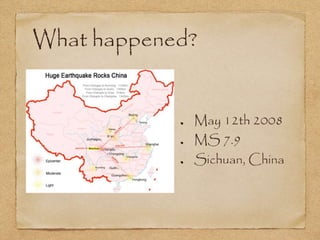
What happened?
May 12th 2008
MS 7.9
Sichuan, China
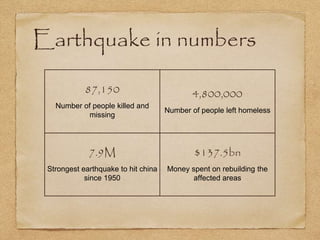
Earthquake in numbers
87,150
Number of people killed and
missing
4,800,000
Number of people left homeless
7.9M
Strongest earthquake to hit china
since 1950
$137.5bn
Money spent on rebuilding the
affected areas
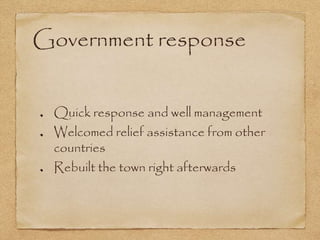
Government response
Quick response and well management
Welcomed relief assistance from other
countries
Rebuilt the town right afterwards
Arisen Problems
Many schools collapsed
Poor infrastructure ➡
Partly man-made disaster!?
<2>
Comparison of 2008 and 2013
Sichuan earthquake
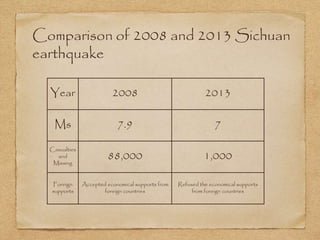
Comparison of 2008 and 2013 Sichuan
earthquake
Year 2008 2013
Ms 7.9 7
Casualties
and
Missing
88,000 1,000
Foreign
supports
Accepted economical supports from
foreign countries
Refused the economical supports
from foreign countries
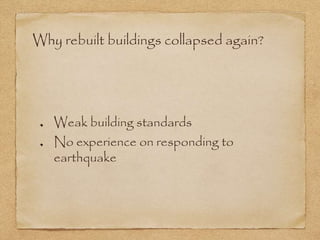
Why rebuilt buildings collapsed again?
Weak building standards
No experience on responding to
earthquake
<3>
Responses of Private Companies and
the Government
Responses of Private Companies and
the Government
Premier Wen entered the stricken area by
the day the earthquake occurred
However, Did not accept foreign
assistance until 72hours after the
earthquake
<4>
Summary and significance
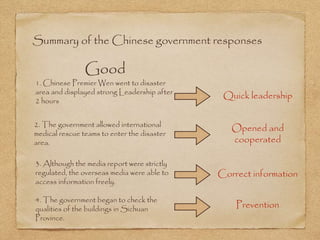
Summary of the Chinese government responses
Good
1. Chinese Premier Wen went to disaster
area and displayed strong Leadership after
2 hours
2. The government allowed international
medical rescue teams to enter the disaster
area.
3. Although the media report were strictly
regulated, the overseas media were able to
access information freely.
4. The government began to check the
qualities of the buildings in Sichuan
Province.
Quick leadership
Opened and
cooperated
Correct information
Prevention
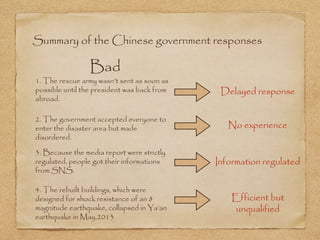
Summary of the Chinese government responses
Bad
1. The rescue army wasn’t sent as soon as
possible until the president was back from
abroad.
2. The government accepted everyone to
enter the disaster area but made
disordered.
3. Because the media report were strictly
regulated, people got their informations
from SNS.
4. The rebuilt buildings, which were
designed for shock resistance of an 8
magnitude earthquake, collapsed in Ya’an
earthquake in May,2013
Delayed response
No experience
Information regulated
Efficient but
unqualified
How the government act its leadership to
minimise damage after earthquake happened
The government should determine a single headquarters responsible for
command, control and coordination in emergency situation and centralise
the power to that single authority.
Encourage each citizen to be educated and trained in how to minimised
risks from earthquake-induced secondary effects.
All of the related agencies should formulate emergency plans and pass on
information regarding the emergency situation to the general public and
health professionals on a normal basis.
The government should check the problems and insufficiency after
disasters and make an improvement in the ability of anti-disaster.
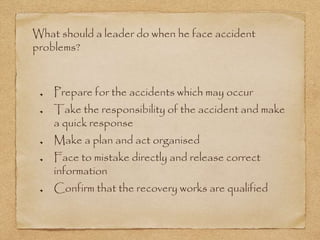
What should a leader do when he face accident
problems?
Prepare for the accidents which may occur
Take the responsibility of the accident and make
a quick response
Make a plan and act organised
Face to mistake directly and release correct
information
Confirm that the recovery works are qualified
References
China launches massive rescue after Sichuan earthquake: http://www.peoplesworld.org/china-
launches-massive-rescue-after-sichuan-earthquake/
Wenchuan Earthquake Maps: http://www.maps-of-china.net/wenchuan-earthquake-map/
Sichuan 2008: Adisaster on an immense scale: http://www.bbc.co.uk/news/science-environment-
22398684
Sichuan 2008: Rebuilding lives after the earthquake: http://www.bbc.co.uk/news/world-asia-china-
22476520
Yuki Otani(2011). Comparison of two large earthquakes: the 2008 Sichuan earthquake and the
2011 East Japan earthquake
宮入興一,沓掛俊夫,宮沢哲男,樋口義治(2011). 「四川大震災の総合的研究」. 豊橋 : 愛知大学中
部地方産業研究所(2011.3)

2008 sichuan earthquake

  • 1.
  • 2.
    Table of Contents 1.Introduction to Sichuan Earthquake 2. Comparison of 2008 and 2013 Sichuan earthquake 3. Responses of Private Companies and the Government 4. Summary and significance
  • 3.
  • 4.
    What happened? May 12th2008 MS 7.9 Sichuan, China
  • 5.
    Earthquake in numbers 87,150 Numberof people killed and missing 4,800,000 Number of people left homeless 7.9M Strongest earthquake to hit china since 1950 $137.5bn Money spent on rebuilding the affected areas
  • 6.
    Government response Quick responseand well management Welcomed relief assistance from other countries Rebuilt the town right afterwards
  • 7.
    Arisen Problems Many schoolscollapsed Poor infrastructure ➡ Partly man-made disaster!?
  • 8.
    <2> Comparison of 2008and 2013 Sichuan earthquake
  • 9.
    Comparison of 2008and 2013 Sichuan earthquake Year 2008 2013 Ms 7.9 7 Casualties and Missing 88,000 1,000 Foreign supports Accepted economical supports from foreign countries Refused the economical supports from foreign countries
  • 10.
    Why rebuilt buildingscollapsed again? Weak building standards No experience on responding to earthquake
  • 11.
    <3> Responses of PrivateCompanies and the Government
  • 12.
    Responses of PrivateCompanies and the Government Premier Wen entered the stricken area by the day the earthquake occurred However, Did not accept foreign assistance until 72hours after the earthquake
  • 13.
  • 14.
    Summary of theChinese government responses Good 1. Chinese Premier Wen went to disaster area and displayed strong Leadership after 2 hours 2. The government allowed international medical rescue teams to enter the disaster area. 3. Although the media report were strictly regulated, the overseas media were able to access information freely. 4. The government began to check the qualities of the buildings in Sichuan Province. Quick leadership Opened and cooperated Correct information Prevention
  • 15.
    Summary of theChinese government responses Bad 1. The rescue army wasn’t sent as soon as possible until the president was back from abroad. 2. The government accepted everyone to enter the disaster area but made disordered. 3. Because the media report were strictly regulated, people got their informations from SNS. 4. The rebuilt buildings, which were designed for shock resistance of an 8 magnitude earthquake, collapsed in Ya’an earthquake in May,2013 Delayed response No experience Information regulated Efficient but unqualified
  • 16.
    How the governmentact its leadership to minimise damage after earthquake happened The government should determine a single headquarters responsible for command, control and coordination in emergency situation and centralise the power to that single authority. Encourage each citizen to be educated and trained in how to minimised risks from earthquake-induced secondary effects. All of the related agencies should formulate emergency plans and pass on information regarding the emergency situation to the general public and health professionals on a normal basis. The government should check the problems and insufficiency after disasters and make an improvement in the ability of anti-disaster.
  • 17.
    What should aleader do when he face accident problems? Prepare for the accidents which may occur Take the responsibility of the accident and make a quick response Make a plan and act organised Face to mistake directly and release correct information Confirm that the recovery works are qualified
  • 18.
    References China launches massiverescue after Sichuan earthquake: http://www.peoplesworld.org/china- launches-massive-rescue-after-sichuan-earthquake/ Wenchuan Earthquake Maps: http://www.maps-of-china.net/wenchuan-earthquake-map/ Sichuan 2008: Adisaster on an immense scale: http://www.bbc.co.uk/news/science-environment- 22398684 Sichuan 2008: Rebuilding lives after the earthquake: http://www.bbc.co.uk/news/world-asia-china- 22476520 Yuki Otani(2011). Comparison of two large earthquakes: the 2008 Sichuan earthquake and the 2011 East Japan earthquake 宮入興一,沓掛俊夫,宮沢哲男,樋口義治(2011). 「四川大震災の総合的研究」. 豊橋 : 愛知大学中 部地方産業研究所(2011.3)