Entertainment, media and communications


Beyond the horizon*
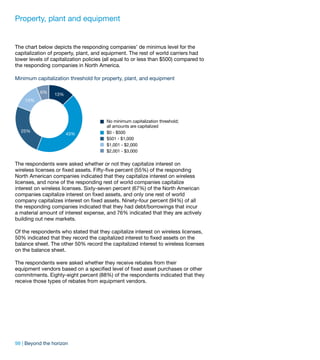
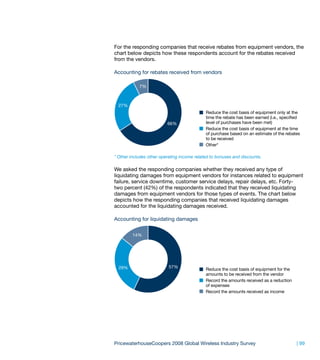
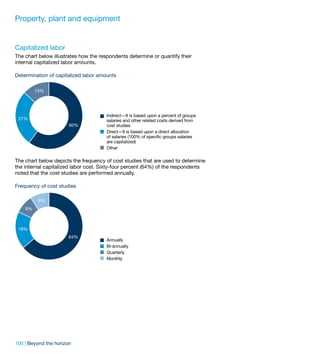
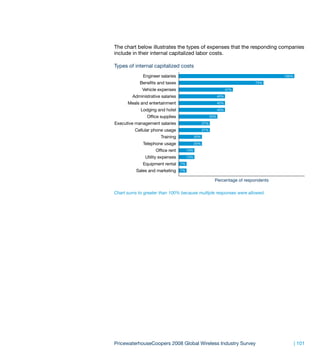
2008 Global Wireless Industry Survey
Introduction
The PricewaterhouseCoopers (PwC) 2008 Wireless Industry Survey was led
by Paul Rees, PwC’s Global Infocomm Leader and Pierre-Alain Sur, PwC’s US
wireless industry leader, and represents the efforts and ideas of many members
of our Entertainment, Media and Communications Industry group. The principal
contributors were: Shara Slattery, Sarah McWilliams, Rob Glasgow, Tom Leonard
Jr., Mackenzie Welch, Michael Riordan, Jamal Douglas, Kristen Lybrand, Taylor
Cloninger, Erik Hönig, Constantin Vogel, Brian Caisman, Timothy Schmitt, Tyler
Furness, Peter Osvaldik, Karen Plunkett, Dominic Wong, and Keri Dickey.

PwC would especially like to thank the companies that participated in and
contributed topics for the survey. Their candid responses and support of this
project are very much appreciated. Together we have created valuable insight
into the operations of and challenges faced by today’s wireless industry on a
global basis.


About this survey
The PricewaterhouseCoopers Wireless Industry Survey is an annual publication
that covers the financial and operational reporting policies and practices of
wireless telecommunications service providers. The 2008 survey includes
companies in the U.S., Canada, Europe, Asia-Pacific, and South America. The
survey is conducted by PwC’s Entertainment, Media and Communications
Industry group, which prepares the survey questions, solicits company
participation and compiles and analyzes the survey results. Companies participate
voluntarily and the individual survey results are kept confidential by PwC.

PwC has taken reasonable steps to ensure that the information contained in
this publication accurately summarizes the survey responses received from the
participating companies; however, PwC has not performed any procedures to
verify the accuracy of the survey responses. The survey provides a summary
of the participating companies’ financial and operational reporting policies and
practices and does not purport to render accounting guidance nor any other
type of professional advice. Should such advice be required, please contact your
local PricewaterhouseCoopers office.

You can access our worldwide office directory at www.pwc.com.
Contents


01
Executive summary


05
Participating company information


23
Revenue recognition


63
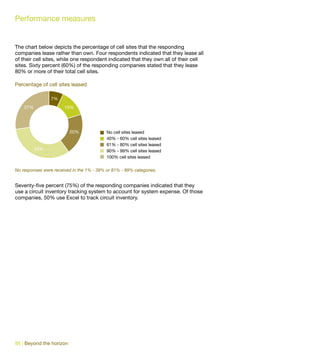
Performance measures


93
Property, plant and equipment


149
Legal and regulatory
Executive summary


We are pleased to publish the first annual
PricewaterhouseCoopers Global Wireless Industry Survey.
This survey is a continuation of the past 11 years of the North
American Survey and for 2008 has been expanded to include
global wireless operators. The expansion of the survey globally
also reflects the ever-growing importance of International
Financial Reporting Standards (IFRS) and the United States and
Canada adoption in the future of IFRS. The global survey will
provide the opportunity for carriers to compare and contrast
the two frameworks. This year’s survey begins to articulate
differences. The goal of the survey is to help companies
understand industry performance measures and their evolution
over time, policies and procedures utilized by responding
companies, and to help companies better understand the
comparability of financial statements within the industry. We
also have a goal of addressing general financial accounting
and reporting practices in the industry and identifying emerging
trends or issues.

The survey has become a resource for many wireless
communication industry executives and has evolved with
the changing businesses and trends of the industry. We have
provided a highlight of this year’s survey results in the executive
summary. We hope you find the 2008 PricewaterhouseCoopers
Global Wireless Industry Survey informative, pertinent,
and stimulating.


PricewaterhouseCoopers 2008 Global Wireless Industry Survey      |1
Executive summary


The 2008 survey results reflect the participation of nine U.S. companies, including
six of the largest wireless operators, plus four Canadian wireless companies
and five carriers in the rest of world. Because of the breadth of coverage and
participation, we believe that the survey provides the most representative
summary of industry accounting policies and practices available on a global basis.

In the 2007 North American Wireless Survey, and the surveys before that, we
examined wireless carriers in the U.S. and Canada only. This year, we expanded
our population of carriers and responding companies to include wireless carriers
from the rest of the world, outside of North America, including Asia, Europe and
South America. Although the responding carriers differ only slightly this year from
our last North American Survey, we highlighted important changes, if applicable
throughout the survey.

Here are a few highlights from this year’s results that covers 2007 year-end and
early 2008 metrics:


Revenue and performance measures
New products and features represent ongoing sources of additional revenue
growth for wireless carriers. Industry competition has continued to decrease
monthly rate plans while minutes of use continue to increase to an average of
628 minutes used per month. Recently, many of the North American carriers
began offering all-inclusive packages to increase data usage. Data services—
including SMS, picture, ring tones, e-mail services and games—continue to
increase revenue for the responding companies. On average, data revenue
increased by more than 50% for all responding companies on a year over year
basis. The industry defines data users by several different methods ranging
from daily data use to all subscribers if data technology exists on the handset.
In addition, prepaid plans continue to be a significant portion of revenue,
representing on average 26.8% of total service revenue.

We asked survey respondents how they define minutes of use (MOU) and 61%
define MOU as billed minutes (whether included as part of the customer’s plan
or additional non-packaged minutes billed). Roaming revenue for the responding
companies represents an average of five percent (5%) of total service revenue
while long distance revenue represents six percent (6%) of total service revenue.
Advertising of products and services represents a significant expense for
most responding carriers. The average advertising cost per gross addition for
companies with revenue greater than $5.0 billion is $82.50, and for companies
with less than $5.0 billion in revenue it is $65.75. Advertising dollars are mostly
spent for television spots (34%), newspaper (13%), other printed media (12%),
and radio (11%).


2 | Beyond the horizon
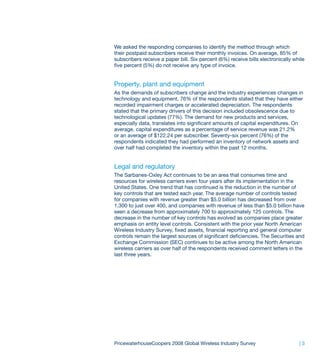
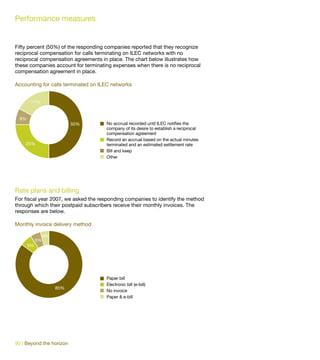
We asked the responding companies to identify the method through which
their postpaid subscribers receive their monthly invoices. On average, 85% of
subscribers receive a paper bill. Six percent (6%) receive bills electronically while
five percent (5%) do not receive any type of invoice.


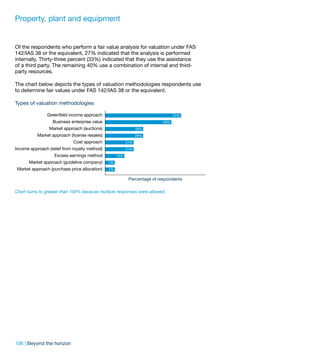
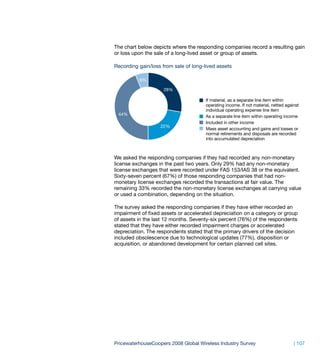
Property, plant and equipment
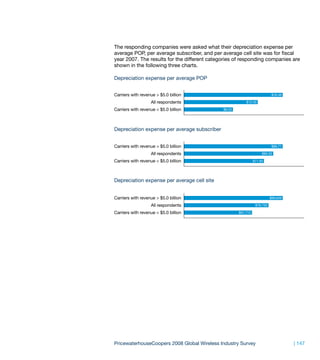
As the demands of subscribers change and the industry experiences changes in
technology and equipment, 76% of the respondents stated that they have either
recorded impairment charges or accelerated depreciation. The respondents
stated that the primary drivers of this decision included obsolescence due to
technological updates (77%). The demand for new products and services,
especially data, translates into significant amounts of capital expenditures. On
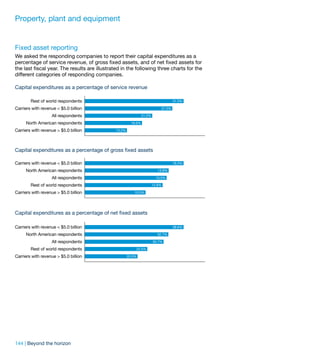
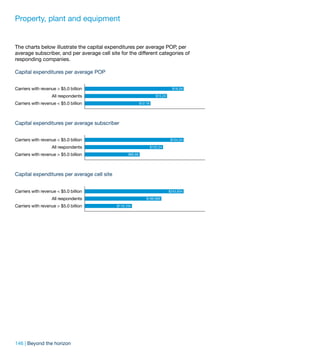
average, capital expenditures as a percentage of service revenue was 21.2%
or an average of $122.24 per subscriber. Seventy-six percent (76%) of the
respondents indicated they had performed an inventory of network assets and
over half had completed the inventory within the past 12 months.


Legal and regulatory
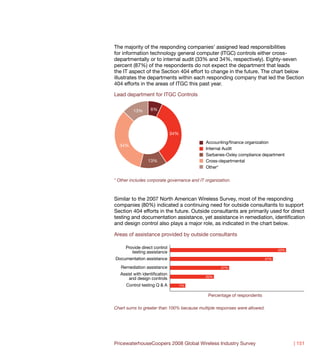
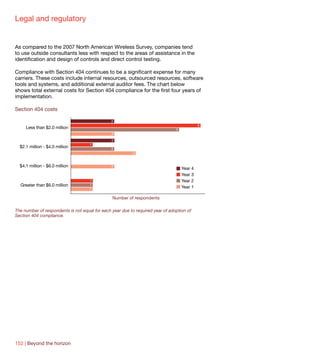
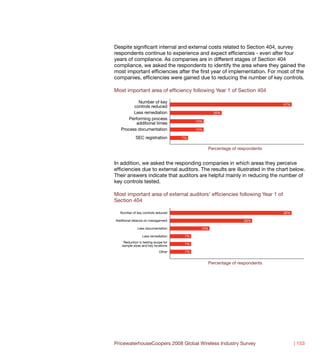
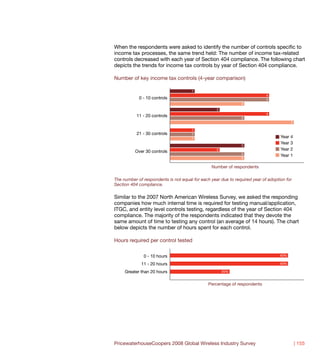
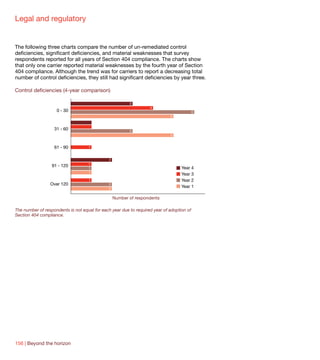
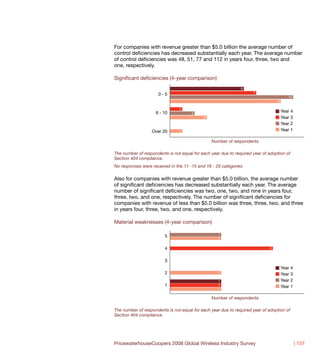
The Sarbanes-Oxley Act continues to be an area that consumes time and
resources for wireless carriers even four years after its implementation in the
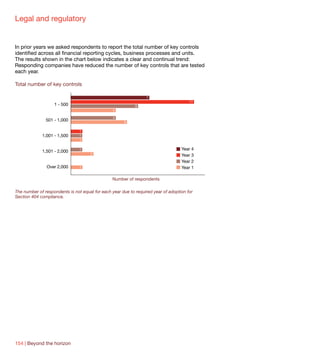
United States. One trend that has continued is the reduction in the number of
key controls that are tested each year. The average number of controls tested
for companies with revenue greater than $5.0 billion has decreased from over
1,300 to just over 400, and companies with revenue of less than $5.0 billion have
seen a decrease from approximately 700 to approximately 125 controls. The
decrease in the number of key controls has evolved as companies place greater
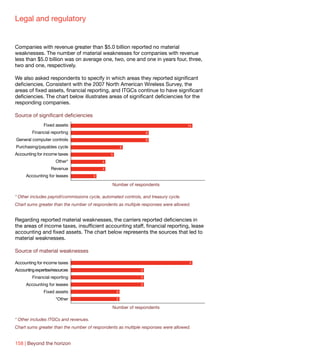
emphasis on entity level controls. Consistent with the prior year North American
Wireless Industry Survey, fixed assets, financial reporting and general computer
controls remain the largest sources of significant deficiencies. The Securities and
Exchange Commission (SEC) continues to be active among the North American
wireless carriers as over half of the respondents received comment letters in the
last three years.


PricewaterhouseCoopers 2008 Global Wireless Industry Survey                       |3
Participating
company information


The 2008 Global Wireless Industry Survey results
represent nine United States, four Canadian and five
rest of world wireless companies. The following pages
provide the demographics and general corporate data
and structure of the responding carriers.

Names of participating companies

Company type and subscriber base

Annual service revenue

Employee base

Sales locations

Customer care

Licensed spectrum

Environmental sustainability


PricewaterhouseCoopers 2008 Global Wireless Industry Survey   |5
Participating company information


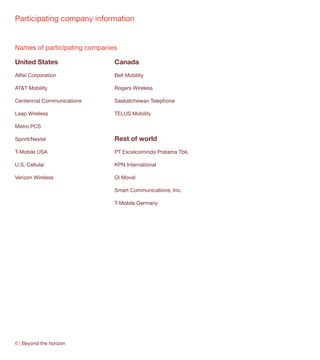
Names of participating companies

United States                  Canada
Alltel Corporation             Bell Mobility

AT&T Mobility                  Rogers Wireless

Centennial Communications      Saskatchewan Telephone

Leap Wireless                  TELUS Mobility

Metro PCS

Sprint/Nextel                  Rest of world
T-Mobile USA                   PT Excelcomindo Pratama Tbk.

U.S. Cellular                  KPN International

Verizon Wireless               Oi Movel

                               Smart Communications, Inc.

                               T-Mobile Germany


6 | Beyond the horizon
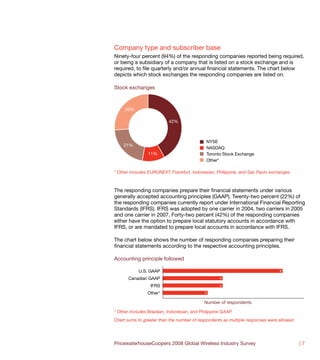
Company type and subscriber base
Ninety-four percent (94%) of the responding companies reported being required,
or being a subsidiary of a company that is listed on a stock exchange and is
required, to file quarterly and/or annual financial statements. The chart below
depicts which stock exchanges the responding companies are listed on.

Stock exchanges


     26%

                           42%


                                              NYSE
    21%
                                              NASDAQ
                 11%                          Toronto Stock Exchange
                                              Other*

* Other includes EURONEXT, Frankfurt, Indonesian, Philippine, and Sao Paulo exchanges.


The responding companies prepare their financial statements under various
generally accepted accounting principles (GAAP). Twenty-two percent (22%) of
the responding companies currently report under International Financial Reporting
Standards (IFRS). IFRS was adopted by one carrier in 2004, two carriers in 2005
and one carrier in 2007. Forty-two percent (42%) of the responding companies
either have the option to prepare local statutory accounts in accordance with
IFRS, or are mandated to prepare local accounts in accordance with IFRS.

The chart below shows the number of responding companies preparing their
financial statements according to the respective accounting principles.

Accounting principle followed

            U.S. GAAP                                                           8

       Canadian GAAP                                 4

                  IFRS                               4

                Other*                       3

                                             Number of respondents

* Other Includes Brazilian, Indonesian, and Philippine GAAP.
Chart sums to greater than the number of respondents as multiple responses were allowed.


PricewaterhouseCoopers 2008 Global Wireless Industry Survey                                |7
Participating company information


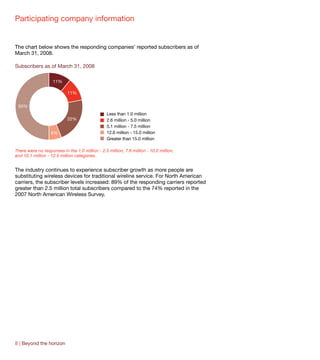
The chart below shows the responding companies’ reported subscribers as of
March 31, 2008.

Subscribers as of March 31, 2008

                    11%

                            11%


 50%
                                                 Less than 1.0 million
                            22%                  2.6 million - 5.0 million
                                                 5.1 million - 7.5 million
                   6%                            12.6 million - 15.0 million
                                                 Greater than 15.0 million

There were no responses in the 1.0 million - 2.5 million, 7.6 million - 10.0 million,
and 10.1 million - 12.5 million categories.


The industry continues to experience subscriber growth as more people are
substituting wireless devices for traditional wireline service. For North American
carriers, the subscriber levels increased: 89% of the responding carriers reported
greater than 2.5 million total subscribers compared to the 74% reported in the
2007 North American Wireless Survey.


8 | Beyond the horizon
Annual service revenue
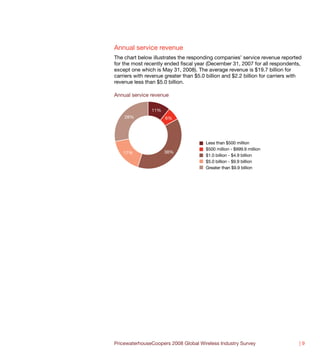
The chart below illustrates the responding companies’ service revenue reported
for the most recently ended fiscal year (December 31, 2007 for all respondents,
except one which is May 31, 2008). The average revenue is $19.7 billion for
carriers with revenue greater than $5.0 billion and $2.2 billion for carriers with
revenue less than $5.0 billion.

Annual service revenue

                11%
    28%               6%


                                        Less than $500 million
                                        $500 million - $999.9 million
    17%               38%
                                        $1.0 billion - $4.9 billion
                                        $5.0 billion - $9.9 billion
                                        Greater than $9.9 billion


PricewaterhouseCoopers 2008 Global Wireless Industry Survey                      |9
Participating company information


Employee base
Seventy-eight percent (78%) of the responding companies reported operating
their company on a centralized basis (a single headquarters location that
completes the accounting/finance function for the entire organization), as opposed
to a decentralized basis (multiple business units or segments that have separate
accounting/finance functions that are consolidated by a headquarters office).

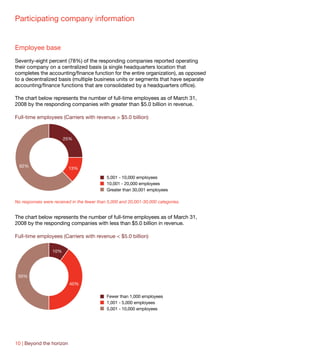
The chart below represents the number of full-time employees as of March 31,
2008 by the responding companies with greater than $5.0 billion in revenue.

Full-time employees (Carriers with revenue > $5.0 billion)


                        25%


  62%
                          13%

                                            5,001 - 10,000 employees
                                            10,001 - 20,000 employees
                                            Greater than 30,001 employees

No responses were received in the fewer than 5,000 and 20,001-30,000 categories.


The chart below represents the number of full-time employees as of March 31,
2008 by the responding companies with less than $5.0 billion in revenue.

Full-time employees (Carriers with revenue < $5.0 billion)

                  10%


 50%
                          40%

                                            Fewer than 1,000 employees
                                            1,001 - 5,000 employees
                                            5,001 - 10,000 employees


10 | Beyond the horizon
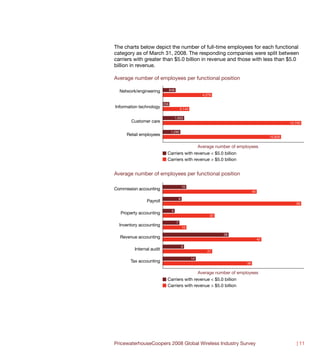
The charts below depict the number of full-time employees for each functional
category as of March 31, 2008. The responding companies were split between
carriers with greater than $5.0 billion in revenue and those with less than $5.0
billion in revenue.

Average number of employees per functional position

  Network/engineering           848
                                                          4,279

                          256
Information technology                    2,144

                                      1,653
       Customer care                                                                                  12,750

                                 1,295
     Retail employees                                                                        10,826

                                                        Average number of employees
                            Carriers with revenue < $5.0 billion
                            Carriers with revenue > $5.0 billion


Average number of employees per functional position

                                              10
Commission accounting
                                                                                   40

                                          8
               Payroll
                                                                                                         59

                                 5
  Property accounting
                                                              22

                                      7
  Inventory accounting                        10

                                                                   28
  Revenue accounting                                                                    42

                                              9
         Internal audit                                     21

                                                   14
       Tax accounting                                                         38

                                                        Average number of employees
                            Carriers with revenue < $5.0 billion
                            Carriers with revenue > $5.0 billion


PricewaterhouseCoopers 2008 Global Wireless Industry Survey                                              | 11
Participating company information


Sales locations
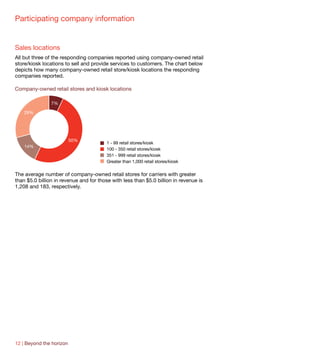
All but three of the responding companies reported using company-owned retail
store/kiosk locations to sell and provide services to customers. The chart below
depicts how many company-owned retail store/kiosk locations the responding
companies reported.

Company-owned retail stores and kiosk locations

                7%

    29%


                          50%
                                         1 - 99 retail stores/kiosk
    14%
                                         100 - 350 retail stores/kiosk
                                         351 - 999 retail stores/kiosk
                                         Greater than 1,000 retail stores/kiosk

The average number of company-owned retail stores for carriers with greater
than $5.0 billion in revenue and for those with less than $5.0 billion in revenue is
1,208 and 183, respectively.


12 | Beyond the horizon
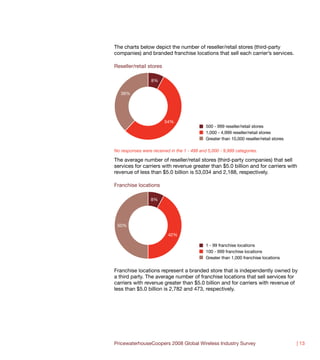
The charts below depict the number of reseller/retail stores (third-party
companies) and branded franchise locations that sell each carrier’s services.

Reseller/retail stores

                  8%

   38%


                         54%
                                             500 - 999 reseller/retail stores
                                             1,000 - 4,999 reseller/retail stores
                                             Greater than 10,000 reseller/retail stores

No responses were received in the 1 - 499 and 5,000 - 9,999 categories.

The average number of reseller/retail stores (third-party companies) that sell
services for carriers with revenue greater than $5.0 billion and for carriers with
revenue of less than $5.0 billion is 53,034 and 2,188, respectively.

Franchise locations

                  8%


 50%

                          42%

                                             1 - 99 franchise locations
                                             100 - 999 franchise locations
                                             Greater than 1,000 franchise locations

Franchise locations represent a branded store that is independently owned by
a third party. The average number of franchise locations that sell services for
carriers with revenue greater than $5.0 billion and for carriers with revenue of
less than $5.0 billion is 2,782 and 473, respectively.


PricewaterhouseCoopers 2008 Global Wireless Industry Survey                               | 13
Participating company information


Customer care
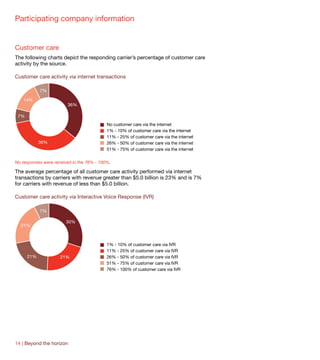
The following charts depict the responding carrier’s percentage of customer care
activity by the source.

Customer care activity via internet transactions

            7%

    14%
                        36%

 7%
                                           No customer care via the internet
                                           1% - 10% of customer care via the internet
                                           11% - 25% of customer care via the internet
            36%                            26% - 50% of customer care via the internet
                                           51% - 75% of customer care via the internet

No responses were received in the 76% - 100%.

The average percentage of all customer care activity performed via internet
transactions by carriers with revenue greater than $5.0 billion is 23% and is 7%
for carriers with revenue of less than $5.0 billion.

Customer care activity via Interactive Voice Response (IVR)

            7%

                        30%
  21%


                                           1% - 10% of customer care via IVR
                                           11% - 25% of customer care via IVR
      21%            21%                   26% - 50% of customer care via IVR
                                           51% - 75% of customer care via IVR
                                           76% - 100% of customer care via IVR


14 | Beyond the horizon
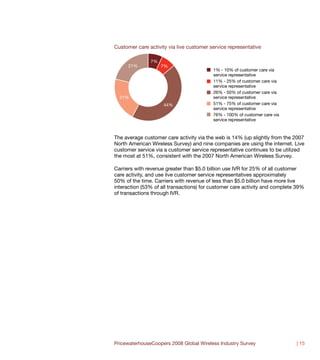
Customer care activity via live customer service representative

               7%
      21%           7%
                                          1% - 10% of customer care via
                                          service representative
                                          11% - 25% of customer care via
                                          service representative
                                          26% - 50% of customer care via
  21%                                     service representative
                     44%                  51% - 75% of customer care via
                                          service representative
                                          76% - 100% of customer care via
                                          service representative


The average customer care activity via the web is 14% (up slightly from the 2007
North American Wireless Survey) and nine companies are using the internet. Live
customer service via a customer service representative continues to be utilized
the most at 51%, consistent with the 2007 North American Wireless Survey.

Carriers with revenue greater than $5.0 billion use IVR for 25% of all customer
care activity, and use live customer service representatives approximately
50% of the time. Carriers with revenue of less than $5.0 billion have more live
interaction (53% of all transactions) for customer care activity and complete 39%
of transactions through IVR.


PricewaterhouseCoopers 2008 Global Wireless Industry Survey                  | 15
Participating company information


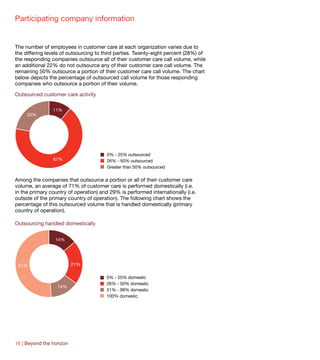
The number of employees in customer care at each organization varies due to
the differing levels of outsourcing to third parties. Twenty-eight percent (28%) of
the responding companies outsource all of their customer care call volume, while
an additional 22% do not outsource any of their customer care call volume. The
remaining 50% outsource a portion of their customer care call volume. The chart
below depicts the percentage of outsourced call volume for those responding
companies who outsource a portion of their volume.

Outsourced customer care activity

                11%
     22%


                                        0% - 25% outsourced
                67%                     26% - 50% outsourced
                                        Greater than 50% outsourced

Among the companies that outsource a portion or all of their customer care
volume, an average of 71% of customer care is performed domestically (i.e.
in the primary country of operation) and 29% is performed internationally (i.e.
outside of the primary country of operation). The following chart shows the
percentage of this outsourced volume that is handled domestically (primary
country of operation).

Outsourcing handled domestically


                 14%


 51%                      21%

                                        0% - 25% domestic
                                        26% - 50% domestic
                  14%
                                        51% - 99% domestic
                                        100% domestic


16 | Beyond the horizon
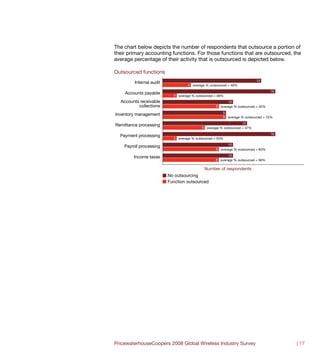
The chart below depicts the number of respondents that outsource a portion of
their primary accounting functions. For those functions that are outsourced, the
average percentage of their activity that is outsourced is depicted below.

Outsourced functions
                                                                          14
         Internal audit
                                   4 average % outsourced = 49%
                                                                                  16
    Accounts payable
                            2 average % outsourced = 48%
  Accounts receivable                                     10
          collections                              8 average % outsourced = 42%
                                                       9
Inventory management
                                                       9 average % outsourced = 75%
                                                                  12
Remittance processing
                                           6 average % outsourced = 47%
                                                                                  16
  Payment processing
                            2 average % outsourced = 53%
                                                          10
    Payroll processing
                                                   8 average % outsourced = 60%

        Income taxes                                      10
                                                   8 average % outsourced = 56%

                                             Number of respondents
                          No outsourcing
                          Function outsourced


PricewaterhouseCoopers 2008 Global Wireless Industry Survey                            | 17
Participating company information


Licensed spectrum
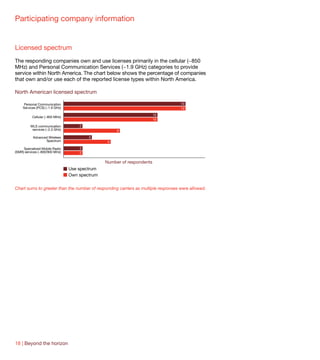
The responding companies own and use licenses primarily in the cellular (~850
MHz) and Personal Communication Services (~1.9 GHz) categories to provide
service within North America. The chart below shows the percentage of companies
that own and/or use each of the reported license types within North America.

North American licensed spectrum

     Personal Communication                                                        13
    Services (PCS) (~1.9 GHz)                                                      13
                                                                       10
          Cellular (~850 MHz)
                                                                       10

         WLS communication          2
          services (~2.3 GHz)                       6

           Advanced Wireless            3
                  Spectrum                      5

     Specialized Mobile Radio       2
(SMR) services (~800/900 MHz)       2

                                               Number of respondents
                                Use spectrum
                                Own spectrum


Chart sums to greater than the number of responding carriers as multiple responses were allowed.


18 | Beyond the horizon
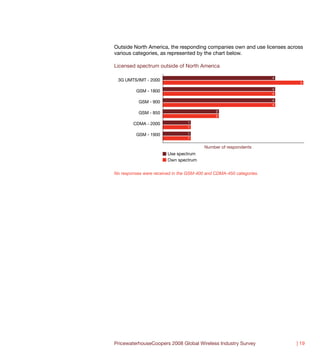
Outside North America, the responding companies own and use licenses across
various categories, as represented by the chart below.

Licensed spectrum outside of North America

                                                                     4
 3G UMTS/IMT - 2000
                                                                          5
                                                                     4
          GSM - 1800
                                                                     4
                                                                     4
           GSM - 900
                                                                     4

           GSM - 850                          2
                                              2

        CDMA - 2000              1
                                 1

          GSM - 1900             1
                                 1

                                         Number of respondents
                        Use spectrum
                        Own spectrum


No responses were received in the GSM-400 and CDMA-450 categories.


PricewaterhouseCoopers 2008 Global Wireless Industry Survey              | 19
Participating company information


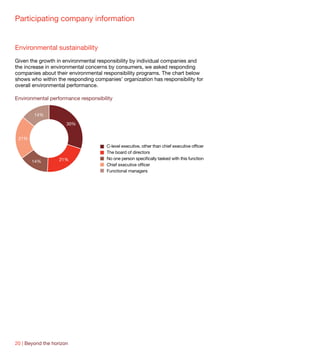
Environmental sustainability
Given the growth in environmental responsibility by individual companies and
the increase in environmental concerns by consumers, we asked responding
companies about their environmental responsibility programs. The chart below
shows who within the responding companies’ organization has responsibility for
overall environmental performance.

Environmental performance responsibility


        14%

                      30%


 21%
                                      C-level executive, other than chief executive officer
                                      The board of directors
                   21%                No one person specifically tasked with this function
       14%
                                      Chief executive officer
                                      Functional managers


20 | Beyond the horizon
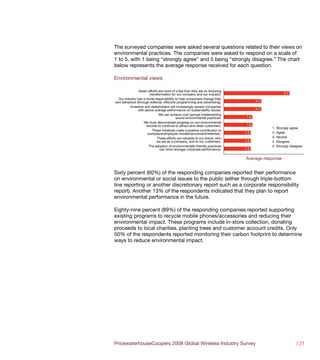
The surveyed companies were asked several questions related to their views on
environmental practices. The companies were asked to respond on a scale of
1 to 5, with 1 being “strongly agree” and 5 being “strongly disagree.” The chart
below represents the average response received for each question.

Environmental views

                Green efforts are more of a fad than they are an enduring
                        transformation for our company and our industry.                            3.7
  Our industry has a moral responsibility to help consumers change their
own behaviors (through editorial, effective programming and advertising).            2.1
          Investors and stakeholders will increasingly reward companies
               with above average performance on sustainability issues.              2.1
                              We can achieve cost savings implementing
                                           sound environmental practices.      1.6
                   We must demonstrate progress on our environmental
                     records to continue to attract and retain customers.      1.6
                                                                                           1.   Strongly agree
                          These initiatives make a positive contribution to
                      workplace/employee morale/recruitment/retention.        1.5          2.   Agree
                             These efforts are valuable to our brand, who                  3.   Neutral
                             we are as a company, and to our customers.       1.5          4.   Disagree
                       The adoption of environmentally friendly practices                  5.   Strongly disagree
                               can drive stronger corporate performance.      1.5


                                                                              Average response


Sixty percent (60%) of the responding companies reported their performance
on environmental or social issues to the public (either through triple-bottom
line reporting or another discretionary report such as a corporate responsibility
report). Another 13% of the respondents indicated that they plan to report
environmental performance in the future.

Eighty-nine percent (89%) of the responding companies reported supporting
existing programs to recycle mobile phones/accessories and reducing their
environmental impact. These programs include in-store collection, donating
proceeds to local charities, planting trees and customer account credits. Only
50% of the respondents reported monitoring their carbon footprint to determine
ways to reduce environmental impact.


PricewaterhouseCoopers 2008 Global Wireless Industry Survey                                                  | 21
Revenue recognition


The following pages cover wireless company
practices in the area of revenue recognition.

Service contracts and family plans

Termination fees and bad debt expense

Prepaid

Data services

Mobile advertising

Wi-Fi data services

Customer retention

Sales incentives

Market development funds and rebates

Other revenue activities

Revenue assurance

Customer billing and payments

Handset insurance

All-inclusive packages


PricewaterhouseCoopers 2008 Global Wireless Industry Survey   | 23
Revenue recognition


Service contracts and family plans
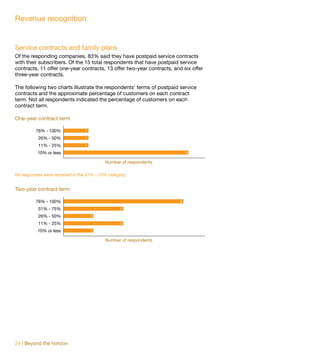
Of the responding companies, 83% said they have postpaid service contracts
with their subscribers. Of the 15 total respondents that have postpaid service
contracts, 11 offer one-year contracts, 13 offer two-year contracts, and six offer
three-year contracts.

The following two charts illustrate the respondents’ terms of postpaid service
contracts and the approximate percentage of customers on each contract
term. Not all respondents indicated the percentage of customers on each
contract term.

One-year contract term

         76% - 100%              1

           26% - 50%             1

           11% - 25%             1

          10% or less                                                       5

                                          Number of respondents

No responses were received in the 51% - 75% category.


Two-year contract term

         76% - 100%                                                     4

           51% - 75%                              2

           26% - 50%                 1

           11% - 25%                              2

          10% or less                1

                                          Number of respondents


24 | Beyond the horizon
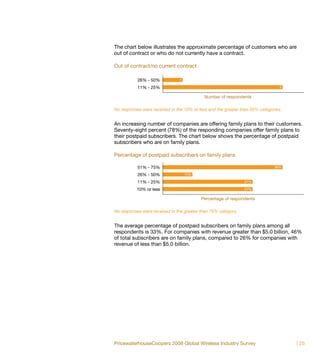
The chart below illustrates the approximate percentage of customers who are
out of contract or who do not currently have a contract.

Out of contract/no current contract

           26% - 50%            1

           11% - 25%                                                             6

                                            Number of respondents

No responses were received in the 10% or less and the greater than 50% categories.


An increasing number of companies are offering family plans to their customers.
Seventy-eight percent (78%) of the responding companies offer family plans to
their postpaid subscribers. The chart below shows the percentage of postpaid
subscribers who are on family plans.

Percentage of postpaid subscribers on family plans

           51% - 75%                                                          36%

           26% - 50%                10%

           11% - 25%                                           27%

           10% or less                                         27%

                                          Percentage of respondents

No responses were received in the greater than 75% category.


The average percentage of postpaid subscribers on family plans among all
respondents is 33%. For companies with revenue greater than $5.0 billion, 46%
of total subscribers are on family plans, compared to 26% for companies with
revenue of less than $5.0 billion.


PricewaterhouseCoopers 2008 Global Wireless Industry Survey                          | 25
Revenue recognition


Of the responding companies that offer family plans, 43% indicated that family
plans average two subscribers per plan and 50% indicated that family plans
average three subscribers per plan. The remaining seven percent indicated an
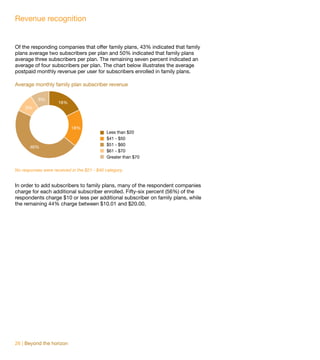
average of four subscribers per plan. The chart below illustrates the average
postpaid monthly revenue per user for subscribers enrolled in family plans.

Average monthly family plan subscriber revenue

           9%
                     18%
     9%


                           18%
                                            Less than $20
                                            $41 - $50
                                            $51 - $60
       46%
                                            $61 - $70
                                            Greater than $70

No responses were received in the $21 - $40 category.


In order to add subscribers to family plans, many of the respondent companies
charge for each additional subscriber enrolled. Fifty-six percent (56%) of the
respondents charge $10 or less per additional subscriber on family plans, while
the remaining 44% charge between $10.01 and $20.00.


26 | Beyond the horizon
Termination fees and bad debt expense
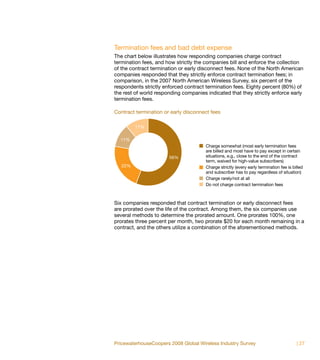
The chart below illustrates how responding companies charge contract
termination fees, and how strictly the companies bill and enforce the collection
of the contract termination or early disconnect fees. None of the North American
companies responded that they strictly enforce contract termination fees; in
comparison, in the 2007 North American Wireless Survey, six percent of the
respondents strictly enforced contract termination fees. Eighty percent (80%) of
the rest of world responding companies indicated that they strictly enforce early
termination fees.

Contract termination or early disconnect fees

         11%

  11%
                                       Charge somewhat (most early termination fees
                                       are billed and most have to pay except in certain
                       56%             situations, e.g., close to the end of the contract
                                       term, waived for high-value subscribers)
   22%                                 Charge strictly (every early termination fee is billed
                                       and subscriber has to pay regardless of situation)
                                       Charge rarely/not at all
                                       Do not charge contract termination fees


Six companies responded that contract termination or early disconnect fees
are prorated over the life of the contract. Among them, the six companies use
several methods to determine the prorated amount. One prorates 100%, one
prorates three percent per month, two prorate $20 for each month remaining in a
contract, and the others utilize a combination of the aforementioned methods.


PricewaterhouseCoopers 2008 Global Wireless Industry Survey                              | 27
Revenue recognition


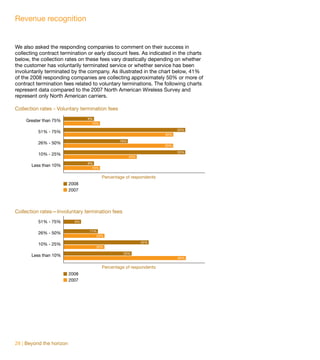
We also asked the responding companies to comment on their success in
collecting contract termination or early discount fees. As indicated in the charts
below, the collection rates on these fees vary drastically depending on whether
the customer has voluntarily terminated service or whether service has been
involuntarily terminated by the company. As illustrated in the chart below, 41%
of the 2008 responding companies are collecting approximately 50% or more of
contract termination fees related to voluntary terminations. The following charts
represent data compared to the 2007 North American Wireless Survey and
represent only North American carriers.

Collection rates - Voluntary termination fees
                                 8%
    Greater than 75%
                                   10%
                                                                           33%
          51% - 75%
                                                                     30%
                                                 18%
          26% - 50%
                                                                     30%
                                                                           33%
          10% - 25%
                                                       20%
                                 8%
       Less than 10%
                                   10%

                                         Percentage of respondents
                          2008
                          2007


Collection rates—Involuntary termination fees
          51% - 75%         8%

                                 17%
          26% - 50%
                                    20%
                                                             42%
          10% - 25%
                                    20%
                                                   33%
       Less than 10%
                                                                           60%

                                         Percentage of respondents
                          2008
                          2007


28 | Beyond the horizon
The responding companies use several different methods to record bad
debt expense related to termination fees. The following chart illustrates what
percentage of companies uses each type of method identified.

Revenue recognition of contract termination or early disconnect fees

                                           Recognize no revenue until amount billed is
                                           collected (no bad debt expense is ever recorded);
           8%                              represents reporting revenue on a cash basis
                         25%               Record 100% of billed termination fee as service
                                           revenue and record bad debt expense (through
                                           the company’s allowance method); represents
                                           gross reporting of revenue
                                           Record as revenue only the portion of the billed
                           8%              termination fee that is expected to be collected and
                                           record any additional bad debt expense against
                                           this amount; represents net reporting of revenue
     59%
                                           Termination fee is recorded as fully reserved for
                                           bad debt; any collections on this are treated as
                                           recoveries that reduce bad debt expense


The following chart illustrates the bad debt expense related to postpaid
receivables as a percentage of total postpaid revenues.
Postpaid bad debt expense

         1.00% or less                                            29%

       1.01% - 2.00%                                                           36%

       2.01% - 3.00%                                  21%

       3.01% - 4.00%            7%

  Greater than 10.00%           7%

                                         Percentage of respondents

No responses were received in the 4.01% to 10% category.


For companies with revenue greater than $5.0 billion, the average postpaid bad
debt expense as a percentage of postpaid revenue was 2.23%. For companies
with revenue of less than $5.0 billion, average bad debt expense as a percentage
of postpaid revenue was 2.54%.


PricewaterhouseCoopers 2008 Global Wireless Industry Survey                                | 29
Revenue recognition


Prepaid
Of the responding companies, 100% offer customers the opportunity to pay
for service in advance. The following chart illustrates the percentage of the
responding companies’ total subscribers that are prepaid subscribers.

Percentage of prepaid subscribers

     Greater than 75%                                                  5

             51% - 75%                     2

             11% - 25%                                                       6

            10% or less                                                5

                                               Number of respondents

No responses were received in the 26% - 50% category.


The following chart indicates the average percentage of prepaid subscribers as a
percentage of total subscribers.

Average percentage of prepaid subscribers

   Rest of world respondents                                               78.2%
       Carriers with revenue
                < $5.0 billion                              53.2%

             All respondents                       39.7%

 North American respondents         24.8%
       Carriers with revenue
                > $5.0 billion     22.8%


30 | Beyond the horizon
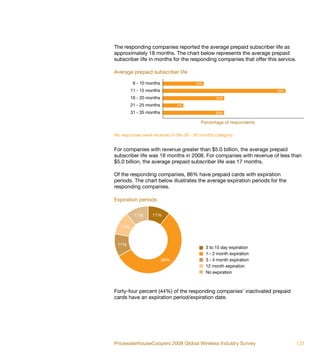
The responding companies reported the average prepaid subscriber life as
approximately 18 months. The chart below represents the average prepaid
subscriber life in months for the responding companies that offer this service.

Average prepaid subscriber life

          6 - 10 months                13%

         11 - 15 months                                                40%

         16 - 20 months                           20%

         21 - 25 months         7%

         31 - 35 months                           20%

                                          Percentage of respondents

No responses were received in the 26 - 30 months category.


For companies with revenue greater than $5.0 billion, the average prepaid
subscriber life was 18 months in 2008. For companies with revenue of less than
$5.0 billion, the average prepaid subscriber life was 17 months.

Of the responding companies, 86% have prepaid cards with expiration
periods. The chart below illustrates the average expiration periods for the
responding companies.

Expiration periods

          11%      11%

   11%


 11%
                                             3 to 15 day expiration
                                             1 - 2 month expiration
                          56%                3 - 4 month expiration
                                             12 month expiration
                                             No expiration


Forty-four percent (44%) of the responding companies’ inactivated prepaid
cards have an expiration period/expiration date.


PricewaterhouseCoopers 2008 Global Wireless Industry Survey                       | 31
Revenue recognition


The chart below illustrates the average monthly minutes of use (MOU) per
prepaid subscriber for the responding companies. The average minutes of use
per month for all the responding companies were 343.

Average monthly MOU per prepaid subscriber
Less than 100 minutes                                             27%

    100 - 250 minutes                                             27%

    251 - 500 minutes                                             27%

    501 - 750 minutes        7%

   751 - 1,000 minutes                 12%

                                   Percentage of respondents


Companies with revenue greater than $5.0 billion reported average prepaid MOU
of 387 minutes, and companies with revenue of less than $5.0 billion reported
average prepaid MOU of 292.


32 | Beyond the horizon
The following charts represent prepaid revenues as a percentage of total
revenues, both for the responding companies in total and by categories
of respondents.

Prepaid revenue as a percentage of total revenues

           81% - 100%                        3

             51% - 70%              2

             11% - 20%              2

              6% - 10%                       3

              5% or less                                                    8

                                             Number of respondents

No responses were received in the 21% - 50% and 71% - 80% categories.


Average prepaid revenue as a percentage of total revenues by category
of respondents

   Rest of world respondents                                            49.4%
       Carriers with revenue
                < $5.0 billion                                 38.3%

             All respondents                      26.8%

 North American respondents              18.2%
       Carriers with revenue     12.5%
                > $5.0 billion


Four of the 18 responding companies offer family plans to their prepaid
subscribers.


PricewaterhouseCoopers 2008 Global Wireless Industry Survey                     | 33
Revenue recognition


Data services
Data services continue to be an area of focus, as most responding companies
are seeking opportunities to grow revenue. The responding companies use
several different methods to define users of data services. The following chart
illustrates what percentage of the responding companies uses each type of
method identified.

Definition of user of data services

                 7%
    27%

                                       Use of data services on a daily basis
                                       Use of data services on a monthly basis
                                       Use of data services at least once in a
                          46%          12 month period
   13%                                 Other
          7%                           All subscribers, regardless of usage are defined
                                       as data subscribers if the technology exists on
                                       the handset


We asked the responding companies what percentage of their data revenue
is generated from stand-alone data services versus combined voice and
data bundled packages. The chart below illustrates that the majority of the
respondents (54%) indicated that more than 50% of their data revenue is from
stand-alone data services.
Data revenue generated from stand-alone data service


                       31%
  39%


                                       Less than 26%
                      15%              26% - 50%
           15%                         51% - 75%
                                       Greater than 75%


Twenty-eight percent (28%) of the respondents have implemented e-wallet (the
ability to make purchases through the mobile phone).


34 | Beyond the horizon
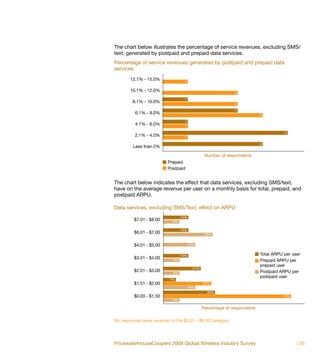
The chart below illustrates the percentage of service revenues, excluding SMS/
text, generated by postpaid and prepaid data services.
Percentage of service revenues generated by postpaid and prepaid data
services
       12.1% - 15.0%               1

       10.1% - 12.0%                                          3
                                   1
         8.1% - 10.0%                                         3
                                                              3
          6.1% - 8.0%                                                      4
                                   1
          4.1% - 6.0%              1
                                                                                      5
          2.1% - 4.0%              1
                                                                           4
         Less than 2%

                                                Number of respondents
                          Prepaid
                          Postpaid


The chart below indicates the effect that data services, excluding SMS/text,
have on the average revenue per user on a monthly basis for total, prepaid, and
postpaid ARPU.

Data services, excluding SMS/Text, effect on ARPU
                                  14%
         $7.01 - $8.00       9%

                                  14%
         $6.01 - $7.00                          28%


         $4.01 - $5.00                 18%


                                  14%                                      Total ARPU per user
         $3.01 - $4.00       9%                                            Prepaid ARPU per
                                                                           prepaid user
                                         21%
         $2.01 - $3.00       9%                                            Postpaid ARPU per
                                                                           postpaid user
                           7%
         $1.51 - $2.00                         27%
                                       18%
                                                 30%
         $0.00 - $1.50                                                               73%
                             9%

                                               Percentage of respondents

No responses were received in the $5.01 - $6.00 category.


PricewaterhouseCoopers 2008 Global Wireless Industry Survey                                 | 35
Revenue recognition


Fifty-eight percent (58%) of the responding companies indicated that postpaid
data services revenue, excluding SMS/text, increased more than 50% year over
year. Sixty-seven percent (67%) of the responding companies had an increase of
more than 50% in their prepaid data services revenue year over year.

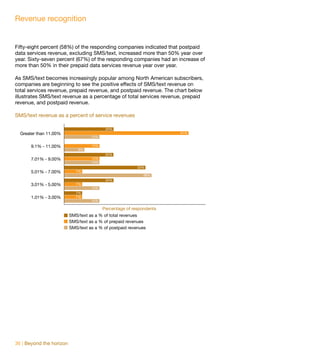
As SMS/text becomes increasingly popular among North American subscribers,
companies are beginning to see the positive effects of SMS/text revenue on
total services revenue, prepaid revenue, and postpaid revenue. The chart below
illustrates SMS/text revenue as a percentage of total services revenue, prepaid
revenue, and postpaid revenue.

SMS/text revenue as a percent of service revenues

                                           20%
  Greater than 11.00%                                                 51%
                                    14%

       9.1% - 11.00%                14%
                              8%
                                           20%
       7.01% - 9.00%                14%
                                    14%
                                                          33%
       5.01% - 7.00%         7%
                                                             36%
                                           20%
       3.01% - 5.00%         7%
                                    14%
                             7%
       1.01% - 3.00%         7%
                                    14%

                                          Percentage of respondents
                          SMS/text as a % of total revenues
                          SMS/text as a % of prepaid revenues
                          SMS/text as a % of postpaid revenues


36 | Beyond the horizon
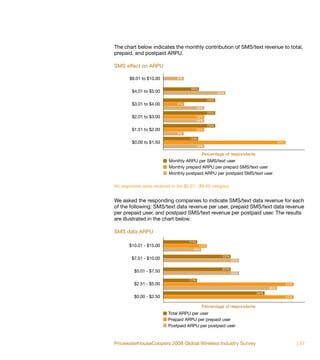
The chart below indicates the monthly contribution of SMS/text revenue to total,
prepaid, and postpaid ARPU.

SMS effect on ARPU

       $9.01 to $10.00         9%


                                     16%
        $4.01 to $5.00                                28%

                                                23%
        $3.01 to $4.00         9%
                                          18%
                                                23%
        $2.01 to $3.00                    18%
                                          18%
                                                23%
        $1.51 to $2.00                    18%
                               9%
                                     15%
        $0.00 to $1.50                                                              55%
                                          18%

                                            Percentage of respondents
                          Monthly ARPU per SMS/text user
                          Monthly prepaid ARPU per prepaid SMS/text user
                          Monthly postpaid ARPU per postpaid SMS/text user

No responses were received in the $5.01 - $9.00 category.


We asked the responding companies to indicate SMS/text data revenue for each
of the following: SMS/text data revenue per user, prepaid SMS/text data revenue
per prepaid user, and postpaid SMS/text revenue per postpaid user. The results
are illustrated in the chart below.

SMS data ARPU
                                    11%
       $10.01 - $15.00                   14%
                                      12%

                                                        22%
        $7.51 - $10.00                                        25%

                                                        22%
         $5.01 - $7.50                                        25%

                                    11%
         $2.51 - $5.00                                                                    43%
                                                                              38%
                                                                        34%
         $0.00 - $2.50                                                                    43%

                                            Percentage of respondents
                          Total ARPU per user
                          Prepaid ARPU per prepaid user
                          Postpaid ARPU per postpaid user


PricewaterhouseCoopers 2008 Global Wireless Industry Survey                                     | 37
Revenue recognition


We asked the responding companies whether they allocate airtime usage charges
between data services and voice service. Only 28% of the responding companies
indicated that they allocate airtime usage between data services and voice service.

Fifty-four percent (54%) of the responding companies indicated a more than
50% increase in postpaid data services revenue for SMS/text revenue only
year over year. Fifty-eight percent (58%) of the responding companies had an
increase of more than 50% in prepaid data services revenue year over year.

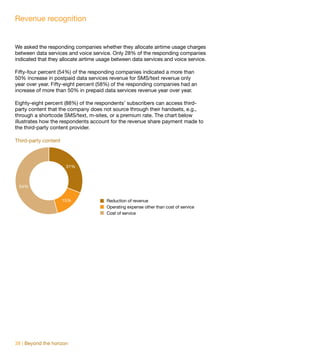
Eighty-eight percent (88%) of the respondents’ subscribers can access third-
party content that the company does not source through their handsets, e.g.,
through a shortcode SMS/text, m-sites, or a premium rate. The chart below
illustrates how the respondents account for the revenue share payment made to
the third-party content provider.

Third-party content


                       31%


 54%


                      15%              Reduction of revenue
                                       Operating expense other than cost of service
                                       Cost of service


38 | Beyond the horizon
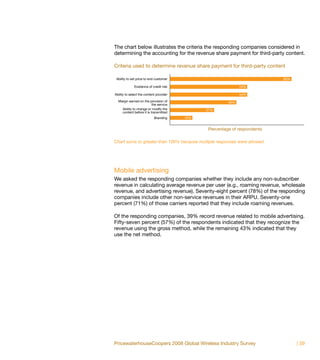
The chart below illustrates the criteria the responding companies considered in
determining the accounting for the revenue share payment for third-party content.

Criteria used to determine revenue share payment for third-party content

 Ability to set price to end customer                                      85%

              Existence of credit risk                        54%

Ability to select the content provider                        54%
  Margin earned on the provision of                     46%
                          the service
    Ability to change or modify the            31%
    content before it is transmitted
                            Branding     15%


                                               Percentage of respondents

Chart sums to greater than 100% because multiple responses were allowed.


Mobile advertising
We asked the responding companies whether they include any non-subscriber
revenue in calculating average revenue per user (e.g., roaming revenue, wholesale
revenue, and advertising revenue). Seventy-eight percent (78%) of the responding
companies include other non-service revenues in their ARPU. Seventy-one
percent (71%) of those carriers reported that they include roaming revenues.

Of the responding companies, 39% record revenue related to mobile advertising.
Fifty-seven percent (57%) of the respondents indicated that they recognize the
revenue using the gross method, while the remaining 43% indicated that they
use the net method.


PricewaterhouseCoopers 2008 Global Wireless Industry Survey                      | 39
Revenue recognition


Wi-Fi data services
Wi-Fi hotspots and wireless broadband access cards are common in today’s
marketplace. Of the responding companies, 67% offer Wi-Fi hotspots in public
locations, such as airports, coffeehouses, hotels, and offices.

For the companies that offer hotspot services and pay the hotspot location a
portion of the fee billed to the customer, 88% account for fees paid to location
owners as an operating expense. The remaining 12% of respondents account for
such fees as a reduction of revenue.

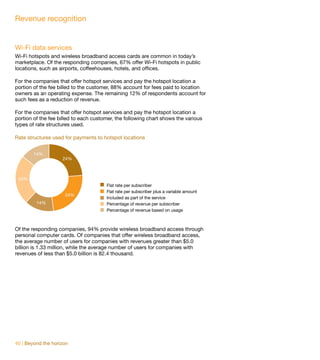
For the companies that offer hotspot services and pay the hotspot location a
portion of the fee billed to each customer, the following chart shows the various
types of rate structures used.

Rate structures used for payments to hotspot locations


        14%
                    24%


 24%
                                       Flat rate per subscriber
                                       Flat rate per subscriber plus a variable amount
                     24%
                                       Included as part of the service
         14%                           Percentage of revenue per subscriber
                                       Percentage of revenue based on usage


Of the responding companies, 94% provide wireless broadband access through
personal computer cards. Of companies that offer wireless broadband access,
the average number of users for companies with revenues greater than $5.0
billion is 1.33 million, while the average number of users for companies with
revenues of less than $5.0 billion is 82.4 thousand.


40 | Beyond the horizon
Customer retention
Companies continue to focus on retaining current customers, as overall market
penetration rates have slowed. Accordingly, retention-related activities have
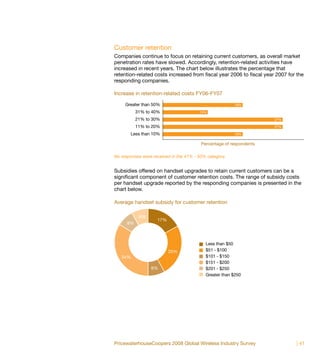
increased in recent years. The chart below illustrates the percentage that
retention-related costs increased from fiscal year 2006 to fiscal year 2007 for the
responding companies.

Increase in retention-related costs FY06-FY07

     Greater than 50%                                   18%

           31% to 40%                   10%

           21% to 30%                                                 27%

           11% to 20%                                                 27%

       Less than 10%                                    18%

                                         Percentage of respondents

No responses were received in the 41% - 50% category.


Subsidies offered on handset upgrades to retain current customers can be a
significant component of customer retention costs. The range of subsidy costs
per handset upgrade reported by the responding companies is presented in the
chart below.

Average handset subsidy for customer retention

            8%
                    17%
      8%


                                           Less than $50
                          25%              $51 - $100
   34%                                     $101 - $150
                                           $151 - $200
                 8%                        $201 - $250
                                           Greater than $250


PricewaterhouseCoopers 2008 Global Wireless Industry Survey                    | 41
Revenue recognition


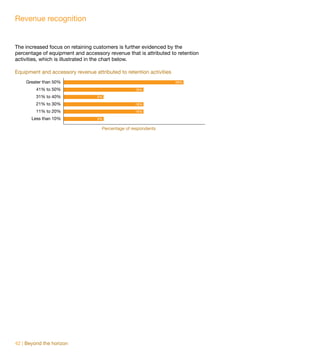
The increased focus on retaining customers is further evidenced by the
percentage of equipment and accessory revenue that is attributed to retention
activities, which is illustrated in the chart below.

Equipment and accessory revenue attributed to retention activities
    Greater than 50%                                                 28%

         41% to 50%                                18%

         31% to 40%               9%

         21% to 30%                                18%

         11% to 20%                                18%

       Less than 10%              9%

                                    Percentage of respondents


42 | Beyond the horizon
Sales incentives
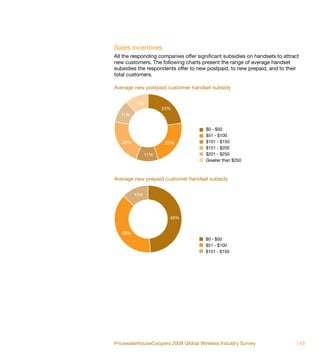
All the responding companies offer significant subsidies on handsets to attract
new customers. The following charts present the range of average handset
subsidies the respondents offer to new postpaid, to new prepaid, and to their
total customers.

Average new postpaid customer handset subsidy

         11%
                     23%
  11%


                                       $0 - $50
                                       $51 - $100
   22%                22%              $101 - $150
                                       $151 - $200
               11%                     $201 - $250
                                       Greater than $250


Average new prepaid customer handset subsidy

         13%


                       49%


   38%
                                       $0 - $50
                                       $51 - $100
                                       $101 - $150


PricewaterhouseCoopers 2008 Global Wireless Industry Survey                   | 43
Revenue recognition


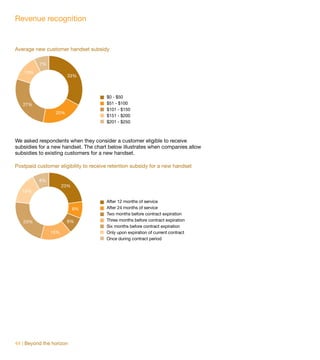
Average new customer handset subsidy

          7%
    13%
                       33%


                                       $0 - $50
   27%                                 $51 - $100
                                       $101 - $150
                 20%
                                       $151 - $200
                                       $201 - $250


We asked respondents when they consider a customer eligible to receive
subsidies for a new handset. The chart below illustrates when companies allow
subsidies to existing customers for a new handset.

Postpaid customer eligibility to receive retention subsidy for a new handset

          8%
                     23%
   15%

                                       After 12 months of service
                           8%          After 24 months of service
                                       Two months before contract expiration
   23%                 8%              Three months before contract expiration
                                       Six months before contract expiration
               15%                     Only upon expiration of current contract
                                       Once during contract period


44 | Beyond the horizon
Market development funds and rebates
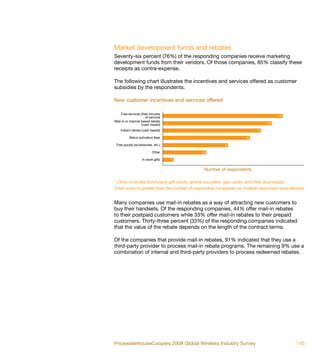
Seventy-six percent (76%) of the responding companies receive marketing
development funds from their vendors. Of those companies, 85% classify these
receipts as contra-expense.

The following chart illustrates the incentives and services offered as customer
subsidies by the respondents.

New customer incentives and services offered

     Free services (free minutes
                       of service)                                                 11
Mail-in or internet based rebate
                    (cash based)                                             10

    Instant rebate (cash based)                                          9

           Waive activation fees                                   8

 Free goods (accessories, etc.)                         6

                           Other             4

                    In store gifts   1

                                             Number of respondents

* Other includes third-party gift cards, airline vouchers, gas cards, and free downloads.
Chart sums to greater than the number of responding companies as multiple responses were allowed.


Many companies use mail-in rebates as a way of attracting new customers to
buy their handsets. Of the responding companies, 44% offer mail-in rebates
to their postpaid customers while 33% offer mail-in rebates to their prepaid
customers. Thirty-three percent (33%) of the responding companies indicated
that the value of the rebate depends on the length of the contract terms.

Of the companies that provide mail-in rebates, 91% indicated that they use a
third-party provider to process mail-in rebate programs. The remaining 9% use a
combination of internal and third-party providers to process redeemed rebates.


PricewaterhouseCoopers 2008 Global Wireless Industry Survey                                 | 45
Revenue recognition


Rebate requirements vary widely for the responding companies; however, most
respondents required customers to return the receipt, rebate redemption form,
and UPC code. Other carriers required a packaging slip and a copy of the
customer’s bill.

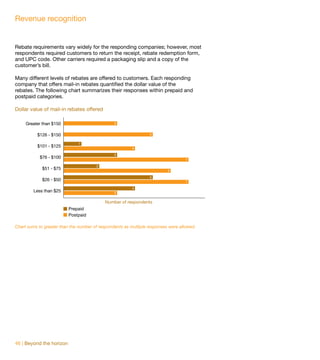
Many different levels of rebates are offered to customers. Each responding
company that offers mail-in rebates quantified the dollar value of the
rebates. The following chart summarizes their responses within prepaid and
postpaid categories.

Dollar value of mail-in rebates offered

     Greater than $150                          3


          $126 - $150                                            5

                              1
          $101 - $125                                    4
                                                3
            $76 - $100                                                             7
                                       2
             $51 - $75                                                    6
                                                                 5
             $26 - $50                                                             7
                                                         4
         Less than $25                          3

                                           Number of respondents
                          Prepaid
                          Postpaid

Chart sums to greater than the number of respondents as multiple responses were allowed.


46 | Beyond the horizon
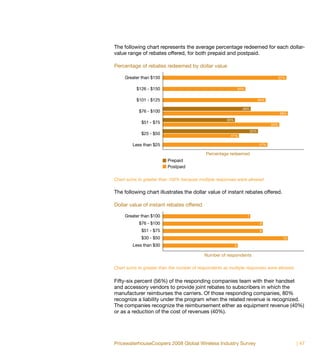
The following chart represents the average percentage redeemed for each dollar-
value range of rebates offered, for both prepaid and postpaid.

Percentage of rebates redeemed by dollar value

     Greater than $150                                                                      67%


          $126 - $150                                           45%


          $101 - $125                                                           56%

                                                                  48%
            $76 - $100                                                                      68%
                                                      39%
             $51 - $75                                                                63%
                                                                          52%
             $25 - $50                                  41%

         Less than $25                                                          57%

                                            Percentage redeemed
                          Prepaid
                          Postpaid

Chart sums to greater than 100% because multiple responses were allowed.

The following chart illustrates the dollar value of instant rebates offered.

Dollar value of instant rebates offered

     Greater than $100                                                7

            $76 - $100                                                           8

             $51 - $75                                                           8

             $30 - $50                                                                        10

         Less than $30                                      6

                                           Number of respondents

Chart sums to greater than the number of respondents as multiple responses were allowed.


Fifty-six percent (56%) of the responding companies team with their handset
and accessory vendors to provide joint rebates to subscribers in which the
manufacturer reimburses the carriers. Of those responding companies, 80%
recognize a liability under the program when the related revenue is recognized.
The companies recognize the reimbursement either as equipment revenue (40%)
or as a reduction of the cost of revenues (40%).


PricewaterhouseCoopers 2008 Global Wireless Industry Survey                                        | 47
Revenue recognition


Other revenue activities
Fifty-six percent (56%) of the responding companies are currently or expect to
be eligible for the status of Eligible Telecommunication Carrier (ETC) this year. Of
the companies with revenue greater than $5.0 billion, 63% receive ETC revenue;
and of the companies with revenue of less than $5.0 billion, 50% receive ETC
revenue. We asked those who are receiving or expect to receive ETC amounts
during the period to specify what percentage of their service revenues they
expect to derive from ETC distributions. Of those that replied, 78% of those
receiving ETC revenue expect less than one percent, 11% expect between two
percent and five percent, and 11% expect more than five percent.

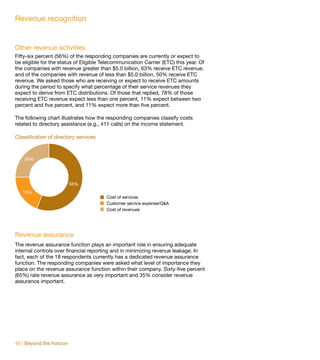
The following chart illustrates how the responding companies classify costs
related to directory assistance (e.g., 411 calls) on the income statement.

Classification of directory services


    25%


                          56%
   19%
                                        Cost of services
                                        Customer service expense/G&A
                                        Cost of revenues


Revenue assurance
The revenue assurance function plays an important role in ensuring adequate
internal controls over financial reporting and in minimizing revenue leakage. In
fact, each of the 18 respondents currently has a dedicated revenue assurance
function. The responding companies were asked what level of importance they
place on the revenue assurance function within their company. Sixty-five percent
(65%) rate revenue assurance as very important and 35% consider revenue
assurance important.


48 | Beyond the horizon
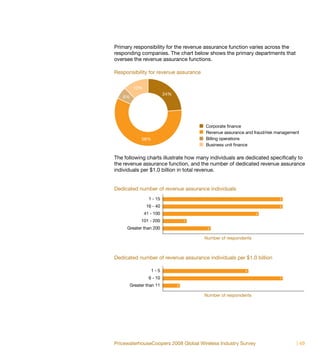
Primary responsibility for the revenue assurance function varies across the
responding companies. The chart below shows the primary departments that
oversee the revenue assurance functions.

Responsibility for revenue assurance

        12%
                         24%
   6%


                                       Corporate finance
                                       Revenue assurance and fraud/risk management
            58%                        Billing operations
                                       Business unit finance

The following charts illustrate how many individuals are dedicated specifically to
the revenue assurance function, and the number of dedicated revenue assurance
individuals per $1.0 billion in total revenue.


Dedicated number of revenue assurance individuals
                1 - 15                                                   5

               16 - 40                                                   5

              41 - 100                                         4

           101 - 200               1

     Greater than 200                   2

                                       Number of respondents


Dedicated number of revenue assurance individuals per $1.0 billion

                  1-5                                    5

                6 - 10                                                   7

      Greater than 11          2

                                       Number of respondents


PricewaterhouseCoopers 2008 Global Wireless Industry Survey                     | 49
Revenue recognition


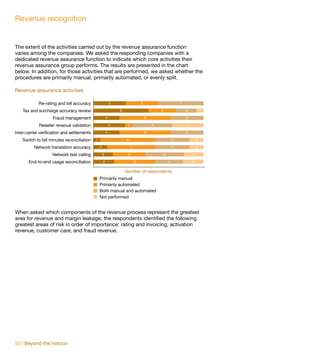
The extent of the activities carried out by the revenue assurance function
varies among the companies. We asked the responding companies with a
dedicated revenue assurance function to indicate which core activities their
revenue assurance group performs. The results are presented in the chart
below. In addition, for those activities that are performed, we asked whether the
procedures are primarily manual, primarily automated, or evenly split.

Revenue assurance activities

             Re-rating and bill accuracy                     5                    5                           7

    Tax and surcharge accuracy review                            8                            4                   3           1

                    Fraud management                     4                            8                           5

             Reseller revenue validation                     4        1                   5                       4

Inter-carrier verification and settlements               4                            8                           5

    Switch to bill minutes reconciliation    1                       8                                    5               2

          Network translation accuracy           2                        7                               5               2

                    Network test calling             3                5                           6                   3

       End-to-end usage reconciliation               3                        6                       4               3

                                                                     Number of respondents
                                                 Primarily manual
                                                 Primarily automated
                                                 Both manual and automated
                                                 Not performed


When asked which components of the revenue process represent the greatest
area for revenue and margin leakage, the respondents identified the following
greatest areas of risk in order of importance: rating and invoicing, activation
revenue, customer care, and fraud revenue.


50 | Beyond the horizon
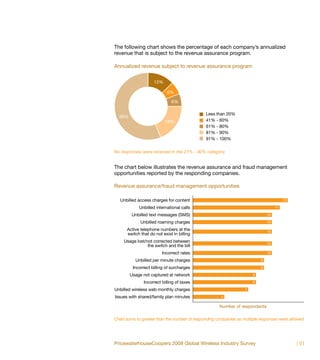
The following chart shows the percentage of each company’s annualized
revenue that is subject to the revenue assurance program.

Annualized revenue subject to revenue assurance program

                    13%

                            6%

                              6%

                                              Less than 20%
  56%
                          19%                 41% - 60%
                                              61% - 80%
                                              81% - 90%
                                              91% - 100%

No responses were received in the 21% - 40% category.


The chart below illustrates the revenue assurance and fraud management
opportunities reported by the responding companies.

Revenue assurance/fraud management opportunities

   Unbilled access charges for content                                                  12

            Unbilled international calls                                           11

        Unbilled text messages (SMS)                                          10

             Unbilled roaming charges                                         10

      Active telephone numbers at the                                         10
      switch that do not exist in billing
    Usage lost/not corrected between                                          10
                the switch and the bill
                         Incorrect rates                                      10

          Unbilled per minute charges                                     9

         Incorrect billing of surcharges                                  9

        Usage not captured at network                                 8

               Incorrect billing of taxes                             8

Unbilled wireless web monthly charges                             7

Issues with shared/family plan minutes                4

                                                     Number of respondents

Chart sums to greater than the number of responding companies as multiple responses were allowed.


PricewaterhouseCoopers 2008 Global Wireless Industry Survey                                  | 51
Revenue recognition


Customer billing and payments
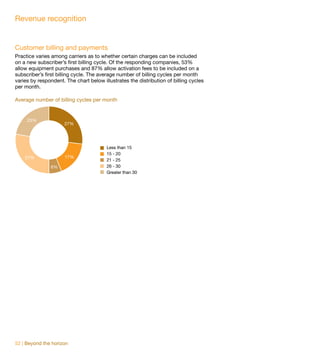
Practice varies among carriers as to whether certain charges can be included
on a new subscriber’s first billing cycle. Of the responding companies, 53%
allow equipment purchases and 87% allow activation fees to be included on a
subscriber’s first billing cycle. The average number of billing cycles per month
varies by respondent. The chart below illustrates the distribution of billing cycles
per month.

Average number of billing cycles per month


     23%
                      27%


                                        Less than 15
                                        15 - 20
    27%               17%
                                        21 - 25
               6%                       26 - 30
                                        Greater than 30


52 | Beyond the horizon
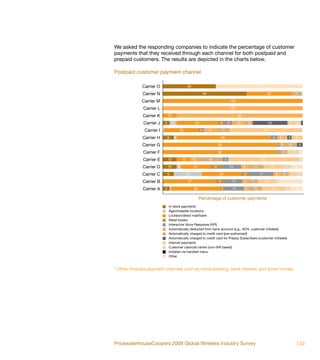
We asked the responding companies to indicate the percentage of customer
payments that they received through each channel for both postpaid and
prepaid customers. The results are depicted in the charts below.

Postpaid customer payment channel

             Carrier O                                  38                                                                     62

             Carrier N                                                  60                                                               32                                 7           1

             Carrier M                                                                                 100

              Carrier L                                                                                100

             Carrier K            10                                                                         90

              Carrier J       5        5                          30                   5           5         10       5                      25                     5           4 1

              Carrier I   1                    23                      41    11           11                                            48                                              1

             Carrier H            8        2                                              66                                                 1 5       5 2 3                    8

             Carrier G                                                                82                                                               22           10              4

              Carrier F                                                               82                                                               2 5          3       5       3

             Carrier E            10               10         5              18                4                                    50                                              3

             Carrier D            10           3              21                  8                14             5           11              13                7               8

             Carrier C            8                     20                            28                          6                17              5        6           5           5

             Carrier B    1                              37                           6                13         4       7             13         2                17

             Carrier A        5 1                             35                          3             14        3       10                  16                4           9

                                                                   Percentage of customer payments
                                  In-store payments
                                  Agent/reseller locations
                                  Lockbox/direct mail/bank
                                  Retail kiosks
                                  Interactive Voice Response (IVR)
                                  Automatically deducted from bank account (e.g., ACH, customer initiated)
                                  Automatically charged to credit card (pre-authorized)
                                  Automatically charged to credit card for Prepay Subscribers (customer initiated)
                                  Internet payments
                                  Customer care/call center (non-IVR based)
                                  Initiated via handset menu
                                  Other


* Other includes payment channels such as home banking, bank transfer, and smart money.


PricewaterhouseCoopers 2008 Global Wireless Industry Survey                                                                                                                     | 53
Revenue recognition


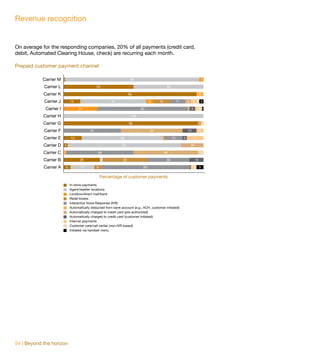
On average for the responding companies, 20% of all payments (credit card,
debit, Automated Clearing House, check) are recurring each month.

Prepaid customer payment channel

            Carrier M    1                                                96                                                           3

            Carrier L                              50                                             50

            Carrier K                                                    95                                                        5

            Carrier J            12                         47                        5     12              11       4    4 2 3

             Carrier I                24                                        65                                   1    4    1   4   1


            Carrier H                                                     100

            Carrier G                                                    96                                                        22

            Carrier F                         41                                      44                             10            5

            Carrier E            13                               58                          1        13        3            12

            Carrier D    3                                         81                                                    16

            Carrier C    2                         48                                            46                                1   3

            Carrier B                  26               2           32                            30                          10

            Carrier A        5          17         5                             63                                      12   2 5

                                                       Percentage of customer payments
                                 In-store payments
                                 Agent/reseller locations
                                 Lockbox/direct mail/bank
                                 Retail kiosks
                                 Interactive Voice Response (IVR)
                                 Automatically deducted from bank account (e.g., ACH, customer initiated)
                                 Automatically charged to credit card (pre-authorized)
                                 Automatically charged to credit card (customer initiated)
                                 Internet payments
                                 Customer care/call center (non-IVR based)
                                 Initiated via handset menu


54 | Beyond the horizon
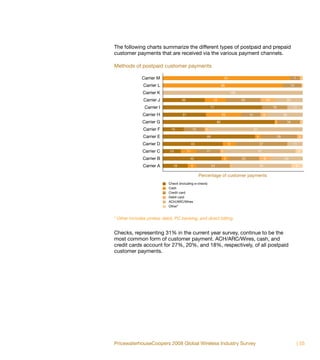
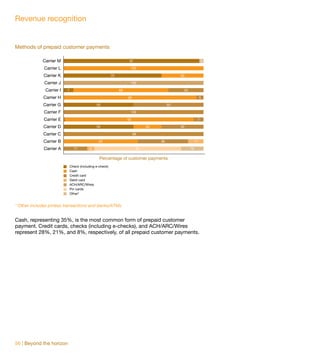
The following charts summarize the different types of postpaid and prepaid
customer payments that are received via the various payment channels.

Methods of postpaid customer payments

              Carrier M                                                  91                                                          7           2

               Carrier L                                             86                                                         13               1


               Carrier K                                                      100

               Carrier J            30                      15                      25                      10              20

                Carrier I                                  71                                                    18              11

              Carrier H             31                               25                  14             5                  25

              Carrier G                                         80                                                2         16                   2

               Carrier F      15              15      3                                       67

               Carrier E                              66                                       4                      26                     4

              Carrier D                       43                              9                    37                            11

              Carrier C      13          11           17             3                             51                                        5

               Carrier B                  42                             5          22                  8                  23

               Carrier A       18             6            24                 1                    43                                    8

                                                   Percentage of customer payments
                            Check (including e-check)
                            Cash
                            Credit card
                            Debit card
                            ACH/ARC/Wires
                            Other*


* Other includes pinless debit, PC banking, and direct billing.


Checks, representing 31% in the current year survey, continue to be the
most common form of customer payment. ACH/ARC/Wires, cash, and
credit cards account for 27%, 20%, and 18%, respectively, of all postpaid
customer payments.


PricewaterhouseCoopers 2008 Global Wireless Industry Survey                                                                              | 55
Revenue recognition


Methods of prepaid customer payments

             Carrier M                                                    97                                              3

              Carrier L                                                   100

              Carrier K                                        70                                      30

              Carrier J                                                   100

               Carrier I       7                                    68                                  25

              Carrier H                                                  95                                           5

             Carrier G                              50                                        50   2        16            2

              Carrier F                                                   100

              Carrier E    1                                             92                                           7

              Carrier D                             50                              20                 30

              Carrier C    1                                                  99

              Carrier B                              53                                  36                      11

              Carrier A              17         5                              62                            16

                                                      Percentage of customer payments
                                   Check (including e-check)
                                   Cash
                                   Credit card
                                   Debit card
                                   ACH/ARC/Wires
                                   Pin cards
                                   Other*


* Other includes pinless transactions and banks/ATMs.


Cash, representing 35%, is the most common form of prepaid customer
payment. Credit cards, checks (including e-checks), and ACH/ARC/Wires
represent 28%, 21%, and 8%, respectively, of all prepaid customer payments.


56 | Beyond the horizon
Practices vary from carrier to carrier, as well as within certain carriers, as to
whether postpaid subscribers are billed in advance or in arrears. The charts
below illustrate the range of percentages of postpaid customers billed in arrears
versus in advance for the responding companies.

Customers billed in arrears

           9%


  18%                     37%


                                            Less than 15%
   9%
                                            15% - 25%
                                            26% - 50%
              27%                           51% - 75%
                                            76% - 100%


Customers billed in advance


                    15%


                          15%


   70%
                                            26% - 50%
                                            51% - 75%
                                            76% - 100%

No responses were received in the less than 26% category.


The responding companies indicated that, on average, they bill 25% of their
customers in arrears and bill 75% in advance.


PricewaterhouseCoopers 2008 Global Wireless Industry Survey                   | 57
Revenue recognition


We asked the responding companies how they bill postpaid subscribers for
usage charges. The following chart illustrates how the responding companies bill
their customers’ usage.

Billing of usage


     21%
                     29%


                                      Based on per second usage
                                      Based on per minute billing
           50%                        (seconds rounded up to the next minute)
                                      Based on per second usage and per minute billing


58 | Beyond the horizon
Handset insurance
Most responding companies offer their subscribers a handset insurance or
protection program. This program can either be self-insured by the provider,
provided through a third party, or provided by a combination of the company
and a third party. Seventy-one percent (71%) of the respondents offer handset
protection programs. Of the respondents that offer a handset replacement
program, 64% use a third-party provider, 27% use a self-insured protection
program, and the remaining 9% indicated using a combination of a company-
sponsored and a third-party program. The chart below illustrates the percentage
of subscribers who choose to participate in handset replacement programs.

Handset protection participation

          10%

                        30%


 30%
                                            Less than 11%
                        10%                 11%-20%
                                            21%-30%
              20%                           31%-40%
                                            51%-60%

No responses were received in the 41% - 50% or the greater than 60% categories.


PricewaterhouseCoopers 2008 Global Wireless Industry Survey                       | 59
Revenue recognition


Eighty-two percent (82%) of the responding companies that offer handset
replacement programs bill subscribers based on a fixed monthly amount, while
the remaining 18% bill customers based on the value of the handset. The chart
below illustrates the average fixed monthly fees charged to customers for
handset replacement protection.

Fixed fees charged for handset protection


     22%


                          56%
   22%
                                      $4.00 - $4.99
                                      $5.00 - $9.99
                                      $10.00 - $15.00


60 | Beyond the horizon
All-inclusive packages
The responding companies were asked whether they offer all-inclusive packages
to subscribers. Fifty-six percent (56%) of the responding companies offer
all-inclusive packages. Of those companies, 63% indicated that less than two
percent of their subscribers participate in the plans they offer. The following chart
illustrates the services that the respondents include in the all-inclusive packages.

Services offered in all-inclusive package

                  Voice                                                            89%

             Text/SMS                                      56%

                Internet                                   56%

               Pictures                             44%

                 E-mail                     33%

           Web surfing                      33%

                  Other                     33%

       GPS Navigation               22%

                  Video     11%

                                             Percentage of respondents

* Other includes unlimited text to in-system subscribers, unlimited to other countries, video
  messaging, roaming, and television.
Chart sums to greater than 100% because multiple responses were allowed.


PricewaterhouseCoopers 2008 Global Wireless Industry Survey                                     | 61
Performance measures


The following section focuses on the internal and
external key performance measures that wireless
companies track and report.

Customers/Metrics

Subscriber costs

General and administrative

Data

Ring tones

Games

SMS and premium SMS

Phone/BlackBerry-based e-mail and Web access

Laptop cards

Internet access from handsets

Picture revenue

Network

Long distance and interconnect expense

Rate plans and billing


PricewaterhouseCoopers 2008 Global Wireless Industry Survey   | 63
Performance measures


Customers/Metrics
The chart below depicts the average length of the responding companies’
relationships with postpaid customers.

Average length of customer relationship—Postpaid


                  17%
    25%


                      33%              20 - 40 months
    25%                                41 - 60 months
                                       61 - 80 months
                                       Greater than 80 months


The average length of customer relationships is approximately 63 months
in 2008. For companies with revenue greater than $5.0 billion, the average
customer relationship is 73 months, and for companies with revenue of less
than $5.0 billion, the average is 56 months. For North American respondents,
the average length of customer relationships is 70 months. For North American
companies with revenue greater than $5.0 billion, the average customer
relationship is 73 months, while companies with revenue of less than $5.0 billion
have an average customer relationship of 67 months.

We asked the respondents how they define minutes of use (MOU). Sixty-one
percent (61%) of the respondents define MOU as billed minutes (whether
included as part of the customer’s plan or additional non-packaged minutes
billed); 39% of the respondents define MOU as minutes per the switch,
regardless of whether those minutes are ultimately billed to the customer.

The following chart depicts the average MOU per customer per month.
According to the responding companies, the average percentage of MOU
that is billed as excess (i.e., over plan) minutes is 20%. For North American
respondents, the average MOU billed as excess is 7% in the current year and
was 6% in the 2007 North American Wireless Survey.


64 | Beyond the horizon
The average MOU for all responding carriers is 628 minutes for the current year.
The average North American MOU increased to 800 minutes in the current year
survey from the 744 minutes reported in the 2007 North American Wireless
Survey. MOU for North American respondents with revenue greater than $5.0
billion averages 836 in 2008, as compared to 818 minutes in 2007; and the
responding companies with revenue of less than $5.0 billion have an increase in
average MOU to 771 in 2008 from the 710 reported in the 2007 North American
Wireless Survey.

Average monthly minutes of use per postpaid subscriber


       20%         20%


 13%
                                       Less than 200 MOU
                      27%              200 - 500 MOU
                                       501 - 800 MOU
        20%                            801 - 1,000 MOU
                                       Greater than 1,000 MOU


Seventy-two percent (72%) of the responding companies report postpaid
churn externally, and 44% of the responding companies report prepaid churn
externally. The responding carriers indicated that an average of 32% of all
churn is a result of involuntary disconnects (company-induced disconnects or
termination of service).
We asked the companies how postpaid churn is calculated. Half of the
responding companies use net deactivations for the numerator of the churn
calculation, while 44% use gross deactivations. The majority (63%) of the
respondents use average subscribers for the denominator of the churn
calculation, while 25% use beginning subscribers and 12% use ending
subscribers for the period. For the companies using net deactivations for the
numerator, the definition varies widely—ranging from excluding only same-day
activations/deactivations to a 60-day period.


PricewaterhouseCoopers 2008 Global Wireless Industry Survey                  | 65
Performance measures


The responding companies indicated that for prepaid churn, 60% use net
deactivations for the numerator of the calculation, while 40% use gross
deactivations. For the denominator of the prepaid churn calculation, 60% of the
respondents use average subscribers, while 27% use beginning subscribers and
13% use ending subscribers for the period.

Ninety-four percent (94%) of the respondents track information regarding
postpaid and prepaid customers separately. The percent of respondents with a
postpaid churn rate of two percent or less is 93% in the current year. For prepaid
churn, the number of respondents with a churn rate of five percent or less is
56% in the current year. For North American respondents, 90% have a postpaid
churn rate of less than two percent in 2008, as compared to the 75% reported in
the 2007 North American Wireless Survey.

The percentage of respondents with postpaid average revenue per user (ARPU)
greater than $50.00 is 77%. The percentage of respondents with prepaid ARPU
greater than $20.00 is 56%. The average North American respondents’ ARPU for
postpaid and ARPU for prepaid subscribers are $59.98 and $27.76, respectively,
in the current year, as compared to $58.72 and $23.56, respectively, in the 2007
North American Wireless Survey.

For those responding companies that track information separately, the
following four charts compare churn rates and ARPU for postpaid and prepaid
subscribers.

Churn for postpaid subscribers

               7%
     21%


  21%                 51%              Less than 1.0%
                                       1.0% - 1.5%
                                       1.6% - 2.0%
                                       Greater than 2.0%


66 | Beyond the horizon
Churn for prepaid subscribers


                13%
    25%


   19%                43%             Less than 3%
                                      3.0% - 5.0%
                                      5.1% - 7.0%
                                      Greater than 7.0%


ARPU for postpaid subscribers


                   23%
   31%


                                      Less than $50
                46%
                                      $51 - $60
                                      Greater than $60


ARPU for prepaid subscribers


         13%


                       43%
 19%


                                      Less than $20
                                      $20.01 - $29.99
          25%                         $30 - $40
                                      Greater than $40


PricewaterhouseCoopers 2008 Global Wireless Industry Survey   | 67
Performance measures


We asked companies what percentage of their 2007 postpaid subscriber
revenue is access versus usage. Sixty-four percent (64%) of the respondents’
revenue is due to access. Companies with revenue greater than $5.0 billion
have a larger percentage of subscriber revenue obtained from access charges
(approximately 75%) than do the companies with revenue of less than $5.0
billion (approximately 55%).

We asked the respondents what percentage of total service revenue was a
result of roaming. The average of all respondents was five percent. For all
responding carriers with revenue greater than $5.0 billion and the rest of world
based respondents, the average was six percent; and for all responding carriers
with revenue of less than $5.0 billion and the North American respondents, the
average was four percent.

The following charts show the percentage of revenue for all responding
companies that are a result of long distance and features.

Long distance revenue as a percentage of service revenue

        Rest of world respondents                                        14%

Carriers with revenue < $5.0 billion                  8%

                   All respondents               6%

     North American respondents             4%

Carriers with revenue > $5.0 billion   3%


68 | Beyond the horizon
Feature revenue as a percentage of total service revenue

        Rest of world respondents                                              50%

Carriers with revenue < $5.0 billion                   21%

                   All respondents               15%

     North American respondents             8%

Carriers with revenue > $5.0 billion   4%


We also asked the responding companies their percentage of bad debt expense
and operating expense to total services revenue. Two percent (2%) was the
average bad debt expense. The chart below shows operating expense as a
percentage of service revenue for 2007.

Operating expense as percentage of service revenue

     North American respondents                                                57%

Carriers with revenue < $5.0 billion                                       56%

                   All respondents                                       53%

Carriers with revenue > $5.0 billion                               48%

        Rest of world respondents                            39%


PricewaterhouseCoopers 2008 Global Wireless Industry Survey                          | 69
Performance measures


The chart below shows the EBITDA (earnings before interest, taxes, depreciation,
and amortization) margin of the responding companies as a percentage of
service revenue.

EBITDA margin as a percentage of service revenue

Carriers with revenue < $5.0 billion                                    42%

     North American respondents                                   41%

                   All respondents                                41%

Carriers with revenue > $5.0 billion                38%

        Rest of world respondents            37%


We asked companies how long they wait before discontinuing service if a
prepaid customer fails to “replenish” his/her account when the balance is zero
and when the subscriber has not had activity in the customer’s account. Their
responses are illustrated in the following two charts.

Time to discontinue service

                  6%
                         12%
    29%


                             12%
                                         Less than 30 days
                                         30 - 45 days
                                         46 - 60 days
    12%
                                         61 - 90 days
                    29%                  91 - 120 days
                                         Other*

* Other includes 121 days to one year.


70 | Beyond the horizon
Time to disconnect prepaid customers with no activity

                    13%


                            19%
 49%


                                        30 - 45 days
                                        46 - 60 days
                      19%
                                        61 - 90 days
                                        Other*

* Other includes 91 days to one year.


Further, we asked companies how they account for any remaining balance on an
account when a prepaid customer is disconnected. Seventy-six percent (76%)
stated that the customer forfeits the balance and that revenue is recognized.
The remaining 24% stated that either the remaining balance is refunded to the
customer or the subscriber is charged a monthly maintenance fee until the
balance is zero.


PricewaterhouseCoopers 2008 Global Wireless Industry Survey               | 71
Performance measures


Carriers use various sales channels to acquire subscribers (postpaid and
prepaid) and to allow prepaid subscribers to replenish service. We asked the
responding companies to indicate the percentage of their postpaid subscribers,
prepaid subscribers, and prepaid replenishments that they acquire through each
channel. Their responses are illustrated in the following three charts.

Postpaid subscriber acquisition channels

                                                                                      50%
      Resellers/agents
                                                                   33%
                                                                  32%
          Retail stores
                                                                           41%
                          2%
                 Other
                                      8%
                               4%
           Direct sales
                                    7%
                            4%
Telesales/telemarketing
                             5%
                                 6%
                Kiosks
                          1%
           Call Center
                           3%
                          1%
               Internet     3%

                                    Percentage of subscribers added through channel
                           Carriers with revenue < $5.0 billion
                           Carriers with revenue > $5.0 billion


72 | Beyond the horizon
In terms of regional differences, the North American responding carriers obtain
more postpaid subscribers via retail stores (32%) compared to the rest of world-
based respondents (21%). In contrast, the rest of world-based respondents
obtain more postpaid subscribers via the reseller/agent channel (50%) than
North American respondents do (40%).

Prepaid subscriber acquisition channel

                                                                                 44%
      Resellers/agents
                                                                                       51%
                                                                           41%
          Retail stores
                                                                         40%

                Kiosks                   13%


                 Other         5%


            Call center    3%


           Direct sales   1%


Telesales/telemarketing   1%


               Internet   1%


                                    Percentage of subscribers added through channel
                           Carriers with revenue < $5.0 billion
                           Carriers with revenue > $5.0 billion


In terms of regional differences, the North American responding carriers
obtain more prepaid subscribers via resellers/agents (53%) compared to the
rest of world-based respondents (24%). In contrast, the rest of world-based
respondents obtain more prepaid subscribers via kiosks (24%) than North
American respondents do (2%).

The allocation of different sales channels for all respondents to acquire postpaid
and prepaid customers in the current year is consistent with the responses
received in the 2007 North American Wireless Survey.


PricewaterhouseCoopers 2008 Global Wireless Industry Survey                                  | 73
Performance measures


Subscriber costs
The following chart illustrates the allocation of cash cost per user (CCPU)
between each component for all responding carriers and for carriers with greater
than and less than $5.0 billion in revenue.

Components of total Cash Cost Per User (CCPU)

                                                                                      33%
            Network/engineering                                              25%
                                                                                27%
                                      2%
                            Other                                        23%
                                                                   16%
                                                             13%
         General/admin salaries                          11%
                                                           12%
                                                         11%
                 Retention costs               6%
                                                    8%
                                               6%
         Information technology                      9%
                                                    8%
                                                    8%
                  Customer care                6%
                                                7%
                                                  8%
       Commissions and selling                 6%
                                                7%
                                     1%
Billing and other outside services            6%
                                           4%
                                            5%
                        Bad debt      2%
                                       3%
                                          3%
                      Advertising         3%
                                          3%
                                          4%
           Revenue based taxes       1%
                                       2%
                                        3%
           Rent (store/corporate)    1%
                                       2%
                                        3%
                 Rebates/credits     1%
                                     1%


                                      Carriers with revenue > $5.0 billion
                                      Carriers with revenue < $5.0 billion
                                      All respondents


74 | Beyond the horizon
We asked the responding companies what percentage of each component make
up the total costs per gross addition (CPGA). The results are presented in the
chart below for all responding carriers and for carriers with greater than and less
than $5.0 billion in revenue.

Components that make up total cash costs per gross addition (CPGA)

                                                                                     22%
                   Advertising                                                                26%
                                                                                            25%
                                                                                                    29%
         Commission expense                                                     21%
                                                                                           24%
                                                                                     22%
           Equipment subsidy                                             18%
                                                                               20%
                                                                   16%
          Sales/admin salaries                     9%
                                                        11%
                                            5%
                         Other                               12%
                                                       10%
                                       3%
           Marketing expense                      8%
                                             6%
                                  1%
                      Rebates               5%
                                       3%

                                   2%
         Rent (store/corporate)   1%


                Customer care     1%


                                   Carriers with revenue > $5.0 billion
                                   Carriers with revenue < $5.0 billion
                                   Average of all respondents


Eighty-eight percent (88%) of all the responding carriers’ expense customer
acquisition costs related to postpaid subscribers, while the remaining 12%
capitalize all or part of these costs. Ninety-four percent (94%) of all the
responding carriers expense customer retention costs for postpaid subscribers.
All the responding carriers’ expense customer acquisition and retention costs
related to prepaid subscribers.


PricewaterhouseCoopers 2008 Global Wireless Industry Survey                                               | 75
Performance measures


The responding companies were asked to indicate the costs that they include
in the numerator for their calculation of CPGA when used as a performance
measure. The following chart shows the elements used in the numerator for
the calculation.

Costs included in CPGA

                   Advertising                                                                       93%

Sales commissions-activation                                                                   87%

            Gross equipment                                                              80%

    Direct sales force salaries                                                    73%

         Equipment revenues                                                        73%

Dealer volume sales bonuses                                                        73%

                Agent rebates                                                67%

          Subscriber rebates                                           60%

           Retail store facility                                 53%

      Cooperative marketing                                      53%

  Direct sales force and G&A                                     53%

                       Training                            47%

 Post activation commissions                         40%

        Product development                    27%

          Airtime promotions             20%

                         Other           20%

   Direct subscriber retention     13%

       Credit check expense        13%

                                                     Percentage of respondents


Chart sums to greater than 100% because multiple responses were allowed.


76 | Beyond the horizon
We asked the responding companies what their advertising costs were per gross
addition. The results are presented in the chart below.

Advertising cost per gross addition


                     21%

  37%


                           14%                Less than $30
                                              $30 - $60
                      7%                      $61 - $80
           21%                                $81 - $100
                                              Greater than $100


The average advertising cost per gross addition for companies with revenue
greater than $5.0 billion is $82.50, and for companies with less than $5.0 billion
in revenue it is $65.75.
The responding carriers were also asked which media they used for advertising
their service. The table below shows the average response by each source
of advertising.

Advertising medium


                     Television                                                 34%

                   Newspaper                        13%

              Other print media                    12%

                         Radio                    11%

                     Billboards               9%

        Advertising/agency fees              8%

                         Other          5%

                       Internet        4%

                  Sponsorship      3%

                     Magazine     1%

                                                    Percentage of respondents


PricewaterhouseCoopers 2008 Global Wireless Industry Survey                           | 77
Performance measures


Carriers with revenue greater than $5.0 billion reported using television for
50% of their advertising and the internet for seven percent. Carriers with less
than $5.0 billion in revenue use those two media only 24% and two percent,
respectively; and they use billboards for 14% and radio for 13% of their
advertising. In comparison, the carriers with revenue greater than $5.0 billion use
billboards only one percent and radio only nine percent.

We asked the responding carriers to provide the percentage of commission
expense for each sales channel in fiscal year 2007. The results are
presented below.

Commission expense by channel
             2%


      14%           19%


                                          National retail sales
                                          Agent sales
            65%                           Direct retail sales
                                          Direct enterprise sales


Eighty-one percent (81%) of the responding carriers’ commission payments
typically are structured to pay in full at the point of acquisition or retention of the
subscriber. The remainder of the responding carriers pay in installments.
Thirty-five percent (35%) of the survey respondents record an accrual for
potential chargebacks (reduction to commission expense resulting from potential
deactivations). Of these companies, the majority record an accrual based on
average chargeback percentages.


78 | Beyond the horizon
Fifty-nine percent (59%) of the survey respondents pay recurring residual
commission fees. Of the companies that pay a residual commission expense,
100% pay it to sales agents and 60% pay the residual commission expense
to national retail sales channel. Sixty percent (60%) of the respondents
recognize the residual commission fee paid to agents when earned, while 30%
recognize the commission fee paid to agents when paid. For the national retail
sales channel, 83% recognize this expense when earned. Only one carrier
pays residual commission expense for direct retail sales, and this expense is
recognized when earned.

The responding companies were asked to indicate how they treat the sale of
handsets if their company uses resellers and/or indirect agents.

Treatment of postpaid handset sales

         10%

                       30%


 30%

                                       Sell handsets separately at cost
                                       Sell handsets separately at cost, plus a mark-up
                30%                    Sell handsets separately at cost, less discount
                                       Suggested retail price


Treatment of prepaid handset sales


       15%       15%


                        23%

                                       Sell handsets separately at cost
       47%                             Sell handsets separately at cost, plus a mark-up
                                       Sell handsets separately at cost, less discount(s)
                                       Suggested retail price


Seventeen percent (17%) of the responding companies pay commissions to
resellers for sales of handsets in addition to the activation of subscribers.


PricewaterhouseCoopers 2008 Global Wireless Industry Survey                            | 79
Performance measures


General and administrative
We asked the responding companies what their average monthly general and
administrative (G&A) costs were per customer. The results are presented in the
chart below.

Average monthly general and administrative cost per subscriber


   27%               27%


                                      Less than $5
    19%                               $5 - $8
                   27%
                                      $9 - $12
                                      Greater than $12


The average monthly general and administrative cost per subscriber in 2008 was
$9.92 compared to $13.20 in the 2007 North American Wireless Survey.


80 | Beyond the horizon
Data
All of the responding companies offer data services to postpaid customers, while
94% of the responding companies offer data services to prepaid customers.

The responding companies offer multiple types of data services to customers.
SMS continues to be the data revenue stream that generates the majority of data
revenue. The chart below depicts the percentage of total revenue generated for
each type of data service identified as related to postpaid data services.

Postpaid data revenue


                          SMS                                              43%

BlackBerry based email and web                   19%

                         Other           11%

                  Laptop cards          9%

                  Data bundles     4%

  Internet access from handsets    4%

                       Pictures   3%

                    Ring tones    3%

                        Games     2%

                 Premium SMS      2%

                                               Percentage of respondents


With the exception of SMS, phone/BlackBerry, laptop cards, and data bundling,
no significant differences were reported between companies with revenue
greater than $5.0 billion and those with revenue of less than $5.0 billion. For
SMS, companies with revenue greater than $5.0 billion average 34% of data
revenue, while companies with revenue of less than $5.0 billion average 51%.
However, companies with revenue greater than $5.0 billion average nine percent
of data revenue related to data bundling and 23% and 11% related to phone/
BlackBerry and laptop cards, respectively. Companies with revenue of less
than $5.0 billion average only one percent of data services revenue from data
bundling and 15% and seven percent related to phone/BlackBerry and laptop
cards, respectively.


PricewaterhouseCoopers 2008 Global Wireless Industry Survey                      | 81
Performance measures


The chart below depicts the percentage of total revenue generated for each type
of data service identified as related to prepaid data services.

Prepaid data revenue

                          SMS                                             55%

               Internet access          11%

                 Data bundles          9%

                    Ring tones         8%

           Downloading games      4%

                        Other     4%

                Premium SMS       4%

                      Pictures   2%

               Ringback tones    1%

BlackBerry based email and web   1%

                  Game usage     1%

                                              Percentage of respondents


82 | Beyond the horizon
The following explanations and charts illustrate how the responding companies
bill and recognize the various data revenue streams.


Ring tones
The majority (71%) of the companies bill their customers per download/usage
charge, and 21% bill based on a fixed monthly fee plus variable fees per
usage. Seventy-five percent (75%) of the responding companies recognize ring
tones revenue gross on the income statement, and the remaining 25% use a
net presentation.


Games
Sixty-seven percent (67%) of the companies bill their customers per download/
usage charge and 17% bill a fixed monthly fee plus variable fees based on usage
related to games. Eighty-six percent (86%) recognize game revenue gross on the
income statement.


PricewaterhouseCoopers 2008 Global Wireless Industry Survey                | 83
Performance measures


SMS and premium SMS
Sixty-seven percent (67%) of the respondents recognize SMS and premium SMS
revenue gross on the income statement. The chart below illustrates how SMS is
billed to customers.

Billing of SMS revenues

          7%

                     29%


                                       Per download/use charge
       64%
                                       Fixed monthly fee plus variable per usage
                                       Fixed monthly fee


Compared to SMS in the chart above, 85% of the companies bill premium SMS
based on a per-download use/charge or variable pricing.


Phone/BlackBerry-based e-mail and Web access
Sixty-seven percent (67%) of the respondents recognize phone/BlackBerry-
based e-mail and Web access revenue gross on the income statement. A
majority (82%) of the survey respondents bill their customers a fixed monthly fee
plus a variable fee based on usage.


Laptop cards
Seventy-five percent (75%) of the respondents recognize laptop card revenue
gross on the income statement. Sixty-seven percent (67%) of the survey
respondents bill their customers a fixed monthly fee plus a variable fee based on
usage, and 25% bill based on a fixed monthly fee.


84 | Beyond the horizon
Internet access from handsets
Sixty percent (60%) of the respondents recognize internet access from handset
revenue gross on the income statement. The chart below shows the methods of
billing internet access from handsets to customers.

Billing of internet access from handset revenue


     21%             21%


 14%
                                      Per download/use charge
                                      Fixed monthly fee plus variable per usage
                  44%
                                      Fixed monthly fee
                                      Combination


Picture revenue
Seventy-one percent (71%) of the respondents recognize picture revenue
gross on the income statement. The chart below indicates how picture revenue
is billed.

Billing of picture revenue


     23%
                      31%


 15%
                                      Per download/use charge
                                      Fixed monthly fee plus variable per usage
               31%                    Fixed monthly fee
                                      Other


PricewaterhouseCoopers 2008 Global Wireless Industry Survey                       | 85
Performance measures


Network
We asked the responding companies which costs are included in the network/
system expense. The responses are depicted below.

Costs included in network/system costs


          Maintenance/utility                                                       93%
                Interconnect                                                  86%
              Long distance                                             79%
            Engineer salaries                                     71%
                   Roaming                                        71%
                        Data                                      71%
                        Rent                                      71%
           Government fees                            50%
           Subscriber usage                           20%
             Switch support                29%
        Directory assistance               29%
           Backhaul support          21%

                                                 Percentage of respondents


Chart sums to greater than 100% because multiple responses were allowed.


86 | Beyond the horizon
We asked the responding companies what percentages of each component
make up the total network/system costs. Their average responses are illustrated
in the chart below.

Components of network costs

               Interconnect                                                    20%

                      Other                                       14%

                       Rent                                 12%

                  Roaming                             10%

         Maintenance/utility                          10%

             Long distance                    7%

          Government fees                     7%

                       Data                   7%

            Engineer salary              5%

          Subscriber usage          3%

          Backhaul support          3%

            Switch support     1%

       Directory assistance    1%

                                                   Percentage of respondents


PricewaterhouseCoopers 2008 Global Wireless Industry Survey                          | 87
Performance measures


The chart below depicts the percentage of cell sites that the responding
companies lease rather than own. Four respondents indicated that they lease all
of their cell sites, while one respondent indicated that they own all of their cell
sites. Sixty percent (60%) of the responding companies stated that they lease
80% or more of their total cell sites.

Percentage of cell sites leased

                 7%
    27%                13%


                          20%              No cell sites leased
                                           40% - 60% cell sites leased
                                           61% - 80% cell sites leased
          33%                              90% - 99% cell sites leased
                                           100% cell sites leased

No responses were received in the 1% - 39% or 81% - 89% categories.


Seventy-five percent (75%) of the responding companies indicated that they
use a circuit inventory tracking system to account for system expense. Of those
companies, 50% use Excel to track circuit inventory.


88 | Beyond the horizon
Long distance and interconnect expense
Ninety-four percent (94%) of the respondents perform bill verification for long
distance and interconnect expenses. Of those companies, 75% perform bill
verification internally, 19% use third parties to perform their bill verification, and
six percent use a combination of internal resources and a third party to perform
their bill verification. The following chart depicts which internal group performs
their bill verification.

Internal department that performs bill verification

          9%
    9%

                         46%


                                          Engineering
    36%
                                          Revenue
                                          Roaming
                                          Transmission


We asked the companies to report interconnect and long distance expenses as
a percentage of service revenue. The average of all responding companies was
5.82%. The chart below illustrates the results.
Interconnect and long distance as a percentage of total service revenue


      19%

                        36%


                                          Less than 3%
      45%
                                          3% - 6%
                                          Greater than 6%


PricewaterhouseCoopers 2008 Global Wireless Industry Survey                         | 89
Performance measures


Fifty percent (50%) of the responding companies reported that they recognize
reciprocal compensation for calls terminating on ILEC networks with no
reciprocal compensation agreements in place. The chart below illustrates how
these companies account for terminating expenses when there is no reciprocal
compensation agreement in place.

Accounting for calls terminated on ILEC networks


        17%


  8%
                            50%      No accrual recorded until ILEC notifies the
                                     company of its desire to establish a reciprocal
                                     compensation agreement
                                     Record an accrual based on the actual minutes
    25%                              terminated and an estimated settlement rate
                                     Bill and keep
                                     Other


Rate plans and billing
For fiscal year 2007, we asked the responding companies to identify the method
through which their postpaid subscribers receive their monthly invoices. The
responses are below.

Monthly invoice delivery method

                 4%
            5%
       6%


                                     Paper bill
                                     Electronic bill (e-bill)
                      85%
                                     No invoice
                                     Paper & e-bill


90 | Beyond the horizon
The charts below indicate the varying numbers of rate plans that the responding
companies currently offer to postpaid and to prepaid subscribers.

Number of rate plans offered to postpaid customers

 Fewer than 100 plans                                                  8

      100 - 500 plans                 3

Greater than 500 plans   1

                                          Number of respondents


Number of rate plans offered to prepaid customers

  Fewer than 10 plans                                                  8

         10 - 30 plans         2

 Greater than 30 plans         2

                                          Number of respondents


Compared to the number of plans currently offered (shown above), nine carriers
indicated that they have more than 1,000 postpaid plans maintained in the billing
system and five carriers indicated that they have more than 30 prepaid plans
active in the billing system. Fifty-eight percent (58%) of the companies indicated
that they are currently focused on reducing the number of rate plans offered
to subscribers.


PricewaterhouseCoopers 2008 Global Wireless Industry Survey                   | 91
Property, plant and equipment


The following pages cover wireless company practices
in the area of property, plant and equipment.

Capital expenditure reporting

Capitalization policies

Capitalized labor

Site acquisition costs

Asset impairments and fair value

Business combinations

Asset retirement obligations

Lease accounting and tracking

Asset tracking

Asset useful lives

Taxes and tax useful lives

Co-location

Fixed asset reporting


PricewaterhouseCoopers 2008 Global Wireless Industry Survey   | 93
Property, plant and equipment


Capital expenditure reporting
The chart below shows what methods the responding companies use in
reporting capital expenditures externally.

Externally reported capital expenditures

          6%

   18%


                                       Reported on an accrual basis
                                       Reported on an accrual basis, along with a
                                       reconciliation to cash basis capital expenditures
                    76%
                                       Reported on a cash basis, including those
                                       capital expenditures that were paid for during
                                       the relevant period

Survey respondents were asked whether their method of externally reporting
capital expenditures was consistent with the capital expenditures reported on
the statement of cash flows. Eighty-eight percent (88%) of all the respondents
stated that their method of externally reporting capital expenditures was
consistent with capital expenditures reported on the statement of cash flows,
and 12% reported making other adjustments, which included acquisition of
companies and capitalized interest.


94 | Beyond the horizon
The chart below illustrates the percentage of respondents who include the
following expenditures in their externally reported capital expenditures related to
property, plant and equipment (P,P&E).

Types of capital expenditures
      Purchase of non-network P,P&E, or land                                              100%
           Purchase of network-related P,P&E                                              100%
              Capitalized internal use software                                       94%
                      Leasehold improvement                                         88%
         Capitalized labor and overhead costs                                       88%
               Purchases of software licenses                               65%
Purchases of licenses & related licensing costs                       53%
  Prepayments or deposits made for any P,P&E              29%
           Acquisitions of companies/markets              29%
                                         Other          24%
                  Asset retirement obligations    12%
                               Rental expense     6%

                                                              Percentage of respondents

* Chart sums to greater than 100% because multiple responses were allowed.
* Other includes perpetual license software, capitalized interest, and progress payments.


Responding companies were asked whether they consider the hardware and
software components of network equipment separately. Eight-eight percent (88%)
of the respondents consider hardware and software components separately.


PricewaterhouseCoopers 2008 Global Wireless Industry Survey                                      | 95
Property, plant and equipment


The chart below illustrates which software costs the responding companies
classify separately from property, plant, and equipment.

Software classified separately from property, plant, and equipment

Billing and mediation device software                                               64%

                     Switch software                                          57%

                   Network software                                     50%

      Network management systems                                  43%

                               Other        14%

                                                   Percentage of respondents

* Other includes separate identification of network vs. non-network software and SAP/Windows.
Chart sums to greater than 100% because multiple responses were allowed.


We asked the responding companies on which externally reported balance
sheet line item they recorded capitalized internal use software. Seventy-one
percent (71%) of the respondents include capitalized internal use software as
property, plant, and equipment, and 29% record it as intangible assets subject
to amortization, including three of the four carriers reporting under IFRS.

Eighty-eight percent (88%) of the respondents indicated that they disclose their
construction-in-progress balance in their financials or notes thereto.


96 | Beyond the horizon
Capitalization policies
The chart below illustrates the types of costs associated with fixed assets that
responding companies capitalize.

Types of capital expenditures
                            External labor                                               94%

                         Installation costs                                              94%

          Internal labor and related costs                                             88%

                    Legal/permitting fees                                      76%

                              Sales taxes                                    71%

                          Overhead costs                            53%

               Interest expense on P,P&E                         47%

       Utilities during construction period                35%

    Interest expense on wireless licenses                  35%

                          Rigging activity           24%

Telco charges during construction period             24%

         Rent during construction period           18%

Property taxes during construction period     6%

                                     Other    6%

                                                           Percentage of respondents

* Other includes network maintenance.
Chart sums to greater than 100% because multiple responses were allowed.


Responding companies that capitalize rent during the construction period
indicated that doing so is related to site rental.


PricewaterhouseCoopers 2008 Global Wireless Industry Survey                                    | 97
Property, plant and equipment


The chart below depicts the responding companies’ de minimus level for the
capitalization of property, plant, and equipment. The rest of world carriers had
lower levels of capitalization policies (all equal to or less than $500) compared to
the responding companies in North America.

Minimum capitalization threshold for property, plant, and equipment

           6%    13%
    13%


                                        No minimum capitalization threshold;
                                        all amounts are capitalized
  25%                                   $0 - $500
                       43%
                                        $501 - $1,000
                                        $1,001 - $2,000
                                        $2,001 - $3,000

The respondents were asked whether or not they capitalize interest on
wireless licenses or fixed assets. Fifty-five percent (55%) of the responding
North American companies indicated that they capitalize interest on wireless
licenses, and none of the responding rest of world companies capitalize
interest on wireless licenses. Sixty-seven percent (67%) of the North American
companies capitalize interest on fixed assets, and only one rest of world
company capitalizes interest on fixed assets. Ninety-four percent (94%) of all
the responding companies indicated that they had debt/borrowings that incur
a material amount of interest expense, and 76% indicated that they are actively
building out new markets.

Of the respondents who stated that they capitalize interest on wireless licenses,
50% indicated that they record the capitalized interest to fixed assets on the
balance sheet. The other 50% record the capitalized interest to wireless licenses
on the balance sheet.

The respondents were asked whether they receive rebates from their
equipment vendors based on a specified level of fixed asset purchases or other
commitments. Eighty-eight percent (88%) of the respondents indicated that they
receive those types of rebates from equipment vendors.


98 | Beyond the horizon
For the responding companies that receive rebates from equipment vendors, the
chart below depicts how these respondents account for the rebates received
from the vendors.

Accounting for rebates received from vendors

            7%


  27%
                                             Reduce the cost basis of equipment only at the
                                             time the rebate has been earned (i.e., specified
                          66%                level of purchases have been met)
                                             Reduce the cost basis of equipment at the time
                                             of purchase based on an estimate of the rebates
                                             to be received
                                             Other*

* Other includes other operating income related to bonuses and discounts.

We asked the responding companies whether they received any type of
liquidating damages from equipment vendors for instances related to equipment
failure, service downtime, customer service delays, repair delays, etc. Forty-
two percent (42%) of the respondents indicated that they received liquidating
damages from equipment vendors for those types of events. The chart below
depicts how the responding companies that received liquidating damages
accounted for the liquidating damages received.

Accounting for liquidating damages

         14%


  29%                      57%
                                             Reduce the cost basis of equipment for the
                                             amounts to be received from the vendor
                                             Record the amounts received as a reduction
                                             of expenses
                                             Record the amounts received as income


PricewaterhouseCoopers 2008 Global Wireless Industry Survey                                | 99
Property, plant and equipment


Capitalized labor
The chart below illustrates how the respondents determine or quantify their
internal capitalized labor amounts.

Determination of capitalized labor amounts

         13%


                                      Indirect—It is based upon a percent of groups
 27%                                  salaries and other related costs derived from
                       60%            cost studies
                                      Direct—It is based upon a direct allocation
                                      of salaries (100% of specific groups salaries
                                      are capitalized)
                                      Other

The chart below depicts the frequency of cost studies that are used to determine
the internal capitalized labor cost. Sixty-four percent (64%) of the respondents
noted that the cost studies are performed annually.

Frequency of cost studies

          9%
    9%


 18%
                       64%
                                      Annually
                                      Bi-annually
                                      Quarterly
                                      Monthly


100 | Beyond the horizon
The chart below illustrates the types of expenses that the responding companies
include in their internal capitalized labor costs.

Types of internal capitalized costs
             Engineer salaries                                                         100%

            Benefits and taxes                                               73%

             Vehicle expenses                                        47%

        Administrative salaries                                40%

      Meals and entertainment                                  40%

            Lodging and hotel                                  40%

               Office supplies                           33%

Executive management salaries                      27%

         Cellular phone usage                      27%

                      Training               20%

             Telephone usage                 20%

                    Office rent        13%

              Utility expenses         13%

             Equipment rental     7%

          Sales and marketing     7%

                                                           Percentage of respondents

Chart sums to greater than 100% because multiple responses were allowed.


PricewaterhouseCoopers 2008 Global Wireless Industry Survey                                   | 101
Property, plant and equipment


Site acquisition costs
The chart below shows how the responding companies account for site
acquisition costs associated with unsuccessful candidates within a search ring.
We noted that 44% of the respondents expensed the site acquisition costs
immediately to cost of services for all candidates/search rings evaluated.

Accounting for site acquisition costs


                    25%

 44%

                                        Capitalize costs of unsuccessful candidates
                                        within a search ring and depreciate over the life
                                        of other site acquisition costs
                   31%                  Capitalize/defer costs, expense if site is later
                                        determined unsuccessful
                                        Expense immediately to cost of services


102 | Beyond the horizon
The charts below illustrate how the responding companies account for and
classify construction-in-progress (CIP) abandonment costs related to soft assets
(e.g., site acquisition costs and tangible assets such as radios, switch hardware,
and software) under SFAS 144/IAS 36 or the equivalent.

Tangible assets

          11%     11%


  17%                                        Cost of service (cost of revenue)
                                             Classified as a component of depreciation expense
                           28%
                                             Allocated among cost of service, general and
                                             administrative, and sales and marketing expense
                                             Transfer to another site where the asset can
      22%                                    be used
                  11%                        Classified on a separate line item
                                             Other

* Other includes non-operating expense and infrastructure expense.


Soft assets

                  11%
      22%

                                             Cost of service (cost of revenue)
                                             Classified as a component of depreciation expense
 6%                        33%               Classified on a separate line item
                                             Transferred to another site where the asset can
   11%                                       be used
                                             Allocated among cost of service, general and
            17%                              administrative, and sales and marketing expense
                                             Other


PricewaterhouseCoopers 2008 Global Wireless Industry Survey                              | 103
Property, plant and equipment


Asset impairments and fair value
Eighty-two percent (82%) of the respondents indicated that they exclude asset
impairment charges from their EBITDA calculations.

The chart below indicates how respondents define the lowest level of cash flows
under SFAS 144/IAS 36 or the equivalent standard. Fifty-nine percent (59%)
of the respondents stated that they define the lowest level of cash flows at the
enterprise level. The global results below are consistent with the results of the
2007 North American Wireless Survey.

Lowest level of cash flows


   29%


                       59%
   12%
                                        At the enterprise level
                                        At a regional level
                                        At a reporting unit/segment level


The chart below depicts whether the respondents’ definitions of the lowest
level of cash flows/cash generating units (CGU) under SFAS 144/IAS 36 or the
equivalent standard are consistent with their operating segments under SFAS
131/IAS 14 or the equivalent standard.

Definition of the lowest level of cash flows

           6%


 29%


                                        Generally consistent with our operating segments
                       65%
                                        under SFAS 131/IAS 14 or equivalent
                                        Generally at a lower level than our operating
                                        segments under SFAS 131/IAS 14 or equivalent
                                        Cash generating unit


104 | Beyond the horizon
Business combinations
Of the respondents who perform a fair value analysis under FAS 141/IFRS 3 or
the equivalent, 40% indicated that the analysis is performed internally. Thirty-
three percent (33%) indicated that they use the assistance of a third party.
The remaining 27% use a combination of internal and third-party resources.
Sixty-three percent (63%) of the respondents indicated that they completed a
business combination within the past three years.

The chart below depicts the types of valuation methodologies the respondents
use in determining fair values under FAS 141/IFRS 3 or the equivalent.

Valuation methodologies for FAS 141/IFRS 3 or equivalent analysis

                  Business enterprise value                                           67%
               Greenfield income approach                                    50%
                             Cost approach                             42%
Income approach (relief from royalty method)                     33%
Market approach (purchase price allocation)                25%
                   Excess earnings method                  25%
                Market approach (auctions)                 25%
          Market approach (license resales)                25%

      Market approach (guideline company)           17%

                      Discounted cash flow     8%

                                                          Percentage of respondents

Chart sums to greater than 100% because multiple responses were allowed.


PricewaterhouseCoopers 2008 Global Wireless Industry Survey                            | 105
Property, plant and equipment


Of the respondents who perform a fair value analysis for valuation under FAS
142/IAS 38 or the equivalent, 27% indicated that the analysis is performed
internally. Thirty-three percent (33%) indicated that they use the assistance
of a third party. The remaining 40% use a combination of internal and third-
party resources.

The chart below depicts the types of valuation methodologies respondents use
to determine fair values under FAS 142/IAS 38 or the equivalent.

Types of valuation methodologies

                Greenfield income approach                                       57%
                  Business enterprise value                                50%
                 Market approach (auctions)                     29%
           Market approach (license resales)                    29%
                             Cost approach                21%
Income approach (relief from royalty method)              21%
                   Excess earnings method           14%
       Market approach (guideline company)     7%
 Market approach (purchase price allocation)   7%

                                                           Percentage of respondents

Chart sums to greater than 100% because multiple responses were allowed.


106 | Beyond the horizon
The chart below depicts where the responding companies record a resulting gain
or loss upon the sale of a long-lived asset or group of assets.

Recording gain/loss from sale of long-lived assets

          6%

                     28%

                                       If material, as a separate line item within
                                       operating income. If not material, netted against
                                       individual operating expense line item
 44%                                   As a separate line item within operating income
                                       Included in other income
                   22%
                                       Mass asset accounting and gains and losses or
                                       normal retirements and disposals are recorded
                                       into accumulated depreciation


We asked the responding companies if they had recorded any non-monetary
license exchanges in the past two years. Only 29% had any non-monetary
license exchanges that were recorded under FAS 153/IAS 38 or the equivalent.
Sixty-seven percent (67%) of those responding companies that had non-
monetary license exchanges recorded the transactions at fair value. The
remaining 33% recorded the non-monetary license exchanges at carrying value
or used a combination, depending on the situation.

The survey asked the responding companies if they have either recorded an
impairment of fixed assets or accelerated depreciation on a category or group
of assets in the last 12 months. Seventy-six percent (76%) of the respondents
stated that they have either recorded impairment charges or accelerated
depreciation. The respondents stated that the primary drivers of the decision
included obsolescence due to technological updates (77%), disposition or
acquisition, or abandoned development for certain planned cell sites.


PricewaterhouseCoopers 2008 Global Wireless Industry Survey                          | 107
Property, plant and equipment


Asset retirement obligations
The chart below depicts the percentage of responding companies that have
asset retirement obligations (ARO) (SFAS 143/IAS 16 or the equivalent)
associated with the following types of long-lived assets.

Long-lived assets with asset retirement obligations

                  Cell sites                                                  88%

                    MTSOs                                          53%

General and administrative                                   47%

      Retail sales facilities                          41%

              Data centers                 18%

    Underground network                    18%

 Network operating center            12%

           Telehouse sites      6%

                                                  Percentage of respondents

Chart sums to greater than 100% because multiple responses were allowed.


Responding companies were asked to indicate the location of their cell sites.
The results are presented in the chart below.

Cell site locations
           3%
            3%


                      15%

  23%                                            Rooftops
                                10%
                                                 Monopoles
                                 3%              Utility towers
                                5%               Towers on owned land
                                                 Towers on leased land
                                                 Co-located cell sites
               38%                               Non-tower-in building
                                                 Other


108 | Beyond the horizon
We asked the respondents for their estimates, low and high, of the expected
ARO for each major asset type. Responses are summarized in the two
charts below.

Average minimum ARO by asset type

                    Rooftops     11                             45                              11             11                22

                  Monopoles                 34                                 22               11                   22                11

                 Utility tower    14                                 44                              14              14               14

 Tower (owned) on leased land                    40                                       30                          20               10

         Co-located cell sites                             58                                        14              14               14

       Non-tower—In building                     40                                 20                    20                     20

                      Tunnels                         50                                                        50

                 Retail stores                                  66                                              17                17

                                                                Percentage of respondents


Average maximum ARO by asset type

                    Rooftops     12                         38                                            38                          12

                  Monopoles            22                                 34                    11             11          11          11

                 Utility tower    14                                 44                              14              14               14

 Tower (owned) on leased land               35                                        35                        10          10         10

         Co-located cell sites                        49                                   17                   17                17

       Non-tower—In building                          50                                                        50

                      Tunnels                                                       100

                 Retail stores                   40                                 20                    20                     20

                                                                Percentage of respondents
                                 Less than $5,000
                                 $5,001 - $10,000
                                 $10,001 - $15,000
                                 $15,001 - $20,000
                                 $20,001 - $25,000
                                 $30,001 - $35,000
                                 $35,001 - $40,000
                                 $40,001 - $45,000
                                 $45,001 - $50,000
                                 $65,001 - $70,000
                                 $95,001 - $100,000
                                 $165,001 - $170,000


No responses were received in the $25,001 - $30,000, $50,001 - $65,000, $70,001 - $95,000,
and $100,001 - $165,000 categories.


PricewaterhouseCoopers 2008 Global Wireless Industry Survey                                                                            | 109
Property, plant and equipment


Of the respondents who indicated that they record an ARO, the chart below
summarizes the costs included in the respective ARO calculations.

Costs included in ARO calculation

     Dismantle assets                                                         88%

      Recondition site                                                  81%

         Demolish site                                         69%

   Move assets off site                            50%

      Redeploy assets          19%

                                        Percentage of respondents

Chart sums to more than 100% because multiple responses were allowed.


Of the responding companies, 59% indicated that lessors have required
performance of remediation or restoration activities for cell site leases that have
been terminated.

The survey asked the responding companies whether they factored the
probability of the lessor enforcement into the calculation of their ARO liability.
Forty-seven percent (47%) of the respondents factor the probability of lessor
enforcement into the calculation of their ARO liability.


110 | Beyond the horizon
The survey responses indicate that there continues to be variation in classifying
ARO accretion expense in the income statement. The chart below shows where
the responding companies record accretion expense.

Income statement line item of accretion expense related to AROs

           7%


 36%
                       57%
                                       Operating expense line item other than
                                       depreciation and amortization
                                       Depreciation and amortization
                                       Finance costs or similar charges


Of those companies that record accretion expense on an operating expense line
item other than depreciation and amortization, 86% record it as cost of services
or equivalent cost line item and 14% record the accretion expense in selling,
general, and administrative.

The responding companies were asked which line items on the statement
of cash flow are utilized for reporting accretion expense. The chart below
shows which items on the statement of cash flow they use for reporting
accretion expense.

Reporting of accretion expense on statement of cash flows


     21%           21%
                                       As part of the changes in accruals/payables/
                                       provisions to reconcile net income to operating
                                       cash flow
                                       “Other, net” as an adjustment to reconcile net
                         14%           income to operating cash flow
                                       Combined with depreciation and amortization
                                       expense as an adjustment to reconcile net
                                       income to operating cash flow
        44%
                                       Separately as an adjustment to reconcile net
                                       income to operating cash flow


PricewaterhouseCoopers 2008 Global Wireless Industry Survey                         | 111
Property, plant and equipment


The chart below illustrates the responding companies’ various methods of
identifying, calculating, and tracking AROs.

Method of identifying, calculating, and tracking AROs


       18%

                        35%

 12%                                  My company uses a sampling method to identify,
                                      calculate, and track AROs
                                      My company identifies, calculates, and tracks
                                      AROs for each individual asset
                                      My company uses a portfolio approach of
             35%                      stratifying asset types
                                      My company uses location specific information


The chart below depicts the frequency with which the responding companies
update their SFAS 143/IAS 16 or equivalent ARO analysis.

Frequency of update of SFAS 143/IAS 16 or equivalent ARO analysis


       19%


                        44%


   31%                                Annually
                                      Bi-annually
                   6%                 Quarterly
                                      Monthly


112 | Beyond the horizon
Lease accounting and tracking
The chart below illustrates the average life that the responding companies utilize
to recognize the scheduled increases in rent expense on a straight-line basis.

Average life of scheduled increases in rent expense

        Co-location sites with escalations              30                         40                   10       10         10

Office and retail locations with escalations                  50                                 36                    7        7

     Cell site land leases with escalations    9             28            9                36                         18

                                                                     Percentage of respondents
                                               5 years
                                               10 years
                                               15 years
                                               20 years
                                               25 years or greater
                                               Current lease term


The chart below illustrates the policy that the respondents follow to determine
the average lease life used to recognize the scheduled increases in rent expense
on a straight-line basis.

Policy used to determine lease life
        Co-location sites with escalations         23                    31                   23                      23

Office and retail locations with escalations       23                              54                        8             15

     Cell site land leases with escalations             31                    23              23                      23

                                                                     Percentage of respondents
                                               Life of related asset
                                               Current period/term only
                                               Current period/term plus determined number of renewals
                                               Current period/term plus all stated renewals


PricewaterhouseCoopers 2008 Global Wireless Industry Survey                                                                 | 113
Property, plant and equipment


We asked the respondents how their companies track leases with escalations,
renewable terms, retirement obligations, rent holidays, etc. Eighty-one percent
(81%) of the responding companies indicated that they track this type of
information via separate applications external to the accounting general ledger
application. Six percent (6%) indicated that they use an application within the
accounting general ledger application system, and 13% indicated that they use
mainly spreadsheets.

Of the respondents who indicated that they use a separate application
external to the general ledger application, 38% indicated that the application
was developed internally, 46% indicated that the application was developed
externally, and the remaining 16% indicated that a portion of the application was
developed externally and a portion internally.

Fifty percent (50%) of the respondents indicated that their lease tracking
application is managed within their company’s engineering/property
management function and 38% indicated managing the application within the
accounting and finance function. The remaining respondents (12%) indicated
that accounting and property management share responsibility for managing the
lease tracking application.

Forty percent (40%) of the respondents stated that they had plans to add,
modify, or purchase lease software applications.


114 | Beyond the horizon
Asset tracking
The chart below illustrates how the respondents track the movement of their
network fixed assets.

Tracking network fixed assets

         9%


  17%                                   A fixed asset system that uses a bar code
                       39%              scanning system (automated)
                                        A fixed asset system with movements entered
                                        real-time into the system (manual)
                                        Manual input of fixed asset movements based on
  13%
                                        transfer tags
                                        Physical counts that are reconciled to the fixed
              22%                       asset system
                                        Other manual processes


Responding companies were asked which fixed asset tracking system they
use. The fixed asset tracking systems the respondents use include CATS/
Fulcrum (cellular asset tracking system), SAP, GAMMA, Lawson, Oracle, EMPAC/
Infowave, and AM-01.

Of the respondents, 69% stated that their tracking systems also track spare parts.
Fifty-seven percent (57%) of the respondents who use a bar coding system
indicated that the bar coding system is integrated or interfaced directly with the
fixed asset sub-ledger.

Survey respondents were asked whether they have performed an inventory of
their network assets. The results are presented in the chart below.

Completion of network asset inventory

        12%


  12%


                                        Yes
                     76%
                                        No, but we plan to perform one within the next
                                        1 - 2 years
                                        No, and we have no plans to perform one


PricewaterhouseCoopers 2008 Global Wireless Industry Survey                         | 115
Property, plant and equipment


The respondents who completed an inventory were asked when they had
performed the inventory. Fifty-nine percent (59%) stated that the inventory was
completed within the last 12 months.

Timing of inventory of network assets

           8%

  17%


  8%                                         Inventory completed within the past 12 months
                       59%
                                             Inventory completed within the past 1 - 2 years
    8%                                       Inventory completed within the past 2 - 3 years
                                             Inventory completed within the past 3 - 4 years
                                             Inventory completed over 5 years ago


The responding companies indicated whether the inventory process for
network assets was a result of physical counts or cycle counts for each type of
item counted.

Nature of inventory procedures


                           6             6

                                                                      5
        Number of                                      4                   4
        responding
        companies              3               3                                    3    3

                                                             2


                       Cell sites    Switches          Depots      Warehouses      Vendor
                                                                                 warehouses
                       Physical counts
                       Cycle counts


116 | Beyond the horizon
The respondents were asked how they reconcile their physical or cycle counts to
their fixed asset ledger. The results are presented in the chart below.

Reconciliation of inventory

          8%

   15%


                    77%               Specific identification of each asset
                                      Application of a standard cost to the asset
                                      Unit counts and average costs by location and item


We asked the respondents whether they performed physical counts by internal
resources, third-party resources, or a combination of the two. The results are
summarized in the chart below.

Resources used for completion of physical inventory


  38%

                       47%


                                      Internal resources only
         15%                          Third party under management supervision
                                      Combination of internal and third party resources


PricewaterhouseCoopers 2008 Global Wireless Industry Survey                        | 117
Property, plant and equipment


Asset useful lives
The chart below depicts the respondents’ fixed asset components that are
tracked and depreciated separately within the respondents’ fixed asset systems.

Separately tracked and depreciated fixed asset components

                  Switch—hardware                                                      100%

                   Switch—software                                                 94%

             Radios (RF)—hardware                                                88%

               Towers/base stations                                        82%

                             Antenna                                       82%

                     Test equipment                                     76%

              Radios (RF)—software                                      76%

           Leasehold improvements                                    71%

                   Power equipment                                   71%

                   Shelters/buildings                                71%

              Microwave equipment                                 65%

                        Data network                              65%

                Voicemail equipment                         53%

                      Channel cards                         53%

                             Cabling                        53%

        Capitalized interest on P,P&E            35%

   Land improvement—owned land                 29%

    Land improvement—leased land               29%

Capitalized interest wireless licenses   18%

                                                     Percentage of respondents


Chart sums to greater than 100% because multiple responses were allowed.


118 | Beyond the horizon
The charts below illustrate the depreciation lives for the fixed asset components.
The charts are separated into the depreciation lives of 2.0G, 2.5G, and 3.0G for
each fixed asset component.

Radios (RF) and related equipment—Hardware

2.0G (average useful life = 8.2 years)

                   10                             3


 Number of years
                    8                                            4

                    7    1

                    5    1

                                         Number of respondents


2.5G (average useful life = 7.9 years)

                   10                2
 Number of years


                    8                                            4

                    7                                            4

                   6.5   1

                                         Number of respondents

3.0G (average useful life = 7.2 years)

                   10                2
 Number of years


                    8                2

                    7                                            4

                    5                             3

                                         Number of respondents


PricewaterhouseCoopers 2008 Global Wireless Industry Survey                  | 119
Property, plant and equipment


Radios (RF) and related equipment—Software

2.0G (average useful life = 8.0 years)
 Number of years


                   10                              3

                   8                  2

                   2    1

                                          Number of respondents


2.5G (average useful life = 6.3 years)


                   10                 2

                   8                  2
 Number of years


                   7                  2

                   5    1

                   3                  2

                   2    1

                                          Number of respondents

3.0G (average useful life = 6.7 years)


                   10             2

                   8              2
 Number of years


                   7              2

                   5    1

                   3    1

                   2    1

                                          Number of respondents


120 | Beyond the horizon
Switch—Hardware

2.0G (average useful life = 9.4 years)


 Number of years
                   10                                                    6

                   8    1

                   7    1

                                         Number of respondents


2.5G (average useful life = 7.9 years)
 Number of years
                   10                2

                   8                                             4

                   7                                                 5

                                         Number of respondents

3.0G (average useful life = 8.3 years)
 Number of years


                   10                                            4

                   8                              3

                   7                                                 5

                                         Number of respondents


PricewaterhouseCoopers 2008 Global Wireless Industry Survey                  | 121
Property, plant and equipment


Switch—Software

2.0G (average useful life = 6.9 years)

                   10                             3
 Number of years


                   8    1

                   5    1

                   3    1

                   2    1

                                         Number of respondents


2.5G (average useful life = 4.7 years)


                   10   1

                   8    1
 Number of years


                   7                 2

                   5    1

                   3                                             4

                   2    1

                   1    1

                                         Number of respondents

3.0G (average useful life = 5.4 years)


                   10                2

                   8    1
 Number of years


                   7                 2

                   5    1

                   3                              3

                   2    1

                   1    1

                                         Number of respondents


122 | Beyond the horizon
Antenna

2.0G (average useful life = 9.0 years)

                   15   1


 Number of years
                   10                                            4

                   8                              3

                   7    1

                   4    1

                                         Number of respondents


2.5G (average useful life = 7.8 years)

                   15   1
 Number of years


                   10   1

                   8                              3

                   7                              3

                   4                 2

                                         Number of respondents

3.0G (average useful life = 7.8 years)
                   15   1

                   10                2
 Number of years


                   8                              3

                   7                              3

                   5    1

                   4                 2

                                         Number of respondents


PricewaterhouseCoopers 2008 Global Wireless Industry Survey          | 123
Property, plant and equipment


Cabling

2.0G (average useful life = 12.2 years)

                   24   1
 Number of years


                   15   1

                   10                              3

                   8    1

                                          Number of respondents


2.5G (average useful life = 11.0 years)

                   18   1
 Number of years


                   15                2

                   10   1

                   8                 2

                   7                 2

                                          Number of respondents

3.0G (average useful life = 8.9 years)

                   15   1
 Number of years


                   10   1

                   8                 2

                   7                               3

                                          Number of respondents


124 | Beyond the horizon
Microwave equipment

2.0G (average useful life = 12.2 years)

                   20   1


 Number of years
                   15   1

                   10                              3

                   8    1

                                          Number of respondents


2.5G (average useful life = 8.1 years)

                   15   1

                   10                2
 Number of years


                   8                 2

                   7                 2

                   6    1

                   2    1

                                          Number of respondents

3.0G (average useful life = 8.4 years)

                   15   1
 Number of years


                   10                2

                   8                 2

                   7                 2

                   2    1

                                          Number of respondents


PricewaterhouseCoopers 2008 Global Wireless Industry Survey       | 125
Property, plant and equipment


Shelters/Buildings

2.0G (average useful life = 17.0 years)


                   25               2
 Number of years


                   21   1

                   20   1

                   15   1

                   10                              3

                                          Number of respondents


2.5G (average useful life = 18.5 years)
                   39   1

                   21   1
 Number of years


                   20                                             4

                   15               2

                   14   1

                   10               2

                                          Number of respondents

3.0G (average useful life = 16.0 years)
                   25   1

                   21   1
 Number of years


                   20               2

                   15               2

                   14   1

                   10                              3

                                          Number of respondents


126 | Beyond the horizon
Towers/Base stations

2.0G (average useful life = 13.8 years)

                   25   1


 Number of years
                   16               2

                   15               2

                   10                              3

                   7    1

                                          Number of respondents


2.5G (average useful life = 17.5 years)
                   30   1

                   25   1
 Number of years


                   20   1

                   16               2

                   15                                             5

                   10   1

                                          Number of respondents

3.0G (average useful life = 15.5 years)
                   25   1

                   20   1
 Number of years


                   16               2

                   15                                             5

                   14   1

                   10               2

                                          Number of respondents


PricewaterhouseCoopers 2008 Global Wireless Industry Survey           | 127
Property, plant and equipment


Test equipment

2.0G (average useful life = 5.0 years)

                   12   1
 Number of years


                   5    1

                   4    1

                   3                              3

                                         Number of respondents


2.5G (average useful life = 4.7 years)

                   7    1
 Number of years


                   5                                                 5

                   4    1

                   3                 2

                                         Number of respondents

3.0G (average useful life = 4.3 years)

                   7    1
 Number of years


                   5                                             4

                   4    1

                   3                                             4

                                         Number of respondents


128 | Beyond the horizon
Land improvements—Leased land

2.0G (average useful life = 8.5 years)


 Number of years
                   12   1

                   5    1

                                          Number of respondents


2.5G (average useful life = 13.0 years)

                   20   1
 Number of years
                   15   1

                   12   1

                   5    1

                                          Number of respondents

3.0G (average useful life = 10.7 years)
 Number of years


                   15   1

                   12   1

                   5    1

                                          Number of respondents


PricewaterhouseCoopers 2008 Global Wireless Industry Survey       | 129
Property, plant and equipment


Land improvements—Owned land

2.0G (average useful life = 12.0 years)
 Number of years


                   12   1

                                          Number of respondents


2.5G (average useful life = 16.4 years)
 Number of years


                   20               2

                   15               2

                   12   1

                                          Number of respondents

3.0G (average useful life = 15.7 years)
 Number of years


                   20   1

                   15   1

                   12   1

                                          Number of respondents


130 | Beyond the horizon
Leasehold improvements

2.0G (average useful life = 5.3 years)

                   10   1


 Number of years
                   5                              3

                   4    1

                   3    1

                                         Number of respondents


2.5G (average useful life = 5.6 years)
 Number of years

                   10   1

                   5                                             5

                   4    1

                                         Number of respondents

3.0G (average useful life = 6.0 years)

                   10                2
 Number of years


                   5                              3

                   4    1

                   3    1

                                         Number of respondents


PricewaterhouseCoopers 2008 Global Wireless Industry Survey          | 131
Property, plant and equipment


Channel cards

2.0G (average useful life = 7.5 years)

                   10    1
 Number of years


                    8    1

                    7    1

                    5    1

                                         Number of respondents


2.5G (average useful life = 6.6 years)

                    8                2
 Number of years


                    7                2

                   6.5   1

                    5                2

                                         Number of respondents

3.0G (average useful life = 6.4 years)
 Number of years


                    8                2

                    7                2

                    5                             3

                                         Number of respondents


132 | Beyond the horizon
Power equipment

2.0G (average useful life = 10.7 years)


 Number of years
                   17   1

                   10                                             5

                   8    1

                                          Number of respondents


2.5G (average useful life = 8.9 years)
 Number of years
                   11   1

                   10                              3

                   8                 2

                   7                 2

                                          Number of respondents

3.0G (average useful life = 9.4 years)

                   14   1
 Number of years


                   11   1

                   10                              3

                   8                 2

                   7                 2

                                          Number of respondents


PricewaterhouseCoopers 2008 Global Wireless Industry Survey           | 133
Property, plant and equipment


Voicemail equipment

2.0G (average useful life = 7.0 years)

                   10   1
 Number of years


                   8                 2

                   6    1

                   5                 2

                                         Number of respondents


2.5G (average useful life = 6.6 years)
 Number of years


                   8                              3

                   7                 2

                   5                              3

                                         Number of respondents

3.0G (average useful life = 6.9 years)
 Number of years


                   8                              3

                   7                 2

                   5                 2

                                         Number of respondents


134 | Beyond the horizon
Data network

2.0G (average useful life = 9.0 years)

                   20   1


 Number of years
                   10                2

                   8    1

                   5                 2

                                         Number of respondents


2.5G (average useful life = 6.9 years)

                   10   1
 Number of years


                   8                 2

                   7                 2

                   5                              3

                                         Number of respondents

3.0G (average useful life = 6.7 years)

                   10   1
 Number of years


                   8    1

                   7                 2

                   8    1

                   5                              3

                                         Number of respondents


PricewaterhouseCoopers 2008 Global Wireless Industry Survey      | 135
Property, plant and equipment


Responding companies were asked if they changed any of their fixed asset
useful lives during the past year. Fifty-nine percent (59%) of the respondents
indicated that they have had a change in the useful lives of their fixed assets.
Sixty percent (60%) of the respondents who indicated that they have changed
their fixed asset useful lives during the past year stated that the change generally
increased depreciation expense.

The respondents were also asked what triggered the change in the assessment
of the fixed asset useful lives. Responses include technology developments,
company-specific replacement of assets, and third-party asset review.

The chart below illustrates the last time the respondents performed a full study
of their fixed asset useful lives.

Most recent fixed asset useful life study

              6%


  24%


                         52%

                                        Within the last 12 months
     18%                                Between 1 and 2 years ago
                                        More than 4 years ago
                                        Study of lives has not been performed


The respondents were asked when they plan to perform their next study of asset
lives and the chart below illustrates the responses. Forty-one percent (41%) of
the respondents plan to perform a study of asset lives within the next 12 months.

Next planned fixed asset useful life study

                   12%

  35%


                         41%            Within the next 6 months
                                        Within the next 12 months
        12%
                                        Within the next 1-2 years
                                        No plans to perform a study


136 | Beyond the horizon
Taxes and tax useful lives
The charts below represent the useful lives for tax purposes of the fixed asset
components utilized by the respondents.

Radio (RF) and related equipment—Hardware
(tax average useful life = 6.6 years)

                   10       2


 Number of years
                   8                    3

                   7                    3

                   5                                                8

                                            Number of respondents


Radio (RF) and related equipment—Software
(tax average useful life = 5.4 years)


                   12   1

                   8    1
 Number of years


                   7                    3

                   5    1

                   4    1

                   3                                     5

                                            Number of respondents

Switch—Hardware
(tax average useful life = 8.9 years)


                   46   1
 Number of years


                   10       2

                   8    1

                   7        2

                   5                                                        9

                                            Number of respondents


PricewaterhouseCoopers 2008 Global Wireless Industry Survey                     | 137
Property, plant and equipment


Switch—Software
(tax average useful life = 5.2 years)


                   12   1

                   10   1
 Number of years


                   7        2

                   5                    3

                   4    1

                   3                                                6

                                            Number of respondents


Antenna
(tax average useful life = 7.9 years)


                   15   1
 Number of years


                   10                            4

                   8                    3

                   7                             4

                   5                             4

                                            Number of respondents

Cabling
(tax average useful life = 13.5 years)


                   42   1

                   20   1
 Number of years


                   16   1

                   15                   3

                   10   1

                   7        2

                   5                    3

                                            Number of respondents


138 | Beyond the horizon
Microwave equipment
(tax average useful life = 8.3 years)


                   20   1

                   15   1


 Number of years
                   10   1

                   8        2

                   7        2

                   5                                     5

                                            Number of respondents


Shelters/Buildings
(tax average useful life = 17.5 years)

                   39                            4

                   25       2

                   20       2
 Number of years


                   15                                               7

                   10       2

                   8    1

                   7    1

                   5                    3

                   1    1

                                            Number of respondents

Towers/Base stations
(tax average useful life = 12.6 years)


                   25   1

                   15                                                   8
 Number of years


                   14   1

                   10   1

                   8        2

                   7    1

                   5        2

                                            Number of respondents


PricewaterhouseCoopers 2008 Global Wireless Industry Survey                 | 139
Property, plant and equipment


Text equipment
(tax average useful life = 5.3 years)


                   8    1
 Number of years


                   7                             4

                   5                             4

                   4    1

                   3                    3

                                            Number of respondents


Land improvements—Leased land
(tax average useful life = 15.4 years)
 Number of years


                   20   1

                   15                                    5

                   13   1

                                            Number of respondents

Land improvements—Owned land
(tax average useful life = 15.3 years)
 Number of years


                   17   1

                   15                                    5

                                            Number of respondents


140 | Beyond the horizon
Leasehold improvements
(tax average useful life = 20.3 years)


                   39                            4

                   20   1


 Number of years
                   15                   3

                   13   1

                   10       2

                   7    1

                   3    1

                                            Number of respondents


Channel cards
(tax average useful life = 5.6 years)
 Number of years


                   8    1

                   7    1

                   5                                                7

                                            Number of respondents

Power equipment
(tax average useful life = 10.8 years)


                   46   1

                   14   1
 Number of years


                   10                            4

                   8    1

                   7    1

                   5                                     5

                                            Number of respondents


PricewaterhouseCoopers 2008 Global Wireless Industry Survey             | 141
Property, plant and equipment


Voicemail equipment
(tax average useful life = 5.4 years)
 Number of years


                   8    1

                   5                                            7

                                        Number of respondents

Data network
(tax average useful life = 6.8 years)
 Number of years


                   20   1

                   5    1

                   5                                            7

                                        Number of respondents


The respondents were asked whether or not they have an integrated fixed asset
system that links book basis and tax basis calculations for recording additions,
disposals, transfers, etc. Fifty percent (50%) of the respondents indicated that
they have an integrated fixed asset system.

The remaining 50% of the respondents that do not have an integrated fixed
asset system stated that they utilize two fixed asset systems.

The respondents were asked when they last reconciled their fixed-asset tax
basis and book basis differences. Ninety-four percent (94%) indicated that they
have performed such reconciliation within the last 12 months, and, of those
companies, 44% perform the reconciliation regularly (at least semi-annually).


142 | Beyond the horizon
Co-location
The chart below depicts approximately what percentages of the respondents’
total cell sites generate co-location receipts.

Co-location receipts

            6%
       6%            18%


                                      No co-location
                                      Less than 25%
            70%                       25% - 50%
                                      Greater than 50%


The chart below depicts where the respondents record co-location receipts
on their income statements. Forty-three percent (43%) record their co-location
receipts on the revenue section of their income statements.

Classification of co-location receipts on income statement

         13%


 13%
                           43%
                                      Revenue
                                      Other income
   18%                                Reduction of cost of service
                                      Reduction of an operating expense other than
               13%                    direct cost of service
                                      Not applicable; no co-location receipts


PricewaterhouseCoopers 2008 Global Wireless Industry Survey                      | 143
Property, plant and equipment


Fixed asset reporting
We asked the responding companies to report their capital expenditures as a
percentage of service revenue, of gross fixed assets, and of net fixed assets for
the last fiscal year. The results are illustrated in the following three charts for the
different categories of responding companies.

Capital expenditures as a percentage of service revenue

        Rest of world respondents                                                   31.0%

Carriers with revenue < $5.0 billion                                        27.5%

                   All respondents                              21.2%

     North American respondents                         18.0%

Carriers with revenue > $5.0 billion          13.2%


Capital expenditures as a percentage of gross fixed assets

Carriers with revenue < $5.0 billion                                                16.3%

     North American respondents                                            13.8%

                   All respondents                                        13.5%

        Rest of world respondents                                       12.8%

Carriers with revenue > $5.0 billion                      10.0%


Capital expenditures as a percentage of net fixed assets

Carriers with revenue < $5.0 billion                                                38.6%

     North American respondents                                           32.7%

                   All respondents                                      30.7%

        Rest of world respondents                         24.5%

Carriers with revenue > $5.0 billion                  20.5%


144 | Beyond the horizon
The charts below show the responding companies’ depreciation expense as a
percentage of service revenue and gross fixed assets for fiscal year 2007 for the
different categories of responding companies.

Depreciation expense as a percentage of service revenue

        Rest of world respondents                                       16.0%

Carriers with revenue < $5.0 billion                      15%

                   All respondents              14.6%

     North American respondents        14.0%

Carriers with revenue > $5.0 billion   14.0%


Depreciation expense as a percentage of gross fixed assets

        Rest of world respondents                                       19.8%

Carriers with revenue < $5.0 billion                            15.1%

                   All respondents                      12.9%

     North American respondents                10.1%

Carriers with revenue > $5.0 billion           9.9%


PricewaterhouseCoopers 2008 Global Wireless Industry Survey                     | 145
Property, plant and equipment


The charts below illustrate the capital expenditures per average POP, per
average subscriber, and per average cell site for the different categories of
responding companies.

Capital expenditures per average POP


Carriers with revenue > $5.0 billion                                               $18.29

                   All respondents                                      $15.24

Carriers with revenue < $5.0 billion                        $12.18


Capital expenditures per average subscriber


Carriers with revenue < $5.0 billion                                              $154.24

                   All respondents                                   $122.24

Carriers with revenue > $5.0 billion               $85.66


Capital expenditures per average cell site


Carriers with revenue < $5.0 billion                                             $243,654

                   All respondents                              $188,989

Carriers with revenue > $5.0 billion         $116,104


146 | Beyond the horizon
The responding companies were asked what their depreciation expense per
average POP, per average subscriber, and per average cell site was for fiscal
year 2007. The results for the different categories of responding companies are
shown in the following three charts.

Depreciation expense per average POP


Carriers with revenue > $5.0 billion                                        $16.49

                   All respondents                        $12.35

Carriers with revenue < $5.0 billion          $8.20


Depreciation expense per average subscriber


Carriers with revenue > $5.0 billion                                        $88.71

                   All respondents                                   $80.32

Carriers with revenue < $5.0 billion                            $71.93


Depreciation expense per average cell site


Carriers with revenue > $5.0 billion                                       $89,649

                   All respondents                               $76,755

Carriers with revenue < $5.0 billion                  $61,712


PricewaterhouseCoopers 2008 Global Wireless Industry Survey                          | 147
Legal and regulatory


The following pages discuss the continued compliance
of Section 404 of the Sarbanes-Oxley Act and the
financial reporting regulatory environment.

Section 404 of the Sarbanes-Oxley Act

SEC reviews


PricewaterhouseCoopers 2008 Global Wireless Industry Survey   | 149
Legal and regulatory


Section 404 of the Sarbanes-Oxley Act
The majority of the responding companies (83%) are subject to complying with
Section 404 of the Sarbanes-Oxley Act. Only 17% of the respondents are private
and are not required to implement Section 404. Seventy-two percent (72%) of
the companies have complied with Section 404 for at least two years and 11%
implemented the requirements in 2007. None of the responding companies were
required to comply with Section 404 for the first time in 2008 and no responding
carriers are considering delisting to reduce the regulatory and financial burden of
the Sarbanes-Oxley Act.

The majority of companies (72%) have completed at least two years of Section
404 compliance. Consequently, they have established long-term plans and
assigned responsibilities. When asked which department will be responsible
for Section 404 compliance in the long term, the majority of the respondents
identified the Sarbanes-Oxley compliance department, the accounting/finance
organization or internal audit. However, the responsibility has been shifted from
both the Sarbanes-Oxley compliance department and internal audit to the
accounting/finance organization.

Long-term responsibility for Section 404 compliance

           7%
      7%
                     27%


                                       Accounting/finance organization
   39%                                 Internal audit
                     20%               Sarbanes-Oxley compliance department
                                       Cross departmental
                                       Corporate governance department


150 | Beyond the horizon
The majority of the responding companies’ assigned lead responsibilities
for information technology general computer (ITGC) controls either cross-
departmentally or to internal audit (33% and 34%, respectively). Eighty-seven
percent (87%) of the respondents do not expect the department that leads
the IT aspect of the Section 404 effort to change in the future. The chart below
illustrates the departments within each responding company that led the Section
404 efforts in the areas of ITGC this past year.

Lead department for ITGC Controls


          13%      6%


                                34%
                                             Accounting/finance organization
  34%
                                             Internal Audit
                                             Sarbanes-Oxley compliance department
                  13%                        Cross-departmental
                                             Other*

* Other includes corporate governance and IT organization.


Similar to the 2007 North American Wireless Survey, most of the responding
companies (80%) indicated a continuing need for outside consultants to support
Section 404 efforts in the future. Outside consultants are primarily used for direct
testing and documentation assistance, yet assistance in remediation, identification
and design control also plays a major role, as indicated in the chart below.

Areas of assistance provided by outside consultants

     Provide direct control
                                                                                53%
        testing assistance
Documentation assistance                                                  47%

   Remediation assistance                            27%
   Assist with identification
                                             20%
       and design controls
      Control testing Q & A           7%


                                              Percentage of respondents

Chart sums to greater than 100% because multiple responses were allowed.


PricewaterhouseCoopers 2008 Global Wireless Industry Survey                           | 151
Legal and regulatory


As compared to the 2007 North American Wireless Survey, companies tend
to use outside consultants less with respect to the areas of assistance in the
identification and design of controls and direct control testing.

Compliance with Section 404 continues to be a significant expense for many
carriers. These costs include internal resources, outsourced resources, software
tools and systems, and additional external auditor fees. The chart below
shows total external costs for Section 404 compliance for the first four years of
implementation.

Section 404 costs

                                                2
                                                                                             6
     Less than $2.0 million                                                     5
                                                2
                                                2
                                     1
  $2.1 million - $4.0 million                   2
                                                          3


  $4.1 million - $6.0 million                   2
                                                                                    Year 4
                                                                                    Year 3
                                     1                                              Year 2
  Greater than $6.0 million          1
                                                                                    Year 1
                                     1

                                                Number of respondents

The number of respondents is not equal for each year due to required year of adoption of
Section 404 compliance.


152 | Beyond the horizon
Despite significant internal and external costs related to Section 404, survey
respondents continue to experience and expect efficiencies - even after four
years of compliance. As companies are in different stages of Section 404
compliance, we asked the respondents to identify the area where they gained the
most important efficiencies after the first year of implementation. For most of the
companies, efficiencies were gained due to reducing the number of key controls.

Most important area of efficiency following Year 1 of Section 404

            Number of key
                                                                             47%
         controls reduced
         Less remediation                          20%
       Performing process
                                           13%
           additional times
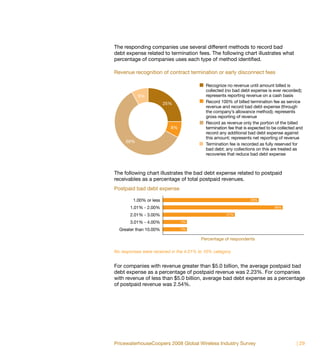
   Process documentation                   13%

            SEC registration         7%


                                                 Percentage of respondents


In addition, we asked the responding companies in which areas they perceive
efficiencies due to external auditors. The results are illustrated in the chart below.
Their answers indicate that auditors are helpful mainly in reducing the number of
key controls tested.

Most important area of external auditors’ efficiencies following Year 1 of
Section 404

  Number of key controls reduced                                             40%

Additional reliance on management                                26%

             Less documentation              13%

                 Less remediation     7%
    Reduction in testing scope for
   sample sizes and key locations     7%

                            Other     7%


                                                 Percentage of respondents


PricewaterhouseCoopers 2008 Global Wireless Industry Survey                        | 153
Legal and regulatory


In prior years we asked respondents to report the total number of key controls
identified across all financial reporting cycles, business processes and units.
The results shown in the chart below indicates a clear and continual trend:
Responding companies have reduced the number of key controls that are tested
each year.

Total number of key controls

                                                                 7
                                                                                       11
                   1 - 500                                  6
                                                 4

                                                 4
               501 - 1,000                            5

                                1
             1,001 - 1,500      1
                                1

                                1                                                  Year 4
             1,501 - 2,000
                                     2
                                                                                   Year 3
                                                                                   Year 2
               Over 2,000       1                                                  Year 1

                                                Number of respondents

The number of respondents is not equal for each year due to required year of adoption for
Section 404 compliance.


154 | Beyond the horizon
When the respondents were asked to identify the number of controls specific to
income tax processes, the same trend held: The number of income tax-related
controls decreased with each year of Section 404 compliance. The following chart
depicts the trends for income tax controls by year of Section 404 compliance.

Number of key income tax controls (4-year comparison)

                                      1
                                                                            4
            0 - 10 controls                                                 4
                                                               3
                                                   2
                                                                            4
           11 - 20 controls                                    3
                                                                                         5

                                      1
           21 - 30 controls           1
                                      1                                            Year 4
                                                                                   Year 3
                                                               3
          Over 30 controls                         2                               Year 2
                                                               3
                                                                                   Year 1
                                                               3

                                                Number of respondents

The number of respondents is not equal for each year due to required year of adoption for
Section 404 compliance.

Similar to the 2007 North American Wireless Survey, we asked the responding
companies how much internal time is required for testing manual/application,
ITGC, and entity level controls testing, regardless of the year of Section 404
compliance. The majority of the respondents indicated that they devote the
same amount of time to testing any control (an average of 14 hours). The chart
below depicts the number of hours spent for each control.

Hours required per control tested

              0 - 10 hours                                                         40%

             11 - 20 hours                                                         40%

     Greater than 20 hours                             20%


                                               Percentage of respondents


PricewaterhouseCoopers 2008 Global Wireless Industry Survey                                  | 155
Legal and regulatory


The following three charts compare the number of un-remediated control
deficiencies, significant deficiencies, and material weaknesses that survey
respondents reported for all years of Section 404 compliance. The charts show
that only one carrier reported material weaknesses by the fourth year of Section
404 compliance. Although the trend was for carriers to report a decreasing total
number of control deficiencies, they still had significant deficiencies by year three.

Control deficiencies (4-year comparison)

                                                          3
                                                                   4
                    0 - 30                                                                 6
                                                                             5


                   31 - 60                                3
                                                                             5


                   61 - 90          1


                                               2
                                    1
                  91 - 120                                                         Year 4
                                    1
                                    1
                                                                                   Year 3
                                    1                                              Year 2
                 Over 120                     2
                                              2
                                                                                   Year 1

                                                   Number of respondents

The number of respondents is not equal for each year due to required year of adoption of
Section 404 compliance.


156 | Beyond the horizon
For companies with revenue greater than $5.0 billion the average number of
control deficiencies has decreased substantially each year. The average number
of control deficiencies was 48, 51, 77 and 112 in years four, three, two and
one, respectively.

Significant deficiencies (4-year comparison)
                                                               6
                      0-5                                            7
                                                                                        10
                                                                                 9

                                1
                    6 - 10            2
                                                                                     Year 4
                                            3                                        Year 3
                                                                                     Year 2
                  Over 20       1                                                    Year 1

                                                Number of respondents

The number of respondents is not equal for each year due to required year of adoption of
Section 404 compliance.
No responses were received in the 11 -15 and 16 - 20 categories

Also for companies with revenue greater than $5.0 billion, the average number
of significant deficiencies has decreased substantially each year. The average
number of significant deficiencies was two, one, two, and nine in years four,
three, two, and one, respectively. The number of significant deficiencies for
companies with revenue of less than $5.0 billion was three, three, two, and three
in years four, three, two, and one, respectively.

Material weaknesses (4-year comparison)

                                                    1
                         5                          1


                         4                                                   2


                         3
                                                                                     Year 4
                         2                          1
                                                                                     Year 3
                                                    1                                Year 2
                         1                          1
                                                                                     Year 1
                                                    1

                                                Number of respondents

The number of respondents is not equal for each year due to required year of adoption of
Section 404 compliance.


PricewaterhouseCoopers 2008 Global Wireless Industry Survey                                   | 157
Legal and regulatory


Companies with revenue greater than $5.0 billion reported no material
weaknesses. The number of material weaknesses for companies with revenue
less than $5.0 billion was on average one, two, one and one in years four, three,
two and one, respectively.

We also asked respondents to specify in which areas they reported significant
deficiencies. Consistent with the 2007 North American Wireless Survey, the
areas of fixed assets, financial reporting, and ITGCs continue to have significant
deficiencies. The chart below illustrates areas of significant deficiencies for the
responding companies.

Source of significant deficiencies
                Fixed assets                                                          14

         Financial reporting                                       9

General computer controls                                          9

Purchasing/payables cycle                               6

Accounting for income taxes                     5

                      Other*               4

                    Revenue                4

      Accounting for leases            3

                                                Number of respondents

* Other includes payroll/commissions cycle, automated controls, and treasury cycle.
Chart sums greater than the number of respondents as multiple responses were allowed.


Regarding reported material weaknesses, the carriers reported deficiencies in
the areas of income taxes, insufficient accounting staff, financial reporting, lease
accounting and fixed assets. The chart below represents the sources that led to
material weaknesses.

Source of material weaknesses

Accounting for income taxes                                                            5

Accounting expertise/resources                                 3

         Financial reporting                                   3

      Accounting for leases                                    3

                Fixed assets                        2

                      *Other                        2

                                                Number of respondents

* Other includes ITGCs and revenues.
Chart sums greater than the number of respondents as multiple responses were allowed.


158 | Beyond the horizon
In the recent past, much discussion has been devoted to implementing AS
5, and to how the implementation of this auditing standard would impact the
resources devoted to Section 404 compliance. In 2007, the Securities and
Exchange Commission unanimously approved AS 5, as amended on May 24,
2007. The 2007 North American Wireless Survey asked respondents to rank
the elements and factors related to AS 5 that would affect their approach to
Section 404 compliance the most significantly. Conversely, this year we asked
for the elements and factors that resulted in the largest change to the responding
companies Section 404-approach. The outcomes are depicted in the chart below.

Change with largest impact due to AS 5


               Percentage of respondents
                                                                                                                         36%


                                                                                                       28%


                                                                                    18%


                                                  9%                9%


                                           Level of judgment     History of       Nature of       Emphasis on        Overall
                                           required to record    prior year     the activities   effective entity  materiality of
                                              transactions      deficiencies     performed        level controls account balance


Last year, we asked wireless carriers in which areas they believed efficiency benefits
from AS 5 would occur. Consequently, this year we asked how the responding
companies realized efficiencies. The companies expected greater efficiency,
but the reduction in the number of key controls was much greater than they
expected. The chart below indicates the ranking in the areas of efficiency gains.

Most important source of realized AS 5 efficiencies

                                                                                                                         58%
               Percentage of respondents


                                                                                                       18%

                                                  8%                8%               8%

                                             Reduction in     Reduction in      Reduction in      Reduction in        Reduction in
                                            external audit external audit hrs   the individual   nature, timing &    number of key
                                            hours reliance, reliance, control   process level    extent of testing      controls
                                             walkthroughs     environment


PricewaterhouseCoopers 2008 Global Wireless Industry Survey                                                                     | 159
Legal and regulatory


SEC reviews
The Securities and Exchange Commissions’ (SEC) Division of Corporate Finance
continues to perform extensive reviews of regulatory filings. This year the survey
results showed 47% of the responding and eligible wireless companies (the SEC
registrants) received a comment letter from the SEC in the last three years. In
the 2007 North American Wireless Survey approximately 85% of the responding
companies had received a comment letter.

SFAS 144/IAS 36 (impairment of long-lived assets), revenue recognition, fair
value measurement and stock-based compensation were among the accounting
topics that the SEC addressed most frequently.

In addition, individual responding companies received comment letters related to
the following topics:

•	 SFAS 142/IAS 38 or the equivalent—goodwill/intangible assets
•	 SFAS 143/IFRS 3 or the equivalent—asset retirement obligations
•	 GAAP/Non-GAAP measures
•	 Segment reporting
•	 Multiple elements or bundled arrangements
•	 Joint venture/variable interest entities (FIN 46)/consolidation
•	 Accounting for derivatives instruments
•	 Amortization of customer list
•	 IFRS/US GAAP differences
•	 Corporate disclosure policies
•	 Allowance for doubtful accounts/accounts receivable
•	 Management Discussion and Analysis (MD&A)
•	 Accelerated share repurchase

No responding companies had to restate related to these comment letters.


160 | Beyond the horizon
As depicted in the chart below, most respondents describe the regulatory
oversight/regime in their home country to be at least moderately involved.
In addition, most responding carriers feel that the regulatory oversight is
consistent among competitors.


Description of the regulatory oversight in the country


   27%

                       40%


                                       Involved
         33%                           Very involved
                                       Moderately involved


PricewaterhouseCoopers 2008 Global Wireless Industry Survey                   | 161
Contact information
For more information about this publication or to inquire
about participating in a future survey, please contact:

Pierre-Alain Sur, Partner                  Paul Rees, Partner
PricewaterhouseCoopers LLP                 PricewaterhouseCoopers LLP
900 South Shackleford Road, Suite 505      1 Embankment Place
Little Rock, AR 72211                      London, United Kingdom
501.907.8085                               44 (20) 7213 4644
pierre-alain.sur@us.pwc.com                paul.g.rees@uk.pwc.com

To request additional copies of this publication, contact
Shara Slattery by e-mail at shara.slattery@us.pwc.com.

About PricewaterhouseCoopers
PricewaterhouseCoopers’ Entertainment, Media and Communications industry
practice delivers a complete range of professional services to telecom, cable,
satellite, Internet, media, and entertainment service providers across the globe.
The group provides industry-focused assurance, tax, and advisory services to
build public trust and enhance value for its clients and their stakeholders.

Drawing on our accumulated experience, we anticipate and meet the challenges
of global regulatory change, and help our clients deal with the impact of industry
convergence. We continue to add measurable value to our client relationships
through our leadership and innovation, which are evident in our evolving services
and products. With thousands of practitioners around the world, we are always
close at hand to provide industry specialist expertise and resources.


162 | Beyond the horizon
Of further interest
Communications review
PwC’s quarterly journal for telecom, cable, satellite and Internet executives
that showcases some of the best global practices and leading-edge thinking
regarding management and financial issues in the communications industry. To
view or download the pdf file, please visit www.pwc.com/communications and
click on the publication link.

CommunicationsDirect News
It’s a news source. It’s a research tool. It’s free.
Subscribe today to start receiving daily or weekly updates on the latest
news and information specifically covering the global telecom, cable, satellite
and Internet industries. Customized at your request by sector and region,
CommunicationsDirect News provides you with updates selected from
more than a dozen news sources. For research needs, utilize the site to
search for content on more than 40 industry sites. See it for yourself, visit
www.communicationsdirectnews.com.

Entertainment & Media Outlook: 2008–2012
Created by top minds from PricewaterhouseCoopers’ Entertainment, Media and
Communications (EMC) practice, in conjunction with economic forecasting firm
Wilkofsky Gruen Associates, this ninth edition of the Outlook provides an in-
depth global analyses and five-year growth projections for 15 industry segments.
The Outlook includes an overview of the global entertainment and media market
as well as in-depth coverage of the market in the US, Europe, the Middle East,
Asia/Pacific, Latin America, and Canada. All orders can be placed through PwC’s
Outlook Web site at www.pwc.com/outlook.

Convergence monitor: Personal mobility
The third in a series of global surveys of PwC staff from 20 territories, the
Convergence Monitor is aimed at understanding consumer preferences and
interest in buying and using various converged services. The report focuses
on which devices and applications people are using today, how they are using
them, and what they would like to have in the future. To download the PDF, visit
www.pwc.com/monitor.

How consumer conversation will transform business
This report examines how new technologies and new methodologies are
transforming a new source of consumer data—the customer’s thoughts,
intentions and innovative ideas obtained from conversations found in blogs,
message boards, phone calls and other interactive media—into a dramatically
deeper understanding of consumers. www.pwc.com/convergence.


PricewaterhouseCoopers 2008 Global Wireless Industry Survey
pwc.com
© 2009 PricewaterhouseCoopers LLP. All rights reserved. “PricewaterhouseCoopers” refers to
PricewaterhouseCoopers LLP (a Delaware limited liability partnership) or, as the context requires, the
PricewaterhouseCoopers global network or other member firms of the network, each of which is a separate
and independent legal entity. *connectedthinking is a trademark of PricewaterhouseCoopers LLP (US).

BS-BS-09-0193-A.0109.DvL

WISNA08
Beyond the horizon
2008 Global Wireless Industry Survey

2008 Global Wireless Industry Survey

  • 1.
    Entertainment, media andcommunications Beyond the horizon* 2008 Global Wireless Industry Survey
  • 2.
    Introduction The PricewaterhouseCoopers (PwC)2008 Wireless Industry Survey was led by Paul Rees, PwC’s Global Infocomm Leader and Pierre-Alain Sur, PwC’s US wireless industry leader, and represents the efforts and ideas of many members of our Entertainment, Media and Communications Industry group. The principal contributors were: Shara Slattery, Sarah McWilliams, Rob Glasgow, Tom Leonard Jr., Mackenzie Welch, Michael Riordan, Jamal Douglas, Kristen Lybrand, Taylor Cloninger, Erik Hönig, Constantin Vogel, Brian Caisman, Timothy Schmitt, Tyler Furness, Peter Osvaldik, Karen Plunkett, Dominic Wong, and Keri Dickey. PwC would especially like to thank the companies that participated in and contributed topics for the survey. Their candid responses and support of this project are very much appreciated. Together we have created valuable insight into the operations of and challenges faced by today’s wireless industry on a global basis. About this survey The PricewaterhouseCoopers Wireless Industry Survey is an annual publication that covers the financial and operational reporting policies and practices of wireless telecommunications service providers. The 2008 survey includes companies in the U.S., Canada, Europe, Asia-Pacific, and South America. The survey is conducted by PwC’s Entertainment, Media and Communications Industry group, which prepares the survey questions, solicits company participation and compiles and analyzes the survey results. Companies participate voluntarily and the individual survey results are kept confidential by PwC. PwC has taken reasonable steps to ensure that the information contained in this publication accurately summarizes the survey responses received from the participating companies; however, PwC has not performed any procedures to verify the accuracy of the survey responses. The survey provides a summary of the participating companies’ financial and operational reporting policies and practices and does not purport to render accounting guidance nor any other type of professional advice. Should such advice be required, please contact your local PricewaterhouseCoopers office. You can access our worldwide office directory at www.pwc.com.
  • 3.
    Contents 01 Executive summary 05 Participating companyinformation 23 Revenue recognition 63 Performance measures 93 Property, plant and equipment 149 Legal and regulatory
  • 5.
    Executive summary We arepleased to publish the first annual PricewaterhouseCoopers Global Wireless Industry Survey. This survey is a continuation of the past 11 years of the North American Survey and for 2008 has been expanded to include global wireless operators. The expansion of the survey globally also reflects the ever-growing importance of International Financial Reporting Standards (IFRS) and the United States and Canada adoption in the future of IFRS. The global survey will provide the opportunity for carriers to compare and contrast the two frameworks. This year’s survey begins to articulate differences. The goal of the survey is to help companies understand industry performance measures and their evolution over time, policies and procedures utilized by responding companies, and to help companies better understand the comparability of financial statements within the industry. We also have a goal of addressing general financial accounting and reporting practices in the industry and identifying emerging trends or issues. The survey has become a resource for many wireless communication industry executives and has evolved with the changing businesses and trends of the industry. We have provided a highlight of this year’s survey results in the executive summary. We hope you find the 2008 PricewaterhouseCoopers Global Wireless Industry Survey informative, pertinent, and stimulating. PricewaterhouseCoopers 2008 Global Wireless Industry Survey |1
  • 6.
    Executive summary The 2008survey results reflect the participation of nine U.S. companies, including six of the largest wireless operators, plus four Canadian wireless companies and five carriers in the rest of world. Because of the breadth of coverage and participation, we believe that the survey provides the most representative summary of industry accounting policies and practices available on a global basis. In the 2007 North American Wireless Survey, and the surveys before that, we examined wireless carriers in the U.S. and Canada only. This year, we expanded our population of carriers and responding companies to include wireless carriers from the rest of the world, outside of North America, including Asia, Europe and South America. Although the responding carriers differ only slightly this year from our last North American Survey, we highlighted important changes, if applicable throughout the survey. Here are a few highlights from this year’s results that covers 2007 year-end and early 2008 metrics: Revenue and performance measures New products and features represent ongoing sources of additional revenue growth for wireless carriers. Industry competition has continued to decrease monthly rate plans while minutes of use continue to increase to an average of 628 minutes used per month. Recently, many of the North American carriers began offering all-inclusive packages to increase data usage. Data services— including SMS, picture, ring tones, e-mail services and games—continue to increase revenue for the responding companies. On average, data revenue increased by more than 50% for all responding companies on a year over year basis. The industry defines data users by several different methods ranging from daily data use to all subscribers if data technology exists on the handset. In addition, prepaid plans continue to be a significant portion of revenue, representing on average 26.8% of total service revenue. We asked survey respondents how they define minutes of use (MOU) and 61% define MOU as billed minutes (whether included as part of the customer’s plan or additional non-packaged minutes billed). Roaming revenue for the responding companies represents an average of five percent (5%) of total service revenue while long distance revenue represents six percent (6%) of total service revenue. Advertising of products and services represents a significant expense for most responding carriers. The average advertising cost per gross addition for companies with revenue greater than $5.0 billion is $82.50, and for companies with less than $5.0 billion in revenue it is $65.75. Advertising dollars are mostly spent for television spots (34%), newspaper (13%), other printed media (12%), and radio (11%). 2 | Beyond the horizon
  • 7.
    We asked theresponding companies to identify the method through which their postpaid subscribers receive their monthly invoices. On average, 85% of subscribers receive a paper bill. Six percent (6%) receive bills electronically while five percent (5%) do not receive any type of invoice. Property, plant and equipment As the demands of subscribers change and the industry experiences changes in technology and equipment, 76% of the respondents stated that they have either recorded impairment charges or accelerated depreciation. The respondents stated that the primary drivers of this decision included obsolescence due to technological updates (77%). The demand for new products and services, especially data, translates into significant amounts of capital expenditures. On average, capital expenditures as a percentage of service revenue was 21.2% or an average of $122.24 per subscriber. Seventy-six percent (76%) of the respondents indicated they had performed an inventory of network assets and over half had completed the inventory within the past 12 months. Legal and regulatory The Sarbanes-Oxley Act continues to be an area that consumes time and resources for wireless carriers even four years after its implementation in the United States. One trend that has continued is the reduction in the number of key controls that are tested each year. The average number of controls tested for companies with revenue greater than $5.0 billion has decreased from over 1,300 to just over 400, and companies with revenue of less than $5.0 billion have seen a decrease from approximately 700 to approximately 125 controls. The decrease in the number of key controls has evolved as companies place greater emphasis on entity level controls. Consistent with the prior year North American Wireless Industry Survey, fixed assets, financial reporting and general computer controls remain the largest sources of significant deficiencies. The Securities and Exchange Commission (SEC) continues to be active among the North American wireless carriers as over half of the respondents received comment letters in the last three years. PricewaterhouseCoopers 2008 Global Wireless Industry Survey |3
  • 9.
    Participating company information The 2008Global Wireless Industry Survey results represent nine United States, four Canadian and five rest of world wireless companies. The following pages provide the demographics and general corporate data and structure of the responding carriers. Names of participating companies Company type and subscriber base Annual service revenue Employee base Sales locations Customer care Licensed spectrum Environmental sustainability PricewaterhouseCoopers 2008 Global Wireless Industry Survey |5
  • 10.
    Participating company information Namesof participating companies United States Canada Alltel Corporation Bell Mobility AT&T Mobility Rogers Wireless Centennial Communications Saskatchewan Telephone Leap Wireless TELUS Mobility Metro PCS Sprint/Nextel Rest of world T-Mobile USA PT Excelcomindo Pratama Tbk. U.S. Cellular KPN International Verizon Wireless Oi Movel Smart Communications, Inc. T-Mobile Germany 6 | Beyond the horizon
  • 11.
    Company type andsubscriber base Ninety-four percent (94%) of the responding companies reported being required, or being a subsidiary of a company that is listed on a stock exchange and is required, to file quarterly and/or annual financial statements. The chart below depicts which stock exchanges the responding companies are listed on. Stock exchanges 26% 42% NYSE 21% NASDAQ 11% Toronto Stock Exchange Other* * Other includes EURONEXT, Frankfurt, Indonesian, Philippine, and Sao Paulo exchanges. The responding companies prepare their financial statements under various generally accepted accounting principles (GAAP). Twenty-two percent (22%) of the responding companies currently report under International Financial Reporting Standards (IFRS). IFRS was adopted by one carrier in 2004, two carriers in 2005 and one carrier in 2007. Forty-two percent (42%) of the responding companies either have the option to prepare local statutory accounts in accordance with IFRS, or are mandated to prepare local accounts in accordance with IFRS. The chart below shows the number of responding companies preparing their financial statements according to the respective accounting principles. Accounting principle followed U.S. GAAP 8 Canadian GAAP 4 IFRS 4 Other* 3 Number of respondents * Other Includes Brazilian, Indonesian, and Philippine GAAP. Chart sums to greater than the number of respondents as multiple responses were allowed. PricewaterhouseCoopers 2008 Global Wireless Industry Survey |7
  • 12.
    Participating company information Thechart below shows the responding companies’ reported subscribers as of March 31, 2008. Subscribers as of March 31, 2008 11% 11% 50% Less than 1.0 million 22% 2.6 million - 5.0 million 5.1 million - 7.5 million 6% 12.6 million - 15.0 million Greater than 15.0 million There were no responses in the 1.0 million - 2.5 million, 7.6 million - 10.0 million, and 10.1 million - 12.5 million categories. The industry continues to experience subscriber growth as more people are substituting wireless devices for traditional wireline service. For North American carriers, the subscriber levels increased: 89% of the responding carriers reported greater than 2.5 million total subscribers compared to the 74% reported in the 2007 North American Wireless Survey. 8 | Beyond the horizon
  • 13.
    Annual service revenue Thechart below illustrates the responding companies’ service revenue reported for the most recently ended fiscal year (December 31, 2007 for all respondents, except one which is May 31, 2008). The average revenue is $19.7 billion for carriers with revenue greater than $5.0 billion and $2.2 billion for carriers with revenue less than $5.0 billion. Annual service revenue 11% 28% 6% Less than $500 million $500 million - $999.9 million 17% 38% $1.0 billion - $4.9 billion $5.0 billion - $9.9 billion Greater than $9.9 billion PricewaterhouseCoopers 2008 Global Wireless Industry Survey |9
  • 14.
    Participating company information Employeebase Seventy-eight percent (78%) of the responding companies reported operating their company on a centralized basis (a single headquarters location that completes the accounting/finance function for the entire organization), as opposed to a decentralized basis (multiple business units or segments that have separate accounting/finance functions that are consolidated by a headquarters office). The chart below represents the number of full-time employees as of March 31, 2008 by the responding companies with greater than $5.0 billion in revenue. Full-time employees (Carriers with revenue > $5.0 billion) 25% 62% 13% 5,001 - 10,000 employees 10,001 - 20,000 employees Greater than 30,001 employees No responses were received in the fewer than 5,000 and 20,001-30,000 categories. The chart below represents the number of full-time employees as of March 31, 2008 by the responding companies with less than $5.0 billion in revenue. Full-time employees (Carriers with revenue < $5.0 billion) 10% 50% 40% Fewer than 1,000 employees 1,001 - 5,000 employees 5,001 - 10,000 employees 10 | Beyond the horizon
  • 15.
    The charts belowdepict the number of full-time employees for each functional category as of March 31, 2008. The responding companies were split between carriers with greater than $5.0 billion in revenue and those with less than $5.0 billion in revenue. Average number of employees per functional position Network/engineering 848 4,279 256 Information technology 2,144 1,653 Customer care 12,750 1,295 Retail employees 10,826 Average number of employees Carriers with revenue < $5.0 billion Carriers with revenue > $5.0 billion Average number of employees per functional position 10 Commission accounting 40 8 Payroll 59 5 Property accounting 22 7 Inventory accounting 10 28 Revenue accounting 42 9 Internal audit 21 14 Tax accounting 38 Average number of employees Carriers with revenue < $5.0 billion Carriers with revenue > $5.0 billion PricewaterhouseCoopers 2008 Global Wireless Industry Survey | 11
  • 16.
    Participating company information Saleslocations All but three of the responding companies reported using company-owned retail store/kiosk locations to sell and provide services to customers. The chart below depicts how many company-owned retail store/kiosk locations the responding companies reported. Company-owned retail stores and kiosk locations 7% 29% 50% 1 - 99 retail stores/kiosk 14% 100 - 350 retail stores/kiosk 351 - 999 retail stores/kiosk Greater than 1,000 retail stores/kiosk The average number of company-owned retail stores for carriers with greater than $5.0 billion in revenue and for those with less than $5.0 billion in revenue is 1,208 and 183, respectively. 12 | Beyond the horizon
  • 17.
    The charts belowdepict the number of reseller/retail stores (third-party companies) and branded franchise locations that sell each carrier’s services. Reseller/retail stores 8% 38% 54% 500 - 999 reseller/retail stores 1,000 - 4,999 reseller/retail stores Greater than 10,000 reseller/retail stores No responses were received in the 1 - 499 and 5,000 - 9,999 categories. The average number of reseller/retail stores (third-party companies) that sell services for carriers with revenue greater than $5.0 billion and for carriers with revenue of less than $5.0 billion is 53,034 and 2,188, respectively. Franchise locations 8% 50% 42% 1 - 99 franchise locations 100 - 999 franchise locations Greater than 1,000 franchise locations Franchise locations represent a branded store that is independently owned by a third party. The average number of franchise locations that sell services for carriers with revenue greater than $5.0 billion and for carriers with revenue of less than $5.0 billion is 2,782 and 473, respectively. PricewaterhouseCoopers 2008 Global Wireless Industry Survey | 13
  • 18.
    Participating company information Customercare The following charts depict the responding carrier’s percentage of customer care activity by the source. Customer care activity via internet transactions 7% 14% 36% 7% No customer care via the internet 1% - 10% of customer care via the internet 11% - 25% of customer care via the internet 36% 26% - 50% of customer care via the internet 51% - 75% of customer care via the internet No responses were received in the 76% - 100%. The average percentage of all customer care activity performed via internet transactions by carriers with revenue greater than $5.0 billion is 23% and is 7% for carriers with revenue of less than $5.0 billion. Customer care activity via Interactive Voice Response (IVR) 7% 30% 21% 1% - 10% of customer care via IVR 11% - 25% of customer care via IVR 21% 21% 26% - 50% of customer care via IVR 51% - 75% of customer care via IVR 76% - 100% of customer care via IVR 14 | Beyond the horizon
  • 19.
    Customer care activityvia live customer service representative 7% 21% 7% 1% - 10% of customer care via service representative 11% - 25% of customer care via service representative 26% - 50% of customer care via 21% service representative 44% 51% - 75% of customer care via service representative 76% - 100% of customer care via service representative The average customer care activity via the web is 14% (up slightly from the 2007 North American Wireless Survey) and nine companies are using the internet. Live customer service via a customer service representative continues to be utilized the most at 51%, consistent with the 2007 North American Wireless Survey. Carriers with revenue greater than $5.0 billion use IVR for 25% of all customer care activity, and use live customer service representatives approximately 50% of the time. Carriers with revenue of less than $5.0 billion have more live interaction (53% of all transactions) for customer care activity and complete 39% of transactions through IVR. PricewaterhouseCoopers 2008 Global Wireless Industry Survey | 15
  • 20.
    Participating company information Thenumber of employees in customer care at each organization varies due to the differing levels of outsourcing to third parties. Twenty-eight percent (28%) of the responding companies outsource all of their customer care call volume, while an additional 22% do not outsource any of their customer care call volume. The remaining 50% outsource a portion of their customer care call volume. The chart below depicts the percentage of outsourced call volume for those responding companies who outsource a portion of their volume. Outsourced customer care activity 11% 22% 0% - 25% outsourced 67% 26% - 50% outsourced Greater than 50% outsourced Among the companies that outsource a portion or all of their customer care volume, an average of 71% of customer care is performed domestically (i.e. in the primary country of operation) and 29% is performed internationally (i.e. outside of the primary country of operation). The following chart shows the percentage of this outsourced volume that is handled domestically (primary country of operation). Outsourcing handled domestically 14% 51% 21% 0% - 25% domestic 26% - 50% domestic 14% 51% - 99% domestic 100% domestic 16 | Beyond the horizon
  • 21.
    The chart belowdepicts the number of respondents that outsource a portion of their primary accounting functions. For those functions that are outsourced, the average percentage of their activity that is outsourced is depicted below. Outsourced functions 14 Internal audit 4 average % outsourced = 49% 16 Accounts payable 2 average % outsourced = 48% Accounts receivable 10 collections 8 average % outsourced = 42% 9 Inventory management 9 average % outsourced = 75% 12 Remittance processing 6 average % outsourced = 47% 16 Payment processing 2 average % outsourced = 53% 10 Payroll processing 8 average % outsourced = 60% Income taxes 10 8 average % outsourced = 56% Number of respondents No outsourcing Function outsourced PricewaterhouseCoopers 2008 Global Wireless Industry Survey | 17
  • 22.
    Participating company information Licensedspectrum The responding companies own and use licenses primarily in the cellular (~850 MHz) and Personal Communication Services (~1.9 GHz) categories to provide service within North America. The chart below shows the percentage of companies that own and/or use each of the reported license types within North America. North American licensed spectrum Personal Communication 13 Services (PCS) (~1.9 GHz) 13 10 Cellular (~850 MHz) 10 WLS communication 2 services (~2.3 GHz) 6 Advanced Wireless 3 Spectrum 5 Specialized Mobile Radio 2 (SMR) services (~800/900 MHz) 2 Number of respondents Use spectrum Own spectrum Chart sums to greater than the number of responding carriers as multiple responses were allowed. 18 | Beyond the horizon
  • 23.
    Outside North America,the responding companies own and use licenses across various categories, as represented by the chart below. Licensed spectrum outside of North America 4 3G UMTS/IMT - 2000 5 4 GSM - 1800 4 4 GSM - 900 4 GSM - 850 2 2 CDMA - 2000 1 1 GSM - 1900 1 1 Number of respondents Use spectrum Own spectrum No responses were received in the GSM-400 and CDMA-450 categories. PricewaterhouseCoopers 2008 Global Wireless Industry Survey | 19
  • 24.
    Participating company information Environmentalsustainability Given the growth in environmental responsibility by individual companies and the increase in environmental concerns by consumers, we asked responding companies about their environmental responsibility programs. The chart below shows who within the responding companies’ organization has responsibility for overall environmental performance. Environmental performance responsibility 14% 30% 21% C-level executive, other than chief executive officer The board of directors 21% No one person specifically tasked with this function 14% Chief executive officer Functional managers 20 | Beyond the horizon
  • 25.
    The surveyed companieswere asked several questions related to their views on environmental practices. The companies were asked to respond on a scale of 1 to 5, with 1 being “strongly agree” and 5 being “strongly disagree.” The chart below represents the average response received for each question. Environmental views Green efforts are more of a fad than they are an enduring transformation for our company and our industry. 3.7 Our industry has a moral responsibility to help consumers change their own behaviors (through editorial, effective programming and advertising). 2.1 Investors and stakeholders will increasingly reward companies with above average performance on sustainability issues. 2.1 We can achieve cost savings implementing sound environmental practices. 1.6 We must demonstrate progress on our environmental records to continue to attract and retain customers. 1.6 1. Strongly agree These initiatives make a positive contribution to workplace/employee morale/recruitment/retention. 1.5 2. Agree These efforts are valuable to our brand, who 3. Neutral we are as a company, and to our customers. 1.5 4. Disagree The adoption of environmentally friendly practices 5. Strongly disagree can drive stronger corporate performance. 1.5 Average response Sixty percent (60%) of the responding companies reported their performance on environmental or social issues to the public (either through triple-bottom line reporting or another discretionary report such as a corporate responsibility report). Another 13% of the respondents indicated that they plan to report environmental performance in the future. Eighty-nine percent (89%) of the responding companies reported supporting existing programs to recycle mobile phones/accessories and reducing their environmental impact. These programs include in-store collection, donating proceeds to local charities, planting trees and customer account credits. Only 50% of the respondents reported monitoring their carbon footprint to determine ways to reduce environmental impact. PricewaterhouseCoopers 2008 Global Wireless Industry Survey | 21
  • 27.
    Revenue recognition The followingpages cover wireless company practices in the area of revenue recognition. Service contracts and family plans Termination fees and bad debt expense Prepaid Data services Mobile advertising Wi-Fi data services Customer retention Sales incentives Market development funds and rebates Other revenue activities Revenue assurance Customer billing and payments Handset insurance All-inclusive packages PricewaterhouseCoopers 2008 Global Wireless Industry Survey | 23
  • 28.
    Revenue recognition Service contractsand family plans Of the responding companies, 83% said they have postpaid service contracts with their subscribers. Of the 15 total respondents that have postpaid service contracts, 11 offer one-year contracts, 13 offer two-year contracts, and six offer three-year contracts. The following two charts illustrate the respondents’ terms of postpaid service contracts and the approximate percentage of customers on each contract term. Not all respondents indicated the percentage of customers on each contract term. One-year contract term 76% - 100% 1 26% - 50% 1 11% - 25% 1 10% or less 5 Number of respondents No responses were received in the 51% - 75% category. Two-year contract term 76% - 100% 4 51% - 75% 2 26% - 50% 1 11% - 25% 2 10% or less 1 Number of respondents 24 | Beyond the horizon
  • 29.
    The chart belowillustrates the approximate percentage of customers who are out of contract or who do not currently have a contract. Out of contract/no current contract 26% - 50% 1 11% - 25% 6 Number of respondents No responses were received in the 10% or less and the greater than 50% categories. An increasing number of companies are offering family plans to their customers. Seventy-eight percent (78%) of the responding companies offer family plans to their postpaid subscribers. The chart below shows the percentage of postpaid subscribers who are on family plans. Percentage of postpaid subscribers on family plans 51% - 75% 36% 26% - 50% 10% 11% - 25% 27% 10% or less 27% Percentage of respondents No responses were received in the greater than 75% category. The average percentage of postpaid subscribers on family plans among all respondents is 33%. For companies with revenue greater than $5.0 billion, 46% of total subscribers are on family plans, compared to 26% for companies with revenue of less than $5.0 billion. PricewaterhouseCoopers 2008 Global Wireless Industry Survey | 25
  • 30.
    Revenue recognition Of theresponding companies that offer family plans, 43% indicated that family plans average two subscribers per plan and 50% indicated that family plans average three subscribers per plan. The remaining seven percent indicated an average of four subscribers per plan. The chart below illustrates the average postpaid monthly revenue per user for subscribers enrolled in family plans. Average monthly family plan subscriber revenue 9% 18% 9% 18% Less than $20 $41 - $50 $51 - $60 46% $61 - $70 Greater than $70 No responses were received in the $21 - $40 category. In order to add subscribers to family plans, many of the respondent companies charge for each additional subscriber enrolled. Fifty-six percent (56%) of the respondents charge $10 or less per additional subscriber on family plans, while the remaining 44% charge between $10.01 and $20.00. 26 | Beyond the horizon
  • 31.
    Termination fees andbad debt expense The chart below illustrates how responding companies charge contract termination fees, and how strictly the companies bill and enforce the collection of the contract termination or early disconnect fees. None of the North American companies responded that they strictly enforce contract termination fees; in comparison, in the 2007 North American Wireless Survey, six percent of the respondents strictly enforced contract termination fees. Eighty percent (80%) of the rest of world responding companies indicated that they strictly enforce early termination fees. Contract termination or early disconnect fees 11% 11% Charge somewhat (most early termination fees are billed and most have to pay except in certain 56% situations, e.g., close to the end of the contract term, waived for high-value subscribers) 22% Charge strictly (every early termination fee is billed and subscriber has to pay regardless of situation) Charge rarely/not at all Do not charge contract termination fees Six companies responded that contract termination or early disconnect fees are prorated over the life of the contract. Among them, the six companies use several methods to determine the prorated amount. One prorates 100%, one prorates three percent per month, two prorate $20 for each month remaining in a contract, and the others utilize a combination of the aforementioned methods. PricewaterhouseCoopers 2008 Global Wireless Industry Survey | 27
  • 32.
    Revenue recognition We alsoasked the responding companies to comment on their success in collecting contract termination or early discount fees. As indicated in the charts below, the collection rates on these fees vary drastically depending on whether the customer has voluntarily terminated service or whether service has been involuntarily terminated by the company. As illustrated in the chart below, 41% of the 2008 responding companies are collecting approximately 50% or more of contract termination fees related to voluntary terminations. The following charts represent data compared to the 2007 North American Wireless Survey and represent only North American carriers. Collection rates - Voluntary termination fees 8% Greater than 75% 10% 33% 51% - 75% 30% 18% 26% - 50% 30% 33% 10% - 25% 20% 8% Less than 10% 10% Percentage of respondents 2008 2007 Collection rates—Involuntary termination fees 51% - 75% 8% 17% 26% - 50% 20% 42% 10% - 25% 20% 33% Less than 10% 60% Percentage of respondents 2008 2007 28 | Beyond the horizon
  • 33.
    The responding companiesuse several different methods to record bad debt expense related to termination fees. The following chart illustrates what percentage of companies uses each type of method identified. Revenue recognition of contract termination or early disconnect fees Recognize no revenue until amount billed is collected (no bad debt expense is ever recorded); 8% represents reporting revenue on a cash basis 25% Record 100% of billed termination fee as service revenue and record bad debt expense (through the company’s allowance method); represents gross reporting of revenue Record as revenue only the portion of the billed 8% termination fee that is expected to be collected and record any additional bad debt expense against this amount; represents net reporting of revenue 59% Termination fee is recorded as fully reserved for bad debt; any collections on this are treated as recoveries that reduce bad debt expense The following chart illustrates the bad debt expense related to postpaid receivables as a percentage of total postpaid revenues. Postpaid bad debt expense 1.00% or less 29% 1.01% - 2.00% 36% 2.01% - 3.00% 21% 3.01% - 4.00% 7% Greater than 10.00% 7% Percentage of respondents No responses were received in the 4.01% to 10% category. For companies with revenue greater than $5.0 billion, the average postpaid bad debt expense as a percentage of postpaid revenue was 2.23%. For companies with revenue of less than $5.0 billion, average bad debt expense as a percentage of postpaid revenue was 2.54%. PricewaterhouseCoopers 2008 Global Wireless Industry Survey | 29
  • 34.
    Revenue recognition Prepaid Of theresponding companies, 100% offer customers the opportunity to pay for service in advance. The following chart illustrates the percentage of the responding companies’ total subscribers that are prepaid subscribers. Percentage of prepaid subscribers Greater than 75% 5 51% - 75% 2 11% - 25% 6 10% or less 5 Number of respondents No responses were received in the 26% - 50% category. The following chart indicates the average percentage of prepaid subscribers as a percentage of total subscribers. Average percentage of prepaid subscribers Rest of world respondents 78.2% Carriers with revenue < $5.0 billion 53.2% All respondents 39.7% North American respondents 24.8% Carriers with revenue > $5.0 billion 22.8% 30 | Beyond the horizon
  • 35.
    The responding companiesreported the average prepaid subscriber life as approximately 18 months. The chart below represents the average prepaid subscriber life in months for the responding companies that offer this service. Average prepaid subscriber life 6 - 10 months 13% 11 - 15 months 40% 16 - 20 months 20% 21 - 25 months 7% 31 - 35 months 20% Percentage of respondents No responses were received in the 26 - 30 months category. For companies with revenue greater than $5.0 billion, the average prepaid subscriber life was 18 months in 2008. For companies with revenue of less than $5.0 billion, the average prepaid subscriber life was 17 months. Of the responding companies, 86% have prepaid cards with expiration periods. The chart below illustrates the average expiration periods for the responding companies. Expiration periods 11% 11% 11% 11% 3 to 15 day expiration 1 - 2 month expiration 56% 3 - 4 month expiration 12 month expiration No expiration Forty-four percent (44%) of the responding companies’ inactivated prepaid cards have an expiration period/expiration date. PricewaterhouseCoopers 2008 Global Wireless Industry Survey | 31
  • 36.
    Revenue recognition The chartbelow illustrates the average monthly minutes of use (MOU) per prepaid subscriber for the responding companies. The average minutes of use per month for all the responding companies were 343. Average monthly MOU per prepaid subscriber Less than 100 minutes 27% 100 - 250 minutes 27% 251 - 500 minutes 27% 501 - 750 minutes 7% 751 - 1,000 minutes 12% Percentage of respondents Companies with revenue greater than $5.0 billion reported average prepaid MOU of 387 minutes, and companies with revenue of less than $5.0 billion reported average prepaid MOU of 292. 32 | Beyond the horizon
  • 37.
    The following chartsrepresent prepaid revenues as a percentage of total revenues, both for the responding companies in total and by categories of respondents. Prepaid revenue as a percentage of total revenues 81% - 100% 3 51% - 70% 2 11% - 20% 2 6% - 10% 3 5% or less 8 Number of respondents No responses were received in the 21% - 50% and 71% - 80% categories. Average prepaid revenue as a percentage of total revenues by category of respondents Rest of world respondents 49.4% Carriers with revenue < $5.0 billion 38.3% All respondents 26.8% North American respondents 18.2% Carriers with revenue 12.5% > $5.0 billion Four of the 18 responding companies offer family plans to their prepaid subscribers. PricewaterhouseCoopers 2008 Global Wireless Industry Survey | 33
  • 38.
    Revenue recognition Data services Dataservices continue to be an area of focus, as most responding companies are seeking opportunities to grow revenue. The responding companies use several different methods to define users of data services. The following chart illustrates what percentage of the responding companies uses each type of method identified. Definition of user of data services 7% 27% Use of data services on a daily basis Use of data services on a monthly basis Use of data services at least once in a 46% 12 month period 13% Other 7% All subscribers, regardless of usage are defined as data subscribers if the technology exists on the handset We asked the responding companies what percentage of their data revenue is generated from stand-alone data services versus combined voice and data bundled packages. The chart below illustrates that the majority of the respondents (54%) indicated that more than 50% of their data revenue is from stand-alone data services. Data revenue generated from stand-alone data service 31% 39% Less than 26% 15% 26% - 50% 15% 51% - 75% Greater than 75% Twenty-eight percent (28%) of the respondents have implemented e-wallet (the ability to make purchases through the mobile phone). 34 | Beyond the horizon
  • 39.
    The chart belowillustrates the percentage of service revenues, excluding SMS/ text, generated by postpaid and prepaid data services. Percentage of service revenues generated by postpaid and prepaid data services 12.1% - 15.0% 1 10.1% - 12.0% 3 1 8.1% - 10.0% 3 3 6.1% - 8.0% 4 1 4.1% - 6.0% 1 5 2.1% - 4.0% 1 4 Less than 2% Number of respondents Prepaid Postpaid The chart below indicates the effect that data services, excluding SMS/text, have on the average revenue per user on a monthly basis for total, prepaid, and postpaid ARPU. Data services, excluding SMS/Text, effect on ARPU 14% $7.01 - $8.00 9% 14% $6.01 - $7.00 28% $4.01 - $5.00 18% 14% Total ARPU per user $3.01 - $4.00 9% Prepaid ARPU per prepaid user 21% $2.01 - $3.00 9% Postpaid ARPU per postpaid user 7% $1.51 - $2.00 27% 18% 30% $0.00 - $1.50 73% 9% Percentage of respondents No responses were received in the $5.01 - $6.00 category. PricewaterhouseCoopers 2008 Global Wireless Industry Survey | 35
  • 40.
    Revenue recognition Fifty-eight percent(58%) of the responding companies indicated that postpaid data services revenue, excluding SMS/text, increased more than 50% year over year. Sixty-seven percent (67%) of the responding companies had an increase of more than 50% in their prepaid data services revenue year over year. As SMS/text becomes increasingly popular among North American subscribers, companies are beginning to see the positive effects of SMS/text revenue on total services revenue, prepaid revenue, and postpaid revenue. The chart below illustrates SMS/text revenue as a percentage of total services revenue, prepaid revenue, and postpaid revenue. SMS/text revenue as a percent of service revenues 20% Greater than 11.00% 51% 14% 9.1% - 11.00% 14% 8% 20% 7.01% - 9.00% 14% 14% 33% 5.01% - 7.00% 7% 36% 20% 3.01% - 5.00% 7% 14% 7% 1.01% - 3.00% 7% 14% Percentage of respondents SMS/text as a % of total revenues SMS/text as a % of prepaid revenues SMS/text as a % of postpaid revenues 36 | Beyond the horizon
  • 41.
    The chart belowindicates the monthly contribution of SMS/text revenue to total, prepaid, and postpaid ARPU. SMS effect on ARPU $9.01 to $10.00 9% 16% $4.01 to $5.00 28% 23% $3.01 to $4.00 9% 18% 23% $2.01 to $3.00 18% 18% 23% $1.51 to $2.00 18% 9% 15% $0.00 to $1.50 55% 18% Percentage of respondents Monthly ARPU per SMS/text user Monthly prepaid ARPU per prepaid SMS/text user Monthly postpaid ARPU per postpaid SMS/text user No responses were received in the $5.01 - $9.00 category. We asked the responding companies to indicate SMS/text data revenue for each of the following: SMS/text data revenue per user, prepaid SMS/text data revenue per prepaid user, and postpaid SMS/text revenue per postpaid user. The results are illustrated in the chart below. SMS data ARPU 11% $10.01 - $15.00 14% 12% 22% $7.51 - $10.00 25% 22% $5.01 - $7.50 25% 11% $2.51 - $5.00 43% 38% 34% $0.00 - $2.50 43% Percentage of respondents Total ARPU per user Prepaid ARPU per prepaid user Postpaid ARPU per postpaid user PricewaterhouseCoopers 2008 Global Wireless Industry Survey | 37
  • 42.
    Revenue recognition We askedthe responding companies whether they allocate airtime usage charges between data services and voice service. Only 28% of the responding companies indicated that they allocate airtime usage between data services and voice service. Fifty-four percent (54%) of the responding companies indicated a more than 50% increase in postpaid data services revenue for SMS/text revenue only year over year. Fifty-eight percent (58%) of the responding companies had an increase of more than 50% in prepaid data services revenue year over year. Eighty-eight percent (88%) of the respondents’ subscribers can access third- party content that the company does not source through their handsets, e.g., through a shortcode SMS/text, m-sites, or a premium rate. The chart below illustrates how the respondents account for the revenue share payment made to the third-party content provider. Third-party content 31% 54% 15% Reduction of revenue Operating expense other than cost of service Cost of service 38 | Beyond the horizon
  • 43.
    The chart belowillustrates the criteria the responding companies considered in determining the accounting for the revenue share payment for third-party content. Criteria used to determine revenue share payment for third-party content Ability to set price to end customer 85% Existence of credit risk 54% Ability to select the content provider 54% Margin earned on the provision of 46% the service Ability to change or modify the 31% content before it is transmitted Branding 15% Percentage of respondents Chart sums to greater than 100% because multiple responses were allowed. Mobile advertising We asked the responding companies whether they include any non-subscriber revenue in calculating average revenue per user (e.g., roaming revenue, wholesale revenue, and advertising revenue). Seventy-eight percent (78%) of the responding companies include other non-service revenues in their ARPU. Seventy-one percent (71%) of those carriers reported that they include roaming revenues. Of the responding companies, 39% record revenue related to mobile advertising. Fifty-seven percent (57%) of the respondents indicated that they recognize the revenue using the gross method, while the remaining 43% indicated that they use the net method. PricewaterhouseCoopers 2008 Global Wireless Industry Survey | 39
  • 44.
    Revenue recognition Wi-Fi dataservices Wi-Fi hotspots and wireless broadband access cards are common in today’s marketplace. Of the responding companies, 67% offer Wi-Fi hotspots in public locations, such as airports, coffeehouses, hotels, and offices. For the companies that offer hotspot services and pay the hotspot location a portion of the fee billed to the customer, 88% account for fees paid to location owners as an operating expense. The remaining 12% of respondents account for such fees as a reduction of revenue. For the companies that offer hotspot services and pay the hotspot location a portion of the fee billed to each customer, the following chart shows the various types of rate structures used. Rate structures used for payments to hotspot locations 14% 24% 24% Flat rate per subscriber Flat rate per subscriber plus a variable amount 24% Included as part of the service 14% Percentage of revenue per subscriber Percentage of revenue based on usage Of the responding companies, 94% provide wireless broadband access through personal computer cards. Of companies that offer wireless broadband access, the average number of users for companies with revenues greater than $5.0 billion is 1.33 million, while the average number of users for companies with revenues of less than $5.0 billion is 82.4 thousand. 40 | Beyond the horizon
  • 45.
    Customer retention Companies continueto focus on retaining current customers, as overall market penetration rates have slowed. Accordingly, retention-related activities have increased in recent years. The chart below illustrates the percentage that retention-related costs increased from fiscal year 2006 to fiscal year 2007 for the responding companies. Increase in retention-related costs FY06-FY07 Greater than 50% 18% 31% to 40% 10% 21% to 30% 27% 11% to 20% 27% Less than 10% 18% Percentage of respondents No responses were received in the 41% - 50% category. Subsidies offered on handset upgrades to retain current customers can be a significant component of customer retention costs. The range of subsidy costs per handset upgrade reported by the responding companies is presented in the chart below. Average handset subsidy for customer retention 8% 17% 8% Less than $50 25% $51 - $100 34% $101 - $150 $151 - $200 8% $201 - $250 Greater than $250 PricewaterhouseCoopers 2008 Global Wireless Industry Survey | 41
  • 46.
    Revenue recognition The increasedfocus on retaining customers is further evidenced by the percentage of equipment and accessory revenue that is attributed to retention activities, which is illustrated in the chart below. Equipment and accessory revenue attributed to retention activities Greater than 50% 28% 41% to 50% 18% 31% to 40% 9% 21% to 30% 18% 11% to 20% 18% Less than 10% 9% Percentage of respondents 42 | Beyond the horizon
  • 47.
    Sales incentives All theresponding companies offer significant subsidies on handsets to attract new customers. The following charts present the range of average handset subsidies the respondents offer to new postpaid, to new prepaid, and to their total customers. Average new postpaid customer handset subsidy 11% 23% 11% $0 - $50 $51 - $100 22% 22% $101 - $150 $151 - $200 11% $201 - $250 Greater than $250 Average new prepaid customer handset subsidy 13% 49% 38% $0 - $50 $51 - $100 $101 - $150 PricewaterhouseCoopers 2008 Global Wireless Industry Survey | 43
  • 48.
    Revenue recognition Average newcustomer handset subsidy 7% 13% 33% $0 - $50 27% $51 - $100 $101 - $150 20% $151 - $200 $201 - $250 We asked respondents when they consider a customer eligible to receive subsidies for a new handset. The chart below illustrates when companies allow subsidies to existing customers for a new handset. Postpaid customer eligibility to receive retention subsidy for a new handset 8% 23% 15% After 12 months of service 8% After 24 months of service Two months before contract expiration 23% 8% Three months before contract expiration Six months before contract expiration 15% Only upon expiration of current contract Once during contract period 44 | Beyond the horizon
  • 49.
    Market development fundsand rebates Seventy-six percent (76%) of the responding companies receive marketing development funds from their vendors. Of those companies, 85% classify these receipts as contra-expense. The following chart illustrates the incentives and services offered as customer subsidies by the respondents. New customer incentives and services offered Free services (free minutes of service) 11 Mail-in or internet based rebate (cash based) 10 Instant rebate (cash based) 9 Waive activation fees 8 Free goods (accessories, etc.) 6 Other 4 In store gifts 1 Number of respondents * Other includes third-party gift cards, airline vouchers, gas cards, and free downloads. Chart sums to greater than the number of responding companies as multiple responses were allowed. Many companies use mail-in rebates as a way of attracting new customers to buy their handsets. Of the responding companies, 44% offer mail-in rebates to their postpaid customers while 33% offer mail-in rebates to their prepaid customers. Thirty-three percent (33%) of the responding companies indicated that the value of the rebate depends on the length of the contract terms. Of the companies that provide mail-in rebates, 91% indicated that they use a third-party provider to process mail-in rebate programs. The remaining 9% use a combination of internal and third-party providers to process redeemed rebates. PricewaterhouseCoopers 2008 Global Wireless Industry Survey | 45
  • 50.
    Revenue recognition Rebate requirementsvary widely for the responding companies; however, most respondents required customers to return the receipt, rebate redemption form, and UPC code. Other carriers required a packaging slip and a copy of the customer’s bill. Many different levels of rebates are offered to customers. Each responding company that offers mail-in rebates quantified the dollar value of the rebates. The following chart summarizes their responses within prepaid and postpaid categories. Dollar value of mail-in rebates offered Greater than $150 3 $126 - $150 5 1 $101 - $125 4 3 $76 - $100 7 2 $51 - $75 6 5 $26 - $50 7 4 Less than $25 3 Number of respondents Prepaid Postpaid Chart sums to greater than the number of respondents as multiple responses were allowed. 46 | Beyond the horizon
  • 51.
    The following chartrepresents the average percentage redeemed for each dollar- value range of rebates offered, for both prepaid and postpaid. Percentage of rebates redeemed by dollar value Greater than $150 67% $126 - $150 45% $101 - $125 56% 48% $76 - $100 68% 39% $51 - $75 63% 52% $25 - $50 41% Less than $25 57% Percentage redeemed Prepaid Postpaid Chart sums to greater than 100% because multiple responses were allowed. The following chart illustrates the dollar value of instant rebates offered. Dollar value of instant rebates offered Greater than $100 7 $76 - $100 8 $51 - $75 8 $30 - $50 10 Less than $30 6 Number of respondents Chart sums to greater than the number of respondents as multiple responses were allowed. Fifty-six percent (56%) of the responding companies team with their handset and accessory vendors to provide joint rebates to subscribers in which the manufacturer reimburses the carriers. Of those responding companies, 80% recognize a liability under the program when the related revenue is recognized. The companies recognize the reimbursement either as equipment revenue (40%) or as a reduction of the cost of revenues (40%). PricewaterhouseCoopers 2008 Global Wireless Industry Survey | 47
  • 52.
    Revenue recognition Other revenueactivities Fifty-six percent (56%) of the responding companies are currently or expect to be eligible for the status of Eligible Telecommunication Carrier (ETC) this year. Of the companies with revenue greater than $5.0 billion, 63% receive ETC revenue; and of the companies with revenue of less than $5.0 billion, 50% receive ETC revenue. We asked those who are receiving or expect to receive ETC amounts during the period to specify what percentage of their service revenues they expect to derive from ETC distributions. Of those that replied, 78% of those receiving ETC revenue expect less than one percent, 11% expect between two percent and five percent, and 11% expect more than five percent. The following chart illustrates how the responding companies classify costs related to directory assistance (e.g., 411 calls) on the income statement. Classification of directory services 25% 56% 19% Cost of services Customer service expense/G&A Cost of revenues Revenue assurance The revenue assurance function plays an important role in ensuring adequate internal controls over financial reporting and in minimizing revenue leakage. In fact, each of the 18 respondents currently has a dedicated revenue assurance function. The responding companies were asked what level of importance they place on the revenue assurance function within their company. Sixty-five percent (65%) rate revenue assurance as very important and 35% consider revenue assurance important. 48 | Beyond the horizon
  • 53.
    Primary responsibility forthe revenue assurance function varies across the responding companies. The chart below shows the primary departments that oversee the revenue assurance functions. Responsibility for revenue assurance 12% 24% 6% Corporate finance Revenue assurance and fraud/risk management 58% Billing operations Business unit finance The following charts illustrate how many individuals are dedicated specifically to the revenue assurance function, and the number of dedicated revenue assurance individuals per $1.0 billion in total revenue. Dedicated number of revenue assurance individuals 1 - 15 5 16 - 40 5 41 - 100 4 101 - 200 1 Greater than 200 2 Number of respondents Dedicated number of revenue assurance individuals per $1.0 billion 1-5 5 6 - 10 7 Greater than 11 2 Number of respondents PricewaterhouseCoopers 2008 Global Wireless Industry Survey | 49
  • 54.
    Revenue recognition The extentof the activities carried out by the revenue assurance function varies among the companies. We asked the responding companies with a dedicated revenue assurance function to indicate which core activities their revenue assurance group performs. The results are presented in the chart below. In addition, for those activities that are performed, we asked whether the procedures are primarily manual, primarily automated, or evenly split. Revenue assurance activities Re-rating and bill accuracy 5 5 7 Tax and surcharge accuracy review 8 4 3 1 Fraud management 4 8 5 Reseller revenue validation 4 1 5 4 Inter-carrier verification and settlements 4 8 5 Switch to bill minutes reconciliation 1 8 5 2 Network translation accuracy 2 7 5 2 Network test calling 3 5 6 3 End-to-end usage reconciliation 3 6 4 3 Number of respondents Primarily manual Primarily automated Both manual and automated Not performed When asked which components of the revenue process represent the greatest area for revenue and margin leakage, the respondents identified the following greatest areas of risk in order of importance: rating and invoicing, activation revenue, customer care, and fraud revenue. 50 | Beyond the horizon
  • 55.
    The following chartshows the percentage of each company’s annualized revenue that is subject to the revenue assurance program. Annualized revenue subject to revenue assurance program 13% 6% 6% Less than 20% 56% 19% 41% - 60% 61% - 80% 81% - 90% 91% - 100% No responses were received in the 21% - 40% category. The chart below illustrates the revenue assurance and fraud management opportunities reported by the responding companies. Revenue assurance/fraud management opportunities Unbilled access charges for content 12 Unbilled international calls 11 Unbilled text messages (SMS) 10 Unbilled roaming charges 10 Active telephone numbers at the 10 switch that do not exist in billing Usage lost/not corrected between 10 the switch and the bill Incorrect rates 10 Unbilled per minute charges 9 Incorrect billing of surcharges 9 Usage not captured at network 8 Incorrect billing of taxes 8 Unbilled wireless web monthly charges 7 Issues with shared/family plan minutes 4 Number of respondents Chart sums to greater than the number of responding companies as multiple responses were allowed. PricewaterhouseCoopers 2008 Global Wireless Industry Survey | 51
  • 56.
    Revenue recognition Customer billingand payments Practice varies among carriers as to whether certain charges can be included on a new subscriber’s first billing cycle. Of the responding companies, 53% allow equipment purchases and 87% allow activation fees to be included on a subscriber’s first billing cycle. The average number of billing cycles per month varies by respondent. The chart below illustrates the distribution of billing cycles per month. Average number of billing cycles per month 23% 27% Less than 15 15 - 20 27% 17% 21 - 25 6% 26 - 30 Greater than 30 52 | Beyond the horizon
  • 57.
    We asked theresponding companies to indicate the percentage of customer payments that they received through each channel for both postpaid and prepaid customers. The results are depicted in the charts below. Postpaid customer payment channel Carrier O 38 62 Carrier N 60 32 7 1 Carrier M 100 Carrier L 100 Carrier K 10 90 Carrier J 5 5 30 5 5 10 5 25 5 4 1 Carrier I 1 23 41 11 11 48 1 Carrier H 8 2 66 1 5 5 2 3 8 Carrier G 82 22 10 4 Carrier F 82 2 5 3 5 3 Carrier E 10 10 5 18 4 50 3 Carrier D 10 3 21 8 14 5 11 13 7 8 Carrier C 8 20 28 6 17 5 6 5 5 Carrier B 1 37 6 13 4 7 13 2 17 Carrier A 5 1 35 3 14 3 10 16 4 9 Percentage of customer payments In-store payments Agent/reseller locations Lockbox/direct mail/bank Retail kiosks Interactive Voice Response (IVR) Automatically deducted from bank account (e.g., ACH, customer initiated) Automatically charged to credit card (pre-authorized) Automatically charged to credit card for Prepay Subscribers (customer initiated) Internet payments Customer care/call center (non-IVR based) Initiated via handset menu Other * Other includes payment channels such as home banking, bank transfer, and smart money. PricewaterhouseCoopers 2008 Global Wireless Industry Survey | 53
  • 58.
    Revenue recognition On averagefor the responding companies, 20% of all payments (credit card, debit, Automated Clearing House, check) are recurring each month. Prepaid customer payment channel Carrier M 1 96 3 Carrier L 50 50 Carrier K 95 5 Carrier J 12 47 5 12 11 4 4 2 3 Carrier I 24 65 1 4 1 4 1 Carrier H 100 Carrier G 96 22 Carrier F 41 44 10 5 Carrier E 13 58 1 13 3 12 Carrier D 3 81 16 Carrier C 2 48 46 1 3 Carrier B 26 2 32 30 10 Carrier A 5 17 5 63 12 2 5 Percentage of customer payments In-store payments Agent/reseller locations Lockbox/direct mail/bank Retail kiosks Interactive Voice Response (IVR) Automatically deducted from bank account (e.g., ACH, customer initiated) Automatically charged to credit card (pre-authorized) Automatically charged to credit card (customer initiated) Internet payments Customer care/call center (non-IVR based) Initiated via handset menu 54 | Beyond the horizon
  • 59.
    The following chartssummarize the different types of postpaid and prepaid customer payments that are received via the various payment channels. Methods of postpaid customer payments Carrier M 91 7 2 Carrier L 86 13 1 Carrier K 100 Carrier J 30 15 25 10 20 Carrier I 71 18 11 Carrier H 31 25 14 5 25 Carrier G 80 2 16 2 Carrier F 15 15 3 67 Carrier E 66 4 26 4 Carrier D 43 9 37 11 Carrier C 13 11 17 3 51 5 Carrier B 42 5 22 8 23 Carrier A 18 6 24 1 43 8 Percentage of customer payments Check (including e-check) Cash Credit card Debit card ACH/ARC/Wires Other* * Other includes pinless debit, PC banking, and direct billing. Checks, representing 31% in the current year survey, continue to be the most common form of customer payment. ACH/ARC/Wires, cash, and credit cards account for 27%, 20%, and 18%, respectively, of all postpaid customer payments. PricewaterhouseCoopers 2008 Global Wireless Industry Survey | 55
  • 60.
    Revenue recognition Methods ofprepaid customer payments Carrier M 97 3 Carrier L 100 Carrier K 70 30 Carrier J 100 Carrier I 7 68 25 Carrier H 95 5 Carrier G 50 50 2 16 2 Carrier F 100 Carrier E 1 92 7 Carrier D 50 20 30 Carrier C 1 99 Carrier B 53 36 11 Carrier A 17 5 62 16 Percentage of customer payments Check (including e-check) Cash Credit card Debit card ACH/ARC/Wires Pin cards Other* * Other includes pinless transactions and banks/ATMs. Cash, representing 35%, is the most common form of prepaid customer payment. Credit cards, checks (including e-checks), and ACH/ARC/Wires represent 28%, 21%, and 8%, respectively, of all prepaid customer payments. 56 | Beyond the horizon
  • 61.
    Practices vary fromcarrier to carrier, as well as within certain carriers, as to whether postpaid subscribers are billed in advance or in arrears. The charts below illustrate the range of percentages of postpaid customers billed in arrears versus in advance for the responding companies. Customers billed in arrears 9% 18% 37% Less than 15% 9% 15% - 25% 26% - 50% 27% 51% - 75% 76% - 100% Customers billed in advance 15% 15% 70% 26% - 50% 51% - 75% 76% - 100% No responses were received in the less than 26% category. The responding companies indicated that, on average, they bill 25% of their customers in arrears and bill 75% in advance. PricewaterhouseCoopers 2008 Global Wireless Industry Survey | 57
  • 62.
    Revenue recognition We askedthe responding companies how they bill postpaid subscribers for usage charges. The following chart illustrates how the responding companies bill their customers’ usage. Billing of usage 21% 29% Based on per second usage Based on per minute billing 50% (seconds rounded up to the next minute) Based on per second usage and per minute billing 58 | Beyond the horizon
  • 63.
    Handset insurance Most respondingcompanies offer their subscribers a handset insurance or protection program. This program can either be self-insured by the provider, provided through a third party, or provided by a combination of the company and a third party. Seventy-one percent (71%) of the respondents offer handset protection programs. Of the respondents that offer a handset replacement program, 64% use a third-party provider, 27% use a self-insured protection program, and the remaining 9% indicated using a combination of a company- sponsored and a third-party program. The chart below illustrates the percentage of subscribers who choose to participate in handset replacement programs. Handset protection participation 10% 30% 30% Less than 11% 10% 11%-20% 21%-30% 20% 31%-40% 51%-60% No responses were received in the 41% - 50% or the greater than 60% categories. PricewaterhouseCoopers 2008 Global Wireless Industry Survey | 59
  • 64.
    Revenue recognition Eighty-two percent(82%) of the responding companies that offer handset replacement programs bill subscribers based on a fixed monthly amount, while the remaining 18% bill customers based on the value of the handset. The chart below illustrates the average fixed monthly fees charged to customers for handset replacement protection. Fixed fees charged for handset protection 22% 56% 22% $4.00 - $4.99 $5.00 - $9.99 $10.00 - $15.00 60 | Beyond the horizon
  • 65.
    All-inclusive packages The respondingcompanies were asked whether they offer all-inclusive packages to subscribers. Fifty-six percent (56%) of the responding companies offer all-inclusive packages. Of those companies, 63% indicated that less than two percent of their subscribers participate in the plans they offer. The following chart illustrates the services that the respondents include in the all-inclusive packages. Services offered in all-inclusive package Voice 89% Text/SMS 56% Internet 56% Pictures 44% E-mail 33% Web surfing 33% Other 33% GPS Navigation 22% Video 11% Percentage of respondents * Other includes unlimited text to in-system subscribers, unlimited to other countries, video messaging, roaming, and television. Chart sums to greater than 100% because multiple responses were allowed. PricewaterhouseCoopers 2008 Global Wireless Industry Survey | 61
  • 67.
    Performance measures The followingsection focuses on the internal and external key performance measures that wireless companies track and report. Customers/Metrics Subscriber costs General and administrative Data Ring tones Games SMS and premium SMS Phone/BlackBerry-based e-mail and Web access Laptop cards Internet access from handsets Picture revenue Network Long distance and interconnect expense Rate plans and billing PricewaterhouseCoopers 2008 Global Wireless Industry Survey | 63
  • 68.
    Performance measures Customers/Metrics The chartbelow depicts the average length of the responding companies’ relationships with postpaid customers. Average length of customer relationship—Postpaid 17% 25% 33% 20 - 40 months 25% 41 - 60 months 61 - 80 months Greater than 80 months The average length of customer relationships is approximately 63 months in 2008. For companies with revenue greater than $5.0 billion, the average customer relationship is 73 months, and for companies with revenue of less than $5.0 billion, the average is 56 months. For North American respondents, the average length of customer relationships is 70 months. For North American companies with revenue greater than $5.0 billion, the average customer relationship is 73 months, while companies with revenue of less than $5.0 billion have an average customer relationship of 67 months. We asked the respondents how they define minutes of use (MOU). Sixty-one percent (61%) of the respondents define MOU as billed minutes (whether included as part of the customer’s plan or additional non-packaged minutes billed); 39% of the respondents define MOU as minutes per the switch, regardless of whether those minutes are ultimately billed to the customer. The following chart depicts the average MOU per customer per month. According to the responding companies, the average percentage of MOU that is billed as excess (i.e., over plan) minutes is 20%. For North American respondents, the average MOU billed as excess is 7% in the current year and was 6% in the 2007 North American Wireless Survey. 64 | Beyond the horizon
  • 69.
    The average MOUfor all responding carriers is 628 minutes for the current year. The average North American MOU increased to 800 minutes in the current year survey from the 744 minutes reported in the 2007 North American Wireless Survey. MOU for North American respondents with revenue greater than $5.0 billion averages 836 in 2008, as compared to 818 minutes in 2007; and the responding companies with revenue of less than $5.0 billion have an increase in average MOU to 771 in 2008 from the 710 reported in the 2007 North American Wireless Survey. Average monthly minutes of use per postpaid subscriber 20% 20% 13% Less than 200 MOU 27% 200 - 500 MOU 501 - 800 MOU 20% 801 - 1,000 MOU Greater than 1,000 MOU Seventy-two percent (72%) of the responding companies report postpaid churn externally, and 44% of the responding companies report prepaid churn externally. The responding carriers indicated that an average of 32% of all churn is a result of involuntary disconnects (company-induced disconnects or termination of service). We asked the companies how postpaid churn is calculated. Half of the responding companies use net deactivations for the numerator of the churn calculation, while 44% use gross deactivations. The majority (63%) of the respondents use average subscribers for the denominator of the churn calculation, while 25% use beginning subscribers and 12% use ending subscribers for the period. For the companies using net deactivations for the numerator, the definition varies widely—ranging from excluding only same-day activations/deactivations to a 60-day period. PricewaterhouseCoopers 2008 Global Wireless Industry Survey | 65
  • 70.
    Performance measures The respondingcompanies indicated that for prepaid churn, 60% use net deactivations for the numerator of the calculation, while 40% use gross deactivations. For the denominator of the prepaid churn calculation, 60% of the respondents use average subscribers, while 27% use beginning subscribers and 13% use ending subscribers for the period. Ninety-four percent (94%) of the respondents track information regarding postpaid and prepaid customers separately. The percent of respondents with a postpaid churn rate of two percent or less is 93% in the current year. For prepaid churn, the number of respondents with a churn rate of five percent or less is 56% in the current year. For North American respondents, 90% have a postpaid churn rate of less than two percent in 2008, as compared to the 75% reported in the 2007 North American Wireless Survey. The percentage of respondents with postpaid average revenue per user (ARPU) greater than $50.00 is 77%. The percentage of respondents with prepaid ARPU greater than $20.00 is 56%. The average North American respondents’ ARPU for postpaid and ARPU for prepaid subscribers are $59.98 and $27.76, respectively, in the current year, as compared to $58.72 and $23.56, respectively, in the 2007 North American Wireless Survey. For those responding companies that track information separately, the following four charts compare churn rates and ARPU for postpaid and prepaid subscribers. Churn for postpaid subscribers 7% 21% 21% 51% Less than 1.0% 1.0% - 1.5% 1.6% - 2.0% Greater than 2.0% 66 | Beyond the horizon
  • 71.
    Churn for prepaidsubscribers 13% 25% 19% 43% Less than 3% 3.0% - 5.0% 5.1% - 7.0% Greater than 7.0% ARPU for postpaid subscribers 23% 31% Less than $50 46% $51 - $60 Greater than $60 ARPU for prepaid subscribers 13% 43% 19% Less than $20 $20.01 - $29.99 25% $30 - $40 Greater than $40 PricewaterhouseCoopers 2008 Global Wireless Industry Survey | 67
  • 72.
    Performance measures We askedcompanies what percentage of their 2007 postpaid subscriber revenue is access versus usage. Sixty-four percent (64%) of the respondents’ revenue is due to access. Companies with revenue greater than $5.0 billion have a larger percentage of subscriber revenue obtained from access charges (approximately 75%) than do the companies with revenue of less than $5.0 billion (approximately 55%). We asked the respondents what percentage of total service revenue was a result of roaming. The average of all respondents was five percent. For all responding carriers with revenue greater than $5.0 billion and the rest of world based respondents, the average was six percent; and for all responding carriers with revenue of less than $5.0 billion and the North American respondents, the average was four percent. The following charts show the percentage of revenue for all responding companies that are a result of long distance and features. Long distance revenue as a percentage of service revenue Rest of world respondents 14% Carriers with revenue < $5.0 billion 8% All respondents 6% North American respondents 4% Carriers with revenue > $5.0 billion 3% 68 | Beyond the horizon
  • 73.
    Feature revenue asa percentage of total service revenue Rest of world respondents 50% Carriers with revenue < $5.0 billion 21% All respondents 15% North American respondents 8% Carriers with revenue > $5.0 billion 4% We also asked the responding companies their percentage of bad debt expense and operating expense to total services revenue. Two percent (2%) was the average bad debt expense. The chart below shows operating expense as a percentage of service revenue for 2007. Operating expense as percentage of service revenue North American respondents 57% Carriers with revenue < $5.0 billion 56% All respondents 53% Carriers with revenue > $5.0 billion 48% Rest of world respondents 39% PricewaterhouseCoopers 2008 Global Wireless Industry Survey | 69
  • 74.
    Performance measures The chartbelow shows the EBITDA (earnings before interest, taxes, depreciation, and amortization) margin of the responding companies as a percentage of service revenue. EBITDA margin as a percentage of service revenue Carriers with revenue < $5.0 billion 42% North American respondents 41% All respondents 41% Carriers with revenue > $5.0 billion 38% Rest of world respondents 37% We asked companies how long they wait before discontinuing service if a prepaid customer fails to “replenish” his/her account when the balance is zero and when the subscriber has not had activity in the customer’s account. Their responses are illustrated in the following two charts. Time to discontinue service 6% 12% 29% 12% Less than 30 days 30 - 45 days 46 - 60 days 12% 61 - 90 days 29% 91 - 120 days Other* * Other includes 121 days to one year. 70 | Beyond the horizon
  • 75.
    Time to disconnectprepaid customers with no activity 13% 19% 49% 30 - 45 days 46 - 60 days 19% 61 - 90 days Other* * Other includes 91 days to one year. Further, we asked companies how they account for any remaining balance on an account when a prepaid customer is disconnected. Seventy-six percent (76%) stated that the customer forfeits the balance and that revenue is recognized. The remaining 24% stated that either the remaining balance is refunded to the customer or the subscriber is charged a monthly maintenance fee until the balance is zero. PricewaterhouseCoopers 2008 Global Wireless Industry Survey | 71
  • 76.
    Performance measures Carriers usevarious sales channels to acquire subscribers (postpaid and prepaid) and to allow prepaid subscribers to replenish service. We asked the responding companies to indicate the percentage of their postpaid subscribers, prepaid subscribers, and prepaid replenishments that they acquire through each channel. Their responses are illustrated in the following three charts. Postpaid subscriber acquisition channels 50% Resellers/agents 33% 32% Retail stores 41% 2% Other 8% 4% Direct sales 7% 4% Telesales/telemarketing 5% 6% Kiosks 1% Call Center 3% 1% Internet 3% Percentage of subscribers added through channel Carriers with revenue < $5.0 billion Carriers with revenue > $5.0 billion 72 | Beyond the horizon
  • 77.
    In terms ofregional differences, the North American responding carriers obtain more postpaid subscribers via retail stores (32%) compared to the rest of world- based respondents (21%). In contrast, the rest of world-based respondents obtain more postpaid subscribers via the reseller/agent channel (50%) than North American respondents do (40%). Prepaid subscriber acquisition channel 44% Resellers/agents 51% 41% Retail stores 40% Kiosks 13% Other 5% Call center 3% Direct sales 1% Telesales/telemarketing 1% Internet 1% Percentage of subscribers added through channel Carriers with revenue < $5.0 billion Carriers with revenue > $5.0 billion In terms of regional differences, the North American responding carriers obtain more prepaid subscribers via resellers/agents (53%) compared to the rest of world-based respondents (24%). In contrast, the rest of world-based respondents obtain more prepaid subscribers via kiosks (24%) than North American respondents do (2%). The allocation of different sales channels for all respondents to acquire postpaid and prepaid customers in the current year is consistent with the responses received in the 2007 North American Wireless Survey. PricewaterhouseCoopers 2008 Global Wireless Industry Survey | 73
  • 78.
    Performance measures Subscriber costs Thefollowing chart illustrates the allocation of cash cost per user (CCPU) between each component for all responding carriers and for carriers with greater than and less than $5.0 billion in revenue. Components of total Cash Cost Per User (CCPU) 33% Network/engineering 25% 27% 2% Other 23% 16% 13% General/admin salaries 11% 12% 11% Retention costs 6% 8% 6% Information technology 9% 8% 8% Customer care 6% 7% 8% Commissions and selling 6% 7% 1% Billing and other outside services 6% 4% 5% Bad debt 2% 3% 3% Advertising 3% 3% 4% Revenue based taxes 1% 2% 3% Rent (store/corporate) 1% 2% 3% Rebates/credits 1% 1% Carriers with revenue > $5.0 billion Carriers with revenue < $5.0 billion All respondents 74 | Beyond the horizon
  • 79.
    We asked theresponding companies what percentage of each component make up the total costs per gross addition (CPGA). The results are presented in the chart below for all responding carriers and for carriers with greater than and less than $5.0 billion in revenue. Components that make up total cash costs per gross addition (CPGA) 22% Advertising 26% 25% 29% Commission expense 21% 24% 22% Equipment subsidy 18% 20% 16% Sales/admin salaries 9% 11% 5% Other 12% 10% 3% Marketing expense 8% 6% 1% Rebates 5% 3% 2% Rent (store/corporate) 1% Customer care 1% Carriers with revenue > $5.0 billion Carriers with revenue < $5.0 billion Average of all respondents Eighty-eight percent (88%) of all the responding carriers’ expense customer acquisition costs related to postpaid subscribers, while the remaining 12% capitalize all or part of these costs. Ninety-four percent (94%) of all the responding carriers expense customer retention costs for postpaid subscribers. All the responding carriers’ expense customer acquisition and retention costs related to prepaid subscribers. PricewaterhouseCoopers 2008 Global Wireless Industry Survey | 75
  • 80.
    Performance measures The respondingcompanies were asked to indicate the costs that they include in the numerator for their calculation of CPGA when used as a performance measure. The following chart shows the elements used in the numerator for the calculation. Costs included in CPGA Advertising 93% Sales commissions-activation 87% Gross equipment 80% Direct sales force salaries 73% Equipment revenues 73% Dealer volume sales bonuses 73% Agent rebates 67% Subscriber rebates 60% Retail store facility 53% Cooperative marketing 53% Direct sales force and G&A 53% Training 47% Post activation commissions 40% Product development 27% Airtime promotions 20% Other 20% Direct subscriber retention 13% Credit check expense 13% Percentage of respondents Chart sums to greater than 100% because multiple responses were allowed. 76 | Beyond the horizon
  • 81.
    We asked theresponding companies what their advertising costs were per gross addition. The results are presented in the chart below. Advertising cost per gross addition 21% 37% 14% Less than $30 $30 - $60 7% $61 - $80 21% $81 - $100 Greater than $100 The average advertising cost per gross addition for companies with revenue greater than $5.0 billion is $82.50, and for companies with less than $5.0 billion in revenue it is $65.75. The responding carriers were also asked which media they used for advertising their service. The table below shows the average response by each source of advertising. Advertising medium Television 34% Newspaper 13% Other print media 12% Radio 11% Billboards 9% Advertising/agency fees 8% Other 5% Internet 4% Sponsorship 3% Magazine 1% Percentage of respondents PricewaterhouseCoopers 2008 Global Wireless Industry Survey | 77
  • 82.
    Performance measures Carriers withrevenue greater than $5.0 billion reported using television for 50% of their advertising and the internet for seven percent. Carriers with less than $5.0 billion in revenue use those two media only 24% and two percent, respectively; and they use billboards for 14% and radio for 13% of their advertising. In comparison, the carriers with revenue greater than $5.0 billion use billboards only one percent and radio only nine percent. We asked the responding carriers to provide the percentage of commission expense for each sales channel in fiscal year 2007. The results are presented below. Commission expense by channel 2% 14% 19% National retail sales Agent sales 65% Direct retail sales Direct enterprise sales Eighty-one percent (81%) of the responding carriers’ commission payments typically are structured to pay in full at the point of acquisition or retention of the subscriber. The remainder of the responding carriers pay in installments. Thirty-five percent (35%) of the survey respondents record an accrual for potential chargebacks (reduction to commission expense resulting from potential deactivations). Of these companies, the majority record an accrual based on average chargeback percentages. 78 | Beyond the horizon
  • 83.
    Fifty-nine percent (59%)of the survey respondents pay recurring residual commission fees. Of the companies that pay a residual commission expense, 100% pay it to sales agents and 60% pay the residual commission expense to national retail sales channel. Sixty percent (60%) of the respondents recognize the residual commission fee paid to agents when earned, while 30% recognize the commission fee paid to agents when paid. For the national retail sales channel, 83% recognize this expense when earned. Only one carrier pays residual commission expense for direct retail sales, and this expense is recognized when earned. The responding companies were asked to indicate how they treat the sale of handsets if their company uses resellers and/or indirect agents. Treatment of postpaid handset sales 10% 30% 30% Sell handsets separately at cost Sell handsets separately at cost, plus a mark-up 30% Sell handsets separately at cost, less discount Suggested retail price Treatment of prepaid handset sales 15% 15% 23% Sell handsets separately at cost 47% Sell handsets separately at cost, plus a mark-up Sell handsets separately at cost, less discount(s) Suggested retail price Seventeen percent (17%) of the responding companies pay commissions to resellers for sales of handsets in addition to the activation of subscribers. PricewaterhouseCoopers 2008 Global Wireless Industry Survey | 79
  • 84.
    Performance measures General andadministrative We asked the responding companies what their average monthly general and administrative (G&A) costs were per customer. The results are presented in the chart below. Average monthly general and administrative cost per subscriber 27% 27% Less than $5 19% $5 - $8 27% $9 - $12 Greater than $12 The average monthly general and administrative cost per subscriber in 2008 was $9.92 compared to $13.20 in the 2007 North American Wireless Survey. 80 | Beyond the horizon
  • 85.
    Data All of theresponding companies offer data services to postpaid customers, while 94% of the responding companies offer data services to prepaid customers. The responding companies offer multiple types of data services to customers. SMS continues to be the data revenue stream that generates the majority of data revenue. The chart below depicts the percentage of total revenue generated for each type of data service identified as related to postpaid data services. Postpaid data revenue SMS 43% BlackBerry based email and web 19% Other 11% Laptop cards 9% Data bundles 4% Internet access from handsets 4% Pictures 3% Ring tones 3% Games 2% Premium SMS 2% Percentage of respondents With the exception of SMS, phone/BlackBerry, laptop cards, and data bundling, no significant differences were reported between companies with revenue greater than $5.0 billion and those with revenue of less than $5.0 billion. For SMS, companies with revenue greater than $5.0 billion average 34% of data revenue, while companies with revenue of less than $5.0 billion average 51%. However, companies with revenue greater than $5.0 billion average nine percent of data revenue related to data bundling and 23% and 11% related to phone/ BlackBerry and laptop cards, respectively. Companies with revenue of less than $5.0 billion average only one percent of data services revenue from data bundling and 15% and seven percent related to phone/BlackBerry and laptop cards, respectively. PricewaterhouseCoopers 2008 Global Wireless Industry Survey | 81
  • 86.
    Performance measures The chartbelow depicts the percentage of total revenue generated for each type of data service identified as related to prepaid data services. Prepaid data revenue SMS 55% Internet access 11% Data bundles 9% Ring tones 8% Downloading games 4% Other 4% Premium SMS 4% Pictures 2% Ringback tones 1% BlackBerry based email and web 1% Game usage 1% Percentage of respondents 82 | Beyond the horizon
  • 87.
    The following explanationsand charts illustrate how the responding companies bill and recognize the various data revenue streams. Ring tones The majority (71%) of the companies bill their customers per download/usage charge, and 21% bill based on a fixed monthly fee plus variable fees per usage. Seventy-five percent (75%) of the responding companies recognize ring tones revenue gross on the income statement, and the remaining 25% use a net presentation. Games Sixty-seven percent (67%) of the companies bill their customers per download/ usage charge and 17% bill a fixed monthly fee plus variable fees based on usage related to games. Eighty-six percent (86%) recognize game revenue gross on the income statement. PricewaterhouseCoopers 2008 Global Wireless Industry Survey | 83
  • 88.
    Performance measures SMS andpremium SMS Sixty-seven percent (67%) of the respondents recognize SMS and premium SMS revenue gross on the income statement. The chart below illustrates how SMS is billed to customers. Billing of SMS revenues 7% 29% Per download/use charge 64% Fixed monthly fee plus variable per usage Fixed monthly fee Compared to SMS in the chart above, 85% of the companies bill premium SMS based on a per-download use/charge or variable pricing. Phone/BlackBerry-based e-mail and Web access Sixty-seven percent (67%) of the respondents recognize phone/BlackBerry- based e-mail and Web access revenue gross on the income statement. A majority (82%) of the survey respondents bill their customers a fixed monthly fee plus a variable fee based on usage. Laptop cards Seventy-five percent (75%) of the respondents recognize laptop card revenue gross on the income statement. Sixty-seven percent (67%) of the survey respondents bill their customers a fixed monthly fee plus a variable fee based on usage, and 25% bill based on a fixed monthly fee. 84 | Beyond the horizon
  • 89.
    Internet access fromhandsets Sixty percent (60%) of the respondents recognize internet access from handset revenue gross on the income statement. The chart below shows the methods of billing internet access from handsets to customers. Billing of internet access from handset revenue 21% 21% 14% Per download/use charge Fixed monthly fee plus variable per usage 44% Fixed monthly fee Combination Picture revenue Seventy-one percent (71%) of the respondents recognize picture revenue gross on the income statement. The chart below indicates how picture revenue is billed. Billing of picture revenue 23% 31% 15% Per download/use charge Fixed monthly fee plus variable per usage 31% Fixed monthly fee Other PricewaterhouseCoopers 2008 Global Wireless Industry Survey | 85
  • 90.
    Performance measures Network We askedthe responding companies which costs are included in the network/ system expense. The responses are depicted below. Costs included in network/system costs Maintenance/utility 93% Interconnect 86% Long distance 79% Engineer salaries 71% Roaming 71% Data 71% Rent 71% Government fees 50% Subscriber usage 20% Switch support 29% Directory assistance 29% Backhaul support 21% Percentage of respondents Chart sums to greater than 100% because multiple responses were allowed. 86 | Beyond the horizon
  • 91.
    We asked theresponding companies what percentages of each component make up the total network/system costs. Their average responses are illustrated in the chart below. Components of network costs Interconnect 20% Other 14% Rent 12% Roaming 10% Maintenance/utility 10% Long distance 7% Government fees 7% Data 7% Engineer salary 5% Subscriber usage 3% Backhaul support 3% Switch support 1% Directory assistance 1% Percentage of respondents PricewaterhouseCoopers 2008 Global Wireless Industry Survey | 87
  • 92.
    Performance measures The chartbelow depicts the percentage of cell sites that the responding companies lease rather than own. Four respondents indicated that they lease all of their cell sites, while one respondent indicated that they own all of their cell sites. Sixty percent (60%) of the responding companies stated that they lease 80% or more of their total cell sites. Percentage of cell sites leased 7% 27% 13% 20% No cell sites leased 40% - 60% cell sites leased 61% - 80% cell sites leased 33% 90% - 99% cell sites leased 100% cell sites leased No responses were received in the 1% - 39% or 81% - 89% categories. Seventy-five percent (75%) of the responding companies indicated that they use a circuit inventory tracking system to account for system expense. Of those companies, 50% use Excel to track circuit inventory. 88 | Beyond the horizon
  • 93.
    Long distance andinterconnect expense Ninety-four percent (94%) of the respondents perform bill verification for long distance and interconnect expenses. Of those companies, 75% perform bill verification internally, 19% use third parties to perform their bill verification, and six percent use a combination of internal resources and a third party to perform their bill verification. The following chart depicts which internal group performs their bill verification. Internal department that performs bill verification 9% 9% 46% Engineering 36% Revenue Roaming Transmission We asked the companies to report interconnect and long distance expenses as a percentage of service revenue. The average of all responding companies was 5.82%. The chart below illustrates the results. Interconnect and long distance as a percentage of total service revenue 19% 36% Less than 3% 45% 3% - 6% Greater than 6% PricewaterhouseCoopers 2008 Global Wireless Industry Survey | 89
  • 94.
    Performance measures Fifty percent(50%) of the responding companies reported that they recognize reciprocal compensation for calls terminating on ILEC networks with no reciprocal compensation agreements in place. The chart below illustrates how these companies account for terminating expenses when there is no reciprocal compensation agreement in place. Accounting for calls terminated on ILEC networks 17% 8% 50% No accrual recorded until ILEC notifies the company of its desire to establish a reciprocal compensation agreement Record an accrual based on the actual minutes 25% terminated and an estimated settlement rate Bill and keep Other Rate plans and billing For fiscal year 2007, we asked the responding companies to identify the method through which their postpaid subscribers receive their monthly invoices. The responses are below. Monthly invoice delivery method 4% 5% 6% Paper bill Electronic bill (e-bill) 85% No invoice Paper & e-bill 90 | Beyond the horizon
  • 95.
    The charts belowindicate the varying numbers of rate plans that the responding companies currently offer to postpaid and to prepaid subscribers. Number of rate plans offered to postpaid customers Fewer than 100 plans 8 100 - 500 plans 3 Greater than 500 plans 1 Number of respondents Number of rate plans offered to prepaid customers Fewer than 10 plans 8 10 - 30 plans 2 Greater than 30 plans 2 Number of respondents Compared to the number of plans currently offered (shown above), nine carriers indicated that they have more than 1,000 postpaid plans maintained in the billing system and five carriers indicated that they have more than 30 prepaid plans active in the billing system. Fifty-eight percent (58%) of the companies indicated that they are currently focused on reducing the number of rate plans offered to subscribers. PricewaterhouseCoopers 2008 Global Wireless Industry Survey | 91
  • 97.
    Property, plant andequipment The following pages cover wireless company practices in the area of property, plant and equipment. Capital expenditure reporting Capitalization policies Capitalized labor Site acquisition costs Asset impairments and fair value Business combinations Asset retirement obligations Lease accounting and tracking Asset tracking Asset useful lives Taxes and tax useful lives Co-location Fixed asset reporting PricewaterhouseCoopers 2008 Global Wireless Industry Survey | 93
  • 98.
    Property, plant andequipment Capital expenditure reporting The chart below shows what methods the responding companies use in reporting capital expenditures externally. Externally reported capital expenditures 6% 18% Reported on an accrual basis Reported on an accrual basis, along with a reconciliation to cash basis capital expenditures 76% Reported on a cash basis, including those capital expenditures that were paid for during the relevant period Survey respondents were asked whether their method of externally reporting capital expenditures was consistent with the capital expenditures reported on the statement of cash flows. Eighty-eight percent (88%) of all the respondents stated that their method of externally reporting capital expenditures was consistent with capital expenditures reported on the statement of cash flows, and 12% reported making other adjustments, which included acquisition of companies and capitalized interest. 94 | Beyond the horizon
  • 99.
    The chart belowillustrates the percentage of respondents who include the following expenditures in their externally reported capital expenditures related to property, plant and equipment (P,P&E). Types of capital expenditures Purchase of non-network P,P&E, or land 100% Purchase of network-related P,P&E 100% Capitalized internal use software 94% Leasehold improvement 88% Capitalized labor and overhead costs 88% Purchases of software licenses 65% Purchases of licenses & related licensing costs 53% Prepayments or deposits made for any P,P&E 29% Acquisitions of companies/markets 29% Other 24% Asset retirement obligations 12% Rental expense 6% Percentage of respondents * Chart sums to greater than 100% because multiple responses were allowed. * Other includes perpetual license software, capitalized interest, and progress payments. Responding companies were asked whether they consider the hardware and software components of network equipment separately. Eight-eight percent (88%) of the respondents consider hardware and software components separately. PricewaterhouseCoopers 2008 Global Wireless Industry Survey | 95
  • 100.
    Property, plant andequipment The chart below illustrates which software costs the responding companies classify separately from property, plant, and equipment. Software classified separately from property, plant, and equipment Billing and mediation device software 64% Switch software 57% Network software 50% Network management systems 43% Other 14% Percentage of respondents * Other includes separate identification of network vs. non-network software and SAP/Windows. Chart sums to greater than 100% because multiple responses were allowed. We asked the responding companies on which externally reported balance sheet line item they recorded capitalized internal use software. Seventy-one percent (71%) of the respondents include capitalized internal use software as property, plant, and equipment, and 29% record it as intangible assets subject to amortization, including three of the four carriers reporting under IFRS. Eighty-eight percent (88%) of the respondents indicated that they disclose their construction-in-progress balance in their financials or notes thereto. 96 | Beyond the horizon
  • 101.
    Capitalization policies The chartbelow illustrates the types of costs associated with fixed assets that responding companies capitalize. Types of capital expenditures External labor 94% Installation costs 94% Internal labor and related costs 88% Legal/permitting fees 76% Sales taxes 71% Overhead costs 53% Interest expense on P,P&E 47% Utilities during construction period 35% Interest expense on wireless licenses 35% Rigging activity 24% Telco charges during construction period 24% Rent during construction period 18% Property taxes during construction period 6% Other 6% Percentage of respondents * Other includes network maintenance. Chart sums to greater than 100% because multiple responses were allowed. Responding companies that capitalize rent during the construction period indicated that doing so is related to site rental. PricewaterhouseCoopers 2008 Global Wireless Industry Survey | 97
  • 102.
    Property, plant andequipment The chart below depicts the responding companies’ de minimus level for the capitalization of property, plant, and equipment. The rest of world carriers had lower levels of capitalization policies (all equal to or less than $500) compared to the responding companies in North America. Minimum capitalization threshold for property, plant, and equipment 6% 13% 13% No minimum capitalization threshold; all amounts are capitalized 25% $0 - $500 43% $501 - $1,000 $1,001 - $2,000 $2,001 - $3,000 The respondents were asked whether or not they capitalize interest on wireless licenses or fixed assets. Fifty-five percent (55%) of the responding North American companies indicated that they capitalize interest on wireless licenses, and none of the responding rest of world companies capitalize interest on wireless licenses. Sixty-seven percent (67%) of the North American companies capitalize interest on fixed assets, and only one rest of world company capitalizes interest on fixed assets. Ninety-four percent (94%) of all the responding companies indicated that they had debt/borrowings that incur a material amount of interest expense, and 76% indicated that they are actively building out new markets. Of the respondents who stated that they capitalize interest on wireless licenses, 50% indicated that they record the capitalized interest to fixed assets on the balance sheet. The other 50% record the capitalized interest to wireless licenses on the balance sheet. The respondents were asked whether they receive rebates from their equipment vendors based on a specified level of fixed asset purchases or other commitments. Eighty-eight percent (88%) of the respondents indicated that they receive those types of rebates from equipment vendors. 98 | Beyond the horizon
  • 103.
    For the respondingcompanies that receive rebates from equipment vendors, the chart below depicts how these respondents account for the rebates received from the vendors. Accounting for rebates received from vendors 7% 27% Reduce the cost basis of equipment only at the time the rebate has been earned (i.e., specified 66% level of purchases have been met) Reduce the cost basis of equipment at the time of purchase based on an estimate of the rebates to be received Other* * Other includes other operating income related to bonuses and discounts. We asked the responding companies whether they received any type of liquidating damages from equipment vendors for instances related to equipment failure, service downtime, customer service delays, repair delays, etc. Forty- two percent (42%) of the respondents indicated that they received liquidating damages from equipment vendors for those types of events. The chart below depicts how the responding companies that received liquidating damages accounted for the liquidating damages received. Accounting for liquidating damages 14% 29% 57% Reduce the cost basis of equipment for the amounts to be received from the vendor Record the amounts received as a reduction of expenses Record the amounts received as income PricewaterhouseCoopers 2008 Global Wireless Industry Survey | 99
  • 104.
    Property, plant andequipment Capitalized labor The chart below illustrates how the respondents determine or quantify their internal capitalized labor amounts. Determination of capitalized labor amounts 13% Indirect—It is based upon a percent of groups 27% salaries and other related costs derived from 60% cost studies Direct—It is based upon a direct allocation of salaries (100% of specific groups salaries are capitalized) Other The chart below depicts the frequency of cost studies that are used to determine the internal capitalized labor cost. Sixty-four percent (64%) of the respondents noted that the cost studies are performed annually. Frequency of cost studies 9% 9% 18% 64% Annually Bi-annually Quarterly Monthly 100 | Beyond the horizon
  • 105.
    The chart belowillustrates the types of expenses that the responding companies include in their internal capitalized labor costs. Types of internal capitalized costs Engineer salaries 100% Benefits and taxes 73% Vehicle expenses 47% Administrative salaries 40% Meals and entertainment 40% Lodging and hotel 40% Office supplies 33% Executive management salaries 27% Cellular phone usage 27% Training 20% Telephone usage 20% Office rent 13% Utility expenses 13% Equipment rental 7% Sales and marketing 7% Percentage of respondents Chart sums to greater than 100% because multiple responses were allowed. PricewaterhouseCoopers 2008 Global Wireless Industry Survey | 101
  • 106.
    Property, plant andequipment Site acquisition costs The chart below shows how the responding companies account for site acquisition costs associated with unsuccessful candidates within a search ring. We noted that 44% of the respondents expensed the site acquisition costs immediately to cost of services for all candidates/search rings evaluated. Accounting for site acquisition costs 25% 44% Capitalize costs of unsuccessful candidates within a search ring and depreciate over the life of other site acquisition costs 31% Capitalize/defer costs, expense if site is later determined unsuccessful Expense immediately to cost of services 102 | Beyond the horizon
  • 107.
    The charts belowillustrate how the responding companies account for and classify construction-in-progress (CIP) abandonment costs related to soft assets (e.g., site acquisition costs and tangible assets such as radios, switch hardware, and software) under SFAS 144/IAS 36 or the equivalent. Tangible assets 11% 11% 17% Cost of service (cost of revenue) Classified as a component of depreciation expense 28% Allocated among cost of service, general and administrative, and sales and marketing expense Transfer to another site where the asset can 22% be used 11% Classified on a separate line item Other * Other includes non-operating expense and infrastructure expense. Soft assets 11% 22% Cost of service (cost of revenue) Classified as a component of depreciation expense 6% 33% Classified on a separate line item Transferred to another site where the asset can 11% be used Allocated among cost of service, general and 17% administrative, and sales and marketing expense Other PricewaterhouseCoopers 2008 Global Wireless Industry Survey | 103
  • 108.
    Property, plant andequipment Asset impairments and fair value Eighty-two percent (82%) of the respondents indicated that they exclude asset impairment charges from their EBITDA calculations. The chart below indicates how respondents define the lowest level of cash flows under SFAS 144/IAS 36 or the equivalent standard. Fifty-nine percent (59%) of the respondents stated that they define the lowest level of cash flows at the enterprise level. The global results below are consistent with the results of the 2007 North American Wireless Survey. Lowest level of cash flows 29% 59% 12% At the enterprise level At a regional level At a reporting unit/segment level The chart below depicts whether the respondents’ definitions of the lowest level of cash flows/cash generating units (CGU) under SFAS 144/IAS 36 or the equivalent standard are consistent with their operating segments under SFAS 131/IAS 14 or the equivalent standard. Definition of the lowest level of cash flows 6% 29% Generally consistent with our operating segments 65% under SFAS 131/IAS 14 or equivalent Generally at a lower level than our operating segments under SFAS 131/IAS 14 or equivalent Cash generating unit 104 | Beyond the horizon
  • 109.
    Business combinations Of therespondents who perform a fair value analysis under FAS 141/IFRS 3 or the equivalent, 40% indicated that the analysis is performed internally. Thirty- three percent (33%) indicated that they use the assistance of a third party. The remaining 27% use a combination of internal and third-party resources. Sixty-three percent (63%) of the respondents indicated that they completed a business combination within the past three years. The chart below depicts the types of valuation methodologies the respondents use in determining fair values under FAS 141/IFRS 3 or the equivalent. Valuation methodologies for FAS 141/IFRS 3 or equivalent analysis Business enterprise value 67% Greenfield income approach 50% Cost approach 42% Income approach (relief from royalty method) 33% Market approach (purchase price allocation) 25% Excess earnings method 25% Market approach (auctions) 25% Market approach (license resales) 25% Market approach (guideline company) 17% Discounted cash flow 8% Percentage of respondents Chart sums to greater than 100% because multiple responses were allowed. PricewaterhouseCoopers 2008 Global Wireless Industry Survey | 105
  • 110.
    Property, plant andequipment Of the respondents who perform a fair value analysis for valuation under FAS 142/IAS 38 or the equivalent, 27% indicated that the analysis is performed internally. Thirty-three percent (33%) indicated that they use the assistance of a third party. The remaining 40% use a combination of internal and third- party resources. The chart below depicts the types of valuation methodologies respondents use to determine fair values under FAS 142/IAS 38 or the equivalent. Types of valuation methodologies Greenfield income approach 57% Business enterprise value 50% Market approach (auctions) 29% Market approach (license resales) 29% Cost approach 21% Income approach (relief from royalty method) 21% Excess earnings method 14% Market approach (guideline company) 7% Market approach (purchase price allocation) 7% Percentage of respondents Chart sums to greater than 100% because multiple responses were allowed. 106 | Beyond the horizon
  • 111.
    The chart belowdepicts where the responding companies record a resulting gain or loss upon the sale of a long-lived asset or group of assets. Recording gain/loss from sale of long-lived assets 6% 28% If material, as a separate line item within operating income. If not material, netted against individual operating expense line item 44% As a separate line item within operating income Included in other income 22% Mass asset accounting and gains and losses or normal retirements and disposals are recorded into accumulated depreciation We asked the responding companies if they had recorded any non-monetary license exchanges in the past two years. Only 29% had any non-monetary license exchanges that were recorded under FAS 153/IAS 38 or the equivalent. Sixty-seven percent (67%) of those responding companies that had non- monetary license exchanges recorded the transactions at fair value. The remaining 33% recorded the non-monetary license exchanges at carrying value or used a combination, depending on the situation. The survey asked the responding companies if they have either recorded an impairment of fixed assets or accelerated depreciation on a category or group of assets in the last 12 months. Seventy-six percent (76%) of the respondents stated that they have either recorded impairment charges or accelerated depreciation. The respondents stated that the primary drivers of the decision included obsolescence due to technological updates (77%), disposition or acquisition, or abandoned development for certain planned cell sites. PricewaterhouseCoopers 2008 Global Wireless Industry Survey | 107
  • 112.
    Property, plant andequipment Asset retirement obligations The chart below depicts the percentage of responding companies that have asset retirement obligations (ARO) (SFAS 143/IAS 16 or the equivalent) associated with the following types of long-lived assets. Long-lived assets with asset retirement obligations Cell sites 88% MTSOs 53% General and administrative 47% Retail sales facilities 41% Data centers 18% Underground network 18% Network operating center 12% Telehouse sites 6% Percentage of respondents Chart sums to greater than 100% because multiple responses were allowed. Responding companies were asked to indicate the location of their cell sites. The results are presented in the chart below. Cell site locations 3% 3% 15% 23% Rooftops 10% Monopoles 3% Utility towers 5% Towers on owned land Towers on leased land Co-located cell sites 38% Non-tower-in building Other 108 | Beyond the horizon
  • 113.
    We asked therespondents for their estimates, low and high, of the expected ARO for each major asset type. Responses are summarized in the two charts below. Average minimum ARO by asset type Rooftops 11 45 11 11 22 Monopoles 34 22 11 22 11 Utility tower 14 44 14 14 14 Tower (owned) on leased land 40 30 20 10 Co-located cell sites 58 14 14 14 Non-tower—In building 40 20 20 20 Tunnels 50 50 Retail stores 66 17 17 Percentage of respondents Average maximum ARO by asset type Rooftops 12 38 38 12 Monopoles 22 34 11 11 11 11 Utility tower 14 44 14 14 14 Tower (owned) on leased land 35 35 10 10 10 Co-located cell sites 49 17 17 17 Non-tower—In building 50 50 Tunnels 100 Retail stores 40 20 20 20 Percentage of respondents Less than $5,000 $5,001 - $10,000 $10,001 - $15,000 $15,001 - $20,000 $20,001 - $25,000 $30,001 - $35,000 $35,001 - $40,000 $40,001 - $45,000 $45,001 - $50,000 $65,001 - $70,000 $95,001 - $100,000 $165,001 - $170,000 No responses were received in the $25,001 - $30,000, $50,001 - $65,000, $70,001 - $95,000, and $100,001 - $165,000 categories. PricewaterhouseCoopers 2008 Global Wireless Industry Survey | 109
  • 114.
    Property, plant andequipment Of the respondents who indicated that they record an ARO, the chart below summarizes the costs included in the respective ARO calculations. Costs included in ARO calculation Dismantle assets 88% Recondition site 81% Demolish site 69% Move assets off site 50% Redeploy assets 19% Percentage of respondents Chart sums to more than 100% because multiple responses were allowed. Of the responding companies, 59% indicated that lessors have required performance of remediation or restoration activities for cell site leases that have been terminated. The survey asked the responding companies whether they factored the probability of the lessor enforcement into the calculation of their ARO liability. Forty-seven percent (47%) of the respondents factor the probability of lessor enforcement into the calculation of their ARO liability. 110 | Beyond the horizon
  • 115.
    The survey responsesindicate that there continues to be variation in classifying ARO accretion expense in the income statement. The chart below shows where the responding companies record accretion expense. Income statement line item of accretion expense related to AROs 7% 36% 57% Operating expense line item other than depreciation and amortization Depreciation and amortization Finance costs or similar charges Of those companies that record accretion expense on an operating expense line item other than depreciation and amortization, 86% record it as cost of services or equivalent cost line item and 14% record the accretion expense in selling, general, and administrative. The responding companies were asked which line items on the statement of cash flow are utilized for reporting accretion expense. The chart below shows which items on the statement of cash flow they use for reporting accretion expense. Reporting of accretion expense on statement of cash flows 21% 21% As part of the changes in accruals/payables/ provisions to reconcile net income to operating cash flow “Other, net” as an adjustment to reconcile net 14% income to operating cash flow Combined with depreciation and amortization expense as an adjustment to reconcile net income to operating cash flow 44% Separately as an adjustment to reconcile net income to operating cash flow PricewaterhouseCoopers 2008 Global Wireless Industry Survey | 111
  • 116.
    Property, plant andequipment The chart below illustrates the responding companies’ various methods of identifying, calculating, and tracking AROs. Method of identifying, calculating, and tracking AROs 18% 35% 12% My company uses a sampling method to identify, calculate, and track AROs My company identifies, calculates, and tracks AROs for each individual asset My company uses a portfolio approach of 35% stratifying asset types My company uses location specific information The chart below depicts the frequency with which the responding companies update their SFAS 143/IAS 16 or equivalent ARO analysis. Frequency of update of SFAS 143/IAS 16 or equivalent ARO analysis 19% 44% 31% Annually Bi-annually 6% Quarterly Monthly 112 | Beyond the horizon
  • 117.
    Lease accounting andtracking The chart below illustrates the average life that the responding companies utilize to recognize the scheduled increases in rent expense on a straight-line basis. Average life of scheduled increases in rent expense Co-location sites with escalations 30 40 10 10 10 Office and retail locations with escalations 50 36 7 7 Cell site land leases with escalations 9 28 9 36 18 Percentage of respondents 5 years 10 years 15 years 20 years 25 years or greater Current lease term The chart below illustrates the policy that the respondents follow to determine the average lease life used to recognize the scheduled increases in rent expense on a straight-line basis. Policy used to determine lease life Co-location sites with escalations 23 31 23 23 Office and retail locations with escalations 23 54 8 15 Cell site land leases with escalations 31 23 23 23 Percentage of respondents Life of related asset Current period/term only Current period/term plus determined number of renewals Current period/term plus all stated renewals PricewaterhouseCoopers 2008 Global Wireless Industry Survey | 113
  • 118.
    Property, plant andequipment We asked the respondents how their companies track leases with escalations, renewable terms, retirement obligations, rent holidays, etc. Eighty-one percent (81%) of the responding companies indicated that they track this type of information via separate applications external to the accounting general ledger application. Six percent (6%) indicated that they use an application within the accounting general ledger application system, and 13% indicated that they use mainly spreadsheets. Of the respondents who indicated that they use a separate application external to the general ledger application, 38% indicated that the application was developed internally, 46% indicated that the application was developed externally, and the remaining 16% indicated that a portion of the application was developed externally and a portion internally. Fifty percent (50%) of the respondents indicated that their lease tracking application is managed within their company’s engineering/property management function and 38% indicated managing the application within the accounting and finance function. The remaining respondents (12%) indicated that accounting and property management share responsibility for managing the lease tracking application. Forty percent (40%) of the respondents stated that they had plans to add, modify, or purchase lease software applications. 114 | Beyond the horizon
  • 119.
    Asset tracking The chartbelow illustrates how the respondents track the movement of their network fixed assets. Tracking network fixed assets 9% 17% A fixed asset system that uses a bar code 39% scanning system (automated) A fixed asset system with movements entered real-time into the system (manual) Manual input of fixed asset movements based on 13% transfer tags Physical counts that are reconciled to the fixed 22% asset system Other manual processes Responding companies were asked which fixed asset tracking system they use. The fixed asset tracking systems the respondents use include CATS/ Fulcrum (cellular asset tracking system), SAP, GAMMA, Lawson, Oracle, EMPAC/ Infowave, and AM-01. Of the respondents, 69% stated that their tracking systems also track spare parts. Fifty-seven percent (57%) of the respondents who use a bar coding system indicated that the bar coding system is integrated or interfaced directly with the fixed asset sub-ledger. Survey respondents were asked whether they have performed an inventory of their network assets. The results are presented in the chart below. Completion of network asset inventory 12% 12% Yes 76% No, but we plan to perform one within the next 1 - 2 years No, and we have no plans to perform one PricewaterhouseCoopers 2008 Global Wireless Industry Survey | 115
  • 120.
    Property, plant andequipment The respondents who completed an inventory were asked when they had performed the inventory. Fifty-nine percent (59%) stated that the inventory was completed within the last 12 months. Timing of inventory of network assets 8% 17% 8% Inventory completed within the past 12 months 59% Inventory completed within the past 1 - 2 years 8% Inventory completed within the past 2 - 3 years Inventory completed within the past 3 - 4 years Inventory completed over 5 years ago The responding companies indicated whether the inventory process for network assets was a result of physical counts or cycle counts for each type of item counted. Nature of inventory procedures 6 6 5 Number of 4 4 responding companies 3 3 3 3 2 Cell sites Switches Depots Warehouses Vendor warehouses Physical counts Cycle counts 116 | Beyond the horizon
  • 121.
    The respondents wereasked how they reconcile their physical or cycle counts to their fixed asset ledger. The results are presented in the chart below. Reconciliation of inventory 8% 15% 77% Specific identification of each asset Application of a standard cost to the asset Unit counts and average costs by location and item We asked the respondents whether they performed physical counts by internal resources, third-party resources, or a combination of the two. The results are summarized in the chart below. Resources used for completion of physical inventory 38% 47% Internal resources only 15% Third party under management supervision Combination of internal and third party resources PricewaterhouseCoopers 2008 Global Wireless Industry Survey | 117
  • 122.
    Property, plant andequipment Asset useful lives The chart below depicts the respondents’ fixed asset components that are tracked and depreciated separately within the respondents’ fixed asset systems. Separately tracked and depreciated fixed asset components Switch—hardware 100% Switch—software 94% Radios (RF)—hardware 88% Towers/base stations 82% Antenna 82% Test equipment 76% Radios (RF)—software 76% Leasehold improvements 71% Power equipment 71% Shelters/buildings 71% Microwave equipment 65% Data network 65% Voicemail equipment 53% Channel cards 53% Cabling 53% Capitalized interest on P,P&E 35% Land improvement—owned land 29% Land improvement—leased land 29% Capitalized interest wireless licenses 18% Percentage of respondents Chart sums to greater than 100% because multiple responses were allowed. 118 | Beyond the horizon
  • 123.
    The charts belowillustrate the depreciation lives for the fixed asset components. The charts are separated into the depreciation lives of 2.0G, 2.5G, and 3.0G for each fixed asset component. Radios (RF) and related equipment—Hardware 2.0G (average useful life = 8.2 years) 10 3 Number of years 8 4 7 1 5 1 Number of respondents 2.5G (average useful life = 7.9 years) 10 2 Number of years 8 4 7 4 6.5 1 Number of respondents 3.0G (average useful life = 7.2 years) 10 2 Number of years 8 2 7 4 5 3 Number of respondents PricewaterhouseCoopers 2008 Global Wireless Industry Survey | 119
  • 124.
    Property, plant andequipment Radios (RF) and related equipment—Software 2.0G (average useful life = 8.0 years) Number of years 10 3 8 2 2 1 Number of respondents 2.5G (average useful life = 6.3 years) 10 2 8 2 Number of years 7 2 5 1 3 2 2 1 Number of respondents 3.0G (average useful life = 6.7 years) 10 2 8 2 Number of years 7 2 5 1 3 1 2 1 Number of respondents 120 | Beyond the horizon
  • 125.
    Switch—Hardware 2.0G (average usefullife = 9.4 years) Number of years 10 6 8 1 7 1 Number of respondents 2.5G (average useful life = 7.9 years) Number of years 10 2 8 4 7 5 Number of respondents 3.0G (average useful life = 8.3 years) Number of years 10 4 8 3 7 5 Number of respondents PricewaterhouseCoopers 2008 Global Wireless Industry Survey | 121
  • 126.
    Property, plant andequipment Switch—Software 2.0G (average useful life = 6.9 years) 10 3 Number of years 8 1 5 1 3 1 2 1 Number of respondents 2.5G (average useful life = 4.7 years) 10 1 8 1 Number of years 7 2 5 1 3 4 2 1 1 1 Number of respondents 3.0G (average useful life = 5.4 years) 10 2 8 1 Number of years 7 2 5 1 3 3 2 1 1 1 Number of respondents 122 | Beyond the horizon
  • 127.
    Antenna 2.0G (average usefullife = 9.0 years) 15 1 Number of years 10 4 8 3 7 1 4 1 Number of respondents 2.5G (average useful life = 7.8 years) 15 1 Number of years 10 1 8 3 7 3 4 2 Number of respondents 3.0G (average useful life = 7.8 years) 15 1 10 2 Number of years 8 3 7 3 5 1 4 2 Number of respondents PricewaterhouseCoopers 2008 Global Wireless Industry Survey | 123
  • 128.
    Property, plant andequipment Cabling 2.0G (average useful life = 12.2 years) 24 1 Number of years 15 1 10 3 8 1 Number of respondents 2.5G (average useful life = 11.0 years) 18 1 Number of years 15 2 10 1 8 2 7 2 Number of respondents 3.0G (average useful life = 8.9 years) 15 1 Number of years 10 1 8 2 7 3 Number of respondents 124 | Beyond the horizon
  • 129.
    Microwave equipment 2.0G (averageuseful life = 12.2 years) 20 1 Number of years 15 1 10 3 8 1 Number of respondents 2.5G (average useful life = 8.1 years) 15 1 10 2 Number of years 8 2 7 2 6 1 2 1 Number of respondents 3.0G (average useful life = 8.4 years) 15 1 Number of years 10 2 8 2 7 2 2 1 Number of respondents PricewaterhouseCoopers 2008 Global Wireless Industry Survey | 125
  • 130.
    Property, plant andequipment Shelters/Buildings 2.0G (average useful life = 17.0 years) 25 2 Number of years 21 1 20 1 15 1 10 3 Number of respondents 2.5G (average useful life = 18.5 years) 39 1 21 1 Number of years 20 4 15 2 14 1 10 2 Number of respondents 3.0G (average useful life = 16.0 years) 25 1 21 1 Number of years 20 2 15 2 14 1 10 3 Number of respondents 126 | Beyond the horizon
  • 131.
    Towers/Base stations 2.0G (averageuseful life = 13.8 years) 25 1 Number of years 16 2 15 2 10 3 7 1 Number of respondents 2.5G (average useful life = 17.5 years) 30 1 25 1 Number of years 20 1 16 2 15 5 10 1 Number of respondents 3.0G (average useful life = 15.5 years) 25 1 20 1 Number of years 16 2 15 5 14 1 10 2 Number of respondents PricewaterhouseCoopers 2008 Global Wireless Industry Survey | 127
  • 132.
    Property, plant andequipment Test equipment 2.0G (average useful life = 5.0 years) 12 1 Number of years 5 1 4 1 3 3 Number of respondents 2.5G (average useful life = 4.7 years) 7 1 Number of years 5 5 4 1 3 2 Number of respondents 3.0G (average useful life = 4.3 years) 7 1 Number of years 5 4 4 1 3 4 Number of respondents 128 | Beyond the horizon
  • 133.
    Land improvements—Leased land 2.0G(average useful life = 8.5 years) Number of years 12 1 5 1 Number of respondents 2.5G (average useful life = 13.0 years) 20 1 Number of years 15 1 12 1 5 1 Number of respondents 3.0G (average useful life = 10.7 years) Number of years 15 1 12 1 5 1 Number of respondents PricewaterhouseCoopers 2008 Global Wireless Industry Survey | 129
  • 134.
    Property, plant andequipment Land improvements—Owned land 2.0G (average useful life = 12.0 years) Number of years 12 1 Number of respondents 2.5G (average useful life = 16.4 years) Number of years 20 2 15 2 12 1 Number of respondents 3.0G (average useful life = 15.7 years) Number of years 20 1 15 1 12 1 Number of respondents 130 | Beyond the horizon
  • 135.
    Leasehold improvements 2.0G (averageuseful life = 5.3 years) 10 1 Number of years 5 3 4 1 3 1 Number of respondents 2.5G (average useful life = 5.6 years) Number of years 10 1 5 5 4 1 Number of respondents 3.0G (average useful life = 6.0 years) 10 2 Number of years 5 3 4 1 3 1 Number of respondents PricewaterhouseCoopers 2008 Global Wireless Industry Survey | 131
  • 136.
    Property, plant andequipment Channel cards 2.0G (average useful life = 7.5 years) 10 1 Number of years 8 1 7 1 5 1 Number of respondents 2.5G (average useful life = 6.6 years) 8 2 Number of years 7 2 6.5 1 5 2 Number of respondents 3.0G (average useful life = 6.4 years) Number of years 8 2 7 2 5 3 Number of respondents 132 | Beyond the horizon
  • 137.
    Power equipment 2.0G (averageuseful life = 10.7 years) Number of years 17 1 10 5 8 1 Number of respondents 2.5G (average useful life = 8.9 years) Number of years 11 1 10 3 8 2 7 2 Number of respondents 3.0G (average useful life = 9.4 years) 14 1 Number of years 11 1 10 3 8 2 7 2 Number of respondents PricewaterhouseCoopers 2008 Global Wireless Industry Survey | 133
  • 138.
    Property, plant andequipment Voicemail equipment 2.0G (average useful life = 7.0 years) 10 1 Number of years 8 2 6 1 5 2 Number of respondents 2.5G (average useful life = 6.6 years) Number of years 8 3 7 2 5 3 Number of respondents 3.0G (average useful life = 6.9 years) Number of years 8 3 7 2 5 2 Number of respondents 134 | Beyond the horizon
  • 139.
    Data network 2.0G (averageuseful life = 9.0 years) 20 1 Number of years 10 2 8 1 5 2 Number of respondents 2.5G (average useful life = 6.9 years) 10 1 Number of years 8 2 7 2 5 3 Number of respondents 3.0G (average useful life = 6.7 years) 10 1 Number of years 8 1 7 2 8 1 5 3 Number of respondents PricewaterhouseCoopers 2008 Global Wireless Industry Survey | 135
  • 140.
    Property, plant andequipment Responding companies were asked if they changed any of their fixed asset useful lives during the past year. Fifty-nine percent (59%) of the respondents indicated that they have had a change in the useful lives of their fixed assets. Sixty percent (60%) of the respondents who indicated that they have changed their fixed asset useful lives during the past year stated that the change generally increased depreciation expense. The respondents were also asked what triggered the change in the assessment of the fixed asset useful lives. Responses include technology developments, company-specific replacement of assets, and third-party asset review. The chart below illustrates the last time the respondents performed a full study of their fixed asset useful lives. Most recent fixed asset useful life study 6% 24% 52% Within the last 12 months 18% Between 1 and 2 years ago More than 4 years ago Study of lives has not been performed The respondents were asked when they plan to perform their next study of asset lives and the chart below illustrates the responses. Forty-one percent (41%) of the respondents plan to perform a study of asset lives within the next 12 months. Next planned fixed asset useful life study 12% 35% 41% Within the next 6 months Within the next 12 months 12% Within the next 1-2 years No plans to perform a study 136 | Beyond the horizon
  • 141.
    Taxes and taxuseful lives The charts below represent the useful lives for tax purposes of the fixed asset components utilized by the respondents. Radio (RF) and related equipment—Hardware (tax average useful life = 6.6 years) 10 2 Number of years 8 3 7 3 5 8 Number of respondents Radio (RF) and related equipment—Software (tax average useful life = 5.4 years) 12 1 8 1 Number of years 7 3 5 1 4 1 3 5 Number of respondents Switch—Hardware (tax average useful life = 8.9 years) 46 1 Number of years 10 2 8 1 7 2 5 9 Number of respondents PricewaterhouseCoopers 2008 Global Wireless Industry Survey | 137
  • 142.
    Property, plant andequipment Switch—Software (tax average useful life = 5.2 years) 12 1 10 1 Number of years 7 2 5 3 4 1 3 6 Number of respondents Antenna (tax average useful life = 7.9 years) 15 1 Number of years 10 4 8 3 7 4 5 4 Number of respondents Cabling (tax average useful life = 13.5 years) 42 1 20 1 Number of years 16 1 15 3 10 1 7 2 5 3 Number of respondents 138 | Beyond the horizon
  • 143.
    Microwave equipment (tax averageuseful life = 8.3 years) 20 1 15 1 Number of years 10 1 8 2 7 2 5 5 Number of respondents Shelters/Buildings (tax average useful life = 17.5 years) 39 4 25 2 20 2 Number of years 15 7 10 2 8 1 7 1 5 3 1 1 Number of respondents Towers/Base stations (tax average useful life = 12.6 years) 25 1 15 8 Number of years 14 1 10 1 8 2 7 1 5 2 Number of respondents PricewaterhouseCoopers 2008 Global Wireless Industry Survey | 139
  • 144.
    Property, plant andequipment Text equipment (tax average useful life = 5.3 years) 8 1 Number of years 7 4 5 4 4 1 3 3 Number of respondents Land improvements—Leased land (tax average useful life = 15.4 years) Number of years 20 1 15 5 13 1 Number of respondents Land improvements—Owned land (tax average useful life = 15.3 years) Number of years 17 1 15 5 Number of respondents 140 | Beyond the horizon
  • 145.
    Leasehold improvements (tax averageuseful life = 20.3 years) 39 4 20 1 Number of years 15 3 13 1 10 2 7 1 3 1 Number of respondents Channel cards (tax average useful life = 5.6 years) Number of years 8 1 7 1 5 7 Number of respondents Power equipment (tax average useful life = 10.8 years) 46 1 14 1 Number of years 10 4 8 1 7 1 5 5 Number of respondents PricewaterhouseCoopers 2008 Global Wireless Industry Survey | 141
  • 146.
    Property, plant andequipment Voicemail equipment (tax average useful life = 5.4 years) Number of years 8 1 5 7 Number of respondents Data network (tax average useful life = 6.8 years) Number of years 20 1 5 1 5 7 Number of respondents The respondents were asked whether or not they have an integrated fixed asset system that links book basis and tax basis calculations for recording additions, disposals, transfers, etc. Fifty percent (50%) of the respondents indicated that they have an integrated fixed asset system. The remaining 50% of the respondents that do not have an integrated fixed asset system stated that they utilize two fixed asset systems. The respondents were asked when they last reconciled their fixed-asset tax basis and book basis differences. Ninety-four percent (94%) indicated that they have performed such reconciliation within the last 12 months, and, of those companies, 44% perform the reconciliation regularly (at least semi-annually). 142 | Beyond the horizon
  • 147.
    Co-location The chart belowdepicts approximately what percentages of the respondents’ total cell sites generate co-location receipts. Co-location receipts 6% 6% 18% No co-location Less than 25% 70% 25% - 50% Greater than 50% The chart below depicts where the respondents record co-location receipts on their income statements. Forty-three percent (43%) record their co-location receipts on the revenue section of their income statements. Classification of co-location receipts on income statement 13% 13% 43% Revenue Other income 18% Reduction of cost of service Reduction of an operating expense other than 13% direct cost of service Not applicable; no co-location receipts PricewaterhouseCoopers 2008 Global Wireless Industry Survey | 143
  • 148.
    Property, plant andequipment Fixed asset reporting We asked the responding companies to report their capital expenditures as a percentage of service revenue, of gross fixed assets, and of net fixed assets for the last fiscal year. The results are illustrated in the following three charts for the different categories of responding companies. Capital expenditures as a percentage of service revenue Rest of world respondents 31.0% Carriers with revenue < $5.0 billion 27.5% All respondents 21.2% North American respondents 18.0% Carriers with revenue > $5.0 billion 13.2% Capital expenditures as a percentage of gross fixed assets Carriers with revenue < $5.0 billion 16.3% North American respondents 13.8% All respondents 13.5% Rest of world respondents 12.8% Carriers with revenue > $5.0 billion 10.0% Capital expenditures as a percentage of net fixed assets Carriers with revenue < $5.0 billion 38.6% North American respondents 32.7% All respondents 30.7% Rest of world respondents 24.5% Carriers with revenue > $5.0 billion 20.5% 144 | Beyond the horizon
  • 149.
    The charts belowshow the responding companies’ depreciation expense as a percentage of service revenue and gross fixed assets for fiscal year 2007 for the different categories of responding companies. Depreciation expense as a percentage of service revenue Rest of world respondents 16.0% Carriers with revenue < $5.0 billion 15% All respondents 14.6% North American respondents 14.0% Carriers with revenue > $5.0 billion 14.0% Depreciation expense as a percentage of gross fixed assets Rest of world respondents 19.8% Carriers with revenue < $5.0 billion 15.1% All respondents 12.9% North American respondents 10.1% Carriers with revenue > $5.0 billion 9.9% PricewaterhouseCoopers 2008 Global Wireless Industry Survey | 145
  • 150.
    Property, plant andequipment The charts below illustrate the capital expenditures per average POP, per average subscriber, and per average cell site for the different categories of responding companies. Capital expenditures per average POP Carriers with revenue > $5.0 billion $18.29 All respondents $15.24 Carriers with revenue < $5.0 billion $12.18 Capital expenditures per average subscriber Carriers with revenue < $5.0 billion $154.24 All respondents $122.24 Carriers with revenue > $5.0 billion $85.66 Capital expenditures per average cell site Carriers with revenue < $5.0 billion $243,654 All respondents $188,989 Carriers with revenue > $5.0 billion $116,104 146 | Beyond the horizon
  • 151.
    The responding companieswere asked what their depreciation expense per average POP, per average subscriber, and per average cell site was for fiscal year 2007. The results for the different categories of responding companies are shown in the following three charts. Depreciation expense per average POP Carriers with revenue > $5.0 billion $16.49 All respondents $12.35 Carriers with revenue < $5.0 billion $8.20 Depreciation expense per average subscriber Carriers with revenue > $5.0 billion $88.71 All respondents $80.32 Carriers with revenue < $5.0 billion $71.93 Depreciation expense per average cell site Carriers with revenue > $5.0 billion $89,649 All respondents $76,755 Carriers with revenue < $5.0 billion $61,712 PricewaterhouseCoopers 2008 Global Wireless Industry Survey | 147
  • 153.
    Legal and regulatory Thefollowing pages discuss the continued compliance of Section 404 of the Sarbanes-Oxley Act and the financial reporting regulatory environment. Section 404 of the Sarbanes-Oxley Act SEC reviews PricewaterhouseCoopers 2008 Global Wireless Industry Survey | 149
  • 154.
    Legal and regulatory Section404 of the Sarbanes-Oxley Act The majority of the responding companies (83%) are subject to complying with Section 404 of the Sarbanes-Oxley Act. Only 17% of the respondents are private and are not required to implement Section 404. Seventy-two percent (72%) of the companies have complied with Section 404 for at least two years and 11% implemented the requirements in 2007. None of the responding companies were required to comply with Section 404 for the first time in 2008 and no responding carriers are considering delisting to reduce the regulatory and financial burden of the Sarbanes-Oxley Act. The majority of companies (72%) have completed at least two years of Section 404 compliance. Consequently, they have established long-term plans and assigned responsibilities. When asked which department will be responsible for Section 404 compliance in the long term, the majority of the respondents identified the Sarbanes-Oxley compliance department, the accounting/finance organization or internal audit. However, the responsibility has been shifted from both the Sarbanes-Oxley compliance department and internal audit to the accounting/finance organization. Long-term responsibility for Section 404 compliance 7% 7% 27% Accounting/finance organization 39% Internal audit 20% Sarbanes-Oxley compliance department Cross departmental Corporate governance department 150 | Beyond the horizon
  • 155.
    The majority ofthe responding companies’ assigned lead responsibilities for information technology general computer (ITGC) controls either cross- departmentally or to internal audit (33% and 34%, respectively). Eighty-seven percent (87%) of the respondents do not expect the department that leads the IT aspect of the Section 404 effort to change in the future. The chart below illustrates the departments within each responding company that led the Section 404 efforts in the areas of ITGC this past year. Lead department for ITGC Controls 13% 6% 34% Accounting/finance organization 34% Internal Audit Sarbanes-Oxley compliance department 13% Cross-departmental Other* * Other includes corporate governance and IT organization. Similar to the 2007 North American Wireless Survey, most of the responding companies (80%) indicated a continuing need for outside consultants to support Section 404 efforts in the future. Outside consultants are primarily used for direct testing and documentation assistance, yet assistance in remediation, identification and design control also plays a major role, as indicated in the chart below. Areas of assistance provided by outside consultants Provide direct control 53% testing assistance Documentation assistance 47% Remediation assistance 27% Assist with identification 20% and design controls Control testing Q & A 7% Percentage of respondents Chart sums to greater than 100% because multiple responses were allowed. PricewaterhouseCoopers 2008 Global Wireless Industry Survey | 151
  • 156.
    Legal and regulatory Ascompared to the 2007 North American Wireless Survey, companies tend to use outside consultants less with respect to the areas of assistance in the identification and design of controls and direct control testing. Compliance with Section 404 continues to be a significant expense for many carriers. These costs include internal resources, outsourced resources, software tools and systems, and additional external auditor fees. The chart below shows total external costs for Section 404 compliance for the first four years of implementation. Section 404 costs 2 6 Less than $2.0 million 5 2 2 1 $2.1 million - $4.0 million 2 3 $4.1 million - $6.0 million 2 Year 4 Year 3 1 Year 2 Greater than $6.0 million 1 Year 1 1 Number of respondents The number of respondents is not equal for each year due to required year of adoption of Section 404 compliance. 152 | Beyond the horizon
  • 157.
    Despite significant internaland external costs related to Section 404, survey respondents continue to experience and expect efficiencies - even after four years of compliance. As companies are in different stages of Section 404 compliance, we asked the respondents to identify the area where they gained the most important efficiencies after the first year of implementation. For most of the companies, efficiencies were gained due to reducing the number of key controls. Most important area of efficiency following Year 1 of Section 404 Number of key 47% controls reduced Less remediation 20% Performing process 13% additional times Process documentation 13% SEC registration 7% Percentage of respondents In addition, we asked the responding companies in which areas they perceive efficiencies due to external auditors. The results are illustrated in the chart below. Their answers indicate that auditors are helpful mainly in reducing the number of key controls tested. Most important area of external auditors’ efficiencies following Year 1 of Section 404 Number of key controls reduced 40% Additional reliance on management 26% Less documentation 13% Less remediation 7% Reduction in testing scope for sample sizes and key locations 7% Other 7% Percentage of respondents PricewaterhouseCoopers 2008 Global Wireless Industry Survey | 153
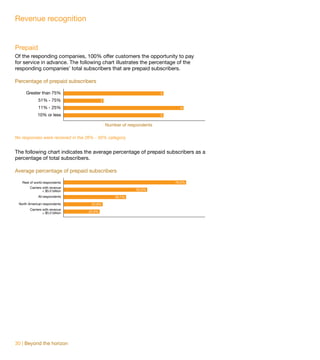
  • 158.
    Legal and regulatory Inprior years we asked respondents to report the total number of key controls identified across all financial reporting cycles, business processes and units. The results shown in the chart below indicates a clear and continual trend: Responding companies have reduced the number of key controls that are tested each year. Total number of key controls 7 11 1 - 500 6 4 4 501 - 1,000 5 1 1,001 - 1,500 1 1 1 Year 4 1,501 - 2,000 2 Year 3 Year 2 Over 2,000 1 Year 1 Number of respondents The number of respondents is not equal for each year due to required year of adoption for Section 404 compliance. 154 | Beyond the horizon
  • 159.
    When the respondentswere asked to identify the number of controls specific to income tax processes, the same trend held: The number of income tax-related controls decreased with each year of Section 404 compliance. The following chart depicts the trends for income tax controls by year of Section 404 compliance. Number of key income tax controls (4-year comparison) 1 4 0 - 10 controls 4 3 2 4 11 - 20 controls 3 5 1 21 - 30 controls 1 1 Year 4 Year 3 3 Over 30 controls 2 Year 2 3 Year 1 3 Number of respondents The number of respondents is not equal for each year due to required year of adoption for Section 404 compliance. Similar to the 2007 North American Wireless Survey, we asked the responding companies how much internal time is required for testing manual/application, ITGC, and entity level controls testing, regardless of the year of Section 404 compliance. The majority of the respondents indicated that they devote the same amount of time to testing any control (an average of 14 hours). The chart below depicts the number of hours spent for each control. Hours required per control tested 0 - 10 hours 40% 11 - 20 hours 40% Greater than 20 hours 20% Percentage of respondents PricewaterhouseCoopers 2008 Global Wireless Industry Survey | 155
  • 160.
    Legal and regulatory Thefollowing three charts compare the number of un-remediated control deficiencies, significant deficiencies, and material weaknesses that survey respondents reported for all years of Section 404 compliance. The charts show that only one carrier reported material weaknesses by the fourth year of Section 404 compliance. Although the trend was for carriers to report a decreasing total number of control deficiencies, they still had significant deficiencies by year three. Control deficiencies (4-year comparison) 3 4 0 - 30 6 5 31 - 60 3 5 61 - 90 1 2 1 91 - 120 Year 4 1 1 Year 3 1 Year 2 Over 120 2 2 Year 1 Number of respondents The number of respondents is not equal for each year due to required year of adoption of Section 404 compliance. 156 | Beyond the horizon
  • 161.
    For companies withrevenue greater than $5.0 billion the average number of control deficiencies has decreased substantially each year. The average number of control deficiencies was 48, 51, 77 and 112 in years four, three, two and one, respectively. Significant deficiencies (4-year comparison) 6 0-5 7 10 9 1 6 - 10 2 Year 4 3 Year 3 Year 2 Over 20 1 Year 1 Number of respondents The number of respondents is not equal for each year due to required year of adoption of Section 404 compliance. No responses were received in the 11 -15 and 16 - 20 categories Also for companies with revenue greater than $5.0 billion, the average number of significant deficiencies has decreased substantially each year. The average number of significant deficiencies was two, one, two, and nine in years four, three, two, and one, respectively. The number of significant deficiencies for companies with revenue of less than $5.0 billion was three, three, two, and three in years four, three, two, and one, respectively. Material weaknesses (4-year comparison) 1 5 1 4 2 3 Year 4 2 1 Year 3 1 Year 2 1 1 Year 1 1 Number of respondents The number of respondents is not equal for each year due to required year of adoption of Section 404 compliance. PricewaterhouseCoopers 2008 Global Wireless Industry Survey | 157
  • 162.
    Legal and regulatory Companieswith revenue greater than $5.0 billion reported no material weaknesses. The number of material weaknesses for companies with revenue less than $5.0 billion was on average one, two, one and one in years four, three, two and one, respectively. We also asked respondents to specify in which areas they reported significant deficiencies. Consistent with the 2007 North American Wireless Survey, the areas of fixed assets, financial reporting, and ITGCs continue to have significant deficiencies. The chart below illustrates areas of significant deficiencies for the responding companies. Source of significant deficiencies Fixed assets 14 Financial reporting 9 General computer controls 9 Purchasing/payables cycle 6 Accounting for income taxes 5 Other* 4 Revenue 4 Accounting for leases 3 Number of respondents * Other includes payroll/commissions cycle, automated controls, and treasury cycle. Chart sums greater than the number of respondents as multiple responses were allowed. Regarding reported material weaknesses, the carriers reported deficiencies in the areas of income taxes, insufficient accounting staff, financial reporting, lease accounting and fixed assets. The chart below represents the sources that led to material weaknesses. Source of material weaknesses Accounting for income taxes 5 Accounting expertise/resources 3 Financial reporting 3 Accounting for leases 3 Fixed assets 2 *Other 2 Number of respondents * Other includes ITGCs and revenues. Chart sums greater than the number of respondents as multiple responses were allowed. 158 | Beyond the horizon
  • 163.
    In the recentpast, much discussion has been devoted to implementing AS 5, and to how the implementation of this auditing standard would impact the resources devoted to Section 404 compliance. In 2007, the Securities and Exchange Commission unanimously approved AS 5, as amended on May 24, 2007. The 2007 North American Wireless Survey asked respondents to rank the elements and factors related to AS 5 that would affect their approach to Section 404 compliance the most significantly. Conversely, this year we asked for the elements and factors that resulted in the largest change to the responding companies Section 404-approach. The outcomes are depicted in the chart below. Change with largest impact due to AS 5 Percentage of respondents 36% 28% 18% 9% 9% Level of judgment History of Nature of Emphasis on Overall required to record prior year the activities effective entity materiality of transactions deficiencies performed level controls account balance Last year, we asked wireless carriers in which areas they believed efficiency benefits from AS 5 would occur. Consequently, this year we asked how the responding companies realized efficiencies. The companies expected greater efficiency, but the reduction in the number of key controls was much greater than they expected. The chart below indicates the ranking in the areas of efficiency gains. Most important source of realized AS 5 efficiencies 58% Percentage of respondents 18% 8% 8% 8% Reduction in Reduction in Reduction in Reduction in Reduction in external audit external audit hrs the individual nature, timing & number of key hours reliance, reliance, control process level extent of testing controls walkthroughs environment PricewaterhouseCoopers 2008 Global Wireless Industry Survey | 159
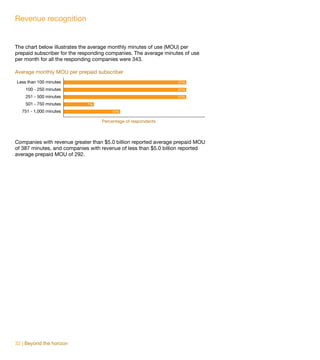
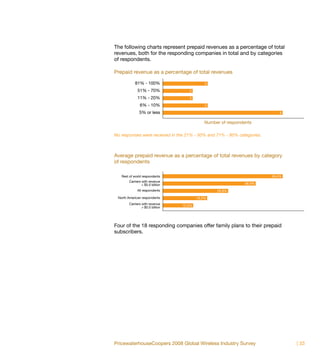
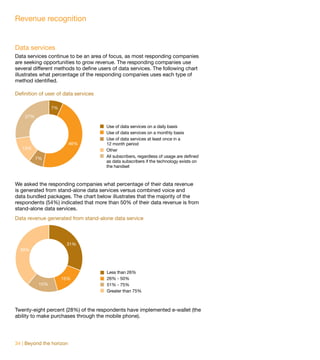
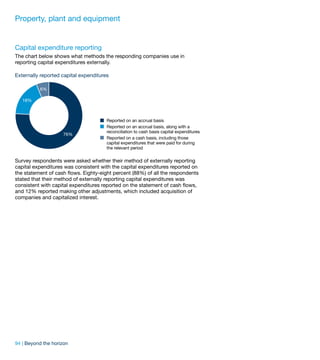
  • 164.
    Legal and regulatory SECreviews The Securities and Exchange Commissions’ (SEC) Division of Corporate Finance continues to perform extensive reviews of regulatory filings. This year the survey results showed 47% of the responding and eligible wireless companies (the SEC registrants) received a comment letter from the SEC in the last three years. In the 2007 North American Wireless Survey approximately 85% of the responding companies had received a comment letter. SFAS 144/IAS 36 (impairment of long-lived assets), revenue recognition, fair value measurement and stock-based compensation were among the accounting topics that the SEC addressed most frequently. In addition, individual responding companies received comment letters related to the following topics: • SFAS 142/IAS 38 or the equivalent—goodwill/intangible assets • SFAS 143/IFRS 3 or the equivalent—asset retirement obligations • GAAP/Non-GAAP measures • Segment reporting • Multiple elements or bundled arrangements • Joint venture/variable interest entities (FIN 46)/consolidation • Accounting for derivatives instruments • Amortization of customer list • IFRS/US GAAP differences • Corporate disclosure policies • Allowance for doubtful accounts/accounts receivable • Management Discussion and Analysis (MD&A) • Accelerated share repurchase No responding companies had to restate related to these comment letters. 160 | Beyond the horizon
  • 165.
    As depicted inthe chart below, most respondents describe the regulatory oversight/regime in their home country to be at least moderately involved. In addition, most responding carriers feel that the regulatory oversight is consistent among competitors. Description of the regulatory oversight in the country 27% 40% Involved 33% Very involved Moderately involved PricewaterhouseCoopers 2008 Global Wireless Industry Survey | 161
  • 166.
    Contact information For moreinformation about this publication or to inquire about participating in a future survey, please contact: Pierre-Alain Sur, Partner Paul Rees, Partner PricewaterhouseCoopers LLP PricewaterhouseCoopers LLP 900 South Shackleford Road, Suite 505 1 Embankment Place Little Rock, AR 72211 London, United Kingdom 501.907.8085 44 (20) 7213 4644 pierre-alain.sur@us.pwc.com paul.g.rees@uk.pwc.com To request additional copies of this publication, contact Shara Slattery by e-mail at shara.slattery@us.pwc.com. About PricewaterhouseCoopers PricewaterhouseCoopers’ Entertainment, Media and Communications industry practice delivers a complete range of professional services to telecom, cable, satellite, Internet, media, and entertainment service providers across the globe. The group provides industry-focused assurance, tax, and advisory services to build public trust and enhance value for its clients and their stakeholders. Drawing on our accumulated experience, we anticipate and meet the challenges of global regulatory change, and help our clients deal with the impact of industry convergence. We continue to add measurable value to our client relationships through our leadership and innovation, which are evident in our evolving services and products. With thousands of practitioners around the world, we are always close at hand to provide industry specialist expertise and resources. 162 | Beyond the horizon
  • 167.
    Of further interest Communicationsreview PwC’s quarterly journal for telecom, cable, satellite and Internet executives that showcases some of the best global practices and leading-edge thinking regarding management and financial issues in the communications industry. To view or download the pdf file, please visit www.pwc.com/communications and click on the publication link. CommunicationsDirect News It’s a news source. It’s a research tool. It’s free. Subscribe today to start receiving daily or weekly updates on the latest news and information specifically covering the global telecom, cable, satellite and Internet industries. Customized at your request by sector and region, CommunicationsDirect News provides you with updates selected from more than a dozen news sources. For research needs, utilize the site to search for content on more than 40 industry sites. See it for yourself, visit www.communicationsdirectnews.com. Entertainment & Media Outlook: 2008–2012 Created by top minds from PricewaterhouseCoopers’ Entertainment, Media and Communications (EMC) practice, in conjunction with economic forecasting firm Wilkofsky Gruen Associates, this ninth edition of the Outlook provides an in- depth global analyses and five-year growth projections for 15 industry segments. The Outlook includes an overview of the global entertainment and media market as well as in-depth coverage of the market in the US, Europe, the Middle East, Asia/Pacific, Latin America, and Canada. All orders can be placed through PwC’s Outlook Web site at www.pwc.com/outlook. Convergence monitor: Personal mobility The third in a series of global surveys of PwC staff from 20 territories, the Convergence Monitor is aimed at understanding consumer preferences and interest in buying and using various converged services. The report focuses on which devices and applications people are using today, how they are using them, and what they would like to have in the future. To download the PDF, visit www.pwc.com/monitor. How consumer conversation will transform business This report examines how new technologies and new methodologies are transforming a new source of consumer data—the customer’s thoughts, intentions and innovative ideas obtained from conversations found in blogs, message boards, phone calls and other interactive media—into a dramatically deeper understanding of consumers. www.pwc.com/convergence. PricewaterhouseCoopers 2008 Global Wireless Industry Survey
  • 168.
    pwc.com © 2009 PricewaterhouseCoopersLLP. All rights reserved. “PricewaterhouseCoopers” refers to PricewaterhouseCoopers LLP (a Delaware limited liability partnership) or, as the context requires, the PricewaterhouseCoopers global network or other member firms of the network, each of which is a separate and independent legal entity. *connectedthinking is a trademark of PricewaterhouseCoopers LLP (US). BS-BS-09-0193-A.0109.DvL WISNA08
  • 169.
    Beyond the horizon 2008Global Wireless Industry Survey