CATERPILLAR INC.
GENERAL AND FINANCIAL INFORMATION
2006
A-1
A-2
TABLE OF CONTENTS
Page
Management’s Report on Internal Control Over Financial Reporting.............................. A-3
Report of Independent Registered Public Accounting Firm......................................... A-4
Consolidated Financial Statements and Notes........................................................ A-5
Five-year Financial Summary ......................................................................... A-39
Management’s Discussion and Analysis (MD&A)
Overview ........................................................................................... A-40
2006 Compared with 2005........................................................................ A-40
Fourth Quarter 2006 Compared with Fourth Quarter 2005 .................................... A-46
2005 Compared with 2004........................................................................ A-50
Glossary of Terms ................................................................................. A-53
Liquidity and Capital Resources ................................................................. A-54
Critical Accounting Policies ...................................................................... A-57
Employment........................................................................................ A-58
Other Matters ...................................................................................... A-58
Supplemental Consolidating Data................................................................ A-63
Outlook ............................................................................................. A-66
Supplemental Stockholder Information............................................................... A-69
Directors and Officers .................................................................................. A-70
The management of Caterpillar Inc. (company) is responsible for establishing and maintaining adequate internal control
over financial reporting. Our internal control over financial reporting is a process designed to provide reasonable assur-
ance regarding the reliability of our financial reporting and the preparation of financial statements for external purposes
in accordance with generally accepted accounting principles. Our internal control over financial reporting includes those
policies and procedures that (i) pertain to the maintenance of records that, in reasonable detail, accurately and fairly reflect
the transactions and dispositions of the assets of the company; (ii) provide reasonable assurance that transactions are
recorded as necessary to permit preparation of financial statements in accordance with generally accepted accounting prin-
ciples, and that receipts and expenditures of the company are being made only in accordance with authorizations of man-
agement and directors of the company; and (iii) provide reasonable assurance regarding prevention or timely detection of
unauthorized acquisition, use, or disposition of the company’s assets that could have a material effect on the financial
statements.
Because of its inherent limitations, internal control over financial reporting may not prevent or detect misstatements.
Also, projections of any evaluation of effectiveness to future periods are subject to the risk that controls may become inad-
equate because of changes in conditions, or that the degree of compliance with the policies or procedures may deteriorate.
Management assessed the effectiveness of the company’s internal control over financial reporting as of December 31,
2006. In making this assessment, we used the criteria set forth by the Committee of Sponsoring Organizations of the
Treadway Commission (COSO) in Internal Control — Integrated Framework. Based on our assessment we concluded
that, as of December 31, 2006, the company’s internal control over financial reporting was effective based on those criteria.
Management has excluded Progress Rail Services from our assessment of internal control over financial reporting as of
December 31, 2006 because we acquired Progress Rail Services on June 19, 2006. Progress Rail Services is a wholly
owned subsidiary of Caterpillar Inc. whose total assets and total revenues represent 3% and 2%, respectively, of the related
consolidated financial statement amounts as of and for the year ended December 31, 2006.
Our management’s assessment of the effectiveness of the company’s internal control over financial reporting as of
December 31, 2006 has been audited by PricewaterhouseCoopers LLP, an independent registered public accounting firm.
Their report appears on page A-4.
James W. Owens
Chairman of the Board
and Chief Executive Officer
David B. Burritt
Vice President and
Chief Financial Officer
February 22, 2007
MANAGEMENT’S REPORT ON Caterpillar Inc.
INTERNAL CONTROL OVER FINANCIAL REPORTING
A-3
REPORT OF INDEPENDENT REGISTERED PUBLIC ACCOUNTING FIRM
To the Board of Directors and Stockholders of Caterpillar Inc.:
We have completed integrated audits of Caterpillar Inc.’s consolidated financial statements and of its internal control over financial reporting as of
December 31, 2006, in accordance with the standards of the Public Company Accounting Oversight Board (United States). Our opinions, based on
our audits, are presented below.
Consolidated financial statements
In our opinion, the accompanying consolidated statement of financial position and the related statements of consolidated results of operations, changes
in stockholders’ equity, and cash flow, including pages A-5 through A-38, present fairly, in all material respects, the financial position of Caterpillar
Inc. and its subsidiaries at December 31, 2006, 2005 and 2004, and the results of their operations and their cash flows for each of the three years in
the period ended December 31, 2006 in conformity with accounting principles generally accepted in the United States of America. These financial
statements are the responsibility of the Company’s management. Our responsibility is to express an opinion on these financial statements based on
our audits. We conducted our audits of these statements in accordance with the standards of the Public Company Accounting Oversight Board (United
States). Those standards require that we plan and perform the audit to obtain reasonable assurance about whether the financial statements are free of
material misstatement. An audit of financial statements includes examining, on a test basis, evidence supporting the amounts and disclosures in the
financial statements, assessing the accounting principles used and significant estimates made by management, and evaluating the overall financial
statement presentation. We believe that our audits provide a reasonable basis for our opinion.
As discussed in Note 1L to the consolidated financial statements, the Company changed the manner in which it accounts for stock-based compen-
sation and the manner in which it accounts for defined benefit pension and other postretirement plans in 2006.
Internal control over financial reporting
Also, in our opinion, management’s assessment, included in Management’s Report on Internal Control Over Financial Reporting appearing on
page A-3, that the Company maintained effective internal control over financial reporting as of December 31, 2006 based on criteria established in
Internal Control — Integrated Framework issued by the Committee of Sponsoring Organizations of the Treadway Commission (COSO), is fairly
stated, in all material respects, based on those criteria. Furthermore, in our opinion, the Company maintained, in all material respects, effective
internal control over financial reporting as of December 31, 2006, based on criteria established in Internal Control — Integrated Framework issued
by the COSO. The Company’s management is responsible for maintaining effective internal control over financial reporting and for its assessment
of the effectiveness of internal control over financial reporting. Our responsibility is to express opinions on management’s assessment and on the
effectiveness of the Company’s internal control over financial reporting based on our audit. We conducted our audit of internal control over finan-
cial reporting in accordance with the standards of the Public Company Accounting Oversight Board (United States). Those standards require that
we plan and perform the audit to obtain reasonable assurance about whether effective internal control over financial reporting was maintained in all
material respects. An audit of internal control over financial reporting includes obtaining an understanding of internal control over financial report-
ing, evaluating management’s assessment, testing and evaluating the design and operating effectiveness of internal control, and performing such
other procedures as we consider necessary in the circumstances. We believe that our audit provides a reasonable basis for our opinions.
A company’s internal control over financial reporting is a process designed to provide reasonable assurance regarding the reliability of financial
reporting and the preparation of financial statements for external purposes in accordance with generally accepted accounting principles. A company’s
internal control over financial reporting includes those policies and procedures that (i) pertain to the maintenance of records that, in reasonable detail,
accurately and fairly reflect the transactions and dispositions of the assets of the company; (ii) provide reasonable assurance that transactions are
recorded as necessary to permit preparation of financial statements in accordance with generally accepted accounting principles, and that receipts
and expenditures of the company are being made only in accordance with authorizations of management and directors of the company; and (iii) pro-
vide reasonable assurance regarding prevention or timely detection of unauthorized acquisition, use, or disposition of the company’s assets that could
have a material effect on the financial statements.
Because of its inherent limitations, internal control over financial reporting may not prevent or detect misstatements. Also, projections of any
evaluation of effectiveness to future periods are subject to the risk that controls may become inadequate because of changes in conditions, or that
the degree of compliance with the policies or procedures may deteriorate.
As described in Management’s Report on Internal Control Over Financial Reporting, management has excluded Progress Rail Services from its
assessment of internal control over financial reporting as of December 31, 2006 because Progress Rail Services was acquired by Caterpillar Inc. in
a purchase business combination during 2006. We have also excluded Progress Rail Services from our audit of internal control over financial report-
ing. Progress Rail Services is a wholly owned subsidiary of Caterpillar Inc. whose total assets and total revenues represent 3% and 2%, respectively,
of the related consolidated financial statement amounts as of and for the year ended December 31, 2006.
Peoria, Illinois
February 22, 2007
A-4
STATEMENT 1 Caterpillar Inc.
Consolidated Results of Operations for the Years Ended December 31
(Dollars in millions except per share data)
A-5
2006 2005 2004________ _______ _______
Sales and revenues:
Sales of Machinery and Engines........................................................................................................... $38,869 $34,006 $28,336
Revenues of Financial Products............................................................................................................ 2,648 2,333 1,970________ _______ _______
Total sales and revenues ............................................................................................................... 41,517 36,339 30,306
Operating costs:
Cost of goods sold.......................................................................................................................... 29,549 26,558 22,497
Selling, general and administrative expenses ............................................................................................. 3,706 3,190 2,926
Research and development expenses...................................................................................................... 1,347 1,084 928
Interest expense of Financial Products .................................................................................................... 1,023 768 524
Other operating expenses .................................................................................................................. 971 955 747________ _______ _______
Total operating costs ................................................................................................................... 36,596 32,555 27,622________ _______ _______
Operating profit .............................................................................................................................. 4,921 3,784 2,684
Interest expense excluding Financial Products............................................................................................ 274 260 230
Other income (expense) .................................................................................................................... 214 377 253________ _______ _______
Consolidated profit before taxes ......................................................................................................... 4,861 3,901 2,707
Provision for income taxes ................................................................................................................. 1,405 1,120 731________ _______ _______
Profit of consolidated companies .......................................................................................................... 3,456 2,781 1,976
Equity in profit (loss) of unconsolidated affiliated companies............................................................................ 81 73 59________ _______ _______
Profit............................................................................................................................................ $ 3,537 $ 2,854 $ 2,035________ _______ _______________ _______ _______
Profit per common share................................................................................................................... $ 5.37 $ 4.21 $ 2.97
Profit per common share — diluted(1)
................................................................................................... $ 5.17 $ 4.04 $ 2.88
Weighted-average common shares outstanding (millions)
— Basic.................................................................................................................................... 658.7 678.4 684.5
— Diluted(1)
............................................................................................................................... 683.8 705.8 707.4
Cash dividends declared per common share.......................................................................................... $ 1.15 $ .96 $ .80
(1)
Diluted by assumed exercise of stock options and SARs, using the treasury stock method.
See accompanying notes to Consolidated Financial Statements.
A-6
STATEMENT 2
Consolidated Financial Position at December 31
(Dollars in millions)
2006 2005 2004________ _______ _______
Assets
Current assets:
Cash and short-term investments ..................................................................................................... $ 530 $ 1,108 $ 445
Receivables — trade and other ........................................................................................................ 8,168 7,526 7,463
Receivables — finance................................................................................................................. 6,804 6,442 5,182
Deferred and refundable income taxes ................................................................................................ 733 255 330
Prepaid expenses and other current assets ........................................................................................... 507 2,146 1,369
Inventories .............................................................................................................................. 6,351 5,224 4,675________ _______ _______
Total current assets ......................................................................................................................... 23,093 22,701 19,464
Property, plant and equipment — net ..................................................................................................... 8,851 7,988 7,682
Long-term receivables — trade and other ................................................................................................ 860 1,037 764
Long-term receivables — finance ......................................................................................................... 11,531 10,301 9,903
Investments in unconsolidated affiliated companies...................................................................................... 562 565 517
Deferred income taxes ...................................................................................................................... 1,949 857 742
Intangible assets ............................................................................................................................ 387 424 315
Goodwill..................................................................................................................................... 1,904 1,451 1,450
Other assets ................................................................................................................................. 1,742 1,745 2,258________ _______ _______
Total assets ................................................................................................................................... $50,879 $47,069 $43,095________ _______ _______________ _______ _______
Liabilities
Current liabilities:
Short-term borrowings:
Machinery and Engines ............................................................................................................ $ 165 $ 871 $ 93
Financial Products ................................................................................................................. 4,990 4,698 4,064
Accounts payable....................................................................................................................... 4,085 3,412 3,524
Accrued expenses ...................................................................................................................... 2,923 2,617 2,261
Accrued wages, salaries and employee benefits ...................................................................................... 938 1,601 1,543
Customer advances..................................................................................................................... 921 454 503
Dividends payable ...................................................................................................................... 194 168 141
Deferred and current income taxes payable ........................................................................................... 575 528 259
Long-term debt due within one year:
Machinery and Engines ............................................................................................................ 418 340 6
Financial Products ................................................................................................................. 4,043 4,159 3,525________ _______ _______
Total current liabilities ...................................................................................................................... 19,252 18,848 15,919
Long-term debt due after one year:
Machinery and Engines ............................................................................................................ 3,694 2,717 3,663
Financial Products ................................................................................................................. 13,986 12,960 12,174
Liability for postemployment benefits ..................................................................................................... 5,879 3,161 3,126
Deferred income taxes and other liabilities ................................................................................................ 1,209 951 746________ _______ _______
Total liabilities ............................................................................................................................... 44,020 38,637 35,628________ _______ _______
Commitments and contingencies (Notes 22 and 23)
Stockholders’ equity
Common stock of $1.00 par value:
Authorized shares: 900,000,000
Issued shares (2006, 2005 and 2004 — 814,894,624) at paid-in amount ......................................................... 2,465 1,859 1,231
Treasury stock (2006 — 169,086,448 shares; 2005 — 144,027,405 shares and 2004 — 129,020,726 shares) at cost ........... (7,352) (4,637) (3,277)
Profit employed in the business ........................................................................................................... 14,593 11,808 9,937
Accumulated other comprehensive income................................................................................................ (2,847) (598) (424)________ _______ _______
Total stockholders’ equity ................................................................................................................. 6,859 8,432 7,467________ _______ _______
Total liabilities and stockholders’ equity .............................................................................................. $50,879 $47,069 $43,095________ _______ _______________ _______ _______
See accompanying notes to Consolidated Financial Statements.
A-7
Accumulated other comprehensive income__________________________________________
Pension &
Profit Foreign other post- Derivative Available-
Common Treasury employed in currency retirement financial for-sale
stock stock the business translation benefits(1)
instruments securities Total________ ________ __________ _________ ________ __________ _________ ________
Balance at December 31, 2003 ............................ $ 1,059 $ (2,914) $ 8,450 $ 348 $ (982) $ 104 $ 13 $ 6,078________ ________ ________ ________ ________ ________ ________ ________
Profit .............................................................. — — 2,035 — — — — 2,035
Foreign currency translation ..................................... — — — 141 — — — 141
Minimum pension liability adjustment, net of tax of $25....... — — — — (59) — — (59)
Derivative financial instruments
Gains (losses) deferred, net of tax of $60 .................... — — — — — 111 — 111
(Gains) losses reclassified to earnings, net of tax of $56 ... — — — — — (105) — (105)
Available-for-sale securities
Gains (losses) deferred, net of tax of $3...................... — — — — — — 6 6
(Gains) losses reclassified to earnings, net of tax of $1..... — — — — — — (1) (1)________
Comprehensive Income.................................... 2,128________
Dividends declared ............................................... — — (548) — — — — (548)
Common shares issued from treasury stock
for stock-based compensation: 12,216,618 ................. 94 176 — — — — — 270
Tax benefits from stock-based compensation................... 78 — — — — — — 78
Shares repurchased: 13,866,800 ................................ — (539) — — — — — (539)________ ________ ________ ________ ________ ________ ________ ________
Balance at December 31, 2004 ............................ 1,231 (3,277) 9,937 489 (1,041) 110 18 7,467________ ________ ________ ________ ________ ________ ________ ________
Profit............................................................... — — 2,854 — — — — 2,854
Foreign currency translation ..................................... — — — (187) — — — (187)
Minimum pension liability adjustment, net of tax of $36....... — — — — 107 — — 107
Derivative financial instruments
Gains (losses) deferred, net of tax of $1...................... — — — — — (3) — (3)
(Gains) losses reclassified to earnings, net of tax of $46 ... — — — — — (89) — (89)
Available-for-sale securities
Gains (losses) deferred, net of tax of $3...................... — — — — — — 3 3
(Gains) losses reclassified to earnings, net of tax of $1..... — — — — — — (5) (5)________
Comprehensive Income.................................... 2,680________
Dividends declared ............................................... — — (645) — — — — (645)
Common shares issued from treasury stock for
stock-based compensation: 18,912,521 ..................... 156 324 — — — — — 480
Tax benefits from stock-based compensation................... 134 — — — — — — 134
Shares repurchased: 33,919,200 ................................ — (1,684) — — — — — (1,684)
Impact of 2–for–1 stock split .................................... 338 — (338) — — — — —________ ________ ________ ________ ________ ________ ________ ________
Balance at December 31, 2005 ............................ 1,859 (4,637) 11,808 302 (934) 18 16 8,432________ ________ ________ ________ ________ ________ ________ ________
Profit............................................................... — — 3,537 — — — — 3,537
Foreign currency translation ..................................... — — — 169 — — — 169
Minimum pension liability adjustment, net of tax of $97....... — — — — 229 — — 229
Derivative financial instruments
Gains (losses) deferred, net of tax of $40 .................... — — — — — 73 — 73
(Gains) losses reclassified to earnings, net of tax of $26 ... — — — — — (43) — (43)
Available-for-sale securities
Gains (losses) deferred, net of tax of $8...................... — — — — — — 17 17
(Gains) losses reclassified to earnings, net of tax of $12 ... — — — — — — (23) (23)________
Comprehensive Income.................................... 3,959________
Incremental adjustment to adopt SFAS 158,
net of tax of $1,494............................................ — — — — (2,671) — — (2,671)
Dividends declared ............................................... — — (752) — — — — (752)
Common shares issued from treasury stock
for stock-based compensation: 15,207,055 ................. 73 341 — — — — — 414
Stock-based compensation expense ............................ 137 — — — — — — 137
Tax benefits from stock-based compensation................... 170 — — — — — — 170
Shares repurchased: 45,608,000 ................................ — (3,208) — — — — — (3,208)
Shares issued for Progress Rail Services, Inc.
acquisition: 5,341,902 ........................................ 226 152 — — — — — 378________ ________ ________ ________ ________ ________ ________ ________
Balance at December 31, 2006 ............................ $ 2,465 $ (7,352) $14,593 $ 471 $ (3,376) $ 48 $ 10 $ 6,859________ ________ ________ ________ ________ ________ ________ ________________ ________ ________ ________ ________ ________ ________ ________
(1)
Pension and other postretirement benefits includes the aggregate adjustment for minimum pension liability for unconsolidated companies of $(6) million, $11 million
and $0 million and the ending balances of $(43) million, $(37) million and $(48) million for the years 2006, 2005 and 2004, respectively.
STATEMENT 3 Caterpillar Inc.
Changes in Consolidated Stockholders’ Equity for the Years Ended December 31
(Dollars in millions)
See accompanying notes to Consolidated Financial Statements.
2006 2005 2004________ _______ _______
Cash flow from operating activities:
Profit......................................................................................................................................... $ 3,537 $ 2,854 $ 2,035
Adjustments for non-cash items:
Depreciation and amortization ......................................................................................................... 1,602 1,477 1,397
Other..................................................................................................................................... 197 (20) (113)
Changes in assets and liabilities:
Receivables — trade and other ........................................................................................................ (89) (908) (7,616)
Inventories .............................................................................................................................. (827) (568) (1,391)
Accounts payable and accrued expenses.............................................................................................. 670 532 1,457
Other assets — net..................................................................................................................... (235) (866) 337
Other liabilities — net.................................................................................................................. 944 612 (97)________ _______ _______
Net cash provided by (used for) operating activities .......................................................................................... 5,799 3,113 (3,991)________ _______ _______
Cash flow from investing activities:
Capital expenditures — excluding equipment leased to others.......................................................................... (1,593) (1,201) (926)
Expenditures for equipment leased to others.............................................................................................. (1,082) (1,214) (1,188)
Proceeds from disposals of property, plant and equipment.............................................................................. 572 637 486
Additions to finance receivables ........................................................................................................... (10,522) (10,334) (8,930)
Collections of finance receivables ......................................................................................................... 8,094 7,057 6,216
Proceeds from sale of finance receivables................................................................................................. 1,067 900 700
Collections of retained interests in securitized trade receivables ........................................................................ — — 5,722
Investments and acquisitions (net of cash acquired) ..................................................................................... (513) (13) (290)
Proceeds from sale of partnership investment ............................................................................................ — — 290
Proceeds from release of security deposit................................................................................................. — 530 —
Proceeds from sale of available-for-sale securities....................................................................................... 539 257 408
Investments in available-for-sale securities............................................................................................... (681) (338) (609)
Other — net................................................................................................................................. 323 194 198________ _______ _______
Net cash provided by (used for) investing activities........................................................................................... (3,796) (3,525) 2,077________ _______ _______
Cash flow from financing activities:
Dividends paid .............................................................................................................................. (726) (618) (534)
Common stock issued, including treasury shares reissued.............................................................................. 414 482 317
Treasury shares purchased................................................................................................................. (3,208) (1,684) (539)
Excess tax benefit from stock-based compensation ...................................................................................... 169 — —
Proceeds from debt issued (original maturities greater than three months):
— Machinery and Engines ............................................................................................................ 1,445 574 55
— Financial Products.................................................................................................................. 9,824 14,000 10,435
Payments on debt (original maturities greater than three months):
— Machinery and Engines ............................................................................................................ (839) (654) (78)
— Financial Products.................................................................................................................. (9,536) (10,966) (8,612)
Short-term borrowings (original maturities three months or less) — net............................................................... (136) 19 830________ _______ _______
Net cash provided by (used for) financing activities .......................................................................................... (2,593) 1,153 1,874________ _______ _______
Effect of exchange rate changes on cash....................................................................................................... 12 (78) 143________ _______ _______
Increase (decrease) in cash and short-term investments.......................................................................... (578) 663 103
Cash and short-term investments at beginning of period..................................................................................... 1,108 445 342________ _______ _______
Cash and short-term investments at end of period............................................................................................ $ 530 $ 1,108 $ 445________ _______ _______________ _______ _______
All short-term investments, which consist primarily of highly liquid investments with original maturities of three months or less, are considered to be cash equivalents.
Non-cash activities:
On June 19, 2006, Caterpillar acquired 100 percent of the equity in Progress Rail Services, Inc. A portion of the acquisition was financed with 5.3 million shares of
Caterpillar stock with a fair value of $379 million as of the acquisition date. See Note 25 for further discussion.
In 2005, $116 million of 9.375% debentures due in 2021 and $117 million of 8.00% debentures due in 2023 were exchanged for $307 million of 5.300% debentures
due in 2035 and $23 million of cash. The $23 million of cash is included in payments on debt.
Trade receivables of $6,786 million were exchanged for retained interests in securitized trade receivables in 2004. See Note 6 for further discussion.
STATEMENT 4
Consolidated Statement of Cash Flow for the Years Ended December 31
(Millions of dollars)
A-8
See accompanying notes to Consolidated Financial Statements.
A-9
1. Operations and summary of
significant accounting policies
A. Nature of Operations
We operate in three principal lines of business:
(1) Machinery — A principal line of business which includes
the design, manufacture, marketing and sales of construction,
mining and forestry machinery — track and wheel tractors, track
and wheel loaders, pipelayers, motor graders, wheel tractor-
scrapers, track and wheel excavators, backhoe loaders, log skid-
ders, log loaders, off-highway trucks, articulated trucks, paving
products, telehandlers, skid steer loaders and related parts. Also
includes logistics services for other companies and the design,
manufacture, remanufacture, maintenance and service of rail-
related products.
(2) Engines — A principal line of business including the
design, manufacture, marketing and sales of engines for Caterpillar
machinery; electric power generation systems; on-highway vehicles
and locomotives; marine, petroleum, construction, industrial, agri-
cultural and other applications; and related parts. Also includes
remanufacturing of Caterpillar engines and a variety of Caterpillar
machine and engine components and remanufacturing services
for other companies. Reciprocating engines meet power needs
ranging from 5 to 21,500 horsepower (4 to over 16 000 kilo-
watts). Turbines range from 1,600 to 20,500 horsepower (1 200
to 15 000 kilowatts).
(3) Financial Products — A principal line of business consist-
ing primarily of Caterpillar Financial Services Corporation (Cat
Financial), Caterpillar Insurance Holdings, Inc. (Cat Insurance),
Caterpillar Power Ventures Corporation (Cat Power Ventures) and
their respective subsidiaries. Cat Financial provides a wide range
of financing alternatives to customers and dealers for Caterpillar
machinery and engines, Solar gas turbines, as well as other equip-
ment and marine vessels. Cat Financial also extends loans to cus-
tomers and dealers. Cat Insurance provides various forms of
insurance to customers and dealers to help support the purchase
and lease of our equipment. Cat Power Ventures is an investor
in independent power projects using Caterpillar power genera-
tion equipment and services.
Our Machinery and Engines operations are highly integrated.
Throughout the Notes, Machinery and Engines represents the
aggregate total of these principal lines of business.
Our products are sold primarily under the brands “Caterpillar,”
“Cat,” “Solar Turbines,” “MaK,” “Perkins,” “FG Wilson” and
“Olympian.”
We conduct operations in our Machinery and Engines lines of
business under highly competitive conditions, including intense price
competition. We place great emphasis on the high quality and per-
formance of our products and our dealers’ service support. Although
no one competitor is believed to produce all of the same types of
machines and engines that we do, there are numerous compa-
nies, large and small, which compete with us in the sale of each
of our products.
Machines are distributed principally through a worldwide orga-
nization of dealers (dealer network), 54 located in the United States
and 128 located outside the United States. Worldwide, these dealers
serve 182 countries and operate 3,576 places of business, including
1,639 dealer rental outlets. Reciprocating engines are sold princi-
pally through the dealer network and to other manufacturers for
use in products manufactured by them. Some of the reciprocating
engines manufactured by Perkins are also sold through a world-
wide network of 132 distributors located in 181 countries along with
3,500 supporting dealers. Most of the electric power generation
systems manufactured by FG Wilson are sold through a world-
wide network of 200 dealers located in 180 countries. Our dealers
do not deal exclusively with our products; however, in most cases
sales and servicing of our products are the dealers’ principal
business. Turbines and large marine reciprocating engines are
sold through sales forces employed by the company. At times, these
employees are assisted by independent sales representatives.
Manufacturing activities of the Machinery and Engines lines of
business are conducted in 74 plants in the United States; 12 in the
United Kingdom; nine in Italy; eight in Mexico; seven in China; four
each in Canada and France; three each in Australia, Brazil, India,
Northern Ireland, and Poland; two each in Germany, Indonesia,
Japan, and The Netherlands; and one each in Belgium, Hungary,
Malaysia, Nigeria, Russia, Scotland, South Africa, Switzerland
and Tunisia. Thirteen parts distribution centers are located in the
United States and 14 are located outside the United States.
The Financial Products line of business also conducts opera-
tions under highly competitive conditions. Financing for users of
Caterpillar products is available through a variety of competi-
tive sources, principally commercial banks and finance and leasing
companies. We emphasize prompt and responsive service to
meet customer requirements and offer various financing plans
designed to increase the opportunity for sales of our products and
generate financing income for our company. Financial Products
activity is conducted primarily in the United States, with additional
offices in Asia, Australia, Canada, Europe and Latin America.
B. Basis of consolidation
The financial statements include the accounts of Caterpillar Inc.
and its subsidiaries. Investments in companies that are owned
20% to 50% or are less than 20% owned and for which we have
significant influence are accounted for by the equity method (see
Note 11). We consolidate all variable interest entities where
Caterpillar Inc. is the primary beneficiary.
Certain amounts for prior years have been reclassified to con-
form with the current-year financial statement presentation.
Shipping and handling costs are included in Cost of goods
sold in Statement 1. Other operating expense primarily includes
Cat Financial’s depreciation of equipment leased to others, Cat
Insurance’s underwriting expenses, gains (losses) on disposal of
long-lived assets and long-lived asset impairment charges.
Prepaid expenses and other current assets in Statement 2
include prepaid rent, prepaid insurance and other prepaid items.
In addition, at December 31, 2006, this line includes a security
deposit of $249 million related to a deposit obligation due in
2007 (see Note 16 for further discussion). At December 31, 2005
and 2004 prepaid expenses related to our pension plans of $1.95 bil-
lion and $1.13 billion, respectively, were also included in this
line. No such prepaid pension asset existed at December 31, 2006
as a result of our adoption of SFAS 158, “Employers’ Accounting
for Defined Benefit Pension and Other Postretirement Plans”
(See Notes 1L and 14 for further discussion).
C. Sales and revenue recognition
Sales of Machinery and Engines are generally recognized when
title transfers and the risks and rewards of ownership have passed to
NOTES TO CONSOLIDATED FINANCIAL STATEMENTS
NOTES continued
A-10
customers or independently owned and operated dealers. Typically,
where product is produced and sold in the same country, title and
risk of ownership transfer when the product is shipped. Products
that are exported from a country for sale typically pass title and
risk of ownership at the border of the destination country.
No right of return exists on sales of equipment. Replacement part
returns are estimable and accrued at the time a sale is recognized.
We provide discounts to dealers and original equipment manu-
facturers (OEM) through merchandising programs that are admin-
istered by our marketing profit centers. We have numerous programs
that are designed to promote the sale of our products. The most
common dealer programs provide a discount when the dealer
sells a product to a targeted end user. OEM programs provide
discounts designed to encourage the use of our engines. The cost
of these discounts is estimated based on historical experience
and known changes in merchandising programs and is reported
as a reduction to sales when the product sale is recognized.
Our standard invoice terms are established by marketing region.
When a sale is made to a dealer, the dealer is responsible for
payment even if the product is not sold to an end customer and
must make payment within the standard terms to avoid interest
costs. Interest at or above prevailing market rates is charged on
any past due balance. Our policy is to not forgive this interest.
In 2006, 2005 and 2004, terms were extended to not more than
one year for $49 million, $287 million and $15 million of receiv-
ables, respectively. For 2006, 2005 and 2004, these amounts repre-
sent less than 1% of consolidated sales.
Sales with payment terms of two months or more were as follows:
(Dollars in millions)
2 $ 1,481 3.8% $ 261 0.8% $ 96 0.3%
3 636 1.6% 548 1.6% 175 0.6%
4 336 0.9% 262 0.8% 117 0.4%
5 1,228 3.2% 916 2.7% 750 2.6%
6 8,516 21.9% 8,147 23.9% 6,172 21.9%
7-12 272 0.7% 345 1.0% 831 2.9%
We establish a bad debt allowance for Machinery and Engines
receivables when it becomes probable that the receivable will
not be collected. Our allowance for bad debts is not significant.
In 2006, we wrote off approximately $70 million of receivables in
conjunction with settlement of various legal disputes with Navistar
International Corporation. No significant write-offs of Machinery
and Engines receivables were made during 2005 or 2004.
Revenues of Financial Products primarily represent the fol-
lowing Cat Financial revenues:
● Retail finance revenue on finance leases and installment
sale contracts is recognized over the term of the contract
at a constant rate of return on the scheduled outstanding
principal balance. Revenue on retail notes is recognized
based on the daily balance of retail receivables outstand-
ing and the applicable interest rate.
● Operating lease revenue is recorded on a straight-line
basis in the period earned over the life of the contract.
● Wholesale finance revenue on installment contracts and
finance leases is recognized over the term of the contract
at a constant rate of return on the scheduled outstanding
principal balance. Revenue on wholesale notes is recog-
nized based on the daily balance of wholesale receivables
outstanding and the applicable effective interest rate.
Recognition of income is suspended when collection of future
income is not probable. Accrual is resumed, and previously sus-
pended income is recognized, when the receivable becomes con-
tractually current and/or collection doubts are removed. Cat
Financial provides wholesale inventory financing to dealers. See
Notes 7 and 8 for more information.
Sales and revenue recognition items are presented net of sales
and other related taxes.
D. Inventories
Inventories are stated at the lower of cost or market. Cost is prin-
cipally determined using the last-in, first-out (LIFO) method.
The value of inventories on the LIFO basis represented about
75% of total inventories at December 31, 2006 and about 80%
of total inventories at December 31, 2005 and 2004.
If the FIFO (first-in, first-out) method had been in use, inventories
would have been $2,403 million, $2,345 million and $2,124 mil-
lion higher than reported at December 31, 2006, 2005 and 2004,
respectively.
E. Securitized receivables
We periodically sell finance receivables in securitization transac-
tions. When finance receivables are securitized, we retain interests
in the receivables in the form of interest-only strips, servicing rights,
cash reserve accounts and subordinated certificates. The retained
interests are recorded in “Other assets” at fair value. We estimate
fair value based on the present value of future expected cash flows
using key assumptions for credit losses, prepayment speeds and
discount rates. See Note 8 for more information.
Prior to June 2005, we securitized trade receivables. We retained
interests in the receivables in the form of certificates. The fair value
of the certificated retained interests approximated carrying value
due to their short-term nature. See Note 6 for more information.
F. Depreciation and amortization
Depreciation of plant and equipment is computed principally
using accelerated methods. Depreciation on equipment leased
to others, primarily for Financial Products, is computed using the
straight-line method over the term of the lease. The depreciable
basis is the original cost of the equipment less the estimated residual
value of the equipment at the end of the lease term. In 2006, 2005
and 2004, Cat Financial depreciation on equipment leased to others
was $631 million, $615 million and $575 million, respectively,
and was included in “Other operating expenses” in Statement 1.
In 2006, 2005 and 2004 consolidated depreciation expense was
$1,554 million, $1,444 million and $1,366 million, respectively.
Amortization of purchased intangibles is computed using the
straight-line method, generally not to exceed a period of 20 years.
Accumulated amortization was $139 million, $107 million and
$91 million at December 31, 2006, 2005 and 2004, respectively.
G. Foreign currency translation
The functional currency for most of our Machinery and Engines
consolidated companies is the U.S. dollar. The functional currency
for most of our Financial Products and equity basis companies is
28.7%$ 8,14130.8%$10,47932.1%$12,469
Percent
of SalesSales
Percent
of SalesSales
Percent
of SalesSales
Payment Terms
(months)
200420052006
Caterpillar Inc.
A-11
the respective local currency. Gains and losses resulting from the
translation of foreign currency amounts to the functional currency
are included in “Other income (expense)” in Statement 1. Gains
and losses resulting from translating assets and liabilities from the
functional currency to U.S. dollars are included in “Accumulated
other comprehensive income” in Statement 2.
H. Derivative financial instruments
Our earnings and cash flow are subject to fluctuations due to
changes in foreign currency exchange rates, interest rates and
commodity prices. Our Risk Management Policy (policy) allows
for the use of derivative financial instruments to prudently man-
age foreign currency exchange rate, interest rate and commod-
ity price exposure. Our policy specifies that derivatives are not
to be used for speculative purposes. Derivatives that we use are
primarily foreign currency forward and option contracts, inter-
est rate swaps and commodity forward and option contracts. Our
derivative activities are subject to the management, direction and
control of our financial officers. Risk management practices, includ-
ing the use of financial derivative instruments, are presented to
the Audit Committee of the Board of Directors at least annually.
All derivatives are recognized on the Consolidated Financial
Position at their fair value. On the date the derivative contract is
entered, we designate the derivative as (1) a hedge of the fair
value of a recognized liability (“fair value” hedge), (2) a hedge
of a forecasted transaction or the variability of cash flow to be
paid (“cash flow” hedge), or (3) an “undesignated” instrument.
Changes in the fair value of a derivative that is qualified, desig-
nated and highly effective as a fair value hedge, along with the
gain or loss on the hedged liability that is attributable to the
hedged risk, are recorded in current earnings. Changes in the fair
value of a derivative that is qualified, designated and highly
effective as a cash flow hedge are recorded in other compre-
hensive income until earnings are affected by the forecasted
transaction or the variability of cash flow and are then reported
in current earnings. Changes in the fair value of undesignated
derivative instruments and the ineffective portion of designated
derivative instruments are reported in current earnings. Cash
flows from designated derivative financial instruments are clas-
sified within the same category as the item being hedged on the
Consolidated Statement of Cash Flow. Cash flows from undesig-
nated derivative financial instruments are included in the invest-
ing category on the Consolidated Statement of Cash Flow.
We formally document all relationships between hedging instru-
ments and hedged items, as well as the risk-management objec-
tive and strategy for undertaking various hedge transactions. This
process includes linking all derivatives that are designated as fair
value hedges to specific liabilities on the Consolidated Financial
Position and linking cash flow hedges to specific forecasted trans-
actions or variability of cash flow.
We also formally assess, both at the hedge’s inception and on an
ongoing basis, whether the derivatives that are used in hedging
transactions are highly effective in offsetting changes in fair values
or cash flow of hedged items. When it is determined that a derivative
is not highly effective as a hedge or that it has ceased to be a highly
effective hedge, we discontinue hedge accounting prospectively,
in accordance with Statement of Financial Accounting Standards
No. 133 (SFAS 133), “Accounting for Derivative Instruments
and Hedging Activities.” See Note 3 for more information.
I. Impairment of available-for-sale securities
Available-for-sale securities are reviewed monthly to identify
market values below cost of 20% or more. If a decline for a debt
security is in excess of 20% for six months, the investment is
evaluated to determine if the decline is due to general declines
in the marketplace or if the investment has been impaired and
should be written down to market value pursuant to Statement of
Financial Accounting Standards No. 115 (SFAS 115), “Account-
ing for Certain Investments in Debt and Equity Securities.” After
the six-month period, debt securities with declines from cost in
excess of 20% are evaluated monthly for impairment. For equity
securities, if a decline from cost of 20% or more continues for a
12-month period, an other than temporary impairment is recog-
nized without continued analysis.
J. Income taxes
The provision for income taxes is determined using the asset and
liability approach for accounting for income taxes in accordance
with Statement of Financial Accounting Standards No. 109
(SFAS 109), “Accounting for Income Taxes.” Tax laws require
items to be included in tax filings at different times than the items
are reflected in the financial statements. A current liability is
recognized for the estimated taxes payable for the current year.
Deferred taxes represent the future tax consequences expected to
occur when the reported amounts of assets and liabilities are
recovered or paid. Deferred taxes are adjusted for enacted changes
in tax rates and tax laws. Valuation allowances are recorded to
reduce deferred tax assets when it is more likely than not that a
tax benefit will not be realized.
K. Estimates in financial statements
The preparation of financial statements in conformity with account-
ing principles generally accepted in the United States of America
requires management to make estimates and assumptions that affect
reported amounts. The more significant estimates include: residual
values for leased assets, fair market values for goodwill impairment
tests, warranty liability, stock-based compensation and reserves
for product liability and insurance losses, postemployment bene-
fits, post-sale discounts, credit losses and income taxes.
L. New accounting standards
SFAS 151 — In November 2004, the Financial Accounting Stand-
ards Board (FASB) issued Statement of Financial Accounting
Standards No. 151 (SFAS 151), “Inventory Costs — an amend-
ment of ARB No. 43, Chapter 4.” SFAS 151 discusses the general
principles applicable to the pricing of inventory. Paragraph 5 of
ARB 43, Chapter 4 provides guidance on allocating certain costs
to inventory. This Statement amends ARB 43, Chapter 4, to clarify
that abnormal amounts of idle facility expense, freight, handling
costs, and wasted materials (spoilage) should be recognized as
current-period charges. In addition, this Statement requires that
allocation of fixed production overheads to the costs of conver-
sion be based on the normal capacity of production facilities. As
required by SFAS 151, we adopted this new accounting stan-
dard on January 1, 2006. The adoption of SFAS 151 did not have
a material impact on our financial statements.
SFAS 123R — In December 2004, the FASB issued State-
ment of Financial Accounting Standards No. 123 (revised 2004),
(SFAS 123R) “Share-Based Payment.” SFAS 123R requires that
the cost resulting from all share-based payment transactions be
recognized in the financial statements. SFAS 123R also establishes
fair value as the measurement method in accounting for share-based
payments. The FASB required the provisions of SFAS 123R be
adopted for interim or annual periods beginning after June 15, 2005.
In April 2005, the SEC adopted a new rule amending the compli-
ance dates for SFAS 123R for public companies. In accordance
with this rule, we adopted SFAS 123R effective January 1, 2006
using the modified prospective transition method. We did not
modify the terms of any previously granted options in anticipa-
tion of the adoption of SFAS 123R.
The application of the expensing provisions of SFAS 123R
resulted in a pretax expense of $137 million in 2006. As a result
of the vesting decisions discussed in Note 2, a full complement
of expense related to stock-based compensation will not be rec-
ognized in our results of operations until 2009.
See Notes 2 and 1N for additional information regarding stock-
based compensation.
SFAS 154 — In June 2005, the FASB issued Statement of
Financial Accounting Standards No. 154 (SFAS 154), “Account-
ing Changes and Error Corrections — a replacement of APB
Opinion No. 20 and FASB Statement No. 3.” SFAS 154 changes
the requirements for the accounting for and reporting of a change
in accounting principle. This Statement requires retrospective
applications to prior periods’ financial statements of a voluntary
change in accounting principle unless it is impracticable. In addi-
tion, this Statement requires that a change in depreciation, amor-
tization or depletion for long-lived, non-financial assets be
accounted for as a change in accounting estimate effected by a
change in accounting principle. This new accounting standard
was effective January 1, 2006. The adoption of SFAS 154 did not
have a material impact on our financial statements.
SFAS 155 — In February 2006, the FASB issued Statement
of Financial Accounting Standards No. 155 (SFAS 155), “Account-
ing for Certain Hybrid Financial Instruments — an amendment
of FASB Statements No. 133 and 140.” SFAS 155 allows finan-
cial instruments that have embedded derivatives to be accounted
for as a whole, eliminating the need to separate the derivative
from its host, if the holder elects to account for the whole instru-
ment on a fair value basis. This new accounting standard is effec-
tive January 1, 2007. The adoption of SFAS 155 is not expected
to have a material impact on our financial statements.
SFAS 156 — In March 2006, the FASB issued Statement of
Financial Accounting Standards No. 156 (SFAS 156), “Account-
ing for Servicing of Financial Assets — an amendment of FASB
Statement No. 140.” SFAS 156 requires that all separately rec-
ognized servicing rights be initially measured at fair value, if
practicable. In addition, this Statement permits an entity to choose
between two measurement methods (amortization method or fair
value measurement method) for each class of separately recog-
nized servicing assets and liabilities. This new accounting stan-
dard is effective January 1, 2007. The adoption of SFAS 156 is not
expected to have a material impact on our financial statements.
FIN 48 — In July 2006, the FASB issued FIN 48 “Accounting
for Uncertainty in Income Taxes — an interpretation of FASB
Statement No. 109” to create a single model to address accounting
for uncertainty in tax positions. FIN 48 clarifies that a tax posi-
tion must be more likely than not of being sustained before being
recognized in the financial statements. As required, we will adopt
FIN 48 effective January 1, 2007. The cumulative effect of adopting
FIN 48 will be recorded in profit employed and will also result
in various reclassifications on the statement of financial posi-
tion. We do not expect that the adoption of FIN 48 will have a
material impact on our financial position.
SFAS 157 — In September 2006, the FASB issued Statement
of Financial Accounting Standards No. 157 (SFAS 157), “Fair
Value Measurements.” SFAS 157 provides a common defini-
tion of fair value and a framework for measuring assets and lia-
bilities at fair values when a particular standard prescribes it. In
addition, the Statement expands disclosures about fair value mea-
surements. As required by SFAS 157, we will adopt this new
accounting standard effective January 1, 2008. We are currently
reviewing the impact of SFAS 157 on our financial statements.
We expect to complete this evaluation in 2007.
SFAS 158 — In September 2006, the FASB issued Statement
of Financial Accounting Standards No. 158 (SFAS 158), “Employ-
ers’ Accounting for Defined Benefit Pension and Other Postretire-
ment Plans — an amendment of FASB Statements No. 87, 88,
106 and 132(R).” SFAS 158 requires recognition of the over-
funded or underfunded status of pension and other postretire-
ment benefit plans on the balance sheet. Under SFAS 158, gains
and losses, prior service costs and credits and any remaining tran-
sition amounts under SFAS 87 and SFAS 106 that have not yet
been recognized through net periodic benefit cost will be rec-
ognized in accumulated other comprehensive income, net of tax
effects, until they are amortized as a component of net periodic
cost. Also, the measurement date — the date at which the bene-
fit obligation and plan assets are measured — is required to be the
company’s fiscal year-end. As required by SFAS 158, we adopted
the balance sheet recognition provisions at December 31, 2006
and will adopt the year-end measurement date in 2008. Addition-
ally SFAS 87 required the recognition of an additional minimum
liability (AML) if the market value of plan assets was less than
the accumulated benefit obligation at the end of the measurement
date. The AML was eliminated upon the adoption of SFAS 158.
The following summarizes the effect of the required changes in
the AML, as well as the impact of the initial adoption of SFAS 158,
as of December 31, 2006 (see Note 14 for additional information
regarding postemployment benefits).
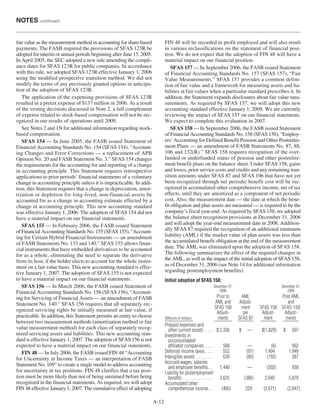
Initial adoption of SFAS 158:
December 31, December 31,
2006 2006
Prior to AML Post AML
AML and Adjust- and
SFAS 158 ment SFAS 158 SFAS 158
Adjust- per Adjust- Adjust-
(Millions of dollars) ments SFAS 87 ment ments___________ _______ ______ ______ ______
Prepaid expenses and
other current assets ..... $ 2,336 $ — $(1,829) $ 507
Investments in
unconsolidated
affiliated companies ..... 568 — (6) 562
Deferred income taxes..... 552 (97) 1,494 1,949
Intangible assets .......... 639 (60) (192) 387
Accrued wages, salaries
and employee benefits... 1,440 — (502) 938
Liability for postemployment
benefits.................. 3,625 (386) 2,640 5,879
Accumulated other
comprehensive income... (405) 229 (2,671) (2,847)
NOTES continued
A-12
Caterpillar Inc.
A-13
SFAS 159 — In February 2007, the FASB issued Statement
of Financial Accounting Standards No. 159 (SFAS 159), “The
Fair Value Option for Financial Assets and Financial Liabilities
— Including an Amendment of FASB Statement No. 115.”
SFAS 159 allows companies the choice to measure many finan-
cial instruments and certain other items at fair value. This gives
a company the opportunity to mitigate volatility in reported earn-
ings caused by measuring related assets and liabilities differently
without having to apply complex hedge accounting provisions.
The Statement is effective January 1, 2008. We are currently
reviewing the impact of SFAS 159 on our financial statements
and expect to complete this evaluation in 2007.
M. Goodwill
Goodwill represents the excess of the cost of an acquisition over
the fair value of the net assets acquired. We account for goodwill
in accordance with Statement of Financial Accounting Standards
No. 142 “Goodwill and Other Intangible Assets,” which requires
that we test goodwill for impairment annually and when events
or circumstances indicate the fair value of a reporting unit may
be below its carrying value. We perform our annual goodwill
impairment testing in September. Goodwill is reviewed for
impairment utilizing a two-step process. The first step requires
us to identify the reporting units and compare the fair value of
each reporting unit, which we compute using a discounted cash
flow analysis, to the respective carrying value, which includes
goodwill. If the carrying value is higher than the fair value, there
is an indication that an impairment may exist. In step two, the
implied fair value of goodwill is calculated as the excess of the
fair value of a reporting unit over the fair values assigned to its
assets and liabilities. If the implied fair value of goodwill is less
than the carrying value of the reporting unit’s goodwill, the dif-
ference is recognized as an impairment loss.
N. Stock-based compensation
On January 1, 2006, we adopted SFAS 123R using the modified
prospective transition method. SFAS 123R requires all stock-
based payments to be recognized in the financial statements
based on the grant date fair value of the award. Under the modi-
fied prospective transition method, we are required to record stock-
based compensation expense for all awards granted after the date
of adoption and for the unvested portion of previously granted
awards outstanding as of the date of adoption. In accordance
with the modified prospective transition method, our Consolidated
Financial Statements for prior periods have not been restated to
reflect, and do not include, the impact of SFAS 123R. See Note 2
for additional information regarding stock-based compensation.
Prior to the adoption of SFAS 123R, we used the intrinsic
value method of accounting for stock-based employee compen-
sation in accordance with Accounting Principles Board Opinion
No. 25, “Accounting for Stock Issued to Employees.” Under the
intrinsic value method no compensation expense was recognized
in association with our stock awards. The following table illus-
trates the effect on profit and profit per share if we had applied
SFAS 123R for 2005 and 2004 grants using the lattice-based
option-pricing model:
Years ended
December 31,
(Dollars in millions except per share data) 2005 2004_____ _____
Profit, as reported.............................................. $ 2,854 $2,035
Deduct: Total stock-based compensation expense
determined under fair value based method for
all awards, net of related tax effects......................... (135) (161)_____ _____
Pro forma profit ................................................ $ 2,719 $1,874_____ __________ _____
Profit per share of common stock:
As reported:
Basic ....................................................... $ 4.21 $ 2.97
Diluted...................................................... $ 4.04 $ 2.88
Pro forma:
Basic ....................................................... $ 4.01 $ 2.74
Diluted...................................................... $ 3.85 $ 2.65
2. Stock-based compensation
Stock Incentive Plans
In 1996, stockholders approved the Stock Option and Long-Term
Incentive Plan (the 1996 Plan), which expired in April of 2006.
The 1996 Plan reserved 144 million shares of common stock
for issuance (128 million under this plan and 16 million under
prior plans). On June 14, 2006, stockholders approved the 2006
Caterpillar Long-Term Incentive Plan (the 2006 Plan). The 2006
non-employee Directors’ grant was issued from this plan. The
2006 Plan reserves 37.6 million shares for issuance (20 million
under the 2006 Plan and 17.6 million transferred from the 1996
Plan). The plans primarily provide for the granting of stock
options and stock-settled stock appreciation rights (SARs) to
Officers and other key employees, as well as non-employee
Directors. Stock options permit a holder to buy Caterpillar stock
at the stock’s price when the option was granted. SARs permit
a holder the right to receive the value in shares of the apprecia-
tion in Caterpillar stock that occurred from the date the right was
granted up to the date of exercise.
Our long-standing practices and policies specify all stock
option and SAR awards are approved by the Compensation
Committee (the Committee) of the Board of Directors on the
date of grant. The stock-based award approval process specifies
the number of awards granted, the terms of the award and the
grant date. The same terms and conditions are consistently
applied to all employee grants, including Officers. The Committee
approves all individual Officer grants. The number of stock
options and SARs included in an individual’s award is deter-
mined based on the methodology approved by the Committee.
The stockholder approved plan provides for the exercise price
methodology to be the average of the high and low price of our
stock on the date of grant.
Common stock issued from Treasury stock under the plans
totaled 15,207,055 for 2006, 18,912,521 for 2005 and 12,216,618
for 2004, respectively.
Options granted prior to 2004 vested at the rate of one-third
per year over the three-year period following the date of grant.
In anticipation of delaying vesting until three years after the grant
date for future grants, the 2004 grant was vested on December 31,
2004. In order to better align our employee stock option program
with the overall market, the number of options granted in 2005
was significantly reduced from the previous year. In response to
NOTES continued
this decrease, we elected to immediately vest the 2005 grant. In
order to further align our stock award program with the overall
market, we adjusted our 2006 grant by reducing the overall number
of employee awards granted and utilizing a mix of SARs and
option awards. The 2006 awards generally vest three years after
the date of grant. At grant, all awards have a term life of ten
years. Upon retirement, the term life is reduced to a maximum
of five remaining years.
Our stock-based compensation plans allow for the immediate
vesting upon retirement for employees who are 55 years old or
older with more than ten years of service and who have fulfilled
the requisite service period of six months. Prior to the adoption
of SFAS 123R, compensation expense for awards associated
with these employees had been recognized in the pro forma net
profit over the nominal vesting period. With the adoption of
SFAS 123R, compensation expense is now recognized over the
period from the grant date to the end date of the requisite service
period for employees who meet the immediate vesting upon retire-
ment requirements. For those employees who become eligible
for immediate vesting upon retirement subsequent to the requi-
site service period and prior to the completion of the vesting
period, compensation expense is recognized over the period from
grant date to the date eligibility is achieved. Application of the
nominal vesting period for these employees for the years ended
December 31, 2005 and 2004 decreased pro forma profit by
$13 million and $16 million, respectively.
SFAS 123R requires companies to estimate the fair value of
share-based payment awards on the date of grant using an option-
pricing model. In 2006, 2005 and 2004, the fair value of the grant
was estimated using a lattice-based option-pricing model. The
lattice-based option-pricing model considers a range of assump-
tions related to volatility, risk-free interest rate and historical
employee behavior. Expected volatility was based on historical
and current implied volatilities from traded options on our stock.
The risk-free rate was based on U.S. Treasury security yields at
the time of grant. The dividend yield was based on historical
information. The expected life was determined from the lattice-
based model. The lattice-based model incorporated exercise and
post vesting forfeiture assumptions based on analysis of histor-
ical data. The following table provides the assumptions used in
determining the fair value of the stock-based awards for the years
ended December 31, 2006, 2005 and 2004, respectively.
The amount of stock-based compensation expense capitalized
for the year ended December 31, 2006 did not have a significant
impact on our financial statements. Prior to our adoption of
SFAS 123R, stock-based compensation was not capitalized in
our pro forma disclosure.
At December 31, 2006, there was $102 million of total unrec-
ognized compensation cost from stock-based compensation
arrangements granted under the plans, which is related to non-
vested stock-based awards. The compensation expense is
expected to be recognized over a weighted-average period of
approximately 2.2 years.
Please refer to Tables I and II on page A-15 for additional
information on our stock-based awards.
The impact related to stock-based compensation for the year
ended December 31, 2006 is shown below:
(Dollars in millions except per share data) 2006______
Stock-based compensation expense, before tax........................ $ 137
Stock-based compensation expense, after tax .......................... $ 92
Income tax benefit recognized in net income ........................... $ 45
Decrease in profit per share of common stock, basic .................. $ .14
Decrease in profit per share of common stock, diluted................. $ .09
In accordance with Staff Accounting Bulletin No. 107 “Share-
based payment,” we classified stock-based compensation within
cost of goods sold, selling, general and administrative expenses
and research and development expenses corresponding to the
same line item as the cash compensation paid to respective
employees, officers and non-employee directors. We do not allo-
cate stock-based compensation to reportable segments.
We currently use shares that have been repurchased through
our stock repurchase program to satisfy share award exercises.
In November 2005, the FASB issued FASB Staff Position
No. FAS 123R-3 “Transition Election Related to Accounting for
Tax Effects of Share-Based Payment Awards.” In the third quar-
ter of 2006, we elected to adopt the alternative transition method
provided in the FASB Staff Position for calculating the tax
effects of stock-based compensation. The alternative transition
method includes simplified methods to determine the beginning
balance of the additional paid-in capital (APIC) pool related to
the tax effects of stock-based compensation, and to determine
the subsequent impact on the APIC pool and the Statement of
Cash Flow of the tax effects of stock-based awards that were
fully vested and outstanding upon the adoption of SFAS 123R.
In accordance with SFAS 154 “Accounting Changes and Error
Corrections,” this change in accounting principle has been
applied retrospectively to the 2006 Consolidated Statement of
Cash Flow. The impact on the Consolidated Statement of Cash
Flow was a decrease in operating cash flow and an offsetting
increase in financing cash flow of $20 million for the three
months ended March 31, 2006 and $27 million for the six months
ended June 30, 2006.
We use the direct only method and tax law ordering approach
to calculate the tax effects of stock-based compensation. In juris-
dictions with net operating loss carryforwards, tax deductions
for 2006 exercises of stock-based awards did not generate a cash
benefit. Approximately $50 million of tax deductions will be
recorded in APIC when realized in these jurisdictions.
A-14
Grant Year________________________________________
2006 2005 2004____________ __________ __________
Weighted-average dividend yield .............................................................................. 1.79% 2.11% 1.89%
Weighted-average volatility..................................................................................... 26.79% 26.48% 25.98%
Range of volatilities ............................................................................................. 26.56-26.79% 21.99-26.65% 25.80-28.10%
Range of risk-free interest rates ................................................................................ 4.34-4.64% 2.38-4.29% 1.90-5.76%
Weighted-average expected lives .............................................................................. 8 years 7 years 6 years
Caterpillar Inc.
A-15
3. Derivative financial instruments
and risk management
A. Foreign currency exchange rate risk
Foreign currency exchange rate movements create a degree of risk
by affecting the U.S. dollar value of sales made and costs incurred
in foreign currencies. Movements in foreign currency rates also
affect our competitive position as these changes may affect business
practices and/or pricing strategies of non-U.S.-based competitors.
Additionally, we have balance sheet positions denominated in
foreign currency, thereby creating exposure to movements in
exchange rates.
Our Machinery and Engines operations purchase, manufacture
and sell products in many locations around the world. As we have
a diversified revenue and cost base, we manage our future foreign
currency cash flow exposure on a net basis. We use foreign cur-
rency forward and option contracts to manage unmatched foreign
currency cash inflow and outflow. Our objective is to minimize the
risk of exchange rate movements that would reduce the U.S. dollar
value of our foreign currency cash flow. Our policy allows for man-
aging anticipated foreign currency cash flow for up to four years.
We generally designate as cash flow hedges at inception of
the contract any Australian dollar, Brazilian real, British pound,
Canadian dollar, euro, Japanese yen, Mexican peso, Singapore
TABLE I — Financial Information Related to Capital Stock_______________________________________________________________________________________________________________
Stock Options/SARs activity:
2006 2005 2004___________________ ___________________ ___________________
Weighted- Weighted- Weighted-
Average Average Average
Exercise Exercise Exercise
Shares Price Shares Price Shares Price_________ _______ _________ _______ _________ _______
Outstanding at beginning of year ............................................ 74,860,582 $ 32.23 82,448,348 $ 28.80 78,999,344 $ 25.69
Granted to officers and key employees ...................................... 9,720,340 $ 72.05 12,565,872 $ 45.64 17,781,466 $ 38.63
Granted to outside directors.................................................. 91,000 $ 66.77 104,000 $ 44.90 104,000 $ 40.64
Exercised ...................................................................... (15,491,627) $ 28.66 (20,086,770) $ 26.68 (13,651,840) $ 23.86
Lapsed......................................................................... (299,628) $ 54.13 (170,868) $ 24.31 (784,622) $ 25.60__________ ________ ________
Outstanding at end of year.................................................... 68,880,667 $ 38.60 74,860,582 $ 32.23 82,448,348 $ 28.80__________ ________ __________________ ________ ________
Exercisable at year-end....................................................... 59,374,295 $ 33.27 69,848,250 $ 32.58 67,241,232 $ 29.28
Stock options/SARs outstanding and exercisable:
Outstanding Exercisable____________________________________________ ____________________________________________
Weighted- Weighted-
Average Weighted- Average Weighted-
Remaining Average Aggregate Remaining Average Aggregate
# Outstanding Contractual Exercise Intrinsic # Outstanding Contractual Exercise Intrinsic
Exercise Prices at 12/31/06 Life (Years) Price Value(1)
at 12/31/06 Life (Years) Price Value(1)
__________ __________ ________ _______ _______ __________ ________ _______ _______
$19.20-22.76 2,938,388 3.43 $19.38 $ 123 2,938,388 3.43 $19.38 $ 123
$25.36-26.77 12,507,410 4.85 $25.94 $ 443 12,507,410 4.85 $25.94 $ 443
$27.14-29.43 14,267,972 5.81 $27.25 $ 487 14,267,972 5.81 $27.25 $ 487
$31.17-45.64 29,539,957 7.12 $40.48 $ 617 29,507,965 7.12 $40.48 $ 616
$66.77-72.05 9,626,940 9.15 $72.00 — 152,560 9.15 $71.81 —__________ _______ _________ _______
68,880,667 $38.60 $1,670 59,374,295 $33.27 $1,669__________ _______ _________ _________________ _______ _________ _______
(1)
The difference between a stock award’s exercise price and the underlying stock’s market price at December 31, 2006, for awards with market price greater than the exercise price. Amounts are in millions
of dollars.
Of the 9,811,340 awards granted during the year ended December 31, 2006, 9,479,534 were SARs.
TABLE II — Additional Stock-based Award Information_______________________________________________________________________________________________________________
(Dollars in millions except per share data) 2006 2005 2004_____ _____ _____
Weighted-average fair value per share of stock awards granted ......................................... $23.44 $ 11.95 $ 9.03
Intrinsic value of stock awards exercised.................................................................. $ 637 $ 501 $ 247
Fair value of shares vested ................................................................................. $ 40 $ 228 $ 274
Cash received from stock awards exercised............................................................... $ 411 $ 478 $ 269
Tax benefit realized from stock awards exercised......................................................... $ 170 $ 134 $ 78
dollar, New Zealand dollar, or Swiss franc forward or option
contracts that meet the requirements for hedge accounting.
Designation is performed on a specific exposure basis to sup-
port hedge accounting. The remainder of Machinery and Engines
foreign currency contracts are undesignated. We designate as
fair value hedges specific euro forward contracts used to hedge
firm commitments.
As of December 31, 2006, $24 million of deferred net gains
(net of tax) included in equity (“Accumulated other compre-
hensive income” in Statement 2), are expected to be reclassified
to current earnings (“Other income (expense)” in Statement 1)
over the next twelve months when earnings are affected by the
hedged transactions. The actual amount recorded in “Other
income (expense)” will vary based on exchange rates at the time
the hedged transactions impact earnings.
In managing foreign currency risk for our Financial Products
operations, our objective is to minimize earnings volatility resulting
from conversion and the remeasurement of net foreign currency
balance sheet positions. Our policy allows the use of foreign
currency forward and option contracts to offset the risk of cur-
rency mismatch between our receivables and debt. All such for-
eign currency forward and option contracts are undesignated.
Gains (losses) included in current earnings [Other income (expense)]
on undesignated contracts:
(Millions of dollars) 2006 2005 2004_____ _____ _____
Machinery and Engines:
On undesignated contracts ....................... $ 23 $ 25 $ (9)
Financial Products:
On undesignated contracts ....................... (19) 58 (46)_____ ____ ____
$ 4 $ 83 $ (55)_____ ____ _________ ____ ____
Gains and losses on the Financial Products contracts above are
substantially offset by balance sheet translation gains and losses.
B. Interest rate risk
Interest rate movements create a degree of risk by affecting the
amount of our interest payments and the value of our fixed rate
debt. Our practice is to use interest rate swap agreements to man-
age our exposure to interest rate changes and, in some cases,
lower the cost of borrowed funds.
Machinery and Engines operations generally use fixed rate debt
as a source of funding. Our objective is to minimize the cost of
borrowed funds. Our policy allows us to enter into fixed-to-floating
interest rate swaps and forward rate agreements to meet that objec-
tive with the intent to designate as fair value hedges at inception
of the contract all fixed-to-floating interest rate swaps. Designation
as a hedge of the fair value of our fixed rate debt is performed to
support hedge accounting. In conjunction with our bond issuance
in 2006 (See Note 16), we entered into $200 million of interest
rate swaps designated as fair value hedges of our fixed-rate debt.
During 2001, our Machinery and Engines operations liquidated all
existing fixed-to-floating interest rate swaps. The gain ($7 million
as of December 31, 2006) is being amortized to earnings ratably
over the remaining life of the hedged debt.
Financial Products operations have a match funding policy
that addresses interest rate risk by aligning the interest rate profile
(fixed or floating rate) of their debt portfolio with the interest rate
profile of their receivables portfolio within predetermined ranges
on an on-going basis. In connection with that policy, we use
interest rate derivative instruments to modify the debt structure
to match assets within the receivables portfolio. This match fund-
ing reduces the volatility of margins between interest-bearing
assets and interest-bearing liabilities, regardless of which direc-
tion interest rates move.
Our policy allows us to use floating-to-fixed, fixed-to-floating
and floating-to-floating interest rate swaps to meet the match
funding objective. To support hedge accounting, we designate
fixed-to-floating interest rate swaps as fair value hedges of the
fair value of our fixed rate debt at the inception of the contract.
Financial Products’ practice is to designate most floating-to-fixed
interest rate swaps as cash flow hedges of the variability of future
cash flows at the inception of the swap contract. Designation as
a hedge of the variability of cash flow is performed to support
hedge accounting. Financial Products liquidated fixed-to-float-
ing interest rate swaps during 2006, 2005 and 2004. The gains
($7 million remaining as of December 31, 2006) are being amortized
to earnings ratably over the remaining life of the hedged debt.
Gains (losses) included in current earnings [Other income (expense)]:
(Millions of dollars) 2006 2005 2004_____ _____ _____
Fixed-to-floating interest rate swaps
Machinery and Engines:
Gain (loss) on designated interest
rate derivatives................................ $ 2 $ — $ —
Gain (loss) on hedged debt .................... (1) — —
Gain (loss) amortization on liquidated
swaps — included in interest expense...... 3 5 5
Financial Products:
Gain (loss) on designated interest
rate derivatives................................ (44) (71) (28)
Gain (loss) on hedged debt .................... 44 71 28
Gain (loss) amortization on liquidated
swaps — included in interest expense...... 6 5 2______ _____ _____
$ 10 $ 10 $ 7______ _____ ___________ _____ _____
As of December 31, 2006, $12 million of deferred net gains
included in equity (“Accumulated other comprehensive income”
in Statement 2), related to Financial Products floating-to-fixed
interest rate swaps, are expected to be reclassified to current earn-
ings (“Interest expense of Financial Products” in Statement 1)
over the next twelve months.
C. Commodity price risk
Commodity price movements create a degree of risk by affect-
ing the price we must pay for certain raw material. Our policy is
to use commodity forward and option contracts to manage the
commodity risk and reduce the cost of purchased materials.
Our Machinery and Engines operations purchase aluminum,
copper and nickel embedded in the components we purchase from
suppliers. Our suppliers pass on to us price changes in the commod-
ity portion of the component cost. In addition, we are also subjected
to price changes on natural gas purchased for operational use.
Our objective is to minimize volatility in the price of these com-
modities. Our policy allows us to enter into commodity forward
and option contracts to lock in the purchase price of a portion of
these commodities within a four-year horizon. All such com-
modity forward and option contracts are undesignated. Gains on
the undesignated contracts of $1 million, $7 million and $15 mil-
lion were recorded in current earnings (“Other income (expense)”
in Statement 1) in 2006, 2005 and 2004, respectively.
NOTES continued
A-16
Caterpillar Inc.
A-17
4. Other income (expense)
Years ended December 31,
(Millions of dollars) 2006 2005 2004______ _____ _____
Investment and interest income ................. $ 83 $ 97 $ 77
Foreign exchange gains ........................ 9 148 96
License fee income............................. 61 59 54
Miscellaneous income (loss) ................... 61 73 26______ _____ _____
$ 214 $ 377 $ 253______ _____ ___________ _____ _____
5. Income taxes
The components of profit before taxes were:
Years ended December 31,
(Millions of dollars) 2006 2005 2004______ _____ _____
U.S............................................ $2,642 $ 2,254 $1,106
Non-U.S. ..................................... 2,219 1,647 1,601______ _____ _____
$4,861 $ 3,901 $2,707______ _____ ___________ _____ _____
Profit before taxes, as shown above, is based on the location
of the entity to which such earnings are attributable. However,
since such earnings are subject to taxation in more than one coun-
try, the income tax provision shown below as U.S. or non-U.S.
may not correspond to the earnings shown above.
The components of the provision for income taxes were:
Years ended December 31,
(Millions of dollars) 2006 2005 2004______ _____ _____
Current tax provision (credit):
U.S. ......................................... $1,342 $ 683 $ 136
Non-U.S. .................................... 373 365 308
State (U.S.) .................................. 49 31 13______ _____ _____
1,764 1,079 457______ _____ _____
Deferred tax provision (credit):
U.S. ......................................... (381) (5) 301
Non-U.S. .................................... 23 31 (24)
State (U.S.) .................................. (1) 15 (3)______ _____ _____
(359) 41 274______ _____ _____
Total provision for income taxes ................ $1,405 $ 1,120 $ 731______ _____ ___________ _____ _____
We paid income taxes of $1,465 million, $731 million and
$326 million in 2006, 2005 and 2004, respectively.
Reconciliation of the U.S. federal statutory rate to effective rate:
Years ended December 31,
2006 2005 2004______ _____ _____
U.S. statutory rate.............................. 35.0)% 35.0)% 35.0)%
(Decreases) increases in taxes resulting from:
Benefit of extraterritorial income exclusion..... (2.1)% (2.7)% (4.9)%
Non-U.S. subsidiaries taxed at other than 35%.. (3.5)% (3.2)% (3.7)%
Other — net ................................. (0.4)% 0.4)% 0.6)%______ _____ _____
29.0)% 29.5)% 27.0)%
Discrete items ................................. (0.1)% (0.8)% —______ _____ _____
Provision for income taxes...................... 28.9)% 28.7)% 27.0)%______ _____ ___________ _____ _____
The 2006 provision for income taxes includes a benefit of
$5 million for net changes in tax reserves. Favorable settlement
of a non-U.S. tax issue resulted in a $25 million decrease in reserves.
This was partially offset by a $20 million increase in tax reserves
for an expected IRS assessment, related to transfer pricing adjust-
ments for tax years 1992 to 1994, which we plan to continue to
dispute. Excluding these discrete items, the effective tax rate for
2006 was 29.0%.
The net impact of repatriation planning and favorable tax set-
tlements resulted in a $31 million decrease to our 2005 provision
for income taxes. We recognized a provision for income taxes of
$33 million in 2005 under the provisions of the American Jobs
Creation Act allowing favorable tax treatment of repatriated earn-
ings. We recognized a benefit of $38 million by reversing a deferred
tax liability related to the undistributed profits of a few selected
non-U.S. subsidiaries. Favorable tax settlements primarily related
to non-U.S. tax jurisdictions reduced the provision by $26 million.
Excluding these discrete items, the effective tax rate for 2005
was 29.5%.
We have recorded income tax expense at U.S. tax rates on all
profits, except for undistributed profits of non-U.S. companies
which are considered indefinitely reinvested. Determination of
the amount of unrecognized deferred tax liability related to indef-
initely reinvested profits is not feasible. A deferred tax asset is
recognized only if we have definite plans to generate a U.S. tax
benefit by repatriating earnings in the foreseeable future.
Deferred income tax assets and liabilities:
December 31,
(Millions of dollars) 2006 2005 2004_____ _____ _____
Deferred income tax assets:
Postemployment benefits other than pensions... $1,593 $ 1,034 $1,092
Warranty reserves ............................ 234 216 212
Unrealized profit excluded from inventories .... 192 176 153
Tax carryforwards ............................ 646 523 498
Deferred compensation ....................... 83 70 57
Allowance for credit losses.................... 83 86 73
Pension ..................................... 577 — —
Post sale discounts........................... 103 62 51
Other — net ................................. 270 106 184_____ _____ _____
3,781 2,273 2,320_____ _____ _____
Deferred income tax liabilities:
Capital and intangible assets.................. (906) (787) (903)
Pension ..................................... — (359) (216)
Unremitted earnings of non-U.S. subs......... (65) (52) (131)_____ _____ _____
(971) (1,198) (1,250)_____ _____ _____
Valuation allowance for deferred tax assets ...... (192) (79) (42)_____ _____ _____
Deferred income taxes — net................... $2,618 $ 996 $1,028______ _____ ___________ _____ _____
Net deferred tax assets increased approximately $1.40 billion
in 2006 related to items reported in accumulated other compre-
hensive income primarily related to adoption of SFAS 158 as
discussed in Notes 1L and 14.
SFAS 109 requires that individual tax-paying entities of the
company offset all current deferred tax liabilities and assets
within each particular tax jurisdiction and present them as a sin-
gle amount in the Consolidated Financial Position. A similar
procedure is followed for all noncurrent deferred tax liabilities
and assets. Amounts in different tax jurisdictions cannot be off-
set against each other. The amount of deferred income taxes at
December 31, included on the following lines in Statement 2,
are as follows:
December 31,
(Millions of dollars) 2006 2005 2004_____ _____ _____
Assets:
Deferred and refundable income taxes ......... $ 733 $ 255 $ 329
Deferred income taxes ....................... 1,949 857 742_____ _____ _____
2,682 1,112 1,071
Liabilities:
Deferred and current income taxes payable .... 9 89 20
Deferred income taxes and other liabilities ..... 55 27 23_____ _____ _____
Deferred income taxes — net................... $2,618 $ 996 $1,028______ _____ ___________ _____ _____
As of December 31, 2006, amounts and expiration dates of
U.S. foreign tax credits available to carry forward were:
(Millions of dollars)
2007-2012 2013 2014 2015 2016 Total_____________________________________________________
$0 $94 $74 $18 $117 $303
As of December 31, 2006, amounts and expiration dates of
net operating loss carryforwards in various non-U.S. taxing juris-
dictions were:
(Millions of dollars)
2007 2008 2009 2010 2011-2016 Unlimited Total_____________________________________________________
$1 $2 $4 $34 $86 $707 $834
A valuation allowance has been recorded at certain non-U.S. sub-
sidiaries that have not yet demonstrated consistent and/or sustain-
able profitability to support the recognition of net deferred tax assets.
As of December 31, 2006, approximately $400 million of state
tax net operating losses (NOLs) and $74 million of state tax credit
carryforwards were available. Of the NOLs, approximately two-
thirds expire after 2016. The state tax credit carryforwards expire
over the next ten years. We established a valuation allowance
for those NOLs and credit carryforwards likely to expire prior to
utilization.
In 2005, the Internal Revenue Service (IRS) completed its
field examination of our 1995 through 1999 U.S. tax returns.
The examination is now at the appellate level of the IRS. In con-
nection with this examination, we received notices of certain
adjustments proposed by the IRS, primarily related to foreign
sales corporation commissions, foreign tax credit calculations
and research and development credits. We disagree with these
proposed adjustments and are continuing to work toward reso-
lution through applicable IRS procedures. We anticipate that this
matter could be resolved by the end of 2007. In the opinion of
management, the ultimate disposition of these matters will not
have a material adverse effect on our consolidated financial posi-
tion, liquidity or results of operations.
The IRS is currently conducting a field examination of our
2000 to 2004 U.S. tax returns. It is reasonably possible that this
audit could be completed by the end of 2007. In the opinion of
management, the ultimate disposition of the audit will not have
a material adverse effect on our consolidated financial position,
liquidity or results of operations.
6. Sales and servicing of trade receivables
Our Machinery and Engines operations generate trade receiv-
ables from the sale of inventory to dealers and customers. Certain
of these receivables are sold to Cat Financial.
A. Prior to June 2005, Cat Financial periodically securitized a
portion of the dealer receivables using a revolving securitization
structure. We used a trust which issued a collateralized trust obli-
gation (CTO) certificate to third party purchasers for their portion
of these receivables. The trust also issued a transferor certificate
(certificated retained interests) to Cat Financial for the portion not
represented by the CTO.
Through August of 2004, the trust was a qualifying special pur-
pose entity (QSPE) and thus, in accordance with Statement of
Financial Accounting Standards No. 140 (SFAS 140), “Accounting
for Transfers and Servicing of Financial Assets and Extinguish-
ments of Liabilities — a replacement of FASB Statement 125,”
was not consolidated. The outstanding principal balance of the
CTO was not included in our Consolidated Financial Position dur-
ing these periods.
From September 2004 through May 2005, because of a signif-
icant increase in Machinery and Engines’ sales and subsequent sale
of the receivables to Cat Financial, our certificated retained inter-
ests in the trust exceeded 90% of the fair value of trust assets. Thus,
during this period, the trust did not qualify as a QSPE as defined
by SFAS 140. We therefore consolidated the trust in accordance
with FIN 46R, “Consolidation of Variable Interest Entities (revised
December 2003), an interpretation of ARB No. 51” as it repre-
sents a variable interest entity for which Cat Financial is the pri-
mary beneficiary. As of December 31, 2004, assets of the trust
of $2,587 million were included in “Receivables — trade and
other” in Statement 2 and the CTO of $240 million was included
in “Short-term Borrowings.” Please refer to Note 15.
Cat Financial serviced the dealer receivables and received an
annual servicing fee of approximately 0.5% of the average out-
standing principal balance of the securitized trade receivables
transferred to third party purchasers. Consolidated expenses of
$7 million related to the securitized receivables were recognized
during 2004 and are included in “Other income (expense)” in
Statement 1. Expected credit losses were assumed to be 0%
because dealer receivables have historically had no losses and
none were expected. The carrying value of the certificated retained
interests approximated fair value due to their short-term nature.
Other than the certificated retained interests (assets of the trust
when consolidated), the investors and the securitization facili-
ties had no recourse to Cat Financial’s assets for failure of debtors
to pay when due.
(Millions of dollars) 2004______
Cash flow from securitizations:
Proceeds from collections reinvested in revolving securitization(1)
.... $ 663
Servicing fees received(1)
................................................. 2
Characteristics of securitized receivables:
Average balance for the year ended December 31(1)
:
Certificated retained interests.......................................... $ 1,936
Collateralized trust obligation.......................................... 240
(1)
For 2004, proceeds, servicing fees and average balances include only the periods the trust was
a QSPE.
In June 2005, Cat Financial terminated the trade receivable
securitization trust and no longer securitizes trade receivables.
Upon termination, receivables held by the trust were transferred
back to Cat Financial.
B. In June 2005, Cat Financial transferred an undivided interest
of $240 million in trade receivables to third party purchasers. In
accordance with SFAS 140, the transfer to third party purchasers
is accounted for as a sale. Cat Financial services the transferred
trade receivables and receives an annual servicing fee of approxi-
mately 0.5% of the average outstanding principal balance. Consoli-
dated expenses of $15 million and $8 million related to the sale
of trade receivables were recognized during 2006 and 2005,
respectively, and are included in “Other income (expense)” in
Statement 1. As of December 31, 2006 and 2005, the outstanding
principal balance of the sold trade receivables was $240 million.
The remaining interest as of December 31, 2006 and 2005 of
$2,718 million and $3,028 million, respectively, are included in
“Receivables — trade and other” in Statement 2. The cash col-
lections from these receivables held by Cat Financial, including
NOTES continued
A-18
those attributable to the third party purchasers, are first applied
to satisfy any obligations of Cat Financial to those purchasers.
The third party purchasers have no recourse to Cat Financial’s
assets, other than the remaining interest, for failure of debtors to
pay when due. For Cat Financial’s remaining interest in trade
receivables, carrying amount approximated fair value due to the
short-term nature of these receivables.
7. Wholesale inventory receivables
Wholesale inventory receivables are receivables of Cat Financial
that arise when Cat Financial provides financing for a dealer’s pur-
chase of inventory. These receivables are included in “Receivables
— trade and other” and “Long-term receivables — trade and other”
in Statement 2 and were $1,215 million, $1,282 million and
$991 million at December 31, 2006, 2005 and 2004, respectively.
Please refer to Note 19 and Table IV for fair value information.
Contractual maturities of outstanding wholesale inventory receivables:
December 31, 2006
Wholesale Wholesale
(Millions of dollars) Installment Finance Wholesale
Amounts Due In Contracts Leases Notes Total___________ _______ ______ ______ ______
2007 ...................... $ 88 $ 76 $ 343 $ 507
2008 ...................... 21 51 353 425
2009 ...................... 18 37 117 172
2010 ...................... 14 14 16 44
2011 ...................... 8 1 1 10
Thereafter ................. — 1 7 8_____ _____ _____ ______
149 180 837 1,166_____ _____ _____ ______
Guaranteed residual value.. — 91 — 91
Less: Unearned income ..... (7) (14) (21) (42)_____ _____ _____ ______
Total ...................... $ 142 $ 257 $ 816 $ 1,215_____ _____ _____ ___________ _____ _____ ______
8. Finance Receivables
Finance receivables are receivables of Cat Financial, which gen-
erally can be repaid or refinanced without penalty prior to contract-
ual maturity. Total finance receivables reported in Statement 2
are net of an allowance for credit losses.
During 2006, 2005 and 2004, Cat Financial securitized retail
installment sale contracts and finance leases into public asset
backed securitization facilities. The securitization facilities are
qualifying special purpose entities and thus, in accordance with
SFAS 140, are not consolidated. These finance receivables, which
are being held in securitization trusts, are secured by new and
used equipment. Cat Financial retained servicing responsibilities
and subordinated interests related to these securitizations. For
2006, subordinated interests included subordinated certificates
with an initial fair value of $4 million, an interest in certain future
cash flow (excess) with an initial fair value of $3 million and a
reserve account with an initial fair value of $10 million. For
2005, subordinated interests included subordinated certificates
with an initial fair value of $8 million, an interest in certain future
cash flow (excess) with an initial fair value of $1 million and a
reserve account with an initial fair value of $12 million. For
2004, subordinated interests included subordinated certificates
with an initial fair value of $8 million, an interest in certain future
cash flow (excess) with an initial fair value of $2 million and a
reserve account with an initial fair value of $10 million. The com-
pany’s retained interests generally are subordinate to the investors’
interests. Net gains of $7 million, $12 million and $13 million
were recognized on these transactions in 2006, 2005 and 2004,
respectively.
Significant assumptions used to estimate the fair value of the
retained interests and subordinated certificates at the time of the
transaction were:
2006 2005 2004_____ _____ _____
Discount rate .................................. 11.2% 10.8% 10.7%
Weighted-average prepayment rate ................ 14.0% 14.0% 14.0%
Expected credit losses .............................. 1.0% 1.0% 1.0%
These assumptions are based on our historical experience,
market trends and anticipated performance relative to the par-
ticular assets securitized.
The company receives annual servicing fees of approximately
1% of the unpaid note value.
As of December 31, 2006, 2005 and 2004, the subordinated
retained interests in the public securitizations totaled $68 million,
$72 million and $73 million, respectively. Key assumptions used
to determine the fair value of the retained interests were:
2006 2005 2004_____ _____ _____
Cash flow discount rates
on retained interests and
subordinated tranches ............... 7.33% 10.7% 10.7%
Weighted-average maturity ............ 31 months 30 months 28 months
Average prepayment rate............... 14.0% 14.0% 14.0%
Expected credit losses ................. 1.0% 1.0% 1.0%
The investors and the securitization trusts have no recourse to
Cat Financial’s other assets for failure of debtors to pay when due.
We estimated the impact of individual 10% and 20% changes
to the key economic assumptions used to determine the fair value
of residual cash flow in retained interests on our income. An
independent, adverse change to each key assumption had an
immaterial impact on the fair value of residual cash flow.
We consider an account past due if any portion of an install-
ment is due and unpaid for more than 30 days. Recognition of
income is suspended when management determines that collec-
tion of future income is not probable (generally after 120 days
past due). Accrual is resumed, and previously suspended income
is recognized, when the receivable becomes contractually current
and/or collection doubts are removed. Cash receipts on impaired
loans or finance leases are recorded against the receivable and
then to any unrecognized income. Investment in loans/finance
leases on nonaccrual status were $190 million, $175 million and
$176 million and past due over 90 days and still accruing were
$18 million, $31 million and $11 million as of December 31, 2006,
2005 and 2004, respectively.
Cat Financial provides financing only when acceptable crite-
ria are met. Credit decisions are based on, among other things,
the customer’s credit history, financial strength and intended use
of equipment. Cat Financial typically maintains a security inter-
est in retail financed equipment and requires physical damage
insurance coverage on financed equipment.
Please refer to Table III for additional finance receivables
information and Note 19 and Table IV for fair value information.
Caterpillar Inc.
A-19
NOTES continued
A-20
9. Inventories
December 31,
(Millions of dollars) 2006 2005 2004______ _____ _____
Raw materials.................................. $2,182 $ 1,689 $1,592
Work-in-process............................... 977 814 664
Finished goods ................................ 2,915 2,493 2,209
Supplies....................................... 277 228 210______ _____ _____
Total inventories ............................... $6,351 $ 5,224 $4,675______ _____ ___________ _____ _____
We had long-term material purchase obligations of approxi-
mately $231 million at December 31, 2006.
10. Property, plant and equipment
Useful
Lives December 31,
(Millions of dollars) (Years) 2006 2005 2004_____ _____ _____ _____
Land ................................... — $ 184 $ 154 $ 152
Buildings and land improvements........ 20-45 3,407 3,195 3,089
Machinery, equipment and other......... 3-10 8,694 7,829 7,361
Equipment leased to others.............. 1-10 3,957 3,988 3,975
Construction-in-process ................ — 1,036 696 587_____ _____ _____
Total property, plant and equipment,
at cost................................ 17,278 15,862 15,164
Less: Accumulated depreciation ......... 8,427 7,874 7,482_____ _____ _____
Property, plant and equipment — net .... $8,851 $ 7,988 $7,682______ _____ ___________ _____ _____
TABLE III — Finance Receivables Information (Millions of dollars)_______________________________________________________________________________________________________________
2006 2005 2004______ ______ ______
Cash flow from securitizations:
Proceeds from initial sales of receivables......................................................................... $ 947 $ 829 $ 639
Servicing fees received............................................................................................. 12 11 9
Cash flows received on retained interests......................................................................... 41 38 34
Characteristics of securitized receivables:
At December 31:
Total securitized principal balance ............................................................................ $1,227 $ 980 $ 815
Loans more than 30 days past due............................................................................ 34 23 26
Weighted-average maturity (in months)....................................................................... 31 30 28
For the year ended December 31:
Average securitized principal balance......................................................................... $1,162 $ 1,085 $ 873
Net credit losses................................................................................................ 5 3 4
Contractual maturities of outstanding finance receivables:
December 31, 2006
Retail Retail
Installment Finance Retail Wholesale
Amounts Due In Contracts Leases Notes Notes Total___________ _______ ______ ______ ______ ______
2007 ................ $ 3,046 $ 2,535 $ 1,749 $ 15 $ 7,345
2008 ................ 2,186 1,810 1,031 13 5,040
2009 ................ 1,373 1,149 663 6 3,191
2010 ................ 679 585 465 — 1,729
2011 ................ 220 232 318 — 770
Thereafter ............ 31 266 795 — 1,092_____ _____ _____ _____ ______
7,535 6,577 5,021 34 19,167
Residual value ....... — 1,157 — — 1,157
Less: Unearned
income ............ (783) (806) (85) — (1,674)_____ _____ _____ _____ ______
Total................. $ 6,752 $ 6,928 $ 4,936 $ 34 $ 18,650_____ _____ _____ _____ ___________ _____ _____ _____ ______
Impaired loans and leases:
2006 2005 2004____ ____ ____
Average recorded investment ...................... $ 168 $ 233 $ 380____ ____ ________ ____ ____
At December 31:
Recorded investment............................ $ 193 $ 171 $ 260
Impaired loans/finance leases for which there
is a related allowance for credit losses.......... $ 133 $ 98 $ 180
Related allowance for credit losses on
impaired loans/finance leases.................. $ 26 $ 20 $ 52
Impaired loans/finance leases for which there
is no related allowance for credit losses ........ $ 60 $ 73 $ 80
Allowance for credit loss activity:
2006 2005 2004_____ _____ _____
Balance at beginning of year...................... $ 302 $ 278 $ 241
Provision for credit losses........................ 68 92 105
Receivables written off ........................... (63) (62) (88)
Recoveries on receivables previously written off.... 16 17 16
Other — net..................................... (8) (23) 4_____ _____ _____
Balance at end of year............................ $ 315 $ 302 $ 278_____ _____ __________ _____ _____
In estimating the allowance for credit losses, we review accounts
that are past due, non-performing or in bankruptcy.
Cat Financial’s net retail finance leases:
December 31,
2006 2005 2004_____ _____ _____
Total minimum lease payments receivable......... $6,577 $ 5,440 $4,876
Estimated residual value of leased assets:
Guaranteed .................................... 483 384 379
Unguaranteed.................................. 674 554 540_____ _____ _____
7,734 6,378 5,795
Less: Unearned income .......................... (806) (623) (550)_____ _____ _____
Net retail finance leases .......................... $6,928 $ 5,755 $ 5,245_____ _____ __________ _____ _____
Caterpillar Inc.
A-21
We had commitments for the purchase or construction of cap-
ital assets of approximately $587 million at December 31, 2006.
Software assets with a carrying value of $50 million, primarily
related to our dealer distribution support system, were abandoned
in 2005. The write-off of these assets is included in “Other oper-
ating expense” in Statement 1.
Assets recorded under capital leases(1)
:
December 31,
(Millions of dollars) 2006 2005 2004_____ _____ _____
Gross capital leases(2)
........................... $ 96 $ 91 $ 326
Less: Accumulated depreciation................. 65 55 220_____ _____ _____
Net capital leases .............................. $ 31 $ 36 $ 106_____ _____ __________ _____ _____
(1)
Included in Property, plant and equipment table on page A-20.
(2)
Consists primarily of machinery and equipment.
The decrease in capital leases from 2004 to 2005 was due to
termination of certain leases in the fourth quarter of 2005. See
Note 16 for additional information.
Equipment leased to others (primarily by Cat Financial):
December 31,
(Millions of dollars) 2006 2005 2004_____ _____ _____
Equipment leased to others — at original cost... $3,957 $ 3,988 $ 3,975
Less: Accumulated depreciation................. 1,299 1,201 1,196_____ _____ _____
Equipment leased to others — net .............. $2,658 $ 2,787 $ 2,779_____ _____ __________ _____ _____
At December 31, 2006, scheduled minimum rental payments
to be received for equipment leased to others were:
(Millions of dollars)
After
2007 2008 2009 2010 2011 2011_____________________________________________________
$575 $463 $258 $132 $43 $8
11. Investments in unconsolidated affiliated companies
Our investments in affiliated companies accounted for by the equity
method consist primarily of a 50% interest in Shin Caterpillar
Mitsubishi Ltd. (SCM) located in Japan. Combined financial infor-
mation of the unconsolidated affiliated companies accounted for
by the equity method (generally on a three-month lag, e.g., SCM
results reflect the periods ending September 30) was as follows:
Years ended December 31,
(Millions of dollars) 2006 2005 2004_____ _____ _____
Results of Operations:
Sales ........................................ $4,420 $ 4,140 $ 3,628
Cost of sales................................. 3,526 3,257 2,788_____ _____ _____
Gross profit.................................. 894 883 840
Profit (loss).................................. $ 187 $ 161 $ 129_____ _____ __________ _____ _____
Caterpillar’s profit (loss) ...................... $ 81 $ 73 $ 59_____ _____ __________ _____ _____
Sales from SCM to Caterpillar of approximately $1.81 billion,
$1.73 billion and $1.48 billion in 2006, 2005 and 2004 respec-
tively, are included in the affiliated company sales. In addition,
SCM purchased $273 million, $282 million and $210 million of
products from Caterpillar in 2006, 2005 and 2004, respectively.
(See Note 27 for subsequent event regarding SCM.)
December 31,
(Millions of dollars) 2006 2005 2004_____ _____ _____
Financial Position:
Assets:
Current assets................................... $1,807 $ 1,714 $1,540
Property, plant and equipment — net ......... 1,119 1,120 1,048
Other assets ..................................... 176 194 195_____ _____ _____
3,102 3,028 2,783_____ _____ _____
December 31,
2006 2005 2004_____ _____ _____
Liabilities:
Current liabilities................................ $1,394 $ 1,348 $1,325
Long-term debt due after one year............. 309 318 273
Other liabilities.................................. 145 188 214_____ _____ _____
1,848 1,854 1,812_____ _____ _____
Ownership ......................................... $1,254 $ 1,174 $ 971_____ _____ __________ _____ _____
Caterpillar’s investments in unconsolidated affiliated companies:
December 31,
(Millions of dollars) 2006 2005 2004_____ _____ _____
Investments in equity method companies ........ $ 542 $ 540 $ 487
Plus: Investments in cost method companies .... 20 25 30_____ _____ _____
Total investments in unconsolidated
affiliated companies .......................... $ 562 $ 565 $ 517_____ _____ __________ _____ _____
At December 31, 2006, consolidated “Profit employed in the
business” in Statement 2 included $262 million representing
undistributed profit of the unconsolidated affiliated companies.
Certain investments in unconsolidated affiliated companies
are accounted for using the cost method. During first quarter
2001, Cat Financial invested for a limited partnership interest in
a venture financing structure associated with Caterpillar’s rental
strategy in the United Kingdom. In the fourth quarter 2004, we
sold our investment in this limited partnership. This sale had no
impact on earnings.
12. Intangible assets and goodwill
A. Intangible assets
Intangible assets are comprised of the following:
Weighted
Amortizable
Life December 31,
(Millions of dollars) (Years) 2006 2005 2004_____ _____ _____ _____
Customer relationships .................. 20 $ 242 $ 40 $ 40
Intellectual property ................... 11 211 206 213
Other................................. 13 73 33 33_____ _____ _____
Total finite-lived intangible
assets — gross..................... 15 526 279 286
Less: Accumulated amortization........ 139 107 91_____ _____ _____
387 172 195
Pension-related....................... — 252 120_____ _____ _____
Intangible assets — net ............... $ 387 $ 424 $ 315______ _____ ___________ _____ _____
During2006weacquiredfinite-livedintangibleassetsof$223mil-
lion due to the purchase of Progress Rail Services, Inc. (Progress
Rail). During 2004 we acquired finite lived intangible assets of
$130 million. (See Note 25 for details on the acquisition of these
assets.) Amortization expense related to intangible assets was
$34 million, $22 million and $18 million for 2006, 2005 and 2004,
respectively. In 2006, pension related intangible assets were
eliminated due to the adoption of SFAS 158. For further dis-
cussion on SFAS 158, see Notes 1L and 14.
Amortization expense related to intangible assets is expected
to be:
(Millions of dollars)
2007 2008 2009 2010 2011 Thereafter_____________________________________________________
$35 $35 $35 $34 $31 $217
NOTES continued
A-22
B. Goodwill
During 2006, we acquired assets with related goodwill of $431 mil-
lion as part of the purchase of Progress Rail. We also acquired
assets with related goodwill of $39 million as part of the purchase
of the large components business of Royal Oak Industries, Inc.
During 2004 we acquired assets with related goodwill of $55 mil-
lion (See Note 25 for details on the acquisition of these assets). No
goodwill was acquired during the year ended December 31, 2005.
During the first quarter of 2006, we determined that the busi-
ness outlook for the parts and accessories distribution business
of MG Rover, acquired in 2004, required a specific impairment
evaluation. The declining outlook of this business resulted from
the MG Rover’s cessation of vehicle production and warranties
resulting from their bankruptcy in 2005. Although the MG Rover
parts business continues to provide parts to the existing popula-
tion of vehicles, the unit’s sales will continue to decline in the
future as production of new vehicles has ceased. In determining
if there was impairment, we first compared the fair value of the
reporting unit (calculated by discounting projected cash flows)
to the carrying value. Because the carrying value exceeded the
fair value, we then allocated the fair value to the assets and liabil-
ities of the unit and determined the fair value of the implied good-
will was zero. Accordingly, a goodwill impairment charge of
$18 million, representing the entire goodwill associated with the
MG Rover parts and accessories business at that date, was included
in “Other operating expenses” in Statement 1 and reported in the
“All Other” category in Note 24. No goodwill was impaired or
disposed of during the years ended December 31, 2005 and 2004.
The changes in carrying amount of goodwill by reportable
segment for the years ended December 31, 2006, 2005 and 2004
were as follows:
13. Available-for-sale securities
Financial Products, primarily Cat Insurance, has investments in
certain debt and equity securities at December 31, 2006, 2005
and 2004, that have been classified as available-for-sale in accor-
dance with SFAS 115 and recorded at fair value based upon
quoted market prices. These fair values are included in “Other
assets” in Statement 2. Unrealized gains and losses arising from
the revaluation of available-for-sale securities are included, net
of applicable deferred income taxes, in equity (“Accumulated
other comprehensive income” in Statement 2). Realized gains
and losses on sales of investments are generally determined using
the FIFO method for debt instruments and the specific identifi-
cation method for equity securities. Realized gains and losses
are included in “Other income (expense)” in Statement 1.
December 31, 2006
Unrealized
Cost Pre-Tax Net Fair
(Millions of dollars) Basis Gains (Losses) Value_____ __________ _____
Government debt ........................... $ 355 $ (5) $ 350
Corporate bonds............................ 541 (6) 535
Equity securities ............................ 154 26 180_____ ____ _____
$ 1,050 $ 15 $ 1,065_____ ____ __________ ____ _____
December 31, 2005
Unrealized
Cost Pre-Tax Net Fair
(Millions of dollars) Basis Gains (Losses) Value_____ __________ _____
Government debt ........................... $ 305 $ (6) $ 299
Corporate bonds............................ 422 (7) 415
Equity securities ............................ 146 38 184_____ ____ _____
$ 873 $ 25 $ 898_____ ____ __________ ____ _____
December 31, 2004
Unrealized
Cost Pre-Tax Net Fair
(Millions of dollars) Basis Gains (Losses) Value_____ __________ _____
Government debt ........................... $ 239 $ (1) $ 238
Corporate bonds............................ 342 — 342
Equity securities ............................ 204 26 230_____ ____ _____
$ 785 $ 25 $ 810_____ ____ __________ ____ _____
Investments in an unrealized loss position that
are not other-than-temporarily impaired:
(Millions of dollars)
Government debt...
Corporate bonds ...
Equity securities....
Total .............. $ 11$ 769$ 9$ 433$ 2$ 336
123—1122
643152331198
$ 4$ 315$ 4$ 199$ —$ 116
Unreal-
ized
Losses
Fair
Value
Unreal-
ized
Losses
Fair
Value
Unreal-
ized
Losses
Fair
Value
Total
12 months
or more(1)
Less than
12 months(1)
December 31, 2006
Construction Large
& Mining Electric Power All Consolidated
(Millions of dollars) Products Power Products Other(1)
Total
Balance at January 1, 2004 ........................... $ 45 $ 204 $ 592 $ 557 $ 1,398
Acquisitions ........................................... — — — 55 55
Other adjustments..................................... — — (3) — (3)
Balance at December 31, 2004 ....................... 45 204 589 612 1,450
Other adjustments..................................... — (1) — 2 1
Balance at December 31, 2005 ....................... 45 203 589 614 1,451
Acquisitions ........................................... — — 39 432 471
Impairments ........................................... — — — (18) (18)
Balance at December 31, 2006 ....................... $ 45 $ 203 $ 628 $ 1,028 $ 1,904
(1)
All Other includes operating segments included in “All Other” category (See Note 24).
Caterpillar Inc.
A-23
(Millions of dollars)
Government debt...
Corporate bonds ...
Equity securities....
Total ..............
(Millions of dollars)
Government debt...
Corporate bonds ...
Equity securities....
Total ..............
(1)
Indicates length of time that individual securities have been in a continuous unrealized loss position.
Government Debt. The unrealized losses on our investments
in U.S. Treasury obligations, direct obligations of U.S. govern-
mental agencies and federal agency mortgage-backed securi-
ties are the result of an increase in interest rates. There are no
credit related events on any of these securities. We intend to and
have the ability to hold these investments that are less than book
value until recovery to fair value or maturity. We do not consider
these investments to be other-than-temporarily impaired as of
December 31, 2006.
Corporate Bonds. The unrealized losses on our investments
in corporate bonds relate primarily to an increase in interest rates.
Individual companies subject to buyouts have seen the yield
spreads on the debt widen. We currently believe it is probable
that we will be able to collect all amounts due according to the
contractual terms of our investments in corporate debt secu-
rities. We intend to and have the ability to hold these invest-
ments that are less than book value, for the aforementioned
reasons, until recovery to fair value or maturity. We do not con-
sider these investments to be other-than-temporarily impaired
as of December 31, 2006.
Equity Securities. Cat Insurance maintains a well-diversified
portfolio consisting of three specific mandates: large cap value
stocks, small and mid cap growth stocks and international growth
and income stocks. The individual securities held in these port-
folios support cash flow, asset allocation and investment objectives.
Currently, we have no holdings in mutual funds. In each case
where unrealized losses occur in the individual stocks, company
management is taking corrective action to increase shareholder
value. We currently believe it is probable that we will be able to
recover all amounts due and do not consider these investments
to be other-than-temporarily impaired as of December 31, 2006.
The fair value of available-for-sale debt securities at December 31,
2006, by contractual maturity, is shown below. Expected maturities
will differ from contractual maturities because borrowers may have
the right to prepay and creditors may have the right to call obligations.
Fair
(Millions of dollars) Value____
Due in one year or less..................................................... $106
Due after one year through five years...................................... $250
Due after five years through ten years ..................................... $111
Due after ten years.......................................................... $418
Proceeds from sales of investments in debt and equity securities
during 2006, 2005 and 2004 were $539 million, $257 million and
$408 million, respectively. Gross gains of $43 million, $14 million
and $8 million and gross losses of $8 million, $6 million and
$6 million have been included in current earnings as a result of
these sales for 2006, 2005 and 2004, respectively.
During 2006, 2005 and 2004, there were no charges for “other
than temporary” declines in the market value of securities.
14. Postemployment benefit plans
We have both U.S. and non-U.S. pension plans covering sub-
stantially all of our U.S. employees and a portion of our non-
U.S. employees, primarily in our European facilities. Our defined
benefit plans provide a benefit based on years of service and/or
the employee’s average earnings near retirement. Our defined
contribution plans allow employees to contribute a portion of
their salary to help save for retirement, and in certain cases, we
provide a matching contribution. We also have defined-benefit
retirement health care and life insurance plans covering sub-
stantially all of our U.S. employees.
As discussed in Note 1L, on December 31, 2006, we adopted
Statement of Financial Accounting Standards No. 158 (SFAS 158),
“ Employers’ Accounting for Defined Benefit Pension and Other
Postretirement Plans.”
In January 2005, amendments were made to both U.S. hourly
pension and other postretirement benefit plans due to the com-
pany and the United Auto Workers reaching a new six-year labor
agreement that will expire on March 1, 2011. These plans were
re-measured as of January 10, 2005 to account for the benefit
changes. The result was a $29 million increase in pension cost
and a $69 million increase in other postretirement benefit cost
for 2005. In addition, the additional minimum pension liability
increased $233 million as a result of the re-measurement. The
liability was offset by an increase in pension-related intangible
assets of $164 million and a decrease in other comprehensive
income (pre-tax) of $69 million.
In April 2005, amendments were made to our U.S. salaried
and management other postretirement benefit plan. The plan was
re-measured, resulting in a reduction of $18 million in other post-
retirement benefit cost for 2005.
We use a November 30th measurement date for our U.S. pen-
sion and other postretirement benefit plans and a September 30th
measurement date for our non-U.S. pension plans. Year-end asset
and obligation amounts are disclosed as of the plan measure-
ment dates.
$ 5$ 414$ 1$ 46$ 4$ 368
148—2146
31911352156
$ 1$ 175$ —$ 9$ 1$ 166
Unreal-
ized
Losses
Fair
Value
Unreal-
ized
Losses
Fair
Value
Unreal-
ized
Losses
Fair
Value
Total
12 months
or more(1)
Less than
12 months(1)
December 31, 2004
$ 14$ 655$ 7$ 249$ 7$ 406
231——231
735641363220
$ 5$ 268$ 3$ 113$ 2$ 155
Unreal-
ized
Losses
Fair
Value
Unreal-
ized
Losses
Fair
Value
Unreal-
ized
Losses
Fair
Value
Total
12 months
or more(1)
Less than
12 months(1)
December 31, 2005
NOTES continued
A-24
A. Benefit obligations_______________________________________________________________________________________________________________
U.S. Pension Benefits Non-U.S. Pension Benefits Other Postretirement Benefits________________________ ________________________ ________________________
(Millions of dollars) 2006 2005 2004 2006 2005 2004 2006 2005 2004______ ______ ______ ______ ______ ______ ______ ______ ______
Change in benefit obligation:
Benefit obligation, beginning of year .......... $10,679 $ 9,593 $ 8,993 $ 2,361 $ 2,097 $ 1,836 $ 5,818 $ 4,926 $ 5,004
Service cost ..................................... 160 150 143 67 58 53 95 86 66
Interest cost ..................................... 575 555 548 111 109 97 302 294 265
Plan amendments............................... 4 204 — (18) (8) — — 412 —
Actuarial losses (gains)......................... 447 863 584 110 254 54 (224) 458 (64)
Foreign currency exchange rates............... — — — 121 (65) 135 1 (2) 2
Participant contributions ....................... — — — 11 12 11 29 28 58
Benefits paid — Gross ......................... (699) (686) (675) (103) (96) (89) (369) (384) (405)
Less federal subsidy on benefits paid ....... — — — — — — 9 — —
Acquisitions/Special termination benefits..... 8 — — 59 — — — — —______ ______ ______ ______ ______ ______ ______ ______ ______
Benefit obligation, end of year ................. $11,174 $ 10,679 $ 9,593 $ 2,719 $ 2,361 $ 2,097 $ 5,661 $ 5,818 $ 4,926______ ______ ______ ______ ______ ______ ______ ______ ____________ ______ ______ ______ ______ ______ ______ ______ ______
Accumulated benefit obligation, end of year ... $10,587 $ 10,213 $ 9,040 $ 2,333 $ 2,069 $ 1,844______ ______ ______ ______ ______ ____________ ______ ______ ______ ______ ______
Weighted-average assumptions
used to determine net cost:
Discount rate(1)
.................................. 5.5% 5.6% 5.9% 4.7% 4.6% 5.2% 5.5% 5.6% 5.9%
Rate of compensation increase(1)
............... 4.0% 4.0% 4.0% 4.0% 3.7% 3.5% 4.0% 4.0% 4.0%
(1)
End of year rates are used to determine net periodic cost for the subsequent year. See Note 14E._______________________________________________________________________________________________________________
Assumed health care cost trend rates have a significant effect on the amounts reported for the health care plans. A one-percentage-
point change in assumed health care cost trend rates would have the following effects: One-percentage- One-percentage-
(Millions of dollars) point increase point decrease___________ ___________
Effect on 2006 service and interest cost components of other postretirement benefit cost .............................................. $ 35 $ (31)
Effect on accumulated postretirement benefit obligation .................................................................................. $444 $(389)
B. Plan assets_______________________________________________________________________________________________________________
U.S. Pension Benefits Non-U.S. Pension Benefits Other Postretirement Benefits________________________ ________________________ ________________________
(Millions of dollars) 2006 2005 2004 2006 2005 2004 2006 2005 2004______ ______ ______ ______ ______ ______ ______ ______ ______
Change in plan assets:
Fair value of plan assets, beginning of year.... $ 9,441 $ 8,725 $ 7,728 $ 2,024 $ 1,503 $ 1,262 $ 1,311 $ 994 $ 867
Actual return on plan assets.................... 1,329 860 1,106 238 272 124 207 100 118
Foreign currency exchange rates............... — — — 100 (47) 91 — — —
Company contributions......................... 9 542 566 34 390 104 331 573 356
Participant contributions ....................... — — — 11 12 11 29 28 58
Benefits paid .................................... (699) (686) (675) (103) (96) (89) (369) (384) (405)
Settlements...................................... — — — — (10) — — — —
Acquisitions..................................... 7 — — — — — — — —______ ______ ______ ______ ______ ______ ______ ______ ______
Fair value of plan assets, end of year .......... $10,087 $ 9,441 $ 8,725 $ 2,304 $ 2,024 $ 1,503 $ 1,509 $ 1,311 $ 994______ ______ ______ ______ ______ ______ ______ ______ ____________ ______ ______ ______ ______ ______ ______ ______ ______
_______________________________________________________________________________________________________________
The asset allocation for our pension and other postretirement benefit plans at the end of 2006, 2005 and 2004, and the target allo-
cation for 2007, by asset category, are as follows: Target Percentage of Plan Assets
Allocation at Year-End_______ ___________________________
(Millions of dollars) 2007 2006 2005 2004_______ _______ _______ _______
U.S. pension:
Equity securities................................................................................................. 70% 74% 72% 74%
Debt securities .................................................................................................. 30% 26% 28% 26%_______ _______ _______ _______
Total.............................................................................................................. 100% 100% 100% 100%_______ _______ _______ ______________ _______ _______ _______
Non-U.S. pension:
Equity securities................................................................................................. 55% 59% 63% 54%
Debt securities .................................................................................................. 33% 30% 30% 38%
Real estate ....................................................................................................... 8% 8% 5% 6%
Other............................................................................................................. 4% 3% 2% 2%_______ _______ _______ _______
Total.............................................................................................................. 100% 100% 100% 100%_______ _______ _______ ______________ _______ _______ _______
Other postretirement benefits:
Equity securities................................................................................................. 80% 84% 84% 84%
Debt securities .................................................................................................. 20% 15% 16% 16%
Cash ............................................................................................................. — 1% — —_______ _______ _______ _______
Total.............................................................................................................. 100% 100% 100% 100%_______ _______ _______ ______________ _______ _______ _______
_______________________________________________________________________________________________________________
Our target asset allocations reflect our investment strategy of maximizing the long-term rate of return on plan assets and the resulting
funded status, within an appropriate level of risk. The U.S. plans are rebalanced to plus or minus five percentage points of the target
asset allocation ranges on a monthly basis. The frequency of rebalancing for the non-U.S. plans varies depending on the plan.
The use of certain derivative instruments is permitted where appropriate and necessary for achieving overall investment policy
objectives. The U.S. plans currently utilize futures contracts to offset current equity positions in order to rebalance the total portfolio
to the target asset allocation. During 2006, approximately 10% of the U.S. pension plans’ assets were rebalanced from equity to fixed
income positions through the use of futures contracts. The actual asset allocation percentages above represent this rebalancing effort.
The plans do not engage in futures contracts for speculative purposes.
Equity securities within plan assets include Caterpillar Inc. common stock in the amounts of:
U.S. Pension Benefits(1)
Non-U.S. Pension Benefits Other Postretirement Benefits________________________ ________________________ ________________________
(Millions of dollars) 2006 2005 2004 2006 2005 2004 2006 2005 2004______ ______ ______ ______ ______ ______ ______ ______ ______
Caterpillar Inc. common stock ................... $ 197 $ 371 $ 299 $ 2 $ 2 $ — $ 2 $ 5 $ 1______ ______ ______ ______ ______ ______ ______ ______ ____________ ______ ______ ______ ______ ______ ______ ______ ______
(1)
Amounts represent 2% of total plan assets for 2006, 4% for 2005 and 3% for 2004.
C. Funded status
The funded status of the plans, reconciled to the amount reported on the Consolidated Financial Position, is as follows:_______________________________________________________________________________________________________________
(Millions of dollars) U.S. Pension Benefits Non-U.S. Pension Benefits Other Postretirement Benefits________________________ ________________________ ________________________
End of Year 2006 2005 2004 2006 2005 2004 2006 2005 2004______ ______ ______ ______ ______ ______ ______ ______ ______
Fair value of plan assets .......................... $10,087 $ 9,441 $ 8,725 $ 2,304 $ 2,024 $ 1,503 $ 1,509 $ 1,311 $ 994
Benefit obligations ................................ 11,174 10,679 9,593 2,719 2,361 2,097 5,661 5,818 4,926______ ______ ______ ______ ______ ______ ______ ______ ______
Over (under) funded status ....................... (1,087) (1,238) (868) (415) (337) (594) (4,152) (4,507) (3,932)
Amounts not yet recognized:
Unrecognized prior service cost (benefit) ..... N/A 303 158 N/A 22 27 N/A 208 (232)
Unrecognized net actuarial loss................ N/A 3,070 2,552 N/A 746 726 N/A 1,595 1,232
Unrecognized net obligation existing
at adoption of SFAS 87/106.................. N/A — — N/A 2 3 N/A 14 16
Contributions made after measurement date... 2 1 — 2 1 22 20 28 27______ ______ ______ ______ ______ ______ ______ ______ ______
Net amount recognized in financial position .... $(1,085) $ 2,136 $ 1,842 $ (413) $ 434 $ 184 $(4,132) $ (2,662) $ (2,889)______ ______ ______ ______ ______ ______ ______ ______ ____________ ______ ______ ______ ______ ______ ______ ______ ______
Components of net amount recognized
in financial position:
Accrued benefit liabilities (current liability) ..... $ (9) $ N/A $ N/A $ (2) $ N/A $ N/A $ (13) $ N/A $ N/A
Liability for postemployment benefits
(non-current liability)........................... (1,076) N/A N/A (411) N/A N/A (4,119) N/A N/A
Prepaid benefit costs.............................. N/A 1,487 1,099 N/A 466 28 N/A — —
Accrued benefit liabilities......................... N/A (71) (97) N/A (59) (173) N/A (599) (402)
Intangible assets .................................. N/A 237 95 N/A 16 25 N/A — —
Liability for postemployment benefits............ N/A (760) (248) N/A (92) (181) N/A (2,063) (2,487)
Accumulated other
comprehensive income (pre-tax)............... N/A 1,243 993 N/A 103 485 N/A — —______ ______ ______ ______ ______ ______ ______ ______ ______
Net asset (liability) recognized ................... $(1,085) $ 2,136 $ 1,842 $ (413) $ 434 $ 184 $(4,132) $ (2,662) $ (2,889)______ ______ ______ ______ ______ ______ ______ ______ ____________ ______ ______ ______ ______ ______ ______ ______ ______
Amounts recognized in accumulated
other comprehensive income (pre-tax)
consist of:
Net actuarial loss (gain) .......................... $ 2,754 $ N/A $ N/A $ 742 $ N/A $ N/A $ 1,159 $ N/A $ N/A
Prior service cos (credit) ......................... 249 N/A N/A 16 N/A N/A 244 N/A N/A
Transition obligation (asset)...................... — N/A N/A 1 N/A N/A 13 N/A N/A______ ______ ______ ______ ______ ______ ______ ______ ______
Total ............................................... $ 3,003 $ N/A $ N/A $ 759 $ N/A $ N/A $ 1,416 $ N/A $ N/A______ ______ ______ ______ ______ ______ ______ ______ ____________ ______ ______ ______ ______ ______ ______ ______ ______
N/A (Not Applicable): The adoption of SFAS 158 (see Note 1L) resulted in recognition of previously unrecognized prior service cost and actuarial loss on our consolidated financial position. Overall, the
prepaid asset was eliminated and a liability recognized through an adjustment to accumulated other comprehensive income.
_______________________________________________________________________________________________________________
The estimated amounts that will be amortized from “Accumulated other comprehensive income” at December 31, 2006 into net periodic
benefit cost in 2007 are as follows:
Other Postretirement
(Millions of dollars) U.S. Pension Non-U.S. Pension Benefits_________________ _________________ _________________
Actuarial (gain) loss ............................................................ $ 214 $ 52 $ 79
Prior service (credit) cost....................................................... 58 5 (36)
Transition (asset) obligation.................................................... — 1 2______ ______ ______
Total ............................................................................. $ 272 $ 58 $ 45______ ______ ____________ ______ ______
Caterpillar Inc.
A-25
NOTES continued
A-26
The following amounts relate to our pension plans with projected benefit obligations in excess of plan assets:
U.S. Pension Benefits Non-U.S. Pension Benefits
at Year-end at Year-end___________________________ ___________________________
(Millions of dollars) 2006 2005 2004 2006 2005 2004_______ _______ _______ _______ _______ _______
Projected benefit obligation .................................................... $(11,174) $ (10,679) $ (9,593) $ (2,719) $ (2,319) $ (2,059)
Accumulated benefit obligation ................................................ $(10,587) $ (10,213) $ (9,040) $ (2,333) $ (2,034) $ (1,813)
Fair value of plan assets........................................................ $ 10,087 $ 9,441 $ 8,725 $ 2,304 $ 1,973 $ 1,455
_______________________________________________________________________________________________________________
The following amounts relate to our pension plans with accumulated benefit obligations in excess of plan assets:
U.S. Pension Benefits Non-U.S. Pension Benefits
at Year-end at Year-end___________________________ ___________________________
(Millions of dollars) 2006 2005 2004 2006 2005 2004_______ _______ _______ _______ _______ _______
Projected benefit obligation .................................................... $ (4,491) $ (4,594) $ (3,975) $ (121) $ (556) $ (2,003)
Accumulated benefit obligation ................................................ $ (4,460) $ (4,564) $ (3,959) $ (106) $ (506) $ (1,767)
Fair value of plan assets........................................................ $ 3,805 $ 3,733 $ 3,614 $ 19 $ 382 $ 1,406
_______________________________________________________________________________________________________________
The accumulated postretirement benefit obligation exceeds plan assets for all of our other postretirement benefit plans.
D. Expected cash flow
Information about the expected cash flow for the pension and other postretirement benefit plans follows:
_______________________________________________________________________________________________________________
U.S. Pension Non-U.S. Pension Other Postretirement
(Millions of dollars) Benefits Benefits Benefits_________________ _________________ _________________
Employer contributions:
2007 (expected)............................................................... $ 10 $ 40 $ 400______ ______ ____________ ______ ______
Expected benefit payments:
2007 ........................................................................... $ 720 $ 80 $ 400
2008 ........................................................................... 730 80 400
2009 ........................................................................... 740 80 420
2010 ........................................................................... 760 90 430
2011 ........................................................................... 770 90 450
2012-2016 .................................................................... 4,000 550 2,400______ ______ ______
Total ........................................................................... $ 7,720 $ 970 $ 4,500______ ______ ____________ ______ ______
The above table reflects the total employer contributions and benefits expected to be paid from the plan or from company assets
and does not include the participants’ share of the cost. The expected benefit payments for our other postretirement benefits include
payments for prescription drug benefits. Medicare Part D subsidy amounts expected to be received by the company which will offset
other postretirement benefit payments are as follows:
2012-
(Millions of dollars) 2007 2008 2009 2010 2011 2016 Total______ ______ ______ ______ ______ ______ ______
Other postretirement benefits................................................... $20 $20 $30 $30 $30 $190 $320
E. Net periodic cost_______________________________________________________________________________________________________________
U.S. Pension Benefits Non-U.S. Pension Benefits Other Postretirement Benefits________________________ ________________________ ________________________
(Millions of dollars) 2006 2005 2004 2006 2005 2004 2006 2005 2004______ ______ ______ ______ ______ ______ ______ ______ ______
Components of net periodic benefit cost:
Service cost ................................... $ 160 $ 150 $ 143 $ 67 $ 58 $ 53 $ 95 $ 86 $ 66
Interest cost ................................... 575 555 548 111 109 97 302 294 265
Expected return on plan assets............... (798) (712) (697) (142) (111) (103) (116) (91) (74)
Settlement loss................................ — — — — 3 — — — —
Termination benefits.......................... — — — 1 — — — — —
Amortization of:
Net asset existing at adoption
of SFAS 87/106........................... — — — 1 1 3 2 2 2
Prior service cost(1)
......................... 58 59 44 5 7 6 (33) (29) (48)
Net actuarial loss ........................... 232 197 142 56 50 38 113 85 45______ ______ ______ ______ ______ ______ ______ ______ ______
Total cost included in operating profit....... $ 227 $ 249 $ 180 $ 99 $ 117 $ 94 $ 363 $ 347 $ 256______ ______ ______ ______ ______ ______ ______ ______ ____________ ______ ______ ______ ______ ______ ______ ______ ______
The assumed discount rate is used to discount future benefit
obligations back to today’s dollars. The U.S. discount rate is
based on the Moody’s Aa bond yield as of our measurement date,
November 30, and represents the rate at which our benefit obli-
gations could effectively be settled. To validate the discount rate,
a detailed analysis of the individual plans’ expected cash flows
is made annually. This involves analyzing Caterpillar’s projected
cash flows against a high quality bond yield curve, calculated
using a wide population of corporate Aa bonds. The modeled
discount rate that results from matching the aggregate expected
future cash flows from the Caterpillar benefit plans to the yield
curve of high quality corporate bonds is consistent with the annu-
alized Moody’s Aa rate. A comprehensive process is also used to
determine the assumed discount rate for our non-U.S. plans. This
rate is sensitive to changes in interest rates. A decrease in the
discount rate would increase our obligation and future expense.
Our U.S. expected long-term rate of return on plan assets is
based on our estimate of long-term passive returns for equities
and fixed income securities weighted by the allocation of our
pension assets. Based on historical performance, we increase the
passive returns due to our active management of the plan assets.
To arrive at our expected long-term return, the amount added
for active management was 1% for 2006, 2005 and 2004. A sim-
ilar process is used to determine this rate for our non-U.S. plans.
The assumed health care trend rate represents the rate at which
health care costs are assumed to increase. To calculate the 2006
benefit expense, we assumed an increase of 8.5% for 2006. We
expect an increase of 7.5% during 2007. The 2006 and 2007 rates
are assumed to decrease gradually to the ultimate health care
trend rate of 5.0% in 2013. This rate represents 3.0% general
inflation plus 2.0% additional health care inflation.
We determined that most of our U.S. retiree health care plans
are at least actuarially equivalent to Medicare Part D and will
qualify for the federal subsidy. In the third quarter of 2004, we
adopted FSP 106-2 retroactive to December 31, 2003 (the period
end that includes the date of the Act’s enactment) as permitted by
the FSP. The impact was a reduction in our accumulated postretire-
ment benefit obligation of $284 million related to benefits attri-
buted to past service. The reduction in the components of 2004
net periodic postretirement benefits expense was $51 million.
F. Other postemployment benefit plans
We offer long-term disability benefits, continued health care for
disabled employees, survivor income benefit insurance and sup-
plemental unemployment benefits to substantially all eligible
U.S. employees.
G. Defined contribution plans
We have both U.S. and non-U.S. employee defined contribution
plans to help employees save for retirement. Our U.S. 401(k)
plan allows eligible employees to contribute a portion of their
salary to the plan on a tax-deferred basis, and we provide a
matching contribution equal to 100% of employee contributions
to the plan up to 6% of their compensation. Various other U.S.
and non-U.S. defined contribution plans allow eligible employ-
ees to contribute a portion of their salary to the plans, and in
some cases, we provide a matching contribution to the funds.
Total company costs related to U.S. and non-U.S. defined con-
tribution plans were the following:
(Millions of dollars) 2006 2005 2004______ _____ _____
U.S. plans ..................................... $ 157 $ 135 $ 110
Non-U.S. plans ................................ 23 18 11______ _____ _____
$ 180 $ 153 $ 121______ _____ ___________ _____ _____
H. Summary of long-term liability:
December 31,
(Millions of dollars) 2006 2005 2004______ _____ _____
Pensions:
U.S. pensions................................ $1,076 $ 760 $ 248
Non-U.S. pensions........................... 411 92 181______ _____ _____
Total pensions ................................. 1,487 852 429
Postretirement benefits other than pensions...... 4,119 2,063 2,487
Other postemployment benefits ................. 73 76 70
Defined contribution ........................... 200 170 140______ _____ _____
$5,879 $ 3,161 $3,126______ _____ ___________ _____ _____
15. Short-term borrowings
December 31,
(Millions of dollars) 2006 2005 2004______ _____ _____
Machinery and Engines:
Notes payable to banks ....................... $ 77 $ 543 $ 93
Commercial paper............................ 88 328 —_____ _____ _____
165 871 93
Financial Products:
Notes payable to banks ....................... 251 257 370
Commercial paper............................ 4,149 3,936 2,972
Collateralized trust obligation ................. — — 240
Demand notes ............................... 590 505 482_____ _____ _____
4,990 4,698 4,064_____ _____ _____
Total short-term borrowings .................... $5,155 $ 5,569 $4,157_____ _____ __________ _____ _____
See Note 6 for further discussion of the collateralized trust
obligation.
Caterpillar Inc.
A-27
Weighted-average assumptions
used to determine net cost:
Discount rate(2)
................................ 5.6% 5.9% 6.2% 4.6% 5.2% 5.1% 5.6% 5.8% 6.1%
Expected return on plan assets(3)
........ 9.0% 9.0% 9.0% 7.5% 7.1% 7.4% 9.0% 9.0% 9.0%
Rate of compensation increase............... 4.0% 4.0% 4.0% 3.5% 3.5% 3.2% 4.0% 4.0% 4.0%
(1)
Prior service costs for both pension and other postretirement benefits are generally amortized using the straight-line method over the average remaining service period to the full retirement eligibility
date of employees expected to receive benefits from the plan amendment. For other postretirement benefit plans in which all or almost all of the plan’s participants are fully eligible for benefits under
the plan, prior service costs are amortized using the straight-line method over the remaining life expectancy of those participants.
(2)
For U.S. plans impacted by the January 2005 plan amendments, a 5.8% discount rate was utilized for valuing the plan re-measurement. For the April 2005 other postretirement benefit plan amend-
ment, a 5.7% discount rate was utilized for valuing the plan re-measurement.
(3)
The weighted-average rates for 2007 are 9.0% and 7.7% for U.S. and non-U.S. plans, respectively.
_______________________________________________________________________________________________________________
The weighted-average interest rates on short-term borrowings
outstanding were: December 31,
2006 2005 2004_____ _____ _____
Notes payable to banks......................... 6.2% 5.4% 5.9%
Commercial paper ............................. 4.5% 3.4% 2.5%
Collateralized trust obligation................... — — 2.3%
Demand notes ................................. 5.4% 4.2% 2.3%
Please refer to Note 19 and Table IV for fair value information
on short-term borrowings.
16. Long-term debt
December 31,
(Millions of dollars) 2006 2005 2004_____ _____ _____
Machinery and Engines:
Notes — 6.550% due 2011 ................ $ 250 $ 250 $ 250
Notes — 5.700% due 2016 ................ 500 — —
Debentures — 9.000% due 2006........... — — 206
Debentures — 7.250% due 2009........... 307 310 313
Debentures — 9.375% due 2011........... 123 123 123
Debentures — 9.375% due 2021........... 120 120 236
Debentures — 8.000% due 2023........... 82 82 199
Debentures — 6.625% due 2028........... 299 299 299
Debentures — 7.300% due 2031........... 348 348 348
Debentures — 5.300% due 2035........... 201 200 —
Debentures — 6.050% due 2036........... 747 — —
Debentures — 6.950% due 2042........... 249 249 249
Debentures — 7.375% due 2097........... 297 297 297
Capital lease obligations ................... 72 66 665
Commercial paper ......................... — — 40
Deposit obligations ........................ — 231 245
Other...................................... 99 142 193______ ______ ______
Total Machinery and Engines................. 3,694 2,717 3,663
Financial Products:
Commercial paper ......................... 408 299 1,400
Medium-term notes........................ 12,857 12,187 10,468
Deposit obligations ........................ 232 232 232
Other...................................... 489 242 74______ ______ ______
Total Financial Products ..................... 13,986 12,960 12,174______ ______ ______
Total long-term debt due after one year ....... $17,680 $ 15,677 $15,837______ ______ ____________ ______ ______
All outstanding notes and debentures are unsecured. Certain
capital lease obligations which were collateralized by leased
manufacturing equipment and/or security deposits, were termi-
nated in the fourth quarter of 2005. This resulted in the fulfill-
ment of the capital lease obligation and conversion of the
associated security deposits into cash. The deposit obligations
have corresponding security deposits, which are included in
“Other assets” in Statement 2. These deposit obligations and cor-
responding security deposits relate to two finance arrangements
which provide us a return. These finance arrangements require
that we commit to certain long-term obligations and provide
security deposits which will fulfill these obligations when they
become due. At December 31, 2006, the Machinery and Engines
deposit obligations are included in “Long-term debt due within
one year,” and the corresponding security deposit is included in
“Prepaid expenses and other current assets” in Statement 2.
On August 8, 2006, Caterpillar Inc. issued $500 million of
5.70% notes due in 2016 and $750 million of 6.05% debentures
due in 2036.
On September 13, 2005, $116 million of 9.375% debentures
due in 2021 and $117 million of 8.00% debentures due in 2023
were exchanged for $307 million of 5.30% debentures due in
2035 and $23 million of cash. The book value of the 5.30%
debentures due in 2035 was $201 million at December 31, 2006
and $200 million at December 31, 2005, which results in an
effective yield of 8.55%.
We may redeem the 6.55% and 5.70% notes and the 5.30%,
7.25%, 6.625%, 7.3%, 6.05%, 6.95% and 7.375% debentures in
whole or in part at our option at any time at a redemption price
equal to the greater of 100% of the principal amount of the
debentures to be redeemed or the sum of the present value of the
remaining scheduled payments.
The terms of other notes and debentures do not specify a redemp-
tion option prior to maturity.
Based on long-term credit agreements, $408 million, $299 mil-
lion and $1,440 million of commercial paper outstanding at
December 31, 2006, 2005 and 2004, respectively, was classified
as long-term debt due after one year.
Medium-term notes are offered by prospectus and are issued
through agents at fixed and floating rates. These notes have a
weighted average interest rate of 4.6% with remaining maturi-
ties up to 20 years at December 31, 2006.
The aggregate amounts of maturities of long-term debt during
each of the years 2007 through 2011, including amounts due
within one year and classified as current, are:
December 31,
(Millions of dollars) 2007 2008 2009 2010 2011_____ _____ _____ _____ _____
Machinery and Engines ........ $ 418 $ 59 $ 321 $ 3 $ 376
Financial Products............. 4,043 3,913 4,011 2,258 1,367_____ _____ _____ _____ _____
$ 4,461 $ 3,972 $ 4,332 $ 2,261 $ 1,743_____ _____ _____ _____ __________ _____ _____ _____ _____
The above table includes $969 million of medium-term notes
that can be called at par.
Interest paid on short-term and long-term borrowings for 2006,
2005 and 2004 was $1,256 million, $1,030 million and $766 mil-
lion, respectively.
Please refer to Note 19 and Table IV for fair value information
on long-term debt.
17. Credit commitments
December 31, 2006
Machinery Financial
(Millions of dollars) Consolidated and Engines Products_________ _________ _______
Credit lines available:
Global credit facilities............ $6,450(1)
$1,000(1)
$5,450(1)
Other external .................... 2,573 1,070 1,503_____ _____ _____
Total credit lines available......... 9,023 2,070 6,953
Less: Global credit facilities
supporting commercial paper... (4,645) (88) (4,557)
Less: Utilized credit ................ (750) (77) (673)_____ _____ _____
Available credit..................... $3,628 $1,905 $1,723_____ _____ __________ _____ _____
(1)
We have three global credit facilities with a syndicate of banks totaling $6,450 million available
in the aggregate to both Machinery and Engines and Financial Products to support commercial
paper programs. Based on management’s allocation decision, which can be revised at any time
during the year, the portion of the facility available to Cat Financial at December 31, 2006 was
$5,450 million. The five-year facility of $1.63 billion, which expires in September 2010, has not
changed from December 2005. The five-year facility, which was previously $2.50 billion and
scheduled to expire in 2009, has been increased to $2.98 billion and now expires in 2011. The
364-day facility of $1.63 billion that expired in September 2006 was increased to $1.85 billion
and now expires in September 2007. The facility expiring in September 2007 has a provision
that allows Caterpillar or Cat Financial to obtain a one-year loan in September 2007 that would
mature in September 2008.
At December 31, 2006, there were no borrowings under these
lines.
NOTES continued
A-28
Caterpillar Inc.
A-29
18. Profit per share
Computations of profit per share:
(Dollars in millions except per share data) 2006 2005 2004_____ _____ _____
Profit for the period (A) ............................. $3,537 $ 2,854 $2,035
Determination of shares (in millions):
Weighted average number of common shares
outstanding (B).................................. 658.7 678.4 684.5
Shares issuable on exercise of stock awards,
net of shares assumed to be purchased out
of proceeds at average market price ........... 25.1 27.4 22.9
Average common shares outstanding for fully
diluted computation (C) ........................ 683.8 705.8 707.4
Profit per share of common stock:
Assuming no dilution (A/B) ...................... $ 5.37 $ 4.21 $ 2.97
Assuming full dilution (A/C) ..................... $ 5.17 $ 4.04 $ 2.88
Shares outstanding as of December 31
(in millions) ....................................... 645.8 670.9 685.9
SARs and stock options to purchase 9,626,940 and 104,000
common shares were outstanding in 2006 and 2004, respectively,
but were not included in the computation of diluted earnings per
share because the effect would have been antidilutive. There were
no antidilutive stock options outstanding at December 31, 2005.
On June 8, 2005, Caterpillar’s Board of Directors approved a
2-for-1 stock split in the form of a 100 percent stock dividend.
The stock split shares were distributed on July 13, 2005 to stock-
holders of record at the close of business on June 22, 2005.
Capital accounts, share data and profit per share data reflect the
stock split, applied retroactively, to all periods presented.
19. Fair values of financial instruments
We used the following methods and assumptions to estimate the
fair value of our financial instruments:
Cash and short-term investments — carrying amount approxi-
mated fair value.
Long-term investments (other than investments in uncon-
solidated affiliated companies) — fair value for available-for-
sale securities was estimated based on quoted market prices. Fair
value for security deposits approximated carrying value.
Foreign currency forward and option contracts — fair
value of forward contracts was determined by discounting the
future cash flow resulting from the differential between the con-
tract price and the forward rate. Fair value of option contracts
was determined by using the Black-Scholes model.
Finance receivables — fair value was estimated by discount-
ing the future cash flow using current rates, representative of
receivables with similar remaining maturities. Historical bad
debt experience also was considered.
Wholesale inventory receivables — fair value was estimated
by discounting the future cash flow using current rates, repre-
sentative of receivables with similar remaining maturities.
Short-term borrowings — carrying amount approximated
fair value.
Long-term debt — for Machinery and Engines notes and
debentures, fair value was estimated based on quoted market
prices. For Financial Products, fair value was estimated by dis-
counting the future cash flow using our current borrowing rates
for similar types and maturities of debt, except for floating rate notes
and commercial paper supported by long-term credit agreements
for which the carrying amounts were considered a reasonable
estimate of fair value. For deposit obligations carrying value approxi-
mated fair value.
Interest rate swaps — fair value was estimated based on the
amount that we would receive or pay to terminate our agree-
ments as of year-end.
Guarantees — fair value is estimated based on the premium
we would require to issue the same guarantee in a stand alone
arm’s-length transaction with an unrelated party.
Please refer to Table IV on the next page for the fair values of
our financial instruments.
20. Concentration of credit risk
Financial instruments with potential credit risk consist primar-
ily of trade and finance receivables and short-term and long-term
investments. Additionally, to a lesser extent, we have a potential
credit risk associated with counterparties to derivative contracts.
Trade receivables are primarily short-term receivables from inde-
pendently owned and operated dealers and customers which arise
in the normal course of business. We perform regular credit eval-
uations of our dealers and customers. Collateral generally is not
required, and the majority of our trade receivables are unsecured.
We do, however, when deemed necessary, make use of various
devices such as security agreements and letters of credit to pro-
tect our interests. No single dealer or customer represents a sig-
nificant concentration of credit risk.
Finance receivables and wholesale inventory receivables pri-
marily represent receivables under installment sales contracts,
receivables arising from leasing transactions and notes receiv-
able. We generally maintain a secured interest in the equipment
financed. No single customer or dealer represents a significant
concentration of credit risk.
Short-term and long-term investments are held with high quality
institutions and, by policy, the amount of credit exposure to any
one institution is limited. Long-term investments, included in “Other
assets” in Statement 2, are comprised primarily of investments which
collateralize deposit obligations and investments of Cat Insurance
supporting insurance reserve requirements. At December 31, 2004
long-term investments also included investments which collat-
eralized capital lease obligations (see Note 16).
For derivatives contracts, collateral is generally not required
of the counterparties or of our company. We do not anticipate
nonperformance by any of the counterparties. Our exposure to
credit loss in the event of nonperformance by the counterparties
is limited to only those gains that we have recorded, but have
not yet received cash payment. At December 31, 2006, 2005 and
2004, the exposure to credit loss was $149 million, $141 million
and $312 million, respectively.
Please refer to Note 19 and Table IV for fair value information.
21. Operating leases
We lease certain computer and communications equipment,
transportation equipment and other property through operating
leases. Total rental expense for operating leases was $319 mil-
lion, $257 million and $224 million for 2006, 2005 and 2004,
respectively.
NOTES continued
A-30
Minimum payments for operating leases having initial or
remaining non-cancelable terms in excess of one year are:
Years ended December 31,
(Millions of dollars)
After
2007 2008 2009 2010 2011 2011 Total_____________________________________________________
$230 $195 $163 $134 $87 $460 $1,269
22. Guarantees and product warranty
We have guaranteed to repurchase loans of certain Caterpillar
dealers from third party lenders in the event of default. These
guarantees arose in conjunction with Cat Financial’s relation-
ship with third party dealers who sell Caterpillar equipment.
These guarantees generally have one-year terms and are secured,
primarily by dealer assets. Additionally, we have provided an
indemnity to a third party insurance company for potential losses
related to performance bonds issued on behalf of Caterpillar deal-
ers. The bonds are issued to insure governmental agencies against
nonperformance by certain Caterpillar dealers.
We provide loan guarantees to third party lenders for financ-
ing associated with machinery purchased by customers. The loan
guarantees are for the remote chance that the customers will
become insolvent. These guarantees have varying terms and are
secured by the machinery.
Cat Financial has provided a limited indemnity to a third party
bank for $35 million resulting from the assignment of certain
leases to that bank. The indemnity is for the remote chance that
the insurers of these leases would become insolvent. The indem-
nity expires December 15, 2012 and is unsecured.
No loss has been experienced or is anticipated under any of
these guarantees. At December 31, 2006, 2005 and 2004, the
related liability was $10 million, $9 million and $10 million,
respectively. The maximum potential amount of future payments
(undiscounted and without reduction for any amounts that may
possibly be recovered under recourse or collateralized provi-
sions) we could be required to make under the guarantees at
December 31 are as follows:
(Millions of dollars) 2006 2005 2004______ _____ _____
Guarantees with Caterpillar dealers.............. $ 527 $ 520 $ 468
Guarantees with customers ..................... 48 64 29
Limited Indemnity.............................. 35 40 45
Guarantees — other ........................... 21 16 17______ _____ _____
Total guarantees ............................... $ 631 $ 640 $ 559______ _____ ___________ _____ _____
Cat Financial is party to agreements in the normal course of
business with selected customers and Caterpillar dealers in which
we commit to provide a set dollar amount of financing on a pre-
approved basis. We also provide lines of credit to selected cus-
tomers and Caterpillar dealers, of which a portion remains unused
as of the end of the period. Commitments and lines of credit gen-
erally have fixed expiration dates or other termination clauses.
It has been our experience that not all commitments and lines of
credit will be used. Management applies the same credit policies
when making commitments and granting lines of credit as it does
for any other financing. We do not require collateral for these com-
mitments/lines, but if credit is extended, collateral may be required
upon funding. The amount of the unused commitments and lines
of credit for dealers as of December 31, 2006 was $6,587 million
compared to $4,729 million at December 31, 2005 and $5,019 mil-
lion at December 31, 2004. The amount of the unused commitments
TABLE IV — Fair Values of Financial Instruments_______________________________________________________________________________________________________________
2006 2005 2004_________________ _________________ _________________
Carrying Fair Carrying Fair Carrying Fair
(Millions of dollars) Amount Value Amount Value Amount Value Reference________ ________ ________ ________ ________ ________ _______
Asset (liability) at December 31
Cash and short-term investments................. $ 530) $ 530) $ 1,108) $ 1,108) $ 445) $ 445) Statement 2
Long-term investments ............................ 1,296) 1,296) 1,356) 1,356) 1,852) 1,852) Notes 13 and 20
Foreign currency contracts ........................ 56) 56) (1) (1) 176) 176) Note 20
Finance receivables — net
(excluding tax leases(1)
).......................... 16,469) 16,468) 15,214) 15,210) 13,457) 13,445) Note 8
Wholesale inventory receivables — net
(excluding finance type leases(1)
)................ 1,027) 992) 1,089) 1,085) 882) 857) Note 7
Short-term borrowings............................. (5,155) (5,155) (5,569) (5,569) (4,157) (4,157) Note 15
Long-term debt
(including amounts due within one year)
Machinery and Engines........................ (4,112) (4,397) (3,057) (3,465) (3,669) (4,186) Note 16
Financial Products............................. (18,029) (17,911) (17,119) (17,176) (15,699) (15,843) Note 16
Interest rate swaps
Machinery and Engines —
in a net receivable position.................... 2) 2) — — — — Note 3
Financial Products —
in a net receivable position.................... 52) 52) 94) 94) 75) 75) Note 3
in a net payable position ...................... (99) (99) (114) (114) (69) (69) Note 3
Guarantees(2)
........................................ (10) (10) (9) (10) (10) (10) Note 22
(1)
Total excluded items have a net carrying value at December 31, 2006, 2005 and 2004 of $2,050 million, $1,719 million and $1,737 million, respectively.
(2)
The carrying amount provisions of FASB Interpretation No. 45 related to guarantees are effective for guarantees issued or modified subsequent to December 31, 2002 only, whereas the fair value amount
is for all guarantees.
Caterpillar Inc.
A-31
and lines of credit for customers as of December 31, 2006 was
$2,279 million compared to $1,972 million at December 31, 2005
and $1,499 million at December 31, 2004.
Our product warranty liability is determined by applying his-
torical claim rate experience to the current field population and
dealer inventory. Historical claim rates are developed using a
rolling average of actual warranty payments.
(Millions of dollars) 2006 2005 2004______ _____ _____
Warranty liability, January 1 .................... $ 879 $ 785 $ 624
Reduction in liability (payments) ................ (745) (712) (571)
Increase in liability (new warranties)............. 819 806 732______ _____ _____
Warranty liability, December 31 ................. $ 953 $ 879 $ 785______ _____ ___________ _____ _____
23. Environmental and legal matters
The company is regulated by federal, state and international envi-
ronmental laws governing our use of substances and control of
emissions. In addition to governing our manufacturing and other
operations, these laws often impact the development of our prod-
ucts, including through required compliance with air emissions
standards applicable to internal combustion engines. Compliance
with these existing laws has not had a material impact on our
capital expenditures, earnings or competitive position.
We are cleaning up contamination at a number of locations,
often with other companies, pursuant to federal and state laws.
When it is probable we will pay cleanup costs at a site and those
costs can be estimated, the costs are charged against our earnings.
In formulating that estimate, we do not consider amounts expected
to be recovered from insurance companies and others.
The amount recorded for environmental cleanup is not material
and is included in “Accrued expenses” in Statement 2. Currently,
we have several sites in the very early stages of cleanup, and
there is no more than a remote chance that a material amount for
cleanup at any individual site or at all sites in the aggregate will
be required.
We have disclosed certain individual legal proceedings in this
filing. Additionally, we are involved in other unresolved legal actions
that arise in the normal course of business. The most prevalent
of these actions involve disputes related to product design, manu-
facture and performance liability (including claimed asbestos and
welding fumes exposure), contracts, employment issues and intel-
lectual property rights. Although it is not possible to predict with
certainty the outcome of these legal actions or the range of probable
loss, we believe that these legal actions will not individually or
in the aggregate have a material impact on our consolidated
financial position, liquidity or results of operations.
On August 24, 2006, Caterpillar announced the settlement of
all current and pending litigation between Navistar International
Corporation (Navistar), the parent company of International
Truck and Engine Corporation, and Caterpillar. As part of the
litigation settlement, Caterpillar received an up-front cash pay-
ment and a three-year promissory note from Navistar. Based on
Caterpillar’s receivable balances related to the Navistar litiga-
tion at the time of settlement, the settlement resulted in a pre-
tax charge to Caterpillar of approximately $70 million in the
third quarter.
On September 29, 2004, Kruse Technology Partnership (Kruse)
filed a lawsuit against Caterpillar in the United States District
Court for the Central District of California alleging that certain
Caterpillar engines built from October 2002 to the present
infringe upon certain claims of three of Kruse’s patents on engine
fuel injection timing and combustion strategies. Kruse seeks
monetary damages, injunctive relief and a finding that the alleged
infringement by Caterpillar was willful. Caterpillar denies Kruse’s
allegations, believes they are without merit, and has filed a coun-
terclaim seeking a declaration from the court that Caterpillar is
not infringing upon Kruse’s patents and that the patents are
invalid and unenforceable. The counterclaim filed by Caterpillar
is pending and no trial date is currently scheduled. In the opin-
ion of management, the ultimate disposition of this matter will
not have a material adverse effect on our consolidated financial
position, liquidity or results of operations.
In November 2004, the U.S. Environmental Protection Agency
(EPA) alleged that Caterpillar had constructed a facility in Emporia,
Kansas that failed to comply with Section 112(g)(2)(B) of the
federal Clean Air Act. Caterpillar sold the Emporia, Kansas facility
in December 2002. This matter has now been settled and terminated
by Consent Decree, entered on June 12, 2006, in the United States
District Court for the District of Kansas, and Caterpillar’s payment
of a civil penalty of $300,000 on June 14, 2006. Accordingly, in
the opinion of our management, this matter is closed and did not
have a material adverse effect on our consolidated financial posi-
tion, liquidity or results of operations.
On June 26, 2006, the UK Environment Agency filed a claim
against Caterpillar Logistics Services (UK) Ltd. (CLS) before
the Leicester & Rutland Magistrates Court in Leicestershire, UK.
The complaint alleged that CLS failed to follow UK regulations
in connection with the handling and disposal of special waste
(primarily batteries) from January through September 2005. On
August 17, 2006, CLS was fined £7,763 (approximately $15,000),
thereby concluding the matter.
The Internal Revenue Service (IRS) completed its field exami-
nation of our 1995 through 1999 U.S. tax returns during the second
quarter of 2005. In connection with this examination, we received
notices of certain adjustments proposed by the IRS, primarily
related to foreign sales corporation commissions, foreign tax
credit calculations and research and development credits. We
disagree with these proposed adjustments and are continuing to
work toward resolution through applicable IRS procedures. In
the opinion of our management, the ultimate disposition of these
matters will not have a material adverse effect on our consoli-
dated financial position, liquidity or results of operations.
The World Trade Organization (WTO) previously found that
the transitional and grandfathering provisions for extraterritorial
income exclusion (ETI), under the American Jobs Creation Act
of 2004, did not satisfy the United States’ obligation to “with-
draw” prohibited export subsidies. The WTO result allowed the
European Union to impose already authorized sanctions on cer-
tain U.S. origin goods beginning May 16, 2006. The Tax Increase
Prevention and Reconciliation Act of 2005, signed by President
Bush on May 17, 2006, repealed the grandfathering provisions
for ETI. In response, the European Union Trade Commissioner
announced the cancellation of sanctions ending the dispute. We
were not materially impacted by this resolution.
NOTES continued
A-32
24. Segment information
A. Basis for segment information
Caterpillar is organized based on a decentralized structure that
has established accountabilities to continually improve business
focus and increase our ability to react quickly to changes in both
the global business cycle and competitors’ actions. Our current
structure uses a product, geographic matrix organization com-
prised of multiple profit center and service center divisions.
Caterpillar is a highly integrated company. The majority of our
profit centers are product focused. They are primarily responsible
for the design, manufacture and ongoing support of their products.
However, some of these product focused profit centers also have
marketing responsibilities. We also have geographically-based
profit centers that are focused primarily on marketing. However, one
of these profit centers also has some manufacturing responsibilities.
One of our profit centers provides various financial services to
our customers and dealers. The service center divisions perform
corporate functions and provide centralized services.
We have developed an internal measurement system to eval-
uate performance and to drive continuous improvement. This
measurement system, which is not based on generally accepted
accounting principles (GAAP), is intended to motivate desired
behavior of employees and drive performance. It is not intended
to measure a division’s contribution to enterprise results. The
sales and cost information used for internal purposes varies sig-
nificantly from our consolidated externally reported informa-
tion, resulting in substantial reconciling items. Each division has
specific performance targets and is evaluated and compensated
based on achieving those targets. Performance targets differ from
division to division; therefore, meaningful comparisons cannot
be made among the profit or service center divisions. It is the com-
parison of actual results to budgeted results that makes our inter-
nal reporting valuable to management. Consequently, we feel
that the financial information required by Statement of Financial
Accounting Standards No. 131 (SFAS 131), “Disclosures about
Segments of an Enterprise and Related Information” has limited
value for our external readers.
Due to Caterpillar’s high level of integration and our concern
that segment disclosures based on SFAS 131 requirements have
limited value to external readers, we are continuing to disclose finan-
cial results for our three principal lines of business (Machinery,
Engines and Financial Products) in our Management’s Discussion
and Analysis beginning on page A-40.
B. Description of segments
The profit center divisions meet the SFAS 131 definition of
“operating segments;” however, the service center divisions do
not. The following is a brief description of our nine reportable
segments and the business activities included in the “All Other”
category.
Primarily responsible for market-
ing machinery through dealers in Australia, Asia (excluding
Japan) and the Pacific Rim.
Primarily responsible for
the design, manufacture and ongoing support of medium and
large machinery used in a variety of construction and mining
applications. This reportable segment represents the aggregation
of three profit centers, Mining and Construction Equipment
Division, Track-Type Tractors Division and Wheel Loaders and
Excavators Division.
Primarily responsible for marketing
machinery through dealers in Europe, Africa, the Middle East
and the Commonwealth of Independent States.
Primarily responsible for the design, manu-
facture and ongoing support of natural gas and diesel powered
generator sets as well as integrated systems used in the electric
power generation industry. Also includes marketing through
dealers worldwide.
Provides financing to cus-
tomers and dealers for the purchase and lease of Caterpillar and
other equipment, as well as some financing for Caterpillar sales
to dealers. Financing plans include operating and finance leases,
installment sale contracts, working capital loans and wholesale
financing plans. The division also provides various forms of
insurance to customers and dealers to help support the purchase
and lease of our equipment.
Primarily responsible for the design,
manufacture and ongoing support of C7 and larger reciprocating
engines. These engines are used in various industries and applica-
tions including on-highway truck, electric power, industrial/rail,
marine, petroleum and Caterpillar machinery.
Primarily responsible for marketing machin-
ery and engines through dealers in Latin America. Also includes
the manufacturing of machinery and components used in a variety
of construction and mining applications.
Primarily responsible for market-
ing machinery through dealers in the United States and Canada.
Primarily responsible for mar-
keting and ongoing support of reciprocating engines sold into
on-highway truck, marine and petroleum industry applications.
Primarily includes activities such as: service sup-
port and parts distribution to Caterpillar dealers worldwide; logistics
services for Caterpillar and other companies; remanufacturing
of Caterpillar engines and components and remanufacturing ser-
vices for other companies; design, manufacture and ongoing sup-
port for reciprocating engines used in industrial applications;
design, manufacture, marketing and ongoing support of turbines;
regional manufacturing of construction and mining machinery
and components in Europe, Asia and Australia; design, manu-
facture and ongoing support of building construction, paving and
forestry machinery and related components and control systems;
and rail-related products and services.
C. Segment measurement and reconciliations
Please refer to Table V on pages A-34 to A-36 for financial infor-
mation regarding our segments. There are several accounting
differences between our segment reporting and our external report-
ing. Our segments are measured on an accountable basis; there-
fore, only those items for which divisional management is directly
responsible are included in the determination of segment profit/
(loss) and assets. In 2006, we began charging business segments
certain costs that previously were reconciling items. No indi-
vidual segment was materially impacted as a result of the changes.
In addition, we made several organizational changes that impacted
our segment reporting. The information for 2005 and 2004 has
been reclassified to conform to the 2006 presentation.
All Other:
Power Systems Marketing:
North America Marketing:
Latin America:
Large Power Products:
Financing & Insurance Services:
Electric Power:
EAME Marketing:
Construction & Mining Products:
Asia/Pacific Marketing:
Caterpillar Inc.
A-33
The following is a list of the more significant accounting
differences:
● Generally, liabilities are managed at the corporate level
and are not included in segment operations. Segment
accountable assets generally include inventories, receiv-
ables and property, plant and equipment.
● We account for intersegment transfers using a system of
market-based prices. With minor exceptions, each of the
profit centers either sells or purchases virtually all of its
products to or from other profit centers within the com-
pany. Our high level of integration results in our inter-
nally reported sales being approximately double that of
our consolidated, externally reported sales.
● Segment inventories and cost of sales are valued using a
current cost methodology.
● Postretirement benefit expenses are split; segments are
generally responsible for service and prior services costs,
with the remaining elements of net periodic benefit cost
included as a methodology difference.
● Interest expense is imputed (i.e., charged) to profit cen-
ters based on their level of accountable assets.
● Accountable profit is determined on a pretax basis.
Reconciling items are created based on accounting differences
between segment reporting and our consolidated, external report-
ing. Please refer to Table V on pages A-34 to A-36 for financial
information regarding significant reconciling items. Most of our
reconciling items are self-explanatory given the above explanations
of accounting differences. However, for the reconciliation of
profit, we have grouped the reconciling items as follows:
● Corporate costs: Certain corporate costs are not charged
to our segments. These costs are related to corporate
requirements and strategies that are considered to be for
the benefit of the entire organization.
● Timing: Timing differences in the recognition of costs
between segment reporting and consolidated external
reporting.
● Methodology differences: See previous discussion of
significant accounting differences between segment
reporting and consolidated external reporting.
NOTES continued
A-34
TABLE V — Segment Information (Millions of dollars)_______________________________________________________________________________________________________________
Business Segments:
Machinery and Engines____________________________________________________________________________________________
Asia/ Construction Large North Power Financing Consoli-
Pacific & Mining EAME Electric Power Latin America Systems All & Insurance dated
Marketing Products Marketing Power Products America Marketing Marketing Other Total Services Total_______ _______ _______ _______ _______ _______ _______ _______ _______ _______ _______ _______
2006
External sales and revenues ......... $ 2,683 $ (52) $ 5,282 $ 2,569 $ (172) $ 2,796 $11,801 $ 5,564 $ 8,140 $38,611 $ 3,359 $41,970
Intersegment sales and revenues.... $ (1) 11,332 5 228 8,517 1,921 317 27 17,101 $39,447 1 $39,448_______ _______ _______ _______ _______ _______ _______ _______ _______ _______ _______ _______
Total sales and revenues............. $ 2,682 11,280 5,287 2,797 8,345 4,717 12,118 5,591 25,241 $78,058 3,360 $81,418_______ _______ _______ _______ _______ _______ _______ _______ _______ _______ _______ _______
Depreciation and amortization....... $ 2 103 1 21 162 46 1 9 460 $ 805 642 $ 1,447
Imputed interest expense ............ $ 8 51 6 19 54 29 4 2 284 $ 457 1,044 $ 1,501
Accountable profit (loss)............. $ 80 1,617 170 177 724 367 363 141 2,307 $ 5,946 718 $ 6,664
Accountable assets at Dec. 31....... $ 352 1,844 285 682 2,041 941 (196) 131 10,573 $16,653 28,406 $45,059
Capital expenditures ................. $ 3 233 1 39 277 56 5 4 666 $ 1,284 1,183 $ 2,467
2005
External sales and revenues ......... $ 2,462 3 4,397 2,136 (128) 2,275 10,988 4,696 6,980 $ 33,809 2,867 $ 36,676
Intersegment sales and revenues.... $ 3 9,925 5 188 7,259 1,670 385 27 15,160 $ 34,622 1 $ 34,623_______ _______ _______ _______ _______ _______ _______ _______ _______ _______ _______ _______
Total sales and revenues............. $ 2,465 9,928 4,402 2,324 7,131 3,945 11,373 4,723 22,140 $ 68,431 2,868 $ 71,299_______ _______ _______ _______ _______ _______ _______ _______ _______ _______ _______ _______
Depreciation and amortization....... $ 2 89 1 18 154 44 2 8 377 $ 695 646 $ 1,341
Imputed interest expense ............ $ 7 44 3 18 48 26 4 3 248 $ 401 798 $ 1,199
Accountable profit (loss)............. $ 94 1,452 71 109 464 202 278 116 1,863 $ 4,649 566 $ 5,215
Accountable assets at Dec. 31....... $ 257 1,579 93 595 1,675 878 31 47 8,598 $ 13,753 26,815 $ 40,568
Capital expenditures ................. $ 2 172 1 27 186 51 5 5 529 $ 978 1,232 $ 2,210
2004
External sales and revenues ......... $ 2,105 (46) 3,848 1,764 (79) 1,728 8,881 3,953 5,969 $ 28,123 2,439 $ 30,562
Intersegment sales and revenues.... $ — 7,562 6 141 6,208 1,260 322 46 12,451 $ 27,996 1 $ 27,997_______ _______ _______ _______ _______ _______ _______ _______ _______ _______ _______ _______
Total sales and revenues............. $ 2,105 7,516 3,854 1,905 6,129 2,988 9,203 3,999 18,420 $ 56,119 2,440 $ 58,559_______ _______ _______ _______ _______ _______ _______ _______ _______ _______ _______ _______
Depreciation and amortization....... $ 1 82 1 35 157 46 1 (6) 364 $ 681 604 $ 1,285
Imputed interest expense ............ $ 9 34 3 17 50 20 1 4 213 $ 351 543 $ 894
Accountable profit (loss)............. $ 137 846 83 (40) 190 250 395 16 1,285 $ 3,162 460 $ 3,622
Accountable assets at Dec. 31....... $ 258 1,352 94 622 1,586 775 (61) 133 8,089 $ 12,848 24,450 $ 37,298
Capital expenditures ................. $ — 113 — 19 108 41 6 — 444 $ 731 1,327 $ 2,058
_______________________________________________________________________________________________________________
Reconciliations:
Machinery Financing & Consolidating Consolidated
and Engines Insurance Services Adjustments Total______________ ______________ ______________ ______________
Sales & Revenues_______________
2006
Total external sales and revenues from business segments .................... $ 38,611 $ 3,359 $ — $ 41,970
Other ............................................................................... 258 (245) (466)(1)
(453)_______ _______ _______ _______
Total sales and revenues.......................................................... $ 38,869 $ 3,114 $ (466) $ 41,517_______ _______ _______ ______________ _______ _______ _______
2005
Total external sales and revenues from business segments .................... $ 33,809 $ 2,867 $ — $ 36,676
Other ............................................................................... 197 (217) (317)(1)
(337)_______ _______ _______ _______
Total sales and revenues.......................................................... $ 34,006 $ 2,650 $ (317) $ 36,339_______ _______ _______ ______________ _______ _______ _______
2004
Total external sales and revenues from business segments .................... $ 28,123 $ 2,439 $ — $ 30,562
Other ............................................................................... 213 (270) (199)(1)
(256)_______ _______ _______ _______
Total sales and revenues.......................................................... $ 28,336 $ 2,169 $ (199) $ 30,306_______ _______ _______ ______________ _______ _______ _______
(1)
Elimination of Financial Products revenues from Machinery and Engines.
Continued on Page A-35
Caterpillar Inc.
A-35
TABLE V Continued — Segment Information (Millions of dollars)_______________________________________________________________________________________________________________
Reconciliations: Machinery Financing & Consolidated
and Engines Insurance Services Total______________ ______________ ______________Profit before taxes_______________
2006
Total accountable profit from business segments............................... $ 5,946 $ 718 $ 6,664
Corporate costs ................................................................... (888) — (888)
Timing ............................................................................. (114) — (114)
Methodology differences:
Inventory/cost of sales.......................................................... (60) — (60)
Postretirement benefit expense................................................. (331) — (331)
Financing costs ................................................................. (131) — (131)
Equity in profit of unconsolidated affiliated companies....................... (79) (2) (81)
Currency......................................................................... 15 — 15
Legal disputes................................................................... (77) — (77)
Other methodology differences................................................. (67) 29 (38)
Other ............................................................................... (98) — (98)_______ _______ _______
Total profit before taxes........................................................... $ 4,116 $ 745 $ 4,861_______ _______ ______________ _______ _______
2005
Total accountable profit from business segments............................... $ 4,649 $ 566 $ 5,215
Corporate costs ................................................................... (728) — (728)
Timing ............................................................................. (66) — (66)
Methodology differences:
Inventory/cost of sales.......................................................... 14 — 14
Postretirement benefit expense................................................. (386) — (386)
Financing costs ................................................................. (14) — (14)
Equity in profit of unconsolidated affiliated companies....................... (64) (9) (73)
Currency......................................................................... (21) — (21)
Other methodology differences................................................. (14) 23 9
Other ............................................................................... (49) — (49)_______ _______ _______
Total profit before taxes........................................................... $ 3,321 $ 580 $ 3,901_______ _______ ______________ _______ _______
2004
Total accountable profit from business segments............................... $ 3,162 $ 460 $ 3,622
Corporate costs ................................................................... (601) — (601)
Timing ............................................................................. 30 — 30
Methodology differences:
Inventory/cost of sales.......................................................... (62) — (62)
Postretirement benefit expense................................................. (270) — (270)
Financing costs ................................................................. 52 — 52
Equity in profit of unconsolidated affiliated companies....................... (56) (3) (59)
Currency......................................................................... 35 — 35
Other methodology differences................................................. (52) 48 (4)
Other ............................................................................... (36) — (36)_______ _______ _______
Total profit before taxes........................................................... $ 2,202 $ 505 $ 2,707_______ _______ ______________ _______ _______
Machinery Financing & Consolidating Consolidated
and Engines Insurance Services Adjustments Total______________ ______________ ______________ ______________Assets______
2006
Total accountable assets from business segments.............................. $ 16,653 $ 28,406 $ — $ 45,059
Items not included in segment assets:
Cash and short-term investments.............................................. 319 211 — 530
Intercompany receivables....................................................... 205 85 (290) —
Trade and other receivables .................................................... 324 — — 324
Investments in unconsolidated affiliated companies.......................... 439 — (9) 430
Investment in Financial Products .............................................. 3,513 — (3,513) —
Deferred income taxes and prepaids........................................... 3,167 116 (327) 2,956
Intangible assets and other assets ............................................. 1,283 (1) — 1,282
Service center assets............................................................ 1,008 — — 1,008
Liabilities included in segment assets ........................................... 1,767 21 — 1,788
Inventory methodology differences .............................................. (2,503) — — (2,503)
Other ............................................................................... 250 (245) — 5_______ _______ _______ _______
Total assets........................................................................ $ 26,425 $ 28,593 $ (4,139) $ 50,879_______ _______ _______ ______________ _______ _______ _______
Continued on Page A-36
NOTES continued
A-36
TABLE V Continued — Segment Information (Millions of dollars)_______________________________________________________________________________________________________________
Reconciliations:
Machinery Financing & Consolidating Consolidated
and Engines Insurance Services Adjustments Total______________ ______________ ______________ ______________
Assets______
2005
Total accountable assets from business segments.............................. $ 13,753 $ 26,815 $ — $ 40,568
Items not included in segment assets:
Cash and short-term investments.............................................. 951 157 — 1,108
Intercompany receivables....................................................... 310 67 (377) —
Trade and other receivables .................................................... 332 — — 332
Investments in unconsolidated affiliated companies.......................... 407 — — 407
Investment in Financial Products .............................................. 3,253 — (3,253) —
Deferred income taxes and prepaids........................................... 3,282 100 (340) 3,042
Intangible assets and other assets ............................................. 1,692 — — 1,692
Service center assets............................................................ 892 — — 892
Liabilities included in segment assets ........................................... 1,242 14 — 1,256
Inventory methodology differences .............................................. (2,300) — — (2,300)
Other ............................................................................... 173 (101) — 72_______ _______ _______ _______
Total assets........................................................................ $ 23,987 $ 27,052 $ (3,970) $ 47,069_______ _______ _______ ______________ _______ _______ _______
2004
Total accountable assets from business segments.............................. $ 12,848 $ 24,450 $ — $ 37,298
Items not included in segment assets:
Cash and short-term investments.............................................. 270 175 — 445
Intercompany receivables....................................................... 443 18 (461) —
Trade and other receivables .................................................... 547 — — 547
Investments in unconsolidated affiliated companies.......................... 367 — (1) 366
Investment in Financial Products .............................................. 3,012 — (3,012) —
Deferred income taxes and prepaids........................................... 2,477 92 (317) 2,252
Intangible assets and other assets ............................................. 2,158 — — 2,158
Service center assets............................................................ 890 — — 890
Liabilities included in segment assets ........................................... 1,346 — — 1,346
Inventory methodology differences .............................................. (2,235) — — (2,235)
Other ............................................................................... 146 (123) 5 28_______ _______ _______ _______
Total assets........................................................................ $ 22,269 $ 24,612 $ (3,786) $ 43,095_______ _______ _______ ______________ _______ _______ _______
_______________________________________________________________________________________________________________
Enterprise-wide Disclosures:
External sales and revenues from products and services:
2006 2005 2004_____ _____ _____
Machinery...................................... $26,062 $22,931 $18,844
Engines......................................... 12,807 11,075 9,492
Financial Products............................. 2,648 2,333 1,970_______ ______ ______
Total consolidated ........................... $41,517 $36,339 $30,306_______ ______ _____________ ______ ______
Information about Geographic Areas:
External Sales & Revenues(1)
Net property, plant and equipment___________________________ ___________________________
December 31,
2006 2005 2004 2006 2005 2004_______ _______ _______ _______ _______ _______
Inside United States............................................................. $ 19,636 $ 17,348 $ 14,198 $ 5,424 $ 4,725 $ 4,424
Outside United States........................................................... 21,881 18,991 16,108 3,427(2)
3,263(2)
3,258(2)
_______ _______ _______ _______ _______ _______
Total ........................................................................... $ 41,517 $ 36,339 $ 30,306 $ 8,851 $ 7,988 $ 7,682_______ _______ _______ _______ _______ ______________ _______ _______ _______ _______ _______
(1)
Sales of machinery and engines are based on dealer or customer location. Revenues from services provided are based on where service is rendered.
(2)
Amount includes $725 million, $692 million and $681 million of net property, plant and equipment located in the United Kingdom as of December 31, 2006, 2005 and 2004, respectively.
Caterpillar Inc.
A-37
25. Alliances and Acquisitions
Large Components Business of Royal Oak Industries, Inc.
In August 2006, we acquired the large components business of
Royal Oak Industries, Inc. (Royal Oak), a supplier to our engines
business, for $97 million, consisting of $92 million at closing
and $5 million plus accrued interest to be paid in 2009. The busi-
ness acquired provides machining of engine cylinder blocks,
heads, manifolds and bearing caps. This acquisition expands our
machining operations in our engine manufacturing business.
The transaction was financed with available cash and commer-
cial paper borrowings. Net tangible assets acquired of $58 million,
consisting of property, plant and equipment, accounts receivable
and inventory, were recorded at their fair values. No intangible
assets were acquired. Goodwill of $39 million, deductible for
income tax purposes, represents the excess of cost over the fair
value of the acquired net tangible assets. The results of the acquired
business for the period from the acquisition date are included in
the accompanying consolidated financial statements and reported
in the “Large Power Products” segment. Assuming this transac-
tion had been made at January 1, 2006, the consolidated pro
forma results for the year would not be materially different from
reported results.
Progress Rail Services, Inc.
In June 2006, Caterpillar acquired 100 percent of the equity in
Progress Rail Services, Inc. (Progress Rail) for approximately
$1 billion, including the assumption of $200 million in debt. A
privately held company based in Albertville, Alabama, Progress
Rail is a leading provider of remanufactured locomotive, railcar
and track products and services to the North American railroad
industry. With 2005 sales of $1.2 billion, the company has one
of the most extensive rail service and supply networks in North
America. It operates more than 90 facilities in 29 states in the
United States, Canada and Mexico, with about 3,700 employ-
ees. Expansion into the railroad aftermarket business is a strong
fit with our strategic direction and will leverage Caterpillar’s
remanufacturing capabilities.
The transaction was financed with available cash and commercial
paper borrowings of $427 million and Caterpillar stock of $379 mil-
lion (5.3 million shares). Net tangible assets acquired, recorded
at their fair values, primarily were inventories of $257 million,
receivables of $169 million and property, plant and equipment
of $260 million. Liabilities acquired, recorded at their fair values,
primarily consisted of assumed debt of $200 million, accounts pay-
able of $148 million and net deferred tax liabilities of $115 mil-
lion. Finite-lived intangible assets acquired of $223 million
related primarily to customer relationships are being amortized
on a straight-line basis over 20 years. Goodwill of $431 million,
non-deductible for income tax purposes, represents the excess
of cost over the fair value of net tangible and finite-lived intangible
assets acquired. The results of the acquired business for the period
from the acquisition date are included in the accompanying con-
solidated financial statements and reported in the “All Other”
category. Assuming this transaction had been made at January 1,
2006, the consolidated pro forma results for the year would not
be materially different from reported results.
Global Alliance with JLG Industries, Inc.
In November 2005, we entered into a global alliance agreement
with JLG Industries, Inc. (JLG) to produce a full line of Caterpillar
branded telehandlers. The alliance is a strategic fit for both com-
panies and will give Caterpillar dealers and customers greater
access to a quality range of Caterpillar branded telehandler
products. Caterpillar will supply components to JLG and JLG
will benefit by distributing through the Caterpillar dealer net-
work and utilizing our parts distribution capabilities. Under the
20 year alliance agreement, telehandler production shifted from
Caterpillar’s manufacturing facility in Desford, United Kingdom
to JLG’s manufacturing facilities. In accordance with the alliance
agreement, JLG paid Caterpillar $46 million at closing and $5 mil-
lion in September 2006. The book value of assets acquired by
JLG was $10 million. The resulting $41 million gain was deferred
and is being recognized over the alliance agreement.
As part of the telehandler production shift, Caterpillar’s Building
Construction Products Division, part of Caterpillar’s “All Other”
category, began a strategic restructuring to better position its
European manufacturing operations. This restructuring resulted
in approximately $8 million in severance costs, charged to “Other
operating expenses” in Statement 1. The severance costs relate to
approximately 400 voluntary and involuntary employee separations.
Williams Technologies, Inc.
In September 2004, we acquired Williams Technologies, Inc., a
wholly owned subsidiary of Remy International, Inc., for
$105 million. Williams Technologies, Inc. is a leading remanufac-
turer of automatic transmissions, torque converters and engines for
automotive and medium and heavy-duty truck applications. This
acquisition represents an expansion of our remanufacturing oper-
ations into the automotive powertrain remanufacturing business.
The transaction was financed with available cash and commer-
cial paper borrowings. The results of the acquired business for
the period from the acquisition date are included in the accom-
panying consolidated financial statements and reported in the
“All Other” category. Net tangible assets acquired and liabilities
assumed of $25 million were recorded at their fair values. Finite-
lived intangible assets acquired of $43 million relate primarily
to customer relationships, and are being amortized on a straight-
line basis over 20 years. Goodwill of $37 million represents the
excess of cost over the fair value of net tangible and finite-lived
intangible assets acquired. Assuming this transaction had been
made at January 1, 2004, the consolidated pro forma results for
the year would not be materially different from reported results.
Parts and Accessories Distribution Business
of MG Rover Ltd.
In August 2004, we acquired the global parts and accessories
business of U.K. auto manufacturer MG Rover, a wholly owned
subsidiary of Phoenix Venture Holdings Limited, for $178 million,
including $169 million at closing and a $9 million promissory
note. The business acquired includes the sourcing, marketing,
distribution and sale of automotive service parts and accessories
to MG Rover dealers, distributors, importers and other related
customers worldwide.
The transaction was financed with available cash and commer-
cial paper borrowings. The results of the acquired business for
the period from the acquisition date are included in the accom-
panying consolidated financial statements and reported in the
“All Other” category. Net tangible assets acquired and liabilities
assumed of $73 million were recorded at their fair values. Finite-
lived intangible assets acquired of $87 million relate primarily
to technology and trademark rights, which are being amortized on
a straight-line basis over 8 years. Goodwill of $18 million repre-
sents the excess of cost over the fair value of net tangible and finite-
lived intangible assets acquired. During the first quarter of 2006,
we determined that the business outlook for the parts and acces-
sories distribution business of MG Rover required a specific
impairment evaluation, which resulted in a goodwill impairment
charge of $18 million (see Note 12 for additional information).
Assuming this transaction had been made at January 1, 2004,
the consolidated pro forma results for the year would not be
materially different from reported results.
Turbomach S.A.
In June 2004, we acquired Turbomach S.A. from Borsig Energy
Gmbh for $41 million. Turbomach S.A. is a Swiss corporation
that has packaged, distributed and provided aftermarket services
for Solar brand gas turbine engines since 1985 for the industrial
power generation market. Turbomach also provides integrated
systems for power projects, including balance of plant design,
procurement and site construction. The acquisition expands our
participation within the global power generation market, partic-
ularly in the expanding markets of Europe, Africa and Asia.
The transaction was financed with available cash and commer-
cial paper borrowings. The results of the acquired business for
the period from the acquisition date are included in the accom-
panying consolidated financial statements and reported in the
“All Other” category. Net tangible assets acquired and liabilities
assumed of $41 million were recorded at their fair values. No sig-
nificant intangible assets were acquired. Assuming this transac-
tion had been made at January 1, 2004, the consolidated pro
forma results for the year would not be materially different from
reported results.
26. Selected quarterly financial results (unaudited)
2006 Quarter
(Dollars in millions ________________________________
except per share data) 1st 2nd 3rd 4th_______ _______ _______ _______
Sales and revenues ............ $ 9,392 $ 10,605 $ 10,517 $ 11,003
Less: Revenues ................ 649 649 675 675_______ _______ _______ _______
Sales............................ 8,743 9,956 9,842 10,328
Cost of goods sold ............ 6,552 7,416 7,610 7,971_______ _______ _______ _______
Gross margin................... 2,191 2,540 2,232 2,357
Profit............................ $ 840 $ 1,046 $ 769 $ 882
Profit per common share ...... $ 1.25 $ 1.58 $ 1.18 $ 1.36
Profit per common share
— diluted.................... $ 1.20 $ 1.52 $ 1.14 $ 1.32
2005 Quarter
(Dollars in millions ________________________________
except per share data) 1st 2nd 3rd 4th_______ _______ _______ _______
Sales and revenues ............ $ 8,339 $ 9,360 $ 8,977 $ 9,663
Less: Revenues ................ 550 576 585 622_______ _______ _______ _______
Sales............................ 7,789 8,784 8,392 9,041
Cost of goods sold ............ 6,215 6,890 6,547 6,906_______ _______ _______ _______
Gross margin................... 1,574 1,894 1,845 2,135
Profit............................ $ 581 $ 760 $ 667 $ 846
Profit per common share ...... $ 0.85 $ 1.12 $ 0.98 $ 1.26
Profit per common share
— diluted.................... $ 0.81 $ 1.08 $ 0.94 $ 1.20
27. Subsequent event
Shin Caterpillar Mitsubishi Ltd. (SCM)
On February 15, 2007, we signed a nonbinding memorandum
of understanding with Mitsubishi Heavy Industries Ltd. (MHI)
and SCM to conclude a plan that would result in a new owner-
ship structure for SCM. The companies are in discussions with
the intention of reaching definitive agreements for the plan where
we would own the majority of the outstanding shares of SCM,
with MHI owning the remaining shares. In conjunction with the
plan, we agreed to discuss with MHI the creation of a new com-
prehensive joint venture agreement as well as certain definitive
agreements for implementation of the plan. These definitive agree-
ments would be subject to applicable regulatory approvals.
Acquisition of Franklin Power Products
On February 5, 2007, we acquired certain assets and assumed
certain liabilities of Franklin Power Products, Inc. (FPP) and
International Fuel Systems, Inc. (IFS), subsidiaries of Remy
International. FPP is a remanufacturer of on-highway light and
medium duty truck diesel engines and engine components. IFS
provides remanufactured diesel engine components such as high-
pressure fuel pumps, fuel injectors and turbochargers. The aggre-
gate purchase price is approximately $150 million, financed with
available cash and short-term borrowings. This acquisition repre-
sents a strategic expansion of our engine and engine component
remanufacturing operations. We are in the process of obtaining
third-party valuations of certain tangible and intangible assets,
thus the allocation of the purchase price to the acquired assets and
liabilities will be completed in the first quarter of 2007.
NOTES continued
A-38
A-39
Years ended December 31, 2006 2005 2004(4)
2003(4)
2002(4)
______ ______ ______ ______ ______
Sales and revenues ................................................ $41,517 36,339 30,306 22,807 20,185
Sales ........................................................... $38,869 34,006 28,336 21,048 18,648
Percent inside the United States ........................... 46% 47% 46% 44% 45%
Percent outside the United States.......................... 54% 53% 54% 56% 55%
Revenues ....................................................... $ 2,648 2,333 1,970 1,759 1,537
Profit(6)
.............................................................. $ 3,537 2,854 2,035 1,099 798
Profit per common share(1)(6)
....................................... $ 5.37 4.21 2.97 1.59 1.16
Profit per common share — diluted(2)(6)
.......................... $ 5.17 4.04 2.88 1.56 1.15
Dividends declared per share of common stock ................. $ 1.150 0.955 0.800 0.720 0.700
Return on average common stockholders’ equity(3)(5)
............. 46.3% 35.9% 30.0% 19.0% 14.4%
Capital expenditures:
Property, plant and equipment................................. $ 1,593 1,201 926 682 728
Equipment leased to others.................................... $ 1,082 1,214 1,188 1,083 1,045
Depreciation and amortization .................................... $ 1,602 1,477 1,397 1,347 1,220
Research and development expenses............................. $ 1,347 1,084 928 669 656
As a percent of sales and revenues............................ 3.2% 3.0% 3.1% 2.9% 3.3%
Wages, salaries and employee benefits........................... $ 7,512 6,928 6,025 4,980 4,360
Average number of employees .................................... 90,160 81,673 73,033 67,828 70,973
December 31,
Total assets(5)
....................................................... $50,879 47,069 43,095 36,711 32,705
Long-term debt due after one year:
Consolidated ................................................... $17,680 15,677 15,837 14,546 11,774
Machinery and Engines........................................ $ 3,694 2,717 3,663 3,603 3,581
Financial Products ............................................. $13,986 12,960 12,174 10,943 8,193
Total debt:
Consolidated ................................................... $27,296 25,745 23,525 20,284 17,861
Machinery and Engines........................................ $ 4,277 3,928 3,762 3,707 3,903
Financial Products ............................................. $23,019 21,817 19,763 16,577 13,958
(1)
Computed on weighted-average number of shares outstanding.
(2)
Computed on weighted-average number of shares outstanding diluted by assumed exercise of stock options and SARs, using the treasury stock method.
(3)
Represents profit divided by average stockholders’ equity (beginning of year stockholders’ equity plus end of year stockholders’ equity divided by two).
(4)
The per share data reflects the 2005 2-for-1 stock split.
(5)
As discussed in Note 1L, in 2006 we changed the manner in which we account for postemployment benefits upon the adoption of SFAS 158.
(6)
As discussed in Note 1L, in 2006 we changed the manner in which we account for stock-based compensation upon the adoption of SFAS 123R.
Five-year Financial Summary Caterpillar Inc.
(Dollars in millions except per share data)
A-40
Sales and Revenues by Geographic Region
% North % % Latin % Asia/ %
(Millions of dollars) Total Change America Change EAME Change America Change Pacific Change
2006
Machinery.............. $26,062 14% $14,215 11% $ 6,223 19% $ 2,544 28% $ 3,080 6%
Engines(1)
............... 12,807 16% 5,940 22% 4,064 11% 1,102 8% 1,701 13%
Financial Products(2)
... 2,648 14% 1,852 12% 377 11% 195 32% 224 21%_______ _______ _______ _______ _______
$41,517 14% $22,007 14% $10,664 16% $ 3,841 22% $ 5,005 9%_______ _______ _______ _______ ______________ _______ _______ _______ _______
2005
Machinery.............. $22,931 $12,822 $ 5,222 $ 1,982 $ 2,905
Engines(1)
............... 11,075 4,887 3,658 1,022 1,508
Financial Products(2)
... 2,333 1,659 341 148 185_______ _______ _______ _______ _______
$36,339 $19,368 $ 9,221 $ 3,152 $ 4,598_______ _______ _______ _______ ______________ _______ _______ _______ _______
(1)
Does not include internal engine transfers of $2,310 million and $2,065 million in 2006 and 2005, respectively. Internal engines transfers are valued at prices comparable to those for unrelated parties.
(2)
Does not include revenues earned from Machinery and Engines of $466 million and $317 million in 2006 and 2005, respectively.
2006 COMPARED WITH 2005
MANAGEMENT’S DISCUSSION AND ANALYSIS
OVERVIEW
2006 marked a fourth straight year of double-digit profit growth
and the third consecutive year of record sales and profit. We
reported sales and revenues of $41.517 billion and profit of
$3.537 billion, or $5.17 per share, up 28 percent from a year ago.
We also reported a record fourth quarter with sales and revenues
of $11.003 billion and profit of $882 million, or $1.32 per share,
up 10 percent from last year.
2006 was an extraordinary year for Caterpillar. It was the best
ever in terms of top-line sales and revenues and profit. The com-
mitment of our employees, dealers and suppliers allowed us to
achieve these financial results.
For the year, sales and revenues increased $5.178 billion —
$3.321 billion from higher sales volume, $1.464 billion from
improved price realization, $315 million from higher Financial
Products revenues and $78 million from the effects of currency.
2006 profit increased $683 million from 2005. The increase
was largely due to improved price realization and higher sales
volume, partially offset by higher core operating costs.
For the fourth quarter, sales and revenues increased $1.340 bil-
lion — $951 million from higher sales volume, $190 million from
improved price realization, $146 million from the effects of cur-
rency and $53 million from higher Financial Products revenues.
Fourth-quarter profit increased $36 million from 2005. The
increase was due to improved price realization and higher sales
volume despite an unfavorable geographic/product mix of sales
and was largely offset by higher core operating costs.
What we were able to accomplish in 2006 is a reflection of
the diversity of the industries we serve, the global need for our
products and services and the strength of our partnership with
our dealers and suppliers. We took advantage of our financial
success — including strong cash flow — to fund growth in capac-
ity, continue aggressive new product development, complete the
strategic acquisition of Progress Rail, increase the dividend rate
by 20 percent and buy back more than $3 billion in stock. These
actions will deliver long-term benefits for our customers, employ-
ees and stockholders.
It is our objective to provide the most meaningful disclosures
in our Management’s Discussion and Analysis in order to explain
significant changes in our company’s results of operations and
liquidity and capital resources. As discussed in Note 24, our seg-
ment financial information is not based on generally accepted
accounting principles and it is not intended to measure contri-
butions to enterprise results. Therefore, it is impractical for us
to try to discuss our company’s results of operations and liquid-
ity and capital resources solely based on segment information.
Where practical, we have linked our discussions to segment
information provided in Note 24 and Table V on pages A-32 to
A-36 (see “Reconciliation of Machinery and Engines Sales by
Geographic Region to External Sales by Marketing Segment”
on page A-41). Our discussions will focus on consolidated results
and our three principal lines of business, Machinery, Engines
and Financial Products.
*Glossary of terms included on pages A-53 to A-54; first occurrence of terms shown in bold italics.
Caterpillar Inc.
A-41
Reconciliation of Machinery and Engine Sales by Geographic Region to External Sales by Marketing Segment
(Millions of dollars) 2006 2005 2004
North America Geographic Region ............................................................ $20,155 $17,709 $14,521
Sales included in the Power Systems Marketing segment.................................... (4,040) (3,431) (2,896)
Sales included in the Electric Power segment ................................................. (746) (603) (499)
Company owned dealer sales included in the All Other category ........................... (816) (878) (766)
Other(1)
............................................................................................ (2,752) (1,809) (1,479)_______ _______ _______
North America Marketing external sales ...................................................... $11,801 $10,988 $ 8,881_______ _______ ______________ _______ _______
EAME Geographic Region...................................................................... $10,287 $ 8,860 $ 7,505
Sales included in the Power Systems Marketing segment.................................... (761) (652) (538)
Sales included in the Electric Power segment ................................................. (1,314) (1,104) (910)
Other(1)
............................................................................................ (2,930) (2,707) (2,209)_______ _______ _______
EAME Marketing external sales ............................................................... $ 5,282 $ 4,397 $ 3,848_______ _______ ______________ _______ _______
Latin America Geographic Region ............................................................. $ 3,646 $ 3,024 $ 2,372
Sales included in the Power Systems Marketing segment.................................... (195) (145) (153)
Sales included in the Electric Power segment ................................................. (59) (25) (19)
Other(1)
............................................................................................ (596) (579) (472)_______ _______ _______
Latin America Marketing external sales ....................................................... $ 2,796 $ 2,275 $ 1,728_______ _______ ______________ _______ _______
Asia/Pacific Geographic Region ............................................................... $ 4,781 $ 4,413 $ 3,938
Sales included in the Power Systems Marketing segment.................................... (568) (468) (366)
Sales included in the Electric Power segment ................................................. (450) (404) (336)
Other(1)
............................................................................................ (1,080) (1,079) (1,131)_______ _______ _______
Asia/Pacific Marketing external sales ......................................................... $ 2,683 $ 2,462 $ 2,105_______ _______ ______________ _______ _______
(1)
Mostly represents external sales of the All Other category.
SALES AND REVENUES
The chart above graphically illustrates reasons for the change in Consolidated Sales and Revenues between 2005 (at left) and 2006 (at right). Items favorably impacting
sales and revenues appear as upward stair steps with the corresponding dollar amounts above each bar. The bar entitled Machinery Volume includes Progress Rail
sales. Caterpillar management utilizes these charts internally to visually communicate with the company’s Board of Directors and employees.
10,000
15,000
20,000
25,000
30,000
35,000
40,000
45,000
Millionsof$
2005 Sales &
Revenues
Machinery
Volume
2,081
Engines
Volume
1,240
Price
Realization
1,464
Currency
78
Financial
Products
Revenues
315
2006 Sales &
Revenues
41,517
Consolidated Sales and Revenues Comparison
2006 vs. 2005
36,339
A-42
MANAGEMENT’S DISCUSSION AND ANALYSIS continued
Sales and revenues for 2006 were $41.517 billion, up $5.178 billion,
or 14 percent, from 2005. Machinery volume was up $2.081 bil-
lion, Engines volume was up $1.240 billion, price realization
improved $1.464 billion and Financial Products revenues increased
$315 million. In addition, currency had a positive impact on sales
of $78 million.
Machinery Sales
Sales of $26.062 billion were an increase of $3.131 billion, or
14 percent, from 2005.
• Sales volume increased $2.081 billion and increased in all geo-
graphic regions.
• Price realization increased $996 million.
• Currency benefited sales by $54 million.
• The acquisition of Progress Rail added $766 million to sales vol-
ume in North America. Excluding Progress Rail, North America
experienced stronger growth in the first half, which was par-
tially offset by the effects of higher interest rates and lower
housing starts that caused sales volume to weaken during the
second half of the year.
• Outside North America, economic conditions improved as
Europe turned in its best economic growth since 2000. Construc-
tion and mining were strong in all regions.
• Dealers increased inventories in 2006, although at a slower
rate than in 2005, to support higher deliveries. Dealer inven-
tories in months of supply were about even with 2005.
North America — Sales increased $1.393 billion, or 11 percent.
• Sales volume increased $771 million, primarily due to Progress
Rail.
• Price realization increased $622 million.
• Housing starts in the United States dropped sharply in the sec-
ond half, causing lower sales of machines used in that sector.
While lower mortgage rates revived new home sales late in
the year, builders continued to cut starts in order to reduce
inventories of unsold homes.
• The significant increase in short-term interest rates over the
past two years somewhat reduced the incentives for users to
replace machines currently operating in their fleets. As a result,
trends in dealer deliveries moderated in some still-growing
applications such as nonresidential construction. Dealers also
added fewer machines to rental fleets. Those developments
were more pronounced in the second half.
• Coal mines increased production to a record high in the sec-
ond quarter but reduced output in the second half of the year.
Electric utilities cut coal consumption, and coal stocks increased
to cause a decline in spot prices. Lower coal prices and some
reported delays in securing mine permits caused a decline in
dealer-reported deliveries to coal mines.
• Metals mines increased exploration spending 38 percent in
2006 in response to favorable metals prices, and highway con-
tracts awarded, net of inflation, increased 7 percent. As a result,
dealer-reported deliveries of machines in metal mining and
highway applications increased.
• Dealer-reported inventories declined slightly in the last half
of 2006, reversing the pattern of the past three years. However,
dealer inventories in months of supply ended the year higher
than at the end of 2005.
EAME — Sales increased $1.001 billion, or 19 percent.
• Sales volume increased $884 million.
• Price realization increased $102 million.
• Currency benefited sales by $15 million.
• Volume improved in Europe, Africa/Middle East and the
Commonwealth of Independent States (CIS). Dealers reported
higher deliveries and increased their inventories to support that
growth. Reported inventories in months of supply were lower
than at the end of 2005.
• Sales in the CIS increased for the sixth consecutive year, reach-
ing a record high.
• Sales in Europe benefited from better economic growth in the
Euro-zone economies and a recovery in construction. Higher
home prices and readily available credit led to an increase in
building permits. Sales increased in the central European coun-
tries in response to rapid growth in construction.
• Sales increased significantly in Africa/Middle East for the third
consecutive year. High energy and metals prices have driven
increased investment in those industries and contributed to
construction booms. Construction increased more than 10 per-
cent in both Turkey and South Africa.
Latin America — Sales increased $562 million, or 28 percent.
• Sales volume increased $365 million.
• Price realization increased $165 million.
• Currency benefited sales by $32 million.
• Dealers reported higher deliveries to end users and increased
inventories to support that growth. Reported inventories in
months of supply were lower than a year earlier.
• Sales increased in most countries in the region, the result of
higher commodity prices, increased mine production and rapid
growth in construction.
• Interest rates in Brazil declined 475 basis points during the
year, reaching the lowest levels in at least 20 years. Lower
rates helped improve the economy, leading to an increase in sales.
Asia/Pacific — Sales increased $175 million, or 6 percent.
• Sales volume increased $61 million.
• Price realization increased $107 million.
• Currency benefited sales by $7 million.
• Dealers reported increased deliveries but reduced their inven-
tories. As a result, inventories in months of supply were well
below a year earlier.
• The largest sales gain occurred in China, the result of signifi-
cant increases in construction and mining.
• Sales also increased sharply in Australia, benefiting from an
increase in construction spending. While mine production
declined, exploration expenditures increased 26 percent.
• Sales in India continued to grow for the fifth consecutive year
due to increases in construction and mining.
• Sales in Indonesia were down significantly in 2006, although
the rate of decline diminished as the year progressed.
Engines Sales
Sales of $12.807 billion were an increase of $1.732 billion, or
16 percent, from 2005.
• Sales volume increased $1.240 billion.
• Price realization increased $468 million.
• Currency impact benefited sales by $24 million.
• Worldwide, and for most geographic regions and industries,
dealer-reported inventories were up. Inventories in months of
supply decreased slightly.
• Sales benefited particularly from widespread strength in
petroleum applications for reciprocating engines, turbines and
turbine-related services as strong demand and limited reserve
capacity drove continued industry investment.
North America — Sales increased $1.053 billion, or 22 percent.
• Sales volume increased $841 million.
• Price realization increased $212 million.
• Sales for petroleum applications increased 44 percent with
continued strong demand for reciprocating engines for drilling
and compression as well as turbines and turbine-related ser-
vices for pipelines.
• Sales for on-highway truck applications increased 16 percent
as industry demand strengthened in advance of the 2007 emis-
sions change.
• Sales for electric power applications increased 13 percent
supported by technology applications and nonresidential
construction.
• Sales for industrial applications increased 22 percent with
widespread strong demand for various types of industrial
Original Equipment Manufacturer (OEM) equipment.
• Sales for marine applications remained about flat with increased
workboat sales mostly offset by reduced pleasure craft demand.
EAME — Sales increased $406 million, or 11 percent.
• Sales volume increased $237 million.
• Price realization increased $149 million.
• Currency impact benefited sales by $20 million.
• Sales for electric power applications increased 8 percent sup-
ported by developing region demand from high commodity
prices.
• Sales for marine applications increased 21 percent with con-
tinued strength in shipbuilding.
• Sales for petroleum applications increased 16 percent, primarily
from turbine demand for oil production and gas transmission.
• Sales for industrial applications remained about flat.
Latin America — Sales increased $80 million, or 8 percent.
• Sales volume increased $46 million.
• Price realization increased $34 million.
• Sales for electric power engines increased 25 percent from
growth in commercial development and increased investment
in standby generator sets to support business operations.
• Sales for petroleum engines declined 10 percent with all of the
decline driven by nonrecurring projects to support increased oil
production.
• Sales for industrial engines increased 55 percent with increased
demand for agricultural equipment.
• Sales for on-highway truck engines increased 30 percent with
continued increased demand for trucks and strong market
acceptance of Caterpillar engines.
• Sales for marine engines increased 50 percent from ongoing
strength in workboat demand.
Asia/Pacific — Sales increased $193 million, or 13 percent.
• Sales volume increased $116 million.
• Price realization increased $73 million.
• Currency impact benefited sales by $4 million.
• Sales for petroleum applications increased 22 percent with
continued growth in demand for drill rigs as well as turbines
and turbine-related services in Southeast Asia.
• Sales for electric power applications increased 10 percent from
demand for manufacturing support.
• Sales for marine applications increased 15 percent with con-
tinued growth in demand for oceangoing and workboat vessels.
• Sales for industrial applications increased 6 percent with increased
demand for various types of industrial OEM equipment.
Financial Products
Revenues of $2.648 billion were an increase of $315 million, or
14 percent, from 2005.
• Growth in average earning assets increased revenues
$178 million.
• The impact of higher interest rates on new and existing finance
receivables at Cat Financial added $123 million.
• There was a $14 million increase in other revenues, primarily
due to an increase in earned premiums at Cat Insurance.
Caterpillar Inc.
A-43
MANAGEMENT’S DISCUSSION AND ANALYSIS continued
A-44
OPERATING PROFIT
The chart above graphically illustrates reasons for the change in Consolidated Operating Profit between 2005 (at left) and 2006 (at right). Items favorably impacting
operating profit appear as upward stair steps with the corresponding dollar amounts above each bar, while items negatively impacting operating profit appear as
downward stair steps with dollar amounts reflected in parentheses above each bar. Caterpillar management utilizes these charts internally to visually communicate
with the company’s Board of Directors and employees. The bar entitled Consolidating Adjustments/M&E Other Operating Expense includes the operating
profit impact of Progress Rail.
Millionsof$
2005
Operating
Profit
3,784
Sales
Volume
861
Price
Realization
1,464
Currency
130
Core
Operating
Costs
(1,261)
Stock-based
Compensation
(133)
Financial
Products
139
Consolidating
Adjustments/
M&E Other
Operating
Expenses
(63)
2006
Operating
Profit
4,921
Consolidated Operating Profit Comparison
2006 vs. 2005
1,000
1,500
2,000
2,500
3,000
3,500
4,000
4,500
5,000
5,500
6,000
6,500
Operating Profit
Operating profit in 2006 improved $1.137 billion, or 30 percent
from last year, driven by higher price realization and sales vol-
ume, partially offset by higher core operating costs.
Core operating costs rose $1.261 billion from 2005. Of this
increase, $650 million was attributable to higher manufacturing
costs. Manufacturing costs include both period and variable costs
associated with building our products. The increase in manu-
facturing costs was split about evenly between period costs and
variable costs. The increase in period manufacturing costs was
primarily attributable to costs to support increased volume. This
includes capacity increases, machine tool repair and maintenance,
facility support and growth of our Logistics business. The increase
in variable manufacturing costs was due to variable inefficiencies
and higher material costs. Non-manufacturing core operating costs
were up $611 million as a result of higher Selling, General and
Administrative (SG&A) and Research and Development (R&D)
expenses to support significant new product programs as well
as order fulfillment/velocity initiatives. 2006 SG&A expense
includes approximately $70 million related to a settlement of var-
ious legal disputes with Navistar.
Operating Profit by Principal Line of Business
Change Change
(Millions of dollars) 2006 2005 $ %
Machinery(1)
..................................................................... $ 3,027 $ 2,431 $ 596 25%
Engines(1)
......................................................................... 1,630 1,071 559 52%
Financial Products .............................................................. 670 531 139 26%
Consolidating Adjustments.................................................... (406) (249) (157)_______ _______ _______
Consolidated Operating Profit ................................................. $ 4,921 $ 3,784 $ 1,137 30%_______ _______ ______________ _______ _______
(1)
Caterpillar operations are highly integrated; therefore, the company uses a number of allocations to determine lines of business operating profit for Machinery and Engines.
• Machinery operating profit of $3.027 billion was up $596 mil-
lion, or 25 percent, from 2005. The favorable impact of improved
price realization and higher sales volume was largely offset
by higher core operating costs.
• Engines operating profit of $1.630 billion was up $559 million,
or 52 percent, from 2005. The favorable impact of improved
price realization and higher sales volume was partially offset
by higher core operating costs, which included expense related
to a settlement of various legal disputes with Navistar.
• Financial Products operating profit of $670 million was up
$139 million, or 26 percent, from 2005. The increase was pri-
marily due to $86 million from continued growth of average
earning assets and a $77 million impact from improved net yield
on average earning assets at Cat Financial.
OTHER PROFIT/LOSS ITEMS
• Other income/expense was income of $214 million compared
with income of $377 million in 2005. The decrease was pri-
marily due to the unfavorable impact of currency.
• The provision for income taxes in 2006 reflects an annual tax
rate of 29 percent compared to 29.5 percent in 2005 (exclud-
ing discrete items discussed below). The decrease is primarily
due to a change in our geographic mix of profits and increased
benefits recognized for the research and development credit
and domestic production activities deduction more than off-
setting the impact of the phase-out provision of the American
Jobs Creation Act permitting only 60 percent of Extraterritorial
Income Exclusion (ETI) benefits in 2006.
The provision for income taxes for 2006 also includes a discrete
benefit of $5 million for net changes in tax reserves. Favorable
settlement of a non-U.S. tax issue resulted in a $25 million
decrease in reserves. This was partially offset by a $20 million
increase in tax reserves for an expected IRS assessment, related
to transfer pricing adjustments for tax years 1992 to 1994,
which we plan to continue to dispute. The provision for income
taxes for 2005 included a $31 million discrete benefit.
Supplemental Information
(Millions of dollars) 2006 2005 2004
Identifiable Assets:
Machinery ..................... $ 16,364 $ 14,877 $ 13,717
Engines ........................ 10,061 9,110 8,552
Financial Products ............ 28,593 27,052 24,612
Consolidating Adjustments... (4,139) (3,970) (3,786)_______ _______ _______
Total.......................... $ 50,879 $ 47,069 $ 43,095_______ _______ ______________ _______ _______
Capital Expenditures:
Machinery ..................... $ 906 $ 685 $ 546
Engines ........................ 617 426 297
Financial Products ............ 1,152 1,304 1,271_______ _______ _______
Total.......................... $ 2,675 $ 2,415 $ 2,114_______ _______ ______________ _______ _______
Depreciation and Amortization:
Machinery ..................... $ 550 $ 476 $ 442
Engines ........................ 393 359 353
Financial Products ............ 659 642 602_______ _______ _______
Total.......................... $ 1,602 $ 1,477 $ 1,397_______ _______ ______________ _______ _______
Caterpillar operations are highly integrated; therefore, the company uses a number of allocations
to determine lines of business financial data.
Stock-Based Compensation
On January 1, 2006, we adopted the provisions of Statement of
Financial Accounting Standards No. 123 (revised 2004), “Share-
Based Payment,” (SFAS 123R) using the modified prospective
transition method. The modified prospective transition method
requires compensation expense to be recognized in the financial
statements for all awards granted after the date of adoption as
well as for the unvested portion of previously granted awards out-
standing as of the date of adoption. Prior to the date of adoption of
SFAS 123R, we used the intrinsic-value based method, as described
in Accounting Principles Board No. 25, to account for stock options
and no compensation expense was recognized in association with
our stock awards. Pro forma profit and profit per share as if we
had applied the fair value method were previously disclosed in
the footnotes in accordance with SFAS 148, “Accounting for
Stock-Based Compensation — Transition and Disclosures.”
In anticipation of the adoption of SFAS 123R, we did not mod-
ify the terms of any previously granted options. Our stock incen-
tive plans provide for the granting of nonqualified options and
stock-settled stock appreciation rights (SARs) to officers, direc-
tors and key employees of the company. Options granted prior
to 2004 vested at the rate of one-third per year over the three-
year period following the date of grant. In anticipation of delay-
ing vesting until three years after the grant date for future grants,
the 2004 grant was vested on December 31, 2004. In order to
better align our employee stock option program with the over-
all market, the number of options granted in 2005 was signifi-
cantly reduced from the previous year. In response to this decrease,
we elected to immediately vest the 2005 grant. To further align
our stock award program with the overall market, we adjusted
our 2006 grant by reducing the overall number of employee
awards granted in the first quarter of 2006 and utilizing a mix
of SARs and option awards. The 2006 grant is generally exer-
cisable three years after the date of grant. At grant, all awards
have a term life of ten years. Upon retirement, the term life is
reduced to a maximum of five remaining years.
We use a lattice-based option-pricing model to estimate the fair
value of options and SARs granted. The adoption of SFAS 123R
reduced operating profit for the year ended December 31, 2006
by $137 million and reduced profit after-tax by $92 million ($.14
per share basic and $.09 per share diluted). At December 31, 2006,
$102 million of expense with respect to unvested stock-based
awards has yet to be recognized and will be expensed over a
weighted-average period of approximately 2.2 years.
As a result of our vesting decisions discussed above, a full
complement of expense related to stock-based compensation will
not be recognized in our results of operations until 2009. Based
on the same assumptions used to value our 2006 compensation
expense, we estimate our pretax expense associated with our
stock-based compensation plans will range from approximately
$170 million in 2007 to approximately $220 million in 2009.
Progress Rail Services, Inc.
On June 19, 2006, Caterpillar acquired 100 percent of the equity
in Progress Rail Services, Inc. (Progress Rail) for approximately
$1 billion, including the assumption of $200 million in debt. A
privately held company based in Albertville, Alabama, Progress
Rail is a leading provider of remanufactured locomotive, railcar
and track products and services to the North American railroad
Caterpillar Inc.
A-45
MANAGEMENT’S DISCUSSION AND ANALYSIS continued
A-46
industry. With 2005 sales of $1.2 billion, the company has one
of the most extensive rail service and supply networks in North
America. It operates more than 90 facilities in 29 states in the
United States, Canada and Mexico, with about 3,700 employ-
ees. Expansion into the railroad aftermarket business is a strong
fit with our strategic direction and will leverage Caterpillar’s
remanufacturing capabilities.
The transaction was financed with available cash and commercial
paper borrowings of $427 million and Caterpillar stock of $379 mil-
lion (5.3 million shares). Net tangible assets acquired, recorded
at their fair values, primarily were inventories of $257 million,
receivables of $169 million and property, plant and equipment
of $260 million. Liabilities acquired, recorded at their fair values,
primarily consisted of assumed debt of $200 million, accounts pay-
able of $148 million and net deferred tax liabilities of $115 million.
Finite-lived intangible assets acquired of $223 million related pri-
marily to customer relationships are being amortized on a straight-
line basis over 20 years. Goodwill of $431 million, non-deductible
for income tax purposes, represents the excess of cost over the
fair value of net tangible and finite-lived intangible assets acquired.
The results of the acquired business for the period from the acquisi-
tion date are included in the accompanying consolidated financial
statements and reported in the “All Other” category. Assuming
this transaction had been made at January 1, 2006, the consoli-
dated pro forma results would not be materially different from
reported results.
Sales and Revenues by Geographic Region
% North % % Latin % Asia/ %
(Millions of dollars) Total Change America Change EAME Change America Change Pacific Change
Fourth Quarter 2006
Machinery.............. $ 6,603 13% $ 3,353 (1)% $ 1,753 42% $ 645 (39)% $ 852 9%
Engines(1)
............... 3,725 17% 1,650 (42)% 1,193 4% 384 (1)% 498 3%
Financial Products(2)
... 675 9% 468 ( 5)% 97 14% 53 (23)% 57 21%_______ _______ _______ _______ _______
$11,003 14% $ 5,471 (10)% $ 3,043 23% $ 1,082 (21)% $ 1,407 7%_______ _______ _______ _______ ______________ _______ _______ _______ _______
Fourth Quarter 2005
Machinery.............. $ 5,857 $ 3,375 $ 1,238 $ 465 $ 779
Engines(1)
............... 3,184 1,162 1,150 387 485
Financial Products(2)
... 622 447 85 43 47_______ _______ _______ _______ _______
$ 9,663 $ 4,984 $ 2,473 $ 895 $ 1,311_______ _______ _______ _______ ______________ _______ _______ _______ _______
(1)
Does not include internal engine transfers of $577 million and $512 million in fourth quarter 2006 and 2005, respectively. Internal engines transfers are valued at prices comparable to those for unre-
lated parties.
(2)
Does not include revenues earned from Machinery and Engines of $124 million and $93 million in fourth quarter 2006 and 2005, respectively.
FOURTH QUARTER 2006 COMPARED WITH FOURTH QUARTER 2005
Caterpillar Inc.
A-47
SALES AND REVENUES
The chart above graphically illustrates reasons for the change in Consolidated Sales and Revenues between fourth quarter 2005 (at left) and fourth quarter 2006
(at right). Items favorably impacting sales and revenues appear as upward stair steps with the corresponding dollar amounts above each bar. The bar entitled
Machinery Volume includes Progress Rail sales. Caterpillar management utilizes these charts internally to visually communicate with the company’s Board of
Directors and employees.
5,000
6,000
7,000
8,000
9,000
10,000
11,000
Millionsof$
Fourth Quarter
2005 Sales &
Revenues
Machinery
Volume
628
Engines
Volume
323
Price
Realization
190
Currency
146
Financial
Products
Revenues
53
Fourth Quarter
2006 Sales &
Revenues
11,003
Consolidated Sales and Revenues Comparison
Fourth Quarter 2006 vs. Fourth Quarter 2005
9,663
Sales and revenues for fourth quarter 2006 were $11.003 billion, up
$1.340 billion, or 14 percent, from fourth quarter 2005. Machinery
volume was up $628 million, Engines volume was up $323 million,
price realization improved $190 million and currency had a posi-
tive impact on sales of $146 million. In addition, Financial Products
revenues increased $53 million.
Machinery Sales
Sales of $6.603 billion were an increase of $746 million, or 13 per-
cent, from fourth quarter 2005.
• Sales volume increased $628 million, of which $328 million
was from the acquisition of Progress Rail.
• Price realization increased $30 million.
• Currency benefited sales $88 million.
• Sales volume declined in North America and increased out-
side North America.
• The decline in North America resulted from lower reported
dealer deliveries into most construction applications and a
much smaller inventory build than in 2005.
• Sales volume growth in EAME more than offset the decline in
North America. The Euro-zone economic recovery and con-
tinuing economic booms in both Africa/Middle East and the
CIS led to significant sales growth in all three regions.
• Sales volume increased in both Latin America and Asia/Pacific,
the result of good growth in both construction and mining.
• Dealer reported inventories in months of supply were about
even with fourth quarter 2005.
North America — Sales decreased $22 million, or 1 percent.
• Sales volume decreased $26 million.
• Price realization increased $4 million.
• The acquisition of Progress Rail added $328 million in sales
volume.
• Lower machine volume resulted from a decline in dealer-
reported deliveries to end users, a much lower dealer inven-
tory build than 2005 and some shipment delays associated with
new product introductions.
• Fourth-quarter housing starts in the United States were 24 per-
cent lower than fourth quarter 2005, which caused significant
declines in sales of machines used in housing construction.
• Interest rates averaged higher than 2005, which reduced incen-
tives for users to replace machines. Dealers also added fewer
machines to rental fleets.
• A sharp drop in spot coal prices and slower growth in mine
production caused coal mining companies to cut back on machine
purchases.
• Metals mining remained a source of strength, the combination
of sharply higher metals prices and increased investment in
the United States. Metals mining also rebounded in Canada in
the fourth quarter.
• Inventories in months of supply ended the year higher than a
year earlier.
EAME — Sales increased $515 million, or 42 percent.
• Sales volume increased $432 million.
• Price realization increased $6 million.
MANAGEMENT’S DISCUSSION AND ANALYSIS continued
A-48
• Currency benefited sales by $77 million.
• Sales volume gains occurred in Europe, Africa/Middle East and
the CIS. Dealers reported higher deliveries to end users and
increased their inventories to support that growth. Reported inven-
tories in months of supply were lower than at the end of 2005.
• Construction activity in Europe increased about 5 percent, the
result of better economic growth, higher home prices, increased
office rents and favorable financing conditions. Good sales
growth occurred in most countries.
• Africa/Middle East is experiencing the best economic growth
since the early 1970s. High oil prices have led to construction
booms in the Middle East, and African countries are benefit-
ing from increased commodity prices, growth in exports and
more capital inflows.
• Sales nearly doubled in the CIS. Russia is now the world’s
largest oil producer and has also increased production of metals.
Latin America — Sales increased $180 million, or 39 percent.
• Sales volume increased $165 million.
• Price realization increased $13 million.
• Currency benefited sales by $2 million.
• Most economies were healthy as the year ended, the result of
high commodity prices, increased exports and large foreign
exchange reserves.
• Sales volume growth in the quarter resulted from a large
increase in dealer-reported inventories. Much of that increase
was in larger machines, which are not typically inventoried,
and reflects the transit time needed to move machines to cus-
tomers. However, inventories in months of supply were lower
than a year earlier.
Asia/Pacific — Sales increased $73 million, or 9 percent.
• Sales volume increased $57 million.
• Price realization increased $7 million.
• Currency benefited sales by $9 million.
• Sales volume growth resulted largely from a surge in dealer-
reported deliveries in the quarter. Robust growth continued in
Australia, China and India, and activity in Indonesia rebounded.
• Rapid economic growth boosted construction, and mining ben-
efited from higher coal and metals prices.
Engines Sales
Sales of $3.725 billion were an increase of $541 million, or
17 percent, from fourth quarter 2005.
• Sales volume increased $323 million.
• Price realization increased $160 million.
• Currency benefited sales by $58 million.
• Worldwide, and for most geographic regions and industries,
dealer-reported inventories were up. Inventories in months of
supply decreased slightly.
North America — Sales increased $488 million, or 42 percent.
• Sales volume increased $411 million.
• Price realization increased $77 million.
• Sales for on-highway truck applications increased 48 percent
as industry demand strengthened in advance of the 2007 emis-
sions changes.
• Sales for petroleum applications increased 30 percent with
continued strong demand for reciprocating engines for drilling,
compression and well servicing and turbines and turbine-
related services for pipelines.
• Sales for electric power applications increased 39 percent
supported by technology applications and nonresidential
construction.
• Sales for industrial applications increased 29 percent with
widespread strong demand for various types of industrial OEM
equipment.
• Sales for marine applications declined 6 percent due to reduced
sales into pleasure craft applications.
EAME — Sales increased $43 million, or 4 percent.
• Sales volume decreased $52 million.
• Price realization increased $47 million.
• Currency benefited sales by $48 million.
• Sales for petroleum applications increased 22 percent, pri-
marily from demand for turbines and turbine-related services
in oil production and gas transmission applications.
• Sales for marine applications increased 30 percent with con-
tinued strength in shipbuilding.
• Sales for electric power applications declined 6 percent with
lower demand for power plants.
• Sales for industrial applications increased 14 percent as industry
demand strengthened in advance of 2007 emissions regulations.
Latin America — Sales declined $3 million, or 1 percent.
• Sales volume decreased $15 million.
• Price realization increased $12 million.
• Sales for petroleum engines declined 31 percent due to the absence
of a major project to support increases in oil production.
• Sales for industrial engines increased due to a resurgence in
demand for agricultural equipment engines.
• Sales for electric power engines increased 27 percent from
growth in commercial development and increased investment
in standby generator sets to support business operations.
Asia/Pacific — Sales increased $13 million, or 3 percent.
• Sales volume decreased $21 million.
• Price realization increased $24 million.
• Currency benefited sales by $10 million.
• Sales for electric power applications increased 35 percent from
generator set demand to support manufacturing operations as
well as power plant installations.
• Sales for marine applications increased 18 percent with con-
tinued growth in demand for oceangoing and offshore support
vessels.
• Sales for petroleum applications declined 15 percent due to
project timing of offshore applications.
Financial Products
Revenues of $675 million were an increase of $53 million, or
9 percent, from fourth quarter 2005.
• Growth in average earning assets increased revenues $35 million.
• The impact of higher interest rates on new and existing finance
receivables at Cat Financial added $28 million.
• There was a $10 million decrease in other revenues, primarily
due to a decrease in earned premiums at Cat Insurance.
Caterpillar Inc.
A-49
OPERATING PROFIT
The chart above graphically illustrates reasons for the change in Consolidated Operating Profit between fourth quarter 2005 (at left) and fourth quarter 2006 (at
right). Items favorably impacting operating profit appear as upward stair steps with the corresponding dollar amounts above each bar, while items negatively
impacting operating profit appear as downward stair steps with dollar amounts reflected in parentheses above each bar. Caterpillar management utilizes these
charts internally to visually communicate with the company’s Board of Directors and employees. The bar entitled Consolidating Adjustments/M&E Other Operating
Expense includes the operating profit impact of Progress Rail.
Millionsof$
Fourth
Quarter
2005
Operating
Profit
1,067
Sales
Volume
135
Price
Realization
190
Currency
(5)
Core
Operating
Costs
(322)
Stock-based
Compensation
(13)
Financial
Products
30
Consolidating
Adjustments/
M&E Other
Operating
Expenses
64
Fourth
Quarter
2006
Operating
Profit
1,146
Consolidated Operating Profit Comparison
Fourth Quarter 2006 vs. Fourth Quarter 2005
0
200
400
600
800
1,000
1,200
1,400
1,600
Operating profit in fourth quarter 2006 improved $79 million,
or 7 percent, from last year. The increase was due to improved
price realization and higher sales volume despite an unfavorable
geographic/product mix of sales, and was largely offset by higher
core operating costs.
Core operating costs rose $322 million from fourth quarter 2005.
Of this increase, $153 million was attributable to higher manufactur-
ing costs. Manufacturing costs include both period and variable costs
associated with building our products. Approximately 60 percent
of the increase in manufacturing costs was attributable to variable
costs with the remainder resulting from higher period manufacturing
costs. The increase in variable manufacturing costs was the result
of higher material costs and variable operating inefficiencies.
Non-manufacturing core operating costs were up $169 million
as a result of higher Selling, General and Administrative (SG&A)
expenses of $96 million and higher Research and Development
(R&D) expenses of $73 million to support significant new prod-
uct programs as well as order fulfillment/velocity initiatives.
Other operating expense was favorably impacted due to the
absence of approximately $70 million of charges in 2005, which
were related to changes in our dealer distribution support soft-
ware and the global telehandler alliance.
Operating Profit by Principal Line of Business
Fourth Fourth
Quarter Quarter Change Change
(Millions of dollars) 2006 2005 $ %
Machinery(1)
..................................................................... $ 579 $ 644 $ (65) (10)%
Engines(1)
......................................................................... 502 358 144 (40)%
Financial Products .............................................................. 172 142 30 (21)%
Consolidating Adjustments .................................................... (107) (77) (30)_______ _______ _______
Consolidated Operating Profit ................................................. $ 1,146 $ 1,067 $ 79 ( 7)%_______ _______ ______________ _______ _______
(1)
Caterpillar operations are highly integrated; therefore, the company uses a number of allocations to determine lines of business operating profit for Machinery and Engines.
MANAGEMENT’S DISCUSSION AND ANALYSIS continued
A-50
• Machinery operating profit of $579 million was down $65 mil-
lion, or 10 percent, from fourth quarter 2005. The unfavorable
impact of higher core operating costs was partially offset by
higher sales volume and improved price realization. The
improvement in price realization included an unfavorable
impact due to our geographic mix of sales, primarily the result
of higher machinery sales outside North America.
• Engines operating profit of $502 million was up $144 million,
or 40 percent, from fourth quarter 2005. The favorable impact
of improved price realization and higher sales volume was par-
tially offset by higher core operating costs and an unfavorable
product mix as sales of on-highway truck engines increased
as a percent of total engine sales.
• Financial Products operating profit of $172 million was up
$30 million, or 21 percent, from fourth quarter 2005. The
increase was primarily due to a $19 million impact from the
continued growth of average earning assets and a $22 million
impact from improved net yield on average earning assets
at Cat Financial, partially offset by an increase in operating
expenses.
OTHER PROFIT/LOSS ITEMS
• Other income/expense was income of $49 million compared
with income of $99 million in fourth quarter 2005. The decrease
is primarily due to the absence of a favorable reserve adjust-
ment related to the termination of certain capital lease obliga-
tions in the fourth quarter of 2005, the unfavorable impact of
currency and lower interest income.
• The provision for income taxes in the fourth quarter reflects
an annual tax rate of 29 percent as compared to a 29.5 percent
rate in 2005 (excluding discrete items discussed below). The
decrease is primarily due to changes in our geographic mix of
profits and increased benefits recognized for the research and
development credit and domestic production activities deduc-
tion more than offsetting the impact of the phase-out provision
of the American Jobs Creation Act permitting only 60 percent
of Extraterritorial Income Exclusion (ETI) benefits in 2006.
A favorable adjustment of $75 million was recorded this quarter
related to the first nine months of 2006 as a result of a decrease
in the estimated annual tax rate from 31 to 29 percent, primar-
ily due to changes in our geographic mix of profits as well as
the impact of the recent renewal of the 2006 research and
development tax credit. This compares to a favorable adjustment
of $56 million in the fourth quarter of 2005 related to favor-
able discrete items and a decrease in the estimated tax rate.
Sales and Revenues by Geographic Region
% North % % Latin % Asia/ %
(Millions of dollars) Total Change America Change EAME Change America Change Pacific Change
2005
Machinery.............. $22,931 22% $12,822 24% $ 5,222 16% $ 1,982 31% $ 2,905 17%
Engines(1)
............... 11,075 17% 4,887 17% 3,658 22% 1,022 19% 1,508 4%
Financial Products(2)
... 2,333 18% 1,659 20% 341 1% 148 25% 185 42%_______ _______ _______ _______ _______
$36,339 20% $19,368 22% $ 9,221 18% $ 3,152 27% $ 4,598 13%_______ _______ _______ _______ ______________ _______ _______ _______ _______
2004
Machinery.............. $18,844 $10,337 $ 4,511 $ 1,510 $ 2,486
Engines(1)
............... 9,492 4,184 2,994 862 1,452
Financial Products(2)
... 1,970 1,384 338 118 130_______ _______ _______ _______ _______
$30,306 $15,905 $ 7,843 $ 2,490 $ 4,068_______ _______ _______ _______ ______________ _______ _______ _______ _______
(1)
Does not include internal engine transfers of $2,065 million and $1,738 million in 2005 and 2004, respectively. Internal engines transfers are valued at prices comparable to those for unrelated parties.
(2)
Does not include revenues earned from Machinery and Engines of $317 million and $199 million in 2005 and 2004, respectively.
2005 COMPARED WITH 2004
Caterpillar Inc.
A-51
Sales and revenues for 2005 were $36.339 billion, up $6.033 billion,
or 20 percent, from 2004. Machinery volume was up $2.637 bil-
lion, Engines volume was up $1.078 billion, price realization
improved $1.827 billion and currency had a positive impact on
sales of $128 million. In addition, Financial Products revenues
increased $363 million.
Machinery sales in 2005 were $22.931 billion, an increase of
$4.087 billion, or 22 percent, from 2004. Sales volume accounted
for $2.637 billion of the increase, price realization added $1.343 bil-
lion and the remaining $107 million was due to currency.
Growth in sales volume resulted from increased shipments to
dealers in response to broad-based gains in reported dealer deliv-
eries to end users. All regions and most industries participated
in this growth, which showed little sign of abating as the year
ended. Worldwide, dealers reported increases to machine inven-
tory in both 2004 and 2005. At the end of 2005, dealers reported
lower machine inventory, as measured by months of supply, than
at the end of 2004.
• North America sales were up $2.485 billion, or 24 percent,
from 2004; sales volume increased $1.653 billion and price
realization added $832 million. Growth in sales volume resulted
largely from increased sales through our dealer network, the
result of favorable metals and energy prices and increased con-
struction spending. Dealers built machine inventories in line
with deliveries so that inventories in months of deliveries were
the same as at the end of 2004.
• EAME sales increased 16 percent, or $711 million, compared
to 2004. Sales volume accounted for $421 million, improved
price realization added $253 million and the remaining $37 mil-
lion came from the favorable impact of currency. Volume growth
occurred as a result of increased sales through our dealer net-
work. Low interest rates benefited housing construction in Europe,
and higher metals and energy prices supported both construc-
tion and mining in Africa/Middle East (AME). Mining and
energy investment in the Commonwealth of Independent States
(CIS) increased and had a positive effect on Caterpillar sales.
• Latin America sales rose $472 million, or 31 percent, from the
same period a year ago — $304 million from increased volume,
$120 million from improved price realization and the remain-
ing $48 million due to currency, primarily related to a stronger
Brazilian real. Increased sales through our dealer network into
both construction and mining sectors accounted for all the sales
volume growth; dealer machine inventories declined in both
absolute amount and months of deliveries.
• Asia/Pacific sales were up 17 percent, or $419 million, higher
than last year — $259 million from higher volume, $138 million
from improved price realization and the remaining $22 million
due to currency. Sales volume in most of the larger countries
increased, a result of very strong mining activity and continued
growth in construction. In China, sales were down modestly for
the year. Sales in China have been rising since early in 2005
following a steep downturn in the second half of 2004. Dealers
in the Asia/Pacific region added less to their inventories than
in 2004. Dealer machine inventories at December 2005, in
months of deliveries, were below 2004.
Engine sales were $11.075 billion in 2005, up $1.583 billion, or
17 percent, from 2004. Volume accounted for $1.078 billion, price
realization added $484 million and currency added $21 million.
Dealer engine inventory increased during both full-year 2005
and full-year 2004. The 2005 inventory increase was less than the
SALES AND REVENUES
The chart above graphically illustrates reasons for the change in Consolidated Sales and Revenues between 2004 (at left) and 2005 (at right). Items favorably
impacting sales and revenues appear as upward stair steps with the corresponding dollar amounts above each bar. Caterpillar management utilizes these charts
internally to visually communicate with its Board and employees.
10,000
15,000
20,000
25,000
30,000
35,000
40,000
Millionsof$
2004 Sales &
Revenues
Machinery
Volume
2,637
Engines
Volume
1,078
Price
Realization
1,827
Currency
128
Financial
Products
Revenues
363
2005 Sales &
Revenues
36,339
Consolidated Sales and Revenues Comparison
2005 vs. 2004
30,306
MANAGEMENT’S DISCUSSION AND ANALYSIS continued
A-52
2004 increase, which slightly reduced the company’s year-over-
year sales growth. Months of inventory relative to deliveries declined
in most regions and sectors compared to 2004.
• North America sales were up 17 percent. Sales of petroleum
engines increased 50 percent, primarily from increased sales
of reciprocating engines for drilling and gas compression and
turbines and related services for gas production and transmis-
sion. High oil and gas prices were a significant factor behind
the increase in sales. Sales of on-highway truck engines were
up 5 percent, primarily due to expansion and replacement of
truck fleets. Sales of electric power engines were up 21 percent,
with widespread demand for generator sets for communica-
tions, data center and standby applications. Marine engine sales
were up 33 percent, primarily from increased demand for work-
boats and petroleum support vessels.
• EAME sales increased 22 percent. Sales into the electric power
sector were up 35 percent, with widespread growth in demand
for reciprocating generator sets, support from Middle East recon-
struction efforts and incremental revenue from the acquisition of
Turbomach, a turbine generator set packager and service provider.
Marine engine sales increased 20 percent, with strong demand
for oceangoing and inland waterway vessels. Sales of indus-
trial engines were up 8 percent — a result of increases in demand
from a broad range of industrial equipment customers, partially
offset by lower demand from agricultural equipment manufactur-
ers. Petroleum engine sales dropped 4 percent for the year, pri-
marily from reduced shipments for turbines and turbine-related
services for offshore oil platforms and gas transmission projects.
• Latin America sales were up 19 percent. Sales of petroleum
engines increased 49 percent, with nearly all of the increase
from sales of turbines and turbine-related services to support
increased investment in oil production. Sales of electric power
engines increased 44 percent, benefiting from investments in
generator sets for electricity reliability and disaster prepared-
ness as well as demand for rental fleets. Sales of industrial
engines decreased 34 percent, with reduced demand for engines
for agricultural equipment. Sales of marine engines declined
37 percent, impacted by limited shipyard capacity and com-
parison with a high 2004 base.
• Asia/Pacific sales were up 4 percent. Sales of marine engines
were up 26 percent, with increased demand for oceangoing
and petroleum support vessels due to strong freight and petroleum
demand. Petroleum engine sales increased 12 percent, with
widespread demand for reciprocating engines for petroleum
site power, drilling and well support as well as demand for tur-
bines and related services to support production. Electric power
engine sales declined 19 percent, with most of the decline due
to centralized electrical demand management actions and
improved electricity reliability in China that drove reduced
demand for generator sets.
Financial Products revenues were $2.333 billion, up $363 mil-
lion, or 18 percent, from 2004. The increase was due primarily
to a $211 million favorable impact from continued growth of
Earning Assets and an $89 million impact of higher interest rates
on new and existing finance receivables at Cat Financial. Also,
there was a $47 million increase in revenues at Cat Insurance, pri-
marily due to an increase in earned premiums.
OPERATING PROFIT
The chart above graphically illustrates reasons for the change in Consolidated Operating Profit between 2004 (at left) and 2005 (at right). Items favorably impacting
operating profit appear as upward stair steps with the corresponding dollar amounts above each bar, while items negatively impacting operating profit appear as
downward stair steps with dollar amounts reflected in parentheses above each bar. Caterpillar management utilizes these charts internally to visually communicate
with its Board and employees.
Millionsof$
2004
Operating
Profit
2,684
Sales
Volume
1,287
Price
Realization
1,827
Currency
(74)
Core
Operating
Costs
(1,668)
Retirement
Benefits
(215)
Financial
Products
61
Consolidating
Adjustments
(118)
2005
Operating
Profit
3,784
Consolidated Operating Profit Comparison
2005 vs. 2004
1,000
1,500
2,000
2,500
3,000
3,500
4,000
4,500
5,000
5,500
6,000
Caterpillar Inc.
A-53
Operating profit in 2005 improved $1.100 billion, or 41 percent,
from last year, driven by higher price realization and sales vol-
ume, partially offset by higher core operating costs and retire-
ment benefits.
Core operating costs rose $1.668 billion from 2004, primarily
due to a $1.296 billion increase in manufacturing costs. Approxi-
mately two-thirds of the manufacturing cost increase was attrib-
utable to variable costs — primarily higher material costs and
supply chain-related inefficiencies. The remainder of the man-
ufacturing cost increase was due to higher period manufactur-
ing costs; the significant increase in Machinery and Engines sales
volume was a key driver. For the year, period manufacturing costs
increased 13 percent on a sales increase of 20 percent.
Non-manufacturing-related core operating costs were up
$372 million — primarily the result of higher SG&A and R&D
expenses to support new product programs and growth. Full-year
Machinery and Engines SG&A as a percent of sales declined from
9.0 percent to 8.2 percent but was up $176 million in 2005 versus
2004, excluding the impact of currency and retirement benefits.
Full-year Machinery and Engines R&D as a percent of sales declined
from 3.3 percent to 3.2 percent but was up $138 million in 2005 ver-
sus 2004, excluding the impact of currency and retirement benefits.
Full-year Machinery and Engines Other Operating Costs were up
$58 million. This was due primarily to about $70 million in charges
related to our dealer distribution support software and the global tele-
handler alliance that was announced in the fourth quarter of 2005.
Machinery operating profit of $2.431 billion was up $675 mil-
lion, or 38 percent, from 2004. The favorable impact of improved
price realization and higher sales volume was partially offset by
higher core operating costs and higher retirement benefits.
Engines operating profit of $1.071 billion was up $482 million,
or 82 percent, from 2004. The favorable impact of improved
price realization and higher sales volume was partially offset by
higher core operating costs and higher retirement benefits.
Financial Products operating profit of $531 million was up
$61 million, or 13 percent, from 2004. The increase was primarily
due to $123 million favorable impact from the continued growth
of earning assets at Cat Financial. Partially offsetting this increase
were $33 million in higher operating expenses, primarily related
to growth at Cat Financial and a $28 million decrease in operating
profit at Cat Insurance, primarily due to less favorable insurance
reserve adjustments in 2005 than in 2004.
OTHER PROFIT/LOSS ITEMS
Other income/expense was income of $377 million compared
with income of $253 million in 2004. The improvement was due
to the favorable impact of currency, higher interest income and
the absence of a number of expense items incurred during 2004
that were individually not significant.
The provision for income taxes in 2005 reflects an annual tax
rate of 29.5 percent, excluding the discrete items discussed below,
and compares to a 27 percent rate in 2004. The increase is primar-
ily due to a reduction in our Extraterritorial Income Exclusion
(ETI) benefits, partially attributable to the impact of the American
Jobs Creation Act (AJCA) permitting only 80 percent of ETI bene-
fits in 2005 and to a change in our geographic mix of profits.
During 2005, we repatriated earnings of $1.4 billion, which includes
approximately $500 million subject to preferential tax treatment
allowed by the AJCA. We recognized a charge of $33 million
related to this repatriation. In connection with our current repa-
triation plan, we changed our intention of repatriating earnings
for a few selected non-U.S. subsidiaries and recognized an income
tax benefit of $38 million. In addition, we recognized an income
tax benefit of $26 million from the settlement of several non-U.S.
tax issues. The net impact of these items is a $31 million discrete
benefit to our 2005 provision for income taxes.
UAW LABOR AGREEMENT
In January 2005 the company and about 9,000 employees rep-
resented by the United Auto Workers reached a new six-year labor
agreement that will expire on March 1, 2011. This agreement
positions the company and all our employees for long-term com-
petitiveness. While the initial impact was about a $100 million
increase in retirement benefits in 2005, with the establishment of
a very competitive market-based new hire wage package, the
introduction of employee and retiree health care cost-sharing and
other operational effectiveness improvements, we believe we
have a long-term cost structure that enables us to compete from
our traditional manufacturing and logistics locations.
GLOSSARY OF TERMS
1. Consolidating Adjustments — Eliminations of transactions
between Machinery and Engines and Financial Products.
2. Core Operating Costs — Machinery and Engines variable
manufacturing cost change adjusted for volume and change
in period costs. Excludes the impact of currency and stock-
based compensation.
Operating Profit by Principal Line of Business
Change Change
(Millions of dollars) 2005 2004 $ %
Machinery(1)
..................................................................... $ 2,431 $ 1,756 $ 675 38%
Engines(1)
......................................................................... 1,071 589 482 82%
Financial Products .............................................................. 531 470 61 13%
Consolidating Adjustments .................................................... (249) (131) (118)_______ _______ _______
Consolidated Operating Profit ................................................. $ 3,784 $ 2,684 $ 1,100 41%_______ _______ ______________ _______ _______
(1)
Caterpillar operations are highly integrated; therefore, the company uses a number of allocations to determine lines of business operating profit for Machinery and Engines.
MANAGEMENT’S DISCUSSION AND ANALYSIS continued
A-54
3. Currency — With respect to sales and revenues, currency rep-
resents the translation impact on sales resulting from changes
in foreign currency exchange rates versus the U.S. dollar.
With respect to operating profit, currency represents the net
translation impact on sales and operating costs resulting
from changes in foreign currency exchange rates versus the
U.S. dollar. Currency includes the impacts on sales and oper-
ating profit for the Machinery and Engines lines of business
only; currency impacts on Financial Products revenues and
operating profit are included in the Financial Products por-
tions of the respective analyses. With respect to other income/
expense, currency represents the effects of forward and option
contracts entered into by the company to reduce the risk of
fluctuations in exchange rates and the net effect of changes
in foreign currency exchange rates on our foreign currency
assets and liabilities for consolidated results.
4. EAME — Geographic region including Europe, Africa, the
Middle East and the Commonwealth of Independent States
(CIS).
5. Earning Assets — These assets consist primarily of total
finance receivables net of unearned income, plus equipment on
operating leases, less accumulated depreciation at Cat Financial.
6. Engines — A principal line of business including the design,
manufacture, marketing and sales of engines for Caterpillar
machinery; electric power generation systems; on-highway
vehicles and locomotives; marine, petroleum, construction,
industrial, agricultural and other applications; and related parts.
Also includes remanufacturing of Caterpillar engines and a
variety of Caterpillar machine and engine components and
remanufacturing services for other companies. Reciprocating
engines meet power needs ranging from 5 to 21,500 horse-
power (4 to over 16 000 kilowatts). Turbines range from
1,600 to 20,500 horsepower (1 200 to 15 000 kilowatts).
7. Financial Products — A principal line of business consist-
ing primarily of Caterpillar Financial Services Corporation (Cat
Financial), Caterpillar Insurance Holdings, Inc. (Cat Insurance),
Caterpillar Power Ventures Corporation (Cat Power Ventures)
and their respective subsidiaries. Cat Financial provides a
wide range of financing alternatives to customers and dealers
for Caterpillar machinery and engines, Solar gas turbines as
well as other equipment and marine vessels. Cat Financial
also extends loans to customers and dealers. Cat Insurance
provides various forms of insurance to customers and deal-
ers to help support the purchase and lease of our equipment.
Cat Power Ventures is an investor in independent power proj-
ects using Caterpillar power generation equipment and services.
8. Latin America — Geographic region including Central and
South American countries and Mexico.
9. Machinery — A principal line of business which includes
the design, manufacture, marketing and sales of construction,
mining and forestry machinery — track and wheel tractors,
track and wheel loaders, pipelayers, motor graders, wheel
tractor-scrapers, track and wheel excavators, backhoe loaders,
log skidders, log loaders, off-highway trucks, articulated trucks,
paving products, telehandlers, skid steer loaders and related
parts. Also includes logistics services for other companies
and the design, manufacture, remanufacture, maintenance
and services of rail-related products.
10. Machinery and Engines (M&E) — Due to the highly inte-
grated nature of operations, it represents the aggregate total
of the Machinery and Engines lines of business and includes
primarily our manufacturing, marketing and parts distribu-
tion operations.
11. Manufacturing Costs — Manufacturing costs represent
the volume-adjusted change for variable costs and the abso-
lute dollar change for period manufacturing costs. Variable
manufacturing costs are defined as having a direct relation-
ship with the volume of production. This includes material
costs, direct labor and other costs that vary directly with pro-
duction volume such as freight, power to operate machines
and supplies that are consumed in the manufacturing pro-
cess. Period manufacturing costs support production but are
defined as generally not having a direct relationship to short-
term changes in volume. Examples include machine and equip-
ment repair, depreciation on manufacturing assets, facility
support, procurement, factory scheduling, manufacturing
planning and operations management. Excludes the impact
of currency and stock-based compensation.
12. M&E Other Operating Expenses — Comprised primarily
of gains (losses) on disposal of long-lived assets, long-lived
asset impairment charges and impairment of goodwill.
13. Period Costs — Comprised of Machinery and Engines
period manufacturing costs, SG&A expense and R&D
expense. Excludes the impact of currency and stock-based
compensation.
14. Price Realization — The impact of net price changes exclud-
ing currency and new product introductions. Includes the
impact of changes in the relative weighting of sales between
geographic regions.
15. Sales Volume — With respect to sales and revenues, sales
volume represents the impact of changes in the quantities
sold for machines, engines and parts as well as the incre-
mental revenue impact of new product introductions. With
respect to operating profit, sales volume represents the impact
of changes in the quantities sold for machines, engines and
parts combined with product mix — the net operating profit
impact of changes in the relative weighting of machines,
engines and parts sales with respect to total sales.
LIQUIDITY AND CAPITAL RESOURCES
Sources of funds
We generate our capital resources primarily through operations.
In 2006, operating cash flow was $5.80 billion. In 2005, oper-
ating cash flow was $3.11 billion. The significant increase of
$2.69 billion is primarily the result of a $1.12 billion decrease in
contributions to pension and other postretirement benefit plans,
an $819 million improvement from receivables, and a $683 mil-
lion increase in profit. The receivable change is largely due to the
timing of payments. See further discussion under Machinery and
Engines and Financial Products. We anticipate that the major-
ity of future capital resource requirements will be funded by
operating cash flow, which is largely sourced from profits. See
our Outlook on page A-66.
Total debt as of December 31, 2006, was $27.30 billion, an
increase of $1.55 billion from year-end 2005. On August 8, 2006,
Caterpillar Inc.
A-55
Caterpillar issued $500 million of 5.70% notes due in 2016 and
$750 million of 6.05% debentures due in 2036, which increased
Machinery and Engine debt to $4.28 billion. The additional debt
was used primarily to reduce short-term borrowings. The
increase in total debt, along with cash provided by operating
activities, was used to fund capital expenditures, acquisitions
(primarily Progress Rail), dividends and stock repurchase. Debt
related to Financial Products increased $1.20 billion due to
growth at Cat Financial.
We have three global credit facilities with a syndicate of banks
totaling $6.45 billion available in the aggregate to both Machinery
and Engines and Financial Products to support commercial paper
programs. Based on management’s allocation decision, which
can be revised at any time, the portion of the facility available to
Cat Financial at December 31, 2006 was $5.45 billion. In
September 2006, we increased the amounts and extended the
expiration dates related to two of the facilities. The five-year
facility of $1.63 billion, which expires in September 2010, has
not changed from December 2005. The five-year facility, which
was previously $2.50 billion and expired in 2009, has been
increased to $2.98 billion and now expires in 2011. The 364-day
facility of $1.63 billion that expired in September 2006 was
increased to $1.85 billion and now expires in September 2007.
The facility expiring in September 2007 has a provision that
allows Caterpillar or Cat Financial to obtain a one-year loan in
September 2007 that would mature in September 2008. The over-
all increase of $700 million to the global credit facilities was ini-
tiated in order to support the growth in total sales and revenue.
At December 31, 2006, there were no borrowings under these
lines and we were in compliance with all debt covenants. Our
total credit commitments as of December 31, 2006 were:
(Millions of dollars)
Machinery Financial
Consolidated and Engines Products_________ _________ _______
Credit lines available:
Global credit facilities............ $6,450 $1,000 $5,450
Other external .................... 2,573 1,070 1,503_____ _____ _____
Total credit lines available......... 9,023 2,070 6,953
Less: Global credit facilities
supporting commercial paper... (4,645) (88) (4,557)
Less: Utilized credit ................ (750) (77) (673)_____ _____ _____
Available credit..................... $3,628 $1,905 $1,723_____ _____ __________ _____ _____
To maintain an alternative funding source, Cat Financial peri-
odically (generally once a year) securitizes retail (customer)
installment sale contracts and finance leases. In this process,
these finance receivables are sold into a public asset-backed secu-
ritization trust. The trusts, bankruptcy remote qualified special
purpose entities (QSPEs) that are not consolidated in our finan-
cial statements, held total assets of $1,227 million related to these
securitizations at year-end 2006. We use QSPEs in a manner
consistent with conventional practices in the securitization indus-
try to isolate these finance receivables, which are secured by new
and used equipment, for the benefit of securitization investors.
Our sensitivity analysis indicated that the impact of a 20 percent
adverse change to all individual assumptions used to calculate the
fair value of all our retained interests at December 31, 2006
would be $3 million or less.
The use of the QSPEs enables us to access the U.S. securiti-
zation market for the sale of these types of financial assets. The
amounts of funding from securitizations reflect such factors as
capital market accessibility, relative costs of funding sources and
assets available for securitization. We had total proceeds from
initial sales of these receivables of $964 million and $850 mil-
lion, and recognized a pre-tax gain of $7 million and $12 million
for 2006 and 2005, respectively. Subordinated retained interests
in the public securitizations totaled $68 million and $72 million
at December 31, 2006 and 2005, respectively.
Machinery and Engines
Operating cash flows increased to $4.61 billion in 2006 from
$2.81 billion in 2005. The favorable change is mainly due to
higher profit and lower pension and other postretirement bene-
fit plan contributions. Operating cash flow also benefited from
increased dividends of $350 million paid to Caterpillar Inc. by
Cat Financial. This dividend is eliminated in the Consolidated
Statement of Cash Flow. Other significant operating items in
2006 include an increase in customer advances, which was due
to both higher 2007 turbine orders and a large percentage of tur-
bine customers issuing advances. The increases in operating cash
flows were partially offset by increases in taxes paid and record
demand in our products resulting in increased inventory. This
demand has resulted in longer delivery times for many of our prod-
ucts. We are expecting improved inventory performance in 2007.
Our priorities for the use of cash are to maintain a strong financial
position, fund profitable growth, maintain well-funded pension
plans, consistently increase dividends and repurchase common
stock.
Maintain a strong financial position — A key measure of
Machinery and Engines financial strength used by both man-
agement and our credit rating agencies is Machinery and Engines’
debt to debt plus equity. Debt to debt plus equity is defined as
short-term borrowings, long-term debt due within one year, and
long-term debt due after one year (debt) divided by the sum of
debt and stockholders’ equity. Debt also includes borrowings
from Financial Products. At December 31, 2006, Machinery and
Engines debt to debt plus equity was 38.6 percent compared to
32.0 percent at December 31, 2005. The change was due to the
adoption of SFAS 158, which reduced Caterpillar’s stockholders’
equity at December 31, 2006 by approximately $2.70 billion.
The debt to debt plus equity ratio without the SFAS 158 adjust-
ment would have been 31.1 percent, comparable to the 2005
ratio. With the adoption of SFAS 158, the target debt to debt plus
equity ratio has increased from 30 to 40 percent to 35 to 45 per-
cent. As previously discussed, we issued $1.25 billion of notes
and debentures which were primarily used to reduce short-term
borrowings.
Fund profitable growth — Capital expenditures during 2006
were $1.58 billion, an increase of $418 million compared to
2005. The increase is primarily to support new product programs
and additional capacity. Cash used for acquisitions (net of cash
acquired) was $513 million, primarily for the purchase of Progress
Rail during the second quarter.
Maintain well-funded pension plans — Pension plans remain
well funded and we have adequate liquidity to fund both U.S. and
non-U.S. plans. In 2006, we contributed $45 million to our pen-
sion plans compared to $912 million in 2005. In 2006, we also
MANAGEMENT’S DISCUSSION AND ANALYSIS continued
A-56
contributed $323 million to our other postretirement benefits,
which represents our funding of ongoing cash benefit payments.
In 2005, we contributed $574 million, of which $200 million
was in addition to ongoing cash benefits. Required contributions
to our pension plans over the next three years are expected to be
very low.
Consistently increase dividends — Dividends paid totaled
$726 million for 2006, representing 25 cents per share paid in
the first two quarters and 30 cents per share paid in the third and
fourth quarters. 2006 marks the thirteenth consecutive year our
annual dividend per share has increased.
Repurchase common stock — Pursuant to the stock repurchase
program authorized by the Board of Directors in October 2003,
$3.21 billion was spent to purchase 46 million shares in 2006.
The goal of the stock repurchase program, which expires in
October 2008, is to reduce the company’s outstanding shares to
640 million. We expect to complete this repurchase program in
2007. There were 646 million shares outstanding at the end of 2006.
In February 2007, the Board of Directors authorized a $7.50 bil-
lion stock repurchase program over the next five years, expiring
on December 31, 2011.
Financial Products
Financial Products 2006 operating cash flow was $1.01 billion,
about the same as 2005. Cash used to purchase equipment leased
to others was $1.11 billion in 2006 compared to $1.27 billion in
2005. In addition, net cash used for finance receivables and pro-
ceeds from sales of finance receivables was $781 million in 2006,
compared to $3.08 billion in 2005. Although Cat Financial’s
receivable portfolio continued to grow, collections in 2006 off-
set a greater portion of the additions to the portfolio than in 2005.
Financial Products total borrowings were $23.02 billion at
December 31, 2006, an increase of $1.20 billion from December 31,
2005 due to financing a higher amount of assets. However, this
increase was less than the increase of $2.05 billion in 2005. Debt
repayment in Financial Products depends primarily on timely
repayment and collectibility of the receivables portfolio. At
December 31, 2006, finance receivables past due over 30 days
were 1.71 percent, compared with 1.42 percent at December 31,
2005. The allowance for credit losses was 1.33 percent of finance
receivables, net of unearned income, at December 31, 2006, com-
pared to 1.35 percent at December 31, 2005. Receivables written
off due to uncollectibility, net of recoveries on receivables pre-
viously written off, were $47 million and $45 million for 2006
and 2005, respectively. Net cash provided by financing activities
was also lower in 2006 due to a dividend of $350 million from
Cat Financial to Caterpillar Inc. Cat Financial provides a reliable
and stable source of earnings and was able to pay this dividend
while remaining within their targeted debt to equity range.
Dividends paid per common share(1)
Quarter 2006 2005(1)
2004(1)
First............................... $ .250 $ .205 $ .185
Second............................ .250 .205 .185
Third.............................. .300 .250 .205
Fourth ............................ .300 .250 .205______ ______ ______
$1.100 $0.910 $0.780______ ______ ____________ ______ ______
(1)
Per share data reflects the July 2005 2-for-1 stock split.
Contractual obligations
The company has committed cash outflow related to long-term debt, operating lease agreements, purchase obligations and other con-
tractual obligations. Minimum payments for these long-term obligations are:
After
(Millions of dollars) 2007 2008 2009 2010 2011 2011 Total_____ _____ _____ _____ _____ ______ ______
Long-term debt:
Machinery and Engines (excluding capital leases).............................. $ 416 $ 57 $ 319 $ 1 $ 374 $ 2,871 $ 4,038
Machinery and Engines — capital leases ....................................... 2 2 2 2 2 64 74
Financial Products ................................................................ 4,043 3,913 4,011 2,258 1,367 2,437 18,029______ _____ _____ _____ _____ ______ ______
Total long-term debt ............................................................ 4,461 3,972 4,332 2,261 1,743 5,372 22,141
Operating leases..................................................................... 230 195 163 134 87 460 1,269
Postretirement obligations(1)
........................................................ 430 410 420 430 450 2,900 5,040
Purchase obligations:
Accounts payable(2)
................................................................ 4,085 — — — — — 4,085
Purchase orders(3)
................................................................. 5,074 — — — — — 5,074
Other contractual obligations(4)
................................................... 172 23 18 18 — — 231______ _____ _____ _____ _____ ______ ______
Total purchase obligations ..................................................... 9,331 23 18 18 — — 9,390
Other long-term obligations(5)
....................................................... 137 90 74 65 59 — 425
Interest on long-term debt(6)
......................................................... 994 825 616 470 375 5,711 8,991______ _____ _____ _____ _____ ______ ______
Total contractual obligations ....................................................... $15,583 $ 5,515 $ 5,623 $ 3,378 $ 2,714 $14,443 $47,256______ _____ _____ _____ _____ ______ ____________ _____ _____ _____ _____ ______ ______
(1)
Amounts represent expected contributions to our pension and other postretirement benefit plans through 2016, offset by expected Medicare Part D subsidy receipts.
(2)
Amount represents invoices received and recorded as liabilities in 2006, but scheduled for payment in 2007. These represent short-term obligations made in the ordinary course of business.
(3)
Amount represents contractual obligations for material and services on order at December 31, 2006 but not yet delivered. These represent short-term obligations made in the ordinary course of business.
(4)
Amounts represent long-term commitments entered into with key suppliers for minimum purchases quantities.
(5)
Amounts represent contractual obligations primarily related to software license contracts, IT consulting contracts and outsourcing contracts for benefit plan administration and software system support.
(6)
Amounts represent estimated contractual interest payments on long-term debt.
Caterpillar Inc.
A-57
CRITICAL ACCOUNTING POLICIES
The preparation of financial statements in conformity with gener-
ally accepted accounting principles requires management to make
estimates and assumptions that affect reported amounts. The more
significant estimates include: residual values for leased assets, fair
market values for goodwill impairment tests, warranty liability,
stock-based compensation and reserves for product liability and
insurance losses, postretirement benefits, post-sale discounts,
credit losses and income taxes. We have incorporated many
years of data into the determination of each of these estimates and
we have not historically experienced significant adjustments.
These assumptions are reviewed at least annually with the Audit
Committee of the Board of Directors. Following are the methods
and assumptions used in determining our estimates and an indi-
cation of the risks inherent in each.
Residual values for leased assets — Determined based on the
product, specifications, application and hours of usage. Each
product has its own model for evaluation that includes market
value cycles and forecasts. Consideration is also given to the
amount of assets that will be returned from lease during a given
time frame. Residual values could decline due to economic fac-
tors, obsolescence or other adverse circumstances.
Fair market values for goodwill impairment tests — Determined
for each reporting unit by discounting projected cash flow for
five years and adding a year-five residual value based upon a mar-
ket Earnings Before Interest, Taxes, Depreciation and Amortization
(EBITDA) multiple. The estimated fair value could be impacted
by changes in interest rates, growth rates, costs, capital expen-
ditures and market conditions.
Warranty liability — Our product warranty liability is determined
by applying historical claim rate experience to the current field
population and dealer inventory. Historical claim rates are devel-
oped using a rolling average of actual warranty payments.
Stock-based compensation — We use a lattice-based option-
pricing model to calculate the fair value of our stock awards.
The calculation of the fair value of the awards using the lattice-
based option-pricing model is affected by our stock price on the
date of grant as well as assumptions regarding the following:
● Volatility is a measure of the amount by which the stock
price is expected to fluctuate each year during the expected
life of the award and is based on historical and current
implied volatilities from traded options on Caterpillar
stock. The implied volatilities from traded options are
impacted by changes in market conditions. An increase
in the volatility would result in an increase in our expense.
● The expected term represents the period of time that awards
granted are expected to be outstanding and is an output
of the lattice-based option-pricing model. In determining
the expected term of the award, future exercise and for-
feiture patterns are estimated from Caterpillar employee
historical exercise behavior. These patterns are also affected
by the vesting conditions of the award. Changes in the
future exercise behavior of employees or in the vesting
period of the award could result in a change in the expected
term. An increase in the expected term would result in
an increase to our expense.
● The dividend yield is based on Caterpillar’s historical
dividend yields. As holders of stock-based awards do not
receive dividend payments, this could result in employees
retaining the award for a longer period of time if dividend
yields decrease or exercising the award sooner if divi-
dend yields increase. A decrease in the dividend yield
would result in an increase in our expense.
● The risk-free interest rate is based on the U.S. Treasury
yield curve in effect at time of grant. As the risk-free
interest rate increases, the expected term increases, result-
ing in an increase in our expense.
Stock-based compensation expense recognized during the
period is based on the value of the number of awards that are
expected to vest. In determining the stock-based compensation
expense to be recognized, a forfeiture rate is applied to the fair
value of the award. This rate represents the number of awards
that are expected to be forfeited prior to vesting and is based on
Caterpillar employee historical behavior. Changes in the future
behavior of employees could impact this rate. A decrease in this
rate would result in an increase in our expense.
Product liability and insurance loss reserve — Determined
based upon reported claims in process of settlement and actuar-
ial estimates for losses incurred but not reported. Loss reserves,
including incurred but not reported reserves, are based on esti-
mates and ultimate settlements may vary significantly from such
estimates due to increased claims frequency or severity over his-
torical levels.
Postretirement benefits — Primary actuarial assumptions were
determined as follows:
● The U.S. expected long-term rate of return on plan assets
is based on our estimate of long-term passive returns for
equities and fixed income securities weighted by the allo-
cation of our plan assets. Based on historical performance,
we increase the passive returns due to our active manage-
ment of the plan assets. A similar process is used to deter-
mine the rate for our non-U.S. pension plans. This rate is
impacted by changes in general market conditions, but
because it represents a long-term rate, it is not significantly
impacted by short-term market swings. Changes in our allo-
cation of plan assets would also impact this rate. For exam-
ple, a shift to more fixed income securities would lower
the rate. A decrease in the rate would increase our expense.
● The assumed discount rate is used to discount future ben-
efit obligations back to today’s dollars. The U.S. discount
rate is based on the Moody’s Aa bond yield as of our
measurement date, November 30, and represents the rate
at which our benefit obligations could effectively be settled.
To validate the discount rate, a detailed analysis of the
individual plans’ expected cash flows is made annually.
This involves analyzing Caterpillar’s projected cash flows
against a high quality bond yield curve, calculated using
a wide population of corporate Aa bonds. The modeled
discount rate that results from matching the aggregate
expected future cash flow from the Caterpillar benefit
plans to the yield curve of high quality corporate bonds
is consistent with the annualized Moody’s Aa rate. A com-
prehensive process is also used to determine the assumed
MANAGEMENT’S DISCUSSION AND ANALYSIS continued
A-58
discount rate for our non-U.S. plans. This rate is sensitive
to changes in interest rates. A decrease in the discount
rate would increase our obligation and expense.
● The expected rate of compensation increase is used to
develop benefit obligations using projected pay at retire-
ment. It represents average long-term salary increases.
This rate is influenced by our long-term compensation
policies. An increase in the rate would increase our obli-
gation and expense.
● The assumed health care trend rate represents the rate at
which health care costs are assumed to increase and is
based on historical and expected experience. Changes in
our projections of future health care costs due to general
economic conditions and those specific to health care
(e.g. technology driven cost changes) will impact this
trend rate. An increase in the trend rate would increase
our obligation and expense.
Post-sale discount reserve — We provide discounts to dealers
and original equipment manufacturers (OEM) through mer-
chandising programs that are administered by our marketing
profit centers. We have numerous programs that are designed to
promote the sale of our products. The most common dealer pro-
grams provide a discount when the dealer sells a product to a
targeted end user. OEM programs provide discounts designed
to encourage the use of our engines. The cost of discounts is esti-
mated based on historical experience and planned changes in
merchandising programs and is reported as a reduction to sales
when the product sale is recognized. The amount of accrued post-
sale discounts was $726 million, $616 million and $437 million
as of December 31, 2006, 2005 and 2004, respectively. The reserve
represents discounts that we expect to pay on previously sold
units and is reviewed at least quarterly. The reserve is adjusted
if discounts paid differ from those estimated. Historically, those
adjustments have not been material.
Credit loss reserve — Management’s ongoing evaluation of the
adequacy of the allowance for credit losses considers both impaired
and unimpaired finance receivables and takes into consideration
past loss experience, known and inherent risks in the portfolio,
adverse situations that may affect the borrower’s ability to repay,
estimated value of underlying collateral and current economic
conditions. In estimating probable losses we review accounts that
are past due, non-performing, in bankruptcy or otherwise iden-
tified as at risk for potential credit loss. Accounts are identified
as at risk for potential credit loss using information available
about the customer, such as financial statements, news reports,
and published credit ratings as well as general information regard-
ing industry trends and the general economic environment.
The allowance for credit losses attributable to specific accounts
is based on the most probable source of repayment, which is nor-
mally the liquidation of collateral. In determining collateral value
we estimate current fair market value of collateral and factor in
credit enhancements such as additional collateral and third party
guarantees. The allowance for credit losses attributable to the
remaining accounts is a general allowance based upon the risk in
the portfolio, primarily using probabilities of default and an esti-
mate of associated losses. In addition qualitative factors not able
to be fully captured in previous analysis including industry trends,
macroeconomic factors and model imprecision are considered
in the evaluation of the adequacy of the allowance for credit
losses. These qualitative factors are subjective and require a
degree of management judgment.
While management believes it has exercised prudent judg-
ment and applied reasonable assumptions which have resulted in
an allowance presented in accordance with generally accepted
accounting principles, there can be no assurance that in the future,
changes in economic conditions or other factors might cause
changes in the financial health of our customers which could
change the timing and level of payments received thus necessi-
tating a change to our estimated losses.
Income tax reserve — Despite our belief that our tax return
positions are consistent with applicable tax laws, we expect that
certain positions are likely to be challenged by taxing authorities.
Settlement of any challenge can result in no change, a complete
disallowance, or some partial adjustment reached through negotia-
tions or litigation. Significant judgment is required in evaluating
our tax reserves. Our reserves are adjusted in light of changing
facts and circumstances, such as the progress of our tax audits.
Our income tax expense includes the impact of reserve provisions
and changes to reserves that we consider appropriate, as well as
related interest and penalties. Unfavorable adjustments to our
tax filing position for issues included in our tax reserves would
require use of our cash. Favorable resolution would be recognized
as a reduction to income tax expense.
EMPLOYMENT
Caterpillar’s worldwide employment was 94,593 in 2006, up
9,477 from 85,116 in 2005. Of the increase, about 5,100 employ-
ees were added via acquisitions, and about 2,000 hourly and
2,400 salaried and management employees were added to sup-
port higher volume and new product introductions. The increase
related to acquisitions was primarily due to Progress Rail and a
logistics business in Europe.
Full-Time Employees at Year-End
2006 2005 2004
Inside U.S. ........................ 48,709 43,878 38,128
Outside U.S. ...................... 45,884 41,238 38,792______ ______ ______
Total............................ 94,593 85,116 76,920______ ______ ____________ ______ ______
By Region:
North America................. 49,018 43,933 38,396
EAME.......................... 24,845 23,137 22,169
Latin America ................. 13,231 11,688 10,733
Asia/Pacific.................... 7,499 6,358 5,622______ ______ ______
Total ........................ 94,593 85,116 76,920______ ______ ____________ ______ ______
OTHER MATTERS
ENVIRONMENTAL AND LEGAL MATTERS
The company is regulated by federal, state and international envi-
ronmental laws governing our use of substances and control of
emissions. In addition to governing our manufacturing and other
operations, these laws often impact the development of our prod-
ucts, including through required compliance with air emissions
standards applicable to internal combustion engines. Compliance
Caterpillar Inc.
A-59
with these existing laws has not had a material impact on our
capital expenditures, earnings or competitive position.
We are cleaning up contamination at a number of locations,
often with other companies, pursuant to federal and state laws.
When it is probable we will pay cleanup costs at a site and those
costs can be estimated, the costs are charged against our earnings.
In formulating that estimate, we do not consider amounts expected
to be recovered from insurance companies and others.
The amount recorded for environmental cleanup is not material
and is included in “Accrued expenses” in Statement 2. Currently,
we have several sites in the very early stages of cleanup, and
there is no more than a remote chance that a material amount for
cleanup at any individual site or at all sites in the aggregate will
be required.
We have disclosed certain individual legal proceedings in this
filing. Additionally, we are involved in other unresolved legal actions
that arise in the normal course of business. The most prevalent
of these actions involve disputes related to product design, manu-
facture and performance liability (including claimed asbestos and
welding fumes exposure), contracts, employment issues and intel-
lectual property rights. Although it is not possible to predict with
certainty the outcome of these legal actions or the range of probable
loss, we believe that these legal actions will not individually or
in the aggregate have a material impact on our consolidated finan-
cial position, liquidity or results of operations.
On August 24, 2006, Caterpillar announced the settlement of
all current and pending litigation between Navistar International
Corporation (Navistar), the parent company of International
Truck and Engine Corporation, and Caterpillar. As part of the
litigation settlement, Caterpillar received an up-front cash pay-
ment and a three-year promissory note from Navistar. Based on
Caterpillar’s receivable balances related to the Navistar litiga-
tion at the time of settlement, the settlement resulted in a pre-
tax charge to Caterpillar of approximately $70 million in the
third quarter.
On September 29, 2004, Kruse Technology Partnership (Kruse)
filed a lawsuit against Caterpillar in the United States District
Court for the Central District of California alleging that certain
Caterpillar engines built from October 2002 to the present
infringe upon certain claims of three of Kruse’s patents on engine
fuel injection timing and combustion strategies. Kruse seeks
monetary damages, injunctive relief and a finding that the alleged
infringement by Caterpillar was willful. Caterpillar denies Kruse’s
allegations, believes they are without merit, and has filed a coun-
terclaim seeking a declaration from the court that Caterpillar is
not infringing upon Kruse’s patents and that the patents are
invalid and unenforceable. The counterclaim filed by Caterpillar
is pending and no trial date is currently scheduled. In the opin-
ion of management, the ultimate disposition of this matter will
not have a material adverse effect on our consolidated financial
position, liquidity or results of operations.
In November 2004, the U.S. Environmental Protection Agency
(EPA) alleged that Caterpillar had constructed a facility in Emporia,
Kansas that failed to comply with Section 112(g)(2)(B) of the
Federal Clean Air Act. Caterpillar sold the Emporia, Kansas facility
in December 2002. This matter has now been settled and terminated
by Consent Decree, entered on June 12, 2006, in the United States
District Court for the District of Kansas, and Caterpillar’s payment
of a civil penalty of $300,000 on June 14, 2006. Accordingly, in
the opinion of our management, this matter is closed and did not
have a material adverse effect on our consolidated financial posi-
tion, liquidity or results of operations.
On June 26, 2006, the UK Environment Agency filed a claim
against Caterpillar Logistics Services (UK) Ltd. (CLS) before
the Leicester & Rutland Magistrates Court in Leicestershire, UK.
The complaint alleged that CLS failed to follow UK regulations
in connection with the handling and disposal of special waste
(primarily batteries) from January through September 2005. On
August 17, 2006, CLS was fined £7,763 (approximately $15,000),
thereby concluding the matter.
The Internal Revenue Service (IRS) completed its field exami-
nation of our 1995 through 1999 U.S. tax returns during the second
quarter of 2005. In connection with this examination, we received
notices of certain adjustments proposed by the IRS, primarily
related to foreign sales corporation commissions, foreign tax
credit calculations and research and development credits. We
disagree with these proposed adjustments and are continuing to
work toward resolution through applicable IRS procedures. In
the opinion of our management, the ultimate disposition of these
matters will not have a material adverse effect on our consoli-
dated financial position, liquidity or results of operations.
The World Trade Organization (WTO) previously found that
the transitional and grandfathering provisions for extraterritorial
income exclusion (ETI), under the American Jobs Creation Act
of 2004, did not satisfy the United States’ obligation to “with-
draw” prohibited export subsidies. The WTO result allowed the
European Union to impose already authorized sanctions on cer-
tain U.S. origin goods beginning May 16, 2006. The Tax Increase
Prevention and Reconciliation Act of 2005, signed by President
Bush on May 17, 2006, repealed the grandfathering provisions
for ETI. In response, the European Union Trade Commissioner
announced the cancellation of sanctions ending the dispute. We
were not materially impacted by this resolution.
RETIREMENT BENEFITS
In September 2006, the FASB issued Statement of Financial
Accounting Standards No. 158 (SFAS 158), “Employers’ Account-
ing for Defined Benefit Pension and Other Postretirement Plans
— an amendment of FASB Statements No. 87, 88, 106 and
132(R).” SFAS 158 requires recognition of the overfunded or
underfunded status of pension and other postretirement benefit
plans on the balance sheet. Under SFAS 158, gains and losses,
prior service costs and credits and any remaining transition
amounts under SFAS 87 and SFAS 106 that have not yet been
recognized through net periodic benefit cost are recognized in
accumulated other comprehensive income, net of tax effects,
until they are amortized as a component of net periodic cost.
Also, the measurement date — the date at which the benefit obli-
gation and plan assets are measured — is required to be the com-
pany’s fiscal year-end. As required by SFAS 158, we adopted
the balance sheet recognition provisions at December 31, 2006
and will adopt the year-end measurement date in 2008 using
the prospective method. The adoption of SFAS 158 reduced
December 31, 2006 assets by approximately $500 million,
increased liabilities by approximately $2.20 billion and reduced
stockholders’ equity by approximately $2.70 billion. Also, we
reclassified approximately $500 million from current liabilities
MANAGEMENT’S DISCUSSION AND ANALYSIS continued
A-60
to long-term liabilities based on the classification guidelines pro-
vided in SFAS 158. We did not incur any violation of debt cove-
nant agreements as a result of the reduction in stockholders’
equity. The adoption of this Statement did not affect our results
of operations.
Additionally, SFAS 87 required the recognition of an Addi-
tional Minimum Liability if the market value of plan assets was
less than the accumulated benefit obligation at the end of the
measurement date. The Additional Minimum Liability was elim-
inated upon the adoption of SFAS 158.
We recognized pension expense of $326 million in 2006 as
compared to $366 million in 2005. The decrease in expense was
primarily a result of the impact of expected asset returns on plan
assets, partially offset by the amortization of actuarial losses result-
ing largely from a declining discount rate. SFAS 87, “Employers’
Accounting for Pensions,” as amended by SFAS 158, requires
companies to discount future benefit obligations back to today’s
dollars using a discount rate that is based on high-quality fixed-
income investments. A decrease in the discount rate increases
the pension benefit obligation. This increase is amortized into
earnings as an actuarial loss. SFAS 87 also requires companies
to use an expected long-term rate of return on plan assets for
computing current year pension expense. Differences between
the actual and expected asset returns are also amortized into earn-
ings as actuarial gains and losses. At the end of 2006, total actu-
arial losses (recognized in accumulated other comprehensive
income upon the adoption of SFAS 158) were $3.50 billion, as
compared to $3.82 billion (unrecognized) in 2005. The majority
of the actuarial losses are due to declining discount rates, slightly
offset by asset gains in recent years. The $320 million decrease
during 2006 was the result of better than expected asset returns
and amortization of net unrecognized losses during 2006, slightly
offset by demographic losses.
In 2006, we recognized other postretirement benefit expense
of $363 million compared to $347 million in 2005. The increase
in expense is primarily the result of a declining discount rate and
an increase in expected health care inflation, partially offset by the
impact of expected asset returns on plan assets. Actuarial losses
(recognized in accumulated other comprehensive income upon
the adoption of SFAS 158) for other postretirement benefit plans
were $1.16 billion at the end of 2006. These losses mainly reflect
a declining discount rate and an increase in expected health care
inflation. The losses were $436 million lower than at the end of
2005 due to lower than expected health care claims experience,
higher than expected asset returns and amortization of net unrec-
ognized losses during 2006, slightly offset by a lower discount
rate in 2006.
Actuarial losses for both pensions and other postretirement
benefits will be impacted in future periods by actual asset returns,
actual health care inflation, discount rate changes, actual demo-
graphic experience and other factors that impact these expenses.
These losses, now recorded as a component of accumulated other
comprehensive income upon the adoption of SFAS 158, will be
amortized as a component of net periodic benefit cost on a
straight-line basis over the average remaining service period of
active employees expected to receive benefits under the benefit
plans. At the end of 2006, the average remaining service period
of active employees was 10 years for our U.S. pension plans,
12 years for our non-U.S. pension plans and 7 years for other
postretirement benefit plans. We expect our amortization of net
actuarial losses to decrease approximately $60 million in 2007
as compared to 2006, primarily due to favorable asset returns.
For our U.S. pension plans, our 2006 asset allocation is 74 per-
cent equity securities and 26 percent debt securities, and our target
allocation for 2007 is 70 percent equity securities and 30 percent
debt securities. The 2006 asset allocation for our non-U.S. pension
plans is 59 percent equity securities, 30 percent debt securities
8 percent real estate and 3 percent other. The target allocation for
2007 for our non-U.S. pension plans is 55 percent equity securi-
ties, 33 percent debt securities, 8 percent real estate and 4 percent
other. Our target asset allocations reflect our investment strategy
of maximizing the rate of return on plan assets and the resulting
funded status, within an appropriate level of risk. The U.S. plans
are rebalanced to plus or minus five percentage points of the tar-
get asset allocation ranges on a monthly basis. The frequency of
rebalancing for the non-U.S. plans varies depending on the plan.
The use of certain derivative instruments is permitted where
appropriate and necessary for achieving overall investment pol-
icy objectives. The U.S. plans currently utilize futures contracts
to offset current equity positions in order to rebalance the total
portfolio to the target asset allocation. During 2006, approxi-
mately 10 percent of the U.S. pension plans’ assets were rebal-
anced from equity to fixed income positions through the use of
futures contracts. The actual asset allocation percentages above
represent this rebalancing effort. The plans do not engage in
futures contracts for speculative purposes.
During 2006, we made cash contributions of $10 million to
our U.S. defined benefit pension plans and $35 million to our
non-U.S. pension plans.
The agreement reached with the UAW in January 2005
included changes to both pension and other postretirement ben-
efits. Pension plan changes included increases in basic benefit
payments, increases in the allowance provided to employees who
retire before age 62 as well as annual lump-sum payments to
retirees during the first three years of the contract. Other postre-
tirement benefit changes included several changes to our retiree
medical plan design that resulted in a net increase in company
cost sharing with retirees.
Changes to the pension plan in 2005 resulted in an increase in
the pension obligation of approximately $230 million. This
reflected a discount rate of 5.8 percent. The increase will be
amortized into earnings on a straight-line basis over 10 years,
the average remaining service period of active employees impacted
by the plan change. In addition, there will be an ongoing increase
in expense as a result of the benefit changes. In total, full year
2005 pension expense (and annual expense until the plan change
is fully amortized) increased $29 million.
Changes to the other postretirement plan in 2005 resulted in an
increase in the benefit obligation of approximately $620 million.
This also reflected a discount rate of 5.8 percent. The increase will
be amortized into earnings on a straight-line basis over 16 years,
the average remaining life expectancy of plan participants that
are fully eligible for benefits (as they comprise almost all of the
plan). In addition, there will be an ongoing increase in expense
as a result of the benefit changes. In total, full year 2005 other
Caterpillar Inc.
A-61
postretirement benefit expense (and annual expense until the
plan change is fully amortized) increased $69 million.
In April 2005, amendments were made to our U.S. salaried
and management other postretirement benefit plan that increase
employee cost sharing and resulted in a decrease in the benefit obli-
gation of approximately $190 million. This reflected a discount rate
of 5.7 percent. The decrease will be amortized into earnings on a
straight-line basis over nine years, the average remaining service
period of active employees impacted by the plan change. In addition,
there will be an ongoing decrease in expense as a result of the ben-
efit changes. 2005 other postretirement benefit expense decreased
$18 million. After 2005, the annual expense (until the plan change
is fully amortized) will decrease approximately $24 million.
Although we have no ERISA funding requirements in 2007,
we expect to make approximately $50 million of contributions
during the year. We have adequate liquidity resources to fund
both U.S. and non-U.S. pension plans.
Actuarial assumptions have a significant impact on both pen-
sion and other postretirement benefit expenses. The effects of a
one percentage point change in our primary actuarial assump-
tions on 2006 benefit costs and year-end obligations are included
in the table on page A-62.
SENSITIVITY
Foreign Exchange Rate Sensitivity
Machinery and Engines use foreign currency forward and option
contracts to manage unmatched foreign currency cash inflow
and outflow. Our objective is to minimize the risk of exchange
rate movements that would reduce the U.S. dollar value of our
foreign currency cash flow. Our policy allows for managing
anticipated foreign currency cash flow for up to four years. Based
on the anticipated and firmly committed cash inflow and out-
flow for our Machinery and Engines operations for the next
12 months and the foreign currency derivative instruments in
place at year-end, a hypothetical 10 percent weakening of the
U.S. dollar relative to all other currencies would adversely affect
our expected 2007 cash flow for our Machinery and Engines
operations by approximately $175 million. Last year similar
assumptions and calculations yielded a potential $178 million
adverse impact on 2006 cash flow. We determine our net expo-
sures by calculating the difference in cash inflow and outflow
by currency and adding or subtracting outstanding foreign cur-
rency derivative instruments. We multiply these net amounts by
10 percent to determine the sensitivity.
Since our policy for Financial Products operations is to hedge
the foreign exchange risk when the currency of our debt portfolio
does not match the currency of our receivable portfolio, a 10 per-
cent change in the value of the U.S. dollar relative to all other cur-
rencies would not have a material effect on our Consolidated
Financial Position, results of operations or cash flow. Neither
our policy nor the effect of a 10 percent change in the value of the
U.S. dollar has changed from that reported at the end of last year.
The effect of the hypothetical change in exchange rates ignores
the effect this movement may have on other variables, including
competitive risk. If it were possible to quantify this competitive
impact, the results would probably be different from the sensitivity
effects shown above. In addition, it is unlikely that all currencies
would uniformly strengthen or weaken relative to the U.S. dollar.
In reality, some currencies may weaken while others may strengthen.
Our primary exposure (excluding competitive risk) is to exchange
rate movements in the British pound and Japanese yen.
Interest Rate Sensitivity
For our Machinery and Engines operations, we have the option
to use interest rate swaps to lower the cost of borrowed funds by
attaching fixed-to-floating interest rate swaps to fixed-rate debt.
A hypothetical 100 basis point adverse move (increase) in inter-
est rates along the entire interest rate yield curve would adversely
affect 2007 pretax earnings of Machinery and Engines by $9 mil-
lion. Last year, similar assumptions and calculations yielded a
potential $15 million adverse impact on 2006 pretax earnings.
This effect is caused by the interest rate fluctuations on our short-
term debt.
For our Financial Products operations, we use interest rate deriv-
ative instruments primarily to meet our match funding objectives
and strategies. We have a match funding policy whereby the
interest rate profile (fixed or floating rate) of our debt portfolio
is matched to the interest rate profile of our earning asset port-
folio (finance receivables and operating leases) within certain
parameters. In connection with that policy, we use interest rate
swap agreements to modify the debt structure. Match funding
assists us in maintaining our interest rate spreads, regardless of
the direction interest rates move.
In order to properly manage our sensitivity to changes in inter-
est rates, we measure the potential impact of different interest
rate assumptions on pretax earnings. All on-balance sheet posi-
tions, including derivative financial instruments, are included in
the analysis. The primary assumptions included in the analysis
are that there are no new fixed rate assets or liabilities, the pro-
portion of fixed rate debt to fixed rate assets remains unchanged
and the level of floating rate assets and debt remain constant.
Based on the December 31, 2006 balance sheet under these
assumptions, the analysis estimates the impact of a 100 basis
point immediate and sustained parallel rise in interest rates to be a
$27 million decrease to pretax earnings for 2007. Last year, sim-
ilar assumptions and calculations yielded a potential $9 million
adverse impact on 2006 pretax earnings.
This analysis does not necessarily represent our current outlook
of future market interest rate movement, nor does it consider any
actions management could undertake in response to changes in
interest rates. Accordingly, no assurance can be given that actual
results would be consistent with the results of our estimate.
MANAGEMENT’S DISCUSSION AND ANALYSIS continued
A-62
Postretirement Benefit Plan Actuarial Assumptions Sensitivity
Following are the effects of a one percentage-point change in our primary pension and other postretirement benefit actuarial assump-
tions (included in the following table) on 2006 pension and other postretirement benefits costs and obligations:
2006 Benefit Cost Year-end Benefit Obligation
One percentage- One percentage- One percentage- One percentage-
(Millions of dollars) point increase point decrease point increase point decrease
Pension benefits:
Assumed discount rate........................ $ (144) $ 149 $(1,622) $1,847
Expected rate of compensation increase .... 48 (45) 244 (236)
Expected long-term rate of return
on plan assets .............................. (108) 108 — —
Other postretirement benefits:
Assumed discount rate........................ (53) 80 (572) 638
Expected rate of compensation increase .... — — 1 (1)
Expected long-term rate of return
on plan assets .............................. (13) 13 — —
Assumed health care cost trend rate ......... 92 (75) 428 (377)
Primary Actuarial Assumptions
U.S. Pension Non-U.S. Pension Other Postretirement
Benefits Benefits Benefits
2006 2005 2004 2006 2005 2004 2006 2005 2004
Weighted-average assumptions used to
determine benefit obligations, end of year:
Discount rate.................................. 5.5% 5.6% 5.9% 4.7% 4.6% 5.2% 5.5% 5.6% 5.9%
Rate of compensation increase .............. 4.0% 4.0% 4.0% 4.0% 3.7% 3.5% 4.0% 4.0% 4.0%
Weighted-average assumptions used to
determine net cost:
Discount rate.................................. 5.6% 5.9% 6.2% 4.6% 5.2% 5.1% 5.6% 5.8% 6.1%
Expected return on plan assets .............. 9.0% 9.0% 9.0% 7.5% 7.1% 7.4% 9.0% 9.0% 9.0%
Rate of compensation increase .............. 4.0% 4.0% 4.0% 3.5% 3.5% 3.2% 4.0% 4.0% 4.0%
Health care cost trend rates at year-end:
Health care trend rate assumed for next year.................................................................. 7.5% 8.5% 8.4%
Rate that the cost trend rate gradually declines to ............................................................ 5.0% 5.0% 5.0%
Year that the cost trend rate reaches ultimate rate ............................................................ 2013 2013 2012
Caterpillar Inc.
A-63
SUPPLEMENTAL CONSOLIDATING DATA
We are providing supplemental consolidating data for the purpose
of additional analysis. The data has been grouped as follows:
Consolidated — Caterpillar Inc. and its subsidiaries.
Machinery and Engines — The Machinery and Engines data
contained in the schedules on pages A-63 to A-65 are “non-GAAP
financial measures” as defined by the Securities and Exchange
Commission in Regulation G. These non-GAAP financial mea-
sures have no standardized meaning prescribed by U.S. GAAP,
and therefore, are unlikely to be comparable with the calculation
of similar measures for other companies. Management does not
intend these items to be considered in isolation or as a substitute
for the related GAAP measures. Caterpillar defines Machinery and
Engines as it is presented in the supplemental data as Caterpillar Inc.
and its subsidiaries with Financial Products accounted for on the
equity basis. Machinery and Engines information relates to our
design, manufacturing, marketing and parts distribution operations.
Financial Products information relates to the financing to cus-
tomers and dealers for the purchase and lease of Caterpillar and
other equipment. The nature of these businesses is different,
especially with regard to the financial position and cash flow
items. Caterpillar management utilizes this presentation inter-
nally to highlight these differences. We also believe this pre-
sentation will assist readers in understanding our business.
Financial Products — primarily our finance and insurance
subsidiaries, Cat Financial and Cat Insurance.
Consolidating Adjustments — eliminations of transactions
between Machinery and Engines and Financial Products.
Pages A-63 to A-65 reconcile Machinery and Engines with
Financial Products on the Equity Basis to Caterpillar Inc. Consoli-
dated financial information.
Supplemental Data for Results of Operations
For The Years Ended December 31
(Millions of dollars)
Supplemental consolidating data___________________________________________________________________________
Machinery Consolidating
Consolidated and Engines(1)
Financial Products Adjustments_________________________ _________________________ _________________________ _________________________
2006 2005 2004 2006 2005 2004 2006 2005 2004 2006 2005 2004_______ ______ ______ _______ ______ ______ _______ ______ ______ _______ ______ ______
Sales and revenues:
Sales of Machinery and Engines........... $ 38,869 $34,006 $28,336 $ 38,869 $34,006 $28,336 $ — $ — $ — $ — $ — $ —
Revenues of Financial Products ........... 2,648 2,333 1,970 — — — 3,114 2,650 2,169 (466)(2)
(317)(2)
(199)(2)
_______ ______ ______ _______ ______ ______ _______ ______ ______ _______ ______ ______
Total sales and revenues.............. 41,517 36,339 30,306 38,869 34,006 28,336 3,114 2,650 2,169 (466) (317) (199)
Operating costs:
Cost of goods sold ......................... 29,549 26,558 22,497 29,549 26,558 22,497 — — — — — —
Selling, general and administrative
expenses ............................... 3,706 3,190 2,926 3,294 2,786 2,548 446 446 441 (34)(3)
(42)(3)
(63)(3)
Research and development expenses ..... 1,347 1,084 928 1,347 1,084 928 — — — — — —
Interest expense of Financial Products.... 1,023 768 524 — — — 1,033 786 536 (10)(4)
(18)(4)
(12)(4)
Other operating expenses .................. 971 955 747 22 76 18 965 887 722 (16)(3)
(8)(3)
7)(3)
_______ ______ ______ _______ ______ ______ _______ ______ ______ _______ ______ ______
Total operating costs .................. 36,596 32,555 27,622 34,212 30,504 25,991 2,444 2,119 1,699 (60) (68) (68)_______ ______ ______ _______ ______ ______ _______ ______ ______ _______ ______ ______
Operating profit............................... 4,921 3,784 2,684 4,657 3,502 2,345 670 531 470 (406) (249) (131)
Interest expense excluding
Financial Products..................... 274 260 230 285 266 235 — — — (11)(4)
(6)(4)
(5)(4)
Other income (expense).................... 214 377 253 (256) 85 92 75 49 35 395)(5)
243)(5)
126)(5)
_______ ______ ______ _______ ______ ______ _______ ______ ______ _______ ______ ______
Consolidated profit before taxes.......... 4,861 3,901 2,707 4,116 3,321 2,202 745 580 505 — — —
Provision for income taxes................. 1,405 1,120 731 1,158 926 566 247 194 165 — — —_______ ______ ______ _______ ______ ______ _______ ______ ______ _______ ______ ______
Profit of consolidated companies.......... 3,456 2,781 1,976 2,958 2,395 1,636 498 386 340 — — —
Equity in profit (loss) of unconsolidated
affiliated companies ................... 81 73 59 79 64 56 2 9 3 — — —
Equity in profit of Financial Products’
subsidiaries............................ — — — 500 395 343 — — — (500)(6)
(395)(6)
(343)(6)
_______ ______ ______ _______ ______ ______ _______ ______ ______ _______ ______ ______
Profit ............................................ $ 3,537 $ 2,854 $ 2,035 $ 3,537 $ 2,854 $ 2,035 $ 500 $ 395 $ 343 $ (500) $ (395) $ (343)_______ ______ ______ _______ ______ ______ _______ ______ ______ _______ ______ _____________ ______ ______ _______ ______ ______ _______ ______ ______ _______ ______ ______
(1)
Represents Caterpillar Inc. and its subsidiaries with Financial Products accounted for on the equity basis.
(2)
Elimination of Financial Products’ revenues earned from Machinery and Engines.
(3)
Elimination of net expenses recorded by Machinery and Engines paid to Financial Products.
(4)
Elimination of interest expense recorded between Financial Products and Machinery and Engines.
(5)
Elimination of discount recorded by Machinery and Engines on receivables sold to Financial Products and of interest earned between Machinery and Engines and Financial Products.
(6)
Elimination of Financial Products’ profit due to equity method of accounting.
MANAGEMENT’S DISCUSSION AND ANALYSIS continued
A-64
Supplemental Data for Financial Position
At December 31
(Millions of dollars)
Supplemental consolidating data__________________________________________________
Machinery Consolidating
Consolidated and Engines(1)
Financial Products Adjustments________________ ________________ ________________ ________________
2006 2005 2006 2005 2006 2005 2006 2005_______ ______ _______ ______ _______ ______ _______ ______
Assets
Current assets:
Cash and short-term investments ............................................................ $ 530 $ 1,108 $ 319 $ 951 $ 211 $ 157 $ — $ —
Receivables — trade and other............................................................... 8,168 7,526 3,485 2,833 368 419 4,315)(2)(3)
4,274)(2)(3)
Receivables — finance ....................................................................... 6,804 6,442 — — 11,379 11,058 (4,575)(3)
(4,616)(3)
Deferred and refundable income taxes ....................................................... 733 255 656 187 77 68 — —
Prepaid expenses and other current assets .................................................. 507 2,146 485 2,139 41 26 (19)(4)
(19)(4)
Inventories..................................................................................... 6,351 5,224 6,351 5,224 — — — —_______ ______ _______ ______ _______ ______ _______ ______
Total current assets................................................................................. 23,093 22,701 11,296 11,334 12,076 11,728 (279) (361)
Property, plant and equipment — net............................................................. 8,851 7,988 6,046 5,067 2,805 2,921 — —
Long-term receivables — trade and other........................................................ 860 1,037 155 301 30 36 675)(2)(3)
700)(2)(3)
Long-term receivables — finance................................................................. 11,531 10,301 — — 12,236 11,036 (705)(3)
(735)(3)
Investments in unconsolidated affiliated companies ............................................. 562 565 559 526 12 39 (9)(5)
—)
Investments in Financial Products subsidiaries .................................................. — — 3,513 3,253 — — (3,513)(6)
(3,253)(6)
Deferred income taxes.............................................................................. 1,949 857 2,218 1,146 39 32 (308)(7)
(321)(7)
Intangible assets.................................................................................... 387 424 382 418 5 6 — —
Goodwill ............................................................................................ 1,904 1,451 1,904 1,451 — — — —
Other assets......................................................................................... 1,742 1,745 352 491 1,390 1,254 — —_______ ______ _______ ______ _______ ______ _______ ______
Total assets............................................................................................ $ 50,879 $47,069 $ 26,425 $23,987 $ 28,593 $27,052 $ (4,139) $(3,970)_______ ______ _______ ______ _______ ______ _______ _____________ ______ _______ ______ _______ ______ _______ ______
Liabilities
Current liabilities:
Short-term borrowings........................................................................ $ 5,155 $ 5,569 $ 165 $ 871 $ 5,077 $ 4,897 $ (87)(8)
$ (199)(8)
Accounts payable.............................................................................. 4,085 3,412 3,907 3,288 344 261 (166)(9)
(137)(9)
Accrued expenses ............................................................................. 2,923 2,617 1,848 1,605 1,101 1,038 (26)(10)
(26)(10)
Accrued wages, salaries and employee benefits............................................. 938 1,601 922 1,582 16 19 — —
Customer advances ........................................................................... 921 454 921 454 — — — —
Dividends payable............................................................................. 194 168 194 168 — — — —
Deferred and current income taxes payable.................................................. 575 528 456 448 127 84 (8)(7)
(4)(7)
Long-term debt due within one year ......................................................... 4,461 4,499 418 340 4,043 4,159 — —_______ ______ _______ ______ _______ ______ _______ ______
Total current liabilities.............................................................................. 19,252 18,848 8,831 8,756 10,708 10,458 (287) (366)
Long-term debt due after one year................................................................. 17,680 15,677 3,724 2,752 13,986 12,960 (30)(8)
(35)(8)
Liability for postemployment benefits............................................................. 5,879 3,161 5,879 3,161 — — — —
Deferred income taxes and other liabilities........................................................ 1,209 951 1,132 886 386 381 (309)(5)(7)
(316)(5)(7)
_______ ______ _______ ______ _______ ______ _______ ______
Total liabilities........................................................................................ 44,020 38,637 19,566 15,555 25,080 23,799 (626) (717)_______ ______ _______ ______ _______ ______ _______ ______
Commitments and contingencies
Stockholders’ equity
Common stock ..................................................................................... 2,465 1,859 2,465 1,859 862 875 (862)(6)
(875)(6)
Treasury stock ...................................................................................... (7,352) (4,637) (7,352) (4,637) — — — —
Profit employed in the business ................................................................... 14,593 11,808 14,593 11,808 2,325 2,197 (2,325)(6)
(2,197)(6)
Accumulated other comprehensive income ....................................................... (2,847) (598) (2,847) (598) 326 181 (326)(6)
(181)(6)
_______ ______ _______ ______ _______ ______ _______ ______
Total stockholders’ equity.......................................................................... 6,859 8,432 6,859 8,432 3,513 3,253 (3,513) (3,253)_______ ______ _______ ______ _______ ______ _______ ______
Total liabilities and stockholders’ equity....................................................... $ 50,879 $47,069 $ 26,425 $23,987 $ 28,593 $27,052 $ (4,139) $ (3,970)_______ ______ _______ ______ _______ ______ _______ _____________ ______ _______ ______ _______ ______ _______ ______
(1)
Represents Caterpillar Inc. and its subsidiaries with Financial Products accounted for on the equity basis.
(2)
Elimination of receivables between Machinery and Engines and Financial Products.
(3)
Reclassification of Machinery and Engines’ trade receivables purchased by Cat Financial and Cat Financial’s wholesale inventory receivables.
(4)
Elimination of Machinery and Engines’ insurance premiums that are prepaid to Financial Products.
(5)
Elimination of Machinery and Engines’ investment in Financial Products subsidiary.
(6)
Elimination of Financial Products’ equity which is accounted for on Machinery and Engines on the equity basis.
(7)
Reclassification reflecting required netting of deferred tax assets/liabilities by taxing jurisdiction.
(8)
Elimination of debt between Machinery and Engines and Financial Products.
(9)
Elimination of payables between Machinery and Engines and Financial Products.
(10)
Elimination of prepaid insurance in Financial Products’ accrued expenses.
Caterpillar Inc.
A-65
Supplemental Data for Statement of Cash Flow
For The Years Ended December 31
(Millions of dollars)
Supplemental consolidating data__________________________________________________
Machinery Consolidating
Consolidated and Engines(1)
Financial Products Adjustments________________ ________________ ________________ ________________
2006 2005 2006 2005 2006 2005 2006 2005_______ ______ _______ ______ _______ ______ _______ ______
Cash flow from operating activities:
Profit ................................................................................................ $ 3,537 $ 2,854 $ 3,537 $ 2,854 $ 500 $ 395 $ (500)(2)
$ (395)(2)
Adjustments for non-cash items:
Depreciation and amortization................................................................ 1,602 1,477 943 835 659 642 — —
Undistributed profit of Financial Products ................................................... — — (128) (373) — — 128)(3)
373)(3)
Other ........................................................................................... 197 (20) 140 7 (330) (205) 387)(4)
178)(4)
Changes in assets and liabilities:
Receivables — trade and other ............................................................... (89) (908) (292) (39) 6 7 197)(4)(5)
(876)(4)(5)
Inventories..................................................................................... (827) (568) (827) (568) — — — —
Accounts payable and accrued expenses .................................................... 670 532 507 353 185 238 (22)(4)
(59)(4)
Other assets — net............................................................................ (235) (866) (178) (854) (44) (34) (13)(4)
22)(4)
Other liabilities — net ........................................................................ 944 612 911 595 30 34 3)(4)
(17)(4)
_______ ______ _______ ______ _______ ______ _______ ______
Net cash provided by (used for) operating activities .................................................. 5,799 3,113 4,613 2,810 1,006 1,077 180 (774)_______ ______ _______ ______ _______ ______ _______ ______
Cash flow from investing activities:
Capital expenditures — excluding equipment leased to others ................................. (1,593) (1,201) (1,580) (1,162) (41) (39) 28)(4)
—
Expenditures for equipment leased to others ..................................................... (1,082) (1,214) — — (1,111) (1,265) 29)(4)
51)(4)
Proceeds from disposals of property, plant and equipment...................................... 572 637 29 45 581 592 (38)(4)
—
Additions to finance receivables................................................................... (10,522) (10,334) — — (35,561) (33,961) 25,039)(5)
23,627)(5)
Collections of finance receivables................................................................. 8,094 7,057 — — 32,670 29,449 (24,576)(5)
(22,392)(5)
Proceeds from sale of finance receivables ........................................................ 1,067 900 — — 2,110 1,430 (1,043)(5)
(530)(5)
Net intercompany borrowings ..................................................................... — — 123 111 (2) — (121)(6)
(111)(6)
Investments and acquisitions (net of cash acquired)............................................. (513) (13) (513) (13) — — — —
Proceeds from release of security deposit ........................................................ — 530 — 530 — — — —
Proceeds from sale of available-for-sale securities .............................................. 539 257 26 15 513 242 — —
Investments in available-for-sale securities....................................................... (681) (338) (35) (20) (646) (318) — —
Other — net ........................................................................................ 323 194 33 10 294 197 (4)(8)
(13)(8)
_______ ______ _______ ______ _______ ______ _______ ______
Net cash provided by (used for) investing activities................................................... (3,796) (3,525) (1,917) (484) (1,193) (3,673) (686) 632_______ ______ _______ ______ _______ ______ _______ ______
Cash flow from financing activities:
Dividends paid...................................................................................... (726) (618) (726) (618) (372) (22) 372)(9)
22)(9)
Common stock issued, including treasury shares reissued...................................... 414 482 414 482 (13) (14) 13)(8)
14)(8)
Treasury shares purchased ........................................................................ (3,208) (1,684) (3,208) (1,684) — — — —
Excess tax benefit from stock-based compensation.............................................. 169 — 169 — — — — —
Net intercompany borrowings ..................................................................... — — 2 — (123) (111) 121)(6)
111)(6)
Proceeds from debt issued (original maturities greater than three months) .................... 11,269 14,574 1,445 574 9,824 14,000 — —
Payments on debt (original maturities greater than three months) .............................. (10,375) (11,620) (839) (654) (9,536) (10,966) — —
Short-term borrowings (original maturities three months or less) — net ...................... (136) 19 (593) 317 457 (298) — —_______ ______ _______ ______ _______ ______ _______ ______
Net cash provided by (used for) financing activities................................................... (2,593) 1,153 (3,336) (1,583) 237 2,589 506 147_______ ______ _______ ______ _______ ______ _______ ______
Effect of exchange rate changes on cash............................................................... 12 (78) 8 (62) 4 (11) — (5)(7)
_______ ______ _______ ______ _______ ______ _______ ______
Increase (decrease) in cash and short-term investments .................................. (578) 663 (632) 681 54 (18) — —
Cash and short-term investments at beginning of period............................................. 1,108 445 951 270 157 175 — —_______ ______ _______ ______ _______ ______ _______ ______
Cash and short-term investments at end of period .................................................... $ 530 $ 1,108 $ 319 $ 951 $ 211 $ 157 $ — $ —_______ ______ _______ ______ _______ ______ _______ _____________ ______ _______ ______ _______ ______ _______ ______
(1)
Represents Caterpillar Inc. and its subsidiaries with Financial Products accounted for on the equity basis.
(2)
Elimination of Financial Products’ profit after tax due to equity method of accounting.
(3)
Non-cash adjustment for the undistributed earnings from Financial Products.
(4)
Elimination of non-cash adjustments and changes in assets and liabilities related to consolidated reporting.
(5)
Reclassification of Cat Financial’s cash flow activity from investing to operating for receivables that arose from the sale of inventory.
(6)
Net proceeds and payments to/from Machinery and Engines and Financial Products.
(7)
Elimination of the effect of exchange on intercompany balances.
(8)
Change in investment and common stock related to Financial Products.
(9)
Elimination of dividends from Financial Products to Machinery and Engines.
A-66
MANAGEMENT’S DISCUSSION AND ANALYSIS continued
OUTLOOK
SALES AND REVENUES OUTLOOK
The sales and revenues outlook for 2007 is a range of $41.5 bil-
lion to $43.6 billion. The midpoint of the 2007 range represents
an increase of about $1.0 billion, or 2.5 percent. This expected
increase is due to improved price realization, the impact of
Progress Rail for a full year and increased Financial Products
revenues, partially offset by a decline in Machinery and Engine
volume of approximately 2 to 3 percent.
The majority of the decline in sales volume is a result of a sharp
decline in sales of on-highway truck engines, a large decline in
sales of machines for U.S. housing construction and expected
declines in dealer inventories. These negative effects on sales
are expected to be largely offset by strength in industries like
mining and petroleum, volume growth outside of North America
and a full year of Progress Rail sales.
• We expect global liquidity will tighten further in 2007 as European,
Japanese and many developing country banks raise interest
rates further. However, increases will come from relatively low
interest rate levels so the impact on economic growth in 2007
should be modest. Expected mid-year rate cuts in North America
will not have much effect in 2007.
• We forecast worldwide economic growth to slow from 4 per-
cent in 2006 to 3.5 percent in 2007. Growth should slow in all
regions and will fall below trend growth in North America.
• Europe recovered from five years of weak growth in 2006, and
prospects for 2007 continue to be positive. Continuing good
performance in the European economy should help compen-
sate for slowing in the U.S. economy.
• Developing countries should continue their best recovery in
years. Exports are doing well, and many have improved their
ability to withstand any tightening in world liquidity by accu-
mulating sizable international reserves. Commodity prices
should remain high in 2007, a further aid to these economies.
• Housing construction should drop further in the United States
but will do well in other regions. Home prices are increasing,
and credit terms are generally attractive.
• Nonresidential construction should grow in most countries. High
corporate profits, rapid growth in commercial borrowing and
increased office rents should encourage businesses to invest more.
Infrastructure construction should benefit from further improve-
ments in government financing and good economic growth.
• Metals prices increased steadily over the course of 2006, peak-
ing in December. We expect prices to ease over coming months
but not much faster than they rose in 2006. As a result, many
metals prices in 2007 will average close to 2006 average levels.
Market fundamentals — growing demand, tight inventories
and the potential for supply problems — support a need for
increased investment in 2007.
• West Texas Intermediate crude oil prices dropped sharply from
the early July 2006 peak of $77 per barrel; we forecast prices
will average around $58 per barrel in 2007. A number of coun-
tries increased production capacity, which will likely reduce
market concerns regarding supply disruptions. However,
worldwide spare capacity remains below the historical average,
and prices are still attractive for new investments. We expect
further growth in exploration, drilling, pipeline expenditures
and tar sands development in 2007, which should benefit both
machinery and engine sales.
• International spot prices for coal are trading above 2006 prices,
and demand continues to be strong. We expect increased
investments in coal mines outside North America.
• Demand for marine engines should continue strong. Ocean
shipping rates are favorable. The world’s fleet has a high per-
cent of ships over 20 years old, and shipyards have healthy
order backlogs.
North America (United States and Canada) — Machinery and
Engines sales are expected to decrease 8 percent in 2007. For
machinery, the most significant decline is expected for machines
used in housing construction. In addition, we expect dealers to
significantly reduce machine inventories. For engines, the decline
is primarily related to on-highway engines.
• The initial estimate of U.S. economic growth in fourth quar-
ter 2006 was a 3.5 percent annual rate, above what the Federal
Reserve would consider trend growth. As a result, the Fed likely
will not see a need to change interest rates in the near future.
• We believe the fourth-quarter growth was a temporary improve-
ment and that economic growth for 2007 will be below trend
at 2.5 percent. Housing, auto sales and freight activity are declin-
ing, and manufacturing slowed in the fourth quarter. Without
interest rate relief, recoveries in those sectors seem unlikely,
and other sectors could weaken.
• Our forecast assumes that a slow-growing economy and a
further easing in inflation will eventually prompt the Fed to
react. We look for two 25-basis points cuts in 2007, with the
first coming around midyear — too late to have much impact
on economic growth in 2007.
• Lower mortgage interest rates and better wage growth stabi-
lized new home sales late in 2006, but the inventory of unsold
new homes has kept downward pressure on new construction.
Builders likely will take a good part of 2007 to bring home
inventories into better balance with sales. Our forecast is that
housing starts will decline to 1.7 million units in 2007, down
from a little over 1.8 million in 2006.
• Nonresidential construction should increase in 2007 but at a
slower rate than in 2006. Federal highway funding will increase
less rapidly, and the financial incentives for businesses to
invest in new facilities will likely be less attractive.
• Lower spot coal prices, increased coal stockpiles and slower
growth in electricity usage should cause coal mine production to
increase 2 percent in 2007, down from 5 percent growth in 2006.
• Metals mines output declined slightly in 2006, but we expect
output to increase 3 percent in 2007. With metals prices averag-
ing near those in 2006, investment should increase again in 2007.
• The U.S. government implemented new emissions standards
for on-highway truck diesel engines at the start of 2007. The
uncertainties associated with new standards caused trucking
firms to accelerate purchases and truck dealers to build inven-
tories in 2006. As a result, we expect close to a 50 percent decline
in the North American on-highway truck industry in 2007.
• Overall economic conditions in Canada should closely mirror
those in the United States. However, lower interest rates and
the impact of mining and energy development should provide
better support for machinery sales than in the United States.
Caterpillar Inc.
A-67
EAME — Machinery and Engines sales are expected to increase
13 percent in 2007.
• Recent data confirmed the European Union economy is grow-
ing above trend. Surveys and leading indicators suggest this
strength should continue near term.
• The European Central Bank raised its interest rate to 3.5 per-
cent in December of 2006, and we expect that rate will increase
to 4 percent by year-end 2007. The Bank of England recently
raised its interest rate to 5.25 percent, which we expect to be
unchanged for 2007.
• Interest rate increases in 2007 should not disrupt economic
growth. Our forecast is for economic growth of about 2.25 per-
cent in 2007, down from 2.75 percent growth in 2006.
• We expect both residential and nonresidential construction to
increase again in 2007. Home prices are up, mortgage rates
remain attractive and lending to businesses has been increas-
ing at a 12 percent rate. Good economic growth and increased
business investment should boost demand for standby electri-
cal power.
• Africa/Middle East looks set to continue its three-year eco-
nomic boom, which has driven large increases in machinery
and engines sales. Regional economic growth should be about
5 percent in 2007, only slightly less than 2006.
• Exports are sustaining economic growth in Turkey, which in
turn is driving good construction growth. African countries
should continue to benefit from high commodity prices,
increased oil production and more foreign investment.
• The sharp increase in oil prices contributed to significant con-
struction booms in the Middle East. However, countries did
not increase spending as fast as revenues grew. So these coun-
tries have the financial reserves to continue spending, even in
the face of lower production and prices.
• The CIS has enjoyed more than 5 percent yearly economic
growth since the 1998 Russian debt crisis, and that trend should
extend through 2007, with growth of almost 7 percent. High
commodity prices have enabled the region to run large trade
surpluses and accumulate sizable foreign exchange reserves.
Low internal interest rates have bolstered domestic spending.
Latin America — Machinery and Engines sales are expected
to increase 1 percent in 2007.
• We expect that regional growth will average almost 4.5 percent
in 2007, down from over 5 percent in 2006. Construction
should grow faster than the overall economy, and high metals
prices should contribute to an expansion in mining.
• Most governments have reduced outstanding debt relative to
the size of their economies, and several have shifted borrow-
ings from U.S. dollars to local currencies. This means the
expected tightening in world liquidity should not have much
impact on the region.
• Internally, interest rates remain low, and the largest economy,
Brazil, probably will cut interest rates further in 2007. Domestic
spending should continue to be strong.
• The region is running a current account surplus, which has
allowed several countries to accumulate sizable foreign cur-
rency reserves. Overall, reserves exceed short-term external
financing requirements, providing more scope to deal with any
weakening in exports.
• Several governments are putting more emphasis on public spend-
ing. While the long-term impact of these changes likely will be
inflationary, domestic spending and construction should ben-
efit in 2007.
Asia/Pacific — Machinery and Engines sales are expected to
increase 17 percent in 2007.
• We project regional growth to slow from almost 7.5 percent in
2006 to around 7 percent in 2007. Contributing to slower
growth will be a slowing in world trade and some tightening
in internal policies, particularly in China. The Chinese gov-
ernment announced it would like to slow economic growth
from the 10 percent rate in 2006.
• The region is running a sizable current account surplus, with
over 70 percent originating in China. Government efforts to
resist currency appreciation have resulted in international reserves
far in excess of any short-term financing needs and have com-
plicated efforts to control domestic credit growth.
• Favorable credit conditions and rapid growth contributed to
good growth in construction in many countries in 2006, often
in excess of 5 percent. We expect that construction will grow
almost as fast in 2007.
• In 2006, a steep decline in sales into Indonesia offset a good
part of the large gains in other large economies. Indonesia
reduced interest rates in 2006, and we expect sales into that
country will improve in 2007.
• Australia raised interest rates to 6.25 percent in 2006, and we
expect the central bank to maintain that rate for 2007. Economic
growth should remain sluggish at about 2.5 percent; however,
good orders for nonresidential construction and increased min-
ing investment should allow those sectors to outperform the
overall economy.
• Increased oil exploration and development will drive sales
growth in engines used in marine and petroleum applications.
Increases in both infrastructure spending and industrial pro-
duction will benefit standby electrical power.
Financial Products Revenues
• We expect continued growth in Financial Products for 2007.
Revenues are expected to increase approximately 15 percent
versus 2006, primarily due to higher average earning assets
in 2007.
PROFIT OUTLOOK
We expect profit per share to be in the range of $5.20 to $5.70.
2007 is expected to benefit from improved price realization, par-
tially offset by lower sales volume, higher core operating costs
and a higher effective tax rate. Specifically, we expect research
and development costs to be relatively flat in 2007 as we continue
to invest in new products. Material costs were up about 1 percent
in 2006 but are not expected to increase in 2007. In addition,
2007 will benefit from the absence of expense related to the set-
tlement of various legal disputes with Navistar. 2006 included
costs related to quality and production problems associated with
a number of new product introduction programs and supply chain
inefficiencies. We are not expecting that level of cost or disrup-
tion in 2007 as we continue to make progress on the implemen-
tation of the Cat Production System.
MANAGEMENT’S DISCUSSION AND ANALYSIS continued
A-68
We expect on-highway truck engine units to decline approx-
imately 50 percent in 2007. We expect a disproportionate share
of the decline will occur in the first quarter. The drop in U.S.
housing will have a significant impact on our sales of small and
compact machines in North America. We estimate the combined
impact of these two factors will negatively impact first quarter
2007 operating profit by about $200 million compared with first
quarter 2006.
We expect our effective tax rate for 2007 will increase to 32 per-
cent, approximately three percentage points from the 2006 rate of
29 percent, primarily due to the phase out of extraterritorial income
exclusion (ETI). The American Jobs Creation Act provides for the
phase out of ETI with 80 percent of the benefit in 2005, 60 per-
cent of the benefit in 2006 and complete phase out in 2007.
Capital expenditures (excluding equipment leased to others)
are expected to be approximately $1.80 billion, compared with
approximately $1.60 billion in 2006 as we continue to invest in
new product programs and add capacity.
* * *
The information included in the Outlook section is forward looking
and involves risks and uncertainties that could significantly affect
expected results. A discussion of these risks and uncertainties is
contained in Item 1A of this Form 10-K.
MANAGEMENT’S DISCUSSION AND ANALYSIS ■
(1)
The PPS outlook is between $5.20 and $5.70. The above chart illustrates operating profit at the midpoint of this profit range. Each of the stair steps in the chart
may individually vary within the outlook range.
(2)
Other includes the impact of currency, consolidating adjustments, M&E other operating expenses, operating profit of Progress Rail and the effects of rounding.
Millionsof$
2006
Operating
Profit
4,921
Sales
Volume
900
Price
Realization
(500)
Core
Operating
Costs
65
Financial
Products
(225)
Other(2)
96
2007
Operating
Profit Outlook
5,257
Consolidated Operating Profit Comparison(1)
2007 Outlook vs. 2006
3,000
3,500
4,000
4,500
5,000
5,500
6,000
Sales and Revenues Outlook — Midpoint of Range(1)
2006 2007 %
(Millions of dollars) Actual Outlook Change
Machinery and Engines
North America ................................................................................ $20,155 $18,600 (8)%
EAME ......................................................................................... 10,287 11,600 13)%
Latin America................................................................................. 3,646 3,700 1)%
Asia/Pacific ................................................................................... 4,781 5,600 17)%_______ _______
Total Machinery and Engines................................................................... 38,869 39,500 2)%_______ _______
Financial Products(2)
.............................................................................. 2,648 3,050 15)%_______ _______
Total............................................................................................... $41,517 $42,550 2.5)%_______ ______________ _______
(1)
The Consolidated Operating Profit chart below reflects sales and revenues at the midpoint of the range.
(2)
Does not include revenues earned from Machinery and Engines of $400 million and $466 million in 2007 and 2006, respectively.
A-69
SUPPLEMENTAL STOCKHOLDER INFORMATION
Shareholder Services:
Registered stockholders should contact:
Stock Transfer Agent
Mellon Investor Services
P.O. Box 3315
South Hackensack, NJ 07606-3315
Phone: (866) 203-6622 (U.S. and Canada)
(201) 680-6578 (Outside U.S. and Canada)
Hearing Impaired:
(800) 231-5469 (U.S. and Canada)
(201) 680-6610 (Outside U.S. or Canada)
Internet: www.melloninvestor.com
Caterpillar Assistant Secretary
Laurie J. Huxtable
Assistant Secretary
Caterpillar Inc.
100 N.E. Adams Street
Peoria, IL 61629-7310
Phone: (309) 675-4619
Fax: (309) 675-6620
E-mail: CATshareservices@CAT.com
Shares held in Street Position
Stockholders that hold shares through a street position should
contact their bank or broker with questions regarding those
shares.
Stock Purchase Plan:
Current stockholders and other interested investors may purchase
Caterpillar Inc. common stock directly through the Investor Ser-
vices Program sponsored and administered by our Transfer
Agent. Current stockholders can get more information on the
program from our Transfer Agent using the contact information
provided above. Non-stockholders can request program materials
by calling: (800) 842-7629 (U.S. and Canada) or (201) 680-6578
(outside the U.S. and Canada). The Investor Services Program
materials are available on-line from Mellon’s website or linked
from www.CAT.com/dspp.
Investor Relations:
Institutional analysts, portfolio managers, and representatives of
financial institutions seeking additional information about the
Company should contact:
Director of Investor Relations
Mike DeWalt
Caterpillar Inc.
100 N.E. Adams Street
Peoria, IL 61629-5310
Phone: (309) 675-4549
Fax: (309) 675-4457
E-mail: CATir@CAT.com
Internet: www.CAT.com/investor
Common Stock (NYSE: CAT)
Listing Information: Caterpillar common stock is listed on the
New York and Chicago stock exchanges in the United States,
and on stock exchanges in Belgium, France, Germany, Great
Britain and Switzerland. Caterpillar voluntarily delisted from
the NYSE Arca Exchange (formerly Pacific Stock Exchange) in
January 2007.
Compliance: For 2006, Caterpillar filed Annual CEO Certifica-
tions in compliance with New York and NYSE Arca stock
exchange rules and CEO/CFO certifications in compliance with
Sections 302 and 906 of the Sarbanes-Oxley Act of 2002. These
certifications are included as exhibits to our Form 10-K filing
for the relevant fiscal year.
Price Ranges: Quarterly price ranges of Caterpillar common
stock on the New York Stock Exchange, the principal market in
which the stock is traded, were:
2006 2005(1)
_______________ _______________
Quarter High Low High Low______ ____ ____ ____ ____
First ................. $77.21 $57.05 $49.98 $43.20
Second .............. $82.03 $64.41 $51.49 $41.31
Third ................ $75.43 $62.09 $59.88 $47.43
Fourth ............... $70.92 $58.82 $59.84 $48.25
(1)
Price ranges reflect July 2005 2-for-1 stock split.
Number of Stockholders: Stockholders of record at year-end
totaled 39,075, compared with 38,329 at the end of 2005. Approxi-
mately 63 percent of our issued shares are held by institutions and
banks, 30 percent by individuals, and 7 percent by employees
through company investment plans.
Caterpillar qualified investment plans held 40,025,772 shares
at year-end, including 5,087,149 shares acquired during 2006.
Non-U.S. employee stock purchase plans held an additional
4,848,066 shares at year-end, including 721,024 shares acquired
during 2006.
Company Information:
Current information:
● phone our Information Hotline — (800) 228-7717 (U.S.
or Canada) or (858) 244-2080 (outside U.S. or Canada)
to request company publications by mail, listen to a sum-
mary of Caterpillar’s latest financial results and current
outlook, or to request a copy of results by fax or mail
● request, view, or download materials on-line or register for
email alerts by visiting www.CAT.com/materialsrequest
Historical information:
● view/download on-line at www.CAT.com/historical
Annual Meeting:
On Wednesday, June 13, 2007, at 1:30 p.m., Central Time, the
annual meeting of stockholders will be held at the Q Center in
St. Charles, Illinois. Proxy materials are being sent to stock-
holders with this report on or about April 28, 2007.
Internet:
Visit us on the Internet at www.CAT.com.
Information contained on our website is not incorporated by ref-
erence into this document.
A-70
Note: All director/officer information is as of December 31, 2006, except as noted.
1
Retired effective December 31, 2006
OFFICERS
James W. Owens Chairman and
Chief Executive Officer
Stuart L. Levenick Group President
Douglas R. Oberhelman Group President
Gerald L. Shaheen Group President
Gérard R. Vittecoq Group President
Steven H. Wunning Group President
Kent M. Adams Vice President
William P. Ainsworth Vice President
Ali M. Bahaj Vice President
Sidney C. Banwart Vice President
Michael J. Baunton Vice President
Rodney C. Beeler Vice President
Mary H. Bell Vice President
James B. Buda Vice President,
General Counsel and Secretary
David B. Burritt Vice President
and Chief Financial Officer
Rodney L. Bussell Vice President
Christopher C. Curfman Vice President
Paolo Fellin Vice President
Steven L. Fisher Vice President
Thomas A. Gales Vice President
Stephen A. Gosselin Vice President
Hans A. Haefeli Vice President
John S. Heller Vice President
Richard P. Lavin Vice President
William D. Mayo Vice President
Daniel M. Murphy Vice President
Gerald Palmer1
Vice President
James J. Parker Vice President
Mark R. Pflederer Vice President
Edward J. Rapp Vice President
William J. Rohner Vice President
Christiano V. Schena Vice President
William F. Springer Vice President
Gary A. Stampanato Vice President
Gary A. Stroup Vice President
James D. Waters Vice President
Robert T. Williams Vice President
Bradley M. Halverson Controller
Kevin E. Colgan Treasurer
Robin D. Beran Assistant Treasurer
Tinkie E. Demmin Assistant Secretary
Laurie J. Huxtable Assistant Secretary
Directors/Committee Membership
(as of December 31, 2006)
Audit Compensation Governance Public Policy
W. Frank Blount *✔*
John R. Brazil ✔
Daniel M. Dickinson ✔
John T. Dillon ✔
Eugene V. Fife *✔*
Gail D. Fosler ✔
Juan Gallardo ✔
David R. Goode ✔
Peter A. Magowan ✔
William A. Osborn *✔*
James W. Owens
Charles D. Powell *✔*
Edward B. Rust, Jr. ✔
Joshua I. Smith ✔ ✔
* Chairman of Committee
DIRECTORS AND OFFICERS

• 2006 General and Financial Information (Proxy Appendix)

  • 1.
    CATERPILLAR INC. GENERAL ANDFINANCIAL INFORMATION 2006 A-1
  • 2.
    A-2 TABLE OF CONTENTS Page Management’sReport on Internal Control Over Financial Reporting.............................. A-3 Report of Independent Registered Public Accounting Firm......................................... A-4 Consolidated Financial Statements and Notes........................................................ A-5 Five-year Financial Summary ......................................................................... A-39 Management’s Discussion and Analysis (MD&A) Overview ........................................................................................... A-40 2006 Compared with 2005........................................................................ A-40 Fourth Quarter 2006 Compared with Fourth Quarter 2005 .................................... A-46 2005 Compared with 2004........................................................................ A-50 Glossary of Terms ................................................................................. A-53 Liquidity and Capital Resources ................................................................. A-54 Critical Accounting Policies ...................................................................... A-57 Employment........................................................................................ A-58 Other Matters ...................................................................................... A-58 Supplemental Consolidating Data................................................................ A-63 Outlook ............................................................................................. A-66 Supplemental Stockholder Information............................................................... A-69 Directors and Officers .................................................................................. A-70
  • 3.
    The management ofCaterpillar Inc. (company) is responsible for establishing and maintaining adequate internal control over financial reporting. Our internal control over financial reporting is a process designed to provide reasonable assur- ance regarding the reliability of our financial reporting and the preparation of financial statements for external purposes in accordance with generally accepted accounting principles. Our internal control over financial reporting includes those policies and procedures that (i) pertain to the maintenance of records that, in reasonable detail, accurately and fairly reflect the transactions and dispositions of the assets of the company; (ii) provide reasonable assurance that transactions are recorded as necessary to permit preparation of financial statements in accordance with generally accepted accounting prin- ciples, and that receipts and expenditures of the company are being made only in accordance with authorizations of man- agement and directors of the company; and (iii) provide reasonable assurance regarding prevention or timely detection of unauthorized acquisition, use, or disposition of the company’s assets that could have a material effect on the financial statements. Because of its inherent limitations, internal control over financial reporting may not prevent or detect misstatements. Also, projections of any evaluation of effectiveness to future periods are subject to the risk that controls may become inad- equate because of changes in conditions, or that the degree of compliance with the policies or procedures may deteriorate. Management assessed the effectiveness of the company’s internal control over financial reporting as of December 31, 2006. In making this assessment, we used the criteria set forth by the Committee of Sponsoring Organizations of the Treadway Commission (COSO) in Internal Control — Integrated Framework. Based on our assessment we concluded that, as of December 31, 2006, the company’s internal control over financial reporting was effective based on those criteria. Management has excluded Progress Rail Services from our assessment of internal control over financial reporting as of December 31, 2006 because we acquired Progress Rail Services on June 19, 2006. Progress Rail Services is a wholly owned subsidiary of Caterpillar Inc. whose total assets and total revenues represent 3% and 2%, respectively, of the related consolidated financial statement amounts as of and for the year ended December 31, 2006. Our management’s assessment of the effectiveness of the company’s internal control over financial reporting as of December 31, 2006 has been audited by PricewaterhouseCoopers LLP, an independent registered public accounting firm. Their report appears on page A-4. James W. Owens Chairman of the Board and Chief Executive Officer David B. Burritt Vice President and Chief Financial Officer February 22, 2007 MANAGEMENT’S REPORT ON Caterpillar Inc. INTERNAL CONTROL OVER FINANCIAL REPORTING A-3
  • 4.
    REPORT OF INDEPENDENTREGISTERED PUBLIC ACCOUNTING FIRM To the Board of Directors and Stockholders of Caterpillar Inc.: We have completed integrated audits of Caterpillar Inc.’s consolidated financial statements and of its internal control over financial reporting as of December 31, 2006, in accordance with the standards of the Public Company Accounting Oversight Board (United States). Our opinions, based on our audits, are presented below. Consolidated financial statements In our opinion, the accompanying consolidated statement of financial position and the related statements of consolidated results of operations, changes in stockholders’ equity, and cash flow, including pages A-5 through A-38, present fairly, in all material respects, the financial position of Caterpillar Inc. and its subsidiaries at December 31, 2006, 2005 and 2004, and the results of their operations and their cash flows for each of the three years in the period ended December 31, 2006 in conformity with accounting principles generally accepted in the United States of America. These financial statements are the responsibility of the Company’s management. Our responsibility is to express an opinion on these financial statements based on our audits. We conducted our audits of these statements in accordance with the standards of the Public Company Accounting Oversight Board (United States). Those standards require that we plan and perform the audit to obtain reasonable assurance about whether the financial statements are free of material misstatement. An audit of financial statements includes examining, on a test basis, evidence supporting the amounts and disclosures in the financial statements, assessing the accounting principles used and significant estimates made by management, and evaluating the overall financial statement presentation. We believe that our audits provide a reasonable basis for our opinion. As discussed in Note 1L to the consolidated financial statements, the Company changed the manner in which it accounts for stock-based compen- sation and the manner in which it accounts for defined benefit pension and other postretirement plans in 2006. Internal control over financial reporting Also, in our opinion, management’s assessment, included in Management’s Report on Internal Control Over Financial Reporting appearing on page A-3, that the Company maintained effective internal control over financial reporting as of December 31, 2006 based on criteria established in Internal Control — Integrated Framework issued by the Committee of Sponsoring Organizations of the Treadway Commission (COSO), is fairly stated, in all material respects, based on those criteria. Furthermore, in our opinion, the Company maintained, in all material respects, effective internal control over financial reporting as of December 31, 2006, based on criteria established in Internal Control — Integrated Framework issued by the COSO. The Company’s management is responsible for maintaining effective internal control over financial reporting and for its assessment of the effectiveness of internal control over financial reporting. Our responsibility is to express opinions on management’s assessment and on the effectiveness of the Company’s internal control over financial reporting based on our audit. We conducted our audit of internal control over finan- cial reporting in accordance with the standards of the Public Company Accounting Oversight Board (United States). Those standards require that we plan and perform the audit to obtain reasonable assurance about whether effective internal control over financial reporting was maintained in all material respects. An audit of internal control over financial reporting includes obtaining an understanding of internal control over financial report- ing, evaluating management’s assessment, testing and evaluating the design and operating effectiveness of internal control, and performing such other procedures as we consider necessary in the circumstances. We believe that our audit provides a reasonable basis for our opinions. A company’s internal control over financial reporting is a process designed to provide reasonable assurance regarding the reliability of financial reporting and the preparation of financial statements for external purposes in accordance with generally accepted accounting principles. A company’s internal control over financial reporting includes those policies and procedures that (i) pertain to the maintenance of records that, in reasonable detail, accurately and fairly reflect the transactions and dispositions of the assets of the company; (ii) provide reasonable assurance that transactions are recorded as necessary to permit preparation of financial statements in accordance with generally accepted accounting principles, and that receipts and expenditures of the company are being made only in accordance with authorizations of management and directors of the company; and (iii) pro- vide reasonable assurance regarding prevention or timely detection of unauthorized acquisition, use, or disposition of the company’s assets that could have a material effect on the financial statements. Because of its inherent limitations, internal control over financial reporting may not prevent or detect misstatements. Also, projections of any evaluation of effectiveness to future periods are subject to the risk that controls may become inadequate because of changes in conditions, or that the degree of compliance with the policies or procedures may deteriorate. As described in Management’s Report on Internal Control Over Financial Reporting, management has excluded Progress Rail Services from its assessment of internal control over financial reporting as of December 31, 2006 because Progress Rail Services was acquired by Caterpillar Inc. in a purchase business combination during 2006. We have also excluded Progress Rail Services from our audit of internal control over financial report- ing. Progress Rail Services is a wholly owned subsidiary of Caterpillar Inc. whose total assets and total revenues represent 3% and 2%, respectively, of the related consolidated financial statement amounts as of and for the year ended December 31, 2006. Peoria, Illinois February 22, 2007 A-4
  • 5.
    STATEMENT 1 CaterpillarInc. Consolidated Results of Operations for the Years Ended December 31 (Dollars in millions except per share data) A-5 2006 2005 2004________ _______ _______ Sales and revenues: Sales of Machinery and Engines........................................................................................................... $38,869 $34,006 $28,336 Revenues of Financial Products............................................................................................................ 2,648 2,333 1,970________ _______ _______ Total sales and revenues ............................................................................................................... 41,517 36,339 30,306 Operating costs: Cost of goods sold.......................................................................................................................... 29,549 26,558 22,497 Selling, general and administrative expenses ............................................................................................. 3,706 3,190 2,926 Research and development expenses...................................................................................................... 1,347 1,084 928 Interest expense of Financial Products .................................................................................................... 1,023 768 524 Other operating expenses .................................................................................................................. 971 955 747________ _______ _______ Total operating costs ................................................................................................................... 36,596 32,555 27,622________ _______ _______ Operating profit .............................................................................................................................. 4,921 3,784 2,684 Interest expense excluding Financial Products............................................................................................ 274 260 230 Other income (expense) .................................................................................................................... 214 377 253________ _______ _______ Consolidated profit before taxes ......................................................................................................... 4,861 3,901 2,707 Provision for income taxes ................................................................................................................. 1,405 1,120 731________ _______ _______ Profit of consolidated companies .......................................................................................................... 3,456 2,781 1,976 Equity in profit (loss) of unconsolidated affiliated companies............................................................................ 81 73 59________ _______ _______ Profit............................................................................................................................................ $ 3,537 $ 2,854 $ 2,035________ _______ _______________ _______ _______ Profit per common share................................................................................................................... $ 5.37 $ 4.21 $ 2.97 Profit per common share — diluted(1) ................................................................................................... $ 5.17 $ 4.04 $ 2.88 Weighted-average common shares outstanding (millions) — Basic.................................................................................................................................... 658.7 678.4 684.5 — Diluted(1) ............................................................................................................................... 683.8 705.8 707.4 Cash dividends declared per common share.......................................................................................... $ 1.15 $ .96 $ .80 (1) Diluted by assumed exercise of stock options and SARs, using the treasury stock method. See accompanying notes to Consolidated Financial Statements.
  • 6.
    A-6 STATEMENT 2 Consolidated FinancialPosition at December 31 (Dollars in millions) 2006 2005 2004________ _______ _______ Assets Current assets: Cash and short-term investments ..................................................................................................... $ 530 $ 1,108 $ 445 Receivables — trade and other ........................................................................................................ 8,168 7,526 7,463 Receivables — finance................................................................................................................. 6,804 6,442 5,182 Deferred and refundable income taxes ................................................................................................ 733 255 330 Prepaid expenses and other current assets ........................................................................................... 507 2,146 1,369 Inventories .............................................................................................................................. 6,351 5,224 4,675________ _______ _______ Total current assets ......................................................................................................................... 23,093 22,701 19,464 Property, plant and equipment — net ..................................................................................................... 8,851 7,988 7,682 Long-term receivables — trade and other ................................................................................................ 860 1,037 764 Long-term receivables — finance ......................................................................................................... 11,531 10,301 9,903 Investments in unconsolidated affiliated companies...................................................................................... 562 565 517 Deferred income taxes ...................................................................................................................... 1,949 857 742 Intangible assets ............................................................................................................................ 387 424 315 Goodwill..................................................................................................................................... 1,904 1,451 1,450 Other assets ................................................................................................................................. 1,742 1,745 2,258________ _______ _______ Total assets ................................................................................................................................... $50,879 $47,069 $43,095________ _______ _______________ _______ _______ Liabilities Current liabilities: Short-term borrowings: Machinery and Engines ............................................................................................................ $ 165 $ 871 $ 93 Financial Products ................................................................................................................. 4,990 4,698 4,064 Accounts payable....................................................................................................................... 4,085 3,412 3,524 Accrued expenses ...................................................................................................................... 2,923 2,617 2,261 Accrued wages, salaries and employee benefits ...................................................................................... 938 1,601 1,543 Customer advances..................................................................................................................... 921 454 503 Dividends payable ...................................................................................................................... 194 168 141 Deferred and current income taxes payable ........................................................................................... 575 528 259 Long-term debt due within one year: Machinery and Engines ............................................................................................................ 418 340 6 Financial Products ................................................................................................................. 4,043 4,159 3,525________ _______ _______ Total current liabilities ...................................................................................................................... 19,252 18,848 15,919 Long-term debt due after one year: Machinery and Engines ............................................................................................................ 3,694 2,717 3,663 Financial Products ................................................................................................................. 13,986 12,960 12,174 Liability for postemployment benefits ..................................................................................................... 5,879 3,161 3,126 Deferred income taxes and other liabilities ................................................................................................ 1,209 951 746________ _______ _______ Total liabilities ............................................................................................................................... 44,020 38,637 35,628________ _______ _______ Commitments and contingencies (Notes 22 and 23) Stockholders’ equity Common stock of $1.00 par value: Authorized shares: 900,000,000 Issued shares (2006, 2005 and 2004 — 814,894,624) at paid-in amount ......................................................... 2,465 1,859 1,231 Treasury stock (2006 — 169,086,448 shares; 2005 — 144,027,405 shares and 2004 — 129,020,726 shares) at cost ........... (7,352) (4,637) (3,277) Profit employed in the business ........................................................................................................... 14,593 11,808 9,937 Accumulated other comprehensive income................................................................................................ (2,847) (598) (424)________ _______ _______ Total stockholders’ equity ................................................................................................................. 6,859 8,432 7,467________ _______ _______ Total liabilities and stockholders’ equity .............................................................................................. $50,879 $47,069 $43,095________ _______ _______________ _______ _______ See accompanying notes to Consolidated Financial Statements.
  • 7.
    A-7 Accumulated other comprehensiveincome__________________________________________ Pension & Profit Foreign other post- Derivative Available- Common Treasury employed in currency retirement financial for-sale stock stock the business translation benefits(1) instruments securities Total________ ________ __________ _________ ________ __________ _________ ________ Balance at December 31, 2003 ............................ $ 1,059 $ (2,914) $ 8,450 $ 348 $ (982) $ 104 $ 13 $ 6,078________ ________ ________ ________ ________ ________ ________ ________ Profit .............................................................. — — 2,035 — — — — 2,035 Foreign currency translation ..................................... — — — 141 — — — 141 Minimum pension liability adjustment, net of tax of $25....... — — — — (59) — — (59) Derivative financial instruments Gains (losses) deferred, net of tax of $60 .................... — — — — — 111 — 111 (Gains) losses reclassified to earnings, net of tax of $56 ... — — — — — (105) — (105) Available-for-sale securities Gains (losses) deferred, net of tax of $3...................... — — — — — — 6 6 (Gains) losses reclassified to earnings, net of tax of $1..... — — — — — — (1) (1)________ Comprehensive Income.................................... 2,128________ Dividends declared ............................................... — — (548) — — — — (548) Common shares issued from treasury stock for stock-based compensation: 12,216,618 ................. 94 176 — — — — — 270 Tax benefits from stock-based compensation................... 78 — — — — — — 78 Shares repurchased: 13,866,800 ................................ — (539) — — — — — (539)________ ________ ________ ________ ________ ________ ________ ________ Balance at December 31, 2004 ............................ 1,231 (3,277) 9,937 489 (1,041) 110 18 7,467________ ________ ________ ________ ________ ________ ________ ________ Profit............................................................... — — 2,854 — — — — 2,854 Foreign currency translation ..................................... — — — (187) — — — (187) Minimum pension liability adjustment, net of tax of $36....... — — — — 107 — — 107 Derivative financial instruments Gains (losses) deferred, net of tax of $1...................... — — — — — (3) — (3) (Gains) losses reclassified to earnings, net of tax of $46 ... — — — — — (89) — (89) Available-for-sale securities Gains (losses) deferred, net of tax of $3...................... — — — — — — 3 3 (Gains) losses reclassified to earnings, net of tax of $1..... — — — — — — (5) (5)________ Comprehensive Income.................................... 2,680________ Dividends declared ............................................... — — (645) — — — — (645) Common shares issued from treasury stock for stock-based compensation: 18,912,521 ..................... 156 324 — — — — — 480 Tax benefits from stock-based compensation................... 134 — — — — — — 134 Shares repurchased: 33,919,200 ................................ — (1,684) — — — — — (1,684) Impact of 2–for–1 stock split .................................... 338 — (338) — — — — —________ ________ ________ ________ ________ ________ ________ ________ Balance at December 31, 2005 ............................ 1,859 (4,637) 11,808 302 (934) 18 16 8,432________ ________ ________ ________ ________ ________ ________ ________ Profit............................................................... — — 3,537 — — — — 3,537 Foreign currency translation ..................................... — — — 169 — — — 169 Minimum pension liability adjustment, net of tax of $97....... — — — — 229 — — 229 Derivative financial instruments Gains (losses) deferred, net of tax of $40 .................... — — — — — 73 — 73 (Gains) losses reclassified to earnings, net of tax of $26 ... — — — — — (43) — (43) Available-for-sale securities Gains (losses) deferred, net of tax of $8...................... — — — — — — 17 17 (Gains) losses reclassified to earnings, net of tax of $12 ... — — — — — — (23) (23)________ Comprehensive Income.................................... 3,959________ Incremental adjustment to adopt SFAS 158, net of tax of $1,494............................................ — — — — (2,671) — — (2,671) Dividends declared ............................................... — — (752) — — — — (752) Common shares issued from treasury stock for stock-based compensation: 15,207,055 ................. 73 341 — — — — — 414 Stock-based compensation expense ............................ 137 — — — — — — 137 Tax benefits from stock-based compensation................... 170 — — — — — — 170 Shares repurchased: 45,608,000 ................................ — (3,208) — — — — — (3,208) Shares issued for Progress Rail Services, Inc. acquisition: 5,341,902 ........................................ 226 152 — — — — — 378________ ________ ________ ________ ________ ________ ________ ________ Balance at December 31, 2006 ............................ $ 2,465 $ (7,352) $14,593 $ 471 $ (3,376) $ 48 $ 10 $ 6,859________ ________ ________ ________ ________ ________ ________ ________________ ________ ________ ________ ________ ________ ________ ________ (1) Pension and other postretirement benefits includes the aggregate adjustment for minimum pension liability for unconsolidated companies of $(6) million, $11 million and $0 million and the ending balances of $(43) million, $(37) million and $(48) million for the years 2006, 2005 and 2004, respectively. STATEMENT 3 Caterpillar Inc. Changes in Consolidated Stockholders’ Equity for the Years Ended December 31 (Dollars in millions) See accompanying notes to Consolidated Financial Statements.
  • 8.
    2006 2005 2004_______________ _______ Cash flow from operating activities: Profit......................................................................................................................................... $ 3,537 $ 2,854 $ 2,035 Adjustments for non-cash items: Depreciation and amortization ......................................................................................................... 1,602 1,477 1,397 Other..................................................................................................................................... 197 (20) (113) Changes in assets and liabilities: Receivables — trade and other ........................................................................................................ (89) (908) (7,616) Inventories .............................................................................................................................. (827) (568) (1,391) Accounts payable and accrued expenses.............................................................................................. 670 532 1,457 Other assets — net..................................................................................................................... (235) (866) 337 Other liabilities — net.................................................................................................................. 944 612 (97)________ _______ _______ Net cash provided by (used for) operating activities .......................................................................................... 5,799 3,113 (3,991)________ _______ _______ Cash flow from investing activities: Capital expenditures — excluding equipment leased to others.......................................................................... (1,593) (1,201) (926) Expenditures for equipment leased to others.............................................................................................. (1,082) (1,214) (1,188) Proceeds from disposals of property, plant and equipment.............................................................................. 572 637 486 Additions to finance receivables ........................................................................................................... (10,522) (10,334) (8,930) Collections of finance receivables ......................................................................................................... 8,094 7,057 6,216 Proceeds from sale of finance receivables................................................................................................. 1,067 900 700 Collections of retained interests in securitized trade receivables ........................................................................ — — 5,722 Investments and acquisitions (net of cash acquired) ..................................................................................... (513) (13) (290) Proceeds from sale of partnership investment ............................................................................................ — — 290 Proceeds from release of security deposit................................................................................................. — 530 — Proceeds from sale of available-for-sale securities....................................................................................... 539 257 408 Investments in available-for-sale securities............................................................................................... (681) (338) (609) Other — net................................................................................................................................. 323 194 198________ _______ _______ Net cash provided by (used for) investing activities........................................................................................... (3,796) (3,525) 2,077________ _______ _______ Cash flow from financing activities: Dividends paid .............................................................................................................................. (726) (618) (534) Common stock issued, including treasury shares reissued.............................................................................. 414 482 317 Treasury shares purchased................................................................................................................. (3,208) (1,684) (539) Excess tax benefit from stock-based compensation ...................................................................................... 169 — — Proceeds from debt issued (original maturities greater than three months): — Machinery and Engines ............................................................................................................ 1,445 574 55 — Financial Products.................................................................................................................. 9,824 14,000 10,435 Payments on debt (original maturities greater than three months): — Machinery and Engines ............................................................................................................ (839) (654) (78) — Financial Products.................................................................................................................. (9,536) (10,966) (8,612) Short-term borrowings (original maturities three months or less) — net............................................................... (136) 19 830________ _______ _______ Net cash provided by (used for) financing activities .......................................................................................... (2,593) 1,153 1,874________ _______ _______ Effect of exchange rate changes on cash....................................................................................................... 12 (78) 143________ _______ _______ Increase (decrease) in cash and short-term investments.......................................................................... (578) 663 103 Cash and short-term investments at beginning of period..................................................................................... 1,108 445 342________ _______ _______ Cash and short-term investments at end of period............................................................................................ $ 530 $ 1,108 $ 445________ _______ _______________ _______ _______ All short-term investments, which consist primarily of highly liquid investments with original maturities of three months or less, are considered to be cash equivalents. Non-cash activities: On June 19, 2006, Caterpillar acquired 100 percent of the equity in Progress Rail Services, Inc. A portion of the acquisition was financed with 5.3 million shares of Caterpillar stock with a fair value of $379 million as of the acquisition date. See Note 25 for further discussion. In 2005, $116 million of 9.375% debentures due in 2021 and $117 million of 8.00% debentures due in 2023 were exchanged for $307 million of 5.300% debentures due in 2035 and $23 million of cash. The $23 million of cash is included in payments on debt. Trade receivables of $6,786 million were exchanged for retained interests in securitized trade receivables in 2004. See Note 6 for further discussion. STATEMENT 4 Consolidated Statement of Cash Flow for the Years Ended December 31 (Millions of dollars) A-8 See accompanying notes to Consolidated Financial Statements.
  • 9.
    A-9 1. Operations andsummary of significant accounting policies A. Nature of Operations We operate in three principal lines of business: (1) Machinery — A principal line of business which includes the design, manufacture, marketing and sales of construction, mining and forestry machinery — track and wheel tractors, track and wheel loaders, pipelayers, motor graders, wheel tractor- scrapers, track and wheel excavators, backhoe loaders, log skid- ders, log loaders, off-highway trucks, articulated trucks, paving products, telehandlers, skid steer loaders and related parts. Also includes logistics services for other companies and the design, manufacture, remanufacture, maintenance and service of rail- related products. (2) Engines — A principal line of business including the design, manufacture, marketing and sales of engines for Caterpillar machinery; electric power generation systems; on-highway vehicles and locomotives; marine, petroleum, construction, industrial, agri- cultural and other applications; and related parts. Also includes remanufacturing of Caterpillar engines and a variety of Caterpillar machine and engine components and remanufacturing services for other companies. Reciprocating engines meet power needs ranging from 5 to 21,500 horsepower (4 to over 16 000 kilo- watts). Turbines range from 1,600 to 20,500 horsepower (1 200 to 15 000 kilowatts). (3) Financial Products — A principal line of business consist- ing primarily of Caterpillar Financial Services Corporation (Cat Financial), Caterpillar Insurance Holdings, Inc. (Cat Insurance), Caterpillar Power Ventures Corporation (Cat Power Ventures) and their respective subsidiaries. Cat Financial provides a wide range of financing alternatives to customers and dealers for Caterpillar machinery and engines, Solar gas turbines, as well as other equip- ment and marine vessels. Cat Financial also extends loans to cus- tomers and dealers. Cat Insurance provides various forms of insurance to customers and dealers to help support the purchase and lease of our equipment. Cat Power Ventures is an investor in independent power projects using Caterpillar power genera- tion equipment and services. Our Machinery and Engines operations are highly integrated. Throughout the Notes, Machinery and Engines represents the aggregate total of these principal lines of business. Our products are sold primarily under the brands “Caterpillar,” “Cat,” “Solar Turbines,” “MaK,” “Perkins,” “FG Wilson” and “Olympian.” We conduct operations in our Machinery and Engines lines of business under highly competitive conditions, including intense price competition. We place great emphasis on the high quality and per- formance of our products and our dealers’ service support. Although no one competitor is believed to produce all of the same types of machines and engines that we do, there are numerous compa- nies, large and small, which compete with us in the sale of each of our products. Machines are distributed principally through a worldwide orga- nization of dealers (dealer network), 54 located in the United States and 128 located outside the United States. Worldwide, these dealers serve 182 countries and operate 3,576 places of business, including 1,639 dealer rental outlets. Reciprocating engines are sold princi- pally through the dealer network and to other manufacturers for use in products manufactured by them. Some of the reciprocating engines manufactured by Perkins are also sold through a world- wide network of 132 distributors located in 181 countries along with 3,500 supporting dealers. Most of the electric power generation systems manufactured by FG Wilson are sold through a world- wide network of 200 dealers located in 180 countries. Our dealers do not deal exclusively with our products; however, in most cases sales and servicing of our products are the dealers’ principal business. Turbines and large marine reciprocating engines are sold through sales forces employed by the company. At times, these employees are assisted by independent sales representatives. Manufacturing activities of the Machinery and Engines lines of business are conducted in 74 plants in the United States; 12 in the United Kingdom; nine in Italy; eight in Mexico; seven in China; four each in Canada and France; three each in Australia, Brazil, India, Northern Ireland, and Poland; two each in Germany, Indonesia, Japan, and The Netherlands; and one each in Belgium, Hungary, Malaysia, Nigeria, Russia, Scotland, South Africa, Switzerland and Tunisia. Thirteen parts distribution centers are located in the United States and 14 are located outside the United States. The Financial Products line of business also conducts opera- tions under highly competitive conditions. Financing for users of Caterpillar products is available through a variety of competi- tive sources, principally commercial banks and finance and leasing companies. We emphasize prompt and responsive service to meet customer requirements and offer various financing plans designed to increase the opportunity for sales of our products and generate financing income for our company. Financial Products activity is conducted primarily in the United States, with additional offices in Asia, Australia, Canada, Europe and Latin America. B. Basis of consolidation The financial statements include the accounts of Caterpillar Inc. and its subsidiaries. Investments in companies that are owned 20% to 50% or are less than 20% owned and for which we have significant influence are accounted for by the equity method (see Note 11). We consolidate all variable interest entities where Caterpillar Inc. is the primary beneficiary. Certain amounts for prior years have been reclassified to con- form with the current-year financial statement presentation. Shipping and handling costs are included in Cost of goods sold in Statement 1. Other operating expense primarily includes Cat Financial’s depreciation of equipment leased to others, Cat Insurance’s underwriting expenses, gains (losses) on disposal of long-lived assets and long-lived asset impairment charges. Prepaid expenses and other current assets in Statement 2 include prepaid rent, prepaid insurance and other prepaid items. In addition, at December 31, 2006, this line includes a security deposit of $249 million related to a deposit obligation due in 2007 (see Note 16 for further discussion). At December 31, 2005 and 2004 prepaid expenses related to our pension plans of $1.95 bil- lion and $1.13 billion, respectively, were also included in this line. No such prepaid pension asset existed at December 31, 2006 as a result of our adoption of SFAS 158, “Employers’ Accounting for Defined Benefit Pension and Other Postretirement Plans” (See Notes 1L and 14 for further discussion). C. Sales and revenue recognition Sales of Machinery and Engines are generally recognized when title transfers and the risks and rewards of ownership have passed to NOTES TO CONSOLIDATED FINANCIAL STATEMENTS
  • 10.
    NOTES continued A-10 customers orindependently owned and operated dealers. Typically, where product is produced and sold in the same country, title and risk of ownership transfer when the product is shipped. Products that are exported from a country for sale typically pass title and risk of ownership at the border of the destination country. No right of return exists on sales of equipment. Replacement part returns are estimable and accrued at the time a sale is recognized. We provide discounts to dealers and original equipment manu- facturers (OEM) through merchandising programs that are admin- istered by our marketing profit centers. We have numerous programs that are designed to promote the sale of our products. The most common dealer programs provide a discount when the dealer sells a product to a targeted end user. OEM programs provide discounts designed to encourage the use of our engines. The cost of these discounts is estimated based on historical experience and known changes in merchandising programs and is reported as a reduction to sales when the product sale is recognized. Our standard invoice terms are established by marketing region. When a sale is made to a dealer, the dealer is responsible for payment even if the product is not sold to an end customer and must make payment within the standard terms to avoid interest costs. Interest at or above prevailing market rates is charged on any past due balance. Our policy is to not forgive this interest. In 2006, 2005 and 2004, terms were extended to not more than one year for $49 million, $287 million and $15 million of receiv- ables, respectively. For 2006, 2005 and 2004, these amounts repre- sent less than 1% of consolidated sales. Sales with payment terms of two months or more were as follows: (Dollars in millions) 2 $ 1,481 3.8% $ 261 0.8% $ 96 0.3% 3 636 1.6% 548 1.6% 175 0.6% 4 336 0.9% 262 0.8% 117 0.4% 5 1,228 3.2% 916 2.7% 750 2.6% 6 8,516 21.9% 8,147 23.9% 6,172 21.9% 7-12 272 0.7% 345 1.0% 831 2.9% We establish a bad debt allowance for Machinery and Engines receivables when it becomes probable that the receivable will not be collected. Our allowance for bad debts is not significant. In 2006, we wrote off approximately $70 million of receivables in conjunction with settlement of various legal disputes with Navistar International Corporation. No significant write-offs of Machinery and Engines receivables were made during 2005 or 2004. Revenues of Financial Products primarily represent the fol- lowing Cat Financial revenues: ● Retail finance revenue on finance leases and installment sale contracts is recognized over the term of the contract at a constant rate of return on the scheduled outstanding principal balance. Revenue on retail notes is recognized based on the daily balance of retail receivables outstand- ing and the applicable interest rate. ● Operating lease revenue is recorded on a straight-line basis in the period earned over the life of the contract. ● Wholesale finance revenue on installment contracts and finance leases is recognized over the term of the contract at a constant rate of return on the scheduled outstanding principal balance. Revenue on wholesale notes is recog- nized based on the daily balance of wholesale receivables outstanding and the applicable effective interest rate. Recognition of income is suspended when collection of future income is not probable. Accrual is resumed, and previously sus- pended income is recognized, when the receivable becomes con- tractually current and/or collection doubts are removed. Cat Financial provides wholesale inventory financing to dealers. See Notes 7 and 8 for more information. Sales and revenue recognition items are presented net of sales and other related taxes. D. Inventories Inventories are stated at the lower of cost or market. Cost is prin- cipally determined using the last-in, first-out (LIFO) method. The value of inventories on the LIFO basis represented about 75% of total inventories at December 31, 2006 and about 80% of total inventories at December 31, 2005 and 2004. If the FIFO (first-in, first-out) method had been in use, inventories would have been $2,403 million, $2,345 million and $2,124 mil- lion higher than reported at December 31, 2006, 2005 and 2004, respectively. E. Securitized receivables We periodically sell finance receivables in securitization transac- tions. When finance receivables are securitized, we retain interests in the receivables in the form of interest-only strips, servicing rights, cash reserve accounts and subordinated certificates. The retained interests are recorded in “Other assets” at fair value. We estimate fair value based on the present value of future expected cash flows using key assumptions for credit losses, prepayment speeds and discount rates. See Note 8 for more information. Prior to June 2005, we securitized trade receivables. We retained interests in the receivables in the form of certificates. The fair value of the certificated retained interests approximated carrying value due to their short-term nature. See Note 6 for more information. F. Depreciation and amortization Depreciation of plant and equipment is computed principally using accelerated methods. Depreciation on equipment leased to others, primarily for Financial Products, is computed using the straight-line method over the term of the lease. The depreciable basis is the original cost of the equipment less the estimated residual value of the equipment at the end of the lease term. In 2006, 2005 and 2004, Cat Financial depreciation on equipment leased to others was $631 million, $615 million and $575 million, respectively, and was included in “Other operating expenses” in Statement 1. In 2006, 2005 and 2004 consolidated depreciation expense was $1,554 million, $1,444 million and $1,366 million, respectively. Amortization of purchased intangibles is computed using the straight-line method, generally not to exceed a period of 20 years. Accumulated amortization was $139 million, $107 million and $91 million at December 31, 2006, 2005 and 2004, respectively. G. Foreign currency translation The functional currency for most of our Machinery and Engines consolidated companies is the U.S. dollar. The functional currency for most of our Financial Products and equity basis companies is 28.7%$ 8,14130.8%$10,47932.1%$12,469 Percent of SalesSales Percent of SalesSales Percent of SalesSales Payment Terms (months) 200420052006
  • 11.
    Caterpillar Inc. A-11 the respectivelocal currency. Gains and losses resulting from the translation of foreign currency amounts to the functional currency are included in “Other income (expense)” in Statement 1. Gains and losses resulting from translating assets and liabilities from the functional currency to U.S. dollars are included in “Accumulated other comprehensive income” in Statement 2. H. Derivative financial instruments Our earnings and cash flow are subject to fluctuations due to changes in foreign currency exchange rates, interest rates and commodity prices. Our Risk Management Policy (policy) allows for the use of derivative financial instruments to prudently man- age foreign currency exchange rate, interest rate and commod- ity price exposure. Our policy specifies that derivatives are not to be used for speculative purposes. Derivatives that we use are primarily foreign currency forward and option contracts, inter- est rate swaps and commodity forward and option contracts. Our derivative activities are subject to the management, direction and control of our financial officers. Risk management practices, includ- ing the use of financial derivative instruments, are presented to the Audit Committee of the Board of Directors at least annually. All derivatives are recognized on the Consolidated Financial Position at their fair value. On the date the derivative contract is entered, we designate the derivative as (1) a hedge of the fair value of a recognized liability (“fair value” hedge), (2) a hedge of a forecasted transaction or the variability of cash flow to be paid (“cash flow” hedge), or (3) an “undesignated” instrument. Changes in the fair value of a derivative that is qualified, desig- nated and highly effective as a fair value hedge, along with the gain or loss on the hedged liability that is attributable to the hedged risk, are recorded in current earnings. Changes in the fair value of a derivative that is qualified, designated and highly effective as a cash flow hedge are recorded in other compre- hensive income until earnings are affected by the forecasted transaction or the variability of cash flow and are then reported in current earnings. Changes in the fair value of undesignated derivative instruments and the ineffective portion of designated derivative instruments are reported in current earnings. Cash flows from designated derivative financial instruments are clas- sified within the same category as the item being hedged on the Consolidated Statement of Cash Flow. Cash flows from undesig- nated derivative financial instruments are included in the invest- ing category on the Consolidated Statement of Cash Flow. We formally document all relationships between hedging instru- ments and hedged items, as well as the risk-management objec- tive and strategy for undertaking various hedge transactions. This process includes linking all derivatives that are designated as fair value hedges to specific liabilities on the Consolidated Financial Position and linking cash flow hedges to specific forecasted trans- actions or variability of cash flow. We also formally assess, both at the hedge’s inception and on an ongoing basis, whether the derivatives that are used in hedging transactions are highly effective in offsetting changes in fair values or cash flow of hedged items. When it is determined that a derivative is not highly effective as a hedge or that it has ceased to be a highly effective hedge, we discontinue hedge accounting prospectively, in accordance with Statement of Financial Accounting Standards No. 133 (SFAS 133), “Accounting for Derivative Instruments and Hedging Activities.” See Note 3 for more information. I. Impairment of available-for-sale securities Available-for-sale securities are reviewed monthly to identify market values below cost of 20% or more. If a decline for a debt security is in excess of 20% for six months, the investment is evaluated to determine if the decline is due to general declines in the marketplace or if the investment has been impaired and should be written down to market value pursuant to Statement of Financial Accounting Standards No. 115 (SFAS 115), “Account- ing for Certain Investments in Debt and Equity Securities.” After the six-month period, debt securities with declines from cost in excess of 20% are evaluated monthly for impairment. For equity securities, if a decline from cost of 20% or more continues for a 12-month period, an other than temporary impairment is recog- nized without continued analysis. J. Income taxes The provision for income taxes is determined using the asset and liability approach for accounting for income taxes in accordance with Statement of Financial Accounting Standards No. 109 (SFAS 109), “Accounting for Income Taxes.” Tax laws require items to be included in tax filings at different times than the items are reflected in the financial statements. A current liability is recognized for the estimated taxes payable for the current year. Deferred taxes represent the future tax consequences expected to occur when the reported amounts of assets and liabilities are recovered or paid. Deferred taxes are adjusted for enacted changes in tax rates and tax laws. Valuation allowances are recorded to reduce deferred tax assets when it is more likely than not that a tax benefit will not be realized. K. Estimates in financial statements The preparation of financial statements in conformity with account- ing principles generally accepted in the United States of America requires management to make estimates and assumptions that affect reported amounts. The more significant estimates include: residual values for leased assets, fair market values for goodwill impairment tests, warranty liability, stock-based compensation and reserves for product liability and insurance losses, postemployment bene- fits, post-sale discounts, credit losses and income taxes. L. New accounting standards SFAS 151 — In November 2004, the Financial Accounting Stand- ards Board (FASB) issued Statement of Financial Accounting Standards No. 151 (SFAS 151), “Inventory Costs — an amend- ment of ARB No. 43, Chapter 4.” SFAS 151 discusses the general principles applicable to the pricing of inventory. Paragraph 5 of ARB 43, Chapter 4 provides guidance on allocating certain costs to inventory. This Statement amends ARB 43, Chapter 4, to clarify that abnormal amounts of idle facility expense, freight, handling costs, and wasted materials (spoilage) should be recognized as current-period charges. In addition, this Statement requires that allocation of fixed production overheads to the costs of conver- sion be based on the normal capacity of production facilities. As required by SFAS 151, we adopted this new accounting stan- dard on January 1, 2006. The adoption of SFAS 151 did not have a material impact on our financial statements. SFAS 123R — In December 2004, the FASB issued State- ment of Financial Accounting Standards No. 123 (revised 2004), (SFAS 123R) “Share-Based Payment.” SFAS 123R requires that the cost resulting from all share-based payment transactions be recognized in the financial statements. SFAS 123R also establishes
  • 12.
    fair value asthe measurement method in accounting for share-based payments. The FASB required the provisions of SFAS 123R be adopted for interim or annual periods beginning after June 15, 2005. In April 2005, the SEC adopted a new rule amending the compli- ance dates for SFAS 123R for public companies. In accordance with this rule, we adopted SFAS 123R effective January 1, 2006 using the modified prospective transition method. We did not modify the terms of any previously granted options in anticipa- tion of the adoption of SFAS 123R. The application of the expensing provisions of SFAS 123R resulted in a pretax expense of $137 million in 2006. As a result of the vesting decisions discussed in Note 2, a full complement of expense related to stock-based compensation will not be rec- ognized in our results of operations until 2009. See Notes 2 and 1N for additional information regarding stock- based compensation. SFAS 154 — In June 2005, the FASB issued Statement of Financial Accounting Standards No. 154 (SFAS 154), “Account- ing Changes and Error Corrections — a replacement of APB Opinion No. 20 and FASB Statement No. 3.” SFAS 154 changes the requirements for the accounting for and reporting of a change in accounting principle. This Statement requires retrospective applications to prior periods’ financial statements of a voluntary change in accounting principle unless it is impracticable. In addi- tion, this Statement requires that a change in depreciation, amor- tization or depletion for long-lived, non-financial assets be accounted for as a change in accounting estimate effected by a change in accounting principle. This new accounting standard was effective January 1, 2006. The adoption of SFAS 154 did not have a material impact on our financial statements. SFAS 155 — In February 2006, the FASB issued Statement of Financial Accounting Standards No. 155 (SFAS 155), “Account- ing for Certain Hybrid Financial Instruments — an amendment of FASB Statements No. 133 and 140.” SFAS 155 allows finan- cial instruments that have embedded derivatives to be accounted for as a whole, eliminating the need to separate the derivative from its host, if the holder elects to account for the whole instru- ment on a fair value basis. This new accounting standard is effec- tive January 1, 2007. The adoption of SFAS 155 is not expected to have a material impact on our financial statements. SFAS 156 — In March 2006, the FASB issued Statement of Financial Accounting Standards No. 156 (SFAS 156), “Account- ing for Servicing of Financial Assets — an amendment of FASB Statement No. 140.” SFAS 156 requires that all separately rec- ognized servicing rights be initially measured at fair value, if practicable. In addition, this Statement permits an entity to choose between two measurement methods (amortization method or fair value measurement method) for each class of separately recog- nized servicing assets and liabilities. This new accounting stan- dard is effective January 1, 2007. The adoption of SFAS 156 is not expected to have a material impact on our financial statements. FIN 48 — In July 2006, the FASB issued FIN 48 “Accounting for Uncertainty in Income Taxes — an interpretation of FASB Statement No. 109” to create a single model to address accounting for uncertainty in tax positions. FIN 48 clarifies that a tax posi- tion must be more likely than not of being sustained before being recognized in the financial statements. As required, we will adopt FIN 48 effective January 1, 2007. The cumulative effect of adopting FIN 48 will be recorded in profit employed and will also result in various reclassifications on the statement of financial posi- tion. We do not expect that the adoption of FIN 48 will have a material impact on our financial position. SFAS 157 — In September 2006, the FASB issued Statement of Financial Accounting Standards No. 157 (SFAS 157), “Fair Value Measurements.” SFAS 157 provides a common defini- tion of fair value and a framework for measuring assets and lia- bilities at fair values when a particular standard prescribes it. In addition, the Statement expands disclosures about fair value mea- surements. As required by SFAS 157, we will adopt this new accounting standard effective January 1, 2008. We are currently reviewing the impact of SFAS 157 on our financial statements. We expect to complete this evaluation in 2007. SFAS 158 — In September 2006, the FASB issued Statement of Financial Accounting Standards No. 158 (SFAS 158), “Employ- ers’ Accounting for Defined Benefit Pension and Other Postretire- ment Plans — an amendment of FASB Statements No. 87, 88, 106 and 132(R).” SFAS 158 requires recognition of the over- funded or underfunded status of pension and other postretire- ment benefit plans on the balance sheet. Under SFAS 158, gains and losses, prior service costs and credits and any remaining tran- sition amounts under SFAS 87 and SFAS 106 that have not yet been recognized through net periodic benefit cost will be rec- ognized in accumulated other comprehensive income, net of tax effects, until they are amortized as a component of net periodic cost. Also, the measurement date — the date at which the bene- fit obligation and plan assets are measured — is required to be the company’s fiscal year-end. As required by SFAS 158, we adopted the balance sheet recognition provisions at December 31, 2006 and will adopt the year-end measurement date in 2008. Addition- ally SFAS 87 required the recognition of an additional minimum liability (AML) if the market value of plan assets was less than the accumulated benefit obligation at the end of the measurement date. The AML was eliminated upon the adoption of SFAS 158. The following summarizes the effect of the required changes in the AML, as well as the impact of the initial adoption of SFAS 158, as of December 31, 2006 (see Note 14 for additional information regarding postemployment benefits). Initial adoption of SFAS 158: December 31, December 31, 2006 2006 Prior to AML Post AML AML and Adjust- and SFAS 158 ment SFAS 158 SFAS 158 Adjust- per Adjust- Adjust- (Millions of dollars) ments SFAS 87 ment ments___________ _______ ______ ______ ______ Prepaid expenses and other current assets ..... $ 2,336 $ — $(1,829) $ 507 Investments in unconsolidated affiliated companies ..... 568 — (6) 562 Deferred income taxes..... 552 (97) 1,494 1,949 Intangible assets .......... 639 (60) (192) 387 Accrued wages, salaries and employee benefits... 1,440 — (502) 938 Liability for postemployment benefits.................. 3,625 (386) 2,640 5,879 Accumulated other comprehensive income... (405) 229 (2,671) (2,847) NOTES continued A-12
  • 13.
    Caterpillar Inc. A-13 SFAS 159— In February 2007, the FASB issued Statement of Financial Accounting Standards No. 159 (SFAS 159), “The Fair Value Option for Financial Assets and Financial Liabilities — Including an Amendment of FASB Statement No. 115.” SFAS 159 allows companies the choice to measure many finan- cial instruments and certain other items at fair value. This gives a company the opportunity to mitigate volatility in reported earn- ings caused by measuring related assets and liabilities differently without having to apply complex hedge accounting provisions. The Statement is effective January 1, 2008. We are currently reviewing the impact of SFAS 159 on our financial statements and expect to complete this evaluation in 2007. M. Goodwill Goodwill represents the excess of the cost of an acquisition over the fair value of the net assets acquired. We account for goodwill in accordance with Statement of Financial Accounting Standards No. 142 “Goodwill and Other Intangible Assets,” which requires that we test goodwill for impairment annually and when events or circumstances indicate the fair value of a reporting unit may be below its carrying value. We perform our annual goodwill impairment testing in September. Goodwill is reviewed for impairment utilizing a two-step process. The first step requires us to identify the reporting units and compare the fair value of each reporting unit, which we compute using a discounted cash flow analysis, to the respective carrying value, which includes goodwill. If the carrying value is higher than the fair value, there is an indication that an impairment may exist. In step two, the implied fair value of goodwill is calculated as the excess of the fair value of a reporting unit over the fair values assigned to its assets and liabilities. If the implied fair value of goodwill is less than the carrying value of the reporting unit’s goodwill, the dif- ference is recognized as an impairment loss. N. Stock-based compensation On January 1, 2006, we adopted SFAS 123R using the modified prospective transition method. SFAS 123R requires all stock- based payments to be recognized in the financial statements based on the grant date fair value of the award. Under the modi- fied prospective transition method, we are required to record stock- based compensation expense for all awards granted after the date of adoption and for the unvested portion of previously granted awards outstanding as of the date of adoption. In accordance with the modified prospective transition method, our Consolidated Financial Statements for prior periods have not been restated to reflect, and do not include, the impact of SFAS 123R. See Note 2 for additional information regarding stock-based compensation. Prior to the adoption of SFAS 123R, we used the intrinsic value method of accounting for stock-based employee compen- sation in accordance with Accounting Principles Board Opinion No. 25, “Accounting for Stock Issued to Employees.” Under the intrinsic value method no compensation expense was recognized in association with our stock awards. The following table illus- trates the effect on profit and profit per share if we had applied SFAS 123R for 2005 and 2004 grants using the lattice-based option-pricing model: Years ended December 31, (Dollars in millions except per share data) 2005 2004_____ _____ Profit, as reported.............................................. $ 2,854 $2,035 Deduct: Total stock-based compensation expense determined under fair value based method for all awards, net of related tax effects......................... (135) (161)_____ _____ Pro forma profit ................................................ $ 2,719 $1,874_____ __________ _____ Profit per share of common stock: As reported: Basic ....................................................... $ 4.21 $ 2.97 Diluted...................................................... $ 4.04 $ 2.88 Pro forma: Basic ....................................................... $ 4.01 $ 2.74 Diluted...................................................... $ 3.85 $ 2.65 2. Stock-based compensation Stock Incentive Plans In 1996, stockholders approved the Stock Option and Long-Term Incentive Plan (the 1996 Plan), which expired in April of 2006. The 1996 Plan reserved 144 million shares of common stock for issuance (128 million under this plan and 16 million under prior plans). On June 14, 2006, stockholders approved the 2006 Caterpillar Long-Term Incentive Plan (the 2006 Plan). The 2006 non-employee Directors’ grant was issued from this plan. The 2006 Plan reserves 37.6 million shares for issuance (20 million under the 2006 Plan and 17.6 million transferred from the 1996 Plan). The plans primarily provide for the granting of stock options and stock-settled stock appreciation rights (SARs) to Officers and other key employees, as well as non-employee Directors. Stock options permit a holder to buy Caterpillar stock at the stock’s price when the option was granted. SARs permit a holder the right to receive the value in shares of the apprecia- tion in Caterpillar stock that occurred from the date the right was granted up to the date of exercise. Our long-standing practices and policies specify all stock option and SAR awards are approved by the Compensation Committee (the Committee) of the Board of Directors on the date of grant. The stock-based award approval process specifies the number of awards granted, the terms of the award and the grant date. The same terms and conditions are consistently applied to all employee grants, including Officers. The Committee approves all individual Officer grants. The number of stock options and SARs included in an individual’s award is deter- mined based on the methodology approved by the Committee. The stockholder approved plan provides for the exercise price methodology to be the average of the high and low price of our stock on the date of grant. Common stock issued from Treasury stock under the plans totaled 15,207,055 for 2006, 18,912,521 for 2005 and 12,216,618 for 2004, respectively. Options granted prior to 2004 vested at the rate of one-third per year over the three-year period following the date of grant. In anticipation of delaying vesting until three years after the grant date for future grants, the 2004 grant was vested on December 31, 2004. In order to better align our employee stock option program with the overall market, the number of options granted in 2005 was significantly reduced from the previous year. In response to
  • 14.
    NOTES continued this decrease,we elected to immediately vest the 2005 grant. In order to further align our stock award program with the overall market, we adjusted our 2006 grant by reducing the overall number of employee awards granted and utilizing a mix of SARs and option awards. The 2006 awards generally vest three years after the date of grant. At grant, all awards have a term life of ten years. Upon retirement, the term life is reduced to a maximum of five remaining years. Our stock-based compensation plans allow for the immediate vesting upon retirement for employees who are 55 years old or older with more than ten years of service and who have fulfilled the requisite service period of six months. Prior to the adoption of SFAS 123R, compensation expense for awards associated with these employees had been recognized in the pro forma net profit over the nominal vesting period. With the adoption of SFAS 123R, compensation expense is now recognized over the period from the grant date to the end date of the requisite service period for employees who meet the immediate vesting upon retire- ment requirements. For those employees who become eligible for immediate vesting upon retirement subsequent to the requi- site service period and prior to the completion of the vesting period, compensation expense is recognized over the period from grant date to the date eligibility is achieved. Application of the nominal vesting period for these employees for the years ended December 31, 2005 and 2004 decreased pro forma profit by $13 million and $16 million, respectively. SFAS 123R requires companies to estimate the fair value of share-based payment awards on the date of grant using an option- pricing model. In 2006, 2005 and 2004, the fair value of the grant was estimated using a lattice-based option-pricing model. The lattice-based option-pricing model considers a range of assump- tions related to volatility, risk-free interest rate and historical employee behavior. Expected volatility was based on historical and current implied volatilities from traded options on our stock. The risk-free rate was based on U.S. Treasury security yields at the time of grant. The dividend yield was based on historical information. The expected life was determined from the lattice- based model. The lattice-based model incorporated exercise and post vesting forfeiture assumptions based on analysis of histor- ical data. The following table provides the assumptions used in determining the fair value of the stock-based awards for the years ended December 31, 2006, 2005 and 2004, respectively. The amount of stock-based compensation expense capitalized for the year ended December 31, 2006 did not have a significant impact on our financial statements. Prior to our adoption of SFAS 123R, stock-based compensation was not capitalized in our pro forma disclosure. At December 31, 2006, there was $102 million of total unrec- ognized compensation cost from stock-based compensation arrangements granted under the plans, which is related to non- vested stock-based awards. The compensation expense is expected to be recognized over a weighted-average period of approximately 2.2 years. Please refer to Tables I and II on page A-15 for additional information on our stock-based awards. The impact related to stock-based compensation for the year ended December 31, 2006 is shown below: (Dollars in millions except per share data) 2006______ Stock-based compensation expense, before tax........................ $ 137 Stock-based compensation expense, after tax .......................... $ 92 Income tax benefit recognized in net income ........................... $ 45 Decrease in profit per share of common stock, basic .................. $ .14 Decrease in profit per share of common stock, diluted................. $ .09 In accordance with Staff Accounting Bulletin No. 107 “Share- based payment,” we classified stock-based compensation within cost of goods sold, selling, general and administrative expenses and research and development expenses corresponding to the same line item as the cash compensation paid to respective employees, officers and non-employee directors. We do not allo- cate stock-based compensation to reportable segments. We currently use shares that have been repurchased through our stock repurchase program to satisfy share award exercises. In November 2005, the FASB issued FASB Staff Position No. FAS 123R-3 “Transition Election Related to Accounting for Tax Effects of Share-Based Payment Awards.” In the third quar- ter of 2006, we elected to adopt the alternative transition method provided in the FASB Staff Position for calculating the tax effects of stock-based compensation. The alternative transition method includes simplified methods to determine the beginning balance of the additional paid-in capital (APIC) pool related to the tax effects of stock-based compensation, and to determine the subsequent impact on the APIC pool and the Statement of Cash Flow of the tax effects of stock-based awards that were fully vested and outstanding upon the adoption of SFAS 123R. In accordance with SFAS 154 “Accounting Changes and Error Corrections,” this change in accounting principle has been applied retrospectively to the 2006 Consolidated Statement of Cash Flow. The impact on the Consolidated Statement of Cash Flow was a decrease in operating cash flow and an offsetting increase in financing cash flow of $20 million for the three months ended March 31, 2006 and $27 million for the six months ended June 30, 2006. We use the direct only method and tax law ordering approach to calculate the tax effects of stock-based compensation. In juris- dictions with net operating loss carryforwards, tax deductions for 2006 exercises of stock-based awards did not generate a cash benefit. Approximately $50 million of tax deductions will be recorded in APIC when realized in these jurisdictions. A-14 Grant Year________________________________________ 2006 2005 2004____________ __________ __________ Weighted-average dividend yield .............................................................................. 1.79% 2.11% 1.89% Weighted-average volatility..................................................................................... 26.79% 26.48% 25.98% Range of volatilities ............................................................................................. 26.56-26.79% 21.99-26.65% 25.80-28.10% Range of risk-free interest rates ................................................................................ 4.34-4.64% 2.38-4.29% 1.90-5.76% Weighted-average expected lives .............................................................................. 8 years 7 years 6 years
  • 15.
    Caterpillar Inc. A-15 3. Derivativefinancial instruments and risk management A. Foreign currency exchange rate risk Foreign currency exchange rate movements create a degree of risk by affecting the U.S. dollar value of sales made and costs incurred in foreign currencies. Movements in foreign currency rates also affect our competitive position as these changes may affect business practices and/or pricing strategies of non-U.S.-based competitors. Additionally, we have balance sheet positions denominated in foreign currency, thereby creating exposure to movements in exchange rates. Our Machinery and Engines operations purchase, manufacture and sell products in many locations around the world. As we have a diversified revenue and cost base, we manage our future foreign currency cash flow exposure on a net basis. We use foreign cur- rency forward and option contracts to manage unmatched foreign currency cash inflow and outflow. Our objective is to minimize the risk of exchange rate movements that would reduce the U.S. dollar value of our foreign currency cash flow. Our policy allows for man- aging anticipated foreign currency cash flow for up to four years. We generally designate as cash flow hedges at inception of the contract any Australian dollar, Brazilian real, British pound, Canadian dollar, euro, Japanese yen, Mexican peso, Singapore TABLE I — Financial Information Related to Capital Stock_______________________________________________________________________________________________________________ Stock Options/SARs activity: 2006 2005 2004___________________ ___________________ ___________________ Weighted- Weighted- Weighted- Average Average Average Exercise Exercise Exercise Shares Price Shares Price Shares Price_________ _______ _________ _______ _________ _______ Outstanding at beginning of year ............................................ 74,860,582 $ 32.23 82,448,348 $ 28.80 78,999,344 $ 25.69 Granted to officers and key employees ...................................... 9,720,340 $ 72.05 12,565,872 $ 45.64 17,781,466 $ 38.63 Granted to outside directors.................................................. 91,000 $ 66.77 104,000 $ 44.90 104,000 $ 40.64 Exercised ...................................................................... (15,491,627) $ 28.66 (20,086,770) $ 26.68 (13,651,840) $ 23.86 Lapsed......................................................................... (299,628) $ 54.13 (170,868) $ 24.31 (784,622) $ 25.60__________ ________ ________ Outstanding at end of year.................................................... 68,880,667 $ 38.60 74,860,582 $ 32.23 82,448,348 $ 28.80__________ ________ __________________ ________ ________ Exercisable at year-end....................................................... 59,374,295 $ 33.27 69,848,250 $ 32.58 67,241,232 $ 29.28 Stock options/SARs outstanding and exercisable: Outstanding Exercisable____________________________________________ ____________________________________________ Weighted- Weighted- Average Weighted- Average Weighted- Remaining Average Aggregate Remaining Average Aggregate # Outstanding Contractual Exercise Intrinsic # Outstanding Contractual Exercise Intrinsic Exercise Prices at 12/31/06 Life (Years) Price Value(1) at 12/31/06 Life (Years) Price Value(1) __________ __________ ________ _______ _______ __________ ________ _______ _______ $19.20-22.76 2,938,388 3.43 $19.38 $ 123 2,938,388 3.43 $19.38 $ 123 $25.36-26.77 12,507,410 4.85 $25.94 $ 443 12,507,410 4.85 $25.94 $ 443 $27.14-29.43 14,267,972 5.81 $27.25 $ 487 14,267,972 5.81 $27.25 $ 487 $31.17-45.64 29,539,957 7.12 $40.48 $ 617 29,507,965 7.12 $40.48 $ 616 $66.77-72.05 9,626,940 9.15 $72.00 — 152,560 9.15 $71.81 —__________ _______ _________ _______ 68,880,667 $38.60 $1,670 59,374,295 $33.27 $1,669__________ _______ _________ _________________ _______ _________ _______ (1) The difference between a stock award’s exercise price and the underlying stock’s market price at December 31, 2006, for awards with market price greater than the exercise price. Amounts are in millions of dollars. Of the 9,811,340 awards granted during the year ended December 31, 2006, 9,479,534 were SARs. TABLE II — Additional Stock-based Award Information_______________________________________________________________________________________________________________ (Dollars in millions except per share data) 2006 2005 2004_____ _____ _____ Weighted-average fair value per share of stock awards granted ......................................... $23.44 $ 11.95 $ 9.03 Intrinsic value of stock awards exercised.................................................................. $ 637 $ 501 $ 247 Fair value of shares vested ................................................................................. $ 40 $ 228 $ 274 Cash received from stock awards exercised............................................................... $ 411 $ 478 $ 269 Tax benefit realized from stock awards exercised......................................................... $ 170 $ 134 $ 78
  • 16.
    dollar, New Zealanddollar, or Swiss franc forward or option contracts that meet the requirements for hedge accounting. Designation is performed on a specific exposure basis to sup- port hedge accounting. The remainder of Machinery and Engines foreign currency contracts are undesignated. We designate as fair value hedges specific euro forward contracts used to hedge firm commitments. As of December 31, 2006, $24 million of deferred net gains (net of tax) included in equity (“Accumulated other compre- hensive income” in Statement 2), are expected to be reclassified to current earnings (“Other income (expense)” in Statement 1) over the next twelve months when earnings are affected by the hedged transactions. The actual amount recorded in “Other income (expense)” will vary based on exchange rates at the time the hedged transactions impact earnings. In managing foreign currency risk for our Financial Products operations, our objective is to minimize earnings volatility resulting from conversion and the remeasurement of net foreign currency balance sheet positions. Our policy allows the use of foreign currency forward and option contracts to offset the risk of cur- rency mismatch between our receivables and debt. All such for- eign currency forward and option contracts are undesignated. Gains (losses) included in current earnings [Other income (expense)] on undesignated contracts: (Millions of dollars) 2006 2005 2004_____ _____ _____ Machinery and Engines: On undesignated contracts ....................... $ 23 $ 25 $ (9) Financial Products: On undesignated contracts ....................... (19) 58 (46)_____ ____ ____ $ 4 $ 83 $ (55)_____ ____ _________ ____ ____ Gains and losses on the Financial Products contracts above are substantially offset by balance sheet translation gains and losses. B. Interest rate risk Interest rate movements create a degree of risk by affecting the amount of our interest payments and the value of our fixed rate debt. Our practice is to use interest rate swap agreements to man- age our exposure to interest rate changes and, in some cases, lower the cost of borrowed funds. Machinery and Engines operations generally use fixed rate debt as a source of funding. Our objective is to minimize the cost of borrowed funds. Our policy allows us to enter into fixed-to-floating interest rate swaps and forward rate agreements to meet that objec- tive with the intent to designate as fair value hedges at inception of the contract all fixed-to-floating interest rate swaps. Designation as a hedge of the fair value of our fixed rate debt is performed to support hedge accounting. In conjunction with our bond issuance in 2006 (See Note 16), we entered into $200 million of interest rate swaps designated as fair value hedges of our fixed-rate debt. During 2001, our Machinery and Engines operations liquidated all existing fixed-to-floating interest rate swaps. The gain ($7 million as of December 31, 2006) is being amortized to earnings ratably over the remaining life of the hedged debt. Financial Products operations have a match funding policy that addresses interest rate risk by aligning the interest rate profile (fixed or floating rate) of their debt portfolio with the interest rate profile of their receivables portfolio within predetermined ranges on an on-going basis. In connection with that policy, we use interest rate derivative instruments to modify the debt structure to match assets within the receivables portfolio. This match fund- ing reduces the volatility of margins between interest-bearing assets and interest-bearing liabilities, regardless of which direc- tion interest rates move. Our policy allows us to use floating-to-fixed, fixed-to-floating and floating-to-floating interest rate swaps to meet the match funding objective. To support hedge accounting, we designate fixed-to-floating interest rate swaps as fair value hedges of the fair value of our fixed rate debt at the inception of the contract. Financial Products’ practice is to designate most floating-to-fixed interest rate swaps as cash flow hedges of the variability of future cash flows at the inception of the swap contract. Designation as a hedge of the variability of cash flow is performed to support hedge accounting. Financial Products liquidated fixed-to-float- ing interest rate swaps during 2006, 2005 and 2004. The gains ($7 million remaining as of December 31, 2006) are being amortized to earnings ratably over the remaining life of the hedged debt. Gains (losses) included in current earnings [Other income (expense)]: (Millions of dollars) 2006 2005 2004_____ _____ _____ Fixed-to-floating interest rate swaps Machinery and Engines: Gain (loss) on designated interest rate derivatives................................ $ 2 $ — $ — Gain (loss) on hedged debt .................... (1) — — Gain (loss) amortization on liquidated swaps — included in interest expense...... 3 5 5 Financial Products: Gain (loss) on designated interest rate derivatives................................ (44) (71) (28) Gain (loss) on hedged debt .................... 44 71 28 Gain (loss) amortization on liquidated swaps — included in interest expense...... 6 5 2______ _____ _____ $ 10 $ 10 $ 7______ _____ ___________ _____ _____ As of December 31, 2006, $12 million of deferred net gains included in equity (“Accumulated other comprehensive income” in Statement 2), related to Financial Products floating-to-fixed interest rate swaps, are expected to be reclassified to current earn- ings (“Interest expense of Financial Products” in Statement 1) over the next twelve months. C. Commodity price risk Commodity price movements create a degree of risk by affect- ing the price we must pay for certain raw material. Our policy is to use commodity forward and option contracts to manage the commodity risk and reduce the cost of purchased materials. Our Machinery and Engines operations purchase aluminum, copper and nickel embedded in the components we purchase from suppliers. Our suppliers pass on to us price changes in the commod- ity portion of the component cost. In addition, we are also subjected to price changes on natural gas purchased for operational use. Our objective is to minimize volatility in the price of these com- modities. Our policy allows us to enter into commodity forward and option contracts to lock in the purchase price of a portion of these commodities within a four-year horizon. All such com- modity forward and option contracts are undesignated. Gains on the undesignated contracts of $1 million, $7 million and $15 mil- lion were recorded in current earnings (“Other income (expense)” in Statement 1) in 2006, 2005 and 2004, respectively. NOTES continued A-16
  • 17.
    Caterpillar Inc. A-17 4. Otherincome (expense) Years ended December 31, (Millions of dollars) 2006 2005 2004______ _____ _____ Investment and interest income ................. $ 83 $ 97 $ 77 Foreign exchange gains ........................ 9 148 96 License fee income............................. 61 59 54 Miscellaneous income (loss) ................... 61 73 26______ _____ _____ $ 214 $ 377 $ 253______ _____ ___________ _____ _____ 5. Income taxes The components of profit before taxes were: Years ended December 31, (Millions of dollars) 2006 2005 2004______ _____ _____ U.S............................................ $2,642 $ 2,254 $1,106 Non-U.S. ..................................... 2,219 1,647 1,601______ _____ _____ $4,861 $ 3,901 $2,707______ _____ ___________ _____ _____ Profit before taxes, as shown above, is based on the location of the entity to which such earnings are attributable. However, since such earnings are subject to taxation in more than one coun- try, the income tax provision shown below as U.S. or non-U.S. may not correspond to the earnings shown above. The components of the provision for income taxes were: Years ended December 31, (Millions of dollars) 2006 2005 2004______ _____ _____ Current tax provision (credit): U.S. ......................................... $1,342 $ 683 $ 136 Non-U.S. .................................... 373 365 308 State (U.S.) .................................. 49 31 13______ _____ _____ 1,764 1,079 457______ _____ _____ Deferred tax provision (credit): U.S. ......................................... (381) (5) 301 Non-U.S. .................................... 23 31 (24) State (U.S.) .................................. (1) 15 (3)______ _____ _____ (359) 41 274______ _____ _____ Total provision for income taxes ................ $1,405 $ 1,120 $ 731______ _____ ___________ _____ _____ We paid income taxes of $1,465 million, $731 million and $326 million in 2006, 2005 and 2004, respectively. Reconciliation of the U.S. federal statutory rate to effective rate: Years ended December 31, 2006 2005 2004______ _____ _____ U.S. statutory rate.............................. 35.0)% 35.0)% 35.0)% (Decreases) increases in taxes resulting from: Benefit of extraterritorial income exclusion..... (2.1)% (2.7)% (4.9)% Non-U.S. subsidiaries taxed at other than 35%.. (3.5)% (3.2)% (3.7)% Other — net ................................. (0.4)% 0.4)% 0.6)%______ _____ _____ 29.0)% 29.5)% 27.0)% Discrete items ................................. (0.1)% (0.8)% —______ _____ _____ Provision for income taxes...................... 28.9)% 28.7)% 27.0)%______ _____ ___________ _____ _____ The 2006 provision for income taxes includes a benefit of $5 million for net changes in tax reserves. Favorable settlement of a non-U.S. tax issue resulted in a $25 million decrease in reserves. This was partially offset by a $20 million increase in tax reserves for an expected IRS assessment, related to transfer pricing adjust- ments for tax years 1992 to 1994, which we plan to continue to dispute. Excluding these discrete items, the effective tax rate for 2006 was 29.0%. The net impact of repatriation planning and favorable tax set- tlements resulted in a $31 million decrease to our 2005 provision for income taxes. We recognized a provision for income taxes of $33 million in 2005 under the provisions of the American Jobs Creation Act allowing favorable tax treatment of repatriated earn- ings. We recognized a benefit of $38 million by reversing a deferred tax liability related to the undistributed profits of a few selected non-U.S. subsidiaries. Favorable tax settlements primarily related to non-U.S. tax jurisdictions reduced the provision by $26 million. Excluding these discrete items, the effective tax rate for 2005 was 29.5%. We have recorded income tax expense at U.S. tax rates on all profits, except for undistributed profits of non-U.S. companies which are considered indefinitely reinvested. Determination of the amount of unrecognized deferred tax liability related to indef- initely reinvested profits is not feasible. A deferred tax asset is recognized only if we have definite plans to generate a U.S. tax benefit by repatriating earnings in the foreseeable future. Deferred income tax assets and liabilities: December 31, (Millions of dollars) 2006 2005 2004_____ _____ _____ Deferred income tax assets: Postemployment benefits other than pensions... $1,593 $ 1,034 $1,092 Warranty reserves ............................ 234 216 212 Unrealized profit excluded from inventories .... 192 176 153 Tax carryforwards ............................ 646 523 498 Deferred compensation ....................... 83 70 57 Allowance for credit losses.................... 83 86 73 Pension ..................................... 577 — — Post sale discounts........................... 103 62 51 Other — net ................................. 270 106 184_____ _____ _____ 3,781 2,273 2,320_____ _____ _____ Deferred income tax liabilities: Capital and intangible assets.................. (906) (787) (903) Pension ..................................... — (359) (216) Unremitted earnings of non-U.S. subs......... (65) (52) (131)_____ _____ _____ (971) (1,198) (1,250)_____ _____ _____ Valuation allowance for deferred tax assets ...... (192) (79) (42)_____ _____ _____ Deferred income taxes — net................... $2,618 $ 996 $1,028______ _____ ___________ _____ _____ Net deferred tax assets increased approximately $1.40 billion in 2006 related to items reported in accumulated other compre- hensive income primarily related to adoption of SFAS 158 as discussed in Notes 1L and 14. SFAS 109 requires that individual tax-paying entities of the company offset all current deferred tax liabilities and assets within each particular tax jurisdiction and present them as a sin- gle amount in the Consolidated Financial Position. A similar procedure is followed for all noncurrent deferred tax liabilities and assets. Amounts in different tax jurisdictions cannot be off- set against each other. The amount of deferred income taxes at December 31, included on the following lines in Statement 2, are as follows: December 31, (Millions of dollars) 2006 2005 2004_____ _____ _____ Assets: Deferred and refundable income taxes ......... $ 733 $ 255 $ 329 Deferred income taxes ....................... 1,949 857 742_____ _____ _____ 2,682 1,112 1,071 Liabilities: Deferred and current income taxes payable .... 9 89 20 Deferred income taxes and other liabilities ..... 55 27 23_____ _____ _____ Deferred income taxes — net................... $2,618 $ 996 $1,028______ _____ ___________ _____ _____
  • 18.
    As of December31, 2006, amounts and expiration dates of U.S. foreign tax credits available to carry forward were: (Millions of dollars) 2007-2012 2013 2014 2015 2016 Total_____________________________________________________ $0 $94 $74 $18 $117 $303 As of December 31, 2006, amounts and expiration dates of net operating loss carryforwards in various non-U.S. taxing juris- dictions were: (Millions of dollars) 2007 2008 2009 2010 2011-2016 Unlimited Total_____________________________________________________ $1 $2 $4 $34 $86 $707 $834 A valuation allowance has been recorded at certain non-U.S. sub- sidiaries that have not yet demonstrated consistent and/or sustain- able profitability to support the recognition of net deferred tax assets. As of December 31, 2006, approximately $400 million of state tax net operating losses (NOLs) and $74 million of state tax credit carryforwards were available. Of the NOLs, approximately two- thirds expire after 2016. The state tax credit carryforwards expire over the next ten years. We established a valuation allowance for those NOLs and credit carryforwards likely to expire prior to utilization. In 2005, the Internal Revenue Service (IRS) completed its field examination of our 1995 through 1999 U.S. tax returns. The examination is now at the appellate level of the IRS. In con- nection with this examination, we received notices of certain adjustments proposed by the IRS, primarily related to foreign sales corporation commissions, foreign tax credit calculations and research and development credits. We disagree with these proposed adjustments and are continuing to work toward reso- lution through applicable IRS procedures. We anticipate that this matter could be resolved by the end of 2007. In the opinion of management, the ultimate disposition of these matters will not have a material adverse effect on our consolidated financial posi- tion, liquidity or results of operations. The IRS is currently conducting a field examination of our 2000 to 2004 U.S. tax returns. It is reasonably possible that this audit could be completed by the end of 2007. In the opinion of management, the ultimate disposition of the audit will not have a material adverse effect on our consolidated financial position, liquidity or results of operations. 6. Sales and servicing of trade receivables Our Machinery and Engines operations generate trade receiv- ables from the sale of inventory to dealers and customers. Certain of these receivables are sold to Cat Financial. A. Prior to June 2005, Cat Financial periodically securitized a portion of the dealer receivables using a revolving securitization structure. We used a trust which issued a collateralized trust obli- gation (CTO) certificate to third party purchasers for their portion of these receivables. The trust also issued a transferor certificate (certificated retained interests) to Cat Financial for the portion not represented by the CTO. Through August of 2004, the trust was a qualifying special pur- pose entity (QSPE) and thus, in accordance with Statement of Financial Accounting Standards No. 140 (SFAS 140), “Accounting for Transfers and Servicing of Financial Assets and Extinguish- ments of Liabilities — a replacement of FASB Statement 125,” was not consolidated. The outstanding principal balance of the CTO was not included in our Consolidated Financial Position dur- ing these periods. From September 2004 through May 2005, because of a signif- icant increase in Machinery and Engines’ sales and subsequent sale of the receivables to Cat Financial, our certificated retained inter- ests in the trust exceeded 90% of the fair value of trust assets. Thus, during this period, the trust did not qualify as a QSPE as defined by SFAS 140. We therefore consolidated the trust in accordance with FIN 46R, “Consolidation of Variable Interest Entities (revised December 2003), an interpretation of ARB No. 51” as it repre- sents a variable interest entity for which Cat Financial is the pri- mary beneficiary. As of December 31, 2004, assets of the trust of $2,587 million were included in “Receivables — trade and other” in Statement 2 and the CTO of $240 million was included in “Short-term Borrowings.” Please refer to Note 15. Cat Financial serviced the dealer receivables and received an annual servicing fee of approximately 0.5% of the average out- standing principal balance of the securitized trade receivables transferred to third party purchasers. Consolidated expenses of $7 million related to the securitized receivables were recognized during 2004 and are included in “Other income (expense)” in Statement 1. Expected credit losses were assumed to be 0% because dealer receivables have historically had no losses and none were expected. The carrying value of the certificated retained interests approximated fair value due to their short-term nature. Other than the certificated retained interests (assets of the trust when consolidated), the investors and the securitization facili- ties had no recourse to Cat Financial’s assets for failure of debtors to pay when due. (Millions of dollars) 2004______ Cash flow from securitizations: Proceeds from collections reinvested in revolving securitization(1) .... $ 663 Servicing fees received(1) ................................................. 2 Characteristics of securitized receivables: Average balance for the year ended December 31(1) : Certificated retained interests.......................................... $ 1,936 Collateralized trust obligation.......................................... 240 (1) For 2004, proceeds, servicing fees and average balances include only the periods the trust was a QSPE. In June 2005, Cat Financial terminated the trade receivable securitization trust and no longer securitizes trade receivables. Upon termination, receivables held by the trust were transferred back to Cat Financial. B. In June 2005, Cat Financial transferred an undivided interest of $240 million in trade receivables to third party purchasers. In accordance with SFAS 140, the transfer to third party purchasers is accounted for as a sale. Cat Financial services the transferred trade receivables and receives an annual servicing fee of approxi- mately 0.5% of the average outstanding principal balance. Consoli- dated expenses of $15 million and $8 million related to the sale of trade receivables were recognized during 2006 and 2005, respectively, and are included in “Other income (expense)” in Statement 1. As of December 31, 2006 and 2005, the outstanding principal balance of the sold trade receivables was $240 million. The remaining interest as of December 31, 2006 and 2005 of $2,718 million and $3,028 million, respectively, are included in “Receivables — trade and other” in Statement 2. The cash col- lections from these receivables held by Cat Financial, including NOTES continued A-18
  • 19.
    those attributable tothe third party purchasers, are first applied to satisfy any obligations of Cat Financial to those purchasers. The third party purchasers have no recourse to Cat Financial’s assets, other than the remaining interest, for failure of debtors to pay when due. For Cat Financial’s remaining interest in trade receivables, carrying amount approximated fair value due to the short-term nature of these receivables. 7. Wholesale inventory receivables Wholesale inventory receivables are receivables of Cat Financial that arise when Cat Financial provides financing for a dealer’s pur- chase of inventory. These receivables are included in “Receivables — trade and other” and “Long-term receivables — trade and other” in Statement 2 and were $1,215 million, $1,282 million and $991 million at December 31, 2006, 2005 and 2004, respectively. Please refer to Note 19 and Table IV for fair value information. Contractual maturities of outstanding wholesale inventory receivables: December 31, 2006 Wholesale Wholesale (Millions of dollars) Installment Finance Wholesale Amounts Due In Contracts Leases Notes Total___________ _______ ______ ______ ______ 2007 ...................... $ 88 $ 76 $ 343 $ 507 2008 ...................... 21 51 353 425 2009 ...................... 18 37 117 172 2010 ...................... 14 14 16 44 2011 ...................... 8 1 1 10 Thereafter ................. — 1 7 8_____ _____ _____ ______ 149 180 837 1,166_____ _____ _____ ______ Guaranteed residual value.. — 91 — 91 Less: Unearned income ..... (7) (14) (21) (42)_____ _____ _____ ______ Total ...................... $ 142 $ 257 $ 816 $ 1,215_____ _____ _____ ___________ _____ _____ ______ 8. Finance Receivables Finance receivables are receivables of Cat Financial, which gen- erally can be repaid or refinanced without penalty prior to contract- ual maturity. Total finance receivables reported in Statement 2 are net of an allowance for credit losses. During 2006, 2005 and 2004, Cat Financial securitized retail installment sale contracts and finance leases into public asset backed securitization facilities. The securitization facilities are qualifying special purpose entities and thus, in accordance with SFAS 140, are not consolidated. These finance receivables, which are being held in securitization trusts, are secured by new and used equipment. Cat Financial retained servicing responsibilities and subordinated interests related to these securitizations. For 2006, subordinated interests included subordinated certificates with an initial fair value of $4 million, an interest in certain future cash flow (excess) with an initial fair value of $3 million and a reserve account with an initial fair value of $10 million. For 2005, subordinated interests included subordinated certificates with an initial fair value of $8 million, an interest in certain future cash flow (excess) with an initial fair value of $1 million and a reserve account with an initial fair value of $12 million. For 2004, subordinated interests included subordinated certificates with an initial fair value of $8 million, an interest in certain future cash flow (excess) with an initial fair value of $2 million and a reserve account with an initial fair value of $10 million. The com- pany’s retained interests generally are subordinate to the investors’ interests. Net gains of $7 million, $12 million and $13 million were recognized on these transactions in 2006, 2005 and 2004, respectively. Significant assumptions used to estimate the fair value of the retained interests and subordinated certificates at the time of the transaction were: 2006 2005 2004_____ _____ _____ Discount rate .................................. 11.2% 10.8% 10.7% Weighted-average prepayment rate ................ 14.0% 14.0% 14.0% Expected credit losses .............................. 1.0% 1.0% 1.0% These assumptions are based on our historical experience, market trends and anticipated performance relative to the par- ticular assets securitized. The company receives annual servicing fees of approximately 1% of the unpaid note value. As of December 31, 2006, 2005 and 2004, the subordinated retained interests in the public securitizations totaled $68 million, $72 million and $73 million, respectively. Key assumptions used to determine the fair value of the retained interests were: 2006 2005 2004_____ _____ _____ Cash flow discount rates on retained interests and subordinated tranches ............... 7.33% 10.7% 10.7% Weighted-average maturity ............ 31 months 30 months 28 months Average prepayment rate............... 14.0% 14.0% 14.0% Expected credit losses ................. 1.0% 1.0% 1.0% The investors and the securitization trusts have no recourse to Cat Financial’s other assets for failure of debtors to pay when due. We estimated the impact of individual 10% and 20% changes to the key economic assumptions used to determine the fair value of residual cash flow in retained interests on our income. An independent, adverse change to each key assumption had an immaterial impact on the fair value of residual cash flow. We consider an account past due if any portion of an install- ment is due and unpaid for more than 30 days. Recognition of income is suspended when management determines that collec- tion of future income is not probable (generally after 120 days past due). Accrual is resumed, and previously suspended income is recognized, when the receivable becomes contractually current and/or collection doubts are removed. Cash receipts on impaired loans or finance leases are recorded against the receivable and then to any unrecognized income. Investment in loans/finance leases on nonaccrual status were $190 million, $175 million and $176 million and past due over 90 days and still accruing were $18 million, $31 million and $11 million as of December 31, 2006, 2005 and 2004, respectively. Cat Financial provides financing only when acceptable crite- ria are met. Credit decisions are based on, among other things, the customer’s credit history, financial strength and intended use of equipment. Cat Financial typically maintains a security inter- est in retail financed equipment and requires physical damage insurance coverage on financed equipment. Please refer to Table III for additional finance receivables information and Note 19 and Table IV for fair value information. Caterpillar Inc. A-19
  • 20.
    NOTES continued A-20 9. Inventories December31, (Millions of dollars) 2006 2005 2004______ _____ _____ Raw materials.................................. $2,182 $ 1,689 $1,592 Work-in-process............................... 977 814 664 Finished goods ................................ 2,915 2,493 2,209 Supplies....................................... 277 228 210______ _____ _____ Total inventories ............................... $6,351 $ 5,224 $4,675______ _____ ___________ _____ _____ We had long-term material purchase obligations of approxi- mately $231 million at December 31, 2006. 10. Property, plant and equipment Useful Lives December 31, (Millions of dollars) (Years) 2006 2005 2004_____ _____ _____ _____ Land ................................... — $ 184 $ 154 $ 152 Buildings and land improvements........ 20-45 3,407 3,195 3,089 Machinery, equipment and other......... 3-10 8,694 7,829 7,361 Equipment leased to others.............. 1-10 3,957 3,988 3,975 Construction-in-process ................ — 1,036 696 587_____ _____ _____ Total property, plant and equipment, at cost................................ 17,278 15,862 15,164 Less: Accumulated depreciation ......... 8,427 7,874 7,482_____ _____ _____ Property, plant and equipment — net .... $8,851 $ 7,988 $7,682______ _____ ___________ _____ _____ TABLE III — Finance Receivables Information (Millions of dollars)_______________________________________________________________________________________________________________ 2006 2005 2004______ ______ ______ Cash flow from securitizations: Proceeds from initial sales of receivables......................................................................... $ 947 $ 829 $ 639 Servicing fees received............................................................................................. 12 11 9 Cash flows received on retained interests......................................................................... 41 38 34 Characteristics of securitized receivables: At December 31: Total securitized principal balance ............................................................................ $1,227 $ 980 $ 815 Loans more than 30 days past due............................................................................ 34 23 26 Weighted-average maturity (in months)....................................................................... 31 30 28 For the year ended December 31: Average securitized principal balance......................................................................... $1,162 $ 1,085 $ 873 Net credit losses................................................................................................ 5 3 4 Contractual maturities of outstanding finance receivables: December 31, 2006 Retail Retail Installment Finance Retail Wholesale Amounts Due In Contracts Leases Notes Notes Total___________ _______ ______ ______ ______ ______ 2007 ................ $ 3,046 $ 2,535 $ 1,749 $ 15 $ 7,345 2008 ................ 2,186 1,810 1,031 13 5,040 2009 ................ 1,373 1,149 663 6 3,191 2010 ................ 679 585 465 — 1,729 2011 ................ 220 232 318 — 770 Thereafter ............ 31 266 795 — 1,092_____ _____ _____ _____ ______ 7,535 6,577 5,021 34 19,167 Residual value ....... — 1,157 — — 1,157 Less: Unearned income ............ (783) (806) (85) — (1,674)_____ _____ _____ _____ ______ Total................. $ 6,752 $ 6,928 $ 4,936 $ 34 $ 18,650_____ _____ _____ _____ ___________ _____ _____ _____ ______ Impaired loans and leases: 2006 2005 2004____ ____ ____ Average recorded investment ...................... $ 168 $ 233 $ 380____ ____ ________ ____ ____ At December 31: Recorded investment............................ $ 193 $ 171 $ 260 Impaired loans/finance leases for which there is a related allowance for credit losses.......... $ 133 $ 98 $ 180 Related allowance for credit losses on impaired loans/finance leases.................. $ 26 $ 20 $ 52 Impaired loans/finance leases for which there is no related allowance for credit losses ........ $ 60 $ 73 $ 80 Allowance for credit loss activity: 2006 2005 2004_____ _____ _____ Balance at beginning of year...................... $ 302 $ 278 $ 241 Provision for credit losses........................ 68 92 105 Receivables written off ........................... (63) (62) (88) Recoveries on receivables previously written off.... 16 17 16 Other — net..................................... (8) (23) 4_____ _____ _____ Balance at end of year............................ $ 315 $ 302 $ 278_____ _____ __________ _____ _____ In estimating the allowance for credit losses, we review accounts that are past due, non-performing or in bankruptcy. Cat Financial’s net retail finance leases: December 31, 2006 2005 2004_____ _____ _____ Total minimum lease payments receivable......... $6,577 $ 5,440 $4,876 Estimated residual value of leased assets: Guaranteed .................................... 483 384 379 Unguaranteed.................................. 674 554 540_____ _____ _____ 7,734 6,378 5,795 Less: Unearned income .......................... (806) (623) (550)_____ _____ _____ Net retail finance leases .......................... $6,928 $ 5,755 $ 5,245_____ _____ __________ _____ _____
  • 21.
    Caterpillar Inc. A-21 We hadcommitments for the purchase or construction of cap- ital assets of approximately $587 million at December 31, 2006. Software assets with a carrying value of $50 million, primarily related to our dealer distribution support system, were abandoned in 2005. The write-off of these assets is included in “Other oper- ating expense” in Statement 1. Assets recorded under capital leases(1) : December 31, (Millions of dollars) 2006 2005 2004_____ _____ _____ Gross capital leases(2) ........................... $ 96 $ 91 $ 326 Less: Accumulated depreciation................. 65 55 220_____ _____ _____ Net capital leases .............................. $ 31 $ 36 $ 106_____ _____ __________ _____ _____ (1) Included in Property, plant and equipment table on page A-20. (2) Consists primarily of machinery and equipment. The decrease in capital leases from 2004 to 2005 was due to termination of certain leases in the fourth quarter of 2005. See Note 16 for additional information. Equipment leased to others (primarily by Cat Financial): December 31, (Millions of dollars) 2006 2005 2004_____ _____ _____ Equipment leased to others — at original cost... $3,957 $ 3,988 $ 3,975 Less: Accumulated depreciation................. 1,299 1,201 1,196_____ _____ _____ Equipment leased to others — net .............. $2,658 $ 2,787 $ 2,779_____ _____ __________ _____ _____ At December 31, 2006, scheduled minimum rental payments to be received for equipment leased to others were: (Millions of dollars) After 2007 2008 2009 2010 2011 2011_____________________________________________________ $575 $463 $258 $132 $43 $8 11. Investments in unconsolidated affiliated companies Our investments in affiliated companies accounted for by the equity method consist primarily of a 50% interest in Shin Caterpillar Mitsubishi Ltd. (SCM) located in Japan. Combined financial infor- mation of the unconsolidated affiliated companies accounted for by the equity method (generally on a three-month lag, e.g., SCM results reflect the periods ending September 30) was as follows: Years ended December 31, (Millions of dollars) 2006 2005 2004_____ _____ _____ Results of Operations: Sales ........................................ $4,420 $ 4,140 $ 3,628 Cost of sales................................. 3,526 3,257 2,788_____ _____ _____ Gross profit.................................. 894 883 840 Profit (loss).................................. $ 187 $ 161 $ 129_____ _____ __________ _____ _____ Caterpillar’s profit (loss) ...................... $ 81 $ 73 $ 59_____ _____ __________ _____ _____ Sales from SCM to Caterpillar of approximately $1.81 billion, $1.73 billion and $1.48 billion in 2006, 2005 and 2004 respec- tively, are included in the affiliated company sales. In addition, SCM purchased $273 million, $282 million and $210 million of products from Caterpillar in 2006, 2005 and 2004, respectively. (See Note 27 for subsequent event regarding SCM.) December 31, (Millions of dollars) 2006 2005 2004_____ _____ _____ Financial Position: Assets: Current assets................................... $1,807 $ 1,714 $1,540 Property, plant and equipment — net ......... 1,119 1,120 1,048 Other assets ..................................... 176 194 195_____ _____ _____ 3,102 3,028 2,783_____ _____ _____ December 31, 2006 2005 2004_____ _____ _____ Liabilities: Current liabilities................................ $1,394 $ 1,348 $1,325 Long-term debt due after one year............. 309 318 273 Other liabilities.................................. 145 188 214_____ _____ _____ 1,848 1,854 1,812_____ _____ _____ Ownership ......................................... $1,254 $ 1,174 $ 971_____ _____ __________ _____ _____ Caterpillar’s investments in unconsolidated affiliated companies: December 31, (Millions of dollars) 2006 2005 2004_____ _____ _____ Investments in equity method companies ........ $ 542 $ 540 $ 487 Plus: Investments in cost method companies .... 20 25 30_____ _____ _____ Total investments in unconsolidated affiliated companies .......................... $ 562 $ 565 $ 517_____ _____ __________ _____ _____ At December 31, 2006, consolidated “Profit employed in the business” in Statement 2 included $262 million representing undistributed profit of the unconsolidated affiliated companies. Certain investments in unconsolidated affiliated companies are accounted for using the cost method. During first quarter 2001, Cat Financial invested for a limited partnership interest in a venture financing structure associated with Caterpillar’s rental strategy in the United Kingdom. In the fourth quarter 2004, we sold our investment in this limited partnership. This sale had no impact on earnings. 12. Intangible assets and goodwill A. Intangible assets Intangible assets are comprised of the following: Weighted Amortizable Life December 31, (Millions of dollars) (Years) 2006 2005 2004_____ _____ _____ _____ Customer relationships .................. 20 $ 242 $ 40 $ 40 Intellectual property ................... 11 211 206 213 Other................................. 13 73 33 33_____ _____ _____ Total finite-lived intangible assets — gross..................... 15 526 279 286 Less: Accumulated amortization........ 139 107 91_____ _____ _____ 387 172 195 Pension-related....................... — 252 120_____ _____ _____ Intangible assets — net ............... $ 387 $ 424 $ 315______ _____ ___________ _____ _____ During2006weacquiredfinite-livedintangibleassetsof$223mil- lion due to the purchase of Progress Rail Services, Inc. (Progress Rail). During 2004 we acquired finite lived intangible assets of $130 million. (See Note 25 for details on the acquisition of these assets.) Amortization expense related to intangible assets was $34 million, $22 million and $18 million for 2006, 2005 and 2004, respectively. In 2006, pension related intangible assets were eliminated due to the adoption of SFAS 158. For further dis- cussion on SFAS 158, see Notes 1L and 14. Amortization expense related to intangible assets is expected to be: (Millions of dollars) 2007 2008 2009 2010 2011 Thereafter_____________________________________________________ $35 $35 $35 $34 $31 $217
  • 22.
    NOTES continued A-22 B. Goodwill During2006, we acquired assets with related goodwill of $431 mil- lion as part of the purchase of Progress Rail. We also acquired assets with related goodwill of $39 million as part of the purchase of the large components business of Royal Oak Industries, Inc. During 2004 we acquired assets with related goodwill of $55 mil- lion (See Note 25 for details on the acquisition of these assets). No goodwill was acquired during the year ended December 31, 2005. During the first quarter of 2006, we determined that the busi- ness outlook for the parts and accessories distribution business of MG Rover, acquired in 2004, required a specific impairment evaluation. The declining outlook of this business resulted from the MG Rover’s cessation of vehicle production and warranties resulting from their bankruptcy in 2005. Although the MG Rover parts business continues to provide parts to the existing popula- tion of vehicles, the unit’s sales will continue to decline in the future as production of new vehicles has ceased. In determining if there was impairment, we first compared the fair value of the reporting unit (calculated by discounting projected cash flows) to the carrying value. Because the carrying value exceeded the fair value, we then allocated the fair value to the assets and liabil- ities of the unit and determined the fair value of the implied good- will was zero. Accordingly, a goodwill impairment charge of $18 million, representing the entire goodwill associated with the MG Rover parts and accessories business at that date, was included in “Other operating expenses” in Statement 1 and reported in the “All Other” category in Note 24. No goodwill was impaired or disposed of during the years ended December 31, 2005 and 2004. The changes in carrying amount of goodwill by reportable segment for the years ended December 31, 2006, 2005 and 2004 were as follows: 13. Available-for-sale securities Financial Products, primarily Cat Insurance, has investments in certain debt and equity securities at December 31, 2006, 2005 and 2004, that have been classified as available-for-sale in accor- dance with SFAS 115 and recorded at fair value based upon quoted market prices. These fair values are included in “Other assets” in Statement 2. Unrealized gains and losses arising from the revaluation of available-for-sale securities are included, net of applicable deferred income taxes, in equity (“Accumulated other comprehensive income” in Statement 2). Realized gains and losses on sales of investments are generally determined using the FIFO method for debt instruments and the specific identifi- cation method for equity securities. Realized gains and losses are included in “Other income (expense)” in Statement 1. December 31, 2006 Unrealized Cost Pre-Tax Net Fair (Millions of dollars) Basis Gains (Losses) Value_____ __________ _____ Government debt ........................... $ 355 $ (5) $ 350 Corporate bonds............................ 541 (6) 535 Equity securities ............................ 154 26 180_____ ____ _____ $ 1,050 $ 15 $ 1,065_____ ____ __________ ____ _____ December 31, 2005 Unrealized Cost Pre-Tax Net Fair (Millions of dollars) Basis Gains (Losses) Value_____ __________ _____ Government debt ........................... $ 305 $ (6) $ 299 Corporate bonds............................ 422 (7) 415 Equity securities ............................ 146 38 184_____ ____ _____ $ 873 $ 25 $ 898_____ ____ __________ ____ _____ December 31, 2004 Unrealized Cost Pre-Tax Net Fair (Millions of dollars) Basis Gains (Losses) Value_____ __________ _____ Government debt ........................... $ 239 $ (1) $ 238 Corporate bonds............................ 342 — 342 Equity securities ............................ 204 26 230_____ ____ _____ $ 785 $ 25 $ 810_____ ____ __________ ____ _____ Investments in an unrealized loss position that are not other-than-temporarily impaired: (Millions of dollars) Government debt... Corporate bonds ... Equity securities.... Total .............. $ 11$ 769$ 9$ 433$ 2$ 336 123—1122 643152331198 $ 4$ 315$ 4$ 199$ —$ 116 Unreal- ized Losses Fair Value Unreal- ized Losses Fair Value Unreal- ized Losses Fair Value Total 12 months or more(1) Less than 12 months(1) December 31, 2006 Construction Large & Mining Electric Power All Consolidated (Millions of dollars) Products Power Products Other(1) Total Balance at January 1, 2004 ........................... $ 45 $ 204 $ 592 $ 557 $ 1,398 Acquisitions ........................................... — — — 55 55 Other adjustments..................................... — — (3) — (3) Balance at December 31, 2004 ....................... 45 204 589 612 1,450 Other adjustments..................................... — (1) — 2 1 Balance at December 31, 2005 ....................... 45 203 589 614 1,451 Acquisitions ........................................... — — 39 432 471 Impairments ........................................... — — — (18) (18) Balance at December 31, 2006 ....................... $ 45 $ 203 $ 628 $ 1,028 $ 1,904 (1) All Other includes operating segments included in “All Other” category (See Note 24).
  • 23.
    Caterpillar Inc. A-23 (Millions ofdollars) Government debt... Corporate bonds ... Equity securities.... Total .............. (Millions of dollars) Government debt... Corporate bonds ... Equity securities.... Total .............. (1) Indicates length of time that individual securities have been in a continuous unrealized loss position. Government Debt. The unrealized losses on our investments in U.S. Treasury obligations, direct obligations of U.S. govern- mental agencies and federal agency mortgage-backed securi- ties are the result of an increase in interest rates. There are no credit related events on any of these securities. We intend to and have the ability to hold these investments that are less than book value until recovery to fair value or maturity. We do not consider these investments to be other-than-temporarily impaired as of December 31, 2006. Corporate Bonds. The unrealized losses on our investments in corporate bonds relate primarily to an increase in interest rates. Individual companies subject to buyouts have seen the yield spreads on the debt widen. We currently believe it is probable that we will be able to collect all amounts due according to the contractual terms of our investments in corporate debt secu- rities. We intend to and have the ability to hold these invest- ments that are less than book value, for the aforementioned reasons, until recovery to fair value or maturity. We do not con- sider these investments to be other-than-temporarily impaired as of December 31, 2006. Equity Securities. Cat Insurance maintains a well-diversified portfolio consisting of three specific mandates: large cap value stocks, small and mid cap growth stocks and international growth and income stocks. The individual securities held in these port- folios support cash flow, asset allocation and investment objectives. Currently, we have no holdings in mutual funds. In each case where unrealized losses occur in the individual stocks, company management is taking corrective action to increase shareholder value. We currently believe it is probable that we will be able to recover all amounts due and do not consider these investments to be other-than-temporarily impaired as of December 31, 2006. The fair value of available-for-sale debt securities at December 31, 2006, by contractual maturity, is shown below. Expected maturities will differ from contractual maturities because borrowers may have the right to prepay and creditors may have the right to call obligations. Fair (Millions of dollars) Value____ Due in one year or less..................................................... $106 Due after one year through five years...................................... $250 Due after five years through ten years ..................................... $111 Due after ten years.......................................................... $418 Proceeds from sales of investments in debt and equity securities during 2006, 2005 and 2004 were $539 million, $257 million and $408 million, respectively. Gross gains of $43 million, $14 million and $8 million and gross losses of $8 million, $6 million and $6 million have been included in current earnings as a result of these sales for 2006, 2005 and 2004, respectively. During 2006, 2005 and 2004, there were no charges for “other than temporary” declines in the market value of securities. 14. Postemployment benefit plans We have both U.S. and non-U.S. pension plans covering sub- stantially all of our U.S. employees and a portion of our non- U.S. employees, primarily in our European facilities. Our defined benefit plans provide a benefit based on years of service and/or the employee’s average earnings near retirement. Our defined contribution plans allow employees to contribute a portion of their salary to help save for retirement, and in certain cases, we provide a matching contribution. We also have defined-benefit retirement health care and life insurance plans covering sub- stantially all of our U.S. employees. As discussed in Note 1L, on December 31, 2006, we adopted Statement of Financial Accounting Standards No. 158 (SFAS 158), “ Employers’ Accounting for Defined Benefit Pension and Other Postretirement Plans.” In January 2005, amendments were made to both U.S. hourly pension and other postretirement benefit plans due to the com- pany and the United Auto Workers reaching a new six-year labor agreement that will expire on March 1, 2011. These plans were re-measured as of January 10, 2005 to account for the benefit changes. The result was a $29 million increase in pension cost and a $69 million increase in other postretirement benefit cost for 2005. In addition, the additional minimum pension liability increased $233 million as a result of the re-measurement. The liability was offset by an increase in pension-related intangible assets of $164 million and a decrease in other comprehensive income (pre-tax) of $69 million. In April 2005, amendments were made to our U.S. salaried and management other postretirement benefit plan. The plan was re-measured, resulting in a reduction of $18 million in other post- retirement benefit cost for 2005. We use a November 30th measurement date for our U.S. pen- sion and other postretirement benefit plans and a September 30th measurement date for our non-U.S. pension plans. Year-end asset and obligation amounts are disclosed as of the plan measure- ment dates. $ 5$ 414$ 1$ 46$ 4$ 368 148—2146 31911352156 $ 1$ 175$ —$ 9$ 1$ 166 Unreal- ized Losses Fair Value Unreal- ized Losses Fair Value Unreal- ized Losses Fair Value Total 12 months or more(1) Less than 12 months(1) December 31, 2004 $ 14$ 655$ 7$ 249$ 7$ 406 231——231 735641363220 $ 5$ 268$ 3$ 113$ 2$ 155 Unreal- ized Losses Fair Value Unreal- ized Losses Fair Value Unreal- ized Losses Fair Value Total 12 months or more(1) Less than 12 months(1) December 31, 2005
  • 24.
    NOTES continued A-24 A. Benefitobligations_______________________________________________________________________________________________________________ U.S. Pension Benefits Non-U.S. Pension Benefits Other Postretirement Benefits________________________ ________________________ ________________________ (Millions of dollars) 2006 2005 2004 2006 2005 2004 2006 2005 2004______ ______ ______ ______ ______ ______ ______ ______ ______ Change in benefit obligation: Benefit obligation, beginning of year .......... $10,679 $ 9,593 $ 8,993 $ 2,361 $ 2,097 $ 1,836 $ 5,818 $ 4,926 $ 5,004 Service cost ..................................... 160 150 143 67 58 53 95 86 66 Interest cost ..................................... 575 555 548 111 109 97 302 294 265 Plan amendments............................... 4 204 — (18) (8) — — 412 — Actuarial losses (gains)......................... 447 863 584 110 254 54 (224) 458 (64) Foreign currency exchange rates............... — — — 121 (65) 135 1 (2) 2 Participant contributions ....................... — — — 11 12 11 29 28 58 Benefits paid — Gross ......................... (699) (686) (675) (103) (96) (89) (369) (384) (405) Less federal subsidy on benefits paid ....... — — — — — — 9 — — Acquisitions/Special termination benefits..... 8 — — 59 — — — — —______ ______ ______ ______ ______ ______ ______ ______ ______ Benefit obligation, end of year ................. $11,174 $ 10,679 $ 9,593 $ 2,719 $ 2,361 $ 2,097 $ 5,661 $ 5,818 $ 4,926______ ______ ______ ______ ______ ______ ______ ______ ____________ ______ ______ ______ ______ ______ ______ ______ ______ Accumulated benefit obligation, end of year ... $10,587 $ 10,213 $ 9,040 $ 2,333 $ 2,069 $ 1,844______ ______ ______ ______ ______ ____________ ______ ______ ______ ______ ______ Weighted-average assumptions used to determine net cost: Discount rate(1) .................................. 5.5% 5.6% 5.9% 4.7% 4.6% 5.2% 5.5% 5.6% 5.9% Rate of compensation increase(1) ............... 4.0% 4.0% 4.0% 4.0% 3.7% 3.5% 4.0% 4.0% 4.0% (1) End of year rates are used to determine net periodic cost for the subsequent year. See Note 14E._______________________________________________________________________________________________________________ Assumed health care cost trend rates have a significant effect on the amounts reported for the health care plans. A one-percentage- point change in assumed health care cost trend rates would have the following effects: One-percentage- One-percentage- (Millions of dollars) point increase point decrease___________ ___________ Effect on 2006 service and interest cost components of other postretirement benefit cost .............................................. $ 35 $ (31) Effect on accumulated postretirement benefit obligation .................................................................................. $444 $(389) B. Plan assets_______________________________________________________________________________________________________________ U.S. Pension Benefits Non-U.S. Pension Benefits Other Postretirement Benefits________________________ ________________________ ________________________ (Millions of dollars) 2006 2005 2004 2006 2005 2004 2006 2005 2004______ ______ ______ ______ ______ ______ ______ ______ ______ Change in plan assets: Fair value of plan assets, beginning of year.... $ 9,441 $ 8,725 $ 7,728 $ 2,024 $ 1,503 $ 1,262 $ 1,311 $ 994 $ 867 Actual return on plan assets.................... 1,329 860 1,106 238 272 124 207 100 118 Foreign currency exchange rates............... — — — 100 (47) 91 — — — Company contributions......................... 9 542 566 34 390 104 331 573 356 Participant contributions ....................... — — — 11 12 11 29 28 58 Benefits paid .................................... (699) (686) (675) (103) (96) (89) (369) (384) (405) Settlements...................................... — — — — (10) — — — — Acquisitions..................................... 7 — — — — — — — —______ ______ ______ ______ ______ ______ ______ ______ ______ Fair value of plan assets, end of year .......... $10,087 $ 9,441 $ 8,725 $ 2,304 $ 2,024 $ 1,503 $ 1,509 $ 1,311 $ 994______ ______ ______ ______ ______ ______ ______ ______ ____________ ______ ______ ______ ______ ______ ______ ______ ______ _______________________________________________________________________________________________________________ The asset allocation for our pension and other postretirement benefit plans at the end of 2006, 2005 and 2004, and the target allo- cation for 2007, by asset category, are as follows: Target Percentage of Plan Assets Allocation at Year-End_______ ___________________________ (Millions of dollars) 2007 2006 2005 2004_______ _______ _______ _______ U.S. pension: Equity securities................................................................................................. 70% 74% 72% 74% Debt securities .................................................................................................. 30% 26% 28% 26%_______ _______ _______ _______ Total.............................................................................................................. 100% 100% 100% 100%_______ _______ _______ ______________ _______ _______ _______ Non-U.S. pension: Equity securities................................................................................................. 55% 59% 63% 54% Debt securities .................................................................................................. 33% 30% 30% 38% Real estate ....................................................................................................... 8% 8% 5% 6% Other............................................................................................................. 4% 3% 2% 2%_______ _______ _______ _______ Total.............................................................................................................. 100% 100% 100% 100%_______ _______ _______ ______________ _______ _______ _______ Other postretirement benefits: Equity securities................................................................................................. 80% 84% 84% 84% Debt securities .................................................................................................. 20% 15% 16% 16% Cash ............................................................................................................. — 1% — —_______ _______ _______ _______ Total.............................................................................................................. 100% 100% 100% 100%_______ _______ _______ ______________ _______ _______ _______ _______________________________________________________________________________________________________________
  • 25.
    Our target assetallocations reflect our investment strategy of maximizing the long-term rate of return on plan assets and the resulting funded status, within an appropriate level of risk. The U.S. plans are rebalanced to plus or minus five percentage points of the target asset allocation ranges on a monthly basis. The frequency of rebalancing for the non-U.S. plans varies depending on the plan. The use of certain derivative instruments is permitted where appropriate and necessary for achieving overall investment policy objectives. The U.S. plans currently utilize futures contracts to offset current equity positions in order to rebalance the total portfolio to the target asset allocation. During 2006, approximately 10% of the U.S. pension plans’ assets were rebalanced from equity to fixed income positions through the use of futures contracts. The actual asset allocation percentages above represent this rebalancing effort. The plans do not engage in futures contracts for speculative purposes. Equity securities within plan assets include Caterpillar Inc. common stock in the amounts of: U.S. Pension Benefits(1) Non-U.S. Pension Benefits Other Postretirement Benefits________________________ ________________________ ________________________ (Millions of dollars) 2006 2005 2004 2006 2005 2004 2006 2005 2004______ ______ ______ ______ ______ ______ ______ ______ ______ Caterpillar Inc. common stock ................... $ 197 $ 371 $ 299 $ 2 $ 2 $ — $ 2 $ 5 $ 1______ ______ ______ ______ ______ ______ ______ ______ ____________ ______ ______ ______ ______ ______ ______ ______ ______ (1) Amounts represent 2% of total plan assets for 2006, 4% for 2005 and 3% for 2004. C. Funded status The funded status of the plans, reconciled to the amount reported on the Consolidated Financial Position, is as follows:_______________________________________________________________________________________________________________ (Millions of dollars) U.S. Pension Benefits Non-U.S. Pension Benefits Other Postretirement Benefits________________________ ________________________ ________________________ End of Year 2006 2005 2004 2006 2005 2004 2006 2005 2004______ ______ ______ ______ ______ ______ ______ ______ ______ Fair value of plan assets .......................... $10,087 $ 9,441 $ 8,725 $ 2,304 $ 2,024 $ 1,503 $ 1,509 $ 1,311 $ 994 Benefit obligations ................................ 11,174 10,679 9,593 2,719 2,361 2,097 5,661 5,818 4,926______ ______ ______ ______ ______ ______ ______ ______ ______ Over (under) funded status ....................... (1,087) (1,238) (868) (415) (337) (594) (4,152) (4,507) (3,932) Amounts not yet recognized: Unrecognized prior service cost (benefit) ..... N/A 303 158 N/A 22 27 N/A 208 (232) Unrecognized net actuarial loss................ N/A 3,070 2,552 N/A 746 726 N/A 1,595 1,232 Unrecognized net obligation existing at adoption of SFAS 87/106.................. N/A — — N/A 2 3 N/A 14 16 Contributions made after measurement date... 2 1 — 2 1 22 20 28 27______ ______ ______ ______ ______ ______ ______ ______ ______ Net amount recognized in financial position .... $(1,085) $ 2,136 $ 1,842 $ (413) $ 434 $ 184 $(4,132) $ (2,662) $ (2,889)______ ______ ______ ______ ______ ______ ______ ______ ____________ ______ ______ ______ ______ ______ ______ ______ ______ Components of net amount recognized in financial position: Accrued benefit liabilities (current liability) ..... $ (9) $ N/A $ N/A $ (2) $ N/A $ N/A $ (13) $ N/A $ N/A Liability for postemployment benefits (non-current liability)........................... (1,076) N/A N/A (411) N/A N/A (4,119) N/A N/A Prepaid benefit costs.............................. N/A 1,487 1,099 N/A 466 28 N/A — — Accrued benefit liabilities......................... N/A (71) (97) N/A (59) (173) N/A (599) (402) Intangible assets .................................. N/A 237 95 N/A 16 25 N/A — — Liability for postemployment benefits............ N/A (760) (248) N/A (92) (181) N/A (2,063) (2,487) Accumulated other comprehensive income (pre-tax)............... N/A 1,243 993 N/A 103 485 N/A — —______ ______ ______ ______ ______ ______ ______ ______ ______ Net asset (liability) recognized ................... $(1,085) $ 2,136 $ 1,842 $ (413) $ 434 $ 184 $(4,132) $ (2,662) $ (2,889)______ ______ ______ ______ ______ ______ ______ ______ ____________ ______ ______ ______ ______ ______ ______ ______ ______ Amounts recognized in accumulated other comprehensive income (pre-tax) consist of: Net actuarial loss (gain) .......................... $ 2,754 $ N/A $ N/A $ 742 $ N/A $ N/A $ 1,159 $ N/A $ N/A Prior service cos (credit) ......................... 249 N/A N/A 16 N/A N/A 244 N/A N/A Transition obligation (asset)...................... — N/A N/A 1 N/A N/A 13 N/A N/A______ ______ ______ ______ ______ ______ ______ ______ ______ Total ............................................... $ 3,003 $ N/A $ N/A $ 759 $ N/A $ N/A $ 1,416 $ N/A $ N/A______ ______ ______ ______ ______ ______ ______ ______ ____________ ______ ______ ______ ______ ______ ______ ______ ______ N/A (Not Applicable): The adoption of SFAS 158 (see Note 1L) resulted in recognition of previously unrecognized prior service cost and actuarial loss on our consolidated financial position. Overall, the prepaid asset was eliminated and a liability recognized through an adjustment to accumulated other comprehensive income. _______________________________________________________________________________________________________________ The estimated amounts that will be amortized from “Accumulated other comprehensive income” at December 31, 2006 into net periodic benefit cost in 2007 are as follows: Other Postretirement (Millions of dollars) U.S. Pension Non-U.S. Pension Benefits_________________ _________________ _________________ Actuarial (gain) loss ............................................................ $ 214 $ 52 $ 79 Prior service (credit) cost....................................................... 58 5 (36) Transition (asset) obligation.................................................... — 1 2______ ______ ______ Total ............................................................................. $ 272 $ 58 $ 45______ ______ ____________ ______ ______ Caterpillar Inc. A-25
  • 26.
    NOTES continued A-26 The followingamounts relate to our pension plans with projected benefit obligations in excess of plan assets: U.S. Pension Benefits Non-U.S. Pension Benefits at Year-end at Year-end___________________________ ___________________________ (Millions of dollars) 2006 2005 2004 2006 2005 2004_______ _______ _______ _______ _______ _______ Projected benefit obligation .................................................... $(11,174) $ (10,679) $ (9,593) $ (2,719) $ (2,319) $ (2,059) Accumulated benefit obligation ................................................ $(10,587) $ (10,213) $ (9,040) $ (2,333) $ (2,034) $ (1,813) Fair value of plan assets........................................................ $ 10,087 $ 9,441 $ 8,725 $ 2,304 $ 1,973 $ 1,455 _______________________________________________________________________________________________________________ The following amounts relate to our pension plans with accumulated benefit obligations in excess of plan assets: U.S. Pension Benefits Non-U.S. Pension Benefits at Year-end at Year-end___________________________ ___________________________ (Millions of dollars) 2006 2005 2004 2006 2005 2004_______ _______ _______ _______ _______ _______ Projected benefit obligation .................................................... $ (4,491) $ (4,594) $ (3,975) $ (121) $ (556) $ (2,003) Accumulated benefit obligation ................................................ $ (4,460) $ (4,564) $ (3,959) $ (106) $ (506) $ (1,767) Fair value of plan assets........................................................ $ 3,805 $ 3,733 $ 3,614 $ 19 $ 382 $ 1,406 _______________________________________________________________________________________________________________ The accumulated postretirement benefit obligation exceeds plan assets for all of our other postretirement benefit plans. D. Expected cash flow Information about the expected cash flow for the pension and other postretirement benefit plans follows: _______________________________________________________________________________________________________________ U.S. Pension Non-U.S. Pension Other Postretirement (Millions of dollars) Benefits Benefits Benefits_________________ _________________ _________________ Employer contributions: 2007 (expected)............................................................... $ 10 $ 40 $ 400______ ______ ____________ ______ ______ Expected benefit payments: 2007 ........................................................................... $ 720 $ 80 $ 400 2008 ........................................................................... 730 80 400 2009 ........................................................................... 740 80 420 2010 ........................................................................... 760 90 430 2011 ........................................................................... 770 90 450 2012-2016 .................................................................... 4,000 550 2,400______ ______ ______ Total ........................................................................... $ 7,720 $ 970 $ 4,500______ ______ ____________ ______ ______ The above table reflects the total employer contributions and benefits expected to be paid from the plan or from company assets and does not include the participants’ share of the cost. The expected benefit payments for our other postretirement benefits include payments for prescription drug benefits. Medicare Part D subsidy amounts expected to be received by the company which will offset other postretirement benefit payments are as follows: 2012- (Millions of dollars) 2007 2008 2009 2010 2011 2016 Total______ ______ ______ ______ ______ ______ ______ Other postretirement benefits................................................... $20 $20 $30 $30 $30 $190 $320 E. Net periodic cost_______________________________________________________________________________________________________________ U.S. Pension Benefits Non-U.S. Pension Benefits Other Postretirement Benefits________________________ ________________________ ________________________ (Millions of dollars) 2006 2005 2004 2006 2005 2004 2006 2005 2004______ ______ ______ ______ ______ ______ ______ ______ ______ Components of net periodic benefit cost: Service cost ................................... $ 160 $ 150 $ 143 $ 67 $ 58 $ 53 $ 95 $ 86 $ 66 Interest cost ................................... 575 555 548 111 109 97 302 294 265 Expected return on plan assets............... (798) (712) (697) (142) (111) (103) (116) (91) (74) Settlement loss................................ — — — — 3 — — — — Termination benefits.......................... — — — 1 — — — — — Amortization of: Net asset existing at adoption of SFAS 87/106........................... — — — 1 1 3 2 2 2 Prior service cost(1) ......................... 58 59 44 5 7 6 (33) (29) (48) Net actuarial loss ........................... 232 197 142 56 50 38 113 85 45______ ______ ______ ______ ______ ______ ______ ______ ______ Total cost included in operating profit....... $ 227 $ 249 $ 180 $ 99 $ 117 $ 94 $ 363 $ 347 $ 256______ ______ ______ ______ ______ ______ ______ ______ ____________ ______ ______ ______ ______ ______ ______ ______ ______
  • 27.
    The assumed discountrate is used to discount future benefit obligations back to today’s dollars. The U.S. discount rate is based on the Moody’s Aa bond yield as of our measurement date, November 30, and represents the rate at which our benefit obli- gations could effectively be settled. To validate the discount rate, a detailed analysis of the individual plans’ expected cash flows is made annually. This involves analyzing Caterpillar’s projected cash flows against a high quality bond yield curve, calculated using a wide population of corporate Aa bonds. The modeled discount rate that results from matching the aggregate expected future cash flows from the Caterpillar benefit plans to the yield curve of high quality corporate bonds is consistent with the annu- alized Moody’s Aa rate. A comprehensive process is also used to determine the assumed discount rate for our non-U.S. plans. This rate is sensitive to changes in interest rates. A decrease in the discount rate would increase our obligation and future expense. Our U.S. expected long-term rate of return on plan assets is based on our estimate of long-term passive returns for equities and fixed income securities weighted by the allocation of our pension assets. Based on historical performance, we increase the passive returns due to our active management of the plan assets. To arrive at our expected long-term return, the amount added for active management was 1% for 2006, 2005 and 2004. A sim- ilar process is used to determine this rate for our non-U.S. plans. The assumed health care trend rate represents the rate at which health care costs are assumed to increase. To calculate the 2006 benefit expense, we assumed an increase of 8.5% for 2006. We expect an increase of 7.5% during 2007. The 2006 and 2007 rates are assumed to decrease gradually to the ultimate health care trend rate of 5.0% in 2013. This rate represents 3.0% general inflation plus 2.0% additional health care inflation. We determined that most of our U.S. retiree health care plans are at least actuarially equivalent to Medicare Part D and will qualify for the federal subsidy. In the third quarter of 2004, we adopted FSP 106-2 retroactive to December 31, 2003 (the period end that includes the date of the Act’s enactment) as permitted by the FSP. The impact was a reduction in our accumulated postretire- ment benefit obligation of $284 million related to benefits attri- buted to past service. The reduction in the components of 2004 net periodic postretirement benefits expense was $51 million. F. Other postemployment benefit plans We offer long-term disability benefits, continued health care for disabled employees, survivor income benefit insurance and sup- plemental unemployment benefits to substantially all eligible U.S. employees. G. Defined contribution plans We have both U.S. and non-U.S. employee defined contribution plans to help employees save for retirement. Our U.S. 401(k) plan allows eligible employees to contribute a portion of their salary to the plan on a tax-deferred basis, and we provide a matching contribution equal to 100% of employee contributions to the plan up to 6% of their compensation. Various other U.S. and non-U.S. defined contribution plans allow eligible employ- ees to contribute a portion of their salary to the plans, and in some cases, we provide a matching contribution to the funds. Total company costs related to U.S. and non-U.S. defined con- tribution plans were the following: (Millions of dollars) 2006 2005 2004______ _____ _____ U.S. plans ..................................... $ 157 $ 135 $ 110 Non-U.S. plans ................................ 23 18 11______ _____ _____ $ 180 $ 153 $ 121______ _____ ___________ _____ _____ H. Summary of long-term liability: December 31, (Millions of dollars) 2006 2005 2004______ _____ _____ Pensions: U.S. pensions................................ $1,076 $ 760 $ 248 Non-U.S. pensions........................... 411 92 181______ _____ _____ Total pensions ................................. 1,487 852 429 Postretirement benefits other than pensions...... 4,119 2,063 2,487 Other postemployment benefits ................. 73 76 70 Defined contribution ........................... 200 170 140______ _____ _____ $5,879 $ 3,161 $3,126______ _____ ___________ _____ _____ 15. Short-term borrowings December 31, (Millions of dollars) 2006 2005 2004______ _____ _____ Machinery and Engines: Notes payable to banks ....................... $ 77 $ 543 $ 93 Commercial paper............................ 88 328 —_____ _____ _____ 165 871 93 Financial Products: Notes payable to banks ....................... 251 257 370 Commercial paper............................ 4,149 3,936 2,972 Collateralized trust obligation ................. — — 240 Demand notes ............................... 590 505 482_____ _____ _____ 4,990 4,698 4,064_____ _____ _____ Total short-term borrowings .................... $5,155 $ 5,569 $4,157_____ _____ __________ _____ _____ See Note 6 for further discussion of the collateralized trust obligation. Caterpillar Inc. A-27 Weighted-average assumptions used to determine net cost: Discount rate(2) ................................ 5.6% 5.9% 6.2% 4.6% 5.2% 5.1% 5.6% 5.8% 6.1% Expected return on plan assets(3) ........ 9.0% 9.0% 9.0% 7.5% 7.1% 7.4% 9.0% 9.0% 9.0% Rate of compensation increase............... 4.0% 4.0% 4.0% 3.5% 3.5% 3.2% 4.0% 4.0% 4.0% (1) Prior service costs for both pension and other postretirement benefits are generally amortized using the straight-line method over the average remaining service period to the full retirement eligibility date of employees expected to receive benefits from the plan amendment. For other postretirement benefit plans in which all or almost all of the plan’s participants are fully eligible for benefits under the plan, prior service costs are amortized using the straight-line method over the remaining life expectancy of those participants. (2) For U.S. plans impacted by the January 2005 plan amendments, a 5.8% discount rate was utilized for valuing the plan re-measurement. For the April 2005 other postretirement benefit plan amend- ment, a 5.7% discount rate was utilized for valuing the plan re-measurement. (3) The weighted-average rates for 2007 are 9.0% and 7.7% for U.S. and non-U.S. plans, respectively. _______________________________________________________________________________________________________________
  • 28.
    The weighted-average interestrates on short-term borrowings outstanding were: December 31, 2006 2005 2004_____ _____ _____ Notes payable to banks......................... 6.2% 5.4% 5.9% Commercial paper ............................. 4.5% 3.4% 2.5% Collateralized trust obligation................... — — 2.3% Demand notes ................................. 5.4% 4.2% 2.3% Please refer to Note 19 and Table IV for fair value information on short-term borrowings. 16. Long-term debt December 31, (Millions of dollars) 2006 2005 2004_____ _____ _____ Machinery and Engines: Notes — 6.550% due 2011 ................ $ 250 $ 250 $ 250 Notes — 5.700% due 2016 ................ 500 — — Debentures — 9.000% due 2006........... — — 206 Debentures — 7.250% due 2009........... 307 310 313 Debentures — 9.375% due 2011........... 123 123 123 Debentures — 9.375% due 2021........... 120 120 236 Debentures — 8.000% due 2023........... 82 82 199 Debentures — 6.625% due 2028........... 299 299 299 Debentures — 7.300% due 2031........... 348 348 348 Debentures — 5.300% due 2035........... 201 200 — Debentures — 6.050% due 2036........... 747 — — Debentures — 6.950% due 2042........... 249 249 249 Debentures — 7.375% due 2097........... 297 297 297 Capital lease obligations ................... 72 66 665 Commercial paper ......................... — — 40 Deposit obligations ........................ — 231 245 Other...................................... 99 142 193______ ______ ______ Total Machinery and Engines................. 3,694 2,717 3,663 Financial Products: Commercial paper ......................... 408 299 1,400 Medium-term notes........................ 12,857 12,187 10,468 Deposit obligations ........................ 232 232 232 Other...................................... 489 242 74______ ______ ______ Total Financial Products ..................... 13,986 12,960 12,174______ ______ ______ Total long-term debt due after one year ....... $17,680 $ 15,677 $15,837______ ______ ____________ ______ ______ All outstanding notes and debentures are unsecured. Certain capital lease obligations which were collateralized by leased manufacturing equipment and/or security deposits, were termi- nated in the fourth quarter of 2005. This resulted in the fulfill- ment of the capital lease obligation and conversion of the associated security deposits into cash. The deposit obligations have corresponding security deposits, which are included in “Other assets” in Statement 2. These deposit obligations and cor- responding security deposits relate to two finance arrangements which provide us a return. These finance arrangements require that we commit to certain long-term obligations and provide security deposits which will fulfill these obligations when they become due. At December 31, 2006, the Machinery and Engines deposit obligations are included in “Long-term debt due within one year,” and the corresponding security deposit is included in “Prepaid expenses and other current assets” in Statement 2. On August 8, 2006, Caterpillar Inc. issued $500 million of 5.70% notes due in 2016 and $750 million of 6.05% debentures due in 2036. On September 13, 2005, $116 million of 9.375% debentures due in 2021 and $117 million of 8.00% debentures due in 2023 were exchanged for $307 million of 5.30% debentures due in 2035 and $23 million of cash. The book value of the 5.30% debentures due in 2035 was $201 million at December 31, 2006 and $200 million at December 31, 2005, which results in an effective yield of 8.55%. We may redeem the 6.55% and 5.70% notes and the 5.30%, 7.25%, 6.625%, 7.3%, 6.05%, 6.95% and 7.375% debentures in whole or in part at our option at any time at a redemption price equal to the greater of 100% of the principal amount of the debentures to be redeemed or the sum of the present value of the remaining scheduled payments. The terms of other notes and debentures do not specify a redemp- tion option prior to maturity. Based on long-term credit agreements, $408 million, $299 mil- lion and $1,440 million of commercial paper outstanding at December 31, 2006, 2005 and 2004, respectively, was classified as long-term debt due after one year. Medium-term notes are offered by prospectus and are issued through agents at fixed and floating rates. These notes have a weighted average interest rate of 4.6% with remaining maturi- ties up to 20 years at December 31, 2006. The aggregate amounts of maturities of long-term debt during each of the years 2007 through 2011, including amounts due within one year and classified as current, are: December 31, (Millions of dollars) 2007 2008 2009 2010 2011_____ _____ _____ _____ _____ Machinery and Engines ........ $ 418 $ 59 $ 321 $ 3 $ 376 Financial Products............. 4,043 3,913 4,011 2,258 1,367_____ _____ _____ _____ _____ $ 4,461 $ 3,972 $ 4,332 $ 2,261 $ 1,743_____ _____ _____ _____ __________ _____ _____ _____ _____ The above table includes $969 million of medium-term notes that can be called at par. Interest paid on short-term and long-term borrowings for 2006, 2005 and 2004 was $1,256 million, $1,030 million and $766 mil- lion, respectively. Please refer to Note 19 and Table IV for fair value information on long-term debt. 17. Credit commitments December 31, 2006 Machinery Financial (Millions of dollars) Consolidated and Engines Products_________ _________ _______ Credit lines available: Global credit facilities............ $6,450(1) $1,000(1) $5,450(1) Other external .................... 2,573 1,070 1,503_____ _____ _____ Total credit lines available......... 9,023 2,070 6,953 Less: Global credit facilities supporting commercial paper... (4,645) (88) (4,557) Less: Utilized credit ................ (750) (77) (673)_____ _____ _____ Available credit..................... $3,628 $1,905 $1,723_____ _____ __________ _____ _____ (1) We have three global credit facilities with a syndicate of banks totaling $6,450 million available in the aggregate to both Machinery and Engines and Financial Products to support commercial paper programs. Based on management’s allocation decision, which can be revised at any time during the year, the portion of the facility available to Cat Financial at December 31, 2006 was $5,450 million. The five-year facility of $1.63 billion, which expires in September 2010, has not changed from December 2005. The five-year facility, which was previously $2.50 billion and scheduled to expire in 2009, has been increased to $2.98 billion and now expires in 2011. The 364-day facility of $1.63 billion that expired in September 2006 was increased to $1.85 billion and now expires in September 2007. The facility expiring in September 2007 has a provision that allows Caterpillar or Cat Financial to obtain a one-year loan in September 2007 that would mature in September 2008. At December 31, 2006, there were no borrowings under these lines. NOTES continued A-28
  • 29.
    Caterpillar Inc. A-29 18. Profitper share Computations of profit per share: (Dollars in millions except per share data) 2006 2005 2004_____ _____ _____ Profit for the period (A) ............................. $3,537 $ 2,854 $2,035 Determination of shares (in millions): Weighted average number of common shares outstanding (B).................................. 658.7 678.4 684.5 Shares issuable on exercise of stock awards, net of shares assumed to be purchased out of proceeds at average market price ........... 25.1 27.4 22.9 Average common shares outstanding for fully diluted computation (C) ........................ 683.8 705.8 707.4 Profit per share of common stock: Assuming no dilution (A/B) ...................... $ 5.37 $ 4.21 $ 2.97 Assuming full dilution (A/C) ..................... $ 5.17 $ 4.04 $ 2.88 Shares outstanding as of December 31 (in millions) ....................................... 645.8 670.9 685.9 SARs and stock options to purchase 9,626,940 and 104,000 common shares were outstanding in 2006 and 2004, respectively, but were not included in the computation of diluted earnings per share because the effect would have been antidilutive. There were no antidilutive stock options outstanding at December 31, 2005. On June 8, 2005, Caterpillar’s Board of Directors approved a 2-for-1 stock split in the form of a 100 percent stock dividend. The stock split shares were distributed on July 13, 2005 to stock- holders of record at the close of business on June 22, 2005. Capital accounts, share data and profit per share data reflect the stock split, applied retroactively, to all periods presented. 19. Fair values of financial instruments We used the following methods and assumptions to estimate the fair value of our financial instruments: Cash and short-term investments — carrying amount approxi- mated fair value. Long-term investments (other than investments in uncon- solidated affiliated companies) — fair value for available-for- sale securities was estimated based on quoted market prices. Fair value for security deposits approximated carrying value. Foreign currency forward and option contracts — fair value of forward contracts was determined by discounting the future cash flow resulting from the differential between the con- tract price and the forward rate. Fair value of option contracts was determined by using the Black-Scholes model. Finance receivables — fair value was estimated by discount- ing the future cash flow using current rates, representative of receivables with similar remaining maturities. Historical bad debt experience also was considered. Wholesale inventory receivables — fair value was estimated by discounting the future cash flow using current rates, repre- sentative of receivables with similar remaining maturities. Short-term borrowings — carrying amount approximated fair value. Long-term debt — for Machinery and Engines notes and debentures, fair value was estimated based on quoted market prices. For Financial Products, fair value was estimated by dis- counting the future cash flow using our current borrowing rates for similar types and maturities of debt, except for floating rate notes and commercial paper supported by long-term credit agreements for which the carrying amounts were considered a reasonable estimate of fair value. For deposit obligations carrying value approxi- mated fair value. Interest rate swaps — fair value was estimated based on the amount that we would receive or pay to terminate our agree- ments as of year-end. Guarantees — fair value is estimated based on the premium we would require to issue the same guarantee in a stand alone arm’s-length transaction with an unrelated party. Please refer to Table IV on the next page for the fair values of our financial instruments. 20. Concentration of credit risk Financial instruments with potential credit risk consist primar- ily of trade and finance receivables and short-term and long-term investments. Additionally, to a lesser extent, we have a potential credit risk associated with counterparties to derivative contracts. Trade receivables are primarily short-term receivables from inde- pendently owned and operated dealers and customers which arise in the normal course of business. We perform regular credit eval- uations of our dealers and customers. Collateral generally is not required, and the majority of our trade receivables are unsecured. We do, however, when deemed necessary, make use of various devices such as security agreements and letters of credit to pro- tect our interests. No single dealer or customer represents a sig- nificant concentration of credit risk. Finance receivables and wholesale inventory receivables pri- marily represent receivables under installment sales contracts, receivables arising from leasing transactions and notes receiv- able. We generally maintain a secured interest in the equipment financed. No single customer or dealer represents a significant concentration of credit risk. Short-term and long-term investments are held with high quality institutions and, by policy, the amount of credit exposure to any one institution is limited. Long-term investments, included in “Other assets” in Statement 2, are comprised primarily of investments which collateralize deposit obligations and investments of Cat Insurance supporting insurance reserve requirements. At December 31, 2004 long-term investments also included investments which collat- eralized capital lease obligations (see Note 16). For derivatives contracts, collateral is generally not required of the counterparties or of our company. We do not anticipate nonperformance by any of the counterparties. Our exposure to credit loss in the event of nonperformance by the counterparties is limited to only those gains that we have recorded, but have not yet received cash payment. At December 31, 2006, 2005 and 2004, the exposure to credit loss was $149 million, $141 million and $312 million, respectively. Please refer to Note 19 and Table IV for fair value information. 21. Operating leases We lease certain computer and communications equipment, transportation equipment and other property through operating leases. Total rental expense for operating leases was $319 mil- lion, $257 million and $224 million for 2006, 2005 and 2004, respectively.
  • 30.
    NOTES continued A-30 Minimum paymentsfor operating leases having initial or remaining non-cancelable terms in excess of one year are: Years ended December 31, (Millions of dollars) After 2007 2008 2009 2010 2011 2011 Total_____________________________________________________ $230 $195 $163 $134 $87 $460 $1,269 22. Guarantees and product warranty We have guaranteed to repurchase loans of certain Caterpillar dealers from third party lenders in the event of default. These guarantees arose in conjunction with Cat Financial’s relation- ship with third party dealers who sell Caterpillar equipment. These guarantees generally have one-year terms and are secured, primarily by dealer assets. Additionally, we have provided an indemnity to a third party insurance company for potential losses related to performance bonds issued on behalf of Caterpillar deal- ers. The bonds are issued to insure governmental agencies against nonperformance by certain Caterpillar dealers. We provide loan guarantees to third party lenders for financ- ing associated with machinery purchased by customers. The loan guarantees are for the remote chance that the customers will become insolvent. These guarantees have varying terms and are secured by the machinery. Cat Financial has provided a limited indemnity to a third party bank for $35 million resulting from the assignment of certain leases to that bank. The indemnity is for the remote chance that the insurers of these leases would become insolvent. The indem- nity expires December 15, 2012 and is unsecured. No loss has been experienced or is anticipated under any of these guarantees. At December 31, 2006, 2005 and 2004, the related liability was $10 million, $9 million and $10 million, respectively. The maximum potential amount of future payments (undiscounted and without reduction for any amounts that may possibly be recovered under recourse or collateralized provi- sions) we could be required to make under the guarantees at December 31 are as follows: (Millions of dollars) 2006 2005 2004______ _____ _____ Guarantees with Caterpillar dealers.............. $ 527 $ 520 $ 468 Guarantees with customers ..................... 48 64 29 Limited Indemnity.............................. 35 40 45 Guarantees — other ........................... 21 16 17______ _____ _____ Total guarantees ............................... $ 631 $ 640 $ 559______ _____ ___________ _____ _____ Cat Financial is party to agreements in the normal course of business with selected customers and Caterpillar dealers in which we commit to provide a set dollar amount of financing on a pre- approved basis. We also provide lines of credit to selected cus- tomers and Caterpillar dealers, of which a portion remains unused as of the end of the period. Commitments and lines of credit gen- erally have fixed expiration dates or other termination clauses. It has been our experience that not all commitments and lines of credit will be used. Management applies the same credit policies when making commitments and granting lines of credit as it does for any other financing. We do not require collateral for these com- mitments/lines, but if credit is extended, collateral may be required upon funding. The amount of the unused commitments and lines of credit for dealers as of December 31, 2006 was $6,587 million compared to $4,729 million at December 31, 2005 and $5,019 mil- lion at December 31, 2004. The amount of the unused commitments TABLE IV — Fair Values of Financial Instruments_______________________________________________________________________________________________________________ 2006 2005 2004_________________ _________________ _________________ Carrying Fair Carrying Fair Carrying Fair (Millions of dollars) Amount Value Amount Value Amount Value Reference________ ________ ________ ________ ________ ________ _______ Asset (liability) at December 31 Cash and short-term investments................. $ 530) $ 530) $ 1,108) $ 1,108) $ 445) $ 445) Statement 2 Long-term investments ............................ 1,296) 1,296) 1,356) 1,356) 1,852) 1,852) Notes 13 and 20 Foreign currency contracts ........................ 56) 56) (1) (1) 176) 176) Note 20 Finance receivables — net (excluding tax leases(1) ).......................... 16,469) 16,468) 15,214) 15,210) 13,457) 13,445) Note 8 Wholesale inventory receivables — net (excluding finance type leases(1) )................ 1,027) 992) 1,089) 1,085) 882) 857) Note 7 Short-term borrowings............................. (5,155) (5,155) (5,569) (5,569) (4,157) (4,157) Note 15 Long-term debt (including amounts due within one year) Machinery and Engines........................ (4,112) (4,397) (3,057) (3,465) (3,669) (4,186) Note 16 Financial Products............................. (18,029) (17,911) (17,119) (17,176) (15,699) (15,843) Note 16 Interest rate swaps Machinery and Engines — in a net receivable position.................... 2) 2) — — — — Note 3 Financial Products — in a net receivable position.................... 52) 52) 94) 94) 75) 75) Note 3 in a net payable position ...................... (99) (99) (114) (114) (69) (69) Note 3 Guarantees(2) ........................................ (10) (10) (9) (10) (10) (10) Note 22 (1) Total excluded items have a net carrying value at December 31, 2006, 2005 and 2004 of $2,050 million, $1,719 million and $1,737 million, respectively. (2) The carrying amount provisions of FASB Interpretation No. 45 related to guarantees are effective for guarantees issued or modified subsequent to December 31, 2002 only, whereas the fair value amount is for all guarantees.
  • 31.
    Caterpillar Inc. A-31 and linesof credit for customers as of December 31, 2006 was $2,279 million compared to $1,972 million at December 31, 2005 and $1,499 million at December 31, 2004. Our product warranty liability is determined by applying his- torical claim rate experience to the current field population and dealer inventory. Historical claim rates are developed using a rolling average of actual warranty payments. (Millions of dollars) 2006 2005 2004______ _____ _____ Warranty liability, January 1 .................... $ 879 $ 785 $ 624 Reduction in liability (payments) ................ (745) (712) (571) Increase in liability (new warranties)............. 819 806 732______ _____ _____ Warranty liability, December 31 ................. $ 953 $ 879 $ 785______ _____ ___________ _____ _____ 23. Environmental and legal matters The company is regulated by federal, state and international envi- ronmental laws governing our use of substances and control of emissions. In addition to governing our manufacturing and other operations, these laws often impact the development of our prod- ucts, including through required compliance with air emissions standards applicable to internal combustion engines. Compliance with these existing laws has not had a material impact on our capital expenditures, earnings or competitive position. We are cleaning up contamination at a number of locations, often with other companies, pursuant to federal and state laws. When it is probable we will pay cleanup costs at a site and those costs can be estimated, the costs are charged against our earnings. In formulating that estimate, we do not consider amounts expected to be recovered from insurance companies and others. The amount recorded for environmental cleanup is not material and is included in “Accrued expenses” in Statement 2. Currently, we have several sites in the very early stages of cleanup, and there is no more than a remote chance that a material amount for cleanup at any individual site or at all sites in the aggregate will be required. We have disclosed certain individual legal proceedings in this filing. Additionally, we are involved in other unresolved legal actions that arise in the normal course of business. The most prevalent of these actions involve disputes related to product design, manu- facture and performance liability (including claimed asbestos and welding fumes exposure), contracts, employment issues and intel- lectual property rights. Although it is not possible to predict with certainty the outcome of these legal actions or the range of probable loss, we believe that these legal actions will not individually or in the aggregate have a material impact on our consolidated financial position, liquidity or results of operations. On August 24, 2006, Caterpillar announced the settlement of all current and pending litigation between Navistar International Corporation (Navistar), the parent company of International Truck and Engine Corporation, and Caterpillar. As part of the litigation settlement, Caterpillar received an up-front cash pay- ment and a three-year promissory note from Navistar. Based on Caterpillar’s receivable balances related to the Navistar litiga- tion at the time of settlement, the settlement resulted in a pre- tax charge to Caterpillar of approximately $70 million in the third quarter. On September 29, 2004, Kruse Technology Partnership (Kruse) filed a lawsuit against Caterpillar in the United States District Court for the Central District of California alleging that certain Caterpillar engines built from October 2002 to the present infringe upon certain claims of three of Kruse’s patents on engine fuel injection timing and combustion strategies. Kruse seeks monetary damages, injunctive relief and a finding that the alleged infringement by Caterpillar was willful. Caterpillar denies Kruse’s allegations, believes they are without merit, and has filed a coun- terclaim seeking a declaration from the court that Caterpillar is not infringing upon Kruse’s patents and that the patents are invalid and unenforceable. The counterclaim filed by Caterpillar is pending and no trial date is currently scheduled. In the opin- ion of management, the ultimate disposition of this matter will not have a material adverse effect on our consolidated financial position, liquidity or results of operations. In November 2004, the U.S. Environmental Protection Agency (EPA) alleged that Caterpillar had constructed a facility in Emporia, Kansas that failed to comply with Section 112(g)(2)(B) of the federal Clean Air Act. Caterpillar sold the Emporia, Kansas facility in December 2002. This matter has now been settled and terminated by Consent Decree, entered on June 12, 2006, in the United States District Court for the District of Kansas, and Caterpillar’s payment of a civil penalty of $300,000 on June 14, 2006. Accordingly, in the opinion of our management, this matter is closed and did not have a material adverse effect on our consolidated financial posi- tion, liquidity or results of operations. On June 26, 2006, the UK Environment Agency filed a claim against Caterpillar Logistics Services (UK) Ltd. (CLS) before the Leicester & Rutland Magistrates Court in Leicestershire, UK. The complaint alleged that CLS failed to follow UK regulations in connection with the handling and disposal of special waste (primarily batteries) from January through September 2005. On August 17, 2006, CLS was fined £7,763 (approximately $15,000), thereby concluding the matter. The Internal Revenue Service (IRS) completed its field exami- nation of our 1995 through 1999 U.S. tax returns during the second quarter of 2005. In connection with this examination, we received notices of certain adjustments proposed by the IRS, primarily related to foreign sales corporation commissions, foreign tax credit calculations and research and development credits. We disagree with these proposed adjustments and are continuing to work toward resolution through applicable IRS procedures. In the opinion of our management, the ultimate disposition of these matters will not have a material adverse effect on our consoli- dated financial position, liquidity or results of operations. The World Trade Organization (WTO) previously found that the transitional and grandfathering provisions for extraterritorial income exclusion (ETI), under the American Jobs Creation Act of 2004, did not satisfy the United States’ obligation to “with- draw” prohibited export subsidies. The WTO result allowed the European Union to impose already authorized sanctions on cer- tain U.S. origin goods beginning May 16, 2006. The Tax Increase Prevention and Reconciliation Act of 2005, signed by President Bush on May 17, 2006, repealed the grandfathering provisions for ETI. In response, the European Union Trade Commissioner announced the cancellation of sanctions ending the dispute. We were not materially impacted by this resolution.
  • 32.
    NOTES continued A-32 24. Segmentinformation A. Basis for segment information Caterpillar is organized based on a decentralized structure that has established accountabilities to continually improve business focus and increase our ability to react quickly to changes in both the global business cycle and competitors’ actions. Our current structure uses a product, geographic matrix organization com- prised of multiple profit center and service center divisions. Caterpillar is a highly integrated company. The majority of our profit centers are product focused. They are primarily responsible for the design, manufacture and ongoing support of their products. However, some of these product focused profit centers also have marketing responsibilities. We also have geographically-based profit centers that are focused primarily on marketing. However, one of these profit centers also has some manufacturing responsibilities. One of our profit centers provides various financial services to our customers and dealers. The service center divisions perform corporate functions and provide centralized services. We have developed an internal measurement system to eval- uate performance and to drive continuous improvement. This measurement system, which is not based on generally accepted accounting principles (GAAP), is intended to motivate desired behavior of employees and drive performance. It is not intended to measure a division’s contribution to enterprise results. The sales and cost information used for internal purposes varies sig- nificantly from our consolidated externally reported informa- tion, resulting in substantial reconciling items. Each division has specific performance targets and is evaluated and compensated based on achieving those targets. Performance targets differ from division to division; therefore, meaningful comparisons cannot be made among the profit or service center divisions. It is the com- parison of actual results to budgeted results that makes our inter- nal reporting valuable to management. Consequently, we feel that the financial information required by Statement of Financial Accounting Standards No. 131 (SFAS 131), “Disclosures about Segments of an Enterprise and Related Information” has limited value for our external readers. Due to Caterpillar’s high level of integration and our concern that segment disclosures based on SFAS 131 requirements have limited value to external readers, we are continuing to disclose finan- cial results for our three principal lines of business (Machinery, Engines and Financial Products) in our Management’s Discussion and Analysis beginning on page A-40. B. Description of segments The profit center divisions meet the SFAS 131 definition of “operating segments;” however, the service center divisions do not. The following is a brief description of our nine reportable segments and the business activities included in the “All Other” category. Primarily responsible for market- ing machinery through dealers in Australia, Asia (excluding Japan) and the Pacific Rim. Primarily responsible for the design, manufacture and ongoing support of medium and large machinery used in a variety of construction and mining applications. This reportable segment represents the aggregation of three profit centers, Mining and Construction Equipment Division, Track-Type Tractors Division and Wheel Loaders and Excavators Division. Primarily responsible for marketing machinery through dealers in Europe, Africa, the Middle East and the Commonwealth of Independent States. Primarily responsible for the design, manu- facture and ongoing support of natural gas and diesel powered generator sets as well as integrated systems used in the electric power generation industry. Also includes marketing through dealers worldwide. Provides financing to cus- tomers and dealers for the purchase and lease of Caterpillar and other equipment, as well as some financing for Caterpillar sales to dealers. Financing plans include operating and finance leases, installment sale contracts, working capital loans and wholesale financing plans. The division also provides various forms of insurance to customers and dealers to help support the purchase and lease of our equipment. Primarily responsible for the design, manufacture and ongoing support of C7 and larger reciprocating engines. These engines are used in various industries and applica- tions including on-highway truck, electric power, industrial/rail, marine, petroleum and Caterpillar machinery. Primarily responsible for marketing machin- ery and engines through dealers in Latin America. Also includes the manufacturing of machinery and components used in a variety of construction and mining applications. Primarily responsible for market- ing machinery through dealers in the United States and Canada. Primarily responsible for mar- keting and ongoing support of reciprocating engines sold into on-highway truck, marine and petroleum industry applications. Primarily includes activities such as: service sup- port and parts distribution to Caterpillar dealers worldwide; logistics services for Caterpillar and other companies; remanufacturing of Caterpillar engines and components and remanufacturing ser- vices for other companies; design, manufacture and ongoing sup- port for reciprocating engines used in industrial applications; design, manufacture, marketing and ongoing support of turbines; regional manufacturing of construction and mining machinery and components in Europe, Asia and Australia; design, manu- facture and ongoing support of building construction, paving and forestry machinery and related components and control systems; and rail-related products and services. C. Segment measurement and reconciliations Please refer to Table V on pages A-34 to A-36 for financial infor- mation regarding our segments. There are several accounting differences between our segment reporting and our external report- ing. Our segments are measured on an accountable basis; there- fore, only those items for which divisional management is directly responsible are included in the determination of segment profit/ (loss) and assets. In 2006, we began charging business segments certain costs that previously were reconciling items. No indi- vidual segment was materially impacted as a result of the changes. In addition, we made several organizational changes that impacted our segment reporting. The information for 2005 and 2004 has been reclassified to conform to the 2006 presentation. All Other: Power Systems Marketing: North America Marketing: Latin America: Large Power Products: Financing & Insurance Services: Electric Power: EAME Marketing: Construction & Mining Products: Asia/Pacific Marketing:
  • 33.
    Caterpillar Inc. A-33 The followingis a list of the more significant accounting differences: ● Generally, liabilities are managed at the corporate level and are not included in segment operations. Segment accountable assets generally include inventories, receiv- ables and property, plant and equipment. ● We account for intersegment transfers using a system of market-based prices. With minor exceptions, each of the profit centers either sells or purchases virtually all of its products to or from other profit centers within the com- pany. Our high level of integration results in our inter- nally reported sales being approximately double that of our consolidated, externally reported sales. ● Segment inventories and cost of sales are valued using a current cost methodology. ● Postretirement benefit expenses are split; segments are generally responsible for service and prior services costs, with the remaining elements of net periodic benefit cost included as a methodology difference. ● Interest expense is imputed (i.e., charged) to profit cen- ters based on their level of accountable assets. ● Accountable profit is determined on a pretax basis. Reconciling items are created based on accounting differences between segment reporting and our consolidated, external report- ing. Please refer to Table V on pages A-34 to A-36 for financial information regarding significant reconciling items. Most of our reconciling items are self-explanatory given the above explanations of accounting differences. However, for the reconciliation of profit, we have grouped the reconciling items as follows: ● Corporate costs: Certain corporate costs are not charged to our segments. These costs are related to corporate requirements and strategies that are considered to be for the benefit of the entire organization. ● Timing: Timing differences in the recognition of costs between segment reporting and consolidated external reporting. ● Methodology differences: See previous discussion of significant accounting differences between segment reporting and consolidated external reporting.
  • 34.
    NOTES continued A-34 TABLE V— Segment Information (Millions of dollars)_______________________________________________________________________________________________________________ Business Segments: Machinery and Engines____________________________________________________________________________________________ Asia/ Construction Large North Power Financing Consoli- Pacific & Mining EAME Electric Power Latin America Systems All & Insurance dated Marketing Products Marketing Power Products America Marketing Marketing Other Total Services Total_______ _______ _______ _______ _______ _______ _______ _______ _______ _______ _______ _______ 2006 External sales and revenues ......... $ 2,683 $ (52) $ 5,282 $ 2,569 $ (172) $ 2,796 $11,801 $ 5,564 $ 8,140 $38,611 $ 3,359 $41,970 Intersegment sales and revenues.... $ (1) 11,332 5 228 8,517 1,921 317 27 17,101 $39,447 1 $39,448_______ _______ _______ _______ _______ _______ _______ _______ _______ _______ _______ _______ Total sales and revenues............. $ 2,682 11,280 5,287 2,797 8,345 4,717 12,118 5,591 25,241 $78,058 3,360 $81,418_______ _______ _______ _______ _______ _______ _______ _______ _______ _______ _______ _______ Depreciation and amortization....... $ 2 103 1 21 162 46 1 9 460 $ 805 642 $ 1,447 Imputed interest expense ............ $ 8 51 6 19 54 29 4 2 284 $ 457 1,044 $ 1,501 Accountable profit (loss)............. $ 80 1,617 170 177 724 367 363 141 2,307 $ 5,946 718 $ 6,664 Accountable assets at Dec. 31....... $ 352 1,844 285 682 2,041 941 (196) 131 10,573 $16,653 28,406 $45,059 Capital expenditures ................. $ 3 233 1 39 277 56 5 4 666 $ 1,284 1,183 $ 2,467 2005 External sales and revenues ......... $ 2,462 3 4,397 2,136 (128) 2,275 10,988 4,696 6,980 $ 33,809 2,867 $ 36,676 Intersegment sales and revenues.... $ 3 9,925 5 188 7,259 1,670 385 27 15,160 $ 34,622 1 $ 34,623_______ _______ _______ _______ _______ _______ _______ _______ _______ _______ _______ _______ Total sales and revenues............. $ 2,465 9,928 4,402 2,324 7,131 3,945 11,373 4,723 22,140 $ 68,431 2,868 $ 71,299_______ _______ _______ _______ _______ _______ _______ _______ _______ _______ _______ _______ Depreciation and amortization....... $ 2 89 1 18 154 44 2 8 377 $ 695 646 $ 1,341 Imputed interest expense ............ $ 7 44 3 18 48 26 4 3 248 $ 401 798 $ 1,199 Accountable profit (loss)............. $ 94 1,452 71 109 464 202 278 116 1,863 $ 4,649 566 $ 5,215 Accountable assets at Dec. 31....... $ 257 1,579 93 595 1,675 878 31 47 8,598 $ 13,753 26,815 $ 40,568 Capital expenditures ................. $ 2 172 1 27 186 51 5 5 529 $ 978 1,232 $ 2,210 2004 External sales and revenues ......... $ 2,105 (46) 3,848 1,764 (79) 1,728 8,881 3,953 5,969 $ 28,123 2,439 $ 30,562 Intersegment sales and revenues.... $ — 7,562 6 141 6,208 1,260 322 46 12,451 $ 27,996 1 $ 27,997_______ _______ _______ _______ _______ _______ _______ _______ _______ _______ _______ _______ Total sales and revenues............. $ 2,105 7,516 3,854 1,905 6,129 2,988 9,203 3,999 18,420 $ 56,119 2,440 $ 58,559_______ _______ _______ _______ _______ _______ _______ _______ _______ _______ _______ _______ Depreciation and amortization....... $ 1 82 1 35 157 46 1 (6) 364 $ 681 604 $ 1,285 Imputed interest expense ............ $ 9 34 3 17 50 20 1 4 213 $ 351 543 $ 894 Accountable profit (loss)............. $ 137 846 83 (40) 190 250 395 16 1,285 $ 3,162 460 $ 3,622 Accountable assets at Dec. 31....... $ 258 1,352 94 622 1,586 775 (61) 133 8,089 $ 12,848 24,450 $ 37,298 Capital expenditures ................. $ — 113 — 19 108 41 6 — 444 $ 731 1,327 $ 2,058 _______________________________________________________________________________________________________________ Reconciliations: Machinery Financing & Consolidating Consolidated and Engines Insurance Services Adjustments Total______________ ______________ ______________ ______________ Sales & Revenues_______________ 2006 Total external sales and revenues from business segments .................... $ 38,611 $ 3,359 $ — $ 41,970 Other ............................................................................... 258 (245) (466)(1) (453)_______ _______ _______ _______ Total sales and revenues.......................................................... $ 38,869 $ 3,114 $ (466) $ 41,517_______ _______ _______ ______________ _______ _______ _______ 2005 Total external sales and revenues from business segments .................... $ 33,809 $ 2,867 $ — $ 36,676 Other ............................................................................... 197 (217) (317)(1) (337)_______ _______ _______ _______ Total sales and revenues.......................................................... $ 34,006 $ 2,650 $ (317) $ 36,339_______ _______ _______ ______________ _______ _______ _______ 2004 Total external sales and revenues from business segments .................... $ 28,123 $ 2,439 $ — $ 30,562 Other ............................................................................... 213 (270) (199)(1) (256)_______ _______ _______ _______ Total sales and revenues.......................................................... $ 28,336 $ 2,169 $ (199) $ 30,306_______ _______ _______ ______________ _______ _______ _______ (1) Elimination of Financial Products revenues from Machinery and Engines. Continued on Page A-35
  • 35.
    Caterpillar Inc. A-35 TABLE VContinued — Segment Information (Millions of dollars)_______________________________________________________________________________________________________________ Reconciliations: Machinery Financing & Consolidated and Engines Insurance Services Total______________ ______________ ______________Profit before taxes_______________ 2006 Total accountable profit from business segments............................... $ 5,946 $ 718 $ 6,664 Corporate costs ................................................................... (888) — (888) Timing ............................................................................. (114) — (114) Methodology differences: Inventory/cost of sales.......................................................... (60) — (60) Postretirement benefit expense................................................. (331) — (331) Financing costs ................................................................. (131) — (131) Equity in profit of unconsolidated affiliated companies....................... (79) (2) (81) Currency......................................................................... 15 — 15 Legal disputes................................................................... (77) — (77) Other methodology differences................................................. (67) 29 (38) Other ............................................................................... (98) — (98)_______ _______ _______ Total profit before taxes........................................................... $ 4,116 $ 745 $ 4,861_______ _______ ______________ _______ _______ 2005 Total accountable profit from business segments............................... $ 4,649 $ 566 $ 5,215 Corporate costs ................................................................... (728) — (728) Timing ............................................................................. (66) — (66) Methodology differences: Inventory/cost of sales.......................................................... 14 — 14 Postretirement benefit expense................................................. (386) — (386) Financing costs ................................................................. (14) — (14) Equity in profit of unconsolidated affiliated companies....................... (64) (9) (73) Currency......................................................................... (21) — (21) Other methodology differences................................................. (14) 23 9 Other ............................................................................... (49) — (49)_______ _______ _______ Total profit before taxes........................................................... $ 3,321 $ 580 $ 3,901_______ _______ ______________ _______ _______ 2004 Total accountable profit from business segments............................... $ 3,162 $ 460 $ 3,622 Corporate costs ................................................................... (601) — (601) Timing ............................................................................. 30 — 30 Methodology differences: Inventory/cost of sales.......................................................... (62) — (62) Postretirement benefit expense................................................. (270) — (270) Financing costs ................................................................. 52 — 52 Equity in profit of unconsolidated affiliated companies....................... (56) (3) (59) Currency......................................................................... 35 — 35 Other methodology differences................................................. (52) 48 (4) Other ............................................................................... (36) — (36)_______ _______ _______ Total profit before taxes........................................................... $ 2,202 $ 505 $ 2,707_______ _______ ______________ _______ _______ Machinery Financing & Consolidating Consolidated and Engines Insurance Services Adjustments Total______________ ______________ ______________ ______________Assets______ 2006 Total accountable assets from business segments.............................. $ 16,653 $ 28,406 $ — $ 45,059 Items not included in segment assets: Cash and short-term investments.............................................. 319 211 — 530 Intercompany receivables....................................................... 205 85 (290) — Trade and other receivables .................................................... 324 — — 324 Investments in unconsolidated affiliated companies.......................... 439 — (9) 430 Investment in Financial Products .............................................. 3,513 — (3,513) — Deferred income taxes and prepaids........................................... 3,167 116 (327) 2,956 Intangible assets and other assets ............................................. 1,283 (1) — 1,282 Service center assets............................................................ 1,008 — — 1,008 Liabilities included in segment assets ........................................... 1,767 21 — 1,788 Inventory methodology differences .............................................. (2,503) — — (2,503) Other ............................................................................... 250 (245) — 5_______ _______ _______ _______ Total assets........................................................................ $ 26,425 $ 28,593 $ (4,139) $ 50,879_______ _______ _______ ______________ _______ _______ _______ Continued on Page A-36
  • 36.
    NOTES continued A-36 TABLE VContinued — Segment Information (Millions of dollars)_______________________________________________________________________________________________________________ Reconciliations: Machinery Financing & Consolidating Consolidated and Engines Insurance Services Adjustments Total______________ ______________ ______________ ______________ Assets______ 2005 Total accountable assets from business segments.............................. $ 13,753 $ 26,815 $ — $ 40,568 Items not included in segment assets: Cash and short-term investments.............................................. 951 157 — 1,108 Intercompany receivables....................................................... 310 67 (377) — Trade and other receivables .................................................... 332 — — 332 Investments in unconsolidated affiliated companies.......................... 407 — — 407 Investment in Financial Products .............................................. 3,253 — (3,253) — Deferred income taxes and prepaids........................................... 3,282 100 (340) 3,042 Intangible assets and other assets ............................................. 1,692 — — 1,692 Service center assets............................................................ 892 — — 892 Liabilities included in segment assets ........................................... 1,242 14 — 1,256 Inventory methodology differences .............................................. (2,300) — — (2,300) Other ............................................................................... 173 (101) — 72_______ _______ _______ _______ Total assets........................................................................ $ 23,987 $ 27,052 $ (3,970) $ 47,069_______ _______ _______ ______________ _______ _______ _______ 2004 Total accountable assets from business segments.............................. $ 12,848 $ 24,450 $ — $ 37,298 Items not included in segment assets: Cash and short-term investments.............................................. 270 175 — 445 Intercompany receivables....................................................... 443 18 (461) — Trade and other receivables .................................................... 547 — — 547 Investments in unconsolidated affiliated companies.......................... 367 — (1) 366 Investment in Financial Products .............................................. 3,012 — (3,012) — Deferred income taxes and prepaids........................................... 2,477 92 (317) 2,252 Intangible assets and other assets ............................................. 2,158 — — 2,158 Service center assets............................................................ 890 — — 890 Liabilities included in segment assets ........................................... 1,346 — — 1,346 Inventory methodology differences .............................................. (2,235) — — (2,235) Other ............................................................................... 146 (123) 5 28_______ _______ _______ _______ Total assets........................................................................ $ 22,269 $ 24,612 $ (3,786) $ 43,095_______ _______ _______ ______________ _______ _______ _______ _______________________________________________________________________________________________________________ Enterprise-wide Disclosures: External sales and revenues from products and services: 2006 2005 2004_____ _____ _____ Machinery...................................... $26,062 $22,931 $18,844 Engines......................................... 12,807 11,075 9,492 Financial Products............................. 2,648 2,333 1,970_______ ______ ______ Total consolidated ........................... $41,517 $36,339 $30,306_______ ______ _____________ ______ ______ Information about Geographic Areas: External Sales & Revenues(1) Net property, plant and equipment___________________________ ___________________________ December 31, 2006 2005 2004 2006 2005 2004_______ _______ _______ _______ _______ _______ Inside United States............................................................. $ 19,636 $ 17,348 $ 14,198 $ 5,424 $ 4,725 $ 4,424 Outside United States........................................................... 21,881 18,991 16,108 3,427(2) 3,263(2) 3,258(2) _______ _______ _______ _______ _______ _______ Total ........................................................................... $ 41,517 $ 36,339 $ 30,306 $ 8,851 $ 7,988 $ 7,682_______ _______ _______ _______ _______ ______________ _______ _______ _______ _______ _______ (1) Sales of machinery and engines are based on dealer or customer location. Revenues from services provided are based on where service is rendered. (2) Amount includes $725 million, $692 million and $681 million of net property, plant and equipment located in the United Kingdom as of December 31, 2006, 2005 and 2004, respectively.
  • 37.
    Caterpillar Inc. A-37 25. Alliancesand Acquisitions Large Components Business of Royal Oak Industries, Inc. In August 2006, we acquired the large components business of Royal Oak Industries, Inc. (Royal Oak), a supplier to our engines business, for $97 million, consisting of $92 million at closing and $5 million plus accrued interest to be paid in 2009. The busi- ness acquired provides machining of engine cylinder blocks, heads, manifolds and bearing caps. This acquisition expands our machining operations in our engine manufacturing business. The transaction was financed with available cash and commer- cial paper borrowings. Net tangible assets acquired of $58 million, consisting of property, plant and equipment, accounts receivable and inventory, were recorded at their fair values. No intangible assets were acquired. Goodwill of $39 million, deductible for income tax purposes, represents the excess of cost over the fair value of the acquired net tangible assets. The results of the acquired business for the period from the acquisition date are included in the accompanying consolidated financial statements and reported in the “Large Power Products” segment. Assuming this transac- tion had been made at January 1, 2006, the consolidated pro forma results for the year would not be materially different from reported results. Progress Rail Services, Inc. In June 2006, Caterpillar acquired 100 percent of the equity in Progress Rail Services, Inc. (Progress Rail) for approximately $1 billion, including the assumption of $200 million in debt. A privately held company based in Albertville, Alabama, Progress Rail is a leading provider of remanufactured locomotive, railcar and track products and services to the North American railroad industry. With 2005 sales of $1.2 billion, the company has one of the most extensive rail service and supply networks in North America. It operates more than 90 facilities in 29 states in the United States, Canada and Mexico, with about 3,700 employ- ees. Expansion into the railroad aftermarket business is a strong fit with our strategic direction and will leverage Caterpillar’s remanufacturing capabilities. The transaction was financed with available cash and commercial paper borrowings of $427 million and Caterpillar stock of $379 mil- lion (5.3 million shares). Net tangible assets acquired, recorded at their fair values, primarily were inventories of $257 million, receivables of $169 million and property, plant and equipment of $260 million. Liabilities acquired, recorded at their fair values, primarily consisted of assumed debt of $200 million, accounts pay- able of $148 million and net deferred tax liabilities of $115 mil- lion. Finite-lived intangible assets acquired of $223 million related primarily to customer relationships are being amortized on a straight-line basis over 20 years. Goodwill of $431 million, non-deductible for income tax purposes, represents the excess of cost over the fair value of net tangible and finite-lived intangible assets acquired. The results of the acquired business for the period from the acquisition date are included in the accompanying con- solidated financial statements and reported in the “All Other” category. Assuming this transaction had been made at January 1, 2006, the consolidated pro forma results for the year would not be materially different from reported results. Global Alliance with JLG Industries, Inc. In November 2005, we entered into a global alliance agreement with JLG Industries, Inc. (JLG) to produce a full line of Caterpillar branded telehandlers. The alliance is a strategic fit for both com- panies and will give Caterpillar dealers and customers greater access to a quality range of Caterpillar branded telehandler products. Caterpillar will supply components to JLG and JLG will benefit by distributing through the Caterpillar dealer net- work and utilizing our parts distribution capabilities. Under the 20 year alliance agreement, telehandler production shifted from Caterpillar’s manufacturing facility in Desford, United Kingdom to JLG’s manufacturing facilities. In accordance with the alliance agreement, JLG paid Caterpillar $46 million at closing and $5 mil- lion in September 2006. The book value of assets acquired by JLG was $10 million. The resulting $41 million gain was deferred and is being recognized over the alliance agreement. As part of the telehandler production shift, Caterpillar’s Building Construction Products Division, part of Caterpillar’s “All Other” category, began a strategic restructuring to better position its European manufacturing operations. This restructuring resulted in approximately $8 million in severance costs, charged to “Other operating expenses” in Statement 1. The severance costs relate to approximately 400 voluntary and involuntary employee separations. Williams Technologies, Inc. In September 2004, we acquired Williams Technologies, Inc., a wholly owned subsidiary of Remy International, Inc., for $105 million. Williams Technologies, Inc. is a leading remanufac- turer of automatic transmissions, torque converters and engines for automotive and medium and heavy-duty truck applications. This acquisition represents an expansion of our remanufacturing oper- ations into the automotive powertrain remanufacturing business. The transaction was financed with available cash and commer- cial paper borrowings. The results of the acquired business for the period from the acquisition date are included in the accom- panying consolidated financial statements and reported in the “All Other” category. Net tangible assets acquired and liabilities assumed of $25 million were recorded at their fair values. Finite- lived intangible assets acquired of $43 million relate primarily to customer relationships, and are being amortized on a straight- line basis over 20 years. Goodwill of $37 million represents the excess of cost over the fair value of net tangible and finite-lived intangible assets acquired. Assuming this transaction had been made at January 1, 2004, the consolidated pro forma results for the year would not be materially different from reported results. Parts and Accessories Distribution Business of MG Rover Ltd. In August 2004, we acquired the global parts and accessories business of U.K. auto manufacturer MG Rover, a wholly owned subsidiary of Phoenix Venture Holdings Limited, for $178 million, including $169 million at closing and a $9 million promissory note. The business acquired includes the sourcing, marketing, distribution and sale of automotive service parts and accessories to MG Rover dealers, distributors, importers and other related customers worldwide.
  • 38.
    The transaction wasfinanced with available cash and commer- cial paper borrowings. The results of the acquired business for the period from the acquisition date are included in the accom- panying consolidated financial statements and reported in the “All Other” category. Net tangible assets acquired and liabilities assumed of $73 million were recorded at their fair values. Finite- lived intangible assets acquired of $87 million relate primarily to technology and trademark rights, which are being amortized on a straight-line basis over 8 years. Goodwill of $18 million repre- sents the excess of cost over the fair value of net tangible and finite- lived intangible assets acquired. During the first quarter of 2006, we determined that the business outlook for the parts and acces- sories distribution business of MG Rover required a specific impairment evaluation, which resulted in a goodwill impairment charge of $18 million (see Note 12 for additional information). Assuming this transaction had been made at January 1, 2004, the consolidated pro forma results for the year would not be materially different from reported results. Turbomach S.A. In June 2004, we acquired Turbomach S.A. from Borsig Energy Gmbh for $41 million. Turbomach S.A. is a Swiss corporation that has packaged, distributed and provided aftermarket services for Solar brand gas turbine engines since 1985 for the industrial power generation market. Turbomach also provides integrated systems for power projects, including balance of plant design, procurement and site construction. The acquisition expands our participation within the global power generation market, partic- ularly in the expanding markets of Europe, Africa and Asia. The transaction was financed with available cash and commer- cial paper borrowings. The results of the acquired business for the period from the acquisition date are included in the accom- panying consolidated financial statements and reported in the “All Other” category. Net tangible assets acquired and liabilities assumed of $41 million were recorded at their fair values. No sig- nificant intangible assets were acquired. Assuming this transac- tion had been made at January 1, 2004, the consolidated pro forma results for the year would not be materially different from reported results. 26. Selected quarterly financial results (unaudited) 2006 Quarter (Dollars in millions ________________________________ except per share data) 1st 2nd 3rd 4th_______ _______ _______ _______ Sales and revenues ............ $ 9,392 $ 10,605 $ 10,517 $ 11,003 Less: Revenues ................ 649 649 675 675_______ _______ _______ _______ Sales............................ 8,743 9,956 9,842 10,328 Cost of goods sold ............ 6,552 7,416 7,610 7,971_______ _______ _______ _______ Gross margin................... 2,191 2,540 2,232 2,357 Profit............................ $ 840 $ 1,046 $ 769 $ 882 Profit per common share ...... $ 1.25 $ 1.58 $ 1.18 $ 1.36 Profit per common share — diluted.................... $ 1.20 $ 1.52 $ 1.14 $ 1.32 2005 Quarter (Dollars in millions ________________________________ except per share data) 1st 2nd 3rd 4th_______ _______ _______ _______ Sales and revenues ............ $ 8,339 $ 9,360 $ 8,977 $ 9,663 Less: Revenues ................ 550 576 585 622_______ _______ _______ _______ Sales............................ 7,789 8,784 8,392 9,041 Cost of goods sold ............ 6,215 6,890 6,547 6,906_______ _______ _______ _______ Gross margin................... 1,574 1,894 1,845 2,135 Profit............................ $ 581 $ 760 $ 667 $ 846 Profit per common share ...... $ 0.85 $ 1.12 $ 0.98 $ 1.26 Profit per common share — diluted.................... $ 0.81 $ 1.08 $ 0.94 $ 1.20 27. Subsequent event Shin Caterpillar Mitsubishi Ltd. (SCM) On February 15, 2007, we signed a nonbinding memorandum of understanding with Mitsubishi Heavy Industries Ltd. (MHI) and SCM to conclude a plan that would result in a new owner- ship structure for SCM. The companies are in discussions with the intention of reaching definitive agreements for the plan where we would own the majority of the outstanding shares of SCM, with MHI owning the remaining shares. In conjunction with the plan, we agreed to discuss with MHI the creation of a new com- prehensive joint venture agreement as well as certain definitive agreements for implementation of the plan. These definitive agree- ments would be subject to applicable regulatory approvals. Acquisition of Franklin Power Products On February 5, 2007, we acquired certain assets and assumed certain liabilities of Franklin Power Products, Inc. (FPP) and International Fuel Systems, Inc. (IFS), subsidiaries of Remy International. FPP is a remanufacturer of on-highway light and medium duty truck diesel engines and engine components. IFS provides remanufactured diesel engine components such as high- pressure fuel pumps, fuel injectors and turbochargers. The aggre- gate purchase price is approximately $150 million, financed with available cash and short-term borrowings. This acquisition repre- sents a strategic expansion of our engine and engine component remanufacturing operations. We are in the process of obtaining third-party valuations of certain tangible and intangible assets, thus the allocation of the purchase price to the acquired assets and liabilities will be completed in the first quarter of 2007. NOTES continued A-38
  • 39.
    A-39 Years ended December31, 2006 2005 2004(4) 2003(4) 2002(4) ______ ______ ______ ______ ______ Sales and revenues ................................................ $41,517 36,339 30,306 22,807 20,185 Sales ........................................................... $38,869 34,006 28,336 21,048 18,648 Percent inside the United States ........................... 46% 47% 46% 44% 45% Percent outside the United States.......................... 54% 53% 54% 56% 55% Revenues ....................................................... $ 2,648 2,333 1,970 1,759 1,537 Profit(6) .............................................................. $ 3,537 2,854 2,035 1,099 798 Profit per common share(1)(6) ....................................... $ 5.37 4.21 2.97 1.59 1.16 Profit per common share — diluted(2)(6) .......................... $ 5.17 4.04 2.88 1.56 1.15 Dividends declared per share of common stock ................. $ 1.150 0.955 0.800 0.720 0.700 Return on average common stockholders’ equity(3)(5) ............. 46.3% 35.9% 30.0% 19.0% 14.4% Capital expenditures: Property, plant and equipment................................. $ 1,593 1,201 926 682 728 Equipment leased to others.................................... $ 1,082 1,214 1,188 1,083 1,045 Depreciation and amortization .................................... $ 1,602 1,477 1,397 1,347 1,220 Research and development expenses............................. $ 1,347 1,084 928 669 656 As a percent of sales and revenues............................ 3.2% 3.0% 3.1% 2.9% 3.3% Wages, salaries and employee benefits........................... $ 7,512 6,928 6,025 4,980 4,360 Average number of employees .................................... 90,160 81,673 73,033 67,828 70,973 December 31, Total assets(5) ....................................................... $50,879 47,069 43,095 36,711 32,705 Long-term debt due after one year: Consolidated ................................................... $17,680 15,677 15,837 14,546 11,774 Machinery and Engines........................................ $ 3,694 2,717 3,663 3,603 3,581 Financial Products ............................................. $13,986 12,960 12,174 10,943 8,193 Total debt: Consolidated ................................................... $27,296 25,745 23,525 20,284 17,861 Machinery and Engines........................................ $ 4,277 3,928 3,762 3,707 3,903 Financial Products ............................................. $23,019 21,817 19,763 16,577 13,958 (1) Computed on weighted-average number of shares outstanding. (2) Computed on weighted-average number of shares outstanding diluted by assumed exercise of stock options and SARs, using the treasury stock method. (3) Represents profit divided by average stockholders’ equity (beginning of year stockholders’ equity plus end of year stockholders’ equity divided by two). (4) The per share data reflects the 2005 2-for-1 stock split. (5) As discussed in Note 1L, in 2006 we changed the manner in which we account for postemployment benefits upon the adoption of SFAS 158. (6) As discussed in Note 1L, in 2006 we changed the manner in which we account for stock-based compensation upon the adoption of SFAS 123R. Five-year Financial Summary Caterpillar Inc. (Dollars in millions except per share data)
  • 40.
    A-40 Sales and Revenuesby Geographic Region % North % % Latin % Asia/ % (Millions of dollars) Total Change America Change EAME Change America Change Pacific Change 2006 Machinery.............. $26,062 14% $14,215 11% $ 6,223 19% $ 2,544 28% $ 3,080 6% Engines(1) ............... 12,807 16% 5,940 22% 4,064 11% 1,102 8% 1,701 13% Financial Products(2) ... 2,648 14% 1,852 12% 377 11% 195 32% 224 21%_______ _______ _______ _______ _______ $41,517 14% $22,007 14% $10,664 16% $ 3,841 22% $ 5,005 9%_______ _______ _______ _______ ______________ _______ _______ _______ _______ 2005 Machinery.............. $22,931 $12,822 $ 5,222 $ 1,982 $ 2,905 Engines(1) ............... 11,075 4,887 3,658 1,022 1,508 Financial Products(2) ... 2,333 1,659 341 148 185_______ _______ _______ _______ _______ $36,339 $19,368 $ 9,221 $ 3,152 $ 4,598_______ _______ _______ _______ ______________ _______ _______ _______ _______ (1) Does not include internal engine transfers of $2,310 million and $2,065 million in 2006 and 2005, respectively. Internal engines transfers are valued at prices comparable to those for unrelated parties. (2) Does not include revenues earned from Machinery and Engines of $466 million and $317 million in 2006 and 2005, respectively. 2006 COMPARED WITH 2005 MANAGEMENT’S DISCUSSION AND ANALYSIS OVERVIEW 2006 marked a fourth straight year of double-digit profit growth and the third consecutive year of record sales and profit. We reported sales and revenues of $41.517 billion and profit of $3.537 billion, or $5.17 per share, up 28 percent from a year ago. We also reported a record fourth quarter with sales and revenues of $11.003 billion and profit of $882 million, or $1.32 per share, up 10 percent from last year. 2006 was an extraordinary year for Caterpillar. It was the best ever in terms of top-line sales and revenues and profit. The com- mitment of our employees, dealers and suppliers allowed us to achieve these financial results. For the year, sales and revenues increased $5.178 billion — $3.321 billion from higher sales volume, $1.464 billion from improved price realization, $315 million from higher Financial Products revenues and $78 million from the effects of currency. 2006 profit increased $683 million from 2005. The increase was largely due to improved price realization and higher sales volume, partially offset by higher core operating costs. For the fourth quarter, sales and revenues increased $1.340 bil- lion — $951 million from higher sales volume, $190 million from improved price realization, $146 million from the effects of cur- rency and $53 million from higher Financial Products revenues. Fourth-quarter profit increased $36 million from 2005. The increase was due to improved price realization and higher sales volume despite an unfavorable geographic/product mix of sales and was largely offset by higher core operating costs. What we were able to accomplish in 2006 is a reflection of the diversity of the industries we serve, the global need for our products and services and the strength of our partnership with our dealers and suppliers. We took advantage of our financial success — including strong cash flow — to fund growth in capac- ity, continue aggressive new product development, complete the strategic acquisition of Progress Rail, increase the dividend rate by 20 percent and buy back more than $3 billion in stock. These actions will deliver long-term benefits for our customers, employ- ees and stockholders. It is our objective to provide the most meaningful disclosures in our Management’s Discussion and Analysis in order to explain significant changes in our company’s results of operations and liquidity and capital resources. As discussed in Note 24, our seg- ment financial information is not based on generally accepted accounting principles and it is not intended to measure contri- butions to enterprise results. Therefore, it is impractical for us to try to discuss our company’s results of operations and liquid- ity and capital resources solely based on segment information. Where practical, we have linked our discussions to segment information provided in Note 24 and Table V on pages A-32 to A-36 (see “Reconciliation of Machinery and Engines Sales by Geographic Region to External Sales by Marketing Segment” on page A-41). Our discussions will focus on consolidated results and our three principal lines of business, Machinery, Engines and Financial Products. *Glossary of terms included on pages A-53 to A-54; first occurrence of terms shown in bold italics.
  • 41.
    Caterpillar Inc. A-41 Reconciliation ofMachinery and Engine Sales by Geographic Region to External Sales by Marketing Segment (Millions of dollars) 2006 2005 2004 North America Geographic Region ............................................................ $20,155 $17,709 $14,521 Sales included in the Power Systems Marketing segment.................................... (4,040) (3,431) (2,896) Sales included in the Electric Power segment ................................................. (746) (603) (499) Company owned dealer sales included in the All Other category ........................... (816) (878) (766) Other(1) ............................................................................................ (2,752) (1,809) (1,479)_______ _______ _______ North America Marketing external sales ...................................................... $11,801 $10,988 $ 8,881_______ _______ ______________ _______ _______ EAME Geographic Region...................................................................... $10,287 $ 8,860 $ 7,505 Sales included in the Power Systems Marketing segment.................................... (761) (652) (538) Sales included in the Electric Power segment ................................................. (1,314) (1,104) (910) Other(1) ............................................................................................ (2,930) (2,707) (2,209)_______ _______ _______ EAME Marketing external sales ............................................................... $ 5,282 $ 4,397 $ 3,848_______ _______ ______________ _______ _______ Latin America Geographic Region ............................................................. $ 3,646 $ 3,024 $ 2,372 Sales included in the Power Systems Marketing segment.................................... (195) (145) (153) Sales included in the Electric Power segment ................................................. (59) (25) (19) Other(1) ............................................................................................ (596) (579) (472)_______ _______ _______ Latin America Marketing external sales ....................................................... $ 2,796 $ 2,275 $ 1,728_______ _______ ______________ _______ _______ Asia/Pacific Geographic Region ............................................................... $ 4,781 $ 4,413 $ 3,938 Sales included in the Power Systems Marketing segment.................................... (568) (468) (366) Sales included in the Electric Power segment ................................................. (450) (404) (336) Other(1) ............................................................................................ (1,080) (1,079) (1,131)_______ _______ _______ Asia/Pacific Marketing external sales ......................................................... $ 2,683 $ 2,462 $ 2,105_______ _______ ______________ _______ _______ (1) Mostly represents external sales of the All Other category. SALES AND REVENUES The chart above graphically illustrates reasons for the change in Consolidated Sales and Revenues between 2005 (at left) and 2006 (at right). Items favorably impacting sales and revenues appear as upward stair steps with the corresponding dollar amounts above each bar. The bar entitled Machinery Volume includes Progress Rail sales. Caterpillar management utilizes these charts internally to visually communicate with the company’s Board of Directors and employees. 10,000 15,000 20,000 25,000 30,000 35,000 40,000 45,000 Millionsof$ 2005 Sales & Revenues Machinery Volume 2,081 Engines Volume 1,240 Price Realization 1,464 Currency 78 Financial Products Revenues 315 2006 Sales & Revenues 41,517 Consolidated Sales and Revenues Comparison 2006 vs. 2005 36,339
  • 42.
    A-42 MANAGEMENT’S DISCUSSION ANDANALYSIS continued Sales and revenues for 2006 were $41.517 billion, up $5.178 billion, or 14 percent, from 2005. Machinery volume was up $2.081 bil- lion, Engines volume was up $1.240 billion, price realization improved $1.464 billion and Financial Products revenues increased $315 million. In addition, currency had a positive impact on sales of $78 million. Machinery Sales Sales of $26.062 billion were an increase of $3.131 billion, or 14 percent, from 2005. • Sales volume increased $2.081 billion and increased in all geo- graphic regions. • Price realization increased $996 million. • Currency benefited sales by $54 million. • The acquisition of Progress Rail added $766 million to sales vol- ume in North America. Excluding Progress Rail, North America experienced stronger growth in the first half, which was par- tially offset by the effects of higher interest rates and lower housing starts that caused sales volume to weaken during the second half of the year. • Outside North America, economic conditions improved as Europe turned in its best economic growth since 2000. Construc- tion and mining were strong in all regions. • Dealers increased inventories in 2006, although at a slower rate than in 2005, to support higher deliveries. Dealer inven- tories in months of supply were about even with 2005. North America — Sales increased $1.393 billion, or 11 percent. • Sales volume increased $771 million, primarily due to Progress Rail. • Price realization increased $622 million. • Housing starts in the United States dropped sharply in the sec- ond half, causing lower sales of machines used in that sector. While lower mortgage rates revived new home sales late in the year, builders continued to cut starts in order to reduce inventories of unsold homes. • The significant increase in short-term interest rates over the past two years somewhat reduced the incentives for users to replace machines currently operating in their fleets. As a result, trends in dealer deliveries moderated in some still-growing applications such as nonresidential construction. Dealers also added fewer machines to rental fleets. Those developments were more pronounced in the second half. • Coal mines increased production to a record high in the sec- ond quarter but reduced output in the second half of the year. Electric utilities cut coal consumption, and coal stocks increased to cause a decline in spot prices. Lower coal prices and some reported delays in securing mine permits caused a decline in dealer-reported deliveries to coal mines. • Metals mines increased exploration spending 38 percent in 2006 in response to favorable metals prices, and highway con- tracts awarded, net of inflation, increased 7 percent. As a result, dealer-reported deliveries of machines in metal mining and highway applications increased. • Dealer-reported inventories declined slightly in the last half of 2006, reversing the pattern of the past three years. However, dealer inventories in months of supply ended the year higher than at the end of 2005. EAME — Sales increased $1.001 billion, or 19 percent. • Sales volume increased $884 million. • Price realization increased $102 million. • Currency benefited sales by $15 million. • Volume improved in Europe, Africa/Middle East and the Commonwealth of Independent States (CIS). Dealers reported higher deliveries and increased their inventories to support that growth. Reported inventories in months of supply were lower than at the end of 2005. • Sales in the CIS increased for the sixth consecutive year, reach- ing a record high. • Sales in Europe benefited from better economic growth in the Euro-zone economies and a recovery in construction. Higher home prices and readily available credit led to an increase in building permits. Sales increased in the central European coun- tries in response to rapid growth in construction. • Sales increased significantly in Africa/Middle East for the third consecutive year. High energy and metals prices have driven increased investment in those industries and contributed to construction booms. Construction increased more than 10 per- cent in both Turkey and South Africa. Latin America — Sales increased $562 million, or 28 percent. • Sales volume increased $365 million. • Price realization increased $165 million. • Currency benefited sales by $32 million. • Dealers reported higher deliveries to end users and increased inventories to support that growth. Reported inventories in months of supply were lower than a year earlier. • Sales increased in most countries in the region, the result of higher commodity prices, increased mine production and rapid growth in construction. • Interest rates in Brazil declined 475 basis points during the year, reaching the lowest levels in at least 20 years. Lower rates helped improve the economy, leading to an increase in sales. Asia/Pacific — Sales increased $175 million, or 6 percent. • Sales volume increased $61 million. • Price realization increased $107 million. • Currency benefited sales by $7 million. • Dealers reported increased deliveries but reduced their inven- tories. As a result, inventories in months of supply were well below a year earlier. • The largest sales gain occurred in China, the result of signifi- cant increases in construction and mining. • Sales also increased sharply in Australia, benefiting from an increase in construction spending. While mine production declined, exploration expenditures increased 26 percent. • Sales in India continued to grow for the fifth consecutive year due to increases in construction and mining. • Sales in Indonesia were down significantly in 2006, although the rate of decline diminished as the year progressed. Engines Sales Sales of $12.807 billion were an increase of $1.732 billion, or 16 percent, from 2005. • Sales volume increased $1.240 billion.
  • 43.
    • Price realizationincreased $468 million. • Currency impact benefited sales by $24 million. • Worldwide, and for most geographic regions and industries, dealer-reported inventories were up. Inventories in months of supply decreased slightly. • Sales benefited particularly from widespread strength in petroleum applications for reciprocating engines, turbines and turbine-related services as strong demand and limited reserve capacity drove continued industry investment. North America — Sales increased $1.053 billion, or 22 percent. • Sales volume increased $841 million. • Price realization increased $212 million. • Sales for petroleum applications increased 44 percent with continued strong demand for reciprocating engines for drilling and compression as well as turbines and turbine-related ser- vices for pipelines. • Sales for on-highway truck applications increased 16 percent as industry demand strengthened in advance of the 2007 emis- sions change. • Sales for electric power applications increased 13 percent supported by technology applications and nonresidential construction. • Sales for industrial applications increased 22 percent with widespread strong demand for various types of industrial Original Equipment Manufacturer (OEM) equipment. • Sales for marine applications remained about flat with increased workboat sales mostly offset by reduced pleasure craft demand. EAME — Sales increased $406 million, or 11 percent. • Sales volume increased $237 million. • Price realization increased $149 million. • Currency impact benefited sales by $20 million. • Sales for electric power applications increased 8 percent sup- ported by developing region demand from high commodity prices. • Sales for marine applications increased 21 percent with con- tinued strength in shipbuilding. • Sales for petroleum applications increased 16 percent, primarily from turbine demand for oil production and gas transmission. • Sales for industrial applications remained about flat. Latin America — Sales increased $80 million, or 8 percent. • Sales volume increased $46 million. • Price realization increased $34 million. • Sales for electric power engines increased 25 percent from growth in commercial development and increased investment in standby generator sets to support business operations. • Sales for petroleum engines declined 10 percent with all of the decline driven by nonrecurring projects to support increased oil production. • Sales for industrial engines increased 55 percent with increased demand for agricultural equipment. • Sales for on-highway truck engines increased 30 percent with continued increased demand for trucks and strong market acceptance of Caterpillar engines. • Sales for marine engines increased 50 percent from ongoing strength in workboat demand. Asia/Pacific — Sales increased $193 million, or 13 percent. • Sales volume increased $116 million. • Price realization increased $73 million. • Currency impact benefited sales by $4 million. • Sales for petroleum applications increased 22 percent with continued growth in demand for drill rigs as well as turbines and turbine-related services in Southeast Asia. • Sales for electric power applications increased 10 percent from demand for manufacturing support. • Sales for marine applications increased 15 percent with con- tinued growth in demand for oceangoing and workboat vessels. • Sales for industrial applications increased 6 percent with increased demand for various types of industrial OEM equipment. Financial Products Revenues of $2.648 billion were an increase of $315 million, or 14 percent, from 2005. • Growth in average earning assets increased revenues $178 million. • The impact of higher interest rates on new and existing finance receivables at Cat Financial added $123 million. • There was a $14 million increase in other revenues, primarily due to an increase in earned premiums at Cat Insurance. Caterpillar Inc. A-43
  • 44.
    MANAGEMENT’S DISCUSSION ANDANALYSIS continued A-44 OPERATING PROFIT The chart above graphically illustrates reasons for the change in Consolidated Operating Profit between 2005 (at left) and 2006 (at right). Items favorably impacting operating profit appear as upward stair steps with the corresponding dollar amounts above each bar, while items negatively impacting operating profit appear as downward stair steps with dollar amounts reflected in parentheses above each bar. Caterpillar management utilizes these charts internally to visually communicate with the company’s Board of Directors and employees. The bar entitled Consolidating Adjustments/M&E Other Operating Expense includes the operating profit impact of Progress Rail. Millionsof$ 2005 Operating Profit 3,784 Sales Volume 861 Price Realization 1,464 Currency 130 Core Operating Costs (1,261) Stock-based Compensation (133) Financial Products 139 Consolidating Adjustments/ M&E Other Operating Expenses (63) 2006 Operating Profit 4,921 Consolidated Operating Profit Comparison 2006 vs. 2005 1,000 1,500 2,000 2,500 3,000 3,500 4,000 4,500 5,000 5,500 6,000 6,500 Operating Profit Operating profit in 2006 improved $1.137 billion, or 30 percent from last year, driven by higher price realization and sales vol- ume, partially offset by higher core operating costs. Core operating costs rose $1.261 billion from 2005. Of this increase, $650 million was attributable to higher manufacturing costs. Manufacturing costs include both period and variable costs associated with building our products. The increase in manu- facturing costs was split about evenly between period costs and variable costs. The increase in period manufacturing costs was primarily attributable to costs to support increased volume. This includes capacity increases, machine tool repair and maintenance, facility support and growth of our Logistics business. The increase in variable manufacturing costs was due to variable inefficiencies and higher material costs. Non-manufacturing core operating costs were up $611 million as a result of higher Selling, General and Administrative (SG&A) and Research and Development (R&D) expenses to support significant new product programs as well as order fulfillment/velocity initiatives. 2006 SG&A expense includes approximately $70 million related to a settlement of var- ious legal disputes with Navistar. Operating Profit by Principal Line of Business Change Change (Millions of dollars) 2006 2005 $ % Machinery(1) ..................................................................... $ 3,027 $ 2,431 $ 596 25% Engines(1) ......................................................................... 1,630 1,071 559 52% Financial Products .............................................................. 670 531 139 26% Consolidating Adjustments.................................................... (406) (249) (157)_______ _______ _______ Consolidated Operating Profit ................................................. $ 4,921 $ 3,784 $ 1,137 30%_______ _______ ______________ _______ _______ (1) Caterpillar operations are highly integrated; therefore, the company uses a number of allocations to determine lines of business operating profit for Machinery and Engines.
  • 45.
    • Machinery operatingprofit of $3.027 billion was up $596 mil- lion, or 25 percent, from 2005. The favorable impact of improved price realization and higher sales volume was largely offset by higher core operating costs. • Engines operating profit of $1.630 billion was up $559 million, or 52 percent, from 2005. The favorable impact of improved price realization and higher sales volume was partially offset by higher core operating costs, which included expense related to a settlement of various legal disputes with Navistar. • Financial Products operating profit of $670 million was up $139 million, or 26 percent, from 2005. The increase was pri- marily due to $86 million from continued growth of average earning assets and a $77 million impact from improved net yield on average earning assets at Cat Financial. OTHER PROFIT/LOSS ITEMS • Other income/expense was income of $214 million compared with income of $377 million in 2005. The decrease was pri- marily due to the unfavorable impact of currency. • The provision for income taxes in 2006 reflects an annual tax rate of 29 percent compared to 29.5 percent in 2005 (exclud- ing discrete items discussed below). The decrease is primarily due to a change in our geographic mix of profits and increased benefits recognized for the research and development credit and domestic production activities deduction more than off- setting the impact of the phase-out provision of the American Jobs Creation Act permitting only 60 percent of Extraterritorial Income Exclusion (ETI) benefits in 2006. The provision for income taxes for 2006 also includes a discrete benefit of $5 million for net changes in tax reserves. Favorable settlement of a non-U.S. tax issue resulted in a $25 million decrease in reserves. This was partially offset by a $20 million increase in tax reserves for an expected IRS assessment, related to transfer pricing adjustments for tax years 1992 to 1994, which we plan to continue to dispute. The provision for income taxes for 2005 included a $31 million discrete benefit. Supplemental Information (Millions of dollars) 2006 2005 2004 Identifiable Assets: Machinery ..................... $ 16,364 $ 14,877 $ 13,717 Engines ........................ 10,061 9,110 8,552 Financial Products ............ 28,593 27,052 24,612 Consolidating Adjustments... (4,139) (3,970) (3,786)_______ _______ _______ Total.......................... $ 50,879 $ 47,069 $ 43,095_______ _______ ______________ _______ _______ Capital Expenditures: Machinery ..................... $ 906 $ 685 $ 546 Engines ........................ 617 426 297 Financial Products ............ 1,152 1,304 1,271_______ _______ _______ Total.......................... $ 2,675 $ 2,415 $ 2,114_______ _______ ______________ _______ _______ Depreciation and Amortization: Machinery ..................... $ 550 $ 476 $ 442 Engines ........................ 393 359 353 Financial Products ............ 659 642 602_______ _______ _______ Total.......................... $ 1,602 $ 1,477 $ 1,397_______ _______ ______________ _______ _______ Caterpillar operations are highly integrated; therefore, the company uses a number of allocations to determine lines of business financial data. Stock-Based Compensation On January 1, 2006, we adopted the provisions of Statement of Financial Accounting Standards No. 123 (revised 2004), “Share- Based Payment,” (SFAS 123R) using the modified prospective transition method. The modified prospective transition method requires compensation expense to be recognized in the financial statements for all awards granted after the date of adoption as well as for the unvested portion of previously granted awards out- standing as of the date of adoption. Prior to the date of adoption of SFAS 123R, we used the intrinsic-value based method, as described in Accounting Principles Board No. 25, to account for stock options and no compensation expense was recognized in association with our stock awards. Pro forma profit and profit per share as if we had applied the fair value method were previously disclosed in the footnotes in accordance with SFAS 148, “Accounting for Stock-Based Compensation — Transition and Disclosures.” In anticipation of the adoption of SFAS 123R, we did not mod- ify the terms of any previously granted options. Our stock incen- tive plans provide for the granting of nonqualified options and stock-settled stock appreciation rights (SARs) to officers, direc- tors and key employees of the company. Options granted prior to 2004 vested at the rate of one-third per year over the three- year period following the date of grant. In anticipation of delay- ing vesting until three years after the grant date for future grants, the 2004 grant was vested on December 31, 2004. In order to better align our employee stock option program with the over- all market, the number of options granted in 2005 was signifi- cantly reduced from the previous year. In response to this decrease, we elected to immediately vest the 2005 grant. To further align our stock award program with the overall market, we adjusted our 2006 grant by reducing the overall number of employee awards granted in the first quarter of 2006 and utilizing a mix of SARs and option awards. The 2006 grant is generally exer- cisable three years after the date of grant. At grant, all awards have a term life of ten years. Upon retirement, the term life is reduced to a maximum of five remaining years. We use a lattice-based option-pricing model to estimate the fair value of options and SARs granted. The adoption of SFAS 123R reduced operating profit for the year ended December 31, 2006 by $137 million and reduced profit after-tax by $92 million ($.14 per share basic and $.09 per share diluted). At December 31, 2006, $102 million of expense with respect to unvested stock-based awards has yet to be recognized and will be expensed over a weighted-average period of approximately 2.2 years. As a result of our vesting decisions discussed above, a full complement of expense related to stock-based compensation will not be recognized in our results of operations until 2009. Based on the same assumptions used to value our 2006 compensation expense, we estimate our pretax expense associated with our stock-based compensation plans will range from approximately $170 million in 2007 to approximately $220 million in 2009. Progress Rail Services, Inc. On June 19, 2006, Caterpillar acquired 100 percent of the equity in Progress Rail Services, Inc. (Progress Rail) for approximately $1 billion, including the assumption of $200 million in debt. A privately held company based in Albertville, Alabama, Progress Rail is a leading provider of remanufactured locomotive, railcar and track products and services to the North American railroad Caterpillar Inc. A-45
  • 46.
    MANAGEMENT’S DISCUSSION ANDANALYSIS continued A-46 industry. With 2005 sales of $1.2 billion, the company has one of the most extensive rail service and supply networks in North America. It operates more than 90 facilities in 29 states in the United States, Canada and Mexico, with about 3,700 employ- ees. Expansion into the railroad aftermarket business is a strong fit with our strategic direction and will leverage Caterpillar’s remanufacturing capabilities. The transaction was financed with available cash and commercial paper borrowings of $427 million and Caterpillar stock of $379 mil- lion (5.3 million shares). Net tangible assets acquired, recorded at their fair values, primarily were inventories of $257 million, receivables of $169 million and property, plant and equipment of $260 million. Liabilities acquired, recorded at their fair values, primarily consisted of assumed debt of $200 million, accounts pay- able of $148 million and net deferred tax liabilities of $115 million. Finite-lived intangible assets acquired of $223 million related pri- marily to customer relationships are being amortized on a straight- line basis over 20 years. Goodwill of $431 million, non-deductible for income tax purposes, represents the excess of cost over the fair value of net tangible and finite-lived intangible assets acquired. The results of the acquired business for the period from the acquisi- tion date are included in the accompanying consolidated financial statements and reported in the “All Other” category. Assuming this transaction had been made at January 1, 2006, the consoli- dated pro forma results would not be materially different from reported results. Sales and Revenues by Geographic Region % North % % Latin % Asia/ % (Millions of dollars) Total Change America Change EAME Change America Change Pacific Change Fourth Quarter 2006 Machinery.............. $ 6,603 13% $ 3,353 (1)% $ 1,753 42% $ 645 (39)% $ 852 9% Engines(1) ............... 3,725 17% 1,650 (42)% 1,193 4% 384 (1)% 498 3% Financial Products(2) ... 675 9% 468 ( 5)% 97 14% 53 (23)% 57 21%_______ _______ _______ _______ _______ $11,003 14% $ 5,471 (10)% $ 3,043 23% $ 1,082 (21)% $ 1,407 7%_______ _______ _______ _______ ______________ _______ _______ _______ _______ Fourth Quarter 2005 Machinery.............. $ 5,857 $ 3,375 $ 1,238 $ 465 $ 779 Engines(1) ............... 3,184 1,162 1,150 387 485 Financial Products(2) ... 622 447 85 43 47_______ _______ _______ _______ _______ $ 9,663 $ 4,984 $ 2,473 $ 895 $ 1,311_______ _______ _______ _______ ______________ _______ _______ _______ _______ (1) Does not include internal engine transfers of $577 million and $512 million in fourth quarter 2006 and 2005, respectively. Internal engines transfers are valued at prices comparable to those for unre- lated parties. (2) Does not include revenues earned from Machinery and Engines of $124 million and $93 million in fourth quarter 2006 and 2005, respectively. FOURTH QUARTER 2006 COMPARED WITH FOURTH QUARTER 2005
  • 47.
    Caterpillar Inc. A-47 SALES ANDREVENUES The chart above graphically illustrates reasons for the change in Consolidated Sales and Revenues between fourth quarter 2005 (at left) and fourth quarter 2006 (at right). Items favorably impacting sales and revenues appear as upward stair steps with the corresponding dollar amounts above each bar. The bar entitled Machinery Volume includes Progress Rail sales. Caterpillar management utilizes these charts internally to visually communicate with the company’s Board of Directors and employees. 5,000 6,000 7,000 8,000 9,000 10,000 11,000 Millionsof$ Fourth Quarter 2005 Sales & Revenues Machinery Volume 628 Engines Volume 323 Price Realization 190 Currency 146 Financial Products Revenues 53 Fourth Quarter 2006 Sales & Revenues 11,003 Consolidated Sales and Revenues Comparison Fourth Quarter 2006 vs. Fourth Quarter 2005 9,663 Sales and revenues for fourth quarter 2006 were $11.003 billion, up $1.340 billion, or 14 percent, from fourth quarter 2005. Machinery volume was up $628 million, Engines volume was up $323 million, price realization improved $190 million and currency had a posi- tive impact on sales of $146 million. In addition, Financial Products revenues increased $53 million. Machinery Sales Sales of $6.603 billion were an increase of $746 million, or 13 per- cent, from fourth quarter 2005. • Sales volume increased $628 million, of which $328 million was from the acquisition of Progress Rail. • Price realization increased $30 million. • Currency benefited sales $88 million. • Sales volume declined in North America and increased out- side North America. • The decline in North America resulted from lower reported dealer deliveries into most construction applications and a much smaller inventory build than in 2005. • Sales volume growth in EAME more than offset the decline in North America. The Euro-zone economic recovery and con- tinuing economic booms in both Africa/Middle East and the CIS led to significant sales growth in all three regions. • Sales volume increased in both Latin America and Asia/Pacific, the result of good growth in both construction and mining. • Dealer reported inventories in months of supply were about even with fourth quarter 2005. North America — Sales decreased $22 million, or 1 percent. • Sales volume decreased $26 million. • Price realization increased $4 million. • The acquisition of Progress Rail added $328 million in sales volume. • Lower machine volume resulted from a decline in dealer- reported deliveries to end users, a much lower dealer inven- tory build than 2005 and some shipment delays associated with new product introductions. • Fourth-quarter housing starts in the United States were 24 per- cent lower than fourth quarter 2005, which caused significant declines in sales of machines used in housing construction. • Interest rates averaged higher than 2005, which reduced incen- tives for users to replace machines. Dealers also added fewer machines to rental fleets. • A sharp drop in spot coal prices and slower growth in mine production caused coal mining companies to cut back on machine purchases. • Metals mining remained a source of strength, the combination of sharply higher metals prices and increased investment in the United States. Metals mining also rebounded in Canada in the fourth quarter. • Inventories in months of supply ended the year higher than a year earlier. EAME — Sales increased $515 million, or 42 percent. • Sales volume increased $432 million. • Price realization increased $6 million.
  • 48.
    MANAGEMENT’S DISCUSSION ANDANALYSIS continued A-48 • Currency benefited sales by $77 million. • Sales volume gains occurred in Europe, Africa/Middle East and the CIS. Dealers reported higher deliveries to end users and increased their inventories to support that growth. Reported inven- tories in months of supply were lower than at the end of 2005. • Construction activity in Europe increased about 5 percent, the result of better economic growth, higher home prices, increased office rents and favorable financing conditions. Good sales growth occurred in most countries. • Africa/Middle East is experiencing the best economic growth since the early 1970s. High oil prices have led to construction booms in the Middle East, and African countries are benefit- ing from increased commodity prices, growth in exports and more capital inflows. • Sales nearly doubled in the CIS. Russia is now the world’s largest oil producer and has also increased production of metals. Latin America — Sales increased $180 million, or 39 percent. • Sales volume increased $165 million. • Price realization increased $13 million. • Currency benefited sales by $2 million. • Most economies were healthy as the year ended, the result of high commodity prices, increased exports and large foreign exchange reserves. • Sales volume growth in the quarter resulted from a large increase in dealer-reported inventories. Much of that increase was in larger machines, which are not typically inventoried, and reflects the transit time needed to move machines to cus- tomers. However, inventories in months of supply were lower than a year earlier. Asia/Pacific — Sales increased $73 million, or 9 percent. • Sales volume increased $57 million. • Price realization increased $7 million. • Currency benefited sales by $9 million. • Sales volume growth resulted largely from a surge in dealer- reported deliveries in the quarter. Robust growth continued in Australia, China and India, and activity in Indonesia rebounded. • Rapid economic growth boosted construction, and mining ben- efited from higher coal and metals prices. Engines Sales Sales of $3.725 billion were an increase of $541 million, or 17 percent, from fourth quarter 2005. • Sales volume increased $323 million. • Price realization increased $160 million. • Currency benefited sales by $58 million. • Worldwide, and for most geographic regions and industries, dealer-reported inventories were up. Inventories in months of supply decreased slightly. North America — Sales increased $488 million, or 42 percent. • Sales volume increased $411 million. • Price realization increased $77 million. • Sales for on-highway truck applications increased 48 percent as industry demand strengthened in advance of the 2007 emis- sions changes. • Sales for petroleum applications increased 30 percent with continued strong demand for reciprocating engines for drilling, compression and well servicing and turbines and turbine- related services for pipelines. • Sales for electric power applications increased 39 percent supported by technology applications and nonresidential construction. • Sales for industrial applications increased 29 percent with widespread strong demand for various types of industrial OEM equipment. • Sales for marine applications declined 6 percent due to reduced sales into pleasure craft applications. EAME — Sales increased $43 million, or 4 percent. • Sales volume decreased $52 million. • Price realization increased $47 million. • Currency benefited sales by $48 million. • Sales for petroleum applications increased 22 percent, pri- marily from demand for turbines and turbine-related services in oil production and gas transmission applications. • Sales for marine applications increased 30 percent with con- tinued strength in shipbuilding. • Sales for electric power applications declined 6 percent with lower demand for power plants. • Sales for industrial applications increased 14 percent as industry demand strengthened in advance of 2007 emissions regulations. Latin America — Sales declined $3 million, or 1 percent. • Sales volume decreased $15 million. • Price realization increased $12 million. • Sales for petroleum engines declined 31 percent due to the absence of a major project to support increases in oil production. • Sales for industrial engines increased due to a resurgence in demand for agricultural equipment engines. • Sales for electric power engines increased 27 percent from growth in commercial development and increased investment in standby generator sets to support business operations. Asia/Pacific — Sales increased $13 million, or 3 percent. • Sales volume decreased $21 million. • Price realization increased $24 million. • Currency benefited sales by $10 million. • Sales for electric power applications increased 35 percent from generator set demand to support manufacturing operations as well as power plant installations. • Sales for marine applications increased 18 percent with con- tinued growth in demand for oceangoing and offshore support vessels. • Sales for petroleum applications declined 15 percent due to project timing of offshore applications. Financial Products Revenues of $675 million were an increase of $53 million, or 9 percent, from fourth quarter 2005. • Growth in average earning assets increased revenues $35 million. • The impact of higher interest rates on new and existing finance receivables at Cat Financial added $28 million. • There was a $10 million decrease in other revenues, primarily due to a decrease in earned premiums at Cat Insurance.
  • 49.
    Caterpillar Inc. A-49 OPERATING PROFIT Thechart above graphically illustrates reasons for the change in Consolidated Operating Profit between fourth quarter 2005 (at left) and fourth quarter 2006 (at right). Items favorably impacting operating profit appear as upward stair steps with the corresponding dollar amounts above each bar, while items negatively impacting operating profit appear as downward stair steps with dollar amounts reflected in parentheses above each bar. Caterpillar management utilizes these charts internally to visually communicate with the company’s Board of Directors and employees. The bar entitled Consolidating Adjustments/M&E Other Operating Expense includes the operating profit impact of Progress Rail. Millionsof$ Fourth Quarter 2005 Operating Profit 1,067 Sales Volume 135 Price Realization 190 Currency (5) Core Operating Costs (322) Stock-based Compensation (13) Financial Products 30 Consolidating Adjustments/ M&E Other Operating Expenses 64 Fourth Quarter 2006 Operating Profit 1,146 Consolidated Operating Profit Comparison Fourth Quarter 2006 vs. Fourth Quarter 2005 0 200 400 600 800 1,000 1,200 1,400 1,600 Operating profit in fourth quarter 2006 improved $79 million, or 7 percent, from last year. The increase was due to improved price realization and higher sales volume despite an unfavorable geographic/product mix of sales, and was largely offset by higher core operating costs. Core operating costs rose $322 million from fourth quarter 2005. Of this increase, $153 million was attributable to higher manufactur- ing costs. Manufacturing costs include both period and variable costs associated with building our products. Approximately 60 percent of the increase in manufacturing costs was attributable to variable costs with the remainder resulting from higher period manufacturing costs. The increase in variable manufacturing costs was the result of higher material costs and variable operating inefficiencies. Non-manufacturing core operating costs were up $169 million as a result of higher Selling, General and Administrative (SG&A) expenses of $96 million and higher Research and Development (R&D) expenses of $73 million to support significant new prod- uct programs as well as order fulfillment/velocity initiatives. Other operating expense was favorably impacted due to the absence of approximately $70 million of charges in 2005, which were related to changes in our dealer distribution support soft- ware and the global telehandler alliance. Operating Profit by Principal Line of Business Fourth Fourth Quarter Quarter Change Change (Millions of dollars) 2006 2005 $ % Machinery(1) ..................................................................... $ 579 $ 644 $ (65) (10)% Engines(1) ......................................................................... 502 358 144 (40)% Financial Products .............................................................. 172 142 30 (21)% Consolidating Adjustments .................................................... (107) (77) (30)_______ _______ _______ Consolidated Operating Profit ................................................. $ 1,146 $ 1,067 $ 79 ( 7)%_______ _______ ______________ _______ _______ (1) Caterpillar operations are highly integrated; therefore, the company uses a number of allocations to determine lines of business operating profit for Machinery and Engines.
  • 50.
    MANAGEMENT’S DISCUSSION ANDANALYSIS continued A-50 • Machinery operating profit of $579 million was down $65 mil- lion, or 10 percent, from fourth quarter 2005. The unfavorable impact of higher core operating costs was partially offset by higher sales volume and improved price realization. The improvement in price realization included an unfavorable impact due to our geographic mix of sales, primarily the result of higher machinery sales outside North America. • Engines operating profit of $502 million was up $144 million, or 40 percent, from fourth quarter 2005. The favorable impact of improved price realization and higher sales volume was par- tially offset by higher core operating costs and an unfavorable product mix as sales of on-highway truck engines increased as a percent of total engine sales. • Financial Products operating profit of $172 million was up $30 million, or 21 percent, from fourth quarter 2005. The increase was primarily due to a $19 million impact from the continued growth of average earning assets and a $22 million impact from improved net yield on average earning assets at Cat Financial, partially offset by an increase in operating expenses. OTHER PROFIT/LOSS ITEMS • Other income/expense was income of $49 million compared with income of $99 million in fourth quarter 2005. The decrease is primarily due to the absence of a favorable reserve adjust- ment related to the termination of certain capital lease obliga- tions in the fourth quarter of 2005, the unfavorable impact of currency and lower interest income. • The provision for income taxes in the fourth quarter reflects an annual tax rate of 29 percent as compared to a 29.5 percent rate in 2005 (excluding discrete items discussed below). The decrease is primarily due to changes in our geographic mix of profits and increased benefits recognized for the research and development credit and domestic production activities deduc- tion more than offsetting the impact of the phase-out provision of the American Jobs Creation Act permitting only 60 percent of Extraterritorial Income Exclusion (ETI) benefits in 2006. A favorable adjustment of $75 million was recorded this quarter related to the first nine months of 2006 as a result of a decrease in the estimated annual tax rate from 31 to 29 percent, primar- ily due to changes in our geographic mix of profits as well as the impact of the recent renewal of the 2006 research and development tax credit. This compares to a favorable adjustment of $56 million in the fourth quarter of 2005 related to favor- able discrete items and a decrease in the estimated tax rate. Sales and Revenues by Geographic Region % North % % Latin % Asia/ % (Millions of dollars) Total Change America Change EAME Change America Change Pacific Change 2005 Machinery.............. $22,931 22% $12,822 24% $ 5,222 16% $ 1,982 31% $ 2,905 17% Engines(1) ............... 11,075 17% 4,887 17% 3,658 22% 1,022 19% 1,508 4% Financial Products(2) ... 2,333 18% 1,659 20% 341 1% 148 25% 185 42%_______ _______ _______ _______ _______ $36,339 20% $19,368 22% $ 9,221 18% $ 3,152 27% $ 4,598 13%_______ _______ _______ _______ ______________ _______ _______ _______ _______ 2004 Machinery.............. $18,844 $10,337 $ 4,511 $ 1,510 $ 2,486 Engines(1) ............... 9,492 4,184 2,994 862 1,452 Financial Products(2) ... 1,970 1,384 338 118 130_______ _______ _______ _______ _______ $30,306 $15,905 $ 7,843 $ 2,490 $ 4,068_______ _______ _______ _______ ______________ _______ _______ _______ _______ (1) Does not include internal engine transfers of $2,065 million and $1,738 million in 2005 and 2004, respectively. Internal engines transfers are valued at prices comparable to those for unrelated parties. (2) Does not include revenues earned from Machinery and Engines of $317 million and $199 million in 2005 and 2004, respectively. 2005 COMPARED WITH 2004
  • 51.
    Caterpillar Inc. A-51 Sales andrevenues for 2005 were $36.339 billion, up $6.033 billion, or 20 percent, from 2004. Machinery volume was up $2.637 bil- lion, Engines volume was up $1.078 billion, price realization improved $1.827 billion and currency had a positive impact on sales of $128 million. In addition, Financial Products revenues increased $363 million. Machinery sales in 2005 were $22.931 billion, an increase of $4.087 billion, or 22 percent, from 2004. Sales volume accounted for $2.637 billion of the increase, price realization added $1.343 bil- lion and the remaining $107 million was due to currency. Growth in sales volume resulted from increased shipments to dealers in response to broad-based gains in reported dealer deliv- eries to end users. All regions and most industries participated in this growth, which showed little sign of abating as the year ended. Worldwide, dealers reported increases to machine inven- tory in both 2004 and 2005. At the end of 2005, dealers reported lower machine inventory, as measured by months of supply, than at the end of 2004. • North America sales were up $2.485 billion, or 24 percent, from 2004; sales volume increased $1.653 billion and price realization added $832 million. Growth in sales volume resulted largely from increased sales through our dealer network, the result of favorable metals and energy prices and increased con- struction spending. Dealers built machine inventories in line with deliveries so that inventories in months of deliveries were the same as at the end of 2004. • EAME sales increased 16 percent, or $711 million, compared to 2004. Sales volume accounted for $421 million, improved price realization added $253 million and the remaining $37 mil- lion came from the favorable impact of currency. Volume growth occurred as a result of increased sales through our dealer net- work. Low interest rates benefited housing construction in Europe, and higher metals and energy prices supported both construc- tion and mining in Africa/Middle East (AME). Mining and energy investment in the Commonwealth of Independent States (CIS) increased and had a positive effect on Caterpillar sales. • Latin America sales rose $472 million, or 31 percent, from the same period a year ago — $304 million from increased volume, $120 million from improved price realization and the remain- ing $48 million due to currency, primarily related to a stronger Brazilian real. Increased sales through our dealer network into both construction and mining sectors accounted for all the sales volume growth; dealer machine inventories declined in both absolute amount and months of deliveries. • Asia/Pacific sales were up 17 percent, or $419 million, higher than last year — $259 million from higher volume, $138 million from improved price realization and the remaining $22 million due to currency. Sales volume in most of the larger countries increased, a result of very strong mining activity and continued growth in construction. In China, sales were down modestly for the year. Sales in China have been rising since early in 2005 following a steep downturn in the second half of 2004. Dealers in the Asia/Pacific region added less to their inventories than in 2004. Dealer machine inventories at December 2005, in months of deliveries, were below 2004. Engine sales were $11.075 billion in 2005, up $1.583 billion, or 17 percent, from 2004. Volume accounted for $1.078 billion, price realization added $484 million and currency added $21 million. Dealer engine inventory increased during both full-year 2005 and full-year 2004. The 2005 inventory increase was less than the SALES AND REVENUES The chart above graphically illustrates reasons for the change in Consolidated Sales and Revenues between 2004 (at left) and 2005 (at right). Items favorably impacting sales and revenues appear as upward stair steps with the corresponding dollar amounts above each bar. Caterpillar management utilizes these charts internally to visually communicate with its Board and employees. 10,000 15,000 20,000 25,000 30,000 35,000 40,000 Millionsof$ 2004 Sales & Revenues Machinery Volume 2,637 Engines Volume 1,078 Price Realization 1,827 Currency 128 Financial Products Revenues 363 2005 Sales & Revenues 36,339 Consolidated Sales and Revenues Comparison 2005 vs. 2004 30,306
  • 52.
    MANAGEMENT’S DISCUSSION ANDANALYSIS continued A-52 2004 increase, which slightly reduced the company’s year-over- year sales growth. Months of inventory relative to deliveries declined in most regions and sectors compared to 2004. • North America sales were up 17 percent. Sales of petroleum engines increased 50 percent, primarily from increased sales of reciprocating engines for drilling and gas compression and turbines and related services for gas production and transmis- sion. High oil and gas prices were a significant factor behind the increase in sales. Sales of on-highway truck engines were up 5 percent, primarily due to expansion and replacement of truck fleets. Sales of electric power engines were up 21 percent, with widespread demand for generator sets for communica- tions, data center and standby applications. Marine engine sales were up 33 percent, primarily from increased demand for work- boats and petroleum support vessels. • EAME sales increased 22 percent. Sales into the electric power sector were up 35 percent, with widespread growth in demand for reciprocating generator sets, support from Middle East recon- struction efforts and incremental revenue from the acquisition of Turbomach, a turbine generator set packager and service provider. Marine engine sales increased 20 percent, with strong demand for oceangoing and inland waterway vessels. Sales of indus- trial engines were up 8 percent — a result of increases in demand from a broad range of industrial equipment customers, partially offset by lower demand from agricultural equipment manufactur- ers. Petroleum engine sales dropped 4 percent for the year, pri- marily from reduced shipments for turbines and turbine-related services for offshore oil platforms and gas transmission projects. • Latin America sales were up 19 percent. Sales of petroleum engines increased 49 percent, with nearly all of the increase from sales of turbines and turbine-related services to support increased investment in oil production. Sales of electric power engines increased 44 percent, benefiting from investments in generator sets for electricity reliability and disaster prepared- ness as well as demand for rental fleets. Sales of industrial engines decreased 34 percent, with reduced demand for engines for agricultural equipment. Sales of marine engines declined 37 percent, impacted by limited shipyard capacity and com- parison with a high 2004 base. • Asia/Pacific sales were up 4 percent. Sales of marine engines were up 26 percent, with increased demand for oceangoing and petroleum support vessels due to strong freight and petroleum demand. Petroleum engine sales increased 12 percent, with widespread demand for reciprocating engines for petroleum site power, drilling and well support as well as demand for tur- bines and related services to support production. Electric power engine sales declined 19 percent, with most of the decline due to centralized electrical demand management actions and improved electricity reliability in China that drove reduced demand for generator sets. Financial Products revenues were $2.333 billion, up $363 mil- lion, or 18 percent, from 2004. The increase was due primarily to a $211 million favorable impact from continued growth of Earning Assets and an $89 million impact of higher interest rates on new and existing finance receivables at Cat Financial. Also, there was a $47 million increase in revenues at Cat Insurance, pri- marily due to an increase in earned premiums. OPERATING PROFIT The chart above graphically illustrates reasons for the change in Consolidated Operating Profit between 2004 (at left) and 2005 (at right). Items favorably impacting operating profit appear as upward stair steps with the corresponding dollar amounts above each bar, while items negatively impacting operating profit appear as downward stair steps with dollar amounts reflected in parentheses above each bar. Caterpillar management utilizes these charts internally to visually communicate with its Board and employees. Millionsof$ 2004 Operating Profit 2,684 Sales Volume 1,287 Price Realization 1,827 Currency (74) Core Operating Costs (1,668) Retirement Benefits (215) Financial Products 61 Consolidating Adjustments (118) 2005 Operating Profit 3,784 Consolidated Operating Profit Comparison 2005 vs. 2004 1,000 1,500 2,000 2,500 3,000 3,500 4,000 4,500 5,000 5,500 6,000
  • 53.
    Caterpillar Inc. A-53 Operating profitin 2005 improved $1.100 billion, or 41 percent, from last year, driven by higher price realization and sales vol- ume, partially offset by higher core operating costs and retire- ment benefits. Core operating costs rose $1.668 billion from 2004, primarily due to a $1.296 billion increase in manufacturing costs. Approxi- mately two-thirds of the manufacturing cost increase was attrib- utable to variable costs — primarily higher material costs and supply chain-related inefficiencies. The remainder of the man- ufacturing cost increase was due to higher period manufactur- ing costs; the significant increase in Machinery and Engines sales volume was a key driver. For the year, period manufacturing costs increased 13 percent on a sales increase of 20 percent. Non-manufacturing-related core operating costs were up $372 million — primarily the result of higher SG&A and R&D expenses to support new product programs and growth. Full-year Machinery and Engines SG&A as a percent of sales declined from 9.0 percent to 8.2 percent but was up $176 million in 2005 versus 2004, excluding the impact of currency and retirement benefits. Full-year Machinery and Engines R&D as a percent of sales declined from 3.3 percent to 3.2 percent but was up $138 million in 2005 ver- sus 2004, excluding the impact of currency and retirement benefits. Full-year Machinery and Engines Other Operating Costs were up $58 million. This was due primarily to about $70 million in charges related to our dealer distribution support software and the global tele- handler alliance that was announced in the fourth quarter of 2005. Machinery operating profit of $2.431 billion was up $675 mil- lion, or 38 percent, from 2004. The favorable impact of improved price realization and higher sales volume was partially offset by higher core operating costs and higher retirement benefits. Engines operating profit of $1.071 billion was up $482 million, or 82 percent, from 2004. The favorable impact of improved price realization and higher sales volume was partially offset by higher core operating costs and higher retirement benefits. Financial Products operating profit of $531 million was up $61 million, or 13 percent, from 2004. The increase was primarily due to $123 million favorable impact from the continued growth of earning assets at Cat Financial. Partially offsetting this increase were $33 million in higher operating expenses, primarily related to growth at Cat Financial and a $28 million decrease in operating profit at Cat Insurance, primarily due to less favorable insurance reserve adjustments in 2005 than in 2004. OTHER PROFIT/LOSS ITEMS Other income/expense was income of $377 million compared with income of $253 million in 2004. The improvement was due to the favorable impact of currency, higher interest income and the absence of a number of expense items incurred during 2004 that were individually not significant. The provision for income taxes in 2005 reflects an annual tax rate of 29.5 percent, excluding the discrete items discussed below, and compares to a 27 percent rate in 2004. The increase is primar- ily due to a reduction in our Extraterritorial Income Exclusion (ETI) benefits, partially attributable to the impact of the American Jobs Creation Act (AJCA) permitting only 80 percent of ETI bene- fits in 2005 and to a change in our geographic mix of profits. During 2005, we repatriated earnings of $1.4 billion, which includes approximately $500 million subject to preferential tax treatment allowed by the AJCA. We recognized a charge of $33 million related to this repatriation. In connection with our current repa- triation plan, we changed our intention of repatriating earnings for a few selected non-U.S. subsidiaries and recognized an income tax benefit of $38 million. In addition, we recognized an income tax benefit of $26 million from the settlement of several non-U.S. tax issues. The net impact of these items is a $31 million discrete benefit to our 2005 provision for income taxes. UAW LABOR AGREEMENT In January 2005 the company and about 9,000 employees rep- resented by the United Auto Workers reached a new six-year labor agreement that will expire on March 1, 2011. This agreement positions the company and all our employees for long-term com- petitiveness. While the initial impact was about a $100 million increase in retirement benefits in 2005, with the establishment of a very competitive market-based new hire wage package, the introduction of employee and retiree health care cost-sharing and other operational effectiveness improvements, we believe we have a long-term cost structure that enables us to compete from our traditional manufacturing and logistics locations. GLOSSARY OF TERMS 1. Consolidating Adjustments — Eliminations of transactions between Machinery and Engines and Financial Products. 2. Core Operating Costs — Machinery and Engines variable manufacturing cost change adjusted for volume and change in period costs. Excludes the impact of currency and stock- based compensation. Operating Profit by Principal Line of Business Change Change (Millions of dollars) 2005 2004 $ % Machinery(1) ..................................................................... $ 2,431 $ 1,756 $ 675 38% Engines(1) ......................................................................... 1,071 589 482 82% Financial Products .............................................................. 531 470 61 13% Consolidating Adjustments .................................................... (249) (131) (118)_______ _______ _______ Consolidated Operating Profit ................................................. $ 3,784 $ 2,684 $ 1,100 41%_______ _______ ______________ _______ _______ (1) Caterpillar operations are highly integrated; therefore, the company uses a number of allocations to determine lines of business operating profit for Machinery and Engines.
  • 54.
    MANAGEMENT’S DISCUSSION ANDANALYSIS continued A-54 3. Currency — With respect to sales and revenues, currency rep- resents the translation impact on sales resulting from changes in foreign currency exchange rates versus the U.S. dollar. With respect to operating profit, currency represents the net translation impact on sales and operating costs resulting from changes in foreign currency exchange rates versus the U.S. dollar. Currency includes the impacts on sales and oper- ating profit for the Machinery and Engines lines of business only; currency impacts on Financial Products revenues and operating profit are included in the Financial Products por- tions of the respective analyses. With respect to other income/ expense, currency represents the effects of forward and option contracts entered into by the company to reduce the risk of fluctuations in exchange rates and the net effect of changes in foreign currency exchange rates on our foreign currency assets and liabilities for consolidated results. 4. EAME — Geographic region including Europe, Africa, the Middle East and the Commonwealth of Independent States (CIS). 5. Earning Assets — These assets consist primarily of total finance receivables net of unearned income, plus equipment on operating leases, less accumulated depreciation at Cat Financial. 6. Engines — A principal line of business including the design, manufacture, marketing and sales of engines for Caterpillar machinery; electric power generation systems; on-highway vehicles and locomotives; marine, petroleum, construction, industrial, agricultural and other applications; and related parts. Also includes remanufacturing of Caterpillar engines and a variety of Caterpillar machine and engine components and remanufacturing services for other companies. Reciprocating engines meet power needs ranging from 5 to 21,500 horse- power (4 to over 16 000 kilowatts). Turbines range from 1,600 to 20,500 horsepower (1 200 to 15 000 kilowatts). 7. Financial Products — A principal line of business consist- ing primarily of Caterpillar Financial Services Corporation (Cat Financial), Caterpillar Insurance Holdings, Inc. (Cat Insurance), Caterpillar Power Ventures Corporation (Cat Power Ventures) and their respective subsidiaries. Cat Financial provides a wide range of financing alternatives to customers and dealers for Caterpillar machinery and engines, Solar gas turbines as well as other equipment and marine vessels. Cat Financial also extends loans to customers and dealers. Cat Insurance provides various forms of insurance to customers and deal- ers to help support the purchase and lease of our equipment. Cat Power Ventures is an investor in independent power proj- ects using Caterpillar power generation equipment and services. 8. Latin America — Geographic region including Central and South American countries and Mexico. 9. Machinery — A principal line of business which includes the design, manufacture, marketing and sales of construction, mining and forestry machinery — track and wheel tractors, track and wheel loaders, pipelayers, motor graders, wheel tractor-scrapers, track and wheel excavators, backhoe loaders, log skidders, log loaders, off-highway trucks, articulated trucks, paving products, telehandlers, skid steer loaders and related parts. Also includes logistics services for other companies and the design, manufacture, remanufacture, maintenance and services of rail-related products. 10. Machinery and Engines (M&E) — Due to the highly inte- grated nature of operations, it represents the aggregate total of the Machinery and Engines lines of business and includes primarily our manufacturing, marketing and parts distribu- tion operations. 11. Manufacturing Costs — Manufacturing costs represent the volume-adjusted change for variable costs and the abso- lute dollar change for period manufacturing costs. Variable manufacturing costs are defined as having a direct relation- ship with the volume of production. This includes material costs, direct labor and other costs that vary directly with pro- duction volume such as freight, power to operate machines and supplies that are consumed in the manufacturing pro- cess. Period manufacturing costs support production but are defined as generally not having a direct relationship to short- term changes in volume. Examples include machine and equip- ment repair, depreciation on manufacturing assets, facility support, procurement, factory scheduling, manufacturing planning and operations management. Excludes the impact of currency and stock-based compensation. 12. M&E Other Operating Expenses — Comprised primarily of gains (losses) on disposal of long-lived assets, long-lived asset impairment charges and impairment of goodwill. 13. Period Costs — Comprised of Machinery and Engines period manufacturing costs, SG&A expense and R&D expense. Excludes the impact of currency and stock-based compensation. 14. Price Realization — The impact of net price changes exclud- ing currency and new product introductions. Includes the impact of changes in the relative weighting of sales between geographic regions. 15. Sales Volume — With respect to sales and revenues, sales volume represents the impact of changes in the quantities sold for machines, engines and parts as well as the incre- mental revenue impact of new product introductions. With respect to operating profit, sales volume represents the impact of changes in the quantities sold for machines, engines and parts combined with product mix — the net operating profit impact of changes in the relative weighting of machines, engines and parts sales with respect to total sales. LIQUIDITY AND CAPITAL RESOURCES Sources of funds We generate our capital resources primarily through operations. In 2006, operating cash flow was $5.80 billion. In 2005, oper- ating cash flow was $3.11 billion. The significant increase of $2.69 billion is primarily the result of a $1.12 billion decrease in contributions to pension and other postretirement benefit plans, an $819 million improvement from receivables, and a $683 mil- lion increase in profit. The receivable change is largely due to the timing of payments. See further discussion under Machinery and Engines and Financial Products. We anticipate that the major- ity of future capital resource requirements will be funded by operating cash flow, which is largely sourced from profits. See our Outlook on page A-66. Total debt as of December 31, 2006, was $27.30 billion, an increase of $1.55 billion from year-end 2005. On August 8, 2006,
  • 55.
    Caterpillar Inc. A-55 Caterpillar issued$500 million of 5.70% notes due in 2016 and $750 million of 6.05% debentures due in 2036, which increased Machinery and Engine debt to $4.28 billion. The additional debt was used primarily to reduce short-term borrowings. The increase in total debt, along with cash provided by operating activities, was used to fund capital expenditures, acquisitions (primarily Progress Rail), dividends and stock repurchase. Debt related to Financial Products increased $1.20 billion due to growth at Cat Financial. We have three global credit facilities with a syndicate of banks totaling $6.45 billion available in the aggregate to both Machinery and Engines and Financial Products to support commercial paper programs. Based on management’s allocation decision, which can be revised at any time, the portion of the facility available to Cat Financial at December 31, 2006 was $5.45 billion. In September 2006, we increased the amounts and extended the expiration dates related to two of the facilities. The five-year facility of $1.63 billion, which expires in September 2010, has not changed from December 2005. The five-year facility, which was previously $2.50 billion and expired in 2009, has been increased to $2.98 billion and now expires in 2011. The 364-day facility of $1.63 billion that expired in September 2006 was increased to $1.85 billion and now expires in September 2007. The facility expiring in September 2007 has a provision that allows Caterpillar or Cat Financial to obtain a one-year loan in September 2007 that would mature in September 2008. The over- all increase of $700 million to the global credit facilities was ini- tiated in order to support the growth in total sales and revenue. At December 31, 2006, there were no borrowings under these lines and we were in compliance with all debt covenants. Our total credit commitments as of December 31, 2006 were: (Millions of dollars) Machinery Financial Consolidated and Engines Products_________ _________ _______ Credit lines available: Global credit facilities............ $6,450 $1,000 $5,450 Other external .................... 2,573 1,070 1,503_____ _____ _____ Total credit lines available......... 9,023 2,070 6,953 Less: Global credit facilities supporting commercial paper... (4,645) (88) (4,557) Less: Utilized credit ................ (750) (77) (673)_____ _____ _____ Available credit..................... $3,628 $1,905 $1,723_____ _____ __________ _____ _____ To maintain an alternative funding source, Cat Financial peri- odically (generally once a year) securitizes retail (customer) installment sale contracts and finance leases. In this process, these finance receivables are sold into a public asset-backed secu- ritization trust. The trusts, bankruptcy remote qualified special purpose entities (QSPEs) that are not consolidated in our finan- cial statements, held total assets of $1,227 million related to these securitizations at year-end 2006. We use QSPEs in a manner consistent with conventional practices in the securitization indus- try to isolate these finance receivables, which are secured by new and used equipment, for the benefit of securitization investors. Our sensitivity analysis indicated that the impact of a 20 percent adverse change to all individual assumptions used to calculate the fair value of all our retained interests at December 31, 2006 would be $3 million or less. The use of the QSPEs enables us to access the U.S. securiti- zation market for the sale of these types of financial assets. The amounts of funding from securitizations reflect such factors as capital market accessibility, relative costs of funding sources and assets available for securitization. We had total proceeds from initial sales of these receivables of $964 million and $850 mil- lion, and recognized a pre-tax gain of $7 million and $12 million for 2006 and 2005, respectively. Subordinated retained interests in the public securitizations totaled $68 million and $72 million at December 31, 2006 and 2005, respectively. Machinery and Engines Operating cash flows increased to $4.61 billion in 2006 from $2.81 billion in 2005. The favorable change is mainly due to higher profit and lower pension and other postretirement bene- fit plan contributions. Operating cash flow also benefited from increased dividends of $350 million paid to Caterpillar Inc. by Cat Financial. This dividend is eliminated in the Consolidated Statement of Cash Flow. Other significant operating items in 2006 include an increase in customer advances, which was due to both higher 2007 turbine orders and a large percentage of tur- bine customers issuing advances. The increases in operating cash flows were partially offset by increases in taxes paid and record demand in our products resulting in increased inventory. This demand has resulted in longer delivery times for many of our prod- ucts. We are expecting improved inventory performance in 2007. Our priorities for the use of cash are to maintain a strong financial position, fund profitable growth, maintain well-funded pension plans, consistently increase dividends and repurchase common stock. Maintain a strong financial position — A key measure of Machinery and Engines financial strength used by both man- agement and our credit rating agencies is Machinery and Engines’ debt to debt plus equity. Debt to debt plus equity is defined as short-term borrowings, long-term debt due within one year, and long-term debt due after one year (debt) divided by the sum of debt and stockholders’ equity. Debt also includes borrowings from Financial Products. At December 31, 2006, Machinery and Engines debt to debt plus equity was 38.6 percent compared to 32.0 percent at December 31, 2005. The change was due to the adoption of SFAS 158, which reduced Caterpillar’s stockholders’ equity at December 31, 2006 by approximately $2.70 billion. The debt to debt plus equity ratio without the SFAS 158 adjust- ment would have been 31.1 percent, comparable to the 2005 ratio. With the adoption of SFAS 158, the target debt to debt plus equity ratio has increased from 30 to 40 percent to 35 to 45 per- cent. As previously discussed, we issued $1.25 billion of notes and debentures which were primarily used to reduce short-term borrowings. Fund profitable growth — Capital expenditures during 2006 were $1.58 billion, an increase of $418 million compared to 2005. The increase is primarily to support new product programs and additional capacity. Cash used for acquisitions (net of cash acquired) was $513 million, primarily for the purchase of Progress Rail during the second quarter. Maintain well-funded pension plans — Pension plans remain well funded and we have adequate liquidity to fund both U.S. and non-U.S. plans. In 2006, we contributed $45 million to our pen- sion plans compared to $912 million in 2005. In 2006, we also
  • 56.
    MANAGEMENT’S DISCUSSION ANDANALYSIS continued A-56 contributed $323 million to our other postretirement benefits, which represents our funding of ongoing cash benefit payments. In 2005, we contributed $574 million, of which $200 million was in addition to ongoing cash benefits. Required contributions to our pension plans over the next three years are expected to be very low. Consistently increase dividends — Dividends paid totaled $726 million for 2006, representing 25 cents per share paid in the first two quarters and 30 cents per share paid in the third and fourth quarters. 2006 marks the thirteenth consecutive year our annual dividend per share has increased. Repurchase common stock — Pursuant to the stock repurchase program authorized by the Board of Directors in October 2003, $3.21 billion was spent to purchase 46 million shares in 2006. The goal of the stock repurchase program, which expires in October 2008, is to reduce the company’s outstanding shares to 640 million. We expect to complete this repurchase program in 2007. There were 646 million shares outstanding at the end of 2006. In February 2007, the Board of Directors authorized a $7.50 bil- lion stock repurchase program over the next five years, expiring on December 31, 2011. Financial Products Financial Products 2006 operating cash flow was $1.01 billion, about the same as 2005. Cash used to purchase equipment leased to others was $1.11 billion in 2006 compared to $1.27 billion in 2005. In addition, net cash used for finance receivables and pro- ceeds from sales of finance receivables was $781 million in 2006, compared to $3.08 billion in 2005. Although Cat Financial’s receivable portfolio continued to grow, collections in 2006 off- set a greater portion of the additions to the portfolio than in 2005. Financial Products total borrowings were $23.02 billion at December 31, 2006, an increase of $1.20 billion from December 31, 2005 due to financing a higher amount of assets. However, this increase was less than the increase of $2.05 billion in 2005. Debt repayment in Financial Products depends primarily on timely repayment and collectibility of the receivables portfolio. At December 31, 2006, finance receivables past due over 30 days were 1.71 percent, compared with 1.42 percent at December 31, 2005. The allowance for credit losses was 1.33 percent of finance receivables, net of unearned income, at December 31, 2006, com- pared to 1.35 percent at December 31, 2005. Receivables written off due to uncollectibility, net of recoveries on receivables pre- viously written off, were $47 million and $45 million for 2006 and 2005, respectively. Net cash provided by financing activities was also lower in 2006 due to a dividend of $350 million from Cat Financial to Caterpillar Inc. Cat Financial provides a reliable and stable source of earnings and was able to pay this dividend while remaining within their targeted debt to equity range. Dividends paid per common share(1) Quarter 2006 2005(1) 2004(1) First............................... $ .250 $ .205 $ .185 Second............................ .250 .205 .185 Third.............................. .300 .250 .205 Fourth ............................ .300 .250 .205______ ______ ______ $1.100 $0.910 $0.780______ ______ ____________ ______ ______ (1) Per share data reflects the July 2005 2-for-1 stock split. Contractual obligations The company has committed cash outflow related to long-term debt, operating lease agreements, purchase obligations and other con- tractual obligations. Minimum payments for these long-term obligations are: After (Millions of dollars) 2007 2008 2009 2010 2011 2011 Total_____ _____ _____ _____ _____ ______ ______ Long-term debt: Machinery and Engines (excluding capital leases).............................. $ 416 $ 57 $ 319 $ 1 $ 374 $ 2,871 $ 4,038 Machinery and Engines — capital leases ....................................... 2 2 2 2 2 64 74 Financial Products ................................................................ 4,043 3,913 4,011 2,258 1,367 2,437 18,029______ _____ _____ _____ _____ ______ ______ Total long-term debt ............................................................ 4,461 3,972 4,332 2,261 1,743 5,372 22,141 Operating leases..................................................................... 230 195 163 134 87 460 1,269 Postretirement obligations(1) ........................................................ 430 410 420 430 450 2,900 5,040 Purchase obligations: Accounts payable(2) ................................................................ 4,085 — — — — — 4,085 Purchase orders(3) ................................................................. 5,074 — — — — — 5,074 Other contractual obligations(4) ................................................... 172 23 18 18 — — 231______ _____ _____ _____ _____ ______ ______ Total purchase obligations ..................................................... 9,331 23 18 18 — — 9,390 Other long-term obligations(5) ....................................................... 137 90 74 65 59 — 425 Interest on long-term debt(6) ......................................................... 994 825 616 470 375 5,711 8,991______ _____ _____ _____ _____ ______ ______ Total contractual obligations ....................................................... $15,583 $ 5,515 $ 5,623 $ 3,378 $ 2,714 $14,443 $47,256______ _____ _____ _____ _____ ______ ____________ _____ _____ _____ _____ ______ ______ (1) Amounts represent expected contributions to our pension and other postretirement benefit plans through 2016, offset by expected Medicare Part D subsidy receipts. (2) Amount represents invoices received and recorded as liabilities in 2006, but scheduled for payment in 2007. These represent short-term obligations made in the ordinary course of business. (3) Amount represents contractual obligations for material and services on order at December 31, 2006 but not yet delivered. These represent short-term obligations made in the ordinary course of business. (4) Amounts represent long-term commitments entered into with key suppliers for minimum purchases quantities. (5) Amounts represent contractual obligations primarily related to software license contracts, IT consulting contracts and outsourcing contracts for benefit plan administration and software system support. (6) Amounts represent estimated contractual interest payments on long-term debt.
  • 57.
    Caterpillar Inc. A-57 CRITICAL ACCOUNTINGPOLICIES The preparation of financial statements in conformity with gener- ally accepted accounting principles requires management to make estimates and assumptions that affect reported amounts. The more significant estimates include: residual values for leased assets, fair market values for goodwill impairment tests, warranty liability, stock-based compensation and reserves for product liability and insurance losses, postretirement benefits, post-sale discounts, credit losses and income taxes. We have incorporated many years of data into the determination of each of these estimates and we have not historically experienced significant adjustments. These assumptions are reviewed at least annually with the Audit Committee of the Board of Directors. Following are the methods and assumptions used in determining our estimates and an indi- cation of the risks inherent in each. Residual values for leased assets — Determined based on the product, specifications, application and hours of usage. Each product has its own model for evaluation that includes market value cycles and forecasts. Consideration is also given to the amount of assets that will be returned from lease during a given time frame. Residual values could decline due to economic fac- tors, obsolescence or other adverse circumstances. Fair market values for goodwill impairment tests — Determined for each reporting unit by discounting projected cash flow for five years and adding a year-five residual value based upon a mar- ket Earnings Before Interest, Taxes, Depreciation and Amortization (EBITDA) multiple. The estimated fair value could be impacted by changes in interest rates, growth rates, costs, capital expen- ditures and market conditions. Warranty liability — Our product warranty liability is determined by applying historical claim rate experience to the current field population and dealer inventory. Historical claim rates are devel- oped using a rolling average of actual warranty payments. Stock-based compensation — We use a lattice-based option- pricing model to calculate the fair value of our stock awards. The calculation of the fair value of the awards using the lattice- based option-pricing model is affected by our stock price on the date of grant as well as assumptions regarding the following: ● Volatility is a measure of the amount by which the stock price is expected to fluctuate each year during the expected life of the award and is based on historical and current implied volatilities from traded options on Caterpillar stock. The implied volatilities from traded options are impacted by changes in market conditions. An increase in the volatility would result in an increase in our expense. ● The expected term represents the period of time that awards granted are expected to be outstanding and is an output of the lattice-based option-pricing model. In determining the expected term of the award, future exercise and for- feiture patterns are estimated from Caterpillar employee historical exercise behavior. These patterns are also affected by the vesting conditions of the award. Changes in the future exercise behavior of employees or in the vesting period of the award could result in a change in the expected term. An increase in the expected term would result in an increase to our expense. ● The dividend yield is based on Caterpillar’s historical dividend yields. As holders of stock-based awards do not receive dividend payments, this could result in employees retaining the award for a longer period of time if dividend yields decrease or exercising the award sooner if divi- dend yields increase. A decrease in the dividend yield would result in an increase in our expense. ● The risk-free interest rate is based on the U.S. Treasury yield curve in effect at time of grant. As the risk-free interest rate increases, the expected term increases, result- ing in an increase in our expense. Stock-based compensation expense recognized during the period is based on the value of the number of awards that are expected to vest. In determining the stock-based compensation expense to be recognized, a forfeiture rate is applied to the fair value of the award. This rate represents the number of awards that are expected to be forfeited prior to vesting and is based on Caterpillar employee historical behavior. Changes in the future behavior of employees could impact this rate. A decrease in this rate would result in an increase in our expense. Product liability and insurance loss reserve — Determined based upon reported claims in process of settlement and actuar- ial estimates for losses incurred but not reported. Loss reserves, including incurred but not reported reserves, are based on esti- mates and ultimate settlements may vary significantly from such estimates due to increased claims frequency or severity over his- torical levels. Postretirement benefits — Primary actuarial assumptions were determined as follows: ● The U.S. expected long-term rate of return on plan assets is based on our estimate of long-term passive returns for equities and fixed income securities weighted by the allo- cation of our plan assets. Based on historical performance, we increase the passive returns due to our active manage- ment of the plan assets. A similar process is used to deter- mine the rate for our non-U.S. pension plans. This rate is impacted by changes in general market conditions, but because it represents a long-term rate, it is not significantly impacted by short-term market swings. Changes in our allo- cation of plan assets would also impact this rate. For exam- ple, a shift to more fixed income securities would lower the rate. A decrease in the rate would increase our expense. ● The assumed discount rate is used to discount future ben- efit obligations back to today’s dollars. The U.S. discount rate is based on the Moody’s Aa bond yield as of our measurement date, November 30, and represents the rate at which our benefit obligations could effectively be settled. To validate the discount rate, a detailed analysis of the individual plans’ expected cash flows is made annually. This involves analyzing Caterpillar’s projected cash flows against a high quality bond yield curve, calculated using a wide population of corporate Aa bonds. The modeled discount rate that results from matching the aggregate expected future cash flow from the Caterpillar benefit plans to the yield curve of high quality corporate bonds is consistent with the annualized Moody’s Aa rate. A com- prehensive process is also used to determine the assumed
  • 58.
    MANAGEMENT’S DISCUSSION ANDANALYSIS continued A-58 discount rate for our non-U.S. plans. This rate is sensitive to changes in interest rates. A decrease in the discount rate would increase our obligation and expense. ● The expected rate of compensation increase is used to develop benefit obligations using projected pay at retire- ment. It represents average long-term salary increases. This rate is influenced by our long-term compensation policies. An increase in the rate would increase our obli- gation and expense. ● The assumed health care trend rate represents the rate at which health care costs are assumed to increase and is based on historical and expected experience. Changes in our projections of future health care costs due to general economic conditions and those specific to health care (e.g. technology driven cost changes) will impact this trend rate. An increase in the trend rate would increase our obligation and expense. Post-sale discount reserve — We provide discounts to dealers and original equipment manufacturers (OEM) through mer- chandising programs that are administered by our marketing profit centers. We have numerous programs that are designed to promote the sale of our products. The most common dealer pro- grams provide a discount when the dealer sells a product to a targeted end user. OEM programs provide discounts designed to encourage the use of our engines. The cost of discounts is esti- mated based on historical experience and planned changes in merchandising programs and is reported as a reduction to sales when the product sale is recognized. The amount of accrued post- sale discounts was $726 million, $616 million and $437 million as of December 31, 2006, 2005 and 2004, respectively. The reserve represents discounts that we expect to pay on previously sold units and is reviewed at least quarterly. The reserve is adjusted if discounts paid differ from those estimated. Historically, those adjustments have not been material. Credit loss reserve — Management’s ongoing evaluation of the adequacy of the allowance for credit losses considers both impaired and unimpaired finance receivables and takes into consideration past loss experience, known and inherent risks in the portfolio, adverse situations that may affect the borrower’s ability to repay, estimated value of underlying collateral and current economic conditions. In estimating probable losses we review accounts that are past due, non-performing, in bankruptcy or otherwise iden- tified as at risk for potential credit loss. Accounts are identified as at risk for potential credit loss using information available about the customer, such as financial statements, news reports, and published credit ratings as well as general information regard- ing industry trends and the general economic environment. The allowance for credit losses attributable to specific accounts is based on the most probable source of repayment, which is nor- mally the liquidation of collateral. In determining collateral value we estimate current fair market value of collateral and factor in credit enhancements such as additional collateral and third party guarantees. The allowance for credit losses attributable to the remaining accounts is a general allowance based upon the risk in the portfolio, primarily using probabilities of default and an esti- mate of associated losses. In addition qualitative factors not able to be fully captured in previous analysis including industry trends, macroeconomic factors and model imprecision are considered in the evaluation of the adequacy of the allowance for credit losses. These qualitative factors are subjective and require a degree of management judgment. While management believes it has exercised prudent judg- ment and applied reasonable assumptions which have resulted in an allowance presented in accordance with generally accepted accounting principles, there can be no assurance that in the future, changes in economic conditions or other factors might cause changes in the financial health of our customers which could change the timing and level of payments received thus necessi- tating a change to our estimated losses. Income tax reserve — Despite our belief that our tax return positions are consistent with applicable tax laws, we expect that certain positions are likely to be challenged by taxing authorities. Settlement of any challenge can result in no change, a complete disallowance, or some partial adjustment reached through negotia- tions or litigation. Significant judgment is required in evaluating our tax reserves. Our reserves are adjusted in light of changing facts and circumstances, such as the progress of our tax audits. Our income tax expense includes the impact of reserve provisions and changes to reserves that we consider appropriate, as well as related interest and penalties. Unfavorable adjustments to our tax filing position for issues included in our tax reserves would require use of our cash. Favorable resolution would be recognized as a reduction to income tax expense. EMPLOYMENT Caterpillar’s worldwide employment was 94,593 in 2006, up 9,477 from 85,116 in 2005. Of the increase, about 5,100 employ- ees were added via acquisitions, and about 2,000 hourly and 2,400 salaried and management employees were added to sup- port higher volume and new product introductions. The increase related to acquisitions was primarily due to Progress Rail and a logistics business in Europe. Full-Time Employees at Year-End 2006 2005 2004 Inside U.S. ........................ 48,709 43,878 38,128 Outside U.S. ...................... 45,884 41,238 38,792______ ______ ______ Total............................ 94,593 85,116 76,920______ ______ ____________ ______ ______ By Region: North America................. 49,018 43,933 38,396 EAME.......................... 24,845 23,137 22,169 Latin America ................. 13,231 11,688 10,733 Asia/Pacific.................... 7,499 6,358 5,622______ ______ ______ Total ........................ 94,593 85,116 76,920______ ______ ____________ ______ ______ OTHER MATTERS ENVIRONMENTAL AND LEGAL MATTERS The company is regulated by federal, state and international envi- ronmental laws governing our use of substances and control of emissions. In addition to governing our manufacturing and other operations, these laws often impact the development of our prod- ucts, including through required compliance with air emissions standards applicable to internal combustion engines. Compliance
  • 59.
    Caterpillar Inc. A-59 with theseexisting laws has not had a material impact on our capital expenditures, earnings or competitive position. We are cleaning up contamination at a number of locations, often with other companies, pursuant to federal and state laws. When it is probable we will pay cleanup costs at a site and those costs can be estimated, the costs are charged against our earnings. In formulating that estimate, we do not consider amounts expected to be recovered from insurance companies and others. The amount recorded for environmental cleanup is not material and is included in “Accrued expenses” in Statement 2. Currently, we have several sites in the very early stages of cleanup, and there is no more than a remote chance that a material amount for cleanup at any individual site or at all sites in the aggregate will be required. We have disclosed certain individual legal proceedings in this filing. Additionally, we are involved in other unresolved legal actions that arise in the normal course of business. The most prevalent of these actions involve disputes related to product design, manu- facture and performance liability (including claimed asbestos and welding fumes exposure), contracts, employment issues and intel- lectual property rights. Although it is not possible to predict with certainty the outcome of these legal actions or the range of probable loss, we believe that these legal actions will not individually or in the aggregate have a material impact on our consolidated finan- cial position, liquidity or results of operations. On August 24, 2006, Caterpillar announced the settlement of all current and pending litigation between Navistar International Corporation (Navistar), the parent company of International Truck and Engine Corporation, and Caterpillar. As part of the litigation settlement, Caterpillar received an up-front cash pay- ment and a three-year promissory note from Navistar. Based on Caterpillar’s receivable balances related to the Navistar litiga- tion at the time of settlement, the settlement resulted in a pre- tax charge to Caterpillar of approximately $70 million in the third quarter. On September 29, 2004, Kruse Technology Partnership (Kruse) filed a lawsuit against Caterpillar in the United States District Court for the Central District of California alleging that certain Caterpillar engines built from October 2002 to the present infringe upon certain claims of three of Kruse’s patents on engine fuel injection timing and combustion strategies. Kruse seeks monetary damages, injunctive relief and a finding that the alleged infringement by Caterpillar was willful. Caterpillar denies Kruse’s allegations, believes they are without merit, and has filed a coun- terclaim seeking a declaration from the court that Caterpillar is not infringing upon Kruse’s patents and that the patents are invalid and unenforceable. The counterclaim filed by Caterpillar is pending and no trial date is currently scheduled. In the opin- ion of management, the ultimate disposition of this matter will not have a material adverse effect on our consolidated financial position, liquidity or results of operations. In November 2004, the U.S. Environmental Protection Agency (EPA) alleged that Caterpillar had constructed a facility in Emporia, Kansas that failed to comply with Section 112(g)(2)(B) of the Federal Clean Air Act. Caterpillar sold the Emporia, Kansas facility in December 2002. This matter has now been settled and terminated by Consent Decree, entered on June 12, 2006, in the United States District Court for the District of Kansas, and Caterpillar’s payment of a civil penalty of $300,000 on June 14, 2006. Accordingly, in the opinion of our management, this matter is closed and did not have a material adverse effect on our consolidated financial posi- tion, liquidity or results of operations. On June 26, 2006, the UK Environment Agency filed a claim against Caterpillar Logistics Services (UK) Ltd. (CLS) before the Leicester & Rutland Magistrates Court in Leicestershire, UK. The complaint alleged that CLS failed to follow UK regulations in connection with the handling and disposal of special waste (primarily batteries) from January through September 2005. On August 17, 2006, CLS was fined £7,763 (approximately $15,000), thereby concluding the matter. The Internal Revenue Service (IRS) completed its field exami- nation of our 1995 through 1999 U.S. tax returns during the second quarter of 2005. In connection with this examination, we received notices of certain adjustments proposed by the IRS, primarily related to foreign sales corporation commissions, foreign tax credit calculations and research and development credits. We disagree with these proposed adjustments and are continuing to work toward resolution through applicable IRS procedures. In the opinion of our management, the ultimate disposition of these matters will not have a material adverse effect on our consoli- dated financial position, liquidity or results of operations. The World Trade Organization (WTO) previously found that the transitional and grandfathering provisions for extraterritorial income exclusion (ETI), under the American Jobs Creation Act of 2004, did not satisfy the United States’ obligation to “with- draw” prohibited export subsidies. The WTO result allowed the European Union to impose already authorized sanctions on cer- tain U.S. origin goods beginning May 16, 2006. The Tax Increase Prevention and Reconciliation Act of 2005, signed by President Bush on May 17, 2006, repealed the grandfathering provisions for ETI. In response, the European Union Trade Commissioner announced the cancellation of sanctions ending the dispute. We were not materially impacted by this resolution. RETIREMENT BENEFITS In September 2006, the FASB issued Statement of Financial Accounting Standards No. 158 (SFAS 158), “Employers’ Account- ing for Defined Benefit Pension and Other Postretirement Plans — an amendment of FASB Statements No. 87, 88, 106 and 132(R).” SFAS 158 requires recognition of the overfunded or underfunded status of pension and other postretirement benefit plans on the balance sheet. Under SFAS 158, gains and losses, prior service costs and credits and any remaining transition amounts under SFAS 87 and SFAS 106 that have not yet been recognized through net periodic benefit cost are recognized in accumulated other comprehensive income, net of tax effects, until they are amortized as a component of net periodic cost. Also, the measurement date — the date at which the benefit obli- gation and plan assets are measured — is required to be the com- pany’s fiscal year-end. As required by SFAS 158, we adopted the balance sheet recognition provisions at December 31, 2006 and will adopt the year-end measurement date in 2008 using the prospective method. The adoption of SFAS 158 reduced December 31, 2006 assets by approximately $500 million, increased liabilities by approximately $2.20 billion and reduced stockholders’ equity by approximately $2.70 billion. Also, we reclassified approximately $500 million from current liabilities
  • 60.
    MANAGEMENT’S DISCUSSION ANDANALYSIS continued A-60 to long-term liabilities based on the classification guidelines pro- vided in SFAS 158. We did not incur any violation of debt cove- nant agreements as a result of the reduction in stockholders’ equity. The adoption of this Statement did not affect our results of operations. Additionally, SFAS 87 required the recognition of an Addi- tional Minimum Liability if the market value of plan assets was less than the accumulated benefit obligation at the end of the measurement date. The Additional Minimum Liability was elim- inated upon the adoption of SFAS 158. We recognized pension expense of $326 million in 2006 as compared to $366 million in 2005. The decrease in expense was primarily a result of the impact of expected asset returns on plan assets, partially offset by the amortization of actuarial losses result- ing largely from a declining discount rate. SFAS 87, “Employers’ Accounting for Pensions,” as amended by SFAS 158, requires companies to discount future benefit obligations back to today’s dollars using a discount rate that is based on high-quality fixed- income investments. A decrease in the discount rate increases the pension benefit obligation. This increase is amortized into earnings as an actuarial loss. SFAS 87 also requires companies to use an expected long-term rate of return on plan assets for computing current year pension expense. Differences between the actual and expected asset returns are also amortized into earn- ings as actuarial gains and losses. At the end of 2006, total actu- arial losses (recognized in accumulated other comprehensive income upon the adoption of SFAS 158) were $3.50 billion, as compared to $3.82 billion (unrecognized) in 2005. The majority of the actuarial losses are due to declining discount rates, slightly offset by asset gains in recent years. The $320 million decrease during 2006 was the result of better than expected asset returns and amortization of net unrecognized losses during 2006, slightly offset by demographic losses. In 2006, we recognized other postretirement benefit expense of $363 million compared to $347 million in 2005. The increase in expense is primarily the result of a declining discount rate and an increase in expected health care inflation, partially offset by the impact of expected asset returns on plan assets. Actuarial losses (recognized in accumulated other comprehensive income upon the adoption of SFAS 158) for other postretirement benefit plans were $1.16 billion at the end of 2006. These losses mainly reflect a declining discount rate and an increase in expected health care inflation. The losses were $436 million lower than at the end of 2005 due to lower than expected health care claims experience, higher than expected asset returns and amortization of net unrec- ognized losses during 2006, slightly offset by a lower discount rate in 2006. Actuarial losses for both pensions and other postretirement benefits will be impacted in future periods by actual asset returns, actual health care inflation, discount rate changes, actual demo- graphic experience and other factors that impact these expenses. These losses, now recorded as a component of accumulated other comprehensive income upon the adoption of SFAS 158, will be amortized as a component of net periodic benefit cost on a straight-line basis over the average remaining service period of active employees expected to receive benefits under the benefit plans. At the end of 2006, the average remaining service period of active employees was 10 years for our U.S. pension plans, 12 years for our non-U.S. pension plans and 7 years for other postretirement benefit plans. We expect our amortization of net actuarial losses to decrease approximately $60 million in 2007 as compared to 2006, primarily due to favorable asset returns. For our U.S. pension plans, our 2006 asset allocation is 74 per- cent equity securities and 26 percent debt securities, and our target allocation for 2007 is 70 percent equity securities and 30 percent debt securities. The 2006 asset allocation for our non-U.S. pension plans is 59 percent equity securities, 30 percent debt securities 8 percent real estate and 3 percent other. The target allocation for 2007 for our non-U.S. pension plans is 55 percent equity securi- ties, 33 percent debt securities, 8 percent real estate and 4 percent other. Our target asset allocations reflect our investment strategy of maximizing the rate of return on plan assets and the resulting funded status, within an appropriate level of risk. The U.S. plans are rebalanced to plus or minus five percentage points of the tar- get asset allocation ranges on a monthly basis. The frequency of rebalancing for the non-U.S. plans varies depending on the plan. The use of certain derivative instruments is permitted where appropriate and necessary for achieving overall investment pol- icy objectives. The U.S. plans currently utilize futures contracts to offset current equity positions in order to rebalance the total portfolio to the target asset allocation. During 2006, approxi- mately 10 percent of the U.S. pension plans’ assets were rebal- anced from equity to fixed income positions through the use of futures contracts. The actual asset allocation percentages above represent this rebalancing effort. The plans do not engage in futures contracts for speculative purposes. During 2006, we made cash contributions of $10 million to our U.S. defined benefit pension plans and $35 million to our non-U.S. pension plans. The agreement reached with the UAW in January 2005 included changes to both pension and other postretirement ben- efits. Pension plan changes included increases in basic benefit payments, increases in the allowance provided to employees who retire before age 62 as well as annual lump-sum payments to retirees during the first three years of the contract. Other postre- tirement benefit changes included several changes to our retiree medical plan design that resulted in a net increase in company cost sharing with retirees. Changes to the pension plan in 2005 resulted in an increase in the pension obligation of approximately $230 million. This reflected a discount rate of 5.8 percent. The increase will be amortized into earnings on a straight-line basis over 10 years, the average remaining service period of active employees impacted by the plan change. In addition, there will be an ongoing increase in expense as a result of the benefit changes. In total, full year 2005 pension expense (and annual expense until the plan change is fully amortized) increased $29 million. Changes to the other postretirement plan in 2005 resulted in an increase in the benefit obligation of approximately $620 million. This also reflected a discount rate of 5.8 percent. The increase will be amortized into earnings on a straight-line basis over 16 years, the average remaining life expectancy of plan participants that are fully eligible for benefits (as they comprise almost all of the plan). In addition, there will be an ongoing increase in expense as a result of the benefit changes. In total, full year 2005 other
  • 61.
    Caterpillar Inc. A-61 postretirement benefitexpense (and annual expense until the plan change is fully amortized) increased $69 million. In April 2005, amendments were made to our U.S. salaried and management other postretirement benefit plan that increase employee cost sharing and resulted in a decrease in the benefit obli- gation of approximately $190 million. This reflected a discount rate of 5.7 percent. The decrease will be amortized into earnings on a straight-line basis over nine years, the average remaining service period of active employees impacted by the plan change. In addition, there will be an ongoing decrease in expense as a result of the ben- efit changes. 2005 other postretirement benefit expense decreased $18 million. After 2005, the annual expense (until the plan change is fully amortized) will decrease approximately $24 million. Although we have no ERISA funding requirements in 2007, we expect to make approximately $50 million of contributions during the year. We have adequate liquidity resources to fund both U.S. and non-U.S. pension plans. Actuarial assumptions have a significant impact on both pen- sion and other postretirement benefit expenses. The effects of a one percentage point change in our primary actuarial assump- tions on 2006 benefit costs and year-end obligations are included in the table on page A-62. SENSITIVITY Foreign Exchange Rate Sensitivity Machinery and Engines use foreign currency forward and option contracts to manage unmatched foreign currency cash inflow and outflow. Our objective is to minimize the risk of exchange rate movements that would reduce the U.S. dollar value of our foreign currency cash flow. Our policy allows for managing anticipated foreign currency cash flow for up to four years. Based on the anticipated and firmly committed cash inflow and out- flow for our Machinery and Engines operations for the next 12 months and the foreign currency derivative instruments in place at year-end, a hypothetical 10 percent weakening of the U.S. dollar relative to all other currencies would adversely affect our expected 2007 cash flow for our Machinery and Engines operations by approximately $175 million. Last year similar assumptions and calculations yielded a potential $178 million adverse impact on 2006 cash flow. We determine our net expo- sures by calculating the difference in cash inflow and outflow by currency and adding or subtracting outstanding foreign cur- rency derivative instruments. We multiply these net amounts by 10 percent to determine the sensitivity. Since our policy for Financial Products operations is to hedge the foreign exchange risk when the currency of our debt portfolio does not match the currency of our receivable portfolio, a 10 per- cent change in the value of the U.S. dollar relative to all other cur- rencies would not have a material effect on our Consolidated Financial Position, results of operations or cash flow. Neither our policy nor the effect of a 10 percent change in the value of the U.S. dollar has changed from that reported at the end of last year. The effect of the hypothetical change in exchange rates ignores the effect this movement may have on other variables, including competitive risk. If it were possible to quantify this competitive impact, the results would probably be different from the sensitivity effects shown above. In addition, it is unlikely that all currencies would uniformly strengthen or weaken relative to the U.S. dollar. In reality, some currencies may weaken while others may strengthen. Our primary exposure (excluding competitive risk) is to exchange rate movements in the British pound and Japanese yen. Interest Rate Sensitivity For our Machinery and Engines operations, we have the option to use interest rate swaps to lower the cost of borrowed funds by attaching fixed-to-floating interest rate swaps to fixed-rate debt. A hypothetical 100 basis point adverse move (increase) in inter- est rates along the entire interest rate yield curve would adversely affect 2007 pretax earnings of Machinery and Engines by $9 mil- lion. Last year, similar assumptions and calculations yielded a potential $15 million adverse impact on 2006 pretax earnings. This effect is caused by the interest rate fluctuations on our short- term debt. For our Financial Products operations, we use interest rate deriv- ative instruments primarily to meet our match funding objectives and strategies. We have a match funding policy whereby the interest rate profile (fixed or floating rate) of our debt portfolio is matched to the interest rate profile of our earning asset port- folio (finance receivables and operating leases) within certain parameters. In connection with that policy, we use interest rate swap agreements to modify the debt structure. Match funding assists us in maintaining our interest rate spreads, regardless of the direction interest rates move. In order to properly manage our sensitivity to changes in inter- est rates, we measure the potential impact of different interest rate assumptions on pretax earnings. All on-balance sheet posi- tions, including derivative financial instruments, are included in the analysis. The primary assumptions included in the analysis are that there are no new fixed rate assets or liabilities, the pro- portion of fixed rate debt to fixed rate assets remains unchanged and the level of floating rate assets and debt remain constant. Based on the December 31, 2006 balance sheet under these assumptions, the analysis estimates the impact of a 100 basis point immediate and sustained parallel rise in interest rates to be a $27 million decrease to pretax earnings for 2007. Last year, sim- ilar assumptions and calculations yielded a potential $9 million adverse impact on 2006 pretax earnings. This analysis does not necessarily represent our current outlook of future market interest rate movement, nor does it consider any actions management could undertake in response to changes in interest rates. Accordingly, no assurance can be given that actual results would be consistent with the results of our estimate.
  • 62.
    MANAGEMENT’S DISCUSSION ANDANALYSIS continued A-62 Postretirement Benefit Plan Actuarial Assumptions Sensitivity Following are the effects of a one percentage-point change in our primary pension and other postretirement benefit actuarial assump- tions (included in the following table) on 2006 pension and other postretirement benefits costs and obligations: 2006 Benefit Cost Year-end Benefit Obligation One percentage- One percentage- One percentage- One percentage- (Millions of dollars) point increase point decrease point increase point decrease Pension benefits: Assumed discount rate........................ $ (144) $ 149 $(1,622) $1,847 Expected rate of compensation increase .... 48 (45) 244 (236) Expected long-term rate of return on plan assets .............................. (108) 108 — — Other postretirement benefits: Assumed discount rate........................ (53) 80 (572) 638 Expected rate of compensation increase .... — — 1 (1) Expected long-term rate of return on plan assets .............................. (13) 13 — — Assumed health care cost trend rate ......... 92 (75) 428 (377) Primary Actuarial Assumptions U.S. Pension Non-U.S. Pension Other Postretirement Benefits Benefits Benefits 2006 2005 2004 2006 2005 2004 2006 2005 2004 Weighted-average assumptions used to determine benefit obligations, end of year: Discount rate.................................. 5.5% 5.6% 5.9% 4.7% 4.6% 5.2% 5.5% 5.6% 5.9% Rate of compensation increase .............. 4.0% 4.0% 4.0% 4.0% 3.7% 3.5% 4.0% 4.0% 4.0% Weighted-average assumptions used to determine net cost: Discount rate.................................. 5.6% 5.9% 6.2% 4.6% 5.2% 5.1% 5.6% 5.8% 6.1% Expected return on plan assets .............. 9.0% 9.0% 9.0% 7.5% 7.1% 7.4% 9.0% 9.0% 9.0% Rate of compensation increase .............. 4.0% 4.0% 4.0% 3.5% 3.5% 3.2% 4.0% 4.0% 4.0% Health care cost trend rates at year-end: Health care trend rate assumed for next year.................................................................. 7.5% 8.5% 8.4% Rate that the cost trend rate gradually declines to ............................................................ 5.0% 5.0% 5.0% Year that the cost trend rate reaches ultimate rate ............................................................ 2013 2013 2012
  • 63.
    Caterpillar Inc. A-63 SUPPLEMENTAL CONSOLIDATINGDATA We are providing supplemental consolidating data for the purpose of additional analysis. The data has been grouped as follows: Consolidated — Caterpillar Inc. and its subsidiaries. Machinery and Engines — The Machinery and Engines data contained in the schedules on pages A-63 to A-65 are “non-GAAP financial measures” as defined by the Securities and Exchange Commission in Regulation G. These non-GAAP financial mea- sures have no standardized meaning prescribed by U.S. GAAP, and therefore, are unlikely to be comparable with the calculation of similar measures for other companies. Management does not intend these items to be considered in isolation or as a substitute for the related GAAP measures. Caterpillar defines Machinery and Engines as it is presented in the supplemental data as Caterpillar Inc. and its subsidiaries with Financial Products accounted for on the equity basis. Machinery and Engines information relates to our design, manufacturing, marketing and parts distribution operations. Financial Products information relates to the financing to cus- tomers and dealers for the purchase and lease of Caterpillar and other equipment. The nature of these businesses is different, especially with regard to the financial position and cash flow items. Caterpillar management utilizes this presentation inter- nally to highlight these differences. We also believe this pre- sentation will assist readers in understanding our business. Financial Products — primarily our finance and insurance subsidiaries, Cat Financial and Cat Insurance. Consolidating Adjustments — eliminations of transactions between Machinery and Engines and Financial Products. Pages A-63 to A-65 reconcile Machinery and Engines with Financial Products on the Equity Basis to Caterpillar Inc. Consoli- dated financial information. Supplemental Data for Results of Operations For The Years Ended December 31 (Millions of dollars) Supplemental consolidating data___________________________________________________________________________ Machinery Consolidating Consolidated and Engines(1) Financial Products Adjustments_________________________ _________________________ _________________________ _________________________ 2006 2005 2004 2006 2005 2004 2006 2005 2004 2006 2005 2004_______ ______ ______ _______ ______ ______ _______ ______ ______ _______ ______ ______ Sales and revenues: Sales of Machinery and Engines........... $ 38,869 $34,006 $28,336 $ 38,869 $34,006 $28,336 $ — $ — $ — $ — $ — $ — Revenues of Financial Products ........... 2,648 2,333 1,970 — — — 3,114 2,650 2,169 (466)(2) (317)(2) (199)(2) _______ ______ ______ _______ ______ ______ _______ ______ ______ _______ ______ ______ Total sales and revenues.............. 41,517 36,339 30,306 38,869 34,006 28,336 3,114 2,650 2,169 (466) (317) (199) Operating costs: Cost of goods sold ......................... 29,549 26,558 22,497 29,549 26,558 22,497 — — — — — — Selling, general and administrative expenses ............................... 3,706 3,190 2,926 3,294 2,786 2,548 446 446 441 (34)(3) (42)(3) (63)(3) Research and development expenses ..... 1,347 1,084 928 1,347 1,084 928 — — — — — — Interest expense of Financial Products.... 1,023 768 524 — — — 1,033 786 536 (10)(4) (18)(4) (12)(4) Other operating expenses .................. 971 955 747 22 76 18 965 887 722 (16)(3) (8)(3) 7)(3) _______ ______ ______ _______ ______ ______ _______ ______ ______ _______ ______ ______ Total operating costs .................. 36,596 32,555 27,622 34,212 30,504 25,991 2,444 2,119 1,699 (60) (68) (68)_______ ______ ______ _______ ______ ______ _______ ______ ______ _______ ______ ______ Operating profit............................... 4,921 3,784 2,684 4,657 3,502 2,345 670 531 470 (406) (249) (131) Interest expense excluding Financial Products..................... 274 260 230 285 266 235 — — — (11)(4) (6)(4) (5)(4) Other income (expense).................... 214 377 253 (256) 85 92 75 49 35 395)(5) 243)(5) 126)(5) _______ ______ ______ _______ ______ ______ _______ ______ ______ _______ ______ ______ Consolidated profit before taxes.......... 4,861 3,901 2,707 4,116 3,321 2,202 745 580 505 — — — Provision for income taxes................. 1,405 1,120 731 1,158 926 566 247 194 165 — — —_______ ______ ______ _______ ______ ______ _______ ______ ______ _______ ______ ______ Profit of consolidated companies.......... 3,456 2,781 1,976 2,958 2,395 1,636 498 386 340 — — — Equity in profit (loss) of unconsolidated affiliated companies ................... 81 73 59 79 64 56 2 9 3 — — — Equity in profit of Financial Products’ subsidiaries............................ — — — 500 395 343 — — — (500)(6) (395)(6) (343)(6) _______ ______ ______ _______ ______ ______ _______ ______ ______ _______ ______ ______ Profit ............................................ $ 3,537 $ 2,854 $ 2,035 $ 3,537 $ 2,854 $ 2,035 $ 500 $ 395 $ 343 $ (500) $ (395) $ (343)_______ ______ ______ _______ ______ ______ _______ ______ ______ _______ ______ _____________ ______ ______ _______ ______ ______ _______ ______ ______ _______ ______ ______ (1) Represents Caterpillar Inc. and its subsidiaries with Financial Products accounted for on the equity basis. (2) Elimination of Financial Products’ revenues earned from Machinery and Engines. (3) Elimination of net expenses recorded by Machinery and Engines paid to Financial Products. (4) Elimination of interest expense recorded between Financial Products and Machinery and Engines. (5) Elimination of discount recorded by Machinery and Engines on receivables sold to Financial Products and of interest earned between Machinery and Engines and Financial Products. (6) Elimination of Financial Products’ profit due to equity method of accounting.
  • 64.
    MANAGEMENT’S DISCUSSION ANDANALYSIS continued A-64 Supplemental Data for Financial Position At December 31 (Millions of dollars) Supplemental consolidating data__________________________________________________ Machinery Consolidating Consolidated and Engines(1) Financial Products Adjustments________________ ________________ ________________ ________________ 2006 2005 2006 2005 2006 2005 2006 2005_______ ______ _______ ______ _______ ______ _______ ______ Assets Current assets: Cash and short-term investments ............................................................ $ 530 $ 1,108 $ 319 $ 951 $ 211 $ 157 $ — $ — Receivables — trade and other............................................................... 8,168 7,526 3,485 2,833 368 419 4,315)(2)(3) 4,274)(2)(3) Receivables — finance ....................................................................... 6,804 6,442 — — 11,379 11,058 (4,575)(3) (4,616)(3) Deferred and refundable income taxes ....................................................... 733 255 656 187 77 68 — — Prepaid expenses and other current assets .................................................. 507 2,146 485 2,139 41 26 (19)(4) (19)(4) Inventories..................................................................................... 6,351 5,224 6,351 5,224 — — — —_______ ______ _______ ______ _______ ______ _______ ______ Total current assets................................................................................. 23,093 22,701 11,296 11,334 12,076 11,728 (279) (361) Property, plant and equipment — net............................................................. 8,851 7,988 6,046 5,067 2,805 2,921 — — Long-term receivables — trade and other........................................................ 860 1,037 155 301 30 36 675)(2)(3) 700)(2)(3) Long-term receivables — finance................................................................. 11,531 10,301 — — 12,236 11,036 (705)(3) (735)(3) Investments in unconsolidated affiliated companies ............................................. 562 565 559 526 12 39 (9)(5) —) Investments in Financial Products subsidiaries .................................................. — — 3,513 3,253 — — (3,513)(6) (3,253)(6) Deferred income taxes.............................................................................. 1,949 857 2,218 1,146 39 32 (308)(7) (321)(7) Intangible assets.................................................................................... 387 424 382 418 5 6 — — Goodwill ............................................................................................ 1,904 1,451 1,904 1,451 — — — — Other assets......................................................................................... 1,742 1,745 352 491 1,390 1,254 — —_______ ______ _______ ______ _______ ______ _______ ______ Total assets............................................................................................ $ 50,879 $47,069 $ 26,425 $23,987 $ 28,593 $27,052 $ (4,139) $(3,970)_______ ______ _______ ______ _______ ______ _______ _____________ ______ _______ ______ _______ ______ _______ ______ Liabilities Current liabilities: Short-term borrowings........................................................................ $ 5,155 $ 5,569 $ 165 $ 871 $ 5,077 $ 4,897 $ (87)(8) $ (199)(8) Accounts payable.............................................................................. 4,085 3,412 3,907 3,288 344 261 (166)(9) (137)(9) Accrued expenses ............................................................................. 2,923 2,617 1,848 1,605 1,101 1,038 (26)(10) (26)(10) Accrued wages, salaries and employee benefits............................................. 938 1,601 922 1,582 16 19 — — Customer advances ........................................................................... 921 454 921 454 — — — — Dividends payable............................................................................. 194 168 194 168 — — — — Deferred and current income taxes payable.................................................. 575 528 456 448 127 84 (8)(7) (4)(7) Long-term debt due within one year ......................................................... 4,461 4,499 418 340 4,043 4,159 — —_______ ______ _______ ______ _______ ______ _______ ______ Total current liabilities.............................................................................. 19,252 18,848 8,831 8,756 10,708 10,458 (287) (366) Long-term debt due after one year................................................................. 17,680 15,677 3,724 2,752 13,986 12,960 (30)(8) (35)(8) Liability for postemployment benefits............................................................. 5,879 3,161 5,879 3,161 — — — — Deferred income taxes and other liabilities........................................................ 1,209 951 1,132 886 386 381 (309)(5)(7) (316)(5)(7) _______ ______ _______ ______ _______ ______ _______ ______ Total liabilities........................................................................................ 44,020 38,637 19,566 15,555 25,080 23,799 (626) (717)_______ ______ _______ ______ _______ ______ _______ ______ Commitments and contingencies Stockholders’ equity Common stock ..................................................................................... 2,465 1,859 2,465 1,859 862 875 (862)(6) (875)(6) Treasury stock ...................................................................................... (7,352) (4,637) (7,352) (4,637) — — — — Profit employed in the business ................................................................... 14,593 11,808 14,593 11,808 2,325 2,197 (2,325)(6) (2,197)(6) Accumulated other comprehensive income ....................................................... (2,847) (598) (2,847) (598) 326 181 (326)(6) (181)(6) _______ ______ _______ ______ _______ ______ _______ ______ Total stockholders’ equity.......................................................................... 6,859 8,432 6,859 8,432 3,513 3,253 (3,513) (3,253)_______ ______ _______ ______ _______ ______ _______ ______ Total liabilities and stockholders’ equity....................................................... $ 50,879 $47,069 $ 26,425 $23,987 $ 28,593 $27,052 $ (4,139) $ (3,970)_______ ______ _______ ______ _______ ______ _______ _____________ ______ _______ ______ _______ ______ _______ ______ (1) Represents Caterpillar Inc. and its subsidiaries with Financial Products accounted for on the equity basis. (2) Elimination of receivables between Machinery and Engines and Financial Products. (3) Reclassification of Machinery and Engines’ trade receivables purchased by Cat Financial and Cat Financial’s wholesale inventory receivables. (4) Elimination of Machinery and Engines’ insurance premiums that are prepaid to Financial Products. (5) Elimination of Machinery and Engines’ investment in Financial Products subsidiary. (6) Elimination of Financial Products’ equity which is accounted for on Machinery and Engines on the equity basis. (7) Reclassification reflecting required netting of deferred tax assets/liabilities by taxing jurisdiction. (8) Elimination of debt between Machinery and Engines and Financial Products. (9) Elimination of payables between Machinery and Engines and Financial Products. (10) Elimination of prepaid insurance in Financial Products’ accrued expenses.
  • 65.
    Caterpillar Inc. A-65 Supplemental Datafor Statement of Cash Flow For The Years Ended December 31 (Millions of dollars) Supplemental consolidating data__________________________________________________ Machinery Consolidating Consolidated and Engines(1) Financial Products Adjustments________________ ________________ ________________ ________________ 2006 2005 2006 2005 2006 2005 2006 2005_______ ______ _______ ______ _______ ______ _______ ______ Cash flow from operating activities: Profit ................................................................................................ $ 3,537 $ 2,854 $ 3,537 $ 2,854 $ 500 $ 395 $ (500)(2) $ (395)(2) Adjustments for non-cash items: Depreciation and amortization................................................................ 1,602 1,477 943 835 659 642 — — Undistributed profit of Financial Products ................................................... — — (128) (373) — — 128)(3) 373)(3) Other ........................................................................................... 197 (20) 140 7 (330) (205) 387)(4) 178)(4) Changes in assets and liabilities: Receivables — trade and other ............................................................... (89) (908) (292) (39) 6 7 197)(4)(5) (876)(4)(5) Inventories..................................................................................... (827) (568) (827) (568) — — — — Accounts payable and accrued expenses .................................................... 670 532 507 353 185 238 (22)(4) (59)(4) Other assets — net............................................................................ (235) (866) (178) (854) (44) (34) (13)(4) 22)(4) Other liabilities — net ........................................................................ 944 612 911 595 30 34 3)(4) (17)(4) _______ ______ _______ ______ _______ ______ _______ ______ Net cash provided by (used for) operating activities .................................................. 5,799 3,113 4,613 2,810 1,006 1,077 180 (774)_______ ______ _______ ______ _______ ______ _______ ______ Cash flow from investing activities: Capital expenditures — excluding equipment leased to others ................................. (1,593) (1,201) (1,580) (1,162) (41) (39) 28)(4) — Expenditures for equipment leased to others ..................................................... (1,082) (1,214) — — (1,111) (1,265) 29)(4) 51)(4) Proceeds from disposals of property, plant and equipment...................................... 572 637 29 45 581 592 (38)(4) — Additions to finance receivables................................................................... (10,522) (10,334) — — (35,561) (33,961) 25,039)(5) 23,627)(5) Collections of finance receivables................................................................. 8,094 7,057 — — 32,670 29,449 (24,576)(5) (22,392)(5) Proceeds from sale of finance receivables ........................................................ 1,067 900 — — 2,110 1,430 (1,043)(5) (530)(5) Net intercompany borrowings ..................................................................... — — 123 111 (2) — (121)(6) (111)(6) Investments and acquisitions (net of cash acquired)............................................. (513) (13) (513) (13) — — — — Proceeds from release of security deposit ........................................................ — 530 — 530 — — — — Proceeds from sale of available-for-sale securities .............................................. 539 257 26 15 513 242 — — Investments in available-for-sale securities....................................................... (681) (338) (35) (20) (646) (318) — — Other — net ........................................................................................ 323 194 33 10 294 197 (4)(8) (13)(8) _______ ______ _______ ______ _______ ______ _______ ______ Net cash provided by (used for) investing activities................................................... (3,796) (3,525) (1,917) (484) (1,193) (3,673) (686) 632_______ ______ _______ ______ _______ ______ _______ ______ Cash flow from financing activities: Dividends paid...................................................................................... (726) (618) (726) (618) (372) (22) 372)(9) 22)(9) Common stock issued, including treasury shares reissued...................................... 414 482 414 482 (13) (14) 13)(8) 14)(8) Treasury shares purchased ........................................................................ (3,208) (1,684) (3,208) (1,684) — — — — Excess tax benefit from stock-based compensation.............................................. 169 — 169 — — — — — Net intercompany borrowings ..................................................................... — — 2 — (123) (111) 121)(6) 111)(6) Proceeds from debt issued (original maturities greater than three months) .................... 11,269 14,574 1,445 574 9,824 14,000 — — Payments on debt (original maturities greater than three months) .............................. (10,375) (11,620) (839) (654) (9,536) (10,966) — — Short-term borrowings (original maturities three months or less) — net ...................... (136) 19 (593) 317 457 (298) — —_______ ______ _______ ______ _______ ______ _______ ______ Net cash provided by (used for) financing activities................................................... (2,593) 1,153 (3,336) (1,583) 237 2,589 506 147_______ ______ _______ ______ _______ ______ _______ ______ Effect of exchange rate changes on cash............................................................... 12 (78) 8 (62) 4 (11) — (5)(7) _______ ______ _______ ______ _______ ______ _______ ______ Increase (decrease) in cash and short-term investments .................................. (578) 663 (632) 681 54 (18) — — Cash and short-term investments at beginning of period............................................. 1,108 445 951 270 157 175 — —_______ ______ _______ ______ _______ ______ _______ ______ Cash and short-term investments at end of period .................................................... $ 530 $ 1,108 $ 319 $ 951 $ 211 $ 157 $ — $ —_______ ______ _______ ______ _______ ______ _______ _____________ ______ _______ ______ _______ ______ _______ ______ (1) Represents Caterpillar Inc. and its subsidiaries with Financial Products accounted for on the equity basis. (2) Elimination of Financial Products’ profit after tax due to equity method of accounting. (3) Non-cash adjustment for the undistributed earnings from Financial Products. (4) Elimination of non-cash adjustments and changes in assets and liabilities related to consolidated reporting. (5) Reclassification of Cat Financial’s cash flow activity from investing to operating for receivables that arose from the sale of inventory. (6) Net proceeds and payments to/from Machinery and Engines and Financial Products. (7) Elimination of the effect of exchange on intercompany balances. (8) Change in investment and common stock related to Financial Products. (9) Elimination of dividends from Financial Products to Machinery and Engines.
  • 66.
    A-66 MANAGEMENT’S DISCUSSION ANDANALYSIS continued OUTLOOK SALES AND REVENUES OUTLOOK The sales and revenues outlook for 2007 is a range of $41.5 bil- lion to $43.6 billion. The midpoint of the 2007 range represents an increase of about $1.0 billion, or 2.5 percent. This expected increase is due to improved price realization, the impact of Progress Rail for a full year and increased Financial Products revenues, partially offset by a decline in Machinery and Engine volume of approximately 2 to 3 percent. The majority of the decline in sales volume is a result of a sharp decline in sales of on-highway truck engines, a large decline in sales of machines for U.S. housing construction and expected declines in dealer inventories. These negative effects on sales are expected to be largely offset by strength in industries like mining and petroleum, volume growth outside of North America and a full year of Progress Rail sales. • We expect global liquidity will tighten further in 2007 as European, Japanese and many developing country banks raise interest rates further. However, increases will come from relatively low interest rate levels so the impact on economic growth in 2007 should be modest. Expected mid-year rate cuts in North America will not have much effect in 2007. • We forecast worldwide economic growth to slow from 4 per- cent in 2006 to 3.5 percent in 2007. Growth should slow in all regions and will fall below trend growth in North America. • Europe recovered from five years of weak growth in 2006, and prospects for 2007 continue to be positive. Continuing good performance in the European economy should help compen- sate for slowing in the U.S. economy. • Developing countries should continue their best recovery in years. Exports are doing well, and many have improved their ability to withstand any tightening in world liquidity by accu- mulating sizable international reserves. Commodity prices should remain high in 2007, a further aid to these economies. • Housing construction should drop further in the United States but will do well in other regions. Home prices are increasing, and credit terms are generally attractive. • Nonresidential construction should grow in most countries. High corporate profits, rapid growth in commercial borrowing and increased office rents should encourage businesses to invest more. Infrastructure construction should benefit from further improve- ments in government financing and good economic growth. • Metals prices increased steadily over the course of 2006, peak- ing in December. We expect prices to ease over coming months but not much faster than they rose in 2006. As a result, many metals prices in 2007 will average close to 2006 average levels. Market fundamentals — growing demand, tight inventories and the potential for supply problems — support a need for increased investment in 2007. • West Texas Intermediate crude oil prices dropped sharply from the early July 2006 peak of $77 per barrel; we forecast prices will average around $58 per barrel in 2007. A number of coun- tries increased production capacity, which will likely reduce market concerns regarding supply disruptions. However, worldwide spare capacity remains below the historical average, and prices are still attractive for new investments. We expect further growth in exploration, drilling, pipeline expenditures and tar sands development in 2007, which should benefit both machinery and engine sales. • International spot prices for coal are trading above 2006 prices, and demand continues to be strong. We expect increased investments in coal mines outside North America. • Demand for marine engines should continue strong. Ocean shipping rates are favorable. The world’s fleet has a high per- cent of ships over 20 years old, and shipyards have healthy order backlogs. North America (United States and Canada) — Machinery and Engines sales are expected to decrease 8 percent in 2007. For machinery, the most significant decline is expected for machines used in housing construction. In addition, we expect dealers to significantly reduce machine inventories. For engines, the decline is primarily related to on-highway engines. • The initial estimate of U.S. economic growth in fourth quar- ter 2006 was a 3.5 percent annual rate, above what the Federal Reserve would consider trend growth. As a result, the Fed likely will not see a need to change interest rates in the near future. • We believe the fourth-quarter growth was a temporary improve- ment and that economic growth for 2007 will be below trend at 2.5 percent. Housing, auto sales and freight activity are declin- ing, and manufacturing slowed in the fourth quarter. Without interest rate relief, recoveries in those sectors seem unlikely, and other sectors could weaken. • Our forecast assumes that a slow-growing economy and a further easing in inflation will eventually prompt the Fed to react. We look for two 25-basis points cuts in 2007, with the first coming around midyear — too late to have much impact on economic growth in 2007. • Lower mortgage interest rates and better wage growth stabi- lized new home sales late in 2006, but the inventory of unsold new homes has kept downward pressure on new construction. Builders likely will take a good part of 2007 to bring home inventories into better balance with sales. Our forecast is that housing starts will decline to 1.7 million units in 2007, down from a little over 1.8 million in 2006. • Nonresidential construction should increase in 2007 but at a slower rate than in 2006. Federal highway funding will increase less rapidly, and the financial incentives for businesses to invest in new facilities will likely be less attractive. • Lower spot coal prices, increased coal stockpiles and slower growth in electricity usage should cause coal mine production to increase 2 percent in 2007, down from 5 percent growth in 2006. • Metals mines output declined slightly in 2006, but we expect output to increase 3 percent in 2007. With metals prices averag- ing near those in 2006, investment should increase again in 2007. • The U.S. government implemented new emissions standards for on-highway truck diesel engines at the start of 2007. The uncertainties associated with new standards caused trucking firms to accelerate purchases and truck dealers to build inven- tories in 2006. As a result, we expect close to a 50 percent decline in the North American on-highway truck industry in 2007. • Overall economic conditions in Canada should closely mirror those in the United States. However, lower interest rates and the impact of mining and energy development should provide better support for machinery sales than in the United States.
  • 67.
    Caterpillar Inc. A-67 EAME —Machinery and Engines sales are expected to increase 13 percent in 2007. • Recent data confirmed the European Union economy is grow- ing above trend. Surveys and leading indicators suggest this strength should continue near term. • The European Central Bank raised its interest rate to 3.5 per- cent in December of 2006, and we expect that rate will increase to 4 percent by year-end 2007. The Bank of England recently raised its interest rate to 5.25 percent, which we expect to be unchanged for 2007. • Interest rate increases in 2007 should not disrupt economic growth. Our forecast is for economic growth of about 2.25 per- cent in 2007, down from 2.75 percent growth in 2006. • We expect both residential and nonresidential construction to increase again in 2007. Home prices are up, mortgage rates remain attractive and lending to businesses has been increas- ing at a 12 percent rate. Good economic growth and increased business investment should boost demand for standby electri- cal power. • Africa/Middle East looks set to continue its three-year eco- nomic boom, which has driven large increases in machinery and engines sales. Regional economic growth should be about 5 percent in 2007, only slightly less than 2006. • Exports are sustaining economic growth in Turkey, which in turn is driving good construction growth. African countries should continue to benefit from high commodity prices, increased oil production and more foreign investment. • The sharp increase in oil prices contributed to significant con- struction booms in the Middle East. However, countries did not increase spending as fast as revenues grew. So these coun- tries have the financial reserves to continue spending, even in the face of lower production and prices. • The CIS has enjoyed more than 5 percent yearly economic growth since the 1998 Russian debt crisis, and that trend should extend through 2007, with growth of almost 7 percent. High commodity prices have enabled the region to run large trade surpluses and accumulate sizable foreign exchange reserves. Low internal interest rates have bolstered domestic spending. Latin America — Machinery and Engines sales are expected to increase 1 percent in 2007. • We expect that regional growth will average almost 4.5 percent in 2007, down from over 5 percent in 2006. Construction should grow faster than the overall economy, and high metals prices should contribute to an expansion in mining. • Most governments have reduced outstanding debt relative to the size of their economies, and several have shifted borrow- ings from U.S. dollars to local currencies. This means the expected tightening in world liquidity should not have much impact on the region. • Internally, interest rates remain low, and the largest economy, Brazil, probably will cut interest rates further in 2007. Domestic spending should continue to be strong. • The region is running a current account surplus, which has allowed several countries to accumulate sizable foreign cur- rency reserves. Overall, reserves exceed short-term external financing requirements, providing more scope to deal with any weakening in exports. • Several governments are putting more emphasis on public spend- ing. While the long-term impact of these changes likely will be inflationary, domestic spending and construction should ben- efit in 2007. Asia/Pacific — Machinery and Engines sales are expected to increase 17 percent in 2007. • We project regional growth to slow from almost 7.5 percent in 2006 to around 7 percent in 2007. Contributing to slower growth will be a slowing in world trade and some tightening in internal policies, particularly in China. The Chinese gov- ernment announced it would like to slow economic growth from the 10 percent rate in 2006. • The region is running a sizable current account surplus, with over 70 percent originating in China. Government efforts to resist currency appreciation have resulted in international reserves far in excess of any short-term financing needs and have com- plicated efforts to control domestic credit growth. • Favorable credit conditions and rapid growth contributed to good growth in construction in many countries in 2006, often in excess of 5 percent. We expect that construction will grow almost as fast in 2007. • In 2006, a steep decline in sales into Indonesia offset a good part of the large gains in other large economies. Indonesia reduced interest rates in 2006, and we expect sales into that country will improve in 2007. • Australia raised interest rates to 6.25 percent in 2006, and we expect the central bank to maintain that rate for 2007. Economic growth should remain sluggish at about 2.5 percent; however, good orders for nonresidential construction and increased min- ing investment should allow those sectors to outperform the overall economy. • Increased oil exploration and development will drive sales growth in engines used in marine and petroleum applications. Increases in both infrastructure spending and industrial pro- duction will benefit standby electrical power. Financial Products Revenues • We expect continued growth in Financial Products for 2007. Revenues are expected to increase approximately 15 percent versus 2006, primarily due to higher average earning assets in 2007. PROFIT OUTLOOK We expect profit per share to be in the range of $5.20 to $5.70. 2007 is expected to benefit from improved price realization, par- tially offset by lower sales volume, higher core operating costs and a higher effective tax rate. Specifically, we expect research and development costs to be relatively flat in 2007 as we continue to invest in new products. Material costs were up about 1 percent in 2006 but are not expected to increase in 2007. In addition, 2007 will benefit from the absence of expense related to the set- tlement of various legal disputes with Navistar. 2006 included costs related to quality and production problems associated with a number of new product introduction programs and supply chain inefficiencies. We are not expecting that level of cost or disrup- tion in 2007 as we continue to make progress on the implemen- tation of the Cat Production System.
  • 68.
    MANAGEMENT’S DISCUSSION ANDANALYSIS continued A-68 We expect on-highway truck engine units to decline approx- imately 50 percent in 2007. We expect a disproportionate share of the decline will occur in the first quarter. The drop in U.S. housing will have a significant impact on our sales of small and compact machines in North America. We estimate the combined impact of these two factors will negatively impact first quarter 2007 operating profit by about $200 million compared with first quarter 2006. We expect our effective tax rate for 2007 will increase to 32 per- cent, approximately three percentage points from the 2006 rate of 29 percent, primarily due to the phase out of extraterritorial income exclusion (ETI). The American Jobs Creation Act provides for the phase out of ETI with 80 percent of the benefit in 2005, 60 per- cent of the benefit in 2006 and complete phase out in 2007. Capital expenditures (excluding equipment leased to others) are expected to be approximately $1.80 billion, compared with approximately $1.60 billion in 2006 as we continue to invest in new product programs and add capacity. * * * The information included in the Outlook section is forward looking and involves risks and uncertainties that could significantly affect expected results. A discussion of these risks and uncertainties is contained in Item 1A of this Form 10-K. MANAGEMENT’S DISCUSSION AND ANALYSIS ■ (1) The PPS outlook is between $5.20 and $5.70. The above chart illustrates operating profit at the midpoint of this profit range. Each of the stair steps in the chart may individually vary within the outlook range. (2) Other includes the impact of currency, consolidating adjustments, M&E other operating expenses, operating profit of Progress Rail and the effects of rounding. Millionsof$ 2006 Operating Profit 4,921 Sales Volume 900 Price Realization (500) Core Operating Costs 65 Financial Products (225) Other(2) 96 2007 Operating Profit Outlook 5,257 Consolidated Operating Profit Comparison(1) 2007 Outlook vs. 2006 3,000 3,500 4,000 4,500 5,000 5,500 6,000 Sales and Revenues Outlook — Midpoint of Range(1) 2006 2007 % (Millions of dollars) Actual Outlook Change Machinery and Engines North America ................................................................................ $20,155 $18,600 (8)% EAME ......................................................................................... 10,287 11,600 13)% Latin America................................................................................. 3,646 3,700 1)% Asia/Pacific ................................................................................... 4,781 5,600 17)%_______ _______ Total Machinery and Engines................................................................... 38,869 39,500 2)%_______ _______ Financial Products(2) .............................................................................. 2,648 3,050 15)%_______ _______ Total............................................................................................... $41,517 $42,550 2.5)%_______ ______________ _______ (1) The Consolidated Operating Profit chart below reflects sales and revenues at the midpoint of the range. (2) Does not include revenues earned from Machinery and Engines of $400 million and $466 million in 2007 and 2006, respectively.
  • 69.
    A-69 SUPPLEMENTAL STOCKHOLDER INFORMATION ShareholderServices: Registered stockholders should contact: Stock Transfer Agent Mellon Investor Services P.O. Box 3315 South Hackensack, NJ 07606-3315 Phone: (866) 203-6622 (U.S. and Canada) (201) 680-6578 (Outside U.S. and Canada) Hearing Impaired: (800) 231-5469 (U.S. and Canada) (201) 680-6610 (Outside U.S. or Canada) Internet: www.melloninvestor.com Caterpillar Assistant Secretary Laurie J. Huxtable Assistant Secretary Caterpillar Inc. 100 N.E. Adams Street Peoria, IL 61629-7310 Phone: (309) 675-4619 Fax: (309) 675-6620 E-mail: CATshareservices@CAT.com Shares held in Street Position Stockholders that hold shares through a street position should contact their bank or broker with questions regarding those shares. Stock Purchase Plan: Current stockholders and other interested investors may purchase Caterpillar Inc. common stock directly through the Investor Ser- vices Program sponsored and administered by our Transfer Agent. Current stockholders can get more information on the program from our Transfer Agent using the contact information provided above. Non-stockholders can request program materials by calling: (800) 842-7629 (U.S. and Canada) or (201) 680-6578 (outside the U.S. and Canada). The Investor Services Program materials are available on-line from Mellon’s website or linked from www.CAT.com/dspp. Investor Relations: Institutional analysts, portfolio managers, and representatives of financial institutions seeking additional information about the Company should contact: Director of Investor Relations Mike DeWalt Caterpillar Inc. 100 N.E. Adams Street Peoria, IL 61629-5310 Phone: (309) 675-4549 Fax: (309) 675-4457 E-mail: CATir@CAT.com Internet: www.CAT.com/investor Common Stock (NYSE: CAT) Listing Information: Caterpillar common stock is listed on the New York and Chicago stock exchanges in the United States, and on stock exchanges in Belgium, France, Germany, Great Britain and Switzerland. Caterpillar voluntarily delisted from the NYSE Arca Exchange (formerly Pacific Stock Exchange) in January 2007. Compliance: For 2006, Caterpillar filed Annual CEO Certifica- tions in compliance with New York and NYSE Arca stock exchange rules and CEO/CFO certifications in compliance with Sections 302 and 906 of the Sarbanes-Oxley Act of 2002. These certifications are included as exhibits to our Form 10-K filing for the relevant fiscal year. Price Ranges: Quarterly price ranges of Caterpillar common stock on the New York Stock Exchange, the principal market in which the stock is traded, were: 2006 2005(1) _______________ _______________ Quarter High Low High Low______ ____ ____ ____ ____ First ................. $77.21 $57.05 $49.98 $43.20 Second .............. $82.03 $64.41 $51.49 $41.31 Third ................ $75.43 $62.09 $59.88 $47.43 Fourth ............... $70.92 $58.82 $59.84 $48.25 (1) Price ranges reflect July 2005 2-for-1 stock split. Number of Stockholders: Stockholders of record at year-end totaled 39,075, compared with 38,329 at the end of 2005. Approxi- mately 63 percent of our issued shares are held by institutions and banks, 30 percent by individuals, and 7 percent by employees through company investment plans. Caterpillar qualified investment plans held 40,025,772 shares at year-end, including 5,087,149 shares acquired during 2006. Non-U.S. employee stock purchase plans held an additional 4,848,066 shares at year-end, including 721,024 shares acquired during 2006. Company Information: Current information: ● phone our Information Hotline — (800) 228-7717 (U.S. or Canada) or (858) 244-2080 (outside U.S. or Canada) to request company publications by mail, listen to a sum- mary of Caterpillar’s latest financial results and current outlook, or to request a copy of results by fax or mail ● request, view, or download materials on-line or register for email alerts by visiting www.CAT.com/materialsrequest Historical information: ● view/download on-line at www.CAT.com/historical Annual Meeting: On Wednesday, June 13, 2007, at 1:30 p.m., Central Time, the annual meeting of stockholders will be held at the Q Center in St. Charles, Illinois. Proxy materials are being sent to stock- holders with this report on or about April 28, 2007. Internet: Visit us on the Internet at www.CAT.com. Information contained on our website is not incorporated by ref- erence into this document.
  • 70.
    A-70 Note: All director/officerinformation is as of December 31, 2006, except as noted. 1 Retired effective December 31, 2006 OFFICERS James W. Owens Chairman and Chief Executive Officer Stuart L. Levenick Group President Douglas R. Oberhelman Group President Gerald L. Shaheen Group President Gérard R. Vittecoq Group President Steven H. Wunning Group President Kent M. Adams Vice President William P. Ainsworth Vice President Ali M. Bahaj Vice President Sidney C. Banwart Vice President Michael J. Baunton Vice President Rodney C. Beeler Vice President Mary H. Bell Vice President James B. Buda Vice President, General Counsel and Secretary David B. Burritt Vice President and Chief Financial Officer Rodney L. Bussell Vice President Christopher C. Curfman Vice President Paolo Fellin Vice President Steven L. Fisher Vice President Thomas A. Gales Vice President Stephen A. Gosselin Vice President Hans A. Haefeli Vice President John S. Heller Vice President Richard P. Lavin Vice President William D. Mayo Vice President Daniel M. Murphy Vice President Gerald Palmer1 Vice President James J. Parker Vice President Mark R. Pflederer Vice President Edward J. Rapp Vice President William J. Rohner Vice President Christiano V. Schena Vice President William F. Springer Vice President Gary A. Stampanato Vice President Gary A. Stroup Vice President James D. Waters Vice President Robert T. Williams Vice President Bradley M. Halverson Controller Kevin E. Colgan Treasurer Robin D. Beran Assistant Treasurer Tinkie E. Demmin Assistant Secretary Laurie J. Huxtable Assistant Secretary Directors/Committee Membership (as of December 31, 2006) Audit Compensation Governance Public Policy W. Frank Blount *✔* John R. Brazil ✔ Daniel M. Dickinson ✔ John T. Dillon ✔ Eugene V. Fife *✔* Gail D. Fosler ✔ Juan Gallardo ✔ David R. Goode ✔ Peter A. Magowan ✔ William A. Osborn *✔* James W. Owens Charles D. Powell *✔* Edward B. Rust, Jr. ✔ Joshua I. Smith ✔ ✔ * Chairman of Committee DIRECTORS AND OFFICERS