Introduction to Transport Analysis
TAG Unit 1.1
June 2005
Department for Transport
Transport Analysis Guidance (TAG)
This Unit is part of a family which can be accessed at www.webtag.org.uk
Contents
1 An Overview of Transport Analysis 1

1.1 The Green Book 1

1.2 A Background to Transport Appraisal 1

1.3 The New Approach To Appraisal 2

1.4 Appraisal and the Study Process 2

1.5 The Government’s Five Objectives for Transport 4

1.6 Appraisal of Options 5

1.7 The Appraisal Summary Table 5

1.8 Regional and Local Objectives 5

1.9 Effectiveness of Problem Solving 6

1.10 Supporting Analyses 6

2 Further Information 6

3 References 7

4 Document Provenance 7

This Unit is part of a family which can be accessed at www.webtag.org.uk
TAG Unit 1.1
Introduction to Transport Analysis
1 	 An Overview of Transport Analysis
1.1 	The Green Book
1.1.1 	 The Green Book, Appraisal and Evaluation in Central Government, provides
guidance on appraisal and evaluation in Government - see Transport Appraisal
and the New Green Book (TAG Unit 2.7). All central departments and executive
agencies use this guide, the latest version of which was released on 17 January
2003.
1.1.2 	 Appraisal is the process of assessing the worth of a course of action – which
includes projects, programmes or policies. Evaluation is a similar to appraisal,
although uses historic data and takes place after the event.
1.1.3	 The Green Book places appraisal in the context of policy development,
discussing the whole process. This includes establishing the rationale, setting
objectives and appraisal of the costs and benefits. The process also includes
monitoring and evaluation, the results of which are fed back in to the process.
1.1.4 	 The Green Book aims to make the appraisal process throughout government
more consistent and transparent, ensuring that no course of action is adopted
without first having the answer to these questions:
• Are there better ways to achieve the objectives?
• Does it provide value for money?
1.2 	 A Background to Transport Appraisal
1.2.1	 In the transport context appraisal is always likely to be complex, with
interactions at many levels with other policy areas. The Government’s White
paper A New Deal for Transport: Better for Everyone (DETR, 1998) sets in
place the policy context for dealing with transport and highlights the complexity
of transport problems and the interaction with other policy areas:
‘Our quality of life depends on transport. Most of us travel every day, even if
only locally. And we need an efficient transport system to support a strong and
prosperous economy. But in turn, the way we travel is damaging our towns and
cities and harming our countryside. As demand for transport grows, we are even
changing the very climate of our planet.’
1.2.2 	 Transport appraisal is carried out to provide input to efficient policy development
and resource allocation across government. To be effective, transport appraisal
must deal consistently with competing proposals, be even-handed across
modes and take account of a wide range of effects. This guidance represents
the department's attempt to ensure that transport appraisals are carried out
effectively. It has been written to be broadly consistent with the Green Book,
but is guidance designed specifically for transport schemes. As such it is a
more appropriate reference than the Green Book for anyone wishing to appraise
a transport scheme in England. Should you identify any apparent contradictions
between TAG and the Green Book you should contact DfT to discuss.
1.2.3 	 The White paper framed the move away from ‘predict and provide’ solutions to
transport problems and put at the core an integrated transport policy. Appraisal
of problems is key to the efficient delivery of this policy. The decisions made as
part of the delivery need to be based on a full range of options and a
comprehensive analysis of the impacts using a consistent approach. To this
end, the White paper introduced the New Approach To Appraisal (NATA), to
appraise and inform the prioritisation of transport investment proposals. The
New Approach to Appraisal is outlined in The Overall Approach: The Steps in
the Process (TAG Unit 2.1) and The Appraisal Process (TAG Unit 2.5). Further
detail is provided in Appraisal (TAG Unit 3.2).
Page 1
TAG Unit 1.1
Introduction to Transport Analysis
1.3 	 The New Approach To Appraisal
1.3.1 	 NATA has evolved since its original launch in 1998, most recently to take
account of the latest Green Book recommendations. It is now the basis for:
•	 appraisal of multi-modal studies;
•	 appraisal of Highways Agency road schemes and Local Transport Plans
major road and public transport schemes;
•	 the Strategic Rail Authority's Appraisal Criteria;
•	 the project appraisal framework for seaports; and
•	 the appraisal process employed during the development of the
Government's airports strategy
1.3.2 	 NATA is broadly in line with the Department's Sustainable Development policy
statement and the Department's guidance Better Policy Making: Integrated
Policy Appraisal in DTLR (IPA).
1.3.3 	 The Department's Sustainable Development policy statement sets out the
Department's approach to the achievement of the Government's overall
sustainable development objectives. It has three criteria at its core: economic,
social and environmental. The Policy requires decision-makers to take a
balanced approach to ensure that all three are given equal consideration. It
states that, in assessing transport projects, an integrated project appraisal
methodology will be used, and refers the reader to the Transport Analysis
Guidance website.
1.3.4 	 The IPA is a good practice tool of use to anyone embarking on a policy project.
It allows the user to review the widest possible range of impacts - economic,
environmental, social and distributional - and thus ensure a robust approach to
policy development.
1.3.5 	 Strategic environmental assessment (SEA) of certain plans and programmes,
including Local Transport Plans and Regional Transport Strategies, is required
under European Directive 2001/42/EC on the assessment of the effects of
certain plans and programmes on the environment. SEA is broadly consistent
with NATA and should be carried out as part of the NATA process for such
plans and programmes (see Strategic Environmental Assessment for Transport
Plans and Programmes TAG Unit 2.11).
1.4 	 Appraisal and the Study Process
1.4.1 	 As recommended in the Green Book, transport appraisal must be carried out as
part of an overall process. The form and basis of the appraisal strongly affects
the way in which all other stages of the process are carried out. NATA includes
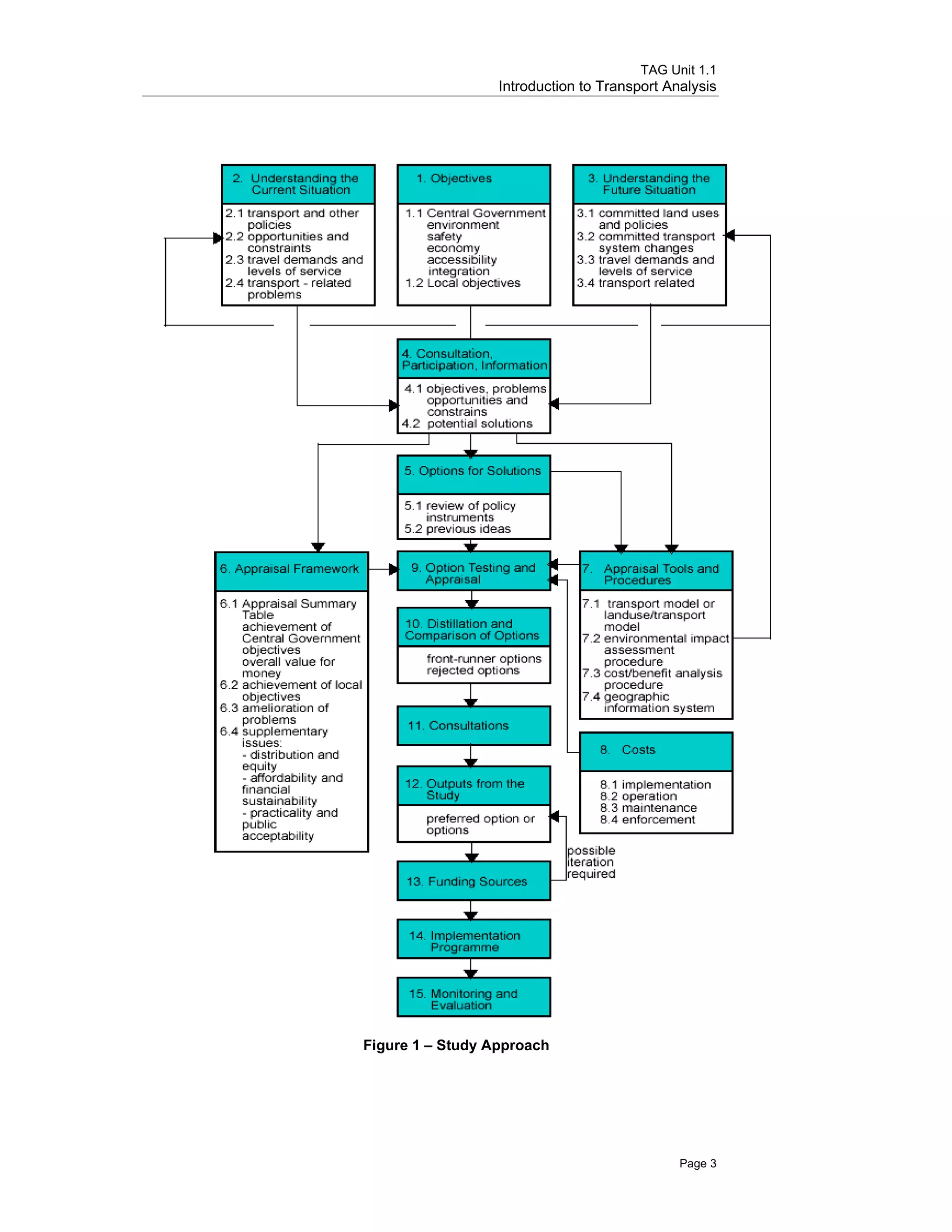
the transport study process outlined in Figure 1 below.
1.4.2 	 The level to which each of the steps in this process is implemented will be
dependent upon the type and size of the problems being addressed. It is
expected that appraisals will be comprehensive but proportionate.
Page 2
TAG Unit 1.1
Introduction to Transport Analysis
Figure 1 – Study Approach
Page 3
TAG Unit 1.1
Introduction to Transport Analysis
1.4.3 	 In all cases, however, the process of identifying solutions should be broadly
similar and:
•	 be easily comprehensible, to those commissioning, steering and
undertaking the work; and where possible to a wider public;
•	 avoid leading to a particular outcome simply by virtue of the method or
process adopted;
•	 enable a wide range of solutions and the synergy between combinations
of components to be investigated in a cost-effective manner;
•	 enable a preferred solution to be developed which addresses the
objectives and problems at which it is aimed; and
•	 provide a means by which the acceptability of the solution to the public
can be tested and taken into account.
1.4.4	 Typically, a study should include:
•	 agreement on a set of objectives which the solution should seek to
satisfy;
•	 analysis of present and future problems on, or relating to, the transport
system;
•	 exploration of potential solutions for solving the problems and meeting the
objectives;
•	 appraisal of options, seeking combinations which perform better as a
whole than the sum of the individual components; and
•	 selection and phasing of the preferred solution, taking account of the
views of the public and transport providers.
1.5 	 The Government’s Five Objectives for Transport
1.5.1 	 Throughout the NATA process the Government’s five objectives for transport as
outlined in the White paper are central:
•	 Environmental impact involves reducing the direct and indirect impacts
of transport facilities on the environment of both users and non-users.
There are 10 sub-objectives including noise, atmospheric pollution of
differing kinds, impacts on countryside, wildlife, ancient monuments and
historic buildings. See The Environment Objective (TAG Unit 3.3);
•	 Safety is concerned with reducing the loss of life, injuries and damage to
property resulting from transport incidents and crime. The 2 sub-
objectives are to reduce accidents and improve security. See The Safety
Objective (TAG Unit 3.4);
•	 Economy is concerned with improving the economic efficiency of
transport. The 5 sub-objectives are to improve economic efficiency for
consumers and for business users and providers of transport, to improve
reliability and the wider economic impacts, and to get good value for
money in relation to impacts on public accounts. See The Economy
Objective (TAG Unit 3.5);
•	 Accessibility is concerned with the ability with which people can reach
different locations and facilities by different modes. See The Accessibility
Objective (TAG Unit 3.6); and
•	 Integration aims to ensure that all decisions are taken in the context of
the Government’s integrated transport policy. See The Integration
Objective (TAG Unit 3.7)
1.5.2 These are the basis for the appraisal process in NATA.
Page 4
TAG Unit 1.1
Introduction to Transport Analysis
1.6 	 Appraisal of Options
1.6.1 	 The appraisal framework in NATA is made up of four distinct parts:
•	 Appraisal Summary Table (achievement of Government objectives)
•	 Achievement of regional and local objectives
•	 Effectiveness of problem solving
•	 Supporting analyses
1.6.2 	 These four strands when considered together provide the decision-maker with
the information needed to reach a considered judgement on the worth of a
project.
1.6.3 	 To enable a consistent judgement to be made of the relative merits of options a
single summary sheet of each of the four analyses is produced for each strategy
or plan option. Single sheet information is also provided to decision-makers on
each of the following:
•	 An annotated map describing the strategy or plan option
•	 A list of the alternatives considered and their reasons for rejection (if this
information cannot be fitted onto the previous sheet)
1.6.4 	 In addition there will also be worksheets for each sub-objective on the AST.
1.7 	 The Appraisal Summary Table
1.7.1 	 An important element of the New Approach to Appraisal is the inclusion of an
Appraisal Summary Table (AST), See Transport Appraisal and the New Green
Book (TAG Unit 2.7). This is a one page tabular summary of the main economic,
environmental and social impacts of a transport solution.
1.7.2 	 An Appraisal Summary Table is produced for each option and sets out simply
and concisely the key consequences of different options for tackling a particular
problem using the five objectives. Some of these objectives have been divided
into a number of sub-objectives as described earlier, reflecting the wide variety
of impacts arising from transport projects.
1.7.3 	 The AST and its more detailed supporting documents provide the information
needed to make a judgement about the overall value for money of the option or
options in achieving the Government’s objectives. Providing the information in
this way enables a consistent view to be taken about the value of projects.
1.7.4 	 The AST does not automatically provide a mechanistic way of estimating value
for money, but summarises the effects in each area so that decision-takers have
a clearer and more transparent basis on which to make a judgement. The
inclusion of any sub-objective in the AST, with the associated qualitative and
quantitative analyses, cannot be used to imply weightings between objectives in
forming decisions.
1.8 	 Regional and Local Objectives
1.8.1 	 As part of the study process it is anticipated that specific local objectives will be
set, these are expected to ‘nest’ within the Governments five objectives for
transport. This is discussed further in Objectives and Problems (TAG Unit 2.2).
1.8.2 	 By their nature these objectives will be specific to each study; there is no
requirement for them to be the same in all studies. It is therefore not practical to
be prescriptive about their formulation or measurement. However it is
recommended that a key set of indicators are developed against which to
measure the performance of solutions.
1.8.3 	 In many instances, it will be sensible and cost-effective to use the same
indicators for measuring performance against local and regional objectives as
are used to measure impacts in the Appraisal Summary Table. Differences may
Page 5
TAG Unit 1.1
Introduction to Transport Analysis
arise in that different or supplementary indicators may be used for some
impacts.
1.8.4 	 An assessment of the degree to which the local and regional objectives of the
project will be achieved is likely to be of particular interest to the regional and
local authorities, and the local people.
1.8.5 	 Clearly, overlap between this appraisal strand and the previous one is to be
expected.
1.9 	 Effectiveness of Problem Solving
1.9.1 	 At an early stage in the study process, the current and future transport related
problems will have been identified, analysed and displayed using text, tables
and plots as appropriate.
1.9.2 	 An assessment of the extent to which the problems identified would be solved
by the option or options proposed needs to be made considering both absolute
and relative performance against key indicators.
1.9.3 	 It is possible that the second and third of these appraisal strands may amount to
much the same thing, although this will clearly depend on the nature of the local
and regional objectives adopted and the form of the local problem analyses.
1.9.4 	 This analysis is also likely to be of particular interest to the regional and local
authorities, and the local people, and additionally the local transport providers.
1.10 	Supporting Analyses
1.10.1	 Supporting analyses cover three additional groups of issues that do not easily fit
within the Appraisal Summary Table. These are further discussed Supporting
Analysis (TAG Unit 3.8).
1.10.2	 These issues are:
•	 distribution and equity which aims to show the distribution (spatially,
across modes, etc.) of the impacts of the solution, thus enabling an
assessment to be made about the fairness of impacts on those affected;
•	 affordability and financial sustainability which aims to outline the
financial performance of the solution, identifying public and private sector
input; and
•	 practicality and public acceptability which follows a checklist that
includes such measures as feasibility, area of interest, complexity, time
scale, phasing, and political nature of solution.
1.10.3	 Supporting analyses are likely to be of interest to both Central Government and
the regional and local authorities, as well as the local people. The local transport
providers will be particularly interested in the impacts on the financial
sustainability of their operations.
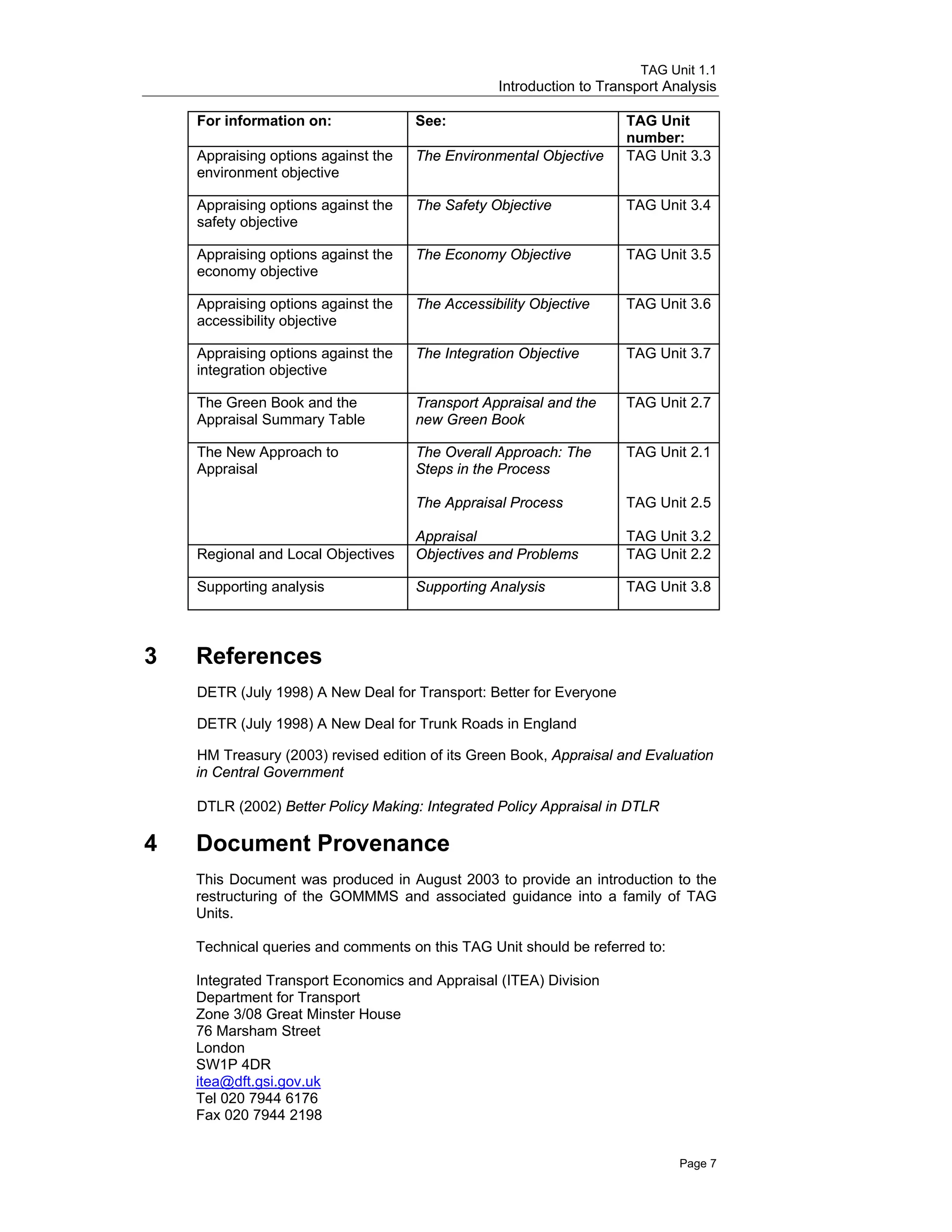
2 	Further Information
The following documents provide information that follows on directly from the
key topics covered in this Unit.
Page 6
TAG Unit 1.1
Introduction to Transport Analysis
For information on: See: TAG Unit
number:
Appraising options against the
environment objective
The Environmental Objective TAG Unit 3.3
Appraising options against the
safety objective
The Safety Objective TAG Unit 3.4
Appraising options against the
economy objective
The Economy Objective TAG Unit 3.5
Appraising options against the
accessibility objective
The Accessibility Objective TAG Unit 3.6
Appraising options against the
integration objective
The Integration Objective TAG Unit 3.7
The Green Book and the
Appraisal Summary Table
Transport Appraisal and the
new Green Book
TAG Unit 2.7
The New Approach to
Appraisal
The Overall Approach: The
Steps in the Process
The Appraisal Process
Appraisal
TAG Unit 2.1
TAG Unit 2.5
TAG Unit 3.2
Regional and Local Objectives Objectives and Problems TAG Unit 2.2
Supporting analysis Supporting Analysis TAG Unit 3.8
3 References
DETR (July 1998) A New Deal for Transport: Better for Everyone
DETR (July 1998) A New Deal for Trunk Roads in England
HM Treasury (2003) revised edition of its Green Book, Appraisal and Evaluation
in Central Government
DTLR (2002) Better Policy Making: Integrated Policy Appraisal in DTLR
4 Document Provenance
This Document was produced in August 2003 to provide an introduction to the
restructuring of the GOMMMS and associated guidance into a family of TAG
Units.
Technical queries and comments on this TAG Unit should be referred to:
Integrated Transport Economics and Appraisal (ITEA) Division

Department for Transport

Zone 3/08 Great Minster House

76 Marsham Street

London 

SW1P 4DR 

itea@dft.gsi.gov.uk
Tel 020 7944 6176 

Fax 020 7944 2198

Page 7

2005 introduction to transport analysis

  • 1.
    Introduction to TransportAnalysis TAG Unit 1.1 June 2005 Department for Transport Transport Analysis Guidance (TAG) This Unit is part of a family which can be accessed at www.webtag.org.uk
  • 2.
    Contents 1 An Overviewof Transport Analysis 1 1.1 The Green Book 1 1.2 A Background to Transport Appraisal 1 1.3 The New Approach To Appraisal 2 1.4 Appraisal and the Study Process 2 1.5 The Government’s Five Objectives for Transport 4 1.6 Appraisal of Options 5 1.7 The Appraisal Summary Table 5 1.8 Regional and Local Objectives 5 1.9 Effectiveness of Problem Solving 6 1.10 Supporting Analyses 6 2 Further Information 6 3 References 7 4 Document Provenance 7 This Unit is part of a family which can be accessed at www.webtag.org.uk
  • 3.
    TAG Unit 1.1 Introductionto Transport Analysis 1 An Overview of Transport Analysis 1.1 The Green Book 1.1.1 The Green Book, Appraisal and Evaluation in Central Government, provides guidance on appraisal and evaluation in Government - see Transport Appraisal and the New Green Book (TAG Unit 2.7). All central departments and executive agencies use this guide, the latest version of which was released on 17 January 2003. 1.1.2 Appraisal is the process of assessing the worth of a course of action – which includes projects, programmes or policies. Evaluation is a similar to appraisal, although uses historic data and takes place after the event. 1.1.3 The Green Book places appraisal in the context of policy development, discussing the whole process. This includes establishing the rationale, setting objectives and appraisal of the costs and benefits. The process also includes monitoring and evaluation, the results of which are fed back in to the process. 1.1.4 The Green Book aims to make the appraisal process throughout government more consistent and transparent, ensuring that no course of action is adopted without first having the answer to these questions: • Are there better ways to achieve the objectives? • Does it provide value for money? 1.2 A Background to Transport Appraisal 1.2.1 In the transport context appraisal is always likely to be complex, with interactions at many levels with other policy areas. The Government’s White paper A New Deal for Transport: Better for Everyone (DETR, 1998) sets in place the policy context for dealing with transport and highlights the complexity of transport problems and the interaction with other policy areas: ‘Our quality of life depends on transport. Most of us travel every day, even if only locally. And we need an efficient transport system to support a strong and prosperous economy. But in turn, the way we travel is damaging our towns and cities and harming our countryside. As demand for transport grows, we are even changing the very climate of our planet.’ 1.2.2 Transport appraisal is carried out to provide input to efficient policy development and resource allocation across government. To be effective, transport appraisal must deal consistently with competing proposals, be even-handed across modes and take account of a wide range of effects. This guidance represents the department's attempt to ensure that transport appraisals are carried out effectively. It has been written to be broadly consistent with the Green Book, but is guidance designed specifically for transport schemes. As such it is a more appropriate reference than the Green Book for anyone wishing to appraise a transport scheme in England. Should you identify any apparent contradictions between TAG and the Green Book you should contact DfT to discuss. 1.2.3 The White paper framed the move away from ‘predict and provide’ solutions to transport problems and put at the core an integrated transport policy. Appraisal of problems is key to the efficient delivery of this policy. The decisions made as part of the delivery need to be based on a full range of options and a comprehensive analysis of the impacts using a consistent approach. To this end, the White paper introduced the New Approach To Appraisal (NATA), to appraise and inform the prioritisation of transport investment proposals. The New Approach to Appraisal is outlined in The Overall Approach: The Steps in the Process (TAG Unit 2.1) and The Appraisal Process (TAG Unit 2.5). Further detail is provided in Appraisal (TAG Unit 3.2). Page 1
  • 4.
    TAG Unit 1.1 Introductionto Transport Analysis 1.3 The New Approach To Appraisal 1.3.1 NATA has evolved since its original launch in 1998, most recently to take account of the latest Green Book recommendations. It is now the basis for: • appraisal of multi-modal studies; • appraisal of Highways Agency road schemes and Local Transport Plans major road and public transport schemes; • the Strategic Rail Authority's Appraisal Criteria; • the project appraisal framework for seaports; and • the appraisal process employed during the development of the Government's airports strategy 1.3.2 NATA is broadly in line with the Department's Sustainable Development policy statement and the Department's guidance Better Policy Making: Integrated Policy Appraisal in DTLR (IPA). 1.3.3 The Department's Sustainable Development policy statement sets out the Department's approach to the achievement of the Government's overall sustainable development objectives. It has three criteria at its core: economic, social and environmental. The Policy requires decision-makers to take a balanced approach to ensure that all three are given equal consideration. It states that, in assessing transport projects, an integrated project appraisal methodology will be used, and refers the reader to the Transport Analysis Guidance website. 1.3.4 The IPA is a good practice tool of use to anyone embarking on a policy project. It allows the user to review the widest possible range of impacts - economic, environmental, social and distributional - and thus ensure a robust approach to policy development. 1.3.5 Strategic environmental assessment (SEA) of certain plans and programmes, including Local Transport Plans and Regional Transport Strategies, is required under European Directive 2001/42/EC on the assessment of the effects of certain plans and programmes on the environment. SEA is broadly consistent with NATA and should be carried out as part of the NATA process for such plans and programmes (see Strategic Environmental Assessment for Transport Plans and Programmes TAG Unit 2.11). 1.4 Appraisal and the Study Process 1.4.1 As recommended in the Green Book, transport appraisal must be carried out as part of an overall process. The form and basis of the appraisal strongly affects the way in which all other stages of the process are carried out. NATA includes the transport study process outlined in Figure 1 below. 1.4.2 The level to which each of the steps in this process is implemented will be dependent upon the type and size of the problems being addressed. It is expected that appraisals will be comprehensive but proportionate. Page 2
  • 5.
    TAG Unit 1.1 Introductionto Transport Analysis Figure 1 – Study Approach Page 3
  • 6.
    TAG Unit 1.1 Introductionto Transport Analysis 1.4.3 In all cases, however, the process of identifying solutions should be broadly similar and: • be easily comprehensible, to those commissioning, steering and undertaking the work; and where possible to a wider public; • avoid leading to a particular outcome simply by virtue of the method or process adopted; • enable a wide range of solutions and the synergy between combinations of components to be investigated in a cost-effective manner; • enable a preferred solution to be developed which addresses the objectives and problems at which it is aimed; and • provide a means by which the acceptability of the solution to the public can be tested and taken into account. 1.4.4 Typically, a study should include: • agreement on a set of objectives which the solution should seek to satisfy; • analysis of present and future problems on, or relating to, the transport system; • exploration of potential solutions for solving the problems and meeting the objectives; • appraisal of options, seeking combinations which perform better as a whole than the sum of the individual components; and • selection and phasing of the preferred solution, taking account of the views of the public and transport providers. 1.5 The Government’s Five Objectives for Transport 1.5.1 Throughout the NATA process the Government’s five objectives for transport as outlined in the White paper are central: • Environmental impact involves reducing the direct and indirect impacts of transport facilities on the environment of both users and non-users. There are 10 sub-objectives including noise, atmospheric pollution of differing kinds, impacts on countryside, wildlife, ancient monuments and historic buildings. See The Environment Objective (TAG Unit 3.3); • Safety is concerned with reducing the loss of life, injuries and damage to property resulting from transport incidents and crime. The 2 sub- objectives are to reduce accidents and improve security. See The Safety Objective (TAG Unit 3.4); • Economy is concerned with improving the economic efficiency of transport. The 5 sub-objectives are to improve economic efficiency for consumers and for business users and providers of transport, to improve reliability and the wider economic impacts, and to get good value for money in relation to impacts on public accounts. See The Economy Objective (TAG Unit 3.5); • Accessibility is concerned with the ability with which people can reach different locations and facilities by different modes. See The Accessibility Objective (TAG Unit 3.6); and • Integration aims to ensure that all decisions are taken in the context of the Government’s integrated transport policy. See The Integration Objective (TAG Unit 3.7) 1.5.2 These are the basis for the appraisal process in NATA. Page 4
  • 7.
    TAG Unit 1.1 Introductionto Transport Analysis 1.6 Appraisal of Options 1.6.1 The appraisal framework in NATA is made up of four distinct parts: • Appraisal Summary Table (achievement of Government objectives) • Achievement of regional and local objectives • Effectiveness of problem solving • Supporting analyses 1.6.2 These four strands when considered together provide the decision-maker with the information needed to reach a considered judgement on the worth of a project. 1.6.3 To enable a consistent judgement to be made of the relative merits of options a single summary sheet of each of the four analyses is produced for each strategy or plan option. Single sheet information is also provided to decision-makers on each of the following: • An annotated map describing the strategy or plan option • A list of the alternatives considered and their reasons for rejection (if this information cannot be fitted onto the previous sheet) 1.6.4 In addition there will also be worksheets for each sub-objective on the AST. 1.7 The Appraisal Summary Table 1.7.1 An important element of the New Approach to Appraisal is the inclusion of an Appraisal Summary Table (AST), See Transport Appraisal and the New Green Book (TAG Unit 2.7). This is a one page tabular summary of the main economic, environmental and social impacts of a transport solution. 1.7.2 An Appraisal Summary Table is produced for each option and sets out simply and concisely the key consequences of different options for tackling a particular problem using the five objectives. Some of these objectives have been divided into a number of sub-objectives as described earlier, reflecting the wide variety of impacts arising from transport projects. 1.7.3 The AST and its more detailed supporting documents provide the information needed to make a judgement about the overall value for money of the option or options in achieving the Government’s objectives. Providing the information in this way enables a consistent view to be taken about the value of projects. 1.7.4 The AST does not automatically provide a mechanistic way of estimating value for money, but summarises the effects in each area so that decision-takers have a clearer and more transparent basis on which to make a judgement. The inclusion of any sub-objective in the AST, with the associated qualitative and quantitative analyses, cannot be used to imply weightings between objectives in forming decisions. 1.8 Regional and Local Objectives 1.8.1 As part of the study process it is anticipated that specific local objectives will be set, these are expected to ‘nest’ within the Governments five objectives for transport. This is discussed further in Objectives and Problems (TAG Unit 2.2). 1.8.2 By their nature these objectives will be specific to each study; there is no requirement for them to be the same in all studies. It is therefore not practical to be prescriptive about their formulation or measurement. However it is recommended that a key set of indicators are developed against which to measure the performance of solutions. 1.8.3 In many instances, it will be sensible and cost-effective to use the same indicators for measuring performance against local and regional objectives as are used to measure impacts in the Appraisal Summary Table. Differences may Page 5
  • 8.
    TAG Unit 1.1 Introductionto Transport Analysis arise in that different or supplementary indicators may be used for some impacts. 1.8.4 An assessment of the degree to which the local and regional objectives of the project will be achieved is likely to be of particular interest to the regional and local authorities, and the local people. 1.8.5 Clearly, overlap between this appraisal strand and the previous one is to be expected. 1.9 Effectiveness of Problem Solving 1.9.1 At an early stage in the study process, the current and future transport related problems will have been identified, analysed and displayed using text, tables and plots as appropriate. 1.9.2 An assessment of the extent to which the problems identified would be solved by the option or options proposed needs to be made considering both absolute and relative performance against key indicators. 1.9.3 It is possible that the second and third of these appraisal strands may amount to much the same thing, although this will clearly depend on the nature of the local and regional objectives adopted and the form of the local problem analyses. 1.9.4 This analysis is also likely to be of particular interest to the regional and local authorities, and the local people, and additionally the local transport providers. 1.10 Supporting Analyses 1.10.1 Supporting analyses cover three additional groups of issues that do not easily fit within the Appraisal Summary Table. These are further discussed Supporting Analysis (TAG Unit 3.8). 1.10.2 These issues are: • distribution and equity which aims to show the distribution (spatially, across modes, etc.) of the impacts of the solution, thus enabling an assessment to be made about the fairness of impacts on those affected; • affordability and financial sustainability which aims to outline the financial performance of the solution, identifying public and private sector input; and • practicality and public acceptability which follows a checklist that includes such measures as feasibility, area of interest, complexity, time scale, phasing, and political nature of solution. 1.10.3 Supporting analyses are likely to be of interest to both Central Government and the regional and local authorities, as well as the local people. The local transport providers will be particularly interested in the impacts on the financial sustainability of their operations. 2 Further Information The following documents provide information that follows on directly from the key topics covered in this Unit. Page 6
  • 9.
    TAG Unit 1.1 Introductionto Transport Analysis For information on: See: TAG Unit number: Appraising options against the environment objective The Environmental Objective TAG Unit 3.3 Appraising options against the safety objective The Safety Objective TAG Unit 3.4 Appraising options against the economy objective The Economy Objective TAG Unit 3.5 Appraising options against the accessibility objective The Accessibility Objective TAG Unit 3.6 Appraising options against the integration objective The Integration Objective TAG Unit 3.7 The Green Book and the Appraisal Summary Table Transport Appraisal and the new Green Book TAG Unit 2.7 The New Approach to Appraisal The Overall Approach: The Steps in the Process The Appraisal Process Appraisal TAG Unit 2.1 TAG Unit 2.5 TAG Unit 3.2 Regional and Local Objectives Objectives and Problems TAG Unit 2.2 Supporting analysis Supporting Analysis TAG Unit 3.8 3 References DETR (July 1998) A New Deal for Transport: Better for Everyone DETR (July 1998) A New Deal for Trunk Roads in England HM Treasury (2003) revised edition of its Green Book, Appraisal and Evaluation in Central Government DTLR (2002) Better Policy Making: Integrated Policy Appraisal in DTLR 4 Document Provenance This Document was produced in August 2003 to provide an introduction to the restructuring of the GOMMMS and associated guidance into a family of TAG Units. Technical queries and comments on this TAG Unit should be referred to: Integrated Transport Economics and Appraisal (ITEA) Division Department for Transport Zone 3/08 Great Minster House 76 Marsham Street London SW1P 4DR itea@dft.gsi.gov.uk Tel 020 7944 6176 Fax 020 7944 2198 Page 7