Description -
20 Best React interview questions to learn today to crack any interview. Just visit to
check 20 best React interview questions and answer.
20 React Interview Questions:
20 React interview questions that are most common in getting
through a ReactJS interview can change the way developers work
because React is still the most popular front-end framework. To assist
you with planning, we've prepared 20 react interview questions and
answers that the interviewer asked in the interviews.
1. What is ReactJS?
An open-source JavaScript library called ReactJS, it creates user
interfaces, particularly for applications with only one page. Created by
Facebook, Respond permits designers to make reusable UI parts and
deal with the state effectively.
2. What exactly are React's components?
Parts are the structure blocks of a Respond application. They are
JavaScript functions or classes that return React elements that describe
what should appear on the screen and optionally accept inputs (called
"props").
3. What is JSX?
JavaScript XML is abbreviated as JSX. A sentence structure expansion
for JavaScript seems to be like XML or HTML. Without the need for
functions like createElement or appendChild, JSX makes it possible to
write HTML elements in JavaScript and insert them into the DOM.
4. How do props work?
Props (short for properties) are perused just traits used to pass
information from a parent part to a kid part. Props permit parts to be
dynamic and reusable.
5. What is State?
State is an underlying item in Respond parts used to store information or
data about the part. State is mutable and can be changed within the
component using setState, in contrast to props.
6. The Virtual DOM:
what is it? A smaller version of the actual DOM is the Virtual DOM.
React uses reconciliation to keep a virtual DOM in sync with the actual
DOM in memory. This approach further develops execution by limiting
direct controls of the genuine DOM.
7. What are Respond Lifecycle Techniques?
Respond lifecycle techniques are extraordinary strategies that are
summoned at various phases of a part's life. They are ordered into:
Mounting: constructor(), static getDerivedStateFromProps(), render(),
componentDidMount() static getDerivedStateFromProps(), render(),
shouldComponentUpdate(), getSnapshotBeforeUpdate(), and
componentDidUpdate() are updates. ComponentWillUnmount() is used
to unmount.
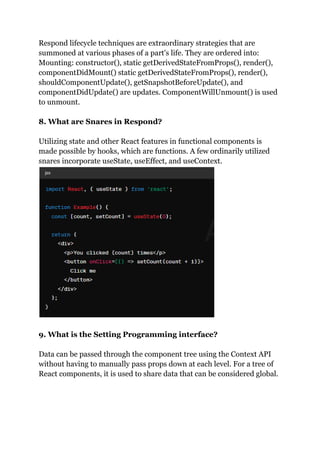
8. What are Snares in Respond?
Utilizing state and other React features in functional components is
made possible by hooks, which are functions. A few ordinarily utilized
snares incorporate useState, useEffect, and useContext.
9. What is the Setting Programming interface?
Data can be passed through the component tree using the Context API
without having to manually pass props down at each level. For a tree of
React components, it is used to share data that can be considered global.
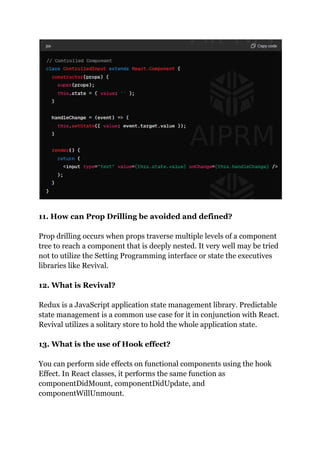
10. What are Controlled and Uncontrolled Parts?
Props are used by the parent component to control controlled
components, so they do not keep their own state. Refs are used by
uncontrolled components to access the DOM's elements and maintain
their own internal state.
11. How can Prop Drilling be avoided and defined?
Prop drilling occurs when props traverse multiple levels of a component
tree to reach a component that is deeply nested. It very well may be tried
not to utilize the Setting Programming interface or state the executives
libraries like Revival.
12. What is Revival?
Redux is a JavaScript application state management library. Predictable
state management is a common use case for it in conjunction with React.
Revival utilizes a solitary store to hold the whole application state.
13. What is the use of Hook effect?
You can perform side effects on functional components using the hook
Effect. In React classes, it performs the same function as
componentDidMount, componentDidUpdate, and
componentWillUnmount.
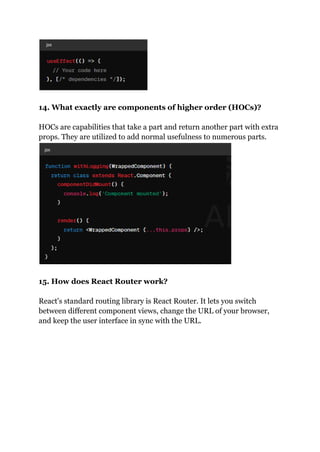
14. What exactly are components of higher order (HOCs)?
HOCs are capabilities that take a part and return another part with extra
props. They are utilized to add normal usefulness to numerous parts.
15. How does React Router work?
React's standard routing library is React Router. It lets you switch
between different component views, change the URL of your browser,
and keep the user interface in sync with the URL.
16. What is Respond Fiber?
Respond Fiber is a finished revise of Respond's center calculation for
delivering. It means to work on apparent execution and responsiveness
of Respond applications by breaking delivering work into lumps and
spreading it out over numerous edges.
17. How to Improve the Performance of a React Application?
The following are some methods for improving the performance of React
applications: Utilizing React.memo to memoize utilitarian parts.
React.PureComponent or shouldComponentUpdate can be used to
prevent unnecessary re-renders. using code splitting with dynamic
imports. utilizing the useMemo and useCallback hooks.
18. What is Compromise in Respond?
Compromise is the cycle by which Respond refreshes the DOM. Respond
contrasts the new components and the past ones and makes the
negligible number of changes expected to refresh the DOM.
19. Describe how to use the Ref Hook?
Values can be saved between renders using the Ref hook. It tends to be
utilized to get to a DOM component straightforwardly or to store a
changeable worth that doesn't cause re-renders when refreshed.
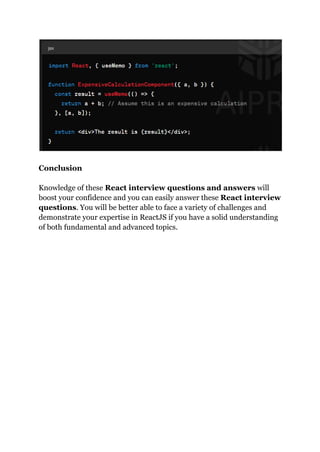
20. What exactly is a useMemo Hook?
A memoized value is returned by the useMemo hook. By avoiding costly
calculations on every render, it is used to improve performance. When
one of the dependencies changes, the value is only recalculated.
Conclusion
Knowledge of these React interview questions and answers will
boost your confidence and you can easily answer these React interview
questions. You will be better able to face a variety of challenges and
demonstrate your expertise in ReactJS if you have a solid understanding
of both fundamental and advanced topics.

20 React Interview Questions. Pdf Download

  • 1.
    Description - 20 BestReact interview questions to learn today to crack any interview. Just visit to check 20 best React interview questions and answer. 20 React Interview Questions: 20 React interview questions that are most common in getting through a ReactJS interview can change the way developers work because React is still the most popular front-end framework. To assist you with planning, we've prepared 20 react interview questions and answers that the interviewer asked in the interviews. 1. What is ReactJS? An open-source JavaScript library called ReactJS, it creates user interfaces, particularly for applications with only one page. Created by Facebook, Respond permits designers to make reusable UI parts and deal with the state effectively. 2. What exactly are React's components? Parts are the structure blocks of a Respond application. They are JavaScript functions or classes that return React elements that describe what should appear on the screen and optionally accept inputs (called "props"). 3. What is JSX? JavaScript XML is abbreviated as JSX. A sentence structure expansion for JavaScript seems to be like XML or HTML. Without the need for functions like createElement or appendChild, JSX makes it possible to write HTML elements in JavaScript and insert them into the DOM. 4. How do props work?
  • 2.
    Props (short forproperties) are perused just traits used to pass information from a parent part to a kid part. Props permit parts to be dynamic and reusable. 5. What is State? State is an underlying item in Respond parts used to store information or data about the part. State is mutable and can be changed within the component using setState, in contrast to props. 6. The Virtual DOM: what is it? A smaller version of the actual DOM is the Virtual DOM. React uses reconciliation to keep a virtual DOM in sync with the actual DOM in memory. This approach further develops execution by limiting direct controls of the genuine DOM. 7. What are Respond Lifecycle Techniques?
  • 3.
    Respond lifecycle techniquesare extraordinary strategies that are summoned at various phases of a part's life. They are ordered into: Mounting: constructor(), static getDerivedStateFromProps(), render(), componentDidMount() static getDerivedStateFromProps(), render(), shouldComponentUpdate(), getSnapshotBeforeUpdate(), and componentDidUpdate() are updates. ComponentWillUnmount() is used to unmount. 8. What are Snares in Respond? Utilizing state and other React features in functional components is made possible by hooks, which are functions. A few ordinarily utilized snares incorporate useState, useEffect, and useContext. 9. What is the Setting Programming interface? Data can be passed through the component tree using the Context API without having to manually pass props down at each level. For a tree of React components, it is used to share data that can be considered global.
  • 4.
    10. What areControlled and Uncontrolled Parts? Props are used by the parent component to control controlled components, so they do not keep their own state. Refs are used by uncontrolled components to access the DOM's elements and maintain their own internal state.
  • 5.
    11. How canProp Drilling be avoided and defined? Prop drilling occurs when props traverse multiple levels of a component tree to reach a component that is deeply nested. It very well may be tried not to utilize the Setting Programming interface or state the executives libraries like Revival. 12. What is Revival? Redux is a JavaScript application state management library. Predictable state management is a common use case for it in conjunction with React. Revival utilizes a solitary store to hold the whole application state. 13. What is the use of Hook effect? You can perform side effects on functional components using the hook Effect. In React classes, it performs the same function as componentDidMount, componentDidUpdate, and componentWillUnmount.
  • 6.
    14. What exactlyare components of higher order (HOCs)? HOCs are capabilities that take a part and return another part with extra props. They are utilized to add normal usefulness to numerous parts. 15. How does React Router work? React's standard routing library is React Router. It lets you switch between different component views, change the URL of your browser, and keep the user interface in sync with the URL.
  • 7.
    16. What isRespond Fiber? Respond Fiber is a finished revise of Respond's center calculation for delivering. It means to work on apparent execution and responsiveness of Respond applications by breaking delivering work into lumps and spreading it out over numerous edges. 17. How to Improve the Performance of a React Application? The following are some methods for improving the performance of React applications: Utilizing React.memo to memoize utilitarian parts. React.PureComponent or shouldComponentUpdate can be used to prevent unnecessary re-renders. using code splitting with dynamic imports. utilizing the useMemo and useCallback hooks.
  • 8.
    18. What isCompromise in Respond? Compromise is the cycle by which Respond refreshes the DOM. Respond contrasts the new components and the past ones and makes the negligible number of changes expected to refresh the DOM. 19. Describe how to use the Ref Hook? Values can be saved between renders using the Ref hook. It tends to be utilized to get to a DOM component straightforwardly or to store a changeable worth that doesn't cause re-renders when refreshed. 20. What exactly is a useMemo Hook? A memoized value is returned by the useMemo hook. By avoiding costly calculations on every render, it is used to improve performance. When one of the dependencies changes, the value is only recalculated.
  • 9.
    Conclusion Knowledge of theseReact interview questions and answers will boost your confidence and you can easily answer these React interview questions. You will be better able to face a variety of challenges and demonstrate your expertise in ReactJS if you have a solid understanding of both fundamental and advanced topics.