Research
Ethan Colman
Audience Research
Target Audience Profile
• Age: 12-18 (maybe 12-25)
• Gender: None
Market
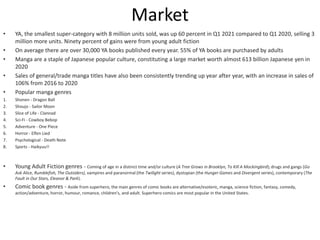
• YA, the smallest super-category with 8 million units sold, was up 60 percent in Q1 2021 compared to Q1 2020, selling 3
million more units. Ninety percent of gains were from young adult fiction
• On average there are over 30,000 YA books published every year. 55% of YA books are purchased by adults
• Manga are a staple of Japanese popular culture, constituting a large market worth almost 613 billion Japanese yen in
2020
• Sales of general/trade manga titles have also been consistently trending up year after year, with an increase in sales of
106% from 2016 to 2020
• Popular manga genres
1. Shonen - Dragon Ball
2. Shoujo - Sailor Moon
3. Slice of Life - Clannad
4. Sci-Fi - Cowboy Bebop
5. Adventure - One Piece
6. Horror - Elfen Lied
7. Psychological - Death Note
8. Sports - Haikyuu!!
• Young Adult Fiction genres - Coming of age in a distinct time and/or culture (A Tree Grows in Brooklyn, To Kill A Mockingbird); drugs and gangs (Go
Ask Alice, Rumblefish, The Outsiders), vampires and paranormal (the Twilight series), dystopian (the Hunger Games and Divergent series), contemporary (The
Fault in Our Stars, Eleanor & Park).
• Comic book genres - Aside from superhero, the main genres of comic books are alternative/esoteric, manga, science fiction, fantasy, comedy,
action/adventure, horror, humour, romance, children's, and adult. Superhero comics are most popular in the United States.
Production
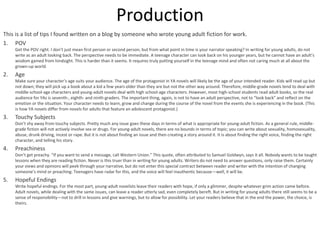
This is a list of tips I found written on a blog by someone who wrote young adult fiction for work.
1. POV
Get the POV right. I don’t just mean first person or second person, but from what point in time is your narrator speaking? In writing for young adults, do not
write as an adult looking back. The perspective needs to be immediate. A teenage character can look back on his younger years, but he cannot have an adult’s
wisdom gained from hindsight. This is harder than it seems. It requires truly putting yourself in the teenage mind and often not caring much at all about the
grown-up world.
2. Age
Make sure your character’s age suits your audience. The age of the protagonist in YA novels will likely be the age of your intended reader. Kids will read up but
not down; they will pick up a book about a kid a few years older than they are but not the other way around. Therefore, middle-grade novels tend to deal with
middle-school-age characters and young-adult novels deal with high school-age characters. However, most high-school students read adult books, so the real
audience for YAs is seventh-, eighth- and ninth-graders. The important thing, again, is not to have an adult perspective, not to “look back” and reflect on the
emotion or the situation. Your character needs to learn, grow and change during the course of the novel from the events she is experiencing in the book. (This
is how YA novels differ from novels for adults that feature an adolescent protagonist.)
3. Touchy Subjects
Don’t shy away from touchy subjects. Pretty much any issue goes these days in terms of what is appropriate for young-adult fiction. As a general rule, middle-
grade fiction will not actively involve sex or drugs. For young-adult novels, there are no bounds in terms of topic; you can write about sexuality, homosexuality,
abuse, drunk driving, incest or rape. But it is not about finding an issue and then creating a story around it. It is about finding the right voice, finding the right
character, and telling his story.
4. Preachiness
Don’t get preachy. “If you want to send a message, call Western Union.” This quote, often attributed to Samuel Goldwyn, says it all. Nobody wants to be taught
lessons when they are reading fiction. Never is this truer than in writing for young adults. Writers do not need to answer questions, only raise them. Certainly
your views and opinions will peek through your narrative, but do not enter this special contract between reader and writer with the intention of changing
someone’s mind or preaching. Teenagers have radar for this, and the voice will feel inauthentic because—well, it will be.
5. Hopeful Endings
Write hopeful endings. For the most part, young-adult novelists leave their readers with hope, if only a glimmer, despite whatever grim action came before.
Adult novels, while dealing with the same issues, can leave a reader utterly sad, even completely bereft. But in writing for young adults there still seems to be a
sense of responsibility—not to drill in lessons and give warnings, but to allow for possibility. Let your readers believe that in the end the power, the choice, is
theirs.
Production
There are two main methods of creating comics digitally: drawing sketches by hand and then scanning for lineart and
colouring or doing every step digitally. Some artists will also do lineart by hand and then scan right before colouring, but
many prefer the crisp, clean lineart that digital methods allow
Topic
• Coming of age in a distinct time and/or culture (A Tree Grows in Brooklyn, To Kill A
Mockingbird); drugs and gangs (Go Ask Alice, Rumblefish, The Outsiders), vampires and
paranormal (the Twilight series), dystopian (the Hunger Games and Divergent series),
contemporary (The Fault in Our Stars, Eleanor & Park).
• Fiction/Drama/Sports/Teen/Family and Relationships
Audience Research
Audience Research
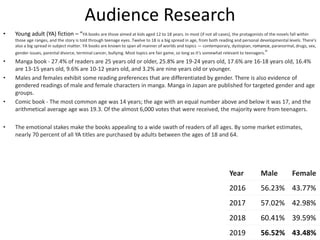
• Young adult (YA) fiction – “YA books are those aimed at kids aged 12 to 18 years. In most (if not all cases), the protagonists of the novels fall within
those age ranges, and the story is told through teenage eyes. Twelve to 18 is a big spread in age, from both reading and personal developmental levels. There's
also a big spread in subject matter. YA books are known to span all manner of worlds and topics — contemporary, dystopian, romance, paranormal, drugs, sex,
gender issues, parental divorce, terminal cancer, bullying. Most topics are fair game, so long as it's somewhat relevant to teenagers.”
• Manga book - 27.4% of readers are 25 years old or older, 25.8% are 19-24 years old, 17.6% are 16-18 years old, 16.4%
are 13-15 years old, 9.6% are 10-12 years old, and 3.2% are nine years old or younger.
• Males and females exhibit some reading preferences that are differentiated by gender. There is also evidence of
gendered readings of male and female characters in manga. Manga in Japan are published for targeted gender and age
groups.
• Comic book - The most common age was 14 years; the age with an equal number above and below it was 17, and the
arithmetical average age was 19.3. Of the almost 6,000 votes that were received, the majority were from teenagers.
• The emotional stakes make the books appealing to a wide swath of readers of all ages. By some market estimates,
nearly 70 percent of all YA titles are purchased by adults between the ages of 18 and 64.
Year Male Female
2016 56.23% 43.77%
2017 57.02% 42.98%
2018 60.41% 39.59%
2019 56.52% 43.48%
Market Research
Existing Products
Existing Product
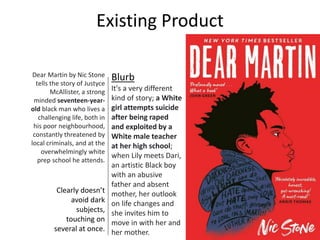
It's a very different
kind of story; a White
girl attempts suicide
after being raped
and exploited by a
White male teacher
at her high school;
when Lily meets Dari,
an artistic Black boy
with an abusive
father and absent
mother, her outlook
on life changes and
she invites him to
move in with her and
her mother.
Blurb
Clearly doesn’t
avoid dark
subjects,
touching on
several at once.
Dear Martin by Nic Stone
tells the story of Justyce
McAllister, a strong
minded seventeen-year-
old black man who lives a
challenging life, both in
his poor neighbourhood,
constantly threatened by
local criminals, and at the
overwhelmingly white
prep school he attends.
Existing Product
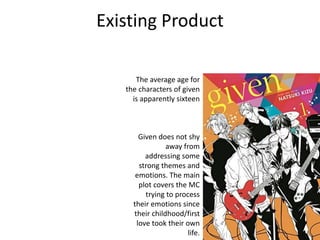
Given does not shy
away from
addressing some
strong themes and
emotions. The main
plot covers the MC
trying to process
their emotions since
their childhood/first
love took their own
life.
The average age for
the characters of given
is apparently sixteen
Existing Product
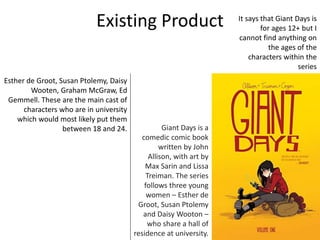
Giant Days is a
comedic comic book
written by John
Allison, with art by
Max Sarin and Lissa
Treiman. The series
follows three young
women – Esther de
Groot, Susan Ptolemy
and Daisy Wooton –
who share a hall of
residence at university.
It says that Giant Days is
for ages 12+ but I
cannot find anything on
the ages of the
characters within the
series
Esther de Groot, Susan Ptolemy, Daisy
Wooten, Graham McGraw, Ed
Gemmell. These are the main cast of
characters who are in university
which would most likely put them
between 18 and 24.
Existing Product
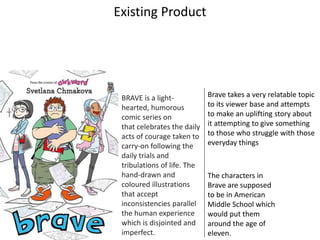
BRAVE is a light-
hearted, humorous
comic series on
that celebrates the daily
acts of courage taken to
carry-on following the
daily trials and
tribulations of life. The
hand-drawn and
coloured illustrations
that accept
inconsistencies parallel
the human experience
which is disjointed and
imperfect.
The characters in
Brave are supposed
to be in American
Middle School which
would put them
around the age of
eleven.
Brave takes a very relatable topic
to its viewer base and attempts
to make an uplifting story about
it attempting to give something
to those who struggle with those
everyday things
Research Analysis
• What common features do the researched products have?
• The characters are all similar ages, they all touch on some serious topics and highly
emotional subjects.
• They all feature cartoon esc artwork whether on the covers or throughout the whole work.
• What aspects of the research will you include within your own work?
• Character age shall be within 12-18
• Tough topics will be touched on
• The narrative will be emotive and lead by a clear thread of feelings
Questionnaire Analysis
Audience research
• Observation: Intended for informative years of youth where they are often learning
about these tough topics through these forms of media.
• What this says about my audience: They are looking for the tough topics to be
addressed in full and not be brushed off or treated as though it is a side topic.
• How will your product appeal to this audience: The main cast deals with a lot of serious
topics from abuse, sexual harassment to burnout syndrome and the fear of finding your
own way.
Audience research
• Observation:
• What this says about my audience:
• How will your product appeal to this audience:
Audience research
• Observation:
• What this says about my audience:
• How will your product appeal to this audience:
Audience research
• Observation:
• What this says about my audience:
• How will your product appeal to this audience:
Audience research
• Observation:
• What this says about my audience:
• How will your product appeal to this audience:
Interviews
Interview 1
Interview 1
• Observation:
• What this says about my audience:
• How will your product appeal to this
audience:
Interview 2
Interview 2
• Observation:
• What this says about my audience:
• How will your product appeal to this
audience:
Bibliography
Bibliography
1. Your, Name. (2018) Target Audience Research Survey (conducted on
DATE)
2. Interviewees, Name. (2018) Target Audience Interviews (conducted on
DATE)
3. Young Adult Book Market Facts and Figures (thebalancecareers.com)
Art work
• For the art work of my piece I will need to do some research on aspects such as software,
technique etc.
• https://www.youtube.com/watch?v=g4MLq2hRsFw this was a good short tutorial on a piece
of software focusing on how to use it rather than techniques.
• https://www.youtube.com/watch?v=F2hm544loqc this tutorial was far more in depth, it
talked a lot about software and technique and covered almost everything it touched on
incredibly well
• https://www.youtube.com/watch?v=MOCU2LAFpv4 covers trying to mimic different styles
and the techniques used to achieve them which seems very helpful for thinking about what
style I might want to use and how I might achieve that
• https://www.youtube.com/watch?v=0q0E11tRzvc a really helpful coverage of a specific
piece of software and the assets it presents and how they can be used to make work
easier/better
• https://www.youtube.com/watch?v=s4VvCBtDWBw

2. Research.pptx

  • 1.
  • 2.
  • 3.
    Target Audience Profile •Age: 12-18 (maybe 12-25) • Gender: None
  • 4.
    Market • YA, thesmallest super-category with 8 million units sold, was up 60 percent in Q1 2021 compared to Q1 2020, selling 3 million more units. Ninety percent of gains were from young adult fiction • On average there are over 30,000 YA books published every year. 55% of YA books are purchased by adults • Manga are a staple of Japanese popular culture, constituting a large market worth almost 613 billion Japanese yen in 2020 • Sales of general/trade manga titles have also been consistently trending up year after year, with an increase in sales of 106% from 2016 to 2020 • Popular manga genres 1. Shonen - Dragon Ball 2. Shoujo - Sailor Moon 3. Slice of Life - Clannad 4. Sci-Fi - Cowboy Bebop 5. Adventure - One Piece 6. Horror - Elfen Lied 7. Psychological - Death Note 8. Sports - Haikyuu!! • Young Adult Fiction genres - Coming of age in a distinct time and/or culture (A Tree Grows in Brooklyn, To Kill A Mockingbird); drugs and gangs (Go Ask Alice, Rumblefish, The Outsiders), vampires and paranormal (the Twilight series), dystopian (the Hunger Games and Divergent series), contemporary (The Fault in Our Stars, Eleanor & Park). • Comic book genres - Aside from superhero, the main genres of comic books are alternative/esoteric, manga, science fiction, fantasy, comedy, action/adventure, horror, humour, romance, children's, and adult. Superhero comics are most popular in the United States.
  • 5.
    Production This is alist of tips I found written on a blog by someone who wrote young adult fiction for work. 1. POV Get the POV right. I don’t just mean first person or second person, but from what point in time is your narrator speaking? In writing for young adults, do not write as an adult looking back. The perspective needs to be immediate. A teenage character can look back on his younger years, but he cannot have an adult’s wisdom gained from hindsight. This is harder than it seems. It requires truly putting yourself in the teenage mind and often not caring much at all about the grown-up world. 2. Age Make sure your character’s age suits your audience. The age of the protagonist in YA novels will likely be the age of your intended reader. Kids will read up but not down; they will pick up a book about a kid a few years older than they are but not the other way around. Therefore, middle-grade novels tend to deal with middle-school-age characters and young-adult novels deal with high school-age characters. However, most high-school students read adult books, so the real audience for YAs is seventh-, eighth- and ninth-graders. The important thing, again, is not to have an adult perspective, not to “look back” and reflect on the emotion or the situation. Your character needs to learn, grow and change during the course of the novel from the events she is experiencing in the book. (This is how YA novels differ from novels for adults that feature an adolescent protagonist.) 3. Touchy Subjects Don’t shy away from touchy subjects. Pretty much any issue goes these days in terms of what is appropriate for young-adult fiction. As a general rule, middle- grade fiction will not actively involve sex or drugs. For young-adult novels, there are no bounds in terms of topic; you can write about sexuality, homosexuality, abuse, drunk driving, incest or rape. But it is not about finding an issue and then creating a story around it. It is about finding the right voice, finding the right character, and telling his story. 4. Preachiness Don’t get preachy. “If you want to send a message, call Western Union.” This quote, often attributed to Samuel Goldwyn, says it all. Nobody wants to be taught lessons when they are reading fiction. Never is this truer than in writing for young adults. Writers do not need to answer questions, only raise them. Certainly your views and opinions will peek through your narrative, but do not enter this special contract between reader and writer with the intention of changing someone’s mind or preaching. Teenagers have radar for this, and the voice will feel inauthentic because—well, it will be. 5. Hopeful Endings Write hopeful endings. For the most part, young-adult novelists leave their readers with hope, if only a glimmer, despite whatever grim action came before. Adult novels, while dealing with the same issues, can leave a reader utterly sad, even completely bereft. But in writing for young adults there still seems to be a sense of responsibility—not to drill in lessons and give warnings, but to allow for possibility. Let your readers believe that in the end the power, the choice, is theirs.
  • 6.
    Production There are twomain methods of creating comics digitally: drawing sketches by hand and then scanning for lineart and colouring or doing every step digitally. Some artists will also do lineart by hand and then scan right before colouring, but many prefer the crisp, clean lineart that digital methods allow
  • 7.
    Topic • Coming ofage in a distinct time and/or culture (A Tree Grows in Brooklyn, To Kill A Mockingbird); drugs and gangs (Go Ask Alice, Rumblefish, The Outsiders), vampires and paranormal (the Twilight series), dystopian (the Hunger Games and Divergent series), contemporary (The Fault in Our Stars, Eleanor & Park). • Fiction/Drama/Sports/Teen/Family and Relationships
  • 8.
  • 9.
    Audience Research • Youngadult (YA) fiction – “YA books are those aimed at kids aged 12 to 18 years. In most (if not all cases), the protagonists of the novels fall within those age ranges, and the story is told through teenage eyes. Twelve to 18 is a big spread in age, from both reading and personal developmental levels. There's also a big spread in subject matter. YA books are known to span all manner of worlds and topics — contemporary, dystopian, romance, paranormal, drugs, sex, gender issues, parental divorce, terminal cancer, bullying. Most topics are fair game, so long as it's somewhat relevant to teenagers.” • Manga book - 27.4% of readers are 25 years old or older, 25.8% are 19-24 years old, 17.6% are 16-18 years old, 16.4% are 13-15 years old, 9.6% are 10-12 years old, and 3.2% are nine years old or younger. • Males and females exhibit some reading preferences that are differentiated by gender. There is also evidence of gendered readings of male and female characters in manga. Manga in Japan are published for targeted gender and age groups. • Comic book - The most common age was 14 years; the age with an equal number above and below it was 17, and the arithmetical average age was 19.3. Of the almost 6,000 votes that were received, the majority were from teenagers. • The emotional stakes make the books appealing to a wide swath of readers of all ages. By some market estimates, nearly 70 percent of all YA titles are purchased by adults between the ages of 18 and 64. Year Male Female 2016 56.23% 43.77% 2017 57.02% 42.98% 2018 60.41% 39.59% 2019 56.52% 43.48%
  • 10.
  • 11.
    Existing Product It's avery different kind of story; a White girl attempts suicide after being raped and exploited by a White male teacher at her high school; when Lily meets Dari, an artistic Black boy with an abusive father and absent mother, her outlook on life changes and she invites him to move in with her and her mother. Blurb Clearly doesn’t avoid dark subjects, touching on several at once. Dear Martin by Nic Stone tells the story of Justyce McAllister, a strong minded seventeen-year- old black man who lives a challenging life, both in his poor neighbourhood, constantly threatened by local criminals, and at the overwhelmingly white prep school he attends.
  • 12.
    Existing Product Given doesnot shy away from addressing some strong themes and emotions. The main plot covers the MC trying to process their emotions since their childhood/first love took their own life. The average age for the characters of given is apparently sixteen
  • 13.
    Existing Product Giant Daysis a comedic comic book written by John Allison, with art by Max Sarin and Lissa Treiman. The series follows three young women – Esther de Groot, Susan Ptolemy and Daisy Wooton – who share a hall of residence at university. It says that Giant Days is for ages 12+ but I cannot find anything on the ages of the characters within the series Esther de Groot, Susan Ptolemy, Daisy Wooten, Graham McGraw, Ed Gemmell. These are the main cast of characters who are in university which would most likely put them between 18 and 24.
  • 14.
    Existing Product BRAVE isa light- hearted, humorous comic series on that celebrates the daily acts of courage taken to carry-on following the daily trials and tribulations of life. The hand-drawn and coloured illustrations that accept inconsistencies parallel the human experience which is disjointed and imperfect. The characters in Brave are supposed to be in American Middle School which would put them around the age of eleven. Brave takes a very relatable topic to its viewer base and attempts to make an uplifting story about it attempting to give something to those who struggle with those everyday things
  • 15.
    Research Analysis • Whatcommon features do the researched products have? • The characters are all similar ages, they all touch on some serious topics and highly emotional subjects. • They all feature cartoon esc artwork whether on the covers or throughout the whole work. • What aspects of the research will you include within your own work? • Character age shall be within 12-18 • Tough topics will be touched on • The narrative will be emotive and lead by a clear thread of feelings
  • 16.
  • 17.
    Audience research • Observation:Intended for informative years of youth where they are often learning about these tough topics through these forms of media. • What this says about my audience: They are looking for the tough topics to be addressed in full and not be brushed off or treated as though it is a side topic. • How will your product appeal to this audience: The main cast deals with a lot of serious topics from abuse, sexual harassment to burnout syndrome and the fear of finding your own way.
  • 18.
    Audience research • Observation: •What this says about my audience: • How will your product appeal to this audience:
  • 19.
    Audience research • Observation: •What this says about my audience: • How will your product appeal to this audience:
  • 20.
    Audience research • Observation: •What this says about my audience: • How will your product appeal to this audience:
  • 21.
    Audience research • Observation: •What this says about my audience: • How will your product appeal to this audience:
  • 22.
  • 23.
  • 24.
    Interview 1 • Observation: •What this says about my audience: • How will your product appeal to this audience:
  • 25.
  • 26.
    Interview 2 • Observation: •What this says about my audience: • How will your product appeal to this audience:
  • 27.
  • 28.
    Bibliography 1. Your, Name.(2018) Target Audience Research Survey (conducted on DATE) 2. Interviewees, Name. (2018) Target Audience Interviews (conducted on DATE) 3. Young Adult Book Market Facts and Figures (thebalancecareers.com)
  • 29.
    Art work • Forthe art work of my piece I will need to do some research on aspects such as software, technique etc. • https://www.youtube.com/watch?v=g4MLq2hRsFw this was a good short tutorial on a piece of software focusing on how to use it rather than techniques. • https://www.youtube.com/watch?v=F2hm544loqc this tutorial was far more in depth, it talked a lot about software and technique and covered almost everything it touched on incredibly well • https://www.youtube.com/watch?v=MOCU2LAFpv4 covers trying to mimic different styles and the techniques used to achieve them which seems very helpful for thinking about what style I might want to use and how I might achieve that • https://www.youtube.com/watch?v=0q0E11tRzvc a really helpful coverage of a specific piece of software and the assets it presents and how they can be used to make work easier/better • https://www.youtube.com/watch?v=s4VvCBtDWBw

Editor's Notes

  • #4 Who is the project for, define age range, demographic info, and psychographic info
  • #9 Collect examples of audience specific information, e.g. viewing figures, online data, etc to support you audience identification
  • #10 Collect examples of audience specific information, e.g. viewing figures, online data, etc to support you audience identification
  • #12 Choose a recent product similar to your own and annotate it Type of image- studio/location, angle, effects, post-production Use of lighting/composition/mise en scene/costume/props/location/colours/fonts etc. Audience appeal- how does it make its audience want to buy/watch/play it?
  • #13 Choose a recent product similar to your own and annotate it Type of image- studio/location, angle, effects, post-production Use of lighting/composition/mise en scene/costume/props/location/colours/fonts etc. Audience appeal- how does it make its audience want to buy/watch/play it?
  • #14 Choose a recent product similar to your own and annotate it Type of image- studio/location, angle, effects, post-production Use of lighting/composition/mise en scene/costume/props/location/colours/fonts etc. Audience appeal- how does it make its audience want to buy/watch/play it?
  • #15 Choose a recent product similar to your own and annotate it Type of image- studio/location, angle, effects, post-production Use of lighting/composition/mise en scene/costume/props/location/colours/fonts etc. Audience appeal- how does it make its audience want to buy/watch/play it?
  • #29 List all products researched in previous sections. Include anything additional you have watched/read in preparation for production. Alphabetise your list.