Ministry of Economy and Finances
Santa Cruz, 12 September 2013
KINGDOM OF MOROCCO
GOVERNMENTAL PLAN FOR GENDER EQUALITY (2012-
2016)
1
BACKGROUND
►The directives of His Majesty King Mohammed VI in the areas
of promotion of women reflect the political will to make
gender equality, both purpose and an a central element to
promote economic and social growth;
►The adoption of the new constitution guarantees that women
enjoy all rights and freedoms in the civil, political, economic,
social and environmental fields in equal conditions of men;
►Morocco's commitment towards the implementation of the
content of international agreements, such as the achievement
of the Millennium Development Goals (MDGs) by 2015, as well
as those arising from the ratification of the Convention on the
Elimination of All forms of Discrimination Against Women
(CEDAW);
►The Moroccan legal arsenal (Family Code, the Labour Code,
the Nationality Code, ....).
2
► The equality of rights, responsibilities, resources and
opportunities;
► The recognition of the value of contributions and inputs of women
and men in the public and private spheres;
► Consideration of the needs, constraints, interests and expectations
of women and men in the
development, implementation, monitoring and evaluation of
policies and programs;
► Recognition of full citizenship to both sexes;
The provisions of the new constitution of 2011 reinforce the principle of
equality as the original concept for the construction of a state based on
citizenship according to the following principles:
BACKGROUND
3
► Encouraging the participation of women in political parties and civil
society;
► The actual implementation of the constitutional provisions on
equality between men and women and regulations to achieve
parity;
► Empowerment of women and the eradication of its precarious
situation while fighting against contributing factors namely
illiteracy, poverty, discrimination and violence;
► Promoting the culture of respect for rights, freedoms and dignity
of women.
In addition, the special attention given by the government to the
issue of women is reflected in its governmental program for the
period 2012/2016 through a number of measures including:
REFERENCE
4
Governmental Plan for Gender Equality (2012-2016)
The government's plan for gender equality aims to promote gender
equality through essentially the development of sectoral policies and
programs that contribute to gender equality, strengthening the legal
protection of women and strengthening their access to positions of
responsibility.
Main objective:
Specific objectives:
► contribute to the promotion of a gender equality and gender
equality at national and local levels;
► create the conditions for mainstreaming gender in development
policies, and
► strengthen the operational capacity of the national machinery for
the promotion of equality between women and men and the actors
involved in the implementation of the Government Agenda for
Equality (AGE).
The Program includes 143 measures, 24 objectives and eight domains
5
Areas of the plan :
1. The institutionalization and dissemination of the principles of equity
and equality and the launch of the implementation of the rules of
parity;
2. The fight against all forms of discrimination against women;
3. The rehabilitation of the education and training system based on
fairness and equality;
4. The promotion of fair and equal access to health services;
5. The development of basic infrastructure to improve the lives of
women and girls;
6. Social and economic empowerment of women;
7. Empowerment for a fair and equitable access to decision-making
positions in administrative and political levels;
8. Achieving equal opportunities between women and men in the
labor market.
Governmental Plan for Gender Equality (2012-2016)
6
Main actions planned:
► The creation of a ministerial committee for equality;
► The creation of an inter-ministerial technical committee
responsible for monitoring the implementation of this program;
► The integration of a gender approach in both the planning and
programming budgets of different sectors and also in the national
statistical system;
► The development of legal instruments for the protection of
women, particularly the law project creating the instance of
parity, as well as other regulations on violence against women.
Governmental Plan for Gender Equality (2012-2016)
7
Expected results:
► The establishment of equity and equality between women and
men;
► Improvement and effectiveness of legal protection for women;
► The institutionalization of gender at central, regional and local
levels;
► Strengthening the equal participation of women and men in
political governance and management of public affairs and;
► The establishment of mechanisms for the implementation of the
AGE.
Governmental Plan for Gender Equality (2012-2016)
8
Financing of the plan:
The 48 month long program includes four sections:
 Legal aspects concerning the development and implementation of specific
legal frameworks;
 Institutional and social aspects;
 Component of communication through awareness and training;
 Implementation of the AGE (steering committee, planning and
coordination).
The governmental plan for gender equality has received a grant from
the European Union of an estimated 497 million dirhams (45 million
Euros), under the « Support program for the promotion of equity and
equality between women and men », held as part of the axis « Good
governance and human rights »
Governmental Plan for Gender Equality (2012-2016)
9
Financing of the plan:
The total estimated cost of the plan is 45 millions Euros
according to the following distribution:
 37.5 million in budget support;
 7.5 million for technical assistance activities;
 5.3 million for
education, training, communication, monitoring, evaluation and
audit;
 2.2 million of grants to non-governmental organizations (NGO).
Governmental Plan for Gender Equality (2012-2016)
10
► Adoption by the Council of the Government of the Decree that
establishes a ministerial committee for equality;
► Increased ministerial departments that integrate the gender
approach in the preparation of their budgets knowing that the
gender budget was considered by the Plan as a mainstreaming
mechanism to integrate the gender dimension in the planning of
sectoral departments ;
► Financial component, $ 5 million dirhams has already been
disbursed by the European Union (technical assistance).
► Achieving the overall objectives of the governmental plan for
gender equality will only be realized only through a strong
commitment of the various stakeholders (government, political
parties, civil society).
Main achievements:
Governmental Plan for Gender Equality (2012-2016)
11
Gender responsive budgets and gender equality
In 2006, Morocco developed the National Strategy for Gender Equality,
which ensures the integration of the gender approach into sectoral
action plans and programs, but also in the development of projects.
Gradual mainstreaming of gender equality in the programs of several
government departments
Since 2005, Morocco has carried out the integration of a gender
approach in the general budget of the State which is in the
framework of the implementation of results-based budget reforms.
 Increase performance by conducing budgets to results;
 Give greater clarity to strategic choices by strengthening multi-year
budget planning;
 Strengthen fiscal decentralization to promote local management to
meet the expectations of citizens.
Objectives
12
Gender responsive budgets and gender equality
 Reflect the concerns and interests of affected women, men, girls
and boys in the formulation, implementation and evaluation of
public policies;
 Ensure gender equality and improve the effectiveness and
coherence of public policies through a better allocation of
budgetary resources.
Objectives of Gender Responsive Budgeting
13
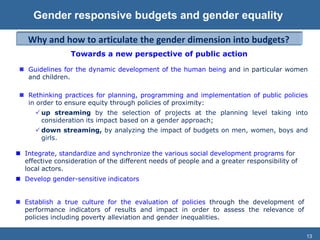
 Guidelines for the dynamic development of the human being and in particular women
and children.
 Rethinking practices for planning, programming and implementation of public policies
in order to ensure equity through policies of proximity:
 up streaming by the selection of projects at the planning level taking into
consideration its impact based on a gender approach;
 down streaming, by analyzing the impact of budgets on men, women, boys and
girls.
 Establish a true culture for the evaluation of policies through the development of
performance indicators of results and impact in order to assess the relevance of
policies including poverty alleviation and gender inequalities.
Towards a new perspective of public action
 Integrate, standardize and synchronize the various social development programs for
effective consideration of the different needs of people and a greater responsibility of
local actors.
 Develop gender-sensitive indicators
Why and how to articulate the gender dimension into budgets?
Gender responsive budgets and gender equality
14
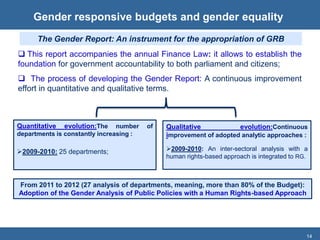
 This report accompanies the annual Finance Law: it allows to establish the
foundation for government accountability to both parliament and citizens;
 The process of developing the Gender Report: A continuous improvement
effort in quantitative and qualitative terms.
The Gender Report: An instrument for the appropriation of GRB
Quantitative evolution:The number of
departments is constantly increasing :
2009-2010: 25 departments;
Qualitative evolution:Continuous
improvement of adopted analytic approaches :
2009-2010: An inter-sectoral analysis with a
human rights-based approach is integrated to RG.
From 2011 to 2012 (27 analysis of departments, meaning, more than 80% of the Budget):
Adoption of the Gender Analysis of Public Policies with a Human Rights-based Approach
Gender responsive budgets and gender equality
15
 Strengthening fiscal performance and improving fiscal governance: the
institutionalization of the CDMT;
 Increased transparencyandfiscal readability:delineation programs;
 Improved procedures for the control of the Parliament;
 Generalization of evaluation, audit and accountability practices.
 Integration of the regional dimension;
 Generalization to all government departments of the implementation of
various aspects of budget reform;
 Overhaul of the Organic Law on the Finance Act devoted to the
consolidation of the process and the integration of new concepts
and associated tools:
 Implementing behavioral change within government departments
and appropriation of budget reform by both politicians and
technicians;
Gender responsive budgets and gender equality
PERSPECTIVES:
16
 Integration of the Gender analyses in the performance unit;
 Accompanying governmental departments :
 development of gender-sensitive indicators;
 capacity building of officials responsible for planning and budgeting at
the central and decentralized levels;
 better understanding of gender-sensitive data in information systems.
 GRB ownership in laws, advisory, executive and control institutions
(The Authority for Gender Parity and the Fight Against of All Forms
of Discrimination, etc. ..)
 Institutionalization of GRB through the Implementation of the
objectives assiged to the Centre of Excellence, which was launched at
the International Conference on GRB held in Marrakech between the 09
and 10 of November 2012. The Centre aims to enhance the exchange of
expertise and best practices of GRB through the networking of all
stakeholders in the field at the national, regional and global levels.
PERSPECTIVES :
Gender responsive budgets and gender equality
17
Governmental Plan for Gender Equality (2012-2016)
Thank you for your attention

Kingdom of Morocco: Governmental plan for gender equality (2012-2016)

  • 1.
    Ministry of Economyand Finances Santa Cruz, 12 September 2013 KINGDOM OF MOROCCO GOVERNMENTAL PLAN FOR GENDER EQUALITY (2012- 2016)
  • 2.
    1 BACKGROUND ►The directives ofHis Majesty King Mohammed VI in the areas of promotion of women reflect the political will to make gender equality, both purpose and an a central element to promote economic and social growth; ►The adoption of the new constitution guarantees that women enjoy all rights and freedoms in the civil, political, economic, social and environmental fields in equal conditions of men; ►Morocco's commitment towards the implementation of the content of international agreements, such as the achievement of the Millennium Development Goals (MDGs) by 2015, as well as those arising from the ratification of the Convention on the Elimination of All forms of Discrimination Against Women (CEDAW); ►The Moroccan legal arsenal (Family Code, the Labour Code, the Nationality Code, ....).
  • 3.
    2 ► The equalityof rights, responsibilities, resources and opportunities; ► The recognition of the value of contributions and inputs of women and men in the public and private spheres; ► Consideration of the needs, constraints, interests and expectations of women and men in the development, implementation, monitoring and evaluation of policies and programs; ► Recognition of full citizenship to both sexes; The provisions of the new constitution of 2011 reinforce the principle of equality as the original concept for the construction of a state based on citizenship according to the following principles: BACKGROUND
  • 4.
    3 ► Encouraging theparticipation of women in political parties and civil society; ► The actual implementation of the constitutional provisions on equality between men and women and regulations to achieve parity; ► Empowerment of women and the eradication of its precarious situation while fighting against contributing factors namely illiteracy, poverty, discrimination and violence; ► Promoting the culture of respect for rights, freedoms and dignity of women. In addition, the special attention given by the government to the issue of women is reflected in its governmental program for the period 2012/2016 through a number of measures including: REFERENCE
  • 5.
    4 Governmental Plan forGender Equality (2012-2016) The government's plan for gender equality aims to promote gender equality through essentially the development of sectoral policies and programs that contribute to gender equality, strengthening the legal protection of women and strengthening their access to positions of responsibility. Main objective: Specific objectives: ► contribute to the promotion of a gender equality and gender equality at national and local levels; ► create the conditions for mainstreaming gender in development policies, and ► strengthen the operational capacity of the national machinery for the promotion of equality between women and men and the actors involved in the implementation of the Government Agenda for Equality (AGE). The Program includes 143 measures, 24 objectives and eight domains
  • 6.
    5 Areas of theplan : 1. The institutionalization and dissemination of the principles of equity and equality and the launch of the implementation of the rules of parity; 2. The fight against all forms of discrimination against women; 3. The rehabilitation of the education and training system based on fairness and equality; 4. The promotion of fair and equal access to health services; 5. The development of basic infrastructure to improve the lives of women and girls; 6. Social and economic empowerment of women; 7. Empowerment for a fair and equitable access to decision-making positions in administrative and political levels; 8. Achieving equal opportunities between women and men in the labor market. Governmental Plan for Gender Equality (2012-2016)
  • 7.
    6 Main actions planned: ►The creation of a ministerial committee for equality; ► The creation of an inter-ministerial technical committee responsible for monitoring the implementation of this program; ► The integration of a gender approach in both the planning and programming budgets of different sectors and also in the national statistical system; ► The development of legal instruments for the protection of women, particularly the law project creating the instance of parity, as well as other regulations on violence against women. Governmental Plan for Gender Equality (2012-2016)
  • 8.
    7 Expected results: ► Theestablishment of equity and equality between women and men; ► Improvement and effectiveness of legal protection for women; ► The institutionalization of gender at central, regional and local levels; ► Strengthening the equal participation of women and men in political governance and management of public affairs and; ► The establishment of mechanisms for the implementation of the AGE. Governmental Plan for Gender Equality (2012-2016)
  • 9.
    8 Financing of theplan: The 48 month long program includes four sections:  Legal aspects concerning the development and implementation of specific legal frameworks;  Institutional and social aspects;  Component of communication through awareness and training;  Implementation of the AGE (steering committee, planning and coordination). The governmental plan for gender equality has received a grant from the European Union of an estimated 497 million dirhams (45 million Euros), under the « Support program for the promotion of equity and equality between women and men », held as part of the axis « Good governance and human rights » Governmental Plan for Gender Equality (2012-2016)
  • 10.
    9 Financing of theplan: The total estimated cost of the plan is 45 millions Euros according to the following distribution:  37.5 million in budget support;  7.5 million for technical assistance activities;  5.3 million for education, training, communication, monitoring, evaluation and audit;  2.2 million of grants to non-governmental organizations (NGO). Governmental Plan for Gender Equality (2012-2016)
  • 11.
    10 ► Adoption bythe Council of the Government of the Decree that establishes a ministerial committee for equality; ► Increased ministerial departments that integrate the gender approach in the preparation of their budgets knowing that the gender budget was considered by the Plan as a mainstreaming mechanism to integrate the gender dimension in the planning of sectoral departments ; ► Financial component, $ 5 million dirhams has already been disbursed by the European Union (technical assistance). ► Achieving the overall objectives of the governmental plan for gender equality will only be realized only through a strong commitment of the various stakeholders (government, political parties, civil society). Main achievements: Governmental Plan for Gender Equality (2012-2016)
  • 12.
    11 Gender responsive budgetsand gender equality In 2006, Morocco developed the National Strategy for Gender Equality, which ensures the integration of the gender approach into sectoral action plans and programs, but also in the development of projects. Gradual mainstreaming of gender equality in the programs of several government departments Since 2005, Morocco has carried out the integration of a gender approach in the general budget of the State which is in the framework of the implementation of results-based budget reforms.  Increase performance by conducing budgets to results;  Give greater clarity to strategic choices by strengthening multi-year budget planning;  Strengthen fiscal decentralization to promote local management to meet the expectations of citizens. Objectives
  • 13.
    12 Gender responsive budgetsand gender equality  Reflect the concerns and interests of affected women, men, girls and boys in the formulation, implementation and evaluation of public policies;  Ensure gender equality and improve the effectiveness and coherence of public policies through a better allocation of budgetary resources. Objectives of Gender Responsive Budgeting
  • 14.
    13  Guidelines forthe dynamic development of the human being and in particular women and children.  Rethinking practices for planning, programming and implementation of public policies in order to ensure equity through policies of proximity:  up streaming by the selection of projects at the planning level taking into consideration its impact based on a gender approach;  down streaming, by analyzing the impact of budgets on men, women, boys and girls.  Establish a true culture for the evaluation of policies through the development of performance indicators of results and impact in order to assess the relevance of policies including poverty alleviation and gender inequalities. Towards a new perspective of public action  Integrate, standardize and synchronize the various social development programs for effective consideration of the different needs of people and a greater responsibility of local actors.  Develop gender-sensitive indicators Why and how to articulate the gender dimension into budgets? Gender responsive budgets and gender equality
  • 15.
    14  This reportaccompanies the annual Finance Law: it allows to establish the foundation for government accountability to both parliament and citizens;  The process of developing the Gender Report: A continuous improvement effort in quantitative and qualitative terms. The Gender Report: An instrument for the appropriation of GRB Quantitative evolution:The number of departments is constantly increasing : 2009-2010: 25 departments; Qualitative evolution:Continuous improvement of adopted analytic approaches : 2009-2010: An inter-sectoral analysis with a human rights-based approach is integrated to RG. From 2011 to 2012 (27 analysis of departments, meaning, more than 80% of the Budget): Adoption of the Gender Analysis of Public Policies with a Human Rights-based Approach Gender responsive budgets and gender equality
  • 16.
    15  Strengthening fiscalperformance and improving fiscal governance: the institutionalization of the CDMT;  Increased transparencyandfiscal readability:delineation programs;  Improved procedures for the control of the Parliament;  Generalization of evaluation, audit and accountability practices.  Integration of the regional dimension;  Generalization to all government departments of the implementation of various aspects of budget reform;  Overhaul of the Organic Law on the Finance Act devoted to the consolidation of the process and the integration of new concepts and associated tools:  Implementing behavioral change within government departments and appropriation of budget reform by both politicians and technicians; Gender responsive budgets and gender equality PERSPECTIVES:
  • 17.
    16  Integration ofthe Gender analyses in the performance unit;  Accompanying governmental departments :  development of gender-sensitive indicators;  capacity building of officials responsible for planning and budgeting at the central and decentralized levels;  better understanding of gender-sensitive data in information systems.  GRB ownership in laws, advisory, executive and control institutions (The Authority for Gender Parity and the Fight Against of All Forms of Discrimination, etc. ..)  Institutionalization of GRB through the Implementation of the objectives assiged to the Centre of Excellence, which was launched at the International Conference on GRB held in Marrakech between the 09 and 10 of November 2012. The Centre aims to enhance the exchange of expertise and best practices of GRB through the networking of all stakeholders in the field at the national, regional and global levels. PERSPECTIVES : Gender responsive budgets and gender equality
  • 18.
    17 Governmental Plan forGender Equality (2012-2016) Thank you for your attention