1
Introduction to Human
Resource Development
Werner & DeSimone (2006) 2
Definition of HRD
A set of systematic and planned
activities designed by an organization to
provide its members with the necessary
skills to meet current and future job
demands.
Werner & DeSimone (2006) 3
Human Relations Movement
Factory system often abused workers
“Human relations” movement promoted
better working conditions
Start of business & management
education
Tied to Maslow’s hierarchy of needs
Werner & DeSimone (2006) 4
Emergence of HRD
Employee needs extend beyond the
training classroom
Includes coaching, group work, and
problem solving
Need for basic employee development
Need for structured career development
ASTD changes its name to the American
Society for Training and Development
Werner & DeSimone (2006) 5
Relationship Between HRM
and HRD
Human resource management (HRM)
encompasses many functions
Human resource development (HRD) is
just one of the functions within HRM
Werner & DeSimone (2006) 6
HRD Functions
Training and development (T&D)
Organizational development
Career development
Werner & DeSimone (2006) 7
Training and Development
(T&D)
Training – improving the knowledge,
skills and attitudes of employees for the
short-term, particular to a specific job
or task – e.g.,
 Employee orientation
 Skills & technical training
 Coaching
 Counseling
Werner & DeSimone (2006) 8
Training and Development
(T&D)
Development – preparing for future
responsibilities, while increasing the
capacity to perform at a current job
 Management training
 Supervisor development
Werner & DeSimone (2006) 9
Organizational Development
The process of improving an
organization’s effectiveness and
member’s well-being through the
application of behavioral science
concepts
Focuses on both macro- and micro-
levels
HRD plays the role of a change agent
Werner & DeSimone (2006) 10
Career Development
Ongoing process by which individuals
progress through series of changes until
they achieve their personal level of
maximum achievement.
 Career planning
 Career management
Werner & DeSimone (2006) 11
Critical HRD Issues
Strategic management and HRD
The supervisor’s role in HRD
Organizational structure of HRD
Werner & DeSimone (2006) 12
Strategic Management & HRD
Strategic management aims to ensure
organizational effectiveness for the
foreseeable future – e.g., maximizing
profits in the next 3 to 5 years
HRD aims to get managers and workers
ready for new products, procedures,
and materials
Werner & DeSimone (2006) 13
Supervisor’s Role in HRD
Implements HRD programs and
procedures
On-the-job training (OJT)
Coaching/mentoring/counseling
Career and employee development
A “front-line participant” in HRD
Werner & DeSimone (2006) 14
Organizational Structure of
HRD Departments
Depends on company size, industry and
maturity
No single structure used
Depends in large part on how well the
HRD manager becomes an institutional
part of the company – i.e., a revenue
contributor, not just a revenue user
Werner & DeSimone (2006) 15
Sample HRD Jobs/Roles
Executive/Manager
HR Strategic Advisor
HR Systems Designer/Developer
Organization Change Agent
Organization Design Consultant
Learning Program Specialist
Werner & DeSimone (2006) 16
Sample HRD Jobs/Roles – 2
Instructor/Facilitator
Individual Development and Career
Counselor
Performance Consultant (Coach)
Researcher
Werner & DeSimone (2006) 17
HR Manager Role
Integrates HRD with organizational
goals and strategies
Promotes HRD as a profit enhancer
Tailors HRD to corporate needs and
budget
Institutionalizes performance
enhancement
Werner & DeSimone (2006) 18
HR Strategic Advisor Role
Consults with corporate strategic
thinkers
Helps to articulate goals and strategies
Develops HR plans
Develops strategic planning education
and training programs
Werner & DeSimone (2006) 19
HR Systems
Designer/Developer
Assists HR manager in the design and
development of HR systems
Designs HR programs
Develops intervention strategies
Plans HR implementation actions
Werner & DeSimone (2006) 20
Organization Change Agent
Develops more efficient work teams
Improves quality management
Implements intervention strategies
Develops change reports
Werner & DeSimone (2006) 21
Organization Design
Consultant
Designs work systems
Develops effective alternative work
designs
Implements changed systems
Werner & DeSimone (2006) 22
Learning Program Specialist
Identifies needs of learners
Develops and designs learning
programs
Prepares learning materials and
learning aids
Develops program objectives, lesson
plans, and strategies
Werner & DeSimone (2006) 23
Instructor/Facilitator
Presents learning materials
Leads and facilitates structured learning
experiences
Selects appropriate instructional
methods and techniques
Delivers instruction
Werner & DeSimone (2006) 24
Individual Development and
Career Counselor
Assists individuals in career planning
Develops individual assessments
Facilitates career workshops
Provides career guidance
Werner & DeSimone (2006) 25
Performance Consultant
(Coach)
Advises line management on
appropriate interventions to improve
individual and group performance
Provides intervention strategies
Develops and provides coaching designs
Implements coaching activities
Werner & DeSimone (2006) 26
Researcher
Assesses HRD practices and programs
Determines HRD program effectiveness
Develops requirements for changing
HRD programs to address current and
future problems
Werner & DeSimone (2006) 27
Challenges for HRD
Changing workforce demographics
Competing in global economy
Eliminating the skills gap
Need for lifelong learning
Need for organizational learning
Werner & DeSimone (2006) 28
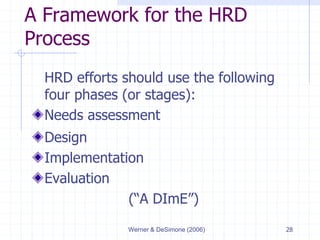
A Framework for the HRD
Process
HRD efforts should use the following
four phases (or stages):
Needs assessment
Design
Implementation
Evaluation
(“A DImE”)
Werner & DeSimone (2006) 29
Summary
HRD is too important to be left to
amateurs
HRD should be a revenue producer, not
a revenue user
HRD should be a central part of
company
You need to be able to talk MONEY
Werner & DeSimone (2006) 30
HRD at Different levels
Macro Level- National
Micro level- Individual
Micro Level- Organizational

1_Human_Resource_Development.ppt

  • 1.
  • 2.
    Werner & DeSimone(2006) 2 Definition of HRD A set of systematic and planned activities designed by an organization to provide its members with the necessary skills to meet current and future job demands.
  • 3.
    Werner & DeSimone(2006) 3 Human Relations Movement Factory system often abused workers “Human relations” movement promoted better working conditions Start of business & management education Tied to Maslow’s hierarchy of needs
  • 4.
    Werner & DeSimone(2006) 4 Emergence of HRD Employee needs extend beyond the training classroom Includes coaching, group work, and problem solving Need for basic employee development Need for structured career development ASTD changes its name to the American Society for Training and Development
  • 5.
    Werner & DeSimone(2006) 5 Relationship Between HRM and HRD Human resource management (HRM) encompasses many functions Human resource development (HRD) is just one of the functions within HRM
  • 6.
    Werner & DeSimone(2006) 6 HRD Functions Training and development (T&D) Organizational development Career development
  • 7.
    Werner & DeSimone(2006) 7 Training and Development (T&D) Training – improving the knowledge, skills and attitudes of employees for the short-term, particular to a specific job or task – e.g.,  Employee orientation  Skills & technical training  Coaching  Counseling
  • 8.
    Werner & DeSimone(2006) 8 Training and Development (T&D) Development – preparing for future responsibilities, while increasing the capacity to perform at a current job  Management training  Supervisor development
  • 9.
    Werner & DeSimone(2006) 9 Organizational Development The process of improving an organization’s effectiveness and member’s well-being through the application of behavioral science concepts Focuses on both macro- and micro- levels HRD plays the role of a change agent
  • 10.
    Werner & DeSimone(2006) 10 Career Development Ongoing process by which individuals progress through series of changes until they achieve their personal level of maximum achievement.  Career planning  Career management
  • 11.
    Werner & DeSimone(2006) 11 Critical HRD Issues Strategic management and HRD The supervisor’s role in HRD Organizational structure of HRD
  • 12.
    Werner & DeSimone(2006) 12 Strategic Management & HRD Strategic management aims to ensure organizational effectiveness for the foreseeable future – e.g., maximizing profits in the next 3 to 5 years HRD aims to get managers and workers ready for new products, procedures, and materials
  • 13.
    Werner & DeSimone(2006) 13 Supervisor’s Role in HRD Implements HRD programs and procedures On-the-job training (OJT) Coaching/mentoring/counseling Career and employee development A “front-line participant” in HRD
  • 14.
    Werner & DeSimone(2006) 14 Organizational Structure of HRD Departments Depends on company size, industry and maturity No single structure used Depends in large part on how well the HRD manager becomes an institutional part of the company – i.e., a revenue contributor, not just a revenue user
  • 15.
    Werner & DeSimone(2006) 15 Sample HRD Jobs/Roles Executive/Manager HR Strategic Advisor HR Systems Designer/Developer Organization Change Agent Organization Design Consultant Learning Program Specialist
  • 16.
    Werner & DeSimone(2006) 16 Sample HRD Jobs/Roles – 2 Instructor/Facilitator Individual Development and Career Counselor Performance Consultant (Coach) Researcher
  • 17.
    Werner & DeSimone(2006) 17 HR Manager Role Integrates HRD with organizational goals and strategies Promotes HRD as a profit enhancer Tailors HRD to corporate needs and budget Institutionalizes performance enhancement
  • 18.
    Werner & DeSimone(2006) 18 HR Strategic Advisor Role Consults with corporate strategic thinkers Helps to articulate goals and strategies Develops HR plans Develops strategic planning education and training programs
  • 19.
    Werner & DeSimone(2006) 19 HR Systems Designer/Developer Assists HR manager in the design and development of HR systems Designs HR programs Develops intervention strategies Plans HR implementation actions
  • 20.
    Werner & DeSimone(2006) 20 Organization Change Agent Develops more efficient work teams Improves quality management Implements intervention strategies Develops change reports
  • 21.
    Werner & DeSimone(2006) 21 Organization Design Consultant Designs work systems Develops effective alternative work designs Implements changed systems
  • 22.
    Werner & DeSimone(2006) 22 Learning Program Specialist Identifies needs of learners Develops and designs learning programs Prepares learning materials and learning aids Develops program objectives, lesson plans, and strategies
  • 23.
    Werner & DeSimone(2006) 23 Instructor/Facilitator Presents learning materials Leads and facilitates structured learning experiences Selects appropriate instructional methods and techniques Delivers instruction
  • 24.
    Werner & DeSimone(2006) 24 Individual Development and Career Counselor Assists individuals in career planning Develops individual assessments Facilitates career workshops Provides career guidance
  • 25.
    Werner & DeSimone(2006) 25 Performance Consultant (Coach) Advises line management on appropriate interventions to improve individual and group performance Provides intervention strategies Develops and provides coaching designs Implements coaching activities
  • 26.
    Werner & DeSimone(2006) 26 Researcher Assesses HRD practices and programs Determines HRD program effectiveness Develops requirements for changing HRD programs to address current and future problems
  • 27.
    Werner & DeSimone(2006) 27 Challenges for HRD Changing workforce demographics Competing in global economy Eliminating the skills gap Need for lifelong learning Need for organizational learning
  • 28.
    Werner & DeSimone(2006) 28 A Framework for the HRD Process HRD efforts should use the following four phases (or stages): Needs assessment Design Implementation Evaluation (“A DImE”)
  • 29.
    Werner & DeSimone(2006) 29 Summary HRD is too important to be left to amateurs HRD should be a revenue producer, not a revenue user HRD should be a central part of company You need to be able to talk MONEY
  • 30.
    Werner & DeSimone(2006) 30 HRD at Different levels Macro Level- National Micro level- Individual Micro Level- Organizational

Editor's Notes