CONSTITUTIONAL PROVISIONS IN THE
CLASSIFICATION OF LANDS IN THE
PUBLIC DOMAIN AND NATURAL
RESOURCES
Prepared by:
ENGR. MYRA ROSE R. GARCIA
Instructor I
Art.12 Sec 2. 1987 Philippine Constitution
• All lands of the public domain, waters,
minerals, coal, petroleum, and other mineral
oils, all forces of potential energy, fisheries, forests
or timber, wildlife, flora and fauna, and other natural
resources are owned by the State.
• With the exception of agricultural lands, all
other natural resources shall not be alienated.
Art.12 Sec 3. 1987 Philippine Constitution
• Lands of the public domain are classified into
agricultural, forest or timber, mineral lands, and
national parks. (AFMN)
• Alienable lands of the public domain shall be
limited to agricultural lands.
• Private corporations or associations can hold
alienable lands only by lease.
Art.12 Sec 3. 1987 Philippine Constitution
• 25 years renewable for not exceeding 25 years
with a total area of not exceeding 1000 hectares.
• Citizens of the Philippines may lease not more
than 500 hundred hectares, or acquire not more
than 12 hectares thereof by purchase,
homestead, or grant.
Art.12 Sec 4. 1987 Philippine Constitution
• The Congress shall, as soon as possible,
determine by law the specific limits of forest
lands and national parks, marking clearly their
boundaries on the ground.
• Thereafter, such forest lands and national parks
shall be conserved and may not be increased nor
diminished, except by law.
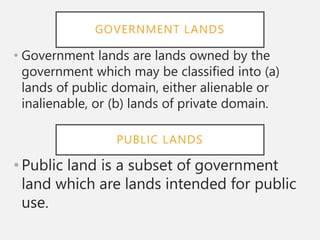
Government Lands
• Government lands are lands owned by the
government which may be classified into (a)
lands of public domain, either alienable or
inalienable, or (b) lands of private domain.
Public Lands
• Public land is a subset of government
land which are lands intended for public
use.
GOVERNMENT LANDS
PUBLIC LANDS
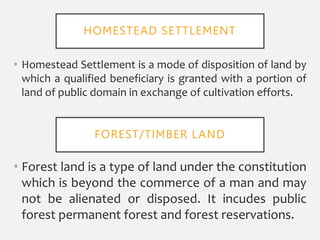
• Homestead Settlement is a mode of disposition of land by
which a qualified beneficiary is granted with a portion of
land of public domain in exchange of cultivation efforts.
• Forest land is a type of land under the constitution
which is beyond the commerce of a man and may
not be alienated or disposed. It incudes public
forest permanent forest and forest reservations.
HOMESTEAD SETTLEMENT
FOREST/TIMBER LAND
FORESHORE LANDS
• Foreshore land is a strip of land that lies
between the high and the low water marks that
is alternately wet and dry.
CLASSIFICATION OF LANDS
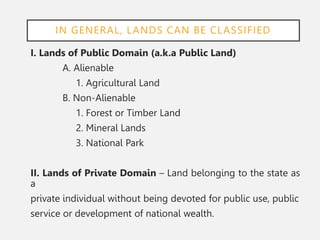
IN GENERAL, LANDS CAN BE CLASSIFIED
I. Lands of Public Domain (a.k.a Public Land)
A. Alienable
1. Agricultural Land
B. Non-Alienable
1. Forest or Timber Land
2. Mineral Lands
3. National Park
II. Lands of Private Domain – Land belonging to the state as
a
private individual without being devoted for public use, public
service or development of national wealth.
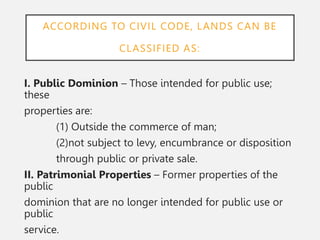
ACCORDING TO CIVIL CODE, LANDS CAN BE
CLASSIFIED AS:
I. Public Dominion – Those intended for public use;
these
properties are:
(1) Outside the commerce of man;
(2)not subject to levy, encumbrance or disposition
through public or private sale.
II. Patrimonial Properties – Former properties of the
public
dominion that are no longer intended for public use or
public
service.
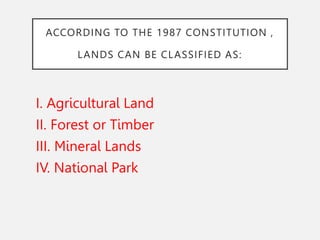
ACCORDING TO THE 1987 CONSTITUTION ,
LANDS CAN BE CLASSIFIED AS:
I. Agricultural Land
II. Forest or Timber
III. Mineral Lands
IV. National Park
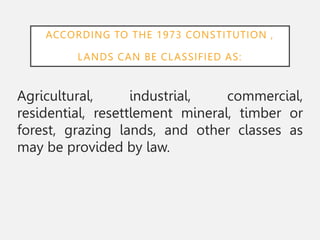
ACCORDING TO THE 1973 CONSTITUTION ,
LANDS CAN BE CLASSIFIED AS:
Agricultural, industrial, commercial,
residential, resettlement mineral, timber or
forest, grazing lands, and other classes as
may be provided by law.
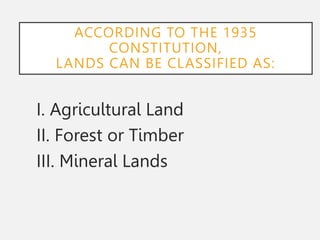
ACCORDING TO THE 1935
CONSTITUTION,
LANDS CAN BE CLASSIFIED AS:
I. Agricultural Land
II. Forest or Timber
III. Mineral Lands
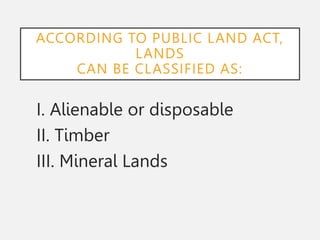
ACCORDING TO PUBLIC LAND ACT,
LANDS
CAN BE CLASSIFIED AS:
I. Alienable or disposable
II. Timber
III. Mineral Lands
THANK YOU!

1_GEO135.pptx

  • 1.
    CONSTITUTIONAL PROVISIONS INTHE CLASSIFICATION OF LANDS IN THE PUBLIC DOMAIN AND NATURAL RESOURCES Prepared by: ENGR. MYRA ROSE R. GARCIA Instructor I
  • 2.
    Art.12 Sec 2.1987 Philippine Constitution • All lands of the public domain, waters, minerals, coal, petroleum, and other mineral oils, all forces of potential energy, fisheries, forests or timber, wildlife, flora and fauna, and other natural resources are owned by the State. • With the exception of agricultural lands, all other natural resources shall not be alienated.
  • 3.
    Art.12 Sec 3.1987 Philippine Constitution • Lands of the public domain are classified into agricultural, forest or timber, mineral lands, and national parks. (AFMN) • Alienable lands of the public domain shall be limited to agricultural lands. • Private corporations or associations can hold alienable lands only by lease.
  • 4.
    Art.12 Sec 3.1987 Philippine Constitution • 25 years renewable for not exceeding 25 years with a total area of not exceeding 1000 hectares. • Citizens of the Philippines may lease not more than 500 hundred hectares, or acquire not more than 12 hectares thereof by purchase, homestead, or grant.
  • 5.
    Art.12 Sec 4.1987 Philippine Constitution • The Congress shall, as soon as possible, determine by law the specific limits of forest lands and national parks, marking clearly their boundaries on the ground. • Thereafter, such forest lands and national parks shall be conserved and may not be increased nor diminished, except by law.
  • 6.
    Government Lands • Governmentlands are lands owned by the government which may be classified into (a) lands of public domain, either alienable or inalienable, or (b) lands of private domain. Public Lands • Public land is a subset of government land which are lands intended for public use. GOVERNMENT LANDS PUBLIC LANDS
  • 7.
    • Homestead Settlementis a mode of disposition of land by which a qualified beneficiary is granted with a portion of land of public domain in exchange of cultivation efforts. • Forest land is a type of land under the constitution which is beyond the commerce of a man and may not be alienated or disposed. It incudes public forest permanent forest and forest reservations. HOMESTEAD SETTLEMENT FOREST/TIMBER LAND
  • 8.
    FORESHORE LANDS • Foreshoreland is a strip of land that lies between the high and the low water marks that is alternately wet and dry.
  • 9.
  • 10.
    IN GENERAL, LANDSCAN BE CLASSIFIED I. Lands of Public Domain (a.k.a Public Land) A. Alienable 1. Agricultural Land B. Non-Alienable 1. Forest or Timber Land 2. Mineral Lands 3. National Park II. Lands of Private Domain – Land belonging to the state as a private individual without being devoted for public use, public service or development of national wealth.
  • 11.
    ACCORDING TO CIVILCODE, LANDS CAN BE CLASSIFIED AS: I. Public Dominion – Those intended for public use; these properties are: (1) Outside the commerce of man; (2)not subject to levy, encumbrance or disposition through public or private sale. II. Patrimonial Properties – Former properties of the public dominion that are no longer intended for public use or public service.
  • 12.
    ACCORDING TO THE1987 CONSTITUTION , LANDS CAN BE CLASSIFIED AS: I. Agricultural Land II. Forest or Timber III. Mineral Lands IV. National Park
  • 13.
    ACCORDING TO THE1973 CONSTITUTION , LANDS CAN BE CLASSIFIED AS: Agricultural, industrial, commercial, residential, resettlement mineral, timber or forest, grazing lands, and other classes as may be provided by law.
  • 14.
    ACCORDING TO THE1935 CONSTITUTION, LANDS CAN BE CLASSIFIED AS: I. Agricultural Land II. Forest or Timber III. Mineral Lands
  • 15.
    ACCORDING TO PUBLICLAND ACT, LANDS CAN BE CLASSIFIED AS: I. Alienable or disposable II. Timber III. Mineral Lands
  • 16.