Infant development
Introduction
Physical Development
Rationale
• What do you expect from this course?
• Why we study pre-natal development?
– Child related problems
– Mother related problems
****Importance for physiotherapists:
– Congenital problems
– Developmental problem
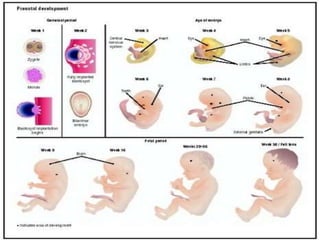
FROM ZYGOT TO BIRTH
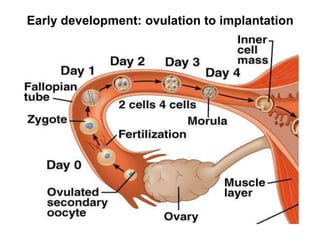
• conception-- when a sperm unites with an
ovum to form a single cell, zygote
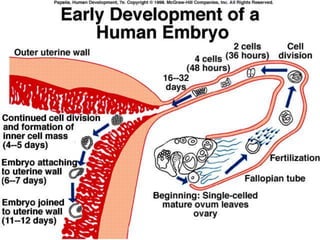
• germinal period-- begins with conception,
continues with zygotic cell division (mitosis),
ends with attachment of the zygote to the uterine
wall (implantation) about 10 days later
• embryonic period-- begins with implantation,
after which the rate of cell differentiation
intensifies, and organs appear (2 to 8 weeks
after conception)
• fetal period-- development of the organ systems
(9 weeks to birth)
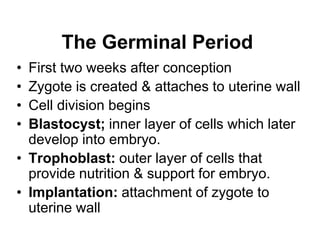
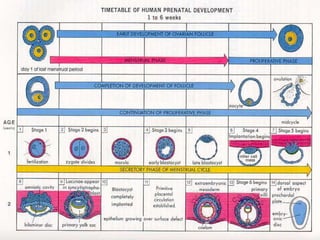
The Germinal Period
• First two weeks after conception
• Zygote is created & attaches to uterine wall
• Cell division begins
• Blastocyst; inner layer of cells which later
develop into embryo.
• Trophoblast: outer layer of cells that
provide nutrition & support for embryo.
• Implantation: attachment of zygote to
uterine wall
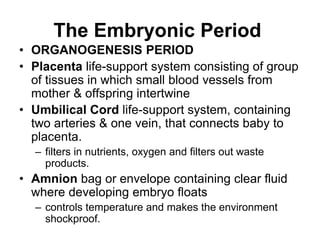
The Embryonic Period
• ORGANOGENESIS PERIOD
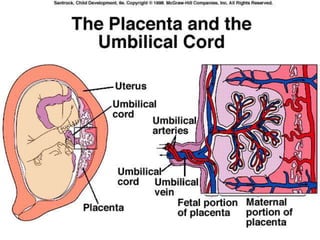
• Placenta life-support system consisting of group
of tissues in which small blood vessels from
mother & offspring intertwine
• Umbilical Cord life-support system, containing
two arteries & one vein, that connects baby to
placenta.
– filters in nutrients, oxygen and filters out waste
products.
• Amnion bag or envelope containing clear fluid
where developing embryo floats
– controls temperature and makes the environment
shockproof.
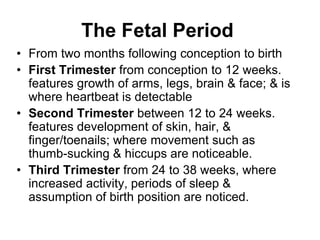
The Fetal Period
• From two months following conception to birth
• First Trimester from conception to 12 weeks.
features growth of arms, legs, brain & face; & is
where heartbeat is detectable
• Second Trimester between 12 to 24 weeks.
features development of skin, hair, &
finger/toenails; where movement such as
thumb-sucking & hiccups are noticeable.
• Third Trimester from 24 to 38 weeks, where
increased activity, periods of sleep &
assumption of birth position are noticed.
Human Development
Fertilization - fusion of male and female gametes
- forms a zygote
Cleavage - Period of rapid cell division without
growth of cells
Blastula - hollow ball of cells
Outer cells - trophoblasts
- extraembryonic membranes
Inside cells
- inner cell mass - embryo
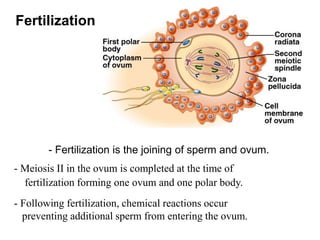
Fertilization
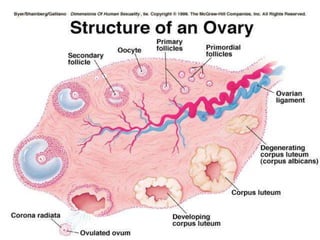
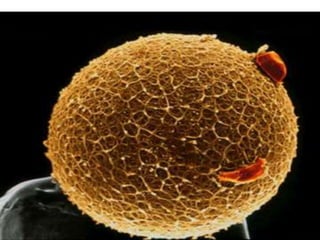
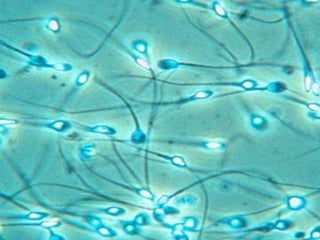
- Fertilization is the joining of sperm and ovum.
- Meiosis II in the ovum is completed at the time of
fertilization forming one ovum and one polar body.
- Following fertilization, chemical reactions occur
preventing additional sperm from entering the ovum.
Early development: ovulation to implantation
Cleavage
• Mitotic cell division creates more cells.
• Cells are called blastomeres.
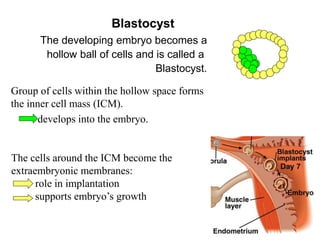
Blastocyst
The developing embryo becomes a
hollow ball of cells and is called a
Blastocyst.
The cells around the ICM become the
extraembryonic membranes:
role in implantation
supports embryo’s growth
Group of cells within the hollow space forms
the inner cell mass (ICM).
develops into the embryo.
1general aspects of human prenatal development.ppt

1general aspects of human prenatal development.ppt

  • 1.
  • 2.
    Rationale • What doyou expect from this course? • Why we study pre-natal development? – Child related problems – Mother related problems ****Importance for physiotherapists: – Congenital problems – Developmental problem
  • 7.
    FROM ZYGOT TOBIRTH • conception-- when a sperm unites with an ovum to form a single cell, zygote • germinal period-- begins with conception, continues with zygotic cell division (mitosis), ends with attachment of the zygote to the uterine wall (implantation) about 10 days later • embryonic period-- begins with implantation, after which the rate of cell differentiation intensifies, and organs appear (2 to 8 weeks after conception) • fetal period-- development of the organ systems (9 weeks to birth)
  • 8.
    The Germinal Period •First two weeks after conception • Zygote is created & attaches to uterine wall • Cell division begins • Blastocyst; inner layer of cells which later develop into embryo. • Trophoblast: outer layer of cells that provide nutrition & support for embryo. • Implantation: attachment of zygote to uterine wall
  • 9.
    The Embryonic Period •ORGANOGENESIS PERIOD • Placenta life-support system consisting of group of tissues in which small blood vessels from mother & offspring intertwine • Umbilical Cord life-support system, containing two arteries & one vein, that connects baby to placenta. – filters in nutrients, oxygen and filters out waste products. • Amnion bag or envelope containing clear fluid where developing embryo floats – controls temperature and makes the environment shockproof.
  • 11.
    The Fetal Period •From two months following conception to birth • First Trimester from conception to 12 weeks. features growth of arms, legs, brain & face; & is where heartbeat is detectable • Second Trimester between 12 to 24 weeks. features development of skin, hair, & finger/toenails; where movement such as thumb-sucking & hiccups are noticeable. • Third Trimester from 24 to 38 weeks, where increased activity, periods of sleep & assumption of birth position are noticed.
  • 12.
    Human Development Fertilization -fusion of male and female gametes - forms a zygote Cleavage - Period of rapid cell division without growth of cells Blastula - hollow ball of cells Outer cells - trophoblasts - extraembryonic membranes Inside cells - inner cell mass - embryo
  • 13.
    Fertilization - Fertilization isthe joining of sperm and ovum. - Meiosis II in the ovum is completed at the time of fertilization forming one ovum and one polar body. - Following fertilization, chemical reactions occur preventing additional sperm from entering the ovum.
  • 14.
  • 16.
    Cleavage • Mitotic celldivision creates more cells. • Cells are called blastomeres.
  • 17.
    Blastocyst The developing embryobecomes a hollow ball of cells and is called a Blastocyst. The cells around the ICM become the extraembryonic membranes: role in implantation supports embryo’s growth Group of cells within the hollow space forms the inner cell mass (ICM). develops into the embryo.