Foundations of Machine Learning
Sudeshna Sarkar
IIT Kharagpur
Module 1: Introduction
Part c: Hypothesis Space and Inductive Bias
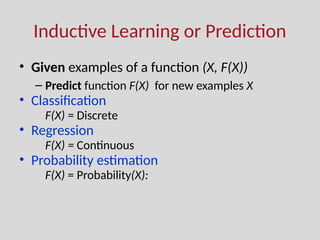
Inductive Learning or Prediction
• Given examples of a function (X, F(X))
– Predict function F(X) for new examples X
• Classification
F(X) = Discrete
• Regression
F(X) = Continuous
• Probability estimation
F(X) = Probability(X):
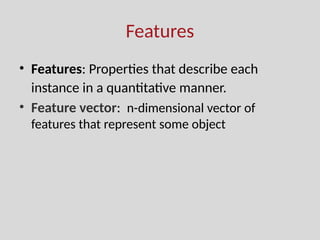
Features
• Features: Properties that describe each
instance in a quantitative manner.
• Feature vector: n-dimensional vector of
features that represent some object
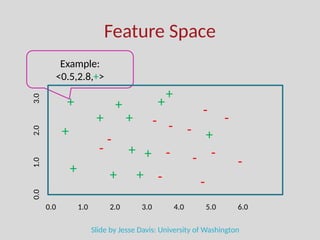
Feature Space
0.0 1.0 2.0 3.0 4.0 5.0 6.0
0.0
1.0
2.0
3.0
Example:
<0.5,2.8,+>
+
+
+ +
+
+
+
+
- -
-
- -
-
-
-
-
- +
+
+
-
-
-
+
+
Slide by Jesse Davis: University of Washington
Terminology
0.0 1.0 2.0 3.0 4.0 5.0 6.0
0.0
1.0
2.0
3.0
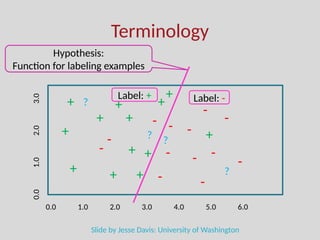
Hypothesis:
Function for labeling examples
+
+
+ +
+
+
+
+
- -
-
- -
-
-
-
-
- +
+
+
-
-
-
+
+ Label: -
Label: +
?
?
?
?
Slide by Jesse Davis: University of Washington
Terminology
0.0 1.0 2.0 3.0 4.0 5.0 6.0
0.0
1.0
2.0
3.0
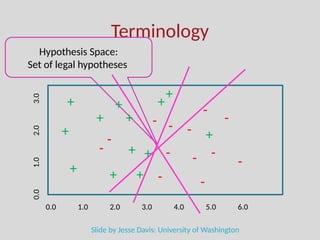
Hypothesis Space:
Set of legal hypotheses
+
+
+ +
+
+
+
+
- -
-
- -
-
-
-
-
- +
+
+
-
-
-
+
+
Slide by Jesse Davis: University of Washington
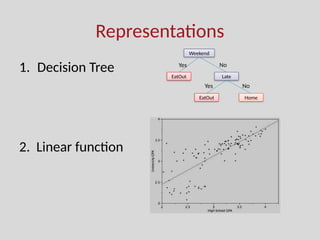
Representations
1. Decision Tree
2. Linear function
Weekend
EatOut Late
EatOut Home
Yes
Yes
No
No
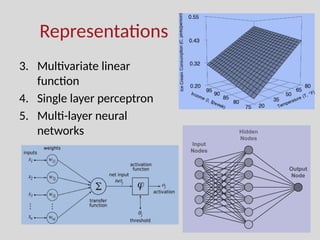
Representations
3. Multivariate linear
function
4. Single layer perceptron
5. Multi-layer neural
networks
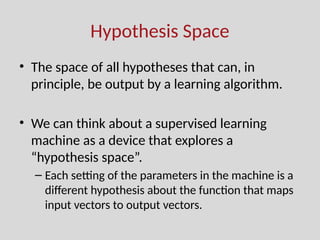
Hypothesis Space
• The space of all hypotheses that can, in
principle, be output by a learning algorithm.
• We can think about a supervised learning
machine as a device that explores a
“hypothesis space”.
– Each setting of the parameters in the machine is a
different hypothesis about the function that maps
input vectors to output vectors.
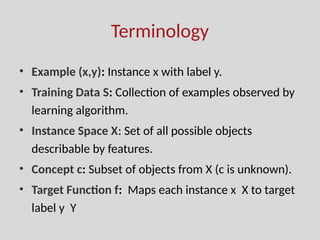
Terminology
• Example (x,y): Instance x with label y.
• Training Data S: Collection of examples observed by
learning algorithm.
• Instance Space X: Set of all possible objects
describable by features.
• Concept c: Subset of objects from X (c is unknown).
• Target Function f: Maps each instance x X to target
label y Y
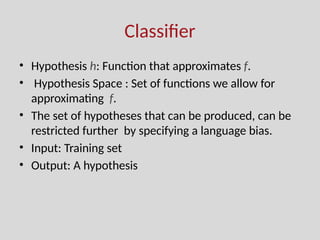
Classifier
• Hypothesis h: Function that approximates f.
• Hypothesis Space : Set of functions we allow for
approximating f.
• The set of hypotheses that can be produced, can be
restricted further by specifying a language bias.
• Input: Training set
• Output: A hypothesis
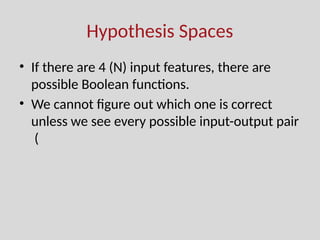
Hypothesis Spaces
• If there are 4 (N) input features, there are
possible Boolean functions.
• We cannot figure out which one is correct
unless we see every possible input-output pair
(
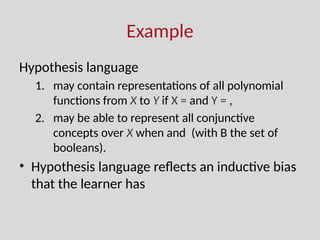
Example
Hypothesis language
1. may contain representations of all polynomial
functions from X to Y if X = and Y = ,
2. may be able to represent all conjunctive
concepts over X when and (with B the set of
booleans).
• Hypothesis language reflects an inductive bias
that the learner has
Inductive Bias
• Need to make assumptions
– Experience alone doesn’t allow us to make
conclusions about unseen data instances
• Two types of bias:
– Restriction: Limit the hypothesis space
(e.g., look at rules)
– Preference: Impose ordering on hypothesis space
(e.g., more general, consistent with data)
Inductive learning
• Inductive learning: Inducing a general function from
training examples
– Construct hypothesis h to agree with c on the training
examples.
– A hypothesis is consistent if it agrees with all training
examples.
– A hypothesis said to generalize well if it correctly predicts
the value of y for novel example.
• Inductive Learning is an Ill Posed Problem:
Unless we see all possible examples the data is not sufficient for an
inductive learning algorithm to find a unique solution.
Inductive Learning Hypothesis
• Any hypothesis h found to approximate the
target function c well over a sufficiently large
set of training examples D will also
approximate the target function well over
other unobserved examples.
Learning as Refining the Hypothesis Space
• Concept learning is a task of searching an hypotheses
space of possible representations looking for the
representation(s) that best fits the data, given the
bias.
• The tendency to prefer one hypothesis over another
is called a bias.
• Given a representation, data, and a bias, the problem
of learning can be reduced to one of search.
Occam's Razor
⁻ A classical example of Inductive Bias
• the simplest consistent hypothesis about the
target function is actually the best
Some more Types of Inductive Bias
• Minimum description length: when forming a
hypothesis, attempt to minimize the length of the
description of the hypothesis.
• Maximum margin: when drawing a boundary
between two classes, attempt to maximize the width
of the boundary (SVM)
Important issues in Machine Learning
• What are good hypothesis spaces?
• Algorithms that work with the hypothesis spaces
• How to optimize accuracy over future data points
(overfitting)
• How can we have confidence in the result? (How
much training data – statistical qs)
• Are some learning problems computationally
intractable?
Generalization
• Components of generalization error
– Bias: how much the average model over all
training sets differ from the true model?
• Error due to inaccurate assumptions/simplifications
made by the model
– Variance: how much models estimated from
different training sets differ from each other
Underfitting and Overfitting
• Underfitting: model is too “simple” to represent all
the relevant class characteristics
– High bias and low variance
– High training error and high test error
• Overfitting: model is too “complex” and fits irrelevant
characteristics (noise) in the data
– Low bias and high variance
– Low training error and high test error

1c-Hypohhhhhhhhhhhhhhhhthesis-space-17May.pptx

  • 1.
    Foundations of MachineLearning Sudeshna Sarkar IIT Kharagpur Module 1: Introduction Part c: Hypothesis Space and Inductive Bias
  • 2.
    Inductive Learning orPrediction • Given examples of a function (X, F(X)) – Predict function F(X) for new examples X • Classification F(X) = Discrete • Regression F(X) = Continuous • Probability estimation F(X) = Probability(X):
  • 3.
    Features • Features: Propertiesthat describe each instance in a quantitative manner. • Feature vector: n-dimensional vector of features that represent some object
  • 4.
    Feature Space 0.0 1.02.0 3.0 4.0 5.0 6.0 0.0 1.0 2.0 3.0 Example: <0.5,2.8,+> + + + + + + + + - - - - - - - - - - + + + - - - + + Slide by Jesse Davis: University of Washington
  • 5.
    Terminology 0.0 1.0 2.03.0 4.0 5.0 6.0 0.0 1.0 2.0 3.0 Hypothesis: Function for labeling examples + + + + + + + + - - - - - - - - - - + + + - - - + + Label: - Label: + ? ? ? ? Slide by Jesse Davis: University of Washington
  • 6.
    Terminology 0.0 1.0 2.03.0 4.0 5.0 6.0 0.0 1.0 2.0 3.0 Hypothesis Space: Set of legal hypotheses + + + + + + + + - - - - - - - - - - + + + - - - + + Slide by Jesse Davis: University of Washington
  • 7.
    Representations 1. Decision Tree 2.Linear function Weekend EatOut Late EatOut Home Yes Yes No No
  • 8.
    Representations 3. Multivariate linear function 4.Single layer perceptron 5. Multi-layer neural networks
  • 9.
    Hypothesis Space • Thespace of all hypotheses that can, in principle, be output by a learning algorithm. • We can think about a supervised learning machine as a device that explores a “hypothesis space”. – Each setting of the parameters in the machine is a different hypothesis about the function that maps input vectors to output vectors.
  • 10.
    Terminology • Example (x,y):Instance x with label y. • Training Data S: Collection of examples observed by learning algorithm. • Instance Space X: Set of all possible objects describable by features. • Concept c: Subset of objects from X (c is unknown). • Target Function f: Maps each instance x X to target label y Y
  • 11.
    Classifier • Hypothesis h:Function that approximates f. • Hypothesis Space : Set of functions we allow for approximating f. • The set of hypotheses that can be produced, can be restricted further by specifying a language bias. • Input: Training set • Output: A hypothesis
  • 12.
    Hypothesis Spaces • Ifthere are 4 (N) input features, there are possible Boolean functions. • We cannot figure out which one is correct unless we see every possible input-output pair (
  • 13.
    Example Hypothesis language 1. maycontain representations of all polynomial functions from X to Y if X = and Y = , 2. may be able to represent all conjunctive concepts over X when and (with B the set of booleans). • Hypothesis language reflects an inductive bias that the learner has
  • 14.
    Inductive Bias • Needto make assumptions – Experience alone doesn’t allow us to make conclusions about unseen data instances • Two types of bias: – Restriction: Limit the hypothesis space (e.g., look at rules) – Preference: Impose ordering on hypothesis space (e.g., more general, consistent with data)
  • 15.
    Inductive learning • Inductivelearning: Inducing a general function from training examples – Construct hypothesis h to agree with c on the training examples. – A hypothesis is consistent if it agrees with all training examples. – A hypothesis said to generalize well if it correctly predicts the value of y for novel example. • Inductive Learning is an Ill Posed Problem: Unless we see all possible examples the data is not sufficient for an inductive learning algorithm to find a unique solution.
  • 16.
    Inductive Learning Hypothesis •Any hypothesis h found to approximate the target function c well over a sufficiently large set of training examples D will also approximate the target function well over other unobserved examples.
  • 17.
    Learning as Refiningthe Hypothesis Space • Concept learning is a task of searching an hypotheses space of possible representations looking for the representation(s) that best fits the data, given the bias. • The tendency to prefer one hypothesis over another is called a bias. • Given a representation, data, and a bias, the problem of learning can be reduced to one of search.
  • 18.
    Occam's Razor ⁻ Aclassical example of Inductive Bias • the simplest consistent hypothesis about the target function is actually the best
  • 19.
    Some more Typesof Inductive Bias • Minimum description length: when forming a hypothesis, attempt to minimize the length of the description of the hypothesis. • Maximum margin: when drawing a boundary between two classes, attempt to maximize the width of the boundary (SVM)
  • 20.
    Important issues inMachine Learning • What are good hypothesis spaces? • Algorithms that work with the hypothesis spaces • How to optimize accuracy over future data points (overfitting) • How can we have confidence in the result? (How much training data – statistical qs) • Are some learning problems computationally intractable?
  • 21.
    Generalization • Components ofgeneralization error – Bias: how much the average model over all training sets differ from the true model? • Error due to inaccurate assumptions/simplifications made by the model – Variance: how much models estimated from different training sets differ from each other
  • 22.
    Underfitting and Overfitting •Underfitting: model is too “simple” to represent all the relevant class characteristics – High bias and low variance – High training error and high test error • Overfitting: model is too “complex” and fits irrelevant characteristics (noise) in the data – Low bias and high variance – Low training error and high test error

Editor's Notes

  • #15 Apprendimento induttivo, una forma di apprendimento supervisionato.