Chapter 1
An Introduction
Islamic Commercial Law
(Fiqh Muamalat)
Introduction
What is Islam?
 The Arabic word 'Islam' simply means
'submission', and derived from the word meaning
'peace’.
 In a religious context it means complete
submission to the will of Allah (SWT). Islam is not
mere religion “Deen”,but stands for a way of life.
 It touches upon the material as well as spiritual
dimensions of human existence.
The Concept of Islam
 Broken down to its bare elements, Islam comprises
of aqidah (a set of beliefs), shariah (a set of laws)
and akhlaq (a code of moralities).
 The concept of the shariah is not only to govern
man in the conduct of his life in order to realize
Divine will, but covers all behavior; spiritual, mental
as well as physical.
 Thus, the shariah principles are more than law,
covering the total way of life that includes faith
(iman) and practices (amal), personal behavior,
legal and social transaction
Introduction
Introduction
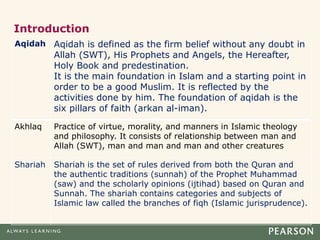
Aqidah Aqidah is defined as the firm belief without any doubt in
Allah (SWT), His Prophets and Angels, the Hereafter,
Holy Book and predestination.
It is the main foundation in Islam and a starting point in
order to be a good Muslim. It is reflected by the
activities done by him. The foundation of aqidah is the
six pillars of faith (arkan al-iman).
Akhlaq Practice of virtue, morality, and manners in Islamic theology
and philosophy. It consists of relationship between man and
Allah (SWT), man and man and man and other creatures
Shariah Shariah is the set of rules derived from both the Quran and
the authentic traditions (sunnah) of the Prophet Muhammad
(saw) and the scholarly opinions (ijtihad) based on Quran and
Sunnah. The shariah contains categories and subjects of
Islamic law called the branches of fiqh (Islamic jurisprudence).
Introduction
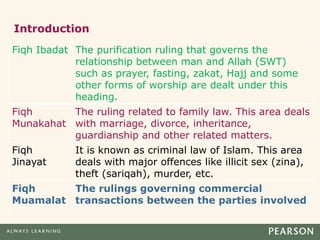
Fiqh Ibadat The purification ruling that governs the
relationship between man and Allah (SWT)
such as prayer, fasting, zakat, Hajj and some
other forms of worship are dealt under this
heading.
Fiqh
Munakahat
The ruling related to family law. This area deals
with marriage, divorce, inheritance,
guardianship and other related matters.
Fiqh
Jinayat
It is known as criminal law of Islam. This area
deals with major offences like illicit sex (zina),
theft (sariqah), murder, etc.
Fiqh
Muamalat
The rulings governing commercial
transactions between the parties involved
Objective of Shariah (Maqasid al Shariah)
• Maqasid means the goals or purposes.
• In Islamic context, it can refer to the purposes
of Islamic faith.
• According to Imam al-Ghazali “the objective of
the shariah is to promote the well-being of all
mankind, which is safeguarding their faith
(deen), their self (nafs), their intellect (aql),
their posterity (nasl) and their wealth (mal)”.
• Whatever ensures the safeguard of these five
principles serves public interest and is therefore
desirable.
• The Muslims scholars have classified the entire
range of masalih into three categories in a
descending order of importance:
Classification of Benefits of the Objectives of
the Shariah
Sources of Shariah
• In general, the source of
shariah is divided into two:
Resources agreed upon by
scholars, and
Resources not agreed upon by
scholars.
 Qur’an:
 it is the word of Allah (SWT) revealed to the Prophet
(saw) in Arabic conveyed by angel Jibril (as). The Quran
is the main primary sources of shariah. It is mu‟jizat
(meaning which may not be understood by someone) and
is immutable and preserved by Allah (SWT).
 Sunnah:
 According to the scholars of science of hadith, sunnah
refer anything which came from the Prophet (saw)
including his acts, sayings, tacit approval as well as
physical attribute.
Resources agreed upon by scholars
Sunnah
• It can be divided into three categories:
–Sunnah Qawliyyah (Sunnah by Words); reciting ways
in prayers,
–Sunnah Fi’liyyah (Sunnah by Action); the Prophet’s
deeds and actual instructions, e.g. the way he
performed prayers, the fasting, the ritual of hajj, sale,
etc.
Resources agreed upon by scholars
Sunnah
–Sunnah Taqririyyah (Sunnah by Agreement);
○The tacitly approved sunnah consist of the acts and
sayings of the companions in the Prophet’s presence
or which came to his knowledge and on which he
remained silent.
○The tacit approval of the Prophet (saw) may be
inferred from his silence, indicating the
permissibility of the acts as the Prophet (saw) would
never keep silent on prohibited things.
Resources agreed upon by scholars
Ijma’ (consensus)
–Ijma‟ is an Arabic term referring to the unanimous
agreement amongst the mujtahidun after the demise
of the Prophet (saw),
Qiyas (Analogy)
–Qiyas refers to the application of an original ruling
(hukm) that has been established in the earlier case
on the current issue on which the law is silent,
The Five Rulings of Islam
• Islamic Law provides levels of rulings and its
enforceability such as the commands, prohibitions
and the options to run or leave an activity/job.
• According to Islamic terminology, the acts of a
Muslim must be guided by the five Islamic
commandments classified as follows:
–Wajib (obligatory)
–Mandub (recommended)
–Haram (prohibited/unlawful),
–Makruh (disapproved)
–Mubah (permissible)
The Five Rulings of Islam
• Wajib (obligatory): wajib means an act the performance
of which is obligatory for the subject. E.g. performing
prayer (solat), fasting Ramadhan, etc. In its technical
sense, it is an act whose commission is demanded by
Allah (SWT) in certain and binding terms.
• Mandub (recommended): it is an act or words
demanded by Allah (SWT) without making it binding
and without assigning any blame for its omission. The
rule for mandub is that for doing so there is reward
(thawab) for the doer, while omitting it entails no
penalty such as giving voluntary charity to the others.
The Five Rulings of Islam
• Haram (prohibited/unlawful). Haram is defined as one which
omission is required by Allah (swt) in binding and certain
terms. E.g. the misappropriation of another’s wealth is a
prohibited act (haram).
• Makruh (disapproved): it is defined as one which omission is
demanded by Allah (swt) in non-binding terms. E.g.
undocumented debt is a reprehensible act (makruh)
disapproved by Islam.
• Mubah (permissible): Mubah act is one in which Allah (swt)
has granted a choice of commission and omission, without
blame or praise for omission or commission. All contracts and
transactions are permissible, unless there is evidence
indicating otherwise.
An Introduction to Muamalat
Introduction to Muamalat
An Introduction
 The literal meaning of the term “muamalat” (plural of
muamalah) is “the transactions‟ while its technical idea is any
form of “mutual dealings” held between men to solve their
everyday needs, especially in trade and commerce.
 Muamalat is also meant a social relationship which consists of
various economic and non-economic activities.
 Basic Principles of Muamalat:
 The following Table (next slide) provides the basic
principles that guides any role of forming shariah
rulings in Islamic transactions (muamalat).
Introduction to Muamalat
Basic Principles of Muamalat
Permissibility
as a General
Rule
The status of all matters other than
rituals is permissible until evidence is
given that a certain matter is
prohibited.
Conclusion of
Contract by
Mutual Consent
Mutual consent means that the
contract entered into by the parties
shall be free from any elements of
coercion, fraud, misrepresentation or
other illegal means
Conformity of
Contract with
the Maqasid al
Shariah
The transaction or contract entered by
individuals shall be accordance with
the maqasid al shariah.
Basic Principles of Muamalat
The Principle of
Wide
Circulation of
Wealth
Wealth and property should be
circulated among the general public
and actively transferred from one hand
to another in the form of expenditures
and investment.
The Principle of
Transparency in
Commercial
Dealing
All financial transactions must be
conducted in such a manner that all
the parties are clear about all the
important facts including the terms
and conditions of their dealings
Justice and Fair
Dealing
Justice is the general principle of
shariah that needs to be observed in
all Islamic transactions and contract.
END

18007272 (1).ppt

  • 1.
    Chapter 1 An Introduction IslamicCommercial Law (Fiqh Muamalat)
  • 2.
    Introduction What is Islam? The Arabic word 'Islam' simply means 'submission', and derived from the word meaning 'peace’.  In a religious context it means complete submission to the will of Allah (SWT). Islam is not mere religion “Deen”,but stands for a way of life.  It touches upon the material as well as spiritual dimensions of human existence.
  • 3.
    The Concept ofIslam  Broken down to its bare elements, Islam comprises of aqidah (a set of beliefs), shariah (a set of laws) and akhlaq (a code of moralities).  The concept of the shariah is not only to govern man in the conduct of his life in order to realize Divine will, but covers all behavior; spiritual, mental as well as physical.  Thus, the shariah principles are more than law, covering the total way of life that includes faith (iman) and practices (amal), personal behavior, legal and social transaction Introduction
  • 5.
    Introduction Aqidah Aqidah isdefined as the firm belief without any doubt in Allah (SWT), His Prophets and Angels, the Hereafter, Holy Book and predestination. It is the main foundation in Islam and a starting point in order to be a good Muslim. It is reflected by the activities done by him. The foundation of aqidah is the six pillars of faith (arkan al-iman). Akhlaq Practice of virtue, morality, and manners in Islamic theology and philosophy. It consists of relationship between man and Allah (SWT), man and man and man and other creatures Shariah Shariah is the set of rules derived from both the Quran and the authentic traditions (sunnah) of the Prophet Muhammad (saw) and the scholarly opinions (ijtihad) based on Quran and Sunnah. The shariah contains categories and subjects of Islamic law called the branches of fiqh (Islamic jurisprudence).
  • 6.
    Introduction Fiqh Ibadat Thepurification ruling that governs the relationship between man and Allah (SWT) such as prayer, fasting, zakat, Hajj and some other forms of worship are dealt under this heading. Fiqh Munakahat The ruling related to family law. This area deals with marriage, divorce, inheritance, guardianship and other related matters. Fiqh Jinayat It is known as criminal law of Islam. This area deals with major offences like illicit sex (zina), theft (sariqah), murder, etc. Fiqh Muamalat The rulings governing commercial transactions between the parties involved
  • 7.
    Objective of Shariah(Maqasid al Shariah) • Maqasid means the goals or purposes. • In Islamic context, it can refer to the purposes of Islamic faith. • According to Imam al-Ghazali “the objective of the shariah is to promote the well-being of all mankind, which is safeguarding their faith (deen), their self (nafs), their intellect (aql), their posterity (nasl) and their wealth (mal)”. • Whatever ensures the safeguard of these five principles serves public interest and is therefore desirable.
  • 8.
    • The Muslimsscholars have classified the entire range of masalih into three categories in a descending order of importance: Classification of Benefits of the Objectives of the Shariah
  • 9.
    Sources of Shariah •In general, the source of shariah is divided into two: Resources agreed upon by scholars, and Resources not agreed upon by scholars.
  • 10.
     Qur’an:  itis the word of Allah (SWT) revealed to the Prophet (saw) in Arabic conveyed by angel Jibril (as). The Quran is the main primary sources of shariah. It is mu‟jizat (meaning which may not be understood by someone) and is immutable and preserved by Allah (SWT).  Sunnah:  According to the scholars of science of hadith, sunnah refer anything which came from the Prophet (saw) including his acts, sayings, tacit approval as well as physical attribute. Resources agreed upon by scholars
  • 11.
    Resources agreed uponby scholars Sunnah • It can be divided into three categories: –Sunnah Qawliyyah (Sunnah by Words); reciting ways in prayers, –Sunnah Fi’liyyah (Sunnah by Action); the Prophet’s deeds and actual instructions, e.g. the way he performed prayers, the fasting, the ritual of hajj, sale, etc.
  • 12.
    Resources agreed uponby scholars Sunnah –Sunnah Taqririyyah (Sunnah by Agreement); ○The tacitly approved sunnah consist of the acts and sayings of the companions in the Prophet’s presence or which came to his knowledge and on which he remained silent. ○The tacit approval of the Prophet (saw) may be inferred from his silence, indicating the permissibility of the acts as the Prophet (saw) would never keep silent on prohibited things.
  • 13.
    Resources agreed uponby scholars Ijma’ (consensus) –Ijma‟ is an Arabic term referring to the unanimous agreement amongst the mujtahidun after the demise of the Prophet (saw), Qiyas (Analogy) –Qiyas refers to the application of an original ruling (hukm) that has been established in the earlier case on the current issue on which the law is silent,
  • 14.
    The Five Rulingsof Islam • Islamic Law provides levels of rulings and its enforceability such as the commands, prohibitions and the options to run or leave an activity/job. • According to Islamic terminology, the acts of a Muslim must be guided by the five Islamic commandments classified as follows: –Wajib (obligatory) –Mandub (recommended) –Haram (prohibited/unlawful), –Makruh (disapproved) –Mubah (permissible)
  • 15.
    The Five Rulingsof Islam • Wajib (obligatory): wajib means an act the performance of which is obligatory for the subject. E.g. performing prayer (solat), fasting Ramadhan, etc. In its technical sense, it is an act whose commission is demanded by Allah (SWT) in certain and binding terms. • Mandub (recommended): it is an act or words demanded by Allah (SWT) without making it binding and without assigning any blame for its omission. The rule for mandub is that for doing so there is reward (thawab) for the doer, while omitting it entails no penalty such as giving voluntary charity to the others.
  • 16.
    The Five Rulingsof Islam • Haram (prohibited/unlawful). Haram is defined as one which omission is required by Allah (swt) in binding and certain terms. E.g. the misappropriation of another’s wealth is a prohibited act (haram). • Makruh (disapproved): it is defined as one which omission is demanded by Allah (swt) in non-binding terms. E.g. undocumented debt is a reprehensible act (makruh) disapproved by Islam. • Mubah (permissible): Mubah act is one in which Allah (swt) has granted a choice of commission and omission, without blame or praise for omission or commission. All contracts and transactions are permissible, unless there is evidence indicating otherwise.
  • 17.
  • 18.
    Introduction to Muamalat AnIntroduction  The literal meaning of the term “muamalat” (plural of muamalah) is “the transactions‟ while its technical idea is any form of “mutual dealings” held between men to solve their everyday needs, especially in trade and commerce.  Muamalat is also meant a social relationship which consists of various economic and non-economic activities.
  • 19.
     Basic Principlesof Muamalat:  The following Table (next slide) provides the basic principles that guides any role of forming shariah rulings in Islamic transactions (muamalat). Introduction to Muamalat
  • 20.
    Basic Principles ofMuamalat Permissibility as a General Rule The status of all matters other than rituals is permissible until evidence is given that a certain matter is prohibited. Conclusion of Contract by Mutual Consent Mutual consent means that the contract entered into by the parties shall be free from any elements of coercion, fraud, misrepresentation or other illegal means Conformity of Contract with the Maqasid al Shariah The transaction or contract entered by individuals shall be accordance with the maqasid al shariah.
  • 21.
    Basic Principles ofMuamalat The Principle of Wide Circulation of Wealth Wealth and property should be circulated among the general public and actively transferred from one hand to another in the form of expenditures and investment. The Principle of Transparency in Commercial Dealing All financial transactions must be conducted in such a manner that all the parties are clear about all the important facts including the terms and conditions of their dealings Justice and Fair Dealing Justice is the general principle of shariah that needs to be observed in all Islamic transactions and contract.
  • 22.