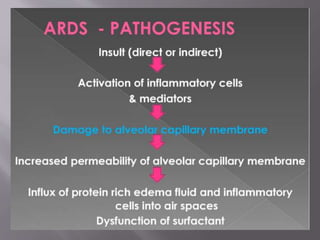
1
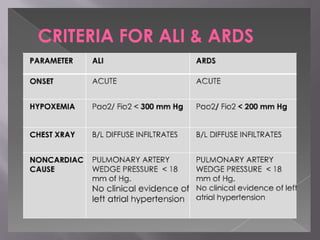
๏‚จ a clinical syndrome of severe dyspnea of rapid
onset, hypoxemia, and diffuse pulmonary infiltrates
leading to respiratory failure.
๏‚จ caused by diffuse lung injury from many underlying
medical and surgical disorders.
3
10
13
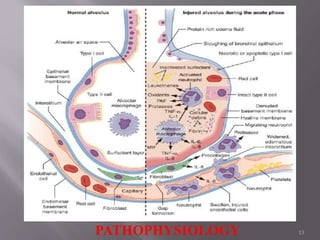
PATHOPHYSIOLOGY
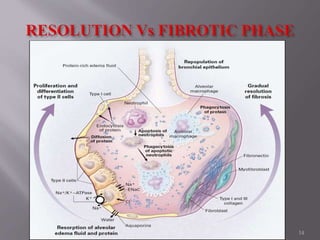
14
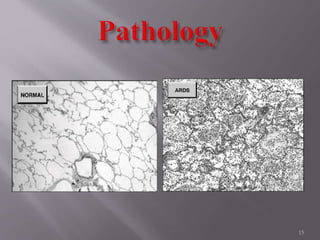
15
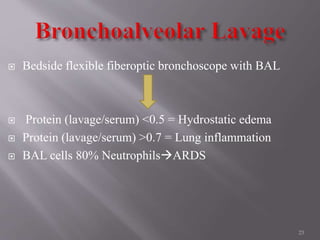
๏‚จ Bedside flexible fiberoptic bronchoscope with BAL
๏‚จ Protein (lavage/serum) <0.5 = Hydrostatic edema
๏‚จ Protein (lavage/serum) >0.7 = Lung inflammation
๏‚จ BAL cells 80% Neutrophils๏ƒ ARDS
23
๏‚จ Sensitive than CXR
๏‚จ Earlier detection.
๏‚จ Patchy abnormalities with increased density in dependent
lung zones.
๏‚จ Also detects pneumothorax, effusions and
pneumomediastinum, cavitation, and mediastinal
lymphadenopathy.
๏‚จ Potential benefit must be weighed against the risk
associated with transporting a critically ill patient.
24
๏‚จ Echocardiography.
๏‚จ (Brain Natriuretic Peptide) BNP <100 pg/ml suggestive
of ARDS/ALI.
๏‚จ Invasive Hemodynamic Monitoring
๏‚ก A PCWP<18 mm Hg consistent with noncardiogenic
๏‚ก Supporting evidence of Sepsis
๏‚ก Fluid Management
25
๏‚จ Treatment of the underlying disorders
๏‚จ Mechanical Ventilation
๏‚จ Prophylaxis against
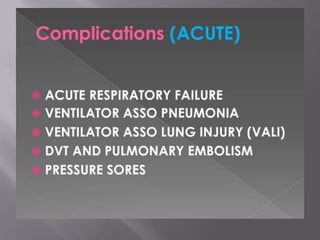
๏‚ก DVT
๏‚ก Stress Ulcer
๏‚ก Aspiration
๏‚ก CVP infections
๏‚จ Prompt recognition of nosocomial infections
๏‚จ Adequate nutrition.
26
๏‚จ Sometimes CPAP ventilation alone may be
sufficient to improve oxygenation.
๏‚จ Less invasive, less complication.
๏‚จ Lack of enough study and lack of definite
guidelines.
27
๏‚จ Goals
๏‚ก Maintain oxygenation.
๏‚ก Avoid oxygen toxicity.
๏‚ก Avoid complications of mechanical ventilation.
๏‚จ Target
๏‚ก SpO2 @ 85-90% with FIO2< 65% within first 24-48
hours.
28
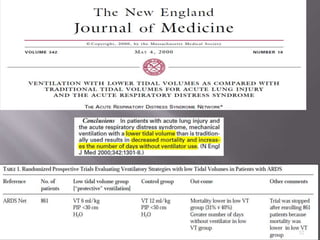
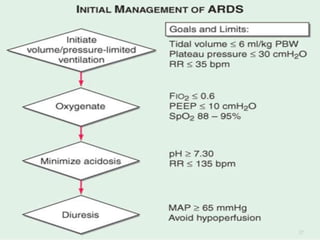
๏‚จ Conventional tidal volume๏ƒ 12 mL/kg
๏‚จ Low tidal volume๏ƒ 6ml/kg
๏‚จ was associated with a 9% (absolute) reduction in
mortality when the end inspiratory plateau pressure
was <30 cm H2O (18).
31
32
๏‚จ One of the consequences of low volume ventilation is
hypercapnia and respiratory acidosis.
๏‚จ Data from clinical trials shows PCO2 60 -70 mm Hg
with pH-7.2- 7.25 safe for most patients.
๏‚จ Brainstem respiratory stimulation with subsequent
hyperventilation๏ƒ ventilator asynchrony.
๏‚จ Hypercapneic acidosis may down-regulate
inflammatory cell activity, and may inhibit xanthine
oxidase, thus reducing oxidant stress. 33
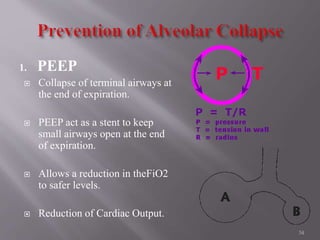
1. PEEP
๏‚จ Collapse of terminal airways at
the end of expiration.
๏‚จ PEEP act as a stent to keep
small airways open at the end
of expiration.
๏‚จ Allows a reduction in theFiO2
to safer levels.
๏‚จ Reduction of Cardiac Output.
34
35
2.โ€œInverse Ratio ventilationโ€
๏‚จ Increasing Inspiration time such that I:E > 1:1
๏‚จ Advantage of improving oxygenation allowing FI02
reduction.
๏‚จ Diminished time to exhale, dynamic hyperinflation leading
to increased end-expiratory pressure, similar to ventilator
prescribed PEEP(Auto-PEEP generation)
๏‚จ Sedation & Paralysis.
๏‚จ No mortality benefit in ARDS has been demonstrated.
36
๏‚จ Partial liquid ventilation (PLV) with perfluorocarbon
๏‚ก An inert, high-density liquid that easily solubilizes oxygen
and carbon dioxide
๏‚ก Filling the lung with liquid removes the air-liquid interface
and supports alveoli thus preventing their collapse
๏‚ก Promising preliminary tests
๏‚ก Associated with increased incidence of pneumothorax,
mucus plugging and disruption of normal surfactant system
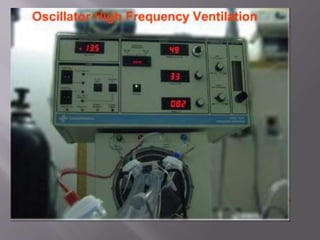
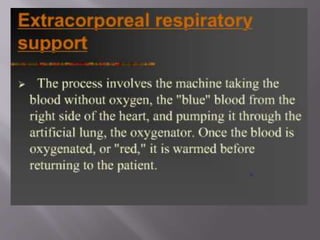
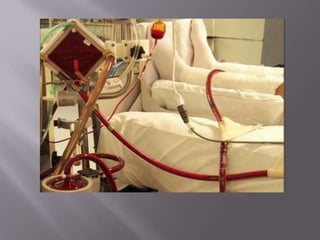
๏ฑ Lung-replacement therapy with extracorporeal membrane
oxygenation (ECMO) - survival benefit in neonatal
respiratory distress syndrome, may also have utility in select
adult patients with ARDS.
37
๏‚จ Maintain a normal or low left atrial filling pressure
๏‚จ Minimizes pulmonary edema
๏‚จ prevents further decrements
๏‚ก in arterial oxygenation
๏‚ก lung compliance
๏‚จ Shortens
๏‚ก ICU stay
๏‚ก duration of mechanical ventilation
๏‚จ limited by
๏‚ก Hypotension -- Add up to reduce venous return by PEEP
๏‚ก โ€œDiuretics don't reduce inflammationโ€™โ€™ 38
๏‚จ Dobutamine is preferred ionotrope.
๏‚จ Dopamine
๏‚ก Avoided
๏‚ก Constricts pulmonary veins
๏‚ก Increase shunting
39
๏‚จ Despite nearly forty years of active research in
search of a cure, ARDS remains an untreatable
condition.
40
๏‚จ Anti-Inflammatory.
๏‚จ Ability to promote collagen breakdown and inhibit
fibrosis.
๏‚จ Methylprednisolone @ 2 to 3 mg/kg/day.
41
42
๏‚จ A randomized, clinical trial determined that
simvastatin, a hydroxymethylglutaryl-coenzyme A
reductase inhibitor,improved oxygenation and
respiratory mechanics in patients with ALI. Further
studies are needed, but treatment with simvastatin
appears safe and may be associated with improved
organ dysfunction in patients with ALI.
43
44
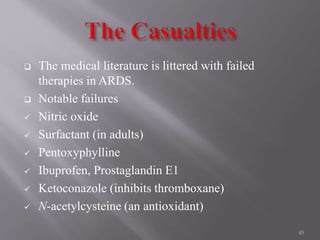
๏ฑ The medical literature is littered with failed
therapies in ARDS.
๏ฑ Notable failures
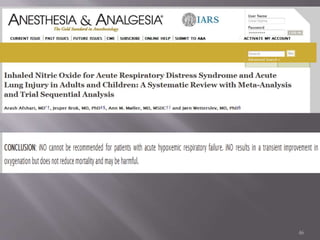
๏ƒผ Nitric oxide
๏ƒผ Surfactant (in adults)
๏ƒผ Pentoxyphylline
๏ƒผ Ibuprofen, Prostaglandin E1
๏ƒผ Ketoconazole (inhibits thromboxane)
๏ƒผ N-acetylcysteine (an antioxidant)
45
46
๏‚จ Rationale for Use
๏‚ก BAL from patients with ARDS have lower concentrations
of surfactant proteins.
๏‚ก Successful trials in premature infants.
๏‚ก Improve oxygenation acutely.
๏‚ก Rapid weaning from mechanical ventilation.
47
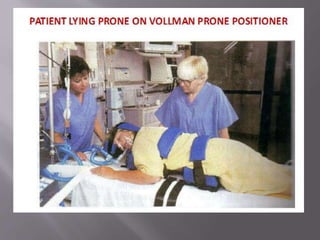
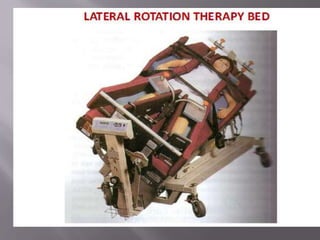
Basis for Recommendation
๏‚จ More recruitment of atelectatic dorsal lung regions
๏‚จ Decrease in abdominal compression of the thorax
๏‚จ Mobilisation and removal of secretions
๏‚จ Improve oxygenation in 70% of patients with ARDS
๏‚จ Effect that persists in 50% after returning to the supine
position.
Repositioning critically ill patients can be
hazardous
48
56
57
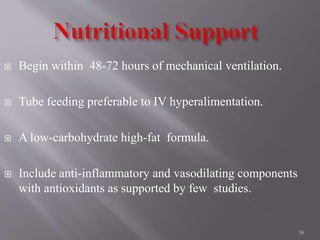
๏‚จ Begin within 48-72 hours of mechanical ventilation.
๏‚จ Tube feeding preferable to IV hyperalimentation.
๏‚จ A low-carbohydrate high-fat formula.
๏‚จ Include anti-inflammatory and vasodilating components
with antioxidants as supported by few studies.
58
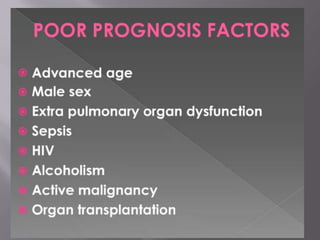
๏‚จ Recent mortality estimates for ARDS range from 26 to 44%.
๏‚จ Mortality in ARDS is largely attributable to nonpulmonary
causes, with sepsis and nonpulmonary organ failure accounting
for >80% of deaths.
๏‚จ Advanced age ,Preexisting organ dysfunction are separate
predicotors of mortality.
๏‚จ Little value in predicting mortality from lung severity index
๏‚ก the PaO2/FIO2 ratio
๏‚ก the level of PEEP used in mechanical ventilation,
๏‚ก the respiratorycompliance,
๏‚ก the extent of alveolar infiltrates on chest radiography,
๏‚ก the lung injury score
61
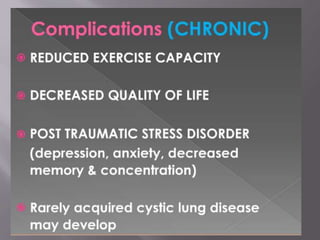
๏‚จ Patients usually recover their maximum lung function
within 6 months.
๏‚จ One year after endotracheal extubation, more than one-
third of ARDS survivors have normal spirometry values
and diffusion capacity.
๏‚จ Severity Index & duration of mechanical ventilation are
associated with worse recovery of pulmonary function.
๏‚จ Significant rates of depression and PTSD in ARDS 62

17.ARDS.ppt

  • 1.
  • 2.
    ๏‚จ a clinicalsyndrome of severe dyspnea of rapid onset, hypoxemia, and diffuse pulmonary infiltrates leading to respiratory failure. ๏‚จ caused by diffuse lung injury from many underlying medical and surgical disorders.
  • 3.
  • 10.
  • 13.
  • 14.
  • 15.
  • 23.
    ๏‚จ Bedside flexiblefiberoptic bronchoscope with BAL ๏‚จ Protein (lavage/serum) <0.5 = Hydrostatic edema ๏‚จ Protein (lavage/serum) >0.7 = Lung inflammation ๏‚จ BAL cells 80% Neutrophils๏ƒ ARDS 23
  • 24.
    ๏‚จ Sensitive thanCXR ๏‚จ Earlier detection. ๏‚จ Patchy abnormalities with increased density in dependent lung zones. ๏‚จ Also detects pneumothorax, effusions and pneumomediastinum, cavitation, and mediastinal lymphadenopathy. ๏‚จ Potential benefit must be weighed against the risk associated with transporting a critically ill patient. 24
  • 25.
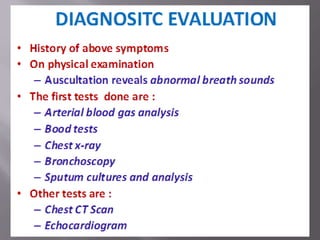
    ๏‚จ Echocardiography. ๏‚จ (BrainNatriuretic Peptide) BNP <100 pg/ml suggestive of ARDS/ALI. ๏‚จ Invasive Hemodynamic Monitoring ๏‚ก A PCWP<18 mm Hg consistent with noncardiogenic ๏‚ก Supporting evidence of Sepsis ๏‚ก Fluid Management 25
  • 26.
    ๏‚จ Treatment ofthe underlying disorders ๏‚จ Mechanical Ventilation ๏‚จ Prophylaxis against ๏‚ก DVT ๏‚ก Stress Ulcer ๏‚ก Aspiration ๏‚ก CVP infections ๏‚จ Prompt recognition of nosocomial infections ๏‚จ Adequate nutrition. 26
  • 27.
    ๏‚จ Sometimes CPAPventilation alone may be sufficient to improve oxygenation. ๏‚จ Less invasive, less complication. ๏‚จ Lack of enough study and lack of definite guidelines. 27
  • 28.
    ๏‚จ Goals ๏‚ก Maintainoxygenation. ๏‚ก Avoid oxygen toxicity. ๏‚ก Avoid complications of mechanical ventilation. ๏‚จ Target ๏‚ก SpO2 @ 85-90% with FIO2< 65% within first 24-48 hours. 28
  • 31.
    ๏‚จ Conventional tidalvolume๏ƒ 12 mL/kg ๏‚จ Low tidal volume๏ƒ 6ml/kg ๏‚จ was associated with a 9% (absolute) reduction in mortality when the end inspiratory plateau pressure was <30 cm H2O (18). 31
  • 32.
  • 33.
    ๏‚จ One ofthe consequences of low volume ventilation is hypercapnia and respiratory acidosis. ๏‚จ Data from clinical trials shows PCO2 60 -70 mm Hg with pH-7.2- 7.25 safe for most patients. ๏‚จ Brainstem respiratory stimulation with subsequent hyperventilation๏ƒ ventilator asynchrony. ๏‚จ Hypercapneic acidosis may down-regulate inflammatory cell activity, and may inhibit xanthine oxidase, thus reducing oxidant stress. 33
  • 34.
    1. PEEP ๏‚จ Collapseof terminal airways at the end of expiration. ๏‚จ PEEP act as a stent to keep small airways open at the end of expiration. ๏‚จ Allows a reduction in theFiO2 to safer levels. ๏‚จ Reduction of Cardiac Output. 34
  • 35.
  • 36.
    2.โ€œInverse Ratio ventilationโ€ ๏‚จIncreasing Inspiration time such that I:E > 1:1 ๏‚จ Advantage of improving oxygenation allowing FI02 reduction. ๏‚จ Diminished time to exhale, dynamic hyperinflation leading to increased end-expiratory pressure, similar to ventilator prescribed PEEP(Auto-PEEP generation) ๏‚จ Sedation & Paralysis. ๏‚จ No mortality benefit in ARDS has been demonstrated. 36
  • 37.
    ๏‚จ Partial liquidventilation (PLV) with perfluorocarbon ๏‚ก An inert, high-density liquid that easily solubilizes oxygen and carbon dioxide ๏‚ก Filling the lung with liquid removes the air-liquid interface and supports alveoli thus preventing their collapse ๏‚ก Promising preliminary tests ๏‚ก Associated with increased incidence of pneumothorax, mucus plugging and disruption of normal surfactant system ๏ฑ Lung-replacement therapy with extracorporeal membrane oxygenation (ECMO) - survival benefit in neonatal respiratory distress syndrome, may also have utility in select adult patients with ARDS. 37
  • 38.
    ๏‚จ Maintain anormal or low left atrial filling pressure ๏‚จ Minimizes pulmonary edema ๏‚จ prevents further decrements ๏‚ก in arterial oxygenation ๏‚ก lung compliance ๏‚จ Shortens ๏‚ก ICU stay ๏‚ก duration of mechanical ventilation ๏‚จ limited by ๏‚ก Hypotension -- Add up to reduce venous return by PEEP ๏‚ก โ€œDiuretics don't reduce inflammationโ€™โ€™ 38
  • 39.
    ๏‚จ Dobutamine ispreferred ionotrope. ๏‚จ Dopamine ๏‚ก Avoided ๏‚ก Constricts pulmonary veins ๏‚ก Increase shunting 39
  • 40.
    ๏‚จ Despite nearlyforty years of active research in search of a cure, ARDS remains an untreatable condition. 40
  • 41.
    ๏‚จ Anti-Inflammatory. ๏‚จ Abilityto promote collagen breakdown and inhibit fibrosis. ๏‚จ Methylprednisolone @ 2 to 3 mg/kg/day. 41
  • 42.
  • 43.
    ๏‚จ A randomized,clinical trial determined that simvastatin, a hydroxymethylglutaryl-coenzyme A reductase inhibitor,improved oxygenation and respiratory mechanics in patients with ALI. Further studies are needed, but treatment with simvastatin appears safe and may be associated with improved organ dysfunction in patients with ALI. 43
  • 44.
  • 45.
    ๏ฑ The medicalliterature is littered with failed therapies in ARDS. ๏ฑ Notable failures ๏ƒผ Nitric oxide ๏ƒผ Surfactant (in adults) ๏ƒผ Pentoxyphylline ๏ƒผ Ibuprofen, Prostaglandin E1 ๏ƒผ Ketoconazole (inhibits thromboxane) ๏ƒผ N-acetylcysteine (an antioxidant) 45
  • 46.
  • 47.
    ๏‚จ Rationale forUse ๏‚ก BAL from patients with ARDS have lower concentrations of surfactant proteins. ๏‚ก Successful trials in premature infants. ๏‚ก Improve oxygenation acutely. ๏‚ก Rapid weaning from mechanical ventilation. 47
  • 48.
    Basis for Recommendation ๏‚จMore recruitment of atelectatic dorsal lung regions ๏‚จ Decrease in abdominal compression of the thorax ๏‚จ Mobilisation and removal of secretions ๏‚จ Improve oxygenation in 70% of patients with ARDS ๏‚จ Effect that persists in 50% after returning to the supine position. Repositioning critically ill patients can be hazardous 48
  • 56.
  • 57.
  • 58.
    ๏‚จ Begin within48-72 hours of mechanical ventilation. ๏‚จ Tube feeding preferable to IV hyperalimentation. ๏‚จ A low-carbohydrate high-fat formula. ๏‚จ Include anti-inflammatory and vasodilating components with antioxidants as supported by few studies. 58
  • 61.
    ๏‚จ Recent mortalityestimates for ARDS range from 26 to 44%. ๏‚จ Mortality in ARDS is largely attributable to nonpulmonary causes, with sepsis and nonpulmonary organ failure accounting for >80% of deaths. ๏‚จ Advanced age ,Preexisting organ dysfunction are separate predicotors of mortality. ๏‚จ Little value in predicting mortality from lung severity index ๏‚ก the PaO2/FIO2 ratio ๏‚ก the level of PEEP used in mechanical ventilation, ๏‚ก the respiratorycompliance, ๏‚ก the extent of alveolar infiltrates on chest radiography, ๏‚ก the lung injury score 61
  • 62.
    ๏‚จ Patients usuallyrecover their maximum lung function within 6 months. ๏‚จ One year after endotracheal extubation, more than one- third of ARDS survivors have normal spirometry values and diffusion capacity. ๏‚จ Severity Index & duration of mechanical ventilation are associated with worse recovery of pulmonary function. ๏‚จ Significant rates of depression and PTSD in ARDS 62

Editor's Notes

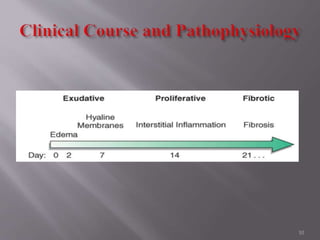
  • #11ย Rough concept of chronological events (after discussion of the main diagram) proliferative phase is a junction from where either resolution or fibrosis occurs. The presence of alveolar type III procollagen peptide, a marker of pulmonary fibrosis, is associated with a protracted clinical course and increased mortality from ARDS More characteristically there is predominant interstial odema and shift from neutrophil predominant to lymphocyte predominant infiltrate
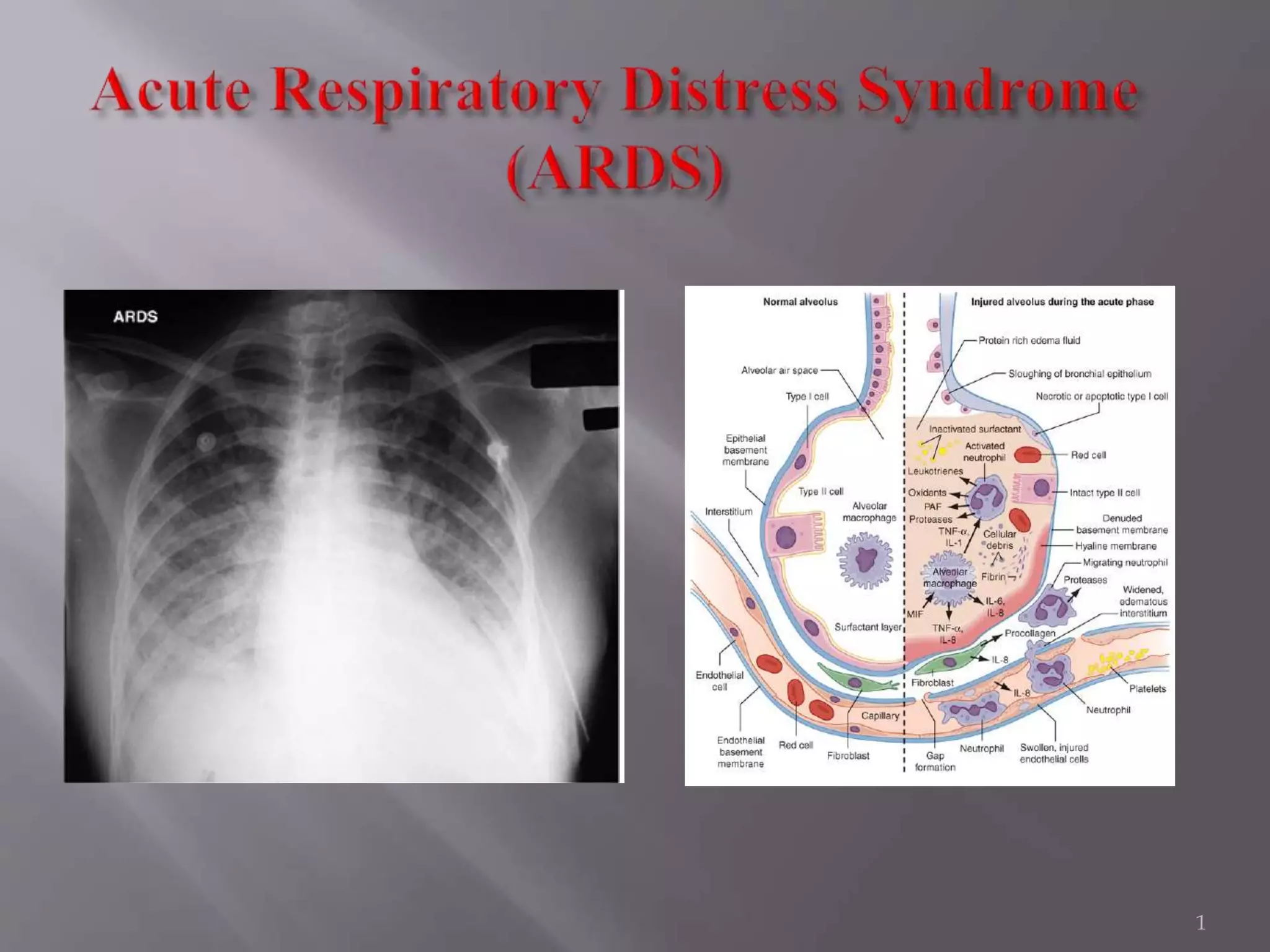
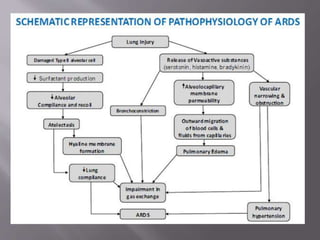
  • #14ย Left hand show nice aerated alveolus withโ€ฆ. Under the influence of proinflammatory cytokines released by macrophages, neutrophils initially undergo sequestration in the pulmonary microvasculature, followed by margination and egress into the alveolar space. organization of alveolar exudates forming hyaline membrane The neutrophils then release the contents of their cytoplasmic granules (i.e., proteolytic enzymes and toxic oxygen metabolites), and this damages the endothelium and leads to a leaky-capillary type of exudation into the lung parenchyma
  • #15ย As a part of reparative process or resoultion, Resorption of alveolar edema fluid โ€ฆ.surfactantโ€ฆ..differentiate into type one While many patients with ARDS recover lung function 3โ€“4 weeks after the initial pulmonary injury, some will enter a fibrotic phase that may require long-term support on mechanical ventilators and/or supplemental oxygen. Histologically, the alveolar edema and inflammatory exudates of earlier phases are now converted to extensive alveolar duct and interstitial fibrosis. Acinar architecture is markedly disrupted, leading to emphysema-like changes with large bullae. Intimal fibroproliferation in the pulmonary microcirculation leads to progressive vascular occlusion and pulmonary hypertension The physiologic consequences include an increased risk of pneumothorax, reductions in lung compliance, and increased pulmonary dead space. Gradual remodeling and resolution of intraalveolar and interstitial granulation tissue and fibrosis are shown.
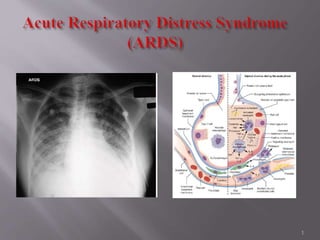
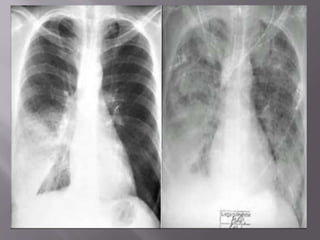
  • #16ย Putting this slide ahead For concept of lungs in Normal Spacious, roomy aerated alveoulos Note the dense infiltration of inflammatory flooded with tiny dot like inflammatory cells in ARDS and the obliteration of the distal airspaces.
  • #24ย  In normal subjects, neutrophils make up less than 5% of the cells recovered in lung lavage fluid, whereas in patients with ARDS, as many as 80% of the recovered cells are neutrophils eosinophilic pneumonia. Pneumocystis.
  • #26ย the based upon thermodilution cardiac output, right atrial pressure, and mean arterial pressure may provide
  • #27ย efficient. More than 60% ARDS patients experience a (nosocomial) pulmonary infection either before or after the onset of lung injury. Because infection is often the underlying cause of ARDS, early administration of appropriate antibiotic therapy broad enough to cover suspected pathogens is essential Other important interventions in sepsis have included early goal-directed therapy, use of drotrecogin alfa (Xigris) in selected patients with severe sepsis (APACHE score โ‰ฅ25) and no contraindications, prevention of bleeding complications by means of prophylaxis for deep venous thrombosis (DVT) and stress ulcers, early mobilization, turning and skin care, removal of catheters and tubes as soon as possible, and elevation of the head of the bed and other strategies to prevent ventilator-associated pneumonia, including facilitation of weaning from mechanical ventilation by daily interruption of sedation coordinated with daily spontaneous breathing trials.
  • #28ย Because intubation and mechanical ventilation may be associated with an increased incidence of complications, such as barotrauma and nosocomial pneumonia
  • #32ย Low tidal volumes (Vt) may cause hypercapnia and atelectasis[1] due to their inherent tendency to increase Dead space (physiology.
  • #33ย most substantial benefit in ARDS mortality demonstrated for any therapeutic intervention in ARDS to date.
  • #35ย Marked reduction of lung compliance absorption atelectasis, lung toxicity and possibly, systemic toxicity set PEEP to minimize FIO2 and optimize PaO2 air spaces that are filled with exudate and not recruitable, and (c) areas that are collapsed due to interstitial infiltration and are potentially recruitable. Recruitment is a strategy aimed at re-expanding collapsed lung tissue, and then maintaining high PEEP to prevent subsequent โ€˜de-recruitment ARDS causes redistribution of pulmonary blood flow away from dependent lung regions that exhibit increased pulmonary vascular resistance (PVR) because of pulmonary edema. PEEP may lower the PVR hence improving V/Q matching by shifting pulmonary blood flow from non-dependant lung regions to dependant The PEEP is effective in early ARDS, because it acts as a counterforce, preventing the compression atelectasis secondary to severe pulmonary edema whereas the fibro-proliferative processes may explain the lack of effects of PEEP in the late stage of ARDS Through stepwise increases in PEEP (increments of 2-3), a level should be sought that maintains approximately 90% arterial oxygen saturation at 50-60% FiO2. Application of PEEP beyond 15-20 cm H2O may result in decreased venous return (hence ensure normal volume prior to starting PEEP), in turn reducing the cardiac output If volume loading is insufficient, the next step to restore cardiac output would be to add inotropes. If cardiac output still remains depressed, PEEP needs to be decreased stepwise until cardiac output is restored PEEP optimization may lead to lung protection via mechanisms other than alveolar recruitment -for example, by avoiding surfactant depletion and disruption occurring at low end-expiratory lung volumes.24 There are normal alveoli which are always inflated and engaging in gas exchange, flooded alveoli which can never, under any ventilatory regime, be used for gas exchange, and atelectatic or partially flooded alveoli that can be "recruited" to participate in gas exchange under certain ventilatory regimens. The recruitable aveoli represent a continuous population, some of which can be recruited with minimal PEEP, and others which can only be recruited with high levels of PEEP. An additional complication is that some or perhaps most alveoli can only be opened with higher airway pressures than are needed to keep them open the use of CPAP or PEEP usually promotes improved oxygenation, allowing the FIO2 to be tapered. With PEEP, positive pressure is maintained throughout expiration, but when the patient inhales spontaneously, airway pressure decreases to below zero to trigger airflow. With CPAP, a low-resistance demand valve is used to allow positive pressure to be maintained continuously.
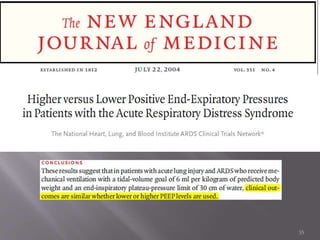
  • #36ย In the ARDS Network clinical trial, it was concluded that in patients with acute lung injury and ARDS who received mechanical ventilation with lower tidal volumes and inspiratory pressures (all patients received a tidalvolume goal of 6 ml per kilogram of predicted body weight and an inspiratory plateau pressure of 30 cm of water or less), raising PEEP to levels that exceeded those used in their lower-PEEP strategy (8.3ยฑ3.2 cm of water in the lower-PEEP group and 13.2ยฑ3.5 cm of water in the higher-PEEP group) did not achieve statistically significant survival benefit.27
  • #37ย On the other hand, there is the potential of developing dynamic hyperinflation and auto-PEEP (which may be undesirable) during inverse ratio ventilation (IRV), which is an extreme form of lengthening the Ti. NEJM 1995 Review Article: ARDS & I:E Inverse ratio ventilation should still be considered experimental since it has not been prospectively evaluated... therefore, until further studies have been performed, we recommend that โ€˜reversal' be considered only when acceptable arterial oxygenation cannot be achieved with a PEEP <15 cm H20 or when the use of PEEP is associated with excessive peak airway pressures. However, โ€œReverse Ventilationโ€ usually requires heavy sedation & paralysis
  • #39ย hypoperfusion of critical organs Diuretic therapy can then be tailored to achieve the lowest cardiac filling pressures that do not compromise cardiac output and systemic oxygen transport
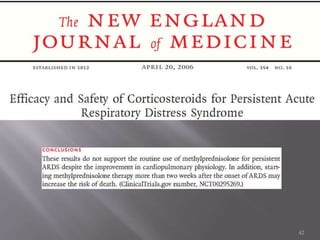
  • #42ย They concluded that, if administered before end-stage fibrosis develops, methylprednisolone therapy could be effective in improving lung function and outcome in patients with unresolving ARDS They concluded that, if administered before end-stage fibrosis develops, methylprednisolone therapy could be effective in improving lung function and outcome in patients with unresolving ARDS
  • #43ย increased risk of superinfections
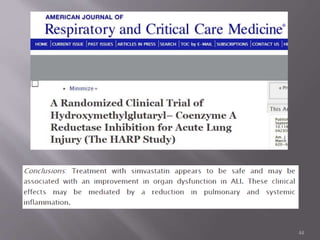
  • #44ย Craig TR, Duffy MJ, Shyamsundar M, McDowell C, O'Kane CM, Elborn JS, et al. A Randomized Clinical Trial of Hydroxymethylglutaryl- Coenzyme A Reductase Inhibition for Acute Lung Injury (The HARP Study) Am J Respir Crit Care Med. Mar 12011;183(5):620-6. [Medline].
  • #47ย Methemoglobinemia, decreased platelet aggregation and rebound deterioration in arterial oxygenation and elevation of pulmonary arterial pressure are significant possible side effects Sildenafil
  • #48ย of phosphatidyl choline, phosphatidyl glycerol, and Preferential deposition in healthy lung units, inactivation in damaged alveoli, and variable delivery systems may all contribute to failure in these trials.65
  • #49ย Leading to accidental endotracheal extubation, loss of central venous catheters, and orthopedic injury
  • #57ย open lung approach optimal level of PEEP is just above the lower inflection point. Using this approach, the average PEEP level required is 15.
  • #59ย unless it is contraindicated because of an acute abdomen, ileus, GI bleeding, or other conditions. eicosapentaenoic acid and linoleic acid
  • #62ย  Risk factors predictive of increased mortality in ARDS/ ALI as reviewed by Vasudevan A et al include liver dysfunction, age, sepsis, HIV infection, oxygenation index, length of mechanical ventilation prior to ARDS, mechanism of lung injury, right ventricular dysfunction and PaO2/FiO2 ratio less than 100. 11,12,13,14 ,15 liver disease, cirrhosis, chronic alcohol abuse, chronic immunosuppression, sepsis chronic renal disease, any nonpulmonary organ failure, and increased APACHE III scores