3
Sequential Pattern Mining
Sequential Pattern and Sequential Pattern Mining
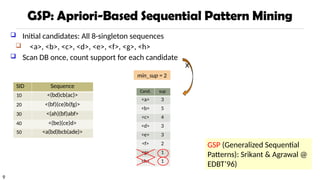
GSP: Apriori-Based Sequential Pattern Mining
SPADE: Sequential Pattern Mining in Vertical Data Format
PrefixSpan: Sequential Pattern Mining by Pattern-Growth
CloSpan: Mining Closed Sequential Patterns
Constraint-Based Sequential-Pattern Mining
4.
4
Sequential Pattern Mining
What kind of patterns are sequential?
Sequential: The order really matters
You cannot swap two items in a sequence and have the same sequence
Example: The English language is sequential: Subject → Verb → Object
Other points:
For Sequential Pattern Mining, the time which the items occur is not
considered
Time Series Analysis does take into account the time in which an item
occurred
5.
5
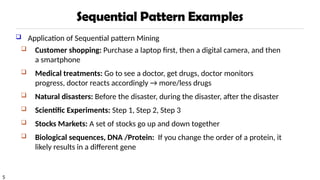
Sequential Pattern Examples
Application of Sequential pattern Mining
Customer shopping: Purchase a laptop first, then a digital camera, and then
a smartphone
Medical treatments: Go to see a doctor, get drugs, doctor monitors
progress, doctor reacts accordingly → more/less drugs
Natural disasters: Before the disaster, during the disaster, after the disaster
Scientific Experiments: Step 1, Step 2, Step 3
Stocks Markets: A set of stocks go up and down together
Biological sequences, DNA /Protein: If you change the order of a protein, it
likely results in a different gene
6.
6
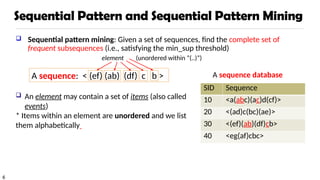
Sequential Pattern andSequential Pattern Mining
Sequential pattern mining: Given a set of sequences, find the complete set of
frequent subsequences (i.e., satisfying the min_sup threshold)
A sequence database
An element may contain a set of items (also called
events)
* Items within an element are unordered and we list
them alphabetically
A sequence: < (ef) (ab) (df) c b >
SID Sequence
10 <a(abc)(ac)d(cf)>
20 <(ad)c(bc)(ae)>
30 <(ef)(ab)(df)cb>
40 <eg(af)cbc>
element (unordered within “(..)”)
7.
7
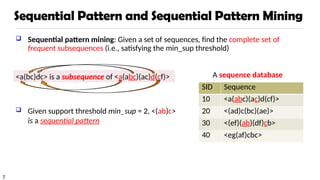
Sequential Pattern andSequential Pattern Mining
Sequential pattern mining: Given a set of sequences, find the complete set of
frequent subsequences (i.e., satisfying the min_sup threshold)
<a(bc)dc> is a subsequence of <a(abc)(ac)d(cf)>
Given support threshold min_sup = 2, <(ab)c>
is a sequential pattern
SID Sequence
10 <a(abc)(ac)d(cf)>
20 <(ad)c(bc)(ae)>
30 <(ef)(ab)(df)cb>
40 <eg(af)cbc>
A sequence database
8.
8
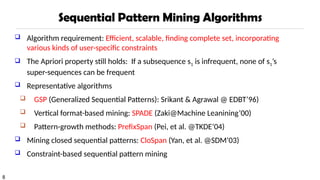
Sequential Pattern MiningAlgorithms
Algorithm requirement: Efficient, scalable, finding complete set, incorporating
various kinds of user-specific constraints
The Apriori property still holds: If a subsequence s1 is infrequent, none of s1’s
super-sequences can be frequent
Representative algorithms
GSP (Generalized Sequential Patterns): Srikant & Agrawal @ EDBT’96)
Vertical format-based mining: SPADE (Zaki@Machine Leanining’00)
Pattern-growth methods: PrefixSpan (Pei, et al. @TKDE’04)
Mining closed sequential patterns: CloSpan (Yan, et al. @SDM’03)
Constraint-based sequential pattern mining
11
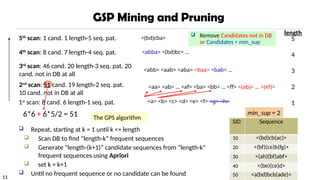
GSP Mining andPruning
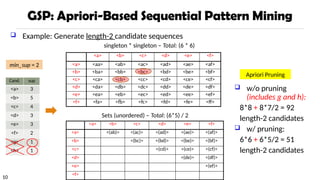
<a> <b> <c> <d> <e> <f> <g> <h>
<aa> <ab> … <af> <ba> <bb> … <ff> <(ab)> … <(ef)>
<abb> <aab> <aba> <baa> <bab> …
<abba> <(bd)bc> …
<(bd)cba>
1st
scan: 8 cand. 6 length-1 seq. pat.
2nd
scan: 51 cand. 19 length-2 seq. pat.
10 cand. not in DB at all
3rd
scan: 46 cand. 20 length-3 seq. pat. 20
cand. not in DB at all
4th
scan: 8 cand. 7 length-4 seq. pat.
5th
scan: 1 cand. 1 length-5 seq. pat.
SID Sequence
10 <(bd)cb(ac)>
20 <(bf)(ce)b(fg)>
30 <(ah)(bf)abf>
40 <(be)(ce)d>
50 <a(bd)bcb(ade)>
min_sup = 2
Remove Candidates not in DB
or Candidates < min_sup
6*6 + 6*5/2 = 51
length
5
4
3
2
1
Repeat, starting at k = 1 until k <= length
Scan DB to find “length-k” frequent sequences
Generate “length-(k+1)” candidate sequences from “length-k”
frequent sequences using Apriori
set k = k+1
Until no frequent sequence or no candidate can be found
The GPS algorithm
12.
12
Sequential Pattern Miningin Vertical Data
Format: The SPADE Algorithm
SID Sequence
1 <a(abc)(ac)d(cf)>
2 <(ad)c(bc)(ae)>
3 <(ef)(ab)(df)cb>
4 <eg(af)cbc>
Ref: SPADE (Sequential
PAttern Discovery using
Equivalent Class) [M.
Zaki 2001]
min_sup = 2
A sequence database is mapped to: <SID, EID>
Grow the subsequences (patterns) one item at a time by Apriori candidate generation
EID (b) < EID (a):
Corresponds to:
<a(abc)(ac)d(cf)>
13.
13
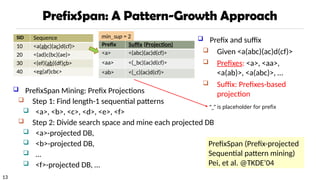
PrefixSpan: A Pattern-GrowthApproach
PrefixSpan Mining: Prefix Projections
Step 1: Find length-1 sequential patterns
<a>, <b>, <c>, <d>, <e>, <f>
Step 2: Divide search space and mine each projected DB
<a>-projected DB,
<b>-projected DB,
…
<f>-projected DB, …
SID Sequence
10 <a(abc)(ac)d(cf)>
20 <(ad)c(bc)(ae)>
30 <(ef)(ab)(df)cb>
40 <eg(af)cbc>
Prefix Suffix (Projection)
<a> <(abc)(ac)d(cf)>
<aa> <(_bc)(ac)d(cf)>
<ab> <(_c)(ac)d(cf)>
Prefix and suffix
Given <a(abc)(ac)d(cf)>
Prefixes: <a>, <aa>,
<a(ab)>, <a(abc)>, …
Suffix: Prefixes-based
projection
PrefixSpan (Prefix-projected
Sequential pattern mining)
Pei, et al. @TKDE’04
min_sup = 2
“_” is placeholder for prefix
14.
14
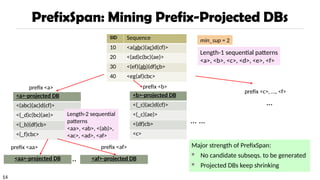
prefix <a>
PrefixSpan: MiningPrefix-Projected DBs
Length-1 sequential patterns
<a>, <b>, <c>, <d>, <e>, <f>
prefix <aa>
…
prefix <af>
…
prefix <b>
prefix <c>, …, <f>
… …
SID Sequence
10 <a(abc)(ac)d(cf)>
20 <(ad)c(bc)(ae)>
30 <(ef)(ab)(df)cb>
40 <eg(af)cbc>
<a>-projected DB
<(abc)(ac)d(cf)>
<(_d)c(bc)(ae)>
<(_b)(df)cb>
<(_f)cbc>
<aa>-projected DB <af>-projected DB
Major strength of PrefixSpan:
No candidate subseqs. to be generated
Projected DBs keep shrinking
min_sup = 2
<b>-projected DB
<(_c)(ac)d(cf)>
<(_c)(ae)>
<(df)cb>
<c>
Length-2 sequential
patterns
<aa>, <ab>, <(ab)>,
<ac>, <ad>, <af>
15.
16
CloSpan: Mining ClosedSequential Patterns
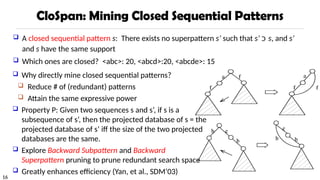
A closed sequential pattern s: There exists no superpattern s’ such that s’ כ s, and s’
and s have the same support
Which ones are closed? <abc>: 20, <abcd>:20, <abcde>: 15
Why directly mine closed sequential patterns?
Reduce # of (redundant) patterns
Attain the same expressive power
Property P: Given two sequences s and s’, if s is a
subsequence of s’, then the projected database of s = the
projected database of s’ iff the size of the two projected
databases are the same.
Explore Backward Subpattern and Backward
Superpattern pruning to prune redundant search space
Greatly enhances efficiency (Yan, et al., SDM’03)
16.
17
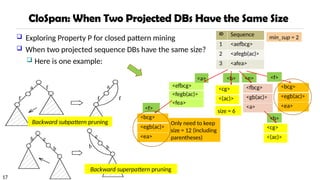
<efbcg>
<fegb(ac)>
<fea>
<e>
<a>
CloSpan: When TwoProjected DBs Have the Same Size
<f>
<b>
ID Sequence
1 <aefbcg>
2 <afegb(ac)>
3 <afea>
<bcg>
<egb(ac)>
<ea>
<cg>
<(ac)>
<fbcg>
<gb(ac)>
<a>
<b>
<cg>
<(ac)>
<f>
<bcg>
<egb(ac)>
<ea>
Exploring Property P for closed pattern mining
When two projected sequence DBs have the same size?
Here is one example:
Only need to keep
size = 12 (including
parentheses)
size = 6
Backward subpattern pruning
Backward superpattern pruning
min_sup = 2
17.
56
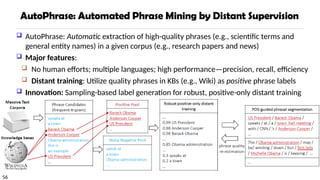
AutoPhrase: Automaticextraction of high-quality phrases (e.g., scientific terms and
general entity names) in a given corpus (e.g., research papers and news)
Major features:
No human efforts; multiple languages; high performance—precision, recall, efficiency
Distant training: Utilize quality phrases in KBs (e.g., Wiki) as positive phrase labels
Innovation: Sampling-based label generation for robust, positive-only distant training
AutoPhrase: Automated Phrase Mining by Distant Supervision
18.
57
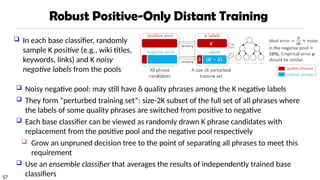
Robust Positive-Only DistantTraining
In each base classifier, randomly
sample K positive (e.g., wiki titles,
keywords, links) and K noisy
negative labels from the pools
Noisy negative pool: may still have δ quality phrases among the K negative labels
They form “perturbed training set”: size-2K subset of the full set of all phrases where
the labels of some quality phrases are switched from positive to negative
Each base classifier can be viewed as randomly drawn K phrase candidates with
replacement from the positive pool and the negative pool respectively
Grow an unpruned decision tree to the point of separating all phrases to meet this
requirement
Use an ensemble classifier that averages the results of independently trained base
classifiers
19.
58
Theoretical Analysis
T base classifiers
Exponentially decreasing
Empirical Performance
AUC to evaluate the ranking
Why Is Positive-Only Distant Training Robust?
Note: AUC (Area Under Curve), with value
range [0,1], is a classification measure to
be introduced in the classification module
20.
59
Modeling Single-Word Phrases:Enhancing Recall
AutoPhrase simultaneously models single-word and multi-word phrases
A phrase can also be a single word, as long as it functions as a constituent in the
syntax of a sentence, e.g., “UIUC”, “Illinois”
Based on our experiments: 10%~30% quality phrases are single-word phrases
Criteria for modeling single-word phrases
Popularity: Sufficiently frequent in a given corpus
Informativeness: Indicative of a specific topic or concept
Independence: A quality single-word phrase is more likely a complete semantic
unit in a given document
Example: Is the following good single-word phrase?
“CMU”? Yes (frequent, informative, independent)
“this”? No (not informative)
“united”? No (not independent, may be in “United States”, “United Airline”,…)
21.
60
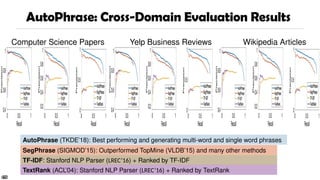
Computer Science PapersYelp Business Reviews Wikipedia Articles
AutoPhrase: Cross-Domain Evaluation Results
60
SegPhrase (SIGMOD’15): Outperformed TopMine (VLDB’15) and many other methods
TF-IDF: Stanford NLP Parser (LREC’16) + Ranked by TF-IDF
TextRank (ACL’04): Stanford NLP Parser (LREC’16) + Ranked by TextRank
AutoPhrase (TKDE’18): Best performing and generating multi-word and single word phrases
22.
61
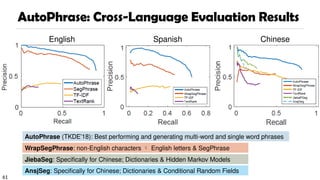
English Spanish Chinese
AutoPhrase:Cross-Language Evaluation Results
WrapSegPhrase: non-English characters English letters & SegPhrase
JiebaSeg: Specifically for Chinese; Dictionaries & Hidden Markov Models
AnsjSeg: Specifically for Chinese; Dictionaries & Conditional Random Fields
AutoPhrase (TKDE’18): Best performing and generating multi-word and single word phrases
23.
62
62
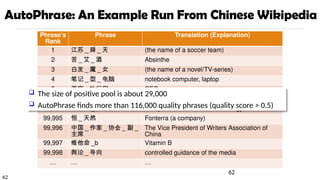
Phrase’s
Rank
Phrase Translation (Explanation)
1江苏 _ 舜 _ 天 (the name of a soccer team)
2 苦 _ 艾 _ 酒 Absinthe
3 白发 _ 魔 _ 女 (the name of a novel/TV-series)
4 笔记 _ 型 _ 电脑 notebook computer, laptop
5 首席 _ 执行官 CEO
… … …
99,994 计算机 _ 科学技术 Computer Science and Technology
99,995 恒 _ 天然 Fonterra (a company)
99,996 中国 _ 作家 _ 协会 _ 副 _
主席
The Vice President of Writers Association of
China
99,997 维他命 _b Vitamin B
99,998 舆论 _ 导向 controlled guidance of the media
… … …
The size of positive pool is about 29,000
AutoPhrase finds more than 116,000 quality phrases (quality score > 0.5)
AutoPhrase: An Example Run From Chinese Wikipedia
66
References: Mining DiversePatterns
R. Srikant and R. Agrawal, “Mining generalized association rules”, VLDB'95
Y. Aumann and Y. Lindell, “A Statistical Theory for Quantitative Association Rules”,
KDD'99
K. Wang, Y. He, J. Han, “Pushing Support Constraints Into Association Rules Mining”,
IEEE Trans. Knowledge and Data Eng. 15(3): 642-658, 2003
D. Xin, J. Han, X. Yan and H. Cheng, "On Compressing Frequent Patterns",
Knowledge and Data Engineering, 60(1): 5-29, 2007
D. Xin, H. Cheng, X. Yan, and J. Han, "Extracting Redundancy-Aware Top-K Patterns",
KDD'06
J. Han, H. Cheng, D. Xin, and X. Yan, "Frequent Pattern Mining: Current Status and
Future Directions", Data Mining and Knowledge Discovery, 15(1): 55-86, 2007
F. Zhu, X. Yan, J. Han, P. S. Yu, and H. Cheng, “Mining Colossal Frequent Patterns by
Core Pattern Fusion”, ICDE'07
28.
67
References: Constraint-Based FrequentPattern Mining
R. Srikant, Q. Vu, and R. Agrawal, “Mining association rules with item constraints”,
KDD'97
R. Ng, L.V.S. Lakshmanan, J. Han & A. Pang, “Exploratory mining and pruning
optimizations of constrained association rules”, SIGMOD’98
G. Grahne, L. Lakshmanan, and X. Wang, “Efficient mining of constrained correlated
sets”, ICDE'00
J. Pei, J. Han, and L. V. S. Lakshmanan, “Mining Frequent Itemsets with Convertible
Constraints”, ICDE'01
J. Pei, J. Han, and W. Wang, “Mining Sequential Patterns with Constraints in Large
Databases”, CIKM'02
F. Bonchi, F. Giannotti, A. Mazzanti, and D. Pedreschi, “ExAnte: Anticipated Data
Reduction in Constrained Pattern Mining”, PKDD'03
F. Zhu, X. Yan, J. Han, and P. S. Yu, “gPrune: A Constraint Pushing Framework for Graph
Pattern Mining”, PAKDD'07
29.
68
References: Sequential PatternMining
R. Srikant and R. Agrawal, “Mining sequential patterns: Generalizations and performance
improvements”, EDBT’96
M. Zaki, “SPADE: An Efficient Algorithm for Mining Frequent Sequences”, Machine
Learning, 2001
J. Pei, J. Han, B. Mortazavi-Asl, J. Wang, H. Pinto, Q. Chen, U. Dayal, and M.-C. Hsu,
"Mining Sequential Patterns by Pattern-Growth: The PrefixSpan Approach", IEEE TKDE,
16(10), 2004
X. Yan, J. Han, and R. Afshar, “CloSpan: Mining Closed Sequential Patterns in Large
Datasets”, SDM'03
J. Pei, J. Han, and W. Wang, "Constraint-based sequential pattern mining: the pattern-
growth methods", J. Int. Inf. Sys., 28(2), 2007
M. N. Garofalakis, R. Rastogi, K. Shim: Mining Sequential Patterns with Regular Expression
Constraints. IEEE Trans. Knowl. Data Eng. 14(3), 2002
H. Mannila, H. Toivonen, and A. I. Verkamo, “Discovery of frequent episodes in event
sequences”, Data Mining and Knowledge Discovery, 1997
30.
69
References: Graph PatternMining
C. Borgelt and M. R. Berthold, Mining molecular fragments: Finding relevant substructures of
molecules, ICDM'02
J. Huan, W. Wang, and J. Prins. Efficient mining of frequent subgraph in the presence of
isomorphism, ICDM'03
A. Inokuchi, T. Washio, and H. Motoda. An apriori-based algorithm for mining frequent
substructures from graph data, PKDD'00
M. Kuramochi and G. Karypis. Frequent subgraph discovery, ICDM'01
S. Nijssen and J. Kok. A Quickstart in Frequent Structure Mining can Make a Difference.
KDD'04
N. Vanetik, E. Gudes, and S. E. Shimony. Computing frequent graph patterns from
semistructured data, ICDM'02
X. Yan and J. Han, gSpan: Graph-Based Substructure Pattern Mining, ICDM'02
X. Yan and J. Han, CloseGraph: Mining Closed Frequent Graph Patterns, KDD'03
X. Yan, P. S. Yu, J. Han, Graph Indexing: A Frequent Structure-based Approach, SIGMOD'04
X. Yan, P. S. Yu, and J. Han, Substructure Similarity Search in Graph Databases, SIGMOD'05
31.
70
References: Phrase Mining
S. Bergsma, E. Pitler, D. Lin, Creating Robust Supervised Classifiers via Web-scale N-gram Data, ACL’2010
D. M. Blei and J. D. Lafferty. Visualizing Topics with Multi-word Expressions. arXiv:0907.1013, 2009
D.M. Blei, A. Y. Ng, M. I. Jordan, J. D. Lafferty, Latent Dirichlet Allocation. JMLR 2003
M. Danilevsky, C. Wang, N. Desai, X. Ren, J. Guo, J. Han. Automatic Construction and Ranking of Topical
Keyphrases on Collections of Short Documents. SDM’14
A. El-Kishky, Y. Song, C. Wang, C. R. Voss, and J. Han. Scalable Topical Phrase Mining from Text Corpora.
VLDB’15
R. V. Lindsey, W. P. Headden, III, M. J. Stipicevic.
A Phrase-Discovering Topic Model Using Hierarchical Pitman-Yor Processes. EMNLP-CoNLL’12.
J. Liu, J. Shang, C. Wang, X. Ren, J. Han, Mining Quality Phrases from Massive Text Corpora. SIGMOD’15
A. Parameswaran, H. Garcia-Molina, and A. Rajaraman.
Towards the Web of Concepts: Extracting Concepts from Large Datasets. VLDB’10
X. Wang, A. McCallum, X. Wei.
Topical N-grams: Phrase and Topic Discovery, With and Application to Information Retrieval. ICDM’07
J. Shang, J. Liu, M. Jiang, X. Ren, C. R Voss, J. Han, "Automated Phrase Mining from Massive Text Corpora
", IEEE Transactions on Knowledge and Data Engineering, 30(10):1825-1837 (2018)
Editor's Notes
#28 Apriori:
Step1: Join two k-1 edge graphs (these two graphs share a same k-2 edge subgraph) to generate a k-edge graph
Step2: Join the tid-list of these two k-1 edge graphs, then see whether its count is larger than the minimum support
Step3: Check all k-1 subgraph of this k-edge graph to see whether all of them are frequent
Step4: After G successfully pass Step1-3, do support computation of G in the graph dataset, See whether it is really frequent.
gSpan:
Step1: Right-most extend a k-1 edge graph to several k edge graphs.
Step2: Enumerate the occurrence of this k-1 edge graph in the graph dataset, meanwhile, counting these k edge graphs.
Step3: Output those k edge graphs whose support is larger than the minimum support.
Pros:
1: gSpan avoid the costly candidate generation and testing some infrequent subgraphs.
2: No complicated graph operations, like joining two graphs and calculating its k-1 subgraphs.
3. gSpan is very simple
The key is how to do right most extension efficiently in graph. We invented DFS code for graph.
#30 - Challenge: An n-edge frequent graph may have 2n subgraphs
#31 Apriori:
Step1: Join two k-1 edge graphs (these two graphs share a same k-2 edge subgraph) to generate a k-edge graph
Step2: Join the tid-list of these two k-1 edge graphs, then see whether its count is larger than the minimum support
Step3: Check all k-1 subgraph of this k-edge graph to see whether all of them are frequent
Step4: After G successfully pass Step1-3, do support computation of G in the graph dataset, See whether it is really frequent.
gSpan:
Step1: Right-most extend a k-1 edge graph to several k edge graphs.
Step2: Enumerate the occurrence of this k-1 edge graph in the graph dataset, meanwhile, counting these k edge graphs.
Step3: Output those k edge graphs whose support is larger than the minimum support.
Pros:
1: gSpan avoid the costly candidate generation and testing some infrequent subgraphs.
2: No complicated graph operations, like joining two graphs and calculating its k-1 subgraphs.
3. gSpan is very simple
The key is how to do right most extension efficiently in graph. We invented DFS code for graph.
#47 An interesting comparison
A state of the art phrase-discovering topic model
#48 An interesting comparison
A state of the art phrase-discovering topic model
#53 Then the picky audience might ask how to project phrase mining methods back to the corpus so we can get mention-level chunking results? Maybe during presentation we can emphasize that's not the goal, we think it's more interesting to discover important phrases from a large corpus without any manual annotations.
#60 As we mentioned in the introduction, our methods are designed to be effective in multiple domains and languages.
We first evaluate the results in three domains: CS papers, Yelp reviews, and Wiki articles.
We mainly compared AutoPhrase with SegPhrase and Stanford NLP Parser.
SegPhrase has outperformed many unsupervised methods like TopMine. So we didn’t include the results here.
The Stanford NLP parser can extract noun phrases and verb phrases from sentences.
We use the popular TF-IDF and TextRank to rank the extracted phrases.
TF-IDF is a popular measurement in information retrieval. TF is term frequency and IDF is the inverse document frequency.
TextRank is similar to the PageRank. We construct a graph of phrases and build edges as their co-occurrence within a given sliding window. Then we run the random walk on this graph and compute the page rank.
As you can see here, AutoPhrase always has the best performance.
The compared methods include
AutoPhrase: distantly supervised
SegPhrase: weakly supervised (outperformed ToPMine, ConExtr, KEA, NLP-based + ranking, …)
NLP-based methods + TF-IDF/TextRank ranking
#61 We further conducted experiments in different languages.
Since SegPhrase is originally designed for English, we introduce its variant WrapSegPhrase for other languages.
We encode the non-English tokens using English letters. The first token is marked as ‘a’, the second as ‘b’, and so on.
I would like to highlight here, on the Chinese dataset, we compare with the popular, supervised Chinese phrase mining methods, Jieba Segmentation and Ansj Segmentation. They are using conditional random fields and hidden markov models trained on annotated corpora.
As you can see here, AutoPhrase performs the best.
Compared Methods:
WrapSegPhrase: encoding/decoding process for non-English languages + SegPhrase
NLP-based methods + TF-IDF/TextRank ranking
Pre-trained Chinese Segmenters: AnsjSeg and JiebaPSeg
#62 After the quantitative evaluation, I would like to show you some example results.
The Chinese dataset is one of the most challenging datasets. As you may know, the tokenization is also very hard in Chinese, because there is no whitespace. Meanwhile, the volume of Chinese Wiki is much smaller than English and Spanish Wikis. This makes the distant supervision hard.
So let’s take a look at the Chinese phrase results. The first column is the rank, the second column is the phrase, and the third column is the translation.
The underscores are inserted by the tokenizer, although some of them are not accurate. AutoPhrase can find many high-quality phrases, for example, around the rank of a hundred thousand, we can still find phrases like “Computer Science and Technology”.
Most of these high-quality phrases are not covered by the Wikipedia: Only about twenty-nine thousand phrases can be found in the positive pool, while AutoPhrase has found more than a hundred and sixteen thousand phrases.

![12
Sequential Pattern Mining in Vertical Data
Format: The SPADE Algorithm
SID Sequence
1 <a(abc)(ac)d(cf)>
2 <(ad)c(bc)(ae)>
3 <(ef)(ab)(df)cb>
4 <eg(af)cbc>
Ref: SPADE (Sequential
PAttern Discovery using
Equivalent Class) [M.
Zaki 2001]
min_sup = 2
A sequence database is mapped to: <SID, EID>
Grow the subsequences (patterns) one item at a time by Apriori candidate generation
EID (b) < EID (a):
Corresponds to:
<a(abc)(ac)d(cf)>](https://image.slidesharecdn.com/1760516799059if5141-1-2025-module05-sequential-pattern-251126012315-1e7a1633/85/1760516799059_IF5141-1-2025-Module_05-Sequential-Pattern-pptx-12-320.jpg)
![58
Theoretical Analysis
T base classifiers
Exponentially decreasing
Empirical Performance
AUC to evaluate the ranking
Why Is Positive-Only Distant Training Robust?
Note: AUC (Area Under Curve), with value
range [0,1], is a classification measure to
be introduced in the classification module](https://image.slidesharecdn.com/1760516799059if5141-1-2025-module05-sequential-pattern-251126012315-1e7a1633/85/1760516799059_IF5141-1-2025-Module_05-Sequential-Pattern-pptx-19-320.jpg)