Force Protection
What is Force Protection?
 Force protection (FP) is a term used by the US
military to describe preventive measures taken
to mitigate hostile actions in specific areas or
against a specific population.

Who is the target?
 All military units in the United States. When
force protection condition is applied it is to raise
the level of awareness and thereby protect our
country
Force Protection
Condition(FPCON)
 Force Protection Condition (FPCON) is
a terrorist threat system overseen by
the Department of Defense directive, and
describes the measures security agencies need
to take in response to various levels of terrorist
threats against military facilities
Purpose of FPCON
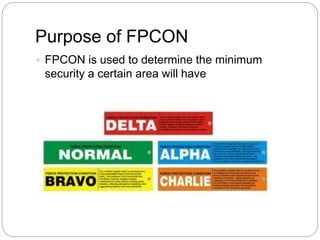
 FPCON is used to determine the minimum
security a certain area will have
Normal
 FPCON NORMAL describes a situation of no
current terrorist activity. The only security forces
needed are enough to stop the everyday criminal,
similar to civilian police forces
Alpha
 FPCON ALPHA describes a situation where
there is a small and general terrorist activity
that is not predictable. Agencies will inform
personnel that there is a possible threat and a
standard security procedure review is conducted
Bravo
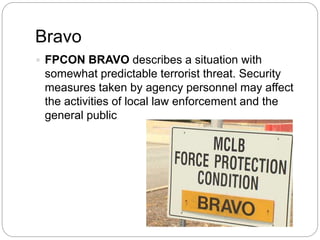
 FPCON BRAVO describes a situation with
somewhat predictable terrorist threat. Security
measures taken by agency personnel may affect
the activities of local law enforcement and the
general public
Charlie
 FPCON CHARLIE describes a situation when a
global terrorist attack has occurred or when
intelligence reports that there is local terrorist
activity imminent.
Delta
 FPCON DELTA describes a situation when a
terrorist attack is taking place or has just occurred
in the immediate area. FPCON Delta usually
occurs only in the areas that are most vulnerable
to or have been attacked.
Types of Threats
 Bio Terrorism – the release of germs or viruses, such
as anthrax
 Chemical Terrorism – the release of poisonous
chemicals
 Cyber Terrorism – the electronic attack on critical
computer infrastructure
 Nuclear Terrorism – the use of nuclear materials in a
terrorist attack, either a nuclear bomb or a "dirty
bomb" (highly radioactive chemicals spread by an
ordinary explosive)
 Eco Terrorism - the use of acts of violence,
sabotage, vandalism, property damage and
intimidation committed in the name of
environmentalism
Conclusion
 Pay attention to the level of threat at your base
 Keep a look out for anything suspicious that might
be related to that threat
 Make sure you are able to provide more than one
idea for any of the elevated threat levels
 Be familiar with the FPCON instruction specific to
your command
Resources
 Force Protection Agency
 http://www.pfpa.mil/
 DoD Antiterrorism Standards
 http://www.dtic.mil/whs/directives/corres/pdf/2000
16p.pdf

16_force_protection.pptx

  • 1.
  • 2.
    What is ForceProtection?  Force protection (FP) is a term used by the US military to describe preventive measures taken to mitigate hostile actions in specific areas or against a specific population. 
  • 3.
    Who is thetarget?  All military units in the United States. When force protection condition is applied it is to raise the level of awareness and thereby protect our country
  • 4.
    Force Protection Condition(FPCON)  ForceProtection Condition (FPCON) is a terrorist threat system overseen by the Department of Defense directive, and describes the measures security agencies need to take in response to various levels of terrorist threats against military facilities
  • 5.
    Purpose of FPCON FPCON is used to determine the minimum security a certain area will have
  • 6.
    Normal  FPCON NORMALdescribes a situation of no current terrorist activity. The only security forces needed are enough to stop the everyday criminal, similar to civilian police forces
  • 7.
    Alpha  FPCON ALPHAdescribes a situation where there is a small and general terrorist activity that is not predictable. Agencies will inform personnel that there is a possible threat and a standard security procedure review is conducted
  • 8.
    Bravo  FPCON BRAVOdescribes a situation with somewhat predictable terrorist threat. Security measures taken by agency personnel may affect the activities of local law enforcement and the general public
  • 9.
    Charlie  FPCON CHARLIEdescribes a situation when a global terrorist attack has occurred or when intelligence reports that there is local terrorist activity imminent.
  • 10.
    Delta  FPCON DELTAdescribes a situation when a terrorist attack is taking place or has just occurred in the immediate area. FPCON Delta usually occurs only in the areas that are most vulnerable to or have been attacked.
  • 11.
    Types of Threats Bio Terrorism – the release of germs or viruses, such as anthrax  Chemical Terrorism – the release of poisonous chemicals  Cyber Terrorism – the electronic attack on critical computer infrastructure  Nuclear Terrorism – the use of nuclear materials in a terrorist attack, either a nuclear bomb or a "dirty bomb" (highly radioactive chemicals spread by an ordinary explosive)  Eco Terrorism - the use of acts of violence, sabotage, vandalism, property damage and intimidation committed in the name of environmentalism
  • 12.
    Conclusion  Pay attentionto the level of threat at your base  Keep a look out for anything suspicious that might be related to that threat  Make sure you are able to provide more than one idea for any of the elevated threat levels  Be familiar with the FPCON instruction specific to your command
  • 13.
    Resources  Force ProtectionAgency  http://www.pfpa.mil/  DoD Antiterrorism Standards  http://www.dtic.mil/whs/directives/corres/pdf/2000 16p.pdf

Editor's Notes

  • #2 PCC. III-K
  • #3 This is usually for Department of Defense personnel (including, but not limited to, family members and chaplains), resources, facilities, and critical information. 
  • #5 As opposed to DEFCON, which assesses the amount of military forces needed to be deployed in a situation with a certain likelihood of attack against the civilian population
  • #6 This security can be as simple as requiring proper credentials to get inside a building and can become as stringent as inspecting every single vehicle to pass through a gate.
  • #8 http://www.dtic.mil/whs/directives/corres/pdf/200016p.pdf An FPCON level may also be designated as "+", meaning the facility shall institute extra security measures beyond those specified for the FPCON Level. Generally this is used to provide an extra layer of security for FPCON Alpha. 
  • #11 One example is the September 11, 2001 Attacks. (Army or Air Force Bases are Restricted to only Military Personnel) The key significant differences between FPCON Charlie, and FPCON Delta, is that FPCON Delta references a specific, known threat, whereas FPCON Charlie is used to prepare for imminent threats of a general, non-targeted nature. FPCON Charlie can also be maintained for a significant length of time, several weeks, while FPCON Delta is generally only maintainable for several days.