Sample papers
© UCLES 2013 | CE/2051b/3Y11
Young Learners
Young Learners English Tests (YLE)
Movers
2Volume
Two
Movers
Listening
Part 1
– 5 questions –
Listen and draw lines. There is one example.
Peter Jim John Sally
Jane Daisy Anna
3
Movers
Listening
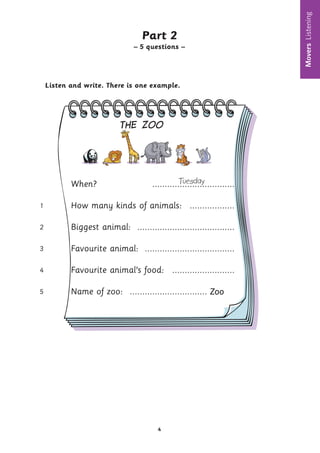
Zoo
Movers
Listening
5
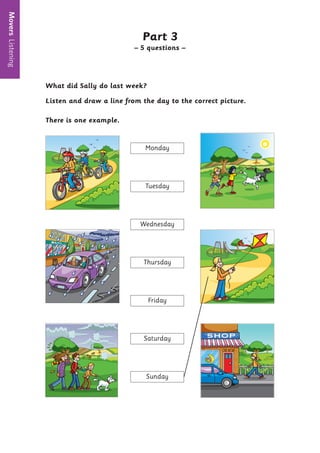
Part 3
– 5 questions –
What did Sally do last week?
Listen and draw a line from the day to the correct picture.
There is one example.
Monday
Tuesday
Wednesday
Thursday
Friday
Sunday
Saturday
Movers
Listening
6
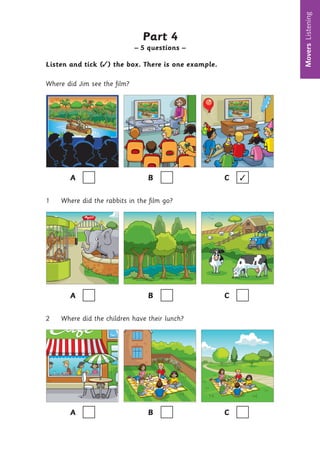
Part 4
– 5 questions –
Listen and tick (✓) the box. There is one example.
Where did Jim see the film?
A B C ✓
1 Where did the rabbits in the film go?
A B C
2 Where did the children have their lunch?
A B C
Movers
Listening
7
3 What did the children eat?
A B C
4 What did the children do after lunch?
A B C
5 What did Jim’s friends give him?
A B C
Movers
Listening
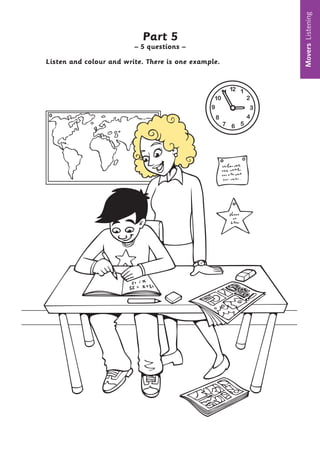
Part 5
– 5 questions –
Listen and colour and write. There is one example.
8
Movers
Listening
Movers Listening
Marking Key
Part 1 5 marks
Lines should be drawn between:
1 Sally and girl painting rainbow
2 Peter and boy in blue T-shirt and jeans,
painting leaves
3 Daisy and girl carrying box of drinks
4 Jim and boy taking photos
5 Jane and girl sitting down and drinking
Part 2 5 marks
1 30/thirty (kinds of animals)
2 (the) elephant(s)
3 (the) parrot(s)
4 (all kinds of)/(some) fruit
5 W-I-L-D
Part 3 5 marks
Thursday Friday
Monday Sunday (example)
Saturday Wednesday
Part 4 5 marks
1 B
2 B
3 A
4 C
5 C
Part 5 5 marks
1 Colour clock – blue
2 Write ‘MAP’ below map on wall
3 Colour star on boy’s sweater – green
4 Colour comic on desk – red
5 Colour eraser on desk – brown
( ) = Acceptable extra words are placed in
brackets
/ = A single slash is placed between
acceptable alternative words within an
answer
// = A double slash is placed between
acceptable alternative complete
answers
Movers
Listening
R = rubric
F = Female adult
M = Male adult
Fch = Female child
Mch = Male child
Movers Listening
Tapescript
R Hello. This is the University of Cambridge Movers
Listening Test.
Look at Part One. Look at the picture. Listen and
look.
There is one example.
M Excuse me. What are you all doing?
Fch We’re drawing and painting on this wall.
M Oh. A wall picture! Are these all your friends?
Fch Yes. But one is my brother, John.
M Is he the boy who’s painting a rainbow?
Fch Yes, you’re clever! How did you know?
M His hair is blond, like yours.
R Can you see the line? This is an example.
Now you listen and draw lines.
One
M That’s a beautiful rainbow.
Fch Yes, it is. John’s very good at painting.
M Who’s the girl that’s helping to paint it?
Fch The one who’s standing on a box?
M Yes.
Fch That’s Sally.
R Two
M Who’s the boy that’s painting the leaves?
Fch Which one?
M The one with jeans and a blue T-shirt.
Fch Oh, he’s called Peter.
M I love those leaves!
R Three
Fch Look at Daisy.
M What’s she doing?
Fch She’s bringing a box of drinks for the children.
M Oh yes! I’m thirsty. Can I have a drink, please?
R Four
M One boy isn’t painting. He’s taking photos of the
children.
Fch The one with the purple shirt?
M Yes.
Fch That’s Jim. He likes taking photos more than
painting.
M Mmmm.
R Five
M Who’s the girl who’s having a drink?
Fch The one with the curly hair?
M Yes.
Fch That’s my best friend, Jane.
M Why isn’t she painting?
Fch Well, she’s hot and tired, I think.
R Now listen to Part One again.
That is the end of Part One.
Part Two. Listen and look. There is one example.
F What’s your homework today, Paul?
Mch I’ve got to write about the zoo.
F When did you go to the zoo? Was it last Tuesday?
Mch That’s right. Last Tuesday.
F Well, that’s easy, then.
Mch Is it?
R Can you see the answer? Now you listen and write.
One
F How many different kinds of animals did you see at
the zoo?
Mch That’s difficult.
F Well, think about it.
Mch Oh…thirty, I think.
F Thirty! Good.
R Two
F What were the biggest animals that you saw?
Mch Erm… the giraffes, I think.
F Weren’t there any elephants?
Mch Oh yes, that’s right. The elephants were the biggest!
R Three
F So, which animal did you like best in the zoo?
Mch I liked them all.
F Which was your favourite? The lions?
Mch No, I liked the birds. The parrots were my favourite.
F The parrots?
Mch Yes. They were beautiful. They were in a very
big cage.
R Four
F What do they eat?
Mch Well, they like all kinds of fruit.
F Did you give them some fruit?
Movers
Listening
Mch Yes we did. They loved it!
R Five
F Oh, yes, one last thing – what was the name of the
zoo?
Mch Wild Zoo.
F How do you spell that?
Mch W-I-L-D.
F Oh yes, I know it. Good. Well, now you can start
your homework.
R Now listen to Part Two again.
That is the end of Part Two.
Part Three. Look at the pictures. What did Sally do
last week? Listen and look. There is one example.
M Hello, Sally. Did you have a good holiday last week?
Fch Not bad. Sunday was good. I flew my kite!
M Where did you do that?
Fch In the park.
R Can you see the line from the word Sunday?
On Sunday, Sally flew her kite in the park.
Now you listen and draw lines.
One
M What did you do on Saturday?
Fch I went for a long walk with my mum and dad. We
took our dog with us.
M Did you enjoy it?
Fch It was OK, but it was very windy that day. In the
evening, we were all tired.
R Two
M Did you go shopping last week, Sally?
Fch Yes, we did. We went to the shops in town on
Monday afternoon. I bought a present for my
grandpa.
M Did you drive into town?
Fch Yes. The weather was terrible that day and we didn’t
want to walk.
R Three
M And what did you do on Thursday, Sally?
Fch Which day?
M Thursday.
Fch Oh, I rode my bike in the park.
M With your friends?
Fch That’s right.
R Four
Fch I went shopping again on Wednesday!
M Did you?
Fch Yes, but I didn’t go to town that day. I only went to
the shop in the village.
M What did you buy?
Fch Oh, we needed some bread and milk.
M Did you walk there?
Fch Yes, it’s very near.
R Five
M Which was your best day last week?
Fch Friday, I think.
M Why? Did you go shopping again?
Fch No! I don’t go shopping every day, you know! I
invited my favourite cousin to come and play with
me.
M Oh. That was good. What did you do with her?
Fch We took our dogs for a walk in the fields. It was very
hot that day.
M Great!
R Now listen to Part Three again.
That is the end of Part Three.
Part Four. Look at the pictures. Listen and look.
There is one example.
Where did Jim see the film?
Mch I saw a good film last week.
F Oh, did your Mum take you to the cinema?
Mch No…
F Was it at your school, then?
Mch No, it was at my birthday party.
F Oh, I see!
Mch It was a DVD.
R Can you see the tick? Now you listen and tick the
box.
One. Where did the rabbits in the film go?
Mch The film was about some rabbits.
F Oh. I know the one. They have to find a new home.
Did they go to live with the animals in a zoo?
Mch No, they didn’t do that!
F Oh. Well, did they go to a farm then?
Mch No. They went to live in a big forest.
R Two. Where did the children have their lunch?
F What did you do after the film?
Mch We all had lunch.
F In a café?
Mch No. We had a picnic.
F Where? In the park?
Mch No, we had it in my garden.
R Three. What did the children eat?
F What did you have for your lunch? Sandwiches?
Mch No, we had burgers.
F And ice-cream?
Mch No. We had some grapes.
Movers
Reading
&
Writing
There are 40 questions.
You have 30 minutes.
You will need a pen or pencil.
Cambridge Young Learners English
Movers
Reading & Writing
Sample Paper
My name is: ..........................................................................................
Centre Number Candidate Number
Movers
Reading
&
Writing
Part 1
– 6 questions –
Look and read. Choose the correct words and write them on the
lines.
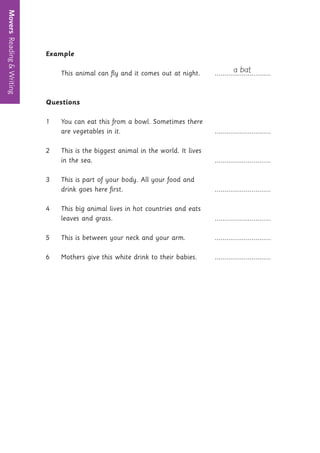
a whale coffee
a shoulder an elephant
soup a stomach
milk a bat
2
Movers
Reading
&
Writing
Example
a bat
This animal can fly and it comes out at night. .............................
Questions
1 You can eat this from a bowl. Sometimes there
are vegetables in it. .............................
2 This is the biggest animal in the world. It lives
in the sea. .............................
3 This is part of your body. All your food and
drink goes here first. .............................
4 This big animal lives in hot countries and eats
leaves and grass. .............................
5 This is between your neck and your arm. .............................
6 Mothers give this white drink to their babies. .............................
3
Movers
Reading
&
Writing
Part 2
– 6 questions –
Look and read. Write yes or no.
Examples
There are five white towels in
the bathroom. yes
.................................
The two smallest bears are washing
their faces. no
.................................
4
Movers
Reading
&
Writing
Questions
1 A big brown bear is having a shower. .................................
2 There are some glasses below
the mirror. .................................
3 The yellow bear is fatter than the
blue bear. .................................
4 There are four toys in the bath. .................................
5 There are lots of boxes in
the cupboard. .................................
6 The floor is wet and there is a
toothbrush on it. .................................
5
Movers
Reading
&
Writing
Part 3
– 6 questions –
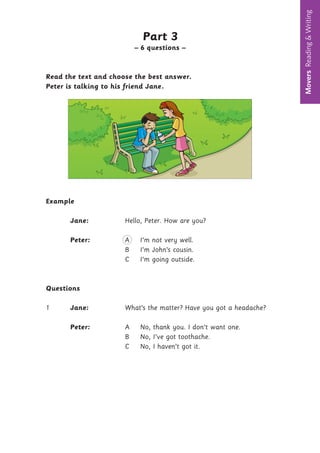
Read the text and choose the best answer.
Peter is talking to his friend Jane
Example
Jane: Hello, Peter. How are you?
Peter: A I’m not very well.
B I’m John’s cousin.
C I’m going outside.
Questions
1 Jane: What’s the matter? Have you got a headache?
Peter: A No, thank you. I don’t want one.
B No, I’ve got toothache.
C No, I haven’t got it.
6
.
Movers
Reading
&
Writing
2 Jane: Would you like to come to my house?
Peter: A Yes, I went home quickly.
B No, thanks. I want to go home.
C Well, I like my house a lot.
3 Jane: Have you got a coat?
Peter: A Yes, It does.
B OK, he’s here.
C No, I haven’t.
4 Jane: Do you want a drink of water?
Peter: A Yes, please.
B Yes, it is.
C Yes, I had.
5 Jane: Shall I walk home with you?
Peter: A He can walk there.
B I’d like that, thanks.
C I can go with her this evening.
6 Jane: Is your mum at home?
Peter: A It’s his new home.
B Next to the bus station.
C Only my dad’s there today.
7
it
Movers
Reading
&
Writing
8
Part 4
– 7 questions –
Read the story. Choose a word from the box. Write the correct
word next to numbers 1–6. There is one example.
My name is Daisy. I like toys, but I like books and comics
...........................
best. I love stories about men on the moon and about
(1)........................... who live in different countries.
I read a good story yesterday. In this story, a boy climbed
a (2)........................... . At the top, there was a lot of snow. It was
evening, but the boy could see the forest below him.
He (3)........................... down on a rock to have a drink and to look
up at all the (4)........................... .
But then he (5)........................... something that he didn’t understand.
Something very big and round flew quietly and quickly behind a cloud.
What was it? The boy didn’t know and he didn’t wait to see it again. He
(6)........................... home to his village because he was very afraid.
I wasn’t afraid! I enjoyed the story a lot!
Movers
Reading
&
Writing
9
(7) Now choose the best name for the story.
Tick one box.
A boy that Daisy knows
A film that Daisy watched
A story that Daisy liked
example
comics blankets ran
children cooked stars
saw sat mountain
Movers
Reading
&
Writing
10
Part 5
– 10 questions –
Look at the pictures and read the story. Write some words to
complete the sentences about the story. You can use 1, 2 or 3
words.
A family holiday
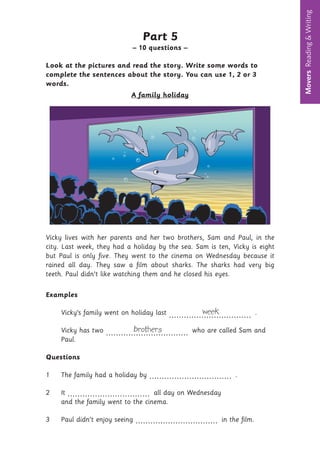
Vicky lives with her parents and her two brothers, Sam and Paul, in the
city. Last week, they had a holiday by the sea. Sam is ten, Vicky is eight
but Paul is only five. They went to the cinema on Wednesday because it
rained all day. They saw a film about sharks. The sharks had very big
teeth. Paul didn’t like watching them and he closed his eyes.
Examples
Vicky’s family went on holiday last week
................................. .
Vicky has two brothers
................................. who are called Sam and
Paul.
Questions
1 The family had a holiday by ................................. .
2 It ................................. all day on Wednesday
and the family went to the cinema.
3 Paul didn’t enjoy seeing ................................. in the film.
Movers
Reading
&
Writing
11
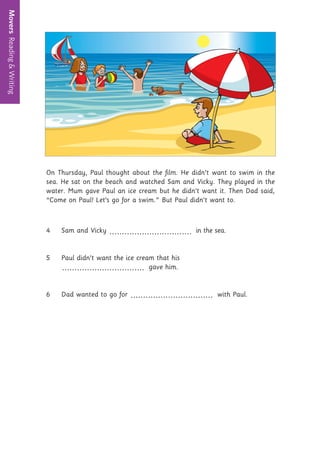
On Thursday, Paul thought about the film. He didn’t want to swim in the
sea. He sat on the beach and watched Sam and Vicky. They played in the
water. Mum gave Paul an ice cream but he didn’t want it. Then Dad said,
“Come on Paul! Let’s go for a swim.” But Paul didn’t want to.
4 Sam and Vicky ................................. in the sea.
5 Paul didn’t want the ice cream that his
................................. gave him.
6 Dad wanted to go for ................................. with Paul.
Movers
Reading
&
Writing
12
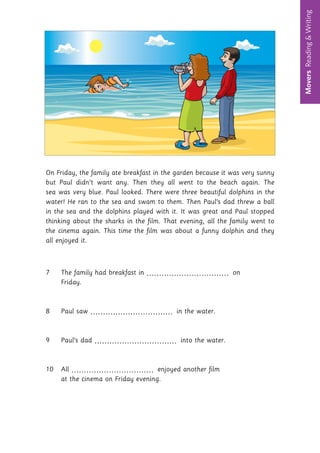
On Friday, the family ate breakfast in the garden because it was very sunny
but Paul didn’t want any. Then they all went to the beach again. The
sea was very blue. Paul looked. There were three beautiful dolphins in the
water! He ran to the sea and swam to them. Then Paul’s dad threw a ball
in the sea and the dolphins played with it. It was great and Paul stopped
thinking about the sharks in the film. That evening, all the family went to
the cinema again. This time the film was about a funny dolphin and they
all enjoyed it.
7 The family had breakfast in ................................. on
Friday.
8 Paul saw ................................. in the water.
9 Paul’s dad ................................. into the water.
10 All ................................. enjoyed another film
at the cinema on Friday evening.
Movers
Reading
&
Writing
Part 6
– 5 questions –
Read the text. Choose the right words and write them on the
lines.
Cats
Cats have
............................. good eyes. They can see very well
at night. ............................. cats climb trees and eat meat.
They can move very quietly and catch animals. Then they eat
them. They have strong teeth. There .............................
small cats and big cats like lions and tigers. Only tigers live
............................. the jungle. Lions don’t. Some people go
and see lions and tigers at the zoo. A lot of people have small
cats in ............................. homes. These cats are pets.
People ............................. them because they are beautiful.
14
Example
1
2
3
4
5
Example had have has
1 All Every Any
2 am are is
3 at on in
4 your their our
5 like liking likes
15
Movers
Reading
&
Writing
Movers
Reading
&
Writing
Movers Reading
& Writing
Marking Key
Part 1 6 marks
1 soup
2 a whale
3 a stomach
4 an elephant
5 a shoulder
6 milk
Part 2 6 marks
1 yes
2 yes
3 no
4 yes
5 no
6 yes
Part 3 6 marks
1 B
2 B
3 C
4 A
5 B
6 C
Part 4 7 marks
1 children
2 mountain
3 sat
4 stars
5 saw
6 ran
7 A story that Daisy liked
Part 5 10 marks
1 the sea//the seaside
2 rained
3 the sharks//the sharks’ teeth
4 played
5 mum//mother//mummy
6 a swim
7 the/their garden
8 (three/some) (beautiful) dolphins
9 threw a ball
10 the/Peter’s family
Part 6 5 marks
1 All
2 are
3 in
4 their
5 like
( ) = Acceptable extra words are placed in
brackets
/ = A single slash is placed between
acceptable alternative words within an
answer
// = A double slash is placed between
acceptable alternative complete answers
Movers
Speaking
Movers Speaking
Summary of Procedures
The usher introduces the child to the examiner. The examiner asks how old the
child is.
1 The examiner asks the child to describe several differences between the two Find
the Differences pictures, e.g. ‘This is a bird but this is a cat.’
2 The examiner tells the child the name of the story and describes the first picture
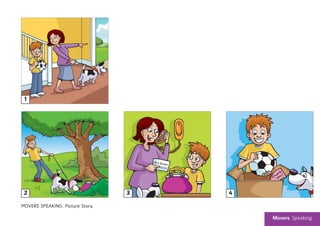
e.g. ‘Fred is sad. He can’t play football. His ball is very old. His mum’s saying,
“Take the dog to the park.” ’ The examiner then asks the child to continue telling
the story.
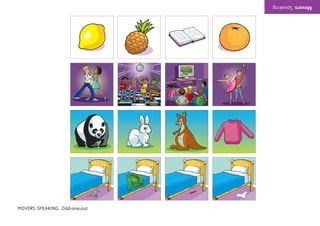
3 The examiner demonstrates how to do this task with the first set of four odd-one-
out pictures and then asks the child to choose one picture in the other three sets
and say which is different and why. For example, ‘These are all animals, but this is
a sweater.’
4 The examiner asks questions about the child, e.g. ‘Who’s the youngest in your
family?’
MOVERS SPEAKING. Find the Differences
1
Movers
Speaking
Movers Speaking
MOVERS SPEAKING. Picture Story
2
1
2 3 4
MOVERS SPEAKING. Odd-one-out
3
Movers
Speaking

153310-movers-sample-papers-volume-2.pdf

  • 1.
    Sample papers © UCLES2013 | CE/2051b/3Y11 Young Learners Young Learners English Tests (YLE) Movers 2Volume Two
  • 2.
    Movers Listening Part 1 – 5questions – Listen and draw lines. There is one example. Peter Jim John Sally Jane Daisy Anna 3
  • 3.
  • 4.
    Movers Listening 5 Part 3 – 5questions – What did Sally do last week? Listen and draw a line from the day to the correct picture. There is one example. Monday Tuesday Wednesday Thursday Friday Sunday Saturday
  • 5.
    Movers Listening 6 Part 4 – 5questions – Listen and tick (✓) the box. There is one example. Where did Jim see the film? A B C ✓ 1 Where did the rabbits in the film go? A B C 2 Where did the children have their lunch? A B C
  • 6.
    Movers Listening 7 3 What didthe children eat? A B C 4 What did the children do after lunch? A B C 5 What did Jim’s friends give him? A B C
  • 7.
    Movers Listening Part 5 – 5questions – Listen and colour and write. There is one example. 8
  • 8.
    Movers Listening Movers Listening Marking Key Part1 5 marks Lines should be drawn between: 1 Sally and girl painting rainbow 2 Peter and boy in blue T-shirt and jeans, painting leaves 3 Daisy and girl carrying box of drinks 4 Jim and boy taking photos 5 Jane and girl sitting down and drinking Part 2 5 marks 1 30/thirty (kinds of animals) 2 (the) elephant(s) 3 (the) parrot(s) 4 (all kinds of)/(some) fruit 5 W-I-L-D Part 3 5 marks Thursday Friday Monday Sunday (example) Saturday Wednesday Part 4 5 marks 1 B 2 B 3 A 4 C 5 C Part 5 5 marks 1 Colour clock – blue 2 Write ‘MAP’ below map on wall 3 Colour star on boy’s sweater – green 4 Colour comic on desk – red 5 Colour eraser on desk – brown ( ) = Acceptable extra words are placed in brackets / = A single slash is placed between acceptable alternative words within an answer // = A double slash is placed between acceptable alternative complete answers
  • 9.
    Movers Listening R = rubric F= Female adult M = Male adult Fch = Female child Mch = Male child Movers Listening Tapescript R Hello. This is the University of Cambridge Movers Listening Test. Look at Part One. Look at the picture. Listen and look. There is one example. M Excuse me. What are you all doing? Fch We’re drawing and painting on this wall. M Oh. A wall picture! Are these all your friends? Fch Yes. But one is my brother, John. M Is he the boy who’s painting a rainbow? Fch Yes, you’re clever! How did you know? M His hair is blond, like yours. R Can you see the line? This is an example. Now you listen and draw lines. One M That’s a beautiful rainbow. Fch Yes, it is. John’s very good at painting. M Who’s the girl that’s helping to paint it? Fch The one who’s standing on a box? M Yes. Fch That’s Sally. R Two M Who’s the boy that’s painting the leaves? Fch Which one? M The one with jeans and a blue T-shirt. Fch Oh, he’s called Peter. M I love those leaves! R Three Fch Look at Daisy. M What’s she doing? Fch She’s bringing a box of drinks for the children. M Oh yes! I’m thirsty. Can I have a drink, please? R Four M One boy isn’t painting. He’s taking photos of the children. Fch The one with the purple shirt? M Yes. Fch That’s Jim. He likes taking photos more than painting. M Mmmm. R Five M Who’s the girl who’s having a drink? Fch The one with the curly hair? M Yes. Fch That’s my best friend, Jane. M Why isn’t she painting? Fch Well, she’s hot and tired, I think. R Now listen to Part One again. That is the end of Part One. Part Two. Listen and look. There is one example. F What’s your homework today, Paul? Mch I’ve got to write about the zoo. F When did you go to the zoo? Was it last Tuesday? Mch That’s right. Last Tuesday. F Well, that’s easy, then. Mch Is it? R Can you see the answer? Now you listen and write. One F How many different kinds of animals did you see at the zoo? Mch That’s difficult. F Well, think about it. Mch Oh…thirty, I think. F Thirty! Good. R Two F What were the biggest animals that you saw? Mch Erm… the giraffes, I think. F Weren’t there any elephants? Mch Oh yes, that’s right. The elephants were the biggest! R Three F So, which animal did you like best in the zoo? Mch I liked them all. F Which was your favourite? The lions? Mch No, I liked the birds. The parrots were my favourite. F The parrots? Mch Yes. They were beautiful. They were in a very big cage. R Four F What do they eat? Mch Well, they like all kinds of fruit. F Did you give them some fruit?
  • 10.
    Movers Listening Mch Yes wedid. They loved it! R Five F Oh, yes, one last thing – what was the name of the zoo? Mch Wild Zoo. F How do you spell that? Mch W-I-L-D. F Oh yes, I know it. Good. Well, now you can start your homework. R Now listen to Part Two again. That is the end of Part Two. Part Three. Look at the pictures. What did Sally do last week? Listen and look. There is one example. M Hello, Sally. Did you have a good holiday last week? Fch Not bad. Sunday was good. I flew my kite! M Where did you do that? Fch In the park. R Can you see the line from the word Sunday? On Sunday, Sally flew her kite in the park. Now you listen and draw lines. One M What did you do on Saturday? Fch I went for a long walk with my mum and dad. We took our dog with us. M Did you enjoy it? Fch It was OK, but it was very windy that day. In the evening, we were all tired. R Two M Did you go shopping last week, Sally? Fch Yes, we did. We went to the shops in town on Monday afternoon. I bought a present for my grandpa. M Did you drive into town? Fch Yes. The weather was terrible that day and we didn’t want to walk. R Three M And what did you do on Thursday, Sally? Fch Which day? M Thursday. Fch Oh, I rode my bike in the park. M With your friends? Fch That’s right. R Four Fch I went shopping again on Wednesday! M Did you? Fch Yes, but I didn’t go to town that day. I only went to the shop in the village. M What did you buy? Fch Oh, we needed some bread and milk. M Did you walk there? Fch Yes, it’s very near. R Five M Which was your best day last week? Fch Friday, I think. M Why? Did you go shopping again? Fch No! I don’t go shopping every day, you know! I invited my favourite cousin to come and play with me. M Oh. That was good. What did you do with her? Fch We took our dogs for a walk in the fields. It was very hot that day. M Great! R Now listen to Part Three again. That is the end of Part Three. Part Four. Look at the pictures. Listen and look. There is one example. Where did Jim see the film? Mch I saw a good film last week. F Oh, did your Mum take you to the cinema? Mch No… F Was it at your school, then? Mch No, it was at my birthday party. F Oh, I see! Mch It was a DVD. R Can you see the tick? Now you listen and tick the box. One. Where did the rabbits in the film go? Mch The film was about some rabbits. F Oh. I know the one. They have to find a new home. Did they go to live with the animals in a zoo? Mch No, they didn’t do that! F Oh. Well, did they go to a farm then? Mch No. They went to live in a big forest. R Two. Where did the children have their lunch? F What did you do after the film? Mch We all had lunch. F In a café? Mch No. We had a picnic. F Where? In the park? Mch No, we had it in my garden. R Three. What did the children eat? F What did you have for your lunch? Sandwiches? Mch No, we had burgers. F And ice-cream? Mch No. We had some grapes.
  • 11.
    Movers Reading & Writing There are 40questions. You have 30 minutes. You will need a pen or pencil. Cambridge Young Learners English Movers Reading & Writing Sample Paper My name is: .......................................................................................... Centre Number Candidate Number
  • 12.
    Movers Reading & Writing Part 1 – 6questions – Look and read. Choose the correct words and write them on the lines. a whale coffee a shoulder an elephant soup a stomach milk a bat 2
  • 13.
    Movers Reading & Writing Example a bat This animalcan fly and it comes out at night. ............................. Questions 1 You can eat this from a bowl. Sometimes there are vegetables in it. ............................. 2 This is the biggest animal in the world. It lives in the sea. ............................. 3 This is part of your body. All your food and drink goes here first. ............................. 4 This big animal lives in hot countries and eats leaves and grass. ............................. 5 This is between your neck and your arm. ............................. 6 Mothers give this white drink to their babies. ............................. 3
  • 14.
    Movers Reading & Writing Part 2 – 6questions – Look and read. Write yes or no. Examples There are five white towels in the bathroom. yes ................................. The two smallest bears are washing their faces. no ................................. 4
  • 15.
    Movers Reading & Writing Questions 1 A bigbrown bear is having a shower. ................................. 2 There are some glasses below the mirror. ................................. 3 The yellow bear is fatter than the blue bear. ................................. 4 There are four toys in the bath. ................................. 5 There are lots of boxes in the cupboard. ................................. 6 The floor is wet and there is a toothbrush on it. ................................. 5
  • 16.
    Movers Reading & Writing Part 3 – 6questions – Read the text and choose the best answer. Peter is talking to his friend Jane Example Jane: Hello, Peter. How are you? Peter: A I’m not very well. B I’m John’s cousin. C I’m going outside. Questions 1 Jane: What’s the matter? Have you got a headache? Peter: A No, thank you. I don’t want one. B No, I’ve got toothache. C No, I haven’t got it. 6 .
  • 17.
    Movers Reading & Writing 2 Jane: Wouldyou like to come to my house? Peter: A Yes, I went home quickly. B No, thanks. I want to go home. C Well, I like my house a lot. 3 Jane: Have you got a coat? Peter: A Yes, It does. B OK, he’s here. C No, I haven’t. 4 Jane: Do you want a drink of water? Peter: A Yes, please. B Yes, it is. C Yes, I had. 5 Jane: Shall I walk home with you? Peter: A He can walk there. B I’d like that, thanks. C I can go with her this evening. 6 Jane: Is your mum at home? Peter: A It’s his new home. B Next to the bus station. C Only my dad’s there today. 7 it
  • 18.
    Movers Reading & Writing 8 Part 4 – 7questions – Read the story. Choose a word from the box. Write the correct word next to numbers 1–6. There is one example. My name is Daisy. I like toys, but I like books and comics ........................... best. I love stories about men on the moon and about (1)........................... who live in different countries. I read a good story yesterday. In this story, a boy climbed a (2)........................... . At the top, there was a lot of snow. It was evening, but the boy could see the forest below him. He (3)........................... down on a rock to have a drink and to look up at all the (4)........................... . But then he (5)........................... something that he didn’t understand. Something very big and round flew quietly and quickly behind a cloud. What was it? The boy didn’t know and he didn’t wait to see it again. He (6)........................... home to his village because he was very afraid. I wasn’t afraid! I enjoyed the story a lot!
  • 19.
    Movers Reading & Writing 9 (7) Now choosethe best name for the story. Tick one box. A boy that Daisy knows A film that Daisy watched A story that Daisy liked example comics blankets ran children cooked stars saw sat mountain
  • 20.
    Movers Reading & Writing 10 Part 5 – 10questions – Look at the pictures and read the story. Write some words to complete the sentences about the story. You can use 1, 2 or 3 words. A family holiday Vicky lives with her parents and her two brothers, Sam and Paul, in the city. Last week, they had a holiday by the sea. Sam is ten, Vicky is eight but Paul is only five. They went to the cinema on Wednesday because it rained all day. They saw a film about sharks. The sharks had very big teeth. Paul didn’t like watching them and he closed his eyes. Examples Vicky’s family went on holiday last week ................................. . Vicky has two brothers ................................. who are called Sam and Paul. Questions 1 The family had a holiday by ................................. . 2 It ................................. all day on Wednesday and the family went to the cinema. 3 Paul didn’t enjoy seeing ................................. in the film.
  • 21.
    Movers Reading & Writing 11 On Thursday, Paulthought about the film. He didn’t want to swim in the sea. He sat on the beach and watched Sam and Vicky. They played in the water. Mum gave Paul an ice cream but he didn’t want it. Then Dad said, “Come on Paul! Let’s go for a swim.” But Paul didn’t want to. 4 Sam and Vicky ................................. in the sea. 5 Paul didn’t want the ice cream that his ................................. gave him. 6 Dad wanted to go for ................................. with Paul.
  • 22.
    Movers Reading & Writing 12 On Friday, thefamily ate breakfast in the garden because it was very sunny but Paul didn’t want any. Then they all went to the beach again. The sea was very blue. Paul looked. There were three beautiful dolphins in the water! He ran to the sea and swam to them. Then Paul’s dad threw a ball in the sea and the dolphins played with it. It was great and Paul stopped thinking about the sharks in the film. That evening, all the family went to the cinema again. This time the film was about a funny dolphin and they all enjoyed it. 7 The family had breakfast in ................................. on Friday. 8 Paul saw ................................. in the water. 9 Paul’s dad ................................. into the water. 10 All ................................. enjoyed another film at the cinema on Friday evening.
  • 23.
    Movers Reading & Writing Part 6 – 5questions – Read the text. Choose the right words and write them on the lines. Cats Cats have ............................. good eyes. They can see very well at night. ............................. cats climb trees and eat meat. They can move very quietly and catch animals. Then they eat them. They have strong teeth. There ............................. small cats and big cats like lions and tigers. Only tigers live ............................. the jungle. Lions don’t. Some people go and see lions and tigers at the zoo. A lot of people have small cats in ............................. homes. These cats are pets. People ............................. them because they are beautiful. 14 Example 1 2 3 4 5
  • 24.
    Example had havehas 1 All Every Any 2 am are is 3 at on in 4 your their our 5 like liking likes 15 Movers Reading & Writing
  • 25.
    Movers Reading & Writing Movers Reading & Writing MarkingKey Part 1 6 marks 1 soup 2 a whale 3 a stomach 4 an elephant 5 a shoulder 6 milk Part 2 6 marks 1 yes 2 yes 3 no 4 yes 5 no 6 yes Part 3 6 marks 1 B 2 B 3 C 4 A 5 B 6 C Part 4 7 marks 1 children 2 mountain 3 sat 4 stars 5 saw 6 ran 7 A story that Daisy liked Part 5 10 marks 1 the sea//the seaside 2 rained 3 the sharks//the sharks’ teeth 4 played 5 mum//mother//mummy 6 a swim 7 the/their garden 8 (three/some) (beautiful) dolphins 9 threw a ball 10 the/Peter’s family Part 6 5 marks 1 All 2 are 3 in 4 their 5 like ( ) = Acceptable extra words are placed in brackets / = A single slash is placed between acceptable alternative words within an answer // = A double slash is placed between acceptable alternative complete answers
  • 26.
    Movers Speaking Movers Speaking Summary ofProcedures The usher introduces the child to the examiner. The examiner asks how old the child is. 1 The examiner asks the child to describe several differences between the two Find the Differences pictures, e.g. ‘This is a bird but this is a cat.’ 2 The examiner tells the child the name of the story and describes the first picture e.g. ‘Fred is sad. He can’t play football. His ball is very old. His mum’s saying, “Take the dog to the park.” ’ The examiner then asks the child to continue telling the story. 3 The examiner demonstrates how to do this task with the first set of four odd-one- out pictures and then asks the child to choose one picture in the other three sets and say which is different and why. For example, ‘These are all animals, but this is a sweater.’ 4 The examiner asks questions about the child, e.g. ‘Who’s the youngest in your family?’
  • 27.
    MOVERS SPEAKING. Findthe Differences 1 Movers Speaking
  • 28.
    Movers Speaking MOVERS SPEAKING.Picture Story 2 1 2 3 4
  • 29.