Transformers
Background (1)
• The RNN and LSTM neural models were designed to process
language and perform tasks like classification, summarization,
translation, and sentiment detection
• RNN: Recurrent Neural Network
• LSTM: Long Short Term Memory
• In both models, layers get the next input word and have access to
some previous words, allowing it to use the word’s left context
• They used word embeddings where each word was encoded as a
vector of 100-300 real numbers representing its meaning
Background (2)
• Transformers extend this to allow the network to process a word
input knowing the words in both its left and right context
• This provides a more powerful context model
• Transformers add additional features, like attention, which
identifies the important words in this context
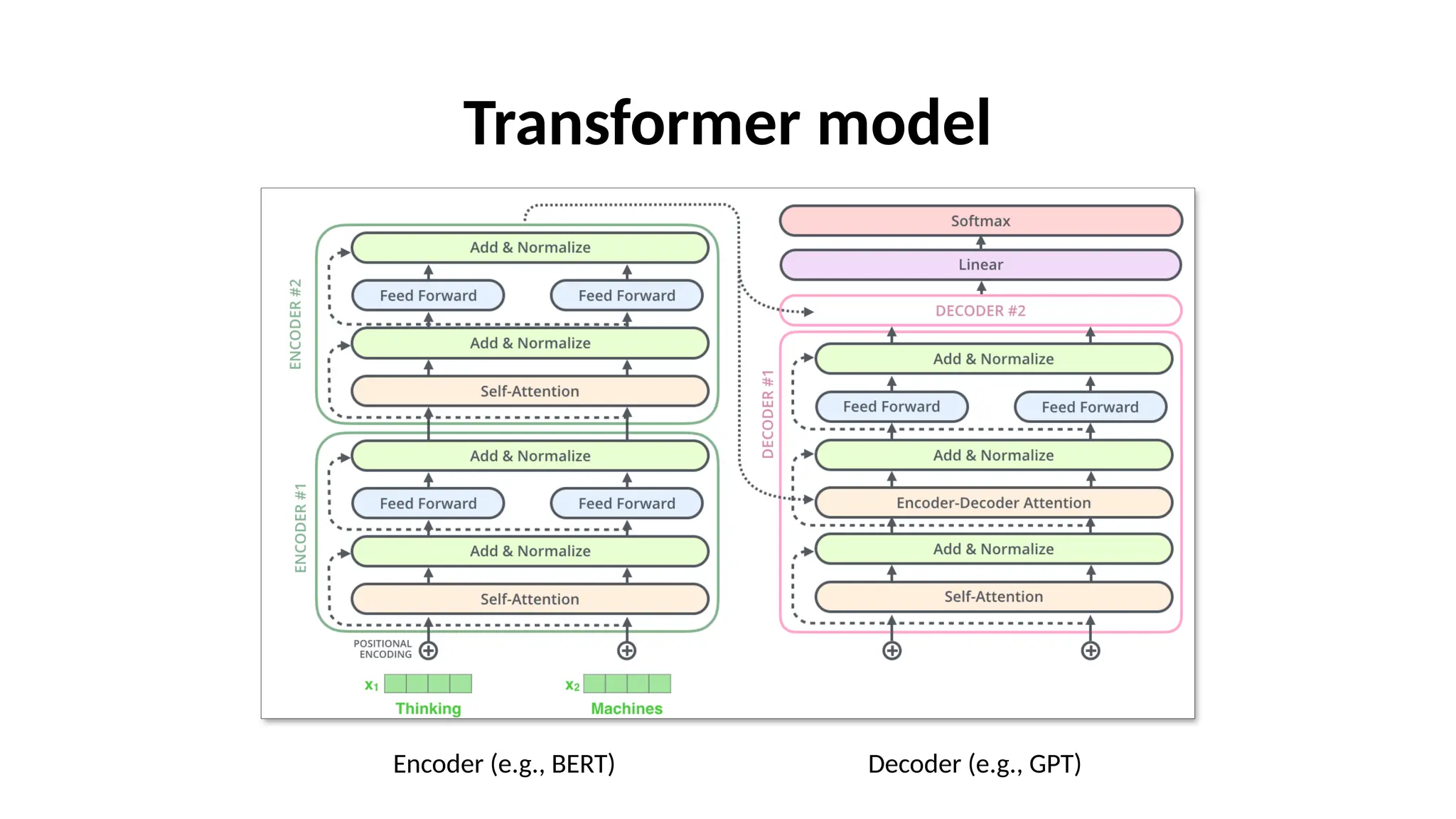
• And break the problem into two parts:
• An encoder (e.g., Bert)
• A decoder (e.g., GPT)
Transformer model
Encoder (e.g., BERT) Decoder (e.g., GPT)
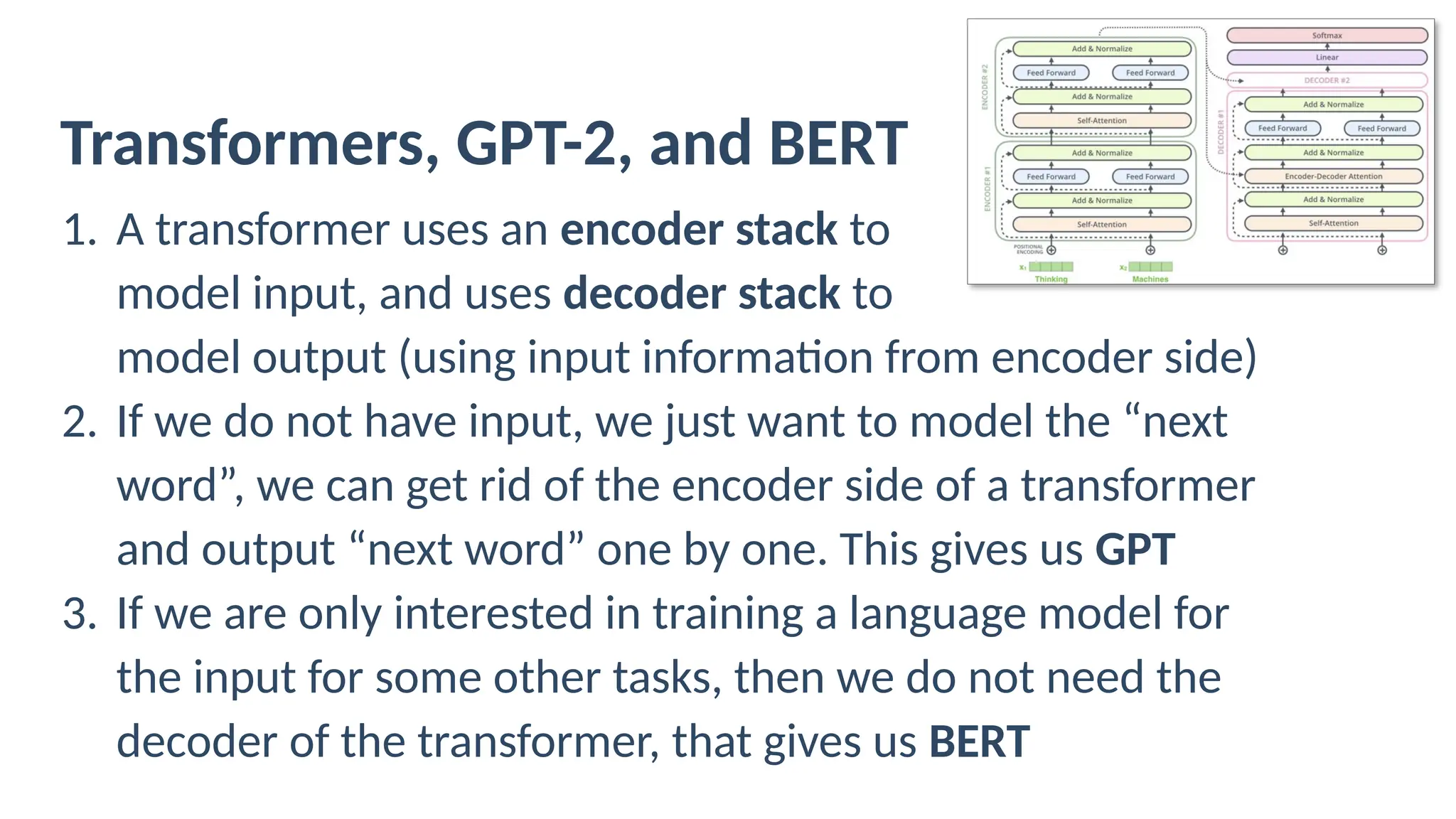
Transformers, GPT-2, and BERT
1. A transformer uses an encoder stack to
model input, and uses decoder stack to
model output (using input information from encoder side)
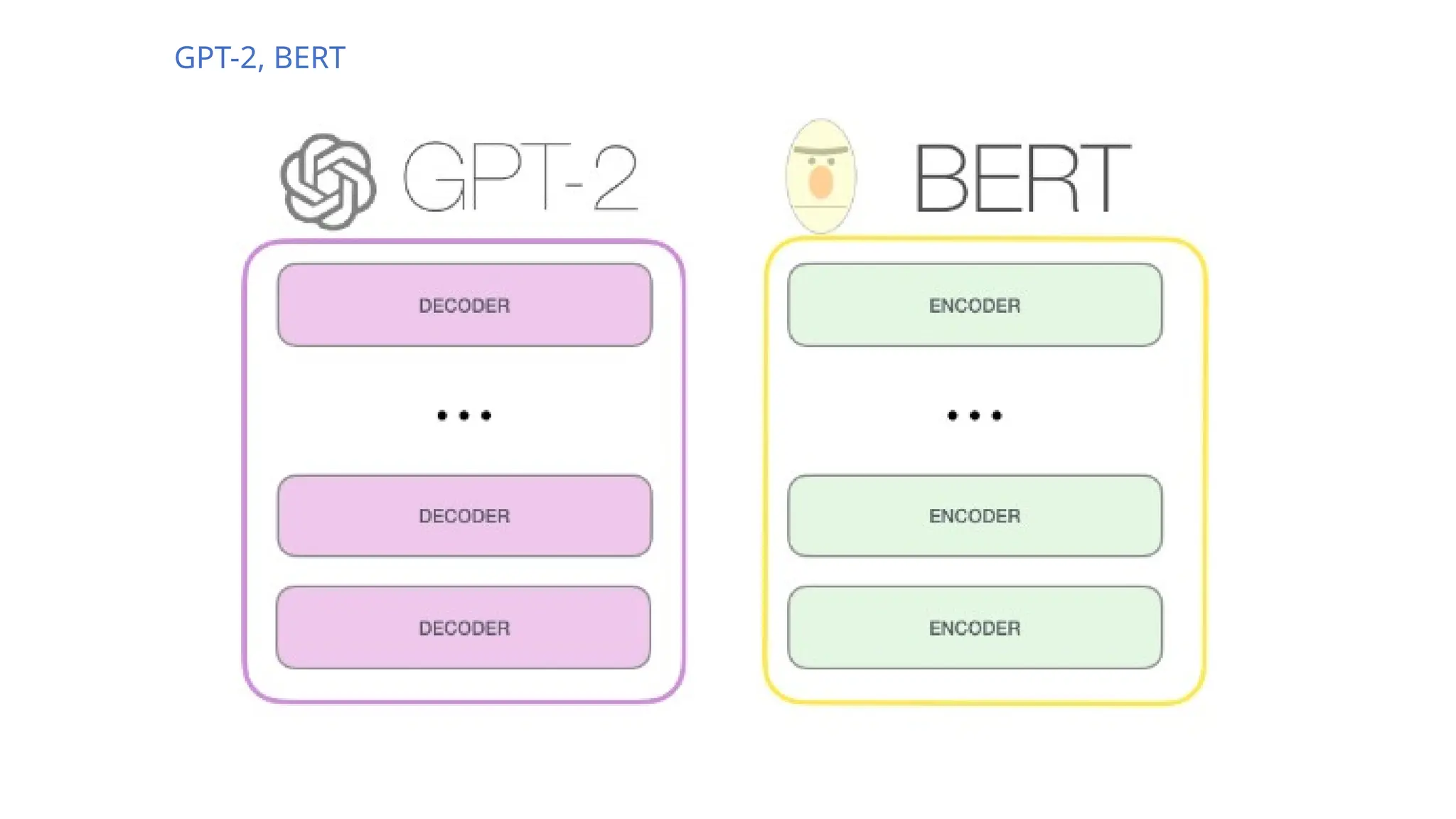
2. If we do not have input, we just want to model the “next
word”, we can get rid of the encoder side of a transformer
and output “next word” one by one. This gives us GPT
3. If we are only interested in training a language model for
the input for some other tasks, then we do not need the
decoder of the transformer, that gives us BERT
Training a Transformer
• Transformers typically use semi-supervised learning with
• Unsupervised pretraining over a very large dataset of general text
• Followed by supervised fine-tuning over a focused data set of
inputs and outputs for a particular task
• Tasks for pretraining and fine-tuning commonly include:
• language modeling
• next-sentence prediction (aka completion)
• question answering
• reading comprehension
• sentiment analysis
• paraphrasing
Pretrained models
• Since training a model requires huge datasets of text and significan
computation, researchers often use common pretrained models
• Examples (circa December 2021) include
• Google’s BERT model
• Huggingface’s various Transformer models
• OpenAI’s and GPT-3 models
Hugggingface Models
OpenAI Application Examples
GPT-2, BERT
03
03
1542M
762M
345M
117M parameters
GPT released June 2018
GPT-2 released Nov. 2019 with 1.5B parameters
GPT-3 released in 2020 with 175B parameters

14_04_transformerso3459834759883457983475.pptx

  • 1.
  • 2.
    Background (1) • TheRNN and LSTM neural models were designed to process language and perform tasks like classification, summarization, translation, and sentiment detection • RNN: Recurrent Neural Network • LSTM: Long Short Term Memory • In both models, layers get the next input word and have access to some previous words, allowing it to use the word’s left context • They used word embeddings where each word was encoded as a vector of 100-300 real numbers representing its meaning
  • 3.
    Background (2) • Transformersextend this to allow the network to process a word input knowing the words in both its left and right context • This provides a more powerful context model • Transformers add additional features, like attention, which identifies the important words in this context • And break the problem into two parts: • An encoder (e.g., Bert) • A decoder (e.g., GPT)
  • 4.
    Transformer model Encoder (e.g.,BERT) Decoder (e.g., GPT)
  • 5.
    Transformers, GPT-2, andBERT 1. A transformer uses an encoder stack to model input, and uses decoder stack to model output (using input information from encoder side) 2. If we do not have input, we just want to model the “next word”, we can get rid of the encoder side of a transformer and output “next word” one by one. This gives us GPT 3. If we are only interested in training a language model for the input for some other tasks, then we do not need the decoder of the transformer, that gives us BERT
  • 6.
    Training a Transformer •Transformers typically use semi-supervised learning with • Unsupervised pretraining over a very large dataset of general text • Followed by supervised fine-tuning over a focused data set of inputs and outputs for a particular task • Tasks for pretraining and fine-tuning commonly include: • language modeling • next-sentence prediction (aka completion) • question answering • reading comprehension • sentiment analysis • paraphrasing
  • 7.
    Pretrained models • Sincetraining a model requires huge datasets of text and significan computation, researchers often use common pretrained models • Examples (circa December 2021) include • Google’s BERT model • Huggingface’s various Transformer models • OpenAI’s and GPT-3 models
  • 8.
  • 9.
  • 10.
  • 11.
    03 1542M 762M 345M 117M parameters GPT releasedJune 2018 GPT-2 released Nov. 2019 with 1.5B parameters GPT-3 released in 2020 with 175B parameters