HASPI Medical A & P Lab 14, Respiratory System, Teacher Info; Revised July 2014 539
HASPI Medical Anatomy & Physiology Lab 14
Teacher Information
Activity 14a – The Respiratory System
Station lab activity that has students investigate the organs, histology, diseases, and characteristics
of the respiratory system. Students have the opportunity to perform a spirometry test to measure tidal
volume, expiratory reserve volume, inspiratory reserve volume, vital capacity, and total lung capacity.
Students practice auscultating lung sounds and taking respiratory rates. Students also have the
opportunity to perform a simulated analysis of a patient to determine what is causing respiratory
distress.
Activity 14b – Respiratory Distress
Students learn how to recognize respiratory distress and the most common causes including asthma
and COPD (chronic bronchitis and emphysema). The lab activity involves students using different
diameter straws to simulate constriction of airways. The students will assess the respiratory rate and
pulse of test subjects breathing through the straws at rest and during exercise.
Activity 14c – Air Quality
Students identify the amount of particulate matter pollution in outdoor or indoor locations of their
choice. Assessment of environmental factors and using an air quality index to determine respiratory
safety is used throughout the lab. The impact of air pollution on respiratory health is also reviewed.
1. Outline the steps of inhalation and exhalation using all of the organs involved in the process.
2. Identify the causes and symptoms of common respiratory disorders.
3. Conduct a spirometry exam using a spirometer to determine lung capacity and volume.
4. Assess the impact of respiratory distress and exercise on respiratory rate and pulse.
5. Determine sources and dangerous concentrations of common air pollutants using an air quality
index.
Dependent on Activity
Lab 14a: 60-90 minutes; Each station can be separated and used as individual labs or activities.
Lab 14b: 45-60 minutes; If time is an issue, different respiratory distress levels can be assigned to
groups and class data can be shared.
Lab 14c: 7 days to collect data (can be less); 30-45 minutes in class.
Supplies needed for 10 lab groups or 40 students
Supply Provided (P)
or Needed (N)
Quantity Company/
Item #
Approximate
Cost
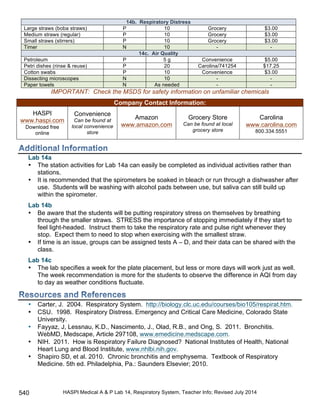
14a. The Respiratory System
Spirometer P 3 Amazon/B00BHELXQI $10.99 each
Alcohol wipes P 20 Convenience $5.00
Respiratory Anatomy Posters P 4
HASPI Cost of copies
Respiratory Histology Posters P 4
Respiratory Disorder Posters P 5
Patient Question Cards P 1 set
Stethoscopes (use from lab 13) N 3 - -
Timer N 3 - -
HASPI Medical A & P Lab 14, Respiratory System, Teacher Info; Revised July 2014540
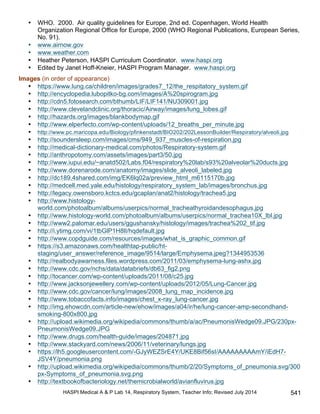
14b. Respiratory Distress
Large straws (boba straws) P 10 Grocery $3.00
Medium straws (regular) P 10 Grocery $3.00
Small straws (stirrers) P 10 Grocery $3.00
Timer N 10 - -
14c. Air Quality
Petroleum P 5 g Convenience $5.00
Petri dishes (rinse & reuse) P 20 Carolina/741254 $17.25
Cotton swabs P 10 Convenience $3.00
Dissecting microscopes N 10 - -
Paper towels N As needed - -
IMPORTANT: Check the MSDS for safety information on unfamiliar chemicals
Company Contact Information:
HASPI
www.haspi.com
Download free
online
Convenience
Can be found at
local convenience
store
Amazon
www.amazon.com
Grocery Store
Can be found at local
grocery store
Carolina
www.carolina.com
800.334.5551
Lab 14a
• The station activities for Lab 14a can easily be completed as individual activities rather than
stations.
• It is recommended that the spirometers be soaked in bleach or run through a dishwasher after
use. Students will be washing with alcohol pads between use, but saliva can still build up
within the spirometer.
Lab 14b
• Be aware that the students will be putting respiratory stress on themselves by breathing
through the smaller straws. STRESS the importance of stopping immediately if they start to
feel light-headed. Instruct them to take the respiratory rate and pulse right whenever they
stop. Expect them to need to stop when exercising with the smallest straw.
• If time is an issue, groups can be assigned tests A – D, and their data can be shared with the
class.
Lab 14c
• The lab specifies a week for the plate placement, but less or more days will work just as well.
The week recommendation is more for the students to observe the difference in AQI from day
to day as weather conditions fluctuate.
• Carter, J. 2004. Respiratory System. http://biology.clc.uc.edu/courses/bio105/respirat.htm.
• CSU. 1998. Respiratory Distress. Emergency and Critical Care Medicine, Colorado State
University.
• Fayyaz, J, Lessnau, K.D., Nascimento, J., Olad, R.B., and Ong, S. 2011. Bronchitis.
WebMD, Medscape, Article 297108, www.emedicine.medscape.com.
• NIH. 2011. How is Respiratory Failure Diagnosed? National Institutes of Health, National
Heart Lung and Blood Institute, www.nhlbi.nih.gov.
• Shapiro SD, et al. 2010. Chronic bronchitis and emphysema. Textbook of Respiratory
Medicine. 5th ed. Philadelphia, Pa.: Saunders Elsevier; 2010.
HASPI Medical A & P Lab 14, Respiratory System, Teacher Info; Revised July 2014 541
• WHO. 2000. Air quality guidelines for Europe, 2nd ed. Copenhagen, World Health
Organization Regional Office for Europe, 2000 (WHO Regional Publications, European Series,
No. 91).
• www.airnow.gov
• www.weather.com
• Heather Peterson, HASPI Curriculum Coordinator. www.haspi.org
• Edited by Janet Hoff-Kneier, HASPI Program Manager. www.haspi.org
Images (in order of appearance)
• https://www.lung.ca/children/images/grades7_12/the_respitatory_system.gif
• http://encyclopedia.lubopitko-bg.com/images/A%20spirogram.jpg
• http://cdn5.fotosearch.com/bthumb/LIF/LIF141/NU309001.jpg
• http://www.clevelandclinic.org/thoracic/Airway/images/lung_lobes.gif
• http://hazards.org/images/blankbodymap.gif
• http://www.elperfecto.com/wp-content/uploads/12_breaths_per_minute.jpg
• http://www.pc.maricopa.edu/Biology/pfinkenstadt/BIO202/202LessonBuilder/Respiratory/alveoli.jpg
• http://soundersleep.com/images/cms/949_937_muscles-of-respiration.jpg
• http://medical-dictionary-medical.com/photos/Respiratory-system.gif
• http://anthropotomy.com/assets/images/part3/50.jpg
• http://www.iupui.edu/~anatd502/Labs.f04/respiratory%20lab/s93%20alveolar%20ducts.jpg
• http://www.dorenarode.com/anatomy/images/slide_alveoli_labeled.jpg
• http://dc189.4shared.com/img/EK6lq02a/preview_html_m6115170b.jpg
• http://medcell.med.yale.edu/histology/respiratory_system_lab/images/bronchus.jpg
• http://legacy.owensboro.kctcs.edu/gcaplan/anat2/histology/trachea5.jpg
• http://www.histology-
world.com/photoalbum/albums/userpics/normal_tracheathyroidandesophagus.jpg
• http://www.histology-world.com/photoalbum/albums/userpics/normal_trachea10X_lbl.jpg
• http://www2.palomar.edu/users/ggushansky/histology/images/trachea%202_tif.jpg
• http://i.ytimg.com/vi/1tbGlP1H8lI/hqdefault.jpg
• http://www.copdguide.com/resources/images/what_is_graphic_common.gif
• https://s3.amazonaws.com/healthtap-public/ht-
staging/user_answer/reference_image/9514/large/Emphysema.jpeg?1344953536
• http://realbodyawarness.files.wordpress.com/2011/03/emphysema-lung-ashx.jpg
• http://www.cdc.gov/nchs/data/databriefs/db63_fig2.png
• http://tocancer.com/wp-content/uploads/2011/08/c25.jpg
• http://www.jacksonjewellery.com/wp-content/uploads/2012/05/Lung-Cancer.jpg
• http://www.cdc.gov/cancer/lung/images/2008_lung_map_incidence.jpg
• http://www.tobaccofacts.info/images/chest_x-ray_lung-cancer.jpg
• http://img.ehowcdn.com/article-new/ehow/images/a04/ir/he/lung-cancer-amp-secondhand-
smoking-800x800.jpg
• http://upload.wikimedia.org/wikipedia/commons/thumb/a/ac/PneumonisWedge09.JPG/230px-
PneumonisWedge09.JPG
• http://www.drugs.com/health-guide/images/204871.jpg
• http://www.stackyard.com/news/2006/11/veterinary/lungs.jpg
• https://lh5.googleusercontent.com/-GJyWEZSrE4Y/UKE8Bif56sI/AAAAAAAAAmY/iEdH7-
JSV4Y/pneumonia.png
• http://upload.wikimedia.org/wikipedia/commons/thumb/2/20/Symptoms_of_pneumonia.svg/300
px-Symptoms_of_pneumonia.svg.png
• http://textbookofbacteriology.net/themicrobialworld/avianfluvirus.jpg
HASPI Medical A & P Lab 14, Respiratory System, Teacher Info; Revised July 2014542
• http://www.nationaljewish.org/img/stock/Flu-Prevention-Tips-Infographic.png
http://www.medicalecology.org/diseases/influenza/6
• 7.gifhttp://upload.wikimedia.org/wikipedia/commons/thumb/9/9e/Symptoms_of_influenza.svg/3
00px-Symptoms_of_influenza.svg.png
• http://upload.wikimedia.org/wikipedia/commons/thumb/9/9c/Tuberculosis-x-ray-1.jpg/230px-
Tuberculosis-x-ray-1.jpg
• http://www.news-medical.net/image.axd?picture=2009%2F12%2F9997.png
• http://media.mcclatchydc.com/smedia/2009/04/01/19/467-20090401-
TUBERCULOSIS.large.prod_affiliate.91.jpg
• http://2.bp.blogspot.com/_ayDfkQkrVmU/TFJ0clyjbWI/AAAAAAAAAIs/5oG7IQ7UuHI/s1600/po
st+mortem+Dis+alpacas.JPG
• https://s3.amazonaws.com/healthtap-public/ht-
staging/user_answer/reference_image/2427/large/Tuberculosis.jpeg?1344912794
• http://4.bp.blogspot.com/-fJKYgJ16zBs/TxPVhnPLvLI/AAAAAAAAAUE/tEBqJ9EE-
yo/s1600/how-you-get-asthma.jpg
• http://www.allinahealth.org/mdex/en135139.jpg
• http://www.drugs.com/health-guide/images/205041.jpg
• http://media.treehugger.com/assets/images/2011/10/global-air-pollution-map.jpg
• http://www.nocoenergysolutions.com/wp-content/uploads/2012/04/IAQ-Graphic_AirAdvice.png

14 respiratory system_-_info

  • 1.
    HASPI Medical A& P Lab 14, Respiratory System, Teacher Info; Revised July 2014 539 HASPI Medical Anatomy & Physiology Lab 14 Teacher Information Activity 14a – The Respiratory System Station lab activity that has students investigate the organs, histology, diseases, and characteristics of the respiratory system. Students have the opportunity to perform a spirometry test to measure tidal volume, expiratory reserve volume, inspiratory reserve volume, vital capacity, and total lung capacity. Students practice auscultating lung sounds and taking respiratory rates. Students also have the opportunity to perform a simulated analysis of a patient to determine what is causing respiratory distress. Activity 14b – Respiratory Distress Students learn how to recognize respiratory distress and the most common causes including asthma and COPD (chronic bronchitis and emphysema). The lab activity involves students using different diameter straws to simulate constriction of airways. The students will assess the respiratory rate and pulse of test subjects breathing through the straws at rest and during exercise. Activity 14c – Air Quality Students identify the amount of particulate matter pollution in outdoor or indoor locations of their choice. Assessment of environmental factors and using an air quality index to determine respiratory safety is used throughout the lab. The impact of air pollution on respiratory health is also reviewed. 1. Outline the steps of inhalation and exhalation using all of the organs involved in the process. 2. Identify the causes and symptoms of common respiratory disorders. 3. Conduct a spirometry exam using a spirometer to determine lung capacity and volume. 4. Assess the impact of respiratory distress and exercise on respiratory rate and pulse. 5. Determine sources and dangerous concentrations of common air pollutants using an air quality index. Dependent on Activity Lab 14a: 60-90 minutes; Each station can be separated and used as individual labs or activities. Lab 14b: 45-60 minutes; If time is an issue, different respiratory distress levels can be assigned to groups and class data can be shared. Lab 14c: 7 days to collect data (can be less); 30-45 minutes in class. Supplies needed for 10 lab groups or 40 students Supply Provided (P) or Needed (N) Quantity Company/ Item # Approximate Cost 14a. The Respiratory System Spirometer P 3 Amazon/B00BHELXQI $10.99 each Alcohol wipes P 20 Convenience $5.00 Respiratory Anatomy Posters P 4 HASPI Cost of copies Respiratory Histology Posters P 4 Respiratory Disorder Posters P 5 Patient Question Cards P 1 set Stethoscopes (use from lab 13) N 3 - - Timer N 3 - -
  • 2.
    HASPI Medical A& P Lab 14, Respiratory System, Teacher Info; Revised July 2014540 14b. Respiratory Distress Large straws (boba straws) P 10 Grocery $3.00 Medium straws (regular) P 10 Grocery $3.00 Small straws (stirrers) P 10 Grocery $3.00 Timer N 10 - - 14c. Air Quality Petroleum P 5 g Convenience $5.00 Petri dishes (rinse & reuse) P 20 Carolina/741254 $17.25 Cotton swabs P 10 Convenience $3.00 Dissecting microscopes N 10 - - Paper towels N As needed - - IMPORTANT: Check the MSDS for safety information on unfamiliar chemicals Company Contact Information: HASPI www.haspi.com Download free online Convenience Can be found at local convenience store Amazon www.amazon.com Grocery Store Can be found at local grocery store Carolina www.carolina.com 800.334.5551 Lab 14a • The station activities for Lab 14a can easily be completed as individual activities rather than stations. • It is recommended that the spirometers be soaked in bleach or run through a dishwasher after use. Students will be washing with alcohol pads between use, but saliva can still build up within the spirometer. Lab 14b • Be aware that the students will be putting respiratory stress on themselves by breathing through the smaller straws. STRESS the importance of stopping immediately if they start to feel light-headed. Instruct them to take the respiratory rate and pulse right whenever they stop. Expect them to need to stop when exercising with the smallest straw. • If time is an issue, groups can be assigned tests A – D, and their data can be shared with the class. Lab 14c • The lab specifies a week for the plate placement, but less or more days will work just as well. The week recommendation is more for the students to observe the difference in AQI from day to day as weather conditions fluctuate. • Carter, J. 2004. Respiratory System. http://biology.clc.uc.edu/courses/bio105/respirat.htm. • CSU. 1998. Respiratory Distress. Emergency and Critical Care Medicine, Colorado State University. • Fayyaz, J, Lessnau, K.D., Nascimento, J., Olad, R.B., and Ong, S. 2011. Bronchitis. WebMD, Medscape, Article 297108, www.emedicine.medscape.com. • NIH. 2011. How is Respiratory Failure Diagnosed? National Institutes of Health, National Heart Lung and Blood Institute, www.nhlbi.nih.gov. • Shapiro SD, et al. 2010. Chronic bronchitis and emphysema. Textbook of Respiratory Medicine. 5th ed. Philadelphia, Pa.: Saunders Elsevier; 2010.
  • 3.
    HASPI Medical A& P Lab 14, Respiratory System, Teacher Info; Revised July 2014 541 • WHO. 2000. Air quality guidelines for Europe, 2nd ed. Copenhagen, World Health Organization Regional Office for Europe, 2000 (WHO Regional Publications, European Series, No. 91). • www.airnow.gov • www.weather.com • Heather Peterson, HASPI Curriculum Coordinator. www.haspi.org • Edited by Janet Hoff-Kneier, HASPI Program Manager. www.haspi.org Images (in order of appearance) • https://www.lung.ca/children/images/grades7_12/the_respitatory_system.gif • http://encyclopedia.lubopitko-bg.com/images/A%20spirogram.jpg • http://cdn5.fotosearch.com/bthumb/LIF/LIF141/NU309001.jpg • http://www.clevelandclinic.org/thoracic/Airway/images/lung_lobes.gif • http://hazards.org/images/blankbodymap.gif • http://www.elperfecto.com/wp-content/uploads/12_breaths_per_minute.jpg • http://www.pc.maricopa.edu/Biology/pfinkenstadt/BIO202/202LessonBuilder/Respiratory/alveoli.jpg • http://soundersleep.com/images/cms/949_937_muscles-of-respiration.jpg • http://medical-dictionary-medical.com/photos/Respiratory-system.gif • http://anthropotomy.com/assets/images/part3/50.jpg • http://www.iupui.edu/~anatd502/Labs.f04/respiratory%20lab/s93%20alveolar%20ducts.jpg • http://www.dorenarode.com/anatomy/images/slide_alveoli_labeled.jpg • http://dc189.4shared.com/img/EK6lq02a/preview_html_m6115170b.jpg • http://medcell.med.yale.edu/histology/respiratory_system_lab/images/bronchus.jpg • http://legacy.owensboro.kctcs.edu/gcaplan/anat2/histology/trachea5.jpg • http://www.histology- world.com/photoalbum/albums/userpics/normal_tracheathyroidandesophagus.jpg • http://www.histology-world.com/photoalbum/albums/userpics/normal_trachea10X_lbl.jpg • http://www2.palomar.edu/users/ggushansky/histology/images/trachea%202_tif.jpg • http://i.ytimg.com/vi/1tbGlP1H8lI/hqdefault.jpg • http://www.copdguide.com/resources/images/what_is_graphic_common.gif • https://s3.amazonaws.com/healthtap-public/ht- staging/user_answer/reference_image/9514/large/Emphysema.jpeg?1344953536 • http://realbodyawarness.files.wordpress.com/2011/03/emphysema-lung-ashx.jpg • http://www.cdc.gov/nchs/data/databriefs/db63_fig2.png • http://tocancer.com/wp-content/uploads/2011/08/c25.jpg • http://www.jacksonjewellery.com/wp-content/uploads/2012/05/Lung-Cancer.jpg • http://www.cdc.gov/cancer/lung/images/2008_lung_map_incidence.jpg • http://www.tobaccofacts.info/images/chest_x-ray_lung-cancer.jpg • http://img.ehowcdn.com/article-new/ehow/images/a04/ir/he/lung-cancer-amp-secondhand- smoking-800x800.jpg • http://upload.wikimedia.org/wikipedia/commons/thumb/a/ac/PneumonisWedge09.JPG/230px- PneumonisWedge09.JPG • http://www.drugs.com/health-guide/images/204871.jpg • http://www.stackyard.com/news/2006/11/veterinary/lungs.jpg • https://lh5.googleusercontent.com/-GJyWEZSrE4Y/UKE8Bif56sI/AAAAAAAAAmY/iEdH7- JSV4Y/pneumonia.png • http://upload.wikimedia.org/wikipedia/commons/thumb/2/20/Symptoms_of_pneumonia.svg/300 px-Symptoms_of_pneumonia.svg.png • http://textbookofbacteriology.net/themicrobialworld/avianfluvirus.jpg
  • 4.
    HASPI Medical A& P Lab 14, Respiratory System, Teacher Info; Revised July 2014542 • http://www.nationaljewish.org/img/stock/Flu-Prevention-Tips-Infographic.png http://www.medicalecology.org/diseases/influenza/6 • 7.gifhttp://upload.wikimedia.org/wikipedia/commons/thumb/9/9e/Symptoms_of_influenza.svg/3 00px-Symptoms_of_influenza.svg.png • http://upload.wikimedia.org/wikipedia/commons/thumb/9/9c/Tuberculosis-x-ray-1.jpg/230px- Tuberculosis-x-ray-1.jpg • http://www.news-medical.net/image.axd?picture=2009%2F12%2F9997.png • http://media.mcclatchydc.com/smedia/2009/04/01/19/467-20090401- TUBERCULOSIS.large.prod_affiliate.91.jpg • http://2.bp.blogspot.com/_ayDfkQkrVmU/TFJ0clyjbWI/AAAAAAAAAIs/5oG7IQ7UuHI/s1600/po st+mortem+Dis+alpacas.JPG • https://s3.amazonaws.com/healthtap-public/ht- staging/user_answer/reference_image/2427/large/Tuberculosis.jpeg?1344912794 • http://4.bp.blogspot.com/-fJKYgJ16zBs/TxPVhnPLvLI/AAAAAAAAAUE/tEBqJ9EE- yo/s1600/how-you-get-asthma.jpg • http://www.allinahealth.org/mdex/en135139.jpg • http://www.drugs.com/health-guide/images/205041.jpg • http://media.treehugger.com/assets/images/2011/10/global-air-pollution-map.jpg • http://www.nocoenergysolutions.com/wp-content/uploads/2012/04/IAQ-Graphic_AirAdvice.png