Science Module
7th Grade
Body Systems
Respiratory System
7th Grade Science
TAKS 2
TEKS 7.9(A)
TAKS Objective 2
The student will demonstrate an
understanding of living systems and the
environment – Interdependence occurs
among living systems
TEKS Science Concept
• TEKS 7.9 (A) identify the systems of the
human organism and describe their
functions.
Student Prior Knowledge
• TEKS 6.10 (C) identify how structure
complements function at different levels of
organization including organ and organ
systems.
Background
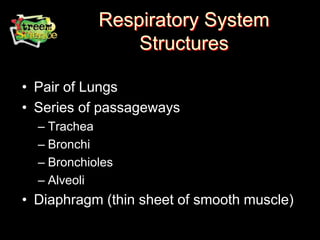
Respiratory System
Structures
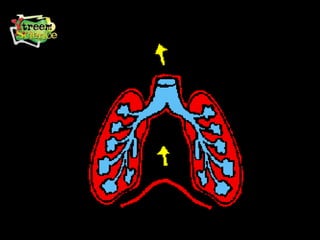
• Pair of Lungs
• Series of passageways
– Trachea
– Bronchi
– Bronchioles
– Alveoli
• Diaphragm (thin sheet of smooth muscle)
Respiratory System
Function
• Involves all mechanisms that get O2 to the cells
• Gets rid of CO2
• Formation of ATP for energy
Path Air Takes
1. Air enters nose or mouth
2. Passes Pharynx
3. Moves past epiglottis
4. Passes through larynx
5. Trachea
6. Lungs and their passageways
Respiratory System
• I bring in the oxygen that is carried on the
red blood cells…without me you’d have no
oxygen to carry!
• I carry the CO2 (waste gas) out of the body.
• The circulatory system needs me for gas
exchange.
• The muscles need oxygen to move.
• The brain needs
my oxygen to think.
Breathe Easy
ENGAGE
Engage 1:
• Obtain a pluck from Owen’s Sausage. Demonstrate how air goes
in and out of their lungs. The lungs are very elastic and will
expand greatly. Allow the students to look at the heart, lungs and
trachea.
Engage 2
1. Use the paper towel to clean and dry the mirror.
2. Hold the mirror near, but not touching, your mouth.
3. Exhale onto the mirror two or three times.
4. Examine the surface of the mirror.
•What happens to the mirror?
•Why does the mirror become fogged?
EXPLORE
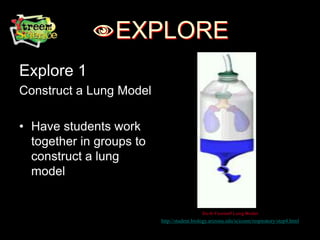
Explore 1
Construct a Lung Model
• Have students work
together in groups to
construct a lung
model
Do-It-Yourself Lung Model
http://student.biology.arizona.edu/sciconn/respiratory/step4.html
MODEL
Assemble the “Lungs”
• Step 1
• Step 2
Construct the “Chest Cavity”
• Step 3
• Step 4
Prepare the “Diaphragm”
• Step 5
• Step 6
Start “Breathing”
Breaths per Minute
Explore 2
• BREATHER:
All students sit quietly (lie down if possible) with hands placed over their
stomachs or chests.
• WATCHERS:
The watchers must watch their partners and count the breaths taken in
one minute (count ONE breathe for every time the stomach or chest
rises). Teacher cues the watcher when to begin and when to stop after
60 seconds. After the 60 seconds, watchers tell the breathers how many
breaths were counted. Then all breathers record their at rest information
on the index card or sticky notepaper. Students trade places and repeat
the activity. Next, students do jumping jacks or run in place for 60
seconds before recording breathing rates as described above.
EXPLAIN
1. In which case did you breathe more? Why?
2. Do you think respiration rate would be faster or
slower if you ran for 10 minutes before counting
breaths?
3. Would there be a difference in your respiration rate if
you checked it when you were sleeping and then
again if you were walking?
4. Why can't we hold our breath for 5 minutes?
5. List at least six components of the respiratory
system.
ELABORATE
Measuring Lung Capacity
CAUTION: Do not do this activity if you have asthma!
Give identical balloons to pairs of students. Instruct each to blow up a balloon
as much as possible with only one breath. Measure how big around
everyone's balloon is and write down the numbers next to the persons
names. Let air out of balloons and repeat two more times. Take an
average of three tests.
QUESTIONS:
1. Who was able to blow the most air into their balloon?
2. What is it about the person that enables him or her to do this?
3. If you ran in place for 2 - 3 minutes, would you be able to blow as
much air into the balloon? Try it.
EVALUATE
• Upon completion of the human lung model the student
will explain the mechanism of breathing through the use of
their model, they will name the gases the primary gases
that compose air, and they will name the gases we exhale.
A grade of pass or fail will be given.
• After creating the respiration model the student will list
six components of respiration: Nose, trachea, bronchi,
bronchioles, alveoli, and lung.

Grade_9_Respiratory_System

  • 1.
  • 2.
    Body Systems Respiratory System 7thGrade Science TAKS 2 TEKS 7.9(A)
  • 3.
    TAKS Objective 2 Thestudent will demonstrate an understanding of living systems and the environment – Interdependence occurs among living systems
  • 4.
    TEKS Science Concept •TEKS 7.9 (A) identify the systems of the human organism and describe their functions.
  • 5.
    Student Prior Knowledge •TEKS 6.10 (C) identify how structure complements function at different levels of organization including organ and organ systems.
  • 6.
  • 7.
    Respiratory System Structures • Pairof Lungs • Series of passageways – Trachea – Bronchi – Bronchioles – Alveoli • Diaphragm (thin sheet of smooth muscle)
  • 8.
    Respiratory System Function • Involvesall mechanisms that get O2 to the cells • Gets rid of CO2 • Formation of ATP for energy
  • 9.
    Path Air Takes 1.Air enters nose or mouth 2. Passes Pharynx 3. Moves past epiglottis 4. Passes through larynx 5. Trachea 6. Lungs and their passageways
  • 11.
    Respiratory System • Ibring in the oxygen that is carried on the red blood cells…without me you’d have no oxygen to carry! • I carry the CO2 (waste gas) out of the body. • The circulatory system needs me for gas exchange. • The muscles need oxygen to move. • The brain needs my oxygen to think.
  • 12.
  • 13.
    ENGAGE Engage 1: • Obtaina pluck from Owen’s Sausage. Demonstrate how air goes in and out of their lungs. The lungs are very elastic and will expand greatly. Allow the students to look at the heart, lungs and trachea. Engage 2 1. Use the paper towel to clean and dry the mirror. 2. Hold the mirror near, but not touching, your mouth. 3. Exhale onto the mirror two or three times. 4. Examine the surface of the mirror. •What happens to the mirror? •Why does the mirror become fogged?
  • 14.
    EXPLORE Explore 1 Construct aLung Model • Have students work together in groups to construct a lung model Do-It-Yourself Lung Model http://student.biology.arizona.edu/sciconn/respiratory/step4.html MODEL
  • 15.
  • 16.
    Construct the “ChestCavity” • Step 3 • Step 4
  • 17.
  • 18.
  • 19.
    Breaths per Minute Explore2 • BREATHER: All students sit quietly (lie down if possible) with hands placed over their stomachs or chests. • WATCHERS: The watchers must watch their partners and count the breaths taken in one minute (count ONE breathe for every time the stomach or chest rises). Teacher cues the watcher when to begin and when to stop after 60 seconds. After the 60 seconds, watchers tell the breathers how many breaths were counted. Then all breathers record their at rest information on the index card or sticky notepaper. Students trade places and repeat the activity. Next, students do jumping jacks or run in place for 60 seconds before recording breathing rates as described above.
  • 20.
    EXPLAIN 1. In whichcase did you breathe more? Why? 2. Do you think respiration rate would be faster or slower if you ran for 10 minutes before counting breaths? 3. Would there be a difference in your respiration rate if you checked it when you were sleeping and then again if you were walking? 4. Why can't we hold our breath for 5 minutes? 5. List at least six components of the respiratory system.
  • 21.
    ELABORATE Measuring Lung Capacity CAUTION:Do not do this activity if you have asthma! Give identical balloons to pairs of students. Instruct each to blow up a balloon as much as possible with only one breath. Measure how big around everyone's balloon is and write down the numbers next to the persons names. Let air out of balloons and repeat two more times. Take an average of three tests. QUESTIONS: 1. Who was able to blow the most air into their balloon? 2. What is it about the person that enables him or her to do this? 3. If you ran in place for 2 - 3 minutes, would you be able to blow as much air into the balloon? Try it.
  • 22.
    EVALUATE • Upon completionof the human lung model the student will explain the mechanism of breathing through the use of their model, they will name the gases the primary gases that compose air, and they will name the gases we exhale. A grade of pass or fail will be given. • After creating the respiration model the student will list six components of respiration: Nose, trachea, bronchi, bronchioles, alveoli, and lung.