The Step-by-Step Guide to Branding
- HANDOUT -
13 Steps to Success | Handout
www.RogerBrooksInternational.com
Copyright © 2013 Roger Brooks International. All rights reserved.
Educate locals
on what a
brand is
Now it’s time to
educate local
stakeholders,
organizations,
businesses and business leaders, as well as the
general population on what a brand is and why this
is important to do. Otherwise, you’ll end up with
a population sending you just slogans and logo
concepts.
Prepare a 20-minute presentation and give it at
local board meetings (Chamber, City Council,
Auxiliary organizations such as Rotary and Kiwanis,
school boards, hospital boards, etc.
Also include the press on the brand education
so they understand it and will also educate local
residents and business leaders.
Inventory your assets
What do you have that makes you a desirable
community for establishing a new business? As a
place to live? Or as a place to visit? Make it specific.
Do NOT use“quality of life”on the list. Break it
down. What, specifically, makes you special. This
can be quite the list.
Then take the list and if some items can be found
closer to the markets you are hoping to attract,
move it to the“diversionary”or“secondary”list. You
Brand
Development
Committee
This is the group of
stakeholders who
will take the lead in
developing the brand
direction. Typically keep it to 13 people, or fewer. As
you know, the larger the committee the less likely
you are to get things accomplished.
Typical members might include:
• Economic Development
• Chamber of Commerce
• Tourism
• City/county elected official
• City/county senior staff
• Downtown representative
• Planning director
• Six business sector representatives
These folks will help decide on the final brand
direction. They need to be“heavy hitters”locally.
Get an outside facilitator
It’s extremely important to get an outside facilitator
- someone with no political ties locally, and not in
business locally. This way politics won’t get in the
way. Someone who has nothing to gain or locally
should help facilitate the process.
1
If you had a sports retailer as your local facilitator,
and then sports ends up being the most feasible
brand direction, the community will assume that
he or she steered the brand that direction, thus
eliminating the non-biased opinion.
The facilitator will also be charged with helping to
“sell”the community on the brand once it’s been
decided, so make sure you have a good speaker
who can excite the community about the brand
direction.
2
13 Steps to Success | Handout
www.RogerBrooksInternational.com
Copyright © 2013 Roger Brooks International. All rights reserved.
Identify the
markets
The next step is to
identify the markets
you are hoping to
attract. This is not
just about tourism,
but also the types of
markets you are looking for in terms of business
(jobs).
Those markets should include:
• Geographic areas (primary and secondary)
• Demographics (Young people? Creative Class?
Retirees? Families?)
• Lifestyle or psychographics: Identification
of personality characteristics and attitudes
that affect a person’s lifestyle and purchasing
behaviors.
• Primary and secondary markets.
• Industry: The type of industry best suited for the
area based on your points of differentiation.
3
are hoping to find one or two things the markets
can’t get or do closer to home. This may take some
time and you may need to really dig deep.
You are looking for possible building blocks or a
foundation upon which you can build your brand.
Ask the community
This is where the community can weigh in and have
their chance to provide input. Here are ways to ask:
• Hold an open house and provide places for
people to provide input. Often this can be
combined with educational workshops.
• Do an online survey using Constant Contact or
another service like Survey Monkey.
• Interview local stakeholders asking for specific
input.
• Through the press: radio, television, print media.
Yes, you’ll get some sarcasm, and yes, you’ll get
some slogans. That’s okay. Take it all in.
Find your“anchor tenants”
Take the“seven questions quiz”to local meetings
such as Kiwanis, Rotary, Chamber and other
organizations and ask them the questions. You’ll
find out, quickly, who your“anchor tenants”are in
terms of restaurants, retail shops and activities.
Here’s a sample list of questions you can start with:
1. Where can I get the best dessert? Name the
restaurant and the dish.
2. Where will me and my partner have the best
dining experience? It can be fancy, great food,
great ambiance, or great characters. Breakfast,
lunch, or dinner.
3. Where can I get gourmet items for a picnic?
4. Where, specifically, can I see a breathtaking
sunrise or sunset?
5. Where is the best place to take a memorable
photo that says I was really there?
6. Where can I check my e-mails?
7. Where can I get the perfect gift? Something
locally or regionally made?
Then have your audience put these in order of an
itinerary as if a guest was coming into town on a
Friday evening, and spending the weekend in town.
This is what every visitor is looking for. Itineraries
from the locals. You MUST promote your“anchor
tenants.”They make you worth a special trip and
an extended stay. Everyone will benefit from them.
Think Orlando and Disney World.
13 Steps to Success | Handout
www.RogerBrooksInternational.com
Copyright © 2013 Roger Brooks International. All rights reserved.
Create
the Brand
Leadership
Team
Your Brand
Development
Committee got you
to this point. They“developed”the brand. Now that
you have the brand direction, you need to shift the
focus to those who will“lead”the brand - The BLT.
The entire branding effort will hinge on the efforts
of this group of people. Once again, keep it to 13
people. Seven of them should be from the private
sector and should have a vested interest in the
brand direction. They are most willing to champion
the cause because their paycheck depends on it.
The other six people would include the supporting
organizations. There might be a wholesale change
from the BDC to the BLT.
Go through the
filtering process
Take the entire list
from the community
(over perhaps three or
four weeks), combine
similar concepts, and
then remove the ones
that are too generic or can fit other communities
within the markets you are hoping to attract.
This will typically shorten the list from perhaps 100
different items down to, in most cases, less than ten
items.
Keep track of items you heard from multiple
people. Perhaps these can be used as niche brands
or as supporting activities to the final brand
direction.
Run the ideas through the 10-point
Feasibility Test
These are listed in the previous section. Run each
item on the list through the feasibility test and
see what’s left. If you’re lucky, you should have it
narrowed down to just one or two items. The goal is
to get down to one item.
In many cases there may be no items left on the list.
Don’t despair! This gives you a clean slate to build a
fresh brand, still using the assets you listed earlier.
Look for other ideas. Dig a little deeper. It’s ok to
duplicate another community’s brand as long as it’s
different from what the markets you are hoping to
attract can get or do closer to home.
Identify the niche and sub-brands
Sub or niche-brands are smaller well-defined
brands where you can market to that group
specifically. Typical niche brands include:
• Sports
• Bird watching
• Fishing and hunting
• RV’ing
Make sure there is good“cross-participation”
between the primary brand and niche brands. For
instance, art and food go well together. Sports and
entertainment are a good fit. Birding and gardening
are compatible brands/niche-brands.
By identifying these, you’ll be able to provide your
primary brand with“legs”- or offshoots.
Pick one and only one
The natural tendency will be to pick several and
to head down the path of“we have something for
everyone!”Don’t even try it.
Pick one that the Brand Development Committee
can buy into and that makes sense. If someone else
has this brand in a different market, check it out.
How’s it working for them? Can you reasonably
duplicate it or exceed it?
If you have to develop a new brand, don’t panic
about the time it will take to develop. We’ll get to
BridgeBrands in a minute.
4 5
13 Steps to Success | Handout
www.RogerBrooksInternational.com
Copyright © 2013 Roger Brooks International. All rights reserved.
Develop the
“Brand Bank”
These are the ideas
that will reinforce and
support the brand.
When Leavenworth,
Washington decided
to become a Bavarian
themed town, the ideas included:
• An amphitheater where they would produce The
Sound of Music annually.
• Maypole dances, long-pipe festival, and other
Bavarian-oriented events.
• Facade improvements.
• Bavarian eateries, retail sales of goods made in
Bavaria.
• Bavarian artists in action, art shows.
And the list goes on. They did such a good job
that 40% of Leavenworth’s population is now from
Germany. Remember that brands are built on
product, so this should be the focus.
Look for partnership opportunities.
Write the brand
promise
This is the paragraph
that describes what
you will be ten, 15
years down the road.
Not today, but what
you aspire to become.
This is the goal that you are aiming for.
Make sure it’s not generic. Read it, rewrite it, and
keep fine tuning it until it is very specific and would
make you want to go there or move there when it’s
in place.
Business prospects should read this and think“Gee,
there’s a business opportunity for me here.”You can
develop a long version (three paragraphs or so) and
a short version, which would be just one paragraph
of no more than five lines.
Short, to the point, very specific, and well defined.
6 7
Create the look
and feel of the
brand
We’re finally to the
look and feel of the
brand: the logo or
brand identity, color
schemes, tag lines and all the marketing elements
that will be used as you develop the brand and
claim ownership of it. This is where communities go
sideways, typically putting this first without going
through the other 13 necessary steps.
Hire professional services to do this for you and
remember that you are selling a feeling more than
the physical attributes that support the brand.
Develop a Brand Style Guide and include all your
local marketing organizations. Continuity is critical
at this point.
Remember that the logo and tag line make up 2%
of a brand, but will get virtually all of the attention.
You cannot do this by public consent. Do NOT make
this a public process. It can kill your entire effort.
8
13 Steps to Success | Handout
www.RogerBrooksInternational.com
Copyright © 2013 Roger Brooks International. All rights reserved.
Make something
happen
This can be a new
wayfinding sign or
entry sign. Or even
something as simple as
new business cards or
the redevelopment of an existing website. People are
impatient, so having something physical they can see
will help sell the brand, and will tell the community
you’re serious and this won’t be another plan sitting
on a shelf gathering dust.
The best way to develop a brand is to slide it in slowly.
All of a sudden a new sign goes up with a new identity
and tag line on it. Then another, and over time, it
becomes pervasive throughout the community.
Sell it! Begin the outreach program
One of the big responsibilities of the Brand
Leadership Champions are selling the brand to the
community and creating buy-in opportunities for
local organizations.
This will include your“BridgeBrand”as well as your
long-term branding goals and implementation of
the plan.
Every member of the BLC should be charged with
speaking at three, four, five or six events a year. They
need to be good speakers, enthusiastic and able to
convince others to jump on board the band wagon.
This process doesn’t end for years until the brand
has taken on momentum of its own.
Developing an
Action Plan
All successful
brands are built
on product so
develop a Branding,
Development &
Marketing Action
Plan. No more strategic plans. You need action
steps - a to do list - as opposed to strategies, goals
and objectives.
For each recommendation provide the following:
• A description of the recommendation
• Who would be charged with implementation. It
takes a village to win.
• When it would be implemented.
• Cost of implementation
• Where the money would or could come from.
• The rationale for making the recommendation.
The marketing action plan
Telling the world is how you stake your claim
- ownership - of your brand. Like the product
development plan, the marketing plan should
include the same elements and should incorporate
all partnering organizations. Everyone has a role to
play in a successful branding effort.
The plan should include graphics, advertising,
public relations (a cornerstone of the branding
9 10
effort), photography, video, marketing materials,
web and Internet marketing initiatives, brand-
building posters and give-away items, etc.
Always promote the businesses, specifically, that
reinforce and support the brand. Don’t let politics
get in the way of marketing your“anchor tenants.”
Define the roles
As just noted, it takes a village to win. Every
organization plays a role. For instance, Kiwanis or
Rotary might take on the development of new
entry points (fitting the brand), while the city
may take on the development of a Wayfinding
System (decorative directional signage that
fit the brand). This can extend into downtown
business recruitment, facade improvements, event
development and a host of other brand-specific
assignments.
When you get everyone on the same page, pulling
in the same direction, this becomes fun. This is
where you put it all together.
13 Steps to Success | Handout
www.RogerBrooksInternational.com
Copyright © 2013 Roger Brooks International. All rights reserved.
Keep the
energy high.
The first year
is ALWAYS the
toughest year when
implementing a
branding program.
Because you are
narrowing your focus, you will undoubtedly run
into opposition who want your community to
be all things to all people – that you really do
have“something for everyone.”Even though that
marketing approach no longer works, the blogs will
light up with dissent and so your brand champions
must just let it go and MUST work to keep the
energy high.
Once the branding effort starts taking hold, people
will come on board – slowly at first – and as they
“get used”to the new direction, and businesses
begin to invest in it, it will garner strength over
time. Nobody in Napa Valley complains about
it being the world’s“wine capital.”Nor do they
complain about Nashville owning the country
music brand. Over time it became organic to the
community – who they are. The same holds true
with your community.
Just remember that there are only three killers of
any branding effort. Period:
1. Local politics – and it’s far worse with
membership organizations than it is with
elected officials.
11
Tell the world
Once you have the
product – and people
– in place, it’s time
to tell the world of
who you are, what
separates you from
everyone else and
makes you THE destination of choice. Now it’s time
to drive your stake in the ground that you“own”
your brand. After all, brands are about owning you
niche in the marketplace.
You build your brand through public relations.
Advertising is used to maintain your ownership
position. Remember that brands are a perception
– what people think of you when your name is
mentioned. And perceptions are created from first
impressions, visual things we see once in your
community, what we see on the news or read in
print publications, and now what we“hear”in social
media.
This is where you put together a detailed Marketing
Action Plan – with all of your local organizations at
the table (branding requires continuity) and craft
a plan on how you are going to tell the world what
you’re about – specifically.
When it comes to marketing budgets, here’s a
guideline to use:
45% - Website | Pay Per Click | SEO | online
advertising | social media | apps |anything that is
Internet-related.
12
2. Lack of champions – No branding effort
can succeed without tireless pioneers who
champion the cause – especially in the face of
criticism – but push the agenda forward and
never take no for an answer.
3. Lack of money – both public and private.
Almost every well-branded city, town, county, or
destination in the world was founded on private
sector investment and marketing. Consider
these:
a. Orlando, Florida and Anaheim, California (Disney
– kids & family)
b. Napa Valley, California (wine)
c. Nashville, Tennessee (country music)
d. Memphis, Tennessee (home of Graceland)
e. Hershey, Pennsylvania (chocolate)
f. Lancaster, Pennsylvania (Amish)
g. Hollywood, California (movies and stars)
h. Silicon Valley, California (high tech)
Finally, every community is full of CAVERS – people
who don’t want change and will fight it. What’s a
CAVER? Citizens Against Virtually Everything.
Keeping the energy high is the make or break it for
any branding effort.
13 Steps to Success | Handout
www.RogerBrooksInternational.com
Copyright © 2013 Roger Brooks International. All rights reserved.
Mottos to Live By
“If you think you’re too small to make a difference, try
going to bed with a mosquito in the room.” - unknown
“Never doubt that a small group of thoughtful committed
people can change the world. Indeed, it is the only thing
that ever has.” – Margaret Mead
“A by-product of brands ‘for the people’ is the committee
that compromises and kills a potential brand home run.
This is why you never see statues of committees in public
parks. You see brave leaders.”
“Nothing great was ever achieved without enthusiasm.” –
Ralph Waldo Emerson
The Bridge Brand
It can take anywhere from three to 20 years to fully“own”
your brand. Rarely is it a shorter or longer process. But
what can you do between now and then? How do you
“bridge”the gap while you’re developing your brand?
This is where the BridgeBrand comes to play. If you
want to become a culinary destination, then start by
promoting your best restaurants, a culinary school, and
culinary events. Don’t tell the world you are a culinary
destination, but start to market the small things that
are the foundation or building blocks of your long-term
brand direction.
BridgeBrands are often used as a“repositioning”or
“rebranding”effort. Often communities have a negative
perception that needs to be turned around before
implementing the final brand. Look at the case histories
in this kit where BridgeBrands for Stockton and Oxnard,
California are displayed. Also look at the League City,
Texas BridgeBrand.
Revisit the plan
And do it every year,
if not every few
months. Do NOT let
your plan sit on a
shelf gathering dust!
Keep your focus
narrow, go right down
the list and make sure your branding“partners”
are keeping up with their assignments and the
timelines outlined in the plan.
Branding is a fluid process that is crafted and
molded over time. You may end up adding to-do
items to the plan, moving some things around, but
it is ALWAYS your to-do list and the plan that will
lead to your success.
If you need to, bring back your facilitator every four
months, six months, or once a year to pump up
your champions, to cut through any red herrings, or
to address challenges you’re having along the way.
A good facilitator can help you update the plan, on
the spot, or as a contracted service.
And finally, never, ever give up. Branding and
stamina go hand in hand. The plan is your guide.
13
20% - Public relations – getting articles written
about you, creating video contents, professional
photography reinforcing the brand, creating brand-
specific itineraries – getting the word out there.
20% - Advertising. And this is to drive people to
your website, which must be good enough to close
the sale.
10% - Printed collateral materials. With the advent
of the Internet, apps, and PDF docs available on
smart phones, tablets and laptop computers, the
need for printed materials is declining fast. They are
still important, but should not be the priority.
5% - Trade shows, billboards, other forms of
marketing.
www.RogerBrooksInternational.com
Copyright © 2013 Roger Brooks International. All rights reserved.
About Roger Brooks
As CEO of Roger Brooks International, Roger’s expertise
comes from having assisted nearly a thousand
communities in their efforts to become better places to
live, invest, establish a business, or visit.
The information is not just entertaining – it is clear,
concise and it sticks. Known for telling engaging stories,
Roger uses real-life examples shown in photos and video
clips, some of them hilarious, all of them poignant. His
bottom-line rules, tips, and ingredients leave attendees
with rock solid action items they can implement today to
make a difference tomorrow.
Roger Brooks International
For over 30 years, the award-winning Roger Brooks International team has had a
singular mission – to improve people’s lives by helping their communities become
healthier, more attractive, and more economically vibrant. We believe that every
community has the potential to become a thriving, desirable place for residents,
businesses, and visitors.
Working primarily in the public sector with cities, counties, states, CVBs, destination
marketing organizations, and provinces, RBI is renowned for its bottom-line,“make-
something-happen”approach. This results in tremendously successful planning and
implementation efforts.
Contact Us
Roger Brooks International
981 Powell Ave. SW, Suite 125
Renton, WA 98057
206-241-4770
Presented by Roger Brooks
The Power of Public Plazas
The 13 Ingredients to a Perfect Plaza told through a dozen case histories.
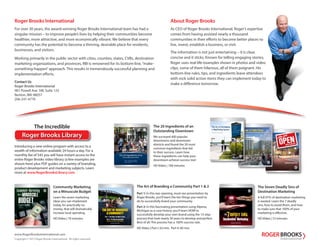
Roger Brooks Library
Introducing a new online program with access to a
wealth of information available 24 hours a day. For a
monthly fee of $45 you will have instant access to the
entire Roger Brooks video library (a few examples are
shown here) plus PDF guides on a variety of branding,
product development and marketing subjects. Learn
more at www.RogerBrooksLibrary.com
Community Marketing
on a Minuscule Budget
Learn the seven marketing
ideas you can implement
today, for practically no
money, that will dramatically
increase local spending.
HD Video | 70 minutes
The Art of Branding a Community Part 1 & 2
The 20 Ingredients of an
Outstanding Downtown
We surveyed 400 popular
downtowns and downtown
districts and found the 20 most
common ingredients that led
to their success. Learn how
these ingredients can help your
downtown achieve success too!
HD Video | 108 minutes
The Seven Deadly Sins of
Destination Marketing
A full 97% of destination marketing
is wasted. Learn the 7 deadly
sins, how to avoid them, and how
to make sure that 100% of your
marketing is effective.
HD Video | 72 minutes
Part 1: In this eye-opening, must-see presentation by
Roger Brooks, you’ll learn the ten things you need to
do to successfully brand your community.
Part 2: In this fascinating presentation using Alpena,
Michigan as a case history, you’ll learn HOW to
successfully develop your own brand using the 13-step
process that took nearly 30 years to develop and perfect.
Best of all: This process has a 100% success rate.
HD Video | Part I: 63 min. Part II: 60 min.
Presented by Roger Brooks
Community Marketing
on a MINUSCULE
BUDGET
Part 2: The Step-By-Step Guide
Featuring the case history of Alpena, Michigan
Presented by Roger Brooks
Part 1: Ten Things You Need to Know
The 20 Ingredients of an
Outstanding Downtown
PART 1: PROPERTY OWNERS
PART 2: THE PUBLIC SECTOR
PART 3: MERCHANTS
Presented by Roger Brooks
The Incredible
Presented by Roger Brooks
The Art of Developing
a Wayfinding System

13-Steps-to-Success.pdf

  • 1.
    The Step-by-Step Guideto Branding - HANDOUT -
  • 2.
    13 Steps toSuccess | Handout www.RogerBrooksInternational.com Copyright © 2013 Roger Brooks International. All rights reserved. Educate locals on what a brand is Now it’s time to educate local stakeholders, organizations, businesses and business leaders, as well as the general population on what a brand is and why this is important to do. Otherwise, you’ll end up with a population sending you just slogans and logo concepts. Prepare a 20-minute presentation and give it at local board meetings (Chamber, City Council, Auxiliary organizations such as Rotary and Kiwanis, school boards, hospital boards, etc. Also include the press on the brand education so they understand it and will also educate local residents and business leaders. Inventory your assets What do you have that makes you a desirable community for establishing a new business? As a place to live? Or as a place to visit? Make it specific. Do NOT use“quality of life”on the list. Break it down. What, specifically, makes you special. This can be quite the list. Then take the list and if some items can be found closer to the markets you are hoping to attract, move it to the“diversionary”or“secondary”list. You Brand Development Committee This is the group of stakeholders who will take the lead in developing the brand direction. Typically keep it to 13 people, or fewer. As you know, the larger the committee the less likely you are to get things accomplished. Typical members might include: • Economic Development • Chamber of Commerce • Tourism • City/county elected official • City/county senior staff • Downtown representative • Planning director • Six business sector representatives These folks will help decide on the final brand direction. They need to be“heavy hitters”locally. Get an outside facilitator It’s extremely important to get an outside facilitator - someone with no political ties locally, and not in business locally. This way politics won’t get in the way. Someone who has nothing to gain or locally should help facilitate the process. 1 If you had a sports retailer as your local facilitator, and then sports ends up being the most feasible brand direction, the community will assume that he or she steered the brand that direction, thus eliminating the non-biased opinion. The facilitator will also be charged with helping to “sell”the community on the brand once it’s been decided, so make sure you have a good speaker who can excite the community about the brand direction. 2
  • 3.
    13 Steps toSuccess | Handout www.RogerBrooksInternational.com Copyright © 2013 Roger Brooks International. All rights reserved. Identify the markets The next step is to identify the markets you are hoping to attract. This is not just about tourism, but also the types of markets you are looking for in terms of business (jobs). Those markets should include: • Geographic areas (primary and secondary) • Demographics (Young people? Creative Class? Retirees? Families?) • Lifestyle or psychographics: Identification of personality characteristics and attitudes that affect a person’s lifestyle and purchasing behaviors. • Primary and secondary markets. • Industry: The type of industry best suited for the area based on your points of differentiation. 3 are hoping to find one or two things the markets can’t get or do closer to home. This may take some time and you may need to really dig deep. You are looking for possible building blocks or a foundation upon which you can build your brand. Ask the community This is where the community can weigh in and have their chance to provide input. Here are ways to ask: • Hold an open house and provide places for people to provide input. Often this can be combined with educational workshops. • Do an online survey using Constant Contact or another service like Survey Monkey. • Interview local stakeholders asking for specific input. • Through the press: radio, television, print media. Yes, you’ll get some sarcasm, and yes, you’ll get some slogans. That’s okay. Take it all in. Find your“anchor tenants” Take the“seven questions quiz”to local meetings such as Kiwanis, Rotary, Chamber and other organizations and ask them the questions. You’ll find out, quickly, who your“anchor tenants”are in terms of restaurants, retail shops and activities. Here’s a sample list of questions you can start with: 1. Where can I get the best dessert? Name the restaurant and the dish. 2. Where will me and my partner have the best dining experience? It can be fancy, great food, great ambiance, or great characters. Breakfast, lunch, or dinner. 3. Where can I get gourmet items for a picnic? 4. Where, specifically, can I see a breathtaking sunrise or sunset? 5. Where is the best place to take a memorable photo that says I was really there? 6. Where can I check my e-mails? 7. Where can I get the perfect gift? Something locally or regionally made? Then have your audience put these in order of an itinerary as if a guest was coming into town on a Friday evening, and spending the weekend in town. This is what every visitor is looking for. Itineraries from the locals. You MUST promote your“anchor tenants.”They make you worth a special trip and an extended stay. Everyone will benefit from them. Think Orlando and Disney World.
  • 4.
    13 Steps toSuccess | Handout www.RogerBrooksInternational.com Copyright © 2013 Roger Brooks International. All rights reserved. Create the Brand Leadership Team Your Brand Development Committee got you to this point. They“developed”the brand. Now that you have the brand direction, you need to shift the focus to those who will“lead”the brand - The BLT. The entire branding effort will hinge on the efforts of this group of people. Once again, keep it to 13 people. Seven of them should be from the private sector and should have a vested interest in the brand direction. They are most willing to champion the cause because their paycheck depends on it. The other six people would include the supporting organizations. There might be a wholesale change from the BDC to the BLT. Go through the filtering process Take the entire list from the community (over perhaps three or four weeks), combine similar concepts, and then remove the ones that are too generic or can fit other communities within the markets you are hoping to attract. This will typically shorten the list from perhaps 100 different items down to, in most cases, less than ten items. Keep track of items you heard from multiple people. Perhaps these can be used as niche brands or as supporting activities to the final brand direction. Run the ideas through the 10-point Feasibility Test These are listed in the previous section. Run each item on the list through the feasibility test and see what’s left. If you’re lucky, you should have it narrowed down to just one or two items. The goal is to get down to one item. In many cases there may be no items left on the list. Don’t despair! This gives you a clean slate to build a fresh brand, still using the assets you listed earlier. Look for other ideas. Dig a little deeper. It’s ok to duplicate another community’s brand as long as it’s different from what the markets you are hoping to attract can get or do closer to home. Identify the niche and sub-brands Sub or niche-brands are smaller well-defined brands where you can market to that group specifically. Typical niche brands include: • Sports • Bird watching • Fishing and hunting • RV’ing Make sure there is good“cross-participation” between the primary brand and niche brands. For instance, art and food go well together. Sports and entertainment are a good fit. Birding and gardening are compatible brands/niche-brands. By identifying these, you’ll be able to provide your primary brand with“legs”- or offshoots. Pick one and only one The natural tendency will be to pick several and to head down the path of“we have something for everyone!”Don’t even try it. Pick one that the Brand Development Committee can buy into and that makes sense. If someone else has this brand in a different market, check it out. How’s it working for them? Can you reasonably duplicate it or exceed it? If you have to develop a new brand, don’t panic about the time it will take to develop. We’ll get to BridgeBrands in a minute. 4 5
  • 5.
    13 Steps toSuccess | Handout www.RogerBrooksInternational.com Copyright © 2013 Roger Brooks International. All rights reserved. Develop the “Brand Bank” These are the ideas that will reinforce and support the brand. When Leavenworth, Washington decided to become a Bavarian themed town, the ideas included: • An amphitheater where they would produce The Sound of Music annually. • Maypole dances, long-pipe festival, and other Bavarian-oriented events. • Facade improvements. • Bavarian eateries, retail sales of goods made in Bavaria. • Bavarian artists in action, art shows. And the list goes on. They did such a good job that 40% of Leavenworth’s population is now from Germany. Remember that brands are built on product, so this should be the focus. Look for partnership opportunities. Write the brand promise This is the paragraph that describes what you will be ten, 15 years down the road. Not today, but what you aspire to become. This is the goal that you are aiming for. Make sure it’s not generic. Read it, rewrite it, and keep fine tuning it until it is very specific and would make you want to go there or move there when it’s in place. Business prospects should read this and think“Gee, there’s a business opportunity for me here.”You can develop a long version (three paragraphs or so) and a short version, which would be just one paragraph of no more than five lines. Short, to the point, very specific, and well defined. 6 7 Create the look and feel of the brand We’re finally to the look and feel of the brand: the logo or brand identity, color schemes, tag lines and all the marketing elements that will be used as you develop the brand and claim ownership of it. This is where communities go sideways, typically putting this first without going through the other 13 necessary steps. Hire professional services to do this for you and remember that you are selling a feeling more than the physical attributes that support the brand. Develop a Brand Style Guide and include all your local marketing organizations. Continuity is critical at this point. Remember that the logo and tag line make up 2% of a brand, but will get virtually all of the attention. You cannot do this by public consent. Do NOT make this a public process. It can kill your entire effort. 8
  • 6.
    13 Steps toSuccess | Handout www.RogerBrooksInternational.com Copyright © 2013 Roger Brooks International. All rights reserved. Make something happen This can be a new wayfinding sign or entry sign. Or even something as simple as new business cards or the redevelopment of an existing website. People are impatient, so having something physical they can see will help sell the brand, and will tell the community you’re serious and this won’t be another plan sitting on a shelf gathering dust. The best way to develop a brand is to slide it in slowly. All of a sudden a new sign goes up with a new identity and tag line on it. Then another, and over time, it becomes pervasive throughout the community. Sell it! Begin the outreach program One of the big responsibilities of the Brand Leadership Champions are selling the brand to the community and creating buy-in opportunities for local organizations. This will include your“BridgeBrand”as well as your long-term branding goals and implementation of the plan. Every member of the BLC should be charged with speaking at three, four, five or six events a year. They need to be good speakers, enthusiastic and able to convince others to jump on board the band wagon. This process doesn’t end for years until the brand has taken on momentum of its own. Developing an Action Plan All successful brands are built on product so develop a Branding, Development & Marketing Action Plan. No more strategic plans. You need action steps - a to do list - as opposed to strategies, goals and objectives. For each recommendation provide the following: • A description of the recommendation • Who would be charged with implementation. It takes a village to win. • When it would be implemented. • Cost of implementation • Where the money would or could come from. • The rationale for making the recommendation. The marketing action plan Telling the world is how you stake your claim - ownership - of your brand. Like the product development plan, the marketing plan should include the same elements and should incorporate all partnering organizations. Everyone has a role to play in a successful branding effort. The plan should include graphics, advertising, public relations (a cornerstone of the branding 9 10 effort), photography, video, marketing materials, web and Internet marketing initiatives, brand- building posters and give-away items, etc. Always promote the businesses, specifically, that reinforce and support the brand. Don’t let politics get in the way of marketing your“anchor tenants.” Define the roles As just noted, it takes a village to win. Every organization plays a role. For instance, Kiwanis or Rotary might take on the development of new entry points (fitting the brand), while the city may take on the development of a Wayfinding System (decorative directional signage that fit the brand). This can extend into downtown business recruitment, facade improvements, event development and a host of other brand-specific assignments. When you get everyone on the same page, pulling in the same direction, this becomes fun. This is where you put it all together.
  • 7.
    13 Steps toSuccess | Handout www.RogerBrooksInternational.com Copyright © 2013 Roger Brooks International. All rights reserved. Keep the energy high. The first year is ALWAYS the toughest year when implementing a branding program. Because you are narrowing your focus, you will undoubtedly run into opposition who want your community to be all things to all people – that you really do have“something for everyone.”Even though that marketing approach no longer works, the blogs will light up with dissent and so your brand champions must just let it go and MUST work to keep the energy high. Once the branding effort starts taking hold, people will come on board – slowly at first – and as they “get used”to the new direction, and businesses begin to invest in it, it will garner strength over time. Nobody in Napa Valley complains about it being the world’s“wine capital.”Nor do they complain about Nashville owning the country music brand. Over time it became organic to the community – who they are. The same holds true with your community. Just remember that there are only three killers of any branding effort. Period: 1. Local politics – and it’s far worse with membership organizations than it is with elected officials. 11 Tell the world Once you have the product – and people – in place, it’s time to tell the world of who you are, what separates you from everyone else and makes you THE destination of choice. Now it’s time to drive your stake in the ground that you“own” your brand. After all, brands are about owning you niche in the marketplace. You build your brand through public relations. Advertising is used to maintain your ownership position. Remember that brands are a perception – what people think of you when your name is mentioned. And perceptions are created from first impressions, visual things we see once in your community, what we see on the news or read in print publications, and now what we“hear”in social media. This is where you put together a detailed Marketing Action Plan – with all of your local organizations at the table (branding requires continuity) and craft a plan on how you are going to tell the world what you’re about – specifically. When it comes to marketing budgets, here’s a guideline to use: 45% - Website | Pay Per Click | SEO | online advertising | social media | apps |anything that is Internet-related. 12 2. Lack of champions – No branding effort can succeed without tireless pioneers who champion the cause – especially in the face of criticism – but push the agenda forward and never take no for an answer. 3. Lack of money – both public and private. Almost every well-branded city, town, county, or destination in the world was founded on private sector investment and marketing. Consider these: a. Orlando, Florida and Anaheim, California (Disney – kids & family) b. Napa Valley, California (wine) c. Nashville, Tennessee (country music) d. Memphis, Tennessee (home of Graceland) e. Hershey, Pennsylvania (chocolate) f. Lancaster, Pennsylvania (Amish) g. Hollywood, California (movies and stars) h. Silicon Valley, California (high tech) Finally, every community is full of CAVERS – people who don’t want change and will fight it. What’s a CAVER? Citizens Against Virtually Everything. Keeping the energy high is the make or break it for any branding effort.
  • 8.
    13 Steps toSuccess | Handout www.RogerBrooksInternational.com Copyright © 2013 Roger Brooks International. All rights reserved. Mottos to Live By “If you think you’re too small to make a difference, try going to bed with a mosquito in the room.” - unknown “Never doubt that a small group of thoughtful committed people can change the world. Indeed, it is the only thing that ever has.” – Margaret Mead “A by-product of brands ‘for the people’ is the committee that compromises and kills a potential brand home run. This is why you never see statues of committees in public parks. You see brave leaders.” “Nothing great was ever achieved without enthusiasm.” – Ralph Waldo Emerson The Bridge Brand It can take anywhere from three to 20 years to fully“own” your brand. Rarely is it a shorter or longer process. But what can you do between now and then? How do you “bridge”the gap while you’re developing your brand? This is where the BridgeBrand comes to play. If you want to become a culinary destination, then start by promoting your best restaurants, a culinary school, and culinary events. Don’t tell the world you are a culinary destination, but start to market the small things that are the foundation or building blocks of your long-term brand direction. BridgeBrands are often used as a“repositioning”or “rebranding”effort. Often communities have a negative perception that needs to be turned around before implementing the final brand. Look at the case histories in this kit where BridgeBrands for Stockton and Oxnard, California are displayed. Also look at the League City, Texas BridgeBrand. Revisit the plan And do it every year, if not every few months. Do NOT let your plan sit on a shelf gathering dust! Keep your focus narrow, go right down the list and make sure your branding“partners” are keeping up with their assignments and the timelines outlined in the plan. Branding is a fluid process that is crafted and molded over time. You may end up adding to-do items to the plan, moving some things around, but it is ALWAYS your to-do list and the plan that will lead to your success. If you need to, bring back your facilitator every four months, six months, or once a year to pump up your champions, to cut through any red herrings, or to address challenges you’re having along the way. A good facilitator can help you update the plan, on the spot, or as a contracted service. And finally, never, ever give up. Branding and stamina go hand in hand. The plan is your guide. 13 20% - Public relations – getting articles written about you, creating video contents, professional photography reinforcing the brand, creating brand- specific itineraries – getting the word out there. 20% - Advertising. And this is to drive people to your website, which must be good enough to close the sale. 10% - Printed collateral materials. With the advent of the Internet, apps, and PDF docs available on smart phones, tablets and laptop computers, the need for printed materials is declining fast. They are still important, but should not be the priority. 5% - Trade shows, billboards, other forms of marketing.
  • 9.
    www.RogerBrooksInternational.com Copyright © 2013Roger Brooks International. All rights reserved. About Roger Brooks As CEO of Roger Brooks International, Roger’s expertise comes from having assisted nearly a thousand communities in their efforts to become better places to live, invest, establish a business, or visit. The information is not just entertaining – it is clear, concise and it sticks. Known for telling engaging stories, Roger uses real-life examples shown in photos and video clips, some of them hilarious, all of them poignant. His bottom-line rules, tips, and ingredients leave attendees with rock solid action items they can implement today to make a difference tomorrow. Roger Brooks International For over 30 years, the award-winning Roger Brooks International team has had a singular mission – to improve people’s lives by helping their communities become healthier, more attractive, and more economically vibrant. We believe that every community has the potential to become a thriving, desirable place for residents, businesses, and visitors. Working primarily in the public sector with cities, counties, states, CVBs, destination marketing organizations, and provinces, RBI is renowned for its bottom-line,“make- something-happen”approach. This results in tremendously successful planning and implementation efforts. Contact Us Roger Brooks International 981 Powell Ave. SW, Suite 125 Renton, WA 98057 206-241-4770 Presented by Roger Brooks Presented by Roger Brooks The Power of Public Plazas The 13 Ingredients to a Perfect Plaza told through a dozen case histories. Roger Brooks Library Introducing a new online program with access to a wealth of information available 24 hours a day. For a monthly fee of $45 you will have instant access to the entire Roger Brooks video library (a few examples are shown here) plus PDF guides on a variety of branding, product development and marketing subjects. Learn more at www.RogerBrooksLibrary.com Community Marketing on a Minuscule Budget Learn the seven marketing ideas you can implement today, for practically no money, that will dramatically increase local spending. HD Video | 70 minutes The Art of Branding a Community Part 1 & 2 The 20 Ingredients of an Outstanding Downtown We surveyed 400 popular downtowns and downtown districts and found the 20 most common ingredients that led to their success. Learn how these ingredients can help your downtown achieve success too! HD Video | 108 minutes The Seven Deadly Sins of Destination Marketing A full 97% of destination marketing is wasted. Learn the 7 deadly sins, how to avoid them, and how to make sure that 100% of your marketing is effective. HD Video | 72 minutes Part 1: In this eye-opening, must-see presentation by Roger Brooks, you’ll learn the ten things you need to do to successfully brand your community. Part 2: In this fascinating presentation using Alpena, Michigan as a case history, you’ll learn HOW to successfully develop your own brand using the 13-step process that took nearly 30 years to develop and perfect. Best of all: This process has a 100% success rate. HD Video | Part I: 63 min. Part II: 60 min. Presented by Roger Brooks Community Marketing on a MINUSCULE BUDGET Part 2: The Step-By-Step Guide Featuring the case history of Alpena, Michigan Presented by Roger Brooks Part 1: Ten Things You Need to Know The 20 Ingredients of an Outstanding Downtown PART 1: PROPERTY OWNERS PART 2: THE PUBLIC SECTOR PART 3: MERCHANTS Presented by Roger Brooks The Incredible Presented by Roger Brooks The Art of Developing a Wayfinding System