Adapting Agronomic Management Practices for Enhancing Rice Yields:
The Spread of SRI Practices in Mountain Farms of Uttarakhand, India
* Dr. C. Shambu Prasad, Professor,
Rural Management and Development, Xavier
Institute of Management, Bhubaneswar, Odisha, India
email:shambu@ximb.ac.in

* Debashish Sen, PhD Student
Knowledge Technology & Innovation Group,
Wageningen, The Netherlands,
email:debashish.sen@wur.nl

We Investigated

We Hypothesized

Farmers’ adaptations in response to
introduction of System of Rice
Intensification (SRI) in mountain
farms of Uttarakhand, India

• Farmers
based
on
their
needs, knowledge, experience, and
resources apply diverse practices
across different rice plots

• how farmers adjust SRI elements to
create
various
management
combinations on rice farms

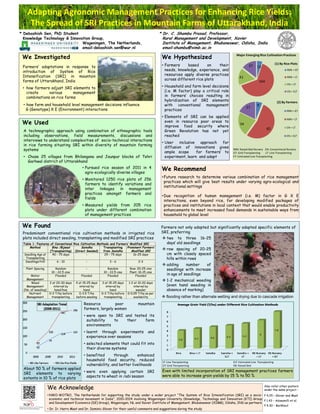
Major Emerging Rice Cultivation Practices

• Household and farm level decisions
(i.e. M factor) play a critical role
in farmers’ choices resulting in
hybridization of SRI elements
with conventional management
practices

• how farm and household level management decisions influence
G (Genotype) X E (Environment) interactions

We Used
A technographic approach using combination of ethnographic tools
including observations, field measurements, discussions and
interviews to understand complexities of socio-technical interactions
in rice farming situating SRI within diversity of mountain farming
systems
• Chose 25 villages from Bhilangana and Jaunpur blocks of Tehri
Garhwal district of Uttarakhand
• Pursued rice season of 2011 in 4
agro-ecologically diverse villages
• Monitored 1250 rice plots of 256
farmers to identify variations and
inter linkages in management
practices amongst farmers and
fields
• Measured yields from 205 rice
plots under different combination
of management practices

We Found
Predominant conventional rice cultivation methods in irrigated rice
plots included direct seeding, transplanting and modified SRI practices
Table 1: Features of Conventional Rice Cultivation Methods and Farmers’ Modified SRI
Method
Transplanting
Prominent Farmers’
Bina /Bijwad
Saindha
(Transplanting) (Direct Seeded)
from Saindha
Modified SRI
Seedling Age at
40 - 75 days
25 – 75 days
16-25 days
Transplanting
Seedlings/Hill
6 - 10
3-6
2-3
Plant Spacing

Random
10 – 22.5 cms
Flooded

Water
Management
2 at 20-30 days
Weed
interval by
Management
hand/hoe
(No. of weeding)
Nutrient
0-3 T/ha before
Management
transplanting

Flooded

Random
10 – 22.5 cms
Flooded

Row: 20-25 cms
Plant: 10-15 cms
Flooded

4 at 15-25 days
interval by
hand
0-3.5 T/ha
before seeding

3 at 15-25 days
interval by
hand
0-3 T/ha before
transplanting

1-2 at 10-20 days
interval by
weeder
0-0.05 T/ha as per
availability

Resource
poor
farmers, largely women

• Elements of SRI can be applied
even in resource poor areas to
improve food security where
Green Revolution has not yet
reached
• User inclusive approach for
diffusion of innovations gives
ample scope
for farmers’ to
experiment, learn and adapt

37

(1) By Rice Plots

13

RBN + GT

41

RBN + LT

164

CN + LT
CN + ELT

27

(2) By Farmers

9

RBN + GT
RBN + LT

34
82

CN + LT
CN + ELT

RBN: Raised Bed Nursery CN: Conventional Nursery
GT: Grid Transplanting
LT: Line Transplanting
ET: Estimated Line Transplanting

We Recommend
• Future research to determine various combination of rice management
practices which will give best results under varying agro-ecological and
institutional settings
• Due recognition of human management (i.e. M) factor in G X E
interactions, even beyond rice, for developing modified packages of
practices and institutions in local context that would enable productivity
enhancements to meet increased food demands in sustainable ways from
household to global level
Farmers not only adopted but significantly adapted specific elements of
SRI, preferring
two to three 16-25
days’ old seedlings
row spacing of 20-25
cm with closely spaced
hills within rows
adding
number
of
seedlings with increase
in age of seedlings
1-2 mechanical weeding
(even hand weeding in
absence of marking)
flooding rather than alternate wetting and drying due to cascade irrigation

mountain

• were open to SRI and tested its
suitability
to
their
farm
environments
• learnt through experiments
experience over seasons

and

• selected elements that could fit into
their diverse systems
• benefited
through
enhanced
household food security, reduced
vulnerability, and better livelihoods

About 50 % of farmers applied
SRI elements to varying • were even applying certain SRI
aspects to wheat in rabi season
extents in 10 % of rice plots

LT: Line Transplanting
GT: Grid Transplanting

ELT: Estimated Line Transplanting
RB: Raised Bed

Even with limited incorporation of SRI management practices farmers
were able to increase grain yields by 15 % to 50 %

We Acknowledge

Also refer other posters
under the same project :

• NWO-WOTRO, The Netherlands for supporting the study under a wider project “The System of Rice Intensification (SRI) as a socio- P 4.25 – Glover and Maat
economic and technical movement in India”, 2010-2014 involving Wageningen University (Knowledge, Technology and Innovation (KTI) Group
P 1.43 – Adusumilli et al.
and Development Economics (DE) Group), Wageningen, NL and Xavier Institute of Management, Bhubaneswar (XIMB), Odisha, IND as partners
• Dr. Ir. Harro Maat and Dr. Dominic Glover for their useful comments and suggestions during the study

P 4.30 – Berkhout

1318 - Adapting Agronomic Management Practices for Enhancing Rice Yieds

  • 1.
    Adapting Agronomic ManagementPractices for Enhancing Rice Yields: The Spread of SRI Practices in Mountain Farms of Uttarakhand, India * Dr. C. Shambu Prasad, Professor, Rural Management and Development, Xavier Institute of Management, Bhubaneswar, Odisha, India email:shambu@ximb.ac.in * Debashish Sen, PhD Student Knowledge Technology & Innovation Group, Wageningen, The Netherlands, email:debashish.sen@wur.nl We Investigated We Hypothesized Farmers’ adaptations in response to introduction of System of Rice Intensification (SRI) in mountain farms of Uttarakhand, India • Farmers based on their needs, knowledge, experience, and resources apply diverse practices across different rice plots • how farmers adjust SRI elements to create various management combinations on rice farms Major Emerging Rice Cultivation Practices • Household and farm level decisions (i.e. M factor) play a critical role in farmers’ choices resulting in hybridization of SRI elements with conventional management practices • how farm and household level management decisions influence G (Genotype) X E (Environment) interactions We Used A technographic approach using combination of ethnographic tools including observations, field measurements, discussions and interviews to understand complexities of socio-technical interactions in rice farming situating SRI within diversity of mountain farming systems • Chose 25 villages from Bhilangana and Jaunpur blocks of Tehri Garhwal district of Uttarakhand • Pursued rice season of 2011 in 4 agro-ecologically diverse villages • Monitored 1250 rice plots of 256 farmers to identify variations and inter linkages in management practices amongst farmers and fields • Measured yields from 205 rice plots under different combination of management practices We Found Predominant conventional rice cultivation methods in irrigated rice plots included direct seeding, transplanting and modified SRI practices Table 1: Features of Conventional Rice Cultivation Methods and Farmers’ Modified SRI Method Transplanting Prominent Farmers’ Bina /Bijwad Saindha (Transplanting) (Direct Seeded) from Saindha Modified SRI Seedling Age at 40 - 75 days 25 – 75 days 16-25 days Transplanting Seedlings/Hill 6 - 10 3-6 2-3 Plant Spacing Random 10 – 22.5 cms Flooded Water Management 2 at 20-30 days Weed interval by Management hand/hoe (No. of weeding) Nutrient 0-3 T/ha before Management transplanting Flooded Random 10 – 22.5 cms Flooded Row: 20-25 cms Plant: 10-15 cms Flooded 4 at 15-25 days interval by hand 0-3.5 T/ha before seeding 3 at 15-25 days interval by hand 0-3 T/ha before transplanting 1-2 at 10-20 days interval by weeder 0-0.05 T/ha as per availability Resource poor farmers, largely women • Elements of SRI can be applied even in resource poor areas to improve food security where Green Revolution has not yet reached • User inclusive approach for diffusion of innovations gives ample scope for farmers’ to experiment, learn and adapt 37 (1) By Rice Plots 13 RBN + GT 41 RBN + LT 164 CN + LT CN + ELT 27 (2) By Farmers 9 RBN + GT RBN + LT 34 82 CN + LT CN + ELT RBN: Raised Bed Nursery CN: Conventional Nursery GT: Grid Transplanting LT: Line Transplanting ET: Estimated Line Transplanting We Recommend • Future research to determine various combination of rice management practices which will give best results under varying agro-ecological and institutional settings • Due recognition of human management (i.e. M) factor in G X E interactions, even beyond rice, for developing modified packages of practices and institutions in local context that would enable productivity enhancements to meet increased food demands in sustainable ways from household to global level Farmers not only adopted but significantly adapted specific elements of SRI, preferring two to three 16-25 days’ old seedlings row spacing of 20-25 cm with closely spaced hills within rows adding number of seedlings with increase in age of seedlings 1-2 mechanical weeding (even hand weeding in absence of marking) flooding rather than alternate wetting and drying due to cascade irrigation mountain • were open to SRI and tested its suitability to their farm environments • learnt through experiments experience over seasons and • selected elements that could fit into their diverse systems • benefited through enhanced household food security, reduced vulnerability, and better livelihoods About 50 % of farmers applied SRI elements to varying • were even applying certain SRI aspects to wheat in rabi season extents in 10 % of rice plots LT: Line Transplanting GT: Grid Transplanting ELT: Estimated Line Transplanting RB: Raised Bed Even with limited incorporation of SRI management practices farmers were able to increase grain yields by 15 % to 50 % We Acknowledge Also refer other posters under the same project : • NWO-WOTRO, The Netherlands for supporting the study under a wider project “The System of Rice Intensification (SRI) as a socio- P 4.25 – Glover and Maat economic and technical movement in India”, 2010-2014 involving Wageningen University (Knowledge, Technology and Innovation (KTI) Group P 1.43 – Adusumilli et al. and Development Economics (DE) Group), Wageningen, NL and Xavier Institute of Management, Bhubaneswar (XIMB), Odisha, IND as partners • Dr. Ir. Harro Maat and Dr. Dominic Glover for their useful comments and suggestions during the study P 4.30 – Berkhout