Creative Ability
can be Learned
Gigo Learning Lab’s complete series includes 20 individual packages, as well as five
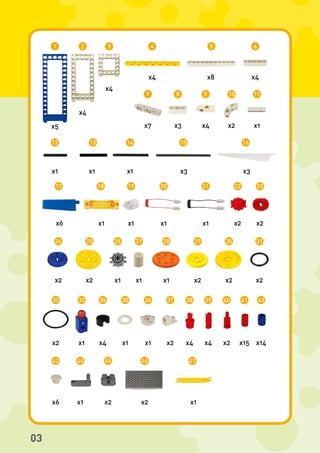
school sets. The special features of Gigo’s Learning Lab are as follows:
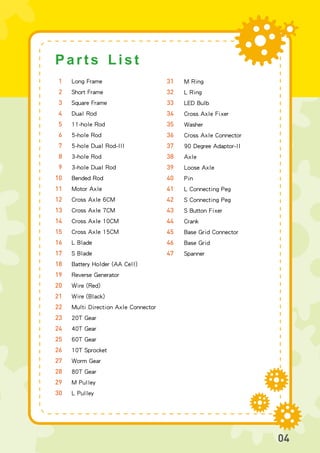
1.	 Using GIGO’s “building block” construction-based curriculum, every class has
a ready-to-assemble model, and includes time designed to promote individual
creativity.
2.	 Promotes thinking outside-the-box of the traditional educational framework by
learning innovation through play!
3.	 We are all innately good at something, so we should take into account both individual
development and the ability to work as part of a team effort.
4.	 Course levels are designed from elementary to difficult, combining a life sciences-
based curriculum with applications from daily life.
5.	 Experiment using Gigo’s “building blocks”, which can be used over and over again,
saving both time and effort.
6.	 Comes with Gigo’s newly developed 3D Smart Manual, which makes learning how to
intelligently assemble each model easier than ever before.
7.	 Learning Lab’s Cloud Platform allows systematic recording of learning progress.
We hope that kids can enthusiastically learn scientific knowledge through fun hands-
on experience, developing their problem-solving abilities, as well as a positive attitude
towards science. Our mission is to help children apply their newfound knowledge to
daily life, furthering their innovational skills and abilities.
For any questions or inquires. please email to LL@mail.gigo.com.tw
01
(v1.0)
02
01 39
03 45
09 53
17 59
23 67
31 75
02 41
05 49
13 57
21 63
27 71
35 77
Index
07. Blades
08. Output Efficiency
10. Monograph (2)
11. Wind Power Generation
Appendix: Learning Lab Packages
20. Monograph (4)
19. Early Warning of Wind Disaster
18. Wind-powered Carrier
17. Wind Energy Transmission
16. Horizontal Wind Turbine
15. Monograph (3)
14. Vertical Wind Powered Generator
13. Transfer Efficiency
12. Start-up Wind Speed
09. Wind Powered Mechanism
04. Application of Wind Power
05. Monograph (1)
06. Wind Resources
03. Wind Speed Measurement
02. Wind Direction
01.Source of Wind Power
Parts List
Index
Education Philosophy
03
1
x5
2
x4
4 6
x4
9
x4
10
16
17 18 19 20 21 22 23
24 25 26 27 28 29 30 31
32 33 34 35 36 37 38 39 40 41 42
43 44 45 46 47
11
x2 x1
12
x1 x1 x1 x3 x3
x6 x1 x1 x1 x1 x2 x2
x2 x2 x1 x1 x1 x2 x2 x2
x2 x1 x4 x1 x1 x2 x4 x4 x2 x15 x14
x6 x1 x1x2 x2
13 14 15
3
x4
x4 x8
5
8
x3
7
x7
01
02
03
04
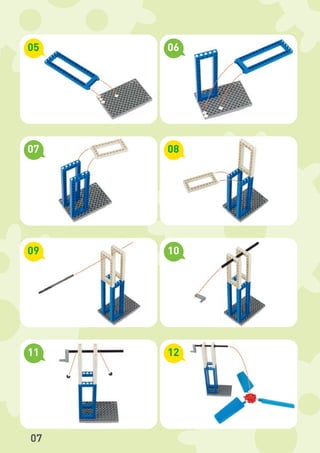
05
06
07
08
09
10
11
12
13
14
15
16
17
18
19
20
21
22
23
24
25
26
27
28
29
30
Long Frame
Short Frame
Square Frame
Dual Rod
11-hole Rod
5-hole Rod
5-hole Dual Rod-III
3-hole Rod
3-hole Dual Rod
Bended Rod
Motor Axle
Cross Axle 6CM
Cross Axle 7CM
Cross Axle 10CM
Cross Axle 15CM
L Blade
S Blade
Battery Holder (AA Cell)
Reverse Generator
Wire (Red)
Wire (Black)
Multi Direction Axle Connector
20T Gear
40T Gear
60T Gear
10T Sprocket
Worm Gear
80T Gear
M Pulley
L Pulley
31
32
33
34
35
36
37
38
39
40
41
42
43
44
45
46
47
M Ring
L Ring
LED Bulb
Cross Axle Fixer
Washer
Cross Axle Connector
90 Degree Adaptor-II
Axle
Loose Axle
Pin
L Connecting Peg
S Connecting Peg
S Button Fixer
Crank
Base Grid Connector
Base Grid
Spanner
Parts List
04
Wind is a displacement of air in relation to an
object. It is a concept of relative motion. Outdoors, the
wind blows from a high pressure area to a low pressure area. Air
flow is the source of the wind. In a windless day or indoors, we often create
artificial wind by utilizing devices that generate air flow. For instance, people
use electric fans to cool themselves during the hot summer. People in the
past discovered the power of air in moving objects. Thus, they invented
sailboats that conquered the ocean using wind force. Wind can be
transformed into energy by controlling the wind source.
Grandpa Rudolph took Tony to the park so he could fly a kite.
Grandpa Rudolph looked up at the trees and saw that there was no
wind. He said, “How can we fly a kite on such a windless day!”
Tony also knew that a kite could not fly without the wind. Out of
frustration, both of them just decided to go back home. But then,
Tony saw someone running at the park and suddenly had an idea.
He held the kite high and tried to generate
wind by running. Naturally, he was able to
fly the kite and didn’t stop running until he
reached the end of the park.
Tony was physically tired, but deep down
he was happy. It was his first time to fly a
kite and he was proud
of himself for solving
the wind problem on
his own.
S e s s i o n 01
Source of Wind Power
Daily
Application
05
1 2 17
x2
x1
x3
x2
x3
x1
x2 x1
x1
x322
34
43
44
46
15
7
01
03
02
04
Parts List
Brainstorming
Besides f lying a kite, which
activities will be held in a windy
day?
Artificial
Wind
06
05
09
07
11
06
10
08
12
07
1 2 3
Model
Assembled
Experiment
Complete
Model
Creation
Experiment
Time
Art
Attack
Evaluation
How do you change the wind velocity
of your model?
What size of paper can your model blow
away?
08
A wind vane is basically an instrument
consisting of a large arrow with an increased tail
area and a balance point on the arrow shaft connected to
a rotator. The arrow head determines the wind direction. When the
wind blows, the tail may be pushed back due to the larger windage given the large
tail area. The wind continues to move the instrument until the indicator is parallel to
the wind direction. The direction of the arrow head determines the wind direction.
If this principle is hard to understand, Have a try action. Bend over backwards and
turn your head 90 degrees. Observe the wind vane as it rotates around the center
and when you see an image of a see-saw then that’s it! A wind vane is
basically a vivid application of the lever principle.
With regard to the Earth’s natural wind, heat makes air volume expand.
Thus, the density decreases when there is a larger volume of air but the
mass remains unchanged. Moreover, since air is fluid, a smaller density of
warm air may rise upward and form a low pressure area, during which the
cooler air would often move in to replace it and cause air to flow. This is
how wind is formed.
Wind direction refers to the direction where the wind originates. Wind
originating from the north is called the north wind and that from the south
is called the south wind. The simplest way to
measure wind direction is to wet a finger and
hold it in the air. The side of the finger that
gets cold is where the wind is coming from.
With the development of human civilization,
numerous tools for
m e a s u r i n g w i n d
direction have been
invented, such as
windsock and wind
vane.
S e s s i o n 02
Wind Direction
Daily
Application
09
1 4
x2
x1 x2 x5 x1
x1x1
x1 x4
x1
x2
x2
6
10
17
39
41
42
43
46
3
7
01
03
02
04
Parts List
Brainstorming
What methods can be used to
determine wind direction?
Wind Vane
10
05
09
07
11
06
10
08
12
05
09
07
11
06
10
08
12
11
1 2 3
How can you change the counterweight to
improve the sensitivity of the wind vane?
Model
Assembled
Experiment
Complete
Model
Creation
Experiment
Time
Art
Attack
Evaluation
How will you design a wind vane?
12
An anemometer is a device used for
measuring air velocity. According to the
working principle, there are many types of
anemometers; namely, mechanical, optical, pressure,
hot-wire, sonic, etc. In addition, the design of anemometers
is constantly improving. In fact, inventors have already utilized smart
phones as anemometers for convenience. An APP is actually used as
a microphone to detect the sound of the wind and estimate its speed.
This is the application of a sonic anemometer. For beginners, one
can design a simple anemometer by combining the knowledge of
hydromechanics and simple pendulum or by calculating the rotating
speed of a propeller.
Tony’s father took a flight and his plane would land after a couple
of hours. However, the city was struck by a strong typhoon. Tony
was anxious and asked his grandpa, “Will it be dangerous for the
plane to travel when there is typhoon?”
After assuring Tony, Grandpa Rudolph asked him, “Is it the rain or
the wind first that affects the plane’s safety?” Tony answered with
uncertainly: “Perhaps the wind”.
Grandpa replied, “All airports are equipped with Doppler radars
which measure the wind speed using a non-contact method;
furthermore, the wind speed and direction are determined when
planes take off or land. So there is no
problem in terms of safety. The only problem
would be the arrival time which may be
delayed due to weather
conditions.”
S e s s i o n 03
Wind Speed Measurement
Daily
Application
13
1 3 8
x3
x2 x6 x1 x2 x1 x2 x2
x2x15x1x1
x2
x4
x3
x6 x2 x4 x6
x2
x1
x4
2
6
9
10
17
22
23
25
28
34
38
41
42
43
45
46
15
5
7
01
03
02
04
Parts List
Brainstorming
How do you determine the size of
the wind?
Anemometer
14
05
09
11 12
06
10
0807
15
1 2 3
Please observe the operation of the anemometer
by using an electric fan set at different speed.
Then, try to blow into the anemometer to see
how fast it rotates.
Model
Assembled
Experiment
Complete
Model
Creation
Experiment
Time
Art
Attack
Evaluation
In addition to wind speed, what else can
an anemometer measure?
16
This kind of sailing car with one wheel in
front and two at the rear is easier to control
since it travels on land unlike the sail boat. The
sailing car is designed with directions controlled by feet and
a sail maneuvered by hand. The car would speed up when the rope is tightly
held. Conversely, the car may slow down when the rope is loosened to lessen the
wind on the sail. Since the sailing car is light, it can travel on different
surfaces like (beach) sand, parking lots, sports arena and even ice.
In the early 1600s, Dutchman Simon Stevin invented a two-masted
sailing car. He integrated two-masted sails with a car body, axle and
wheels to make a sailing car a possible mode of transport. However, the
vehicle could not move against the wind or without the wind. Moreover,
the air flow and wind strength were unstable on the streets, so driving
the vehicle wasn’t practical. Consequently, given these factors; namely,
wrong market position, high cost, weight (i.e. heavy) and poor efficiency,
the sailing car had no practical value and was forgotten by the people.
By the 20th century, leisure sports have become popular. A New
Zealander named Paul Beckett improved the invention. Beckett initially
intended to create a portable wind-driven sport equipment applicable to
people of different ages and body conditions. Because of its reasonable
price and easy operation, the lightweight and newly invented three-wheel
sailing car became widely popular around
the world with the rise of leisure activities.
The broad leisure arena has enhanced
its value.
S e s s i o n 04
Application of Wind Power
Daily
Application
17
Brainstorming
Pe o ple of ten make li fe m o re
convenient with the help and power
of nature. What facilities around you
are applications derived from natural
sources?
1 4
x2
x1
x3
x4
x4
x2
x4
x2 x2 x14
x1x2x2
x2 x2 x4 x4
6 9
29
30
31
32
34
39
41
42
15
3
5
8
7
01
03
02
04
Parts List
Sail Car
18
05
09
07
11
06
10
08
12
19
2 3
Model
Assembled
Experiment
Complete
Model
Creation
Experiment
Time
Art
Attack
Evaluation
What could be different in the sail car’s
operation when different materials are
used in the sail, in addition to common A4
paper.
Change the angle of the sail but keep the
directions of the car and wind. What are the
force changes on the sail car?
1
20
21
Using the models and principles that you have learned, try to
design a mechanism that is able to measure both wind direction
and speed.
S e s s i o n
Monograph
03. Anemometer
02. Wind Vane
04. Sail Car
05
1
Model
Review
01. Artificial Wind
22
1
2
3
Model
Design
Model
Creation
Winner!
Design
Concept
Evaluation
My Artwork
People in the past already knew how
to use wooden windmills to irrigate and
grind cereal. The wind mill is characterized
by its strength, hence it is also called a wind mill. The
main function of a windmill is to transform wind into power
through the rotation of a paddle wheel. People use this wind energy
to grind cereal. With the rapid development of modern technologies,
the ancient windmill has almost been forgotten; nevertheless, it is still
considered a unique landscape in the world given its advantages of
natural energy, pollution-free and inexhaustible energy.
Wind resource also called wind energy resource, refers to kinetic energy
generated when air flows above the Earth’s surface.
Wind resource is derived from nature, which is renewable energy that is
sustainable to use. Although wind resource can’t be exhausted, it is unstable
since wind often changes like day and night. Moreover, only when wind
speed reaches a certain degree, can it be used for power generation.
This means that not all wind resources can be converted into electricity.
Accordingly, a wind field refers to a place or area that can be utilized or used
as a wind resource.
However, wind power generation creates elevated sound levels, so a wind
field should be constructed on a wide-open area away from people. This
would result in regional restrictions on wind
resources and consideration for appropriate
geographical environments; for example, an
offshore wind field would be located along
coastal areas or an on-land wind field would
be situated in wide-
open areas.
S e s s i o n 06
Wind Resources
Daily
Application
23
1 93
x1 x6 x2
x6x3x2x1
x1
x2
x4
x1
x1
x1
x6
x2
x6
x1
x2
x2 x1 x2 x2
2
6
22
25
28
30
34
36
38
41
42
43
45
46
15
8
7
17
23
01
03
02
04
24
Parts List
Brainstorming
What tools will you use to grind
food?
Wind Mill
05
09
07
11
06
10
08
12
25
1 2 3
Model
Assembled
Experiment
Complete
Model
Creation
Experiment
Time
Art
Attack
Evaluation
What are the changes in design when
replacing gear sets that are used to
represent millstone with other parts?
Adjust the output speed of the windmill by
collocating different gear sets.
26
Tony joined an off-campus activity that involved visiting a power plant.
When the tour bus reached the mountain, Tony saw windmills that had
three blades and were different from the electric fans at home that had
four blades.
Tony was curious and asked the teacher why windmills for power
generation only have three blades. And the teacher replied that windmills
with more blades are normally called low-speed windmills, which have
higher rotor power coefficient and larger torque during operation, and are
more suitable for water lifts given their low start-up wind speed.
In contrast, windmills with fewer blades
are called high-speed windmills.
Experimental tests on strong windmills
showed that windmills with three blades
could produce optimum economic
efficiency, since they could produce
higher rotor power coefficient during
high-speed operation. Moreover, fewer
blades made them lighter than those
with more blades, so they are ideal for
power generation.
A strong windmill generator is usually installed on a high tower,
since the air velocity aboveground is greater than that on the earth.
Generally, a larger blade can improve the generating efficiency, but may break
due to increased thrust when the blade is increased. In order to avoid risk and
considering the economic efficiency under weak wind conditions, researchers
found that with the area remaining the same, a valid wind area can be achieved
by designing longer blades that can still produce equal generating efficiency.
Moreover, longer blades can generate enough torque to drive the power
generator even under weak wind conditions.
S e s s i o n 07
Blades
Daily
Application
27
1 6 16
x4
x4 x1
x1
x1
x2 x3
x1
x1
x1
x6
x1
x2
x1 x2
2
22
23
25
34
41
44
45
46
15
8
14
01
03
02
04
Parts List
Brainstorming
What shapes of blades have you
seen?
Long-blade
Windmill
28
05
09
07
11
06
10
08
12
29
1 2 3
Model
Assembled
Experiment
Complete
Model
Creation
Experiment
Time
Art
Attack
Evaluation
See the difference in the rotation of the
windmill after adjusting the number of
blades.
Record how much strong wind is required to
blow your windmill? How many spins can it do
after being blown?
30
Since windmill generators cannot convert all the wind
energy, their design may affect the amount of electricity
derived from kinetic energy, which is called output efficiency.
The output efficiency is greatly affected by the blade design and
rotation speed. Since blade design was previously discussed, we
now focus on the influence of the rotation speed on output efficiency.
It is a universal fact that wind flow on the Earth’s surface is unstable,
so the rotation speed of a windmill may vary with the strength of the
wind. Generally, an increased rotation speed may produce higher output
efficiency. Most large scale windmill generators may adjust rotation speed
through a variable-speed motor or blade adjustment mechanism, to
maintain normal operation.
During Tony’s visit to the wind power plant, the tour guide
mentioned that the windmill generators were the latest products.
Later on, when Tony climbed up the high tower, he observed that
the area was spacious and there was relatively low noise in the
machine room.
The guide explained that the generators were driven directly by
the wind with no variable-speed motor. These machines were
called direct-driven windmill generators. With the high failure rate
of variable-speed motors, direct-driven windmill generators have
become popular because of their high
efficiency, low noise, long service
life, smaller set volume and reduced
maintenance costs.
S e s s i o n 08
Output Efficiency
Daily
Application
31
1 6 17
x2
x3 x2 x2
x1 x2
x3
x3
x6
x6
x5
x1
x2
x2
x2
x3 x1
2
22
23
25
34
41
42
43
44
45
46
15
8
7
01
03
02
04
01
03
02
04
Parts List
Brainstorming
When do we need to adjust the
rotation speed of a windmill?
Variable-speed
Windmill
32
05
09
07
11
06
10
08
12
33
1 2 3
Model
Assembled
Experiment
Complete
Model
Creation
Art
Attack
Evaluation
Design an output power with different
rotation speeds by using the existing
materials.
Compare two windmills with different output
power. What is the difference in their rotation
speed?
Experiment
Time
34
Since ancient times, people already knew
how to utilize wind power. In the application of
wind, different functions and environments are considered
to build a suitable mechanism. There should be a space for the equipment
for wind operation and a solid structure that can protect the mechanism
and support normal operation. For instance, people design a wind powered
mechanism to drive away birds that feed on crops; this is called a wind powered
scarecrow, which is a primitive and simple wind energy mechanism. In terms of
manufacturing, people use local materials like straws to create a shape
of a man and set this up among the crops. The scarecrow moves and
waves when the wind blows, and scares the birds away.
A wind energy mechanism is used to maintain the normal operation of a
windmill and protects it from being destroyed by strong wind, which makes
it a challenge to protect the blades.
When a blade rotates quickly because of strong wind, the conventional
mechanism changes the windward side of the blade into leeward and
blocks the blades to protect them. However, this may shut off the power
generator and greatly decrease its utilization rate.
The new mechanism has a variable angle design. When the blades come
in contact with strong wind, a rotating torsion centered on the axial blade
may adjust the blade gear and change the blade angle accordingly based
on the automatic detection system, through
which it can reduce the wind thrust under
strong wind conditions.
This helps prevent
damage and generate
power as well.
S e s s i o n 09
Wind Powered Mechanism
Daily
Application
35
1 3 7
x4
x3
x1
x1
x4 x1
x2
x1
x3
x1
x1 x2 x1 x9 x2
x3x1x1x1
x1x3 x2 x8 x2x1
2
4
6
9
10
17
22
23
25
28
34
38
39
41
42
43
45
46
13
15
5
8
01
03
02
04
Parts List
Brainstorming
Which objects are powered by
the wind?
Wind Powered
Scarecrow
36
05
09
07
11
06
10
08
12
37
1 2 3
Model
Assembled
Experiment
Complete
Model
Creation
Experiment
Time
Art
Attack
Evaluation
How do you adjust the amplitude of the
scarecrow’s swing and its frequency?
Observe the amplitude of the scarecrow’s swing
and design the appropriate parts.
38
Please design a power-driven tool using the models or principles
that you’ve learned.
S e s s i o n
Monograph
08. Variable-speed Windmill
07. Long-blade Windmill
09. Wind Powered Scarecrow
10
2
Model
Review
06. Wind Mill
39
40
1
2
3
Model
Design
Model
Creation
Winner!
Design
Concept
Evaluation
My Artwork
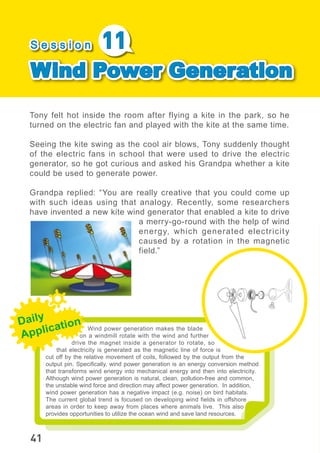
Tony felt hot inside the room after flying a kite in the park, so he
turned on the electric fan and played with the kite at the same time.
Seeing the kite swing as the cool air blows, Tony suddenly thought
of the electric fans in school that were used to drive the electric
generator, so he got curious and asked his Grandpa whether a kite
could be used to generate power.
Grandpa replied: “You are really creative that you could come up
with such ideas using that analogy. Recently, some researchers
have invented a new kite wind generator that enabled a kite to drive
a merry-go-round with the help of wind
energy, which generated electricity
caused by a rotation in the magnetic
field.”
Wind power generation makes the blade
on a windmill rotate with the wind and further
drive the magnet inside a generator to rotate, so
that electricity is generated as the magnetic line of force is
cut off by the relative movement of coils, followed by the output from the
output pin. Specifically, wind power generation is an energy conversion method
that transforms wind energy into mechanical energy and then into electricity.
Although wind power generation is natural, clean, pollution-free and common,
the unstable wind force and direction may affect power generation. In addition,
wind power generation has a negative impact (e.g. noise) on bird habitats.
The current global trend is focused on developing wind fields in offshore
areas in order to keep away from places where animals live. This also
provides opportunities to utilize the ocean wind and save land resources.
S e s s i o n 11
Wind Power Generation
Daily
Application
41
01
03
02
04
191 3
17
20
21
22
33
42
43
45
46
15
7
x2
x2
x3 x1
x1
x1
x1
x3
x1
x1 x2
x2x4
x3x2
2
Parts List
Brainstorming
Have you ever seen a large
windmill by the sea? Do you
know its function?
Windmill
Generator
42
05
09
07
11
06
10
08
12
43
1 2 3
Model
Assembled
Experiment
Complete
Model
Creation
Experiment
Time
Art
Attack
Evaluation
Try to design your own generator.
Record how much strong wind is required
to light a bulb.
44
A wind turbine should overcome the maximum
static friction force in order to start rotating from a
static state. This is called a start-up wind speed, i.e. the
minimum wind speed required to start a wind turbine. The start-
up speed of a common windmill is about 3m/s, but it is unable to generate
electricity at a wind speed lower than 4m/s. To ensure that communities with a
lower average wind speed in the wind field, can generate electricity through the
wind, it is necessary to minimize the scale of the windmill to reduce the maximum
static friction force. Therefore, the so-called air-breeze wind generator can start
to operate at half the start-up speed of a common generator, which can produce
electricity even with a gentle breeze. Nevertheless, its generated power is
relatively low. For instance, some people have invented an air-breeze wind
generator installed on bicycles.
In order to encourage most cities to effectively use wind energy,
researchers have developed a new air-breeze wind generator
technology.
The air-breeze wind generator consists of several specially
designed light plastic wind turbines with gears, as well as a tail
vane for finding wind. With the support of a small generator, the
plastic turbines are blown by the wind, making them rotate and
generate electricity. This kind of wind power generation system
is able to work under a wind speed of
2m/s. Although the generated power
is not high, it can serve as a small
independent auxiliary power system
that conserves energy.
S e s s i o n 12
Start-up Wind Speed
Daily
Application
45
01
03
02
04
151 3
x2
6
17
19
20
21
22
23
25
33
34
41
42
43
45
46
14
7
x2
x1
x2 x1 x1
x1
x6
x1
x1 x1 x2 x2
x4x1 x1
x1 x1 x6
x7
x1
2
Parts List
Brainstorming
W h e r e d o e s s t r o n g w i n d
normally appear?
46
Air-breeze Wind
Generator
05
09
07
11
06
10
08
12
47
1 2 3
Model
Assembled
Experiment
Complete
Model
Creation
Experiment
Time
Art
Attack
Evaluation
How do you modify the air-breeze wind
generator if it is installed on the bicycle?
Generate wind by using different methods and
see which method can successfully drive a
generator.
48
The turbine of a horizontal wind power
generation can transfer wind power into mechanical
energy. However, if the turbines do not operate against the
wind, the transfer efficiency may reduce. To ensure that the change in wind
direction can also facilitate wind energy, it is necessary to install an automatic wind
sensing equipment. A large-scale wind powered generator can first detect wind
direction and signal through a wind direction sensor and then control the direction of
rotation. As for the small-sized wind powered generator, a tail vane is added, which
works as the tail on an anemoscope. Since it has a larger wind resistance due to its
larger area, it may be pushed behind to automatically adjust the direction of
the generator, making the turbine run against the wind to improve transfer
efficiency.
Grandpa Rudolph took Tony on a holiday to visit a green chicken farm
to help expand Tony’s knowledge about green energy.
When he arrived in the farm, Tony felt odd because of the strange
street lights that he saw. There was a wind powered generator with
a vane installed on a pole for detecting the wind. There was also an
integrated wind energy and solar energy panel for lighting applications.
Grandpa Rudolph explained that although the individual transfer
efficiency of both wind powered generator and solar panel were
not high, the energy output can be increased if they are integrated
just like these lighting facilities. It is only when we exert some effort
in environmental protection and energy
conversation, can the future generation live
in a better environment.
S e s s i o n 13
Transfer Efficiency
Daily
Application
49
01
03
02
04
81 3
x5
x4
x3 x1
x2 x1
x1
x1 x11 x2
x2x1
x1x2
x2 x1
x3 x1 x1 x1 x2
x6x1
x2
6
16
17
19
20
21
22
33
34
35
37
41
42
43
45
46
12
15
5
7
2
Parts List
Brainstorming
How do you determine the wind
direction and strength in an
area?
Wind Sensing
Generator
50
05
09
07
11
06
10
08
12
51
1 2 3
Model
Assembled
Experiment
Complete
Model
Creation
Experiment
Time
Art
Attack
Evaluation
How do you make the wind sensing
function of a model more sensitive?
Make a model that is facing the electric fan at
different angles and test whether it can change
directions successfully in line with the wind’s
direction.
52
A wind powered generator is categorized
according to its installation direction. In other words,
a generator parallel to the ground is called a horizontal wind
powered generator while a generator vertical to the earth is
called a vertical wind powered generator. Since the rotating axle
in a vertical generator is perpendicular to the wind direction, and a
vertical plate or a cambered bending plate is used as a turbine, there are several
advantages which include receiving wind from any direction, a simple structural
design and a small rotation range of blades. However, given the small turbine
size and (heavy) weight, the generated transfer efficiency is lower than that of
a horizontal generator. Moreover, it requires a larger start-up torque, and at
times, a motor to get it started.
The world’s first wind-powered electric vehicle charging station was
installed successfully in Barcelona, Spain in 2012. It was an electric
vehicle charging station that used wind for power generation and energy
storage. It perfectly incorporated a pollution-free wind power generation
and electric vehicle charging mechanism. It did not only expand the
practical application of an infinite wind energy, but it also brought electric
vehicles a fresh new energy experience, which was helpful in popularize
the said vehicles.
The wind-powered electric vehicle charging
station consists of a 12 meters high tower, in
which a vertical axis wind powered generator
is installed to transmit electricity to the
charging station. A vertical axis wind powered
generator only requires a small space for
operation. Thus, it
is small in terms of
volume and is easily
installed.
S e s s i o n 14
Vertical Wind Powered
Generator
Daily
Application
53
01
03
02
04
1 4 8
x2
x4
x2
x6 x1
x1
x1
x6
x1 x1 x8 x2
x2x14x1x1
x1 x1 x1 x6
x2
x3
6 17
19
20
21
22
23
25
33
35
41
42
43
45
46
15
3
5
7
Parts List
Brainstorming
Where does the wind blow?
What is the wind’s direction?
54
Vertical Axis Wind
Powered Generator
05
09
07
11
06
10
08
12
55
1 2 3
Model
Assembled
Experiment
Complete
Model
Creation
Experiment
Time
Art
Attack
Evaluation
How do you improve the generated power
of a vertical axis wind powered generator?
Please use a model for blowing wind from
different angles and observe the difference in
the model’s action.
56
Please design a variable speed wind sensing power generator
using the models and principles that you have learned.
S e s s i o n
Monograph
13. Wind Sensing Generator
12. Air-breeze Wind Generator
14. Vertical Axis Wind Powered Generator
15
3
Model
Review
11. Windmill Generator
57
58
1
2
3
Model
Design
Model
Creation
Winner!
Design
Concept
Evaluation
My Artwork
Generally, the angle of an electric fan blade is designed
to blow air forward, thus a lower pressure may form behind
the fan during its rotation, which makes air flow towards a
higher pressure area. This is why people feel a suction-like
force working behind the fan. When the blades run, the bevel angle
of blades may produce friction with the air, which is then pushed forward.
The pushed air also exerts pressure on the blades, according to Newton’s
principle of action and reaction. As for the pushed air, it is released from
the electric fan, which produces wind.
When Tony let the electric fan blow the kite, he associated
this action to power generation. Since a kite could be used
to generate power, he assumed that an electric fan can also
generate power. So he got curious and asked Grandpa Rudolph.
Grandpa Rudolph answered: “Generally, an electric fan powered
by an alternating current has a horizontal rotating axle. Although
it can be treated as a horizontal wind turbine, it cannot generate
power. Since it adopts an AC Induction
Motor, its coils are fixed on a stator
w hi l e it s r oto r wo r ks t hr o u g h an
electro - magnetic induction. It is
formed by an iron core coated with
aluminum. Since the motor has no
magnet, the coils are unable to cut the
magnetic field for power generation.”
S e s s i o n
Horizontal Wind Turbine
Daily
Application
5959
16
81 3
x3
6
17
18
19
20
21
22
23
27
28
34
35
39
40
41
42
43
45
46
11
12
13
15
5
7
x3
x1
x4
x1
x1
x1
x1 x1 x1
x3 x1 x1
x1
x7 x2
x2x2
x3
x1
x1
x1 x1 x1
x1 x1 x2x4 x1
2
01
03
02
04
Parts List
Brainstorming
What kinds of electric fans have
you seen?
Electric
Fan
60
05
09
07
11
06
10
08
12
61
1 2 3
Model
Assembled
Experiment
Complete
Model
Creation
Experiment
Time
Art
Attack
Evaluation
How can you change the oscillating angle
of your electric fan?
What is the oscillating angle of your electric
fan?
62
There is a type of electric stand fan,
which is a wind deflector that can send
wind to different directions. This fan has a base
that can be placed on the ground or on the desk. It has
an additional deflector installed on the external area of the
blades in which there is a wind board with parallel spacing. Wind
from an electric fan is sent to a fixed direction while the deflector is not
working. In contrast, if the deflector is running, the wind is circulated to
enhance air convection results.
Generally, a cooling fan is installed in the mother board of a desktop
computer’s CPU to avoid a system crash due to overheating of the CPU.
However, when processing a complicated high-speed computation using a
multicore CPU, there would be an increased generated heat, so the system
may crash even when a common cooling fan is installed. This is because
the heated air extracted from the CPU via the cooling fan has not been
discharged from the computer case and still keeps accumulating, making
the overall temperature inside the case rise rather than decrease. This
could cause the CPU to crash.
The new design of the heat deflector for the CPU can improve the
situation, since it extracts heated air through a wind deflector and connects
the computer case with a duct, which
can effectively transmit wind energy and
discharge the CPU-generated heat out of
the computer case.
S e s s i o n 17
Wind Energy Transmission
Daily
Application
63
01
03
02
04
1 6 16
x4
x4 x3
x3
x2
x1 x2
x3x1
x2
x1
x3 x1 x10
x4
x4
2
9
17
22
23
25
26
41
43
45
46
15
7
Parts List
Brainstorming
What will you do to allow air to
circulate inside your house?
Wind
Deflector
64
05
09
07
11
06
10
08
12
65
1 2 3
Model
Assembled
Experiment
Complete
Model
Creation
Experiment
Time
Art
Attack
Evaluation
Change the model to increase the air
deflector’s transmission direction.
Try to observe whether the two sets of blades in
an air deflector have the same rate of rotation.
66
The wind-powered beast is one of the
bionic beasts. It can drive the propeller to
rotate with the help of the wind. It makes one set
of gears rotate to drive the bent axle and connecting
rod, so that the double swinging motions of various connecting
rods are enabled. This helps achieve a walking motion of the leg, which is
restrained and similar to the leg movements of insects. If we make a larger beast
with more solid materials, the wind-powered beast can serve as a manned
vehicle controlled by a strong wind. It is a veritable but slow wind-powered
vehicle. Although it does not have significant practical application and value,
it can be used in teaching because of its concept.
When Tony went home after seeing the bionic beast exhibit, he asked
Grandpa Rudolph why nobody knew about the early bionic beast in the
wind-powered carrier shown in the exhibit.
Grandpa Rudolph answered that some early inventions had no means to
undergo research. But as far as he was concerned, it was Otto Lilienthal, a
German who invented the bat-like wind-powered manned glider. Lilienthal
was known worldwide as the father of the glider.
Grandpa Rudolph added that the design of the glider wing was similar to
the blade of a wind powered generator. It had the same wing area and
a larger ratio of length (from left to right) to the width (from front to rear)
which significantly helped its flight capability. It
was similar to the design of windmill blades.
S e s s i o n 18
Wind-powered Carrier
Daily
Application
67
01
03
02
04
1 3 9
x2
x1
2
x1
x8
x3
x2
x4
x1 x1 x2 x10
x2x1x2
x1 x2 x4 x2
x4
x2
x4
6
17
22
23
24
25
34
35
37
39
40
41
42
43
15
5
7
Parts List
Brainstorming
Which vehicles are powered by
the wind?
Strandbeest
68
05
09
07
11
06
10
08
12
69
1 2 3
Model
Assembled
Experiment
Complete
Model
Creation
Experiment
Time
Art
Attack
Evaluation
How will you design your strandbeest to
make it move on water?
Record the distance per minute that your model
can move.
70
With modern technologies, weather
forecasts can be confirmed in the news.
For instance, warnings are given if there is
a typhoon coming. It is necessary to increase
meteorological detection to prevent damage to equipment due
to strong wind. Consequently, we can detect strong wind through the
changes in rotation speed of propellers. A mechanical or electrical facility can
be used to trigger early warning indicators. The simplest weather vane can also
be used as a strong wind warning indicator. Nowadays, a weather vane is often
used in small-sized airports or parachute training grounds when funds are
limited. This weather vane swings aggressively to warn people when a
strong wind is coming.
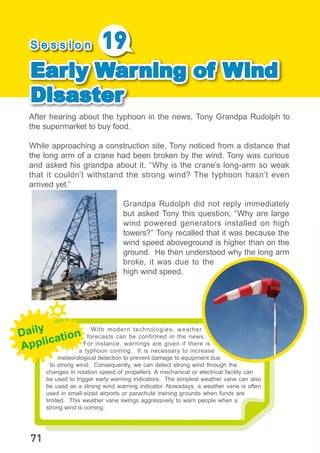
After hearing about the typhoon in the news, Tony Grandpa Rudolph to
the supermarket to buy food.
While approaching a construction site, Tony noticed from a distance that
the long arm of a crane had been broken by the wind. Tony was curious
and asked his grandpa about it. “Why is the crane’s long-arm so weak
that it couldn’t withstand the strong wind? The typhoon hasn’t even
arrived yet.”
Grandpa Rudolph did not reply immediately
but asked Tony this question, “Why are large
wind powered generators installed on high
towers?” Tony recalled that it was because the
wind speed aboveground is higher than on the
ground. He then understood why the long arm
broke, it was due to the
high wind speed.
S e s s i o n 19
Early Warning of Wind
Disaster
Daily
Application
71
1 3 15
x4
x4
2
x2
x1
x3
x1
x1
x1 x4
x8 x2
x1 x2
x1
x1x1
16
22
23
25
34
36
39
41
42
45
46
14
x2
x3
6
5
01
03
02
04
Parts List
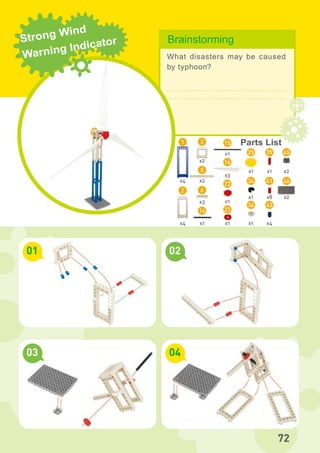
Brainstorming
What disasters may be caused
by typhoon?
Strong Wind
Warning Indicator
72
05
09
07
11
06
10
08
12
73
1 2 3
Model
Assembled
Experiment
Complete
Model
Creation
Experiment
Time
Art
Attack
Evaluation
How do you design a warning indicator
that is able to adjust the war ning’s
sensitivity?
Determine how strong the wind is when a
warning model device sends warnings.
74
Please design a self-propelled electric fan using the models and
principles that you have learned.
S e s s i o n
Monograph
18. Strandbeest
17. Wind Deflector
19. Strong Wind Warning Indicator
20
4
Model
Review
16. Electric Fan
75
76
1
2
3
Model
Design
Model
Creation
Winner!
Design
Concept
Evaluation
My Artwork
7777
Learning Lab- Individual Packages
Creative World
Technology Explorer
Brick Contraption
Scientific Experiment
30 mins/ session; 30 sessions/ package
50 mins/ session; 20 sessions/ package
40 mins/ session; 20 sessions/ package
#1230 Wonderful World1
#1249 Construction Set
#1231 Theme Park2
#1232 Little Artist3 #1233 Fun Cube4
#1248 Basic Set
#1245 Vibro & Gyro16#1244 Robot15
#1246 Programmable
Controller
17 #1247 S4A Interactive
Bricks
18
40 mins/ session; 20 sessions/ package
#1238 Gas & Pneumatics9
#1240 Light & Solar Energy11
#1242 Chemical Battery13
#1234 Force &
Simple Machine
5 #1235 Motion &
Mechanism
6
#1236 Electricity & Circuit7 #1237 Electromagnetism
& Motor
8
#1239 Wind Power10
#1241 Liquid & Hydraulics12
#1243 Optical Devices14
7878
Learning Lab- School Packages
Target: age 2-6 (Kindergarten)
30 mins/ session;
120 sessions in total
Target: age 10+ (Jr. & Sr. High School)
50 mins/ session;
80 sessions in total
Target: age 7+ (Elementary School)
40 mins/ session;
100 sessions in total
Target: age 7+ (Elementary School)
40 mins/ session;
40 sessions in total
Target: age 7+ (Elementary School)
40 mins/ session;
100 sessions in total
#1250 Creative World Set #1251 Scientific Experiment Set-
Power Machine
#1252 Scientific Experiment Set-
Green Energy
#1253 Technology Explorer Set
#1254 Brick Contraption Set
Creative Classroom

#1239 Wind Power

  • 1.
    Creative Ability can beLearned Gigo Learning Lab’s complete series includes 20 individual packages, as well as five school sets. The special features of Gigo’s Learning Lab are as follows: 1. Using GIGO’s “building block” construction-based curriculum, every class has a ready-to-assemble model, and includes time designed to promote individual creativity. 2. Promotes thinking outside-the-box of the traditional educational framework by learning innovation through play! 3. We are all innately good at something, so we should take into account both individual development and the ability to work as part of a team effort. 4. Course levels are designed from elementary to difficult, combining a life sciences- based curriculum with applications from daily life. 5. Experiment using Gigo’s “building blocks”, which can be used over and over again, saving both time and effort. 6. Comes with Gigo’s newly developed 3D Smart Manual, which makes learning how to intelligently assemble each model easier than ever before. 7. Learning Lab’s Cloud Platform allows systematic recording of learning progress. We hope that kids can enthusiastically learn scientific knowledge through fun hands- on experience, developing their problem-solving abilities, as well as a positive attitude towards science. Our mission is to help children apply their newfound knowledge to daily life, furthering their innovational skills and abilities. For any questions or inquires. please email to LL@mail.gigo.com.tw 01
  • 2.
    (v1.0) 02 01 39 03 45 0953 17 59 23 67 31 75 02 41 05 49 13 57 21 63 27 71 35 77 Index 07. Blades 08. Output Efficiency 10. Monograph (2) 11. Wind Power Generation Appendix: Learning Lab Packages 20. Monograph (4) 19. Early Warning of Wind Disaster 18. Wind-powered Carrier 17. Wind Energy Transmission 16. Horizontal Wind Turbine 15. Monograph (3) 14. Vertical Wind Powered Generator 13. Transfer Efficiency 12. Start-up Wind Speed 09. Wind Powered Mechanism 04. Application of Wind Power 05. Monograph (1) 06. Wind Resources 03. Wind Speed Measurement 02. Wind Direction 01.Source of Wind Power Parts List Index Education Philosophy
  • 3.
    03 1 x5 2 x4 4 6 x4 9 x4 10 16 17 1819 20 21 22 23 24 25 26 27 28 29 30 31 32 33 34 35 36 37 38 39 40 41 42 43 44 45 46 47 11 x2 x1 12 x1 x1 x1 x3 x3 x6 x1 x1 x1 x1 x2 x2 x2 x2 x1 x1 x1 x2 x2 x2 x2 x1 x4 x1 x1 x2 x4 x4 x2 x15 x14 x6 x1 x1x2 x2 13 14 15 3 x4 x4 x8 5 8 x3 7 x7
  • 4.
    01 02 03 04 05 06 07 08 09 10 11 12 13 14 15 16 17 18 19 20 21 22 23 24 25 26 27 28 29 30 Long Frame Short Frame SquareFrame Dual Rod 11-hole Rod 5-hole Rod 5-hole Dual Rod-III 3-hole Rod 3-hole Dual Rod Bended Rod Motor Axle Cross Axle 6CM Cross Axle 7CM Cross Axle 10CM Cross Axle 15CM L Blade S Blade Battery Holder (AA Cell) Reverse Generator Wire (Red) Wire (Black) Multi Direction Axle Connector 20T Gear 40T Gear 60T Gear 10T Sprocket Worm Gear 80T Gear M Pulley L Pulley 31 32 33 34 35 36 37 38 39 40 41 42 43 44 45 46 47 M Ring L Ring LED Bulb Cross Axle Fixer Washer Cross Axle Connector 90 Degree Adaptor-II Axle Loose Axle Pin L Connecting Peg S Connecting Peg S Button Fixer Crank Base Grid Connector Base Grid Spanner Parts List 04
  • 5.
    Wind is adisplacement of air in relation to an object. It is a concept of relative motion. Outdoors, the wind blows from a high pressure area to a low pressure area. Air flow is the source of the wind. In a windless day or indoors, we often create artificial wind by utilizing devices that generate air flow. For instance, people use electric fans to cool themselves during the hot summer. People in the past discovered the power of air in moving objects. Thus, they invented sailboats that conquered the ocean using wind force. Wind can be transformed into energy by controlling the wind source. Grandpa Rudolph took Tony to the park so he could fly a kite. Grandpa Rudolph looked up at the trees and saw that there was no wind. He said, “How can we fly a kite on such a windless day!” Tony also knew that a kite could not fly without the wind. Out of frustration, both of them just decided to go back home. But then, Tony saw someone running at the park and suddenly had an idea. He held the kite high and tried to generate wind by running. Naturally, he was able to fly the kite and didn’t stop running until he reached the end of the park. Tony was physically tired, but deep down he was happy. It was his first time to fly a kite and he was proud of himself for solving the wind problem on his own. S e s s i o n 01 Source of Wind Power Daily Application 05
  • 6.
    1 2 17 x2 x1 x3 x2 x3 x1 x2x1 x1 x322 34 43 44 46 15 7 01 03 02 04 Parts List Brainstorming Besides f lying a kite, which activities will be held in a windy day? Artificial Wind 06
  • 7.
  • 8.
    1 2 3 Model Assembled Experiment Complete Model Creation Experiment Time Art Attack Evaluation Howdo you change the wind velocity of your model? What size of paper can your model blow away? 08
  • 9.
    A wind vaneis basically an instrument consisting of a large arrow with an increased tail area and a balance point on the arrow shaft connected to a rotator. The arrow head determines the wind direction. When the wind blows, the tail may be pushed back due to the larger windage given the large tail area. The wind continues to move the instrument until the indicator is parallel to the wind direction. The direction of the arrow head determines the wind direction. If this principle is hard to understand, Have a try action. Bend over backwards and turn your head 90 degrees. Observe the wind vane as it rotates around the center and when you see an image of a see-saw then that’s it! A wind vane is basically a vivid application of the lever principle. With regard to the Earth’s natural wind, heat makes air volume expand. Thus, the density decreases when there is a larger volume of air but the mass remains unchanged. Moreover, since air is fluid, a smaller density of warm air may rise upward and form a low pressure area, during which the cooler air would often move in to replace it and cause air to flow. This is how wind is formed. Wind direction refers to the direction where the wind originates. Wind originating from the north is called the north wind and that from the south is called the south wind. The simplest way to measure wind direction is to wet a finger and hold it in the air. The side of the finger that gets cold is where the wind is coming from. With the development of human civilization, numerous tools for m e a s u r i n g w i n d direction have been invented, such as windsock and wind vane. S e s s i o n 02 Wind Direction Daily Application 09
  • 10.
    1 4 x2 x1 x2x5 x1 x1x1 x1 x4 x1 x2 x2 6 10 17 39 41 42 43 46 3 7 01 03 02 04 Parts List Brainstorming What methods can be used to determine wind direction? Wind Vane 10
  • 11.
  • 12.
    1 2 3 Howcan you change the counterweight to improve the sensitivity of the wind vane? Model Assembled Experiment Complete Model Creation Experiment Time Art Attack Evaluation How will you design a wind vane? 12
  • 13.
    An anemometer isa device used for measuring air velocity. According to the working principle, there are many types of anemometers; namely, mechanical, optical, pressure, hot-wire, sonic, etc. In addition, the design of anemometers is constantly improving. In fact, inventors have already utilized smart phones as anemometers for convenience. An APP is actually used as a microphone to detect the sound of the wind and estimate its speed. This is the application of a sonic anemometer. For beginners, one can design a simple anemometer by combining the knowledge of hydromechanics and simple pendulum or by calculating the rotating speed of a propeller. Tony’s father took a flight and his plane would land after a couple of hours. However, the city was struck by a strong typhoon. Tony was anxious and asked his grandpa, “Will it be dangerous for the plane to travel when there is typhoon?” After assuring Tony, Grandpa Rudolph asked him, “Is it the rain or the wind first that affects the plane’s safety?” Tony answered with uncertainly: “Perhaps the wind”. Grandpa replied, “All airports are equipped with Doppler radars which measure the wind speed using a non-contact method; furthermore, the wind speed and direction are determined when planes take off or land. So there is no problem in terms of safety. The only problem would be the arrival time which may be delayed due to weather conditions.” S e s s i o n 03 Wind Speed Measurement Daily Application 13
  • 14.
    1 3 8 x3 x2x6 x1 x2 x1 x2 x2 x2x15x1x1 x2 x4 x3 x6 x2 x4 x6 x2 x1 x4 2 6 9 10 17 22 23 25 28 34 38 41 42 43 45 46 15 5 7 01 03 02 04 Parts List Brainstorming How do you determine the size of the wind? Anemometer 14
  • 15.
  • 16.
    1 2 3 Pleaseobserve the operation of the anemometer by using an electric fan set at different speed. Then, try to blow into the anemometer to see how fast it rotates. Model Assembled Experiment Complete Model Creation Experiment Time Art Attack Evaluation In addition to wind speed, what else can an anemometer measure? 16
  • 17.
    This kind ofsailing car with one wheel in front and two at the rear is easier to control since it travels on land unlike the sail boat. The sailing car is designed with directions controlled by feet and a sail maneuvered by hand. The car would speed up when the rope is tightly held. Conversely, the car may slow down when the rope is loosened to lessen the wind on the sail. Since the sailing car is light, it can travel on different surfaces like (beach) sand, parking lots, sports arena and even ice. In the early 1600s, Dutchman Simon Stevin invented a two-masted sailing car. He integrated two-masted sails with a car body, axle and wheels to make a sailing car a possible mode of transport. However, the vehicle could not move against the wind or without the wind. Moreover, the air flow and wind strength were unstable on the streets, so driving the vehicle wasn’t practical. Consequently, given these factors; namely, wrong market position, high cost, weight (i.e. heavy) and poor efficiency, the sailing car had no practical value and was forgotten by the people. By the 20th century, leisure sports have become popular. A New Zealander named Paul Beckett improved the invention. Beckett initially intended to create a portable wind-driven sport equipment applicable to people of different ages and body conditions. Because of its reasonable price and easy operation, the lightweight and newly invented three-wheel sailing car became widely popular around the world with the rise of leisure activities. The broad leisure arena has enhanced its value. S e s s i o n 04 Application of Wind Power Daily Application 17
  • 18.
    Brainstorming Pe o pleof ten make li fe m o re convenient with the help and power of nature. What facilities around you are applications derived from natural sources? 1 4 x2 x1 x3 x4 x4 x2 x4 x2 x2 x14 x1x2x2 x2 x2 x4 x4 6 9 29 30 31 32 34 39 41 42 15 3 5 8 7 01 03 02 04 Parts List Sail Car 18
  • 19.
  • 20.
    2 3 Model Assembled Experiment Complete Model Creation Experiment Time Art Attack Evaluation What couldbe different in the sail car’s operation when different materials are used in the sail, in addition to common A4 paper. Change the angle of the sail but keep the directions of the car and wind. What are the force changes on the sail car? 1 20
  • 21.
    21 Using the modelsand principles that you have learned, try to design a mechanism that is able to measure both wind direction and speed. S e s s i o n Monograph 03. Anemometer 02. Wind Vane 04. Sail Car 05 1 Model Review 01. Artificial Wind
  • 22.
  • 23.
    People in thepast already knew how to use wooden windmills to irrigate and grind cereal. The wind mill is characterized by its strength, hence it is also called a wind mill. The main function of a windmill is to transform wind into power through the rotation of a paddle wheel. People use this wind energy to grind cereal. With the rapid development of modern technologies, the ancient windmill has almost been forgotten; nevertheless, it is still considered a unique landscape in the world given its advantages of natural energy, pollution-free and inexhaustible energy. Wind resource also called wind energy resource, refers to kinetic energy generated when air flows above the Earth’s surface. Wind resource is derived from nature, which is renewable energy that is sustainable to use. Although wind resource can’t be exhausted, it is unstable since wind often changes like day and night. Moreover, only when wind speed reaches a certain degree, can it be used for power generation. This means that not all wind resources can be converted into electricity. Accordingly, a wind field refers to a place or area that can be utilized or used as a wind resource. However, wind power generation creates elevated sound levels, so a wind field should be constructed on a wide-open area away from people. This would result in regional restrictions on wind resources and consideration for appropriate geographical environments; for example, an offshore wind field would be located along coastal areas or an on-land wind field would be situated in wide- open areas. S e s s i o n 06 Wind Resources Daily Application 23
  • 24.
    1 93 x1 x6x2 x6x3x2x1 x1 x2 x4 x1 x1 x1 x6 x2 x6 x1 x2 x2 x1 x2 x2 2 6 22 25 28 30 34 36 38 41 42 43 45 46 15 8 7 17 23 01 03 02 04 24 Parts List Brainstorming What tools will you use to grind food? Wind Mill
  • 25.
  • 26.
    1 2 3 Model Assembled Experiment Complete Model Creation Experiment Time Art Attack Evaluation Whatare the changes in design when replacing gear sets that are used to represent millstone with other parts? Adjust the output speed of the windmill by collocating different gear sets. 26
  • 27.
    Tony joined anoff-campus activity that involved visiting a power plant. When the tour bus reached the mountain, Tony saw windmills that had three blades and were different from the electric fans at home that had four blades. Tony was curious and asked the teacher why windmills for power generation only have three blades. And the teacher replied that windmills with more blades are normally called low-speed windmills, which have higher rotor power coefficient and larger torque during operation, and are more suitable for water lifts given their low start-up wind speed. In contrast, windmills with fewer blades are called high-speed windmills. Experimental tests on strong windmills showed that windmills with three blades could produce optimum economic efficiency, since they could produce higher rotor power coefficient during high-speed operation. Moreover, fewer blades made them lighter than those with more blades, so they are ideal for power generation. A strong windmill generator is usually installed on a high tower, since the air velocity aboveground is greater than that on the earth. Generally, a larger blade can improve the generating efficiency, but may break due to increased thrust when the blade is increased. In order to avoid risk and considering the economic efficiency under weak wind conditions, researchers found that with the area remaining the same, a valid wind area can be achieved by designing longer blades that can still produce equal generating efficiency. Moreover, longer blades can generate enough torque to drive the power generator even under weak wind conditions. S e s s i o n 07 Blades Daily Application 27
  • 28.
    1 6 16 x4 x4x1 x1 x1 x2 x3 x1 x1 x1 x6 x1 x2 x1 x2 2 22 23 25 34 41 44 45 46 15 8 14 01 03 02 04 Parts List Brainstorming What shapes of blades have you seen? Long-blade Windmill 28
  • 29.
  • 30.
    1 2 3 Model Assembled Experiment Complete Model Creation Experiment Time Art Attack Evaluation Seethe difference in the rotation of the windmill after adjusting the number of blades. Record how much strong wind is required to blow your windmill? How many spins can it do after being blown? 30
  • 31.
    Since windmill generatorscannot convert all the wind energy, their design may affect the amount of electricity derived from kinetic energy, which is called output efficiency. The output efficiency is greatly affected by the blade design and rotation speed. Since blade design was previously discussed, we now focus on the influence of the rotation speed on output efficiency. It is a universal fact that wind flow on the Earth’s surface is unstable, so the rotation speed of a windmill may vary with the strength of the wind. Generally, an increased rotation speed may produce higher output efficiency. Most large scale windmill generators may adjust rotation speed through a variable-speed motor or blade adjustment mechanism, to maintain normal operation. During Tony’s visit to the wind power plant, the tour guide mentioned that the windmill generators were the latest products. Later on, when Tony climbed up the high tower, he observed that the area was spacious and there was relatively low noise in the machine room. The guide explained that the generators were driven directly by the wind with no variable-speed motor. These machines were called direct-driven windmill generators. With the high failure rate of variable-speed motors, direct-driven windmill generators have become popular because of their high efficiency, low noise, long service life, smaller set volume and reduced maintenance costs. S e s s i o n 08 Output Efficiency Daily Application 31
  • 32.
    1 6 17 x2 x3x2 x2 x1 x2 x3 x3 x6 x6 x5 x1 x2 x2 x2 x3 x1 2 22 23 25 34 41 42 43 44 45 46 15 8 7 01 03 02 04 01 03 02 04 Parts List Brainstorming When do we need to adjust the rotation speed of a windmill? Variable-speed Windmill 32
  • 33.
  • 34.
    1 2 3 Model Assembled Experiment Complete Model Creation Art Attack Evaluation Designan output power with different rotation speeds by using the existing materials. Compare two windmills with different output power. What is the difference in their rotation speed? Experiment Time 34
  • 35.
    Since ancient times,people already knew how to utilize wind power. In the application of wind, different functions and environments are considered to build a suitable mechanism. There should be a space for the equipment for wind operation and a solid structure that can protect the mechanism and support normal operation. For instance, people design a wind powered mechanism to drive away birds that feed on crops; this is called a wind powered scarecrow, which is a primitive and simple wind energy mechanism. In terms of manufacturing, people use local materials like straws to create a shape of a man and set this up among the crops. The scarecrow moves and waves when the wind blows, and scares the birds away. A wind energy mechanism is used to maintain the normal operation of a windmill and protects it from being destroyed by strong wind, which makes it a challenge to protect the blades. When a blade rotates quickly because of strong wind, the conventional mechanism changes the windward side of the blade into leeward and blocks the blades to protect them. However, this may shut off the power generator and greatly decrease its utilization rate. The new mechanism has a variable angle design. When the blades come in contact with strong wind, a rotating torsion centered on the axial blade may adjust the blade gear and change the blade angle accordingly based on the automatic detection system, through which it can reduce the wind thrust under strong wind conditions. This helps prevent damage and generate power as well. S e s s i o n 09 Wind Powered Mechanism Daily Application 35
  • 36.
    1 3 7 x4 x3 x1 x1 x4x1 x2 x1 x3 x1 x1 x2 x1 x9 x2 x3x1x1x1 x1x3 x2 x8 x2x1 2 4 6 9 10 17 22 23 25 28 34 38 39 41 42 43 45 46 13 15 5 8 01 03 02 04 Parts List Brainstorming Which objects are powered by the wind? Wind Powered Scarecrow 36
  • 37.
  • 38.
    1 2 3 Model Assembled Experiment Complete Model Creation Experiment Time Art Attack Evaluation Howdo you adjust the amplitude of the scarecrow’s swing and its frequency? Observe the amplitude of the scarecrow’s swing and design the appropriate parts. 38
  • 39.
    Please design apower-driven tool using the models or principles that you’ve learned. S e s s i o n Monograph 08. Variable-speed Windmill 07. Long-blade Windmill 09. Wind Powered Scarecrow 10 2 Model Review 06. Wind Mill 39
  • 40.
  • 41.
    Tony felt hotinside the room after flying a kite in the park, so he turned on the electric fan and played with the kite at the same time. Seeing the kite swing as the cool air blows, Tony suddenly thought of the electric fans in school that were used to drive the electric generator, so he got curious and asked his Grandpa whether a kite could be used to generate power. Grandpa replied: “You are really creative that you could come up with such ideas using that analogy. Recently, some researchers have invented a new kite wind generator that enabled a kite to drive a merry-go-round with the help of wind energy, which generated electricity caused by a rotation in the magnetic field.” Wind power generation makes the blade on a windmill rotate with the wind and further drive the magnet inside a generator to rotate, so that electricity is generated as the magnetic line of force is cut off by the relative movement of coils, followed by the output from the output pin. Specifically, wind power generation is an energy conversion method that transforms wind energy into mechanical energy and then into electricity. Although wind power generation is natural, clean, pollution-free and common, the unstable wind force and direction may affect power generation. In addition, wind power generation has a negative impact (e.g. noise) on bird habitats. The current global trend is focused on developing wind fields in offshore areas in order to keep away from places where animals live. This also provides opportunities to utilize the ocean wind and save land resources. S e s s i o n 11 Wind Power Generation Daily Application 41
  • 42.
    01 03 02 04 191 3 17 20 21 22 33 42 43 45 46 15 7 x2 x2 x3 x1 x1 x1 x1 x3 x1 x1x2 x2x4 x3x2 2 Parts List Brainstorming Have you ever seen a large windmill by the sea? Do you know its function? Windmill Generator 42
  • 43.
  • 44.
    1 2 3 Model Assembled Experiment Complete Model Creation Experiment Time Art Attack Evaluation Tryto design your own generator. Record how much strong wind is required to light a bulb. 44
  • 45.
    A wind turbineshould overcome the maximum static friction force in order to start rotating from a static state. This is called a start-up wind speed, i.e. the minimum wind speed required to start a wind turbine. The start- up speed of a common windmill is about 3m/s, but it is unable to generate electricity at a wind speed lower than 4m/s. To ensure that communities with a lower average wind speed in the wind field, can generate electricity through the wind, it is necessary to minimize the scale of the windmill to reduce the maximum static friction force. Therefore, the so-called air-breeze wind generator can start to operate at half the start-up speed of a common generator, which can produce electricity even with a gentle breeze. Nevertheless, its generated power is relatively low. For instance, some people have invented an air-breeze wind generator installed on bicycles. In order to encourage most cities to effectively use wind energy, researchers have developed a new air-breeze wind generator technology. The air-breeze wind generator consists of several specially designed light plastic wind turbines with gears, as well as a tail vane for finding wind. With the support of a small generator, the plastic turbines are blown by the wind, making them rotate and generate electricity. This kind of wind power generation system is able to work under a wind speed of 2m/s. Although the generated power is not high, it can serve as a small independent auxiliary power system that conserves energy. S e s s i o n 12 Start-up Wind Speed Daily Application 45
  • 46.
    01 03 02 04 151 3 x2 6 17 19 20 21 22 23 25 33 34 41 42 43 45 46 14 7 x2 x1 x2 x1x1 x1 x6 x1 x1 x1 x2 x2 x4x1 x1 x1 x1 x6 x7 x1 2 Parts List Brainstorming W h e r e d o e s s t r o n g w i n d normally appear? 46 Air-breeze Wind Generator
  • 47.
  • 48.
    1 2 3 Model Assembled Experiment Complete Model Creation Experiment Time Art Attack Evaluation Howdo you modify the air-breeze wind generator if it is installed on the bicycle? Generate wind by using different methods and see which method can successfully drive a generator. 48
  • 49.
    The turbine ofa horizontal wind power generation can transfer wind power into mechanical energy. However, if the turbines do not operate against the wind, the transfer efficiency may reduce. To ensure that the change in wind direction can also facilitate wind energy, it is necessary to install an automatic wind sensing equipment. A large-scale wind powered generator can first detect wind direction and signal through a wind direction sensor and then control the direction of rotation. As for the small-sized wind powered generator, a tail vane is added, which works as the tail on an anemoscope. Since it has a larger wind resistance due to its larger area, it may be pushed behind to automatically adjust the direction of the generator, making the turbine run against the wind to improve transfer efficiency. Grandpa Rudolph took Tony on a holiday to visit a green chicken farm to help expand Tony’s knowledge about green energy. When he arrived in the farm, Tony felt odd because of the strange street lights that he saw. There was a wind powered generator with a vane installed on a pole for detecting the wind. There was also an integrated wind energy and solar energy panel for lighting applications. Grandpa Rudolph explained that although the individual transfer efficiency of both wind powered generator and solar panel were not high, the energy output can be increased if they are integrated just like these lighting facilities. It is only when we exert some effort in environmental protection and energy conversation, can the future generation live in a better environment. S e s s i o n 13 Transfer Efficiency Daily Application 49
  • 50.
    01 03 02 04 81 3 x5 x4 x3 x1 x2x1 x1 x1 x11 x2 x2x1 x1x2 x2 x1 x3 x1 x1 x1 x2 x6x1 x2 6 16 17 19 20 21 22 33 34 35 37 41 42 43 45 46 12 15 5 7 2 Parts List Brainstorming How do you determine the wind direction and strength in an area? Wind Sensing Generator 50
  • 51.
  • 52.
    1 2 3 Model Assembled Experiment Complete Model Creation Experiment Time Art Attack Evaluation Howdo you make the wind sensing function of a model more sensitive? Make a model that is facing the electric fan at different angles and test whether it can change directions successfully in line with the wind’s direction. 52
  • 53.
    A wind poweredgenerator is categorized according to its installation direction. In other words, a generator parallel to the ground is called a horizontal wind powered generator while a generator vertical to the earth is called a vertical wind powered generator. Since the rotating axle in a vertical generator is perpendicular to the wind direction, and a vertical plate or a cambered bending plate is used as a turbine, there are several advantages which include receiving wind from any direction, a simple structural design and a small rotation range of blades. However, given the small turbine size and (heavy) weight, the generated transfer efficiency is lower than that of a horizontal generator. Moreover, it requires a larger start-up torque, and at times, a motor to get it started. The world’s first wind-powered electric vehicle charging station was installed successfully in Barcelona, Spain in 2012. It was an electric vehicle charging station that used wind for power generation and energy storage. It perfectly incorporated a pollution-free wind power generation and electric vehicle charging mechanism. It did not only expand the practical application of an infinite wind energy, but it also brought electric vehicles a fresh new energy experience, which was helpful in popularize the said vehicles. The wind-powered electric vehicle charging station consists of a 12 meters high tower, in which a vertical axis wind powered generator is installed to transmit electricity to the charging station. A vertical axis wind powered generator only requires a small space for operation. Thus, it is small in terms of volume and is easily installed. S e s s i o n 14 Vertical Wind Powered Generator Daily Application 53
  • 54.
    01 03 02 04 1 4 8 x2 x4 x2 x6x1 x1 x1 x6 x1 x1 x8 x2 x2x14x1x1 x1 x1 x1 x6 x2 x3 6 17 19 20 21 22 23 25 33 35 41 42 43 45 46 15 3 5 7 Parts List Brainstorming Where does the wind blow? What is the wind’s direction? 54 Vertical Axis Wind Powered Generator
  • 55.
  • 56.
    1 2 3 Model Assembled Experiment Complete Model Creation Experiment Time Art Attack Evaluation Howdo you improve the generated power of a vertical axis wind powered generator? Please use a model for blowing wind from different angles and observe the difference in the model’s action. 56
  • 57.
    Please design avariable speed wind sensing power generator using the models and principles that you have learned. S e s s i o n Monograph 13. Wind Sensing Generator 12. Air-breeze Wind Generator 14. Vertical Axis Wind Powered Generator 15 3 Model Review 11. Windmill Generator 57
  • 58.
  • 59.
    Generally, the angleof an electric fan blade is designed to blow air forward, thus a lower pressure may form behind the fan during its rotation, which makes air flow towards a higher pressure area. This is why people feel a suction-like force working behind the fan. When the blades run, the bevel angle of blades may produce friction with the air, which is then pushed forward. The pushed air also exerts pressure on the blades, according to Newton’s principle of action and reaction. As for the pushed air, it is released from the electric fan, which produces wind. When Tony let the electric fan blow the kite, he associated this action to power generation. Since a kite could be used to generate power, he assumed that an electric fan can also generate power. So he got curious and asked Grandpa Rudolph. Grandpa Rudolph answered: “Generally, an electric fan powered by an alternating current has a horizontal rotating axle. Although it can be treated as a horizontal wind turbine, it cannot generate power. Since it adopts an AC Induction Motor, its coils are fixed on a stator w hi l e it s r oto r wo r ks t hr o u g h an electro - magnetic induction. It is formed by an iron core coated with aluminum. Since the motor has no magnet, the coils are unable to cut the magnetic field for power generation.” S e s s i o n Horizontal Wind Turbine Daily Application 5959 16
  • 60.
    81 3 x3 6 17 18 19 20 21 22 23 27 28 34 35 39 40 41 42 43 45 46 11 12 13 15 5 7 x3 x1 x4 x1 x1 x1 x1 x1x1 x3 x1 x1 x1 x7 x2 x2x2 x3 x1 x1 x1 x1 x1 x1 x1 x2x4 x1 2 01 03 02 04 Parts List Brainstorming What kinds of electric fans have you seen? Electric Fan 60
  • 61.
  • 62.
    1 2 3 Model Assembled Experiment Complete Model Creation Experiment Time Art Attack Evaluation Howcan you change the oscillating angle of your electric fan? What is the oscillating angle of your electric fan? 62
  • 63.
    There is atype of electric stand fan, which is a wind deflector that can send wind to different directions. This fan has a base that can be placed on the ground or on the desk. It has an additional deflector installed on the external area of the blades in which there is a wind board with parallel spacing. Wind from an electric fan is sent to a fixed direction while the deflector is not working. In contrast, if the deflector is running, the wind is circulated to enhance air convection results. Generally, a cooling fan is installed in the mother board of a desktop computer’s CPU to avoid a system crash due to overheating of the CPU. However, when processing a complicated high-speed computation using a multicore CPU, there would be an increased generated heat, so the system may crash even when a common cooling fan is installed. This is because the heated air extracted from the CPU via the cooling fan has not been discharged from the computer case and still keeps accumulating, making the overall temperature inside the case rise rather than decrease. This could cause the CPU to crash. The new design of the heat deflector for the CPU can improve the situation, since it extracts heated air through a wind deflector and connects the computer case with a duct, which can effectively transmit wind energy and discharge the CPU-generated heat out of the computer case. S e s s i o n 17 Wind Energy Transmission Daily Application 63
  • 64.
    01 03 02 04 1 6 16 x4 x4x3 x3 x2 x1 x2 x3x1 x2 x1 x3 x1 x10 x4 x4 2 9 17 22 23 25 26 41 43 45 46 15 7 Parts List Brainstorming What will you do to allow air to circulate inside your house? Wind Deflector 64
  • 65.
  • 66.
    1 2 3 Model Assembled Experiment Complete Model Creation Experiment Time Art Attack Evaluation Changethe model to increase the air deflector’s transmission direction. Try to observe whether the two sets of blades in an air deflector have the same rate of rotation. 66
  • 67.
    The wind-powered beastis one of the bionic beasts. It can drive the propeller to rotate with the help of the wind. It makes one set of gears rotate to drive the bent axle and connecting rod, so that the double swinging motions of various connecting rods are enabled. This helps achieve a walking motion of the leg, which is restrained and similar to the leg movements of insects. If we make a larger beast with more solid materials, the wind-powered beast can serve as a manned vehicle controlled by a strong wind. It is a veritable but slow wind-powered vehicle. Although it does not have significant practical application and value, it can be used in teaching because of its concept. When Tony went home after seeing the bionic beast exhibit, he asked Grandpa Rudolph why nobody knew about the early bionic beast in the wind-powered carrier shown in the exhibit. Grandpa Rudolph answered that some early inventions had no means to undergo research. But as far as he was concerned, it was Otto Lilienthal, a German who invented the bat-like wind-powered manned glider. Lilienthal was known worldwide as the father of the glider. Grandpa Rudolph added that the design of the glider wing was similar to the blade of a wind powered generator. It had the same wing area and a larger ratio of length (from left to right) to the width (from front to rear) which significantly helped its flight capability. It was similar to the design of windmill blades. S e s s i o n 18 Wind-powered Carrier Daily Application 67
  • 68.
    01 03 02 04 1 3 9 x2 x1 2 x1 x8 x3 x2 x4 x1x1 x2 x10 x2x1x2 x1 x2 x4 x2 x4 x2 x4 6 17 22 23 24 25 34 35 37 39 40 41 42 43 15 5 7 Parts List Brainstorming Which vehicles are powered by the wind? Strandbeest 68
  • 69.
  • 70.
    1 2 3 Model Assembled Experiment Complete Model Creation Experiment Time Art Attack Evaluation Howwill you design your strandbeest to make it move on water? Record the distance per minute that your model can move. 70
  • 71.
    With modern technologies,weather forecasts can be confirmed in the news. For instance, warnings are given if there is a typhoon coming. It is necessary to increase meteorological detection to prevent damage to equipment due to strong wind. Consequently, we can detect strong wind through the changes in rotation speed of propellers. A mechanical or electrical facility can be used to trigger early warning indicators. The simplest weather vane can also be used as a strong wind warning indicator. Nowadays, a weather vane is often used in small-sized airports or parachute training grounds when funds are limited. This weather vane swings aggressively to warn people when a strong wind is coming. After hearing about the typhoon in the news, Tony Grandpa Rudolph to the supermarket to buy food. While approaching a construction site, Tony noticed from a distance that the long arm of a crane had been broken by the wind. Tony was curious and asked his grandpa about it. “Why is the crane’s long-arm so weak that it couldn’t withstand the strong wind? The typhoon hasn’t even arrived yet.” Grandpa Rudolph did not reply immediately but asked Tony this question, “Why are large wind powered generators installed on high towers?” Tony recalled that it was because the wind speed aboveground is higher than on the ground. He then understood why the long arm broke, it was due to the high wind speed. S e s s i o n 19 Early Warning of Wind Disaster Daily Application 71
  • 72.
    1 3 15 x4 x4 2 x2 x1 x3 x1 x1 x1x4 x8 x2 x1 x2 x1 x1x1 16 22 23 25 34 36 39 41 42 45 46 14 x2 x3 6 5 01 03 02 04 Parts List Brainstorming What disasters may be caused by typhoon? Strong Wind Warning Indicator 72
  • 73.
  • 74.
    1 2 3 Model Assembled Experiment Complete Model Creation Experiment Time Art Attack Evaluation Howdo you design a warning indicator that is able to adjust the war ning’s sensitivity? Determine how strong the wind is when a warning model device sends warnings. 74
  • 75.
    Please design aself-propelled electric fan using the models and principles that you have learned. S e s s i o n Monograph 18. Strandbeest 17. Wind Deflector 19. Strong Wind Warning Indicator 20 4 Model Review 16. Electric Fan 75
  • 76.
  • 77.
    7777 Learning Lab- IndividualPackages Creative World Technology Explorer Brick Contraption Scientific Experiment 30 mins/ session; 30 sessions/ package 50 mins/ session; 20 sessions/ package 40 mins/ session; 20 sessions/ package #1230 Wonderful World1 #1249 Construction Set #1231 Theme Park2 #1232 Little Artist3 #1233 Fun Cube4 #1248 Basic Set #1245 Vibro & Gyro16#1244 Robot15 #1246 Programmable Controller 17 #1247 S4A Interactive Bricks 18 40 mins/ session; 20 sessions/ package #1238 Gas & Pneumatics9 #1240 Light & Solar Energy11 #1242 Chemical Battery13 #1234 Force & Simple Machine 5 #1235 Motion & Mechanism 6 #1236 Electricity & Circuit7 #1237 Electromagnetism & Motor 8 #1239 Wind Power10 #1241 Liquid & Hydraulics12 #1243 Optical Devices14
  • 78.
    7878 Learning Lab- SchoolPackages Target: age 2-6 (Kindergarten) 30 mins/ session; 120 sessions in total Target: age 10+ (Jr. & Sr. High School) 50 mins/ session; 80 sessions in total Target: age 7+ (Elementary School) 40 mins/ session; 100 sessions in total Target: age 7+ (Elementary School) 40 mins/ session; 40 sessions in total Target: age 7+ (Elementary School) 40 mins/ session; 100 sessions in total #1250 Creative World Set #1251 Scientific Experiment Set- Power Machine #1252 Scientific Experiment Set- Green Energy #1253 Technology Explorer Set #1254 Brick Contraption Set Creative Classroom