Data, the Internet and  the Work of  Community Workers:   Data “Fishing” to Save Lives! Jonathan Nomachi Community Health Councils December 3, 2010
Workshop Objectives  Provide an overview of identifying reliable data sources from the internet Provide an overview of HealthyCity.org website Provide interactive session that utilizes real life examples from the audience
Community Health Councils  Los Angeles based, non-profit organization since 1992. Health promotion, policy advocacy. Mission to improve health; increase access to quality healthcare of uninsured and undeserved populations. Centers for Disease Control and Prevention REACH U.S. grantee.
Finding Data on the Internet can be EITHER….
Keys to Successful Data Fishing Ask the right questions Be Patient Be Creative LOCATION LOCATION LOCATION
Asking the Right Question Exercise What are some data questions that you ask to assist in your work as a Community Health Worker? What is the prevalence of diabetes in  Los Angeles County? Is this question sufficient?
Asking the Right Question Exercise What is the prevalence of diabetes in South Los Angeles? What is South Los Angeles?  Who in South Los Angeles are you talking about? Are there other factors that could be used instead of “diabetes?”
Asking the Right Question Exercise Demographics of your population Race, Gender, Age, Education Geography of your population Zip code, Service Planning Area Are there other factors that could answer your first question?
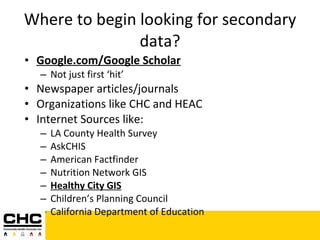
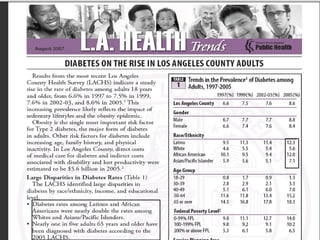
Where to begin looking for secondary data? Google.com/Google Scholar Not just first ‘hit’ Newspaper articles/journals Organizations like CHC and HEAC Internet Sources like: LA County Health Survey AskCHIS American Factfinder Nutrition Network GIS Healthy City GIS Children’s Planning Council California Department of Education
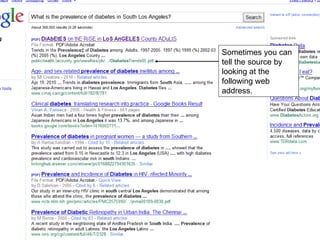
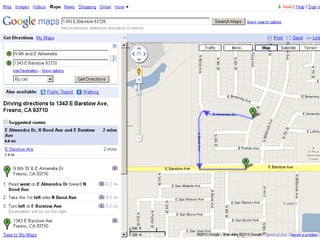
Sometimes you can tell the source by looking at the following web address.
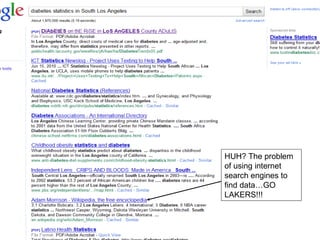
HUH? The problem of using internet search engines to find data…GO LAKERS!!!
 
TIME TO FISH!!!
Helpful Words in Data Fishing “ Data”; “Statistics”; “Rate” “ in Los Angeles”; “in California”; “in South Los Angeles” “ Mortality”; “prevalence” E.G. “Uninsurance Rates in South Los Angeles”
Questions? Feel free to contact me at: Jonathan Nomachi Community Health Councils 323.295.9372 [email_address]
A Resource for all of California  Information + action for social change
A National civil rights POLICY/ ACTION TANK Healthy City is a project of…
Who is Healthy City? Healthy City is  an  information + action  resource   that unites  rigorous research,  community voices and innovative technologies  to solve the root causes of social inequity
Data & Technology :  Data, maps, and service referral through our easy to use online platform  HealthyCity.org Technical Assistance :  Work ON-THE-GROUND to develop targeted research/policy strategies and web tools Community Research Lab:  engages, trains, and provides tools for CBO’s to lead and sustain research.  What Does HC Do?
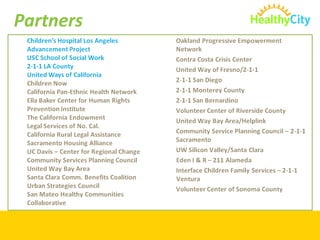
Partners
Find services Conduct Research Share  your community’s  story Use HealthyCity.org to: Anywhere in California !
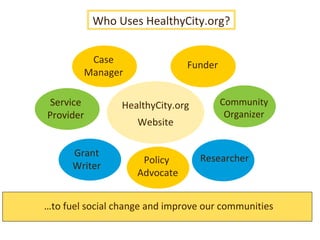
Who Uses HealthyCity.org? Grant Writer … to fuel social change and improve our communities HealthyCity.org Website Service Provider Case Manager Policy  Advocate Funder Community Organizer Researcher
What’s on HealthyCity.org? Data, data, data
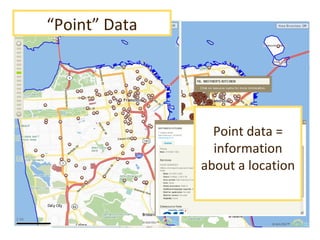
“ Point” Data Point data = information about a location
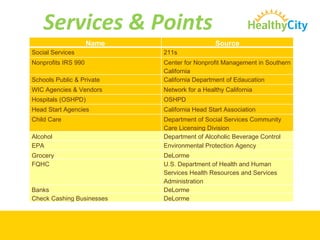
Services & Points  Social Service data from 2-1-1  Over 30,000 Service sites across California (Includes: Basic Needs, Legal Services, Education, Health Care, Employment, and many other Community Services) Name Source Social Services 211s Nonprofits IRS 990 Center for Nonprofit Management in Southern California Schools Public & Private California Department of Edaucation WIC Agencies & Vendors Network for a Healthy California Hospitals (OSHPD) OSHPD Head Start Agencies California Head Start Association Child Care Department of Social Services Community Care Licensing Division Alcohol Department of Alcoholic Beverage Control EPA Environmental Protection Agency Grocery DeLorme FQHC U.S. Department of Health and Human Services Health Resources and Services Administration Banks DeLorme Check Cashing Businesses DeLorme
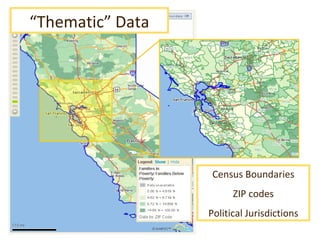
“ Thematic” Data Census Boundaries ZIP codes Political Jurisdictions
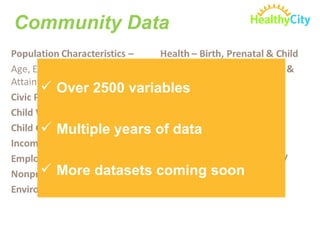
Community Data Over 2500 variables Multiple years of data More datasets coming soon
 
You can save and share anything you create while logged in GET STARTED!
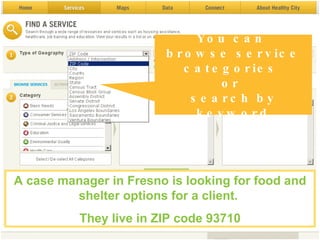
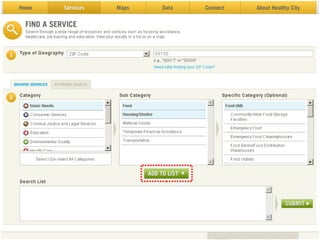
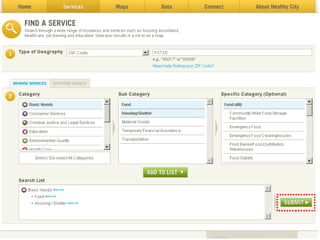
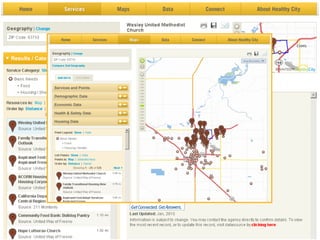
A case manager in Fresno is looking for food and shelter options for a client.  They live in ZIP code 93710 You can  browse service categories  or  search by keyword
 
 
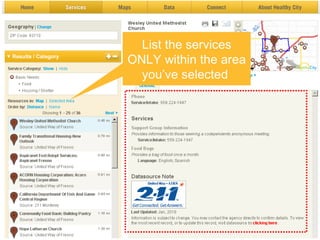
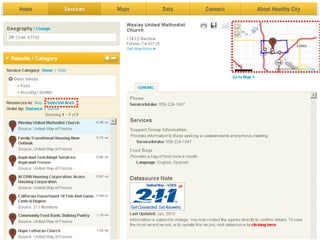
List the services ONLY within the area you’ve selected
 
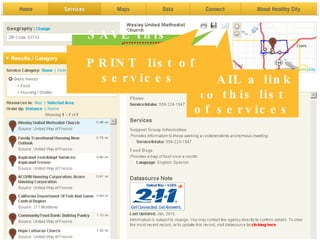
SAVE this list for future reference EMAIL a link to this list of services PRINT  list of services
 
View services on a map
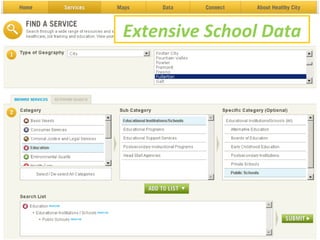
Extensive School Data
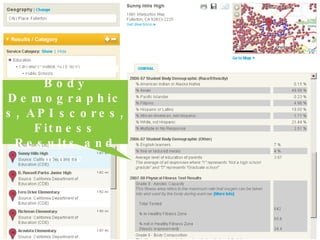
View Student Body Demographics, API scores, Fitness Results and more
Go Live! Try it on HealthyCity.org
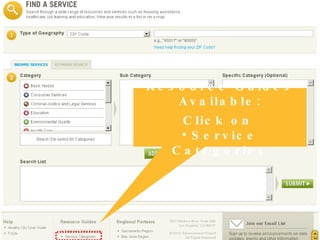
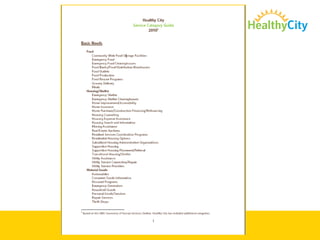
Resource Guides Available: Click on  Service Categories
 
 
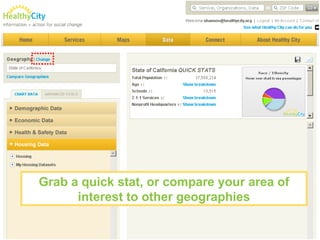
Grab a quick stat, or compare your area of interest to other geographies
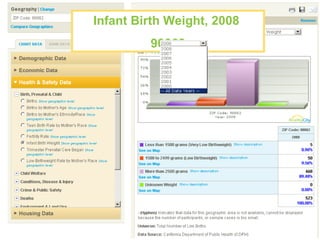
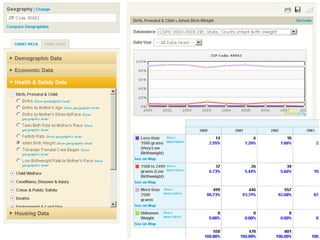
Infant Birth Weight, 2008  90062
 
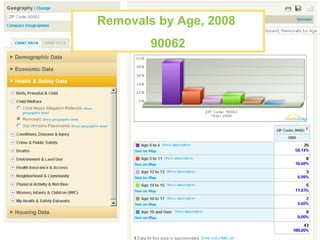
Removals by Age, 2008  90062
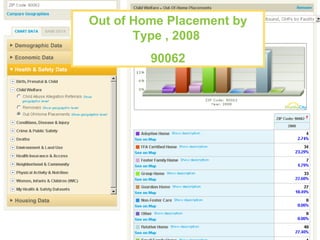
Out of Home Placement by Type , 2008  90062
Rank indicators by Geography: Where are the areas that have the highest percentage of people without health insurance?
Go Live! Try it on HealthyCity.org
 
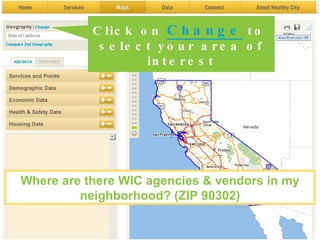
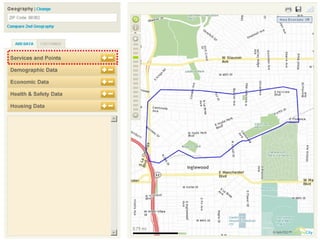
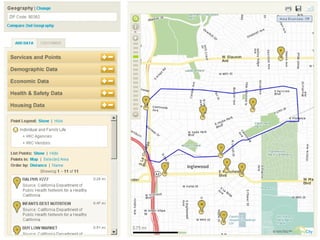
Click on  Change  to  select your area of interest Where are there WIC agencies & vendors in my neighborhood? (ZIP 90302)


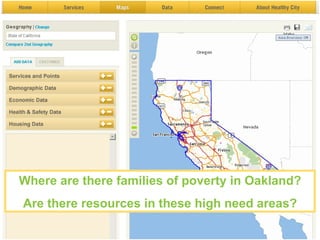
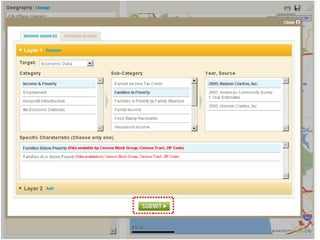
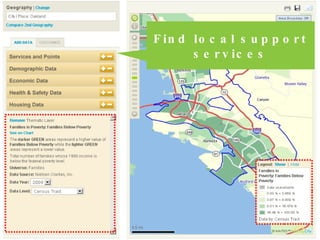
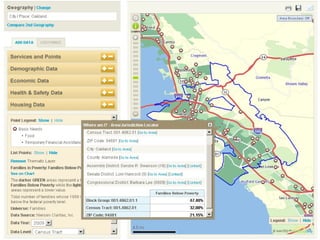
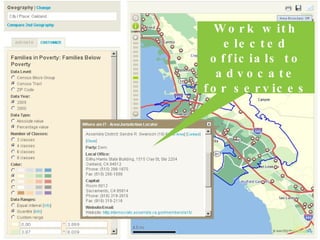
Where are there families of poverty in Oakland? Are there resources in these high need areas?
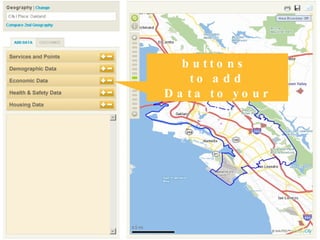
Click the +- buttons  to add Data to your map
 
Find local support services
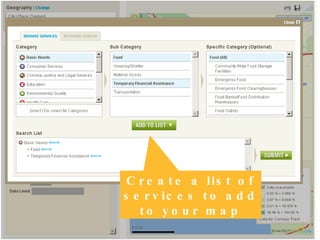
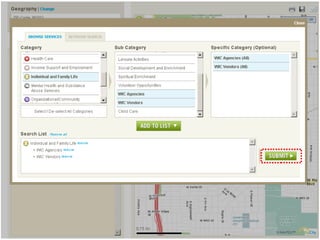
Create a list of services to add to your map
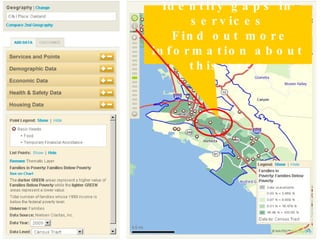
Identify gaps in services Find out more information about this area
 
Work with elected officials to advocate for services
Go Live! Try it on HealthyCity.org
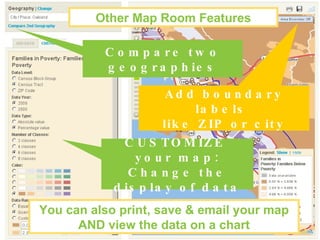
Add boundary labels  like ZIP or city Compare two geographies CUSTOMIZE  your map: Change the display of data Other Map Room Features You can also print, save & email your map AND view the data on a chart
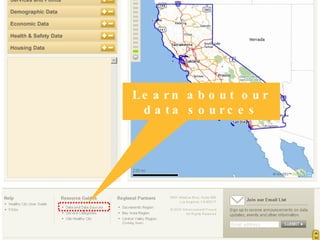
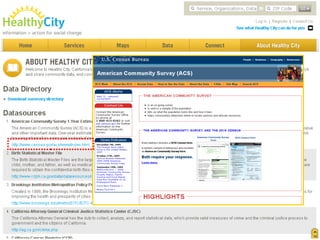
Learn about our data sources
 
You can save and share anything you create while logged in GET STARTED!
 
Thank You!

120310 promotorascombined

  • 1.
    Data, the Internetand the Work of Community Workers: Data “Fishing” to Save Lives! Jonathan Nomachi Community Health Councils December 3, 2010
  • 2.
    Workshop Objectives Provide an overview of identifying reliable data sources from the internet Provide an overview of HealthyCity.org website Provide interactive session that utilizes real life examples from the audience
  • 3.
    Community Health Councils Los Angeles based, non-profit organization since 1992. Health promotion, policy advocacy. Mission to improve health; increase access to quality healthcare of uninsured and undeserved populations. Centers for Disease Control and Prevention REACH U.S. grantee.
  • 4.
    Finding Data onthe Internet can be EITHER….
  • 5.
    Keys to SuccessfulData Fishing Ask the right questions Be Patient Be Creative LOCATION LOCATION LOCATION
  • 6.
    Asking the RightQuestion Exercise What are some data questions that you ask to assist in your work as a Community Health Worker? What is the prevalence of diabetes in Los Angeles County? Is this question sufficient?
  • 7.
    Asking the RightQuestion Exercise What is the prevalence of diabetes in South Los Angeles? What is South Los Angeles? Who in South Los Angeles are you talking about? Are there other factors that could be used instead of “diabetes?”
  • 8.
    Asking the RightQuestion Exercise Demographics of your population Race, Gender, Age, Education Geography of your population Zip code, Service Planning Area Are there other factors that could answer your first question?
  • 9.
    Where to beginlooking for secondary data? Google.com/Google Scholar Not just first ‘hit’ Newspaper articles/journals Organizations like CHC and HEAC Internet Sources like: LA County Health Survey AskCHIS American Factfinder Nutrition Network GIS Healthy City GIS Children’s Planning Council California Department of Education
  • 10.
    Sometimes you cantell the source by looking at the following web address.
  • 11.
    HUH? The problemof using internet search engines to find data…GO LAKERS!!!
  • 12.
  • 13.
  • 14.
    Helpful Words inData Fishing “ Data”; “Statistics”; “Rate” “ in Los Angeles”; “in California”; “in South Los Angeles” “ Mortality”; “prevalence” E.G. “Uninsurance Rates in South Los Angeles”
  • 15.
    Questions? Feel freeto contact me at: Jonathan Nomachi Community Health Councils 323.295.9372 [email_address]
  • 16.
    A Resource forall of California Information + action for social change
  • 17.
    A National civilrights POLICY/ ACTION TANK Healthy City is a project of…
  • 18.
    Who is HealthyCity? Healthy City is an information + action resource that unites rigorous research, community voices and innovative technologies to solve the root causes of social inequity
  • 19.
    Data & Technology: Data, maps, and service referral through our easy to use online platform HealthyCity.org Technical Assistance : Work ON-THE-GROUND to develop targeted research/policy strategies and web tools Community Research Lab: engages, trains, and provides tools for CBO’s to lead and sustain research. What Does HC Do?
  • 20.
  • 21.
    Find services ConductResearch Share your community’s story Use HealthyCity.org to: Anywhere in California !
  • 22.
    Who Uses HealthyCity.org?Grant Writer … to fuel social change and improve our communities HealthyCity.org Website Service Provider Case Manager Policy Advocate Funder Community Organizer Researcher
  • 23.
  • 24.
    “ Point” DataPoint data = information about a location
  • 25.
    Services & Points Social Service data from 2-1-1 Over 30,000 Service sites across California (Includes: Basic Needs, Legal Services, Education, Health Care, Employment, and many other Community Services) Name Source Social Services 211s Nonprofits IRS 990 Center for Nonprofit Management in Southern California Schools Public & Private California Department of Edaucation WIC Agencies & Vendors Network for a Healthy California Hospitals (OSHPD) OSHPD Head Start Agencies California Head Start Association Child Care Department of Social Services Community Care Licensing Division Alcohol Department of Alcoholic Beverage Control EPA Environmental Protection Agency Grocery DeLorme FQHC U.S. Department of Health and Human Services Health Resources and Services Administration Banks DeLorme Check Cashing Businesses DeLorme
  • 26.
    “ Thematic” DataCensus Boundaries ZIP codes Political Jurisdictions
  • 27.
    Community Data Over2500 variables Multiple years of data More datasets coming soon
  • 28.
  • 29.
    You can saveand share anything you create while logged in GET STARTED!
  • 30.
    A case managerin Fresno is looking for food and shelter options for a client. They live in ZIP code 93710 You can browse service categories or search by keyword
  • 31.
  • 32.
  • 33.
    List the servicesONLY within the area you’ve selected
  • 34.
  • 35.
    SAVE this listfor future reference EMAIL a link to this list of services PRINT list of services
  • 36.
  • 37.
  • 38.
  • 39.
    View Student BodyDemographics, API scores, Fitness Results and more
  • 40.
    Go Live! Tryit on HealthyCity.org
  • 41.
    Resource Guides Available:Click on Service Categories
  • 42.
  • 43.
  • 44.
    Grab a quickstat, or compare your area of interest to other geographies
  • 45.
  • 46.
  • 47.
    Removals by Age,2008 90062
  • 48.
    Out of HomePlacement by Type , 2008 90062
  • 49.
    Rank indicators byGeography: Where are the areas that have the highest percentage of people without health insurance?
  • 50.
    Go Live! Tryit on HealthyCity.org
  • 51.
  • 52.
    Click on Change to select your area of interest Where are there WIC agencies & vendors in my neighborhood? (ZIP 90302)
  • 53.
  • 54.
  • 55.
  • 56.
    Where are therefamilies of poverty in Oakland? Are there resources in these high need areas?
  • 57.
    Click the +-buttons to add Data to your map
  • 58.
  • 59.
  • 60.
    Create a listof services to add to your map
  • 61.
    Identify gaps inservices Find out more information about this area
  • 62.
  • 63.
    Work with electedofficials to advocate for services
  • 64.
    Go Live! Tryit on HealthyCity.org
  • 65.
    Add boundary labels like ZIP or city Compare two geographies CUSTOMIZE your map: Change the display of data Other Map Room Features You can also print, save & email your map AND view the data on a chart
  • 66.
    Learn about ourdata sources
  • 67.
  • 68.
    You can saveand share anything you create while logged in GET STARTED!
  • 69.
  • 70.

Editor's Notes

  • #18 Healthy City will soon be a resource for all of California Healthy City is a project of the Advancement Project, a national civil rights, public policy action tank focused on closing the opportunity gap for high need communities. Advancement Project’s work across issues and disciplines has one common principle: to support and enhance community led sustainable change. Healthy City is a direct outgrowth of this principle.
  • #21 HC has been successful in LA as an information + action resource because of the partnerships we established early on in the development of the project to help us understand and meet the needs of communities. Going statewide, HC continues to be committed to forming partnerships to address community needs. At this stage, HC has 4 primary types of formal partnerships supporting the project in the statewide expansion. This includes 1) our Founding/Governing here in LA, 2) Statewide partners – experts in policy/advocacy – issue areas, 3) Local regional partners to provide some of the same support, training, etc. to communities in their region as we do here in LA, and 4) Our I & R partners who provide the detailed resource information to help find local services, program planning, assess community needs, etc.
  • #23 HC.org provides these people in these various roles with data and technology to support their work on behalf of our communities. HC.org helps encourage data-driven planning and inform policy within sectors such as Education, Public Safety, Health, Public Health, Government, etc.
  • #24 The next two slides show two major ‘types’ of data – point & thematic.
  • #25 Point data –What we call “point data” is information that we have for particular locations or resources. This is a map of food banks & food pantries in San Francisco. We have detailed service information for social service resources such as this, as well as schools and hospitals. Later we’ll be creating asset maps, so we’ll be drawing from this point data.
  • #26 New point data… Over the last year we’ve reached out to 2-1-1 agencies across the state to display their data. As of September, 2010, we have 211 data for 16 counties. We’ve also added Hospitals, Head Start agencies, and data from The California Department of Education. Other points that have often been requested, such as Alcohol Outlets, EPA sites, etc., are available only in the Map room, and not the Service room.
  • #27 Thematic data – This is a map showing where there is a concentration of families in poverty in California. Thematic maps display intensity of information (such as demographic, health, or socioeconomic characteristics) about a region by drawing from the many data sources we house.
  • #28 More comprehensive in data sources and issue areas We have expanded our data holdings to focus more on public safety, the nonprofit infrastructure and the environment. HealthyCity.org now features new data from the California Department of Social Services, California Employment Development Department, California Cancer Registry and many more new data sources. More current … and more years of data We have added 2009 Nielsen Claritas, Inc. estimate data to our publicly available data and updated data from the California Department of Public Health, California Department of Education, and American Community Survey and many other datasets. We now feature data collected in the 1990s as well as the 2000s, allowing longer time comparisons and better data trending capabilities. Broader in scope, while more focused on local communities HealthyCity.org now covers the State of California in addition to Los Angeles County. Users can now view more data and smaller geographies such as block groups, and new geographies such as Air Basins and updated Voter Precincts are available for search.
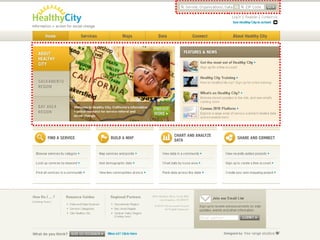
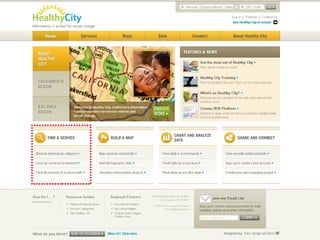
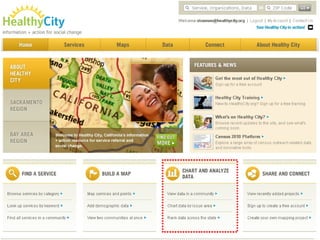
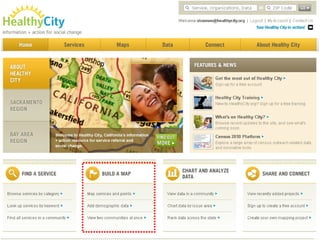
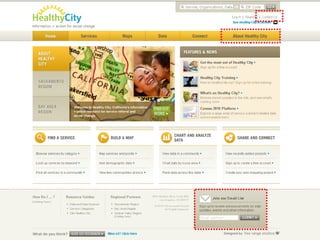
  • #29 Elements to Highlight : About Healthy City & Regional partners (optional – add in your regional partner page) Features & News Rooms & Tabs (Services, Maps, Data, Connect) Quick Search – example: “senior”
  • #34 Click through the agency names on the left to view service details.
  • #40 We receive data on schools from the California Department of Education on an annual basis.
  • #41 The next two slides show two major ‘types’ of data – point & thematic.
  • #45 The Data & Charts room provides QUICK STATS for the area you select. Select from the data categories on the left to begin charting data.
  • #51 The next two slides show two major ‘types’ of data – point & thematic.
  • #60 The darker areas show a higher concentration of families in poverty
  • #62 Click on the i-tool, then click anywhere on the map.
  • #63 The i-tool shows you the value for the Block Group, Census Tract and ZIP code that you click on
  • #64 It also provides contact information for elected officials, with the hope of encouraging action and collaboration
  • #65 The next two slides show two major ‘types’ of data – point & thematic.
  • #66 Using the Customize tab, you can alter the data level, year, number of classes, ranges, etc.