Day 1 - OTC End User Training
2014
Ethiopia
Overview of ERP
2
ERP Explanation
Process Overview
Roles and Responsibilities Overview
Welcome to
Messelal End User Training
Welcome and Introduction
General HeiLite System Overview and Exercises
Debrief
3
Objectives
The objectives of this session is to:
♦ Enable the participant to be familiar with the concept of ERP and
its benefits.
♦ Introduce participants briefly to HeiLite/Dynamics NAV.
4
Scenario
What happens when a sales request is raised in an environment where there is
no automated system in place?
Scenario: A customer wants to buy 1000 Crates of Bedele Beer on Credit in a
month’s time and communicates that to the sales representative.
♦ The sales representative must check the following key points
■ Verify Authorization, Verify Order Approval
■ Check Credit Limit, Check Inventory Level (enough stock to
comply with order?), Shipping (can it be delivered on time?)
♦ What happens when no-automated system is in place?
■ All Information may not be available on time leading to inability
to close the Sales (Wrong decision), Perform process with out
necessary background checks (not meet order).
♦ Risk
■ Not meet customer need at all, Above all lose customer.
5
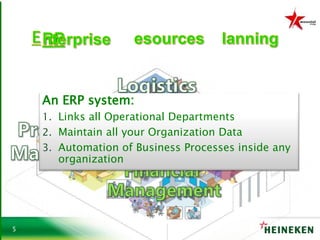
An ERP system:
1. Links all Operational Departments
2. Maintain all your Organization Data
3. Automation of Business Processes inside any
organization
6
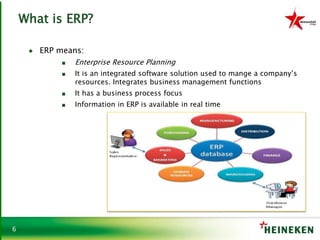
What is ERP?
♦ ERP means:
■ Enterprise Resource Planning
■ It is an integrated software solution used to mange a company’s
resources. Integrates business management functions
■ It has a business process focus
■ Information in ERP is available in real time
7
When ERP system is in place
Advantages:
♦ All information is on one database
♦ Authorization can be checked on sales and purchase transactions
♦ Delivery date and shipping can be checked in distribution
♦ Information integrated throughout all the modules/departments
♦ Data is updated for all as soon as entered. Improved visibility.
♦ Gives ability to do business analytics and reporting
♦ Captures company business processes and controls
♦ Facilitates improved customer responsiveness (order management
cycle, on time delivery, standardization)
♦ Saves time in preparing actionable reports
8
To Keep in Mind: some limitations
♦ ERP systems cannot meet all of the analytical and reporting needs
of organizations:
● Companies often use Business Intelligence (BI) tools along side ERP
systems for reporting and analytical purposes. BI is a generic term for
such applications.
♦ Incorrectly entered data will also be available to all modules! So
you must be careful that you enter data correctly into the system.
Garbage-in  Garbage-Out
9
ERP Solution for HEINEKEN S.C. Ethiopia
♦ Today’s major ERP solutions include:
 Microsoft Dynamics NAV, Oracle, SAP, and others
♦ Heineken uses a customized version of MS Dynamics NAV which is
referred to as – HeiLite for its Ethiopia OPCo.
♦ However, it also uses SAP based ERP (HeiCore) in other
international operations.
10
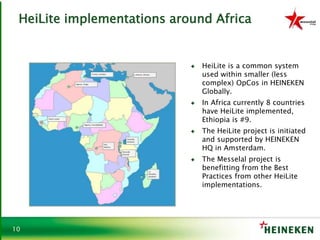
HeiLite implementations around Africa
♦ HeiLite is a common system
used within smaller (less
complex) OpCos in HEINEKEN
Globally.
♦ In Africa currently 8 countries
have HeiLite implemented,
Ethiopia is #9.
♦ The HeiLite project is initiated
and supported by HEINEKEN
HQ in Amsterdam.
♦ The Messelal project is
benefitting from the Best
Practices from other HeiLite
implementations.
11
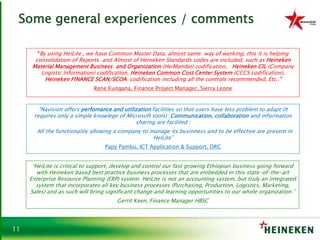
Some general experiences / comments
“By using HeiLite , we have Common Master Data, almost same way of working, this it is helping
consolidation of Reports and Almost of Heineken Standards codes are included, such as Heineken
Material Management Business and Organization (HeiMambo) codification, Heineken CIL (Company
Logistic Information) codification, Heineken Common Cost Center System (CCCS codification),
Heineken FINANCE SCAN/SCOA codification including all the controls recommended, Etc..”
Rene Kungana, Finance Project Manager, Sierra Leone
“Navision offers perfomance and utilization facilities so that users have less problem to adapt (It
requires only a simple knowlege of Microsoft tools) ;Communication, collaboration and information
sharing are facilited ;
All the functionality allowing a company to manage its businness and to be effective are present in
HeiLite”
Papy Pambu, ICT Application & Support, DRC
“HeiLite is critical to support, develop and control our fast growing Ethiopian business going forward
with Heineken based best practice business processes that are embedded in this state-of-the-art
Enterprise Resource Planning (ERP) system. HeiLite is not an accounting system, but truly an integrated
system that incorporates all key business processes (Purchasing, Production, Logistics, Marketing,
Sales) and as such will bring significant change and learning opportunities to our whole organization.”
Gerrit Keen, Finance Manager HBSC
12
Key Notes
♦ ERP systems cost money to buy, implement, and maintain. But the
real cost is the lost opportunities from not getting the most value
from them.
♦ Stakeholders ownership is vital for the successful implementation
of an ERP system. The HBSC Management Team is fully supporting
the HeiLite implementation as it improves the Business processes.
♦ So, you are expected to own the project, understand the system,
take ownership especially for your respective process area, and
play a leading role/ part in making sure that the system is in use.
♦ In this process, your personal skill level will increase. Positive
impact on business.
13
Coffee break
14

1.2 ERP Overview Day 1.pptx

  • 1.
    Day 1 -OTC End User Training 2014 Ethiopia Overview of ERP
  • 2.
    2 ERP Explanation Process Overview Rolesand Responsibilities Overview Welcome to Messelal End User Training Welcome and Introduction General HeiLite System Overview and Exercises Debrief
  • 3.
    3 Objectives The objectives ofthis session is to: ♦ Enable the participant to be familiar with the concept of ERP and its benefits. ♦ Introduce participants briefly to HeiLite/Dynamics NAV.
  • 4.
    4 Scenario What happens whena sales request is raised in an environment where there is no automated system in place? Scenario: A customer wants to buy 1000 Crates of Bedele Beer on Credit in a month’s time and communicates that to the sales representative. ♦ The sales representative must check the following key points ■ Verify Authorization, Verify Order Approval ■ Check Credit Limit, Check Inventory Level (enough stock to comply with order?), Shipping (can it be delivered on time?) ♦ What happens when no-automated system is in place? ■ All Information may not be available on time leading to inability to close the Sales (Wrong decision), Perform process with out necessary background checks (not meet order). ♦ Risk ■ Not meet customer need at all, Above all lose customer.
  • 5.
    5 An ERP system: 1.Links all Operational Departments 2. Maintain all your Organization Data 3. Automation of Business Processes inside any organization
  • 6.
    6 What is ERP? ♦ERP means: ■ Enterprise Resource Planning ■ It is an integrated software solution used to mange a company’s resources. Integrates business management functions ■ It has a business process focus ■ Information in ERP is available in real time
  • 7.
    7 When ERP systemis in place Advantages: ♦ All information is on one database ♦ Authorization can be checked on sales and purchase transactions ♦ Delivery date and shipping can be checked in distribution ♦ Information integrated throughout all the modules/departments ♦ Data is updated for all as soon as entered. Improved visibility. ♦ Gives ability to do business analytics and reporting ♦ Captures company business processes and controls ♦ Facilitates improved customer responsiveness (order management cycle, on time delivery, standardization) ♦ Saves time in preparing actionable reports
  • 8.
    8 To Keep inMind: some limitations ♦ ERP systems cannot meet all of the analytical and reporting needs of organizations: ● Companies often use Business Intelligence (BI) tools along side ERP systems for reporting and analytical purposes. BI is a generic term for such applications. ♦ Incorrectly entered data will also be available to all modules! So you must be careful that you enter data correctly into the system. Garbage-in  Garbage-Out
  • 9.
    9 ERP Solution forHEINEKEN S.C. Ethiopia ♦ Today’s major ERP solutions include:  Microsoft Dynamics NAV, Oracle, SAP, and others ♦ Heineken uses a customized version of MS Dynamics NAV which is referred to as – HeiLite for its Ethiopia OPCo. ♦ However, it also uses SAP based ERP (HeiCore) in other international operations.
  • 10.
    10 HeiLite implementations aroundAfrica ♦ HeiLite is a common system used within smaller (less complex) OpCos in HEINEKEN Globally. ♦ In Africa currently 8 countries have HeiLite implemented, Ethiopia is #9. ♦ The HeiLite project is initiated and supported by HEINEKEN HQ in Amsterdam. ♦ The Messelal project is benefitting from the Best Practices from other HeiLite implementations.
  • 11.
    11 Some general experiences/ comments “By using HeiLite , we have Common Master Data, almost same way of working, this it is helping consolidation of Reports and Almost of Heineken Standards codes are included, such as Heineken Material Management Business and Organization (HeiMambo) codification, Heineken CIL (Company Logistic Information) codification, Heineken Common Cost Center System (CCCS codification), Heineken FINANCE SCAN/SCOA codification including all the controls recommended, Etc..” Rene Kungana, Finance Project Manager, Sierra Leone “Navision offers perfomance and utilization facilities so that users have less problem to adapt (It requires only a simple knowlege of Microsoft tools) ;Communication, collaboration and information sharing are facilited ; All the functionality allowing a company to manage its businness and to be effective are present in HeiLite” Papy Pambu, ICT Application & Support, DRC “HeiLite is critical to support, develop and control our fast growing Ethiopian business going forward with Heineken based best practice business processes that are embedded in this state-of-the-art Enterprise Resource Planning (ERP) system. HeiLite is not an accounting system, but truly an integrated system that incorporates all key business processes (Purchasing, Production, Logistics, Marketing, Sales) and as such will bring significant change and learning opportunities to our whole organization.” Gerrit Keen, Finance Manager HBSC
  • 12.
    12 Key Notes ♦ ERPsystems cost money to buy, implement, and maintain. But the real cost is the lost opportunities from not getting the most value from them. ♦ Stakeholders ownership is vital for the successful implementation of an ERP system. The HBSC Management Team is fully supporting the HeiLite implementation as it improves the Business processes. ♦ So, you are expected to own the project, understand the system, take ownership especially for your respective process area, and play a leading role/ part in making sure that the system is in use. ♦ In this process, your personal skill level will increase. Positive impact on business.
  • 13.
  • 14.

Editor's Notes

  • #4 22/05/2023
  • #7 22/05/2023
  • #9 ERP databases were designed to optimize performance and therefore lack the constructs required for multi-dimensional analysis; Most ERP solutions lack the advanced functionality of today’s leading reporting and analytical tools; Performing complex analyses on the ERP database will impact the performance of the operational (on-line) systems