Audit
Completion Stage
BY
Atta-ur-Rahman Arif
INTRODUCTION
• Refers to those steps which are taken
by the auditor after the routine
checking and verification of
accounting records has been
completed, in order to enable him to
wind-up his examination and report.
• Completion stage normally involves
the following activities:
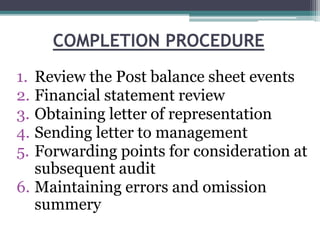
COMPLETION PROCEDURE
1. Review the Post balance sheet events
2. Financial statement review
3. Obtaining letter of representation
4. Sending letter to management
5. Forwarding points for consideration at
subsequent audit
6. Maintaining errors and omission
summery
COMPLETION PROCEDURE
1. POST BALANCE SHEET EVENTS
Those events, favorable or unfavorable, that
occurs between the Balance Sheet date and the
date on which the financial statement are
authorized to issue are called Post Balance
Sheet Events. Events classified into two
categories:
i, Those events which provide further
evidence of conditions that existed at the
balance sheet date called Adjusting Events.
COMPLETION PROCEDURE
ii.Those events that are indicative of
conditions that arose subsequent to the
balance sheet date called Non-Adjusting
Events.
▫ The auditor should perform the procedures
designed to obtain sufficient audit evidence
that all events up to the date of the auditor’s
report that must require adjustments, or
disclosure in, the financial statement have
been identified.
COMPLETION PROCEDURE
2. Review of Financial Statement
• The auditor should review the financial statement in
such a manner that he may be able to:
▫ draw conclusions from the order evidence obtained by
him
▫ to give him a reasonable basis of his opinion on the
financial statements.
• The auditor should satisfy himself as to whether:
i. Financial Statement have been drawn up in
accordance with the GAAP which are consistent and
appropriate to the enterprise.
COMPLETION PROCEDURE
ii. The results of operation, states of affairs of
the financial position, other information
reflected in the financial statement and
the directors report are comparable.
iii. All matters have been properly disclosed
and classified.
iv. Financial Statement comply to the
statutory requirements to the regulation
and constitution of the enterprise.
COMPLETION PROCEDURE
3. Obtaining Letter of Representation
▫ It confirming the various representation made by
management in respect of matters which are material
and for which the auditor has not been able to obtain
sufficient independent evidence.
▫ It should be consistent with other available advance
given by management.
▫ It should either be recorded in the minutes of the
board meeting or formally approved by the board of
directors.
▫ Directors should acknowledge in the letter their
responsibilities for the preparation of financial
statement.
COMPLETION PROCEDURE
4. Sending Letter to Management
▫ It pointing out the areas where
inefficiencies were observed and the
suggested constructive advice for
improvement in financial control.
▫ It also deals with appreciation for co-
operation and assistance extended by the
client’s staff and management during the
course of audit.
COMPLETION PROCEDURE
5. Points Carried to Subsequent Audit
▫ All the unsettled points have to be
taken up at the next period and
settled with the client at the start of
next audit.
▫ Auditor have to be maintain adequate
record of all such items.
COMPLETION PROCEDURE
6. Summary Records of Error
▫ Audit staff should prepare a summary of
all such errors and omission which have
been observed during the course of audit
and which have remain unadjusted.
▫ On the basis of this summary, the
auditor should decided whether the
nature of any error justifies its
opportunity to the management.

12. audit completion

  • 1.
  • 2.
    INTRODUCTION • Refers tothose steps which are taken by the auditor after the routine checking and verification of accounting records has been completed, in order to enable him to wind-up his examination and report. • Completion stage normally involves the following activities:
  • 3.
    COMPLETION PROCEDURE 1. Reviewthe Post balance sheet events 2. Financial statement review 3. Obtaining letter of representation 4. Sending letter to management 5. Forwarding points for consideration at subsequent audit 6. Maintaining errors and omission summery
  • 4.
    COMPLETION PROCEDURE 1. POSTBALANCE SHEET EVENTS Those events, favorable or unfavorable, that occurs between the Balance Sheet date and the date on which the financial statement are authorized to issue are called Post Balance Sheet Events. Events classified into two categories: i, Those events which provide further evidence of conditions that existed at the balance sheet date called Adjusting Events.
  • 5.
    COMPLETION PROCEDURE ii.Those eventsthat are indicative of conditions that arose subsequent to the balance sheet date called Non-Adjusting Events. ▫ The auditor should perform the procedures designed to obtain sufficient audit evidence that all events up to the date of the auditor’s report that must require adjustments, or disclosure in, the financial statement have been identified.
  • 6.
    COMPLETION PROCEDURE 2. Reviewof Financial Statement • The auditor should review the financial statement in such a manner that he may be able to: ▫ draw conclusions from the order evidence obtained by him ▫ to give him a reasonable basis of his opinion on the financial statements. • The auditor should satisfy himself as to whether: i. Financial Statement have been drawn up in accordance with the GAAP which are consistent and appropriate to the enterprise.
  • 7.
    COMPLETION PROCEDURE ii. Theresults of operation, states of affairs of the financial position, other information reflected in the financial statement and the directors report are comparable. iii. All matters have been properly disclosed and classified. iv. Financial Statement comply to the statutory requirements to the regulation and constitution of the enterprise.
  • 8.
    COMPLETION PROCEDURE 3. ObtainingLetter of Representation ▫ It confirming the various representation made by management in respect of matters which are material and for which the auditor has not been able to obtain sufficient independent evidence. ▫ It should be consistent with other available advance given by management. ▫ It should either be recorded in the minutes of the board meeting or formally approved by the board of directors. ▫ Directors should acknowledge in the letter their responsibilities for the preparation of financial statement.
  • 9.
    COMPLETION PROCEDURE 4. SendingLetter to Management ▫ It pointing out the areas where inefficiencies were observed and the suggested constructive advice for improvement in financial control. ▫ It also deals with appreciation for co- operation and assistance extended by the client’s staff and management during the course of audit.
  • 10.
    COMPLETION PROCEDURE 5. PointsCarried to Subsequent Audit ▫ All the unsettled points have to be taken up at the next period and settled with the client at the start of next audit. ▫ Auditor have to be maintain adequate record of all such items.
  • 11.
    COMPLETION PROCEDURE 6. SummaryRecords of Error ▫ Audit staff should prepare a summary of all such errors and omission which have been observed during the course of audit and which have remain unadjusted. ▫ On the basis of this summary, the auditor should decided whether the nature of any error justifies its opportunity to the management.