Auditing AssignmentAuditing Assignment
 Submitted To:
Prof. Gurleen Kaur
(School of management,
IMS Unison University)
 Submitted By:
Shweta Rawat (13BCH035)
Komal Bhatt (13BCH002)
Rashi Patel (13BCH009)
Nitant Rastogi(13BCH052)
1
Auditing
 Auditing is a process of objectively gathering,
evaluating, and documenting the evidence needed
to provide assurance on the financial statements.
 The audit programs detail the auditor's plan to
gather, evaluate, and document evidence.
 Auditors generally conduct audits following these
general steps:
1. planning
2. gathering evidence
3. evaluating evidence
4. Field work
5. issuing a report
6. Audit follow up
2
1. Planning
In planning an audit, three questions need to be answered:
 What audit procedures should be performed?
 How much evidence is needed?
 When should the audit procedures be performed?
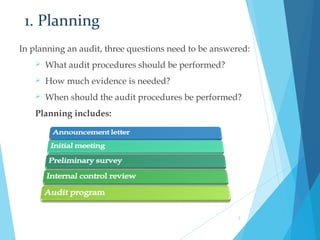
Planning includes:
3
 Announcement Letter: The client is informed of
the audit through an announcement or
engagement letter from the auditor.
 Initial Meeting: the client describes the unit or
system to be reviewed, the organization, available
resources (personnel, facilities, equipment, funds),
and other relevant information.
 Preliminary Survey: In this phase the auditor
gathers relevant information about the unit in
order to obtain a general overview of operations.
4
 Internal Control Review: The auditor will
review the unit's internal control structure, a
process which is usually time-consuming.
 Audit program: Preparation of the audit
program concludes the preliminary review
phase. This program outlines the fieldwork
necessary to achieve the audit objectives.
5
2. Gathering evidence
 Because each audit is unique, there is no set amount or
type of evidence that must be gathered.
 Sufficient and Competent Evidence: There are two
dimensions to audit evidence: sufficient (quantity) and
competent (quality/reliability).The relationship between
these dimensions is inverse; if evidence is of lesser
quality, greater amounts must be collected (and vice
versa).
 When gathering evidence, auditors consider which
procedures provide the most reliable evidence in the
most efficient manner.
6
7
3. Evidence evaluation
 An audit trail is a chronological record of economic
events or transactions that have been experienced
by an organization.
 The audit trail enables an auditor to evaluate the
strengths and weaknesses of internal controls,
system designs, and company policies and
procedures.
 The auditor must evaluate the initial hypothesis
based on the evidence and accept or reject the
hypothesis as a result. 
8
4. Field work
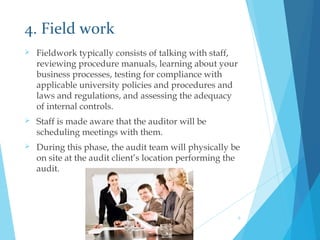
 Fieldwork typically consists of talking with staff,
reviewing procedure manuals, learning about your
business processes, testing for compliance with
applicable university policies and procedures and
laws and regulations, and assessing the adequacy
of internal controls.
 Staff is made aware that the auditor will be
scheduling meetings with them.
 During this phase, the audit team will physically be
on site at the audit client’s location performing the
audit.
9
5. Audit report
10
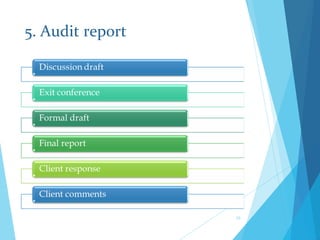
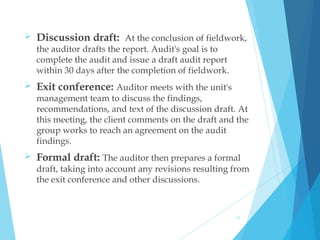
 Discussion draft: At the conclusion of fieldwork,
the auditor drafts the report. Audit's goal is to
complete the audit and issue a draft audit report
within 30 days after the completion of fieldwork. 
 Exit conference: Auditor meets with the unit's
management team to discuss the findings,
recommendations, and text of the discussion draft. At
this meeting, the client comments on the draft and the
group works to reach an agreement on the audit
findings.
 Formal draft: The auditor then prepares a formal
draft, taking into account any revisions resulting from
the exit conference and other discussions.
11
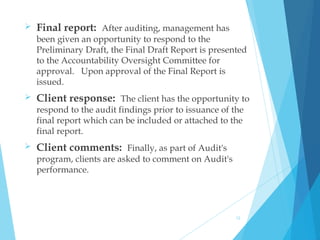
 Final report: After auditing, management has
been given an opportunity to respond to the
Preliminary Draft, the Final Draft Report is presented
to the Accountability Oversight Committee for
approval.   Upon approval of the Final Report is
issued.
 Client response: The client has the opportunity to
respond to the audit findings prior to issuance of the
final report which can be included or attached to the
final report.
 Client comments: Finally, as part of Audit's
program, clients are asked to comment on Audit's
performance.
12
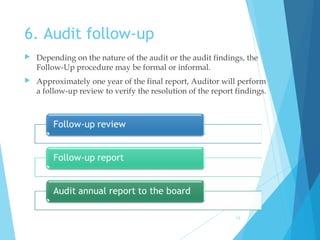
6. Audit follow-up
 Depending on the nature of the audit or the audit findings, the
Follow-Up procedure may be formal or informal.
 Approximately one year of the final report, Auditor will perform
a follow-up review to verify the resolution of the report findings.
13
 Follow-up review: The actions taken to resolve the
audit report findings may be tested to ensure that the
desired results were achieved.
 Follow-up report: To resolve the original report
findings. Unresolved findings will include a brief
description of the finding, the original audit
recommendation, the client response, the current
condition, and the continued exposure to the board of
company.
 Audit annual report: Memorandum to the senior
manager that notifies them that audit activities are
underway and describes the follow-up process. 
14
15

Audit assignment

  • 1.
    Auditing AssignmentAuditing Assignment Submitted To: Prof. Gurleen Kaur (School of management, IMS Unison University)  Submitted By: Shweta Rawat (13BCH035) Komal Bhatt (13BCH002) Rashi Patel (13BCH009) Nitant Rastogi(13BCH052) 1
  • 2.
    Auditing  Auditing isa process of objectively gathering, evaluating, and documenting the evidence needed to provide assurance on the financial statements.  The audit programs detail the auditor's plan to gather, evaluate, and document evidence.  Auditors generally conduct audits following these general steps: 1. planning 2. gathering evidence 3. evaluating evidence 4. Field work 5. issuing a report 6. Audit follow up 2
  • 3.
    1. Planning In planningan audit, three questions need to be answered:  What audit procedures should be performed?  How much evidence is needed?  When should the audit procedures be performed? Planning includes: 3
  • 4.
     Announcement Letter:The client is informed of the audit through an announcement or engagement letter from the auditor.  Initial Meeting: the client describes the unit or system to be reviewed, the organization, available resources (personnel, facilities, equipment, funds), and other relevant information.  Preliminary Survey: In this phase the auditor gathers relevant information about the unit in order to obtain a general overview of operations. 4
  • 5.
     Internal ControlReview: The auditor will review the unit's internal control structure, a process which is usually time-consuming.  Audit program: Preparation of the audit program concludes the preliminary review phase. This program outlines the fieldwork necessary to achieve the audit objectives. 5
  • 6.
    2. Gathering evidence Because each audit is unique, there is no set amount or type of evidence that must be gathered.  Sufficient and Competent Evidence: There are two dimensions to audit evidence: sufficient (quantity) and competent (quality/reliability).The relationship between these dimensions is inverse; if evidence is of lesser quality, greater amounts must be collected (and vice versa).  When gathering evidence, auditors consider which procedures provide the most reliable evidence in the most efficient manner. 6
  • 7.
  • 8.
    3. Evidence evaluation An audit trail is a chronological record of economic events or transactions that have been experienced by an organization.  The audit trail enables an auditor to evaluate the strengths and weaknesses of internal controls, system designs, and company policies and procedures.  The auditor must evaluate the initial hypothesis based on the evidence and accept or reject the hypothesis as a result.  8
  • 9.
    4. Field work Fieldwork typically consists of talking with staff, reviewing procedure manuals, learning about your business processes, testing for compliance with applicable university policies and procedures and laws and regulations, and assessing the adequacy of internal controls.  Staff is made aware that the auditor will be scheduling meetings with them.  During this phase, the audit team will physically be on site at the audit client’s location performing the audit. 9
  • 10.
  • 11.
     Discussion draft:At the conclusion of fieldwork, the auditor drafts the report. Audit's goal is to complete the audit and issue a draft audit report within 30 days after the completion of fieldwork.   Exit conference: Auditor meets with the unit's management team to discuss the findings, recommendations, and text of the discussion draft. At this meeting, the client comments on the draft and the group works to reach an agreement on the audit findings.  Formal draft: The auditor then prepares a formal draft, taking into account any revisions resulting from the exit conference and other discussions. 11
  • 12.
     Final report:After auditing, management has been given an opportunity to respond to the Preliminary Draft, the Final Draft Report is presented to the Accountability Oversight Committee for approval.   Upon approval of the Final Report is issued.  Client response: The client has the opportunity to respond to the audit findings prior to issuance of the final report which can be included or attached to the final report.  Client comments: Finally, as part of Audit's program, clients are asked to comment on Audit's performance. 12
  • 13.
    6. Audit follow-up Depending on the nature of the audit or the audit findings, the Follow-Up procedure may be formal or informal.  Approximately one year of the final report, Auditor will perform a follow-up review to verify the resolution of the report findings. 13
  • 14.
     Follow-up review:The actions taken to resolve the audit report findings may be tested to ensure that the desired results were achieved.  Follow-up report: To resolve the original report findings. Unresolved findings will include a brief description of the finding, the original audit recommendation, the client response, the current condition, and the continued exposure to the board of company.  Audit annual report: Memorandum to the senior manager that notifies them that audit activities are underway and describes the follow-up process.  14
  • 15.