STANDARDS
ON
AUDITING
BY: ANMOL GULATI
2013360
INTRODUCTION
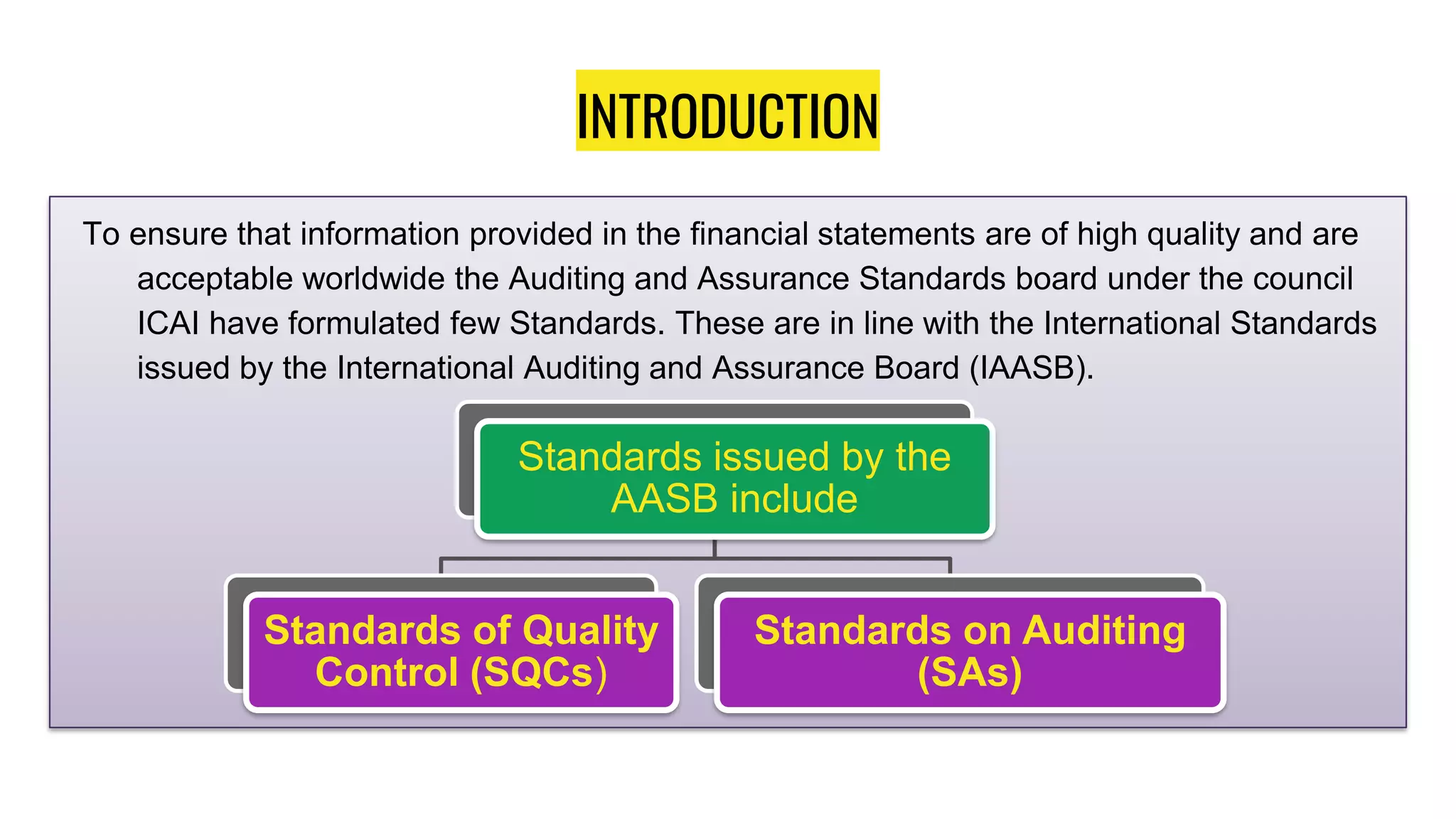
To ensure that information provided in the financial statements are of high quality and are
acceptable worldwide the Auditing and Assurance Standards board under the council
ICAI have formulated few Standards. These are in line with the International Standards
issued by the International Auditing and Assurance Board (IAASB).
Standards issued by the
AASB include
Standards of Quality
Control (SQCs)
Standards on Auditing
(SAs)
1. SA-200
Effective Date
This SA-200 is effective for
audits of financial statements
for periods beginning on or
after April 1, 2010.
AUDITOR RESPONSIBILITY (OVERALL OBJECTIVE OF INDEPENDENT
AUDIT)
● To obtain reasonable assurance that financial statements are free from Material
Mismanagement resulting from either due to fraud or error enabling Auditor to
express an opinion on whether financial statements are prepared in all material
respects as per applicable Financial reporting framework.
● The objective of independent audit is to report u/s 143(2) to Members of
Company on Account examined by him & Financial Statement to be laid in AGM.
● To ensure that his opinion on Financial Statement is reflecting the True & Fair
view.
● The objective of independent audit to State in his Report u/s 143(2) whether A/c
examined by him & Financial Statement give True & Fair view.
● Audit evidence to reduce Audit Risk to Acceptable low level & consider SA 500 as
per SA 200.
SCOPE OF AUDIT
Area of work for Auditor determined by following factors: –
● Requirements of legislation.
● SA & other guidance by ICAI
● Terms of engagement of Auditor:
Terms of engagement can’t override Scope decided by Legislation or SAs.”
(i.e. management cannot Restrict Scope of auditor’s audit function)
● If Scope restricted or threat to Independence, in this case auditors duty is to
communicate to Those charged with governance as per SA 260
REQUIREMENTS OF SA 200
● Professional Skepticism
● Its auditor’s states of mind for Alertness to for any indication to possible misstatement due to error or fraud
● A critical assessment of audit evidence
● Maintain it throughout Audit to identify fraud risk factors & evaluate Related Party transactions
● Attitude requiring: –
○ Alertness towards Info provided to him by client
○ A Questionable mind being alert
● Reduces Risks of: –
○ Overlooking unusual circumstances.
○ Overgeneralizing when drawing conclusions from audit observations.
○ Using inappropriate assumptions in determining Nature, Time & Extent of Audit Procedures & evaluating
results
● Being alert to: –
○ Info provided by the auditee to bringing in doubt the trustworthiness of records & responses to audit evidence.
○ Conditions and situations creating doubt for fraud or and auditor’s competence to assess the need to carry out
additional Audit Procedures.
2. SA 210 (REVISED)
Agreeing The Terms of
Audit Engagement
SA 210 (REVISED) Agreeing The Terms
of Audit Engagement
SA 210 deals with the key considerations that
Independent Auditor needs to keep in mind on
the terms of the Audit engagement with
Management or ‘Those charged with
Governance’.
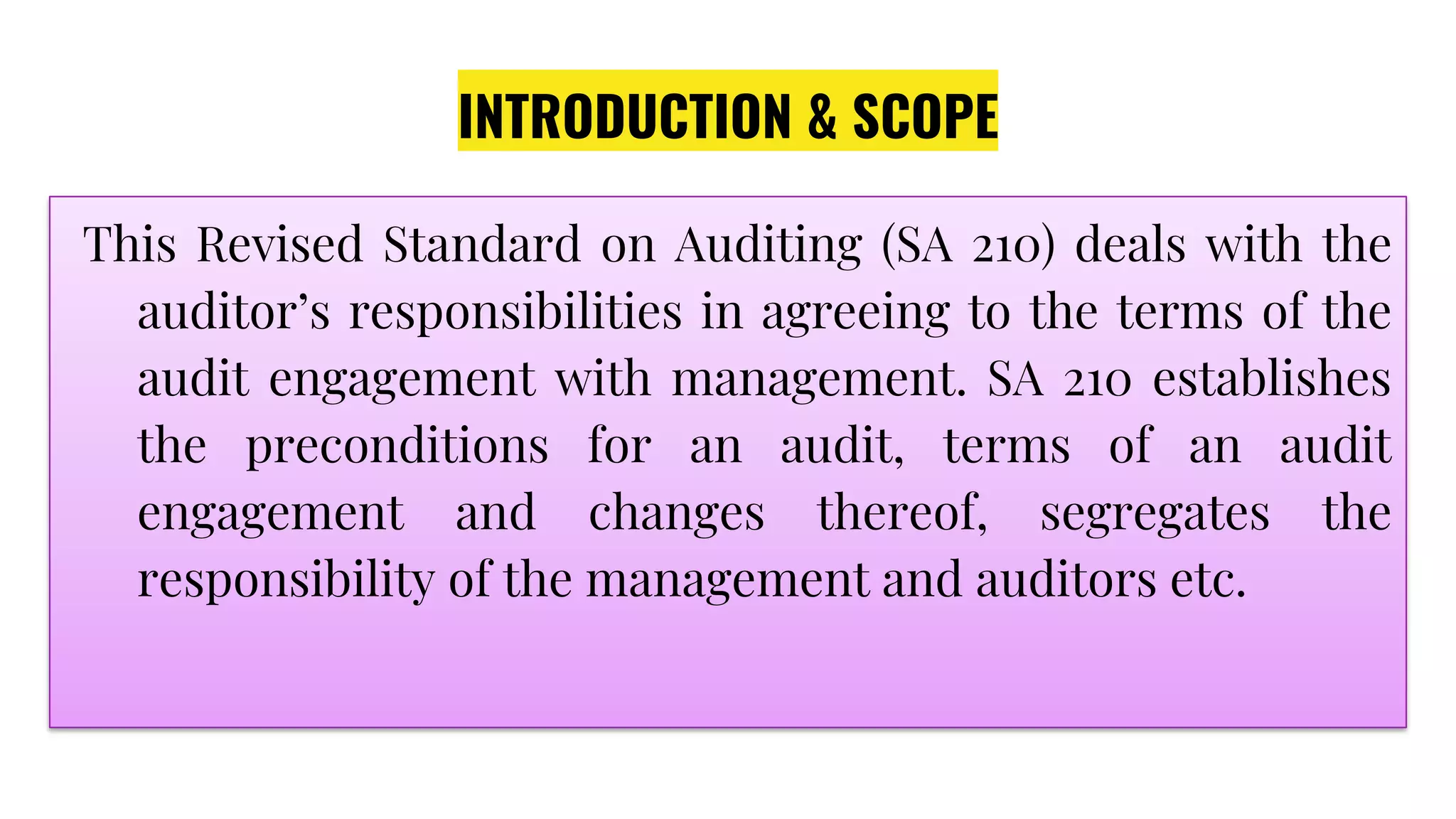
INTRODUCTION & SCOPE
This Revised Standard on Auditing (SA 210) deals with the
auditor’s responsibilities in agreeing to the terms of the
audit engagement with management. SA 210 establishes
the preconditions for an audit, terms of an audit
engagement and changes thereof, segregates the
responsibility of the management and auditors etc.
OBJECTIVE
Auditor’s Objective is to accept or continue an audit engagement only when the
basis upon which it is to be performed has been agreed, through
1.
Ensuring if the
Preconditions for
an audit are
present
2.
Confirming if there
is a common
understanding
between auditor
and management
3. SA 220: QUALITY
CONTROL FOR AN
AUDIT OF FINANCIAL
STATEMENTS
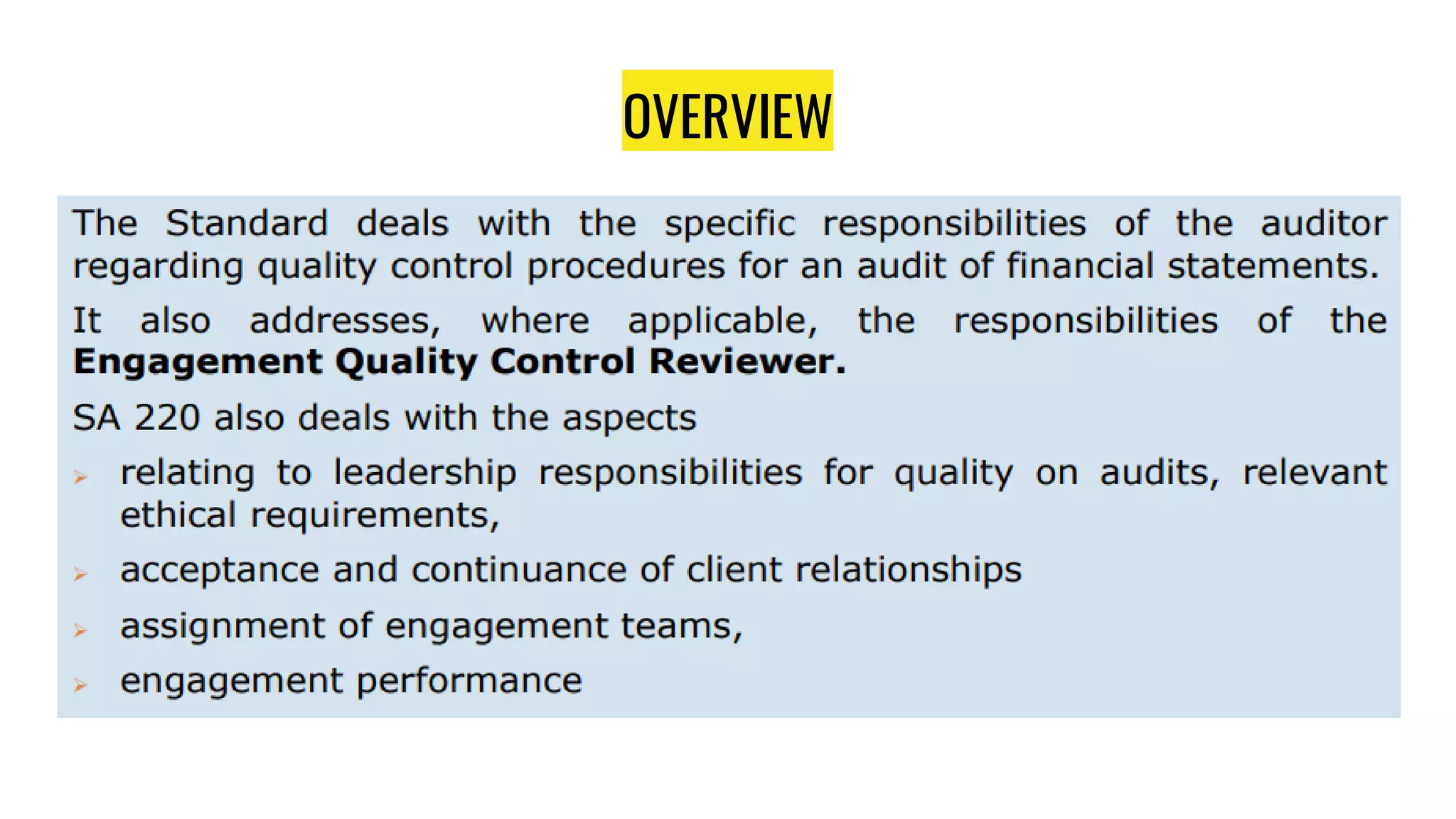
OVERVIEW
ETHICAL REQUIREMENTS AND ENGAGEMENT TEAM
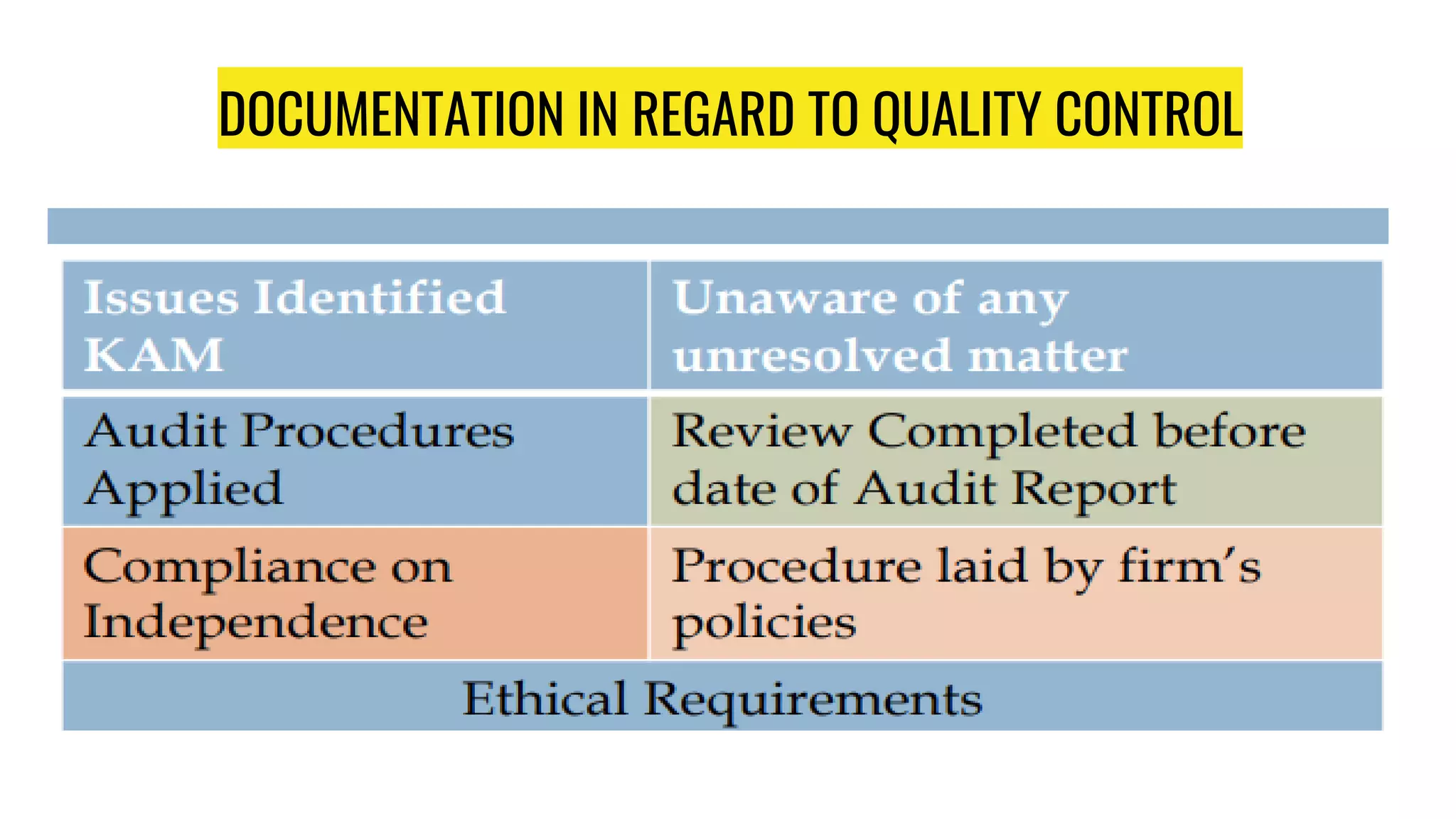
DOCUMENTATION IN REGARD TO QUALITY CONTROL
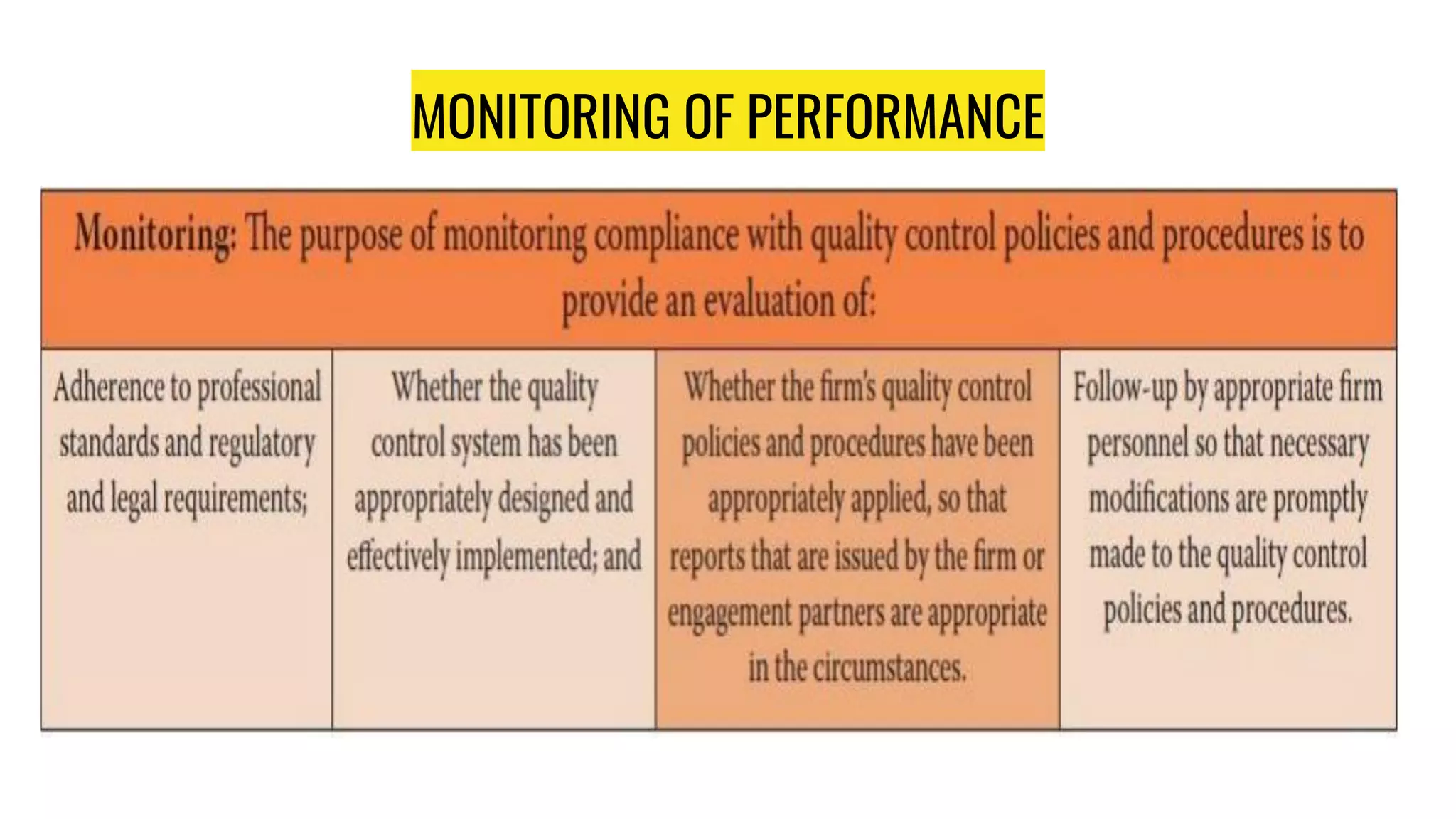
MONITORING OF PERFORMANCE
4. SA 300
PLANNING AN AUDIT
OF FINANCIAL
STATEMENTS
OVERVIEW
SA 300 deals with the auditor’s responsibility
towards planning for an audit of financial
statements and its context is focused more on a
recurring audit. This standard also prescribes
the additional considerations required for an
initial audit engagement.
OBJECTIVE
The objective is to plan the audit in accordance
with the size and complexity of the entity to
perform the audit in an effective
manner. Partner and key members of the
engagement team are required to be involved in
the audit planning through discussion which will
enhance the audit effectiveness and efficiency.
DOCUMENTATION
i. Overall audit
strategy which
exhibits the key
decision of the
audit planning
ii. Audit Plan
which includes
standard audit
program and
audit completion
checklist
iii. Any significant
changes made
during the audit
engagement to
the above and
the reasons for
the same
5. SA 299 (REVISED):
JOINT AUDIT OF
FINANCIAL
STATEMENTS
OBJECTIVES
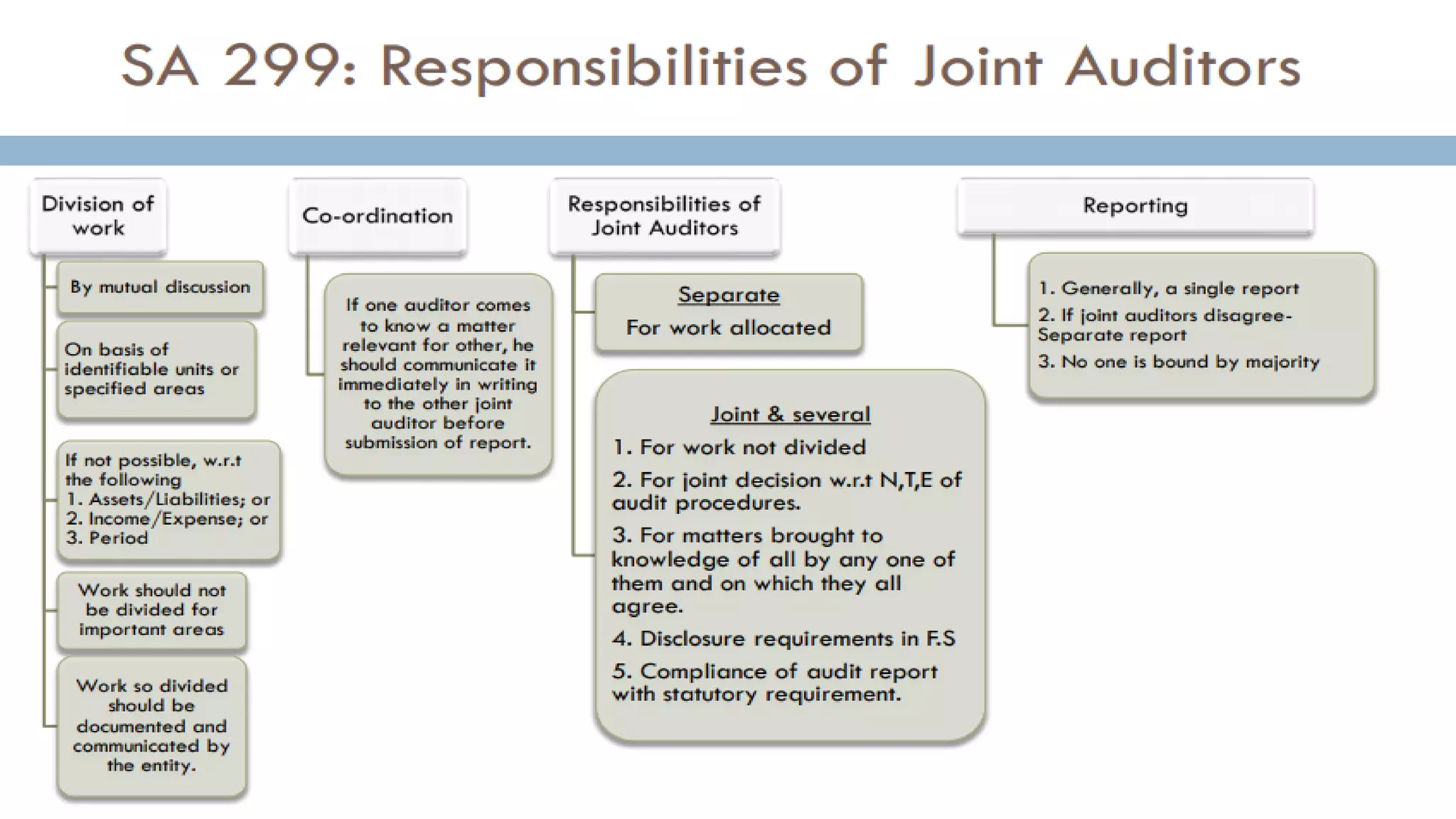
● To lay down broad principles for the joint auditors in conducting the joint
audit.
● To provide a uniform approach to the process of joint audit.
● To identify the distinct areas of work and coverage thereof by each joint
auditor.
● To identify individual responsibility and joint responsibility of the joint
auditors in relation to audit.
6. SA 315:
IDENTIFYING AND ASSESSING
THE RISK OF MATERIAL
MISSTATEMENT THROUGH
UNDERSTANDING THE ENTITY
AND ITS ENVIRONMENT
OVERVIEW
SA 315 deals with the responsibility of
auditor in identifying and assessing the
risk of material misstatement through
understanding the entity and its
environment
OBJECTIVE
The objective of the auditor is to identify and
assess the risk of material misstatement in
an entity’s financial statement and
implement appropriate responses (Refer
SA 330) & procedures which will reduce
such risk to an acceptably low level.
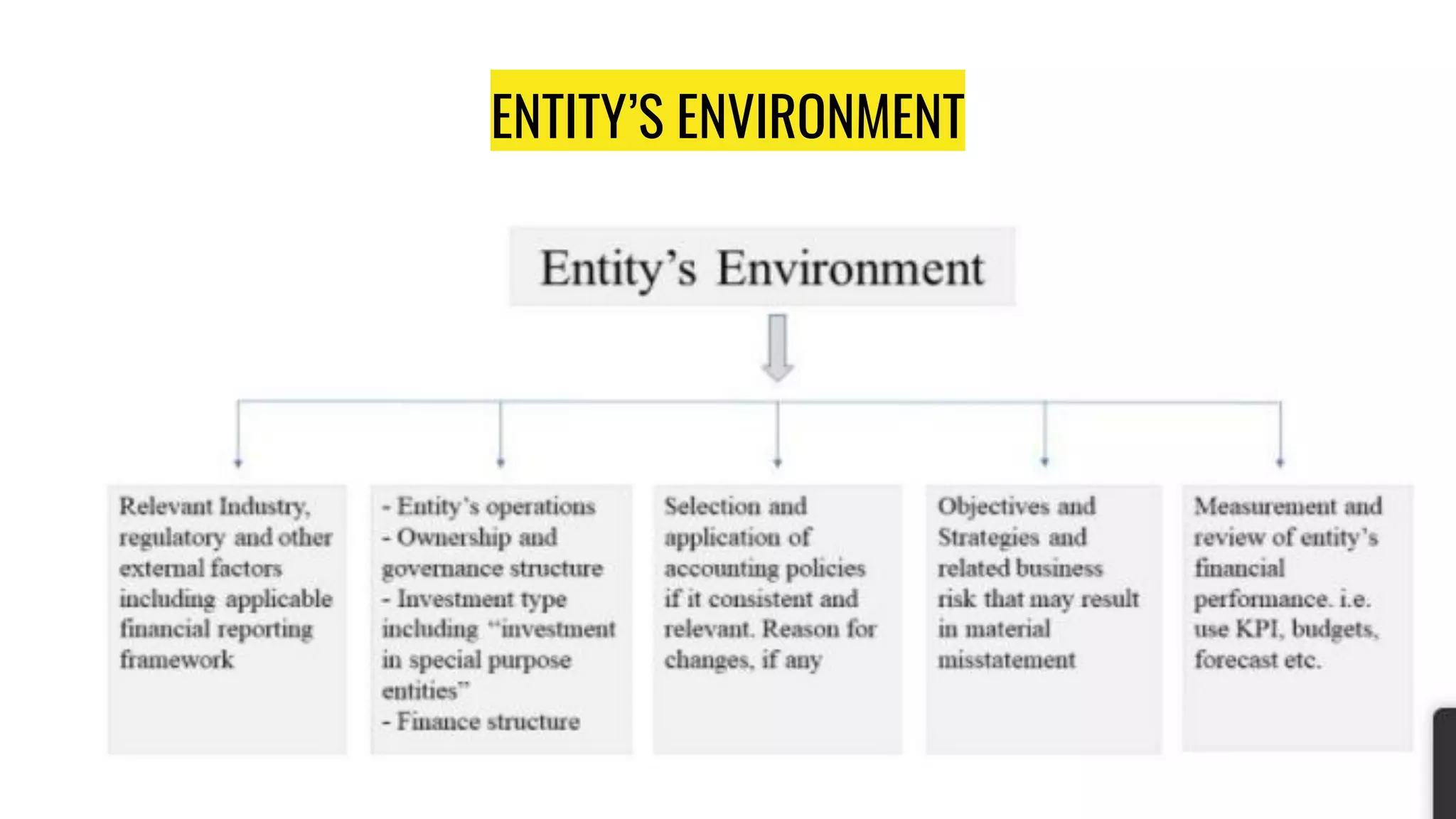
ENTITY’S ENVIRONMENT
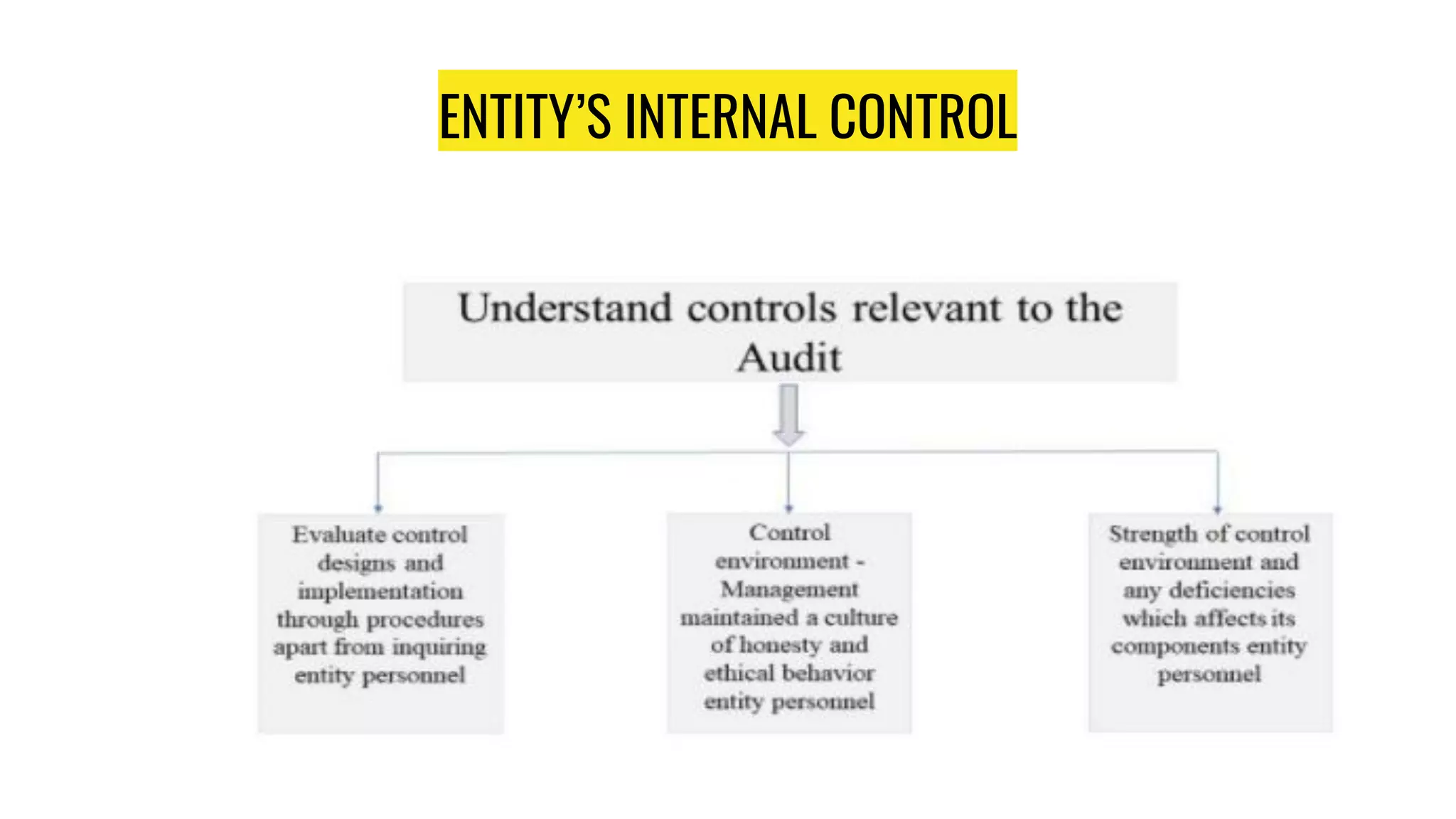
ENTITY’S INTERNAL CONTROL
INFORMATION SYSTEM ACTIVITIES
7. SA 330:
Auditor’s Responses
To Assessed Risk
OVERVIEW
SA 330 deals with the auditor’s responsibility
to design and implement responses to the
assessed risk of material misstatement
identified in accordance with SA 315.
OBJECTIVE
To obtain sufficient appropriate audit
evidence about the assessed risk and
design & implement appropriate responses
to those risk SA 330 is effective for the
audit of financial statements for periods
beginning on or after 1st April 2008
AUDIT PROCEDURES
Nature, timing and the extent of the audit procedures are to be based on and
are responsive to the assessed risk of material misstatement at the assertion
level. Consider the reason for the assessment given to each class of
transaction, account balance and disclosure including:
i. Likelihood of material misstatement due to the particular characteristics of
relevant inherent risk
ii. Whether the risk assessment takes into account the relevant controls
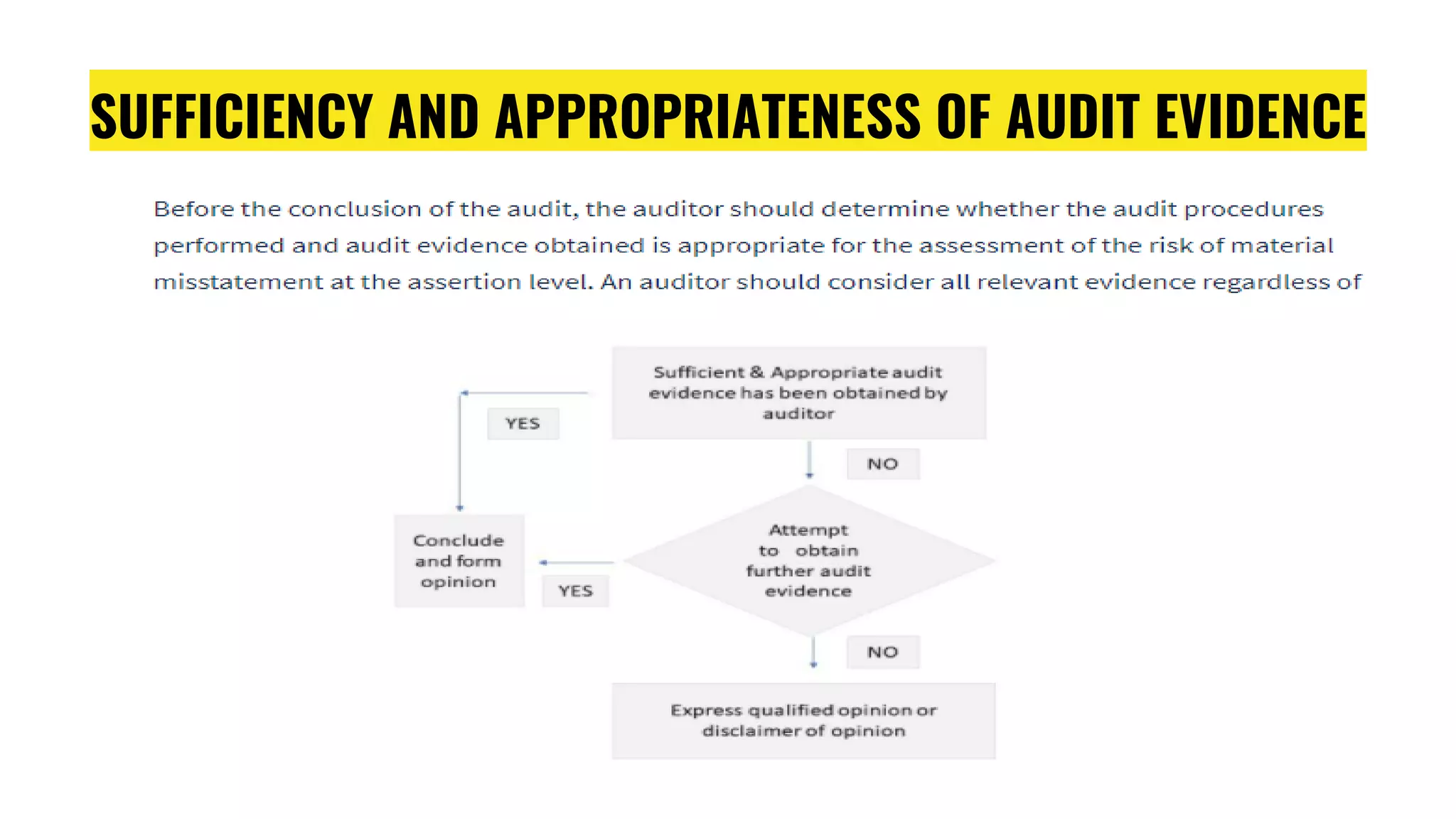
SUFFICIENCY AND APPROPRIATENESS OF AUDIT EVIDENCE
8. SA 600 :
USING THE WORK
OF ANOTHER
AUDITOR
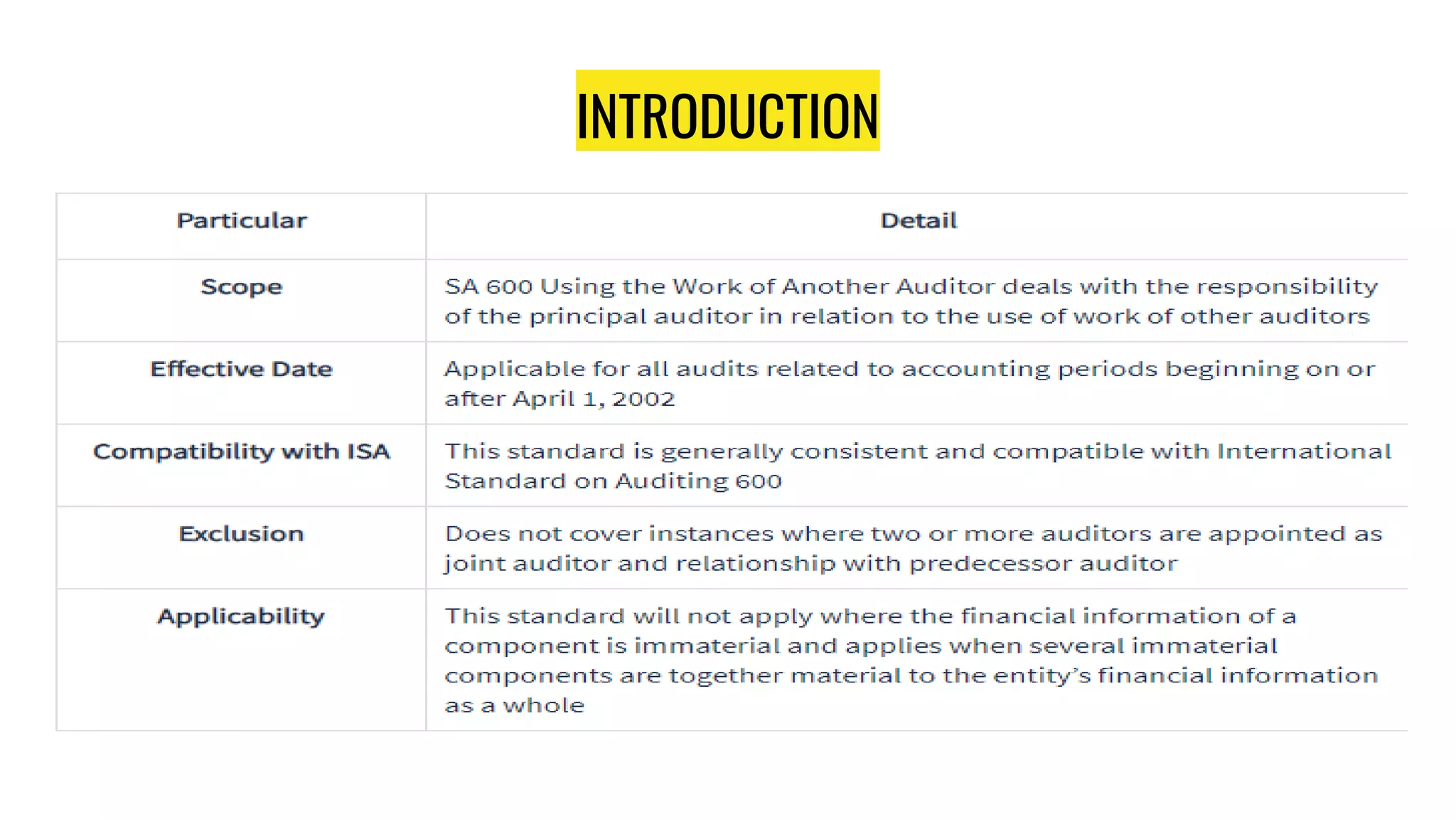
INTRODUCTION
ACCEPTANCE AS PRINCIPAL AUDITOR
Auditor to decide whether the auditor’s own participation is sufficient to be
able to act as the principal auditor with the following consideration:
i. The materiality of the portion of the financial information
ii. The degree of knowledge regarding the business of the components
iii. Risk of material misstatements of the components audited by the other
auditor
iv. Performance of audit procedures per this SA regarding the components
audited by the other auditor in which the principal auditor has significant
participation
CO-ORDINATION BETWEEN THE AUDITORS
A. There should be sufficient liaison (through written communication)
between the principal auditor and other auditors
B. Other auditors should coordinate with the principal auditor knowing the
context in which the work to be used
C. The principal auditor should advise the other auditor of any relevant
matters that comes to principal auditor’s attention
D. The principal auditor may require the other auditor to answer detailed
questionnaire required for discharging duties
E. Another auditor has to respond to such questionnaires on a timely basis
9. SA 450:
Evaluation of
Misstatement Identified
During the Audit
SCOPE
SA 450 Evaluation of Misstatement Identified During the Audit deals with the
auditor’s responsibility to evaluate the effect of identified misstatements and
uncorrected misstatements. SA 700 (Forming an opinion and reporting on
financial statements) takes into account the evaluation of uncorrected
misstatements for auditor’s conclusion
SA 450 is effective for the audit of financial statements for periods beginning
on or after 1st April 2010
AUDITOR’S COMMUNICATION & CORRECTION OF
MISSTATEMENTS
▪ Communicate on a timely basis to the appropriate level
of management (unless prohibited by law or regulation)
▪ Request management to correct those misstatements
▪ If management refuses to correct misstatements, the
auditor should understand the reason for the same
▪ Based on the understanding auditor should evaluate
whether the financial statements as a whole are from
material misstatements.
EFFECT OF UNCORRECTED MISSTATEMENTS
Before evaluating the effect of uncorrected misstatements, the auditor should
reassess materiality per SA 320 to confirm whether it remains appropriate to
the entity’s financial results by taking into account:
a. Size and Nature of the misstatements both in relation to particular
classes of transactions account balance or disclosures etc and circumstance
of their occurrence
b. Effect of uncorrected misstatements related to prior periods on the
relevant classes of transactions, account balance or disclosure, and the
financial statements as a whole
EXAMPLE- MISSTATEMENT
A. Sales income of a company is materially overstated, then financial statement
as a whole will be materially misstated
B. Misclassification between balance sheet items may not be considered material
if the amount of misclassification is small compared to other balance sheet
items and it does not affect the P&L or key ratios
10. SA 620 :
USING THE WORK
OF AN AUDITOR’S
EXPERT
INTRODUCTION
DEFINITION
● Auditor’s Expert – “An individual or organization possessing
expertise in a field other than accounting or auditing, whose work in
that field is used by the auditor to assist the auditor in obtaining
sufficient appropriate audit evidence. An auditor’s expert may be the
auditor’s internal expert or an external expert.
● Management Expert – “An individual or organization possessing
expertise in a field other than accounting or auditing, whose work in
that field is used by the entity to assist the entity in preparing the
financial statements.
REFERENCE TO THE AUDITOR’S EXPERT IN THE AUDITOR’S
REPORT
Reference to the auditor’s expert work should not be made in an auditor’s
report containing an unmodified opinion unless required by law or
regulation. If such reference is-
i. Required by law or regulation or
ii. Relevant to an understanding of a modification to the auditor’s opinion, then
The auditor should indicate in the auditor’s report that the references do not
reduce the auditor’s responsibility for the audit opinion
EXAMPLE
● Valuation of complex financial instruments, land &
buildings, machinery, intangible assets, impaired assets
etc
● II. Estimation of oil and gas reserves, actuarial
calculation of liabilities etc
● III. Valuation of environmental liabilities, site clean-up
cost,
● IV. Interpretation of law, contracts, and regulation
STANDARDS ON AUDITING

STANDARDS ON AUDITING

  • 1.
  • 2.
    INTRODUCTION To ensure thatinformation provided in the financial statements are of high quality and are acceptable worldwide the Auditing and Assurance Standards board under the council ICAI have formulated few Standards. These are in line with the International Standards issued by the International Auditing and Assurance Board (IAASB). Standards issued by the AASB include Standards of Quality Control (SQCs) Standards on Auditing (SAs)
  • 4.
  • 5.
    Effective Date This SA-200is effective for audits of financial statements for periods beginning on or after April 1, 2010.
  • 6.
    AUDITOR RESPONSIBILITY (OVERALLOBJECTIVE OF INDEPENDENT AUDIT) ● To obtain reasonable assurance that financial statements are free from Material Mismanagement resulting from either due to fraud or error enabling Auditor to express an opinion on whether financial statements are prepared in all material respects as per applicable Financial reporting framework. ● The objective of independent audit is to report u/s 143(2) to Members of Company on Account examined by him & Financial Statement to be laid in AGM. ● To ensure that his opinion on Financial Statement is reflecting the True & Fair view. ● The objective of independent audit to State in his Report u/s 143(2) whether A/c examined by him & Financial Statement give True & Fair view. ● Audit evidence to reduce Audit Risk to Acceptable low level & consider SA 500 as per SA 200.
  • 7.
    SCOPE OF AUDIT Areaof work for Auditor determined by following factors: – ● Requirements of legislation. ● SA & other guidance by ICAI ● Terms of engagement of Auditor: Terms of engagement can’t override Scope decided by Legislation or SAs.” (i.e. management cannot Restrict Scope of auditor’s audit function) ● If Scope restricted or threat to Independence, in this case auditors duty is to communicate to Those charged with governance as per SA 260
  • 8.
    REQUIREMENTS OF SA200 ● Professional Skepticism ● Its auditor’s states of mind for Alertness to for any indication to possible misstatement due to error or fraud ● A critical assessment of audit evidence ● Maintain it throughout Audit to identify fraud risk factors & evaluate Related Party transactions ● Attitude requiring: – ○ Alertness towards Info provided to him by client ○ A Questionable mind being alert ● Reduces Risks of: – ○ Overlooking unusual circumstances. ○ Overgeneralizing when drawing conclusions from audit observations. ○ Using inappropriate assumptions in determining Nature, Time & Extent of Audit Procedures & evaluating results ● Being alert to: – ○ Info provided by the auditee to bringing in doubt the trustworthiness of records & responses to audit evidence. ○ Conditions and situations creating doubt for fraud or and auditor’s competence to assess the need to carry out additional Audit Procedures.
  • 10.
    2. SA 210(REVISED) Agreeing The Terms of Audit Engagement
  • 11.
    SA 210 (REVISED)Agreeing The Terms of Audit Engagement SA 210 deals with the key considerations that Independent Auditor needs to keep in mind on the terms of the Audit engagement with Management or ‘Those charged with Governance’.
  • 12.
    INTRODUCTION & SCOPE ThisRevised Standard on Auditing (SA 210) deals with the auditor’s responsibilities in agreeing to the terms of the audit engagement with management. SA 210 establishes the preconditions for an audit, terms of an audit engagement and changes thereof, segregates the responsibility of the management and auditors etc.
  • 13.
    OBJECTIVE Auditor’s Objective isto accept or continue an audit engagement only when the basis upon which it is to be performed has been agreed, through 1. Ensuring if the Preconditions for an audit are present 2. Confirming if there is a common understanding between auditor and management
  • 16.
    3. SA 220:QUALITY CONTROL FOR AN AUDIT OF FINANCIAL STATEMENTS
  • 17.
  • 18.
    ETHICAL REQUIREMENTS ANDENGAGEMENT TEAM
  • 19.
    DOCUMENTATION IN REGARDTO QUALITY CONTROL
  • 20.
  • 21.
    4. SA 300 PLANNINGAN AUDIT OF FINANCIAL STATEMENTS
  • 22.
    OVERVIEW SA 300 dealswith the auditor’s responsibility towards planning for an audit of financial statements and its context is focused more on a recurring audit. This standard also prescribes the additional considerations required for an initial audit engagement.
  • 23.
    OBJECTIVE The objective isto plan the audit in accordance with the size and complexity of the entity to perform the audit in an effective manner. Partner and key members of the engagement team are required to be involved in the audit planning through discussion which will enhance the audit effectiveness and efficiency.
  • 25.
    DOCUMENTATION i. Overall audit strategywhich exhibits the key decision of the audit planning ii. Audit Plan which includes standard audit program and audit completion checklist iii. Any significant changes made during the audit engagement to the above and the reasons for the same
  • 26.
    5. SA 299(REVISED): JOINT AUDIT OF FINANCIAL STATEMENTS
  • 28.
    OBJECTIVES ● To laydown broad principles for the joint auditors in conducting the joint audit. ● To provide a uniform approach to the process of joint audit. ● To identify the distinct areas of work and coverage thereof by each joint auditor. ● To identify individual responsibility and joint responsibility of the joint auditors in relation to audit.
  • 30.
    6. SA 315: IDENTIFYINGAND ASSESSING THE RISK OF MATERIAL MISSTATEMENT THROUGH UNDERSTANDING THE ENTITY AND ITS ENVIRONMENT
  • 31.
    OVERVIEW SA 315 dealswith the responsibility of auditor in identifying and assessing the risk of material misstatement through understanding the entity and its environment
  • 32.
    OBJECTIVE The objective ofthe auditor is to identify and assess the risk of material misstatement in an entity’s financial statement and implement appropriate responses (Refer SA 330) & procedures which will reduce such risk to an acceptably low level.
  • 33.
  • 34.
  • 35.
  • 36.
    7. SA 330: Auditor’sResponses To Assessed Risk
  • 37.
    OVERVIEW SA 330 dealswith the auditor’s responsibility to design and implement responses to the assessed risk of material misstatement identified in accordance with SA 315.
  • 38.
    OBJECTIVE To obtain sufficientappropriate audit evidence about the assessed risk and design & implement appropriate responses to those risk SA 330 is effective for the audit of financial statements for periods beginning on or after 1st April 2008
  • 39.
    AUDIT PROCEDURES Nature, timingand the extent of the audit procedures are to be based on and are responsive to the assessed risk of material misstatement at the assertion level. Consider the reason for the assessment given to each class of transaction, account balance and disclosure including: i. Likelihood of material misstatement due to the particular characteristics of relevant inherent risk ii. Whether the risk assessment takes into account the relevant controls
  • 40.
  • 41.
    8. SA 600: USING THE WORK OF ANOTHER AUDITOR
  • 42.
  • 43.
    ACCEPTANCE AS PRINCIPALAUDITOR Auditor to decide whether the auditor’s own participation is sufficient to be able to act as the principal auditor with the following consideration: i. The materiality of the portion of the financial information ii. The degree of knowledge regarding the business of the components iii. Risk of material misstatements of the components audited by the other auditor iv. Performance of audit procedures per this SA regarding the components audited by the other auditor in which the principal auditor has significant participation
  • 44.
    CO-ORDINATION BETWEEN THEAUDITORS A. There should be sufficient liaison (through written communication) between the principal auditor and other auditors B. Other auditors should coordinate with the principal auditor knowing the context in which the work to be used C. The principal auditor should advise the other auditor of any relevant matters that comes to principal auditor’s attention D. The principal auditor may require the other auditor to answer detailed questionnaire required for discharging duties E. Another auditor has to respond to such questionnaires on a timely basis
  • 45.
    9. SA 450: Evaluationof Misstatement Identified During the Audit
  • 46.
    SCOPE SA 450 Evaluationof Misstatement Identified During the Audit deals with the auditor’s responsibility to evaluate the effect of identified misstatements and uncorrected misstatements. SA 700 (Forming an opinion and reporting on financial statements) takes into account the evaluation of uncorrected misstatements for auditor’s conclusion SA 450 is effective for the audit of financial statements for periods beginning on or after 1st April 2010
  • 47.
    AUDITOR’S COMMUNICATION &CORRECTION OF MISSTATEMENTS ▪ Communicate on a timely basis to the appropriate level of management (unless prohibited by law or regulation) ▪ Request management to correct those misstatements ▪ If management refuses to correct misstatements, the auditor should understand the reason for the same ▪ Based on the understanding auditor should evaluate whether the financial statements as a whole are from material misstatements.
  • 48.
    EFFECT OF UNCORRECTEDMISSTATEMENTS Before evaluating the effect of uncorrected misstatements, the auditor should reassess materiality per SA 320 to confirm whether it remains appropriate to the entity’s financial results by taking into account: a. Size and Nature of the misstatements both in relation to particular classes of transactions account balance or disclosures etc and circumstance of their occurrence b. Effect of uncorrected misstatements related to prior periods on the relevant classes of transactions, account balance or disclosure, and the financial statements as a whole
  • 49.
    EXAMPLE- MISSTATEMENT A. Salesincome of a company is materially overstated, then financial statement as a whole will be materially misstated B. Misclassification between balance sheet items may not be considered material if the amount of misclassification is small compared to other balance sheet items and it does not affect the P&L or key ratios
  • 50.
    10. SA 620: USING THE WORK OF AN AUDITOR’S EXPERT
  • 51.
  • 52.
    DEFINITION ● Auditor’s Expert– “An individual or organization possessing expertise in a field other than accounting or auditing, whose work in that field is used by the auditor to assist the auditor in obtaining sufficient appropriate audit evidence. An auditor’s expert may be the auditor’s internal expert or an external expert. ● Management Expert – “An individual or organization possessing expertise in a field other than accounting or auditing, whose work in that field is used by the entity to assist the entity in preparing the financial statements.
  • 53.
    REFERENCE TO THEAUDITOR’S EXPERT IN THE AUDITOR’S REPORT Reference to the auditor’s expert work should not be made in an auditor’s report containing an unmodified opinion unless required by law or regulation. If such reference is- i. Required by law or regulation or ii. Relevant to an understanding of a modification to the auditor’s opinion, then The auditor should indicate in the auditor’s report that the references do not reduce the auditor’s responsibility for the audit opinion
  • 54.
    EXAMPLE ● Valuation ofcomplex financial instruments, land & buildings, machinery, intangible assets, impaired assets etc ● II. Estimation of oil and gas reserves, actuarial calculation of liabilities etc ● III. Valuation of environmental liabilities, site clean-up cost, ● IV. Interpretation of law, contracts, and regulation