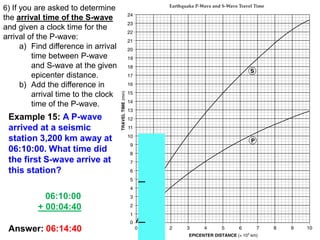
Example 1: How long
does it take a P-wave to
travel 4,000 km?
1) If you are asked the travel
time of a P-wave or S-wave
for a given epicenter
distance:
a) Go to the epicenter
distance on the x-axis
and go up to the correct
curve,
b) Go over to the y-axis
and determine the travel
time.
Answer: 7 minutes
Example 2: How long
does it take an S-wave
to travel 4,000 km?
1) If you are asked the travel
time of a P-wave or S-wave
for a given epicenter
distance:
a) Go to the epicenter
distance on the x-axis
and go up to the correct
curve,
b) Go over to the y-axis
and determine the travel
time.
Answer: 12 min 40 sec
Example 3: How long
does it take a P-wave to
travel 8,000 km?
1) If you are asked the travel
time of a P-wave or S-wave
for a given epicenter
distance:
a) Go to the epicenter
distance on the x-axis
and go up to the correct
curve,
b) Go over to the y-axis
and determine the travel
time.
Answer: 11 min 20 sec
Example 4: How long
does it take an S-wave
to travel 8,000 km?
1) If you are asked the travel
time of a P-wave or S-wave
for a given epicenter
distance:
a) Go to the epicenter
distance on the x-axis
and go up to the correct
curve,
b) Go over to the y-axis
and determine the travel
time.
Answer: 20 min 40 sec
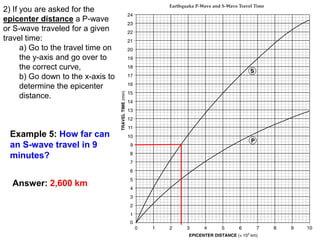
Example 5: How far can
an S-wave travel in 9
minutes?
2) If you are asked for the
epicenter distance a P-wave
or S-wave traveled for a given
travel time:
a) Go to the travel time on
the y-axis and go over to
the correct curve,
b) Go down to the x-axis to
determine the epicenter
distance.
Answer: 2,600 km
Example 6: How far can
an P-wave travel in 9
minutes?
2) If you are asked for the
epicenter distance a P-wave
or S-wave traveled for a given
travel time:
a) Go to the travel time on
the y-axis and go over to
the correct curve,
b) Go down to the x-axis to
determine the epicenter
distance.
Answer: 5,600 km
Example 7: How far can
an S-wave travel in 6
minutes 40 seconds?
2) If you are asked for the
epicenter distance a P-wave
or S-wave traveled for a given
travel time:
a) Go to the travel time on
the y-axis and go over to
the correct curve,
b) Go down to the x-axis to
determine the epicenter
distance.
Answer: 1,800 km
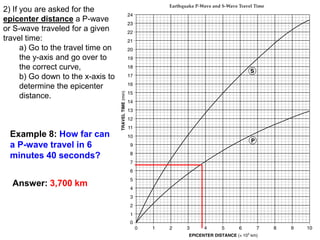
Example 8: How far can
a P-wave travel in 6
minutes 40 seconds?
2) If you are asked for the
epicenter distance a P-wave
or S-wave traveled for a given
travel time:
a) Go to the travel time on
the y-axis and go over to
the correct curve,
b) Go down to the x-axis to
determine the epicenter
distance.
Answer: 3,700 km
Example 9: If an
earthquake occurs at
08:50:40, what time did
the P-wave arrive at a
seismic station 2,600
km away?
3) If you are asked for the
arrival time of an earthquake
wave and given an epicenter
distance and origin time:
a) Determine travel time of
the wave (see #1)
b) Add travel time to the
origin time given.
08:50:40
+00:05:00
Answer: 08:55:40
Example 10: If an
earthquake occurs at
02:11:20, what time did
the S-wave arrive at a
seismic station 9,000
km away?
3) If you are asked for the
arrival time of an earthquake
wave and given an epicenter
distance and origin time:
a) Determine travel time of
the wave (see #1)
b) Add travel time to the
origin time given.
02:11:20
+00:22:20
Answer: 02:33:40
Example 11: If a P-wave
arrives at a station 8,000
km away at 12:15:00,
what time did the
earthquake originate?
4) If you are asked for the
origin time (the time an
earthquake occurred):
a) Determine the travel time
of the given wave (see #1)
b) Subtract arrival time you
were given minus the travel
time.
12:15:00
- 00:11:20
Answer: 12:03:40
Example 12: If an S-
wave arrives at a station
4,400 km away at
07:45:00, what time did
the earthquake
originate?
4) If you are asked for the
origin time (the time an
earthquake occurred):
a) Determine the travel time
of the given wave (see #1)
b) Subtract arrival time you
were given minus the travel
time.
07:45:00
- 00:13:40
Answer: 07:31:20
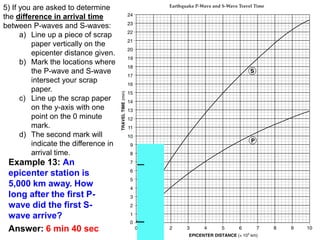
5) If you are asked to determine the difference in arrival time between
P-waves and S-waves:
a) Line up a piece of scrap paper vertically on the epicenter distance
given.
b) Mark the locations where the P-wave and S-wave intersect your
scrap paper.
c) Line up the scrap paper on the y-axis with one point on the 0
minute mark.
d) The second mark will indicate the difference in arrival time.
Example 13: An
epicenter station is
5,000 km away. How
long after the first P-
wave did the first S-
wave arrive?
5) If you are asked to determine
the difference in arrival time
between P-waves and S-waves:
a) Line up a piece of scrap
paper vertically on the
epicenter distance given.
b) Mark the locations where
the P-wave and S-wave
intersect your scrap
paper.
c) Line up the scrap paper
on the y-axis with one
point on the 0 minute
mark.
d) The second mark will
indicate the difference in
arrival time.
Example 13: An
epicenter station is
5,000 km away. How
long after the first P-
wave did the first S-
wave arrive?
Answer: 6 min 40 sec
5) If you are asked to determine
the difference in arrival time
between P-waves and S-waves:
a) Line up a piece of scrap
paper vertically on the
epicenter distance given.
b) Mark the locations where
the P-wave and S-wave
intersect your scrap
paper.
c) Line up the scrap paper
on the y-axis with one
point on the 0 minute
mark.
d) The second mark will
indicate the difference in
arrival time.
Example 14: An
epicenter station is
7,600 km away. How
long after the first P-
wave did the first S-
wave arrive?
5) If you are asked to determine
the difference in arrival time
between P-waves and S-waves:
a) Line up a piece of scrap
paper vertically on the
epicenter distance given.
b) Mark the locations where
the P-wave and S-wave
intersect your scrap
paper.
c) Line up the scrap paper
on the y-axis with one
point on the 0 minute
mark.
d) The second mark will
indicate the difference in
arrival time.
Example 14: An
epicenter station is
7,600 km away. How
long after the first P-
wave did the first S-
wave arrive?
Answer: 9 min 0 sec
5) If you are asked to determine
the difference in arrival time
between P-waves and S-waves:
a) Line up a piece of scrap
paper vertically on the
epicenter distance given.
b) Mark the locations where
the P-wave and S-wave
intersect your scrap
paper.
c) Line up the scrap paper
on the y-axis with one
point on the 0 minute
mark.
d) The second mark will
indicate the difference in
arrival time.
Example 15: A P-wave
arrived at a seismic
station 3,200 km away at
06:10:00. What time did
the first S-wave arrive at
this station?
6) If you are asked to determine
the arrival time of the S-wave
and given a clock time for the
arrival of the P-wave:
a) Find difference in arrival
time between P-wave
and S-wave at the given
epicenter distance.
b) Add the difference in
arrival time to the clock
time of the P-wave.
Answer: 06:14:40
6) If you are asked to determine
the arrival time of the S-wave
and given a clock time for the
arrival of the P-wave:
a) Find difference in arrival
time between P-wave
and S-wave at the given
epicenter distance.
b) Add the difference in
arrival time to the clock
time of the P-wave.
06:10:00
+ 00:04:40
Example 15: A P-wave
arrived at a seismic
station 3,200 km away at
06:10:00. What time did
the first S-wave arrive at
this station?
Example 16: A P-wave
arrived at a seismic
station 4,000 km away at
01:25:00. What time did
the first S-wave arrive at
this station?
6) If you are asked to determine
the arrival time of the S-wave
and given a clock time for the
arrival of the P-wave:
a) Find difference in arrival
time between P-wave
and S-wave at the given
epicenter distance.
b) Add the difference in
arrival time to the clock
time of the P-wave.
Answer: 01:30:40
6) If you are asked to determine
the arrival time of the S-wave
and given a clock time for the
arrival of the P-wave:
a) Find difference in arrival
time between P-wave
and S-wave at the given
epicenter distance.
b) Add the difference in
arrival time to the clock
time of the P-wave.
01:25:00
+ 00:05:40
Example 16: A P-wave
arrived at a seismic
station 4,000 km away at
01:25:00. What time did
the first S-wave arrive at
this station?
Example 17: An S-wave
arrived at a seismic
station 6,200 km away at
04:48:00. What time did
the first P-wave arrive at
this station?
7) If you are asked to determine
the arrival time of the P-wave
and given a clock time for the
arrival of the S-wave:
a) Find difference in arrival
time between P-wave
and S-wave at the given
epicenter distance,
b) Subtract the difference
in arrival time from the
clock time of the S-
wave.
Answer: 04:40:20
7) If you are asked to determine
the arrival time of the S-wave
and given a clock time for the
arrival of the P-wave:
a) Find difference in arrival
time between P-wave
and S-wave at the given
epicenter distance.
b) Add the difference in
arrival time to the clock
time of the P-wave.
04:48:00
- 00:07:40
Example 17: An S-wave
arrived at a seismic
station 6,200 km away at
04:48:00. What time did
the first P-wave arrive at
this station?
Example 18: An S-wave
arrived at a seismic
station 1,400 km away at
09:20:40. What time did
the first P-wave arrive at
this station?
7) If you are asked to determine
the arrival time of the P-wave
and given a clock time for the
arrival of the S-wave:
a) Find difference in arrival
time between P-wave
and S-wave at the given
epicenter distance,
b) Subtract the difference
in arrival time from the
clock time of the S-
wave.
Answer: 09:18:20
7) If you are asked to determine
the arrival time of the S-wave
and given a clock time for the
arrival of the P-wave:
a) Find difference in arrival
time between P-wave
and S-wave at the given
epicenter distance.
b) Add the difference in
arrival time to the clock
time of the P-wave.
09:20:40
- 00:02:20
Example 18: An S-wave
arrived at a seismic
station 1,400 km away at
09:20:40. What time did
the first P-wave arrive at
this station?
8) If you are asked to determine the epicenter distance using the difference in
arrival time of P-wave and S-wave:
a) Find the difference in clock time between the P-wave and S-wave by
subtracting the given times.
b) Use the Y-axis (time travel) and use a piece of scrap paper to mark the
time difference.
c) Place the marked scrap paper between the P-wave and S-wave line on the
graph. Slide the scrap paper along the graph to find the location that the
interval is touching both P-wave and S-wave line.
d) Determine the epicenter distance of this location using the X-axis.
Example 19: The first P-wave arrived at
a seismic station at 10:00:00. The first
S-wave arrived at the same seismic
station at 10:08:40. How far is this
seismic station from the epicenter?
8) If you are asked to determine the
epicenter distance using the
difference in arrival time of P-wave
and S-wave:
a) Find the difference in clock time
between the P-wave and S-wave
by subtracting the given times.
b) Use the Y-axis (time travel) and
use a piece of scrap paper to mark
the time difference.
c) Place the marked scrap paper
between the P-wave and S-wave
line on the graph. Slide the scrap
paper along the graph to find the
location that the interval is
touching both P-wave and S-wave
line.
d) Determine the epicenter distance
of this location using the X-axis.
10:08:40
- 10:00:00
00:08:40
Answer: 7,200 km
Example 19: The first P-wave
arrived at a seismic station at
10:00:00. The first S-wave
arrived at the same seismic
station at 10:08:40. How far is
this seismic station from the
epicenter?
8) If you are asked to determine the
epicenter distance using the
difference in arrival time of P-wave
and S-wave:
a) Find the difference in clock time
between the P-wave and S-wave
by subtracting the given times.
b) Use the Y-axis (time travel) and
use a piece of scrap paper to mark
the time difference.
c) Place the marked scrap paper
between the P-wave and S-wave
line on the graph. Slide the scrap
paper along the graph to find the
location that the interval is
touching both P-wave and S-wave
line.
d) Determine the epicenter distance
of this location using the X-axis.
Example 20: The first P-wave arrived
at a seismic station at 06:32:20. The
first S-wave arrived at the same
seismic station at 06:34:20. How far
is this seismic station from the
epicenter?
8) If you are asked to determine the
epicenter distance using the
difference in arrival time of P-wave
and S-wave:
a) Find the difference in clock time
between the P-wave and S-wave
by subtracting the given times.
b) Use the Y-axis (time travel) and
use a piece of scrap paper to mark
the time difference.
c) Place the marked scrap paper
between the P-wave and S-wave
line on the graph. Slide the scrap
paper along the graph to find the
location that the interval is
touching both P-wave and S-wave
line.
d) Determine the epicenter distance
of this location using the X-axis.
06:34:20
- 06:32:20
00:02:00
Answer: 1,200 km
Example 20: The first P-wave arrived at a
seismic station at 06:32:20. The first S-
wave arrived at the same seismic station
at 06:34:20. How far is this seismic
station from the epicenter?
8) If you are asked to determine the
epicenter distance using the
difference in arrival time of P-wave
and S-wave:
a) Find the difference in clock time
between the P-wave and S-wave
by subtracting the given times.
b) Use the Y-axis (time travel) and
use a piece of scrap paper to mark
the time difference.
c) Place the marked scrap paper
between the P-wave and S-wave
line on the graph. Slide the scrap
paper along the graph to find the
location that the interval is
touching both P-wave and S-wave
line.
d) Determine the epicenter distance
of this location using the X-axis.

11d-Earthquake_Problems_Tutorial.pptx

  • 2.
    Example 1: Howlong does it take a P-wave to travel 4,000 km? 1) If you are asked the travel time of a P-wave or S-wave for a given epicenter distance: a) Go to the epicenter distance on the x-axis and go up to the correct curve, b) Go over to the y-axis and determine the travel time. Answer: 7 minutes
  • 3.
    Example 2: Howlong does it take an S-wave to travel 4,000 km? 1) If you are asked the travel time of a P-wave or S-wave for a given epicenter distance: a) Go to the epicenter distance on the x-axis and go up to the correct curve, b) Go over to the y-axis and determine the travel time. Answer: 12 min 40 sec
  • 4.
    Example 3: Howlong does it take a P-wave to travel 8,000 km? 1) If you are asked the travel time of a P-wave or S-wave for a given epicenter distance: a) Go to the epicenter distance on the x-axis and go up to the correct curve, b) Go over to the y-axis and determine the travel time. Answer: 11 min 20 sec
  • 5.
    Example 4: Howlong does it take an S-wave to travel 8,000 km? 1) If you are asked the travel time of a P-wave or S-wave for a given epicenter distance: a) Go to the epicenter distance on the x-axis and go up to the correct curve, b) Go over to the y-axis and determine the travel time. Answer: 20 min 40 sec
  • 6.
    Example 5: Howfar can an S-wave travel in 9 minutes? 2) If you are asked for the epicenter distance a P-wave or S-wave traveled for a given travel time: a) Go to the travel time on the y-axis and go over to the correct curve, b) Go down to the x-axis to determine the epicenter distance. Answer: 2,600 km
  • 7.
    Example 6: Howfar can an P-wave travel in 9 minutes? 2) If you are asked for the epicenter distance a P-wave or S-wave traveled for a given travel time: a) Go to the travel time on the y-axis and go over to the correct curve, b) Go down to the x-axis to determine the epicenter distance. Answer: 5,600 km
  • 8.
    Example 7: Howfar can an S-wave travel in 6 minutes 40 seconds? 2) If you are asked for the epicenter distance a P-wave or S-wave traveled for a given travel time: a) Go to the travel time on the y-axis and go over to the correct curve, b) Go down to the x-axis to determine the epicenter distance. Answer: 1,800 km
  • 9.
    Example 8: Howfar can a P-wave travel in 6 minutes 40 seconds? 2) If you are asked for the epicenter distance a P-wave or S-wave traveled for a given travel time: a) Go to the travel time on the y-axis and go over to the correct curve, b) Go down to the x-axis to determine the epicenter distance. Answer: 3,700 km
  • 10.
    Example 9: Ifan earthquake occurs at 08:50:40, what time did the P-wave arrive at a seismic station 2,600 km away? 3) If you are asked for the arrival time of an earthquake wave and given an epicenter distance and origin time: a) Determine travel time of the wave (see #1) b) Add travel time to the origin time given. 08:50:40 +00:05:00 Answer: 08:55:40
  • 11.
    Example 10: Ifan earthquake occurs at 02:11:20, what time did the S-wave arrive at a seismic station 9,000 km away? 3) If you are asked for the arrival time of an earthquake wave and given an epicenter distance and origin time: a) Determine travel time of the wave (see #1) b) Add travel time to the origin time given. 02:11:20 +00:22:20 Answer: 02:33:40
  • 12.
    Example 11: Ifa P-wave arrives at a station 8,000 km away at 12:15:00, what time did the earthquake originate? 4) If you are asked for the origin time (the time an earthquake occurred): a) Determine the travel time of the given wave (see #1) b) Subtract arrival time you were given minus the travel time. 12:15:00 - 00:11:20 Answer: 12:03:40
  • 13.
    Example 12: Ifan S- wave arrives at a station 4,400 km away at 07:45:00, what time did the earthquake originate? 4) If you are asked for the origin time (the time an earthquake occurred): a) Determine the travel time of the given wave (see #1) b) Subtract arrival time you were given minus the travel time. 07:45:00 - 00:13:40 Answer: 07:31:20
  • 14.
    5) If youare asked to determine the difference in arrival time between P-waves and S-waves: a) Line up a piece of scrap paper vertically on the epicenter distance given. b) Mark the locations where the P-wave and S-wave intersect your scrap paper. c) Line up the scrap paper on the y-axis with one point on the 0 minute mark. d) The second mark will indicate the difference in arrival time.
  • 15.
    Example 13: An epicenterstation is 5,000 km away. How long after the first P- wave did the first S- wave arrive? 5) If you are asked to determine the difference in arrival time between P-waves and S-waves: a) Line up a piece of scrap paper vertically on the epicenter distance given. b) Mark the locations where the P-wave and S-wave intersect your scrap paper. c) Line up the scrap paper on the y-axis with one point on the 0 minute mark. d) The second mark will indicate the difference in arrival time.
  • 16.
    Example 13: An epicenterstation is 5,000 km away. How long after the first P- wave did the first S- wave arrive? Answer: 6 min 40 sec 5) If you are asked to determine the difference in arrival time between P-waves and S-waves: a) Line up a piece of scrap paper vertically on the epicenter distance given. b) Mark the locations where the P-wave and S-wave intersect your scrap paper. c) Line up the scrap paper on the y-axis with one point on the 0 minute mark. d) The second mark will indicate the difference in arrival time.
  • 17.
    Example 14: An epicenterstation is 7,600 km away. How long after the first P- wave did the first S- wave arrive? 5) If you are asked to determine the difference in arrival time between P-waves and S-waves: a) Line up a piece of scrap paper vertically on the epicenter distance given. b) Mark the locations where the P-wave and S-wave intersect your scrap paper. c) Line up the scrap paper on the y-axis with one point on the 0 minute mark. d) The second mark will indicate the difference in arrival time.
  • 18.
    Example 14: An epicenterstation is 7,600 km away. How long after the first P- wave did the first S- wave arrive? Answer: 9 min 0 sec 5) If you are asked to determine the difference in arrival time between P-waves and S-waves: a) Line up a piece of scrap paper vertically on the epicenter distance given. b) Mark the locations where the P-wave and S-wave intersect your scrap paper. c) Line up the scrap paper on the y-axis with one point on the 0 minute mark. d) The second mark will indicate the difference in arrival time.
  • 19.
    Example 15: AP-wave arrived at a seismic station 3,200 km away at 06:10:00. What time did the first S-wave arrive at this station? 6) If you are asked to determine the arrival time of the S-wave and given a clock time for the arrival of the P-wave: a) Find difference in arrival time between P-wave and S-wave at the given epicenter distance. b) Add the difference in arrival time to the clock time of the P-wave.
  • 20.
    Answer: 06:14:40 6) Ifyou are asked to determine the arrival time of the S-wave and given a clock time for the arrival of the P-wave: a) Find difference in arrival time between P-wave and S-wave at the given epicenter distance. b) Add the difference in arrival time to the clock time of the P-wave. 06:10:00 + 00:04:40 Example 15: A P-wave arrived at a seismic station 3,200 km away at 06:10:00. What time did the first S-wave arrive at this station?
  • 21.
    Example 16: AP-wave arrived at a seismic station 4,000 km away at 01:25:00. What time did the first S-wave arrive at this station? 6) If you are asked to determine the arrival time of the S-wave and given a clock time for the arrival of the P-wave: a) Find difference in arrival time between P-wave and S-wave at the given epicenter distance. b) Add the difference in arrival time to the clock time of the P-wave.
  • 22.
    Answer: 01:30:40 6) Ifyou are asked to determine the arrival time of the S-wave and given a clock time for the arrival of the P-wave: a) Find difference in arrival time between P-wave and S-wave at the given epicenter distance. b) Add the difference in arrival time to the clock time of the P-wave. 01:25:00 + 00:05:40 Example 16: A P-wave arrived at a seismic station 4,000 km away at 01:25:00. What time did the first S-wave arrive at this station?
  • 23.
    Example 17: AnS-wave arrived at a seismic station 6,200 km away at 04:48:00. What time did the first P-wave arrive at this station? 7) If you are asked to determine the arrival time of the P-wave and given a clock time for the arrival of the S-wave: a) Find difference in arrival time between P-wave and S-wave at the given epicenter distance, b) Subtract the difference in arrival time from the clock time of the S- wave.
  • 24.
    Answer: 04:40:20 7) Ifyou are asked to determine the arrival time of the S-wave and given a clock time for the arrival of the P-wave: a) Find difference in arrival time between P-wave and S-wave at the given epicenter distance. b) Add the difference in arrival time to the clock time of the P-wave. 04:48:00 - 00:07:40 Example 17: An S-wave arrived at a seismic station 6,200 km away at 04:48:00. What time did the first P-wave arrive at this station?
  • 25.
    Example 18: AnS-wave arrived at a seismic station 1,400 km away at 09:20:40. What time did the first P-wave arrive at this station? 7) If you are asked to determine the arrival time of the P-wave and given a clock time for the arrival of the S-wave: a) Find difference in arrival time between P-wave and S-wave at the given epicenter distance, b) Subtract the difference in arrival time from the clock time of the S- wave.
  • 26.
    Answer: 09:18:20 7) Ifyou are asked to determine the arrival time of the S-wave and given a clock time for the arrival of the P-wave: a) Find difference in arrival time between P-wave and S-wave at the given epicenter distance. b) Add the difference in arrival time to the clock time of the P-wave. 09:20:40 - 00:02:20 Example 18: An S-wave arrived at a seismic station 1,400 km away at 09:20:40. What time did the first P-wave arrive at this station?
  • 27.
    8) If youare asked to determine the epicenter distance using the difference in arrival time of P-wave and S-wave: a) Find the difference in clock time between the P-wave and S-wave by subtracting the given times. b) Use the Y-axis (time travel) and use a piece of scrap paper to mark the time difference. c) Place the marked scrap paper between the P-wave and S-wave line on the graph. Slide the scrap paper along the graph to find the location that the interval is touching both P-wave and S-wave line. d) Determine the epicenter distance of this location using the X-axis.
  • 28.
    Example 19: Thefirst P-wave arrived at a seismic station at 10:00:00. The first S-wave arrived at the same seismic station at 10:08:40. How far is this seismic station from the epicenter? 8) If you are asked to determine the epicenter distance using the difference in arrival time of P-wave and S-wave: a) Find the difference in clock time between the P-wave and S-wave by subtracting the given times. b) Use the Y-axis (time travel) and use a piece of scrap paper to mark the time difference. c) Place the marked scrap paper between the P-wave and S-wave line on the graph. Slide the scrap paper along the graph to find the location that the interval is touching both P-wave and S-wave line. d) Determine the epicenter distance of this location using the X-axis. 10:08:40 - 10:00:00 00:08:40
  • 29.
    Answer: 7,200 km Example19: The first P-wave arrived at a seismic station at 10:00:00. The first S-wave arrived at the same seismic station at 10:08:40. How far is this seismic station from the epicenter? 8) If you are asked to determine the epicenter distance using the difference in arrival time of P-wave and S-wave: a) Find the difference in clock time between the P-wave and S-wave by subtracting the given times. b) Use the Y-axis (time travel) and use a piece of scrap paper to mark the time difference. c) Place the marked scrap paper between the P-wave and S-wave line on the graph. Slide the scrap paper along the graph to find the location that the interval is touching both P-wave and S-wave line. d) Determine the epicenter distance of this location using the X-axis.
  • 30.
    Example 20: Thefirst P-wave arrived at a seismic station at 06:32:20. The first S-wave arrived at the same seismic station at 06:34:20. How far is this seismic station from the epicenter? 8) If you are asked to determine the epicenter distance using the difference in arrival time of P-wave and S-wave: a) Find the difference in clock time between the P-wave and S-wave by subtracting the given times. b) Use the Y-axis (time travel) and use a piece of scrap paper to mark the time difference. c) Place the marked scrap paper between the P-wave and S-wave line on the graph. Slide the scrap paper along the graph to find the location that the interval is touching both P-wave and S-wave line. d) Determine the epicenter distance of this location using the X-axis. 06:34:20 - 06:32:20 00:02:00
  • 31.
    Answer: 1,200 km Example20: The first P-wave arrived at a seismic station at 06:32:20. The first S- wave arrived at the same seismic station at 06:34:20. How far is this seismic station from the epicenter? 8) If you are asked to determine the epicenter distance using the difference in arrival time of P-wave and S-wave: a) Find the difference in clock time between the P-wave and S-wave by subtracting the given times. b) Use the Y-axis (time travel) and use a piece of scrap paper to mark the time difference. c) Place the marked scrap paper between the P-wave and S-wave line on the graph. Slide the scrap paper along the graph to find the location that the interval is touching both P-wave and S-wave line. d) Determine the epicenter distance of this location using the X-axis.