Surfacing Skills and Rewarding
Achievements with Digital Badges
Dr. Ian Glover
Senior Lecturer in Technology Enhanced Learning
Sheffield Hallam University (SHU)
i.glover@shu.ac.uk
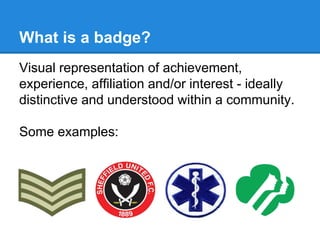
What is a badge?
Visual representation of achievement,
experience, affiliation and/or interest - ideally
distinctive and understood within a community.
Some examples:
- Juliette G. Low,
Founder of Girl Scouts of the USA
“Badges mean nothing in themselves, but
they mark a certain achievement and
they are a link between the rich and the poor.
For when one girl sees a badge on a sister
Scout’s arm, if that girl has won the same
badge, it at once awakens an interest
and sympathy between them.”
Badges in Learning?
Evidence of achievement, experience,
interest, learning and development
Potential to increase motivation in some
learners
Significant interest as a method of
representing micro-credentials
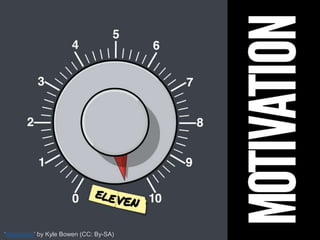
‘Motivation’ by Kyle Bowen (CC: By-SA)
Micro-credentials?
Lighter-weight than formal credentials, such
as degrees, certifications, etc.
Encourage development (and sharing) of a
fuller picture of an individual’s learning and
experience
Represent life-long and life-wide learning
Increasingly standardising around Mozilla’s
digital Open Badges specification
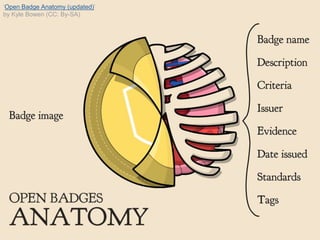
Open Badges?
Open technology
anyone can create, issue, receive and share badges
can collate badges from many sources
‘Cheap’ to create and issue
Potential to automate aspects of process
Bespoke badges for individuals feasible
Embedded details of what each represents
Verifiable and secure
built-in ways to check authenticity
‘Open Badge Anatomy (updated)’
by Kyle Bowen (CC: By-SA)
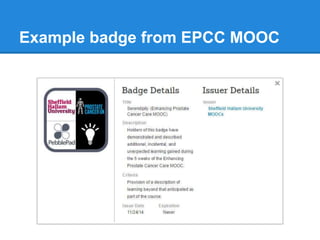
Example badge from EPCC MOOC
How are they used?
Surface ‘hidden’ learning and development
encouraging more comprehensive reflection
Demonstrating proficiency and interests
Learner controlled vs. institutionally controlled (e.g. HEAR)
Defining ‘Learning Pathways’ and enabling students to
check progress
Sharing with:
prospective employers on LinkedIn or digital CV
friends and family via Facebook, Twitter, etc.
colleagues through appraisal, professional portfolios, etc.
Who’s using Open Badges?
Disney, NASA, New York Museum of Modern
Art (MoMA), Smithsonian, Purdue University,
...
Nottingham Trent University, Southampton
Solent University, University of Sheffield,
University of Sussex, University of Warwick,
York St. John University, ...
and Sheffield Hallam University
‘Morton Takes a MOOC’
by Kyle Bowen (CC: By-SA)
With MOOCs?
Association for Learning Technology (ALT),
Cardiff University,
JISC Scotland,
Mozilla Foundation,
Open Learning Design Studio (OLDS MOOC),
Open University,
Oxford Brookes,
University of Alicante
University of Central Florida
...
and Sheffield Hallam University
How are they used at SHU?
Used as evidence of completing additional
(assessed) activities on our MOOCs
‘Enhancing Prostate Cancer Care’ and ‘Conversations
in End of Life Care’
One badge per topic (one topic per week)
Collecting full set and submitting an
integrative reflection for assessment = APAL
for related module on Masters programme
‘Carpet Badging’
by Kyle Bowen (CC: By-SA)
Where do I start?
Sign-up for an existing platform
e.g. Credly.com, Mozilla Backpack
Use features built into learning platforms
e.g. Blackboard, PebblePad
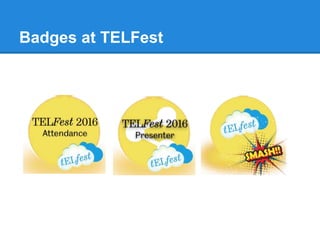
Badges at TELFest
Some Further Information
What are Open Badges? [blog post]
Open Badges: Using 'Lightweight' Rewards and
Credentials to Increase Motivation and Participation
[slides]
Open Badges: a visual learner-centric approach to
recognising achievement [Blog Post]
Towards the Devolution of Lifewide Learning Awards
through Verifiable Digital Badges [Book Chapter]
or, email i.glover@shu.ac.uk to discuss

Rewarding Achievements with Digital Badges

  • 1.
    Surfacing Skills andRewarding Achievements with Digital Badges Dr. Ian Glover Senior Lecturer in Technology Enhanced Learning Sheffield Hallam University (SHU) i.glover@shu.ac.uk
  • 2.
    What is abadge? Visual representation of achievement, experience, affiliation and/or interest - ideally distinctive and understood within a community. Some examples:
  • 3.
    - Juliette G.Low, Founder of Girl Scouts of the USA “Badges mean nothing in themselves, but they mark a certain achievement and they are a link between the rich and the poor. For when one girl sees a badge on a sister Scout’s arm, if that girl has won the same badge, it at once awakens an interest and sympathy between them.”
  • 4.
    Badges in Learning? Evidenceof achievement, experience, interest, learning and development Potential to increase motivation in some learners Significant interest as a method of representing micro-credentials
  • 5.
    ‘Motivation’ by KyleBowen (CC: By-SA)
  • 6.
    Micro-credentials? Lighter-weight than formalcredentials, such as degrees, certifications, etc. Encourage development (and sharing) of a fuller picture of an individual’s learning and experience Represent life-long and life-wide learning Increasingly standardising around Mozilla’s digital Open Badges specification
  • 7.
    Open Badges? Open technology anyonecan create, issue, receive and share badges can collate badges from many sources ‘Cheap’ to create and issue Potential to automate aspects of process Bespoke badges for individuals feasible Embedded details of what each represents Verifiable and secure built-in ways to check authenticity
  • 8.
    ‘Open Badge Anatomy(updated)’ by Kyle Bowen (CC: By-SA)
  • 9.
  • 10.
    How are theyused? Surface ‘hidden’ learning and development encouraging more comprehensive reflection Demonstrating proficiency and interests Learner controlled vs. institutionally controlled (e.g. HEAR) Defining ‘Learning Pathways’ and enabling students to check progress Sharing with: prospective employers on LinkedIn or digital CV friends and family via Facebook, Twitter, etc. colleagues through appraisal, professional portfolios, etc.
  • 11.
    Who’s using OpenBadges? Disney, NASA, New York Museum of Modern Art (MoMA), Smithsonian, Purdue University, ... Nottingham Trent University, Southampton Solent University, University of Sheffield, University of Sussex, University of Warwick, York St. John University, ... and Sheffield Hallam University
  • 12.
    ‘Morton Takes aMOOC’ by Kyle Bowen (CC: By-SA)
  • 13.
    With MOOCs? Association forLearning Technology (ALT), Cardiff University, JISC Scotland, Mozilla Foundation, Open Learning Design Studio (OLDS MOOC), Open University, Oxford Brookes, University of Alicante University of Central Florida ... and Sheffield Hallam University
  • 14.
    How are theyused at SHU? Used as evidence of completing additional (assessed) activities on our MOOCs ‘Enhancing Prostate Cancer Care’ and ‘Conversations in End of Life Care’ One badge per topic (one topic per week) Collecting full set and submitting an integrative reflection for assessment = APAL for related module on Masters programme
  • 15.
  • 16.
    Where do Istart? Sign-up for an existing platform e.g. Credly.com, Mozilla Backpack Use features built into learning platforms e.g. Blackboard, PebblePad
  • 17.
  • 18.
    Some Further Information Whatare Open Badges? [blog post] Open Badges: Using 'Lightweight' Rewards and Credentials to Increase Motivation and Participation [slides] Open Badges: a visual learner-centric approach to recognising achievement [Blog Post] Towards the Devolution of Lifewide Learning Awards through Verifiable Digital Badges [Book Chapter] or, email i.glover@shu.ac.uk to discuss