A DOUBLE-BLIND PLACEBO-CONTROLLED
STUDY OF
BREXPIPRAZOLE FOR THE TREATMENT OF
BORDERLINE
PERSONALITY DISORDER (BPD)
BY
MOSTAFA MAHMOUD ELSABBAN
ASSISTANT LECTURER OF PSYCHIATRY
AL AZHAR UNIVERSITY-DAMIETTA
BACKGROUND
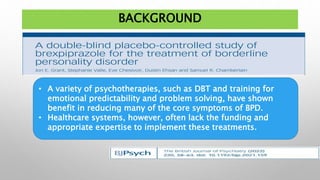
• A variety of psychotherapies, such as DBT and training for
emotional predictability and problem solving, have shown
benefit in reducing many of the core symptoms of BPD.
• Healthcare systems, however, often lack the funding and
appropriate expertise to implement these treatments.
BACKGROUND
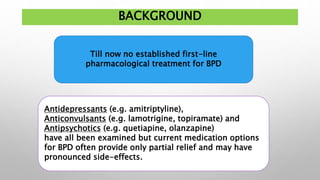
Antidepressants (e.g. amitriptyline),
Anticonvulsants (e.g. lamotrigine, topiramate) and
Antipsychotics (e.g. quetiapine, olanzapine)
have all been examined but current medication options
for BPD often provide only partial relief and may have
pronounced side-effects.
Till now no established first-line
pharmacological treatment for BPD
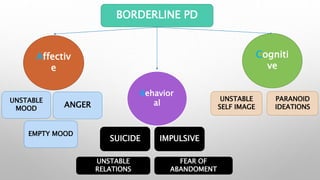
BORDERLINE PD
Affectiv
e
Behavior
al
Cogniti
ve
UNSTABLE
MOOD
EMPTY MOOD
ANGER
SUICIDE IMPULSIVE
UNSTABLE
RELATIONS
FEAR OF
ABANDOMENT
UNSTABLE
SELF IMAGE
PARANOID
IDEATIONS
BRDERLINE PD
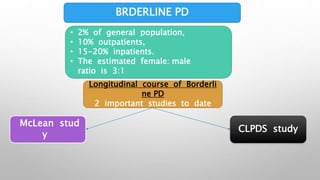
• 2% of general population,
• 10% outpatients,
• 15-20% inpatients.
• The estimated female: male
ratio is 3:1
Longitudinal course of Borderli
ne PD
2 important studies to date
CLPDS study
McLean stud
y
BACKGROUND
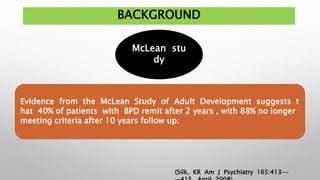
McLean stu
dy
Evidence from the McLean Study of Adult Development suggests t
hat 40% of patients with BPD remit after 2 years , with 88% no longer
meeting criteria after 10 years follow up.
(Silk, KR Am J Psychiatry 165:413--
BACKGROUND
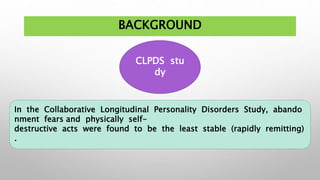
CLPDS stu
dy
In the Collaborative Longitudinal Personality Disorders Study, abando
nment fears and physically self-
destructive acts were found to be the least stable (rapidly remitting)
.
BACKGROUND
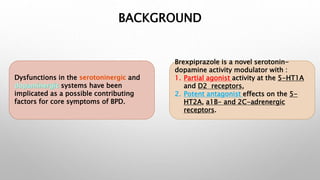
Dysfunctions in the and
systems have been
implicated as a possible contributing
factors for core symptoms of BPD.
Brexpiprazole is a novel serotonin-
dopamine activity modulator with :
1. Partial agonist activity at the 5-HT1A
and D2 receptors,
2. Potent antagonist effects on the 5-
HT2A, a1B- and 2C-adrenergic
receptors.
BACKGROUND
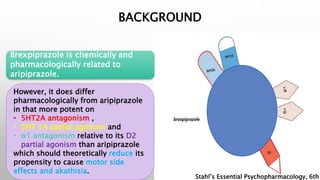
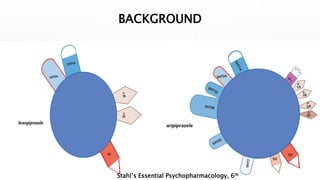
Brexpiprazole is chemically and
pharmacologically related to
aripiprazole.
However, it does differ
pharmacologically from aripiprazole
in that more potent on
• 5HT2A antagonism ,
• 5HT 1A partial agonism and
• α1 antagonism relative to its D2
partial agonism than aripiprazole
which should theoretically reduce its
propensity to cause motor side
effects and akathisia.
Stahl’s Essential Psychopharmacology, 6th
BACKGROUND
Stahl’s Essential Psychopharmacology, 6th
BACKGROUND
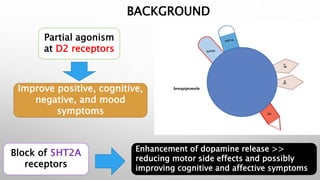
Partial agonism
at D2 receptors
Block of 5HT2A
receptors
Enhancement of dopamine release >>
reducing motor side effects and possibly
improving cognitive and affective symptoms
Improve positive, cognitive,
negative, and mood
symptoms
BACKGROUND
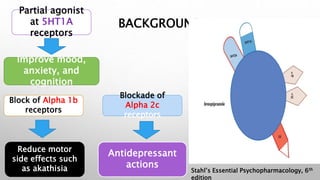
Blockade of
Alpha 2c
receptors
Block of Alpha 1b
receptors
Reduce motor
side effects such
as akathisia
Antidepressant
actions
Partial agonist
at 5HT1A
receptors
Improve mood,
anxiety, and
cognition
Stahl’s Essential Psychopharmacology, 6th
edition
BACKGROUND
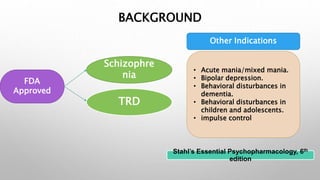
FDA
Approved
Schizophre
nia
TRD
Other Indications
• Acute mania/mixed mania.
• Bipolar depression.
• Behavioral disturbances in
dementia.
• Behavioral disturbances in
children and adolescents.
• impulse control
Stahl’s Essential Psychopharmacology, 6th
edition
AIM OF THE STUDY
• To examine the efficacy and safety of
brexpiprazole compared with placebo in
adults with BPD.
• We hypothesized that brexpiprazole would
reduce the core symptoms of BPD to a
greater extent than placebo, and would be
well tolerated.
STUDY DESIGN
A randomized,
double-blind placebo-
controlled study.
METHOD
• 80 adults with BPD
• Aged 18–65 years were
recruited from clinic and local
advertisements for a 13-week.
• Received 12-week treatment
with brexpiprazole (1 mg/day
for 1 week, then increasing to 2
mg/day) or placebo in a parallel
design in a 1:1 fashion.
• All 80 participants had current
BPD per DSM-5 criteria.
• The primary efficacy outcome
measure was the clinician-rated
Zanarini Rating Scale for
Borderline Personality Disorder
(ZAN-BPD).
METHOD
INCLUSION
CRITERIA
1. Aged 18–65
2. Primary diagnosis of BPD
3. A total score of at least 9 on the clinician-
rated ZAN-BPD at study entry.
METHOD
EXCLUSION CRITERIA
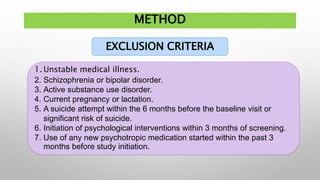
1. Unstable medical illness.
2. Schizophrenia or bipolar disorder.
3. Active substance use disorder.
4. Current pregnancy or lactation.
5. A suicide attempt within the 6 months before the baseline visit or
significant risk of suicide.
6. Initiation of psychological interventions within 3 months of screening.
7. Use of any new psychotropic medication started within the past 3
months before study initiation.
METHOD
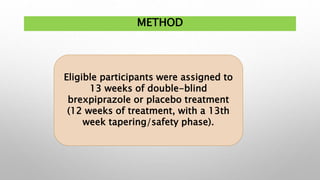
Eligible participants were assigned to
13 weeks of double-blind
brexpiprazole or placebo treatment
(12 weeks of treatment, with a 13th
week tapering/safety phase).
METHOD
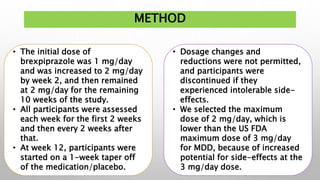
• The initial dose of
brexpiprazole was 1 mg/day
and was increased to 2 mg/day
by week 2, and then remained
at 2 mg/day for the remaining
10 weeks of the study.
• All participants were assessed
each week for the first 2 weeks
and then every 2 weeks after
that.
• At week 12, participants were
started on a 1-week taper off
of the medication/placebo.
• Dosage changes and
reductions were not permitted,
and participants were
discontinued if they
experienced intolerable side-
effects.
• We selected the maximum
dose of 2 mg/day, which is
lower than the US FDA
maximum dose of 3 mg/day
for MDD, because of increased
potential for side-effects at the
3 mg/day dose.
ASSESSMENTS
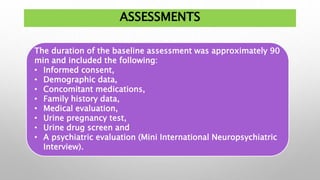
The duration of the baseline assessment was approximately 90
min and included the following:
• Informed consent,
• Demographic data,
• Concomitant medications,
• Family history data,
• Medical evaluation,
• Urine pregnancy test,
• Urine drug screen and
• A psychiatric evaluation (Mini International Neuropsychiatric
Interview).
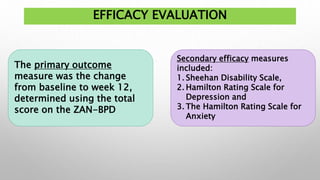
EFFICACY EVALUATION
The primary outcome
measure was the change
from baseline to week 12,
determined using the total
score on the ZAN-BPD
Secondary efficacy measures
included:
1. Sheehan Disability Scale,
2. Hamilton Rating Scale for
Depression and
3. The Hamilton Rating Scale for
Anxiety
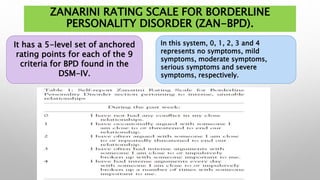
ZANARINI RATING SCALE FOR BORDERLINE
PERSONALITY DISORDER (ZAN-BPD).
It has a 5-level set of anchored
rating points for each of the 9
criteria for BPD found in the
DSM-IV.
In this system, 0, 1, 2, 3 and 4
represents no symptoms, mild
symptoms, moderate symptoms,
serious symptoms and severe
symptoms, respectively.
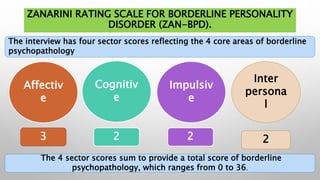
ZANARINI RATING SCALE FOR BORDERLINE PERSONALITY
DISORDER (ZAN-BPD).
The interview has four sector scores reflecting the 4 core areas of borderline
psychopathology
Affectiv
e
Cognitiv
e
Impulsiv
e
Inter
persona
l
3 2 2 2
The 4 sector scores sum to provide a total score of borderline
psychopathology, which ranges from 0 to 36.
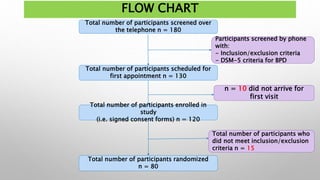
FLOW CHART
Total number of participants screened over
the telephone n = 180
Total number of participants scheduled for
first appointment n = 130
Total number of participants enrolled in
study
(i.e. signed consent forms) n = 120
Participants screened by phone
with:
- Inclusion/exclusion criteria
- DSM-5 criteria for BPD
n = 10 did not arrive for
first visit
Total number of participants who
did not meet inclusion/exclusion
criteria n = 15
Total number of participants randomized
n = 80
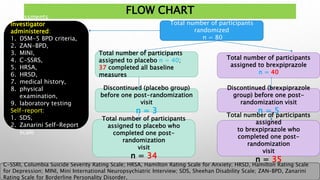
FLOW CHART
Total number of participants
randomized
n = 80
Assessments:
Investigator
administered:
1. DSM-5 BPD criteria,
2. ZAN-BPD,
3. MINI,
4. C-SSRS,
5. HRSA,
6. HRSD,
7. medical history,
8. physical
examination,
9. laboratory testing
Self-report:
1. SDS,
2. Zanarini Self-Report
scale
Total number of participants
assigned to placebo n = 40;
37 completed all baseline
measures
Total number of participants
assigned to brexpiprazole
n = 40
Discontinued (placebo group)
before one post-randomization
visit
n = 3
Total number of participants
assigned to placebo who
completed one post-
randomization
visit
n = 34
Total number of participants
assigned
to brexpiprazole who
completed one post-
randomization
visit
n = 35
Discontinued (brexpiprazole
group) before one post-
randomization visit
n = 5
C-SSRI, Columbia Suicide Severity Rating Scale; HRSA, Hamilton Rating Scale for Anxiety; HRSD, Hamilton Rating Scale
for Depression; MINI, Mini International Neuropsychiatric Interview; SDS, Sheehan Disability Scale; ZAN-BPD, Zanarini
Rating Scale for Borderline Personality Disorder.
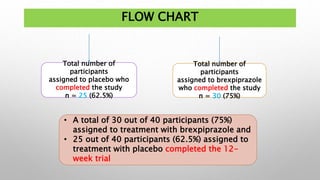
FLOW CHART
Total number of
participants
assigned to placebo who
completed the study
n = 25 (62.5%)
Total number of
participants
assigned to brexpiprazole
who completed the study
n = 30 (75%)
• A total of 30 out of 40 participants (75%)
assigned to treatment with brexpiprazole and
• 25 out of 40 participants (62.5%) assigned to
treatment with placebo completed the 12-
week trial
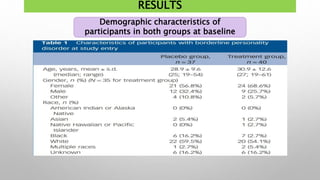
RESULTS
Demographic characteristics of
participants in both groups at baseline
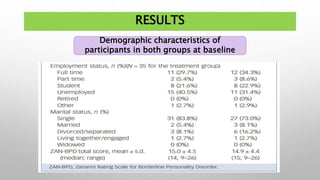
RESULTS
Demographic characteristics of
participants in both groups at baseline
RESULTS
Baseline BPD scores were reflective of
moderate severity
(15.0 ± 4.5 for the placebo group and
14.9 ± 4.4 for the brexpiprazole group)
RESULTS
Of those assigned to brexpiprazole,
12 (out of 40; 30%) were receiving at
least 1 concomitant psychiatric
medication:
• 8were on antidepressants,
• 5 were on antiepileptics and
• 3 were on stimulants.
whereas of those assigned to the
placebo,
14 (out of 40; 35%) were receiving at
least 1 concomitant psychotropic
medication:
• 10 were on antidepressants,
• 7 were on antiepileptics and
• 3 were on stimulants.
RESULTS
Of the adults assigned to brexpiprazole,
25 (62.5%) had at least 1 current
comorbid psychiatric disorder:
• 19 had an anxiety disorder,
• 15 had a mood disorder,
• 4 had ADHD and
• 4 had an eating disorder.
Among the people assigned to the
placebo, 26 (65.0%) had at least 1
current comorbid psychiatric disorder:
• 19 had an anxiety disorder,
• 13 had a mood disorder,
• 1 had ADHD and
• 3 had an eating disorder.
RESULTS
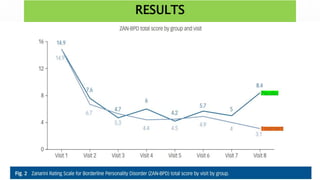
• The primary outcome variable was ZAN-BPD
total scores.
• Figure 2 shows means at each visit by group.
• The treatment group went from a mean score of
14.9 at study entry to 3.1 at end of the 12
weeks,
compared with a change of 14.9 to 8.4 for the
placebo group at the end of the 12 weeks.
RESULTS
DISCUSSION
• BUT RESULTS WERE PRIMARILY BECAUSE OF DIFFERENTIATION FROM PLACEBO,
SPECIFICALLY AT 12 WEEKS.
• SO THESE FINDINGS NEED TO BE INTERPRETED WITH SOME CAUTION.
• ALTHOUGH THE PRIMARY OUTCOME MEASURE SEPARATED FROM PLACEBO AT
THE FINAL VISIT, IT HAD NOT DONE SO FOR THE FIRST 10 WEEKS OF
TREATMENT.
This study showed that brexpiprazole may have had some effect on
BPD symptoms.
DISCUSSION
• THIS MAY BE DUE BECAUSE OF A ROBUST PLACEBO RESPONSE IN BPD, AS
EVIDENCED FROM PREVIOUS PHARMACOLOGICAL TRIALS.
• PERHAPS ONLY LONGER TRIALS CAN PROVIDE CLEAR EVIDENCE OF A STRONG
DRUG EFFECT, ALTHOUGH IT IS UNCLEAR PHARMACOLOGICALLY WHY BENEFITS
WOULD NOT HAVE ACCRUED GRADUALLY OVER TIME RATHER THAN BEING
EVIDENT MAINLY AT A SINGLE TIME POINT.
• ALSO, GIVEN THAT PARTICIPANTS WERE INFORMED AT VISIT 8 THAT THEIR
MEDICATION WOULD BE TAPERED FOR THE FINAL WEEK, SOME MAY HAVE
EXAGGERATED TREATMENT RESPONSE (ALTHOUGH WHY IN ONE ARM AND NOT
THE OTHER REMAINS UNCLEAR).
DISCUSSION
• THE PLACEBO RESPONSE IN THIS STUDY WAS QUICK AND FAIRLY SUSTAINED FOR
SEVERAL WEEKS.
• THIS TYPE OF PLACEBO RESPONSE CAN LOWER STATISTICAL POWER AND
INTERFERE WITH INTERPRETATION OF RESULTS.
• DID THE FORTNIGHTLY VISITS PROVIDE SOME SORT OF NONSPECIFIC
PSYCHOLOGICAL SUPPORT TO THOSE ASSIGNED TO THE PLACEBO?
• ONE POTENTIAL SOLUTION IS TO CONDUCT LONGER TRIALS WITH LESS
FREQUENT VISITS.
LIMITATIONS
The relatively small sample size.
• Also, our percentage of participants who
identified as non-female (i.e. as male or
neither male nor female) was slightly larger
(37%) than those in other studies
(approximately 25%), and
• whether certain medications affect people with
BPD differently based on gender remains
unknown.
There are several limitations associated with this
study
1
2
FINALLY
Despite the limitations, brexpiprazole
appears to have had some possible
effect on BPD symptoms, but further
studies are needed because of the
significant effects evident specifically
at the final time point.
11-2022.pptx

11-2022.pptx

  • 1.
    A DOUBLE-BLIND PLACEBO-CONTROLLED STUDYOF BREXPIPRAZOLE FOR THE TREATMENT OF BORDERLINE PERSONALITY DISORDER (BPD) BY MOSTAFA MAHMOUD ELSABBAN ASSISTANT LECTURER OF PSYCHIATRY AL AZHAR UNIVERSITY-DAMIETTA
  • 2.
    BACKGROUND • A varietyof psychotherapies, such as DBT and training for emotional predictability and problem solving, have shown benefit in reducing many of the core symptoms of BPD. • Healthcare systems, however, often lack the funding and appropriate expertise to implement these treatments.
  • 3.
    BACKGROUND Antidepressants (e.g. amitriptyline), Anticonvulsants(e.g. lamotrigine, topiramate) and Antipsychotics (e.g. quetiapine, olanzapine) have all been examined but current medication options for BPD often provide only partial relief and may have pronounced side-effects. Till now no established first-line pharmacological treatment for BPD
  • 4.
    BORDERLINE PD Affectiv e Behavior al Cogniti ve UNSTABLE MOOD EMPTY MOOD ANGER SUICIDEIMPULSIVE UNSTABLE RELATIONS FEAR OF ABANDOMENT UNSTABLE SELF IMAGE PARANOID IDEATIONS
  • 5.
    BRDERLINE PD • 2%of general population, • 10% outpatients, • 15-20% inpatients. • The estimated female: male ratio is 3:1 Longitudinal course of Borderli ne PD 2 important studies to date CLPDS study McLean stud y
  • 6.
    BACKGROUND McLean stu dy Evidence fromthe McLean Study of Adult Development suggests t hat 40% of patients with BPD remit after 2 years , with 88% no longer meeting criteria after 10 years follow up. (Silk, KR Am J Psychiatry 165:413--
  • 7.
    BACKGROUND CLPDS stu dy In theCollaborative Longitudinal Personality Disorders Study, abando nment fears and physically self- destructive acts were found to be the least stable (rapidly remitting) .
  • 8.
    BACKGROUND Dysfunctions in theand systems have been implicated as a possible contributing factors for core symptoms of BPD. Brexpiprazole is a novel serotonin- dopamine activity modulator with : 1. Partial agonist activity at the 5-HT1A and D2 receptors, 2. Potent antagonist effects on the 5- HT2A, a1B- and 2C-adrenergic receptors.
  • 9.
    BACKGROUND Brexpiprazole is chemicallyand pharmacologically related to aripiprazole. However, it does differ pharmacologically from aripiprazole in that more potent on • 5HT2A antagonism , • 5HT 1A partial agonism and • α1 antagonism relative to its D2 partial agonism than aripiprazole which should theoretically reduce its propensity to cause motor side effects and akathisia. Stahl’s Essential Psychopharmacology, 6th
  • 10.
  • 11.
    BACKGROUND Partial agonism at D2receptors Block of 5HT2A receptors Enhancement of dopamine release >> reducing motor side effects and possibly improving cognitive and affective symptoms Improve positive, cognitive, negative, and mood symptoms
  • 12.
    BACKGROUND Blockade of Alpha 2c receptors Blockof Alpha 1b receptors Reduce motor side effects such as akathisia Antidepressant actions Partial agonist at 5HT1A receptors Improve mood, anxiety, and cognition Stahl’s Essential Psychopharmacology, 6th edition
  • 13.
    BACKGROUND FDA Approved Schizophre nia TRD Other Indications • Acutemania/mixed mania. • Bipolar depression. • Behavioral disturbances in dementia. • Behavioral disturbances in children and adolescents. • impulse control Stahl’s Essential Psychopharmacology, 6th edition
  • 14.
    AIM OF THESTUDY • To examine the efficacy and safety of brexpiprazole compared with placebo in adults with BPD. • We hypothesized that brexpiprazole would reduce the core symptoms of BPD to a greater extent than placebo, and would be well tolerated.
  • 15.
    STUDY DESIGN A randomized, double-blindplacebo- controlled study.
  • 16.
    METHOD • 80 adultswith BPD • Aged 18–65 years were recruited from clinic and local advertisements for a 13-week. • Received 12-week treatment with brexpiprazole (1 mg/day for 1 week, then increasing to 2 mg/day) or placebo in a parallel design in a 1:1 fashion. • All 80 participants had current BPD per DSM-5 criteria. • The primary efficacy outcome measure was the clinician-rated Zanarini Rating Scale for Borderline Personality Disorder (ZAN-BPD).
  • 17.
    METHOD INCLUSION CRITERIA 1. Aged 18–65 2.Primary diagnosis of BPD 3. A total score of at least 9 on the clinician- rated ZAN-BPD at study entry.
  • 18.
    METHOD EXCLUSION CRITERIA 1. Unstablemedical illness. 2. Schizophrenia or bipolar disorder. 3. Active substance use disorder. 4. Current pregnancy or lactation. 5. A suicide attempt within the 6 months before the baseline visit or significant risk of suicide. 6. Initiation of psychological interventions within 3 months of screening. 7. Use of any new psychotropic medication started within the past 3 months before study initiation.
  • 19.
    METHOD Eligible participants wereassigned to 13 weeks of double-blind brexpiprazole or placebo treatment (12 weeks of treatment, with a 13th week tapering/safety phase).
  • 20.
    METHOD • The initialdose of brexpiprazole was 1 mg/day and was increased to 2 mg/day by week 2, and then remained at 2 mg/day for the remaining 10 weeks of the study. • All participants were assessed each week for the first 2 weeks and then every 2 weeks after that. • At week 12, participants were started on a 1-week taper off of the medication/placebo. • Dosage changes and reductions were not permitted, and participants were discontinued if they experienced intolerable side- effects. • We selected the maximum dose of 2 mg/day, which is lower than the US FDA maximum dose of 3 mg/day for MDD, because of increased potential for side-effects at the 3 mg/day dose.
  • 21.
    ASSESSMENTS The duration ofthe baseline assessment was approximately 90 min and included the following: • Informed consent, • Demographic data, • Concomitant medications, • Family history data, • Medical evaluation, • Urine pregnancy test, • Urine drug screen and • A psychiatric evaluation (Mini International Neuropsychiatric Interview).
  • 22.
    EFFICACY EVALUATION The primaryoutcome measure was the change from baseline to week 12, determined using the total score on the ZAN-BPD Secondary efficacy measures included: 1. Sheehan Disability Scale, 2. Hamilton Rating Scale for Depression and 3. The Hamilton Rating Scale for Anxiety
  • 23.
    ZANARINI RATING SCALEFOR BORDERLINE PERSONALITY DISORDER (ZAN-BPD). It has a 5-level set of anchored rating points for each of the 9 criteria for BPD found in the DSM-IV. In this system, 0, 1, 2, 3 and 4 represents no symptoms, mild symptoms, moderate symptoms, serious symptoms and severe symptoms, respectively.
  • 24.
    ZANARINI RATING SCALEFOR BORDERLINE PERSONALITY DISORDER (ZAN-BPD). The interview has four sector scores reflecting the 4 core areas of borderline psychopathology Affectiv e Cognitiv e Impulsiv e Inter persona l 3 2 2 2 The 4 sector scores sum to provide a total score of borderline psychopathology, which ranges from 0 to 36.
  • 25.
    FLOW CHART Total numberof participants screened over the telephone n = 180 Total number of participants scheduled for first appointment n = 130 Total number of participants enrolled in study (i.e. signed consent forms) n = 120 Participants screened by phone with: - Inclusion/exclusion criteria - DSM-5 criteria for BPD n = 10 did not arrive for first visit Total number of participants who did not meet inclusion/exclusion criteria n = 15 Total number of participants randomized n = 80
  • 26.
    FLOW CHART Total numberof participants randomized n = 80 Assessments: Investigator administered: 1. DSM-5 BPD criteria, 2. ZAN-BPD, 3. MINI, 4. C-SSRS, 5. HRSA, 6. HRSD, 7. medical history, 8. physical examination, 9. laboratory testing Self-report: 1. SDS, 2. Zanarini Self-Report scale Total number of participants assigned to placebo n = 40; 37 completed all baseline measures Total number of participants assigned to brexpiprazole n = 40 Discontinued (placebo group) before one post-randomization visit n = 3 Total number of participants assigned to placebo who completed one post- randomization visit n = 34 Total number of participants assigned to brexpiprazole who completed one post- randomization visit n = 35 Discontinued (brexpiprazole group) before one post- randomization visit n = 5 C-SSRI, Columbia Suicide Severity Rating Scale; HRSA, Hamilton Rating Scale for Anxiety; HRSD, Hamilton Rating Scale for Depression; MINI, Mini International Neuropsychiatric Interview; SDS, Sheehan Disability Scale; ZAN-BPD, Zanarini Rating Scale for Borderline Personality Disorder.
  • 27.
    FLOW CHART Total numberof participants assigned to placebo who completed the study n = 25 (62.5%) Total number of participants assigned to brexpiprazole who completed the study n = 30 (75%) • A total of 30 out of 40 participants (75%) assigned to treatment with brexpiprazole and • 25 out of 40 participants (62.5%) assigned to treatment with placebo completed the 12- week trial
  • 28.
  • 29.
  • 30.
    RESULTS Baseline BPD scoreswere reflective of moderate severity (15.0 ± 4.5 for the placebo group and 14.9 ± 4.4 for the brexpiprazole group)
  • 31.
    RESULTS Of those assignedto brexpiprazole, 12 (out of 40; 30%) were receiving at least 1 concomitant psychiatric medication: • 8were on antidepressants, • 5 were on antiepileptics and • 3 were on stimulants. whereas of those assigned to the placebo, 14 (out of 40; 35%) were receiving at least 1 concomitant psychotropic medication: • 10 were on antidepressants, • 7 were on antiepileptics and • 3 were on stimulants.
  • 32.
    RESULTS Of the adultsassigned to brexpiprazole, 25 (62.5%) had at least 1 current comorbid psychiatric disorder: • 19 had an anxiety disorder, • 15 had a mood disorder, • 4 had ADHD and • 4 had an eating disorder. Among the people assigned to the placebo, 26 (65.0%) had at least 1 current comorbid psychiatric disorder: • 19 had an anxiety disorder, • 13 had a mood disorder, • 1 had ADHD and • 3 had an eating disorder.
  • 33.
    RESULTS • The primaryoutcome variable was ZAN-BPD total scores. • Figure 2 shows means at each visit by group. • The treatment group went from a mean score of 14.9 at study entry to 3.1 at end of the 12 weeks, compared with a change of 14.9 to 8.4 for the placebo group at the end of the 12 weeks.
  • 34.
  • 35.
    DISCUSSION • BUT RESULTSWERE PRIMARILY BECAUSE OF DIFFERENTIATION FROM PLACEBO, SPECIFICALLY AT 12 WEEKS. • SO THESE FINDINGS NEED TO BE INTERPRETED WITH SOME CAUTION. • ALTHOUGH THE PRIMARY OUTCOME MEASURE SEPARATED FROM PLACEBO AT THE FINAL VISIT, IT HAD NOT DONE SO FOR THE FIRST 10 WEEKS OF TREATMENT. This study showed that brexpiprazole may have had some effect on BPD symptoms.
  • 36.
    DISCUSSION • THIS MAYBE DUE BECAUSE OF A ROBUST PLACEBO RESPONSE IN BPD, AS EVIDENCED FROM PREVIOUS PHARMACOLOGICAL TRIALS. • PERHAPS ONLY LONGER TRIALS CAN PROVIDE CLEAR EVIDENCE OF A STRONG DRUG EFFECT, ALTHOUGH IT IS UNCLEAR PHARMACOLOGICALLY WHY BENEFITS WOULD NOT HAVE ACCRUED GRADUALLY OVER TIME RATHER THAN BEING EVIDENT MAINLY AT A SINGLE TIME POINT. • ALSO, GIVEN THAT PARTICIPANTS WERE INFORMED AT VISIT 8 THAT THEIR MEDICATION WOULD BE TAPERED FOR THE FINAL WEEK, SOME MAY HAVE EXAGGERATED TREATMENT RESPONSE (ALTHOUGH WHY IN ONE ARM AND NOT THE OTHER REMAINS UNCLEAR).
  • 37.
    DISCUSSION • THE PLACEBORESPONSE IN THIS STUDY WAS QUICK AND FAIRLY SUSTAINED FOR SEVERAL WEEKS. • THIS TYPE OF PLACEBO RESPONSE CAN LOWER STATISTICAL POWER AND INTERFERE WITH INTERPRETATION OF RESULTS. • DID THE FORTNIGHTLY VISITS PROVIDE SOME SORT OF NONSPECIFIC PSYCHOLOGICAL SUPPORT TO THOSE ASSIGNED TO THE PLACEBO? • ONE POTENTIAL SOLUTION IS TO CONDUCT LONGER TRIALS WITH LESS FREQUENT VISITS.
  • 38.
    LIMITATIONS The relatively smallsample size. • Also, our percentage of participants who identified as non-female (i.e. as male or neither male nor female) was slightly larger (37%) than those in other studies (approximately 25%), and • whether certain medications affect people with BPD differently based on gender remains unknown. There are several limitations associated with this study 1 2
  • 39.
    FINALLY Despite the limitations,brexpiprazole appears to have had some possible effect on BPD symptoms, but further studies are needed because of the significant effects evident specifically at the final time point.