Composite Linepipe
Technology
September 25, 2015
CRUG – 5th Annual Conference & Exhibition
Composite Linepipe
2
Agenda
• Oil and Gas Pipeline Materials
• Linepipe Types
• Composite Advantages / Disadvantages
• Composite Linepipe Design
• Composite Installation Methods
• Codes and Standards
Crude Oil and Gas Pipeline Materials
3
• Steel Pipe
• Coated Steel Pipe (Fusion Bonded Epoxy [FBE])
• Uncoated Steel Pipe (Bare Pipe)
• Cathodically Protected Steel Pipe
• Unprotected Steel Pipe (Not Cathodically Protected)
• Cast Iron Pipe
• Fiberglass Pipe
• Polyethylene Pipe
• Composite Pipe
• Nylon Pipe
Composites and Plastics in Pipelines and Piping
4
Linepipe Types
• Polyethylene Pipe (PE)
• Fiberglass Reinforced Thermoset Pipe (GRE)
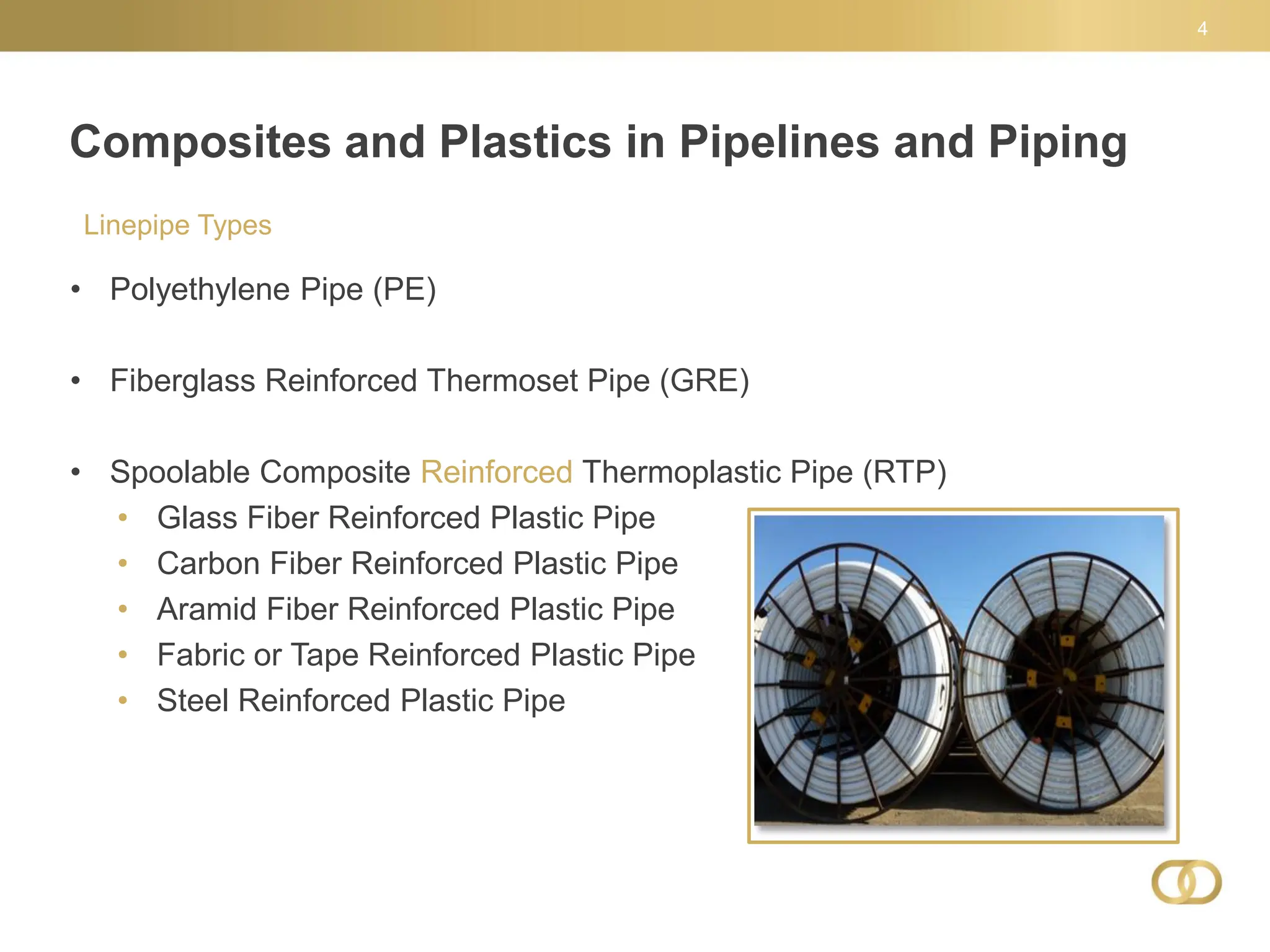
• Spoolable Composite Reinforced Thermoplastic Pipe (RTP)
• Glass Fiber Reinforced Plastic Pipe
• Carbon Fiber Reinforced Plastic Pipe
• Aramid Fiber Reinforced Plastic Pipe
• Fabric or Tape Reinforced Plastic Pipe
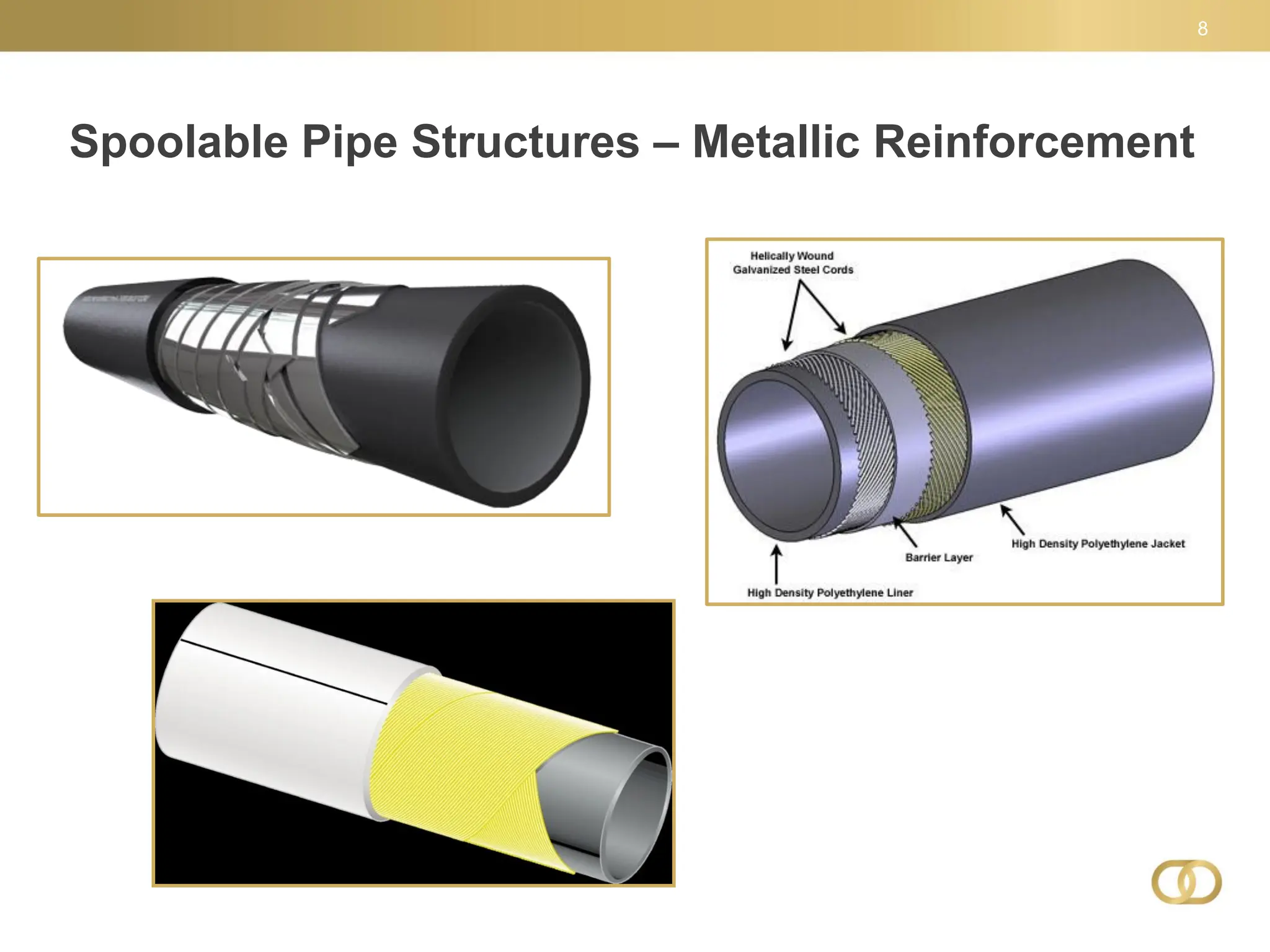
• Steel Reinforced Plastic Pipe
Manufacturers of Spoolable Composite Pipe for Oil
and Gas, Liquids and Water Pipelines
5
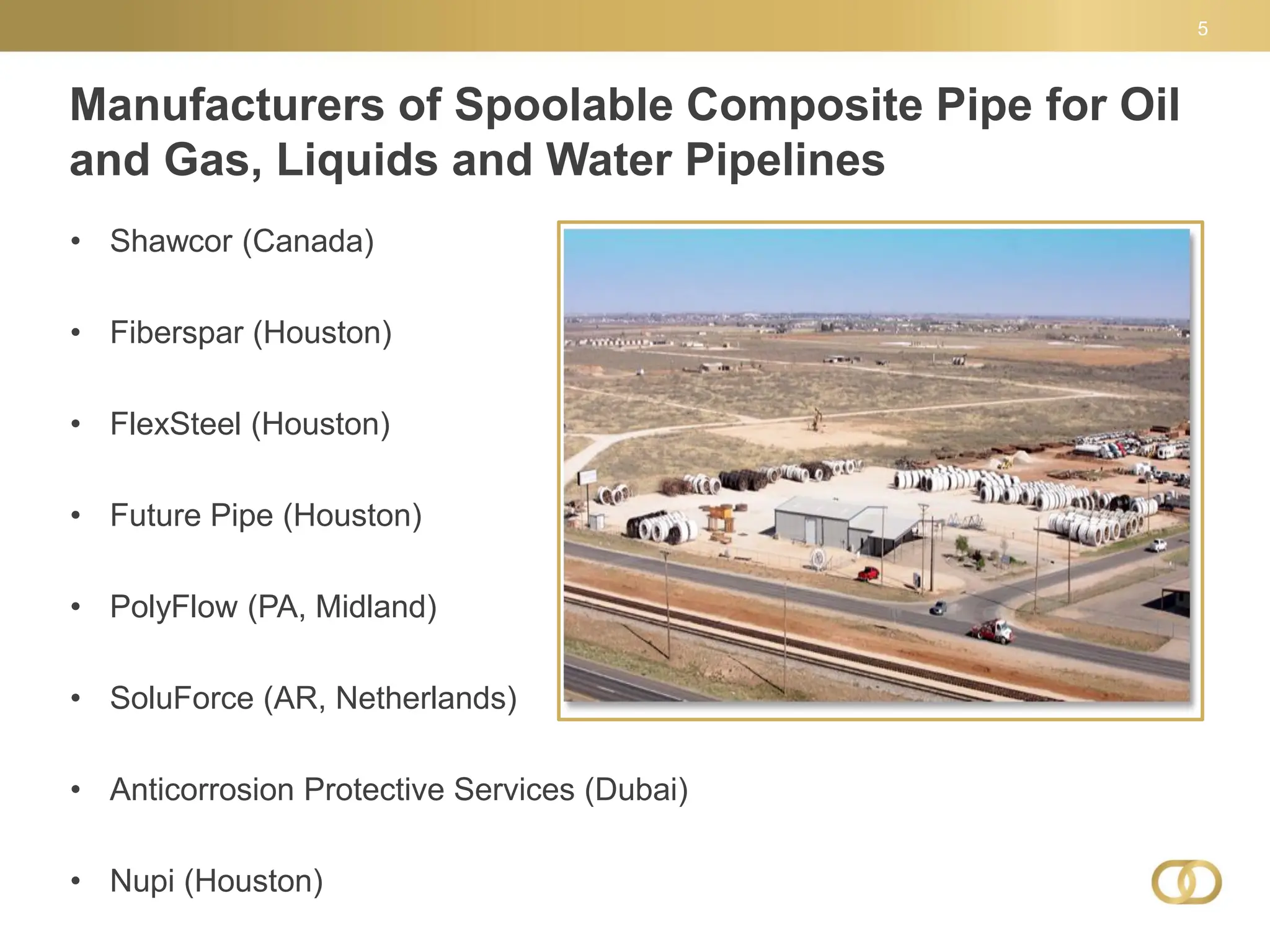
• Shawcor (Canada)
• Fiberspar (Houston)
• FlexSteel (Houston)
• Future Pipe (Houston)
• PolyFlow (PA, Midland)
• SoluForce (AR, Netherlands)
• Anticorrosion Protective Services (Dubai)
• Nupi (Houston)
Spoolable Composite Thermoplastic Piping
6
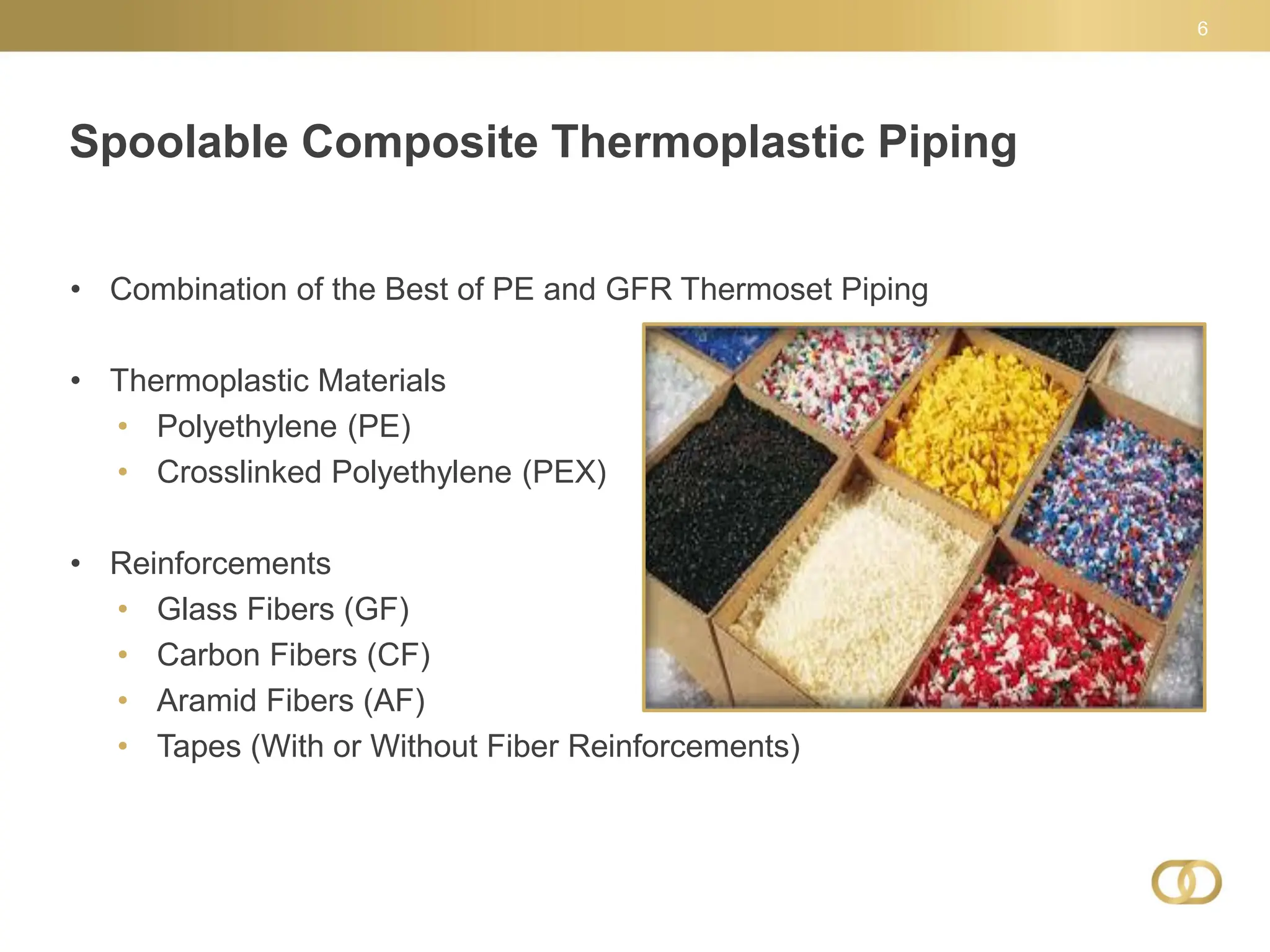
• Combination of the Best of PE and GFR Thermoset Piping
• Thermoplastic Materials
• Polyethylene (PE)
• Crosslinked Polyethylene (PEX)
• Reinforcements
• Glass Fibers (GF)
• Carbon Fibers (CF)
• Aramid Fibers (AF)
• Tapes (With or Without Fiber Reinforcements)
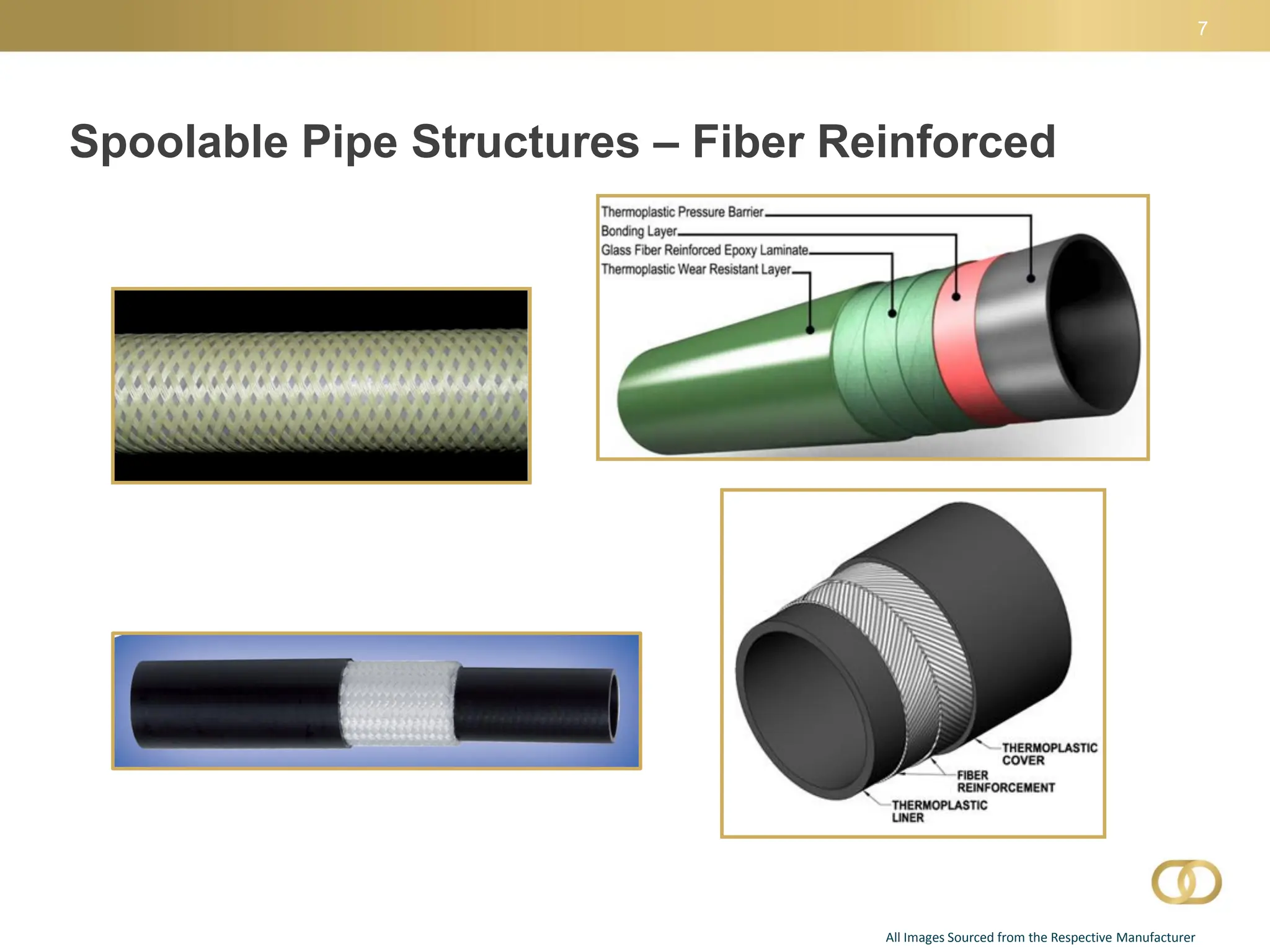
Spoolable Pipe Structures – Fiber Reinforced
7
All Images Sourced from the Respective Manufacturer
Spoolable Pipe Structures – Metallic Reinforcement
8
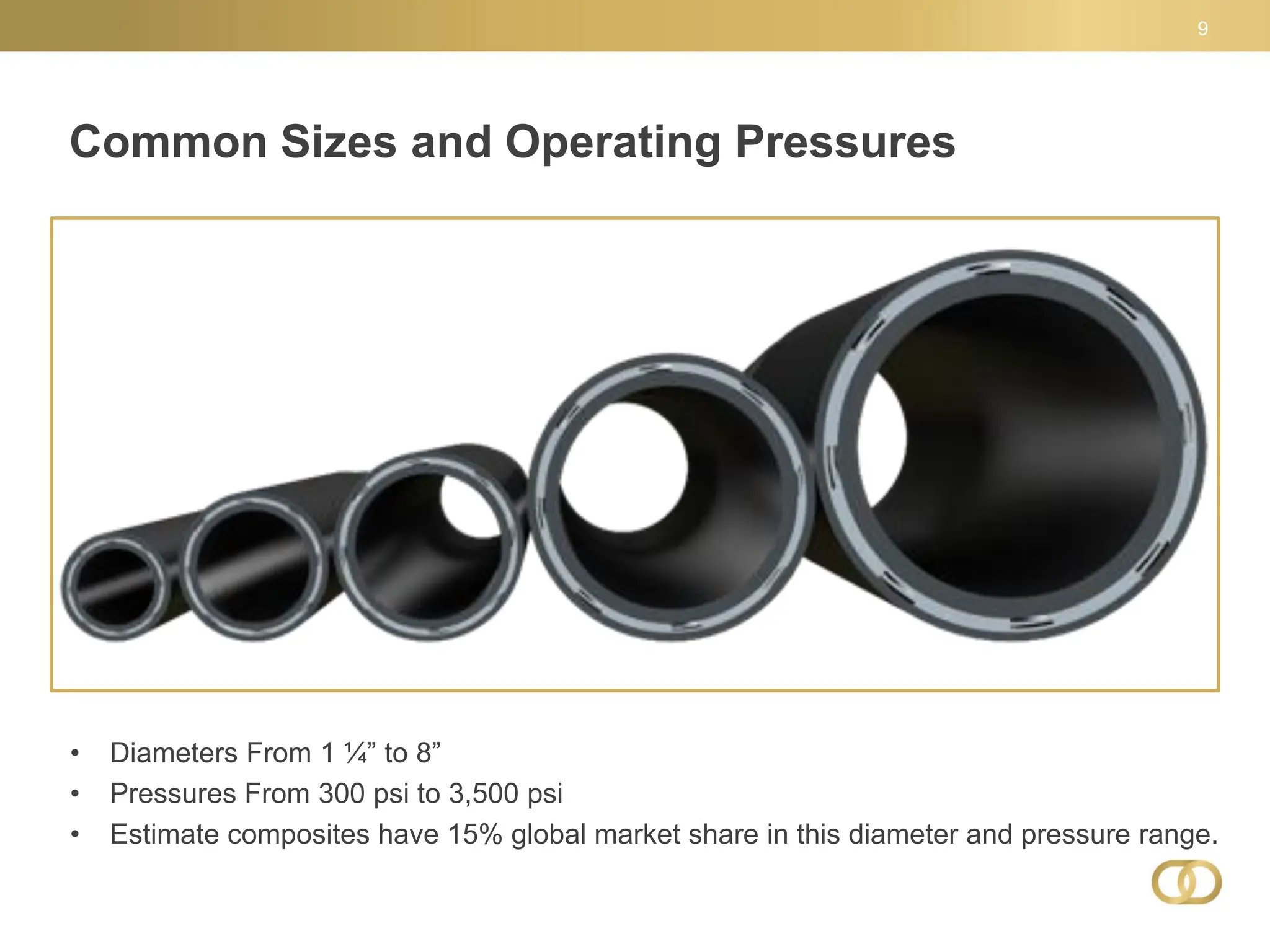
Common Sizes and Operating Pressures
9
• Diameters From 1 ¼” to 8”
• Pressures From 300 psi to 3,500 psi
• Estimate composites have 15% global market share in this diameter and pressure range.
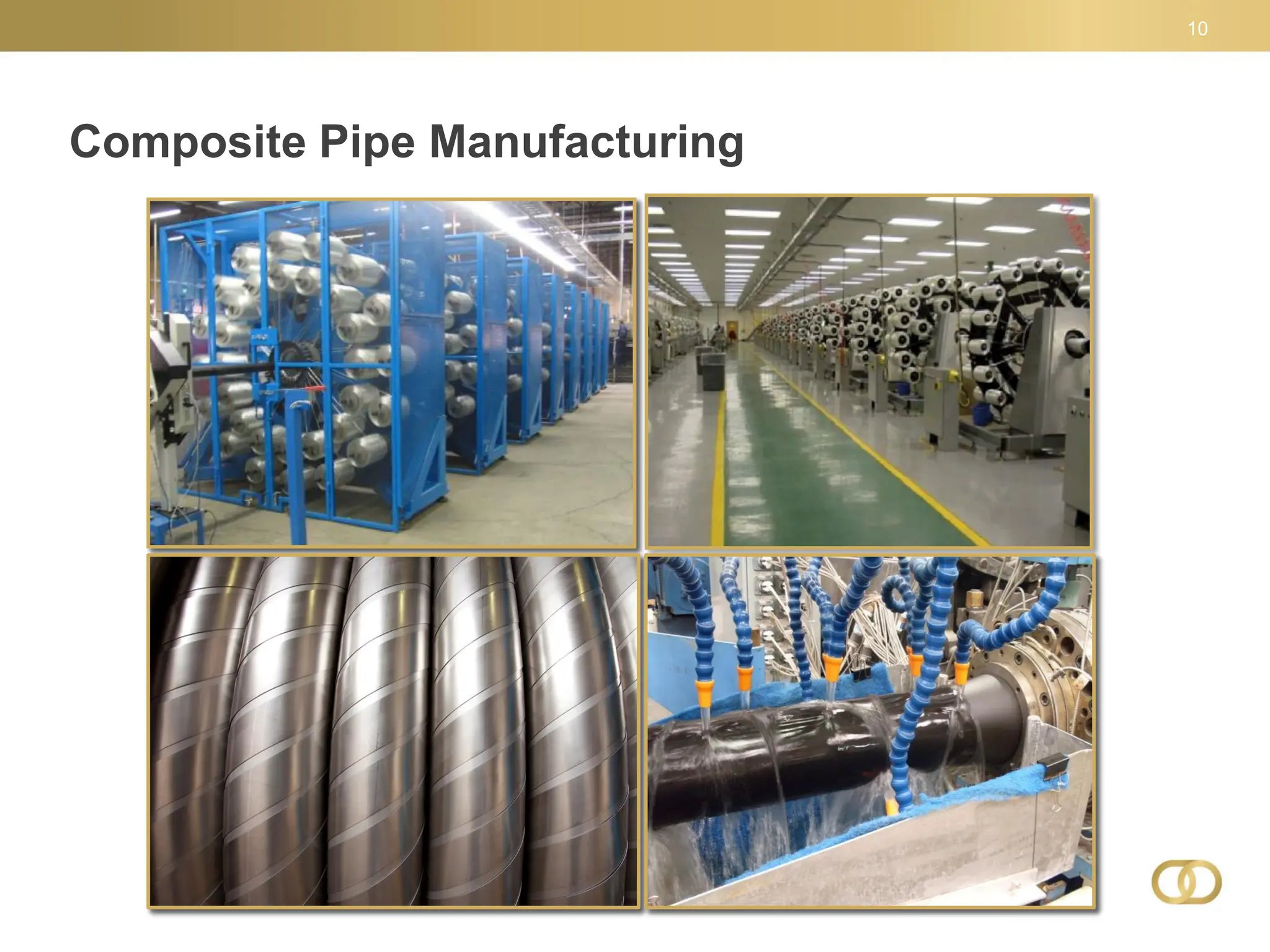
Composite Pipe Manufacturing
10
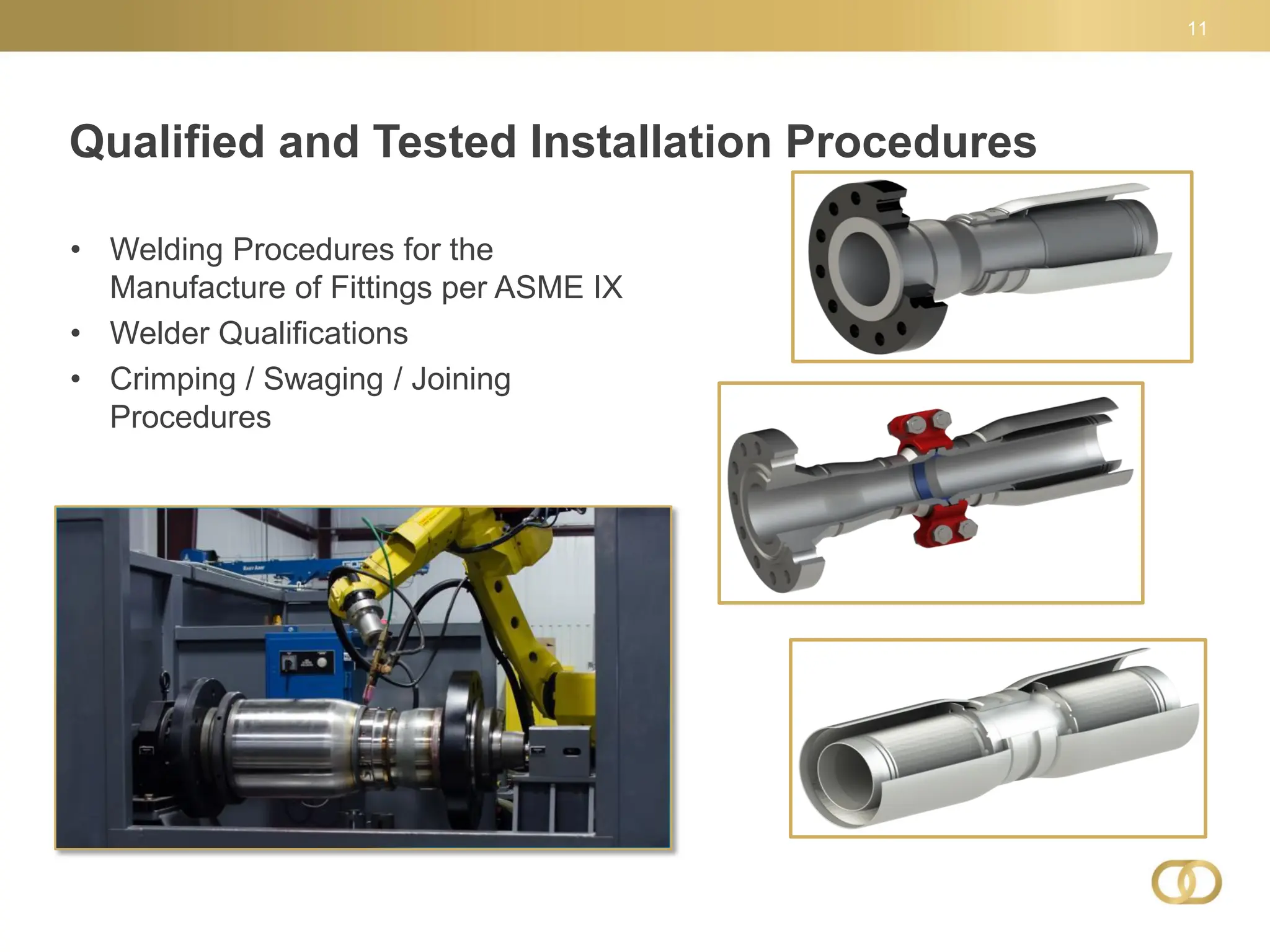
Qualified and Tested Installation Procedures
11
• Welding Procedures for the
Manufacture of Fittings per ASME IX
• Welder Qualifications
• Crimping / Swaging / Joining
Procedures
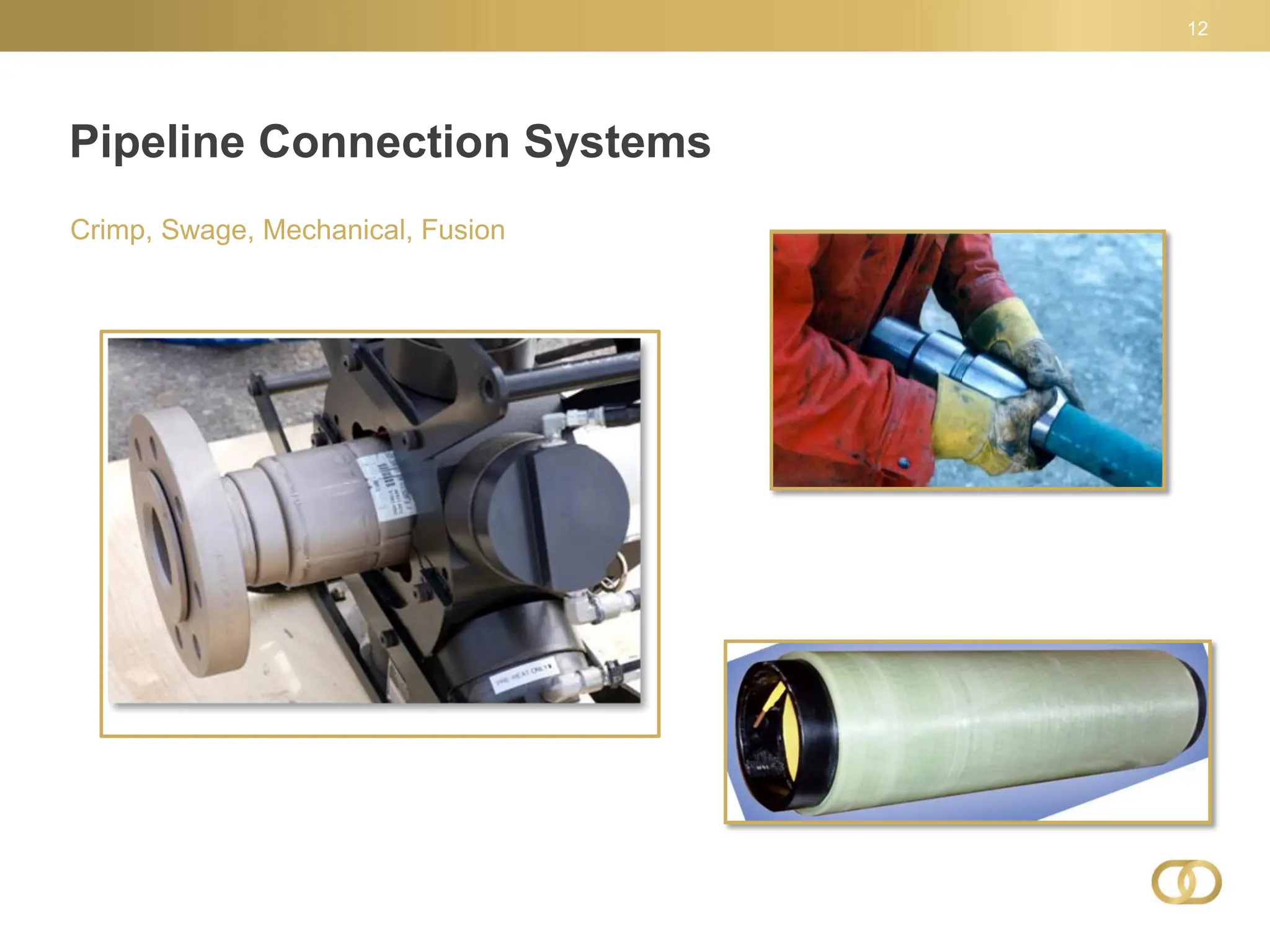
Pipeline Connection Systems
12
Crimp, Swage, Mechanical, Fusion
13
• Flow Lines or Gathering Lines for
Transfer of
• Crude Oil
• Gas
• Water
• Condensate
• Emulsion
• Sour Applications (H2S)
• Gases of Liquids Containing
CO2
• EOR Injection Line
• Source Water and Disposal
Lines for SAGD
• Fuel Gas Lines or Gas Lift
Lines
• Rehabilitation of Failed
Pipeline Through Liner Pulls
• Well Test Temporary Surface
Line (Re-spool and Re-use)
• Waste Water Disposal Line
Applications
Note: Each manufacturer’s design does not fit all applications.
Spoolable Composite Reinforced Thermoplastic
Piping
14
• Advantages
• Cost Effective – Less Expensive to Install vs. Steel (up to 40%)
• No Welding, X-ray Inspection, Jeeping
• Corrosion Resistance
• Higher Pressure Capacity (>1,500 psi) than non-reinforced
• Pipe Can Be Made in Long Lengths (Spoolable)
• Fewer Connections Required
• Pipe Can be Easily Installed – Multiple Methods
• Mechanical End Connections - Joints
Spoolable Composite Reinforced Thermoplastic
Piping
15
• Advantages, continued
• Annular Space Between Thermoplastic Layers Can be Vented to Prevent
Gas or Liquid Buildup Due to Permeation
• Piping Doesn’t Require Cathodic Protection
• Can Handle Higher Service Temperatures Using PEX
• Low Friction Rates – Higher Flow Rates
• Quick to Install
• Smaller ROW
• Minimal Equipment Required
Spoolable Composite Reinforced Thermoplastic
Piping
16
• Disadvantages
• “New” Technology – Lack of History Collected by Regulatory Agencies
• Only Available in Smaller Diameters (1 1/4” to 8”)
• Permeability
• Proprietary Designs
• Failure Mechanisms Not Fully Established
• Connections Are Weak Link in Some Systems
• Thermoset Layer Can Be Susceptible to Acidic and Caustic Chemicals
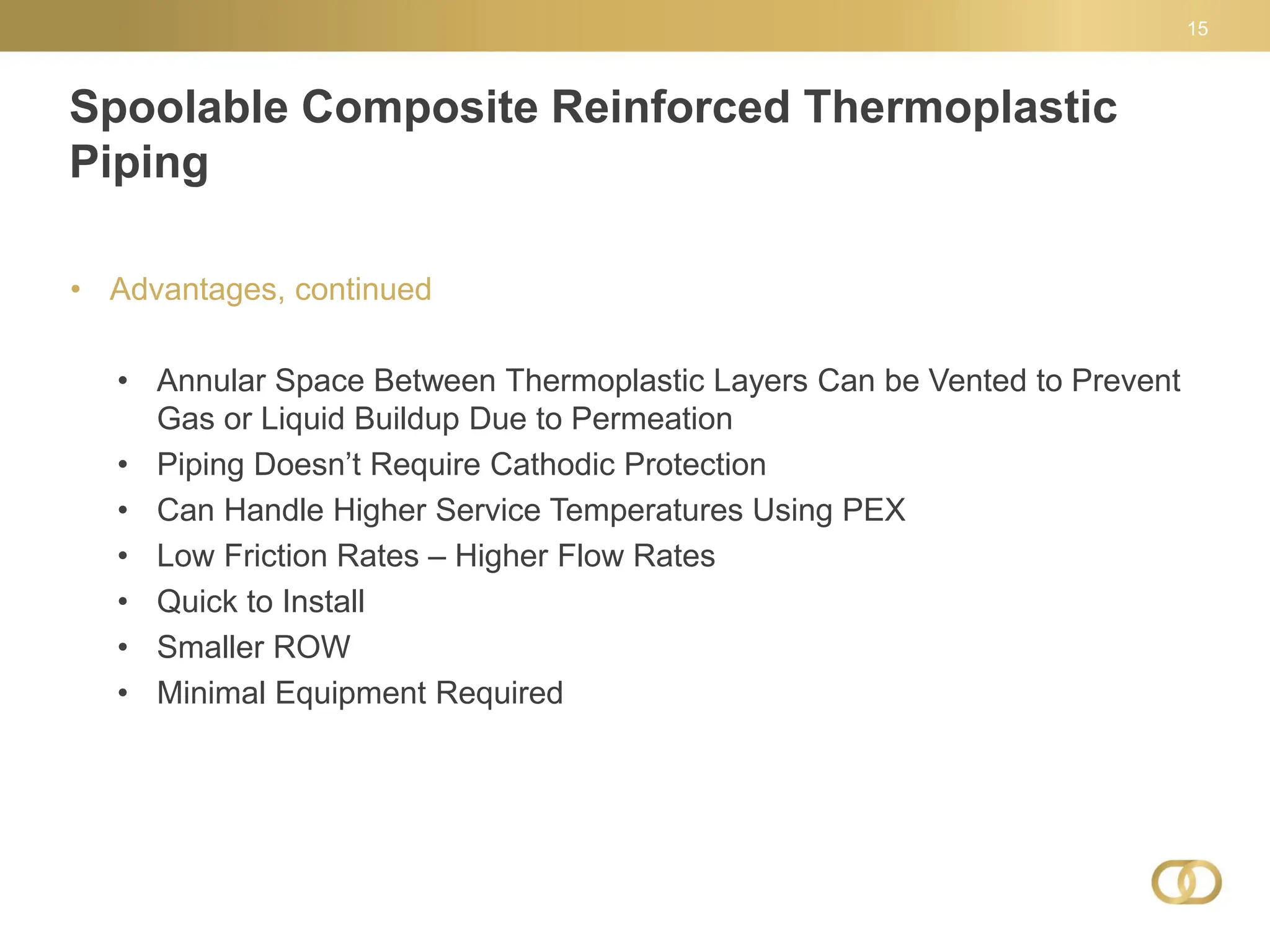
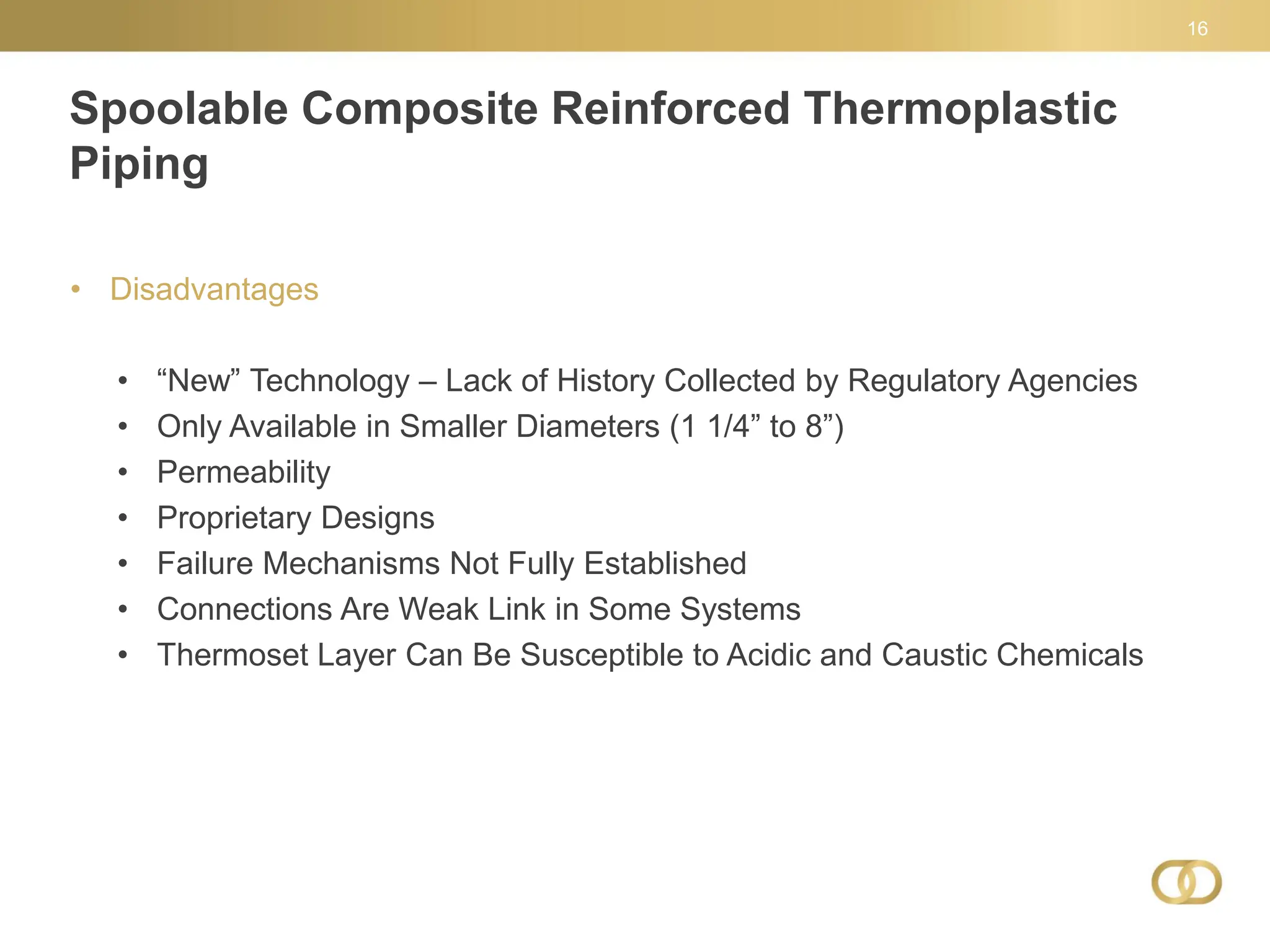
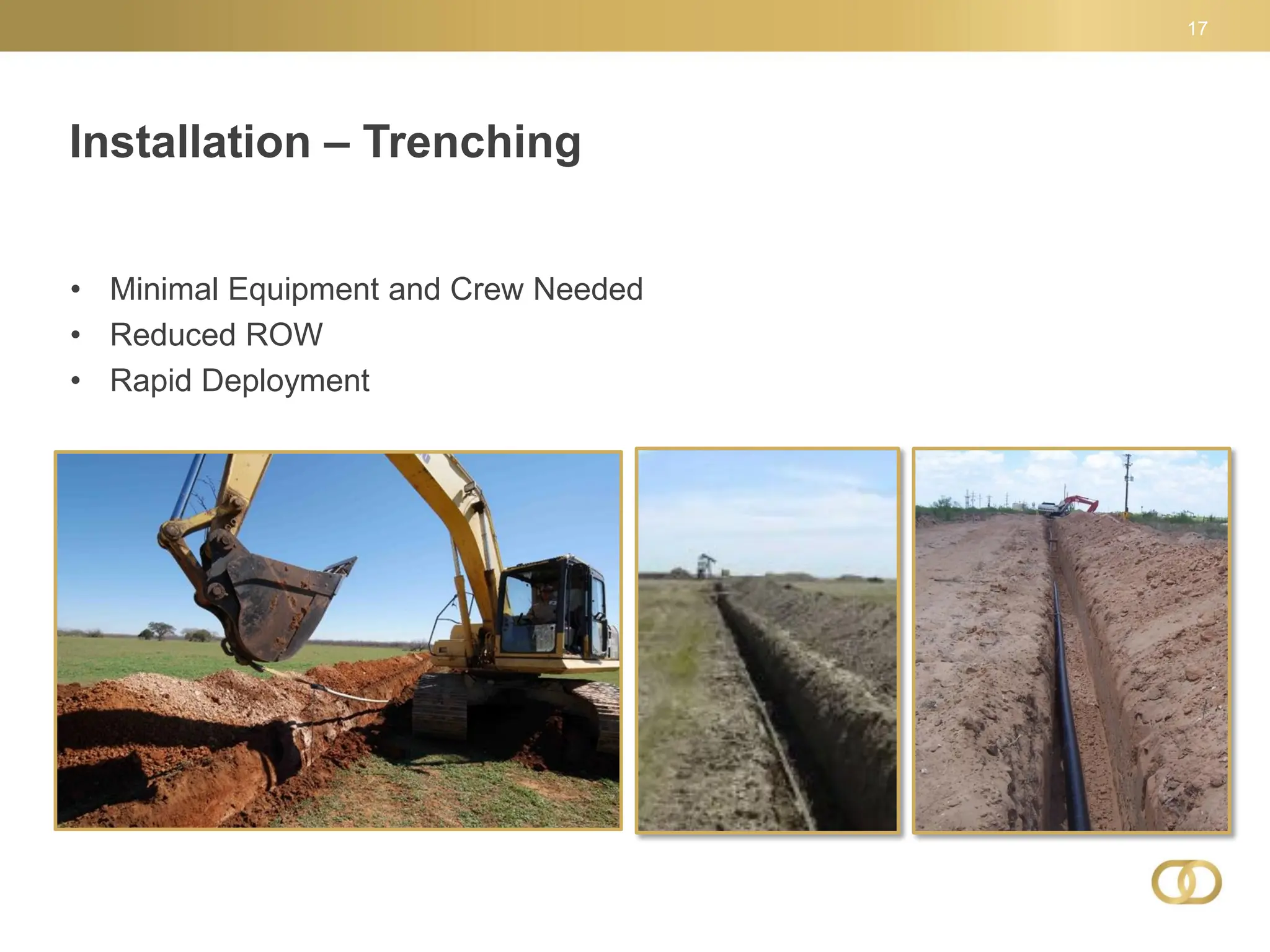
Installation – Trenching
17
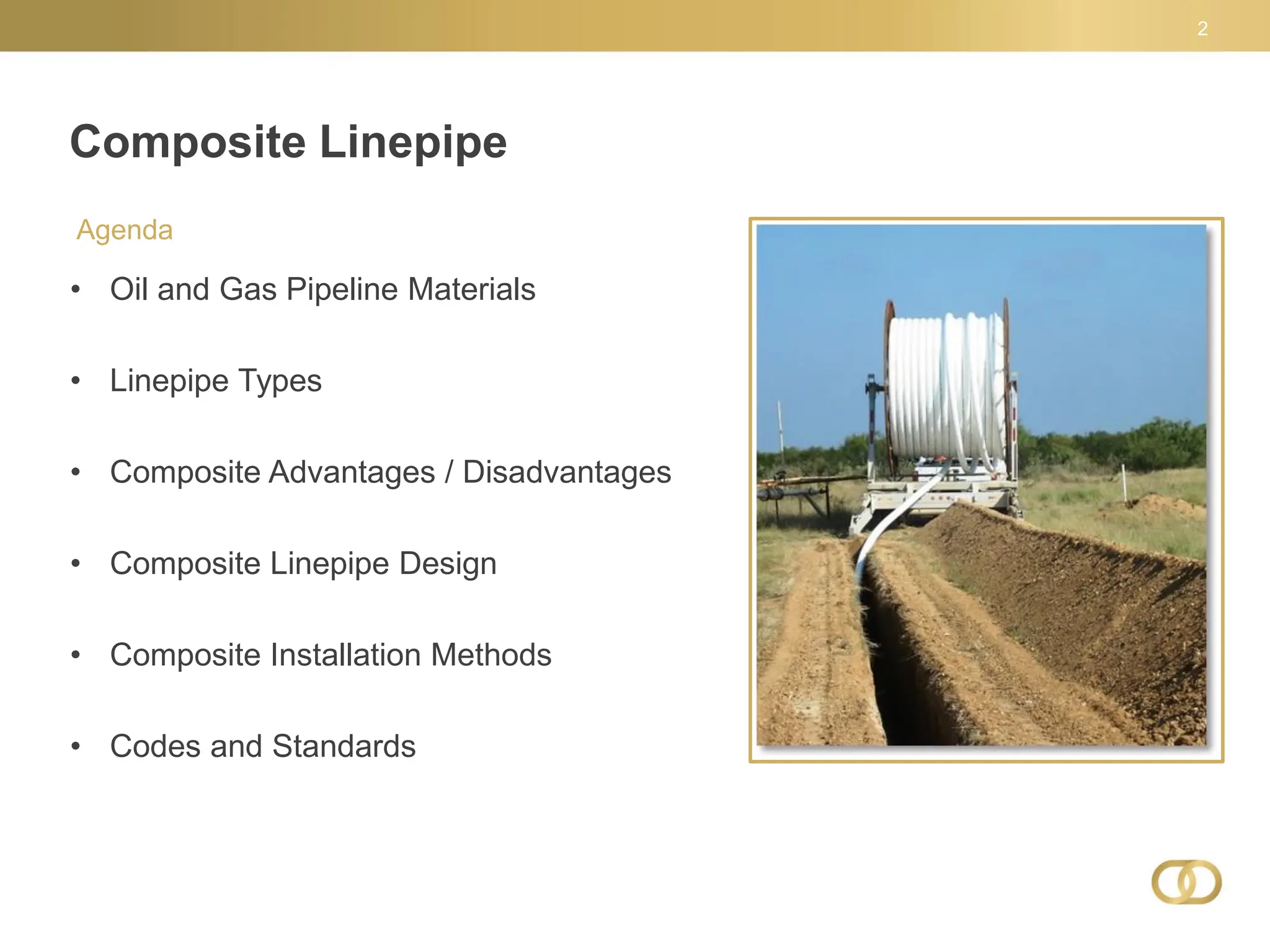
• Minimal Equipment and Crew Needed
• Reduced ROW
• Rapid Deployment
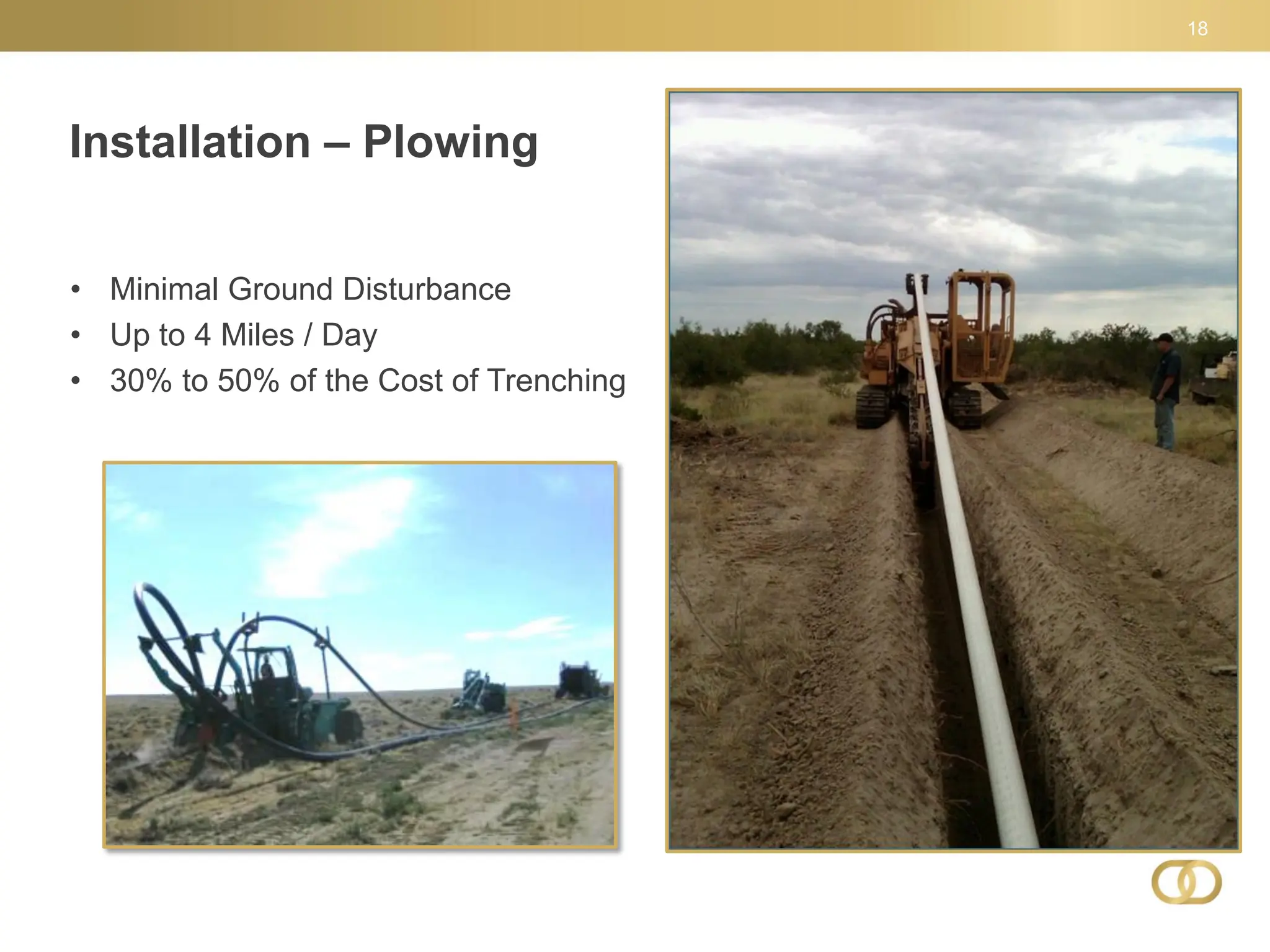
Installation – Plowing
18
• Minimal Ground Disturbance
• Up to 4 Miles / Day
• 30% to 50% of the Cost of Trenching
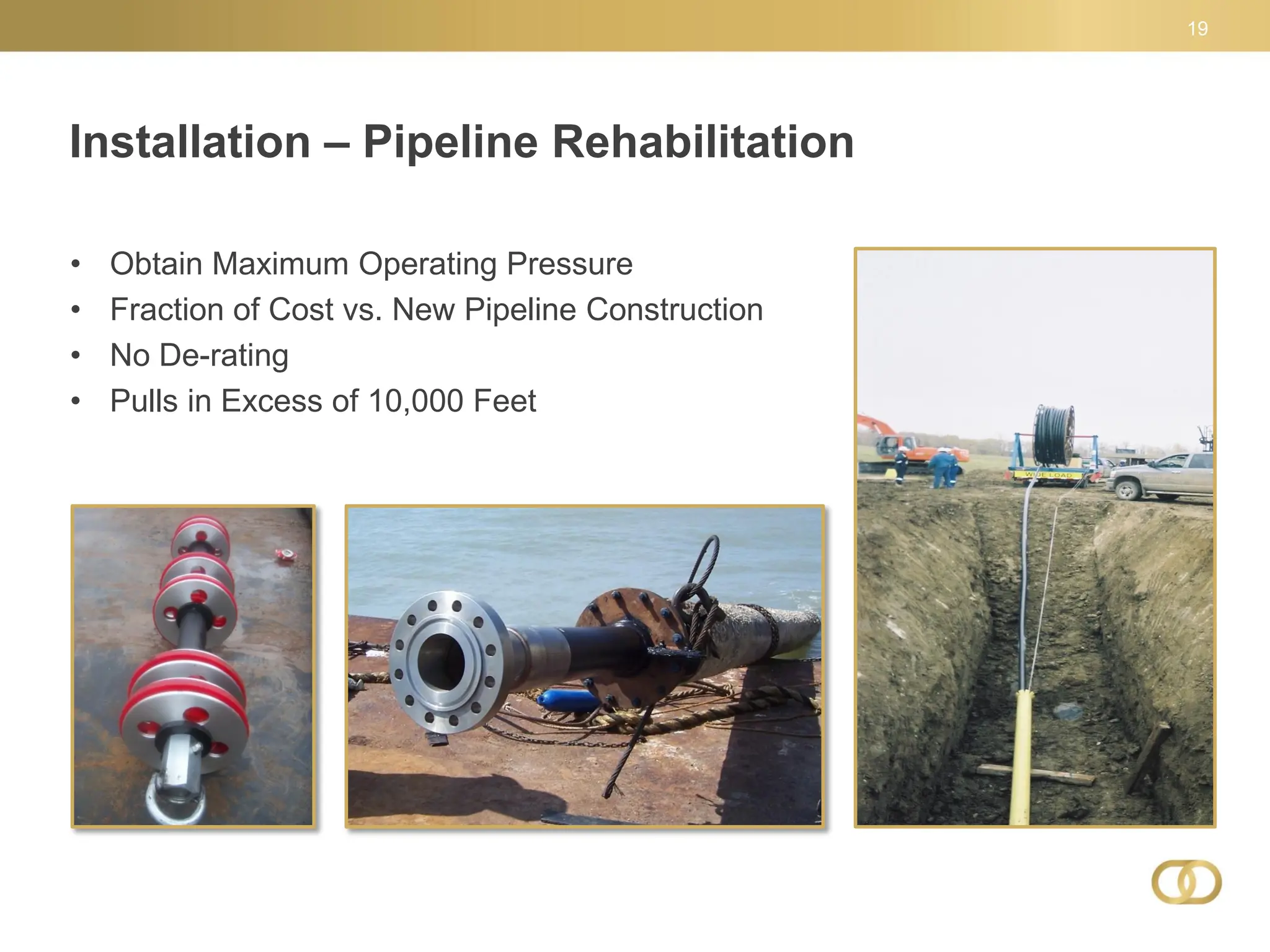
Installation – Pipeline Rehabilitation
19
• Obtain Maximum Operating Pressure
• Fraction of Cost vs. New Pipeline Construction
• No De-rating
• Pulls in Excess of 10,000 Feet
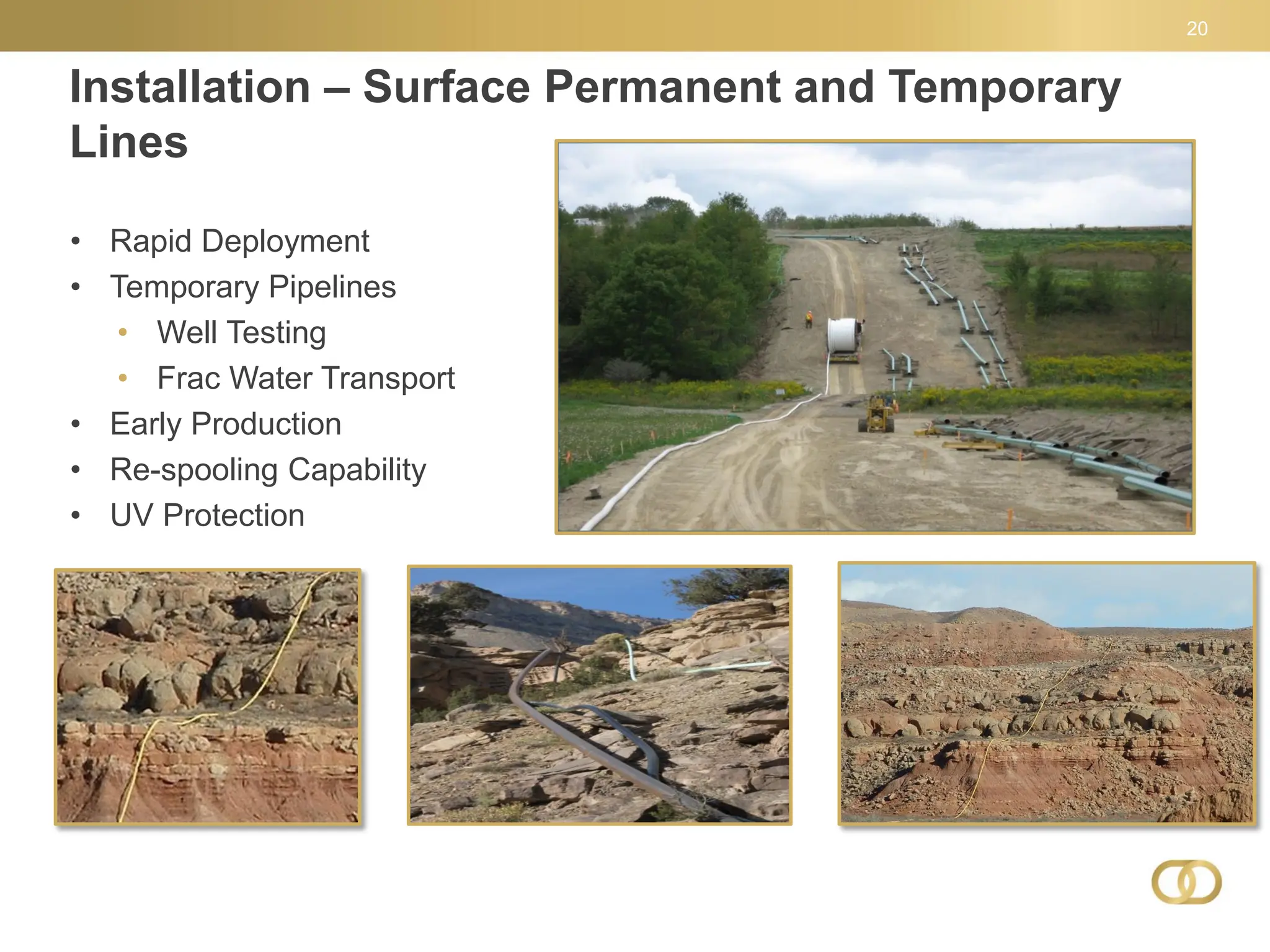
Installation – Surface Permanent and Temporary
Lines
20
• Rapid Deployment
• Temporary Pipelines
• Well Testing
• Frac Water Transport
• Early Production
• Re-spooling Capability
• UV Protection
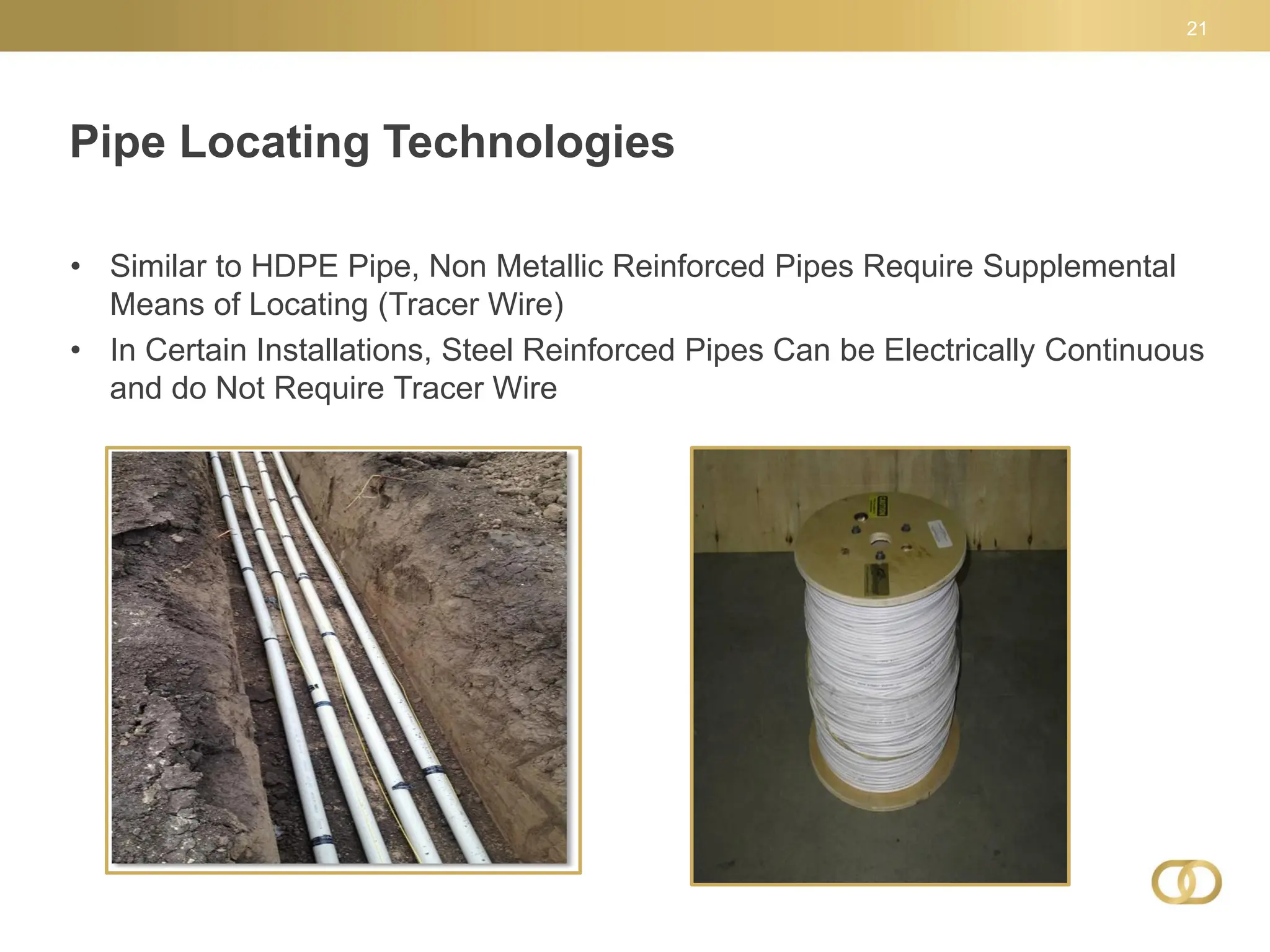
Pipe Locating Technologies
21
• Similar to HDPE Pipe, Non Metallic Reinforced Pipes Require Supplemental
Means of Locating (Tracer Wire)
• In Certain Installations, Steel Reinforced Pipes Can be Electrically Continuous
and do Not Require Tracer Wire
Applicable Codes and Standards
22
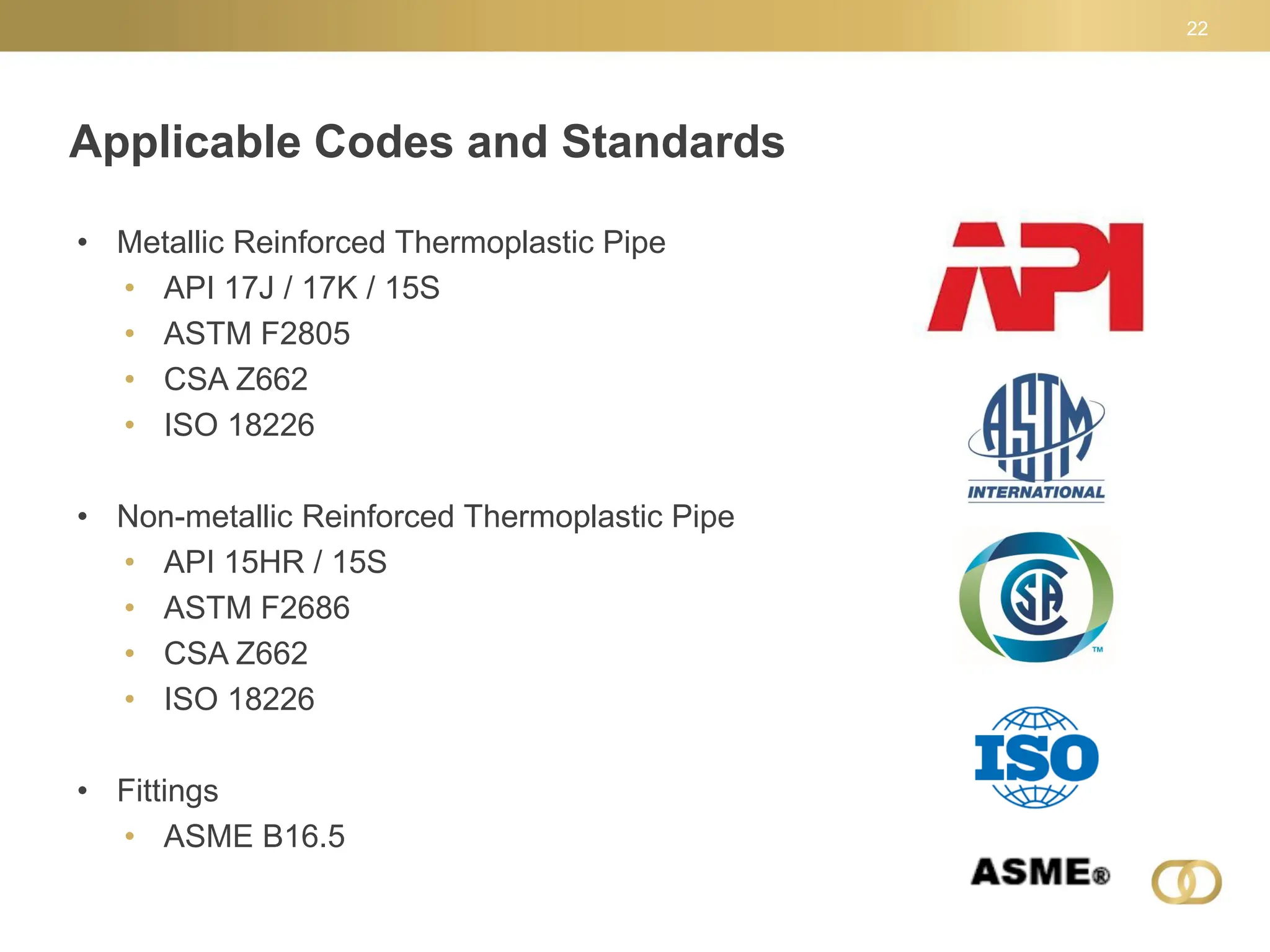
• Metallic Reinforced Thermoplastic Pipe
• API 17J / 17K / 15S
• ASTM F2805
• CSA Z662
• ISO 18226
• Non-metallic Reinforced Thermoplastic Pipe
• API 15HR / 15S
• ASTM F2686
• CSA Z662
• ISO 18226
• Fittings
• ASME B16.5
Qualification Testing
23
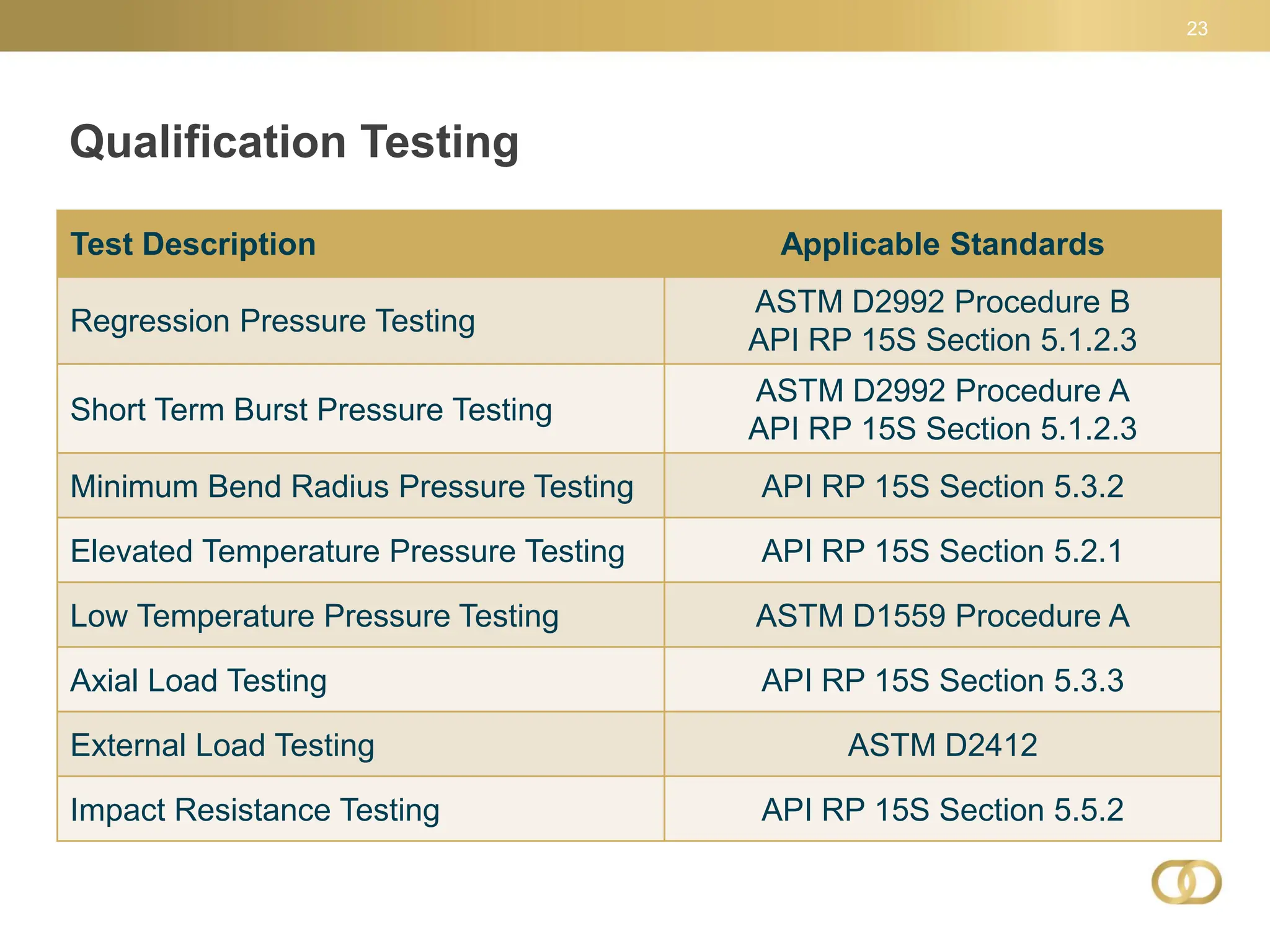
Test Description Applicable Standards
Regression Pressure Testing
ASTM D2992 Procedure B
API RP 15S Section 5.1.2.3
Short Term Burst Pressure Testing
ASTM D2992 Procedure A
API RP 15S Section 5.1.2.3
Minimum Bend Radius Pressure Testing API RP 15S Section 5.3.2
Elevated Temperature Pressure Testing API RP 15S Section 5.2.1
Low Temperature Pressure Testing ASTM D1559 Procedure A
Axial Load Testing API RP 15S Section 5.3.3
External Load Testing ASTM D2412
Impact Resistance Testing API RP 15S Section 5.5.2
Qualification Testing
24
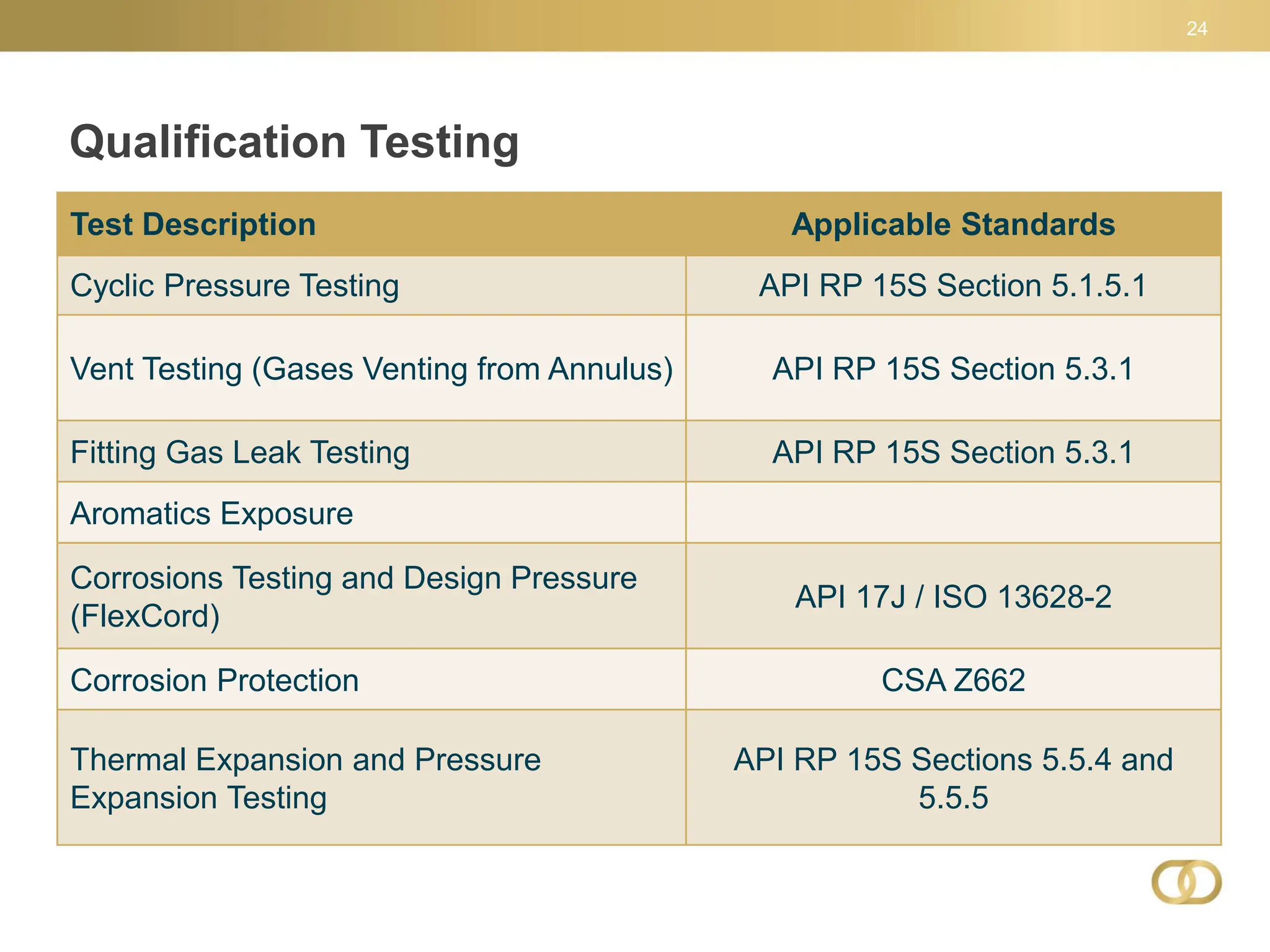
Test Description Applicable Standards
Cyclic Pressure Testing API RP 15S Section 5.1.5.1
Vent Testing (Gases Venting from Annulus) API RP 15S Section 5.3.1
Fitting Gas Leak Testing API RP 15S Section 5.3.1
Aromatics Exposure
Corrosions Testing and Design Pressure
(FlexCord)
API 17J / ISO 13628-2
Corrosion Protection CSA Z662
Thermal Expansion and Pressure
Expansion Testing
API RP 15S Sections 5.5.4 and
5.5.5
Spoolable Pipe in Jurisdictional Systems
25
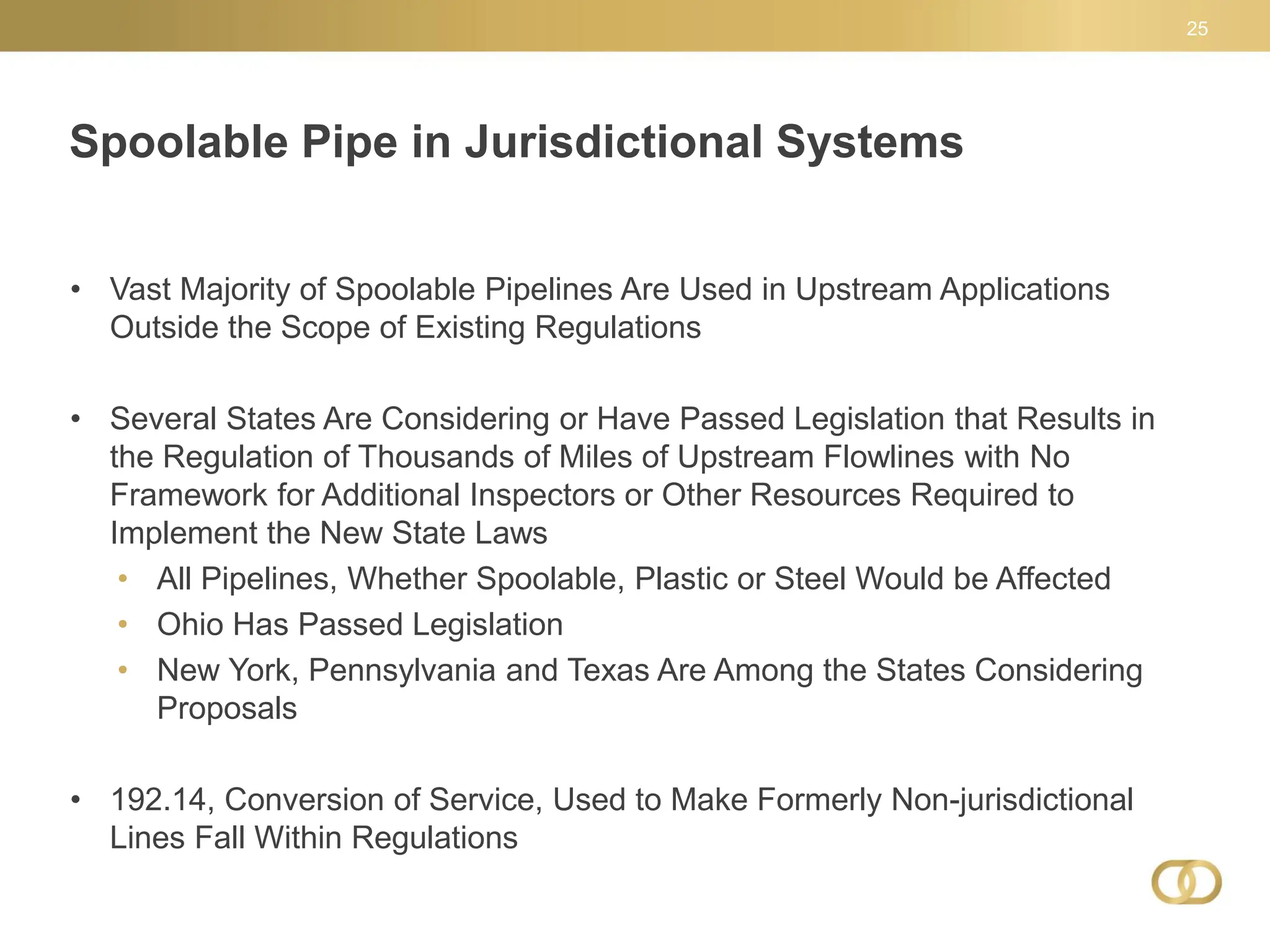
• Vast Majority of Spoolable Pipelines Are Used in Upstream Applications
Outside the Scope of Existing Regulations
• Several States Are Considering or Have Passed Legislation that Results in
the Regulation of Thousands of Miles of Upstream Flowlines with No
Framework for Additional Inspectors or Other Resources Required to
Implement the New State Laws
• All Pipelines, Whether Spoolable, Plastic or Steel Would be Affected
• Ohio Has Passed Legislation
• New York, Pennsylvania and Texas Are Among the States Considering
Proposals
• 192.14, Conversion of Service, Used to Make Formerly Non-jurisdictional
Lines Fall Within Regulations
Spoolable Pipe in Jurisdictional Systems
26
• All Spoolable Composite Pipelines in Regulated Service (D.O.T.) Currently
Require a Special Permit
• Special Permit Advantages
• Enables PHMSA / State Agencies to Monitor New Technologies Over Time
• Special Permit Disadvantages
• 90 - 180+ Days Approval Cycle is Typical and Most Oil and Gas Producers
Cannot Accommodate the Delay – Catch 22
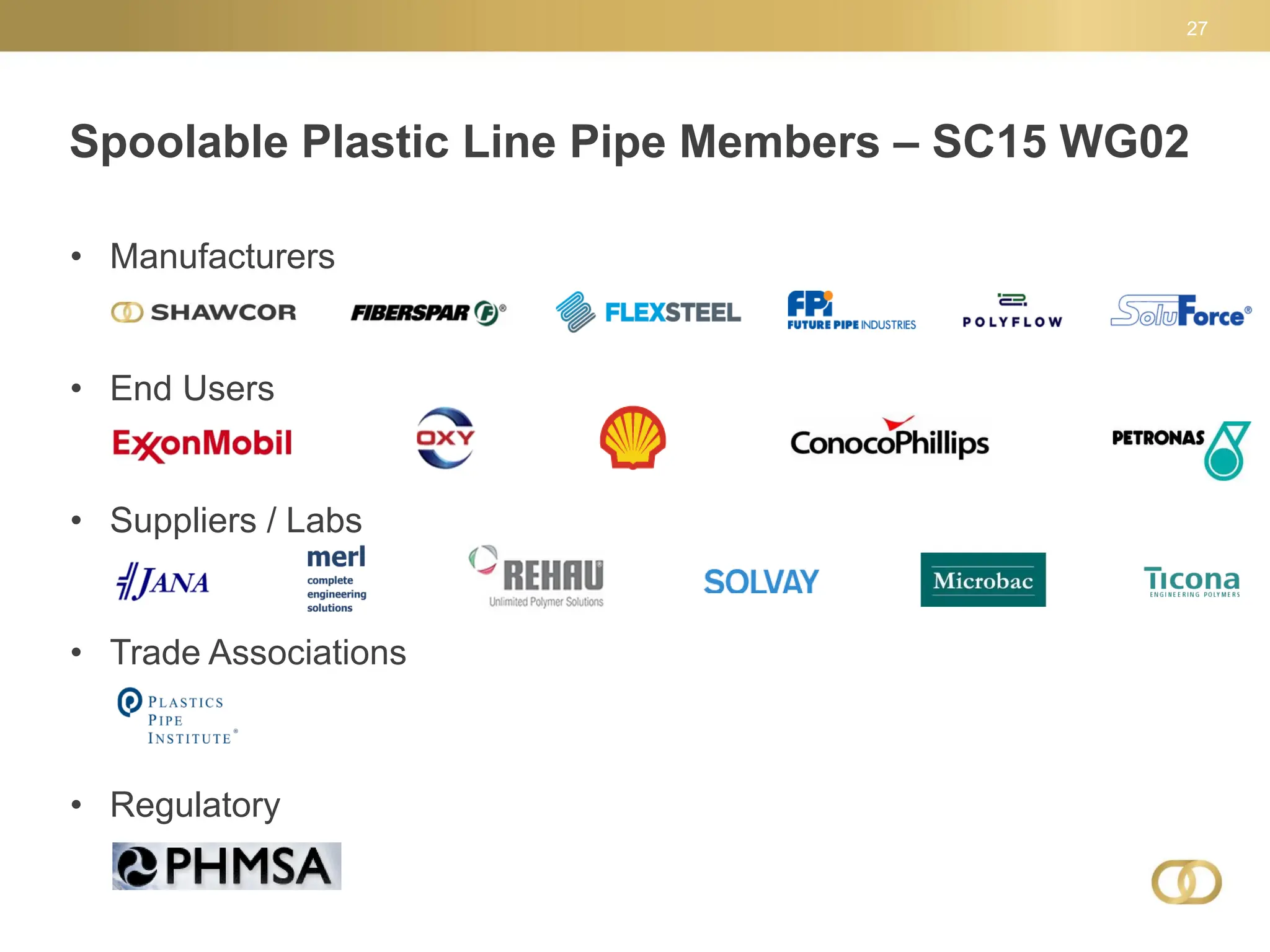
Spoolable Plastic Line Pipe Members – SC15 WG02
27
• Manufacturers
• End Users
• Suppliers / Labs
• Trade Associations
• Regulatory
Questions?

1111 - Composite Line pipe Technology.pdf

  • 1.
    Composite Linepipe Technology September 25,2015 CRUG – 5th Annual Conference & Exhibition
  • 2.
    Composite Linepipe 2 Agenda • Oiland Gas Pipeline Materials • Linepipe Types • Composite Advantages / Disadvantages • Composite Linepipe Design • Composite Installation Methods • Codes and Standards
  • 3.
    Crude Oil andGas Pipeline Materials 3 • Steel Pipe • Coated Steel Pipe (Fusion Bonded Epoxy [FBE]) • Uncoated Steel Pipe (Bare Pipe) • Cathodically Protected Steel Pipe • Unprotected Steel Pipe (Not Cathodically Protected) • Cast Iron Pipe • Fiberglass Pipe • Polyethylene Pipe • Composite Pipe • Nylon Pipe
  • 4.
    Composites and Plasticsin Pipelines and Piping 4 Linepipe Types • Polyethylene Pipe (PE) • Fiberglass Reinforced Thermoset Pipe (GRE) • Spoolable Composite Reinforced Thermoplastic Pipe (RTP) • Glass Fiber Reinforced Plastic Pipe • Carbon Fiber Reinforced Plastic Pipe • Aramid Fiber Reinforced Plastic Pipe • Fabric or Tape Reinforced Plastic Pipe • Steel Reinforced Plastic Pipe
  • 5.
    Manufacturers of SpoolableComposite Pipe for Oil and Gas, Liquids and Water Pipelines 5 • Shawcor (Canada) • Fiberspar (Houston) • FlexSteel (Houston) • Future Pipe (Houston) • PolyFlow (PA, Midland) • SoluForce (AR, Netherlands) • Anticorrosion Protective Services (Dubai) • Nupi (Houston)
  • 6.
    Spoolable Composite ThermoplasticPiping 6 • Combination of the Best of PE and GFR Thermoset Piping • Thermoplastic Materials • Polyethylene (PE) • Crosslinked Polyethylene (PEX) • Reinforcements • Glass Fibers (GF) • Carbon Fibers (CF) • Aramid Fibers (AF) • Tapes (With or Without Fiber Reinforcements)
  • 7.
    Spoolable Pipe Structures– Fiber Reinforced 7 All Images Sourced from the Respective Manufacturer
  • 8.
    Spoolable Pipe Structures– Metallic Reinforcement 8
  • 9.
    Common Sizes andOperating Pressures 9 • Diameters From 1 ¼” to 8” • Pressures From 300 psi to 3,500 psi • Estimate composites have 15% global market share in this diameter and pressure range.
  • 10.
  • 11.
    Qualified and TestedInstallation Procedures 11 • Welding Procedures for the Manufacture of Fittings per ASME IX • Welder Qualifications • Crimping / Swaging / Joining Procedures
  • 12.
    Pipeline Connection Systems 12 Crimp,Swage, Mechanical, Fusion
  • 13.
    13 • Flow Linesor Gathering Lines for Transfer of • Crude Oil • Gas • Water • Condensate • Emulsion • Sour Applications (H2S) • Gases of Liquids Containing CO2 • EOR Injection Line • Source Water and Disposal Lines for SAGD • Fuel Gas Lines or Gas Lift Lines • Rehabilitation of Failed Pipeline Through Liner Pulls • Well Test Temporary Surface Line (Re-spool and Re-use) • Waste Water Disposal Line Applications Note: Each manufacturer’s design does not fit all applications.
  • 14.
    Spoolable Composite ReinforcedThermoplastic Piping 14 • Advantages • Cost Effective – Less Expensive to Install vs. Steel (up to 40%) • No Welding, X-ray Inspection, Jeeping • Corrosion Resistance • Higher Pressure Capacity (>1,500 psi) than non-reinforced • Pipe Can Be Made in Long Lengths (Spoolable) • Fewer Connections Required • Pipe Can be Easily Installed – Multiple Methods • Mechanical End Connections - Joints
  • 15.
    Spoolable Composite ReinforcedThermoplastic Piping 15 • Advantages, continued • Annular Space Between Thermoplastic Layers Can be Vented to Prevent Gas or Liquid Buildup Due to Permeation • Piping Doesn’t Require Cathodic Protection • Can Handle Higher Service Temperatures Using PEX • Low Friction Rates – Higher Flow Rates • Quick to Install • Smaller ROW • Minimal Equipment Required
  • 16.
    Spoolable Composite ReinforcedThermoplastic Piping 16 • Disadvantages • “New” Technology – Lack of History Collected by Regulatory Agencies • Only Available in Smaller Diameters (1 1/4” to 8”) • Permeability • Proprietary Designs • Failure Mechanisms Not Fully Established • Connections Are Weak Link in Some Systems • Thermoset Layer Can Be Susceptible to Acidic and Caustic Chemicals
  • 17.
    Installation – Trenching 17 •Minimal Equipment and Crew Needed • Reduced ROW • Rapid Deployment
  • 18.
    Installation – Plowing 18 •Minimal Ground Disturbance • Up to 4 Miles / Day • 30% to 50% of the Cost of Trenching
  • 19.
    Installation – PipelineRehabilitation 19 • Obtain Maximum Operating Pressure • Fraction of Cost vs. New Pipeline Construction • No De-rating • Pulls in Excess of 10,000 Feet
  • 20.
    Installation – SurfacePermanent and Temporary Lines 20 • Rapid Deployment • Temporary Pipelines • Well Testing • Frac Water Transport • Early Production • Re-spooling Capability • UV Protection
  • 21.
    Pipe Locating Technologies 21 •Similar to HDPE Pipe, Non Metallic Reinforced Pipes Require Supplemental Means of Locating (Tracer Wire) • In Certain Installations, Steel Reinforced Pipes Can be Electrically Continuous and do Not Require Tracer Wire
  • 22.
    Applicable Codes andStandards 22 • Metallic Reinforced Thermoplastic Pipe • API 17J / 17K / 15S • ASTM F2805 • CSA Z662 • ISO 18226 • Non-metallic Reinforced Thermoplastic Pipe • API 15HR / 15S • ASTM F2686 • CSA Z662 • ISO 18226 • Fittings • ASME B16.5
  • 23.
    Qualification Testing 23 Test DescriptionApplicable Standards Regression Pressure Testing ASTM D2992 Procedure B API RP 15S Section 5.1.2.3 Short Term Burst Pressure Testing ASTM D2992 Procedure A API RP 15S Section 5.1.2.3 Minimum Bend Radius Pressure Testing API RP 15S Section 5.3.2 Elevated Temperature Pressure Testing API RP 15S Section 5.2.1 Low Temperature Pressure Testing ASTM D1559 Procedure A Axial Load Testing API RP 15S Section 5.3.3 External Load Testing ASTM D2412 Impact Resistance Testing API RP 15S Section 5.5.2
  • 24.
    Qualification Testing 24 Test DescriptionApplicable Standards Cyclic Pressure Testing API RP 15S Section 5.1.5.1 Vent Testing (Gases Venting from Annulus) API RP 15S Section 5.3.1 Fitting Gas Leak Testing API RP 15S Section 5.3.1 Aromatics Exposure Corrosions Testing and Design Pressure (FlexCord) API 17J / ISO 13628-2 Corrosion Protection CSA Z662 Thermal Expansion and Pressure Expansion Testing API RP 15S Sections 5.5.4 and 5.5.5
  • 25.
    Spoolable Pipe inJurisdictional Systems 25 • Vast Majority of Spoolable Pipelines Are Used in Upstream Applications Outside the Scope of Existing Regulations • Several States Are Considering or Have Passed Legislation that Results in the Regulation of Thousands of Miles of Upstream Flowlines with No Framework for Additional Inspectors or Other Resources Required to Implement the New State Laws • All Pipelines, Whether Spoolable, Plastic or Steel Would be Affected • Ohio Has Passed Legislation • New York, Pennsylvania and Texas Are Among the States Considering Proposals • 192.14, Conversion of Service, Used to Make Formerly Non-jurisdictional Lines Fall Within Regulations
  • 26.
    Spoolable Pipe inJurisdictional Systems 26 • All Spoolable Composite Pipelines in Regulated Service (D.O.T.) Currently Require a Special Permit • Special Permit Advantages • Enables PHMSA / State Agencies to Monitor New Technologies Over Time • Special Permit Disadvantages • 90 - 180+ Days Approval Cycle is Typical and Most Oil and Gas Producers Cannot Accommodate the Delay – Catch 22
  • 27.
    Spoolable Plastic LinePipe Members – SC15 WG02 27 • Manufacturers • End Users • Suppliers / Labs • Trade Associations • Regulatory
  • 28.