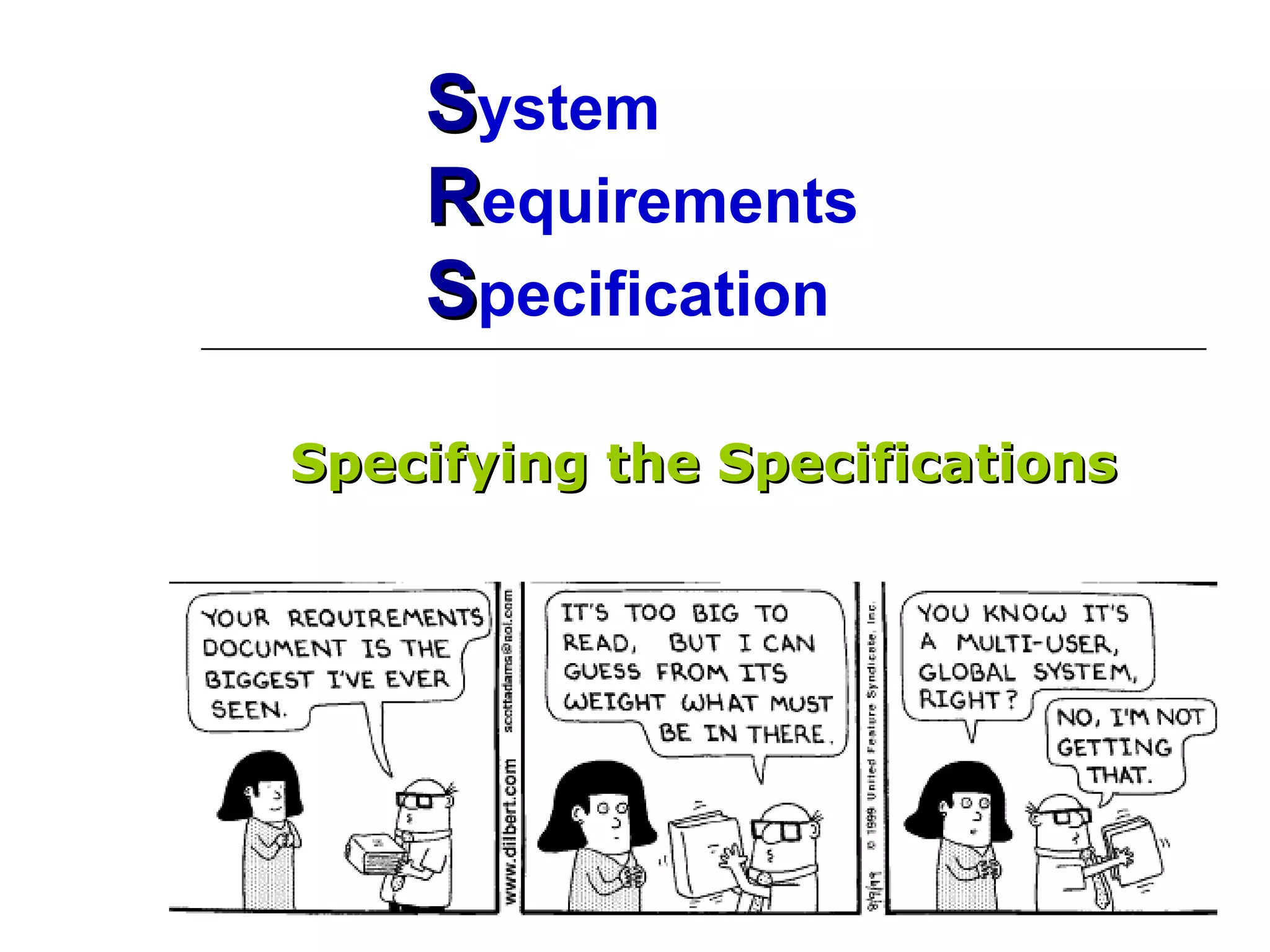
SSystem
RRequirements
SSpecification
Specifying the SpecificationsSpecifying the Specifications
Review from last classReview from last class
Requirements Engineering Tasks
1. Inception
2. Elicitation
3. Elaboration - next brief topic
4. Negotiation
5. Specification - main topic tonight
6. Validation
7. Management
ModelingModeling
 What are the benefits of building a
model?
 So, what needs to be modeled?
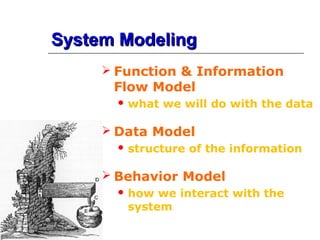
System ModelingSystem Modeling
 Function & Information
Flow Model
 what we will do with the data
 Data Model
 structure of the information
 Behavior Model
 how we interact with the
system
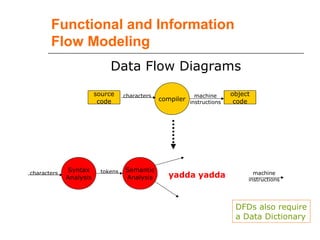
Functional and Information
Flow Modeling
Data Flow Diagrams
compiler
source
code
object
code
characters
machine
instructions
Syntax
Analysis
characters
Semantic
Analysis
tokens
yadda yadda machine
instructions
DFDs also require
a Data Dictionary
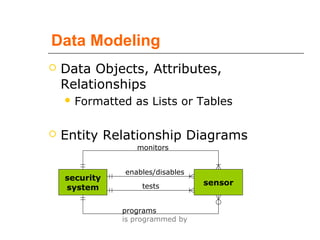
Data Modeling
 Data Objects, Attributes,
Relationships
 Formatted as Lists or Tables
 Entity Relationship Diagrams
security
system
sensor
monitors
enables/disables
tests
programs
is programmed by
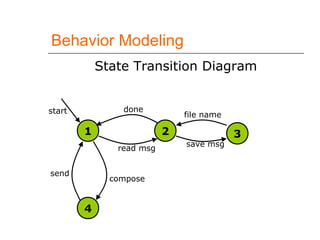
Behavior Modeling
State Transition Diagram
1 32
4
start
read msg
save msg
file name
done
compose
send
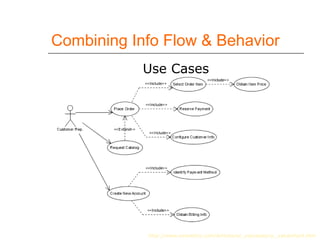
Combining Info Flow & Behavior
Use Cases
http://www.evanetics.com/Articles/ar_usecases/uc_valueofucd.htm
Requirements Engineering Tasks
1. Inception
2. Elicitation
3. Elaboration
4. Negotiation
5. Specification
6. Validation
7. Management
Technically Speaking,
"requirement" ≠ "specification"
 Requirement – understanding
between customer and supplier
 Specification – what the software
must do
 Requirements that are not in the SRS
 Costs
 Delivery dates
 Acceptance procedures
 etc
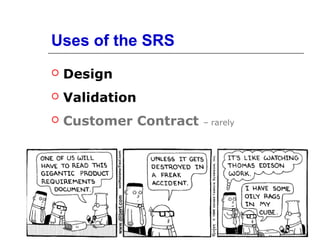
Uses of the SRS
 Design
 Validation
 Customer Contract – rarely
IEEE 830
Role of SRS
1. “The SRS must correctly define all
of the software requirements, but
no more.”
2. “The SRS should not describe
design, verification, or project
management details, except for
required design constraints.”
IEEE 830
Characteristics of a Good SRS
1. Unambiguous
2. Complete
3. Verifiable
4. Consistent
5. Modifiable
6. Traceable
7. Usable during the Operation and
Maintenance Phase
Desired SRS CharacteristicsDesired SRS Characteristics
 Complete
 Consistent
 Changeable
 Traceable
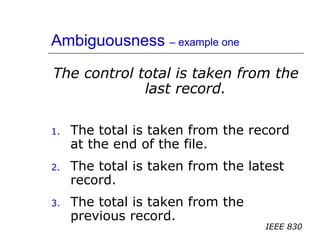
Ambiguousness – example one
The control total is taken from the
last record.
1. The total is taken from the record
at the end of the file.
2. The total is taken from the latest
record.
3. The total is taken from the
previous record.
IEEE 830
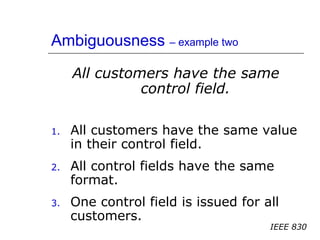
Ambiguousness – example two
All customers have the same
control field.
1. All customers have the same value
in their control field.
2. All control fields have the same
format.
3. One control field is issued for all
customers.
IEEE 830
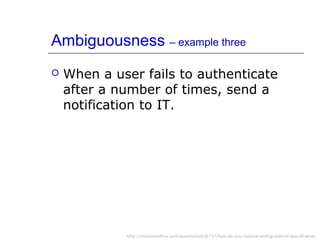
Ambiguousness – example three
 When a user fails to authenticate
after a number of times, send a
notification to IT.
http://stackoverflow.com/questions/626737/how-do-you-resolve-ambiguities-in-specification
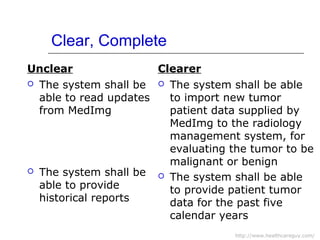
Clear, Complete
Unclear
 The system shall be
able to read updates
from MedImg
 The system shall be
able to provide
historical reports
Clearer
 The system shall be able
to import new tumor
patient data supplied by
MedImg to the radiology
management system, for
evaluating the tumor to be
malignant or benign
 The system shall be able
to provide patient tumor
data for the past five
calendar years
http://www.healthcareguy.com/
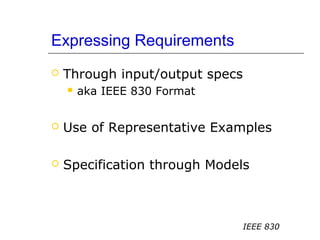
Expressing Requirements
 Through input/output specs
 aka IEEE 830 Format
 Use of Representative Examples
 Specification through Models
IEEE 830
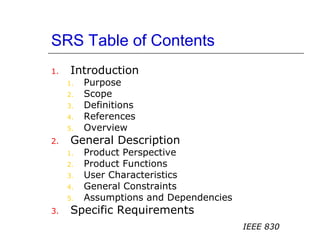
SRS Table of Contents
1. Introduction
1. Purpose
2. Scope
3. Definitions
4. References
5. Overview
2. General Description
1. Product Perspective
2. Product Functions
3. User Characteristics
4. General Constraints
5. Assumptions and Dependencies
3. Specific Requirements
IEEE 830
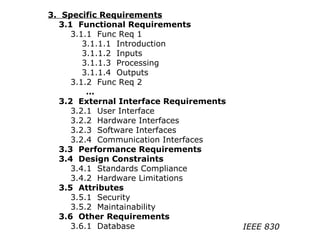
3. Specific Requirements
3.1 Functional Requirements
3.1.1 Func Req 1
3.1.1.1 Introduction
3.1.1.2 Inputs
3.1.1.3 Processing
3.1.1.4 Outputs
3.1.2 Func Req 2
…
3.2 External Interface Requirements
3.2.1 User Interface
3.2.2 Hardware Interfaces
3.2.3 Software Interfaces
3.2.4 Communication Interfaces
3.3 Performance Requirements
3.4 Design Constraints
3.4.1 Standards Compliance
3.4.2 Hardware Limitations
3.5 Attributes
3.5.1 Security
3.5.2 Maintainability
3.6 Other Requirements
3.6.1 Database IEEE 830
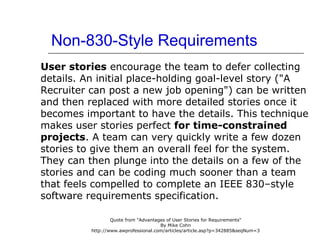
Non-830-Style Requirements
User stories encourage the team to defer collecting
details. An initial place-holding goal-level story ("A
Recruiter can post a new job opening") can be written
and then replaced with more detailed stories once it
becomes important to have the details. This technique
makes user stories perfect for time-constrained
projects. A team can very quickly write a few dozen
stories to give them an overall feel for the system.
They can then plunge into the details on a few of the
stories and can be coding much sooner than a team
that feels compelled to complete an IEEE 830–style
software requirements specification.
Quote from "Advantages of User Stories for Requirements"
By Mike Cohn
http://www.awprofessional.com/articles/article.asp?p=342885&seqNum=3
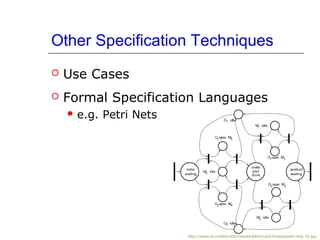
Other Specification Techniques
 Use Cases
 Formal Specification Languages
 e.g. Petri Nets
http://www.cs.indiana.edu/classes/p465/Lect/Images/petri-img-10.jpg
Next ClassesNext Classes
 Agile Development
 Risk Analysis and Management
 Metrics
 Managing the Testing Process

11 req specs

  • 1.
  • 2.
    Review from lastclassReview from last class Requirements Engineering Tasks 1. Inception 2. Elicitation 3. Elaboration - next brief topic 4. Negotiation 5. Specification - main topic tonight 6. Validation 7. Management
  • 3.
    ModelingModeling  What arethe benefits of building a model?  So, what needs to be modeled?
  • 4.
    System ModelingSystem Modeling Function & Information Flow Model  what we will do with the data  Data Model  structure of the information  Behavior Model  how we interact with the system
  • 5.
    Functional and Information FlowModeling Data Flow Diagrams compiler source code object code characters machine instructions Syntax Analysis characters Semantic Analysis tokens yadda yadda machine instructions DFDs also require a Data Dictionary
  • 6.
    Data Modeling  DataObjects, Attributes, Relationships  Formatted as Lists or Tables  Entity Relationship Diagrams security system sensor monitors enables/disables tests programs is programmed by
  • 7.
    Behavior Modeling State TransitionDiagram 1 32 4 start read msg save msg file name done compose send
  • 8.
    Combining Info Flow& Behavior Use Cases http://www.evanetics.com/Articles/ar_usecases/uc_valueofucd.htm
  • 9.
    Requirements Engineering Tasks 1.Inception 2. Elicitation 3. Elaboration 4. Negotiation 5. Specification 6. Validation 7. Management
  • 10.
    Technically Speaking, "requirement" ≠"specification"  Requirement – understanding between customer and supplier  Specification – what the software must do  Requirements that are not in the SRS  Costs  Delivery dates  Acceptance procedures  etc
  • 11.
    Uses of theSRS  Design  Validation  Customer Contract – rarely
  • 12.
    IEEE 830 Role ofSRS 1. “The SRS must correctly define all of the software requirements, but no more.” 2. “The SRS should not describe design, verification, or project management details, except for required design constraints.”
  • 13.
    IEEE 830 Characteristics ofa Good SRS 1. Unambiguous 2. Complete 3. Verifiable 4. Consistent 5. Modifiable 6. Traceable 7. Usable during the Operation and Maintenance Phase
  • 14.
    Desired SRS CharacteristicsDesiredSRS Characteristics  Complete  Consistent  Changeable  Traceable
  • 15.
    Ambiguousness – exampleone The control total is taken from the last record. 1. The total is taken from the record at the end of the file. 2. The total is taken from the latest record. 3. The total is taken from the previous record. IEEE 830
  • 16.
    Ambiguousness – exampletwo All customers have the same control field. 1. All customers have the same value in their control field. 2. All control fields have the same format. 3. One control field is issued for all customers. IEEE 830
  • 17.
    Ambiguousness – examplethree  When a user fails to authenticate after a number of times, send a notification to IT. http://stackoverflow.com/questions/626737/how-do-you-resolve-ambiguities-in-specification
  • 18.
    Clear, Complete Unclear  Thesystem shall be able to read updates from MedImg  The system shall be able to provide historical reports Clearer  The system shall be able to import new tumor patient data supplied by MedImg to the radiology management system, for evaluating the tumor to be malignant or benign  The system shall be able to provide patient tumor data for the past five calendar years http://www.healthcareguy.com/
  • 19.
    Expressing Requirements  Throughinput/output specs  aka IEEE 830 Format  Use of Representative Examples  Specification through Models IEEE 830
  • 20.
    SRS Table ofContents 1. Introduction 1. Purpose 2. Scope 3. Definitions 4. References 5. Overview 2. General Description 1. Product Perspective 2. Product Functions 3. User Characteristics 4. General Constraints 5. Assumptions and Dependencies 3. Specific Requirements IEEE 830
  • 21.
    3. Specific Requirements 3.1Functional Requirements 3.1.1 Func Req 1 3.1.1.1 Introduction 3.1.1.2 Inputs 3.1.1.3 Processing 3.1.1.4 Outputs 3.1.2 Func Req 2 … 3.2 External Interface Requirements 3.2.1 User Interface 3.2.2 Hardware Interfaces 3.2.3 Software Interfaces 3.2.4 Communication Interfaces 3.3 Performance Requirements 3.4 Design Constraints 3.4.1 Standards Compliance 3.4.2 Hardware Limitations 3.5 Attributes 3.5.1 Security 3.5.2 Maintainability 3.6 Other Requirements 3.6.1 Database IEEE 830
  • 22.
    Non-830-Style Requirements User storiesencourage the team to defer collecting details. An initial place-holding goal-level story ("A Recruiter can post a new job opening") can be written and then replaced with more detailed stories once it becomes important to have the details. This technique makes user stories perfect for time-constrained projects. A team can very quickly write a few dozen stories to give them an overall feel for the system. They can then plunge into the details on a few of the stories and can be coding much sooner than a team that feels compelled to complete an IEEE 830–style software requirements specification. Quote from "Advantages of User Stories for Requirements" By Mike Cohn http://www.awprofessional.com/articles/article.asp?p=342885&seqNum=3
  • 23.
    Other Specification Techniques Use Cases  Formal Specification Languages  e.g. Petri Nets http://www.cs.indiana.edu/classes/p465/Lect/Images/petri-img-10.jpg
  • 24.
    Next ClassesNext Classes Agile Development  Risk Analysis and Management  Metrics  Managing the Testing Process