Table of Contents
1. Introduction to preference assessments
2. Single stimulus and paired-stimulus preference assessments
3. Paired-stimulus data collection
4. Calculating and interpreting the results of a paired-stimulus
preference assessment
5. Multiple-stimulus without replacement preference assessment
6. Multiple-stimulus without replacement data collection
7. Calculating and interpreting the results of a multiple stimulus
without replacement preference assessment
8. Free-operant preference assessment
9. Free-operant data collection
10. Calculating and interpreting the results of a free-operant
preference assessment
11. Decision making tree
1
Table of Contents
11. Decision making tree
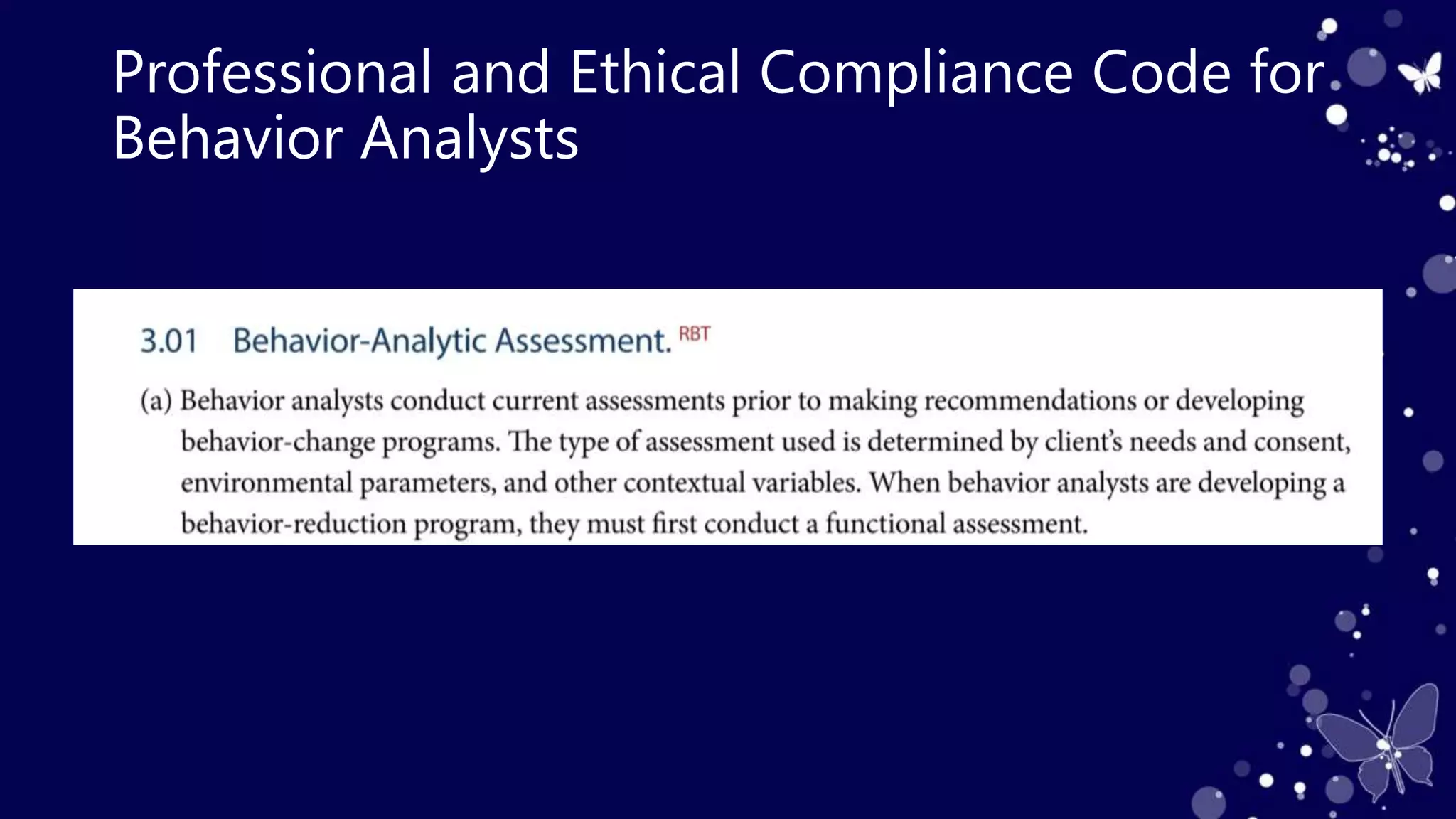
a) 3.01 Behavior-Analytic Assessment
b) Decision making tree
Professional and Ethical Compliance Code for
Behavior Analysts
Following the ethical compliance code
• Choosing the right assessment to conduct based on your
client’s needs is important in order to get more accurate
results.
• Scenario:
• Joel, the BCBA, wants his RBT to conduct a preference assessment. In order to
abide by the code, Joel takes his client’s needs into account to choose the right
preference assessment. To make his choice easier, he uses a decision making tree.
Now get ready to answer a few checkpoint
questions!

11. decision making tree

  • 1.
    Table of Contents 1.Introduction to preference assessments 2. Single stimulus and paired-stimulus preference assessments 3. Paired-stimulus data collection 4. Calculating and interpreting the results of a paired-stimulus preference assessment 5. Multiple-stimulus without replacement preference assessment 6. Multiple-stimulus without replacement data collection 7. Calculating and interpreting the results of a multiple stimulus without replacement preference assessment 8. Free-operant preference assessment 9. Free-operant data collection 10. Calculating and interpreting the results of a free-operant preference assessment 11. Decision making tree 1
  • 2.
    Table of Contents 11.Decision making tree a) 3.01 Behavior-Analytic Assessment b) Decision making tree
  • 3.
    Professional and EthicalCompliance Code for Behavior Analysts
  • 4.
    Following the ethicalcompliance code • Choosing the right assessment to conduct based on your client’s needs is important in order to get more accurate results. • Scenario: • Joel, the BCBA, wants his RBT to conduct a preference assessment. In order to abide by the code, Joel takes his client’s needs into account to choose the right preference assessment. To make his choice easier, he uses a decision making tree.
  • 5.
    Now get readyto answer a few checkpoint questions!