ECELS-Healthy Child Care PA; PA Chapter, American Academy of Pediatrics 11-07-2013 Page 1 of 9
Early Childhood Education Linkage System
PA Chapter, American Academy of Pediatrics
Rose Tree Corporate Center II, 1400 Providence
Road, Suite 3007
Media, PA 19063
Phone: 1-800-243-2357
E-Mail: ECELS@paaap.org
www.ecels-healthychildcarepa.org
November 2013
Dear Early Learning Practitioner,
Thank you for choosing the Self-Learning Module from ECELS called “Caring for
Children with Medical and Developmental Special Needs-Inclusive Practices.” This
module uses an online format including short video segments. Upon successful
completion of this module, we expect you to:
1. Identify strategies for healthful inclusion of children with special needs.
2. Review your program documents for opportunities to update these tools.
3. Offer correct responses to questions using information provided in the module.
You need a broad-band Internet connection (cable, DSL or FIOS) to view this module.
Sometimes, heavy traffic on the Internet or use of a slow-running computer interferes
with smooth viewing of the video segments. Pennsylvania early learning practitioners
who have difficulty with their Internet connection may click on "Available to Order" next
to the title of the module or "Request Self-Learning Module" in the left pane of the
ECELS website to request a copy of the module on disk. You need to use the
Document Packet and submit your responses to ECELS for review for credit whether
you use the module on line or on disk.
Please follow the Instructions for Completion of the Module on the next page. ECELS
staff members will review the work you send us and offer advice if you seem to need
help to complete the module successfully. If you have questions, please call or e-mail
the ECELS office. Submit your responses to the questions in the module:
 EITHER submit your responses using the link to an electronic response form at
https://www.surveymonkey.com/s/FN62K73
 OR fill out the Response Sheet and returning it by a scan attached to an e-mail,
by fax or by surface mail.
For each person seeking professional development credit for this module, follow the
instructions you will frind on the ECELS website Self-Learning Module page where it
says “Click Here to Order SLM Reviews.”
ECELS staff will enter the names of practitioners who successfully complete the module
into the database of the Pennsylvania Early Learning Keys to Professional
Development. Then ECELS will inform those whose names have been entered about
how to obtain a Certificate of Attendance form the PA Key website. Please print and
retain this certificate.
Susan S. Aronson, MD, FAAP Nancy Alleman, RN, BSN, CRNP, CSN
ECELS-Healthy Child Care PA; PA Chapter, American Academy of Pediatrics 11-07-2013 Page 2 of 9
Pediatric Advisor for ECELS Lead Training/Technical Assistance Coordinator
INSTRUCTIONS FOR COMPLETION OF THIS SELF- LEARNING MODULE
CONTENT OF THE DOWNLOADED DOCUMENT PACKET
The document packet is required to complete the module. You should have 12
documents to use while completing this module.
1. Registration Form – This form collects your identifying information and
tells you about the address and processing fee to submit this module for
credit in the database of the Pennsylvania Early Learning Keys to
Professional Development. This form is in this packet. For additional
copies of the Registration form, click here. You do not need to submit this
form if you are using the Survey Monkey electronic response link.
2. Response Worksheet for Credit – a form to record and submit your
responses to questions in the module if you choose to submit by e-mail,
fax or surface mail. This form is in this packet. You can use this form as
your worksheet, but do not need to submit the form if you are using the
Survey Monkey electronic response link.
3. Care Plan for a Child with a Special Need in Child Care
To best care for children with special health needs, information should be
shared by parents and the child’s primary health care provider (PCP) with
those who care for the child. This Care Plan communicates information to
early care and education practitioners to help them provide competent
care for an individual child. Early care and education practitioners should
make sure they understand the information and obtain any training
necessary. Not all children with special health needs will require the
completion of each section of the Care Plan. What is needed is
documentation of any special daily or emergency needs. For some
children, early care and education providers will need more information
than is collected in the brief responses on the Care Plan. This form is in
this packet. For additional copies of this care plan and an explanation for
each item on the form, click here.
4. Authorization for Release of Information – a form (from Appendix J-Model
Child Care Health Policies, 5th
edition available online. Click here for a
PDF of the whole set of policies and appendices or buy the hard copy
from the American Academy of Pediatrics at www.aap.org/bookstore. This
form is signed by the parents/guardian to define what information may be
shared and with whom it can be shared. This form is in this packet.
5. Emergency Information Form for Children with Special Needs – a form to
give to emergency medical personnel to inform them about the child for
proper care. Some children’s medical conditions are unusual or complex.
Parents and health care providers want the medical information to
accompany the child at all times in case a medical emergency occurs.
The form is for emergency service personnel and other health care
providers to quickly know about the child’s special needs. This form is in
this packet or http://www.healthychildcare.org/pdf/MedAdmin/AR_EmergencyInfo.pdf.
ECELS-Healthy Child Care PA; PA Chapter, American Academy of Pediatrics 11-07-2013 Page 3 of 9
6. Documents 6, 7, and 8: Medication Administration Forms - a Packet of 3
forms. The American Academy of Pediatrics created these 3 forms for the
curriculum, Healthy Futures Medication Administration in Early Education
and Child Care Settings. These forms prompt documentation required for
safely giving medication to a child in a group care setting whether the staff
give medication daily or only in the event of an emergency. The 3 forms
are: 6. Authorization to Give Medicine, 7. Receiving Medication, 8.
Medication Log. These forms are in this packet. For more copies of these
forms, go to: http://www.healthychildcare.org/pdf/MedAdmin/M2_MedAdminPacket.pdf
9. Documents 9, 10, and 11.
Quick Reference Sheets from Managing Chronic Health Needs in Child
Care and Schools (Premature Newborns, Cerebral Palsy, and Asthma).
These three Quick Reference Sheets provide brief summaries of special
health conditions. There are many such descriptions provided in the book
for conditions that occur in children who may come to a group care setting.
These particular three Quick Reference Sheets provide information about
conditions discussed in this Self-Learning Module. These sheets are in
this packet. The book, from which these sheets came, Managing Chronic
Health Needs in Child Care and Schools, is available for purchase at
www.aap.org/bookstore.
12.Children with Special Needs- Resources and References –this list
provides additional information that users of the Self-Learning Module
might want to use. This list document is on the ECELS website in the
Resources section as a resource list by topic. If the hyperlink doesn’t work
for you, go to the ECELS Home Page; select Resources on the top menu
bar, then Resource List by Topic, then scroll down to find this list.
ECELS-Healthy Child Care PA; PA Chapter, American Academy of Pediatrics 11-07-2013 Page 4 of 9
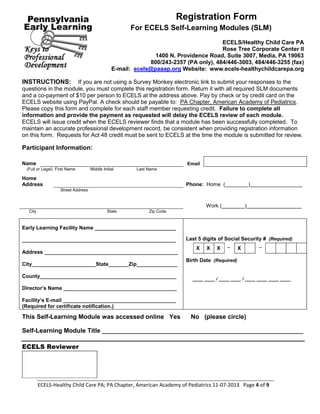
Registration Form
For ECELS Self-Learning Modules (SLM)
ECELS/Healthy Child Care PA
Rose Tree Corporate Center II
1400 N. Providence Road, Suite 3007, Media, PA 19063
800/243-2357 (PA only), 484/446-3003, 484/446-3255 (fax)
E-mail: ecels@paaap.org Website: www.ecels-healthychildcarepa.org
INSTRUCTIONS: If you are not using a Survey Monkey electronic link to submit your responses to the
questions in the module, you must complete this registration form. Return it with all required SLM documents
and a co-payment of $10 per person to ECELS at the address above. Pay by check or by credit card on the
ECELS website using PayPal. A check should be payable to: PA Chapter, American Academy of Pediatrics.
Please copy this form and complete for each staff member requesting credit. Failure to complete all
information and provide the payment as requested will delay the ECELS review of each module.
ECELS will issue credit when the ECELS reviewer finds that a module has been successfully completed. To
maintain an accurate professional development record, be consistent when providing registration information
on this form. Requests for Act 48 credit must be sent to ECELS at the time the module is submitted for review.
Participant Information:
Name Email
(Full or Legal) First Name Middle Initial Last Name
Home
Address Phone: Home (________)__________________
Street Address
Work (________)___________________
City State Zip Code
Early Learning Facility Name ____________________________
_____________________________________________________ Last 5 digits of Social Security # (Required)
Address ______________________________________________
City______________________State_______Zip______________
County_______________________________________________
Director’s Name _______________________________________
Facility’s E-mail _______________________________________
(Required for certificate notification.)
X X X – X –
Birth Date (Required)
____ ____ / ____ ____ / ____ ____ ____ ____
This Self-Learning Module was accessed online Yes No (please circle)
Self-Learning Module Title _______________________________________________________________
ECELS Reviewer
i
ECELS-Healthy Child Care PA; PA Chapter, American Academy of Pediatrics 11-07-2013 Page 5 of 9
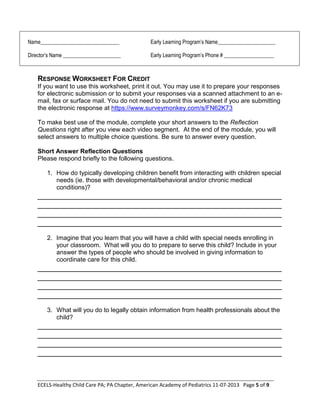
Name______________________________ Early Learning Program’s Name______________________
Director’s Name ______________________ Early Learning Program’s Phone # ___________________
RESPONSE WORKSHEET FOR CREDIT
If you want to use this worksheet, print it out. You may use it to prepare your responses
for electronic submission or to submit your responses via a scanned attachment to an e-
mail, fax or surface mail. You do not need to submit this worksheet if you are submitting
the electronic response at https://www.surveymonkey.com/s/FN62K73
To make best use of the module, complete your short answers to the Reflection
Questions right after you view each video segment. At the end of the module, you will
select answers to multiple choice questions. Be sure to answer every question.
Short Answer Reflection Questions
Please respond briefly to the following questions.
1. How do typically developing children benefit from interacting with children special
needs (ie. those with developmental/behavioral and/or chronic medical
conditions)?
________________________________________________________
________________________________________________________
________________________________________________________
________________________________________________________
2. Imagine that you learn that you will have a child with special needs enrolling in
your classroom. What will you do to prepare to serve this child? Include in your
answer the types of people who should be involved in giving information to
coordinate care for this child.
________________________________________________________
________________________________________________________
________________________________________________________
________________________________________________________
3. What will you do to legally obtain information from health professionals about the
child?
________________________________________________________
________________________________________________________
________________________________________________________
________________________________________________________
ECELS-Healthy Child Care PA; PA Chapter, American Academy of Pediatrics 11-07-2013 Page 6 of 9
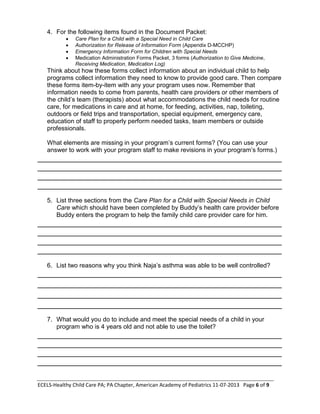
4. For the following items found in the Document Packet:
 Care Plan for a Child with a Special Need in Child Care
 Authorization for Release of Information Form (Appendix D-MCCHP)
 Emergency Information Form for Children with Special Needs
 Medication Administration Forms Packet, 3 forms (Authorization to Give Medicine,
Receiving Medication, Medication Log)
Think about how these forms collect information about an individual child to help
programs collect information they need to know to provide good care. Then compare
these forms item-by-item with any your program uses now. Remember that
information needs to come from parents, health care providers or other members of
the child’s team (therapists) about what accommodations the child needs for routine
care, for medications in care and at home, for feeding, activities, nap, toileting,
outdoors or field trips and transportation, special equipment, emergency care,
education of staff to properly perform needed tasks, team members or outside
professionals.
What elements are missing in your program’s current forms? (You can use your
answer to work with your program staff to make revisions in your program’s forms.)
________________________________________________________
________________________________________________________
________________________________________________________
________________________________________________________
5. List three sections from the Care Plan for a Child with Special Needs in Child
Care which should have been completed by Buddy’s health care provider before
Buddy enters the program to help the family child care provider care for him.
________________________________________________________
________________________________________________________
________________________________________________________
________________________________________________________
6. List two reasons why you think Naja’s asthma was able to be well controlled?
________________________________________________________
________________________________________________________
________________________________________________________
________________________________________________________
7. What would you do to include and meet the special needs of a child in your
program who is 4 years old and not able to use the toilet?
________________________________________________________
________________________________________________________
________________________________________________________
________________________________________________________
ECELS-Healthy Child Care PA; PA Chapter, American Academy of Pediatrics 11-07-2013 Page 7 of 9
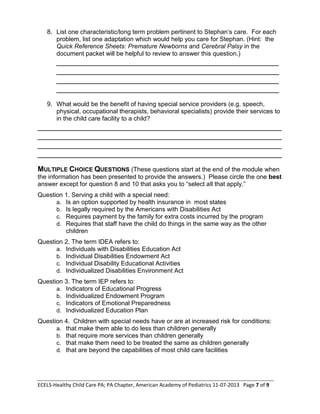
8. List one characteristic/long term problem pertinent to Stephan’s care. For each
problem, list one adaptation which would help you care for Stephan. (Hint: the
Quick Reference Sheets: Premature Newborns and Cerebral Palsy in the
document packet will be helpful to review to answer this question.)
___________________________________________________
___________________________________________________
___________________________________________________
___________________________________________________
9. What would be the benefit of having special service providers (e.g. speech,
physical, occupational therapists, behavioral specialists) provide their services to
in the child care facility to a child?
________________________________________________________
________________________________________________________
________________________________________________________
________________________________________________________
MULTIPLE CHOICE QUESTIONS (These questions start at the end of the module when
the information has been presented to provide the answers.) Please circle the one best
answer except for question 8 and 10 that asks you to “select all that apply.”
Question 1. Serving a child with a special need:
a. Is an option supported by health insurance in most states
b. Is legally required by the Americans with Disabilities Act
c. Requires payment by the family for extra costs incurred by the program
d. Requires that staff have the child do things in the same way as the other
children
Question 2. The term IDEA refers to:
a. Individuals with Disabilities Education Act
b. Individual Disabilities Endowment Act
c. Individual Disability Educational Activities
d. Individualized Disabilities Environment Act
Question 3. The term IEP refers to:
a. Indicators of Educational Progress
b. Individualized Endowment Program
c. Indicators of Emotional Preparedness
d. Individualized Education Plan
Question 4. Children with special needs have or are at increased risk for conditions:
a. that make them able to do less than children generally
b. that require more services than children generally
c. that make them need to be treated the same as children generally
d. that are beyond the capabilities of most child care facilities
ECELS-Healthy Child Care PA; PA Chapter, American Academy of Pediatrics 11-07-2013 Page 8 of 9
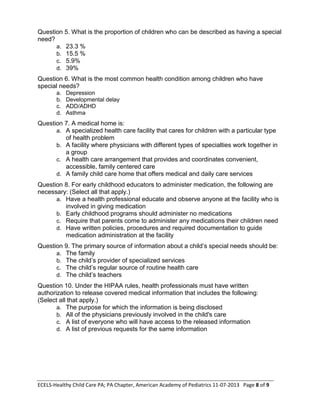
Question 5. What is the proportion of children who can be described as having a special
need?
a. 23.3 %
b. 15.5 %
c. 5.9%
d. 39%
Question 6. What is the most common health condition among children who have
special needs?
a. Depression
b. Developmental delay
c. ADD/ADHD
d. Asthma
Question 7. A medical home is:
a. A specialized health care facility that cares for children with a particular type
of health problem
b. A facility where physicians with different types of specialties work together in
a group
c. A health care arrangement that provides and coordinates convenient,
accessible, family centered care
d. A family child care home that offers medical and daily care services
Question 8. For early childhood educators to administer medication, the following are
necessary: (Select all that apply.)
a. Have a health professional educate and observe anyone at the facility who is
involved in giving medication
b. Early childhood programs should administer no medications
c. Require that parents come to administer any medications their children need
d. Have written policies, procedures and required documentation to guide
medication administration at the facility
Question 9. The primary source of information about a child’s special needs should be:
a. The family
b. The child’s provider of specialized services
c. The child’s regular source of routine health care
d. The child’s teachers
Question 10. Under the HIPAA rules, health professionals must have written
authorization to release covered medical information that includes the following:
(Select all that apply.)
a. The purpose for which the information is being disclosed
b. All of the physicians previously involved in the child's care
c. A list of everyone who will have access to the released information
d. A list of previous requests for the same information
ECELS-Healthy Child Care PA; PA Chapter, American Academy of Pediatrics 11-07-2013 Page 9 of 9
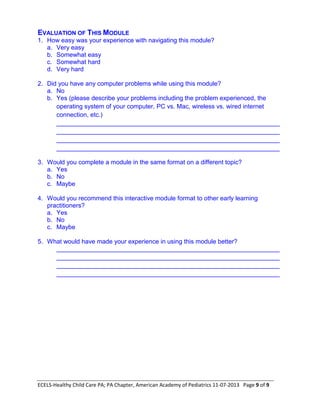
EVALUATION OF THIS MODULE
1. How easy was your experience with navigating this module?
a. Very easy
b. Somewhat easy
c. Somewhat hard
d. Very hard
2. Did you have any computer problems while using this module?
a. No
b. Yes (please describe your problems including the problem experienced, the
operating system of your computer, PC vs. Mac, wireless vs. wired internet
connection, etc.)
________________________________________________________________
________________________________________________________________
________________________________________________________________
________________________________________________________________
3. Would you complete a module in the same format on a different topic?
a. Yes
b. No
c. Maybe
4. Would you recommend this interactive module format to other early learning
practitioners?
a. Yes
b. No
c. Maybe
5. What would have made your experience in using this module better?
________________________________________________________________
________________________________________________________________
________________________________________________________________
________________________________________________________________

11 7-13 csn-doc_pk (3)

  • 1.
    ECELS-Healthy Child CarePA; PA Chapter, American Academy of Pediatrics 11-07-2013 Page 1 of 9 Early Childhood Education Linkage System PA Chapter, American Academy of Pediatrics Rose Tree Corporate Center II, 1400 Providence Road, Suite 3007 Media, PA 19063 Phone: 1-800-243-2357 E-Mail: ECELS@paaap.org www.ecels-healthychildcarepa.org November 2013 Dear Early Learning Practitioner, Thank you for choosing the Self-Learning Module from ECELS called “Caring for Children with Medical and Developmental Special Needs-Inclusive Practices.” This module uses an online format including short video segments. Upon successful completion of this module, we expect you to: 1. Identify strategies for healthful inclusion of children with special needs. 2. Review your program documents for opportunities to update these tools. 3. Offer correct responses to questions using information provided in the module. You need a broad-band Internet connection (cable, DSL or FIOS) to view this module. Sometimes, heavy traffic on the Internet or use of a slow-running computer interferes with smooth viewing of the video segments. Pennsylvania early learning practitioners who have difficulty with their Internet connection may click on "Available to Order" next to the title of the module or "Request Self-Learning Module" in the left pane of the ECELS website to request a copy of the module on disk. You need to use the Document Packet and submit your responses to ECELS for review for credit whether you use the module on line or on disk. Please follow the Instructions for Completion of the Module on the next page. ECELS staff members will review the work you send us and offer advice if you seem to need help to complete the module successfully. If you have questions, please call or e-mail the ECELS office. Submit your responses to the questions in the module:  EITHER submit your responses using the link to an electronic response form at https://www.surveymonkey.com/s/FN62K73  OR fill out the Response Sheet and returning it by a scan attached to an e-mail, by fax or by surface mail. For each person seeking professional development credit for this module, follow the instructions you will frind on the ECELS website Self-Learning Module page where it says “Click Here to Order SLM Reviews.” ECELS staff will enter the names of practitioners who successfully complete the module into the database of the Pennsylvania Early Learning Keys to Professional Development. Then ECELS will inform those whose names have been entered about how to obtain a Certificate of Attendance form the PA Key website. Please print and retain this certificate. Susan S. Aronson, MD, FAAP Nancy Alleman, RN, BSN, CRNP, CSN
  • 2.
    ECELS-Healthy Child CarePA; PA Chapter, American Academy of Pediatrics 11-07-2013 Page 2 of 9 Pediatric Advisor for ECELS Lead Training/Technical Assistance Coordinator INSTRUCTIONS FOR COMPLETION OF THIS SELF- LEARNING MODULE CONTENT OF THE DOWNLOADED DOCUMENT PACKET The document packet is required to complete the module. You should have 12 documents to use while completing this module. 1. Registration Form – This form collects your identifying information and tells you about the address and processing fee to submit this module for credit in the database of the Pennsylvania Early Learning Keys to Professional Development. This form is in this packet. For additional copies of the Registration form, click here. You do not need to submit this form if you are using the Survey Monkey electronic response link. 2. Response Worksheet for Credit – a form to record and submit your responses to questions in the module if you choose to submit by e-mail, fax or surface mail. This form is in this packet. You can use this form as your worksheet, but do not need to submit the form if you are using the Survey Monkey electronic response link. 3. Care Plan for a Child with a Special Need in Child Care To best care for children with special health needs, information should be shared by parents and the child’s primary health care provider (PCP) with those who care for the child. This Care Plan communicates information to early care and education practitioners to help them provide competent care for an individual child. Early care and education practitioners should make sure they understand the information and obtain any training necessary. Not all children with special health needs will require the completion of each section of the Care Plan. What is needed is documentation of any special daily or emergency needs. For some children, early care and education providers will need more information than is collected in the brief responses on the Care Plan. This form is in this packet. For additional copies of this care plan and an explanation for each item on the form, click here. 4. Authorization for Release of Information – a form (from Appendix J-Model Child Care Health Policies, 5th edition available online. Click here for a PDF of the whole set of policies and appendices or buy the hard copy from the American Academy of Pediatrics at www.aap.org/bookstore. This form is signed by the parents/guardian to define what information may be shared and with whom it can be shared. This form is in this packet. 5. Emergency Information Form for Children with Special Needs – a form to give to emergency medical personnel to inform them about the child for proper care. Some children’s medical conditions are unusual or complex. Parents and health care providers want the medical information to accompany the child at all times in case a medical emergency occurs. The form is for emergency service personnel and other health care providers to quickly know about the child’s special needs. This form is in this packet or http://www.healthychildcare.org/pdf/MedAdmin/AR_EmergencyInfo.pdf.
  • 3.
    ECELS-Healthy Child CarePA; PA Chapter, American Academy of Pediatrics 11-07-2013 Page 3 of 9 6. Documents 6, 7, and 8: Medication Administration Forms - a Packet of 3 forms. The American Academy of Pediatrics created these 3 forms for the curriculum, Healthy Futures Medication Administration in Early Education and Child Care Settings. These forms prompt documentation required for safely giving medication to a child in a group care setting whether the staff give medication daily or only in the event of an emergency. The 3 forms are: 6. Authorization to Give Medicine, 7. Receiving Medication, 8. Medication Log. These forms are in this packet. For more copies of these forms, go to: http://www.healthychildcare.org/pdf/MedAdmin/M2_MedAdminPacket.pdf 9. Documents 9, 10, and 11. Quick Reference Sheets from Managing Chronic Health Needs in Child Care and Schools (Premature Newborns, Cerebral Palsy, and Asthma). These three Quick Reference Sheets provide brief summaries of special health conditions. There are many such descriptions provided in the book for conditions that occur in children who may come to a group care setting. These particular three Quick Reference Sheets provide information about conditions discussed in this Self-Learning Module. These sheets are in this packet. The book, from which these sheets came, Managing Chronic Health Needs in Child Care and Schools, is available for purchase at www.aap.org/bookstore. 12.Children with Special Needs- Resources and References –this list provides additional information that users of the Self-Learning Module might want to use. This list document is on the ECELS website in the Resources section as a resource list by topic. If the hyperlink doesn’t work for you, go to the ECELS Home Page; select Resources on the top menu bar, then Resource List by Topic, then scroll down to find this list.
  • 4.
    ECELS-Healthy Child CarePA; PA Chapter, American Academy of Pediatrics 11-07-2013 Page 4 of 9 Registration Form For ECELS Self-Learning Modules (SLM) ECELS/Healthy Child Care PA Rose Tree Corporate Center II 1400 N. Providence Road, Suite 3007, Media, PA 19063 800/243-2357 (PA only), 484/446-3003, 484/446-3255 (fax) E-mail: ecels@paaap.org Website: www.ecels-healthychildcarepa.org INSTRUCTIONS: If you are not using a Survey Monkey electronic link to submit your responses to the questions in the module, you must complete this registration form. Return it with all required SLM documents and a co-payment of $10 per person to ECELS at the address above. Pay by check or by credit card on the ECELS website using PayPal. A check should be payable to: PA Chapter, American Academy of Pediatrics. Please copy this form and complete for each staff member requesting credit. Failure to complete all information and provide the payment as requested will delay the ECELS review of each module. ECELS will issue credit when the ECELS reviewer finds that a module has been successfully completed. To maintain an accurate professional development record, be consistent when providing registration information on this form. Requests for Act 48 credit must be sent to ECELS at the time the module is submitted for review. Participant Information: Name Email (Full or Legal) First Name Middle Initial Last Name Home Address Phone: Home (________)__________________ Street Address Work (________)___________________ City State Zip Code Early Learning Facility Name ____________________________ _____________________________________________________ Last 5 digits of Social Security # (Required) Address ______________________________________________ City______________________State_______Zip______________ County_______________________________________________ Director’s Name _______________________________________ Facility’s E-mail _______________________________________ (Required for certificate notification.) X X X – X – Birth Date (Required) ____ ____ / ____ ____ / ____ ____ ____ ____ This Self-Learning Module was accessed online Yes No (please circle) Self-Learning Module Title _______________________________________________________________ ECELS Reviewer i
  • 5.
    ECELS-Healthy Child CarePA; PA Chapter, American Academy of Pediatrics 11-07-2013 Page 5 of 9 Name______________________________ Early Learning Program’s Name______________________ Director’s Name ______________________ Early Learning Program’s Phone # ___________________ RESPONSE WORKSHEET FOR CREDIT If you want to use this worksheet, print it out. You may use it to prepare your responses for electronic submission or to submit your responses via a scanned attachment to an e- mail, fax or surface mail. You do not need to submit this worksheet if you are submitting the electronic response at https://www.surveymonkey.com/s/FN62K73 To make best use of the module, complete your short answers to the Reflection Questions right after you view each video segment. At the end of the module, you will select answers to multiple choice questions. Be sure to answer every question. Short Answer Reflection Questions Please respond briefly to the following questions. 1. How do typically developing children benefit from interacting with children special needs (ie. those with developmental/behavioral and/or chronic medical conditions)? ________________________________________________________ ________________________________________________________ ________________________________________________________ ________________________________________________________ 2. Imagine that you learn that you will have a child with special needs enrolling in your classroom. What will you do to prepare to serve this child? Include in your answer the types of people who should be involved in giving information to coordinate care for this child. ________________________________________________________ ________________________________________________________ ________________________________________________________ ________________________________________________________ 3. What will you do to legally obtain information from health professionals about the child? ________________________________________________________ ________________________________________________________ ________________________________________________________ ________________________________________________________
  • 6.
    ECELS-Healthy Child CarePA; PA Chapter, American Academy of Pediatrics 11-07-2013 Page 6 of 9 4. For the following items found in the Document Packet:  Care Plan for a Child with a Special Need in Child Care  Authorization for Release of Information Form (Appendix D-MCCHP)  Emergency Information Form for Children with Special Needs  Medication Administration Forms Packet, 3 forms (Authorization to Give Medicine, Receiving Medication, Medication Log) Think about how these forms collect information about an individual child to help programs collect information they need to know to provide good care. Then compare these forms item-by-item with any your program uses now. Remember that information needs to come from parents, health care providers or other members of the child’s team (therapists) about what accommodations the child needs for routine care, for medications in care and at home, for feeding, activities, nap, toileting, outdoors or field trips and transportation, special equipment, emergency care, education of staff to properly perform needed tasks, team members or outside professionals. What elements are missing in your program’s current forms? (You can use your answer to work with your program staff to make revisions in your program’s forms.) ________________________________________________________ ________________________________________________________ ________________________________________________________ ________________________________________________________ 5. List three sections from the Care Plan for a Child with Special Needs in Child Care which should have been completed by Buddy’s health care provider before Buddy enters the program to help the family child care provider care for him. ________________________________________________________ ________________________________________________________ ________________________________________________________ ________________________________________________________ 6. List two reasons why you think Naja’s asthma was able to be well controlled? ________________________________________________________ ________________________________________________________ ________________________________________________________ ________________________________________________________ 7. What would you do to include and meet the special needs of a child in your program who is 4 years old and not able to use the toilet? ________________________________________________________ ________________________________________________________ ________________________________________________________ ________________________________________________________
  • 7.
    ECELS-Healthy Child CarePA; PA Chapter, American Academy of Pediatrics 11-07-2013 Page 7 of 9 8. List one characteristic/long term problem pertinent to Stephan’s care. For each problem, list one adaptation which would help you care for Stephan. (Hint: the Quick Reference Sheets: Premature Newborns and Cerebral Palsy in the document packet will be helpful to review to answer this question.) ___________________________________________________ ___________________________________________________ ___________________________________________________ ___________________________________________________ 9. What would be the benefit of having special service providers (e.g. speech, physical, occupational therapists, behavioral specialists) provide their services to in the child care facility to a child? ________________________________________________________ ________________________________________________________ ________________________________________________________ ________________________________________________________ MULTIPLE CHOICE QUESTIONS (These questions start at the end of the module when the information has been presented to provide the answers.) Please circle the one best answer except for question 8 and 10 that asks you to “select all that apply.” Question 1. Serving a child with a special need: a. Is an option supported by health insurance in most states b. Is legally required by the Americans with Disabilities Act c. Requires payment by the family for extra costs incurred by the program d. Requires that staff have the child do things in the same way as the other children Question 2. The term IDEA refers to: a. Individuals with Disabilities Education Act b. Individual Disabilities Endowment Act c. Individual Disability Educational Activities d. Individualized Disabilities Environment Act Question 3. The term IEP refers to: a. Indicators of Educational Progress b. Individualized Endowment Program c. Indicators of Emotional Preparedness d. Individualized Education Plan Question 4. Children with special needs have or are at increased risk for conditions: a. that make them able to do less than children generally b. that require more services than children generally c. that make them need to be treated the same as children generally d. that are beyond the capabilities of most child care facilities
  • 8.
    ECELS-Healthy Child CarePA; PA Chapter, American Academy of Pediatrics 11-07-2013 Page 8 of 9 Question 5. What is the proportion of children who can be described as having a special need? a. 23.3 % b. 15.5 % c. 5.9% d. 39% Question 6. What is the most common health condition among children who have special needs? a. Depression b. Developmental delay c. ADD/ADHD d. Asthma Question 7. A medical home is: a. A specialized health care facility that cares for children with a particular type of health problem b. A facility where physicians with different types of specialties work together in a group c. A health care arrangement that provides and coordinates convenient, accessible, family centered care d. A family child care home that offers medical and daily care services Question 8. For early childhood educators to administer medication, the following are necessary: (Select all that apply.) a. Have a health professional educate and observe anyone at the facility who is involved in giving medication b. Early childhood programs should administer no medications c. Require that parents come to administer any medications their children need d. Have written policies, procedures and required documentation to guide medication administration at the facility Question 9. The primary source of information about a child’s special needs should be: a. The family b. The child’s provider of specialized services c. The child’s regular source of routine health care d. The child’s teachers Question 10. Under the HIPAA rules, health professionals must have written authorization to release covered medical information that includes the following: (Select all that apply.) a. The purpose for which the information is being disclosed b. All of the physicians previously involved in the child's care c. A list of everyone who will have access to the released information d. A list of previous requests for the same information
  • 9.
    ECELS-Healthy Child CarePA; PA Chapter, American Academy of Pediatrics 11-07-2013 Page 9 of 9 EVALUATION OF THIS MODULE 1. How easy was your experience with navigating this module? a. Very easy b. Somewhat easy c. Somewhat hard d. Very hard 2. Did you have any computer problems while using this module? a. No b. Yes (please describe your problems including the problem experienced, the operating system of your computer, PC vs. Mac, wireless vs. wired internet connection, etc.) ________________________________________________________________ ________________________________________________________________ ________________________________________________________________ ________________________________________________________________ 3. Would you complete a module in the same format on a different topic? a. Yes b. No c. Maybe 4. Would you recommend this interactive module format to other early learning practitioners? a. Yes b. No c. Maybe 5. What would have made your experience in using this module better? ________________________________________________________________ ________________________________________________________________ ________________________________________________________________ ________________________________________________________________